EP1177153B1 - Bulk synthesis of long nanotubes of transition metal chalcogenides - Google Patents
Bulk synthesis of long nanotubes of transition metal chalcogenides Download PDFInfo
- Publication number
- EP1177153B1 EP1177153B1 EP00921021A EP00921021A EP1177153B1 EP 1177153 B1 EP1177153 B1 EP 1177153B1 EP 00921021 A EP00921021 A EP 00921021A EP 00921021 A EP00921021 A EP 00921021A EP 1177153 B1 EP1177153 B1 EP 1177153B1
- Authority
- EP
- European Patent Office
- Prior art keywords
- transition metal
- nanotubes
- gas
- long
- oxide
- Prior art date
- Legal status (The legal status is an assumption and is not a legal conclusion. Google has not performed a legal analysis and makes no representation as to the accuracy of the status listed.)
- Expired - Lifetime
Links
- 239000002071 nanotube Substances 0.000 title claims abstract description 125
- 229910052723 transition metal Inorganic materials 0.000 title claims abstract description 45
- -1 transition metal chalcogenides Chemical class 0.000 title claims abstract description 20
- 230000015572 biosynthetic process Effects 0.000 title claims description 49
- 238000003786 synthesis reaction Methods 0.000 title claims description 34
- 238000000034 method Methods 0.000 claims abstract description 63
- XLYOFNOQVPJJNP-UHFFFAOYSA-N water Chemical compound O XLYOFNOQVPJJNP-UHFFFAOYSA-N 0.000 claims abstract description 48
- 150000003624 transition metals Chemical class 0.000 claims abstract description 25
- 229910052717 sulfur Inorganic materials 0.000 claims abstract description 18
- 229910052711 selenium Inorganic materials 0.000 claims abstract description 14
- 239000007769 metal material Substances 0.000 claims abstract description 9
- 238000004621 scanning probe microscopy Methods 0.000 claims abstract description 6
- 239000000126 substance Substances 0.000 claims abstract description 5
- 229910052714 tellurium Inorganic materials 0.000 claims abstract description 4
- 239000002105 nanoparticle Substances 0.000 claims description 67
- 238000000137 annealing Methods 0.000 claims description 26
- 229910052721 tungsten Inorganic materials 0.000 claims description 25
- 239000000203 mixture Substances 0.000 claims description 24
- 229910003090 WSe2 Inorganic materials 0.000 claims description 16
- 239000012298 atmosphere Substances 0.000 claims description 16
- 238000010438 heat treatment Methods 0.000 claims description 16
- 238000001704 evaporation Methods 0.000 claims description 15
- SPVXKVOXSXTJOY-UHFFFAOYSA-N selane Chemical compound [SeH2] SPVXKVOXSXTJOY-UHFFFAOYSA-N 0.000 claims description 10
- 229910000058 selane Inorganic materials 0.000 claims description 10
- 229910000314 transition metal oxide Inorganic materials 0.000 claims description 10
- 238000010894 electron beam technology Methods 0.000 claims description 9
- OKTJSMMVPCPJKN-UHFFFAOYSA-N Carbon Chemical compound [C] OKTJSMMVPCPJKN-UHFFFAOYSA-N 0.000 claims description 7
- 238000002360 preparation method Methods 0.000 claims description 6
- 229910052799 carbon Inorganic materials 0.000 claims description 4
- 239000011888 foil Substances 0.000 claims description 4
- 239000000853 adhesive Substances 0.000 claims description 3
- 230000001070 adhesive effect Effects 0.000 claims description 3
- 229910052758 niobium Inorganic materials 0.000 claims description 3
- 150000004771 selenides Chemical class 0.000 claims description 3
- 229910052715 tantalum Inorganic materials 0.000 claims description 3
- 229910052719 titanium Inorganic materials 0.000 claims description 3
- 229910052720 vanadium Inorganic materials 0.000 claims description 3
- 239000000956 alloy Substances 0.000 claims description 2
- 229910045601 alloy Inorganic materials 0.000 claims description 2
- 150000004770 chalcogenides Chemical class 0.000 claims description 2
- 229910052735 hafnium Inorganic materials 0.000 claims description 2
- 229910052750 molybdenum Inorganic materials 0.000 claims description 2
- 229910052697 platinum Inorganic materials 0.000 claims description 2
- 229910052702 rhenium Inorganic materials 0.000 claims description 2
- 229910052707 ruthenium Inorganic materials 0.000 claims description 2
- 229910052726 zirconium Inorganic materials 0.000 claims description 2
- 150000004763 sulfides Chemical class 0.000 claims 1
- ITRNXVSDJBHYNJ-UHFFFAOYSA-N tungsten disulfide Chemical compound S=[W]=S ITRNXVSDJBHYNJ-UHFFFAOYSA-N 0.000 description 58
- 239000007789 gas Substances 0.000 description 45
- 239000002245 particle Substances 0.000 description 43
- UFHFLCQGNIYNRP-UHFFFAOYSA-N Hydrogen Chemical compound [H][H] UFHFLCQGNIYNRP-UHFFFAOYSA-N 0.000 description 28
- 229910052739 hydrogen Inorganic materials 0.000 description 27
- 239000001257 hydrogen Substances 0.000 description 27
- 230000008569 process Effects 0.000 description 23
- WFKWXMTUELFFGS-UHFFFAOYSA-N tungsten Chemical compound [W] WFKWXMTUELFFGS-UHFFFAOYSA-N 0.000 description 23
- 239000010937 tungsten Substances 0.000 description 23
- 239000012071 phase Substances 0.000 description 22
- 238000002474 experimental method Methods 0.000 description 20
- 239000002243 precursor Substances 0.000 description 18
- 238000006243 chemical reaction Methods 0.000 description 17
- UCKMPCXJQFINFW-UHFFFAOYSA-N Sulphide Chemical compound [S-2] UCKMPCXJQFINFW-UHFFFAOYSA-N 0.000 description 14
- 229910052751 metal Inorganic materials 0.000 description 14
- 239000002184 metal Substances 0.000 description 14
- 239000000843 powder Substances 0.000 description 14
- 230000009467 reduction Effects 0.000 description 12
- QGLKJKCYBOYXKC-UHFFFAOYSA-N nonaoxidotritungsten Chemical compound O=[W]1(=O)O[W](=O)(=O)O[W](=O)(=O)O1 QGLKJKCYBOYXKC-UHFFFAOYSA-N 0.000 description 10
- 229910001930 tungsten oxide Inorganic materials 0.000 description 10
- 238000001237 Raman spectrum Methods 0.000 description 9
- 238000002003 electron diffraction Methods 0.000 description 9
- 230000008020 evaporation Effects 0.000 description 9
- 239000011669 selenium Substances 0.000 description 8
- QVGXLLKOCUKJST-UHFFFAOYSA-N atomic oxygen Chemical compound [O] QVGXLLKOCUKJST-UHFFFAOYSA-N 0.000 description 7
- 229910052760 oxygen Inorganic materials 0.000 description 7
- 239000001301 oxygen Substances 0.000 description 7
- 238000003917 TEM image Methods 0.000 description 6
- 230000003647 oxidation Effects 0.000 description 6
- 238000007254 oxidation reaction Methods 0.000 description 6
- 230000036961 partial effect Effects 0.000 description 6
- NINIDFKCEFEMDL-UHFFFAOYSA-N Sulfur Chemical group [S] NINIDFKCEFEMDL-UHFFFAOYSA-N 0.000 description 5
- 230000007547 defect Effects 0.000 description 5
- 238000002524 electron diffraction data Methods 0.000 description 5
- 238000005259 measurement Methods 0.000 description 5
- 230000002829 reductive effect Effects 0.000 description 5
- 239000011593 sulfur Substances 0.000 description 5
- 238000001069 Raman spectroscopy Methods 0.000 description 4
- 238000005452 bending Methods 0.000 description 4
- 239000000463 material Substances 0.000 description 4
- 230000007246 mechanism Effects 0.000 description 4
- 229910052961 molybdenite Inorganic materials 0.000 description 4
- CWQXQMHSOZUFJS-UHFFFAOYSA-N molybdenum disulfide Chemical compound S=[Mo]=S CWQXQMHSOZUFJS-UHFFFAOYSA-N 0.000 description 4
- 229910052982 molybdenum disulfide Inorganic materials 0.000 description 4
- 238000002441 X-ray diffraction Methods 0.000 description 3
- 230000005540 biological transmission Effects 0.000 description 3
- RKTYLMNFRDHKIL-UHFFFAOYSA-N copper;5,10,15,20-tetraphenylporphyrin-22,24-diide Chemical class [Cu+2].C1=CC(C(=C2C=CC([N-]2)=C(C=2C=CC=CC=2)C=2C=CC(N=2)=C(C=2C=CC=CC=2)C2=CC=C3[N-]2)C=2C=CC=CC=2)=NC1=C3C1=CC=CC=C1 RKTYLMNFRDHKIL-UHFFFAOYSA-N 0.000 description 3
- 239000013078 crystal Substances 0.000 description 3
- 230000003247 decreasing effect Effects 0.000 description 3
- 238000009792 diffusion process Methods 0.000 description 3
- 238000005538 encapsulation Methods 0.000 description 3
- 230000001965 increasing effect Effects 0.000 description 3
- 230000001939 inductive effect Effects 0.000 description 3
- 229910052698 phosphorus Inorganic materials 0.000 description 3
- 150000003839 salts Chemical class 0.000 description 3
- 238000001228 spectrum Methods 0.000 description 3
- 239000012798 spherical particle Substances 0.000 description 3
- 238000001016 Ostwald ripening Methods 0.000 description 2
- 239000002041 carbon nanotube Substances 0.000 description 2
- 229910021393 carbon nanotube Inorganic materials 0.000 description 2
- 230000008859 change Effects 0.000 description 2
- 150000001875 compounds Chemical class 0.000 description 2
- 238000009833 condensation Methods 0.000 description 2
- 230000005494 condensation Effects 0.000 description 2
- 238000000354 decomposition reaction Methods 0.000 description 2
- 230000004660 morphological change Effects 0.000 description 2
- 238000005086 pumping Methods 0.000 description 2
- 239000000523 sample Substances 0.000 description 2
- 238000001878 scanning electron micrograph Methods 0.000 description 2
- 239000007787 solid Substances 0.000 description 2
- 239000007858 starting material Substances 0.000 description 2
- AZUYLZMQTIKGSC-UHFFFAOYSA-N 1-[6-[4-(5-chloro-6-methyl-1H-indazol-4-yl)-5-methyl-3-(1-methylindazol-5-yl)pyrazol-1-yl]-2-azaspiro[3.3]heptan-2-yl]prop-2-en-1-one Chemical compound ClC=1C(=C2C=NNC2=CC=1C)C=1C(=NN(C=1C)C1CC2(CN(C2)C(C=C)=O)C1)C=1C=C2C=NN(C2=CC=1)C AZUYLZMQTIKGSC-UHFFFAOYSA-N 0.000 description 1
- IJGRMHOSHXDMSA-UHFFFAOYSA-N Atomic nitrogen Chemical compound N#N IJGRMHOSHXDMSA-UHFFFAOYSA-N 0.000 description 1
- 101150071434 BAR1 gene Proteins 0.000 description 1
- 229910021580 Cobalt(II) chloride Inorganic materials 0.000 description 1
- RYGMFSIKBFXOCR-UHFFFAOYSA-N Copper Chemical compound [Cu] RYGMFSIKBFXOCR-UHFFFAOYSA-N 0.000 description 1
- 229910002483 Cu Ka Inorganic materials 0.000 description 1
- MYMOFIZGZYHOMD-UHFFFAOYSA-N Dioxygen Chemical compound O=O MYMOFIZGZYHOMD-UHFFFAOYSA-N 0.000 description 1
- 229910021586 Nickel(II) chloride Inorganic materials 0.000 description 1
- 238000003841 Raman measurement Methods 0.000 description 1
- BUGBHKTXTAQXES-UHFFFAOYSA-N Selenium Chemical compound [Se] BUGBHKTXTAQXES-UHFFFAOYSA-N 0.000 description 1
- HCHKCACWOHOZIP-UHFFFAOYSA-N Zinc Chemical compound [Zn] HCHKCACWOHOZIP-UHFFFAOYSA-N 0.000 description 1
- 238000010521 absorption reaction Methods 0.000 description 1
- 125000004429 atom Chemical group 0.000 description 1
- 244000052616 bacterial pathogen Species 0.000 description 1
- 230000008901 benefit Effects 0.000 description 1
- 239000006227 byproduct Substances 0.000 description 1
- 150000001721 carbon Chemical class 0.000 description 1
- 239000003054 catalyst Substances 0.000 description 1
- 238000012512 characterization method Methods 0.000 description 1
- 239000003638 chemical reducing agent Substances 0.000 description 1
- 239000003795 chemical substances by application Substances 0.000 description 1
- 238000004581 coalescence Methods 0.000 description 1
- 230000000052 comparative effect Effects 0.000 description 1
- 239000002131 composite material Substances 0.000 description 1
- 239000000356 contaminant Substances 0.000 description 1
- 229910052802 copper Inorganic materials 0.000 description 1
- 239000010949 copper Substances 0.000 description 1
- 238000012864 cross contamination Methods 0.000 description 1
- 230000008021 deposition Effects 0.000 description 1
- 229910001873 dinitrogen Inorganic materials 0.000 description 1
- 238000009826 distribution Methods 0.000 description 1
- 238000005566 electron beam evaporation Methods 0.000 description 1
- 238000002389 environmental scanning electron microscopy Methods 0.000 description 1
- 230000005284 excitation Effects 0.000 description 1
- 238000011010 flushing procedure Methods 0.000 description 1
- 229910052733 gallium Inorganic materials 0.000 description 1
- 150000002431 hydrogen Chemical class 0.000 description 1
- 238000003384 imaging method Methods 0.000 description 1
- 229910052738 indium Inorganic materials 0.000 description 1
- 230000003993 interaction Effects 0.000 description 1
- 230000000670 limiting effect Effects 0.000 description 1
- 238000004519 manufacturing process Methods 0.000 description 1
- 230000003446 memory effect Effects 0.000 description 1
- 229910052976 metal sulfide Inorganic materials 0.000 description 1
- 230000000877 morphologic effect Effects 0.000 description 1
- 239000002073 nanorod Substances 0.000 description 1
- QMMRZOWCJAIUJA-UHFFFAOYSA-L nickel dichloride Chemical compound Cl[Ni]Cl QMMRZOWCJAIUJA-UHFFFAOYSA-L 0.000 description 1
- VVRQVWSVLMGPRN-UHFFFAOYSA-N oxotungsten Chemical group [W]=O VVRQVWSVLMGPRN-UHFFFAOYSA-N 0.000 description 1
- 230000037361 pathway Effects 0.000 description 1
- 230000000704 physical effect Effects 0.000 description 1
- 239000000047 product Substances 0.000 description 1
- 230000001737 promoting effect Effects 0.000 description 1
- 230000001681 protective effect Effects 0.000 description 1
- 238000000746 purification Methods 0.000 description 1
- 238000011946 reduction process Methods 0.000 description 1
- 230000001105 regulatory effect Effects 0.000 description 1
- 238000000926 separation method Methods 0.000 description 1
- 239000002109 single walled nanotube Substances 0.000 description 1
- 239000002904 solvent Substances 0.000 description 1
- 238000000859 sublimation Methods 0.000 description 1
- 230000008022 sublimation Effects 0.000 description 1
- 239000000758 substrate Substances 0.000 description 1
- 125000004434 sulfur atom Chemical group 0.000 description 1
- 230000008719 thickening Effects 0.000 description 1
- 229910052718 tin Inorganic materials 0.000 description 1
- GWEVSGVZZGPLCZ-UHFFFAOYSA-N titanium dioxide Inorganic materials O=[Ti]=O GWEVSGVZZGPLCZ-UHFFFAOYSA-N 0.000 description 1
- 230000007704 transition Effects 0.000 description 1
- 150000003657 tungsten Chemical class 0.000 description 1
- ZNOKGRXACCSDPY-UHFFFAOYSA-N tungsten trioxide Chemical compound O=[W](=O)=O ZNOKGRXACCSDPY-UHFFFAOYSA-N 0.000 description 1
- 239000012808 vapor phase Substances 0.000 description 1
Images





Classifications
-
- G—PHYSICS
- G01—MEASURING; TESTING
- G01Q—SCANNING-PROBE TECHNIQUES OR APPARATUS; APPLICATIONS OF SCANNING-PROBE TECHNIQUES, e.g. SCANNING PROBE MICROSCOPY [SPM]
- G01Q70/00—General aspects of SPM probes, their manufacture or their related instrumentation, insofar as they are not specially adapted to a single SPM technique covered by group G01Q60/00
- G01Q70/08—Probe characteristics
- G01Q70/10—Shape or taper
- G01Q70/12—Nanotube tips
-
- C—CHEMISTRY; METALLURGY
- C01—INORGANIC CHEMISTRY
- C01B—NON-METALLIC ELEMENTS; COMPOUNDS THEREOF; METALLOIDS OR COMPOUNDS THEREOF NOT COVERED BY SUBCLASS C01C
- C01B17/00—Sulfur; Compounds thereof
- C01B17/20—Methods for preparing sulfides or polysulfides, in general
-
- C—CHEMISTRY; METALLURGY
- C01—INORGANIC CHEMISTRY
- C01B—NON-METALLIC ELEMENTS; COMPOUNDS THEREOF; METALLOIDS OR COMPOUNDS THEREOF NOT COVERED BY SUBCLASS C01C
- C01B19/00—Selenium; Tellurium; Compounds thereof
- C01B19/02—Elemental selenium or tellurium
-
- C—CHEMISTRY; METALLURGY
- C01—INORGANIC CHEMISTRY
- C01G—COMPOUNDS CONTAINING METALS NOT COVERED BY SUBCLASSES C01D OR C01F
- C01G41/00—Compounds of tungsten
-
- C—CHEMISTRY; METALLURGY
- C01—INORGANIC CHEMISTRY
- C01G—COMPOUNDS CONTAINING METALS NOT COVERED BY SUBCLASSES C01D OR C01F
- C01G41/00—Compounds of tungsten
- C01G41/02—Oxides; Hydroxides
-
- C—CHEMISTRY; METALLURGY
- C30—CRYSTAL GROWTH
- C30B—SINGLE-CRYSTAL GROWTH; UNIDIRECTIONAL SOLIDIFICATION OF EUTECTIC MATERIAL OR UNIDIRECTIONAL DEMIXING OF EUTECTOID MATERIAL; REFINING BY ZONE-MELTING OF MATERIAL; PRODUCTION OF A HOMOGENEOUS POLYCRYSTALLINE MATERIAL WITH DEFINED STRUCTURE; SINGLE CRYSTALS OR HOMOGENEOUS POLYCRYSTALLINE MATERIAL WITH DEFINED STRUCTURE; AFTER-TREATMENT OF SINGLE CRYSTALS OR A HOMOGENEOUS POLYCRYSTALLINE MATERIAL WITH DEFINED STRUCTURE; APPARATUS THEREFOR
- C30B25/00—Single-crystal growth by chemical reaction of reactive gases, e.g. chemical vapour-deposition growth
- C30B25/005—Growth of whiskers or needles
-
- C—CHEMISTRY; METALLURGY
- C30—CRYSTAL GROWTH
- C30B—SINGLE-CRYSTAL GROWTH; UNIDIRECTIONAL SOLIDIFICATION OF EUTECTIC MATERIAL OR UNIDIRECTIONAL DEMIXING OF EUTECTOID MATERIAL; REFINING BY ZONE-MELTING OF MATERIAL; PRODUCTION OF A HOMOGENEOUS POLYCRYSTALLINE MATERIAL WITH DEFINED STRUCTURE; SINGLE CRYSTALS OR HOMOGENEOUS POLYCRYSTALLINE MATERIAL WITH DEFINED STRUCTURE; AFTER-TREATMENT OF SINGLE CRYSTALS OR A HOMOGENEOUS POLYCRYSTALLINE MATERIAL WITH DEFINED STRUCTURE; APPARATUS THEREFOR
- C30B29/00—Single crystals or homogeneous polycrystalline material with defined structure characterised by the material or by their shape
- C30B29/10—Inorganic compounds or compositions
- C30B29/46—Sulfur-, selenium- or tellurium-containing compounds
-
- C—CHEMISTRY; METALLURGY
- C30—CRYSTAL GROWTH
- C30B—SINGLE-CRYSTAL GROWTH; UNIDIRECTIONAL SOLIDIFICATION OF EUTECTIC MATERIAL OR UNIDIRECTIONAL DEMIXING OF EUTECTOID MATERIAL; REFINING BY ZONE-MELTING OF MATERIAL; PRODUCTION OF A HOMOGENEOUS POLYCRYSTALLINE MATERIAL WITH DEFINED STRUCTURE; SINGLE CRYSTALS OR HOMOGENEOUS POLYCRYSTALLINE MATERIAL WITH DEFINED STRUCTURE; AFTER-TREATMENT OF SINGLE CRYSTALS OR A HOMOGENEOUS POLYCRYSTALLINE MATERIAL WITH DEFINED STRUCTURE; APPARATUS THEREFOR
- C30B29/00—Single crystals or homogeneous polycrystalline material with defined structure characterised by the material or by their shape
- C30B29/60—Single crystals or homogeneous polycrystalline material with defined structure characterised by the material or by their shape characterised by shape
- C30B29/605—Products containing multiple oriented crystallites, e.g. columnar crystallites
-
- C—CHEMISTRY; METALLURGY
- C01—INORGANIC CHEMISTRY
- C01P—INDEXING SCHEME RELATING TO STRUCTURAL AND PHYSICAL ASPECTS OF SOLID INORGANIC COMPOUNDS
- C01P2002/00—Crystal-structural characteristics
- C01P2002/70—Crystal-structural characteristics defined by measured X-ray, neutron or electron diffraction data
- C01P2002/72—Crystal-structural characteristics defined by measured X-ray, neutron or electron diffraction data by d-values or two theta-values, e.g. as X-ray diagram
-
- C—CHEMISTRY; METALLURGY
- C01—INORGANIC CHEMISTRY
- C01P—INDEXING SCHEME RELATING TO STRUCTURAL AND PHYSICAL ASPECTS OF SOLID INORGANIC COMPOUNDS
- C01P2002/00—Crystal-structural characteristics
- C01P2002/70—Crystal-structural characteristics defined by measured X-ray, neutron or electron diffraction data
- C01P2002/74—Crystal-structural characteristics defined by measured X-ray, neutron or electron diffraction data by peak-intensities or a ratio thereof only
-
- C—CHEMISTRY; METALLURGY
- C01—INORGANIC CHEMISTRY
- C01P—INDEXING SCHEME RELATING TO STRUCTURAL AND PHYSICAL ASPECTS OF SOLID INORGANIC COMPOUNDS
- C01P2002/00—Crystal-structural characteristics
- C01P2002/80—Crystal-structural characteristics defined by measured data other than those specified in group C01P2002/70
- C01P2002/82—Crystal-structural characteristics defined by measured data other than those specified in group C01P2002/70 by IR- or Raman-data
-
- C—CHEMISTRY; METALLURGY
- C01—INORGANIC CHEMISTRY
- C01P—INDEXING SCHEME RELATING TO STRUCTURAL AND PHYSICAL ASPECTS OF SOLID INORGANIC COMPOUNDS
- C01P2004/00—Particle morphology
- C01P2004/01—Particle morphology depicted by an image
- C01P2004/03—Particle morphology depicted by an image obtained by SEM
-
- C—CHEMISTRY; METALLURGY
- C01—INORGANIC CHEMISTRY
- C01P—INDEXING SCHEME RELATING TO STRUCTURAL AND PHYSICAL ASPECTS OF SOLID INORGANIC COMPOUNDS
- C01P2004/00—Particle morphology
- C01P2004/01—Particle morphology depicted by an image
- C01P2004/04—Particle morphology depicted by an image obtained by TEM, STEM, STM or AFM
-
- C—CHEMISTRY; METALLURGY
- C01—INORGANIC CHEMISTRY
- C01P—INDEXING SCHEME RELATING TO STRUCTURAL AND PHYSICAL ASPECTS OF SOLID INORGANIC COMPOUNDS
- C01P2004/00—Particle morphology
- C01P2004/10—Particle morphology extending in one dimension, e.g. needle-like
- C01P2004/13—Nanotubes
-
- C—CHEMISTRY; METALLURGY
- C01—INORGANIC CHEMISTRY
- C01P—INDEXING SCHEME RELATING TO STRUCTURAL AND PHYSICAL ASPECTS OF SOLID INORGANIC COMPOUNDS
- C01P2004/00—Particle morphology
- C01P2004/60—Particles characterised by their size
- C01P2004/62—Submicrometer sized, i.e. from 0.1-1 micrometer
-
- C—CHEMISTRY; METALLURGY
- C01—INORGANIC CHEMISTRY
- C01P—INDEXING SCHEME RELATING TO STRUCTURAL AND PHYSICAL ASPECTS OF SOLID INORGANIC COMPOUNDS
- C01P2004/00—Particle morphology
- C01P2004/60—Particles characterised by their size
- C01P2004/64—Nanometer sized, i.e. from 1-100 nanometer
-
- C—CHEMISTRY; METALLURGY
- C01—INORGANIC CHEMISTRY
- C01P—INDEXING SCHEME RELATING TO STRUCTURAL AND PHYSICAL ASPECTS OF SOLID INORGANIC COMPOUNDS
- C01P2006/00—Physical properties of inorganic compounds
- C01P2006/10—Solid density
-
- C—CHEMISTRY; METALLURGY
- C01—INORGANIC CHEMISTRY
- C01P—INDEXING SCHEME RELATING TO STRUCTURAL AND PHYSICAL ASPECTS OF SOLID INORGANIC COMPOUNDS
- C01P2006/00—Physical properties of inorganic compounds
- C01P2006/60—Optical properties, e.g. expressed in CIELAB-values
-
- Y—GENERAL TAGGING OF NEW TECHNOLOGICAL DEVELOPMENTS; GENERAL TAGGING OF CROSS-SECTIONAL TECHNOLOGIES SPANNING OVER SEVERAL SECTIONS OF THE IPC; TECHNICAL SUBJECTS COVERED BY FORMER USPC CROSS-REFERENCE ART COLLECTIONS [XRACs] AND DIGESTS
- Y10—TECHNICAL SUBJECTS COVERED BY FORMER USPC
- Y10S—TECHNICAL SUBJECTS COVERED BY FORMER USPC CROSS-REFERENCE ART COLLECTIONS [XRACs] AND DIGESTS
- Y10S977/00—Nanotechnology
- Y10S977/84—Manufacture, treatment, or detection of nanostructure
- Y10S977/842—Manufacture, treatment, or detection of nanostructure for carbon nanotubes or fullerenes
- Y10S977/844—Growth by vaporization or dissociation of carbon source using a high-energy heat source, e.g. electric arc, laser, plasma, e-beam
Definitions
- the present invention relates to methods for the bulk synthesis of long nanotubes of transition metal chalcogenides and to methods for preparation of tips for scanning probe microscopy from said long nanotubes.
- the nanotubes were relatively rare and constituted even a smaller fraction of the total composition. Besides this statistical fact, the reproducibility of the nanotubes growth was rather poor. Consequently, a lot of effort has been recently devoted to the study of nanotubes from new other related materials.
- WO 98/23796 describes a method for the preparation of nanoparticles or nanowhiskers of a metal II-doped metal I oxide, wherein said metal I is selected from In, Ga, Sn and a transition metal and said metal II is any metal, which method comprises:
- a foil of the transition metal is heated in poor vacuum conditions (e.g. 133 Pa (1 Torr)) or nanoparticles of the transition metal oxide as large as 0.3 microns of step (a) as described below are further elongated, to obtain transition metal oxide whiskers/nanoparticles as long as 10-20 microns or more, which are then annealed with the H 2 X gas or with H 2 gas and X vapor.
- poor vacuum conditions e.g. 133 Pa (1 Torr)
- nanoparticles of the transition metal oxide as large as 0.3 microns of step (a) as described below are further elongated, to obtain transition metal oxide whiskers/nanoparticles as long as 10-20 microns or more, which are then annealed with the H 2 X gas or with H 2 gas and X vapor.
- the invention relates to a method for bulk synthesis of long nanotubes of a transition metal chalcogenide from a transition metal material, water vapor and H 2 X gas or with H 2 gas and X vapor, wherein X is S, Se or Te, said method comprising:
- the elongation of the transition metal oxide nanoparticles in step (b) is carried out by any known and suitable method by heating the oxide under mild reducing conditions for a few minutes such as for 5-30, preferably, 10 minutes, or by electron beam irradiation of the oxide in high vacuum conditions.
- the annealing step is carried out by alternating the annealing atmosphere, for example, by alternating H 2 S and H 2 Se gas or by alternating the S and Se vapors in the presence of H 2 .
- the nanotubes obtained by the methods of the invention are perfect in shape and of high cristallinity and may be 0.3-20 micron long or more.
- the nanotubes of the invention shorter than 0.5 microns are sometimes herein in the specification referred to as "short" nanotubes to distinguish them from the longer nanotubes.
- the metal material may be the transition metal itself, a mixture of or an alloy of two or more transition metals, a substance comprising a transition metal, e.g. an oxide, and a mixture of substances comprising two or more transition metals.
- transition metals include, but are not limited to, Mo, W, V, Zr, Hf, Pt, Re, Nb, Ta, Ti, and Ru.
- the electron beam evaporation embodiment is more suitable for refractory transition metals, e.g. Nb, V, Ta, Ti.
- a two-step method for bulk synthesis of long nanotubes of WS 2 and/or WSe 2 comprises:
- Longer WS 2 and WSe 2 nanotubes can be obtained when in step (a) a W foil is heated in poor vacuum conditions, e.g. of 133 Pa (1 Torr), and the long tungsten oxide whiskers obtained are then annealed sulfidized or selenized.
- poor vacuum conditions e.g. of 133 Pa (1 Torr)
- the invention relates to a three-step method for bulk synthesis of long nanotubes of WS 2 and/or WSe 2 which comprises:
- the mild reducing conditions for elongation of the oxide nanoparticles in step (b) of the three-step method include, for example, heating the oxide nanoparticles under the flow of H 2 (0.05-1.0 %) / N 2 (99.95 - 99 %)-110 ml l min gas stream for up to 10 minutes. Under these conditions, elongation of the oxide nanoparticles is achieved. With higher amounts of H 2 , e.g. above 5% H 2 , no elongation is obtained.
- the mild reducing atmosphere for annealing the oxide nanoparticles includes, for example, sulfidization or selenization under the flow of H 2 (1%)/N 2 (99%) - 110 ml/min and H 2 S - 1 ml/min. If the flow of H 2 S is lower than 1 ml/min, then longer transition metal chalcogenide nanotubes are obtained.
- the invention further relates to long transition metal chalcogenide nanotubes as long as 20 microns or more obtained by a method of the invention.
- said transition metal chalcogenide is WS 2 and/or WSe 2 .
- the invention additionally relates to tips for scanning probe microscopy (both STM and FTM) and methods for preparation of such tips from the long transition metal chalcogenide nanotubes obtained by the methods of the invention, comprising:
- the synthesis of a pure phase of very long and hollow WS 2 nanotubes from short but asymmetric oxide nanoparticles was achieved.
- the oxide nanoparticle grows along its longest axis; and subsequently its outermost layer is being sulfidized, while the growing oxide tip remains uncoated as long as the nanowhisker continues to grow.
- a superlattice of ⁇ 001 ⁇ R crystal shear is formed in the oxide core, and the diffusion controlled sulfidization of the oxide core is completed within 60-120 min.
- WS 2 nanotubes The synthesis of WS 2 nanotubes involves two steps, each one carried-out in a separate reactor: first, W is heated in the presence of water vapor in a vacuum apparatus or W or WO 3 is electron beam evaporated in the presence of water vapor, at a pressure of 0.13-2.67 kPa (1-20 Torr), and then the thus obtained WO 3 nanoparticles as large as 0.3 microns are then reacted with H 2 S gas under mild reducing conditions.
- a three-step method is carried out in which an intermediate step is added for the elongation of the WO 3 nanoparticles as large as 0.3 microns before they are reacted with H 2 S gas under mild reducing conditions.
- a great advantage of the process of the present invention is the absence of almost any contaminant or byproduct It is also remarkable that no catalyst, which must be separated and dislodged from the nanotube mat at the end of the growth, is necessary in the current process. Therefore, tedious purification steps to isolate the nanotubes, which are time consuming and expensive, are not required once the process is completed.
- transition metal chalcogenide nanotubes of the invention can be used for the preparation of tips for scanning probe microscopy by methods well-known in the art such as the procedure of Dai et al., 1996. Using these tips, images of high aspect ratio replica and evaporated Ti films with sharp asperities became feasible, which could not be achieved with commercially available sharp Si tips.
- a powder consisting of asymmetric oxide nanoparticles of ca. 10-30 nm in diameter and a length of 40-300 nm is produced in a high vacuum evaporator.
- water vapor from an external reservoir is introduced through a needle valve, while pumping with a rotary vane pump so that the pressure can be regulated to any desired value up to the vapor pressure of water at room temperature, ca. 20 Torr.
- a tungsten filament is heated to 1600 ⁇ 20°C. The water molecules react with the hot tungsten filament and produce (WO 3 ) n clusters which condense on the walls of the bell jar or, alternatively, onto a water-cooled copper surface.
- crystalline oxide nanoparticles with an asymmetric shape are produced.
- Lower vapor pressures ( ⁇ 5 Torr) yield amorphous nanoparticles of a non-defined (spaghetti-like) or spherical shape.
- the powder color varies with the water vapor pressure and is an excellent indicator for the deviation from stoichiometric yellow-green WO 3 phase.
- the tungsten oxide powder of Example 1a was collected and 50 mg thereof were transferred to another reactor, in which sulfidization under controlled temperature (835-840°C), and N 2 /H 2 +H 2 S gas flow takes place.
- Fig. 1a When the precursor oxide consisted of nanoparticles 100-300 nm in length (Fig. 1a), nanotubes as long as 10 microns were obtained.
- Fig. 2 shows typical scanning electron microscope (SEM) images of this phase at two different magnifications, showing a mat of nanotubes consiting of 6 sulfide layers with an oxide core.
- SEM scanning electron microscope
- TEM micrograph of the apex of a long and hollow WS 2 nanotube, obtained by this method, is shown in the inset of Fig. 2 A. While the cross section of the nanotubes is quite similar to that of the precursor nanoparticles, their length increases by a factor of 20-40 during the sulfidization step. Note, however, that about 10% of the nanotubes, have an enlarged cross-section diameter of app. 100 nm.
- stage II app. 5 mg of the amorphous spaghetti-like oxide nanoparticles, were heated to 835-840°C under the flow of H 2 (1%)/N 2 (99%)-110 ml/min gas stream for 10 min.
- This process yielded a mat of oxide nanowhiskers, typically 10 ⁇ m long and 20-50 nm thick. About 80% of the oxide nanowhiskers, obtained in this way, were thin (ca. 30 nm) and cylindrical in shape. The rest did not have a circular but rather a rectangular cross section (ca. 10 ⁇ 100 nm). Furthermore, they were completely crystalline and the prevailing oxide phase was identified by ED as WO 2.9 .
- CS crystal shear
- stage III the elongated oxide nanowhiskers of 1c above were heated at 835-840°C under the flow of a gas mixture consisting of H 2 S (2 ml/min) and N 2 (110 ml/min) for 120 min yielding about 4 mg of WS 2 nanotubes with characteristics very similar to the one presented in Fig. 2. Nonetheless, a substantial fraction (ca. 20%) of the material, obtained in this way, formed non-perfectly closed nanotubes. Selenization of the same oxide nanowhiskers lead to the formation of very long WSe 2 nanotubes, and mixed WS 2 /WSe 2 nanotubes were also prepared by alternating the annealing atmosphere with H 2 S and H 2 Se.
- Curve B shows a spectrum of the 3-10 ⁇ m long oxide nanowhiskers (prepared in stage II), which have partially ordered shear structure ⁇ 001 ⁇ R.
- the Raman spectrum of WO 2 which was not reported hitherto, is shown in curve C.
- the Raman spectrum of the WS 2 nanotubes (prepared in stage III) coincides with that of crystalline 2H-WS 2 (curve D) (Frey et al., 1998).
- the present Raman measurements strongly indicate the formation of partially ordered CS planes in the reduced oxide nanowhiskers (stage II). This superstructure is likely to be an important intermediate stage in the formation of WS 2 nanotubes.
- Tungsten suboxide particles were produced by heating a tungsten filament (model ME11 from the R. D. Mathis company) in the presence of water vapor inside a vacuum chamber, by the following procedure: once the vacuum in the bell-jar had reached a value of 0.013 Pa (10 -4 Torr), the filament was heated for a few minutes in order to remove the superficial oxide layer. Water vapor was then allowed to diffuse into the vacuum chamber through an inlet, until the desired pressure was reached. The filament was heated to around 1600 ⁇ 20°C, while the pressure in the chamber was maintained constant during the evaporation process (a few Torr). After a few minutes of evaporation, a blue powder condensed on the bell-jar walls. The accrued powder consisted of needle-like WO 3-x particles (ca. 50 nm in length and 15 nm in diameter) under a specific water vapor pressure.
- NiCl 2 or CoCl 2 (2x10 -3 M) salts were dissolved in the water reservoir before each evaporation.
- the nanoparticles produced in the presence of the transition-metal salt appeared to be more crystalline than those obtained without the addition of a salt, as shown by ED (electron diffraction).
- the synthesis of the WS 2 nanotubes starting from the needle-like WO 3-x particles was done in a reactor similar to the one used for the synthesis of IF- WS 2 particles (Feldman et a., 1996, 1998).
- the principle of the synthesis is based on a solid-gas reaction, where a small quantity (5 mg) of WO 3-x particles (solid) is heated to 840°C under the flow of H 2 /N 2 (forming gas) + H 2 S gas mixture.
- flushing of the reactor (10 min) with N 2 gas flow was performed after each synthesis.
- Samples were studied using a scanning electron microscope (SEM) (Philips XL30-ESEM FEG), a transmission electron microscope (TEM) (Philips CM 120 (120 keV)) and X-ray diffraction (XRD) (Rigaku Rotaflex RU-200B) having Cu-Ka anode.
- SEM scanning electron microscope
- TEM transmission electron microscope
- XRD X-ray diffraction
- HRTEM high resolution transmission electron microscope
- Ring patterns from TiCl were used as a calibration reference standard for the ED patterns.
- the accuracy of the d-spacings was estimated at ⁇ 0.005 nm.
- the water vapor pressure in the chamber apparently influences the morphology and the stoichiometry of the nanoparticles obtained by evaporation.
- P H2O 5 Torr
- the oxide nanoparticles did not have a well-defined morphology (Fig. 4a).
- the ED pattern confirms that the powder is completely amorphous (not shown).
- P H2O 12 Torr
- the nanoparticles presented a cylindrical shape and were crystalline.
- a typical batch is shown in Fig. 4b, where the dimensions of the whiskers are typically around 50 run in length and 15 nm in diameter.
- the stoichiometry of the particles could not be easily assigned by XRD for several reasons.
- several nonstoichiometric tungsten oxide phases have been reported in the literature and all of them exhibit very similar patterns. Consequently, assigning the stoichiometry of the concerned phase accurately from the XRD data, was rather difficult.
- the measurement by electron diffraction of a bundle of individual needle-like crystals was more informative in this case.
- Both sets of whiskers can be interpreted as having an average substructure similar to that of the reported tetragonal phase W 20 O 58 (WO 2.9 ) originally described by Glemser et al. (1964) and the results are shown in Table 1.
- the needles can be described according to a substructure of WO 3 interspersed with defects attributable to random crystallographic shear planes occurring either parallel to the needle axis or, alternatively, at some angle to the beam direction as the needles are viewed in the HRTEM. Further evidence of the randomness of the defects occurring in the needles is given by the prominent diffuse streaking that is often observed in ED patterns obtained from these needles (Sloan et al., 1999). It is noteworthy to underline that, whatever the pressure inside the chamber, the batches appeared to be homogeneous in their morphology, providing needle-like particles of relatively constant oxide stoichiometry for a given preparation.
- oxidation of the tungsten filament could be performed either with water vapor according to equation 1 below or with pure oxygen according to equation 2, both reactions being exothermic in the conditions of the present measurements (temperature of the filament: 1600 ⁇ 20 °C, and pressure in the chamber maintained at 12 Torr).
- the free energies of the reactions were calculated using the data described in Horsley et al., 1987, for STP (standard) conditions.
- the resultant particles were 100 % spherical or faceted, typically 5 to 30 nm in diameter.
- the color of the powder was light blue, which can be ascribed to a slight reduction of the powder by traces of water still present in the vacuum chamber.
- the oxygen pressure was decreased, light blue phases of spherical or faceted nanoparticles were observed as well.
- H 2 is a resultant product of both reactions. It is therefore believed that hydrogen is involved in the production of needle-like particles as opposed to the spherical ones, which are obtained in the absence of hydrogen in the chamber.
- the second point to underline is the influence of the gas flow-rate (F) on the morphology of the particles, which is equivalent to a change in the pressure, (especially the partial pressure of hydrogen).
- F gas flow-rate
- a low flow-rate 55 cm 3 3min -1
- a higher one ⁇ 110 cm 3 min -1
- the trend is the same whatever the starting tungsten suboxide precursor.
- VLS vapor-liquid-solid
- the main process of the WS 2 nanotubes synthesis consists of sulfidizing the tungsten suboxide powder in a gas mixture which is composed of H 2 /N 2 and H 2 S, where H 2 plays the role of the reducer and H 2 S is the sulfidizing agent according to equation 5 (stage III): WO 3-x + (1-x) H 2 + 2 H 2 S ⁇ WS 2 + (3-x) H 2 O [5]
- the two-step method may be more difficult to control, but it gives very satisfactory results.
- the three-step method of the invention lends itself to the synthesis of nanotubes from related compounds, such as WSe 2 or mixed WS 2 /WSe 2 using preprepared long oxide nanowhiskers as a precursor.
- WSe 2 nanotubes were prepared by heating selenium ingot at 350 °C downstream of the main reactor, which was heated to 760 °C. Forming gas (1% H 2 /99%N 2 -110 cm 3 min -1 ) was provided in this case. The resulting WSe 2 nanotubes were quite perfect in shape.
- Fig. 8A the asymmetric tungsten oxide nanoparticle reacts with H 2 S and forms a protective tungsten disulfide monomolecular layer, prohibiting coalescence of this nanoparticle with neighboring oxide nanoparticles.
- the elongation of the oxide nanowhiskers requires a reservoir of (WO 3 ) n clusters in the vapor phase.
- the vaporized oxide clusters react only very slowly with the H 2 and H 2 S gases, which would otherwise hamper the rapid growth of the oxide nanowhisker.
- the termination of the nanowhisker growth occurs when the source of tungsten oxide is depleted and the vapor pressure of the oxide clusters diminishes below a critical value. In this case the simultaneous reaction of tip growth/reduction and sulfidization cannot be maintained and the outer sulfide layer of the encapsulate completely enfolds the oxide tip.
- Example 4 WS 2 nanotubes as tips for scanning probe microscopy
- WS 2 nanotubes were attached to microfabricated tips of an atomic force microscope (AFM) by transferring adhesive from carbon tape to a Si tip, then pulling off nanotube bundles with this tip from a mat of nanotubes prepared on a different area of the tape (Dai et al., 1996). A portion of this mat was glued to the Si tip, of which the longest nanotube served now as the new tip. Scans on a Ti tip calibrator (Westra et al.,1995) and subsequent blind reconstruction (using algorithm developed by A. Efimov, obtainable at http://www.siliconmdt.com) of tip shape gave tip width of 16 nm for the last 100 nm of the tip length.
- AFM atomic force microscope
- the nanotube tips perform significantly better than microfabricated sharp Si tips. While the WS 2 nanotube tip follows the contour of even the finest replica and reaches its bottom, the commercial Si tip is unable to delineate the replica correctly due to its slanted edge. Also, the Si tip is unable to follow the sample contour very smoothly (see for example Fig. 9C), because the surface of this tip is not passivated and therefore strong interaction with the substrate at close proximity is unavoidable. Thinner or single walled nanotubes may not be useful for such applications because of their small spring constant toward bending.
- the WS 2 nanotubes are probably stiffer than their carbon analogs.
- the present nanotubes can be easily sensitized by visible and infra-red light and therefore show promise as a selective probe for nanophotolithography.
Landscapes
- Chemical & Material Sciences (AREA)
- Organic Chemistry (AREA)
- Inorganic Chemistry (AREA)
- Engineering & Computer Science (AREA)
- Metallurgy (AREA)
- Materials Engineering (AREA)
- Crystallography & Structural Chemistry (AREA)
- Health & Medical Sciences (AREA)
- Radiology & Medical Imaging (AREA)
- Nuclear Medicine, Radiotherapy & Molecular Imaging (AREA)
- General Physics & Mathematics (AREA)
- General Health & Medical Sciences (AREA)
- Physics & Mathematics (AREA)
- Nanotechnology (AREA)
- Chemical Kinetics & Catalysis (AREA)
- General Chemical & Material Sciences (AREA)
- Carbon And Carbon Compounds (AREA)
- Crystals, And After-Treatments Of Crystals (AREA)
- Inorganic Compounds Of Heavy Metals (AREA)
Abstract
Description
- The present invention relates to methods for the bulk synthesis of long nanotubes of transition metal chalcogenides and to methods for preparation of tips for scanning probe microscopy from said long nanotubes.
- The discovery of carbon nanotubes in 1991 (Iijima, 1991) has generated intense experimental and theoretical interest over the last few years because of their unusual geometry and physical properties. Besides the original carbon structure, similar inorganic structures have also emerged: BN (Chopra et al., 1995), V2O5 (Ajayan et al., 1995), MoS2 (Feldman et al., 1995; Remskar et al., 1998 and 1999a; Zelensky et al., 1998); and WS2 (Tenne et al., 1992; Remskar et al., 1998, 1999a and 1999b). The reason for such an analogy between the pure carbon and inorganic structures is based on the fact that they all stem from lamellar (2D) compounds.
- The case of the layered transition-metal dichalcogenides (WS2 and MoS2) was the first example of such an analogy. Indeed, in 1992, IF (inorganic fullerene-like) structures and nanotubes of WS2 were reported by the laboratory of the present inventors (
Tenne et al., 1992; EP 0580019 ;US 5,958,358 ), followed shortly by similar results on MoS2 (Margulis et al., 1993) and the respective selenides (Hershfinkel et al., 1994). However, it is noteworthy to underline that the samples contained minute amounts of IF particles. Instead, most of the samples consisted of WS2 platelets (2H-WS2). The nanotubes were relatively rare and constituted even a smaller fraction of the total composition. Besides this statistical fact, the reproducibility of the nanotubes growth was rather poor. Consequently, a lot of effort has been recently devoted to the study of nanotubes from new other related materials. -
WO 98/23796 - (i) heating a metal I material with water in a vacuum apparatus at a base pressure of 133.10-3 to 133.10-5 Pa (10-3 to 10-5) Torr) or electron beam evaporating a metal I material with water or with an oxygen-containing volatile solvent in a vacuum apparatus at a base pressure of 133.10-5 to 133.10-6 Pa (10-5 to 10-6 Torr), in the presence of a metal II salt;, and
- (ii) recovering the metal II-doped metal I oxide powder from the walls of the vacuum apparatus.
- None of the methods described recently for the synthesis of WS2 and MoS2 nanotubes mentioned above permit synthesis of bulk quantities of a single phase of inorganic nanotubes and mostly perfect inorganic nanotubes to be obtained.
- It is an object of the present invention to provide methods for the bulk synthesis of inorganic nanotubes, particularly of long nanotubes of transition metal chalcogenides.
- In alternative routes, in order to obtain larger nanotubes, either a foil of the transition metal is heated in poor vacuum conditions (e.g. 133 Pa (1 Torr)) or nanoparticles of the transition metal oxide as large as 0.3 microns of step (a) as described below are further elongated, to obtain transition metal oxide whiskers/nanoparticles as long as 10-20 microns or more, which are then annealed with the H2X gas or with H2 gas and X vapor.
- Thus, the invention relates to a method for bulk synthesis of long nanotubes of a transition metal chalcogenide from a transition metal material, water vapor and H2X gas or with H2 gas and X vapor, wherein X is S, Se or Te, said method comprising:
- carrying out
- a) either heating a transition metal material in the presence of water vapor in a vacuum apparatus or electron beam evaporating a transition metal material in the presence of water vapor, at a suitable pressure, to obtain nanoparticles of the transition metal oxide as large as 0.3 microns, and
- b) elongating the transition metal oxide nanoparticles as large as 0.3 microns of step (a) to obtain nanoparticles as long as 20 microns or more; or
- c) heating a foil of the transition metall in poor vacuum conditions; and
- 2) annealing the elongated transition metal oxide nanoparticles obtained in step (b) or (c) in a mild reducing atmosphere with a H2X gas or with H2 gas and X vapor, wherein X is S, Se or Te, at a suitable temperature, in order to obtain long nanotubes of the transition metal chalcogenide, said tubes being as long as 0.3-20 µm or more.
- The elongation of the transition metal oxide nanoparticles in step (b) is carried out by any known and suitable method by heating the oxide under mild reducing conditions for a few minutes such as for 5-30, preferably, 10 minutes, or by electron beam irradiation of the oxide in high vacuum conditions.
- When a mixture of nanotubes of two different metal chalcogenides is desired, for example metal sulfide and metal selenide, the annealing step is carried out by alternating the annealing atmosphere, for example, by alternating H2S and H2Se gas or by alternating the S and Se vapors in the presence of H2.
- The nanotubes obtained by the methods of the invention are perfect in shape and of high cristallinity and may be 0.3-20 micron long or more. For the sake of convenience, the nanotubes of the invention shorter than 0.5 microns are sometimes herein in the specification referred to as "short" nanotubes to distinguish them from the longer nanotubes.
- The metal material may be the transition metal itself, a mixture of or an alloy of two or more transition metals, a substance comprising a transition metal, e.g. an oxide, and a mixture of substances comprising two or more transition metals. Examples of transition metals include, but are not limited to, Mo, W, V, Zr, Hf, Pt, Re, Nb, Ta, Ti, and Ru. The electron beam evaporation embodiment is more suitable for refractory transition metals, e.g. Nb, V, Ta, Ti.
- A two-step method for bulk synthesis of long nanotubes of WS2 and/or WSe2 comprises:
- a) either heating W in the presence of water vapor in a vacuum apparatus, or electron beam evaporating W or WO3 in the presence of water vapor, at a pressure of 0.13-2.67, preferably 1.06-2.40, kPa (1-20, preferably 8-12, Torr), thus obtaining WO3 nanoparticles as large as 0.3 microns; and
- b) annealing the WO3 nanoparticles obtained in step (a) in a mild reducing atmosphere with H2S or H2Se gas or with H2 and S or Se vapor, or by alternating the annealing atmosphere with H2S and H2Se or with H2 and S or Se vapor, at 800-850°C, preferably at 835-840°C, thus obtaining relatively long and hollow WS2 and/or WSe2 nanotubes as long as 10 microns or more.
- Longer WS2 and WSe2 nanotubes can be obtained when in step (a) a W foil is heated in poor vacuum conditions, e.g. of 133 Pa (1 Torr), and the long tungsten oxide whiskers obtained are then annealed sulfidized or selenized.
- In another preferred embodiment, the invention relates to a three-step method for bulk synthesis of long nanotubes of WS2 and/or WSe2 which comprises:
- 1) a) either heating W in the presence of water vapor in a vacuum apparatus or electron beam evaporating W or WO3 in the presence of water vapor, at a pressure of 0.13-2.67, preferably 1.06-2.40, kPa (1-20, preferably 8-12, Torr), thus obtaining WO3 nanoparticles as large as 0.3 microns;
b) heating the WO3 nanoparticles as long as 0.3 microns under mild reducing conditions at 800-850°C, preferably at 835-840°C, for about 10 minutes to obtain WO3 nanowhiskers as long as 10 microns; and - 2) annealing the WO3 nanoparticles obtained in step (b) in a mild reducing atmosphere with H2S or H2Se gas or with H2 and S or Se vapor, or by alternating the annealing atmosphere with H2S and H2Se or with H2 and S or Se vapor, at 800-850°C, preferably at 835-840°C, thus obtaining relatively long and hollow WS2 and/or WSe2 nanotubes as long as 10 microns or more.
- The mild reducing conditions for elongation of the oxide nanoparticles in step (b) of the three-step method include, for example, heating the oxide nanoparticles under the flow of H2 (0.05-1.0 %) / N2 (99.95 - 99 %)-110 mllmin gas stream for up to 10 minutes. Under these conditions, elongation of the oxide nanoparticles is achieved. With higher amounts of H2, e.g. above 5% H2, no elongation is obtained.
- The mild reducing atmosphere for annealing the oxide nanoparticles includes, for example, sulfidization or selenization under the flow of H2 (1%)/N2 (99%) - 110 ml/min and H2S - 1 ml/min. If the flow of H2S is lower than 1 ml/min, then longer transition metal chalcogenide nanotubes are obtained.
- The invention further relates to long transition metal chalcogenide nanotubes as long as 20 microns or more obtained by a method of the invention. In one embodiment, said transition metal chalcogenide is WS2 and/or WSe2.
- The invention additionally relates to tips for scanning probe microscopy (both STM and FTM) and methods for preparation of such tips from the long transition metal chalcogenide nanotubes obtained by the methods of the invention, comprising:
- a) transferring adhesive from carbon tape to a microfabricated Si tip; and
- b) pulling off bundles of said transition metal chalcogenide long nanotubes as prepared above with this tip from a mat of nanotubes prepared on a different area of the tape.
- Fig. 1a is a typical TEM image of WO3-x needles 40 nm in length (the scale bar represents 100 nm); Fig. 1b shows hollow WS2 nanotubes obtained from the asymmetric oxide nanoparticles shown in Fig. 1a (the scale bar represents 20 nm).
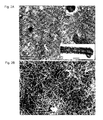
- Figs. 2A-2B are SEM micrographs of a mat of WS2 nanotubes (6-7 sulfide layers) with an oxide core at 2 different magnifications (2A - 50 µm; 2B - 10 µm). The inset in Fig. 2A shows a typical hollow nanotube obtained after completion of the sulfidization process (the scale bar represents 20 nm). Distance between each two WS2 layers (fringes) is 0.62 nm.
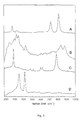
- Fig. 3 shows Raman spectra of: curve A. WO3; curve B. WO2.9 long nanowhiskers; curve C. WO2 powder; curve D. WS2 nanotubes. Excitation source used: 1 mW 632.8 nm laser beam.
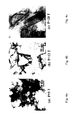
- Figs. 4a-c show TEM micrographs and the corresponding ED patterns of tungsten oxide (WO3) particles synthesized at different water vapor pressures: (a) PH2O = 0.67 kPa (5 Torr) (scale bar - 50 nm); (b) PH2O = 1.60 kPa (12 Torr) (scale bar - 50 nm); (c) PH2O = 2.67 kPa (20 Torr) (scale bar - 20 nm).
- Fig. 5 shows TEM micrograph of "short" WS2 nanotubes with oxide in the core.
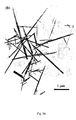
- Fig. 6a shows SEM micrographs of long hollow or oxide-free WS2 nanotubes at two different magnifications (upper figure - 2 µm; lower figure - 500 nm). Fig. 6b shows TEM micrograph of long WS2 nanotubes (scale bar - 1 µm).
- Fig. 7 shows TEM micrographs of: (7a) apex of one WS2 nanotube synthesized by the "three-step method"; (7b) nanotube walls, which contain several defects.
- Figs. 8A-8C depict a schematic illustration of the growth process of the encapsulated sulfide/oxide nanowhisker. 8A. Initialization of the sulfidization process of the asymmetric oxide nanoparticle; 8B. Growth of a long sulfide/oxide encapsulated nanowhisker. 8C. [010] is the growth axis of the oxide whiskers.
- Figs. 9A-9D show a comparison of microfabricated sharp Si tip (NT-MDT) and WS2 nanotube tip for measuring deep structures (nominal 670 nm) of varying linewidth. 9A and 9B - microfabricated Si and WS2 nanotube tips, respectively, on 350 nm linewidth structure; 9C and 9D - 600 nm linewidth structure. Note that in case of Fig. 9A, the Si tip cannot reach the bottom of the trench, while the nanotube in Fig. 9B is able to follow the trench contour faithfully.
- According to the present invention, the synthesis of a pure phase of very long and hollow WS2 nanotubes from short but asymmetric oxide nanoparticles was achieved. In this process, the oxide nanoparticle grows along its longest axis; and subsequently its outermost layer is being sulfidized, while the growing oxide tip remains uncoated as long as the nanowhisker continues to grow. Thereafter, a superlattice of {001}R crystal shear is formed in the oxide core, and the diffusion controlled sulfidization of the oxide core is completed within 60-120 min.
- The synthesis of WS2 nanotubes involves two steps, each one carried-out in a separate reactor: first, W is heated in the presence of water vapor in a vacuum apparatus or W or WO3 is electron beam evaporated in the presence of water vapor, at a pressure of 0.13-2.67 kPa (1-20 Torr), and then the thus obtained WO3 nanoparticles as large as 0.3 microns are then reacted with H2S gas under mild reducing conditions.
- In order to obtain longer WS2 nanotubes, a three-step method is carried out in which an intermediate step is added for the elongation of the WO3 nanoparticles as large as 0.3 microns before they are reacted with H2S gas under mild reducing conditions.
- The simultaneous reduction and sulfidization reactions were found to be essential for the encapsulation process, which is the key step in the formation of nested fullerene-1ike WS2 structures from oxide nanoparticles (Feldman et al., 1998). While sulfidization of the sulfide/oxide composite nanoparticle proceeds, more sulfide layers are being added from the outside inwards. Concomitantly, the remaining oxide core is further reduced and gradually transforms into an ordered superlattice of {001}R CS planes. These planes, which stretch along the whisker's growth's axis can be easily observed by TEM since they present strong contrast modulation. This microscopic structure is a direct manifestation of the reduction process, which affects the homologous series of tungsten suboxides phases - WnO3n-1 (Miyano et al., 1983).
- A great advantage of the process of the present invention is the absence of almost any contaminant or byproduct It is also remarkable that no catalyst, which must be separated and dislodged from the nanotube mat at the end of the growth, is necessary in the current process. Therefore, tedious purification steps to isolate the nanotubes, which are time consuming and expensive, are not required once the process is completed.
- Similar conditions as described herein for the bulk synthesis of long WS2 nanotubes can be used for carrying out the bulk synthesis of other transition metal chalcogenide nanotubes.
- The transition metal chalcogenide nanotubes of the invention can be used for the preparation of tips for scanning probe microscopy by methods well-known in the art such as the procedure of Dai et al., 1996. Using these tips, images of high aspect ratio replica and evaporated Ti films with sharp asperities became feasible, which could not be achieved with commercially available sharp Si tips.
- The invention will now be illustrated by the following non-limiting Examples. In the Examples 1 Torr = 133 Pa; 5 Torrs = 0.67 kPa; 8 Torrs = 1.06 kPa; 12 Torrs = 2.40 kPa; 20 Torrs = 2.67 kPa
- In the first step (stage I), a powder consisting of asymmetric oxide nanoparticles of ca. 10-30 nm in diameter and a length of 40-300 nm is produced in a high vacuum evaporator. After pumping to 0.0133 ~(10-4 Torr), water vapor from an external reservoir is introduced through a needle valve, while pumping with a rotary vane pump so that the pressure can be regulated to any desired value up to the vapor pressure of water at room temperature, ca. 20 Torr. A tungsten filament is heated to 1600 ± 20°C. The water molecules react with the hot tungsten filament and produce (WO3)n clusters which condense on the walls of the bell jar or, alternatively, onto a water-cooled copper surface. If the water vapor pressure is maintained in the pressure range 8-12 Torr, crystalline oxide nanoparticles with an asymmetric shape are produced. A transmission electron microscope (TEM) image of a typical batch of nanoparticles produced at 12 Torr, is shown in Fig. 1a. Lower vapor pressures (<5 Torr) yield amorphous nanoparticles of a non-defined (spaghetti-like) or spherical shape. It is also noted that the powder color varies with the water vapor pressure and is an excellent indicator for the deviation from stoichiometric yellow-green WO3 phase. Whereas at high vapor pressure (~20 Torr) a powder in light blue color, which is identified by electron diffraction (ED) as a mixture of WO3 and WO2.9 is obtained, a deep blue WO2.9 phase is accrued under lower water vapor pressure.
- The tungsten oxide powder of Example 1a was collected and 50 mg thereof were transferred to another reactor, in which sulfidization under controlled temperature (835-840°C), and N2/H2+H2S gas flow takes place. Sulfidization of oxide nanocigars ca. 40 nm long under mild reducing conditions, i.e. N2(99%)/H2(1%)-110ml/min and H2S-1ml/min, lead to the formation (ca. 40 mg) of relatively long or "short" nanotubes of WS2 (~0.2-0.5 µm), as shown in Fig. 1b.
- When the precursor oxide consisted of nanoparticles 100-300 nm in length (Fig. 1a), nanotubes as long as 10 microns were obtained. Fig. 2 shows typical scanning electron microscope (SEM) images of this phase at two different magnifications, showing a mat of nanotubes consiting of 6 sulfide layers with an oxide core. The formation of hollow WS2 nanotubes from oxide nanowhiskers was followed by both SEM and TEM imaging. While no discernible changes in the overall shape of the nanoparticles could be observed by the SEM, the detailed microscopic changes, during the oxide to sulfide conversion, could be easily followed by the TEM work.
- TEM micrograph of the apex of a long and hollow WS2 nanotube, obtained by this method, is shown in the inset of Fig. 2 A. While the cross section of the nanotubes is quite similar to that of the precursor nanoparticles, their length increases by a factor of 20-40 during the sulfidization step. Note, however, that about 10% of the nanotubes, have an enlarged cross-section diameter of app. 100 nm.
- In another series of experiments (stage II), app. 5 mg of the amorphous spaghetti-like oxide nanoparticles, were heated to 835-840°C under the flow of H2(1%)/N2(99%)-110 ml/min gas stream for 10 min. This process yielded a mat of oxide nanowhiskers, typically 10 µm long and 20-50 nm thick. About 80% of the oxide nanowhiskers, obtained in this way, were thin (ca. 30 nm) and cylindrical in shape. The rest did not have a circular but rather a rectangular cross section (ca. 10×100 nm). Furthermore, they were completely crystalline and the prevailing oxide phase was identified by ED as WO2.9. TEM of the nanowhiskers revealed {10∞}={001}R crystal shear (CS) planes along the [010] growth axis of the nanowhiskers, but the CS planes were not equally spaced. Occasionally however, needles with an ordered CS superlattice were obtained. If the process was overextended, complete reduction of the oxide into tungsten metal nanorods was observed.
- In the next step (stage III), the elongated oxide nanowhiskers of 1c above were heated at 835-840°C under the flow of a gas mixture consisting of H2S (2 ml/min) and N2(110 ml/min) for 120 min yielding about 4 mg of WS2 nanotubes with characteristics very similar to the one presented in Fig. 2. Nonetheless, a substantial fraction (ca. 20%) of the material, obtained in this way, formed non-perfectly closed nanotubes. Selenization of the same oxide nanowhiskers lead to the formation of very long WSe2 nanotubes, and mixed WS2/WSe2 nanotubes were also prepared by alternating the annealing atmosphere with H2S and H2Se.
- The Raman spectra at different stages of the oxide nanowhisker growth and reduction were measured and are shown in Fig. 3. The spectrum of a pure WO3 powder (curve A) is in good agreement with previous studies (Horsley et al., 1987). The signal of the WO2.9 precursors, which are X-ray amorphous, consisted of an intense background, indicating that these oxide nanoparticles are indeed amorphous. Unfortunately, the strong absorption and Raman scattering of the sulfide envelope hides the Raman pattern of the oxide core, in the partially sulfidized nanowhiskers. In order to gain some insight into the structure of the reduced oxide nanowhiskers, its Raman spectrum was measured. Curve B shows a spectrum of the 3-10 µm long oxide nanowhiskers (prepared in stage II), which have partially ordered shear structure {001}R. The Raman spectrum of WO2, which was not reported hitherto, is shown in curve C. Finally, the Raman spectrum of the WS2 nanotubes (prepared in stage III) coincides with that of crystalline 2H-WS2 (curve D) (Frey et al., 1998).
- The absence of data in the literature for the Raman of the reduced WO3-x (0<x≤1) phases probably reflects the difficulty to prepare the pure phases of the different suboxides (however vide infra). It is important to note, that although the suboxide has a non-stoichiometric composition, it produces a distinct Raman spectrum. The appearance of new peaks in the Raman spectrum of the suboxide (curve B) reflects the appreciable distortion in the WO6 octahedra in this phase. Using an empirical formula described by Hardcastle et al., 1995, it is possible to associate the 870 cm-1 mode in curve b with the stretch mode of a 0.178 nm (1.78 Å) W-O bond. This value compares favorably with the calculated 0.177 nm (1.77 Å) for one of W-O bondlengths in the W3O8 structure. The new bands in the W-O bending region (200-400 cm-1) are attributed to the fact that each nanowhisker contains at least one of several possible members of the WnO3n-1 homologous series, with different CS distance. The most intense peak in the Raman spectra of WO2 (curve C) appears At 285 cm-1, and is assigned to the W-O-W bending mode, which appears in 275 cm-1 for WO3 (curve A). Thus, the shift of this band to a higher frequency is attributed to the constrained W-O-W bending in the more compact distorted-rutile structure of WO2. It is also important to note that no Raman bands around 950 cm-1, indicative of hydrated clusters, could be discerned.
- Hence, the present Raman measurements strongly indicate the formation of partially ordered CS planes in the reduced oxide nanowhiskers (stage II). This superstructure is likely to be an important intermediate stage in the formation of WS2 nanotubes.
- Tungsten suboxide particles (WO3-x) were produced by heating a tungsten filament (model ME11 from the R. D. Mathis company) in the presence of water vapor inside a vacuum chamber, by the following procedure: once the vacuum in the bell-jar had reached a value of 0.013 Pa (10-4 Torr), the filament was heated for a few minutes in order to remove the superficial oxide layer. Water vapor was then allowed to diffuse into the vacuum chamber through an inlet, until the desired pressure was reached. The filament was heated to around 1600 ± 20°C, while the pressure in the chamber was maintained constant during the evaporation process (a few Torr). After a few minutes of evaporation, a blue powder condensed on the bell-jar walls. The accrued powder consisted of needle-like WO3-x particles (ca. 50 nm in length and 15 nm in diameter) under a specific water vapor pressure.
- NiCl2 or CoCl2 (2x10⁻³ M) salts were dissolved in the water reservoir before each evaporation. The nanoparticles produced in the presence of the transition-metal salt appeared to be more crystalline than those obtained without the addition of a salt, as shown by ED (electron diffraction).
- The synthesis of the WS2 nanotubes starting from the needle-like WO3-x particles was done in a reactor similar to the one used for the synthesis of IF-WS2 particles (Feldman et a., 1996, 1998). The principle of the synthesis is based on a solid-gas reaction, where a small quantity (5 mg) of WO3-x particles (solid) is heated to 840°C under the flow of H2/N2 (forming gas) + H2S gas mixture. In order to avoid cross-contamination between the different runs and minimize memory effects, which can be attributed to the decomposition of H2S and deposition of sulfur on the cold walls of the reactor, flushing of the reactor (10 min) with N2 gas flow was performed after each synthesis.
- Samples were studied using a scanning electron microscope (SEM) (Philips XL30-ESEM FEG), a transmission electron microscope (TEM) (Philips CM 120 (120 keV)) and X-ray diffraction (XRD) (Rigaku Rotaflex RU-200B) having Cu-Ka anode. The electron diffraction (ED) patterns were obtained on a high resolution transmission electron microscope (HRTEM) (JEM-4000EX) operated at 400 kV. Ring patterns from TiCl were used as a calibration reference standard for the ED patterns. The accuracy of the d-spacings was estimated at ±0.005 nm.
- Three different values of water vapor pressure were selected: PH2O=5, 12 and 20 Torr, the latter corresponding to the thermodynamic limit of the water vapor pressure at room temperature (22 °C). The texture of all the batches appeared to be more or less the same after a few minutes of evaporation. However, a variation in the color of the powder, which was collected on the walls of the bell-jar, was noticed. A color range, which goes from dark blue for PH2O=5 Torr to light blue for PH2O=20 Torr, was observed.
- The water vapor pressure in the chamber apparently influences the morphology and the stoichiometry of the nanoparticles obtained by evaporation. For a low value (PH2O=5 Torr), the oxide nanoparticles did not have a well-defined morphology (Fig. 4a). The ED pattern confirms that the powder is completely amorphous (not shown). When the pressure was increased (PH2O=12 Torr) the nanoparticles presented a cylindrical shape and were crystalline. A typical batch is shown in Fig. 4b, where the dimensions of the whiskers are typically around 50 run in length and 15 nm in diameter. For the thermodynamic limit of the water pressure at room temperature (PH2O=20 Torr), a growth in both directions (along the nanoparticle long axis and perpendicular to it) led to the formation of needle-like particles with much smaller aspect ratio and steps perpendicular to the long axis. The whiskers are crystalline as could be evidenced from the ED pattern, which is similar to the one observed for the particles produced at 12 Torr (Fig. 4c).
- The stoichiometry of the particles could not be easily assigned by XRD for several reasons. First, most of the samples were not sufficiently crystalline for generating well defined peaks in the spectrum. Moreover, several nonstoichiometric tungsten oxide phases have been reported in the literature and all of them exhibit very similar patterns. Consequently, assigning the stoichiometry of the concerned phase accurately from the XRD data, was rather difficult. The measurement by electron diffraction of a bundle of individual needle-like crystals was more informative in this case. The values of the dhkl spacings were calculated for the crystalline whiskers synthesized at PH2O=12 Torr and at PH2O=20 Torr. Both sets of whiskers can be interpreted as having an average substructure similar to that of the reported tetragonal phase W20O58 (WO2.9) originally described by Glemser et al. (1964) and the results are shown in Table 1. The needles can be described according to a substructure of WO3 interspersed with defects attributable to random crystallographic shear planes occurring either parallel to the needle axis or, alternatively, at some angle to the beam direction as the needles are viewed in the HRTEM. Further evidence of the randomness of the defects occurring in the needles is given by the prominent diffuse streaking that is often observed in ED patterns obtained from these needles (Sloan et al., 1999). It is noteworthy to underline that, whatever the pressure inside the chamber, the batches appeared to be homogeneous in their morphology, providing needle-like particles of relatively constant oxide stoichiometry for a given preparation.
- A detailed study of the conditions required for the whisker's growth was then undertaken, the role of the water in this process being examined first.
- To study the role of water in the oxidation of the tungsten filament, evaporations were performed with oxygen instead of water vapor in the chamber. Indeed, oxidation of the tungsten filament could be performed either with water vapor according to equation 1 below or with pure oxygen according to equation 2, both reactions being exothermic in the conditions of the present measurements (temperature of the filament: 1600 ± 20 °C, and pressure in the chamber maintained at 12 Torr). The free energies of the reactions were calculated using the data described in Horsley et al., 1987, for STP (standard) conditions.
W(s)+3H2O(g) → WO3 (s) + 3 H2 (g), ΔG(1873 K and P=12 T) = -21 kJ mol-1 [1]
W(s) + 3/2 O2 (g) → WO3(s), ΔG(1873 K and P=12 T) = -150.5 kJ mol-1 [2]
- To perform the evaporation with the same quantity of oxygen as for the one performed in the presence of water vapor, the oxygen pressure was maintained at PO2=6 Torr compared to PH2O=12 Torr (nO2=1/2 nH2O). The resultant particles were 100 % spherical or faceted, typically 5 to 30 nm in diameter. The color of the powder was light blue, which can be ascribed to a slight reduction of the powder by traces of water still present in the vacuum chamber. When the oxygen pressure was decreased, light blue phases of spherical or faceted nanoparticles were observed as well.
- The absence of needle-like particles in presence of oxygen in the chamber is indicative of the role played by hydrogen in generating an asymmetric growth of the nanoparticles (see equations 1 and 2).
- These findings allude to the fact that the needle's growth consists of a two-step process occurring simultaneously on the hot filament surface. The first step is the oxidation of the tungsten filament, which leads to the formation of WO3 particles. In the next step, reduction of these particles results in the formation of WO3-x needle-like particles (eq 3).
WO3 (s) + H2 (g) → WO3-x (g) + x H2O (g) + (1-x) H2 (g) [3]
- It is important to note that the direct reaction between water vapor and the W filament is not the only plausible oxidation route. Indeed two pathways could be contemplated for the oxidation of W with water. The first one corresponds to the direct reaction of water molecules with W atoms (eq 1). Alternatively, partial water decomposition (see eq 4) leads to the oxidation of the hot tungsten filament by liberated oxygen.
H2O (g) → 1/2 O2 (g) + H2 (g), ΔG(1873 K and P=12T) = +33.9 kJ mol-1 [4]
- Regardless of whether the direct or indirect mechanism is correct, H2 is a resultant product of both reactions. It is therefore believed that hydrogen is involved in the production of needle-like particles as opposed to the spherical ones, which are obtained in the absence of hydrogen in the chamber.
- Since hydrogen was found to be indispensable for the growth of the needles (see 2c above), an alternative procedure for promoting their growth under more controllable conditions was pursued. The basic idea was to promote the uniaxial growth of the short tungsten suboxide needles obtained in stage I under very low hydrogen gas concentration. For that purpose, the needles were placed in a reactor operating at around 840 °C in a flow of (H2/N2) gas mixture where the concentration of hydrogen was progressively increased to 1% (stage II). It was believed that the separation between the two reactions, i.e. formation of the needle-like germs in the first place and their subsequent growth, would afford a better control of the process, enabling more uniform whiskers to be derived.
- Experiments were performed with the three types of particles synthesized in Example 2b above in stage I by evaporation at: PH2O=5, 12 and 20 Torr. The results are summarized in Table 2a. The first point to emphasize is that the two sets of short needle-like particles (evaporated at PH2O=12 and 20 Torr) in contact with the gas mixture (1%H2/99%N2) are transformed into long tungsten oxide nanowhiskers (several microns in length) at 840 °C. This is quite a large elongation considering the fact that the starting material consists of oxide needles that are usually no longer than 50 nm. Moreover, the amorphous oxide nanoparticles, which are shapeless (PH2O=5 Torr), are also converted into very long whiskers. Consequently, the starting needle-like morphology is apparently not relevant for inducing the growth of very long oxide whiskers during the annealing (stage II). Indeed, it can be summarized that the lesser the crystallinity of the precursor (tungsten suboxide) particles, the thinner and longer are the microlength oxide nanowhiskers obtained after stage II annealing. The most likely explanation for this observation would be that a sublimation of a part of the tungsten suboxide particles is followed by a transport of the clusters in the gas and their condensation on some other tungsten suboxide particles, which did not sublime. For example, amorphous nanoparticles smaller than say 5 nm are likely to be more volatile than the larger nanoparticles (Ostwald ripening), a point discussed in greater detail hereinbelow.
- The second point to underline is the influence of the gas flow-rate (F) on the morphology of the particles, which is equivalent to a change in the pressure, (especially the partial pressure of hydrogen). This is particularly well illustrated in the series of measurements done with the particles synthesized at PH2O=12 Torr. In that case, a low flow-rate (55 cm3 3min-1) generates spherical particles while a higher one (≥110 cm3 min-1) brings about the growth of long nanowhiskers. The trend is the same whatever the starting tungsten suboxide precursor. The flow-rate also influences the thickness of the particles, as shown by the experiment performed with the precursor synthesized at PH2O=5 Torr. Indeed, in the particular case where the limit of the flow-rate allowed by the equipment was reached (300 cm3 min-1), a majority of thin oxide nanowhiskers (10-20 nm in diameter) were observed instead of the usual mixture of thin and thick nanowhiskers (diameters up to 100 nm).
- Since the amount of the starting oxide whiskers used for each experiment was quite similar from one batch to another (≅5 mg), the differences observed by changing the flow-rates could be attributed to either of two parameters: the partial flow-rate of hydrogen in the reactor (partial pressure of hydrogen) or the total gas flow-rate (total pressure). This point is particularly well expressed by the experiment performed with the particles synthesized at PH2O=12 Torr (stage I) and fired under a gas flow-rate of 55 cm3 min-1 (stage II). In that case, whatever the fomation mechanism, the flow is so slow that spherical or faceted nanoparticles are formed. Even the original needle-like morphology is not preserved in such circumstances. Note also that the gas flow-rate may influence the apparent temperature of the gas mixture.
- It can thus be concluded that the higher the flow-rate, the higher is the driving force to generate long and thin oxide nanowhiskers.
- The morphology of the oxide whiskers obtained after annealing the particles evaporated at PH2O=20 Torr are pretty different from the previous results, since the length and the thickness appear to be systematically limited to approximately one micron and 50-100 nm, respectively. These results indicate that, in such a case, the initial thickness and perhaps the degree of cristallinity of the needle-like nanoparticles dictates the final thickness of the elongated nanowhisker after annealing. Particular regard should be paid to the apex of these whiskers as they routinely formed perfect ninety-degree heads following annealing. This head morphology excludes a vapor-liquid-solid (VLS) growth mode as a plausible growth mechanism.
- This point was tested by varying the hydrogen concentration in the gas mixture. Indeed, by adding extra N2 gas, the hydrogen concentration was diluted from 1% to approximately 0.2%, keeping the total flow-rate constant. The annealing experiments (stage II) were performed with the precursor synthesized at PH2O=12 Torr (stage I). These results are shown in Table 2b.
- The first noticeable observation is that the morphology of the resultant particles of two different batches annealed at the same total flow-rate (FTot) but at a different partial flow-rate of H2 (FH2), is different. In parallel, for two experiments, in which annealing was done with the same value of FH2 but with two different values of the total flow-rate (i.e. by varying the nitrogen gas flow-rate), a slight morphological difference was observed. It is evident that both parameters (FH2 and PTot) influence the morphology of the particles (stage II), as it was previously found for the case of the tungsten filament evaporated in contact with water vapor in the chamber (stage I).
- Besides this consideration, it is important to note that this set of experiments was also a useful means of determining the minimum concentration of hydrogen required for providing the elongation of the whiskers. Globally, it appears that decreasing the concentration of hydrogen to 0.2% did not change drastically the morphology of the particles, which consists of long oxide whiskers>1µm (Table 2b). It is noteworthy to underline the fact that the hydrogen concentration should be adjusted for the given amount of WO3-x particles. Indeed, the ratio between the quantities of hydrogen and the starting WO3-x powder must be kept constant in order to get the same kind of morphology during the annealing (stage II).
- From this last experiment it emerges that a low concentration of hydrogen (0.2%) is sufficient for inducing the elongation process of the oxide whiskers. Furthermore, it suggests that the sublimed phase involved in the process has a stoichiometry very close to the one of the starting precursor (WO2.9).
- As a conclusion of these experiments, two key parameters for inducing the oxide whisker's growth can therefore be discerned during stage II annealing: the total gas flow (PTot) and the partial flow of hydrogen (PH2). These two factors are probably involved in the synthesis of the WS2 nanotubes as well, starting from the short WO3-x whiskers.
- The main process of the WS2 nanotubes synthesis consists of sulfidizing the tungsten suboxide powder in a gas mixture which is composed of H2/N2 and H2S, where H2 plays the role of the reducer and H2S is the sulfidizing agent according to equation 5 (stage III):
WO3-x + (1-x) H2 + 2 H2S → WS2 + (3-x) H2O [5]
- Since the growth process of the sulfide proceeds from outside in, sulfur atoms have to cross the already existing compact layers of sulfide and therefore the oxide to sulfide conversion is diffusion controlled. In this way, after a few hours of reaction, all the W-O bonds of the starting material are converted into W-S bonds, leading to hollow structures without a substantial morphological change. Furthermore, since the density of WO3 (ρ=7.16 g. cm-3) and WS2 (ρ=7.5 g. cm-3) are quite similar, the original structure of WO3 (and therefore WO3-x) is preserved throughout the reaction as was the case for the IF nanoparticles starting with quasi-spherical particles of WO3.
- Short WO3-x needle-like particles, produced by evaporation at PH2O=12 Torr in stage I, were placed in a reducing/sulfidizing atmosphere as described previously. In order to understand which factors are responsible for the morphology of the converted sulfidized samples, only one parameter amongst three was changed at a time: the flow-rates of H2/N2; H2S and the hydrogen concentration in the gas mixture. In all these experiments the temperature was maintained at 840 °C. The data from these experiments are summarized in Table 3. Each Table (3a, 3b and 3c) contains experiments in which one parameter was changed at a time. Comparisons could therefore be done inside each set of experiments and between them.
- When a gas mixture with 5% hydrogen was used (Table 3a), most of the needle batches had similar morphologies irrespective of the flow-rate ratio (FH2/N2/FH2S). A TEM picture of a typical bundle of short nanotubes stemming from those batches is presented in Fig. 1b and Fig. 5. The particles are hollow (Fig. 1b) or with some remaining oxide (Fig. 5) and the WS2 layers contain very few defects. The apexes of the tubes are quite perfectly closed. The elongation of the WO3-x precursors (50 nm in length and 15 nm in diameter). is not very pronounced in this case. In contrast, when the ratio FH2/FH2S was very high, long nanotubes of several microns in length could be discerned in the samples amongst bundles of short nanotubes. However, the formation of long nanotubes was always accompanied by the presence of metallic tungsten in their cores and, in several cases, spherical nanoparticles of tungsten were found. Also, the number of WS2 layers was rather small in this case. This is attributed to fast reduction of the tungsten oxide core to the pure metal and subsequently to the slow diffusion of sulfur through the compact metallic core (Margulis et al., 1993). Furthermore, a wide size-distribution amongst the long nanotubes was found. Indeed, in such conditions, two types of nanotubes were present: "thin nanotubes", with a typical diameter of about 20 nm and the "thick" ones, which could reach a diameter up to 100 nm.
- The variety of morphologies which appear by varying the flow-rate of forming gas (H2/N2)and H2S shows that the ratio between the two gases is essential for determining the final shape of the sulfidized nanotubes.
- More precisely, when the ratio FH2/FH2S exceeds the value of ca. 10, either tungsten particles or nanotubes containing a tungsten core, start to appear. In that case, the hydrogen concentration in the reactor is so high compared to that of sulfur (for the amount of precursor taken), that the tungsten suboxide particles (WO3-x) are reduced almost instantaneously into tungsten. This is another manifestation of the competition which occurs between the reduction and the sulfidization processes. To avoid such an unwieldy situation, one has to operate in a specific ratio with FH2/FH2S < 10. When the concentration of H2 in the forming gas was about 5%, short nanotubes were produced in the range 1.4 ≤FH2/FH2S≤11 (Fig. 5) and long ones were observed for a ratio FH2/FH2S above 11 (not shown).
- Another aspect for the influence of the flow-rate ratio FH2/FH2S on the nanotubes morphology is illustrated in the experiments where no H2S was added to the system at all. In this case, the reactor was not flushed with N2 prior to the experiment. Here traces of sulfur, which remained on the reactor walls from the previous experiment, led to the formation of long nanotubes (Table 3a). This point emphasizes the fact that the ratio FH2/FH2S is essential for the final morphology of the sulfidized particles.
- When the hydrogen concentration in the forming gas was lowered to 1% instead of 5%, the factor FH2/FH2S appeared not to be the only one responsible for the morphological changes. Indeed, two different batches, for which the ratio FH2/FH2S was kept constant (Table 3b: batches 3 and 6), gave two discernable morphologies. Besides that, careful examination of the data revealed that, decreasing the hydrogen concentration in the gas mixture leads frequently to the formation of long nanotubes instead of the usual short ones. This trend was even more pronounced in experiments performed with an extremely low hydrogen concentration (less than 1% - see Table 3c). As a matter of fact, all the batches performed with hydrogen concentration below 1% led to the growth of either a mixture of short and long nanotubes (not shown) or to almost pure phases of long nanotubes (see Figs. 6a, 6b). The results of Table 3 lead to the conclusion that the appearance of long nanotubes depends on the ratio between the flow-rate of hydrogen and the total flow-rate of gases (FH2/FTot).
- It emerges therefore, that in order to achieve the formation of long nanotubes, two flow-rate ratios have to be carefully controlled: the ratio FH2/FH2S and FH2/FTot. The conditions required for providing long nanotubes as a majority phase in a reproducible manner are consequently the following:

- To obtain homogeneous phases consisting of purely long nanotubes without tungsten in their core, the conditions are even more restrictive:

- It emerges from all these results that a careful control of the synthesis parameters leads to a specific and desireable morphology of the nanotubes.
- The purpose of this last study was to explore the possibility to synthesize long WS2 nanotubes from the already existing long oxide nanowhiskers obtained in stage II. The long oxide nanowhiskers synthesized from the short whiskers (see Example 2b above) were placed in a reducing and sulfidizing atmosphere without taking specific attention to the ratios FH2/FH2S and FH2/FTot. All the attempts led to the formation of long nanotubes, although the degree of crystallinity of the nanotubes was not perfect. The WS2 layers contained plenty of defects (Figs. 7a, 7b) and rather quite large proportion of the nanotubes was not totally closed at their apex (not shown).
- The two-step method may be more difficult to control, but it gives very satisfactory results. The three-step method of the invention lends itself to the synthesis of nanotubes from related compounds, such as WSe2 or mixed WS2/WSe2 using preprepared long oxide nanowhiskers as a precursor.
- Indeed, WSe2 nanotubes were prepared by heating selenium ingot at 350 °C downstream of the main reactor, which was heated to 760 °C. Forming gas (1% H2/99%N2-110 cm3 min-1) was provided in this case. The resulting WSe2 nanotubes were quite perfect in shape.
- From the present measurements, one can visualize the growth process of the encapsulated nanowhisker as depicted in Fig. 8. At the first instant of the reaction (Fig. 8A), the asymmetric tungsten oxide nanoparticle reacts with H2S and forms a protective tungsten disulfide monomolecular layer, prohibiting coalescence of this nanoparticle with neighboring oxide nanoparticles. Simultaneous condensation of (WO3)n or (WO3-x·H2O)n clusters on the nanowhisker tip and reduction by hydrogen gas leads to growth of the sulfide-coated oxide nanowhisker. This process is schematically illustrated in Fig. 8B. Note that during the gradual reduction of the oxide core, the CS planes in the oxide phase rearrange and approach each other until a stable oxide phase W3O8 is reached (Iguchi, 1978). In Fig. 8C, [010} is the growth axis of the W3O8 whiskers. This phase provides a sufficiently open structure for the sulfidization to proceed until the entire oxide core is consumed. Further reduction of the oxide core would bring the sulfidization reaction into a halt (Margulis et al., 1993). Therefore, the encapsulation of the oxide nanowhisker, which tames the reduction of the core, allows for the gradual conversion of this nanoparticle into a hollow WS2 nanotube.
- Naturally, the elongation of the oxide nanowhiskers requires a reservoir of (WO3)n clusters in the vapor phase. Conceivably, the vaporized oxide clusters react only very slowly with the H2 and H2S gases, which would otherwise hamper the rapid growth of the oxide nanowhisker. The termination of the nanowhisker growth occurs when the source of tungsten oxide is depleted and the vapor pressure of the oxide clusters diminishes below a critical value. In this case the simultaneous reaction of tip growth/reduction and sulfidization cannot be maintained and the outer sulfide layer of the encapsulate completely enfolds the oxide tip. In fact, this is the reason that the WS2 nanotubes are almost the sole phase comprising the mat of Figs. 2 and 6. This mechanism entails that part of the oxide nanoparticles predominantly elongate through tip growth, while the rest of the oxide nanoparticles furnish the required vapor pressure for the tip growth of the former population, and they slowly diminish in size (Ostwald ripening). The oxide vapor can not condense and stick onto the sulfide wall of the encapsulated nanowhiskers and therefore no thickening of the nanotubes or their bifurcation, is observed.
- WS2 nanotubes were attached to microfabricated tips of an atomic force microscope (AFM) by transferring adhesive from carbon tape to a Si tip, then pulling off nanotube bundles with this tip from a mat of nanotubes prepared on a different area of the tape (Dai et al., 1996). A portion of this mat was glued to the Si tip, of which the longest nanotube served now as the new tip. Scans on a Ti tip calibrator (Westra et al.,1995) and subsequent blind reconstruction (using algorithm developed by A. Efimov, obtainable at http://www.siliconmdt.com) of tip shape gave tip width of 16 nm for the last 100 nm of the tip length. In order to demonstrate the capabilities of these tips for investigating deep and narrow structures, they were used to image a line structure of depth 670 nm and varying linewidth. As seen in Fig. 9, the nanotube tips perform significantly better than microfabricated sharp Si tips. While the WS2 nanotube tip follows the contour of even the finest replica and reaches its bottom, the commercial Si tip is unable to delineate the replica correctly due to its slanted edge. Also, the Si tip is unable to follow the sample contour very smoothly (see for example Fig. 9C), because the surface of this tip is not passivated and therefore strong interaction with the substrate at close proximity is unavoidable. Thinner or single walled nanotubes may not be useful for such applications because of their small spring constant toward bending. Also, due to its sandwich S-W-S structure, the WS2 nanotubes are probably stiffer than their carbon analogs. In contrast to carbon nanotubes, the present nanotubes can be easily sensitized by visible and infra-red light and therefore show promise as a selective probe for nanophotolithography.
-
- 1. Ajayan, P.M.; Stephan, O.; Redlich, Ph.; Colliex, C. Nature 1995, 375, 564.
- 2. Chopra, N.G.; Luyken, R.J.; Cherrey, K.; Crespi, V.H.; Cohen, M.L.; Louie, S.G.; Zettl, A. Science 1995, 269, 966.
- 3. H. Dai, J.H. Hafner, A.G. Rinzler, D.T. Colbert, R.E. Smalley, Nature 1996, 384, 147. See also, J.H. Hafner, "Nanotube tips for SFM", http://cnst.rice.edu/mount/html.
- 4. Feldman, Y.; Wasserman, E.; Srolovitz, D.; Tenne, R. Science 1995, 267, 222.
- 5. Feldman, Y.; Frey, G.L.; Homyonfer, M.; Lyakhovitskaya, V.; Margulis, L. Cohen, H.; Hodes, G.; Hutchison, J.L. and Tenne, R. J. Am. Chem. Soc. 1996, 118, 5362.
- 6. Y. Feldman, V. Lyakhovitskaya, R. Tenne, J. Am. Chem. Soc. 1998, 120, 4176.
- 7. G.L. Frey, R. Tenne, M.J. Matthews, M.S. Dresselhaus, G. Dresselhaus, J. Mater. Res. 1998, 13, 2412.
- 8. Glemser, O.; Weidelt, J.; Freund, F. Z. Anorg. Allg. Chem. 1964, 332, 299.
- 9. F.D. Hardcastle, I.E. Wachs, J. Raman Spectrosc.1995, 26, 397.
- 10. Hershfinkel, M.; Gheber, L.A.; Volterra, V.; Hutchison, J.L.; Margulis, L.; and Tenne, R. J. Am. Chem. Soc. 1994, 116, 1914.
- 11. J.A. Horsley, I.E. Wachs, J.M. Brown, G.H. Via, F.D. Hardcastle, J. Phys. Chem. 1987, 91, 4014.
- 12. E. Iguchi, J. Solid State Chem., 1978, 23, 231.
- 13. Iijima, S. Nature 1991, 56, 354.
- 14. Margulis, L.; Salitra, G.; Talianker, M.; Tenne, R. Nature 1993, 365, 113.
- 15. T. Miyano, M. Iwanishi, C. Kaito, M. Shiojiri, Jap. J. Appl. Phys. 1983, 22, 863.
- 16. Remskar, M.; Skraba, Z.; Cleton, F.; Sanjines, R.; Levy, F. Appl. Phys. Lett. 1996, 69, 351.
- 17. Remskar, M.; Skraba, Z.; Regula, M.; Ballif, C.; Sanjines, R. and Levy, F. Adv. Mater. 1998, 10, 246.
- 18. Remskar, M.; Skraba, Z.; Ballif, C.; Sanjines, R.; Levy, F. Surf Sci.1999a, 435, 637.
- 19. Remskar, M.; Skraba, Z. Appl. Phys. Lett. 1999b, 74, 3633.
- 20. Sloan, J.; Hutchison, J.L.; Tenne, R.; Feldman, Y.; Tsirlina, T.; Homyonfer, M. J. Solid State Chem. 1999, 144, 100.
- 21. Tenne, R.; Margulis, L.; Genut, M. and Hodes, G. Nature 1992, 360, 444.
- 22. K.L. Westra, D.J. Thomson, J. Vac. Sci. Technol. 1995, B 13, 344. Obtainable from General Microdevices, Edomonton, Alberta, Canada.
- 23. Zelenski, C.M.; Dorhout, P. K. J. Am. Chem. Soc. 1998, 120, 734.
- Table 2. Influence of the hydrogen concentration on the morphology of the particles: (a) mixture of 1% H2/99% N2. (b) mixture of gases with less than 1% H2 in the overall gas mixture. Lox-T denotes long oxide whiskers, which are thick (D up to 100 nm). Lox-t denotes long oxide whiskers, which are thin (D≅10-20 nm). S denotes spherical particles. F denotes faceted particles.
Table 2a PH2O (Torr) Flow 1%H2/99% N2 (cm3 min-1) Morphology of the particles 5 110 Lox-t & Lox-T (>1 µm) 5 200 Lox-t & Lox-T.(>>1 µm) 5 300 Lox-t >> Lox-T (>>1 µm) 12 55 S+ F 12 110 Lox-t& Lox-T (>>1 µm) 12 200 Lox-t & Lox-T (>> 1 µm) 20 110 Lox-T >> Lox-t (≅1 µm) 20 200 Lox-T >> Lox-t (≅1 µm) Table 2b PH2O (Torr) Flow 1%H2 (cm3 min-1) Flow N2 (cm3 min-1) Ftot (cm3 min-1) FH2 (cm3 min-1) % H2= FH2 /Ftot Morphology of the particles 12 110 100 210 1.1 0.52 Lox-t & Lox-T (>>1 µm) 12 200 100 300 2 0.73 Lox-T >> Lox-t (≅1 µm) 12 200 50 250 2 0.88 Lox-t & Lox-T (>> 1 µm) 12 200 20 220 2 1 Lox-t & Lox-T (>>1 µm) 12 100 200 300 1 0.33 Lox-t & Lox-T (>> 1 µm) 12 50 200 250 0.5 0.2 Lox-T >> Lox-t (≅1 µm) - Table 3. Influence of the flow-rate of the gases and the ratio between them on the morphology of the sulfidized samples for different concentrations of hydrogen in the gas mixture: (a) 5%H2/ 95% N2. (b) 1%H2/ 99% N2. (c) less than 1%H2/ 99% N2. All measurements have been done with the starting WO3-x precursor produced at PH2O=12 Torr. Sh and L denote short and long nanotubes, respectively. LT long and thick nanotubes and Lt long and thin nanotubes. * : synthesis done without addition of H2S but with residual sulfur from the previous synthesis.
Table 3a Flow of 5%H2/ 95% N2 (CM3 min-1) Flow of H2S (cm3 min-1) FH2/FH2S FH2/N2/FH2S Morphology of the samples 110 4 1.375 27.5 Sh 110 2 2.75 55 Sh 110 1 5.5 110 Sh 110 0.5 11 220 Sh with W inside 110 0* LT with W inside + W 200 2 5.5 110 Sh 200 1 10 200 Sh with W inside 200 0.5 20 400 (Lt & LT + Sh) with W inside 55 2 1.375 27.5 Sh Table 3b Flow of 1%H2/99% N2 (cm3 min-1) Flow of H2S (cm3 min-1) FH2/FH2S FH2/N2/FH2S Morphology of the samples 110 2 0.55 55 Sh + 2H-WS2 110 1 1.1 110 Sh + Lt & LT + IF + 2H-WS2 110 0.5 2.2 220 Sh 110 0.3 3.7 314 Non defined shape + IF + Sh 200 2 1 100 Bad encapsulation 200 1 2 200 Sh + very few L + IF + 2H-WS2 200 0.5 4 400 (Sh + Lt & LT + IF) with W inside 55 2 0.275 27.5 2H-WS2 Table 3c Flow of 1%H2/ 99% N2 (cm3 min-1) Flow of N2 (cm3 min-1) Flow of H2S (cm3 min-1) FH2/FH2S % H2= FH2 /Ftot Morphology of the samples 200 100 1 2 0.66 Sh + Lt 110 100 1 1.1 0.52 Sh + Lt 100 200 1 1 0.33 Sh with W inside + Lt & LT 50 200 1 0.5 0.2 Sh + Lt 100 200 0.5 2 0.33 (Sh+ Lt & LT) with W inside 110 100 0.5 2.2 0.52 LT&Lt+Sh 200 100 0.5 4 0.66 LT & Lt >> Sh with W inside 200 100 2 1 0.66 Lt & LT >> Sh 110 100 2 0.55 0.52 Sh >> 2H-WS2
| Oxide precursors | Tetragonal WO2.9 | |||
| Irel | dhkl (Å) | Irel | dhkl (Å) | hkl |
| 100 | 3.752 | 100 | 3.74 | 110 |
| 20 | 3.206 | 20 | 3.10 | 101 |
| 80 | 2.640 | 80 | 2.65 | 200 |
| 30 | 2.184 | 30 | 2.20 | 201 |
| - | 10 | 2.02 | 211 | |
| 30 | 1.878 | 30 | 1.88 | 220 |
| 10 | 1.703 | 10 | 1.78 | 300 |
| 60 | 1.558 | 60 | 1.67 | 310 |
| 50 | 1.153 | 50 | 1.53 | 311 |
| - | 10 | 1.33 | 222 | |
| - | 10 | 1.25 | 330 | |
| - | 10 | 1.17 | 322 | |
Claims (10)
- A method for bulk synthesis oflong nanotubes of a transition metal chalcogenide from a transition metal material, water vapor and H2X gas or H2 gas and X vapor, wherein X is S, Se, or Te, comprising:1) carrying outa) either heating a transition metal material in the presence of water vapor in a vacuum apparatus or electron beam evaporating a transition metal material in the presence of water vapor, at a suitable pressure, to obtain nanoparticles of the transition metal oxide as large as 0.3 microns, andb) elongating the transition metal oxide nanoparticles as large as 0.3 microns of step (a) to 10-20 microns or more, wherein the elongation of the transition metal oxide nanoparticles is carried out by heating the oxide under reducing conditions for a few minutes, or by electron beam irradiation of the oxide in high vacuum conditions; or2)c) heating a foil of the transition metal in poor vacuum conditions; and annealing the transition metal oxide nanoparticles obtained in step (b) or (c) in a reducing atmosphere with a H2X gas or H2 gas and X vapor, wherein X is S, Se or Te, at a suitable temperature, thus obtaining long nanotubes of the transition metal chalcogenide, said nanotubes being as long as 0.3-20 micron or more.
- A method according to claim 1, wherein said reducing conditions consist in heating the oxide nanoparticles under the flow of a gas comprising from 0.05 to 1% H2 and from 99.95 to 99% N2 at a flow rate of 110 ml/min gas stream for up to 10 minutes.
- A method according to claim 1 or 2, wherein the annealing step is carried out by alternating the annealing atmosphere of H2X gas or of H2 gas and X vapor.
- A method according to claim 3, wherein the chalcogenides are sulfides and selenides and the annealing step is carried out by alternating the annealing atmosphere of H2S and H2Se gas or of H2 gas and S and Se vapor.
- A method according to any one of claims 1 to 4, wherein the reducing atmosphere for annealing the oxide nanoparticles includes chalcogenation, preferably sulfidization or selenization, under the flow of a gas comprising 1% H2 and 99% N2 at a flow rate of 110 ml/min and H2X, preferably H2S or H2Se, at a flow rate of 1 ml/min.
- The method according to any one of claims 1 to 5 wherein said transition metal is selected from Mo, W, V, Zr, Hf, Pt, Re, Nb, Ta, Ti and Ru.
- The method according to any one of claims 1 to 6, wherein said transition metal material is the transition metal itself a mixture of or an alloy of two or more transition metals, a substance comprising a transition metal, and a mixture of substances comprising two or more transition metals.
- The method according to claim 1, for bulk synthesis of long nanotubes of WS2 and/or WSe2 which comprises:1)a) either heating W in the presence of water vapor in a vacuum apparatus or electron beam evaporating W or |WO3| in the presence of water vapor, at a pressure of 0.13-2.67, preferably 1.06-2.40, kPa (1-20, preferably 8-12, Torr), thus obtaining |WO3| nanoparticles as long as 0.3 microns;b) heating the |WO3| nanoparticles as long as 0.3 microns under reducing conditions at 800-850°C, preferably at 835-840°C, for about 10 minutes to obtain WO3 nanowhiskers as long as 10 microns; and2) annealing the |WO3| nanoparticles obtained in step (b) in a reducing atmosphere with H2S or H2Se gas or with H2 gas and S or Se vapor, or by alternating the annealing atmosphere with H2S and H2Se or with H2 gas and S or Se vapor, at 800-850°C, preferably at 835-840°C, thus obtaining relatively long and hollow WS2 and/or WSe2 nanotubes as long as 10 microns or more.
- A method for preparation of tips for scanning probe microscopy which comprises:a) transferring adhesive from carbon tape to a microfabricated Si tip; andb) pulling off bundles of transition metal chalcogenide nanotubes prepared by a method according to claim 1 with this tip from a mat of nanotubes prepared on a different area of the tape.
- A method according to claim 9, wherein said transition metal chalcogenide is WS2 and/or WSe2.
Applications Claiming Priority (3)
| Application Number | Priority Date | Filing Date | Title |
|---|---|---|---|
| IL12971899A IL129718A0 (en) | 1999-05-02 | 1999-05-02 | Synthesis of nanotubes of transition metal chalcogenides |
| IL12971899 | 1999-05-02 | ||
| PCT/IL2000/000251 WO2000066485A1 (en) | 1999-05-02 | 2000-05-02 | Bulk synthesis of long nanotubes of transition metal chalcogenides |
Publications (2)
| Publication Number | Publication Date |
|---|---|
| EP1177153A1 EP1177153A1 (en) | 2002-02-06 |
| EP1177153B1 true EP1177153B1 (en) | 2007-10-03 |
Family
ID=11072753
Family Applications (1)
| Application Number | Title | Priority Date | Filing Date |
|---|---|---|---|
| EP00921021A Expired - Lifetime EP1177153B1 (en) | 1999-05-02 | 2000-05-02 | Bulk synthesis of long nanotubes of transition metal chalcogenides |
Country Status (7)
| Country | Link |
|---|---|
| US (3) | US6841142B1 (en) |
| EP (1) | EP1177153B1 (en) |
| AT (1) | ATE374729T1 (en) |
| DE (1) | DE60036613T2 (en) |
| ES (1) | ES2293897T3 (en) |
| IL (1) | IL129718A0 (en) |
| WO (1) | WO2000066485A1 (en) |
Families Citing this family (40)
| Publication number | Priority date | Publication date | Assignee | Title |
|---|---|---|---|---|
| US6692660B2 (en) * | 2001-04-26 | 2004-02-17 | Nanogram Corporation | High luminescence phosphor particles and related particle compositions |
| IL134891A0 (en) | 2000-03-06 | 2001-05-20 | Yeda Res & Dev | Reactors for production of tungsten disulfide hollow onion-like nanoparticles |
| AU2001294585A1 (en) | 2000-09-18 | 2002-03-26 | President And Fellows Of Harvard College | Fabrication of nanotube microscopy tips |
| AU2001294876A1 (en) | 2000-09-29 | 2002-04-08 | President And Fellows Of Harvard College | Direct growth of nanotubes, and their use in nanotweezers |
| IL139266A0 (en) | 2000-10-25 | 2001-11-25 | Yeda Res & Dev | A method and apparatus for producing inorganic fullerene-like nanoparticles |
| JP2003265962A (en) * | 2002-03-18 | 2003-09-24 | Nittetsu Mining Co Ltd | Photocatalyst and method for producing the same |
| JP4357801B2 (en) * | 2002-06-25 | 2009-11-04 | 日鉄鉱業株式会社 | Highly active photocatalyst and method for producing the same |
| EP1394115B1 (en) | 2002-08-24 | 2009-10-21 | Haldor Topsoe A/S | Rhenium (iv) sulphide nanotube material and method of preparation |
| US7708974B2 (en) * | 2002-12-10 | 2010-05-04 | Ppg Industries Ohio, Inc. | Tungsten comprising nanomaterials and related nanotechnology |
| JP4125638B2 (en) * | 2003-06-02 | 2008-07-30 | 独立行政法人科学技術振興機構 | Nanofiber or nanotube comprising group V transition metal dichalcogenide crystal and method for producing the same |
| FR2863265B1 (en) | 2003-12-04 | 2006-12-08 | Centre Nat Rech Scient | PROCESS FOR THE SYNTHESIS OF CHALCOGENIDE NANOPARTICLES HAVING A LAMELLAR STRUCTURE |
| US7208094B2 (en) * | 2003-12-17 | 2007-04-24 | Hewlett-Packard Development Company, L.P. | Methods of bridging lateral nanowires and device using same |
| JP4418300B2 (en) * | 2004-05-25 | 2010-02-17 | 株式会社日立製作所 | Recording medium manufacturing method, recording medium using the same, and information recording / reproducing apparatus |
| CN1328157C (en) * | 2006-03-02 | 2007-07-25 | 浙江大学 | Method for preparing non-laminate sulfide nano tube |
| SI22445A (en) | 2007-02-26 | 2008-08-31 | Institut "Jožef Stefan" | Procedure for synthesis of nanowires of tungsten oxide w5o14 |
| CN101641292B (en) * | 2007-03-23 | 2012-10-17 | 株式会社东芝 | Method for producing tungsten trioxide powder for photocatalyst, tungsten trioxide powder for photocatalyst, and photocatalyst product |
| EP2132142B1 (en) * | 2007-03-30 | 2015-08-05 | Institut "Jozef Stefan" | A process for the synthesis of nanotubes and fullerene-like nanostructures of transition metals dichalcogenides, quasi one-dimensional structures of transition metals and oxides of transition metals |
| US8329138B2 (en) | 2007-09-10 | 2012-12-11 | Yeda Research And Development Company Ltd. | Fullerene-like nanostructures, their use and process for their production |
| RU2366541C2 (en) * | 2007-10-15 | 2009-09-10 | Государственное образовательное учреждение высшего профессионального образования Иркутский государственный университет путей сообщения (ИрГУПС) | Method for preparation of nanoparticles chalcogenide semiconductive materials |
| DE102008034452B4 (en) * | 2008-07-24 | 2010-09-09 | Johannes Gutenberg-Universität Mainz | Process for the preparation of nanostructures from metal disulphides, nanostructures produced therefrom and their use |
| JP2012515808A (en) | 2009-01-20 | 2012-07-12 | ピーピージー インダストリーズ オハイオ,インコーポレイテッド | Transparent and colorless infrared absorbing composition comprising non-stoichiometric tungsten oxide nanoparticles |
| US7955588B2 (en) * | 2009-05-26 | 2011-06-07 | Conocophillips Company | Metal sulfide catalysts and methods of making same |
| WO2013184212A2 (en) * | 2012-05-04 | 2013-12-12 | William Marsh Rice University | Non-contact strain sensing of objects by use of single-walled carbon nanotubes |
| CA2901480C (en) | 2013-02-19 | 2021-07-13 | Nanotech Industrial Solutions, Inc. | Inorganic fullerene-like and tubular-like particles in fluids and lubricants and applications to subterranean drilling |
| US9446965B2 (en) | 2013-02-19 | 2016-09-20 | Nanotech Industrial Solutions, Inc. | Applications for inorganic fullerene-like particles |
| EP3011623A1 (en) | 2013-06-18 | 2016-04-27 | Yeda Research and Development Co., Ltd. | Fullerene-like nanoparticles and inorganic nanotubes as host electrode materials for sodium/magnesium ion batteries |
| US9896340B2 (en) * | 2013-07-18 | 2018-02-20 | William Marsh Rice University | Rebar hybrid materials and methods of making the same |
| US11158502B2 (en) | 2014-09-25 | 2021-10-26 | Purdue Research Foundation | Methods of forming nano-scale and micro-scale structured materials and materials formed thereby |
| TWI532892B (en) | 2015-02-16 | 2016-05-11 | 炬力奈米科技有限公司 | Method for synthesizing two-dimensional layered chalcogen compound and process equipment |
| US9840764B2 (en) * | 2015-09-30 | 2017-12-12 | National Tsing Hua University | Method of fabricating transition metal dichalcogenide |
| WO2017136660A1 (en) * | 2016-02-04 | 2017-08-10 | Nanotech Industrial Solutions, Inc. | Nanolog and nanoparticles and method of formation |
| IL249804A0 (en) * | 2016-12-27 | 2017-04-02 | Yeda Res & Dev | Electromechanical devices are based on metal chalcogenide nanotubes |
| EP3715332A4 (en) * | 2017-11-21 | 2021-01-20 | Sumitomo Metal Mining Co., Ltd. | Tungsten trioxide |
| WO2019145287A1 (en) | 2018-01-23 | 2019-08-01 | Evonik Oil Additives Gmbh | Polymeric-inorganic nanoparticle compositions, manufacturing process thereof and their use as lubricant additives |
| CN111655827B (en) | 2018-01-23 | 2022-07-26 | 赢创运营有限公司 | Polymer-inorganic nanoparticle compositions, methods of manufacture thereof, and use thereof as lubricant additives |
| JP7411555B2 (en) | 2018-01-23 | 2024-01-11 | エボニック オペレーションズ ゲーエムベーハー | Polymeric inorganic nanoparticle compositions, methods of their preparation, and their use as lubricants |
| CN109201084B (en) * | 2018-11-06 | 2021-03-19 | 中国科学院东北地理与农业生态研究所 | Preparation method and application of a tungsten trioxide@molybdenum disulfide hollow tube composite catalyst |
| JP7575076B2 (en) * | 2021-06-28 | 2024-10-29 | 国立研究開発法人産業技術総合研究所 | Morphology-controlled particles, structured film made of said particles, methods for producing them, and sensor using said structured film |
| CN113666341A (en) * | 2021-08-24 | 2021-11-19 | 昆明理工大学 | Preparation method of chalcogenide tubular material |
| CN119411098B (en) * | 2024-11-12 | 2025-11-21 | 西北工业大学 | Method for preparing transition metal chalcogenide heterojunction nanotubes with assistance of gold catalyst particles |
Family Cites Families (13)
| Publication number | Priority date | Publication date | Assignee | Title |
|---|---|---|---|---|
| US4055630A (en) * | 1975-08-12 | 1977-10-25 | Atlantic Richfield Company | Process for the recovery of selenium from urethanes containing selenium or compounds thereof |
| US4299892A (en) * | 1975-12-17 | 1981-11-10 | Exxon Research & Engineering Co. | Amorphous and sheet dichalcogenides of Group IVb, Vb, molybdenum and tungsten |
| US4390514A (en) * | 1977-05-16 | 1983-06-28 | Exxon Research And Engineering Co. | Method of preparing chalocogenides of group VIII by low temperature precipitation from nonaqueous solution, the products produced by said method and their use as catalysts |
| US4548800A (en) * | 1982-08-02 | 1985-10-22 | Xerox Corporation | Process for selenium purification |
| US4676969A (en) * | 1986-06-23 | 1987-06-30 | Eastman Kodak Company | Method of synthesis of inorganic chalcogenides |
| US5958358A (en) | 1992-07-08 | 1999-09-28 | Yeda Research And Development Co., Ltd. | Oriented polycrystalline thin films of transition metal chalcogenides |
| EP0580019B1 (en) | 1992-07-08 | 1999-05-26 | Yeda Research And Development Company, Ltd. | Oriented polycrystalline thin films of transition metal chalcogenides |
| IL118378A0 (en) | 1996-05-22 | 1996-09-12 | Yeda Res & Dev | Method and apparatus for preparing inorganic fullerene-like nanoparticles of transition metal chalcogenides having predetermined size and shape |
| IL119719A0 (en) | 1996-11-29 | 1997-02-18 | Yeda Res & Dev | Inorganic fullerene-like structures of metal chalcogenides |
| US6346189B1 (en) * | 1998-08-14 | 2002-02-12 | The Board Of Trustees Of The Leland Stanford Junior University | Carbon nanotube structures made using catalyst islands |
| US6146227A (en) * | 1998-09-28 | 2000-11-14 | Xidex Corporation | Method for manufacturing carbon nanotubes as functional elements of MEMS devices |
| US6419717B2 (en) * | 2000-03-17 | 2002-07-16 | Hyperion Catalysis International, Inc. | Carbon nanotubes in fuels |
| US7276283B2 (en) * | 2004-03-24 | 2007-10-02 | Wisconsin Alumni Research Foundation | Plasma-enhanced functionalization of carbon-containing substrates |
-
1999
- 1999-05-02 IL IL12971899A patent/IL129718A0/en unknown
-
2000
- 2000-05-02 EP EP00921021A patent/EP1177153B1/en not_active Expired - Lifetime
- 2000-05-02 WO PCT/IL2000/000251 patent/WO2000066485A1/en not_active Ceased
- 2000-05-02 US US09/959,664 patent/US6841142B1/en not_active Expired - Lifetime
- 2000-05-02 ES ES00921021T patent/ES2293897T3/en not_active Expired - Lifetime
- 2000-05-02 DE DE60036613T patent/DE60036613T2/en not_active Expired - Lifetime
- 2000-05-02 AT AT00921021T patent/ATE374729T1/en active
-
2003
- 2003-10-27 US US10/693,988 patent/US20040089410A1/en not_active Abandoned
-
2005
- 2005-11-25 US US11/286,377 patent/US20060071165A1/en not_active Abandoned
Also Published As
| Publication number | Publication date |
|---|---|
| EP1177153A1 (en) | 2002-02-06 |
| US20060071165A1 (en) | 2006-04-06 |
| US6841142B1 (en) | 2005-01-11 |
| IL129718A0 (en) | 2000-02-29 |
| DE60036613D1 (en) | 2007-11-15 |
| WO2000066485A1 (en) | 2000-11-09 |
| US20040089410A1 (en) | 2004-05-13 |
| ATE374729T1 (en) | 2007-10-15 |
| DE60036613T2 (en) | 2008-07-10 |
| ES2293897T3 (en) | 2008-04-01 |
Similar Documents
| Publication | Publication Date | Title |
|---|---|---|
| US6841142B1 (en) | Bulk synthesis of long nanotubes of transition metal chalcogenides | |
| Rao et al. | Inorganic nanotubes | |
| US5958358A (en) | Oriented polycrystalline thin films of transition metal chalcogenides | |
| Chen et al. | Synthesis of rod-, twinrod-, and tetrapod-shaped CdS nanocrystals using a highly oriented solvothermal recrystallization technique | |
| Yao et al. | Formation of ZnO nanostructures by a simple way of thermal evaporation | |
| Kępiński et al. | Hydrothermal synthesis of precursors of neodymium oxide nanoparticles | |
| Umar et al. | Star-shaped ZnO nanostructures on silicon by cyclic feeding chemical vapor deposition | |
| Huang et al. | Morphology, structures and properties of ZnO nanobelts fabricated by Zn-powder evaporation without catalyst at lower temperature | |
| Yella et al. | Bismuth‐Catalyzed Growth of SnS2 Nanotubes and Their Stability | |
| US8999877B2 (en) | Single-crystal fine powder of sulfide or sulfide complex and method for preparing the same | |
| WO2006106517A2 (en) | Process and apparatus for producing inorganic fullerene-like nanoparticles | |
| US11639546B2 (en) | Moisture governed growth method of atomic layer ribbons and nanoribbons of transition metal dichalcogenides | |
| Wang et al. | Selective synthesis of boron nitride nanotubes by self-propagation high-temperature synthesis and annealing process | |
| US20070087470A1 (en) | Vapor phase synthesis of metal and metal oxide nanowires | |
| Rahm et al. | Pulsed-laser deposition and characterization of ZnO nanowires with regular lateral arrangement | |
| US7544626B2 (en) | Preparation of self-assembled silicon nanotubes by hydrothermal method | |
| US9950926B2 (en) | Method for production of germanium nanowires encapsulated within multi-walled carbon nanotubes | |
| US7182812B2 (en) | Direct synthesis of oxide nanostructures of low-melting metals | |
| Hu et al. | Growth of uniform tungsten oxide nanowires with small diameter via a two-step heating process | |
| Zhang et al. | Solvothermal synthesis of uniform hexagonal-phase ZnS nanorods using a single-source molecular precursor | |
| Rosentsveig et al. | Bundles and foils of WS2 nanotubes | |
| Kim et al. | Formation of amorphous and crystalline gallium oxide nanowires by metalorganic chemical vapor deposition | |
| Mwakikunga et al. | WO3 nano-spheres into W18O49 one-dimensional nano-structures through thermal annealing | |
| KR101665378B1 (en) | Solution-phase process of preparing single-layer transition metal chalogenides | |
| Szczęsny et al. | Low-cost preparation and characterization of new CuO/ZnO and Cu3N/ZnO nanocomposites |
Legal Events
| Date | Code | Title | Description |
|---|---|---|---|
| PUAI | Public reference made under article 153(3) epc to a published international application that has entered the european phase |
Free format text: ORIGINAL CODE: 0009012 |
|
| 17P | Request for examination filed |
Effective date: 20011122 |
|
| AK | Designated contracting states |
Kind code of ref document: A1 Designated state(s): AT BE CH CY DE DK ES FI FR GB GR IE IT LI LU MC NL PT SE |
|
| 17Q | First examination report despatched |
Effective date: 20040805 |
|
| 17Q | First examination report despatched |
Effective date: 20040805 |
|
| GRAP | Despatch of communication of intention to grant a patent |
Free format text: ORIGINAL CODE: EPIDOSNIGR1 |
|
| GRAS | Grant fee paid |
Free format text: ORIGINAL CODE: EPIDOSNIGR3 |
|
| GRAA | (expected) grant |
Free format text: ORIGINAL CODE: 0009210 |
|
| RAP1 | Party data changed (applicant data changed or rights of an application transferred) |
Owner name: YEDA RESEARCH AND DEVELOPMENT COMPANY, LTD. |
|
| AK | Designated contracting states |
Kind code of ref document: B1 Designated state(s): AT BE CH CY DE DK ES FI FR GB GR IE IT LI LU MC NL PT SE |
|
| REG | Reference to a national code |
Ref country code: GB Ref legal event code: FG4D |
|
| RAP2 | Party data changed (patent owner data changed or rights of a patent transferred) |
Owner name: YEDA RESEARCH AND DEVELOPMEMT CO., LTD. |
|
| REG | Reference to a national code |
Ref country code: CH Ref legal event code: EP |
|
| RAP2 | Party data changed (patent owner data changed or rights of a patent transferred) |
Owner name: YEDA RESEARCH AND DEVELOPMENT CO., LTD. |
|
| REG | Reference to a national code |
Ref country code: IE Ref legal event code: FG4D |
|
| REF | Corresponds to: |
Ref document number: 60036613 Country of ref document: DE Date of ref document: 20071115 Kind code of ref document: P |
|
| NLT2 | Nl: modifications (of names), taken from the european patent patent bulletin |
Owner name: YEDA RESEARCH AND DEVELOPMEMT CO., LTD. Effective date: 20071024 |
|
| NLT2 | Nl: modifications (of names), taken from the european patent patent bulletin |
Owner name: YEDA RESEARCH AND DEVELOPMENT CO., LTD. Effective date: 20071031 |
|
| REG | Reference to a national code |
Ref country code: SE Ref legal event code: TRGR |
|
| REG | Reference to a national code |
Ref country code: CH Ref legal event code: NV Representative=s name: VOSSIUS & PARTNER |
|
| REG | Reference to a national code |
Ref country code: CH Ref legal event code: PCAR Free format text: VOSSIUS & PARTNER;NADELBERG 3;4051 BASEL (CH) |
|
| REG | Reference to a national code |
Ref country code: ES Ref legal event code: FG2A Ref document number: 2293897 Country of ref document: ES Kind code of ref document: T3 |
|
| PG25 | Lapsed in a contracting state [announced via postgrant information from national office to epo] |
Ref country code: PT Free format text: LAPSE BECAUSE OF FAILURE TO SUBMIT A TRANSLATION OF THE DESCRIPTION OR TO PAY THE FEE WITHIN THE PRESCRIBED TIME-LIMIT Effective date: 20080303 |
|
| ET | Fr: translation filed | ||
| PG25 | Lapsed in a contracting state [announced via postgrant information from national office to epo] |
Ref country code: DK Free format text: LAPSE BECAUSE OF FAILURE TO SUBMIT A TRANSLATION OF THE DESCRIPTION OR TO PAY THE FEE WITHIN THE PRESCRIBED TIME-LIMIT Effective date: 20071003 |
|
| PLBE | No opposition filed within time limit |
Free format text: ORIGINAL CODE: 0009261 |
|
| STAA | Information on the status of an ep patent application or granted ep patent |
Free format text: STATUS: NO OPPOSITION FILED WITHIN TIME LIMIT |
|
| 26N | No opposition filed |
Effective date: 20080704 |
|
| PG25 | Lapsed in a contracting state [announced via postgrant information from national office to epo] |
Ref country code: MC Free format text: LAPSE BECAUSE OF NON-PAYMENT OF DUE FEES Effective date: 20080531 |
|
| PG25 | Lapsed in a contracting state [announced via postgrant information from national office to epo] |
Ref country code: GR Free format text: LAPSE BECAUSE OF FAILURE TO SUBMIT A TRANSLATION OF THE DESCRIPTION OR TO PAY THE FEE WITHIN THE PRESCRIBED TIME-LIMIT Effective date: 20080104 |
|
| PG25 | Lapsed in a contracting state [announced via postgrant information from national office to epo] |
Ref country code: IE Free format text: LAPSE BECAUSE OF NON-PAYMENT OF DUE FEES Effective date: 20080502 |
|
| PG25 | Lapsed in a contracting state [announced via postgrant information from national office to epo] |
Ref country code: CY Free format text: LAPSE BECAUSE OF FAILURE TO SUBMIT A TRANSLATION OF THE DESCRIPTION OR TO PAY THE FEE WITHIN THE PRESCRIBED TIME-LIMIT Effective date: 20071003 |
|
| PG25 | Lapsed in a contracting state [announced via postgrant information from national office to epo] |
Ref country code: LU Free format text: LAPSE BECAUSE OF NON-PAYMENT OF DUE FEES Effective date: 20080502 |
|
| REG | Reference to a national code |
Ref country code: FR Ref legal event code: PLFP Year of fee payment: 17 |
|
| REG | Reference to a national code |
Ref country code: CH Ref legal event code: PFA Owner name: YEDA RESEARCH AND DEVELOPMENT CO. LTD. THE WEI, IL Free format text: FORMER OWNER: YEDA RESEARCH AND DEVELOPMENT CO. LTD. THE WEIZMANN INSTITUTE OF SCIENCE, IL |
|
| PGFP | Annual fee paid to national office [announced via postgrant information from national office to epo] |
Ref country code: FI Payment date: 20160531 Year of fee payment: 17 Ref country code: CH Payment date: 20160613 Year of fee payment: 17 |
|
| PGFP | Annual fee paid to national office [announced via postgrant information from national office to epo] |
Ref country code: NL Payment date: 20160531 Year of fee payment: 17 Ref country code: BE Payment date: 20160531 Year of fee payment: 17 |
|
| REG | Reference to a national code |
Ref country code: FR Ref legal event code: PLFP Year of fee payment: 18 |
|
| REG | Reference to a national code |
Ref country code: CH Ref legal event code: PL |
|
| REG | Reference to a national code |
Ref country code: NL Ref legal event code: MM Effective date: 20170601 |
|
| PG25 | Lapsed in a contracting state [announced via postgrant information from national office to epo] |
Ref country code: FI Free format text: LAPSE BECAUSE OF NON-PAYMENT OF DUE FEES Effective date: 20170502 |
|
| PG25 | Lapsed in a contracting state [announced via postgrant information from national office to epo] |
Ref country code: LI Free format text: LAPSE BECAUSE OF NON-PAYMENT OF DUE FEES Effective date: 20170531 Ref country code: CH Free format text: LAPSE BECAUSE OF NON-PAYMENT OF DUE FEES Effective date: 20170531 |
|
| PG25 | Lapsed in a contracting state [announced via postgrant information from national office to epo] |
Ref country code: NL Free format text: LAPSE BECAUSE OF NON-PAYMENT OF DUE FEES Effective date: 20170601 |
|
| REG | Reference to a national code |
Ref country code: BE Ref legal event code: MM Effective date: 20170531 |
|
| REG | Reference to a national code |
Ref country code: FR Ref legal event code: PLFP Year of fee payment: 19 |
|
| PGFP | Annual fee paid to national office [announced via postgrant information from national office to epo] |
Ref country code: DE Payment date: 20180502 Year of fee payment: 19 Ref country code: ES Payment date: 20180601 Year of fee payment: 19 |
|
| PG25 | Lapsed in a contracting state [announced via postgrant information from national office to epo] |
Ref country code: BE Free format text: LAPSE BECAUSE OF NON-PAYMENT OF DUE FEES Effective date: 20170531 |
|
| PGFP | Annual fee paid to national office [announced via postgrant information from national office to epo] |
Ref country code: IT Payment date: 20180522 Year of fee payment: 19 Ref country code: FR Payment date: 20180511 Year of fee payment: 19 Ref country code: AT Payment date: 20180509 Year of fee payment: 19 |
|
| PGFP | Annual fee paid to national office [announced via postgrant information from national office to epo] |
Ref country code: SE Payment date: 20180511 Year of fee payment: 19 |
|
| PGFP | Annual fee paid to national office [announced via postgrant information from national office to epo] |
Ref country code: GB Payment date: 20180502 Year of fee payment: 19 |
|
| REG | Reference to a national code |
Ref country code: DE Ref legal event code: R119 Ref document number: 60036613 Country of ref document: DE |
|
| REG | Reference to a national code |
Ref country code: AT Ref legal event code: MM01 Ref document number: 374729 Country of ref document: AT Kind code of ref document: T Effective date: 20190502 |
|
| GBPC | Gb: european patent ceased through non-payment of renewal fee |
Effective date: 20190502 |
|
| PG25 | Lapsed in a contracting state [announced via postgrant information from national office to epo] |
Ref country code: AT Free format text: LAPSE BECAUSE OF NON-PAYMENT OF DUE FEES Effective date: 20190502 Ref country code: SE Free format text: LAPSE BECAUSE OF NON-PAYMENT OF DUE FEES Effective date: 20190503 |
|
| PG25 | Lapsed in a contracting state [announced via postgrant information from national office to epo] |
Ref country code: GB Free format text: LAPSE BECAUSE OF NON-PAYMENT OF DUE FEES Effective date: 20190502 Ref country code: IT Free format text: LAPSE BECAUSE OF NON-PAYMENT OF DUE FEES Effective date: 20190502 Ref country code: DE Free format text: LAPSE BECAUSE OF NON-PAYMENT OF DUE FEES Effective date: 20191203 |
|
| REG | Reference to a national code |
Ref country code: SE Ref legal event code: EUG |
|
| PG25 | Lapsed in a contracting state [announced via postgrant information from national office to epo] |
Ref country code: FR Free format text: LAPSE BECAUSE OF NON-PAYMENT OF DUE FEES Effective date: 20190531 |
|
| REG | Reference to a national code |
Ref country code: ES Ref legal event code: FD2A Effective date: 20200925 |
|
| PG25 | Lapsed in a contracting state [announced via postgrant information from national office to epo] |
Ref country code: ES Free format text: LAPSE BECAUSE OF NON-PAYMENT OF DUE FEES Effective date: 20190503 |