EP1176780A1 - Method, device and network for reducing the size of data packet headers - Google Patents
Method, device and network for reducing the size of data packet headers Download PDFInfo
- Publication number
- EP1176780A1 EP1176780A1 EP00306265A EP00306265A EP1176780A1 EP 1176780 A1 EP1176780 A1 EP 1176780A1 EP 00306265 A EP00306265 A EP 00306265A EP 00306265 A EP00306265 A EP 00306265A EP 1176780 A1 EP1176780 A1 EP 1176780A1
- Authority
- EP
- European Patent Office
- Prior art keywords
- data packet
- data
- destination address
- concatenated
- original
- Prior art date
- Legal status (The legal status is an assumption and is not a legal conclusion. Google has not performed a legal analysis and makes no representation as to the accuracy of the status listed.)
- Withdrawn
Links
- 238000000034 method Methods 0.000 title claims abstract description 49
- 238000004891 communication Methods 0.000 description 5
- 230000005540 biological transmission Effects 0.000 description 3
- 238000004590 computer program Methods 0.000 description 1
- 238000013467 fragmentation Methods 0.000 description 1
- 238000006062 fragmentation reaction Methods 0.000 description 1
Images


Classifications
-
- H—ELECTRICITY
- H04—ELECTRIC COMMUNICATION TECHNIQUE
- H04L—TRANSMISSION OF DIGITAL INFORMATION, e.g. TELEGRAPHIC COMMUNICATION
- H04L69/00—Network arrangements, protocols or services independent of the application payload and not provided for in the other groups of this subclass
- H04L69/04—Protocols for data compression, e.g. ROHC
-
- H—ELECTRICITY
- H04—ELECTRIC COMMUNICATION TECHNIQUE
- H04L—TRANSMISSION OF DIGITAL INFORMATION, e.g. TELEGRAPHIC COMMUNICATION
- H04L9/00—Cryptographic mechanisms or cryptographic arrangements for secret or secure communications; Network security protocols
- H04L9/40—Network security protocols
-
- H—ELECTRICITY
- H04—ELECTRIC COMMUNICATION TECHNIQUE
- H04L—TRANSMISSION OF DIGITAL INFORMATION, e.g. TELEGRAPHIC COMMUNICATION
- H04L69/00—Network arrangements, protocols or services independent of the application payload and not provided for in the other groups of this subclass
- H04L69/22—Parsing or analysis of headers
Definitions
- the invention relates to a method for transmitting data packets and a method for receiving data packets. Furthermore, the invention relates to a data packet transmitter device, a data packet receiver device and a communication network including such devices.
- a data packet is a data unit of variable size
- a header is a part of a data packet containing information about the data packet, for example it's type, source address and destination address
- the body part or payload is the part of the data packet containing data transmitted via the packet
- a datagram is a data packet containing by itself all information needed to transmit the packet to its destination; so the network used for transmitting does not need to be configured before sending the packets
- a connectionless network is a network in which data can be sent without setting up a connection in advance
- a router device is a network node connected to two or more networks that may be of the same type or may be of different types, said router device in use forwarding data packets from one network to another.
- transmission bandwidth is limited; for example a telephone line, as generally used to connect users to the Internet, has a transport capacity of only 28.8 kilobytes per seconds.
- a large part of the occupied bandwidth is used in an inefficient manner, because a significant part of the transmitted data packets is not data, but merely information required by transport protocols about the packet itself, for example information on the data packet type or the source and destination address of the packet. It is known that about 38.9 % of the packets transmitted via the Internet has a total length of 40 bytes.
- IPv4 Internet Protocol version 4
- a method for transmitting data packets includes the steps of: extracting from at least two separate first data packets an original first destination address and a first body part containing data to be transmitted by the first data packet; making a concatenated or second data packet and transmitting the concatenated or second data packet to a second destination address, wherein the step of extracting includes: determining a first header part of each first data packet, said first header part containing data packet specific information including an original first destination address; determining from each of said first header parts the original first destination address of the corresponding first data packet; storing the original first destination addresses of the first data packet in address storing means; discarding the first header part; storing in first storing means a remaining part of each of the first data packets, as a first body part, and wherein the concatenated or second data packet includes: a second header part containing second data packet specific information including a second
- Such a method increases the effective data transmission, because a single second header part is sharedby n first body parts, whereby n-1 headers are omitted.
- the invention further provides a method for receiving data packets transmitted by a transmitting method of the above type, said method for receiving including the steps of: receiving a concatenated or second data packet; extracting each of said first body parts contained in the concatenated or second data packet from the concatenated or second data packet; reconstructing at least one first data packet including; a first header part containing packet specific information and the original first destination address, and the first body part; and transmitting the at least one first data packet to the corresponding original first destination address, wherein the step of extracting includes: determining a second header part containing concatenated or second data packet specific information; and a second body part including: a content information part including information determining the position of each of the first body parts in the data part and information determining the number of first body parts contained in the concatenated or second data packet, and the content information part further containing information about the original first destination addresses of the first body parts, and a data part including the first body parts; storing the at least one first body part and the corresponding original
- the invention further relates to a data packet transmitter device and a data packet receiver device, both devices being able to perform one of the methods according to the invention.
- a communication network including at least one transmitter device and at least one receiver device according to the invention.
- a network is provided that reduces the required bandwidth, especially if a significant part of the data packets sent via the network are small packets.
- the known method differs from the present invention, because according to the present invention does not involve a connection established between a client computer and a server computer. Also, the transmitted data packets are not generated or used by applications running on a client computer and a server computer. Furthermore, according to the present invention the method does not need to be implemented in a specific OSI layer.
- the method proposed in WO 9847166 is disadvantageous because the method requires an extensive communication in accordance with a specific and inflexible protocol in order to establish the connection and only allows to transmit data via the connection, whereby the method can only be applied in a very limited number of networks allowing a connection to be established.
- Figure 1 diagrammatically shows an Internet Protocol datagram as is commonly transmitted.
- Figure 2 diagrammatically shows an example of an Internet Protocol datagram after applying an example method according to the invention.
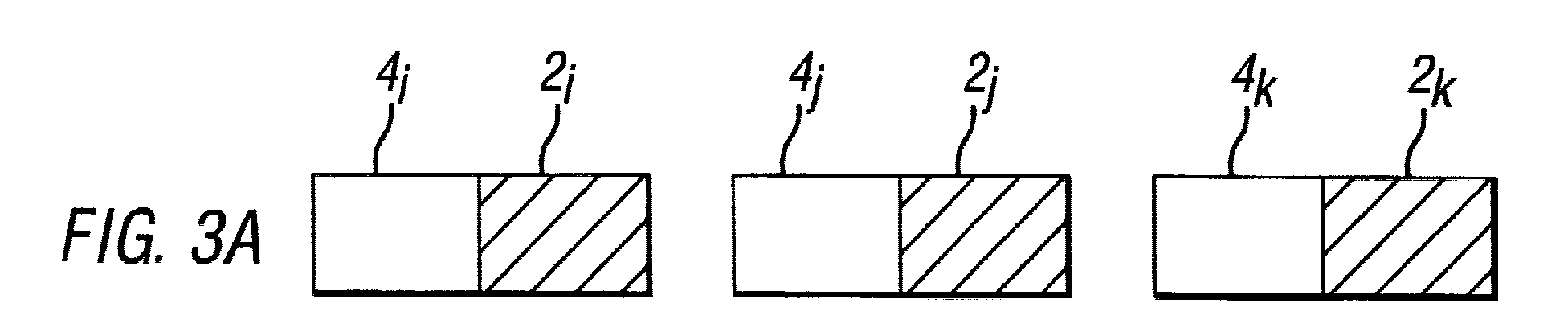
- FIG. 3 diagrammatically show steps of an example method according to the invention.
- Figure 4 diagrammatically shows a router device as an example of a data packet transmitter device according to the invention.
- Figure 5 diagrammatically shows a router device as an example of a data packet receiver device according to the invention.
- FIG. 6 diagrammatically shows a number of interconnected Wide Area Networks (WANs) in each of which the invention is applied.
- WANs Wide Area Networks
- FIG 1 a 40 byte first data packet 1 in accordance with the IPv4 protocol is shown.
- the first data packet 1 includes a 20 byte first header part 2, required by the IPv4 protocol, and a 20 byte first body part 4.
- the first body part includes data transferred via the packet. As can be seen only 50 % of the bits in the first data packet is actually data.
- the IPv4 first header part contains a 4 bits version field 21 indicating the IP protocol version, which protocol version is 4 in the first data packet 1.
- a 4 bits Header Length field 22 is placed, indicating the header size (which is 20 bytes as required by the IPv4 protocol).
- a Type Of Service field 23 of 8 bits is placed, indicating the type of data. This field 23 distinguishes between possible data types. For example, the Type Of Service field 23 may indicate that the packet contains video data, whereby the packet may be sent with priority.
- the following field is Length field 24 of 16 bits size indicating the total length of the first data packet.
- 8 bit Ident field 25 indicates the identity of the first data packet, making it possible to gather IP-datagrams with the same identifier and reassembling them.
- An 8 bits Fragmentation field 26 contains information necessary to place a number of IP-datagrams with the same identifier in the correct order.
- a Time To Life field 27 of 4 bits indicates the life time of the packet.
- a 4 bits Protocol field 28 is a demultiplexing key that identifies a higher level protocol the first data packet should be passed to, for example Transmission Control Protocol (TCP) or UDP.
- a Checksum field 29, of 8 bits size, is used to check for transmitter errors in the first header part.
- a 32 bit Source address field 30 specifies the source address of the first data packet, whereas a 32 bit Destination address field 31 specifies an original first destination address of the first data packet.
- the example method according to the invention described below is applied to data packets in accordance with the IPv4 protocol, the invention is not limited to this type of data packets and it should be apparent that the invention can be applied to any type of data packets. It is advantageous to apply a method according to the invention to datagrams because datagrams tend to have a large header, whereby the real data occupies a small percentage of the datagram, so reduction of the percentage of bits used by the header is extremely useful. Application of the invention to IP-datagrams is even more advantageous because this type of datagrams is commonly used and as is mentioned above a large part of the transmitted IP-datagrams is of a small size.
- first body parts 4 i , 4 j , 4 k containing data included in the corresponding first data packet 1 i , 1 j , 1 k and first destination addresses are extracted from first data packets 1 i , 1 j , 1 k .
- a first header part 2 i , 2 j , 2 k of each first data packet 1 i , 1 j , 1 k is determined.
- the first header part 2 i , 2 j , 2 k contains data packet specific information including the original first destination address.
- the respective original first destination addresses of the first data packets 1 i , 1 j , 1 k are extracted from the first header parts 2 i , 2 j , 2 k and the original first destination addresses are stored in, not shown, storing means.
- the first header parts 2 i , 2 j , 2 k are now discarded.
- the remaining parts of the first data packets 1 i , 1 j , 1 k are the body parts 4 i , 4 j , 4 k .
- These body parts are also stored in a, not shown ,storing means.
- a concatenated or second data packet 1' is made based on the first data packets 1 i , 1 j , 1 k .
- the concatenated or second data packet 1' includes a header part 2' and a body part 4', as can be seen in figure 2.
- the header part 2' contains fields 21', 22', 23', 24', 25', 26', 27', 28', 29', 30', 31' of the same type and size as the first header part, but with settings that correspond to the concatenated or second data packet. For instance, the Length field 24' will now read 106 bytes instead of 40 bytes.
- the header part 2' and a content information part 41-44 of the second body part 4' are prepared, as can is diagrammatically shown in figure 3 C.
- the second header part 2' is made in a manner similar to the first header parts 2, as is generally known in the art.
- a destination address in the Destination Address field 31' can be taken the most frequent first destination address or the most nearby first destination address.
- any destination address can be taken as a second destination address, but it is advantageous to choose a second destination address that is nearby all or a large number of the original first destination addresses.
- the content information part 41-44 of the second header part includes information for determining certain parameters of the first body parts 45, 46, 47 in the data part 45-47 and for determining the number of first body parts 45,46,47 contained in the concatenated or second data packet 1'. In the shown example this is indicated by a Length Of Data Per Packet field 41 indicating the length of each packet. This field 41 is followed by First Data Packet Destination Address fields 42, 43, 44 indicating the original first destination addresses.
- the first body parts 4 i , 4 j , 4 k are extracted from the storing means and placed after the First Data Packet Destination Address fields 42, 43, 44, in the same order as the original first destination addresses are placed in the address field 42, 43, 44, whereby the concatenated or second data packet 1' is completed, as is diagrammatically shown in figure 3 D.
- the example second data packet 1' shown in figure 2 contains three first body parts 4 i , 4 j , 4 k but is should be apparent that any number of first body parts 4 i , 4 j , 4 k can be contained in the data part 45-47 as long as the size of the second body part does not exceed the maximum size of a body part as is allowed by the specific type of data packet.
- the concatenated or second data packet has a size of 106 bytes, of which 60 bytes (57 %) is payload, which is an increase of 7% compared to the percentage of payload of the first data packet shown in figure 1. It should be apparent that the advantages of the invention increase with the number of first body parts 4 i , 4 j , 4 k contained in the second body part4'. For instance, if in the shown example method 1000 first data packets of the type shown in figure 1 would be contained in a concatenated or second data packet 2', the percentage of payload is 73 %.
- the data part 45-47 contains the first body parts 4 i , 4 j , 4 k in a coded form and the content information part 41-44 contains information about the coding algorithm which has been applied. This allows a secure transfer of data packets if the coding algorithm is of an encrypting kind like public key encryption. If this coding algorithm is of a compressing kind, like prediction coding or entropy coding, the effective data percentage will increase even more, since redundant bits are removed from the payload.
- a check data packet can be sent to the second destination address.
- the second destination address will send a return check data packet which contains an address type field. This makes it possible to determine the second address type and to transmit concatenated or second data packets only to addresses having facilities to extract the first body parts.
- the concatenated or second data packets are received and the first body parts 4 i , 4 j , 4 k are extracted.
- the second header part 2' is determined. Also, from the second body part 4' the content information part 41-44 and the data part 45-47 are determined. The information in the content information part 41-44 makes it possible to distinguish each first body part 4 i , 4 j , 4 k and the corresponding original first destination address. Thus, the first body parts and first destination addresses are extracted and stored in storing means.
- the first data packets 4 i , 4 j , 4 k are reconstructed by preparing for each first data packet 1 i , 1 j , 1 k the first header part 2 i , 2 j , 2 k and placing the first body part 4 i , 4 j , 4 k behind the first header part.
- the reconstructed first data packets are transmitted to their original first destination addresses. But it is also possible that the original first destination addresses are the same as the second addresses, in such case the first data packets do not have to be transmitted, of course.
- connections within a network do have a larger bandwidth than a connection from one network to another network.
- computers in a typical Local Area Network (LAN) are usually connected to each other via an Ethernet connection of 10 megabits per second bandwidth whereas the LAN is connected to the Internet by a telephone cable of only 28.8 kilo bits per second bandwidth.
- the invention is advantageous to apply a method according to the invention at the connection of the LAN to the Internet. It is especially useful to perform the invention at a router device of a Wide Area Network. If the invention is applied to datagrams, the Wide Area Network may be a connectionless network.
- Figure 4 shows an example of a device 5 arranged for performing a method for assembling and transmitting a data packet according to the invention.
- the device 5 includes an input port 51, for receiving data packets, extracting means 56 connected to the input port 51, for extracting from first data packets the original first destination addresses and the first body parts, packet preparation means 57, routing means 55 and output ports 52, 53, 54.
- the extracting means include: first determining means 561 for determining the first header part of each first data packet, second determining means 562 for determining from the first header part the original first destination address of the first data packet, first storing means 563 connected to the first determining means and second storing means 564 connected to the second determining means for storing the original first destination addresses and storing the first body parts, respectively. Furthermore, the extracting means are provided with dropping means 565 for discarding the first header part.
- packet preparation means 57 for assembling a concatenated or second data packet.
- packet preparation means 57 include second header part preparation means 571 for preparing the second header part and second body part preparation means 572 for preparing the second body part
- the device shown in fig. 4 is a router device. It is therefore provided with routing means 55 connected between the input port 51 and output ports 52, 53, 54 through means 56 and 57 for routing data packets to one of the output ports 52,53,54.
- the router device is adapted to route TCP/IP datagrams, but it should be apparent that any kind of router device can be used.
- Fig 5 shows a data packet receiver device 6.
- Device 6 includes input ports 61, 62, 63 for receiving and processing concatenated data packets 1'; extracting means 66 for extracting from a concatenated or second data packet 1' first body parts 4 i ,4 j ,4 k ; and first destination addresses and an output port 64.
- the extracting means include: first determining means 661 for determining the second header part; second determining means 662 for determining the position of first body parts in the second data part based on the information in the content information part; third determining means 663 connected to the second determining means 662 for determining the original first destination address of the first body parts; and storage means 664 connected to the first determining means 661 for storing extracted first body parts and the corresponding original first destination addresses.
- first packet preparation means 67 for reconstructing the extracted first data packets 1 i ,1 j ,1 k from the extracted first body parts. These extracted data packets are transmitted to output port 64, where after they are transmitted to the original first destination address.
- the shown example of a data packet receiver device 6 is part of a router device. Therefor, it is provided with routing means 65 connected between the input ports and the output port through means 66. These routing means act in a similar way as the routing means 55 in the previously described transmitter device 5.
- the determination means determine the type of an incoming data packet, in particular whether it is a concatenated data packet l'as described above or not. If the data packet is not a concatenated or second data packet l'the switching means switch off the extracting means 66 and first packet preparation means 67 or route the data packet to the output port 64 without going through the extracting means 66.
- the receiver device 6 can be implemented in a TCP/IP router device
- Figure 6 shows three Wide Area Networks WANs ⁇ , ⁇ , ⁇ , each including a number of network devices 90-92, 93-96,and 98-103 respectively.
- the WANs ⁇ , ⁇ , ⁇ are connected by router devices 70-72 to each other via network connections.
- Each of the WANs ⁇ , ⁇ , ⁇ is connected to the other WANs ⁇ , ⁇ , ⁇ in such a manner that the data packets sent between the WANs are concatenated or second data packets 1'. As can be seen, this may be achieved in various ways.
- the invention can be applied in a router device 72 which in this example includes both devices 5, 6 according to the present invention.
- the invention can also be applied in all network devices 90-92 as in WAN ⁇ . This is advantageous if the connections between the network devices are of limited bandwidth.
- WAN ⁇ It is also possible, as illustrated in WAN ⁇ , to provide the network devices 93-95 directly connected to the router device 70 with a data packet transmitter device 5 and a data packet receiver device 6. This is useful if a number of sub-networks 93;96-97, 94 and 95 situated at different locations are connected to each other via a telephone line and share a single router device 70.
Landscapes
- Engineering & Computer Science (AREA)
- Computer Security & Cryptography (AREA)
- Computer Networks & Wireless Communication (AREA)
- Signal Processing (AREA)
- Data Exchanges In Wide-Area Networks (AREA)
Abstract


Description
- The invention relates to a method for transmitting data packets and a method for receiving data packets. Furthermore, the invention relates to a data packet transmitter device, a data packet receiver device and a communication network including such devices.
- The following terminology is used in this application: a data packet is a data unit of variable size; a header is a part of a data packet containing information about the data packet, for example it's type, source address and destination address; the body part or payload is the part of the data packet containing data transmitted via the packet; a datagram is a data packet containing by itself all information needed to transmit the packet to its destination; so the network used for transmitting does not need to be configured before sending the packets; a connectionless network is a network in which data can be sent without setting up a connection in advance; a router device is a network node connected to two or more networks that may be of the same type or may be of different types, said router device in use forwarding data packets from one network to another.
- In communication or computer networks transmission bandwidth is limited; for example a telephone line, as generally used to connect users to the Internet, has a transport capacity of only 28.8 kilobytes per seconds. A large part of the occupied bandwidth is used in an inefficient manner, because a significant part of the transmitted data packets is not data, but merely information required by transport protocols about the packet itself, for example information on the data packet type or the source and destination address of the packet. It is known that about 38.9 % of the packets transmitted via the Internet has a total length of 40 bytes. These packets are in accordance with the Internet Protocol version 4 (IPv4) and since the IPv4 protocol requires 20 bytes of information about the packet, only 50% of the occupied bandwidth is used for payload.
- The invention seeks to solve this problem and to provide a method by which the overhead/payload ratio of transmitted packets can be improved. To this end, a method for transmitting data packets includes the steps of: extracting from at least two separate first data packets an original first destination address and a first body part containing data to be transmitted by the first data packet; making a concatenated or second data packet and transmitting the concatenated or second data packet to a second destination address, wherein the step of extracting includes: determining a first header part of each first data packet, said first header part containing data packet specific information including an original first destination address; determining from each of said first header parts the original first destination address of the corresponding first data packet; storing the original first destination addresses of the first data packet in address storing means; discarding the first header part; storing in first storing means a remaining part of each of the first data packets, as a first body part, and wherein the concatenated or second data packet includes: a second header part containing second data packet specific information including a second destination address for the concatenated or second data packet, a second body part including: a data part including the first body parts of said first data packets and a content information part including information determining the position of each of the first body parts in the data part, the number of first body parts contained in the concatenated or second data packet and said original first destination addresses of the first body parts.
- Such a method increases the effective data transmission, because a single second header part is sharedby n first body parts, whereby n-1 headers are omitted.
- The invention further provides a method for receiving data packets transmitted by a transmitting method of the above type, said method for receiving including the steps of: receiving a concatenated or second data packet; extracting each of said first body parts contained in the concatenated or second data packet from the concatenated or second data packet; reconstructing at least one first data packet including; a first header part containing packet specific information and the original first destination address, and the first body part; and transmitting the at least one first data packet to the corresponding original first destination address, wherein the step of extracting includes: determining a second header part containing concatenated or second data packet specific information; and a second body part including: a content information part including information determining the position of each of the first body parts in the data part and information determining the number of first body parts contained in the concatenated or second data packet, and the content information part further containing information about the original first destination addresses of the first body parts, and a data part including the first body parts; storing the at least one first body part and the corresponding original first destination address in storing means.
- Thereby reception and use of data packets transmitted by a method according to the invention is made possible.
- The invention further relates to a data packet transmitter device and a data packet receiver device, both devices being able to perform one of the methods according to the invention.
- Also, a communication network is provided including at least one transmitter device and at least one receiver device according to the invention. Thereby a network is provided that reduces the required bandwidth, especially if a significant part of the data packets sent via the network are small packets.
- It should be noted that from PCT patent application WO 9847166 a method is known for transmitting data packets between applications running on a client computer and a server computer. In this prior art document, a method is described whereby a connection is established between a client computer and a server computer via the Internet or an intranet, and smaller data packets transmitted via the connection are contained in a large data packet. The large data packet contains an IP (Internet Protocol) header, followed by an UDP (User Datagram Protocol) header, as is required by the IP and UDP standards. After the UDP header a Communication Enhancement Header is placed, containing information about the place and size of the smaller data packets. The method has to be implemented in OSI (Open Systems Interconnection)
layer - However, the known method differs from the present invention, because according to the present invention does not involve a connection established between a client computer and a server computer. Also, the transmitted data packets are not generated or used by applications running on a client computer and a server computer. Furthermore, according to the present invention the method does not need to be implemented in a specific OSI layer.
- Furthermore, the method proposed in WO 9847166 is disadvantageous because the method requires an extensive communication in accordance with a specific and inflexible protocol in order to establish the connection and only allows to transmit data via the connection, whereby the method can only be applied in a very limited number of networks allowing a connection to be established.
- Further details, aspects and embodiments of the invention are described with reference to the attached drawing.
- Figure 1 diagrammatically shows an Internet Protocol datagram as is commonly transmitted.
- Figure 2 diagrammatically shows an example of an Internet Protocol datagram after applying an example method according to the invention.
- Figure 3 A-D diagrammatically show steps of an example method according to the invention.
- Figure 4 diagrammatically shows a router device as an example of a data packet transmitter device according to the invention.
- Figure 5 diagrammatically shows a router device as an example of a data packet receiver device according to the invention.
- Figure 6 diagrammatically shows a number of interconnected Wide Area Networks (WANs) in each of which the invention is applied.
- In figure 1, a 40 byte
first data packet 1 in accordance with the IPv4 protocol is shown. - The
first data packet 1 includes a 20 bytefirst header part 2, required by the IPv4 protocol, and a 20 bytefirst body part 4. The first body part includes data transferred via the packet. As can be seen only 50 % of the bits in the first data packet is actually data. - The IPv4 first header part contains a 4
bits version field 21 indicating the IP protocol version, which protocol version is 4 in thefirst data packet 1. After theversion field 21, a 4 bitsHeader Length field 22 is placed, indicating the header size (which is 20 bytes as required by the IPv4 protocol). Thereafter, a Type OfService field 23 of 8 bits is placed, indicating the type of data. Thisfield 23 distinguishes between possible data types. For example, the Type OfService field 23 may indicate that the packet contains video data, whereby the packet may be sent with priority. The following field isLength field 24 of 16 bits size indicating the total length of the first data packet. 8 bitIdent field 25 indicates the identity of the first data packet, making it possible to gather IP-datagrams with the same identifier and reassembling them. An 8bits Fragmentation field 26 contains information necessary to place a number of IP-datagrams with the same identifier in the correct order. A Time To Lifefield 27 of 4 bits indicates the life time of the packet. A 4bits Protocol field 28 is a demultiplexing key that identifies a higher level protocol the first data packet should be passed to, for example Transmission Control Protocol (TCP) or UDP. AChecksum field 29, of 8 bits size, is used to check for transmitter errors in the first header part. A 32 bitSource address field 30 specifies the source address of the first data packet, whereas a 32 bitDestination address field 31 specifies an original first destination address of the first data packet. - It should be noted that, although the example method according to the invention described below is applied to data packets in accordance with the IPv4 protocol, the invention is not limited to this type of data packets and it should be apparent that the invention can be applied to any type of data packets. It is advantageous to apply a method according to the invention to datagrams because datagrams tend to have a large header, whereby the real data occupies a small percentage of the datagram, so reduction of the percentage of bits used by the header is extremely useful. Application of the invention to IP-datagrams is even more advantageous because this type of datagrams is commonly used and as is mentioned above a large part of the transmitted IP-datagrams is of a small size.
- As can be seen in figure 3 A,
first body parts first data packet first data packets - In order to extract the original first destination addresses and
first body parts first header part first data packet first header part first data packets first header parts first header parts first data packets body parts - After extracting the respective first destination addresses and
first body parts first data packets first data packets - The header part 2' contains fields 21', 22', 23', 24', 25', 26', 27', 28', 29', 30', 31' of the same type and size as the first header part, but with settings that correspond to the concatenated or second data packet. For instance, the Length field 24' will now read 106 bytes instead of 40 bytes.
- For making the concatenated or second data packet the header part 2' and a content information part 41-44 of the second body part 4' are prepared, as can is diagrammatically shown in figure 3 C.
- The second header part 2' is made in a manner similar to the
first header parts 2, as is generally known in the art. As a destination address in the Destination Address field 31', can be taken the most frequent first destination address or the most nearby first destination address. However, it should be apparent that any destination address can be taken as a second destination address, but it is advantageous to choose a second destination address that is nearby all or a large number of the original first destination addresses. - The content information part 41-44 of the second header part includes information for determining certain parameters of the
first body parts first body parts Per Packet field 41 indicating the length of each packet. Thisfield 41 is followed by First Data Packet Destination Address fields 42, 43, 44 indicating the original first destination addresses. - After preparing the second header part 2'and the content information part 41-44 of the second body part 4', the
first body parts address field - For the sake of simplicity, the example second data packet 1' shown in figure 2 contains three
first body parts first body parts - The concatenated or second data packet has a size of 106 bytes, of which 60 bytes (57 %) is payload, which is an increase of 7% compared to the percentage of payload of the first data packet shown in figure 1. It should be apparent that the advantages of the invention increase with the number of
first body parts - It is advantageous if the data part 45-47 contains the
first body parts - After assembly of the concatenated or second data packet, it is transmitted to the second destination address. Before transmitting the concatenated or second data packet 1' or a multiple of concatenated or second data packets, a check data packet can be sent to the second destination address. In return the second destination address will send a return check data packet which contains an address type field. This makes it possible to determine the second address type and to transmit concatenated or second data packets only to addresses having facilities to extract the first body parts.
- At a second destination address the concatenated or second data packets are received and the
first body parts - In order to extract the
first body parts first body part - Thereafter, the
first data packets first data packet first header part first body part - It is of course possible to extract all first body parts from the concatenated or second data packet at a single address, but it is equally possible to extract only a few first body parts and transmit the remaining part of the concatenated or second data packet to a third destination address. It is also possible to extract all first body parts and then transmit only some of the first data packets individually further, while preparing a new second data packet containing the not further transmitted first data packets as well as new first data packets and transmit this new second data packet to a third destination address.
- It is advantageous to apply a method according to the invention at network nodes connected to each other by a connection of limited bandwidth. It is quite common that connections within a network do have a larger bandwidth than a connection from one network to another network. For example, computers in a typical Local Area Network (LAN) are usually connected to each other via an Ethernet connection of 10 megabits per second bandwidth whereas the LAN is connected to the Internet by a telephone cable of only 28.8 kilo bits per second bandwidth.
- In such cases it is advantageous to apply a method according to the invention at the connection of the LAN to the Internet. It is especially useful to perform the invention at a router device of a Wide Area Network. If the invention is applied to datagrams, the Wide Area Network may be a connectionless network.
- Figure 4 shows an example of a
device 5 arranged for performing a method for assembling and transmitting a data packet according to the invention. Thedevice 5 includes aninput port 51, for receiving data packets, extracting means 56 connected to theinput port 51, for extracting from first data packets the original first destination addresses and the first body parts, packet preparation means 57, routing means 55 andoutput ports - The extracting means include: first determining means 561 for determining the first header part of each first data packet, second determining means 562 for determining from the first header part the original first destination address of the first data packet, first storing means 563 connected to the first determining means and second storing means 564 connected to the second determining means for storing the original first destination addresses and storing the first body parts, respectively. Furthermore, the extracting means are provided with dropping means 565 for discarding the first header part.
- Connected to the extracting means 56 are packet preparation means 57 for assembling a concatenated or second data packet. These packet preparation means 57 include second header part preparation means 571 for preparing the second header part and second body part preparation means 572 for preparing the second body part
- The device shown in fig. 4 is a router device. It is therefore provided with routing means 55 connected between the
input port 51 andoutput ports output ports - In the example shown, the router device is adapted to route TCP/IP datagrams, but it should be apparent that any kind of router device can be used.
- Fig 5 shows a data
packet receiver device 6.Device 6 includesinput ports means 66 for extracting from a concatenated or second data packet 1'first body parts output port 64. - The extracting means include: first determining means 661 for determining the second header part; second determining means 662 for determining the position of first body parts in the second data part based on the information in the content information part; third determining means 663 connected to the second determining means 662 for determining the original first destination address of the first body parts; and storage means 664 connected to the first determining means 661 for storing extracted first body parts and the corresponding original first destination addresses.
- Connected to the extracting means are first packet preparation means 67 for reconstructing the extracted
first data packets output port 64, where after they are transmitted to the original first destination address. - It should be clear that if the second destination address is the same as the original first destination address the first data packets do not have to be transmitted further.
- The shown example of a data
packet receiver device 6 is part of a router device. Therefor, it is provided with routing means 65 connected between the input ports and the output port throughmeans 66. These routing means act in a similar way as the routing means 55 in the previously describedtransmitter device 5. - It is also possible to provide the
device 6 with type determination means and switching means. The determination means determine the type of an incoming data packet, in particular whether it is a concatenated data packet l'as described above or not. If the data packet is not a concatenated or second data packet l'the switching means switch off the extractingmeans 66 and first packet preparation means 67 or route the data packet to theoutput port 64 without going through the extractingmeans 66. - Similar to the device for transmitting a data packet, the
receiver device 6 too can be implemented in a TCP/IP router device - Figure 6 shows three Wide Area Networks WANs α, β, γ, each including a number of network devices 90-92, 93-96,and 98-103 respectively. The WANs α, β, γ, are connected by router devices 70-72 to each other via network connections. Each of the WANs α, β, γ is connected to the other WANs α, β, γ in such a manner that the data packets sent between the WANs are concatenated or second data packets 1'. As can be seen, this may be achieved in various ways. As described before, the invention can be applied in a router device 72 which in this example includes both
devices - The invention can also be applied in all network devices 90-92 as in WAN α. This is advantageous if the connections between the network devices are of limited bandwidth.
- It is also possible, as illustrated in WAN β, to provide the network devices 93-95 directly connected to the router device 70 with a data
packet transmitter device 5 and a datapacket receiver device 6. This is useful if a number ofsub-networks 93;96-97, 94 and 95 situated at different locations are connected to each other via a telephone line and share a single router device 70. - It should be apparent to the worker in this field of art that the invention is not limited to application in a physical device as described, but can likewise be applied in another device and the invention is especially not limited to physical implementation but can likewise be implemented in a more abstract manner, like in a computer program running on a network computer.
Claims (21)
- A method for transmitting a data packet, characterised by the steps of:extracting from each of at least two first data packets (1,1i,1j,1k) an original first destination address (31) and a first body part (4,4i,4j,4k) containing data to be transmitted by the first data packet (1,1i,1j,1k), the extracting step including:determining a first header part (2,2i,2j,2k) of each first data packet (1,1i,1j,1k), said first header part (2,2i,2j,2k) containing data packet specific information including an original first destination address (31),determining from each of said first header parts (2,2i,2j,2k) the original first destination address (31) of the first data packet (1,1i,1j,1k),storing the original first destination address (31) of the corresponding first data packet (1,1i,1j,1k) in second storing means (572),discarding the first header parts (2,2i,2j,2k),storing in first storing means (571) a remaining part of each of the first data packets, as afirst body part (4,4i,4j,4k),making a concatenated or second data packet (1'), the concatenated or second data packet (1') including:transmitting the concatenated or second data packet (1') to said second destination address (31').a second header part (2') containing second data packet specific information including a second destination address (31') for the concatenated or second data packet,a second body part (4',41-47) including: a data part (45-47) including the first body parts (4,4i,4j,4k) of said first data packets (1,1i,1j,1k) and a content information part (41-44) including information determining the position of each of the first body parts (4,4i,4j,4k) in the data part, the number of first body parts (4,4i,4j,4k) contained in the concatenated or second data packet (1') and said original first destination addresses (31) of the first body parts (4, 4i,4j,4k),
- A method as claimed in claim 1, wherein before transmitting the concatenated or second data packet (1'), a check data packet is transmitted to the second destination address, for determining a type of the second destination address (31') based on a return check data packet transmitted by the second destination address (31') in response to the check data packet.
- A method as claimed in claim 1 or 2, wherein the first data packets (1,1i,1j,1k) are first datagrams and the concatenated or second data packet l'is a second datagram.
- A method as claimed in claim 3, wherein the first datagrams and second datagram are IP-datagrams.
- A method as claimed in any of the preceding claims, wherein the first body parts (4') are coded with a coding algorithm before the concatenated or second data packet (1') is made and information about the coding algorithm is included in the content information part (41-44).
- A method as claimed in any of the preceding claims, wherein the method is performed at a router device (70-72)of a Wide Area Network (α, β, γ).
- A method as claimed in claim 6, wherein the method is performed in a connectionless Wide Area Network (α, β, γ).
- A method for receiving data packets transmitted by a transmitting method as claimed in any of the claims 1-7, characterised by the steps of:receiving a concatenated or second data packet (1'),extracting each of said first body parts (4,4i,4j,4k) contained in the concatenated or second data packet (1') from the concatenated or second data packet (1'), the extracting step including:determining a second header part (2') containing second data packet specific information, anda second body part (4') including: a content information part (41-44) including information for determining the position of each of the first body parts (4, 4i,4j,4k) in a data part (45-47) and information for determining a number of first body parts (4, 4i,4j,4k) contained in the concatenated or second data packet (1'), and the content information part (41-44) further containing information about the original first destination addresses (31) of the first body parts (4, 4i,4j,4k), and a data part (45-47) including the first body parts (4, 4i,4j,4k),storing at least one first body part (4, 4i,4j,4k) and the corresponding original first destination address (31) in storing means (664),reconstructing at least one first data packet (1,1i,1j,1k), including a first header part (2,2i,2j,2k) containing packet specific information and the original first destination address (31), and the first body part (4, 4i,4j,4k).transmitting the at least one first data packet (1,1i,1j,1k) to the corresponding original first destination address (31).
- A method as claimed in claim 7, wherein the concatenated or second data packet (1') is a second datagram and the first data packet (1,1i,1j,1k) is a first datagram.
- A method as claimed in claim 8, wherein the first and second datagrams are IP-datagrams.
- A method as claimed in any of the claims 7-9, wherein after extracting one or more first data packets (1,1i, 1j, 1k), a remainder of the concatenated or second data packet is transmitted (1') to a third destination address.
- A method as claimed in any of the claims 7-9, wherein a number of the first data packets (1, 1i,1j,1k) contained in the second body part (4') are extracted, at least one of the first data packets (1, 1i,1j,1k) is transmitted to an original first destination address (31) and at least one remaining data packet and at least one new first data packet are concatenated through a method as claimed in any of the claims 1-7 and are transmitted to the third destination address.
- A method as claimed in any of the preceding claims, wherein the method is performed at a router device (70-72) of a Wide Area Network (α, β, γ).
- A data packet transmitter device having:at least one input port (51), for receiving first data packets,extracting means (56) connected to the input port, for extracting from each of at least two first data packets an original first destination address (31) and a first body part (4, 4i,4j,4k) containing data to be transmitted by the first data packet (1, 1i,1j,1k), the extracting means including:first determining means (561) for determining a first header part (2, 2i,2j,2k) of each first data packet(1, 1i,1j,1k), the first header part (2, 2i,2j,2k) containing data packet specific information including an original first destination address (31),second determining means (562) for determining from each of said first header parts (2, 2i,2j,2k) the original first destination address of each of the first data packets (1, 1i,1j,1k),first storing means (563) for storing the original first destination addresses (31),dropping means (565) for discarding the first header parts (2, 2i,2j,2k).second storing means (564) for storing first body parts (4, 4i,4j,4k) of the first data packets (1, 1i,1j,1k).packet preparation means (57) connected to said extracting means (56) for making a concatenated or second data packet (1'), including:second header part preparation means (571) for preparing a second header part (2') containing second data packet specific information including a second destination address (31'),second body part preparation means (572) for preparing a second body part (4',41-47) including: a content information part (41-44) including information for determining a position of first body parts (4, 4i,4j,4k) in a data part (45-47) of the second body part, the number of first body parts (4, 4i,4j,4k) contained in the concatenated or second data packet (1') and original first destination addresses (31) of said first body parts (4, 4i,4j,4k), and said data part (45-47) including said first body parts (4, 4i,4j,4k),at least one output port (52-54) connected to said packet preparation means (57) for transmitting the concatenated or second data packet (1') to the second destination address (31').
- A router device, having a transmitter device (5) as claimed in claim 14 and the router device further including routing means (55) connected to the transmitter device (5) between the at least one input port (51) and at least one of the at least one output ports (52-54) for routing data packets (1,1') to one of the at least one output ports (52-54).
- A router device as claimed in claim 15 wherein the router device (70-72) is a TCP/IP router device (70-72).
- A data packet receiver device (6), includingan input port (61-63) for receiving data packets,extracting means (66) for extracting first body parts (4, 4i,4j,4k) and original first destination addresses (31) from a concatenated or second data packet (1'), the extracting means (66) including:first packet preparation means (67) for reconstructing at least one extracted first data packet, including a first body part (4, 4i,4j,4k) and a first header part (2, 2i,2j,2k), the first header part containing extracted first packet specific information and the original first destination address (31),first determining means (661) for determining a second header part (2') containing second data packet (1') specific information, and a second body part (4'),second determining means (662) for determining a position of each of the first body parts (4, 4i,4j,4k) in a second data part (45-47) of the second body part (4', 41-47) based on information in a content information part (41-44) of the second body part (4',41-47),third determining means (663) for determining from the content information part (41-44) an original first destination address (31) of each of the first body parts (4, 4i,4j,4k),storage means (664) for storing at least one first body part (4, 4i,4j,4k) and the corresponding original first destination address (31),an output port (64) for transmitting the first data packet (1, 1i,1j, 1k) to the original first destination address (31).
- A router device having a receiver device (6) according to claim 17 and further including routing means (65) connected to the receiver device (6) between the at least one input port (61-63) and at least one output port (64) for routing data packets to one of the at least one output ports (64).
- A router device as claimed in claim 18, further including type determination means for determining a type of an incoming data packet, and switching means for switching off or bypassing the extracting means (66) and first packet preparation means (67) if the type of the incoming data packet is not a concatenated or second data packet (1').
- Router device as claimed in any of the claims 18-19, wherein the router device is an TCP/IP router device (70-72).
- Wide Area Network (α,β,γ), including at least two network devices (70-72;90-103) connected to each other via a network connection, wherein at least one of the devices (70-72;90-103) includes a data packet transmitter device (5) according any of the claims 14-16 and at least one of the devices includes a data packet receiver device (6) as claimed in any of the claims 17.
Priority Applications (2)
| Application Number | Priority Date | Filing Date | Title |
|---|---|---|---|
| EP00306265A EP1176780A1 (en) | 2000-07-24 | 2000-07-24 | Method, device and network for reducing the size of data packet headers |
| US09/911,269 US6963568B2 (en) | 2000-07-24 | 2001-07-23 | Method for transmitting data packets, method for receiving data packets, data packet transmitter device, data packet receiver device and network including such devices |
Applications Claiming Priority (1)
| Application Number | Priority Date | Filing Date | Title |
|---|---|---|---|
| EP00306265A EP1176780A1 (en) | 2000-07-24 | 2000-07-24 | Method, device and network for reducing the size of data packet headers |
Publications (1)
| Publication Number | Publication Date |
|---|---|
| EP1176780A1 true EP1176780A1 (en) | 2002-01-30 |
Family
ID=8173140
Family Applications (1)
| Application Number | Title | Priority Date | Filing Date |
|---|---|---|---|
| EP00306265A Withdrawn EP1176780A1 (en) | 2000-07-24 | 2000-07-24 | Method, device and network for reducing the size of data packet headers |
Country Status (2)
| Country | Link |
|---|---|
| US (1) | US6963568B2 (en) |
| EP (1) | EP1176780A1 (en) |
Cited By (4)
| Publication number | Priority date | Publication date | Assignee | Title |
|---|---|---|---|---|
| WO2004042952A1 (en) | 2002-11-05 | 2004-05-21 | Lg Electronics Inc. | Processing data units for transfer over the same channel |
| EP1505775A3 (en) * | 2003-08-07 | 2006-08-16 | NTT DoCoMo, Inc. | Wireless packet communication apparatus and method using packet concatenation |
| WO2006047781A3 (en) * | 2004-10-27 | 2006-12-21 | Intel Corp | Power saving when using aggregated packets |
| US7787395B2 (en) * | 2003-09-25 | 2010-08-31 | British Telecommunications Plc | Virtual networks |
Families Citing this family (7)
| Publication number | Priority date | Publication date | Assignee | Title |
|---|---|---|---|---|
| EP1741236A4 (en) * | 2004-04-15 | 2011-02-23 | Qualcomm Inc | Packet concatenation in wireless networks |
| US7457316B1 (en) * | 2004-08-31 | 2008-11-25 | Sun Microsystems, Inc. | Method and system for handling received packets |
| JP6299266B2 (en) * | 2014-02-20 | 2018-03-28 | 富士通株式会社 | Data storage method, storage system, program, and storage apparatus |
| US10225153B2 (en) | 2016-04-18 | 2019-03-05 | International Business Machines Corporation | Node discovery mechanisms in a switchless network |
| US10225185B2 (en) | 2016-04-18 | 2019-03-05 | International Business Machines Corporation | Configuration mechanisms in a switchless network |
| US10218601B2 (en) | 2016-04-18 | 2019-02-26 | International Business Machines Corporation | Method, system, and computer program product for configuring an attribute for propagating management datagrams in a switchless network |
| US10193758B2 (en) * | 2016-04-18 | 2019-01-29 | International Business Machines Corporation | Communication via a connection management message that uses an attribute having information on queue pair objects of a proxy node in a switchless network |
Citations (1)
| Publication number | Priority date | Publication date | Assignee | Title |
|---|---|---|---|---|
| US5521940A (en) * | 1992-02-11 | 1996-05-28 | Ouest Standard Telematique Sa | Method and device for the compression and decompression of data in a transmission system |
Family Cites Families (5)
| Publication number | Priority date | Publication date | Assignee | Title |
|---|---|---|---|---|
| US6804251B1 (en) * | 1998-11-12 | 2004-10-12 | Broadcom Corporation | System and method for multiplexing data from multiple sources |
| US6366961B1 (en) * | 1999-03-03 | 2002-04-02 | Nokia Telecommunications, Oy | Method and apparatus for providing mini packet switching in IP based cellular access networks |
| WO2000057284A1 (en) * | 1999-03-25 | 2000-09-28 | Motorola Inc. | Point to point protocol multiplexing/demultiplexing method and apparatus |
| US6804237B1 (en) * | 1999-06-23 | 2004-10-12 | Nortel Networks Limited | Method, devices and signals for multiplexing payload data for transport in a data network |
| US6704311B1 (en) * | 1999-06-25 | 2004-03-09 | Lucent Technologies Inc. | Application-level switching server for internet protocol (IP) based networks |
-
2000
- 2000-07-24 EP EP00306265A patent/EP1176780A1/en not_active Withdrawn
-
2001
- 2001-07-23 US US09/911,269 patent/US6963568B2/en not_active Expired - Lifetime
Patent Citations (1)
| Publication number | Priority date | Publication date | Assignee | Title |
|---|---|---|---|---|
| US5521940A (en) * | 1992-02-11 | 1996-05-28 | Ouest Standard Telematique Sa | Method and device for the compression and decompression of data in a transmission system |
Non-Patent Citations (3)
| Title |
|---|
| J. ROSENBERG, H. SCHULZRINE: "An RTP Payload Format for User Multiplexing <draft-ietf-avt-aggregation-00.txt>", NTERNET ENGINEERING TASK FORCE (IETF), INTERNET DRAFT, 6 November 1998 (1998-11-06), pages 1 - 10, XP002127739 * |
| J. ROSENBERG, H. SCHULZRINE: "Issues and options for RTP multiplexing <draft-ietf-avt-muxissues-00.txt>", INTERNET ENGINEERING TASK FORCE (IETF) , INTERNET DRAFT, 1 March 1999 (1999-03-01), pages 1 - 27, XP002149446 * |
| K. EL-KHATIB, G. LUO, G. BOCHMANN: "Multiplexing scheme for RTP Flows between Access Routers <draft-ietf-avt-multiplexing-rtp-00.txt>", INTERNET ENGINEERING TASK FORCE (IETF), INTERNET DRAFT, 24 June 1999 (1999-06-24), pages 1 - 13, XP002149447 * |
Cited By (8)
| Publication number | Priority date | Publication date | Assignee | Title |
|---|---|---|---|---|
| WO2004042952A1 (en) | 2002-11-05 | 2004-05-21 | Lg Electronics Inc. | Processing data units for transfer over the same channel |
| EP1559203A4 (en) * | 2002-11-05 | 2009-07-29 | Lg Electronics Inc | Processing data units for transfer over the same channel |
| EP2293620A1 (en) * | 2002-11-05 | 2011-03-09 | LG Electronics, Inc. | Processing data units for transfer over the same channel |
| EP2299752A1 (en) * | 2002-11-05 | 2011-03-23 | LG Electronics, Inc. | Processing data units for transfer over the same channel |
| EP1505775A3 (en) * | 2003-08-07 | 2006-08-16 | NTT DoCoMo, Inc. | Wireless packet communication apparatus and method using packet concatenation |
| US7787395B2 (en) * | 2003-09-25 | 2010-08-31 | British Telecommunications Plc | Virtual networks |
| WO2006047781A3 (en) * | 2004-10-27 | 2006-12-21 | Intel Corp | Power saving when using aggregated packets |
| US8009601B2 (en) | 2004-10-27 | 2011-08-30 | Intel Corporation | Power saving when using aggregated packets |
Also Published As
| Publication number | Publication date |
|---|---|
| US20020018467A1 (en) | 2002-02-14 |
| US6963568B2 (en) | 2005-11-08 |
Similar Documents
| Publication | Publication Date | Title |
|---|---|---|
| Shacham et al. | IP payload compression protocol (IPComp) | |
| US7948921B1 (en) | Automatic network optimization | |
| US6542504B1 (en) | Profile based method for packet header compression in a point to point link | |
| US5535199A (en) | TCP/IP header compression X.25 networks | |
| EP2400693B1 (en) | Routing and service performance management in an application acceleration environment | |
| US7006526B1 (en) | Mechanisms for avoiding problems associated with network address protocol translation | |
| US7526577B2 (en) | Multiple offload of network state objects with support for failover events | |
| EP3198464B1 (en) | Application-aware multihoming for data traffic acceleration in data communications networks | |
| US6018530A (en) | Method for transmitting using a modified transport control protocol | |
| US7308001B2 (en) | Fibre channel frame batching for IP transmission | |
| US10757230B2 (en) | Efficient parsing of extended packet headers | |
| EP2088717A1 (en) | A method of transferring fragmentation message, a system of communication and a tunnel device | |
| JP2002502188A (en) | System and method for using a domain name to route data transmitted to a destination on a network | |
| AU2007320794B2 (en) | Selective session interception method | |
| US20020196793A1 (en) | End-user communication systems access network | |
| JP2003520461A (en) | How to optimize data transmission | |
| US6963568B2 (en) | Method for transmitting data packets, method for receiving data packets, data packet transmitter device, data packet receiver device and network including such devices | |
| EP1515511B1 (en) | Multiple offload of network state objects with support for failover events | |
| CN107104911B (en) | UDP (user Datagram protocol) data packet segmentation method and transmission method | |
| KR102736167B1 (en) | One-way High Speed Transmission System for Large File Data in the Separated Network Environment | |
| FI110151B (en) | Method for transmitting packets over a circuit switching network | |
| EP1389852B1 (en) | Method for performing TCP/IP based communication over a multiple IP-network system | |
| Neupane | IP payload compression for higher throughput | |
| EP1451983B1 (en) | Procedures and devices for routing of data packets | |
| JP7008714B2 (en) | Communication device |
Legal Events
| Date | Code | Title | Description |
|---|---|---|---|
| PUAI | Public reference made under article 153(3) epc to a published international application that has entered the european phase |
Free format text: ORIGINAL CODE: 0009012 |
|
| AK | Designated contracting states |
Kind code of ref document: A1 Designated state(s): DE FR GB Kind code of ref document: A1 Designated state(s): AT BE CH CY DE DK ES FI FR GB GR IE IT LI LU MC NL PT SE |
|
| AX | Request for extension of the european patent |
Free format text: AL;LT;LV;MK;RO;SI |
|
| 17P | Request for examination filed |
Effective date: 20020720 |
|
| AKX | Designation fees paid |
Free format text: DE FR GB |
|
| GRAP | Despatch of communication of intention to grant a patent |
Free format text: ORIGINAL CODE: EPIDOSNIGR1 |
|
| STAA | Information on the status of an ep patent application or granted ep patent |
Free format text: STATUS: THE APPLICATION IS DEEMED TO BE WITHDRAWN |
|
| 18D | Application deemed to be withdrawn |
Effective date: 20070412 |