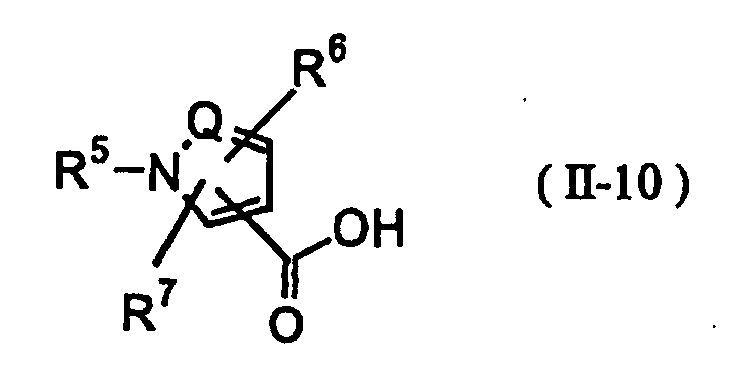
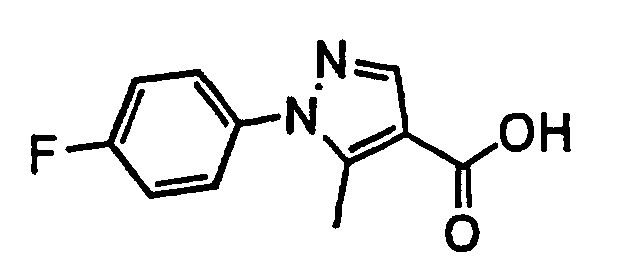
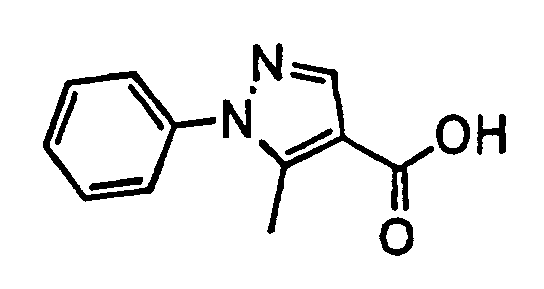
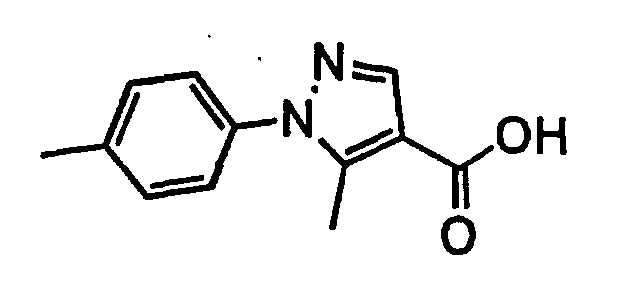
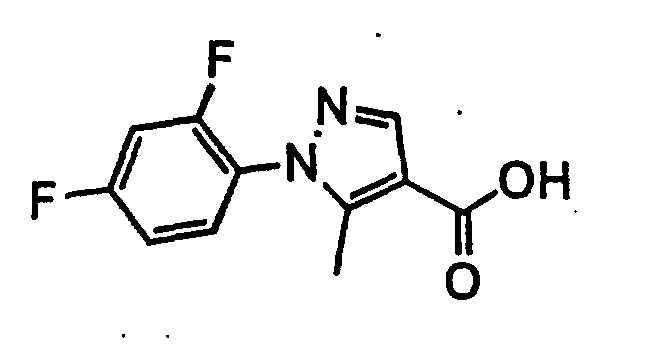
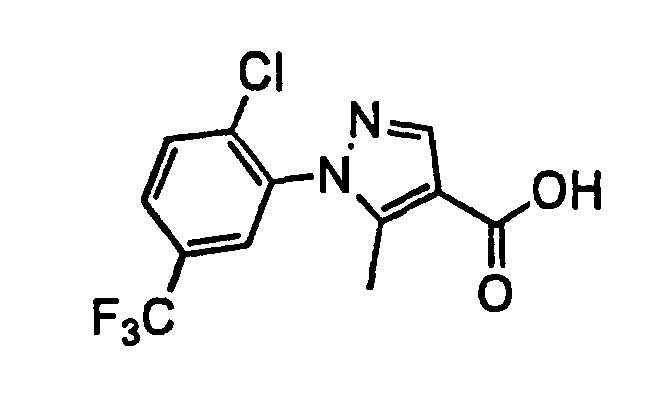
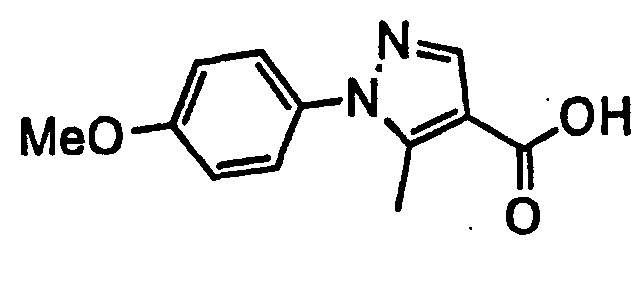
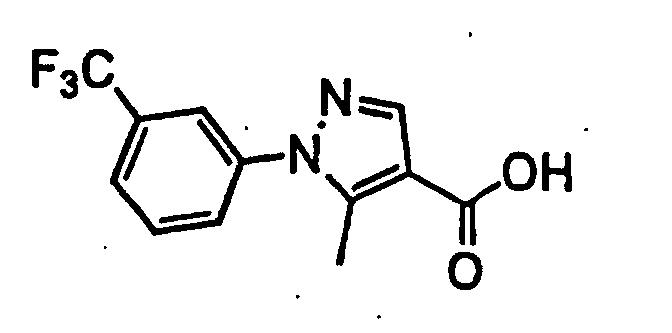
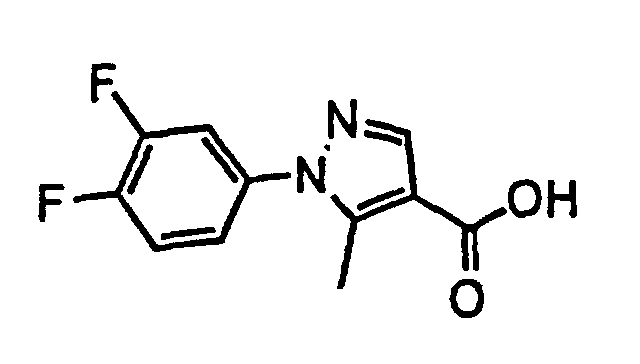
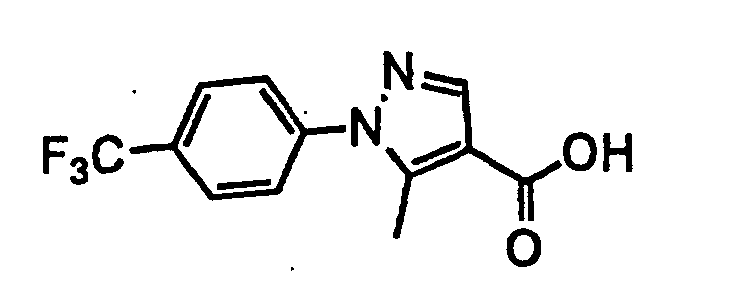
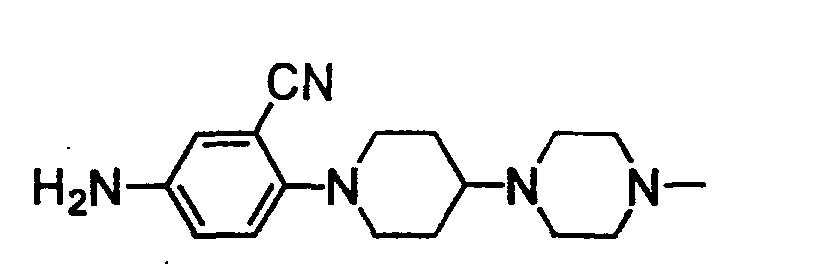
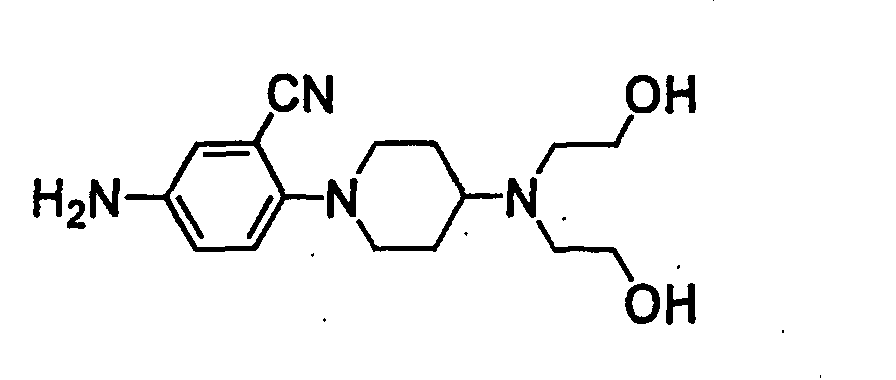
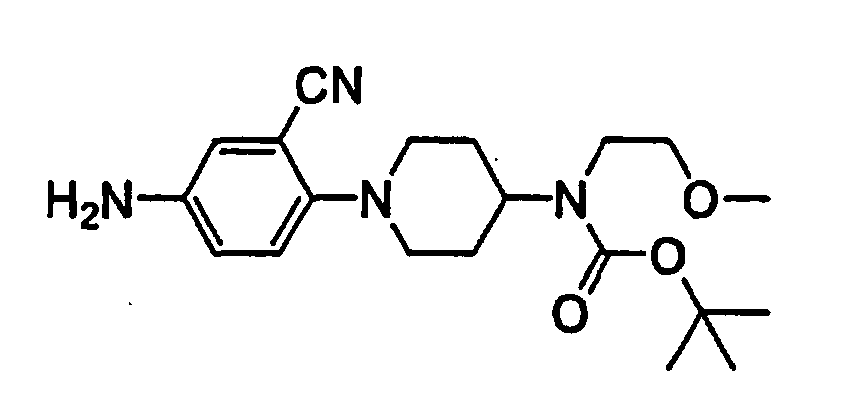
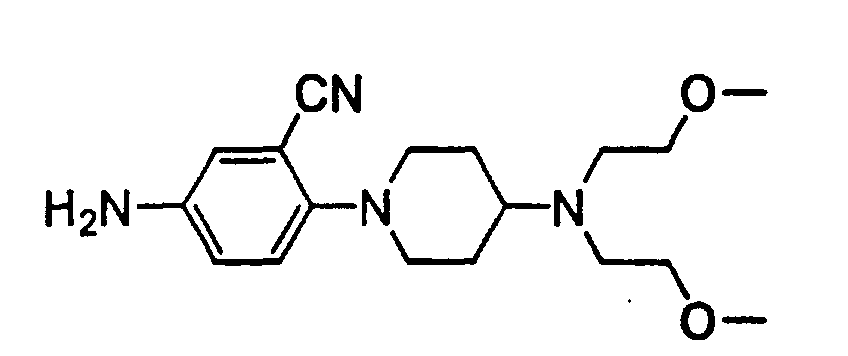
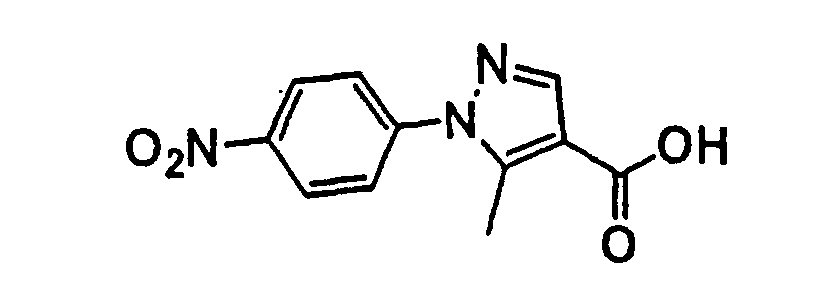
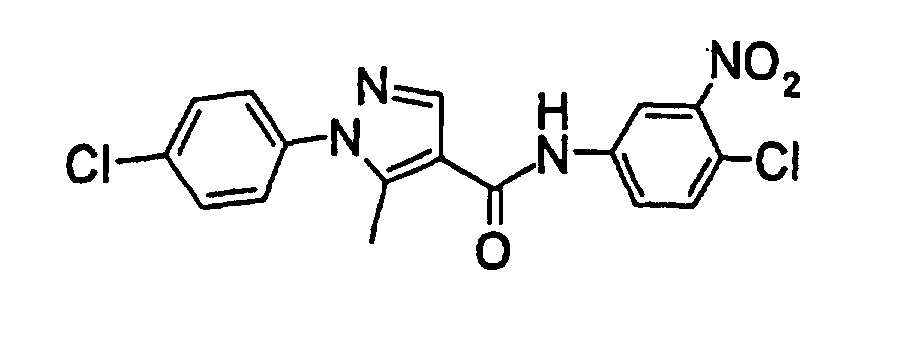
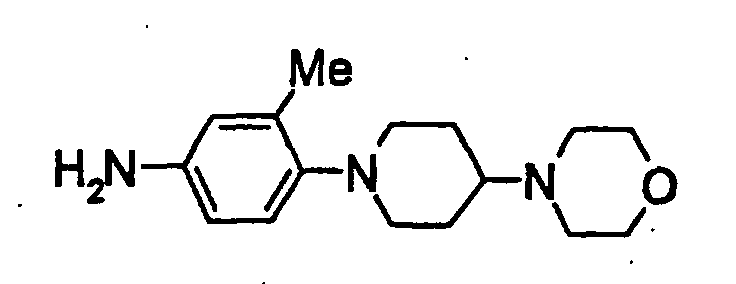
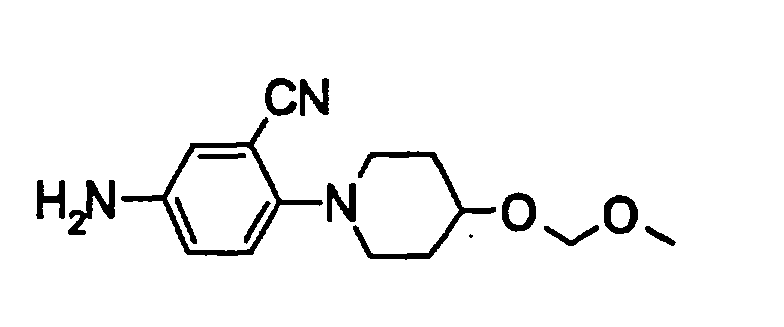
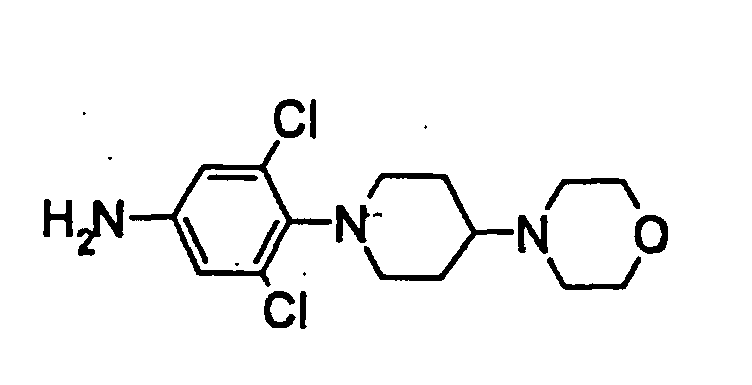
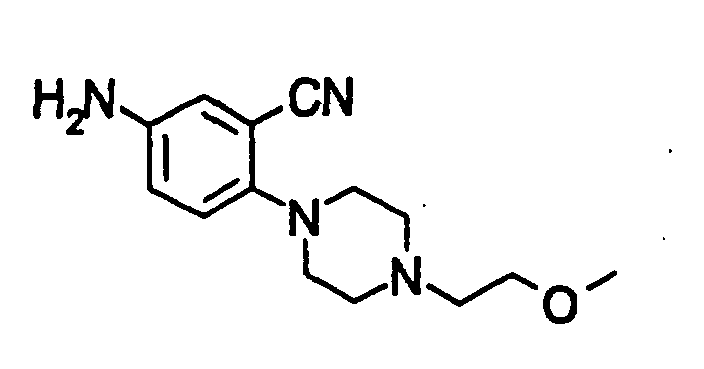
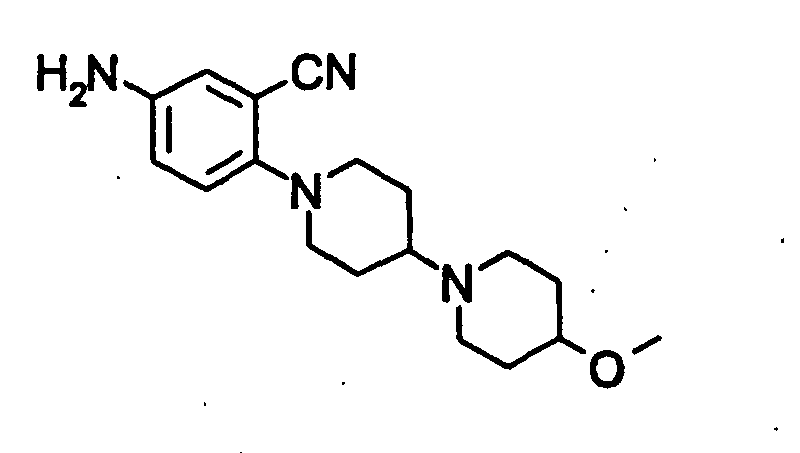
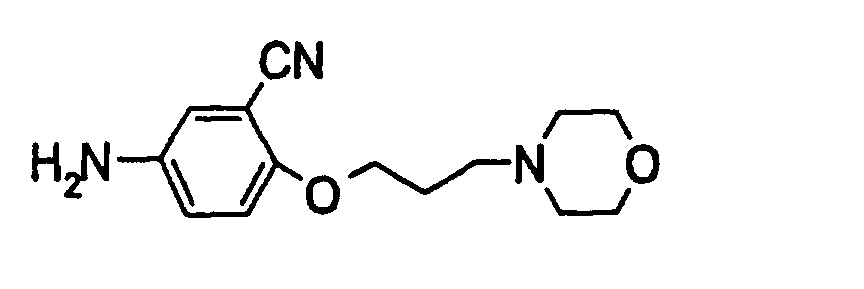
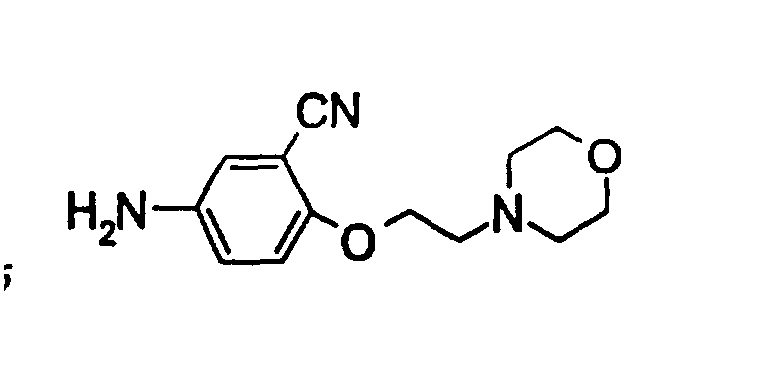
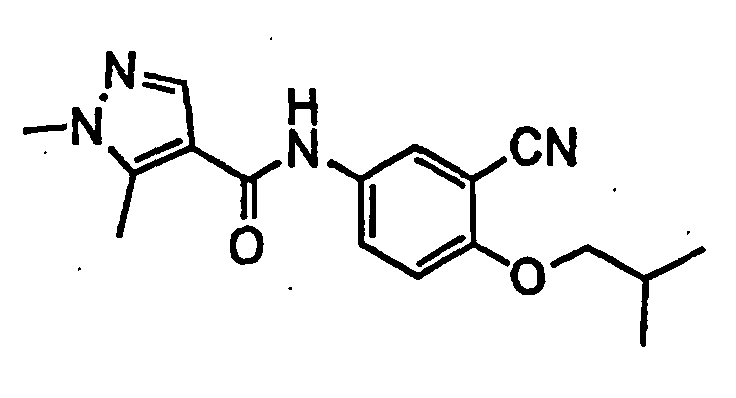
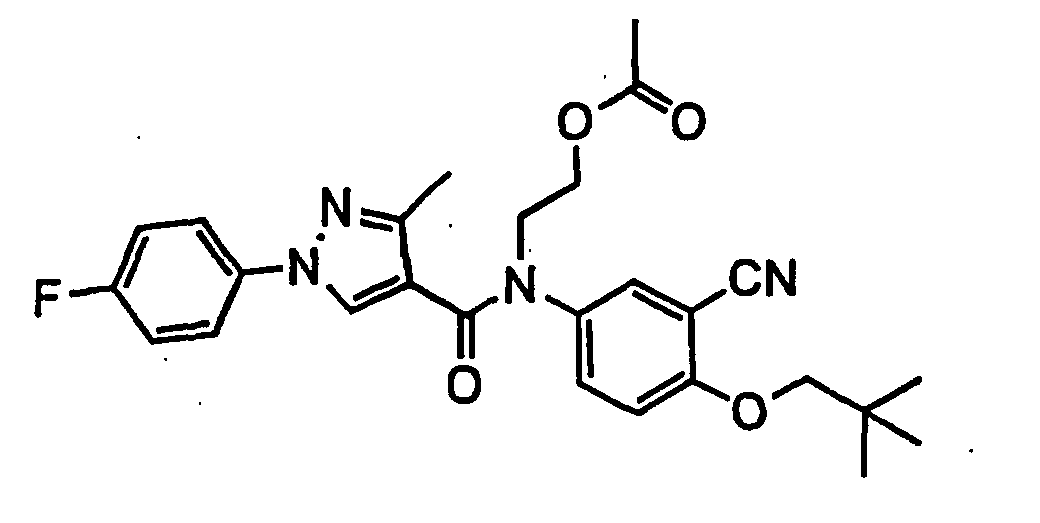
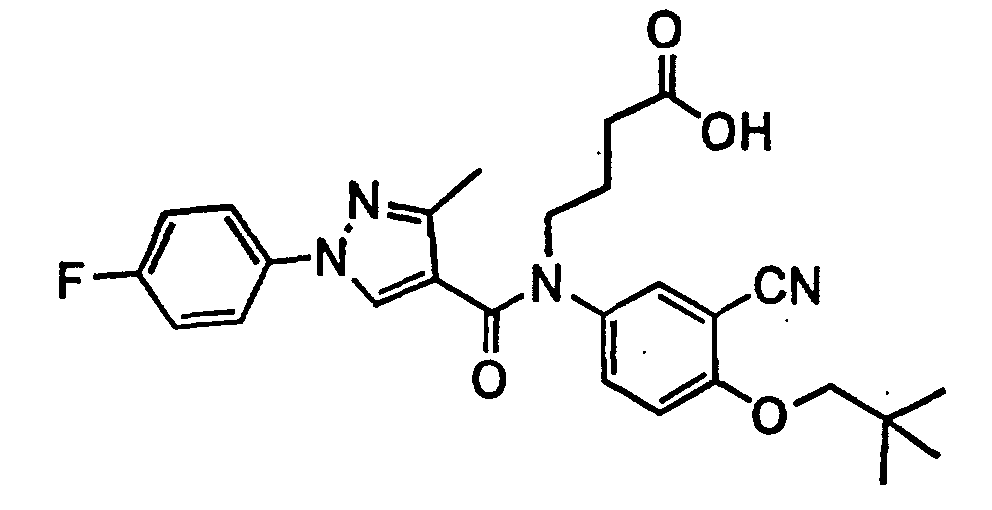
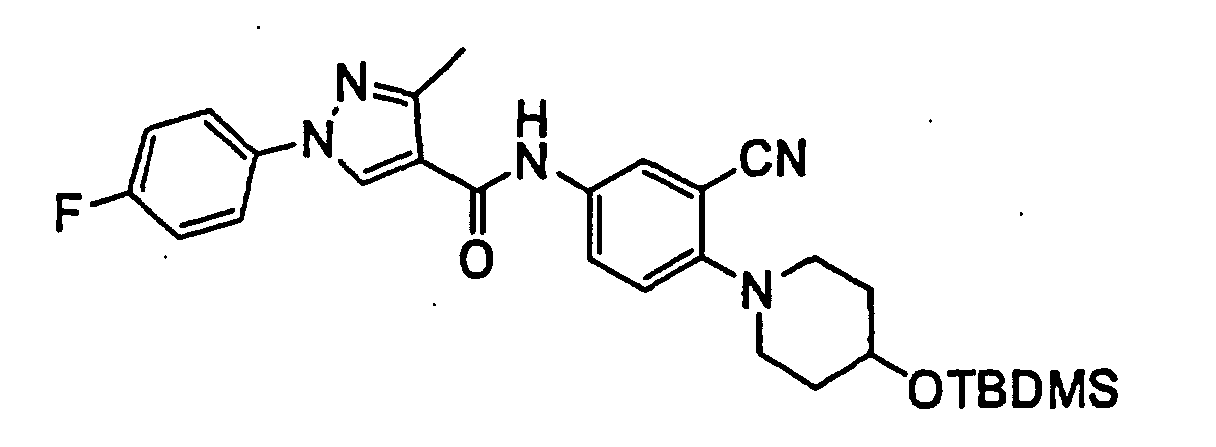
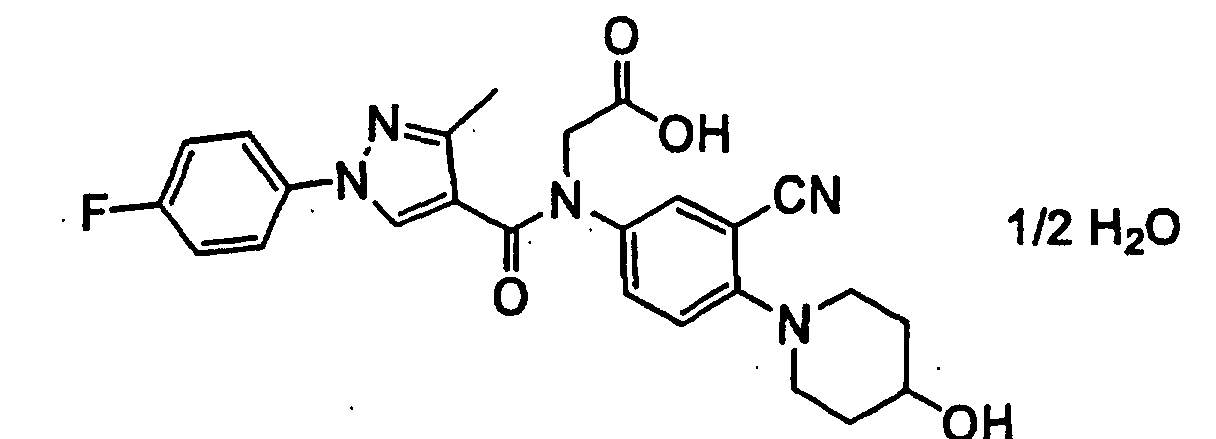
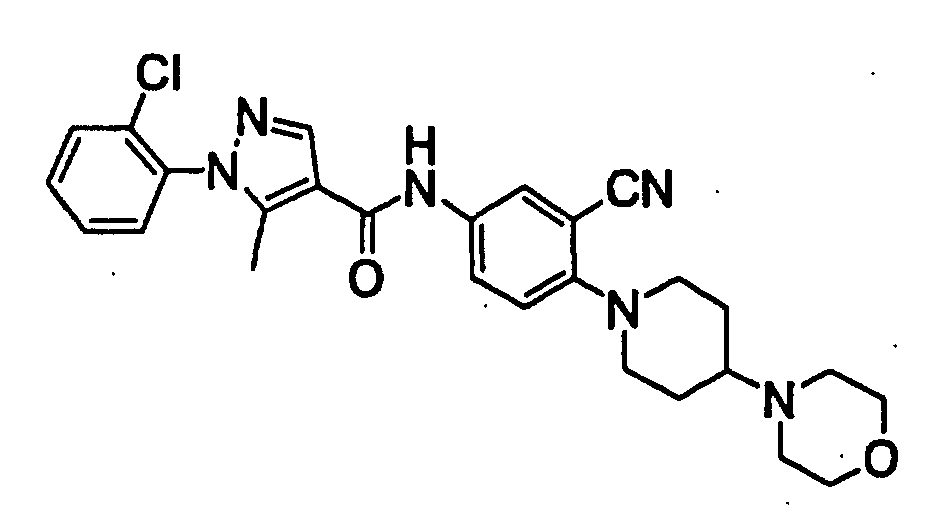
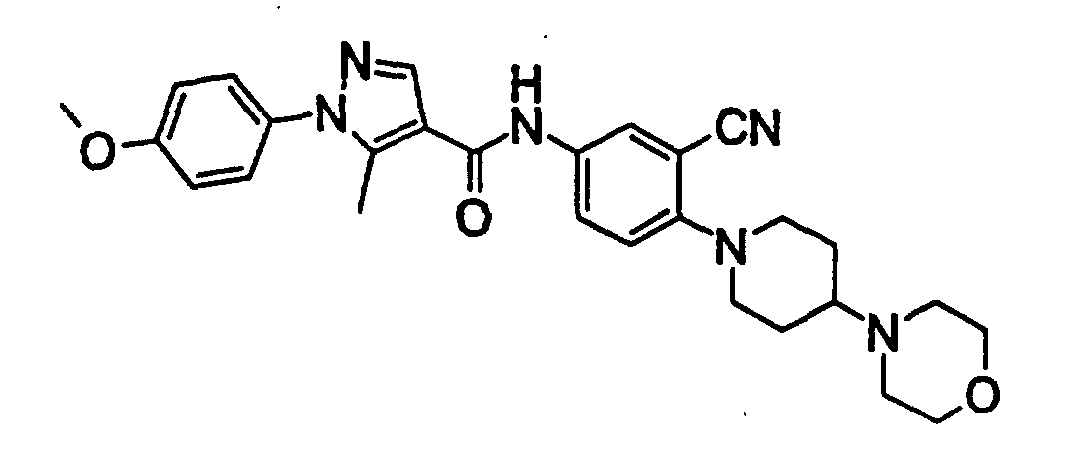
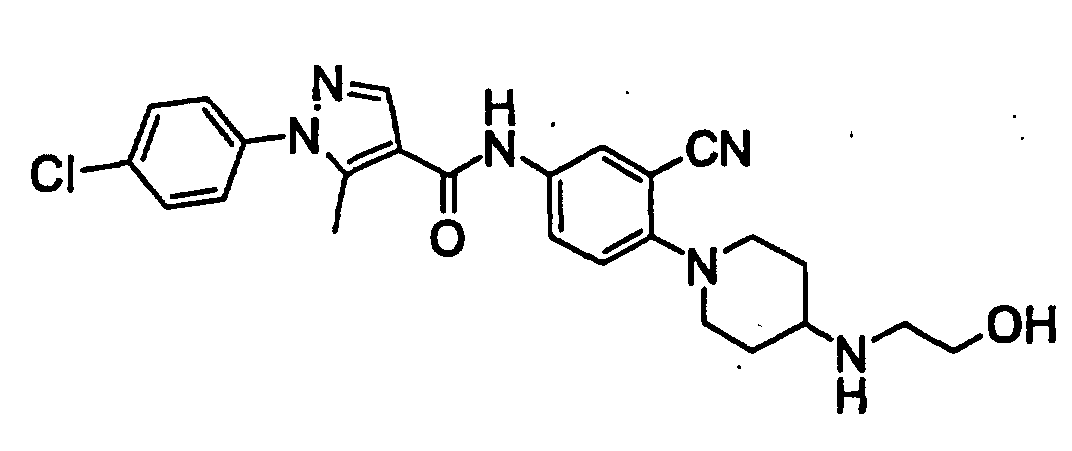
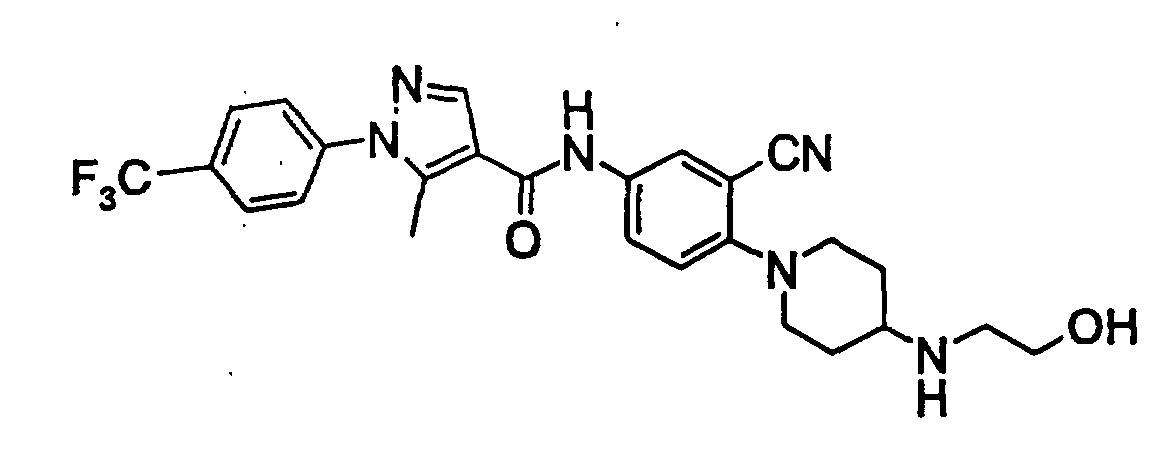
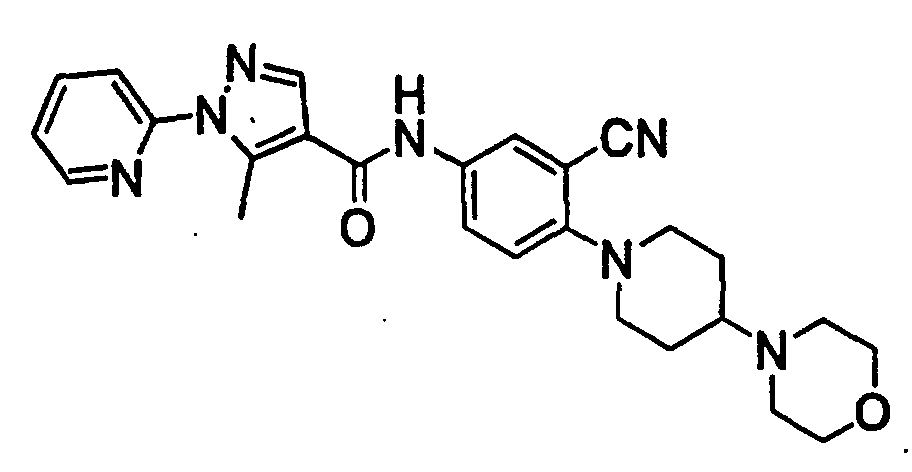
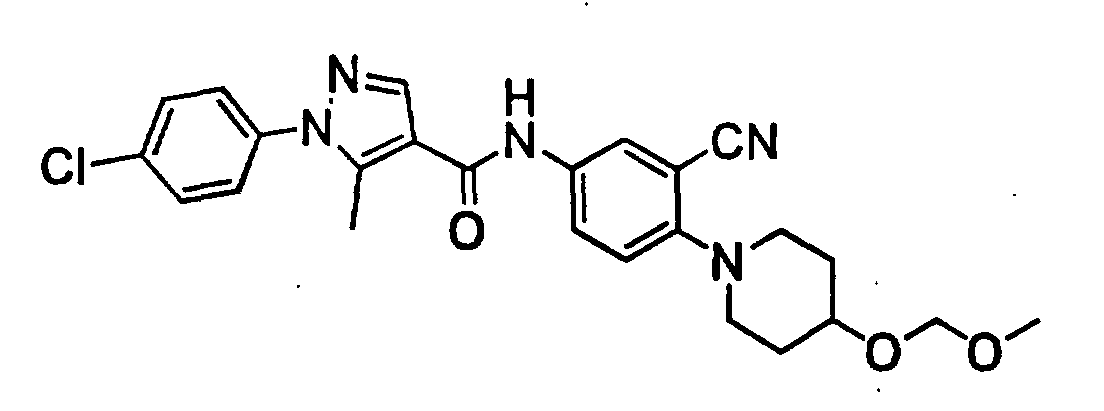
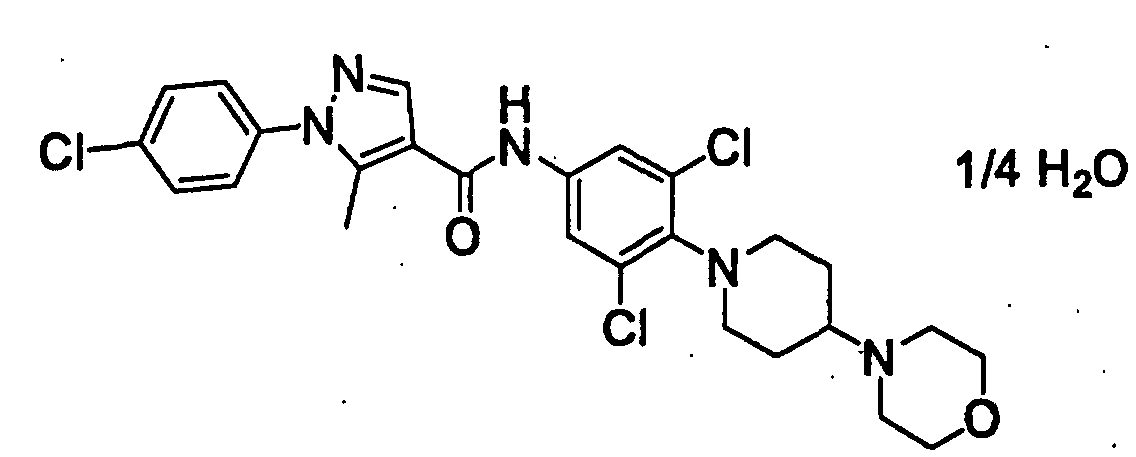
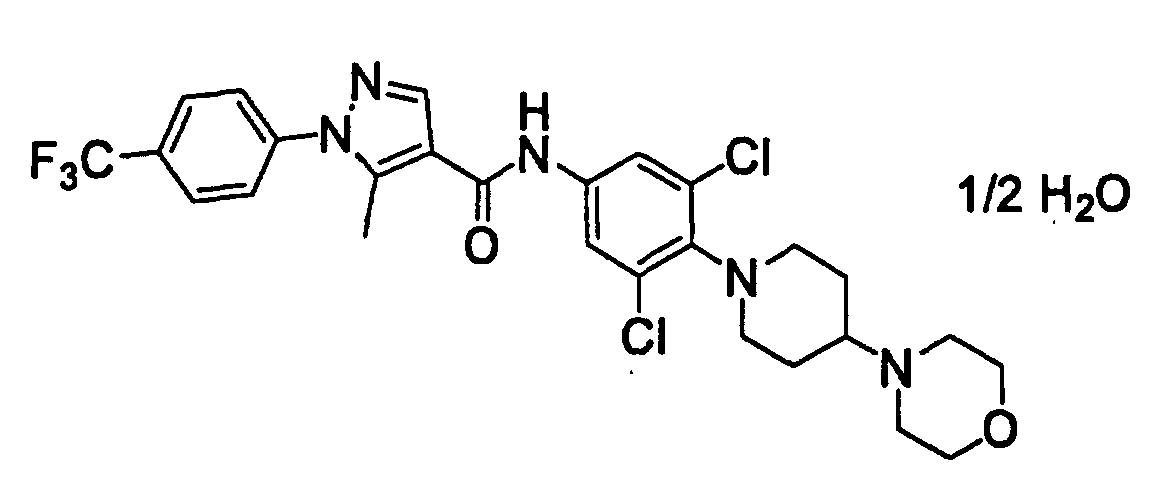
TECHNICAL FIELD OF THE INVENTION
The present invention relates to an amide compound useful as a
medicine, particularly as an agent for the prophylaxis or treatment of
autoimmune disease, and its use as a medicine.
BACKGROUND OF THE INVENTION
Autoimmune diseases are considered to be induced by
autoreactivity acquired by lymphocytes that originally does not respond
to themselves, or by incomplete removal of autoreactivated lymphocytes
in the thymus and the like. In particular, rheumatoid arthritis (RA)
is considered to be induced by immune response of lymphocytes,
particularly T cells and B cells, against type II collagen that mostly
exists in one's own joints. The disease gets serious because it
accompanies infiltration of T cells and B cells into the joints,
activation and proliferation of these cells in the joints and, when it
advances, abnormal proliferation of synoviocytes in the joints to
result in articular destruction. Because a number of activated
lymphocytes infiltrate into articular tissues of RA patients, activated
lymphocytes are considered to play an important role in the formation
and advance of the disease state of RA.
In general terms, it is known that when lymphocytes are
activated by antigen, type 1 helper T cells (Th1 cell) in the
lymphocytes produces cytokines such as interleukin 2 (IL-2), interferon
γ (IFN-γ) and the like, and the produced IL-2 and IFN-γ cause growth and
division of lymphocytes, particularly T cells. Despite the presence of
a great number of activated lymphocytes in the articular tissues of RA
patients, IL-2 level is extremely low, which has produced a presumption
that a lymphocyte growth factor should be present besides IL-2 (Journal
of Experimental Medicine, vol. 168, p. 1573, 1988).
Recently, interleukin 15 (IL-15) was cloned as a new cytokine
that promotes growth and differentiation of lymphocytes (T cells or B
cells) (Science, vol. 264, p 965, 1994). The IL-15 receptor has been
clarified to consist of α chain specific to IL-15, β chain common to
IL-15 and IL-2, and γ chain common to the receptors of IL-15, IL-2, IL-4,
IL-7, IL-9 and IL-13 (EMBO Journal, vol. 13, p. 2822, 1994; EMBO
Journal, vol. 14, p. 3654, 1995). The presence of a signal
transduction pathway via tyrosin kinase (represented by JAK1 and JAK3)
in the downstream of β chain and γ chain has been also uncovered
(Science, vol. 266, p. 1782, 1994). It is expected, therefore, that
the pharmacological activity induced by the binding of IL-15 and IL-15
receptor is the promotion of proliferation of lymphocytes, and is
almost of the same nature as the binding of IL-2 and IL-2 receptor. It
has been reported that the IL-2, IL-9-producing cells are T cells,
particularly helper T cells activated by antigen, the IL-7-producing
cells are mostly stroma cells, and IL-15-producing cells are
macrophages, dendritic cells, synoviocytes and the like (Science, vol.
264, p. 965, 1994). A recent report has documented that synovial fluid
of RA patients has a markedly high concentration of IL-15, which
suggests the important role of IL-15 as a growth factor for the
proliferation of activated lymphocytes in the joints in RA. In
addition, there is a report on many activities of IL-15 besides
promotion of proliferation of the activated lymphocytes, such as
promotion of migration of T cells toward inflammatory sites, activation
of memory T cells, promotion of production of inflammatory cytokines
such as tumor necrosis factor (TNF)-α and the like, and other
activities (Nature medicine, vol. 3, p. 189, 1997). It is being
elucidated that IL-15 plays an important role in the onset and
development of various autoimmune diseases such as Crohn's diseases,
lupus nephritis in systemic lupus erythematosus and the like.
From the foregoing, it is considered that, for the improvement
of symptoms of autoimmune diseases represented by RA, inhibition of
proliferation of IL-15-dependent activated lymphocytes is particularly
effective.
Conventionally, a therapeutic agent for autoimmune diseases,
particularly RA, has been a gold compound, penicillamine, bucillamine,
azathioprine, cyclophosphamide, methotrexate and the like. These
inhibit proliferation of synoviocytes in the joints. Due to their
antagonistic inhibitory action in nucleic acid metabolism, however, the
long-term use of the agent is associated with highly frequent
occurrence of side effects, such as hematopoietic injury, digestive
system disorder and the like. Combined with easy infectivity and the
like caused by the agents, they are not therapeutically satisfactory.
While corticosteroid is effective for these diseases, it is associated
with serious side effects, such as moon face, hypoadrenalism,
osteonecrosis of femoral head and the like. Furthermore, leflunomide
approved as an antirheumatic drug in the US has been reported to show a
long half-life of blood disappearance despite its superior therapeutic
effect, causing side effects such as digestive system disorder, liver
disorder, eruption and the like (The Lancet, vol. 353, pp. 259-266,
1999), and a clinically more superior therapeutic agent is desired.
Thus, there is a strong demand for a therapeutic agent for
autoimmune diseases such as RA and the like, which shows a superior
therapeutic effect as compared to conventional pharmaceutical agents
and which causes less side effects.
As mentioned above, the proliferation of activated lymphocytes
in articular tissue is deeply involved in the progress of arthritis in
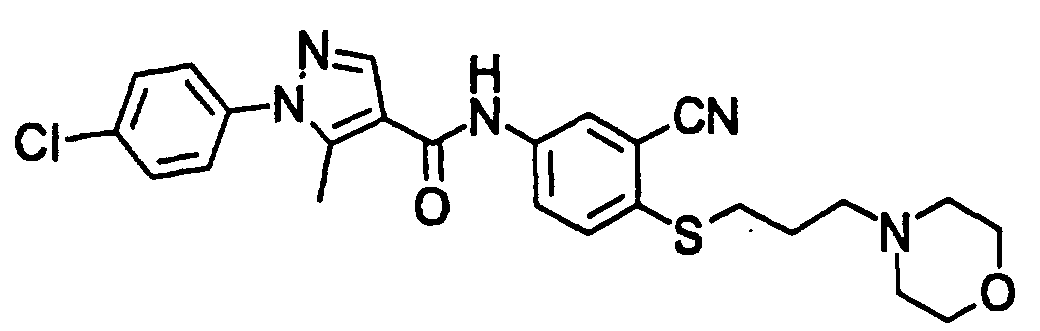
RA, and IL-15 is suggested to be responsible for the proliferation of
activated lymphocytes. Therefore, a compound that inhibits signal
transduction via tyrosine kinase originated from IL-15 receptor (γ
chain common to IL-2, IL-4, IL-7, IL-9, IL-13 and IL-15) is considered
to show a superior effect for the prophylaxis or treatment of
autoimmune diseases such as rheumatoid arthritis and the like. In
addition to the aforementioned effect, a compound that inhibits
production of IL-15 itself or production of inflammatory cytokines,
such as TNF-α and the like, which is derived by IL-15, is likely to
show a superior effect for the prophylaxis or treatment of autoimmune
diseases such as rheumatoid arthritis and the like. However, there is
no report taking note of IL-15, which concerns a compound having an
inhibitory effect on the proliferation of activated lymphocytes as a
therapeutic agent for autoimmune diseases or as a therapeutic agent for
RA.
Bioorganic and Medicinal Chemistry Letters, vol. 8, pp. 2787-2792,
1998 discloses a pyrazolecarboxamide compound useful as an
immunosuppressant agent. As phenylpyrazolecarboxamide having similar
structure, JP-A-52-87167 discloses a compound as an antimicrobial agent;
WO97/11690 discloses a compound for treating bacterial infection in
which a therapeutically effective amount of an inhibitor of global
regulator of pathogenic gene is administered to mammals. Veshchestva,
vol. 23, pp. 82-87, 1991 discloses a compound as an agricultural
chemical to inhibit growth of plants. However, an inhibitory effect on
the proliferation of activated lymphocytes taking note of IL-15 on
these compounds is not disclosed at all.
In view of the above, the present inventors have conducted
intensive studies and found that an amide compound of the following
formula and a pharmaceutically acceptable salt thereof suppress
cytokine response that may induce proliferation, differentiation and
the like of various cells responsible for immunity, such as lymphocytes
(T cells, B cells), macrophages and the like, by the addition of a
cytokine, such as IL-2, IL-4, IL-7, IL-9, IL-13, IL-15 and the like, in
the presence or absence of an antigen or mitogen. In particular, they
have found that the above compound and its salt inhibit IL-15-dependent
proliferation of activated lymphocytes and production of inflammatory
cytokine derived by IL-15, namely, IL-1, IL-6, IL-12, IL-15, IL-18,
TNF-α and the like, which resulted in the completion of the present
invention.
DISCLOSURE OF THE INVENTION
Accordingly, the present invention provides the following.
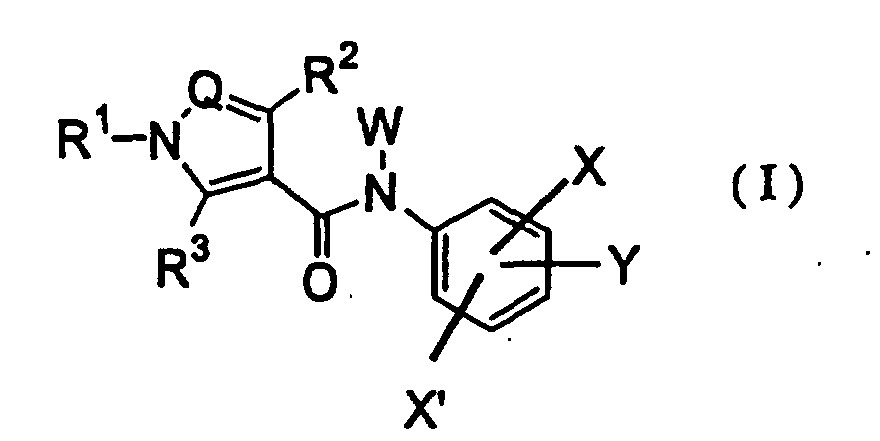
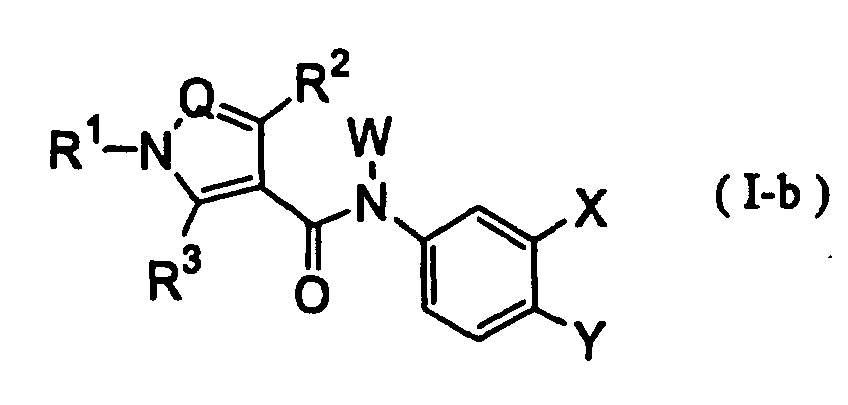
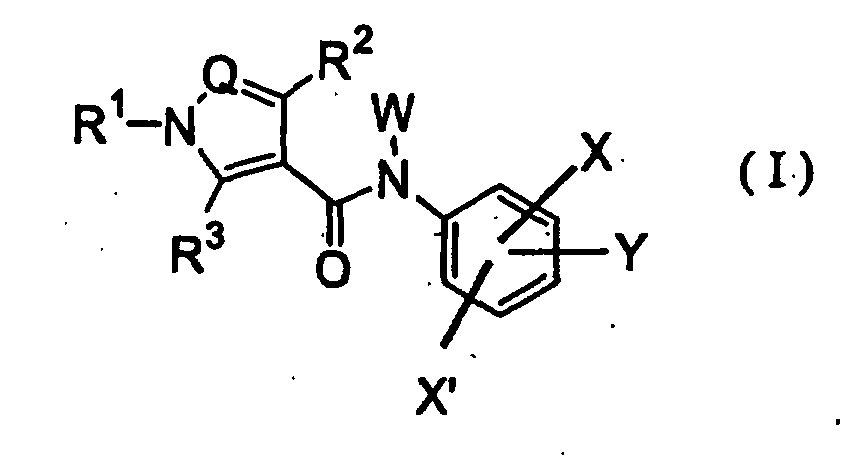
- R1
- is substituted aryl, arylalkyl, optionally substituted
heteroaryl, heteroarylalkyl or cycloalkyl,
- R2 and R3
- are the same or different and each is hydrogen, alkyl,
halogen, hydroxyl group, alkoxy, optionally substituted
amino or phenyl,
- Q
- is nitrogen atom or a group C-R4 (wherein R4 is hydrogen,
alkyl, halogen or optionally substituted amino),
- W
- is hydrogen, alkyl, hydroxyalkyl, acyloxyalkyl, aminoalkyl,
hydroxycarbonylalkyl or alkoxycarbonylalkyl,
- X
- is halogen, cyano, nitro, amino, alkyl, alkoxy, carboxy,
alkoxycarbonyl, carbamoyl, alkenyl, alkynyl or haloalkyl,
- X'
- is hydrogen, halogen, cyano or nitro, and
- Y
- is alkyl, hydroxyalkyl, hydroxycarbonylalkyl, optionally
substituted aminoalkyl, hydroxyl group, alkoxy, haloalkoxy,
aryloxy, cycloalkyloxy, hydroxyalkoxy,
hydroxycarbonylalkoxy, optionally substituted aminoalkoxy,
mercapto, alkylthio, hydroxyalkylthio,
hydroxycarbonylalkylthio, optionally substituted
aminoalkylthio, a group O-Het (wherein Het is optionally
substituted saturated heterocycle having hetero atom
selected from oxygen atom and nitrogen atom) or a group
N(Z2) (Z3) (wherein Z2 and Z3 are the same or different and
each is hydrogen, alkyl, hydroxyalkyl or aminoalkyl, or Z2
and Z3 form, together with the adjacent nitrogen atom,
cyclic amine optionally having one or two atoms from
oxygen atom, sulfur atom and nitrogen atom in the ring),
or a pharmaceutically acceptable salt thereof.
[2] The amide compound of the above-mentioned [1], which has the
formula
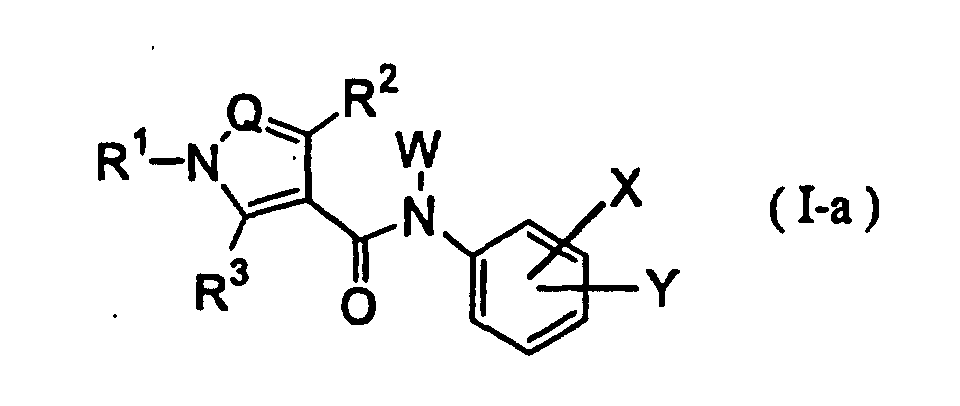
- R1
- is substituted aryl, arylalkyl, optionally substituted
heteroaryl, heteroarylalkyl or cycloalkyl,
- R2 and R3
- are the same or different and each is hydrogen, alkyl,
halogen, hydroxyl group, alkoxy, optionally substituted
amino or phenyl,
- Q
- is nitrogen atom or a group C-R4 (wherein R4 is hydrogen,
alkyl, halogen or optionally substituted amino),
- W
- is hydrogen, alkyl, hydroxyalkyl, acyloxyalkyl, aminoalkyl,
hydroxycarbonylalkyl or alkoxycarbonylalkyl,
- X
- is halogen, cyano, nitro, amino, alkyl, alkoxy, carboxy,
alkoxycarbonyl, carbamoyl, alkenyl, alkynyl or haloalkyl,
- Y
- is alkyl, hydroxyalkyl, hydroxycarbonylalkyl, optionally
substituted aminoalkyl, hydroxyl group, alkoxy, haloalkoxy,
aryloxy, cycloalkyloxy, hydroxyalkoxy,
hydroxycarbonylalkoxy, optionally substituted aminoalkoxy,
mercapto, alkylthio, hydroxyalkylthio,
hydroxycarbonylalkylthio, optionally substituted
aminoalkylthio, a group O-Het (wherein Het is optionally
substituted saturated heterocycle having hetero atom
selected from oxygen atom and nitrogen atom) or a group
N(Z2) (Z3) (wherein Z2 and Z3 are the same or different and
each is hydrogen, alkyl, hydroxyalkyl or aminoalkyl, or Z2
and Z3 form, together with the adjacent nitrogen atom,
cyclic amine optionally having one or two atoms from
oxygen atom, sulfur atom and nitrogen atom in the ring),
or a pharmaceutically acceptable salt thereof.
[3] The amide compound of the above-mentioned [2], which has the
formula
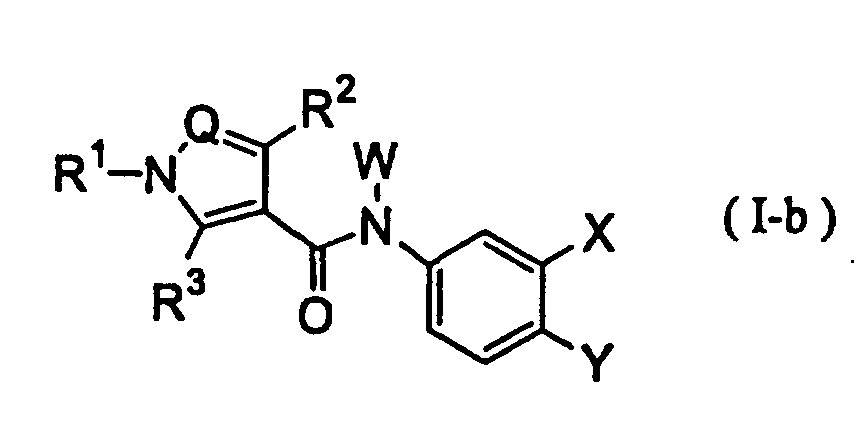
- R1
- is substituted aryl, arylalkyl, optionally substituted
heteroaryl, heteroarylalkyl or cycloalkyl,
- R2 and R3
- are the same or different and each is hydrogen, alkyl,
halogen, hydroxyl group, alkoxy, optionally substituted
amino or phenyl,
- Q
- is nitrogen atom or a group C-R4 (wherein R4 is hydrogen,
alkyl, halogen or optionally substituted amino),
- W
- is hydrogen, alkyl, hydroxyalkyl, acyloxyalkyl, aminoalkyl,
hydroxycarbonylalkyl or alkoxycarbonylalkyl,
- X
- is halogen, cyano, nitro, amino, alkyl, alkoxy, carboxy,
alkoxycarbonyl, carbamoyl, alkenyl, alkynyl or haloalkyl,
and
- Y
- is alkyl, hydroxyalkyl, hydroxycarbonylalkyl, optionally
substituted aminoalkyl, hydroxyl group, alkoxy, haloalkoxy,
aryloxy, cycloalkyloxy, hydroxyalkoxy,
hydroxycarbonylalkoxy, optionally substituted aminoalkoxy,
mercapto, alkylthio, hydroxyalkylthio,
hydroxycarbonylalkylthio, optionally substituted
aminoalkylthio, a group O-Het (wherein Het is optionally
substituted saturated heterocycle having hetero atom
selected from oxygen atom and nitrogen atom) or a group
N(Z2) (Z3) (wherein Z2 and Z3 are the same or different and
each is hydrogen, alkyl, hydroxyalkyl or aminoalkyl, or Z2
and Z3 form, together with the adjacent nitrogen atom,
cyclic amine optionally having one or two atoms from
oxygen atom, sulfur atom and nitrogen atom in the ring),
or a pharmaceutically acceptable salt thereof.
[4] The amide compound of the above-mentioned [3], which has the
formula

- R1
- is substituted aryl, arylalkyl, optionally substituted
heteroaryl, heteroarylalkyl or cycloalkyl,
- R2 and R3
- are the same or different and each is hydrogen, alkyl,
halogen, hydroxyl group, alkoxy, optionally substituted
amino or phenyl,
- Q
- is nitrogen atom or a group C-R4 (wherein R4 is hydrogen,
alkyl, halogen or optionally substituted amino),
- W
- is hydrogen, alkyl, hydroxyalkyl, acyloxyalkyl, aminoalkyl,
hydroxycarbonylalkyl or alkoxycarbonylalkyl,
- X1
- is halogen, cyano, nitro, carboxy, alkoxycarbonyl or
alkynyl, and
- Y1
- is alkoxy, haloalkoxy, aryloxy, cycloalkyloxy,
hydroxyalkoxy, optionally substituted aminoalkoxy,
optionally substituted aminoalkylthio, a group O-Het
(wherein Het is optionally substituted saturated
heterocycle having hetero atom selected from oxygen atom
and nitrogen atom) or a group N(Z2)(Z3) (wherein Z2 and Z3
are the same or different and each is hydrogen, alkyl,
hydroxyalkyl or aminoalkyl, or Z2 and Z3 form, together
with the adjacent nitrogen atom, cyclic amine optionally
having one or two atoms from oxygen atom, sulfur atom and
nitrogen atom in the ring),
or a pharmaceutically acceptable salt thereof.
[5] The amide compound of the above-mentioned [4], which has the
formula
wherein
- R1a
- is substituted aryl, arylalkyl or optionally substituted
heteroaryl,
- R2a and R3a
- are the same or different and each is hydrogen or alkyl,
- Q1
- is nitrogen atom or a group C-R4a (wherein R4a is hydrogen
or alkyl),
- W1
- is hydrogen, alkyl, hydroxycarbonylalkyl or
alkoxycarbonylalkyl, and
- Y2
- is alkoxy, optionally substituted aminoalkoxy, optionally
substituted aminoalkylthio or a group N (Z2a)(Z3a) (wherein
Z2a and Z3a form, together with the adjacent nitrogen atom,
cyclic amine optionally having one or two atoms from
oxygen atom, sulfur atom and nitrogen atom in the ring),
or a pharmaceutically acceptable salt thereof.
[6] The amide compound of [1] above, which is a member selected from
the group consisting of
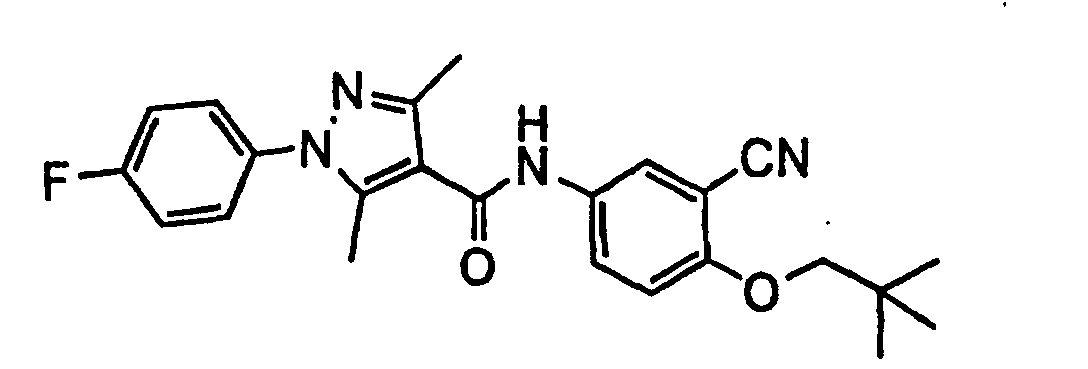
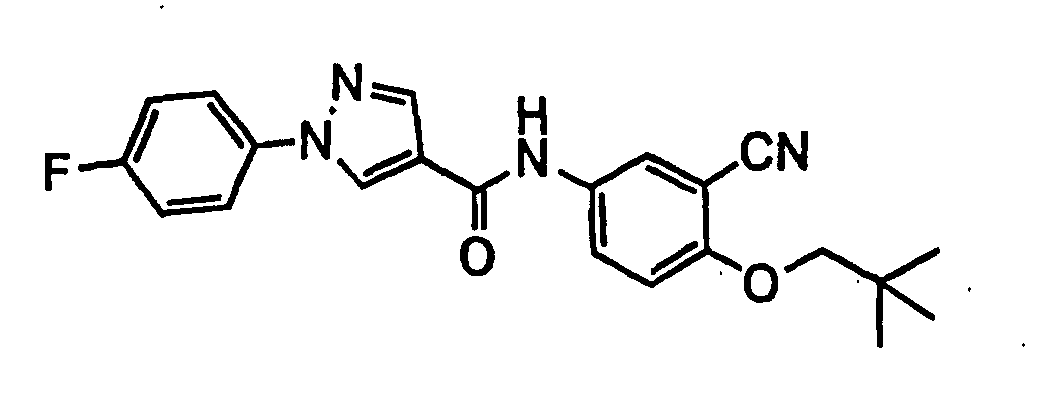
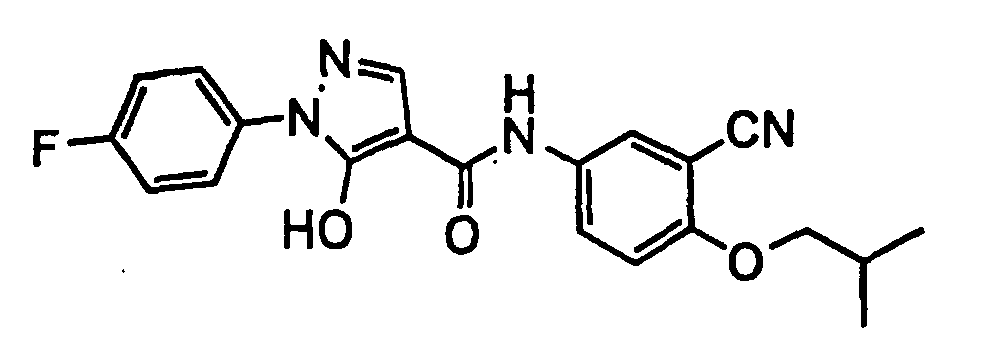
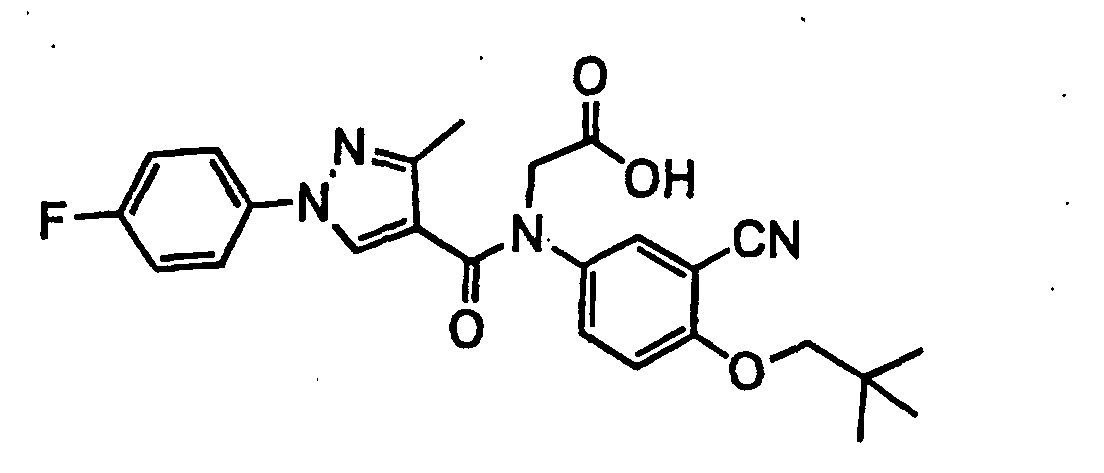
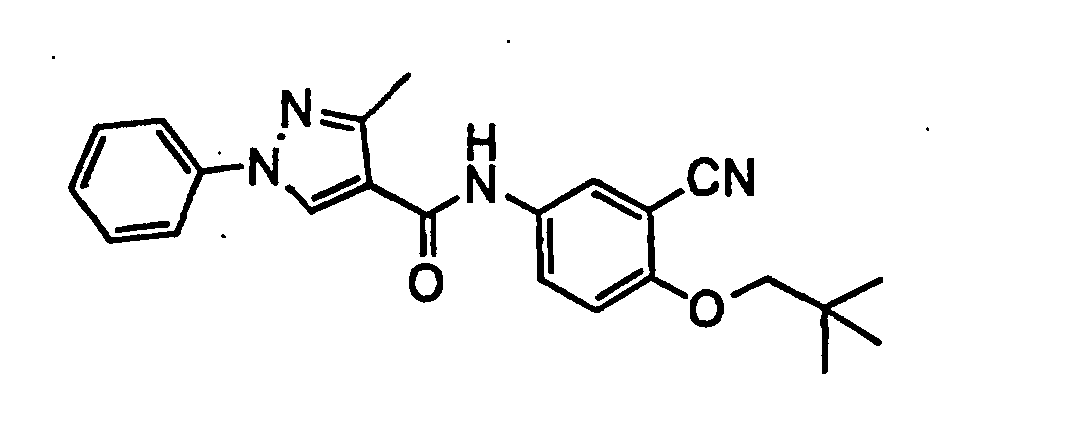
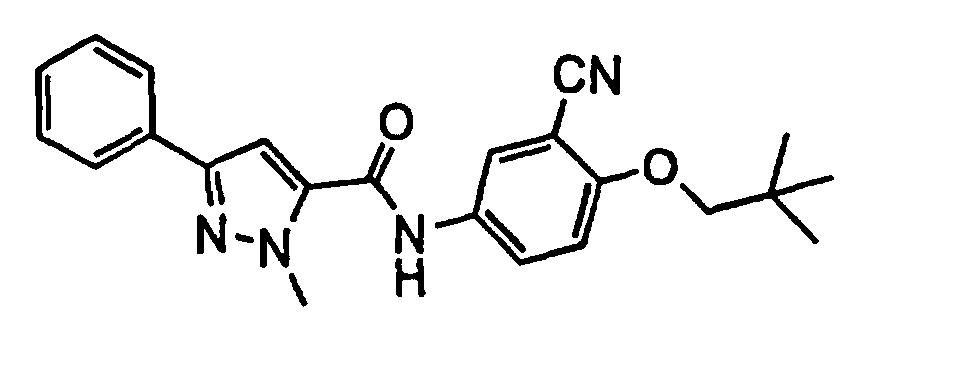
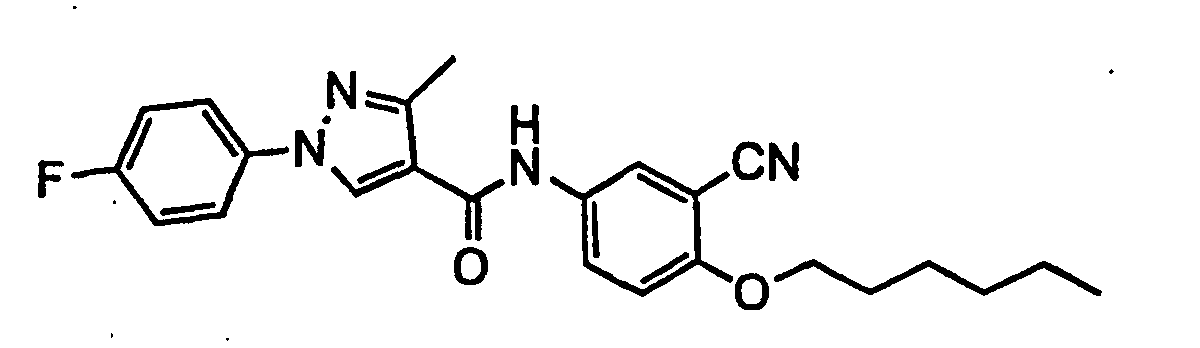
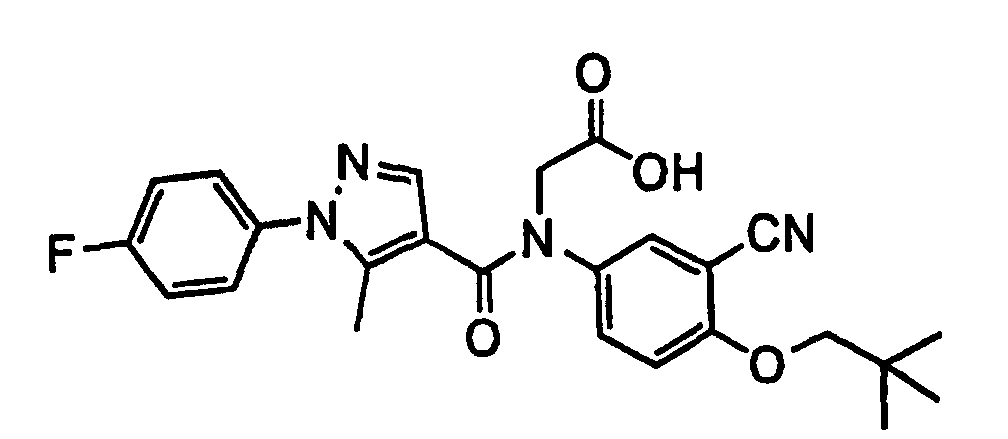
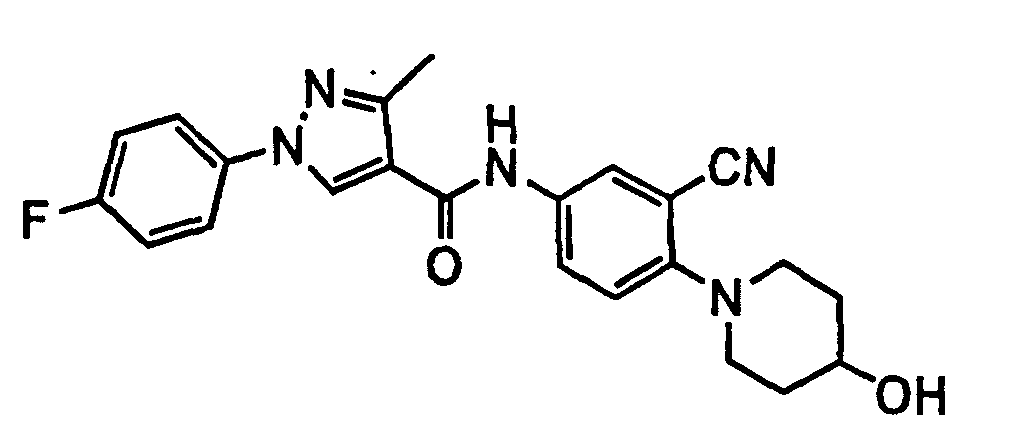
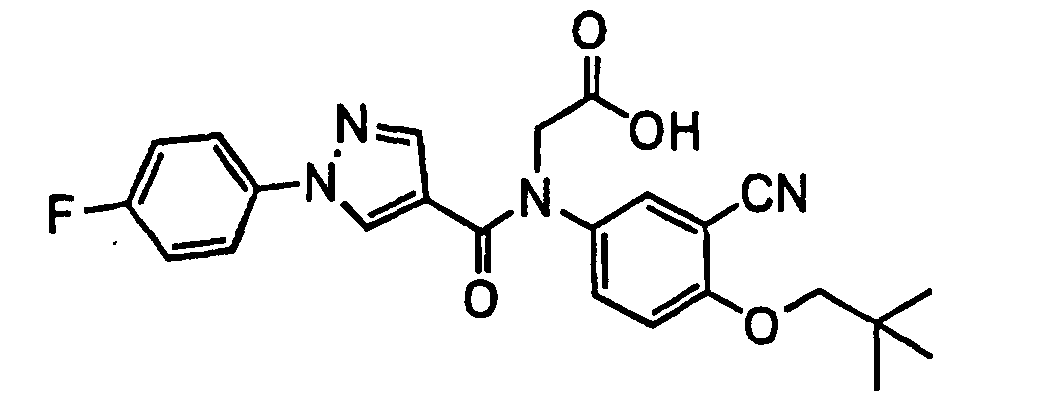
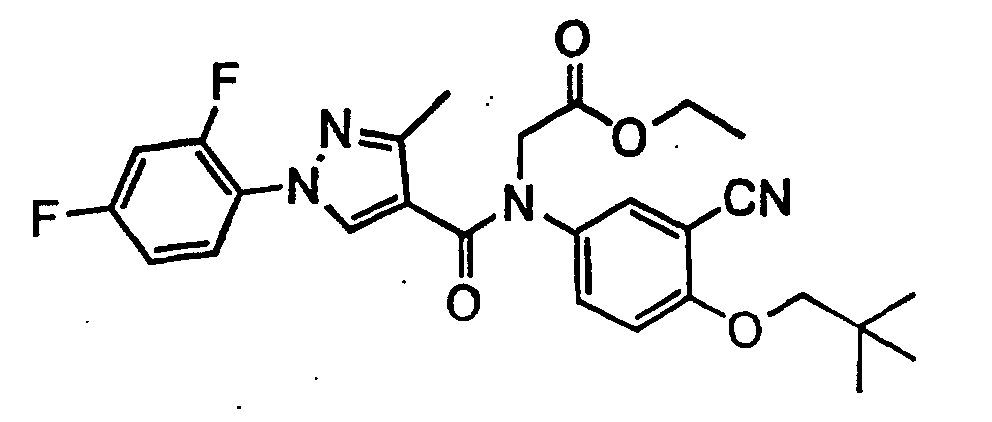
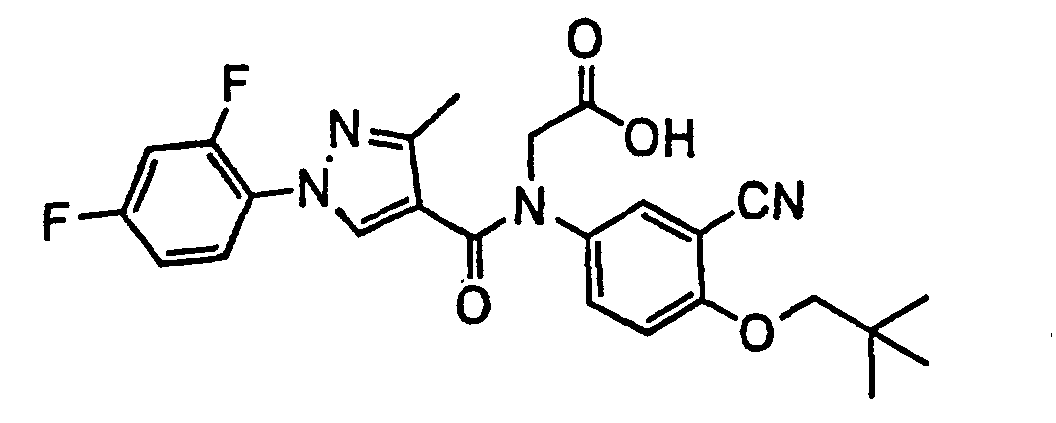
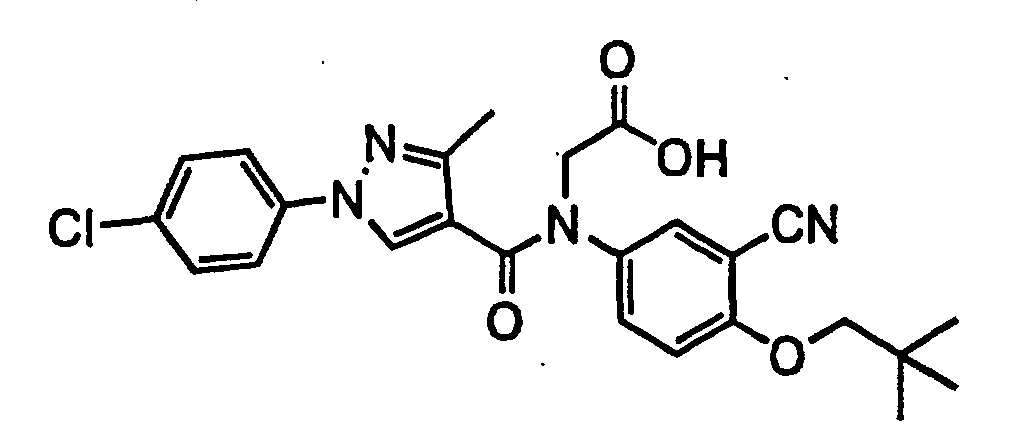
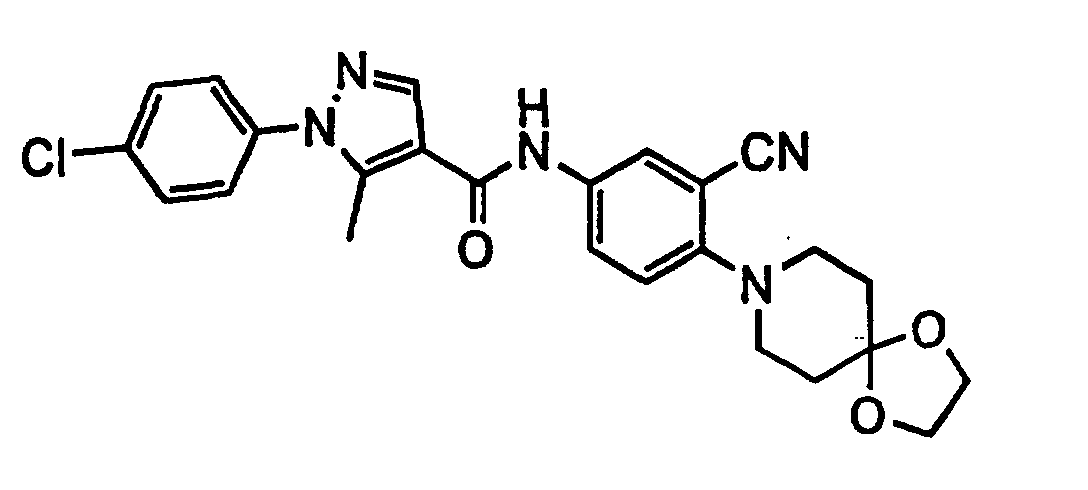
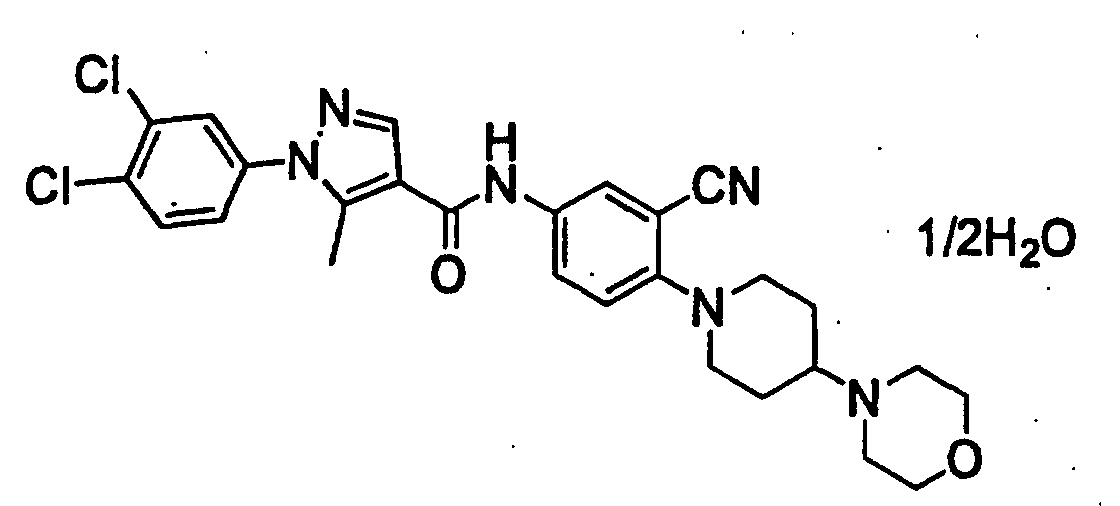
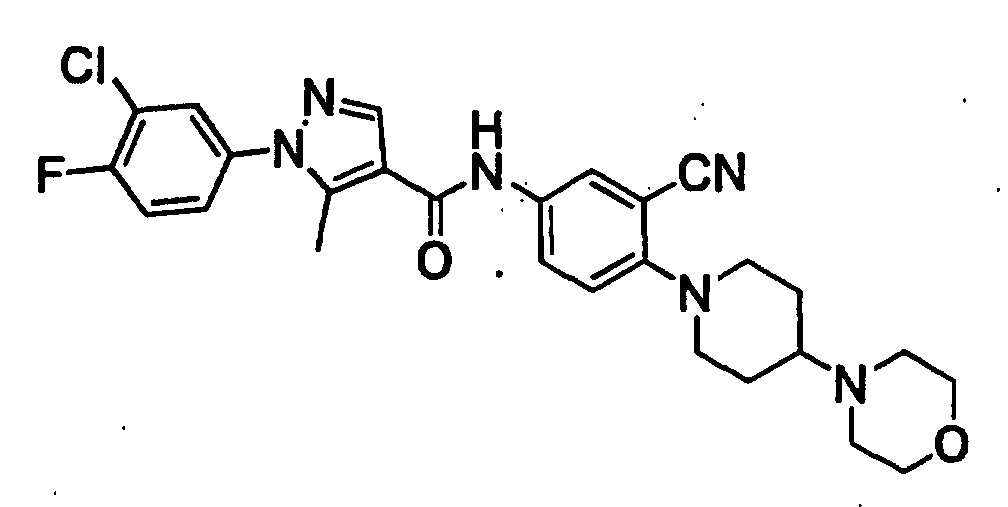
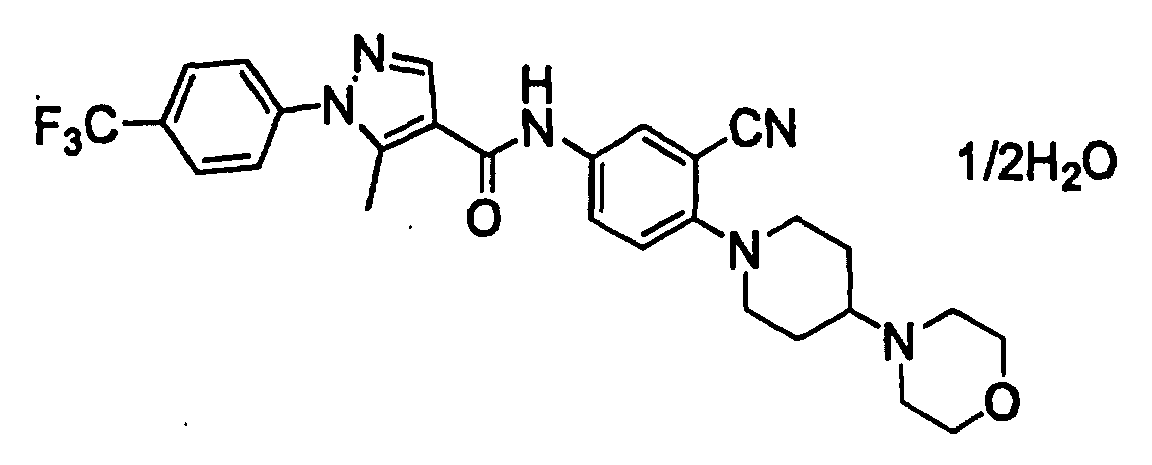
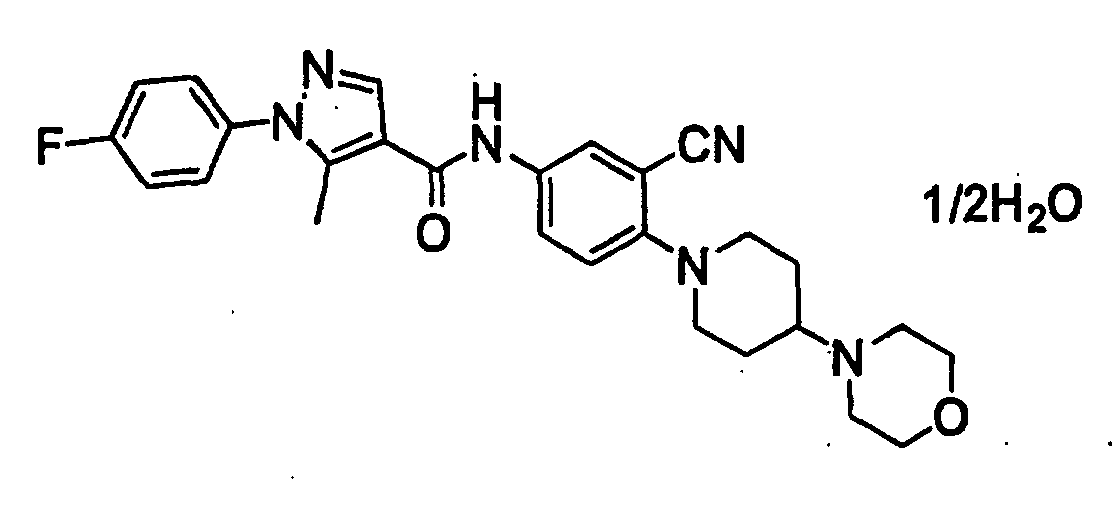
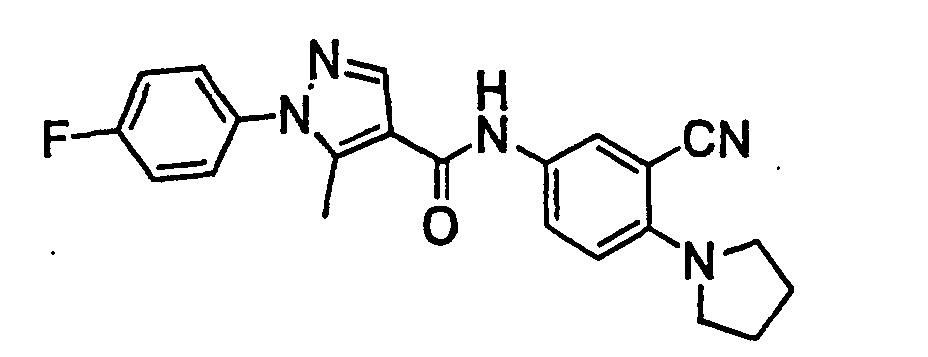
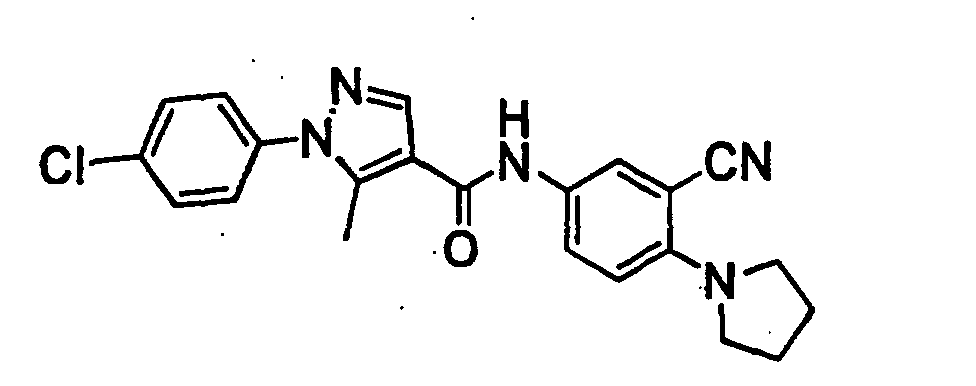
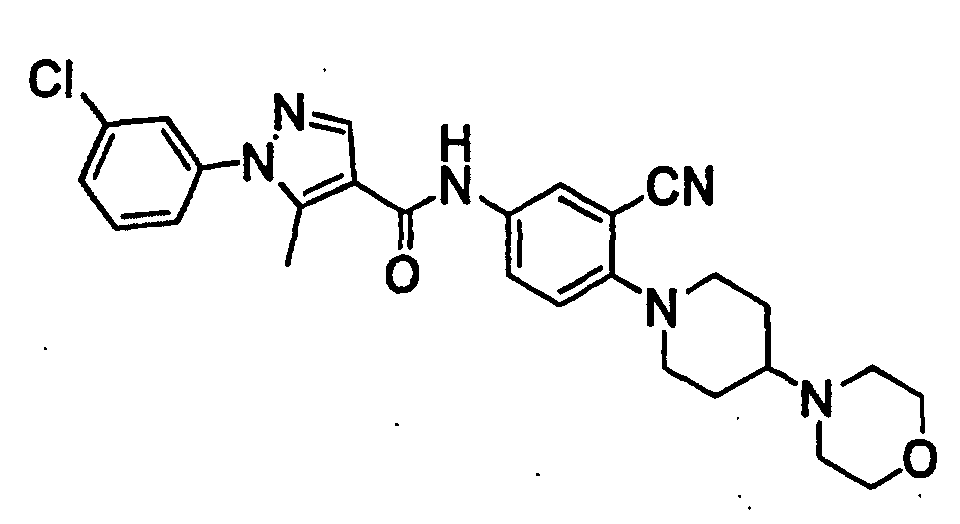
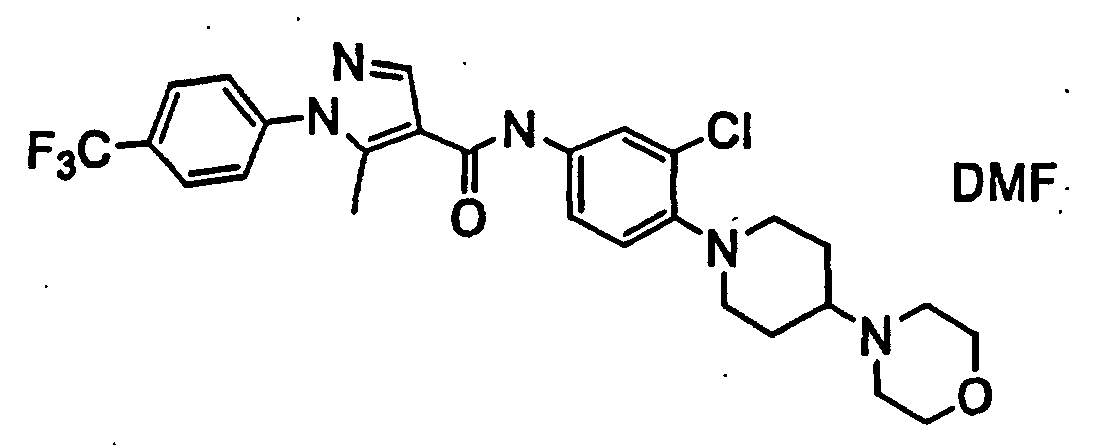
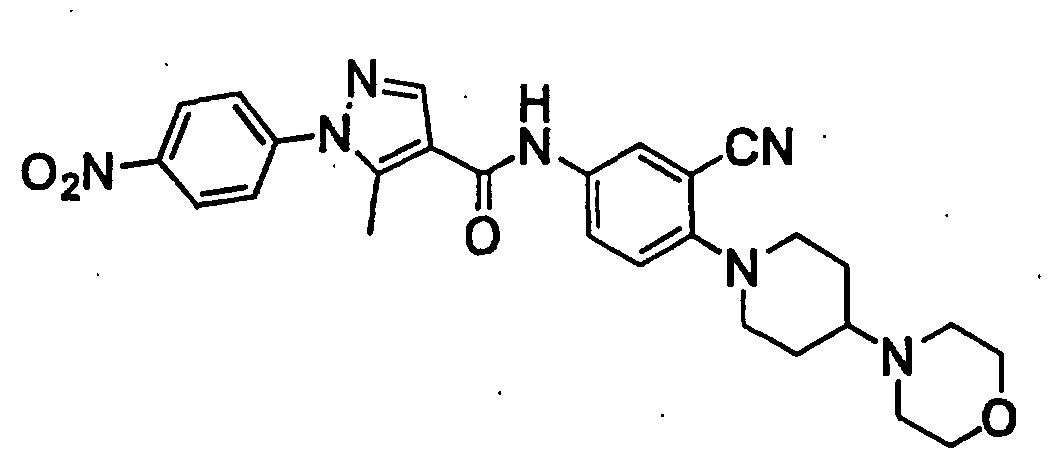
(1) N-(3-cyano-4-neopentyloxyphenyl)-1-(4-fluorophenyl)-3-methylpyrazole-4-carboxamide, (2) N-(3-cyano-4-neopentyloxyphenyl)-1-(4-fluorophenyl)-5-methylpyrazole-4-carboxamide, (3) N-(3-cyano-4-neopentyloxyphenyl)-1-(4-fluorophenyl)-3,5-dimethylpyrazole-4-carboxamide, (4) N-(3-cyano-4-neopentyloxyphenyl)-1-(4-fluorophenyl)-N,3-dimethylpyrazole-4-carboxamide, (5) N-(3-cyano-4-neopentyloxyphenyl)-5-chloro-1-(4-fluorophenyl)pyrazole-4-carboxamide, (6) N-(3-cyano-4-neopentyloxyphenyl)-N-[1-(4-fluorophenyl)-3-methylpyrazol-4-ylcarbonyl]glycine, (7) 4-[N-(3-cyano-4-neopentyloxyphenyl)-N-[1-(4-fluorophenyl)-3-methylpyrazol-4-ylcarbonyl]amino]butyric
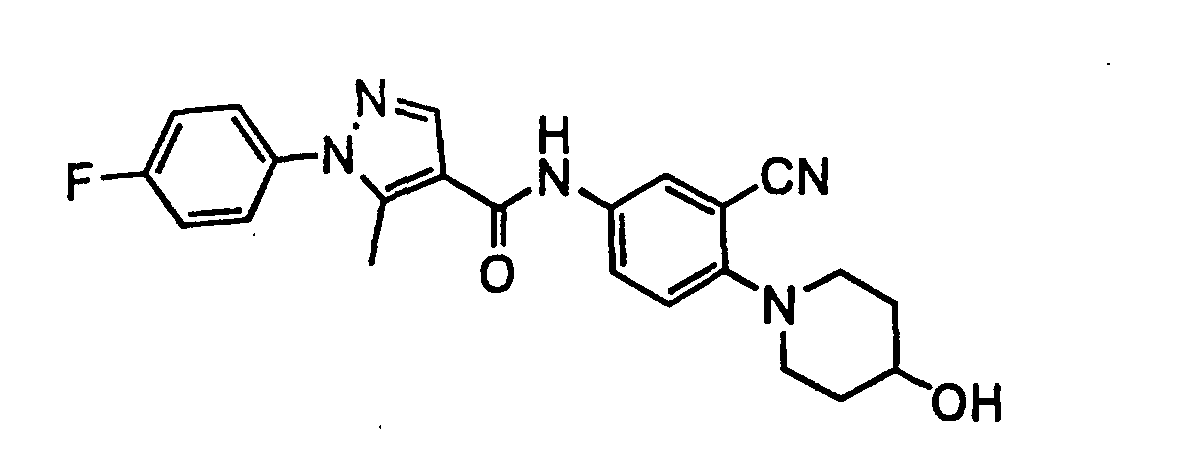
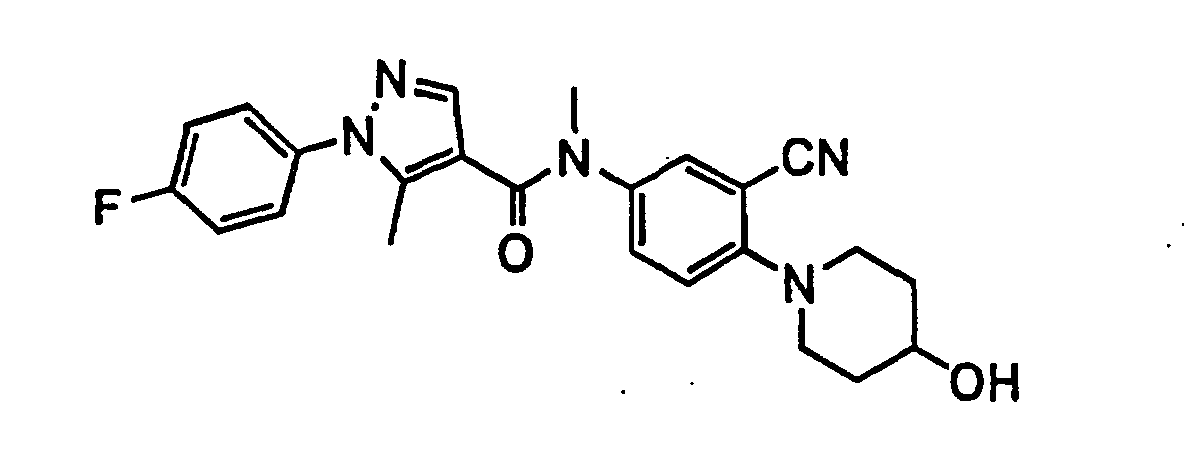
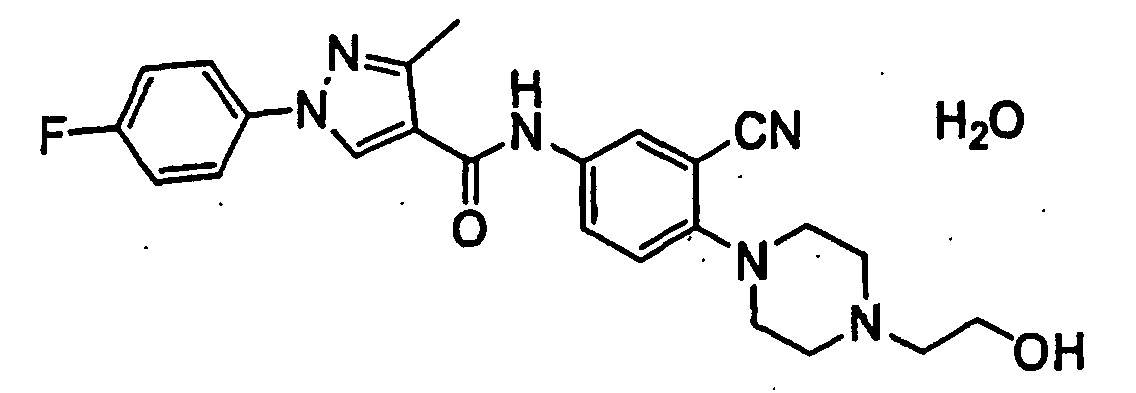
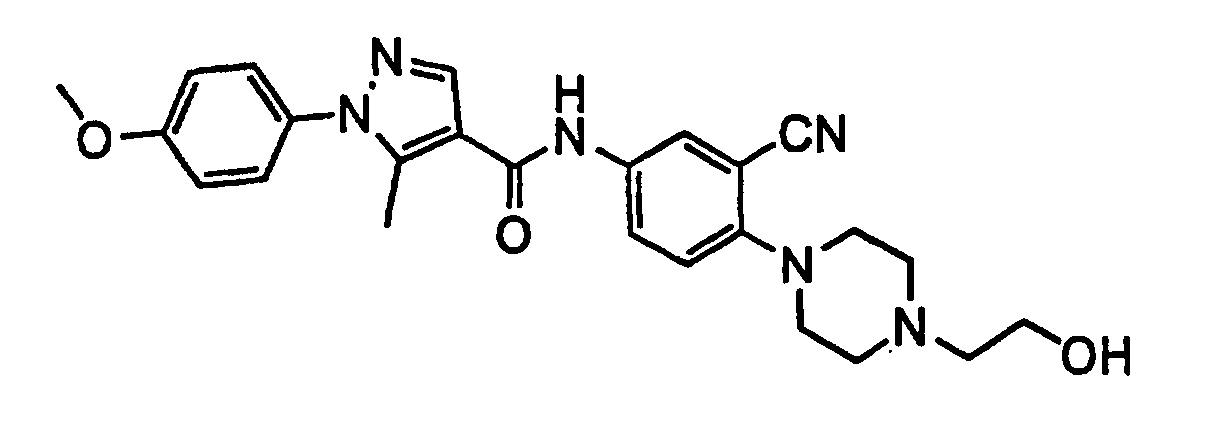
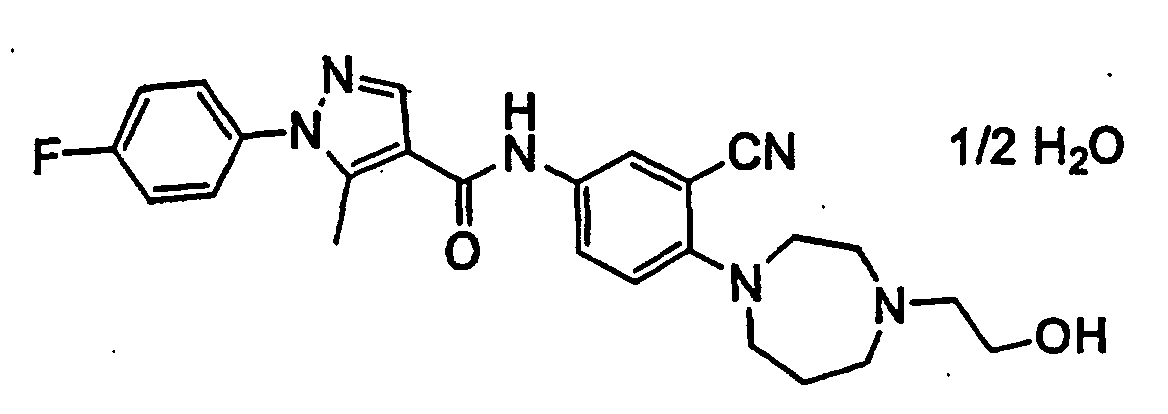
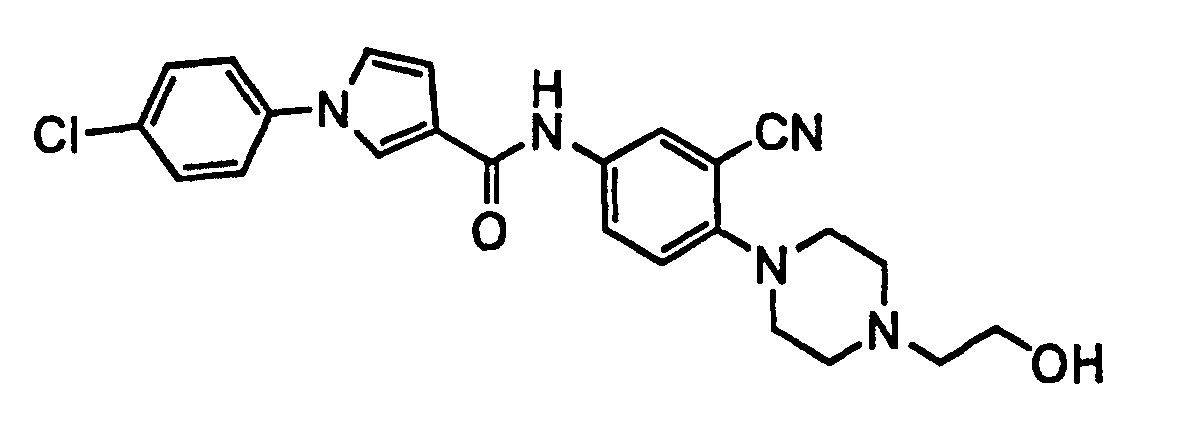
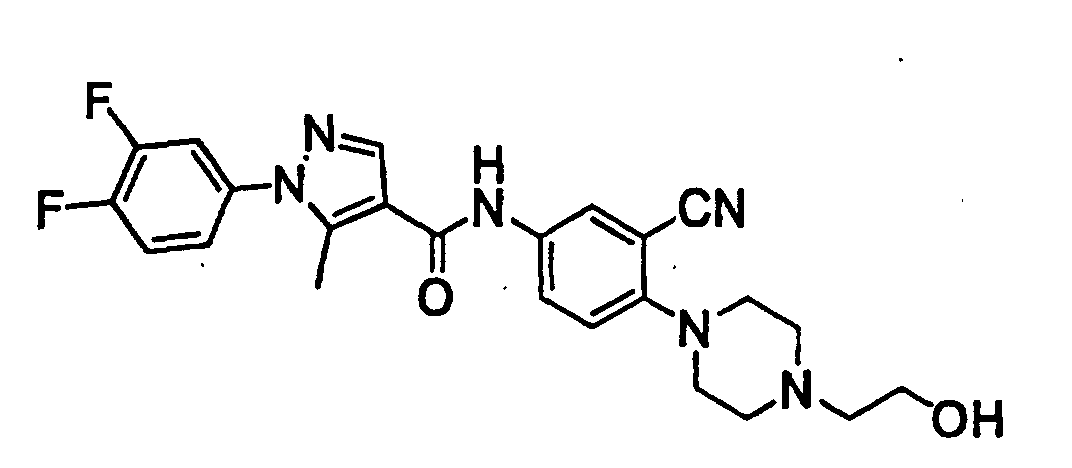
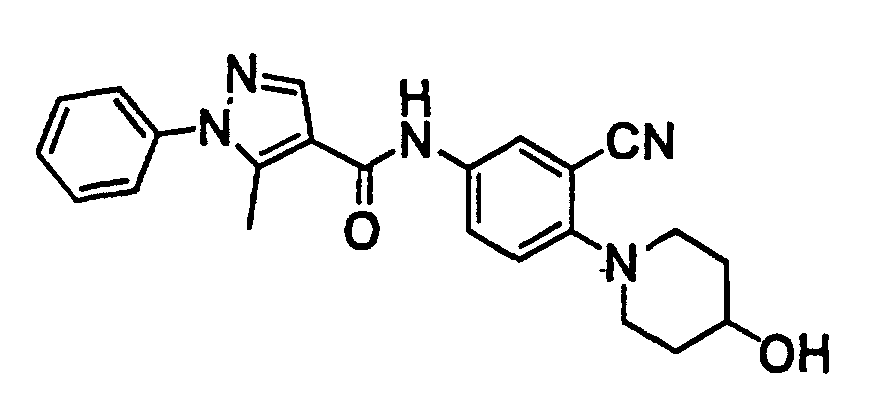
acid, (8) N-(3-cyano-4-piperidinophenyl)-1-(4-fluorophenyl)-5-methylpyrazole-4-carboxamide, (9) N-[3-cyano-4-(4-hydroxypiperidino)phenyl]-1-(4-fluorophenyl)-5-methylpyrazole-4-carboxamide, (10) N-{3-cyano-4-[4-(2-hydroxyethyl)piperazin-1-yl]phenyl}-1-(4-fluorophenyl)
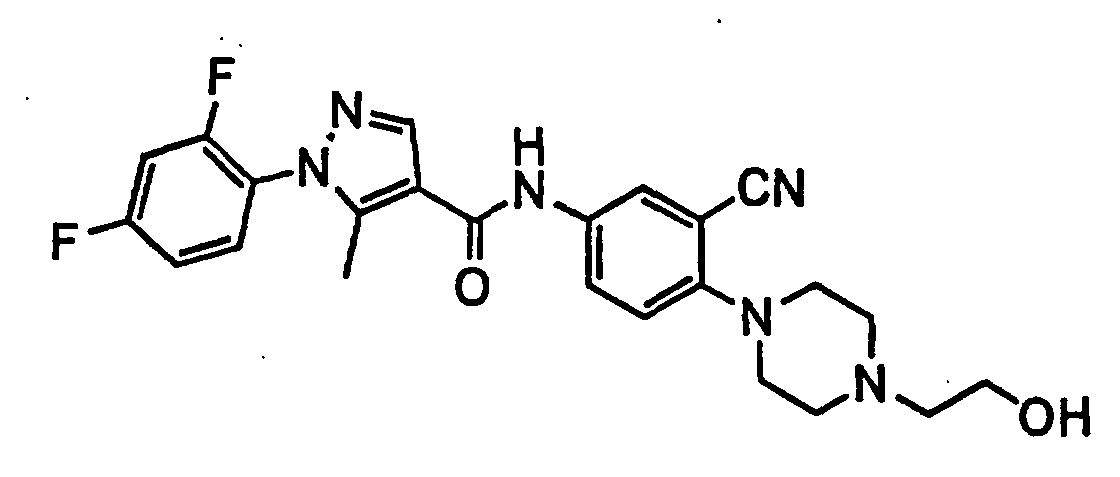
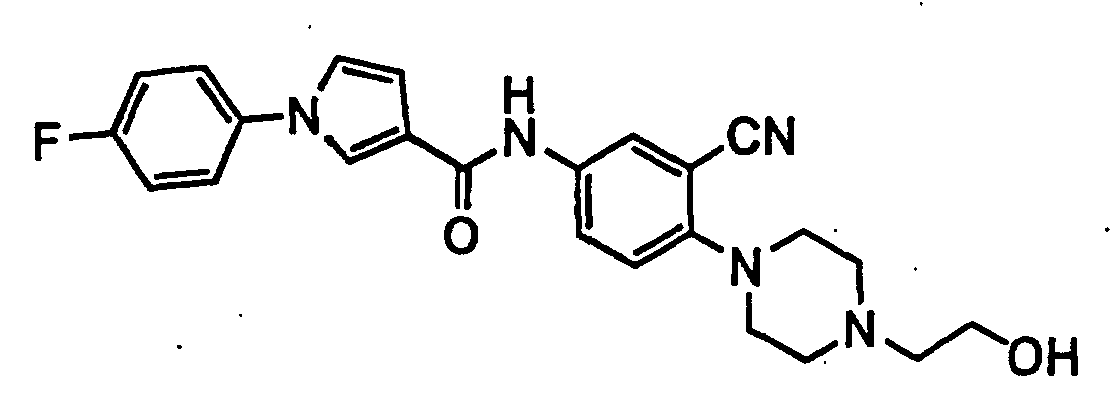
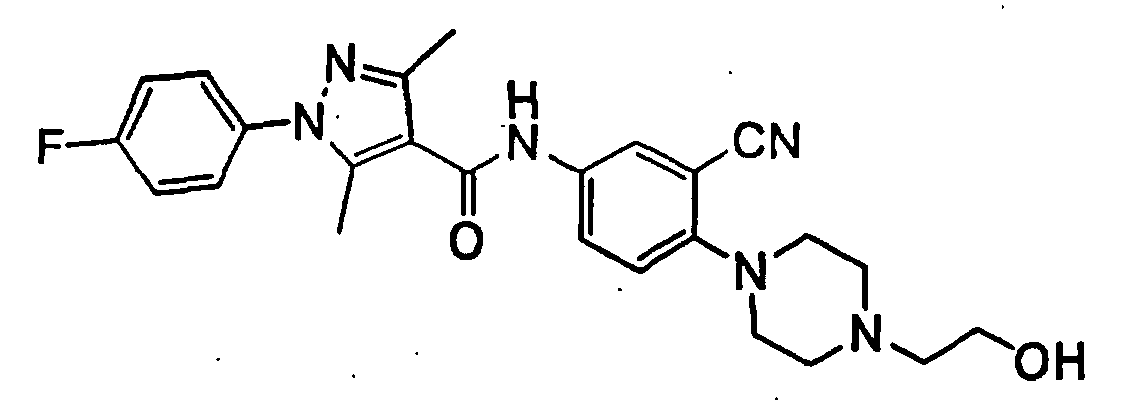
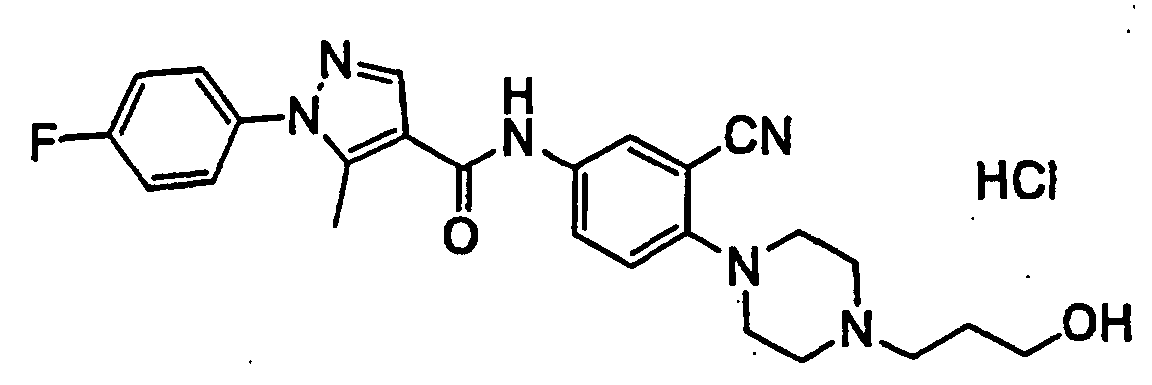
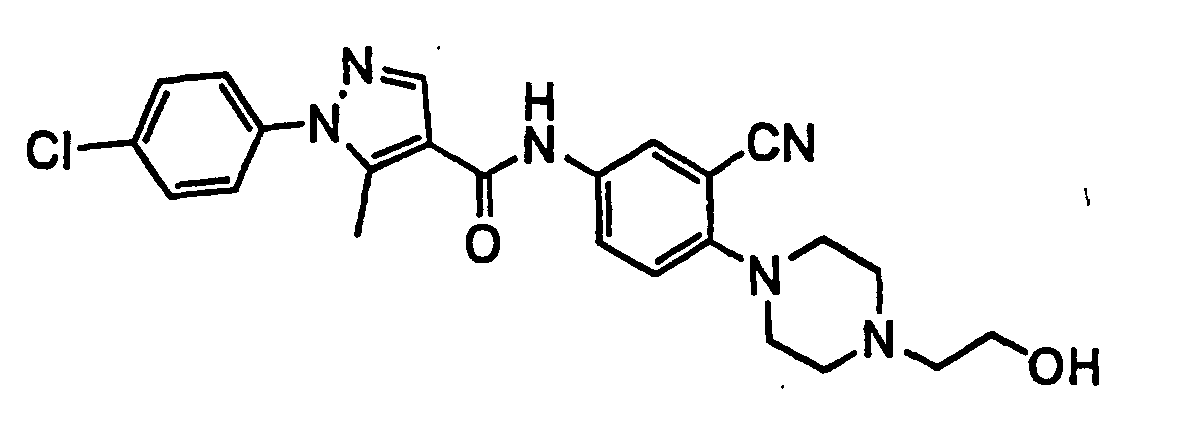
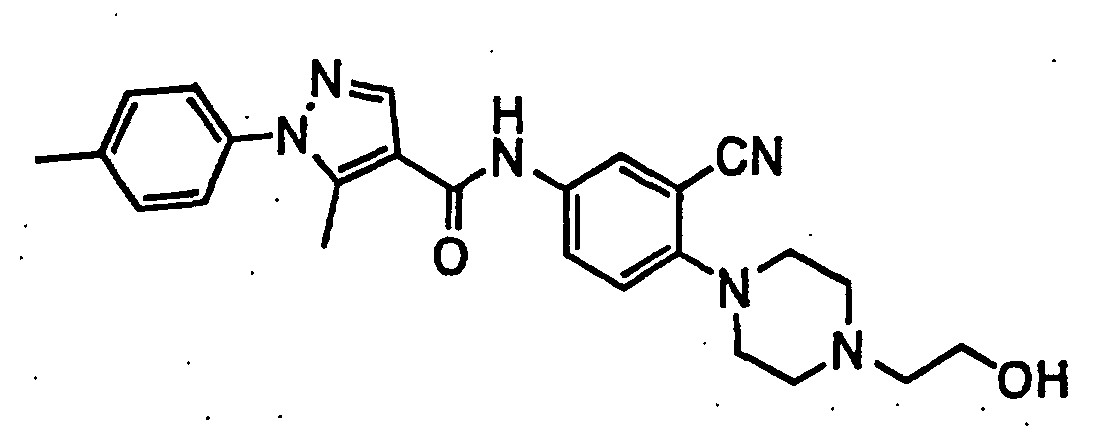
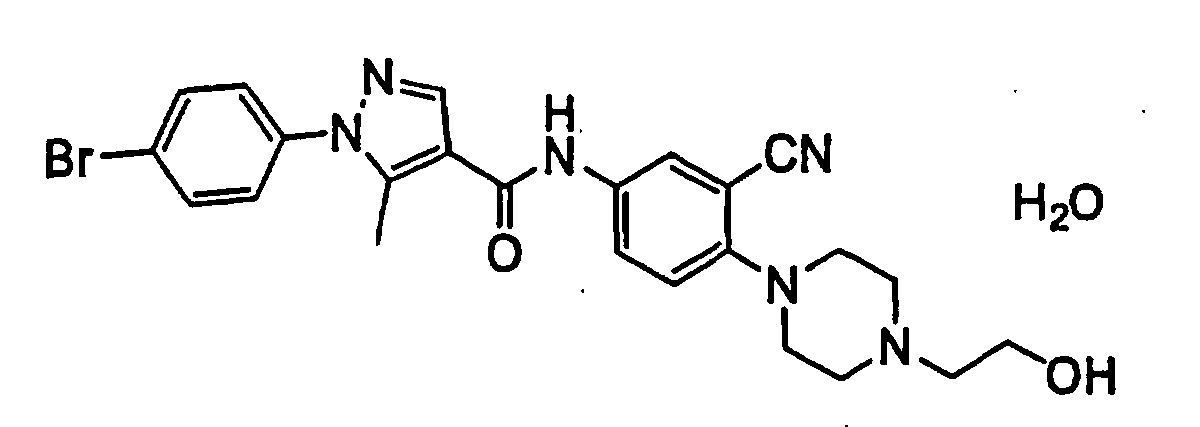
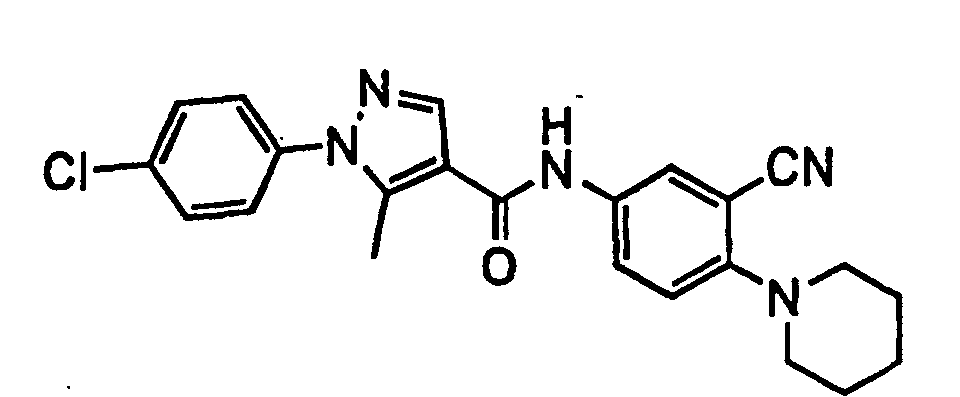
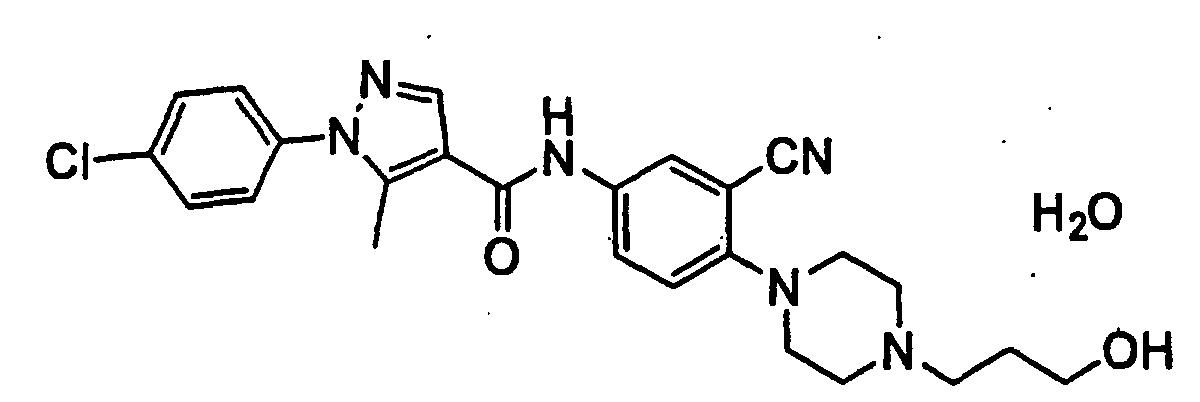
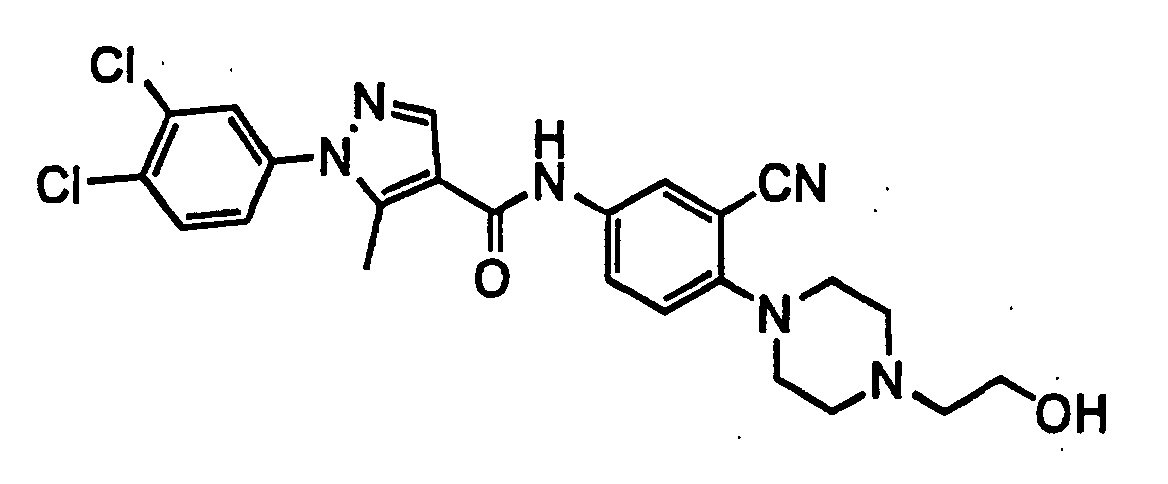
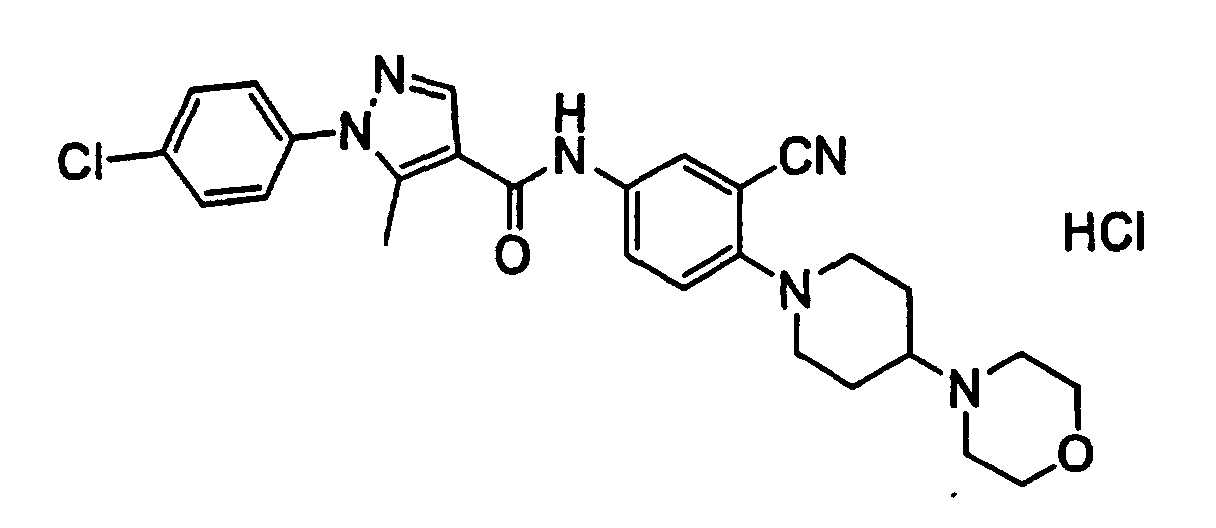
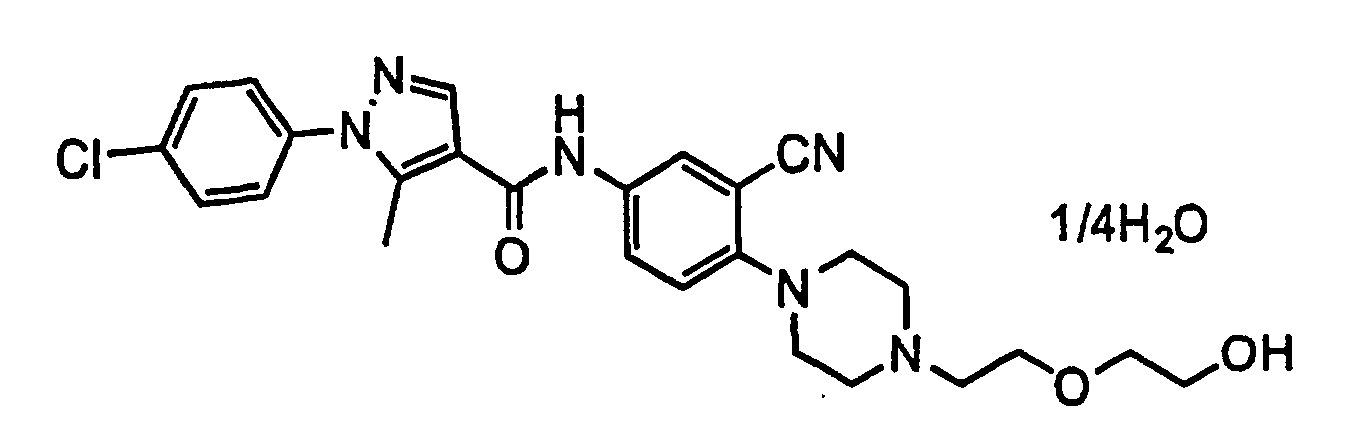
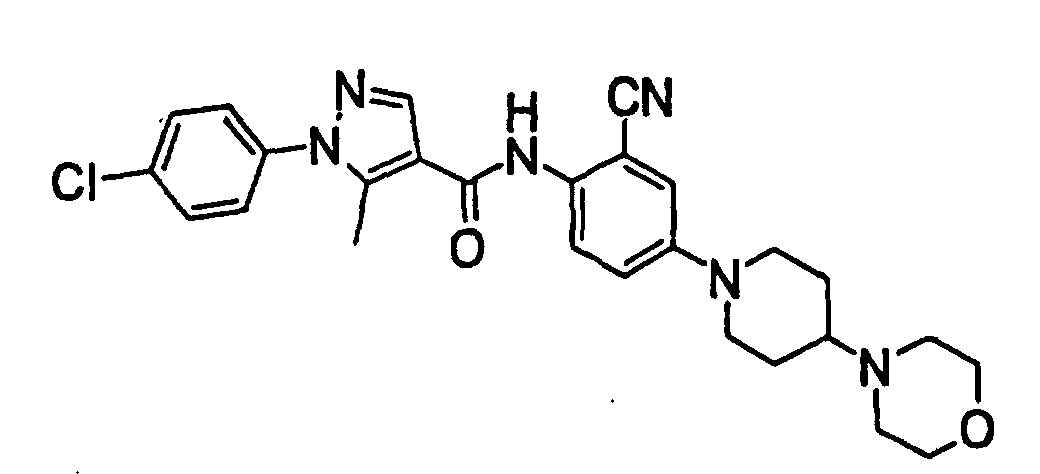
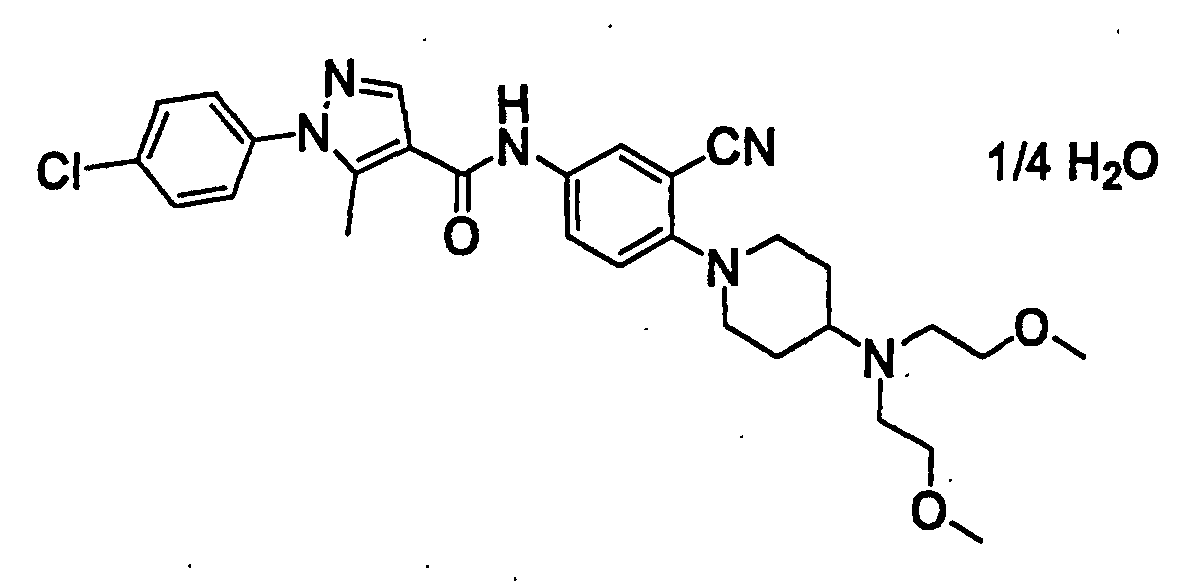
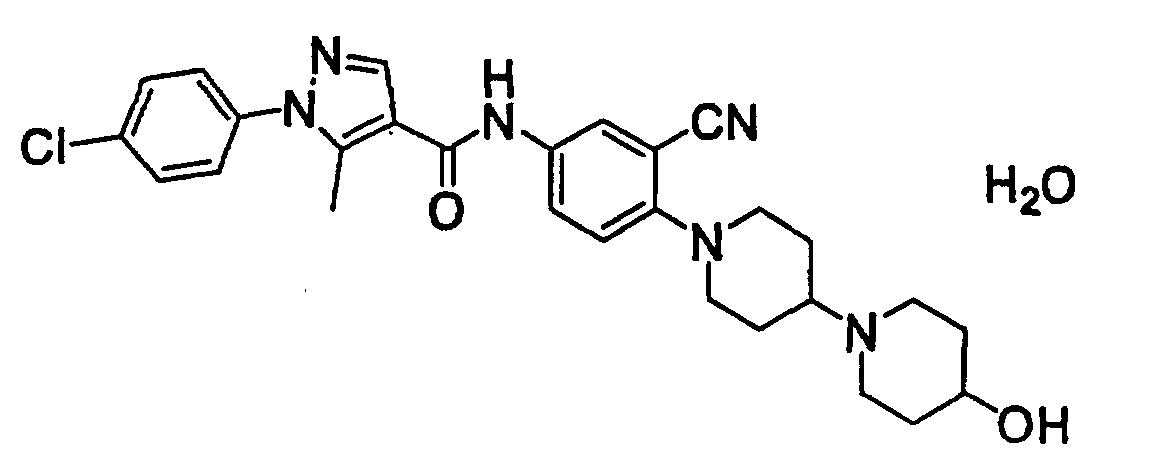
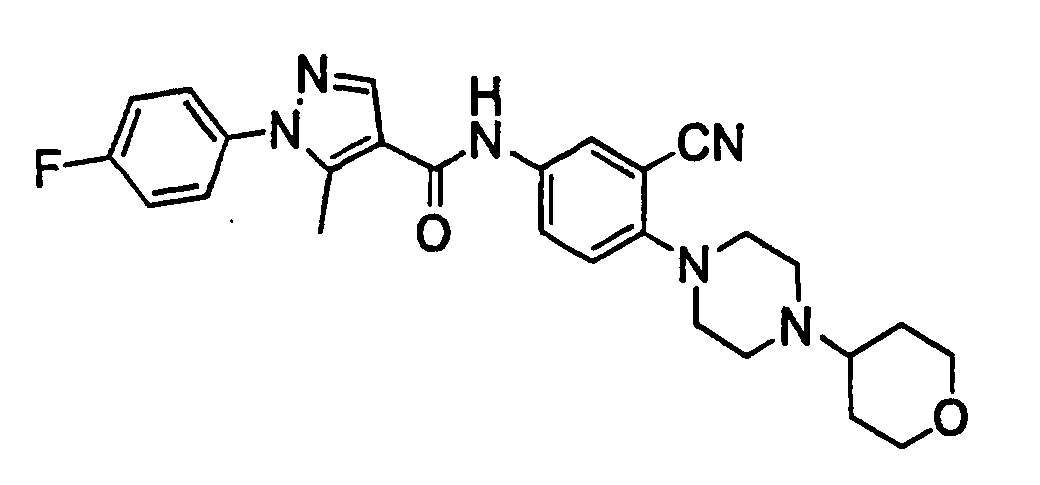
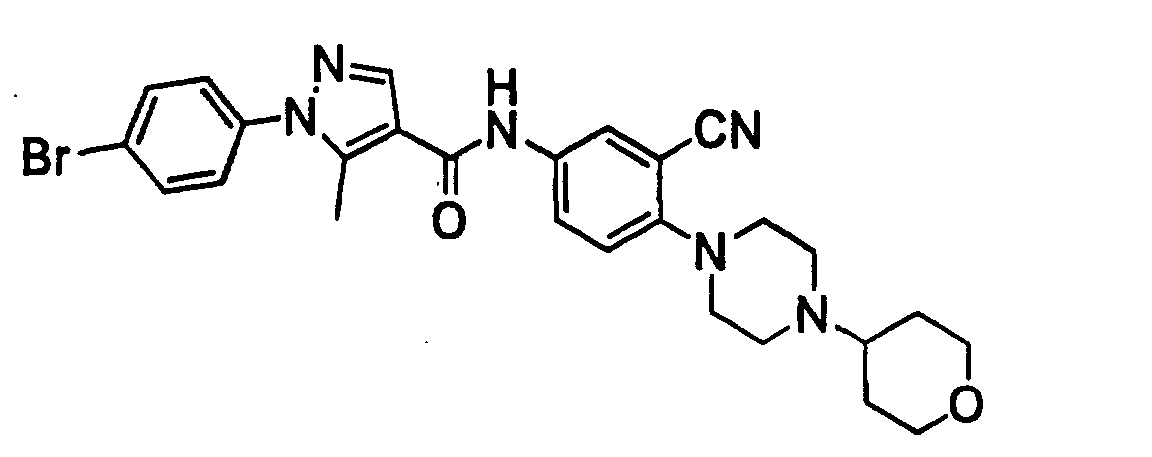
pyrazole-4-carboxamide, (11) N-{3-cyano-4-[4-(2-hydroxyethyl)piperazin-1-yl]phenyl}-1-(4-fluorophenyl)-3-methylpyrazole-4-carboxamide, (12) N-{3-cyano-4-[4-(2-hydroxyethyl)piperazin-1-yl]phenyl}-1-(4-fluorophenyl)-5-methylpyrazole-4-carboxamide, (13) N-{3-cyano-4- [4- (2-hydroxyethyl)piperazin-1-yl]phenyl}-1- (4-chlorophenyl)-5-methylpyrazole-4-carboxamide, (14) N-{3-cyano-4-[4-(2-hydroxyethyl)piperazin-1-yl]phenyl}-1-(4-methylphenyl)-5-methylpyrazole-4-carboxamide, (15) N-{3-cyano-4-[4-(2-hydroxyethyl)piperazin-1-yl]phenyl}-1-(4-fluorophenyl)-3,5-dimethylpyrazole-4-carboxamide, (16) N-{3-cyano-4-[4-(2-hydroxyethyl)piperazin-1-yl]phenyl}-1-(3-trifluoromethylphenyl)-5-methylpyrazole-4-carboxamide, (17) N-{3-cyano-4-[4-(2-hydroxyethyl)piperazin-1-yl]phenyl}-1-(2,4-difluorophenyl)-5-methylpyrazole-4-carboxamide, (18) N-{3-cyano-4-[4-(2-hydroxyethyl)homopiperazin-1-yl]phenyl}-1-(4-fluorophenyl)-5-methylpyrazole-4-carboxamide, (19) N-{3-cyano-4-[4-(3-hydroxypropyl)piperazin-1-yl]phenyl}-1-(4-fluorophenyl)-5-methylpyrazole-4-carboxamide, (20) N-{3-cyano-4-[4-(2-hydroxyethyl)piperazin-1-yl]phenyl}-1-(4-fluorophenyl)pyrrole-3-carboxamide, (21) 1- (4-bromophenyl)-N-{3-cyano-4-[4- (2-hydroxyethyl)piperazin-1-yl]phenyl}-5-methylpyrazole-4-carboxamide, (22) N-{3-cyano-4-[4-(2-hydroxyethyl)piperazin-1-yl]phenyl}-1-(4-iodophenyl)-5-methylpyrazole-4-carboxamide, (23) 1-(4-chlorophenyl)-N-(3-cyano-4-piperidinophenyl)-5-methylpyrazole-4-carboxamide, (24) 1-(4-chlorophenyl)-N-[3-cyano-4-(4-hydroxypiperidin-1-yl)phenyl]-5-methylpyrazole-4-carboxamide, (25) 1-(4-chlorophenyl)-N-[3-cyano-4-(4-morpholinopiperidin-1-yl)phenyl]-5-methylpyrazole-4-carboxamide, (26) N-(4-{4-[bis(2-hydroxyethyl)mino]pippridin-1-yl)-3-cyanophenyl)-1-(4-chlorophenyl)-5-methylpyrazole-4-carboxamide, (27) 1-(3,4-dichlorophenyl)-N-[3-cyano-4-(4-morpholinopiperidin-1-yl)phenyl]-5-methylpyrazole-4-carboxamide, (28) N- [3-cyano-4- (4-morpholinopiperidin-1-yl)phenyl] -1- (3,4-difluorophenyl)-5-methylpyrazole-4-carboxamide, (29) 1-(3-chloro-4-fluorophenyl)-N-[3-cyano-4-(4-morpholinopiperidin-1-yl)phenyl]-5-methylpyrazole-4-carboxamide, (30) N-{3-cyano-4- [4- (2-hydroxyethyl)piperazin-1-yl]phenyl}-1-(4-trifluoromethylphenyl)-5-methylpyrazole-4-carboxamide, (31) N- [3-cyano-4- (4-morpholinopiperidin-1-yl) phenyl] -1- (4-trifluoromethylphenyl)-5-methylpyrazole-4-carboxamide, (32) N-{4- [4-bis (2-methoxyethyl) aminopiperidin-1-yl]-3-cyanophenyl}-1-(4-chlorophenyl)-5-methylpyrazole-4-carboxamide (33) 1-(4-chlorophenyl)-N-[3-cyano-(4-morpholinopiperidin-1-yl)phenyl]pyrrole-3-carboxamide, (34) N-[3-bromo-4-(4-morpholinopiperidin-1-yl)phenyl]-1-(4-chlorophenyl)-5-methylpyrazole-4-carboxamide, (35) N-[3-bromo-4-(4-morpholinopiperidin-1-yl)phenyl]-5-methyl-1-(4-trifluoromethylphenyl)pyrazole-4-carboxamide, (36) 1-(4-chlorophenyl)-N-{3-cyano-4-[4-(3,4,5,6-tetrahydro-2H-pyran-4-yl)piperazin-1-yl]phenyl)-5-methylpyrazole-4-carboxamide, (37) N-{3-cyano-4-[4-(3,4,5,6-tetrahydro-2H-pyran-4-yl)piperazin-1-yl]phenyl}-5-methyl-1-(4-trifluoromethylphenyl)pyrazole-4-carboxamide, (38) N-{3-cyano-4-[4-(3,4,5,6-tetrahydro-2H-pyran-4-yl)piperazin-1-yl]phenyl}-1-(4-fluorophenyl)
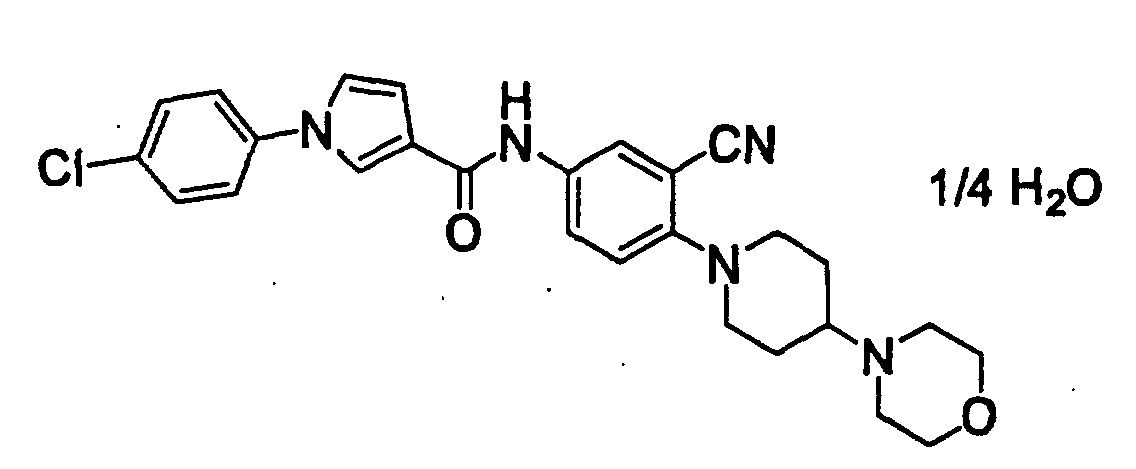
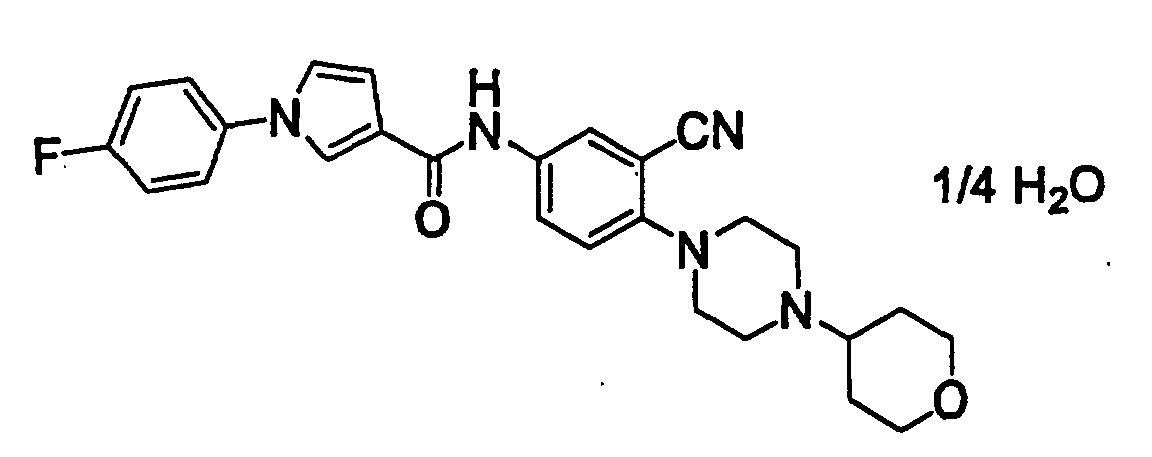
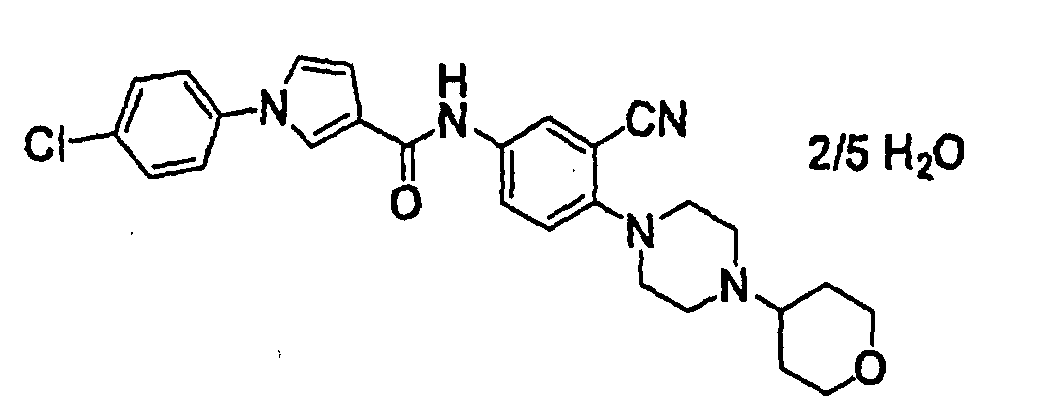
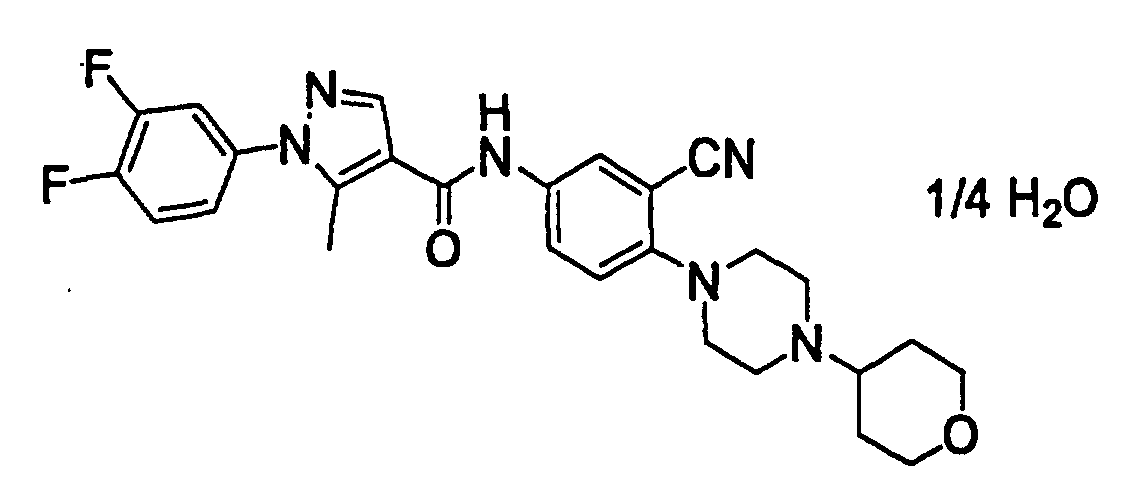
-5-methylpyrazole-4-carboxamide, (39) N-{3-cyano-4-[4-(3,4,5,6-tetrahydro-2H-pyran-4-yl)piperazin-1-yl]phenyl}-1-(4-fluorophenyl)pyrrole-3-carboxamide, (40) 1-(4-chlorophenyl)-N-{3-cyano-4-[4-(3,4,5,6-tetrahydro-2H-pyran-4-yl)piperazin-1-yl]phenyl}pyrrole-3-carboxamide, (41) 1-(3,4-dichlorophenyl)-N-{3-cyano-4-[4-(3,4,5,6-tetrahydro-2H-pyran-4-yl)piperazin-1-yl]phenyl}-5-methylpyrazole-4-carboxamide, (42) 1-(4-chlorophenyl)-N-{3-cyano-4-[4-(3-hydroxypropyl)piperazin-1-yl]phenyl}-5-methylpyrazole-4-carboxamide, (43) 1-(3,4-dichlorophenyl)-N-(3-cyano-4-[4-(2-hydroxyethyl)piperazin-1-yl]phenyl}-5-methylpyrazole-4-carboxamide, (44) 1-(4-chlorophenyl)-N-{3-cyano-4-[4-(2-hydroxyethyl)piperidin-1-yl]phenyl}-5-methylpyrazole-4-carboxamide, (45) 1-(4-chlorophenyl)-N-(3-cyano-4-(4-[2-(2-hydroxyethoxy)ethyl]piperazin-1-yl}phenyl)-5-methylpyrazole-4-carboxamide, (46) 1-(4-chlorophenyl)-N-[3-cyano-4-(1,4-dioxa-8-azaspiro[4,5]deca-8-yl)phenyl]-5-methylpyrazole-4-carboxamide, (47) 1- (4-bromophenyl) -N- [3-cyano-4- (4-morpholinopiperidino)phenyl]-5-methylpyrazole-4-carboxamide, (48) N- [3-cyano-4- (4-morpholinopiperidino)phenyl] -1- (4-fluorophenyl) -5-methylpyrazole-4-carboxamide, (49) N-[3-cyano-4-(4-morpholinopiperidino)phenyl]-1-(4-fluorophenyl)pyrrole-3-carboxamide, (50) N-[3-cyano-4-(4-morpholinopiperidin-1-yl)phenyl]-1-(4-methylphenyl)-5-methylpyrazole-4-carboxamide, (51) N-[3-cyano-4-(4-morpholinopiperidin-1-yl)phenyl]-1-(4-iodophenyl)-5-methylpyrazole-4-carboxamide, (52) N-[3-cyano-4-(4-morpholinopiperidin-1-yl)phenyl]-1-(4-methoxyphenyl)
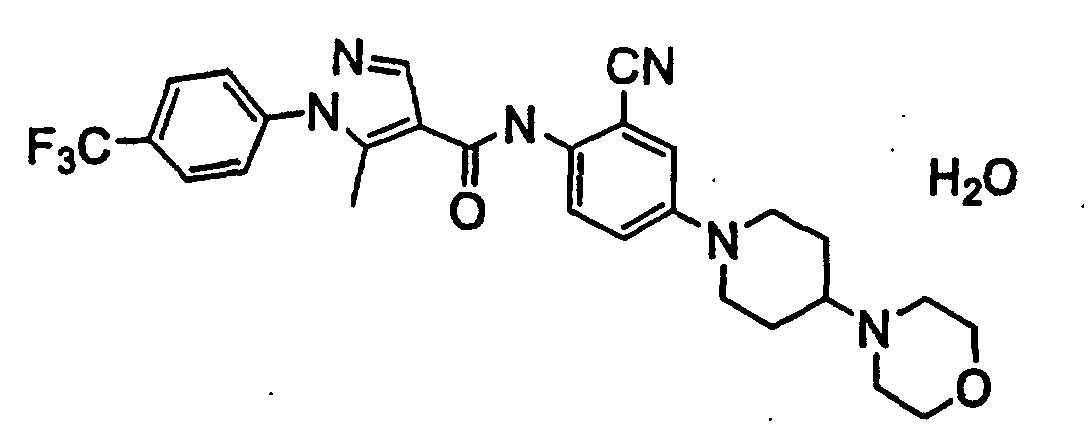
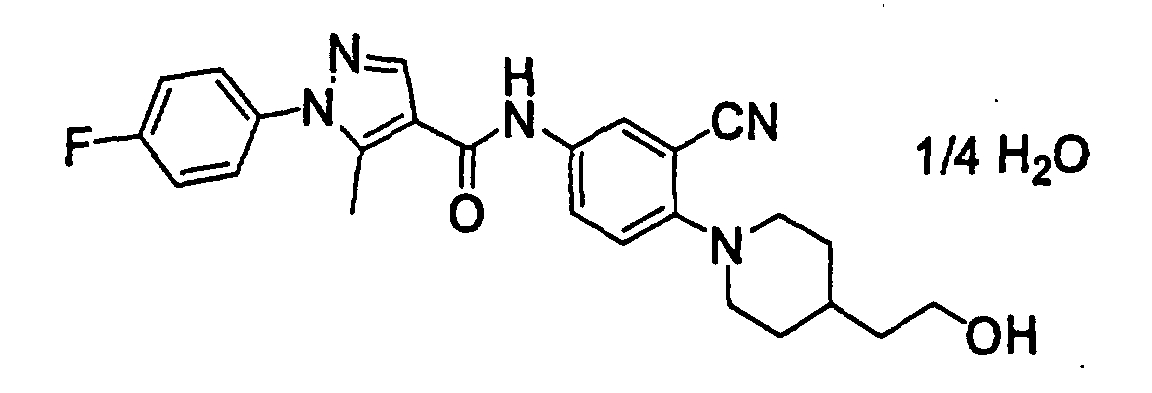
-5-methylpyrazole-4-carboxamide, (53) 1-(4-chlorophenyl)-N-[3-cyano-4-(4-thiomorpholinopiperidin-1-yl)phenyl]-5-methylpyrazole-4-carboxamide, (54) 1-(4-chlorophenyl)-5-methyl-N-[4-(4-morpholinopiperidin-1-yl)-3-nitrophenyl]pyrazole-4-carboxamide, (55) 5-methyl-N-[4-(4-morpholinopiperidin-1-yl)-3-nitrophenyl]-1-(4-trifluoromethylphenyl)pyrazole-4-carboxamide., (56) N-[3-chloro-4-(4-morpholinopiperidin-1-yl)phenyl]-5-methyl-1-(4-trifluoromethylphenyl)pyrazole-4-carboxamide, (57) 1-(4-chlorophenyl)-N-[3-ethynyl-4-(4-morpholinopiperidin-1-yl)phenyl]-5-methylpyrazole-4-carboxamide, (58) N-[3-cyano-4-(4-morpholinopiperidin-1-yl)phenyl]-5-methyl-1-(2-phenylethyl)pyrazole-4-carboxamide, (59) 1-(4-chlorophenyl)-N-[3-cyano-4-(4-methoxymethoxypiperidin-1-yl)phenyl]-5-methylpyrazole-4-carboxamide, (60) 1-(4-chlorophenyl)-N-[3-cyano-4-[4-(2-methoxyethoxy)piperidin-1-yl]phenyl]-5-methylpyrazole-4-carboxamide, (61) N-{3-cyano-4-[4-(2-hydroxyethyl)piperidin-1-yl]phenyl}-1-(4-fluorophenyl)-5-methylpyrazole-4-carboxamide, (62) N-[3-cyano-(4-morpholinopiperidin-1-yl)phenyl]-5-methyl-1-(4-nitrophenyl)pyrazole-4-carboxamide, (63) 1-(4-bromophenyl)-N-(3-cyano-4-[4-(3,4,5,6-tetrahydro-2H-pyran-4-yl)piperazin-1-yl]phenyl}-5-methylpyrazole-4-carboxamide, (64) N-{3-cyano-4-[4-(3,4,5,6-tetrahydro-2H-pyran-4-yl)piperazin-1-yl]phenyl}-1-(3,4-difluorophenyl)-5-methylpyrazole-4-carboxamide, (65) 1-(3-chlorophenyl)-N-{3-cyano-4-[4-(3,4,5,6-tetrahydro-2H-pyran-4-yl)piperazin-1-yl]phenyl}-5-methylpyrazole-4-carboxamide, (66) N-{3-cyano-4-[4-(3,4,5,6-tetrahydro-2H-pyran-4-yl)piperazin-1-yl]phenyl}-5-methyl-1-(4-methylphenyl)pyrazole-4-carboxamide, (67) 1- (3-chlorophenyl) -N- [3-cyano-4- (4-morpholinopiperidino) phenyl] -5-methylpyrazole-4-carboxamide, (68) 1-(4-chlorophenyl)-N-[3-chloro-4-(4-morpholinopiperidin-1-yl)phenyl]-5-methylpyrazole-4-carboxamide, (69) N-{3-cyano-4-[4-(3,4,5,6-tetrahydro-2H-pyran-4-yl)piperazin-1-yl]phenyl}-1-(4-trifluoramethylphenyl)pyrrole-3-carboxamide, (70) N-[3-cyano-4-(4-morpholinopiperidin-1-yl)phenyl]-1-(4-trifluoromethylphenyl)pyrrole-3-carboxamide, (71) N-{3-cyano-4-[4-(3,4,5,6-tetrahydro-2H-pyran-4-yl)piperazin-1-yl]phenyl}-1-(3,4-dichlorophenyl)pyrrole-3-carboxamide, (72) N-[3-cyano-4-(4-morpholinopiperidin-1-yl)phenyl]-1-(3,4-dichlorophenyl)pyrrole-3-carboxamide, (73) 1-(4-chlorophenyl)-N-{3-ethynyl-4-[4-(3,4,5,6-tetrahydro-2H-pyran-4-yl)piperazin-1-yl]phenyl}-5-methylpyrazole-4-carboxamide, (74) 1-(4-chlorophenyl)-5-methyl-N-{3-(1-propyne)-4-[4-(3,4,5,6-tetrahydro-2H-pyran-4-yl)piperazin-1-yl]phenyl}pyrazole-4-carboxamide, (75) 1-(4-chlorophenyl)-5-methyl-N-[3-(1-propyne)-4-(4-morpholinopiperidin-l-yl)phenyl]pyrazole-4-carboxamide, (76) 1-(4-chlorophenyl)-N-{3-ethenyl-4-[4-(3,4,5,6-tetrahydro-2H-pyran-4-yl)piperazin-1-yl]phenyl}-5-methylpyrazole-4-carboxamide, (77) 1- (4-chlorophenyl) -N- [3-ethenyl-4- (4-morpholinopiperidin-1-yl)phenyl]-5-methylpyrazole-4-carboxamide, (78) 1-(4-chlorophenyl)-N-[3-iodo-4-(4-morpholinopiperidin-1-yl)
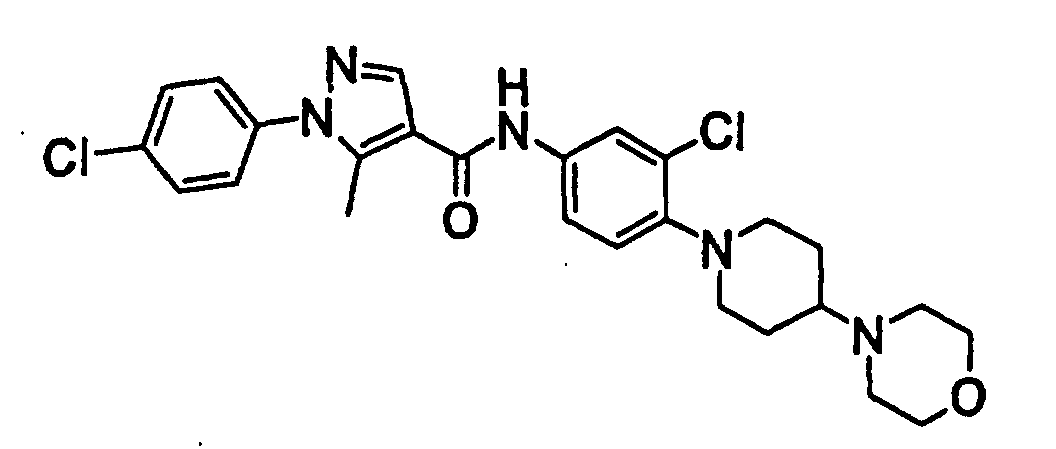
phenyl] -5-methylpyrazole-4-carboxamide, (79) N-{3-bromo-4-[4-(3,4,5,6-tetrahydro-2H-pyran-4-yl)piperazin-1-yl]phenyl}-1-(4-chlorophenyl)-5-methylpyrazole-4-carboxamide, (80) N-{3-chloro-4-[4-(3,4,5,6-tetrahydro-2H-pyran-4-yl)piperazin-1-yl]phenyl}-1-(4-chlorophenyl)-5-methylpyrazole-4-carboxamide, (81) N-{3-chloro-4-[4-(3,4,5,6-tetrahydro-2H-pyran-4-yl)piperazin-1-yl]phenyl}-1-(4-chlorophenyl)pyrrole-3-carboxamide, (82) N-{3-bromo-4-[4-(3,4,5,6-tetrahydro-2H-pyran-4-yl)piperazin-1-yl]phenyl}-1-(4-chlorophenyl)pyrrole-3-carboxamide, (83) 1- (4-chlorophenyl) -N- [3-cyano-4- (5-morpholinopentyloxy) phenyl] -5-methylpyrazole-4-carboxamide, (84) 1-(4-chlorophenyl)-N-[3-cyano-4-(5-morpholinopentyloxy)phenyl]pyrrole-3-carboxamide, (85) 1-(4-chlorophenyl)-N-[3-cyano-4-(5-morpholinopentylthio)phenyl]-5-methylpyrazole-4-carboxamide, (86) 1-(4-chlorophenyl) -N- [3-cyano-4- (5-morpholinopentylthio)phenyl]pyrrole-3-carboxamide, (87) N-[3-cyano-4-(4-morpholinopiperidin-1-yl)phenyl]-1-(3,4-methylenedioxyphenyl)-5-methylpyrazole-4-carboxamide, (88) N-[3-cyano-4-(4-morpholinopiperidin-1-yl)phenyl]-1-(3,4-methylenedioxyphenyl)pyrrole-3-carboxamide, (89) N-{3-cyano-4-[4-(3,4,5,6-tetrahydro-2H-pyran-4-yl)piperazin-1-yl]phenyl)-1-(3,4-methylenedioxyphenyl)-5-methylpyrazole-4-carboxamide, (90) N-{3-cyano-4-[4-(3,4,5,6-tetrahydro-2H-pyran-4-yl)piperazin-1-yl]phenyl)-1-(3,4-methylenedioxyphenyl)pyrrole-3-carboxamide, (91) 1-(4-chlorophenyl)-N-[3-cyano-4-(2,2-dimethyl-3-morpholinopropoxy)phenyl]-5-methylpyrazole-4-carboxamide, (92) 1- (4-chlorophenyl)-N- [3-cyano-4- (2,2-dimethyl-3-morpholinopropoxy)phenyl]pyrrole-3-carboxamide, (93) N-[3-cyano-4-(2,2-dimethyl-3-morpholinopropoxy) phenyl]-5-methyl-1-(3,4-methylenedioxyphenyl)pyrazole-4-carboxamide, (94) N-[3-cyano-4-(2,2-dimethyl-3-morpholinopropoxy)phenyl]-2,5-dimethyl-1-(3,4-methylenedioxyphenyl)pyrrole-3-carboxamide, (95) N-[3-cyano-4-(4-morpholinopiperidin-1-yl)phenyl]-2,5-dimethyl-1-(3,4-methylenedioxyphenyl)pyrrole-3-carboxamide, (96) N-[3-cyano-4-(4-morpholinopiperidin-1-yl)phenyl]-5-methyl-1-(3,4-methylenedioxyphenyl)pyrrole-3-carboxamide, (97) N-[3-cyano-4-[4-(3,4,5,6-tetrahydro-2H-pyran-4-yl)piperazin-1-yl]phenyl]-2,5-dimethyl-1-(3,4-methylenedioxyphenyl)pyrrole-3-carboxamide, (98) N-[3-chloro-4-(4-morpholinopiperidin-1-yl)phenyl]-2,5-dimethyl-1-(3,4-methylenedioxyphenyl)
pyrrole-3-carboxamide, (99) N-[3-cyano-4-(4-morpholinopiperidin-1-yl)phenyl]-1-(3,4-dimethoxyphenyl)-5-methylpyrazole-4-carboxamide, (100) N-[3-cyano-4-(4-morpholinopiperidin-1-yl)phenyl]-1-(3,4-dimethoxyphenyl)pyrrole-3-carboxamide, (101) N-[3-cyano-4-(4-morpholinopiperidin-1-yl)phenyl]-1-(3,4-dimethoxyphenyl)-2,5-dimethylpyrrole-3-carboxamide, (102) 1-(4-chlorophenyl)-N-[3-cyano-4-(2,2-dimethyl-3-morpholinopropoxy)phenyl]-2,5-dimethylpyrrole-3-carboxamide,
and (103) 1-(4-chlorophenyl)-N-[3-cyano-4-(4-morpholinopiperazin-1-yl)phenyl]-2,5-dimethylpyrrole-3-carboxamide
or a pharmaceutically acceptable salt thereof. [7] A pharmaceutical composition comprising the amide compound of the
above-mentioned [1] to [6] or a pharmaceutically acceptable salt
thereof, and a pharmaceutically acceptable carrier. [8] A pharmaceutical agent comprising the amide compound of the above-mentioned
[1] to [6] or a pharmaceutically acceptable salt thereof. [9] An inhibitor on the proliferation of activated lymphocytes
comprising, as an active ingredient, an amide compound of the formula

- R5
- is hydrogen, optionally substituted alkyl, hydroxyalkyl,
aminoalkyl, optionally substituted aryl, arylalkyl,
optionally substituted heteroaryl, heteroarylalkyl or
cycloalkyl,
- R6 and R7
- are the same or different and each is hydrogen, alkyl,
halogen, hydroxyl group, alkoxy, optionally substituted
amino or phenyl,
- Q
- is nitrogen atom or a group C-R8 (wherein R8 is hydrogen,
alkyl, halogen or optionally substituted amino),
- W
- is hydrogen, alkyl, hydroxyalkyl, acyloxyalkyl, aminoalkyl,
hydroxycarbonylalkyl or alkoxycarbonylalkyl,
- X
- is halogen, cyano, nitro, amino, alkyl, alkoxy, carboxy,
alkoxycarbonyl, carbamoyl, alkenyl, alkynyl or haloalkyl,
- X'
- is hydrogen, halogen, cyano or nitro, and
- Y
- is alkyl, hydroxyalkyl, hydroxycarbonylalkyl, optionally
substituted aminoalkyl, hydroxyl group, alkoxy, haloalkoxy,
aryloxy, cycloalkyloxy, hydroxyalkoxy,
hydroxycarbonylalkoxy, optionally substituted aminoalkoxy,
mercapto, alkylthio, hydroxyalkylthio,
hydroxycarbonylalkylthio, optionally substituted
aminoalkylthio, a group O-Het (wherein Het is optionally
substituted saturated heterocycle having hetero atom
selected from oxygen atom and nitrogen atom) or a group
N(Z2) (Z3) (wherein Z2 and Z3 are the same or different and
each is hydrogen, alkyl, hydroxyalkyl or aminoalkyl, or Z2
and Z3 form, together with the adjacent nitrogen atom,
cyclic amine optionally having one or two atoms from
oxygen atom, sulfur atom and nitrogen atom in the ring),
or a pharmaceutically acceptable salt thereof.
[10] An inhibitor on the proliferation of activated lymphocytes
comprising the amide compound of the above-mentioned [1] - [6] or a
pharmaceutically acceptable salt thereof as an active ingredient. [11] The inhibitor on the proliferation of activated lymphocytes of the
above-mentioned [9] or [10], which is dependent on IL-2, IL-4, IL-7,
IL-9, IL-13 or IL-15. [12] A phosphorylation inhibitor of tyrosine kinase involved in the
signal transduction in the downstream of a common β chain that is a
receptor subunit common to IL-15 and IL-2 and/or a common γ chain that
is a receptor subunit common to IL-2, IL-4, IL-7, IL-9, IL-13 and IL-15,
which inhibitor comprises the amide compound of the above-mentioned [1]
- [6] or a pharmaceutically acceptable salt thereof as an active
ingredient. [13] The cytokine production inhibitor, which comprises the amide
compound of the above-mentioned [1] - [6] or a pharmaceutically
acceptable salt thereof as an active ingredient. [14] An IL-2, IL-4, IL-13 or IFN-γ production inhibitor, which
comprises the amide compound of the above-mentioned [1] - [6] or a
pharmaceutically acceptable salt thereof as an active ingredient. [15] An IL-1, IL-6, IL-12, IL-15, IL-18 or TNF-α production inhibitor,
which comprises the amide compound of the above-mentioned [1] - [6] or
a pharmaceutically acceptable salt thereof as an active ingredient. [16] A pharmaceutical agent comprising a synthesized low molecular
compound having inhibitory effect on activated lymphocytes
proliferation dependent on IL-2, IL-4, IL-7, IL-9, IL-13 or IL-15. [17] An agent for the prophylaxis or treatment of diseases caused by
proliferation of lymphocytes, which agent comprises, as an active
ingredient, a synthesized low molecular compound having inhibitory
effect on activated lymphocytes proliferation dependent on IL-2, IL-4,
IL-7, IL-9, IL-13 or IL-15. [18] An agent for the prophylaxis or treatment of diseases caused by
proliferation of lymphocytes, which comprises the amide compound of the
above-mentioned [1] - [6] or a pharmaceutically acceptable salt thereof
as an active ingredient. [19] An agent for the prophylaxis or treatment of autoimmune diseases,
which comprises, as an active ingredient, a synthesized low molecular
compound having inhibitory effect on activated lymphocytes
proliferation dependent on IL-2, IL-4, IL-7, IL-9, IL-13 or IL-15. [20] An agent for the prophylaxis or treatment of autoimmune diseases,
which comprises, as an active ingredient, the amide compound of the
above-mentioned [1] - [6] or a pharmaceutically acceptable salt thereof. [21] An agent for the prophylaxis or treatment of rheumatoid arthritis,
which comprises, as an active ingredient, the amide compound of the
above-mentioned [1] - [6] or a pharmaceutically acceptable salt thereof. [22] A combination composition comprising the amide compound of the
formula

- R1
- is substituted aryl, arylalkyl, optionally substituted
heteroaryl, heteroarylalkyl or cycloalkyl,
- R2 and R3
- are the same or different and each is hydrogen, alkyl,
halogen, hydroxyl group, alkoxy, optionally substituted
amino or phenyl,
- Q
- is nitrogen atom or a group C-R4 (wherein R4 is hydrogen,
alkyl, halogen or optionally substituted amino),
- W
- is hydrogen, alkyl, hydroxyalkyl, acyloxyalkyl, aminoalkyl,
hydroxycarbonylalkyl or alkoxycarbonylalkyl,
- X
- is halogen, cyano, nitro, amino, alkyl, alkoxy, carboxy,
alkoxycarbonyl, carbamoyl, alkenyl, alkynyl or haloalkyl,
- X'
- is hydrogen, halogen, cyano or nitro, and
- Y
- is alkyl; hydroxyalkyl, hydroxycarbonylalkyl, optionally
substituted aminoalkyl, hydroxyl group, optionally
substituted alkoxy, aryloxy, cycloalkyloxy, hydroxyalkoxy,
hydroxycarbonylalkoxy, optionally substituted aminoalkoxy,
mercapto, alkylthio, hydroxyalkylthio,
hydroxycarbonylalkylthio, optionally substituted
aminoalkylthio, a group O-Het (wherein Het is optionally
substituted saturated heterocycle having hetero atom
selected from oxygen atom and nitrogen atom) or a group
N(Z2) (Z3) (wherein Z2 and Z3 are the same or different and
each is hydrogen, alkyl, hydroxyalkyl or aminoalkyl, or Z2
and Z3 form, together with the adjacent nitrogen atom,
cyclic amine optionally having one or two atoms from
oxygen atom, sulfur atom and nitrogen atom in the ring),
or a pharmaceutically acceptable salt thereof, and one or more
pharmaceutical agents selected from an antirheumatic drug, an
immunosuppressive agent, a steroidal drug and a nonsteroidal anti-inflammatory
drug.
[23] The combination composition of the above-mentioned [22], wherein
the antirheumatic drug is selected from a gold compound, penicillamine,
bucillamine, lobenzarit, actarit and salazosulfapyridine. [24] The combination composition of the above-mentioned [22], wherein
the immunosuppressive agent is selected from azathioprine,
cyclophosphamide, methotrexate, brequinar sodium, deoxyspergualin,
mizoribine, 2-morpholinoethyl mycophenolate, cyclosporin, rapamycin,
tacrolimus hydrate, leflunomide, OKT-3, anti TNF-α antibody, anti IL-6
antibody and FTY720. [25] The combination composition of the above-mentioned [22], wherein
the steroidal drug is selected from prednisolone, methylprednisolone,
dexamethasone and hydrocortisone. [26] The combination composition of the above-mentioned [22], wherein
the nonsteroidal anti-inflammatory drug is selected from aspirin,
indomethacin, indomethacin farnesil, diclofenac sodium, alclofenac,
amfenac sodium, ibuprofen, ketoprofen, loxoprofen sodium, naproxen,
pranoprofen, zaltoprofen, mefenamic acid, flufenamic acid, tolufenamic
acid, phenylbutazone, ketophenylbutazone, piroxicam, tenoxicam and
ampiroxicam. [27] An effect enhancer of one or more pharmaceutical agents selected
from an antirheumatic drug, an immunosuppressive agent, a steroidal
drug and a nonsteroidal anti-inflammatory drug, which enhancer
comprises an amide compound of the formula

- R1
- is substituted aryl, arylalkyl, optionally substituted
heteroaryl, heteroarylalkyl or cycloalkyl,
- R2 and R3
- are the same or different and each is hydrogen, alkyl,
halogen, hydroxyl group, alkoxy, optionally substituted
amino or phenyl,
- Q
- is nitrogen atom or a group C-R4 (wherein R4 is hydrogen,
alkyl, halogen or optionally substituted amino),
- W
- is hydrogen, alkyl, hydroxyalkyl, acyloxyalkyl, aminoalkyl,
hydroxycarbonylalkyl or alkoxycarbonylalkyl,
- X
- is halogen, cyano, nitro, amino, alkyl, alkoxy, carboxy,
alkoxycarbonyl, carbamoyl, alkenyl, alkynyl or haloalkyl,
- X'
- is hydrogen, halogen, cyano or nitro, and
- Y
- is alkyl, hydroxyalkyl, hydroxycarbonylalkyl, optionally
substituted aminoalkyl, hydroxyl group, optionally
substituted alkoxy, aryloxy, cycloalkyloxy, hydroxyalkoxy,
hydroxycarbonylalkoxy, optionally substituted aminoalkoxy,
mercapto, alkylthio, hydroxyalkylthio,
hydroxycarbonylalkylthio, optionally substituted
aminoalkylthio, a group O-Het (wherein Het is optionally
substituted saturated heterocycle having hetero atom
selected from oxygen atom and nitrogen atom) or a group
N(Z2) (Z3) (wherein Z2 and Z3 are the same or different and
each is hydrogen, alkyl, hydroxyalkyl or aminoalkyl, or Z2
and Z3 form, together with the adjacent nitrogen atom,
cyclic amine Qptionally having one or two atoms from
oxygen atom, sulfur atom and nitrogen atom in the ring),
or a pharmaceutically acceptable salt thereof.
[28] The effect enhancer of the above-mentioned [27], wherein the
antirheumatic drug is selected from a gold compound, penicillamine,
bucillamine, lobenzarit, actarit and salazosulfapyridine. [29] The effect enhancer of the above-mentioned [27], wherein the
immunosuppressive agent is selected from azathioprine, cyclophosphamide,
methotrexate, brequinar sodium, deoxyspergualin, mizoribine, 2-morpholinoethyl
mycophenolate, cyclosporin, rapamycin, tacrolimus
hydrate, leflunomide, OKT-3, anti TNF-α antibody, anti IL-6 antibody
and FTY720. [30] The effect enhancer of the above-mentioned [27], wherein the
steroidal drug is selected from prednisolone, methylprednisolone,
dexamethasone and hydrocortisone. [31] The effect enhancer of the above-mentioned [27], wherein the
nonsteroidal anti-inflammatory drug is selected from aspirin,
indomethacin, indomethacin farnesil, diclofenac sodium, alclofenac,
amfenac sodium, ibuprofen, ketoprofen, loxoprofen sodium, naproxen,
pranoprofen, zaltoprofen, mefenamic acid, flufenamic acid, tolufenamic
acid, phenylbutazone, ketophenylbutazone, piroxicam, tenoxicam and
ampiroxicam.
The present invention aims at providing a synthesized low
molecular compound having an inhibitory effect on the proliferation of
activated lymphocytes taking note of IL-15. The inhibitory effect on
the proliferation of activated lymphocytes taking note of IL-15 means
inhibitory effect on activated lymphocytes proliferation dependent on
IL-15, and embraces an inhibitory effect on the activated lymphocytes
proliferation dependent on IL-2, IL-4, IL-7, IL-9 and IL-13 which are
cytokines closely related to IL-15. The present invention also aims at
providing a compound which inhibits signal transduction from an IL-15
receptor (β chain common to IL-15 and IL-2, and γ chain common to IL-2,
IL-4, IL-7, IL-9, IL-13 and IL-15), inhibits a path via tyrosine kinase
during the process of the signal transduction, and which inhibits
production of IL-15 and inflammatory cytokines (IL-1, IL-6, IL-12, IL-15,
IL-18, TNF-α and the like) derived by IL-15. In addition, the
synthesized low molecular compound is able to produce by using a low
molecular weight organic compound to a method known in the field of
organic synthetic chemistry. The preferable compounds in the present
invention are compound (I) and compound (I-e), more preferably the
compound (I-a) - compound (I-d). The particularly preferable compounds
are as follows.
The substituents represented by each symbol in the present
specification are explained in the following.
The aryl of substituted aryl at R1, R1a and R5 means phenyl,
naphthyl and the like, wherein the substituent is 1 to 3 groups
selected from halogen (fluorine, chlorine, bromine, iodine), alkyl
having 1 to 4 carbon atoms (methyl, ethyl, propyl, isopropyl, butyl and
the like), alkoxy having 1 to 4 carbon atoms (methoxy, ethoxy, propoxy,
isopropoxy, butoxy and the like), cyano, nitro, carboxy, alkylenedioxy
having 1 to 4 carbon atoms (methylenedioxy, ethylenedioxy,
propylenedioxy, 1,1-dimethylmethylenedioxy and the like) and haloalkyl
having 1 to 4 carbon atoms (fluoromethyl, chloromethyl, trifluoromethyl,
2,2,2-trifluoroethyl and the like). The preferable substituent is
exemplified by halogen, alkyl, alkoxy, haloalkyl, alkylenedioxy and
nitro. Examples of substituted aryl include 4-chlorophenyl, 3-chlorophenyl,
2-chlorophenyl, 3,4-dichlorophenyl, 4-fluorophenyl, 2,4-difluorophenyl,
3,4-difluorophenyl, 3-chloro-4-fluorophenyl, 4-bromophenyl,
4-iodophenyl, 4-methylphenyl, 4-methoxyphenyl, 4-ethoxyphenyl,
3,4-dimethoxyphenyl, 3,4-diethoxyphenyl, 4-cyanophenyl,
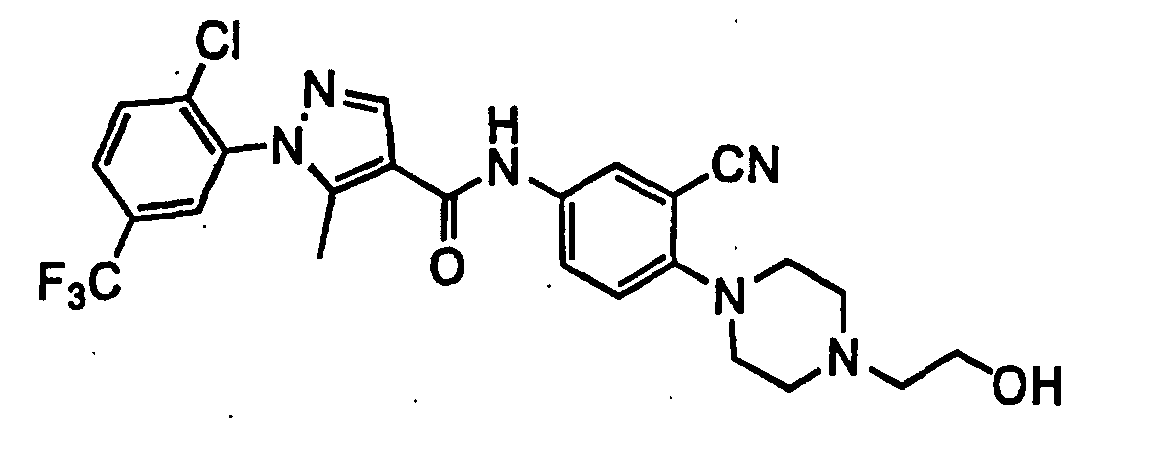
4-carboxyphenyl, 4-trifluoromethylphenyl, 3-trifluoromethylphenyl, 2-chloro-5-trifluoromethylphenyl,
4-nitrophenyl, 3,4-methylenedioxyphenyl,
3,4-ethylenedioxyphenyl and the like.
The arylalkyl at R1, R1a and R5 is aryl (phenyl, naphthyl and the
like) substituted with alkyl having 1 to 4 carbon atoms, and is
exemplified by phenylmethyl, 2-phenylethyl, 1-phenylethyl, 3-phenylpropyl,
4-phenylbutyl and the like.
The heteroaryl of optionally substituted heteroaryl at R1, R1a
and R5 is a 5 or 6-membered heteroaryl ring having 1 or 2 substituents
selected from hetero atoms of nitrogen atom, sulfur atom and oxygen
atom. As the substituent, alkyl having 1 to 4 carbon atoms, halogen
(fluorine, chlorine, bromine and the like) and the like are exemplified.
Examples thereof include pyrimidyl, 4,6-dimethylpyrimidyl, pyridazinyl,
6-chloropyridazinyl, thienyl, 5-methylthienyl, 5-chlorothienyl, pyridyl
and the like.
The heteroarylalkyl at R1 and R5 is a 5 or 6-membered heteroaryl
ring substituted with 1 or 2 hetero atoms selected from nitrogen atom,
sulfur atom and oxygen atom (as defined above), which is substituted
with alkyl having 1 to 4 carbon atoms. Examples thereof include 2-thienylmethyl,
2-(2-thienyl)ethyl, 3-(2-thienyl)propyl, 2-pyridylmethyl,
3-pyridylmethyl, 4-pyridylmethyl and the like.
The cycloalkyl at R1 and R5 is a cycloalkyl having 3 to 6 carbon
atoms, such as cyclopropyl, cyclobutyl, cyclopentyl, cyclohexyl and the
like.
The alkyl at R2, R2a, R3, R3a, R4a, R6 and R7 is a linear or
branched chain alkyl having 1 to 4 carbon atoms, and is exemplified by
methyl, ethyl, propyl, isopropyl, butyl, isobutyl, tert-butyl and the
like, preferably methyl.
The halogen at R2, R3, R6 and R7 is fluorine, chlorine, bromine
or iodine.
The alkoxy at R2, R3, R6 and R7 is a linear or branched chain
alkoxy having 1 to 4 carbon atoms, and is exemplified by methoxy,
ethoxy, propoxy, isopropoxy, butoxy, tert-butoxy and the like.
The optionally substituted amino at R2, R3, R6 and R7 may be mono
or di-substituted with a substituent selected from alkyl having 1 to 4
carbon atoms (as defined above), acyl having 1 to 4 carbon atoms
(formyl, acetyl, propionyl and the like) and benzoyl. Examples thereof
include amino, methylamino, dimethylamino, ethylamino, diethylamino,
formylamino, acetylamino, propionylamino and benzoylamino.
The alkyl, halogen and optionally substituted amino at R4 and R8
are as defined for alkyl, halogen and optionally substituted amino at
R2, R3, R6 and R7.
The alkyl of optionally substituted alkyl at R5 is a linear or
branched chain alkyl having 1 to 6 carbon atoms, and is exemplified by
methyl, ethyl, propyl, isopropyl, butyl, isobutyl, tert-butyl, pentyl,
isopentyl, neopentyl, hexyl and the like. Examples of the substituent
include halogen (fluorine, chlorine, bromine, iodine), alkoxycarbonyl
wherein the alkoxy moiety has 1 to 4 carbon atoms (C1-C4 alkoxy moiety
is as defined above) and carboxyl group, and specific examples thereof
include fluoromethyl, chloromethyl, 2,2,2-trifluoroethyl, 2,2,2-trichloroethyl,
methoxycarbonylmethyl, ethoxycarbonylmethyl, 2-(methoxycarbonyl)
ethyl, carboxymethyl, 2-carboxyethyl and the like.
The hydroxyalkyl at R5 is a linear or branched chain alkyl
having 1 to 4 carbon atoms (as defined above), which is substituted
with hydroxyl group. Examples thereof include hydroxymethyl, 2-hydroxyethyl,
3-hydroxypropyl, 4-hydroxybutyl and the like, preferably
2-hydroxyethyl.
The aminoalkyl at R5 is a linear or branched chain alkyl having
1 to 4 carbon atoms (as defined above), which is substituted with amino.
The amino may be substituted with a substituent selected from alkyl
having 1 to 4 carbon atoms (as defined above), acyl having 1 to 4
carbon atoms (as defined above) and benzoyl. Examples thereof include
aminomethyl, 2-aminoethyl, 3-aminopropyl, 4-aminobutyl,
dimethylaminomethyl, diethylaminomethyl, dipropylaminomethyl,
dibutylaminomethyl, 2-dimethylaminoethyl, formylaminomethyl, 2-formylaminoethyl,
acetylaminomethyl, 2-acetylaminoethyl,
benzoylaminomethyl, 2-benzoylaminoethyl and the like.
The alkyl at W and W1 is a linear or branched chain alkyl having
1 to 4 carbon atoms, and is exemplified by methyl, ethyl, propyl,
isopropyl, butyl and the like, preferably methyl or ethyl.
The hydroxyalkyl at W is an alkyl having 1 to 4 carbon atoms (as
defined above) which is substituted with hydroxyl group, and is
exemplified by hydroxymethyl, 2-hydroxyethyl, 3-hydroxypropyl, 4-hydroxybutyl
and the like.
The acyloxyalkyl at W is a C1 - C4 alkyl (as defined above)
substituted with acyloxy having 1 to 4 carbon atoms (formyloxy,
acetyloxy, propionyloxy, butyryloxy and the like). Examples thereof
include formyloxymethyl, 2-formyloxyethyl, acetyloxymethyl, 2-acetyloxyethyl,
3-acetyloxypropyl, 4-acetyloxybutyl, propionyloxymethyl
and the like, preferably 2-acetyloxyethyl.
The aminoalkyl at W is a C1 - C4 alkyl (as defined above)
substituted with amino. Examples thereof include aminomethyl,
aminoethyl, dimethylaminomethyl, diethylaminomethyl and the like.
The hydroxycarbonylalkyl at W and W1 is C1 - C4 alkyl (as
defined above) substituted with hydroxycarbonyl. Examples thereof
include hydroxycarbonylmethyl, 2-hydroxycarbonylethyl, 3-hydroxycarbonylpropyl,
4-hydroxycarbonylbutyl and the like, preferably
hydroxycarbonylmethyl and 3-hydroxycarbonylpropyl.
The alkoxycarbonylalkyl at W, W1 is a C1-C4 alkyl (as defined
above) substituted with alkoxycarbonyl, wherein the alkoxy moiety has 1
to 4 carbon atoms (as defined above). Examples thereof include
methoxycarbonylmethyl, methoxycarbonylethyl, methoxycarbonylpropyl,
methoxycarbonylbutyl, ethoxycarbonylmethyl, propoxycarbonylmethyl,
isopropoxycarbonylmethyl, butoxycarbonylmethyl and the like, preferably
ethoxycarbonylmethyl.
The halogen at X and X1 is fluorine, chlorine, bromine or iodine,
preferably chlorine or bromine.
The alkyl at X is a linear or branched chain alkyl having 1 to 6
carbon atoms, and is exemplified by methyl, ethyl, propyl, isopropyl,
butyl, isobutyl, tert-butyl, pentyl, isopentyl, neopentyl, hexyl and
the like, preferably alkyl having 1 to 3 carbon atoms, particularly
preferably methyl.
The alkoxy at X is a linear or branched chain alkoxy having 1 to
6 carbon atoms, and is exemplified by methoxy, ethoxy, propoxy,
isopropoxy, butoxy, isobutoxy, tert-butoxy, pentyloxy, isopentyloxy,
neopentyloxy, hexyloxy and the like, particularly preferably alkoxy
having 1 to 3 carbon atoms.
The alkenyl at X is a linear or branched chain alkenyl having 2
to 4 carbon atoms, and is exemplified by ethenyl, 1-propenyl, 1-butenyl
and the like, particularly preferably ethenyl.
The haloalkyl at X is a linear or branched chain haloalkyl
having 1 to 4 carbon atoms, and is exemplified by fluoromethyl,
chloromethyl, bromomethyl, trifluoromethyl, 2-fluoroethyl, 2-chloromethyl,
2,2,2-trifluoroethyl and the like, particularly
preferably trifluoromethyl.
The alkoxycarbonyl at X and X1 is an alkoxycarbonyl, wherein the
alkoxy moiety has 1 to 4 carbon atoms (as defined above). Examples
thereof include methoxycarbonyl, ethoxycarbonyl, propoxycarbonyl,
isopropoxycarbonyl, butoxycarbonyl, tert-butoxycarbonyl and the like.
The alkynyl at X and X1 is a linear or branched chain alkynyl
having 1 to 4 carbon atoms, and is exemplified by ethynyl, 1-propynyl,
1-butynyl and the like, particularly preferably ethynyl.
The halogen at X' is fluorine, chlorine, bromine or iodine,
preferably chlorine.
The alkyl at Y is a linear or branched chain alkyl having 1 to 6
carbon atoms, and is exemplified by methyl, ethyl, propyl, isopropyl,
butyl, isobutyl, tert-butyl, pentyl, isopentyl, neopentyl, hexyl,
isohexyl, neohexyl and the like, particularly preferably alkyl having 4
to 6 carbon atoms.
The hydroxyalkyl at Y is a linear or branched chain C1 - C4
alkyl (as defined above) substituted with hydroxyl group. Examples
thereof include hydroxymethyl, 2-hydroxyethyl, 3-hydroxypropyl, 4-hydroxybutyl
and the like.
The hydroxycarbonylalkyl at Y is C1 - C4 alkyl (as defined
above) substituted with hydroxycarbonyl. Examples thereof include
hydroxycarbonylmethyl, 2-hydroxycarbonylethyl, 3-hydroxycarbonylpropyl,
4-hydroxycarbonylbutyl and the like.
The optionally substituted aminoalkyl at Y is C1 - C4 alkyl (as
defined above) substituted with amino, wherein the amino may be mono or
di-substituted with alkyl having 1 to 4 carbon atoms (as defined above),
acyl having 1 to 4 carbon atoms (as defined above) and benzoyl and the
like. Examples thereof include aminomethyl, 2-aminoethyl,
dilmethylaminomethyl, 2-diethylaminomethyl, formylaminomethyl,
acetylaminomethyl, 2-formylaminoethyl, 2-acetylaminoethyl,
benzoylaminomethyl and the like. The said amino may form cyclic amine,
which may have one or two atoms from oxygen atom, sulfur atom and.
nitrogen atom in the ring. Examples thereof include pyrrolidine,
optionally substituted piperidine, homopiperidine, optionally
substituted piperazine, optionally substituted homopiperazine,
morpholine and thiomorpholine and the like. Specific examples thereof
include piperidinomethyl, 2-piperidinoethyl, morpholinomethyl, 2-morpholinoethyl,
thiomorpholinomethyl, piperazinomethyl, (4-morpholinopiperidin-1-yl)methyl
and the like.
The alkoxy at Y, Y1 and Y2 is a linear or branched chain alkoxy
having 1 to 6 carbon atoms, and is exemplified by methoxy, ethoxy,
propoxy, isopropoxy, butoxy, isobutoxy, tert-butoxy, pentyloxy,
isopentyloxy, neopentyloxy, hexyloxy, isohexyloxy, neohexyloxy and the
like, preferably alkoxy having 4 to 6 carbon atoms.
The haloalkoxy at Y and Y1 is a C1 - C4 alkoxy (as defined
above) substituted with halogen (as defined above). Examples thereof
include fluoromethoxy, chloromethoxy, 2-fluoroethoxy, 2,2,2-trifluoroethoxy
and the like, preferably 2,2,2-trifluoroethoxy.
The aryloxy at Y and Y1 is phenyloxy, naphthyloxy and the like,
preferably phenyloxy.
The cycloalkyloxy at Y and Y1 is a cycloalkyloxy having 3 to 6
carbon atoms, and is exemplified by cyclopentyloxy, cyclohexyloxy and
the like, preferably cyclohexyloxy.
The hydroxyalkoxy at Y and Y1 is a linear or branched chain C3-C6
alkoxy substituted with hydroxy. Examples thereof include 3-hydroxypropoxy,
1-methyl-1-hydroxyethoxy, 4-hydroxybutoxy, 5-hydroxypentyloxy
and 6-hydroxyhexyloxy.
The hydroxycarbonylalkoxy at Y is a linear or branched chain C1
- C4 alkoxy substituted with hydroxycarbonyl. Examples thereof include
hydroxycarbonylmethoxy, 2-hydroxycarbonylethoxy, 3-hydroxycarbonylpropoxy
and 4-hydroxycarbonylbutoxy.
The optionally substituted aminoalkoxy at Y, Y1 and Y2 is a
linear or branched chain C1 - C6 alkoxy (as defined above) substituted
with amino. The said amino may have a substituent such as alkyl having
1 to 4 carbon atoms (as defined above), acyl having 1 to 4 carbon atoms
(as defined above) and benzoyl. The said amino may form cyclic amine
which may have one or two atoms from oxygen atom, sulfur atom and
nitrogen atom in the ring. Examples thereof include pyrrolidine,
optionally substituted piperidine, homopiperidine, optionally
substituted piperazine, optionally substituted homopiperazine,
morpholine and thiomorpholine and the like. Examples thereof include
aminomethoxy, aminoethoxy, aminopropoxy, methylaminomethoxy,
dimethylaminomethoxy, 2-dimethylaminoethoxy, formylaminomethoxy,
acetylaminomethoxy, propionylaminomethoxy, benzoylaminomethoxy,
morpholinomethoxy, 2-morpholinoethoxy, 3-morpholinopropoxy, 2,2-dimethyl-3-morpholinopropoxy,
4-morpholinobutoxy, 5-morpholinopentyloxy,
6-morpholinohexyloxy, thiomorpholinomethoxy, 2-thiomorpholinoethoxy, 3-thiomorpholinopropoxy,
2,2-dimethyl-3-thiomorpholinopropoxy, 4-thiomorpholinobutoxy,
5-thiomorpholinopentyloxy, 6-thiomorpholinohexyloxy,
piperidinomethoxy, 2-piperidinoethoxy, 3-piperidinopropoxy,
2,2-dimethyl-3-piperidinopropoxy, 4-piperidinobutoxy,
5-piperidinopentyloxy, 6-piperidinohexyloxy, piperazinomethoxy, 2-piperazinoethoxy,
3-piperazinopropoxy, 2,2-dimethyl-3-piperazinopropoxy,
4-piperazinobutoxy, 5-piperazinopentyloxy, 6-piperazinohexyloxy, 2-pyrrolidinoethoxy,
3-pyrrolidinopropoxy and the like. Of these, 2-dimethylaminoethoxy,
4-morpholinobutoxy, 3-morpholinopropoxy, 2-morpholinoethoxy,
morpholinomethoxy and 2,2-dimethyl-3-morpholinopropoxy
are preferable.
The alkylthio at Y is that wherein the alkyl moiety has 1 to 6
carbon atoms, and is exemplified by methylthio, ethylthio, propylthio,
n-butylthio, pentylthio, neopentylthio, hexylthio and the like.
The hydroxyalkylthio at Y is that wherein the alkyl moiety has 1
to 6 carbon atoms. Examples thereof include hydroxymethylthio, 2-hydroxyethylthio,
3-hydroxypropylthio, 4-hydroxybutylthio, 5-hydroxypentylthio
and 6-hydroxyhexylthio.
The hydroxycarbonylalkylthio at Y is that wherein the alkyl
moiety has 1 to 4 carbon atoms. Examples thereof include
hydroxycarbonylmethylthio, 2-hydroxycarbonylethylthio, 3-hydroxycarbonylpropylthio
and 4-hydroxycarbonylbutylthio.
The optionally substituted aminoalkylthio at Y, Y1, Y2 is that
wherein the alkyl moiety has a linear or branched chain alkyl having 1
to 6 carbon atoms (as defined above). The said amino is optionally
substituted with alkyl having 1 to 4 carbon atoms (as defined above),
acyl having 1 to 4 carbon atoms (as defined above) or benzoyl as a
substituent. The said amino may form cyclic amine which may have one
or two atoms from oxygen atom, sulfur atom and nitrogen atom in the
ring. Examples thereof include pyrrolidine, optionally substituted
piperidine, homopiperidine, optionally substituted piperazine,
optionally substituted homopiperazine, morpholine and thiomorpholine
and the like. Specific examples thereof include aminomethylthio, 2-aminoethylthio,
3-aminopropylthio, 4-aminobutylthio,
dimethylaminomethylthio, diethylaminomethylthio, 2-dimethylaminoethylthio,
3-dimethylaminopropylthio, 4-dimethylaminobutylthio,
formylaminomethylthio, 2-formylaminoethylthio,
acetylaminomethylthio, 2-acetylaminoethylthio, benzoylaminomethylthio,
2-benzoylaminoethylthio, morpholinomethylthio, 2-morpholinoethylthio,
3-morpholinopropylthio, 4-morpholinobutylthio, 5-morpholinopentylthio,
6-morpholinohexylthio, thiomorpholinomethylthio, 2-thiomorpholinoethylthio,
3-thiomorpholinopropylthio, 4-thiomorpholinobutylthio,
5-thiomorpholinopentylthio, 6-thiomorpholinohexylthio,
piperidinomethylthio, 2-piperidinoethylthio,
3-piperidinopropylthio, 4-piperidinobutylthio, 5-piperidinopentylthio,
6-piperidinohexylthio, piperazinomethylthio, 2-piperazinoethylthio, 3-piperazinopropylthio,
4-piperazinobutylthio, 5-piperazinopentylthio, 6-piperazinohexylthio,
2-pyrrolidinoethylthio and 3-pyrrolidinopropylthio.
The alkyl at Z2 and Z3 is an alkyl having 1 to 4 carbon atoms
(as defined above). Examples thereof include methyl, ethyl, propyl,
isopropyl, butyl, isobutyl, tert-butyl and the like, preferably ethyl.
The hydroxyalkyl at Z2 and Z3 is a C1 - C4 alkyl (as defined
above) substituted with hydroxyl group. Examples thereof include
hydroxymethyl, 2-hydroxyethyl, 3-hydroxypropyl, 4-hydroxybutyl and the
like, preferably 2-hydroxyethyl.
The aminoalkyl at Z2 and Z3 is a C1 - C4 alkyl (as defined
above) substituted with amino. The amino may be substituted with alkyl
having 1 to 4 carbon atoms (as defined above), acyl having 1 to 4
carbon atoms (as defined above) or benzoyl. Examples thereof include
aminomethyl, aminoethyl, dimethylaminomethyl, diethylaminomethyl,
formylaminomethyl, 2-formylaminoethyl, acetylaminomethyl, 2-acetylaminoethyl,
benzoylaminomethyl and the like.
The group at Z2, Z3, Z2a and Z3a that forms, together with the
adjacent nitrogen atom, cyclic amine which may have one or two atoms
from oxygen atom, sulfur atom and nitrogen atom in the ring is cyclic
amine selected from pyrrolidine, optionally substituted piperidine,
homopiperidine, optionally substituted piperazine, optionally
substituted homopiperazine, morpholine and thiomorpholine.
The substituent of the aforementioned optionally substituted
piperidine is exemplified by hydroxy; carboxy; alkoxycarbonyl wherein
the alkoxy moiety has 1 to 4 carbon atoms (as defined above);
hydroxyalkyl having 1 to 4 carbon atoms (as defined above);
alkoxyalkoxy wherein the alkoxy moiety has 1 to 4 carbon atoms
(methoxymethoxy, ethoxymethoxy, propoxymethoxy, butoxymethoxy, 2-methoxyethoxy,
3-methoxypropoxy, 4-methoxybutoxy and the like);
carboxyalkylcarbonyloxy wherein the alkyl moiety has 1 to 4 carbon
atoms (carboxymethylcarbonyloxy, 2-carboxyethylcarbonyloxy and the
like); acyloxy having 1 to 4 carbon atoms (as defined above);
benzoyloxy; phenyl; alkylenedioxy having 1 to 4 carbon atoms
(methylenedioxy, ethylenedioxy and the like); oxo; amino optionally
mono or di-substituted with alkyl having 1 to 4 carbon atoms (as
defined above), alkoxyalkyl wherein the alkoxy moiety and alkyl moiety
each have 1 to 4 carbon atoms (methoxymethyl, ethoxymethyl, 2-methoxyethyl,
2-ethoxyethyl and the like) or hydroxyalkyl having 1 to 4
carbon atoms (as defined above); cyclic amine selected from piperidine
optionally having a substituent (hydroxy, alkoxy having 1 to 4 carbon
atoms, oxo and the like), morpholine, thiomorpholine, piperazine
optionally having a substituent (alkyl having 1 to 4 carbon atoms, acyl
having 1 to 4 carbon atoms and the like) and the like (the said cyclic
amine may be N-oxide); morpholinomethyl and the like. Examples thereof
include piperidin-1-yl, 4-hydroxypiperidin-1-yl, 4-carboxypiperidin-1-yl,
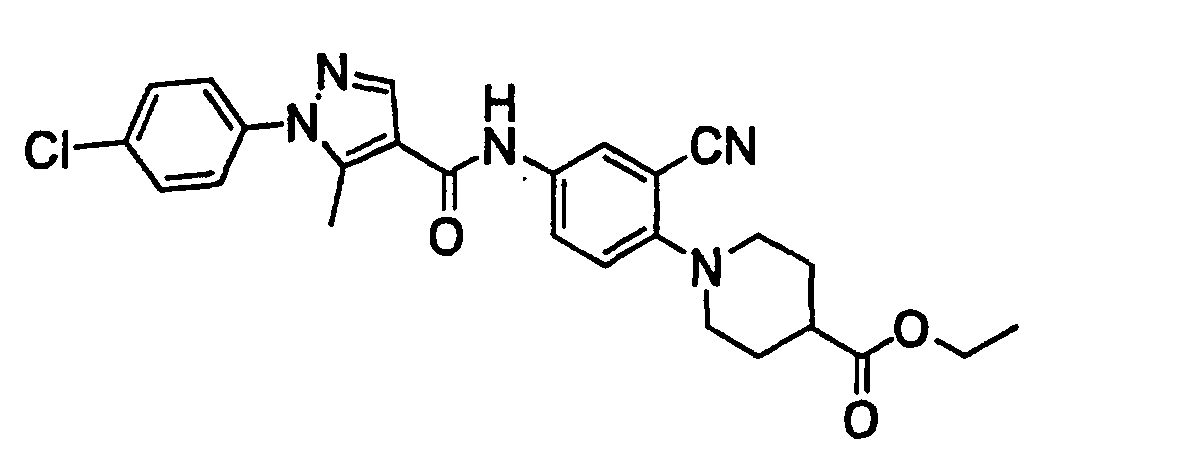
4-methoxycarbonylpiperidin-1-yl, 4-ethoxycarbonylpiperidin-1-yl, 4-((2-carboxyethyl)carbonyloxy)piperidin-1-yl,
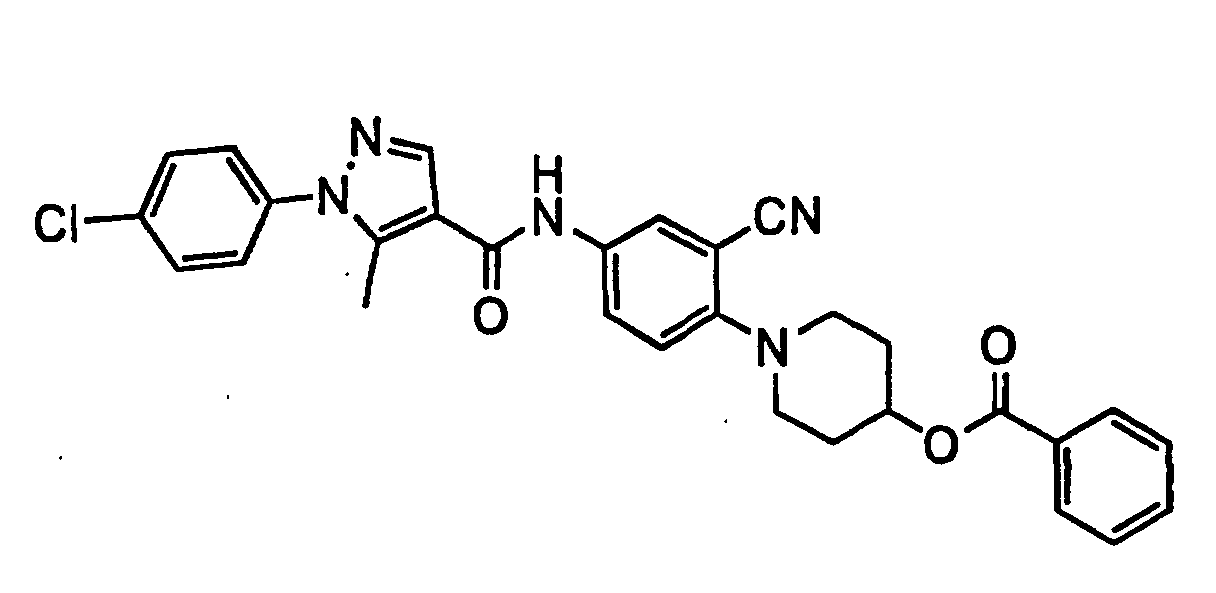
4-benzoyloxypiperidin-1-yl,
4-piperidinopiperidin-1-yl, 4-morpholinopiperidin-1-yl, 4-thiomorpholinopiperidin-1-yl,
4-(N-oxidomorpholino)piperidin-1-yl, 4,4-ethylenedioxypiperidin-1-yl,
4-oxopiperidin-1-yl, 4-aminopiperidin-1-yl,
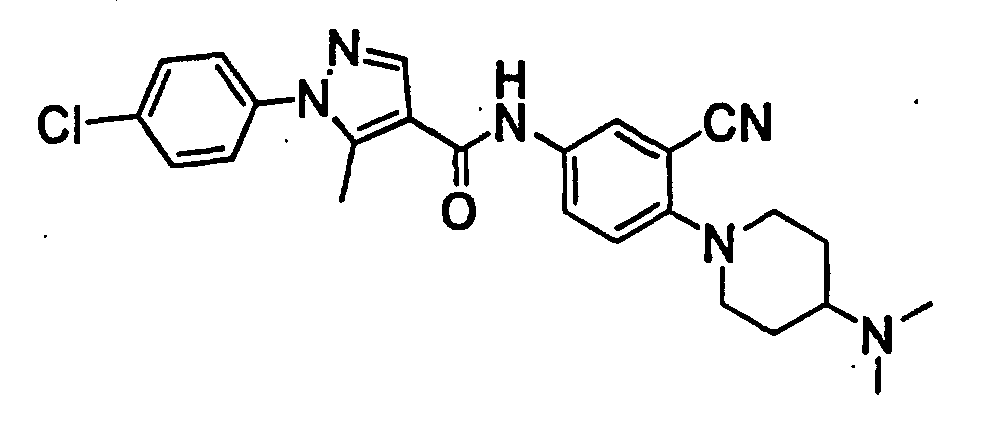
4-dimethylaminopiperidin-1-yl, 4-(N-(2-hydroxyethyl)amino)piperidin-1-yl,
4-(N,N-bis(2-hydroxyethyl)amino)piperidin-1-yl, 4-(N-(2-hydroxyethyl)-N-methylamino)
piperidin-1-yl, 4-(4-methylpiperazin-1-yl)piperidin-1-yl,
4-(N-(2-hydroxyethyl)amino)piperidin-1-yl, 4-(piperazin-1-yl)piperidin-1-yl,
4-(4-(4-acetylpiperazin-1-yl)piperidine)-1-yl,
4-phenylpiperidin-1-yl,4-(N-(2-methoxyethyl)amino)piperidin-1-yl,
4-(N-(2-methoxyethyl)-N-methylamino)piperidin-1-yl,
4-(N,N-bis(2-methoxyethyl)amino)piperidin-1-yl,
4-methoxymethoxypiperidin-1-yl, 4-(2-methoxyethyl)oxypiperidin-1-yl,
4-(2-hydroxyethyl)piperidin-1-yl, 4-(4-hydroxypiperidin-1-yl)piperidin-1-yl,
4-(4-morpholinomethyl)piperidin-1-yl, 4-(4-methoxypiperidin-1-yl)piperidin-1-yl,
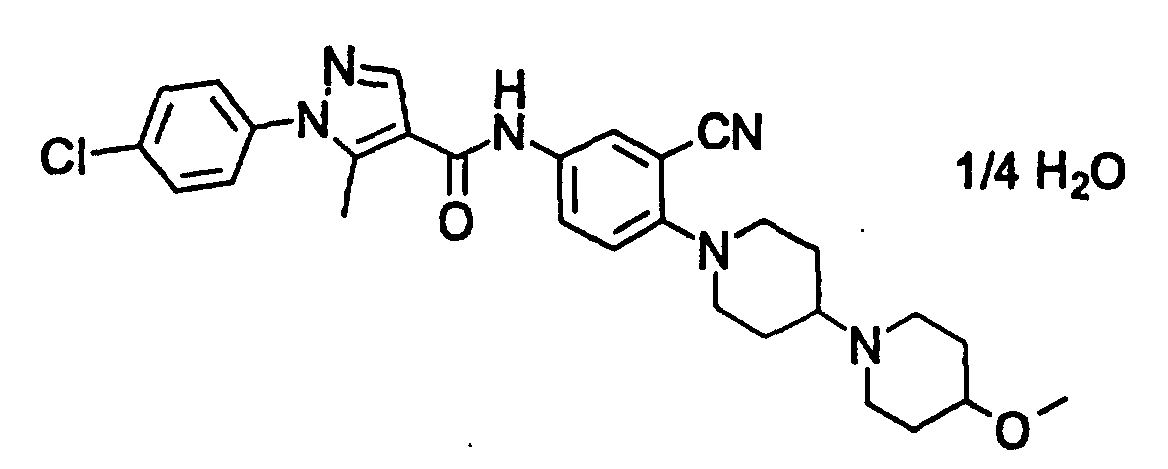
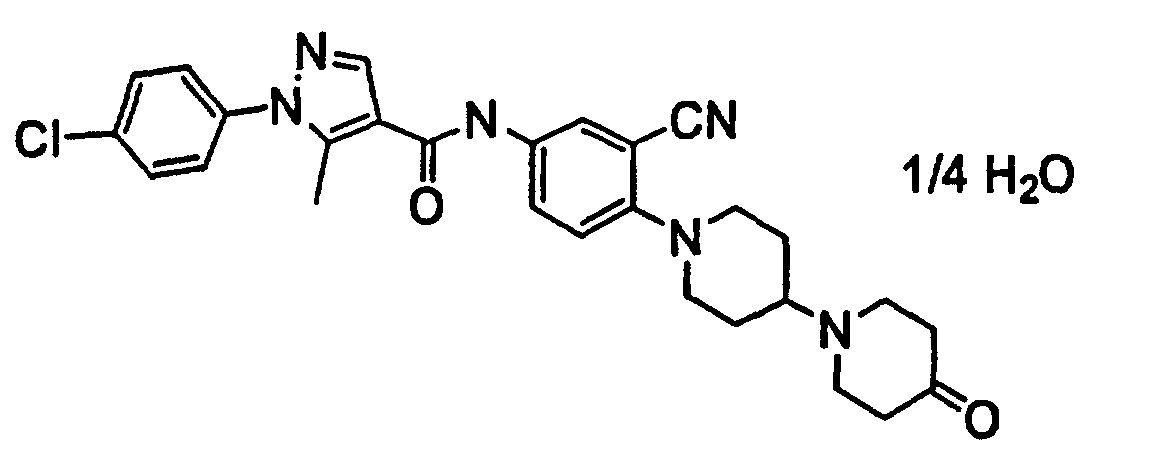
4-(4-oxopiperidin-1-yl)piperidin-1-yl
and the like.
The substituent of the aforementioned optionally substituted
piperazine is exemplified by alkyl having 1 to 4 carbon atoms (as
defined above); carboxyalkyl wherein the alkyl moiety has 1 to 4 carbon
atoms (carboxylmethyl, carboxyethyl and the like); hydroxyalkyl having
1 to 4 carbon atoms (as defined above); alkoxyalkyl wherein the alkyl
moiety and alkoxy moiety have 1 to 4 carbon atoms (as defined above);
hydroxyalkoxyalkyl wherein the alkoxy moiety and alkyl moiety each have
1 to 4 carbon atoms (hydroxymethoxymethyl, hydroxyethoxyethyl and the
like); carboxy; alkoxycarbonyl wherein the alkoxy moiety has 1 to 4
carbon atoms (as defined above); alkoxycarbonylalkyl wherein the alkoxy
moiety and alkyl moiety each have 1 to 4 carbon atoms (as defined
above); acyl having 1 to 4 carbon atoms (as defined above);
acyloxyalkyl wherein the acyl moiety and alkyl moiety have 1 to 4
carbon atoms (as defined above); optionally substituted aminoalkyl
having 1 to 4 carbon atoms (as defined above); carboxyalkylcarbonyloxy
wherein the alkyl moiety has 1 to 4 carbon atoms
(carboxymethylcarbonyloxy, (2-carboxyethyl)carbonyloxy and the like);
heteroaralkyl (C1 - C4 alkyl substituted with heteroaryl such as
pyridyl, thienyl, furyl and the like); phenyl substituted with a
substituent selected from halogen (as defined above), alkyl having 1 to
4 carbon atoms (as defined above) and alkoxy having 1 to 4 carbon atoms
(as defined above); 3,4,5,6-tetrahydro-2H-pyran-4-yl; 3,4,5,6-tetrahydro-2H-thiopyran-4-yl;
5-methylisoxazole-4-ylcarbonyl; 2-cyano-3-hydroxyisocrotonoyl
and the like. Examples thereof include
piperazin-1-yl, 4-methylpiperazin-1-yl, 4-ethylpiperazin-1-yl, 4-hydroxymethylpiperazin-1-yl,
4-(2-hydroxyethyl)piperazin-1-yl, 4-(3-hydroxypropyl)piperazin-1-yl,
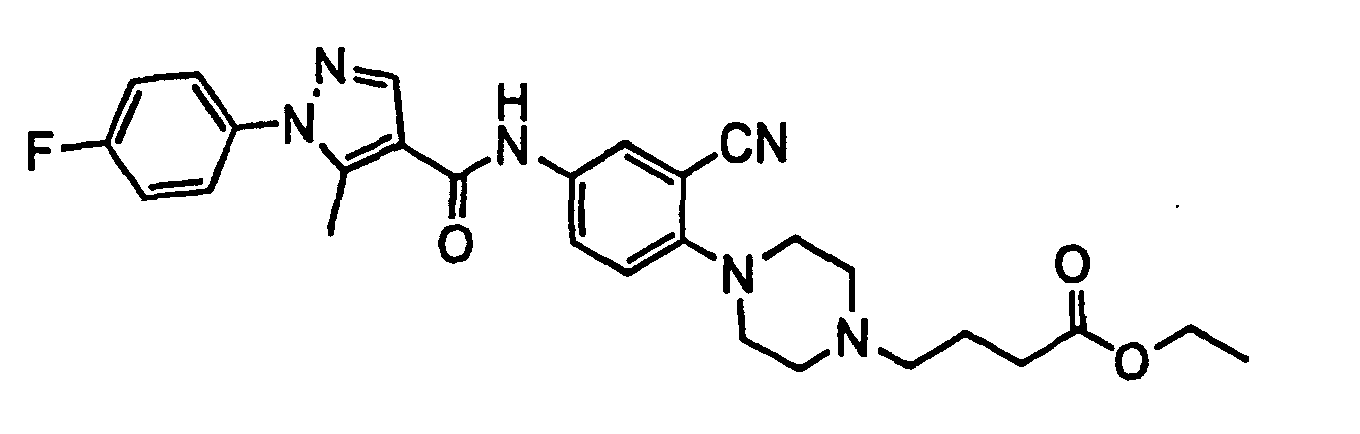
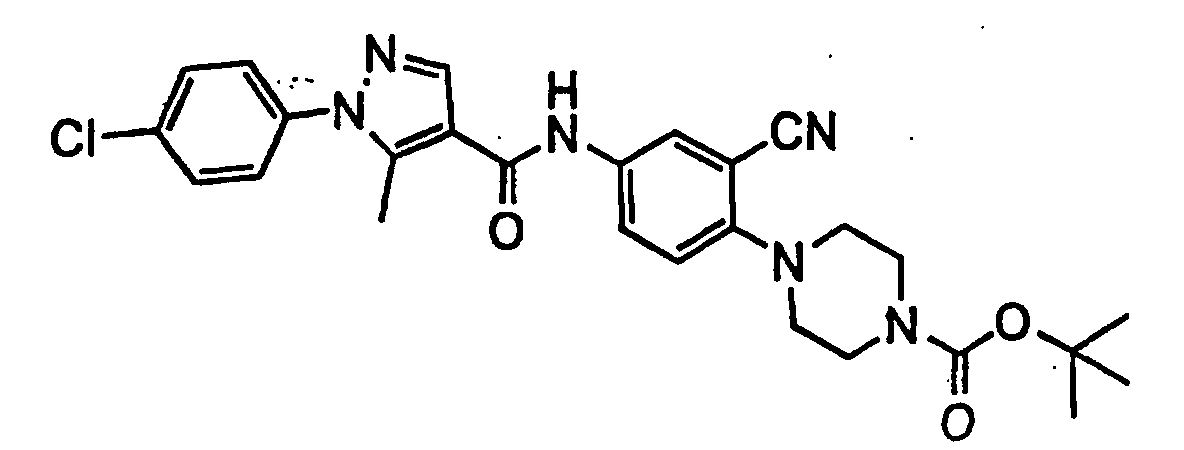
4-(tert-butoxycarbonyl)piperazin-1-yl, 4-(ethoxycarbonylmethyl)piperazin-1-yl,
4-(2-ethoxycarbonylethyl)piperazin-1-yl,
4-(3-ethoxycarbonylpropyl)piperazin-1-yl,
4-(carboxymethyl)piperazin-1-yl,
4-(2-carboxyethyl)piperazin-1-yl,4-(3-carboxypropyl)piperazin-1-yl, 4-((2-carboxyethyl)
carbonyloxy) piperazin-1-yl, 4-(5-methylisoxazole-4-ylcarbonyl)piperazin-1-yl,
4-(2-cyano-3- hydroxyisocrotonoyl)piperazin-1-yl,
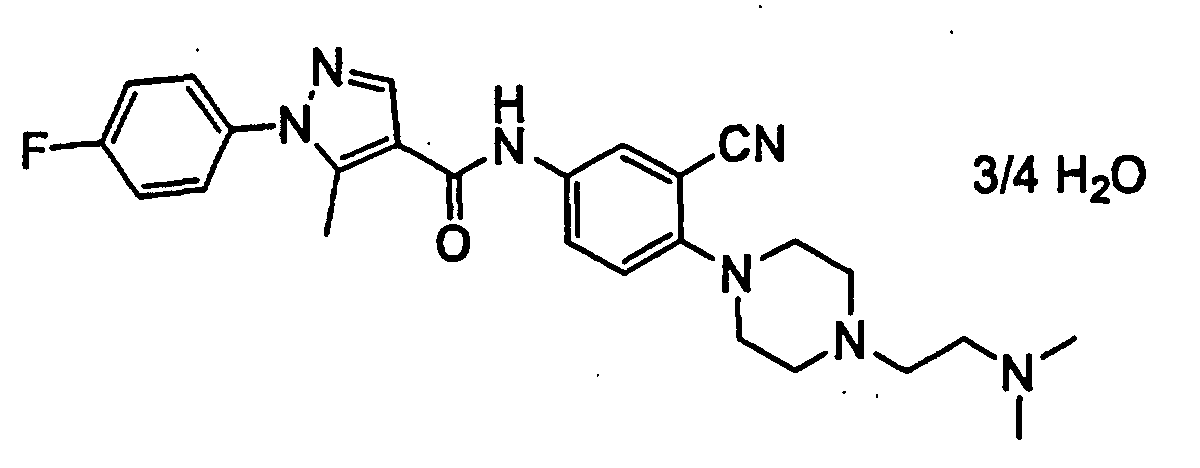
4-(dimethylaminomethyl)piperazin-1-yl, 4-(2-dimethylaminoethyl)piperazin-1-yl,
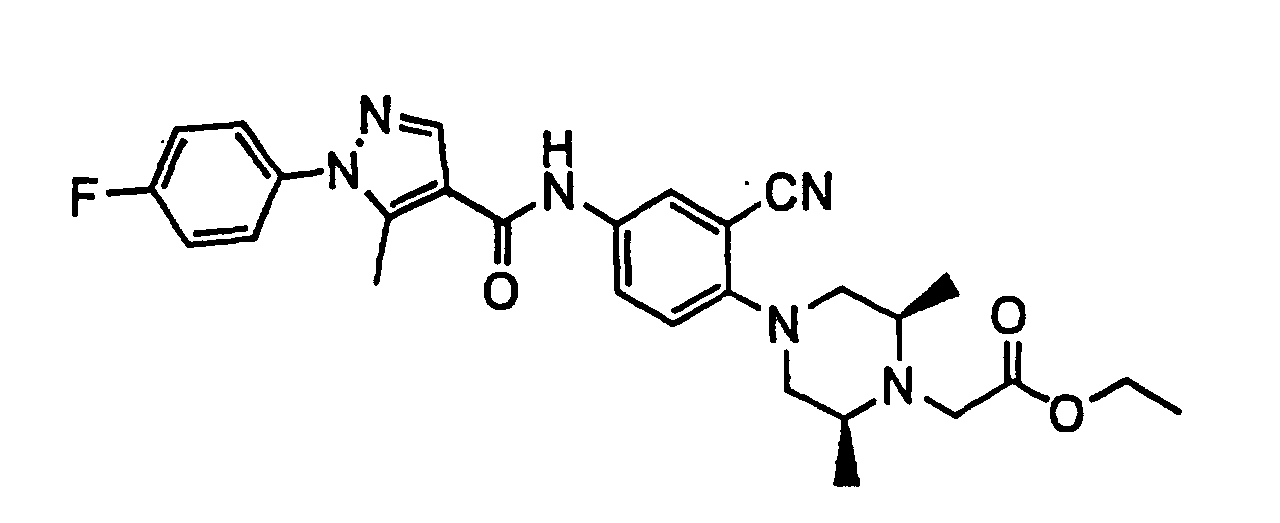
3,5-dimethyl-4-ethoxycarbonylmethylpiperazin-1-yl,
3,5-dimethyl-4-carboxymethylpiperazin-1-yl,
4-(3-(3-pyridyl)propyl)piperazin-1-yl, 4-(2-(2-hydroxyethoxy)ethyl)piperazin-1-yl,
4-(2-acetyloxyethyl)piperazin-1-yl,
4-(3,4,5,6-tetrahydro-2H-pyran-4-yl)piperazin-1-yl,
4-(3,4,5,6-tetrahydro-2H-thiopyran-4-yl)piperazin-1-yl,
4-(4-chlorophenyl)piperazin-1-yl, 4-(4-fluorophenyl)piperazin-1-yl,
4-(4-methylphenyl)piperazin-1-yl, 4- (4-methoxyphenyl) piperazin-1-yl, 4-methoxymethylpiperazin-1-yl,
4-(2-methoxyethyl)piperazin-1-yl, 4-(3-methoxypropyl)piperazin-1-yl
and the like.
The above-mentioned optionally substituted homopiperazine may be
substituted with alkyl having 1 to 4 carbon atoms (as defined above) or
hydroxyalkyl having 1 to 4 carbon atoms (as defined above). Examples
thereof include homopiperazine, 4-(hydroxymethyl)homopiperazin-1-yl, 4-(2-hydroxyethyl)homopiperazin-1-yl,
4-methylhomopiperazin-1-yl and the
like.
The optionally substituted saturated heterocycle at Het which
contains a hetero atom selected from oxygen atom and nitrogen atom is a
5 or 6-membered ring. The substituent of the said heterocycle is
exemplified by alkyl having 1 to 4 carbon atoms (as defined above),
arylalkyl (as defined above) and the like. Examples thereof include
piperidin-4-yl, 1-methylpiperidin-4-yl, 1-ethylpiperidin-4-yl, 1-benzylpiperidin-4-yl,
pyrrolidin-3-yl, 1-methylpyrrolidin-3-yl, 1-ethylpyrrolidin-3-yl,
1-benzylpyrrolidin-3-yl, 3,4,5,6-tetrahydro-2H-pyran-4-yl,
2,3,4,5-tetrahydrofuran-3-yl and the like.
The pharmaceutically acceptable salt of the compound of the
present invention is exemplified by salts with inorganic acid such as
hydrochloride, hydrobromate, sulfate, phosphate, nitrate and the like,
salts with organic acid such as acetate, propionate, succinate, maleate,
fumarate, benzoate, citrate, malate, methanesulfonate, benzenesulfonate,
p-toluenesulfonate and the like, metal salts such as sodium salt,
potassium salt, calcium salt, aluminum salt, magnesium salt and the
like when carboxyl group is contained, salts with amine such as
triethylamine and the like, and salts with dibasic amino acid such as
lysine and the like. In addition, the compound of the present
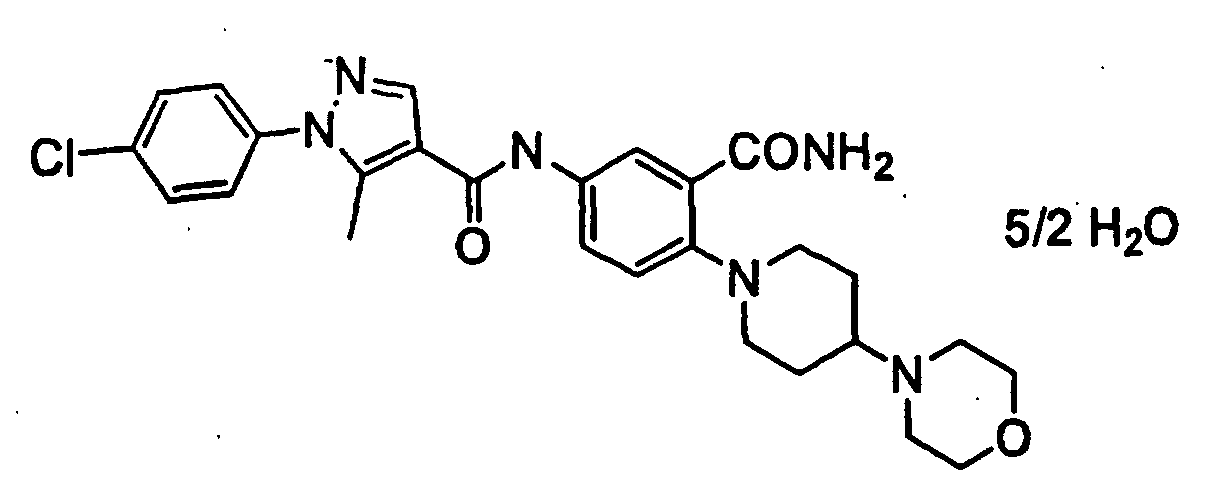
invention encompasses hydrate (1 hydrate, 1/2 hydrate, 3/4 hydrate, 1/4
hydrate and the like), solvates and the like. The compound of the
present invention further encompasses N-oxide compound.
When the compound of the present invention has a geometric
isomer, the present invention encompasses cis compound, trans compound
and mixtures thereof. When the present invention contains one or more
asymmetric centers in a molecule, various optical isomers exist. The
present invention also encompasses optical isomers, racemates,
diastereomers and mixtures thereof.
The compound of the present invention can be produced by the
following methods.
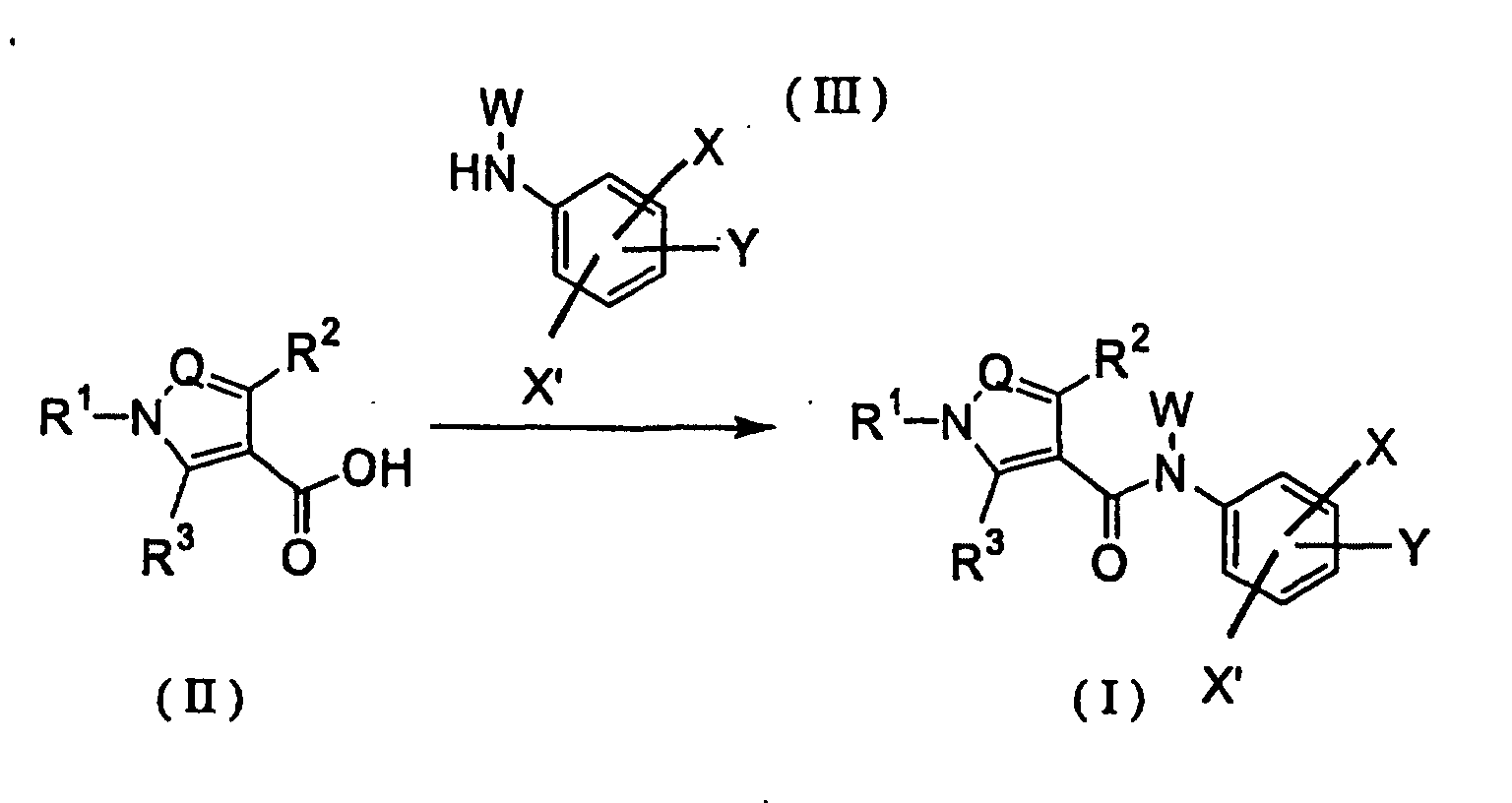
When W of compound (III) is hydrogen in this reaction, a
protecting group generally used in the organic synthetic chemistry,
such as
tert-butoxycarbonyl group, 9-fluorenylmethoxycarbonyl group,
benzyloxycarbonyl group and the like, can be also used for the reaction.
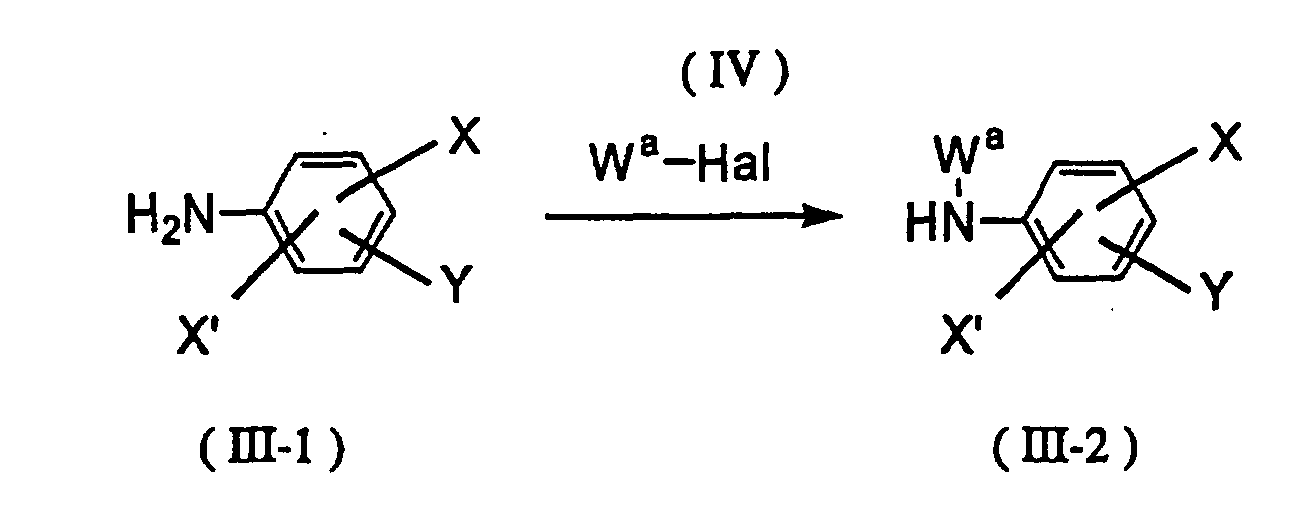
Method 2: A compound (I) wherein W is hydroxyalkyl, alkyl, acyloxyalkyl,
aminoalkyl, hydroxycarbonylalkyl or alkoxycarbonylalkyl [compound (I-2)]
can be produced by the following method.
wherein Wa is alkyl, hydroxyalkyl, acyloxyalkyl, aminoalkyl,
hydroxycarbonylalkyl or alkoxycarbonylalkyl, Hal is halogen such as
chlorine, bromine, iodine and the like, and other symbols are as
defined above.
The compound (I-2) can be obtained by reacting compound (I-1)
with compound (IV) in a suitable solvent (dimethylformamide, dimethyl
sulfoxide, benzene, toluene, xylene, hexane, tetrahydrofuran, diethyl
ether, methanol, ethanol, isopropyl alcohol, tert-butyl alcohol and the
like) in the presence of a base (sodium hydride, sodium hydroxide,
potassium hydroxide, potassium carbonate, sodium carbonate, sodium
methoxide, sodium ethoxide, triethylamine and the like) at a
temperature of from -20°C to 100°C for 30 min to 24 h. Method 3: A compound (I) wherein R1 is arylalkyl, heteroarylalkyl or
cycloalkyl [compound (I-4)] can be produced by the following method.
wherein R1b is arylalkyl (same as arylalkyl at R1), heteroarylalkyl
(same as heteroarylalkyl at R1) or cycloalkyl (same as cycloalkyl at
R1) and other symbols are as defined above.
The compound (I-3) is reacted with compound (V) in a suitable
solvent (dimethylformamide, dimethyl sulfoxide, benzene, toluene,
xylene, tetrahydrofuran, diethyl ether, methanol, ethanol, isopropyl
alcohol, tert-butyl alcohol and the like) in the presence of a base
(sodium hydride, sodium hydroxide, potassium hydroxide, potassium
carbonate, sodium carbonate, sodium methoxide, sodium ethoxide,
triethylamine and the like) at a temperature of from -20°C to 100°C for
30 min to 24 h to give compound (I-4). Method 4: A compound (I) wherein Y is optionally substituted alkoxy,
aryloxy, cycloalkyloxy, hydroxyalkoxy, hydroxycarbonylalkoxy,
optionally substituted aminoalkoxy, alkylthio, hydroxyalkylthio,
hydroxycarbonylalkylthio, optionally substituted aminoalkylthio or a
group N(Z2)(Z3) [compound (I-6)] can be produced by the following
method.
wherein Ya is optionally substituted alkoxy, aryloxy, cycloalkyloxy,
hydroxyalkoxy, hydroxycarbonylalkoxy, optionally substituted
aminoalkoxy, alkylthio, hydroxyalkylthio, hydroxycarbonylalkylthio,
optionally substituted aminoalkylthio or a group N(Z2)(Z3) (wherein Z2
and Z3 are the same or different and each is hydrogen, alkyl,
hydroxyalkyl or aminoalkyl, or form cyclic amine together with the
adjacent nitrogen atom) and other symbols are as defined above.
The compound (I-5) can be obtained by reacting and treating
compound (II) and compound (III-a) in the same manner as in Method 1.The compound (I-5) is reacted with H-Ya in a suitable solvent
(dimethyl sulfoxide, dimethylformamide, dichloromethane, chloroform and
the like) in the presence of a base (triethylamine, pyridine and the
like) at a temperature of from 0°C to the refluxing temperature of the
solvent to be used for 30 min to 24 h to give compound (I-6). It is
possible to use an excess H-Ya instead of the base for the reaction.
Method 5: A compound (I) wherein X is alkenyl or alkynyl [compound (I-8)]
can be also produced by the following method.
wherein P1 is a protecting group of triple bond such as trimethylsilyl
and the like, Xa is alkynyl such as acetylene and the like, M is metal
such as tin and the like or boron, Xb is alkenyl such as vinyl and the
like, n is an integer of 3 or 4, Xc is alkynyl such as acetylene and
the like or alkenyl such as vinyl and the like, and other symbols are
as defined above.The compound (I-7) is subjected to Sonogashira coupling reaction
in the presence of a palladium catalyst
(bis(triphenylphosphine)palladium dichloride or
tetrakis (triphenylphosphine) palladium and the like) using alkyne such
as trimethylsilylacetylene and the like, Suzuki coupling reaction using
alkenylborane (vinylborane and the like) or Stille coupling reaction
using alkenyltin (tetravinyltin and the like) to give compound (I-8).
In the Sonogashira coupling reaction, compound (I-7) and compound P1-Xa
can be reacted in the presence of a
tetrakis(triphenylphosphine)palladium or
bis (triphenylphosphine)palladium dichloride and cuprous iodide as a
catalyst, wherein the solvent to be used is exemplified by
triethylamine,. diethylamine, piperidine and the like. The reaction
temperature is generally from room temperature to the refluxing
temperature of the solvent, and the reaction time is generally 1-24 h.
After the Sonogashira coupling reaction, by reacting under moderate
alkaline conditions using potassium carbonate, sodium hydroxide and the
like in an alcohol solvent such as methanol and the like at a
temperature of from room temperature to the refluxing temperature of a
solvent for 1-24 h, a compound (I-8) wherein Xc is alkynyl (acetylene
and the like) can be obtained.In the Stille coupling reaction, compound (I-7) is reacted with
alkenyltin (tetravinyltin and the like) using
tetrakis(triphenylphosphine)palladium and the like as a catalyst to
give compound (I-8) wherein Xc is alkenyl (vinyl and the like). The
solvent to be used is benzene, toluene, tetrahydrofuran,
dimethylformamide, N-methylpyrrolidone and the like. Where necessary,
an additive such as lithium chloride and the like, or a base such as
triethylamine, diisopropylethylamine and the like is used. The
reaction temperature is generally from room temperature to the
refluxing temperature of a solvent, and the reaction time is generally
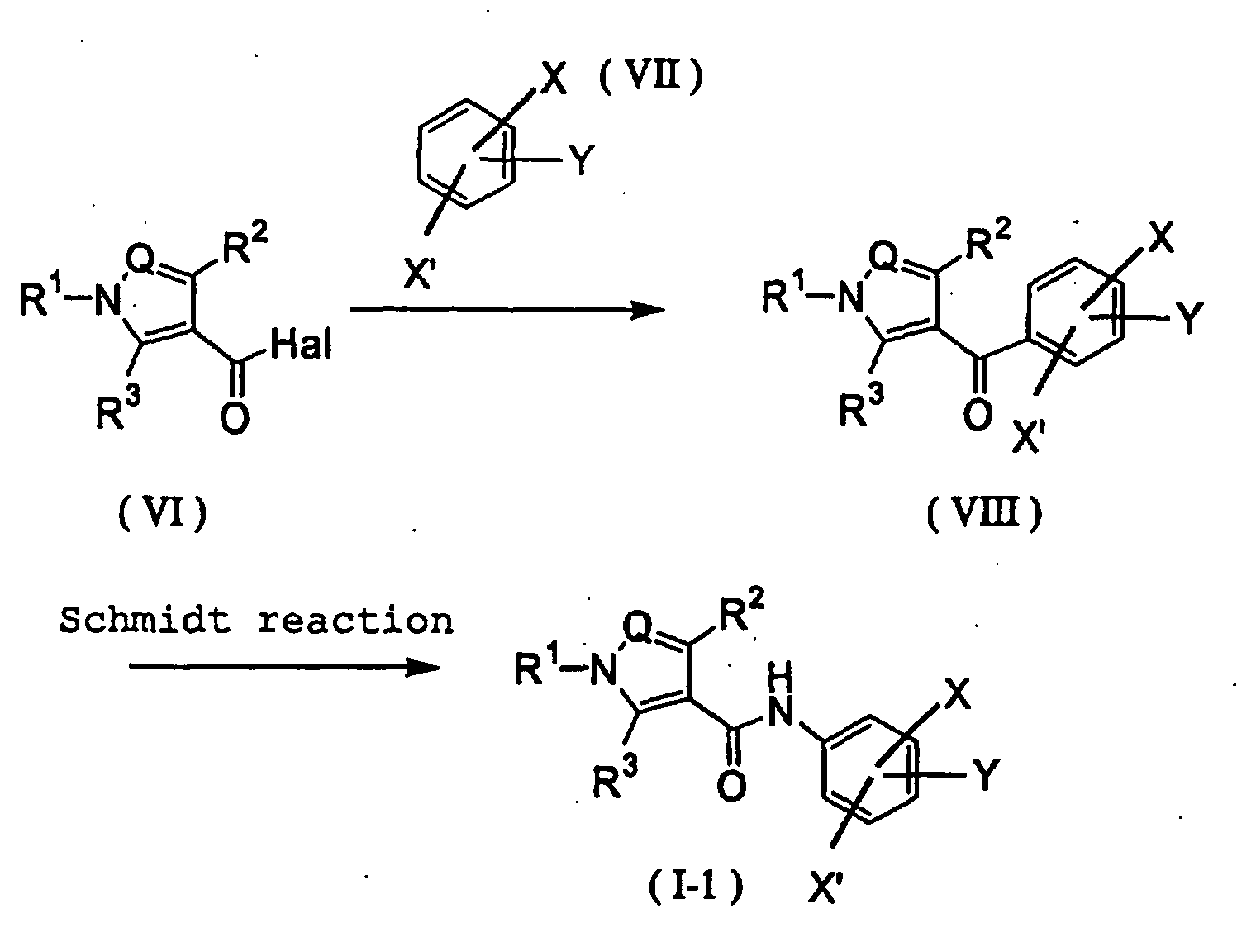
1-24 h. Method 6: A compound (I) wherein W is hydrogen [compound (I-1)] can be
also produced by the following method.
wherein each symbol is as defined above.
The compound (VI) and compound (VII) are subjected to Friedel-Craft
reaction in a suitable solvent (tetrahydrofuran, diethyl ether,
ethylene glycol dimethyl ether, dimethylformamide, dimethyl sulfoxide,
methylene chloride, chloroform, dichloroethane, acetonitrile,
nitromethane, carbon disulfide and the like) or without solvent where
necessary in the presence of an acid catalyst (aluminum chloride,
aluminum bromide, titanium tetrachloride and the like) at a temperature
of from -20°C to 100°C for 30 min to 24 h to give compound (VIII). The
compound (VIII) is subjected to Schmidt reaction in a suitable solvent
(benzene, toluene, xylene and the like, preferably benzene) using a
strong acid (sulfuric acid, trifluoroacetic acid and the like) and
sodium azide at a temperature of from -20°C to the refluxing
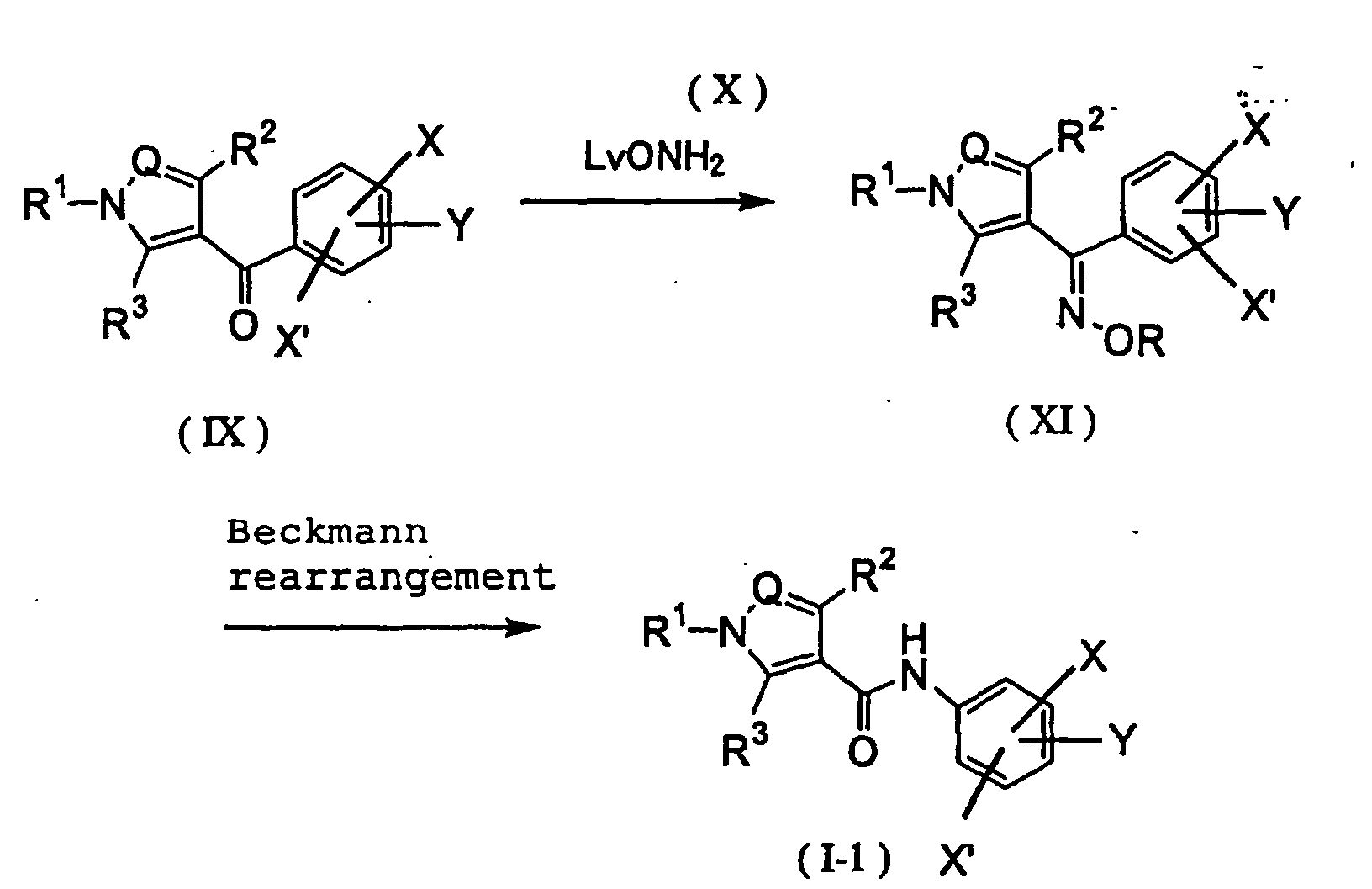
temperature of the solvent for 1-24 h to give compound (I-1). Method 7: The compound (I-1) can be also produced by the following
method.
wherein Lv is hydrogen or arylsulfonyl group such as benzenesulfonyl
and the like, and other symbols are as defined above.
The compound (IX) and compound (X) are reacted in a suitable
solvent (water, methanol, ethanol or a mixed solvent thereof and the
like) in the presence of a base (sodium carbonate, potassium carbonate,
sodium hydroxide, potassium hydroxide, sodium acetate, triethylamine
and the like) at a temperature of from -20°C to 100°C for 1-24 h to
give compound (XI). The compound (XI) is subjected to Beckmann
rearrangement reaction in a suitable solvent (water, dimethyl sulfoxide,
dimethylformamide, benzene, toluene, xylene or a mixed solvent thereof
and the like) at a temperature of from room temperature to the .
refluxing temperature of a solvent for 1-24 h to give compound (I-1). Method 8: When the compound of the present invention has a hydroxyl
group, the corresponding ester compound can be obtained by subjecting
the compound to condensation generally used in the field of organic
synthetic chemistry with a carboxylic acid compound, an acid halide
compound or an acid anhydride compound. When the compound of the
present invention has a carboxyl group, the corresponding ester
compound can be obtained by subjecting the compound to condensation
generally used in the field of organic synthetic chemistry with an
alcohol compound or phenol compound. Furthermore, when the compound of
the present invention has an ester group, the corresponding carboxylic
acid compound can be obtained by subjecting the compound to hydrolysis
by a conventional method with an acid (hydrochloric acid, sulfuric acid
and the like) or a base (sodium hydroxide, potassium hydroxide and the
like). When the compound of the present invention has an amino group,
the compound can be N-alkylated or N-acylated by a conventional method
in the presence of a base (triethylamine, pyridine and the like) using
an alkyl halide or acyl halide. When the compound of the present
invention has a hydroxyl group, the compound can be converted to
carbonyl group or aldehyde group by oxidation known in the field of
organic synthetic chemistry using chromic acid-sulfuric acid, chromium
oxide (VI)-sulfuric acid-acetone (Jones reagent), chromium oxide (VI)-pyridine
complex (Collins reagent), dichromate (sodium dichromate,
potassium dichromate and the like)-sulfuric acid, pyridinium
chlorochromate (PCC), manganese dioxide, dimethyl sulfoxide-electrophilic
activating reagent (dicyclohexylcarbodiimide, acetic
anhydride, phosphorus pentaoxide, sulfur trioxide-pyridine complex,
anhydrous trifluoroacetic acid, oxalyl chloride, halogen), sodium
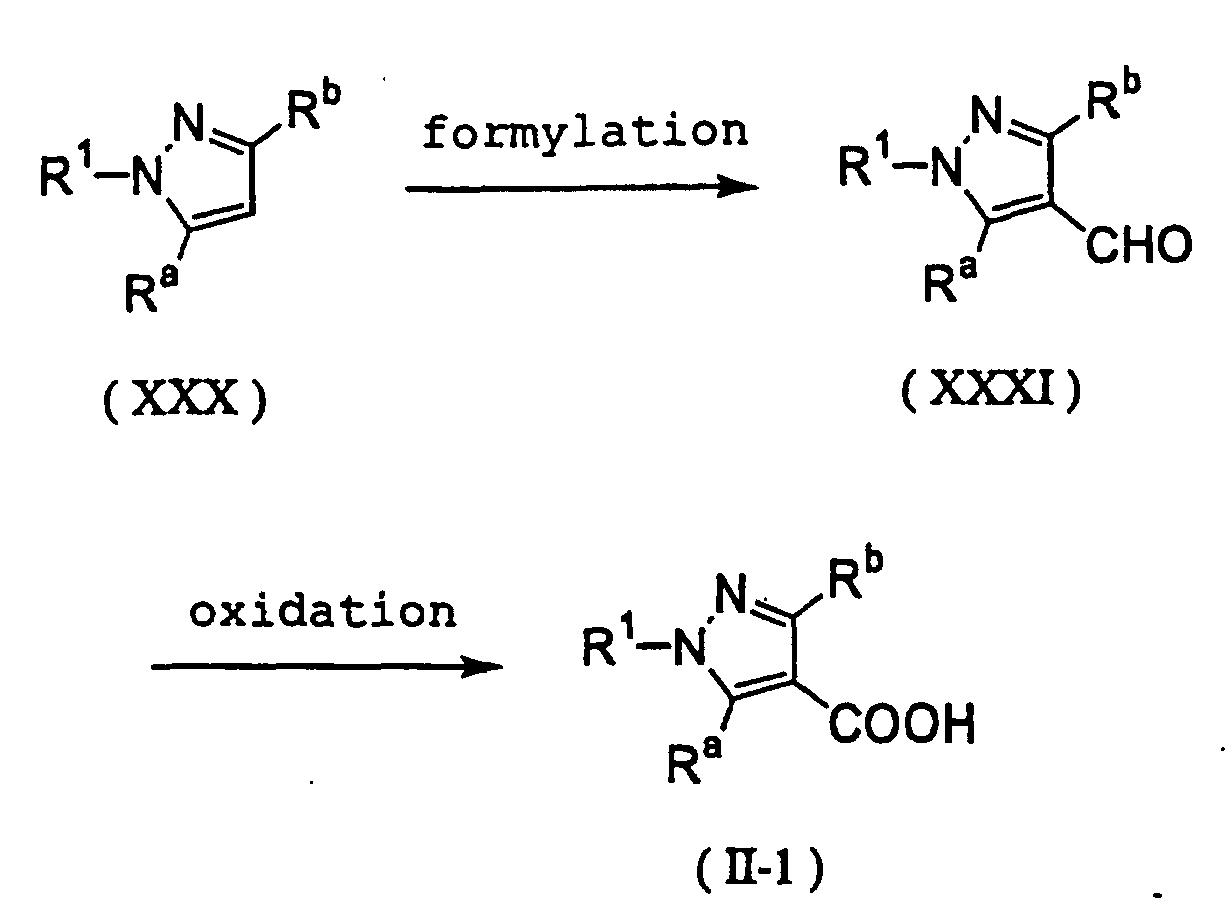
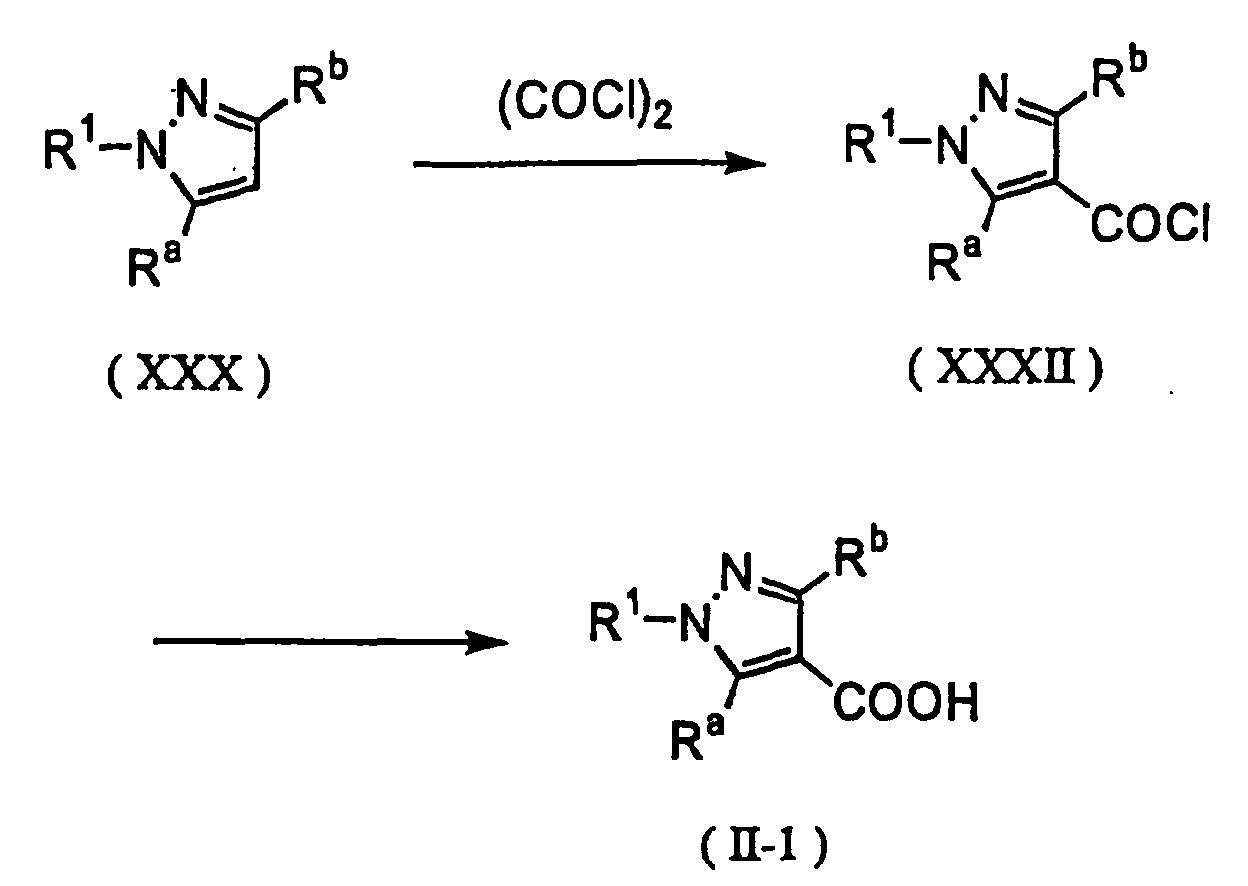
hypochlorite, potassium hypochlorite, sodium bromite and the like. Method 9: A compound (II) having a pyrazole ring wherein Q is nitrogen
atom, which ring is substituted with alkyl at the 3-position, with
hydrogen or alkyl at the 5-posiiton and with carboxy group at the 4-position
[compound (II-1)] can be produced by the following method.
wherein Ra is hydrogen or alkyl having 1 to 4 carbon atoms, Rb and Rc
are each alkyl having 1 to 4 carbon atoms, and other symbols are as
defined above.
The compound (XII) and compound (XIII) are reacted in a suitable
solvent (water, methanol, ethanol, isopropyl alcohol, butanol, ethylene
glycol or a mixed solvent thereof) at a temperature of from room
temperature to the refluxing temperature of a solvent for 1-24 h to
give compound (XIV).The compound (XIV) is reacted in a suitable solvent (water,
methanol, ethanol or a mixed solvent thereof) using an acid
(hydrochloric acid, sulfuric acid and the like) or an alkali (sodium
hydroxide, potassium hydroxide and the like) at a temperature of from
room temperature to the refluxing temperature of a solvent for 1-12 h
to give compound (II-1).The compound (XII) can be produced according to J. Chem. Soc.
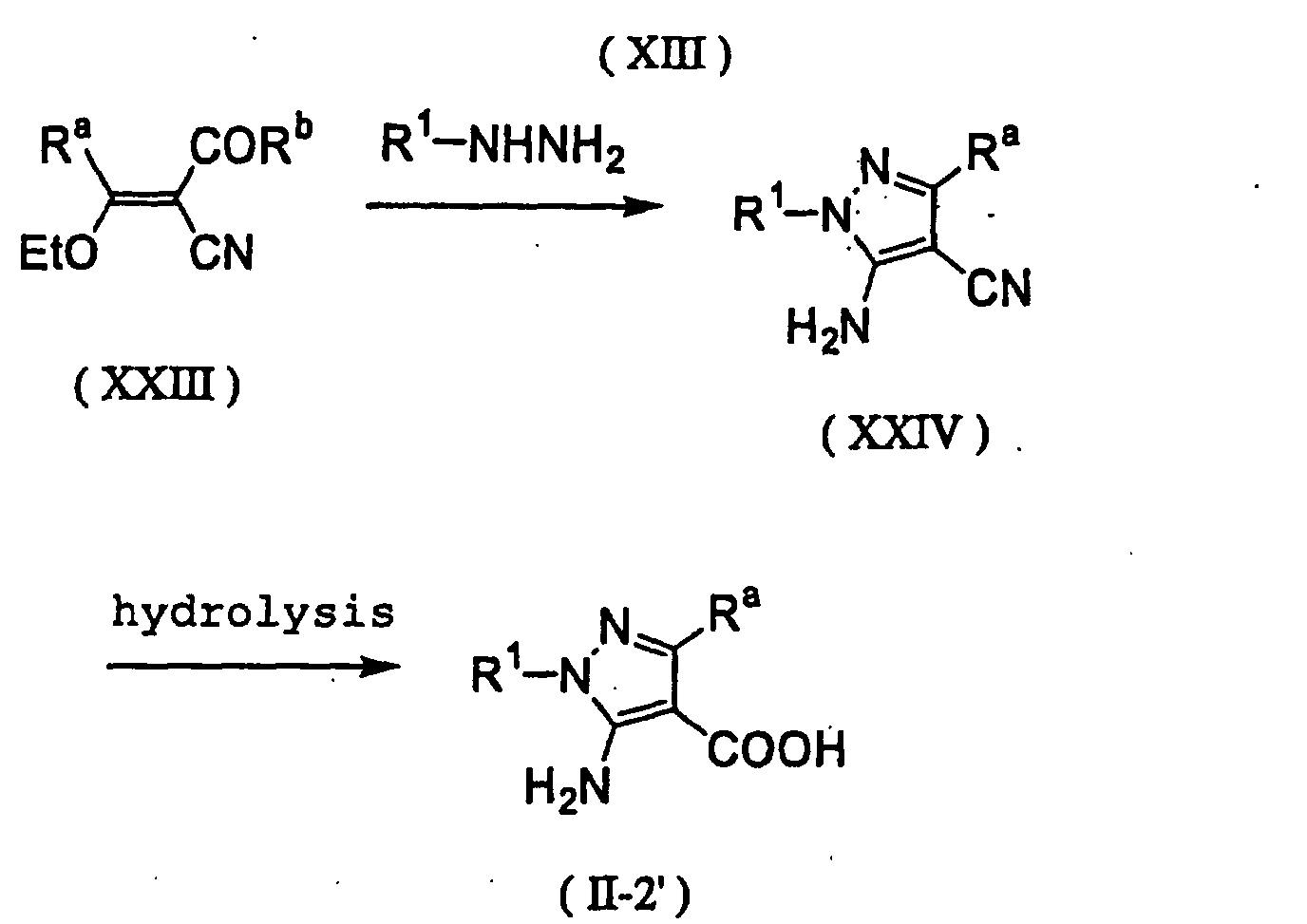
Perkin Trans I), p. 1875 (1988). Method 10: A compound (II) having a pyrazole ring wherein Q is nitrogen
atom, which ring is substituted with hydrogen or an alkyl at the 3-position,
with carboxyl group at the 4-position, and with amino at the
5-position [compound (II-3)] can be produced by the following method.
wherein each symbol is as defined above.
The reaction of compound (XV) and compound (XIII) and hydrolysis
of compound (XVI) can be conducted under the same reaction condition as
in Method 9. Method 11: A compound (II) having a pyrazole ring wherein Q is nitrogen
atom, which ring is substituted with alkyl at the 3-position, with
carboxyl group at the 4-position, and with amino at the 5-position
[compound (II-2)] can be produced by the following method.
wherein each symbol is as defined above.
The reaction of compound (XVII) and compound (XIII) and
hydrolysis of compound (XVIII) can be conducted under the same reaction
condition as in Method 9. Method 12: A compound (II) having a pyrazole ring wherein Q is nitrogen
atom, which ring is substituted with hydrogen or alkyl at the 3-position,
with carboxyl group at the 4-position, and with hydroxyl
group at the 5-position [compound (II-4)] can be produced by the
following method.
wherein Rd is alkyl having 1 to 4 carbon atoms and other symbols are as
defined above.
The reaction of compound (XIX) and compound (XIII) and
hydrolysis of compound (XX) can be conducted under the same reaction
condition as in Method 9. Method 13: A compound (II) having a pyrazole ring wherein Q is nitrogen
atom, which ring is substituted with hydrogen or alkyl at the 3-position,
with alkyl at the 5-position, and with carboxyl group at the
4-position [compound (II-5)] can be produced by the following method.
wherein each symbol is as defined above.
The reaction of compound (XXI) and compound (XIII) and
hydrolysis of compound (XXII) can be conducted under the same reaction
condition as in Method 9. Method 14: A compound (II) having a pyrazole ring wherein Q is nitrogen
atom, which ring is substituted with hydrogen or alkyl at the 3-position,
with carboxyl group at the 4-position, and with amino at the
5-position [compound (II-2')] can be produced by the following method.
wherein each symbol is as defined above.
The compound (XXIII) and compound (XIII) are reacted in a
suitable solvent (water, methanol, ethanol, propanol, butanol, ethylene
glycol or a mixed solvent thereof) at a temperature of from room
temperature to the refluxing temperature of a solvent for 1-24 h to
give compound (XXIV) and the compound (XXIV) is treated by a
conventional method with an acid (hydrochloric acid, sulfuric acid and
the like) or an alkali (sodium hydroxide, potassium hydroxide and the
like) in a suitable solvent (water, methanol, ethanol or a mixed
solvent thereof) to give compound (II-2'). Method 15: A compound (II) having substituted amino can be obtained as
follows. The carboxyl group of compound (II-2) is protected with a
suitable protecting group and reacted with halogenated alkyl in the
presence of a base (triethylamine, pyridine and the like), or subjected
to reductive N-alkylation with alkylaldehyde in an organic acid
(preferably formic acid), followed by deprotection to give a compound
having mono or di-substituted amino. The compound (II-2) can be also
obtained by hydrolysis after the above-mentioned N-alkylation of
compound (XXIV).
Method 16: A compound (II) having a pyrazole ring wherein Q is nitrogen
atom, which ring is substituted with chlorine at the 5-position, with
hydrogen or alkyl at the 3-position, and with carboxyl group at the 4-position
[compound (II-6)] can be produced by the following method.
wherein each symbol is as defined above. The compound (XXV) is reacted with chlorinating agent (sulfuryl
chloride and the like) in a suitable solvent (toluene, benzene, n-hexane
or a mixed solvent thereof), at a temperature of from room
temperature to the refluxing temperature of a solvent for 1-24 h to
give compound (XXVI). The compound (XXVI) is hydrolyzed according to a
conventional method using an acid (hydrochloric acid, sulfuric acid and
the like) or an alkali (sodium hydroxide, potassium hydroxide and the
like) to give compound (II-6). Method 17: A compound (II) wherein R1 is arylalkyl, heteroarylalkyl or
cycloalkyl [compound (II-7) can be produced by the following method.
wherein Lv' is a leaving group such as halogen (chlorine, bromine,
iodine and the like), methanesulfonyloxy, p-toluenesulfonyloxy and the
like, and other symbols are as defined above.
The compound (XXVII) and compound (XXVIII) are reacted in a
suitable solvent (dimethylformamide, dimethyl sulfoxide, benzene,
toluene, xylene, methylene chloride, chloroform and the like) in the
presence of, where necessary, a metal catalyst (copper powder, copper
chloride, copper sulfate, silver carbonate, silver nitrate and the
like) in a base (potassium carbonate, barium carbonate, sodium hydride
and the like) at a temperature of from -20°C to 100°C for 1-24 h to
give compound (XXIX). The compound (XXIX) is hydrolyzed according to a
conventional method using an acid (hydrochloric acid, sulfuric acid and
the like) or an alkali (sodium hydroxide, potassium hydroxide and the
like) to give compound (II-7). Method 18: The compound (II-1) can be also produced by the following
method.
wherein each symbol is as defined above.
The compound (XXX) is subjected to Vilsmeier reaction using
phosphorus oxychloride in the presence of N,N-dimethylformamide or N-methylformanilide
at a temperature of from room temperature to 100°C
for 1-24 h to give compound (XXXI). The compound (XXXI) is subjected
to oxidation with an oxidizing agent (manganese dioxide, potassium
permanganate, peroxidate (hydrogen peroxide, m-chloroperbenzoic acid
etc.) and the like) in a suitable solvent (water, diethyl ether,
tetrahydrofuran, dioxane, acetone, tert-butyl alcohol, methylene
chloride, chloroform, hexane, benzene, toluene or a mixed solvent
thereof) to give compound (II-1). The compound (XXX) can be obtained
according to the method described in Bull. Soc. Chim. France, p. 1346,
1970. Method 19: The compound (II-1) can be also produced by the following
method.
wherein each symbol is as defined above.
The compound (XXX) and oxalyl chloride are reacted at a
temperature of from room temperature to the refluxing temperature of a
solvent for 1-24 h to give compound (XXXII). The compound (XXXII) is
reacted in an aqueous solution for 1-24 h to give compound (II-1). Method 20: A compound (II) having a pyrrole ring wherein Q is C-R4
where R4 is hydrogen, which ring is substituted with carboxyl group at
the 3-position, and unsubstituted at the 2- and 4-positions [compound
(II-8) can be produced by the following method.
wherein each symbol is as defined above.
The compound (XXXIII) and compound (XXXIV) are reacted in a
suitable solvent (diethyl ether, dimethyl ether, n-hexane or a mixed
solvent thereof) at a temperature of from room temperature to the
refluxing temperature of a solvent for 1-24 h to give compound (XXXV).
The compound (XXXV) is subjected to oxidation with an oxidizing agent
(manganese dioxide, potassium permanganate, peroxidate (hydrogen
peroxide, m-chloroperbenzoic acid etc.) and the like) in the presence
of a base (sodium hydroxide, potassium hydroxide, triethylamine,
pyridine and the like) to give compound (II-8).The compound (XXXIII) can be also obtained according to the
method described in Synthetic Communications, vol. 13, No. 9, pp. 741-744
(1983). The compound (XXXV) can be also obtained according to the
method described in Synthetic Communications, vol. 24, No. 13, p. 1855
(1994). Method 21: The compound (XXXV) can be also produced by the following
method.
wherein each symbol is as defined above.
The compound (XXXVI) is reacted with trifluoromethanesulfonic
acid in a suitable solvent (methylene chloride, chloroform,
dichloroethane, benzene, toluene, xylene and the like) at a temperature
of from room temperature to the refluxing temperature of a solvent for
1-24 h to give compound (XXXV). Method 22: The compound (XXXVI) can be produced by the following method.
wherein each symbol is as defined above.
The compound (XXXVII) and compound (XXXIV) are reacted in a
suitable solvent (diethyl ether, dimethyl ether, n-hexane or a mixed
solvent thereof) at a temperature of from room temperature to the
refluxing temperature of a solvent for 1-24 h to give compound
(XXXVIII). The compound (XXXVIII) is reacted with phosphorus
oxychloride using Vilsmeier reaction in the presence of N,N-dimethylformamide
or in the presence of N-methylformanilide at a
temperature of from room temperature to 100°C for 1-24 h to give
compound (XXXVI). Method 23: A compound (II) having a pyrrole ring wherein Q is C-R4,
which ring is substituted with alkyl at both the 2- and 5-positions,
carboxyl group at the 3-position, and unsubstituted at the 4-position
[compound (II-9)] can be produced by the following method.
wherein Rh and Ri are each alkyl having 1 to 4 carbon atoms and other
symbols are as defined above.
Utilizing the pyrrole synthetic method of Paal-Knorr, compound
(XXXVII) and compound (XXXIV) are condensed in N,N-dimethylformamide or
without solvent in the presence of an acid catalyst (hydrochloric acid,
sulfuric acid and the like) where necessary at a temperature of from-20°C
to 100°C for 1-24 h to give compound (XXXVIII). The formylation
of compound (XXXVIII) and oxidation of compound (XXXIX) can be
conducted under the same reaction condition as in Method 20. Method 24: The compound (II-9) can be also produced by the following
method.
wherein each symbol is as defined above.
The compound (XL) is subjected to Friedel-Craft reaction in a
suitable solvent (tetrahydrofuran, dioxane, diethyl ether,
dichloromethane, dichloroethane, chloroform, ethylene glycol dimethyl
ether, acetonitrile, nitromethane, carbon disulfide or a mixture
thereof) or without solvent in the presence of an acid catalyst
(aluminum chloride, aluminum bromide, titanium chloride and the like)
at a temperature of from -20°C to 100°C for 30 min to 24 h to give
compound (XLI). Utilizing the Halofom reaction, the compound (XLI) is
treated with an alkali (sodium hydroxide, potassium hydroxide and the
like) and a halogenating agent (bromine, chlorine, sodium (potassium)
hypochlorite, sodium (potassium) hypobromite and the like) in a
suitable solvent (water, methanol, ethanol, 1-propanol, 2-propanol,
tert-butyl alcohol, tetrahydrofuran, dioxane or a mixture thereof and
the like) at a temperature of from -20°C to 100°C for 30 min to 24 h to
give compound (II-9). Method 25: A compound (III) wherein W is hydrogen [compound (III-1)]
can be produced by the following method.
wherein each symbol is as defined above.
The compound (XLII) is subjected to reduction generally used in
the field of organic synthetic chemistry, such as a method comprising
treating with dilute hydrochloric acid or a catalytic amount of
ammonium chloride in a suitable solvent (water, methanol, ethanol,
propanol, butanol, ethylene glycol or a mixed solvent thereof and the
like) using iron powder or tin chloride as a catalyst; a method
comprising treating with a catalytic amount of iron chloride and
hydrazine; catalytic reduction by hydrogenation in the presence of a
catalyst such as nickel, palladium, platinum and the like; Birch
reduction using alkali metal such as sodium, lithium and the like in
liquid ammonia, and the like to give compound (III-1). The reaction
temperature is generally from room temperature to the refluxing
temperature of a solvent and the reaction time is generally 1-24 h. Method 26: The compound (III-1) can be also produced by the following
method.
wherein each symbol is as defined above.
Utilizing the Schmidt reaction, compound (XLIII) is treated with
sodium azide and a strong acid (sulfuric acid, trifluoroacetic acid and
the like) in a suitable solvent (water, methanol, ethanol, propanol,
butanol, tert-butyl alcohol, ethylene glycol, benzene, toluene or
xylene, preferably benzene) at a temperature of from room temperature
to the refluxing temperature of a solvent for 1-24 h, or reacted with
triethylamine and diphenylphosphonyl azide in a suitable solvent
(methanol, ethanol, isopropyl alcohol, butanol or tert-butanol,
preferably tert-butanol) at a temperature of from room temperature to
the refluxing temperature of a solvent for 1-24 h, followed by
treatment with an acid (hydrochloric acid, sulfuric acid and the like)
to give compound (III-1). Method 27: A compound (XLII) wherein X' is hydrogen, X is halogen
substituted at the 3-position, and Y is alkoxy substituted at the 4-position
can be produced by the following method.
wherein R is alkyl having 1 to 6 carbon atoms and other symbols are as
defined above.
4-Nitrophenol is reacted with haloalkyl in a suitable solvent
(water, dimethyl sulfoxide, dimethylformamide, toluene, methanol,
ethanol, tetrahydrofuran or a mixed solvent thereof and the like) in
the presence of a base (sodium hydroxide, sodium hydride, sodium
methoxide, sodium ethoxide, butyllithium, butylmagnesium chloride and
the like) at a temperature of from -20°C to the refluxing temperature
of a solvent for 1-24 h to give compound (XLIV). The compound (XLIV)
is reacted with halogen (chlorine, bromine and the like) at a
temperature of from -20°C to room temperature for 1-24 h to give
compound (XLII-1). The compound (XLII-1) can be also obtained by
halogenating 4-nitrophenol, followed by alkylation under the above-mentioned
reaction conditions. Method 28: A compound (XLII) wherein X' is hydrogen, X is cyano
substituted at the 3-position, and Y is halogen substituted at the 4-position
can be produced by the following method.
wherein each symbol is as defined above.
The compound (XLV) is treated with a halogenating agent (thionyl
chloride and the like) to convert to an acid halide, and reacted with
aqueous ammonia at a temperature of from -20°C to room temperature for
30 min to 24 h to give compound (XLVI). The compound (XLVI) is reacted
with toluenesulfonic chloride in the mixed solvent of pyridine-dimethylformamide
at a temperature of from room temperature to 100°C
for 1-24 h to give compound (XLII-2).The compound (XLII-2) can be also produced by reacting compound
(XLV) in the presence of a phosphorus pentachloride and
toluenesulfonamide at a temperature of from room temperature to 200°C
for 30 min to 12 h and treating with a base such as pyridine and the
like at a temperature of from 0°C to 40°C for 1-24 h. Method 29: A compound (XLII) wherein Y is alkoxy, hydroxyalkoxy,
hydroxycarbonylalkoxy, optionally substituted aminoalkoxy, alkylthio,
hydroxyalkylthio, hydroxycarbonylalkylthio, optionally substituted
aminoalkylthio or a group N(Z2)(Z3) can be produced by the following
method.
wherein Ya is alkoxy, hydroxyalkoxy, hydroxycarbonylalkoxy, optionally
substituted aminoalkoxy, alkylthio, hydroxyalkylthio,
hydroxycarbonylalkylthio, optionally substituted aminoalkylthio or a
group N (Z2) (Z3), and other symbols are as defined above.
The compound (XLII-3) is reacted with compound (XLVII) in a
suitable solvent (chloroform, acetonitrile, water, methanol, ethanol,
tetrahydrofuran, diethyl ether, dimethylformamide, dimethyl sulfoxide
or a mixed solvent thereof and the like) or without solvent in the
presence of a base (sodium hydroxide, sodium methoxide, sodium ethoxide,
sodium hydride, butyllithium and the like) at a temperature of from-20°C
to 100°C for 1-24 h to give compound (XLII-4).A compound (XLII-4) wherein Ya is hydroxyalkoxy or
hydroxyalkylthio, which is obtained by this method, can be converted to
compound (XLII-4) wherein Ya is aminoalkoxy or aminoalkylthio by
treating its hydroxyl group with a halogenating agent such as thionyl
chloride and the like, methanesulfonyl chloride or p-toluenesulfonyl
chloride etc. to give the corresponding halogenated compound or
sulfonyl compound, which is then subjected to the same reaction and
treatment with HN(Z2) (Z3) as in the above-mentioned method. Method 30: A compound (XLII) or compound (XLIII) wherein X is cyano can
be produced by the following method.
wherein G is nitro or carboxy and other symbols are as defined above.
The compound (XLVIII) is reacted with a cyanide agent (sodium
cyanide, potassium cyanide, cuprous cyanide and the like) in a suitable
solvent (water, methanol, ethanol, propanol, ethylene glycol, dimethyl
sulfoxide, dimethylformamide or a mixed solvent thereof and the like)
at a temperature of from room temperature to 100°C for 1-24 h to give
compound (XLIX). The compound (XLIX) can be also produced by using a
tetrakis(phenylphosphine) palladium catalyst and a cyanating agent such
as zinc cyanide and the like. Method 31: A compound (III) wherein W is alkyl, hydroxyalkyl,
acyloxyalkyl, aminoalkyl, hydroxycarbonylalkyl or alkoxycarbonylalkyl
[compound (III-2)] can be produced by the following method.
wherein each symbol is as defined above.
The compound (III-1) is reacted with compound (IV) in the
presence of sodium acetate without solvent or in a suitable solvent
(tetrahydrofuran, diethyl ether, dimethylformamide, dimethyl sulfoxide
and the like) at a temperature of from room temperature to 60°C for 1-24
h to give compound (III-2).The compound (III-2) can be also obtained by protecting compound
(III-1) by a conventional method with tert-butoxycarbonyl and the like
conventionally used generally as an amino-protecting group, reacting
with compound (IV) in the presence of metal sodium, sodium hydride,
sodium amide and the like and then deprotecting by a conventional
method. Method 32: The compound (I-c) can be produced according to the above-mentioned
Methods 1-31. The starting compound for the production of
compound (I-c), which is the compound of the formula
wherein each symbol is as defined above, having a pyrazole ring wherein
Q is nitrogen atom, and having carboxyl group at the 3- or 5-position,
can be produced by the following method.
wherein Rf is alkyl. having 1 to 4 carbon atoms, Rg is hydrogen or alkyl
having 1 to 4 carbon atoms, and other symbols are as defined above.
The reaction of compound (L) and compound (XIII) and hydrolysis
of compounds (LI-1) and (LI-2) can be conducted under the same reaction
condition as in Method 9.A compound having a pyrrole ring wherein Q is C-R4 where R4 is
hydrogen, which ring having carboxyl group at the 2-position can be
produced by the following method
wherein each symbol is as defined above.
The oxidation of compound (LII) can be conducted under the same
reaction condition as in Method 20.
The compound of the present invention can be converted to an
acid addition salt by treating the compound with an acid (inorganic
acid such as hydrochloric acid, hydrobromic acid, sulfuric acid,
phosphoric acid, nitric acid and the like, or organic acid such as
acetic acid, propionic acid, succinic acid, maleic acid, fumaric acid,
benzoic acid, citric acid, malic acid, methanesulfonic acid,
benzenesulfonic acid and the like) in, where necessary, a suitable
solvent (water, methanol, ethanol, propanol, isopropyl alcohol, diethyl
ether, tetrahydrofuran, dioxane and the like). When the obtained
compound has a carboxyl group, the compound can be treated with sodium
hydroxide, potassium hydroxide, calcium hydroxide, aluminum hydroxide,
magnesium hydroxide, sodium alcoholate and the like to give the
corresponding metal salt, and treated with amine, such as triethylamine
and the like, or a dibasic amino acid, such as lysine and the like, in,
where necessary, a suitable solvent to give the corresponding salt. In
addition, when crystal of the compound of the present invention is
anhydride, it can be treated with water, hydrous solvent or other
solvent to give a hydrate (1 hydrate, 1/2 hydrate, 3/4 hydrate, 1/4
hydrate and the like) or a solvate. Moreover, the compound of the
present invention can be converted to an N-oxide compound by treating
it with an oxidizing agent, such as hydrogen peroxide, m-chloroperbenzoic
acid and the like, according to a conventional method.
The compound of the present invention thus obtained can be
isolated and purified by a method known in the field of organic
synthetic chemistry, such as recrystallization, column chromatography
and the like. When the obtained product is a racemate, it can be
resolved into a desired optically active compound by, for example,
fractional crystallization into a salt with an optically active acid or
base, or passing through a column packed with an optically active
carrier. These can be also produced by using an optically active
starting compound and the like.
Because the compound of the present invention and a
pharmaceutically acceptable salt thereof have been clarified to show a
superior inhibitory effect on the proliferation of activated
lymphocytes, particularly inhibitory effect on lymphocyte proliferation
dependent on IL-2, IL-4, IL-7, IL-9, IL-13 or IL-15, and inhibit the
production of IL-15 as well as inflammatory cytokines (IL-1, IL-6, IL-12,
IL-15, IL-18, TNF-a and the like) derived by IL-15, and also
inhibit the phosphorylation of tyrosine kinase represented by JAK1,
JAK3 and the like, which are present in the signal transduction path
involved in the proliferation of lymphocytes derived by IL-15, they can
be used for the prophylaxis or treatment of various autoimmune diseases.
More particularly, the compound of the present invention and a
pharmaceutically acceptable salt thereof can be used for the treatment
and prophylaxis of the diseases caused by lymphocyte proliferation,
particularly autoimmune diseases such as rheumatoid arthritis, systemic
lupus erythematosus, nephrotic syndrome lupus, Hashimoto's struma,
multiple sclerosis, myasthenia gravis, type I diabetes, type II adult
onset type diabetes mellitus, uveitis, nephrotic syndrome, steroid-dependent
and steroid resistant nephrosis, pustulosis palmoplantaris,
allergic encephalomyelitis, glomerular nephritis and the like, as well
as for infection with pathogenic microorganisms. Moreover, they can be
used for the treatment of inflammatory, proliferative and
superproliferative dermatosis, onset on the skin of immunity-mediated
diseases, such as psoriasis, psoriatic arthritis, atopic eczema (atopic
dermatitis), contact dermatitis, eczematous dermatitis, seborrheic
dermatitis, lichen planus, pemphigus, bullous pemphigoid, epidermolysis
bullosa, urticaria, vascular edema, angitis, erythema, eosinophilic
increase of skin, acne, alopecia areata, eosinophilic fasciitis and
atherosclerosis. The compound of the present invention more
specifically prevents epilation, forms hair germ and/or produces and
grows hair, and can be used for recovery of hair by treating female or
male pattern alopecia and senile alopecia.
The compound of the present invention is also applicable to
respiratory diseases, such as sarcoidosis, fibroid lung, idiopathic
interstitial pneumonia and reversible obstructive airway diseases, and
to the treatment of symptoms such as asthma including bronchial asthma,
infantile asthma, allergic asthma, intrinsic asthma, extrinsic asthma
and dust asthma, particularly chronic and intractable asthma (e.g.,
late asthma and airway irritation), bronchitis and the like. The
compound of the present invention can be used for the treatment of
liver disorders related to ischemia. It is also effective for
particular eye diseases such as conjunctivitis, keratoconjunctivitis,
keratitis, vernal conjunctivitis, Behcet disease-related uveitis,
herpetic keratitis, keratoconus, corneal epithelial degeneration,
keratoleukoma, ocular pemphigus, Mooren's ulcer, scleritis, Graves'
disease, severe intraocular inflammation and the like.
The compound of the present invention can be used for the
prophylaxis or treatment of mucosal or vascular inflammation [e.g.,
leukotriene B4-mediated disease, gastric ulcer, vascular injury caused
by thrombosis and ischemic disease, ischemic intestinal disease,
inflammatory bowel disease (e.g., Crohn's disease and ulcerative
colitis), necrotizing enterocolitis] and bowel injury relating to
thermal burn. The composition of the present invention can be also
used for the prophylaxis or treatment of renal diseases such as
interstitial nephritis, Goodpasture's syndrome, hemolytic uremic
syndrome and diabetic nephropathy; nervous disease selected from
multiple myositis, Guillain-Barre syndrome, Meniere's disease and
radiculopathy; endocrine diseases such as hyperthyroidism and Basedow's
disease; hematic diseases such as pure red cell aplasia, aplastic
anemia, hypoplastic anemia, idiopathic thrombocytopenic purpura,
autoimmune hemolytic anemia, granulocytopenia and anerythroplasia;
diseases of bone such as osteoporosis; respiratory diseases such as
sarcoidosis, fibroid lung and idiopathic interstitial pneumonia;
dermatosis such as dermatomyositis, leukoderma vulgaris, ichthyosis
vulgaris, photoallergic sensitivity and skin T-cell lymphoma;
circulatory diseases such as arteriosclerosis, aortitis, polyarteritis
nodosa and myocardiopathy; collagen diseases such as scleroderma,
Wegener's granulomatosis and Sjögren's syndrome; adiposis; eosinophilic
fasciitis; periodontal disease; nephrotic syndrome; hemolytic uremic
syndrome; and muscular dystrophy.
The compound of the present invention is suitable for the
prophylaxis or treatment of bowel inflammation/allergy, such as Coeliac
disease, proctitis, eosinophilic gastroenteritis, mastocytosis, Crohn's
disease and ulcerative colitis; and allergic diseases related to food,
which shows symptoms directly unrelated to the gastrointestinal tract,
such as migraine, rhinitis and eczema. Due to the liver regeneration
activity and/or hepatocyte hypertrophy and hyperplasia promoting
activity, the compound of the present invention can be used for the
prophylaxis or treatment of liver diseases such as immunogenic diseases
(e.g., chronic autoimmune liver diseases including autoimmune hepatitis,
primary biliary cirrhosis and sclerosing cholangitis), partial hepatic
resection, acute liver necrosis (necrosis due to toxin, viral hepatitis,
shock or oxygen deficiency), viral hepatitis type B, non-A non-B viral
hepatitis and cirrhosis.
Where the case demands, the compound of the present invention
can be also used for the prophylaxis or treatment of malignant
rheumatoid arthritis, amyloidosis, fulminant hepatitis, Shy-Drager
syndrome, pustular psoriasis, Behcet's disease, systemic lupus
erythematodes, endocrine ophthalmopathy, progressive systemic sclerosis,
mixed connective tissue disease, aortitis syndrome, Wegener's
granulomatosis, active chronic hepatitis, Evans syndrome, pollinosis,
idiopathic hypoparathyroidism, Addison's disease (autoimmune
adrenalitis), autoimmune orchitis, autoimmune oophoritis, cold
hemagglutinin disease, paroxysmal cold hemoglobinuria, pernicious
anemia, adult T cells leukemia, autoimmune atrophic gastritis, lupoid
hepatitis, tubulointerstitial nephritis, membranous nephropathy,
amyotrophic lateral sclerosis, rheumatic fever, postmyocardial
infarction syndrome and sympathetic ophthalmia.
Where the case demands, the compound of the present invention or
a pharmaceutically acceptable salt thereof can be used along with other
antirheumatic drug (gold compound, penicillamine, bucillamine,
lobenzarit, actarit, salazosulfapyridine and the like),
immunosuppressive agent, steroidal drug (prednisolone,
methylprednisolone, dexamethasone, hydrocortisone and the like) or
nonsteroidal anti-inflammatory drug and the like. The
immunosuppressive agent is particularly preferably the one selected
from azathioprine, cyclophosphamide, methotrexate, brequinar sodium,
deoxyspergualin, mizoribine, 2-morpholinoethyl mycophenolate,
cyclosporin, rapamycin, tacrolimus hydrate, leflunomide, OKT-3, anti
TNF-α antibody, anti IL-6 antibody and FTY720 (EP627406-B1). The
nonsteroidal anti-inflammatory drug is exemplified by aspirin,
indomethacin, indomethacin farnesil, diclofenac sodium, alclofenac,
amfenac sodium, ibuprofen, ketoprofen, loxoprofen sodium, naproxen,
pranoprofen, zaltoprofen, mefenamic acid, flufenamic acid, tolufenamic
acid, phenylbutazone, ketophenylbutazone, piroxicam, tenoxicam,
ampiroxicam and the like.
As mentioned above, the compound of the present invention and a
pharmaceutically acceptable salt thereof have a novel action mechanism,
which is different from that of existing antirheumatic drugs,
immunosuppressive agents, steroidal drugs, nonsteroidal anti-inflammatory
drugs and the like used for the treatment of various
autoimmune diseases. Thus, they are expected to show a synergistic
action when combined with the above-mentioned existing pharmaceutical
agents.
When the compound of the present invention or a pharmaceutically
salt thereof is used as a pharmaceutical agent, the inventive compound
is admixed with a pharmaceutically acceptable carrier (e.g., excipient,
binder, disintegrator, corrective, corrigent, emulsifier, diluent,
solubilizer and the like) to give a pharmaceutical composition or
pharmaceutical preparation, which is formulated into tablet, pill,
capsule, granule, dispersion, syrup, emulsion, elixir, suspension,
solution, injection, infusion, eye drop, eye ointment, suppository,
ointment, lotion and the like and administered orally or parenterally.
A pharmaceutical composition can be formulated according to a
typical method. In the present specification, the "parenteral"
includes subcutaneous injection, intravenous injection, intramuscular
injection, intraperitoneal injection, drip, instillation and the like.
A preparation for injection such as sterile aqueous suspension for
injection and oily suspension for injection can be prepared according
to the method known in this field using a suitable dispersing agent,
moisturizing agent or suspending agent. The sterile preparation for
injection may be a sterile injectable solution or suspension in a nontoxic,
parenterally administrable diluent or solvent such as an aqueous
solution and the like. Examples of usable vehicle and solvent include
water, Ringer solution, isotonic brine and the like. It is also
possible to use sterile nonvolatile oil as a typical solvent or
suspending solvent. Any nonvolatile oil or fatty acid can be used for
this end, which may be natural, synthetic or semi-synthetic fatty oil
or fatty acid, or natural, synthetic or semi-synthetic mono, di or triglycerides.
When an injection is prepared, a suitable suspending agent,
nonionic surfactant, solubilizer and the like may be combined as
necessary. Suppositories for intrarectal administration can be
produced by admixing a drug with a suitable nonirritative excipient,
such as cocoa butter and polyethylene glycols, and the like that are
solid at normal temperature but become liquid at the temperature in the
intestine and melt in rectum to release the drug. The solid dosage
form for oral administration includes the above-mentioned powder,
granule, tablet, pill, capsule and the like. In such a dosage form,
the active ingredient compound can contain at least one additive such
as sucrose, lactose, cellulose sugar, mannitol, maltitol, dextran,
starches, agar, arginates, chitins, chitosans, pectines, tragacanth,
gum arabic, gelatins, collagens, casein, albumin, synthetic or semi-synthetic
polymers and glycerides. Such dosage product can generally
contain other additives such as inert diluent, lubricants such as
magnesium stearate, preservatives such as parabens, sorbins and the
like, antioxidant such as ascorbic acid, α-tocopherol, cysteine and
the like, disintegrators, binders, thickeners, buffer agent, sweetener,
flavors, perfumes and the like. Tablets and pills may be further
enteric-coated. A liquid agent for oral administration may be those
approved as medicines, such as emulsion, syrup, elixir, suspension,
solution and the like, which may contain an inert diluent generally
used in this field, such as water and the like. When preparing an eye
drop, an aqueous liquid or aqueous solution, particularly a sterile
injectable aqueous solution is used. Such liquid for instillation may
contain various additives as appropriate, such as buffer, isotonicity
agent, solubilizer, preservative, thickener, chelating agent, pH
adjusting agent, flavor and the like. When an ointment is prepared, an
oleaginous base, an emulsion base, a water-soluble base, a suspension
base and the like are used, and a dissolution/absorption accelerator
can be also added as appropriate. When a lotion is prepared, the
compound is dispersed in a liquid medium or partially dissolved therein
and admixed with emulsifier, dissolution/absorption accelerator,
thickener and stabilizer as appropriate.
Moreover, by combining the compound of the formula (I) of the
present invention or a pharmaceutically acceptable salt thereof with
one or more pharmaceutical agents selected from an antirheumatic drug,
an immunosuppressive agent, a steroidal drug and a nonsteroidal anti-inflammatory
drug, a superior therapeutic effect can be expected. As
used herein, by the "combination" is meant a combination composition of
the compound of the present invention or a pharmaceutically acceptable
salt thereof, with one or more pharmaceutical agents selected from an
antirheumatic drug, an immunosuppressive agent, a steroidal drug and a
nonsteroidal anti-inflammatory drug, and the use as an enhancer of the
effect of one or more pharmaceutical agents selected from an
antirheumatic drug, an immunosuppressive agent, a steroidal drug and a
nonsteroidal anti-inflammatory drug, which enchancer contains the
compound of the present invention or a pharmaceutically acceptable salt
thereof. It also includes simultaneous or time interval use of two or
more active ingredient compounds upon mixing or without mixing, as well
as use upon combination and the combination. The medicine of the
present invention characterized by the combination of the above-mentioned
compound of the formula (I) or a pharmaceutically acceptable
salt thereof with one or more pharmaceutical agents selected from an
antirheumatic drug, an inmunosuppressive agent, a steroidal drug and a
nonsteroidal anti-inflammatory drug is free of any particular
limitation as long as the compound of the formula (I) of the present
invention or a pharmaceutically acceptable salt thereof is combined
with one or more pharmaceutical agents selected from an antirheumatic
drug, an immunosuppressive agent, a steroidal drug and a nonsteroidal
anti-inflammatory drug. For example, (A) a compound of the formula (I)
or a pharmaceutically acceptable salt thereof, and (B) one or more
pharmaceutical agents selected from an antirheumatic drug, an
immunosuppressive agent, a steroidal drug and a nonsteroidal anti-inflammatory
drug may be set to give a preparation for general
administration, or they may be admixed in advance to give a composition.
The combination medicine of the present invention may be obtained by,
for example, mixing a compound of the formula (I) or a pharmaceutically
acceptable salt thereof and one or more pharmaceutical agents selected
from an antirheumatic drug, an immunosuppressive agent, a steroidal
drug and a nonsteroidal anti-inflammatory drug according to a known
production method for producing a pharmaceutical preparation, while
using a pharmaceutically acceptable diluent, excipient and the like, to
give a single preparation. Alternatively, they may be respectively
prepared into a preparation using a pharmaceutically acceptable diluent,
excipient and the like on demand, or into a combined preparation (set,
kit, pack) containing respective agents prepared separately in one
container. For example, the combination medicine of the present
invention may be (1) a combination preparation wherein a preparation,
which may be independent or in combination, containing a compound of
the formula (I) or a pharmaceutically acceptable salt thereof, and one
or more pharmaceutical agents selected from an antirheumatic drug, an
immunosuppressive agent, a steroidal drug and a nonsteroidal anti-inflammatory
drug are packaged, or (2) a composition containing a
compound of the formula (I) or a pharmaceutically acceptable salt
thereof and one or more pharmaceutical agents selected from an
antirheumatic drug, an immunosuppressive agent, a steroidal drug and a
nonsteroidal anti-inflammatory drug.
The administration route of the combination medicine of the
present invention is the same as the administration route of the above-mentioned
medicine containing the compound of the present invention,
which may be an oral administration or parenteral administration and
determined in consideration of concrete target disease site and the
like. When the compound of the present invention or a pharmaceutically
acceptable salt thereof and one or more pharmaceutical agents selected
from an antirheumatic drug, an immunosuppressive agent, a steroidal
drug and a nonsteroidal anti-inflammatory drug are prepared separately,
these may be administered separately, simultaneously or at time
intervals to a single subject via the same route or different routes.
When the combination medicine of the present invention is administered,
the compound of the present invention or a pharmaceutically acceptable
salt thereof, and one or more pharmaceutical agents selected from an
antirheumatic drug, an inmunosuppressive agent, a steroidal drug and a
nonsteroidal anti-inflammatory drug are each prepared by the above-mentioned
conventional method and used for administration.
When the compound of the present invention or a pharmaceutically
acceptable salt thereof is used as a medicine or a combination medicine,
the dose is determined in consideration of the age, body weight,
general health condition, sex, diet, administration time,
administration method, clearance rate, combination of drugs, level of
disease for which the patient is under treatment and other factors.
The compound of the present invention and pharmaceutically
acceptable salts thereof are low toxic and can be used safely. When
the compound or a pharmaceutically acceptable salt thereof is used
alone, the daily dose varies depending on the conditions and body
weight of patients, the kind of the compound, administration route and
the like. In the case of parenteral use, it is about 0.01-100
mg/person/day, preferably 0.01-50 mg/person/day for subcutaneous
injection, intravenous injection, intramuscular injection and
intrarectal injection, and in case of oral use, it is about 0.01-1000
mg/person/day, preferably 0.01-500 mg/person/day.
When the compound of the present invention or a pharmaceutically
acceptable salt thereof is used as a combination medicine, the daily
dose varies depending on the condition and body weight of patients, the
kind of the compound, administration route and the like. For example,
it is administered parenterally in a dose of about 0.01-100
mg/person/day, preferably 0.01-10 mg/person/day, subcutaneously,
intravenously, intramuscularly or intrarectally, or orally in a dose of
about 0.01-1000 mg/person/day, preferably 0.01-100 mg/person/day. When
an antirheumatic drug, an immunosuppressive agent, a steroidal drug or
a nonsteroidal anti-inflammatory drug is used as a combination medicine,
the daily dose varies depending on the condition and body weight of
patients, the kind of the compound, administration route and the like.
For example, it is administered parenterally in a dose of about 0.001-500
mg/person/day, preferably 0.001-50 mg/person/day, subcutaneously,
intravenously, intramuscularly or intrarectally, or orally in a dose of
about 0.001-5000 mg/person/day, preferably 0.001-500 mg/person/day.
Best Mode of Embodiment of the Invention
The present invention is explained in more detail in the
following by way of Starting Material Synthesis Examples, Examples,
Formulation Example and Experimental Examples that do not limit the
present invention in any way. In the Examples, Me means methyl, Et
means ethyl, iPr means isopropyl, tBu means tert-butyl, TBDMS means
tert-butyldimethylsilyl and DMF means dimethylformamide.
Starting Material Synthesis Example 1:
1-(4-Fluorophenyl)-5-methylpyrazole-4-carboxylic
acid
4-Fluorophenylhydrazine (15.5 g) and ethyl 2-ethoxymethyleneacetoacetate
(22.9 g) synthesized according to the
method described in J. Chem. Soc. Perkin trans. I, p.1875, 1988 were
stirred in ethanol (200ml) at a refluxing temperature for 2 h. After
the evaporation of the solvent, the residue was recrystallized from a
mixed solvent of ethyl acetate-n-hexane to give ethyl 1-(4-fluorophenyl)-5-methylpyrazole-4-carboxylate
(17.7 g), melting point:
48-49°C.
Then, ethyl 1-(4-fluorophenyl)-5-methylpyrazole-4-carboxylate
(17.7 g) and sodium hydroxide (3.5 g) were added to a mixed solvent of
ethanol (80 ml)-water (80 ml), and the mixture was stirred at a
refluxing temperature for 2 h. After the reaction, ethanol was
evaporated and dilute hydrochloric acid was added. The mixture was
extracted with ethyl acetate. The organic layer was dried over
anhydrous magnesium sulfate, and the solvent was evaporated. The
residue was recrystallized from ethyl acetate to give the title
compound (12.3 g), melting point: 165-166°C.
Starting Material Synthesis Example 2:
1-Phenyl-5-methylpyrazole-4-carboxylic
acid
By the reaction and treatment in the same manner as in Starting
Material Synthesis Example 1, except that phenylhydrazine was used
instead of 4-fluorophenylhydrazine, the title compound was obtained,
melting point: 118°C.
Starting Material Synthesis Example 3:
1-(4-Methylphenyl)-5-methylpyrazole-4-carboxylic
acid
By the reaction and treatment in the same manner as in Starting
Material Synthesis Example 1, except that 4-methylphenylhydrazine was
used instead of 4-fluorophenylhydrazine, the title compound was
obtained, melting point: 203°C.
Starting Material Synthesis Example 4:
1-(2,4-Difluorophenyl)-5-methylpyrazole-4-carboxylic
acid
By the reaction and treatment in the same manner as in Starting
Material Synthesis Example 1, except that 2,4-difluorophenylhydrazine
was used instead of 4-fluorophenylhydrazine, the title compound was
obtained, melting point: 183-184°C.
Starting Material Synthesis Example 5:
1-(2-Chloro-5-trifluoromethylphenyl)-5-methylpyrazole-4-carboxylic
acid
By the reaction and treatment in the same manner as in Starting
Material Synthesis Example 1, except that 2-chloro-5-trifluoromethylphenylhydrazine
was used instead of 4-fluorophenylhydrazine,
the title compound was obtained, melting point:
124-125°C.
Starting Material Synthesis Example 6:
1-(4-Methoxyphenyl)-5
methylpyrazole-4-carboxylic acid
By the reaction and treatment in the same manner as in Starting
Material Synthesis Example 1, except that 4-methoxyphenylhydrazine was
used instead of 4-fluorophenylhydrazine, the title compound was
obtained, melting point: 213-214°C.
Starting Material Synthesis Example 7:
1-(3-Trifluoromethylphenyl)-5-methylpyrazole-4-carboxylic
acid
By the reaction and treatment in the same manner as in Starting
Material Synthesis Example 1, except that 3-trifluoromethylphenylhydrazine
was used instead of 4-fluorophenylhydrazine,
the title compound was obtained, melting point:
153-154°C.
Starting Material Synthesis Example 8:
1-(4-Chlorophenyl)-5-methylpyrazole-4-carboxylic
acid
By the reaction and treatment in the same manner as in Starting
Material Synthesis Example 1, except that 4-chlorophenylhydrazine was
used instead of 4-fluorophenylhydrazine, the title compound was
obtained, melting point: 199-200°C.
Starting Material Synthesis Example 9:
1,5-Dimethylpyrazole-4-carboxylic
acid
By the reaction and treatment in the same manner as in Starting
Material Synthesis Example 1, except that methylhydrazine was used
instead of 4-fluorophenylhydrazine, the title compound was obtained,
melting point: 230°C (decomposition).
Starting Material Synthesis Example 10:
5-Methylpyrazole-4-carboxylic
acid
By the reaction and treatment in the same manner as in Starting
Material Synthesis Example 1, except that hydrazine was used instead of
4-fluorophenylhydrazine, the title compound was obtained, melting
point: 223°C.
Starting Material Synthesis Example 11:
1-Cyclohexyl-5-methylpyrazole-4-carboxylic
acid
By the reaction and treatment in the same manner as in Starting
Material Synthesis Example 1, except that cyclohexylhydrazine was used
instead of 4-fluorophenylhydrazine, the title compound was obtained,
melting point: 153-154°C.
Starting Material Synthesis Example 12:
1-tert-Butyl-5-methylpyrazole-4-carboxylic
acid
By the reaction and treatment in the same manner as in Starting
Material Synthesis Example 1, except that tert-butylhydrazine was used
instead of 4-fluorophenylhydrazine, the title compound was obtained,
melting point: 213-214°C.
Starting Material Synthesis Example 13:
1-(2-Hydroxyethyl)-5-methylpyrazole-4-carboxylic
acid
By the reaction and treatment in the same manner as in Starting
Material Synthesis Example 1, except that 2-hydroxyethylhydrazine was
used instead of 4-fluorophenylhydrazine, the title compound was
obtained, melting point: 203°C.
Starting Material Synthesis Example 14:
1-(2,2,2-Trifluoroethyl)-5-methylpyrazole-4-carboxylic
acid
By the reaction and treatment in the same manner as in Starting
Material Synthesis Example 1, except that (2,2,2-trifluoroethyl)hydrazine
was used instead of 4-fluorophenylhydrazine,
the title compound was obtained, melting point: 188-190°C.
Starting Material Synthesis Example 15:
1-(4-Fluorophenyl)-3-methylpyrazole-4-carboxylic
acid
Starting Material Synthesis Example 16:
1-Phenyl-3-methylpyrazole-4-carboxylic
acid
By the reaction and treatment in the same manner as in Starting
Material Synthesis Example 15, except that phenylhydrazine was used
instead of 4-fluorophenylhydrazine, the title compound was obtained,
melting point: 194-195°C.
Starting Material Synthesis Example 17:
1-(2,4-Difluorophenyl)-3-methylpyrazole-4-carboxylic
acid
By the reaction and treatment in the same manner as in Starting
Material Synthesis Example 15, except that 2,4-difluorophenylhydrazine
was used instead of 4-fluorophenylhydrazine, the title compound was
obtained, melting point: 245-247°C.
Starting Material Synthesis Example 18:
1-(4-Methoxyphenyl)-3-methylpyrazole-4-carboxylic
acid
By the reaction and treatment in the same manner as in Starting
Material Synthesis Example 15, except that 4-methoxyphenylhydrazine was
used instead of 4-fluorophenylhydrazine, the title compound was
obtained, melting point: 176-178°C.
Starting Material Synthesis Example 19:
1-(2-Chloro-5-trifluoromethylphenyl)-3-methylpyrazole-4-carboxylic
acid
By the reaction and treatment in the same manner as in Starting
Material Synthesis Example 15, except that 2-chloro-5-trifluoromethylphenylhydrazine
was used instead of 4-fluorophenylhydrazine,
the title compound was obtained, melting point:
206-208°C.
Starting Material Synthesis Example 20:
1-(3-Trifluoromethylphenyl)-3-methylpyrazole-4-carboxylic
acid
By the reaction and treatment in the same manner as in Starting
Material Synthesis Example 15, except that 3-trifluoromethylphenylhydrazine
was used instead of 4-fluorophenylhydrazine,
the title compound was obtained, melting point:
166-168°C.
Starting Material Synthesis Example 21:
1,3-Dimethylpyrazole-4-carboxylic
acid
By the reaction and treatment in the same manner as in Starting
Material Synthesis Example 15, except that methylhydrazine was used
instead of 4-fluorophenylhydrazine, the title compound was obtained,
melting point: 191-192°C.
Starting Material Synthesis Example 22:
1-(4-Fluorophenyl)pyrazole-4-carboxylic
acid
1H-NMR(270MHz, CDCl3) δ(ppm):1.37(3H, dd, J=6.6, 7.3Hz), 4.33(2H, dd,
J=6.6, 7.3Hz),7.14-7.19(2H, m), 7.63-7.70(2H, m), 8.01(1H, s), 8.34(1H,
s) (3) 1-(4-Fluorophenyl)pyrazole-4-carboxylic acid
Ethyl 1-(4-fluorophenyl)pyrazole-4-carboxylate (10.6 g) was
dissolved in a mixed solvent of ethanol (80 ml) and water (80 ml), and
sodium hydroxide (2.2 g) was added. The mixture was stirred at a
refluxing temperature for 30 min. After evaporation of ethanol, dilute
hydrochloric acid was added to the residue. The obtained solid was
recrystallized from aqueous methanol solution to give the title
compound (8.9 g), melting point: 244-247°C.
Starting Material Synthesis Example 23:
1-(2,2,2-Trifluoroethyl)pyrazole-4-carboxylic
acid
By the reaction and treatment in the same manner as in Starting
Material Synthesis Example 22, except that 2,2,2-trifluoroethylhydrazine
was used instead of 4-fluorophenylhydrazine,
the title compound was obtained, melting point: 160-162°C.
Starting Material Synthesis Example 24:
Pyrazole-4-carboxylic acid
By the reaction and treatment in the same manner as in Starting
Material Synthesis Example 22, except that hydrazine was used instead
of 4-fluorophenylhydrazine, the title compound was obtained, melting
point: 227-228°C.
Starting Material Synthesis Example 25:
5-Chloro-1-(4-fluorophenyl)pyrazole-4-carboxylic
acid
Ethyl 5-amino-1-(4-fluorophenyl)pyrazole-4-carboxylate (5.4 g)
was dissolved in 12N hydrochloric acid, and aqueous solution (10 ml)
containing sodium nitrite (4.5 g) was added dropwise thereto under ice-cooling,
which was followed by stirring for 2 h. An aqueous solution
(10 ml) containing copper(I) chloride (10.7 g) was added and the
mixture was stirred for 30 min. The mixture was warmed to room
temperature and stirred further for 2 h. Solid was filtered off with
Celite and ethyl acetate was added to the filtrate to separate the
organic layer. The organic layer was washed with saturated brine and
dried over anhydrous magnesium sulfate, after which the solvent was
evaporated under reduced pressure. n-Hexane was added to the obtained
residue to allow crystallization. The crystals were recrystallized
from a mixed solvent of ethyl acetate-n-hexane to give ethyl 5-chloro-1-(4-fluorophenyl)pyrazole-4-carboxylate
(3.5 g), melting point: 70-72°C.
Ethyl 5-chloro-1-(4-fluorophenyl)pyrazole-4-carboxylate (3.5 g)
was dissolved in a mixed solvent of ethanol (30 ml) and water (30 ml).
Sodium hydroxide (0.62 g) was added and the mixture was stirred at a
refluxing temperature for 30 min. Ethanol was evaporated and dilute
hydrochloric acid was added. The obtained solid was recrystallized
from an aqueous methanol solution to give the title compound (2.9 g),
melting point: 230-231°C.
Starting Material Synthesis Example 26:
Ethyl 1-(4-fluorophenyl)-5-hydroxypyrazole-4-carboxylate
To ethanol (30 ml) were added 4-fluorophenylhydrazine (7.75 g)
and ethyl ethoxymethylenemalonate (2.5 g), and the mixture was refluxed
for 3 h. The solvent was evaporated under reduced pressure and
diisopropyl ether was added to the residue to allow crystallization.
The crystals were recrystallized from a mixed solvent of ethyl acetate-diisopropyl
ether to give the title compound (2.5 g), melting point:
127-128°C.
Starting Material Synthesis Example 27:
1-(4-Fluorophenyl)-3,5-dimethylpyrazole-4-carboxylic
acid
4-Fluorophenylhydrazine (7.75 g) and ethyl diacetoacetate (10.6
g) were added to ethanol (30 ml) and the mixture was refluxed for 3 h.
The solvent was evaporated under reduced pressure and diisopropyl ether
was added to the residue to allow crystallization. The crystals were
recrystallized from a mixed solvent of ethyl acetate-diisopropyl ether
to give ethyl 1-(4-fluorophenyl)-3,5-dimethylpyrazole-4-carboxylate
(15.5 g), melting point: 59-60°C.
Then, ethyl 1-(4-fluorophenyl)-3,5-dimethylpyrazole-4-carboxylate
(15.5 g) was dissolved in a mixed solvent of ethanol (30
ml) and water (30 ml). Sodium hydroxide (2.75 g) was added and the
mixture was stirred at a refluxing temperature for 30 min. After
evaporation of ethanol, dilute hydrochloric acid was added to the
residue. The obtained solid was recrystallized from aqueous methanol
solution to give the title compound (11.5 g), melting point: 219-220°C.
Starting Material Synthesis Example 28:
Ethyl 1-(4-fluorophenyl)-3-methylpyrazole-5-carboxylate
and ethyl 1-(4-fluorophenyl)-5-methylpyrazole-3-carboxylate
To ethanol (30 ml) were added 4-fluorophenylhydrazine (5 g) and
ethyl 2,4-dioxovalerate (10.6 g) and the mixture was refluxed for 3 h.
The solvent was evaporated under reduced pressure and the obtained
residue was purified by silica gel column chromatography (mobile phase:
chloroform) to give ethyl 1-(4-fluorophenyl)-3-methylpyrazole-5-carboxylate
(2 g) and ethyl 1-(4-fluorophenyl)-5-methylpyrazole-3-carboxylate
(3 g).
1H-NMR(270MHz, CDCl3) δ(ppm) :1.37(3H,t,J=7.3Hz), 2.34(3H, s), 4.22(2H, q,
J=7.3Hz), 6.80(1H, s), 7.08-7.14(2H, m), 7.35-7.40(2H, m) Ethyl 1-(4-fluorophenyl)-5-methylpyrazole-3-carboxylate:
1H-NMR(270MHz, CDCl3) δ(ppm):1.39(3H, dd, J=6.6, 7.3Hz), 2.30(3H, s),
4.41(2H, dd, J=6.6, 7.3Hz), 6.73(1H, s), 7.13-7.19(2H, m), 7.41-7.46(2H,
m)
Starting Material Synthesis Example 29:
1-(4-Fluorophenyl)-3-methylpyrazole-5-carboxylic
acid
Ethyl 1-(4-fluorophenyl)-3-methylpyrazole-5-carboxylate (2 g)
was dissolved in a mixed solvent of ethanol (10 ml) and water (10 ml)
and sodium hydroxide (0.4 g) was added. The mixture was stirred at a
refluxing temperature for 30 min. Ethanol was evaporated and to the
residue was added dilute hydrochloric acid. The obtained solid was
recrystallized from aqueous methanol solution to give the title
compound (1.4 g), melting point: 188°C.
Starting Material Synthesis Example 30:
1-(4-Fluorophenyl)-5-methylpyrazole-3-carboxylic acid
Ethyl 1-(4-fluorophenyl)-5-methylpyrazole-3-carboxylate (3 g)
was dissolved in a mixed solvent of ethanol (15 ml) and water (15 ml)
and sodium hydroxide (0.6 g) was added. The mixture was stirred at a
refluxing temperature for 30 min. Ethanol was evaporated and to the
residue was added dilute hydrochloric acid. The obtained solid was
recrystallized from aqueous methanol solution to give the title
compound (2.1 g), melting point: 177°C.
Starting Material Synthesis Example 31:
Methyl 1-methyl-3-phenylpyrazole-5-carboxylate and methyl 1-methyl-5-phenylpyrazole-3-carboxylate
Methyl 4-phenyl-2, 4-dioxobutanoate (10 g) obtained by
acetophenone and dimethyl oxalate as starting materials and
methylhydrazine were reacted in ethanol (60 ml) at a refluxing
temperature for 1 h. The solvent was evaporated under reduced pressure,
and the obtained residue was purified by silica gel column
chromatography (mobile phase: dichloromethane) to give methyl 1-methyl-3-phenylpyrazole-5-carboxylate
(3.0 g) and methyl 1-methyl-5-phenylpyrazole-3-carboxylate
(3.6 g).
Methyl 1-methyl-3-phenylpyrazole-5-carboxylate:
melting point: 54-56°C
Methyl 1-methyl-5-phenylpyrazole-3-carboxylate:
1H-NMR(270MHz, CDCl3) δ(ppm):3.93(3H, s), 3.94(3H, s), 6.84(1H, s),
7.33-7.48(5H, m)
Starting Material Synthesis Example 32:
1-Methyl-3-phenylpyrazole-5-carboxylic
acid
Methyl 1-methyl-3-phenylpyrazole-5-carboxylate (3 g) was
dissolved in a mixed solvent of ethanol (20 ml) and water (20 ml) and
sodium hydroxide (0.7 g) was added. The mixture was stirred at a
refluxing temperature for 30 min. Ethanol was evaporated and to the
residue was added dilute hydrochloric acid. The obtained solid was
recrystallized from aqueous methanol solution to give the title
compound (0.8 g), melting point: 189°C.
Starting Material Compound 33:
1-Methyl-5-phenylpyrazole-3-carboxylic
acid
Methyl 1-methyl-5-phenylpyrazole-3-carboxylate (3.6 g) was
dissolved in a mixed solvent of ethanol (20 ml) and water (20 ml) and
sodium hydroxide (0.8 g) was added. The mixture was stirred at a
refluxing temperature for 30 min. Ethanol was evaporated and to the
residue was added dilute hydrochloric acid. The obtained solid was
recrystallized from aqueous methanol solution to give the title
compound (2.2 g), melting point: 149-150°C.
Starting Material Synthesis Example 34:
1-(4-Fluorophenyl)pyrrole-2-carboxylic
acid and 1-(4-fluorophenyl)pyrrole-3-carboxylic acid
Starting Material Synthesis Example 35:
2-Chloro-5-nitrobenzonitrile
2-Chloro-5-nitrobenzoic acid (500 g) was added to a mixed
solvent of dimethylformamide (500 ml) and toluene (1.5 Liters).
Thionyl chloride (217 ml) was added thereto at room temperature with
stirring and the mixture was stirred at a refluxing temperature for 3 h.
The reaction mixture was then ice-cooled and added dropwise to 28%
aqueous ammonia (750 ml). The mixture was stirred further for 1 h.
The precipitated crystals were collected by filtration, and the
crystals were recrystallized from hydrous ethanol to give 2-chloro-5-nitrobenzamide
(346 g), melting point: 177-179°C.
Further, 2-chloro-5-nitrobenzamide (100 g) was added to
dimethylformamide (240 ml) and pyridine (100 ml). To the mixture was
dropwise added benzenesulfonyl chloride at room temperature with
stirring, and the mixture was stirred at 145°C for 3 h. The reaction
mixture was ice-cooled, and water (240 ml) was added thereto. The
precipitated crystals were recrystallized from hydrous ethanol to give
2-chloro-5-nitrobenzonitrile (81.3 g), melting point: 108-110°C.
Starting Material Synthesis Example 36:
5-Amino-2-neopentyloxybenzonitrile
To dimethylformamide solution (364 ml) containing 2-chloro-5-nitrobenzonitrile
(91 g) and neopentyl alcohol (52 g) was added sodium
hydride (60% content, 27.8 g) under ice-cooling and the mixture was
stirred for 1 h. The reaction mixture was poured into water and
extracted with toluene. The organic layer was washed with saturated
brine and dried over anhydrous magnesium sulfate, after which the
solvent was evaporated under reduced pressure. Diisopropyl ether was
added to the residue to allow crystallization. The crystals were
recrystallized from a mixed solvent of ethyl acetate-n-hexane to give
5-nitro-2-neopentyloxybenzonitrile (105 g), melting point: 90-91°C.
Subsequently, Ammonium chloride (10 g) and iron powder (75 g)
> were added to a mixed solvent of water (286 ml) and ethanol (753 ml),
and the mixture was heated to 65°C. Then, 5-nitro-2-neopentyloxybenzonitrile
(80.5 g) was added in parts over 20 min and the
mixture was stirred at a refluxing temperature for 30 min. After ice-cooling,
the reaction mixture was filtrated and the solvent was
evaporated under reduced pressure. To the residue was added aqueous
sodium hydroxide solution and the mixture was extracted with toluene.
The organic layer was washed with saturated brine and dried over
anhydrous sodium sulfate, after which the solvent was evaporated under
reduced pressure. Diisopropyl ether was added to the residue to allow
crystallization. The crystals were recrystallized from a mixed solvent
of ethyl acetate-n-hexane to give the title compound (70 g), melting
point: 55-56°C.
Starting Material Synthesis Example 37:
3-Bromo-4-neopentyloxyaniline
To dimethylformamide solution (78 ml) containing 4-chloronitrobenzene
(15.7 g) and neopentyl alcohol (10.6 g) was added by
portions sodium hydride (60% content, 4.8 g) under ice-cooling. The
mixture was stirred under ice-cooling for 1 h. The mixture was warmed
to room temperature and stirred further for 1 h. The reaction mixture
was poured into water and extracted with toluene. The organic layer
was washed with saturated brine and dried over anhydrous magnesium
sulfate, after which the solvent was evaporated under reduced pressure.
The obtained oily substance was distilled under reduced pressure to
give 4-neopentyloxynitrobenzene (69 g), boiling point: 120-125°C/0.1
mmHg.
Subsequently, a catalytic amount of potassium iodide was added
to 4-neopentyloxynitrobenzene (69 g), and bromine (66 g) was added
dropwise at 60°C. The mixture was stirred for 5 h. The reaction
mixture was poured into water and extracted with toluene. The organic
layer was washed with aqueous sodium sulfite solution, dried over
anhydrous magnesium sulfate, after which the solvent was evaporated
under reduced pressure. The residue was recrystallized from n-hexane
to give 3-bromo-4-neopentyloxynitrobenzene (80 g), melting point: 86-88°C.
Furthermore, ammonium chloride (10 g) and iron powder (75 g)
were added to a mixed solvent of water (286 ml) and ethanol (753 ml),
and the mixture was heated to 65°C. 3-Bromo-4-neopentyloxynitrobenzene
(80 g) was added in parts over 20 min and the mixture was stirred at a
refluxing temperature for 30 min. The reaction mixture was ice-cooled
and filtrated. The solvent was evaporated under reduced pressure. To
the residue was added sodium hydroxide and the mixture was extracted
with toluene. The organic layer was washed with saturated brine and
dried over anhydrous sodium sulfate, after which the solvent was
evaporated under reduced pressure. Diisopropyl ether was added to the
residue to allow crystallization. The crystals were recrystallized
from a mixed solvent of ethyl acetate-n-hexane to give the title
compound (70 g), melting point: 45°C.
Starting Material Synthesis Example 38:
Ethyl N-(3-cyano-4-neopentyloxyphenyl)glycine
To a tetrahydrofuran solution (90 ml) containing 5-amino-2-neopentyloxybenzonitrile
(30 g) and triethylamine (17.7 g) was added
tert-butoxycarboxylic anhydride (35.2 g) under ice-cooling. The
mixture was warmed to room temperature and stirred further for 4 h.
The reaction mixture was poured into aqueous potassium carbonate
solution and extracted with chloroform. The organic layer was washed
with saturated brine and dried over anhydrous sodium sulfate, after
which the solvent was evaporated under reduced pressure. n-Hexane was
added to the residue to allow crystallization. The crystals were
recrystallized from a mixed solvent of ethyl acetate-n-hexane to give
N- (3-cyano-4-neopentyloxyphenyl) -tert-butoxycarboxamide (24.5 g),
melting point: 169-170°C.
To dimethylformamide solution (240 ml) containing N-(3-cyano-4-neopentyloxyphenyl)-tert-butoxycarboxamide
(24.5 g) was added sodium
hydride (60% content, 1.15 g) under ice-cooling and the mixture was
stirred for 30 min. The mixture was warmed to room temperature and
stirred further for 1 h. The reaction mixture was ice-cooled and ethyl
bromoacetate (24.5 g) was added, which was followed by stirring for 1 h.
The reaction mixture was poured into water and extracted with ethyl
acetate. The organic layer was washed with 0.1N hydrochloric acid and
saturated brine, and dried over anhydrous magnesium sulfate, after
which the solvent was evaporated under reduced pressure. The residue
was purified by silica gel column chromatography (mobile phase:
chloroform) to give ethyl N-tert-butoxycarbonyl-N-(3-cyano-4-neopentyloxyphenyl)glycine
(36.5 g) as an oily substance. The obtained
ethyl N-tert-butoxycarbonyl-N-(3-cyano-4-neopentyloxyphenyl)glycine
(8.2 g) was added to trifluoroacetic acid (24 ml) at room temperature
and the mixture was stirred for 1 h. The reaction mixture was poured
into an aqueous potassium carbonate solution and extracted with ethyl
acetate. The organic layer was washed with saturated brine and dried
over anhydrous sodium sulfate, after which the solvent was evaporated.
The residue was purified by silica gel column chromatography (mobile
phase: chloroform) to give the title compound (5.9 g), melting point:
78°C.
Starting Material Synthesis Example 39:
Ethyl 4-(3-cyano-4-neopentyloxyphenyl)aminobutyrate
To dimethylformamide solution (50 ml) containing N-(3-cyano-4-neopentyloxyphenyl)-tert-butoxycarboxamide
(5 g) was added sodium
hydride (60% content, 0.79 g), and the mixture was stirred for 30 min
under ice-cooling. The mixture was warmed to room temperature and
stirred further for 1 h. The reaction mixture was ice-cooled and ethyl
bromobutyrate (4.17 g) was added. The mixture was stirred for 1 h.
The reaction mixture was poured into water and extracted with ethyl
acetate. The organic layer was washed with 0.1N hydrochloric acid and
saturated brine and dried over anhydrous magnesium sulfate, after which
the solvent was evaporated under reduced pressure. The residue was
purified by silica gel column chromatography (mobile phase: chloroform)
to give ethyl 4-[N-tert-butoxycarbonyl-N-(3-cyano-4-neopentyloxyphenyl)]butyrate
(7.2 g) as an oily substance. The
obtained ethyl 4-[N-tert-butoxycarbonyl-N-(3-cyano-4-neopentyloxyphenyl)
]butyrate (7.2 g) was added to trifluoroacetic acid
(24 ml) at room temperature and the mixture was stirred for 1 h. The
reaction mixture was poured into aqueous potassium carbonate solution
and extracted with ethyl acetate. The organic layer was washed with
saturated brine and dried over anhydrous sodium sulfate, after which
the solvent was evaporated. The residue was purified by silica gel
column chromatography (mobile phase: chloroform) to give the title
compound (5.7 g), melting point: 88°C.
Starting Material Synthesis Example 40:
5-Amino-2-piperidinobenzonitrile
2-Chloro-5-nitrobenzonitrile (20 g) and piperidine (9.34 g) were
added to ethanol (100 ml) and the mixture was stirred at a refluxing
temperature for 1 h. The solvent was evaporated under reduced pressure
and diisopropyl ether was added to the residue to allow crystallization.
The crystals were recrystallized from hydrous ethanol to give 5-nitro-2-piperidinobenzonitrile
(17 g), melting point 75°C.
Ammonium chloride (1.6 g) and iron powder (8.4 g) were added to
a mixed solvent of water (40 ml) and ethanol (120 ml), and the mixture
was heated to 65°C. Then, 5-nitro-2-piperidinobenzonitrile (10 g) was
added in parts over 20 min and the mixture was stirred at a refluxing
temperature for 30 min. The reaction mixture was ice-cooled and
filtrated. The solvent was evaporated under reduced pressure. To the
residue was added aqueous sodium hydroxide solution, and the mixture
was extracted with toluene. The organic layer was washed with
saturated brine and dried over anhydrous sodium sulfate, after which
the solvent was evaporated under reduced pressure. Diisopropyl ether
was added to the residue to allow crystallization. The crystals were
recrystallized from a mixed solvent of ethyl acetate-n-hexane to give
the title compound (8.3 g), melting point: 148-149°C.
Starting Material Synthesis Example 41:
5-Amino-2-(4-hydroxypiperidin-1-yl)benzonitrile
2-chloro-5-nitrobenzonitrile (36 g) and 4-hydroxypiperidine (50
g) were added to ethanol (300 ml), and the mixture was stirred at a
refluxing temperature for 1 h. The solvent was evaporated under
reduced pressure. Diisopropyl ether was added to the residue to allow
crystallization. The crystals were recrystallized from hydrous ethanol
to give 5-nitro-2-(4-hydroxypiperidin-1-yl)benzonitrile (37.4 g),
melting point: 114-115°C.
Ammonium chloride (1.2 g) and iron powder (6.3 g) were added to
a mixed solvent of water (16 ml) and ethanol (48 ml), and the mixture
was heated to 65°C. Then, 5-nitro-2-(4-hydroxypiperidino)benzonitrile
(10 g) was added in parts over 20 min and the mixture was stirred at a
refluxing temperature for 30 min. The reaction mixture was ice-cooled
and filtrated. The solvent was evaporated under reduced pressure. To
the residue was added aqueous sodium hydroxide solution and the mixture
was extracted with toluene. The organic layer was washed with
saturated brine and dried over anhydrous sodium sulfate, after which
the solvent was evaporated under reduced pressure. Diisopropyl ether
was added to the residue to allow crystallization. The crystals were
recrystallized from a mixed solvent of ethyl acetate-n-hexane to give
the title compound (4.5 g), melting point: 144-145°C.
Starting Material Synthesis Example 42:
5-Amino-2-[4-(2-hydroxyethyl)piperazin-1-yl]benzonitrile
2-Chloro-5-nitrobenzonitrile (15 g) and piperazinoethanol (16 g)
were added to ethanol (100 ml) and the mixture was stirred at a
refluxing temperature for 1 h. The solvent was evaporated under
reduced pressure. To the residue was added aqueous sodium hydroxide
solution and the mixture was extracted with chloroform. The organic
layer was washed with saturated brine and dried over anhydrous sodium
sulfate, after which the solvent was evaporated under reduced pressure.
To the residue diisopropyl ether was added to allow crystallization.
The crystals were recrystallized from hydrous ethanol to give 5-nitro-2-(2-hydroxyethylpiperazin-1-yl)benzonitrile
(18.7 g), melting point
100-102°C.
Ammonium chloride (1.5 g) and iron powder (13.8 g) were added to
a mixed solvent of water (51 ml) and ethanol (170 ml), and the mixture
was heated to 65°C. Then, 5-nitro-2-(2-hydroxyethylpiperazin-1-yl)benzonitrile
(17 g) was added in parts over 20 min and the mixture
was stirred at a refluxing temperature for 30 min. The reaction
mixture was ice-cooled and filtrated. The solvent was evaporated under
reduced pressure. To the residue was added aqueous sodium hydroxide
solution and the mixture was extracted with toluene. The organic layer
was washed with saturated brine and dried over anhydrous sodium sulfate,
after which the solvent was evaporated under reduced pressure.
Diisopropyl ether was added to the residue to allow crystallization.
The crystals were recrystallized from a mixed solvent of ethyl acetate-n-hexane
to give the title compound (13 g), melting point: 137-138°C.
Starting Material Synthesis Example 43:
5-Amino-2-morpholinobenzonitrile
2-Chloro-5-nitrobenzonitrile (16.7 g) and morpholine (16 g) were
added to ethanol (300 ml) and the mixture was stirred at a refluxing
temperature for 1 h. The solvent was evaporated under reduced pressure.
Diisopropyl ether was added to the residue to allow crystallization.
The crystals were recrystallized from hydrous ethanol to give 5-nitro-2-morpholinobenzonitrile
(19.7 g), melting point: 138-140°C.
Ammonium chloride (2 g) and iron powder (18.9 g) were added to a
mixed solvent of water (65 ml) and ethanol (197 ml), and the mixture
was heated to 65°C. Then, 5-nitro-2-morpholinobenzonitrile (19.7 g)
was added in parts over 20 min and the mixture was stirred at a
refluxing temperature for 30 min. The reaction mixture was ice-cooled
and filtrated. The solvent was evaporated under reduced pressure. To
the residue was added aqueous sodium hydroxide solution and the mixture
was extracted with toluene. The organic layer was washed with
saturated brine and dried over anhydrous sodium sulfate, after which
the solvent was evaporated under reduced pressure. Diisopropyl ether
was added to the residue to allow crystallization. The crystals were
recrystallized from a mixed solvent of ethyl acetate-n-hexane to give
the title compound (12.9 g), melting point: 147-148°C.
Starting Material Synthesis Example 44:
5-Amino-2-diethylaminobenzonitrile
2-Chloro-5-nitrobenzonitrile (15 g) and diethylamine (15 g) were
added to ethanol (100 ml) and the mixture was stirred at a refluxing
temperature for 1 h. The solvent was evaporated under reduced pressure.
Diisopropyl ether was added to the residue to allow crystallization.
The crystals were recrystallized from hydrous ethanol to give 5-nitro-2-diethylaminobenzonitrile
(15.6 g), melting point: 98°C.
Ammonium chloride (1.5 g) and iron powder (15.9 g) were added to
a mixed solvent of water (50 ml) and ethanol (150 ml), and the mixture
was heated to 65°C. Then, 5-nitro-2-diethylaminobenzonitrile (15.6 g)
was added in parts over 20 min and the mixture was stirred at a
refluxing temperature for 30 min. The reaction mixture was ice-cooled
and filtrated. The solvent was evaporated under reduced pressure. To
the residue was added aqueous sodium hydroxide solution and the mixture
was extracted with toluene. The organic layer was washed with
saturated brine and dried over anhydrous sodium sulfate, after which
the solvent was evaporated under reduced pressure. Diisopropyl ether
was added to the residue to allow crystallization. The crystals were
recrystallized from a mixed solvent of ethyl acetate-n-hexane to give
the title compound (12.1 g), melting point: 63-66°C.
Starting Material Synthesis Example 45:
5-Amino-2-(4-methylpiperazin-1-yl)benzonitrile
2-Chloro-5-nitrobenzonitrile (15 g) and methylpiperazine (9.8 g)
were added to ethanol (100 ml) and the mixture was stirred at a
refluxing temperature for 1 h. The solvent was evaporated under
reduced pressure. Diisopropyl ether was added to the residue to allow
crystallization. The crystals were recrystallized from hydrous ethanol
to give 5-nitro-2-diethylaminobenzonitrile (12.7 g), melting point: 83-85°C.
Ammonium chloride (1.3 g) and iron powder (11.6 g) were added to
a mixed solvent of water (43 ml) and ethanol (130 ml), and the mixture
was heated to 65°C. Then, 5-nitro-2-diethylaminobenzonitrile (12.7 g)
was added in parts over 20 min and the mixture was stirred at a
refluxing temperature for 30 min. The reaction mixture was ice-cooled
and filtrated. The solvent was evaporated under reduced pressure. To
the residue was added aqueous sodium hydroxide solution and the mixture
was extracted with toluene. The organic layer was washed with
saturated brine and dried over anhydrous sodium sulfate, after which
the solvent was evaporated under reduced pressure. Diisopropyl ether
was added to the residue to allow crystallization. The crystals were
recrystallized from a mixed solvent of ethyl acetate-n-hexane to give
the title compound (8.1 g), melting point: 45-46°C.
Starting Material Synthesis Example 46:
Ethyl 1-(4-amino-2-cyanophenyl)piperidin-4-ylcarboxylate
2-Chloro-5-nitrobenzonitrile (10 g), ethyl isonipecotate (60 g)
and silver nitrate (11.1 g) were stirred at 120°C for 3 h. The
reaction mixture was cooled to room temperature and the solid was
filtered off. To the filtrate was added dilute hydrochloric acid and
the mixture was extracted with ethyl acetate. The organic layer was
washed with dilute hydrochloric acid and saturated brine, and dried
over anhydrous magnesium sulfate. The solvent was evaporated under
reduced pressure. Diisopropyl ether was added to the residue to allow
crystallization. The crystals were recrystallized from hydrous
diisopropyl ether to give ethyl 1-(4-nitro-2-cyanophenyl)piperidin-4-ylcarboxylate
(17.1 g).
1H-NMR(270MHz, CDCl3) δ(ppm):1.28(3H, dd, J=6.6, 7.3Hz), 1.94-2.15(4H,
m), 2.55-2.62(1H, m), 3.21(2H, ddd, J=2.6, 4.3, 10.6Hz), 3.88(2H, ddd,
J=2.6, 4.3, 10.6Hz), 4.15(2H, dd, J=6.6, 7.3Hz ), 6.98(1H, d, J=10.2
Hz), 8.25(1H, dd, J=2.6, 10.2Hz), 8.41(1H, d, J=2.6 Hz)
Ammonium chloride (2.1 g) and iron powder (11.1 g) were added to
a mixed solvent of water (110 ml) and ethanol (30 ml), and the mixture
was heated to 65°C. Then, ethyl 1-(4-nitro-2-cyanophenyl)piperidin-4-ylcarboxylate
(17.1 g) was added in parts over 20 min and the mixture
was stirred at a refluxing temperature for 30 min. The reaction
mixture was ice-cooled and filtrated. The solvent was evaporated under
reduced pressure. To the residue was added aqueous sodium hydroxide
solution, and the mixture was extracted with toluene. The organic
layer was washed with saturated brine and dried over anhydrous sodium
sulfate, after which the solvent was evaporated under reduced pressure.
Diisopropyl ether was added to the residue to allow crystallization.
The crystals were recrystallized from a mixed solvent of ethyl acetate-n-hexane
to give the title compound (12 g), melting point: 98°C.
Starting Material Synthesis Example 47:
5-Amino-2-[4-(
tert-butoxycarbonyl)piperazin-1-yl]benzonitrile
2-Chloro-5-nitrobenzonitrile (31.4 g) and piperazine (44.5 g)
were added to acetonitrile (250 ml), and the mixture was stirred at
room temperature for 1 h. The reaction mixture was added to water and
extracted with chloroform. The organic layer was washed with saturated
brine and dried over anhydrous sodium sulfate, after which the solvent
was evaporated under reduced pressure. The residue was recrystallized
from diisopropyl ether to give 5-nitro-2-piperazinebenzonitrile (48.8
g). tert-Butoxycarboxylic anhydride (91.5 g) was added under ice-cooling
to tetrahydrofuran (150 ml) containing 5-nitro-2-piperazinebenzonitrile
(48.8 g) and triethylamine (25 g). The mixture
was stirred for 30 min and at room temperature for 1 h. The
precipitated crystals were collected by filtration to give 5-nitro-2-(4-tert-butoxycarbonylpiperazin-1-yl)benzonitrile
(62.1 g), melting
point:141-142°C.
Ammonium chloride (7.0 g) and iron powder (36.6 g) were added to
a mixed solvent of water (180 ml) and ethanol (540 ml), and the mixture
was heated to 65°C. Then, 5-nitro-2-(4-tert-butoxycarbonylpiperazin-1-yl)benzonitrile
(62.1 g) was added in parts over 40 min and the mixture
was stirred at a refluxing temperature for 1 h. The reaction mixture
was ice-cooled and filtrated. The solvent was evaporated under reduced
pressure. To the residue was added aqueous sodium hydroxide solution,
and the mixture was extracted with toluene. The organic layer was
washed with saturated brine and dried over anhydrous sodium sulfate,
after which the solvent was evaporated under reduced pressure.
Diisopropyl ether was added to the residue to allow crystallization.
The crystals were recrystallized from a mixed solvent of ethyl acetate-n-hexane
to give the title compound (50.7 g), melting point: 145°C.
Starting Material Synthesis Example 48:
5-Amino-2-[4-(
tert-butoxycarbonyl)homopiperazin-1-yl]benzonitrile
2-Chloro-5-nitrobenzonitrile (30.3 g) and homopiperazine (50 g)
were added to acetonitrile (250 ml) and the mixture was stirred under
ice-cooling for 1 h. The reaction mixture was added to water and
extracted with chloroform. The organic layer was washed with saturated
brine and dried over anhydrous sodium sulfate, after which the solvent
was evaporated under reduced pressure. The residue was recrystallized
from diisopropyl ether to give 5-nitro-2-homopiperazinebenzonitrile
(32.4 g), melting point: 101°C.
tert-Butoxycarboxylic anhydride (70 g) was added under ice-cooling
to tetrahydrofuran (150 ml) containing 5-nitro-2-homopiperazinebenzonitrile
(32.4 g) and triethylamine (21 g). The
mixture was stirred for 30 min and at room temperature for 1 h. The
precipitated crystals were collected by filtration to give 5-nitro-2-(4-tert-butoxycarbonylhomopiperazin-1-yl)benzonitrile
(56 g), melting
point: 98°C.
Ammonium chloride (5.9 g) and iron powder (32 g) were added to a
mixed solvent of water (160 ml) and ethanol (470 ml), and the mixture
was heated to 65°C. Then, 5-nitro-2-(4-tert-butoxycarbonylhomopiperazin-1-yl)benzonitrile
(56 g) was added in parts
over 30 min and the mixture was stirred at a refluxing temperature for
1 h. The reaction mixture was ice-cooled and filtrated. The solvent
was evaporated under reduced pressure. To the residue was added
aqueous sodium hydroxide solution and the mixture was extracted with
toluene. The organic layer was washed with saturated brine and dried
over anhydrous sodium sulfate, after which the solvent was evaporated
under reduced pressure. Diisopropyl ether was added to the residue to
allow crystallization. The crystals were recrystallized from a mixed
solvent of ethyl acetate-n-hexane to give the title compound (32 g),
melting point: 38°C.
Starting Material Synthesis Example 49:
Ethyl cis-4-(4-amino-2-cyanophenyl)-2,6-dimethylpiperazin-1-ylacetate
2-Chloro-5-nitrobenzonitrile (13.3 g) and cis-2,6-dimethylpiperazine
(25 g) were added to acetonitrile (25 ml) and the
mixture was stirred at room temperature for 1 h. The reaction mixture
was added to water and extracted with chloroform. The organic layer
was washed with saturated brine and dried over anhydrous sodium sulfate.
The solvent was evaporated under reduced pressure. The residue was
recrystallized from diisopropyl ether to give cis-2-(3,5-dimethylpiperazin-1-yl)-5-nitrobenzonitrile
(14.3 g), melting point:
109-110°C.
Then, cis-2-(3,5-dimethylpiperazin-1-yl)-5-nitrobenzonitrile
(14.3 g), potassium carbonate (4.9 g) and ethyl bromoacetate (6 g) were
added to dimethylformamide (35 ml), and the mixture was stirred at 60°C
for 1 h. The reaction mixture was added to water and extracted with
ethyl acetate. The organic layer was washed with saturated brine and
dried over anhydrous sodium sulfate, after which the solvent was
evaporated under reduced pressure. The residue was purified by silica
gel column chromatography (mobile phase: chloroform) to give ethyl cis-4-(4-nitro-2-cyanophenyl)-2,6-dimethylpiperazin-1-ylacetate
(10.8 g) as
an oily substance.
1H-NMR(270MHz, CDCl3) δ(ppm):1.17(3H, s), 1.19(3H, s), 1.27(3H, t,
J=7.3Hz), 2.88(1H, d, J=3.3Hz), 2.96(1H, d, J=3.3Hz), 3.23(2H, ddd,
J=2.6, 3.3, 4.0Hz), 3.61(2H, s), 3.83(2H, dd, J = 2.6, 4.0Hz), 4.17(2H,
q, J=7.3Hz), 6.95 (1H, d, J=9.2 Hz), 8.21(1H, dd, J=2.5, 9.2Hz),
8.39(1H, d, J=2.5 Hz)
Ammonium chloride (1.2 g) and iron powder (6.1 g) were added to
a mixed solvent of water (90 ml) and ethanol (270 ml), and the mixture
was heated to 65°C. Then, ethanol solution (20 ml) containing ethyl
cis-4-(4-nitro-2-cyanophenyl)-2,6-dimethylpiperazin-1-ylacetate (10.8
g) was dropwise added in parts over 20 min and the mixture was stirred
at a refluxing temperature for 1 h. The reaction mixture was ice-cooled
and filtrated. The solvent was evaporated under reduced
pressure. To the residue was added aqueous sodium hydroxide solution
and the mixture was extracted with toluene. The organic layer was
washed with saturated brine and dried over anhydrous sodium sulfate,
after which the solvent was evaporated under reduced pressure. n-Hexane
was added to the residue to allow crystallization. The crystals
were recrystallized from a mixed solvent of diisopropyl ether-n-hexane
to give the title compound (9.5 g), melting point: 45°C.
Starting Material Synthesis Example 50:
5-Amino-2-isobutoxybenzonitrile
4-Nitrophenol (177 g), potassium carbonate (177 g) and isobutyl
bromide (190 g) were added to dimethylformamide (500 ml) and the
mixture was stirred at 90°C for 4 h. The reaction mixture was poured
into water, and extracted with ethyl acetate. The organic layer was
washed with saturated brine and dried over anhydrous magnesium sulfate,
after which the solvent was evaporated under reduced pressure. The
obtained oily substance was distilled under reduced pressure to give 4-isobutoxynitrobenzene
(203 g), boiling point: 125°C/0.15 mmHg
Subsequently, a catalytic amount of potassium iodide was added
to 4-isobutoxynitrobenzene (203 g) and the mixture was heated to 60°C.
Bromine (183 g) was added dropwise over 3 h. The mixture was stirred
further for 1 h. The reaction mixture was poured into water and
extracted with toluene. The organic layer was washed with aqueous
sodium sulfite solution and dried over anhydrous magnesium sulfate,
after which the solvent was evaporated under reduced pressure. The
obtained oily substance was distilled under reduced pressure to give 2-isobutoxy-5-nitrobromobenzene
(248 g), boiling point: 135-140°C/0.25
mmHg.
2-Isobutoxy-5-nitrobromobenzene (193 g) and copper cyanide (72
g) were reacted in dimethylformamide (419 ml) at 140°C for 4 h. The
reaction mixture was cooled to room temperature and the solid was
filtered off. To the filtrate was added water, and the mixture was
extracted with toluene. The organic layer was washed with saturated
brine and dried over anhydrous magnesium sulfate, after which the
solvent was evaporated under reduced pressure. The residue was
recrystallized from diisopropyl ether to give 2-isobutyl-5-nitrobenzonitrile
(20 g), melting point: 73°C.
Ammonium chloride (5.6 g) and iron powder (21 g) were added to a
mixed solvent of water (80 ml) and ethanol (240 ml), and the mixture
was heated to 65°C. Then, 2-isobutyl-5-nitrobenzonitrile (20 g) was
added in parts over 20 min and the mixture was stirred at a refluxing
temperature for 30 min. The reaction mixture was ice-cooled and
filtrated. The solvent was evaporated under reduced pressure. To the
residue was added aqueous sodium hydroxide solution and the mixture was
extracted with toluene. The organic layer was washed with saturated
brine and dried over anhydrous sodium sulfate, after which the solvent
was evaporated under reduced pressure. Diisopropyl ether was added to
the residue to allow crystallization. The crystals were recrystallized
from a mixed solvent of ethyl acetate-n-hexane to give the title
compound (17 g), melting point: 88-93°C.
Starting Material Synthesis Example 51:
5-Amino-2-isobutylbenzonitrile
4'-isobutylacetophenone (215 g) was added to 49% sulfuric acid
(1 Liter) was and potassium bromate (268 g) was added under ice-cooling
over 1.5 h. The mixture was warmed to room temperature and stirred
further for 1 h, which was followed by extraction with toluene. The
organic layer was washed with water and dried over anhydrous magnesium
sulfate, after which the solvent was evaporated under reduced pressure.
The remaining oily substance was distilled under highly reduced
pressure to give 3'-bromo-4'-isobutylacetophenone (182 g), boiling
point: 130-140°C/0.15 mmHg
3'-Bromo-4'-isobutylacetophenone (182 g) and copper cyanide
(95.7 g) were stirred in dimethylformamide (520 ml) at 140°C for 7 h.
The reaction mixture was cooled to room temperature and the solid was
filtered off. To the filtrate was added water and the mixture was
extracted with toluene. The organic layer was washed with saturated
brine and dried over anhydrous magnesium sulfate, after which the
solvent was evaporated under reduced pressure. The residue was
recrystallized from n-hexane to give 3'-cyano-4'-isobutylacetophenone
(70 g), melting point: 71-72°C.
Subsequently, 10% aqueous sodium hypochlorite solution (370 ml)
containing sodium hydroxide (8 g) and methanol (5 ml) was heated to
60°C. 3'-Cyano-4'-isobutylacetophenone (20 g) was added thereto by
portions and the mixture was stirred for 1 h. The reaction mixture was
cooled to room temperature and dilute hydrochloric acid was added,
which was followed by extraction with chloroform. The organic layer
was washed with saturated brine and dried over anhydrous magnesium
sulfate, after which the solvent was evaporated under reduced pressure.
n-Hexane was added to the residue to allow crystallization. The
crystals were recrystallized from a mixed solvent of ethyl acetate-n-hexane
to give 3-cyano-4-isobutylbenzoic acid (8.5 g), melting point:
118°C.
To tert-butyl alcohol containing 3-cyano-4-isobutylbenzoic acid
(8.5 g) and triethylamine (4.2 g) was added diphenylphosphoryl azide
(11.5 g) at room temperature and the mixture was stirred at a refluxing
temperature for 1 h. The solvent was evaporated under reduced pressure.
To the residue was added aqueous potassium carbonate solution and the
mixture was extracted with ethyl acetate. The organic layer was washed
with saturated brine and dried over anhydrous sodium sulfate, after
which the solvent was evaporated under reduced pressure. To the
residue were added 6N hydrochloric acid (10 ml) and methanol (100 ml)
and the mixture was stirred at a refluxing temperature for 1 h. The
solvent was evaporated under reduced pressure. To the residue was
added aqueous sodium hydroxide solution and the mixture was extracted
with toluene. The organic layer was washed with saturated brine and
dried over anhydrous sodium sulfate, after which the solvent was
evaporated under reduced pressure. n-Hexane was added to the residue
to allow crystallization. The crystals were recrystallized from a
mixed solvent of diisopropyl ether-n-hexane to give the title compound
(6.0 g), melting point: 68°C.
Starting Material Synthesis Example 52:
5-Amino-2-hexyloxybenzonitrile
To dimethylformamide solution (91 ml) containing 2-chloro-5-nitrobenzonitrile
(18.2 g) and n-hexanol (11.2 g) was added sodium
hydride (60% content, 4.8 g) under ice-cooling and the mixture was
stirred for 1 h. The reaction mixture was added to water and extracted
with toluene. The organic layer was washed with saturated brine and
dried over anhydrous magnesium sulfate, after which the solvent was
evaporated under reduced pressure. The residue was purified by silica
gel column chromatography (mobile phase: chloroform) to give 2-n-hexyloxy-5-nitrobenzonitrile
(16.2 g). Then, ammonium chloride (0.2 g)
and iron powder (1.6 g) were added to a mixed solvent of water (6.3 ml)
and ethanol (17 ml), and the mixture was heated to 65°C. Then, the
obtained ethanol solution (4 ml) containing 5-nitro-2-n-hexyloxybenzonitrile
(16.2 g) was added dropwise thereto, and the
mixture was stirred at a refluxing temperature for 30 min. The
reaction mixture was ice-cooled and filtrated and the solvent was
evaporated under reduced pressure. To the residue was added aqueous
sodium hydroxide solution and the mixture was extracted with toluene.
The organic layer was washed with saturated brine and dried over
anhydrous sodium sulfate, after which the solvent was evaporated under
reduced pressure. The residue was purified by silica gel column
chromatography (mobile phase: chloroform) to give the title compound
(6.0 g).
1H-NMR (270MHz, CDCl3) δ(ppm):0.87-0.93(3H, m) , 1.30-1.37(4H, m) , 1.43-1.51(2H,
m), 1.78(2H, dt, J=6.6, 7.3Hz), 4.03(2H, t, J=7.3 Hz), 6.90(1H,
d, J=9.2 Hz), 7.66(1H, dd, J=2.6, 9.2Hz), 7.76(1H, d, J=2.6 Hz)
Starting Material Synthesis Example 53:
5-Amino-2-(2-(2-dimethylamino)ethoxy)benzonitrile
To dimethylformamide solution (30 ml) containing 2-chloro-5-nitrobenzonitrile
(20 g) and 2-dimethylaminoethanol (10.7 g) was added
sodium hydride (60% content, 4.9 g) under ice-cooling, and the mixture
was stirred for 1 hr. The reaction mixture was added to water and
extracted with toluene. The organic layer was washed with saturated
brine and dried over anhydrous sodium sulfate, after which the solvent
was evaporated under reduced pressure. The residue was purified by
silica gel column chromatography (mobile phase: chloroform) to give 2-(2-(2-dimethylamino)ethoxy)-5-nitrobenzonitrile
(34.8 g). Then,
ammonium chloride (9.3 g) and iron powder (35 g) were added to a mixed
solvent of water (130 ml) and ethanol (400 ml), and the mixture was
heated to 65°C. Then, ethanol solution (20 ml) containing 2-(2-(2-dimethylamino)ethoxy)-5-nitrobenzonitrile
(34.8 g) was added dropwise
over 20 min and the mixture was stirred at a refluxing temperature for
30 min. The reaction mixture was ice-cooled and filtrated. The
solvent was evaporated under reduced pressure. To the residue was
added aqueous sodium hydroxide solution and the mixture was extracted
with toluene. The organic layer was washed with saturated brine and
dried over anhydrous sodium sulfate, after which the solvent was
evaporated under reduced pressure. Diisopropyl ether was added to the
residue to allow crystallization. The crystals were recrystallized
from a mixed solvent of ethyl acetate-n-hexane to give the title
compound (20.1 g), melting point: 192-193°C.
Starting Material Synthesis Example 54:
5-Amino-2-pheoxybenzonitrile
To a dimethylformamide solution (30 ml) containing 2-chloro-5-nitrobenzonitrile
(10 g) and phenol (5.7 g) was added sodium hydride
(60% content, 2.63 g) under ice-cooling, and the mixture was stirred
for 1 h. The reaction mixture was added to water and extracted with
toluene. The organic layer was washed saturated brine and dried over
anhydrous sodium sulfate, after which the solvent was evaporated under
reduced pressure. The residue was recrystallized from diisopropyl
ether to give 5-nitro-2-phenoxybenzonitrile (10.8 g), melting point:
126°C.
Subsequently, ammonium chloride (2.9 g) and iron powder (8.8 g)
were added to mixed solvent of water (130 ml) and ethanol (120 ml), and
the mixture was heated to 65°C. Then, ethanol solution (20 ml)
containing 5-nitro-2-phenoxybenzonitrile (10.8 g) was added dropwise
over 20 min and the mixture was stirred at a refluxing temperature for
30 min. The reaction mixture was ice-cooled and filtrated. The
solvent was evaporated under reduced pressure. To the residue was
added aqueous sodium hydroxide solution and the mixture was extracted
with toluene. The organic layer was washed with saturated brine and
dried over anhydrous sodium sulfate, after which the solvent was
evaporated under reduced pressure. Diisopropyl ether was added to the
residue to allow crystallization. The crystals were recrystallized
from a mixed solvent of ethyl acetate-n-hexane to give the title
compound (3 g), melting point: 89°C.
Starting Material Synthesis Example 55:
5-Amino-2-cyclohexyloxybenzonitrile
To dimethylformamide solution (35 ml) containing 2-chloro-5-nitrobenzonitrile
(14.1 g) and cyclohexanol (8.5 g) was added sodium
hydride (60% content, 3.7 g) under ice-cooling, and the mixture was
stirred for 1 h. The reaction mixture was added to water and extracted
with toluene. The organic layer was washed with saturated brine and
dried over anhydrous sodium sulfate, after which the solvent was
evaporated under reduced pressure. The residue was recrystallized from
diisopropyl ether to give 2-cyclohexyloxy-5-nitrobenzonitrile (11.6 g),
melting point: 97-98°C.
Subsequently, ammonium chloride (1.8 g) and iron powder (9.2 g)
were added to a mixed solvent of water (32 ml) and ethanol (130 ml),
and the mixture was heated to 65°C. Then, ethanol solution (4 ml)
containing 2-cyclohexyloxy-5-nitrobenzonitrile (11.6 g) was added
dropwise over 20 min and the mixture was stirred at a refluxing
temperature for 30 min. The reaction mixture was ice-cooled and
filtrated. The solvent was evaporated under reduced pressure. To the
residue was added aqueous sodium hydroxide solution and the mixture was
extracted with toluene. The organic layer was washed with saturated
brine and dried over anhydrous sodium sulfate, after which the solvent
was evaporated under reduced pressure. n-Hexane was added to the
residue to allow crystallization. The crystals were recrystallized
from a mixed solvent of diisopropyl ether-n-hexane to give the title
compound (9.5 g), melting point: 59°C.
Starting Material Synthesis Example 56:
5-Amino-2-[bis(2-hydroxyethyl)amino]benzonitrile
2-Chloro-5-nitrobenzonitrile (25.5 g) and silver nitrate (28.5
g) were added to diethanolamine (102 g) and the mixture was stirred at
100°C for 1 h. The reaction mixture was cooled to room temperature and
the solid was filtered off. To the filtrate was added water and the
mixture was extracted with ethyl acetate. The organic layer was washed
with saturated brine and dried over anhydrous sodium sulfate, after
which the solvent was evaporated under reduced pressure. Diisopropyl
ether was added to the residue to allow crystallization. The crystals
were recrystallized from hydrous methanol to give 2-bis(2-hydroxyethyl)amino-5-nitrobenzonitrile
(21.2 g).
1H-NMR(270MHz, CDCl3) δ(ppm):3.69(4H, q, J = 5.3 Hz), 3.84 (4H, q, J =
5.3 Hz), 4.95 (2H, t, J = 5.3 Hz), 7.15 (1H, d, J = 9.4 Hz), 8,12 (1H,
dd, J = 2.6, 9.4 Hz), 8.36 (1H, d, J = 2.6 Hz)
Subsequently, ammonium chloride (0.9 g) and iron powder (4.5 g)
were added to a mixed solvent of water (10 ml) and ethanol (30 ml), and
the mixture was heated to 65°C. Then, 2-bis(2-hydroxyethyl)amino-5-nitrobenzonitrile
(11 g) was added in parts over 20 min and the mixture
was stirred at a refluxing temperature for 30 min. The reaction
mixture was ice-cooled and filtrated. The solvent was evaporated under
reduced pressure. To the residue was added aqueous sodium hydroxide
solution and the mixture was extracted with toluene. The organic layer
was washed with saturated brine and dried over anhydrous sodium sulfate,
after which the solvent was evaporated under reduced pressure. n-Hexane
was added to the residue to allow crystallization. The crystals
were recrystallized from a mixed solvent of diisopropyl ether-n-hexane
to give the title compound (8 g), melting point: 38°C.
Starting Material Synthesis Example 57:
5-Amino-2-(2,2,2,-trifluoroethoxy)benzonitrile
To a dimethylformamide solution (30 ml) containing 2-chloro-5-nitrobenzonitrile
(10 g) and 2,2,2-trifluoroethanol (6 g) was added
sodium hydride (60% content, 2.65 g) under ice-cooling, and the mixture
was stirred for 1 h. The reaction mixture was added to water and
extracted with toluene. The organic layer was washed with saturated
brine and dried over anhydrous magnesium sulfate, after which the
solvent was evaporated under reduced pressure. Diisopropyl ether was
added to the residue to allow crystallization. The crystals were
recrystallized from a mixed solvent of toluene-diisopropyl ether to
give 5-nitro-2-(2,2,2-trifluoroethoxy)benzonitrile (9.4 g), melting
point: 94°C.
Subsequently, ammonium chloride (0.5 g) and iron powder (2.5 g)
were added to a mixed solvent of water (40 ml) and ethanol (120 ml),
and the mixture was heated to 65°C. Then, 5-nitro-2-(2,2,2-trifluoroethoxy)benzonitrile
(80.5 g) was added in parts over 20 min
and the mixture was stirred at a refluxing temperature for 30 min. The
reaction mixture was ice-cooled and filtrated. The solvent was
evaporated under reduced pressure. To the residue was added aqueous
sodium hydroxide solution and the mixture was extracted with toluene.
The organic layer was washed with saturated brine and dried over
anhydrous sodium sulfate, after which the solvent was evaporated under
reduced pressure. Diisopropyl ether was added to the residue to allow
crystallization. The crystals were recrystallized from a mixed solvent
of ethyl acetate-n-hexane to give the title compound (70 g), melting
point: 98-100°C.
Starting Material Synthesis Example 58:
5-Amino-2-(4-
tert-butyldimethylsilyloxypiperidino)benzonitrile
5-Amino-2- (4-hydroxypiperidino)benzonitrile (4.0 g), tert-butyldiethylsilyl
chloride (3.0 g) and imidazole (1.6 g) were stirred
in dimethylformamide (20 ml) at room temperature for 1 h. The reaction
mixture was treated with aqueous sodium hydrogen carbonate solution and
extracted with ethyl acetate. The organic layer was washed with
saturated brine and dried over anhydrous magnesium sulfate, after which
the solvent was evaporated under reduced pressure. The residue was
recrystallized from n-hexane to give the title compound (4.2 g),
melting point: 88-90°C.
Starting Material Synthesis Example 59:
2-[N-(3-Cyano-4-neopentyloxyphenyl)amino]ethyl
acetate
To a dimethylformamide solution (50 ml) containing N-(3-cyano-4-neopentyloxyphenyl)-tert-butoxycarboxamide
(5 g) was added sodium
hydride (60% content, 0.8 g) under ice-cooling, and the mixture was
stirred for 30 min under ice-cooling. The mixture was warmed to room
temperature and stirred further for 1 h. Thereafter, the mixture was
ice-cooled again and 2-bromoethyl acetate (2.6 g) was added, and the
mixture was stirred for 1 h. The reaction mixture was poured into
water and extracted with ethyl acetate. The extract was washed with
0.1 N hydrochloric acid and saturated brine, and washed with anhydrous
magnesium sulfate, after which the solvent was evaporated under reduced
pressure. The residue was purified by silica gel column chromatography
(mobile phase: methylene chloride) to give 2-[N-tert-butoxycarbonyl-N-(3-cyano-4-neopentyloxyphenyl)]aminoethyl
acetate (3.5 g) as an oily
substance. This oily substance was added to trifluoroacetic acid (7
ml) at room temperature and the mixture was stirred for 1 h. The
reaction mixture was poured into aqueous potassium carbonate solution
and extracted with ethyl acetate. The organic layer was washed with
saturated brine and dried over anhydrous sodium sulfate. The solvent
was evaporated and the obtained residue was purified by silica gel
column chromatography (mobile phase: chloroform) to give the title
compound (2.1 g) as an oily substance.
1H-NMR(270MHz, CDCl3) δ(ppm):1.09(9H, s), 2.00(3H, s), 3.69(2H, s),
3.81(2H, t, J=5.2Hz), 4.20(2H, t, J=5.2Hz), 6.99(1H, d, J=9.2Hz), 7.35-7.42(2H,
m)
Starting Material Synthesis Example 60:
5-Amino-2-(4-piperidinopiperidin-1-yl)benzonitrile
2-Chloro-5-nitrobenzonitrile (3.9 g) and piperidinopiperidine
(7.2 g) were added to ethanol (40 ml), and the mixture was stirred at
78°C for 3 h. The solvent was evaporated under reduced pressure. The
residue was treated with aqueous sodium hydrogencarbonate and extracted
with ethyl acetate. The organic layer was washed with saturated brine
and dried over anhydrous magnesium sulfate, after which the solvent was
evaporated under reduced pressure. Diisopropyl ether was added to the
residue to allow crystallization. The crystals were recrystallized
from ethanol to give 5-nitro-2-(4-piperidinopiperidin-1-yl)benzonitrile
(6.2 g), melting point: 134-135°C.
Subsequently, ammonium chloride (0.7 g) and iron powder (3.8 g)
were added to a mixed solvent of water (30 ml) and ethanol (120 ml),
and the mixture was heated to 65°C. Then, 5-nitro-2-(4-piperidinopiperidin-1-yl)benzonitrile
(6.2 g) was added in parts over
20 min and the mixture was stirred at a refluxing temperature for 30
min. The reaction mixture was ice-cooled and filtrated. The solvent
was evaporated under reduced pressure. To the residue was added
aqueous sodium hydroxide solution and the mixture was extracted with
toluene. The organic layer was washed with saturated brine and dried
over anhydrous sodium sulfate, after which the solvent was evaporated
under reduced pressure. Diisopropyl ether was added to the residue to
allow crystallization. The crystals were recrystallized from a mixed
solvent of ethyl acetate-n-hexane to give the title compound (4.8 g),
melting point: 110-112°C.
Starting Material Synthesis Example 61:
1-(4-Amino-2-cyanophenyl)-4-piperidinyl benzoate
5-Nitro-2-(4-hydroxypiperidin-1-yl)benzonitrile (20 g) was
dissolved in pyridine (100 ml). To the solution was added dropwise
toluene solution (50 ml) containing benzoyl chloride (12.8 g) under
ice-cooling, and the mixture was stirred at room temperature for 3 h.
The reaction mixture was poured into water. The obtained crystals were
recrystallized from a mixed solvent of ethyl acetate-n-hexane to give
1-(2-cyano-4-nitrophenyl)-4-piperidinyl benzoate (32.3 g), melting
point: 143-145°C.
Subsequently, ammonium chloride (3.4 g) and iron powder (18 g)
were added to a mixed solvent of water (80 ml) and ethanol (240 ml),
and the mixture was heated to 65°C. Thereafter, 1-(2-cyano-4-nitrophenyl)-4-piperidinyl
benzoate (32.3 g) was added in parts over 20
min and the mixture was stirred at a refluxing temperature for 30 min.
The reaction mixture was ice-cooled and filtrated. The solvent was
evaporated under reduced pressure. To the residue was added aqueous
sodium hydroxide solution and the mixture was extracted with toluene.
The organic layer was washed with saturated brine and dried over
anhydrous sodium sulfate, after which the solvent was evaporated under
reduced pressure. Diisopropyl ether was added to the residue to allow
crystallization. The crystals were recrystallized from a mixed solvent
of ethyl acetate-n-hexane to give the title compound (25.3 g), melting
point: 154-155°C.
Starting Material Synthesis Example 62:
1-(4-Bromophenyl)-5-methylpyrazole-4-carboxylic
acid
By the reaction and treatment in the same manner as in Starting
Material Synthesis Example 1, except that 4-bromophenylhydrazine was
used instead of 4-fluorophenylhydrazine, the title compound was
obtained, melting point: 213°C.
Starting Material Synthesis Example 63:
1-(4-Iodophenyl)-5-methylpyrazole-4-carboxylic
acid
By the reaction and treatment in the same manner as in Starting
Material Synthesis Example 1, except that 4-iodophenylhydrazine was
used instead of 4-fluorophenylhydrazine, the title compound was
obtained, melting point: 225°C.
Starting Material Synthesis Example 64:
1-(4-Chlorophenyl)-3-methylpyrazole-4-carboxylic
acid
By the reaction and treatment in the same manner as in Starting
Material Synthesis Example 15, except that 4-chlorophenylhydrazine was
used instead of 4-fluorophenylhydrazine, the title compound was
obtained, melting point: 217°C.
Starting Material Synthesis Example 65:
1-(4-Bromophenyl)-3-methylpyrazole-4-carboxylic
acid
By the reaction and treatment in the same manner as in Starting
Material Synthesis Example 15, except that 4-bromophenylhydrazine was
used instead of 4-fluorophenylhydrazine, the title compound was
obtained, melting point: 226°C.
Starting Material Synthesis Example 66:
1-(4-Chlorophenyl)pyrrole-3-carboxylic
acid
By the reaction and treatment in the same manner as in Starting
Material Synthesis Example 34, except that 4-chloroaniline was used
instead of 4-fluoroaniline, the title compound was obtained, melting
point: 222-224°C.
Starting Material Synthesis Example 67:
1-(3-Chlorophenyl)-5-methylpyrazole-4-carboxylic
acid
By the reaction and treatment in the same manner as in Starting
Material Synthesis Example 1, except that 3-chlorophenylhydrazine was
used instead of 4-fluorophenylhydrazine, the title compound was
obtained, melting point: 145°C.
Starting Material Synthesis Example 68:
1-(3,4-Dichlorophenyl)-5-methylpyrazole-4-carboxylic
acid
By the reaction and treatment in the same manner as in Starting
Material Synthesis Example 1, except that 3,4-dichlorophenylhydrazine
was used instead of 4-fluorophenylhydrazine, the title compound was
obtained, melting point: 188°C.
Starting Material Synthesis Example 69:
1-(3,4-Difluorophenyl)-5-methylpyrazole-4-carboxylic
acid
By the reaction and treatment in the same manner as in Starting
Material Synthesis Example 1, except that 3,4-difluorophenylhydrazine
was used instead of 4-fluorophenylhydrazine, the title compound was
obtained, melting point: 148°C.
Starting Material Synthesis Example 70:
1-(3-Chloro-4-fluorophenyl)-5-methylpyrazole-4-carboxylic
acid
By the reaction and treatment in the same manner as in Starting
Material Synthesis Example 1, except that 3-chloro-4-fluorophenylhydrazine
was used instead of 4-fluorophenylhydrazine, the
title compound was obtained, melting point: 187°C.
Starting Material Synthesis Example 71:
1-(4-Trifluoromethylphenyl)-5-methylpyrazole-4-carboxylic
acid
By the reaction and treatment in the same manner as in Starting
Material Synthesis Example 1, except that
4-trifluoromethylphenylhydrazine was used instead of 4-fluorophenylhydrazine,
the title compound was obtained, melting point:
181°C.
Starting Material Synthesis Example 72:
5-Amino-2-(4-morpholinopiperidin-1-yl)benzonitrile
By the reaction and treatment in the same manner as in Starting
Material Synthesis Example 40 using 4-morpholinopiperidine synthesized
according to Tetrahedron, vol. 38, No. 3, p. 413 (1982) instead of
piperidine, the title compound was obtained, melting point: 84-86°C.
Starting Material Synthesis Example 73:
5-Amino-2-[4-(4-methylpiperazin-1-yl)piperidin-1-yl]benzonitrile
By the reaction and treatment in the same manner as in Starting
Material Synthesis Example 40 using 4-(4-methylpiperazin-1-yl)piperidine
synthesized according to Tetrahedron, vol. 38, No. 3, p.
413 (1982) instead of piperidine, the title compound was obtained,
melting point: 174°C.
Starting Material Synthesis Example 74:
5-Amino-2-{4-[bis(2-hydroxyethyl)amino]piperidin-1-yl}benzonitrile
By the reaction and treatment in the same manner as in Starting
Material Synthesis Example 40 using 4-[bis(2-hydroxyethyl)amino]piperidine
synthesized according to Tetrahedron, vol.
38, No. 3, p. 413 (1982) instead of piperidine, the title compound was
obtained, melting point: 45-47°C.
Starting Material Synthesis Example 75:
5-Amino-2-[4-(dimethylamino)piperidin-1-yl]benzonitrile
By the reaction and treatment in the same manner as in Starting
Material Synthesis Example 40, except that 4-dimethylaminopiperidine
was used instead of piperidine, the title compound was obtained.
1H-NMR (400MHz, CDCl3) δ(ppm): 1.75 (2H, dd, J = 3.3, 11.9 Hz), 1.90 (2H,
d, J = 12.5 Hz), 2.21 - 2.43 (1H, m), 2.31 (6H, s), 2.64- 2.77 (2H, d,
J = 11.9 Hz), 3.62 (2H, d, J = 7.9 Hz), 6.81 - 6.95 (3H, m).
Starting Material Synthesis Example 76:
5-Amino-2-pyrrolidinobenzonitrile
By the reaction and treatment in the same manner as in Starting
Material Synthesis Example 40, except that pyrrolidine was used instead
of piperidine, the title compound was obtained, melting point: 113°C.
Starting Material Synthesis Example 77:
5-amino-2-homopiperidinobenzonitrile
By the reaction and treatment in the same manner as in Starting
Material Synthesis Example 40, except that homopiperidine was used
instead of piperidine, the title compound was obtained.
1H-NMR (400MHz, CDCl3) δ(ppm): 1.55 - 1.70 (4H, m), 1.75 - 1.90 (4H, m),
3.20 (2H, brs), 3.39 (4H, t, J = 5.9 Hz), 6.7 - 6.9(3H, m)
Starting Material Synthesis Example 78:
1-(2-chlorophenyl)-5-methylpyrazole-4-carboxylic acid
By the reaction and treatment in the same manner as in Starting
Material Synthesis Example 1, except that 2-chlorophenylhydrazine was
used instead of 4-fluorophenylhydrazine, the title compound was
obtained, melting point: 114°C.
Starting Material Synthesis Example 79:
5-Amino-2-{4-[2-(2-hydroxyethoxy)ethyl]piperazin-1-yl)benzonitrile
By the reaction and treatment in the same manner as in Starting
Material Synthesis Example 40, except that 4-[2-(2-hydroxyethoxy)ethyl]piperazine
was used instead of piperidine, the
title compound was obtained.
1H-NMR (270MHz, CDCl3) δ(ppm):2.66 (2H, d, J = 5.3 Hz), 2.74 (2H, d,
J=4.6 Hz), 3.09 (4H, dd, J = 4.6, 5.3 Hz), 3.62 - 3.71 (8H, m), 4.2-4.8
(2H, br), 6.80 - 6.92 (3H, m)
Starting Material Synthesis Example 80:
5-Amino-2-(1,4-dioxa-8-azaspiro[4,5]deca-8-yl)benzonitrile
By the reaction and treatment in the same manner as in Starting
Material Synthesis Example 40, except that 1,4-dioxa-8-azaspiro[4,5]decane
was used instead of piperidine, the title compound
was obtained, melting point: 98°C.
Starting Material Synthesis Example 81:
5-Amino-2-(1-benzylpiperidin-4-yloxy)benzonitrile
By the reaction and treatment in the same manner as in Starting
Material Synthesis Example 36, except that 1-benzyl-4-hydroxypiperidine
was used instead of neopentyl alcohol, the title compound was obtained
as an oil.
1H-NMR (400 MHz, CDCl3) δ(ppm):1.80-1.98 (5H, m), 2.33 (2H, m), 2.70-2.85
(2H, m), 3.52 (2H, s), 3.59 (2H, brs), 4.29 (1H, m), 6.81-6.83(7H,
m)
Starting Material Synthesis Example 82:
5-Amino-2-(4-phenylpiperidin-1-yl)benzonitrile
By the reaction and treatment in the same manner as in Starting
Material Synthesis Example 40, except that 4-phenylpiperidine was used
instead of piperidine, the title compound was obtained, melting point:
158-162°C.
Starting Material Synthesis Example 83:
5-Amino-2-[4-(4-chlorophenyl)piperazin-1-yl]benzonitrile
By the reaction and treatment in the same manner as in Starting
Material Synthesis Example 40, except that 4-(4-chlorophenyl)piperazine
was used instead of piperidine, the title compound was obtained as an
oil.
1H-NMR (400 MHz, DMSO-d6) δ(ppn):3.05 (4H, brs), 3.28 (4H, brs), 5.25
(2H, brs), 6.84 (2H, m), 7.01 (1H, brs), 7.01 (2H, d, J = 7.8 Hz), 7.25
(2H, d, J = 7.8 Hz)
Starting Material Synthesis Example 84:
5-Amino-2-(4-thiomorpholinopiperidin-1-yl)benzonitrile
Reductive amination was conducted according to J. Org. Chem.,
vol. 55, p. 2552 (1990) using 5-nitro-2-(4-oxopiperidin-1-yl)benzonitrile
and thiomorpholine. Then, the nitro group was reduced
in the same manner as in Starting Material Synthesis Example 40 to give
the title compound, melting point: 138°C.
Starting Material Synthesis Example 85:
5-Amino-2-[4-[N-tert-butoxycarbonyl-N-(2-hydroxyethyl)amino]piperidin-1-yl]benzonitrile
1H-NMR (400MHz, DMSO-d6) δ(ppm):1.41 (9H, s), 1.5 - 1.7 (2H, m), 1.7-2.0
(2H, m), 2.6 - 2.8 (2H, m), 3.0 - 3.5 (7H, m), 4.68 (1H, brs), 5.19
(2H, s), 6.7 - 6.9 (2H, m), 6.96 (1H, d, J = 9.8 Hz)
Starting Material Synthesis Example 86:
5-Amino-2-[4-(3,4,5,6-tetrahydro-2H-pyran-4-yl)piperazin-1-yl]benzonitrile
According to Tetrahedron vol. 38(3), p. 413 (1982), reductive
amidation was conducted using 5-nitro-2-piperazinebenzonitrile
synthesized in Starting Material Synthesis Example 47 and 2,3,5,6-tetrahydropyran-4-one,
and reduction reaction was conducted in the same
manner as in Starting Material Synthesis Example 40 to give the title
compound, melting point: 162°C.
1H-NMR (400 MHz, DMSO-d6) δ(ppm):1.39 - 1.43 (2H, m), 1.71 (2H, d, J =
11.7 Hz), 2.38 - 2.50 (1H, m), 2.52 - 2.63 (4H, brs), 2.86 - 2.97 (4H,
brs), 3.28 (2H, dd, J = 11.2, 11.7 Hz), 3.88 (2H, d, J = 9.7 Hz), 5.19
(2H, brs), 6.81 (2H, brs), 6.92- 6.94 (1H, m)
Starting Material Synthesis Example 87:
5-Amino-2-[4-(3,4,5,6-tetrahydro-2H-thiopyran-4-yl)piperazin-1-yl]benzonitrile
According to Tetrahedron vol. 38(3), p. 413 (1982), reductive
amidation was conducted using 5-nitro-2-piperazinebenzonitrile
synthesized in Starting Material Synthesis Example 47 and 2,3,5,6-tetrahydrothiopyran-4-one,
and reduction reaction was conducted in the
same manner as in Starting Material Synthesis Example 40 to give the
title compound, melting point: 109°C.
1H-NMR (400 MHz, DMSO-d6) δ(ppm):1.60 - 1.76 (2H, m), 2.14 (2H, d, J =
10.7 Hz), 2.34 - 2.40 (1H, m), 2.64 - 2.73 (2H, m) 2.73 - 2.75 (4H, m),
3.03 (4H, m), 3.61 (2H, brs), 6.79 - 6.88 (3H, m)
Starting Material Synthesis Example 88:
1-(4-Chlorophenyl)-5-methylpyrazole-4-carboxylic
chloride
A suspension of 1-(4-chlorophenyl)-5-methylpyrazole-4-carboxylic
acid (50 g) synthesized in Starting Material Synthesis Example 8,
thionyl chloride (17 ml), toluene (200 ml) and dimethylformamide (0.1
ml) was refluxed under heating for 3 h. After the reaction, the
solvent was evaporated to give the title compound (54 g), melting
point: 105-107°C.
Starting Material Synthesis Example 89:
5-Amino-2-[4-(N-2-hydroxyethyl-N-methylamino)piperidin-1-yl]benzonitrile
According to Tetrahedron, vol. 38, No. 3, p. 413 (1982) and
using 5-nitro-2-(4-oxopiperidino)benzonitrile and N-methylethanolamine,
2-[4-(N-2-hydroxyethyl-N-methylamino)piperidin-1-yl]-5-nitrobenzonitrile
was synthesized, which was subjected to reduction
according to Starting Material Synthesis Example 40 to give the title
compound.
1H-NMR (400MHz, DMSO-d6) δ(ppm):1.5-1.55 (2H, m), 1.7-1.85 (2H, m), 2.22
(3H, s), 2.35-2.5 (1H, m), 2.55-2.65 (2H, m), 3.15-3.25 (2H, m), 3.35-3.5
(4H, m), 4.30 (1H, brs), 5.16 (2H, brs), 6.7-6.9 (2H, m), 6.93 (1H,
d, J = 9.3 Hz)
Starting Material Synthesis Example 90:
1-(4-Trifluoromethylphenyl)-5-methylpyrazole-4-carboxylic acid
By the reaction and treatment in the same manner as in Starting
Material Synthesis Example 1 using 4-trifluoromethylphenylhydrazine
(12.8 g) and ethyl 2-ethoxymethyleneacetoacetate (12.3 g), the title
compound (12.3 g) was obtained, melting point: 181°C.
Starting Material Synthesis Example 91:
5-Amino-2-[4-(4-tert-butoxycarbonylpiperazin-1-yl)piperidin-1-yl]benzonitrile
By the reaction and treatment in the same manner as in Starting
Material Synthesis Example 84, except that 1-tert-butoxycarbonylpiperazine
was used instead of thiomorpholine, the title
compound was obtained, melting point: 172°C.
Starting Material Synthesis Example 92:
1-Benzyl-3-methylpyrazole-4-carboxylic acid and 1-benzyl-5-methylpyrazole-4-carboxylic acid
By the reaction and treatment in the same manner as in Starting
Material Synthesis Example 1 using benzylhydrazine dihydrochloride (8.0
g) and ethyl 2-ethoxymethyleneacetoacetate (7.6 g), the residue was
recrystallized from ethyl acetate to give 1-benzyl-3-methylpyrazole-4-carboxylic
acid (2.45 g).
1H-NMR (400MHz, DMSO-d6) δ(ppm):2.29 (3H, s), 5.26 (2H, s), 7.2-7.4 (5H,
m), 8.26 (1H, s), 12.15 (1H, brs)
The mother liquor thereof was concentrated and recrystallized
twice from a mixed solvent of ethyl acetate-diisopropyl ether to give
1-benzyl-5-methylpyrazole-4-carboxylic acid (0.8 g).
1H-NMR (400MHz, DMSO-d6) δ(ppm):2.45 (3H, s), 5.36 (2H, s), 7.13 (2H, d,
J = 7.3 Hz), 7.2-7.4 (3H, m), 7.78 (1H, s), 12.23 (1H, brs)
Starting Material Synthesis Example 93:
3-Methyl-1-phenethylpyrazole-4-carboxylic
acid and 5-methyl-1-phenethylpyrazole-4-carboxylic acid
By the reaction and treatment in the same manner as in Starting
Material Synthesis Example 1 using phenelzine (15 g) and ethyl 2-ethoxymethyleneacetoacetate
(12 g), the residue was recrystallized from
a mixed solvent of ethyl acetate-diisopropyl ether to give 3-methyl-1-phenethylpyrazole-4-carboxylic
acid (5.5 g).
1H-NMR (400MHz, DMSO-d6) δ(ppm):2.31 (3H, s), 3.08 (2H, d, J = 6.8 Hz),
4.27 (2H, d, J = 6.8 Hz), 7.15-7.3 (5H, m), 7.99 (1H, s), 12.07 (1H,
brs)
The mother liquor thereof was concentrated and hexane was added.
The insoluble matter was filtrated and 5-methyl-1-phenethylpyrazole-4-carboxylic
acid (0.9 g) was obtained as crystals from the filtrate.
1H-NMR (400MHz, DMSO-d6) δ(ppm):2.15 (3H, s), 3.04 (2H, d, J = 6.8 Hz),
4.27 (2H, d, J = 6.8 Hz), 7.08 (2H, d, J = 7.3 Hz), 7.15-7.3 (3H, m),
7.75 (1H, s), 12.13 (1H, brs)
Starting Material Synthesis Example 94:
5-Amino-2-[4-[N-
tert-butoxycarbonyl-N-(2-methoxyethyl)amino]piperidin-1-yl]benzonitrile
By the reaction and treatment in the same manner as in Starting
Material Synthesis Example 85(2), (3) and (4) using 5-nitro-2-(4-oxopiperidino)benzonitrile
and 2-methoxyethylamine, the title compound
was obtained.
1H-NMR (400MHz, DMSO-d6) δ(ppm):1.41 (9H, s), 1.55-1.75 (2H, m), 1.75-2.0
(2H, m), 2.6-2.75 (2H, m), 3.15-3.45 (7H, m), 3.26 (3H, s), 5.19
(2H, s), 6.75-6.85 (2H, m), 6.92 (1H, d, J = 9.2 Hz)
Starting Material Synthesis Example 95:
5-Amino-2-[4-[N-(2-methoxyethyl)
-N-methylamino]piperidin-1-yl]benzonitrile
By the reaction and treatment in the same manner as in Starting
Material Synthesis Example 84, except that 2-methoxyethylmethylamine
was used instead of thiomorpholine, the title compound was obtained,
melting point: 88°C.
Starting Material Synthesis Example 96:
5-Amino-2-[4-bis(2-methoxyethyl)aminopiperidin-1-yl]benzonitrile
By the reaction and treatment in the same manner as in Starting
Material Synthesis Example 84, except that bis(2-methoxyethyl)amine was
used instead of thiomorpholine, the title compound was obtained.
1H-NMR (400MHz, DMSO-d6) δ(ppm):1.45-1.6 (2H, m) , 1.7-1.8 (2H, m), 2.5-2.65
(3H, m), 2.65 (4H, t, J = 6.3 Hz), 3.15-3.25 (2H, m), 3.24 (6H, s),
3.33 (4H, t, J = 6.3 Hz), 5.17 (2H, s), 6.75-6.8 (2H, m), 6.93 (1H, d,
J = 9.7 Hz)
Starting Material Synthesis Example 97:
5-Methyl-1-(2-pyridyl)pyrazole-4-carboxylic
acid
By the reaction and treatment in the same manner as in Starting
Material Synthesis Example 1 using 2-pyridylhydrazine (8.0 g) and ethyl
2-ethoxymethyleneacetoacetate (13.7 g), the title compound (9.4 g) was
obtained, melting point: 165°C.
Starting Material Synthesis Example 98:
5-Amino-2-[4-(4-hydroxypiperidino)piperidin-1-yl]benzonitrile
According to Tetrahedron vol. 38(3), p. 413 (1982), reductive
amidation was conducted using 5-nitro-2-(4-oxopiperidin-1-yl)benzonitrile
and 4-hydroxypiperazine, and reduction reaction was
conducted in the same manner as in Starting Material Synthesis Example
40 to give the title compound, melting point: 175°C.
Starting Material Synthesis Example 99:
5-Amino-2-[4-(4-morpholinomethylpiperidino)]benzonitrile
By the reaction and treatment in the same manner as in Starting
Material Synthesis Example 40 using 2-chloro-5-nitrobenzonitrile and 4-morpholinomethylpiperidine,
the title compound was obtained.
1H-NMR (400MHz, DMSO-d6) δ(ppm):1.15-1.3 (2H, m), 1.55-1.65 (1H, m),
1.75-1.85 (2H, m), 2.17 (2H, d, J = 7.3 Hz), 2.25-2.4 (4H, m), 2.55-2.65
(2H, m), 3.1-3.2 (2H, m), 3.57 (4H, t, J = 4.4 Hz), 5.16 (2H, s),
6.75-6.85 (2H, m), 6.93 (1H, d, J = 9.3 Hz)
Starting Material Synthesis Example 100:
1-(4-Nitrophenyl)-5-methylpyrazole-4-carboxylic
acid
By the reaction and treatment in the same manner as in Starting
Material Synthesis Example 1 using 4-nitrophenylhydrazine and ethyl 2-ethoxymethyleneacetoacetate,
the title compound was obtained, melting
point: 202°C.
Starting Material Synthesis Example 101:
3-Bromo-4-(4-morpholinopiperidin-1-yl)aniline
By the reaction and treatment in the same manner as in Starting
Material Synthesis Example 40 using 3-bromo-4-chloronitrobenzene and 4-morpholinopiperidine,
the title compound was obtained, melting point:
215-217°C.
Starting Material Synthesis Example 102:
2-Amino-5-(4-morpholinopiperidin-1-yl)benzonitrile
By the reaction and treatment in the same manner as in Starting
Material Synthesis Example 40 using 5-chloro-2-nitrobenzonitrile and 4-morpholinopiperidine,
the title compound was obtained, melting point:
178-180°C.
Starting Material Synthesis Example 103:
N-(4-Chloro-3-nitrophenyl)-1-(4-chlorophenyl)-5-methylpyrazole-4-carboxamide
1-(4-Chlorophenyl) -5-methylpyrazole-4-carboxylic chloride (1.7
g) was added to a pyridine solution of 4-chloro-3-nitroaniline (1 g)
and the mixture was stirred at room temperature for 2 h. After the
reaction, water was added and the precipitated solid was collected by
filtration to give the title compound (2.1 g), melting point:221-225°C.
Starting Material Synthesis Example 104:
N-(4-Chloro-3-nitrophenyl)-5-methyl-1-(4-trifluoromethylphenyl)pyrazole-4-carboxamide
1-(4-Trifluoromethylphenyl) -5-methylpyrazole-4-carboxylic acid
obtained in Starting Material Synthesis Example 90 was converted to
acid chloride according to Starting Material Synthesis Example 88. The
acid chloride was reacted and treated in the same manner as in Starting
Material Synthesis Example 103 to give the title compound, melting
point: 206-208°C.
Starting Material Synthesis Example 105:
3-Methyl-4-(4-morpholinopiperidin-1-yl)aniline
By the reaction and treatment in the same manner as in Starting
Material Synthesis Example 40 using 4-chloro-3-methylnitrobemene and
4-morpholinopiperidine, the title compound was obtained, melting point:
199-200°C.
Starting Material Synthesis Example 106:
3-Chloro-4-(4-morpholinopiperidin-1-yl)aniline
By the reaction and treatment in the same manner as in Starting
Material Synthesis Example 40 using 3,4-dichloronitrobenzene and 4-morpholinopiperidine,
the title compound was obtained, melting point:
220-223°C.
Starting Material Synthesis Example 107:
4-(4-Morpholinopiperidin-1-yl)-3-trifluoromethylaniline
By the reaction and treatment in the same manner as in Starting
Material Synthesis Example 40 using 4-chloro-3-trifluoromethylnitrobenzene
and 4-morpholinopiperidine, the title
compound was obtained, melting point: 118-120°C.
Starting Material Synthesis Example 108:
5-Amino-2-(4-methoxymethoxypiperidin-1-yl)benzonitrile
By the reaction and treatment in the same manner as in Starting
Material Synthesis Example 59 using N-(tert-butoxycarbonyl)-4-hydroxypiperidine,
sodium hydride and methoxymethylchloride, N-(tert-butoxycarbonyl)-4-methoxymethoxypiperidine
was obtained. This was
treated with trifluoroacetic acid-chloroform to give 4-methoxymethoxypiperidine,
which was subjected to the reaction and
treatment in the same manner as in Starting Material Synthesis Example
40 using 4-fold equivalents of triethylamine to give the title compound.
1H-NMR (400 MHz, DMSO-d6) δ(ppm):1.6 - 1.7 (2H, m), 1.9 - 2.0 (2H, m),
2.7 - 2.8 (2H, m), 3.0 - 3.1 (2H, m), 3.27 (3H, s), 3.6 - 3.7 (1H, m),
4.65 (2H, s), 5.18 (2H, s, NH2), 6.7- 6.8 (2H, m), 6.96 (1H, d, J =
9.3 Hz).
Starting Material Synthesis Example 109:
5-Amino-2-[4-(2-methoxyethoxy)piperidin-1-yl]benzonitrile
By the reaction and treatment in the same manner as in Starting
Material Synthesis Example 108 using N-(tert-butoxycarbonyl)-4-hydroxypiperidine,
the title compound was obtained.
1H-NMR (400 MHz, DMSO-d6) δ(ppm):1.5 - 1.65 (2H, m), 1.9 - 2.0 (2H, m),
2.65 - 2.75 (2H, m), 3.0 - 3.1 (2H, m), 3.26 (3H, s), 3.4 - 3.5 (3H, m),
3.5 - 3.6 (2H, m), 5.18 (2H, s, NH2), 6.75 - 6. 85 (2H, m), 6.95 (1H, d,
J = 9.3 Hz).
Starting Material Synthesis Example 110:
3,5-Dichloro-4-(4-morpholinopiperidin-1-yl)aniline
By the reaction and treatment in the same manner as in Starting
Material Synthesis Example 40 using 3,4,5-trichloronitrobenzene and 4-morpholinopiperidine,
the title compound was obtained, melting point:
144-146°C.
Starting Material Synthesis Example 111:
5-Amino-2-{4-(2-hydroxyethyl)piperidin-1-yl}benzonitrile
By the reaction and treatment in the same manner as in Starting
Material Synthesis Example 40, except that 4-piperidineethanol was used
instead of piperidine, the title compound was obtained, melting point:
60-63°C.
Starting Material Synthesis Example 112:
5-Amino-2-[4-(2-methoxyethyl)piperazin-1-yl]benzonitrile
By the reaction and treatment in the same manner as in Starting
Material Synthesis Example 40, except that 1-(2-methoxyethyl)piperazine
was used instead of piperidine, the title compound was obtained.
1H-NMR (400 MHz, DMSO-d6) δ(ppm):2.45 - 2.6 (6H, m), 2.85 - 2.95 (4H, m),
3.24 (3H, s), 3.45 (2H, t, J = 5.9 Hz), 5.20 (2H, s), 6.75 - 6.85 (2H,
m), 6.95 (1H, d, J = 9.3 Hz).
Starting Material Synthesis Example 113:
5-Amino-2-[4-(4-methoxypiperidin-1-yl)piperidin-1-yl]benzonitrile
By the reaction and treatment in the same manner as in Starting
Material Synthesis Example 84, except that 4-methoxypiperidine was used
instead of thiomorpholine, the title compound was obtained, melting
point: 125-130°C.
Starting Material Synthesis Example 114:
5-Amino-2-(3-morpholinopropoxy)benzonitrile
By the reaction and treatment in the same manner as in Starting
Material Synthesis Example 36, using 1-(3-hydroxypropyl)morpholine and
2-chloro-5-nitrobenzonitrile, the title compound was obtained.
1H-NMR (400 MHz, DMSO-d6) δ (ppm):1.8 - 1.9 (2H, m), 2.3 - 2.5 (6H, m),
3.5 - 3.6 (4H, m), 3.95 - 4.05 (2H, m), 5.06 (2H, s), 6.78 (1H, d,J =
2.9 Hz), 6.84 (1H, dd, J = 8.8, 2.9 Hz), 6.96 (1H, d, J = 8.8 Hz)
Starting Material Synthesis Example 115:
5-Amino-2-(2-morpholinoethoxy)benzonitrile
By the reaction and treatment in the same manner as in Starting
Material Synthesis Example 36 using 1-(2-hydroxyethyl)morpholine and 2-chloro-5-nitrobenzonitrile,
the title compound was obtained.
1H-NMR (400 MHz, DMSO-d6) δ(ppm):2.4 - 2.5 (4H, m), 2.6 - 2.7 (2H, m),
3.5 - 3.6 (4H, m), 4.08 (2H, d, J = 5.9 Hz), 5.08 (2H, s), 6.78 (1H, d,
J = 2.5 Hz), 6.84 (1H, dd, J = 8.8, 2.5 Hz), 6.98 (1H, d, J = 8.8 Hz).
Starting Material Synthesis Example 116:
5-Amino-2-(4-morpholinopiperidin-1-ylmethyl)benzonitrile
A suspension of carbon tetrachloride (400 ml) containing 2-methyl-5-nitrobenzonitrile
(24 g), N-bromosuccinicimide (26.4 g) and
2,2'-azobis(isobutyronitrile) (0.8 g) was stirred at a refluxing
temperature for 4 h. The reaction mixture was added into saturated
aqueous sodium thiosulfate solution under room temperature, washed with
water and saturated brine and dried over anhydrous magnesium sulfate,
after which the solvent was evaporated under reduced pressure.
Acetonitrile (50 ml) solution of the obtained 2-bromomethyl-5-nitrobenzonitrile
(5 g), 4-morpholinopiperidine (5.3 g) and
diisopropylethylamine (8.0 g) was stirred at a refluxing temperature
for 1 h. 4N Hydrochloric acid was added under ice-cooling to adjust
the solution to pH 2 and the solution was washed with chloroform. The
solution was adjusted to pH 10 with a 30% aqueous potassium carbonate
solution and extracted with chloroform. The organic layer was washed
with water and saturated brine and dried over anhydrous magnesium
sulfate, after which the solvent was evaporated under reduced pressure.
The residue was purified by silica gel column chromatography (mobile
phase: chloroform-methanol) to give 2-(4-morpholinopiperidin-1-ylmethyl)-5-nitrobenzonitrile
(1.7 g). Using this compound, reduction
was conducted acording to Starting Material Synthesis Example 40 to
give the title compound, melting point: 162-165°C.
Starting Material Synthesis Example 117:
5-Amino-2-(3-hydroxypropylthio)benzonitrile
By the reaction and treatment in the same manner as in Starting
Material Synthesis Example 40, except that 3-mercapto-1-propanol was
used instead of piperidine, the title compound was obtained.
1H-NMR (400 MHz, DMSO-d6) δ(ppm):1.5 - 1.7 (2H, m), 2.84. (2H, t, J = 6.8
Hz), 3.45 (2H, q apparent, J = 5.3 Hz), 4.50 (1H, t, J = 5.3 Hz), 5.77
(2H, s), 7.60 (1H, dd, J = 8.8, 2.4 Hz), 6.89 (1H, d, J = 2.4 Hz), 7.32
(1H, d, J = 8.8 Hz).
Example 1:
N-(3-Cyano-4-neopentyloxyphenyl)-1,5-dimethylpyrazole-4-carboxamide
1,5-Dimethylpyrazole-4-carboxylic acid (10 g), 1-hydroxybenzotriazole
(11.6 g) and 1-ethyl-3-(3'-dimethylaminopropyl)carbodiimide
(16.3 g) were added to
dimethylformamide (200 ml) and the mixture was stirred at room
temperature for 1.5 h. The reaction mixture was treated with aqueous
potassium carbonate solution. The organic layer was extracted with
ethyl acetate, washed with saturated brine and dried over anhydrous
magnesium sulfate, after which the solvent was evaporated under reduced
pressure. Diisopropyl ether was added to the residue to allow
crystallization. The crystals were recrystallized from ethyl acetate
to give 1-benzotriazole 1,5-dimethylpyrazole-4-carboxylate (11.8 g),
melting point 167-168°C.
1-Benzotriazole 1,5-dimethylpyrazole-4-carboxylate (3 g) and 5-amino-2-neopentyloxybenzonitrile
(2.4 g) were added to ethanol (30 ml)
and the mixture was stirred at 78°C for 3 h. After evaporation of the
solvent, the residue was purified by silica gel column chromatography
(mobile phase: chloroform:methanol = 50:1). to give the title compound
(2.56 g), melting point: 187-188°C.
Example 2:
N-(3-Cyano-4-isobutoxyphenyl)-1,5-dimethylpyrazole-4-carboxamide
1-Hydroxybenzotriazole 1,5-dimethylpyrazole-4-carboxylate (2 g)
and 5-amino-2-isobutoxybenzonitrile (1.9 g) were added to ethanol (25
ml) and the mixture was stirred at 78°C for 3 h. After evaporation of
the solvent, the residue was purified by silica gel column
chromatography (mobile phase: chloroform:methanol = 50:1) to give the
title compound (0.8 g), melting point: 160-162°C.
Example 3:
N-(3-Cyano-4-piperidinophenyl)-1,5-dimethylpyrazole-4-carboxamide
1-Hydroxybenzotriazole 1,5-dimethylpyrazole-4-carboxylate (1.2
g) and 5-amino-2-piperidinobenzonitrile (0.9 g) were added to ethanol
(20 ml) and the mixture was stirred at 78°C for 3 h. After evaporation
of the solvent, aqueous potassium carbonate solution was added to the
residue and the mixture was extracted with ethyl acetate. The organic
layer was washed with saturated brine and dried over anhydrous
magnesium sulfate, after which the solvent was evaporated under reduced
pressure, n-Hexane was added to the residue to allow crystallization.
The crystals were recrystallized from hydrous ethanol to give the title
compound (0.7 g), melting point: 217-218°C.
Example 4:
N-{3-Cyano-4-[4-(2-hydroxyethyl)piperazin-1-yl]phenyl)-1,5-dimethylpyrazole-4-carboxamide
1-Benzotriazole 1,5-dimethylpyrazole-4-carboxylate (3 g) and 5-amino-2-[4-(2-hydroxyethyl)piperazin-1-yl]benzonitrile
(2.9 g) were
added to ethanol (25 ml) and the mixture was stirred at 78°C for 3 h.
After evaporation of the solvent, aqueous potassium carbonate solution
was added to the residue and the mixture was extracted with ethyl
acetate. The organic layer was washed with saturated brine and dried
over anhydrous magnesium sulfate, after which the solvent was
evaporated under reduced pressure. n-Hexane was added to the residue
to allow crystallization. The crystals were recrystallized from
hydrous ethanol to give the title compound (0.65 g), melting point:
228-230°C.
Example 5:
N-[3-Cyano-(4-hydroxypiperidin-1-yl)phenyl]-1,5-dimethylpyrazole-4-carboxamide
1-Benzotriazole 1,5-dimethylpyrazole-4-carboxylate (3 g) and 5-amino-2-(4-hydroxypiperidin-1-yl)benzonitrile
(2.5 g) were added to
ethanol (35 ml) and the mixture was stirred at 78°C for 3 h. After
evaporation of the solvent, aqueous potassium carbonate solution was
added to the residue and the mixture was extracted with ethyl acetate.
The organic layer was washed with saturated brine and dried over
anhydrous magnesium sulfate, after which the solvent was evaporated
under reduced pressure. n-Hexane was added to the residue to allow
crystallization. The crystals were recrystallized from hydrous ethanol
to give the title compound (0.9 g), melting point: 261-262°C.
Example 6:
4-(1-[2-Cyano-4-(1,5-dimethyl-4-pyrazolecarboxamide)phenyl]piperidine-4-yloxy)-4-oxobutyric acid
N-[3-Cyano-(4-hydroxypiperidin-1-yl)phenyl]-1,5-dimethylpyrazole-4-carboxamide
(0.7 g), succinic anhydride (0.2 g) and
a catalytic amount of p-toluenesulfonic acid monohydrate were added to
nitrobenzene (5 ml), and the mixture was reacted at 120°C for 3 h.
After cooling to room temperature, diisopropyl ether was added and the
precipitated crystals were recrystallized from hydrous
dimethylformamide to give the title compound (0.5 g), melting point:
211-212°C.
Example 7:
N-(3-Cyano-4-n-hexyloxyphenyl)-1,5-dimethylpyrazole-4-carboxamide
1-Benzotriazole 1,5-dimethylpyrazole-4-carboxylate (1 g) and 5-amino-2-n-hexyloxybenzonitrile
(0.8 g) were added to ethanol (10 ml)
and the mixture was stirred at 78°C for 3 h. After evaporation of the
solvent, aqueous potassium carbonate solution was added to the residue
and the mixture was extracted with ethyl acetate. The organic layer
was washed with saturated brine and dried over anhydrous magnesium
sulfate, after which the solvent was evaporated under reduced pressure.
n-Hexane was added to the residue to allow crystallization. The
crystals were recrystallized from hydrous ethanol to give the title
compound (0.7 g), melting point: 150-151°C.
Example 8:
N-(3-Cyano-4-neopentyloxyphenyl)-1,3-dimethylpyrazole-4-carboxamide
1,3-Dimethylpyrazole-4-carboxylic acid (0.6 g), 5-amino-2-neopentyloxybenzonitrile
(0.9 g), triethylamine (1.0 g) and diethyl
cyanophosphate (1.0 g) were added to dimethylformamide (10 ml) and the
mixture was stirred at room temperature for 1 h. The reaction mixture
was added into water and extracted with ethyl acetate. The organic
layer was washed with saturated brine and dried over
magnesium sulfate, after which the solvent was evaporated under reduced
pressure. n-Hexane was added to the residue to allow crystallization.
The crystals were recrystallized from hydrous methanol to give the
title compound (0.5 g), melting point: 193-194°C.
Example 9:
N-(3-Cyano-4-neopentyloxyphenyl)-1-(4-fluorophenyl)-3-methylpyrazole-4-carboxamide
1-(4-Fluorophenyl)-3-methylpyrazole-4-carboxylic acid (1.2 g),
5-amino-2-neopentyloxybenzonitrile (1.3 g), triethylamine (1.7 g) and
diethyl cyanophosphate (1.3 g) were added to dimethylformamide (10 ml)
and the mixture was stirred at room temperature for 1 h. The reaction
mixture was added into water and extracted with ethyl acetate. The
organic layer was washed with saturated brine and dried over anhydrous
magnesium sulfate, after which the solvent was evaporated under reduced
pressure. n-Hexane was added to the residue to allow crystallization.
The crystals were recrystallized from a mixed solvent of ethyl acetate-n-hexane
to give the title compound (0.4 g), melting point: 181-182°C.
Example 10:
N-(3-Cyano-4-neopentyloxyphenyl)-1-(4-fluorophenyl)-5-me.thylpyrazole-4-carboxamide
1/2 hydrate
1-(4-Fluorophenyl)-5-methylpyrazole-4-carboxylic acid (2.1 g),
5-amino-2-neopentyloxybenzonitrile (1.3 g), triethylamine (1.7 g) and
diethyl cyanophosphate (1.3 g) were added to dimethylformamide (10 ml)
and the mixture was stirred at room temperature for 1 h. The reaction
mixture was added into water and extracted with ethyl acetate. The
organic layer was washed with saturated brine and dried over anhydrous
magnesium sulfate, after which the solvent was evaporated under reduced
pressure. n-Hexane was added to the residue to allow crystallization.
The crystals were recrystallized from hydrous ethanol to give the title
compound (0.2 g), melting point: 126-127°C.
Example 11:
N-(3-Cyano-4-isobutoxyphenyl)-1-(4-fluorophenyl)-3-methylpyrazole-4-carboxamide
1-(4-Fluorophenyl)-3-methylpyrazole-4-carboxylic acid (0.6 g),
5-amino-2-isobutoxybenzonitrile (0.5 g), triethylamine (0.8 g) and
diethyl cyanophosphate (0.7 g) were added to dimethylformamide (8 ml)
and the mixture was stirred at room temperature for 1 h. The reaction
mixture was added into water and extracted with ethyl acetate. The
organic layer was washed with saturated brine and dried over anhydrous
magnesium sulfate, after which the solvent was evaporated under reduced
pressure. n-Hexane was added to the residue to allow crystallization.
The crystals were recrystallized from hydrous ethanol to give the title
compound (0.2 g), melting point: 179-180°C.
Example 12:
N-(3-Cyano-4-neopentyloxyphenyl)-1-(4-fluorophenyl)-3,5-dimethylpyrazole-4-carboxamide
1-(4-Fluorophenyl)-3,5-dimethylpyrazole-4-carboxylic acid (2 g),
5-amino-2-neopentyloxybenzonitrile (1.7 g), triethylamine (1.7 g) and
diethyl cyanophosphate (1.4 g) were added to dimethylformamide (20 ml)
and the mixture was stirred at room temperature for 1 h. The reaction
mixture was added into water and extracted with ethyl acetate. The
organic layer was washed with saturated brine and dried over anhydrous
magnesium sulfate, after which the solvent was evaporated under reduced
pressure, n-Hexane was added to the residue to allow crystallization.
The crystals were recrystallized from hydrous methanol to give the
title compound (0.6 g), melting point: 174-175°C.
Example 13:
N-(3-Cyano-4-neopentyloxyphenyl)-1-(4-fluorophenyl)pyrazole-4-carboxamide
1-(4-Fluorophenyl)pyrazole-4-carboxylic acid (2 g), 5-amino-2-neopentyloxybenzonitrile
(2.2 g), triethylamine (2 g) and diethyl
cyanophosphate (1.6 g) were added to dimethylformamide (20 ml) and the
mixture was stirred at room temperature for 1 h. The reaction mixture
was added into water and extracted with ethyl acetate. The organic
layer was washed with saturated brine and dried over anhydrous
magnesium sulfate, after which the solvent was evaporated under reduced
pressure. n-Hexane was added to the residue to allow crystallization.
The crystals were recrystallized from hydrous methanol to give the
title compound (1.2 g), melting point: 196-197°C.
Example 14:
N-(3-Cyano-4-neopentyloxyphenyl)-1-(3-trifluoromethylphenyl)-5-methylpyrazole-4-carboxamide
1-(3-Trifluoromethylphenyl)-5-methylpyrazole-4-carboxylic acid
(2 g), 5-amino-2-neopentyloxybenzonitrile (1.8 g), triethylamine (1.6
g) and diethyl cyanophosphate (1.4 g) were added to dimethylformamide
(20 ml) and the mixture was stirred at room temperature for 1 h. The
reaction mixture was added into water and extracted with ethyl acetate.
The organic layer was washed with saturated brine and dried over
anhydrous magnesium sulfate, after which the solvent was evaporated
under reduced pressure. n-Hexane was added to the residue to allow
crystallization. The crystals were recrystallized from hydrous ethanol
to give the title compound (1.4 g), melting point: 116-118°C.
Example 15:
N-(3-Cyano-4-neopentyloxyphenyl)-1-(4-fluorophenyl)pyrrole-3-carboxamide
1-(4-Fluorophenyl)pyrrole-3-carboxylic acid (2 g), 5-amino-2-neopentyloxybenzonitrile
(1.8 g), triethylamine (1.7 g) and diethyl
cyanophosphate (1.6 g) were added to dimethylformamide (20 ml) and the
mixture was stirred at room temperature for 1 h. The reaction mixture
was added into water and extracted with ethyl acetate. The organic
layer was washed with saturated brine and dried over anhydrous
magnesium sulfate, after which the solvent was evaporated under reduced
pressure. n-Hexane was added to the residue to allow crystallization.
The crystals were recrystallized from hydrous methanol to give the
title compound (0.7 g), melting point: 167-169°C.
Example 16:
N-(3-Cyano-4-isobutoxyphenyl)-1-(4-fluorophenyl)-5-methylpyrazole-4-carboxamide
1-(4-Fluorophenyl)-5-methylpyrazole-4-carboxylic acid (2 g), 5-amino-2-isobutoxybenzonitrile
(1.7 g), triethylamine (2.7 g) and
diethyl cyanophosphate (2.2 g) were added to dimethylformamide (20 ml)
and the mixture was stirred at room temperature for 1 h. The reaction
mixture was added into water and extracted with ethyl acetate. The
organic layer was washed with saturated brine and dried over anhydrous
magnesium sulfate, after which the solvent was evaporated under reduced
pressure. Diisopropyl ether was added to the residue to allow
crystallization. The crystals were recrystallized from a mixed solvent
of ethyl acetate-n-hexane to give the title compound (1.2 g), melting
point: 177-178°C.
Example 17:
N- (3-Cyano-4-isobutoxyphenyl)-1-(4-fluorophenyl)-5-hydroxypyrazole-4-carboxamide
Ethyl 1-(4-fluorophenyl)-5-hydroxypyrazole-4-carboxylate (1 g)
and 5-amino-2-isobutoxybenzonitrile (0.8 g) were added to pyridine (10
ml) and the mixture was stirred at 120°C for 4 h. After evaporation of
the solvent under reduced pressure, hydrochloric acid was added to the
residue and the mixture was extracted with chloroform. The organic
layer was washed with saturated brine and dried over anhydrous
magnesium sulfate, after which the solvent was evaporated under reduced
pressure. Diisopropyl ether was added to the residue to allow
crystallization. The crystals were recrystallized from a mixed solvent
of ethanol-diisopropyl ether to give the title compound (0.2 g),
melting point: 207-208°C.
Example 18:
N-(3-Cyano-4-neopentyloxyphenyl)-1-(4-fluorophenyl)-N,3-dimethylpyrazole-4-carboxamide 1/2 hydrate
To dimthylformamide (5 ml) solution containing N-(3-cyano-4-neopentyloxyphenyl)-1-(4-fluorophenyl)-3-methylpyrazole-4-carboxamide
(1.5 g) was added sodium hydride (60% content, 0.2 g) under ice-cooling
and the mixture was stirred for 1 h. A solution of dimethylformamide
(1 ml) containing methyl iodide (0.6 g) was added and the mixture was
stirred under ice-cooling for 1 h. The mixture was allowed to warm to
room temperature and stirred for 1 h. The reaction mixture was added
into water and extracted with ethyl acetate. The organic layer was
washed with saturated brine and dried over anhydrous magnesium sulfate,
after which the solvent was evaporated under reduced pressure. The
residue was purified by silica gel column chromatography (mobile phase:
ethyl acetate:n-hexane = 5:1) to give the title compound (0.5 g),
melting point: 65-69°C.
Example 19:
N-(3-Cyano-4-neopentyloxyphenyl)-N-[1-(4-fluorophenyl)-3-methylpyrazol-4-ylcarbonyl]glycine
Dichloroethane solution (45 ml) containing 1-(4-fluorophenyl)-3-methylpyrazole-4-carboxylic
acid (8.1 g) and thionyl chloride (5.3 g)
was stirred at 83°C for 30 min to give acid chloride. This was added
to pyridine solution (80 ml) containing ethyl N-(3-cyano-4-neopentyloxyphenyl)glycine
(5.3 g) under ice-cooling and the mixture
was stirred for 1 h. The reaction mixture was added into water and
extracted with ethyl acetate. The organic layer was washed with
saturated brine, after which the solvent was evaporated under reduced
pressure. Sodium hydroxide (1.8 g), water (40 ml) and ethanol (40 ml)
were added to the residue and the mixture was stirred at a refluxing
temperature for 1 h. The solvent was evaporated under reduced pressure.
Dilute hydrochloric acid was added, and the mixture was extracted with
ethyl acetate. The organic layer was washed with saturated brine and
dried over anhydrous magnesium sulfate, after which the solvent was
evaporated under reduced pressure. n-Hexane was added to the residue
to allow crystallization. The crystals were recrystallized from a
mixed solvent of toluene-n-hexane to give the title compound (4.7 g),
melting point: 156.7°C.
Example 20:
N-(3-Cyano-4-neopentyloxyphenyl)-1-phenyl-3-methylpyrazole-4-carboxamide
1-Phenyl-3-methylpyrazole-4-carboxylic acid (2.2 g), 5-amino-2-neopentyloxybenzonitrile
(2.2 g), triethylamine (3.3 g) and diethyl
cyanophosphate (2.7 g) were added to dimethylformamide (20 ml) and the
mixture was stirred at room temperature for 1 h. The reaction mixture
was added into water and extracted with ethyl acetate. The organic
layer was washed with saturated brine and dried over anhydrous
magnesium sulfate, after which the solvent was evaporated under reduced
pressure, n-Hexane was added to the residue to allow crystallization.
The crystals were recrystallized from hydrous methanol to give the
title compound (2.4 g), melting point: 155-156°C.
Example 21:
N-(3-Cyano-4-neopentyloxyphenyl)-1-methyl-3-phenylpyrazole-5-carboxamide
1-Methyl-3-phenylpyrazole-5-carboxylic acid (0.8 g), 5-amino-2-neopentyloxybenzonitrile
(0.8 g), triethylamine (1.2 g) and diethyl
cyanophosphate (1.0 g) were added to dimethylformamide (10 ml) and the
mixture was stirred at room temperature for 1 h. The reaction mixture
was added into water and extracted with ethyl acetate. The organic
layer was washed with saturated brine and dried over anhydrous
magnesium sulfate, after which the solvent was evaporated under reduced
pressure. n-Hexane was added to the residue to allow crystallization.
The crystals were recrystallized from hydrous methanol to give the
title compound (0.3 g), melting point: 223-224°C.
Example 22:
N-(3-Cyano-4-neopentyloxyphenyl)-1-methyl-5-phenylpyrazole-3-carboxamide
1-Methyl-5-phenylpyrazole-3-carboxylic acid (2.1 g), 5-amino-2-neopentyloxybenzonitrile
(2.2 g), triethylamine (3.4 g) and diethyl
cyanophosphate (2.7 g) were added to dimethylformamide (25 ml) and the
mixture was stirred at room temperature for 1 h. The reaction mixture
was added into water and extracted with ethyl acetate. The organic
layer was washed with saturated brine and dried over anhydrous
magnesium sulfate, after which the solvent was evaporated under reduced
pressure. n-Hexane was added to the residue to allow crystallization.
The crystals were recrystallized from hydrous dimethylformamide to give
the title compound (3.1 g), melting point: 156-157°C.
Example 23:
N-(3-Bromo-4-neopentyloxyphenyl)-1-(4-fluorophenyl)-3-methylpyrazole-4-carboxamide
1-(4-Fluorophenyl)-3-methylpyrazole-4-carboxylic acid (1.7 g),
3-bromo-4-neopentyloxyaniline (2 g), triethylamine (2.3 g) and diethyl
cyanophosphate (1.9 g) were added to dimethylformamide (20 ml) and the
mixture was stirred at room temperature for 1 h. The reaction mixture
was added into water and extracted with ethyl acetate. The organic
layer was washed with saturated brine and dried over anhydrous
magnesium sulfate, after which the solvent was evaporated under reduced
pressure. n-Hexane was added to the residue to allow crystallization.
The crystals were recrystallized from hydrous dimethylformamide to give
the title compound (1.4 g), melting point: 193-194°C.
Example 24:
N-(3-Cyano-4-n-hexyloxyphenyl)-1-(4-fluorophenyl)-3-methylpyrazole-4-carboxamide
1-(4-Fluorophenyl)-3-methylpyrazole-4-carboxylic acid (1.0 g),
5-amino-2-n-hexyloxybenzonitrile (1.0 g), triethylamine (1.4 g) and
diethyl cyanophosphate (1.2 g) were added to dimethylformamide (20 ml)
and the mixture was stirred at room temperature for 1 h. The reaction
mixture was added into water and extracted with ethyl acetate. The
organic layer was washed with saturated brine and dried over anhydrous
magnesium sulfate, after which the solvent was evaporated under reduced
pressure. n-Hexane was added to the residue to allow crystallization.
The crystals were recrystallized from ethyl acetate to give the title
compound (0.5 g), melting point: 160-161°C.
Example 25:
5-Chloro-N-(3-cyano-4-neopentyloxyphenyl)-1- (4-fluorophenyl)pyrazole-4-carboxamide
5-Chloro-1-(4-fluorophenyl)-3-pyrazole-4-carboxylic acid (1.0 g),
5-amino-2-neopentyloxybenzonitrile (0.9 g), triethylamine (1.3 g) and
diethyl cyanophosphate (1.0 g) were added to dimethylformamide (10 ml)
and the mixture was stirred at room temperature for 1 h. The reaction
mixture was added into water and extracted with ethyl acetate. The
organic layer was washed with saturated brine and dried over anhydrous
magnesium sulfate, after which the solvent was evaporated under reduced
pressure. n-Hexane was added to the residue to allow crystallization.
The crystals were recrystallized from hydrous methanol to give the
title compound (0.6 g), melting point: 149-150°C.
Example 26:
N-(3-Cyano-4-neopentyloxyphenyl)-1-(2,2,2-trifluoroethyl)pyrazole-4-carboxamide
1-(2,2,2-Trifluoroethyl)pyrazole-4-carboxylic acid (2.2 g), 5-amino-2-neopentyloxybenzonitrile
(2.5 g), 1-hydroxybenzotriazole (1.8
g) and 1-ethyl-3-(3'-dimethylaminopropyl)carbodiimide (2.6 g) were
added to dimethylformamide (20 ml) and the mixture was stirred at room
temperature for 1.5 h. The reaction mixture was treated with aqueous
potassium carbonate solution and extracted with ethyl acetate. The
organic layer was washed with saturated brine and dried over anhydrous
magnesium sulfate, after which the solvent was evaporated under reduced
pressure. Diisopropyl ether was added to the residue to allow
crystallization. The crystals were recrystallized from ethyl acetate
to give the title compound (1.8 g), melting point 159-160°C.
Example 27:
N-(3-Cyano-4-neopentyloxyphenyl)-1-(4-fluorophenyl)-5-methylpyrazole-3-carboxamide
1-(4-Fluorophenyl)-5-methylpyrazole-3-carboxylic acid (2.1 g),
5-amino-2-neopentyloxybenzonitrile (2.0 g), triethylamine (2.9 g) and
diethyl cyanophosphate (2.3 g) were added to dimethylformamide (25 ml)
and the mixture was stirred at room temperature for 1 h. The reaction
mixture was added into water and extracted with ethyl acetate. The
organic layer was washed with saturated brine and dried over anhydrous
magnesium sulfate, after which the solvent was evaporated under reduced
pressure. Methanol was added to the residue to allow crystallization.
The crystals were recrystallized from hydrous methanol to give the
title compound (1.9 g), melting point: 146-147°C.
Example 28:
N-(3-Cyano-4-neopentyloxyphenyl)-1-(4-fluorophenyl)-3-methylpyrazole-5-carboxamide
1-(4-Fluorophenyl)-3-methylpyrazole-5-carboxylic acid (1.4 g),
5-amino-2-neopentyloxybenzonitrile (1.3 g), triethylamine (1.9 g) and
diethyl cyanophosphate (1.6 g) were added to dimethylformamide (20 ml)
and the mixture was stirred at room temperature for 1 h. The reaction
mixture was added into water and extracted with ethyl acetate. The
organic layer was washed with saturated brine and dried over anhydrous
magnesium sulfate, after which the solvent was evaporated under reduced
pressure. Methanol was added to the residue to allow crystallization.
The crystals were recrystallized from hydrous methanol to give the
title compound (0.3 g), melting point: 165°C.
Example 29:
N-(3-Cyano-4-isobutylphenyl)-1-(4-fluorophenyl)-3-methylpyrazole-4-carboxamide
1-(4-Fluorophenyl)-3-methylpyrazole-4-carboxylic acid (1.5 g),
5-amino-2-isobutylbenzonitrile (1.2 g), triethylamine (2.0 g) and
diethyl cyanophosphate (1.2 g) were added to dimethylformamide (15 ml)
and the mixture was stirred at room temperature for 1 h. The reaction
mixture was added into water and extracted with ethyl acetate. The
organic layer was washed with saturated brine and dried over anhydrous
magnesium sulfate, after which the solvent was evaporated under reduced
pressure. A mixed solvent of ethyl acetate-n-hexane was added to the
residue to allow crystallization. The crystals were recrystallized
from hydrous dimethylformamide to give the title compound (0.9 g),
melting point: 178-179°C.
Example 30:
1-tert-Butyl-N-(3-cyano-4-neopentyloxyphenyl)-5-methylpyrazole-4-carboxamide
1-tert-Butyl-5-methylpyrazole-4-carboxylic acid (2 g), 5-amino-2-neopentyloxybenzonitrile
(2.2 g), triethylamine (3.3 g) and diethyl
cyanophosphate (2.7 g) were added to dimethylformamide (20 ml) and the
mixture was stirred at room temperature for 1 h. The reaction mixture
was added into water and extracted with ethyl acetate. The organic
layer was washed with saturated brine and dried over anhydrous
magnesium sulfate, after which the solvent was evaporated under reduced
pressure. Methanol was added to the residue to allow crystallization.
The crystals were recrystallized from hydrous dimethylformamide to give
the title compound (2.2 g), melting point: 143-144°C.
Example 31:
N-{3-Cyano-4-(2-(dimethylamino)ethoxy)phenyl}-1-(4-fluorophenyl)-5-methylpyrazole-4-carboxamide
hydrochloride 1/4 hydrate
1-(4-Fluorophenyl)-5-dimethylpyrazole-4-carboxylic acid (35 g),
1-hydroxybenzotriazole (25.5 g) and 1-ethyl-3-(3'-dimethylaminopropyl)carbodiimide
(36 g) were added to dimethylformamide
(360 ml) and the mixture was stirred at room temperature for 1.5 h.
The reaction mixture was treated with aqueous potassium carbonate
solution and extracted with ethyl acetate. The organic layer was
washed with saturated brine and dried over anhydrous magnesium sulfate,
after which the solvent was evaporated under reduced pressure.
Diisopropyl ether was added to the residue to allow crystallization.
The crystals were recrystallized from ethyl acetate to give 1-benzotriazole
1-(4-fluorophenyl)-5-dimethylpyrazole-4-carboxylate (62
g), melting point 166-168°C.
1-Benzotriazole 1-(4-fluorophenyl)-5-dimethylpyrazole-4-carboxylate
(3 g) and 5-amino-2-(2-(dimethylamino)ethoxy)benzonitrile
(2.3 g) were added to ethanol (30 ml) and the mixture was stirred at
78°C for 3 h. The solvent was evaporated and the residue was purified
by silica gel column chromatography (mobile phase: chloroform:methanol
= 50:1). To the obtained oily substance was added 10% hydrogen
chloride-isopropanol solution to allow crystallization and the crystals
were recrystallized from a mixed solvent of methanol-ethyl acetate to
give the title compound (0.4 g), melting point: 258°C.
Example 32:
N-(3-Cyano-4-neopentyloxyphenyl)-1-cyclohexyl-5-methylpyrazole-4-carboxamide
1 hydrate
1-Cyclohexyl-5-methylpyrazole-4-carboxylic acid (1.2 g), 5-amino-2-neopentyloxybenzonitrile
(1.1 g), triethylamine (1.7 g) and
diethyl cyanophosphate (1.4 g) were added to dimethylformamide (15 ml)
and the mixture was stirred at room temperature for 1 h. The reaction
mixture was added into water and extracted with ethyl acetate. The
organic layer was washed with saturated brine and dried over anhydrous
magnesium sulfate, after which the solvent was evaporated under reduced
pressure. Methanol was added to the residue to allow crystallization.
The crystals were recrystallized from hydrous dimethylformamide to give
the title compound (1.2 g), melting point: 126-128°C.
Example 33:
N-[3-Cyano-4-phenoxyphenyl]-1- (4-fluorophenyl)-5-methylpyrazole-4-carboxamide
1-Benzotriazole 1-(4-fluorophenyl)-5-methylpyrazole-4-carboxylate
(1.6 g) and 5-amino-2-phenoxybenzonitrile (1 g) were added
to ethanol (12 ml) and the mixture was stirred at 78°C for 3 h. The
solvent was evaporated and the residue was purified by silica gel
column chromatography (mobile phase: chloroform:methanol = 50:1) and
recrystallized from ethyl acetate to give the title compound (0.7 g),
melting point: 182-183°C.
Example 34:
N-[3-Cyano-4-(2,2,2-trifluoroethoxy)phenyl-1-(4-fluorophenyl)pyrrole-3-carboxamide
Dichloroethane solution (10 ml) containing 1-(4-fluorophenyl)pyrrole-3-carboxylic
acid (1 g) and thionyl chloride (0.7
g) was stirred at 83°C for 30 min to give acid chloride. This was
added to pyridine solution (10 ml) containing 5-amino-2-(2,2,2-trifluoroethoxy)benzonitrile
(1.1 g) under ice-cooling and the mixture
was stirred for 1 h. The reaction mixture was added into water and
extracted with ethyl acetate. The organic layer was washed with
saturated brine and the solvent was evaporated under reduced pressure.
Diisopropyl ether was added to the residue to allow crystallization.
The crystals were recrystallized from a mixed solvent of toluene-acetonitrile
to give the title compound (0.4 g), melting point: 227- 228°C.
Example 35:
N-(3-Cyano-4-neopentyloxyphenyl)-N-[1-(4-fluorophenyl)pyrrole-3-ylcarbonyl]glycine
To dimethylformamide solution (24 ml) containing N-(3-cyano-4-neopentyloxyphenyl)-1-(4-fluorophenyl)pyrrole-3-carboxamide
(2.2 g) was
added sodium hydride (60% content, 0.3 g) under ice-cooling and the
mixture was stirred for 1 h. Dimethylformamide solution (1 ml)
containing ethyl bromoacetate (1.2 g) was added and the mixture was
stirred for 1 h under ice-cooling, and after being warmed to room
temperature, stirred for another 1 h. The reaction mixture was added
into water and extracted with ethyl acetate. The organic layer was
washed with saturated brine and dried over anhydrous magnesium sulfate,
after which the solvent was evaporated under reduced pressure. The
residue was purified by silica gel column chromatography (mobile phase:
ethyl acetate:n-hexane = 5:1) to give ethyl N-(3-cyano-4-neopentyloxyphenyl)-N-[1-(4-fluorophenyl)
pyrrole-3-ylcarbonyl]glycine
ethyl as an oily sybstance. This was added to ethanol (10 ml) and 10%
aqueous sodium hydroxide solution (10 ml) was added. The mixture was
stirred for 30 min at a refluxing temperature. The solvent was
evaporated under reduced pressure and dilute hydrochloric acid was
added. The resulting crystals were recrystallized from hydrous
dimethylformamide to give the title compound (0.8 g), melting point:
248-249°C.
Example 36:
N-(3-Cyano-4-cyclohexyloxyphenyl)-1-(4-fluorophenyl)pyrrole-3-carboxamide
1-(4-Fluorophenyl)pyrrole-3-carboxylic acid (1.5 g) and thionyl
chloride (1.0 g) were reacted in dichloroethane (10 ml) at 110°C for 30
min to give acid chloride. The solvent was evaporated under reduced
pressure. To the residue were added 5-amino-2-cyclohexyloxybenzonitrile
(1.6 g) and pyridine (10 ml) and the mixture
was stirred at room temperature for 1 h. The reaction mixture was
treated with dilute hydrochloric acid and extracted with ethyl acetate.
The organic layer was washed with sodium hydrogen carbonate and
saturated brine, and dried over anhydrous magnesium sulfate, after
which the solvent was evaporated under reduced pressure. Hydrous
methanol was added to the residue to allow crystallization. The
crystals were further recrystallized from hydrous methanol to give the
title compound (1.9 g), melting point: 111-113°C.
Example 37:
N-(3-Cyano-4-piperidinophenyl)-1-(4-fluorophenyl)-5-methylpyrazole-4-carboxamide
1-Benzotriazole 1-(4-fluorophenyl)-5-methylpyrazole-4-carboxylate
(2 g) and 5-amino-2-piperidinobenzonitrile (1.1 g) were
reacted at 78°C for 3 h in ethanol (20 ml). After evaporation of the
solvent, aqueous potassium carbonate solution was added to the residue
and the mixture was extracted with ethyl acetate. The organic layer
was washed with dilute hydrochloric acid and saturated brine, and dried
over anhydrous sodium sulfate, after which the solvent was evaporated.
A mixed solvent of ethyl acetate-n-hexane was added to the residue to
allow crystallization. The crystals were recrystallized from ethyl
acetate to give the title compound (1.2 g), melting point: 196-197°C.
Example 38:
N-(3-Cyano-4-neopentyloxyphenyl)-N-[1-(4-fluorophenyl)-5-methylpyrazol-4-ylcarbonyl]glycine
N-(3-Cyano-4-neopentyloxyphenyl)-1-(4-fluorophenyl)-5-methylpyrazole-4-carboxamide
(1.8 g) and sodium hydride (60% content,
0.2 g) were reacted for 1 h in dimethylformamide (24 ml) under ice-cooling.
Dimethylformamide solution (1 ml) containing ethyl
bromoacetate (0.8 g) was added and the mixture was stirred for 1 h
under ice-cooling and, after allowed to warm to room temperature,
stirred for another 1 h. The reaction mixture was added into water and
extracted with ethyl acetate. The organic layer was washed with
saturated brine and dried over anhydrous magnesium sulfate, after which
the solvent was evaporated under reduced pressure. The residue was
purified by silica gel column chromatography (mobile phase: ethyl
acetate:n-hexane = 5:1) to give ethyl N-(3-cyano-4-neopentyloxyphenyl)-N-[1-(4-fluorophenyl)-5-methylpyrazol-4-ylcarbonyl]glycine
as an oily
substance. This was added to ethanol (10 ml) and 10% aqueous sodium
hydroxide solution (10 ml) was added. The mixture was stirred at a
refluxing temperature for 30 min. The solvent was evaporated under
reduced pressure. To the residue was added dilute hydrochloric acid
and the mixture was extracted with ethyl acetate, washed with saturated
brine and dried over anhydrous magnesium sulfate, after which the
solvent was evaporated under reduced pressure. A mixed solvent of
toluene-n-hexane was added to the residue to allow crystallization.
The crystals were recrystallized from a mixed solvent of toluene-n-hexane
to give the title compound (0.7 g), melting point: 105-110°C.
Example 39:
N-(3-Cyano-4-neopentyloxyphenyl)-1-(4-fluorophenyl)-5-methoxypyrazole-4-carboxamide
To a methanol solution (20 ml) containing metallic sodium (0.065
g) were added 5-chloro-N-(3-cyano-4-neopentyloxyphenyl)-1-(4-fluorophenyl)pyrazole-4-carboxamide
(1 g) and a catalytic amount of
potassium iodide, and the mixture was stirred at 65°C for 5 h. The
solvent was evaporated. Water was added to the residue to allow
crystallization. The crystals were recrystallized from hydrous
methanol to give the title compound (0.3 g), melting point: 120-123°C.
Example 40:
N-(3-Cyano-4-morpholinophenyl)-1-(4-fluorophenyl)-5-methylpyrazole-4-carboxamide
Dichloroethane solution (20 ml) containing 1-(4-fluorophenyl)-5-methylpyrazole-4-carboxylic
acid (2.2 g) and thionyl chloride (1.5 g)
was stirred at 83°C for 30 min to give acid chloride. To this was
added pyridine solution (10 ml) containing 5-amino-2-morpholinobenzonitrile
(2.0 g) under ice-cooling and the mixture was
stirred for 1 h. The reaction mixture was added into water and
extracted with ethyl acetate. The organic layer was washed with
saturated brine, and the solvent was evaporated under reduced pressure.
Diisopropyl ether was added to the residue to allow crystallization.
The crystals were recrystallized from hydrous ethanol to give the title
compound (2.1 g), melting point: 201-202°C.
Example 41:
N-(3-Cyano-4-diethylaminophenyl)-1-(4-fluorophenyl)-5-methylpyrazole-4-carboxamide
Dichloroethane solution (20 ml) containing 1-(4-fluorophenyl)-5-methylpyrazole-4-carboxylic
acid (2.2 g) and thionyl chloride (1.5 g)
was stirred at 83°C for 30 min to give acid chloride. To this was
added pyridine solution (10 ml) containing 5-amino-2-diethylaminobenzonitrile
(1.9 g) under ice-cooling and the mixture was
stirred for 1 h. The reaction mixture was added into water and
extracted with ethyl acetate. The organic layer was washed with
saturated brine, and the solvent was evaporated under reduced pressure.
Diisopropyl ether was added to the residue to allow crystallization.
The crystals were recrystallized from hydrous methanol to give the
title compound (2.1 g), melting point: 135-136°C.
Example 42:
N-[3-Cyano-4-(4-methylpiperazin-1-yl)phenyl]-1-(4-fluorophenyl)-5-methylpyrazole-4-carboxamide
Dichloroethane solution (20 ml) containing 1-(4-fluorophenyl)-5-methylpyrazole-4-carboxylic
acid (2.2 g) and thionyl chloride (1.5 g)
was stirred at 83°C for 30 min to give acid chloride. To this was
added pyridine solution (10 ml) containing 5-amino-2-(4-methylpiperazin-1-yl)benzonitrile
(1.9 g) under ice-cooling and the
mixture was stirred for 1 h. The reaction mixture was treated with
aqueous sodium hydroxide solution and extracted with ethyl acetate.
The organic layer was washed with saturated brine, and the solvent was
evaporated under reduced pressure. Diisopropyl ether was added to the
residue to allow crystallization. The crystals were recrystallized
from ethanol to give the title compound (1.6 g), melting point: 205-207°C.
Example 43:
N-(3-Cyano-4-piperidinophenyl)-1-(4-fluorophenyl)pyrrole-2-carboxamide
Dichloroethane solution (20 ml) containing 1-(4-fluorophenyl)pyrrole-2-carboxylic
acid (2 g) and thionyl chloride (1.4
g) was stirred at 83°C for 30 min to give acid chloride. To this was
added pyridine solution (20 ml) containing 5-amino-2-piperidinobenzonitrile
(2.0 g) under ice-cooling and the mixture was
stirred for 1 h. The reaction mixture was treated with aqueous sodium
hydroxide solution and extracted with ethyl acetate. The organic layer
was washed with saturated brine, and the solvent was evaporated under
reduced pressure. Diisopropyl ether was added to the residue to allow
crystallization. The crystals were recrystallized from a mixed solvent
of ethyl acetate-toluene to give the title compound (0.7 g), melting
point: 158-159°C.
Example 44:
N-(3-Cyano-4-neopentyloxyphenyl)-5-methylpyrazole-4-carboxamide
5-Methylpyrazole-4-carboxylic acid (2 g), 5-amino-2-neopentyloxybenzonitrile
(3.2 g), 1-hydroxybenzotriazole (2.5 g) and 1-ethyl-3-(3'-dimethylaminopropyl)carbodiimide
(3.6 g) were added to
dimethylformamide (110 ml) and the mixture was stirred at room
temperature for 5 h. The reaction mixture was treated with aqueous
potassium carbonate solution and extracted with ethyl acetate. The
organic layer was washed with saturated brine and dried over anhydrous
magnesium sulfate, after which the solvent was evaporated under reduced
pressure. The residue was purified by silica gel column chromatography
(mobile phase: chloroform:methanol = 100:1), and the obtained oily
substance was recrystallized from a mixed solvent of toluene-n-hexane
to give the title compound (0.8 g), melting point: 133-134°C.
Example 45:
N-[3-Cyano-4-(4-hydroxypiperidin-1-yl)phenyl]-1-(4-fluorophenyl)-5-methylpyrazole-4-carboxamide
1-Benzotriazole 1-(4-fluorophenyl)-5-methylpyrazole-4-carboxylate
(2 g) and 5-amino-2-(4-hydroxypiperidino)benzonitrile (1.0
g) were reacted in ethanol (20 ml) at 78°C for 3 h. After the
evaporation of the solvent, aqueous potassium carbonate solution was
added to the residue and the mixture was extracted with ethyl acetate.
The organic layer was washed with dilute hydrochloric acid and
saturated brine, and dried over anhydrous sodium sulfate, after which
the solvent was evaporated. Diisopropanol was added to the residue to
allow crystallization. The crystals were recrystallized from a mixed
solvent of ethyl acetate-toluene to give the title compound (0.7 g),
melting point: 215-216°C.
Example 46:
N-(3-Cyano-4-neopentyloxyphenyl)-1-(2-hydroxyethyl)-5-methylpyrazole-4-carboxamide
1-(2-Hydroxyethyl)-5-methylpyrazole-4-carboxylic acid (1.7 g),
5-amino-2-neopentyloxybenzonitrile (2.1 g), 1-hydroxybenzotriazole (1.6
g) and 1-ethyl-3-(3'-dimethylaminopropyl)carbodiimide (2.3 g) were
added to dimethylformamide (20 ml) and the mixture was stirred at room
temperature for 5 h. The reaction mixture was treated with aqueous
potassium carbonate solution and extracted with ethyl acetate. The
organic layer was washed with saturated brine, and dried over anhydrous
magnesium sulfate, after which the solvent was evaporated under reduced
pressure. The residue was purified by silica gel column chromatography
(mobile phase: chloroform:methanol = 100:1). Diisopropyl ether was
added to the obtained oily substance to allow crystallization. The
crystals were recrystallized from a mixed solvent of ethyl acetate-diisopropyl
ether to give the title compound (1.1 g), melting point:
98-100°C.
Example 47:
Ethyl N-(3-Cyano-4-piperidinophenyl)-N-[1-(4-fluorophenyl)pyrrol-2-ylcarbonyl]glycine
N- (3-Cyano-4-piperidinophenyl)-1-(4-fluorophenyl)pyrrol-2-ylcarbonyl
(1.1 g) and sodium hydride (60% content, 0.2 g) were reacted
in dimethylformamide (24 ml) under ice-cooling for 1 h.
Dimethylformamide solution (1 ml) containing ethyl bromoacetate(0.8 g)
was added and the mixture was stirred under ice-cooling for 1 h and,
after allowed to warm to room temperature, stirred for another 1 h.
The reaction mixture was added into water and extracted with ethyl
acetate. The organic layer was washed with saturated brine and dried
over anhydrous magnesium sulfate, after which the solvent was
evaporated under reduced pressure. A mixed solvent of toluene-diisopropyl
ether was added to the residue to allow crystallization.
The crystals were recrystallized from a mixed solvent of ethyl acetate-n-hexane
to give the title compound (1.3 g), melting point: 138-139°C.
Example 48:
N-(3-Cyano-4-piperidinophenyl)-N-[1-(4-fluorophenyl)pyrrol-2-ylcarbonyl]glycine
1 hydrate
Ethyl N-(3-cyano-4-piperidinophenyl)-N-[1-(4-fluorophenyl)pyrrol-2-ylcarbonyl]glycine
(1.0 g) was added to ethanol
(10 ml), and 10% aqueous sodium hydroxide solution (10 ml) was added.
The mixture was stirred at a refluxing temperature for 30 min. The
solvent was evaporated under reduced pressure. Dilute hydrochloric
acid was added to the residue and the mixture was extracted with ethyl
acetate. The organic layer was washed with saturated brine and dried
over anhydrous magnesium sulfate, after which the solvent was
evaporated under reduced pressure. A mixed solvent of toluene-diisopropyl
ether was added to the residue to allow crystallization.
The crystals were recrystallized from hydrous methanol to give the
title compound (0.5 g), melting point: 117-120°C.
Example 49:
N-(3-Cyano-4-piperidinophenyl)-1-(4-fluorophenyl)pyrrole-3-carboxamide
Dichloroethane solution (20 ml) containing 1-(4-fluorophenyl)pyrrole-3-carboxylic
acid (2 g) and thionyl chloride (1.4
g) was stirred at 83°C for 30 min to give acid chloride. To this was
added pyridine solution (20 ml) containing 5-amino-2-piperidinobenzonitrile
(2.0 g) under ice-cooling and the mixture was
stirred for 1 h. The reaction mixture was treated with aqueous sodium
hydroxide solution and extracted with ethyl acetate. The organic layer-was
washed with saturated brine, and the solvent was evaporated under
reduced pressure. Diisopropyl ether was added to the residue to allow
crystallization. The crystals were recrystallized from a mixed solvent
of ethyl acetate-n-hexane to give the title compound (0.7 g), melting
point: 195-196°C.
Example 50:
N-[3-Cyano-4-neopentyloxyphenyl]-1-(4-fluorophenyl)pyrrole-2-carboxamide
Dichloroethane solution (50 ml) containing 1-(4-fluorophenyl)pyrrole-2-carboxylic
acid (5 g) and thionyl chloride (3.5
g) was stirred at 83°C for 1 h to give acid chloride. To this was
added pyridine solution (50 ml) containing 5-amino-2-neopentyloxybenzonitrile
(5 g) under ice-cooling and the mixture was
stirred for 1 h. The reaction mixture was treated with aqueous sodium
hydroxide solution and extracted with ethyl acetate. The organic layer
was washed with saturated brine, and the solvent was evaporated under
reduced pressure. Diisopropyl ether was added to the residue to allow
crystallization. The crystals were recrystallized from a mixed solvent
of toluene-ethyl acetate to give the title compound (7.9 g), melting
point: 181-182°C.
Example 51:
Ethyl 4-[N-(3-cyano-4-neopentyloxyphenyl)carbamoyl]-3-methylpyrazol-1-ylacetate
N-(3-Cyano-4-neopentyloxyphenyl)-5-methylpyrazole-4-carboxamide
(2.4 g), potassium carbonate (1.1 g), potassium iodide (1.4 g) and
ethyl bromoacetate (1.4 g) were added to a mixed solvent of
dimethylformamide (24 ml) and toluene (24 ml) and the mixture was
stirred at 60°C for 4 h. The reaction mixture was added into water,
washed with dilute hydrochloric acid and saturated brine, and dried
over anhydrous magnesium sulfate, after which the solvent was
evaporated under reduced pressure. The residue was purified by silica
gel column chromatography (mobile phase: chloroform). Methylene
chloride was added to the obtained oily substance to allow
crystallization. The crystals were recrystallized from a mixed solvent
of methylene chloride-n-hexane to give the title compound (0.7 g),
melting point: 240°C.
Example 52:
4-[N-(3-Cyano-4-neopentyloxyphenyl)carbamoyl]-3-methylpyrazol-1-ylacetic acid
Ethyl 4-[N-(3-cyano-4-neopentyloxyphenyl)carbamoyl]-3-methylpyrazol-1-ylacetate
(0.7 g) was added to ethanol (5 ml) and 10%
aqueous sodium hydroxide solution (5 ml) was added. The mixture was
stirred at a refluxing temperature for 30 min. The solvent was
evaporated under reduced pressure. To the residue was added dilute
hydrochloric acid and the mixture was extracted with ethyl acetate.
The organic layer was washed with saturated brine and dried over
anhydrous magnesium sulfate, after which the solvent was evaporated
under reduced pressure. Diisopropyl ether was added to the residue to
allow crystallization. The crystals were recrystallized from a mixed
solvent of ethyl acetate-diisopropyl ether to give the title compound
(0.2 g), melting point: 234-245°C.
Example 53:
N- (3-Cyano-4-neopentyloxyphenyl)-N-[1-(4-fluorophenyl)pyrrol-2-ylcarbonyl]glycine
1/2 hydrate
N-[3-Cyano-4-neopentyloxyphenyl]-1-(4-fluorophenyl)pyrrole-2-carboxamide
(4.0 g) and sodium hydride (60% content, 0.6 g) were
reacted in dimthylformamide (40 ml) under ice-cooling for 1 h.
Dimethylformamide solution (3 ml) containing ethyl bromoacetate (3.4g)
was added and the mixture was stirred under ice-cooling for 1 h, and
after allowed to warm to room temperature, stirred for another 1 h. The
reaction mixture was added into water and extracted with ethyl acetate.
The organic layer was washed with saturated brine and dried over
anhydrous magnesium sulfate, after which the solvent was evaporated
under reduced pressure. To the residue were added ethanol (40 ml) and
then 10% aqueous sodium hydroxide solution (50 ml). The mixture was
stirred at a refluxing temperature for 30 min. The solvent was
evaporated under reduced pressure. Dilute hydrochloric acid was added
to the residue and the mixture was extracted with ethyl acetate. The
organic layer was washed with saturated brine and dried over anhydrous
magnesium sulfate, after which the solvent was evaporated under reduced
pressure. A mixed solvent of chloroform-n-hexane was added to the
residue to allow crystallization. The crystals were recrystallized
from hydrous ethanol to give the title compound (3.0 g), melting point:
140-143°C.
Example 54:
N-[3-Cyano-4-(4-hydroxypiperidin-1-yl)phenyl)-1-(4-fluorophenyl)-3-methylpyrazole-4-carboxamide
1-(4-Fluorophenyl)-3-methylpyrazole-4-carboxylic acid (1.0 g),
5-amino-2-(4-hydroxypiperidin-1-yl)benzonitrile (1.0 g), 1-hydroxybenzotriazole
(0.7 g) and 1-ethyl-3-(3'-dimethylaminopropyl)carbodiimide
(1.0 g) were added to
dimethylformamide (20 ml) and the mixture was stirred at room
temperature for 5 h. The reaction mixture was treated with aqueous
potassium carbonate solution and extracted with ethyl acetate. The
organic layer was washed with saturated brine and dried over anhydrous
magnesium sulfate, after which the solvent was evaporated under reduced
pressure. The residue was purified by silica gel column chromatography
(mobile phase: chloroform:methanol = 100:1). Diisopropyl ether was
added to the obtained oily substance to allow crystallization. The
crystals were recrystallized from a mixed solvent of ethyl acetate-diisopropyl
ether to give the title compound (0.7 g), melting point:
224-225°C.
Example 55:
N-(3-Cyano-4-(4-
tert-butyldimethylsilyloxypiperidin-1-yl)phenyl)-1-(4-fluorophenyl)-5-methylpyrazole-4-carboxamide
Dichloroethane solution (20 ml) containing 1-(4-fluorophenyl)-5-methylpyrazole-4-carboxylic
acid (2.4 g) and thionyl chloride (1.6 g)
was stirred at 83°C for 30 min to give acid chloride. To this were
added 5-amino-2-(4-tert-butyldimethylsilyloxypiperidin-1-yl)benzonitrile
(3.6 g) and pyridine (40 ml), and the mixture was
stirred at room temperature for 1 h. The reaction mixture was treated
with aqueous sodium hydroxide solution and extracted with ethyl acetate.
The organic layer was washed with saturated brine, and the solvent was
evaporated under reduced pressure. Diisopropyl ether was added to the
residue to allow crystallization. The crystals were recrystallized
from ethyl acetate to give the title compound (5.1 g), melting point:
195-197°C.
Example 56:
N-(3-Cyano-4-(4-hydroxypiperidin-1-yl)phenyl)-1-(4-fluorophenyl)-N,5-dimethylpyrazole-4-carboxamide
N-[3-Cyano-4-(4-tert-butyldimethylsilyloxypiperidin-1-yl)phenyl]-1-(4-fluorophenyl)-5-methylpyrazole-4-carboxamide
(1.5 g)
and sodium hydride (60% content, 0.2 g) were reacted in
dimethylformamide (10 ml) under ice-cooling for 1 h. Dimethyifonnamide
solution (1 ml) containing methyl iodide (0.6 g) was added and the
mixture was stirred under ice-cooling for 1 h and, after allowed to
warm to room temperature, stirred for another 1 h. The reaction
mixture was added into water and extracted with ethyl acetate. The
organic layer was washed with dilute hydrochloric acid and saturated-brine,
and dried over anhydrous magnesium sulfate, after which the
solvent was evaporated under reduced pressure. Tetrabutylammonium
fluoride (1.4 g), tetrahydrofuran (10 ml) and acetonitrile (10 ml) were
added to the residue, and the mixture was stirred at 80°C for 2 h. The
reaction mixture was added into water and extracted with ethyl acetate.
The organic layer was washed with saturated brine and dried over
anhydrous magnesium sulfate, after which the solvent was evaporated
under reduced pressure. A mixed solvent of ethyl acetate-n-hexane was
added to the residue to allow crystallization. The crystals were
recrystallized from a mixed solvent of ethyl acetate-ethanol to give
the title compound (0.8 g), melting point: 211-212°C.
Example 57:
N-[3-Cyano-4-(4-hydroxypiperidin-1-yl)phenyl]-N-[1-(4-fluorophenyl)-5-methylpyrazol-4-ylcarbonyl]glycine
1/2 isopropanol
N-(3-Cyano-4-(4-tert-butyldimethylsilyloxypiperidin-1-yl)
phenyl) -1- (4-fluorophenyl) -5-methylpyrazole-4-carboxamide (3.3 g)
and sodium hydride (60% content, 0.3 g) were reacted in
dimethylformamide (30 ml) under ice-cooling for 1 h. Dimethylformamide
solution (10 ml) containing ethyl bromoacetate(1.4 g) was added and the
mixture was stirred under ice-cooling for 1 h and, after allowed to
warm to room temperature, stirred for another 1 h. The reaction
mixture was added into water and extracted with ethyl acetate. The
organic layer was washed with saturated brine and dried over anhydrous
magnesium sulfate, after which the solvent was evaporated under reduced
pressure. Tetrabutylammonium fluoride (3.0 g), tetrahydrofuran (20 ml)
and acetonitrile (20 ml) were added to the residue and the mixture was
stirred at 80°C for 1 h. The solvent was evaporated under reduced
pressure. To the residue was added dilute hydrochloric acid and the
mixture was extracted with ethyl acetate. The organic layer was washed
with saturated brine and dried over anhydrous magnesium sulfate, after
which the solvent was evaporated under reduced pressure. A mixed
solvent of toluene-ethyl acetate was added to the residue to allow
crystallization. The crystals were recrystallized from hydrous
isopropanol to give the title compound (0.3 g), melting point: 155-158°C.
Example 58: Ethyl
N-(3-Cyano-4-neopentyloxyphenyl)-N-[1-(4-fluorophenyl)pyrazol-4-ylcarbonyl]glycine
Dichloroethane solution (15 ml) containing 1-(4-fluorophenyl)pyrazole-4-carboxylic
acid (1.2 g) and thionyl chloride
(0.7 g) was stirred at 83°C for 1 h to give acid chloride. To this was
added pyridine solution (15 ml) containing ethyl N-(3-cyano-4-neopentyloxyphenyl)glycine
(1.5 g) under ice-cooling and the mixture
was stirred for 1 h. The reaction mixture was added into water and
extracted with ethyl acetate. The organic layer was washed with
saturated brine, and the solvent was evaporated under reduced pressure.
A mixed solvent of toluene-n-hexane was added to the residue to allow
crystallization. The crystals were recrystallized from hydrous ethanol
to give the title compound (1.7 g), melting point: 153-155°C.
Example 59:
N-(3-Cyano-4-neopentyloxyphenyl)-N-[1-(4-fluorophenyl)pyrazol-4-ylcarbonyl]glycine
Ethyl N-(3-cyano-4-neopentyloxyphenyl)-N-[1-(4-fluorophenyl)pyrazol-4-ylcarbonyl]glycine
(1.5 g) was added to ethanol
(15 ml). 10% aqueous sodium hydroxide solution (10 ml) was added and
the mixture was stirred at a refluxing temperature for 30 min. The
solvent was evaporated under reducer pressure. To the residue was
added dilute hydrochloric acid and the mixture was extracted with ethyl
acetate. The organic layer was washed with saturated brine and dried
over anhydrous magnesium sulfate, after which the solvent was
evaporated under reduced pressure. A mixed solvent of chloroform-n-hexane
was added to the residue to allow crystallization. The crystals
were recrystallized from hydrous acetic acid to give the title compound
(0.9 g), melting point: 274-275°C/decomposition
Example 60:
N-{3-Cyano-4-[4-(2-hydroxyethyl)piperazin-1-yl]phenyl}-1-(4-fluorophenyl)-5-methylpyrazole-4-carboxamide
1-Benzotriazole 1-(4-fluorophenyl)-5-dimethylpyrazole-4-carboxylate
(30 g) and 5-amino-2-[4-(2-hydroxyethyl)piperazin-1-yl]benzonitrile
(21.9 g) were reacted in ethanol (100 ml) at 78°C for 3
h. After the evaporation of the solvent, aqueous potassium carbonate
solution was added to the residue and the mixture was extracted with
ethyl acetate. The organic layer was washed with saturated brine and
dried over anhydrous magnesium sulfate, after which the solvent was
evaporated. Ethyl acetate was added to the residue to allow
crystallization. The crystals were recrystallized from ethyl acetate
to give the title compound (25 g), melting point: 179-180°C.
Example 61:
4-(1-{2-Cyano-4-[1-(4-fluorophenyl)-5-methylpyrazole-4-carboxamide]phenyl)piperidin-4-yloxy)-4-oxobutyric
acid
N-[3-Cyano-4-(4-hydroxypiperidino)phenyl]-1-(4-fluorophenyl)-5-methylpyrazole-4-carboxamide
(1.9 g), succinic anhydride (0.5 g) and a
catalytic amount of p-toluenesulfonic acid 1 hydrate were added to
nitrobenzene (40 ml) and the mixture was stirred at 110°C for 6 h. The
reaction mixture was ice-cooled, diisopropyl ether was added thereto.
The precipitated crystals was collected by filtration and
recrystallized from hydrous ethanol to give the title compound (1.2 g),
melting point: 219-220°C.
Example 62:
Ethyl N-[3-cyano-4-neopentyloxyphenyl]-N-[1-(3-trifluoromethylphenyl)-3-methylpyrazol-4-ylcarbonyl]glycine
Dichloroethane solution (20 ml) containing 1-(3-trifluorophenyl)-3-methylpyrazole-4-carboxylic
acid (1.6 g) and thionyl
chloride (0.8 g) was stirred at 83°C for 1 h to give acid chloride.
Pyridine solution (15 ml) containing ethyl N-(3-cyano-4-neopentyloxyphenyl)glycine
(1.4 g) was added thereto under ice-cooling
and the mixture was stirred for 1 h. The reaction mixture was added
into water and extracted with ethyl acetate. The organic layer was
washed with saturated brine, and the solvent was evaporated under
reduced pressure. The residue was recrystallized from ethanol to give
the title compound (1.7 g), melting point: 156-158°C.
Example 63: N-(3-Cyano-4-neopentyloxyphenyl)-N-[1-(3-trifluoromethylphenyl)-3-methylpyrazol-4-ylcarbonyl]
glycine
Ethyl N-(3-cyano-4-neopentyloxyphenyl)-N-[1-(3-trifluoromethylphenyl)-3-methylpyrazol-4-ylcarbonyl]glycine
(1.5 g) was
added to ethanol (15 ml). 10% Aqueous sodium hydroxide solution (10
ml) was added and the mixture was stirred at a refluxing temperature
for 30 min. The solvent was evaporated under reduced pressure. Dilute
hydrochloric acid was added to the residue and the mixture was
extracted with ethyl acetate. The organic layer was washed with
saturated brine and dried over anhydrous magnesium sulfate, after which
the solvent was evaporated under reduced pressure. A mixed solvent of
chloroform-n-hexane was added to the residue to allow crystallization.
The crystals were recrystallized from hydrous acetic acid to give the
title compound (0.9 g), melting point: 110-112°C,
Example 64: N-{3-Cyano-4-[4-(2-hydroxyethyl)piperazin-1-yl]phenyl}-1-(2,4-difluorophenyl)-5-methylpyrazole-4-carboxamide
1/4 isopropanol
Dichloroethane solution (20 ml) containing 1-(2,4-difluorophenyl)-5-methylpyrazole-4-carboxylic
acid (2.3 g) and thionyl
chloride (1.4 g) was stirred at 83°C for 30 min to give acid chloride.
To this was added pyridine solution (20 ml) containing 5-amino-2-[4-(2-hydroxyethyl)piperazin-1-yl]benzonitrile
(2.8 g) under ice-cooling and
the mixture was stirred for 1 h. The reaction mixture was treated with
aqueous sodium hydroxide solution and extracted with ethyl acetate.
The organic layer was washed with saturated brine, and the solvent was
evaporated under reduced pressure. Ethyl acetate was added to the
residue to allow crystallization. The crystals were recrystallized
from a mixed solvent of ethyl acetate-isopropanol to give the title
compound (3.1 g), melting point: 149-151°C.
Example 65:
Ethyl N-(3-Cyano-4-neopentyloxyphenyl)-N-[1-(4-methoxyphenyl)
-3-methylpyrazol-4-ylcarbonyl]glycine
Dichloroethane solution (20 ml) containing 1-(4-methoxyphenyl)-3-methylpyrazole-4-carboxylic
acid (1.4 g) and thionyl chloride (0.8 g)
was stirred at 83°C for 1 h to give acid chloride. To this was added
pyridine solution (15 ml) containing ethyl N-(3-cyano-4-neopentyloxyphenyl)glycine
(1.4 g) under ice-cooling and the mixture
was stirred for 1 h. The reaction mixture was added into water and
extracted with ethyl acetate. The organic layer was washed with
saturated brine, and the solvent was evaporated under reduced pressure.
The residue was recrystallized form ethanol to give the title compound
(1.8 g), melting point: 113-114°C.
Example 66:
N-(3-Cyano-4-neopentyloxyphenyl)-N-[1-(4-methoxyphenyl)-3-methylpyrazol-4-ylcarbonyl]glycine
Ethyl N-(3-cyano-4-neopentyloxyphenyl)-N-[1-(4-methoxyphenyl)-3-methylpyrazol-4-ylcarbonyl]glycine
(1.8 g) was added to ethanol (20 ml).
10% aqueous sodium hydroxide solution (20 ml) was added and the mixture
was stirred at a refluxing temperature for 30 min. The solvent was
evaporated under reduced pressure. Dilute hydrochloric acid was added
to the residue and the mixture was extracted with ethyl acetate. The
organic layer was washed with saturated brine and dried over anhydrous
magnesium sulfate, after which the solvent was evaporated under reduced
pressure. A mixed solvent of chloroform-n-hexane was added to the
residue to allow crystallization. The crystals were recrystallized
from hydrous acetic acid to give the title compound (1.6 g), melting
point: 98-101°C.
Example 67:
Ethyl N-[1-(2-chloro-5-trifluoromethylphenyl)-3-methylpyrazol-4-ylcarbonyl]-N-[3-cyano-4-neopentyloxyphenyl]glycine
Dichloroethane solution (15 ml) containing 1-(2-chloro-5-trifluorophenyl)-3-methylpyrazole-4-carboxylic
acid (1.8 g) and thionyl
chloride (0.8 g) was stirred at 83°C for 1 h to give acid chloride. To
this was added pyridine solution (15 ml) containing ethyl N-(3-cyano-4-neopentyloxyphenyl)glycine
(1.4 g) under ice-cooling and the mixture
was stirred for 1 h. The reaction mixture was added into water and
extracted with ethyl acetate. The organic layer was washed with
saturated brine, and the solvent was evaporated under reduced pressure.
Diisopropyl ether was added to the residue to allow crystallization.
The crystals were recrystallized from ethanol to give the title
compound (1.8 g), melting point: 134-135°C.
Example 68:
N-[1-(2-chloro-5-trifluoromethylphenyl)-3-methylpyrazol-4-ylcarbonyl] -N-(3-cyano-4-neopentyloxyphenyl)glycine
Ethyl N-[1-(2-Chloro-5-trifluoromethylphenyl)-3-methylpyrazol-4-ylcarbonyl]-N-(3-cyano-4-neopentyloxyphenyl)glycine
(1.8 g) was added
to ethanol (15 ml). 10% aqueous sodium hydroxide solution (15 ml) was
added and the mixture was stirred at a refluxing temperature for 30 min.
The solvent was evaporated under reduced pressure, and dilute
hydrochloric acid was added. The mixture was extracted with ethyl
acetate. The organic layer was washed with saturated brine and dried
over anhydrous magnesium sulfate, after which the solvent was
evaporated under reduced pressure. A mixed solvent of chloroform-n-hexane
was added to the residue to allow crystallization. The crystals
were recrystallized from a mixed solvent of diisopropyl ether-n-hexane
to give the title compound (1.2 g), melting point: 189-190°C.
Example 69:
2-{N-(3-Cyano-4-neopentyloxyphenyl)-N-[1-(4-fluorophenyl)-3-methylpyrazol-4-ylcarbonyl]amino}ethylacetate
Dichloroethane solution (20 ml) containing 1-(4-fluorophenyl)-3-methylpyrazole-4-carboxylic
acid (1.8 g) and thionyl chloride (1.2 g)
was stirred at 83°C for 1 h to give acid chloride. To this was added
pyridine solution (20 ml) containing 2-[N-(3-cyano-4-neopentyloxyphenyl)amino]ethylacetate
(2.4 g) under ice-cooling and the
mixture was stirred for 1 h. The reaction mixture was added into water
and extracted with ethyl acetate. The organic layer was washed with
saturated brine, and the solvent was evaporated under reduced pressure.
Diisopropyl ether was added to the residue to allow crystallization.
The crystals were recrystallized from hydrous ethanol to give the title
compound (1.7 g), melting point: 112-113°C.
Example 70:
4- [N- (3-cyano-4-neopentyloxyphenyl) -N- [1- (4-fluorophenyl)-3-methylpyrazol-4-ylcarbonyl]amino]butyric
acid
Dichloroethane solution (20 ml) containing 1-(4-fluorophenyl)-3-methylpyrazole-4-carboxylic
acid (2.0 g) and thionyl chloride (1.3 g)
was stirred at 83°C for 1 h to give acid chloride. To this was added
pyridine solution (20 ml) containing ethyl 4-[N-(3-cyano-4-neopentyloxyphenyl)amino]butyrate
(2.6 g) under ice-cooling and the
mixture was stirred for 1 h. The reaction mixture was added into water
and extracted with ethyl acetate. The organic layer was washed with
saturated brine, and the solvent was evaporated under reduced pressure.
To the residue were added 10% aqueous sodium hydroxide solution (30 ml)
and ethanol (30 ml) and the mixture was stirred at 78°C for 1 h. The
reaction mixture was cooled to room temperature, after which the
mixture was treated with dilute hydrochloric acid and extracted with
ethyl acetate. The organic layer was washed with saturated brine and
dried over anhydrous magnesium sulfate, after which the solvent was
evaporated under reduced pressure. Toluene was added to the residue to
allow crystallization. The crystals were recrystallized from a mixed
solvent of ethyl acetate-toluene to give the title compound (2.2 g),
melting point: 178-180°C.
Example 71:
N-[3-Cyano-4-(4-
tert-butyldimethylsilyloxypiperidin-1-yl)phenyl]-1-(4-fluorophenyl)-3-methylpyrazole-4-carboxamide
Dichloroethane solution (30 ml) containing 1-(4-fluorophenyl)-3-methylpyrazole-4-carboxylic
acid (3.0 g) and thionyl chloride (1.9 g)
was stirred at 83°C for 30 min to give acid chloride. To this were
added 5-amino-2- (4-tert-butyldimethylsilyloxypiperidin-1-yl)benzonitrile
(4.5 g) and pyridine (30 ml) and the mixture was
stirred at room temperature for 1 h. The reaction mixture was treated
with aqueous sodium hydroxide solution and extracted with ethyl acetate.
The organic layer was washed with saturated brine, and the solvent was
evaporated under reduced pressure. Diisopropyl ether was added to the
residue to allow crystallization. The crystals were recrystallized
from a mixed solvent of ethyl acetate-n-hexane to give the title
compound (5.5 g), melting point: 190-191°C.
Example 72:
N-[3-Cyano-4-(4-hydroxypiperidin-1-yl)phenyl]-N-[1-(4-fluorophenyl)-3-mthylpyrazol-4-ylcarbonyl]glycine
1/2 hydrate
N-(3-Cyano-4-(4-tert-butyldimethylsilyloxypiperidin-1-yl)phenyl)-1-(4-fluorophenyl)-3-methylpyrazole-4-carboxamide
(2.1 g)
and sodium hydride (60% content, 0.2 g) were reacted in
dimethylformamide (30 ml) under ice-cooling for 1 h. Dimethylformamide
solution (10 ml) containing ethyl bromoacetate (1.0 g) was added and
the mixture was stirred under ice-cooling for 1 h and, after allowed to
warm to room temperature, stirred for another 1 h. The reaction mixture
was added into water and extracted with ethyl acetate. The organic
layer was washed with saturated brine and dried over anhydrous
magnesium sulfate, after which the solvent was evaporated under reduced
pressure. To the residue were added tetrabutylammonium fluoride (2.0
g), tetrahydrofuran (20 ml) and acetonitrile (20 ml) and the mixture
was stirred at 80°C for 1 h. The solvent was evaporated under reduced
pressure. To the residue was added dilute hydrochloric acid, and the
mixture was extracted with ethyl acetate. The organic layer was washed
with saturated brine and dried over anhydrous magnesium sulfate, after
which the solvent was evaporated under reduced pressure. A mixed
solvent of toluene-ethyl acetate was added to the residue to allow
crystallization. The crystals were recrystallized from hydrous
isopropanol to give the title compound (0.2 g), melting point: 124-125°C.
Example 73:
N-{3-Cyano-4-[bis(2-hydroxyethyl)amino]phenyl}-1-(4-fluorophenyl)-5-methylpyrazole-4-carboxamide
1-(4-Fluorophenyl)-5-methylpyrazole-4-carboxylic acid (2.0 g),
5-amino-2- [bis (2-hydroxyethyl)amino]benzonitrile (2.0 g), 1-hydroxybenzotriazole
(1.5 g) and 1-ethyl-3-(3'-dimethylaminopropyl)carbodiimide
(2.0 g) were added to
dimethylformamide (25 ml) and the mixture was stirred at room
temperature for 5 h. The reaction mixture was treated with aqueous
potassium carbonate solution and extracted with ethyl acetate. The
organic layer was washed with saturated brine and dried over anhydrous
magnesium sulfate, after which the solvent was evaporated under reduced
pressure. The residue was purified by silica gel column chromatography
(mobile phase: chloroform:methanol = 100:1) to give an oily substance.
Diisopropyl ether was added to the oily substance to allow
crystallization. The crystals were recrystallized from a mixed solvent
of ethyl acetate-diisopropyl ether to give the title compound (0.9 g),
melting point: 158-159°C.
Example 74:
Ethyl N-[3-Cyano-4-neopentyloxyphenyl]-N-[1-(2,4-difluorophenyl)-3-methylpyrazol-4-ylcarbonyl]glycine
Dichloroethane solution (15 ml) containing 1-(2,4-difluorophenyl)-3-methylpyrazole-4-carboxylic
acid (1.0 g) and thionyl
chloride (0.6 g) was stirred at 83°C for 1 h to give acid chloride. To
this was added pyridine solution (15 ml) containing ethyl N-(3-cyano-4-neopentyloxyphenyl)glycine
(1.4 g) under ice-cooling and the mixture
was stirred for 1 h. The reaction mixture was added into water and
extracted with ethyl acetate. The organic layer was washed with
saturated brine, and the solvent was evaporated under reduced pressure.
Diisopropyl ether was added to the residue to allow crystallization.
The crystals were recrystallized from ethanol to give the title
compound (0.9 g), melting point: 110°C.
Example 75:
N-[3-Cyano-4-neopentyloxyphenyl]-N-[1-(2,4-difluorophenyl)-3-methylpyrazol-4-ylcarbonyl]glycine
Ethyl N-[3-cyano-4-neopentyloxyphenyl]-N-[1-(2,4-difluorophenyl)-3-methylpyrazol-4-ylcarbonyl]glycine
(0.9 g) was added
to ethanol (15 ml). 10% aqueous sodium hydroxide solution (15 ml) was
added and the mixture was stirred at a refluxing temperature for 30 min.
The solvent was evaporated under reduced pressure. To the residue was
added dilute hydrochloric acid and the mixture was extracted with ethyl
acetate. The organic layer was washed with saturated brine and dried
over anhydrous magnesium sulfate, after which the solvent was
evaporated under reduced pressure. A mixed solvent of chlorofom-n-hexane
was added to the residue to allow crystallization. The crystals
were recrystallized from toluene to give the title compound (0.6 g),
melting point: 157-158°C.
Example 76:
N-{3-Cyano-4-[4-(2-hydroxyethyl)piperazin-1-yl]phenyl)-1(2,4-difluorophenyl)-5-methylpyrazole-4-carboxamide
1-(2,4-Difluorophenyl)-5-methylpyrazole-4-carboxylic acid (2.4
g), 5-amino-2-[4-(2-hydroxyethyl)piperazin-1-yl]benzonitrile (2.4 g),
1-hydroxybenzotriazole (1.6 g) and 1-ethyl-3-(3'-dimethylaminopropyl)carbodiimide
(2.3 g) were added to
dimethylformamide (25 ml) and the mixture was stirred at room
temperature for 5 h. The reaction mixture was treated with aqueous
potassium carbonate solution and extracted with ethyl acetate. The
organic layer was washed with saturated brine and dried over anhydrous
magnesium sulfate, after which the solvent was evaporated under reduced
pressure. The residue was purified by silica gel column chromatography
(mobile phase: chloroform:methanol = 100:1). Diisopropyl ether was
added to the obtained oily substance to allow crystallization. The
crystals were recrystallized from isopropyl alcohol to give the title
compound (2.4 g), melting point: 193-194°C.
Example 77:
Ethyl 1-{2-cyano-4-[1-(4-fluorophenyl)-5-methyl-4-pyrazolecarboxamide]phenyl}piperidine-4-carboxylate
Dichloroethane solution (30 ml) containing 1-(4-fluorophenyl)-5-methylpyrazole-4-carboxylic
acid (3.3 g) and thionyl chloride (2.1 g)
was stirred at 83°C for 1 h to give acid chloride. To this was added
pyridine solution (30 ml) containing ethyl 1-(4-amino-2-cyanophenyl)piperidin-4-ylcarboxylate
(4.1 g) under ice-cooling and the
mixture was stirred for 1 h. The reaction mixture was treated with
aqueous sodium hydroxide solution and extracted with ethyl acetate.
The organic layer was washed with saturated brine, and the solvent was
evaporated under reduced pressure. A mixed solvent of toluene-diisopropyl
ether was added to the residue to allow crystallization.
The crystals were recrystallized from a mixed solvent of ethyl acetate-diisopropyl
ether to give the title compound (4.8 g), melting point:
186-188°C.
Example 78:
1-{2-Cyano-4-[1-(4-fluorophenyl)-5-methyl-4-pyrazolecarboxamide]phenyl)piperidine-4-carboxylic acid
Ethyl 1-{2-cyano-4-[1-(4-fluorophenyl)-5-mthyl-4-pyrazolecarboxamide]phenyl)piperidine-4-carboxylate
(2.5 g) was added
to ethanol (20 ml). 10% aqueous sodium hydroxide solution (20 ml) was
added and the mixture was stirred at a refluxing temperature for 30 min.
The solvent was evaporated under reduced pressure. To the residue was
added dilute hydrochloric acid and the mixture was extracted with ethyl
acetate. The organic layer was washed with saturated brine and dried
over anhydrous magnesium sulfate, after which the solvent was
evaporated under reduced pressure. A mixed solvent of chloroform-n-hexane
was added to the residue to allow crystallization. The crystals
were recrystallized from hydrous dimethylformamide to give the title
compound (1.4 g), melting point: 260-261°C/decomposition.
Example 79:
N-(3-Cyano-4-[4-(2-hydroxyethyl)piperazin-1-yl]phenyl}-1-(4-fluorophenyl)pyrrole-3-carboxamide
Dichloroethane solution (30 ml) containing 1-(4-fluorophenyl)pyrrole-3-carboxylic
acid (1 g) and thionyl chloride (0.7
g) was stirred at 83°C for 1 h to give acid chloride. The solvent was
evaporated under reduced pressure. To the residue was added pyridine
solution (10 ml) containing 5-amino-2-[4-(2-hydroxyethyl)piperazin-1-yl]benzonitrile
(1.4 g) under ice-cooling and the mixture was stirred
for 1 h. The reaction mixture was treated with aqueous sodium
hydroxide solution and extracted with ethyl acetate. The organic layer
was washed with saturated brine, and the solvent was evaporated under
reduced pressure. Ethyl acetate was added to the residue to allow
crystallization. The crystals were recrystallized from a mixed solvent
of ethyl acetate-diisopropyl ether to give the title compound (0.6 g),
melting point: 138-140°C.
Example 80:
N-[3-Cyano-4-(4-piperidinopiperidin-1-yl)phenyl]-1-(4-fluorophenyl)-5-methylpyrazole-4-carboxamide
1-Benzotriazole 1-(4-fluorophenyl)-5-methylpyrazole-4-carboxylate
(1.6 g) and 5-amino-2-(4-piperidinopiperidin-1-yl)benzonitrile
(1.4 g) were reacted in ethanol (15 ml) at 78°C for 3 h.
The solvent was evaporated. To the residue was added aqueous potassium
carbonate solution and the mixture was extracted with ethyl acetate.
The organic layer was washed with dilute hydrochloric acid and
saturated brine, and dried over anhydrous magnesium sulfate, after
which the solvent was evaporated. Diisopropanol was added to the
residue to allow crystallization. The crystals were recrystallized
from hydrous ethanol to give the title compound (0.3 g), melting point:
237-238°C.
Example 81:
N-{3-Cyano-4-[4-(2-hydroxyethyl)piperazin-1-yl]phenyl}-1-(4-fluorophenyl)-3-methylpyrazole-4-carboxamide 1 hydrate
Dichloroethane solution (30 ml) containing 1-(4-fluorophenyl)-3-methylpyrazole-4-carboxylic
acid (3 g) and thionyl chloride (1.9 g) was
stirred at 83°C for 1 h to give acid chloride. The solvent was
evaporated under reduced pressure. To the residue was added pyridine
solution (40 ml) containing 5-amino-2-[4-(2-hydroxyethyl)piperazin-1-yl]benzonitrile
(5 g) under ice-cooling and the mixture was stirred for
1h. The reaction mixture was treated with aqueous sodium hydroxide
solution and extracted with ethyl acetate. The organic layer was
washed with saturated brine, and the solvent was evaporated under
reduced pressure. Ethyl acetate was added to the residue to allow
crystallization. The crystals were recrystallized from hydrous ethanol
to give the title compound (2.6 g), melting point: 120-121°C.
Example 82:
N-{3-Cyano-4-[4-(2-hydroxyethyl)piperazin-1-yl]phenyl}-1-(4-fluorophenyl) -3,5-dimethylpyrazole-4-carboxamide
Dichloroethane solution (25 ml) containing 1-(4-fluorophenyl)-3,5-dimthylpyrazole-4-carboxylic
acid (2.3 g) and thionyl chloride
(1.4 g) was stirred at 83°C for 1 h to give acid chloride. The solvent
was evaporated under reduced pressure. To the residue was added
pyridine solution (40 ml) containing 5-amino-2-[4-(2-hydroxyethyl)piperazin-1-yl]benzonitrile
(2.9 g) under ice-cooling and
the mixture was stirred for 1 h. The reaction mixture was treated with
aqueous sodium hydroxide solution and extracted with ethyl acetate.
The organic layer was washed with saturated brine, and the solvent was
evaporated under reduced pressure. Ethyl acetate was added to the
residue to allow crystallization. The crystals were recrystallized
from hydrous dimethylformamide to give the title compound (2.4 g),
melting point: 203-204°C.
Example 83:
N-{3-Cyano-4-[4-(2-hydroxyethyl)piperazin-1-yl]phenyl}-1-(4-fluorophenyl)pyrazole-4-carboxamide
Dichloroethane solution (25 ml) containing 1-(4-fluorophenyl)pyrazole-4-carboxylic
acid (2.2 g) and thionyl chloride
(1.6 g) was stirred at 83°C for 1 h to give acid chloride. The solvent
was evaporated under reduced pressure. To the residue was added
pyridine solution (25 ml) containing 5-amino-2-[4-(2-hydroxyethyl)piperazin-l-yl]benzonitrile
(3.2 g) under ice-cooling and
the mixture was stirred for 1 h. The reaction mixture was treated with
aqueous sodium hydroxide solution and extracted with ethyl acetate.
The organic layer was washed with saturated brine, and the solvent was
evaporated under reduced pressure. Ethyl acetate was added to the
residue to allow crystallization. The crystals were recrystallized
from hydrous ethanol to give the title compound (2.1 g), melting point:
205-206°C.
Example 84:
N-{3-Cyano-4-[4-(2-hydroxyethyl)piperazin-1-yl]phenyl}-1-(4-fluorophenyl)pyrrole-2-carboxamide
1-(4-Fluorophenyl)pyrrole-2-carboxylic acid (2 g), 5-amino-2-[4-(2-hydroxyethyl)piperazin-1-yl]benzonitrile
(2.4 g), 1-hydroxybenzotriazole
(1.8 g) and 1-ethyl-3-(3'-dimethylaminopropyl)carbodiimide
(2.2 g) were added to
dimethylformamide (25 ml) and the mixture was stirred at room
temperature for 5 h. The reaction mixture was treated with aqueous
potassium carbonate solution and extracted with ethyl acetate. The
organic layer was washed with saturated brine and dried over anhydrous
magnesium sulfate, after which the solvent was evaporated under reduced
pressure. The residue was purified by silica gel column chromatography
(mobile phase: chloroform:methanol = 100:1) to give an oily substance.
The obtained oily substance was recrystallized from a mixed solvent of
toluene-n-hexane to give the title compound (1.5 g), melting point:
170-171°C.
Example 85:
tert-Butyl 4-{2-cyano-4-[1-(4-fluorophenyl)-5-methyl-4-pyrazolecarboxamide]phenyl}piperazin-1-ylcarboxylate
Dichloroethane solution (40 ml) containing 1-(4-fluorophenyl)-5-methylpyrazole-4-carboxylic
acid (3.9 g) and thionyl chloride (2.5 g)
was stirred at 83°C for 1 h to give acid chloride. The solvent was
evaporated under reduced pressure. To the residue was added pyridine
solution (40 ml) containing 5-amino-2-[4-(tert-butoxycarbonyl)piperazin-1-yl]benzonitrile
(5.4 g) under ice-cooling
and the mixture was stirred for 1 h. The reaction mixture was treated
with aqueous sodium hydroxide solution and extracted with ethyl acetate.
The organic layer was washed with saturated brine, and the solvent was
evaporated under reduced pressure. Diisopropyl ether was added to the
residue to allow crystallization. The crystals were recrystallized
from a mixed solvent of ethyl acetate-n-hexane to give the title
compound (5.5 g), melting point: 223-224°C.
Example 86:
N-[3-Cyano-4-(piperazin-1-yl)phenyl]-1-(4-fluorophenyl)-5-methylpyrazole-4-carboxamide
tert-Butyl 4-{2-cyano-4-[1-(4-fluorophenyl)-5-methyl-4-pyrazolecarboxamide]phenyl)piperazin-1-ylcarboxylate
(5.0 g) was added
to trifluoroacetic acid (30 ml) under ice-cooling and the mixture was
stirred for 1 h. The reaction mixture was treated with aqueous sodium
hydroxide solution and extracted with chlorofom. The organic layer
was washed with saturated brine and dried over anhydrous sodium sulfate,
after which the solvent was evaporated under reduced pressure.
Diisopropyl ether was added to the residue to allow crystallization.
The crystals were recrystallized from hydrous ethanol to give the title
compound (3.6 g), melting point: 218-219°C.
Example 87:
N-{3-Cyano-4-[4-(3-hydroxypropyl)piperazin-1-yl]phenyl}-1-(4-fluorophenyl)-5-methylpyrazole-4-carboxamide hydrochloride
N-[3-Cyano-4-(piperazin-1-yl)phenyl]-1-(4-fluorophenyl)-5-methylpyrazole-4-carboxamide
(2 g), potassium carbonate (0.8 g) and 3-bromopropanol
(0.8 g) were added into dimethylformamide (20 ml) and the
mixture was stirred at 60°C for 3 h. The reaction mixture was added
into water and extracted with ethyl acetate. The organic layer was
washed with saturated brine and dried over anhydrous sodium sulfate,
after which the solvent was evaporated under reduced pressure. The
residue was purified by silica gel column chromatography (mobile phase:
chloroform:methanol = 50:1). To the resulting oily substance was added
hydrogen chloride-isopropyl alcohol solution to give a hydrochloride,
which was recrystallized from hydrous ethanol to give the title
compound (0.5 g), melting point: 280°C or higher.
Example 88:
Ethyl 4-(4-{2-cyano-4-[1-(4-fluorophenyl)-5-methyl-4-pyrazolecarboxamide]phenyl}piperazin-1-yl)butyrate
N-[3-Cyano-4-(piperazin-1-yl)phenyl]-1-(4-fluorophenyl)-5-methylpyrazole-4-carboxamide
(4 g), potassium carbonate (1.6 g) and
ethyl 4-bromobutyrate (2.3 g) were added into dimethylformamide (20 ml)
and the mixture was stirred at 60°C for 3 h. The reaction mixture was
added into water and extracted with ethyl acetate. The organic layer
was washed with saturated brine and dried over anhydrous sodium sulfate,
after which the solvent was evaporated under reduced pressure.
Diisopropyl ether was added to the residue to allow crystallization.
The crystals were recrystallized from a mixed solvent of ethyl acetate-n-hexane
to give the title compound (3.8 g), melting point: 149-150°C.
Example 89:
N-{3-Cyano-4-[4-(2-hydroxyethyl)piperazin-1-yl]phenyl}-5-methyl-1-phenylpyrazole-4-carboxamide
Dichloroethane solution (15 ml) containing 5-methyl-1-phenylpyrazole-4-carboxylic
acid (1.3 g) and thionyl chloride (0.9 g)
was stirred at 83°C for 1 h to give acid chloride. The solvent was
evaporated under reduced pressure. To the residue was added pyridine
solution (15 ml) containing 5-amino-2-[4-(2-hydroxyethyl)piperazin-1-yl]benzonitrile
(1.9 g) under ice-cooling and the mixture was stirred
for 1 h. The reaction mixture was treated with aqueous sodium
hydroxide solution and extracted with ethyl acetate. The organic layer
was washed with saturated brine, and the solvent was evaporated under
reduced pressure. Ethyl acetate was added to the residue to allow
crystallization. The crystals were recrystallized from hydrous ethanol
to give the title compound (0.9 g), melting point: 214-215°C.
Example 90:
1-(2-Chloro-5-trifluoromethylphenyl)-N-{3-cyano-4-[4-(2-hydroxyethyl)piperazin-1-yl]phenyl}-5-methylpyrazole-4-carboxamide
Dichloroethane solution (15 ml) containing 1-(2-chloro-5-trifluoromethylphenyl)-5-methylpyrazole-4-carboxylic
acid (2 g) and
thionyl chloride (0.9 g) was stirred at 83°C for 1 h to give acid
chloride. The solvent was evaporated under reduced pressure. To the
residue was added pyridine solution (15 ml) containing 5-amino-2-[4-(2-hydroxyethyl)piperazin-1-yl]benzonitrile
(1.9 g) under ice-cooling and
the mixture was stirred for 1 h. The reaction mixture was treated with
aqueous sodium hydroxide solution and extracted with ethyl acetate.
The organic layer was washed with saturated brine, and the solvent was
evaporated under reduced pressure. Ethyl acetate was added to the
residue to allow crystallization. The crystals were recrystallized
from a mixed solvent of ethyl acetate-diisopropyl ether to give the
title compound (1.5 g), melting point: 208-209°C.
Example 91:
Ethyl cis-4-{2-cyano-4-[1-(4-fluorophenyl)-5-methylpyrazole-4-carboxamide]phenyl}-2,6-dimethylpiperazin-1-ylacetate
Dichloroethane solution (15 ml) containing 1-(4-fluorophenyl)-5-methylpyrazole-4-carboxylic
acid (2.2 g) and thionyl chloride (1.4 g)
was stirred at 83°C for 1 h to give acid chloride. The solvent was
evaporated under reduced pressure. To the residue was added pyridine
solution (20 ml) containing ethyl cis-4-(4-amino-2-cyanophenyl)-2,6-dimethylpiperazin-1-ylacetate
(3.2 g) under ice-cooling and the mixture
was stirred for 1 h. The reaction mixture was treated with aqueous
sodium hydroxide solution and extracted with ethyl acetate. The
organic layer was washed with saturated brine, and the solvent was
evaporated under reduced pressure. The residue was purified by silica
gel column chromatography (mobile phase: chloroform:methanol = 50:1).
A solution of hydrogen chloride-isopropyl alcohol was added to the
obtained oily substance to allow crystallization." The crystals were
recrystallized from hydrous methanol to give the title compound (4.5 g),
melting point: 231-233°C.
Example 92:
cis-4-{2-Cyano-4-[1-(4-fluorophenyl)-5-methylpyrazole-4-carboxamide]phenyl}-2,6-dimethylpiperazin-1-ylacetic acid 1 hydrate
Ethyl cis-4-{2-cyano-4-[1-(4-fluorophenyl)-5-methylpyrazole-4-carboxamide]phenyl}-2,6-dimethylpiperazin-1-ylacetate
(3.5 g) and 10%
aqueous sodium hydroxide solution (40 ml) were added to ethanol (40 ml)
and the mixture was stirred at 78°C for 1 h. The solvent was
evaporated under reduced pressure. Dilute hydrochloric acid was added
and the precipitated crystals were recrystallized from hydrous ethanol
to give the title compound (1.2 g), melting point 239-240°C.
Example 93:
1-(4-Chlorophenyl)-N-{3-cyano-4-[4-(2-hydroxyethyl)piperazin-1-yl]phenyl}-5-methylpyrazole-4-carboxamide
Dichloroethane solution (20 ml) containing 1-(4-Chlorophenyl)-5-methylpyrazole-4-carboxylic
acid (2 g) and thionyl chloride (1.2 g) was
stirred at 83°C for 1 h to give acid chloride. The solvent was
evaporated under reduced pressure. To the residue was added pyridine
solution (20 ml) containing 5-amino-2-[4-(2-hydroxyethyl)piperazin-1-yl]benzonitrile
(2.5 g) under ice-cooling and the mixture was stirred
for 1 h. The reaction mixture was treated with aqueous sodium
hydroxide solution and extracted with ethyl acetate. The organic layer
was washed with saturated brine, and the solvent was evaporated under
reduced pressure. Ethyl acetate was added to the residue to allow
crystallization. The crystals were recrystallized from hydrous
dimethylformamide to give the title compound (2.8 g), melting point:
220-221°C.
Example 94:
N-{3-Cyano-4-[4-(2-hydroxyethyl)piperazin-1-yl]phenyl}-1-(4-methylphenyl)-5-methylpyrazole-4-carboxamide
Dichloroethane solution (20 ml) containing 1-(4-mthylphenyl)-5-methylpyrazole-4-carboxylic
acid (2 g) and thionyl chloride (1.4 g) was
stirred at 83°C for 1 h to give acid chloride. The solvent was
evaporated under reduced pressure. To the residue was added pyridine
solution (20 ml) containing 5-amino-2-[4-(2-hydroxyethyl)piperazin-1-yl]benzonitrile
(2.9 g) under ice-cooling and the mixture was stirred
for 1 h. The reaction mixture was treated with aqueous sodium
hydroxide solution and extracted with ethyl acetate. The organic layer
was washed with saturated brine, and the solvent was evaporated under
reduced pressure. The residue was recrystallized from ethyl acetate to
give the title compound (1.2 g), melting point: 183-184°C.
Example 95:
N-{3-Cyano-4-[4-(2-hydroxyethyl)piperazin-1-yl]phenyl}-1-(4-methoxyphenyl)-5-methylpyrazole-4-carboxamide
Dichloroethane solution (20 ml) containing 1-(4-methoxyphenyl)-5-methylpyrazole-4-carboxylic
acid (2 g) and thionyl chloride (1.2 g)
was stirred at 83°C for 1 h to give acid chloride. The solvent was
evaporated under reduced pressure. To the residue was added pyridine
solution (20 ml) containing 5-amino-2-[4-(2-hydroxyethyl)piperazin-1-yl]benzonitrile
(2.5 g) under ice-cooling and the mixture was stirred
for 1 h. The reaction mixture was treated with aqueous sodium
hydroxide solution and extracted with ethyl acetate. The organic layer
was washed with saturated brine, and the solvent was evaporated under
reduced pressure. Ethyl acetate was added to the residue to allow
crystallization. The crystals were recrystallized from hydrous
dimethylformamide to give the title compound (2.8 g), melting point:
210-211°C.
Example 96:
4-(4-{2-cyano-4-[1-(4-fluorophenyl)-5-methyl-4-pyrazolecarboxamide]phenyl}piperazin-1-yl)butyric acid 1 hydrochloride
1/2 hydrate
Ethyl 4-(4-{2-cyano-4-[1-(4-fluorophenyl)-5-methyl-4-pyrazolecarboxamide]phenyl}piperazin-1-yl)butyrate
(2.0 g) and sodium
hydroxide (0.2 g) were added to a mixed solvent of ethanol (20 ml) and
water (20 ml), and the mixture was stirred at a refluxing temperature
for 1 h. The solvent was evaporated under reduced pressure. Dilute
hydrochloric acid was added to the residue and the resulting crystals
were recrystallized from hydrous dimethylformamide to give the title
compound (1.30 g), melting point: 233°C.
Example 97:
1-(4-Bromophenyl)-N-{3-cyano-4-[4-(2-hydroxyethyl)piperazin-1-yl]phenyl}-5-methylpyrazole-4-carboxamide 1
hydrate
Dichloroethane solution (20 ml) containing 1-(4-bromophenyl)-5-methylpyrazole-4-carboxylic
acid (1.5 g) and thionyl chloride (0.76 g)
was stirred at 83°C for 1 h to give acid chloride. The solvent was
evaporated under reduced pressure. To the residue was added pyridine
solution (20 ml) containing 5-amino-2-[4-(2-hydroxyethyl)piperazin-1-yl]benzonitrile
(1.57 g) under ice-cooling and the mixture was stirred
for 1 h. The reaction mixture was treated with aqueous sodium
hydroxide solution and extracted with ethyl acetate. The organic layer
was washed with saturated brine, and the solvent was evaporated under
reduced pressure. Ethyl acetate was added to the residue to allow
crystallization. The crystals were recrystallized from hydrous
dimethylformamide to give the title compound (2.07 g), melting point:
232°C.
Example 98:
N-{3-Cyano-4-[4-(2-hydroxyethyl)piperazin-1-yl]phenyl}-1-(4-iodophenyl)-5-methylpyrazole-4-carboxamide 1 hydrate
Dichloroethane solution (20 ml) containing 1-(4-iodophenyl)-5-methylpyrazole-4-carboxylic
acid (2 g) and thionyl chloride (0.8 g) was
stirred at 83°C for 1 h to give acid chloride. The solvent was
evaporated under reduced pressure. To the residue was added pyridine
solution (20 ml) containing 5-amino-2-[4-(2-hydroxyethyl)piperazin-1-yl]benzonitrile
(1.8 g) under ice-cooling and the mixture was stirred
for 1 h. The reaction mixture was treated with aqueous sodium
hydroxide solution and extracted with ethyl acetate. The organic layer
was washed with saturated brine, and the solvent was evaporated under
reduced pressure. Ethyl acetate was added to the residue to allow
crystallization. The crystals were recrystallized from hydrous
dimethylformamide to give the title compound (2.5 g), melting point:
240°C.
Example 99:
N-{3-Cyano-4-[4-(5-methylisoxazol-4-ylcarbonyl)piperazin-1-yl]phenyl}-1-(4-fluorophenyl)-5-methylpyrazole-4-carboxamide
5-Methylisoxazole-4-carbonyl chloride (1.4 g) synthesized
according to the method described in J. Chem. Soc. Perkin Trans. I,
pp.1875-1879 (1988) was added to a pyridine solution (20 ml) containing
N-[3-cyano-4-(piperazin-1-yl)phenyl]-1-(4-fluorophenyl)-5-methylpyrazole-4-carboxamide
(4 g) under ice-cooling, and the mixture
was stirred for 1 h. The reaction mixture was poured into water and
extracted with ethyl acetate. The organic layer was washed with dilute
hydrochloric acid and saturated brine and dried over anhydrous
magnesium sulfate, after which the solvent was evaporated under
pressure. Diisopropyl ether was added to the obtained residue to allow
crystallization. The crystals were recrystallized from hydrous
dimethylformamide to give the title compound (2.9 g), melting point:
208°C.
Example 100:
N-{3-Cyano-4-[4-(2-cyano-3-hydroxycrotonoyl)piperazin-1-yl]phenyl}-1-(4-fluorophenyl)-5-methylpyrazole-4-carboxamide
A mixed solvent of ethanol (10 ml) and water (10 ml) containing
N-{3-cyano-4-[4- (5-methylisoxazol-4-ylcarbonyl) piperazin-1-yl]phenyl}-1-(4-fluorophenyl)-5-methylpyrazole-4-carboxamide
(0.95 g) and sodium
hydroxide (0.1 g) was stirred at a refluxing temperature for 2 h. The
solvent was evaporated under reduced pressure. Dilute hydrochloric
acid was added to the residue to allow crystallization. The crystals
were recrystallized from hydrous dimethylformamide to give the title
compound (0.45 g), melting point: 210°C.
Example 101:
N-[3-cyano-4-(1-homopiperazinyl)phenyl]-1-(4-fluorophenyl)-5-methylpyrazole-4-carboxamide
Dichloroethane solution (40 ml) containing 1-(4-fluorophenyl)-5-methylpyrazole-4-carboxylic
acid (3.0 g) and thionyl chloride (2.0 g)
was stirred at 83°C for 1 h to give acid chloride. The solvent was
evaporated under reduced pressure. To the residue was added pyridine
solution (30 ml) containing 5-amino-2-[4-(tert-butoxycarbonyl)homopiperazin-1-yl]benzonitrile
(4.8 g) under ice-cooling
and the mixture was stirred for 1 h. The reaction mixture was
treated with aqueous sodium hydroxide solution and extracted with ethyl
acetate. The organic layer was washed with saturated brine, and the
solvent was evaporated under reduced pressure. To the residue was
added trifluoroacetic acid (25 ml) under ice-cooling, and the mixture
was stirred for 1 h. The reaction mixture was treated with aqueous
sodium hydroxide solution and extracted with chloroform. The organic
layer was washed with saturated brine and dried over anhydrous sodium
sulfate, after which the solvent was evaporated under reduced pressure.
Diisopropyl ether was added to the residue to allow crystallization.
The crystals were recrystallized from hydrous ethanol to give the title
compound (1.6 g), melting point: 158°C.
Example 102:
N-{3-Cyano-4-[4-(2-hydroxyethyl)homopiperazin-1-yl]phenyl}-1-(4-fluorophenyl)-5-methylpyrazole-4-carboxamide 1/2
hydrate
N-[3-Cyano-4-(homopiperazin-1-yl)phenyl]-1-(4-fluorophenyl)-5-methylpyrazole-4-carboxamide
(1.5 g), potassium carbonate (0.6 g) and
2-bromoethyl acetate (0.7 g) were added to dimethylformamide (20 ml)
and the mixture was stirred at 60°C for 1 h. The reaction mixture was
added into water and extracted with ethyl acetate. The organic layer
was washed with saturated brine, and the solvent was evaporated under
reduced pressure. To the residue were added 2N aqueous sodium
hydroxide solution (10 ml) and ethanol (20 ml) and the mixture was
stirred at a refluxing temperature for 1 h. The solvent was evaporated
under reduced pressure and dilute hydrochloric acid was added. The
obtained crystals were recrystallized from hydrous ethanol to give the
title compound (1.1 g), melting point: 124°C.
Example 103:
N-{4-[4-(2-Dimethylaminoethyl)piperazin-1-yl]-3-cyanophenyl}-1-(4-fluorophenyl)-5-methylpyrazole-4-carboxamide 3/4
hydrate
N-[3-Cyano-4-(piperazin-1-yl)phenyl]-1-(4-fluorophenyl)-5-methylpyrazole-4-carboxamide
(2 g), 2-dimethylaminoethyl chloride
hydrochloride (0.85 g) and potassium carbonate (0.8 g) were added to
dimethylformamide (20 ml) and the mixture was stirred at 60°C for 3 h.
The reaction mixture was added into water and extracted with ethyl
acetate. The organic layer was washed with saturated brine, and the
solvent was evaporated under reduced pressure. Ethanol was added to
the residue to allow crystallization. The crystals were recrystallized
from hydrous ethanol to give the title compound (0.3 g), melting point:
185°C.
Example 104:
1-(4-Chlorophenyl)-N-(3-cyano-4-piperidinophenyl)-5-methylpyrazole-4-carboxamide
Dichloroethane solution (20 ml) containing 1-(4-chlorophenyl)-5-methylpyrazole-4-carboxylic
acid (1.5 g) and thionyl chloride (0.9 g)
was stirred at 83°C for 1 h to give acid chloride. The solvent was
evaporated under reduced pressure. To the residue was added pyridine
solution (20 ml) containing 5-amino-2-piperidinobenzonitrile (1.4 g),
and the mixture was stirred at room temperature for 1 h. The reaction
mixture was added into water, and the obtained crystals were
recrystallized from hydrous dimethylformamide to give the title
compound (2.0 g), melting point: 192°C.
Example 105:
tert-Butyl 4-{4-[1-(4-chlorophenyl)-5-methyl-4-pyrazolecarboxamide]-2-cyanophenyl}piperazin-1-ylcarboxyate
Dichloroethane solution (40 ml) containing 1-(4-chlorophenyl)-5-methylpyrazole-4-carboxylic
acid (3.9 g) and thionyl chloride (2.4 g)
was stirred at 83°C for 1 h to give acid chloride. The solvent was
evaporated under reduced pressure. To the residue was added pyridine
solution (40 ml) containing 5-amino-2-[4-(tert-butoxycarbonyl)piperazin-1-yl]benzonitrile
(5.1 g) under ice-cooling
and the mixture was stirred for 1 h. The reaction mixture was treated
with aqueous sodium hydroxide solution and extracted with ethyl acetate.
The organic layer was washed with saturated brine, and the solvent was
evaporated under reduced pressure. Diisopropyl ether was added to the
residue to allow crystallization. The crystals were recrystallized
from a mixed solvent of ethyl acetate-n-hexane to give the title
compound (5.5 g), melting point: 251-252°C.
Example 106:
1-(4-Chlorophenyl)-N-[3-cyano-4-(piperazin-1-yl)phenyl]-5-methylpyrazole-4-carboxamide
tert-Butyl 4-{4-[1-(4-chlorophenyl)-5-methyl-4-pyrazolecarboxamide]-2-cyanophenyl)piperazin-1-ylcarboxylate
(9.92 g)
was added to trifluoroacetic acid (50 ml) under ice-cooling and the
mixture was stirred for 1 h. The reaction mixture was treated with
aqueous sodium hydroxide solution and extracted with chloroform. The
organic layer was washed with saturated brine and dried over anhydrous
sodium sulfate, after which the solvent was evaporated under reduced
pressure. Diisopropyl ether was added to the residue to allow
crystallization. The crystals were recrystallized from hydrous ethanol
to give the title compound (4.7 g), melting point: 184°C.
Example 107:
1-(4-Chlorophenyl)-N-{3-cyano-4-[4-(3-hydroxypropyl)piperazin-1-yl]phenyl}-5-methylpyrazole-4-carboxamide 1
hydrate
1-(4-Chlorophenyl)-N-[3-cyano-4-(piperazin-1-yl)phenyl]-5-methylpyrazole-4-carboxamide
(4.0 g), 3-bromopropanol (1.6 g) and
potassium carbonate (1.6 g) were added to dimethylformamide (25 ml) and
the mixture was stirred at 60°C for 3 h. The reaction mixture was
added into water, and the obtained crystals were recrystallized from
hydrous dimethylformamide to give the title compound (2.5 g), melting
point: 213°C.
Example 108:
1-{4-[1-(4-Chlorophenyl)-5-methylpyrazole-4-carboxamide]-2-cyanophenyl)-4-piperidinylbenzoate
Dichloroethane solution (40 ml) containing 1-(4-chlorophenyl)-5-methylpyrazole-4-carboxylic
acid (4 g) and thionyl chloride (2.4 g) was
stirred at 83°C for 1 h to give acid chloride. The solvent was
evaporated under reduced pressure. To the residue was added pyridine
solution (40 ml) containing 1-(4-amino-2-cyanophenyl)-4-piperidinylbenzoate
(5.4 g) under ice-cooling and the mixture was
stirred for 1 h. The reaction mixture was added into water, and the
obtained crystals were recrystallized from hydrous dimethylformamide to
give the title compound (8.8 g), melting point: 227°C.
Example 109:
1-(4-Chlorophenyl)-N-[3-cyano-4-(4-hydroxypiperidin-1-yl)phenyl]-5-methylpyrazole-4-carboxamide 3/4 hydrate
1-{4-[1-(4-Chlorophenyl)-5-methylpyrazole-4-carboxamide]-2-cyanophenyl}piperidin-4-ylbenzoate
(8.2 g), 10% aqueous sodium
hydroxide solution (90 ml) were added ethanol (90 ml) and the mixture
was stirred at 78°C for 1 h. The precipitated crystals were collected
by filtration and recrystallized from hydrous dimethylformamide to give
the title compound (4.7 g), melting point: 247°C.
Example 110:
4-(1-{4-[1-(4-Chlorophenyl)-5-methylpyrazole-4-carboxamide]-2-cyanophenyl}piperidin-4-yloxy)-4-oxobutyric acid
1-(4-chlorophenyl)-N-[3-cyano-4-(4-hydroxypiperidino)phenyl]-5-methylpyrazole-4-carboxamide
(2.0 g), succinic anhydride (0.5 g) and a
catalytic amount of p-toluenesulfonic acid 1 hydrate were added to
nitrobenzene (40 ml) and the mixture was stirred at 110°C for 6 h. The
reaction mixture was ice-cooled, and diisopropyl ether was added
thereto. The precipitated crystals were filtered and recrystallized
from hydrous ethanol to give the title compound (1.2 g), melting point:
246-248°C.
Example 111:
N-[1-(4-Chlorophenyl)-3-methylpyrazol-4-ylcarbonyl]-N-(3-cyano-4-neopentyloxyphenyl)glycine
Dichloroethane solution (45 ml) containing 1-(4-chlorophenyl)-3-methylpyrazole-4-carboxylic
acid (2.0 g) and thionyl chloride (1.2 g)
was stirred at 83°C for 30 min to give acid chloride. The acid
chloride was added into pyridine solution (80 ml) containing ethyl N-(3-cyano-4-neopentyloxyphenyl)glycine
(2.5 g) under ice-cooling, and
the mixture was stirred for 1 h. The reaction mixture was added into
water and extracted with ethyl acetate. The organic layer was washed
with saturated brine, and the solvent was evaporated under reduced
pressure. Sodium hydroxide (1.8 g), water (40 ml) and ethanol (40 ml)
were added to the residue and the mixture was stirred at a refluxing
temperature for further 1 h. The solvent was evaporated under reduced
pressure, dilute hydrochloric acid was added, and the mixture was
extracted with ethyl acetate. The organic layer was washed with
saturated brine and dried over anhydrous magnesium sulfate, after which
the solvent was evaporated under reduced pressure. n-Hexane was added
to the residue to allow crystallization. The crystals were
recrystallized from a mixed solvent of toluene-n-hexane to give the
title compound (1.7 g), melting point: 186-189°C.
Example 112:
N-[1-(4-Bromophenyl)-3-methylpyrazol-4-ylcarbonyl]-N-(3-cyano-4-neopentyloxyphenyl)glycine 1/4 isopropyl ether
Dichloroethane solution (12 ml) containing 1-(4-bromophenyl)-3-methylpyrazole-4-carboxylic
acid (1.2 g) and thionyl chloride (0.6 g)
was stirred at 83°C for 30 min to give acid chloride. The acid
chloride was added pyridine solution (20 ml) containing ethyl N-(3-cyano-4-neopentyloxyphenyl)glycine
(1.2 g) under ice-cooling and the
mixture was stirred for 1h. The reaction mixture was added into water
and extracted with ethyl acetate. The organic layer was washed with
saturated brine, and the solvent was evaporated under reduced pressure.
Sodium hydroxide (0.3 g), water (10 ml) and ethanol (10 ml) were added
to the residue and the mixture was stirred at a refluxing temperature
for further 1 h. The solvent was evaporated under reduced pressure,
dilute hydrochloric acid was added, and the mixture was extracted with
ethyl acetate. The organic layer was washed with saturated brine and
dried over anhydrous magnesium sulfate, after which the solvent was
evaporated under reduced pressure. n-Hexane was added to the residue
to allow crystallization. The crystals were recrystallized from a
mixed solvent of toluene-isopropyl ether to give the title compound
(0.7 g), melting point: 169-170°C.
Example 113:
1-(4-Chlorophenyl)-N-{3-cyano-4-[4-(2-hydroxyethyl)piperazin-1-yl]phenyl}pyrrole-3-carboxamide
By the reaction and treatment in the same manner as in Example
64 using 1-(4-chlorophenyl)pyrrole-3-carboxylic acid (2 g) and 5-amino-2-[4-(2-hydroxyethyl)piperazin-1-yl]benzonitrile
(2.67 g), the title
compound (1.1 g) was obtained, melting point: 196°C.
Example 114:
1-(3-chlorophenyl)-N-{3-cyano-4-[4-(2-hydroxyethyl)piperazin-1-yl]phenyl}-5-methylpyrazole-4-carboxamide
By the reaction and treatment in the same manner as in Example
64 using 1-(3-chlorophenyl)-5-methylpyrazole-4-carboxylic acid (2 g)
and 5-amino-2-[4-(2-hydroxyethyl)piperazin-1-yl]benzonitrile (2.5 g),
the title compound (0.5 g) was obtained, melting point: 176-177°C.
Example 115:
1-(3,4-Dichlorophenyl)-N-{3-cyano-4-[4-(2-hydroxyethyl)piperazin-1-yl]phenyl}-5-methylpyrazole-4-carboxamide
By the reaction and treatment in the same manner as in Example
64 using 1-(3,4-dichlorophenyl)-5-methylpyrazole-4-carboxylic acid (2
g) and 5-amino-2-[4-(2-hydroxyethyl)piperazin-1-yl]benzonitrile (2.67
g), the title compound (1.2 g) was obtained, melting point: 195-197°C.
Example 116:
1-(4-Chlorophenyl)-N-[3-cyano-4-(4-morpholinopiperidin-1-yl)phenyl]-5-methylpyrazole-4-carboxamide hydrochloride
By the reaction and treatment in the same manner as in Example
64 using 1-(4-chlorophenyl) -5-methylpyrazole-4-carboxylic acid (2 g)
and 5-amino-2-(4-morpholinopiperidin-1-yl)benzonitrile (2.2 g), 1-(4-chlorophenyl)-N-[3-cyano-4-(4-morpholinopiperidin-1-yl)phenyl]-5-methylpyrazole-4-carboxamide
(1.3 g) was obtained, melting point: 249-250°C.
1H-NMR (270 MHz, DMSO-d6) δ(ppm) :1.57 (2H, dd, J = 2.6, 11.9 Hz), 1.90
(2H, d, J = 11.2 Hz), 2.25-2.28 (1H, m) , 2.47-2.51(4H, m), 2.55 (3H, s),
2.75 (2H, t, 11.2 Hz), 3.45 (2H, d, 11.9 Hz), 3.58 (4H, dd, J=4.0, 4.6
Hz), 7.16 (1H, d, J=8.6 Hz), 7.5-7.7(4H, m), 7.84 (1H, dd, J = 2.6, 8.6
Hz), 8.06(1H, d, J = 2.6 Hz), 8.30 (1H, s), 9.97 (1H, br).
The above compound was treated with 1N hydrogen chloride-ethanol
solution to give 1-(4-chlorophenyl)-N-[3-cyano-4-(4-morpholinopiperidin-1-yl)phenyl]-5-methylpyrazole-4-carboxamide
hydrochloride was obtained, melting point: 286°C (decomposition).
Example 117:
N-(1-(4-(1-(4-Chlorophenyl)-5-methyl-4-pyraxolecarboxamide)-2-cyanophenyl)piperidine-4-yl)morpholine N-oxide
1-(4-Chlorophenyl)-N-[3-cyano-4-(4-morpholinopiperidin-1-yl)phenyl]-5-methylpyrazole-4-carboxamide
(1 g) and m-chloroperbenzoic
acid (0.4 g) were stirred in dichloromethane (10 ml) at room
temperature for 8 h. To the reaction mixture was added sodium hydrogen
carbonate solution. The organic layer was extracted with chloroform
and dried over anhydrous magnesim sulfate. The solvent was evaporated
and the residue was purified by silica gel column chromatography
(chloroform:methanol = 1:1) to give the title compound (0.3 g), melting
point: 200-201°C.
Example 118:
1-(2-Chlorophenyl)-N-{3-cyano-4-[4-(2-hydroxyethyl)piperazin-1-yl]phenyl}-5-methylpyrazole-4-carboxamide
hydrochloride
Dichloroethane solution (20 ml) containing 1-(2-chlorophenyl)-5-methylpyrazole-4-carboxylic
acid (2 g) and thionyl chloride (1.4 g) was
stirred at 83°C for 30 min to give acid chloride. A pyridine solution
(20 ml) containing 5-amino-2-[4-(2-hydroxyethyl)piperazin-1-yl]benzonitrile
(2.5 g) was added thereto under ice-cooling and the
mixture was stirred for 1h. The reaction mixture was treated with
aqueous sodium hydroxide solution and extracted with ethyl acetate.
The organic layer was washed with saturated brine, and the solvent was
evaporated under reduced pressure. 1N Hydrogen chloride-ethanol
solution was added to the residue to allow crystallization. The
crystals were recrystallized from hydrous ethanol to give the title
compound (0.8 g), melting point: 280°C or higher.
1H-NMR(270 MHz, CDCl3) δ(ppm):2.33(3H, s), 3.21 - 3.32(6H, m), 3.55 (2H,
d, J = 10.9 Hz), 3.66 (2H, d, J = 10.9 Hz), 3.84(2H, dd, J = 4.4, 5.2
Hz),5.3 -5.5 (1H, br), 7.28 (1H, d, J = 11.2 Hz), 7.57 - 7.68 (3H, m),
7.74(1H, d, J = 9.2 Hz), 7.99 (1H, dd, J = 2.6, 9.2 Hz), 8.20 (1H, d, J
= 2.6 Hz), 8.46 (1H, s), 10.26 (1H, s), 10.65 - 10.83 (1H, br)
Example 119:
1-(4-Chlorophenyl)-N-(3-cyano-4-{4-[3-(3-pyridyl)propyl]piperazin-1-yl}phenyl}-5-methylpyrazole-4-carboxamide 1
hydrate
3-(3-Pyridyl)propanol (0.2 g) and thionyl chloride (0.2 g) were
added into dichloroethane (5 ml) and the mixture was stirred at a
refluxing temperature for 1 h. After the evaporation of the solvent,
1-(4-chlorophenyl)-N-[3-cyano-4-(piperazin-1-yl)phenyl]-5-methylpyrazole-4-carboxamide
(0.6 g), potassium carbonate (0.1 g) and
dimethylformamide (5 ml) were added and the mixture was stirred at 60°C
for 1 h. The reaction mixture was treated with water, and the organic
layer was extracted with ethyl acetate. The extract was washed with
saturated brine and dried over anhydrous sodium sulfate, after which
the solvent was evaporated under reduced pressure. The residue was
purified by silica gel column chromatography (chloroform:methanol =
20:1) to give the title compound (0.1 g), melting point: 201-203°C.
Example 120:
1-(4-Chlorophenyl)-N-(3-cyano-4-(4-[2-(2-hydroxyethoxy)ethyl]piperazin-1-yl}phenyl)-5-methylpyrazole-4-carboxamide 1/4 hydrate
By the reaction and treatment in the same manner as in Example
64 using 1-(4-chlorophenyl)-5-methylpyrazole-4-carboxylic acid (2 g)
and 5-amino-2-{4-[2-(2-hydroxyethoxy)ethyl]piperazin-1-yl}benzonitrile
(4.2 g), the title compound (2.8 g) was obtained, melting point: 196°C.
Example 121:
1- (4-Chlorophenyl) -N- [3-cyano-4- (1,4-dioxa-8-azaspiro[4,5]deca-8-yl)phenyl]-5-methylpyrazole-4-carboxamide
By the reaction and treatment in the same manner as in Example
64 using 1-(4-chlorophenyl)-5-methylpyrazole-4-carboxylic acid (4.2 g)
and 5-amino-2-(1,4-dioxa-8-azaspiro[4,5]deca-8-yl)benzonitrile (4.6 g),
the title compound (5.4 g) was obtained, melting point: 241°C.
Example 122:
1-(4-Chlorophenyl)-N-[3-cyano-4-(4-oxopiperidin-1-yl)phenyl]-5-methylpyrazole-4-carboxamide
1-(4-Chlorophenyl)-N-[3-cyano-4-(1,4-dioxa-8-azaspiro[4,5]deca-8-yl)phenyl]-5-methylpyrazole-4-carboxamide
(5.3 g) and 0.1N
hydrochloric acid (6 ml) were added to tetrahydrofuran (60 ml) and the
mixture was stirred at a refluxing temperature for 3 h. The organic
layer was extracted with ethyl acetate and dried over anhydrous
magnesium sulfate, after which the solvent was evaporated under reduced
pressure. Diisopropyl ether was added to the residue to allow
crystallization. The crystals were recrystallized from ethyl acetate-n-hexane
to give the title compound (4.5 g), melting point: 238°C.
Example 123:
Ethyl 1-{4-[1-(4-chlorophenyl)-5-methyl-4-pyrazolecarboxamide]-2-cyanophenyl)piperidine-4-carboxylate
By the reaction and treatment in the same manner as in Example
77, except that 1-(4-chlorophenyl)-5-methylpyrazole-4-carboxylic acid
was used instead of 1-(4-fluorophenyl)-5-methylpyrazole-4-carboxylic
acid, the title compound was obtained, melting point: 193°C.
Example 124:
1-{4-[1-(4-Chlorophenyl)-5-methyl-4-pyrazolecarboxamide]-2-cyanophenyl)piperidine-4-carboxylic acid 1 hydrate
By the reaction and treatment in the same manner as in Example
78, except that ethyl 1-{4-[1-(4-chlorophenyl)-5-methyl-4-pyrazolecarboxamide]-2-cyanophenyl}piperidine-4-carboxylate
was used
instead of ethyl 1-{2-cyano-4-[1-(4-fluorophenyl)-5-methyl-4-pyrazolecarboxamide]phenyl}piperidine-4-carboxylate,
the title compound
was obtained, melting point: 260°C or higher.
1H-NMR(270 MHz, CDCl3) δ(ppm):1.80 (2H, dd, J = 3.2, 9.9 Hz),1.95 (2H,
dd, J = 3.2, 9.9 Hz), 2.40 (1H, ddd, J = 3.2, 9.2, 11.2 Hz), 2.55 (3H,
s), 2.83 (2H, dd, J = 9.2, 11.2 Hz),3.2 -3.5 (2H, br), 7.18 (1H, d, J =
8.6 Hz), 7.61 (4H, m), 7.85 (1H, dd, J = 2.6, 8.6 Hz), 8.08 (1H, d, J =
2.6 Hz), 8.32 (1H, s), 10.01 (1H, s)
Example 125:
2-(4-{4-[1-(4-Chlorophenyl)-5-methyl-4-pyrazolecarboxamide]-2-cyanophenyl}piperazin-1-yl) ethyl acetate
1-(4-Chlorophenyl)-N-{3-cyano-4-[4-(2-hydroxyethyl)piperazin-1-yl]phenyl-5-methylpyrazolecarboxamide
(1 g) was dissolved in pyridine
(10 ml). Acetyl chloride (0.17 g) was added under ice-cooling and the
mixture was stirred for 1 h. The reaction mixture was treated with
aqueous potassium carbonate solution. The organic layer was extracted
with ethyl acetate. The extract was washed with saturated brine and
dried over anhydrous sodium sulfate, after which the solvent was
evaporated under reduced pressure. n-Hexane was added to the residue
to allow crystallization. The crystals were recrystallized from a
mixed solvent of ethyl acetate-n-hexane to give the title compound (0.6
g), melting point: 175°C:
Example 126:
1-(4-Chlorophenyl)-N-{3-cyano-4-[4-(N,N-dimethylamino)piperidin-1-yl]phenyl}-5-methylpyrazole-4-carboxamide
By the reaction and treatment in the same manner as in Example
64 using 1-(4-chlorophenyl)-5-methylpyrazole-4-carboxylic acid (3.3 g)
and 5-amino-2-[4-(N,N-dimethylamino)piperidin-1-yl]benzonitrile (2.9 g),
the title compound (1.7 g) was obtained, melting point: 210-213°C.
Example 127:
N-(4-{4-[N,N-Bis(2-hydroxyethyl)amino]piperidin-1-yl}-3-cyanophenyl)-1-(4-chlorophenyl)-5-methylpyrazole-4-carboxamide
By the reaction and treatment in the same manner as in Example
64 using 1-(4-chlorophenyl) -5-methylpyrazole-4-carboxylic acid (1.0 g)
and 5-amino-2-{4-[N,N-bis(2-hydroxyethyl)amino]piperidin-1-yl}benzonitrile (1.2 g), the title compound (0.2 g) was obtained,
melting point: 230-233°C.
Example 128:
N-{3-Cyano-4-[4-(2-hydroxyethyl)piperazin-1-yl]phenyl}-1-(3,4-difluorophenyl)-5-methylpyrazole-4-carboxamide
By the reaction and treatment in the same manner as in Example
64 using 1-(3,4-difluorophenyl)-5-methylpyrazole-4-carboxylic acid (3
g) and 5-amino-2-[4-(2-hydroxyethyl)piperazin-1-yl]benzonitrile (3.7 g),
the title compound (1.9 g) was obtained, melting point: 164-165°C.
Example 129:
1-(4-Chlorophenyl)-N-{3-cyano-4-[4-(4-methylpiperazin-1-yl)piperidin-1-yl]phenyl}-5-methylpyrazole-4-carboxamide 1/4 hydrate
By the reaction and treatment in the same manner as in Example
64 using 1-(4-chlorophenyl)-5-methylpyrazole-4-carboxylic acid (1.7 g)
and 5-amino-2-[4-(4-methylpiperazin-1-yl)piperidin-1-yl]benzonitrile
(2.0 g), the title compound (0.6 g) was obtained, melting point: 240°C
(decomposition).
Example 130:
1-(3-Chloro-4-fluorophenyl)-N-{3-cyano-4-[4-(2-hydroxyethyl)piperazin-1-yl]phenyl}-5-methylpyrazole-4-carboxamide
By the reaction and treatment in the same manner as in Example
64 using 1-(3-chloro-4-fluorophenyl)-5-methylpyrazole-4-carboxylic acid
(3.5 g) and 5-amino-2-[4-(2-hydroxyethyl)piperazin-1-yl]benzonitrile
(3.7 g), the title compound (1.0 g) was obtained, melting point: 191°C.
Example 131:
1- (3, 4-Dichlorophenyl) -N- [3-cyano-4- (4-morpholinopiperidin-1-yl)phenyl]-5-methylpyrazole-4-carboxamide 1/2
hydrate
By the reaction and treatment in the same manner as in Example
64 using 1-(3,4-dichlorophenyl)-5-methylpyrazole-4-carboxylic acid (1.5
g) and 5-amino-2-(4-morpholinopiperidin-1-yl)benzonitrile (1.7 g), the
title compound (1.2 g) was obtained, melting point: 242°C.
Example 132:
N-[3-Cyano-4-(4-morpholinopiperidin-1-yl)phenyl]-1-(3,4-difluorophenyl)-5-methylpyrazole-4-carboxamide 1/2 hydrate
By the reaction and treatment in the same manner as in Example
64 using 1-(3,4-difluorophenyl)-5-methylpyrazole-4-carboxylic acid (1.5
g) and 5-amino-2-(4-morpholinopiperidin-1-yl)benzonitrile (2.0 g), the
title compound (0.8 g) was obtained, melting point: 243°C.
Example 133:
1-(3-Chloro-4-fluorophenyl)-N-[3-cyano-4-(4-morpholinopiperidin-1-yl)phenyl]-5-methylpyrazole-4-carboxamide
By the reaction and treatment in the same manner as in Example
64 using 1-(3-chloro-4-fluorophenyl)-5-methylpyrazole-4-carboxylic acid
(1.5 g) and 5-amino-2-(4-morpholinopiperidin-1-yl)benzonitrile (1.9 g),
the title compound (1.3 g) was obtained, melting point: 266°C.
Example 134:
1-(4-Bromophenyl)-N-[3-cyano-4-(4-morpholinopiperidin-1-yl)phenyl]-5-methylpyrazole-4-carboxamide
By the reaction and treatment in the same manner as in Example
64 using 1-(4-bromophenyl)-5-methylpyrazole-4-carboxylic acid (0.6 g)
and 5-amino-2-(4-morpholinopiperidin-1-yl)benzonitrile (0.6 g), the
title compound (0.5 g) was obtained, melting point: 250-252°C.
Example 135:
N-[3-Cyano-4-(4-morpholinopiperidin-1-yl)phenyl]-1-phenyl-5-methylpyrazole-4-carboxamide
By the reaction and treatment in the same manner as in Example
64 using 1-phenyl-5-methylpyrazole-4-carboxylic acid (0.6 g) and 5-amino-2-(4-morpholinopiperidin-1-yl)benzonitrile
(0.6 g), the title
compound (0.2 g) was obtained, melting point: 223°C.
Example 136:
N-{3-Cyano-4-[4-(2-hydroxyethyl)piperazin-1-yl]phenyl}-1-(4-trifluoromethylphenyl)-5-methylpyrazole-4-carboxamide 1 hydrate
By the reaction and treatment in the same manner as in Example
64 using 1-(4-trifluoromethylphenyl)-5-methylpyrazole-4-carboxylic acid
(1.0 g) and 5-amino-2-[4-(2-hydroxyethyl)piperazin-1-yl]benzonitrile
(0.6 g), the title compound (0.4 g) was obtained, melting point: 218°C.
Example 137:
N-[3-Cyano-4-(4-morpholinopiperidin-1-yl)phenyl]-1-(4-trifluoromethylphenyl)-5-methylpyrazole-4-carboxamide 1/2 hydrate
By the reaction and treatment in the same manner as in Example
64 using 1-(4-trifluoromethylphenyl)-5-mthylpyrazole-4-carboxylic acid
(0.7 g) and 5-amino-2-(4-morpholinopiperidin-1-yl)benzonitrile (0.6 g),
the title compound (0.1 g) was obtained, melting point: 257°C
(decomposition).
Example 138:
N-[3-Cyano-4-(4-morpholinopiperidin-1-yl)phenyl]-1-(4-fluorophenyl)-5-methylpyrazole-4-carboxamide 1/2 hydrate
By the reaction and treatment in the same manner as in Example
64 using 1-(4-fluorophenyl)-5-methylpyrazole-4-carboxylic acid (0.8 g)
and 5-amino-2-(4-morpholinopiperidin-1-yl)benzonitrile (0.6 g), the
title compound (0.3 g) was obtained, melting point:
226°C (decomposition).
Example 139:
N-(3-Cyano-4-pyrrolidinophenyl)-1-(4-fluorophenyl)-5-methylpyrazole-4-carboxamide
By the reaction and treatment in the same manner as in Example
64 using 1-(4-fluorophenyl)-5-methylpyrazole-4-carboxylic acid (1.2 g)
and 5-amino-2-pyrrolidinobenzonitrile (0.8 g), the title compound (0.8
g) was obtained, melting point: 185°C.
Example 140:
1-(4-Chlorophenyl)-N-(3-cyano-4-pyrrolidinophenyl)-5-methylpyrazole-4-carboxamide
By the reaction and treatment in the same manner as in Example
64 using 1-(4-chlorophenyl)-5-methylpyrazole-4-carboxylic acid (1.3 g)
and 5-amino-2-pyrrolidinobenzonitrile (0.8 g), the title compound (0.4
g) was obtained, melting point: 205°C.
Example 141:
N-(3-Cyano-4-homopiperidinophenyl)-1-(4-fluorophenyl)-5-methylpyrazole-4-carboxamide
By the reaction and treatment in the same manner as in Example
64 using 1-(4-fluorophenyl)-5-methylpyrazole-4-carboxylic acid (1.1 g)
and 5-amino-2-homopiperidinobenzonitrile (0.8 g), the title compound
(0.6 g) was obtained, melting point: 138°C.
Example 142:
1-(4-chlorophenyl)-N-(3-cyano-4-homopiperidinophenyl)-5-methylpyrazole-4-carboxamide
By the reaction and treatment in the same manner as in Example
64 using 1-(4-chlorophenyl)-5-methylpyrazole-4-carboxylic acid (1.1 g)
and 5-amino-2-homopiperidinobenzonitrile (0.8 g), the title compound
(0.5 g) was obtained, melting point: 131°C.
Example 143:
N-[3-Cyano-4-(4-morpholinopiperidin-1-yl)phenyl]-1-(4-fluorophenyl)pyrrole-3-carboxamide
By the reaction and treatment in the same manner as in Example
64 using 1-(4-fluorophenyl)pyrrole-3-carboxylic acid (0.5 g) and 5-amino-2-(4-morpholinopiperidin-1-yl)benzonitrile
(0.7 g), the title
compound (0.4 g) was obtained, melting point: 182-183°C.
Example 144:
1-(3-Chlorophenyl)-N-[3-cyano-4-(4-morpholinopiperidin-1-yl)phenyl]-5-methylpyrazole-4-carboxamide
By the reaction and treatment in the same manner as in Example
64 using 1-(3-chlorophenyl)-5-methylpyrazole-4-carboxylic acid (2.0 g)
and 5-amino-2-(4-morpholinopiperidin-1-yl)benzonitrile (2.4 g), the
title compound (1.0 g) was obtained, melting point: 210°C.
Example 145:
N-[3-Cyano-4-(4-morpholinopiperidin-1-yl)phenyl]-1-(3-trifluoromethylphenyl)-5-methylpyrazole-4-carboxamide
By the reaction and treatment in the same manner as in Example
64 using 1-(3-trifluoromethylphenyl)-5-methylpyrazole-4-carboxylic acid
(2.0 g) and 5-amino-2-(4-morpholinopiperidin-1-yl)benzonitrile (2.4 g),
the title compound (1.0 g) was obtained, melting point: 215-216°C.
1H-NMR (400 MHz, DMSO-d6) δ(ppm): 1.55 - 1.61 (2H, m), 1.91 (2H, d, J =
11.2 Hz), 2.28- 2.31 (1H, m), 2.48 - 2.60 (4H, m), 2.60 (3H, s), 2.77
(2H, t, J = 11.2 Hz), 3.47 (2H, d, J = 11.8 Hz), 3.50 - 3.59 (4H, m),
7.19 (1H, d; J = 9.2 Hz), 7.80- 7.95 (5H, m), 8.08 (1H, d, J = 2.0 Hz),
8.35 (1H, s), 10.02 (1H, s).
Example 146:
1-(2-Chlorophenyl) -N-[3-cyano-4- (4-morpholinopiperidin-1-yl)phenyl]-5-methylpyrazole-4-carboxamide
By the reaction and treatment in the same manner as in Example
64 using 1-(2-chlorophenyl)-5-methylpyrazole-4-carboxylic acid (1.0 g)
and 5-amino-2-(4-morpholinopiperidin-1-yl)benzonitrile (1.2 g), the
title compound (0.79 g) was obtained, melting point: 218°C.
1H-NMR (400 MHz, DMSO-d6) δ(ppm): 1.57 (2H, ddd, J = 3.0, 11.2, 11.7 Hz),
1.90 (2H, d, J = 11.7 Hz), 2.25 - 2.30 (1H, m), 2.33 (3H, s), 2.47-2.51
(4H, m), 2.77 (2H, t, J = 11.7 Hz), 3.47 (2H, d, J = 11.7 Hz),
3.58 - 3.60 (4H, m), 7.19 (1H, d, J = 9.3 Hz), 7.53 - 7.66 (3H, m),
7.75 (1H, d, J = 9.8 Hz), 7.85 (1H, dd, J = 2.4, 9.3 Hz), 8.77 (1H, d,
J = 2.4 Hz), 8.32 (1H, s), 10.00 (1H, s).
Example 147:
N- [3-Cyano-4- (4-morpholinopiperidin-1-yl)phenyl] -1- (4-iodophenyl)-5-methylpyrazole-4-carboxamide
By the reaction and treatment in the same manner as in Example
64 using 1-(4-iodophenyl)-5-methylpyrazole-4-carboxylic acid (1.2 g)
and 5-amino-2-(4-morpholinopiperidin-1-yl)benzonitrile (1 g), the title
compound (1.0 g) was obtained, melting point: 280°C.
1H-NMR (400 MHz, DMSO-d6) δ(ppm): 1.57 (2H, dd, J = 11.2, 11.7 Hz), 1.91
(2H, d, J = 10.5 Hz), 2.26 - 2.34 (1H, m), 2.49 - 2.54 (4H, m), 2.55
(3H, s), 2.77 (2H, dd, J = 10.5, 11.7 Hz), 3.47 (2H, d, J = 11.7 Hz),
3.57 - 3.60 (4H, m), 9.19 (1H, d, J = 9.3 Hz), 7.37 (2H, dd, J = 2.0,
6.8 Hz), 7.86 (1H, dd, J = 2.4, 9.3 Hz), 7.91 (2H, dd, J = 2.0, 6.8 Hz),
8.06 (1H, d, J = 2.0 Hz), 8.30 (1H, s), 9.98 (1H, s).
Example 148:
N-[3-Cyano-4-(4-morpholinopiperidin-1-yl) phenyl)-1-(4-methylphenyl)-5-methylpyrazole-4-carboxamide
By the reaction and treatment in the same manner as in Example
64 using 1-(4-methylphenyl)-5-methylpyrazole-4-carboxylic acid (1.0 g)
and 5-amino-2-(4-morpholinopiperidin-1-yl)benzonitrile (1.4 g), the
title compound (0.94 g) was obtained, melting point: 243°C.
1H-NMR (400 MHz, DMSO-d6) δ(ppm): 1.53 - 1.60 (2H, m), 1.91 (2H, d, J =
11.7 Hz), 2.27 - 2.31 (1H, m), 2.40 (3H, s), 2.50 - 2.52 (4H, m), 2.77
(2H, dd, J = 10.2, 11.7 Hz), 3.33 - 3.37 (4H, m), 3.38 (3H, s), 3.46
(2H, d, J = 11.7 Hz), 3.56 - 3.60 (4H, m), 7.19 (1H, d, J = 11.2 Hz),
7.36 (2H, d, J = 8.6 Hz), 7.41 (2H, d, J = 8.6 Hz), 7.84 (1H, dd, J =
2.7, 11.2 Hz), 8.06 (1H, d, J = 2.7 Hz), 8.27 (1H, s), 9.96 (1H, s).
Example 149:
N-[3-Cyano-4-(4-morpholinopiperidin-1-yl)phenyl]-1-(4-methoxyphenyl)-5-methylpyrazole-4-carboxamide
By the reaction and treatment in the same manner as in Example
64 using 1-(4-methoxyphenyl)-5-methylpyrazole-4-carboxylic acid (1.0 g)
and 5-amino-2-(4-morpholinopiperidin-1-yl)benzonitrile (1.2 g), the
title compound (1.3 g) was obtained, melting point: 238°C.
1H-NMR (400 MHz, DMSO-d6) δ (ppm): 1.52 - 1.62 (2H, m), 1.90 (2H, d, J =
11.8 Hz), 2.25 - 2.32 (1H, m), 2.48 - 2.50 (4H, m), 2.49 (3H, s), 2.76
(2H, t, J = 11.2 Hz), 3.46 (2H, d, J = 11.8 Hz), 3.57 - 3.59 (4H, m),
3.83 (3H, s), 7.09 (2H, d, J = 8.3 Hz), 7.17 (1H, d, J = 8.8 Hz), 7.44
(2H, d, J = 8.3 Hz), 7.84 (1H, dd, J = 2.5, 8.8 Hz), 8.07 (1H, d, J =
2.5 Hz), 8.25 (1H, s), 9.94 (1H, s).
Example 150:
1-(4-Chlorophenyl)-N-[3-cyano-4-(4-thiomorpholinopiperidin-1-yl)phenyl]-5-methylpyrazole-4-carboxamide
1-(4-chlorophenyl)-5-methylpyrazole-4-carboxylic chloride (0.67
g) and 5-amino-2-(4-thiomorpholinopiperidin-1-yl)benzonitrile (0.8 g)
were added to pyridine (10 ml) and the reaction was conducted for 1 h
at room temperature . To the reaction mixture was added aqueous
potassium carbonate solution and the precipitated crystals were
recrystallized from hydrous dimethylformamide to give the title
compound (0.52 g), melting point: 256°C /decomposition.
Example 151:
1-(4-Chlorophenyl)-N-{3-cyano-4-[4-(N-(2-hydroxyethyl)amino)piperidin-1-yl]phenyl}-5-methylpyrazole-4-carboxamide
The reaction and treatment in the same manner as in Example 150
were conducted using 1-(4-chlorophenyl)-5-methylpyrazole-4-carboxylic
chloride (1.19 g) and 5-amino-2-[4-(N-tert-butoxycarbonyl-N-(2-hydroxyethyl)amino)piperidin-1-yl]benzonitrile
and the resulting
mixture was further stirred in trifluoroacetic acid (10 ml) under ice-cooling
for 1 h. The reaction mixture was treated with aqueous sodium
hydroxide solution and extracted with ethyl acetate. The organic layer
was washed with saturated brine and dried over anhydrous sodium sulfate.
The solvent was evaporated under reduced pressure. The residue was
recrystallized from ethanol to give the title compound (0.29 g),
melting point: 181°C.
Example 152:
1-(4-Chlorophenyl)-N-{3-cyano-4-[4-(N-(2-hydroxyethyl)-N-methylamino)piperidin-1-yl]phenyl}-5-methylpyrazole-4-carboxamide
By the reaction and treatment in the same manner as in Example
150 using 1-(4-chlorophenyl)-5-methylpyrazole-4-carboxylic chloride
(0.73 g) and 5-amino-2-[4-[N-(2-hydroxyethyl)-N-methylamino]piperidin-1-yl]benzonitrile
(0.65 g), the title compound (0.2 g) was obtained,
melting point: 186°C.
Example 153:
N-{3-Cyano-4-[4-(N-(2-hydroxyethyl)amino)piperidin-1-yl]phenyl}-1-(4-trifluoromethylphenyl)-5-methylpyrazole-4-carboxamide
The reaction and treatment in the same manner as in Example 64
were conducted using 1-(4-trifluoromethylphenyl)-5-methylpyrazole-4-carboxylic
acid (1.94 g) and 5-amino-2-[4-(N-tert-butoxycarbonyl-2-hydroxyethylamino)piperidin-1-yl]benzonitrile
(2.59 g) and the
resulting mixture was further stirred in trifluoroacetic acid (10 ml)
under ice-cooling for 1 h. The reaction mixture was treated with
aqueous sodium hydroxide solution and extracted with ethyl acetate.
The organic layer was washed with saturated brine and dried over
anhydrous sodium sulfate. The solvent was evaporated under reduced
pressure. The residue was recrystallized from a mixed solvent of
dimethylformamide-water to give the title compound (0.34 g), melting
point: 202°C.
Example 154:
1-(4-Chlorophenyl)-N-[3-cyano-4-(4-piperidinopiperidin-1-yl)phenyl]-5-methylpyrazole-4-carboxamide
By the reaction and treatment in the same manner as in Example
150 using 1-(4-chlorophenyl)-5-methylpyrazole-4-carboxylic chloride
(0.86 g) and 5-amino-2-(4-piperidinopiperidin-1-yl)benzonitrile (0.8 g),
the title compound (0.78 g) was obtained, melting point: 252°C/
decomposition.
Example 155:
N-[3-Carbamoyl-4-(4-morpholinopiperidin-1-yl)phenyl]-1-(4-chlorophenyl)-5-methylpyrazole-4-carboxamide 5/2 hydrate
By the reaction and treatment in the same manner as in Example
64 using 1-(4-chlorophenyl)-5-methylpyrazole-4-carboxylic acid (2.0 g)
and 5-amino-2-(4-morpholinopiperidin-1-yl)benzamide (2.5 g), the title
compound (0.94 g) was obtained, melting point: 270°C.
1H-NMR (400 MHz, DMSO-d6) δ(ppm): 1.53 - 1.59 (2H, m), 1.93 (2H, d, J =
12.2 Hz), 2.21 - 2.29 (1H, m), 2.45 - 2.57 (4H, m), 2.56 (3H, s), 2.70
(2H, d, J = 11.3 Hz), 3.11 (2H, d, J = 11.3 Hz), 3.55 - 3.62 (4H, m),
7.23 (1H, d, J = 8.3 Hz), 7.24 (1H, brs), 7.58 - 7.64 (4H, m), 7.80-7.82
(1H, m), 8.09 - 8.14 (1H, m), 8.36 (1H, s), 8.96 (1H, s), 9.92(1H,
s).
Example 156:
1-(4-Chlorophenyl)-N-[3-cyano-4-(4-piperazinopiperidin-1-yl)phenyl]-5-methylpyrazole-4-carboxamide 1/2 hydrate
By the reaction and treatment in the same manner as in Example
151 using 1-(4-chlorophenyl)-5-methylpyrazole-4-carboxylic chloride
(0.66 g) and 5-amino-2-[4-(4-tert-butoxycarbonylpiperazin-1-yl)piperidin-1-yl]benzonitrile
(1.0 g), the title compound (0.54 g) was
obtained, melting point: 226°C.
Example 157:
N-{4-[4-(4-Acetylpiperazin-1-yl)piperidin-1-yl]-3-cyanophenyl}-1-(4-chlorophenyl)-5-methylpyrazole-4-carboxamide 1/2
hydrate
By the reaction and treatment in the same manner as in Example
125 using 1-(4-chlorophenyl)-N-[3-cyano-4-(4-piperazinopiperidin-1-yl)phenyl]-5-methylpyrazole-4-carboxamide
(0.18 g), the title compound
(0.16 g) was obtained, melting point: 247°C.
Example 158:
N-[3-Bromo-4-(4-morpholinopiperidin-1-yl)phenyl-1-(4-chlorophenyl)-5-methylpyrazole-4-carboxamide 1/2 hydrate
By the reaction and treatment in the same manner as in Example
150 using 1-(4-chlorophenyl)-5-methylpyrazole-4-carboxylic chloride
(4.8 g) and 3-bromo-4-(4-morpholinopiperidin-1-yl) aniline (5 g) , the
title compound (4.5 g) was obtained, melting point: 205-210°C.
1H-NMR (400 MHz, DMSO-d6) δ(ppm): 1.5 - 1.7 (2H, m), 1.8 - 1.9 (2H, m),
2.2 - 2.3 (1H, m), 2.5 - 2.55 (4H, m), 2.55 (3H, s), 2.55 - 2.65 (2H,
m), 3.2 - 3.4 (2H, m), 3.55 - 3.65 (4H, m), 7.15 (1H, d, J = 8.8 Hz),
7.5 - 7.7 (5H, m), 8.06 (1H, d, J = 2.5 Hz), 8.31 (1H, s), 9.88 (1H, s,
NH)
Example 159:
N-[3-Bromo-4-(4-morpholinopiperidin-1-yl)phenyl]-5-methyl-1-(4-trifluoromethylphenyl)pyrazole-4-carboxamide 1/2 hydrate
By the reaction and treatment in the same manner as in Example
150 using 5-methyl-1-(4-trifluoromethylphenyl)pyrazole-4-carboxylic
chloride (1.7 g) and 3-bromo-4-(4-morpholinopiperidin-1-yl)aniline (2.0
g), the title compound (2.1 g) was obtained, melting point: 220-230°C.
1H-NMR (400 MHz, DMSO-d6) δ(ppm): 1.5 - 1.6 (2H, m), 1.8 - 1.9 (2H, m),
2.25 - 2.35 (1H, m), 2.45 - 2.55 (4H, m), 2.62 (3H, s), 2.55 - 2.65 (2H,
m), 3.2 - 3.3 (2H, m), 3.55 - 3.65 (4H, m), 7.15 (1H, d, J = 8.8 Hz),
7.67 (1H, dd, J = 1.9, 8.8 Hz), 7.83 (2H, d, J = 8.3 Hz), 7.95 (2H, d,
J = 8.3 Hz), 8.06 (1H, d, J = 1.9 Hz), 8.36 (1H, s), 9.92 (1H, s).
Example 160:
1-(4-Chlorophenyl)-N-[2-cyano-4-(4-morpholinopiperidin-1-yl)phenyl]-5-methylpyrazole-4-carboxamide
By the reaction and treatment in the same manner as in Example
150 using 1-(4-chlorophenyl)-5-methylpyrazole-4-carboxylic chloride
(0.81 g) and 2-amino-5-(4-morpholinopiperidin-1-yl)benzonitrile (0.9 g),
the title compound (0.29 g) was obtained, melting point: 212-213°C.
1H-NMR (400 MHz, DMSO-d6) δ(ppm): 1.4 -1.5 (2H, m), 1.8 - 1.9 (2H, m),
2.3 - 2.4 (1H, m), 2.5 - 2.55 (4H, m), 2.54 (3H, s), 2.7 - 2.8 (2H, m) ,
3.5 - 3.6 (4H, m), 3.75 - 3.85 (2H, m), 7.3 - 7.35 (3H, m), 7.61 (2H, d,
J = 8.8 Hz), 7.64 (2H, d, J = 8.8 Hz), 8.29 (1H, s), 9.98 (1H, s).
Example 161:
N-[2-Cyano-4-(4-morpholinopiperidin-1-yl)phenyl]-5-methyl-1-(4-trifluoromethylphenyl)pyrazole-4-carboxamide 1 hydrate
By the reaction and treatment in the same manner as in Example
150 using 5-methyl-1-(4-trifluoromethylphenyl)pyrazole-4-carboxylic
chloride (0.9 g) and 2-amino-5-(4-morpholinopiperidin-1-yl)benzonitrile
(0.9 g), the title compound (0.67g) was obtained, melting point: 210-212°C.
1H-NMR (400 MHz, DMSO-d6) δ(ppm) : 1.4 - 1.5 (2H, m), 1.8 - 1.9 (2H, m),
2.3- 2.35 (1H, m), 2.4 - 2.55 (4H, m), 2.61 (3H, s), 2.7 - 2.8 (2H, m),
3.55 - 3.65 (4H, m), 3.8 - 3.85 (2H, m), 7.3- 7.35 (3H, m), 7.84 (2H,
d, J = 8.3 Hz), 7.95 (2H, d, J = 8.3 Hz), 8.34 (1H, s), 10.02 (1H, s).
Example 162:
1-(4-Chlorophenyl)-5-methyl-N-[4-(4-morpholinopiperidin-1-yl)-3-nitrophenyl]pyrazole-4-carboxamide
1-(4-Chlorophenyl)-N-(4-chloro-3-nitrophenyl)-5-methylpyrazole-4-carboxamide
(1.6 g) and 4-morpholinopiperidine (2.4 g) were added to
dimethyl sulfoxide (20 ml) and the mixture was stirred at a refluxing
temperature for 1.5 h. After cooling to room temperature, water was
added and the precipitated solid was collected by filtration and
extracted with chloroform. The organic layer was washed with 30%
potassium carbonate and saturated brine, and dried over anhydrous
sodium sulfate. The solvent was evaporated under reduced pressure.
The residue was purified by silica gel column chromatography (mobile
phase: chloroform/methanol) and recrystallized from hydrous
dimethylformamide to give the title compound (0.7 g), melting point:
195-200°C.
1H-NMR (400 MHz, DMSO-d6) δ(ppm): 1.45 - 1.55 (2H, m), 1.8 - 1.9 (2H, m),
2.25 - 2.35 (1H, m), 2.5 - 2.55 (4H, m), 2.56 (3H, s), 2.7 - 2.8 (2H,
m), 3.15 - 3.2 (2H, m), 3.55 - 3.60 (4H, m), 7.35 (1H, d, J = 9.3 Hz),
7.60 (2H, d, J = 8.8 Hz), 7.64 (2H, d, J = 8.8 Hz), 7.88 (1H, dd, J =
1.9, 9.3 Hz), 8.30 (1H, d, J = 1.9 Hz), 8.33 (1H, s), 10.09 (1H, s).
Example 163:
5-Methyl-N-[4-(4-morpholinopiperidin-1-yl)-3-nitrophenyl]-1-(4-trifluoromethylphenyl)pyrazole-4-carboxamide
By the reaction and treatment in the same manner as in Example
162 using N-(4-chloro-3-nitrophenyl)-5-methyl-1-(4-trifluoromethylphenyl)pyrazole-4-carboxamide
(1.0 g) and 4-morpholinopiperidine
(1.4 g), the title compound (0.12 g) was obtained,
melting point: 225-230°C.
1H-NMR (400 MHz, DMSO-d6) δ(ppm) : 1.5 - 1.6 (2H, m), 1.8 - 1.9 (2H, m),
2.25 - 2.35 (1H, m), 2.5 - 2.6 (4H, m), 2.63 (3H, s), 2.75 - 2.85 (2H,
m), 3.15 - 3.25 (2H, m), 3.55 - 3.60 (4H, m), 7.36 (1H, d, J = 8.8 Hz),
7.84 (2H, d, J = 8.8 Hz), 7.88 (1H, dd, J = 2.4, 8.8 Hz), 7.95 (2H, d,
J = 8.8 Hz), 8.30 (1H, d, J = 2.4 Hz), 8.38 (1H, s), 10.12 (1H, s).
Example 164:
1-(4-Chlorophenyl)-5-methyl-N-[3-methyl-4-(4-morpholinopiperidin-1-yl)phenyl]pyrazole-4-carboxamide 1/2 hydrate
By the reaction and treatment in the same manner as in Example
150 using 1-(4-chlorophenyl)-5-methylpyrazole-4-carboxylic chloride
(1.0 g) and 3-methyl-4-(4-morpholinopiperidin-1-yl)aniline(1.07 g),
the title compound (1.0 g) was obtained, melting point: 235-245°C.
1H-NMR (400 MHz, DMSO-d6) δ(ppm) : 1.5 - 1.6 (2H, m), 1.8 - 1.9 (2H, m),
2.24 (3H, s), 2.4 - 2.6 (7H, m), 2.55 (3H, s), 3.0 - 3.1 (2H, m), 3.5-3.6
(4H, m), 6.98 (1H, d, J = 8.3 Hz), 7.4 - 7.5 (2H, m), 7.59 (2H, d,
J = 8.8 Hz), 7.63 (2H, d, J = 8.8 Hz), 8.31 (1H, s), 9.68 (1H, s).
Example 165:
5-Methyl-N-[3-methyl-4-(4-morpholinopiperidin-1-yl)phenyl]-1-(4-trifluoromethylphenyl)pyrazole-4-carboxamide 1 hydrate
By the reaction and treatment in the same manner as in Example
150 using 5-methyl-1-(4-trifluoromethylphenyl)pyrazole-4-carboxylic
chloride (1.0 g) and 3-methyl-4-(4-morpholinopiperidin-1-yl)aniline
(0.95 g), the title compound (1.1 g) was obtained, melting point: 252-255°C.
1H-NMR (400 MHz, DMSO-d6) δ(ppm): 1.5 - 1.6 (2H, m), 1.8 - 1.9 (2H, m),
2.2 - 2.3 (1H, m), 2.24 (3H, s), 2.45 - 2.55 (4H, m), 2.55 - 2.65 (2H,
m), 2.62 (3H, s), 3.0 - 3.1 (2H, m), 3.5 - 3.6 (4H, m), 6.99 (1H, d, J
= 8.7 Hz), 7.4 - 7.5 (2H, m), 7.83 (2H, d, J = 8.3 Hz), 7.95 (2H, d, J
= 8.3 Hz), 8.36 (1H, s), 9.73 (1H, s).
Example 166:
1-(4-Chlorophenyl)-N-[3-chloro-4-(4-morpholinopiperidin-1-yl)phenyl]-5-methylpyrazole-4-carboxamide
By the reaction and treatment in the same manner as in Example
150 using 1-(4-chlorophenyl)-5-methylpyrazole-4-carboxylic chloride
(0.6 g) and 3-chloro-4-(4-morpholinopiperidin-1-yl)aniline (0.7 g), the
title compound (0.51g) was obtained, melting point: 238-240°C.
1H-NMR (400 MHz, DMSO-d6) δ(ppm) : 1.5 - 1.6 (2H, m), 1.85.- 1.95 (2H,
m), 2.2 - 2.3 (1H, m), 2.5 - 2.55 (4H, m), 2.55 (3H, s), 2.6 - 2.7 (2H,
m), 3.2 - 3.4 (2H, m), 3.55 - 3.65 (4H, m), 7.14 (1H, d, J = 8.7 Hz),
7.55 - 7.65 (5H, m), 7.88 (1H, s), 8.31 (1H, s), 9.89 (1H, s).
Example 167:
N-[3-Chloro-4-(4-morpholinopiperidin-1-yl)phenyl]-5-methyl-1-(4-trifluoromethylphenyl)pyrazole-4-carboxamide
dimethylformamide
By the reaction and treatment in the same manner as in Example
150 using 5-methyl-1-(4-trifluoromethylphenyl)pyrazole-4-carboxylic
chloride (0.6 g) and 3-chloro-4-(4-morpholinopiperidin-1-yl)aniline
(0.61 g), the title compound (0.79 g) was obtained, melting point: 252-256°C.
1H-NMR (400 MHz, DMSO-d6) δ(ppm): 1.5 - 1.6 (2H, m), 1.8 - 1.9 (2H, m),
2.2 - 2.3 (1H, m), 2.5 - 2.65 (6H, m), 2.62 (3H, s), 3.3 - 3.4 (2H, m),
3.4 - 3.6 (4H, m), 7.15 (1H, d, J = 8.8 Hz), 7.59 (1H, d, J = 8.8 Hz),
7.8 - 7.95 (5H, m), 8.36 (1H, s), 9.93 (1H, s).
Example 168:
1-(4-Chlorophenyl)-N-[3-cyano-4-(4-phenylpiperidin-1-yl)phenyl]-5-methylpyrazole-4-carboxamide
By the reaction and treatment in the same manner as in Example
150 using 1-(4-chlorophenyl)-5-methylpyrazole-4-carboxylic chloride
(0.6 g) and 5-amino-2-(4-phenylpiperidin-1-yl)benzonitrile (0.65 g),
the title compound (0.7 g) was obtained, melting point: 186-188°C.
1H-NMR (400 MHz, DMSO-d6) δ (ppm): 1.8 - 1.95 (4H, m), 2.56 (3H, s), 2.7
- 2.75 (1H, m), 2.85 - 2.95 (2H, m), 3.55 - 3.6 (2H, m), 7.25 (1H, d, J
= 9.3 Hz), 7.3 - 7.4 (5H, m), 7.61 (2H, d, J = 8.8 Hz), 7.65 (2H, d, J
= 8.8 Hz), 7.88 (1H, dd, J = 2.4, 9.3 Hz), 8.10 (1H, d, J = 2.4 Hz),
8.52 (1H, s), 10.01 (1H, s).
Example 169:
N-[4-(1-Benzylpiperidin-4-yloxy)-3-cyanophenyl]-1-(4-chlorophenyl)-5-methylpyrazole-4-carboxamide
By the reaction and treatment in the same manner as in Example
64 using 1-(4-chlorophenyl)-5-methylpyrazole-4-carboxylic acid (1.0 g)
and 5-amino-2-(1-benzylpiperidin-4-yloxy)benzonitrile (1.2 g), the
title compound (0.6 g) was obtained, melting point: 194°C.
Example 170:
1-(4-Chlorophenyl)-N-(3-cyano-4-[4-(3,4,5,6-tetrahydro-2H-pyran-4-yl)piperazin-1-yl]phenyl}-5-methylpyrazole-4-carboxamide
By the reaction and treatment in the same manner as in Example
64 using 1-(4-chlorophenyl)-5-methylpyrazole-4-carboxylic acid (1 g)
and 5-amino-2-[4-(3,4,5,6-tetrahydro-2H-pyran-4-yl)piperazin-1-yl]benzonitrile
(1.1 g), the title compound (0.9 g) was obtained,
melting point: 276°C.
1H-NMR (400 MHz, DMSO-d6) δ(ppm) : d: 1.44 (2H, ddd, J = 4.0, 11.7, 12.2
Hz), 1.75 (2H, d, J = 12.2 Hz), 2.41 - 2.49 (1H, m), 2.56 (3H, s), 2.66
- 2.69 (4H, m), 3.07 - 3.12 (4H, m), 3.27 - 3.36 (2H, m), 3.90 (2H, d,
J = 10.7 Hz), 7.19 (1H, d, J = 8.8 Hz), 7.59 - 7.65 (4H, m), 7.86 (1H,
dd, J = 2.5, 8.8 Hz), 8.08 (1H, d, J = 2.5 Hz), 8.31 (1H, s), 10.00 (1H,
s).
Example 171:
1-(4-Chlorophenyl)-N-[3-ethynyl-4-(4-morpholinopiperidin-1-yl)phenyl]-5-methylpyrazole-4-carboxamide 1/2 hydrate
A suspension of N-[3-bromo-4-(4-morpholinopiperidin-1-yl)phenyl]-1-(4-chlorophenyl)-5-methylpyrazole-4-carboxamide
(1 g),
bistriphenylphosphinepalladium dichloride (0.38 g), cuprous iodide
(0.06 g), trimethylsilylacetylene (0.53 g) and piperidine (50 ml) was
refluxed under heating for 15 h. The solvent was evaporated and the
residue was purified by silica gel column chromatography (mobile phase:
ethyl acetate/hexane). The resulting residue was dissolved in methanol
(10 ml) and potassium carbonate (170 mg) was added. The mixture was
stirred at room temperature for 1 h. After the reaction, potassium
carbonate was filtered off. The filtrate was purified by silica gel
column chromatography (mobile phase: chloroform/methanol) and
recrystallized from a mixed solvent of chloroform-diisopropyl ether to
give the title compound (27 mg), melting point: 203-205°C.
1H-NMR (400 MHz, DMSO-d6) δ(ppm) : 1.5 - 1.6 (2H, m), 1.8 - 1.9 (2H, m),
2.2 - 2.3 (1H, m), 2.50 - 2.55 (4H, m), 2.55 (3H, s), 2.5 - 2.6 (2H, m),
3.5 - 3.6 (6H, m), 4.37 (1H, s), 6.98 (1H, d, J = 8.8 Hz), 7.5 - 7.65
(5H, m), 7.81 (1H, d, J = 2.5 Hz), 8.30 (1H, s), 9.78 (1H, s).
Example 172:
N-{3-Cyano-4-[4-(3,4,5,6-tetrahydro-2H-pyran-4-yl)piperazin-1-yl]phenyl}-5-methyl-1-(4-trifluoromethylphenyl) pyrazole-4-carboxamide
By the reaction and treatment in the same manner as in Example
64 using 5-methyl-1-(4-trifluoromethylphenyl)pyrazole-4-carboxylic acid
(1.1 g) and 5-amino-2-[4-(3,4,5,6-tetrahydro-2H-pyran-4-yl)piperazin-1-yl]benzonitrile
(1.1 g), the title compound (1.0 g) was obtained,
melting point: 274°C.
1H-NMR (400 MHz, DMSO-d6) δ(ppm): 1.43 (2H, dq, J = 3.6, 11.7 Hz), 1.74
(2H, d, J = 11.7 Hz), 2.41 - 2.50 (1H, m), 2.62 (3H, s), 2.50 - 2.63
(4H, m), 3.09 - 3.15 (4H, m), 3.26 - 3.34 (2H, m), 3.90 (2H, d, J =
11.7 Hz), 7.18 (1H, d, J = 8.8 Hz), 7.83 (2H, d, J = 8.3 Hz), 7.86 (1H,
dd, J = 2.4, 8.8 Hz), 7.95 (2H, d, J = 8.3 Hz), 8.08 (1H, d, J = 2.4
Hz), 8.35 (1H, s), 10.03 (1H, s).
Example 173:
1-(4-Chlorophenyl)-N-{4-[4-(4-chlorophenyl)piperazin-1-yl]-3-cyanophenyl}-5-methylpyrazole-4-carboxamide
By the reaction and treatment in the same manner as in Example
64 using 1-(4-chlorophenyl)-5-methylpyrazole-4-carboxylic acid (0.5 g)
and 5-amino-2-[4-(4-chlorophenyl)piperazin-1-yl]benzonitrile (0.6 g),
the title compound (0.5 g) was obtained, melting point: 265°C.
Example 174:
1-Benzyl-N-[3-cyano-4-(4-morpholinopiperidin-1-yl)phenyl]-3-methylpyrazole-4-carboxamide 1/3 hydrate
By the reaction and treatment in the same manner as in Example
64 using 1-benzyl-3-methylpyrazole-4-carboxylic acid (0.6 g) and 5-amino-2-(4-morpholinopiperidin-1-yl)benzonitrile
(0.8 g), the title
compound (0.63 g) was obtained, melting point: 193°C.
Example 175:
N-[3-Cyano-4-(4-morpholinopiperidin-1-yl)phenyl]-3-methyl-1-(2-phenylethyl)pyrazole-4-carboxamide
By the reaction and treatment in the same manner as in Example
64 using 3-methyl-1-(2-phenylethyl)pyrazole-4-carboxylic acid (0.64 g)
and 5-amino-2-(4-morpholinopiperidin-1-yl)benzonitrile (0.8 g), the
title compound (0.8 g) was obtained, melting point: 188°C.
Example 176:
1-(4-Chlorophenyl)-N-{3-cyano-4-[4-(2-methoxyethylamino)piperidin-1-yl]phenyl}-5-methylpyrazole-4-carboxamide
By the reaction and treatment in the same manner as in Example
151 using 1-(4-chlorophenyl)-5-methylpyrazole-4-carboxylic chloride
(0.6 g) and 5-amino-2-[4-[N-tert-butoxycarbonyl-N-(2-methoxyethyl)amino]piperidin-1-yl]benzonitrile
(0.9 g), the title
compound (0.6 g) was obtained, melting point: 194°C.
Example 177:
1-(4-Chlorophenyl)-N-{3-cyano-4-[4-[N-(2-methoxyethyl)-N-methylamino]piperidin-1-yl]phenyl}-5-methylpyrazole-4-carboxamide
By the reaction and treatment in the same manner as in Example
150 using 1-(4-chlorophenyl)-5-methylpyrazole-4-carboxylic chloride
(0.53 g) and 5-amino-2-[4-[N-(2-methoxyethyl)-N-methylamino]piperidin-1-yl]benzonitrile
(0.6 g), the title compound (0.66 g) was obtained,
melting point: 187°C.
Example 178:
1-(4-Chlorophenyl)-5-methyl-N-[4-(4-morpholinopiperidin-1-yl)-3-trifluoromethylphenyl]pyrazole-4-carboxamide
By the reaction and treatment in the same manner as in Example
150 using 1-(4-chlorophenyl)-5-methylpyrazole-4-carboxylic chloride
(0.77 g) and 4-(4-morpholinopiperidin-1-yl)-3-trifluoromethylaniline (1
g), the title compound (1.1 g) was obtained, melting point: 193-194°C.
1H-NMR (400 MHz, DMSO-d6) δ(ppm): 1.5 - 1.6 (2H, m), 1.8 - 1.9 (2H, m),
2.2 - 2.3 (1H, m), 2.5 - 2.6 (4H, m), 2.56 (3H, s), 2.7 - 2.8 (2H, m),
2.9 - 3.0 (2H, m), 3.5 - 3.6 (4H, m), 7.51 (1H, d, J = 8.8 Hz), 7.55-7.7
(4H, m), 7.98 (1H, dd, J = 2.5, 8.8 Hz), 8.09 (1H, d, J = 2.5 Hz),
8.34 (1H, s), 10.06 (1H, s).
Example 179:
N-{4-[4-Bis(2-methoxyethyl)aminopiperidin-1-yl]-3-cyanophenyl}-1-(4-chlorophenyl)-5-methylpyrazole-4-carboxamide 1/4
hydrate
By the reaction and treatment in the same manner as in Example
150 using 1-(4-chlorophenyl)-5-methylpyrazole-4-carboxylic chloride
(0.83 g) and 5-amino-2-[4-bis(2-methoxyethyl)aminopiperidin-1-yl]benzonitrile
(0.9 g), the title compound (0.52 g) was obtained,
melting point: 152°C.
Example 180:
N-[3-Cyano-4-(4-morpholinopiperidin-1-yl)phenyl]-5-methyl-1-(2-pyridyl)pyrazole-4-carboxamide
By the reaction and treatment in the same manner as in Example
64 using 5-methyl-1-(2-pyridyl)pyrazole-4-carboxylic acid (2.0 g) and
5-amino-2-(4-morpholinopiperidin-1-yl)benzonitrile (1.88 g), the title
compound (1.52 g) was obtained, melting point: 251°C.
Example 181:
N-[3-Cyano-4-(4-morpholinopiperidin-1-yl)phenyl]-5-methyl-1-(2-phenylethyl)pyrazole-4-carboxamide
The reaction and treatment in the same manner as in Example 64
were conducted using 5-methyl-1-(2-phenylethyl)pyrazole-4-carboxylic
acid (0.6 g) and 5-amino-2-(4-morpholinopiperidin-1-yl)benzonitrile
(0.75 g) and the resulting product was recrystallized from ethyl
acetate to give the title compound (0.4 g), melting point: 195°C.
Example 182:
1-Benzyl-N-[3-cyano-4-(4-morpholinopiperidin-1-yl)phenyl]-5-methylpyrazole-4-carboxamide 1/3 hydrate
The reaction and treatment in the same manner as in Example 64
were conducted using 1-benzyl-5-methylpyrazole-4-carboxylic acid (0.7
g) and 5-amino-2-(4-morpholinopiperidin-1-yl)benzonitrile (0.93 g) and
the resulting product was recrystallized from a mixed solvent of ethyl
acetate-diisopropyl ether to give the title compound (0.36 g), melting
point: 155°C.
Example 183:
1-(4-Chlorophenyl)-N-[3-cyano-4-(4-methoxymethoxypiperidin-1-yl)phenyl]-5-methylpyrazole-4-carboxamide
By the reaction and treatment in the same manner as in Example
150 using 1-(4-chlorophenyl)-5-methylpyrazole-4-carboxylic chloride
(0.62 g) and 5-amino-2-(4-methoxymethoxypiperidin-1-yl)benzonitrile
(0.63 g), the title compound (0.33 g) was obtained, melting point: 186-188°C.
1H-NMR (400 MHz, DMSO-d6) δ(ppm): 1.6 - 1.7 (2H, m), 1.9 - 2.0 (2H, m),
2.56 (3H, s), 2.9 - 3.0 (2H, m), 3.29 (3H, s), 3.3 - 3.4 (2H, m), 3.65
- 3.75 (1H, m), 4.67 (2H, s), 7.21 (1H, d, J = 8.8 Hz), 7.60 (2H, d, J
= 8.8 Hz), 7.64 (2H, d, J = 8.8 Hz), 7.85 (1H, d, J = 8.8 Hz), 8.07 (1H,
s), 8.31 (1H, s), 10.00 (1H, s).
Example 184:
1-(4-Chlorophenyl)-N-[3-cyano-4-[4-(2-methoxyethoxy)piperidin-1-yl]phenyl]-5-methylpyrazole-4-carboxamide
By the reaction and treatment in the same manner as in Example
150 using 1-(4-chlorophenyl)-5-methylpyrazole-4-carboxylic chloride
(0.13 g) and 5-amino-2-[4-(2-methoxyethoxy)piperidin-1-yl]benzonitrile
(0.14 g), the title compound (0.05 g) was obtained, melting point: 180-182°C.
1H-NMR (400 MHz, DMSO-d6) δ(ppm) : 1.6 - 1.7 (2H, m), 1.9 - 2.0 (2H, m),
2.50 (3H, s), 2.85 - 2.95 (2H, m), 3.27 (3H, s), 3.2 - 3.3 (2H, m), 3.4
- 3.5 (3H, m), 3.5 - 3.6 (2H, m), 7.20 (1H, d, J = 8.8 Hz), 7.60 (2H, d,
J = 9.3 Hz), 7.64 (2H, d, J = 9.3 Hz), 7.85 (1H, dd, J = 8.8, 2.5 Hz),
8.07 (1H, d, J = 2.5 Hz), 8.31 (1H, s), 10.00 (1H, s).
Example 185:
1-(4-Chlorophenyl)-N-[3,5-dichloro-4-(4-morpholinopiperidin-1-yl)phenyl]-5-methylpyrazole-4-carboxamide 1/4
hydrate
By the reaction and treatment in the same manner as in Example
150 using 1-(4-chlorophenyl)-5-methylpyrazole-4-carboxylic chloride
(0.77 g) and 3,5-dichloro-4-(4-morpholinopiperidin-1-yl)aniline (1.0 g),
the title compound (1.0 g) was obtained, melting point: 246-248°C.
1H-NMR (400 MHz, DMSO-d6) δ(ppm): 1.5 - 1.6 (2H, m), 1.8 - 1.85 (2H, m) ,
2.25 - 2.35 (1H, m), 2.5- 2.55 (4H, m), 2.55 (3H, s), 2.95 - 3.00 (2H,
m), 3.2 - 3.3 (2H, m), 3.55 - 3.65 (4H, m), 7.60 (2H, d, J = 9.3 Hz),
7.64 (2H, d, J = 9.3 Hz), 7.80 (1H, s), 7.88 (1H, s), 8.31 (1H, s),
10.02 (1H, s).
Example 186 :
N-[3,5-Dichloro-4-(4-morpholinopiperidin-1-yl)phenyl]-5-methyl-1-(4-trifluoromethylphenyl)pyrazole-4-carboxamide 1/2 hydrate
By the reaction and treatment in the same manner as in Example
150 using 5-methyl-1-(4-trifluoromethylphenyl)pyrazole-4-carboxylic
chloride (0.87 g) and 3,5-dichloro-4-(4-morpholinopiperidin-1-yl)aniline
(1.0 g), the title compound (1.2 g) was obtained, melting
point: 252-254°C.
1H-NMR (400 MHz, DMSO-d6) δ(ppm): 1.5 - 1.6 (2H, m), 1.75 - 1.85 (2H, m),
2.25 - 2.35 (1H, m), 2.5 - 2.55 (4H, m), 2.61 (3H, s), 2.95 - 3.0 (2H,
m), 3.2 - 3.3 (2H, m), 3.55 - 3.65 (4H, m), 7.8 - 8.00 (6H, m), 8.36
(1H, s), 10.07 (1H, s).
Example 187:
N-[3-Cyano-4-(4-hydroxypiperidin-1-yl)phenyl]-5-methyl-1-phenylpyrazole-4-carboxamide
By the reaction and treatment in the same manner as in Example
64 using 5-methyl-1-phenylpyrazole-4-carboxylic acid (0.4 g) and 5-amino-2-(4-hydroxypiperidin-1-yl)benzonitrile
(0.4 g), the title
compound (0.3 g) was obtained, melting point: 182°C.
Example 188:
N-{3-Cyano-4-[4-(2-hydroxyethyl)piperidin-1-yl]phenyl}-1-(4-fluorophenyl)-5-methylpyrazole-4-carboxamide 1/4 hydrate
By the reaction and treatment in the same manner as in Example
64 using 1-(4-fluorophenyl)-5-methylpyrazole-4-carboxylic acid (1 g)
and 5-amino-2-[4-(2-hydroxyethyl)piperidin-1-yl]benzonitrile (1.6 g),
the title compound (0.2 g) was obtained, melting point: 186°C.
Example 189:
1-(4-Chlorophenyl)-N-{3-cyano-4-[4-(4-hydroxypiperidin-1-yl)piperidin-1-yl]phenyl}-5-methylpyrazole-4-carboxamide 1 hydrate
By the reaction and treatment in the same manner as in Example
150 using 1-(4-chlorophenyl)-5-methylpyrazole-4-carboxylic chloride
(0.6 g) and 5-amino-2-[4-(4-hydroxypiperidin-1-yl) piperidin-1-yl]benzonitrile
(0.6 g), the title compound (0.2 g) was obtained,
melting point: 213°C.
Example 190:
1-(4-Chlorophenyl)-N-[3-cyano-(4-morpholinopiperidin-1-yl)phenyl]pyrrole-3-carboxamide 1/4 hydrate
By the reaction and treatment in the same manner as in Example
64 using 1-(4-chlorophenyl)pyrrole-3-carboxylic acid (0.6 g) and 5-amino-2-(4-morpholinopiperidin-1-yl)benzonitrile
(0.7 g), the title
compound (0.49 g) was obtained, melting point: 220°C.
Example 191:
1-(4-Chlorophenyl)-N-[3-cyano-(4-morpholinomethylpiperidin-1-yl)phenyl]-5-methylpyrazole-4-carboxamide
By the reaction and treatment in the same manner as in Example
150 using 1-(4-chlorophenyl)-5-methylpyrazole-4-carboxylic chloride
(1.17 g) and 5-amino-2-[4-(4-morpholinomethylpiperidin-1-yl)phenyl]benzonitrile (1.25 g), the title compound (0.94 g) was
obtained, melting point: 235°C.
Example 192:
N-[3-Cyano-(4-morpholinopiperidin-1-yl)phenyl]-5-methyl-1-(4-nitrophenyl)pyrazole-4-carboxamide
By the reaction and treatment in the same manner as in Example
150 using 5-methyl-1-(4-nitrophenyl)pyrazole-4-carboxylic acid (1.6 g)
and 5-amino-2-(4-morpholinopiperidin-1-yl)benzonitrile (1.8 g), the
title compound (0.8 g) was obtained, melting point: 265°C/
decomposition.
Example 193:
N-{3-Cyano-4-[4-(3,4,5,6-tetrahydro-2H-pyran-4-yl)piperazin-1-yl]phenyl}-1-(4-fluorophenyl)-5-methylpyrazole-4-carboxamide
By the reaction and treatment in the same manner as in Example
64 using 1-(4-fluorophenyl)-5-methylpyrazole-4-carboxylic acid (0.6 g)
and 5-amino-2-[4-(3,4,5,6-tetrahydro-2H-pyran-4-yl)piperazin-1-yl]benzonitrile
(0.8 g), the title compound (0.6 g) was obtained,
melting point: 240°C.
1H-NMR (400 MHz, DMSO-d6) δ(ppm): 1.43 (2H, dq, J = 3.4, 11.7 Hz), 1.75
(2H, d, J = 12.2 Hz), 2.40 - 2.50 (1H, m), 2.50 (3H, s), 2.67 (4H, m),
3.10 (4H, m), 3.31 (2H, d, J = 13.6 Hz), 3.90 (2H, d, J = 13.6Hz), 7.19
(1H, d, J = 8.8 Hz), 7.41 (2H, t, J = 8.8 Hz), 7.60 (2H, dd, J = 4.8,
8.8 Hz), 7.87 (1H, dd, J = 2.4, 8.8 Hz), 8.09 (1H, d, J = 2.4 Hz), 8.29
(1H, s), 10.00 (1H, s).
Example 194:
N-{3-Cyano-4-[4-(3,4,5,6-tetrahydro-2H-pyran-4-yl) piperazin-1-yl)phenyl}-1-(4-fluorophenyl)pyrrole-3-carboxamide 1/4
hydrate
By the reaction and treatment in the same manner as in Example
64 using 1-(4-fluorophenyl)pyrrole-3-carboxylic acid (0.3 g) and 5-amino-2-[4-(3,4,5,6-tetrahydro-2H-pyran-4-yl)piperazin-1-yl]benzonitrile
(0.5 g), the title compound (0.4 g) was obtained,
melting point: 240°C.
1H-NMR (400 MHz, DMSO-d6) δ (ppm): 1.43 (2H, dq, J = 4.0, 12.2 Hz), 1.74
(2H, d, J = 12.2 Hz), 2.41 - 2.50 (1H, m), 2.67 (4H, m), 3.10 (4H, m),
3.27 (2H, d, J = 11.2 Hz), 3.89 (2H, d, J = 11.8 Hz), 6.85 (1H, d, J =
9.3 Hz), 7.19 (1H, d, J = 9.3 Hz), 7.37 (2H, t, J = 8.8 Hz), 7.43 (1H,
s), 7.70 (2H, dd, J = 4.4, 8.8 Hz), 7.89 (1H, dd, J = 2.4, 9.3 Hz),
8.05(1H,s), 8.10 (1H, d, J = 2.4 Hz), 9,82 (1H, s).
Example 195:
1-(4-Chlorophenyl)-N-{3-cyano-4-[4-(3,4,5,6-tetrahydro-2H-pyran-4-yl)piperazin-1-yl]phenyl]pyrrole-3-carboxamide 2/5 hydrate
By the reaction and treatment in the same manner as in Example
64 using 1-(4-chlorophenyl)pyrrole-3-carboxylic acid (0.5 g) and 5-amino-2-[4-(3,4,5,6-tetrahydro-2H-pyran-4-yl)piperazin-1-yl]benzonitrile
(0.7 g), the title compound (0.4 g) was obtained,
melting point: 224°C.
1H-NMR (400 MHz, DMSO-d6) δ (ppm): 1.38 - 1.73 (2H, m), 1.74(2H, d, J =
12.2 Hz), 2.41 - 2.50 (1H, m), 2.67 (4H, m), 3.10 (4H, m), 3.27 (2H, d,
J = 11.7 Hz), 3.89 (2H, d, J = 11.7 Hz), 6.86 (1H, m), 7.19 (1H, d, J =
9.3 Hz), 7.49 (1H, m), 7.67 (2H, d, J = 9.2 Hz), 7.70 (2H, d, J = 9.2
Hz), 7.88 (1H, dd, J = 2.4, 9.3 Hz), 8.09 (1H, d, J = 2.4 Hz), 8.11 (1H,
s), 9.84 (1H, s).
Example 196:
1-(3,4-Dichlorophenyl)-N-{3-cyano-4-[4-{3,4,5,6-tetrahydro-2H-pyran-4-yl)piperazin-1-yl]phenyl]-5-methylpyrazole-4-carboxamide 1 hydrate
By the reaction and treatment in the same manner as in Example
64 using 1-(3,4-dichlorophenyl)-5-methylpyrazole-4-carboxylic acid (1.0
g) and 5-amino-2-[4-(3,4,5,6-tetrahydro-2H-pyran-4-yl)piperazin-1-yl]benzonitrile
(1.1 g), the title compound (0.6 g) was obtained,
melting point: 242°C.
1H-NMR (400 MHz, DMSO-d6) δ (ppm): 1.43 (2H, dq, J = 3.5, 11.8 Hz), 1.73
(2H, d, J = 11.8 Hz), 2.41 - 2.50 (1H, m), 2.51 (3H, s), 2.67 (4H, m),
3.10 (3H, m), 3.27 (2H, d, J = 11.7 Hz), 3.91 (2H, d, J = 10.2 Hz),
7.18 (1H, d, J = 8.8 Hz), 7.60 (1H, dd, J = 2.5, 8.8 Hz), 7.85 (1H, dd,
J = 2.5, 8.8 Hz), 7.92 (1H, d, J = 2.5 Hz), 8.08 (1H, d, J = 2.5 Hz),
8.33 (1H, s), 10.01 (1H, s)
Example 197:
1-(4-Bromophenyl)-N-{3-cyano-4-[4-(3,4,5,6-tetrahydro-2H-pyran-4-yl)piperazin-1-yl]phenyl}-5-methylpyrazole-4-carboxamide
By the reaction and treatment in the same manner as in Example
64 using 1-(4-bromophenyl)-5-methylpyrazole-4-carboxylic acid (1.0 g)
and 5-amino-2-[4-(3,4,5,6-tetrahydro-2H-pyran-4-yl)piperazin-1-yl]benzonitrile
(1.0 g), the title compound (0.7 g) was obtained,
melting point: 288°C.
1H-NMR (400 MHz, DMSO-d6) δ(ppm) : 1.43 (2H, ddd, J = 2.9, 11.5, 12.2 Hz),
1.75 (2H, d, J = 12.2 Hz), 2.42 - 2.51 (1H, m), 2.56 (3H, s), 2.67 (4H,
m), 3.10 (4H, m), 3.28 (2H, d, J = 11.5 Hz), 3.90 (2H, d, J = 7.8 Hz),
7.19 (1H, d, J = 8.3 Hz), 7.53(2H, d, J = 8.8 Hz), 7.77 (2H, d, J = 8.8
Hz), 7.86 (1H, dd, J = 2.4, 8.3 Hz), 8.08 (1H, d, J =2.4 Hz), 8.31 (1H,
s), 10.00 (1H, s).
Example 198:
N-{3-Cyano-4-[4-(3,4,5,6-tetrahydro-2H-pyran-4-yl)piperazin-1-yl]phenyl}-1-(3,4-difluorophenyl)-5-methylpyrazole-4-carboxamide 1/4 hydrate
By the reaction and treatment in the same manner as in Example
64 using 1-(3,4-difluorophenyl)-5-methylpyrazole-4-carboxylic acid (0.7
g) and 5-amino-2-[4-(3,4,5,6-tetrahydro-2H-pyran-4-yl)piperazin-1-yl]benzonitrile
(1.0 g), the title compound (0.8 g) was obtained,
melting point: 235°C.
1H-NMR (400 MHz, DMSO-d6) δ(ppm): 1.42 (2H, ddd, J = 4.9, 11.2, 11.7 Hz),
1.73 (2H, d, J = 12.2 Hz), 2.41 - 2.50 (1H, m), 2.56 (3H, s), 2.66 (4H,
m), 3.10 (4H, m), 3.27 (2H, d, J = 11.7 Hz), 3.90 (2H, d, J = 10.3 Hz),
7.17 (1H, d, J = 8.8 Hz), 7.19 (1H, m), 7.63 (1H, m), 7.78 (1H, m),
7.86 (1H, d, J = 8.8 Hz), 8.09 (1H, s), 8.31 (1H, s) , 10.00 (1H, s).
Example 199:
N-{3-Cyano-4-[4-(3,4,5,6-tetrahydro-2H-pyran-4-yl)piperazin-1-yl]phenyl)-5-methyl-1-phenylpyrazole-4-carboxamide 2/3
hydrate
By the reaction and treatment in the same manner as in Example
64 using 5-methyl-1-phenylpyrazole-4-carboxylic acid (0.5 g) and 5-amino-2-[4-(3,4,5,6-tetrahydro-2H-pyran-4-yl)piperazin-1-yl]benzonitrile
(0.7 g), the title compound (0.8 g) was obtained,
melting point: 227°C.
1H-NMR (400 MHz, DMSO-d6) δ(ppm): 1.43 (2H, dq, J = 3.5, 11.7 Hz), 1.75
(2H, d, J = 13.7 Hz), 2.45 - 2.50 (1H, m), 2.55 (3H, s), 2.67 (4H, m),
3.11 (4H, m), 3.29 (2H, d, J = 11.7 Hz), 3.90 (2H, d, J = 7.8 Hz), 7.19
(1H, d, J = 8.8 Hz), 7.39 - 7.70 (5H, m), 7.85 (1H, dd, J = 2.5, 8.8
Hz), 8.09 (1H, d, J = 2.5 Hz), 8.29 (1H, s), 9.99 (1H, s).
Example 200:
1-(3-Chlorophenyl)-N-{3-cyano-4-[4-(3,4,5,6-tetrahydro-2H-pyran-4-yl)piperazin-1-yl]phenyl}-5-methylpyrazole-4-carboxamide
By the reaction and treatment in the same manner as in Example
64 using 1-(3-chlorophenyl)-5-methylpyrazole-4-carboxylic acid (0.8 g)
and 5-amino-2-[4-(3,4,5,6-tetrahydro-2H-pyran-4-yl)piperazin-1-yl]benzonitrile
(1.0 g), the title compound (0.7 g) was obtained,
melting point: 230°C.
1H-NMR (400 MHz, DMSO-d6) δ(ppm): 1.43 (2H, ddd, J = 3.9, 11.2, 11.7 Hz),
1.75 (2H, d, J = 13.7 Hz), 2.42 - 2.45 (1H, m), 2.50 (3H, s), 2.67 (4H,
m), 3.10 (4H, m), 3.28 (2H, d, J = 11.7 Hz), 3.90 (2H, d, J = 11.2 Hz),
7.19 (1H, d, J = 9.2 Hz), 7.55 - 7.58 (3H, m), 7.59 (1H, s), 7.86 (1H,
d, J = 2.4, 9.2 Hz), 8.09 (1H, d, J = 2.4 Hz), 8.32 (1H, s), 10.01 (1H,
s).
Example 201:
N-{3-Cyano-4-[4-(3,4,5,6-tetrahydro-2H-pyran-4-yl)piperazin-1-yl]phenyl}-5-methyl-1-(4-methylphenyl)pyrazole-4-carboxamide
By the reaction and treatment in the same manner as in Example
64 using 1-(4-chlorophenyl)-5-methylpyrazole-4-carboxylic acid (0.7 g)
and 5-amino-2-[4-(3,4,5,6-tetrahydro-2H-pyran-4-yl)piperazin-1-yl]benzonitrile
(0.9 g), the title compound (0.7 g) was obtained,
melting point: 258°C.
1H-NMR (400 MHz, DMSO-d6) δ(ppm) : 1.43 (2H, dq, J = 3.9, 12.2 Hz), 1.75
(2H, d, J = 12.2 Hz), 2.40 (3H, s), 2.40 - 2.55 (1H, m) , 2.55 (3H, s),
2.67 (4H, m), 3.10 (4H, m), 3.27 (2H, d, J = 11.7 Hz), 3.90 (2H, d, J =
7.8 Hz), 7.18 (1H, d, J = 9.3 Hz), 7.36 (2H, d, J = 8.3 Hz), 7.41 (2H,
d, J = 8.3 Hz), 7.86 (1H, dd, J = 2.4, 9.3 Hz), 8.09 (1H, d, J = 2.4
Hz), 8.27 (1H, s), 9.97 (1H, s).
Example 202:
1-(4-Chlorophenyl)-N-{3-cyano-4-[4-(3,4,5,6-tetrahydro-2H-thiopyran-4-yl)piperazin-1-yl]phenyl}-5-methylpyrazole-4-carboxamide
By the reaction and treatment in the same manner as in Example
64 using 1-(4-chlorophenyl)-5-methylpyrazole-4-carboxylic acid (1.3 g)
and 5-amino-2-[4-(3,4,5,6-tetrahydro-2H-thiopyran-4-yl)piperazin-1-yl]benzonitrile
(1.1 g), the title compound (1.1 g) was obtained,
melting point: 281°C
1H-NMR (400 MHz, DMSO-d6) δ(ppm): 1.58 - 1.68 (2H, m), 2.07 (2H, d, J =
12.2 Hz), 2.41 - 2.50 (1H, m), 2.56 (3H, s), 2.65 (2H, d, J = 11.7 Hz),
2.68 (4H, m), 3.09 (4H, m), 3.33 (2H, m), 7.18 (1H, d, J = 8.8 Hz),
7.60 (2H, d, J = 8.8 Hz), 7.64 (2H, d, J = 8.8 Hz), 7.85 (1H, dd, J =
2.4, 8.8 Hz), 8.08 (1H, d, J = 2.4 Hz), 8.31 (1H, s), 10.00 (1H, s).
Example 203:
1-(4-Chlorophenyl)-N-[3-cyano-4-[4-(2-methoxyethyl)piperazin-1-yl]phenyl]-5-methylpyrazole-4-carboxamide
By the reaction and treatment in the same manner as in Example
150 using 1-(4-chlorophenyl)-5-methylpyrazole-4-carboxylic chloride
(0.8 g) and 5-amino-2-[4-(2-methoxyethyl)piperazin-1-yl]benzonitrile
(0.8 g), the title compound (0.7 g) was obtained, melting point: 207°C.
Example 204:
1- (4-Chlorophenyl) -N- [3-cyano-4- [4- (4-methoxypiperidin-1-yl)piperidin-1-yl]phenyl]-5-methylpyrazole-4-carboxamide 1/4 hydrate
By the reaction and treatment in the same manner as in Example
150 using 1-(4-chlorophenyl)-5-methylpyrazole-4-carboxylic chloride
(0.4 g) and 5-amino-2-[4-(4-methoxypiperidin-1-yl)piperidin-1-yl]benzonitrile
(0.5 g), the title compound (0.2 g) was obtained,
melting point: 245°C decomposition.
Example 205:
1-(4-Chlorophenyl)-N-[3-cyano-4-[4-(4-oxopiperidin-1-yl)piperidin-1-yl]phenyl]-5-methylpyrazole-4-carboxamide 1/4 hydrate
To a solution of oxalyl chloride (0.1 ml) and dimethyl sulfoxide
(0.2 ml) in methylene chloride (30 ml) were added under ice-cooling 1-(4-chlorophenyl)-N-[3-cyano-4-[4-(4-hydroxypiperidin-1-yl)piperidin-1-yl]phenyl]-5-methylpyrazole-4-carboxamide
synthesized in Example 189
and triethylamine (0.9 ml), and the mixture was stirred at the same
temperature for 1 h. To a reaction mixture was added aqueous sodium
hydroxide solution. The organic layer was washed with saturated brine
and dried over anhydrous sodium sulfate, and the solvent was evaporated
under reduced pressure. The residue was purified by silica gel column
chromatography (mobile phase: chloroform:methanol = 20:1) to give the
title compound (0.2 g), melting point: 213°C.
Example 206:
1-(4-Chlorophenyl)-N-[3-cyano-4-(3-morpholinopropoxy)phenyl]-5-methylpyrazole-4-carboxamide
By the reaction and treatment in the same manner as in Example
150 using 1-(4-chlorophenyl)-5-methylpyrazole-4-carboxylic chloride
(0.74 g) and 5-amino-2-(3-morpholinopropoxy)benzonitrile (0.76 g), the
title compound (0.35 g) was obtained, melting point: 155-157°C.
1H-NMR (400 MHz, DMSO-d6) δ(ppm): 1.9 - 1.95 (2H, m), 2.3 - 2.4 (4H, m),
2.4 - 2.5 (2H, m), 2.56 (3H, s), 3.55 - 3.6 (4H, m), 4.17 (2H, t, J =
6.3 Hz), 7.28 (1H, d, J = 9.2 Hz), 7.60 (2H, d, J = 8.8 Hz), 7.64 (2H,
d, J = 8.8 Hz), 7.90 (1H, dd, J = 2.4, 9.2 Hz), 8.07 (1H, d, J = 2.4
Hz), 8.31 (1H, s), 10.00 (1H, s)
Example 207:
N-[3-Cyano-4-(3-morpholinopropoxy)phenyl]-5-methyl-1-(4-trifluoromethylphenyl)pyrazole-4-carboxamide
By the reaction and treatment in the same manner as in Example
150 using 5-methyl-1-(4-trifluoromethylphenyl)pyrazole-4-carboxylic
chloride (1.0 g) synthesized according to Starting Material Synthesis
Example 88 and 5-amino-2-(3-morpholinopropoxy)benzonitrile (0.9 g), the
title compound (0.75 g) was obtained, melting point: 172-174°C.
1H-NMR (400 MHz, DMSO-d6) δ(ppm): 1.9 - 1.95 (2H, m), 2.3 - 2.4 (4H, m),
2.4 - 2.5 (2H, m), 2.63 (3H, s), 3.55 - 3.6 (4H, m), 4.17 (2H, t, J =
6.3 Hz), 7.29 (1H, d, J = 9.3 Hz), 7.84 (2H, d, J = 8.3 Hz), 7.90 (1H,
dd, J = 2.5, 9.3 Hz), 7.95 (2H, d, J = 8.3 Hz), 8.07 (1H, d, J = 2.5
Hz), 8.36 (1H, s), 10.04 (1H, s)
Example 208:
1-(4-Chlorophenyl)-N-[3-cyano-4-(2-morpholinoethoxy)phenyl]-5-methylpyrazole-4-carboxamide
By the reaction and treatment in the same manner as in Example
150 using 1-(4-chlorophenyl)-5-methylpyrazole-4-carboxylic chloride
(0.65 g) and 5-amino-2-(2-morpholinoethoxy)benzonitrile (0.95 g), the
title compound (1.02 g) was obtained, melting point: 187-189°C.
1H-NMR (400 MHz, DMSO-d6) δ(ppm): 2.5 - 2.6 (4H, m), 2.56 (3H, s), 2.7-2.8
(2H, m), 3.5 - 3.6 (4H, m), 4.25 (2H, t, J = 5.4 Hz), 7.30 (1H, d,
J = 9.2 Hz), 7.60 (2H, d, J = 8.8 Hz), 7.64 (2H, d, J = 8.8 Hz), 7.90
(1H, dd, J = 2.4, 9.2 Hz), 8.07 (1H, d, J = 2.4 Hz), 8.31 (1H, s),
10.00 (1H, s)
Example 209:
N-[3-Cyano-4-(2-morpholinoethoxy)phenyl]-5-methyl-1-(4-trifluoromethylphenyl)pyrazole-4-carboxamide
By the reaction and treatment in the same manner as in Example
150 using 5-methyl-1-(4-trifluoromethylphenyl)pyrazole-4-carboxylic
chloride (0.74 g) synthesized according to Starting Material Synthesis
Example 88 and 5-amino-2-(2-morpholinoethoxy)benzonitrile (0.95 g), the
title compound (0.78g) was obtained, melting point: 191-193°C.
1H-NMR (400 MHz, DMSO-d6) δ(ppm) : 2.5 - 2.6 (4H, m), 2.73 (3H, s), 2.7-2.8(2H,
m), 3.5 - 3.6 (4H, m), 4.25 (2H, t, J = 5.3 Hz), 7.31 (1H, d, J
= 9.3 Hz), 7.84 (2H, d, J = 8.3 Hz), 7.90 (1H, dd, J = 2.9, 9.3 Hz),
7.95 (2H, d, J = 8.3 Hz), 8.07 (1H, d, J = 2.9 Hz), 8.36 (1H, s), 10.05
(1H, s)
Example 210:
1-(4-Chlorophenyl)-N-[3-cyano-4-((4-morpholinopiperidin-1-yl)methyl)phenyl]-5-methylpyrazole-4-carboxamide
By the reaction and treatment in the same manner as in Example
150 using 1-(4-chlorophenyl)-5-methylpyrazole-4-carboxylic chloride
(0.26 g) and 5-amino-2-((4-morpholinopiperidin-1-yl)methyl)benzonitrile
(0.3 g), the title compound (0.16 g) was obtained, melting point: 167-168°C.
1H-NMR (400 MHz, DMSO-d6) δ(ppm): 1.3 - 1.4 (2H, m), 1.7 - 1.8 (2H, m),
1.95 - 2.05 (2H, m), 2.1 - 2.2 (1H, m), 2.4 - 2.5 (4H, m), 2.57 (3H, s),
2.8 - 2.9 (2H, m), 3.5 - 3.6 (6H, m), 7.53 (1H, d, J = 8.8 Hz), 7.61
(2H, d, J = 8.8 Hz), 7.65 (2H, d, J = 8.8 Hz), 7.93 (1H, d, J = 8.8 Hz),
8.18 (1H, s), 8.34 (1H, s), 10.14 (1H, s)
Example 211:
1-(4-Chlorophenyl)-N-[3-cyano-4- (3-hydroxypropylthio)phenyl]-5-methylpyrazole-4-carboxamide 1/4 hydrate
By the reaction and treatment in the same manner as in Example
150 using 1-(4-chlorophenyl)-5-methylpyrazole-4-carboxylic chloride
(3.9 g) and 5-amino-2-(3-hydroxypropylthio)benzonitrile (2.9 g), the
title compound (1.5 g) was obtained, melting point: 165°C.
Example 212:
1-(4-Chlorophenyl)-N-[3-cyano-4-(3-morpholinopropylthio)phenyl]-5-methylpyrazole-4-carboxamide
A solution of 1-(4-chlorophenyl)-N-[3-cyano-4-(3-hydroxypropylthio)phenyl]-5-methylpyrazole-4-carboxamide
(1.8 g) and
methanesulfonyl chloride (0.5 ml) in pyridine (20 ml) was stirred
overnight. To the reaction mixture was added aqueous hydrochloric acid
solution and the mixture was extracted with ethyl acetate. The organic
layer was washed with saturated brine and dried over anhydrous sodium
sulfate. The solvent was evaporated under reduced pressure. The
residue was purified by silica gel column chromatography (mobile phase:
chloroform:methanol = 50:1) to give 1-(4-chlorophenyl)-N-[3-cyano-4-(3-methanesulfonyloxypropylthio)phenyl]-5-methylpyrazole-4-carboxamide
(1.2 g).
The above compound (0.6 g) and morpholine (0.5 g) were stirred
in dimethylformamide (20 ml) at room temperature for 2 h. To the
reaction mixture was added aqueous sodium hydroxide solution and the
mixture was extracted with ethyl acetate. The organic layer was washed
with saturated brine and dried over anhydrous sodium sulfate. The
solvent was evaporated under reduced pressure. The residue was
dissolved in ethyl acetate. The mixture was acidified with
hydrochloric acid-ethanol and crystals were precipitated. The crystals
were added to ethyl acetate and aqueous sodium hydroxide solution again,
and the mixture was extracted with ethyl acetate. The organic layer
was washed with saturated brine and dried over anhydrous sodium sulfate.
The solvent was evaporated under reduced pressure. The residue was
recrystallized from a mixed solvent of ethyl acetate and hexane to give
the title compound (0.2 g), melting point: 105-110°C (decomposition)
Example 213:
1-(4-Chlorophenyl)-N-[3-cyano-4-(3-piperidinopropylthio)phenyl]-5-methylpyrazole-4-carboxamide 1/4 hydrate
By the reaction and treatment in the same manner as in Example
212 using piperidine instead of morpholine, the title compound was
obtained, melting point: 142°C.
In the same manner as in the above-described Starting Material
Synthesis Examples and Examples, the following compound can be produced.
Formulation Example
| |
(mg) |
| compound of the present invention |
10.0 |
| lactose |
109.6 |
| microcrystalline cellulose |
27.4 |
| light anhydrous silicic acid |
1.5 |
| magnesium stearate |
1.5 |
| |
150 (per tablet) |
The compound of the present invention (30 g), lactose (328.8 g)
and microcrystalline cellulose (82.2 g) are mixed. The mixture is
compression formed with a roller compactor to give compressed flakes.
The compressed flakes are pulverized in a hammer mill and the
pulverizate is passed through a 20-mesh sieve. To the resulting
product are added light anhydrous silicic acid (4.5 g) and magnesium
stearate (4.5 g) , followed by admixing. The mixture is punched with a
7.5 mm diameter pounder to give 3000 tablets weighing 150 mg per tablet.
As regards the pharmacological activity of the compound of the
present invention and a pharmaceutically acceptable salt thereof, in
vitro proliferation reaction of mouse, rat, dog, monkey or human
lymphocytes activated with antigen or mitogen, lymphocyte proliferation
reaction dependent on cytokine (e.g., IL-2, IL-4, IL-7, IL-9, IL-13,
IL-15 and the like), or production of inflammatory cytokine (e.g., TNF-a,
IL-1, IL-6, IL-12, IL-15, IL-18 and the like) derived by lymphocytes,
macrophages, dendritic cells and the like upon addition of IL-15,
lipopolysaccharide and the like can be tested for evaluation of
inhibitory activity. The compound of the present invention and a
pharmaceutically acceptable salt thereof show an inhibitory effect in
the above-mentioned in vitro test at a concentration of 0.001-100 µM
which is significant as compared to a control group without addition of
the compound.
For the in vivo pharmacological activity of the compound of the
present invention or a pharmaceutically acceptable salt thereof, type
II collagen-induced arthritis is used, which is induced by immunizing a
mouse, rat, dog or monkey with type II collagen derived from bovine or
suitable mammal together with Freund's complete adjuvant. To be
specific, the compound of the present invention or a pharmaceutically
acceptable salt thereof is intravenously, intraperitoneally,
subcutaneously or orally administered and the inhibitory activity is
evaluated. Besides the above-mentioned test, similar evaluation is
possible with regard to an autoimmune disease model such as a rat or
mouse model with adjuvant arthritis, experimental cerebral meningitis
and the like. Using MRL/MpJ-lpr/1pr mouse, (NZB×NZW)F1 mouse and BXSB
mouse that spontaneously develop autoimmune diseases similar to
systemic lupus erythematosus in human, the therapeutic effect of the
compound of the present invention and a pharmaceutically acceptable
salt thereof against autoimmune diseases can be evaluated based on
manifestation of proteinuria in lupus erythematosus nephritis,
production amount of anti-autoantibody such as anti-DNA antibody,
rheumatoid factor, anti-erythrocyte antibody, anti-type II collagen
antibody and the like, infiltration of activated lymphocytes into
inflammation site and proliferation thereof, survival days and the like,
as indices. The compound of the present invention and a
pharmaceutically acceptable salt thereof show a significant inhibitory
effect or therapeutic effect as compared to a control group with medium
administration alone, by intravenous, intraperitoneal, subcutaneous or
oral administration at 0.1-100 mg/kg body weight in the above-mentioned
in vivo pharmacological. test. The following Experimental Examples
detail such aspect.
Experimental Example 1:
Effect on proliferation of rat lymphocytes
stimulated with phorbol-12-myristate-13-acetate (PMA) and calcium
ionophore A23187
As the medium, RPMI1640 medium (Sigma) supplemented with
kanamycin sulfate (60 µg/ml) and penicillin G potassium (100 unit/ml),
and fetal calf serum (FCS, Gibco), that underwent inactivation
treatment at 56°C for 30 min, in a proportion of 10% was used for the
test. The compound of the present invention or a pharmaceutically
acceptable salt thereof was dissolved in dimethyl sulfoxide, diluted
with 10% FCS-containing RPMI1640 medium to a desired concentration and
used for the test.
Spleen was aseptically removed from 6-week-old male F344 rat or
LEW rat (Charles River Japan) and broken up in the RPMI1640 medium with
tweezers, after which a single cell suspension of spleen cells was
prepared. After haemolysis by hypotonic treatment using a mixture of
0.83% aqueous amonim chloride solution and Tris-HCl buffer at pH 7.65
at a mixing ratio of 9:1, it was passed through a nylon-wool column to
give a nylon non-adhering T cell condensed fraction. A cell suspension
prepared using a 10% FCS-containing RPMI1640 medium was added to a
flat-bottomed 96 well microtest plate at 5x10
5 cells/well. The
compound of the present invention or a pharmaceutically acceptable salt
thereof having a concentration of 0.0001-100 µM, 10 ng/ml of PMA and
100 ng/ml of A23187 were added and the mixture was cultured at 37°C,
under 5% CO
2, 95% air for 44 h. After the completion of the culture,
tritiated thymidine (specific activity:185 GBq/mmol, Amersham Pharmacia
Biotec) was added at 18.5 kBq/well and the mixture was cultured further
at 37°C, under 5% CO
2, 95% air for 4 h. Then, using a cell harvester,
the cells were recovered on a glass fiber filter, and using a plate
scintillation counter (Microbeta 1460), the radioactivity taken into
the cells was measured, based on which the proliferation of rat
lymphocytes induced by the stimulation with PMA and A23187 was
determined. That is, percent of inhibition was calculated from the
following formula from the average of tritiated thymidine uptake (cpm)
into the lymphocytes in the well added with various concentrations of
the compound of the present invention.
In addition, the concentration (IC50) of the compound at which
the compound inhibits the radioactivity to 50% of the value of the
control group was determined by nonlinear regression based on the dose
reaction curve obtained by plotting the average of tritiated thymidine
uptake (cpm) or percent of inhibition on the axis of ordinates and the
concentration on the axis of abscissas.
The compound of the present invention and a pharmaceutically
acceptable salt thereof showed a significant and concentration-dependent
inhibitory effect in the above-mentioned in vitro test, as
compared to the control group without addition of the compound.
Experimental Example 2: Effect on IL-2, IL-4, IL-7, IL-9, IL-13 or IL-15-dependent
proliferation of IL-2-dependent mouse CTLL-2 cell,
D10.G4.1 cell and HT2 cell
As the medium, RPMI1640 medium (Sigma) supplemented with
kanamycin sulfate (60 µg/ml) and penicillin G potassium (100 unit/ml),
and fetal calf serum (FCS, Gibco), that underwent inactivation
treatment at 56°C for 30 min, in a proportion of 10% was used for the
test. The compound of the present invention or a pharmaceuticaliy
acceptable salt thereof was dissolved in dimethyl sulfoxide, diluted
with 10% FCS-containing RPMI1640 medium to a desired concentration and
used for the test.
Using IL-2-dependent mouse CTLL-2 cell, D10.G4.1 cell or HT2
cell (purchased from American Type Culture Collection), proliferation
dependent on IL-2, IL-4, IL-7, IL-9, IL-13 or IL-15 was measured using
tritiated thymidine uptake into the cells as an index.
The CTLL-2 cell, D10.G4.1 cell or HT2 cell was adjusted to a
concentration of 10
5 cells/ml using an RPMI1640 medium containing 10%
FCS and 5×10
-5M of 2-mercaptoethanol, and dispensed to a 96 well
microtest plate at 10
4 cells/well. 0.01-10 ng/ml of recombinant human,
monkey or mouse IL-2, IL-4, IL-7, IL-9, IL-13 or IL-15 (Genzyme/Techne)
and the compound of the present invention or a phamaceutically
acceptable salt thereof having a concentration of 0.0001-100 µM were
added, and the mixture was cultured at 37°C, under 5% CO
2, 95% air for
20-92 h. After the completion of the culture, tritiated thymidine
(specific activity:185 GBq/mmol, Amersham Pharmacia Biotec) was added
at 18.5 kBq/well and the mixture was cultured at 37°C, under 5% CO
2,
95% air for 4 h. Then, using a cell harvester, the cells were
recovered on a glass fiber filter, and using a plate scintillation
counter (Microbeta 1460), the radioactivity taken into the cells was
measured, and T cell proliferation dependent on IL-2, IL-4, IL-7, IL-9,
IL-13 or IL-15 was measured. That is, percent of inhibition was
calculated from the following formula from the average of tritated
thymidine uptake (cpm) into the lymphocytes in the well added with
various concentrations of the compound of the present invention.
In addition, the concentration (IC50) of the compound at which
the compound inhibits the radioactivity to 50% of the value of the
control group was determined by nonlinear regression based on the dose
reaction curve obtained by plotting the average of tritated thymidine
uptake (cpm) or percent of inhibition on the axis of ordinates and the
concentration on the axis of abscissas.
The compound of the present invention and a pharmaceutically
acceptable salt thereof showed a significant and concentration-dependent
inhibitory effect in the above-mentioned in vitro test, as
compared to the control group without addition of the compound.
Experimental Example 3: Effect on production of IL-1, IL-6, IL-12, IL-15,
IL-18, TNF-α by mouse macrophage or macrophage-like cell line
J774A.1 cell
As the medium, RPMI1640 medium (Sigma) supplemented with
kanamycin sulfate (60 µg/ml) and penicillin G potassium (100 unit/ml),
and fetal calf serum (FCS, Gibco), that underwent inactivation
treatment at 56°C for 30 min, in a proportion of 10% was used for the
test. The compound of the present invention or a pharmaceutically
acceptable salt thereof was dissolved in dimethyl sulfoxide, diluted
with 10% FCS-containing RPMI1640 medium to a desired concentration and
used for the test.
To 7-week-old male C57BL/6 mouse (Charles River Japan) was
intraperitoneally administered a 10% proteous peptone (Difco) solution,
and intraperitoneally infiltrated cells were harvested 4 days later.
The cells were incubated in a 24 well plate for 1 h and, after removing
the floating cells, used as macrophages. To the single cell layer
(monolayer) of the macrophage obtained above or mouse macrophage-like
cell line J774A.1 (purchased from American Type Culture Collection)
were added 0.1-10 µg/ml of lipopolysaccharide (Difco) or 0.01-10 ng/ml
of recombinant human, monkey or mouse IL-15 (Genzyme) and the compound
of the present invention or a pharmaceutically acceptable salt thereof
having a concentration of 0.0001-100 µM and the mixture was cultured at
37°C, under 5% CO
2, 95% air for 12-96 h. After the completion of the
culture, the culture supernatant was recovered and IL-1, IL-6, IL-12,
IL-15, IL-18, TNF-α produced in the supernatant was quantitatively
measured by an enzyme antibody method (ELISA), and the inhibitory
effect of cytokine production was evaluated. The activity of IL-1, IL-6,
IL-12, IL-15, IL-18, TNF-α produced in the supernatant was also
evaluated by a bioassay using the dependenT cells line. The total RNA
in the cells was recovered and mRNA of the cytokine was amplified by
reverse transcriptase-polymerase chain reaction (RT-PCR). The
expression of various cytokine mRNAs was semi-quantitatively determined
using hypoxanthine-guanine phosphoribosyltransferase as the control
mRNA and used as an index of cytokine production. That is, percent of
inhibition was calculated from the following formula from the average
of cytokine production or mRNA expression when various concentrations
of the compound of the present of invention was added.
In addition, the concentration (IC50) of the compound, at which
the compound inhibits the cytokine production to 50% of the value of
the control group, was determined by nonlinear regression based on the
dose reaction curve obtained by plotting the average of cytokine
production or percent of inhibition on the axis of ordinates and the
concentration on the axis of abscissas.
The compound of the present invention and a pharmaceutically
acceptable salt thereof showed a significant and concentration-dependent
inhibitory effect in the above-mentioned in vitro test, as
compared to the control group without the addition of the compound.
Experimental Example 4: Effect on JAK phosphorylation
The CTLL-2 cell, D10.G4.1 cell or HT-2 cell, which is a mouse T
cells line, was cultured in the presence of a recombinant simian IL-15
or recombinant mouse IL-2 for 24 h. A lysate of the cell obtained by
the addition of buffer for lysis was mixed with anti-JAK3 antibody
(UBI) or anti-JAK1 antibody (SantaCruz) and a protein agarose, and
stirred at 4°C for 2 h for immunoprecipitation. The immunoprecipitated
protein was electrophoresed on 7.5% SDS polyacrylamide gel, transferred
onto PVDF membrane filter and subjected to western blotting. That is,
after blocking with skim milk, blotting with anti-phosphothyrosine
antibody (4G10, UBI), and addition of peroxidase labeled anti-immunoglobulin
antibody and substrate for color development were
performed to detect a band.
It was clarified that the compound of the present invention or a
pharmaceutically acceptable salt thereof inhibited phosphorylation of
JAK1 or JAK3 in a concentration-dependent manner in the above-mentioned
in vitro test.
Experimental Example 5: Effect on type II collagen induced arthritis in
DBA/1J mouse
An emulsion was prepared by mixing bovine type II collagen (100-200
µg, purchased from Collagen Gizyutsu Kensyukai) with Freund's
complete adjuvant (Sigma) containing dead tubercle bacillus H37Ra was
given to 6-7 week-old male DBA/1J mice (Charles River Japan)
subcutaneously from the root of the tail for immunization twice at 3
week intervals, thereby developing arthritis. The compound of the
present invention or a pharmaceutically acceptable salt thereof was
suspended or dissolved in 0.5% hydroxypropylmethylcellulose and orally
administered repeatedly at the dose of 0.01-100 mg/kg body weight using
an oral sound for 6 weeks from the first immunization. This model was
evaluated for the symptoms of arthritis in the four limbs according to
the following criteria in 0 to 4 scores. The arthritis score of each
mouse was expressed by the total of the scores of the four limbs
(maximum:16 points), and when the total score was 1 or more, the onset
of arthritis was acknowledged.
| score | Symptom |
| 0 | No change |
| 1 | edema in only one joint |
| 2 | edema in two or more joints (light edema of whole limb) |
| 3 | severe edema of whole limb |
| 4 | severe edema of whole limb and rigid and immobilized joint |
The thickness of the four limbs of the mouse was measured with
vernier calipers and the total score of the four limbs was used as an
index of arthritis. Using a soft X-ray photography (OHMIC co.), the
four limbs were X rayed to evaluate the level of destruction of the
joints.
The score of arthritis, the total of thickness of the four limbs
and joint destruction score were expressed by average and standard
error of each group (n=5-10). Using the group administered with medium
alone as a control, statistical analysis was performed by the non-parametric
or parametric Dunnett's method, wherein p value of not more
than 0.05 was considered significant.
The compound of the present invention or a pharmaceutically
acceptable salt thereof was clarified to have shown significant and
dose-dependent improvement in severity of arthritis, swelling of four
limbs and joint destruction, and strikingly inhibited the onset and
progress of arthritis in the above-mentioned in vivo test by repeat
oral administration at 0.1-100 mg/kg body weight, as compared to the
control group administered with medium alone.
In contrast, 1-(4-fluorophenyl)-N-(4-trifluoromethylphenyl)-5-methylpyrazole-4-carboxamide
described in Bioorganic and Medicinal
Chemistry Letters, vol. 8, pp. 2787-2792 (1998) did not improve the
severity of developed arthritis, swelling of four limbs or joint
destruction by repeat oral administration at 10 mg/kg body weight, and
death incidence was confirmed by repeat oral administration at 30 mg/kg
body weight.
Experimental Example 6: Effect on lupus nephritis in spontaneously
developing systemic lupus erythematosus model MRL/MpJ-lpr/lpr mouse and
life prolonging effect
To male 8-16 week-old MRL/MpJ-lpr/lpr mice (Charles River Japan)
was repeat orally administered every day, using an oral sound, 0.01-100
mg/kg body weight of the compound of the present invention or a
pharmaceutically acceptable salt thereof suspended or dissolved in 0.5%
hydroxypropylmethylcellulose. The survival rate during the
administration period was recorded and the blood and urine were sampled
with the lapse of time to measure plasma anti-nucleic antibody titer,
rheumatoid factor and urinary protein amount. The compound of the
present invention and a pharmaceutically acceptable salt thereof were
clarified to have shown marked decrease in the manifestation of
proteinuria and protein concentration in urine and suppression of the
onset of lupus nephritis and improvement of symptoms in MRL/MpJ-lpr/lpr
mouse in the above-mentioned in vivo test by repeat oral administration
at 0.1-100 mg/kg body weight. In addition, the compound of the present
invention and a pharmaceutically acceptable salt thereof were confirmed
to have shown a life prolonging effect by a long-term administration to
MRL/MpJ-lpr/lpr mouse.
Experimental Example 7: Effect on ovalbumin-induced mouse biphasic ear
edema
Physiological saline (0.5 ml) containing ovalbumin (10 µg,
Sigma) and aluminum hydroxide gel (1 mg) was used to immunize 6-7 week-old
male BALB/c mice (Charles River Japan) by intraperitoneally
administering twice at 2 week intervals. One week later, ovalbumin (10
µg) was subcutaneously injected to the ear lobe of the mice for a
challenge, thereby inducing biphasic ear edema accompanying a two-peak
pattern at one hour and 24 hours after the challenge. The compound of
the present invention or a pharmaceutically acceptable salt thereof was
suspended or dissolved in 0.5% hydroxypropylmethylcellulose and repeat
orally administered for 3 weeks from the first immunization at a dose
of 0.01-100 mg/kg body weight using an oral sound. The thickness of
the ear lobe of the model mice was measured with a dial gauge and used
as an index of ear edema.
The thickness of the ear lobe was expressed in average and
standard error of each group (n=5-10), and using a group administered
with a medium as a control, statistical analysis was performed by the
Dunnett's method, wherein p. value of not more than 0.05 was considered
significant.
The compound of the present invention and a pharmaceutically
acceptable salt thereof inhibited the induction of both early phase
edema at one hour from the challenge and late phase edema at 24 hours
from the challenge significantly and dose-dependently in the above-mentioned
in vivo test, by repeat oral administration at 0.1-100 mg/kg
body weight, as compared to the control group administered with medium
alone suggesting inhibition of allergic reaction involving type 2
helper T cells.
Experimental Example 8: Inhibitory effect on rat experimental
autoimmune cerebral meningitis
An emulsion (0.1 ml) was prepared by mixing myelin basic protein
(100 µg, Sigma) with Freund's complete adjuvant (Sigma) containing dead
tubercle bacillus H37Ra and given to immunize 6 week-old female LEW rat
intracutaneously from the footpad of the right hind limb. The physical
sign after immunization was evaluated according to the following
criteria in 6 levels.
| score | Symptom |
| 0 | No symptom |
| 1 | Weak tail |
| 2 | Weak hind limb |
| 3 | Paralysis of one hind limb |
| 4 | Paralysis of both hind limbs |
| 5 | incontinence or death |
The compound of the present invention and a phamaceutically
acceptable salt thereof were confirmed to have markedly inhibited the
onset and progress of autoimmune cerebral meningitis in the above-mentioned
in vivo test by repeat oral administration for 20 days at
0.1-100 mg/kg body weight.
Experimental Example 9: Combination effect test
According to the method of B. D. Kahan et al. [Transplantation,
vol. 55, pp. 849-900 (1993)], test compounds (2 or more) were singly
administered respectively. Based on the dose-reaction curve, the
effect of combination group was calculated and the combination index
was determined. It was defined that, when the combination index was 1,
it means additive effect, when the combination index was smaller than 1,
it means a synergistic effect, and when the combination index was
greater than 1, it means an antagonistic effect.
The compound of the present invention and a pharmaceutically
acceptable salt thereof were confirmed to show a synergistic effect in
the above-mentioned combination effect test when combined with one or
more pharmaceutical agents selected from an antirheumatic drug, an
immunosuppressive agent, a steroidal drug and a nonsteroidal anti-inflammatory
drug, by which the combination index was smaller than 1.
Experimental Example 10: toxicity test
In the single administration toxicity test, the test compound
was administered to female and male SD rats (3 rats/group) and beagle
(1 dog/group), and the toxicity by single administration was evaluated
using the incidence of death, general condition and body weight as
indices. In the repeat administration toxicity test, the test compound
was repeat administered for 2 weeks to female and male SD rats (6
rats/group) and female and male beagle (2 dogs/group), and the toxicity
by repeat administration of the test compound was evaluated based on
the general condition, body weight, diet taken, haematological test,
haemato-biochemical test, weight of organ and biopsy (inclusive of
histopathological test) as indices.
Experimental Example 11: Evaluation of bioavailability in rat
The test compound is intravenously and orally administered to
male SD rats (4 per group) and blood is drawn with the lapse of time.
The plasma drug concentration is measured by high performance liquid
chromatography. The bioavailability (BA) is calculated by the
following formula.
AUC upon oral administrationAUC upon intravenous administration × Dose of intravenous administrationDose of oral administration ×100 %
AUC: area under the plasma concentration- time curve
Industrial Applicability
As is evident from the above-mentioned pharmacological tests,
toxicity test and the like, the compound of the present invention and a
pharmaceutically acceptable salt thereof show superior inhibitory
effect on the proliferation of activated lymphocytes, particularly
inhibitory effect on lymphocyte proliferation dependent on IL-2, IL-4,
IL-7, IL-9, IL-13 or IL-15 and also inhibit production of IL-15 and
inflammatory cytokines induced by IL-15. In addition, since a superior
effect is shown in arthritis models and autoimmune disease models, they
are useful as agents for the prophylaxis or treatment of various
autoimmune diseases.
This application is based on patent application Nos. 33367/1999
and 198473/1999 filed in Japan, the contents of which are hereby
incorporated by reference.