EP1176138A1 - Active derivatives of valproic acid for the treatment of neurological and psychotic disorders and a method for their preparation - Google Patents
Active derivatives of valproic acid for the treatment of neurological and psychotic disorders and a method for their preparation Download PDFInfo
- Publication number
- EP1176138A1 EP1176138A1 EP01117213A EP01117213A EP1176138A1 EP 1176138 A1 EP1176138 A1 EP 1176138A1 EP 01117213 A EP01117213 A EP 01117213A EP 01117213 A EP01117213 A EP 01117213A EP 1176138 A1 EP1176138 A1 EP 1176138A1
- Authority
- EP
- European Patent Office
- Prior art keywords
- treatment
- vpd
- valpromide
- hydroxylpropyl
- mammal
- Prior art date
- Legal status (The legal status is an assumption and is not a legal conclusion. Google has not performed a legal analysis and makes no representation as to the accuracy of the status listed.)
- Granted
Links
- 238000000034 method Methods 0.000 title claims abstract description 13
- 208000028017 Psychotic disease Diseases 0.000 title claims abstract description 9
- 230000000926 neurological effect Effects 0.000 title claims abstract description 9
- 208000012902 Nervous system disease Diseases 0.000 title claims abstract description 8
- 208000025966 Neurological disease Diseases 0.000 title claims abstract description 8
- 238000002360 preparation method Methods 0.000 title claims abstract 3
- NIJJYAXOARWZEE-UHFFFAOYSA-N Valproic acid Chemical class CCCC(C(O)=O)CCC NIJJYAXOARWZEE-UHFFFAOYSA-N 0.000 title description 29
- 229960001930 valpromide Drugs 0.000 claims abstract description 16
- 206010010904 Convulsion Diseases 0.000 claims abstract description 15
- -1 2-hydroxylpropyl Chemical group 0.000 claims abstract description 14
- 206010015037 epilepsy Diseases 0.000 claims abstract description 9
- 239000008194 pharmaceutical composition Substances 0.000 claims abstract description 9
- 208000002193 Pain Diseases 0.000 claims abstract description 8
- 206010027599 migraine Diseases 0.000 claims abstract description 8
- 208000019695 Migraine disease Diseases 0.000 claims abstract description 6
- 208000019022 Mood disease Diseases 0.000 claims abstract description 6
- 230000036461 convulsion Effects 0.000 claims abstract description 6
- 239000004480 active ingredient Substances 0.000 claims abstract description 5
- 239000003085 diluting agent Substances 0.000 claims abstract description 3
- 239000003937 drug carrier Substances 0.000 claims abstract description 3
- YMWUJEATGCHHMB-UHFFFAOYSA-N Dichloromethane Chemical compound ClCCl YMWUJEATGCHHMB-UHFFFAOYSA-N 0.000 claims description 18
- 150000001875 compounds Chemical class 0.000 claims description 15
- 239000000203 mixture Substances 0.000 claims description 10
- XEKOWRVHYACXOJ-UHFFFAOYSA-N Ethyl acetate Chemical compound CCOC(C)=O XEKOWRVHYACXOJ-UHFFFAOYSA-N 0.000 claims description 9
- 241000124008 Mammalia Species 0.000 claims description 7
- RTZKZFJDLAIYFH-UHFFFAOYSA-N Diethyl ether Chemical compound CCOCC RTZKZFJDLAIYFH-UHFFFAOYSA-N 0.000 claims description 6
- 230000003287 optical effect Effects 0.000 claims description 6
- HXKKHQJGJAFBHI-UHFFFAOYSA-N 1-aminopropan-2-ol Chemical compound CC(O)CN HXKKHQJGJAFBHI-UHFFFAOYSA-N 0.000 claims description 4
- PITHYUDHKJKJNQ-UHFFFAOYSA-N 2-propylpentanoyl chloride Chemical compound CCCC(C(Cl)=O)CCC PITHYUDHKJKJNQ-UHFFFAOYSA-N 0.000 claims description 4
- 208000020925 Bipolar disease Diseases 0.000 claims description 3
- 208000002091 Febrile Seizures Diseases 0.000 claims description 3
- 210000004556 brain Anatomy 0.000 claims description 3
- 125000001495 ethyl group Chemical group [H]C([H])([H])C([H])([H])* 0.000 claims description 3
- 239000000284 extract Substances 0.000 claims description 3
- 230000000622 irritating effect Effects 0.000 claims description 3
- 230000003902 lesion Effects 0.000 claims description 3
- 239000007787 solid Substances 0.000 claims description 3
- HXKKHQJGJAFBHI-GSVOUGTGSA-N (2R)-1-aminopropan-2-ol Chemical compound C[C@@H](O)CN HXKKHQJGJAFBHI-GSVOUGTGSA-N 0.000 claims description 2
- HXKKHQJGJAFBHI-VKHMYHEASA-N (2s)-1-aminopropan-2-ol Chemical compound C[C@H](O)CN HXKKHQJGJAFBHI-VKHMYHEASA-N 0.000 claims description 2
- 208000000094 Chronic Pain Diseases 0.000 claims 2
- 206010019233 Headaches Diseases 0.000 claims 2
- 238000001035 drying Methods 0.000 claims 2
- 238000001704 evaporation Methods 0.000 claims 2
- 238000001914 filtration Methods 0.000 claims 2
- 231100000869 headache Toxicity 0.000 claims 2
- 238000003756 stirring Methods 0.000 claims 2
- 239000001961 anticonvulsive agent Substances 0.000 description 22
- 229960000604 valproic acid Drugs 0.000 description 14
- 230000015572 biosynthetic process Effects 0.000 description 9
- 230000000694 effects Effects 0.000 description 9
- 238000003786 synthesis reaction Methods 0.000 description 9
- HBAQYPYDRFILMT-UHFFFAOYSA-N 8-[3-(1-cyclopropylpyrazol-4-yl)-1H-pyrazolo[4,3-d]pyrimidin-5-yl]-3-methyl-3,8-diazabicyclo[3.2.1]octan-2-one Chemical class C1(CC1)N1N=CC(=C1)C1=NNC2=C1N=C(N=C2)N1C2C(N(CC1CC2)C)=O HBAQYPYDRFILMT-UHFFFAOYSA-N 0.000 description 8
- 229960003965 antiepileptics Drugs 0.000 description 8
- 206010029350 Neurotoxicity Diseases 0.000 description 6
- 206010044221 Toxic encephalopathy Diseases 0.000 description 6
- 230000001773 anti-convulsant effect Effects 0.000 description 6
- 230000003556 anti-epileptic effect Effects 0.000 description 6
- 230000007135 neurotoxicity Effects 0.000 description 6
- 231100000228 neurotoxicity Toxicity 0.000 description 6
- OMOMUFTZPTXCHP-UHFFFAOYSA-N valpromide Chemical compound CCCC(C(N)=O)CCC OMOMUFTZPTXCHP-UHFFFAOYSA-N 0.000 description 6
- 230000003389 potentiating effect Effects 0.000 description 5
- 230000000707 stereoselective effect Effects 0.000 description 5
- 230000001037 epileptic effect Effects 0.000 description 4
- 238000002560 therapeutic procedure Methods 0.000 description 4
- 241000700159 Rattus Species 0.000 description 3
- 206010003591 Ataxia Diseases 0.000 description 2
- 206010019851 Hepatotoxicity Diseases 0.000 description 2
- CSNNHWWHGAXBCP-UHFFFAOYSA-L Magnesium sulfate Chemical compound [Mg+2].[O-][S+2]([O-])([O-])[O-] CSNNHWWHGAXBCP-UHFFFAOYSA-L 0.000 description 2
- CWRVKFFCRWGWCS-UHFFFAOYSA-N Pentrazole Chemical compound C1CCCCC2=NN=NN21 CWRVKFFCRWGWCS-UHFFFAOYSA-N 0.000 description 2
- HEDRZPFGACZZDS-MICDWDOJSA-N Trichloro(2H)methane Chemical compound [2H]C(Cl)(Cl)Cl HEDRZPFGACZZDS-MICDWDOJSA-N 0.000 description 2
- 231100000304 hepatotoxicity Toxicity 0.000 description 2
- 230000007686 hepatotoxicity Effects 0.000 description 2
- 230000003285 pharmacodynamic effect Effects 0.000 description 2
- 230000035935 pregnancy Effects 0.000 description 2
- 238000007920 subcutaneous administration Methods 0.000 description 2
- 239000000126 substance Substances 0.000 description 2
- 231100000378 teratogenic Toxicity 0.000 description 2
- 230000003390 teratogenic effect Effects 0.000 description 2
- DWHXNKJKNIHNOI-UHFFFAOYSA-N 10-azaniumylundecanoate Chemical compound CC(N)CCCCCCCCC(O)=O DWHXNKJKNIHNOI-UHFFFAOYSA-N 0.000 description 1
- 238000005160 1H NMR spectroscopy Methods 0.000 description 1
- OKTJSMMVPCPJKN-UHFFFAOYSA-N Carbon Chemical compound [C] OKTJSMMVPCPJKN-UHFFFAOYSA-N 0.000 description 1
- VEXZGXHMUGYJMC-UHFFFAOYSA-M Chloride anion Chemical compound [Cl-] VEXZGXHMUGYJMC-UHFFFAOYSA-M 0.000 description 1
- 208000017667 Chronic Disease Diseases 0.000 description 1
- 208000032170 Congenital Abnormalities Diseases 0.000 description 1
- 206010010356 Congenital anomaly Diseases 0.000 description 1
- 241000557626 Corvus corax Species 0.000 description 1
- 208000030453 Drug-Related Side Effects and Adverse reaction Diseases 0.000 description 1
- 206010019663 Hepatic failure Diseases 0.000 description 1
- 241001465754 Metazoa Species 0.000 description 1
- 238000005481 NMR spectroscopy Methods 0.000 description 1
- CXOFVDLJLONNDW-UHFFFAOYSA-N Phenytoin Chemical compound N1C(=O)NC(=O)C1(C=1C=CC=CC=1)C1=CC=CC=C1 CXOFVDLJLONNDW-UHFFFAOYSA-N 0.000 description 1
- 206010070863 Toxicity to various agents Diseases 0.000 description 1
- 230000007698 birth defect Effects 0.000 description 1
- 229910052799 carbon Inorganic materials 0.000 description 1
- 210000003169 central nervous system Anatomy 0.000 description 1
- 238000006243 chemical reaction Methods 0.000 description 1
- 230000001684 chronic effect Effects 0.000 description 1
- 201000005108 complex partial epilepsy Diseases 0.000 description 1
- 229940079593 drug Drugs 0.000 description 1
- 239000003814 drug Substances 0.000 description 1
- 238000002651 drug therapy Methods 0.000 description 1
- 238000000921 elemental analysis Methods 0.000 description 1
- 231100000835 liver failure Toxicity 0.000 description 1
- 208000007903 liver failure Diseases 0.000 description 1
- 229910052943 magnesium sulfate Inorganic materials 0.000 description 1
- 230000036244 malformation Effects 0.000 description 1
- 230000008774 maternal effect Effects 0.000 description 1
- 238000002483 medication Methods 0.000 description 1
- 238000004452 microanalysis Methods 0.000 description 1
- 201000010193 neural tube defect Diseases 0.000 description 1
- DDBREPKUVSBGFI-UHFFFAOYSA-N phenobarbital Chemical compound C=1C=CC=CC=1C1(CC)C(=O)NC(=O)NC1=O DDBREPKUVSBGFI-UHFFFAOYSA-N 0.000 description 1
- 229960002695 phenobarbital Drugs 0.000 description 1
- 229960002036 phenytoin Drugs 0.000 description 1
- 230000001681 protective effect Effects 0.000 description 1
- 238000001953 recrystallisation Methods 0.000 description 1
- 238000012216 screening Methods 0.000 description 1
- AEQFSUDEHCCHBT-UHFFFAOYSA-M sodium valproate Chemical compound [Na+].CCCC(C([O-])=O)CCC AEQFSUDEHCCHBT-UHFFFAOYSA-M 0.000 description 1
- 239000002904 solvent Substances 0.000 description 1
- 208000035581 susceptibility to neural tube defects Diseases 0.000 description 1
- 208000024891 symptom Diseases 0.000 description 1
- 229940102566 valproate Drugs 0.000 description 1
Classifications
-
- C—CHEMISTRY; METALLURGY
- C07—ORGANIC CHEMISTRY
- C07C—ACYCLIC OR CARBOCYCLIC COMPOUNDS
- C07C233/00—Carboxylic acid amides
- C07C233/01—Carboxylic acid amides having carbon atoms of carboxamide groups bound to hydrogen atoms or to acyclic carbon atoms
- C07C233/16—Carboxylic acid amides having carbon atoms of carboxamide groups bound to hydrogen atoms or to acyclic carbon atoms having the nitrogen atom of at least one of the carboxamide groups bound to a carbon atom of a hydrocarbon radical substituted by singly-bound oxygen atoms
- C07C233/17—Carboxylic acid amides having carbon atoms of carboxamide groups bound to hydrogen atoms or to acyclic carbon atoms having the nitrogen atom of at least one of the carboxamide groups bound to a carbon atom of a hydrocarbon radical substituted by singly-bound oxygen atoms with the substituted hydrocarbon radical bound to the nitrogen atom of the carboxamide group by an acyclic carbon atom
- C07C233/18—Carboxylic acid amides having carbon atoms of carboxamide groups bound to hydrogen atoms or to acyclic carbon atoms having the nitrogen atom of at least one of the carboxamide groups bound to a carbon atom of a hydrocarbon radical substituted by singly-bound oxygen atoms with the substituted hydrocarbon radical bound to the nitrogen atom of the carboxamide group by an acyclic carbon atom having the carbon atom of the carboxamide group bound to a hydrogen atom or to a carbon atom of an acyclic saturated carbon skeleton
-
- A—HUMAN NECESSITIES
- A61—MEDICAL OR VETERINARY SCIENCE; HYGIENE
- A61P—SPECIFIC THERAPEUTIC ACTIVITY OF CHEMICAL COMPOUNDS OR MEDICINAL PREPARATIONS
- A61P25/00—Drugs for disorders of the nervous system
- A61P25/08—Antiepileptics; Anticonvulsants
-
- C—CHEMISTRY; METALLURGY
- C07—ORGANIC CHEMISTRY
- C07B—GENERAL METHODS OF ORGANIC CHEMISTRY; APPARATUS THEREFOR
- C07B2200/00—Indexing scheme relating to specific properties of organic compounds
- C07B2200/07—Optical isomers
Definitions
- the present invention relates to compounds useful for the treatment of neurological and psychotic disorders. More specifically the present invention relates to a novel compound 2-hydroxylpropyl valpromide (HP-VPD), especially to its (S)-enantiomer, as a new antiepileptic and CNS active compound, and to pharmaceutical compositions containing said compounds as an active ingredient. 2-hydroxylpropyl valpromide is shown to be more potent than valproic acid (VPA).
- the present invention further relates to a method for the synthesis of said compound and more specifically to a stereoselective synthesis for obtaining the (S) or (R) enantiomers of said compound.
- Epilepsy is a common and chronic disease which affects about 1% of the global population.
- AEDs antiepileptic drugs
- phenobarbital phenytoin
- carbamazerpine carbamazerpine
- valproic acid a group consisting of phenobarbital, phenytoin, carbamazerpine and valproic acid.
- phenobarbital phenytoin
- carbamazerpine carbamazerpine
- valproic acid valproic acid.
- With the existing medications about 25% of epileptic patients are still not seizure-free even if the therapy is optimally managed (R.H. Levy and D.D. Shen. in Levy R.H. et al (eds) Antiepileptic Drugs, 4th edition, Raven Press, NY 1995 pp. 605-620 and other chapters on valproate therein).
- therapy with existing AEDs is associated with side effects which increase the morbid
- Antiepileptic drug therapy treats the symptoms (seizure) while the cause of the epilepsy in many cases remains unknown. Since AEDs have to be administered repetitively as chronic treatment in antiepileptic therapy, the issues of side effects and drug toxicity are cardinal. Therefore, efforts are on-going to develop new and potent AEDs with minimal side effects (Bialer M. et al Pharm. World Sci. 16: 2-6, 1994).
- Valproic acid (VPA - I), one of the major antiepileptic drugs (AEDs) is associated with teragenecity and hepatotoxicity. So far, world wide 132 patients have died from VPA-associated liver failure or fatal hepatotoxicity. A strong association exists between maternal use of antiepileptic drugs (AEDs) during pregnancy and birth defects in offspring. The overall malformation rate is 11.1% in the offspring of untreated epileptic mothers and 4.8% in those of the general population. VPA treatment during pregnancy may result in a 5- to 10-fold increase in the incidence of neural tube defects compared with incidence in the general population.
- the present invention provides a new CNS-active amide derivative of VPA, the compound 2-hydroxypropyl valpromide (HP-VPD), which is more potent as an antiepileptic than VPA.
- HP-VPD is a mixture of two enantiomers (R)-HP-VPD (II) and (S)-HP-VPD (III). Since HP-VPD is a chiral molecule its individual optical isomers may have different pharmacokinetics, pharmacodynamics potency and teratogenecity.
- the two enantiomers of HP-VPD were prepared by a stereospecific synthesis and their antiepileptic activity and neurotoxicity was analyzed in comparison to racemic HP-VPD and VPA (I).
- Individual enantiomers and racemic HP-VPD were screened following oral administration to rats for their anticonvulsant activity and neuriotoxicity at the NIH Epilepsy Branch by the maximal electoshock (MES) test which measures seizure spread; by the subcutaneous metrazol (sc Met) test, which measures seizure threshold; and by the rotorod ataxia test, which assesses minimal neurotoxicity.
- MES maximal electoshock
- sc Met subcutaneous metrazol
- rotorod ataxia test which assesses minimal neurotoxicity.
- Anticonvulsant activity at the maximal electoshock (MES) test has been associated with antiepileptic activity in complex partial epilepsy which is common epilepsy among therapy-resistant (refractory) epileptic patients.
- the results of the study show that the (S)-HP-VDP in particular, has a potential to become a new efficient antiepileptic drug.
- the present invention relates to 2-hydroxylpropyl valpromide (HP-VPD) as an active compound for the treatment of neurological and psychotic disorders, for the treatment of epilepsy and convulsions and for the treatment of pain and migraine.
- HP-VPD 2-hydroxylpropyl valpromide
- the compound of the present invention can be a racemic mixture or in the form of pure stereisomers, or any other mixture thereof.
- the present invention further relates to pharmaceutical compositions for administration to a mammal, and in particular to humans, comprising an effective amount of said active ingredient and any pharmaceutically acceptable carrier or diluent, for the treatment of neurological and affective and psychotic disorders and for the treatment of pain and migraine.
- Said pharmaceutical composition according are especially useful controlling epileptic seizures, febrile convulsions and convulsions precipitated by an irritative lesion in the brain and to for treating bipolar diseases.
- the present invention further relates to a method for the synthesis of said compound and more specifically to a stereoselective synthesis for obtaining the (S) or (R) enantiomers of said compound.
- HP-VPD The two enantiomers of HP-VPD were synthesized by a stereospecific synthesis and their antiepileptic activity and neurotoxicity was analyzed in comparison to racemic HP-VPD and VPA (I). Individual enantiomers and racemic HP-VPD were screened following oral administration to rats for their anticonvulsant activity and neuriotoxicity at the NIH Epilepsy Branch.
- 2-hydroxypropyl valpromide was obtained from the reaction between valpropyl chloride (V) and 1-amino-2-propanol (VI) by the following procedure: Rac-1-amino-2-propanol (5g., 67 mmole), and 30 ml of dry dichloromethane were stirred in a 250 ml round-bottomed flask at 0°C for 15 min.
- Valproyl chloride (5g., 30 mmole) in 20 ml of dry dichloromethane was added dropwise to this solution over. a period of 20 min. The mixture was stirred at 0°C for an hour after the completion of the addition, then extracted three times with 100 ml of ethyl acetate. The organic extracts were combined, dried with MgSO 4 , filtered and evaporated. A crude white solid was obtained. Recrystallization from an ethyl acetate-petrol ether (2:3 v/v) mixture yielded 4.7 g. (77%) of analytically pure rac-N-(2-OH-propyl)valpromide (HP-VPD).
- the screening procedure involved the following (R.J. Porter et. al. Clev. Clin. Q . 51: 293-305, 1984): 1) the maximal electroshock (MES) test, which measures seizure spread; 2) the subcutaneous metrazol (sc Met) test, which measures seizure threshold; and 3) the rotorod ataxia test, which assesses minimal neurotoxicity.
- MES maximal electroshock
- sc Met subcutaneous metrazol
- rotorod ataxia test which assesses minimal neurotoxicity.
- racemic HP-VPD was five times more potent than VPA, whereas (S)-HP-VPD (III) was more than two times more potent than (R)-HP-VPD (II) leading to a stereoselective index (SI) of 2.4.
- Anticonvulsant activity (ED 50 ) and neurotoxicity (TD 50 ) obtained following oral administration of racemic (HP-VPD) and individual enantiomers of N-(2-Hydroxypropyl)valpromide (HP-VPD) to rats in comparision to VPA.
- VPA HP-VPD (rac) (S)-HP-VPD (II) (R)-HP-VPD (III)
Landscapes
- Chemical & Material Sciences (AREA)
- Organic Chemistry (AREA)
- Health & Medical Sciences (AREA)
- Nuclear Medicine, Radiotherapy & Molecular Imaging (AREA)
- Life Sciences & Earth Sciences (AREA)
- Bioinformatics & Cheminformatics (AREA)
- Biomedical Technology (AREA)
- Neurology (AREA)
- Neurosurgery (AREA)
- Chemical Kinetics & Catalysis (AREA)
- General Chemical & Material Sciences (AREA)
- Medicinal Chemistry (AREA)
- Pain & Pain Management (AREA)
- Pharmacology & Pharmacy (AREA)
- Engineering & Computer Science (AREA)
- Animal Behavior & Ethology (AREA)
- General Health & Medical Sciences (AREA)
- Public Health (AREA)
- Veterinary Medicine (AREA)
- Acyclic And Carbocyclic Compounds In Medicinal Compositions (AREA)
- Pharmaceuticals Containing Other Organic And Inorganic Compounds (AREA)
- Medicines That Contain Protein Lipid Enzymes And Other Medicines (AREA)
- Organic Low-Molecular-Weight Compounds And Preparation Thereof (AREA)
- Peptides Or Proteins (AREA)
Abstract
Description
- The present invention relates to compounds useful for the treatment of neurological and psychotic disorders. More specifically the present invention relates to a novel compound 2-hydroxylpropyl valpromide (HP-VPD), especially to its (S)-enantiomer, as a new antiepileptic and CNS active compound, and to pharmaceutical compositions containing said compounds as an active ingredient. 2-hydroxylpropyl valpromide is shown to be more potent than valproic acid (VPA). The present invention further relates to a method for the synthesis of said compound and more specifically to a stereoselective synthesis for obtaining the (S) or (R) enantiomers of said compound.
- Epilepsy is a common and chronic disease which affects about 1% of the global population. Although a number of new antiepileptic drugs (AEDs) have been introduced recently in Europe and the U.S., at present there are only four major AEDs: phenobarbital, phenytoin, carbamazerpine and valproic acid. With the existing medications, about 25% of epileptic patients are still not seizure-free even if the therapy is optimally managed (R.H. Levy and D.D. Shen. in Levy R.H. et al (eds) Antiepileptic Drugs, 4th edition, Raven Press, NY 1995 pp. 605-620 and other chapters on valproate therein). In addition, therapy with existing AEDs is associated with side effects which increase the morbidity of epileptic patients.
- Antiepileptic drug therapy treats the symptoms (seizure) while the cause of the epilepsy in many cases remains unknown. Since AEDs have to be administered repetitively as chronic treatment in antiepileptic therapy, the issues of side effects and drug toxicity are cardinal. Therefore, efforts are on-going to develop new and potent AEDs with minimal side effects (Bialer M. et al Pharm. World Sci. 16: 2-6, 1994).
- Valproic acid (VPA - I), one of the major antiepileptic drugs (AEDs) is associated with teragenecity and hepatotoxicity. So far, world wide 132 patients have died from VPA-associated liver failure or fatal hepatotoxicity. A strong association exists between maternal use of antiepileptic drugs (AEDs) during pregnancy and birth defects in offspring. The overall malformation rate is 11.1% in the offspring of untreated epileptic mothers and 4.8% in those of the general population. VPA treatment during pregnancy may result in a 5- to 10-fold increase in the incidence of neural tube defects compared with incidence in the general population.
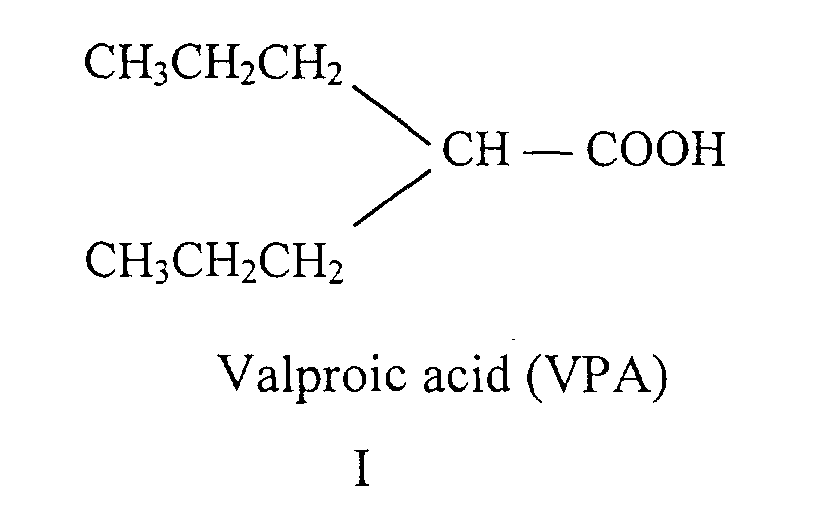
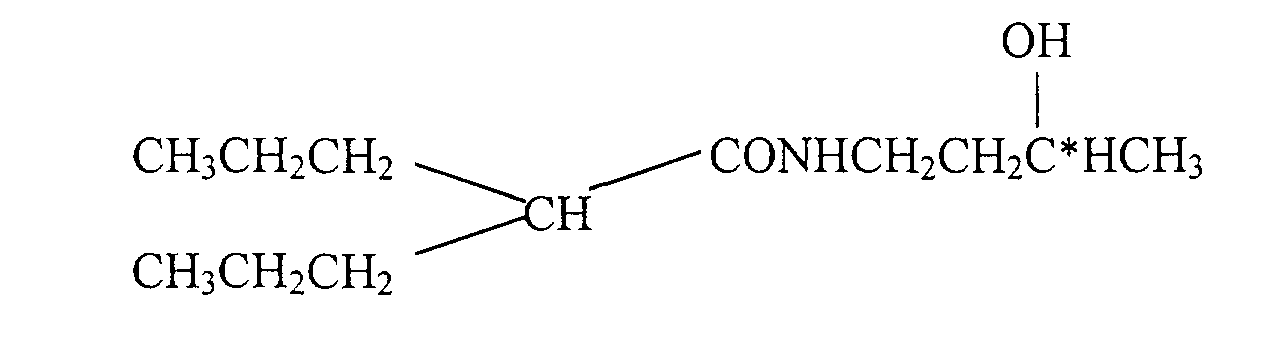
- The present invention provides a new CNS-active amide derivative of VPA, the compound 2-hydroxypropyl valpromide (HP-VPD), which is more potent as an antiepileptic than VPA.
- As a chiral molecule with one asymmetric carbon racemic HP-VPD is a mixture of two enantiomers (R)-HP-VPD (II) and (S)-HP-VPD (III). Since HP-VPD is a chiral molecule its individual optical isomers may have different pharmacokinetics, pharmacodynamics potency and teratogenecity.

- The two enantiomers of HP-VPD were prepared by a stereospecific synthesis and their antiepileptic activity and neurotoxicity was analyzed in comparison to racemic HP-VPD and VPA (I). Individual enantiomers and racemic HP-VPD were screened following oral administration to rats for their anticonvulsant activity and neuriotoxicity at the NIH Epilepsy Branch by the maximal electoshock (MES) test which measures seizure spread; by the subcutaneous metrazol (sc Met) test, which measures seizure threshold; and by the rotorod ataxia test, which assesses minimal neurotoxicity.
- Anticonvulsant activity at the maximal electoshock (MES) test has been associated with antiepileptic activity in complex partial epilepsy which is common epilepsy among therapy-resistant (refractory) epileptic patients. The results of the study show that the (S)-HP-VDP in particular, has a potential to become a new efficient antiepileptic drug.
- The fact that unlike VPA, different valproyiamide analogue were found to be non-teratogenic in animal studies (H. Nau and A.G. Hendricks ISI Atlas Sci: Pharmacol. 1, 52-56, 1987 and M. Radatz et. al. Epilepsy Res. 20:41-49, 1998) give the HP-VPD the potential to be non-teratogenic entity.
- The present invention relates to 2-hydroxylpropyl valpromide (HP-VPD)as an active compound for the treatment of neurological and psychotic disorders, for the treatment of epilepsy and convulsions and for the treatment of pain and migraine. The compound of the present invention can be a racemic mixture or in the form of pure stereisomers, or any other mixture thereof.
- The present invention further relates to pharmaceutical compositions for administration to a mammal, and in particular to humans, comprising an effective amount of said active ingredient and any pharmaceutically acceptable carrier or diluent, for the treatment of neurological and affective and psychotic disorders and for the treatment of pain and migraine.
- Said pharmaceutical composition according are especially useful controlling epileptic seizures, febrile convulsions and convulsions precipitated by an irritative lesion in the brain and to for treating bipolar diseases.
- The present invention further relates to a method for the synthesis of said compound and more specifically to a stereoselective synthesis for obtaining the (S) or (R) enantiomers of said compound.
- The two enantiomers of HP-VPD were synthesized by a stereospecific synthesis and their antiepileptic activity and neurotoxicity was analyzed in comparison to racemic HP-VPD and VPA (I). Individual enantiomers and racemic HP-VPD were screened following oral administration to rats for their anticonvulsant activity and neuriotoxicity at the NIH Epilepsy Branch.
- 2-hydroxypropyl valpromide was obtained from the reaction between valpropyl chloride (V) and 1-amino-2-propanol (VI)by the following procedure:

Rac-1-amino-2-propanol (5g., 67 mmole), and 30 ml of dry dichloromethane were stirred in a 250 ml round-bottomed flask at 0°C for 15 min. - Valproyl chloride (5g., 30 mmole) in 20 ml of dry dichloromethane was added dropwise to this solution over. a period of 20 min. The mixture was stirred at 0°C for an hour after the completion of the addition, then extracted three times with 100 ml of ethyl acetate. The organic extracts were combined, dried with MgSO4, filtered and evaporated. A crude white solid was obtained. Recrystallization from an ethyl acetate-petrol ether (2:3 v/v) mixture yielded 4.7 g. (77%) of analytically pure rac-N-(2-OH-propyl)valpromide (HP-VPD).
- The synthesis of (S) and (R) N-(2-OH-propyl)valpromide (HP-VPD) was identical to that used for the synthesis of racemic -N-(2-OH-propyl)valpromide (HP-VPD) starting from (S) or (R) 1-amino-2-propanol respectively. For the S enantiomer, the yield was 4.7 g. (77%) and for the R enantiomer, the yield was 3.8 g. (62%).
- Following is analytical data:
M.P: 78°C - Elemental Analysis (C11H23NO2):
- Calc.: C: 65.67%; H: 11.44%; N: 6.97%
Found: C: 65.67%; H: 11.16%; N: 6.73% - The screening procedure involved the following (R.J. Porter et. al. Clev. Clin. Q. 51: 293-305, 1984): 1) the maximal electroshock (MES) test, which measures seizure spread; 2) the subcutaneous metrazol (sc Met) test, which measures seizure threshold; and 3) the rotorod ataxia test, which assesses minimal neurotoxicity.
- The pharmacodynamic (anticonvulsant activity and neurotoxicity) results are shown in Table 1.
- In the MES test, racemic HP-VPD was five times more potent than VPA, whereas (S)-HP-VPD (III) was more than two times more potent than (R)-HP-VPD (II) leading to a stereoselective index (SI) of 2.4.
Anticonvulsant activity (ED50) and neurotoxicity (TD50) obtained following oral administration of racemic (HP-VPD) and individual enantiomers of N-(2-Hydroxypropyl)valpromide (HP-VPD) to rats in comparision to VPA. VPA HP-VPD (rac) (S)-HP-VPD (II) (R)-HP-VPD (III) SI MES 490 92 48 117 2.4 sc Met 180 >250 --- --- --- Neurotox. 280 >250 >650 >500 --- PI-MES 0.6 >2.7 >13.5 >4.3 --- PI-sc Met 1.6 --- --- --- --- *ED50 & TD50 (mg/kg) *SI= (R)-HP-VPD/(S)-HP-VPD
*PI (protective index): TD50/ED50 - All chemicals and solvents used were purchased from Aldrich, Milwaukee, Wisconsin, USA and were analitical grade. Compounds II-III and the racemate were synthesized according to the methods as described before and their chemical structures and purity was confirmed by elemental microanalysis and NMR.
IR (cm-1): 3297, 3097, 2929, 2874, 1643, 1558, 1460, 1089.
Claims (12)
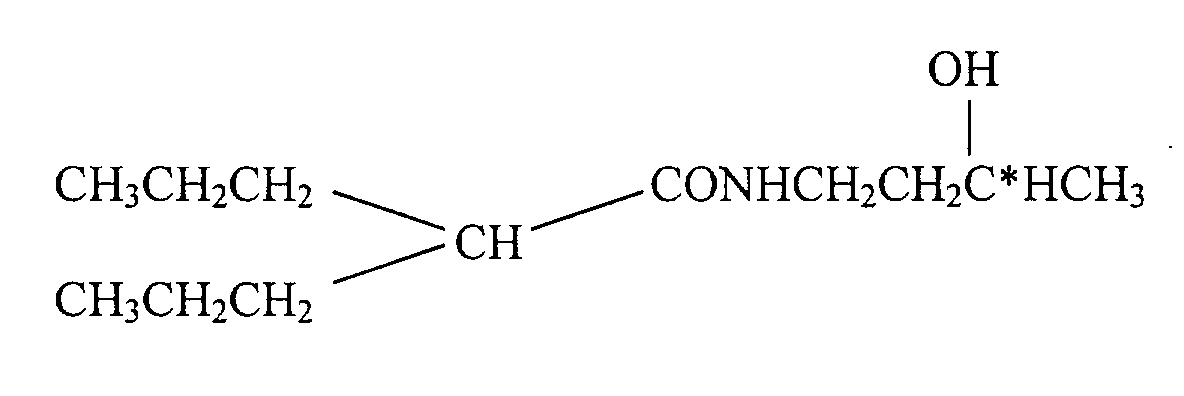
- 2-hydroxylpropyl valpromide (HP-VPD) of the formula:useful for the treatment of neurological, psychotic and affective disorders, such as convulsions and epilepsy, and for the treatment of pain and migraine.
- The (S) optical isomer of the compound as defined in claim 1.
- The (R) optical isomer of the compound as defined in claim 1.
- Pharmaceutical composition for the treatment of neurological, affective and psychotic disorders and for the treatment of pain and migraine comprising as an active ingredient an effective amount of 2-hydroxylpropyl valpromide and a pharmaceutically acceptable carrier or diluent.
- Pharmaceutical composition according to claim 4 wherein the active ingredient is the (S) or (R) optical isomers of the compound of claim 1.
- Pharmaceutical composition according to claim 4 for controlling epileptic seizures, febrile convulsions and convulsions precipitated by an irritative lesion in the brain and to for treating bipolar diseases, chronic pain, headaches and migraines.
- A method for obtaining 2-hydroxylpropyl valpromide or its optical isomers by reacting valproyl chloride and 1-amino-2-propanol or its corresponding optical isomers.
- A method according to claim 7 for obtaining 2-hydroxylpropyl valpromide comprising of the following steps;(a) Stirring 1-amino-2-propanol and dry dichloromethane at approximately 0°C ;(b) dropwise adding valproyl chloride dissolved in dry dichloromethane into the mixture of step (a) at approximately 0°C ;(c) extracting the mixture obtained in (b) with ethyl acetate;(d) drying the organic extract obtained in (c), filtering and evaporating;(e) re-crystallizing the solid obtained in (d) from ethyl acetate-petrol ether to obtain pure HP-VPD.
- A method for the preparation of (S)-enantiomer or (R)-enantiomer of 2-hydroxylpropyl valpromide (HP-VPD) comprising of the following steps;(a) stirring (R) or (S) 1-amino-2-propanol and dry dichloromethane at approximately 0°C ;(b) dropwise adding valproyl chloride dissolved in dry dichloromethane into the mixture of step (a) at approximately 0°C ;(c) extracting the mixture obtained in (b) with ethyl acetate;(d) drying the organic extract obtained in (c), filtering and evaporating;(e) recrystalizing the solid obtained in (d) from ethyl acetate-petrol ether to obtain (R) or (S) HP-VPD respectively.
- A method of treating neurological, affective and psychotic disorders in a mammal in need of such treatment by administering to the mammal an effective amount of the composition as defined in claim 3.
- A method for controlling epileptic seizures, febrile convulsions and convulsions precipitated by an irritative lesion in the brain in a mammal in need of such treatment by administering to the mammal an effective amount of the pharmaceutical composition as defined in claim 4.
- A method of treating bipolar diseases, chronic pain, headaches and migraines, in a mammal in need of such treatment by administering to the mammal an effective amount of the pharmaceutical composition as defined in claim 4.
Applications Claiming Priority (2)
| Application Number | Priority Date | Filing Date | Title |
|---|---|---|---|
| US628016 | 2000-07-28 | ||
| US09/628,016 US6323365B1 (en) | 2000-07-28 | 2000-07-28 | Active derivative of valproic acid for the treatment of neurological and psychotic disorders and a method for their preparation |
Publications (2)
| Publication Number | Publication Date |
|---|---|
| EP1176138A1 true EP1176138A1 (en) | 2002-01-30 |
| EP1176138B1 EP1176138B1 (en) | 2004-12-01 |
Family
ID=24517062
Family Applications (1)
| Application Number | Title | Priority Date | Filing Date |
|---|---|---|---|
| EP01117213A Expired - Lifetime EP1176138B1 (en) | 2000-07-28 | 2001-07-16 | Active derivatives of valproic acid for the treatment of neurological and psychotic disorders and a method for their preparation |
Country Status (5)
| Country | Link |
|---|---|
| US (1) | US6323365B1 (en) |
| EP (1) | EP1176138B1 (en) |
| AT (1) | ATE283838T1 (en) |
| DE (1) | DE60107505T2 (en) |
| ES (1) | ES2233529T3 (en) |
Families Citing this family (6)
| Publication number | Priority date | Publication date | Assignee | Title |
|---|---|---|---|---|
| IL157751A0 (en) * | 2003-02-28 | 2004-03-28 | Yissum Res Dev Co | New amide derivatives of 2,2,3,3-tetramethylcyclopropane carboxylic acid, a method for their synthesis and pharmaceutical compositions containing them |
| US20060025477A1 (en) * | 2004-07-22 | 2006-02-02 | Artman Linda D | Analogs of isovaleramide, a pharmaceutical composition including the same, and a method of treating central nervous system conditions or diseases |
| WO2006102521A2 (en) * | 2005-03-24 | 2006-09-28 | Davis, John M. | Methods of determining compounds useful in the treatment of bipolar disorder and methods of treating such disorders |
| US20080234213A1 (en) * | 2005-09-02 | 2008-09-25 | Matthias Wabl | Oncogenic regulatory RNAs for diagnostics and therapeutics |
| US7459280B2 (en) * | 2006-02-27 | 2008-12-02 | Picobella, Llc | Methods for diagnosing and treating kidney cancer |
| US20080267977A1 (en) * | 2007-04-26 | 2008-10-30 | Friedrich-Alexander University Of Erlangen-Nuremberg | Combined immunological agent and sensitizing agent for the treatment of cancer |
Citations (1)
| Publication number | Priority date | Publication date | Assignee | Title |
|---|---|---|---|---|
| US5585358A (en) * | 1993-07-06 | 1996-12-17 | Yissum Research Development Corporation Of The Hebrew University Of Jerusalem | Derivatives of valproic acid amides and 2-valproenoic acid amides, method of making and use thereof as anticonvulsant agents |
Family Cites Families (1)
| Publication number | Priority date | Publication date | Assignee | Title |
|---|---|---|---|---|
| GB1421743A (en) * | 1972-04-18 | 1976-01-21 | Wilkinson Sword Ltd | Ingestible topical and other compositions |
-
2000
- 2000-07-28 US US09/628,016 patent/US6323365B1/en not_active Expired - Fee Related
-
2001
- 2001-07-16 DE DE60107505T patent/DE60107505T2/en not_active Expired - Fee Related
- 2001-07-16 ES ES01117213T patent/ES2233529T3/en not_active Expired - Lifetime
- 2001-07-16 EP EP01117213A patent/EP1176138B1/en not_active Expired - Lifetime
- 2001-07-16 AT AT01117213T patent/ATE283838T1/en not_active IP Right Cessation
Patent Citations (1)
| Publication number | Priority date | Publication date | Assignee | Title |
|---|---|---|---|---|
| US5585358A (en) * | 1993-07-06 | 1996-12-17 | Yissum Research Development Corporation Of The Hebrew University Of Jerusalem | Derivatives of valproic acid amides and 2-valproenoic acid amides, method of making and use thereof as anticonvulsant agents |
Non-Patent Citations (2)
| Title |
|---|
| MICHA LEVI ET AL.: "Pharmacokinetics and Antiepileptic Activity of Valproyl Hydroxamic Acid Derivatives", PHARMACEUTICAL RESEARCH, vol. 14, no. 2, February 1997 (1997-02-01), US, pages 213 - 217, XP001030867 * |
| W. LÖSCHER ET AL.: "Pharmacological Evaluation of Various Metabolites and Analogues of Valproic Acid", NEUROPHARMACOLOGY, vol. 24, no. 5, 1985, Oxford, GB, pages 427 - 435, XP002113187, ISSN: 0028-3908 * |
Also Published As
| Publication number | Publication date |
|---|---|
| DE60107505D1 (en) | 2005-01-05 |
| EP1176138B1 (en) | 2004-12-01 |
| US6323365B1 (en) | 2001-11-27 |
| ES2233529T3 (en) | 2005-06-16 |
| ATE283838T1 (en) | 2004-12-15 |
| DE60107505T2 (en) | 2005-10-20 |
Similar Documents
| Publication | Publication Date | Title |
|---|---|---|
| EP0099789B1 (en) | 3-aminoquinuclidin derivatives, process for their preparation and their use as therapeutical agents | |
| EP0745586A1 (en) | Aryl(alkyl) propylamides, process for their preparation and pharmaceutical compositions containing them | |
| DE69408962T2 (en) | Naphthalene derivatives with affinity for melatonin receptors, processes for their preparation and pharmaceutical compositions containing them | |
| SK283281B6 (en) | Gamma aminobutyric acid derivatives, processes and intermediates for their preparation, their use and pharmaceutical compositions | |
| KR20020063281A (en) | Novel esters derived from (RR,SS)-2-hydroxybenzoate of 3-(2-dimethylaminomethyl-1-hydroxycyclohexyl) phenyl | |
| ES2547269T3 (en) | Procedures for the preparation of 4-oxo-octahydro-indole-1-carboxylic acid methyl ester and derivatives thereof | |
| JP3542599B2 (en) | Substituted (arylalkoxybenzyl) aminopropanamide derivatives and method for producing the same | |
| DE69510192T2 (en) | SUBSTITUTED CYCLOPENTYLAMINE DERIVATIVES AND THEIR USE AS CALCIUM CHANNEL ANTAGONISTS | |
| EP1176138B1 (en) | Active derivatives of valproic acid for the treatment of neurological and psychotic disorders and a method for their preparation | |
| DE3882679T2 (en) | CARDIOVASCULAR ACTIVE CONNECTIONS. | |
| DE69813228T2 (en) | ALIFATIC PROPARGYLAMINE AS A CELLULAR RESCUE | |
| WO1995004028A1 (en) | Indane and tetrahydronaphthalene derivatives as calcium channel antagonists | |
| EP0413667B1 (en) | Halogenoalkyl-phenyl-alcohols, -ketones and their hydrates | |
| JP3542600B2 (en) | Substituted (arylalkylaminobenzyl) aminopropionamide derivatives and method for producing the same | |
| EP1778623B1 (en) | Derivatives of 1-phenylalkanecarboxylic acids for the treatment of neurodegenerative diseases | |
| CN1122019C (en) | Tetralins with phenyl substituents on the aromatic rings and their use in the treatment of epilepsy, stroke and brain or spinal trauma | |
| DE69616357T2 (en) | BENZOCYCLOALKEN COMPOUNDS WITH BINDING SFFINITY TO THE MELATONIN RECEPTOR, THEIR PRODUCTION AND USE | |
| EP0491263B1 (en) | Phenylalkylaminoalkyl compounds; process for their preparation and pharmaceutical compositions containing same | |
| EP0605667A1 (en) | Diamine derivatives having selective affinity for sigma receptors | |
| IL130666A (en) | Hydroxypropyl valpromide for the treatment of neurological and psychotic disorders and a method for its preparation | |
| CN113521038B (en) | Anesthetic pharmaceutical composition and application thereof | |
| JP2007503445A (en) | Cycloalkylamino acid compounds, methods for their production and use | |
| EP0869952B1 (en) | 5-naphthalen-1-yl-1,3-dioxane derivatives, preparation and therapeutical use thereof | |
| DE69330737T2 (en) | Crystalline salts of optically active aminocoumaran derivatives, their preparation and use | |
| EP0294258A1 (en) | Hydrazine derivatives, process for obtaining them and pharmaceutical composition containing them |
Legal Events
| Date | Code | Title | Description |
|---|---|---|---|
| PUAI | Public reference made under article 153(3) epc to a published international application that has entered the european phase |
Free format text: ORIGINAL CODE: 0009012 |
|
| AK | Designated contracting states |
Kind code of ref document: A1 Designated state(s): AT BE CH CY DE DK ES FI FR GB GR IE IT LI LU MC NL PT SE TR |
|
| AX | Request for extension of the european patent |
Free format text: AL;LT;LV;MK;RO;SI |
|
| 17P | Request for examination filed |
Effective date: 20020228 |
|
| AKX | Designation fees paid |
Free format text: AT BE CH CY DE DK ES FI FR GB GR IE IT LI LU MC NL PT SE TR |
|
| 17Q | First examination report despatched |
Effective date: 20031017 |
|
| GRAP | Despatch of communication of intention to grant a patent |
Free format text: ORIGINAL CODE: EPIDOSNIGR1 |
|
| GRAS | Grant fee paid |
Free format text: ORIGINAL CODE: EPIDOSNIGR3 |
|
| RAP1 | Party data changed (applicant data changed or rights of an application transferred) |
Owner name: YISSUM RESEARCH DEVELOPMENT COMPANYOF THE HEBREW U |
|
| GRAA | (expected) grant |
Free format text: ORIGINAL CODE: 0009210 |
|
| AK | Designated contracting states |
Kind code of ref document: B1 Designated state(s): AT BE CH CY DE DK ES FI FR GB GR IE IT LI LU MC NL PT SE TR |
|
| PG25 | Lapsed in a contracting state [announced via postgrant information from national office to epo] |
Ref country code: BE Free format text: LAPSE BECAUSE OF FAILURE TO SUBMIT A TRANSLATION OF THE DESCRIPTION OR TO PAY THE FEE WITHIN THE PRESCRIBED TIME-LIMIT Effective date: 20041201 Ref country code: AT Free format text: LAPSE BECAUSE OF FAILURE TO SUBMIT A TRANSLATION OF THE DESCRIPTION OR TO PAY THE FEE WITHIN THE PRESCRIBED TIME-LIMIT Effective date: 20041201 Ref country code: FI Free format text: LAPSE BECAUSE OF FAILURE TO SUBMIT A TRANSLATION OF THE DESCRIPTION OR TO PAY THE FEE WITHIN THE PRESCRIBED TIME-LIMIT Effective date: 20041201 Ref country code: TR Free format text: LAPSE BECAUSE OF FAILURE TO SUBMIT A TRANSLATION OF THE DESCRIPTION OR TO PAY THE FEE WITHIN THE PRESCRIBED TIME-LIMIT Effective date: 20041201 Ref country code: NL Free format text: LAPSE BECAUSE OF FAILURE TO SUBMIT A TRANSLATION OF THE DESCRIPTION OR TO PAY THE FEE WITHIN THE PRESCRIBED TIME-LIMIT Effective date: 20041201 |
|
| REG | Reference to a national code |
Ref country code: GB Ref legal event code: FG4D |
|
| REG | Reference to a national code |
Ref country code: CH Ref legal event code: EP |
|
| REG | Reference to a national code |
Ref country code: IE Ref legal event code: FG4D |
|
| REF | Corresponds to: |
Ref document number: 60107505 Country of ref document: DE Date of ref document: 20050105 Kind code of ref document: P |
|
| PG25 | Lapsed in a contracting state [announced via postgrant information from national office to epo] |
Ref country code: SE Free format text: LAPSE BECAUSE OF FAILURE TO SUBMIT A TRANSLATION OF THE DESCRIPTION OR TO PAY THE FEE WITHIN THE PRESCRIBED TIME-LIMIT Effective date: 20050301 Ref country code: GR Free format text: LAPSE BECAUSE OF FAILURE TO SUBMIT A TRANSLATION OF THE DESCRIPTION OR TO PAY THE FEE WITHIN THE PRESCRIBED TIME-LIMIT Effective date: 20050301 Ref country code: DK Free format text: LAPSE BECAUSE OF FAILURE TO SUBMIT A TRANSLATION OF THE DESCRIPTION OR TO PAY THE FEE WITHIN THE PRESCRIBED TIME-LIMIT Effective date: 20050301 |
|
| NLV1 | Nl: lapsed or annulled due to failure to fulfill the requirements of art. 29p and 29m of the patents act | ||
| REG | Reference to a national code |
Ref country code: ES Ref legal event code: FG2A Ref document number: 2233529 Country of ref document: ES Kind code of ref document: T3 |
|
| REG | Reference to a national code |
Ref country code: CH Ref legal event code: NV Representative=s name: ALTHOFF PATENTANWALTSBUERO |
|
| PG25 | Lapsed in a contracting state [announced via postgrant information from national office to epo] |
Ref country code: LU Free format text: LAPSE BECAUSE OF NON-PAYMENT OF DUE FEES Effective date: 20050716 Ref country code: CY Free format text: LAPSE BECAUSE OF FAILURE TO SUBMIT A TRANSLATION OF THE DESCRIPTION OR TO PAY THE FEE WITHIN THE PRESCRIBED TIME-LIMIT Effective date: 20050716 |
|
| PG25 | Lapsed in a contracting state [announced via postgrant information from national office to epo] |
Ref country code: IE Free format text: LAPSE BECAUSE OF NON-PAYMENT OF DUE FEES Effective date: 20050718 |
|
| PG25 | Lapsed in a contracting state [announced via postgrant information from national office to epo] |
Ref country code: MC Free format text: LAPSE BECAUSE OF NON-PAYMENT OF DUE FEES Effective date: 20050731 |
|
| PLBE | No opposition filed within time limit |
Free format text: ORIGINAL CODE: 0009261 |
|
| STAA | Information on the status of an ep patent application or granted ep patent |
Free format text: STATUS: NO OPPOSITION FILED WITHIN TIME LIMIT |
|
| 26N | No opposition filed |
Effective date: 20050902 |
|
| ET | Fr: translation filed | ||
| REG | Reference to a national code |
Ref country code: IE Ref legal event code: MM4A |
|
| PG25 | Lapsed in a contracting state [announced via postgrant information from national office to epo] |
Ref country code: PT Free format text: LAPSE BECAUSE OF NON-PAYMENT OF DUE FEES Effective date: 20050501 |
|
| PGFP | Annual fee paid to national office [announced via postgrant information from national office to epo] |
Ref country code: ES Payment date: 20090724 Year of fee payment: 9 Ref country code: FR Payment date: 20090721 Year of fee payment: 9 |
|
| PGFP | Annual fee paid to national office [announced via postgrant information from national office to epo] |
Ref country code: CH Payment date: 20090724 Year of fee payment: 9 Ref country code: DE Payment date: 20090722 Year of fee payment: 9 Ref country code: GB Payment date: 20090720 Year of fee payment: 9 |
|
| PGFP | Annual fee paid to national office [announced via postgrant information from national office to epo] |
Ref country code: IT Payment date: 20090728 Year of fee payment: 9 |
|
| REG | Reference to a national code |
Ref country code: CH Ref legal event code: PL |
|
| GBPC | Gb: european patent ceased through non-payment of renewal fee |
Effective date: 20100716 |
|
| REG | Reference to a national code |
Ref country code: FR Ref legal event code: ST Effective date: 20110331 |
|
| PG25 | Lapsed in a contracting state [announced via postgrant information from national office to epo] |
Ref country code: LI Free format text: LAPSE BECAUSE OF NON-PAYMENT OF DUE FEES Effective date: 20100731 Ref country code: DE Free format text: LAPSE BECAUSE OF NON-PAYMENT OF DUE FEES Effective date: 20110201 Ref country code: CH Free format text: LAPSE BECAUSE OF NON-PAYMENT OF DUE FEES Effective date: 20100731 |
|
| REG | Reference to a national code |
Ref country code: DE Ref legal event code: R119 Ref document number: 60107505 Country of ref document: DE Effective date: 20110201 |
|
| PG25 | Lapsed in a contracting state [announced via postgrant information from national office to epo] |
Ref country code: IT Free format text: LAPSE BECAUSE OF NON-PAYMENT OF DUE FEES Effective date: 20100716 Ref country code: FR Free format text: LAPSE BECAUSE OF NON-PAYMENT OF DUE FEES Effective date: 20100802 |
|
| PG25 | Lapsed in a contracting state [announced via postgrant information from national office to epo] |
Ref country code: GB Free format text: LAPSE BECAUSE OF NON-PAYMENT OF DUE FEES Effective date: 20100716 |
|
| REG | Reference to a national code |
Ref country code: ES Ref legal event code: FD2A Effective date: 20110818 |
|
| PG25 | Lapsed in a contracting state [announced via postgrant information from national office to epo] |
Ref country code: ES Free format text: LAPSE BECAUSE OF NON-PAYMENT OF DUE FEES Effective date: 20100717 |