EP1175948A2 - Noble metal nanoparticles, a process for preparing these and their use - Google Patents
Noble metal nanoparticles, a process for preparing these and their use Download PDFInfo
- Publication number
- EP1175948A2 EP1175948A2 EP01117494A EP01117494A EP1175948A2 EP 1175948 A2 EP1175948 A2 EP 1175948A2 EP 01117494 A EP01117494 A EP 01117494A EP 01117494 A EP01117494 A EP 01117494A EP 1175948 A2 EP1175948 A2 EP 1175948A2
- Authority
- EP
- European Patent Office
- Prior art keywords
- nanoparticles
- nanoparticles according
- noble metal
- polysaccharide
- membrane electrode
- Prior art date
- Legal status (The legal status is an assumption and is not a legal conclusion. Google has not performed a legal analysis and makes no representation as to the accuracy of the status listed.)
- Withdrawn
Links
Images

Classifications
-
- B—PERFORMING OPERATIONS; TRANSPORTING
- B82—NANOTECHNOLOGY
- B82B—NANOSTRUCTURES FORMED BY MANIPULATION OF INDIVIDUAL ATOMS, MOLECULES, OR LIMITED COLLECTIONS OF ATOMS OR MOLECULES AS DISCRETE UNITS; MANUFACTURE OR TREATMENT THEREOF
- B82B1/00—Nanostructures formed by manipulation of individual atoms or molecules, or limited collections of atoms or molecules as discrete units
-
- B—PERFORMING OPERATIONS; TRANSPORTING
- B01—PHYSICAL OR CHEMICAL PROCESSES OR APPARATUS IN GENERAL
- B01J—CHEMICAL OR PHYSICAL PROCESSES, e.g. CATALYSIS OR COLLOID CHEMISTRY; THEIR RELEVANT APPARATUS
- B01J13/00—Colloid chemistry, e.g. the production of colloidal materials or their solutions, not otherwise provided for; Making microcapsules or microballoons
- B01J13/0004—Preparation of sols
- B01J13/0043—Preparation of sols containing elemental metal
-
- B—PERFORMING OPERATIONS; TRANSPORTING
- B01—PHYSICAL OR CHEMICAL PROCESSES OR APPARATUS IN GENERAL
- B01J—CHEMICAL OR PHYSICAL PROCESSES, e.g. CATALYSIS OR COLLOID CHEMISTRY; THEIR RELEVANT APPARATUS
- B01J23/00—Catalysts comprising metals or metal oxides or hydroxides, not provided for in group B01J21/00
- B01J23/38—Catalysts comprising metals or metal oxides or hydroxides, not provided for in group B01J21/00 of noble metals
- B01J23/40—Catalysts comprising metals or metal oxides or hydroxides, not provided for in group B01J21/00 of noble metals of the platinum group metals
- B01J23/46—Ruthenium, rhodium, osmium or iridium
- B01J23/462—Ruthenium
-
- B—PERFORMING OPERATIONS; TRANSPORTING
- B01—PHYSICAL OR CHEMICAL PROCESSES OR APPARATUS IN GENERAL
- B01J—CHEMICAL OR PHYSICAL PROCESSES, e.g. CATALYSIS OR COLLOID CHEMISTRY; THEIR RELEVANT APPARATUS
- B01J35/00—Catalysts, in general, characterised by their form or physical properties
- B01J35/40—Catalysts, in general, characterised by their form or physical properties characterised by dimensions, e.g. grain size
- B01J35/45—Nanoparticles
-
- B—PERFORMING OPERATIONS; TRANSPORTING
- B22—CASTING; POWDER METALLURGY
- B22F—WORKING METALLIC POWDER; MANUFACTURE OF ARTICLES FROM METALLIC POWDER; MAKING METALLIC POWDER; APPARATUS OR DEVICES SPECIALLY ADAPTED FOR METALLIC POWDER
- B22F1/00—Metallic powder; Treatment of metallic powder, e.g. to facilitate working or to improve properties
- B22F1/05—Metallic powder characterised by the size or surface area of the particles
- B22F1/054—Nanosized particles
-
- B—PERFORMING OPERATIONS; TRANSPORTING
- B22—CASTING; POWDER METALLURGY
- B22F—WORKING METALLIC POWDER; MANUFACTURE OF ARTICLES FROM METALLIC POWDER; MAKING METALLIC POWDER; APPARATUS OR DEVICES SPECIALLY ADAPTED FOR METALLIC POWDER
- B22F1/00—Metallic powder; Treatment of metallic powder, e.g. to facilitate working or to improve properties
- B22F1/05—Metallic powder characterised by the size or surface area of the particles
- B22F1/054—Nanosized particles
- B22F1/0545—Dispersions or suspensions of nanosized particles
-
- B—PERFORMING OPERATIONS; TRANSPORTING
- B22—CASTING; POWDER METALLURGY
- B22F—WORKING METALLIC POWDER; MANUFACTURE OF ARTICLES FROM METALLIC POWDER; MAKING METALLIC POWDER; APPARATUS OR DEVICES SPECIALLY ADAPTED FOR METALLIC POWDER
- B22F1/00—Metallic powder; Treatment of metallic powder, e.g. to facilitate working or to improve properties
- B22F1/10—Metallic powder containing lubricating or binding agents; Metallic powder containing organic material
-
- B—PERFORMING OPERATIONS; TRANSPORTING
- B82—NANOTECHNOLOGY
- B82B—NANOSTRUCTURES FORMED BY MANIPULATION OF INDIVIDUAL ATOMS, MOLECULES, OR LIMITED COLLECTIONS OF ATOMS OR MOLECULES AS DISCRETE UNITS; MANUFACTURE OR TREATMENT THEREOF
- B82B3/00—Manufacture or treatment of nanostructures by manipulation of individual atoms or molecules, or limited collections of atoms or molecules as discrete units
-
- H—ELECTRICITY
- H01—ELECTRIC ELEMENTS
- H01M—PROCESSES OR MEANS, e.g. BATTERIES, FOR THE DIRECT CONVERSION OF CHEMICAL ENERGY INTO ELECTRICAL ENERGY
- H01M4/00—Electrodes
- H01M4/86—Inert electrodes with catalytic activity, e.g. for fuel cells
- H01M4/90—Selection of catalytic material
- H01M4/92—Metals of platinum group
-
- H—ELECTRICITY
- H01—ELECTRIC ELEMENTS
- H01M—PROCESSES OR MEANS, e.g. BATTERIES, FOR THE DIRECT CONVERSION OF CHEMICAL ENERGY INTO ELECTRICAL ENERGY
- H01M4/00—Electrodes
- H01M4/86—Inert electrodes with catalytic activity, e.g. for fuel cells
- H01M4/90—Selection of catalytic material
- H01M4/92—Metals of platinum group
- H01M4/925—Metals of platinum group supported on carriers, e.g. powder carriers
- H01M4/926—Metals of platinum group supported on carriers, e.g. powder carriers on carbon or graphite
-
- H—ELECTRICITY
- H01—ELECTRIC ELEMENTS
- H01M—PROCESSES OR MEANS, e.g. BATTERIES, FOR THE DIRECT CONVERSION OF CHEMICAL ENERGY INTO ELECTRICAL ENERGY
- H01M8/00—Fuel cells; Manufacture thereof
- H01M8/10—Fuel cells with solid electrolytes
- H01M8/1004—Fuel cells with solid electrolytes characterised by membrane-electrode assemblies [MEA]
-
- B—PERFORMING OPERATIONS; TRANSPORTING
- B22—CASTING; POWDER METALLURGY
- B22F—WORKING METALLIC POWDER; MANUFACTURE OF ARTICLES FROM METALLIC POWDER; MAKING METALLIC POWDER; APPARATUS OR DEVICES SPECIALLY ADAPTED FOR METALLIC POWDER
- B22F2998/00—Supplementary information concerning processes or compositions relating to powder metallurgy
-
- B—PERFORMING OPERATIONS; TRANSPORTING
- B82—NANOTECHNOLOGY
- B82Y—SPECIFIC USES OR APPLICATIONS OF NANOSTRUCTURES; MEASUREMENT OR ANALYSIS OF NANOSTRUCTURES; MANUFACTURE OR TREATMENT OF NANOSTRUCTURES
- B82Y30/00—Nanotechnology for materials or surface science, e.g. nanocomposites
-
- H—ELECTRICITY
- H01—ELECTRIC ELEMENTS
- H01M—PROCESSES OR MEANS, e.g. BATTERIES, FOR THE DIRECT CONVERSION OF CHEMICAL ENERGY INTO ELECTRICAL ENERGY
- H01M4/00—Electrodes
- H01M4/86—Inert electrodes with catalytic activity, e.g. for fuel cells
- H01M4/8605—Porous electrodes
-
- Y—GENERAL TAGGING OF NEW TECHNOLOGICAL DEVELOPMENTS; GENERAL TAGGING OF CROSS-SECTIONAL TECHNOLOGIES SPANNING OVER SEVERAL SECTIONS OF THE IPC; TECHNICAL SUBJECTS COVERED BY FORMER USPC CROSS-REFERENCE ART COLLECTIONS [XRACs] AND DIGESTS
- Y02—TECHNOLOGIES OR APPLICATIONS FOR MITIGATION OR ADAPTATION AGAINST CLIMATE CHANGE
- Y02E—REDUCTION OF GREENHOUSE GAS [GHG] EMISSIONS, RELATED TO ENERGY GENERATION, TRANSMISSION OR DISTRIBUTION
- Y02E60/00—Enabling technologies; Technologies with a potential or indirect contribution to GHG emissions mitigation
- Y02E60/30—Hydrogen technology
- Y02E60/50—Fuel cells
-
- Y—GENERAL TAGGING OF NEW TECHNOLOGICAL DEVELOPMENTS; GENERAL TAGGING OF CROSS-SECTIONAL TECHNOLOGIES SPANNING OVER SEVERAL SECTIONS OF THE IPC; TECHNICAL SUBJECTS COVERED BY FORMER USPC CROSS-REFERENCE ART COLLECTIONS [XRACs] AND DIGESTS
- Y02—TECHNOLOGIES OR APPLICATIONS FOR MITIGATION OR ADAPTATION AGAINST CLIMATE CHANGE
- Y02P—CLIMATE CHANGE MITIGATION TECHNOLOGIES IN THE PRODUCTION OR PROCESSING OF GOODS
- Y02P70/00—Climate change mitigation technologies in the production process for final industrial or consumer products
- Y02P70/50—Manufacturing or production processes characterised by the final manufactured product
Definitions
- the present invention provides noble metal-containing nanoparticles for producing membrane electrode assemblies (MEAs) for fuel cells, in particular for low temperature fuel cells, for example polymer electrolyte membrane fuel cells (PEM fuel cells) and direct methanol fuel cells (DMFC).
- MEAs membrane electrode assemblies
- PEM fuel cells polymer electrolyte membrane fuel cells
- DMFC direct methanol fuel cells
- New types of colloidal solutions which contain the noble metal alone or in association with other metals are described, wherein the metals are in the form of nanoparticles embedded in a temporary stabiliser.
- the nanoparticles are used to produce electrocatalysts and catalysed components for fuel cells. Using these nanoparticles, catalysed ionomer membranes, catalysed gas diffusion electrodes (so-called "backings”) and membrane electrode assemblies can be produced.
- Fuel cells convert a fuel and an oxidising agent which are spatially separated from each other at two electrodes into electricity, heat and water. Hydrogen or a hydrogen-rich gas may be used as the fuel, and oxygen or air as the oxidising agent.
- the process of energy conversion in the fuel cell is characterised by a particularly high efficiency. For this reason, fuel cells in combination with electric motors are becoming more and more important as an alternative to traditional internal combustion engines.
- the PEM fuel cell is suitable for use as an energy converter in motor vehicles because of its compact structure, its power density and its high efficiency.
- the PEM fuel cell consists of a stacked arrangement ("stack") of membrane electrode assemblies (MEAs), between which are arranged bipolar plates for supplying gas and conducting electricity.
- a membrane electrode assembly consists of a solid polymer electrolyte membrane, both sides of which are provided with reaction layers which contain catalysts.
- One of the reaction layers is designed as an anode for the oxidation of hydrogen and the second reaction layer is designed as a cathode for the reduction of oxygen.
- gas distributor structures or gas diffusion layers made of carbon fibre paper, carbon fibre woven fabric or carbon fleece, which facilitate good access by the reaction gases to the electrodes and effective removal of the cell current.
- the anode and cathode contain so-called electrocatalysts which catalytically support the particular reaction (oxidation of hydrogen at the anode and reduction of oxygen at the cathode).
- Metals from the platinum group in the periodic system of elements are preferably used as the catalytically active components.
- so-called supported catalysts in which the catalytically active platinum group metal has been applied in highly disperse form to the surface of a conductive support material, are used.
- the polymer electrolyte membrane consists of proton-conducting polymer materials. These materials are also called ionomers for short in the following.
- Such materials are sold, for example, under the tradenames Nafion® (E.I. DuPont) or Flemion® (Asahi Glass Co.).
- fluorine-free, ionomer materials such as sulfonated polyetherketones or polyarylketones or polybenzimidazoles but also ceramic materials can be used.
- the performance data for a fuel cell depends critically on the quality of the catalyst layers applied to the polymer electrolyte membrane. These layers usually consist of an ionomer and a finely divided electrocatalyst dispersed therein. Together with the polymer electrolyte membrane, so-called three-phase interfaces are formed in these layers, wherein the ionomer is in direct contact with the electrocatalyst and the gases (hydrogen at the anode, air at the cathode) introduced to the catalyst particles via the pore system.
- the gases hydrogen at the anode, air at the cathode
- ionomer, electrocatalyst and optionally other additives are generally blended to form an ink or a paste.
- the ink is applied by brushing, rolling, spraying, doctor blading or printing either to the gas diffusion layer (e.g. carbon fleece or carbon fibre paper) or directly to the polymer membrane, dried and optionally subjected to a secondary treatment.
- the gas diffusion layer e.g. carbon fleece or carbon fibre paper
- the non-catalysed gas diffusion layers are then mounted on the membrane on the anode and cathode faces and a membrane electrode assembly is then obtained.
- the catalyst layers may also be applied to the gas diffusion layers.
- the present invention provides noble metal-containing nanoparticles which can be used for the production of catalysed components and membrane electrode assemblies for low temperature fuel cells (PEMFC, DMFC, AFC or PAFC).
- PEMFC low temperature fuel cells
- DMFC low temperature fuel cells
- PAFC low temperature fuel cells
- the object of the invention are new types of preparations, or colloidal solutions, of noble metal-containing nanoparticles which are embedded in a suitable temporary stabiliser.
- colloidal nanoparticle solutions have been known for a long time. For example, they are used to produce noble metal supported catalysts.
- US 3,992,512 describes a process in which colloidal platinum oxide nanoparticles are prepared by decomposing platinum sulfite acid, fixing these to a supporting carbon black and then reducing to platinum. The process is complicated and expensive and provides only electrocatalysts which are contaminated with sulfur due to using sulfur-containing precursor compounds for the platinum. Stabilisers are not used.
- DE 44 43 705 A1 discloses noble metal colloids which are stabilised with surfactants (such as, for example, fatty alcohol polyglycol ethers or amphiphilic betaines) and can be used for preparing supported electrocatalysts.
- surfactants such as, for example, fatty alcohol polyglycol ethers or amphiphilic betaines
- After attaching these noble metal colloids to the support material aftertreatment is required in order to remove the surfactants used for stabilising purposes. During this aftertreatment (generally thermal pyrolysis at temperatures above 400°C) the colloid particles sinter so that coarse crystallites are produced.
- DE 197 45 904 A1 describes a polymer-stabilised metal colloid solution which contains a cation exchange polymer for stabilising purposes.
- the noble metal nanoparticles are precipitated in the presence of an ionomer solution (e.g. Nafion® ) and isolated as a dry powder.
- an ionomer solution e.g. Nafion®
- Investigations by the inventors of the present invention have shown that this process does not lead to stable liquid colloid preparations because the ionomer has no surfactant properties and in addition is itself present as particles in the size range 5 to 20 nm (see also X. Cheng et al., J. Power Sources 79 (1999) 75 - 81).
- nanoparticles which form stable solutions over a long time due to the use of a suitable, temporary, stabiliser and contain only marginal amounts of impurities (halogen ions, alkali metal ions, borate, etc.), which are insignificant for use in fuel cells. They are intended to be used directly for catalysing ionomer membranes and gas diffusion layers for PEM fuel cells, which means that the temporary stabiliser (or protective colloid) has to be completely removable by means of a gentle process without damaging the polymer electrolyte membrane. Furthermore, the nanoparticles are intended to be capable of being prepared in aqueous medium without the addition of organic solvents.
- nanoparticles which contain the noble metals only or noble metals in combination with base metals and are characterised in that they are embedded in an aqueous solution of a temporary stabiliser based on a polysaccharide.
- polysaccharides are used to stabilise the nanoparticles. Suitable polysaccharides are described in Ullmanns Enzyklopädie der ischen Chemie, 4th edition, vol. 19, p. 233 et seq..
- Polysaccharides are water soluble, highly polymer carbohydrate compounds, which consist of monosaccharide units linked together by a so-called glycosidic bond. When forming this bond, the anomeric hydroxyl group of the monosaccharide reversibly condenses with the hydroxy group of another monosaccharide to form a disaccharide, oligo- or finally a polysaccharide molecule.
- a single polysaccharide molecule can contain up to several ten thousands of various monosaccharide units.
- Polysaccharides, which are composed of various types of monosaccharide units are called heteropolysaccharides, those which contain only one monosaccharide type are called homopolysaccharides.
- the polysaccharides differ in their molecular weight, their composition and, most important, in their water solubility.
- polysaccharides suitable for use in the present invention must be highly water soluble. Most common polysaccharides and gums cannot be dissolved in water at concentrations higher than about 5 wt.% because of their very high viscosities and their gelling behaviour.
- the preferred polysaccharides exhibit a water solubility of about 5 to 40 wt.% while still maintaining a low viscosity solution.
- the preferred polysaccharides are heteropolysaccharides such as gum arabic, xanthan gum, tragacanth gum or mixtures thereof.
- the water based solution of the polysaccharide has to be preferably in the pH neutral form.
- a pH range of 5 to 8 preferably 5.5 to 7.5 and most preferably 6 to 7 is required to ensure stability of the polysaccharide.
- the glycosidic bonds of the polysaccharide are broken up and the macromolecule is destroyed. This effect is used in turn to remove traces of the stabiliser after the colloidal noble metal particles have been deposited on the suitable substrate material (ionomer membranes, gas diffusion electrodes or carbon black supports) as described further below in this invention.
- the stabilisers mentioned are able to keep the colloidal preparation of nanoparticles, even in high concentrations, stable for a long time.
- the temporary stabilisers used have to be capable of being removed effectively. Particularly important here is an easy decomposition (i.e. breaking down of the main chain in the polymer into low molecular weight fragments).
- an easy decomposition i.e. breaking down of the main chain in the polymer into low molecular weight fragments.
- the polysaccharides are extremely suitable as temporary stabilisers.
- the glycosidic bonds between the individual monosaccharides or sugar monomers break readily when treated with acids or alkalis. They depolymerise and break down into low molecular weight constituents. This decomposition process also takes place during pyrolysis at temperatures up to 250°C.
- the low molecular weight fragments can be readily removed, for example by washing out.
- Nanoparticles according to the invention may contain one or more noble metals and optionally in addition at least one base metal.
- Nanoparticles according to the invention preferably contain at least one noble metal from the group platinum, palladium, rhodium, iridium, ruthenium, osmium, gold and silver.
- Suitable base metals are iron, cobalt, nickel, copper, titanium, vanadium, chromium, manganese, molybdenum, tungsten and rhenium.
- the particle size of the nanoparticles is between 0.1 and 100, preferably between 1 and 20 and in particular between 1 and 5 nm. The particle size can be determined by means of transmission electron microscopy (TEM).
- the concentration of noble metal nanoparticles in the aqueous colloid solution is 0.01 to 500 g/l (0.001 to 50 wt.%), typically 0.1 to 200 g/l (0.01 to 20 wt.%).
- Nanoparticles according to the invention can be obtained by reducing precursor compounds of the desired noble metals and optionally base metals with a total chlorine concentration of less than 500 ppm in an aqueous solution in the presence of the stabiliser, using a reducing agent.
- Suitable reducing agents for the preparation according to the invention are those which decompose to produce no residues or which leave behind no problematic ionic or organic impurities during the reduction process.
- these are hydrogen, hydrazine, formaldehyde, or else lower aliphatic alcohols such as ethanol or isopropanol which decompose to give gaseous constituents due to the reduction reaction.
- the reducing agent is added directly to the reaction solution, with stirring, wherein temperatures of up to 95°C are optionally used. After completion of the reduction the colloidal solution of the nanoparticles in principle does not contain any more reducing agents. Surplus reducing agents are destroyed due to treatment at elevated temperatures of up to 95°C.
- halogen-free, or low-halogen, compounds are used, for example, as noble metal precursor compounds for preparing the nanoparticles:
- Corresponding compounds may also be used for the noble metals Au, Ag, Ir and Os.
- the precursor compounds used for the base metals mentioned are chlorine-free salts of the base metals, preferably nitrate compounds.
- the total chlorine content of the precursor compounds used should be less than 500 ppm. Determination of the total chlorine content includes both the free and also the bonded chlorine and is performed, for example, by ion chromatography (IC), in aqueous solution, after working up the substance in a suitable manner.
- IC ion chromatography
- the total chlorine content of the noble metal solution according to the invention is typically less than 100 ppm, preferably less than 50 ppm.
- Nanoparticles according to the invention may be used to prepare supported electrocatalysts.
- a particular advantage of the nanoparticles, however, is that they can also be used directly, that means without a support, to prepare catalyst layers for ionomer membranes and gas diffusion layers and also to impregnate the ionomer membranes themselves.
- the noble metal nanoparticles are deposited onto a suitable carbon black material.
- Several methods for example impregnation, soaking or incipient wetness type methods and others) can be used for this process.
- electrocatalysts exhibiting a very high noble metal dispersion i.e. noble metal surface area
- electrocatalysts with a noble metal loading of up to 80 wt.% on carbon black can be prepared with particle sizes in the range of 2 to 5 nanometer.
- the stabiliser can be removed under mild conditions, that is with acidic or alkaline hydrolysis or by thermal decomposition at temperatures of up to 250°C.
- the protective colloid, or temporary stabiliser decomposes under relatively mild conditions and can be washed out so that damage to the components in the fuel cell does not occur.
- the process has the advantage that the high surface area and dispersion of the nanoparticles is retained and is not distorted by high temperature tempering processes. This leads to very good performance by the membrane electrode assemblies prepared in this way so that the platinum loading can be kept low.
- the preparation with the nanoparticles is applied to the membrane in a spray process, by brushing or immersing or by means of screen printing.
- the temporary stabilizer is decomposed by treating with acid or alkali and it is then washed out.
- Dissolved ionomer is obtainable in aqueous solution with low molecular weight aliphatic alcohols (Fluka, Buchs; Aldrich, Steinheim).
- Aqueous solutions of the ionomer in higher concentrations (10 wt.% and 20 wt.%) can be prepared therefrom.
- Ionomer membranes and also the ionomer contained in the catalyst layers can be used in an acidic proton-conducting H + form or, after exchanging the protons for monovalent ions such as, for example, Na + and K + , in a non-acidic Na + or K + form for preparing membrane electrode assemblies.
- the non-acidic form of polymer membranes is usually more stable towards thermal stress than the acidic form and is therefore preferably used.
- the polymer electrolyte Before using the membrane electrode assembly, however, the polymer electrolyte has first to be returned to its acidic, proton-conducting form. This is achieved by so-called reprotonation. Reprotonation is performed by treating the membrane electrode assembly in sulfuric acid.
- Reprotonation with sulfuric acid can therefore be combined in a simple manner with decomposition of the temporary stabiliser. This simplifies the production process for membrane electrode assemblies.
- the ionomer membrane catalysed in this way is then completed with 2 gas diffusion electrodes to give a 5-layered membrane electrode assembly.
- the gas diffusion layers may also be coated with the catalytically active component.
- the colloidal preparation of nanoparticles optionally with the additives mentioned above, is applied to a gas diffusion layer (gas distribution structure or "backing" consisting of carbon fibre paper) using an appropriate method.
- the stabiliser is then removed by a tempering process at temperatures below 250°C and the catalysed electrode, as the anode and cathode, are further laminated with an ionomer membrane to give a 5-layered membrane electrode assembly.
- colloidal noble metal nanoparticles may also be processed to give a catalyst ink.
- Suitable catalyst inks are described, for example, in patent specification US 5,861,222 in the name of the applicant, wherein the supported catalysts used there may be replaced entirely or partly by noble metal nanoparticles according to the invention.
- the colloidal solution of noble metal nanoparticles is also suitable for precatalysing ionomer membranes by impregnating the ionomer membrane in the solution.
- a catalyst ink is then applied to the precatalysed ionomer membrane, as described in the US patent specification mentioned above.
- the precatalysed ionomer membrane may also be assembled, together with catalysed gas diffusion electrodes on the cathode and anode faces, and laminated to produce a 5-layered membrane electrode assembly.
- a thin layer of the colloidal noble metal particles according to the invention is also applied to a catalysed gas diffusion electrode, for example by spraying or brushing.
- the multi-catalysed gas diffusion electrodes are then combined with the ionomer membrane in a sandwich structure and optionally laminated.
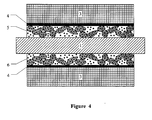
- FIGS 1 to 4 are provided to visualise some of the uses described above.
- Directly catalysing the various components of a PEM fuel cell with noble metal nanoparticles is accomplished by applying the aqueous solution of the stabilised nanoparticles with no further additives to the components in question by a spray process, by brushing or immersing or by means of screen printing. After coating, the temporary stabiliser is decomposed by treating with acid or alkali (depending on the type of stabiliser) and is then washed out.
- Figure 1 visualises such a coating on the opposing surfaces of a polymer electrolyte membrane (1).
- the noble metal nanoparticles (2) are directly applied to the surfaces of the ionomer by a process as described above.
- Figure 2 shows a similar coating as in Figure 1 on an electrode backing consisting of a hydrophobic gas diffusion layer (3) with a carbon black micro layer (4) on one of its surfaces.
- a micro layer consists of a mixture of a hydrophobic polymer and carbon black.
- the micro layer has a microporosity and serves as an intermediate layer between the gas diffusion layer and the catalyst layer of a MEA to improve the electronic connection between both.
- the noble metal nanoparticles (2) are directly deposited onto the micro layer. Since an electrode backing can withstand much higher temperatures than the polymer membrane (340°C instead of only 150°C) the temporary stabiliser can be decomposed in this case thermally by heating the coated electrode backing up to a temperature of 250°C.
- Figure 3 shows the structure of a polymer electrolyte membrane (1) coated with two catalyst layers (5) and (6).
- the catalyst layers comprise a supported electrocatalyst (7) and unsupported nanoparticles (8).
- the supported electrocatalyst and the unsupported nanoparticles are both dispersed in a matrix of a ionomer (9).
- the catalyst layers (5) and (6) may be the same or different. In the final fuel cell one of these catalyst layers functions as the anode and the other as the cathode of the fuel cell.
- Figure 4 visualises a polymer electrolyte fuel cell comprising the membrane electrode assembly of figure 3 complemented by two electrode backings consisting of a hydrophobic gas diffusion layer (3) and a micro layer (4). Taking the electrode backings as one layer, the structure of figure 4 can be viewed as a 5-layered membrane electrode assembly.
- membrane electrode assemblies were prepared by using nanoparticles according to the invention and their electrochemical performance data were characterised.
- the membrane electrode assemblies were processed to give PEM single cells and their characteristics (change in voltage/current density plot) were measured at a pressure of about 1 bar (abs.) when operated with hydrogen/air or with reformate/air.
- the size of each cell was 50 cm 2 , the cell temperature was 75 °C. From the characteristic plots, the cell voltage obtained at a current density of 500 mA/cm 2 was recorded as a measure for the electrocatalytic performance of the cell.
- the colloidal solution prepared in this way had a pH value of 5.9 and contained 10 g Pt/l (1 wt.% Pt) and 10 g/l (1 wt.%) of the stabiliser gum arabic.
- the ratio of Pt nanoparticles to stabiliser was thus 1:1.
- the total chlorine content of the solution was less than 10 ppm.
- the average size of the Pt particles was determined using TEM (transmission electron microscopy) and was 2 nm.
- the electrodes prepared in this way were combined with an non-catalysed membrane to give a 5-layered membrane electrode assembly which had a total Pt loading of 0.25 mg Pt/cm 2 .
- very good performance values were obtained when operating with hydrogen/air (pressureless operation at about 1 bar; cell voltage: 600 mV with a current density of 500 mA/cm 2 ).
- the solution was held under reflux for one hour at 85°C and then concentrated by evaporation to a volume of 100 ml.
- the colloidal solution obtained in this way had a pH value of 5.7 and contained 10 g PtRu/l (1 wt.% PtRu, atomic ratio 1:1) and 10 g/l (1 wt.%) of the stabiliser gum arabic.
- the ratio of PtRu nanoparticles to stabiliser was thus 1:1.
- the total chlorine content of the solution was less than 50 ppm.
- the average size of the PtRu particles was determined by TEM and was 2.5 nm.
- the single cell test produced very good performance values when operating with reformate/air (reformate composition: 60 vol.% hydrogen, 25 vol.% carbon dioxide, 15 vol.% nitrogen, 40 ppm CO, 2 % air bleed, pressureless operation; cell voltage: 550 mV with a current density of 500 mA/cm 2 ).
- the colloidal solution obtained in this way had a pH value of 5.6 and contained 2 g Pt/l (0.2 wt.% Pt) and 2 g/l (0.2 wt.%) of the stabiliser Kelzan.
- the ratio of Pt nanoparticles to stabiliser was thus 1:1.
- the total chlorine content of the solution was less than 30 ppm.
- the average size of the Pt particles was determined by TEM and was 2.5 nm.
- An ionomer membrane was catalysed in the way described in example 1. However, the cathode face of the membrane was coated with PtCr(3:1) nanoparticles and the anode face was coated with pure Pt nanoparticles.
- the membrane coated in this way had a total platinum loading of 0.2 mg Pt/cm 2 . Measurement in a PEM single cell when operating with hydrogen/air (pressureless operation, about 1 bar) provided very good results.
- the cell voltage was 720 mV with a current density of 500 mA/cm 2 .
- Pt nanoparticles were prepared in the way described in example 1. To catalyse an ionomer membrane, the Pt nanoparticles were incorporated into a catalyst ink of the following composition: 15.0 g Pt supported catalyst (40 wt.% Pt on carbon black) 50.0 g Nafion solution (10 % in water) 30.0 g Pt nanoparticles (Pt content 1 wt.%) 5.0 g Dipropylene glycol 100.0 g
- the above catalyst ink contains a mixture of a conventional Pt supported catalyst and unsupported noble metal nanoparticles according to the invention.
- the ink was applied in a screen printing process to the anode and cathode faces of an ionomer membrane (Nafion 112) to give a membrane electrode structure as shown in figure 3.
- the total Pt loading was 0.5 mg/cm 2 .
- the cell voltage was 710 mV with a current density of 500 mA/cm 2 .
Landscapes
- Chemical & Material Sciences (AREA)
- Engineering & Computer Science (AREA)
- Nanotechnology (AREA)
- Chemical Kinetics & Catalysis (AREA)
- Materials Engineering (AREA)
- Organic Chemistry (AREA)
- Inorganic Chemistry (AREA)
- Crystallography & Structural Chemistry (AREA)
- General Chemical & Material Sciences (AREA)
- Electrochemistry (AREA)
- Dispersion Chemistry (AREA)
- Manufacturing & Machinery (AREA)
- Condensed Matter Physics & Semiconductors (AREA)
- General Physics & Mathematics (AREA)
- Composite Materials (AREA)
- Physics & Mathematics (AREA)
- Life Sciences & Earth Sciences (AREA)
- Sustainable Development (AREA)
- Sustainable Energy (AREA)
- Inert Electrodes (AREA)
- Catalysts (AREA)
- Manufacture Of Metal Powder And Suspensions Thereof (AREA)
- Powder Metallurgy (AREA)
- Fuel Cell (AREA)
- Colloid Chemistry (AREA)
- Pigments, Carbon Blacks, Or Wood Stains (AREA)
Abstract
Description
- for Pt:
- hexahydroxoplatinic(IV) acid, ethylammonium hexahydroxoplatinate, tetraammineplatinum(II) nitrate, platinum(IV) nitrate, tetraammineplatinum(II) hydroxide solution
- for Pd:
- tetraamminepalladium(II) nitrate, palladium(II) nitrate, palladium(II) sulfate hydrate
- for Ru:
- trinitratonitrosylruthenium(II), ruthenium(III) oxalate hydrate etc.
- for Rh:
- rhodium(III) nitrate hydrate, rhodium(III) sulfate solution etc.
- Figure 1:
- Polymer electrolyte membrane directly catalysed with nanoparticles
- Figure 2:
- Electrode backing directly catalysed with nanoparticles
- Figure 3:
- Membrane electrode assembly (MEA) with catalyst layers comprising a supported electrocatalyst and nanoparticles
- Figure 4:
- 5-layered membrane electrode assembly
| 15.0 g | Pt supported catalyst (40 wt.% Pt on carbon black) |
| 50.0 g | Nafion solution (10 % in water) |
| 30.0 g | Pt nanoparticles (Pt content 1 wt.%) |
| 5.0 g | Dipropylene glycol |
| |
Claims (22)
- Nanoparticles containing noble metals only or noble metals in combination with base metals,
characterised in that
they are embedded in an aqueous solution of a temporary stabiliser based on a polysaccharide. - Nanoparticles according to claim 1,
characterised in that
the temporary stabiliser can be removed by pyrolysis at temperatures up to 250°C. - Nanoparticles according to claim 1,
characterised in that
the temporary stabiliser can be removed by breaking the glycosidic bonds in the presence of acids or alkalis. - Nanoparticles according to claim 1,
characterised in that
the aqueous solution has a pH-value in the range of from 5 to 8. - Nanoparticles according to claim 1,
characterised in that
the aqueous solution has a total chlorine concentration of less than 100 ppm. - Nanoparticles according to one of claims 1 to 5,
characterised in that
they contain at least one noble metal from the group platinum, palladium, rhodium, iridium, ruthenium, osmium, gold and silver and optionally at least one base metal from the group iron, cobalt, nickel, copper, titanium, vanadium, chromium, manganese, molybdenum, tungsten and rhenium. - Nanoparticles according to claim 6,
characterised in that
the particle size is between 0.1 nm and 100 nm. - Nanoparticles according to claim 7,
characterised in that
the polysaccharide consists of gum arabic, xanthan gum, tragacanth or mixtures thereof. - Nanoparticles according to claim 8,
characterised in that
the concentration of particles in the aqueous solution is between 0.01 and 500 grams per litre. - Nanoparticles according to claim 9,
characterised in that
the ratio by weight of nanoparticles to stabiliser is between 10:1 and 1:10. - A process for preparing nanoparticles according to claim 1,
characterised in that
the precursor compounds for the desired noble metals and optionally the base metals with a total chlorine concentration of less than 500 ppm are reduced, using a reducing agent, in an aqueous solution in the presence of the polysaccharide. - A process for preparing nanoparticles according to claim 11,
characterised in that
hydrogen, hydrazine, formic acid, formaldehyde, lower aliphatic alcohols or similar compounds which decompose to give gaseous constituents during the reduction reaction are used as reducing agents. - Use of the nanoparticles according to one of the claims 1 to 9 to prepare catalysed ionomer membranes, gas diffusion electrodes and membrane electrode assemblies for PEM fuel cells.
- Use of the nanoparticles according to one of the claims 1 to 10 for the preparation of supported electrocatalysts on a conductive carbon support with a noble metal content of from 10 to 80 wt.%, with respect to the total weight of the supported electrocatalyst.
- Supported electrocatalysts, catalysed ionomer membranes, catalysed gas distribution structures and membrane electrode assemblies for fuel cells,
characterised in that
nanoparticles according to one of claims 1 to 10 are used for the catalysing process. - Catalyst ink for catalysing ionomer membranes, gas distribution structures and membrane electrode assemblies for fuel cells,
characterised in that,
it contains nanoparticles according to one of claims 1 to 10. - A process for the catalytic coating of ionomer membranes using noble metal nanoparticles according to one of claims 1 to 10,
characterised in that,
after application of the noble metal nanoparticles, the polysaccharide is removed by breaking the glycosidic bonds in the presence of acids or alkalis. - A process for the catalytic coating of gas diffusion electrodes using noble metal nanoparticles according to one of claims 1 to 10,
characterised in that,
after application of the noble metal nanoparticles, the polysaccharide is removed by pyrolysis at temperatures up to 250°C. - A process for the preparation of carbon-supported electrocatalysts using noble metal nanoparticles according to one of the claims 1 to 10,
characterised in that
after deposition of the noble metal nanoparticles, the polysaccharide is removed by breaking the glycosidic bonds in the presence of acids or alkalis. - A process for the preparation of carbon-supported electrocatalysts using noble metal nanoparticles according to one of the claims 1 to 10,
characterised in that
after deposition of the noble metal nanoparticles, the polysaccharide is removed by pyrolysis at temperatures up to 250°C. - Membrane electrode assemblies for fuel cells,
characterised in that
they are prepared using nanoparticles in accordance with one of claims 1 to 10 and they have a total platinum loading of less than 0.5 mg Pt/cm2. - A fuel cell stack,
characterised in that
it contains membrane electrode assemblies according to claim 21.
Applications Claiming Priority (2)
| Application Number | Priority Date | Filing Date | Title |
|---|---|---|---|
| DE10037071A DE10037071A1 (en) | 2000-07-29 | 2000-07-29 | Precious metal nanoparticles, process for their production and use |
| DE10037071 | 2000-07-29 |
Publications (2)
| Publication Number | Publication Date |
|---|---|
| EP1175948A2 true EP1175948A2 (en) | 2002-01-30 |
| EP1175948A3 EP1175948A3 (en) | 2006-04-19 |
Family
ID=7650702
Family Applications (1)
| Application Number | Title | Priority Date | Filing Date |
|---|---|---|---|
| EP01117494A Withdrawn EP1175948A3 (en) | 2000-07-29 | 2001-07-20 | Noble metal nanoparticles, a process for preparing these and their use |
Country Status (7)
| Country | Link |
|---|---|
| US (4) | US20020034675A1 (en) |
| EP (1) | EP1175948A3 (en) |
| JP (1) | JP5044075B2 (en) |
| KR (1) | KR100886794B1 (en) |
| BR (1) | BR0103322A (en) |
| CA (1) | CA2354239C (en) |
| DE (1) | DE10037071A1 (en) |
Cited By (20)
| Publication number | Priority date | Publication date | Assignee | Title |
|---|---|---|---|---|
| WO2003061827A3 (en) * | 2001-12-03 | 2003-10-16 | 3M Innovative Properties Co | Supported nanoparticle catalyst |
| EP1408569A3 (en) * | 2002-10-11 | 2004-11-10 | Isamu Uchida | Electrocatalyst for ethanol oxidation and direct ethanol fuel cell using the same |
| EP1522341A1 (en) * | 2003-09-22 | 2005-04-13 | Tanaka Kikinzoku Kogyo K.K. | Precious metal-metal oxide composite cluster |
| WO2005097314A1 (en) * | 2004-04-09 | 2005-10-20 | Pemeas Gmbh | Platinum catalysts obtained by reducing in-situ formed platinum dioxide |
| EP1318559A3 (en) * | 2001-12-04 | 2006-02-08 | Umicore AG & Co. KG | Method for the production of membrane electrode assemblies for fuel cells |
| WO2007088291A1 (en) * | 2006-02-03 | 2007-08-09 | Commissariat A L'energie Atomique | Cathode for electrochemical reactor, electrochemical reactor incorporating such cathodes and method for making said cathode |
| KR100766964B1 (en) | 2006-11-22 | 2007-10-15 | 삼성에스디아이 주식회사 | Membrane-electrode assembly for fuel cell, manufacturing method thereof, and fuel cell system comprising same |
| EP1674176A4 (en) * | 2003-10-15 | 2007-11-14 | Sumitomo Electric Industries | GRANULAR METAL POWDER |
| KR100814844B1 (en) | 2006-11-20 | 2008-03-20 | 삼성에스디아이 주식회사 | Membrane-electrode assembly for fuel cell, method for manufacturing same and fuel cell system comprising same |
| EP1921700A1 (en) | 2006-11-10 | 2008-05-14 | Samsung SDI Co., Ltd. | Electrode, membrane-electrode assembly, and fuel cell system including same |
| CN100391664C (en) * | 2005-10-19 | 2008-06-04 | 清华大学 | A method for preparing monodisperse metal nanoparticles |
| WO2008085472A1 (en) * | 2006-12-27 | 2008-07-17 | Eveready Battery Company, Inc. | Electrochemical cell with a catalytic electrode and process for making the electrode and the cell |
| KR100886794B1 (en) * | 2000-07-29 | 2009-03-05 | 우미코레 아게 운트 코 카게 | Noble metal nanoparticles, a process for preparing these and their use |
| US7713910B2 (en) | 2004-10-29 | 2010-05-11 | Umicore Ag & Co Kg | Method for manufacture of noble metal alloy catalysts and catalysts prepared therewith |
| ITTS20080012A1 (en) * | 2008-11-19 | 2010-05-20 | Eurosen S R L | ELECTROCHEMICAL BIOSENSORS BASED ON NANOBIOCOMPOSITES |
| CN101269325B (en) * | 2008-04-30 | 2011-06-22 | 复旦大学 | Catalyst for direct formic acid fuel cell and preparation method thereof |
| EP2704239A1 (en) * | 2012-08-29 | 2014-03-05 | SolviCore GmbH & Co KG | Colloidal dispersions comprising precious metal particles and acidic ionomer components and methods of their manufacture and use |
| CN104538649A (en) * | 2014-12-23 | 2015-04-22 | 天津大学 | Method for preparing platinum/titanium dioxide composite nano porous structure on titanium-copper amorphous alloy |
| EP3210989A1 (en) * | 2016-02-26 | 2017-08-30 | Umicore AG & Co. KG | Noble metal compounds |
| RU2716160C1 (en) * | 2019-09-16 | 2020-03-06 | Федеральное государственное бюджетное образовательное учреждение высшего образования "Кировский государственный медицинский университет" Министерства здравоохранения Российской Федерации (ФГБОУ ВО Кировский ГМУ Минздрава России) | Method of producing silver nanoparticles in an aqueous medium |
Families Citing this family (57)
| Publication number | Priority date | Publication date | Assignee | Title |
|---|---|---|---|---|
| DE10112232A1 (en) * | 2001-03-07 | 2002-09-19 | Deutsch Zentr Luft & Raumfahrt | Method for producing a multi-layer electrode or electrode composite unit and gas diffusion electrode |
| KR100442842B1 (en) * | 2002-02-19 | 2004-08-02 | 삼성전자주식회사 | Pt-Ru-M1-M2 quaternary catalyst based on Pt-Ru for Direct Methanol Fuel Cell(DMFC) |
| JP3861146B2 (en) * | 2002-10-25 | 2006-12-20 | 独立行政法人産業技術総合研究所 | Anode catalyst for fuel cell |
| US20080199685A1 (en) * | 2003-02-10 | 2008-08-21 | Michael Jeremiah Bortner | Spray self assembly |
| US7288325B2 (en) * | 2003-03-14 | 2007-10-30 | The Pennsylvania State University | Hydrogen storage material based on platelets and/or a multilayered core/shell structure |
| US8211593B2 (en) * | 2003-09-08 | 2012-07-03 | Intematix Corporation | Low platinum fuel cells, catalysts, and method for preparing the same |
| US20050129843A1 (en) * | 2003-12-11 | 2005-06-16 | Xerox Corporation | Nanoparticle deposition process |
| US7955758B2 (en) * | 2004-01-22 | 2011-06-07 | GM Global Technology Operations LLC | Membrane electrode assembly prepared by direct spray of catalyst to membrane |
| KR100682887B1 (en) * | 2004-01-30 | 2007-02-15 | 삼성전자주식회사 | Nanostructure Formation Method |
| US7270695B2 (en) * | 2004-04-01 | 2007-09-18 | Dong-A University | Synthesis of nanosized metal particles |
| KR100872162B1 (en) * | 2004-04-14 | 2008-12-08 | (주)석경에이.티 | Conducting metal nano particle and nano-metal ink containing it |
| US7053021B1 (en) * | 2004-04-22 | 2006-05-30 | The Research Foundation Of The State University Of New York | Core-shell synthesis of carbon-supported alloy nanoparticle catalysts |
| US7335245B2 (en) * | 2004-04-22 | 2008-02-26 | Honda Motor Co., Ltd. | Metal and alloy nanoparticles and synthesis methods thereof |
| DE102004024845A1 (en) * | 2004-05-13 | 2005-12-08 | Volkswagen Ag | Catalyst layer`s manufacture for high-temperature fuel cells, involves applying electrode paste on substrate under blade pressure to form catalyst layers, drying layers above room temperature and soaking dried layers in acid |
| US7041191B2 (en) * | 2004-05-27 | 2006-05-09 | Institute Of Nuclear Energy Research | Method for manufacturing membrane electrode assembly of fuel cell by printing processes |
| GB0413771D0 (en) * | 2004-06-21 | 2004-07-21 | Johnson Matthey Plc | Metal oxide sols |
| US7229944B2 (en) * | 2004-07-23 | 2007-06-12 | Massachusetts Institute Of Technology | Fiber structures including catalysts and methods associated with the same |
| US7972744B2 (en) * | 2004-09-28 | 2011-07-05 | GM Global Technology Operations LLC | Fuel cell assembly |
| IT1357799B (en) * | 2004-11-05 | 2009-03-17 | St Microelectronics Srl | PROCESS FOR THE PREPARATION OF A COMPOSITE POLYMERIC MATERIAL |
| US20060116285A1 (en) * | 2004-11-29 | 2006-06-01 | De Nora Elettrodi S.P.A. | Platinum alloy carbon-supported catalysts |
| US20060130700A1 (en) * | 2004-12-16 | 2006-06-22 | Reinartz Nicole M | Silver-containing inkjet ink |
| KR100601984B1 (en) * | 2005-01-20 | 2006-07-18 | 삼성에스디아이 주식회사 | Supported catalyst and method for producing the same |
| JP5377962B2 (en) * | 2005-08-19 | 2013-12-25 | ナノシス・インク. | Electronic grade metal nanostructure |
| US8173166B2 (en) * | 2005-09-09 | 2012-05-08 | Honda Motor Co., Ltd. | Methods of producing tungsten nanoparticles |
| US8084140B2 (en) * | 2005-12-02 | 2011-12-27 | Clarkson University | Silver platelets comprising palladium |
| US7829140B1 (en) | 2006-03-29 | 2010-11-09 | The Research Foundation Of The State University Of New York | Method of forming iron oxide core metal shell nanoparticles |
| US20090215615A1 (en) * | 2006-07-11 | 2009-08-27 | 3M Innovative Properties Company | Method of forming supported nanoparticle catalysts |
| US8343627B2 (en) * | 2007-02-20 | 2013-01-01 | Research Foundation Of State University Of New York | Core-shell nanoparticles with multiple cores and a method for fabricating them |
| DE102007024161A1 (en) * | 2007-05-24 | 2008-11-27 | Daimler Ag | Bipolar plate for fuel cells |
| GB0711882D0 (en) * | 2007-06-20 | 2007-07-25 | Johnson Matthey Plc | Catalyst layer |
| CN101939091B (en) * | 2008-01-09 | 2013-11-20 | 尤米科尔股份公司及两合公司 | Method for preparing dispersions of precious metal nanoparticles and for isolating such nanoparticles from the dispersions |
| EP2082805A1 (en) * | 2008-01-28 | 2009-07-29 | Basf Se | Process for the preparation of an aqueous colloidal precious metal suspension |
| US9017837B2 (en) | 2008-02-19 | 2015-04-28 | Cabot Corporation | High surface area graphitized carbon and processes for making same |
| EP2294644A4 (en) * | 2008-06-04 | 2013-05-22 | Cellera Inc | ALKALINE MEMBRANE FUEL CELLS AND APPARATUS AND METHOD FOR INTRODUCING WATER INSIDE THERETO |
| US8304368B2 (en) * | 2009-02-23 | 2012-11-06 | Cellera, Inc. | Catalyst coated membrane (CCM) and catalyst film/layer for alkaline membrane fuel cells and methods of making same |
| WO2010096797A1 (en) * | 2009-02-23 | 2010-08-26 | Cellera, Inc. | Catalyst coated membrane (ccm) and catalyst film/layer for alkaline membrane fuel cells and methods of making same |
| CA2770880C (en) | 2009-08-24 | 2018-10-16 | Cellera, Inc. | Systems and methods of securing immunity to air co2 in alkaline fuel cells |
| JP5727766B2 (en) * | 2009-12-10 | 2015-06-03 | 理想科学工業株式会社 | Conductive emulsion ink and method for forming conductive thin film using the same |
| US20110218304A1 (en) * | 2010-03-03 | 2011-09-08 | Tecona Technologies, Inc. | Low cost and high yield method of making large quantity and homogenous metal nanoparticles and controlling their solubility |
| CA2801005C (en) | 2010-06-07 | 2019-10-29 | Cellera, Inc. | Chemical bonding for catalyst/membrane surface adherence in membrane-electrolyte fuel cells |
| CN103687683B (en) * | 2011-06-08 | 2016-02-17 | 百拉得动力系统公司 | From palladium nano-particles removing surfactant |
| WO2013070653A1 (en) | 2011-11-09 | 2013-05-16 | Board Of Trustees Michigan State University | Metallic nanoparticle synthesis with carbohydrate capping agent |
| US20140140465A1 (en) * | 2012-11-19 | 2014-05-22 | Hitachi-Ge Nuclear Energy Ltd. | Platinum Oxide Colloidal Solution, Manufacturing Method Therefor, Manufacture Apparatus Thereof, and Method of Injection Noble Metal of Boiling Water Nuclear Power Plant |
| CN105163884A (en) | 2013-04-12 | 2015-12-16 | 德克萨斯州立大学董事会 | Synthesis of Bimetallic Nanoparticle Catalysts Using Microwave Irradiation |
| DE102013108664A1 (en) | 2013-08-09 | 2015-02-12 | Leibniz-Institut Für Neue Materialien Gemeinnützige Gmbh | Surface-modified metal colloids and their preparation |
| US10207921B2 (en) * | 2013-11-06 | 2019-02-19 | Yissum Research Development Company Of The Hebrew University Of Jerusalem Ltd. | Method for storage and release of hydrogen |
| JP6606861B2 (en) | 2014-08-11 | 2019-11-20 | 株式会社リコー | Method for manufacturing additive manufacturing powder and additive manufacturing |
| US9944571B2 (en) | 2014-11-19 | 2018-04-17 | Solvay Specialty Polymers Italy S.P.A. | One-pot process using heterogeneous catalyst |
| DE102015101249B4 (en) * | 2014-12-01 | 2021-02-11 | Deutsches Zentrum für Luft- und Raumfahrt e.V. | A method for producing an electrocatalyst for an electrode of an electrochemical cell, an electrochemical reactor and an electrocatalyst for an electrochemical cell |
| JP2018509524A (en) * | 2015-01-09 | 2018-04-05 | クラークソン ユニバーシティ | Silver-coated copper flakes and method for producing the same |
| WO2018182995A1 (en) | 2017-03-17 | 2018-10-04 | Board Of Regents, The University Of Texas System | Methods of making metal particles |
| CN113492214B (en) * | 2020-04-07 | 2023-07-11 | 中国工程物理研究院材料研究所 | Pt nano particle and preparation method thereof |
| US11492547B2 (en) | 2020-06-04 | 2022-11-08 | UbiQD, Inc. | Low-PH nanoparticles and ligands |
| JP7468379B2 (en) * | 2021-01-27 | 2024-04-16 | トヨタ紡織株式会社 | Manufacturing method of alloy fine particle supported catalyst, electrode, fuel cell, manufacturing method of alloy fine particle, manufacturing method of membrane electrode assembly, and manufacturing method of fuel cell |
| JP7791066B2 (en) * | 2022-09-20 | 2025-12-23 | 株式会社東芝 | Method for producing precious metal particle-containing electrolyte membrane |
| US12378683B2 (en) * | 2022-10-18 | 2025-08-05 | Plug Power Inc. | Sputtering-based catalyst deposition on particles for membrane electrode assembly (MEA) catalyst layer |
| CN119650729B (en) * | 2025-01-21 | 2025-10-03 | 海南大学 | A non-noble metal fuel cell oxygen reduction catalyst based on self-assembled semi-interpenetrating polymer network and its preparation method and application |
Family Cites Families (30)
| Publication number | Priority date | Publication date | Assignee | Title |
|---|---|---|---|---|
| US1429876A (en) * | 1919-10-01 | 1922-09-19 | Hemelmann Hugo | Colloidal solution and method of preparing same |
| CH434588A (en) * | 1962-11-15 | 1967-04-30 | Tesla Np | Process for the production of silver powder |
| US3287169A (en) * | 1965-04-09 | 1966-11-22 | Baldwin Lima Hamilton Corp | Fuel cell having a hollow foraminous electrode |
| SE313831B (en) | 1968-10-09 | 1969-08-25 | Ericsson Telefon Ab L M | |
| US3992512A (en) * | 1971-06-16 | 1976-11-16 | Prototech Company | Finely particulated colloidal platinum compound and sol for producing the same, and method of preparation |
| GB2059282B (en) * | 1979-09-08 | 1983-07-06 | Engelhard Min & Chem | Catalyst for photolytic production of hydrogen from water |
| GR76426B (en) * | 1981-05-21 | 1984-08-10 | Snam Progetti | |
| CA1224003A (en) * | 1984-04-24 | 1987-07-14 | Robert S. Molday | Colloidal sized metal-polysaccharide particles |
| US4652311A (en) * | 1984-05-07 | 1987-03-24 | Shipley Company Inc. | Catalytic metal of reduced particle size |
| US4634468A (en) * | 1984-05-07 | 1987-01-06 | Shipley Company Inc. | Catalytic metal of reduced particle size |
| US4876115A (en) * | 1987-01-30 | 1989-10-24 | United States Department Of Energy | Electrode assembly for use in a solid polymer electrolyte fuel cell |
| US4871790A (en) * | 1987-11-25 | 1989-10-03 | Minnesota Mining And Manufacturing Company | Colloidal metals in monomers or polymers |
| JPH01319683A (en) * | 1988-06-20 | 1989-12-25 | Electroplating Eng Of Japan Co | Platinum colloidal solution and electroless platinum plating method using the same solution and production of platinum carrier |
| US5211984A (en) * | 1991-02-19 | 1993-05-18 | The Regents Of The University Of California | Membrane catalyst layer for fuel cells |
| US5248772A (en) * | 1992-01-29 | 1993-09-28 | Coulter Corporation | Formation of colloidal metal dispersions using aminodextrans as reductants and protective agents |
| DE4206680C1 (en) * | 1992-02-28 | 1994-01-27 | Schering Ag | Process for the metallization of non-conductive surfaces and the use of hydroxymethanesulfinic acid in the process |
| US5364711A (en) * | 1992-04-01 | 1994-11-15 | Kabushiki Kaisha Toshiba | Fuel cell |
| US5421989A (en) * | 1993-08-31 | 1995-06-06 | Atotech Deutschland Gmbh | Process for the metallization of nonconductive substrates with elimination of electroless metallization |
| DE4412463C3 (en) * | 1994-04-08 | 2000-02-10 | Atotech Deutschland Gmbh | Process for the preparation of a palladium colloid solution and its use |
| DE4426973C1 (en) * | 1994-07-29 | 1996-03-28 | Degussa | Method for producing a platinum alloy catalyst that can be used as a fuel cell electrode |
| DE4443705A1 (en) * | 1994-12-08 | 1996-06-13 | Studiengesellschaft Kohle Mbh | Process for the preparation of surfactant-stabilized mono- and bimetallic colloids from groups VIII and Ib of the Periodic Table as isolable and water-soluble precursors for catalysts |
| DE19517598C1 (en) * | 1995-05-13 | 1997-01-02 | Degussa | Platinum-aluminum alloy catalyst and its use in fuel cells |
| DE19611510A1 (en) * | 1996-03-23 | 1997-09-25 | Degussa | Gas diffusion electrode for membrane fuel cells and process for their manufacture |
| JP3179729B2 (en) * | 1996-09-25 | 2001-06-25 | 株式会社日本アルミ | Method for producing metal oxide fine particles |
| DE19745904A1 (en) * | 1997-10-17 | 1999-04-22 | Hoechst Ag | Water-soluble metal colloid solution, used as catalyst for fuel cells and electrolysis cells |
| DE19754304A1 (en) * | 1997-12-08 | 1999-06-10 | Hoechst Ag | Polybetaine-stabilized platinum nanoparticles, process for their preparation and use for electrocatalysts in fuel cells |
| DE19803891A1 (en) * | 1998-01-31 | 1999-08-05 | Bayer Ag | Aqueous precious metal colloids and their use |
| DE19821968A1 (en) * | 1998-05-18 | 1999-11-25 | Studiengesellschaft Kohle Mbh | Production of transition metal colloid for use e.g. as coating, catalyst, fuel cell component and in ink jet printing, laser etching, information storage and cell labeling and cell separation |
| JP2000256015A (en) * | 1999-03-08 | 2000-09-19 | Tokuyama Corp | Metal oxide complex and carrier for immobilizing proteins |
| DE10037071A1 (en) * | 2000-07-29 | 2002-02-21 | Omg Ag & Co Kg | Precious metal nanoparticles, process for their production and use |
-
2000
- 2000-07-29 DE DE10037071A patent/DE10037071A1/en not_active Withdrawn
-
2001
- 2001-07-20 EP EP01117494A patent/EP1175948A3/en not_active Withdrawn
- 2001-07-24 US US09/910,959 patent/US20020034675A1/en not_active Abandoned
- 2001-07-27 CA CA2354239A patent/CA2354239C/en not_active Expired - Fee Related
- 2001-07-28 KR KR1020010045724A patent/KR100886794B1/en not_active Expired - Fee Related
- 2001-07-30 BR BR0103322-0A patent/BR0103322A/en not_active Application Discontinuation
- 2001-07-30 JP JP2001230394A patent/JP5044075B2/en not_active Expired - Fee Related
-
2006
- 2006-04-17 US US11/405,913 patent/US8071259B2/en not_active Expired - Fee Related
-
2011
- 2011-12-02 US US13/309,677 patent/US8361921B2/en not_active Expired - Fee Related
-
2012
- 2012-08-07 US US13/569,178 patent/US20120301606A1/en not_active Abandoned
Cited By (35)
| Publication number | Priority date | Publication date | Assignee | Title |
|---|---|---|---|---|
| US8071259B2 (en) | 2000-07-29 | 2011-12-06 | Umicore Ag & Co. Kg | Noble metal nanoparticles, a process for preparing these and their use |
| KR100886794B1 (en) * | 2000-07-29 | 2009-03-05 | 우미코레 아게 운트 코 카게 | Noble metal nanoparticles, a process for preparing these and their use |
| WO2003061827A3 (en) * | 2001-12-03 | 2003-10-16 | 3M Innovative Properties Co | Supported nanoparticle catalyst |
| US6686308B2 (en) | 2001-12-03 | 2004-02-03 | 3M Innovative Properties Company | Supported nanoparticle catalyst |
| EP1318559A3 (en) * | 2001-12-04 | 2006-02-08 | Umicore AG & Co. KG | Method for the production of membrane electrode assemblies for fuel cells |
| EP1408569A3 (en) * | 2002-10-11 | 2004-11-10 | Isamu Uchida | Electrocatalyst for ethanol oxidation and direct ethanol fuel cell using the same |
| US7960070B2 (en) | 2002-10-11 | 2011-06-14 | Isamu Uchida | Electrocatalyst for ethanol oxidation and direct ethanol fuel cell using the same |
| EP1522341A1 (en) * | 2003-09-22 | 2005-04-13 | Tanaka Kikinzoku Kogyo K.K. | Precious metal-metal oxide composite cluster |
| US7691175B2 (en) | 2003-10-15 | 2010-04-06 | Sumitomo Electric Industries, Ltd. | Granular metal powder |
| EP1674176A4 (en) * | 2003-10-15 | 2007-11-14 | Sumitomo Electric Industries | GRANULAR METAL POWDER |
| WO2005097314A1 (en) * | 2004-04-09 | 2005-10-20 | Pemeas Gmbh | Platinum catalysts obtained by reducing in-situ formed platinum dioxide |
| US8017548B2 (en) | 2004-10-29 | 2011-09-13 | Umicore Ag & Co. Kg | Method for manufacture of noble metal alloy catalysts and catalysts prepared therewith |
| US7713910B2 (en) | 2004-10-29 | 2010-05-11 | Umicore Ag & Co Kg | Method for manufacture of noble metal alloy catalysts and catalysts prepared therewith |
| CN100391664C (en) * | 2005-10-19 | 2008-06-04 | 清华大学 | A method for preparing monodisperse metal nanoparticles |
| FR2897205A1 (en) * | 2006-02-03 | 2007-08-10 | Commissariat Energie Atomique | CATHODE FOR ELECTROCHEMICAL REACTOR, ELECTROCHEMICAL REACTOR INTEGRATION OF SUCH CATHODES AND METHOD OF MANUFACTURING SUCH CATHODE |
| US8318375B2 (en) | 2006-02-03 | 2012-11-27 | Commissariat A L'energie Atomique | Cathode for electrochemical reactor, electrochemical reactor incorporating such cathodes and method for making said cathode |
| WO2007088291A1 (en) * | 2006-02-03 | 2007-08-09 | Commissariat A L'energie Atomique | Cathode for electrochemical reactor, electrochemical reactor incorporating such cathodes and method for making said cathode |
| EP1921700A1 (en) | 2006-11-10 | 2008-05-14 | Samsung SDI Co., Ltd. | Electrode, membrane-electrode assembly, and fuel cell system including same |
| US8637208B2 (en) | 2006-11-10 | 2014-01-28 | Samsung Sdi Co., Ltd. | Electrode for fuel cell, membrane-electrode assembly including same, and fuel cell system including same |
| KR100814844B1 (en) | 2006-11-20 | 2008-03-20 | 삼성에스디아이 주식회사 | Membrane-electrode assembly for fuel cell, method for manufacturing same and fuel cell system comprising same |
| KR100766964B1 (en) | 2006-11-22 | 2007-10-15 | 삼성에스디아이 주식회사 | Membrane-electrode assembly for fuel cell, manufacturing method thereof, and fuel cell system comprising same |
| WO2008085472A1 (en) * | 2006-12-27 | 2008-07-17 | Eveready Battery Company, Inc. | Electrochemical cell with a catalytic electrode and process for making the electrode and the cell |
| CN101269325B (en) * | 2008-04-30 | 2011-06-22 | 复旦大学 | Catalyst for direct formic acid fuel cell and preparation method thereof |
| ITTS20080012A1 (en) * | 2008-11-19 | 2010-05-20 | Eurosen S R L | ELECTROCHEMICAL BIOSENSORS BASED ON NANOBIOCOMPOSITES |
| CN105051957A (en) * | 2012-08-29 | 2015-11-11 | 索尔维克雷有限责任两合公司 | Colloidal dispersions comprising precious metal particles and acidic ionomer components and methods of their manufacture and use |
| WO2014033204A1 (en) * | 2012-08-29 | 2014-03-06 | Solvicore Gmbh & Co. Kg | Colloidal dispersions comprising precious metal particles and acidic ionomer components and methods of their manufacture and use |
| EP2704239A1 (en) * | 2012-08-29 | 2014-03-05 | SolviCore GmbH & Co KG | Colloidal dispersions comprising precious metal particles and acidic ionomer components and methods of their manufacture and use |
| CN104538649A (en) * | 2014-12-23 | 2015-04-22 | 天津大学 | Method for preparing platinum/titanium dioxide composite nano porous structure on titanium-copper amorphous alloy |
| CN104538649B (en) * | 2014-12-23 | 2017-02-22 | 天津大学 | Method for preparing platinum/titanium dioxide composite nano porous structure on titanium-copper amorphous alloy |
| EP3210989A1 (en) * | 2016-02-26 | 2017-08-30 | Umicore AG & Co. KG | Noble metal compounds |
| WO2017144726A1 (en) * | 2016-02-26 | 2017-08-31 | Umicore Ag & Co. Kg | Precious metal compounds |
| EP3872083A1 (en) * | 2016-02-26 | 2021-09-01 | UMICORE AG & Co. KG | Precious metal compounds |
| US11352385B2 (en) | 2016-02-26 | 2022-06-07 | Umicore Ag & Co. Kg | Precious metal compounds |
| US12358937B2 (en) | 2016-02-26 | 2025-07-15 | Umicore Ag & Co. Kg | Precious metal compounds |
| RU2716160C1 (en) * | 2019-09-16 | 2020-03-06 | Федеральное государственное бюджетное образовательное учреждение высшего образования "Кировский государственный медицинский университет" Министерства здравоохранения Российской Федерации (ФГБОУ ВО Кировский ГМУ Минздрава России) | Method of producing silver nanoparticles in an aqueous medium |
Also Published As
| Publication number | Publication date |
|---|---|
| US20120301606A1 (en) | 2012-11-29 |
| CA2354239C (en) | 2012-08-28 |
| US8361921B2 (en) | 2013-01-29 |
| JP2002146235A (en) | 2002-05-22 |
| EP1175948A3 (en) | 2006-04-19 |
| KR20020010554A (en) | 2002-02-04 |
| US20060188772A1 (en) | 2006-08-24 |
| JP5044075B2 (en) | 2012-10-10 |
| CA2354239A1 (en) | 2002-01-29 |
| US8071259B2 (en) | 2011-12-06 |
| KR100886794B1 (en) | 2009-03-05 |
| DE10037071A1 (en) | 2002-02-21 |
| US20120077671A1 (en) | 2012-03-29 |
| US20020034675A1 (en) | 2002-03-21 |
| BR0103322A (en) | 2002-03-26 |
Similar Documents
| Publication | Publication Date | Title |
|---|---|---|
| CA2354239C (en) | Noble metal nanoparticles, a process for preparing these and their use | |
| US6686308B2 (en) | Supported nanoparticle catalyst | |
| KR100601984B1 (en) | Supported catalyst and method for producing the same | |
| US6797667B2 (en) | Process for preparing an anode catalyst for fuel cells and the anode catalyst prepared therewith | |
| US7419740B2 (en) | Membrane electrode unit for polymer electrolyte fuel cells and a process for the production thereof | |
| CN108475791B (en) | catalyst | |
| JP4721539B2 (en) | Fuel cell electrode catalyst and method for producing the same | |
| KR20000017364A (en) | Catalyst layer for polymer electrolyte fuel cells | |
| CA2882000A1 (en) | Colloidal dispersions comprising precious metal particles and acidic ionomer components and methods of their manufacture and use | |
| EP1905113B1 (en) | Electrode catalyst with improved longevity properties and fuel cell using the same | |
| KR101270809B1 (en) | Platinum alloy carbon-supported catalysts | |
| EP3494607B1 (en) | Membrane electrode assembly with improved electrode | |
| KR101229400B1 (en) | Platinum/ruthenium catalyst for direct methanol fuel cells | |
| EP2153483B1 (en) | Membrane electrode assembly for fuel cell | |
| CN104995774A (en) | Electrode catalyst, method for preparing same, and membrane electrode assembly and fuel cell comprising same | |
| JP2002305001A (en) | Electrode catalyst for fuel cell and method for producing the same | |
| EP2413406A2 (en) | Catalyst material and method of manufacturing the same | |
| EP3011625B1 (en) | Gas diffusion electrode and process for making same | |
| DE102020132753A1 (en) | Fuel cell catalyst, the same comprehensive fuel cell electrode and the same comprehensive membrane electrode assembly | |
| EP1260269B1 (en) | A process for preparing an anode catalyst for fuel cells | |
| WO2025017297A1 (en) | Method of preparing an ion-conducting membrane layer | |
| CN121488334A (en) | Methods for preparing catalyst layers |
Legal Events
| Date | Code | Title | Description |
|---|---|---|---|
| PUAI | Public reference made under article 153(3) epc to a published international application that has entered the european phase |
Free format text: ORIGINAL CODE: 0009012 |
|
| 17P | Request for examination filed |
Effective date: 20010720 |
|
| AK | Designated contracting states |
Kind code of ref document: A2 Designated state(s): AT BE CH CY DE DK ES FI FR GB GR IE IT LI LU MC NL PT SE TR |
|
| AX | Request for extension of the european patent |
Free format text: AL;LT;LV;MK;RO;SI |
|
| RAP1 | Party data changed (applicant data changed or rights of an application transferred) |
Owner name: UMICORE AG & CO. KG |
|
| PUAL | Search report despatched |
Free format text: ORIGINAL CODE: 0009013 |
|
| AK | Designated contracting states |
Kind code of ref document: A3 Designated state(s): AT BE CH CY DE DK ES FI FR GB GR IE IT LI LU MC NL PT SE TR |
|
| AX | Request for extension of the european patent |
Extension state: AL LT LV MK RO SI |
|
| AKX | Designation fees paid |
Designated state(s): AT BE CH CY DE DK ES FI FR GB GR IE IT LI LU MC NL PT SE TR |
|
| 17Q | First examination report despatched |
Effective date: 20071119 |
|
| STAA | Information on the status of an ep patent application or granted ep patent |
Free format text: STATUS: THE APPLICATION IS DEEMED TO BE WITHDRAWN |
|
| 18D | Application deemed to be withdrawn |
Effective date: 20140201 |