EP1175921A2 - System for combating fires, in particular for use in motor vehicles - Google Patents
System for combating fires, in particular for use in motor vehicles Download PDFInfo
- Publication number
- EP1175921A2 EP1175921A2 EP01830441A EP01830441A EP1175921A2 EP 1175921 A2 EP1175921 A2 EP 1175921A2 EP 01830441 A EP01830441 A EP 01830441A EP 01830441 A EP01830441 A EP 01830441A EP 1175921 A2 EP1175921 A2 EP 1175921A2
- Authority
- EP
- European Patent Office
- Prior art keywords
- explosive
- explosion
- compounds
- nanoparticles
- microcore
- Prior art date
- Legal status (The legal status is an assumption and is not a legal conclusion. Google has not performed a legal analysis and makes no representation as to the accuracy of the status listed.)
- Granted
Links
Images

Classifications
-
- A—HUMAN NECESSITIES
- A62—LIFE-SAVING; FIRE-FIGHTING
- A62C—FIRE-FIGHTING
- A62C99/00—Subject matter not provided for in other groups of this subclass
- A62C99/0009—Methods of extinguishing or preventing the spread of fire by cooling down or suffocating the flames
- A62C99/0045—Methods of extinguishing or preventing the spread of fire by cooling down or suffocating the flames using solid substances, e.g. sand, ashes; using substances forming a crust
-
- A—HUMAN NECESSITIES
- A62—LIFE-SAVING; FIRE-FIGHTING
- A62C—FIRE-FIGHTING
- A62C13/00—Portable extinguishers which are permanently pressurised or pressurised immediately before use
- A62C13/02—Portable extinguishers which are permanently pressurised or pressurised immediately before use with pressure gas produced by chemicals
- A62C13/22—Portable extinguishers which are permanently pressurised or pressurised immediately before use with pressure gas produced by chemicals with incendiary substances producing pressure gas
-
- A—HUMAN NECESSITIES
- A62—LIFE-SAVING; FIRE-FIGHTING
- A62C—FIRE-FIGHTING
- A62C3/00—Fire prevention, containment or extinguishing specially adapted for particular objects or places
- A62C3/07—Fire prevention, containment or extinguishing specially adapted for particular objects or places in vehicles, e.g. in road vehicles
Definitions
- the present invention relates to the field of systems for controlling fires.
- the known systems so far used in combating fires adopt mainly three different strategies: heat reduction, suffocation, and chemical reactions.
- the purpose of the present invention is to provide a new system for controlling fires, which acts with a combination of the three mechanisms mentioned above.
- the subject of the present invention is a system for controlling fires, characterized in that it comprises the following elements:
- nanoparticles particles having dimensions of the order of nanometres.
- the nanoparticles of the two different reaction compounds are compressed separately or mixed within a very contained volume of just a few cubic centimetres.
- the heat initiates the explosion of the explosive, which nebulizes the powder nanoparticles in the environment.
- the first phenomenon of control of the flames is due to the partial suffocation caused by the powder.
- the second phenomenon is due to the chemical reaction between the powders of compounds chosen, the contact between which causes reactions that subtract heat from the flames.
- one compound may be sodium bicarbonate, and the other may be potassium bicarbonate.
- the third effect is the removal of oxygen from the flames. Following upon nebulization due to the explosion, the nanoparticles expand, reacting rapidly with the oxygen present in the environment.
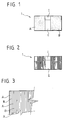
- the device according to the invention designated as a whole by 1,' comprises nanoparticles of two compounds A and B which are compacted into a small cube (a few cubic centimetres in volume) in two separate compartments and which surround an explosive microcore E.
- a priming device I initiates the explosion if it comes into contact with the flame, or else following upon impact.
- Figure 2 illustrates a more efficient variant in which the nanoparticles of the two compounds A and B are deposited in alternate monolayers (see Figure 3) with the purpose of favouring nebulization, the endothermic reaction between the two compounds, and maximization of the number of nanoparticles, which, oxidizing, capture oxygen in the environment.
- the explosive microcore preferably consists of a product with a high rate of explosion, whilst, in order to favour progressive nebulization and maximum expansion of the nanoparticles, the device has explosive branches with a product that has a lower rate of explosion.
- the device for priming the explosive microcore may be of the heat type, of the electric-spark type, or again of the mechanical type, and the control may involve various degrees of complexity and may include a microprocessor, a micro-accelerometer, or a microgyroscope, constructed using microtechnology techniques.
- the devices according to the invention which have a shape and size typical of cubes of sugar, may be cast onto the flames by an electromechanical fire-extinguishing nozzle similar to a gun, or more simply may be dropped by gravity into the danger area.
- a third compound of nanoparticles may be used, which reacts with the oxygen.
- This solution is particularly suitable for the embodiment illustrated in Figure 2, where the alternate layers comprise a succession of three layers of compounds A, B and C.
- the nanoparticles may be prepared in the form of a paste that can be applied by silk-screen printing, and are then deposited in successive layers by silk-screen printing.
- the two compounds of nanoparticles are deposited on the two sides A, B of a film substrate 2 (Figure 4 illustrates the two opposite faces of the film 2) wound as illustrated in Figure 5.
- the priming device is represented by two layers 3 deposited on the two opposite faces of the cylinder constituted by the wound film substrate ( Figure 6).
- the device according to the invention can be used also in the automobile sector, for example for extinguishing a fire resulting from the explosion of the vehicle fuel tank.
- the application of the invention is general.
- Devices according to the invention may be used, for instance, as fire-extinguishing means in the kitchens of dwellings and in public buildings as an alternative to foam-generating means.
- the invention is also suited for being used as a fire-extinguishing means in forestry, more precisely when associated to mechanical or electromechanical ballistic means which are able to shoot a number of devices into the danger area.
Landscapes
- Health & Medical Sciences (AREA)
- Public Health (AREA)
- Business, Economics & Management (AREA)
- Emergency Management (AREA)
- Chemical & Material Sciences (AREA)
- Chemical Kinetics & Catalysis (AREA)
- General Chemical & Material Sciences (AREA)
- Fire-Extinguishing Compositions (AREA)
- Fire-Extinguishing By Fire Departments, And Fire-Extinguishing Equipment And Control Thereof (AREA)
Abstract
Description
- Figure 1 is a schematic view at an enlarged scale of a device according to the invention;
- Figure 2 illustrates a variant of Figure 1;
- Figures 3 is a view, at a more enlarged scale, of a detail of Figure 2; and
- Figures 4, 5, and 6 illustrate three further variants.
Claims (16)
- A system for controlling fires, characterized in that it comprises:nanoparticles of at least two reaction compounds (A, B), which are compacted by pressure or arranged in layers within a contained volume;an explosive microcore; anda priming device for initiating the explosive microcore,in which:the aforesaid reaction compounds are able to react with oxygen so as to reduce the oxygen present in the environment;the aforesaid reaction compounds are able to react together absorbing heat from the flames; andthe priming device is able to initiate the explosion of the explosive microcore as a result of the heat generated by contact with the flames, and/or as a result of a sharp variation in acceleration (impact), or again as a result of a combination of these phenomena.
- The system according to Claim 1, in which the layers of the compounds are deposited as alternate molecular layers, for example using Langmuir-Blodgett techniques.
- The system according to Claim 1, in which the explosive microcore consists of an explosive with a high rate of explosion, and in which the branches consist of a layer of explosive material having a lower rate of explosion.
- The system according to Claim 1, in which the explosive microcore is deposited in an intermediate layer between the multilayers of the nanoparticle compounds.
- The system according to Claim 1, in which the nanoparticles are prepared in the form of a paste that can be applied by silk-screen printing, and are then deposited in successive layers by silk-screen printing.
- The system according to Claim 1, in which the priming device is designed to initiate following upon the signal from a heat or flame sensor, for example of the pyro-electric, thermoelectric, or thermocouple type, or else of the gas or electronic type.
- The system according to Claim 1, in which both the explosive and the nanoparticles compounds are deposited on one side or on both sides of a windable film substrate.
- The system according to Claim 7, in which the aforesaid film substrate is wound into small cylinders, on the side surfaces of which there is deposited the layer of primer.
- The system according to Claim 1, in which the nanoparticles act on the flames by suffocation, by subtraction of oxygen, and by reaction with absorption of heat.
- The system according to Claim 1, characterized in that, in addition to the aforesaid reaction compounds (A, B) which react together subtracting heat as a result of the explosion, a third nanoparticle compound (C) is provided, which is able to react with oxygen.
- The system according to Claim 1, characterized in that the priming device consists of an explosive with a low rate of explosion, which is initiated by contact with a flame or by a spark.
- The system according to Claim 11, characterized in that the spark for initiation of the flame is caused by an electric mechanism.
- The system according to Claim 1, usable for extinguishing a fire resulting from the explosion of the fuel tank of a motor vehicle.
- The system according to Claim 1, used as a fire-extinguishing means in the kitchens of dwellings.
- The system according to Claim 1, used as a fire-extinguishing means in public premises, and in particular in hotels, as an alternative to foam-generating means.
- The system according to Claim 1, usable as a fire-extinguishing means in forestry, preferably in association with mechanical or electromechanical ballistic means which are able to shoot a number of devices into the danger area.
Applications Claiming Priority (2)
| Application Number | Priority Date | Filing Date | Title |
|---|---|---|---|
| IT2000TO000752A IT1320566B1 (en) | 2000-07-28 | 2000-07-28 | FIRE CONTROL SYSTEM, FOR GENERAL AND IN PARTICULAR USE FOR AUTOMOTIVE USE. |
| ITTO000752 | 2000-07-28 |
Publications (3)
| Publication Number | Publication Date |
|---|---|
| EP1175921A2 true EP1175921A2 (en) | 2002-01-30 |
| EP1175921A3 EP1175921A3 (en) | 2002-06-19 |
| EP1175921B1 EP1175921B1 (en) | 2004-05-26 |
Family
ID=11457962
Family Applications (1)
| Application Number | Title | Priority Date | Filing Date |
|---|---|---|---|
| EP01830441A Expired - Lifetime EP1175921B1 (en) | 2000-07-28 | 2001-06-28 | System for combating fires, in particular for use in motor vehicles |
Country Status (4)
| Country | Link |
|---|---|
| EP (1) | EP1175921B1 (en) |
| DE (1) | DE60102268T2 (en) |
| ES (1) | ES2218364T3 (en) |
| IT (1) | IT1320566B1 (en) |
Family Cites Families (4)
| Publication number | Priority date | Publication date | Assignee | Title |
|---|---|---|---|---|
| DE411420C (en) * | 1923-08-17 | 1925-03-24 | Heinrich Fitte Dipl Ing | Dry extinguisher for extinguishing the carburetor fire in a motor vehicle |
| US4285403A (en) * | 1979-11-09 | 1981-08-25 | Poland Cedric M | Explosive fire extinguisher |
| GB2275189B (en) * | 1993-02-22 | 1996-11-13 | Ma Ming Xing | Extinguisher and its launching device |
| WO1998039064A1 (en) * | 1997-03-04 | 1998-09-11 | Nebel, Anita | Explosive fire extinguishing device |
-
2000
- 2000-07-28 IT IT2000TO000752A patent/IT1320566B1/en active
-
2001
- 2001-06-28 DE DE60102268T patent/DE60102268T2/en not_active Expired - Fee Related
- 2001-06-28 EP EP01830441A patent/EP1175921B1/en not_active Expired - Lifetime
- 2001-06-28 ES ES01830441T patent/ES2218364T3/en not_active Expired - Lifetime
Also Published As
| Publication number | Publication date |
|---|---|
| DE60102268D1 (en) | 2004-04-15 |
| DE60102268T2 (en) | 2005-07-28 |
| EP1175921B1 (en) | 2004-05-26 |
| EP1175921A3 (en) | 2002-06-19 |
| ITTO20000752A1 (en) | 2002-01-28 |
| IT1320566B1 (en) | 2003-12-10 |
| ES2218364T3 (en) | 2004-11-16 |
| ITTO20000752A0 (en) | 2000-07-28 |
Similar Documents
| Publication | Publication Date | Title |
|---|---|---|
| AU736509B2 (en) | Fire-extinguishing method and fire-extinguishing system | |
| EP1773459B1 (en) | Improved flame suppressant aerosol generant | |
| US8939225B2 (en) | Inflator-based fire suppression | |
| US8967284B2 (en) | Liquid-augmented, generated-gas fire suppression systems and related methods | |
| CA2741343C (en) | Irritation element with additional effect | |
| JPH08511958A (en) | Extinguishing method and system | |
| US6605233B2 (en) | Gas generant composition with coolant | |
| JP2007512913A (en) | Fire extinguishing method and fire extinguisher | |
| US20070163787A1 (en) | Fire suppression device | |
| CA1086602A (en) | Process for producing dense clouds for the purpose of camouflage | |
| EP1175921B1 (en) | System for combating fires, in particular for use in motor vehicles | |
| US20110219979A1 (en) | Apparatus and method for distributing irritants or warfare agents | |
| RU115673U1 (en) | FIRE EXTINGUISHING AEROSOL GENERATOR | |
| RU2483771C1 (en) | Missile fire-extinguishing device | |
| RU2064305C1 (en) | Device for fire fighting | |
| RU94020391A (en) | FIRE FIGHTING METHOD AND DEVICE FOR ITS IMPLEMENTATION | |
| AU2016216605B2 (en) | Liquid-augmented, generated-gas fire suppression systems and related methods | |
| RU2099113C1 (en) | Launched fire extinguisher | |
| RU2383489C2 (en) | Method of producing cold oxygen gas and device for realising said method | |
| RU59982U1 (en) | FIRE FIGHTING DEVICE | |
| CA3257451A1 (en) | Device for gaseous fire extinction and gas-generating composition | |
| RU94003573A (en) | Gear to fight fire |
Legal Events
| Date | Code | Title | Description |
|---|---|---|---|
| PUAI | Public reference made under article 153(3) epc to a published international application that has entered the european phase |
Free format text: ORIGINAL CODE: 0009012 |
|
| AK | Designated contracting states |
Kind code of ref document: A2 Designated state(s): AT BE CH CY DE DK ES FI FR GB GR IE IT LI LU MC NL PT SE TR |
|
| AX | Request for extension of the european patent |
Free format text: AL;LT;LV;MK;RO;SI |
|
| PUAL | Search report despatched |
Free format text: ORIGINAL CODE: 0009013 |
|
| AK | Designated contracting states |
Kind code of ref document: A3 Designated state(s): AT BE CH CY DE DK ES FI FR GB GR IE IT LI LU MC NL PT SE TR |
|
| AX | Request for extension of the european patent |
Free format text: AL;LT;LV;MK;RO;SI |
|
| REG | Reference to a national code |
Ref country code: GB Ref legal event code: FG4D |
|
| AKX | Designation fees paid |
Designated state(s): DE ES FR GB IT SE |
|
| 17P | Request for examination filed |
Effective date: 20030204 |
|
| 17Q | First examination report despatched |
Effective date: 20030328 |
|
| GRAP | Despatch of communication of intention to grant a patent |
Free format text: ORIGINAL CODE: EPIDOSNIGR1 |
|
| GRAS | Grant fee paid |
Free format text: ORIGINAL CODE: EPIDOSNIGR3 |
|
| GRAA | (expected) grant |
Free format text: ORIGINAL CODE: 0009210 |
|
| AK | Designated contracting states |
Kind code of ref document: B1 Designated state(s): DE ES FR GB IT SE |
|
| PUAC | Information related to the publication of a b1 document modified or deleted |
Free format text: ORIGINAL CODE: 0009299EPPU |
|
| REG | Reference to a national code |
Ref country code: IE Ref legal event code: FG4D |
|
| GRAA | (expected) grant |
Free format text: ORIGINAL CODE: 0009210 |
|
| REF | Corresponds to: |
Ref document number: 60102268 Country of ref document: DE Date of ref document: 20040415 Kind code of ref document: P |
|
| DB1 | Publication of patent cancelled | ||
| AK | Designated contracting states |
Kind code of ref document: B1 Designated state(s): DE ES FR GB IT SE |
|
| REG | Reference to a national code |
Ref country code: SE Ref legal event code: TRGR |
|
| REG | Reference to a national code |
Ref country code: ES Ref legal event code: FG2A Ref document number: 2218364 Country of ref document: ES Kind code of ref document: T3 |
|
| ET | Fr: translation filed | ||
| PLBE | No opposition filed within time limit |
Free format text: ORIGINAL CODE: 0009261 |
|
| STAA | Information on the status of an ep patent application or granted ep patent |
Free format text: STATUS: NO OPPOSITION FILED WITHIN TIME LIMIT |
|
| REG | Reference to a national code |
Ref country code: IE Ref legal event code: MM4A |
|
| 26N | No opposition filed |
Effective date: 20050301 |
|
| PGFP | Annual fee paid to national office [announced via postgrant information from national office to epo] |
Ref country code: SE Payment date: 20070607 Year of fee payment: 7 |
|
| PGFP | Annual fee paid to national office [announced via postgrant information from national office to epo] |
Ref country code: DE Payment date: 20070705 Year of fee payment: 7 |
|
| PGFP | Annual fee paid to national office [announced via postgrant information from national office to epo] |
Ref country code: ES Payment date: 20070717 Year of fee payment: 7 |
|
| PGFP | Annual fee paid to national office [announced via postgrant information from national office to epo] |
Ref country code: GB Payment date: 20070627 Year of fee payment: 7 |
|
| PGFP | Annual fee paid to national office [announced via postgrant information from national office to epo] |
Ref country code: IT Payment date: 20070625 Year of fee payment: 7 |
|
| PGFP | Annual fee paid to national office [announced via postgrant information from national office to epo] |
Ref country code: FR Payment date: 20070608 Year of fee payment: 7 |
|
| EUG | Se: european patent has lapsed | ||
| GBPC | Gb: european patent ceased through non-payment of renewal fee |
Effective date: 20080628 |
|
| REG | Reference to a national code |
Ref country code: FR Ref legal event code: ST Effective date: 20090228 |
|
| PG25 | Lapsed in a contracting state [announced via postgrant information from national office to epo] |
Ref country code: DE Free format text: LAPSE BECAUSE OF NON-PAYMENT OF DUE FEES Effective date: 20090101 |
|
| PG25 | Lapsed in a contracting state [announced via postgrant information from national office to epo] |
Ref country code: GB Free format text: LAPSE BECAUSE OF NON-PAYMENT OF DUE FEES Effective date: 20080628 |
|
| REG | Reference to a national code |
Ref country code: ES Ref legal event code: FD2A Effective date: 20080630 |
|
| PG25 | Lapsed in a contracting state [announced via postgrant information from national office to epo] |
Ref country code: IT Free format text: LAPSE BECAUSE OF NON-PAYMENT OF DUE FEES Effective date: 20080628 Ref country code: FR Free format text: LAPSE BECAUSE OF NON-PAYMENT OF DUE FEES Effective date: 20080630 |
|
| PG25 | Lapsed in a contracting state [announced via postgrant information from national office to epo] |
Ref country code: ES Free format text: LAPSE BECAUSE OF NON-PAYMENT OF DUE FEES Effective date: 20080630 |
|
| PG25 | Lapsed in a contracting state [announced via postgrant information from national office to epo] |
Ref country code: SE Free format text: LAPSE BECAUSE OF NON-PAYMENT OF DUE FEES Effective date: 20080629 |