EP1175603B1 - Method to evaluate the quality of grapes and relative device - Google Patents
Method to evaluate the quality of grapes and relative device Download PDFInfo
- Publication number
- EP1175603B1 EP1175603B1 EP00915319A EP00915319A EP1175603B1 EP 1175603 B1 EP1175603 B1 EP 1175603B1 EP 00915319 A EP00915319 A EP 00915319A EP 00915319 A EP00915319 A EP 00915319A EP 1175603 B1 EP1175603 B1 EP 1175603B1
- Authority
- EP
- European Patent Office
- Prior art keywords
- juice
- sample
- grapes
- quality
- optical signal
- Prior art date
- Legal status (The legal status is an assumption and is not a legal conclusion. Google has not performed a legal analysis and makes no representation as to the accuracy of the status listed.)
- Expired - Lifetime
Links
Images

Classifications
-
- G—PHYSICS
- G01—MEASURING; TESTING
- G01N—INVESTIGATING OR ANALYSING MATERIALS BY DETERMINING THEIR CHEMICAL OR PHYSICAL PROPERTIES
- G01N21/00—Investigating or analysing materials by the use of optical means, i.e. using sub-millimetre waves, infrared, visible or ultraviolet light
- G01N21/17—Systems in which incident light is modified in accordance with the properties of the material investigated
- G01N21/25—Colour; Spectral properties, i.e. comparison of effect of material on the light at two or more different wavelengths or wavelength bands
-
- G—PHYSICS
- G01—MEASURING; TESTING
- G01J—MEASUREMENT OF INTENSITY, VELOCITY, SPECTRAL CONTENT, POLARISATION, PHASE OR PULSE CHARACTERISTICS OF INFRARED, VISIBLE OR ULTRAVIOLET LIGHT; COLORIMETRY; RADIATION PYROMETRY
- G01J3/00—Spectrometry; Spectrophotometry; Monochromators; Measuring colours
- G01J3/46—Measurement of colour; Colour measuring devices, e.g. colorimeters
-
- G—PHYSICS
- G01—MEASURING; TESTING
- G01N—INVESTIGATING OR ANALYSING MATERIALS BY DETERMINING THEIR CHEMICAL OR PHYSICAL PROPERTIES
- G01N33/00—Investigating or analysing materials by specific methods not covered by groups G01N1/00 - G01N31/00
- G01N33/02—Food
- G01N33/14—Beverages
Definitions
- This invention concerns a method to evaluate the quality of grapes.
- the invention also concerns the device suitable to achieve the method.
- the invention is applied mostly, but not exclusively, in the field of wine-making, to perform a rigorous and selective evaluation of the quality of a sample of grape juice in order to discriminate the quality level of the grapes from which the juice has been obtained, and to allow it to be classified according to its actual polyphenol composition and characteristics.
- This procedure is sometimes integrated, or more rarely replaced, by an analysis of the titratable acidity of the sample, in order to obtain further information and to allow to classify the sample more reliably and more rigorously into a certain class of commodity.
- the factors which determine the quality of the grapes, and in general of fruit and vegetable juices are not limited only to the presence and percentage of sugars and/or acids dissolved in the juice; they are also linked to the presence of particular substances, mainly such as polyphenolic substances and aromatic substances.
- the commodity classification of the various qualities of grapes is not rigorous and does not give an efficient, selective and objective discrimination into a plurality of quality levels according to the actual composition characteristics of the juices obtained from the various batches of grapes.
- the purpose of the analysis is to select, in an analytical manner, samples of juice which answer desired visual criteria of color.
- the document WO-A-95/21242 describes a method to determine the colors of beer, and its level of bitterness, by illuminating the beer with a light of a particular wavelength, causing its iso- ⁇ -acids to fluoresce, monitoring the level of fluorescence and comparing it with known reference parameters.
- This document does not teach a method to classify a food product made of juice either.
- the purpose of the invention is to achieve a method, and relative device, suitable to perform an objective evaluation of the quality of a grape juice so as to allow the selective discrimination of a plurality of quality levels relating to the basic product from which the juice is obtained according to the actual composition characteristics of the said juice.
- a further purpose is to achieve a device suitable to perform this quality evaluation which is economical, practical and compatible with existing equipment.
- the method to evaluate the quality of juices, obtained from grapes provides to evaluate the presence and percentage of coloring substances in the juice by means of emitting an optical signal which passes through the sample of juice and then to monitor a significant colorimetric parameter.
- the invention provides to emit a beam of light directed towards the sample of juice to be analysed, to receive the optical signal transmitted through this sample, and to process the optical signal received to acquire information relating to the presence and percentage of coloring substances.
- the invention provides to construct an analytical classification of the basic fruit or vegetable product to sub-divide said grapes, into a plurality of quality classes.
- the device which achieves the method according to the invention comprises:
- the source of light consists of a tungsten lamp and the fiber-optic spectrometer is suitable to discriminate light signals at least in the range of frequencies between 190 nm and 850 nm, that is, substantially in the field of the visible and the ultraviolet.
- the processing unit is able to quantify the content of coloring substances (for example the anthocyanins, or the red and/or yellow polymers) contained in the grape juice, and consequently is able to classify the basic product, for example the grapes, into a defined quality and commodity level.
- coloring substances for example the anthocyanins, or the red and/or yellow polymers
- the device which achieves the colorimetric evaluation of the grapes is integrated into the existing equipment suitable to carry out the analysis of the sugar content of the juice.
- a method to evaluate the quality of grape juice provides a first step 10 to select the sample of grapes to be analysed, followed by a step 11 to obtain the sample of juice on which the colorimetric analysis is made.
- the sample of juice can be subjected to the colorimetric analysis at a desired step in the process of transforming the juice.
- the must can be analysed when it is in the cell 12 of the refractometric station 13 where the sugar analysis is carried out, or during the step 14 when it is loaded into the tanks, or again it is possible to analyse the must obtained after a procedure 15 of sampling the grapes.
- the colorimetric analysis is made on the juice at any intermediate step 16 whatsoever during its transformation.
- the method provides a step 17 to emit an optical signal through the sample of juice to be analysed by means of a suitable source of light 18, and a step to acquire 19 the optical signal transmitted through the sample of juice.
- the acquisition step is made, in this case, by means of a fiber-optic spectrometer 20 suitable to measure a significant colorimetric parameter, such as the absorbance and/or transmittance of the sample of juice analysed.
- the optical signal acquired by the spectrometer 20 is subjected to a processing procedure 21, made by a processing unit 22 equipped with the specific software.
- the processing unit 22 is associated with or incorporates a data bank 23 containing a memorized archive which holds a plurality of correlation parameters, for example obtained experimentally, which correlate the optical and colorimetric parameters acquired on the sample analysed with the organic and composition characteristics of the sample of grapes analysed.
- this processing allows to follow a procedure 24 of correlating the optical signal acquired with the presence and percentage of the coloring substances, for example the anthocyanins or the red and/or yellow polymers, in the juice; or it allows to follow a procedure 25 of correlating the optical signal with the cell maturity of the grape skins.
- the coloring substances for example the anthocyanins or the red and/or yellow polymers
- the processing of the optical signal by the processing unit 22 thus allows to achieve a quality classification 26 of the grapes, and possibly also of the relative juice, based on the actual organic and composition characteristics thereof.
- the processing unit 22 can follow a display procedure 28 by means of which the quality class to which the grapes from which we have obtained the specific sample of juice analysed belongs is identified and displayed.
- the display 128 of the percentage and/or absolute content of coloring substances in the specific sample of juice may also be provided.
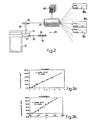
- FIG. 2 shows the example of the case where the quality analysis made by monitoring an optical signal transmitted through a sample of juice is made on a cell 12 associated with the refractometric station 13 in which the analysis of the sugar content of the juice is made.
- This embodiment is extremely practical and economical since it exploits most of the equipment already existing and used for quality analysis of the grape juice.
- the device 29 suitable to achieve the analysis comprises a source of light 18, for example consisting of a tungsten lamp 30, suitable to emit a beam of light which is channeled into a guide 32 and sent inside the cell 12 containing the sample of juice 31 to be analysed.
- a source of light for example consisting of a tungsten lamp 30, suitable to emit a beam of light which is channeled into a guide 32 and sent inside the cell 12 containing the sample of juice 31 to be analysed.
- the processing unit 22 is able to classify the juice analysed according to the composition characteristics and to construct a quality classification of the initial grapes with a desired number of quality levels established in advance.
- the processing unit 22 is thus suitable to display the quality class 35a, 35b, 35c... (in this case from I to V) corresponding to the specific type of grape or juice analysed.
- Processing the optical signal 33 by means of fiber-optic monitoring hence allows to classify the sample of grape according to the actual content of coloring substances, and therefore to classify the sample qualitatively, associating a quality level of the initial grapes to every percentage quantity range of these substances in the juice.
Landscapes
- Physics & Mathematics (AREA)
- Spectroscopy & Molecular Physics (AREA)
- Health & Medical Sciences (AREA)
- Life Sciences & Earth Sciences (AREA)
- Chemical & Material Sciences (AREA)
- General Physics & Mathematics (AREA)
- Biochemistry (AREA)
- Analytical Chemistry (AREA)
- Engineering & Computer Science (AREA)
- General Health & Medical Sciences (AREA)
- Immunology (AREA)
- Pathology (AREA)
- Food Science & Technology (AREA)
- Medicinal Chemistry (AREA)
- Investigating Or Analysing Materials By Optical Means (AREA)
- Non-Alcoholic Beverages (AREA)
- Jellies, Jams, And Syrups (AREA)
- General Preparation And Processing Of Foods (AREA)
- Spectrometry And Color Measurement (AREA)
Description
- a source of light associated with a fiber-optic transmission mean, or guide, suitable to convey the beam of light through the sample of juice to be analysed,
- a reception element consisting of a fiber-optic spectrometer suitable to measure the transmittance or absorbance of the juice to be analysed, and
- a processing unit, equipped with specific software, suitable to receive the information relating to the optical parameters taken from the reception element and to supply the estimation of the content of coloring substances in the juice, from which the phenol quality of the basic fruit or vegetable product can be found.
- Fig. 1
- is a block diagram of the method according to the invention;
- Fig. 2
- is a schematic view of a device suitable to achieve the method according to the invention;
- Figs. 3a and 3b
- show two experimental graphs relating to the correlations between a colorimetric parameter monitored by means of the method according to the invention and the presence of coloring substances in the grapes from which the sample of juice analysed is obtained.
Claims (16)
- Method to evaluate the quality of grapes, which comprises a first step to detect the presence and percentage of coloring substances in the grape juice by means of emitting an optical signal passing through a sample of juice obtained by pressing a sample of grapes to be analysed, with the consequent detection of at least a significant colorimetric parameter, and a second step to correlate the specific percentage value of coloring substances in said sample of juice with a defined and univocal quality and commodity class of said grapes, the method further comprising a prior step of arranging a data bank (23) containing a memorized archive carrying correlation parameters able to correlate the optical and colorimetric parameters acquired on the sample of juice analysed with the organic and composition characteristics of the grapes, said organic and composition characteristics consisting of the phenolic characteristics of the sample of grapes subjected to quality evaluation.
- Method as in Claim 1, wherein said first detection step is performed on a sample of juice just obtained from pressing the grapes during a sampling step.
- Method as in Claim 1 or 2, which provides to emit a beam of light directed towards the sample of juice to be analysed, to receive the optical signal transmitted through the sample of juice by means of a fibre-optic spectrometer, and to process the optical signal received by means of a processing unit to evaluate the percentage value of coloring substances in the juice, to define the quality class to which the grapes belongs and to display said quality class.
- Method as in any claim hereinbefore, wherein
said emission of the optical signal is performed in line on a sample of grape juice just pressed during a sampling step and in a desired step in the process of transforming said grape juice. - Method as in Claim 4, wherein said emission of the optical signal is performed in line on a sample of juice contained in a cell (12) predisposed for sugar analysis, or in the step of loading said juice into a tank.
- Method as in Claim 1 or 2, wherein said coloring substances are anthocyanins.
- Method as in Claim 1 or 2, wherein said coloring substances are red or yellow polymers.
- Method as in Claim 1, wherein said significant colorimetric parameter is transmittancy.
- Method as in Claim 1, wherein significant colorimetric parameter is absorbence.
- Method as in Claim 1, which provides a prior step (27) of devising a quality scale suitable to associate a specific quality and commodity class of said fruit or vegetable product to a determined percentage range of coloring substances in the sample of juice analyzed.
- Device to evaluate the quality of grapes, comprising means (18, 32) to emit and transmit a beam of light through a sample of juice (31) obtained by pressing a sample of grapes to be analysed, reception means (34) suitable to measure at least an optical parameter characteristic of said sample of juice (31) and processing means (22) suitable to receive the information relating to said optical parameters measured, to supply the estimate of the percentage content of coloring substances in said sample of juice (31) and to correlate said percentage content to a defined quality and commodity class of said grapes, said processing means (22) consisting of a processing unit associated at least with a data bank (23) comprising a memorized archive of parameters of correlation between the optical signal received and the percentage content of coloring substances in the sample of juice (31) with the organic and composition characteristic of the sample of grapes, said organic and composition characteristics consisting of the phenolic characteristics of the sample of grapes subjected to quality evaluation.
- Device as in Claim 11, wherein said emission means (18) consist of a tungsten lamp (30).
- Device as in Claim 11, wherein said means (32) to emit and transmit a beam of light consist of a fibre-optic guide.
- Device as in Claim 11, wherein said reception means (34) consist of a fibre-optic spectrometer.
- Device as in Claim 14, wherein said fibre-optic spectrometer is suitable to discriminate the frequencies of the optical signal received in a range of between 190 nm and 850 nm.
- Device as in Claim 11, which is suitable to be integrated into the refractometric station (13) which makes the analysis of the sugar content of the sample of juice (31).
Applications Claiming Priority (3)
| Application Number | Priority Date | Filing Date | Title |
|---|---|---|---|
| IT1999UD000086A IT1311016B1 (en) | 1999-04-28 | 1999-04-28 | QUALITY ASSESSMENT PROCEDURE FOR FOOD JUICES AND DEVICE. |
| ITUD990086 | 1999-04-28 | ||
| PCT/IB2000/000514 WO2000066986A1 (en) | 1999-04-28 | 2000-04-25 | Method to evaluate the quality of food products and relative device |
Publications (2)
| Publication Number | Publication Date |
|---|---|
| EP1175603A1 EP1175603A1 (en) | 2002-01-30 |
| EP1175603B1 true EP1175603B1 (en) | 2003-03-19 |
Family
ID=11422956
Family Applications (1)
| Application Number | Title | Priority Date | Filing Date |
|---|---|---|---|
| EP00915319A Expired - Lifetime EP1175603B1 (en) | 1999-04-28 | 2000-04-25 | Method to evaluate the quality of grapes and relative device |
Country Status (7)
| Country | Link |
|---|---|
| US (1) | US6538741B2 (en) |
| EP (1) | EP1175603B1 (en) |
| AU (1) | AU3667700A (en) |
| DE (1) | DE60001733T2 (en) |
| ES (1) | ES2192172T3 (en) |
| IT (1) | IT1311016B1 (en) |
| WO (1) | WO2000066986A1 (en) |
Cited By (1)
| Publication number | Priority date | Publication date | Assignee | Title |
|---|---|---|---|---|
| FR2947051A1 (en) * | 2009-06-17 | 2010-12-24 | Irenee Giry | DETERMINATION OF FRUIT QUALITIES IN MATURATION |
Families Citing this family (5)
| Publication number | Priority date | Publication date | Assignee | Title |
|---|---|---|---|---|
| ES2204282B1 (en) * | 2002-04-24 | 2005-07-16 | Universidad Publica De Navarra | ELABORATION AND USE OF PATTERNS FOR THE VISUAL EVALUATION OF FOOD. |
| US20050069175A1 (en) * | 2003-09-29 | 2005-03-31 | Tropicana Products, Inc. | Image/optical analysis of citrus pulp |
| ITVI20050098A1 (en) | 2005-04-06 | 2006-10-07 | Caeleno Srl | ASSESSMENT PROCEDURE FOR THE PHENOLIC MATURATION OF A FRUIT AND RELATIVE DEVICE |
| CN102353632A (en) * | 2011-06-28 | 2012-02-15 | 上海谷绿旺农业投资管理有限公司 | Color atla for determining pork freshness and manufacturing method thereof |
| DE102019215692B4 (en) * | 2019-10-11 | 2021-06-17 | Gunther Krieg | Device and method for the identification of substances in the fluid composition |
Family Cites Families (5)
| Publication number | Priority date | Publication date | Assignee | Title |
|---|---|---|---|---|
| US3992109A (en) * | 1973-03-15 | 1976-11-16 | Calspan Corporation | Cyclic colorimetry method and apparatus |
| US3998551A (en) * | 1975-11-20 | 1976-12-21 | Shigeru Suga | Device for measuring stimulus values of the color of a liquid |
| GB9402304D0 (en) * | 1994-02-07 | 1994-03-30 | Whitbread & Co Ltd | Monitoring method |
| ZA964319B (en) * | 1995-08-25 | 1997-02-24 | Orbisphere Lab | Spectroscopic method. |
| US5825478A (en) * | 1996-11-15 | 1998-10-20 | Wilcox; Steven | Multifunctional photometer apparatus |
-
1999
- 1999-04-28 IT IT1999UD000086A patent/IT1311016B1/en active
-
2000
- 2000-04-25 ES ES00915319T patent/ES2192172T3/en not_active Expired - Lifetime
- 2000-04-25 EP EP00915319A patent/EP1175603B1/en not_active Expired - Lifetime
- 2000-04-25 AU AU36677/00A patent/AU3667700A/en not_active Abandoned
- 2000-04-25 DE DE60001733T patent/DE60001733T2/en not_active Expired - Lifetime
- 2000-04-25 WO PCT/IB2000/000514 patent/WO2000066986A1/en not_active Ceased
-
2001
- 2001-10-26 US US10/016,780 patent/US6538741B2/en not_active Expired - Fee Related
Cited By (1)
| Publication number | Priority date | Publication date | Assignee | Title |
|---|---|---|---|---|
| FR2947051A1 (en) * | 2009-06-17 | 2010-12-24 | Irenee Giry | DETERMINATION OF FRUIT QUALITIES IN MATURATION |
Also Published As
| Publication number | Publication date |
|---|---|
| EP1175603A1 (en) | 2002-01-30 |
| WO2000066986A1 (en) | 2000-11-09 |
| AU3667700A (en) | 2000-11-17 |
| DE60001733T2 (en) | 2003-10-23 |
| IT1311016B1 (en) | 2002-02-27 |
| ITUD990086A1 (en) | 2000-10-28 |
| ITUD990086A0 (en) | 1999-04-28 |
| US20020048021A1 (en) | 2002-04-25 |
| DE60001733D1 (en) | 2003-04-24 |
| US6538741B2 (en) | 2003-03-25 |
| ES2192172T3 (en) | 2003-10-01 |
Similar Documents
| Publication | Publication Date | Title |
|---|---|---|
| US5239180A (en) | Laser systems for food analysis based on reflectance ratio detection | |
| US5842150A (en) | Method of determing the organic content in pulp and paper mill effulents | |
| Casale et al. | Near infrared spectroscopy for analysing olive oils | |
| Liu et al. | Preliminary study on the application of visible–near infrared spectroscopy and chemometrics to classify Riesling wines from different countries | |
| Magwaza et al. | Evaluation of Fourier transform-NIR spectroscopy for integrated external and internal quality assessment of Valencia oranges | |
| Cozzolino | Sample presentation, sources of error and future perspectives on the application of vibrational spectroscopy in the wine industry | |
| Zhu et al. | Evaluation of the non-enzymatic browning in thermally processed apple juice by front-face fluorescence spectroscopy | |
| CN101275912B (en) | Fluid food browning testing method | |
| US8072605B2 (en) | Method and apparatus for determining quality of fruit and vegetable products | |
| Croce et al. | Prediction of quality parameters in straw wine by means of FT-IR spectroscopy combined with multivariate data processing | |
| Soriano et al. | Determination of anthocyanins in red wine using a newly developed method based on Fourier transform infrared spectroscopy | |
| CA2093015A1 (en) | A method of calibrating a spectrometer using correlation between calibration sample spectra and measured spectra | |
| Cozzolino et al. | Feasibility study on the use of attenuated total reflectance mid-infrared for analysis of compositional parameters in wine | |
| NZ521919A (en) | Apparatus and method for measuring and correlating characteristics of fruit with visible/near infra-red spectrum | |
| IL151751A (en) | Apparatus and method for measuring and correlating characteristics of fruit with visible/near-red spectrum | |
| AU2005100565A4 (en) | Non-destructive analysis by VIS-NIR spectroscopy of fluid(s) in its original container | |
| Fernández-Novales et al. | A feasibility study on the use of a miniature fiber optic NIR spectrometer for the prediction of volumic mass and reducing sugars in white wine fermentations | |
| US6538741B2 (en) | Method to evaluate the quality of grapes and relative device | |
| JP3615390B2 (en) | Measured value analysis method of on-line spectrometer | |
| US5699162A (en) | Process and apparatus for testing a multi-trip bottle for contamination utilizing residual liquid in bottle bottom and sprectral measurement | |
| JPH01301147A (en) | Method and device for measuring quality of vegitable and fruit | |
| Kim et al. | Defect and ripeness inspection of citrus using NIR transmission spectrum | |
| AU677147B2 (en) | Monitoring the colour and bitterness of beer | |
| Sinnaeve et al. | Quantitative analysis of raw apple juices using near infrared, Fourier-transform near infrared and Fourier-transform infrared instruments: a comparison of their analytical performances | |
| US4755048A (en) | Optical analysis of impurity absorptions |
Legal Events
| Date | Code | Title | Description |
|---|---|---|---|
| PUAI | Public reference made under article 153(3) epc to a published international application that has entered the european phase |
Free format text: ORIGINAL CODE: 0009012 |
|
| AK | Designated contracting states |
Kind code of ref document: A1 Designated state(s): DE ES FR IT Kind code of ref document: A1 Designated state(s): AT BE CH CY DE DK ES FI FR GB GR IE IT LI LU MC NL PT SE |
|
| 17P | Request for examination filed |
Effective date: 20011126 |
|
| GRAG | Despatch of communication of intention to grant |
Free format text: ORIGINAL CODE: EPIDOS AGRA |
|
| 17Q | First examination report despatched |
Effective date: 20020415 |
|
| GRAG | Despatch of communication of intention to grant |
Free format text: ORIGINAL CODE: EPIDOS AGRA |
|
| GRAH | Despatch of communication of intention to grant a patent |
Free format text: ORIGINAL CODE: EPIDOS IGRA |
|
| RIN1 | Information on inventor provided before grant (corrected) |
Inventor name: CARCERERI DE PRATI, GIUSEPPE Inventor name: CELOTTI, EMILIO |
|
| GRAH | Despatch of communication of intention to grant a patent |
Free format text: ORIGINAL CODE: EPIDOS IGRA |
|
| GRAA | (expected) grant |
Free format text: ORIGINAL CODE: 0009210 |
|
| RTI1 | Title (correction) |
Free format text: METHOD TO EVALUATE THE QUALITY OF GRAPES AND RELATIVE DEVICE |
|
| AK | Designated contracting states |
Designated state(s): DE ES FR IT |
|
| REG | Reference to a national code |
Ref country code: IE Ref legal event code: FG4D |
|
| REF | Corresponds to: |
Ref document number: 60001733 Country of ref document: DE Date of ref document: 20030424 Kind code of ref document: P |
|
| REG | Reference to a national code |
Ref country code: ES Ref legal event code: FG2A Ref document number: 2192172 Country of ref document: ES Kind code of ref document: T3 |
|
| ET | Fr: translation filed | ||
| PLBE | No opposition filed within time limit |
Free format text: ORIGINAL CODE: 0009261 |
|
| STAA | Information on the status of an ep patent application or granted ep patent |
Free format text: STATUS: NO OPPOSITION FILED WITHIN TIME LIMIT |
|
| REG | Reference to a national code |
Ref country code: IE Ref legal event code: MM4A |
|
| 26N | No opposition filed |
Effective date: 20031222 |
|
| PG25 | Lapsed in a contracting state [announced via postgrant information from national office to epo] |
Ref country code: IT Free format text: LAPSE BECAUSE OF NON-PAYMENT OF DUE FEES Effective date: 20050425 |
|
| PGRI | Patent reinstated in contracting state [announced from national office to epo] |
Ref country code: IT Effective date: 20091201 |
|
| PGFP | Annual fee paid to national office [announced via postgrant information from national office to epo] |
Ref country code: DE Payment date: 20131010 Year of fee payment: 14 Ref country code: FR Payment date: 20131010 Year of fee payment: 14 |
|
| PGFP | Annual fee paid to national office [announced via postgrant information from national office to epo] |
Ref country code: ES Payment date: 20131029 Year of fee payment: 14 |
|
| PGFP | Annual fee paid to national office [announced via postgrant information from national office to epo] |
Ref country code: IT Payment date: 20140430 Year of fee payment: 15 |
|
| REG | Reference to a national code |
Ref country code: DE Ref legal event code: R119 Ref document number: 60001733 Country of ref document: DE |
|
| REG | Reference to a national code |
Ref country code: FR Ref legal event code: ST Effective date: 20141231 |
|
| REG | Reference to a national code |
Ref country code: DE Ref legal event code: R119 Ref document number: 60001733 Country of ref document: DE Effective date: 20141101 |
|
| PG25 | Lapsed in a contracting state [announced via postgrant information from national office to epo] |
Ref country code: DE Free format text: LAPSE BECAUSE OF NON-PAYMENT OF DUE FEES Effective date: 20141101 |
|
| PG25 | Lapsed in a contracting state [announced via postgrant information from national office to epo] |
Ref country code: FR Free format text: LAPSE BECAUSE OF NON-PAYMENT OF DUE FEES Effective date: 20140430 |
|
| REG | Reference to a national code |
Ref country code: ES Ref legal event code: FD2A Effective date: 20150527 |
|
| PG25 | Lapsed in a contracting state [announced via postgrant information from national office to epo] |
Ref country code: ES Free format text: LAPSE BECAUSE OF NON-PAYMENT OF DUE FEES Effective date: 20140426 |
|
| PG25 | Lapsed in a contracting state [announced via postgrant information from national office to epo] |
Ref country code: IT Free format text: LAPSE BECAUSE OF NON-PAYMENT OF DUE FEES Effective date: 20150425 |