EP1175038A2 - Technique for obtaining a sign-on certificate from a foreign PKI system using an existing strong authentication PKI system - Google Patents
Technique for obtaining a sign-on certificate from a foreign PKI system using an existing strong authentication PKI system Download PDFInfo
- Publication number
- EP1175038A2 EP1175038A2 EP01112852A EP01112852A EP1175038A2 EP 1175038 A2 EP1175038 A2 EP 1175038A2 EP 01112852 A EP01112852 A EP 01112852A EP 01112852 A EP01112852 A EP 01112852A EP 1175038 A2 EP1175038 A2 EP 1175038A2
- Authority
- EP
- European Patent Office
- Prior art keywords
- user
- certificate
- public key
- pki system
- digital signature
- Prior art date
- Legal status (The legal status is an assumption and is not a legal conclusion. Google has not performed a legal analysis and makes no representation as to the accuracy of the status listed.)
- Granted
Links
Images


Classifications
-
- H—ELECTRICITY
- H04—ELECTRIC COMMUNICATION TECHNIQUE
- H04L—TRANSMISSION OF DIGITAL INFORMATION, e.g. TELEGRAPHIC COMMUNICATION
- H04L63/00—Network architectures or network communication protocols for network security
- H04L63/08—Network architectures or network communication protocols for network security for authentication of entities
- H04L63/0815—Network architectures or network communication protocols for network security for authentication of entities providing single-sign-on or federations
-
- G—PHYSICS
- G06—COMPUTING OR CALCULATING; COUNTING
- G06F—ELECTRIC DIGITAL DATA PROCESSING
- G06F21/00—Security arrangements for protecting computers, components thereof, programs or data against unauthorised activity
- G06F21/30—Authentication, i.e. establishing the identity or authorisation of security principals
- G06F21/31—User authentication
- G06F21/33—User authentication using certificates
-
- G—PHYSICS
- G06—COMPUTING OR CALCULATING; COUNTING
- G06F—ELECTRIC DIGITAL DATA PROCESSING
- G06F21/00—Security arrangements for protecting computers, components thereof, programs or data against unauthorised activity
- G06F21/60—Protecting data
- G06F21/604—Tools and structures for managing or administering access control systems
-
- G—PHYSICS
- G06—COMPUTING OR CALCULATING; COUNTING
- G06F—ELECTRIC DIGITAL DATA PROCESSING
- G06F21/00—Security arrangements for protecting computers, components thereof, programs or data against unauthorised activity
- G06F21/60—Protecting data
- G06F21/62—Protecting access to data via a platform, e.g. using keys or access control rules
- G06F21/6209—Protecting access to data via a platform, e.g. using keys or access control rules to a single file or object, e.g. in a secure envelope, encrypted and accessed using a key, or with access control rules appended to the object itself
-
- G—PHYSICS
- G06—COMPUTING OR CALCULATING; COUNTING
- G06F—ELECTRIC DIGITAL DATA PROCESSING
- G06F21/00—Security arrangements for protecting computers, components thereof, programs or data against unauthorised activity
- G06F21/60—Protecting data
- G06F21/62—Protecting access to data via a platform, e.g. using keys or access control rules
- G06F21/6218—Protecting access to data via a platform, e.g. using keys or access control rules to a system of files or objects, e.g. local or distributed file system or database
-
- G—PHYSICS
- G06—COMPUTING OR CALCULATING; COUNTING
- G06F—ELECTRIC DIGITAL DATA PROCESSING
- G06F21/00—Security arrangements for protecting computers, components thereof, programs or data against unauthorised activity
- G06F21/60—Protecting data
- G06F21/62—Protecting access to data via a platform, e.g. using keys or access control rules
- G06F21/6218—Protecting access to data via a platform, e.g. using keys or access control rules to a system of files or objects, e.g. local or distributed file system or database
- G06F21/6236—Protecting access to data via a platform, e.g. using keys or access control rules to a system of files or objects, e.g. local or distributed file system or database between heterogeneous systems
-
- H—ELECTRICITY
- H04—ELECTRIC COMMUNICATION TECHNIQUE
- H04L—TRANSMISSION OF DIGITAL INFORMATION, e.g. TELEGRAPHIC COMMUNICATION
- H04L63/00—Network architectures or network communication protocols for network security
- H04L63/08—Network architectures or network communication protocols for network security for authentication of entities
- H04L63/0823—Network architectures or network communication protocols for network security for authentication of entities using certificates
-
- H—ELECTRICITY
- H04—ELECTRIC COMMUNICATION TECHNIQUE
- H04L—TRANSMISSION OF DIGITAL INFORMATION, e.g. TELEGRAPHIC COMMUNICATION
- H04L63/00—Network architectures or network communication protocols for network security
- H04L63/08—Network architectures or network communication protocols for network security for authentication of entities
- H04L63/083—Network architectures or network communication protocols for network security for authentication of entities using passwords
-
- H—ELECTRICITY
- H04—ELECTRIC COMMUNICATION TECHNIQUE
- H04L—TRANSMISSION OF DIGITAL INFORMATION, e.g. TELEGRAPHIC COMMUNICATION
- H04L9/00—Cryptographic mechanisms or cryptographic arrangements for secret or secure communications; Network security protocols
- H04L9/006—Cryptographic mechanisms or cryptographic arrangements for secret or secure communications; Network security protocols involving public key infrastructure [PKI] trust models
-
- H—ELECTRICITY
- H04—ELECTRIC COMMUNICATION TECHNIQUE
- H04L—TRANSMISSION OF DIGITAL INFORMATION, e.g. TELEGRAPHIC COMMUNICATION
- H04L9/00—Cryptographic mechanisms or cryptographic arrangements for secret or secure communications; Network security protocols
- H04L9/32—Cryptographic mechanisms or cryptographic arrangements for secret or secure communications; Network security protocols including means for verifying the identity or authority of a user of the system or for message authentication, e.g. authorization, entity authentication, data integrity or data verification, non-repudiation, key authentication or verification of credentials
- H04L9/3234—Cryptographic mechanisms or cryptographic arrangements for secret or secure communications; Network security protocols including means for verifying the identity or authority of a user of the system or for message authentication, e.g. authorization, entity authentication, data integrity or data verification, non-repudiation, key authentication or verification of credentials involving additional secure or trusted devices, e.g. TPM, smartcard, USB or software token
-
- H—ELECTRICITY
- H04—ELECTRIC COMMUNICATION TECHNIQUE
- H04L—TRANSMISSION OF DIGITAL INFORMATION, e.g. TELEGRAPHIC COMMUNICATION
- H04L9/00—Cryptographic mechanisms or cryptographic arrangements for secret or secure communications; Network security protocols
- H04L9/32—Cryptographic mechanisms or cryptographic arrangements for secret or secure communications; Network security protocols including means for verifying the identity or authority of a user of the system or for message authentication, e.g. authorization, entity authentication, data integrity or data verification, non-repudiation, key authentication or verification of credentials
- H04L9/3247—Cryptographic mechanisms or cryptographic arrangements for secret or secure communications; Network security protocols including means for verifying the identity or authority of a user of the system or for message authentication, e.g. authorization, entity authentication, data integrity or data verification, non-repudiation, key authentication or verification of credentials involving digital signatures
-
- H—ELECTRICITY
- H04—ELECTRIC COMMUNICATION TECHNIQUE
- H04L—TRANSMISSION OF DIGITAL INFORMATION, e.g. TELEGRAPHIC COMMUNICATION
- H04L9/00—Cryptographic mechanisms or cryptographic arrangements for secret or secure communications; Network security protocols
- H04L9/32—Cryptographic mechanisms or cryptographic arrangements for secret or secure communications; Network security protocols including means for verifying the identity or authority of a user of the system or for message authentication, e.g. authorization, entity authentication, data integrity or data verification, non-repudiation, key authentication or verification of credentials
- H04L9/3263—Cryptographic mechanisms or cryptographic arrangements for secret or secure communications; Network security protocols including means for verifying the identity or authority of a user of the system or for message authentication, e.g. authorization, entity authentication, data integrity or data verification, non-repudiation, key authentication or verification of credentials involving certificates, e.g. public key certificate [PKC] or attribute certificate [AC]; Public key infrastructure [PKI] arrangements
- H04L9/3268—Cryptographic mechanisms or cryptographic arrangements for secret or secure communications; Network security protocols including means for verifying the identity or authority of a user of the system or for message authentication, e.g. authorization, entity authentication, data integrity or data verification, non-repudiation, key authentication or verification of credentials involving certificates, e.g. public key certificate [PKC] or attribute certificate [AC]; Public key infrastructure [PKI] arrangements using certificate validation, registration, distribution or revocation, e.g. certificate revocation list [CRL]
-
- G—PHYSICS
- G06—COMPUTING OR CALCULATING; COUNTING
- G06F—ELECTRIC DIGITAL DATA PROCESSING
- G06F2221/00—Indexing scheme relating to security arrangements for protecting computers, components thereof, programs or data against unauthorised activity
- G06F2221/21—Indexing scheme relating to G06F21/00 and subgroups addressing additional information or applications relating to security arrangements for protecting computers, components thereof, programs or data against unauthorised activity
- G06F2221/2113—Multi-level security, e.g. mandatory access control
-
- G—PHYSICS
- G06—COMPUTING OR CALCULATING; COUNTING
- G06F—ELECTRIC DIGITAL DATA PROCESSING
- G06F2221/00—Indexing scheme relating to security arrangements for protecting computers, components thereof, programs or data against unauthorised activity
- G06F2221/21—Indexing scheme relating to G06F21/00 and subgroups addressing additional information or applications relating to security arrangements for protecting computers, components thereof, programs or data against unauthorised activity
- G06F2221/2119—Authenticating web pages, e.g. with suspicious links
-
- H—ELECTRICITY
- H04—ELECTRIC COMMUNICATION TECHNIQUE
- H04L—TRANSMISSION OF DIGITAL INFORMATION, e.g. TELEGRAPHIC COMMUNICATION
- H04L63/00—Network architectures or network communication protocols for network security
- H04L63/04—Network architectures or network communication protocols for network security for providing a confidential data exchange among entities communicating through data packet networks
- H04L63/0428—Network architectures or network communication protocols for network security for providing a confidential data exchange among entities communicating through data packet networks wherein the data content is protected, e.g. by encrypting or encapsulating the payload
- H04L63/0442—Network architectures or network communication protocols for network security for providing a confidential data exchange among entities communicating through data packet networks wherein the data content is protected, e.g. by encrypting or encapsulating the payload wherein the sending and receiving network entities apply asymmetric encryption, i.e. different keys for encryption and decryption
-
- Y—GENERAL TAGGING OF NEW TECHNOLOGICAL DEVELOPMENTS; GENERAL TAGGING OF CROSS-SECTIONAL TECHNOLOGIES SPANNING OVER SEVERAL SECTIONS OF THE IPC; TECHNICAL SUBJECTS COVERED BY FORMER USPC CROSS-REFERENCE ART COLLECTIONS [XRACs] AND DIGESTS
- Y10—TECHNICAL SUBJECTS COVERED BY FORMER USPC
- Y10S—TECHNICAL SUBJECTS COVERED BY FORMER USPC CROSS-REFERENCE ART COLLECTIONS [XRACs] AND DIGESTS
- Y10S707/00—Data processing: database and file management or data structures
- Y10S707/99951—File or database maintenance
- Y10S707/99952—Coherency, e.g. same view to multiple users
Definitions
- the invention relates to a technique for obtaining a single sign-on certificate using a strong authentication public key infrastructure (PKI) system. More particularly, the present invention relates to a method and computer program by which digital certificates issued by different vendors may be generated and utilized under a PKI system having strong authentication built into it to ensure only authorized members of the firm have access.
- PKI public key infrastructure
- This digital signature capability has been implemented using the same public key infrastructure previously discussed. However, instead of an entire document being encrypted, the document itself is passed through a one-way hashing algorithm that produces a small document, referred to as a digest. This digest is then encrypted using the individual's private key, also known as a private signing key, and is appended to the document. The receiver of the document can verify the authenticity of the digital signature (digest) by stripping the signature from the document and recomputing the hash function on the document to generate as a received digest. Using public signing key, included in the document or previously received, it is possible to decrypt the digest of the document and compare it to the digest as received. If the two digest match, then the signature is authenticated. Therefore, using the aforementioned public key infrastructure it is possible to both encrypt and decrypt messages as well as digitally sign documents.
- certificates generated by one supplier's software may not be compatible with that of another supplier's software.
- MicrosoftTM in Windows 2000TM provides for the generation of digital certificates for the purpose of "single sign-on" by a user to a MicrosoftTM network.
- the user would request such a single sign-on certificate by utilizing a conventional web browser to access a domain certificate authority.
- the user would then fill in the requested information and the domain certificate authority may optionally require the concurrence of an administrator to approve the issuance of the certificate.
- the user is not required to provide any proof of identity and normally no authentication of identity occurs.
- the certificate issued is often only accepted by only Windows 2000TM and certificates generated by other PKI systems may not be accepted by Windows 2000TM.
- An embodiment of the present invention provides for a method of creating a single sign-on certificate using a PKI system.
- This method begins by a user accessing a PKI system in which a digital signature certificate has been previously created for the user and transmitting the digital signature certificate to the PKI system.
- the PKI system then verifies the identity and validity of the user by accessing a directory using the digital signature certificate.
- a private/public key pair is created and the public key is transmitted to the PKI system.
- the public key is transmitted to a domain certificate authority for signature which returns the public key to the user signed by the domain certificate authority.
- an embodiment of the present invention is a computer program embodied on a computer readable medium and executable by a computer.
- This computer program begins by a user accessing a PKI system in which a digital signature certificate has been previously created for the user and transmitting the digital signature certificate to the PKI system.
- the PKI system then verifies the identity and validity of the user by accessing a directory using the digital signature certificate.
- a private/public key pair is created and the public key is transmitted to the PKI system.
- the public key is transmitted to a domain certificate authority for signature which returns the public key to the user signed by the domain certificate authority.
- an embodiment of the present invention is a method of creating a single sign-on role certificate using a PKI system.
- This method begins by creating a digital signature certificate by a security officer or other firm employee verifying the user's identity and receiving approval by the user's management.
- a password is delivered to the user through the mail to the user's home address.
- the PKI system is accessed by the user using the password.
- the digital signature certificate is downloaded from the PKI system by the user.
- the PKI system is accessed by the user using the digital signature certificate.
- the validity of the user is verified by the PKI system accessing a directory using the digital signature certificate.
- a private/public key pair is generated and transmitted the public key to the PKI system.
- the public key is transmitted to a domain certificate authority for signature.
- the public key is returned to the user signed by the domain certificate authority.
- FIG. 1 is a module configuration diagram of the software, firmware, and hardware used in the embodiments of the present invention.
- the blocks illustrated in FIG. 1 represent modules, code, code segments, commands, firmware, hardware, instructions and data that are executable by a processor-based system(s) and may be written in a programming language, such as, but not limited, to C++.
- the modules depicted in FIG. 1 are shown as contained in separate server platforms. However, these modules are not limited to residing on separate servers and may reside and execute on one computer or any number of computers depending on the number of users the system must handle and the communications involved.
- FIGs. 2 through 10 are flowcharts further detailing the operations executed by the modules shown in FIG. 1.
- FIG. 1 illustrates an exemplary architecture 100 in which the Public Key Infrastructure (PKI) processes of the present invention may be practiced.
- PKI Public Key Infrastructure
- the Architecture 100 includes Data Entry 102 which performs a Data Entry function for Authoritative Database 104 which is resident on the server platform 106.
- a server platform 106 is referred to in this description but it should be understood that the present invention is not limited to any particular server architecture.
- the server platform 106 maybe without limitation UNIX or Windows NT servers.
- the authoritative database 104 contains information about members of the group or enterprise for which PKI services in accordance with the present invention are performed. The present invention is not limited by the structure of the group enterprise for which information is stored in the authoritative database 104.
- the authoritative database 104 information includes, without limitation, the name, address, telephone numbers, manager's name, employee identification etc., of the members of the group or enterprise.
- Directory 108 has the structure of the database but is optimized for fast look-up of information stored therein rather than fast data entry. The data in the Directory 108 is not changed frequently but is required to be "accessed rapidly and functions on-line as a fast phone book" containing reference information about the members of the group or enterprise stored in the authoritative database 104.
- Certificate authority 110 is a conventional off-the shelf software executed on server platform 106 providing storage of certificates and related information used by the present invention as described in more detail hereinafter.
- Registration authority 112 is also off-the shelf software executable on server platform 106 regarding registration performed by the present invention as described in more detail hereinafter.
- Key authority 114 is also off-the shelf server software which is executable on Server Platform 106 for recovering keys from members of the group or enterprise as described in more detail hereinafter.
- Domain certificate authority CA 116 may use certificates provided by the present invention for a single sign-on to the architecture of FIG. 1.
- Legacy server 118 executes legacy application programs 120.
- the legacy server maybe, without limitation, a main frame, mini-computer, workstation or other server hosting legacy software applications that are designed to be run on PKI processes in accordance with the present invention.
- the legacy applications 120 are accessible on the client side by a custom client 128 such as an emulator or custom database Graphic User Interface (GUI). Examples of emulators are terminal emulators of an IBM 3270 or terminal emulators of a vt 100.
- GUI Graphic User Interface
- Web Server 124 is a software application which serves Web Pages such as Web Page 122 or other HTML outputs to a web browser client which may be without limitation Apache or a Microsoft Internet Information Server.
- Web browser 126 is resident on client platform 128 which may be any user computer.
- Web browser 126 is a client software application for browsing web pages such as but not limited to HTML or XML protocols or other protocols.
- the Web browser 126 is programmed to operate with PKI certificates issued by the certificate authority 110. Examples of web browsers which has this capability are Netscape Navigator and the Microsoft Internet Explorer.
- the token 130 is a smart card, USB (Universal Serial Bus) or other hardware token capable of generating storing and using PKI certificates.
- a user 132 is a person using the architecture 100.
- a user 132 transitions through a number of states which include a new user, current user and a former user who no longer is a member of the group or enterprise.
- the Architecture 100 is described with reference to two levels of security but the number of the levels of security is not a limitation of the present invention with each level corresponding to a different security requirement.
- the level 1 search engine 134 is a search engine which is permitted to search through the architecture 100 but is allowed access to only level 1 data which is the lowest level of security and may be without limitation data which is freely distributable Level 2 data may be considered to be proprietary.
- Level 2 search engine 136 is a search engine which is allowed to search through both level 1 and level 2 data.
- a Level N search engine is a search engine which is allowed to search through servers possessing Levels 1 through N of data.
- a secured level server with Level 1 data is a web server containing only level 1 data which is secured so that users may have level to level 1 servers.
- a secured web server with level 2 data 140 is a Web Server that contains level 2 data which has been secured so that users must have level 2 access with level 2 users having access to both level 1 and level servers.
- a secured web server with level N data (not illustrated) is a web server that contains level N data which is accessible by user with level N or above access to all levels of data up through level N access.
- VPN Extranet 142 is a software application which functions as a network gateway, which as illustrated, may be either to legacy server 118 and legacy application 120 or to an external network such as the Internet.
- Personal registration authority 144 is a person who is in charge of revocation of members from the network 100.
- Personal registration authority 146 is a person who is in charge of registration of members in the network 100.
- Personal recovery approval 1 148 and personal recovery agent 2 149 are persons responsible for obtaining recovery of certificates.
- a Recovery Agent 150 is a person who performs recovery of certificates and may only recover a certificate if the certificate has first been designated as recoverable by another person.
- Personal role approval 152 is a person who approves different role function within the network 100.
- a web server administrator is in charge of various web functions in the network 100.
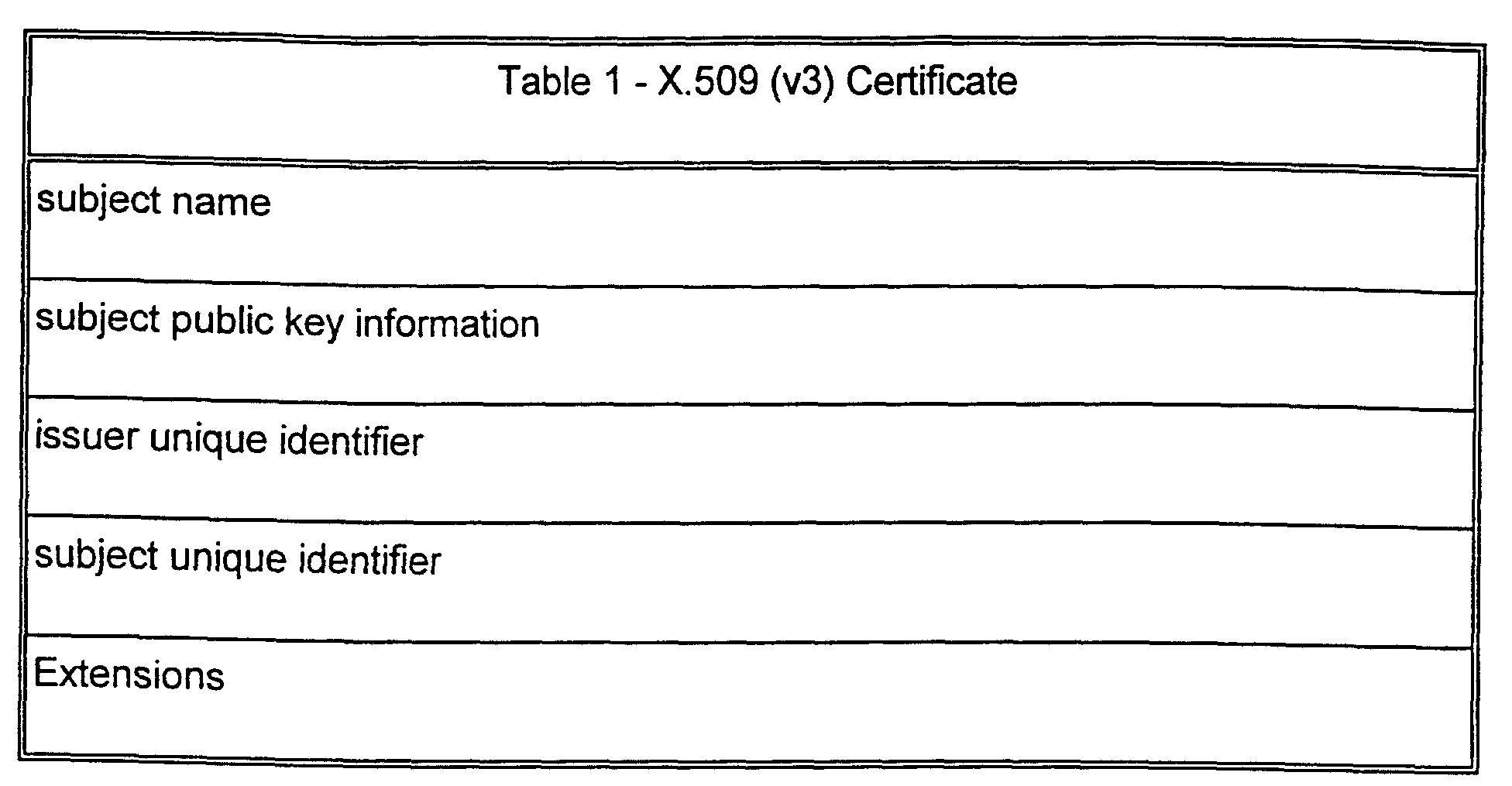
- a certificate is based on an X.509 certificate (V3) discussed in detail in item 4 of RFC 2459, previously incorporated herein by reference.
- the X.509 certificate is a public key certificate utilized for either encryption purposes or as a signature key by a PKI system. It should not be confused with a "single sign-on" certificate which may not be compatible or similar to the X.509 certificate.
- the information contained in the X.509 certificate will vary according to whether it is set up as a signature certificate or as a public key for encryption.
- the X.509 certificate contains at least those fields shown in table 1 ahead.
- the X.509 certificate is created using a strong authentication and delivery method.
- the user 132 must first apply for the certificate via human resources or security and provide proof of his identity.
- the immediate superior for user 132 is then contacted for his approval to receive the X.509 certificate.
- Thereafter, via the mail to the User's 132 home address, a one time password is sent to the user 132 which enables delivery of the X.509 certificate to the user 132.
- the user 132 may then download to his computer the X.509 certificate via an encrypted secure channel.
- the X.509 certificate may also be placed on a hardware token, smart card, or magnetic strip card so that the user 132 may keep it on his person and move from one computer to another.
- FIG. 2 is a flowchart of an example embodiment in the present invention where a "single sign-on" certificate is created for user 132.
- the method and computer program shown in FIG. 2 begins execution in operation 200 and immediately proceeds to operation 210.
- the user accesses the registration web server 124 via web browser 126 and request a single sign-on certificate. Thereafter, the registration web server 124 requests the user 132 for a user signature certificate.
- This user signature certificate would be the X.509 certificate previously discussed and would have been created by the process previously discussed.
- the user 132 transmits his signature certificate to registration web server 124.
- registration web server 124 queries directory 108 to confirm that the user 132 is a valid member of the organization. Processing then proceeds to operation 250 or a check of users 132 validity is a member of the organization is done. If the user 132 is not valid member of the organization an error message is generated in operation 330 and processing proceeds to terminate in operation 320.
- registration web server 124 signals web browser 126 to create a private/public key pair. Thereafter, in operation 270 web browser 126 generates the public/private key pair and stores it locally. In operation 280, web browser 126 transmits the public key only to the registration web server 124. Thereafter, in operation 290, registration web server 124 transmits the public key to the domain certificate authority (CA) 116. In operation 300 the main certificate certificate authority 116 digitally signs the public key received and stores that locally in its directory. This domain certificate authority 116 may be, but not limited to, a Windows 2000TM network. Thereafter, the domain certificate authority 116 transmits assigned public key back to the registration web server 124.
- CA domain certificate authority
- registration web server 124 transmits the signed public key to the web browser 126. Further, in operation 310, the web browser 126 upon receipt of the signed public key may either store locally or copy it to a hardware token, smart card, or a magnetic strip embedded in a card. Thereafter, processing proceeds to operation 320 where processing terminates.
- an organization or individual may create processes, computer software and methods for creating a "single sign-on" certificate useful on an another foreign and noncompatible system using its own PKI system.
- the individual's PKI system may be set up in such fashion as to require strong authentication of the individual's identity before any "single sign-on" certificate is created. Therefore, the user is not required to enter the same information in order to generate a "single sign-on" certificate and access to the creation of such certificates is limited to authorize individuals only.
Landscapes
- Engineering & Computer Science (AREA)
- Computer Security & Cryptography (AREA)
- Theoretical Computer Science (AREA)
- Computer Hardware Design (AREA)
- General Engineering & Computer Science (AREA)
- Computer Networks & Wireless Communication (AREA)
- Signal Processing (AREA)
- General Physics & Mathematics (AREA)
- Software Systems (AREA)
- Physics & Mathematics (AREA)
- Bioethics (AREA)
- General Health & Medical Sciences (AREA)
- Health & Medical Sciences (AREA)
- Computing Systems (AREA)
- Databases & Information Systems (AREA)
- Automation & Control Theory (AREA)
- Management, Administration, Business Operations System, And Electronic Commerce (AREA)
- Storage Device Security (AREA)
Abstract
Description

Claims (15)
- A method of creating a single sign-on role certificate using a PKI system, comprising:accessing a PKI system by a user in which a digital signature certificate has been previously created for the user and transmitting the digital signature certificate to the PKI system;verifying the identity and validity of the user through the PKI system by accessing a directory using the digital signature certificate;generating a private/public key pair and transmitting the public key to the PKI system;transmitting the public key to a domain certificate authority for signature; andreturning the public key to the user signed by the domain certificate authority.
- The method recited in claim 1, further comprising:authenticating the user identity; andverifying the user has authority to receive the public key.
- The method recited in claim 2, further comprising:delivering a password to the user through the mail to the user's home address;accessing the PKI system by the user using the password; andreceiving the digital signature.
- The method recited in claim 3, wherein the digital signature may be used for both signatures and encryption.
- The method recited in claim 1, wherein the verifying the identity and validity of the user by PKI system by accessing a directory using the digital signature certificate further comprises;verifying that the digital signature certificate has not been revoked; andverifying that the user is still a member of the organisation.
- The method recited in claim 5, further comprising:
storing the public key signed by the domain- certificate authority in a hardware token, smart card, a computer, a magnetic strip card or other storage device. - The method recited in claim 6, further comprising:
accessing a foreign computer network not associated with the PKI system using the public key signed by the domain certificate authority. - A computer program embodied on a computer readable medium and executable by a computer to create a single sign-on role certificate using a PKI system, comprising:
accessing a PKI system by a user in which a digital signature certificate has been previously created for the user and transmitting the digital signature certificate to the PKI system:verifying the identity and validity of the user by PKI system by accessing a directory using the digital signature certificate;generating private/public key pair and transmitting the public key to the PKI system;transmitting the public key to a domain certificate authority for signature; andreturning the public key to the user signed by the domain certificate authority. - The computer program recited in claim 8, further comprising:authenticating the user identity; andverifying the user has authority to receive the public key.
- The computer program recited in claim 9, further comprising:delivering a password to the user through the mail to the user's home address;accessing the PKI system by the user using the password; andreceiving the digital signature certificate by the user.
- The computer program recited in claim 8, wherein verifying the identity and validity of the user by PKI system by accessing a directory using the digital signature certificate further comprises:verifying that the digital signature certificate has not been revoked; andverifying that the user is still a member of the organisation.
- A method of creating a single sign-on role certificate using a PKI system, comprising:creating a digital signature certificate verifying the identity of a user and authority of the user to obtain the digital signature certificate;delivering a password to the user through the mail to the user's home address;accessing a PKI system by the user using the password;receiving the digital signature certificate from the PKI system;accessing a PKI system by a user using the digital signature certificate;verifying the validity of the user by PKI system accessing a directory using the digital signature certificate;generating private/public key pair and transmitting the public key to the PKI system;transmitting the public key to a domain certificate authority for signature; andreturning the public key to the user signed by the domain certificate authority.
- The method recited in claim 15, wherein verifying the identity and validity of the user by PKI system by accessing a directory using the digital signature certificate further comprises:verifying that the digital signature certificate has not been revoked; andverifying that the user is still a member of the organisation.
- The method recited in claim 13, further comprising:
storing the public key by the domain certificate authority in a hardware token, smart card, a computer, a magnetic strip card, or other storage device. - The method recited in claim 14, further comprising:
accessing a foreign computer network not associated with the PKI system using the public key signed by the domain certificate authority.
Applications Claiming Priority (8)
| Application Number | Priority Date | Filing Date | Title |
|---|---|---|---|
| US21046200P | 2000-06-09 | 2000-06-09 | |
| US21046400P | 2000-06-09 | 2000-06-09 | |
| US210464P | 2000-06-09 | ||
| US210462P | 2000-06-09 | ||
| US22933600P | 2000-09-01 | 2000-09-01 | |
| US229336P | 2000-09-01 | ||
| US822958 | 2001-03-30 | ||
| US09/822,958 US7069440B2 (en) | 2000-06-09 | 2001-03-30 | Technique for obtaining a single sign-on certificate from a foreign PKI system using an existing strong authentication PKI system |
Publications (3)
| Publication Number | Publication Date |
|---|---|
| EP1175038A2 true EP1175038A2 (en) | 2002-01-23 |
| EP1175038A3 EP1175038A3 (en) | 2004-11-24 |
| EP1175038B1 EP1175038B1 (en) | 2006-07-19 |
Family
ID=27498805
Family Applications (1)
| Application Number | Title | Priority Date | Filing Date |
|---|---|---|---|
| EP01112852A Expired - Lifetime EP1175038B1 (en) | 2000-06-09 | 2001-05-31 | Technique for obtaining a sign-on certificate from a foreign PKI system using an existing strong authentication PKI system |
Country Status (4)
| Country | Link |
|---|---|
| US (1) | US7069440B2 (en) |
| EP (1) | EP1175038B1 (en) |
| JP (1) | JP2002123492A (en) |
| DE (1) | DE60121517T2 (en) |
Cited By (4)
| Publication number | Priority date | Publication date | Assignee | Title |
|---|---|---|---|---|
| WO2002098039A3 (en) * | 2001-05-29 | 2003-03-27 | Xenobit Corp | Method and system for logging into and providing access to a computer system via a communications network |
| WO2005003934A1 (en) * | 2003-07-01 | 2005-01-13 | International Business Machines Corporation | Method and system for a single-sign-on access to a computer grid |
| EP1361694A3 (en) * | 2002-05-09 | 2006-08-02 | Canon Kabushiki Kaisha | Public key certification issuing apparatus |
| CN115378737A (en) * | 2022-10-24 | 2022-11-22 | 中汽数据(天津)有限公司 | Cross-domain device communication trust method, device, equipment and medium |
Families Citing this family (81)
| Publication number | Priority date | Publication date | Assignee | Title |
|---|---|---|---|---|
| US7152450B2 (en) * | 2000-08-17 | 2006-12-26 | Industrial Origami, Llc | Method for forming sheet material with bend controlling displacements |
| NO313480B1 (en) * | 2001-01-24 | 2002-10-07 | Telenor Asa | Procedure for opening all or part of a smart card |
| US8051168B1 (en) * | 2001-06-19 | 2011-11-01 | Microstrategy, Incorporated | Method and system for security and user account integration by reporting systems with remote repositories |
| DE60232359D1 (en) * | 2001-11-23 | 2009-06-25 | Research In Motion Ltd | SYSTEM AND METHOD FOR PROCESSING DOCUMENTS IN EXPANDABLE MARKING LANGUAGE (XML) |
| US20030130960A1 (en) * | 2001-11-28 | 2003-07-10 | Fraser John D. | Bridging service for security validation within enterprises |
| US20030131232A1 (en) * | 2001-11-28 | 2003-07-10 | Fraser John D. | Directory-based secure communities |
| AU2003223238A1 (en) * | 2002-03-11 | 2003-09-29 | Visionshare, Inc. | Method and system for peer-to-peer secure communication |
| US7500262B1 (en) * | 2002-04-29 | 2009-03-03 | Aol Llc | Implementing single sign-on across a heterogeneous collection of client/server and web-based applications |
| JP2004021666A (en) * | 2002-06-18 | 2004-01-22 | Hitachi Ltd | Network system, server, and server setting method |
| US7426642B2 (en) * | 2002-11-14 | 2008-09-16 | International Business Machines Corporation | Integrating legacy application/data access with single sign-on in a distributed computing environment |
| KR100493885B1 (en) * | 2003-01-20 | 2005-06-10 | 삼성전자주식회사 | Electronic Registration and Verification System of Smart Card Certificate For Users in A Different Domain in a Public Key Infrastructure and Method Thereof |
| JP4420201B2 (en) * | 2004-02-27 | 2010-02-24 | インターナショナル・ビジネス・マシーンズ・コーポレーション | Authentication method using hardware token, hardware token, computer apparatus, and program |
| US7698734B2 (en) * | 2004-08-23 | 2010-04-13 | International Business Machines Corporation | Single sign-on (SSO) for non-SSO-compliant applications |
| US20060068758A1 (en) * | 2004-09-30 | 2006-03-30 | Abhay Dharmadhikari | Securing local and intra-platform links |
| JP4607542B2 (en) * | 2004-10-26 | 2011-01-05 | 富士通株式会社 | Data processing device |
| US8087092B2 (en) * | 2005-09-02 | 2011-12-27 | Uniloc Usa, Inc. | Method and apparatus for detection of tampering attacks |
| WO2008013525A1 (en) * | 2006-07-25 | 2008-01-31 | Northrop Grumman Corporation | Common access card heterogeneous (cachet) system and method |
| US8284929B2 (en) | 2006-09-14 | 2012-10-09 | Uniloc Luxembourg S.A. | System of dependant keys across multiple pieces of related scrambled information |
| US8001588B2 (en) * | 2006-12-12 | 2011-08-16 | Oracle International Corporation | Secure single sign-on authentication between WSRP consumers and producers |
| US7908662B2 (en) * | 2007-06-21 | 2011-03-15 | Uniloc U.S.A., Inc. | System and method for auditing software usage |
| US8160962B2 (en) * | 2007-09-20 | 2012-04-17 | Uniloc Luxembourg S.A. | Installing protected software product using unprotected installation image |
| WO2009065135A1 (en) | 2007-11-17 | 2009-05-22 | Uniloc Corporation | System and method for adjustable licensing of digital products |
| EP2232764A1 (en) * | 2007-12-05 | 2010-09-29 | Uniloc Usa, Inc. | System and method for device bound public key infrastructure |
| US9363258B2 (en) | 2007-12-17 | 2016-06-07 | International Business Machines Corporation | Secure digital signature system |
| WO2009105702A2 (en) * | 2008-02-22 | 2009-08-27 | Etchegoyen Craig S | License auditing for distributed applications |
| US8227379B2 (en) * | 2008-02-25 | 2012-07-24 | Ricoh Company, Ltd. | Thermosensitive recording medium and recording method |
| US8812701B2 (en) | 2008-05-21 | 2014-08-19 | Uniloc Luxembourg, S.A. | Device and method for secured communication |
| US8370625B2 (en) | 2008-06-11 | 2013-02-05 | Microsoft Corporation | Extended data signing |
| EP2313858A4 (en) * | 2008-06-25 | 2012-01-18 | Uniloc Usa Inc | System and method for monitoring efficacy of online advertising |
| US8438382B2 (en) | 2008-08-06 | 2013-05-07 | Symantec Corporation | Credential management system and method |
| WO2010093683A2 (en) | 2009-02-10 | 2010-08-19 | Uniloc Usa, Inc. | Web content access using a client device identifier |
| US20100257214A1 (en) * | 2009-03-18 | 2010-10-07 | Luc Bessette | Medical records system with dynamic avatar generator and avatar viewer |
| US20100312702A1 (en) * | 2009-06-06 | 2010-12-09 | Bullock Roddy M | System and method for making money by facilitating easy online payment |
| US8103553B2 (en) * | 2009-06-06 | 2012-01-24 | Bullock Roddy Mckee | Method for making money on internet news sites and blogs |
| US20100332337A1 (en) * | 2009-06-25 | 2010-12-30 | Bullock Roddy Mckee | Universal one-click online payment method and system |
| US9633183B2 (en) | 2009-06-19 | 2017-04-25 | Uniloc Luxembourg S.A. | Modular software protection |
| US9047450B2 (en) | 2009-06-19 | 2015-06-02 | Deviceauthority, Inc. | Identification of embedded system devices |
| US8423473B2 (en) * | 2009-06-19 | 2013-04-16 | Uniloc Luxembourg S. A. | Systems and methods for game activation |
| US20100323790A1 (en) * | 2009-06-19 | 2010-12-23 | Etchegoyen Craig S | Devices and Methods for Auditing and Enforcing Computer Game Licenses |
| US20100325431A1 (en) * | 2009-06-19 | 2010-12-23 | Joseph Martin Mordetsky | Feature-Specific Keys for Executable Code |
| US9047458B2 (en) * | 2009-06-19 | 2015-06-02 | Deviceauthority, Inc. | Network access protection |
| US20100325424A1 (en) * | 2009-06-19 | 2010-12-23 | Etchegoyen Craig S | System and Method for Secured Communications |
| US20100325446A1 (en) * | 2009-06-19 | 2010-12-23 | Joseph Martin Mordetsky | Securing Executable Code Integrity Using Auto-Derivative Key |
| US20100325149A1 (en) * | 2009-06-22 | 2010-12-23 | Craig Stephen Etchegoyen | System and Method for Auditing Software Usage |
| US20100325025A1 (en) * | 2009-06-22 | 2010-12-23 | Etchegoyen Craig S | System and Method for Sharing Media |
| US20100325200A1 (en) * | 2009-06-22 | 2010-12-23 | Craig Stephen Etchegoyen | System and Method for Software Activation Through Digital Media Fingerprinting |
| US20100324981A1 (en) * | 2009-06-22 | 2010-12-23 | Etchegoyen Craig S | System and Method for Media Distribution on Social Networks |
| US8495359B2 (en) * | 2009-06-22 | 2013-07-23 | NetAuthority | System and method for securing an electronic communication |
| US20100325051A1 (en) * | 2009-06-22 | 2010-12-23 | Craig Stephen Etchegoyen | System and Method for Piracy Reduction in Software Activation |
| US20100325735A1 (en) * | 2009-06-22 | 2010-12-23 | Etchegoyen Craig S | System and Method for Software Activation |
| US8452960B2 (en) | 2009-06-23 | 2013-05-28 | Netauthority, Inc. | System and method for content delivery |
| US8903653B2 (en) | 2009-06-23 | 2014-12-02 | Uniloc Luxembourg S.A. | System and method for locating network nodes |
| US8736462B2 (en) | 2009-06-23 | 2014-05-27 | Uniloc Luxembourg, S.A. | System and method for traffic information delivery |
| US20100321208A1 (en) * | 2009-06-23 | 2010-12-23 | Craig Stephen Etchegoyen | System and Method for Emergency Communications |
| US20100325040A1 (en) * | 2009-06-23 | 2010-12-23 | Craig Stephen Etchegoyen | Device Authority for Authenticating a User of an Online Service |
| US9129097B2 (en) * | 2009-06-24 | 2015-09-08 | Uniloc Luxembourg S.A. | Systems and methods for auditing software usage using a covert key |
| US9075958B2 (en) * | 2009-06-24 | 2015-07-07 | Uniloc Luxembourg S.A. | Use of fingerprint with an on-line or networked auction |
| US8239852B2 (en) * | 2009-06-24 | 2012-08-07 | Uniloc Luxembourg S.A. | Remote update of computers based on physical device recognition |
| US10068282B2 (en) * | 2009-06-24 | 2018-09-04 | Uniloc 2017 Llc | System and method for preventing multiple online purchases |
| US20100332331A1 (en) * | 2009-06-24 | 2010-12-30 | Craig Stephen Etchegoyen | Systems and Methods for Providing an Interface for Purchasing Ad Slots in an Executable Program |
| US8213907B2 (en) * | 2009-07-08 | 2012-07-03 | Uniloc Luxembourg S. A. | System and method for secured mobile communication |
| US9141489B2 (en) * | 2009-07-09 | 2015-09-22 | Uniloc Luxembourg S.A. | Failover procedure for server system |
| US8726407B2 (en) | 2009-10-16 | 2014-05-13 | Deviceauthority, Inc. | Authentication of computing and communications hardware |
| US8769296B2 (en) * | 2009-10-19 | 2014-07-01 | Uniloc Luxembourg, S.A. | Software signature tracking |
| US8316421B2 (en) * | 2009-10-19 | 2012-11-20 | Uniloc Luxembourg S.A. | System and method for device authentication with built-in tolerance |
| US20110093503A1 (en) * | 2009-10-19 | 2011-04-21 | Etchegoyen Craig S | Computer Hardware Identity Tracking Using Characteristic Parameter-Derived Data |
| US9082128B2 (en) * | 2009-10-19 | 2015-07-14 | Uniloc Luxembourg S.A. | System and method for tracking and scoring user activities |
| AU2011100168B4 (en) | 2011-02-09 | 2011-06-30 | Device Authority Ltd | Device-bound certificate authentication |
| US9003507B2 (en) * | 2012-03-23 | 2015-04-07 | Cloudpath Networks, Inc. | System and method for providing a certificate to a third party request |
| US8744078B2 (en) | 2012-06-05 | 2014-06-03 | Secure Channels Sa | System and method for securing multiple data segments having different lengths using pattern keys having multiple different strengths |
| US8843741B2 (en) * | 2012-10-26 | 2014-09-23 | Cloudpath Networks, Inc. | System and method for providing a certificate for network access |
| CN103607284B (en) * | 2013-12-05 | 2017-04-19 | 李笑来 | Identity authentication method and equipment and server |
| US10114939B1 (en) * | 2014-09-22 | 2018-10-30 | Symantec Corporation | Systems and methods for secure communications between devices |
| US10521581B1 (en) * | 2017-07-14 | 2019-12-31 | EMC IP Holding Company LLC | Web client authentication and authorization |
| CN110059475A (en) * | 2018-01-18 | 2019-07-26 | 伊姆西Ip控股有限责任公司 | Method, equipment and computer program product for data protection |
| US11831786B1 (en) | 2018-11-13 | 2023-11-28 | Northrop Grumman Systems Corporation | Chain of trust |
| US11121863B1 (en) * | 2020-03-12 | 2021-09-14 | Oracle International Corporation | Browser login sessions via non-extractable asymmetric keys |
| WO2021232347A1 (en) * | 2020-05-21 | 2021-11-25 | Citrix Systems, Inc. | Cross device single sign-on |
| US10965674B1 (en) * | 2020-06-08 | 2021-03-30 | Cyberark Software Ltd. | Security protection against threats to network identity providers |
| CN111953491B (en) * | 2020-09-01 | 2022-06-10 | 杭州视洞科技有限公司 | SSH Certificate and LDAP based two-step authentication auditing method |
| CN113472796B (en) * | 2021-07-06 | 2023-05-30 | 山东电力工程咨询院有限公司 | Data center portal management method and system |
Family Cites Families (6)
| Publication number | Priority date | Publication date | Assignee | Title |
|---|---|---|---|---|
| JP3505058B2 (en) * | 1997-03-28 | 2004-03-08 | 株式会社日立製作所 | Network system security management method |
| JPH118619A (en) * | 1997-06-18 | 1999-01-12 | Hitachi Ltd | Electronic certificate issuing method and system |
| EP0940960A1 (en) | 1998-03-02 | 1999-09-08 | Hewlett-Packard Company | Authentication between servers |
| JP3678009B2 (en) * | 1998-07-23 | 2005-08-03 | 株式会社日立製作所 | Communication method |
| US6438550B1 (en) * | 1998-12-10 | 2002-08-20 | International Business Machines Corporation | Method and apparatus for client authentication and application configuration via smart cards |
| US6668322B1 (en) * | 1999-08-05 | 2003-12-23 | Sun Microsystems, Inc. | Access management system and method employing secure credentials |
-
2001
- 2001-03-30 US US09/822,958 patent/US7069440B2/en not_active Expired - Lifetime
- 2001-05-31 EP EP01112852A patent/EP1175038B1/en not_active Expired - Lifetime
- 2001-05-31 DE DE60121517T patent/DE60121517T2/en not_active Expired - Lifetime
- 2001-06-11 JP JP2001175367A patent/JP2002123492A/en active Pending
Cited By (11)
| Publication number | Priority date | Publication date | Assignee | Title |
|---|---|---|---|---|
| WO2002098039A3 (en) * | 2001-05-29 | 2003-03-27 | Xenobit Corp | Method and system for logging into and providing access to a computer system via a communications network |
| GB2396037A (en) * | 2001-05-29 | 2004-06-09 | Xenobit Corp | Method and system for logging into and providing access to a computer system via a communications network |
| GB2396037B (en) * | 2001-05-29 | 2005-08-24 | Xenobit Corp | Method and system for logging into and providing access to a computer system via a communications network |
| EP1361694A3 (en) * | 2002-05-09 | 2006-08-02 | Canon Kabushiki Kaisha | Public key certification issuing apparatus |
| US7461251B2 (en) | 2002-05-09 | 2008-12-02 | Canon Kabushiki Kaisha | Public key certification issuing apparatus |
| CN100481763C (en) * | 2002-05-09 | 2009-04-22 | 佳能株式会社 | Method and device for generating anonymous public pin, and method for issuing public pin certificates |
| WO2005003934A1 (en) * | 2003-07-01 | 2005-01-13 | International Business Machines Corporation | Method and system for a single-sign-on access to a computer grid |
| US7496755B2 (en) | 2003-07-01 | 2009-02-24 | International Business Machines Corporation | Method and system for a single-sign-on operation providing grid access and network access |
| US7752443B2 (en) | 2003-07-01 | 2010-07-06 | International Business Machines Corporation | Method and system for a single-sign-on operation providing grid access and network access |
| CN115378737A (en) * | 2022-10-24 | 2022-11-22 | 中汽数据(天津)有限公司 | Cross-domain device communication trust method, device, equipment and medium |
| CN115378737B (en) * | 2022-10-24 | 2023-01-10 | 中汽数据(天津)有限公司 | Cross-domain device communication trust method, device, equipment and medium |
Also Published As
| Publication number | Publication date |
|---|---|
| EP1175038A3 (en) | 2004-11-24 |
| US7069440B2 (en) | 2006-06-27 |
| JP2002123492A (en) | 2002-04-26 |
| DE60121517T2 (en) | 2006-11-23 |
| US20020176582A1 (en) | 2002-11-28 |
| EP1175038B1 (en) | 2006-07-19 |
| DE60121517D1 (en) | 2006-08-31 |
Similar Documents
| Publication | Publication Date | Title |
|---|---|---|
| US7069440B2 (en) | Technique for obtaining a single sign-on certificate from a foreign PKI system using an existing strong authentication PKI system | |
| US7028180B1 (en) | System and method for usage of a role certificate in encryption and as a seal, digital stamp, and signature | |
| US6898710B1 (en) | System and method for secure legacy enclaves in a public key infrastructure | |
| US7475250B2 (en) | Assignment of user certificates/private keys in token enabled public key infrastructure system | |
| EP1326368B1 (en) | Device for revocation and updating of tokens in a public key infrastructure | |
| US8185938B2 (en) | Method and system for network single-sign-on using a public key certificate and an associated attribute certificate | |
| KR100268095B1 (en) | Data communications system | |
| AU2001277943B2 (en) | Digital receipt for a transaction | |
| US7747852B2 (en) | Chain of trust processing | |
| US6941455B2 (en) | System and method for cross directory authentication in a public key infrastructure | |
| US20020144108A1 (en) | Method and system for public-key-based secure authentication to distributed legacy applications | |
| IL137099A (en) | Method for carrying out secure digital signature and a system therefor | |
| WO2005029292A1 (en) | Server-based digital signature | |
| EP2262165B1 (en) | User generated content registering method, apparatus and system | |
| JP3704681B2 (en) | System and method for placing a digital certificate on a hardware token | |
| EP1164745A2 (en) | System and method for usage of a role certificate in encryption, and as a seal, digital stamp, and a signature | |
| EP1162781B1 (en) | System and method for generation of a signature certificate in a public key infrastructure | |
| US6839842B1 (en) | Method and apparatus for authenticating information | |
| US20020141592A1 (en) | Preventing ID spoofing with ubiquitous signature certificates | |
| EP1175037A2 (en) | Preventing ID spoofing with ubiquitous signature certificates | |
| JP2003318891A (en) | Signature verification apparatus and method, computer program and recording medium storing the program, certificate authority and public key certificate issuing method |
Legal Events
| Date | Code | Title | Description |
|---|---|---|---|
| PUAI | Public reference made under article 153(3) epc to a published international application that has entered the european phase |
Free format text: ORIGINAL CODE: 0009012 |
|
| AK | Designated contracting states |
Kind code of ref document: A2 Designated state(s): AT BE CH CY DE DK ES FI FR GB GR IE IT LI LU MC NL PT SE TR |
|
| AX | Request for extension of the european patent |
Free format text: AL;LT;LV;MK;RO;SI |
|
| RAP1 | Party data changed (applicant data changed or rights of an application transferred) |
Owner name: NORTHROP GRUMMAN CORPORATION |
|
| RAP1 | Party data changed (applicant data changed or rights of an application transferred) |
Owner name: NORTHROP GRUMMAN CORPORATION |
|
| PUAL | Search report despatched |
Free format text: ORIGINAL CODE: 0009013 |
|
| AK | Designated contracting states |
Kind code of ref document: A3 Designated state(s): AT BE CH CY DE DK ES FI FR GB GR IE IT LI LU MC NL PT SE TR |
|
| AX | Request for extension of the european patent |
Extension state: AL LT LV MK RO SI |
|
| 17P | Request for examination filed |
Effective date: 20050512 |
|
| AKX | Designation fees paid |
Designated state(s): DE FR GB |
|
| GRAP | Despatch of communication of intention to grant a patent |
Free format text: ORIGINAL CODE: EPIDOSNIGR1 |
|
| GRAS | Grant fee paid |
Free format text: ORIGINAL CODE: EPIDOSNIGR3 |
|
| GRAA | (expected) grant |
Free format text: ORIGINAL CODE: 0009210 |
|
| AK | Designated contracting states |
Kind code of ref document: B1 Designated state(s): DE FR GB |
|
| REG | Reference to a national code |
Ref country code: GB Ref legal event code: FG4D |
|
| REF | Corresponds to: |
Ref document number: 60121517 Country of ref document: DE Date of ref document: 20060831 Kind code of ref document: P |
|
| ET | Fr: translation filed | ||
| PLBE | No opposition filed within time limit |
Free format text: ORIGINAL CODE: 0009261 |
|
| STAA | Information on the status of an ep patent application or granted ep patent |
Free format text: STATUS: NO OPPOSITION FILED WITHIN TIME LIMIT |
|
| 26N | No opposition filed |
Effective date: 20070420 |
|
| REG | Reference to a national code |
Ref country code: GB Ref legal event code: 732E Free format text: REGISTERED BETWEEN 20110505 AND 20110511 |
|
| REG | Reference to a national code |
Ref country code: GB Ref legal event code: 732E Free format text: REGISTERED BETWEEN 20110512 AND 20110518 |
|
| REG | Reference to a national code |
Ref country code: FR Ref legal event code: TP Owner name: NORTHROP GRUMMAN SYSTEMS CORPORATION, US Effective date: 20120103 |
|
| REG | Reference to a national code |
Ref country code: DE Ref legal event code: R082 Ref document number: 60121517 Country of ref document: DE Representative=s name: WUESTHOFF & WUESTHOFF PATENT- UND RECHTSANWAEL, DE |
|
| REG | Reference to a national code |
Ref country code: DE Ref legal event code: R082 Ref document number: 60121517 Country of ref document: DE Representative=s name: WUESTHOFF & WUESTHOFF, PATENTANWAELTE PARTG MB, DE Effective date: 20120814 Ref country code: DE Ref legal event code: R081 Ref document number: 60121517 Country of ref document: DE Owner name: NORTHROP GRUMMAN SYSTEMS CORPORATION, LOS ANGE, US Free format text: FORMER OWNER: NORTHROP GRUMMAN CORP., LOS ANGELES, CALIF., US Effective date: 20120814 Ref country code: DE Ref legal event code: R081 Ref document number: 60121517 Country of ref document: DE Owner name: NORTHROP GRUMMAN SYSTEMS CORPORATION, US Free format text: FORMER OWNER: NORTHROP GRUMMAN CORP., LOS ANGELES, US Effective date: 20120814 Ref country code: DE Ref legal event code: R082 Ref document number: 60121517 Country of ref document: DE Representative=s name: WUESTHOFF & WUESTHOFF PATENT- UND RECHTSANWAEL, DE Effective date: 20120814 |
|
| REG | Reference to a national code |
Ref country code: FR Ref legal event code: PLFP Year of fee payment: 16 |
|
| REG | Reference to a national code |
Ref country code: FR Ref legal event code: PLFP Year of fee payment: 17 |
|
| REG | Reference to a national code |
Ref country code: FR Ref legal event code: PLFP Year of fee payment: 18 |
|
| PGFP | Annual fee paid to national office [announced via postgrant information from national office to epo] |
Ref country code: FR Payment date: 20200522 Year of fee payment: 20 Ref country code: DE Payment date: 20200520 Year of fee payment: 20 |
|
| PGFP | Annual fee paid to national office [announced via postgrant information from national office to epo] |
Ref country code: GB Payment date: 20200527 Year of fee payment: 20 |
|
| REG | Reference to a national code |
Ref country code: DE Ref legal event code: R071 Ref document number: 60121517 Country of ref document: DE |
|
| REG | Reference to a national code |
Ref country code: GB Ref legal event code: PE20 Expiry date: 20210530 |
|
| PG25 | Lapsed in a contracting state [announced via postgrant information from national office to epo] |
Ref country code: GB Free format text: LAPSE BECAUSE OF EXPIRATION OF PROTECTION Effective date: 20210530 |