EP1175025A1 - Wireless base station, method of selecting wireless base station, method of multicasting, and wireless terminal - Google Patents
Wireless base station, method of selecting wireless base station, method of multicasting, and wireless terminal Download PDFInfo
- Publication number
- EP1175025A1 EP1175025A1 EP01902741A EP01902741A EP1175025A1 EP 1175025 A1 EP1175025 A1 EP 1175025A1 EP 01902741 A EP01902741 A EP 01902741A EP 01902741 A EP01902741 A EP 01902741A EP 1175025 A1 EP1175025 A1 EP 1175025A1
- Authority
- EP
- European Patent Office
- Prior art keywords
- base station
- wireless
- wireless base
- multicasting
- service
- Prior art date
- Legal status (The legal status is an assumption and is not a legal conclusion. Google has not performed a legal analysis and makes no representation as to the accuracy of the status listed.)
- Granted
Links
Images







Classifications
-
- H—ELECTRICITY
- H04—ELECTRIC COMMUNICATION TECHNIQUE
- H04W—WIRELESS COMMUNICATION NETWORKS
- H04W72/00—Local resource management
- H04W72/30—Resource management for broadcast services
-
- H—ELECTRICITY
- H04—ELECTRIC COMMUNICATION TECHNIQUE
- H04L—TRANSMISSION OF DIGITAL INFORMATION, e.g. TELEGRAPHIC COMMUNICATION
- H04L12/00—Data switching networks
- H04L12/02—Details
- H04L12/16—Arrangements for providing special services to substations
- H04L12/18—Arrangements for providing special services to substations for broadcast or conference, e.g. multicast
- H04L12/189—Arrangements for providing special services to substations for broadcast or conference, e.g. multicast in combination with wireless systems
-
- H—ELECTRICITY
- H04—ELECTRIC COMMUNICATION TECHNIQUE
- H04W—WIRELESS COMMUNICATION NETWORKS
- H04W48/00—Access restriction; Network selection; Access point selection
- H04W48/20—Selecting an access point
Definitions
- the present invention relates to a wireless base station which provides a multicasting service to simultaneously send identical data to a plurality of wireless terminals, and relates to a method of selecting a wireless base station, a method of transmitting a multicast signal, and a wireless terminal.
- a number of wireless base stations have respective service areas to which the service of each base station is provided, and the service areas of the wireless base stations are overlapped each other.
- IP Internet protocol
- Multicasting is the ability of one network node (for example, a wireless base station) to send identical data to a number of end-point terminals (for example, wireless terminals).
- end-point terminals for example, wireless terminals.
- the service areas of wireless base stations are not necessarily appropriate for providing the wireless terminals with the multicasting services.
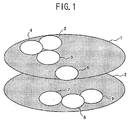
- FIG. 1 is a diagram for explaining a problem of a service area of a conventional wireless base station.
- small service areas 3 through 6 are provided within a larger service area 1
- small service areas 7 through 9 are provided within a large service area 2.
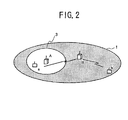
- FIG. 2 is an enlarged view of the large service area 1 of the conventional wireless base station in FIG. 1.
- a wireless base station B stands ready to provide its service.
- a wireless base station A stands ready to provide its service.
- a wireless terminal "a” exists in the service area 3, and a wireless terminal “b” exists in the service area 1.
- Each of the wireless base stations A and B provides the multicasting service.
- the wireless terminal "a” can receive the multicasting service provided by the wireless base station A
- the wireless terminal "b” can receive the multicasting service provided by the wireless base station B.
- the wireless terminal "a" When providing the multicasting service in a wireless access communication system in which the service areas of plural wireless base stations overlap each other, it is likely that the plural wireless base stations simultaneously send identical data to the overlapping service area.
- the wireless terminal "a" receives the multicasting service from the wireless base station A, and, at the same time, it receives the multicasting service from the wireless base station B. Namely, the wireless terminal "a" receives identical data from both the wireless base station A and the wireless base station B at the same time.
- the wireless terminal "a" it is sufficient for the wireless terminal "a" to receive the multicasting service from the wireless base station B only. It is not necessary that the wireless terminal "a" receive the multicasting service from the wireless base station A.
- the multicasting service provided to the wireless terminal "a" by the wireless base station A is inefficient.
- the radio resources are utilized inefficiently in the present example, and the efficiency of utilization of the radio resources is lowered.
- one object of the present invention is to make efficient use of the radio resources and lower the maintenance and operation cost.
- the access communication network is based on the IP network
- the IGMP Internet Group Management Protocol
- the access communication system is connected to the IP network that supports the IGMP protocol, it is preferred that the system employs the access control flow that is compatible with the IGMP protocol.
- the multicasting is not performed for the packets having a group address that is not related to the sub-network.
- the sending of unnecessary data to the sub-network is avoided, and the radio resources are saved.
- routers A and B when two different routers A and B receive the packets having a same group address, the routers A and B perform the multicasting to send identical data to the terminals of the related group within the respective service areas thereof.
- FIG. 3 is a diagram for explaining another problem of a service area of a conventional wireless base station. As shown, reference numeral 1 denotes the service area of the wireless base station A, and reference numeral 2 denotes the service area of the wireless base station B.
- the wireless terminal “a” is connected to the wireless base station A, and the wireless terminal “b” can be connected to both the wireless base station A and the wireless base station B.
- the wireless terminal “b” is located at the place that is nearer to the wireless base station B than the wireless base station A.
- the wireless terminal "b” is connected to the wireless base station B and receives the service from the wireless base station B.
- the wireless terminal "a” can be connected to both the wireless base station A and the wireless base station B.
- the wireless base station A provides a higher level of communication quality for the wireless terminal "a" than the wireless base station B, and the wireless terminal "a" is connected to the wireless base station A and receives the service from the wireless base station A.
- the wireless terminal "a” is connected to the wireless base station A according to the communication quality level, even when the wireless terminals "a” and “b” belong to the same IGMP group (group G1) and receive identical data.
- the wireless base station A sends to the wireless terminal "a” the identical data that is the same as that is sent to the wireless terminal "b".
- the wireless base station B stops providing the multicasting service to the wireless terminal "b".
- the radio resources needed for the wireless base station B to transmit other services to the group G1 terminals can be saved because of the disconnection of the wireless terminal "b" from the wireless base station B.
- the wireless terminal "a” exists in the service area 3 of the wireless base station B, and the wireless terminal “a” can communicate with the wireless base station B as well. If the connection of the wireless terminal "a” and the wireless base station A is switched to the connection of the wireless terminal "a" and the wireless base station B, the radio resources needed for the wireless base station A can be saved.
- another object of the present invention is to reduce the number of the wireless base stations that send identical data to the wireless terminals and increase the efficiency of utilization of the radio resources.
- one preferred embodiment of the present invention provides a wireless base station which is connected to a plurality of wireless terminals and provides a multicasting service for the plurality of wireless terminals, the wireless base station determining autonomously whether the wireless base station provides the multicasting service for the plurality of wireless terminals.
- the determination as to whether the wireless base station provides the multicasting service may be made for each of a plurality of multicasting service groups.
- the determination as to whether the wireless base station provides the multicasting service may be made based on a magnitude of a service area in which the wireless base station can provide the multicasting service for the plurality of wireless terminals.
- the determination as to whether the wireless base station provides the multicasting service may be made based on whether the wireless base station has an overlapping service area.
- the determination as to whether the wireless base station provides the multicasting service may be made based on a service state of a neighboring wireless base station.
- Each of the wireless terminals which are connected to the neighboring wireless base station may send a state signal indicating the service state of the neighboring wireless base station.
- the determination as to whether the wireless base station provides the multicasting service may be made based on a hop number of the wireless base station.
- another preferred embodiment of the present invention provides a method of selecting a wireless base station for a wireless terminal, the wireless base station providing a multicasting service for the wireless terminal, wherein, when the wireless terminal can receive same multicasting information from a plurality of wireless base stations, the wireless terminal selects one of the plurality of wireless base stations so as to make the number of the wireless base stations that send the same multicasting information as small as possible.
- the wireless terminal selects the first wireless base station and is connected to the first wireless base station.
- the wireless terminal selects one of the plurality of first wireless base stations such that the selected first wireless base station has a largest number of wireless terminals connected thereto, and the wireless terminal being connected to the selected first wireless base station.
- FIG. 1 is a diagram for explaining a problem of a service area of a conventional wireless base station.
- FIG. 2 is an enlarged view of the service area of the conventional wireless base station in FIG. 1.
- FIG. 3 is a diagram for explaining another problem of a service area of a conventional wireless base station.
- FIG. 4 is a diagram for explaining a service area of one preferred embodiment of the wireless base station of the invention.
- FIG. 5 is a diagram for explaining detection of an overlapping service area by the wireless base station of the present embodiment.
- FIG. 6 is a diagram for explaining the case in which wireless base stations having small service areas provide the multicasting services.
- FIG. 7 is a diagram for explaining the case in which wireless base stations having large service areas provide the multicasting services.
- FIG. 8 is a diagram for explaining the case in which the wireless base station provides the multicasting service based on the service states of the neighboring wireless base stations.
- FIG. 9 is a diagram for explaining the collection of the service state data of the neighboring wireless base stations performed by the wireless base station.
- FIG. 10 is a diagram for explaining the collection of the service state data of the neighboring wireless base stations performed through the communication between the neighboring wireless base stations.
- FIG. 11 is a block diagram of the wireless base station in the first preferred embodiment of the invention.
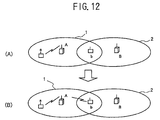
- FIG. 12 is a diagram for explaining joining of a wireless terminal to the multicasting service.
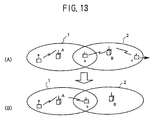
- FIG. 13 is a diagram for explaining switching of the connection of a wireless base station during the multicasting service.
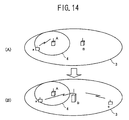
- FIG. 14 is a diagram for explaining multicasting service processing for the overlapping service area.
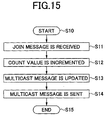
- FIG. 15 is a flowchart for explaining a control process performed by the wireless base station when a join message from the wireless terminal is received.
- FIG. 16 is a flowchart for explaining a control process performed by the wireless base station when a leave message from the wireless terminal is received.
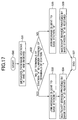
- FIG. 17 is a flowchart for explaining a control process performed by the wireless terminal when sending a join message to a wireless base station to join a multicasting service group.
- FIG. 18 is a flowchart for explaining a control process performed by the wireless terminal when the connection of the wireless terminal is switched.
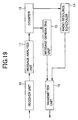
- FIG. 19 is a block diagram of a wireless base station in a second preferred embodiment of the invention.
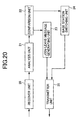
- FIG. 20 is a block diagram of a wireless terminal in the second preferred embodiment of the invention.
- FIG. 4 shows a service area of one preferred embodiment of the wireless base station of the invention.
- a service area 10 A of a wireless base station A is provided within a service area 10 B of a wireless base station B.
- a wireless terminal "a” exists in the service area 10 A
- a wireless terminal "b” exists in the service area 10 B .
- Each of the wireless base stations A and B stands ready to provide the multicasting service.
- a plurality of wireless terminals may exist in the service area 10 A or the service area 10 B .
- the wireless terminal "a” and the wireless terminal “b” are shown as the representative one of the plural wireless terminals in each service area, for the sake of convenience.
- the wireless terminal "a” can receive the multicasting service provided by the base station A and the multicasting service provided by the base station B.
- the wireless terminal “b” can receive the multicasting service provided by the base station B.
- the wireless terminal "a" which is located within the overlapping service area 10 A can receive the multicasting service from the base station B as well.
- the wireless base stations A and B when the wireless base stations A and B send the same multicasting information, the wireless base stations A and B are controlled such that the base station A does not provide the multicasting service for the service area 10 A , and only the base station B provides the multicasting service for the service area 10 B .
- the radio resources of the wireless base station A can be allocated to other services than the multicasting service. Hence, it is possible that the wireless base station of the present embodiment make efficient use of the radio resources.
- the triggers that are needed for the wireless base station to determine autonomously whether it provides the multicasting service are as follows:
- the magnitude of the service area depends on a transmission power of the wireless base station.
- One of a plurality of levels of the service area magnitude can be determined, in advance, for the individual wireless base stations in accordance with their transmission powers. Only the wireless base stations having a given level of the service area magnitude are allocated to those providing the multicasting service.
- wireless base stations having a radius of the service area less than 100 meters are set to level 1
- wireless base stations having a radius of the service area ranging from 100 meters to 200 meters are set to level 2
- wireless base stations having a radius of the service area larger than 200 meters are set to level 3.
- the wireless base stations of level 1 and level 3 are arranged in a spot-like coverage
- the wireless base stations of level 2 are arranged in a wide-range coverage.
- the wireless base stations to which the wireless terminals are most likely to be connected in the entire service area are the level-2 wireless base stations. In such circumstances, the multicasting service is provided by the level-2 wireless base stations only.
- each wireless base station can determine autonomously whether it provides the multicasting service, based on the magnitude of the service area of the wireless base station.
- the magnitude of the service area is derived from the transmission power of the wireless base station. For example, when the level-2 wireless base stations are predetermined as providing multicasting service, it can be autonomously determined that the wireless base stations having the transmission power corresponding to the level-2 are those providing the multicasting service.
- the wireless base stations with two or more levels may be predetermined as providing multicasting service.
- FIG. 5 shows a detection of an overlapping service area by the wireless base station of the present embodiment.
- the presence of the overlapping service area is detected by the wireless base station A based on the radius D2 of the service area of the wireless base station A (derived from a transmission power of the base station A), the receiving power R1 of a certain channel related to the neighboring wireless base station B, and the transmission power T1 of the neighboring base station B.
- the distance D1 between the base station A and the base station B is calculated from the transmission power T1 and the receiving power R1.
- the service area radius D2 and the distance D1 are compared each other.
- D1 ⁇ D2 the case indicated in (A) in FIG. 5
- the base station A detects that the service area of the neighboring base station B is provided within the service area of the base station A, and it is the overlapping area. In this case, the base station A determines that it provides the multicasting service for the overlapping service area.
- the base station A determines that it provides the multicasting service for the service area of the base station A.
- the base station A detects that the service area of the base station A is provided within the service area of the neighboring base station B, and it is the overlapping service area. In this case, the base station A determines that it does not provide the multicasting service for the service area of the base station A.
- the service area of the base station A is inclusive of the service area of the neighboring base station B. If the base station A provides the multicasting service for the service area of the base station A, the neighboring base station B is not required to provide the multicasting service for the service area of the base station B. However, a wireless base station having a small service area generally can easily increase the utilization of the radio resources. If the matter is taken into consideration, an alternative embodiment is possible in which the neighboring base station B having a small service area provides the multicasting service while the base station A having a large, inclusive service area does not provide the multicasting service.
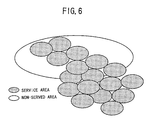
- FIG. 6 is a diagram for explaining the case in which wireless base stations having small service areas provide the multicasting services.
- FIG. 7 is a diagram for explaining the case in which wireless base stations having large service areas provide the multicasting services.
- the base stations having the small service areas cover a large service area.
- a wireless base station having the large service area is installed when the necessity arises, in order to avoid the congestion.
- the base stations having the small service areas provide their multicasting services so as to cover the large service area.
- the wireless base station having the large service area does not provide the multicasting service. According to the present embodiment, it is possible to avoid the redundancy of the multicasting service provided for the overlapping service area.
- the base stations having the large service areas cover a wide-range service area.
- Wireless base stations having small service areas are installed when the necessity arises, in order to avoid the congestion.
- the base stations having the large service areas provide their multicasting services so as to cover the wide-range service area.
- the wireless base stations having the small service areas do not provide their multicasting services. According to the present embodiment, it is possible to avoid the redundancy of the multicasting service provided for the overlapping service area.
- FIG. 8 shows the case in which the wireless base station provides the multicasting service based on the service states of the neighboring wireless base stations.
- the multicasting service #1 is provided by the wireless base station having the large service area, while the multicasting service #2 is provided by each of the wireless base stations having the small service areas.
- the load of the radio resources used for the multicasting is controlled.
- the radio resources used for the multicasting are distributed, and it is possible to increase the utilization of the radio resources used for the multicasting.
- the wireless base station determines whether it provides the multicasting service, based on the service states of the neighboring base stations. According to the present embodiment, it is possible to avoid the redundancy of the multicasting service provided for the overlapping service area. A different service other than the multicasting service can be provided for the overlapping service area.
- the base stations which already provide the services are excluded, and the different service may be provided so as to meet the demands of the wireless terminals.
- the detection of the overlapping service area may be performed according to the previous embodiment of FIG. 5.
- the multicasting information is effective only in the restricted local area.
- the multicasting service is provided by only the wireless base stations which are located near the information source. For this reason, the determination as to whether the wireless base station provides the multicasting service may be made based on a hop number of the wireless base station in a wired or wireless communication network. When the hop number is used, the present embodiment is more useful in a wired communication network than a wireless communication network.
- the hop number is defined for a wireless communication network as follows.
- the hop number 1 is allocated for a wireless base station located nearest to the information source
- the hop number 2 is allocated for a wireless base station neighboring the nearest base station
- the hop number 3 is allocated for a wireless base station neighboring the second nearest base station, and so on.
- the wireless base stations correspond to the routers in the IP (Internet protocol) network.
- a wireless base station located near the information source has the hop number 3.
- the base station transmits control information, including the hop number 3, to a neighboring wireless base station, the received hop number is decremented to 2 at the neighboring base station.
- the neighboring base station transmits control information, including the hop number 2, to a next neighboring base station, the received hop number is decremented to 1 at the next neighboring base station.
- the wireless base station determines that it does not provide the multicasting service. If the hop number that ranges from 1 to 3 is received at a wireless base station, the wireless base station determines that it provides the multicasting service.
- the hop numbers of the wireless base stations are managed for each of a plurality of multicast groups.
- the multicasting service is provided for a restricted local area in accordance with each of the above-mentioned applications.
- the wireless base station collects the service states of the neighboring wireless base stations, each service state including the hop number.
- the method of collection of the service states of the neighboring wireless base stations will now be explained.
- FIG. 9 shows the collection of the service state data of the neighboring wireless base stations performed by the wireless base station.
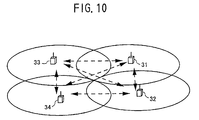
- FIG. 10 shows the collection of the service state data of the neighboring wireless base stations performed through the communication between the neighboring wireless base stations.
- wireless base stations 31, 32, 33 and 34 are connected to a control station 30, and each base station is capable of transmitting control information to and receiving control information from the control station 30.
- each of the base stations 31-34 transmits the control information, including the multicast-related data of the base station, to the control station 30, and one of the base stations 31-34 receives the control information, including the service state data of the neighboring base stations, from the control station 30.
- control station may transmit total multicast instructions or individual multicast group instructions to the neighboring wireless base stations, so that each base station determines whether it provides the multicasting service, based on the instructions received from the control station.
- each of the neighboring base stations receives the control information through the communication between the neighboring base stations, instead of the communication with the control station.
- the method of collection of the service state data of the neighboring wireless base stations in the present embodiment is also applicable to not only the wireless communication network but also the wired communication network.
- All of the wireless base stations transmit the control information by using a certain channel related to the neighboring base station, and the neighboring base station may receive the required control information from the required base station so as to carry out the above-described method.
- the wireless base station transmits the service state data, related to the multicasting service of the wireless base station itself, to the neighboring base station, and the neighboring base station may determine whether it provides the multicasting service, based on the received service state data.
- the wireless terminal which receives the multicasting service can receive the service state data of a wireless base station connectable to the terminal by using a control channel or a certain channel. If the wireless terminal sends the service state data of the connectable base station to the currently connected base station, the currently connected base station may determine whether it provides the multicasting service, based on the received service state data.
- FIG. 11 shows a configuration of the wireless base station in the first preferred embodiment of the invention.
- a transmitter unit 43 transmits a first message, including control data of this base station, to a neighboring wireless base station, and a receiver unit 40 receives a second message including control data of a neighboring wireless base station.
- a message processing unit 41 extracts a multicast-related control data from the second message received by the receiver unit 40.
- the message processing unit 41 sends the extracted multicast-related control data to a determination unit 42.
- the determination unit 42 determines whether the base station provides the multicasting service, based on the extracted multicast-related control data from the message processing unit 41. In a certain case, the determination unit 42 may determine that the base station does not provide the multicasting service.
- the determination unit 42 sends the result of the determination to a call processing unit 45.
- the call processing unit 45 transmits the result of the determination to the calling wireless terminal. Further, the determination unit 42 sends the result of the determination to a message generating unit 44. The message generating unit 44 generates the first message that is indicative of the result of the determination by the determination unit 42, and sends the first message to the transmitter unit 43 so that the transmitter unit 43 transmits the first message to the neighboring base station.
- the transmission and receiving of the control data may be performed by the wireless base station at the time of power-on or periodically at the intervals of a certain period.
- the message generating unit 44 and the call processing unit 45 are notified of the new control data.
- the determination unit 42 may determine that the wireless base station of concern does not provide the multicasting service for the multicasting group.
- the wireless base station may control the multicast-related control data (such as the in-service state, the service disable state or the service enable state) for each of the multicasting service types, and may transmit the multicast-related control data to the neighboring wireless base station or the control station.
- the multicast-related control data such as the in-service state, the service disable state or the service enable state
- the wireless base station collects the service states of the neighboring base stations from the control station or the neighboring base stations, and determines whether the wireless base station provides the multicasting service, based on the service states of the neighboring base stations. It is possible to avoid the redundancy of the multicasting service provided for the overlapping service area. It is possible for the wireless base station of the present embodiment to make efficient use of the radio resources and lower the maintenance and operation costs.
- FIG. 12 is a diagram for explaining joining of a wireless terminal to the multicasting service.
- reference numeral 1 denotes the service area of the wireless base station A
- reference numeral 2 denotes the service area of the wireless base station B.
- FIG. 12 (A) indicates the state before the wireless terminal "b” joins the multicasting service provided by the base station A
- FIG. 12 (B) indicates the state after the wireless terminal "b” joins the multicasting service provided by the base station A according to the present embodiment.
- the wireless terminal "a” is connected to the base station A to receive the multicasting service from the base station A as the multicast group G1.
- the wireless terminal "b” is about to join the multicast group G1.
- the wireless terminal "b” exists at the location where the terminal "b” is connectable to both the base station A and the base station B.
- the wireless terminal "b" detects that the base station A is now providing the multicasting service for the multicast group G1, by using a certain channel related to the neighboring base station.
- the wireless terminal "b” selects the base station A which is now providing the multicasting service, and receives the multicasting service provided by the base station A, as indicated in FIG. 12 (B).
- the base station B transmits identical multicasting information to the multicast group G1.
- the base station B stops providing the multicasting service for the multicast group G1, and it is possible to allocate the radio sources of the base station B to other services.
- FIG. 13 is a diagram for explaining switching of the connection of a wireless base station during the multicasting service.
- reference numeral 1 denotes the service area of the wireless base station A
- reference numeral 2 denotes the service area of the wireless base station B.
- FIG. 13 (A) indicates the state before the connection of the wireless terminal “b” is switched
- FIG. 13 (B) indicates the state after the connection of the wireless terminal "b” is switched according to the present embodiment.
- the wireless terminal "a” is connected to the base station A, and the wireless terminals "b” and “c” are connected to the base station B.
- the wireless terminals "a”, “b” and “c” receives identical multicasting information of the multicast group G1.
- the terminal "c” moves away from the service area of the base station B.
- the terminal “b” in the service area of the base station B receives identical multicasting information of the multicast group G1.
- the wireless terminal "b” exists at the location where the terminal “b” is connectable to both the base station A and the base station B.
- the wireless terminal “b” according to the present embodiment detects that the base station A is now providing the multicasting service for the multicast group G1, by using a certain channel related to the neighboring base station.
- the wireless terminal "b” selects the base station A which is now providing the multicasting service, and receives the multicasting service provided by the base station A, as indicated in FIG. 13 (B).
- the base station B transmits identical multicasting information to the multicast group G1.
- the base station B stops providing the multicasting service for the multicast group G1, and it is possible to allocate the radio sources of the base station B to other services.
- FIG. 14 is a diagram for explaining multicasting service processing for the overlapping service area.
- reference numeral 3 denotes the service area of the wireless base station B
- reference numeral 4 denotes the service area of the wireless base station A
- the service area 4 of the base station A is provided within the service area 3 of the base station B.
- FIG. 14 (A) indicates the state before the connection of the wireless terminal “a” is switched
- FIG. 14 (B) indicates the state after the connection of the wireless terminal "a” is switched according to the present embodiment.
- the wireless terminal "a” is connected to the base station A, and the wireless terminal "a” receives the multicasting service of the multicast group G1 provided by the base station A.
- the terminal "c” is newly connected to the base station B and joins the multicast group G1.
- both the base station A and the base station B transmit identical multicasting information of the multicast group G1.
- the wireless terminal "a” exists at the location where the terminal "a” is connectable to both the base station A and the base station B.
- the wireless terminal "a” detects that the base station B is now providing the multicasting service for the multicast group G1, by using a certain channel related to the neighboring base station.
- the wireless terminal "a” detects the number of wireless terminals currently connected to the base station A (for the multicast group G1) by using a certain channel related to the base station A, and detects the number of wireless terminals currently connected to the base station B (for the multicast group G1) by using a certain channel related to the base station B. It is determined at the wireless terminal “a” whether the latter number is larger than the former number.
- the wireless terminal "a” selects one of connection of the terminal "a” to the base station A and disconnection of the terminal “a” from the base station A based on the result of the determination, so as to make the number of wireless base stations that send identical multicasting information as small as possible.
- the wireless terminal "a” selects disconnection of the terminal “a” from the base station A, and receives the multicasting service provided by the base station B, as indicated in FIG. 14 (B).
- the wireless base station It is necessary for the wireless base station to detect that a certain wireless terminal terminates the receiving of the multicasting service of that base station, or that only one wireless terminal is left in the service area of that base station. It is necessary for the wireless terminal to detect that the terminal solely receives the multicasting service from the wireless base station.
- the wireless terminal when the wireless terminal is about to receive the multicasting service of the wireless base station, the wireless terminal sends a join message to the base station. In addition, when the wireless terminal is about to leave from the multicasting service of the wireless base station, the wireless terminal sends a leave message to the base station. Each time the join or leave message is received at the base station, the count value, indicating the number of wireless terminals currently connected to the base station for each multicast group, is incremented or decremented. A broadcast message, including the resulting count value, is transmitted from the base station to the wireless terminal by using a certain channel related to the neighboring base station.
- the wireless terminal by receiving the broadcast message from the base station, the wireless terminal switches the connection of the wireless terminal to a new base station, so as to make the number of wireless base stations that send identical multicasting information as small as possible.
- the base station stops providing the multicasting service.
- FIG. 15 shows a control process performed by the wireless base station of the present embodiment when a join message from the wireless terminal is received.
- the wireless terminal when the wireless terminal is about to receive the multicasting service of the wireless base station, the wireless terminal sends a join message to the base station.
- the base station receives the join message from the terminal (S11). After the step S11 is performed, the base station increments the count value of the internal counter based on the received join message (S12). At the same time, the base station updates the number of the currently connected wireless terminals in a broadcast message to be transmitted (S13). After the step S13 is performed, the base station transmits the broadcast message (S14).
- FIG. 16 shows a control process performed by the wireless base station of the present embodiment when a leave message from the wireless terminal is received.
- the wireless terminal when the wireless terminal is about to leave the multicasting service of the wireless base station, the wireless terminal sends a leave message to the base station.
- the base station receives the leave message from the terminal (S21).
- the base station decrements the count value of the internal counter based on the received leave message (S22).
- the base station updates the number of the currently connected wireless terminals in a broadcast message to be transmitted (S23).
- the base station determines whether the resulting count value is equal to 0 (S24). When the count value is equal to 0, it indicates that there is no wireless terminal receiving the multicasting service.
- the base station notifies the radio resource scheduler that there is no wireless terminal receiving the multicasting service (S25).
- the base station causes the scheduler to stop the allocation of the radio resources for the multicasting service, and causes the transmitter unit to stop transmitting the multicasting service information (S26). After the step S26 is performed, the control of the base station is transferred to next step S27.
- the base station transmits the broadcast message including the resulting count value (S27).
- FIG. 17 shows a control process performed by the wireless terminal of the present embodiment when sending a join message to a wireless base station to join a multicast group.
- the wireless terminal receives the broadcast messages from the neighboring base stations A and B (S31). After the step S31 is performed, the wireless terminal detects the number of wireless terminals currently connected to the base station A for the intended multicast group from the broadcast message from the base station A, and detects the number of wireless terminals currently connected to the base station B for the intended multicast group from the broadcast message from the base station B. If there is no information related to the intended multicast group, it is determined that the number of wireless terminals currently connected to the base station is equal to 0. The wireless terminal determines whether the former number is larger than the latter number (S32).
- the wireless terminal When the result at the step S32 is affirmative, the wireless terminal sends a join message to the base station A (S33). The wireless terminal receives the multicasting service provided by the base station A (S34). On the other hand, when the result at the step S32 is negative, the wireless terminal sends a join message to the base station B (S35). The wireless terminal receives the multicasting service provided by the base station B (S36). After one of the steps S34 and S36 is performed, the control process of FIG. 17 ends.
- FIG. 18 shows a control process performed by the wireless terminal when the connection of the wireless terminal is switched.
- the wireless terminal has been connected to the base station B to receive the service from the base station B, and the connection of the wireless terminal is switched to the wireless base station A.
- the wireless terminal is now connected to the base station B (S41).
- the wireless terminal intermittently receives broadcast messages from the neighboring wireless base stations.
- the wireless terminal is connectable to the base stations A and B.
- the wireless terminal receives the service states of the base stations A and B, and detects the number of wireless terminals connected to the base station A and the number of wireless terminals connected to the base station B from the received service states of the base stations A and B.
- the wireless terminal determines whether the number of the terminals of the base station A is larger than the number of the terminals of the base station B (S42).
- the wireless terminal sends a leave message to the base station B (S43). After the step S43 is performed, the wireless terminal sends a join message to the base station A (S44). After the step S44 is performed, the connection of the wireless terminal is switched to the base station A, and the wireless terminal joins the multicast group of the base station A and receives the multicasting service provided by the base station A (S45).
- step S42 When the result at the step S42 is negative, the control of the wireless terminal is transferred to the step S41. The switching of the connection of the wireless terminal to the base station A is not performed in this case.
- the wireless terminal When the wireless terminal only leaves from the multicasting group, it is adequate that the wireless terminal sends the leave message to the base station B.
- FIG. 19 shows a wireless base station in a second preferred embodiment of the invention.
- a receiver unit 10 receives control data, including a join message or a leave message, in addition to communication data.
- a message analysis unit 11 extracts the join/leave message from the control data received by the receiver unit 10, and sends the extracted message to a counter 12.
- a count value is incremented or decremented, or remain unchanged, in accordance with the extracted message from the message analysis unit 11.
- the counter 12 notifies a message generating unit 13 of the changed count value.
- the message generating unit 13 generates a broadcast message based on the changed count value, and sends the broadcast message to a transmitter unit 15 so that the transmitter unit 15 transmits the broadcast message.
- the counter 12 When the count value of the counter 12 is equal to zero, the counter 12 notifies a radio resource scheduler 14.
- the resource scheduler 14 in this case stops the allocation of the radio resources to the wireless terminals.
- the count value of the counter 12 is changed from 0 to 1.
- the counter 12 notifies the resource scheduler 14 of the new join message.
- the resource scheduler 14 allocates the radio resources to the new multicasting group.
- the transmitter unit 15 transmits the multicasting information related to the new multicasting group.
- FIG. 20 shows a wireless terminal in the second preferred embodiment of the invention.
- a receiver unit 20 receives control data, including a broadcast message, in addition to communication data.
- a message analysis unit 21 extracts the broadcast message from the control data received by the receiver unit 20, determines the number of wireless terminals connected to the multicast group from the extracted message, and sends the number of wireless terminals to a comparison unit 22.
- the comparison unit 22 determines whether the received number is larger than the number of wireless terminals currently connected to the base station. When the number of wireless terminals connected to the multicast group is larger than the number of wireless terminals currently connected to the base station, the switching of the connection of the wireless terminal of concern is needed. In this case, a join/leave message generating unit 23 and a base station switching unit 24 are notified of the need for the switching. Otherwise, no further processing is performed.
- the message generating unit 23 generates a leave message to the current base station and a join message to a new base station based on the result of the determination received from the comparison unit 22.
- the message generating unit 23 sends the join/leave messages to a transmitter unit 25 so that the transmitter unit 25 transmits the messages.
- the base station switching unit 24 controls the synchronization of the transmitter unit 25 with the current base station (or the new base station) in accordance with the result of the determination received from the comparison unit 22.
Landscapes
- Engineering & Computer Science (AREA)
- Computer Networks & Wireless Communication (AREA)
- Signal Processing (AREA)
- Mobile Radio Communication Systems (AREA)
Abstract
Description
Claims (20)
- A wireless base station which is connected to a plurality of wireless terminals and provides a multicasting service for the plurality of wireless terminals, characterized in that the wireless base station determines autonomously whether the wireless base station provides the multicasting service for the plurality of wireless terminals.
- The wireless base station as claimed in claim 1, characterized in that the determination as to whether the wireless base station provides the multicasting service is made for each of a plurality of multicasting service groups.
- The wireless base station as claimed in claim 1, characterized in that the determination as to whether the wireless base station provides the multicasting service is made based on a magnitude of a service area in which the wireless base station can provide the multicasting service for the plurality of wireless terminals.
- The wireless base station as claimed in claim 1, characterized in that the determination as to whether the wireless base station provides the multicasting service is made based on whether the wireless base station has an overlapping service area.
- The wireless base station as claimed in claim 1, characterized in that the determination as to whether the wireless base station provides the multicasting service is made based on a service state of a neighboring wireless base station.
- The wireless base station as claimed in claim 5, characterized in that each of the wireless terminals which are connected to the neighboring wireless base station sends a state signal indicating the service state of the neighboring wireless base station.
- The wireless base station as claimed in claim 1, characterized in that the determination as to whether the wireless base station provides the multicasting service is made based on a hop number of the wireless base station.
- The wireless base station as claimed in claim 1, characterized in comprising:a transmitting means for transmitting a first state signal to a neighboring wireless base station, the first state signal indicating a multicasting service state of the wireless base station; anda receiving means for receiving a second state signal from the neighboring wireless base station, the second state signal indicating a multicasting service state of the neighboring wireless base station.
- The wireless base station as claimed in claim 1, characterized in comprising:a transmitter unit transmitting a first message;a receiver unit receiving a second message;a message processing unit extracting a multicast-related control data from the second message received by the receiver unit;a determination unit determining whether the wireless base station provides the multicasting service, based on the extracted multicast-related control data; anda message generating unit generating the first message that is indicative of the result of the determination by the determination unit, and sending the first message to the transmitter unit so that the transmitter unit transmits the first message.
- A wireless base station which is connected to a control station and a plurality of wireless terminals and provides a multicasting service for the plurality of wireless terminals, characterized in comprising:a transmitting means for transmitting a first state signal to the control station, the first state signal indicating a multicasting service state of the wireless base station; anda receiving means for receiving a second state signal from the control station, the second state signal indicating a multicasting service state of a neighboring wireless base station.
- A wireless base station which is connected to a control station and a plurality of wireless terminals and provides a multicasting service for the plurality of wireless terminals, characterized in that the wireless base station determines whether the wireless base station provides the multicasting service, based on instructions received from the control station.
- A method of selecting a wireless base station for a wireless terminal, the wireless base station providing a multicasting service for the wireless terminal, characterized in that, when the wireless terminal can receive same multicasting information from a plurality of wireless base stations, the wireless terminal selects one of the plurality of wireless base stations so as to make the number of the wireless base stations that send the same multicasting information as small as possible.
- The method as claimed in claim 12, characterized in that, when there is a first wireless base station which is connectable to the wireless terminal and sending the same multicasting information to the wireless terminal, the wireless terminal selects the first wireless base station and is connected to the first wireless base station.
- The method as claimed in claim 12, characterized in that, when there are a plurality of first wireless base stations which are connectable to the wireless terminal and sending the same multicasting information to the wireless terminal, the wireless terminal selects one of the plurality of first wireless base stations such that the selected first wireless base station has a largest number of wireless terminals connected thereto, and the wireless terminal being connected to the selected first wireless base station.
- The method as claimed in any of claims 12 to 14, characterized in that the selected wireless base station provides the multicasting service for the wireless terminal.
- A wireless base station which provides a multicasting service for a wireless terminal, characterized in that, when the wireless terminal selects one of a plurality of wireless base stations so as to make the number of the wireless base stations that send identical multicasting information as small as possible, the wireless base station determines that the wireless base station provides a multicasting service for the wireless terminal.
- A wireless base station which provides a multicasting service for a wireless terminal, characterized in comprising a counter in which a count value is incremented when a join message from the wireless terminal is received at the wireless base station, and decremented when a leave message from the wireless terminal is received at the wireless base station, wherein the wireless base station transmits the count value of the counter to the wireless terminal.
- The wireless base station as claimed in claim 17, characterized in that the wireless base station transmits a renewed count value of the counter to the wireless terminal each time the count value is renewed.
- The wireless base station as claimed in claim 17, characterized in that the wireless base station stops providing the multicasting service for the wireless terminal when the count value of the counter is equal to zero.
- A wireless terminal which receives a multicasting service provided by a wireless base station, characterized in comprising:wherein the wireless terminal selects one of connection of the wireless terminal to the base station and disconnection of the wireless terminal from the base station based on the result of the determination of the comparison unit, so as to make the number of wireless base stations that send identical multicasting information as small as possible.an analysis unit determining the number of wireless terminals connected to a multicast group, based on a received control data; anda comparison unit determining whether the determined number is larger than the number of wireless terminals currently connected to the base station,
Applications Claiming Priority (5)
| Application Number | Priority Date | Filing Date | Title |
|---|---|---|---|
| JP2000025768A JP3657839B2 (en) | 2000-02-02 | 2000-02-02 | Radio base station |
| JP2000025768 | 2000-02-02 | ||
| JP2000025767 | 2000-02-02 | ||
| JP2000025767A JP3657838B2 (en) | 2000-02-02 | 2000-02-02 | Radio base station selection method, multicast method, radio base station, and radio terminal |
| PCT/JP2001/000748 WO2001058053A1 (en) | 2000-02-02 | 2001-02-02 | Wireless base station, method of selecting wireless base station, method of multicasting, and wireless terminal |
Publications (3)
| Publication Number | Publication Date |
|---|---|
| EP1175025A1 true EP1175025A1 (en) | 2002-01-23 |
| EP1175025A4 EP1175025A4 (en) | 2005-12-21 |
| EP1175025B1 EP1175025B1 (en) | 2007-10-31 |
Family
ID=26584758
Family Applications (1)
| Application Number | Title | Priority Date | Filing Date |
|---|---|---|---|
| EP01902741A Expired - Lifetime EP1175025B1 (en) | 2000-02-02 | 2001-02-02 | Wireless base station, method of selecting wireless base station, method of multicasting, and wireless terminal |
Country Status (5)
| Country | Link |
|---|---|
| US (2) | US7136662B2 (en) |
| EP (1) | EP1175025B1 (en) |
| CN (1) | CN1224190C (en) |
| DE (1) | DE60131120T2 (en) |
| WO (1) | WO2001058053A1 (en) |
Cited By (3)
| Publication number | Priority date | Publication date | Assignee | Title |
|---|---|---|---|---|
| EP1511333A1 (en) * | 2003-08-29 | 2005-03-02 | Alcatel | Fast delivery of multimedia messages in cellular networks |
| EP1582026A4 (en) * | 2003-01-09 | 2010-06-02 | Thomson Licensing | METHOD AND APPARATUS FOR BAND DISTRIBUTING MULTIPLE ACCESS POINTS |
| EP1646258A3 (en) * | 2004-09-14 | 2013-07-03 | NEC Corporation | Portable terminal set and control method thereof |
Families Citing this family (26)
| Publication number | Priority date | Publication date | Assignee | Title |
|---|---|---|---|---|
| US8068832B2 (en) | 2001-11-19 | 2011-11-29 | Nokia Corporation | Multicast session handover |
| US7379738B2 (en) * | 2002-08-05 | 2008-05-27 | Telefonaktiebolaget Lm Ericsson (Publ) | Information service broadcast control in a wireless communication network |
| US6977914B2 (en) * | 2002-12-23 | 2005-12-20 | Nokia Corporation | Broadcast hand-over in a wireless network |
| US7869399B2 (en) * | 2003-01-06 | 2011-01-11 | Interdigital Technology Corporation | Method and apparatus for controlling the distribution of multimedia broadcast services |
| US20050070293A1 (en) * | 2003-09-24 | 2005-03-31 | Kyocera Corporation | Communication terminal and base station selection method |
| KR101042359B1 (en) | 2003-12-11 | 2011-06-17 | 주식회사 케이티 | Method and apparatus for providing multicasting service in wireless internet network |
| KR100943620B1 (en) * | 2004-06-25 | 2010-02-24 | 삼성전자주식회사 | Resource Allocation Method in Multi-carrier-based Communication Systems |
| CN1747588A (en) * | 2004-09-08 | 2006-03-15 | 展讯通信(上海)有限公司 | Village locking method of mobile communication terminal |
| US20060126563A1 (en) * | 2004-12-14 | 2006-06-15 | Sungsoo Kang | System and method of processing hand-off of mobile terminal |
| US8126482B2 (en) | 2005-03-04 | 2012-02-28 | Qualcomm Incorporated | Multiple paging channels for efficient region paging |
| US8565721B2 (en) * | 2006-10-20 | 2013-10-22 | T-Mobile Usa, Inc. | System and method for rating an IP-based wireless telecommunications based on access point |
| FR2889390A1 (en) * | 2005-07-29 | 2007-02-02 | France Telecom | IP MULTICAST FLUX HEARING MEASUREMENT |
| US7558587B2 (en) * | 2005-12-12 | 2009-07-07 | Motorola, Inc. | System and method for dynamically selecting wireless information communication modes for a wireless communication device |
| US8000304B2 (en) * | 2005-12-12 | 2011-08-16 | Motorola Mobility, Inc. | System and method for determining a forward channel rate for wirelessly communicating information to a wireless communication device |
| US7668121B2 (en) * | 2006-01-10 | 2010-02-23 | Intel Corporation | Purging of authentication key contexts by base stations on handoff |
| US8031872B2 (en) * | 2006-01-10 | 2011-10-04 | Intel Corporation | Pre-expiration purging of authentication key contexts |
| JP4577222B2 (en) * | 2006-01-20 | 2010-11-10 | 株式会社デンソー | Mobile communication system, radio base station, and distribution method |
| JP5017218B2 (en) * | 2008-09-12 | 2012-09-05 | アラクサラネットワークス株式会社 | Packet transfer device |
| JP5272702B2 (en) * | 2008-12-16 | 2013-08-28 | 富士通株式会社 | Mobile network system and guidance message providing method |
| JP5386404B2 (en) * | 2010-02-26 | 2014-01-15 | 株式会社日立製作所 | Wireless communication system, base station, and network control apparatus |
| ES2429222B1 (en) * | 2011-05-12 | 2014-06-05 | Telefónica, S.A. | METHOD AND END NODE TO DISTRIBUTE CONTINUOUS FLOW OF CONTENT IN REAL TIME IN A CONTENT DISTRIBUTION NETWORK |
| US9461759B2 (en) | 2011-08-30 | 2016-10-04 | Iheartmedia Management Services, Inc. | Identification of changed broadcast media items |
| US8639178B2 (en) | 2011-08-30 | 2014-01-28 | Clear Channel Management Sevices, Inc. | Broadcast source identification based on matching broadcast signal fingerprints |
| ES2842589T3 (en) * | 2014-03-31 | 2021-07-14 | British Telecomm | Multicast streaming |
| US11736906B2 (en) * | 2020-08-06 | 2023-08-22 | Samsung Electronics Co., Ltd. | Method and system for MBS switching and continuity in 5G wireless network |
| JP7814246B2 (en) * | 2022-06-02 | 2026-02-16 | 三菱電機株式会社 | Relay device, surveillance camera system, data relay method, and relay control program |
Family Cites Families (23)
| Publication number | Priority date | Publication date | Assignee | Title |
|---|---|---|---|---|
| US5081679A (en) * | 1990-07-20 | 1992-01-14 | Ericsson Ge Mobile Communications Holding Inc. | Resynchronization of encryption systems upon handoff |
| US5940771A (en) * | 1991-05-13 | 1999-08-17 | Norand Corporation | Network supporting roaming, sleeping terminals |
| JPH08265358A (en) * | 1995-03-20 | 1996-10-11 | Hitachi Ltd | Wireless LAN system, base station device thereof, wireless terminal device, and information frame relay method |
| JP2959455B2 (en) * | 1995-12-04 | 1999-10-06 | 日本電気株式会社 | Group communication control method for mobile communication system |
| JP3233012B2 (en) | 1996-04-11 | 2001-11-26 | 株式会社日立製作所 | Layer and cell selection method in mobile communication system |
| CA2208821C (en) * | 1996-07-18 | 2002-01-01 | At&T Corp. | Wireless services distribution system |
| US5887252A (en) * | 1996-09-10 | 1999-03-23 | Nokia Mobile Phones Limited | Multicast transmission for DS-CDMA cellular telephones |
| JP3082686B2 (en) | 1996-11-07 | 2000-08-28 | 日本電気株式会社 | MAC bridge control method and device |
| US5920818A (en) * | 1996-12-03 | 1999-07-06 | Telefonaktiebolaget L M Ericsson (Publ) | Apparatus and method for controlling communications in a multi-network, wireless communication system |
| JP3469417B2 (en) * | 1996-12-20 | 2003-11-25 | 株式会社エヌ・ティ・ティ・ドコモ | Mobile communication system |
| JPH10257567A (en) | 1997-03-14 | 1998-09-25 | Victor Co Of Japan Ltd | Communications system |
| EP0863684A3 (en) * | 1997-03-03 | 2000-05-17 | Victor Company Of Japan, Ltd. | Communication system |
| US5930248A (en) * | 1997-03-04 | 1999-07-27 | Telefonaktiebolaget Lm Ericsson | Radio communication system selectively using multicast with variable offset time |
| SE519210C2 (en) * | 1997-06-06 | 2003-01-28 | Ericsson Telefon Ab L M | Method of minimizing the connection delay for a mobile-directed message in cellular radio communication system |
| US6188911B1 (en) * | 1997-09-09 | 2001-02-13 | Telefonaktiebolaget Lm Ericsson (Publ) | Efficient message transmission in a mobile communication system |
| FI107097B (en) * | 1997-09-24 | 2001-05-31 | Nokia Networks Oy | Targeted broadcast on the radio network |
| EP0951198A2 (en) * | 1998-04-14 | 1999-10-20 | Nec Corporation | IP multicast over a wireless ATM network |
| US6480721B1 (en) * | 1998-07-10 | 2002-11-12 | Siemens Information And Communication Mobile Llc | Method and system for avoiding bad frequency subsets in a frequency hopping cordless telephone system |
| US6104709A (en) * | 1998-07-17 | 2000-08-15 | Motorola, Inc. | Channel assignment within a broad-band communication system |
| JP2000050335A (en) * | 1998-07-31 | 2000-02-18 | Nec Corp | Mobile communication system |
| US6597680B1 (en) * | 1998-11-16 | 2003-07-22 | Telefonaktiebolaget Lm Ericsson (Publ) | Packet traffic channel reassignment |
| JP3343908B2 (en) * | 1999-06-22 | 2002-11-11 | 日本電気株式会社 | Broadcast communication method and system, base station apparatus and mobile station |
| US6298058B1 (en) * | 1999-12-17 | 2001-10-02 | Motorola, Inc. | Methods for implementing a talkgroup call with competing sources in a multicast IP network |
-
2001
- 2001-02-02 US US09/926,258 patent/US7136662B2/en not_active Expired - Fee Related
- 2001-02-02 DE DE60131120T patent/DE60131120T2/en not_active Expired - Lifetime
- 2001-02-02 EP EP01902741A patent/EP1175025B1/en not_active Expired - Lifetime
- 2001-02-02 WO PCT/JP2001/000748 patent/WO2001058053A1/en not_active Ceased
- 2001-02-02 CN CN01800155.6A patent/CN1224190C/en not_active Expired - Fee Related
-
2006
- 2006-03-14 US US11/374,140 patent/US20060160549A1/en not_active Abandoned
Cited By (3)
| Publication number | Priority date | Publication date | Assignee | Title |
|---|---|---|---|---|
| EP1582026A4 (en) * | 2003-01-09 | 2010-06-02 | Thomson Licensing | METHOD AND APPARATUS FOR BAND DISTRIBUTING MULTIPLE ACCESS POINTS |
| EP1511333A1 (en) * | 2003-08-29 | 2005-03-02 | Alcatel | Fast delivery of multimedia messages in cellular networks |
| EP1646258A3 (en) * | 2004-09-14 | 2013-07-03 | NEC Corporation | Portable terminal set and control method thereof |
Also Published As
| Publication number | Publication date |
|---|---|
| EP1175025B1 (en) | 2007-10-31 |
| US20060160549A1 (en) | 2006-07-20 |
| CN1363155A (en) | 2002-08-07 |
| WO2001058053A1 (en) | 2001-08-09 |
| CN1224190C (en) | 2005-10-19 |
| US20030157966A1 (en) | 2003-08-21 |
| DE60131120D1 (en) | 2007-12-13 |
| US7136662B2 (en) | 2006-11-14 |
| DE60131120T2 (en) | 2008-08-07 |
| EP1175025A4 (en) | 2005-12-21 |
Similar Documents
| Publication | Publication Date | Title |
|---|---|---|
| EP1175025B1 (en) | Wireless base station, method of selecting wireless base station, method of multicasting, and wireless terminal | |
| EP1650989B1 (en) | Method for providing an MBMS service in a wireless communication system | |
| RU2262811C2 (en) | Method for transmitting and receiving control messages in mobile communication system to provide services of broadcast and multi- address transmission of multimedia information | |
| JP4988765B2 (en) | Wireless communication method and apparatus for supporting wireless terminal mode control signaling | |
| US7920887B2 (en) | System and method for setting up P2P communication group in cellular system, and P2P communication system and method using P2P communication group | |
| US8144604B2 (en) | Method and system for allocating multiple channels in a mesh network | |
| CN101330658A (en) | Method of selecting between multiple modes of operation for providing broadcast or multicast services | |
| EP1271842B1 (en) | Method and device for multicasting | |
| RU2006122013A (en) | TRANSMISSION AND RECEIVING OF MANAGEMENT INFORMATION INFORMATION FOR MULTIPOINT SERVICE IN A WIRELESS COMMUNICATION SYSTEM | |
| US7606569B2 (en) | Wireless terminal for selecting optimal base station from among plural base stations | |
| KR20090032121A (en) | Show broadcast anchor availability | |
| CN101938784A (en) | Channel allocation method, channel adjustment method and network equipment | |
| CN113676845B (en) | Multi-hop relay communication method for near field service | |
| EP1275266B1 (en) | Multicast paging in a communications system | |
| US20050013326A1 (en) | Method for transmitting point-to-point information | |
| KR20110121559A (en) | Base station, mobile station, paging message transmission method, and paging message reception method | |
| RU2394375C2 (en) | Device and method of transmitting information for multimedia broadcast and multicast service (mbms) | |
| KR101022607B1 (en) | Decentralized Cooperative Common Control Channel Selection Method for Multi-Channel Ad Networks in Radio-Aware Environments | |
| JP3657839B2 (en) | Radio base station | |
| KR20090100433A (en) | Method and system for allocating channels in a wireless network | |
| KR101317996B1 (en) | Method and apparatus for transmiting data between nodes in a mesh network | |
| CN119012267A (en) | Multi-device data transmission method and system based on low-power-consumption wide area network | |
| JP3657838B2 (en) | Radio base station selection method, multicast method, radio base station, and radio terminal | |
| JP4469602B2 (en) | Management method of multicast service | |
| EP1969881B1 (en) | Method of receiving/transmitting at least one service in a mobile communication system |
Legal Events
| Date | Code | Title | Description |
|---|---|---|---|
| PUAI | Public reference made under article 153(3) epc to a published international application that has entered the european phase |
Free format text: ORIGINAL CODE: 0009012 |
|
| 17P | Request for examination filed |
Effective date: 20011031 |
|
| AK | Designated contracting states |
Kind code of ref document: A1 Designated state(s): AT BE CH CY DE DK ES FI FR GB GR IE IT LI LU MC NL PT SE TR |
|
| RBV | Designated contracting states (corrected) |
Designated state(s): DE GB |
|
| RIC1 | Information provided on ipc code assigned before grant |
Ipc: 7H 04L 12/28 B Ipc: 7H 04Q 7/22 A Ipc: 7H 04Q 7/30 B Ipc: 7H 04Q 7/36 B |
|
| A4 | Supplementary search report drawn up and despatched |
Effective date: 20051107 |
|
| GRAP | Despatch of communication of intention to grant a patent |
Free format text: ORIGINAL CODE: EPIDOSNIGR1 |
|
| GRAS | Grant fee paid |
Free format text: ORIGINAL CODE: EPIDOSNIGR3 |
|
| GRAA | (expected) grant |
Free format text: ORIGINAL CODE: 0009210 |
|
| AK | Designated contracting states |
Kind code of ref document: B1 Designated state(s): DE GB |
|
| REG | Reference to a national code |
Ref country code: GB Ref legal event code: FG4D |
|
| REF | Corresponds to: |
Ref document number: 60131120 Country of ref document: DE Date of ref document: 20071213 Kind code of ref document: P |
|
| PLBE | No opposition filed within time limit |
Free format text: ORIGINAL CODE: 0009261 |
|
| STAA | Information on the status of an ep patent application or granted ep patent |
Free format text: STATUS: NO OPPOSITION FILED WITHIN TIME LIMIT |
|
| 26N | No opposition filed |
Effective date: 20080801 |
|
| PGFP | Annual fee paid to national office [announced via postgrant information from national office to epo] |
Ref country code: DE Payment date: 20100211 Year of fee payment: 10 Ref country code: GB Payment date: 20100202 Year of fee payment: 10 |
|
| GBPC | Gb: european patent ceased through non-payment of renewal fee |
Effective date: 20110202 |
|
| REG | Reference to a national code |
Ref country code: DE Ref legal event code: R119 Ref document number: 60131120 Country of ref document: DE Effective date: 20110901 |
|
| PG25 | Lapsed in a contracting state [announced via postgrant information from national office to epo] |
Ref country code: GB Free format text: LAPSE BECAUSE OF NON-PAYMENT OF DUE FEES Effective date: 20110202 |
|
| PG25 | Lapsed in a contracting state [announced via postgrant information from national office to epo] |
Ref country code: DE Free format text: LAPSE BECAUSE OF NON-PAYMENT OF DUE FEES Effective date: 20110901 |