EP1174828A2 - Method for vector length calculation in data processing - Google Patents
Method for vector length calculation in data processing Download PDFInfo
- Publication number
- EP1174828A2 EP1174828A2 EP01306196A EP01306196A EP1174828A2 EP 1174828 A2 EP1174828 A2 EP 1174828A2 EP 01306196 A EP01306196 A EP 01306196A EP 01306196 A EP01306196 A EP 01306196A EP 1174828 A2 EP1174828 A2 EP 1174828A2
- Authority
- EP
- European Patent Office
- Prior art keywords
- linear equations
- equations
- subset
- same
- vector
- Prior art date
- Legal status (The legal status is an assumption and is not a legal conclusion. Google has not performed a legal analysis and makes no representation as to the accuracy of the status listed.)
- Withdrawn
Links
Classifications
-
- G—PHYSICS
- G06—COMPUTING OR CALCULATING; COUNTING
- G06F—ELECTRIC DIGITAL DATA PROCESSING
- G06F17/00—Digital computing or data processing equipment or methods, specially adapted for specific functions
- G06F17/10—Complex mathematical operations
- G06F17/16—Matrix or vector computation, e.g. matrix-matrix or matrix-vector multiplication, matrix factorization
-
- G—PHYSICS
- G06—COMPUTING OR CALCULATING; COUNTING
- G06F—ELECTRIC DIGITAL DATA PROCESSING
- G06F17/00—Digital computing or data processing equipment or methods, specially adapted for specific functions
- G06F17/10—Complex mathematical operations
- G06F17/11—Complex mathematical operations for solving equations, e.g. nonlinear equations, general mathematical optimization problems
- G06F17/12—Simultaneous equations, e.g. systems of linear equations
Definitions
- the invention which is the subject of this application is directed towards an improvement in the processing of data such as, but not exclusively, video data which is generated as part of a broadcast data system.
- An alternative conventional technique is to construct a table of data which are referred to as look up tables and which can be referred to during the calculation for data which reduces the need for the full calculation to be performed.
- the storage of the look up table data takes up memory space and it is important, for subsequent calculations to be correct, that the data in the tables is required to be accurate.
- the aim of the present invention is to provide a method whereby the lengths of a vector can be estimated to an acceptable level of accuracy and consistency for practical use but to also achieve a reduction in the computational complexity which is required to be performed.
- a method for the length of a vector to be estimated characterised in that said method includes the generation of a series of linear equations which may be used in the calculation of vector length, analysis of the same and selection of those linear equations which can be solved using arithmetic and/or bitwise operations, to form a subset of linear equations, said vector length calculations subsequently made using one or more linear equations, each derived from the specified subset of linear equations.
- the subset of equations used can be chosen at the stage of the design of the system in accordance with the required balance between execution speed, code size and accuracy of the estimations which are to be obtained.
- the application of this method as herein described can be widely applicable and has application in a wide range of computing applications. Without restricting the scope of the application in any way some examples of use of the method are with respect to 3-D graphics rendering, for example in z-buffering or shading algorithms.
- the method can be used in Bezier curve rendering, which in turn is used for font rendering, among other things.
- the method may be useful in colour space, for example when selecting a closest match to a particular colour from a given palette, or when calculating an optimal palette for a bitmap image.
- the method may also provide applications in motion estimation processing of video data at the encoding of the same and subsequent decoding of the same.
- a preferred way to pick a selection of sets of a , b , c coefficients is to choose the maximum error which the user is prepared to accept in each instant, ⁇ max , and cycle through all possible combinations of coefficients. For each combination, calculate the range of angles over which the resultant function produces acceptable results, and then fit together a selection of functions that, between them, cover the possible angles.
- the method can be used in applications to higher dimensions than 2.
- the direct analogue would be to consider a collection of lines with planes as foci; with the square of the number of functions to achieve the same accuracy in 3 dimensions, the cube of the number in 4 dimensions, and so on.
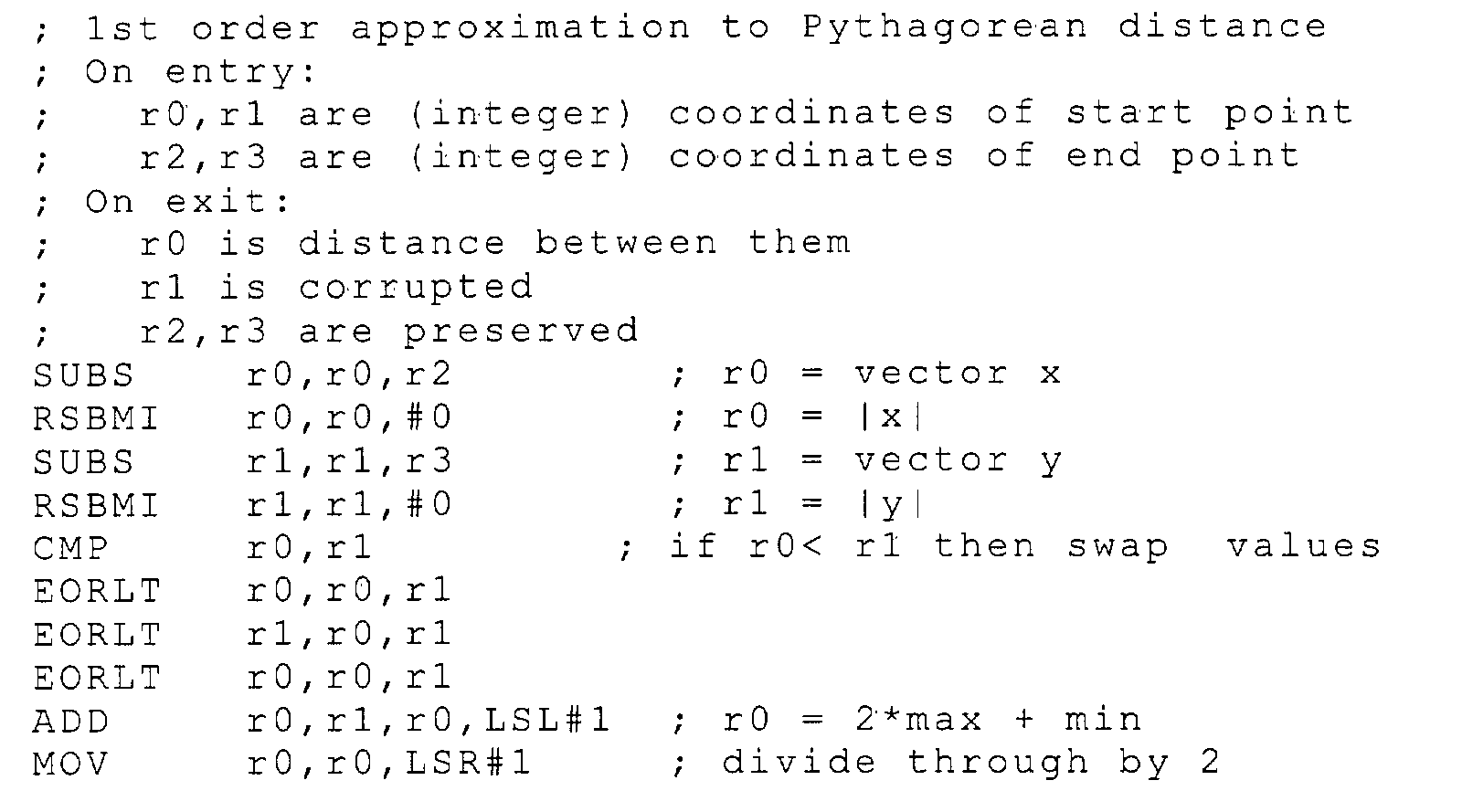
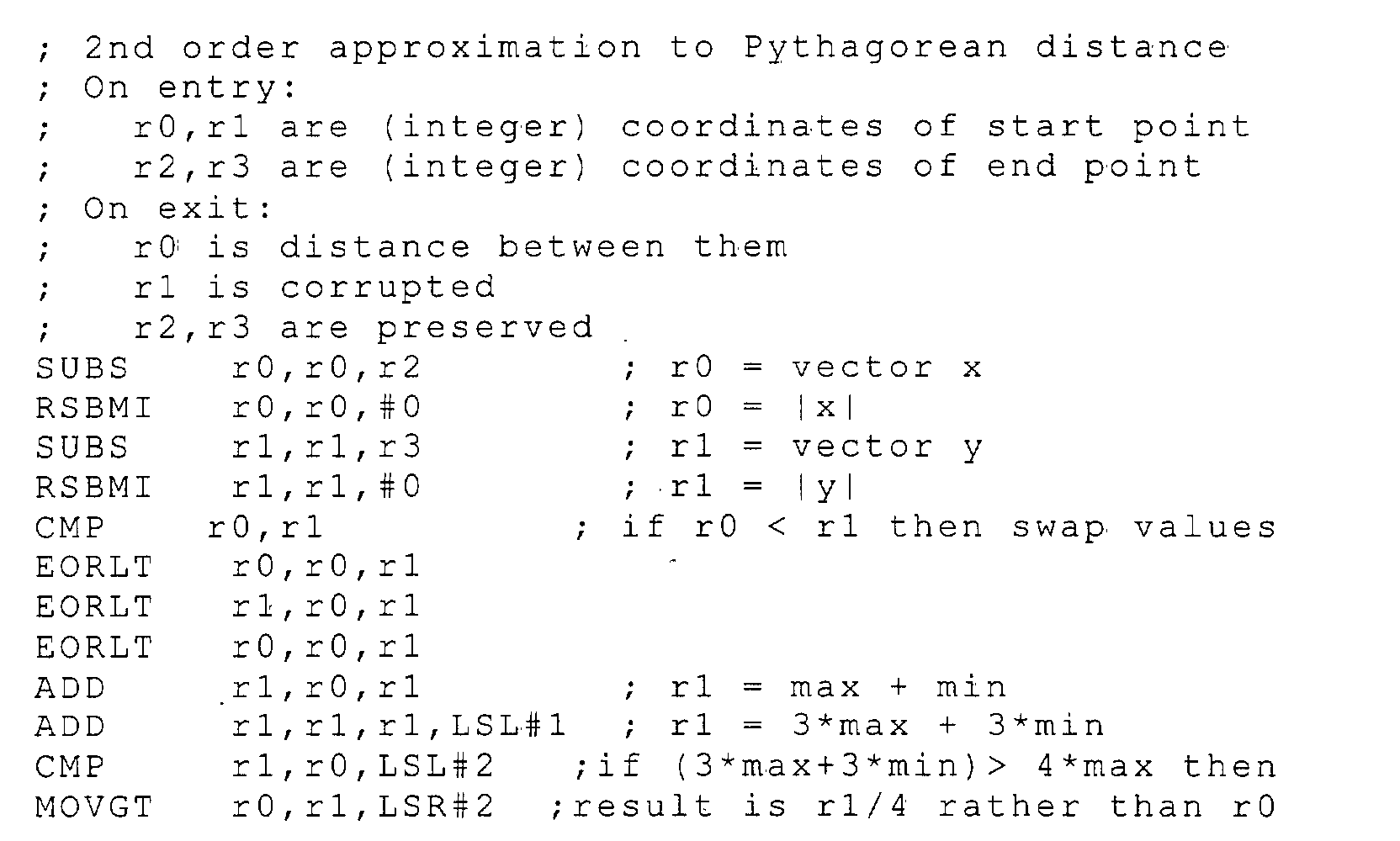
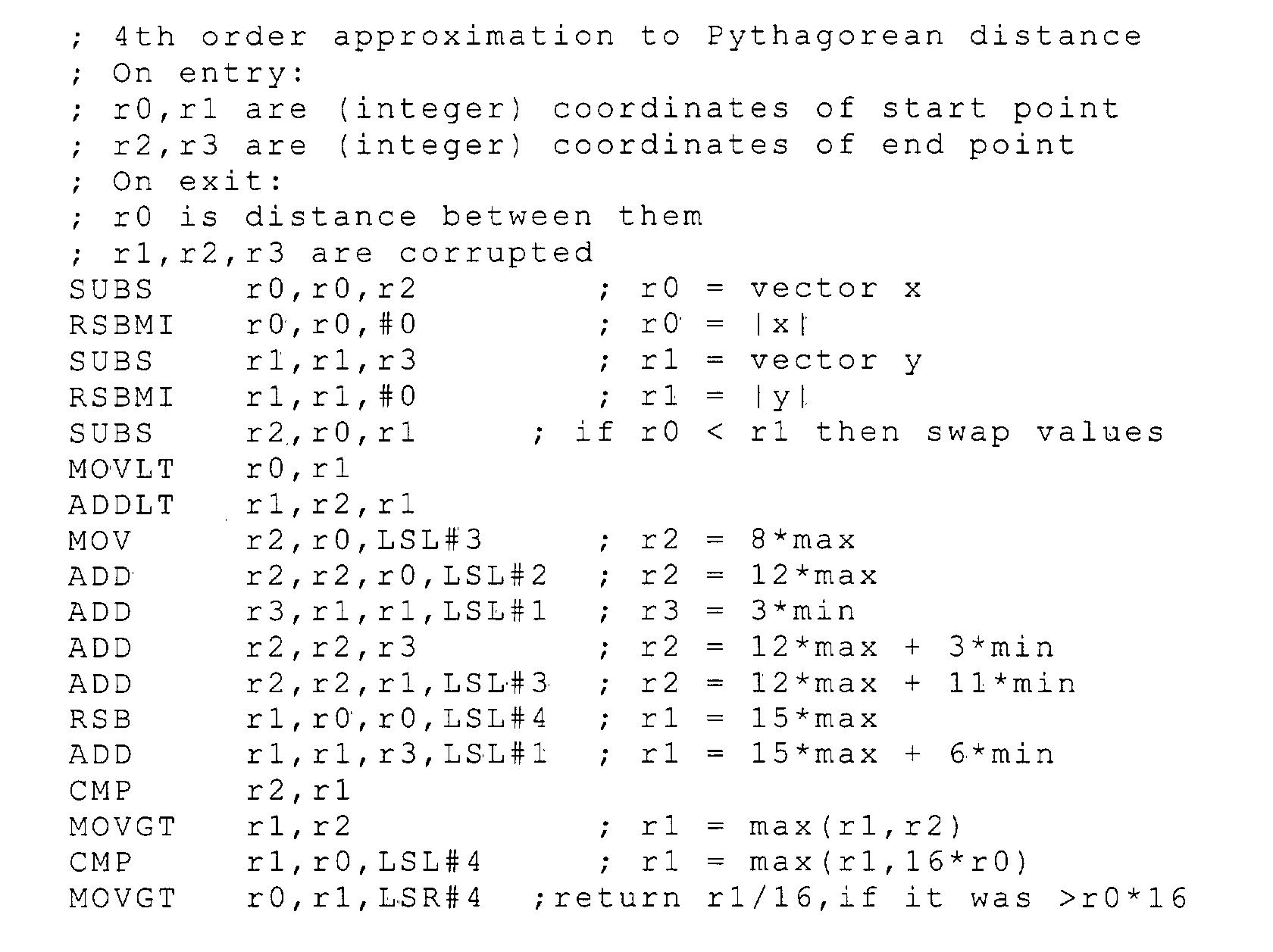
- Example implementation could be with a microprocessor assembler:
- the code required is also compact particularly because there is no requirement for reference tables to be stored.
- the granularity of the vector lengths calculated is as fine as that of the vector components by contrast with a look up table oriented linear equation which is limited by the number of entries provided in the table.
- the method allows the calculation of the vector length to be calculated approximately using a combination of one or more of the linear equations in the subset of linear equations which are particularly suited to fast efficient solution using microprocessors or in dedicated silicon integrated circuits.
- the equations can be solved using relatively simple arithmetic and bitwise operations and do not require the use of look up tables.
Landscapes
- Engineering & Computer Science (AREA)
- Physics & Mathematics (AREA)
- General Physics & Mathematics (AREA)
- Mathematical Physics (AREA)
- Computational Mathematics (AREA)
- Mathematical Analysis (AREA)
- Mathematical Optimization (AREA)
- Pure & Applied Mathematics (AREA)
- Data Mining & Analysis (AREA)
- Theoretical Computer Science (AREA)
- Software Systems (AREA)
- Databases & Information Systems (AREA)
- Algebra (AREA)
- General Engineering & Computer Science (AREA)
- Operations Research (AREA)
- Computing Systems (AREA)
- Complex Calculations (AREA)
Abstract
Description
- The invention which is the subject of this application is directed towards an improvement in the processing of data such as, but not exclusively, video data which is generated as part of a broadcast data system.
- There is a need in the processing of data to be able to calculate vector lengths. Conventionally, to perform such a calculation directly, Pythagoras' theorem is used and requires two multiplications and a square root. However in the processing of data these calculations are computationally intensive operations. Furthermore, in many instances it is not necessary for a high level of accuracy to be obtained in the calculation of the vector lengths such that an estimation of the length can be satisfactory for requirements.
- An alternative conventional technique is to construct a table of data which are referred to as look up tables and which can be referred to during the calculation for data which reduces the need for the full calculation to be performed. However the storage of the look up table data takes up memory space and it is important, for subsequent calculations to be correct, that the data in the tables is required to be accurate.
- The aim of the present invention is to provide a method whereby the lengths of a vector can be estimated to an acceptable level of accuracy and consistency for practical use but to also achieve a reduction in the computational complexity which is required to be performed.
- In a first aspect of the invention there is provided a method for the length of a vector to be estimated, characterised in that said method includes the generation of a series of linear equations which may be used in the calculation of vector length, analysis of the same and selection of those linear equations which can be solved using arithmetic and/or bitwise operations, to form a subset of linear equations, said vector length calculations subsequently made using one or more linear equations, each derived from the specified subset of linear equations.
- The equations which are used in accordance with the invention do not require the utilisation of look-up or record table, unlike alternative techniques.
- In one embodiment the subset of equations used can be chosen at the stage of the design of the system in accordance with the required balance between execution speed, code size and accuracy of the estimations which are to be obtained.
- The application of this method as herein described can be widely applicable and has application in a wide range of computing applications. Without restricting the scope of the application in any way some examples of use of the method are with respect to 3-D graphics rendering, for example in z-buffering or shading algorithms. For example, the method can be used in Bezier curve rendering, which in turn is used for font rendering, among other things. The method may be useful in colour space, for example when selecting a closest match to a particular colour from a given palette, or when calculating an optimal palette for a bitmap image. The method may also provide applications in motion estimation processing of video data at the encoding of the same and subsequent decoding of the same.
- Specific embodiments of the invention are now described with reference to the accompanying diagrams.
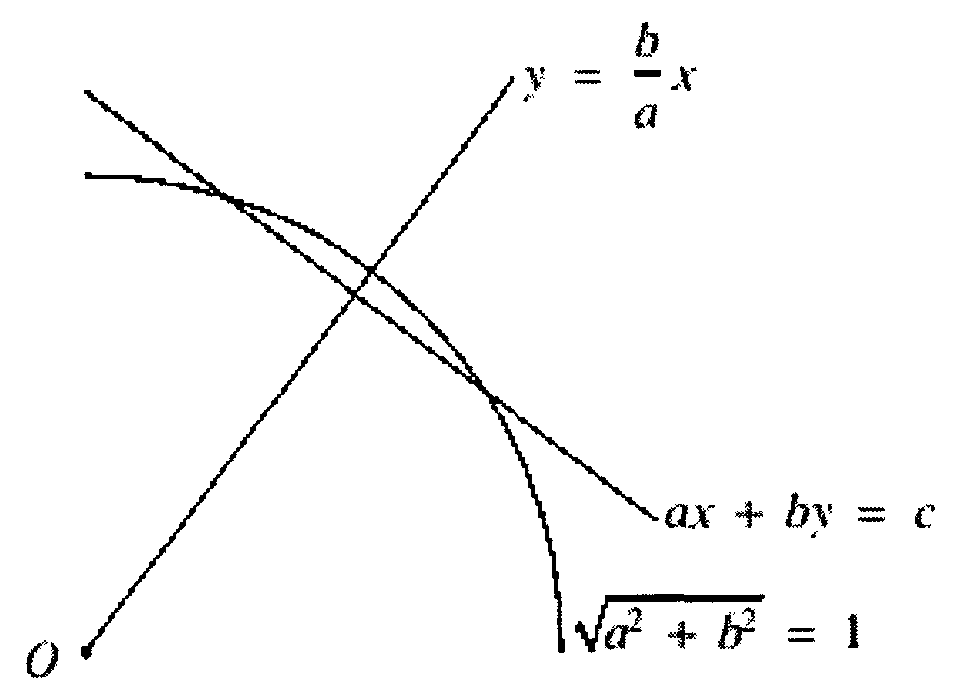
- If one first considers in the calculation of a vector length the length of the projection of the line joining the origin O to the point P(x 0, y 0) onto the line with equation y = b / a x.

- Then by using the definition of the scalar product of two vectors, it can be shown that:
- In accordance with the invention, d is considered to be an approximation to the length of the line OP. Furthermore, a further level of approximation is used to calculate the distance
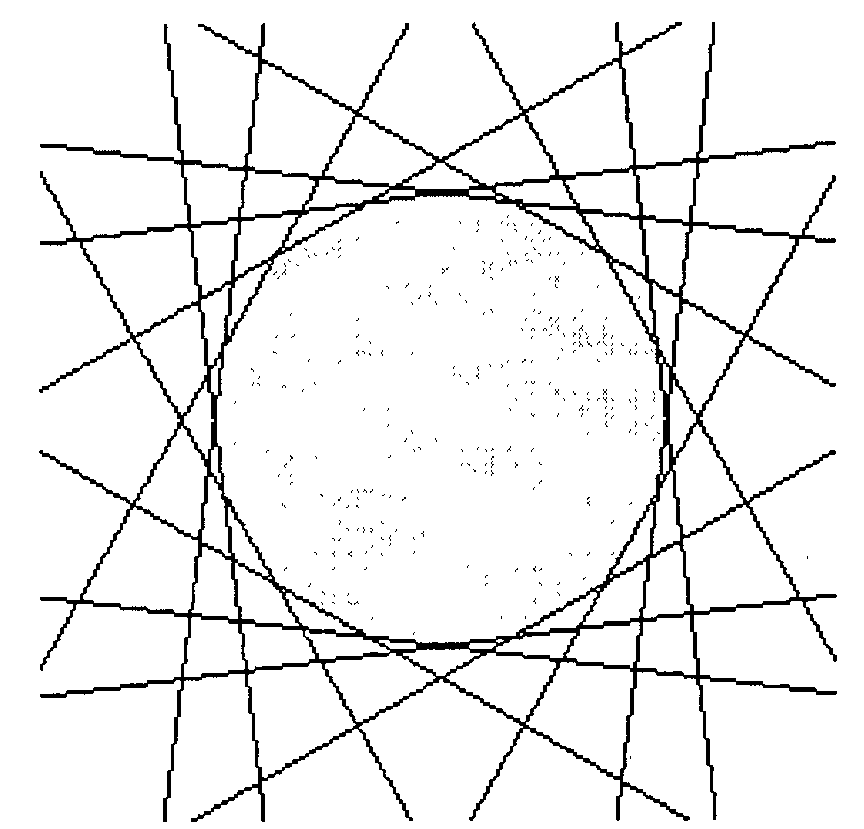
- In order to allow efficient calculation of D, it is specified that the only equations of interest are those where a and b are integer, and c is an integer power of 2. It is demonstrated below how it is possible to select suitable values of a, b and c to achieve a set of equations that can achieve a desired level of accuracy in any direction. However firstly, it is useful for visualisation reasons to consider graphically the locus of constant D.
- For example, the locus of D = 1 is given by ax + by = c :
- In this case, it can be seen that
- As reference is made to angles which are progressively further and further away from the line y = b / a x, D becomes more and more of an underestimate of the actual distance from the origin: this will become significant later when selecting the best estimate of a particular length from the results of a number of functions.
- A preferred way to pick a selection of sets of a, b, c coefficients is to choose the maximum error which the user is prepared to accept in each instant, εmax, and cycle through all possible combinations of coefficients. For each combination, calculate the range of angles over which the resultant function produces acceptable results, and then fit together a selection of functions that, between them, cover the possible angles.
- This is not necessarily a complex matter as, first of all, there is symmetry in the x and y axes, and in the line y = x. If these are redefined as x = max(|x|, |y|) and y = min(|x|, |y|), then only angles in the range 0° - 45° need be considered, along with consideration of positive c and positive or zero a and b. Also, it is known that b ≤ a, as well as a ≤ c and b ≤ c.
- If
- So the limiting angles within which the function satisfies the specified tolerance are given by
- Once the set of functions is known, each of which is suitable for part of the range 0° ≤ ≤ 45°, the distance estimate of any point from the origin - the length of a vector. There is no need to calculate which of the functions is the best one to use for any given point; because each function always provides its greatest overestimates at points closest to the line y = b / a x, all that need be done is to evaluate all the functions, and pick the largest result.
- It should also be noted that the method can be used in applications to higher dimensions than 2. In these cases, the direct analogue would be to consider a collection of lines with planes as foci; with the square of the number of functions to achieve the same accuracy in 3 dimensions, the cube of the number in 4 dimensions, and so on. Alternatively a set of 2-D equations twice (in 3-D) or more (in higher dimensions) could be used, using relations such as
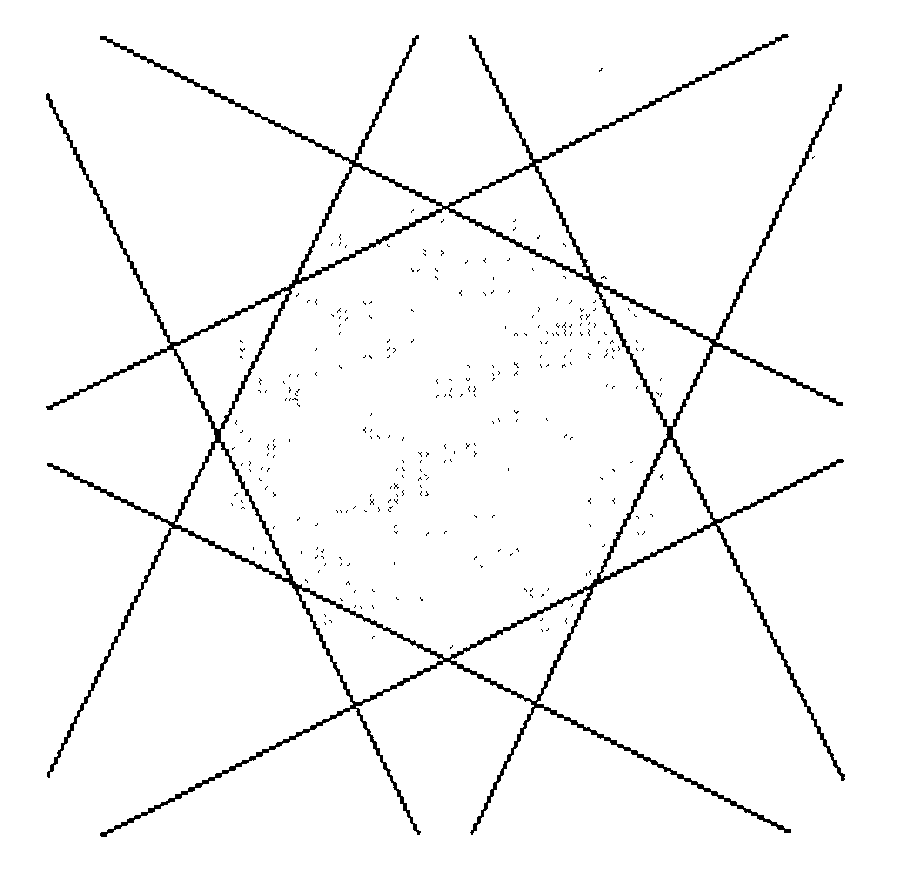
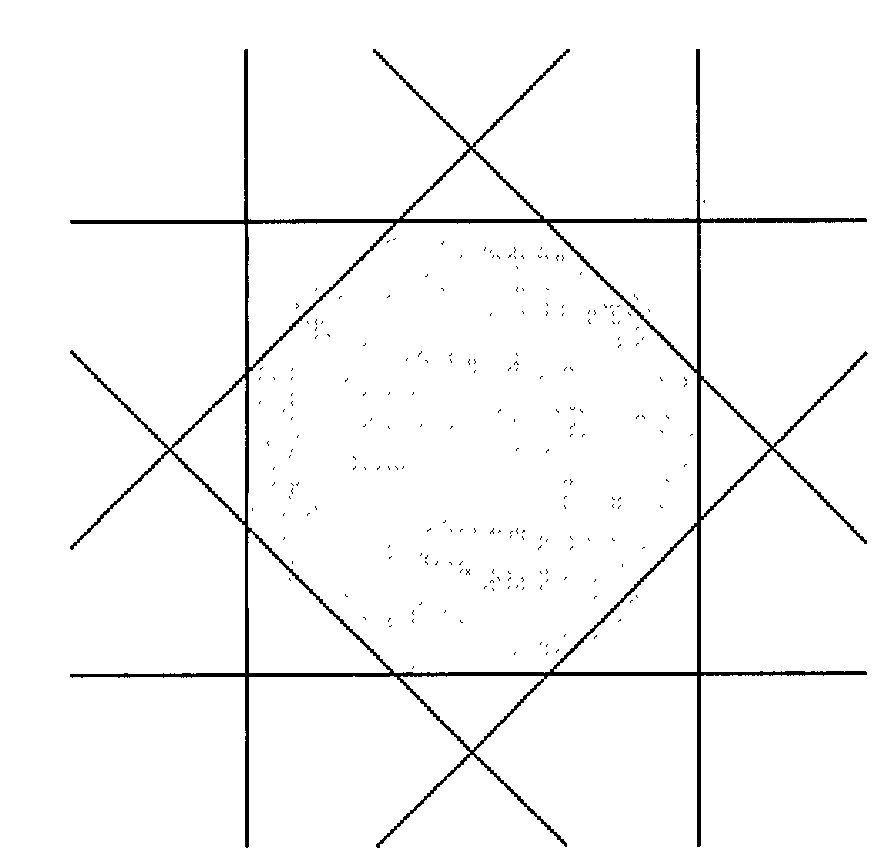
- Some specific examples of the invention can now be provided although there are an infinite collection of linear equations or algorithms that may be envisaged. They may be roughly categorised according to order, where the order is defined as the maximum value of log2(c) out of all the functions used in the algorithm. Listed below are the most accurate, or one of the jointly most accurate, algorithms for each of the orders from 0th to 5th. At the higher orders, there are diminishing returns, because the number of functions, and the binary complexity of the coefficients used, start increasing rapidly compared against the benefit in accuracy.
- The following definitions are used in the expressions below:
- D = approximate distance from origin
- X = max(|x|,|y|)
- Y = min(|x|,|y|)
-
-
- D = X
- εmax = 0.30
 This is the simplest algorithm, and is included for completeness,
although it may find its application limited. The only other 0th
order algorithm is D = X + Y, but in that case εmax is a relatively
large value of 0.41.
This is the simplest algorithm, and is included for completeness,
although it may find its application limited. The only other 0th
order algorithm is D = X + Y, but in that case εmax is a relatively
large value of 0.41. -
-
-
-
-
-
-

-

-
-

-

- Thus the major benefit of this method is in the quick execution time required. The code required is also compact particularly because there is no requirement for reference tables to be stored. The granularity of the vector lengths calculated is as fine as that of the vector components by contrast with a look up table oriented linear equation which is limited by the number of entries provided in the table.
- The method allows the calculation of the vector length to be calculated approximately using a combination of one or more of the linear equations in the subset of linear equations which are particularly suited to fast efficient solution using microprocessors or in dedicated silicon integrated circuits. The equations can be solved using relatively simple arithmetic and bitwise operations and do not require the use of look up tables.
Claims (9)
- A method for the length of a vector to be estimated, characterised in that said method includes the generation of a series of linear equations which may be used in the calculation of vector length, analysis of the same and selection of those linear equations which can be solved using arithmetic and/or bitwise operations, to form a subset of linear equations, said vector length calculations subsequently made using one or more linear equations, each derived from the specified subset of linear equations.
- A method according to claim 1 characterised in that each of the equations in the subset of linear equations do not require the utilisation of look-up or record tables.
- A method according to claim 1 characterised in that the equations included in the subset of equations are selected at the stage of the design of the method with reference to any or any combination of execution speed, code size and accuracy of the calculation result.
- A method according to claim 1 characterised in that the method is used in the development of 3-D graphics rendering in relation to z-buffering or shading algorithms.
- A method according to claim 4 characterised in that the method is used in Bezier curve rendering, which in turn is used for font rendering on a display screen.
- A method according to claim 1 characterised in that the method is used in relation to colour space selection when selecting a closest match to a particular colour from a given colour palette.
- A method according to claim 1 characterised in that the method is used in the motion estimation processing of video data at the encoding of the same and subsequent decoding of the same as part of a broadcast data system.
- A method according to claim 1 characterised in that the linear equations in a subset are categorised according to order, where the order is defined as the maximum value of log2(c) out of all the functions used in the equation.
- A method according to claim 1 characterised in that the same can be used in the application for calculations of 2 or more dimensions.
Applications Claiming Priority (2)
| Application Number | Priority Date | Filing Date | Title |
|---|---|---|---|
| GB0017962 | 2000-07-22 | ||
| GBGB0017962.2A GB0017962D0 (en) | 2000-07-22 | 2000-07-22 | Method for vector length calculation in data processing |
Publications (2)
| Publication Number | Publication Date |
|---|---|
| EP1174828A2 true EP1174828A2 (en) | 2002-01-23 |
| EP1174828A3 EP1174828A3 (en) | 2004-03-24 |
Family
ID=9896110
Family Applications (1)
| Application Number | Title | Priority Date | Filing Date |
|---|---|---|---|
| EP01306196A Withdrawn EP1174828A3 (en) | 2000-07-22 | 2001-07-18 | Method for vector length calculation in data processing |
Country Status (3)
| Country | Link |
|---|---|
| US (1) | US20020109686A1 (en) |
| EP (1) | EP1174828A3 (en) |
| GB (1) | GB0017962D0 (en) |
Family Cites Families (3)
| Publication number | Priority date | Publication date | Assignee | Title |
|---|---|---|---|---|
| US5063375A (en) * | 1987-07-27 | 1991-11-05 | Sun Microsystems, Inc. | Method and apparatus for shading images |
| US5142617A (en) * | 1988-10-27 | 1992-08-25 | Tektronix, Inc. | Method of shading a graphics image |
| US5367702A (en) * | 1993-01-04 | 1994-11-22 | Texas Instruments Incorporated | System and method for approximating nonlinear functions |
-
2000
- 2000-07-22 GB GBGB0017962.2A patent/GB0017962D0/en not_active Ceased
-
2001
- 2001-07-18 US US09/907,797 patent/US20020109686A1/en not_active Abandoned
- 2001-07-18 EP EP01306196A patent/EP1174828A3/en not_active Withdrawn
Non-Patent Citations (2)
| Title |
|---|
| ANDREW S. GLASSNER (ED.): "GRAPHICS GEMS" 1990 , ACADEMIC PRESS , SAN DIEGO CA, ISBN 0-12-286166-3, PAGES 422-433, "DISTANCE MEASURES SUMMARY, A FAST APPROXIMATION TO THE HYPOTHENUSE, A FAST APPROXIMATION TO 3D EUCLIDEAN DISTANCE" XP002262521 * page 423 * * page 427 - page 433 * * |
| PAUL HECKBERT (ED.): "GRAPHICS GEMS IV" 1994 , MORGAN KAUFMANN (ACADEMIC PRESS) , SAN DIEGO CA, ISBN 0-12-336156-7, PAGES 120-125, "FAST LINEAR APPROXIMATIONS OF EUCLIDEAN DISTANCE IN HIGHER DIMENSIONS" XP002262522 * page 120 - page 124 * * |
Also Published As
| Publication number | Publication date |
|---|---|
| GB0017962D0 (en) | 2000-09-13 |
| EP1174828A3 (en) | 2004-03-24 |
| US20020109686A1 (en) | 2002-08-15 |
Similar Documents
| Publication | Publication Date | Title |
|---|---|---|
| EP0817126A2 (en) | Method and apparatus implementing high resolution rendition of Z-buffered primitives | |
| NZ567986A (en) | Real-time stereo image matching system | |
| Lee et al. | Closed-form optimal two-view triangulation based on angular errors | |
| EP1883046B1 (en) | Image interpolation method and apparatus therefor | |
| Ito et al. | A dual parametrization method for convex semi-infinite programming | |
| US20220051055A1 (en) | Training data generation method and training data generation device | |
| Shashua et al. | Trajectory triangulation over conic section | |
| Hofmann et al. | A scalable high-performance hardware architecture for real-time stereo vision by semi-global matching | |
| Normand et al. | A geometry driven reconstruction algorithm for the Mojette transform | |
| Greuel et al. | Normalization of rings | |
| US6891538B1 (en) | Dual mode device and method for generating vector cross products or dot products | |
| Armentano | The effect of reduced integrationin the Steklov eigenvalue problem | |
| Dohi et al. | Deep-pipelined FPGA implementation of ellipse estimation for eye tracking | |
| Roszkowski et al. | FPGA design of the computation unit for the semi-global stereo matching algorithm | |
| CN114494943A (en) | Novel video target detection and evaluation method, device, product and storage medium | |
| US20020109686A1 (en) | Method for vector length calculation in data processing | |
| CN107493471A (en) | The computational methods and device of a kind of video transmission quality | |
| US6457036B1 (en) | System for accurately performing an integer multiply-divide operation | |
| US7388589B2 (en) | System for and method of performing an opacity calculation in a 3D graphics system | |
| US20020126127A1 (en) | Lighting processing circuitry for graphics adapter | |
| Katz et al. | The tropical j-invariant | |
| Kallay | Computing the moment of inertia of a solid defined by a triangle mesh | |
| Plantinga et al. | Contour generators of evolving implicit surfaces | |
| Makryniotis et al. | Implementation of a motion estimation hardware accelerator on Zynq SoC | |
| Jendersie | Path throughput importance weights |
Legal Events
| Date | Code | Title | Description |
|---|---|---|---|
| PUAI | Public reference made under article 153(3) epc to a published international application that has entered the european phase |
Free format text: ORIGINAL CODE: 0009012 |
|
| AK | Designated contracting states |
Kind code of ref document: A2 Designated state(s): AT BE CH CY DE DK ES FI FR GB GR IE IT LI LU MC NL PT SE TR |
|
| AX | Request for extension of the european patent |
Free format text: AL;LT;LV;MK;RO;SI |
|
| RIC1 | Information provided on ipc code assigned before grant |
Ipc: 7G 06F 17/16 B Ipc: 7G 06T 11/20 A |
|
| PUAL | Search report despatched |
Free format text: ORIGINAL CODE: 0009013 |
|
| AK | Designated contracting states |
Kind code of ref document: A3 Designated state(s): AT BE CH CY DE DK ES FI FR GB GR IE IT LI LU MC NL PT SE TR |
|
| AX | Request for extension of the european patent |
Extension state: AL LT LV MK RO SI |
|
| AKX | Designation fees paid |
Designated state(s): AT BE CH CY DE DK ES FI FR GB GR IE IT LI LU MC NL PT SE TR |
|
| STAA | Information on the status of an ep patent application or granted ep patent |
Free format text: STATUS: THE APPLICATION IS DEEMED TO BE WITHDRAWN |
|
| 18D | Application deemed to be withdrawn |
Effective date: 20050425 |