EP1174461B1 - Thermally stabilized PVC compositions - Google Patents
Thermally stabilized PVC compositions Download PDFInfo
- Publication number
- EP1174461B1 EP1174461B1 EP01117191A EP01117191A EP1174461B1 EP 1174461 B1 EP1174461 B1 EP 1174461B1 EP 01117191 A EP01117191 A EP 01117191A EP 01117191 A EP01117191 A EP 01117191A EP 1174461 B1 EP1174461 B1 EP 1174461B1
- Authority
- EP
- European Patent Office
- Prior art keywords
- linear
- branched alkyl
- aryl
- equal
- methylenebis
- Prior art date
- Legal status (The legal status is an assumption and is not a legal conclusion. Google has not performed a legal analysis and makes no representation as to the accuracy of the status listed.)
- Expired - Lifetime
Links
- 239000000203 mixture Substances 0.000 title claims abstract description 100
- 230000001747 exhibiting effect Effects 0.000 claims abstract description 3
- -1 methylenebis(4-cyclohexyl) Chemical group 0.000 claims description 44
- 125000000217 alkyl group Chemical group 0.000 claims description 35
- 125000003118 aryl group Chemical group 0.000 claims description 19
- 125000000753 cycloalkyl group Chemical group 0.000 claims description 16
- 125000003107 substituted aryl group Chemical group 0.000 claims description 16
- 238000002360 preparation method Methods 0.000 claims description 14
- MLIREBYILWEBDM-UHFFFAOYSA-N cyanoacetic acid Chemical compound OC(=O)CC#N MLIREBYILWEBDM-UHFFFAOYSA-N 0.000 claims description 13
- 230000003252 repetitive effect Effects 0.000 claims description 11
- 125000003342 alkenyl group Chemical group 0.000 claims description 10
- 125000002877 alkyl aryl group Chemical group 0.000 claims description 10
- 125000003710 aryl alkyl group Chemical group 0.000 claims description 10
- 125000004183 alkoxy alkyl group Chemical group 0.000 claims description 7
- 125000004171 alkoxy aryl group Chemical group 0.000 claims description 7
- 125000006350 alkyl thio alkyl group Chemical group 0.000 claims description 7
- 125000005160 aryl oxy alkyl group Chemical group 0.000 claims description 7
- 125000005164 aryl thioalkyl group Chemical group 0.000 claims description 7
- 125000004858 cycloalkoxyalkyl group Chemical group 0.000 claims description 7
- 125000002768 hydroxyalkyl group Chemical group 0.000 claims description 7
- 125000003545 alkoxy group Chemical group 0.000 claims description 6
- 125000005647 linker group Chemical group 0.000 claims description 6
- 150000001412 amines Chemical class 0.000 claims description 4
- 229920002396 Polyurea Polymers 0.000 claims description 3
- 150000003973 alkyl amines Chemical class 0.000 claims description 3
- 125000005442 diisocyanate group Chemical group 0.000 claims description 3
- 150000002513 isocyanates Chemical class 0.000 claims description 3
- 125000001997 phenyl group Chemical group [H]C1=C([H])C([H])=C(*)C([H])=C1[H] 0.000 claims description 3
- 238000007363 ring formation reaction Methods 0.000 claims description 3
- 230000006641 stabilisation Effects 0.000 claims description 3
- XSQUKJJJFZCRTK-UHFFFAOYSA-N Urea Chemical compound NC(N)=O XSQUKJJJFZCRTK-UHFFFAOYSA-N 0.000 claims description 2
- 239000004202 carbamide Substances 0.000 claims description 2
- 239000012948 isocyanate Substances 0.000 claims description 2
- 238000006384 oligomerization reaction Methods 0.000 claims description 2
- 238000006116 polymerization reaction Methods 0.000 claims description 2
- 238000011105 stabilization Methods 0.000 claims description 2
- KGRVJHAUYBGFFP-UHFFFAOYSA-N 2,2'-Methylenebis(4-methyl-6-tert-butylphenol) Chemical compound CC(C)(C)C1=CC(C)=CC(CC=2C(=C(C=C(C)C=2)C(C)(C)C)O)=C1O KGRVJHAUYBGFFP-UHFFFAOYSA-N 0.000 claims 1
- 230000001590 oxidative effect Effects 0.000 claims 1
- IAZDPXIOMUYVGZ-UHFFFAOYSA-N Dimethylsulphoxide Chemical compound CS(C)=O IAZDPXIOMUYVGZ-UHFFFAOYSA-N 0.000 description 51
- 239000007787 solid Substances 0.000 description 45
- 239000011541 reaction mixture Substances 0.000 description 38
- WFDIJRYMOXRFFG-UHFFFAOYSA-N Acetic anhydride Chemical compound CC(=O)OC(C)=O WFDIJRYMOXRFFG-UHFFFAOYSA-N 0.000 description 33
- 150000001875 compounds Chemical class 0.000 description 27
- HEMHJVSKTPXQMS-UHFFFAOYSA-M Sodium hydroxide Chemical compound [OH-].[Na+] HEMHJVSKTPXQMS-UHFFFAOYSA-M 0.000 description 24
- 239000000243 solution Substances 0.000 description 19
- 238000003756 stirring Methods 0.000 description 19
- 238000012360 testing method Methods 0.000 description 19
- 229920000642 polymer Polymers 0.000 description 16
- YMWUJEATGCHHMB-UHFFFAOYSA-N Dichloromethane Chemical compound ClCCl YMWUJEATGCHHMB-UHFFFAOYSA-N 0.000 description 15
- XLYOFNOQVPJJNP-UHFFFAOYSA-N water Substances O XLYOFNOQVPJJNP-UHFFFAOYSA-N 0.000 description 13
- 238000005160 1H NMR spectroscopy Methods 0.000 description 12
- 235000012424 soybean oil Nutrition 0.000 description 11
- 239000003549 soybean oil Substances 0.000 description 11
- CSCPPACGZOOCGX-UHFFFAOYSA-N Acetone Chemical compound CC(C)=O CSCPPACGZOOCGX-UHFFFAOYSA-N 0.000 description 10
- BZHJMEDXRYGGRV-UHFFFAOYSA-N Vinyl chloride Chemical compound ClC=C BZHJMEDXRYGGRV-UHFFFAOYSA-N 0.000 description 10
- 230000003068 static effect Effects 0.000 description 10
- OKKJLVBELUTLKV-UHFFFAOYSA-N Methanol Chemical compound OC OKKJLVBELUTLKV-UHFFFAOYSA-N 0.000 description 9
- 230000008646 thermal stress Effects 0.000 description 9
- PMZURENOXWZQFD-UHFFFAOYSA-L Sodium Sulfate Chemical compound [Na+].[Na+].[O-]S([O-])(=O)=O PMZURENOXWZQFD-UHFFFAOYSA-L 0.000 description 8
- 229920001577 copolymer Polymers 0.000 description 8
- 239000012044 organic layer Substances 0.000 description 8
- 238000001644 13C nuclear magnetic resonance spectroscopy Methods 0.000 description 7
- 235000021355 Stearic acid Nutrition 0.000 description 7
- 238000011156 evaluation Methods 0.000 description 7
- QIQXTHQIDYTFRH-UHFFFAOYSA-N octadecanoic acid Chemical compound CCCCCCCCCCCCCCCCCC(O)=O QIQXTHQIDYTFRH-UHFFFAOYSA-N 0.000 description 7
- OQCDKBAXFALNLD-UHFFFAOYSA-N octadecanoic acid Natural products CCCCCCCC(C)CCCCCCCCC(O)=O OQCDKBAXFALNLD-UHFFFAOYSA-N 0.000 description 7
- 239000008117 stearic acid Substances 0.000 description 7
- RRAMGCGOFNQTLD-UHFFFAOYSA-N hexamethylene diisocyanate Chemical compound O=C=NCCCCCCN=C=O RRAMGCGOFNQTLD-UHFFFAOYSA-N 0.000 description 6
- NAQMVNRVTILPCV-UHFFFAOYSA-N hexane-1,6-diamine Chemical compound NCCCCCCN NAQMVNRVTILPCV-UHFFFAOYSA-N 0.000 description 6
- 239000002244 precipitate Substances 0.000 description 6
- 239000003381 stabilizer Substances 0.000 description 6
- 238000010908 decantation Methods 0.000 description 5
- IOQPZZOEVPZRBK-UHFFFAOYSA-N octan-1-amine Chemical compound CCCCCCCCN IOQPZZOEVPZRBK-UHFFFAOYSA-N 0.000 description 5
- 229940008841 1,6-hexamethylene diisocyanate Drugs 0.000 description 4
- 239000004014 plasticizer Substances 0.000 description 4
- 239000000047 product Substances 0.000 description 4
- 229910052938 sodium sulfate Inorganic materials 0.000 description 4
- 235000011152 sodium sulphate Nutrition 0.000 description 4
- 239000002904 solvent Substances 0.000 description 4
- 238000010186 staining Methods 0.000 description 4
- XEKOWRVHYACXOJ-UHFFFAOYSA-N Ethyl acetate Chemical compound CCOC(C)=O XEKOWRVHYACXOJ-UHFFFAOYSA-N 0.000 description 3
- VYPSYNLAJGMNEJ-UHFFFAOYSA-N Silicium dioxide Chemical compound O=[Si]=O VYPSYNLAJGMNEJ-UHFFFAOYSA-N 0.000 description 3
- 238000004587 chromatography analysis Methods 0.000 description 3
- WGLUMOCWFMKWIL-UHFFFAOYSA-N dichloromethane;methanol Chemical compound OC.ClCCl WGLUMOCWFMKWIL-UHFFFAOYSA-N 0.000 description 3
- 239000003480 eluent Substances 0.000 description 3
- 150000002148 esters Chemical class 0.000 description 3
- 238000000034 method Methods 0.000 description 3
- 239000000741 silica gel Substances 0.000 description 3
- 229910002027 silica gel Inorganic materials 0.000 description 3
- 125000000391 vinyl group Chemical group [H]C([*])=C([H])[H] 0.000 description 3
- SMZOUWXMTYCWNB-UHFFFAOYSA-N 2-(2-methoxy-5-methylphenyl)ethanamine Chemical compound COC1=CC=C(C)C=C1CCN SMZOUWXMTYCWNB-UHFFFAOYSA-N 0.000 description 2
- HGINCPLSRVDWNT-UHFFFAOYSA-N Acrolein Chemical compound C=CC=O HGINCPLSRVDWNT-UHFFFAOYSA-N 0.000 description 2
- 239000005057 Hexamethylene diisocyanate Substances 0.000 description 2
- HEDRZPFGACZZDS-MICDWDOJSA-N Trichloro(2H)methane Chemical compound [2H]C(Cl)(Cl)Cl HEDRZPFGACZZDS-MICDWDOJSA-N 0.000 description 2
- XTXRWKRVRITETP-UHFFFAOYSA-N Vinyl acetate Chemical compound CC(=O)OC=C XTXRWKRVRITETP-UHFFFAOYSA-N 0.000 description 2
- 125000001931 aliphatic group Chemical group 0.000 description 2
- 239000000460 chlorine Substances 0.000 description 2
- 229910052801 chlorine Inorganic materials 0.000 description 2
- PAFZNILMFXTMIY-UHFFFAOYSA-N cyclohexylamine Chemical compound NC1CCCCC1 PAFZNILMFXTMIY-UHFFFAOYSA-N 0.000 description 2
- 229920001971 elastomer Polymers 0.000 description 2
- 229920001519 homopolymer Polymers 0.000 description 2
- 239000000463 material Substances 0.000 description 2
- 239000000049 pigment Substances 0.000 description 2
- 239000005060 rubber Substances 0.000 description 2
- 229920002554 vinyl polymer Polymers 0.000 description 2
- QGLWBTPVKHMVHM-KTKRTIGZSA-N (z)-octadec-9-en-1-amine Chemical compound CCCCCCCC\C=C/CCCCCCCCN QGLWBTPVKHMVHM-KTKRTIGZSA-N 0.000 description 1
- MSOZYWZZWADWOD-UHFFFAOYSA-N 1,1-dichloro-2-(2,2-dichloroethenoxy)ethene Chemical compound ClC(Cl)=COC=C(Cl)Cl MSOZYWZZWADWOD-UHFFFAOYSA-N 0.000 description 1
- LGXVIGDEPROXKC-UHFFFAOYSA-N 1,1-dichloroethene Chemical compound ClC(Cl)=C LGXVIGDEPROXKC-UHFFFAOYSA-N 0.000 description 1
- 125000001140 1,4-phenylene group Chemical group [H]C1=C([H])C([*:2])=C([H])C([H])=C1[*:1] 0.000 description 1
- QWDQYHPOSSHSAW-UHFFFAOYSA-N 1-isocyanatooctadecane Chemical compound CCCCCCCCCCCCCCCCCCN=C=O QWDQYHPOSSHSAW-UHFFFAOYSA-N 0.000 description 1
- OEPOKWHJYJXUGD-UHFFFAOYSA-N 2-(3-phenylmethoxyphenyl)-1,3-thiazole-4-carbaldehyde Chemical compound O=CC1=CSC(C=2C=C(OCC=3C=CC=CC=3)C=CC=2)=N1 OEPOKWHJYJXUGD-UHFFFAOYSA-N 0.000 description 1
- NIXOWILDQLNWCW-UHFFFAOYSA-N 2-Propenoic acid Natural products OC(=O)C=C NIXOWILDQLNWCW-UHFFFAOYSA-N 0.000 description 1
- CWLKGDAVCFYWJK-UHFFFAOYSA-N 3-aminophenol Chemical compound NC1=CC=CC(O)=C1 CWLKGDAVCFYWJK-UHFFFAOYSA-N 0.000 description 1
- 229940018563 3-aminophenol Drugs 0.000 description 1
- UPMLOUAZCHDJJD-UHFFFAOYSA-N 4,4'-Diphenylmethane Diisocyanate Chemical compound C1=CC(N=C=O)=CC=C1CC1=CC=C(N=C=O)C=C1 UPMLOUAZCHDJJD-UHFFFAOYSA-N 0.000 description 1
- AFHIIJICYLMCSH-VOTSOKGWSA-N 5-amino-2-[(e)-2-(4-benzamido-2-sulfophenyl)ethenyl]benzenesulfonic acid Chemical compound OS(=O)(=O)C1=CC(N)=CC=C1\C=C\C(C(=C1)S(O)(=O)=O)=CC=C1NC(=O)C1=CC=CC=C1 AFHIIJICYLMCSH-VOTSOKGWSA-N 0.000 description 1
- NLHHRLWOUZZQLW-UHFFFAOYSA-N Acrylonitrile Chemical compound C=CC#N NLHHRLWOUZZQLW-UHFFFAOYSA-N 0.000 description 1
- 239000004604 Blowing Agent Substances 0.000 description 1
- ZAMOUSCENKQFHK-UHFFFAOYSA-N Chlorine atom Chemical compound [Cl] ZAMOUSCENKQFHK-UHFFFAOYSA-N 0.000 description 1
- IEPRKVQEAMIZSS-UHFFFAOYSA-N Di-Et ester-Fumaric acid Natural products CCOC(=O)C=CC(=O)OCC IEPRKVQEAMIZSS-UHFFFAOYSA-N 0.000 description 1
- IEPRKVQEAMIZSS-WAYWQWQTSA-N Diethyl maleate Chemical compound CCOC(=O)\C=C/C(=O)OCC IEPRKVQEAMIZSS-WAYWQWQTSA-N 0.000 description 1
- 229920002943 EPDM rubber Polymers 0.000 description 1
- VGGSQFUCUMXWEO-UHFFFAOYSA-N Ethene Chemical compound C=C VGGSQFUCUMXWEO-UHFFFAOYSA-N 0.000 description 1
- 239000005977 Ethylene Substances 0.000 description 1
- 239000004609 Impact Modifier Substances 0.000 description 1
- CERQOIWHTDAKMF-UHFFFAOYSA-N Methacrylic acid Chemical compound CC(=C)C(O)=O CERQOIWHTDAKMF-UHFFFAOYSA-N 0.000 description 1
- 239000006057 Non-nutritive feed additive Substances 0.000 description 1
- 229910019142 PO4 Inorganic materials 0.000 description 1
- 229920002319 Poly(methyl acrylate) Polymers 0.000 description 1
- 229920000388 Polyphosphate Polymers 0.000 description 1
- RYYWUUFWQRZTIU-UHFFFAOYSA-N Thiophosphoric acid Chemical class OP(O)(S)=O RYYWUUFWQRZTIU-UHFFFAOYSA-N 0.000 description 1
- 239000006096 absorbing agent Substances 0.000 description 1
- 230000002378 acidificating effect Effects 0.000 description 1
- 239000000654 additive Substances 0.000 description 1
- 239000000853 adhesive Substances 0.000 description 1
- 230000001070 adhesive effect Effects 0.000 description 1
- WNLRTRBMVRJNCN-UHFFFAOYSA-N adipic acid Chemical class OC(=O)CCCCC(O)=O WNLRTRBMVRJNCN-UHFFFAOYSA-N 0.000 description 1
- 150000001299 aldehydes Chemical class 0.000 description 1
- 150000001339 alkali metal compounds Chemical class 0.000 description 1
- 150000001341 alkaline earth metal compounds Chemical class 0.000 description 1
- 150000008064 anhydrides Chemical class 0.000 description 1
- 239000003963 antioxidant agent Substances 0.000 description 1
- 239000002216 antistatic agent Substances 0.000 description 1
- 150000001558 benzoic acid derivatives Chemical class 0.000 description 1
- HDFRDWFLWVCOGP-UHFFFAOYSA-N carbonothioic O,S-acid Chemical class OC(S)=O HDFRDWFLWVCOGP-UHFFFAOYSA-N 0.000 description 1
- 239000003795 chemical substances by application Substances 0.000 description 1
- 125000001309 chloro group Chemical group Cl* 0.000 description 1
- YACLQRRMGMJLJV-UHFFFAOYSA-N chloroprene Chemical compound ClC(=C)C=C YACLQRRMGMJLJV-UHFFFAOYSA-N 0.000 description 1
- MLUCVPSAIODCQM-NSCUHMNNSA-N crotonaldehyde Chemical compound C\C=C\C=O MLUCVPSAIODCQM-NSCUHMNNSA-N 0.000 description 1
- MLUCVPSAIODCQM-UHFFFAOYSA-N crotonaldehyde Natural products CC=CC=O MLUCVPSAIODCQM-UHFFFAOYSA-N 0.000 description 1
- 239000012043 crude product Substances 0.000 description 1
- KQWGXHWJMSMDJJ-UHFFFAOYSA-N cyclohexyl isocyanate Chemical compound O=C=NC1CCCCC1 KQWGXHWJMSMDJJ-UHFFFAOYSA-N 0.000 description 1
- 150000001991 dicarboxylic acids Chemical class 0.000 description 1
- KORSJDCBLAPZEQ-UHFFFAOYSA-N dicyclohexylmethane-4,4'-diisocyanate Chemical compound C1CC(N=C=O)CCC1CC1CCC(N=C=O)CC1 KORSJDCBLAPZEQ-UHFFFAOYSA-N 0.000 description 1
- 235000014113 dietary fatty acids Nutrition 0.000 description 1
- IEPRKVQEAMIZSS-AATRIKPKSA-N diethyl fumarate Chemical compound CCOC(=O)\C=C\C(=O)OCC IEPRKVQEAMIZSS-AATRIKPKSA-N 0.000 description 1
- LAWOZCWGWDVVSG-UHFFFAOYSA-N dioctylamine Chemical compound CCCCCCCCNCCCCCCCC LAWOZCWGWDVVSG-UHFFFAOYSA-N 0.000 description 1
- XJELOQYISYPGDX-UHFFFAOYSA-N ethenyl 2-chloroacetate Chemical compound ClCC(=O)OC=C XJELOQYISYPGDX-UHFFFAOYSA-N 0.000 description 1
- SRCZQMGIVIYBBJ-UHFFFAOYSA-N ethoxyethane;ethyl acetate Chemical compound CCOCC.CCOC(C)=O SRCZQMGIVIYBBJ-UHFFFAOYSA-N 0.000 description 1
- 238000002474 experimental method Methods 0.000 description 1
- 239000000194 fatty acid Substances 0.000 description 1
- 229930195729 fatty acid Natural products 0.000 description 1
- 239000000945 filler Substances 0.000 description 1
- 239000003063 flame retardant Substances 0.000 description 1
- 239000006081 fluorescent whitening agent Substances 0.000 description 1
- 239000003349 gelling agent Substances 0.000 description 1
- 229920000578 graft copolymer Polymers 0.000 description 1
- 230000008642 heat stress Effects 0.000 description 1
- PBZROIMXDZTJDF-UHFFFAOYSA-N hepta-1,6-dien-4-one Chemical compound C=CCC(=O)CC=C PBZROIMXDZTJDF-UHFFFAOYSA-N 0.000 description 1
- 239000004615 ingredient Substances 0.000 description 1
- 150000002540 isothiocyanates Chemical class 0.000 description 1
- 150000002576 ketones Chemical class 0.000 description 1
- 238000003475 lamination Methods 0.000 description 1
- 239000004611 light stabiliser Substances 0.000 description 1
- 239000007788 liquid Substances 0.000 description 1
- 239000000314 lubricant Substances 0.000 description 1
- FPYJFEHAWHCUMM-UHFFFAOYSA-N maleic anhydride Chemical compound O=C1OC(=O)C=C1 FPYJFEHAWHCUMM-UHFFFAOYSA-N 0.000 description 1
- 238000004519 manufacturing process Methods 0.000 description 1
- 238000005259 measurement Methods 0.000 description 1
- 229910052751 metal Inorganic materials 0.000 description 1
- 239000002184 metal Substances 0.000 description 1
- 150000002739 metals Chemical class 0.000 description 1
- XJRBAMWJDBPFIM-UHFFFAOYSA-N methyl vinyl ether Chemical compound COC=C XJRBAMWJDBPFIM-UHFFFAOYSA-N 0.000 description 1
- 230000007935 neutral effect Effects 0.000 description 1
- 238000006864 oxidative decomposition reaction Methods 0.000 description 1
- 239000000123 paper Substances 0.000 description 1
- 239000003208 petroleum Substances 0.000 description 1
- 238000005191 phase separation Methods 0.000 description 1
- 235000021317 phosphate Nutrition 0.000 description 1
- AQSJGOWTSHOLKH-UHFFFAOYSA-N phosphite(3-) Chemical class [O-]P([O-])[O-] AQSJGOWTSHOLKH-UHFFFAOYSA-N 0.000 description 1
- 150000003013 phosphoric acid derivatives Chemical class 0.000 description 1
- 125000005498 phthalate group Chemical class 0.000 description 1
- 229920003229 poly(methyl methacrylate) Polymers 0.000 description 1
- 229920000728 polyester Polymers 0.000 description 1
- 239000004926 polymethyl methacrylate Substances 0.000 description 1
- 239000001205 polyphosphate Substances 0.000 description 1
- 235000011176 polyphosphates Nutrition 0.000 description 1
- 239000006077 pvc stabilizer Substances 0.000 description 1
- 238000010992 reflux Methods 0.000 description 1
- 229920005989 resin Polymers 0.000 description 1
- 239000011347 resin Substances 0.000 description 1
- 239000012047 saturated solution Substances 0.000 description 1
- CXMXRPHRNRROMY-UHFFFAOYSA-N sebacic acid Chemical class OC(=O)CCCCCCCCC(O)=O CXMXRPHRNRROMY-UHFFFAOYSA-N 0.000 description 1
- 238000003860 storage Methods 0.000 description 1
- 150000003440 styrenes Chemical class 0.000 description 1
- 239000000758 substrate Substances 0.000 description 1
- 238000005979 thermal decomposition reaction Methods 0.000 description 1
- 229920001169 thermoplastic Polymers 0.000 description 1
- 239000004416 thermosoftening plastic Substances 0.000 description 1
- 125000005591 trimellitate group Chemical group 0.000 description 1
- 229920001567 vinyl ester resin Polymers 0.000 description 1
- FUSUHKVFWTUUBE-UHFFFAOYSA-N vinyl methyl ketone Natural products CC(=O)C=C FUSUHKVFWTUUBE-UHFFFAOYSA-N 0.000 description 1
Classifications
-
- C—CHEMISTRY; METALLURGY
- C07—ORGANIC CHEMISTRY
- C07D—HETEROCYCLIC COMPOUNDS
- C07D239/00—Heterocyclic compounds containing 1,3-diazine or hydrogenated 1,3-diazine rings
- C07D239/02—Heterocyclic compounds containing 1,3-diazine or hydrogenated 1,3-diazine rings not condensed with other rings
- C07D239/24—Heterocyclic compounds containing 1,3-diazine or hydrogenated 1,3-diazine rings not condensed with other rings having three or more double bonds between ring members or between ring members and non-ring members
- C07D239/28—Heterocyclic compounds containing 1,3-diazine or hydrogenated 1,3-diazine rings not condensed with other rings having three or more double bonds between ring members or between ring members and non-ring members with hetero atoms or with carbon atoms having three bonds to hetero atoms with at the most one bond to halogen, directly attached to ring carbon atoms
- C07D239/46—Two or more oxygen, sulphur or nitrogen atoms
- C07D239/52—Two oxygen atoms
- C07D239/54—Two oxygen atoms as doubly bound oxygen atoms or as unsubstituted hydroxy radicals
- C07D239/545—Two oxygen atoms as doubly bound oxygen atoms or as unsubstituted hydroxy radicals with other hetero atoms or with carbon atoms having three bonds to hetero atoms with at the most one bond to halogen, directly attached to ring carbon atoms
-
- C—CHEMISTRY; METALLURGY
- C07—ORGANIC CHEMISTRY
- C07D—HETEROCYCLIC COMPOUNDS
- C07D239/00—Heterocyclic compounds containing 1,3-diazine or hydrogenated 1,3-diazine rings
- C07D239/02—Heterocyclic compounds containing 1,3-diazine or hydrogenated 1,3-diazine rings not condensed with other rings
- C07D239/24—Heterocyclic compounds containing 1,3-diazine or hydrogenated 1,3-diazine rings not condensed with other rings having three or more double bonds between ring members or between ring members and non-ring members
- C07D239/28—Heterocyclic compounds containing 1,3-diazine or hydrogenated 1,3-diazine rings not condensed with other rings having three or more double bonds between ring members or between ring members and non-ring members with hetero atoms or with carbon atoms having three bonds to hetero atoms with at the most one bond to halogen, directly attached to ring carbon atoms
- C07D239/46—Two or more oxygen, sulphur or nitrogen atoms
- C07D239/56—One oxygen atom and one sulfur atom
-
- C—CHEMISTRY; METALLURGY
- C08—ORGANIC MACROMOLECULAR COMPOUNDS; THEIR PREPARATION OR CHEMICAL WORKING-UP; COMPOSITIONS BASED THEREON
- C08K—Use of inorganic or non-macromolecular organic substances as compounding ingredients
- C08K5/00—Use of organic ingredients
- C08K5/16—Nitrogen-containing compounds
- C08K5/34—Heterocyclic compounds having nitrogen in the ring
- C08K5/3442—Heterocyclic compounds having nitrogen in the ring having two nitrogen atoms in the ring
- C08K5/3462—Six-membered rings
-
- C—CHEMISTRY; METALLURGY
- C08—ORGANIC MACROMOLECULAR COMPOUNDS; THEIR PREPARATION OR CHEMICAL WORKING-UP; COMPOSITIONS BASED THEREON
- C08L—COMPOSITIONS OF MACROMOLECULAR COMPOUNDS
- C08L27/00—Compositions of homopolymers or copolymers of compounds having one or more unsaturated aliphatic radicals, each having only one carbon-to-carbon double bond, and at least one being terminated by a halogen; Compositions of derivatives of such polymers
- C08L27/02—Compositions of homopolymers or copolymers of compounds having one or more unsaturated aliphatic radicals, each having only one carbon-to-carbon double bond, and at least one being terminated by a halogen; Compositions of derivatives of such polymers not modified by chemical after-treatment
- C08L27/04—Compositions of homopolymers or copolymers of compounds having one or more unsaturated aliphatic radicals, each having only one carbon-to-carbon double bond, and at least one being terminated by a halogen; Compositions of derivatives of such polymers not modified by chemical after-treatment containing chlorine atoms
- C08L27/06—Homopolymers or copolymers of vinyl chloride
-
- C—CHEMISTRY; METALLURGY
- C08—ORGANIC MACROMOLECULAR COMPOUNDS; THEIR PREPARATION OR CHEMICAL WORKING-UP; COMPOSITIONS BASED THEREON
- C08L—COMPOSITIONS OF MACROMOLECULAR COMPOUNDS
- C08L79/00—Compositions of macromolecular compounds obtained by reactions forming in the main chain of the macromolecule a linkage containing nitrogen with or without oxygen or carbon only, not provided for in groups C08L61/00 - C08L77/00
- C08L79/04—Polycondensates having nitrogen-containing heterocyclic rings in the main chain; Polyhydrazides; Polyamide acids or similar polyimide precursors
Definitions
- the present invention relates to PVC compositions and in particular to flexible PVC compositions containing oligomeric and/or polymeric aminouracyls and exhibiting high thermal stability
- Said oligomers and/or polymers are useful when used as stabilizers in flexible PVC compositions allowing the preparation of fully transparent stabilized system, without staining or blistering.
- flexible PVC we mean a composition containing PVC (PVC-S, PVC-E, PVC-M) and at least 5 phc of a plasticizer chosen among those commonly used.
- compositions of flexible PVC containing the oligomeric and/or polymeric aminouracyls of the present invention is unexpected, because the known compounds with similar structure do not exhibit the same behaviour and are suitable only for the stabilization of rigid and/or semi-rigid PVC.
- flexible PVC compositions with high thermal stability contain oligomeric and/or polymeric aminouracyls consisting of:
- Oligomeric and/or polymeric aminouracyls according to the present invention have a mean molecular weight of from 280 and 5.000.
- Oligomeric and/or polymeric aminouracyls according to the present invention are normally obtained by cyclization of an oligomeric and /or polymeric urea using cyanacetic acid or its derivatives.
- the product thus obtained can be further derivatized to give compounds where R and R 1 are different from H .
- Particularly the cyclization is carried out on a polyurea prepared by oligomerization and/or polymerization using suitable combinations of:
- AA, D, DD in the preparation of the polyurea A, AA, D, DD can be used in all possible ratios.
- the molar ratio DD/A when AA and D are both equal to zero, the molar ratio DD/A is comprised between 0.3 and 0.6; when DD and A are both equal to zero, the molar ratio AA/D is comprised between 0.3 and 0.6.
- the oligomeric and/or polymeric aminouracyls may be incorporated in an amount of from 0.01 to 10% by weight, preferably of from 0.05 to 5% and especially of from 0.1 to 3% based on the entire composition.
- stabilized PVC compositions can further contain customary additives such as, but not exclusively: stabilizers, auxiliaries and processing aids, compounds containing alkali metal compounds and alkaline earth metal compounds, lubricants, plasticizers, pigments, fillers, phosphites, thiophosphites, thiophosphates, mercaptocarboxylates, epoxidized fatty acid esters, antioxidants, UV absorbers and light stabilizers, fluorescent whitening agents, impact modifiers, gelling agents and antistatic agents, metals deactivators, flame retardants, blowing agents and antifogging agents.
- customary additives such as, but not exclusively: stabilizers, auxiliaries and processing aids, compounds containing alkali metal compounds and alkaline earth metal compounds, lubricants, plasticizers, pigments, fillers, phosphites, thiophosphites, thiophosphates, mercaptocarboxylates, epoxidized fatty acid esters, antioxidant
- plasticizers examples include: esters of C 4 -C 20 alcohols ( adipates, phthalates, trimellitates, azelates, sebacates, benzoates, phosphates), epoxidized compounds ( typically epoxidized soy-bean oil), polymeric plasticizers such as polyester, polyadipates, polyphosphates, ...
- the compounds of the present invention are useful as stabilizers of polymers of vinyl chloride, vinyl resins containing vinyl chloride units in the structure, such as copolymers of vinyl chloride and vinyl esters of aliphatic acids, preferably vinyl acetate, copolymers of vinyl chloride with esters of acrylic and methacrylic acid and with acrylonitrile, copolymers of vinyl chloride with diene compounds and unsaturated dicarboxylic acids or their anhydrides, such as copolymers of vinyl chloride with diethyl maleate, diethyl fumarate or maleic acid anhydride, post-chlorinated polymers and copolymers of vinyl chloride and vinyliden chloride with unsaturated aldehydes and ketones, such as acrolein, crotonaldehyde, vinyl methyl ketone, vinylmethylether, vinyl isobuthylether and the like; polymers of vinylidene chloride and copolymers thereof with vinyl chlorides or other polymerizable compounds; poly
- PVC polyvinyl styrene resin
- ABS polystyrene resin
- NBR polystyrene resin
- SAN polystyrene resin
- EVA polystyrene resin
- CPE polystyrene resin
- MBAS polystyrene resin
- PMA polystyrene resin
- EPDM EPDM polylactones
- Suitable stabilizable compositions within the scope of this invention are preferably recycled chlorine containing polymers; these polymers are the above mentioned polymers which have suffered damage through use, storage or production process. Particularly preferred is recycled PVC. Recycled products may also contain minor amounts of foreign material difficult to remove, such as paper, pigments, adhesives.
- compositions of PVC containing the stabilizers of the present invention show as their fundamental characteristic a high thermal stability together with a good transparency of the stabilized system, without staining and blistering.
- compositions of PVC according to the invention are very different from those described in the known art. This is demonstrated by the applicative results obtained on compositions of PVC containing the oligomeric and/or polymeric aminouracyls of the present invention.
- Example 1 According to the procedure described in Example 1, starting from 10 g (45 mmol) of 3-methylen-3,5,5-trimethylcyclohexan-1-yl diisocyanate into 200 ml of THF and 12.77 g (99 mmol) of octylamine into 100 ml of THF, 16.35 g of a white solid are obtained.
- Example 1 According to the procedure described in Example 1, starting from 10 g (38.12 mmol) of methylene-bis(4-cyclohexylisocyanate), alias 4,4'-methylene-bis(cyclohexylisocyanate, into 200 ml of THF and 10.82 g (83.86 mmol) of octylamine into 100 ml of THF, 16.30 g of a white solid are obtained.
- a solution of 11 g (80 mmol) of thiophenylisocyanate in 50 ml of THF are added dropwise to 4.22 g (36 mmol) of hexamethylenediamine dissolved in 100 ml of THF under stirring and at a temperature not exceeding 10°C. After the addition the reaction mixture is allowed to reach room temperature and then stirred for 2 hours. Then the solvent is evaporated under vacuum and 14 g of a white solid are obtained.
- the solid is purified by chromatography (silica gel, eluent: petroleum etherethylacetate 70:30 to 60:40).
- a solution of 11.36 g (87.9 mmol) of n-octylamine in 100 ml of THF are added dropwise to 10 g (40 mmol) of methylene bis(4-phenylisocyanate) dissolved in 200 ml of THF under stirring and at a temperature not exceeding 10°C. After the addition the reaction mixture is allowed to reach room temperature and then stirred for 30 min. ; the precipitate is then filtered, washed with acetone and dried under vacuum. 20 g of a white solid are obtained.
- IR (cm -1 ): 3441, 3326, 2955, 2925, 2852, 1632, 1599, 1561.
- a dry mixture of the ingredients reported in the following table, is laminated using a two cylinder apparatus for 1 min at 190°C. From the obtained rolled sheet, 20 x 220 mm samples are prepared. The test sample is subject to thermal stress in a Wherner Mathis oven equipped with a thermotester device. The oven temperature is set at 190°C and the thermotester device is set so that 20 mm of test sample are removed from the oven at regular intervals. In the reported conditions the sample is under a static heat stress. At the end of the experiment the evaluation is carried out measuring the Yellow Index according to ASTM D-1925-70.
- Compositions 1 and 2 (numbers refer to parts by weight): Composition 1 Composition 2 S-PVC (k value 64) 100 100 Epoxidized soy-bean oil 2 2 Compound of Example 1 - 0.4 Static heat test Thermal stress duration (min.) Y.L Composition 1 Y.I. Composition 2 3' 11.5 5.1 6' 29.3 5.9 9' 41.3 13 12' > 100 (burning) 22.4 15' 38.5 18' 55.6 21' 73.3 24' > 100 (burning)
- Compositions 3 and 4 (numbers refer to parts by weight): Composition 3 Composition 4 S-PVC (k value 70) 100 100 Dioctyl phtalate 60 60 Stearic acid 0.2 0.2 Epoxidized soy-bean oil 2 2 Compound of Example 1 - 0.4 Static heat test Thermal stress duration (min.) Y.I. Composition 3 Y.I. Composition 3 4' 5,5 3 8' 8,3 4,9 12' 25,8 10,9 16' 44,7 20,7 20' 62,5 33,5 24' 70,7 45,5 28' 74,1 59,7 32' > 100 (burning) 70,8 36' 77,3 40' > 100 (burning)
- Compositions 6 and 7 (numbers refer to parts by weight): Composition 6 Composition 7 S-PVC (k value 64) 100 100 Epoxidized soy-bean oil 2 2 Compound of Example 4 0.4 0 Compound of Example 6 0 0.4
- Compositions 8 and 9 (numbers refer to parts by weight): Composition 8 Composition 9 S-PVC (k value 70) 100 100 Dioctyl phtalate 60 60 Stearic Acid 0.5 0.5 Epoxidized soy-bean oil 2 2 Compound of Example 4 0.4 0 Compound of Example 6 0 0.4
- compositions 10, 11, 12, 13 (numbers refer to parts by weight): Composition 10 Composition 11 Composition 12 Composition 13 S-PVC (k value 70) 100 100 100 100 100 Dioctyl phtalate 40 40 40 40 Ca/Zn liquid stabilizer 2 2 2 2 Epoxidized soy-bean oil 2 2 0 0 Compound of Example 4 0 0.2 0 0.2
- Compositions 14, 15, 16 (numbers refer to parts by weight): Composition 14 Composition 15 Composition 16 S-PVC (k value 70) 100 100 100 100 Dioctyl phtalate 60 60 60 Stearic Acid 0.5 0.5 0.5 Epoxidized soy-bean oil 2 2 2 Compound of Example 1 0.1 0.3 1
- Compositions 17, 18, 19 (numbers refer to parts by weight): Composition 17 Composition 18 Composition 19 S-PVC (k value 70) 100 100 100 100 Dioctyl phtalate 60 60 60 Stearic Acid 0.5 0.5 0.5 Epoxidized soy-bean oil 2 2 2 Compound of Example 4 0.1 0.3 1
- Compositions 20, 21, 22 (numbers refer to parts by weight): Composition 20 Composition 21 Composition 22 S-PVC (k value 70) 100 100 100 100 Dioctyl phtalate 60 60 60 Stearic Acid 0.5 0.5 0.5 Epoxidized soy-bean oil 2 2 2 Compound of Example 6 0.1 0.3 1 Static heat test Thermal stress duration (min.) Y.I. Composition 6 Y.I. Composition 7 4 9,85 7,56 8 15,25 10,64 12 33,39 20,11 16 52,91 33,61 20 67,73 52,23 24 79,15 67,84 28 > 100 (burning) 77,47 32 > 100 (burning) Static heat test Thermal stress duration (min.) Y.I.
- Composition 8 Y.I. Composition 9 4' 7,14 6,04 8' 11,47 12,45 12' 18,83 19,37 16' 27,55 30,59 20' 38,04 40,01 24' 52,30 50,71 28' 67,12 60,53 32' 74,29 70,00 36 75,59 76,58 40' 78,55 77,31 44' 81,85 79,58 48' > 100 (burning) 84,56 52' > 100 (burning) Static heat test Thermal stress duration (min.) Y.I. Composition 10 Y.I. Composition 11 Y.I. Composition 12 Y.I.
- Composition 16 3' 4.41 4.39 7.39 6' 12.31 5.70 10.67 9' 30.84 12.79 18.22 12' 45.36 24.22 24.65 15' 75.59 40.23 31.61 18' > 100 (burning) 61.69 40.97 21' 74.18 50.15 24' 78.33 58.80 27' > 100 (burning) 69.03 30' 74.67 33' > 100 (burning) Static heat test Thermal stress duration (min.) Y.I. Composition 17 Y.I. Composition 18 Y.I.
- Composition 19 3' 5.85 3.50 11.73 6' 18.78 6.53 11.55 9' 38.96 15.98 17.22 12' 63.53 28.64 25.62 15' 69.84 53.01 34.92 18' > 100 (burning) 71.06 48.58 21' 76.41 61.37 24' > 100 (burning) 70.89 27' 77.10 30' > 100 (burning) Static heat test Thermal stress duration (min.) Y.I. Composition 20 Y.I. Composition 21 Y.I.
- Composition 22 3' 3.39 3.58 3.73 6' 13.28 7.54 9.50 9' 29.32 19.82 17.03 12' 58.24 32.04 24.70 15' 74.91 52.44 34.79 18' > 100 (burning) 66.97 46.37 21' 78.94 55.40 24' 72.82 65.34 27' > 100 (burning) 73.99 30' 78.73 33' > 100 (burning)
- the appraisal of staining and blistering is carried out by the evaluation, respectively, of exudation and transparency on test samples obtained from lamination using a two cylinder apparatus for 1 min at 190°C.
- the exudation is evaluated by an organoleptic test.
- An exudated sample is tacky.
- An empirical evaluation has been set up with scores from 0 to 3, according to the definitions of Table IV.
- Degree of exudation tacky of the test sample 0 Tack free 1
- Lightly tacky 2 Moderately tacky 3 Strongly tacky
- Transparency is measured by a BYK Colour Guide 45/0 colorimeter using the setting to measure opacity.
- the test sample is placed on a white and black cardboard and two different measurements are carried out: one against the black background and the other against the white background: opacity is the ratio % between the evaluation against the black background and the white background. The higher is the %, the higher is opacity and the lower is transparency.
- composition 5 the results of the application tests for the evaluation of exudation and transparency on flexible PVC are reported. The comparison is made among compositions 3 and 4, that are again reported below for better understanding, and a similar composition of flexible PVC containing the monomeric 1,3-dimethylamino uracyl (Composition 5).
- Compositions 3, 4, 5 (numbers refer to parts in weight): Composition 3 Composition 4 Composition 5 S-PVC (k value 70) 100 100 100 Dioctyl phtalate 60 60 60 Stearic acid 0,2 0,2 0,2 Epoxidised soy-bean oil 2 2 2 Compound of Example 1 - 0,4 - 1,3-dimethyl-6-amino uracyl - - 0,4 Exudation and transparency Composition Exudation value Transparency % 3 0 16,0 4 0 16,9 5 3 21,2
Landscapes
- Chemical & Material Sciences (AREA)
- Organic Chemistry (AREA)
- Health & Medical Sciences (AREA)
- Chemical Kinetics & Catalysis (AREA)
- Medicinal Chemistry (AREA)
- Polymers & Plastics (AREA)
- Compositions Of Macromolecular Compounds (AREA)
- Polyurethanes Or Polyureas (AREA)
Abstract
Description
- The present invention relates to PVC compositions and in particular to flexible PVC compositions containing oligomeric and/or polymeric aminouracyls and exhibiting high thermal stability
- It is a fundamental object of the present invention a new class of oligomeric and/or polymeric aminouracyls capable of imparting an improved stability against thermal and oxidative decomposition of chlorine-containing polymers and in particular of PVC.
- Said oligomers and/or polymers are useful when used as stabilizers in flexible PVC compositions allowing the preparation of fully transparent stabilized system, without staining or blistering.
- In the present text with the expression "flexible PVC" we mean a composition containing PVC (PVC-S, PVC-E, PVC-M) and at least 5 phc of a plasticizer chosen among those commonly used.
- The behaviour of the compositions of flexible PVC containing the oligomeric and/or polymeric aminouracyls of the present invention is unexpected, because the known compounds with similar structure do not exhibit the same behaviour and are suitable only for the stabilization of rigid and/or semi-rigid PVC.
- In prior art, i.e. in patents DE 1694873, US 4,656,209, US 5,925,696, GB (A) 2,318,188A, EP (A1) 967 209, EP (A1) 967 245, EP (A1) 967208 monomeric aminouracyls and aminothiouracyls are described as well as their use as PVC stabilizers; these patents neither describe the use of dimeric or polymeric aminouracyls and aminothiouracyls nor describe the new products of the present invention.
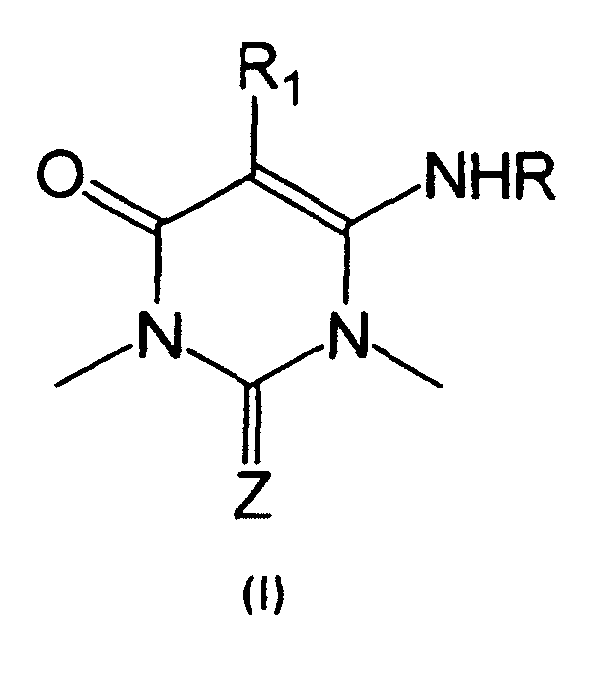
- According to the present invention, flexible PVC compositions with high thermal stability contain oligomeric and/or polymeric aminouracyls consisting of:
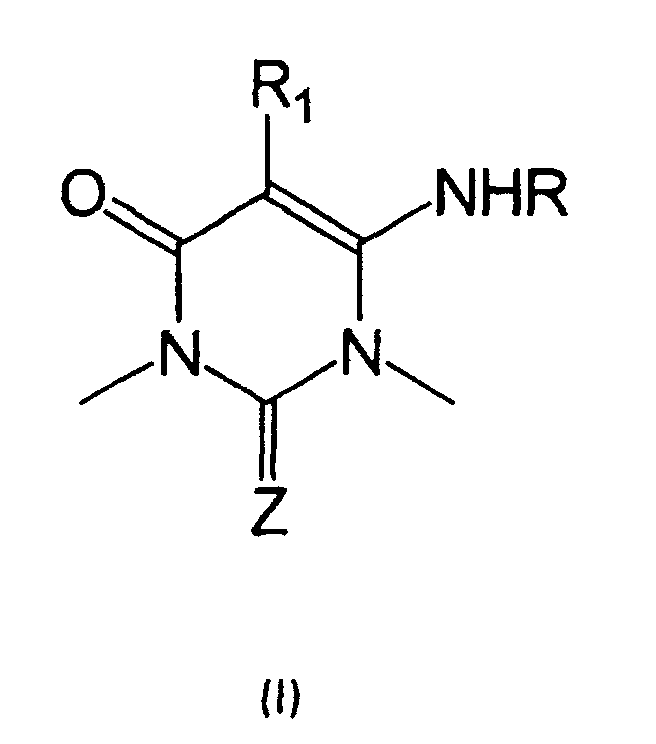
- a repetitive group of formula (I):
wherein:

- R is H, C1-C18 linear o branched alkyl, C5-C8 cycloalkyl, aryl, aryl substituted with -OH or C1-C8 alkoxy (=substituted aryl), arylalkyl, alkylaryl;
- R1 is H, -(C=O)-C1-C12 linear o branched alkyl, -(C=O)-O- C1-C12 linear o branched alkyl, -(C=O) phenyl, not substituted or substituted with -OH, C1-C8 linear o branched alkyl, C1-C8 alkoxy;
- Z is O or S;
- linking groups between the repetitive groups of formula (I) equal or different as: -(CR2R3)n- where R2, R3 can be equal or different and each independently of the other is -H, C1-C12 linear or branched or cyclic alkyl and n is an integer equal or greater than 2; or 3-methylen-3,5,5-trimethylcyclohexan-1-yl, methylenebis(4-cyclohexyl) alias 4,4'-methylenebis(cyclohexyl), methylenebis(3-cyclohexyl) alias 3,3'-methylenebis(cyclohexyl), 1,4-phenylene, 1-methyl-2,4-phenylene, 4,4'-diphenylenmethane;
- terminal groups as: H, C1-C18 linear or branched alkyl, C5-C8 cycloalkyl, C3-C18
alkenyl, aryl, substituted aryl, arylalkyl, alkylaryl, C1-C18 hydroxyalkyl, C2-C18
alkoxy alkyl, C6-C10 cycloalkoxyalkyl, C7-C14 alkoxyaryl, C7-C14 aryloxyalkyl, C2-C8
alkylthioalkyl, C6-C10 cycloalkylthioalkyl, C7-C14 alkylthioaryl, C7-C14
arylthioalkyl, C1-C18 alkylammine, disubstituted with C1-C18 linear or branched
alkyl.
Preferred stabilizers in flexible PVC compositions with a high thermal stability are oligomeric and/or polymeric aminouracyls consisting of repetitive groups of formula (I) wherein: - R is H, C1-C18 linear o branched alkyl, C5-C8 cycloalkyl, aryl, substituted aryl,
- R1 is H,
- Z is O or S;
- linking groups between the repetitive groups of formula (I) equal or different as: -(CR2R3)n- where R2, R3 can be equal or different and each independently of the other is -H, C1-C12 linear or branched or cyclic alkyl and n is an integer equal or greater than 2; or 3-methylen-3,5,5-trimethylcyclohexan-1-yl, methylenebis(4-cyclohexyl) alias 4,4'-methylenebis(cyclohexyl), methylenebis(3-cyclohexyl) alias 3,3'-methylenebis(cyclohexyl), 1,4-phenylene, 1-methyl-2,4-phenylene, 4,4'-diphenylenmethane;
- terminal groups as: H, C1-C18 linear or branched alkyl, C5-C8 cycloalkyl, C3-C18 alkenyl, aryl, substituted aryl, C1-C18 alkylamine, disubstituted with C1-C18 linear or branched alkyl.
- Oligomeric and/or polymeric aminouracyls according to the present invention have a mean molecular weight of from 280 and 5.000.
- Oligomeric and/or polymeric aminouracyls according to the present invention are normally obtained by cyclization of an oligomeric and /or polymeric urea using cyanacetic acid or its derivatives. The product thus obtained can be further derivatized to give compounds where R and R1 are different from H. Particularly the cyclization is carried out on a polyurea prepared by oligomerization and/or polymerization using suitable combinations of:
- 1. a diisocyanate of formula OCN-Y-NCO (DD), where Y can be: -(CR2R3)n- where R2, R3 can be equal or different and each independently of the other is H, C1-C12 linear or branched or cyclic alkyl and n is an integer equal or greater than 2; or 3-methylen-3,5,5-trimethylcyclohexan-1-yl, methylenebis(4-cyclohexyl) alias 4,4'-methylenebis(cyclohexyl), methylenebis(3-cyclohexyl) alias 3,3'-methylenebis(cyclohexyl),1,4-phenylene, 1-methyl-2,4-phenylene, 4,4'-diphenylenmethane;
- 2. an amine (A) of formula X-NH2 where X can be: H, C1-C18 linear or branched alkyl, C5-C8 cycloalkyl, C3-C18 alkenyl, aryl, substituted aryl, arylalkyl, alkylaryl, C1-C18 hydroxyalkyl, C2-C18 alkoxy alkyl, C6-C10 cycloalkoxyalkyl, C7-C14 alkoxyaryl, C7-C14 aryloxyalkyl, C2-C8 alkylthioalkyl, C6-C10 cycloalkylthioalkyl, C7-C14 alkylthioaryl, C7-C14 arylthioalkyl, C1-C18 alkylammine, disubstituted with C1-C18 linear or branched alkyl.
- 3. A di-amine (AA) of formula H2N-K-NH2 where K can be: -(CR2R3)n- where R2, R3 can be equal or different and each independently of the other is -H, C1-C12 linear or branched or cyclic alkyl and n is an integer equal or greater than 2; or 3-methylen-3,5,5-trimethylcydohexan-1-yl, methylenebis(4-cyclohexyl) alias 4,4'-methylenebis(cyclohexyl), methylenebis(3-cyclohexyl) alias 3,3'-methylenebis(cyclohexyl), 1,4-phenylene, 1-methyl-2,4-phenylene, 4,4'-diphenylenmethane;
- 4. An isocyanate (D) of formula W-NCO, where W can be: C1-C18 linear or branched alkyl, C5-C8 cycloalkyl, C3-C18 alkenyl, aryl, substituted aryl, arylalkyl, alkylaryl, C1-C18 hydroxyalkyl, C2-C18 alkoxy alkyl, C6-C10 cycloalkoxyalkyl, C7-C14 alkoxyaryl, C7-C14 aryloxyalkyl, C2-C8 alkylthioalkyl, C6-C10 cycloalkylthioalkyl, C7-C14 alkylthioaryl, C7-C14 arylthioalkyl, C1-C18 alkylammine, disubstituted with C1-C18 linear or branched alkyl.
-
- According to the present invention in the preparation of the polyurea A, AA, D, DD can be used in all possible ratios. In the preferred embodiments, when AA and D are both equal to zero, the molar ratio DD/A is comprised between 0.3 and 0.6; when DD and A are both equal to zero, the molar ratio AA/D is comprised between 0.3 and 0.6.
- Obviously, the above description which was done assuming that Z is O in the repetitive group of formula (I) can be similarly repeated when Z is S by using the corresponding sulphurated compounds; in this case D and DD mean the corresponding isothiocyanate and diisothiocyanate.
- According to the present invention, in flexible PVC compositions with a high thermal stability, the oligomeric and/or polymeric aminouracyls may be incorporated in an amount of from 0.01 to 10% by weight, preferably of from 0.05 to 5% and especially of from 0.1 to 3% based on the entire composition. According to the present invention, stabilized PVC compositions can further contain customary additives such as, but not exclusively: stabilizers, auxiliaries and processing aids, compounds containing alkali metal compounds and alkaline earth metal compounds, lubricants, plasticizers, pigments, fillers, phosphites, thiophosphites, thiophosphates, mercaptocarboxylates, epoxidized fatty acid esters, antioxidants, UV absorbers and light stabilizers, fluorescent whitening agents, impact modifiers, gelling agents and antistatic agents, metals deactivators, flame retardants, blowing agents and antifogging agents. Examples of plasticizers that can be used according to the present invention are: esters of C4-C20 alcohols ( adipates, phthalates, trimellitates, azelates, sebacates, benzoates, phosphates), epoxidized compounds ( typically epoxidized soy-bean oil), polymeric plasticizers such as polyester, polyadipates, polyphosphates, ...
- The compounds of the present invention are useful as stabilizers of polymers of vinyl chloride, vinyl resins containing vinyl chloride units in the structure, such as copolymers of vinyl chloride and vinyl esters of aliphatic acids, preferably vinyl acetate, copolymers of vinyl chloride with esters of acrylic and methacrylic acid and with acrylonitrile, copolymers of vinyl chloride with diene compounds and unsaturated dicarboxylic acids or their anhydrides, such as copolymers of vinyl chloride with diethyl maleate, diethyl fumarate or maleic acid anhydride, post-chlorinated polymers and copolymers of vinyl chloride and vinyliden chloride with unsaturated aldehydes and ketones, such as acrolein, crotonaldehyde, vinyl methyl ketone, vinylmethylether, vinyl isobuthylether and the like; polymers of vinylidene chloride and copolymers thereof with vinyl chlorides or other polymerizable compounds; polymers of vinyl chloroacetate and dichlorovinyl ether; chlorinated polymers of vinyl acetate, chlorinated polymeric esters of acrylic acid and of α-substituted acrylic acid; polymers of chlorinated styrene; chlorinated rubbers; chlorinated polymers of ethylene; polymers and post-chlorinated polymers of chlorobutadiene and their copolymers with vinyl chloride, chlorinated rubber; mixtures of the cited polymers alone or with other polymerizable compounds.
- These materials also include graft polymers of PVC with EVA, ABS and MBS. Preferred substrates are also mixtures of above homo and copolymers, preferably homopolymers of vinyl chloride with other thermoplastic or elastomeric polymers, in particular blends with ABS, MBS, NBR, SAN, EVA, CPE, MBAS, PMA, PMMA, EPDM and polylactones.
- Suitable stabilizable compositions within the scope of this invention, are preferably recycled chlorine containing polymers; these polymers are the above mentioned polymers which have suffered damage through use, storage or production process. Particularly preferred is recycled PVC. Recycled products may also contain minor amounts of foreign material difficult to remove, such as paper, pigments, adhesives.
- The compositions of PVC containing the stabilizers of the present invention, show as their fundamental characteristic a high thermal stability together with a good transparency of the stabilized system, without staining and blistering.
- These properties of the compositions of PVC according to the invention, are very different from those described in the known art. This is demonstrated by the applicative results obtained on compositions of PVC containing the oligomeric and/or polymeric aminouracyls of the present invention.
- The preparation of a diuracyl is reported.
- A solution of 19.2 g (150 mmol) of di n-octylamine in 22 ml of THF are added dropwise into10 g (60 mmol) of 1,6-hexamethylene diisocyanate dissolved in 100 ml of THF under stirring at a temperature not exceeding 15°C. After the addition the reaction mixture is stirred for 30 min and allowed to reach room temperature. The reaction mixture is then poured into 400 ml of acetone. The obtained precipitate is filtered, washed with acetone and dried under vacuum. 25.2 g of a white solid are obtained. (IR: (cm-1): 3333, 2955, 2929, 2853, 1616, 1577).
- 5 g (11.7 mmol) of the solid are reacted under stirring with 2.87 g (28.1 mmol) of acetic anhydride and 2.2 g (25.9 mmol) of cyanacetic acid. The mixture is heated at 90°C and then the temperature is maintained for 2 hours at 80-90°C. 10 ml of water and a 15% sodium hydroxide are added to the reaction mixture solution to obtain pH >9, then the reaction mixture is refluxed for 1 hour. The reaction mixture is then cooled down to room temperature and it is diluted with methylene chloride.
- After phase separation the organic layer is washed with water to neutral pH. The organic layer is dried on anhydrous sodium sulphate, then the solvent is evaporated under vacuum. 4.87 g of a brown solid are obtained.
- IR: (cm-1): 3349, 3207, 2926, 2855, 1623.
- MS: 561 (M+1)
- 13CNMR: (DMSO d6): δ (ppm): 13.5, 21.6, 25.4, 26.0, 27.2, 28.5, 31.0, 41.4, 75.0, 151.0, 154.0, 161.0.
- 1HNMR.(CDCl3 ): δ (ppm): 0.85 (t, 6H); 1.25 (m, 24 H); 1.61 (m,8H); 3.88 (m, 8H); 5.02 (bs, 2H).
- The preparation of a polyuracyl is reported.
- A solution of 2.3 g (19.8 mmol) of 1,6-hexamethylendiamine in 30 ml of THF are added dropwise to 5 g (29.8 mmol) of 1,6-hexamethylene diisocyanate dissolved in 50 ml of THF under stirring at 5°C. After the addition the reaction mixture is allowed to reach room temperature and a solution of 2.9 g (22.5 mmol) of n-octylamine in 30 ml of THF are added dropwise. After stirring for 30 min at room temperature, the reaction mixture is poured into acetone, then it is dried under vacuum. 9.5 g of solid are obtained. (IR: (cm-1): 3329, 2929, 2854, 1616, 1579.
- 4 g of the solid are reacted under stirring with 10 g (98 mmol) of acetic anhydride and 5 g (58.8 mmol) of cyanacetic acid. The mixture is heated at 90°C under stirring for 4.5 hours. 10 ml of water and a 20% sodium hydroxide solution are added to the reaction mixture to obtain pH >9 then the reaction mixture is refluxed for 1.5 hours. The reaction mixture is cooled down to room temperature and a solid compound is obtained by decantation. The solid is dissolved in methylene chloride/methanol (1/1) and the insoluble residue is discarded. The organic layer is evaporated under vacuum. 5.14 g of a brown solid are obtained.
- IR (cm-1): 3419, 3252, 2927, 2855, 1628, 1575.
- 13CNMR: (DMSO d6): δ (ppm): 13.5, 21.5, 25.5, 26.0, 27.0, 27.2, 28.5, 29.6, 31.0, 41.5, 75.0, 151.0, 154.0, 161.0.
- 1HNMR: (DMSO d6): δ (ppm): 0.82 (m, 6H); 1.20 (m,37 H); 1.44 (m,17 H); 3.50 - 3.90 (m, 23H); 4.66 (bs, 3.75 H).
- The preparation of a lipophylic diuracyl is reported.
- A solution of 1.96 g (16.9 mmol) of 1,6-hexamethylenediamine in 50 ml of THF are added dropwise to10 g (33.84 mmol) of octadecyl isocyanate dissolved in 100 ml of THF under stirring and at a temperature not exceeding 10°C. After the addition the reaction mixture is allowed to reach room temperature and then stirred for 30 min. The precipitate thus obtained is filtered. 10.97 g of a white solid are obtained. (IR: (cm-1): 3336, 2920, 2849, 1615, 1575).
- 5 g (7.08 mmol) of the solid are reacted under stirring with 1.73 g (17 mmol) of acetic anhydride and 1.32 g (15.58 mmol) of cyanacetic acid. The mixture is stirred and heated at 95°C for 3 hours. 10 ml of water and a 20% sodium hydroxide solution are added to the reaction mixture to obtain pH >9 then the reaction mixture is refluxed for 1 hour. The reaction mixture is cooled down to room temperature, the insoluble residue is filtered off and the remaining part is redissolved with ethyl acetate. The organic layer is washed with water and is dried on anhydrous sodium sulphate, then the solvent is evaporated under vacuum. 4.45 g of a brown solid are obtained.
- IR (cm-1): 3353, 3206, 2921, 2851,1623.
- 13CNMR: (DMSO d6): δ (ppm): 13.4, 21.8,25.7, 27.2, 28.7, 31.0, 41.3, 75.0, 151.0, 153.9, 161.0.
- 1HNMR: δ (ppm): 0.87 (m, 6H); 1.25 (m, 64 H); 1.63 (m, 8 H); 3.76 (m, 8 H); 5.00 (bs, 2 H).
- The preparation of a polyuracyl is reported.
- A solution of 2.42 g (20.86 mmol) of 1,6-hexamethylenediamine in 30 ml of THF are added dropwise to 7 g (41.67 mmol) of hexamethylene diisocyanate dissolved in 100 ml of THF under stirring and at 5°C. After the addition the reaction mixture is allowed to reach spontaneously 15°C, then a solution of 6.38 g (49.46 mmol) of n-octylamine in 40 ml of THF are added dropwise. The reaction mixture is stirred for 30 min at room temperature then it is filtered and the obtained precipitate is washed with acetone. 13.72 g of crude product are obtained. (IR: (cm-1): 3337, 2928, 2854, 1620, 1576).
- 5 g of the solid are reacted under stirring with 3.23 g (31.69 mmol) of acetic anhydride and 2.51 g (29.58 mmol) of cyanacetic acid. The mixture is heated at 100°C under stirring for 3.5 hours. 10 ml of water and a 15% sodium hydroxide solution are added to the reaction mixture to obtain pH 9 then the reaction mixture is refluxed for 2.5 hours. The reaction mixture is cooled down to room temperature and a solid compound is obtained by decantation. The solid is dissolved in methylene chloride/methanol (1/1) and the insoluble residue is discarded. The organic layer is evaporated under vacuum. 6.74 g of a yellow solid are obtained.
- IR (cm-1): 3414, 2927, 2854, 1631, 1574.
- 13CNMR: (DMSO d6): δ (ppm): 13.4, 21.8, 25.8, 27.3, 28.4, 29.8, 31.0, 41.5, 75.0, 151.0, 154.1, 161.2
- 1HNMR: δ (ppm): 0.86 (m, 6H); 1.27 (m, 32 H); 1.47 (m, 16 H); 3.25 (m, 16 H); 4.67 (bs, 4 H).
- The preparation of a diuracyl with unsaturated side chains is reported.
- According to the procedure described in Example 1, starting from 2 g (11.9 mmol) of hexamethylenediisocyanate in 50 ml of THF and 7.64 g (28.57 mmol) of oleylamine in 30 ml of THF, 8.38 g of a white solid are obtained.
- 5 g (7.12 mmol) of the solid are reacted with 1.33 g (15.6 mmol) of cyanacetic acid and 1.67 g (16.4 mmol) of acetic anhydride; the reaction mixture is treated as reported in Example 1 to obtain 4.06 g of a light yellow solid.
- IR (cm-1): 3386, 3214, 2924, 2853, 1620, 966.
- 13CNMR: (DMSO d6): δ (ppm): 13.8, 21.9, 25.5, 26.6, 27.6, 28.5, 29.0, 31.1, 41.6, 75.0, 129.2, 151.0, 154.0, 161.0.
- 1HNMR: (DMSO d6): δ (ppm): 0.84 (t, 6H); 1.24 (m, 48H); 1.50 (m,8H); 1.96 (m,8H); 3.63-3.83 (m, 8H); 4.65 (s, 2H); 5.32 (m, 4H).
- The preparation of a diuracyl is reported.
- According to the procedure described in Example 1, starting from 10 g (45 mmol) of 3-methylen-3,5,5-trimethylcyclohexan-1-yl diisocyanate into 200 ml of THF and 12.77 g (99 mmol) of octylamine into 100 ml of THF, 16.35 g of a white solid are obtained.
- 5 g (10.42 mmol) of the solid are reacted with 1.96 g (23.06 mmol) of cyanacetic acid and 2.45 g (24.10 mmol) of acetic anhydride; the reaction mixture is treated as reported in Example 1 to obtain 5.51 g of a light yellow solid.
- IR (cm-1): 3359, 3261, 3213, 2955, 2926, 2855, 1623.
- 13CNMR: (DMSO d6): δ (ppm): 13.5, 21.7, 26.0, 27.2, 28.4, 29.7, 30.9, 35.0, 42.1, 46.4, 52.3, 75.2, 151.9, 154.6, 155.0, 160.9.
- 1HNMR: (DMSO d6): δ (ppm): 0.75 - 1.70 (m, 45H); 3.50 - 3.90 (m, 7H); 4.60 - 4.85 (m, 2H).
- The preparation of a diuracyl is reported.
- According to the procedure described in Example 1, starting from 10 g (38.12 mmol) of methylene-bis(4-cyclohexylisocyanate), alias 4,4'-methylene-bis(cyclohexylisocyanate, into 200 ml of THF and 10.82 g (83.86 mmol) of octylamine into 100 ml of THF, 16.30 g of a white solid are obtained.
- 5 g (19.62 mmol) of the solid are reacted with 1.80 g (21.15 mmol) of cyanacetic acid and 2 26 g (22.11 mmol) of acetic anhydride; the reaction mixture is treated as reported in Example 1 to obtain 5.97 g of a yellow solid.
- IR (cm-1) 3384, 3212, 2925, 2853, 1631, 1560.
- CNMR: (DMSO d6): δ (ppm): 13.5, 21.7, 26.1, 28.3, 29.7, 30.9, 33.1, 44.5, 48 3, 55.2, 76.2, 150.7, 154.6, 157.3, 161.1.
- 1HNMR (DMSO d6): δ (ppm): 0.70 - 1.95 (m, 50H); 3.50 - 3.82 (m, 4H); 3.85 - 4.15 (m, 2H); 4.60 -4.75 ( m,2H).
- The relevant data of Examples from 1 to 7 are summarized in Table I.11

- The preparation of a dithiouracyl is reported.
- A solution of 11 g (80 mmol) of thiophenylisocyanate in 50 ml of THF are added dropwise to 4.22 g (36 mmol) of hexamethylenediamine dissolved in 100 ml of THF under stirring and at a temperature not exceeding 10°C. After the addition the reaction mixture is allowed to reach room temperature and then stirred for 2 hours. Then the solvent is evaporated under vacuum and 14 g of a white solid are obtained.
- IR: (cm-1): 3172, 3010, 2926, 1594, 1534, 1452.
- 1HNMR (DMSO d6): δ (ppm): 1.25-1.45 (m, 4H); 1.50-1.70 (m, 4 H); 3.45-3.55 (m, 4H); 7.07 (m, 2 H); 7.3 (m, 4 H); 7.45 (m, 4H); 7.6 (m, 2H).
- MS: 387 (M+1)
- 1.5 g (3.88 mmol) of the white solid are reacted under stirring with 0.84 g (8.23 mmol) of acetic anhydride and 0.7 g (8.23 mmol) of cyanacetic acid. The mixture is stirred and heated at 60°C for 3 hours. 10 ml of water and a 5% sodium hydroxide solution are added to the reaction mixture to obtain pH 9-10, then the reaction mixture is refluxed for 2 hours. The reaction mixture is cooled down to room temperature and methylene chloride is added. The organic layer is separated, washed with water, dried on anhydrous sodium sulphate and then the solvent is evaporated under vacuum. 1.13 g of a solid are obtained.
- The solid is purified by chromatography (silica gel, eluent: petroleum etherethylacetate 70:30 to 60:40).
- A fraction of 0.12 g of dithiouracyl is obtained.
- 1HNMR (DMSO d6) δ (ppm): 1.25-1.50 (m, 4H); 1.50-1.80 (m, 4 H); 3.45-3.65 (m, 4 H); 5.70 (3, 2 H); 7.25-7.50 (m, 10H).
- MS: 521 (M+1)
- The preparation of a diuracyl with diphenylaliphatic internal chain and aliphatic side chain is reported.
- A solution of 11.36 g (87.9 mmol) of n-octylamine in 100 ml of THF are added dropwise to 10 g (40 mmol) of methylene bis(4-phenylisocyanate) dissolved in 200 ml of THF under stirring and at a temperature not exceeding 10°C. After the addition the reaction mixture is allowed to reach room temperature and then stirred for 30 min. ; the precipitate is then filtered, washed with acetone and dried under vacuum. 20 g of a white solid are obtained.
- IR: (cm-1): 3441, 3326, 2955, 2925, 2852, 1632, 1599, 1561.
- 5 g (98 mmol) of the white solid are reacted under stirring with 2.4 g (23.6mmol) of acetic anhydride and 1.84 g (21.6 mmol) of cyanacetic acid. The mixture is stirred and heated at 105°C and the temperature is set at 90-100° for 3 hours. 20 ml of water and a 15% sodium hydroxide solution are added to the reaction mixture to obtain pH >9, then the reaction mixture is refluxed for 2 hour. The reaction mixture is cooled down to room temperature and a solid compound is obtained by decantation. The solid is dissolved in methylene chloride. The organic layer obtained is washed with water and with a saturated solution of NaCI, then dried with sodium sulphate and evaporated under vacuum to obtain 6.1 g of a light yellow solid.
- IR (cm-1): 3473, 3319, 3247, 3191, 2954, 2925, 2854, 1635, 1547, 1510, 1473. 1HNMR (DMSO d6) δ (ppm): 0.75-0.95 (m, 6H); 1.1-1.35 (m, 20H); 1.35-1.60 (m, 4H); 3.60-4.05 (m, 4H); 4.83 (bs, 2H); 6.0 (m, 2H); 6.90-7.57 (m, 8H)
- 13CNMR: (DMSO d6): δ (ppm): 13.4, 21.8, 26.0, 27.0, 28.5, 31.0, 74.8, 128.5, 129.5, 132.3, 141.2, 150.9, 154.0, 161.2.
- The preparation of a diuracyl with cycloaliphatic side chain is reported.
- A solution of 14.5 g (146 mmol) of cyclohexylamine in 50 ml of THF are added dropwise to 12 g (71.4 mmol) of 1,6-hexamethylene diisocyanate dissolved in 150 ml of THF under stirring and at a temperature not exceeding 15°C. After the addition the reaction mixture is allowed to reach room temperature and then stirred for 30 min. then the precipitate is filtered, washed with THF and dried under vacuum. 24.5 g of a white solid are obtained.
- IR: (cm-1): 3346, 3314, 2929, 2854, 1624, 1574.
- 10 g (27 mmol) of the white solid are reacted under stirring with 6.1 g (60 mmol) of acetic anhydride and 5.1 g (60 mmol) of cyanacetic acid. The mixture is stirred and heated at 105°C and the temperature is set at 90-100° for 3 hours. 20 ml of water and a 15% sodium hydroxide solution are added to the reaction mixture to obtain pH >9, then the reaction mixture is refluxed for 2 hours. The reaction mixture is cooled down to room temperature and a solid compound is obtained by decantation. The solid is dissolved in methylene chloride-methanol (1:1) and the insoluble residue is discarded. The organic layer is evaporated under vacuum to obtain 13.2 g of a brown solid. 5 g of the brown solid are purified by chromatography (silica gel, eluent: methylene chloride-methanol 95:5 to 80:20).
- A fraction of 1 g of diuracyl is obtained.
- IR (cm-1): 3362, 3210, 2930, 2855, 1620, 1478.
- 1HNMR (DMSO d6) δ (ppm): 0.95-1.95 (m, 24H); 2.2-2.4 (m, 4H); 3.6-3.8 (m, 4H); 3.85-4.15 (m, 2 H); 4.7 (bs, 2H).
- MS: 501 (M+1).
- The preparation of a diuracyl with hydroxyaromatic side chain is reported.
- A solution of 7.71 g (45.9 mmol) of 1,6-hexamethylene diisocyanate in 100 ml of THF are added dropwise to 10 g (91.7 mmol) of 3-amino-phenol dissolved in 150 ml of THF under stirring and at a temperature not exceeding 15°C. After the addition the reaction mixture is allowed to reach room temperature and then stirred for 1 hour; then the precipitate is filtered, washed with slightly acidic water and dried under vacuum. 12.3 g of a white solid are obtained.
- IR: (cm-1): 3322, 2930, 2857, 1630, 1605, 1566, 1442.
- 2 g (5.2 mmol) of the white solid are reacted under stirring with 2.22 g (21.8 mmol) of acetic anhydride and 1.85 g (21.8 mmol) of cyanacetic acid. The mixture is stirred and heated at 90°C and the temperature is set at 90-95° for 3 hours. 20 ml of water and a 15% sodium hydroxide solution are added to the reaction mixture to obtain pH >9, then the reaction mixture is refluxed for 2.5 hour. The reaction mixture is cooled down to room temperature and a solid compound is obtained by decantation. The solid is dissolved in methanol under reflux. The obtained solution is cooled, filtered and evaporated under vacuum to obtain 2.08 g of a crude solid.
- 2 g of the crude solid are purified by chromatography (silica gel, eluent: methylene chloride-methanol 95:5 to 90:10).
- A fraction of 0.34 g of diuracyl is obtained.
- 1HNMR (DMSO d6) δ (ppm): 1.25 (m, 4H); 1.50 (m, 4H); 3.67 (t, 4H); 4.77 (s, 2 H); 6.65 (m, 2H); 6.70 (m, 2H); 6.87 (m, 2H); 7.30 (m, 2H).
- MS: 521 (M+1).
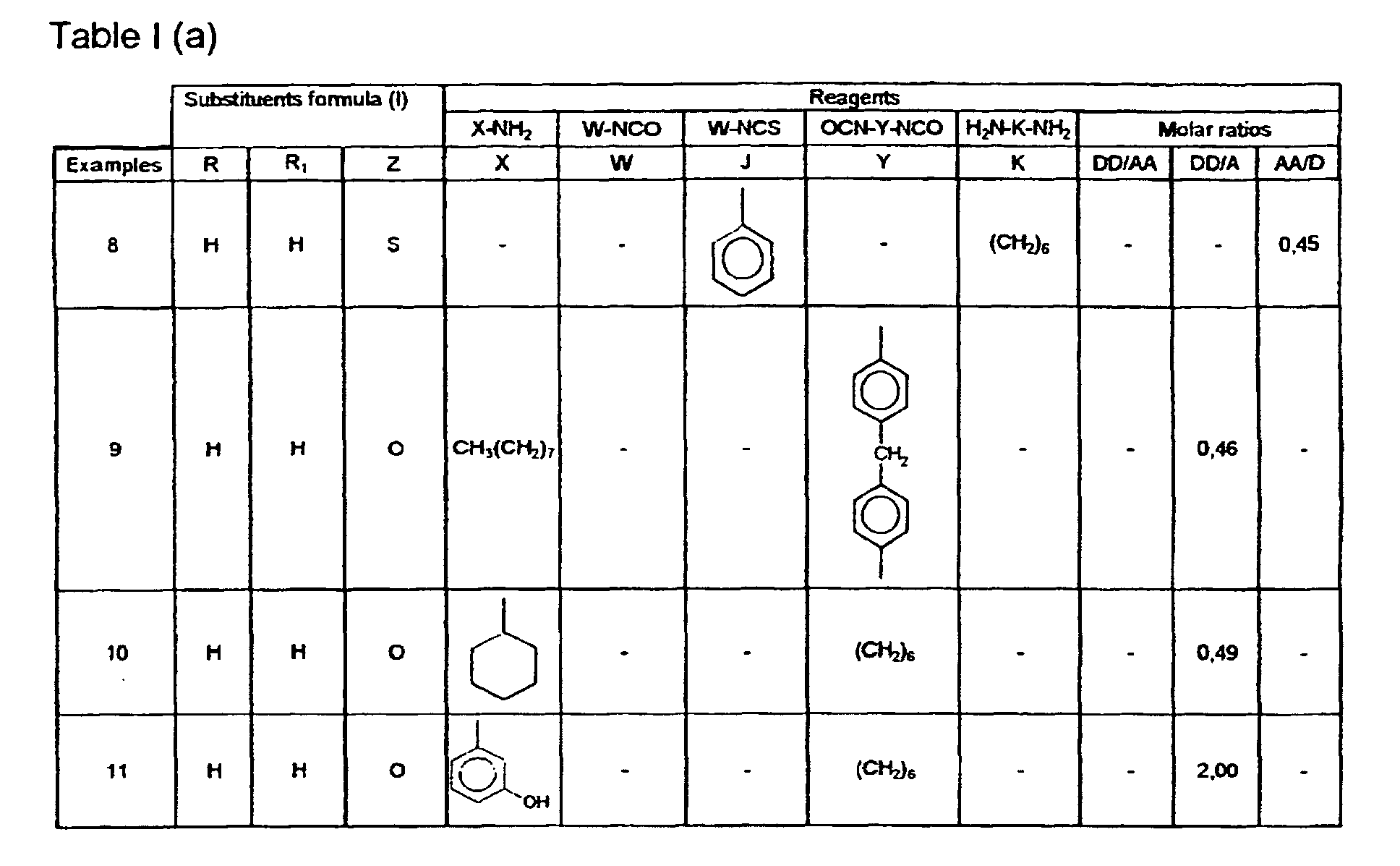
- The relevant data of Examples from 8 to 11 are summarized in Table I (a).
- The thermal stability of PVC compositions stabilized with the products of the present invention is measured as reported below.
- A dry mixture of the ingredients reported in the following table, is laminated using a two cylinder apparatus for 1 min at 190°C. From the obtained rolled sheet, 20 x 220 mm samples are prepared. The test sample is subject to thermal stress in a Wherner Mathis oven equipped with a thermotester device. The oven temperature is set at 190°C and the thermotester device is set so that 20 mm of test sample are removed from the oven at regular intervals. In the reported conditions the sample is under a static heat stress. At the end of the experiment the evaluation is carried out measuring the Yellow Index according to ASTM D-1925-70.
- The results on rigid PVC (Compositions 1 and 2 - Tab. II) and on flexible PVC (Compositions 3 and 4 - Tab. III) are reported below. Low values of Yellow Index signify a good stabilisation.
- Compositions 1 and 2 (numbers refer to parts by weight):
Composition 1 Composition 2 S-PVC (k value 64) 100 100 Epoxidized soy-bean oil 2 2 Compound of Example 1 - 0.4 Static heat test Thermal stress duration (min.) Y.L Composition 1 Y.I. Composition 2 3' 11.5 5.1 6' 29.3 5.9 9' 41.3 13 12' > 100 (burning) 22.4 15' 38.5 18' 55.6 21' 73.3 24' > 100 (burning) - Compositions 3 and 4 (numbers refer to parts by weight):
Composition 3 Composition 4 S-PVC (k value 70) 100 100 Dioctyl phtalate 60 60 Stearic acid 0.2 0.2 Epoxidized soy-bean oil 2 2 Compound of Example 1 - 0.4 Static heat test Thermal stress duration (min.) Y.I. Composition 3 Y.I. Composition 3 4' 5,5 3 8' 8,3 4,9 12' 25,8 10,9 16' 44,7 20,7 20' 62,5 33,5 24' 70,7 45,5 28' 74,1 59,7 32' > 100 (burning) 70,8 36' 77,3 40' > 100 (burning) - In Table II (a) and in Tables from III (a) to III (e) the thermal stability of some other PVC compositions (Compositions 6-22) is reported.
- Compositions 6 and 7 (numbers refer to parts by weight):
Composition 6 Composition 7 S-PVC (k value 64) 100 100 Epoxidized soy-bean oil 2 2 Compound of Example 4 0.4 0 Compound of Example 6 0 0.4 - Compositions 8 and 9 (numbers refer to parts by weight):
Composition 8 Composition 9 S-PVC (k value 70) 100 100 Dioctyl phtalate 60 60 Stearic Acid 0.5 0.5 Epoxidized soy-bean oil 2 2 Compound of Example 4 0.4 0 Compound of Example 6 0 0.4 - Compositions 10, 11, 12, 13 (numbers refer to parts by weight):
Composition 10 Composition 11 Composition 12 Composition 13 S-PVC (k value 70) 100 100 100 100 Dioctyl phtalate 40 40 40 40 Ca/Zn liquid stabilizer 2 2 2 2 Epoxidized soy-bean oil 2 2 0 0 Compound of Example 4 0 0.2 0 0.2 - Compositions 14, 15, 16 (numbers refer to parts by weight):
Composition 14 Composition 15 Composition 16 S-PVC (k value 70) 100 100 100 Dioctyl phtalate 60 60 60 Stearic Acid 0.5 0.5 0.5 Epoxidized soy-bean oil 2 2 2 Compound of Example 1 0.1 0.3 1 - Compositions 17, 18, 19 (numbers refer to parts by weight):
Composition 17 Composition 18 Composition 19 S-PVC (k value 70) 100 100 100 Dioctyl phtalate 60 60 60 Stearic Acid 0.5 0.5 0.5 Epoxidized soy-bean oil 2 2 2 Compound of Example 4 0.1 0.3 1 - Compositions 20, 21, 22 (numbers refer to parts by weight):
Composition 20 Composition 21 Composition 22 S-PVC (k value 70) 100 100 100 Dioctyl phtalate 60 60 60 Stearic Acid 0.5 0.5 0.5 Epoxidized soy-bean oil 2 2 2 Compound of Example 6 0.1 0.3 1 Static heat test Thermal stress duration (min.) Y.I. Composition 6 Y.I. Composition 7 4 9,85 7,56 8 15,25 10,64 12 33,39 20,11 16 52,91 33,61 20 67,73 52,23 24 79,15 67,84 28 > 100 (burning) 77,47 32 > 100 (burning) Static heat test Thermal stress duration (min.) Y.I. Composition 8 Y.I. Composition 9 4' 7,14 6,04 8' 11,47 12,45 12' 18,83 19,37 16' 27,55 30,59 20' 38,04 40,01 24' 52,30 50,71 28' 67,12 60,53 32' 74,29 70,00 36 75,59 76,58 40' 78,55 77,31 44' 81,85 79,58 48' > 100 (burning) 84,56 52' > 100 (burning) Static heat test Thermal stress duration (min.) Y.I. Composition 10 Y.I. Composition 11 Y.I. Composition 12 Y.I. Composition 13 4' 0.85 5.07 1.23 4.32 8' 0.90 4.53 1.25 6.00 12' 2.17 7.24 2.46 8.99 16' 3.92 11.44 3.28 10.86 20' 6.96 13.62 3.61 12.78 24' 18.18 17.90 29.94 13.94 28' 36.77 39.16 > 100 (burning) 14.58 32' > 100 (burning) 59.68 17.37 36 75.81 27.34 40' 83.79 70.59 44' > 100 (burning) > 100 (burning) Static heat test Thermal stress duration (min.) Y.I. Composition 14 Y.I. Composition 15 Y.I. Composition 16 3' 4.41 4.39 7.39 6' 12.31 5.70 10.67 9' 30.84 12.79 18.22 12' 45.36 24.22 24.65 15' 75.59 40.23 31.61 18' > 100 (burning) 61.69 40.97 21' 74.18 50.15 24' 78.33 58.80 27' > 100 (burning) 69.03 30' 74.67 33' > 100 (burning) Static heat test Thermal stress duration (min.) Y.I. Composition 17 Y.I. Composition 18 Y.I. Composition 19 3' 5.85 3.50 11.73 6' 18.78 6.53 11.55 9' 38.96 15.98 17.22 12' 63.53 28.64 25.62 15' 69.84 53.01 34.92 18' > 100 (burning) 71.06 48.58 21' 76.41 61.37 24' > 100 (burning) 70.89 27' 77.10 30' > 100 (burning) Static heat test Thermal stress duration (min.) Y.I. Composition 20 Y.I. Composition 21 Y.I. Composition 22 3' 3.39 3.58 3.73 6' 13.28 7.54 9.50 9' 29.32 19.82 17.03 12' 58.24 32.04 24.70 15' 74.91 52.44 34.79 18' > 100 (burning) 66.97 46.37 21' 78.94 55.40 24' 72.82 65.34 27' > 100 (burning) 73.99 30' 78.73 33' > 100 (burning) - The appraisal of staining and blistering is carried out by the evaluation, respectively, of exudation and transparency on test samples obtained from lamination using a two cylinder apparatus for 1 min at 190°C.
- The exudation is evaluated by an organoleptic test. An exudated sample is tacky. An empirical evaluation has been set up with scores from 0 to 3, according to the definitions of Table IV.
Degree of exudation tacky of the test sample 0 Tack free 1 Lightly tacky 2 Moderately tacky 3 Strongly tacky - Transparency is measured by a BYK Colour Guide 45/0 colorimeter using the setting to measure opacity. The test sample is placed on a white and black cardboard and two different measurements are carried out: one against the black background and the other against the white background: opacity is the ratio % between the evaluation against the black background and the white background. The higher is the %, the higher is opacity and the lower is transparency.
- In table V the results of the application tests for the evaluation of exudation and transparency on flexible PVC are reported. The comparison is made among compositions 3 and 4, that are again reported below for better understanding, and a similar composition of flexible PVC containing the monomeric 1,3-dimethylamino uracyl (Composition 5).
- Compositions 3, 4, 5 (numbers refer to parts in weight):
Composition 3 Composition 4 Composition 5 S-PVC (k value 70) 100 100 100 Dioctyl phtalate 60 60 60 Stearic acid 0,2 0,2 0,2 Epoxidised soy-bean oil 2 2 2 Compound of Example 1 - 0,4 - 1,3-dimethyl-6-amino uracyl - - 0,4 Exudation and transparency Composition Exudation value Transparency % 3 0 16,0 4 0 16,9 5 3 21,2 - In Table V (a) the results of the application tests for the evaluation of exudation and transparency on some other flexible PVC compositions (Compositions 8, 9, 16, 19, 22, 23) are reported.
Comp. 8 Comp. 9 Comp. 16 Comp. 19 Comp. 22 Com p. 23 S-PVC k value 70 100 100 100 100 100 100 Dioctyl phtalate 60 60 60 60 60 60 Stearic Acid 0.5 0.5 0.5 0.5 0.5 0.5 Epoxidized soy-bean oil 2 2 2 2 2 2 Compound of Example 1 0 0 1 0 0 0 Compound of Example 4 0.4 0 0 1 0 0 Compound of Example 6 0 0.4 0 0 1 0 1,3-dimethyl-6-amino uracyl 0 0 0 0 0 1 Exudation and Trasparency Composition Degree of Exudation Transparency % 8 0 16.6 9 0 16.3 16 0 16.7 19 0 18.4 22 0 15.7 23 3 24.6
Claims (9)
- Flexible PVC compositions exhibiting high thermal and oxidative stability, containing oligomeric and/or polymeric aminouracyls, characterised by the fact that the oligomeric and/or polymeric aminouracyls consist of:a repetitive group of formula (I):wherein:
 R is H, C1-C18 linear o branched alkyl, C5-C8 cycloalkyl, aryl, aryl substituted with -OH or C1-C8 alkoxy ( = substituted aryl), arylalkyl, alkylaryl;R1 is H, -(C = O)-C1-C12 linear o branched alkyl, -(C = O)-O- C1-C12 linear o branched alkyl, -(C=O) phenyl, not substituted or substituted with -OH, C1-C8 linear o branched alkyl, C1-C8 alkoxy;Z is O or S;linking groups between the repetitive groups of formula (I) equal or different as: - (CR2R3)n- where R2, R3 can be equal or different and each independently of the other is H, C1-C12 linear or branched or cyclic alkyl and n is an integer equal or greater than 2; or 3-methylen-3,5,5-trimethylcyclohexan-1 -yl, methylenebis(4-cyclohexyl), methylenebis(3-cyclohexyl), 1,4-phenylene, 1-methyl-2,4-phenylene, 4,4'-diphenylenmethane;terminal groups as: H, C1-C18 linear or branched alkyl, C5-C8 cycloalkyl, C3-C18 alkenyl, aryl, substituted aryl, arylalkyl, alkylaryl, C1-C18 hydroxyalkyl, C2-C18 alkoxy alkyl, C6-C10 cycloalkoxyalkyl, C7-C14 alkoxyaryl, C7-C14 aryloxyalkyl, C2-C8 alkylthioalkyl, C6-C10 cycloalkylthioalkyl, C7-C14 alkylthioaryl, C7-C14 arylthioalkyl, C1-C18 alkylammine, disubstituted with C1-C18 linear or branched alkyl.
- Flexible PVC compositions according to Claim 1, whereinR is H, C1-C18 linear o branched alkyl, C5-C8 cycloalkyl, aryl, substituted aryl,R1 is H,Z is O or S;the linking groups between the repetitive groups of formula (I) are equal or different and are: -(CR2R3)n- where R2, R3 can be equal or different and each independently of the other is -H, C1-C12 linear or branched or cyclic alkyl and n is an integer equal or greater than 2; or 3-methylen-3,5,5-trimethylcyclohexan-1-yl, methylenebis(4-cyclohexyl, methylenebis(3-cyclohexyl), 1,4-phenylene, 1-methyl-2,4-phenylene, 4,4'-diphenylenmethane;the terminal groups are: H, C1-C18 linear or branched alkyl, C5-C8 cycloalkyl, C3-C18 alkenyl, aryl, substituted aryl, C1-C18 alkylamine, disubstituted with C1-C18 linear or branched alkyl.
- Flexible PVC compositions according to Claim 1, wherein the oligomeric and/or polymeric aminouracyls are incorporated in an amount of from 0.01 to 10% by weight.
- Flexible PVC compositions according to Claim 3, wherein the oligomeric and/or polymeric aminouracyls are incorporated in an amount of from 0.05 to 5% by weight.
- Flexible PVC compositions according to Claim 3, wherein the oligomeric and/or polymeric aminouracyls are incorporated in an amount from 0.1 to 3% by weight.
- Oligomeric and/or polymeric aminouracyls suitable for the stabilization of flexible PVC consisting of:wherein:a repetitive group of formula (I):
 R is H, C1-C18 linear o branched alkyl, C5-C8 cycloalkyl, aryl, aryl substituted with -OH or C1-C8 alkoxy (=substituted aryl), arylalkyl, alkylaryl;R1 is H, -(C=O)-C1-C12 linear o branched alkyl, -(C=O)-O- C1-C12 linear o branched alkyl, -(C = O) phenyl, not substituted or substituted with -OH, C1-C8 linear o branched alkyl, C1-C8 alkoxy;Z is O or S;linking groups between the repetitive groups of formula (I) equal or different as: -(CR2R3)n- where R2, R3 can be equal or different and each independently of the other is H, C1-C12 linear or branched or cyclic alkyl and n is an integer equal or greater than 2; or 3-methylen-3,5,5-trimethylcyclohexan-1-yl, methylenebis(4-cyclohexyl), methylenebis(3-cyclohexyl), 1,4-phenylene, 1-methyl-2,4-phenylene, 4,4'-diphenylenmethane;terminal groups as: H, C1-C18 linear or branched alkyl, C5-C8 cycloalkyl, C3-C18 alkenyl, aryl, substituted aryl, arylalkyl, alkylaryl, C1-C18 hydroxyalkyl, C2-C18 alkoxy alkyl, C6-C10 cycloalkoxyalkyl, C7-C14 alkoxyaryl, C7-C14 aryloxyalkyl, C2-C8 alkylthioalkyl, C6-C10 cycloalkylthioalkyl, C7-C14 alkylthioaryl, C7-C14 arylthioalkyl, C1-C18 alkylammine, disubstituted with C1-C18 linear or branched alkyl.
- Oligomeric and/or polymeric aminouracyls according to Claim 6, wherein R is H, C1-C18 linear o branched alkyl, C5-C8 cycloalkyl, aryl, substituted aryl,R1 is H,Z is O or S;the linking groups between the repetitive groups of formula (I) are equal or different and are: -(CR2R3)n- where R2, R3 can be equal or different and each independently of the other is -H, C1-C12 linear or branched or cyclic alkyl and n is an integer equal or greater than 2; or 3-methylen-3,5,5-trimethylcyclohexan-1-yl, methylenebis(4-cyclohexyl), methylenebis(3-cyclohexyl), 1,4-phenylene, 1-methyl-2,4-phenylene, 4,4'-diphenylenmethane;the terminal groups are: H, C1-C18 linear or branched alkyl, C5-C8 cycloalkyl, C3-C18 alkenyl, aryl, substituted aryl, C1-C18 alkylamine, disubstituted with C1-C18 linear or branched alkyl.
- Oligomeric and polymeric aminouracyls according to claim 6, characterized by the fact that they can be obtained by cyclization using cyanacetic acid or its derivatives of an oligomeric and/or polymeric urea obtained by oligomerization and/or polymerization using suitable combinations of:a diisocyanate (DD) of formula OCN-Y-NCO where Y can be: -(CR2R3)n-where R2, R3 are equal or different and each independently of the other is -H, C1-C12 linear or branched or cyclic alkyl and n is an integer equal or greater than 2; or 3-methylen-3,5,5-trimethylcyclohexan-1-yl, methylenebis(4-cyclohexyl), methylenebis(3-cyclohexyl), 1,4-phenylene, 1-methyl-2,4-phenylene, 4,4'-diphenylenmethane;an amine (A) of formula X-NH2 where X can be: H, C1-C18 linear or branched alkyl, C5-C8 cycloalkyl, C3-C18 alkenyl, aryl, substituted aryl, arylalkyl, alkylaryl, C1-C18 hydroxyalkyl, C2-C18 alkoxy alkyl, C6-C10 cycloalkoxyalkyl, C7-C14 alkoxyaryl, C7-C14 aryloxyalkyl, C2-C8 alkylthioalkyl, C6-C10 cycloalkylthioalkyl, C7-C14 alkylthioaryl, C7-C14 arylthioalkyl, C1-C18 alkylammine, disubstituted with C1-C18 linear or branched alkyl;a di-amine (AA) of formula H2N-K-NH2 where K can be: -(CR2R3)n- where R2, R3 are equal or different and each independently of the other is H, C1-C12 linear or branched or cyclic alkyl and n is an integer equal or greater than 2; or 3-methylen-3,5,5-trimethylcyclohexan-1-yl, methylenebis(4-cyclohexyl), methylenebis(3-cyclohexyl), 1,4-phenylene, 1-methyl-2,4-phenylene, 4,4'-diphenylenmethane;an isocyanate of formula W-NCO (D), where W can be: C1-C18 linear or branched alkyl, C5-C8 cycloalkyl, C3-C18 alkenyl, aryl, substituted aryl, arylalkyl, alkylaryl, C1-C18 hydroxyalkyl, C2-C18 alkoxy alkyl, C6-C10 cycloalkoxyalkyl, C7-C14 alkoxyaryl, C7-C14 aryloxyalkyl, C2-C8 alkylthioalkyl, C6-C10 cycloalkylthioalkyl, C7-C14 alkylthioaryl, C7-C14 arylthioalkyl, C1-C18 alkylammine, disubstituted with C1-C18 linear or branched alkyl.
- Oligomeric and/or polymeric aminouracyls according to Claim 8, wherein in the preparation of the polyurea, when AA and D are both equal to zero, the molar ratio DD/A is comprised between 0.3 and 0.6; when DD and A are both equal to zero, the molar ratio AA/D is comprised between 0.3 and 0.6.
Applications Claiming Priority (2)
| Application Number | Priority Date | Filing Date | Title |
|---|---|---|---|
| IT2000VA000023A ITVA20000023A1 (en) | 2000-07-19 | 2000-07-19 | HEAT-STABLE PVC COMPOSITIONS. |
| ITVA000023 | 2000-07-19 |
Publications (2)
| Publication Number | Publication Date |
|---|---|
| EP1174461A1 EP1174461A1 (en) | 2002-01-23 |
| EP1174461B1 true EP1174461B1 (en) | 2004-10-27 |
Family
ID=32948221
Family Applications (1)
| Application Number | Title | Priority Date | Filing Date |
|---|---|---|---|
| EP01117191A Expired - Lifetime EP1174461B1 (en) | 2000-07-19 | 2001-07-16 | Thermally stabilized PVC compositions |
Country Status (6)
| Country | Link |
|---|---|
| US (1) | US6790885B2 (en) |
| EP (1) | EP1174461B1 (en) |
| AT (1) | ATE280802T1 (en) |
| DE (1) | DE60106686T2 (en) |
| ES (1) | ES2228708T3 (en) |
| IT (1) | ITVA20000023A1 (en) |
Families Citing this family (7)
| Publication number | Priority date | Publication date | Assignee | Title |
|---|---|---|---|---|
| FR2892124B1 (en) * | 2005-10-18 | 2010-09-10 | Arkema | COMPOSITION BASED ON PLASTICIZED PVC THERMOPLASTIC RESINS FOR PRODUCING COMPOSITE SKINS FOR VEHICLE ROOF PARTS. |
| IT1402262B1 (en) | 2010-09-06 | 2013-08-28 | Lamberti Spa | CHLORINE-containing POLYMERS STORED THERMICALLY |
| US8940935B2 (en) * | 2013-01-28 | 2015-01-27 | Xerox Corporation | Bis-urea gelators for curable ink applications |
| US9328248B2 (en) | 2013-01-28 | 2016-05-03 | Xerox Corporation | Curable inks comprising bis-urea gelators |
| CN107001697B (en) * | 2014-11-24 | 2019-06-28 | 路博润先进材料公司 | Novel Conjugated Uracil Compounds for Vinyl Chloride Polymer Resins |
| CN112375013B (en) * | 2020-11-18 | 2022-03-01 | 中国科学院兰州化学物理研究所 | A kind of urea-based gel lubricant used in a wide temperature range and its preparation method and application |
| CN114835651B (en) * | 2022-05-05 | 2023-08-29 | 横店集团得邦工程塑料有限公司 | Preparation method of high-transparency PVC heat stabilizer and application of high-transparency PVC heat stabilizer in soft transparent PVC plate |
Family Cites Families (14)
| Publication number | Priority date | Publication date | Assignee | Title |
|---|---|---|---|---|
| DE1694873C3 (en) | 1966-02-12 | 1973-11-08 | Ciba-Geigy Marienberg Gmbh, 6140 Marienberg | Stabilization of vinyl chloride polymers |
| US3532699A (en) * | 1968-07-12 | 1970-10-06 | Du Pont | Herbicidal poly uracils |
| US4117029A (en) * | 1973-10-11 | 1978-09-26 | Nitto Kasei Co. Ltd. | Halogen-containing resin composition containing organic substance as stabilizer |
| US4656209A (en) * | 1982-05-26 | 1987-04-07 | Ciba-Geigy Corporation | Chlorinated thermoplastics stabilized with aminouracils |
| US4904714A (en) * | 1987-10-02 | 1990-02-27 | Olin Corporation | Synthetic resin composition and its method of use |
| EP0354179B1 (en) * | 1988-07-29 | 1994-08-17 | Ciba-Geigy Ag | Thiouracils as stabilizers for polymers containing chlorine |
| US6090820A (en) * | 1995-05-11 | 2000-07-18 | Pharmacia & Upjohn Company | Spirocyclic and bicyclic diazinyl and carbazinyl oxazolidinones |
| EP1046668B2 (en) * | 1995-10-13 | 2010-03-03 | Chemtura Vinyl Additives GmbH | Stabiliser combinations for chlorinated polymers |
| US6081674A (en) | 1996-10-08 | 2000-06-27 | Asahi Kogaku Kogyo Kabushiki Kaisha | Camera having a data imprinting device |
| ES2196467T3 (en) * | 1998-01-16 | 2003-12-16 | Crompton Vinyl Additives Gmbh | STABILIZER SYSTEM FOR POLYMERS WITH A CHLORINE CONTENT. |
| EP0967209B1 (en) | 1998-06-26 | 2003-01-08 | Crompton Vinyl Additives GmbH | NH2-modified 6-aminouracils as stabilisers for halogen-containing polymers |
| EP1510545A3 (en) | 1998-06-26 | 2005-06-15 | Wolfgang Dr. Wehner | 1,3 substituted 6-aminouraciles to stabilize halogenated polymers |
| ATE222242T1 (en) * | 1998-06-26 | 2002-08-15 | Crompton Vinyl Additives Gmbh | 6-AMINOURACILE SUBSTITUTED IN THE 5 POSITION AS STABILIZERS FOR HALOGEN-CONTAINING POLYMERS |
| BE1012673A3 (en) * | 1999-05-10 | 2001-02-06 | Solvay | Novel 6-amino-uracil, preparation and use. |
-
2000
- 2000-07-19 IT IT2000VA000023A patent/ITVA20000023A1/en unknown
-
2001
- 2001-07-16 DE DE60106686T patent/DE60106686T2/en not_active Expired - Lifetime
- 2001-07-16 AT AT01117191T patent/ATE280802T1/en not_active IP Right Cessation
- 2001-07-16 EP EP01117191A patent/EP1174461B1/en not_active Expired - Lifetime
- 2001-07-16 ES ES01117191T patent/ES2228708T3/en not_active Expired - Lifetime
- 2001-07-17 US US09/907,173 patent/US6790885B2/en not_active Expired - Fee Related
Also Published As
| Publication number | Publication date |
|---|---|
| ITVA20000023A0 (en) | 2000-07-19 |
| EP1174461A1 (en) | 2002-01-23 |
| US6790885B2 (en) | 2004-09-14 |
| ATE280802T1 (en) | 2004-11-15 |
| DE60106686T2 (en) | 2006-02-16 |
| ITVA20000023A1 (en) | 2002-01-19 |
| US20030109607A1 (en) | 2003-06-12 |
| DE60106686D1 (en) | 2004-12-02 |
| ES2228708T3 (en) | 2005-04-16 |
Similar Documents
| Publication | Publication Date | Title |
|---|---|---|
| US5621145A (en) | Bisamidoxime compound, process for preparing the same and a fluorine-containing elastomer composition comprising the same | |
| US4161592A (en) | Piperidinyl-s-triazines | |
| CA1336600C (en) | Thiouracils as stabilizers for chlorine-containing polymers | |
| EP0070388B1 (en) | Novel light stabilizers for polymers | |
| US6790885B2 (en) | Thermally stabilized polyvinyl chloride compositions | |
| US4279804A (en) | Piperidine compounds and their use as stabilizers for synthetic polymers | |
| GB2189489A (en) | 1, 3, 2-oxazaphospholidine stabilizers | |
| US5446144A (en) | Piperidyl-triazine derivatives and their use as polymer stabilizers | |
| US3692778A (en) | Piperidine-spiro-oxirane derivatives | |
| EP0278890B1 (en) | Non-staining and slightly-staining antiozonants | |
| US4522735A (en) | Polyphosphoramidite oligomers and stabilizer compositions thereof | |
| EP0378315A2 (en) | Method for preparing a flame-retardant triallyl isocyanurate prepolymer | |
| CA2013048C (en) | Substituted aminopyrroles as stabilisers for chlorine-containing polymers | |
| US20090149584A1 (en) | Use of hexahydrophthalimide combinations as softener | |
| EP0636647A1 (en) | Use of substituted phenols as fatique protectors for dynamically stressed elastomers | |
| US4228067A (en) | UV Light stabilized polycarbonate composition | |
| EP0141419B1 (en) | 3,5-dialkyl-4-hydroxyphenyl-substituted derivatives | |
| US4104251A (en) | Substituted tetraalkylpiperidone-4-oximes | |
| GB1596700A (en) | Carbonates and urethanes of 2,2'-alkylene or cycloalkylene bis-4,6-disubstituted phenols | |
| EP0335262B1 (en) | Phosphite compounds | |
| WO2004046236A1 (en) | Thermally stabilised pvc compositions | |
| US5288776A (en) | Substituted pyrroles as stabilisers for chlorinated polymers | |
| EP0222512B1 (en) | Malonate compounds useful as light stabilizers for plastics | |
| US4006140A (en) | Morpholinothio oxamides | |
| US4361695A (en) | Polyesters of N,N-di-alkanol-amines with di-(hydroxy-alkyl-benzyl) malonic acids and use thereof as stabilizers for polymers |
Legal Events
| Date | Code | Title | Description |
|---|---|---|---|
| PUAI | Public reference made under article 153(3) epc to a published international application that has entered the european phase |
Free format text: ORIGINAL CODE: 0009012 |
|
| AK | Designated contracting states |
Kind code of ref document: A1 Designated state(s): AT BE CH CY DE DK ES FI FR GB GR IE IT LI LU MC NL PT SE TR |
|
| AX | Request for extension of the european patent |
Free format text: AL;LT;LV;MK;RO;SI |
|
| 17P | Request for examination filed |
Effective date: 20020521 |
|
| AKX | Designation fees paid |
Free format text: AT BE CH CY DE DK ES FI FR GB GR IE IT LI LU MC NL PT SE TR |
|
| 17Q | First examination report despatched |
Effective date: 20030224 |
|
| GRAP | Despatch of communication of intention to grant a patent |
Free format text: ORIGINAL CODE: EPIDOSNIGR1 |
|
| GRAS | Grant fee paid |
Free format text: ORIGINAL CODE: EPIDOSNIGR3 |
|
| GRAA | (expected) grant |
Free format text: ORIGINAL CODE: 0009210 |
|
| AK | Designated contracting states |
Kind code of ref document: B1 Designated state(s): AT BE CH CY DE DK ES FI FR GB GR IE IT LI LU MC NL PT SE TR |
|
| PG25 | Lapsed in a contracting state [announced via postgrant information from national office to epo] |
Ref country code: AT Free format text: LAPSE BECAUSE OF FAILURE TO SUBMIT A TRANSLATION OF THE DESCRIPTION OR TO PAY THE FEE WITHIN THE PRESCRIBED TIME-LIMIT Effective date: 20041027 Ref country code: FI Free format text: LAPSE BECAUSE OF FAILURE TO SUBMIT A TRANSLATION OF THE DESCRIPTION OR TO PAY THE FEE WITHIN THE PRESCRIBED TIME-LIMIT Effective date: 20041027 Ref country code: TR Free format text: LAPSE BECAUSE OF FAILURE TO SUBMIT A TRANSLATION OF THE DESCRIPTION OR TO PAY THE FEE WITHIN THE PRESCRIBED TIME-LIMIT Effective date: 20041027 |
|
| REG | Reference to a national code |
Ref country code: GB Ref legal event code: FG4D |
|
| REG | Reference to a national code |
Ref country code: CH Ref legal event code: EP |
|
| REG | Reference to a national code |
Ref country code: IE Ref legal event code: FG4D |
|
| REF | Corresponds to: |
Ref document number: 60106686 Country of ref document: DE Date of ref document: 20041202 Kind code of ref document: P |
|
| PG25 | Lapsed in a contracting state [announced via postgrant information from national office to epo] |
Ref country code: GR Free format text: LAPSE BECAUSE OF FAILURE TO SUBMIT A TRANSLATION OF THE DESCRIPTION OR TO PAY THE FEE WITHIN THE PRESCRIBED TIME-LIMIT Effective date: 20050127 Ref country code: DK Free format text: LAPSE BECAUSE OF FAILURE TO SUBMIT A TRANSLATION OF THE DESCRIPTION OR TO PAY THE FEE WITHIN THE PRESCRIBED TIME-LIMIT Effective date: 20050127 Ref country code: SE Free format text: LAPSE BECAUSE OF FAILURE TO SUBMIT A TRANSLATION OF THE DESCRIPTION OR TO PAY THE FEE WITHIN THE PRESCRIBED TIME-LIMIT Effective date: 20050127 |
|
| REG | Reference to a national code |
Ref country code: ES Ref legal event code: FG2A Ref document number: 2228708 Country of ref document: ES Kind code of ref document: T3 |
|
| ET | Fr: translation filed | ||
| PG25 | Lapsed in a contracting state [announced via postgrant information from national office to epo] |
Ref country code: LU Free format text: LAPSE BECAUSE OF NON-PAYMENT OF DUE FEES Effective date: 20050716 Ref country code: CY Free format text: LAPSE BECAUSE OF FAILURE TO SUBMIT A TRANSLATION OF THE DESCRIPTION OR TO PAY THE FEE WITHIN THE PRESCRIBED TIME-LIMIT Effective date: 20050716 |
|
| PG25 | Lapsed in a contracting state [announced via postgrant information from national office to epo] |
Ref country code: IE Free format text: LAPSE BECAUSE OF NON-PAYMENT OF DUE FEES Effective date: 20050718 |
|
| PG25 | Lapsed in a contracting state [announced via postgrant information from national office to epo] |
Ref country code: MC Free format text: LAPSE BECAUSE OF NON-PAYMENT OF DUE FEES Effective date: 20050731 |
|
| PLBE | No opposition filed within time limit |
Free format text: ORIGINAL CODE: 0009261 |
|
| STAA | Information on the status of an ep patent application or granted ep patent |
Free format text: STATUS: NO OPPOSITION FILED WITHIN TIME LIMIT |
|
| 26N | No opposition filed |
Effective date: 20050728 |
|
| REG | Reference to a national code |
Ref country code: IE Ref legal event code: MM4A |
|
| PG25 | Lapsed in a contracting state [announced via postgrant information from national office to epo] |
Ref country code: PT Free format text: LAPSE BECAUSE OF NON-PAYMENT OF DUE FEES Effective date: 20050327 |
|
| PG25 | Lapsed in a contracting state [announced via postgrant information from national office to epo] |
Ref country code: IT Free format text: LAPSE BECAUSE OF NON-PAYMENT OF DUE FEES Effective date: 20070716 |
|
| PGRI | Patent reinstated in contracting state [announced from national office to epo] |
Ref country code: IT Effective date: 20110616 |
|
| PGFP | Annual fee paid to national office [announced via postgrant information from national office to epo] |
Ref country code: ES Payment date: 20120622 Year of fee payment: 12 |
|
| PGFP | Annual fee paid to national office [announced via postgrant information from national office to epo] |
Ref country code: GB Payment date: 20130606 Year of fee payment: 13 Ref country code: CH Payment date: 20130619 Year of fee payment: 13 |
|
| PGFP | Annual fee paid to national office [announced via postgrant information from national office to epo] |
Ref country code: NL Payment date: 20130619 Year of fee payment: 13 |
|
| PGFP | Annual fee paid to national office [announced via postgrant information from national office to epo] |
Ref country code: BE Payment date: 20130620 Year of fee payment: 13 |
|
| PGFP | Annual fee paid to national office [announced via postgrant information from national office to epo] |
Ref country code: DE Payment date: 20130620 Year of fee payment: 13 |
|
| PGFP | Annual fee paid to national office [announced via postgrant information from national office to epo] |
Ref country code: FR Payment date: 20130708 Year of fee payment: 13 |
|
| PGFP | Annual fee paid to national office [announced via postgrant information from national office to epo] |
Ref country code: IT Payment date: 20130701 Year of fee payment: 13 |
|
| REG | Reference to a national code |
Ref country code: DE Ref legal event code: R119 Ref document number: 60106686 Country of ref document: DE |
|
| REG | Reference to a national code |
Ref country code: NL Ref legal event code: V1 Effective date: 20150201 |
|
| REG | Reference to a national code |
Ref country code: CH Ref legal event code: PL |
|
| GBPC | Gb: european patent ceased through non-payment of renewal fee |
Effective date: 20140716 |
|
| PG25 | Lapsed in a contracting state [announced via postgrant information from national office to epo] |
Ref country code: NL Free format text: LAPSE BECAUSE OF NON-PAYMENT OF DUE FEES Effective date: 20150201 |
|
| REG | Reference to a national code |
Ref country code: FR Ref legal event code: ST Effective date: 20150331 |
|
| PG25 | Lapsed in a contracting state [announced via postgrant information from national office to epo] |
Ref country code: IT Free format text: LAPSE BECAUSE OF NON-PAYMENT OF DUE FEES Effective date: 20140716 Ref country code: DE Free format text: LAPSE BECAUSE OF NON-PAYMENT OF DUE FEES Effective date: 20150203 Ref country code: LI Free format text: LAPSE BECAUSE OF NON-PAYMENT OF DUE FEES Effective date: 20140731 Ref country code: CH Free format text: LAPSE BECAUSE OF NON-PAYMENT OF DUE FEES Effective date: 20140731 |
|
| REG | Reference to a national code |
Ref country code: DE Ref legal event code: R119 Ref document number: 60106686 Country of ref document: DE Effective date: 20150203 |
|
| PG25 | Lapsed in a contracting state [announced via postgrant information from national office to epo] |
Ref country code: GB Free format text: LAPSE BECAUSE OF NON-PAYMENT OF DUE FEES Effective date: 20140716 Ref country code: FR Free format text: LAPSE BECAUSE OF NON-PAYMENT OF DUE FEES Effective date: 20140731 |
|
| REG | Reference to a national code |
Ref country code: ES Ref legal event code: FD2A Effective date: 20150826 |
|
| PG25 | Lapsed in a contracting state [announced via postgrant information from national office to epo] |
Ref country code: ES Free format text: LAPSE BECAUSE OF NON-PAYMENT OF DUE FEES Effective date: 20140717 |
|
| PG25 | Lapsed in a contracting state [announced via postgrant information from national office to epo] |
Ref country code: BE Free format text: LAPSE BECAUSE OF NON-PAYMENT OF DUE FEES Effective date: 20140731 |