EP1174409A1 - Novel bicycloheptene derivatives and process for the preparation thereof - Google Patents
Novel bicycloheptene derivatives and process for the preparation thereof Download PDFInfo
- Publication number
- EP1174409A1 EP1174409A1 EP00921053A EP00921053A EP1174409A1 EP 1174409 A1 EP1174409 A1 EP 1174409A1 EP 00921053 A EP00921053 A EP 00921053A EP 00921053 A EP00921053 A EP 00921053A EP 1174409 A1 EP1174409 A1 EP 1174409A1
- Authority
- EP
- European Patent Office
- Prior art keywords
- trans
- preparation
- reaction
- dimethoxy
- compounds
- Prior art date
- Legal status (The legal status is an assumption and is not a legal conclusion. Google has not performed a legal analysis and makes no representation as to the accuracy of the status listed.)
- Withdrawn
Links
- 0 COC1(OC)Cl2C(Cl)=ClC1C*2 Chemical compound COC1(OC)Cl2C(Cl)=ClC1C*2 0.000 description 1
Classifications
-
- C—CHEMISTRY; METALLURGY
- C07—ORGANIC CHEMISTRY
- C07C—ACYCLIC OR CARBOCYCLIC COMPOUNDS
- C07C205/00—Compounds containing nitro groups bound to a carbon skeleton
- C07C205/27—Compounds containing nitro groups bound to a carbon skeleton the carbon skeleton being further substituted by etherified hydroxy groups
- C07C205/33—Compounds containing nitro groups bound to a carbon skeleton the carbon skeleton being further substituted by etherified hydroxy groups having nitro groups or etherified hydroxy groups bound to carbon atoms of rings other than six-membered aromatic rings of the carbon skeleton
-
- C—CHEMISTRY; METALLURGY
- C07—ORGANIC CHEMISTRY
- C07C—ACYCLIC OR CARBOCYCLIC COMPOUNDS
- C07C43/00—Ethers; Compounds having groups, groups or groups
- C07C43/30—Compounds having groups
- C07C43/313—Compounds having groups containing halogen
-
- C—CHEMISTRY; METALLURGY
- C07—ORGANIC CHEMISTRY
- C07C—ACYCLIC OR CARBOCYCLIC COMPOUNDS
- C07C43/00—Ethers; Compounds having groups, groups or groups
- C07C43/30—Compounds having groups
- C07C43/315—Compounds having groups containing oxygen atoms singly bound to carbon atoms not being acetal carbon atoms
-
- C—CHEMISTRY; METALLURGY
- C07—ORGANIC CHEMISTRY
- C07C—ACYCLIC OR CARBOCYCLIC COMPOUNDS
- C07C51/00—Preparation of carboxylic acids or their salts, halides or anhydrides
- C07C51/347—Preparation of carboxylic acids or their salts, halides or anhydrides by reactions not involving formation of carboxyl groups
- C07C51/353—Preparation of carboxylic acids or their salts, halides or anhydrides by reactions not involving formation of carboxyl groups by isomerisation; by change of size of the carbon skeleton
-
- C—CHEMISTRY; METALLURGY
- C07—ORGANIC CHEMISTRY
- C07C—ACYCLIC OR CARBOCYCLIC COMPOUNDS
- C07C62/00—Compounds having carboxyl groups bound to carbon atoms of rings other than six—membered aromatic rings and containing any of the groups OH, O—metal, —CHO, keto, ether, groups, groups, or groups
- C07C62/30—Unsaturated compounds
- C07C62/34—Unsaturated compounds containing ether groups, groups, groups, or groups
-
- C—CHEMISTRY; METALLURGY
- C07—ORGANIC CHEMISTRY
- C07C—ACYCLIC OR CARBOCYCLIC COMPOUNDS
- C07C2602/00—Systems containing two condensed rings
- C07C2602/36—Systems containing two condensed rings the rings having more than two atoms in common
- C07C2602/42—Systems containing two condensed rings the rings having more than two atoms in common the bicyclo ring system containing seven carbon atoms
Definitions
- the present invention relates to novel bicycloheptane derivatives useful as intermediates for the production of agricultural chemicals, drugs and others, and to processes for the preparation of the same.
- the present invention relates to novel bicycloheptane derivatives to become intermediates for the preparation of drugs, agricultural chemicals and others, and to processes for the production of the same. It is an object of the present invention to provide compounds to be used for the preparation of trans-1 and cis isomers suitable for the purposes in good yields, and industrially advantageous processes.
- trans-1 and cis isomers are compounds to be used as intermediates for the industrially advantageous production of bicycloheptene compounds represented by Formula (3) (wherein, Het is optionally substituted isoxazolyl or isoxazolidyl).
- the compounds of Formula (3) are useful as intermediates for the preparation of herbicides described in World Open WO 97/41117, WO 98/31681 and others.
- the compounds of the present invention may have stereoisomers, depending on substituents at positions 5 and 6.
- the (1S, 4R, 5R, 6S) and (1 R, 4S, 5S, 6R) isomers are represented by “trans” and (1S, 4R, 5R, 6R) and (1R, 4S, 5S, 6S) isomers as "cis”.
- the processes of the present invention also give mixtures of trans and cis isomers, as shown in the following reaction scheme.
- the trans-2 isomer is produced at a very low rate, as described later in Examples.
- the compounds of the present invention are thus produced industrially advantageously.
- Process 1 Preparation of trans-1,4,5,6-tetrachloro-3-methyl-7,7-dimethoxybicyclo[2.2.1]-hept-5-ene-2-carboxylic acid, where X is a carboxylic acid.
- a Diels-Alder reaction of (E)-2-butenic acid and 5,5-dimethoxy-1,2,3,4-tetrachlorocyclopentadiene is carried out by heating at 120 to 160°C without a solvent for 8 to 15 hours.
- the reaction product consists of the main product of (1) and small amounts of Stereoisomers (2) and (3) Stereoisomer (1) is isolated by recrystallization of the reaction product.
- solvents to use for the recrystallization include general recrystallization solvents, such as n-hexane, acetone, ethyl acetate or their mixtures.
- Process 2 Preparation of cis-1,4,5,6-tetrachloro-3-methyl-7,7-dimethoxybicyclo[2.2.1]-hept-5-ene-2-carboxylic acid, where X is a carboxylic acid.
- a Diels-Alder reaction of (Z)-2-butenic acid and 5,5-dimethoxy-1,2,3,4-tetrachlorocyclopentadiene is carried out by heating at 100 to 120°C without a solvent for 8 to 15 hours.
- the reaction product consists of the main product of (2) and small amounts of Stereoisomers (1) and (3).
- Stereoisomer (2) is isolated by recrystallization of the reaction product from a general recrystallization solvent, such as n-hexane, acetone, ethyl acetate or their mixture.
- a mixture containing a larger amount of either the (E)- or (Z)-2-butenic acid can also be used as a starting material for Processes 1 and 2.
- X of Compound (1) of the present invention can be any substituent that is oxidized to - CHO or nitrile oxide.
- Examples of X include hydroxymethyl, chloromethyl, bromomethyl, nitromethyl and methylthiomethyl.
- a solvent may or may not be used for the reaction.
- a reaction temperature is about that necessary for the reaction to proceed, and is usually selected in the range between 100°C and 200°C. Any solvent inert to the reaction can be used. Alcoholic solvents such as methoxy ethanol and amyl alcohol are preferred.
- a reaction time varies depending on compounds used. It takes about 5 hours to a week.
- Reaction products are identified by IR, NMR, MS and other means.
- the present invention provides compounds to be used for the industrially advantageous production of bicycloheptene compounds represented by Formula (3) and having heterocyclic rings at position 5, which are useful as intermediates for the preparation of herbicides.
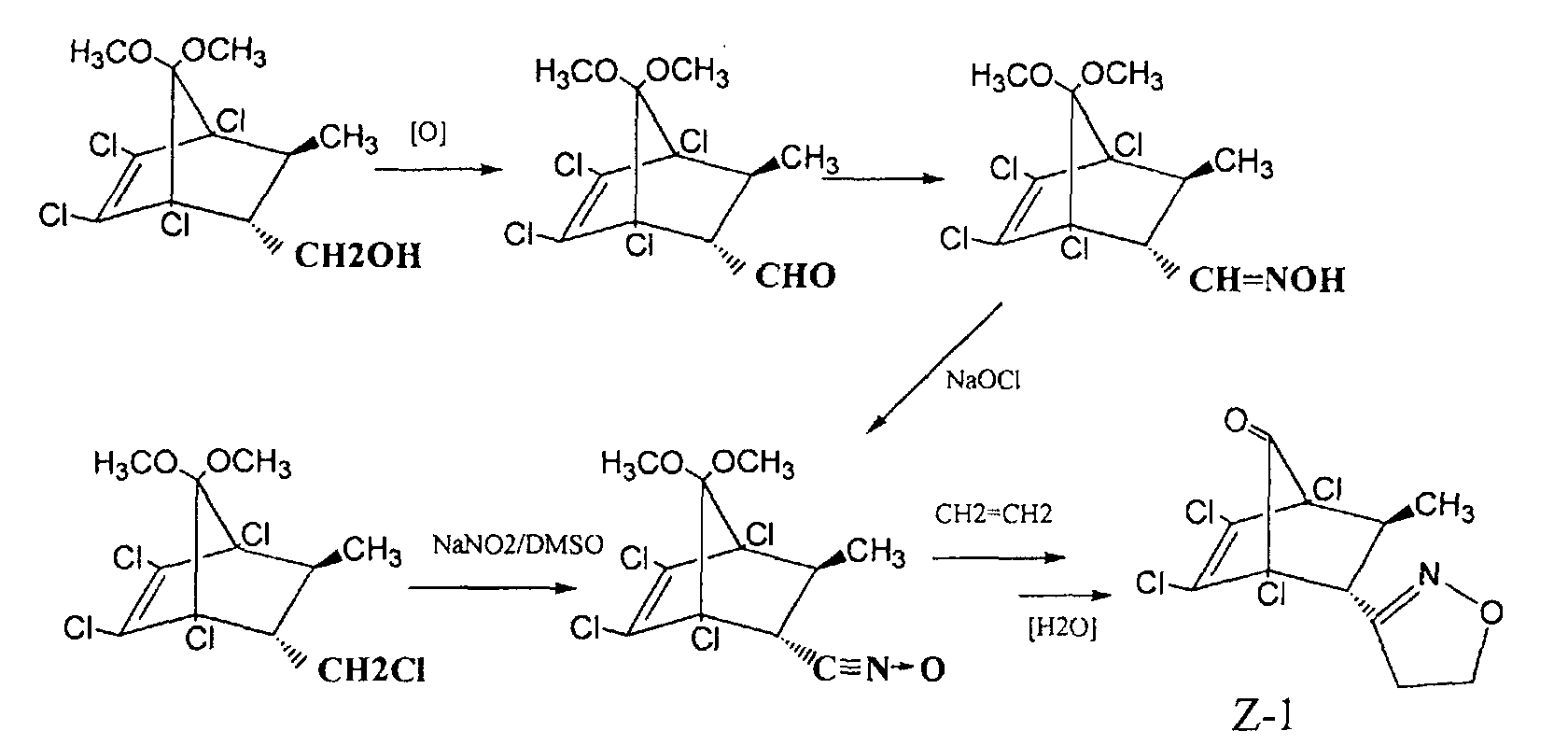
- the compounds of the present invention can be derived to the said compounds of Formula (3) according to the method shown in the following scheme:
- the compound where X is hydroxycarbonyl can be an intermediate for the syntheses of compounds that are difficult to synthesize from carboxylates.
- Diels-Alder reactions can be carried out under milder conditions so as to be more practical than known methods using carboxylates.
Landscapes
- Chemical & Material Sciences (AREA)
- Organic Chemistry (AREA)
- Chemical Kinetics & Catalysis (AREA)
- Engineering & Computer Science (AREA)
- Oil, Petroleum & Natural Gas (AREA)
- Organic Low-Molecular-Weight Compounds And Preparation Thereof (AREA)
Abstract
Description


Claims (6)
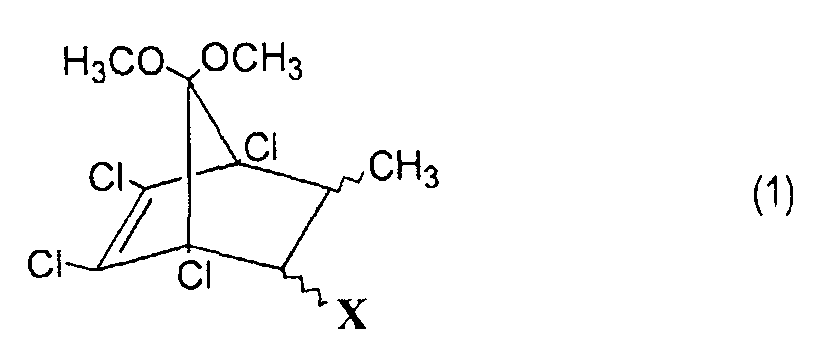
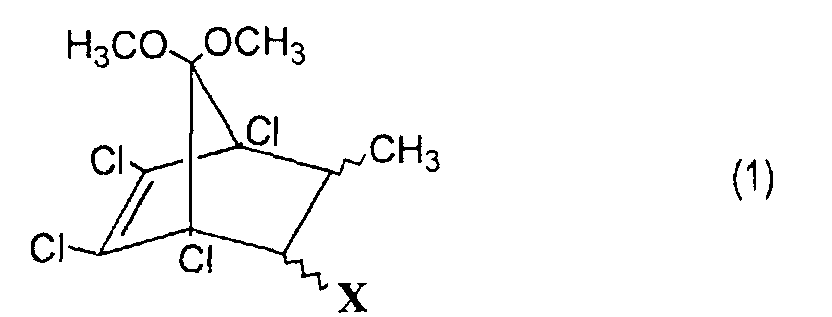
- A compound represented by Formula (1)(wherein, X is hydroxycarbonyl, hydroxymethyl, halogenomethyl, nitromethyl or methylthiomethyl).
- A process for the production of a compound of Formula (1)(wherein, X is hydroxycarbonyl, hydroxymethyl, halogenomethyl, nitromethyl or methylthiomethyl) by a reaction of 5,5-dimethoxy-1,2,3,4-tetrachlorocyclopentadiene with a compound of Formula (2)
- Trans-1,4,5,6-tetrachloro-3-methyl-7,7-dimethoxybicyclo[2.2.1]hept-5-ene-2-carboxylic-acid
- Cis-1,4,5,6-tetrachloro-3-methyl-7,7-dimethoxybicyclo[2.2.1]hept-5-ene-2-carboxylic acid.
- A process for the production of trans-1,4,5,6-tetrachloro-3-methyl-7,7-dimethoxybicyclo[2.2.1]hept-5-ene-2-carboxylic acid by reacting (E)-2-butenic acid with 5,5-dimethoxy-1,2,3,4-tetrachlorocyclopentadiene and isolating the product from the obtained adducts.
- A process for the production of cis-1,4,5,6-tetrachloro-3-methyl-7,7-dimethoxybicyclo[2.2.1]hept-5-ene-2-carboxylic acid by reacting (Z)-2-butenic acid with 5,5-dimethoxy-1,2,3,4-tetrachlorocyclopentadiene and isolating the product from the obtained adducts.
Applications Claiming Priority (5)
| Application Number | Priority Date | Filing Date | Title |
|---|---|---|---|
| JP12095199 | 1999-04-28 | ||
| JP12095199 | 1999-04-28 | ||
| JP17480099 | 1999-06-22 | ||
| JP17480099 | 1999-06-22 | ||
| PCT/JP2000/002762 WO2000066525A1 (en) | 1999-04-28 | 2000-04-27 | Novel bicycloheptene derivatives and process for the preparation thereof |
Publications (2)
| Publication Number | Publication Date |
|---|---|
| EP1174409A1 true EP1174409A1 (en) | 2002-01-23 |
| EP1174409A4 EP1174409A4 (en) | 2003-05-02 |
Family
ID=26458435
Family Applications (1)
| Application Number | Title | Priority Date | Filing Date |
|---|---|---|---|
| EP00921053A Withdrawn EP1174409A4 (en) | 1999-04-28 | 2000-04-27 | Novel bicycloheptene derivatives and process for the preparation thereof |
Country Status (4)
| Country | Link |
|---|---|
| US (1) | US6420612B1 (en) |
| EP (1) | EP1174409A4 (en) |
| AU (1) | AU4143100A (en) |
| WO (1) | WO2000066525A1 (en) |
Family Cites Families (3)
| Publication number | Priority date | Publication date | Assignee | Title |
|---|---|---|---|---|
| US2839553A (en) * | 1955-03-14 | 1958-06-17 | Shell Dev | Polyhalogeno bicyclic acids |
| US3625977A (en) * | 1968-10-04 | 1971-12-07 | Eastman Kodak Co | 2-acetal-7-ketal-5-norbornene and 2-acetal-7-ketalnorbornane compounds |
| ES2318868T3 (en) * | 1997-01-17 | 2009-05-01 | Basf Se | DERIVATIVES OF BENZOIL SUBSTITUTED BY 3-HETEROCICLYL. |
-
2000
- 2000-04-27 WO PCT/JP2000/002762 patent/WO2000066525A1/en not_active Ceased
- 2000-04-27 EP EP00921053A patent/EP1174409A4/en not_active Withdrawn
- 2000-04-27 US US09/936,580 patent/US6420612B1/en not_active Expired - Fee Related
- 2000-04-27 AU AU41431/00A patent/AU4143100A/en not_active Abandoned
Also Published As
| Publication number | Publication date |
|---|---|
| WO2000066525A1 (en) | 2000-11-09 |
| EP1174409A4 (en) | 2003-05-02 |
| AU4143100A (en) | 2000-11-17 |
| US6420612B1 (en) | 2002-07-16 |
Similar Documents
| Publication | Publication Date | Title |
|---|---|---|
| CN100519561C (en) | Process for preparing hexahydro-furo [2, 3-b ] furan-3-ol | |
| Barros et al. | Approaches to the synthesis of (+)-and (−)-epibatidine | |
| Pradipta et al. | Unexplored reactivity of N-alkyl unsaturated imines: a simple procedure for producing optically active 1, 3-diamines via a stereocontrolled formal [4+ 2] and [4+ 2+ 2] iminocycloaddition | |
| DE69709742T2 (en) | ASYMMETRIC SYNTHESIS OF CHIRAL BETA AMINO ACIDS | |
| US4571428A (en) | 6-Substituted-4-hydroxy-tetrahydropyran-2-ones | |
| US6420612B1 (en) | Bicycloheptene derivatives and processes for the preparation of the same | |
| Jeffs et al. | Sceletium alkaloids. Part 12. Synthesis of (.+-.)-mesembranol and (.+-.)-O-methyljoubertiamine. Aza-ring expansion of cis-bicyclo [4.2. 0] octanones | |
| US5254694A (en) | Optically active epoxycyclohexane derivative and epoxycyclohexanone derivative, and process for the preparation thereof | |
| US5679832A (en) | Method for making α,β-unsaturated-β-trifluoromethyl-carboxylates and related compounds | |
| EP0640579B1 (en) | Process for producing optically active 2-norbornanone | |
| US4350641A (en) | 4-Tert.-butoxyphenylglycinonitrile and the preparation of D-(-)- and L-(+)-4-hydroxyphenylglycine | |
| JPS6317077B2 (en) | ||
| Kato et al. | Convergent approach to the maduropeptin chromophore: aryl ether formation of (R)-3-aryl-3-hydroxypropanamide and cyclization of macrolactam | |
| FI66848C (en) | FRUIT PROCEDURES FOR FRAMSTERY AV 1-ALKYLPYRROL-2-ACETIC SYRADES FOR FRUIT PROCESSING | |
| US7786314B2 (en) | Processes for preparing bicyclo [3.1.0] hexane derivatives, and intermediates thereto | |
| DE69104681T2 (en) | Optically active 7-substituted-3,5-difunctionalized 6-heptenoic acid esters. | |
| US20100076199A1 (en) | Process for the preparation of substituted pyridone carboxylic acids | |
| AU2003203479A1 (en) | Process for the preparation of bicyclic diketone salts | |
| US20080108838A1 (en) | Novel chiral heptyne derivatives for the preparation of epothilones and processes for their preparation | |
| Sakagami et al. | CASCADING SINGLE-STEP STEREOSELECTIVE CONSTRUCTION OF THE α-ALLOYOHIMBINE FRAMEWORK: A NEW SYNTHESIS OF (–)-NITRARAINE | |
| KR100543172B1 (en) | Process for preparing terane compound | |
| US5463085A (en) | Synthesis method of physiologically active delta-lactone | |
| JPWO2000066525A1 (en) | Novel bicycloheptene derivatives and their production method | |
| JP4084501B2 (en) | α-Mercaptocarboxylic acid and process for producing the same | |
| Schabbert et al. | A Facile Asymmetric Synthesis of the Compactin Lactone Moiety |
Legal Events
| Date | Code | Title | Description |
|---|---|---|---|
| PUAI | Public reference made under article 153(3) epc to a published international application that has entered the european phase |
Free format text: ORIGINAL CODE: 0009012 |
|
| 17P | Request for examination filed |
Effective date: 20010929 |
|
| AK | Designated contracting states |
Kind code of ref document: A1 Designated state(s): AT BE CH CY DE DK ES FI FR GB GR IE IT LI LU MC NL PT SE |
|
| AX | Request for extension of the european patent |
Free format text: AL;LT;LV;MK;RO;SI |
|
| A4 | Supplementary search report drawn up and despatched |
Effective date: 20030317 |
|
| RBV | Designated contracting states (corrected) |
Designated state(s): CH DE ES FR GB IT LI |
|
| 17Q | First examination report despatched |
Effective date: 20040705 |
|
| STAA | Information on the status of an ep patent application or granted ep patent |
Free format text: STATUS: THE APPLICATION IS DEEMED TO BE WITHDRAWN |
|
| 18D | Application deemed to be withdrawn |
Effective date: 20051221 |