EP1173430B1 - Enantiomers of mercapto lactones and processes for their synthesis - Google Patents
Enantiomers of mercapto lactones and processes for their synthesis Download PDFInfo
- Publication number
- EP1173430B1 EP1173430B1 EP00917002A EP00917002A EP1173430B1 EP 1173430 B1 EP1173430 B1 EP 1173430B1 EP 00917002 A EP00917002 A EP 00917002A EP 00917002 A EP00917002 A EP 00917002A EP 1173430 B1 EP1173430 B1 EP 1173430B1
- Authority
- EP
- European Patent Office
- Prior art keywords
- formula
- compound
- alkyl
- mercapto
- butyrolactone
- Prior art date
- Legal status (The legal status is an assumption and is not a legal conclusion. Google has not performed a legal analysis and makes no representation as to the accuracy of the status listed.)
- Expired - Lifetime
Links
- 238000000034 method Methods 0.000 title claims abstract description 20
- -1 mercapto lactones Chemical class 0.000 title claims description 15
- HBAQYPYDRFILMT-UHFFFAOYSA-N 8-[3-(1-cyclopropylpyrazol-4-yl)-1H-pyrazolo[4,3-d]pyrimidin-5-yl]-3-methyl-3,8-diazabicyclo[3.2.1]octan-2-one Chemical class C1(CC1)N1N=CC(=C1)C1=NNC2=C1N=C(N=C2)N1C2C(N(CC1CC2)C)=O HBAQYPYDRFILMT-UHFFFAOYSA-N 0.000 title abstract description 9
- 238000003786 synthesis reaction Methods 0.000 title description 11
- 230000015572 biosynthetic process Effects 0.000 title description 10
- 238000002360 preparation method Methods 0.000 claims abstract description 11
- 150000001875 compounds Chemical class 0.000 claims description 61
- 238000006243 chemical reaction Methods 0.000 claims description 24
- 239000002904 solvent Substances 0.000 claims description 19
- UIIMBOGNXHQVGW-UHFFFAOYSA-M Sodium bicarbonate Chemical group [Na+].OC([O-])=O UIIMBOGNXHQVGW-UHFFFAOYSA-M 0.000 claims description 14
- VEXZGXHMUGYJMC-UHFFFAOYSA-N Hydrochloric acid Chemical compound Cl VEXZGXHMUGYJMC-UHFFFAOYSA-N 0.000 claims description 13
- 125000004169 (C1-C6) alkyl group Chemical group 0.000 claims description 10
- SUWCVSZZLFOSJL-VKHMYHEASA-N (3s)-3-sulfanyloxolan-2-one Chemical compound S[C@H]1CCOC1=O SUWCVSZZLFOSJL-VKHMYHEASA-N 0.000 claims description 9
- 239000001257 hydrogen Substances 0.000 claims description 9
- 229910052739 hydrogen Inorganic materials 0.000 claims description 9
- LFQSCWFLJHTTHZ-UHFFFAOYSA-N Ethanol Chemical compound CCO LFQSCWFLJHTTHZ-UHFFFAOYSA-N 0.000 claims description 8
- 125000002496 methyl group Chemical group [H]C([H])([H])* 0.000 claims description 8
- 239000007822 coupling agent Substances 0.000 claims description 7
- 229910000030 sodium bicarbonate Inorganic materials 0.000 claims description 7
- XLYOFNOQVPJJNP-UHFFFAOYSA-N water Substances O XLYOFNOQVPJJNP-UHFFFAOYSA-N 0.000 claims description 7
- SUWCVSZZLFOSJL-GSVOUGTGSA-N (3r)-3-sulfanyloxolan-2-one Chemical compound S[C@@H]1CCOC1=O SUWCVSZZLFOSJL-GSVOUGTGSA-N 0.000 claims description 6
- UFHFLCQGNIYNRP-UHFFFAOYSA-N Hydrogen Chemical compound [H][H] UFHFLCQGNIYNRP-UHFFFAOYSA-N 0.000 claims description 6
- 235000017557 sodium bicarbonate Nutrition 0.000 claims description 6
- DNIAPMSPPWPWGF-GSVOUGTGSA-N (R)-(-)-Propylene glycol Chemical compound C[C@@H](O)CO DNIAPMSPPWPWGF-GSVOUGTGSA-N 0.000 claims description 5
- 125000001424 substituent group Chemical group 0.000 claims description 5
- 125000006273 (C1-C3) alkyl group Chemical group 0.000 claims description 4
- 125000006274 (C1-C3)alkoxy group Chemical group 0.000 claims description 4
- 229910052736 halogen Inorganic materials 0.000 claims description 4
- 150000002367 halogens Chemical class 0.000 claims description 4
- 125000002887 hydroxy group Chemical group [H]O* 0.000 claims description 4
- 125000001997 phenyl group Chemical group [H]C1=C([H])C([H])=C(*)C([H])=C1[H] 0.000 claims description 4
- 108090001060 Lipase Proteins 0.000 claims description 3
- 239000004367 Lipase Substances 0.000 claims description 3
- 102000004882 Lipase Human genes 0.000 claims description 3
- 150000002431 hydrogen Chemical class 0.000 claims description 3
- 235000019421 lipase Nutrition 0.000 claims description 3
- 125000000325 methylidene group Chemical group [H]C([H])=* 0.000 claims description 3
- 108090000371 Esterases Proteins 0.000 claims description 2
- 230000002255 enzymatic effect Effects 0.000 claims description 2
- 125000001475 halogen functional group Chemical group 0.000 claims 3
- 239000000543 intermediate Substances 0.000 abstract description 2
- YXFVVABEGXRONW-UHFFFAOYSA-N Toluene Chemical compound CC1=CC=CC=C1 YXFVVABEGXRONW-UHFFFAOYSA-N 0.000 description 48
- XEKOWRVHYACXOJ-UHFFFAOYSA-N Ethyl acetate Chemical compound CCOC(C)=O XEKOWRVHYACXOJ-UHFFFAOYSA-N 0.000 description 31
- YMWUJEATGCHHMB-UHFFFAOYSA-N Dichloromethane Chemical compound ClCCl YMWUJEATGCHHMB-UHFFFAOYSA-N 0.000 description 18
- 239000000203 mixture Substances 0.000 description 17
- OKKJLVBELUTLKV-UHFFFAOYSA-N Methanol Chemical compound OC OKKJLVBELUTLKV-UHFFFAOYSA-N 0.000 description 15
- ZMANZCXQSJIPKH-UHFFFAOYSA-N Triethylamine Chemical compound CCN(CC)CC ZMANZCXQSJIPKH-UHFFFAOYSA-N 0.000 description 15
- 239000000243 solution Substances 0.000 description 14
- HEDRZPFGACZZDS-MICDWDOJSA-N Trichloro(2H)methane Chemical compound [2H]C(Cl)(Cl)Cl HEDRZPFGACZZDS-MICDWDOJSA-N 0.000 description 12
- WYURNTSHIVDZCO-UHFFFAOYSA-N Tetrahydrofuran Chemical compound C1CCOC1 WYURNTSHIVDZCO-UHFFFAOYSA-N 0.000 description 10
- 239000007787 solid Substances 0.000 description 10
- ZMXDDKWLCZADIW-UHFFFAOYSA-N N,N-Dimethylformamide Chemical compound CN(C)C=O ZMXDDKWLCZADIW-UHFFFAOYSA-N 0.000 description 9
- CSCPPACGZOOCGX-UHFFFAOYSA-N Acetone Chemical compound CC(C)=O CSCPPACGZOOCGX-UHFFFAOYSA-N 0.000 description 8
- VLKZOEOYAKHREP-UHFFFAOYSA-N n-Hexane Chemical class CCCCCC VLKZOEOYAKHREP-UHFFFAOYSA-N 0.000 description 8
- BWHMMNNQKKPAPP-UHFFFAOYSA-L potassium carbonate Chemical compound [K+].[K+].[O-]C([O-])=O BWHMMNNQKKPAPP-UHFFFAOYSA-L 0.000 description 8
- 238000005160 1H NMR spectroscopy Methods 0.000 description 7
- 238000001953 recrystallisation Methods 0.000 description 7
- 238000000926 separation method Methods 0.000 description 7
- MHAJPDPJQMAIIY-UHFFFAOYSA-N Hydrogen peroxide Chemical compound OO MHAJPDPJQMAIIY-UHFFFAOYSA-N 0.000 description 6
- CDBYLPFSWZWCQE-UHFFFAOYSA-L Sodium Carbonate Chemical compound [Na+].[Na+].[O-]C([O-])=O CDBYLPFSWZWCQE-UHFFFAOYSA-L 0.000 description 6
- RYHBNJHYFVUHQT-UHFFFAOYSA-N 1,4-Dioxane Chemical compound C1COCCO1 RYHBNJHYFVUHQT-UHFFFAOYSA-N 0.000 description 5
- 150000003839 salts Chemical class 0.000 description 5
- YLQBMQCUIZJEEH-UHFFFAOYSA-N tetrahydrofuran Natural products C=1C=COC=1 YLQBMQCUIZJEEH-UHFFFAOYSA-N 0.000 description 5
- OISVCGZHLKNMSJ-UHFFFAOYSA-N 2,6-dimethylpyridine Chemical compound CC1=CC=CC(C)=N1 OISVCGZHLKNMSJ-UHFFFAOYSA-N 0.000 description 4
- LRHPLDYGYMQRHN-UHFFFAOYSA-N N-Butanol Chemical compound CCCCO LRHPLDYGYMQRHN-UHFFFAOYSA-N 0.000 description 4
- JUJWROOIHBZHMG-UHFFFAOYSA-N Pyridine Chemical compound C1=CC=NC=C1 JUJWROOIHBZHMG-UHFFFAOYSA-N 0.000 description 4
- 239000012043 crude product Substances 0.000 description 4
- 150000002148 esters Chemical class 0.000 description 4
- JMMWKPVZQRWMSS-UHFFFAOYSA-N isopropanol acetate Natural products CC(C)OC(C)=O JMMWKPVZQRWMSS-UHFFFAOYSA-N 0.000 description 4
- 229940011051 isopropyl acetate Drugs 0.000 description 4
- GWYFCOCPABKNJV-UHFFFAOYSA-N isovaleric acid Chemical compound CC(C)CC(O)=O GWYFCOCPABKNJV-UHFFFAOYSA-N 0.000 description 4
- 150000002596 lactones Chemical class 0.000 description 4
- 229910000027 potassium carbonate Inorganic materials 0.000 description 4
- IRCODYMBLSDQPL-YFKPBYRVSA-N s-[(3s)-2-oxooxolan-3-yl] ethanethioate Chemical compound CC(=O)S[C@H]1CCOC1=O IRCODYMBLSDQPL-YFKPBYRVSA-N 0.000 description 4
- HPALAKNZSZLMCH-UHFFFAOYSA-M sodium;chloride;hydrate Chemical compound O.[Na+].[Cl-] HPALAKNZSZLMCH-UHFFFAOYSA-M 0.000 description 4
- WEVYAHXRMPXWCK-UHFFFAOYSA-N Acetonitrile Chemical compound CC#N WEVYAHXRMPXWCK-UHFFFAOYSA-N 0.000 description 3
- 0 C[C@@](CC1)[C@](C)(C(C(C[C@]2*)C(C[C@]3*)[C@](C)(C4)[C@@]3(*)C(CO)=O)[C@]4O)C2=CC1=O Chemical compound C[C@@](CC1)[C@](C)(C(C(C[C@]2*)C(C[C@]3*)[C@](C)(C4)[C@@]3(*)C(CO)=O)[C@]4O)C2=CC1=O 0.000 description 3
- 229940126062 Compound A Drugs 0.000 description 3
- RWSOTUBLDIXVET-UHFFFAOYSA-N Dihydrogen sulfide Chemical compound S RWSOTUBLDIXVET-UHFFFAOYSA-N 0.000 description 3
- XTHFKEDIFFGKHM-UHFFFAOYSA-N Dimethoxyethane Chemical compound COCCOC XTHFKEDIFFGKHM-UHFFFAOYSA-N 0.000 description 3
- IAZDPXIOMUYVGZ-UHFFFAOYSA-N Dimethylsulphoxide Chemical compound CS(C)=O IAZDPXIOMUYVGZ-UHFFFAOYSA-N 0.000 description 3
- NLDMNSXOCDLTTB-UHFFFAOYSA-N Heterophylliin A Natural products O1C2COC(=O)C3=CC(O)=C(O)C(O)=C3C3=C(O)C(O)=C(O)C=C3C(=O)OC2C(OC(=O)C=2C=C(O)C(O)=C(O)C=2)C(O)C1OC(=O)C1=CC(O)=C(O)C(O)=C1 NLDMNSXOCDLTTB-UHFFFAOYSA-N 0.000 description 3
- 239000012359 Methanesulfonyl chloride Substances 0.000 description 3
- NTIZESTWPVYFNL-UHFFFAOYSA-N Methyl isobutyl ketone Chemical compound CC(C)CC(C)=O NTIZESTWPVYFNL-UHFFFAOYSA-N 0.000 description 3
- UIHCLUNTQKBZGK-UHFFFAOYSA-N Methyl isobutyl ketone Natural products CCC(C)C(C)=O UIHCLUNTQKBZGK-UHFFFAOYSA-N 0.000 description 3
- HAYCJJXWGKFZTP-SCSAIBSYSA-N [(3r)-2-oxooxolan-3-yl] methanesulfonate Chemical compound CS(=O)(=O)O[C@@H]1CCOC1=O HAYCJJXWGKFZTP-SCSAIBSYSA-N 0.000 description 3
- 239000002253 acid Substances 0.000 description 3
- 150000001408 amides Chemical class 0.000 description 3
- 239000003849 aromatic solvent Substances 0.000 description 3
- 239000012267 brine Substances 0.000 description 3
- 239000003153 chemical reaction reagent Substances 0.000 description 3
- 239000007789 gas Substances 0.000 description 3
- 239000010410 layer Substances 0.000 description 3
- QARBMVPHQWIHKH-UHFFFAOYSA-N methanesulfonyl chloride Chemical compound CS(Cl)(=O)=O QARBMVPHQWIHKH-UHFFFAOYSA-N 0.000 description 3
- 239000012044 organic layer Substances 0.000 description 3
- 239000000047 product Substances 0.000 description 3
- 229910000029 sodium carbonate Inorganic materials 0.000 description 3
- 239000007858 starting material Substances 0.000 description 3
- 125000003944 tolyl group Chemical group 0.000 description 3
- 239000002699 waste material Substances 0.000 description 3
- KBPLFHHGFOOTCA-UHFFFAOYSA-N 1-Octanol Chemical compound CCCCCCCCO KBPLFHHGFOOTCA-UHFFFAOYSA-N 0.000 description 2
- 238000001644 13C nuclear magnetic resonance spectroscopy Methods 0.000 description 2
- JYWKEVKEKOTYEX-UHFFFAOYSA-N 2,6-dibromo-4-chloroiminocyclohexa-2,5-dien-1-one Chemical group ClN=C1C=C(Br)C(=O)C(Br)=C1 JYWKEVKEKOTYEX-UHFFFAOYSA-N 0.000 description 2
- IJGRMHOSHXDMSA-UHFFFAOYSA-N Atomic nitrogen Chemical compound N#N IJGRMHOSHXDMSA-UHFFFAOYSA-N 0.000 description 2
- ZTQSAGDEMFDKMZ-UHFFFAOYSA-N Butyraldehyde Chemical compound CCCC=O ZTQSAGDEMFDKMZ-UHFFFAOYSA-N 0.000 description 2
- IAZDPXIOMUYVGZ-WFGJKAKNSA-N Dimethyl sulfoxide Chemical compound [2H]C([2H])([2H])S(=O)C([2H])([2H])[2H] IAZDPXIOMUYVGZ-WFGJKAKNSA-N 0.000 description 2
- JGFZNNIVVJXRND-UHFFFAOYSA-N N,N-Diisopropylethylamine (DIPEA) Chemical compound CCN(C(C)C)C(C)C JGFZNNIVVJXRND-UHFFFAOYSA-N 0.000 description 2
- IMNFDUFMRHMDMM-UHFFFAOYSA-N N-Heptane Chemical compound CCCCCCC IMNFDUFMRHMDMM-UHFFFAOYSA-N 0.000 description 2
- SECXISVLQFMRJM-UHFFFAOYSA-N N-Methylpyrrolidone Chemical compound CN1CCCC1=O SECXISVLQFMRJM-UHFFFAOYSA-N 0.000 description 2
- PMZURENOXWZQFD-UHFFFAOYSA-L Sodium Sulfate Chemical compound [Na+].[Na+].[O-]S([O-])(=O)=O PMZURENOXWZQFD-UHFFFAOYSA-L 0.000 description 2
- DTQVDTLACAAQTR-UHFFFAOYSA-N Trifluoroacetic acid Chemical compound OC(=O)C(F)(F)F DTQVDTLACAAQTR-UHFFFAOYSA-N 0.000 description 2
- 239000008346 aqueous phase Substances 0.000 description 2
- 125000001246 bromo group Chemical group Br* 0.000 description 2
- 150000008280 chlorinated hydrocarbons Chemical class 0.000 description 2
- 125000001309 chloro group Chemical group Cl* 0.000 description 2
- 230000008878 coupling Effects 0.000 description 2
- 238000010168 coupling process Methods 0.000 description 2
- 238000005859 coupling reaction Methods 0.000 description 2
- HPYNZHMRTTWQTB-UHFFFAOYSA-N dimethylpyridine Natural products CC1=CC=CN=C1C HPYNZHMRTTWQTB-UHFFFAOYSA-N 0.000 description 2
- 239000003759 ester based solvent Substances 0.000 description 2
- IDGUHHHQCWSQLU-UHFFFAOYSA-N ethanol;hydrate Chemical compound O.CCO IDGUHHHQCWSQLU-UHFFFAOYSA-N 0.000 description 2
- 239000004210 ether based solvent Substances 0.000 description 2
- ZSIAUFGUXNUGDI-UHFFFAOYSA-N hexan-1-ol Chemical compound CCCCCCO ZSIAUFGUXNUGDI-UHFFFAOYSA-N 0.000 description 2
- 238000004128 high performance liquid chromatography Methods 0.000 description 2
- 150000007529 inorganic bases Chemical class 0.000 description 2
- VLTRZXGMWDSKGL-UHFFFAOYSA-N perchloric acid Chemical compound OCl(=O)(=O)=O VLTRZXGMWDSKGL-UHFFFAOYSA-N 0.000 description 2
- UMJSCPRVCHMLSP-UHFFFAOYSA-N pyridine Natural products COC1=CC=CN=C1 UMJSCPRVCHMLSP-UHFFFAOYSA-N 0.000 description 2
- 239000011541 reaction mixture Substances 0.000 description 2
- 239000002002 slurry Substances 0.000 description 2
- 229910052938 sodium sulfate Inorganic materials 0.000 description 2
- 235000011152 sodium sulphate Nutrition 0.000 description 2
- 231100000331 toxic Toxicity 0.000 description 2
- 230000002588 toxic effect Effects 0.000 description 2
- 125000005270 trialkylamine group Chemical group 0.000 description 2
- 238000005292 vacuum distillation Methods 0.000 description 2
- FWIBCWKHNZBDLS-GSVOUGTGSA-N (3r)-3-hydroxyoxolan-2-one Chemical compound O[C@@H]1CCOC1=O FWIBCWKHNZBDLS-GSVOUGTGSA-N 0.000 description 1
- ZWEHNKRNPOVVGH-UHFFFAOYSA-N 2-Butanone Chemical compound CCC(C)=O ZWEHNKRNPOVVGH-UHFFFAOYSA-N 0.000 description 1
- SUWCVSZZLFOSJL-UHFFFAOYSA-N 3-sulfanyloxolan-2-one Chemical compound SC1CCOC1=O SUWCVSZZLFOSJL-UHFFFAOYSA-N 0.000 description 1
- QSNSCYSYFYORTR-UHFFFAOYSA-N 4-chloroaniline Chemical compound NC1=CC=C(Cl)C=C1 QSNSCYSYFYORTR-UHFFFAOYSA-N 0.000 description 1
- QWOJMRHUQHTCJG-UHFFFAOYSA-N CC([CH2-])=O Chemical compound CC([CH2-])=O QWOJMRHUQHTCJG-UHFFFAOYSA-N 0.000 description 1
- 239000004215 Carbon black (E152) Substances 0.000 description 1
- NHTMVDHEPJAVLT-UHFFFAOYSA-N Isooctane Chemical compound CC(C)CC(C)(C)C NHTMVDHEPJAVLT-UHFFFAOYSA-N 0.000 description 1
- AFVFQIVMOAPDHO-UHFFFAOYSA-N Methanesulfonic acid Chemical compound CS(O)(=O)=O AFVFQIVMOAPDHO-UHFFFAOYSA-N 0.000 description 1
- 241000235395 Mucor Species 0.000 description 1
- SUWCVSZZLFOSJL-GSVOUGTGSA-O O=C1OCC[C@H]1[SH2+] Chemical compound O=C1OCC[C@H]1[SH2+] SUWCVSZZLFOSJL-GSVOUGTGSA-O 0.000 description 1
- ZLMJMSJWJFRBEC-UHFFFAOYSA-N Potassium Chemical compound [K] ZLMJMSJWJFRBEC-UHFFFAOYSA-N 0.000 description 1
- VMHLLURERBWHNL-UHFFFAOYSA-M Sodium acetate Chemical compound [Na+].CC([O-])=O VMHLLURERBWHNL-UHFFFAOYSA-M 0.000 description 1
- 241000282485 Vulpes vulpes Species 0.000 description 1
- DHKHKXVYLBGOIT-UHFFFAOYSA-N acetaldehyde Diethyl Acetal Natural products CCOC(C)OCC DHKHKXVYLBGOIT-UHFFFAOYSA-N 0.000 description 1
- 150000001241 acetals Chemical class 0.000 description 1
- 230000002378 acidificating effect Effects 0.000 description 1
- 125000002252 acyl group Chemical group 0.000 description 1
- 150000008064 anhydrides Chemical class 0.000 description 1
- 230000003266 anti-allergic effect Effects 0.000 description 1
- 230000003110 anti-inflammatory effect Effects 0.000 description 1
- 150000004982 aromatic amines Chemical class 0.000 description 1
- 125000003118 aryl group Chemical group 0.000 description 1
- 208000006673 asthma Diseases 0.000 description 1
- 229910052792 caesium Inorganic materials 0.000 description 1
- TVFDJXOCXUVLDH-UHFFFAOYSA-N caesium atom Chemical compound [Cs] TVFDJXOCXUVLDH-UHFFFAOYSA-N 0.000 description 1
- 150000001732 carboxylic acid derivatives Chemical class 0.000 description 1
- 239000007795 chemical reaction product Substances 0.000 description 1
- UIOSOCGVAAMZQW-VSXGLTOVSA-N dihydrofluocinolone acetonide Chemical compound C1([C@@H](F)C2)=CC(=O)CC[C@]1(C)[C@]1(F)[C@@H]2[C@@H]2C[C@H]3OC(C)(C)O[C@@]3(C(=O)CO)[C@@]2(C)C[C@@H]1O UIOSOCGVAAMZQW-VSXGLTOVSA-N 0.000 description 1
- JVSWJIKNEAIKJW-UHFFFAOYSA-N dimethyl-hexane Natural products CCCCCC(C)C JVSWJIKNEAIKJW-UHFFFAOYSA-N 0.000 description 1
- 238000004821 distillation Methods 0.000 description 1
- 238000005265 energy consumption Methods 0.000 description 1
- 150000002170 ethers Chemical class 0.000 description 1
- 239000002024 ethyl acetate extract Substances 0.000 description 1
- 239000000706 filtrate Substances 0.000 description 1
- 125000005843 halogen group Chemical group 0.000 description 1
- 238000010438 heat treatment Methods 0.000 description 1
- 229930195733 hydrocarbon Natural products 0.000 description 1
- 150000002430 hydrocarbons Chemical class 0.000 description 1
- 238000011065 in-situ storage Methods 0.000 description 1
- 208000027866 inflammatory disease Diseases 0.000 description 1
- 239000005453 ketone based solvent Substances 0.000 description 1
- 150000002576 ketones Chemical class 0.000 description 1
- 239000007788 liquid Substances 0.000 description 1
- 239000000463 material Substances 0.000 description 1
- 150000007522 mineralic acids Chemical class 0.000 description 1
- 150000002825 nitriles Chemical class 0.000 description 1
- 229910052757 nitrogen Inorganic materials 0.000 description 1
- 239000012074 organic phase Substances 0.000 description 1
- XSXHWVKGUXMUQE-UHFFFAOYSA-N osmium dioxide Inorganic materials O=[Os]=O XSXHWVKGUXMUQE-UHFFFAOYSA-N 0.000 description 1
- 239000012071 phase Substances 0.000 description 1
- WVDDGKGOMKODPV-ZQBYOMGUSA-N phenyl(114C)methanol Chemical compound O[14CH2]C1=CC=CC=C1 WVDDGKGOMKODPV-ZQBYOMGUSA-N 0.000 description 1
- 229910052700 potassium Inorganic materials 0.000 description 1
- 239000011591 potassium Substances 0.000 description 1
- 239000002244 precipitate Substances 0.000 description 1
- ZMRUPTIKESYGQW-UHFFFAOYSA-N propranolol hydrochloride Chemical compound [H+].[Cl-].C1=CC=C2C(OCC(O)CNC(C)C)=CC=CC2=C1 ZMRUPTIKESYGQW-UHFFFAOYSA-N 0.000 description 1
- 238000002390 rotary evaporation Methods 0.000 description 1
- IRCODYMBLSDQPL-RXMQYKEDSA-N s-[(3r)-2-oxooxolan-3-yl] ethanethioate Chemical compound CC(=O)S[C@@H]1CCOC1=O IRCODYMBLSDQPL-RXMQYKEDSA-N 0.000 description 1
- 229920006395 saturated elastomer Polymers 0.000 description 1
- 239000001632 sodium acetate Substances 0.000 description 1
- 235000017281 sodium acetate Nutrition 0.000 description 1
- 238000001228 spectrum Methods 0.000 description 1
- 238000010561 standard procedure Methods 0.000 description 1
- 239000012258 stirred mixture Substances 0.000 description 1
- 238000003860 storage Methods 0.000 description 1
- 239000000126 substance Substances 0.000 description 1
- YBBRCQOCSYXUOC-UHFFFAOYSA-N sulfuryl dichloride Chemical compound ClS(Cl)(=O)=O YBBRCQOCSYXUOC-UHFFFAOYSA-N 0.000 description 1
- CZDYPVPMEAXLPK-UHFFFAOYSA-N tetramethylsilane Chemical compound C[Si](C)(C)C CZDYPVPMEAXLPK-UHFFFAOYSA-N 0.000 description 1
- 150000003566 thiocarboxylic acids Chemical class 0.000 description 1
- JOXIMZWYDAKGHI-UHFFFAOYSA-N toluene-4-sulfonic acid Chemical compound CC1=CC=C(S(O)(=O)=O)C=C1 JOXIMZWYDAKGHI-UHFFFAOYSA-N 0.000 description 1
- 230000009466 transformation Effects 0.000 description 1
- ITMCEJHCFYSIIV-UHFFFAOYSA-M triflate Chemical compound [O-]S(=O)(=O)C(F)(F)F ITMCEJHCFYSIIV-UHFFFAOYSA-M 0.000 description 1
- GRGCWBWNLSTIEN-UHFFFAOYSA-N trifluoromethanesulfonyl chloride Chemical compound FC(F)(F)S(Cl)(=O)=O GRGCWBWNLSTIEN-UHFFFAOYSA-N 0.000 description 1
- HGBOYTHUEUWSSQ-UHFFFAOYSA-N valeric aldehyde Natural products CCCCC=O HGBOYTHUEUWSSQ-UHFFFAOYSA-N 0.000 description 1
- 231100000925 very toxic Toxicity 0.000 description 1
Classifications
-
- C—CHEMISTRY; METALLURGY
- C07—ORGANIC CHEMISTRY
- C07D—HETEROCYCLIC COMPOUNDS
- C07D307/00—Heterocyclic compounds containing five-membered rings having one oxygen atom as the only ring hetero atom
- C07D307/02—Heterocyclic compounds containing five-membered rings having one oxygen atom as the only ring hetero atom not condensed with other rings
- C07D307/26—Heterocyclic compounds containing five-membered rings having one oxygen atom as the only ring hetero atom not condensed with other rings having one double bond between ring members or between a ring member and a non-ring member
- C07D307/30—Heterocyclic compounds containing five-membered rings having one oxygen atom as the only ring hetero atom not condensed with other rings having one double bond between ring members or between a ring member and a non-ring member with hetero atoms or with carbon atoms having three bonds to hetero atoms with at the most one bond to halogen, e.g. ester or nitrile radicals, directly attached to ring carbon atoms
- C07D307/32—Oxygen atoms
- C07D307/33—Oxygen atoms in position 2, the oxygen atom being in its keto or unsubstituted enol form
-
- C—CHEMISTRY; METALLURGY
- C07—ORGANIC CHEMISTRY
- C07J—STEROIDS
- C07J31/00—Normal steroids containing one or more sulfur atoms not belonging to a hetero ring
- C07J31/006—Normal steroids containing one or more sulfur atoms not belonging to a hetero ring not covered by C07J31/003
-
- C—CHEMISTRY; METALLURGY
- C07—ORGANIC CHEMISTRY
- C07J—STEROIDS
- C07J71/00—Steroids in which the cyclopenta(a)hydrophenanthrene skeleton is condensed with a heterocyclic ring
- C07J71/0005—Oxygen-containing hetero ring
- C07J71/0026—Oxygen-containing hetero ring cyclic ketals
- C07J71/0031—Oxygen-containing hetero ring cyclic ketals at positions 16, 17
Definitions
- the present invention relates to a new process for the synthesis of enantiomers of mercapto lactones, and their acyl derivatives which are useful intermediates in the preparation of compounds of formula (I).
- Compound A is 16 ⁇ , 17 ⁇ -(R-butylidenedioxy)-6 ⁇ ,9 ⁇ -difluoro-11 ⁇ -hydroxy-3-oxo-androst-4-ene-17 ⁇ -carbothioic acid S -(2-oxo-tetrahydro-furan-3S-yl) ester.
- X represents a suitable leaving group, (for example chloro, bromo, or OSO 2 A wherein A is CH 3 , CF 3 , or p-CH 3 C 6 H 4 ) to yield a single diastereoisomer of formula (I).
- X represents a suitable leaving group, (for example chloro, bromo, or OSO 2 A wherein A is CH 3 , CF 3 , or p-CH 3 C 6 H 4 ) to yield a single diastereoisomer of formula (I).
- This process requires the use of hydrogen sulphide gas, which is very toxic and difficult to handle.
- the compound of formula (IV) is not stable on storage and must be kept cold. Also, the route is long since it requires an additional synthetic transformation.
- An ideal route for the synthesis of a compound of formula (I) should produce the compound in high yields at a reasonable speed and at low cost with minimum waste materials and in a manner that is of minimum impact to the environment in terms of energy consumption and disposal of waste-materials.
- the single enantiomer of formula (IIIa), substantially free of the corresponding enantiomer, may be prepared by the following reaction sequence, which is presented as a feature of the present invention:
- A represents CH 3 , CF 3 , or p-CH 3 C 6 H 4 , more preferably CH 3 .
- R represents C 1-6 alkyl or phenyl optionally substituted by one or more substituents selected from halo, C 1-3 alkyl, hydroxy, and C 1-3 alkoxy, more preferably R is CH 3 .
- Step A is carried out by treating a compound of formula (VIIa) with a sulfonyl chloride or sulfonic anhydride, preferably methanesulfonyl chloride or trifluoromethanesulfonyl chloride (most preferably methanesulfonyl chloride) preferably in the presence of a base, for example a trialkylamine base such as triethylamine or diisopropylethylamine, or an aromatic base such as pyridine, lutidine or 4-N,N-dimethylaminopyridine (most preferably the base will be triethylamine or 4-N,N-dimethylaminopyridine, especially triethylamine and 4-N,N-dimethylaminopyridine), and preferably in a suitable solvent, for example aromatic solvents such as toluene, ester solvents such as ethyl acetate, ether solvents such as tetrahydrofuran (TH
- the solvent is selected from the group consisting of dichloromethane, ethyl acetate and methyl isobutyl ketone; most preferably the solvent is ethyl acetate.
- the reaction is carried out at a temperature in the range of -40°C to ambient temperature, most preferably from 10°C to 20°C. Step A will then be completed by recrystallisation of the compound of formula (VIIIa) according to appropriate conditions, preferably using ethyl acetate for recrystallisation.
- Step B is carried out by treating a compound of formula (Villa) with a thiocarboxylate salt (especially a thioacetate salt).
- a thiocarboxylate salt especially a thioacetate salt.
- Suitable thiocarboxylate salts include inorganic salts (such as potassium or cesium), trialkylamine salts (such as triethylamine), or aromatic amine salts (such as pyridine and lutidine).
- the thiocarboxylate salts are either commercially available, prepared by standard methods, or generated in situ from thiocarboxylic acid; the preferred thiocarboxylate salt is potassium thioacetate.
- the reaction is carried out in a suitable solvent, for example aromatic solvents such as toluene, esters such as ethyl acetate, amides such as dimethylformamide, ethers such as THF, dioxane, and dimethoxyethane, or chlorinated hydrocarbons such as dichloromethane.
- a suitable solvent for example aromatic solvents such as toluene, esters such as ethyl acetate, amides such as dimethylformamide, ethers such as THF, dioxane, and dimethoxyethane, or chlorinated hydrocarbons such as dichloromethane.
- the solvent is selected from the group consisting of toluene, dimethoxyethane and THF; more preferably, the solvent is toluene.
- the reaction is carried out at a temperature in the range of -20°C to ambient temperature, most preferably room temperature (20°C).
- Step C is carried out by reacting a compound of formula (IXa) with an aliphatic alcohol, for example methanol or ethanol, preferably methanol, in the presence of an inorganic acid, for example hydrochloric acid, or alternatively with an aromatic amine, for example 4-chloroaniline; preferably the aliphatic alcohol will be present with hydrochloric acid.
- an aliphatic alcohol for example methanol or ethanol, preferably methanol
- an inorganic acid for example hydrochloric acid
- an aromatic amine for example 4-chloroaniline
- the reaction is carried out in the presence of a suitable solvent, for example aromatic solvents such as toluene, ether solvents such as dioxane or THF, or chlorinated solvents such as dichloromethane.
- the solvent is toluene or dioxane; more preferably, the solvent is toluene.
- Step C will then be completed by vacuum distillation of the compound of formula (IIIIa
- the single enantiomer of formula (IIIb), substantially free of the corresponding enantiomer, may be prepared by an analogous process in which reagents and conditions are as in steps A, B and C above, and which is presented as a further feature of the present invention, using as starting material the (S) enantiomer (VIIb) as follows
- Enantiomeric compounds (IIIa), (IIIb), (IXa) and (IXb), substantially free of the corresponding enantiomer, are novel and are presented as further features of the present invention.
- substantially free' is meant no more than about 10% w/w of the corresponding enantiomer, particularly no more than about 5% w/w, and more particularly less than about 3% w/w is present.
- the single enantiomers (IXa) and (IIIb) may be prepared by an enzymatic transacetylation reaction of racemic compound (IX), which is presented as a further feature of the present invention.
- Compound (IXa) prepared in this manner may then be separated from compound (IIIb) by distillation and converted to compound (IIIa) as illustrated in the reaction scheme above.
- This transacetylation reaction is preferably carried out in the presence of an alcohol, such as butanol, benzyl alcohol, hexanol or octanol, most preferably butanol, and a suitable lipase or esterase enzyme, preferably mucor meihei lipase, in toluene and/or isooctane, most preferably toluene, containing a small amount of water.
- an alcohol such as butanol, benzyl alcohol, hexanol or octanol, most preferably butanol
- a suitable lipase or esterase enzyme preferably mucor meihei lipase
- toluene and/or isooctane most preferably toluene, containing a small amount of water.
- the reaction will be carried out at a temperature in the range of -20°C to room temperature, most preferably 5°C.
- Racemic compound (IX) may be prepared by the method described in Fuchs, Swed. Ark. Kemi (1966), 26 (10), 111-116.
- Compounds of formula (II) may be prepared by methods known in the art, for example by the methodology described in Kertesz and Marx, Journal of Organic Chemistry, 1986, 51, 2315-2328, the contents of which are incorporated herein by reference hereto.
- the reaction is carried out in a solvent, for example amide solvents such as N,N-dimethylformamide and N-methyl-2-pyrrolidinone; ester solvents such as ethyl acetate and isopropyl acetate; ketone solvents such as acetone, 2-butanone and 4-methyl-2-pentanone; hydrocarbon solvents such as toluene; halogenated solvents such as dichloromethane; and nitrile solvents such as acetonitrile.
- the solvent is acetone.
- the reaction is carried out in the presence of a base.
- a base is a weak inorganic base such as sodium acetate or sodium bicarbonate. Potassium carbonate is an alternative base, but sodium bicarbonate is especially preferred.
- the reaction is carried out in the presence of a coupling agent.
- the coupling agent is O -benzotriazole-1-yl- N,N,N',N '-tetramethyluronium hexafluorophosphate (or its corresponding tetrafluoroborate salt).
- the coupling agent is added to the compound of formula (II) at a temperature in the range 0 to 100 °C.
- the coupling step with the compound of formula (III) is carried out at a temperature in the range -10 °C to ambient temperature, most preferably 4°C. This reaction will then be completed by recrystallisation of the compound of formula (I) according to appropriate conditions, preferably using isopropyl acetate and heptane for recrystallisation.
- Step A is carried out in the presence of hydrogen peroxide and a base.
- the base is a weak inorganic base such as potassium carbonate, preferably the reaction will be carried out in the presence of an aliphatic alcohol, most preferably methanol, preferably at room temperature.
- Step A will then be completed by recrystallisation of the compound of formula (II) according to appropriate conditions, preferably using ethyl acetate for recrystallisation.
- Triethylamine (45ml, 323mmol) and 4-N,N-dimethylaminopyridine (3.6g, 29mmol) in anhydrous AcOEt (75ml) were added to a stirred solution of (R)-(+)- ⁇ -hydroxy- ⁇ -butyrolactone (30g, 294mmol) in anhydrous AcOEt (300ml), under N 2 , at -40°.
- the solution was stirred for 10min.
- Methanesulfonyl chloride (25ml, 323mmol) was added slowly to the reaction, maintaining the temperature below -35°.
- the mixture was stirred for 2h at -40°. Upon completion the mixture was allowed to warm up to ambient temperature.
- the mixture was diluted with AcOEt (450ml) and filtered. The solid was washed with AcOEt (3x60ml). The filtrate was washed with a solution of 50% H 2 O and 50% brine (60ml). The organic layer was washed with 1 N HCI (45ml), a solution of 50% H 2 O and 50% saturated brine (45ml), a saturated aqueous NaHCO 3 solution (45ml), and a solution of 50% H 2 O and 50% brine (2x45ml). The solvent (780ml) was removed under reduced pressure and hexanes (500 ml) was added to the mixture. The mixture was stirred at 5° for 2h.
- the aqueous layer was then adjusted to pH 2 by addition of concentrated HCI, which resulted in a precipitate.
- the acidic aqueous layer was washed with ethyl acetate (2x25 ml) and the combined ethyl acetate extracts evaporated to dryness.
- the resulting off white solid was triturated in 1:1 hexanes-ethyl acetate (30ml) and filtered and dried at 50°C for 24 hours to provide the title compound as a off-white solid. (3.93g, 81%).
- the compound of Example 2 is capable of preparation according to the invention at an overall yield of 30% in 4 linear steps from the starting material (fluocinoline acetonide), resulting in a product with ⁇ 2% of the undesired lactone isomer. This is clearly advantageous when compared with previously known syntheses, the best of which obtain the compound in 5 linear steps from identical starting material, obtaining an overall yield of 8% and resulting in a much less pure end product (approximately 5% of the undesired lactone isomer).
Landscapes
- Chemical & Material Sciences (AREA)
- Organic Chemistry (AREA)
- Health & Medical Sciences (AREA)
- General Health & Medical Sciences (AREA)
- Organic Low-Molecular-Weight Compounds And Preparation Thereof (AREA)
- Pharmaceuticals Containing Other Organic And Inorganic Compounds (AREA)
- Low-Molecular Organic Synthesis Reactions Using Catalysts (AREA)
- Steroid Compounds (AREA)
Abstract
Description
- The present invention relates to a new process for the synthesis of enantiomers of mercapto lactones, and their acyl derivatives which are useful intermediates in the preparation of compounds of formula (I).
- Compounds of formula (I) have the following structure
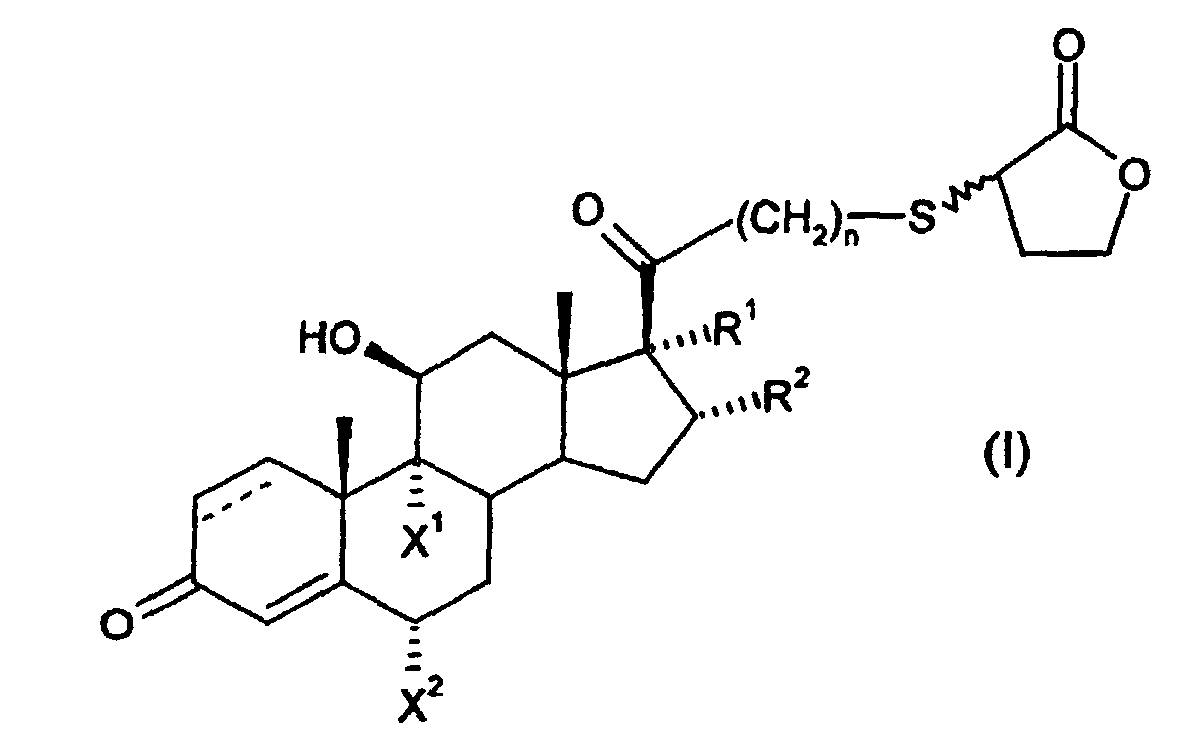
- in which R1 individually represents OC(=O)C1-6alkyl; R2 individually represents hydrogen, methyl (which may be in either the α or β configuration) or methylene; or R1 and R2 together representwherein R3 and R4 are the same or different and each represents hydrogen or C1-6 alkyl; X1 and X2 are the same or different and each represents hydrogen or halogen;
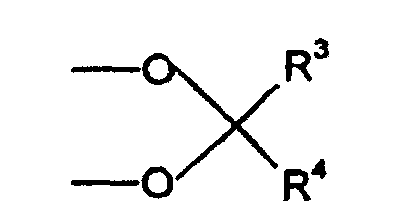
---- represents a single or double bond; and n=0 or 1. These compounds were first described in PCT patent publications WO97/24365 and WO97/24367. Currently there is considerable interest in compounds of formula (I), for example compound A, as antiinflammatory and anti-allergic compounds in the treatment of asthma and other inflammatory diseases.
- Compound A is 16α, 17α-(R-butylidenedioxy)-6α,9α-difluoro-11β-hydroxy-3-oxo-androst-4-ene-17β-carbothioic acid S-(2-oxo-tetrahydro-furan-3S-yl) ester.
- The route of synthesis of the compound A described in the specification of WO97/24365 is specifically described therein in example 19.
- One route to compounds of general formula (I), in which n = 0, described in WO97/24365 involves coupling a carboxylic acid of formula (II)with racemic α-mercapto-γ-butyrolactone (formula (III))
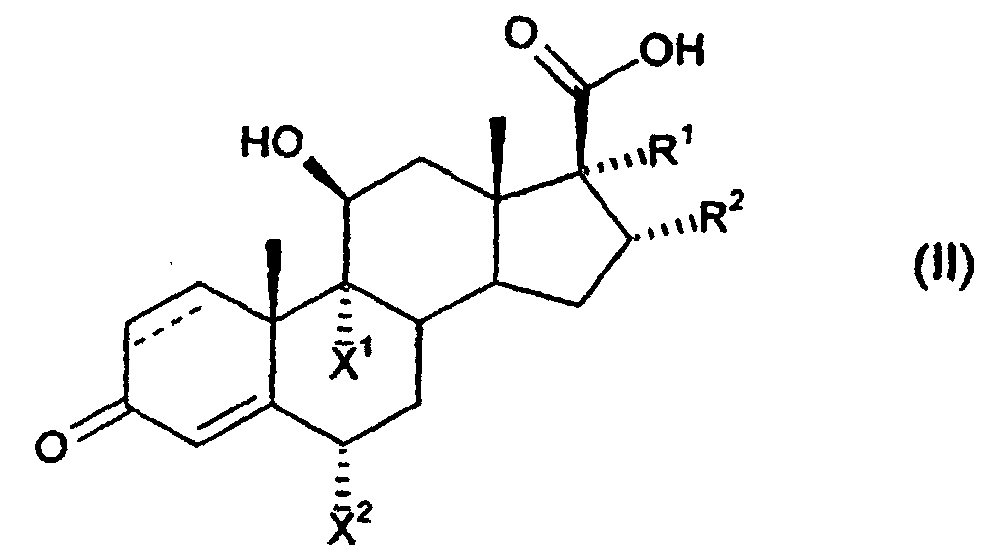 to yield a 1:1 mixture of lactone diastereoisomers of formula (I) which require separation. Due to the separation step this method is not amenable to large scale synthesis.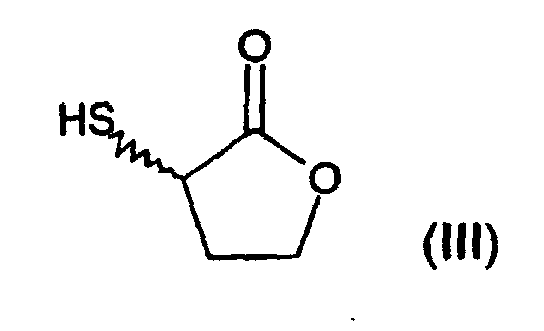
- A further route referred to in WO97/24365 for when n=0 involves the conversion of a compound of formula (II) to a compound of formula (IV), using difficult and toxic reagents such as hydrogen sulphide gas.

- The compound of formula (IV) is then reacted with an enantiomerically pure compound of formula (V)
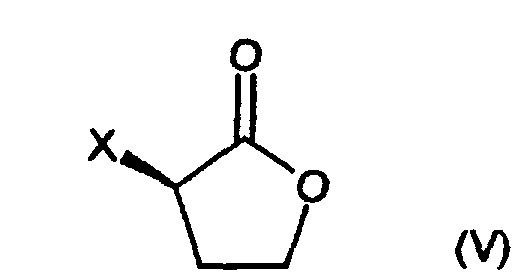
- in which X represents a suitable leaving group, (for example chloro, bromo, or OSO2A wherein A is CH3, CF3, or p-CH3C6H4) to yield a single diastereoisomer of formula (I). This process requires the use of hydrogen sulphide gas, which is very toxic and difficult to handle. Furthermore, the compound of formula (IV) is not stable on storage and must be kept cold. Also, the route is long since it requires an additional synthetic transformation.
- One route to compounds of general formula (I), in which n = 1, described in WO97/24365, involves treating a compound of formula (VI)wherein R1, R2, X1 and X2 are as previously defined, and L represents a suitable leaving group such as a sulphonate ester, for example a mesylate, tosylate or triflate, or L represents a halogen such as chloro or bromo, with racemic a-mercapto-y-butyrolactone (formula (III))
 to yield a 1:1 mixture of lactone diastereoisomers of formula (I) wherein n = 1 which require separation. Due to the separation step this method is not amenable to large scale synthesis.
- An ideal route for the synthesis of a compound of formula (I) should produce the compound in high yields at a reasonable speed and at low cost with minimum waste materials and in a manner that is of minimum impact to the environment in terms of energy consumption and disposal of waste-materials.
- We have found a new process for the synthesis of the enantiomers of compounds of formula (III), providing many advantages in the preparation of compounds of formula (I) over previously known routes of synthesis. Such advantages include avoiding the need for a difficult separation step, avoiding the use of unpleasant and toxic reagents such as hydrogen sulphide gas, lower cost, less waste, and more efficient use of materials.
- The single enantiomers of compound (III), (S)-α-mercapto-γ-butyrolactone and (R)-α-mercapto-γ-butyrolactone, are represented by the formulae (IIIa) and (IIIb).

- The single enantiomer of formula (IIIa), substantially free of the corresponding enantiomer, may be prepared by the following reaction sequence, which is presented as a feature of the present invention:

- In formula (VIIIa), A represents CH3, CF3, or p-CH3C6H4, more preferably CH3. In formula (IXa), R represents C1-6 alkyl or phenyl optionally substituted by one or more substituents selected from halo, C1-3alkyl, hydroxy, and C1-3 alkoxy, more preferably R is CH3.
- Step A is carried out by treating a compound of formula (VIIa) with a sulfonyl chloride or sulfonic anhydride, preferably methanesulfonyl chloride or trifluoromethanesulfonyl chloride (most preferably methanesulfonyl chloride) preferably in the presence of a base, for example a trialkylamine base such as triethylamine or diisopropylethylamine, or an aromatic base such as pyridine, lutidine or 4-N,N-dimethylaminopyridine (most preferably the base will be triethylamine or 4-N,N-dimethylaminopyridine, especially triethylamine and 4-N,N-dimethylaminopyridine), and preferably in a suitable solvent, for example aromatic solvents such as toluene, ester solvents such as ethyl acetate, ether solvents such as tetrahydrofuran (THF), dimethoxyethane and dioxane, amides such as dimethylformamide, ketones such as methyl isobutyl ketone, or chlorinated hydrocarbons such as dichloromethane. Preferably the solvent is selected from the group consisting of dichloromethane, ethyl acetate and methyl isobutyl ketone; most preferably the solvent is ethyl acetate. Preferably, the reaction is carried out at a temperature in the range of -40°C to ambient temperature, most preferably from 10°C to 20°C. Step A will then be completed by recrystallisation of the compound of formula (VIIIa) according to appropriate conditions, preferably using ethyl acetate for recrystallisation.
- Step B is carried out by treating a compound of formula (Villa) with a thiocarboxylate salt (especially a thioacetate salt). Suitable thiocarboxylate salts include inorganic salts (such as potassium or cesium), trialkylamine salts (such as triethylamine), or aromatic amine salts (such as pyridine and lutidine). The thiocarboxylate salts are either commercially available, prepared by standard methods, or generated in situ from thiocarboxylic acid; the preferred thiocarboxylate salt is potassium thioacetate. Preferably, the reaction is carried out in a suitable solvent, for example aromatic solvents such as toluene, esters such as ethyl acetate, amides such as dimethylformamide, ethers such as THF, dioxane, and dimethoxyethane, or chlorinated hydrocarbons such as dichloromethane. Preferably the solvent is selected from the group consisting of toluene, dimethoxyethane and THF; more preferably, the solvent is toluene. Preferably, the reaction is carried out at a temperature in the range of -20°C to ambient temperature, most preferably room temperature (20°C).
- Step C is carried out by reacting a compound of formula (IXa) with an aliphatic alcohol, for example methanol or ethanol, preferably methanol, in the presence of an inorganic acid, for example hydrochloric acid, or alternatively with an aromatic amine, for example 4-chloroaniline; preferably the aliphatic alcohol will be present with hydrochloric acid. Preferably the reaction is carried out in the presence of a suitable solvent, for example aromatic solvents such as toluene, ether solvents such as dioxane or THF, or chlorinated solvents such as dichloromethane. Preferably, the solvent is toluene or dioxane; more preferably, the solvent is toluene. Step C will then be completed by vacuum distillation of the compound of formula (IIIIa) according to appropriate conditions.
- The single enantiomer of formula (IIIb), substantially free of the corresponding enantiomer, may be prepared by an analogous process in which reagents and conditions are as in steps A, B and C above, and which is presented as a further feature of the present invention, using as starting material the (S) enantiomer (VIIb) as follows

- Substituents A and R in formulae (VIIIb) and (IXb) respectively are as defined above for formulae (VIIIa) and (IXa).
- Enantiomeric compounds (IIIa), (IIIb), (IXa) and (IXb), substantially free of the corresponding enantiomer, are novel and are presented as further features of the present invention.
- By 'substantially free' is meant no more than about 10% w/w of the corresponding enantiomer, particularly no more than about 5% w/w, and more particularly less than about 3% w/w is present.
- Compounds (IXa) and (IXb) wherein R is methyl, are (S)-α-acetylthio-γ-butyrolactone and (R)-α-acetylthio-γ-butyrolactone respectively.
- Alternatively, the single enantiomers (IXa) and (IIIb) may be prepared by an enzymatic transacetylation reaction of racemic compound (IX), which is presented as a further feature of the present invention. Compound (IXa) prepared in this manner may then be separated from compound (IIIb) by distillation and converted to compound (IIIa) as illustrated in the reaction scheme above.

- This transacetylation reaction is preferably carried out in the presence of an alcohol, such as butanol, benzyl alcohol, hexanol or octanol, most preferably butanol, and a suitable lipase or esterase enzyme, preferably mucor meihei lipase, in toluene and/or isooctane, most preferably toluene, containing a small amount of water. Preferably, the reaction will be carried out at a temperature in the range of -20°C to room temperature, most preferably 5°C.
- The compounds (VIIa) and (VIIb) are commercially available. Racemic compound (IX) may be prepared by the method described in Fuchs, Swed. Ark. Kemi (1966), 26 (10), 111-116. Compounds of formula (II) may be prepared by methods known in the art, for example by the methodology described in Kertesz and Marx, Journal of Organic Chemistry, 1986, 51, 2315-2328, the contents of which are incorporated herein by reference hereto.
- Compounds (IIIa) and (IIIb) may be used directly in the preparation of single diastereoisomers of compounds of formula (I) in which n=0 by reaction with a compound of formula (II):
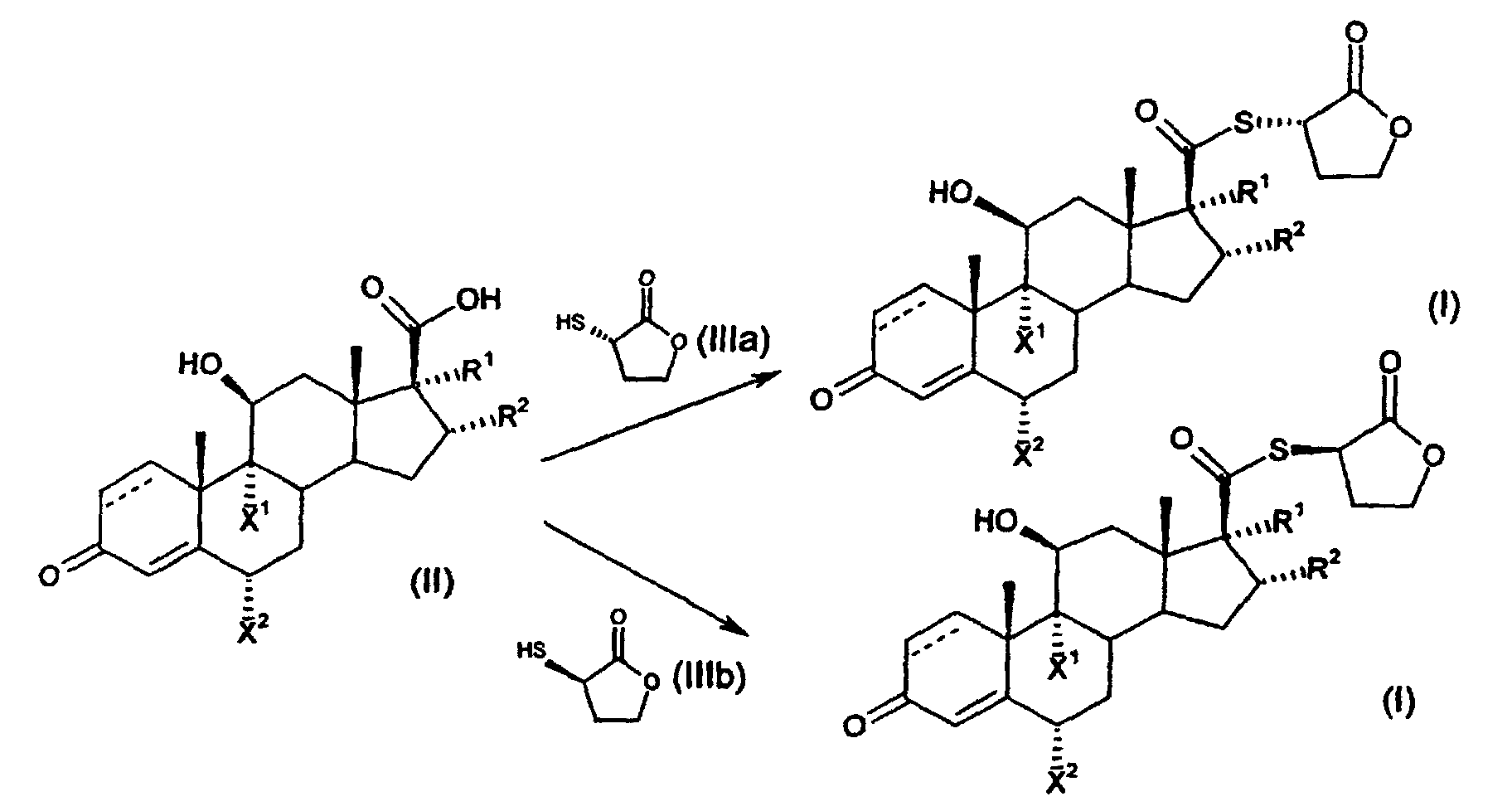
- This represents a cost effective, convergent synthesis of a single diastereoisomer of formula (I) in high yield with no separation step.
- This reaction is presented as a further feature of the present invention. Preferably, the reaction is carried out in a solvent, for example amide solvents such as N,N-dimethylformamide and N-methyl-2-pyrrolidinone; ester solvents such as ethyl acetate and isopropyl acetate; ketone solvents such as acetone, 2-butanone and 4-methyl-2-pentanone; hydrocarbon solvents such as toluene; halogenated solvents such as dichloromethane; and nitrile solvents such as acetonitrile. Preferably, the solvent is acetone.
- The reaction is carried out in the presence of a base. Preferably the base is a weak inorganic base such as sodium acetate or sodium bicarbonate. Potassium carbonate is an alternative base, but sodium bicarbonate is especially preferred.
- The reaction is carried out in the presence of a coupling agent. Preferably, the coupling agent is O-benzotriazole-1-yl-N,N,N',N'-tetramethyluronium hexafluorophosphate (or its corresponding tetrafluoroborate salt). Preferably, the coupling agent is added to the compound of formula (II) at a temperature in the range 0 to 100 °C. Preferably, the coupling step with the compound of formula (III) is carried out at a temperature in the range -10 °C to ambient temperature, most preferably 4°C. This reaction will then be completed by recrystallisation of the compound of formula (I) according to appropriate conditions, preferably using isopropyl acetate and heptane for recrystallisation.
- Compounds of formula (II) may alternatively be prepared according to the following process:
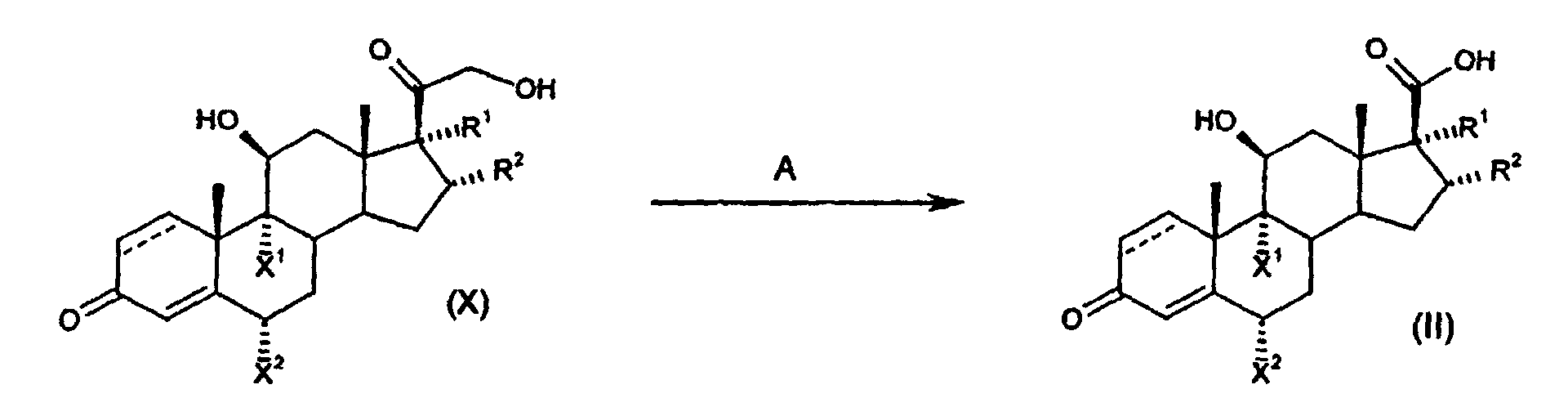
- Step A is carried out in the presence of hydrogen peroxide and a base. Preferably the base is a weak inorganic base such as potassium carbonate, preferably the reaction will be carried out in the presence of an aliphatic alcohol, most preferably methanol, preferably at room temperature. Step A will then be completed by recrystallisation of the compound of formula (II) according to appropriate conditions, preferably using ethyl acetate for recrystallisation.
- Compounds (IIIa) and (IIIb) may also be used directly in the preparation of single diastereoisomers of compounds of formula (I) in which n=1 by reaction with a compound of formula (VI):

- This represents a cost effective, convergent synthesis of a single diastereoisomer of formula (I) where n = 1 in high yield with no separation step. The reaction conditions are as described above for the reaction of compounds of formulae (II) and (IIIa) or (IIIb).
- The invention is further described by following examples, which are presented by way of illustration only.
- All temperatures refer to °C. Proton Magnetic Resonance (1H-NMR) spectra were recorded at 300 MHz, chemical shifts are reported in ppm (δ) from Me4Si, used as internal standard , and are assigned as singlets (s), doublets (d), doublet of doublets (dd), triplets (t), doublet of triplets (dt), quartets (q) or multiplets (m). The following abbreviations are used in text: AcOEt = ethyl acetate, TFA = trifluoroacetic acid, HCI = hydrochloric acid, EtOH = ethanol.
- Triethylamine (45ml, 323mmol) and 4-N,N-dimethylaminopyridine (3.6g, 29mmol) in anhydrous AcOEt (75ml) were added to a stirred solution of (R)-(+)-α-hydroxy-γ-butyrolactone (30g, 294mmol) in anhydrous AcOEt (300ml), under N2, at -40°. The solution was stirred for 10min. Methanesulfonyl chloride (25ml, 323mmol) was added slowly to the reaction, maintaining the temperature below -35°. The mixture was stirred for 2h at -40°. Upon completion the mixture was allowed to warm up to ambient temperature. The mixture was diluted with AcOEt (450ml) and filtered. The solid was washed with AcOEt (3x60ml). The filtrate was washed with a solution of 50% H2O and 50% brine (60ml). The organic layer was washed with 1 N HCI (45ml), a solution of 50% H2O and 50% saturated brine (45ml), a saturated aqueous NaHCO3 solution (45ml), and a solution of 50% H2O and 50% brine (2x45ml). The solvent (780ml) was removed under reduced pressure and hexanes (500 ml) was added to the mixture. The mixture was stirred at 5° for 2h. The mixture was filtered, and solid was dried under vacuum at room temperature to yield (R)-α-(methylsulfonyl)oxy-γ-butyrolactone as a white solid (45g, 85%). 1H-NMR (CDCl3): δ 5.32 (1H, t, J=8.7Hz), 4.52 (1H, m), 4.33 (1H, m), 3.27 (3H, s), 2.76 (1H, m), 2.56 (1H, m).
- Potassium thioacetate (7.33g, 64.17mmol) was added to a solution of (R)-α-(methylsulfonyl)oxy-γ-butyrolactone (11g, 61.11mmol) in toluene (220ml) at 5°. The reaction mixture was stirred at ambient temperature for 36 h. The mixture was filtered and the solid was washed with toluene (3x22ml). The organic layer was washed with water (3 ml) and 1N HCI (3 ml). The organic solution was dried over sodium sulfate, the toluene was removed by rotary evaporation to give (S)-α-acetylthio-γ-butyrolactone as a liquid (9.2g, 94% yield): 98% e.e. (HPLC, column: Daicel AD, 10% EtOH / Hexanes, flow 1ml/min); 1H-NMR (CDCl3), δ 4.40 (1H, m), 4.26 (1H, m), 4.23 (1H, m), 2.70 (1H, m), 2.35 (3H, s), 2.23 (1H, m). 13C-NMR (75MHz, CDCl3): δ 193.59, 174.72, 66.95, 40.46, 30.42, 30.30. Anal. Calcd for C6H8O3S : C, 44.99; H, 5.03; S, 20.02. Found: C, 44.81; H, 5.05; S, 20.10%.
- Methanol (46ml) and 4M HCI in dioxane (9.2ml, 36.8mmol) were added to (S)-α-acetylthio-γ-butyrolactone (9.2g, 58mmol) in toluene (138ml) at 0°. The solution was stirred at ambient temperature overnight. Upon completion of the reaction, 92ml of solvents were removed under vacuum. Toluene (92ml) and TFA (0.1 ml) was added to give a pH of 1.5-2.0. The solution was stirred overnight. Toluene was removed under vacuum to give crude product. The crude product was dried under vacuum for 15min at ambient temperature. Vacuum distillation gave (S)-α-mercapto-y-butyrolactone (5.9g, 87% yield) (b.p. 50-51°, 200millitorr): 98% e.e. (HPLC, column: Daicel AD, 10% EtOH/Hexanes, flow 1ml/min). 1H-NMR (CDCl3): δ 4.47 (1H, m), 4.32 (1H, m), 3.72 (1H, m), 2.69 (1H, m), 2.33 (1H, d, J=4.8Hz), 2.18 (1H, m). 13C-NMR (75MHz, CDCl3): δ 176.89, 66.77, 34.97, 32.09. Anal. Calcd for C4H6O2S : C, 40.66; H, 5.12; S, 27.14. Found: C, 40.61; H, 5.13; S, 26.99%.
- A mixture of 1,2-dihydrofluocinolone acetonide (5.0g, 11.0 mmol), potassium carbonate (4.56g, 33.0 mmol) and hydrogen peroxide (18.5 ml, 16.5 mmol as a 3% wt/vol. solution in water)was stirred in methanol (35 ml) at ambient temperature for 24 hours. The mixture was then treated with additional hydrogen peroxide (12 ml, 11.0 mmol ) for an additional 24-hour period. Water (25 ml) was added and the solution was washed with ethyl acetate (25 ml) followed by hexanes (25 ml). The aqueous layer was then adjusted to pH 2 by addition of concentrated HCI, which resulted in a precipitate. The acidic aqueous layer was washed with ethyl acetate (2x25 ml) and the combined ethyl acetate extracts evaporated to dryness. The resulting off white solid was triturated in 1:1 hexanes-ethyl acetate (30ml) and filtered and dried at 50°C for 24 hours to provide the title compound as a off-white solid. (3.93g, 81%). 1H-NMR (DMSO-d6): 5.77(s,1H), 5.55 and 5.40(2m, 1H), 5.1(m,1H), 4.90(m,1H), 4.10(m,1H), 2.5-2.35(m, 3H), 2.35-2.1(2m, 3H), 2.0-1.85(m, 3H), 1.7-1.4 (m, overlapping s at 1.45, 5H) 1.35-1.20(m overlapping s at 1.29, 4H), 1.13 (s, 3H), 0.9 to 0.75 (m, overlapping s at 0.87, 4H).
- 70% perchloric acid (22.8ml, 264mmol) was added to a stirred mixture butyraldehyde (11ml, 122mmol) and 6α,9α-difluoro-11β-hydroxy-16α,17α-isopropylidenedioxy-3-oxo-androst-4-ene-17β carboxylic acid (30.40g, 69mmol) in dichloromethane (608ml) at -3 °C. The mixture was stirred overnight at -3 °C and then 6% aqueous sodium carbonate ( 248ml) was added. The mixture was then allowed to warm to room temperature and 6% aqueous sodium carbonate (304ml) was added. After 3 hours the phases were separated and the organic phase was extracted with 6% aqueous sodium carbonate ( 2x60ml ). The combined aqueous phase was washed with toluene (2x150ml). Then, the aqueous phase was rapidly stirred as conc. hydrochloric acid was added until a pH of 2-1 was obtained. The resulting slurry was suction-filtered, and the filter plug was washed with water (3x60ml) and dried in air overnight to give a crude product (31g, containing 9% of the undesired acetal epimer). The crude product was dissolved in EtOH-water (1:2, ca. 532ml) by heating at 72-73 °C and the resulting solution was allowed to cool to room temperature overnight. The mixture was filtered, and the solid was washed with 30ml of water. The solid was dried in a vacuum oven at 90-100 °C to give the product (24g) with 1.6% of epimer. Recrystallization was repeated (12vol EtOH-water 1:2, ca. 430 ml). The product was dried in a vacuum oven at 90-100 °C to provide the title compound as an off-white solid (21.6g, 69% total yield, containing 0.3-0.5 % of the undesired epimer). 1H-NMR (300 MHz, DMSO, d6) δ 0.86 (t, 3H); 0.92 (s, 3H); 1.31-1.57 (m, 7H); 1.47 (s, 3H); 1.74 (d, 1H); 1.91-2.42 (m, 8H); 4.14 (m, 1H); 4.62 (t, 1H); 4.87 (br, 1H); 5.14 (br, 1H); 5.42-5.57(m, 1H); 5.81 (s, 1H).
- A mixture of 16α,17α-(R-butylidenedioxy)-6α,9α-difluoro-11β-hydroxy-3-oxo-androst-4-ene-17β-carboxylic acid (6.00g, 13.2mmol), O-benzotriazole-1-yl-N,N,N',N'-tetramethyluronium hexafluorophosphate (HBTU, 5.98g, 15.8mmol), and sodium bicarbonate (2.28g, 27mmol), in acetone (45ml) was stirred under nitrogen and heated at 43° for 16h. The mixture was cooled to 0° and treated with more sodium bicarbonate (2.28g, 27mmol) then a solution of (S)-α-mercapto-γ-butyrolactone (ca. 98% e.e., 2.34g, 19.80mmol) in acetone (3ml). The mixture was stirred at 0° for 25h and the cold reaction mixture was then poured into isopropyl acetate (100ml). 1 N HCl (50 ml) was then added and the layers were separated. The organic layer was washed with 5% potassium carbonate (50 ml) then brine (50 ml) and dried over sodium sulfate, filtered, and concentrated under reduced pressure. The residue was then crystallized from hot isopropylacetate (24ml). The resulting slurry was suction-filtered and the white solid dried in a vacuum oven at 80° for 3 days affording the title compound (5.45g, 75% yield). M.pt. 169-173°; 1H-NMR (CDCl3) δ 6.13 (1H,s); 5.26 (1H, dm, J = 47.5 Hz); 4.84 (1H, d, J = 5.2 Hz); 4.73 (1H, t, J = 4.2Hz); 4.47 (1H, dt, J = 8.6 Hz, 2.9 Hz); 4.4 - 4.28 (3H,m); 2.75 (1H,m); 2.6 - 2.4 (3H,m); 2.4 - 2.18 (4H,m); 2.0 (1H,m); 1.9 - 1.6 (8H,m); 1.52 (3H,s); 1.46 (2H, q, J = 7 Hz); 1.00 (3H,s); 0.95 (3H, t, J = 7.3 Hz).
- The compound of Example 2 is capable of preparation according to the invention at an overall yield of 30% in 4 linear steps from the starting material (fluocinoline acetonide), resulting in a product with <2% of the undesired lactone isomer. This is clearly advantageous when compared with previously known syntheses, the best of which obtain the compound in 5 linear steps from identical starting material, obtaining an overall yield of 8% and resulting in a much less pure end product (approximately 5% of the undesired lactone isomer).
Claims (13)
- (S)-α-mercapto-γ-butyrolactone containing no more than 10% w/w of the corresponding enantiomer.
- (S)-α-mercapto-γ-butyrolactone containing no more than 5% w/w of the corresponding enantiomer.
- (S)-α-mercapto-γ-butyrolactone containing less than 3% w/w of the corresponding enantiomer.
- (R)-α-mercapto-γ-butyrolactone containing no more than 10% w/w of the corresponding enantiomer.
- (R)-α-mercapto-γ-butyrolactone containing no more than 5% w/w of the corresponding enantiomer.
- (R)-α-mercapto-γ-butyrolactone containing less than 3% w/w of the corresponding enantiomer.
- A process for the preparation of a compound of formula (IIIa)comprising reacting a compound of formula (IXa)
 wherein R represents C1-6 alkyl or phenyl optionally substituted by one or more substituents selected from halo, C1-3alkyl, hydroxy, and C1-3 alkoxy; with an aliphatic alcohol in the presence of hydrochloric acid.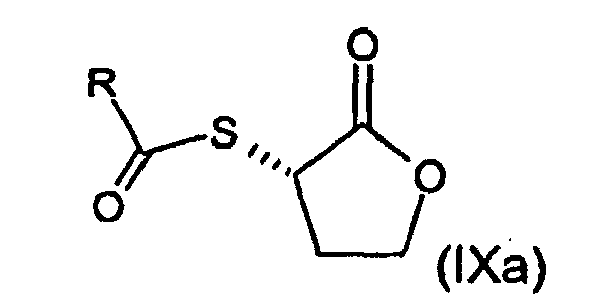
- A process for the preparation of a compound of formula (IIIb)comprising reacting a compound of formula (IXb)
 wherein R represents C1-6 alkyl or phenyl optionally substituted by one or more substituents selected from halo, C1-3alkyl, hydroxy, and C1-3 alkoxy; with an aliphatic alcohol in the presence of hydrochloric acid.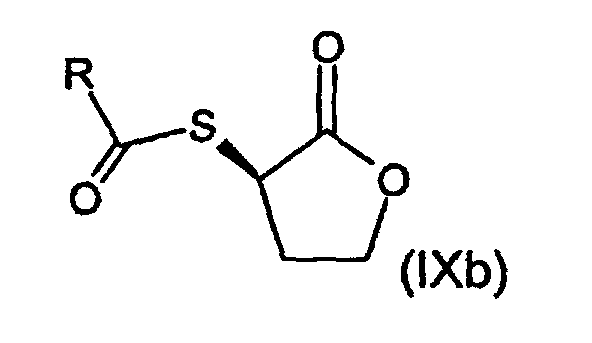
- A process for the preparation of compounds of formulae (IXa) and (IIIb)wherein R represents C1-6 alkyl or phenyl optionally substituted by one or more substituents selected from halo, C1-3alkyl, hydroxy, and C1-3 alkoxy; comprising the enzymatic transacetylation of racemic compound (IX)
 wherein R is as defined above, in the presence of an alcohol and a suitable lipase or esterase enzyme in a solvent containing water.
- A process for the preparation of a single enantiomer of a compound of formula (I)in which R1 individually represents OC(=O)C1-6alkyl; R2 individually represents hydrogen, methyl (which may be in either the α or β configuration) or methylene; or R1 and R2 together represent
 wherein R3 and R4 are the same or different and each represents hydrogen or C1-6 alkyl; X1 and X2 are the same or different and each represents hydrogen or halogen;
---- represents a single or double bond; and n=0; comprising the reaction of a compound of formula (IIIa) or (IIIb)with a compound of formula (II) in which R1, R2, X1 and X2 are as defined above for formula (I), in the presence of a base and a coupling agent.
- A process according to claim 10 wherein the base is sodium bicarbonate and the coupling agent is O-benzotriazole-1-yl-N,N,N',N'-tetramethyluronium hexafluorophosphate.
- A process for the preparation of a single enantiomer of a compound of formula (I)in which R1 individually represents OC(=O)C1-6alkyl; R2 individually represents hydrogen, methyl (which may be in either the α or β configuration) or methylene; or R1 and R2 together represent
 wherein R3 and R4 are the same or different and each represents hydrogen or C1-6 alkyl; X1 and X2 are the same or different and each represents hydrogen or halogen;
---- represents a single or double bond; and n=1; comprising the reaction of a compound of formula (IIIa) or (IIIb)with a compound of formula (VI) in which R1, R2, X1 and X2 are as defined above for formula (I), and L represents a suitable leaving group, in the presence of a base and a coupling agent.
- A process according to claim 12 wherein the base is sodium bicarbonate and the coupling agent is O-benzotriazole-1-yl-N,N,N',N'-tetramethyluronium hexafluorophosphate.
Applications Claiming Priority (3)
| Application Number | Priority Date | Filing Date | Title |
|---|---|---|---|
| GBGB9909229.8A GB9909229D0 (en) | 1999-04-23 | 1999-04-23 | Enantiomers of mercapto lactones and processes for their synthesis |
| GB9909229 | 1999-04-23 | ||
| PCT/EP2000/002705 WO2000064882A2 (en) | 1999-04-23 | 2000-03-28 | Enantiomers of mercapto lactones and processes for their synthesis |
Publications (2)
| Publication Number | Publication Date |
|---|---|
| EP1173430A1 EP1173430A1 (en) | 2002-01-23 |
| EP1173430B1 true EP1173430B1 (en) | 2003-07-09 |
Family
ID=10852031
Family Applications (1)
| Application Number | Title | Priority Date | Filing Date |
|---|---|---|---|
| EP00917002A Expired - Lifetime EP1173430B1 (en) | 1999-04-23 | 2000-03-28 | Enantiomers of mercapto lactones and processes for their synthesis |
Country Status (8)
| Country | Link |
|---|---|
| EP (1) | EP1173430B1 (en) |
| JP (1) | JP2002543069A (en) |
| AT (1) | ATE244706T1 (en) |
| AU (1) | AU3814800A (en) |
| DE (1) | DE60003807T2 (en) |
| ES (1) | ES2202090T3 (en) |
| GB (1) | GB9909229D0 (en) |
| WO (1) | WO2000064882A2 (en) |
Families Citing this family (7)
| Publication number | Priority date | Publication date | Assignee | Title |
|---|---|---|---|---|
| AU2003255851B2 (en) | 2002-07-08 | 2009-07-23 | Glaxosmithkline Istrazivacki Centar Zagreb D.O.O. | New compounds, compositions and methods for treatment of inflammatory diseases and conditions |
| NZ537716A (en) | 2002-07-08 | 2007-05-31 | Glaxosmithkline Zagreb | Novel nonsteroidal anti-inflammatory substances, compositions and methods for their use |
| EP1551865B1 (en) | 2002-07-08 | 2009-04-22 | GlaxoSmithKline istrazivacki centar Zagreb d.o.o. | Hybrid molecules of macrolides with steroidal/non-steroidal anti-inflammatory molecules |
| JP5192730B2 (en) * | 2006-05-29 | 2013-05-08 | 昭和電工株式会社 | Method for producing mercaptoheterocyclic compound |
| ES2385848T3 (en) | 2006-05-29 | 2012-08-01 | Showa Denko K.K. | Production procedure of a heterocyclic mercapto compound |
| EP2443134A2 (en) | 2009-06-16 | 2012-04-25 | Schering Corporation | NOVEL [3,2-c]HETEROARYL STEROIDS AS GLUCOCORTICOID RECEPTOR AGONISTS, COMPOSITIONS AND USES THEREOF |
| EP4635969A1 (en) * | 2022-12-16 | 2025-10-22 | Tianjin Pharmaceutical Biotechnology Co., Ltd. | Novel glucocorticoid, method for preparing same, and use thereof |
Family Cites Families (1)
| Publication number | Priority date | Publication date | Assignee | Title |
|---|---|---|---|---|
| SK89198A3 (en) * | 1995-12-29 | 1999-03-12 | Glaxo Group Ltd | Lactone derivatives of 17.beta.-carboxy, carbothio and amide androstane derivatives |
-
1999
- 1999-04-23 GB GBGB9909229.8A patent/GB9909229D0/en not_active Ceased
-
2000
- 2000-03-28 ES ES00917002T patent/ES2202090T3/en not_active Expired - Lifetime
- 2000-03-28 AU AU38148/00A patent/AU3814800A/en not_active Abandoned
- 2000-03-28 DE DE60003807T patent/DE60003807T2/en not_active Expired - Fee Related
- 2000-03-28 AT AT00917002T patent/ATE244706T1/en not_active IP Right Cessation
- 2000-03-28 WO PCT/EP2000/002705 patent/WO2000064882A2/en not_active Ceased
- 2000-03-28 JP JP2000613835A patent/JP2002543069A/en active Pending
- 2000-03-28 EP EP00917002A patent/EP1173430B1/en not_active Expired - Lifetime
Also Published As
| Publication number | Publication date |
|---|---|
| WO2000064882A2 (en) | 2000-11-02 |
| GB9909229D0 (en) | 1999-06-16 |
| DE60003807D1 (en) | 2003-08-14 |
| WO2000064882A3 (en) | 2001-02-22 |
| ATE244706T1 (en) | 2003-07-15 |
| EP1173430A1 (en) | 2002-01-23 |
| ES2202090T3 (en) | 2004-04-01 |
| DE60003807T2 (en) | 2004-05-27 |
| AU3814800A (en) | 2000-11-10 |
| JP2002543069A (en) | 2002-12-17 |
Similar Documents
| Publication | Publication Date | Title |
|---|---|---|
| ES2550367T3 (en) | Azetidine derivatives | |
| US10040764B2 (en) | Processes for the preparation of 4-alkoxy-3-(acyl or alkyl)oxypicolinamdes | |
| EP0040517A2 (en) | Homobrassinolide and its synthesis | |
| EP1173430A1 (en) | Enantiomers of mercapto lactones and processes for their synthesis | |
| WO2008090046A1 (en) | Alternate process for preparing 3,5-di-omicron-acyl-2-fluoro-2-c-methyl-d-ribono-gamma-lactone | |
| Rewcastle et al. | Reactions of 2-lithiated indoles with elemental sulfur. Formation of pentathiepino [6, 7-b] indoles and indoline-2-thiones | |
| EP0904268B1 (en) | Processes for preparing 3-(1-hydroxyphenyl-1-alkoximinomethyl)dioxazines | |
| CN101573349A (en) | Process for preparing 3,5-di-omicron-acyl-2-fluoro-2-C-methyl-D-ribono-gamma-lactone | |
| HARADA et al. | An efficient synthesis of 6-substituted aminohexahydro-1H-1, 4-diazepines from 2-substituted aminopropenals | |
| SU517263A3 (en) | The method of obtaining d-homosteroids | |
| NL8104985A (en) | OXAZOLINOSTEROIDS, METHOD FOR THE PREPARATION THEREOF, AND USE THEREOF FOR THE PREPARATION OF CORTICOSTEROIDS. | |
| JPH05125072A (en) | Production of 3-acylamino-6-phenyloxy-7-alkylsulfonylamino-4h-1-benzopyran-4-one derivative or its salt | |
| EP4269388A1 (en) | Dipyrromethene-1-one compound and preparation method therefor | |
| CA2384145A1 (en) | Process for the preparation of 2,3-dihydroazepine compounds | |
| Okada et al. | New method for the synthesis of pyrromethanes | |
| US4549019A (en) | Pyrimidinecarbamate derivatives as intermediates | |
| KR900000266B1 (en) | Method for preparing ethyl ester of apovincaminic acid | |
| US4565869A (en) | Dicarbamates | |
| US6388083B2 (en) | Process for the synthesis of (2S)-phenyl-3-piperidone | |
| JPH06172376A (en) | Psychofuranose and Psychopyranose derivatives | |
| JPS62153278A (en) | Production of 4-acylisoxazole derivative | |
| JP3224584B2 (en) | 2,3-dihydroindole-3,3-dicarboxylic acid and 2,3-dihydroindole-3-carboxylic acid derivatives | |
| SK115299A3 (en) | Process for preparation of 4h-4-oxo-quinolizine-3-carboxylic acid derivatives | |
| KR101086039B1 (en) | New preparation method of 3,4-dihydro-pyrano [3,4-c] pyridin-1-one derivative | |
| JPS626719B2 (en) |
Legal Events
| Date | Code | Title | Description |
|---|---|---|---|
| PUAI | Public reference made under article 153(3) epc to a published international application that has entered the european phase |
Free format text: ORIGINAL CODE: 0009012 |
|
| 17P | Request for examination filed |
Effective date: 20011019 |
|
| AK | Designated contracting states |
Kind code of ref document: A1 Designated state(s): AT BE CH CY DE DK ES FI FR GB GR IE IT LI LU MC NL PT SE |
|
| AX | Request for extension of the european patent |
Free format text: AL;LT;LV;MK;RO;SI |
|
| 17Q | First examination report despatched |
Effective date: 20020221 |
|
| GRAH | Despatch of communication of intention to grant a patent |
Free format text: ORIGINAL CODE: EPIDOS IGRA |
|
| GRAH | Despatch of communication of intention to grant a patent |
Free format text: ORIGINAL CODE: EPIDOS IGRA |
|
| GRAA | (expected) grant |
Free format text: ORIGINAL CODE: 0009210 |
|
| AK | Designated contracting states |
Designated state(s): AT BE CH CY DE DK ES FI FR GB GR IE IT LI LU MC NL PT SE |
|
| PG25 | Lapsed in a contracting state [announced via postgrant information from national office to epo] |
Ref country code: NL Free format text: LAPSE BECAUSE OF FAILURE TO SUBMIT A TRANSLATION OF THE DESCRIPTION OR TO PAY THE FEE WITHIN THE PRESCRIBED TIME-LIMIT Effective date: 20030709 Ref country code: LI Free format text: LAPSE BECAUSE OF FAILURE TO SUBMIT A TRANSLATION OF THE DESCRIPTION OR TO PAY THE FEE WITHIN THE PRESCRIBED TIME-LIMIT Effective date: 20030709 Ref country code: FI Free format text: LAPSE BECAUSE OF FAILURE TO SUBMIT A TRANSLATION OF THE DESCRIPTION OR TO PAY THE FEE WITHIN THE PRESCRIBED TIME-LIMIT Effective date: 20030709 Ref country code: CY Free format text: LAPSE BECAUSE OF FAILURE TO SUBMIT A TRANSLATION OF THE DESCRIPTION OR TO PAY THE FEE WITHIN THE PRESCRIBED TIME-LIMIT Effective date: 20030709 Ref country code: CH Free format text: LAPSE BECAUSE OF FAILURE TO SUBMIT A TRANSLATION OF THE DESCRIPTION OR TO PAY THE FEE WITHIN THE PRESCRIBED TIME-LIMIT Effective date: 20030709 Ref country code: AT Free format text: LAPSE BECAUSE OF FAILURE TO SUBMIT A TRANSLATION OF THE DESCRIPTION OR TO PAY THE FEE WITHIN THE PRESCRIBED TIME-LIMIT Effective date: 20030709 |
|
| REG | Reference to a national code |
Ref country code: GB Ref legal event code: FG4D |
|
| REG | Reference to a national code |
Ref country code: CH Ref legal event code: EP |
|
| REF | Corresponds to: |
Ref document number: 60003807 Country of ref document: DE Date of ref document: 20030814 Kind code of ref document: P |
|
| REG | Reference to a national code |
Ref country code: IE Ref legal event code: FG4D |
|
| PG25 | Lapsed in a contracting state [announced via postgrant information from national office to epo] |
Ref country code: SE Free format text: LAPSE BECAUSE OF FAILURE TO SUBMIT A TRANSLATION OF THE DESCRIPTION OR TO PAY THE FEE WITHIN THE PRESCRIBED TIME-LIMIT Effective date: 20031009 Ref country code: GR Free format text: LAPSE BECAUSE OF FAILURE TO SUBMIT A TRANSLATION OF THE DESCRIPTION OR TO PAY THE FEE WITHIN THE PRESCRIBED TIME-LIMIT Effective date: 20031009 Ref country code: DK Free format text: LAPSE BECAUSE OF FAILURE TO SUBMIT A TRANSLATION OF THE DESCRIPTION OR TO PAY THE FEE WITHIN THE PRESCRIBED TIME-LIMIT Effective date: 20031009 |
|
| NLV1 | Nl: lapsed or annulled due to failure to fulfill the requirements of art. 29p and 29m of the patents act | ||
| PG25 | Lapsed in a contracting state [announced via postgrant information from national office to epo] |
Ref country code: PT Free format text: LAPSE BECAUSE OF FAILURE TO SUBMIT A TRANSLATION OF THE DESCRIPTION OR TO PAY THE FEE WITHIN THE PRESCRIBED TIME-LIMIT Effective date: 20031209 |
|
| LTIE | Lt: invalidation of european patent or patent extension |
Effective date: 20030709 |
|
| REG | Reference to a national code |
Ref country code: CH Ref legal event code: PL |
|
| PGFP | Annual fee paid to national office [announced via postgrant information from national office to epo] |
Ref country code: GB Payment date: 20040205 Year of fee payment: 5 |
|
| PGFP | Annual fee paid to national office [announced via postgrant information from national office to epo] |
Ref country code: FR Payment date: 20040302 Year of fee payment: 5 |
|
| PGFP | Annual fee paid to national office [announced via postgrant information from national office to epo] |
Ref country code: ES Payment date: 20040322 Year of fee payment: 5 |
|
| PG25 | Lapsed in a contracting state [announced via postgrant information from national office to epo] |
Ref country code: LU Free format text: LAPSE BECAUSE OF NON-PAYMENT OF DUE FEES Effective date: 20040328 |
|
| PG25 | Lapsed in a contracting state [announced via postgrant information from national office to epo] |
Ref country code: IE Free format text: LAPSE BECAUSE OF NON-PAYMENT OF DUE FEES Effective date: 20040329 |
|
| PG25 | Lapsed in a contracting state [announced via postgrant information from national office to epo] |
Ref country code: MC Free format text: LAPSE BECAUSE OF NON-PAYMENT OF DUE FEES Effective date: 20040331 |
|
| PGFP | Annual fee paid to national office [announced via postgrant information from national office to epo] |
Ref country code: DE Payment date: 20040331 Year of fee payment: 5 |
|
| REG | Reference to a national code |
Ref country code: ES Ref legal event code: FG2A Ref document number: 2202090 Country of ref document: ES Kind code of ref document: T3 |
|
| PGFP | Annual fee paid to national office [announced via postgrant information from national office to epo] |
Ref country code: BE Payment date: 20040416 Year of fee payment: 5 |
|
| ET | Fr: translation filed | ||
| PLBE | No opposition filed within time limit |
Free format text: ORIGINAL CODE: 0009261 |
|
| STAA | Information on the status of an ep patent application or granted ep patent |
Free format text: STATUS: NO OPPOSITION FILED WITHIN TIME LIMIT |
|
| 26N | No opposition filed |
Effective date: 20040414 |
|
| REG | Reference to a national code |
Ref country code: IE Ref legal event code: MM4A |
|
| PG25 | Lapsed in a contracting state [announced via postgrant information from national office to epo] |
Ref country code: IT Free format text: LAPSE BECAUSE OF NON-PAYMENT OF DUE FEES;WARNING: LAPSES OF ITALIAN PATENTS WITH EFFECTIVE DATE BEFORE 2007 MAY HAVE OCCURRED AT ANY TIME BEFORE 2007. THE CORRECT EFFECTIVE DATE MAY BE DIFFERENT FROM THE ONE RECORDED. Effective date: 20050328 Ref country code: GB Free format text: LAPSE BECAUSE OF NON-PAYMENT OF DUE FEES Effective date: 20050328 |
|
| PG25 | Lapsed in a contracting state [announced via postgrant information from national office to epo] |
Ref country code: ES Free format text: LAPSE BECAUSE OF NON-PAYMENT OF DUE FEES Effective date: 20050329 |
|
| PG25 | Lapsed in a contracting state [announced via postgrant information from national office to epo] |
Ref country code: BE Free format text: LAPSE BECAUSE OF NON-PAYMENT OF DUE FEES Effective date: 20050331 |
|
| BERE | Be: lapsed |
Owner name: *GLAXO GROUP LTD Effective date: 20050331 |
|
| PG25 | Lapsed in a contracting state [announced via postgrant information from national office to epo] |
Ref country code: DE Free format text: LAPSE BECAUSE OF NON-PAYMENT OF DUE FEES Effective date: 20051001 |
|
| GBPC | Gb: european patent ceased through non-payment of renewal fee |
Effective date: 20050328 |
|
| PG25 | Lapsed in a contracting state [announced via postgrant information from national office to epo] |
Ref country code: FR Free format text: LAPSE BECAUSE OF NON-PAYMENT OF DUE FEES Effective date: 20051130 |
|
| REG | Reference to a national code |
Ref country code: FR Ref legal event code: ST Effective date: 20051130 |
|
| REG | Reference to a national code |
Ref country code: ES Ref legal event code: FD2A Effective date: 20050329 |
|
| BERE | Be: lapsed |
Owner name: *GLAXO GROUP LTD Effective date: 20050331 |