EP1173169B1 - Aryl substituted pyrazoles, imidazoles, oxazoles, thiazoles and pyrroles, and the use thereof - Google Patents
Aryl substituted pyrazoles, imidazoles, oxazoles, thiazoles and pyrroles, and the use thereof Download PDFInfo
- Publication number
- EP1173169B1 EP1173169B1 EP00919636A EP00919636A EP1173169B1 EP 1173169 B1 EP1173169 B1 EP 1173169B1 EP 00919636 A EP00919636 A EP 00919636A EP 00919636 A EP00919636 A EP 00919636A EP 1173169 B1 EP1173169 B1 EP 1173169B1
- Authority
- EP
- European Patent Office
- Prior art keywords
- phenyl
- fluorophenoxy
- pyrazole
- carboxamide
- pyrazol
- Prior art date
- Legal status (The legal status is an assumption and is not a legal conclusion. Google has not performed a legal analysis and makes no representation as to the accuracy of the status listed.)
- Expired - Lifetime
Links
- 125000003118 aryl group Chemical group 0.000 title claims description 34
- 150000003217 pyrazoles Chemical class 0.000 title description 11
- 150000002460 imidazoles Chemical class 0.000 title description 8
- 150000002916 oxazoles Chemical class 0.000 title description 8
- 150000003233 pyrroles Chemical class 0.000 title description 8
- 150000003557 thiazoles Chemical class 0.000 title description 8
- 150000001875 compounds Chemical class 0.000 claims abstract description 193
- 208000002193 Pain Diseases 0.000 claims abstract description 24
- 150000003839 salts Chemical class 0.000 claims abstract description 23
- 208000028867 ischemia Diseases 0.000 claims abstract description 11
- 208000000094 Chronic Pain Diseases 0.000 claims abstract description 10
- 239000012453 solvate Substances 0.000 claims abstract description 9
- 230000000626 neurodegenerative effect Effects 0.000 claims abstract description 5
- -1 cyano, amino Chemical group 0.000 claims description 89
- 229910052739 hydrogen Inorganic materials 0.000 claims description 59
- 239000001257 hydrogen Substances 0.000 claims description 56
- 125000004169 (C1-C6) alkyl group Chemical group 0.000 claims description 50
- 150000002431 hydrogen Chemical group 0.000 claims description 41
- 125000001072 heteroaryl group Chemical group 0.000 claims description 34
- 125000000217 alkyl group Chemical group 0.000 claims description 33
- 125000001997 phenyl group Chemical group [H]C1=C([H])C([H])=C(*)C([H])=C1[H] 0.000 claims description 33
- 125000000623 heterocyclic group Chemical group 0.000 claims description 30
- 125000000753 cycloalkyl group Chemical group 0.000 claims description 27
- 125000003917 carbamoyl group Chemical group [H]N([H])C(*)=O 0.000 claims description 26
- 229910052760 oxygen Inorganic materials 0.000 claims description 25
- 125000000304 alkynyl group Chemical group 0.000 claims description 23
- 125000003342 alkenyl group Chemical group 0.000 claims description 22
- 125000004356 hydroxy functional group Chemical group O* 0.000 claims description 22
- 125000003178 carboxy group Chemical group [H]OC(*)=O 0.000 claims description 18
- 125000004093 cyano group Chemical group *C#N 0.000 claims description 18
- 125000002924 primary amino group Chemical group [H]N([H])* 0.000 claims description 18
- 229910052717 sulfur Inorganic materials 0.000 claims description 18
- 102000018674 Sodium Channels Human genes 0.000 claims description 17
- 108010052164 Sodium Channels Proteins 0.000 claims description 17
- 125000004390 alkyl sulfonyl group Chemical group 0.000 claims description 17
- 125000001188 haloalkyl group Chemical group 0.000 claims description 17
- 125000002768 hydroxyalkyl group Chemical group 0.000 claims description 17
- 125000004183 alkoxy alkyl group Chemical group 0.000 claims description 16
- 125000003545 alkoxy group Chemical group 0.000 claims description 16
- 125000004103 aminoalkyl group Chemical group 0.000 claims description 16
- 125000004181 carboxyalkyl group Chemical group 0.000 claims description 16
- 125000004890 (C1-C6) alkylamino group Chemical group 0.000 claims description 15
- 125000004423 acyloxy group Chemical group 0.000 claims description 15
- 125000004457 alkyl amino carbonyl group Chemical group 0.000 claims description 15
- 150000001408 amides Chemical class 0.000 claims description 15
- 125000003710 aryl alkyl group Chemical group 0.000 claims description 15
- 230000000694 effects Effects 0.000 claims description 15
- RAXXELZNTBOGNW-UHFFFAOYSA-N imidazole Substances C1=CNC=N1 RAXXELZNTBOGNW-UHFFFAOYSA-N 0.000 claims description 15
- 125000000882 C2-C6 alkenyl group Chemical group 0.000 claims description 14
- 125000000041 C6-C10 aryl group Chemical group 0.000 claims description 14
- 125000003282 alkyl amino group Chemical group 0.000 claims description 14
- 125000000852 azido group Chemical group *N=[N+]=[N-] 0.000 claims description 14
- 125000004432 carbon atom Chemical group C* 0.000 claims description 14
- 150000003573 thiols Chemical class 0.000 claims description 14
- MRGZCLZDYCRVKL-UHFFFAOYSA-N 3-[4-(4-fluorophenoxy)phenyl]pyrazole-1-carboxamide Chemical compound NC(=O)N1C=CC(C=2C=CC(OC=3C=CC(F)=CC=3)=CC=2)=N1 MRGZCLZDYCRVKL-UHFFFAOYSA-N 0.000 claims description 13
- UFHFLCQGNIYNRP-UHFFFAOYSA-N Hydrogen Chemical compound [H][H] UFHFLCQGNIYNRP-UHFFFAOYSA-N 0.000 claims description 13
- 125000004442 acylamino group Chemical group 0.000 claims description 13
- 125000004397 aminosulfonyl group Chemical group NS(=O)(=O)* 0.000 claims description 13
- CGMPMLHCCFCLQL-UHFFFAOYSA-N 5-[4-(4-fluorophenoxy)phenyl]-1h-pyrazole Chemical compound C1=CC(F)=CC=C1OC1=CC=C(C2=NNC=C2)C=C1 CGMPMLHCCFCLQL-UHFFFAOYSA-N 0.000 claims description 12
- 239000003814 drug Substances 0.000 claims description 12
- 150000001356 alkyl thiols Chemical class 0.000 claims description 11
- 125000005018 aryl alkenyl group Chemical group 0.000 claims description 11
- OYOZIANRHNFTPI-UHFFFAOYSA-N 3-[4-(2,4-difluorophenoxy)phenyl]pyrazole-1-carboxamide Chemical compound NC(=O)N1C=CC(C=2C=CC(OC=3C(=CC(F)=CC=3)F)=CC=2)=N1 OYOZIANRHNFTPI-UHFFFAOYSA-N 0.000 claims description 10
- NFXDWZKZVQNAAI-UHFFFAOYSA-N 5-[3-fluoro-4-(4-fluorophenoxy)phenyl]-1h-imidazole Chemical compound C1=CC(F)=CC=C1OC1=CC=C(C=2N=CNC=2)C=C1F NFXDWZKZVQNAAI-UHFFFAOYSA-N 0.000 claims description 10
- 206010010904 Convulsion Diseases 0.000 claims description 10
- 125000004471 alkyl aminosulfonyl group Chemical group 0.000 claims description 10
- 125000003806 alkyl carbonyl amino group Chemical group 0.000 claims description 10
- 125000004448 alkyl carbonyl group Chemical group 0.000 claims description 10
- 125000004663 dialkyl amino group Chemical group 0.000 claims description 10
- 230000036407 pain Effects 0.000 claims description 10
- 125000000475 sulfinyl group Chemical group [*:2]S([*:1])=O 0.000 claims description 10
- 125000004191 (C1-C6) alkoxy group Chemical group 0.000 claims description 9
- SGQSMRQYEPPNIA-UHFFFAOYSA-N 5-(4-phenoxyphenyl)-1h-pyrazole Chemical compound C=1C=C(C=2NN=CC=2)C=CC=1OC1=CC=CC=C1 SGQSMRQYEPPNIA-UHFFFAOYSA-N 0.000 claims description 9
- KIAHCCWSNXBWDQ-UHFFFAOYSA-N 5-[4-(2,4-difluorophenoxy)phenyl]-1h-imidazole Chemical compound FC1=CC(F)=CC=C1OC1=CC=C(C=2N=CNC=2)C=C1 KIAHCCWSNXBWDQ-UHFFFAOYSA-N 0.000 claims description 9
- 125000004414 alkyl thio group Chemical group 0.000 claims description 9
- 125000005015 aryl alkynyl group Chemical group 0.000 claims description 9
- 229920006395 saturated elastomer Polymers 0.000 claims description 9
- CSCPPACGZOOCGX-UHFFFAOYSA-N Acetone Chemical compound CC(C)=O CSCPPACGZOOCGX-UHFFFAOYSA-N 0.000 claims description 8
- 125000003601 C2-C6 alkynyl group Chemical group 0.000 claims description 8
- 208000009205 Tinnitus Diseases 0.000 claims description 8
- 125000006323 alkenyl amino group Chemical group 0.000 claims description 8
- 125000004644 alkyl sulfinyl group Chemical group 0.000 claims description 8
- 125000005100 aryl amino carbonyl group Chemical group 0.000 claims description 8
- 125000004658 aryl carbonyl amino group Chemical group 0.000 claims description 8
- 208000037265 diseases, disorders, signs and symptoms Diseases 0.000 claims description 8
- 230000004770 neurodegeneration Effects 0.000 claims description 8
- 231100000886 tinnitus Toxicity 0.000 claims description 8
- 125000006700 (C1-C6) alkylthio group Chemical group 0.000 claims description 7
- PAQCDHCQXZZOTK-UHFFFAOYSA-N 2-[3-[4-(4-fluorophenoxy)phenyl]pyrazol-1-yl]pyrimidine Chemical compound C1=CC(F)=CC=C1OC1=CC=C(C2=NN(C=C2)C=2N=CC=CN=2)C=C1 PAQCDHCQXZZOTK-UHFFFAOYSA-N 0.000 claims description 7
- RYBGVNFVNQDALX-UHFFFAOYSA-N 2-[4-(4-fluorophenoxy)phenyl]-1,3-oxazole-4-carboxamide Chemical compound NC(=O)C1=COC(C=2C=CC(OC=3C=CC(F)=CC=3)=CC=2)=N1 RYBGVNFVNQDALX-UHFFFAOYSA-N 0.000 claims description 7
- JGJHKOJSLNYHPK-UHFFFAOYSA-N 2-[5-[4-(4-fluorophenoxy)phenyl]pyrazol-1-yl]acetamide Chemical compound NC(=O)CN1N=CC=C1C(C=C1)=CC=C1OC1=CC=C(F)C=C1 JGJHKOJSLNYHPK-UHFFFAOYSA-N 0.000 claims description 7
- QGYHMLTWZSJCMM-UHFFFAOYSA-N 2-[5-[4-(4-fluorophenoxy)phenyl]pyrazol-1-yl]ethanol Chemical compound OCCN1N=CC=C1C(C=C1)=CC=C1OC1=CC=C(F)C=C1 QGYHMLTWZSJCMM-UHFFFAOYSA-N 0.000 claims description 7
- ITAWDKBZOLCQET-UHFFFAOYSA-N 3-[4-(4-chloro-2-fluorophenoxy)phenyl]pyrazole-1-carboxamide Chemical compound NC(=O)N1C=CC(C=2C=CC(OC=3C(=CC(Cl)=CC=3)F)=CC=2)=N1 ITAWDKBZOLCQET-UHFFFAOYSA-N 0.000 claims description 7
- TXAVIYCBJUQLRV-UHFFFAOYSA-N 3-[4-(4-nitrophenoxy)phenyl]pyrazole-1-carboxamide Chemical compound NC(=O)N1C=CC(C=2C=CC(OC=3C=CC(=CC=3)[N+]([O-])=O)=CC=2)=N1 TXAVIYCBJUQLRV-UHFFFAOYSA-N 0.000 claims description 7
- YYFHWJGANSMBCH-UHFFFAOYSA-N 4-[3-fluoro-4-(4-fluorophenoxy)phenyl]-1,3-thiazole-2-carboxamide Chemical compound S1C(C(=O)N)=NC(C=2C=C(F)C(OC=3C=CC(F)=CC=3)=CC=2)=C1 YYFHWJGANSMBCH-UHFFFAOYSA-N 0.000 claims description 7
- UCKUGEJNUBWWMS-UHFFFAOYSA-N 5-[4-(4-fluorophenyl)sulfanylphenyl]-1h-pyrazole Chemical compound C1=CC(F)=CC=C1SC1=CC=C(C2=NNC=C2)C=C1 UCKUGEJNUBWWMS-UHFFFAOYSA-N 0.000 claims description 7
- 125000006620 amino-(C1-C6) alkyl group Chemical group 0.000 claims description 7
- 208000035475 disorder Diseases 0.000 claims description 7
- 125000000547 substituted alkyl group Chemical group 0.000 claims description 7
- VKBOFLKFVJNVON-UHFFFAOYSA-N 1-[3-[4-(4-nitrophenoxy)phenyl]pyrazol-1-yl]ethanone Chemical compound CC(=O)N1C=CC(C=2C=CC(OC=3C=CC(=CC=3)[N+]([O-])=O)=CC=2)=N1 VKBOFLKFVJNVON-UHFFFAOYSA-N 0.000 claims description 6
- PMYHGIHNTWYDPH-UHFFFAOYSA-N 2-[4-(4-fluorophenoxy)phenyl]-1h-imidazole Chemical compound C1=CC(F)=CC=C1OC1=CC=C(C=2NC=CN=2)C=C1 PMYHGIHNTWYDPH-UHFFFAOYSA-N 0.000 claims description 6
- ABCFFRHJLNZMLK-UHFFFAOYSA-N 2-[5-[4-(4-fluorophenoxy)phenyl]pyrazol-1-yl]-1-morpholin-4-ylethanone Chemical compound C1=CC(F)=CC=C1OC1=CC=C(C=2N(N=CC=2)CC(=O)N2CCOCC2)C=C1 ABCFFRHJLNZMLK-UHFFFAOYSA-N 0.000 claims description 6
- PTUJSDGCLJXZRN-UHFFFAOYSA-N 3-[4-(3-chloro-2-cyanophenoxy)phenyl]pyrazole-1-carboxamide Chemical compound NC(=O)N1C=CC(C=2C=CC(OC=3C(=C(Cl)C=CC=3)C#N)=CC=2)=N1 PTUJSDGCLJXZRN-UHFFFAOYSA-N 0.000 claims description 6
- YNTRUANMLCUDBZ-UHFFFAOYSA-N 3-[4-(4-fluorophenoxy)phenyl]-n,n-dimethylpyrazole-1-carboxamide Chemical compound CN(C)C(=O)N1C=CC(C=2C=CC(OC=3C=CC(F)=CC=3)=CC=2)=N1 YNTRUANMLCUDBZ-UHFFFAOYSA-N 0.000 claims description 6
- NWOICISHTNVGPI-UHFFFAOYSA-N 4-[4-(2,4-difluorophenoxy)phenyl]-1-methylimidazole-2-carboxamide Chemical compound N1=C(C(N)=O)N(C)C=C1C(C=C1)=CC=C1OC1=CC=C(F)C=C1F NWOICISHTNVGPI-UHFFFAOYSA-N 0.000 claims description 6
- DIHPDGVREOKWAX-UHFFFAOYSA-N 5-[4-(2,4-difluorophenoxy)phenyl]-2-methyl-1h-imidazole Chemical compound N1C(C)=NC(C=2C=CC(OC=3C(=CC(F)=CC=3)F)=CC=2)=C1 DIHPDGVREOKWAX-UHFFFAOYSA-N 0.000 claims description 6
- RRBDNNKATHQXSL-UHFFFAOYSA-N 5-[4-(4-chloro-2-fluorophenoxy)phenyl]-1h-imidazole Chemical compound FC1=CC(Cl)=CC=C1OC1=CC=C(C=2N=CNC=2)C=C1 RRBDNNKATHQXSL-UHFFFAOYSA-N 0.000 claims description 6
- FMGBXNGBWPWGEK-UHFFFAOYSA-N 5-[4-(4-fluorophenoxy)phenyl]-1h-imidazole Chemical compound C1=CC(F)=CC=C1OC1=CC=C(C=2N=CNC=2)C=C1 FMGBXNGBWPWGEK-UHFFFAOYSA-N 0.000 claims description 6
- GWGLECLUOBAWQJ-UHFFFAOYSA-N 5-methylsulfanyl-3-(4-phenoxyphenyl)pyrazole-1-carboxamide Chemical compound NC(=O)N1C(SC)=CC(C=2C=CC(OC=3C=CC=CC=3)=CC=2)=N1 GWGLECLUOBAWQJ-UHFFFAOYSA-N 0.000 claims description 6
- 125000005125 aryl alkyl amino carbonyl group Chemical group 0.000 claims description 6
- 125000005126 aryl alkyl carbonyl amino group Chemical group 0.000 claims description 6
- 125000000592 heterocycloalkyl group Chemical group 0.000 claims description 6
- AYFUNGMLUBOVCL-UHFFFAOYSA-N n-[2-[5-[4-(4-fluorophenoxy)phenyl]pyrazol-1-yl]ethyl]methanesulfonamide Chemical compound CS(=O)(=O)NCCN1N=CC=C1C(C=C1)=CC=C1OC1=CC=C(F)C=C1 AYFUNGMLUBOVCL-UHFFFAOYSA-N 0.000 claims description 6
- VKMFZYMRPXMJHH-UHFFFAOYSA-N n-[5-[4-(4-fluorophenoxy)phenyl]pyrazol-1-yl]-n-methylacetamide Chemical compound CC(=O)N(C)N1N=CC=C1C(C=C1)=CC=C1OC1=CC=C(F)C=C1 VKMFZYMRPXMJHH-UHFFFAOYSA-N 0.000 claims description 6
- JUTGEKQFBMEDCR-UHFFFAOYSA-N 1-[5-[4-(4-fluorophenoxy)phenyl]pyrazol-1-yl]-2-methylpropan-2-ol Chemical compound CC(C)(O)CN1N=CC=C1C(C=C1)=CC=C1OC1=CC=C(F)C=C1 JUTGEKQFBMEDCR-UHFFFAOYSA-N 0.000 claims description 5
- CIOBKBATFFYLPA-UHFFFAOYSA-N 1-[5-[4-(4-fluorophenoxy)phenyl]pyrazol-1-yl]propan-2-one Chemical compound CC(=O)CN1N=CC=C1C(C=C1)=CC=C1OC1=CC=C(F)C=C1 CIOBKBATFFYLPA-UHFFFAOYSA-N 0.000 claims description 5
- LJWPODFBXNZRNJ-UHFFFAOYSA-N 2-[3-[4-(4-fluorophenoxy)phenyl]pyrazol-1-yl]acetamide Chemical compound NC(=O)CN1C=CC(C=2C=CC(OC=3C=CC(F)=CC=3)=CC=2)=N1 LJWPODFBXNZRNJ-UHFFFAOYSA-N 0.000 claims description 5
- BIWLLWXBQCQLGG-UHFFFAOYSA-N 2-[3-[4-[4-(trifluoromethyl)phenoxy]phenyl]pyrazol-1-yl]pyrimidine Chemical compound C1=CC(C(F)(F)F)=CC=C1OC1=CC=C(C2=NN(C=C2)C=2N=CC=CN=2)C=C1 BIWLLWXBQCQLGG-UHFFFAOYSA-N 0.000 claims description 5
- CSSAKNGWMRWKCM-UHFFFAOYSA-N 2-[4-(4-fluorophenoxy)phenyl]-1h-imidazole-5-carbonitrile Chemical compound C1=CC(F)=CC=C1OC1=CC=C(C=2NC=C(N=2)C#N)C=C1 CSSAKNGWMRWKCM-UHFFFAOYSA-N 0.000 claims description 5
- XBMSSDWJDPMMOF-UHFFFAOYSA-N 2-[4-(4-fluorophenoxy)phenyl]-1h-imidazole-5-carboxamide Chemical compound NC(=O)C1=CNC(C=2C=CC(OC=3C=CC(F)=CC=3)=CC=2)=N1 XBMSSDWJDPMMOF-UHFFFAOYSA-N 0.000 claims description 5
- KDGBSQOBDISXJY-UHFFFAOYSA-N 2-[5-[4-(4-fluorophenoxy)phenyl]pyrazol-1-yl]-1-pyrrolidin-1-ylethanone Chemical compound C1=CC(F)=CC=C1OC1=CC=C(C=2N(N=CC=2)CC(=O)N2CCCC2)C=C1 KDGBSQOBDISXJY-UHFFFAOYSA-N 0.000 claims description 5
- SFXMKTZKDUFZLC-UHFFFAOYSA-N 2-[5-[4-(4-fluorophenoxy)phenyl]pyrazol-1-yl]ethyl carbamate Chemical compound NC(=O)OCCN1N=CC=C1C(C=C1)=CC=C1OC1=CC=C(F)C=C1 SFXMKTZKDUFZLC-UHFFFAOYSA-N 0.000 claims description 5
- PVIJYBAGFROCOB-UHFFFAOYSA-N 3-[3-fluoro-4-(4-fluorophenoxy)phenyl]pyrazole-1-carboxamide Chemical compound NC(=O)N1C=CC(C=2C=C(F)C(OC=3C=CC(F)=CC=3)=CC=2)=N1 PVIJYBAGFROCOB-UHFFFAOYSA-N 0.000 claims description 5
- DWURZDHXVIRXAE-UHFFFAOYSA-N 3-[4-(2-chloro-4-fluorophenoxy)phenyl]pyrazole-1-carboxamide Chemical compound NC(=O)N1C=CC(C=2C=CC(OC=3C(=CC(F)=CC=3)Cl)=CC=2)=N1 DWURZDHXVIRXAE-UHFFFAOYSA-N 0.000 claims description 5
- VICKOKAOSUOGIB-UHFFFAOYSA-N 3-[4-(4-aminophenoxy)phenyl]pyrazole-1-carboxamide Chemical compound NC(=O)N1C=CC(C=2C=CC(OC=3C=CC(N)=CC=3)=CC=2)=N1 VICKOKAOSUOGIB-UHFFFAOYSA-N 0.000 claims description 5
- CJNZUOYYPQXPIJ-UHFFFAOYSA-N 3-[4-(4-fluorophenyl)sulfanylphenyl]pyrazole-1-carboxamide Chemical compound NC(=O)N1C=CC(C=2C=CC(SC=3C=CC(F)=CC=3)=CC=2)=N1 CJNZUOYYPQXPIJ-UHFFFAOYSA-N 0.000 claims description 5
- DNSIJBDKAVUAKO-UHFFFAOYSA-N 3-[4-(4-methoxyphenoxy)phenyl]pyrazole-1-carboxamide Chemical compound C1=CC(OC)=CC=C1OC1=CC=C(C2=NN(C=C2)C(N)=O)C=C1 DNSIJBDKAVUAKO-UHFFFAOYSA-N 0.000 claims description 5
- WZVXAXUFPJMFAC-UHFFFAOYSA-N 3-[5-[4-(4-fluorophenoxy)phenyl]pyrazol-1-yl]propanamide Chemical compound NC(=O)CCN1N=CC=C1C(C=C1)=CC=C1OC1=CC=C(F)C=C1 WZVXAXUFPJMFAC-UHFFFAOYSA-N 0.000 claims description 5
- IFERTYSUNNLIOC-UHFFFAOYSA-N 5-[4-(4-fluorophenoxy)phenyl]-1h-pyrrole-2-carboxamide Chemical compound N1C(C(=O)N)=CC=C1C(C=C1)=CC=C1OC1=CC=C(F)C=C1 IFERTYSUNNLIOC-UHFFFAOYSA-N 0.000 claims description 5
- IIFSJFXZWQFZER-UHFFFAOYSA-N 5-methylsulfinyl-3-(4-phenoxyphenyl)pyrazole-1-carboxamide Chemical compound NC(=O)N1C(S(=O)C)=CC(C=2C=CC(OC=3C=CC=CC=3)=CC=2)=N1 IIFSJFXZWQFZER-UHFFFAOYSA-N 0.000 claims description 5
- 208000020925 Bipolar disease Diseases 0.000 claims description 5
- 229910052783 alkali metal Inorganic materials 0.000 claims description 5
- 150000001340 alkali metals Chemical class 0.000 claims description 5
- 208000028683 bipolar I disease Diseases 0.000 claims description 5
- 125000001316 cycloalkyl alkyl group Chemical group 0.000 claims description 5
- 125000001475 halogen functional group Chemical group 0.000 claims description 5
- 125000004447 heteroarylalkenyl group Chemical group 0.000 claims description 5
- 125000004446 heteroarylalkyl group Chemical group 0.000 claims description 5
- 125000005312 heteroarylalkynyl group Chemical group 0.000 claims description 5
- LOPGZBCUMUNSFM-UHFFFAOYSA-N methyl 5-[4-(4-fluorophenoxy)phenyl]-1h-pyrrole-2-carboxylate Chemical compound N1C(C(=O)OC)=CC=C1C(C=C1)=CC=C1OC1=CC=C(F)C=C1 LOPGZBCUMUNSFM-UHFFFAOYSA-N 0.000 claims description 5
- 208000004296 neuralgia Diseases 0.000 claims description 5
- 208000021722 neuropathic pain Diseases 0.000 claims description 5
- 239000002287 radioligand Substances 0.000 claims description 5
- 125000004738 (C1-C6) alkyl sulfinyl group Chemical group 0.000 claims description 4
- LFABDKAVGRGBKB-UHFFFAOYSA-N 1-benzyl-5-[4-(4-fluorophenoxy)phenyl]pyrazole Chemical compound C1=CC(F)=CC=C1OC1=CC=C(C=2N(N=CC=2)CC=2C=CC=CC=2)C=C1 LFABDKAVGRGBKB-UHFFFAOYSA-N 0.000 claims description 4
- DNGUPPLQAHDYIP-UHFFFAOYSA-N 2-[4-(4-fluorophenoxy)phenyl]-1h-benzimidazole Chemical compound C1=CC(F)=CC=C1OC1=CC=C(C=2NC3=CC=CC=C3N=2)C=C1 DNGUPPLQAHDYIP-UHFFFAOYSA-N 0.000 claims description 4
- RZSLUTWLYXWUSF-UHFFFAOYSA-N 3-[4-(4-cyanophenoxy)phenyl]pyrazole-1-carboxamide Chemical compound NC(=O)N1C=CC(C=2C=CC(OC=3C=CC(=CC=3)C#N)=CC=2)=N1 RZSLUTWLYXWUSF-UHFFFAOYSA-N 0.000 claims description 4
- OQKGTYKILXDSGY-UHFFFAOYSA-N 5-(4-phenoxyphenyl)-1h-pyrrole-2-carboxamide Chemical compound N1C(C(=O)N)=CC=C1C(C=C1)=CC=C1OC1=CC=CC=C1 OQKGTYKILXDSGY-UHFFFAOYSA-N 0.000 claims description 4
- 125000001691 aryl alkyl amino group Chemical group 0.000 claims description 4
- 230000036461 convulsion Effects 0.000 claims description 4
- 239000008194 pharmaceutical composition Substances 0.000 claims description 4
- 125000004750 (C1-C6) alkylaminosulfonyl group Chemical group 0.000 claims description 3
- 125000004916 (C1-C6) alkylcarbonyl group Chemical group 0.000 claims description 3
- 125000004739 (C1-C6) alkylsulfonyl group Chemical group 0.000 claims description 3
- 230000006793 arrhythmia Effects 0.000 claims description 3
- 206010003119 arrhythmia Diseases 0.000 claims description 3
- 239000003937 drug carrier Substances 0.000 claims description 3
- 125000004435 hydrogen atom Chemical group [H]* 0.000 claims description 3
- 125000000171 (C1-C6) haloalkyl group Chemical group 0.000 claims description 2
- 125000006577 C1-C6 hydroxyalkyl group Chemical group 0.000 claims description 2
- 239000003085 diluting agent Substances 0.000 claims description 2
- 238000004519 manufacturing process Methods 0.000 claims description 2
- 238000002690 local anesthesia Methods 0.000 claims 2
- 239000001961 anticonvulsive agent Substances 0.000 abstract description 14
- 229940125681 anticonvulsant agent Drugs 0.000 abstract description 9
- 206010002026 amyotrophic lateral sclerosis Diseases 0.000 abstract description 8
- 230000003288 anthiarrhythmic effect Effects 0.000 abstract description 7
- 239000003416 antiarrhythmic agent Substances 0.000 abstract description 7
- 230000002265 prevention Effects 0.000 abstract description 6
- 229940002612 prodrug Drugs 0.000 abstract description 6
- 239000000651 prodrug Substances 0.000 abstract description 6
- 230000001154 acute effect Effects 0.000 abstract description 5
- 239000003795 chemical substances by application Substances 0.000 abstract description 5
- 239000003589 local anesthetic agent Substances 0.000 abstract description 5
- 229960005015 local anesthetics Drugs 0.000 abstract description 5
- 208000005298 acute pain Diseases 0.000 abstract description 4
- 230000003561 anti-manic effect Effects 0.000 abstract description 4
- 208000032131 Diabetic Neuropathies Diseases 0.000 abstract description 3
- 230000003961 neuronal insult Effects 0.000 abstract description 2
- XEKOWRVHYACXOJ-UHFFFAOYSA-N Ethyl acetate Chemical compound CCOC(C)=O XEKOWRVHYACXOJ-UHFFFAOYSA-N 0.000 description 265
- 239000000243 solution Substances 0.000 description 126
- 235000019439 ethyl acetate Nutrition 0.000 description 114
- HEDRZPFGACZZDS-MICDWDOJSA-N Trichloro(2H)methane Chemical compound [2H]C(Cl)(Cl)Cl HEDRZPFGACZZDS-MICDWDOJSA-N 0.000 description 106
- VLKZOEOYAKHREP-UHFFFAOYSA-N n-Hexane Chemical compound CCCCCC VLKZOEOYAKHREP-UHFFFAOYSA-N 0.000 description 90
- OKKJLVBELUTLKV-UHFFFAOYSA-N Methanol Chemical compound OC OKKJLVBELUTLKV-UHFFFAOYSA-N 0.000 description 75
- 238000005160 1H NMR spectroscopy Methods 0.000 description 67
- 238000006243 chemical reaction Methods 0.000 description 57
- XLYOFNOQVPJJNP-UHFFFAOYSA-N water Substances O XLYOFNOQVPJJNP-UHFFFAOYSA-N 0.000 description 53
- 239000007787 solid Substances 0.000 description 49
- 239000000203 mixture Substances 0.000 description 48
- YMWUJEATGCHHMB-UHFFFAOYSA-N Dichloromethane Chemical compound ClCCl YMWUJEATGCHHMB-UHFFFAOYSA-N 0.000 description 40
- FKNQFGJONOIPTF-UHFFFAOYSA-N Sodium cation Chemical compound [Na+] FKNQFGJONOIPTF-UHFFFAOYSA-N 0.000 description 37
- 229910001415 sodium ion Inorganic materials 0.000 description 37
- 239000010410 layer Substances 0.000 description 36
- 108091006146 Channels Proteins 0.000 description 31
- IAZDPXIOMUYVGZ-WFGJKAKNSA-N Dimethyl sulfoxide Chemical compound [2H]C([2H])([2H])S(=O)C([2H])([2H])[2H] IAZDPXIOMUYVGZ-WFGJKAKNSA-N 0.000 description 30
- HEMHJVSKTPXQMS-UHFFFAOYSA-M Sodium hydroxide Chemical compound [OH-].[Na+] HEMHJVSKTPXQMS-UHFFFAOYSA-M 0.000 description 27
- 0 *C(c1ccc(*c2ccccc2)cc1)=NNC(N)=O Chemical compound *C(c1ccc(*c2ccccc2)cc1)=NNC(N)=O 0.000 description 25
- 238000004440 column chromatography Methods 0.000 description 23
- LFQSCWFLJHTTHZ-UHFFFAOYSA-N Ethanol Chemical compound CCO LFQSCWFLJHTTHZ-UHFFFAOYSA-N 0.000 description 22
- 238000000034 method Methods 0.000 description 20
- ZMXDDKWLCZADIW-UHFFFAOYSA-N N,N-Dimethylformamide Chemical compound CN(C)C=O ZMXDDKWLCZADIW-UHFFFAOYSA-N 0.000 description 18
- VYPSYNLAJGMNEJ-UHFFFAOYSA-N Silicium dioxide Chemical compound O=[Si]=O VYPSYNLAJGMNEJ-UHFFFAOYSA-N 0.000 description 18
- 125000005843 halogen group Chemical group 0.000 description 18
- 125000000008 (C1-C10) alkyl group Chemical group 0.000 description 17
- 239000012044 organic layer Substances 0.000 description 17
- 238000003756 stirring Methods 0.000 description 17
- HEDRZPFGACZZDS-UHFFFAOYSA-N Chloroform Chemical compound ClC(Cl)Cl HEDRZPFGACZZDS-UHFFFAOYSA-N 0.000 description 16
- 239000003921 oil Substances 0.000 description 16
- 235000019198 oils Nutrition 0.000 description 16
- 230000002829 reductive effect Effects 0.000 description 16
- 238000010992 reflux Methods 0.000 description 16
- PMZURENOXWZQFD-UHFFFAOYSA-L Sodium Sulfate Chemical compound [Na+].[Na+].[O-]S([O-])(=O)=O PMZURENOXWZQFD-UHFFFAOYSA-L 0.000 description 15
- 229910052938 sodium sulfate Inorganic materials 0.000 description 15
- 235000011152 sodium sulphate Nutrition 0.000 description 15
- RTZKZFJDLAIYFH-UHFFFAOYSA-N Diethyl ether Chemical compound CCOCC RTZKZFJDLAIYFH-UHFFFAOYSA-N 0.000 description 14
- IAZDPXIOMUYVGZ-UHFFFAOYSA-N Dimethylsulphoxide Chemical compound CS(C)=O IAZDPXIOMUYVGZ-UHFFFAOYSA-N 0.000 description 14
- 210000004027 cell Anatomy 0.000 description 14
- IJGRMHOSHXDMSA-UHFFFAOYSA-N Atomic nitrogen Chemical compound N#N IJGRMHOSHXDMSA-UHFFFAOYSA-N 0.000 description 13
- 241001465754 Metazoa Species 0.000 description 13
- QCQCHGYLTSGIGX-GHXANHINSA-N 4-[[(3ar,5ar,5br,7ar,9s,11ar,11br,13as)-5a,5b,8,8,11a-pentamethyl-3a-[(5-methylpyridine-3-carbonyl)amino]-2-oxo-1-propan-2-yl-4,5,6,7,7a,9,10,11,11b,12,13,13a-dodecahydro-3h-cyclopenta[a]chrysen-9-yl]oxy]-2,2-dimethyl-4-oxobutanoic acid Chemical compound N([C@@]12CC[C@@]3(C)[C@]4(C)CC[C@H]5C(C)(C)[C@@H](OC(=O)CC(C)(C)C(O)=O)CC[C@]5(C)[C@H]4CC[C@@H]3C1=C(C(C2)=O)C(C)C)C(=O)C1=CN=CC(C)=C1 QCQCHGYLTSGIGX-GHXANHINSA-N 0.000 description 12
- WSFSSNUMVMOOMR-UHFFFAOYSA-N Formaldehyde Chemical group O=C WSFSSNUMVMOOMR-UHFFFAOYSA-N 0.000 description 12
- 241000699670 Mus sp. Species 0.000 description 12
- KWYUFKZDYYNOTN-UHFFFAOYSA-M Potassium hydroxide Chemical compound [OH-].[K+] KWYUFKZDYYNOTN-UHFFFAOYSA-M 0.000 description 12
- 229910052799 carbon Inorganic materials 0.000 description 12
- 230000004044 response Effects 0.000 description 12
- VEXZGXHMUGYJMC-UHFFFAOYSA-N Hydrochloric acid Chemical compound Cl VEXZGXHMUGYJMC-UHFFFAOYSA-N 0.000 description 11
- 229910052757 nitrogen Inorganic materials 0.000 description 11
- 238000012360 testing method Methods 0.000 description 11
- QTBSBXVTEAMEQO-UHFFFAOYSA-N Acetic acid Chemical compound CC(O)=O QTBSBXVTEAMEQO-UHFFFAOYSA-N 0.000 description 10
- JUJWROOIHBZHMG-UHFFFAOYSA-N Pyridine Chemical compound C1=CC=NC=C1 JUJWROOIHBZHMG-UHFFFAOYSA-N 0.000 description 10
- UIIMBOGNXHQVGW-UHFFFAOYSA-M Sodium bicarbonate Chemical compound [Na+].OC([O-])=O UIIMBOGNXHQVGW-UHFFFAOYSA-M 0.000 description 10
- 230000015572 biosynthetic process Effects 0.000 description 10
- 239000012267 brine Substances 0.000 description 10
- 239000000047 product Substances 0.000 description 10
- HPALAKNZSZLMCH-UHFFFAOYSA-M sodium;chloride;hydrate Chemical compound O.[Na+].[Cl-] HPALAKNZSZLMCH-UHFFFAOYSA-M 0.000 description 10
- HPLGELQKWAOYKR-UHFFFAOYSA-N 1-[4-(4-fluorophenoxy)phenyl]ethanone Chemical compound C1=CC(C(=O)C)=CC=C1OC1=CC=C(F)C=C1 HPLGELQKWAOYKR-UHFFFAOYSA-N 0.000 description 9
- YXFVVABEGXRONW-UHFFFAOYSA-N Toluene Chemical compound CC1=CC=CC=C1 YXFVVABEGXRONW-UHFFFAOYSA-N 0.000 description 9
- 239000005557 antagonist Substances 0.000 description 9
- 229940079593 drug Drugs 0.000 description 9
- 239000005457 ice water Substances 0.000 description 9
- 238000002360 preparation method Methods 0.000 description 9
- 239000003195 sodium channel blocking agent Substances 0.000 description 9
- 238000003786 synthesis reaction Methods 0.000 description 9
- TWRXJAOTZQYOKJ-UHFFFAOYSA-L Magnesium chloride Chemical compound [Mg+2].[Cl-].[Cl-] TWRXJAOTZQYOKJ-UHFFFAOYSA-L 0.000 description 8
- 241000700159 Rattus Species 0.000 description 8
- FAPWRFPIFSIZLT-UHFFFAOYSA-M Sodium chloride Chemical compound [Na+].[Cl-] FAPWRFPIFSIZLT-UHFFFAOYSA-M 0.000 description 8
- 239000000460 chlorine Substances 0.000 description 8
- 239000012043 crude product Substances 0.000 description 8
- 230000005764 inhibitory process Effects 0.000 description 8
- BWHMMNNQKKPAPP-UHFFFAOYSA-L potassium carbonate Chemical compound [K+].[K+].[O-]C([O-])=O BWHMMNNQKKPAPP-UHFFFAOYSA-L 0.000 description 8
- 239000000725 suspension Substances 0.000 description 8
- KDLHZDBZIXYQEI-UHFFFAOYSA-N Palladium Chemical compound [Pd] KDLHZDBZIXYQEI-UHFFFAOYSA-N 0.000 description 7
- 235000021251 pulses Nutrition 0.000 description 7
- 239000000741 silica gel Substances 0.000 description 7
- 229910002027 silica gel Inorganic materials 0.000 description 7
- WFDIJRYMOXRFFG-UHFFFAOYSA-N Acetic anhydride Chemical compound CC(=O)OC(C)=O WFDIJRYMOXRFFG-UHFFFAOYSA-N 0.000 description 6
- VHUUQVKOLVNVRT-UHFFFAOYSA-N Ammonium hydroxide Chemical compound [NH4+].[OH-] VHUUQVKOLVNVRT-UHFFFAOYSA-N 0.000 description 6
- LYCAIKOWRPUZTN-UHFFFAOYSA-N Ethylene glycol Chemical compound OCCO LYCAIKOWRPUZTN-UHFFFAOYSA-N 0.000 description 6
- 208000004454 Hyperalgesia Diseases 0.000 description 6
- WTKZEGDFNFYCGP-UHFFFAOYSA-N Pyrazole Chemical compound C=1C=NNC=1 WTKZEGDFNFYCGP-UHFFFAOYSA-N 0.000 description 6
- RWRDLPDLKQPQOW-UHFFFAOYSA-N Pyrrolidine Chemical compound C1CCNC1 RWRDLPDLKQPQOW-UHFFFAOYSA-N 0.000 description 6
- 229920002472 Starch Polymers 0.000 description 6
- ZMANZCXQSJIPKH-UHFFFAOYSA-N Triethylamine Chemical class CCN(CC)CC ZMANZCXQSJIPKH-UHFFFAOYSA-N 0.000 description 6
- 125000002252 acyl group Chemical group 0.000 description 6
- 238000003556 assay Methods 0.000 description 6
- QVGXLLKOCUKJST-UHFFFAOYSA-N atomic oxygen Chemical group [O] QVGXLLKOCUKJST-UHFFFAOYSA-N 0.000 description 6
- 230000000903 blocking effect Effects 0.000 description 6
- 239000001301 oxygen Substances 0.000 description 6
- 125000001424 substituent group Chemical group 0.000 description 6
- RIOQSEWOXXDEQQ-UHFFFAOYSA-N triphenylphosphine Chemical compound C1=CC=CC=C1P(C=1C=CC=CC=1)C1=CC=CC=C1 RIOQSEWOXXDEQQ-UHFFFAOYSA-N 0.000 description 6
- WKBOTKDWSSQWDR-UHFFFAOYSA-N Bromine atom Chemical compound [Br] WKBOTKDWSSQWDR-UHFFFAOYSA-N 0.000 description 5
- 125000005915 C6-C14 aryl group Chemical group 0.000 description 5
- DGAQECJNVWCQMB-PUAWFVPOSA-M Ilexoside XXIX Chemical compound C[C@@H]1CC[C@@]2(CC[C@@]3(C(=CC[C@H]4[C@]3(CC[C@@H]5[C@@]4(CC[C@@H](C5(C)C)OS(=O)(=O)[O-])C)C)[C@@H]2[C@]1(C)O)C)C(=O)O[C@H]6[C@@H]([C@H]([C@@H]([C@H](O6)CO)O)O)O.[Na+] DGAQECJNVWCQMB-PUAWFVPOSA-M 0.000 description 5
- 241000124008 Mammalia Species 0.000 description 5
- 230000001773 anti-convulsant effect Effects 0.000 description 5
- 229960003965 antiepileptics Drugs 0.000 description 5
- GDTBXPJZTBHREO-UHFFFAOYSA-N bromine Substances BrBr GDTBXPJZTBHREO-UHFFFAOYSA-N 0.000 description 5
- 229910052794 bromium Inorganic materials 0.000 description 5
- 239000002775 capsule Substances 0.000 description 5
- 229910052801 chlorine Inorganic materials 0.000 description 5
- 238000010828 elution Methods 0.000 description 5
- 238000002474 experimental method Methods 0.000 description 5
- 239000000706 filtrate Substances 0.000 description 5
- 238000001914 filtration Methods 0.000 description 5
- 238000002347 injection Methods 0.000 description 5
- 239000007924 injection Substances 0.000 description 5
- 125000002496 methyl group Chemical group [H]C([H])([H])* 0.000 description 5
- 239000000825 pharmaceutical preparation Substances 0.000 description 5
- 239000002244 precipitate Substances 0.000 description 5
- 238000000159 protein binding assay Methods 0.000 description 5
- 238000000746 purification Methods 0.000 description 5
- UMJSCPRVCHMLSP-UHFFFAOYSA-N pyridine Natural products COC1=CC=CN=C1 UMJSCPRVCHMLSP-UHFFFAOYSA-N 0.000 description 5
- 150000007659 semicarbazones Chemical class 0.000 description 5
- 239000011734 sodium Substances 0.000 description 5
- 229910052708 sodium Inorganic materials 0.000 description 5
- 229910000030 sodium bicarbonate Inorganic materials 0.000 description 5
- 239000011780 sodium chloride Substances 0.000 description 5
- 125000006656 (C2-C4) alkenyl group Chemical group 0.000 description 4
- 125000006650 (C2-C4) alkynyl group Chemical group 0.000 description 4
- ZDPAWHACYDRYIW-UHFFFAOYSA-N 1-(4-fluorophenyl)ethanone Chemical compound CC(=O)C1=CC=C(F)C=C1 ZDPAWHACYDRYIW-UHFFFAOYSA-N 0.000 description 4
- HZNVUJQVZSTENZ-UHFFFAOYSA-N 2,3-dichloro-5,6-dicyano-1,4-benzoquinone Chemical compound ClC1=C(Cl)C(=O)C(C#N)=C(C#N)C1=O HZNVUJQVZSTENZ-UHFFFAOYSA-N 0.000 description 4
- JKMHFZQWWAIEOD-UHFFFAOYSA-N 2-[4-(2-hydroxyethyl)piperazin-1-yl]ethanesulfonic acid Chemical compound OCC[NH+]1CCN(CCS([O-])(=O)=O)CC1 JKMHFZQWWAIEOD-UHFFFAOYSA-N 0.000 description 4
- RHMPLDJJXGPMEX-UHFFFAOYSA-N 4-fluorophenol Chemical compound OC1=CC=C(F)C=C1 RHMPLDJJXGPMEX-UHFFFAOYSA-N 0.000 description 4
- WEVYAHXRMPXWCK-UHFFFAOYSA-N Acetonitrile Chemical compound CC#N WEVYAHXRMPXWCK-UHFFFAOYSA-N 0.000 description 4
- OKTJSMMVPCPJKN-UHFFFAOYSA-N Carbon Chemical compound [C] OKTJSMMVPCPJKN-UHFFFAOYSA-N 0.000 description 4
- ZHNUHDYFZUAESO-UHFFFAOYSA-N Formamide Chemical compound NC=O ZHNUHDYFZUAESO-UHFFFAOYSA-N 0.000 description 4
- 108010010803 Gelatin Proteins 0.000 description 4
- 239000007995 HEPES buffer Substances 0.000 description 4
- JGFZNNIVVJXRND-UHFFFAOYSA-N N,N-Diisopropylethylamine (DIPEA) Chemical compound CCN(C(C)C)C(C)C JGFZNNIVVJXRND-UHFFFAOYSA-N 0.000 description 4
- NINIDFKCEFEMDL-UHFFFAOYSA-N Sulfur Chemical group [S] NINIDFKCEFEMDL-UHFFFAOYSA-N 0.000 description 4
- DTQVDTLACAAQTR-UHFFFAOYSA-N Trifluoroacetic acid Chemical compound OC(=O)C(F)(F)F DTQVDTLACAAQTR-UHFFFAOYSA-N 0.000 description 4
- 239000002253 acid Substances 0.000 description 4
- 125000004429 atom Chemical group 0.000 description 4
- 210000003050 axon Anatomy 0.000 description 4
- 239000002585 base Substances 0.000 description 4
- HUCVOHYBFXVBRW-UHFFFAOYSA-M caesium hydroxide Chemical compound [OH-].[Cs+] HUCVOHYBFXVBRW-UHFFFAOYSA-M 0.000 description 4
- FFGPTBGBLSHEPO-UHFFFAOYSA-N carbamazepine Chemical compound C1=CC2=CC=CC=C2N(C(=O)N)C2=CC=CC=C21 FFGPTBGBLSHEPO-UHFFFAOYSA-N 0.000 description 4
- 229960000623 carbamazepine Drugs 0.000 description 4
- PFKFTWBEEFSNDU-UHFFFAOYSA-N carbonyldiimidazole Chemical compound C1=CN=CN1C(=O)N1C=CN=C1 PFKFTWBEEFSNDU-UHFFFAOYSA-N 0.000 description 4
- 238000001816 cooling Methods 0.000 description 4
- 239000008298 dragée Substances 0.000 description 4
- 238000011156 evaluation Methods 0.000 description 4
- 238000003818 flash chromatography Methods 0.000 description 4
- 239000008273 gelatin Substances 0.000 description 4
- 229920000159 gelatin Polymers 0.000 description 4
- 235000019322 gelatine Nutrition 0.000 description 4
- 235000011852 gelatine desserts Nutrition 0.000 description 4
- 208000014674 injury Diseases 0.000 description 4
- 238000007912 intraperitoneal administration Methods 0.000 description 4
- 229910001629 magnesium chloride Inorganic materials 0.000 description 4
- HQKMJHAJHXVSDF-UHFFFAOYSA-L magnesium stearate Chemical compound [Mg+2].CCCCCCCCCCCCCCCCCC([O-])=O.CCCCCCCCCCCCCCCCCC([O-])=O HQKMJHAJHXVSDF-UHFFFAOYSA-L 0.000 description 4
- NUJOXMJBOLGQSY-UHFFFAOYSA-N manganese dioxide Chemical compound O=[Mn]=O NUJOXMJBOLGQSY-UHFFFAOYSA-N 0.000 description 4
- 210000002569 neuron Anatomy 0.000 description 4
- 230000000324 neuroprotective effect Effects 0.000 description 4
- KJIFKLIQANRMOU-UHFFFAOYSA-N oxidanium;4-methylbenzenesulfonate Chemical compound O.CC1=CC=C(S(O)(=O)=O)C=C1 KJIFKLIQANRMOU-UHFFFAOYSA-N 0.000 description 4
- 229910000027 potassium carbonate Inorganic materials 0.000 description 4
- 239000011541 reaction mixture Substances 0.000 description 4
- 229940125794 sodium channel blocker Drugs 0.000 description 4
- ZVCDLGYNFYZZOK-UHFFFAOYSA-M sodium cyanate Chemical compound [Na]OC#N ZVCDLGYNFYZZOK-UHFFFAOYSA-M 0.000 description 4
- 235000019698 starch Nutrition 0.000 description 4
- VZGDMQKNWNREIO-UHFFFAOYSA-N tetrachloromethane Chemical compound ClC(Cl)(Cl)Cl VZGDMQKNWNREIO-UHFFFAOYSA-N 0.000 description 4
- 230000008733 trauma Effects 0.000 description 4
- 125000004845 (C1-C6) alkylsulfonylamino group Chemical group 0.000 description 3
- DMCSNJLQXGZSTM-UHFFFAOYSA-N 2-bromo-1-[3-fluoro-4-(4-fluorophenoxy)phenyl]ethanone Chemical compound C1=CC(F)=CC=C1OC1=CC=C(C(=O)CBr)C=C1F DMCSNJLQXGZSTM-UHFFFAOYSA-N 0.000 description 3
- WASCLLDFGNOZPZ-UHFFFAOYSA-N 2-bromo-1-[4-(4-fluorophenoxy)phenyl]ethanone Chemical compound C1=CC(F)=CC=C1OC1=CC=C(C(=O)CBr)C=C1 WASCLLDFGNOZPZ-UHFFFAOYSA-N 0.000 description 3
- NFCKCNIUMRPSIE-UHFFFAOYSA-N 2-o-butyl 1-o-tert-butyl 5-oxopyrrolidine-1,2-dicarboxylate Chemical compound CCCCOC(=O)C1CCC(=O)N1C(=O)OC(C)(C)C NFCKCNIUMRPSIE-UHFFFAOYSA-N 0.000 description 3
- GTYXSZUNHYDOEN-UHFFFAOYSA-N 4-[4-(2,4-difluorophenoxy)phenyl]-1-methylimidazole-2-carbonitrile Chemical compound N1=C(C#N)N(C)C=C1C(C=C1)=CC=C1OC1=CC=C(F)C=C1F GTYXSZUNHYDOEN-UHFFFAOYSA-N 0.000 description 3
- XJWFRGPZAYEUPI-UHFFFAOYSA-N 5-[4-(4-nitrophenoxy)phenyl]-1h-pyrazole Chemical compound C1=CC([N+](=O)[O-])=CC=C1OC1=CC=C(C=2NN=CC=2)C=C1 XJWFRGPZAYEUPI-UHFFFAOYSA-N 0.000 description 3
- HBAQYPYDRFILMT-UHFFFAOYSA-N 8-[3-(1-cyclopropylpyrazol-4-yl)-1H-pyrazolo[4,3-d]pyrimidin-5-yl]-3-methyl-3,8-diazabicyclo[3.2.1]octan-2-one Chemical class C1(CC1)N1N=CC(=C1)C1=NNC2=C1N=C(N=C2)N1C2C(N(CC1CC2)C)=O HBAQYPYDRFILMT-UHFFFAOYSA-N 0.000 description 3
- UHOVQNZJYSORNB-UHFFFAOYSA-N Benzene Chemical compound C1=CC=CC=C1 UHOVQNZJYSORNB-UHFFFAOYSA-N 0.000 description 3
- ZAMOUSCENKQFHK-UHFFFAOYSA-N Chlorine atom Chemical compound [Cl] ZAMOUSCENKQFHK-UHFFFAOYSA-N 0.000 description 3
- FBPFZTCFMRRESA-FSIIMWSLSA-N D-Glucitol Natural products OC[C@H](O)[C@H](O)[C@@H](O)[C@H](O)CO FBPFZTCFMRRESA-FSIIMWSLSA-N 0.000 description 3
- FBPFZTCFMRRESA-JGWLITMVSA-N D-glucitol Chemical compound OC[C@H](O)[C@@H](O)[C@H](O)[C@H](O)CO FBPFZTCFMRRESA-JGWLITMVSA-N 0.000 description 3
- PXGOKWXKJXAPGV-UHFFFAOYSA-N Fluorine Chemical compound FF PXGOKWXKJXAPGV-UHFFFAOYSA-N 0.000 description 3
- PEDCQBHIVMGVHV-UHFFFAOYSA-N Glycerine Chemical compound OCC(O)CO PEDCQBHIVMGVHV-UHFFFAOYSA-N 0.000 description 3
- OAKJQQAXSVQMHS-UHFFFAOYSA-N Hydrazine Chemical compound NN OAKJQQAXSVQMHS-UHFFFAOYSA-N 0.000 description 3
- NNJVILVZKWQKPM-UHFFFAOYSA-N Lidocaine Chemical compound CCN(CC)CC(=O)NC1=C(C)C=CC=C1C NNJVILVZKWQKPM-UHFFFAOYSA-N 0.000 description 3
- 239000012359 Methanesulfonyl chloride Substances 0.000 description 3
- BAVYZALUXZFZLV-UHFFFAOYSA-N Methylamine Chemical compound NC BAVYZALUXZFZLV-UHFFFAOYSA-N 0.000 description 3
- SJRJJKPEHAURKC-UHFFFAOYSA-N N-Methylmorpholine Chemical compound CN1CCOCC1 SJRJJKPEHAURKC-UHFFFAOYSA-N 0.000 description 3
- MUBZPKHOEPUJKR-UHFFFAOYSA-N Oxalic acid Chemical compound OC(=O)C(O)=O MUBZPKHOEPUJKR-UHFFFAOYSA-N 0.000 description 3
- 102000001708 Protein Isoforms Human genes 0.000 description 3
- 108010029485 Protein Isoforms Proteins 0.000 description 3
- YZCKVEUIGOORGS-NJFSPNSNSA-N Tritium Chemical compound [3H] YZCKVEUIGOORGS-NJFSPNSNSA-N 0.000 description 3
- 229960000583 acetic acid Drugs 0.000 description 3
- 150000001412 amines Chemical class 0.000 description 3
- 239000000908 ammonium hydroxide Substances 0.000 description 3
- 230000008901 benefit Effects 0.000 description 3
- 150000001721 carbon Chemical group 0.000 description 3
- 125000002915 carbonyl group Chemical group [*:2]C([*:1])=O 0.000 description 3
- 239000001913 cellulose Substances 0.000 description 3
- 229920002678 cellulose Polymers 0.000 description 3
- KRKNYBCHXYNGOX-UHFFFAOYSA-N citric acid Chemical compound OC(=O)CC(O)(C(O)=O)CC(O)=O KRKNYBCHXYNGOX-UHFFFAOYSA-N 0.000 description 3
- 238000000576 coating method Methods 0.000 description 3
- 239000012230 colorless oil Substances 0.000 description 3
- 238000010494 dissociation reaction Methods 0.000 description 3
- 230000005593 dissociations Effects 0.000 description 3
- 206010015037 epilepsy Diseases 0.000 description 3
- OAYLNYINCPYISS-UHFFFAOYSA-N ethyl acetate;hexane Chemical compound CCCCCC.CCOC(C)=O OAYLNYINCPYISS-UHFFFAOYSA-N 0.000 description 3
- 239000011737 fluorine Substances 0.000 description 3
- 229910052731 fluorine Inorganic materials 0.000 description 3
- 210000000548 hind-foot Anatomy 0.000 description 3
- 230000002779 inactivation Effects 0.000 description 3
- 230000002401 inhibitory effect Effects 0.000 description 3
- 229960004194 lidocaine Drugs 0.000 description 3
- 239000012528 membrane Substances 0.000 description 3
- QARBMVPHQWIHKH-UHFFFAOYSA-N methanesulfonyl chloride Chemical compound CS(Cl)(=O)=O QARBMVPHQWIHKH-UHFFFAOYSA-N 0.000 description 3
- 125000002816 methylsulfanyl group Chemical group [H]C([H])([H])S[*] 0.000 description 3
- 238000002156 mixing Methods 0.000 description 3
- 208000015122 neurodegenerative disease Diseases 0.000 description 3
- 125000000449 nitro group Chemical group [O-][N+](*)=O 0.000 description 3
- 125000004433 nitrogen atom Chemical group N* 0.000 description 3
- 231100000252 nontoxic Toxicity 0.000 description 3
- 230000003000 nontoxic effect Effects 0.000 description 3
- 239000000546 pharmaceutical excipient Substances 0.000 description 3
- 239000012071 phase Substances 0.000 description 3
- 229920001223 polyethylene glycol Polymers 0.000 description 3
- 235000013855 polyvinylpyrrolidone Nutrition 0.000 description 3
- 239000001267 polyvinylpyrrolidone Substances 0.000 description 3
- 229920000036 polyvinylpyrrolidone Polymers 0.000 description 3
- 230000036278 prepulse Effects 0.000 description 3
- 102000005962 receptors Human genes 0.000 description 3
- 108020003175 receptors Proteins 0.000 description 3
- 239000000377 silicon dioxide Substances 0.000 description 3
- 239000002904 solvent Substances 0.000 description 3
- 239000000600 sorbitol Substances 0.000 description 3
- 239000003381 stabilizer Substances 0.000 description 3
- 239000008107 starch Substances 0.000 description 3
- 239000000126 substance Substances 0.000 description 3
- 239000000454 talc Substances 0.000 description 3
- 229910052623 talc Inorganic materials 0.000 description 3
- 235000012222 talc Nutrition 0.000 description 3
- VZCYOOQTPOCHFL-UHFFFAOYSA-N trans-butenedioic acid Natural products OC(=O)C=CC(O)=O VZCYOOQTPOCHFL-UHFFFAOYSA-N 0.000 description 3
- 150000003626 triacylglycerols Chemical class 0.000 description 3
- 125000002023 trifluoromethyl group Chemical group FC(F)(F)* 0.000 description 3
- 229910052722 tritium Inorganic materials 0.000 description 3
- 239000003981 vehicle Substances 0.000 description 3
- 238000005303 weighing Methods 0.000 description 3
- NWZSZGALRFJKBT-KNIFDHDWSA-N (2s)-2,6-diaminohexanoic acid;(2s)-2-hydroxybutanedioic acid Chemical compound OC(=O)[C@@H](O)CC(O)=O.NCCCC[C@H](N)C(O)=O NWZSZGALRFJKBT-KNIFDHDWSA-N 0.000 description 2
- 125000006545 (C1-C9) alkyl group Chemical group 0.000 description 2
- FODFFNHFEHGZQR-UHFFFAOYSA-N 1-[4-[4-(trifluoromethyl)phenoxy]phenyl]ethanone Chemical compound C1=CC(C(=O)C)=CC=C1OC1=CC=C(C(F)(F)F)C=C1 FODFFNHFEHGZQR-UHFFFAOYSA-N 0.000 description 2
- AODSTUBSNYVSSL-UHFFFAOYSA-N 1-fluoro-4-phenoxybenzene Chemical compound C1=CC(F)=CC=C1OC1=CC=CC=C1 AODSTUBSNYVSSL-UHFFFAOYSA-N 0.000 description 2
- RPRRQCAHTNMWSI-UHFFFAOYSA-N 1-o-butyl 3-o-tert-butyl 2-amino-2-[3-[4-(4-fluorophenoxy)phenyl]-3-oxopropyl]propanedioate Chemical compound C1=CC(C(=O)CCC(N)(C(=O)OCCCC)C(=O)OC(C)(C)C)=CC=C1OC1=CC=C(F)C=C1 RPRRQCAHTNMWSI-UHFFFAOYSA-N 0.000 description 2
- KAESVJOAVNADME-UHFFFAOYSA-N 1H-pyrrole Natural products C=1C=CNC=1 KAESVJOAVNADME-UHFFFAOYSA-N 0.000 description 2
- HKJXREZOSLYHTG-UHFFFAOYSA-N 2-[2-[5-[4-(4-fluorophenoxy)phenyl]pyrazol-1-yl]ethyl]isoindole-1,3-dione Chemical compound C1=CC(F)=CC=C1OC1=CC=C(C=2N(N=CC=2)CCN2C(C3=CC=CC=C3C2=O)=O)C=C1 HKJXREZOSLYHTG-UHFFFAOYSA-N 0.000 description 2
- FTVGTSUFLFFSDY-UHFFFAOYSA-N 3-(4-phenoxyphenyl)pyrazole-1-carboxamide Chemical compound NC(=O)N1C=CC(C=2C=CC(OC=3C=CC=CC=3)=CC=2)=N1 FTVGTSUFLFFSDY-UHFFFAOYSA-N 0.000 description 2
- XITHCOMWTRISDP-UHFFFAOYSA-N 3-[4-[4-(trifluoromethyl)phenoxy]phenyl]pyrazole-1-carboxamide Chemical compound NC(=O)N1C=CC(C=2C=CC(OC=3C=CC(=CC=3)C(F)(F)F)=CC=2)=N1 XITHCOMWTRISDP-UHFFFAOYSA-N 0.000 description 2
- WHPKLODXZPEAJU-UHFFFAOYSA-N 3-methylsulfanyl-5-(4-phenoxyphenyl)-1h-pyrazole Chemical compound N1N=C(SC)C=C1C(C=C1)=CC=C1OC1=CC=CC=C1 WHPKLODXZPEAJU-UHFFFAOYSA-N 0.000 description 2
- TXFPEBPIARQUIG-UHFFFAOYSA-N 4'-hydroxyacetophenone Chemical compound CC(=O)C1=CC=C(O)C=C1 TXFPEBPIARQUIG-UHFFFAOYSA-N 0.000 description 2
- VNTKSCYVARMLAO-UHFFFAOYSA-N 4-[4-(2,4-difluorophenoxy)phenyl]-1-methylimidazole Chemical compound CN1C=NC(C=2C=CC(OC=3C(=CC(F)=CC=3)F)=CC=2)=C1 VNTKSCYVARMLAO-UHFFFAOYSA-N 0.000 description 2
- VAIZUORPJQTDMJ-UHFFFAOYSA-N 5-[3-fluoro-4-(4-fluorophenoxy)phenyl]-1h-imidazole;hydrochloride Chemical compound Cl.C1=CC(F)=CC=C1OC1=CC=C(C=2N=CNC=2)C=C1F VAIZUORPJQTDMJ-UHFFFAOYSA-N 0.000 description 2
- LICMQWBJIWMTTI-UHFFFAOYSA-N 5-[4-(4-fluorophenoxy)phenyl]-1h-pyrrole-2-carboxylic acid Chemical compound N1C(C(=O)O)=CC=C1C(C=C1)=CC=C1OC1=CC=C(F)C=C1 LICMQWBJIWMTTI-UHFFFAOYSA-N 0.000 description 2
- KKYKMVLTADEDTK-UHFFFAOYSA-N 5-[4-[4-(trifluoromethyl)phenoxy]phenyl]-1h-pyrazole Chemical compound C1=CC(C(F)(F)F)=CC=C1OC1=CC=C(C2=NNC=C2)C=C1 KKYKMVLTADEDTK-UHFFFAOYSA-N 0.000 description 2
- ZCYVEMRRCGMTRW-UHFFFAOYSA-N 7553-56-2 Chemical compound [I] ZCYVEMRRCGMTRW-UHFFFAOYSA-N 0.000 description 2
- 208000019901 Anxiety disease Diseases 0.000 description 2
- UXVMQQNJUSDDNG-UHFFFAOYSA-L Calcium chloride Chemical compound [Cl-].[Cl-].[Ca+2] UXVMQQNJUSDDNG-UHFFFAOYSA-L 0.000 description 2
- KDXKERNSBIXSRK-RXMQYKEDSA-N D-lysine Chemical compound NCCCC[C@@H](N)C(O)=O KDXKERNSBIXSRK-RXMQYKEDSA-N 0.000 description 2
- FEWJPZIEWOKRBE-JCYAYHJZSA-N Dextrotartaric acid Chemical compound OC(=O)[C@H](O)[C@@H](O)C(O)=O FEWJPZIEWOKRBE-JCYAYHJZSA-N 0.000 description 2
- YIIMEMSDCNDGTB-UHFFFAOYSA-N Dimethylcarbamoyl chloride Chemical compound CN(C)C(Cl)=O YIIMEMSDCNDGTB-UHFFFAOYSA-N 0.000 description 2
- PIICEJLVQHRZGT-UHFFFAOYSA-N Ethylenediamine Chemical compound NCCN PIICEJLVQHRZGT-UHFFFAOYSA-N 0.000 description 2
- VZCYOOQTPOCHFL-OWOJBTEDSA-N Fumaric acid Chemical compound OC(=O)\C=C\C(O)=O VZCYOOQTPOCHFL-OWOJBTEDSA-N 0.000 description 2
- WQZGKKKJIJFFOK-GASJEMHNSA-N Glucose Natural products OC[C@H]1OC(O)[C@H](O)[C@@H](O)[C@@H]1O WQZGKKKJIJFFOK-GASJEMHNSA-N 0.000 description 2
- CPELXLSAUQHCOX-UHFFFAOYSA-N Hydrogen bromide Chemical compound Br CPELXLSAUQHCOX-UHFFFAOYSA-N 0.000 description 2
- 208000013016 Hypoglycemia Diseases 0.000 description 2
- 206010021143 Hypoxia Diseases 0.000 description 2
- WHUUTDBJXJRKMK-VKHMYHEASA-N L-glutamic acid Chemical compound OC(=O)[C@@H](N)CCC(O)=O WHUUTDBJXJRKMK-VKHMYHEASA-N 0.000 description 2
- GUBGYTABKSRVRQ-QKKXKWKRSA-N Lactose Natural products OC[C@H]1O[C@@H](O[C@H]2[C@H](O)[C@@H](O)C(O)O[C@@H]2CO)[C@H](O)[C@@H](O)[C@H]1O GUBGYTABKSRVRQ-QKKXKWKRSA-N 0.000 description 2
- VVQNEPGJFQJSBK-UHFFFAOYSA-N Methyl methacrylate Chemical compound COC(=O)C(C)=C VVQNEPGJFQJSBK-UHFFFAOYSA-N 0.000 description 2
- 208000019695 Migraine disease Diseases 0.000 description 2
- YNAVUWVOSKDBBP-UHFFFAOYSA-N Morpholine Chemical compound C1COCCN1 YNAVUWVOSKDBBP-UHFFFAOYSA-N 0.000 description 2
- FXHOOIRPVKKKFG-UHFFFAOYSA-N N,N-Dimethylacetamide Chemical compound CN(C)C(C)=O FXHOOIRPVKKKFG-UHFFFAOYSA-N 0.000 description 2
- ZSXGLVDWWRXATF-UHFFFAOYSA-N N,N-dimethylformamide dimethyl acetal Chemical compound COC(OC)N(C)C ZSXGLVDWWRXATF-UHFFFAOYSA-N 0.000 description 2
- 244000046052 Phaseolus vulgaris Species 0.000 description 2
- 235000010627 Phaseolus vulgaris Nutrition 0.000 description 2
- CXOFVDLJLONNDW-UHFFFAOYSA-N Phenytoin Chemical compound N1C(=O)NC(=O)C1(C=1C=CC=CC=1)C1=CC=CC=C1 CXOFVDLJLONNDW-UHFFFAOYSA-N 0.000 description 2
- NBIIXXVUZAFLBC-UHFFFAOYSA-N Phosphoric acid Chemical compound OP(O)(O)=O NBIIXXVUZAFLBC-UHFFFAOYSA-N 0.000 description 2
- GLUUGHFHXGJENI-UHFFFAOYSA-N Piperazine Chemical compound C1CNCCN1 GLUUGHFHXGJENI-UHFFFAOYSA-N 0.000 description 2
- 229920005372 Plexiglas® Polymers 0.000 description 2
- 229920002565 Polyethylene Glycol 400 Polymers 0.000 description 2
- 239000002202 Polyethylene glycol Substances 0.000 description 2
- CDBYLPFSWZWCQE-UHFFFAOYSA-L Sodium Carbonate Chemical compound [Na+].[Na+].[O-]C([O-])=O CDBYLPFSWZWCQE-UHFFFAOYSA-L 0.000 description 2
- GWEVSGVZZGPLCZ-UHFFFAOYSA-N Titan oxide Chemical compound O=[Ti]=O GWEVSGVZZGPLCZ-UHFFFAOYSA-N 0.000 description 2
- DPXJVFZANSGRMM-UHFFFAOYSA-N acetic acid;2,3,4,5,6-pentahydroxyhexanal;sodium Chemical compound [Na].CC(O)=O.OCC(O)C(O)C(O)C(O)C=O DPXJVFZANSGRMM-UHFFFAOYSA-N 0.000 description 2
- 230000009471 action Effects 0.000 description 2
- 238000004458 analytical method Methods 0.000 description 2
- 229940054051 antipsychotic indole derivative Drugs 0.000 description 2
- 230000036506 anxiety Effects 0.000 description 2
- 125000004104 aryloxy group Chemical group 0.000 description 2
- WPYMKLBDIGXBTP-UHFFFAOYSA-N benzoic acid Chemical compound OC(=O)C1=CC=CC=C1 WPYMKLBDIGXBTP-UHFFFAOYSA-N 0.000 description 2
- 125000003236 benzoyl group Chemical group [H]C1=C([H])C([H])=C(C([H])=C1[H])C(*)=O 0.000 description 2
- 239000011230 binding agent Substances 0.000 description 2
- QARVLSVVCXYDNA-UHFFFAOYSA-N bromobenzene Chemical compound BrC1=CC=CC=C1 QARVLSVVCXYDNA-UHFFFAOYSA-N 0.000 description 2
- 125000000484 butyl group Chemical group [H]C([*])([H])C([H])([H])C([H])([H])C([H])([H])[H] 0.000 description 2
- 239000001110 calcium chloride Substances 0.000 description 2
- 229910001628 calcium chloride Inorganic materials 0.000 description 2
- 239000001506 calcium phosphate Substances 0.000 description 2
- 125000001589 carboacyl group Chemical group 0.000 description 2
- 150000001720 carbohydrates Chemical class 0.000 description 2
- 239000001768 carboxy methyl cellulose Substances 0.000 description 2
- 125000001309 chloro group Chemical group Cl* 0.000 description 2
- 230000006378 damage Effects 0.000 description 2
- 230000001419 dependent effect Effects 0.000 description 2
- JXTHNDFMNIQAHM-UHFFFAOYSA-N dichloroacetic acid Chemical compound OC(=O)C(Cl)Cl JXTHNDFMNIQAHM-UHFFFAOYSA-N 0.000 description 2
- 235000021186 dishes Nutrition 0.000 description 2
- 231100000673 dose–response relationship Toxicity 0.000 description 2
- 230000007831 electrophysiology Effects 0.000 description 2
- 238000002001 electrophysiology Methods 0.000 description 2
- GZKUHGJZNJASIN-UHFFFAOYSA-N ethyl 4-[3-fluoro-4-(4-fluorophenoxy)phenyl]-1,3-thiazole-2-carboxylate Chemical compound S1C(C(=O)OCC)=NC(C=2C=C(F)C(OC=3C=CC(F)=CC=3)=CC=2)=C1 GZKUHGJZNJASIN-UHFFFAOYSA-N 0.000 description 2
- 125000004494 ethyl ester group Chemical group 0.000 description 2
- 125000001495 ethyl group Chemical group [H]C([H])([H])C([H])([H])* 0.000 description 2
- DEFVIWRASFVYLL-UHFFFAOYSA-N ethylene glycol bis(2-aminoethyl)tetraacetic acid Chemical compound OC(=O)CN(CC(O)=O)CCOCCOCCN(CC(O)=O)CC(O)=O DEFVIWRASFVYLL-UHFFFAOYSA-N 0.000 description 2
- 239000010685 fatty oil Substances 0.000 description 2
- 239000000945 filler Substances 0.000 description 2
- 125000001153 fluoro group Chemical group F* 0.000 description 2
- 210000002683 foot Anatomy 0.000 description 2
- 238000009472 formulation Methods 0.000 description 2
- 239000012458 free base Substances 0.000 description 2
- 230000006870 function Effects 0.000 description 2
- 210000004051 gastric juice Anatomy 0.000 description 2
- 239000012362 glacial acetic acid Substances 0.000 description 2
- 239000008103 glucose Substances 0.000 description 2
- 229930195712 glutamate Natural products 0.000 description 2
- 239000008187 granular material Substances 0.000 description 2
- 229910052736 halogen Inorganic materials 0.000 description 2
- 238000010438 heat treatment Methods 0.000 description 2
- IKDUDTNKRLTJSI-UHFFFAOYSA-N hydrazine monohydrate Substances O.NN IKDUDTNKRLTJSI-UHFFFAOYSA-N 0.000 description 2
- 229930195733 hydrocarbon Natural products 0.000 description 2
- 150000002430 hydrocarbons Chemical class 0.000 description 2
- 230000002218 hypoglycaemic effect Effects 0.000 description 2
- MTNDZQHUAFNZQY-UHFFFAOYSA-N imidazoline Chemical compound C1CN=CN1 MTNDZQHUAFNZQY-UHFFFAOYSA-N 0.000 description 2
- 238000000099 in vitro assay Methods 0.000 description 2
- 238000001727 in vivo Methods 0.000 description 2
- 150000002475 indoles Chemical class 0.000 description 2
- 230000004941 influx Effects 0.000 description 2
- 229910052740 iodine Inorganic materials 0.000 description 2
- 239000008101 lactose Substances 0.000 description 2
- 229960001848 lamotrigine Drugs 0.000 description 2
- PYZRQGJRPPTADH-UHFFFAOYSA-N lamotrigine Chemical compound NC1=NC(N)=NN=C1C1=CC=CC(Cl)=C1Cl PYZRQGJRPPTADH-UHFFFAOYSA-N 0.000 description 2
- 239000007788 liquid Substances 0.000 description 2
- 210000003141 lower extremity Anatomy 0.000 description 2
- 239000000314 lubricant Substances 0.000 description 2
- 235000019359 magnesium stearate Nutrition 0.000 description 2
- VZCYOOQTPOCHFL-UPHRSURJSA-N maleic acid Chemical compound OC(=O)\C=C/C(O)=O VZCYOOQTPOCHFL-UPHRSURJSA-N 0.000 description 2
- 239000000463 material Substances 0.000 description 2
- 238000005259 measurement Methods 0.000 description 2
- 230000010534 mechanism of action Effects 0.000 description 2
- 230000001404 mediated effect Effects 0.000 description 2
- 229910052751 metal Inorganic materials 0.000 description 2
- 239000002184 metal Substances 0.000 description 2
- 125000000956 methoxy group Chemical group [H]C([H])([H])O* 0.000 description 2
- IBCSDEVFJRHXIJ-UHFFFAOYSA-N methyl 2-[4-(4-fluorophenoxy)phenyl]-4,5-dihydro-1,3-oxazole-4-carboxylate Chemical compound COC(=O)C1COC(C=2C=CC(OC=3C=CC(F)=CC=3)=CC=2)=N1 IBCSDEVFJRHXIJ-UHFFFAOYSA-N 0.000 description 2
- 150000004702 methyl esters Chemical class 0.000 description 2
- MGJXBDMLVWIYOQ-UHFFFAOYSA-N methylazanide Chemical compound [NH-]C MGJXBDMLVWIYOQ-UHFFFAOYSA-N 0.000 description 2
- 206010027599 migraine Diseases 0.000 description 2
- 230000001537 neural effect Effects 0.000 description 2
- 239000002581 neurotoxin Substances 0.000 description 2
- 231100000618 neurotoxin Toxicity 0.000 description 2
- 150000002825 nitriles Chemical class 0.000 description 2
- 238000010899 nucleation Methods 0.000 description 2
- 239000012188 paraffin wax Substances 0.000 description 2
- 238000012402 patch clamp technique Methods 0.000 description 2
- 229960002036 phenytoin Drugs 0.000 description 2
- XNGIFLGASWRNHJ-UHFFFAOYSA-L phthalate(2-) Chemical compound [O-]C(=O)C1=CC=CC=C1C([O-])=O XNGIFLGASWRNHJ-UHFFFAOYSA-L 0.000 description 2
- OXNIZHLAWKMVMX-UHFFFAOYSA-N picric acid Chemical class OC1=C([N+]([O-])=O)C=C([N+]([O-])=O)C=C1[N+]([O-])=O OXNIZHLAWKMVMX-UHFFFAOYSA-N 0.000 description 2
- 238000007747 plating Methods 0.000 description 2
- LPNYRYFBWFDTMA-UHFFFAOYSA-N potassium tert-butoxide Chemical compound [K+].CC(C)(C)[O-] LPNYRYFBWFDTMA-UHFFFAOYSA-N 0.000 description 2
- 230000008569 process Effects 0.000 description 2
- 238000012545 processing Methods 0.000 description 2
- 210000004129 prosencephalon Anatomy 0.000 description 2
- 125000000561 purinyl group Chemical group N1=C(N=C2N=CNC2=C1)* 0.000 description 2
- 125000004353 pyrazol-1-yl group Chemical group [H]C1=NN(*)C([H])=C1[H] 0.000 description 2
- DVLHGMFTRAFHPR-UHFFFAOYSA-N pyrazole-1-carboxamide Chemical compound NC(=O)N1C=CC=N1 DVLHGMFTRAFHPR-UHFFFAOYSA-N 0.000 description 2
- 125000003226 pyrazolyl group Chemical group 0.000 description 2
- 125000004076 pyridyl group Chemical group 0.000 description 2
- 125000000714 pyrimidinyl group Chemical group 0.000 description 2
- ZVJHJDDKYZXRJI-UHFFFAOYSA-N pyrroline Natural products C1CC=NC1 ZVJHJDDKYZXRJI-UHFFFAOYSA-N 0.000 description 2
- 125000000168 pyrrolyl group Chemical group 0.000 description 2
- 238000011084 recovery Methods 0.000 description 2
- 230000009467 reduction Effects 0.000 description 2
- 230000000284 resting effect Effects 0.000 description 2
- 150000003385 sodium Chemical class 0.000 description 2
- 235000019812 sodium carboxymethyl cellulose Nutrition 0.000 description 2
- 229920001027 sodium carboxymethylcellulose Polymers 0.000 description 2
- 210000000278 spinal cord Anatomy 0.000 description 2
- 210000001032 spinal nerve Anatomy 0.000 description 2
- 238000013222 sprague-dawley male rat Methods 0.000 description 2
- 238000010561 standard procedure Methods 0.000 description 2
- 239000007858 starting material Substances 0.000 description 2
- 239000011550 stock solution Substances 0.000 description 2
- 125000000472 sulfonyl group Chemical group *S(*)(=O)=O 0.000 description 2
- 239000011593 sulfur Chemical group 0.000 description 2
- 239000000829 suppository Substances 0.000 description 2
- 239000002511 suppository base Substances 0.000 description 2
- 238000001356 surgical procedure Methods 0.000 description 2
- DYHSDKLCOJIUFX-UHFFFAOYSA-N tert-butoxycarbonyl anhydride Chemical compound CC(C)(C)OC(=O)OC(=O)OC(C)(C)C DYHSDKLCOJIUFX-UHFFFAOYSA-N 0.000 description 2
- FYSNRJHAOHDILO-UHFFFAOYSA-N thionyl chloride Chemical compound ClS(Cl)=O FYSNRJHAOHDILO-UHFFFAOYSA-N 0.000 description 2
- QORWJWZARLRLPR-UHFFFAOYSA-H tricalcium bis(phosphate) Chemical class [Ca+2].[Ca+2].[Ca+2].[O-]P([O-])([O-])=O.[O-]P([O-])([O-])=O QORWJWZARLRLPR-UHFFFAOYSA-H 0.000 description 2
- 210000004885 white matter Anatomy 0.000 description 2
- 238000010626 work up procedure Methods 0.000 description 2
- LNAZSHAWQACDHT-XIYTZBAFSA-N (2r,3r,4s,5r,6s)-4,5-dimethoxy-2-(methoxymethyl)-3-[(2s,3r,4s,5r,6r)-3,4,5-trimethoxy-6-(methoxymethyl)oxan-2-yl]oxy-6-[(2r,3r,4s,5r,6r)-4,5,6-trimethoxy-2-(methoxymethyl)oxan-3-yl]oxyoxane Chemical compound CO[C@@H]1[C@@H](OC)[C@H](OC)[C@@H](COC)O[C@H]1O[C@H]1[C@H](OC)[C@@H](OC)[C@H](O[C@H]2[C@@H]([C@@H](OC)[C@H](OC)O[C@@H]2COC)OC)O[C@@H]1COC LNAZSHAWQACDHT-XIYTZBAFSA-N 0.000 description 1
- KDGBCPSIDZDNFF-UHFFFAOYSA-N (4-chlorophenyl)-[5-methylsulfanyl-3-(4-phenoxyphenyl)pyrazol-1-yl]methanone Chemical compound CSC1=CC(C=2C=CC(OC=3C=CC=CC=3)=CC=2)=NN1C(=O)C1=CC=C(Cl)C=C1 KDGBCPSIDZDNFF-UHFFFAOYSA-N 0.000 description 1
- 125000006552 (C3-C8) cycloalkyl group Chemical group 0.000 description 1
- 125000006002 1,1-difluoroethyl group Chemical group 0.000 description 1
- GEYOCULIXLDCMW-UHFFFAOYSA-N 1,2-phenylenediamine Chemical compound NC1=CC=CC=C1N GEYOCULIXLDCMW-UHFFFAOYSA-N 0.000 description 1
- PQSKWJVRACFIGK-UHFFFAOYSA-N 1-(2,4-dichlorophenyl)sulfonyl-n,n-dimethyl-4-(4-phenoxyphenyl)pyrazol-3-amine Chemical compound CN(C)C1=NN(S(=O)(=O)C=2C(=CC(Cl)=CC=2)Cl)C=C1C(C=C1)=CC=C1OC1=CC=CC=C1 PQSKWJVRACFIGK-UHFFFAOYSA-N 0.000 description 1
- KYKHCYUERQYECX-UHFFFAOYSA-N 1-[3-fluoro-4-(4-fluorophenoxy)phenyl]ethanone Chemical compound FC1=CC(C(=O)C)=CC=C1OC1=CC=C(F)C=C1 KYKHCYUERQYECX-UHFFFAOYSA-N 0.000 description 1
- LEBVLXFERQHONN-UHFFFAOYSA-N 1-butyl-N-(2,6-dimethylphenyl)piperidine-2-carboxamide Chemical compound CCCCN1CCCCC1C(=O)NC1=C(C)C=CC=C1C LEBVLXFERQHONN-UHFFFAOYSA-N 0.000 description 1
- UNNNAIWPDLRVRN-UHFFFAOYSA-N 1-fluoro-4-(trifluoromethyl)benzene Chemical compound FC1=CC=C(C(F)(F)F)C=C1 UNNNAIWPDLRVRN-UHFFFAOYSA-N 0.000 description 1
- PJUPKRYGDFTMTM-UHFFFAOYSA-N 1-hydroxybenzotriazole;hydrate Chemical compound O.C1=CC=C2N(O)N=NC2=C1 PJUPKRYGDFTMTM-UHFFFAOYSA-N 0.000 description 1
- IXPNQXFRVYWDDI-UHFFFAOYSA-N 1-methyl-2,4-dioxo-1,3-diazinane-5-carboximidamide Chemical compound CN1CC(C(N)=N)C(=O)NC1=O IXPNQXFRVYWDDI-UHFFFAOYSA-N 0.000 description 1
- ROEHLBUICRNXHR-UHFFFAOYSA-N 1-methylsulfonyl-3-(4-phenoxyphenyl)pyrazole Chemical compound CS(=O)(=O)N1C=CC(C=2C=CC(OC=3C=CC=CC=3)=CC=2)=N1 ROEHLBUICRNXHR-UHFFFAOYSA-N 0.000 description 1
- RHTAIKJZSXNELN-UHFFFAOYSA-N 1-pyrroline-2-carboxylic acid Chemical compound [O-]C(=O)C1=[NH+]CCC1 RHTAIKJZSXNELN-UHFFFAOYSA-N 0.000 description 1
- HYZJCKYKOHLVJF-UHFFFAOYSA-N 1H-benzimidazole Chemical compound C1=CC=C2NC=NC2=C1 HYZJCKYKOHLVJF-UHFFFAOYSA-N 0.000 description 1
- HMBHAQMOBKLWRX-UHFFFAOYSA-N 2,3-dihydro-1,4-benzodioxine-3-carboxylic acid Chemical compound C1=CC=C2OC(C(=O)O)COC2=C1 HMBHAQMOBKLWRX-UHFFFAOYSA-N 0.000 description 1
- KGGISRRDDDDZQD-UHFFFAOYSA-N 2-(4-phenoxyphenyl)-1h-imidazole-4,5-dicarbonitrile Chemical compound N1C(C#N)=C(C#N)N=C1C(C=C1)=CC=C1OC1=CC=CC=C1 KGGISRRDDDDZQD-UHFFFAOYSA-N 0.000 description 1
- IDYAYDHLGPEZAG-UHFFFAOYSA-N 2-(4-phenoxyphenyl)-1h-pyrrole Chemical compound C=1C=C(C=2NC=CC=2)C=CC=1OC1=CC=CC=C1 IDYAYDHLGPEZAG-UHFFFAOYSA-N 0.000 description 1
- XDVZABUNTQTOMU-UHFFFAOYSA-N 2-(4-phenylsulfanylphenyl)-1h-pyrrole Chemical compound C=1C=C(C=2NC=CC=2)C=CC=1SC1=CC=CC=C1 XDVZABUNTQTOMU-UHFFFAOYSA-N 0.000 description 1
- GEBORBIQRKFFQE-UHFFFAOYSA-N 2-[4-(2-acetylpyrazol-3-yl)phenoxy]-6-chlorobenzonitrile Chemical compound CC(=O)N1N=CC=C1C(C=C1)=CC=C1OC1=CC=CC(Cl)=C1C#N GEBORBIQRKFFQE-UHFFFAOYSA-N 0.000 description 1
- JIAOXABVTMPZRF-UHFFFAOYSA-N 2-[4-(3-carbamimidoylphenoxy)phenyl]-1h-indole-6-carboximidamide Chemical compound NC(=N)C1=CC=CC(OC=2C=CC(=CC=2)C=2NC3=CC(=CC=C3C=2)C(N)=N)=C1 JIAOXABVTMPZRF-UHFFFAOYSA-N 0.000 description 1
- HQMLIDZJXVVKCW-UHFFFAOYSA-N 2-aminopropanamide Chemical class CC(N)C(N)=O HQMLIDZJXVVKCW-UHFFFAOYSA-N 0.000 description 1
- VBOVHZBNHLJAJS-UHFFFAOYSA-N 2-bromo-1-[4-(2,4-difluorophenoxy)phenyl]ethanone Chemical compound FC1=CC(F)=CC=C1OC1=CC=C(C(=O)CBr)C=C1 VBOVHZBNHLJAJS-UHFFFAOYSA-N 0.000 description 1
- 125000000069 2-butynyl group Chemical group [H]C([H])([H])C#CC([H])([H])* 0.000 description 1
- MATGSIRCYZHPMV-UHFFFAOYSA-N 2-chloro-6-[2-(1h-pyrazol-5-yl)phenoxy]benzonitrile Chemical compound ClC1=CC=CC(OC=2C(=CC=CC=2)C=2NN=CC=2)=C1C#N MATGSIRCYZHPMV-UHFFFAOYSA-N 0.000 description 1
- FXJNEGGDELALIX-UHFFFAOYSA-N 2-chloro-6-[4-(1-methylpyrazol-3-yl)phenoxy]benzonitrile Chemical compound CN1C=CC(C=2C=CC(OC=3C(=C(Cl)C=CC=3)C#N)=CC=2)=N1 FXJNEGGDELALIX-UHFFFAOYSA-N 0.000 description 1
- FGONIWBIKVGBNI-UHFFFAOYSA-N 2-chloro-6-[4-(1h-pyrazol-5-yl)phenoxy]benzonitrile Chemical compound ClC1=CC=CC(OC=2C=CC(=CC=2)C=2NN=CC=2)=C1C#N FGONIWBIKVGBNI-UHFFFAOYSA-N 0.000 description 1
- RXXSZJFXWNLGOG-UHFFFAOYSA-N 2-chloro-6-[4-(2-methylpyrazol-3-yl)phenoxy]benzonitrile Chemical compound CN1N=CC=C1C(C=C1)=CC=C1OC1=CC=CC(Cl)=C1C#N RXXSZJFXWNLGOG-UHFFFAOYSA-N 0.000 description 1
- GWBBMTQKPDXDSF-UHFFFAOYSA-N 2-chloro-6-[4-(2-methylsulfonylpyrazol-3-yl)phenoxy]benzonitrile Chemical compound CS(=O)(=O)N1N=CC=C1C(C=C1)=CC=C1OC1=CC=CC(Cl)=C1C#N GWBBMTQKPDXDSF-UHFFFAOYSA-N 0.000 description 1
- UNZDAVQVQUMKCQ-UHFFFAOYSA-N 2-chloro-6-[4-[1-(4-chlorophenyl)pyrazol-3-yl]phenoxy]benzonitrile Chemical compound C1=CC(Cl)=CC=C1N1N=C(C=2C=CC(OC=3C(=C(Cl)C=CC=3)C#N)=CC=2)C=C1 UNZDAVQVQUMKCQ-UHFFFAOYSA-N 0.000 description 1
- PXYBEKWAJOAXEA-UHFFFAOYSA-N 2-chloro-6-[4-[2-(4-chlorobenzoyl)pyrazol-3-yl]phenoxy]benzonitrile Chemical compound C1=CC(Cl)=CC=C1C(=O)N1C(C=2C=CC(OC=3C(=C(Cl)C=CC=3)C#N)=CC=2)=CC=N1 PXYBEKWAJOAXEA-UHFFFAOYSA-N 0.000 description 1
- GBGHHZAYRKONLH-UHFFFAOYSA-N 2-chloro-6-[4-[2-(4-chlorophenyl)sulfonylpyrazol-3-yl]phenoxy]benzonitrile Chemical compound C1=CC(Cl)=CC=C1S(=O)(=O)N1C(C=2C=CC(OC=3C(=C(Cl)C=CC=3)C#N)=CC=2)=CC=N1 GBGHHZAYRKONLH-UHFFFAOYSA-N 0.000 description 1
- UNCQVRBWJWWJBF-UHFFFAOYSA-N 2-chloropyrimidine Chemical compound ClC1=NC=CC=N1 UNCQVRBWJWWJBF-UHFFFAOYSA-N 0.000 description 1
- GBHCABUWWQUMAJ-UHFFFAOYSA-N 2-hydrazinoethanol Chemical compound NNCCO GBHCABUWWQUMAJ-UHFFFAOYSA-N 0.000 description 1
- 239000001763 2-hydroxyethyl(trimethyl)azanium Substances 0.000 description 1
- HZLCGUXUOFWCCN-UHFFFAOYSA-N 2-hydroxynonadecane-1,2,3-tricarboxylic acid Chemical compound CCCCCCCCCCCCCCCCC(C(O)=O)C(O)(C(O)=O)CC(O)=O HZLCGUXUOFWCCN-UHFFFAOYSA-N 0.000 description 1
- OINKEFPHMNUNHC-UHFFFAOYSA-N 2-methyl-1-[3-(4-phenoxyphenyl)pyrazol-1-yl]propan-1-one Chemical compound CC(C)C(=O)N1C=CC(C=2C=CC(OC=3C=CC=CC=3)=CC=2)=N1 OINKEFPHMNUNHC-UHFFFAOYSA-N 0.000 description 1
- DGMOBVGABMBZSB-UHFFFAOYSA-N 2-methylpropanoyl chloride Chemical compound CC(C)C(Cl)=O DGMOBVGABMBZSB-UHFFFAOYSA-N 0.000 description 1
- BSKHPKMHTQYZBB-UHFFFAOYSA-N 2-methylpyridine Chemical class CC1=CC=CC=N1 BSKHPKMHTQYZBB-UHFFFAOYSA-N 0.000 description 1
- 125000000094 2-phenylethyl group Chemical group [H]C1=C([H])C([H])=C(C([H])=C1[H])C([H])([H])C([H])([H])* 0.000 description 1
- RSEBUVRVKCANEP-UHFFFAOYSA-N 2-pyrroline Chemical compound C1CC=CN1 RSEBUVRVKCANEP-UHFFFAOYSA-N 0.000 description 1
- HEPPAPZASXFWTB-UHFFFAOYSA-N 3,3-dibromo-1,1,1-trifluoropropan-2-one Chemical compound FC(F)(F)C(=O)C(Br)Br HEPPAPZASXFWTB-UHFFFAOYSA-N 0.000 description 1
- FPQQSJJWHUJYPU-UHFFFAOYSA-N 3-(dimethylamino)propyliminomethylidene-ethylazanium;chloride Chemical compound Cl.CCN=C=NCCCN(C)C FPQQSJJWHUJYPU-UHFFFAOYSA-N 0.000 description 1
- BYMUTKNNFJPRNJ-UHFFFAOYSA-N 3-[4-(2-cyanophenoxy)phenyl]pyrazole-1-carboxamide Chemical compound NC(=O)N1C=CC(C=2C=CC(OC=3C(=CC=CC=3)C#N)=CC=2)=N1 BYMUTKNNFJPRNJ-UHFFFAOYSA-N 0.000 description 1
- DBHNYNDXXMTJCV-UHFFFAOYSA-N 3-[4-(2-nitrophenoxy)phenyl]pyrazole-1-carboxamide Chemical compound NC(=O)N1C=CC(C=2C=CC(OC=3C(=CC=CC=3)[N+]([O-])=O)=CC=2)=N1 DBHNYNDXXMTJCV-UHFFFAOYSA-N 0.000 description 1
- RGQXISGMEWQYBR-UHFFFAOYSA-N 3-[5-[4-(4-fluorophenoxy)phenyl]pyrazol-1-yl]propanenitrile Chemical compound C1=CC(F)=CC=C1OC1=CC=C(C=2N(N=CC=2)CCC#N)C=C1 RGQXISGMEWQYBR-UHFFFAOYSA-N 0.000 description 1
- BMYNFMYTOJXKLE-UHFFFAOYSA-N 3-azaniumyl-2-hydroxypropanoate Chemical compound NCC(O)C(O)=O BMYNFMYTOJXKLE-UHFFFAOYSA-N 0.000 description 1
- UIQPGJOKERPXRL-UHFFFAOYSA-N 3-chloro-2-[5-(4-phenylsulfanylphenyl)pyrazol-1-yl]-5-(trifluoromethyl)pyridine Chemical compound ClC1=CC(C(F)(F)F)=CN=C1N1C(C=2C=CC(SC=3C=CC=CC=3)=CC=2)=CC=N1 UIQPGJOKERPXRL-UHFFFAOYSA-N 0.000 description 1
- NHQDETIJWKXCTC-UHFFFAOYSA-N 3-chloroperbenzoic acid Chemical compound OOC(=O)C1=CC=CC(Cl)=C1 NHQDETIJWKXCTC-UHFFFAOYSA-N 0.000 description 1
- VIHRIIARIFUQLC-UHFFFAOYSA-N 3-hydrazinylpropanenitrile Chemical compound NNCCC#N VIHRIIARIFUQLC-UHFFFAOYSA-N 0.000 description 1
- LXWNTLBMNCXRQN-UHFFFAOYSA-N 4'-fluoro-1,1'-biphenyl-4-carboxylic acid Chemical compound C1=CC(C(=O)O)=CC=C1C1=CC=C(F)C=C1 LXWNTLBMNCXRQN-UHFFFAOYSA-N 0.000 description 1
- PRSDBXRSXAZINP-UHFFFAOYSA-N 4-(2-fluorophenoxy)benzaldehyde Chemical compound FC1=CC=CC=C1OC1=CC=C(C=O)C=C1 PRSDBXRSXAZINP-UHFFFAOYSA-N 0.000 description 1
- YUPBWHURNLRZQL-UHFFFAOYSA-N 4-(4-fluorophenoxy)benzaldehyde Chemical compound C1=CC(F)=CC=C1OC1=CC=C(C=O)C=C1 YUPBWHURNLRZQL-UHFFFAOYSA-N 0.000 description 1
- YYKALFXKRWCSLY-UHFFFAOYSA-N 4-(4-fluorophenoxy)benzoic acid Chemical compound C1=CC(C(=O)O)=CC=C1OC1=CC=C(F)C=C1 YYKALFXKRWCSLY-UHFFFAOYSA-N 0.000 description 1
- NXVPHQNXBDDVCT-UHFFFAOYSA-N 4-(4-fluorophenoxy)benzonitrile Chemical compound C1=CC(F)=CC=C1OC1=CC=C(C#N)C=C1 NXVPHQNXBDDVCT-UHFFFAOYSA-N 0.000 description 1
- VHYFNPMBLIVWCW-UHFFFAOYSA-N 4-Dimethylaminopyridine Chemical compound CN(C)C1=CC=NC=C1 VHYFNPMBLIVWCW-UHFFFAOYSA-N 0.000 description 1
- OKIHXNKYYGUVTE-UHFFFAOYSA-N 4-Fluorothiophenol Chemical compound FC1=CC=C(S)C=C1 OKIHXNKYYGUVTE-UHFFFAOYSA-N 0.000 description 1
- 229940073735 4-hydroxy acetophenone Drugs 0.000 description 1
- 125000002471 4H-quinolizinyl group Chemical group C=1(C=CCN2C=CC=CC12)* 0.000 description 1
- WWKHQSUDPSLVLO-UHFFFAOYSA-N 5-(4-phenoxyphenyl)-2-(trifluoromethyl)-1h-pyrrole-3-carbonitrile Chemical compound N#CC1=C(C(F)(F)F)NC(C=2C=CC(OC=3C=CC=CC=3)=CC=2)=C1 WWKHQSUDPSLVLO-UHFFFAOYSA-N 0.000 description 1
- NCVWHNZGWKXUAE-UHFFFAOYSA-N 5-(4-phenylsulfanylphenyl)-1h-pyrazole Chemical compound C=1C=C(C=2NN=CC=2)C=CC=1SC1=CC=CC=C1 NCVWHNZGWKXUAE-UHFFFAOYSA-N 0.000 description 1
- MHYAYQBBIICKTJ-UHFFFAOYSA-N 5-[2-(4-methoxyphenoxy)phenyl]-1h-pyrazole Chemical compound C1=CC(OC)=CC=C1OC1=CC=CC=C1C1=CC=NN1 MHYAYQBBIICKTJ-UHFFFAOYSA-N 0.000 description 1
- RPFQXWOWENXVOZ-UHFFFAOYSA-N 5-[2-(4-nitrophenoxy)phenyl]-1h-pyrazole Chemical compound C1=CC([N+](=O)[O-])=CC=C1OC1=CC=CC=C1C1=CC=NN1 RPFQXWOWENXVOZ-UHFFFAOYSA-N 0.000 description 1
- OPAJVIYSJOUEAV-UHFFFAOYSA-N 5-[4-(2,4-difluorophenoxy)phenyl]-3-methyl-4h-imidazole-5-carbonitrile Chemical compound N1=CN(C)CC1(C#N)C(C=C1)=CC=C1OC1=CC=C(F)C=C1F OPAJVIYSJOUEAV-UHFFFAOYSA-N 0.000 description 1
- DQUCWLYNWVXPCI-UHFFFAOYSA-N 5-[4-(4-methoxyphenoxy)phenyl]-1h-pyrazole Chemical compound C1=CC(OC)=CC=C1OC1=CC=C(C=2NN=CC=2)C=C1 DQUCWLYNWVXPCI-UHFFFAOYSA-N 0.000 description 1
- XPGMZNVJAVQMEM-UHFFFAOYSA-N 5-[4-(benzenesulfonyl)phenyl]-1h-pyrazole Chemical compound C=1C=C(C=2NN=CC=2)C=CC=1S(=O)(=O)C1=CC=CC=C1 XPGMZNVJAVQMEM-UHFFFAOYSA-N 0.000 description 1
- ROLJLUIOLXKEHV-UHFFFAOYSA-N 5-[4-[4-(fluoromethyl)phenoxy]phenyl]-1h-pyrazole Chemical compound C1=CC(CF)=CC=C1OC1=CC=C(C2=NNC=C2)C=C1 ROLJLUIOLXKEHV-UHFFFAOYSA-N 0.000 description 1
- HKKRHZMLSAJFLX-UHFFFAOYSA-N 5-methylsulfanyl-3-(4-phenoxyphenyl)-n-phenylpyrazole-1-carboxamide Chemical compound CSC1=CC(C=2C=CC(OC=3C=CC=CC=3)=CC=2)=NN1C(=O)NC1=CC=CC=C1 HKKRHZMLSAJFLX-UHFFFAOYSA-N 0.000 description 1
- PICGFWNZMBAHHC-UHFFFAOYSA-N 5-morpholin-4-yl-3-(4-phenoxyphenyl)-n-phenylpyrazole-1-carboxamide Chemical compound N1=C(C=2C=CC(OC=3C=CC=CC=3)=CC=2)C=C(N2CCOCC2)N1C(=O)NC1=CC=CC=C1 PICGFWNZMBAHHC-UHFFFAOYSA-N 0.000 description 1
- OEDUIFSDODUDRK-UHFFFAOYSA-N 5-phenyl-1h-pyrazole Chemical compound N1N=CC=C1C1=CC=CC=C1 OEDUIFSDODUDRK-UHFFFAOYSA-N 0.000 description 1
- 244000215068 Acacia senegal Species 0.000 description 1
- QTBSBXVTEAMEQO-UHFFFAOYSA-M Acetate Chemical compound CC([O-])=O QTBSBXVTEAMEQO-UHFFFAOYSA-M 0.000 description 1
- 229920001817 Agar Polymers 0.000 description 1
- GUBGYTABKSRVRQ-XLOQQCSPSA-N Alpha-Lactose Chemical compound O[C@@H]1[C@@H](O)[C@@H](O)[C@@H](CO)O[C@H]1O[C@@H]1[C@@H](CO)O[C@H](O)[C@H](O)[C@H]1O GUBGYTABKSRVRQ-XLOQQCSPSA-N 0.000 description 1
- 208000024827 Alzheimer disease Diseases 0.000 description 1
- USFZMSVCRYTOJT-UHFFFAOYSA-N Ammonium acetate Chemical compound N.CC(O)=O USFZMSVCRYTOJT-UHFFFAOYSA-N 0.000 description 1
- 206010002091 Anaesthesia Diseases 0.000 description 1
- 241000416162 Astragalus gummifer Species 0.000 description 1
- ISNYUQWBWALXEY-UHFFFAOYSA-N Batrachotoxin Natural products C=1CC2(C3=CCC4C5(C)CCC(C4)(O)OC53C(O)C3)OCCN(C)CC32C=1C(C)OC(=O)C=1C(C)=CNC=1C ISNYUQWBWALXEY-UHFFFAOYSA-N 0.000 description 1
- 239000005711 Benzoic acid Substances 0.000 description 1
- CPELXLSAUQHCOX-UHFFFAOYSA-M Bromide Chemical compound [Br-] CPELXLSAUQHCOX-UHFFFAOYSA-M 0.000 description 1
- BNIHWBYFJFBPSO-UHFFFAOYSA-N CC(C)C[n]1c(-c(cc2)ccc2Oc2ccccc2)cnc1 Chemical compound CC(C)C[n]1c(-c(cc2)ccc2Oc2ccccc2)cnc1 BNIHWBYFJFBPSO-UHFFFAOYSA-N 0.000 description 1
- GAWIXWVDTYZWAW-UHFFFAOYSA-N C[CH]O Chemical group C[CH]O GAWIXWVDTYZWAW-UHFFFAOYSA-N 0.000 description 1
- KXDHJXZQYSOELW-UHFFFAOYSA-M Carbamate Chemical compound NC([O-])=O KXDHJXZQYSOELW-UHFFFAOYSA-M 0.000 description 1
- 102000034573 Channels Human genes 0.000 description 1
- 235000019743 Choline chloride Nutrition 0.000 description 1
- RYGMFSIKBFXOCR-UHFFFAOYSA-N Copper Chemical compound [Cu] RYGMFSIKBFXOCR-UHFFFAOYSA-N 0.000 description 1
- 229920002261 Corn starch Polymers 0.000 description 1
- FBPFZTCFMRRESA-KVTDHHQDSA-N D-Mannitol Chemical compound OC[C@@H](O)[C@@H](O)[C@H](O)[C@H](O)CO FBPFZTCFMRRESA-KVTDHHQDSA-N 0.000 description 1
- 229920002307 Dextran Polymers 0.000 description 1
- XBPCUCUWBYBCDP-UHFFFAOYSA-N Dicyclohexylamine Chemical class C1CCCCC1NC1CCCCC1 XBPCUCUWBYBCDP-UHFFFAOYSA-N 0.000 description 1
- LVGKNOAMLMIIKO-UHFFFAOYSA-N Elaidinsaeure-aethylester Natural products CCCCCCCCC=CCCCCCCCC(=O)OCC LVGKNOAMLMIIKO-UHFFFAOYSA-N 0.000 description 1
- BDAGIHXWWSANSR-UHFFFAOYSA-M Formate Chemical compound [O-]C=O BDAGIHXWWSANSR-UHFFFAOYSA-M 0.000 description 1
- 241000699694 Gerbillinae Species 0.000 description 1
- 208000010412 Glaucoma Diseases 0.000 description 1
- 229920000084 Gum arabic Polymers 0.000 description 1
- 229910004373 HOAc Inorganic materials 0.000 description 1
- 240000008415 Lactuca sativa Species 0.000 description 1
- 235000003228 Lactuca sativa Nutrition 0.000 description 1
- 238000005684 Liebig rearrangement reaction Methods 0.000 description 1
- 235000019759 Maize starch Nutrition 0.000 description 1
- 229930195725 Mannitol Natural products 0.000 description 1
- AFVFQIVMOAPDHO-UHFFFAOYSA-N Methanesulfonic acid Chemical compound CS(O)(=O)=O AFVFQIVMOAPDHO-UHFFFAOYSA-N 0.000 description 1
- DBTDEFJAFBUGPP-UHFFFAOYSA-N Methanethial Chemical compound S=C DBTDEFJAFBUGPP-UHFFFAOYSA-N 0.000 description 1
- 101100010166 Mus musculus Dok3 gene Proteins 0.000 description 1
- 208000007101 Muscle Cramp Diseases 0.000 description 1
- HSHXDCVZWHOWCS-UHFFFAOYSA-N N'-hexadecylthiophene-2-carbohydrazide Chemical compound CCCCCCCCCCCCCCCCNNC(=O)c1cccs1 HSHXDCVZWHOWCS-UHFFFAOYSA-N 0.000 description 1
- 238000005481 NMR spectroscopy Methods 0.000 description 1
- 208000028389 Nerve injury Diseases 0.000 description 1
- 101710138657 Neurotoxin Proteins 0.000 description 1
- ZCQWOFVYLHDMMC-UHFFFAOYSA-N Oxazole Chemical compound C1=COC=N1 ZCQWOFVYLHDMMC-UHFFFAOYSA-N 0.000 description 1
- 229910019142 PO4 Inorganic materials 0.000 description 1
- 208000018737 Parkinson disease Diseases 0.000 description 1
- OFOBLEOULBTSOW-UHFFFAOYSA-N Propanedioic acid Natural products OC(=O)CC(O)=O OFOBLEOULBTSOW-UHFFFAOYSA-N 0.000 description 1
- CZPWVGJYEJSRLH-UHFFFAOYSA-N Pyrimidine Chemical compound C1=CN=CN=C1 CZPWVGJYEJSRLH-UHFFFAOYSA-N 0.000 description 1
- FTALBRSUTCGOEG-UHFFFAOYSA-N Riluzole Chemical group C1=C(OC(F)(F)F)C=C2SC(N)=NC2=C1 FTALBRSUTCGOEG-UHFFFAOYSA-N 0.000 description 1
- 229910006074 SO2NH2 Inorganic materials 0.000 description 1
- 229910006124 SOCl2 Inorganic materials 0.000 description 1
- PDOCBJADCWMDGL-UHFFFAOYSA-N Sipatrigine Chemical compound C1CN(C)CCN1C1=NC=C(C=2C(=C(Cl)C=C(Cl)C=2)Cl)C(N)=N1 PDOCBJADCWMDGL-UHFFFAOYSA-N 0.000 description 1
- VMHLLURERBWHNL-UHFFFAOYSA-M Sodium acetate Chemical compound [Na+].CC([O-])=O VMHLLURERBWHNL-UHFFFAOYSA-M 0.000 description 1
- 208000005392 Spasm Diseases 0.000 description 1
- 235000021355 Stearic acid Nutrition 0.000 description 1
- KDYFGRWQOYBRFD-UHFFFAOYSA-N Succinic acid Natural products OC(=O)CCC(O)=O KDYFGRWQOYBRFD-UHFFFAOYSA-N 0.000 description 1
- 229930006000 Sucrose Natural products 0.000 description 1
- CZMRCDWAGMRECN-UGDNZRGBSA-N Sucrose Chemical compound O[C@H]1[C@H](O)[C@@H](CO)O[C@@]1(CO)O[C@@H]1[C@H](O)[C@@H](O)[C@H](O)[C@@H](CO)O1 CZMRCDWAGMRECN-UGDNZRGBSA-N 0.000 description 1
- QAOWNCQODCNURD-UHFFFAOYSA-L Sulfate Chemical compound [O-]S([O-])(=O)=O QAOWNCQODCNURD-UHFFFAOYSA-L 0.000 description 1
- FEWJPZIEWOKRBE-UHFFFAOYSA-N Tartaric acid Natural products [H+].[H+].[O-]C(=O)C(O)C(O)C([O-])=O FEWJPZIEWOKRBE-UHFFFAOYSA-N 0.000 description 1
- 241000906446 Theraps Species 0.000 description 1
- FZWLAAWBMGSTSO-UHFFFAOYSA-N Thiazole Chemical compound C1=CSC=N1 FZWLAAWBMGSTSO-UHFFFAOYSA-N 0.000 description 1
- 206010043994 Tonic convulsion Diseases 0.000 description 1
- 229920001615 Tragacanth Polymers 0.000 description 1
- GSEJCLTVZPLZKY-UHFFFAOYSA-N Triethanolamine Chemical class OCCN(CCO)CCO GSEJCLTVZPLZKY-UHFFFAOYSA-N 0.000 description 1
- DTQVDTLACAAQTR-UHFFFAOYSA-M Trifluoroacetate Chemical compound [O-]C(=O)C(F)(F)F DTQVDTLACAAQTR-UHFFFAOYSA-M 0.000 description 1
- SMEGJBVQLJJKKX-HOTMZDKISA-N [(2R,3S,4S,5R,6R)-5-acetyloxy-3,4,6-trihydroxyoxan-2-yl]methyl acetate Chemical compound CC(=O)OC[C@@H]1[C@H]([C@@H]([C@H]([C@@H](O1)O)OC(=O)C)O)O SMEGJBVQLJJKKX-HOTMZDKISA-N 0.000 description 1
- JWGCWRWESQKIIV-UHFFFAOYSA-N [5-methylsulfanyl-3-(4-phenoxyphenyl)pyrazol-1-yl]-phenylmethanone Chemical compound CSC1=CC(C=2C=CC(OC=3C=CC=CC=3)=CC=2)=NN1C(=O)C1=CC=CC=C1 JWGCWRWESQKIIV-UHFFFAOYSA-N 0.000 description 1
- 235000010489 acacia gum Nutrition 0.000 description 1
- 239000000205 acacia gum Substances 0.000 description 1
- 230000004308 accommodation Effects 0.000 description 1
- 229940081735 acetylcellulose Drugs 0.000 description 1
- 125000000641 acridinyl group Chemical group C1(=CC=CC2=NC3=CC=CC=C3C=C12)* 0.000 description 1
- 230000036982 action potential Effects 0.000 description 1
- 230000006978 adaptation Effects 0.000 description 1
- 239000008272 agar Substances 0.000 description 1
- 235000010419 agar Nutrition 0.000 description 1
- 229940040563 agaric acid Drugs 0.000 description 1
- 239000003905 agrochemical Substances 0.000 description 1
- 235000010443 alginic acid Nutrition 0.000 description 1
- 239000000783 alginic acid Substances 0.000 description 1
- 229920000615 alginic acid Polymers 0.000 description 1
- 229960001126 alginic acid Drugs 0.000 description 1
- 150000004781 alginic acids Chemical class 0.000 description 1
- 150000001447 alkali salts Chemical class 0.000 description 1
- 229910052784 alkaline earth metal Inorganic materials 0.000 description 1
- 150000001342 alkaline earth metals Chemical class 0.000 description 1
- 239000012670 alkaline solution Substances 0.000 description 1
- HSFWRNGVRCDJHI-UHFFFAOYSA-N alpha-acetylene Natural products C#C HSFWRNGVRCDJHI-UHFFFAOYSA-N 0.000 description 1
- 229910000147 aluminium phosphate Inorganic materials 0.000 description 1
- 125000003368 amide group Chemical group 0.000 description 1
- 229940024606 amino acid Drugs 0.000 description 1
- 239000003282 amino acid receptor affecting agent Substances 0.000 description 1
- 125000003277 amino group Chemical group 0.000 description 1
- 230000037005 anaesthesia Effects 0.000 description 1
- 230000003444 anaesthetic effect Effects 0.000 description 1
- 238000000540 analysis of variance Methods 0.000 description 1
- 229940035674 anesthetics Drugs 0.000 description 1
- 238000010171 animal model Methods 0.000 description 1
- 230000003574 anti-allodynic effect Effects 0.000 description 1
- 230000000844 anti-bacterial effect Effects 0.000 description 1
- 230000001833 anti-estrogenic effect Effects 0.000 description 1
- 230000003509 anti-fertility effect Effects 0.000 description 1
- 230000000843 anti-fungal effect Effects 0.000 description 1
- 230000003070 anti-hyperalgesia Effects 0.000 description 1
- 230000000719 anti-leukaemic effect Effects 0.000 description 1
- 230000000845 anti-microbial effect Effects 0.000 description 1
- 230000003502 anti-nociceptive effect Effects 0.000 description 1
- 230000000259 anti-tumor effect Effects 0.000 description 1
- 229940121375 antifungal agent Drugs 0.000 description 1
- 229940058303 antinematodal benzimidazole derivative Drugs 0.000 description 1
- 239000007864 aqueous solution Substances 0.000 description 1
- 125000005135 aryl sulfinyl group Chemical group 0.000 description 1
- 125000003828 azulenyl group Chemical group 0.000 description 1
- 230000009286 beneficial effect Effects 0.000 description 1
- JUHORIMYRDESRB-UHFFFAOYSA-N benzathine Chemical class C=1C=CC=CC=1CNCCNCC1=CC=CC=C1 JUHORIMYRDESRB-UHFFFAOYSA-N 0.000 description 1
- 229940077388 benzenesulfonate Drugs 0.000 description 1
- SRSXLGNVWSONIS-UHFFFAOYSA-M benzenesulfonate Chemical compound [O-]S(=O)(=O)C1=CC=CC=C1 SRSXLGNVWSONIS-UHFFFAOYSA-M 0.000 description 1
- 150000001556 benzimidazoles Chemical class 0.000 description 1
- 229940049706 benzodiazepine Drugs 0.000 description 1
- 125000003310 benzodiazepinyl group Chemical class N1N=C(C=CC2=C1C=CC=C2)* 0.000 description 1
- 125000004618 benzofuryl group Chemical group O1C(=CC2=C1C=CC=C2)* 0.000 description 1
- 235000010233 benzoic acid Nutrition 0.000 description 1
- 125000001797 benzyl group Chemical group [H]C1=C([H])C([H])=C(C([H])=C1[H])C([H])([H])* 0.000 description 1
- MSJHOJKVMMEMNX-UHFFFAOYSA-N benzylhydrazine;hydron;dichloride Chemical compound Cl.Cl.NNCC1=CC=CC=C1 MSJHOJKVMMEMNX-UHFFFAOYSA-N 0.000 description 1
- 125000002619 bicyclic group Chemical group 0.000 description 1
- 239000007844 bleaching agent Substances 0.000 description 1
- 230000036760 body temperature Effects 0.000 description 1
- 230000037396 body weight Effects 0.000 description 1
- 210000004556 brain Anatomy 0.000 description 1
- 229960003150 bupivacaine Drugs 0.000 description 1
- KDYFGRWQOYBRFD-NUQCWPJISA-N butanedioic acid Chemical compound O[14C](=O)CC[14C](O)=O KDYFGRWQOYBRFD-NUQCWPJISA-N 0.000 description 1
- 125000004369 butenyl group Chemical group C(=CCC)* 0.000 description 1
- JWLFRYVJSWXWPN-UHFFFAOYSA-N butyl 5-[4-(4-fluorophenoxy)phenyl]-1h-pyrrole-2-carboxylate Chemical compound N1C(C(=O)OCCCC)=CC=C1C(C=C1)=CC=C1OC1=CC=C(F)C=C1 JWLFRYVJSWXWPN-UHFFFAOYSA-N 0.000 description 1
- QBBAJUQOYIURHA-UHFFFAOYSA-N butyl 5-oxopyrrolidine-2-carboxylate Chemical compound CCCCOC(=O)C1CCC(=O)N1 QBBAJUQOYIURHA-UHFFFAOYSA-N 0.000 description 1
- 125000000480 butynyl group Chemical group [*]C#CC([H])([H])C([H])([H])[H] 0.000 description 1
- FUFJGUQYACFECW-UHFFFAOYSA-L calcium hydrogenphosphate Chemical compound [Ca+2].OP([O-])([O-])=O FUFJGUQYACFECW-UHFFFAOYSA-L 0.000 description 1
- 235000011010 calcium phosphates Nutrition 0.000 description 1
- 159000000007 calcium salts Chemical class 0.000 description 1
- CJZGTCYPCWQAJB-UHFFFAOYSA-L calcium stearate Chemical compound [Ca+2].CCCCCCCCCCCCCCCCCC([O-])=O.CCCCCCCCCCCCCCCCCC([O-])=O CJZGTCYPCWQAJB-UHFFFAOYSA-L 0.000 description 1
- 239000008116 calcium stearate Substances 0.000 description 1
- 235000013539 calcium stearate Nutrition 0.000 description 1
- 125000001951 carbamoylamino group Chemical group C(N)(=O)N* 0.000 description 1
- 125000000609 carbazolyl group Chemical group C1(=CC=CC=2C3=CC=CC=C3NC12)* 0.000 description 1
- BVKZGUZCCUSVTD-UHFFFAOYSA-N carbonic acid Chemical compound OC(O)=O BVKZGUZCCUSVTD-UHFFFAOYSA-N 0.000 description 1
- 125000006297 carbonyl amino group Chemical group [H]N([*:2])C([*:1])=O 0.000 description 1
- 239000003054 catalyst Substances 0.000 description 1
- 230000003197 catalytic effect Effects 0.000 description 1
- 229920002301 cellulose acetate Polymers 0.000 description 1
- 210000003169 central nervous system Anatomy 0.000 description 1
- 238000012512 characterization method Methods 0.000 description 1
- SGMZJAMFUVOLNK-UHFFFAOYSA-M choline chloride Chemical compound [Cl-].C[N+](C)(C)CCO SGMZJAMFUVOLNK-UHFFFAOYSA-M 0.000 description 1
- 229960003178 choline chloride Drugs 0.000 description 1
- 229940075419 choline hydroxide Drugs 0.000 description 1
- 125000004230 chromenyl group Chemical group O1C(C=CC2=CC=CC=C12)* 0.000 description 1
- 230000001684 chronic effect Effects 0.000 description 1
- 125000000259 cinnolinyl group Chemical group N1=NC(=CC2=CC=CC=C12)* 0.000 description 1
- 238000011281 clinical therapy Methods 0.000 description 1
- 230000003750 conditioning effect Effects 0.000 description 1
- 239000013078 crystal Substances 0.000 description 1
- 201000010251 cutis laxa Diseases 0.000 description 1
- ATDGTVJJHBUTRL-UHFFFAOYSA-N cyanogen bromide Chemical compound BrC#N ATDGTVJJHBUTRL-UHFFFAOYSA-N 0.000 description 1
- 125000004122 cyclic group Chemical group 0.000 description 1
- 125000001995 cyclobutyl group Chemical group [H]C1([H])C([H])([H])C([H])(*)C1([H])[H] 0.000 description 1
- 125000000582 cycloheptyl group Chemical group [H]C1([H])C([H])([H])C([H])([H])C([H])([H])C([H])(*)C([H])([H])C1([H])[H] 0.000 description 1
- 125000000113 cyclohexyl group Chemical group [H]C1([H])C([H])([H])C([H])([H])C([H])(*)C([H])([H])C1([H])[H] 0.000 description 1
- 125000001511 cyclopentyl group Chemical group [H]C1([H])C([H])([H])C([H])([H])C([H])(*)C1([H])[H] 0.000 description 1
- 125000001559 cyclopropyl group Chemical group [H]C1([H])C([H])([H])C1([H])* 0.000 description 1
- 230000003247 decreasing effect Effects 0.000 description 1
- 238000005695 dehalogenation reaction Methods 0.000 description 1
- 235000019700 dicalcium phosphate Nutrition 0.000 description 1
- 229960005215 dichloroacetic acid Drugs 0.000 description 1
- 235000014113 dietary fatty acids Nutrition 0.000 description 1
- FAMRKDQNMBBFBR-BQYQJAHWSA-N diethyl azodicarboxylate Substances CCOC(=O)\N=N\C(=O)OCC FAMRKDQNMBBFBR-BQYQJAHWSA-N 0.000 description 1
- 125000001028 difluoromethyl group Chemical group [H]C(F)(F)* 0.000 description 1
- 201000010099 disease Diseases 0.000 description 1
- 238000001647 drug administration Methods 0.000 description 1
- 238000001035 drying Methods 0.000 description 1
- 150000002148 esters Chemical class 0.000 description 1
- WCQOBLXWLRDEQA-UHFFFAOYSA-N ethanimidamide;hydrochloride Chemical compound Cl.CC(N)=N WCQOBLXWLRDEQA-UHFFFAOYSA-N 0.000 description 1
- 150000002169 ethanolamines Chemical class 0.000 description 1
- YMBMCMOZIGSBOA-UHFFFAOYSA-N ethyl 2-amino-2-sulfanylideneacetate Chemical compound CCOC(=O)C(N)=S YMBMCMOZIGSBOA-UHFFFAOYSA-N 0.000 description 1
- HZZRIIPYFPIKHR-UHFFFAOYSA-N ethyl 2-hydrazinylacetate;hydron;chloride Chemical compound Cl.CCOC(=O)CNN HZZRIIPYFPIKHR-UHFFFAOYSA-N 0.000 description 1
- JUHMHPOXZAYYJP-UHFFFAOYSA-N ethyl 5-amino-1-(4-methylphenyl)sulfonylpyrazole-4-carboxylate Chemical class NC1=C(C(=O)OCC)C=NN1S(=O)(=O)C1=CC=C(C)C=C1 JUHMHPOXZAYYJP-UHFFFAOYSA-N 0.000 description 1
- JXMLAPZRDDWRRV-UHFFFAOYSA-N ethyl n-(ethoxycarbonylamino)carbamate Chemical compound CCOC(=O)NNC(=O)OCC JXMLAPZRDDWRRV-UHFFFAOYSA-N 0.000 description 1
- FAMRKDQNMBBFBR-UHFFFAOYSA-N ethyl n-ethoxycarbonyliminocarbamate Chemical compound CCOC(=O)N=NC(=O)OCC FAMRKDQNMBBFBR-UHFFFAOYSA-N 0.000 description 1
- LVGKNOAMLMIIKO-QXMHVHEDSA-N ethyl oleate Chemical compound CCCCCCCC\C=C/CCCCCCCC(=O)OCC LVGKNOAMLMIIKO-QXMHVHEDSA-N 0.000 description 1
- 229940093471 ethyl oleate Drugs 0.000 description 1
- 125000000816 ethylene group Chemical group [H]C([H])([*:1])C([H])([H])[*:2] 0.000 description 1
- 125000002534 ethynyl group Chemical group [H]C#C* 0.000 description 1
- 231100000318 excitotoxic Toxicity 0.000 description 1
- 230000003492 excitotoxic effect Effects 0.000 description 1
- 239000000194 fatty acid Substances 0.000 description 1
- 229930195729 fatty acid Natural products 0.000 description 1
- 125000004216 fluoromethyl group Chemical group [H]C([H])(F)* 0.000 description 1
- 235000013305 food Nutrition 0.000 description 1
- 239000008098 formaldehyde solution Substances 0.000 description 1
- 125000004005 formimidoyl group Chemical group [H]\N=C(/[H])* 0.000 description 1
- 239000001530 fumaric acid Substances 0.000 description 1
- 125000000524 functional group Chemical group 0.000 description 1
- 125000003838 furazanyl group Chemical group 0.000 description 1
- 125000002541 furyl group Chemical group 0.000 description 1
- 239000007789 gas Substances 0.000 description 1
- 239000003193 general anesthetic agent Substances 0.000 description 1
- 239000003825 glutamate receptor antagonist Substances 0.000 description 1
- 238000000227 grinding Methods 0.000 description 1
- 150000002367 halogens Chemical class 0.000 description 1
- BCQZXOMGPXTTIC-UHFFFAOYSA-N halothane Chemical compound FC(F)(F)C(Cl)Br BCQZXOMGPXTTIC-UHFFFAOYSA-N 0.000 description 1
- 229960003132 halothane Drugs 0.000 description 1
- 230000036541 health Effects 0.000 description 1
- 210000002064 heart cell Anatomy 0.000 description 1
- 125000005842 heteroatom Chemical group 0.000 description 1
- 125000004051 hexyl group Chemical group [H]C([H])([H])C([H])([H])C([H])([H])C([H])([H])C([H])([H])C([H])([H])* 0.000 description 1
- 210000004295 hippocampal neuron Anatomy 0.000 description 1
- BHEPBYXIRTUNPN-UHFFFAOYSA-N hydridophosphorus(.) (triplet) Chemical compound [PH] BHEPBYXIRTUNPN-UHFFFAOYSA-N 0.000 description 1
- NPZTUJOABDZTLV-UHFFFAOYSA-N hydroxybenzotriazole Substances O=C1C=CC=C2NNN=C12 NPZTUJOABDZTLV-UHFFFAOYSA-N 0.000 description 1
- 125000004029 hydroxymethyl group Chemical group [H]OC([H])([H])* 0.000 description 1
- 239000001866 hydroxypropyl methyl cellulose Substances 0.000 description 1
- 235000010979 hydroxypropyl methyl cellulose Nutrition 0.000 description 1
- 229920003088 hydroxypropyl methyl cellulose Polymers 0.000 description 1
- 230000002102 hyperpolarization Effects 0.000 description 1
- 230000007954 hypoxia Effects 0.000 description 1
- 230000001146 hypoxic effect Effects 0.000 description 1
- 125000002883 imidazolyl group Chemical group 0.000 description 1
- 238000000338 in vitro Methods 0.000 description 1
- 238000011534 incubation Methods 0.000 description 1
- 125000003453 indazolyl group Chemical group N1N=C(C2=C1C=CC=C2)* 0.000 description 1
- 125000003406 indolizinyl group Chemical group C=1(C=CN2C=CC=CC12)* 0.000 description 1
- 125000001041 indolyl group Chemical group 0.000 description 1
- 239000003112 inhibitor Substances 0.000 description 1
- 239000002917 insecticide Substances 0.000 description 1
- 230000003993 interaction Effects 0.000 description 1
- 230000002452 interceptive effect Effects 0.000 description 1
- 230000003834 intracellular effect Effects 0.000 description 1
- 238000007918 intramuscular administration Methods 0.000 description 1
- 238000010255 intramuscular injection Methods 0.000 description 1
- 239000007927 intramuscular injection Substances 0.000 description 1
- 238000001990 intravenous administration Methods 0.000 description 1
- 238000010253 intravenous injection Methods 0.000 description 1
- 239000011630 iodine Substances 0.000 description 1
- 150000002500 ions Chemical class 0.000 description 1
- 125000001977 isobenzofuranyl group Chemical group C=1(OC=C2C=CC=CC12)* 0.000 description 1
- 125000000904 isoindolyl group Chemical group C=1(NC=C2C=CC=CC12)* 0.000 description 1
- 125000000555 isopropenyl group Chemical group [H]\C([H])=C(\*)C([H])([H])[H] 0.000 description 1
- 125000001449 isopropyl group Chemical group [H]C([H])([H])C([H])(*)C([H])([H])[H] 0.000 description 1
- 125000005956 isoquinolyl group Chemical group 0.000 description 1
- 125000001786 isothiazolyl group Chemical group 0.000 description 1
- 125000000842 isoxazolyl group Chemical group 0.000 description 1
- 229940043355 kinase inhibitor Drugs 0.000 description 1
- 239000004922 lacquer Substances 0.000 description 1
- HTDFEXRUDGWNHA-UHFFFAOYSA-N lifarizine Chemical compound CC=1NC(C=2C=CC(C)=CC=2)=NC=1CN(CC1)CCN1C(C=1C=CC=CC=1)C1=CC=CC=C1 HTDFEXRUDGWNHA-UHFFFAOYSA-N 0.000 description 1
- 229950003413 lifarizine Drugs 0.000 description 1
- 230000000670 limiting effect Effects 0.000 description 1
- 229940057995 liquid paraffin Drugs 0.000 description 1
- 239000007791 liquid phase Substances 0.000 description 1
- 239000011777 magnesium Substances 0.000 description 1
- 159000000003 magnesium salts Chemical class 0.000 description 1
- 239000011976 maleic acid Substances 0.000 description 1
- 239000000594 mannitol Substances 0.000 description 1
- 235000010355 mannitol Nutrition 0.000 description 1
- 230000007246 mechanism Effects 0.000 description 1
- 230000028161 membrane depolarization Effects 0.000 description 1
- 239000003475 metalloproteinase inhibitor Substances 0.000 description 1
- NDBQJIBNNUJNHA-DFWYDOINSA-N methyl (2s)-2-amino-3-hydroxypropanoate;hydrochloride Chemical compound Cl.COC(=O)[C@@H](N)CO NDBQJIBNNUJNHA-DFWYDOINSA-N 0.000 description 1
- BEVQJJAUYKXJJG-UHFFFAOYSA-N methyl 2-[4-(4-fluorophenoxy)phenyl]-1,3-oxazole-4-carboxylate Chemical compound COC(=O)C1=COC(C=2C=CC(OC=3C=CC(F)=CC=3)=CC=2)=N1 BEVQJJAUYKXJJG-UHFFFAOYSA-N 0.000 description 1
- 229920000609 methyl cellulose Polymers 0.000 description 1
- 239000001923 methylcellulose Substances 0.000 description 1
- 235000010981 methylcellulose Nutrition 0.000 description 1
- 125000000325 methylidene group Chemical group [H]C([H])=* 0.000 description 1
- 230000003641 microbiacidal effect Effects 0.000 description 1
- 238000012986 modification Methods 0.000 description 1
- 230000004048 modification Effects 0.000 description 1
- 239000002808 molecular sieve Substances 0.000 description 1
- 125000002950 monocyclic group Chemical group 0.000 description 1
- 210000003205 muscle Anatomy 0.000 description 1
- 210000000663 muscle cell Anatomy 0.000 description 1
- DEICJRBICPSMJT-UHFFFAOYSA-N n-(4-chlorophenyl)-5-methylsulfanyl-3-(4-phenoxyphenyl)pyrazole-1-carboxamide Chemical compound CSC1=CC(C=2C=CC(OC=3C=CC=CC=3)=CC=2)=NN1C(=O)NC1=CC=C(Cl)C=C1 DEICJRBICPSMJT-UHFFFAOYSA-N 0.000 description 1
- 125000001624 naphthyl group Chemical group 0.000 description 1
- 125000004923 naphthylmethyl group Chemical group C1(=CC=CC2=CC=CC=C12)C* 0.000 description 1
- 125000004593 naphthyridinyl group Chemical group N1=C(C=CC2=CC=CN=C12)* 0.000 description 1
- 239000013642 negative control Substances 0.000 description 1
- 230000008764 nerve damage Effects 0.000 description 1
- 230000002981 neuropathic effect Effects 0.000 description 1
- QIQXTHQIDYTFRH-UHFFFAOYSA-N octadecanoic acid Chemical compound CCCCCCCCCCCCCCCCCC(O)=O QIQXTHQIDYTFRH-UHFFFAOYSA-N 0.000 description 1
- OQCDKBAXFALNLD-UHFFFAOYSA-N octadecanoic acid Natural products CCCCCCCC(C)CCCCCCCCC(O)=O OQCDKBAXFALNLD-UHFFFAOYSA-N 0.000 description 1
- 125000002347 octyl group Chemical group [H]C([*])([H])C([H])([H])C([H])([H])C([H])([H])C([H])([H])C([H])([H])C([H])([H])C([H])([H])[H] 0.000 description 1
- 238000001543 one-way ANOVA Methods 0.000 description 1
- 239000003960 organic solvent Substances 0.000 description 1
- 239000003791 organic solvent mixture Substances 0.000 description 1
- 235000006408 oxalic acid Nutrition 0.000 description 1
- 102000002574 p38 Mitogen-Activated Protein Kinases Human genes 0.000 description 1
- 230000008058 pain sensation Effects 0.000 description 1
- 229910052763 palladium Inorganic materials 0.000 description 1
- 238000007911 parenteral administration Methods 0.000 description 1
- 230000036961 partial effect Effects 0.000 description 1
- 230000000149 penetrating effect Effects 0.000 description 1
- 125000006340 pentafluoro ethyl group Chemical group FC(F)(F)C(F)(F)* 0.000 description 1
- 125000003538 pentan-3-yl group Chemical group [H]C([H])([H])C([H])([H])C([H])(*)C([H])([H])C([H])([H])[H] 0.000 description 1
- 125000005327 perimidinyl group Chemical group N1C(=NC2=CC=CC3=CC=CC1=C23)* 0.000 description 1
- 208000033808 peripheral neuropathy Diseases 0.000 description 1
- 230000035699 permeability Effects 0.000 description 1
- 125000004934 phenanthridinyl group Chemical group C1(=CC=CC2=NC=C3C=CC=CC3=C12)* 0.000 description 1
- 125000004625 phenanthrolinyl group Chemical group N1=C(C=CC2=CC=C3C=CC=NC3=C12)* 0.000 description 1
- 125000005561 phenanthryl group Chemical group 0.000 description 1
- 125000001791 phenazinyl group Chemical group C1(=CC=CC2=NC3=CC=CC=C3N=C12)* 0.000 description 1
- 125000001484 phenothiazinyl group Chemical group C1(=CC=CC=2SC3=CC=CC=C3NC12)* 0.000 description 1
- 125000005954 phenoxathiinyl group Chemical group 0.000 description 1
- 125000001644 phenoxazinyl group Chemical group C1(=CC=CC=2OC3=CC=CC=C3NC12)* 0.000 description 1
- NBIIXXVUZAFLBC-UHFFFAOYSA-K phosphate Chemical compound [O-]P([O-])([O-])=O NBIIXXVUZAFLBC-UHFFFAOYSA-K 0.000 description 1
- 239000010452 phosphate Substances 0.000 description 1
- 235000021317 phosphate Nutrition 0.000 description 1
- 239000003757 phosphotransferase inhibitor Substances 0.000 description 1
- 125000004592 phthalazinyl group Chemical group C1(=NN=CC2=CC=CC=C12)* 0.000 description 1
- XKJCHHZQLQNZHY-UHFFFAOYSA-N phthalimide Chemical compound C1=CC=C2C(=O)NC(=O)C2=C1 XKJCHHZQLQNZHY-UHFFFAOYSA-N 0.000 description 1
- 239000000049 pigment Substances 0.000 description 1
- 239000005648 plant growth regulator Substances 0.000 description 1
- 239000004014 plasticizer Substances 0.000 description 1
- 229940068918 polyethylene glycol 400 Drugs 0.000 description 1
- 235000010482 polyoxyethylene sorbitan monooleate Nutrition 0.000 description 1
- 229920000137 polyphosphoric acid Polymers 0.000 description 1
- 229920000053 polysorbate 80 Polymers 0.000 description 1
- XAEFZNCEHLXOMS-UHFFFAOYSA-M potassium benzoate Chemical compound [K+].[O-]C(=O)C1=CC=CC=C1 XAEFZNCEHLXOMS-UHFFFAOYSA-M 0.000 description 1
- 239000012286 potassium permanganate Substances 0.000 description 1
- 229920001592 potato starch Polymers 0.000 description 1
- 239000000843 powder Substances 0.000 description 1
- 238000001556 precipitation Methods 0.000 description 1
- 239000002243 precursor Substances 0.000 description 1
- 150000003140 primary amides Chemical class 0.000 description 1
- JWHAUXFOSRPERK-UHFFFAOYSA-N propafenone Chemical compound CCCNCC(O)COC1=CC=CC=C1C(=O)CCC1=CC=CC=C1 JWHAUXFOSRPERK-UHFFFAOYSA-N 0.000 description 1
- 229960000203 propafenone Drugs 0.000 description 1
- 125000004368 propenyl group Chemical group C(=CC)* 0.000 description 1
- 125000001436 propyl group Chemical group [H]C([*])([H])C([H])([H])C([H])([H])[H] 0.000 description 1
- 125000002568 propynyl group Chemical group [*]C#CC([H])([H])[H] 0.000 description 1
- 125000001042 pteridinyl group Chemical group N1=C(N=CC2=NC=CN=C12)* 0.000 description 1
- 125000004309 pyranyl group Chemical group O1C(C=CC=C1)* 0.000 description 1
- 125000003373 pyrazinyl group Chemical group 0.000 description 1
- USPWKWBDZOARPV-UHFFFAOYSA-N pyrazolidine Chemical compound C1CNNC1 USPWKWBDZOARPV-UHFFFAOYSA-N 0.000 description 1
- 125000002098 pyridazinyl group Chemical group 0.000 description 1
- 150000003222 pyridines Chemical class 0.000 description 1
- WRHZVMBBRYBTKZ-UHFFFAOYSA-N pyrrole-2-carboxylic acid Chemical compound OC(=O)C1=CC=CN1 WRHZVMBBRYBTKZ-UHFFFAOYSA-N 0.000 description 1
- 125000002294 quinazolinyl group Chemical group N1=C(N=CC2=CC=CC=C12)* 0.000 description 1
- 125000002943 quinolinyl group Chemical group N1=C(C=CC2=CC=CC=C12)* 0.000 description 1
- 125000005493 quinolyl group Chemical group 0.000 description 1
- 150000003254 radicals Chemical class 0.000 description 1
- 229940100486 rice starch Drugs 0.000 description 1
- 229960004181 riluzole Drugs 0.000 description 1
- 125000006413 ring segment Chemical group 0.000 description 1
- RPQXVSUAYFXFJA-HGRQIUPRSA-N saxitoxin Chemical compound NC(=O)OC[C@@H]1N=C(N)N2CCC(O)(O)[C@@]22N=C(N)N[C@@H]12 RPQXVSUAYFXFJA-HGRQIUPRSA-N 0.000 description 1
- RPQXVSUAYFXFJA-UHFFFAOYSA-N saxitoxin hydrate Natural products NC(=O)OCC1N=C(N)N2CCC(O)(O)C22NC(N)=NC12 RPQXVSUAYFXFJA-UHFFFAOYSA-N 0.000 description 1
- 125000002914 sec-butyl group Chemical group [H]C([H])([H])C([H])([H])C([H])(*)C([H])([H])[H] 0.000 description 1
- 238000000926 separation method Methods 0.000 description 1
- 239000008159 sesame oil Substances 0.000 description 1
- 235000011803 sesame oil Nutrition 0.000 description 1
- 239000001632 sodium acetate Substances 0.000 description 1
- 235000017281 sodium acetate Nutrition 0.000 description 1
- 235000010413 sodium alginate Nutrition 0.000 description 1
- 239000000661 sodium alginate Substances 0.000 description 1
- 229940005550 sodium alginate Drugs 0.000 description 1
- URGAHOPLAPQHLN-UHFFFAOYSA-N sodium aluminosilicate Chemical compound [Na+].[Al+3].[O-][Si]([O-])=O.[O-][Si]([O-])=O URGAHOPLAPQHLN-UHFFFAOYSA-N 0.000 description 1
- 229910000029 sodium carbonate Inorganic materials 0.000 description 1
- 159000000000 sodium salts Chemical class 0.000 description 1
- AKHNMLFCWUSKQB-UHFFFAOYSA-L sodium thiosulfate Chemical compound [Na+].[Na+].[O-]S([O-])(=O)=S AKHNMLFCWUSKQB-UHFFFAOYSA-L 0.000 description 1
- 239000007901 soft capsule Substances 0.000 description 1
- 239000012439 solid excipient Substances 0.000 description 1
- 208000020431 spinal cord injury Diseases 0.000 description 1
- 239000008117 stearic acid Substances 0.000 description 1
- 238000005556 structure-activity relationship Methods 0.000 description 1
- 238000007920 subcutaneous administration Methods 0.000 description 1
- 238000006467 substitution reaction Methods 0.000 description 1
- 239000005720 sucrose Substances 0.000 description 1
- 229940124530 sulfonamide Drugs 0.000 description 1
- 150000003456 sulfonamides Chemical class 0.000 description 1
- 150000003871 sulfonates Chemical class 0.000 description 1
- 150000003462 sulfoxides Chemical class 0.000 description 1
- 230000004083 survival effect Effects 0.000 description 1
- 239000003826 tablet Substances 0.000 description 1
- 239000011975 tartaric acid Substances 0.000 description 1
- 235000002906 tartaric acid Nutrition 0.000 description 1
- 229940095064 tartrate Drugs 0.000 description 1
- 125000000999 tert-butyl group Chemical group [H]C([H])([H])C(*)(C([H])([H])[H])C([H])([H])[H] 0.000 description 1
- 238000010998 test method Methods 0.000 description 1
- 230000001225 therapeutic effect Effects 0.000 description 1
- 125000004627 thianthrenyl group Chemical group C1(=CC=CC=2SC3=CC=CC=C3SC12)* 0.000 description 1
- 125000000335 thiazolyl group Chemical group 0.000 description 1
- 125000001544 thienyl group Chemical group 0.000 description 1
- 150000003568 thioethers Chemical class 0.000 description 1
- 210000001519 tissue Anatomy 0.000 description 1
- 239000004408 titanium dioxide Substances 0.000 description 1
- JOXIMZWYDAKGHI-UHFFFAOYSA-N toluene-4-sulfonic acid Chemical compound CC1=CC=C(S(O)(=O)=O)C=C1 JOXIMZWYDAKGHI-UHFFFAOYSA-N 0.000 description 1
- 230000001256 tonic effect Effects 0.000 description 1
- 208000028500 tonic seizure Diseases 0.000 description 1
- 235000010487 tragacanth Nutrition 0.000 description 1
- 239000000196 tragacanth Substances 0.000 description 1
- 229940116362 tragacanth Drugs 0.000 description 1
- 102000035160 transmembrane proteins Human genes 0.000 description 1
- 108091005703 transmembrane proteins Proteins 0.000 description 1
- 230000000472 traumatic effect Effects 0.000 description 1
- 229940078499 tricalcium phosphate Drugs 0.000 description 1
- 235000019731 tricalcium phosphate Nutrition 0.000 description 1
- 229910000391 tricalcium phosphate Inorganic materials 0.000 description 1
- 125000003866 trichloromethyl group Chemical group ClC(Cl)(Cl)* 0.000 description 1
- ISNYUQWBWALXEY-OMIQOYQYSA-N tsg6xhx09r Chemical compound O([C@@H](C)C=1[C@@]23CN(C)CCO[C@]3(C3=CC[C@H]4[C@]5(C)CC[C@@](C4)(O)O[C@@]53[C@H](O)C2)CC=1)C(=O)C=1C(C)=CNC=1C ISNYUQWBWALXEY-OMIQOYQYSA-N 0.000 description 1
- 125000000391 vinyl group Chemical group [H]C([*])=C([H])[H] 0.000 description 1
- 102000008538 voltage-gated sodium channel activity proteins Human genes 0.000 description 1
- 108040002416 voltage-gated sodium channel activity proteins Proteins 0.000 description 1
- 229940100445 wheat starch Drugs 0.000 description 1
- 125000001834 xanthenyl group Chemical group C1=CC=CC=2OC3=CC=CC=C3C(C12)* 0.000 description 1
- 125000004933 β-carbolinyl group Chemical group C1(=NC=CC=2C3=CC=CC=C3NC12)* 0.000 description 1
Classifications
-
- C—CHEMISTRY; METALLURGY
- C07—ORGANIC CHEMISTRY
- C07D—HETEROCYCLIC COMPOUNDS
- C07D207/00—Heterocyclic compounds containing five-membered rings not condensed with other rings, with one nitrogen atom as the only ring hetero atom
- C07D207/02—Heterocyclic compounds containing five-membered rings not condensed with other rings, with one nitrogen atom as the only ring hetero atom with only hydrogen or carbon atoms directly attached to the ring nitrogen atom
- C07D207/30—Heterocyclic compounds containing five-membered rings not condensed with other rings, with one nitrogen atom as the only ring hetero atom with only hydrogen or carbon atoms directly attached to the ring nitrogen atom having two double bonds between ring members or between ring members and non-ring members
- C07D207/34—Heterocyclic compounds containing five-membered rings not condensed with other rings, with one nitrogen atom as the only ring hetero atom with only hydrogen or carbon atoms directly attached to the ring nitrogen atom having two double bonds between ring members or between ring members and non-ring members with hetero atoms or with carbon atoms having three bonds to hetero atoms with at the most one bond to halogen, e.g. ester or nitrile radicals, directly attached to ring carbon atoms
- C07D207/36—Oxygen or sulfur atoms
- C07D207/40—2,5-Pyrrolidine-diones
- C07D207/416—2,5-Pyrrolidine-diones with hetero atoms or with carbon atoms having three bonds to hetero atoms with at the most one bond to halogen, e.g. ester or nitrile radicals, directly attached to other ring carbon atoms
-
- A—HUMAN NECESSITIES
- A61—MEDICAL OR VETERINARY SCIENCE; HYGIENE
- A61P—SPECIFIC THERAPEUTIC ACTIVITY OF CHEMICAL COMPOUNDS OR MEDICINAL PREPARATIONS
- A61P21/00—Drugs for disorders of the muscular or neuromuscular system
- A61P21/02—Muscle relaxants, e.g. for tetanus or cramps
-
- A—HUMAN NECESSITIES
- A61—MEDICAL OR VETERINARY SCIENCE; HYGIENE
- A61P—SPECIFIC THERAPEUTIC ACTIVITY OF CHEMICAL COMPOUNDS OR MEDICINAL PREPARATIONS
- A61P23/00—Anaesthetics
- A61P23/02—Local anaesthetics
-
- A—HUMAN NECESSITIES
- A61—MEDICAL OR VETERINARY SCIENCE; HYGIENE
- A61P—SPECIFIC THERAPEUTIC ACTIVITY OF CHEMICAL COMPOUNDS OR MEDICINAL PREPARATIONS
- A61P25/00—Drugs for disorders of the nervous system
-
- A—HUMAN NECESSITIES
- A61—MEDICAL OR VETERINARY SCIENCE; HYGIENE
- A61P—SPECIFIC THERAPEUTIC ACTIVITY OF CHEMICAL COMPOUNDS OR MEDICINAL PREPARATIONS
- A61P25/00—Drugs for disorders of the nervous system
- A61P25/04—Centrally acting analgesics, e.g. opioids
-
- A—HUMAN NECESSITIES
- A61—MEDICAL OR VETERINARY SCIENCE; HYGIENE
- A61P—SPECIFIC THERAPEUTIC ACTIVITY OF CHEMICAL COMPOUNDS OR MEDICINAL PREPARATIONS
- A61P25/00—Drugs for disorders of the nervous system
- A61P25/06—Antimigraine agents
-
- A—HUMAN NECESSITIES
- A61—MEDICAL OR VETERINARY SCIENCE; HYGIENE
- A61P—SPECIFIC THERAPEUTIC ACTIVITY OF CHEMICAL COMPOUNDS OR MEDICINAL PREPARATIONS
- A61P25/00—Drugs for disorders of the nervous system
- A61P25/08—Antiepileptics; Anticonvulsants
-
- A—HUMAN NECESSITIES
- A61—MEDICAL OR VETERINARY SCIENCE; HYGIENE
- A61P—SPECIFIC THERAPEUTIC ACTIVITY OF CHEMICAL COMPOUNDS OR MEDICINAL PREPARATIONS
- A61P25/00—Drugs for disorders of the nervous system
- A61P25/14—Drugs for disorders of the nervous system for treating abnormal movements, e.g. chorea, dyskinesia
- A61P25/16—Anti-Parkinson drugs
-
- A—HUMAN NECESSITIES
- A61—MEDICAL OR VETERINARY SCIENCE; HYGIENE
- A61P—SPECIFIC THERAPEUTIC ACTIVITY OF CHEMICAL COMPOUNDS OR MEDICINAL PREPARATIONS
- A61P25/00—Drugs for disorders of the nervous system
- A61P25/18—Antipsychotics, i.e. neuroleptics; Drugs for mania or schizophrenia
-
- A—HUMAN NECESSITIES
- A61—MEDICAL OR VETERINARY SCIENCE; HYGIENE
- A61P—SPECIFIC THERAPEUTIC ACTIVITY OF CHEMICAL COMPOUNDS OR MEDICINAL PREPARATIONS
- A61P25/00—Drugs for disorders of the nervous system
- A61P25/22—Anxiolytics
-
- A—HUMAN NECESSITIES
- A61—MEDICAL OR VETERINARY SCIENCE; HYGIENE
- A61P—SPECIFIC THERAPEUTIC ACTIVITY OF CHEMICAL COMPOUNDS OR MEDICINAL PREPARATIONS
- A61P25/00—Drugs for disorders of the nervous system
- A61P25/24—Antidepressants
-
- A—HUMAN NECESSITIES
- A61—MEDICAL OR VETERINARY SCIENCE; HYGIENE
- A61P—SPECIFIC THERAPEUTIC ACTIVITY OF CHEMICAL COMPOUNDS OR MEDICINAL PREPARATIONS
- A61P25/00—Drugs for disorders of the nervous system
- A61P25/28—Drugs for disorders of the nervous system for treating neurodegenerative disorders of the central nervous system, e.g. nootropic agents, cognition enhancers, drugs for treating Alzheimer's disease or other forms of dementia
-
- A—HUMAN NECESSITIES
- A61—MEDICAL OR VETERINARY SCIENCE; HYGIENE
- A61P—SPECIFIC THERAPEUTIC ACTIVITY OF CHEMICAL COMPOUNDS OR MEDICINAL PREPARATIONS
- A61P27/00—Drugs for disorders of the senses
- A61P27/02—Ophthalmic agents
- A61P27/06—Antiglaucoma agents or miotics
-
- A—HUMAN NECESSITIES
- A61—MEDICAL OR VETERINARY SCIENCE; HYGIENE
- A61P—SPECIFIC THERAPEUTIC ACTIVITY OF CHEMICAL COMPOUNDS OR MEDICINAL PREPARATIONS
- A61P27/00—Drugs for disorders of the senses
- A61P27/16—Otologicals
-
- A—HUMAN NECESSITIES
- A61—MEDICAL OR VETERINARY SCIENCE; HYGIENE
- A61P—SPECIFIC THERAPEUTIC ACTIVITY OF CHEMICAL COMPOUNDS OR MEDICINAL PREPARATIONS
- A61P29/00—Non-central analgesic, antipyretic or antiinflammatory agents, e.g. antirheumatic agents; Non-steroidal antiinflammatory drugs [NSAID]
-
- A—HUMAN NECESSITIES
- A61—MEDICAL OR VETERINARY SCIENCE; HYGIENE
- A61P—SPECIFIC THERAPEUTIC ACTIVITY OF CHEMICAL COMPOUNDS OR MEDICINAL PREPARATIONS
- A61P43/00—Drugs for specific purposes, not provided for in groups A61P1/00-A61P41/00
-
- A—HUMAN NECESSITIES
- A61—MEDICAL OR VETERINARY SCIENCE; HYGIENE
- A61P—SPECIFIC THERAPEUTIC ACTIVITY OF CHEMICAL COMPOUNDS OR MEDICINAL PREPARATIONS
- A61P9/00—Drugs for disorders of the cardiovascular system
- A61P9/06—Antiarrhythmics
-
- A—HUMAN NECESSITIES
- A61—MEDICAL OR VETERINARY SCIENCE; HYGIENE
- A61P—SPECIFIC THERAPEUTIC ACTIVITY OF CHEMICAL COMPOUNDS OR MEDICINAL PREPARATIONS
- A61P9/00—Drugs for disorders of the cardiovascular system
- A61P9/10—Drugs for disorders of the cardiovascular system for treating ischaemic or atherosclerotic diseases, e.g. antianginal drugs, coronary vasodilators, drugs for myocardial infarction, retinopathy, cerebrovascula insufficiency, renal arteriosclerosis
-
- C—CHEMISTRY; METALLURGY
- C07—ORGANIC CHEMISTRY
- C07D—HETEROCYCLIC COMPOUNDS
- C07D231/00—Heterocyclic compounds containing 1,2-diazole or hydrogenated 1,2-diazole rings
- C07D231/02—Heterocyclic compounds containing 1,2-diazole or hydrogenated 1,2-diazole rings not condensed with other rings
- C07D231/10—Heterocyclic compounds containing 1,2-diazole or hydrogenated 1,2-diazole rings not condensed with other rings having two or three double bonds between ring members or between ring members and non-ring members
- C07D231/12—Heterocyclic compounds containing 1,2-diazole or hydrogenated 1,2-diazole rings not condensed with other rings having two or three double bonds between ring members or between ring members and non-ring members with only hydrogen atoms, hydrocarbon or substituted hydrocarbon radicals, directly attached to ring carbon atoms
-
- C—CHEMISTRY; METALLURGY
- C07—ORGANIC CHEMISTRY
- C07D—HETEROCYCLIC COMPOUNDS
- C07D233/00—Heterocyclic compounds containing 1,3-diazole or hydrogenated 1,3-diazole rings, not condensed with other rings
- C07D233/54—Heterocyclic compounds containing 1,3-diazole or hydrogenated 1,3-diazole rings, not condensed with other rings having two double bonds between ring members or between ring members and non-ring members
-
- C—CHEMISTRY; METALLURGY
- C07—ORGANIC CHEMISTRY
- C07D—HETEROCYCLIC COMPOUNDS
- C07D233/00—Heterocyclic compounds containing 1,3-diazole or hydrogenated 1,3-diazole rings, not condensed with other rings
- C07D233/54—Heterocyclic compounds containing 1,3-diazole or hydrogenated 1,3-diazole rings, not condensed with other rings having two double bonds between ring members or between ring members and non-ring members
- C07D233/64—Heterocyclic compounds containing 1,3-diazole or hydrogenated 1,3-diazole rings, not condensed with other rings having two double bonds between ring members or between ring members and non-ring members with substituted hydrocarbon radicals attached to ring carbon atoms, e.g. histidine
-
- C—CHEMISTRY; METALLURGY
- C07—ORGANIC CHEMISTRY
- C07D—HETEROCYCLIC COMPOUNDS
- C07D235/00—Heterocyclic compounds containing 1,3-diazole or hydrogenated 1,3-diazole rings, condensed with other rings
- C07D235/02—Heterocyclic compounds containing 1,3-diazole or hydrogenated 1,3-diazole rings, condensed with other rings condensed with carbocyclic rings or ring systems
- C07D235/04—Benzimidazoles; Hydrogenated benzimidazoles
- C07D235/18—Benzimidazoles; Hydrogenated benzimidazoles with aryl radicals directly attached in position 2
-
- C—CHEMISTRY; METALLURGY
- C07—ORGANIC CHEMISTRY
- C07D—HETEROCYCLIC COMPOUNDS
- C07D263/00—Heterocyclic compounds containing 1,3-oxazole or hydrogenated 1,3-oxazole rings
- C07D263/02—Heterocyclic compounds containing 1,3-oxazole or hydrogenated 1,3-oxazole rings not condensed with other rings
- C07D263/30—Heterocyclic compounds containing 1,3-oxazole or hydrogenated 1,3-oxazole rings not condensed with other rings having two or three double bonds between ring members or between ring members and non-ring members
- C07D263/34—Heterocyclic compounds containing 1,3-oxazole or hydrogenated 1,3-oxazole rings not condensed with other rings having two or three double bonds between ring members or between ring members and non-ring members with hetero atoms or with carbon atoms having three bonds to hetero atoms with at the most one bond to halogen, e.g. ester or nitrile radicals, directly attached to ring carbon atoms
-
- C—CHEMISTRY; METALLURGY
- C07—ORGANIC CHEMISTRY
- C07D—HETEROCYCLIC COMPOUNDS
- C07D277/00—Heterocyclic compounds containing 1,3-thiazole or hydrogenated 1,3-thiazole rings
- C07D277/02—Heterocyclic compounds containing 1,3-thiazole or hydrogenated 1,3-thiazole rings not condensed with other rings
- C07D277/20—Heterocyclic compounds containing 1,3-thiazole or hydrogenated 1,3-thiazole rings not condensed with other rings having two or three double bonds between ring members or between ring members and non-ring members
- C07D277/32—Heterocyclic compounds containing 1,3-thiazole or hydrogenated 1,3-thiazole rings not condensed with other rings having two or three double bonds between ring members or between ring members and non-ring members with hetero atoms or with carbon atoms having three bonds to hetero atoms with at the most one bond to halogen, e.g. ester or nitrile radicals, directly attached to ring carbon atoms
- C07D277/56—Carbon atoms having three bonds to hetero atoms with at the most one bond to halogen
-
- C—CHEMISTRY; METALLURGY
- C07—ORGANIC CHEMISTRY
- C07D—HETEROCYCLIC COMPOUNDS
- C07D403/00—Heterocyclic compounds containing two or more hetero rings, having nitrogen atoms as the only ring hetero atoms, not provided for by group C07D401/00
- C07D403/02—Heterocyclic compounds containing two or more hetero rings, having nitrogen atoms as the only ring hetero atoms, not provided for by group C07D401/00 containing two hetero rings
- C07D403/04—Heterocyclic compounds containing two or more hetero rings, having nitrogen atoms as the only ring hetero atoms, not provided for by group C07D401/00 containing two hetero rings directly linked by a ring-member-to-ring-member bond
Definitions
- This invention is in the field of medicinal chemistry.
- the invention relates to aryl substituted pyrazoles, imidazoles, oxazoles, thiazoles and pyrroles, and the discovery that these compounds are anticonvulsants and act as blockers of sodium (Na + ) channels.
- Several classes of therapeutically useful drugs including local anesthetics such as lidocaine and bupivacaine, antiarrhythmics such as propafenone and amioclarone, and anticonvulsants such as lamotrigine, phenytoin and carbamazepine, have been shown to share a common mechanism of action by blocking or modulating Na + channel activity ( Catterall, W.A., Trends Pharmacol. Sci. 8:57-65 (1987 )). Each of these agents is believed to act by interfering with the rapid influx of Na + ions.
- Na + channel blockers such as BW619C89 and lifarizine have been shown to be neuroprotective in animal models of global and focal ischemia and are presently in clinical trials ( Graham et al., J Pharmacol. Exp. Ther. 269:854-859 (1994 ); Brown et al., British J. Pharmacol. 115:1425-1432 (1995 )).
- Na + channel blockers prevent hypoxic damage to mammalian white matter ( Stys et al., J. Neurosci. 12:430-439 (1992 )). Thus, they may offer advantages for treating certain types of strokes or neuronal trauma where damage to white matter tracts is prominent.
- riluzole Another example of clinical use of a Na + channel blocker is riluzole. This drug has been shown to prolong survival in a subset of patients with ALS ( Bensim et al., New Engl. J Med. 330:585-591 (1994 )) and has subsequently been approved by the FDA for the treatment of ALS.
- carbamazepine, lidocaine and phenytoin are occasionally used to treat neuropathic pain, such as from trigeminal neurologia, diabetic neuropathy and other forms of nerve damage ( Taylor and Meldrum, Trends Pharmacol. Sci.
- PCT International Published Application WO 98/50348 discloses substituted sulfonamides of the following Formula: where Z is a heteroaryl group.
- the compounds are disclosed to be metalloproteinase inhibitors.
- Japanese Patent Application JP 10168063 ( CA 129:91737 ) discloses compounds of the following Formulae: The compounds are described as microbiocides.
- EP 446180 discloses substituted pyrazoles of the following Formula: wherein X is oxygen and Y is OC 2 H 5 or OH. The compounds are disclosed as starting materials.
- Yamada et al. describe in Biosci. Biotechnol. Biochem. 56:1943-1948 (1992 ) the synthesis of the compounds of the following formula: wherein R is H or Et. The compounds were inactive as bleaching agents in lettuce seedlings.
- JP 07025849 describes a method for preparing 5-(4-phenoxyphenyl)-2-(trifluoromethyl)-1H-pyrrole-3-carbonitrile which is stated to be useful as intermediate for agrochemicals and pharmaceuticals.
- Korostova et al. disclose the synthesis of 2-[4-(phenylthio)phenyl]-1H-pyrrole.
- WO 93/23374 describes the preparation of several indole derivatives that are stated to have antiestrogenic properties.
- the present invention is related to the discovery that aryl substituted pyrazoles, imidazoles, oxazoles, thiazoles and pyrroles represented by Formula I are anticonvulsants and act as blockers of sodium (Na + ) channels.
- a disorder responsive to the blockade of sodium channels in a mammal suffering from excess activity of said channels can be treated by administering an effective amount of a compound of Formula I as described herein.
- the present invention is directed to a compound of Formula I for use in the treatment of neuronal damage following global and focal ischemia, and for the treatment or prevention of neurodegenerative conditions, such as amyotrophic lateral sclerosis (ALS), for the treatment of tinnitus, as antimanic depressants, as local anesthetics, as antiarrhythmics, as anticonvulsants and for the treatment or prevention of diabetic neuropathy and for the treatment of pain including both acute and chronic pain and migraine headache.
- ALS amyotrophic lateral sclerosis
- Another aspect of the present invention is directed to the compounds of Formula I for use as blockers of sodium channels.
- a third aspect of the present invention is to provide a compound of Formula I in the manufacture of a medicament for treating, preventing or ameliorating neuronal loss following global and focal ischemia; treating, preventing or ameliorating pain including acute and chronic pain, and neuropathic pain; treating, preventing or ameliorating convulsion and neurodegenerative conditions; treating, preventing or ameliorating manic depression; using as local anesthesics, antiarrhythmics, and treating tinnitus.
- a number of compounds useful in the present invention have not been heretofor reported.
- the present invention is also directed to novel aryl substituted pyrazoles, imidazoles, oxazoles, thiazoles and pyrroles of Formula I , and a pharmaceutical composition useful for treating disorders responsive to the blockade of sodium ion channels, containing an effective amount of a compound of Formula I in a mixture with one or more pharmaceutically acceptable carriers or diluents.
- the present invention is directed to 3 H and 14 C radiolabeled compounds of Formula I and their use as radioligands for their binding site on the sodium channel.
- the present invention arises out of the discovery that the aryl substituted pyrazoles, imidazoles, oxazoles, thiazoles and pyrroles of Formula I are anticonvulsants and act as blockers of Na + channels.
- compounds of Formula I are useful for treating disorders responsive to the blockade of sodium ion channels.
- the compounds for use in the treatment of a disorder responsive to the blockade of sodium channels of this aspect of the present invention are the aryl substituted pyrazoles, imidazoles, oxazoles, thiazoles and pyrroles represented by Formula I : a pharmaceutically acceptable salt, prodrug or solvate thereof, wherein:
- One group of useful compounds of the invention are compounds of the general Formula I , wherein Het is (i)-(vi), R 1 -R 16 and X are as defined above with the following provisos that:
- R 1 is C(O)R 14 or SO 2 R 14 , where R 14 is amino or C 1-6 alkyl and X is O or S.
- R 1 is optionally substituted heteroaryl, optionally substituted C 1-6 alkyl, or CH 2 C(O)R 14 , wherein R 14 is an optionally substituted heterocycle, such as N-morpholinyl, N-pyrrolidinyl or N-piperazinyl, optionally substituted C 1-6 alkyl, C 1-6 alkylamino, C 1-6 dialkylamino, or OR 16 , wherein R 16 is C 1-6 alkyl.
- R 14 is an optionally substituted heterocycle, such as N-morpholinyl, N-pyrrolidinyl or N-piperazinyl, optionally substituted C 1-6 alkyl, C 1-6 alkylamino, C 1-6 dialkylamino, or OR 16 , wherein R 16 is C 1-6 alkyl.
- One group of preferred compounds falling within the scope of Formula I include compounds wherein Het is selected from the group consisting of (i), (ii), (iv) and (v).
- R 1 is preferably H or alkyl and R 2 and R 3 are both hydrogen.
- R 1 is hydrogen
- R 2 is selected from the group consisting of aminocarbonyl, alkylaminocarbonyl, alkylcarbonyl, heterocyclocarbonyl, aminosulfonyl, alkylaminosulfonyl, alkylsulfonyl, and heterocyclosulfonyl, preferably aminocarbonyl
- R 3 and R 4 are both hydrogen.
- One group of preferred compounds falling within the scope of Formula I include compounds wherein Het is selected from the group consisting of (vii), (viii), (ix) and (x).
- R 1 is selected from the group consisting of an alkyl optionally substituted by halogen, hydroxy, carbamoyloxy, C 1-6 acyl, C 1-6 alkylsulfonylamino, aryl, preferably phenyl, or aminocarbonyl, heteroaryl, preferably pyrimidine, C(O)R 14 , CH 2 C(O)R 14 , or SO 2 R 14 , wherein R 14 is selected from the group consisting of C 1-6 alkyl, C 2-6 alkenyl, OR 16 , amino, C 1-6 alkylamino, di(C 1-6 )alkylamino, C 2-6 alkenylamino, di(C 1-6 )alkylaminoalkenyl, heterocycle, and heterocyclo(C 1-6 )alkylamino, all of which can be optionally substituted, and wherein R 16 is as defined above.
- R 14 is selected from the group consisting of C 1-6 alkyl, C 2-6 alkenyl, OR 16 , amino, C 1-6 alkylamino, di(C 1-6 )alkylamino, C 2-6 alkenylamino, di(C 1-6 )alkylamino(C 2-6 )alkenyl, heterocycle, and heterocyclo(C 1-6 )alkylamino, all of which can be optionally substituted, wherein R 16 is as defined above.
- R 2 -R 4 are independently selected from the group consisting of hydrogen, C 1 -C 6 alkyl, C 2 -C 6 alkenyl, C 2 -C 6 alkynyl, amino(C 1 -C 6 )alkyl, amino, C 1 -C 6 alkylthio, cyano, C 1 -C 6 alkylsulfinyl, hydroxy(C 1 -C 6 )alkyl, C 1 -C 6 alkoxy, aminocarbonyl, C 1 -C 6 alkylaminocarbonyl, C 6 -C 10 arylaminocarbonyl, C 6 -C 10 aryl(C 1 -C 6 )alkylamino-carbonyl, C 1 -C 6 alkylcarbonylamino, C 6 -C 10 arylcarbonylamino, C 6 -C 10 arylcarbonylamino, C 6 -C 10 arylcarbonylamino, C 6 -C 10 ary
- R 5 -R 13 Preferred values of R 5 -R 13 include hydrogen, halo, C 1 -C 6 haloalkyl, C 6 -C 10 aryl, C 4 -C 7 cycloalkyl, C 1 -C 6 alkyl, C 2 -C 6 alkenyl, C 2 -C 6 alkynyl, C 6 -C 10 aryl(C 1 -C 6 )alkyl, C 6 -C 10 aryl(C 2 -C 6 )alkenyl, C 6 -C 10 aryl(C 2 -C 6 )alkynyl, C 1 -C 6 hydroxyalkyl, nitro, amino, ureido, cyano, C 1 -C 6 acylamido, hydroxy, thiol, C 1 -C 6 acyloxy, azido, C 1 -C 6 alkoxy, or carboxy.
- the groups R 5 -R 13 each take place of a hydrogen
- X is O or S, more preferably X is O.
- R 3 and R 4 are both H.
- Another group of useful compounds of this invention are those having the Formula II : or a pharmaceutically acceptable salt, prodrug or solvate thereof, wherein Het 2 is selected from the group consisting of and A is selected from the group consisting of C(O), CH 2 C(O), S(O) and SO 2 ; R 2-15 are as defined previously with respect to Formula I ; and X is O or S, with the proviso that when Het 2 is (i) 2 or (ii) 2
- preferred compounds of Formula II include those where A is C(O) or CH 2 C(O), X is O and R 14 , R 2 , R 3 , and R 4 are as defined above.
- preferred compounds of Formula II include those where A is S(O) or SO 2 , preferably SO 2 , R 2 -R 4 are independently H or C 1-6 alkyl and X is O. Also, preferred compounds of Formula II include those where A is S(O) or SO 2 , preferably SO 2 , R 2 -R 4 are H, R 14 is methyl and X is O.
- R' 1 is selected from the group consisting of hydrogen, optionally substituted alkyl, optionally substituted heteroaryl, C(O)R 14 , CH 2 C(O)R 14 , S(O)R 14 , and SO 2 R 14 ;
- R' 2 is attached to a carbon atom that is not the linking atom attached to the aryl group and is selected from the group consisting of hydrogen, alkyl, alkenyl, alkynyl, cyano, haloalkyl, aminoalkyl, hydroxyalkyl, alkoxyalkyl, alkylthio, alkylsulfinyl, alkylsulfonyl, carboxyalkyl, alkylamino, dialkylamino, aminocarbonyl, alkylaminocarbonyl, arylaminocarbonyl
- X is O or S in compounds of Formula III .
- R' 1 is heteroaryl, C(O)R 14 , CH 2 C(O)R 14 , or SO 2 R 14 wherein R 14 is amino, alkyl, alkylamino or heterocycle, more preferably amino, all of which can be optionally substituted.
- R' 2 is aminocarbonyl
- R' 1 is preferably hydrogen.
- R' 1 is hydrogen and R' 2 is selected from the group consisting of aminocarbonyl, alkylaminocarbonyl, alkylcarbonyl, heterocyclocarbonyl, aminosulfonyl, alkylaminosulfonyl, alkylsulfonyl, and heterocyclosulfonyl, preferably aminocarbonyl.
- R' 1 is hydrogen or alkyl
- R' 2 is hydrogen
- R' 2 is selected from the group consisting of hydrogen, C 1 -C 6 alkyl, halo(C 1 -C 6 )alkyl, amino(C 1 -C 6 )alkyl, hydroxy(C 1 -C 6 )alkyl, alkoxy(C 1 -C 6 )alkyl, C 1 -C 6 alkylthio, C 1 -C 6 alkylsulfinyl, carboxy(C 1 -C 6 )alkyl, C 1 -C 6 alkylamino, aminocarbonyl, C 1 -C 6 alkylaminocarbonyl, C 1 -C 6 alkylcarbonyl, heterocyclocarbonyl, aminosulfonyl, C 1 -C 6 alkylaminosulfonyl, C 1 -C 6 alkylsulfonyl, and heterocyclosulfonyl; more preferably hydrogen, alkyl, halo(C 1 -C 6 )alky
- R' 5 , R' 6 , R' 9 , and R' 10 are independently selected from the group consisting of hydrogen, halo, halo(C 1 -C 6 )alkyl, C 1 -C 6 alkyl, hydroxy(C 1 -C 6 )alkyl, amino(C 1 -C 6 )alkyl, carboxy(C 1 -C 6 )alkyl, alkoxy(C 1 -C 6 )alkyl, nitro, amino, C 1 -C 6 acylamino, amide, hydroxy, thiol, C 1 -C 6 acyloxy, C 1 -C 6 alkoxy, carboxy, carbonylamido and C 1 -C 6 alkylthiol.
- R' 2 is preferably attached to a carbon atom adjacent to a nitrogen atom.
- Het 3 is selected from the group consisting of (i) 3 , (ii) 3 , (iii) 3 , (iv) 3 and (v) 3 .
- One group of preferable compounds of Formula III include compounds wherein Het 3 is (i) 3 or (ii) 3 ; R' 1 is C(O)R 14 ; R' 2 is as defined above; R' 5 , R' 6 , and R' 10 are independently selected from the group consisting of hydrogen, halo, haloalkyl, alkyl, alkenyl, alkynyl, hydroxyalkyl, aminoalkyl, carboxyalkyl, alkoxyalkyl, nitro, amino, ureido, cyano, acylamino, amide, hydroxy, thiol, acyloxy, azido, alkoxy, carboxy, carbonylamido and alkylthiol; R' 9 is selected from the group consisting of halo, haloalkyl, alkenyl, alkynyl, hydroxyalkyl, aminoalkyl, carboxyalkyl, alkoxyalkyl, nitro, amino, ureido,
- R' 1 is selected from the group consisting of hydrogen, optionally substituted alkyl, optionally substituted heteroaryl, C(O)R 14 , CH 2 C(O)R 14 , S(O)R 14 , and SO 2 R 14 ;
- R' 2 is as defined above;
- R' 5 , R' 6 , and R' 10 are independently selected from the group consisting of hydrogen, halo, haloalkyl, alkyl, alkenyl, alkynyl, hydroxyalkyl, aminoalkyl, carboxyalkyl, alkoxyalkyl, nitro, amino, ureido, cyano, acylamino, amide, hydroxy, thiol, acyloxy, azido, alkoxy, carboxy, carbonylamido and alkylthiol;
- R' 9 is selected from
- R' 2 is selected from the group consisting of hydrogen, alkyl, alkenyl, alkynyl, cyano, haloalkyl, aminoalkyl, hydroxyalkyl, alkoxyalkyl, alkylthio, alkylsulfinyl, alkylsulfonyl, carboxyalkyl, alkylamino, dialkylamino, aminocarbonyl, alkylaminocarbonyl, arylaminocarbonyl, aralkylaminocarbonyl, alkylcarbonylamino, arylcarbonylamino, aralkylcarbonylamino, alkylcarbonyl, heterocyclocarbonyl, aminosulfonyl, alkylaminosulfonyl, alkylsulfonyl, wherein Het 4 is selected from the group consisting of and R' 2 is selected from the group consisting of hydrogen, alkyl, alkenyl, alkynyl, cyano,
- Exemplary preferred compounds that may be employed in the invention include, without limitation:
- Additional useful compounds of the present invention include:
- Useful aryl groups are C 6-14 aryl, especially C 6-10 aryl.
- Typical C 6-14 aryl groups include phenyl, naphthyl, phenanthryl, anthracyl, azulenyl, groups.
- Useful cycloalkyl groups are C 3-8 cycloalkyl.
- Typical cycloalkyl groups include cyclopropyl, cyclobutyl, cyclopentyl, cyclohexyl and cycloheptyl.
- heteroaryl refers to groups having 5 to 14 ring atoms; 6, 10 or 14 ⁇ electrons shared in a cyclic array; and containing carbon atoms and 1, 2 or 3 oxygen, nitrogen or sulfur heteroatoms (where examples of heteroaryl groups are: thienyl, benzo[b]thienyl, naphtho[2,3-b]thienyl, thianthrenyl, furyl, benzofuryl, pyranyl, isobenzofuranyl, benzoxazonyl, chromenyl, xanthenyl, phenoxathiinyl, 2 H -pyrrolyl, pyrrolyl, imidazolyl, pyrazolyl, pyridyl, pyrazinyl, pyrimidinyl, pyridazinyl, indolizinyl, isoindolyl, 3 H -indolyl, indolyl, indazo
- Useful halo or halogen groups include fluorine, chlorine, bromine and iodine.
- Useful alkyl groups include straight-chained and branched C 1-10 alkyl groups, more preferably C 1-6 alkyl groups.
- Typical C 1-10 alkyl groups include methyl, ethyl, propyl, isopropyl, butyl, sec-butyl, tert-butyl, 3-pentyl, hexyl and octyl groups.
- Useful alkenyl groups are C 2-6 alkenyl groups, preferably C 2-4 alkenyl.
- Typical C 2-4 alkenyl groups include ethenyl, propenyl, isopropenyl, butenyl, and sec-butenyl.
- Useful alkynyl groups are C 2-6 alkynyl groups, preferably C 2-4 alkynyl.
- Typical C 2-4 alkynyl groups include ethynyl, propynyl, butynyl, and 2-butynyl groups.
- Useful arylalkyl groups include any of the above-mentioned C 1-10 alkyl groups substituted by any of the above-mentioned C 6-14 aryl groups. Useful values include benzyl, phenethyl and naphthylmethyl.
- Useful arylalkenyl groups include any of the above-mentioned C 2-4 alkenyl groups substituted by any of the above-mentioned C 6-14 aryl groups.
- Useful arylalkynyl groups include any of the above-mentioned C 2-4 alkynyl groups substituted by any of the above-mentioned C 6-14 aryl groups. Useful values include phenylethynyl and phenylpropynyl.
- Useful heteroarylalkyl groups include any of the above-mentioned C 1-10 alkyl groups substituted by any of the above-mentioned heteroaryl groups.
- Useful heteroarylalkenyl groups include any of the above-mentioned C 2-4 alkenyl groups substituted by any of the above-mentioned heteroaryl groups.
- Useful heteroarylalkynyl groups include any of the above-mentioned C 2-4 alkynyl groups substituted by any of the above-mentioned heteroaryl groups.
- Useful cycloalkylalkyl groups include any of the above-mentioned C 1-10 alkyl groups substituted by any of the above-mentioned cycloalkyl groups.
- Useful haloalkyl groups include C 1-10 alkyl groups substituted by one or more fluorine, chlorine, bromine or iodine atoms, e.g. fluoromethyl, difluoromethyl, trifluoromethyl, pentafluoroethyl, 1,1-difluoroethyl and trichloromethyl groups.
- Useful hydroxyalkyl groups include C 1-10 alkyl groups substituted by hydroxy, e.g. hydroxymethyl, hydroxyethyl, hydroxypropyl and hydroxybutyl groups.
- Useful alkoxy groups include oxygen substituted by one of the C 1-10 alkyl groups mentioned above.
- Useful alkylthio groups include sulfur substituted by one of the C 1-10 alkyl groups mentioned above.
- acylamino groups are any C 1-6 acyl (alkanoyl) attached to an amino nitrogen, e.g. acetamido, propionamido, butanoylamido, pentanoylamido, hexanoylamido as well as aryl-substituted C 2-6 substituted acyl groups.
- acyloxy groups are any C 1-6 acyl (alkanoyl) attached to an oxy (-O-) group, e.g. acetoxy, propionoyloxy, butanoyloxy, pentanoyloxy, hexanoyloxy and the like.
- heterocycle is used herein to mean saturated or partially unsaturated 3-7 membered monocyclic, or 7-10 membered bicyclic ring system, which consists of carbon atoms and from one to four heteroatoms independently selected from the group consisting of O, N, and S, wherein the nitrogen and sulfur heteroatoms can be optionally oxidized, the nitrogen can be optionally quaternized, and including any bicyclic group in which any of the above-defined heterocyclic rings is fused to a benzene ring, and wherein the heterocyclic ring can be substituted on carbon or on a nitrogen atom if the resulting compound is stable.
- Examples include, but are not limited to, pyrrolidine, piperazine, morpholine, imidazoline, pyrazolidine, benzodiazepines and the like.
- Useful heterocycloalkyl groups include any of the above-mentioned C 1-10 alkyl groups substituted by any of the above-mentioned heterocyclic groups.
- Useful alkylamino and dialkylamino groups are -NHR 17 and -NR 17 R 18 , wherein R 17 and R 18 are C 1-10 alkyl groups.
- Aminocarbonyl group is -C(O)NH 2 .
- Useful alkylaminocarbonyl groups are carbonyl groups substituted by -NHR 17 and -NR 17 R 18 , wherein R 17 and R 18 are C 1-10 alkyl groups as defined above.
- Useful alkylcarbonyl groups are carbonyl groups substituted by any of the above-mentioned C 1-10 alkyl groups.
- Useful alkylthiol groups include any of the above-mentioned C 1-10 alkyl groups substituted by a -SH group.
- Useful alkylsulfinyl groups include any of the above-mentioned C 1-10 alkyl groups attached to a sulfinyl (-SO-).
- Useful alkylsulfonyl groups include any of the above-mentioned C 1-10 alkyl groups attached to a sulfonyl (-SO 2 -).
- Useful alkylaminosulfonyl groups include -NHR 17 and -NR 17 R 18 groups attached to a sulfonyl, wherein R 17 and R 18 are C 1-10 alkyl groups as defined above.
- Aminosulfonyl is -SO 2 NH 2 .
- a carbamoyloxy group is -O-C(O) NH 2 .
- a carboxy group is -COOH.
- An azido group is -N 3 .
- An ureido group is -NH-C(O)-NH 2 .
- An amino group is -NH 2 .
- An amide group is an organic radical having -NHC(O)- as a functional group.
- R 1 , R' 1 and R 14 -R 16 include any one of halo, halo(C 1-6 ) alkyl, aryl, heterocycle, cycloalkyl, C 1-6 alkyl, C 2-6 alkenyl, C 2-6 alkynyl, aryl(C 1-6 )alkyl, aryl(C 2-6 )alkenyl, aryl(C 2-6 )alkynyl, cycloalkyl(C 1-6 )alkyl, heterocyclo(C 1-6 )alkyl, hydroxy(C 1-6 )alkyl, amino(C 1-6 )alkyl, carboxy(C 1-6 )alkyl, alkoxy(C 1-6 )alkyl, nitro, amino, ureido, cyano, C 1-6 acylamino, hydroxy, thiol, C 1-6 acyloxy, azido, C 1-6 alkoxy, carboxy, aminocarbony
- Preferred optional substituents include: halo, halo(C 1-6 )alkyl, hydroxy(C 1-6 )alkyl, amino(C 1-6 )alkyl, hydroxy, nitro, C 1-6 alkyl, C 1-6 alkoxy, aminocarbonyl, carbamoyloxy, C 1-6 alkylsulfonylamino, C 1-6 acyl and amino.
- the pyrazoles, imidazoles, oxazoles, thiazoles and pyrroles are much more rigid.
- the electronics of the pyrazole, imidazole, oxazole, thiazole and pyrrole ring are very different from that of a semicarbazone.
- the 2'-nitrogen, present in the semicarbazone is now replaced with the nitrogen atom at the 2-position of the pyrazole and thus is part of the six electron aromatic ring.
- the heteroaryl compounds of the invention do not have to be basic.
- Pyrazole for example, is half-protonated only at pH 2.5 and substitution with an electron withdrawing carbonyl is expected to reduce its basicity further.
- the primary amides present in the semicarbazones and the aminopropionamides are not necessary for activity as sodium channel blockers in the aryl-pyrazoles and -imidazoles claimed in the present application. Based on these considerations, it is an unexpected finding that the aryl substituted pyrazoles, imidazoles, oxazoles, thiazoles and pyrroles show good activity as sodium channel blockers.
- the invention is related to compounds of Formula I for treating, preventing or ameliorating neuronal loss associated with stroke, global and focal ischemia, CNS trauma, hypoglycemia and surgery, spinal cord trauma; as well as treating or ameliorating neurodegenerative diseases including Alzheimer's disease, amyotrophic lateral sclerosis, Parkinson's disease, treating or ameliorating anxiety, convulsions, glaucoma, migraine headache, and muscle spasm.
- the compounds of Formula I are also useful as antitinnitus agents, antimanic depressants, as local anesthetics, and as antiarrhythmics; as well as for treating, preventing or ameliorating pain including surgical, chronic and neuropathic pain.
- An animal in need of such treatment as described above may be administered an effective amount of sodium channel blocker of the present invention, or a pharmaceutically acceptable salt or prodrug thereof.
- the invention disclosed herein is meant to encompass all pharmaceutically acceptable salts thereof of the disclosed compounds.
- the pharmaceutically acceptable salts include, but are not limited to, metal salts such as sodium salt, potassium salt, secium salt and the like; alkaline earth metals such as calcium salt, magnesium salt and the like; organic amine salts such as triethylamine salt, pyridine salt, picoline salt, ethanolamine salt, triethanolamine salt, dicyclohexylamine salt, N,N'-dibenzylethylenediamine salt and the like; inorganic acid salts such as hydrochloride, hydrobromide, sulfate, phosphate and the like; organic acid salts such as formate, acetate, trifluoroacetate, maleate, tartrate and the like; sulfonates such as methanesulfonate, benzenesulfonate, p-toluenesulfonate, and the like; amino acid salts such as arginate, asparg
- the invention disclosed herein is also meant to encompass the disclosed compounds being isotopically-labelled by having one or more atoms replaced by an atom having a different atomic mass or mass number.
- isotopes that can be incorporated into the disclosed compounds include isotopes of hydrogen, carbon, nitrogen, oxygen, phosphorous, fluorine and chlorine, such as 2 H, 3 H, 13 C, 14 C, 15 N, 18 O, 17 O, 31 P, 32 P, 31 S, 18 F, and 36 Cl, respectively.
- Some of the compounds disclosed herein may contain one or more asymmetric centers and my thus give rise to enantiomers, diastereomers, and other stereoisomeric forms.
- the present invention is also meant to encompass all such possible forms as well as their racemic and resolved forms and mixtures thereof.
- the compounds described herein contain olefinic double bonds or other centers of geometric asymmetry, and unless specified otherwise, it is intended to include both E and Z geometric isomers. All tautomers are intended to be encompassed by the present invention as well.
- stereoisomers is a general term for all isomers of individual molecules that differ only in the orientation of their atoms in space. It includes enantiomers and isomers of compounds with more than one chiral center that are not mirror images of one another (diastereomers).
- chiral center refers to a carbon atom to which four different groups are attached.
- enantiomer or “enantiomeric” refers to a molecule that is nonsuperimposeable on its mirror, image and hence optically active wherein the enantiomer rotates the plane of polarized light in one direction and its mirror image rotates the plane of polarized light in the opposite direction.
- racemic refers to a mixture of equal parts of enantiomers and which is optically inactive.
- resolution refers to the separation or concentration or depletion of one of the two enantiomeric forms of a molecule.
- the invention is directed to compounds for use in treating disorders responsive to the blockade of sodium channels in animals suffering thereof.
- Particular preferred embodiments of the aryl substituted heteroaryl compounds this invention are represented by previously defined Formulae I-IV.
- the compounds of this invention may be prepared using methods known to those skilled in the art.
- the 1H-pyrazoles of the present invention can be prepared as illustrated by exemplary reactions in Scheme 1 and 2.
- Scheme 1 illustrates the formation of a pyrazole-1-carboxamide from the corresponding 3-substituted-1H-pyrazole using sodium cyanate:
- 3-substituted-1H-pyrazoles were prepared as shown in Scheme 2 or were commerically available.
- 3-(4-Phenoxyphenyl)-1H-pyrazole, 3-[(4-nitrophenoxy)phenyl]-1H-pyrazole, 3-[(4-methoxyphenoxy)phenyl]-1H-pyrazole, 5-methylthio-3-(4-phenoxyphenyl)-1H-pyrazole and 3-[(3-chloro-2-cyanophenoxy)phenyl]-1H-pyrazole were obtained from Ryan Scientific (Isle of Palms, SC).
- the 1,5-disubstituted pyrazoles can be prepared as shown in Scheme 3.
- the invention is also directed to 3 H and 14 C radiolabeled compounds of Formula I and their use as radioligands for their binding site on the sodium channel.
- one use of the labeled compounds of the invention is the characterization of specific receptor binding.
- Another use of the labeled compounds of the invention is an alternative to animal testing for the evaluation of structure-activity relationships.
- the receptor assay is performed at a fixed concentration of a labeled compound of Formula I and at increasing concentrations of a test compound in a competition assay.
- Tritiated compounds of Formula I can be prepared by introducing tritium into the compound of Formula I by, for example, catalytic dehalogenation with tritium.
- This method includes reacting a suitably halogen-substituted precursor of a compound of Formula I with tritium gas in the presence of a suitable catalyst, for example Pd/C, in the presence or absence of a base.
- a suitable catalyst for example Pd/C
- Other suitable methods for preparing tritiated compounds can be found in Filer, Isotopes in the Physical and Biomedical Sciences, Vol. 1, Labeled Compounds (Part A), Chapter 6 .
- 14 C-labeled compounds can be prepared by employing starting materials having a 14 C carbon.
- the compounds of the present invention were assessed by electrophysiological assays in dissociated hippocampal neurons for sodium channel blocker activity. These compounds also could be assayed for binding to the neuronal voltage-dependent sodium channel using rat forebrain membranes and [ 3 H]BTX-B.
- Sodium channels are large transmembrane proteins that are expressed in various tissues. They are voltage sensitive channels and are responsible for the rapid increase of Na + permeability in response to depolarization associated with the action potential in many excitable cells including muscle, nerve and cardiac cells.
- One aspect of the present invention is the discovery of the mechanism of action of the compounds herein described as specific Na + channel blockers. Based upon the discovery of this mechanism, these compounds are contemplated to be useful in treating or preventing neuronal loss due to focal or global ischemia, and in treating or preventing neurodegenerative disorders including ALS, anxiety, and epilepsy. They are also expected to be effective in treating, preventing or ameliorating neuropathic pain, surgical pain, chronic pain and tinnitus. The compounds are also expected to be useful as antiarrhythmics, anesthetics and antimanic depressants.
- the present invention is directed to compounds of Formulae I - IV that are blockers of voltage-sensitive sodium channels.
- those compounds having preferred sodium channel blocking properties exhibit an IC 50 of about 100 ⁇ M or less in the electrophysiological assay described herein.
- the compounds of the present invention exhibit an IC 50 of 10 ⁇ M or less.
- the compounds of the present invention exhibit an IC 50 of about 1.0 ⁇ M or less.
- Substituted heteroaryl compounds of the present invention may be tested for their Na + channel blocking activity by the following electrophysiological and binding assays.
- HEK-293 cells stably expressing the hSkM1 isoform of Na + channels were cultured using standard techniques, as described previously ( Verdoorn, T.A, et al., Neuron 4:919-928 (1990 )).
- cells were plated onto 35 mm Petri dishes (pre-coated with poly-D-lysine) at a density of 1:40 on the day of re-seeding from confluent cultures. Our experience has been that cells are suitable for recordings for 2-3 days after plating.
- Patch-clamp recordings of voltage-sensitive Na + currents were made using conventional patch-clamp techniques ( Hamill et al., Pfluegers Arch. 391:85-100 (1981 )) with an Axopatch 200A amplifier (Axon Instruments, Foster City, CA). Recordings were made within 2-3 hours after neuron dissociation. The recording chamber was continuously superfused with the external solution (150 mM Nad, 5.4 mM KCI, 1.8 mM CaCl 2 , 1 mM MgCl 2 , 10 mM HEPES, 10 mM glucose, pH 7.4 (NaOH)) at a speed of about 1 mL/min.
- DMSO dimethylsulfoxide
- the inhibitory potency of drugs was assessed by measuring reductions in the peak amplitude of Na + currents induced by increasing concentrations of compounds tested.
- Na + currents were elicited by stepping membrane voltage from holding potentials over the range -100 mV to -50 mV, to a pulse potential of -10 mV.
- the test pulse duration was 5-10 msec, repeated at a frequency ⁇ 1 Hz.
- HEK-293 (NaIIA-B2) cell line stably expressing the rBIIA isoform of Na + channels was established in-house.
- the cells were cultured using standard techniques, as described previously ( Verdoorn, T.A, et al., Neuron 4:919-928 (1990 )).
- cells were plated onto poly-D-lysine pre-coated Cellware 35 mm Petri dishes (BIOCOAT, Becton Dickinson) at a density of ⁇ 10 4 cells/dish on the day of re-seeding from confluent cultures. Our experience has been that cells are suitable for recordings for 2-3 days after plating.
- Palch-clamp recordings of voltage-sensitive Na + currents were made using conventional patch-clamp techniques ( Hamill et al., Pfluegers Arch. 391:85-100 (1981 )) with an Axopatch 200A amplifier (Axon Instruments, Foster City, CA).
- the recording chamber was continuously superfused with the external solution (150 mM NaCl, 5.4 mM KCl, 1.8 mM CaCl 2 , 1 mM MgCl 2 , 10 mM HEPES, 10 mM glucose, pH 7.4 adjusted with NaOH, osmolality ⁇ 320 mmol/kg) at a speed of about 1 mL/min.
- DMSO dimethylsulfoxide
- the compounds of the present invention may be tested for in vivo anticonvulsant activity after i.v., p.o. or i.p. injection using a number of anticonvulsant tests in mice, including the maximum electroshock seizure test (MES).
- MES maximum electroshock seizure test
- Maximum electroshock seizures were induced in male NSA mice weighing between 15-20 g and male Sprague-Dawley rats weighing between 200-225 g by application of current (50 mA. 60 pulses/sec, 0.8 msec pulse width, 1 sec duration, D.C., mice; 99 mA, 125 pulses/sec, 0.8 msec pulse width, 2 sec duration, D.C., rats) using a Ugo Basile ECT device (Model 7801).
- mice were restrained by gripping the loose skin on their dorsal surface and saline-coated corneal electrodes were held lightly against the two corneae. Rats were allowed free movement on the bench top and ear-clip electrodes were used. Current was applied and animals were observed for a period of up to 30 seconds for the occurrence of a tonic hindlimb extensor response. A tonic seizure was defined as a hindlimb extension in excess of 90 degrees from the plane of the body. Results were treated in a quantal manner.
- mice Male Swiss Webster NIH mice (20-30 g; Harlan. San Diego, CA) were used in all experiments. Food was withdrawn on the day of experiment. Mice were placed in Plexiglass jars for at least 1 hour to accommodate to the environment. Following the accommodation period mice were weighed and given either the compound of interest administered i.p. or p.o., or the appropriate volume of vehicle (10 % Tween-80). Fifteen minutes after the i.p. dosing, and 30 minutes after the p.o.
- mice were injected with formalin (20 ⁇ L of 5% formaldehyde solution in saline) into the dorsal surface of the right hind paw. Mice were transferred to the Plexiglass jars and monitored for the amount of time spent licking or biting the injected paw. Periods of licking and biting were recorded in 5 minute intervals for 1 hour after the formalin injection. All experiments were done in a blinded manner during the light cycle. The early phase of the formalin response was measured as licking / biting between 0-5 min, and the late phase was measured from 15-50 min. Differences between vehicle and drug treated groups were analyzed by one-way analysis of variance (ANOVA). A P value ⁇ 0.05 was considered significant. Having activity in blocking the acute and second phase of formalin-induced paw-licking activity, the compounds are considered to be efficacious for acute and chronic pain.
- formalin 20 ⁇ L of 5% formaldehyde solution in saline
- the compounds may be tested for their potential for the treatment of chronic pain (antiallodynic and antihyperalgesic activities) in the Chung model of peripheral neuropathy.
- a 2-cm dorsal midline incision was then made at the L5 and L6 level and the para-vertibral muscle groups retracted bilaterally.
- L5 and L6 spinal nerves were then be exposed, isolated, and tightly ligated with 6-0 silk suture.
- a sham operation was performed exposing the contralateral L5 and L6 spinal nerves as a negative control.
- Tactile Allodynia Rats were transferred to an elevated testing cage with a wire mesh floor and allowed to acclimate for five to ten minutes. A series of Semmes-Weinstein monofilaments were applied to the plantar surface of the hindpaw to determine the animal's withdrawal threshold. The first filament used possessed a buckling weight of 9.1 gms (.96 log value) and was applied up to five times to see if it elicited a withdrawal response. If the animal had a withdrawal response then the next lightest filament in the series would be applied up to five times to determine if it could elicit a response. This procedure was repeated with subsequent lesser filaments until there was no response and the lightest filament that elicited a response was recorded.
- Rats were transferred to an elevated testing cage with a wire mesh floor and allowed to acclimate for five to ten minutes. A slightly blunted needle was touched to the plantar surface of the hindpaw causing a dimpling of the skin without penetrating the skin. Administration of the needle to control paws typically produced a quick flinching reaction, too short to be timed with a stopwatch and arbitrarily given a withdrawal time of 0.5 sec. The operated side paw of neuropathic animals exhibited an exaggerated withdrawal response to the blunted needle. A maximum withdrawal time of ten seconds was used as a cutoff time.
- the compounds may be tested for their neuroprotective activity after focal and global ischemia produced in rats or gerbils according to the procedures described in Buchan et al. (Stroke, Suppl. 148-152 (1993 )) and Sheardown et al. (Eur. J. Pharmacol. 236:347-353 (1993 )) and Graham et al. (J. Pharmacol. Exp. Therap. 276:1-4 (1996 )).
- the compounds may be tested for their neuroprotective activity after traumatic spinal cord injury according to the procedures described in Wrathall et. al. (Exp. Neurology 137:119-126 (1996 )) and Iwasaki et. al. (J. Neuro Sci. 134:21-25 (1995 )).
- compositions within the scope of this invention include all compositions wherein the compounds of the present invention are contained in an amount that is effective to achieve its intended purpose. While individual needs vary, determination of optimal ranges of effective amounts of each component is within the skill of the art.
- the compounds may be administered to mammals, e.g. humans, orally at a dose of 0.0025 to 50 mg/kg, or an equivalent amount of the pharmaceutically acceptable salt thereof, per day of the body weight of the mammal being treated for epilepsy, neurodegenerative diseases, anesthetic, arrhythmia, manic depression, and pain.
- the dose is generally about one-half of the oral dose.
- the compound in the method of treatment or prevention of neuronal loss in global and focal ischemia, brain and spinal cord trauma, hypoxia, hypoglycemia, status epilepsy and surgery, can be administrated by intravenous injection at a dose of about 0.025 to about 10 mg/kg.
- the unit oral dose may comprise from about 0.01 to about 50 mg, preferably about 0.1 to about 10 mg of the compound.
- the unit dose may be administered one or more times daily as one or more tablets each containing from about 0.1 to about 10, conveniently about 0.25 to 50 mg of the compound or its solvates.
- the compounds of the invention may be administered as part of a pharmaceutical preparation containing suitable pharmaceutically acceptable carriers comprising excipients and auxiliaries which facilitate processing of the compounds into preparations which can be used pharmaceutically.
- suitable pharmaceutically acceptable carriers comprising excipients and auxiliaries which facilitate processing of the compounds into preparations which can be used pharmaceutically.
- the preparations particularly those preparations which can be administered orally and which can be used for the preferred type of administration, such as tablets, dragees, and capsules, and also preparations which can be administered rectally, such as suppositories, as well as suitable solutions for administration by injection or orally, contain from about 0.01 to 99 percent, preferably from about 0.25 to 75 percent of active compound(s), together with the excipient.
- non-toxic pharmaceutically acceptable salts of the compounds of the present invention are also included within the scope of the present invention.
- Acid addition salts are formed by mixing a solution of the particular heteroaryl compound of the present invention with a solution of a pharmaceutically acceptable non-toxic acid such as hydrochloric acid, fumaric acid, maleic acid, succinic acid, acetic acid, citric acid, tartaric acid, carbonic acid, phosphoric acid, oxalic acid, dichloroacetic acid, and the like.
- Basic salts are formed by mixing a solution of the heteroaryl compound of the present invention with a solution of a pharmaceutically acceptable non-toxic base such as sodium hydroxide, potassium hydroxide, choline hydroxide, sodium carbonate and the like.
- compositions of the invention may be administered to any animal that may experience the beneficial effects of the compounds of the invention.
- animals are mammals, e.g., humans, although the invention is not intended to be so limited.
- compositions of the present invention may be administered by any means that achieve their intended purpose.
- administration may be by parenteral, subcutaneous, intravenous, intramuscular, intraperitoneal, transdermal, or buccal routes.
- administration may be by the oral route.
- the dosage administered will be dependent upon the age, health, and weight of the recipient, kind of concurrent treatment, if any, frequency of treatment, and the nature of the effect desired.
- compositions of the present invention are manufactured in a manner which is itself known, for example, by means of conventional mixing, granulating, dragee-making, dissolving, or lyophilizing processes.
- pharmaceutical preparations for oral use can be obtained by combining the active compounds with solid excipients, optionally grinding the resulting mixture and processing the mixture of granules, after adding suitable auxiliaries, if desired or necessary, to obtain tablets or dragee cores.
- Suitable excipients are, in particular, fillers such as saccharides, for example lactose or sucrose, mannitol or sorbitol, cellulose preparations and/or calcium phosphates, for example tricalcium phosphate or calcium hydrogen phosphate, as well as binders such as starch paste, using, for example, maize starch, wheat starch, rice starch, potato starch, gelatin, tragacanth, methyl cellulose, hydroxypropylmethylcellulose, sodium carboxymethylcellulose, and/or polyvinyl pyrrolidone.
- fillers such as saccharides, for example lactose or sucrose, mannitol or sorbitol, cellulose preparations and/or calcium phosphates, for example tricalcium phosphate or calcium hydrogen phosphate, as well as binders such as starch paste, using, for example, maize starch, wheat starch, rice starch, potato starch, gelatin, tragacanth, methyl cellulose,
- disintegrating agents may be added such as the above-mentioned starches and also carboxymethyl-starch, cross-linked polyvinyl pyrrolidone, agar, or alginic acid or a salt thereof, such as sodium alginate.
- Auxiliaries are, above all, flow-regulating agents and lubricants, for example, silica, talc, stearic acid or salts thereof, such as magnesium stearate or calcium stearate, and/or polyethylene glycol.
- Dragee cores are provided with suitable coatings which, if desired, are resistant to gastric juices.
- concentrated saccharide solutions may be used, which may optionally contain gum arabic, talc, polyvinyl pyrrolidone, polyethylene glycol and/or titanium dioxide, lacquer solutions and suitable organic solvents or solvent mixtures.
- suitable cellulose preparations such as acetylcellulose phthalate or hydroxypropymethyl-cellulose phthalate, are used.
- Dye stuffs or pigments may be added to the tablets or dragee coatings, for example, for identification or in order to characterize combinations of active compound doses.
- Other pharmaceutical preparations which can be used orally include push-fit capsules made of gelatin, as well as soft, sealed capsules made of gelatin and a plasticizer such as glycerol or sorbitol.
- the push-fit capsules can contain the active compounds in the form of granules which may be mixed with fillers such as lactose, binders such as starches, and/or lubricants such as talc or magnesium stearate and, optionally, stabilizers.
- the active compounds are preferably dissolved or suspended in suitable liquids, such as fatty oils, or liquid paraffin.
- stabilizers may be added.
- Possible pharmaceutical preparations which can be used rectally, include, for example, suppositories, which consist of a combination of one or more of the active compounds with a suppository base.
- Suitable suppository bases are, for example, natural or synthetic triglycerides, or paraffin hydrocarbons.
- gelatin rectal capsules which consist of a combination of the active compounds with a base.
- Possible base materials include, for example, liquid triglycerides, polyethylene glycols, or paraffin hydrocarbons.
- Suitable formulations for parenteral administration include aqueous solutions of the active compounds in water-soluble form, for example, water-soluble salts and alkaline solutions.
- suspensions of the active compounds as appropriate oily injection suspensions may be administered.
- Suitable lipophilic solvents or vehicles include fatty oils, for example, sesame oil, or synthetic fatty acid esters, for example, ethyl oleate or triglycerides or polyethylene glycol-400 (the compounds are soluble in PEG-400).
- Aqueous injection suspensions may contain substances which increase the viscosity of the suspension, and include, for example, sodium carboxymethyl cellulose, sorbitol, and/or dextran.
- the suspension may also contain stabilizers.
- 3-[4-(2-chloro-4-fluorophenoxy)phenyl]-1H-pyrazole-1-carboxamide can also be prepared by a similar method.
- 3-substituted-pyrazole-1-carboxamides were prepared from the commercially available 3-substituted-1H-pyrazoles (Ryan Scientific, Isle of Palms, SC) as described for the conversion of 3-[4-(4-fluorophenoxy)phenyl]-1H-pyrazole to 3-[4-(4-fluorophenoxy)phenyl]-1H-pyrazole-1-carboxamide:
- methyl amide was prepared similarly by allowing [5-(4-fluorophenoxy)phenyl)pyrazol-1-yl]-acetic acid ethyl ester to react with methylamine in MeOH, mp 132-135 °C.
- 3-[4-(2,4-Difluorophenoxy)phenyl]-1H-pyrazole-1-carboxamide was administered p.o. to mice 30 minutes before the test procedure.
- the compound exhibited protection against MES with an ED 50 (the dose provided protection of 50% of animals) of 3.5 mg/kg.
Landscapes
- Organic Chemistry (AREA)
- Chemical & Material Sciences (AREA)
- Health & Medical Sciences (AREA)
- Engineering & Computer Science (AREA)
- Bioinformatics & Cheminformatics (AREA)
- Veterinary Medicine (AREA)
- Public Health (AREA)
- General Chemical & Material Sciences (AREA)
- Nuclear Medicine, Radiotherapy & Molecular Imaging (AREA)
- Medicinal Chemistry (AREA)
- Life Sciences & Earth Sciences (AREA)
- Chemical Kinetics & Catalysis (AREA)
- Animal Behavior & Ethology (AREA)
- Pharmacology & Pharmacy (AREA)
- General Health & Medical Sciences (AREA)
- Neurology (AREA)
- Neurosurgery (AREA)
- Biomedical Technology (AREA)
- Pain & Pain Management (AREA)
- Psychiatry (AREA)
- Ophthalmology & Optometry (AREA)
- Heart & Thoracic Surgery (AREA)
- Anesthesiology (AREA)
- Cardiology (AREA)
- Urology & Nephrology (AREA)
- Vascular Medicine (AREA)
- Rheumatology (AREA)
- Hospice & Palliative Care (AREA)
- Psychology (AREA)
- Orthopedic Medicine & Surgery (AREA)
- Physical Education & Sports Medicine (AREA)
- Pharmaceuticals Containing Other Organic And Inorganic Compounds (AREA)
- Plural Heterocyclic Compounds (AREA)
- Thiazole And Isothizaole Compounds (AREA)
- Pyrrole Compounds (AREA)
- Heterocyclic Carbon Compounds Containing A Hetero Ring Having Nitrogen And Oxygen As The Only Ring Hetero Atoms (AREA)
Abstract
Description
- This invention is in the field of medicinal chemistry. In particular, the invention relates to aryl substituted pyrazoles, imidazoles, oxazoles, thiazoles and pyrroles, and the discovery that these compounds are anticonvulsants and act as blockers of sodium (Na+) channels.
- Several classes of therapeutically useful drugs, including local anesthetics such as lidocaine and bupivacaine, antiarrhythmics such as propafenone and amioclarone, and anticonvulsants such as lamotrigine, phenytoin and carbamazepine, have been shown to share a common mechanism of action by blocking or modulating Na+ channel activity (Catterall, W.A., Trends Pharmacol. Sci. 8:57-65 (1987)). Each of these agents is believed to act by interfering with the rapid influx of Na+ ions.
- Recently, other Na+ channel blockers such as BW619C89 and lifarizine have been shown to be neuroprotective in animal models of global and focal ischemia and are presently in clinical trials (Graham et al., J Pharmacol. Exp. Ther. 269:854-859 (1994); Brown et al., British J. Pharmacol. 115:1425-1432 (1995)).
- The neuroprotective activity of Na+ channel blockers is due to their effectiveness in decreasing extracellular glutamate concentration during ischemia by inhibiting the release of this excitotoxic amino acid neurotransmitter. Studies have shown that unlike glutamate receptor antagonists, Na+ channel blockers prevent hypoxic damage to mammalian white matter (Stys et al., J. Neurosci. 12:430-439 (1992)). Thus, they may offer advantages for treating certain types of strokes or neuronal trauma where damage to white matter tracts is prominent.
- Another example of clinical use of a Na+ channel blocker is riluzole. This drug has been shown to prolong survival in a subset of patients with ALS (Bensim et al., New Engl. J Med. 330:585-591 (1994)) and has subsequently been approved by the FDA for the treatment of ALS. In addition to the above-mentioned clinical uses, carbamazepine, lidocaine and phenytoin are occasionally used to treat neuropathic pain, such as from trigeminal neurologia, diabetic neuropathy and other forms of nerve damage (Taylor and Meldrum, Trends Pharmacol. Sci. 16:309-316 (1995)), and carbamazepine and lamotrigine have been used for the treatment of manic depression (Denicott et al., J Clin. Psychiatry 55: 70-76 (1994)). Furthermore, based on a number of similiarities between chronic pain and tinnitus (Moller, A. R. Am. J. Otol. 18: 577-585 (1997); Tonndorf, J. Hear. Res. 28: 271-275 (1987)) it has been proposed that tinnitus should be viewed as a form of chronic pain sensation (Simpson, J. J. and Davies, E. W. Tip. 20: 12-18 (1999)). Indeed, lignocaine and carbamazepine have been shown to be efficacious in treating tinnitus (Majumdar, B. et al. Clin. Otolaryngol. 8: 175-180 (1983); Donaldson, I. Laryngol. Otol. 95: 947-951 (1981)).
- It has been established that there are at least five to six sites on the voltage-sensitive Na+ channels which bind neurotoxins specifically (Catterall, W.A., Science 242:50-61 (1988)). Studies have further revealed that therapeutic antiarrhythmics, anticonvulsants and local anesthetics whose actions are mediated by Na+ channels, exert their action by interacting with the intracellular side of the Na+ channel and allosterically inhibiting interaction with neurotoxin receptor site 2 (Catterall, W.A., Ann. Rev. Pharmacol. Toxicol. 10:15-43 (1980)).

-
PCT International Published Application WO96/40628 - Dimmock et al., (J. Med. Chem. 39:3984-3997 (1996)) discloses (aryloxy)aryl semicarbazones that displayed anticonvulsant activities when administered intraperitoneally to mice or orally to rats.
- Pevarello et al., (J. Med. Chem. 41:579-590 (1998)) discloses 2-[(arylalkyl)amino]alkanamide derivatives represented by the following Formula:

-
PCT International Published Application WO 98/52940 
-
PCT International Published Application WO 98/50348 
- Japanese Patent Application
JP 10168063 
- European Patent Application
EP 446180 
- Radwan, S. M. (Collect. Czech. Chem. Commun. 57(7): 1553-1558 (1992)) describes the synthesis of the compound of the following Formula:

- Korshak, K. K., et al., (Polym. Sci. USSR (Engl. Transl.) 6: 1087, 1196-1198 (1964) and J. Polym. Sci. Part A 3: 2425-2439 (1965)) describe the synthesis of the following compounds:

- Stille et al., (J Polym. Sci. Part A-1 6: 2317-2330 (1968)) describe the synthesis of the following compound:

- Szmant et al., (J. Am. Chem. Soc. 78: 4386-4389 (1956)) describes the following compound:

- Grandberg et al. (J. Gen. Chem. USSR (Engl. Transl) 30: 1404-1408 (1960)) describe the synthesis of 3-(4-phenoxyphenyl)pyrazoles of the following Formula:

The following pyrazoles are part of the available chemical directory (ACD): - 2-chloro-6-[4-(1H-pyrazol-5-yl)phenoxy]benzonitrile; 2-chloro-6-[4-(1-methyl-1H-pyrazol-5-yl)phenoxy]benzonitrile; 2-chloro-6-[4-[1-(4-chlorobenzoyl)-1H-pyrazol-5-yl]phenoxy]benzonitrile; 2-[4-(1-acetyl-1H-pyrazol-5-yl)phenoxy]-6-chlorobenzonitrile; 2-chloro-6-(4-[1-[(4-chlorophenyl)sulfonyl]-1H-pyrazol-5-yl]phenoxy)benzonitrile; 2-chloro-6-[4-[1-(methylsulfonyl)-1H-pyrazol-5-yl]phenoxy]benzonitrile; 2-chloro-6-[4-[1-(4-chlorophenyl)-1H-pyrazol-3-yl]phenoxy]benzonitrile; 3-(4-phenoxyphenyl)-1H-pyrazole; 3-[4-(4-nitrophenoxy)phenyl]-1H-pyrazole; 3-[4-(4-methoxyphenoxy)phenyl]-1H-pyrazole; 3-[4-(phenylthio)phenyl]-1H-pyrazole; 3-[4-(phenylsulfonyl)phenyl]-1H-pyrazole; 5-(methylthio)-3-(4-phenoxyphenyl)-1H-pyrazole; N1-phenyl-5-(methylthio)-3-(4-phenoxyphenyl)-1H-pyrazole-1-carboxamide; (4-chlorophenyl)[5-(methylthio)-3-(4-phenoxyphenyl)-1H-pyrazol-1-yl]methanone; N1-(4-chlorophenyl)-5-(methylthio)-3-(4-phenoxyphenyl)-1H-pyrazole-1-carboxamide; [5-(methylthio)-3-(4-phenoxyphenyl)-1H-pyrazol-1-yl](phenyl)methanone; 3-(2-chloro-4[4-chlorophenoxy])phenyl pyrazole; 1-phenylcarbamoyl-3-(2-chloro-4-[4-chlorophenoxy]phenyl pyrazole; 3-(2-chloro-4[4-chlorophenoxy])phenyl-1-(4-chlorophenylcarbamoyl)pyrazole; 3-(2-chloro-4[4-chlorophenoxyl]phenyl-1-(4-chlorobenzoyl)pyrazole; 1-(4-chlorobenzenesulfonyl-3-(2-chloro-4-[4-chlorophenoxy]phenylpyrazole; 1-(2,4-dichlorophenylsulfonyl)-3-dimethylamino-4-(4-phenoxyphenyl)-pyrazole; N1-phenyl-5-morpholino-3-(4-phenoxyphenyl)-1H-pyrazole-1-carboxamide; 3-chloro-2-[5-[4-(phenylthio)phenyl]-1H-pyrazol-1-yl]-5-(trifluoromethyl)-pyridine and 2-chloro-6-[4-(1-methyl-1H-pyrazol-3-yl)phenoxy]-benzonitrile.
- Yamada et al. describe in Biosci. Biotechnol. Biochem. 56:1943-1948 (1992) the synthesis of the compounds of the following formula:

- Kuwano et al. (Agric. Biol. Chem. 55:2999-3004 (1991)) describe the synthesis of the compound of the formula:

- Walker et al. (J. Chem. Soc. 347-350 (1942) describe the following compound as its picrate salt:

- Schubert et al. (J. Prakt. Chem. 18 (No. 3-4): 192-202 (1962)) describes a compound of formula:

- European Patent Application No.
269238 -
WO 99/11627 JP 05287563 JP 59075257 - Golanova et al. (Zh. Org. Khim. 29:1319-1324 (1993)), Ermikow et al. (Z. Obshch. Khim. 58: 450-457 (1988)), and Trofimov et al. (Khim. Geterotsikl. Soedin. 4: 489-491 (1978)) disclose 2-(4-phenoxyphenyl)-1H-pyrrole. No pharmaceutical use is described or suggested.
-
JP 07025849 - Korostova et al. (Khim. Geterotsikl. Soedin. 5: 609-613 (1992)) disclose the synthesis of 2-[4-(phenylthio)phenyl]-1H-pyrrole.
- Anderson et al. (J. Med. Chem. 22: 977-980 (1979)) disclose substituted 1,2-dimethyl-5-[4-(phenylthio)]-1H-pyrroles and 1,2-dimethyl-5-[4-(phenylsulfonyl)]-1H-pyrroles that have antileukemic activity.
-
WO 93/23374 - Dann et al. (Liebigs Ann. Chem. 3: 409-425 (1984)) discloses several indole derivatives having antimicrobial activity.
- 2-[4-[3-(Aminoiminomethyl)phenoxy]phenyl]-1H-indole-6-carboximidamide has been reported to have antihyperpensive, antitumor, antifertility, antifungal and antibacterial properties.
- Compounds of Formula I have not been used heretofor for treating a disorder responsive to the blockade of sodium channels in a mammal.
- The invention is as defined in the appended claims.
- The present invention is related to the discovery that aryl substituted pyrazoles, imidazoles, oxazoles, thiazoles and pyrroles represented by Formula I are anticonvulsants and act as blockers of sodium (Na+) channels.
- A disorder responsive to the blockade of sodium channels in a mammal suffering from excess activity of said channels can be treated by administering an effective amount of a compound of Formula I as described herein.
- The present invention is directed to a compound of Formula I for use in the treatment of neuronal damage following global and focal ischemia, and for the treatment or prevention of neurodegenerative conditions, such as amyotrophic lateral sclerosis (ALS), for the treatment of tinnitus, as antimanic depressants, as local anesthetics, as antiarrhythmics, as anticonvulsants and for the treatment or prevention of diabetic neuropathy and for the treatment of pain including both acute and chronic pain and migraine headache.
- Another aspect of the present invention is directed to the compounds of Formula I for use as blockers of sodium channels.
- A third aspect of the present invention is to provide a compound of Formula I in the manufacture of a medicament for treating, preventing or ameliorating neuronal loss following global and focal ischemia; treating, preventing or ameliorating pain including acute and chronic pain, and neuropathic pain; treating, preventing or ameliorating convulsion and neurodegenerative conditions; treating, preventing or ameliorating manic depression; using as local anesthesics, antiarrhythmics, and treating tinnitus. A number of compounds useful in the present invention have not been heretofor reported. Thus, the present invention is also directed to novel aryl substituted pyrazoles, imidazoles, oxazoles, thiazoles and pyrroles of Formula I, and a pharmaceutical composition useful for treating disorders responsive to the blockade of sodium ion channels, containing an effective amount of a compound of Formula I in a mixture with one or more pharmaceutically acceptable carriers or diluents.
- Further, the present invention is directed to 3H and 14C radiolabeled compounds of Formula I and their use as radioligands for their binding site on the sodium channel.
- Additional embodiments and advantages of the invention will be set forth in part of the description which follows, and in part will be obvious from the description, or may be learned by practice of the invention. The embodiments and advantages of the invention will be realized and attained by means of the elements and combinations particularly pointed out in the appended claims.
- It is to be understood that both the foregoing general description and the following detailed description are exemplary and explanatory only and are not restrictive of the invention, as claimed.
- The present invention arises out of the discovery that the aryl substituted pyrazoles, imidazoles, oxazoles, thiazoles and pyrroles of Formula I are anticonvulsants and act as blockers of Na+ channels. In view of this discovery, compounds of Formula I are useful for treating disorders responsive to the blockade of sodium ion channels.
- The compounds for use in the treatment of a disorder responsive to the blockade of sodium channels of this aspect of the present invention are the aryl substituted pyrazoles, imidazoles, oxazoles, thiazoles and pyrroles represented by Formula I :

- Het is a heteroaryl selected from the group consisting of


- R1 is selected from the group consisting of hydrogen, alkyl, cycloalkyl, aryl, aralkyl, heteroaryl, C(O)R14, CH2C(O)R14, S(O)R14, and SO2R14 all of which may be optionally substituted;
- R2, R3, and R4 are independently selected from the group consisting of hydrogen, alkyl, cycloalkyl, alkenyl, alkynyl, haloalkyl, aryl, aminoalkyl, hydroxyalkyl, alkoxyalkyl, alkylthio, alkylsulfinyl, alkylsulfonyl, carboxyalkyl, cyano, amino, alkylamino, aminocarbonyl, alkylaminocarbonyl, arylaminocarbonyl, aralkylaminocarbonyl, alkylcarbonylamino, arylcarbonylamino, aralkylcarbonylamino, alkylcarbonyl, heterocyclocarbonyl, aminosulfonyl, alkylaminosulfonyl, alkylsulfonyl, and heterocyclosulfonyl, or the R groups in adjacent carbon atoms can be taken together with the carbon atoms to which they are attached to form a carbocycle or a heterocycle. Examples of bridges formed by R groups taken together are -OCH2O-, -OCF2O-, -(CH2)3-, -(CH2)4-, -OCH2CH2O-, -CH2N(R15)CH2- , -CH2CH2N(R15)CH2-, -CH2N(R15)CH2CH2- and -CH=CH-CH=CH-; where R15 is hydrogen, alkyl, or cycloalkyl;
- R5, R6, R7, R8, R9, R10, R11, R12, and R13 are independently selected from the group consisting of hydrogen, halo, haloalkyl, aryl, cycloalkyl, saturated or partially unsaturated heterocycle, heteroaryl, alkyl, alkenyl, alkynyl, arylalkyl, arylalkenyl, arylalkynyl, heteroarylalkyl, heteroarylalkenyl, heteroarylalkynyl, cycloalkylalkyl, heterocycloalkyl, hydroxyalkyl, aminoalkyl, carboxyalkyl, alkoxyalkyl, nitro, amino, ureido, cyano, acylamino, amide, hydroxy, thiol, acyloxy, azido, alkoxy, carboxy, carbonylamido and alkylthiol; or R9 and R10 or R10 and R11 are taken together with the carbon atoms to which they are attached to form a carbocycle or a heterocycle. Examples of bridges formed by R9 and R10 or R10 and R11 taken together are -OCH2O-, -OCF2O-, -(CH2)3-, -(CH2)4-, -OCH2CH2O-, -CH2N(R15)CH2-, -CH2CH2N(R15)CH2-, -CH2N(R15)CH2CH2- and -CH=CH-CH=CH-; where R15, is defined as above;
- R14 is selected from the group consisting of amino, alkyl, alkenyl, alkynyl, OR16, alkylamino, dialkylamino, alkenylamino, cycloalkyl, aralkyl, aryl, heteroaryl, arylalkenyl, arylalkynyl, arylalkylamino, dialkylaminoalkenyl, heterocycle, heterocycloalkylamino, and cycloalkylalkylamino, all of which can be optionally substituted; wherein
- R16 is selected from the group consisting of hydrogen, optionally substituted alkyl, and an alkalimetal; and
- X is one of O, S, NR15, CH2, NR15C(O), or C(O)NR15, where R15 is defined as above.
- One group of useful compounds of the invention are compounds of the general Formula I, wherein Het is (i)-(vi), R1-R16 and X are as defined above with the following provisos that:
- 1) when Het is (i) or (ii),
- a) R1 is H and X is O or S, at least one of R2, R3 and R1-R13 is other than H, except that R11 is not NO2 when R3 is CH3, and R3 is not -CH2CH2COOH when the other substituents are each H;
- b) R1 is H, X is O and one of R9-R13 is NO2 or OCH3, at least one the other substituents is other than H;
- c) X is O, R9 or R13 is CN and a Cl group is ortho to CN, at least one of R2, R3 and R5-R8 is other than H;
- d) X is O, R5 and R11 are Cl, at least one of R6, R7, R8, R9, R10, R12 and R13 is other than H;
- e) X is O, R2 is methylthio, R1 is H or C(O)R14 wherein R14 is optionally substituted phenyl, at least one of R5-R13 is other than H; or
- f) R1 is C(O)NH2 and X is O, at least one of R2, R3 and R5-R13 is other than H;
- 2) when Het is (iii),
- a) R1 is H, X is O or CH2 and R2 and R3 together form -CH=CH-CH=CH-, R5-R13 are not all H;
- b) R1 is Et and R2 and R3 together form -CH=CH-CH=CH-, X is not -NEt; or
- c) R1 is H and X is O, R2-R13 are not all H;
- 3) when Het is (iv) and R1 is H or alkyl, R2-R13 are not all H; or
- 4) when Het is (vi),
- a) X is O, S, or CH2, R2 and R4 do not together form -CH=CH-CH=CH-;
- b) R1 is H and X is O or S, R2-R13 are not all H; or
- c) X is S and R1 and R2 both are Me, at least one of R3 and R4 is other than -CH2OH.
- One group of preferred compounds falling within the scope of Formula I include compounds wherein R1 is C(O)R14 or SO2R14, where R14 is amino or C1-6 alkyl and X is O or S.
- One group of preferred compounds falling within the scope of Formula I include compounds wherein R1 is optionally substituted heteroaryl, optionally substituted C1-6 alkyl, or CH2C(O)R14, wherein R14 is an optionally substituted heterocycle, such as N-morpholinyl, N-pyrrolidinyl or N-piperazinyl, optionally substituted C1-6 alkyl, C1-6 alkylamino, C1-6 dialkylamino, or OR16, wherein R16 is C1-6 alkyl.
- One group of preferred compounds falling within the scope of Formula I include compounds wherein Het is selected from the group consisting of (i), (ii), (iv) and (v).
- When Het is (iii), (iv) or (v), R1 is preferably H or alkyl and R2 and R3 are both hydrogen.
- Preferably, when Het is (vi), R1 is hydrogen, R2 is selected from the group consisting of aminocarbonyl, alkylaminocarbonyl, alkylcarbonyl, heterocyclocarbonyl, aminosulfonyl, alkylaminosulfonyl, alkylsulfonyl, and heterocyclosulfonyl, preferably aminocarbonyl, and R3 and R4 are both hydrogen.
- One group of preferred compounds falling within the scope of Formula I include compounds wherein Het is selected from the group consisting of (vii), (viii), (ix) and (x).
- Preferably, R1 is selected from the group consisting of an alkyl optionally substituted by halogen, hydroxy, carbamoyloxy, C1-6 acyl, C1-6 alkylsulfonylamino, aryl, preferably phenyl, or aminocarbonyl, heteroaryl, preferably pyrimidine, C(O)R14, CH2C(O)R14, or SO2R14, wherein R14 is selected from the group consisting of C1-6 alkyl, C2-6 alkenyl, OR16, amino, C1-6 alkylamino, di(C1-6)alkylamino, C2-6 alkenylamino, di(C1-6)alkylaminoalkenyl, heterocycle, and heterocyclo(C1-6)alkylamino, all of which can be optionally substituted, and wherein R16 is as defined above.
- Preferably, R14 is selected from the group consisting of C1-6 alkyl, C2-6 alkenyl, OR16, amino, C1-6 alkylamino, di(C1-6)alkylamino, C2-6 alkenylamino, di(C1-6)alkylamino(C2-6)alkenyl, heterocycle, and heterocyclo(C1-6)alkylamino, all of which can be optionally substituted, wherein R16 is as defined above.
- Preferably, R2-R4 are independently selected from the group consisting of hydrogen, C1-C6 alkyl, C2-C6 alkenyl, C2-C6 alkynyl, amino(C1-C6)alkyl, amino, C1-C6 alkylthio, cyano, C1-C6 alkylsulfinyl, hydroxy(C1-C6)alkyl, C1-C6 alkoxy, aminocarbonyl, C1-C6 alkylaminocarbonyl, C6-C10 arylaminocarbonyl, C6-C10 aryl(C1-C6)alkylamino-carbonyl, C1-C6 alkylcarbonylamino, C6-C10 arylcarbonylamino, C6-C10 aryl(C1-C6)alkylcarbonylamino, C1-C6 alkylcarbonyl, heterocyclocarbonyl, aminosulfonyl, C1-C6 alkylaminosulfonyl, C1-C6 alkylsulfonyl, and heterocyclosulfonyl, more preferably hydrogen, C1-C6 alkyl, C1-C6 alkoxy, amino (C1-C6)alkyl, C1-C6 alkylthio and aminocarbonyl.
- Preferred values of R5-R13 include hydrogen, halo, C1-C6 haloalkyl, C6-C10 aryl, C4-C7 cycloalkyl, C1-C6 alkyl, C2-C6 alkenyl, C2-C6 alkynyl, C6-C10 aryl(C1-C6)alkyl, C6-C10 aryl(C2-C6)alkenyl, C6-C10 aryl(C2-C6)alkynyl, C1-C6 hydroxyalkyl, nitro, amino, ureido, cyano, C1-C6 acylamido, hydroxy, thiol, C1-C6 acyloxy, azido, C1-C6 alkoxy, or carboxy. The groups R5-R13 each take place of a hydrogen atom that would otherwise be present in any position on the aryl ring to which the R group is attached.
- Especially preferred are compounds where R5-R8 are all hydrogen.
- Preferably X is O or S, more preferably X is O.
- Preferably, R3 and R4 are both H.
- Another group of useful compounds of this invention are those having the Formula II:

Het2 is selected from the group consisting of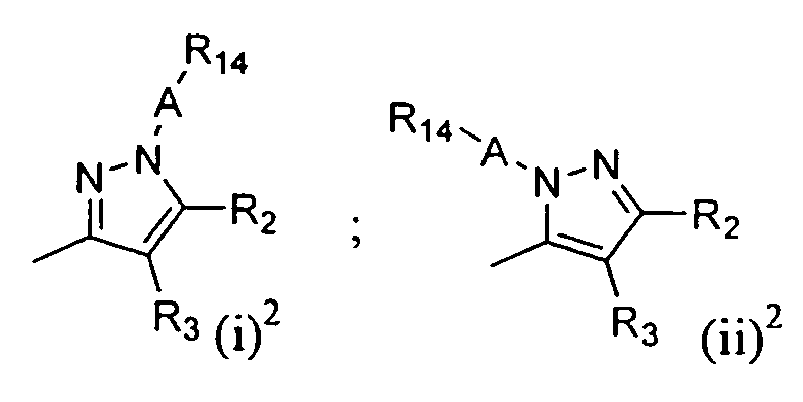

R2-15 are as defined previously with respect to Formula I ; and
X is O or S,
with the proviso that when Het2 is (i)2 or (ii)2 - a) X is O, R2 is methylthio, R1 is H or C(O)R14 wherein R14 is optionally substituted phenyl, at least one of R5-R13 is other than H; or
- b) R1 is C(O)NH2 and X is O, at least one of R2, R3 and R5-R13 is other than H.
- Especially preferred compounds with respect to Formula II include those wherein:
- R14 is amino, optionally substituted C1-C6 alkyl, optionally substituted C1-C6 alkylamino or optionally substituted heterocycle, such as N-morpholinyl, N-pyrrolidinyl and N-piperazinyl;
- R2, R3, and R4 are independently hydrogen, C1-C6 alkyl, C1-C6 alkylthio or C1-C6 alkylsulfinyl; and
- X is O;
- with the proviso that the compound is not 3-(4-phenoxyphenyl)-1H-pyrazole-1-carboxamide.
- Also, preferred compounds of Formula II include those where A is C(O) or CH2C(O), X is O and R14, R2, R3, and R4 are as defined above.
- Further, preferred compounds of Formula II include those where A is S(O) or SO2, preferably SO2, R2-R4 are independently H or C1-6 alkyl and X is O. Also, preferred compounds of Formula II include those where A is S(O) or SO2, preferably SO2, R2-R4 are H, R14 is methyl and X is O.
- Further another group of useful compounds of the invention are those having the Formula III :

Het3 is selected from the group consisting of

R'2 is attached to a carbon atom that is not the linking atom attached to the aryl group and is selected from the group consisting of hydrogen, alkyl, alkenyl, alkynyl, cyano, haloalkyl, aminoalkyl, hydroxyalkyl, alkoxyalkyl, alkylthio, alkylsulfinyl, alkylsulfonyl, carboxyalkyl, alkylamino, dialkylamino, aminocarbonyl, alkylaminocarbonyl, arylaminocarbonyl, aralkylaminocarbonyl, alkylcarbonylamino, arylcarbonylamino, aralkylcarbonylamino, alkylcarbonyl, heterocyclocarbonyl, aminosulfonyl, alkylaminosulfonyl, alkylsulfonyl, and heterocyclosulfonyl;
R'5, R'6, R'9, and R'10 are independently selected from the group consisting of hydrogen, halo, haloalkyl, alkyl, alkenyl, alkynyl, hydroxyalkyl, aminoalkyl, carboxyalkyl, alkoxyalkyl, nitro, amino, ureido, cyano, acylamino, amide, hydroxy, thiol, acyloxy, azido, alkoxy, carboxy, carbonylamido and alkylthiol;
R14 is selected from the group consisting of amino, alkyl, alkenyl, alkynyl, OR16, alkylamino, dialkylamino, alkenylamino, dialkylaminoalkenyl, cycloalkyl, aralkyl, aryl, heteroaryl, arylalkenyl, arylalkenyl, heterocycle, heterocycloalkyl, and cycloalkylalkylamino, all of which can be optionally substituted; wherein
R16 is selected from the group consisting of hydrogen, optionally substituted alkyl, and an alkalimetal; and
X is one of O, S, NR15, CH2, NR15C(O), or C(O)NR15 where R15 is defined as above, with the following provisos that: - 1) when Het is (i)3 or (ii)3,
- a) R'1 is H and X is O or S, at least one of R'2, R'5, R'6, R'9 and R'10 is other than H, except that R'9 or R'10 is not NO2 when R'2 is CH3, and R'2 is not -CH2CH2COOH when the other substituents are each H;
- b) R'1 is H, X is O and R'9 or R'10 is NO2 or OCH3, at least one of the other substituents is other than H;
- c) X is O, R'9 and R'10 are CN and a Cl group ortho to CN, at least one of R'2, R'5 or R'6 is other than H;
- d) X is O, R'5 and R'9 are Cl, at least one of R'6 or R'10 is other than H;
- e) X is O, R'2 is methylthio, R'1 is H or C(O)R14 wherein R14 is optionally substituted phenyl, at least one of R'5, R'6, R'9 or R'10 is other than H; or
- f) R'1 is C(O)NH2 and X is O, at least one of R'2, R'5, R'6, R'9 or R'10 is other than H;
- 2) when Het is (iii)3 , R'1 is H and X is O, R'5, R'6, R'9 or R'10 are not all H;
- 3) when Het is (iv)3 and R'1 is H or alkyl, R'5, R'6, R'9 or R'10 are not all H; or
- 4) when Het is (vi)3, R'1 is H and X is O or S, R'5, R'6, R'9 or R'10 are not all H.
- Preferably X is O or S in compounds of Formula III .
- Preferably, when Het3 is (i)3 or (ii)3, R'1 is heteroaryl, C(O)R14, CH2C(O)R14, or SO2R14 wherein R14 is amino, alkyl, alkylamino or heterocycle, more preferably amino, all of which can be optionally substituted. When R'2 is aminocarbonyl, R'1 is preferably hydrogen.
- Preferably, when Het3 is (vi)3, R'1 is hydrogen and R'2 is selected from the group consisting of aminocarbonyl, alkylaminocarbonyl, alkylcarbonyl, heterocyclocarbonyl, aminosulfonyl, alkylaminosulfonyl, alkylsulfonyl, and heterocyclosulfonyl, preferably aminocarbonyl.
- Preferably, when Het3 is (iii)3, (iv)3 or (v)3, R'1 is hydrogen or alkyl, and R'2 is hydrogen.
- Preferably, R'2 is selected from the group consisting of hydrogen, C1-C6 alkyl, halo(C1-C6)alkyl, amino(C1-C6)alkyl, hydroxy(C1-C6)alkyl, alkoxy(C1-C6)alkyl, C1-C6 alkylthio, C1-C6 alkylsulfinyl, carboxy(C1-C6)alkyl, C1-C6 alkylamino, aminocarbonyl, C1-C6 alkylaminocarbonyl, C1-C6 alkylcarbonyl, heterocyclocarbonyl, aminosulfonyl, C1-C6 alkylaminosulfonyl, C1-C6 alkylsulfonyl, and heterocyclosulfonyl; more preferably hydrogen, alkyl, halo(C1-C6)alkyl, amino(C1-C6)alkyl, alkoxy(C1-C6)alkyl, alkylthio, alkylamino, and aminocarbonyl. Most preferably R'2 is hydrogen or aminocarbonyl.
- Preferably, R'5, R'6, R'9, and R'10 are independently selected from the group consisting of hydrogen, halo, halo(C1-C6)alkyl, C1-C6 alkyl, hydroxy(C1-C6)alkyl, amino(C1-C6)alkyl, carboxy(C1-C6)alkyl, alkoxy(C1-C6)alkyl, nitro, amino, C1-C6 acylamino, amide, hydroxy, thiol, C1-C6 acyloxy, C1-C6 alkoxy, carboxy, carbonylamido and C1-C6 alkylthiol.
- When Het3 is (i)3, (ii)3 or (vi)3, R'2 is preferably attached to a carbon atom adjacent to a nitrogen atom.
- Preferably, Het3 is selected from the group consisting of (i)3, (ii)3, (iii)3, (iv)3 and (v)3.
- One group of preferable compounds of Formula III include compounds wherein Het3 is (i)3 or (ii)3; R'1 is C(O)R14; R'2 is as defined above; R'5, R'6, and R'10 are independently selected from the group consisting of hydrogen, halo, haloalkyl, alkyl, alkenyl, alkynyl, hydroxyalkyl, aminoalkyl, carboxyalkyl, alkoxyalkyl, nitro, amino, ureido, cyano, acylamino, amide, hydroxy, thiol, acyloxy, azido, alkoxy, carboxy, carbonylamido and alkylthiol; R'9 is selected from the group consisting of halo, haloalkyl, alkenyl, alkynyl, hydroxyalkyl, aminoalkyl, carboxyalkyl, alkoxyalkyl, nitro, amino, ureido, cyano, acylamino, amide, hydroxy, thiol, acyloxy, azido, alkoxy, carboxy, carbonylamido and alkylthiol; and R14-16 and X are as defined above.
- Another group of preferable compounds of Formula III include compounds wherein Het3 is (iii)3, (iv)3, (v)3 or (vi)3; R'1 is selected from the group consisting of hydrogen, optionally substituted alkyl, optionally substituted heteroaryl, C(O)R14, CH2C(O)R14, S(O)R14, and SO2R14; R'2 is as defined above; R'5, R'6, and R'10 are independently selected from the group consisting of hydrogen, halo, haloalkyl, alkyl, alkenyl, alkynyl, hydroxyalkyl, aminoalkyl, carboxyalkyl, alkoxyalkyl, nitro, amino, ureido, cyano, acylamino, amide, hydroxy, thiol, acyloxy, azido, alkoxy, carboxy, carbonylamido and alkylthiol; R'9 is selected from the group consisting of halo, haloalkyl, alkenyl, alkynyl, hydroxyalkyl, aminoalkyl, carboxyalkyl, alkoxyalkyl, nitro, amino, ureido, cyano, acylamino, amide, hydroxy, thiol, acyloxy, azido, alkoxy, carboxy, carbonylamido and alkylthiol; and R14-16 and X are as defined above.
- Further another group of useful compounds of the invention are those having the Formula IV:

Het4 is selected from the group consisting of

R'5, R'6, R'9, and R'10 are independently selected from the group consisting of hydrogen, halo, haloalkyl, alkyl, alkenyl, alkynyl, hydroxyalkyl, aminoalkyl, carboxyalkyl, alkoxyalkyl, nitro, amino, ureido, cyano, acylamino, amide, hydroxy, thiol, acyloxy, azido, alkoxy, carboxy, carbonylamido and alkylthiol; and
X is one of O, S, NR15, CH2, NR15C(O), or C(O)NR15 where R15 is defined as above.
Het4 is preferably selected from the group consisting of (vii)4 and (x)4. Preferably, R'2, R'5, R'6, R'9, and R'10 are as described for Formula III . - Exemplary preferred compounds that may be employed in the invention include, without limitation:
- 3-[4-(4-fluorophenoxy)phenyl]-1H-pyrazole;
- 5-methylthio-3-(4-phenoxyphenyl)-1H-pyrazole-1-carboxamide;
- 5-methylsulfinyl-3-(4-phenoxyphenyl)-1H-pyrazole-1-carboxamide;
- 3-[4-(4-fluorophenoxy)phenyl]-1H-pyrazole-1-carboxamide;
- 3-[4-(4-nitrophenoxy)phenyl]-1H-pyrazole-1-carboxamide;
- 3-[4-(4-methoxyphenoxy)phenyl]-1H-pyrazole-1-carboxamide;
- 3-[4-(4-aminophenoxy)phenyl]-1H-pyrazole-1-carboxamide;
- 3-[4-(4-cyanophenoxy)phenyl]-1H-pyrazole-1-carboxamide;
- 3-[4-(3-chloro-2-cyanophenoxy)phenyl]-1H-pyrazole-1-carboxamide;
- 3-[4-(2,4-difluorophenoxy)phenyl]- 1H-pyrazole-1-carboxamide;
- 3-[4-(4-chloro-2-fluorophenoxy)phenyl]-1H-pyrazole-1-carboxamide;
- 3-[4-(2-chloro-4-fluorophenoxy)phenyl]-1H-pyrazole-1-carboxamide;
- 1-[3-[4-(4-nitrophenoxy)phenyl]-1H-pyrazolyl]ethanone;
- 2-methyl-1-[3-(4-phenoxyphenyl)-1H-pyrazole]propanone;
- 1-methanesulfonyl-3-(4-phenoxy)phenyl-1H-pyrazole;
- 2- {5-[4-(4-fluorophenoxy)phenyl]-1H-pyrazol-1-yl}-1-(4-methyl)piperazin-1-yl-ethanone;
- 1-{5-[4-(4-fluorophenoxy)phenyl]-1H-pyrazol-1-yl}-2-methyl-propan-2-ol;
- 1-{5-[4-(4-fluorophenoxy)phenyl]-1H-pyrazol-1-yl}-propan-2-one;
- 1-morpholin-4-yl-2-{5-[4-(4-fluorophenoxy)phenyl]-1H-pyrazol-1-yl}-ethanone;
- 1-[2-(methanesulfonylamino)ethyl]-5-[4-(4-fluorophenoxy)phenyl]-1H-pyrazole;
- 1-(2-carbamoyloxyethyl)-5-[4-(4-fluorophenoxy)phenyl]-1H-pyrazole;
- 3-[4-(4-fluorophenylthio)phenyl]-1H-pyrazole-1-carboxamide;
- 3-[4-(4-fluorophenylthio)phenyl]-1H-pyrazole;
- 2-[5-[4-(4-fluorophenoxy)phenyl]-pyrazol-1-yl]ethanol;
- 3-[4-(4-fluorophenoxy)phenyl]-1H-pyrazole-1-carboxylic acid dimethylamide;
- 1-benzyl-5-[4-(4-fluorophenoxy)phenyl]-1H-pyrazole;
- 2-[3-[4-(4-fluorophenoxy)phenyl]-2H-pyrazol-2-yl]-1-pyrrolidin-1-yl ethanone;
- 2-(N-methylacetamido)-3-[4-(4-fluorophenoxy)phenyl]-2H-pyrazole;
- 2-{5-[4-(4-fluorophenoxy)phenyl]-pyrazol-1-yl}-acetamide;
- 2-{3-[4-(4-fluorophenoxy)phenyl]-pyrazol-1-yl}-acetamide;
- 3-{5-[4-(4-fluorophenoxy)phenyl]-pyrazol-1-yl}-propionamide;
- 3-[3-fluoro-4-(4-fluorophenoxy)phenyl]-1H-pyrazole-1-carboxamide;
- 2-{3-[4-(4-fluorophenoxy)phenyl]-pyrazol-1-yl}-pyrimidine; and
- 2-{3-[4-(4-trifluoromethylphenoxy)phenyl]pyrazol-1-yl}pyrimidine.
- Additional useful compounds of the present invention include:
- 4-[4-(4-fluorophenoxy)phenyl]-1H-imidazole;
- 4-[4-(4-fluorophenoxy)-3-fluorophenyl]-1H-imidazole;
- 4-[4-(4-fluorophenoxy)-3-fluorophenyl]-1H-imidazole, hydrochloride salt;
- 4-[4-(2,4-difluorophenoxy)phenyl]-1H-imidazole;
- 4-[4-(2,4-difluorophenoxy)phenyl]-1H-imidazole, hydrochloride salt;
- 4-[4-(2-fluoro-4-chlorophenoxy)phenyl]-1H-imidazole, hydrochloride salt;
- 4-(4-(4-trifluoromethylphenoxy)phenyl]-1H-imidazole, hydrochloride salt;
- 4-[4-(2,4-difluorophenoxy)phenyl]-2-methyl-1H-imidazole;
- 4-[4-(2,4-difluorophenoxy)phenyl]-1-methyl-1H-imidazole-2-carboxamide;
- 2-[4-(4-fluorophenoxy)phenyl]-1H-imidazole, hydrochloride salt;
- 2-[4-(4-fluorophenoxy)phenyl]-1H-benzimidazole;
- 2-[4-(4-fluorophenoxy)phenyl]-1H-imidazole-4-carboxamide;
- 2-[4-(4-fluorophenoxy)phenyl]-1H-imidazole-4-carbonitrile;
- 5-[4-(4-fluorophenoxy)phenyl]-pyrrole-2-carboxamide;
- 5-(4-phenoxyphenyl)pyrrole-2-carboxamide;
- methyl 5-[4-(4-fluorophenoxy)phenyl]pyrrole-2-carboxylate;
- 2-[4-(4-fluorophenoxy)phenyl]oxazole-4-carboxamide; and
- 4-[4-(4-fluorophenoxy)-3-fluorophenyl]thiazole-2-carboxamide.
- Useful aryl groups are C6-14 aryl, especially C6-10 aryl. Typical C6-14 aryl groups include phenyl, naphthyl, phenanthryl, anthracyl, azulenyl, groups.
- Useful cycloalkyl groups are C3-8 cycloalkyl. Typical cycloalkyl groups include cyclopropyl, cyclobutyl, cyclopentyl, cyclohexyl and cycloheptyl.
- The term "heteroaryl" as employed herein refers to groups having 5 to 14 ring atoms; 6, 10 or 14 π electrons shared in a cyclic array; and containing carbon atoms and 1, 2 or 3 oxygen, nitrogen or sulfur heteroatoms (where examples of heteroaryl groups are: thienyl, benzo[b]thienyl, naphtho[2,3-b]thienyl, thianthrenyl, furyl, benzofuryl, pyranyl, isobenzofuranyl, benzoxazonyl, chromenyl, xanthenyl, phenoxathiinyl, 2H-pyrrolyl, pyrrolyl, imidazolyl, pyrazolyl, pyridyl, pyrazinyl, pyrimidinyl, pyridazinyl, indolizinyl, isoindolyl, 3H-indolyl, indolyl, indazolyl, purinyl, 4H-quinolizinyl, isoquinolyl, quinolyl, phthalazinyl, naphthyridinyl, quinazolinyl, cinnolinyl, pteridinyl, 4aH-carbazolyl, carbazolyl, β-carbolinyl, phenanthridinyl, acridinyl, perimidinyl, phenanthrolinyl, phenazinyl, thiazolyl, isothiazolyl, phenothiazinyl, isoxazolyl, furazanyl, and phenoxazinyl groups).
- Useful halo or halogen groups include fluorine, chlorine, bromine and iodine.
- Useful alkyl groups include straight-chained and branched C1-10 alkyl groups, more preferably C1-6 alkyl groups. Typical C1-10 alkyl groups include methyl, ethyl, propyl, isopropyl, butyl, sec-butyl, tert-butyl, 3-pentyl, hexyl and octyl groups.
- Useful alkenyl groups are C2-6 alkenyl groups, preferably C2-4 alkenyl. Typical C2-4 alkenyl groups include ethenyl, propenyl, isopropenyl, butenyl, and sec-butenyl.
- Useful alkynyl groups are C2-6 alkynyl groups, preferably C2-4 alkynyl. Typical C2-4 alkynyl groups include ethynyl, propynyl, butynyl, and 2-butynyl groups.
- Useful arylalkyl groups include any of the above-mentioned C1-10 alkyl groups substituted by any of the above-mentioned C6-14 aryl groups. Useful values include benzyl, phenethyl and naphthylmethyl.
- Useful arylalkenyl groups include any of the above-mentioned C2-4 alkenyl groups substituted by any of the above-mentioned C6-14 aryl groups.
- Useful arylalkynyl groups include any of the above-mentioned C2-4 alkynyl groups substituted by any of the above-mentioned C6-14 aryl groups. Useful values include phenylethynyl and phenylpropynyl.
- Useful heteroarylalkyl groups include any of the above-mentioned C1-10 alkyl groups substituted by any of the above-mentioned heteroaryl groups.
- Useful heteroarylalkenyl groups include any of the above-mentioned C2-4 alkenyl groups substituted by any of the above-mentioned heteroaryl groups.
- Useful heteroarylalkynyl groups include any of the above-mentioned C2-4 alkynyl groups substituted by any of the above-mentioned heteroaryl groups.
- Useful cycloalkylalkyl groups include any of the above-mentioned C1-10 alkyl groups substituted by any of the above-mentioned cycloalkyl groups.
- Useful haloalkyl groups include C1-10 alkyl groups substituted by one or more fluorine, chlorine, bromine or iodine atoms, e.g. fluoromethyl, difluoromethyl, trifluoromethyl, pentafluoroethyl, 1,1-difluoroethyl and trichloromethyl groups.
- Useful hydroxyalkyl groups include C1-10 alkyl groups substituted by hydroxy, e.g. hydroxymethyl, hydroxyethyl, hydroxypropyl and hydroxybutyl groups.
- Useful alkoxy groups include oxygen substituted by one of the C1-10 alkyl groups mentioned above.
- Useful alkylthio groups include sulfur substituted by one of the C1-10 alkyl groups mentioned above.
- Useful acylamino groups are any C1-6 acyl (alkanoyl) attached to an amino nitrogen, e.g. acetamido, propionamido, butanoylamido, pentanoylamido, hexanoylamido as well as aryl-substituted C2-6 substituted acyl groups.
- Useful acyloxy groups are any C1-6 acyl (alkanoyl) attached to an oxy (-O-) group, e.g. acetoxy, propionoyloxy, butanoyloxy, pentanoyloxy, hexanoyloxy and the like.
- The term heterocycle is used herein to mean saturated or partially unsaturated 3-7 membered monocyclic, or 7-10 membered bicyclic ring system, which consists of carbon atoms and from one to four heteroatoms independently selected from the group consisting of O, N, and S, wherein the nitrogen and sulfur heteroatoms can be optionally oxidized, the nitrogen can be optionally quaternized, and including any bicyclic group in which any of the above-defined heterocyclic rings is fused to a benzene ring, and wherein the heterocyclic ring can be substituted on carbon or on a nitrogen atom if the resulting compound is stable. Examples include, but are not limited to, pyrrolidine, piperazine, morpholine, imidazoline, pyrazolidine, benzodiazepines and the like.
- Useful heterocycloalkyl groups include any of the above-mentioned C1-10 alkyl groups substituted by any of the above-mentioned heterocyclic groups.
- Useful alkylamino and dialkylamino groups are -NHR17 and -NR17R18, wherein R17 and R18 are C1-10 alkyl groups.
- Aminocarbonyl group is -C(O)NH2.
- Useful alkylaminocarbonyl groups are carbonyl groups substituted by -NHR17 and -NR17R18, wherein R17 and R18 are C1-10 alkyl groups as defined above.
- Useful alkylcarbonyl groups are carbonyl groups substituted by any of the above-mentioned C1-10 alkyl groups.
- Useful alkylthiol groups include any of the above-mentioned C1-10 alkyl groups substituted by a -SH group.
- Useful alkylsulfinyl groups include any of the above-mentioned C1-10 alkyl groups attached to a sulfinyl (-SO-).
- Useful alkylsulfonyl groups include any of the above-mentioned C1-10 alkyl groups attached to a sulfonyl (-SO2-).
- Useful alkylaminosulfonyl groups include -NHR17 and -NR17R18 groups attached to a sulfonyl, wherein R17 and R18 are C1-10 alkyl groups as defined above.
- Aminosulfonyl is -SO2NH2.
- A carbamoyloxy group is -O-C(O) NH2.
- A carboxy group is -COOH.
- An azido group is -N3.
- An ureido group is -NH-C(O)-NH2.
- An amino group is -NH2.
- An amide group is an organic radical having -NHC(O)- as a functional group.
- Optional substituents on R1, R'1 and R14-R16 include any one of halo, halo(C1-6) alkyl, aryl, heterocycle, cycloalkyl, C1-6 alkyl, C2-6 alkenyl, C2-6 alkynyl, aryl(C1-6)alkyl, aryl(C2-6)alkenyl, aryl(C2-6)alkynyl, cycloalkyl(C1-6)alkyl, heterocyclo(C1-6)alkyl, hydroxy(C1-6)alkyl, amino(C1-6)alkyl, carboxy(C1-6)alkyl, alkoxy(C1-6)alkyl, nitro, amino, ureido, cyano, C1-6 acylamino, hydroxy, thiol, C1-6 acyloxy, azido, C1-6 alkoxy, carboxy, aminocarbonyl, carbamoyloxy, C1-6 alkylsulfonylamino, C1-6 acyl, and C1-6 alkylthio groups mentioned above. Preferred optional substituents include: halo, halo(C1-6)alkyl, hydroxy(C1-6)alkyl, amino(C1-6)alkyl, hydroxy, nitro, C1-6 alkyl, C1-6 alkoxy, aminocarbonyl, carbamoyloxy, C1-6alkylsulfonylamino, C1-6acyl and amino.
- Unlike the semicarbazones disclosed by
Dimmock et al. in U.S. Patent No. 5,741,818 , which are somewhat flexible molecules, the pyrazoles, imidazoles, oxazoles, thiazoles and pyrroles are much more rigid. In addition, the electronics of the pyrazole, imidazole, oxazole, thiazole and pyrrole ring are very different from that of a semicarbazone. For example, the 2'-nitrogen, present in the semicarbazone is now replaced with the nitrogen atom at the 2-position of the pyrazole and thus is part of the six electron aromatic ring. Unlike the aminoalkanamides described by Pevarello, which contain a basic amine (pKa > 7), the heteroaryl compounds of the invention do not have to be basic. Pyrazole, for example, is half-protonated only at pH 2.5 and substitution with an electron withdrawing carbonyl is expected to reduce its basicity further. In addition, it was found that the primary amides present in the semicarbazones and the aminopropionamides are not necessary for activity as sodium channel blockers in the aryl-pyrazoles and -imidazoles claimed in the present application. Based on these considerations, it is an unexpected finding that the aryl substituted pyrazoles, imidazoles, oxazoles, thiazoles and pyrroles show good activity as sodium channel blockers. - Since the compounds of Formula I are blockers of sodium (Na+) channels, a number of diseases and conditions mediated by sodium ion influx can be treated employing these compounds. Therefore, the invention is related to compounds of Formula I for treating, preventing or ameliorating neuronal loss associated with stroke, global and focal ischemia, CNS trauma, hypoglycemia and surgery, spinal cord trauma; as well as treating or ameliorating neurodegenerative diseases including Alzheimer's disease, amyotrophic lateral sclerosis, Parkinson's disease, treating or ameliorating anxiety, convulsions, glaucoma, migraine headache, and muscle spasm. The compounds of Formula I are also useful as antitinnitus agents, antimanic depressants, as local anesthetics, and as antiarrhythmics; as well as for treating, preventing or ameliorating pain including surgical, chronic and neuropathic pain.
An animal in need of such treatment as described above may be administered an effective amount of sodium channel blocker of the present invention, or a pharmaceutically acceptable salt or prodrug thereof. - The invention disclosed herein is meant to encompass all pharmaceutically acceptable salts thereof of the disclosed compounds. The pharmaceutically acceptable salts include, but are not limited to, metal salts such as sodium salt, potassium salt, secium salt and the like; alkaline earth metals such as calcium salt, magnesium salt and the like; organic amine salts such as triethylamine salt, pyridine salt, picoline salt, ethanolamine salt, triethanolamine salt, dicyclohexylamine salt, N,N'-dibenzylethylenediamine salt and the like; inorganic acid salts such as hydrochloride, hydrobromide, sulfate, phosphate and the like; organic acid salts such as formate, acetate, trifluoroacetate, maleate, tartrate and the like; sulfonates such as methanesulfonate, benzenesulfonate, p-toluenesulfonate, and the like; amino acid salts such as arginate, asparginate, glutamate and the like.
- The invention disclosed herein is also meant to encompass the disclosed compounds being isotopically-labelled by having one or more atoms replaced by an atom having a different atomic mass or mass number. Examples of isotopes that can be incorporated into the disclosed compounds include isotopes of hydrogen, carbon, nitrogen, oxygen, phosphorous, fluorine and chlorine, such as 2H, 3H, 13C, 14C, 15N, 18O, 17O, 31P, 32P, 31S, 18F, and 36Cl, respectively.
- Some of the compounds disclosed herein may contain one or more asymmetric centers and my thus give rise to enantiomers, diastereomers, and other stereoisomeric forms. The present invention is also meant to encompass all such possible forms as well as their racemic and resolved forms and mixtures thereof. When the compounds described herein contain olefinic double bonds or other centers of geometric asymmetry, and unless specified otherwise, it is intended to include both E and Z geometric isomers. All tautomers are intended to be encompassed by the present invention as well.
- As used herein, the term "stereoisomers" is a general term for all isomers of individual molecules that differ only in the orientation of their atoms in space. It includes enantiomers and isomers of compounds with more than one chiral center that are not mirror images of one another (diastereomers).
- The term "chiral center" refers to a carbon atom to which four different groups are attached.
- The term "enantiomer" or "enantiomeric" refers to a molecule that is nonsuperimposeable on its mirror, image and hence optically active wherein the enantiomer rotates the plane of polarized light in one direction and its mirror image rotates the plane of polarized light in the opposite direction.
- The term "racemic" refers to a mixture of equal parts of enantiomers and which is optically inactive.
- The term "resolution" refers to the separation or concentration or depletion of one of the two enantiomeric forms of a molecule.
- The invention is directed to compounds for use in treating disorders responsive to the blockade of sodium channels in animals suffering thereof. Particular preferred embodiments of the aryl substituted heteroaryl compounds this invention are represented by previously defined Formulae I-IV.
- The compounds of this invention may be prepared using methods known to those skilled in the art. The 1H-pyrazoles of the present invention can be prepared as illustrated by exemplary reactions in Scheme 1 and 2. Scheme 1 illustrates the formation of a pyrazole-1-carboxamide from the corresponding 3-substituted-1H-pyrazole using sodium cyanate:

- The 3-substituted-1H-pyrazoles were prepared as shown in Scheme 2 or were commerically available. 3-(4-Phenoxyphenyl)-1H-pyrazole, 3-[(4-nitrophenoxy)phenyl]-1H-pyrazole, 3-[(4-methoxyphenoxy)phenyl]-1H-pyrazole, 5-methylthio-3-(4-phenoxyphenyl)-1H-pyrazole and 3-[(3-chloro-2-cyanophenoxy)phenyl]-1H-pyrazole were obtained from Ryan Scientific (Isle of Palms, SC).

- The 1,5-disubstituted pyrazoles can be prepared as shown in Scheme 3.

- Compounds with Formula I wherein Het is (iii) can be prepared as illustrated by exemplary reactions in Scheme 4.

- Compounds with Formula I where Het is (iv) and (v) can be prepared as illustrated by exemplary reactions in Scheme 5.

- Compounds with Formula I where Het is (vi) can be prepared as illustrated by exemplary reactions in Scheme 6 using the method of Pichon, M. et al. (Tetrahedron Lett. 37: 7963-7966 (1966)) and Fournie-Zaluski, M-C. et al. (J. Med. Chem. 39: 2594-2608 (1996)).

- Compounds with Formula I wherein Het is (vii) can be prepared as illustrated in exemplary reactions in Sceme 7.

- Compounds with Formula I where Het is (x) can be prepared as illustrated by examplary reactions in Scheme 8.

- The invention is also directed to 3H and 14C radiolabeled compounds of Formula I and their use as radioligands for their binding site on the sodium channel. For example, one use of the labeled compounds of the invention is the characterization of specific receptor binding. Another use of the labeled compounds of the invention is an alternative to animal testing for the evaluation of structure-activity relationships. The receptor assay is performed at a fixed concentration of a labeled compound of Formula I and at increasing concentrations of a test compound in a competition assay.
- Tritiated compounds of Formula I can be prepared by introducing tritium into the compound of Formula I by, for example, catalytic dehalogenation with tritium. This method includes reacting a suitably halogen-substituted precursor of a compound of Formula I with tritium gas in the presence of a suitable catalyst, for example Pd/C, in the presence or absence of a base. Other suitable methods for preparing tritiated compounds can be found in Filer, Isotopes in the Physical and Biomedical Sciences, Vol. 1, Labeled Compounds (Part A), Chapter 6. 14C-labeled compounds can be prepared by employing starting materials having a 14C carbon.
- The compounds of the present invention were assessed by electrophysiological assays in dissociated hippocampal neurons for sodium channel blocker activity. These compounds also could be assayed for binding to the neuronal voltage-dependent sodium channel using rat forebrain membranes and [3H]BTX-B.
- Sodium channels are large transmembrane proteins that are expressed in various tissues. They are voltage sensitive channels and are responsible for the rapid increase of Na+ permeability in response to depolarization associated with the action potential in many excitable cells including muscle, nerve and cardiac cells.
- One aspect of the present invention is the discovery of the mechanism of action of the compounds herein described as specific Na+ channel blockers. Based upon the discovery of this mechanism, these compounds are contemplated to be useful in treating or preventing neuronal loss due to focal or global ischemia, and in treating or preventing neurodegenerative disorders including ALS, anxiety, and epilepsy. They are also expected to be effective in treating, preventing or ameliorating neuropathic pain, surgical pain, chronic pain and tinnitus. The compounds are also expected to be useful as antiarrhythmics, anesthetics and antimanic depressants.
- The present invention is directed to compounds of Formulae I-IV that are blockers of voltage-sensitive sodium channels. According to the present invention, those compounds having preferred sodium channel blocking properties exhibit an IC50 of about 100 µM or less in the electrophysiological assay described herein. Preferably, the compounds of the present invention exhibit an IC50 of 10 µM or less. Most preferably, the compounds of the present invention exhibit an IC50 of about 1.0 µM or less. Substituted heteroaryl compounds of the present invention may be tested for their Na+ channel blocking activity by the following electrophysiological and binding assays.
- Cell preparation: HEK-293 cells stably expressing the hSkM1 isoform of Na+ channels (generous gift from Dr. A. L. George, Vanderbilt University Medical School) were cultured using standard techniques, as described previously (Verdoorn, T.A, et al., Neuron 4:919-928 (1990)). For electrophysiology, cells were plated onto 35 mm Petri dishes (pre-coated with poly-D-lysine) at a density of 1:40 on the day of re-seeding from confluent cultures. Our experience has been that cells are suitable for recordings for 2-3 days after plating.
- Patch-clamp recordings of voltage-sensitive Na+ currents: Whole-cell voltage-clamp recordings were made using conventional patch-clamp techniques (Hamill et al., Pfluegers Arch. 391:85-100 (1981)) with an Axopatch 200A amplifier (Axon Instruments, Foster City, CA). Recordings were made within 2-3 hours after neuron dissociation.The recording chamber was continuously superfused with the external solution (150 mM Nad, 5.4 mM KCI, 1.8 mM CaCl2, 1 mM MgCl2, 10 mM HEPES, 10 mM glucose, pH 7.4 (NaOH)) at a speed of about 1 mL/min. Recording pipettes were pulled from thick-walled capillaries (WPI, Sarasota, Fl) and fire-polished. The pipette resistances ranged from 1 to 3 MΩ when the pipettes were filled with internal solution containing (in mM): 110 CsF, 10 NaCl, 5 MgCl2, 11 EGTA, 10 HEPES, pH adjusted to 7.4 with CsOH. Osmolality was set with a difference of 15-20 mmol/kg between external and internal solutions (lower inside the cell). Drugs and intervening wash-outs were applied through a linear array of flow pipes (Drummond Microcaps, 2 µL, 64-mm length). Compounds are dissolved in dimethylsulfoxide (DMSO) to make a 30 mM stock solution, which was subsequently diluted into the external solution to give final concentrations of 0.1-100 µM. At the highest (1%) concentration, DMSO inhibited the size of Na+ current only slightly. Currents were recorded at room temperature (22-25°C), filtered at 5 kHz with an active 8-pole Bessel filter (Frequency Devices, Haverhill, MA), digitized at 10-50 µs intervals, and stored using Digidata 1200 analog/digital interface with Pclamp6/Clampex software (Axon Instruments). Series resistance was cancelled typically by ∼75% when necessary. The inhibitory potency of drugs was assessed by measuring reductions in the peak amplitude of Na+ currents induced by increasing concentrations of compounds tested. Na+ currents were elicited by stepping membrane voltage from holding potentials over the range -100 mV to -50 mV, to a pulse potential of -10 mV. The test pulse duration was 5-10 msec, repeated at a frequency ≤ 1 Hz. Concentration-inhibition curves were fitted with equation 1:

where Icontrol is the maximal Na+ current in the absence of antagonist, [compound] is the drug concentration, and IC50 is the concentration of compound that produces half maximal inhibition. - Cell preparation: HEK-293 (NaIIA-B2) cell line stably expressing the rBIIA isoform of Na+ channels was established in-house. The cells were cultured using standard techniques, as described previously (Verdoorn, T.A, et al., Neuron 4:919-928 (1990)). For electrophysiology, cells were plated onto poly-D-lysine pre-coated Cellware 35 mm Petri dishes (BIOCOAT, Becton Dickinson) at a density of ∼104 cells/dish on the day of re-seeding from confluent cultures. Our experience has been that cells are suitable for recordings for 2-3 days after plating.
- Palch-clamp recordings of voltage-sensitive Na+ currents: Whole-cell voltage-clamp recordings were made using conventional patch-clamp techniques (Hamill et al., Pfluegers Arch. 391:85-100 (1981)) with an Axopatch 200A amplifier (Axon Instruments, Foster City, CA). The recording chamber was continuously superfused with the external solution (150 mM NaCl, 5.4 mM KCl, 1.8 mM CaCl2, 1 mM MgCl2, 10 mM HEPES, 10 mM glucose, pH 7.4 adjusted with NaOH, osmolality ∼320 mmol/kg) at a speed of about 1 mL/min. Recording pipettes were pulled from the thick-walled capillaries (WPI, Sarasota, Fl) and fire-polished. The pipette resistances ranged from I to 3 MΩ when the pipettes were filled with internal solution containing (in mM): 130 CsF, 20 NaCl, 2 MgCl2, 10 EGTA, 10 HEPES, pH adjusted to 7.4 with CsOH, osmolality ∼310 mmol/kg. Drugs and intervening wash-outs were applied through a linear array of flow pipes (Drummond Microcaps, 2 µL, 64-mm length). Compounds are dissolved in dimethylsulfoxide (DMSO) to make a 30 mM stock solution, which was subsequently diluted into the external solution to give final concentrations of 0.1-100 µM. At the highest (1 %) concentration, DMSO inhibited the size of Na+ current only slightly. Currents were recorded at room temperature (22-25 °C), filtered at 3 kHz with an active 8-pole Bessel filter (Frequency Devices, Haverhill, MA), digitized at 10-50 µs intervals, and stored using Digidata 1200 analog/digital interface with Pclamp6/Clampex software (Axon Instruments). Series resistance was cancelled typically by ∼75% when necessary.
- The following voltage pulse protocols were used to assess the potency and kinetics of inhibition of the Na+ channels by the compounds (Fig. 1).


where Icontrol is the maximal Na+ current in the absence of antagonist, [antagonist] is the drug concentration, Ki is the concentration of antagonist that produces half maximal inhibition, and p is the slope factor. - The ability of compounds of the present invention to modulate either site 1 or site 2 of the Na+ channel was determined following the procedures fully described in Yasushi, J. Biol. Chem. 261:6149-6152 (1986) and Creveling, Mol. Pharmacol. 23:350-358 (1983), respectively. Rat forebrain membranes were used as sources of Na- channel proteins. The binding assays were conducted in 130 µM choline chloride at 37°C for 60-minute incubation with [3H] saxitoxin and [3H] batrachotoxin as radioligands for site 1 and site 2, respectively.
- The compounds of the present invention may be tested for in vivo anticonvulsant activity after i.v., p.o. or i.p. injection using a number of anticonvulsant tests in mice, including the maximum electroshock seizure test (MES). Maximum electroshock seizures were induced in male NSA mice weighing between 15-20 g and male Sprague-Dawley rats weighing between 200-225 g by application of current (50 mA. 60 pulses/sec, 0.8 msec pulse width, 1 sec duration, D.C., mice; 99 mA, 125 pulses/sec, 0.8 msec pulse width, 2 sec duration, D.C., rats) using a Ugo Basile ECT device (Model 7801). Mice were restrained by gripping the loose skin on their dorsal surface and saline-coated corneal electrodes were held lightly against the two corneae. Rats were allowed free movement on the bench top and ear-clip electrodes were used. Current was applied and animals were observed for a period of up to 30 seconds for the occurrence of a tonic hindlimb extensor response. A tonic seizure was defined as a hindlimb extension in excess of 90 degrees from the plane of the body. Results were treated in a quantal manner.
- The compounds may be tested for their antinociceptive activity in the formalin model as described in Hunskaar, S., O. B. Fasmer, and K. Hole. J. Neurosci. Methods 14: 69-76 (1985). Male Swiss Webster NIH mice (20-30 g; Harlan. San Diego, CA) were used in all experiments. Food was withdrawn on the day of experiment. Mice were placed in Plexiglass jars for at least 1 hour to accommodate to the environment. Following the accommodation period mice were weighed and given either the compound of interest administered i.p. or p.o., or the appropriate volume of vehicle (10 % Tween-80). Fifteen minutes after the i.p. dosing, and 30 minutes after the p.o. dosing mice were injected with formalin (20 µL of 5% formaldehyde solution in saline) into the dorsal surface of the right hind paw. Mice were transferred to the Plexiglass jars and monitored for the amount of time spent licking or biting the injected paw. Periods of licking and biting were recorded in 5 minute intervals for 1 hour after the formalin injection. All experiments were done in a blinded manner during the light cycle. The early phase of the formalin response was measured as licking / biting between 0-5 min, and the late phase was measured from 15-50 min. Differences between vehicle and drug treated groups were analyzed by one-way analysis of variance (ANOVA). A P value ≤0.05 was considered significant. Having activity in blocking the acute and second phase of formalin-induced paw-licking activity, the compounds are considered to be efficacious for acute and chronic pain.
- The compounds may be tested for their potential for the treatment of chronic pain (antiallodynic and antihyperalgesic activities) in the Chung model of peripheral neuropathy. Male Sprague-Dawley rats weighing between 200-225 g were anesthetized with halothane (1-3 % in a mixture of 70 % air and 30 % oxygen) and their body temperature controlled during anesthesia through use of a homeothermic blanket. A 2-cm dorsal midline incision was then made at the L5 and L6 level and the para-vertibral muscle groups retracted bilaterally. L5 and L6 spinal nerves were then be exposed, isolated, and tightly ligated with 6-0 silk suture. A sham operation was performed exposing the contralateral L5 and L6 spinal nerves as a negative control.
- Tactile Allodynia: Rats were transferred to an elevated testing cage with a wire mesh floor and allowed to acclimate for five to ten minutes. A series of Semmes-Weinstein monofilaments were applied to the plantar surface of the hindpaw to determine the animal's withdrawal threshold. The first filament used possessed a buckling weight of 9.1 gms (.96 log value) and was applied up to five times to see if it elicited a withdrawal response. If the animal had a withdrawal response then the next lightest filament in the series would be applied up to five times to determine if it could elicit a response. This procedure was repeated with subsequent lesser filaments until there was no response and the lightest filament that elicited a response was recorded. If the animal did not have a withdrawal response from the initial 9.1 gms filament then subsequent filaments of increased weight were applied until a filament elicited a response and this filament was then recorded. For each animal, three measurements were made at every time point to produce an average withdrawal threshold determination. Tests were performed prior to and at 1, 2, 4 and 24 hours post drug administration. Tactile allodynia and mechanical hyperalgesia tests were conducted concurrently.
- Mechanical Hyperalgesia: Rats were transferred to an elevated testing cage with a wire mesh floor and allowed to acclimate for five to ten minutes. A slightly blunted needle was touched to the plantar surface of the hindpaw causing a dimpling of the skin without penetrating the skin. Administration of the needle to control paws typically produced a quick flinching reaction, too short to be timed with a stopwatch and arbitrarily given a withdrawal time of 0.5 sec. The operated side paw of neuropathic animals exhibited an exaggerated withdrawal response to the blunted needle. A maximum withdrawal time of ten seconds was used as a cutoff time. Withdrawal times for both paws of the animals were measured three times at each time point with a five-minute recovery period between applications. The three measures were used to generate an average withdrawal time for each time point. Tactile allodynia and mechanical hyperalgesia tests were conducted concurrently.
- The compounds may be tested for their neuroprotective activity after focal and global ischemia produced in rats or gerbils according to the procedures described in Buchan et al. (Stroke, Suppl. 148-152 (1993)) and Sheardown et al. (Eur. J. Pharmacol. 236:347-353 (1993)) and Graham et al. (J. Pharmacol. Exp. Therap. 276:1-4 (1996)).
- The compounds may be tested for their neuroprotective activity after traumatic spinal cord injury according to the procedures described in Wrathall et. al. (Exp. Neurology 137:119-126 (1996)) and Iwasaki et. al. (J. Neuro Sci. 134:21-25 (1995)).
- Compositions within the scope of this invention include all compositions wherein the compounds of the present invention are contained in an amount that is effective to achieve its intended purpose. While individual needs vary, determination of optimal ranges of effective amounts of each component is within the skill of the art. Typically, the compounds may be administered to mammals, e.g. humans, orally at a dose of 0.0025 to 50 mg/kg, or an equivalent amount of the pharmaceutically acceptable salt thereof, per day of the body weight of the mammal being treated for epilepsy, neurodegenerative diseases, anesthetic, arrhythmia, manic depression, and pain. For intramuscular injection, the dose is generally about one-half of the oral dose.
- In the method of treatment or prevention of neuronal loss in global and focal ischemia, brain and spinal cord trauma, hypoxia, hypoglycemia, status epilepsy and surgery, the compound can be administrated by intravenous injection at a dose of about 0.025 to about 10 mg/kg.
- The unit oral dose may comprise from about 0.01 to about 50 mg, preferably about 0.1 to about 10 mg of the compound. The unit dose may be administered one or more times daily as one or more tablets each containing from about 0.1 to about 10, conveniently about 0.25 to 50 mg of the compound or its solvates.
- In addition to administering the compound as a raw chemical, the compounds of the invention may be administered as part of a pharmaceutical preparation containing suitable pharmaceutically acceptable carriers comprising excipients and auxiliaries which facilitate processing of the compounds into preparations which can be used pharmaceutically. Preferably, the preparations, particularly those preparations which can be administered orally and which can be used for the preferred type of administration, such as tablets, dragees, and capsules, and also preparations which can be administered rectally, such as suppositories, as well as suitable solutions for administration by injection or orally, contain from about 0.01 to 99 percent, preferably from about 0.25 to 75 percent of active compound(s), together with the excipient.
- Also included within the scope of the present invention are the non-toxic pharmaceutically acceptable salts of the compounds of the present invention. Acid addition salts are formed by mixing a solution of the particular heteroaryl compound of the present invention with a solution of a pharmaceutically acceptable non-toxic acid such as hydrochloric acid, fumaric acid, maleic acid, succinic acid, acetic acid, citric acid, tartaric acid, carbonic acid, phosphoric acid, oxalic acid, dichloroacetic acid, and the like. Basic salts are formed by mixing a solution of the heteroaryl compound of the present invention with a solution of a pharmaceutically acceptable non-toxic base such as sodium hydroxide, potassium hydroxide, choline hydroxide, sodium carbonate and the like.
- The pharmaceutical compositions of the invention may be administered to any animal that may experience the beneficial effects of the compounds of the invention. Foremost among such animals are mammals, e.g., humans, although the invention is not intended to be so limited.
- The pharmaceutical compositions of the present invention may be administered by any means that achieve their intended purpose. For example, administration may be by parenteral, subcutaneous, intravenous, intramuscular, intraperitoneal, transdermal, or buccal routes. Alternatively, or concurrently, administration may be by the oral route. The dosage administered will be dependent upon the age, health, and weight of the recipient, kind of concurrent treatment, if any, frequency of treatment, and the nature of the effect desired.
- The pharmaceutical preparations of the present invention are manufactured in a manner which is itself known, for example, by means of conventional mixing, granulating, dragee-making, dissolving, or lyophilizing processes. Thus, pharmaceutical preparations for oral use can be obtained by combining the active compounds with solid excipients, optionally grinding the resulting mixture and processing the mixture of granules, after adding suitable auxiliaries, if desired or necessary, to obtain tablets or dragee cores.
- Suitable excipients are, in particular, fillers such as saccharides, for example lactose or sucrose, mannitol or sorbitol, cellulose preparations and/or calcium phosphates, for example tricalcium phosphate or calcium hydrogen phosphate, as well as binders such as starch paste, using, for example, maize starch, wheat starch, rice starch, potato starch, gelatin, tragacanth, methyl cellulose, hydroxypropylmethylcellulose, sodium carboxymethylcellulose, and/or polyvinyl pyrrolidone. If desired, disintegrating agents may be added such as the above-mentioned starches and also carboxymethyl-starch, cross-linked polyvinyl pyrrolidone, agar, or alginic acid or a salt thereof, such as sodium alginate. Auxiliaries are, above all, flow-regulating agents and lubricants, for example, silica, talc, stearic acid or salts thereof, such as magnesium stearate or calcium stearate, and/or polyethylene glycol. Dragee cores are provided with suitable coatings which, if desired, are resistant to gastric juices. For this purpose, concentrated saccharide solutions may be used, which may optionally contain gum arabic, talc, polyvinyl pyrrolidone, polyethylene glycol and/or titanium dioxide, lacquer solutions and suitable organic solvents or solvent mixtures. In order to produce coatings resistant to gastric juices, solutions of suitable cellulose preparations such as acetylcellulose phthalate or hydroxypropymethyl-cellulose phthalate, are used. Dye stuffs or pigments may be added to the tablets or dragee coatings, for example, for identification or in order to characterize combinations of active compound doses.
- Other pharmaceutical preparations which can be used orally include push-fit capsules made of gelatin, as well as soft, sealed capsules made of gelatin and a plasticizer such as glycerol or sorbitol. The push-fit capsules can contain the active compounds in the form of granules which may be mixed with fillers such as lactose, binders such as starches, and/or lubricants such as talc or magnesium stearate and, optionally, stabilizers. In soft capsules, the active compounds are preferably dissolved or suspended in suitable liquids, such as fatty oils, or liquid paraffin. In addition, stabilizers may be added.
- Possible pharmaceutical preparations, which can be used rectally, include, for example, suppositories, which consist of a combination of one or more of the active compounds with a suppository base. Suitable suppository bases are, for example, natural or synthetic triglycerides, or paraffin hydrocarbons. In addition, it is also possible to use gelatin rectal capsules which consist of a combination of the active compounds with a base. Possible base materials include, for example, liquid triglycerides, polyethylene glycols, or paraffin hydrocarbons.
- Suitable formulations for parenteral administration include aqueous solutions of the active compounds in water-soluble form, for example, water-soluble salts and alkaline solutions. In addition, suspensions of the active compounds as appropriate oily injection suspensions may be administered. Suitable lipophilic solvents or vehicles include fatty oils, for example, sesame oil, or synthetic fatty acid esters, for example, ethyl oleate or triglycerides or polyethylene glycol-400 (the compounds are soluble in PEG-400). Aqueous injection suspensions may contain substances which increase the viscosity of the suspension, and include, for example, sodium carboxymethyl cellulose, sorbitol, and/or dextran. Optionally, the suspension may also contain stabilizers.
- The following examples are illustrative, but not limiting of the present invention. Other suitable modifications and adaptations of the variety of conditions and parameters normally encountered in clinical therapy and which are obvious to those skilled in the art are within the scope of the invention as defined in the appended claims.
-
- a) 1-[4-(4-Fluorophenoxy)phenyl]ethanone: A mixture of 4'-fluoroacetophenone (2.2 mL, 17.9 mmol), 4-fluorophenol (2.34 g, 20.6 mmol), and potassium carbonate (5.2 g, 38 mmol) in DMF (17 mL) was refluxed for 16 hours. The mixture was diluted with ethyl acetate and washed several times with an aqueous sodium hydroxide solution (2 N). The organic layer was separated, dried over sodium sulfate, filtered, and evaporated under reduced pressure to give 1-[4-(4-fluorophenoxy)phenyl]ethanone. 1H NMR (CDCl3): δ 7.93 (d, J = 8.7 Hz, 2H), 7.09-7.04 (m, 4H), 6.96 (d, J = 8.4 Hz, 2H), 2.57 (s, 3H).
- b) 3-[4-(4-Fluorophenoxy)phenyl]-1H-pyrazole. A mixture of crude 1-[4-(4-fluorophenoxy)phenyl]ethanone (17.9 mmol) and N,N-dimethylformamide dimethylacetal (2.6 mL, 18.4 mmol) in DMF (20 mL) was refluxed for 24 hours. The solution was then partitioned between ethyl acetate and water. The aqueous layer was extracted twice with ethyl acetate and the combined ethyl acetate layers were washed twice with water, dried over sodium sulfate, filtered, and evaporated under reduce pressure to give a yellow solid. The solid was dissolved in ethanol and neat hydrazine hydrate (2.2 mL, 70 mmol) was added. The solution was refluxed for 6 hours. After cooling to room temperature, the reaction was partitioned between ethyl acetate and water. The aqueous layer was extracted twice with ethyl acetate. The combined ethyl acetate layers were washed several times with water, dried over sodium sulfate, and evaporated under reduced pressure to give 4.4 g (97% crude yield) of 3-[4-(4-fluorophenoxy)phenyl]-1H-pyrazole. 1H NMR (CDCl3): δ 10.6 (bs, 1H), 7.71 (d, J = 8.4 Hz, 2H), 7.60 (d, J = 2.1 Hz, 1H), 7.04-6.99 (m, 6H), 6.57 (d, J = 2.4 Hz, 1H).
- c) 3-[4-(4-Fluorophenoxy)phenyl]-1H-pyrazole-1-carboxamide. A solution of crude 3-[4-(4-fluorophenoxy)phenyl]-1H-pyrazole (4.4 g, 17.3 mmol) in glacial acetic acid (60 mL) and water (5 mL) was treated with a solution of sodium cyanate (1.4 g, 21 mmol) in 5 mL of water. After stirring at room temperature for 16 hours, the reaction was diluted with water, giving a solid precipitate. The crude product was filtered, dried and purified by column chromatography to give 2.79 g (52%) of the title compound as solid, mp 141-143 °C. 1H NMR (DMSO-d6): δ 8.28 (d, J = 3.0 Hz, 1H), 7.94 (d, J = 8.7 Hz, 2H), 7.84 (bs, 2H), 7.24 (t, J = 8.4 Hz, 2H), 7.13-7.08 (m, 2H), 7.04 (d, J = 8.4 Hz, 2H), 6.94 (d, J = 2.7 Hz, 1H).
- The following pyrazole-1-carboxamides were prepared by using a similar procedure:
- 3-[4-(2,4-Difluorophenoxy)phenyl]-1H-pyrazole-1-carboxamide; mp132-134 °C. 1H NMR (CDCl3): δ 8.24 (d, J = 2.7 Hz, 1H), 7.79 (d, J = 8.7 Hz, 2H), 7.15-7.08 (m, 2H), 6.99 (d, J = 8.4 Hz, 2H), 6.94-6.85 (m, 1H), 6.67 (d, J = 3.0 Hz, 1H), 5.30 (bs. 2H).
- 3-[4-(4-Chloro-2-fluorophenoxy)phenyl]- 1H-pyrazole-1-carboxamide; mp 150-151 °C. 1H NMR (CDCl3): δ 8.24 (d, J = 2.4 Hz, 1H). 7.80 (d, J = 8.7 Hz. 2H), 7.23 (d, J = 10.0 Hz, 1H), 7.13 (d, J = 9.6 Hz, 1H), 7.06 (d. J = 8.4 Hz.1H), 7.02 (d, J = 8.7 Hz, 2H), 6.68 (d, J = 3.0 Hz, 1H), 5.25 (bs, 2H).
- 3-[4-(4-Trifluoromethylphenoxy)phenyl]-1H-pyrazole-1-carboxamide; mp 131-132 °C. 1H NMR (CDCl3): δ 8.27 (d, 1H, J = 2.7 Hz), 7.86 (d, 2H, J = 8.4 Hz), 7.59 (d, 2H, J = 8.4 Hz), 7.16 (br s, 1H), 7.11 (d, 2H, J = 8.4 Hz), 7.09 (d, 2H, J = 8.4 Hz), 6.71 (d, 1H, J = 2.7 Hz), 5.81 (br s, 1H). The compound was prepared from 3-[4-(4-trifluoromethylphenoxy)phenyl]-1H-pyrazole, mp 102-104 °C, Rf 0.33 (7/3 hexane/EtOAc), which in turn was prepared from 1-[4-(4-trifluoromethylphenoxy)phenyl]ethanone using the procedure described for the synthesis of 3-[4-(4-fluoromethylphenoxy)phenyl]-1H-pyrazole.
- 3-[4-(2-chloro-4-fluorophenoxy)phenyl]-1H-pyrazole-1-carboxamide can also be prepared by a similar method.
- The following 3-substituted-pyrazole-1-carboxamides were prepared from the commercially available 3-substituted-1H-pyrazoles (Ryan Scientific, Isle of Palms, SC) as described for the conversion of 3-[4-(4-fluorophenoxy)phenyl]-1H-pyrazole to 3-[4-(4-fluorophenoxy)phenyl]-1H-pyrazole-1-carboxamide:
- 3-[4-(4-Methoxyphenoxy)phenyl]-1H-pyrazole-1-carboxamide; mp 156-159 °C: 1H NMR (CDCl3): δ 8.23 (d, J = 2.4 Hz, 1H), 7.77 (d, J = 8.7 Hz, 2H), 7.14 (bs, 1H), 7.00 (dd, J = 9.0, 7.8 Hz, 4H), 6.90 (d, J = 9.3 Hz, 2H), 6.67 (d, J = 2.4 Hz, 1H), 5.25 (bs, 1H), 8.32 (s, 3H).
- 5-Methylthio-3-(4-phenoxyphenyl)-1H-pyrazole-1 -carboxamide; mp 142-144 °C: 1H NMR (CDCl3): δ 7.77 (d, J = 8.7 Hz, 2H), 7.37 (t, J = 8.4 Hz, 2H), 7.14 (t, J = 7.2 Hz, 1H), 7.07-7.04 (m, 4H), 6.34 (s, 1H), 5.20 (bs, 2H), 2.53 (s, 3H).
- 3-[4-(4-Nitrophenoxy)phenyl]-1H-pyrazole-1-carboxamide; mp 145-147 °C; 1H NMR (CDCl3): δ 8.28 (d, J = 2.4 Hz, 1H), 8.23 (d, J = 9.0 Hz, 2H), 7.91 (d, J = 8.4 Hz. 2H), 7.16 (d, J = 8.7 Hz, 2H), 7.07 (d, J = 9.3 Hz, 2H), 6.73 (d, J = 3.0 Hz, 1H), 5.3 (bs, 2H).
- 3-[4-(3-Chloro-2-cyanophenoxy)phenyl]-1H-pyrazole-1-carboxamide; mp 180-181 °C; 1H NMR (CDCl3): δ 8.27 (d, J = 3.0 Hz, 1H), 7.90 (d, J = 8.4 Hz, 2H), 7.40 (d, J = 8.1 Hz, 1H), 7.21 (d, J = 8.1 Hz, 1H), 7.16 (d, J = 8.4 Hz, 2H), 6.80 (d, J = 8.4 Hz, 1H), 6.72 (d, J = 3.0 Hz, 1H), 5.27 (bs, 2H).
- To a solution of 5-thiomethyl-3-(4-phenoxyphenyl)-1H-pyrazole-1-carboxamide (122 mg, 0.375 mmol) in CHCl3 at 0 °C was added solid m-chloroperoxybenzoic acid (57-86%; 129 mg). After several hours at 0 °C, solid Na2S2O3 was added and the mixture was stirred overnight. The reaction was added to a water/EtOAc mixture. The aqueous layer was washed with EtOAc and the pooled EtOAc layers were dried (Na2SO4)' filtered, and concentrated to dryness. Column chromatography (1:1 hexane/EtOAc) gave 74 mg (58%) of the sulfoxide as a white solid, mp 92°C. 1H NMR (CDCl3): δ 7.79 (d, 2H, J = 8.7 Hz), 7.38 (t, 2 H, J = 8.0 Hz), 7.29 (s, 1H), 7.14 (t, 1H, J = 7.2 Hz), 7.06 (d, 4H, J = 8.4 Hz), 5.45 (br s, 2H), 3.05 (s, 3H).
- A solution of 3-[4-(4-nitrophenoxy)phenyl]-1H-pyrazole-1-carboxamide (100 mg. 0.308 mmol) in ethanol was flushed with nitrogen for 5 min, then palladium (10% on carbon, 20 mg) was added. The mixture was shaken under 40 psi of hydrogen for 16 hours. The mixture was then filtered through a bed of Celite and the solvent was removed in vacuo. The crude product was purified by column chromatography to give 57 mg (60%) of the title compound as a solid, mp 158-160 °C. 1H NMR (CDCl3): δ 8.22 (d, J = 3.0 Hz, 1H), 7.75 (d, J = 8.7 Hz, 2H), 6.98 (d, J = 8.7 Hz, 2H), 7.10 (bs, 1H). 6.90 (d, J = 9.0 Hz, 2H), 6.70 (d, J = 9.0 Hz, 2H), 6.66 (d. J = 3.0 Hz, 1H), 5.25 (bs. 1H), 3.61 (bs, 2H).
- A solution of 3-[4-(3-chloro-2-cyanophenoxy)phenyl]-1H-pyrazole-1-carboxamide (65 mg, 0.192 mmol) in ethanol formed upon heating. The solution was allowed to cool to room temperature, purged with nitrogen for 5 minutes, and 10% palladium on carbon (25 mg) was added. The mixture was stirred for 16 hours under a balloon filled with hydrogen. The mixture was then filtered through a bed of Celite and the filtrate was partitioned between water and ethyl acetate. The aqueous layer was extracted with ethyl acetate. The combined ethyl acetate layers were dried over sodium sulfate, filtered, and evaporated under reduced pressure to give the crude product. Purification by column chromatography (60:40 hexane/ethyl acetate) afforded 15 mg (26%) of the title compound as a solid. TLC Rf = 0.38 (60:40 hexane/ethyl acetate). 1H NMR (CDCl3): δ 8.26 (d, J = 2.4 Hz, 1H), 7.88 (d, J = 9.0 Hz. 2H), 7.69 (dd, J = 7.5, 1.5 Hz, 1H), 7.53-7.47 (m, 1H), 7.20-7.14 (m, 1H), 7.15 (d, J = 9.0 Hz, 2H), 6.93 (d, J = 8.7 Hz, 1H), 6.72 (d, J = 2.7 Hz, 1H), 5.30 (bs, 2H).
- A solution of 3-[4-(4-nitrophenoxy)phenyl]-1H-pyrazole (0.16 g, 0.57 mmol) in pyridine (12 mL) was treated with neat acetic anhydride (1.0 mL, 1.0 mmol) and allowed to stir at room temperature for 16 hours. The reaction was then diluted with ethyl acetate, washed several times with an aqueous 2N HCl solution, dried over sodium sulfate, and evaporated under reduced pressure. The crude product was purified by column chromatography, affording 116 mg (63%) of the title compound. TLC Rf 0.78 (70:30 hexane/ethyl acetate). 1H NMR (CDCl3): δ 8.31 (d, J = 3.0 Hz, 1H). 8.22 (d, J = 9.3 Hz, 2H), 7.94 (d, J = 8.7 Hz, 2H), 7.17 (d, J = 9.0 Hz, 2H), 7.07 (d. J = 9.3 Hz, 2H), 6.77 (d, J = 3.0 Hz, 1H), 2.78 (s, 3H).
- A mixture of 3-(4-phenoxyphenyl)-1H-pyrazole (123 mg, 0.52 mmol) and NaH (28 mg, 0.70 mmol) in 5 mL of DMF was stirred at room temperature for 30 minutes. Neat isobutyryl chloride (80 µL, 0.75 mmol) was added and the reaction was stirred at room temperature. The reaction was then partitioned between water and EtOAc. The aqueous layer was extracted twice with EtOAc and the pooled organic layers were dried (Na2SO4), filtered and concentrated in vacuo. Column chromatography (5% EtOAc/hexane) gave 127 mg (80%) of the title compound as a white solid, mp 49-51 °C. 1H NMR (CDCl3): δ 8.3 (d, J=3.0 Hz, 1H), 7.88 (d, J=8.7 Hz, 2H), 7.39 (t, J=8.0 Hz, 2H), 7.17 (t, J=7.2 Hz, 2H), 7.12-7.08 (m, 4H), 6.75 (d, J=3.0 Hz, 1H), 4.03 (m, 1H), 1.78 (d, J=6.9 Hz, 6H).
- To a solution of 3-(4-phenoxyphenyl)-1H-pyrazole (125 mg, 0.529 mmol) in pyridine (10 mL) at room temperature was added neat methanesulfonyl chloride (50 µL, 0.64 mmol). After stirring overnight at room temperature, the reaction was diluted with water. Column chromatography afforded 152 mg (91 %) of the title compound as white solid, mp 136°C. 1H NMR (CDCl3): δ 8.06 (d, J = 3.0 Hz, 1H), 7.84 (d, J = 8.7 Hz, 2H), 7.37 (t, J = 8.7 Hz, 2H), 7.14 (t, J = 7.5 Hz, 1H), 7.06 (d, J = 8.7 Hz, 2H), 7.06-7.04 (m, 2H), 6.72 (d, J = 3.0 Hz, 1H), 3.38 (s, 3H).
-
- a) 2-[2-[5-[4-(4-Fluorophenoxy)phenyl]pyrazol-1-yl]ethyl]-isoindole-1,3-dione. A solution of 2-[5-[4-(4-fluorophenoxy)phenyl]-pyrazol-1-yl]ethanol (210 mg, 0.704 mmol), triphenylphosphine (249 mg, 0.949 mmol) and phthalimide (149 mg, 1.01 mmol) in 5 mL of dry THF was cooled in an ice-water bath and neat diethyl azodicarboxylate (145 µL, 160 mg, 0.919 mmol) was added dropwise via syringe. The resulting yellow solution was stirred at room temperature overnight. TLC (9:1 CH2Cl2/EtOAc) indicated the reaction was not complete and it was allowed to stir at room temperature for an additional 24 hours. The reaction was then cooled in an ice-water bath and quenched with a brine solution. Water was added and the aqueous layer was separated and washed with EtOAc (3 x 5 mL). The pooled organic layers were washed with brine, dried (Na2SO4), filtered and concentrated. The crude product was dissolved in 1:1 EtOAc/hexane with a minimum of CH2Cl2 added to give a clear solution. The resulting solution was added to 11 cm of flash silica gel in a 4 cm diameter column. Elution with 1:1 EtOAc/hexane afforded 218 mg of the desired product contaminated with 1,2-bis(ethoxycarbonyl)hydrazine. Column chromatography (silica gel, 9:1 CH2Cl2/EtOAc) afforded 196 mg (65%) of pure product, mp 126-127 °C. 1H NMR (CDCl3): δ 7.76-7.64 (m, 4H), 7.48 (d, 1H, J = 2 Hz). 7.17 (d, 2H, J = 8 Hz), 7.10-6.99 (m, 4H), 6.82 (d, 2H, J = 8 Hz), 6.20 (d, 1H, J = 2 Hz), 4.49 (t, 2H, J = 7 Hz), 3.96 (t, 2H, J = 7 Hz).
- b) 1-[2-(Methanesulfonylamino)ethyl]-5-[4-(4-fluorophenoxy)phenyl]-1H-pyrazole. A suspension of 2-[2-[5-[4-(4-fluorophenoxy)phenyl]pyrazol-1-yl]ethyl]-isoindole-1,3-dione (126 mg, 0.295 mmol) in 3 mL of a 2M solution of MeNH2 in MeOH was stirred at room temperature for 48 hours. The reaction was then conc. to dryness. Column chromatography (34 cm of flash silica gel in a 2 cm dia. column; eluted with 9:1 CHCl3/MeOH) afforded 36 mg of the desired amine. A solution of this amine (34 mg, 0.12 mmol) in 1 mL of pyridine was treated with neat methanesulfonyl chloride (22 µL, 32 mg, 0.28 mmol) added via syringe. After stirring overnight, an additional 50 µL (74 mg, 0.65 mmol) of methanesulfonyl chloride was added dropwise via syringe. After stirring overnight, the reaction was diluted with EtOAc and extracted with an aqueous 1M HCl solution (1x15 mL and 1 x 5 mL). The aqueous layer was back extracted with EtOAc and the combined EtOAc layers were washed with water and brine, dried (Na2SO4), filtered and concentrated. The residue was added to 4.5 g of flash silica gel in a 1 cm diameter column. Elution with 140 mL of 3:1 EtOAc/hexane afforded 43 mg (95%) of the title compound as a light yellow solid, mp 96-98 °C. 1H NMR (CDCl3): δ 7.53 (d. 1H, J = 2.1 Hz), 7.32 (d. 2H, J = 8.7 Hz), 7.10-7.05 (m, 4H), 7.25 (d, 2H, J = 9 Hz), 6.29 (d, 1H, J = 1.8 Hz), 5.45 (br t, 1H, J = 6 Hz), 4.26 (m, 2H), 3.59 (m, 2H), 2.89 (s, 3H).
- A solution of 2-[5-[4-(4-fluorophenoxy)phenyl]-pyrazol-1-yl]ethanol (118 mg, 0.40 mmol) in 1 mL of toluene was treated with solid sodium cyanate (2 eq.; 53 mg, 0.82 mmol) added in one portion. The resulting mixture was cooled in an ice-water bath and neat trifluoroacetic acid (60 µL, 89 mg, 0.78 mmol) was added dropwise via syringe. The reaction was stirred at room temperature. After 2 hours, the reaction had completely solidified and an additional 1 mL of toluene was added. After stirring overnight, the reaction was recooled to 0 °C and diluted with 3 mL of a saturated aqueous NaHCO3 solution. The aqueous layer was separated and extracted with EtOAc (3 x 5 mL). The organic layers were combined, washed with brine, dried (Na2SO4)' filtered and concentrated. Column chromatography (13 cm of flash silica in a 2 cm diameter column eluted with 600 mL of 3:2 CH2Cl2/EtOAc) afforded 21 mg (15 %) of the carbamate as a solid, mp 120-125 °C. 1H NMR (CDCl3): δ 7.57 (d, 1H, J = 2 Hz), 7.35 (d, 2H, J = 9 Hz), 7.10-7.05 (m, 4H), 7.02 (d, 2H, J = 9 Hz), 6.26 (d, 1H, J = 2 Hz), 4.60 (br s, 2H), 4.43 (t, 2H), 4.35 (t, 2H).
-
- a) 4-Acetyl-4'-fluoro-diphenyl thioether. A mixture of 4'-fluoroacetophenone (0.98 g, 7.1 mmol), 4-fluorothiophenol (1.0 g, 7.8 mmol) and K2CO3 (0.88 g, 6.4 mmol) was heated in 50 mL N,N-dimethylacetamide at 155 °C for 15 hours. After cooling to room temperature, the reaction was quenched with 50 mL of water. Chloroform (2 x 50 mL) was used to extract the product. The combined organic layers were washed with an aqueous 2 N NaOH solution and brine, dried over Na2SO4 and evaporated. The oil that was obtained was dissolved in 300 mL of ether and washed four times with water to remove N,N-dimethylacetamide. The ethereal solution was dried over Na2SO4 and evaporated to give 1.9 g of 4-acetyl-4'-fluorodiphenyl thioether as an oil.
- b) 3-[4-(4-Fluorophenylthio)phenyl]-1H-pyrazole. A solution of 4-acetyl-4'-fluoro-diphenyl thioether (0.75 g, 3.1 mmol) and N,N-dimethylformamide dimethylacetal (0.47 mL, 3.4 mmol) in 6 mL of DMF was heated at 155 °C overnight. Once at room temperature, the solution was poured into 30 mL of water. EtOAc (2 x 100 mL) was used to extract the product. The combined organic layers were washed with water three times, dried over Na2SO4 and evaporated to yield 0.85 g of a dark-brown oil. A solution of the oil in 6 mL of EtOH containing hydrazine-hydrate (0.47 mL, 15.3 mmol) was heated at reflux for 1.5 h. After cooling to room temperature, 30 mL of water was poured into the reaction mixture. EtOAc (2 x 75 mL) was used to extract the product. The organic layer was separated, washed with water, dried over Na2SO4 and evaporated. The crude product was purified on a silica gel column, eluting with 40% EtOAc/hexane, to yield 0.65 g (79%) of the title compound as a yellow oil, TLC Rf = 0.45 (1:1 EtOAc/hexane). 1H NMR (300 MHz, DMSO-d6): δ 12.95 (s, 1H, NH), 7.83 (br s, 1H), 7.81, 7.44 and 7.29 (m, 8H. PhH), 6.72 (br s, 1H).
- A solution of 3-[4-(4-fluorophenylthio)phenyl]-1H-pyrazole (85 mg, 0.31 mmol) in 1.5 mL glacial acetic acid was treated with a solution of sodium cyanate (31 mg. 0.47 mmol) in 0.5 mL of water. The resulting white suspension was stirred at room temperature overnight. The suspension was then diluted with 10 mL of EtOAc, resulting in a yellow solution which was washed with water and sat. NaHCO3 solution, dried over Na2SO4 and evaporated. The residue was trituated with 3 mL of 25% EtOAc/hexane. The white solid that formed was collected by filtration and dried to give 65 mg (66%) of the title compound, mp 150-155 °C (TLC Rf = 0.22 (25% EtOAc/hexane)). 1H NMR (300 MHz, CDCl3): δ 8.27 (d, J = 2.1 Hz. 1H, pyrazole H), 7.77 (d, J = 7.5 Hz, 2H, PhH), 7.48-7.06 (m, 6H, PhH), 6.71 (d, J = 2.1 Hz, 1H, pyrazole H), 5.31 (br s, 2H, NH2).
- A solution of 3-dimethylamino-1-[4-(4-fluorophenoxy)phenyl]-propenone (1.00 g, 3.50 mmol) and 2-hydroxyethylhydrazine (307 mg, 4.03 mmol) in 8 mL of EtOH was heated at reflux for 2 hours. TLC indicated incomplete reaction and an additional 88 mg (1.12 mmol) of the hydrazine was added. After 3.5 hours at reflux, the reaction was allowed to cool and concentrated in vacuo. The residue was dissolved in EtOAc and added to 12.5 cm of flash silica gel in a 4 cm diameter column. Elution with 100% EtOAc afforded 920 mg (88%) of the product as a 10:1 mixture of 1,5- and 1,3-isomers. The mixture (900 mg) was suspended in 5 mL of pyridine, cooled in an ice-water bath and treated with neat acetic anhydride (355 µL, 384 mg, 3.76 mmol) added dropwise via syringe. The resulting clear solution was stirred at room temperature overnight. The reaction was cooled in an ice-water bath and added to 35 mL of an ice-cold aqueous 2N HCl solution and 30 mL of EtOAc. The organic layer was washed with a saturated aqueous NaHCO3 solution and brine. After drying (Na2SO4), the solvent was removed in vacuo. Column chromatography (12 cm of flash silica in a 4 cm diameter column, elution with 600 mL of 5% EtOAc/CH2Cl2 and 200 mL of 10%, 300 mL of 15 % and 100 mL each of 20 and 30% EtOAc/ CH2Cl2) afforded 737 mg of the desired 1,5-pyrazole (Rf 5% EtOAc/CH2Cl2 0.28) and 100 mg of the 1,3-isomer (Rf 5% EtOAc/CH2Cl2 0.52).
- To a solution of the 1,5-isomer (719 mg, 2.11 mmol) in 10 mL of MeOH cooled in an ice-water bath was added solid K2CO3 (283 mg, 2.05 mmol) in one portion. After stirring for 1 hour, 1.3 mL of a 2N aqueous HOAc solution was added dropwise via syringe. The reaction was then added to 25 mL of water. The resulting mixture was extracted with EtOAc (3 x 25 mL). The EtOAc layers were pooled and washed with brine, dried (Na2SO4), filtered and concentrated to dryness. The light yellow oil that formed was triturated with hexane giving 555 mg (88%) of the title compound as a light yellow solid, mp 71-72 °C. 1H NMR (CDCl3): δ 7.55 (d, 1H, J = 1.8 Hz), 7.35 (d, 2H, J = 7.0 Hz), 7.10-7.00 (m, 6H), 6.29 (d, 1H, J = 1.8 Hz), 4.20 (m, 2H), 4.00 (m, 2H), 3.72 (t, 1H, J = 6.2 Hz).
- A solution of 3-[4-(4-fluorophenoxy)phenyl]-1H-pyrazole (467 mg, 1.84 mmol) in 7 mL of THF containing 0.3 mL (2.13 mmol) of triethylamine was treated with 0.3 mL (3.2 mmol) dimethylcarbamyl chloride added via syringe. No reaction was observed at room temperature. An additional 0.3 mL of dimethylcarbamyl chloride was added and the reaction was heated at reflux overnight. The reaction was then added to a saturated aqueous NaHCO3 solution and EtOAc. The aqueous layer was washed with EtOAc and the pooled organic layers were dried (Na2SO4), filtered and concentrated to dryness. Column chromatography (7/3 hexane/EtOAc) afforded 282 mg of the title compound as a yellow oil that solidified on standing, mp 59-63 °C. 1H NMR (CDCl3): δ 8.15 (d, 1H, J = 2.7 Hz), 7.80 (d, 2H, J = 8.4 Hz), 7.06-6.88 (m, 6H), 6.62 (d, 1H, J = 2.7 Hz), 3.30 (br s, 6H).
- To a solution of 3-dimethylamino-1-[4-(4-fluorophenoxy)phenyl]-propenone (580 mg, 2.04 mmol) in EtOH was added benzyl hydrazine dihydrochloride (500 mg, 2.49 mmol). The reaction was heated at reflux until TLC showed complete consumption of the starting enone. The resulting mixture was allowed to cool to room temperature and was added to water/EtOAc. The aqueous layer was separated and extracted with EtOAc. The combined EtOAc layers were dried (Na2SO4), filtered and concentrated in vacuo. Purification by column chromatography (gradient from 9:1 to 8:2 hexane/EtOAc) gave 220 mg of the title compound as an oil. 1H NMR (CDCl3): δ 7.59 (d. 1H, J = 1.5 Hz), 7.30-6.90 (m, 13H), 6.32 (d, 1H, J = 1.8 Hz), 5.34 (s, 2H).
- A solution of [5-(4-fluorophenoxy)phenyl)pyrazol-1-yl]-acetic acid ethyl ester (104 mg, 0.306 mmol) in 1 mL of MeOH was treated with neat pyrrolidine (0.1 mL, 85 mg, 1.20 mmol). After stirring at room temperature for 4 days, the reaction was concentrated to dryness. The solid residue was triturated with hexane, affording 80 mg (71%) of the amide as a solid, mp 90-95 °C. 1H NMR (CDCl3): δ 7.58 (br s, 1H), 7.46 (d, 2H, J = 8.7 Hz), 7.10-6.98 (m, 6H), 6.30 (br s, 1H), 3.51 (t, 2H, J = 6.6 Hz), 3.44 (t, 2H, J = 6.9 Hz), 1.98 (p, 2H, J = 6.6 Hz), 1.85 (p, 2H, J = 6.6 Hz).
- The methyl amide was prepared similarly by allowing [5-(4-fluorophenoxy)phenyl)pyrazol-1-yl]-acetic acid ethyl ester to react with methylamine in MeOH, mp 132-135 °C. 1H NMR (CDCl3): δ 7.64 (d, 1H, J = 1.8 Hz), 7.28 (d, 2H, J = 8.7 Hz), 7.10-7.00 (m, 4H), 7.01 (d, 2H, J = 8.7 Hz), 6.38 (br s, 1H), 6.35 (d, 1H, J = 1.8 Hz), 4,77 (s, 2H), 2.83 (d, 3H, J = 5.4 Hz).
- The following amides were prepared using the procedure described for the methyl amide:
- 2-{5-[4-(4-Fluorophenoxy)phenyl]-pyrazol-1-yl}-1-(4-methyl)piperazine-1-yl-ethanone; Rf 0.30 (10:1 CH2Cl2/MeOH); 1H NMR (300 MHz, CDCl3): δ 7.61 (d, J = 1.8 Hz, 1H), 7.44 (d, J = 9.0 Hz, 2H), 7.10-7.01 (m, 6H), 6.34 (d, J = 1.8 Hz, 1H), 4.96 (s, 2H), 3.68-3.65 (m, 2H), 3.51-3.48 (m, 2H), 2.42 (t, J = 5.0 Hz, 4H), 2.33 (s, 3H).
- 1-{5-[4-(4-Fluorophenoxy)phenyl]-pyrazol-1-yl}-2-methyl-propane-2-ol; Rf 0.59 (100% EtOAc); 1H NMR (300 MHz, CDCl3): δ 7.60 (d, J = 1.8 Hz, 1H), 7.35-7.28 (m, 2H), 7.11-7.03 (m, 6H), 6.32 (d, J = 1.8 Hz, 1H), 5.17 (s, 1H), 4.06 (s, 2H), 1.06 (s, 6H).
- 1-{5-[4-(4-Fluorophenoxy)phenyl]-pyrazol-1-yl}-propane-2-one; Rf 0.53 (EtOAc); 1H NMR (300 MHz, CDCl3): δ 7.63 (d, J = 1.8 Hz, 1H), 7.31-7.28 (m, 2H), 7.13-7.01 (m, 6H), 6.37 (d, J= 1.8 Hz, 1H), 4.91 (s, 2H), 2.09 (s, 3H).
- 1-Morpholin-4-yl-2-{5-[4-(4-fluorophenoxy)phenyl]-pyrazol-1-yl}-ethanone; Rf 0.40 (19:1 CHCl3/MeOH); mp 122-124 °C; 1H NMR (300 MHz, CDCl3): δ 7.61 (d, J = 1.8 Hz, 1H), 7.46 (d, J = 9.0 Hz, 2H), 7.13-7.02 (m, 6H), 6.34 (d, J = 1.5 Hz, 1H), 4.96 (s, 2H), 3.69-3.66 (m, 6H), 3.51-3.50 (m, 2H).
- To a solution of 3-dimethylamino-1-[4-(4-fluorophenoxy)phenyl]-propenone (860 mg, 3.0 mmol) in EtOH was added ethyl hydrazinoacetate hydrochloride (580 mg. 3.64 mmol) as a solid in one portion. After 1 hour at reflux, the reaction was allowed to cool and was partitioned between water and EtOAc. The aqueous layer was extracted with EtOAc and the combined EtOAc layers were dried (Na2SO4), filtered and concentrated in vacuo. Column chromatography (2% EtOAc/CH2Cl2) gave the desired ethyl ester (1,5-isomer; Rf 0.28 5% EtOAc/CH2Cl2) and its 1,3-isomer (Rf 0.68 EtOAc/CH2Cl2). A solution of the 1,5-isomer in MeOH was treated with an aqueous NH4OH solution and stirred at room temperature for 48 hours. Work-up after described for the ethyl ester and column chromatography (100% EtOAc) gave 276 mg of the title compound as a white solid, mp 168-169 °C. 1H NMR (CDCl3): δ 7.65 (d, 1H, J = 1.8 Hz), 7.31 (d, 2H, J = 8.7 Hz), 7.10-7.00 (m, 6H), 6.35 (d, 1H, J = 1.8 Hz), 6.30 (br s, 1H), 5.56 (br s, 1H), 4.78 (s, 2H).
- Reaction of the 1,3-isomer using the method described in example 17 for its 1,5-isomer gave 35 mg of the title compound as a white solid, mp 145 °C. 1H NMR (CDCl3): δ 7.76 (d, 2H, J = 9 Hz), 7.49 (d, 1H, J = 2.1 Hz), 7.05-6.99 (m, 6H), 6.59 (d, 1H, J = 2.4 Hz), 6.40 (br s, 1H), 5.45 (br s, 1H), 4.83 (s, 3H).
- Reaction of 3-dimethylamino-1-[4-(4-fluorophenoxy)phenyl]-propenone with 2-cyanoethylhydrazine as described above gave 1-(2-cyanoethyl)-5-[4-(4-fluorophenoxy)phenyl]pyrazole. Reaction of a solution of the nitrile with 10 mL of a 20% aqueous KOH solution and 4 mL of an aqueous 30% H2O2 solution at reflux gave 64 mg of the amide as a white solid, mp 118-120 °C. 1H NMR (CDCl3): δ 7.54 (d, 1H. J = 1.8 Hz), 7.35 (d, 2H, J = 8.7 Hz), 7.10-6.98 (m, 6H), 6.26 (d, 1H, J = 1.8 Hz). 6.08 (br s, 1H), 5.30 (br s, 1H), 4.39 (t, 2H, J = 6.6 Hz), 2.86 (t, 3H, J = 6.6 Hz).
- To a solution of 3-[4-(4-fluorophenoxy)phenyl]-1H-pyrazole (930 mg, 3.66 mmol) in 15 mL of dry THF was slowly added 240 mg (6.00 mmol) of NaH. After stirring at room temperature for 20 minutes, 500 mg (4.15 mmol) of 2-chloropyrimidine was added in one portion. The reaction was allowed to stir overnight at room temperature and concentrated to dryness. The residue was dissolved in CHCl3 and subjected to flash chromatography. Elution with 3:2 hexane/EtOAc gave 994 mg of the title compound as a solid, mp 123-125 °C. 1H NMR (CDCl3): δ 8.77 (d, 2H, J = 4.8 Hz), 8.65 (d, 1H, J = 3.0 Hz), 7.95 (d, 2H, J = 8.7 Hz), 7.20 (t, 1H, J = 4.9 Hz), 7.07-6.98 (m, 5H), 6.78 (d, 1H, J = 3.0 Hz).
- The following compound was prepared using a similar procedure but using 3-[4-(4-trifluoromethylphenoxy)phenyl]-1H-pyrazole:
- 2-{3-[4-(4-Trifluoromethylphenoxy)phenyl]pyrazol-1-yl}pyrimidine, mp 141-144°C.
-
- a) 1-[4-(4-Fluorophenoxy)phenyl]ethanone. A mixture of 4-fluorophenol (4.45 g, 39.3 mmol), 4-fluoroacetophenone (4.4 mL, 36 mmol), and potassium carbonate (13 g, 94 mmol) in DMF (40 mL) was refluxed overnight. The mixture was allowed to cool to room temperature, then partitioned between ethyl acetate (200 mL) and water (200 mL). The separated aqueous layer was extracted with ethyl acetate (3 x 100 mL). The combined ethyl acetate layers were washed with an aqueous sodium hydroxide solution (2N, 200 mL), washed twice with water (200 mL each), dried over sodium sulfate, filtered, and evaporated under reduced pressure to give a dark oil. The oil solidified on standing at room temperature overnight. The weight of crude 1-[4-(4-fluorophenoxy)phenyl]ethanone was 6.7 g (80%). 1H NMR (CDCl3): δ 7.96 (d, J = 9.0 Hz, 2H), 7.11-7.06 (m, 4H), 6.98 (d, J = 8.7 Hz, 2H), 2.59 (s. 3H).
- b) 2-Bromo-1-[4-(4-fluorophenoxy)phenyl]ethanone. To a solution of 1-[4-(4-fluorophenoxy)phenyl]ethanone (2.1 g, 9.1 mmol) and aqueous hydrobromic acid (3 drops) in methanol (50 mL) was added dropwise a solution of bromine (0.6 mL, 11.6 mmol) in methanol (20 mL). After the addition, the solution was stirred at room temperature overnight. The solution was then partitioned between water and ethyl acetate. The separated aqueous layer was extracted one more time with ethyl acetate. The combined ethyl acetate layers were dried over sodium sulfate, filtered, and evaporated under reduced pressure to give oil, which solidified on standing (2.5 g, 87%). 1H NMR (CDCl3): δ 7.96 (d, J = 9.0 Hz, 2H), 7.10-7.06 (m, 4H), 6.98 (d, J = 9.0 Hz, 2H), 4.39 (s, 2H).
- c) 4-[4-(4-Fluorophenoxy)phenyl]-1H-imidazole. A solution of 2-bromo-1-[4-(4-fluorophenoxy)phenyl]ethanone (0.547 g, 17.7 mmol) in formamide (25 mL) was refluxed at 190 °C for 1 hour. The solution was allowed to cool to room temperature and partitioned between water and ethyl acetate. The organic layer was washed 3 times with water, dried over sodium sulfate, filtered, and evaporated under reduced pressure to give an oil. The oil was purified by column chromatography (flash silica gel, 9:1 ethyl acetate/methanol) to give 94 mg (21%) of the title compound, mp 165-168 °C. 1H NMR (DMSO-d6): δ 7.76 (d, J = 8.4 Hz, 2H), 7.71 (s, 1H), 7.52 (s, 1H), 7.23 (t, J = 9.0 Hz, 2H), 7.07 (dd, J = 8.5. 4.9 Hz, 2H), 6.99 (d, J = 8.4 Hz, 2H).
- The following compounds were prepared similarly:
- 4-[4-(4-Fluorophenoxy)-3-fluorophenyl]-1H-imidazole: 1H NMR (CDCl3): δ 7.70 (s, 1H), 7.56 (dd, J = 2.0, 12.0 Hz, 1H), 7.46 (dd, J = 1.2, 8.4 Hz, 1H), 7.30 (s, 1H). 7.04-6.93 (m, 5H).
- 4-[4-(4-Fluorophenoxy)-3-fluorophenyl]-1H-imidazole, hydrochloride salt; the free base prepared above was dissolved in chloroform and a 1 N solution of HCl in ether was added until precipitation occurred. The mixture was evaporated under reduced pressure to afford the salt. 1H NMR (DMSO-d6): δ 14.8 (bs, 2H), 9.16 (s, 1H), 8.17 (s, 1H), 7.97 (d, J = 11.7 Hz, 1H), 7.71 (d, J = 9.0 Hz, 1H), 7.25 (t, J = 8.4 Hz, 3H), 7.11 (dd, J = 4.5, 8.7 Hz, 2H).
- 4-[4-(2,4-Difluorophenoxy)phenyl]-1H-imidazole; 1H NMR (CDCl3): δ 7.65 (d, J = 8.4 Hz, 2H), 7.66 (s, 1H), 7.26 (s, 1H), 7.09-7.01 (m, 1H), 6.97-6.90 (m, 1H), 6.94 (d, J = 9.0 Hz, 2H), 6.98-6.80 (m, 1H); mp 144-148 °C.
- 4-[4-(2,4-Difluorophenoxy)phenyl]-1H-imidazole, hydrochloride salt; 1H NMR (DMSO-d6): δ 9.24 (s, 1H), 8.14 (s, 1H), 7.95 (d, J = 8.4 Hz, 2H), 7.56-7.48 (m, 1H), 7.42-7.34 (m, 1H), 7.21-7.15 (m, 1H), 7.09 (d, J = 8.7 Hz 2H); mp 192-195 °C.
- 4-[4-(4-Chloro-2-fluorophenoxy)phenyl]-1H-imidazole, hydrochloride salt; 1H NMR (DMSO-d6): δ 9.24 (s, 1H), 8.14 (s, 1H), 7.96 (d, J = 8.7 Hz, 2H), 7.67 (dd, J = 10.5, 1.8 Hz, 1H), 7.37-7.26 (m, 2H), 7.14 (d, J = 8.4 Hz, 2H); mp 216-220 °C.
- 4-(4-(4-Trifluoromethylphenoxy)phenyl]-1H-imidazole, hydrochloride salt; 1H NMR (DMSO-d6): δ 15.0 (bs, 2H), 9.25 (s, 1H), 8.18 (s, 1H), 7.98 (d, J = 8.4 Hz, 2H), 7.77 (d, J = 9.0 Hz, 2H), 7.29 (d, J = 8.7 Hz, 2H), 7.21 (d, J = 8.7 Hz, 2H); mp 230-232 °C. The intermediate 1-[4-(4-trifluoromethylphenoxy)phenyl]ethanone was prepared from 4-hydroxyacetophenone and 4-fluorobenzotrifluoride using the method described for the synthesis of 1-[4-(4-fluorophenoxy)phenyl]ethanone.
- A solution of acetamidine hydrochloride (120 mg, 1.71 mmol) in DMF was treated with 2 mL (2.0 mmol) of a 1 M solution of potassium tert-butoxide in THF. The resulting mixture was heated at 95 °C for 1 hour. Solid 2-bromo-1-[4-(4-fluorophenoxy)-3-fluorophenyl]ethanone (prepared as described for 2-bromo-1-[4-(4-fluorophenoxy)phenyl]ethanone; 345 mg, 1.00 mmol) was added and the reaction was stirred at 95 °C overnight. Once at room temperature, the mixture was partitioned between water and EtOAc. The separated aqueous layer was extracted once with EtOAc and the pooled organic layers were washed with water (3 x), dried (Na2SO4), filtered and concentrated. Column chromatography (100% EtOAc) gave 86 mg of the imidazole as a solid, TLC Rf 0.54 (5% MeOH/EtOAc). 1H NMR (CDCl3): δ 7.53 (dd, 1H, J = 11.9, 1.6 Hz), 7.43 (d, 1H, J = 8.4 Hz), 7.16 (s, 1H), 7.03-6.92 (m, 5H), 2.47 (s, 3H).
-
- a) 2-Cyano-4-[4-(2,4-difluorophenoxy)phenyl]-1-methyl-1H-imidazole. A mixture of crude 4-[4-(2,4-difluorophenoxy)phenyl]-1H-imidazole (prepared from 4.14 g of 2-bromo-1-[4-(2,4-difluorophenoxy)phenyl]ethanone and 35 mL of formamide as described above), solid KOH (2.57 g) and MeI (1 mL) was heated at reflux overnight. After filtration, the reaction was concentrated to dryness and the residue was purified by flash chromatography, affording 4-[4-(2,4-difluorophenoxy)phenyl]-1-methyl-1H-imidazole as a solid. A solution of 4-(dimethylamino)pyridine (1.34 g, 10.9 mmol) in 30 mL of dry DMF at -10 °C was added cyanogen bromide (5.0 M solution in MeCN; 2.1 mL, 10.5 mmol), giving a pale yellow precipitate. Solid 4-[4-(2,4-difluorophenoxy)phenyl]-1-methyl-1H-imidazole (1.39 g, 4.86 mmol) was added and the reaction was heated at 60 °C overnight. The reaction was allowed to cool to room temperature and added to water and EtOAc. The separated aqueous layer was extracted twice with EtOAc and the pooled organic layers were washed with water (3 x), dried (Na2SO4), filtered and concentrated. The oily residue was purified by flash chromatography (gradient from 8.5/2.5 to 7/3 hexane/EtOAc) affording 713 mg of 2-cyano-4-[4-(2,4-difluorophenoxy)phenyl]-1-methyl-1H-imidazole as a solid, mp 109-110 °C (Rf 0.42, 7/3 hexane/EtOAc) along with 122 mg of 4-cyano-4-[4-(2,4-difluorophenoxy)phenyl]-1-methyl-1H-imidazole, mp 169-170 °C (Rf 0.32, 7/3 hexane/EtOAc). 1H NMR (2-cyano; CDCl3): δ 7.65 (d, 2H, J = 9.0 Hz), 7.16 (s, 1H), 7.06 (dt, 1H, J = 9.3, 5.4 Hz), 6.93 (d, 2H, J = 8.7 Hz), 6.98-6.80 (m, 2H), 3.65 (s, 3H). 1H NMR (4-cyano; CDCl3): δ 7.69 (d, 2H, J = 8.7 Hz), 7.27 (s, 1H), 7.09 (dt, J = 8.7. 5.7 Hz), 6.96 (d, 2H, J = 8.7 Hz), 7.00-6.82 (m, 2H), 3.90 (s. 3H).
- b) 4-[4-(2,4-Difluorophenoxy)phenyl]-1-methyl-1H-imidazole-2-carboxamide. A mixture of 2-cyano-4-[4-(2,4-difluorophenoxy)phenyl]-1-methyl-IH-imidazole (0.40 g, 1.27 mmol), ethylenediamine (0.3 mL, 4.5 mmol), p-toluenesulfonic acid monohydrate (110 mg, 0.58 mmol) in ethylene glycol was heated at reflux for 20 hours. Work-up as described above and column chromatography (gradient from 100% EtOAc to 5% MeOH/EtOAc) gave 47 mg of the title compound as a yellow solid, mp 183-187 °C.1H NMR (CDCl3): δ 10.44 (br s, 1H), 7.38 (d, 2H, J = 9.0 Hz), 7.10-6.80 (m, 5H), 6.40 (s, 1H), 3.32 (s, 3H).
- A mixture of 4-(4-fluorophenoxy)benzonitrile (720 mg, 3.38 mmol), ethylenediamine (0.3 mL, 4.4 mmol) and p-toluenesulfonic acid monohydrate (420 mg, 2.20 mmol) in ethylene glycol was heated at reflux for 48 hours. Once at room temperature, the reaction was added an aqueous 2N NaOH solution. The resulting precipitate was isolated by filtration and was carried on without further purification. A solution of the imidazoline (0.53 g, 2.0 mmol) in 20 mL of toluene was treated with 10% Pd/C (0.53 g) and heated at reflux for 40 hours. The reaction was partitioned between 100 mL of EtOAc and 200 mL of an aqueous 2N NaOH solution. The separated organic layer was filtered through a bed of Celite and evaporated to give a solid. A solution of the free base in MeOH was treated with HCl/ether and evaporated to give the hydrochloride salt, mp 86-91 °C. 1H NMR (DMSO-d6): δ 14.8 (br s, 2H), 8.11 (d, 2H, J = 8.7 Hz), 7.76 (s, 2H), 7.31 (t, 2H, J = 8.9 Hz), 7.22-7.19 (m, 2H), 7.19 (d. 2H, J = 9.0 Hz).
- A mixture of 4-(4-fluorophenyl)benzoic acid (190 mg, 0.88 mmol) and phenylenediamine (133 mg, 1.22 mmol) in 25 g of polyphosphoric acid was heated at 150 °C overnight. Once at room temperature, the reaction was diluted with water. The resulting solid was washed with water, dried and chromatographed (gradient from 8/2 to 7/3 hexane/EtOAc) affording 104 mg (39%) of the benzimidazole as a solid, mp 243-245 °C. Rf 0.40 7/3 hexane/EtOAc. 1H NMR (DMSO-d6): δ 12.8 (s, 1H), 8.16 (d, J=8.4 Hz, 2H), 7.61 (m, 1H), 7.49 (m, 1H), 7.29 (t, J=8.4 Hz, 2H), 7.20-7.16 (m, 4H). 7.12 (d, J=8.4 Hz, 2H).
- To a solution of 0.56 g (6.83 mmol) of sodium acetate in 10 mL of water was added 1.29 g (4.78 mmol) of 1,1-dibromo-3,3,3-trifluoroacetone. The resulting solution was warmed for 30 minutes and then cooled in an ice/water bath. A solution of 4-(fluorophenoxy)benzaldehyde (789 mg, 3.65 mmol) in MeOH was added, followed by 10 mL of a concentrated aqueous NH4OH solution. Additional MeOH was added until a homogenous solution formed. After stirring at room temperature overnight, the reaction was diluted with water. The precipitate that formed was collected, washed with water and dried. Column chromatography (gradient from 8/2 to 2/3 hexane/EtOAc) afforded 0.6 g of a solid. A mixture of 0.5 g of the solid and 80 mL of a concentrated aqueous NH4OH solution was diluted with MeOH until a solution formed. The reaction was heated in a sealed tube for 1.5 days. After cooling to room temperature, the mixture was added to a water/EtOAc mixture. The aqueous layer was extracted with EtOAc and the combined organic layers were washed with water, dried (Na2SO4), filtered and concentrated to dryness. Column chromatography (1:1 hexane/EtOAc) gave 2-[4-(4-fluorophenoxy)phenyl]-1H-imidazole-4-carbonitrile as a solid. 1H NMR (DMSO-d6): δ 13.37 (br s, 1H), 8.23 (s, 1H), 7.95 (d, 2H, J = 8.7 Hz). 7.27 (t, 2H, J = 8.9 Hz), 7.15 (dd, 2H, J = 9.3, 4.5 Hz), 7.08 (d, 2H. J = 8.7 Hz). To a solution of the nitrile in EtOH was added 1 g of KOH dissolved in 5 mL of water and 1.5 mL of a 30% aq. H2O2 solution. After heating at reflux for 3 hours, the reaction was added to water/EtOAc. The organic layer was dried (Na2SO4), filtered and evaporated in vacuo. The residue was subjected to flash chromatography (100% EtOAc) affording the title compound as a white solid, TLC Rf 0.34 (5% MeOH/EtOAc).1H NMR (CDCl3): δ 12.90 (br s, 1H), 8.08 (br s, 1H), 7.97 (d, 2H, J = 9.0 Hz), 7.70 (s, 1H), 7.63 (br s, 1H), 7.26 (t, 2H, J = 8.7 Hz), 7.15-7.10 (m, 2H), 7.07 (d, 2H, J = 8.7 Hz).
-
- a) 5-(Butoxycarbonyl)-1-(tert-butoxycarbonyl)-2-pyrrolidone. To a solution of butyl 2-pyrrolidone-5-carboxylate (Aldrich; 7.41 g, 40 mmol) in dry CH2Cl2 (150 mL) was added di-tert-butyl dicarbonate (13.5 g, 61.5 mmol) and Et3N (12 mL). After stirring at room temperature for 3 days, the reaction was concentrated to dryness. The resulting residue was chromatographied (hexane-EtOAc, 1:1) affording 9.8 g (86%) of 5-(butoxycarbonyl)-1-(tert-butoxycarbonyl)-2-pyrrolidone as a yellowish oil. 1H NMR(CDCl3): δ 4.63 (dd, 1H, J = 9 Hz, 3 Hz), 4.19 (t, 2H, J = 7 Hz). 2.72-2.27 (m, 2H), 2.10-2.00 (m, 2H), 1.69-1.62 (m, 2H), 1.52 (s, 9H), 1.48-1.37 (m. 2H), 0.96 (t, 3H, J = 7.5 Hz).
- b) 4-Fluorodiphenyl ether. A mixture of 4-fluorophenol (5.6 g, 50 mmol), potassium tert-butoxide (5.6 g, 50 mmol), bromobenzene (7.85 g, 50 mmol) and copper powder (2 g) in DMSO (20 mL) was refluxed for 18 hours, allowed to cool to room temperature, diluted with EtOAc (150 mL), and filtered. The filtrate was evaporated and the residue was chromatographed (hexane) to give 6.0 g (63.8%) of the ether as a colorless oil. 1H NMR (CDCl3): δ 7.25 (dt, 2H, J = 8 Hz, 2.5 Hz), 7.11 (dt, 1H, J = 8 Hz, 2.5 Hz), 7.06-6.98 (m, 6H).
- c) 4-Bromo-4'-fluorodiphenyl ether. To a solution of 4-fluorodiphenyl ether (6.0 g, 32 mmol) and a crystal of I2 in CS2 (20 mL) cooled in an ice-water bath was slowly added bromine (2 mL). After stirring at room temperature for 16 hours the reaction was concentrated in vacuo and the residue was chromatographied (hexane) to give 7 g (80%) of the ether as a colorless oil. 1H NMR(CDCl3): δ 7.46-7.42 (m, 2H), 7.10-6.97 (m, 4H), 6.88-6.84 (m, 2H).
- d) Butyl 5-[4-(4-fluorophenoxy)phenyl]-5-keto-2-Boc-amino-pentanoate. To a solution of 4-bromo-4'-fluorodiphenyl ether (3.88 g, 14.5 mmol) in dry THF (60 mL) was added Mg metal (500 mg, 20.6 mmol) and a small piece of I2. The mixture was refluxed for 16 hours and allowed to cooled. The liquid phase was transferred with a syringe into a solution of 5-(butoxycarbonyl)-1-(tert-butoxycarbonyl)-2-pyrrolidone (3.9 g, 13.7 mmol) in dry THF (80 mL) cooled below 0°C. The reaction mixture was stirred at room temperature for 5 hours then at reflux. Once at room temperature, the reaction mixture was treated with 10 mL of 50% AcOH and MeOH (10 mL), stirred for 30 minutes and evaporated. The residue was dissolved in EtOAc (300 mL), washed with brine (2x50 mL), evaporated, and chromatographed (hexane-EtOAc, 7:3) affording 2.4 g (39%) of the desired ester as a colorless oil. 1H NMR(CDCl3): δ 7.95 (d, 2H, J = 8 Hz), 7.11-6.85 (m, 6H), 4.95-4.90 (m, 1H), 4.20 (t, 2H, J = 7 Hz), 3.21-2.94 (m, 2H), 2.35-2.00 (m, 2H), 1.73-1.64 (m, 3H), 1.51 (s, 9H), 1.48-1.36 (m, 2H), 0.95 (t, 3H, J = 7.5 Hz).
- e) Butyl 5-[4-(4-fluorophenoxy)phenyl]-ρ1-pyrroline-2-carboxylate. To a cooled (ice-water bath) solution of butyl 5-[4-(4-fluorophenoxy)phenyl]-5-keto-2-Boc-aminopentanoate (2.4 g, 5.36 mmol) in dry CH2Cl2 (12 mL) was added trifluoroacetic acid (5 mL). After stirring cold for 2 hours, the reaction was diluted with CH2Cl2 (200 mL). The CH2Cl2 solution was washed with a saturated aqueous NaHCO3 solution, brine, dried (Na2SO4), filtered and evaporated to give 1.69 g (84 %) of the desired pyrroline as a yellowish oil. 1H NMR(CDCl3): δ 7.87 (d, 2H, J = 9 Hz), 7.12-6.80 (m, 5H), 4.95-4.90 (m, 1H), 4.20 (t, 2H, J = 7 Hz), 3.21-2.94 (m, 2H), 2.35-2.00 (m, 2H), 1.73-1.64 (m, 3H), 1.48-1.36 (m, 2H), 0.96 (t, 3H, J = 7.5 Hz).
- f) Butyl 5-[4-(4-fluorophenoxy)phenyl]-pyrrole-2-carboxylate. A solution of pyrroline ester (1.69 g, 4.76 mmol) and 2,3-dichloro-5,6-dicyano-1,4-benzoquinone (DDQ; 1.71-g, 5.16 mmol) in dry CH2Cl2 (100 mL) was stirred at room temperature for 1 hour. A solid that formed was removed by filtration, and the filtrate was evaporated to dryness. The residue was chromatographed (hexane-EtOAc, 4: 1) to give 400 mg (24%) of the pyrrole ester as a solid, mp.133-134°C. 1H NMR(CDCl3): δ 9.34 (bs, 1H), 7.55 (dd, 2H, J = 9 Hz, 2 Hz), 7.11-6.96 (m, 6H), 6.50-6.49 (m, 1H), 4.31 (t, 2H, J = 7 Hz), 1.80-1.71 (m, 2H), 1.55-1.42 (m, 2H), 1.00 (t, 3H, J = 7.5 Hz).
- g) 5-[4-(4-Fluorophenoxy)phenyl]-pyrrole-2-carboxylic acid. To a solution of the pyrrole ester (900 mg, 2.55 mmol) in MeOH (60 mL) was added a 2N aqueous NaOH solution (15 mL) and the resulting mixture was refluxed for 1.5 hours. Once at room temperature, the reaction was acidified to pH 4 with an aqueous 1N HCl solution. The resulting precipitate was collected by filtration, washed with H2O and dried to give 700 mg (92%) of the acid as a grey solid, mp.154-155°C. 1H NMR (DMSO-d6): δ 7.86 (d, 2H, J = 9 Hz), 7.29-7.23 (m, 2H), 7.14-7.09 (m, 2H), 7.00 (d, 2H, J = 9 Hz), 6.84 (d, 1H, J = 3.6 Hz), 6.58 (d, 1H, J = 3.6 Hz).
- h) 5-[4-(4-Fluorophenoxy)phenyl]-pyrrole-2-carboxamide. To a solution of the acid (356 mg, 1.2 mmol) in DMF (10 mL) was added 1,1'-carbonyldiimidazole (CDI, 406 mg, 2.5 mmoL). The solution was heated at reflux for 1 hour, followed by the addition of solid NH4OAc (1.2 g, 15.6 mmoL). After an additional 16 hours at reflux, the reaction mixture was allowed to cool to room temperature, diluted with EtOAc (100 mL), washed with brine, evaporated, and the residue was chromatographed (1/1 hexane/EtOAc) to give 180 mg (51%) of the amide as an off-white powder, mp 218-220 °C. 1H NMR (DMSO-d6): δ 11.59 (s, 1H), 7.82 (d, 2H, J = 9 Hz), 7.52 (bs, 2H), 7.25 (t, 2H, J = 9 Hz), 7.10-7.04 (m, 2H), 6.97 (d, 2H, J = 9 Hz), 6.83 (dd, 1H, J = 4 Hz, 1 Hz), 6.50 (dd, 1H, J = 4 Hz, 1.2 Hz).
- A mixture of 5-[4-(4-fluorophenoxy)phenyl]-pyrrole-2-carboxylic acid (300 mg, 1.0 mmol) and SOCl2 (2 mL) was stirred at room temperature for 1 h and the resulting solution was evaporated to dryness. The residue was cooled in an ice-water bath, and a 2M solution of NH3 in MeOH (5 mL) was added slowly. The reaction was stirred for 2 hours and then evaporated to dryness. The residue was taken up into CHCl3, the CHCl3 solution was evaporated, and the residue was chromatographed (7/3 hexane/EtOAc) to give 200 mg (64%) of the methyl ester as a light yellow solid, mp144-145°C. 1H NMR (CDCl3): δ 9.23 (bs, 1H), 7.54 (d, 2H, J = 9 Hz), 7.11-6.96 (m, 5H), 6.51-6.49 (m, 1H), 3.90 (s, 3H).
-
- a) 4-(4-Fluorophenoxy)benzoic acid. A solution of 4-(4-fluorophenoxy)benzaldehyde (1.1 g, 5.1 mmol) in pyridine (25 mL) was treated with solid potassium permanganate (1.0 g, 6.3 mmol). The resulting mixture was stirred at room temperature for 16 hours. The mixture was then partitioned between an aqueous 2N HCl solution and a hexane/ethyl acetate solution. The aqueous layer was extracted two more times with hexane/ethyl acetate. The combined organic layers were filtered through a bed of Celite. The filtrate was washed with an aqueous 2N HCl solution, dried over sodium sulfate, filtered, and evaporated under reduced pressure to give 790 mg (67%) of the desired product as a white solid. 1H NMR (DMSO-d6): 12.80 (bs, 1H). 7.94 (d, J = 8.1 Hz, 2H), 7.30 (t, J = 8.7 Hz, 2H), 7.21-7.17 (m, 2H), 7.01 (d, J = 8.4 Hz, 2H).
- b) N-[4-(4-Fluorophenoxy)benzoyl]-L-serine methyl ester. To an ice cold solution of 4-(4-fluorophenoy)benzoic acid (0.79 g, 3.4 mmol), L-serine methyl ester hydrochloride (0.59 g, 3.7 mmol), and a 1-hydroxybenzotriazole hydrate (0.57 g, 3.7 mmol) in DMF (20 mL) was added N-methylmorpholine (82 mL, 7.4 mmol), and 1-[3-(dimethylamino)propyl]-3-ethylcarbodiimide hydrochloride (0.72 g, 3.7 mmol). The resulting solution was allowed to warm to room temperature overnight and was then partitioned between water and ethyl acetate. The aqueous layer was extracted twice with ethyl acetate and the combined ethyl acetate layers were washed with water (3x), dried over sodium sulfate, filtered, and evaporated under reduced pressure to give the desired product as an oil. 1H NMR (DMSO-d6): 8.51 (d, J = 7.5 Hz, 1H), 7.92 (d, J = 8.7 Hz, 2H), 7.28 (t, J = 8,4 Hz, 2H), 7.18-7.13 (m, 2H), 7.04 (d, J = 9.0 Hz. 2H), 5.06 (t, J = 6.3 Hz, 1H), 4.53 (q, J = 7.8 Hz, 1H), 3.79 (t, J = 5.4 Hz, 2H), 3.71 (s, 3H).
- c) Methyl 4,5-dihydro-2-[4-(4-fluorophenoxy)phenyl]oxazole-4-carboxylate. To a solution of N-[4-(4-fluorophenoxy)benzoyl]-L-serine methyl ester (assumed to be 37 mmol from the previous reaction) and triphenylphosphine (0.38 g, 6.8 mmol) in acetonitrile (40 mL) was added diisopropylethyl amine (1.2 ml, 6.8 mmol) and carbon tetrachloride (0.66 mL, 6.8 mmol). The resulting solution was stirred at room temperature for 48 hours when TLC analysis indicated incomplete reaction. Triphenylphosphine (1.9 g, 7.2 mmol), diisopropylethyl amine (1.2 mL, 6.8 mmol) and carbon tetrachloride (0.66 mL, 6.8 mmol) was added to the reaction. The solution was stirred at room temperature for 16 hours and concentrated to dryness. The resulting solid was purified by column chromatography affording 910 mg (89%) of the desired product. 1H NMR (DMSO-d6): 7.88 (d, J = 8.7 Hz, 2H), 7.29 (t, J=9.3 Hz. 2H), 7.20-7.17 (m, 2H), 7.03 (d, J=8.7 Hz, 2H), 4.95 (dd, J = 8.1 Hz, 1H), 4.64-4.25 (m, 2H), 3.71 (s, 3H).
- d) Methyl 2-[4-(4-fluorophenoxy)phenyl]oxazole-4-carboxylate. A mixture of methyl 4,5-dihydro-2-[4-(4-fluorophenoxy)phenyl]oxazole-4-carboxylate (0.91 g, 2.88 mmol), manganese dioxide (2.2 g, 85%, 21.5 mmol) and 4Å molecular sieves (1.2 g) in benzene (30 mL) was refluxed for 3 hours. An additional 1.2 g (11.7 mmol) of manganese dioxide was added and the reaction was heated at reflux for an additional 2 hours. After the mixture was cooled to room temperature, water was added to the mixture. The mixture was filtered through a bed of Celite. The filtrate was extracted twice with dichloromethane and the combined dichloromethane layers were dried over sodium sulfate, filtered, and evaporated under reduced pressure to give the product as a light yellow solid. 1H NMR (CDCl3): 8.28 (s, 1H), 8.09 (d, J = 8.7 Hz, 2H), 7.11-7.02 (m, 6H), 3.98 (s, 3H).
- e) 2-[4-(4-Fluorophenoxy)phenyl]-oxazole-4-carboxamide. The crude methyl ester prepared above was dissolved in MeOH and an aqueous ammonium hydroxide solution (10 mL) was added. After stirring at room temperature for several hours, TLC analysis showed incomplete reaction. An additional 10 mL of an aqueous ammonium hydroxide solution was added, and the solution was stirred at room temperature for 16 hours. The solution was then partitioned between water and ethyl acetate. The aqueous layer was extracted 2 times with ethyl acetate. The combined ethyl acetate layers were dried over sodium sulfate, filtered, and evaporated under reduced pressure to give the crude product. Purification by column chromatography gave 227 mg (26%) of the title compound as a white solid, mp 164°C. 1 NMR (CDCl3): 8.27 (s, 1H), 8.02 (d, J = 9.0 Hz, 2H), 7.15-7.04 (m, 6H), 6.93 (bs, 1H), 5.61 (bs, 1H).
-
- a) 2-Bromo-1-[4-(4-fluorophenoxy)-3-fluorophenyl]-ethanone. A solution of 1-[4-(4-fluorophenoxy)-3-fluorophenyl]-ethanone (2.68 g, 10.8 mmol, prepared as described for 1-[4-(4-fluorophenoxy)phenyl]-ethanone) in methanol containing an aqueous 48% HBr solution (4 drops) was treated with a solution of bromine (0.61 mL, 11.8 mmol) in methanol. After stirring at room temperature for several hours, the solution was evaporated in vacuo. The residue was partitioned between water and ethyl acetate. The ethyl acetate layer was dried over sodium sulfate, filtered and evaporated under reduced pressure to give 3.45 g (97%) of the crude bromide. 1H NMR (CDCl3): 7.82 (dd, J = 11.4. 2.4 Hz, 1H), 7.24 (d, J = 8.7 Hz. 1H), 7.28-7.07 (m, 3H), 6.92 (t, J = 8.4 Hz, 2H), 4.37 (s, 2H).
- b) Ethyl 4-[4-(4-fluorophenoxy)-3-fluorophenyl]-thiazole-2-carboxylate. A solution containing 2-bromo-1-[4-(4-fluorophenoxy)-3-fluorophenyl]ethanone (1.30 g, 3.97 mmol) and ethyl thioxamate (0.60 g, 4.3 mmol) in ethanol was refluxed for 16 hours. The solution was then partitioned between water and ethyl acetate. The aqueous layer was extracted twice with ethyl acetate/hexane. The combined organic layers were dried over sodium sulfate, filtered, and evaporated under reduced pressure to give the crude product. This material was carried on to the next step without purification. 1H NMR (CDCl3): 7.80 (d, J = 11.7 Hz, 1H), 7.69 (s, 1H), 7.66 (d, J = 7.2 Hz, 1H), 7.06-6.97 (m, 5H), 4.51 (q, J = 6.9 Hz, 2H), 1.47 (t, J = 6.9 Hz, 3H).
- c) 4-[4-(4-Fluorophenoxy)-3-fluorophenyl]-thiazole-2-carboxamide. A solution of crude ethyl 4-[4-(4-fluorophenoxy)-3-fluorophenyl]-thiazole-2-carboxylate in methanol (40 mL) and an aqueous ammonium hydroxide solution (10 mL) was stirred at room temperature for several hours. The solution was evaporated under reduced pressure and the residue was partitioned between water and ethyl acetate. The aqueous layer was extracted once with ethyl acetate. The combined ethyl acetate layers were dried over sodium sulfate, filtered, evaporated under reduced pressure, and purified by column chromatography to give 765 mg (58%) of the title compound as a yellow solid, mp 183°C. 1H NMR (CDCl3): 7.76 (dd, J = 11.7, 2.1 Hz, 1H), 7.70 (s, 1H), 7.60 (d, J = 8.7 Hz, 1H), 7.18 (bs, 1H), 7.08-7.00 (m, 5H), 5.66 (bs, 1H).
- The ability of 3-[4-(2,4-difluorophenoxy)phenyl]-1H-pyrazole-1-carboxamide to block maximal electroshock-induced seizures (MES) was determined as described earlier.
- 3-[4-(2,4-Difluorophenoxy)phenyl]-1H-pyrazole-1-carboxamide was administered p.o. to mice 30 minutes before the test procedure. The compound exhibited protection against MES with an ED50 (the dose provided protection of 50% of animals) of 3.5 mg/kg.
- The following compounds in Table 1 were tested in MES as described for 3-[4-(2,4-difluorophenoxy)phenyl]-1H-pyrazole-1-carboxamide:
Table 1. Anticonvulsant Evaluation after Oral Administration to Mice Compound name MES
p.o.
ED50/mg/kg4-[4-(4-fluorophenoxy)phenyl]-1H-imidazole 4.2 4-[4-(4-fluorophenoxy)-3-fluorophenyl]-1H-imidazole 3.2 4-[4-(2-fluoro-4-chlorophenoxy)phenyl]-1H-imidazole, hydrochloride 10 4-(4-(4-trifluoromethylphenoxy)phenyl]-1H-imidazole, hydrochloride 7.7 4-[4-(2,4-difluorophenoxy)phenyl]-2-methyl-1H-imidazole 7.5 Methyl 5-[4-(4-fluorohenoxy)phenyl]pyrrole-2-carboxylate 6.0 5-[4-(4-fluorohenoxy)phenyl]-pyrrole-2-carboxamide 10 3-[4-(4-fluorophenoxy)phenyl]-1H-pyrazole-1-carboxamide 7.0 3-[4-(4-chloro-2-fluorophenoxy)phenyl]-1H-pyrazole-1-carboxamide 3.1 3-[4-(4-nitrophenoxy)phenyl]-1H-pyrazole-1-carboxamide 2.0 5-[4-(4-fluorophenoxy)phenyl]-1H-pyrazole 8.0 3-[3-fluoro-4-(4-fluorophenoxy)phenyl]-1H-pyrazole-1-carboxamide 4.5 2-{5-[4-(4-fluorophenoxy)phenyl]-pyrazol-1-yl}-acetamide 2.6 2-{3-[4-(4-fluorophenoxy)phenyl]-pyrazol-1-yl}-pyrimidine 4.7 3-[4-(4-trifluoromethylphenoxy)phenyl]-1H-pyrazole-1-carboxamide 3.9 2-(N-methylacetamido)-3-[4-(4-fluorophenoxy)phenyl]-2H-pyrazole 2.9 3-[4-(4-fluorophenoxy)phenyl]-1H-pyrazole-1-carboxylic acid dimethylamide 8.6 1-[2-(methanesulfonylamino)ethyl]-5-[4-(4-fluorophenoxy)phenyl]-1H-pyrazole 7.5 1-morpholin-4-yl-2-{5-[4-(4-fluoro-phenoxy)phenyl]pyrazol-1-yl}-ethanone 4.4 2-{5-[4-(4-fluorophenoxy)phenyl]-pyrazol-1-yl}-1-(4-methyl)-piperazin-1-yl-ethanone 10 - 3-[4-(4-Fluorophenoxy)phenyl]-1H-pyrazole-1-carboxamide was tested in the electrophysiological and binding assays described above and produced dose-dependent inhibition of voltage-gated sodium currents recorded in HEK-293 cells stably expressing hSkM1 sodium channels. The blocking effect of this compound on Na- currents was highly sensitive to the holding voltage, indicating that 3-[4-(4-fluorophenoxy)phenyl]-1H-pyrazole-1-carboxamide binds to voltage-sensitive Na+ channels in their inactivated states and has weak potency towards Na+ channels in their resting states (Ragsdale et al., Mol. Pharmacol. 40:756-765 (1991); Kuo and Bean, Mol. Pharmacol. 46:716-725 (1994)). The apparent antagonist dissociation constant (Kd) of this compound for inactivated sodium channels is - 8 nM.
- The Ki (the concentration of a compound that produces half maximal inhibition) value for 3-[4-(4-fluorophenoxy)phenyl]-1H-pyrazole-1-carboxamide and other tested compounds are presented in Table 2.
Table 2. Evaluation of the Tested Compounds as Sodium Channel Blockers after an Electrophysiological in vitro Assay Compound name HSkM1
Ki/µM3-[4-(4-fluorophenoxy)phenyl]-1H-pyrazole-1-carboxamide 0.008 3-(4-phenoxyphenyl)-1H-pyrazole-1-carboxamide 0.015 3-[4-(2,4-difluorophenoxy)phenyl]-1H-pyrazole-1-carboxamide 0.010 3-[4-(4-chloro-2-fluorophenoxy)phenyl]-1H-pyrazole-1-carboxamide 0.003 5-methylthio-3-(4-phenoxyphenyl)-1H-pyrazole-1-carboxamide 0.08 3-[4-(nitrophenoxy)phenyl]-1H-pyrazole-1-carboxamide 0.011 1-{3-[4-(4-nitrophenoxy)phenyl]-pyrazol-1-yl}ethanone 0.009 5-[4-(4-nitrophenoxy)phenyl]-1H-pyrazole 0.11 4-[4-(4-fluorophenoxy)-3-fluorophenyl]thiazole-2-carboxamide 0.02 - 4-[4-(4-Fluorophenoxy)-3-fluorophenyl]-1H-imidazole, hydrochloride salt was tested in the electrophysiological and binding assays described above and produced dose-dependent inhibition of voltage-gated sodium currents recorded in HEK-293 cells stably expressing the rBIIA isoform of Na+ channels. The blocking effect of this compound on Na+ currents was highly sensitive to the holding voltage, indicating that 4-[4-(4-fluorophenoxy)-3-fluorophenyl]-1H-imidazole hydrochloride binds to voltage-sensitive Na+ channels in their inactivated states and has weak potency towards Na+ channels in their resting states (Ragsdale et al., Mol. Pharmacol. 40:756-765 (1991); Kuo and Bean, Mol. Pharmacol. 46:716-725 (1994)). The apparent antagonist dissociation constant (Kd) of this compound for inactivated sodium channels is 250 nM.
- The Ki (the concentration of a compound that produces half maximal inhibition) value for 4-[4-(4-fluorophenoxy)-3-fluorophenyl]-1H-imidazole hydrochloride and other tested compounds are presented in Table 3.
Table 3. Evaluation of the Tested Compounds as Sodium Channel Blockers after an Electrophysiological in vitro Assay Compound name RBIIA
Ki / µM4-[4-(4-fluorophenoxy)-3-fluorophenyl]-1H-imidazole, hydrochloride 0.25 2-{5-[4-(4-fluorophenoxy)phenyl]-pyrazol-1-yl}acetamide 1.56 2-{3-[4-(4-fluorophenoxy)phenyl]-pyrazol-1-yl}pyrimidine 0.42 4-[4-(2,4-difluorophenoxy)phenyl]-1H-imidazole 1.03 4-[4-(2-fluoro-4-chlorophenoxy)phenyl]-1H-imidazole, hydrochloride 0.12 2-[4-(4-fluorophenoxy)phenyl]-1H-imidazole, hydrochloride 1.1 2-[4-(4-fluorophenoxy)phenyl]oxazole-4-carboxamide 1.31 - Having now fully described this invention, it will be understood by those of ordinary skill in the art that the same can be performed within a wide and equivalent range of conditions, formulations and other parameters without affecting the scope of the invention or any embodiment thereof as defined in the claims.
Claims (23)
- A compound of formula:
 Het is a heteroaryl selected from the group consisting of


 R1 is selected from the group consisting of hydrogen, alkyl, cycloalkyl, aryl, aralkyl, heteroaryl, C(O)R14, CH2C(O)R14, S(O)R14, and SO2R14 all of which may be optionally substituted;R2, R3, and R4 are independently selected from the group consisting of hydrogen, alkyl, cycloalkyl, alkenyl, alkynyl, haloalkyl, aryl, aminoalkyl, hydroxyalkyl, alkoxyalkyl, alkylthio, alkylsulfinyl, alkylsulfonyl, carboxyalkyl, cyano, amino, alkylamino, aminocarbonyl, alkylaminocarbonyl, arylaminocarbonyl, aralkylaminocarbonyl, alkylcarbonylamino, arylcarbonylamino, aralkylcarbonylamino, alkylcarbonyl, heterocyclocarbonyl, aminosulfonyl, alkylaminosulfonyl, alkylsulfonyl, and heterocyclosulfonyl, or the R groups in adjacent carbon atoms can be taken together with the carbon atoms to which they are attached to form a carbocycle or a heterocycle;R5, R6, R7, R8, R9, R10, R11, R12, and R13 are independently selected from the group consisting of hydrogen, halo, haloalkyl, aryl, cycloalkyl, saturated or partially unsaturated heterocycle, heteroaryl, alkyl, alkenyl, alkynyl, arylalkyl, arylalkenyl, arylalkynyl, heteroarylalkyl, heteroarylalkenyl, heteroarylalkynyl, cycloalkylalkyl, heterocycloalkyl, hydroxyalkyl, aminoalkyl, carboxyalkyl, alkoxyalkyl, nitro, amino, ureido, cyano, acylamino, amide, hydroxy, thiol, acyloxy, azido, alkoxy, carboxy, carbonylamido and alkylthiol; or R9 and R10 or R10 and R11 are taken together with the carbon atoms to which they are attached to form a carbocycle or a heterocycle;R14 is selected from the group consisting of amino, alkyl, alkenyl, alkynyl, OR16, alkylamino, dialkylamino, alkenylamino, cycloalkyl, aralkyl, aryl, heteroaryl, arylalkenyl, arylalkynyl, arylalkylamino, dialkylaminoalkenyl, heterocycle, heterocycloalkylamino, and cycloalkylalkylamino, all of which can be optionally substituted; whereinR16 is selected from the group consisting of hydrogen, optionally substituted alkyl, and an alkali metal; andX is O or S for use in the treatment of a disorder responsive to the blockade of sodium channels.
 - The compound of claim 1, wherein R14 is selected from the group consisting of C1-6 alkyl, C2-6 alkenyl, OR16, amino, C1-6 alkylamino, di(C1-6)alkylamino, C2-6 alkenylamino, di(C1-6)alkylamino(C2-6)alkenyl, heterocycle, and heterocyclo(C1-6)alkylamino, all of which can be optionally substituted.
- The compound of claim 1, wherein R1 is C(O)R14 or SO2R14, X is O or S and R14 is amino or C1-6 alkyl.
- The compound of claim 1, wherein R1 is optionally substituted heteroaryl, optionally substituted C1-6 alkyl, or CH2C(O)R14, wherein R14 is an optionally substituted heterocycle, optionally substituted C1-6 alkyl, C1-6 alkylamino, C1-6 dialkylamino, or OR16, wherein R16 is C1-6 alkyl.
- The compound of claim 4, wherein the optionally substituted heterocycle is optionally substituted N-morpholinyl, N-pyrrolidinyl or N-piperazinyl.
- The compound of claim 1 wherein Het is a heteroaryl selected from the group consisting of

R2 and R3 are both hydrogen. - The compound of claim 1
wherein Het is
R2 is selected from the group consisting of aminocarbonyl, alkylaminocarbonyl, alkylcarbonyl, heterocyclocarbonyl, aminosulfonyl, alkylaminosulfonyl, alkylsulfonyl, and heterocyclosulfonyl; and
R3 and R4 are both hydrogen. - The compound of claim 1
wherein Het is a heteroaryl selected from the group consisting of

- The compound of claim 1, wherein R2-R4 are independently selected from the group consisting of hydrogen, C1-C6 alkyl, C2-C6 alkenyl, C2-C6 alkynyl, amino(C1-C6)alkyl, amino, C1-C6 alkylthio, cyano, C1-C6 alkylsulfinyl, hydroxy(C1-C6)alkyl, C1-C6 alkoxy, aminocarbonyl, C1-C6 alkylaminocarbonyl, C6-C10 arylaminocarbonyl, C6-C10 aryl(C1-C6)alkylamino-carbonyl, C1-C6 alkylcarbonylamino, C6-C10 arylcarbonylamino, C6-C10 aryl(C1-C6)alkylcarbonylamino, C1-C6 alkylcarbonyl, heterocyclocarbonyl, aminosulfonyl, C1-C6 alkylaminosulfonyl, C1-C6 alkylsulfonyl and heterocyclosulfonyl.
- The compound of claim 9, wherein R2-R4 are independently selected from the group consisting of hydrogen, C1-C6 alkyl, C1-C6 alkoxy, amino(C1-C6)alkyl, C1-C6 alkylthio and aminocarbonyl.
- The compound of claim 1, wherein R5-R13 are independently selected from the group consisting of hydrogen, halo, C1-C6 haloalkyl, C6-C10 aryl, C4-C7 cycloalkyl, C1-C6 alkyl, C2-C6 alkenyl, C2-C6 alkynyl, C6-C10 aryl(C1-C6)alkyl, C6-C10 aryl(C2-C6)alkenyl, C6-C10 aryl(C2-C6)alkynyl, C1-C6 hydroxyalkyl, nitro, amino, ureido, cyano, C1-C6 acylamido, hydroxy, thiol, C1-C6 acyloxy, azido, C1-C6 alkoxy, and carboxy.
- The compound of claim 11, wherein R5-R8 are all hydrogen.
- The compound of claim 1, wherein X is O.
- The compound of claim 1, wherein the compound is selected from the group consisting of:3-[4-(4-fluorophenoxy)phenyl]-1H-pyrazole;5-methylthio-3-(4-phenoxyphenyl)-1H-pyrazole-1-carboxamide;5-methylsulfinyl-3-(4-phenoxyphenyl)-1H-pyrazole-1-carboxamide;3-[4-(4-fluorophenoxy)phenyl]-1H-pyrazole-1-carboxamide;3-[4-(4-nitrophenoxy)phenyl]-1H-pyrazole-1-carboxamide;3-[4-(4-methoxyphenoxy)phenyl]-1H-pyrazole-1-carboxamide;3-[4-(4-aminophenoxy)phenyl]-1H-pyrazole-1-carboxamide;3-[4-(4-cyanophenoxy)phenyl]-1H-pyrazole-1-carboxamide;3-[4-(3-chloro-2-cyanophenoxy)phenyl]-1H-pyrazole-1-carboxamide;3-[4-(2,4-difluorophenoxy)phenyl]-1H-pyrazole-1-carboxamide;3-[4-(4-chloro-2-fluorophenoxy)phenyl]-1H-pyrazole-1-carboxamide;3-[4-(2-chloro-4-fluorophenoxy)phenyl]-1H-pyrazole-1-carboxamide;1-[3-[4-(4-nitrophenoxy)phenyl]-1H-pyrazolyl]ethanone;2-methyl-1-[3-(4-phenoxyphenyl)-1H-pyrazole]propanone;1-methanesulfonyl-3-(4-phenoxy)phenyl-1H-pyrazole;2-{5-[4-(4-fluorophenoxy)phenyl]-1H-pyrazol-1-yl}-1-(4-methyl)piperazin-1-yl-ethanone;1-{5-[4-(4-fluorophenoxy)phenyl]-1H-pyrazol-1-yl}-2-methyl-propan-2-ol;1-{5-[4-(4-fluorophenoxy)phenyl]-1H-pyrazol-1-yl}-propan-2-one;1-morpholin-4-yl-2-{5-[4-(4-fluorophenoxy)phenyl]-1H-pyrazol-1-yl}-ethanone;1-[2-(methanesulfonylamino)ethyl]-5-[4-(4-fluorophenoxy)phenyl]-1H-pyrazole;1-(2-carbamoyloxyethyl)-5-[4-(4-fluorophenoxy)phenyl]-1H-pyrazole;3-[4-(4-fluorophenylthio)phenyl]-1H-pyrazole-1-carboxamide;3-[4-(4-fluorophenylthio)phenyl]-1H-pyrazole;2-[5-[4-(4-fluorophenoxy)phenyl]-pyrazol-1-yl]ethanol;3-[4-(4-fluorophenoxy)phenyl]-1H-pyrazole-1-carboxylic acid dimethylamide;1-benzyl-5-[4-(4-fluorophenoxy)phenyl]-1H-pyrazole;2-[3-[4-(4-fluorophenoxy)phenyl]-2H-pyrazol-2-yl]-1-pyrrolidin-1-yl ethanone;2-(N-methylacetamido)-3-[4-(4-fluorophenoxy)phenyl]-2H-pyrazole;2-{5-[4-(4-fluorophenoxy)phenyl]-pyrazol-1-yl}-acetamide;2-{3-[4-(4-fluorophenoxy)phenyl]-pyrazol-1-yl}-acetamide;3-{5-[4-(4-fluorophenoxy)phenyl]-pyrazol-1-yl}-propionamide;3-[3-fluoro-4-(4-fluorophenoxy)phenyl]-1H-pyrazole-1-carboxamide;2-{3-[4-(4-fluorophenoxy)phenyl]-pyrazol-1-yl}-pyrimidine;2-{3-[4-(4-trifluoromethylphenoxy)phenyl]pyrazol-1-yl}pyrimidine;4-[4-(4-fluorophenoxy)phenyl]-1H-imidazole;4-[4-(4-fluorophenoxy)-3-fluorophenyl]-1H-imidazole;4-[4-(2,4-difluorophenoxy)phenyl]-1H-imidazole;4-[4-(2-fluoro-4-chlorophenoxy)phenyl]-1H-imidazole;4-(4-(4-trifluoromethylphenoxy)phenyl]-1H-imidazole;4-[4-(2,4-difluorophenoxy)phenyl]-2-methyl-1H-imidazole;4-[4-(2,4-difluorophenoxy)phenyl]-1-methyl-1H-imidazole-2-carboxamide;2-[4-(4-fluorophenoxy)phenyl]-1H-imidazole;2-[4-(4-fluorophenoxy)phenyl]-1H-benzimidazole;2-[4-(4-fluorophenoxy)phenyl]-1H-imidazole-4-carboxamide;2-[4-(4-fluorophenoxy)phenyl]-1H-imidazole-4-carbonitrile;5-[4-(4-fluorophenoxy)phenyl]-pyrrole-2-carboxamide;5-(4-phenoxyphenyl)pyrrole-2-carboxamide;methyl 5-[4-(4-fluorophenoxy)phenyl]pyrrole-2-carboxylate;2-[4-(4-fluorophenoxy)phenyl]oxazole-4-carboxamide; and4-[4-(4-fluorophenoxy)-3-fluorophenyl]thiazole-2-carboxamideor a pharmaceutically acceptable salt thereof.
- A compound as defined in any preceding claim for use in treating, preventing or ameliorating neuronal loss following global and focal ischemia; treating, preventing or ameliorating neurodegenerative conditions; treating, preventing or ameliorating pain or tinnitus; treating, preventing or ameliorating manic depression; providing local anesthesia; or treating arrhythmias, or treating convulsions.
- A compound as claimed in claim 15 for treating, preventing or ameliorating pain and said pain is one of neuropathic pain, surgical pain or chronic pain.
- A compound as defined in any preceding claim for use in alleviating or preventing seizure activity.
- A compound having the formula:
 Het is a heteroaryl selected from the group consisting of


 R1 is selected from the group consisting of hydrogen, alkyl, cycloalkyl, aryl, aralkyl, heteroaryl, C(O)R14, CH2C(O)R14, S(O)R14, and SO2R14 all of which may be optionally substituted;R2, R3, and R4 are independently selected from the group consisting of hydrogen, alkyl, cycloalkyl, alkenyl, alkynyl, haloalkyl, aryl, aminoalkyl, hydroxyalkyl, alkoxyalkyl, alkylthio, alkylsulfinyl, alkylsulfonyl, carboxyalkyl, cyano, amino, alkylamino, aminocarbonyl, alkylaminocarbonyl, arylaminocarbonyl, aralkylaminocarbonyl, alkylcarbonylamino, arylcarbonylamino, aralkylcarbonylamino, alkylcarbonyl, heterocyclocarbonyl, aminosulfonyl, alkylaminosulfonyl, alkylsulfonyl, and heterocyclosulfonyl, or the R groups in adjacent carbon atoms can be taken together with the carbon atoms to which they are attached to form a carbocycle or a heterocycle;R5, R6, R7, R8, R9, R10, R11, R12, and R13 are independently selected from the group consisting of hydrogen, halo, haloalkyl, aryl, cycloalkyl, saturated or partially unsaturated heterocycle, heteroaryl, alkyl, alkenyl, alkynyl, arylalkyl, arylalkenyl, arylalkynyl, heteroarylalkyl, heteroarylalkenyl, heteroarylalkynyl, cycloalkylalkyl, heterocycloalkyl, hydroxyalkyl, aminoalkyl, carboxyalkyl, alkoxyalkyl, nitro, amino, ureido, cyano, acylamino, amide, hydroxy, thiol, acyloxy, azido, alkoxy, carboxy, carbonylamido and alkylthiol; or R9 and R10 or R10 and R11 are taken together with the carbon atoms to which they are attached to form a carbocycle or a heterocycle;R14 is selected from the group consisting of amino, alkyl, alkenyl, alkynyl, OR16, alkylamino, dialkylamino, alkenylamino, cycloalkyl, aralkyl, aryl, heteroaryl, arylalkenyl, arylalkynyl, arylalkylamino, dialkylaminoalkenyl, heterocycle, heterocycloalkylamino, and cycloalkylalkylamino, all of which can be optionally substituted; whereinR16 is selected from the group consisting of hydrogen, optionally substituted alkyl, and an alkalimetal; andX is O orwherein said compound is 3H or 14C radiolabeled.
 - A radioligand for binding to a binding site on a sodium channel, wherein the radioligand comprises a compound of claim 18.
- A compound selected from the group consisting of:3-[4-(4-fluorophenoxy)phenyl]-1H-pyrazole;5-methylthio-3-(4-phenoxyphenyl)-1H-pyrazole-1-carboxamide;5-methylsulfinyl-3-(4-phenoxyphenyl)-1H-pyrazole-1-carboxamide;3-[4-(4-fluorophenoxy)phenyl]-1H-pyrazole-1-carboxamide;3-[4-(4-nitrophenoxy)phenyl]-1H-pyrazole-1-carboxamide;3-[4-(4-methoxyphenoxy)phenyl]-1H-pyrazole-1-carboxamide;3-[4-(4-aminophenoxy)phenyl]-1H-pyrazole-1-carboxamide;3-[4-(4-cyanophenoxy)phenyl]-1H-pyrazole-1-carboxamide;3-[4-(3-chloro-2-cyanophenoxy)phenyl]-1H-pyrazole-1-carboxamide;3-[4-(2,4-difluorophenoxy)phenyl]-1H-pyrazole-1-carboxamide;3-[4-(4-chloro-2-fluorophenoxy)phenyl]-1H-pyrazole-1-carboxamide;3-[4-(2-chloro-4-fluorophenoxy)phenyl]-1H-pyrazole-1-carboxamide;1-[3-[4-(4-nitrophenoxy)phenyl]-1H-pyrazolyl]ethanone;2-methyl-1-[3-(4-phenoxyphenyl)-1H-pyrazole]propanone;1-methanesulfonyl-3-(4-phenoxy)phenyl-1H-pyrazote;2-{5-[4-(4-fluorophenoxy)phenyl]-1H-pyrazol-1-yl}-1-(4-methyl)piperazin-1-yl-ethanone;1-{5-[4-(4-fluorophenoxy)phenyl]-1H-pyrazol-1-yl}-2-methyl-propan-2-ol;1-{5-[4-(4-fluorophenoxy)phenyl]-1H-pyrazol-1-yl}-propan-2-one;1-morpholin-4-yl-2-{5-[4-(4-fluorophenoxy)phenyl]-1H-pyrazol-1-yl}-ethanone;1-[2-(methanesulfonylamino)ethyl]-5-[4-(4-fluorophenoxy)phenyl]-1H-pyrazole;1-(2-carbamoyloxyethyl)-5-[4-(4-fluorophenoxy)phenyl]-1H-pyrazole;3-[4-(4-fluorophenylthio)phenyl]-1H-pyrazole-1-carboxamide;3-[4-(4-fluorophenylthio)phenyl]-1H-pyrazole;2-[5-[4-(4-fluorophenoxy)phenyl]-pyrazol-1-yl]ethanol;3-[4-(4-fluorophenoxy)phenyl]-1H-pyrazole-1-carboxylic acid dimethylamide;1-benzyl-5-[4-(4-fluorophenoxy)phenyl]-1H-pyrazole;2-[3-[4-(4-fluorophenoxy)phenyl]-2H-pyrazol-2-yl]-1-pyrrolidin-1-yl ethanone;2-(N-methylacetamido)-3-[4-(4-fluorophenoxy)phenyl]-2H-pyrazole;2-{5-[4-(4-fluorophenoxy)phenyl]-pyrazol-1-yl}-acetamide;2-{3-[4-(4-fluorophenoxy)phenyl]-pyrazol-1-yl}-acetamide;3-{5-[4-(4-fluorophenoxy)phenyl]-pyrazol-1-yl}-propionamide;.3-[3-fluoro-4-(4-fluorophenoxy)phenyl]-1H-pyrazole-1-carboxamide;2-{3-[4-(4-fluorophenoxy)phenyl]-pyrazol-1-yl}-pyrimidine;2-{3-[4-(4-trifluoromethylphenoxy)phenyl]pyrazol-1-yl}pyrimidine;4-[4-(4-fluorophenoxy)phenyl]-1H-imidazole;4-[4-(4-fluorophenoxy)-3-fluorophenyl]-1H-imidazole;4-[4-(2,4-difluorophenoxy)phenyl]-1H-imidazole;4-[4-(2-fluoro-4-chlorophenoxy)phenyl]-1H-imidazole;4-(4-(4-trifluoromethylphenoxy)phenyl]-1H-imidazole;4-[4-(2,4-difluorophenoxy)phenyl]-2-methyl-1H-imidazole;4-[4-(2,4-difluorophenoxy)phenyl]-1-methyl-1H-imidazole-2-carboxamide;2-[4-(4-fluorophenoxy)phenyl]-1H-imidazole;2-[4-(4-fluorophenoxy)phenyl]-1H-benzimidazole;2-[4-(4-fluorophenoxy)phenyl]-1H-imidazole-4-carboxamide;2-[4-(4-fluorophenoxy)phenyl]-1H-imidazole-4-carbonitrile;5-[4-(4-fluorophenoxy)phenyl]-pyrrole-2-carboxamide;5-(4-phenoxyphenyl)pyrrole-2-carboxamide;methyl 5-[4-(4-fluorophenoxy)phenyl]pyrrole-2-carboxylate;2-[4-(4-fluorophenoxy)phenyl]oxazole-4-carboxamide; and4-[4-(4-fluorophenoxy)-3-fluorophenyl]thiazole-2-carboxamideor a pharmaceutically acceptable salt thereof.
- A pharmaceutical composition, comprising the compound of claim 20 and a pharmaceutically acceptable carrier or diluent.
- Use of a compound of formula:
 Het is a heteroaryl selected from the group consisting of


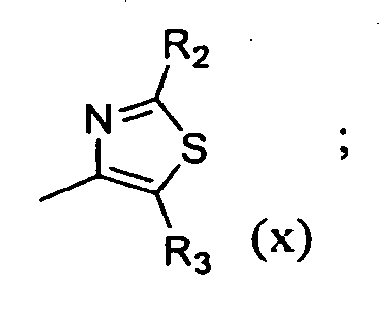 R1 is selected from the group consisting of hydrogen, alkyl, cycloalkyl, aryl, aralkyl, heteroaryl, C(O)R14, CH2C(O)R14, S(O)R14, and SO2R14 all of which may be optionally substituted;R2, R3, and R4 are independently selected from the group consisting of hydrogen, alkyl, cycloalkyl, alkenyl, alkynyl, haloalkyl, aryl, aminoalkyl, hydroxyalkyl, alkoxyalkyl, alkylthio, alkylsulfinyl, alkylsulfonyl, carboxyalkyl, cyano, amino, alkylamino, aminocarbonyl, alkylaminocarbonyl, arylaminocarbonyl, aralkylaminocarbonyl, alkylcarbonylamino, arylcarbonylamino, aralkylcarbonylamino, alkylcarbonyl, heterocyclocarbonyl, aminosulfonyl, alkylaminosulfonyl, alkylsulfonyl, and heterocyclosulfonyl, or the R groups in adjacent carbon atoms can be taken together with the carbon atoms to which they are attached to form a carbocycle or a heterocycle;R5, R6, R7, R8, R9, R10, R11, R12, and R13 are independently selected from the group consisting of hydrogen, halo, haloalkyl, aryl, cycloalkyl, saturated or partially unsaturated heterocycle, heteroaryl, alkyl, alkenyl, alkynyl, arylalkyl, arylalkenyl, arylalkynyl, heteroarylalkyl, heteroarylalkenyl, heteroarylalkynyl, cycloalkylalkyl, heterocycloalkyl, hydroxyalkyl, aminoalkyl, carboxyalkyl, alkoxyalkyl, nitro, amino, ureido, cyano, acylamino, amide, hydroxy, thiol, acyloxy, azido, alkoxy, carboxy, carbonylamido and alkylthiol; or R9 and R10 or R10 and R11 are taken together with the carbon atoms to which they are attached to form a carbocycle or a heterocycle;R14 is selected from the group consisting of amino, alkyl, alkenyl, alkynyl, OR16, alkylamino, dialkylamino, alkenylamino, cycloalkyl, aralkyl, aryl, heteroaryl, arylalkenyl, arylalkynyl, arylalkylamino, dialkylaminoalkenyl, heterocycle, heterocycloalkylamino, and cycloalkylalkylamino, all of which can be optionally substituted; whereinR16 is selected from the group consisting of hydrogen, optionally substituted alkyl, and an alkali metal; andX is O or Sin the manufacture of a medicament for treating, preventing or ameliorating neuronal loss following global and focal ischemia; treating, preventing or ameliorating neurodegenerative conditions; treating, preventing or ameliorating pain or tinnitus; treating, preventing or ameliorating manic depression; providing local anesthesia; or treating arrhythmias, or treating convulsions; or alleviating or preventing seizure activity.
 - The use of claim 22, wherein the compound is selected from the group consisting of:3-[4-(4-fluorophenoxy)phenyl]-1H-pyrazole;5-methylthio-3-(4-phenoxyphenyl)-1H-pyrazole-1-carboxamide;5-methylsulfinyl-3-(4-phenoxyphenyl)-1H-pyrazole-1-carboxamide;3-[4-(4-fluorophenoxy)phenyl]-1H-pyrazole-1-carboxamide;3-[4-(4-nitrophenoxy)phenyl]-1H-pyrazole-1-carboxamide;3-[4-(4-methoxyphenoxy)phenyl]-1H-pyrazole-1-carboxamide;3-[4-(4-aminophenoxy)phenyl]-1H-pyrazole-1-carboxamide;3-[4-(4-cyanophenoxy)phenyl]-1H-pyrazole-1-carboxamide;3-[4-(3-chloro-2-cyanophenoxy)phenyl]-1H-pyrazole-1-carboxamide;3-[4-(2,4-difluorophenoxy)phenyl]-1H-pyrazole-1-carboxamide;3-[4-(4-chloro-2-fluorophenoxy)phenyl]-1H-pyrazole-1-carboxamide;3-[4-(2-chloro-4-fluorophenoxy)phenyl]-1H-pyrazole-1-carboxamide;1-[3-[4-(4-nitrophenoxy)phenyl]-1H-pyrazolyl]ethanone;2-methyl-1-[3-(4-phenoxyphenyl)-1H-pyrazole]propanone;1-methanesulfonyl-3-(4-phenoxy)phenyl-1H-pyrazole;2-{5-[4-(4-fluorophenoxy)phenyl]-1H-pyrazol-1-yl}-1-(4-methyl)piperazin-1-yl-ethanone;1-{5-[4-(4-fluorophenoxy)phenyl]-1H-pyrazol-1-yl}-2-methyl-propan-2-ol;1-{5-[4-(4-fluorophenoxy)phenyl]-1H-pyrazol-1-yl}-propan-2-one;1-morpholin-4-yl-2-{5-[4-(4-fluorophenoxy)phenyl]-1H-pyrazol-1-yl}-ethanone;1-[2-(methanesulfonylamino)ethyl]-5-[4-(4-fluorophenoxy)phenyl]-1H-pyrazole;1-(2-carbamoyloxyethyl)-5-[4-(4-fluorophenoxy)phenyl]-1H-pyrazole;3-[4-(4-fluorophenylthio)phenyl]-1H-pyrazole-1-carboxamide;3-[4-(4-fluorophenylthio)phenyl]-1H-pyrazole;2-[5-[4-(4-fluorophenoxy)phenyl]-pyrazol-1-yl]ethanol;3-[4-(4-fluorophenoxy)phenyl]-1H-pyrazole-1-carboxylic acid dimethylamide;1-benzyl-5-[4-(4-fluorophenoxy)phenyl]-1H-pyrazole;2-[3-[4-(4-fluorophenoxy)phenyl]-2H-pyrazol-2-yl]-1-pyrrolidin-1-yl ethanone;2-(N-methylacetamido)-3-[4-(4-fluorophenoxy)phenyl]-2H-pyrazole;2-{5-[4-(4-fluorophenoxy)phenyl]-pyrazol-1-yl}-acetamide;2-{3-[4-(4-fluorophenoxy)phenyl]-pyrazol-1-yl}-acetamide;3-{5-[4-(4-fluorophenoxy)phenyl]-pyrazol-1-yl}-propionamide;3-[3-fluoro-4-(4-fluorophenoxy)phenyl]-1H-pyrazole-1-carboxamide;2-{3-[4-(4-fluorophenoxy)phenyl]-pyrazol-1-yl}-pyrimidine;2-{3-[4-(4-trifluoromethylphenoxy)phenyl]pyrazol-1-yl}pyrimidine;4-[4-(4-fluorophenoxy)phenyl]-1H-imidazole;4-[4-(4-fluorophenoxy)-3-fluorophenyl]-1H-imidazole;4-[4-(2,4-difluorophenoxy)phenyl]-1H-imidazole;4-[4-(2-fluoro-4-chlorophenoxy)phenyl]-1H-imidazole;4-(4-(4-trifluoromethylphenoxy)phenyl]-1H-imidazole;4-[4-(2,4-difluorophenoxy)phenyl]-2-methyl-1H-imidazole;4-[4-(2,4-difluorophenoxy)phenyl]-1-methyl-1H-imidazole-2-carboxamide;2-[4-(4-fluorophenoxy)phenyl]-1H-imidazole;2-[4-(4-fluorophenoxy)phenyl]-1H-benzimidazole;2-[4-(4-fluorophenoxy)phenyl]-1H-imidazole-4-carboxamide;2-[4-(4-fluorophenoxy)phenyl]-1H-imidazole-4-carbonitrile;5-[4-(4-fluorophenoxy)phenyl]-pyrrole-2-carboxamide;5-(4-phenoxyphenyl)pyrrole-2-carboxamide;methyl 5-[4-(4-fluorophenoxy)phenyl]pyrrole-2-carboxylate;2-[4-(4-fluorophenoxy)phenyl]oxazole-4-carboxamide; and4-[4-(4-fluorophenoxy)-3-fluorophenyl]thiazole-2-carboxamideor a pharmaceutically acceptable salt thereof.
Priority Applications (2)
| Application Number | Priority Date | Filing Date | Title |
|---|---|---|---|
| EP10004963.4A EP2266960B1 (en) | 1999-03-26 | 2000-03-24 | Aryl-substituted pyrazoles, imidazoles, oxazoles, thiazoles and pyrroles as anticonvulsants |
| CY20101100744T CY1111163T1 (en) | 1999-03-26 | 2010-08-10 | Aryl Substituted Pyrazols, Imidazoles, Oaxols, Thiazoles and Pyrrls and Their Use |
Applications Claiming Priority (3)
| Application Number | Priority Date | Filing Date | Title |
|---|---|---|---|
| US12655399P | 1999-03-26 | 1999-03-26 | |
| US126553P | 1999-03-26 | ||
| PCT/US2000/007944 WO2000057877A1 (en) | 1999-03-26 | 2000-03-24 | Aryl substituted pyrazoles, imidazoles, oxazoles, thiazoles and pyrroles, and the use thereof |
Related Child Applications (1)
| Application Number | Title | Priority Date | Filing Date |
|---|---|---|---|
| EP10004963.4A Division EP2266960B1 (en) | 1999-03-26 | 2000-03-24 | Aryl-substituted pyrazoles, imidazoles, oxazoles, thiazoles and pyrroles as anticonvulsants |
Publications (3)
| Publication Number | Publication Date |
|---|---|
| EP1173169A1 EP1173169A1 (en) | 2002-01-23 |
| EP1173169A4 EP1173169A4 (en) | 2007-04-04 |
| EP1173169B1 true EP1173169B1 (en) | 2010-05-12 |
Family
ID=22425462
Family Applications (2)
| Application Number | Title | Priority Date | Filing Date |
|---|---|---|---|
| EP10004963.4A Expired - Lifetime EP2266960B1 (en) | 1999-03-26 | 2000-03-24 | Aryl-substituted pyrazoles, imidazoles, oxazoles, thiazoles and pyrroles as anticonvulsants |
| EP00919636A Expired - Lifetime EP1173169B1 (en) | 1999-03-26 | 2000-03-24 | Aryl substituted pyrazoles, imidazoles, oxazoles, thiazoles and pyrroles, and the use thereof |
Family Applications Before (1)
| Application Number | Title | Priority Date | Filing Date |
|---|---|---|---|
| EP10004963.4A Expired - Lifetime EP2266960B1 (en) | 1999-03-26 | 2000-03-24 | Aryl-substituted pyrazoles, imidazoles, oxazoles, thiazoles and pyrroles as anticonvulsants |
Country Status (29)
| Country | Link |
|---|---|
| US (2) | US6414011B1 (en) |
| EP (2) | EP2266960B1 (en) |
| JP (2) | JP4832647B2 (en) |
| KR (1) | KR20020015308A (en) |
| CN (1) | CN1353605A (en) |
| AR (1) | AR023171A1 (en) |
| AT (1) | ATE467620T1 (en) |
| AU (1) | AU782353B2 (en) |
| BR (1) | BR0009322A (en) |
| CA (1) | CA2368631A1 (en) |
| CY (1) | CY1111163T1 (en) |
| CZ (1) | CZ20013435A3 (en) |
| DE (2) | DE20080291U1 (en) |
| DK (1) | DK1173169T3 (en) |
| ES (1) | ES2345921T3 (en) |
| HU (1) | HUP0201314A3 (en) |
| IL (1) | IL145508A0 (en) |
| MX (1) | MXPA01009655A (en) |
| NO (1) | NO20014659L (en) |
| NZ (2) | NZ514756A (en) |
| PL (1) | PL351439A1 (en) |
| PT (1) | PT1173169E (en) |
| RU (1) | RU2001129155A (en) |
| TR (1) | TR200102790T2 (en) |
| TW (1) | TW502019B (en) |
| UA (1) | UA72244C2 (en) |
| WO (1) | WO2000057877A1 (en) |
| YU (1) | YU68701A (en) |
| ZA (1) | ZA200108807B (en) |
Families Citing this family (116)
| Publication number | Priority date | Publication date | Assignee | Title |
|---|---|---|---|---|
| US7517880B2 (en) * | 1997-12-22 | 2009-04-14 | Bayer Pharmaceuticals Corporation | Inhibition of p38 kinase using symmetrical and unsymmetrical diphenyl ureas |
| EP1158985B1 (en) | 1999-01-13 | 2011-12-28 | Bayer HealthCare LLC | OMEGA-CARBOXY ARYL SUBSTITUTED DIPHENYL UREAS AS p38 KINASE INHIBITORS |
| US8124630B2 (en) | 1999-01-13 | 2012-02-28 | Bayer Healthcare Llc | ω-carboxyaryl substituted diphenyl ureas as raf kinase inhibitors |
| DK1169060T3 (en) | 1999-04-09 | 2006-01-16 | Euro Celtique Sa | Sodium channel blocker preparations and their use |
| TWI283577B (en) * | 1999-10-11 | 2007-07-11 | Sod Conseils Rech Applic | Pharmaceutical composition of imidazole derivatives acting as modulators of sodium channels and the use thereof |
| AR029489A1 (en) | 2000-03-10 | 2003-07-02 | Euro Celtique Sa | PIRIDINES, PYRIMIDINES, PIRAZINAS, TRIAZINES REPLACED BY ARILO, PHARMACEUTICAL COMPOSITIONS AND THE USE OF THE SAME FOR THE MANUFACTURE OF A MEDICINAL PRODUCT |
| AU4589701A (en) | 2000-03-24 | 2001-10-08 | Cocensys Inc | Aryl substituted pyrazoles, triazoles and tetrazoles, and the use thereof |
| AU4961001A (en) | 2000-03-31 | 2001-10-15 | Cocensys Inc | Aminopyridines and their use as anticonvulsants and sodium channel blockers |
| FR2818978B1 (en) * | 2000-12-28 | 2003-02-28 | Sod Conseils Rech Applic | MODULATORS OF SODIUM CHANNELS DERIVED FROM 2-PIPERIDYLIMIDAZOLES |
| TWI248438B (en) * | 2001-04-10 | 2006-02-01 | Sod Conseils Rech Applic | Derivatives of heterocycles with 5 members, their preparation and their use as medicaments |
| FR2825926A1 (en) * | 2001-06-14 | 2002-12-20 | Sod Conseils Rech Applic | DERIVATIVES OF IMIDAZOLES MODULATING SODIUM CHANNELS |
| IL159765A0 (en) * | 2001-07-16 | 2004-06-20 | Euro Celtique Sa | Aryl substituted thiazolidinone derivatives and pharmaceutical compositions containing the same |
| DK1423168T3 (en) | 2001-09-03 | 2006-05-15 | Newron Pharm Spa | A pharmaceutical composition comprising gabapentin or an analogue thereof and an alpha-aminoamide and its analgesic use |
| AR036873A1 (en) | 2001-09-07 | 2004-10-13 | Euro Celtique Sa | PIRIDINAS ARIL REPLACED A, PHARMACEUTICAL COMPOSITIONS AND THE USE OF THE SAME FOR THE PREPARATION OF A MEDICINAL PRODUCT |
| AR037233A1 (en) | 2001-09-07 | 2004-11-03 | Euro Celtique Sa | PIRIDINAS ARIL REPLACED, PHARMACEUTICAL COMPOSITIONS AND THE USE OF SUCH COMPOUNDS FOR THE PREPARATION OF A MEDICINAL PRODUCT |
| SI1478358T1 (en) | 2002-02-11 | 2013-09-30 | Bayer Healthcare Llc | Sorafenib tosylate for the treatment of diseases characterized by abnormal angiogenesis |
| MXPA04008901A (en) * | 2002-03-13 | 2004-11-26 | Euro Celtique Sa | Aryl substituted pyrimidines and the use thereof. |
| CA2492305A1 (en) * | 2002-07-31 | 2004-02-05 | Euro-Celtique S.A. | Aryl substituted benzimidazoles and their use as sodium channel blockers |
| EP1438956A1 (en) * | 2003-01-16 | 2004-07-21 | Newron Pharmaceuticals S.p.A. | Alpha-aminoamide derivatives useful as antimigraine agents |
| US7557129B2 (en) | 2003-02-28 | 2009-07-07 | Bayer Healthcare Llc | Cyanopyridine derivatives useful in the treatment of cancer and other disorders |
| MY142651A (en) | 2003-03-18 | 2010-12-15 | Merck Sharp & Dohme | Biaryl substituted triazoles as sodium channel blockers |
| EP1636585B2 (en) | 2003-05-20 | 2012-06-13 | Bayer HealthCare LLC | Diaryl ureas with kinase inhibiting activity |
| DE602004000260T2 (en) | 2003-07-22 | 2006-08-24 | Arena Pharmaceuticals, Inc., San Diego | DIARYL AND ARYLHETEROARYL DRUG DERIVATIVES AS MODULATORS OF THE 5-HT2A SEROTONIN RECEPTOR SUITABLE FOR THE PROPHYLAXIS AND TREATMENT OF RELATED DISEASES THEREOF |
| EP1663978B1 (en) | 2003-07-23 | 2007-11-28 | Bayer Pharmaceuticals Corporation | Fluoro substituted omega-carboxyaryl diphenyl urea for the treatment and prevention of diseases and conditions |
| JP4638355B2 (en) * | 2003-12-26 | 2011-02-23 | 協和発酵キリン株式会社 | Thiazole derivative |
| ATE548353T1 (en) | 2004-03-23 | 2012-03-15 | Arena Pharm Inc | METHOD FOR PRODUCING SUBSTITUTED N-ARYL-N'-Ä3-(1H-PYRAZOLE-5-YL)PHENYLÜ-UREAS AND INTERMEDIATE THEREOF. |
| US7163945B2 (en) * | 2004-04-29 | 2007-01-16 | Pharmix Corp. | Compositions and treatments for inhibiting kinase and/or HMG-CoA reductase |
| US20060084695A1 (en) * | 2004-04-29 | 2006-04-20 | John Griffin | Compositions and treatments for inhibiting kinase and/or HMG-CoA reductase |
| US20050272770A1 (en) * | 2004-04-29 | 2005-12-08 | John Griffin | Compositions and treatments for inhibiting kinase and/or HMG-CoA reductase |
| US7183285B2 (en) * | 2004-04-29 | 2007-02-27 | Pharmix Corp. | Compositions and treatments for inhibiting kinase and/or HMG-CoA reductase |
| US7199126B2 (en) | 2004-04-29 | 2007-04-03 | Pharmix Corporation | Compositions and treatments for inhibiting kinase and/or HMG-CoA reductase |
| US20050282883A1 (en) * | 2004-04-29 | 2005-12-22 | John Griffin | Compositions and treatments for inhibiting kinase and/or HMG-CoA reductase |
| SA05260357B1 (en) | 2004-11-19 | 2008-09-08 | ارينا فارماسيتو تيكالز ، أنك | 3-phenyle-pyrazole derivatives as modulators of the 5-ht 2a serotonin receptor useful for the treatment of disorders related thereto |
| US20060111436A1 (en) * | 2004-11-23 | 2006-05-25 | John Griffin | Compositions and treatments for modulating kinase and/or HMG-CoA reductase |
| KR20060087386A (en) * | 2005-01-28 | 2006-08-02 | 주식회사 대웅제약 | Novel benzoimidazole derivatives and pharmaceutical compositions containing them |
| EP1894930A4 (en) | 2005-06-23 | 2010-06-23 | Kyowa Hakko Kirin Co Ltd | Thiazole derivative |
| PE20070182A1 (en) | 2005-07-29 | 2007-03-06 | Wyeth Corp | CYANOPYRROL-PHENYL AMIDE DERIVATIVES AS PROGESTERONE RECEPTOR MODULATORS |
| EP1924326B1 (en) | 2005-08-25 | 2016-10-12 | Steven Michael Weiss | Reducing myocardial damage and the incidence of arrhythmia arising from loss, reduction or interruption in coronary blood flow |
| TW200730494A (en) | 2005-10-10 | 2007-08-16 | Glaxo Group Ltd | Novel compounds |
| TW200728258A (en) | 2005-10-10 | 2007-08-01 | Glaxo Group Ltd | Novel compounds |
| EP1943216B1 (en) | 2005-10-10 | 2010-06-30 | Glaxo Group Limited | Prolinamide derivatives as sodium channel modulators |
| EP1966132A2 (en) * | 2005-12-15 | 2008-09-10 | Boehringer Ingelheim International Gmbh | Compounds which modulate the cb2 receptor |
| EP1963280B1 (en) | 2005-12-22 | 2015-10-28 | Newron Pharmaceuticals S.p.A. | 2-phenylethylamino derivatives as calcium and/or sodium channel modulators |
| SG171681A1 (en) | 2006-05-18 | 2011-06-29 | Arena Pharm Inc | Crystalline forms and processes for the preparation of phenyl-pyrazoles useful as modulators of the 5-ht2a serotonin receptor |
| CA2646076C (en) | 2006-05-18 | 2015-06-30 | Arena Pharmaceuticals, Inc. | Ethers, secondary amines and derivatives thereof as modulators of the 5-ht2a serotonin receptor useful for the treatment of disorders related thereto |
| JP5406018B2 (en) | 2006-05-18 | 2014-02-05 | アリーナ ファーマシューティカルズ, インコーポレイテッド | Primary amines as modulators of 5-HT2A serotonin receptors useful for the treatment of disorders associated with 5-HT2A serotonin receptors, and derivatives thereof |
| CA2657247A1 (en) * | 2006-07-28 | 2008-01-31 | Boehringer Ingelheim International Gmbh | Compounds which modulate the cb2 receptor |
| JP4694640B2 (en) * | 2006-09-01 | 2011-06-08 | プレオティント エル エル シー | Ligand exchange thermochromic (LETC) system |
| US7928123B2 (en) * | 2006-09-25 | 2011-04-19 | Boehringer Ingelheim International Gmbh | Compounds which modulate the CB2 receptor |
| TWI415845B (en) | 2006-10-03 | 2013-11-21 | Arena Pharm Inc | Pyrazole derivatives as modulators of the 5-ht2a serotonin receptor useful for the treatment of disorders related thereto |
| EP1969934A1 (en) * | 2007-03-12 | 2008-09-17 | Bayer CropScience AG | 4-cycloalkyl or 4-aryl substituted phenoxy phenylamidines and their use as fungicides |
| US20100247435A1 (en) * | 2007-06-14 | 2010-09-30 | Erik Arstad | Measurement of neural activity |
| JP5393677B2 (en) | 2007-08-15 | 2014-01-22 | アリーナ ファーマシューティカルズ, インコーポレイテッド | Imidazo [1,2-a] pyridine derivatives as modulators of 5-HT2A serotonin receptors for the treatment of disorders associated with 5-HT2A serotonin receptors |
| CA2704684A1 (en) * | 2007-11-07 | 2009-05-14 | Boehringer Ingelheim International Gmbh | Compounds which modulate the cb2 receptor |
| US20110021538A1 (en) | 2008-04-02 | 2011-01-27 | Arena Pharmaceuticals, Inc. | Processes for the preparation of pyrazole derivatives useful as modulators of the 5-ht2a serotonin receptor |
| US8178568B2 (en) * | 2008-07-10 | 2012-05-15 | Boehringer Ingelheim International Gmbh | Sulfone compounds which modulate the CB2 receptor |
| CA2737639A1 (en) | 2008-09-25 | 2010-04-01 | Boehringer Ingelheim International Gmbh | Compounds which selectively modulate the cb2 receptor |
| US9126946B2 (en) | 2008-10-28 | 2015-09-08 | Arena Pharmaceuticals, Inc. | Processes useful for the preparation of 1-[3-(4-bromo-2-methyl-2H-pyrazol-3-yl)-4-methoxy-phenyl]-3-(2,4-difluoro-phenyl)urea and crystalline forms related thereto |
| CA2741731A1 (en) | 2008-10-28 | 2010-06-03 | Arena Pharmaceuticals, Inc. | Compositions of a 5-ht2a serotonin receptor modulator useful for the treatment of disorders related thereto |
| MX2011011136A (en) * | 2009-04-24 | 2011-11-18 | Tibotec Pharm Ltd | Diaryl ethers. |
| US8299103B2 (en) * | 2009-06-15 | 2012-10-30 | Boehringer Ingelheim International Gmbh | Compounds which selectively modulate the CB2 receptor |
| JP5756800B2 (en) | 2009-06-16 | 2015-07-29 | ベーリンガー インゲルハイム インターナショナル ゲゼルシャフト ミット ベシュレンクテル ハフツング | Azetidine 2-carboxamide derivative that modulates CB2 receptor |
| US20110034469A1 (en) | 2009-08-04 | 2011-02-10 | Takeda Pharmaceutical Company Limited | Heterocyclic Compound |
| WO2011037795A1 (en) * | 2009-09-22 | 2011-03-31 | Boehringer Ingelheim International Gmbh | Compounds which selectively modulate the cb2 receptor |
| US8993612B2 (en) * | 2009-10-08 | 2015-03-31 | Rhizen Pharmaceuticals Sa | Modulators of calcium release-activated calcium channel and methods for treatment of non-small cell lung cancer |
| WO2011075596A1 (en) | 2009-12-18 | 2011-06-23 | Arena Pharmaceuticals, Inc. | Crystalline forms of certain 3-phenyl-pyrazole derivatives as modulators of the 5-ht2a serotonin receptor useful for the treatment of disorders related thereto |
| WO2011088015A1 (en) | 2010-01-15 | 2011-07-21 | Boehringer Ingelheim International Gmbh | Compounds which modulate the cb2 receptor |
| DE102010007281A1 (en) * | 2010-02-08 | 2011-08-11 | EMC microcollections GmbH, 72070 | Novel aminoalkyl-oxazole and aminoalkyl-thiazolecarboxamides and their application to stimulate the endogenous regeneration of hair cells in the internal organ Corti organ in the mammal |
| US8329735B2 (en) | 2010-03-05 | 2012-12-11 | Boehringer Ingelheim International Gmbh | Tetrazole compounds which selectively modulate the CB2 receptor |
| JP2013531687A (en) | 2010-07-16 | 2013-08-08 | パーデュー、ファーマ、リミテッド、パートナーシップ | Pyridine compounds as sodium channel blockers |
| WO2012012307A1 (en) | 2010-07-22 | 2012-01-26 | Boehringer Ingelheim International Gmbh | Sulfonyl compounds which modulate the cb2 rece |
| AU2011303597A1 (en) | 2010-09-17 | 2013-04-11 | Purdue Pharma L.P. | Pyridine compounds and the uses thereof |
| KR20130095772A (en) | 2010-10-05 | 2013-08-28 | 퍼듀 퍼머 엘피 | Quinazoline compounds as sodium channel blockers |
| EP2655330B1 (en) | 2010-12-22 | 2016-02-10 | Purdue Pharma LP | Substituted pyridines as sodium channel blockers |
| EP3255041A1 (en) | 2011-09-02 | 2017-12-13 | Purdue Pharma L.P. | Pyrimidines as sodium channel blockers |
| WO2013064883A1 (en) | 2011-10-31 | 2013-05-10 | Purdue Pharma L.P. | Heteroaryl compounds as sodium channel blockers |
| WO2013064884A1 (en) | 2011-10-31 | 2013-05-10 | Purdue Pharma L.P. | Quaternized amines as sodium channel blockers |
| US9133131B2 (en) | 2011-11-15 | 2015-09-15 | Purdue Pharma L.P. | Pyrimidine diol amides as sodium channel blockers |
| MX340033B (en) | 2011-12-28 | 2016-06-21 | Janssen Sciences Ireland Uc | Hetero-bicyclic derivatives as hcv inhibitors. |
| US9128307B2 (en) | 2012-02-20 | 2015-09-08 | Pleotint, L.L.C. | Enhanced thermochromic window which incorporates a film with multiple layers of alternating refractive index |
| WO2013136170A1 (en) | 2012-03-16 | 2013-09-19 | Purdue Pharma L.P. | Substituted pyridines as sodium channel blockers |
| KR102082529B1 (en) | 2012-04-17 | 2020-02-27 | 퍼듀 퍼머 엘피 | Systems and methods for treating an opioid-induced adverse pharmacodynamic response |
| EP2935257B1 (en) | 2012-12-20 | 2018-02-07 | Purdue Pharma LP | Cyclic sulfonamides as sodium channel blockers |
| US9120786B2 (en) | 2013-03-04 | 2015-09-01 | Purdue Pharma, L.P. | Triazine carboxamides as sodium channel blockers |
| WO2014135955A1 (en) | 2013-03-04 | 2014-09-12 | Purdue Pharma L.P. | Pyrimidine carboxamides as sodium channel blockers |
| CA2939549C (en) | 2013-03-15 | 2020-08-18 | Purdue Pharma L.P. | Carboxamide derivatives and use thereof |
| EP2803668A1 (en) | 2013-05-17 | 2014-11-19 | Boehringer Ingelheim International Gmbh | Novel (cyano-dimethyl-methyl)-isoxazoles and -[1,3,4]thiadiazoles |
| CN105612152A (en) | 2013-08-26 | 2016-05-25 | 普渡制药公司 | Azaspiro[4.5] decane derivatives and use thereof |
| US9359330B2 (en) | 2013-08-26 | 2016-06-07 | Purdue Pharma L.P. | Substituted piperidines as sodium channel blockers |
| US9828348B2 (en) | 2013-11-08 | 2017-11-28 | Purdue Pharma L.P. | Benzimidazole derivatives and use thereof |
| US9340504B2 (en) | 2013-11-21 | 2016-05-17 | Purdue Pharma L.P. | Pyridine and piperidine derivatives as novel sodium channel blockers |
| US9745287B2 (en) | 2013-12-20 | 2017-08-29 | Purdue Pharma L.P. | Pyrimidines and use thereof |
| NZ719169A (en) | 2013-12-20 | 2018-08-31 | Novartis Ag | Heteroaryl butanoic acid derivatives as lta4h inhibitors |
| JP6337124B2 (en) | 2013-12-23 | 2018-06-06 | パーデュー、ファーマ、リミテッド、パートナーシップ | Indazole and its use |
| US9695144B2 (en) | 2013-12-23 | 2017-07-04 | Purdue Pharma L.P. | Dibenzazepine derivatives and use thereof |
| EP3089978B1 (en) | 2013-12-30 | 2018-08-29 | Purdue Pharma L.P. | Pyridone-sulfone morphinan analogs as opioid receptor ligands |
| JP6526023B2 (en) | 2014-01-24 | 2019-06-05 | パーデュー、ファーマ、リミテッド、パートナーシップ | Pyridines and pyrimidines and their use |
| AU2015217185B2 (en) | 2014-02-12 | 2018-04-05 | Purdue Pharma L.P. | Isoquinoline derivatives and use thereof |
| US10730866B2 (en) | 2014-04-07 | 2020-08-04 | Purdue Pharma L.P. | Indole derivatives and use thereof |
| WO2015161011A1 (en) * | 2014-04-17 | 2015-10-22 | Merck Sharp & Dohme Corp. | Benzamide cgrp receptor antagonists |
| CA2948144A1 (en) | 2014-05-06 | 2015-11-12 | Purdue Pharma L.P. | Benzomorphan analogs and use thereof |
| MA40171A (en) | 2014-06-13 | 2017-04-19 | Purdue Pharma Lp | Azamophinan derivatives and use thereof |
| WO2015192039A1 (en) | 2014-06-13 | 2015-12-17 | Purdue Pharma L.P. | Heterocyclic morphinan derivatives and use thereof |
| US9849124B2 (en) | 2014-10-17 | 2017-12-26 | Purdue Pharma L.P. | Systems and methods for treating an opioid-induced adverse pharmacodynamic response |
| ES2912881T3 (en) | 2014-12-23 | 2022-05-30 | Convergence Pharmaceuticals | Procedure for preparing alpha-carboxamide pyrrolidine derivatives |
| US10022355B2 (en) | 2015-06-12 | 2018-07-17 | Axovant Sciences Gmbh | Diaryl and arylheteroaryl urea derivatives as modulators of the 5-HT2A serotonin receptor useful for the prophylaxis and treatment of REM sleep behavior disorder |
| BR112018000728A2 (en) | 2015-07-15 | 2018-09-04 | Axovant Sciences Gmbh | method for the prophylaxis and / or treatment of visual hallucinations in a subject in need |
| CN107118586A (en) * | 2016-02-24 | 2017-09-01 | 中国科学技术大学 | The purposes of the vinyl compound of nitrogen heterocycle substitution |
| CN109071455B (en) | 2016-03-11 | 2022-08-02 | 嘉兴和剂药业有限公司 | Compounds and methods for modulating bruton's tyrosine kinase |
| WO2018140504A1 (en) * | 2017-01-24 | 2018-08-02 | Patel Manoj K | Compositions and methods for blocking sodium channels |
| US11192856B2 (en) | 2017-10-05 | 2021-12-07 | Biogen Inc. | Process for preparing alpha-carboxamide pyrrolidine derivatives |
| US10707913B2 (en) * | 2018-09-04 | 2020-07-07 | Raytheon Company | Composable transceiver using low bit count inputs and outputs |
| JP7404261B2 (en) * | 2018-10-18 | 2023-12-25 | 住友化学株式会社 | Phenylpyrazole compound and plant disease control method |
| EP3870159B1 (en) * | 2018-10-26 | 2024-11-13 | University of South Florida | Drug for treating tinnitus |
| US20220022395A1 (en) * | 2018-12-25 | 2022-01-27 | Tokyo University Of Science Foundation | Jasmonic acid endogeny promoting agent, and method for promoting jasmonic acid endogeny |
| CN111825658B (en) * | 2019-04-18 | 2024-11-08 | 华东理工大学 | EGFR triple mutation inhibitors and their applications |
Family Cites Families (32)
| Publication number | Priority date | Publication date | Assignee | Title |
|---|---|---|---|---|
| NZ178996A (en) | 1974-11-15 | 1978-06-02 | Kornis G | Pyrfazole amides and thioamides;herbicidal compositions |
| JPS5975257A (en) | 1982-10-23 | 1984-04-27 | Ricoh Co Ltd | Electrophotographic photoreceptor |
| DE3307364A1 (en) * | 1983-03-02 | 1984-09-06 | Hoechst Ag, 6230 Frankfurt | TWO-COMPONENT DIAZON TYPE MATERIAL |
| DE3503773A1 (en) * | 1985-02-05 | 1986-08-07 | Basf Ag, 6700 Ludwigshafen | THIAZOLYLAMIDES, METHOD FOR THE PRODUCTION THEREOF AND THEIR USE FOR CONTROLLING UNWANTED PLANT GROWTH |
| GB8624879D0 (en) * | 1986-10-17 | 1986-11-19 | May & Baker Ltd | Compositions of matter |
| US5015651A (en) * | 1988-01-07 | 1991-05-14 | E. I. Du Pont De Nemours And Company | Treatment of hypertension with 1,2,4-angiotensin II antagonists |
| US5104960A (en) * | 1989-02-22 | 1992-04-14 | The Dow Chemical Company | Nucleophilic displacement method for synthesis of non-rigid PBZ polymers |
| SG52709A1 (en) | 1989-06-30 | 1998-09-28 | Du Pont | Substituted imidazoles |
| PH27357A (en) * | 1989-09-22 | 1993-06-21 | Fujisawa Pharmaceutical Co | Pyrazole derivatives and pharmaceutical compositions comprising the same |
| GB9005028D0 (en) | 1990-03-06 | 1990-05-02 | Sandoz Ltd | Improvements in or relating to organic compounds |
| JPH04164032A (en) * | 1990-10-26 | 1992-06-09 | Mitsubishi Kasei Corp | Peroxylipid formation inhibitor |
| JPH05287563A (en) | 1992-04-07 | 1993-11-02 | Hideaki Yamaguchi | Method for treating surface of metal |
| EP0639567A1 (en) | 1992-05-08 | 1995-02-22 | Otsuka Pharmaceutical Factory, Inc. | Indole derivative |
| JPH0725849A (en) * | 1993-07-08 | 1995-01-27 | Nippon Soda Co Ltd | 2-trifluoromethylpyprole derivative and its production |
| DE4325822A1 (en) * | 1993-07-31 | 1995-02-02 | Hoechst Ag | Substituted benzoylguanidines, process for their preparation, their use as medicament or diagnostic agent, and medicament containing them |
| US5744492A (en) | 1993-09-17 | 1998-04-28 | United States Of America | Method for inhibiting angiogenesis |
| US5602156A (en) | 1993-09-17 | 1997-02-11 | The United States Of America As Represented By The Department Of Health And Human Services | Method for inhibiting metalloproteinase expression |
| US6057346A (en) | 1994-12-12 | 2000-05-02 | The United States Of America As Represented By The Department Of Health And Human Services | Inhibition of retroviral LTR promoters by calcium response modifiers |
| GB9503946D0 (en) * | 1995-02-28 | 1995-04-19 | Cancer Res Campaign Tech | Benzazole compounds |
| US5741818A (en) | 1995-06-07 | 1998-04-21 | University Of Saskatchewan | Semicarbazones having CNS activity and pharmaceutical preparations containing same |
| US5843951A (en) * | 1995-09-28 | 1998-12-01 | Otsuka Pharmaceutical Factory Inc. | Analgesic composition of pyrazolo(1,5-A) pyrimidines |
| WO1998017267A1 (en) * | 1996-10-23 | 1998-04-30 | Zymogenetics, Inc. | Compositions and methods for treating bone deficit conditions |
| JP4039707B2 (en) | 1996-12-03 | 2008-01-30 | 株式会社エス・ディー・エス バイオテック | Substituted pyrazole derivatives, process for producing the same, and agricultural and horticultural fungicides containing the derivatives as active ingredients |
| US5925654A (en) | 1997-03-12 | 1999-07-20 | G.D. Searle & Co. | LTA4 , hydrolase inhibitors |
| WO1998050348A1 (en) | 1997-05-09 | 1998-11-12 | Agouron Pharmaceuticals, Inc. | Metalloproteinase inhibitors, pharmaceutical compositions containing them and their pharmaceutical uses |
| AU754830C (en) | 1997-05-22 | 2004-02-12 | G.D. Searle Llc | Substituted pyrazoles as p38 kinase inhibitors |
| CN1159302C (en) * | 1997-08-29 | 2004-07-28 | 武田舍林-普劳动物保健株式会社 | Triazine derivatives, their preparation and use |
| US5942532A (en) | 1997-09-05 | 1999-08-24 | Ortho Pharmaceutical Corporation | 2-substituted phenyl-benzimidazole antibacterial agents |
| JP4385414B2 (en) * | 1997-10-13 | 2009-12-16 | アステラス製薬株式会社 | Amides or amine derivatives |
| BR9910642A (en) * | 1998-05-22 | 2001-10-09 | Avanir Pharmaceuticals | Benzimidazole analogs as ige descending regulators |
| JP2000109465A (en) * | 1998-08-05 | 2000-04-18 | Nippon Soda Co Ltd | Phenylpypazole compound, its production and anti- hyperlipidemia medicine |
| AU762992B2 (en) * | 1998-11-06 | 2003-07-10 | Abbott Gmbh & Co. Kg | Tricyclic pyrazole derivatives |
-
2000
- 2000-03-24 TW TW089105616A patent/TW502019B/en not_active IP Right Cessation
- 2000-03-24 EP EP10004963.4A patent/EP2266960B1/en not_active Expired - Lifetime
- 2000-03-24 TR TR2001/02790T patent/TR200102790T2/en unknown
- 2000-03-24 ES ES00919636T patent/ES2345921T3/en not_active Expired - Lifetime
- 2000-03-24 IL IL14550800A patent/IL145508A0/en unknown
- 2000-03-24 HU HU0201314A patent/HUP0201314A3/en unknown
- 2000-03-24 NZ NZ514756A patent/NZ514756A/en unknown
- 2000-03-24 CN CN00806810A patent/CN1353605A/en active Pending
- 2000-03-24 AR ARP000101352A patent/AR023171A1/en unknown
- 2000-03-24 US US09/533,864 patent/US6414011B1/en not_active Expired - Lifetime
- 2000-03-24 DK DK00919636.1T patent/DK1173169T3/en active
- 2000-03-24 JP JP2000607628A patent/JP4832647B2/en not_active Expired - Fee Related
- 2000-03-24 AU AU40291/00A patent/AU782353B2/en not_active Ceased
- 2000-03-24 CZ CZ20013435A patent/CZ20013435A3/en unknown
- 2000-03-24 UA UA2001107227A patent/UA72244C2/en unknown
- 2000-03-24 PL PL00351439A patent/PL351439A1/en not_active Application Discontinuation
- 2000-03-24 YU YU68701A patent/YU68701A/en unknown
- 2000-03-24 DE DE20080291U patent/DE20080291U1/en not_active Expired - Lifetime
- 2000-03-24 WO PCT/US2000/007944 patent/WO2000057877A1/en not_active Ceased
- 2000-03-24 AT AT00919636T patent/ATE467620T1/en active
- 2000-03-24 MX MXPA01009655A patent/MXPA01009655A/en not_active Application Discontinuation
- 2000-03-24 DE DE60044395T patent/DE60044395D1/en not_active Expired - Lifetime
- 2000-03-24 BR BR0009322-0A patent/BR0009322A/en not_active IP Right Cessation
- 2000-03-24 RU RU2001129155/04A patent/RU2001129155A/en not_active Application Discontinuation
- 2000-03-24 CA CA002368631A patent/CA2368631A1/en not_active Abandoned
- 2000-03-24 PT PT00919636T patent/PT1173169E/en unknown
- 2000-03-24 EP EP00919636A patent/EP1173169B1/en not_active Expired - Lifetime
- 2000-03-24 KR KR1020017012292A patent/KR20020015308A/en not_active Ceased
-
2001
- 2001-09-25 NO NO20014659A patent/NO20014659L/en not_active Application Discontinuation
- 2001-10-25 ZA ZA200108807A patent/ZA200108807B/en unknown
-
2002
- 2002-04-30 US US10/134,697 patent/US6737418B2/en not_active Expired - Lifetime
-
2003
- 2003-11-21 NZ NZ529690A patent/NZ529690A/en unknown
-
2010
- 2010-08-10 CY CY20101100744T patent/CY1111163T1/en unknown
- 2010-09-29 JP JP2010220062A patent/JP2011021028A/en not_active Withdrawn
Also Published As
Similar Documents
| Publication | Publication Date | Title |
|---|---|---|
| EP1173169B1 (en) | Aryl substituted pyrazoles, imidazoles, oxazoles, thiazoles and pyrroles, and the use thereof | |
| KR100776934B1 (en) | Aryl substituted pyrazoles, triazoles and tetrazole as sodium channel blockers | |
| AU2001245897A1 (en) | Aryl substituted pyrazoles, triazoles and tetrazoles as sodium channel blocker | |
| KR20030011792A (en) | Aryl substituted pyridines, pyrimidines, pyrazines and triazines and the use thereof | |
| AU2006225221B2 (en) | Aryl substituted pyrazoles, triazoles and tetrazoles, and the use thereof |
Legal Events
| Date | Code | Title | Description |
|---|---|---|---|
| PUAI | Public reference made under article 153(3) epc to a published international application that has entered the european phase |
Free format text: ORIGINAL CODE: 0009012 |
|
| 17P | Request for examination filed |
Effective date: 20011026 |
|
| AK | Designated contracting states |
Kind code of ref document: A1 Designated state(s): AT BE CH CY DE DK ES FI FR GB GR IE IT LI LU MC NL PT SE |
|
| AX | Request for extension of the european patent |
Free format text: AL;LT;LV;MK;RO;SI |
|
| A4 | Supplementary search report drawn up and despatched |
Effective date: 20070302 |
|
| RIC1 | Information provided on ipc code assigned before grant |
Ipc: C07D 207/30 20060101ALI20070226BHEP Ipc: A61K 31/426 20060101ALI20070226BHEP Ipc: A61K 31/506 20060101ALI20070226BHEP Ipc: A61K 31/421 20060101ALI20070226BHEP Ipc: C07D 231/10 20060101AFI20070226BHEP Ipc: C07D 233/54 20060101ALI20070226BHEP Ipc: A61K 31/496 20060101ALI20070226BHEP Ipc: A61K 31/40 20060101ALI20070226BHEP Ipc: A61P 25/00 20060101ALI20070226BHEP Ipc: A61K 31/415 20060101ALI20070226BHEP Ipc: A61K 31/4164 20060101ALI20070226BHEP Ipc: A61K 31/5377 20060101ALI20070226BHEP |
|
| 17Q | First examination report despatched |
Effective date: 20070816 |
|
| GRAP | Despatch of communication of intention to grant a patent |
Free format text: ORIGINAL CODE: EPIDOSNIGR1 |
|
| GRAS | Grant fee paid |
Free format text: ORIGINAL CODE: EPIDOSNIGR3 |
|
| GRAA | (expected) grant |
Free format text: ORIGINAL CODE: 0009210 |
|
| AK | Designated contracting states |
Kind code of ref document: B1 Designated state(s): AT BE CH CY DE DK ES FI FR GB GR IE IT LI LU MC NL PT SE |
|
| REG | Reference to a national code |
Ref country code: GB Ref legal event code: FG4D |
|
| REG | Reference to a national code |
Ref country code: CH Ref legal event code: EP |
|
| RAP2 | Party data changed (patent owner data changed or rights of a patent transferred) |
Owner name: EURO-CELTIQUE S.A. |
|
| REG | Reference to a national code |
Ref country code: IE Ref legal event code: FG4D |
|
| REF | Corresponds to: |
Ref document number: 60044395 Country of ref document: DE Date of ref document: 20100624 Kind code of ref document: P |
|
| REG | Reference to a national code |
Ref country code: NL Ref legal event code: T3 |
|
| REG | Reference to a national code |
Ref country code: PT Ref legal event code: SC4A Free format text: AVAILABILITY OF NATIONAL TRANSLATION Effective date: 20100812 |
|
| REG | Reference to a national code |
Ref country code: DK Ref legal event code: T3 |
|
| REG | Reference to a national code |
Ref country code: SE Ref legal event code: TRGR |
|
| REG | Reference to a national code |
Ref country code: CH Ref legal event code: NV Representative=s name: KIRKER & CIE S.A. |
|
| REG | Reference to a national code |
Ref country code: GR Ref legal event code: EP Ref document number: 20100401867 Country of ref document: GR |
|
| REG | Reference to a national code |
Ref country code: ES Ref legal event code: FG2A Ref document number: 2345921 Country of ref document: ES Kind code of ref document: T3 |
|
| PLBE | No opposition filed within time limit |
Free format text: ORIGINAL CODE: 0009261 |
|
| STAA | Information on the status of an ep patent application or granted ep patent |
Free format text: STATUS: NO OPPOSITION FILED WITHIN TIME LIMIT |
|
| 26N | No opposition filed |
Effective date: 20110215 |
|
| REG | Reference to a national code |
Ref country code: DE Ref legal event code: R097 Ref document number: 60044395 Country of ref document: DE Effective date: 20110214 |
|
| PGFP | Annual fee paid to national office [announced via postgrant information from national office to epo] |
Ref country code: LU Payment date: 20120316 Year of fee payment: 13 Ref country code: MC Payment date: 20120228 Year of fee payment: 13 Ref country code: IE Payment date: 20120228 Year of fee payment: 13 Ref country code: CH Payment date: 20120126 Year of fee payment: 13 |
|
| PGFP | Annual fee paid to national office [announced via postgrant information from national office to epo] |
Ref country code: PT Payment date: 20120228 Year of fee payment: 13 |
|
| PGFP | Annual fee paid to national office [announced via postgrant information from national office to epo] |
Ref country code: SE Payment date: 20120307 Year of fee payment: 13 Ref country code: GR Payment date: 20120228 Year of fee payment: 13 Ref country code: DK Payment date: 20120227 Year of fee payment: 13 Ref country code: BE Payment date: 20120328 Year of fee payment: 13 Ref country code: FI Payment date: 20120307 Year of fee payment: 13 Ref country code: IT Payment date: 20120323 Year of fee payment: 13 |
|
| PGFP | Annual fee paid to national office [announced via postgrant information from national office to epo] |
Ref country code: NL Payment date: 20120322 Year of fee payment: 13 |
|
| PGFP | Annual fee paid to national office [announced via postgrant information from national office to epo] |
Ref country code: CY Payment date: 20120321 Year of fee payment: 13 |
|
| PGFP | Annual fee paid to national office [announced via postgrant information from national office to epo] |
Ref country code: AT Payment date: 20120228 Year of fee payment: 13 |
|
| PGFP | Annual fee paid to national office [announced via postgrant information from national office to epo] |
Ref country code: ES Payment date: 20120320 Year of fee payment: 13 |
|
| BERE | Be: lapsed |
Owner name: EURO-CELTIQUE S.A. Effective date: 20130331 |
|
| REG | Reference to a national code |
Ref country code: PT Ref legal event code: MM4A Free format text: LAPSE DUE TO NON-PAYMENT OF FEES Effective date: 20130924 |
|
| REG | Reference to a national code |
Ref country code: NL Ref legal event code: V1 Effective date: 20131001 |
|
| REG | Reference to a national code |
Effective date: 20130331 Ref country code: DK Ref legal event code: EBP |
|
| REG | Reference to a national code |
Ref country code: SE Ref legal event code: EUG |
|
| PG25 | Lapsed in a contracting state [announced via postgrant information from national office to epo] |
Ref country code: SE Free format text: LAPSE BECAUSE OF NON-PAYMENT OF DUE FEES Effective date: 20130325 Ref country code: PT Free format text: LAPSE BECAUSE OF NON-PAYMENT OF DUE FEES Effective date: 20130924 Ref country code: MC Free format text: LAPSE BECAUSE OF NON-PAYMENT OF DUE FEES Effective date: 20130331 Ref country code: FI Free format text: LAPSE BECAUSE OF NON-PAYMENT OF DUE FEES Effective date: 20130324 |
|
| REG | Reference to a national code |
Ref country code: CH Ref legal event code: PL |
|
| REG | Reference to a national code |
Ref country code: AT Ref legal event code: MM01 Ref document number: 467620 Country of ref document: AT Kind code of ref document: T Effective date: 20130324 |
|
| REG | Reference to a national code |
Ref country code: GR Ref legal event code: ML Ref document number: 20100401867 Country of ref document: GR Effective date: 20131002 |
|
| PG25 | Lapsed in a contracting state [announced via postgrant information from national office to epo] |
Ref country code: CY Free format text: LAPSE BECAUSE OF NON-PAYMENT OF DUE FEES Effective date: 20130324 |
|
| REG | Reference to a national code |
Ref country code: IE Ref legal event code: MM4A |
|
| PG25 | Lapsed in a contracting state [announced via postgrant information from national office to epo] |
Ref country code: AT Free format text: LAPSE BECAUSE OF NON-PAYMENT OF DUE FEES Effective date: 20130324 Ref country code: CH Free format text: LAPSE BECAUSE OF NON-PAYMENT OF DUE FEES Effective date: 20130331 Ref country code: IE Free format text: LAPSE BECAUSE OF NON-PAYMENT OF DUE FEES Effective date: 20130324 Ref country code: BE Free format text: LAPSE BECAUSE OF NON-PAYMENT OF DUE FEES Effective date: 20130331 Ref country code: LI Free format text: LAPSE BECAUSE OF NON-PAYMENT OF DUE FEES Effective date: 20130331 |
|
| PG25 | Lapsed in a contracting state [announced via postgrant information from national office to epo] |
Ref country code: IT Free format text: LAPSE BECAUSE OF NON-PAYMENT OF DUE FEES Effective date: 20130324 Ref country code: NL Free format text: LAPSE BECAUSE OF NON-PAYMENT OF DUE FEES Effective date: 20131001 Ref country code: GR Free format text: LAPSE BECAUSE OF NON-PAYMENT OF DUE FEES Effective date: 20131002 |
|
| PG25 | Lapsed in a contracting state [announced via postgrant information from national office to epo] |
Ref country code: DK Free format text: LAPSE BECAUSE OF NON-PAYMENT OF DUE FEES Effective date: 20130331 |
|
| REG | Reference to a national code |
Ref country code: ES Ref legal event code: FD2A Effective date: 20140609 |
|
| PG25 | Lapsed in a contracting state [announced via postgrant information from national office to epo] |
Ref country code: ES Free format text: LAPSE BECAUSE OF NON-PAYMENT OF DUE FEES Effective date: 20130325 |
|
| PG25 | Lapsed in a contracting state [announced via postgrant information from national office to epo] |
Ref country code: LU Free format text: LAPSE BECAUSE OF NON-PAYMENT OF DUE FEES Effective date: 20130324 |
|
| REG | Reference to a national code |
Ref country code: FR Ref legal event code: PLFP Year of fee payment: 17 |
|
| REG | Reference to a national code |
Ref country code: FR Ref legal event code: PLFP Year of fee payment: 18 |
|
| REG | Reference to a national code |
Ref country code: FR Ref legal event code: PLFP Year of fee payment: 19 |
|
| PGFP | Annual fee paid to national office [announced via postgrant information from national office to epo] |
Ref country code: DE Payment date: 20180219 Year of fee payment: 19 Ref country code: GB Payment date: 20180226 Year of fee payment: 19 |
|
| PGFP | Annual fee paid to national office [announced via postgrant information from national office to epo] |
Ref country code: FR Payment date: 20180220 Year of fee payment: 19 |
|
| REG | Reference to a national code |
Ref country code: DE Ref legal event code: R119 Ref document number: 60044395 Country of ref document: DE |
|
| GBPC | Gb: european patent ceased through non-payment of renewal fee |
Effective date: 20190324 |
|
| PG25 | Lapsed in a contracting state [announced via postgrant information from national office to epo] |
Ref country code: DE Free format text: LAPSE BECAUSE OF NON-PAYMENT OF DUE FEES Effective date: 20191001 Ref country code: GB Free format text: LAPSE BECAUSE OF NON-PAYMENT OF DUE FEES Effective date: 20190324 |
|
| PG25 | Lapsed in a contracting state [announced via postgrant information from national office to epo] |
Ref country code: FR Free format text: LAPSE BECAUSE OF NON-PAYMENT OF DUE FEES Effective date: 20190331 |