EP1172969A2 - High-speed roaming method for a wireless local area network - Google Patents
High-speed roaming method for a wireless local area network Download PDFInfo
- Publication number
- EP1172969A2 EP1172969A2 EP01116831A EP01116831A EP1172969A2 EP 1172969 A2 EP1172969 A2 EP 1172969A2 EP 01116831 A EP01116831 A EP 01116831A EP 01116831 A EP01116831 A EP 01116831A EP 1172969 A2 EP1172969 A2 EP 1172969A2
- Authority
- EP
- European Patent Office
- Prior art keywords
- access point
- access points
- master
- beacon
- neighboring
- Prior art date
- Legal status (The legal status is an assumption and is not a legal conclusion. Google has not performed a legal analysis and makes no representation as to the accuracy of the status listed.)
- Granted
Links
Images


Classifications
-
- H—ELECTRICITY
- H04—ELECTRIC COMMUNICATION TECHNIQUE
- H04W—WIRELESS COMMUNICATION NETWORKS
- H04W48/00—Access restriction; Network selection; Access point selection
- H04W48/20—Selecting an access point
-
- H—ELECTRICITY
- H04—ELECTRIC COMMUNICATION TECHNIQUE
- H04W—WIRELESS COMMUNICATION NETWORKS
- H04W48/00—Access restriction; Network selection; Access point selection
- H04W48/16—Discovering, processing access restriction or access information
-
- H—ELECTRICITY
- H04—ELECTRIC COMMUNICATION TECHNIQUE
- H04W—WIRELESS COMMUNICATION NETWORKS
- H04W48/00—Access restriction; Network selection; Access point selection
- H04W48/08—Access restriction or access information delivery, e.g. discovery data delivery
- H04W48/12—Access restriction or access information delivery, e.g. discovery data delivery using downlink control channel
Definitions
- the present invention relates to a high-speed roaming technology in the infrastructure type wireless LAN environment.
- LAN Local Area Network
- the wireless LAN is developed and utilized in cooperation with the high communication speed and the progress of the mobile computing technology and the mobile terminal.
- the wireless LAN is such a network system that a part of the wire LAN is constructed by the wireless system to incorporate the station into the LAN, and in many cases the Ethernet is employed as the wire LAN.
- the station is normally the general term of PC having the FH-WLAN (Frequency Hopping-Wireless LAN) adaptor, and means the notebook PC into which the FH-WLAN card is inserted, the desktop PC which has the FH-WLAN ⁇ ISA (Industrial Reference Architecture) adaptor, or the like.
- the wireless LAN corresponds to the type that belongs to following 3 ⁇
- the station signifies the mobile station (terminal) that has the wireless terminal adaptor and exchanges the communication while moving.
- the wireless LAN there are 1 ⁇ the wireless LANs which construct the closed network as the private network by themselves, 2 ⁇ the wireless LAN in which the access points (APs) to bridge the wireless terminal to the backbone network are provided as the network which is constructed to switch the terminal, that is connected to the existing wire LAN, to the wireless connection, and 3 ⁇ the infrastructure type wireless LAN in which a plurality of access points are provided to enable the communication with the mobile terminal such as the portable terminal, etc. which has the wireless terminal adaptor.
- APs access points
- the station in order to execute the roaming (this means to execute the switching of the communication connection from one access point to another access point herein) from one access point into which the station is subscribed to another access point, the station executes the operation (scanning) to find the access point into which the station can subscribe after such station transmits the probe request frame and then receives the probe response frame.
- the normal scan contains two type scans in the default (set state), i.e., the active mode scan and the passive mode scan.
- the active mode scan is carried out, and then the scanning mode is switched into the passive mode scan if the access point cannot be found within BSS (Basic Service Set) and then the passive mode scan is carried out. In case the access point cannot be found yet, the active mode scan and the passive mode scan are repeated.
- BSS Basic Service Set
- the U.S. band frequency band
- all channels 79 channels at maximum
- the roaming is carried out by transmitting the authentication request frame (the frame by which the station requests the authentication to enter into the access point (IEEE802.11)) from the station to the access point, that is connected for the first time based on the scan, and then receiving the authentication response frame, by which the access point authenticates the station, from the access point.
- the mobile station (referred simply to as a "station” hereinafter) secedes from the present access point, then scans all connectable access points, and then performs the subscription procedure to the access point having the maximum RSSI (Receive Signal Strength Indicator) .
- RSSI Receiveive Signal Strength Indicator
- a total time required for the roaming is extremely extended from 1 second at minimum to 13 seconds at maximum. This means that the time to disconnect the communication with the station is expanded, and thus this puts the very serious problem to the AGV (Automatic Guided Vehicle), etc. that is desired to be always controlled since the station is moving.
- the applicant of this application has proposed the high- speed roaming method in which the roaming function is started after the beacon quality is reduced smaller than the threshold value, then their radio situations are compared with each other by scanning the access points that are registered as the neighboring access point, and then the subscription operation is carried out in synchronism with the access point having the best communication environment.
- this high-speed roaming method first it is checked by searching the memories whether or not the hopping information of the registered neighboring access points, that are saved and registered in the access point into which the station is currently subscribed, has been gotten (downloaded).
- the hopping information has been downloaded, when the beacon quality of the access point into which the station is currently subscribed (connected) is reduced below the threshold value, the hopping channel, the hopping pattern, and the TSF time are fitted to the neighboring access point via the wireless MAC controller based on the acquired hopping information, and then the probe request frame is transmitted to the directly neighboring access point to monitor the beacon RSSI.
- the probe response frame that is sent from the access point in response to this request is received, then the access point having the highest RSSI out of the monitored RSSIs is decided as the roaming access point (i.e., the subscription access point), and then the authentication request frame is transmitted to the access point via the wireless MAC controller.
- the station can download the hopping information of the neighboring access point from the access point to which the station is now connected (subscribed). Therefore, the access point having the highest RSSI is selected from the neighboring access points in a short time based on the hopping information that is downloaded when the beacon quality is lowered below the threshold value, and thus such access point can be decided as the roaming destination.
- the roaming function is started after the beacon quality is lowered below the predetermined threshold value, then the access points that have been registered as the neighboring access points are scanned, then their radio situations are compared mutually, and then the subscription operation is synchronized with the access point that has the best communication environment. As a result, there is the problem such that the time is consumed until the subscription operation.
- the present invention provides a high-speed roaming method of a wireless LAN that comprises a network, a plurality of access points provided in the network, and a mobile terminal that is radio- connected to one of the plurality of access points via a communication system using a frequency hopping, each of the access points registers previously a predetermined number of access points out of respective neighboring access points as neighboring access points, sends out hopping information of its own access point periodically to the network at mutually different timings, and receives the hopping information of the neighboring access points out of respective access points to construct their own access points as a database, and synchronize all access points in a same subnet of the network and sends out radio beacons synchronously from the access points; and the mobile terminal monitors the radio beacons of a connected access point and downloads hopping information of the neighboring access points from the connected access point, monitors the radio beacons of the neighboring access points based on the hopping information, construct the monitored hopping information as a database to always compare radio environments
- each of the access points sets previously one access point of respective access points connected to the same subnet as a master access point and sets the access points other than the master access point as slave access points
- the master access point sends out a master beacon containing time information to the network at a predetermined time interval
- the slave access points are operated in synchronismwith the master access point by receiving the master beacon and comparing time information contained in the master beacon with its own time information to correct.
- another access point connected to the same subnet backups the master access point in place of the master access point when an operation of the master access point is stopped because of a predetermined reason.
- the mobile terminal is connected subsequently to the access point having a second best radio situation when such mobile terminal is connected to the access point having a best radio situation.
- the mobile terminal is connected to the access point having a good communication situation by scanning all frequency channels when suchmobile terminal is not connected to all neighboring access points.
- the mobile terminal is connected to the access point having a best communication situation, by scanning all connectable access points out of the access points provided in the network at a rising time.
- Fig. 1 is a schematic view showing an embodiment of a wireless LAN to which a high-speed roaming method of the present invention can be applied.
- Fig. 2 is a block diagram showing a structural example of an access point.
- Fig. 3 is a block diagram showing a structural example of a station.
- Fig. 4 is a flowchart showing an operational example of a master AP as a synchronization reference.
- Fig. 5 is a flowchart showing an operational example of a slave AP that operates in synchronism with the master AP.
- Fig. 6 is a flowchart showing transmitting and updating operations of the hopping information of each access point.
- Fig. 7 is a flowchart showing receiving and updating operations of the hopping information of each access point.
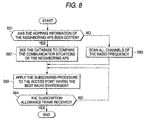
- Fig. 8 is a flowchart showing an example of the high-speed roaming operation of the station.
- FIG.1 is a schematic view showing an embodiment of a wireless LAN to which a high-speed roaming method of the present invention can be applied.
- an Ethernet 1 a plurality of access points AP1, AP2,..., AP6 provided in the Ethernet 1, and a station 3 that moves in the direction indicated by an arrow are shown as a wireless LAN 100 (One mobile station is shown in FIG.1 but such station is not limited to this. A plurality of mobile stations may be employed).
- respective access points function as one type bridge between the Ethernet 1 and the station 3.
- Each access point receives the frame that is directed to the MAC (Media Access Control) address of the subsidiary station 3 from the IEEE802.3 (reference specification) frame transmitted from the backbone Ethernet, then converts such frame into the frame of IEEE802.3 specification, and then transmits the frame to the destination station. Also, the frame transmitted from the subsidiary station 3 is sent out to the backbone (Ethernet 1) in the reverse procedures.
- MAC Media Access Control
- IEEE802.3 reference specification
- the frame transmitted from the subsidiary station 3 is sent out to the backbone (Ethernet 1) in the reverse procedures.
- circles shown as a cell image of the access point AP1, a cell image of the access point AP2... in FIG.1 signify radio zones (in this case, micro cells each having a radius of several tens meter to several hundreds meter) of the access points AP1, AP2,... respectively.
- the cell image of the shaded access point AP2 shows the cell relationship overlapped with the neighboring access points AP1, AP3, ..., AP6 in case the attention is paid to the access point AP.
- FIG.2 is a block diagram showing a structural example of the pertinent portion of each access point.
- An access point 2 comprises a CPU 21, a wireless MAC controller 22, an Ethernet controller 23, and an EEPROM 24.
- the CPU 21 executes the control of the overall access point 2. Also, this CPU 21 controls the transmitting timings of the hopping information of the access point 2 and the information of the neighboring access points to the Ethernet so as to enable the high-speed roaming operation according to the present invention, stores and updates the hopping information of the neighboring access points, etc. by respective means (programs) stored in the EEPROM 24, and controls the execution of the roaming operation.
- the wireless MAC controller 22 has both a data service function for the MAC layer and the PHY layer (Physical Layer) via the radio and a management function to control them. This wireless MAC controller 22 transmits/receives the frame via the PHY layer, and executes the control of the radio media and the data transmission/reception.
- PHY layer Physical Layer
- the Ethernet controller 23 has a function for controlling the PHY layer in the wire portion. This Ethernet controller 23 transmits/receives the frame via the PHY layer, and executes the data transmission/reception to/from the Ethernet 1 and the transmission/reception control.
- the EEPROM 24 stores means (programs) for storing and updating the hopping information of the neighboring access points, etc. and executing the roaming operation, four neighboring access points registered in advance by using NMS (Network Management System) at maximum (e.g., channels or identification information of four neighboring access points at maximum), the initial values necessary at the time of starting, and others.
- NMS Network Management System
- each access point has the not-shown memory (DRAM, the flash memory that can store and read the data by installing the removable memory medium, FD, the magnetic disk, the optical disk, or the like), and stores the hopping information of the registered neighboring access points, etc.
- DRAM the not-shown memory
- the flash memory that can store and read the data by installing the removable memory medium, FD, the magnetic disk, the optical disk, or the like
- FIG.3 is a block diagram showing a structural example of the station.
- the station signifies the mobile station (mobile terminal) that has the wireless terminal adaptor and exchanges the communication while moving.
- This station 3 comprises a CPU 31, a wireless MAC controller 32, and an EEPROM 33.
- the CPU 31 executes the control of the overall station 3. Also, this CPU 31 controls the download of the neighboring access points from the subscription access point, the decision of the roaming destination, etc., based on respective means (programs) stored in the EEPROM 33 to execute the high-speed roaming operation according to the present invention.
- the wireless MAC controller 32 has both a data service function for the MAC layer and the PHY layer (Physical Layer) via the radio and a management function to control them. This wireless MAC controller 32 transmits/receives the frame via the PHY layer, and executes the control, and management of the radio media and the data transmission/ reception.
- PHY layer Physical Layer
- the EEPROM 33 stores means (programs) for executing the high-speed roaming operation according to the present invention, the constants, etc.
- the station 3 has the not-shown memory (DRAM, the flash memory that can store and read the data by installing the removable memory medium, FD, the magnetic disk, the optical disk, or the like), and stores the hopping information of the neighboring access points, that are downloaded from the subscription access point.
- DRAM the not-shown memory
- the flash memory that can store and read the data by installing the removable memory medium, FD, the magnetic disk, the optical disk, or the like
- a feature of the high-speed roaming method according to the present invention resides in that, in the infrastructure type wireless LAN environment that the wireless LAN enters/secedes into/from the access point being selected successively with the movement of the station, all access points in the same ESS ID (Extended Service Set ID: the same ESS ID in the wireless network is referred to as the "same domain" hereinafter) connected on the same subnet via the wires are operated synchronously.
- ESS ID Extended Service Set ID: the same ESS ID in the wireless network is referred to as the "same domain" hereinafter
- one access point is set previously as the master among respective access points that are connected to the same subnet (subnet having the same network address in the wire network), and then a reference signal that is needed to take the synchronization by the access point in the same subnet is generated.
- the access point for generating such signal is called the master access point (referred simply to as a "master AP” hereinafter).
- This master AP broadcasts a reference signal containing TSF (Time Synchronization Function) time information serving as a reference to take the synchronization of the access point periodically (referred to as a "master beacon” hereinafter) to the connected wire Ethernet network.
- TSF Time Synchronization Function
- the master beacon transmitted from the master AP is received by the access points other than the master AP (referred to as a "slave AP" hereinafter).
- the slave AP operates in synchronism with the master beacon transmitted from this master AP. Accordingly, all access points of the same domain in the same subnet operate synchronously.
- the ETH-BEACON frame is a special frame for the high-speed roaming operation of the present invention (this means thebeacon frame that flows through the Ethernet), and is a multicast frame that is used by the access points on the wire side to know the information mutually.
- the access point has previously a function for deciding and registering a predetermined number of access points, into which the station must subscribe subsequently, as the neighboring access point.
- the individual access point as a function for receiving the hopping information transmitted from the registered access point and then constructing/updating the database of its own access point.
- the station can download the information of the neighboring access points from the connected access point to hold the information of the neighboring access points registered in the current subscription access point.
- the station monitors the radio beacon of the connected access point and also monitors the radio beacon of the neighboring access points based on the downloaded information of the neighboring access points. As a result, even when the station is moving, such station can grasp the RSSI value of the radio beacon of the access point registered as the neighboring access point and its quality, while being connected to one access point. Also, if the information are formed as the database to always compare the radio environments mutually, the station itself can always grasp the neighboring access points that have the good communication condition.
- the station When the beacon quality of the connected access point is lowered smaller than the threshold value, the station starts the roaming function and then applies directly the subscription operation to the access point having the best communication condition among the access points, that are registered as the neighboring access points, without the scanning of the frequency channels.
- the subscription operation signifies a series of operations such as transmission/reception of the probe request frame and the probe response frame, transmission/reception of the authentication request frame and the authentication response frame, transmission/reception of the association request frame and the association response frame, etc. between the station and the access points (IEEE802.11 term).
- the station executes the subscription operation sequentially into the access point having the second best communication condition by referring to the database.
- the station can enter into the access point at all, such station scans all frequency channels (i.e., executes the normal scanning). Accordingly, the station can be connected to the access point having the good communication situation.
- the station scans the predetermined frequency channels and is connected to the access point having the best communication environment.
- the backup AP is not limited to this condition.
- the backup AP may be decided based on the set Alias name, the backup AP may be decided based on MAC ID, or the like.
- FIG.4 and FIG.5 are flowcharts showing operational examples in which all access points in the same subnet are operated synchronously.
- FIG.4 is a flowchart showing an operational example of the master AP as the reference of synchronization.
- FIG.5 is a flowchart showing an operational example of the slave AP that operates in synchronism with the master AP.
- the CPU 21 immediately sends out the first master beacon to the Ethernet networks via the Ethernet controller 23 at the time of start to cause the access points to synchronize with each other (step S41). Then, it is decided whether or not a predetermined time has lapsed (step S42). If it is decided that the predetermined time has lapsed (if YES in the decision in step S42), the master AP broadcasts the master beacon to the Ethernet networks via the Ethernet controller 23 (step S43). These operations are repeated periodically at a predetermined time interval (step S43, step S44).
- step S51 it is decided in the start standby state whether or not the first master beacon is received from the master AP (step S51). If it is decided that the first master beacon is received (if YES in the decision in step S51), the slave AP is started in synchronism with the master beacon (step S52). As described above, the master beacon is transmitted from the master AP periodically at the predetermined time interval. In this case, if the master AP is stopped because of any reason, there is the case where the master beacon cannot be received by the slave AP side.
- step S53 the number of times n by which the master beacon is not received within a predetermined time is counted so as to start the backup AP. Then, the number of times n by which the master beacon is not received is compared with a predetermined successive number of times N (step S54). If the number of times n by which the master beacon is not received is not equal to the successive number of times N (in other words, if the master beacon is received only once within the predetermined time) (if YES in the decision in step S54), the slave AP monitors the master beacon transmitted from the master AP (step S55) and then repeats the operations in step S53 and subsequent steps.
- step S56 it is decided whether or not the slave AP can satisfy the conditions as the backup AP (step S56).
- the conditions as the backup AP mean the conditions such that, as described above, the access point has the smallest hopping set number, etc. If the slave AP can satisfy the conditions as the backup AP (if YES in the decision in step S56), the slave AP sends out the master beacon as the backup AP instead of the master AP (step S57). Unless the slave AP can satisfy the conditions as the backup AP (if NO in the decision in step S56), such slave AP repeats the operations in step S53 and subsequent steps.
- the slave APs belonging to the same subnet are operated synchronously based on the information of the master beacon. Therefore, all access points in the same subnet can be operated synchronously.
- the master AP is caused not to function because of any reason, the slave AP acts as the backup access point based on the self-decision and then sends out the master beacon that is important for the present system. As a result, the trouble can be suppressed to the minimum.
- FIG.6 and FIG.7 are flowcharts showing operational examples of each access point.
- FIG.6 is a flowchart showing transmitting and updating operations of the hopping information of each access point.
- FIG.7 is a flowchart showing receiving and updating operations of the hopping information of each access point. In this case, the operations in FIG.6 and FIG.7 can be carried out in parallel.
- the CPU 21 sends out immediately the ETH-BEACON frame containing the hopping information to the Ethernet 1 via the Ethernet controller 23 (step S61). Then, it is decided whether or not a random delay time (0 to 10 seconds in this embodiment) has lapsed (step S62). If it is decided that the random delay time has not lapsed (if NO in the decision in step S62), the decision in step S62 is repeated. If it is decided that the random delay time has lapsed (if YES in the decision in step S62), the CPU 21 sends out (the ETH-BEACON frame containing) the next hopping information to the Ethernet 1 via the Ethernet controller 23 (step S63).
- This operation is repeated at a predetermined time interval (10 seconds interval in the embodiment) (step S64).
- This random delay given after the transmission of the ETH-BEACON frame executed immediately at the time of starting is used to prevent the simultaneous start of the arranged access points or the simultaneous-sending-out of the hopping information.
- the CPU 21 monitors whether or not the ETH-BEACON frame is received from the Ethernet 1 (step S71). If it is decided that the ETH-BEACON frame is received (if YES in the decision in step S71), the operation goes to step S72. If it is decided that the ETH-BEACON frame is not received (if NO in the decision in step S71), the operation goes to step S77.
- the CPU 21 receives the ETH-BEACON frame from the Ethernet 1 via the Ethernet controller 23 (if YES in the decision in step S71), it resets an ageing timer to a predetermined value (step S72).
- the predetermined value is set to 15 seconds in the embodiment, but it is not limited to this value.
- the CPU 21 When the CPU 21 receives the ETH-BEACON frame from the Ethernet 1 via the Ethernet controller 23, it compares the ESS-ID of the frame with its own ESS-ID (step S73). If the ESS-ID of the frame does not coincide with its own ESS-ID (if NO in the decision in step S73), the operation goes to step S76. If the ESS-ID of the frame coincides with its own ESS-ID, the operation goes to step S74.
- the CPU 21 compares sequentially the channel (each access point identification information) of the ETH-BEACON frame with the neighboring access point identification information (four pieces at maximum in this embodiment) stored in the EEPROM 24, to decide whether or not the frame is the information (containing the hopping information) of the registered neighboring access point (step S74). Then, if the ETH-BEACON frame is transmitted from the registered neighboring access point (if YES in the decision in step S74), the CPU 21 picks up the hopping information from the ETH-BEACON frame received via the Ethernet controller 23, and stores (saves) the hopping information in the memory (step S75).
- step S71 The operation is returned to step S71, and the operations in step S71 and subsequent steps are repeated.
- step S74 the operation goes to step S76.
- step S76 the CPU 21 cancels the received ETH-BEACON frame (step S76). The operation is returned to step S71, and the operations in step S71 and subsequent steps are repeated. If the CPU 21 does not receive the ETH-BEACON frame (if NO in the decision in step S71), the CPU 21 decides whether or not the ageing timer is ended (step S77).
- step S78 If the access point fails to receive the ETH-BEACON frame (if NO in the decision in step S77) before the ageing timer is ended, the CPU 21 cancels the saved hopping information, etc. saved in the database (step S78).
- step S79 the CPU 21 resets the ageing timer (step S79). The operation is returned to step S71, and the operations in step S71 and subsequent steps are repeated.
- the access points broadcast respective hopping information (the ETH- BEACON frames) periodically to the networks of the Ethernet (where the broadcast timings of respective access points are different.), all access points belonging to the same subnet can know mutually the information of the hopping patterns, the hopping sets, and the TSF times of other access points. Since respective access points receive the hopping information from other access point after this to update the information in its own database, they can exchange mutually the hopping information via the Ethernet as the result. Accordingly, respective access points can know the up-to-date and precise hopping information about all access points in the same subset.
- the station downloads the hopping information of the neighboring access pointes saved in the subscription access point.
- the station can get the hopping information of up to four access points being provided around the current subscription access point by the downloading. Also, the station enters into the access point having the maximum RSSI at the rising time by the normal scanning.
- FIG. 8 is a flowchart showing an example of the high- speed roaming operation of the station 3.
- the CPU 31 searches the memory to check whether or not the hopping information of the registered neighboring access points that are saved and registered in the current subscription access point has been gotten (downloaded) (step S81).
- the CPU 31 monitors the beacon to mate with the hopping frequency of the neighboring access point since all access points are operated synchronously. Accordingly, the station can grasp the latest radio situation of the neighboring access point into which the station is entered subsequently and also forms the information as the database. Therefore, when the beacon quality of the current subscription (connected) access point becomes smaller than the threshold value, the station can see the database (step S82).
- the station fits the hopping channel and the hopping pattern to the neighboring access point having the best communication environment via the wireless MAC controller 32, then transmits the probe request frame, then receives the response frame (probe response frame) sent from the access point in response to the request made by the probe request frame, then decides the access point (subscription access point) as the roaming destination, and then transmits the authentication request frame (authentication request (subscription request)) to the access point via the wireless MAC controller 32.
- step S81 If the hopping information is not downloaded (if NO in the decision in step S81), the CPU 31 scans all channels of the radio frequency via the wireless MAC controller 32 at the time of rising the station, for example (step S85). Then, the operation goes to step S83.
- the subscription operation can be applied directly to the access point, that has the best communication situations, out of the neighboring access points only by mating the hopping channel and the hopping pattern by referring the database. Accordingly, the roaming can be carried out in a very short time.
- the station can be connected to the access point having the good communication environment by the normal scanning at the time of rising the station.
- the station can self-decide the roaming destination and thus can enter into the optimum access point in a very short time.
- the slave APs in the same subnet are operated in synchronism with the information of the master beacon. Accordingly, all access points in the same subnet can be operated synchronously.
- the station when the station enters into the access point, such station can download the neighboring access points and the hopping information from the access point.
- the station can monitor the radio beacon of the neighboring access points by changing the frequency channel in a moment based on the information. Therefore, the station can grasp the up-to- date radio situation of the neighboring access point to be entered next and also can compare the information as the database.
- the subscription operation can be applied directly to the access point, that has the best communication environment at that time, by referring the database without the matching of the frequency scan and the synchronization.
- the station can be connected to the access point having the good communication environment by the normal scanning at the time of rising the station.
- the station can self-decide the roaming destination and thus can enter into the optimum access point even when the station rises at any place of the wide-area network in which a plurality of access points are provided.
- the access point acts as the backup access point based on the self-decision and then the backup means for sending out the master beacon that is important for the present system is provided.
- the trouble canbe suppressed to the minimum.
Landscapes
- Engineering & Computer Science (AREA)
- Computer Security & Cryptography (AREA)
- Computer Networks & Wireless Communication (AREA)
- Signal Processing (AREA)
- Mobile Radio Communication Systems (AREA)
- Small-Scale Networks (AREA)
Abstract
Description
Claims (6)
- A high-speed roaming method of a wireless LAN comprising a network, a plurality of access points provided in the network, and a mobile terminal that is radio-connected to one of said plurality of access points via a communication system using a frequency hopping, whereineach of said access pointsregisters previously a predetermined number of access points out of respective neighboring access points as neighboring access points,sends out hopping information of the own access point thereof periodically to the network at mutually different timings,receives the hopping information of the neighboring access points out of respective access points to construct the own access points thereof as a database, andsynchronize all access points in a same subnet of the network and sends out radio beacons synchronously from said access points; andsaid mobile terminalmonitors said radio beacons of a connected access point and downloads hopping information of the neighboring access points from said connected access point,monitors radio beacons of said neighboring access points based on the hopping information,construct the monitored hopping information as a database to always compare radio environments, andselect and connect the access point having a best radio situation by referring the database of said neighboring access points when a quality of the radio beacon of said connected access point is reduced lower than a predetermined value.
- The high-speed roaming method of a wireless LAN according to claim 1, whereineach of said access points sets previously one access point of respective access points connected to the same subnet as a master access point, and sets the access points other than said master access point as slave access points,said master access point sends out a master beacon containing time information to the network at a predetermined time interval, andsaid slave access points are operated in synchronism with said master access point by receiving said master beacon and comparing time information contained in said master beacon with the own time information thereof to correct.
- The high-speed roaming method of a wireless LAN according to claim 2, whereinwhen an operation of said master access point is stopped because of a predetermined reason, another access point connected to the same subnet backups said master access point in place of said master access point.
- The high-speed roaming method of a wireless LAN according to any one of claims 1 to 3, wherein.when said mobile terminal is connected to said access point having a best radio situation, such mobile terminal is connected subsequently to said access point having a second best radio situation.
- The high-speed roaming method of a wireless LAN according to any one of claims 1 to 4, whereinwhen said mobile terminal is not connected to all neighboring access points, such mobile terminal is connected to said access point having a good communication situation by scanning all frequency channels.
- The high-speed roaming method of a wireless LAN according to any one of claims 1 to 5, whereinsaid mobile terminal is connected to said access point having a best communication situation, by scanning all connectable access points out of said access points provided in the network at a rising time.
Applications Claiming Priority (2)
| Application Number | Priority Date | Filing Date | Title |
|---|---|---|---|
| JP2000209784 | 2000-07-11 | ||
| JP2000209784A JP3673149B2 (en) | 2000-07-11 | 2000-07-11 | High speed roaming method for wireless LAN |
Publications (3)
| Publication Number | Publication Date |
|---|---|
| EP1172969A2 true EP1172969A2 (en) | 2002-01-16 |
| EP1172969A3 EP1172969A3 (en) | 2004-01-14 |
| EP1172969B1 EP1172969B1 (en) | 2007-05-23 |
Family
ID=18706142
Family Applications (1)
| Application Number | Title | Priority Date | Filing Date |
|---|---|---|---|
| EP01116831A Expired - Lifetime EP1172969B1 (en) | 2000-07-11 | 2001-07-10 | High-speed roaming method for a wireless local area network |
Country Status (5)
| Country | Link |
|---|---|
| US (1) | US6917804B2 (en) |
| EP (1) | EP1172969B1 (en) |
| JP (1) | JP3673149B2 (en) |
| KR (1) | KR100567438B1 (en) |
| DE (1) | DE60128517T2 (en) |
Cited By (15)
| Publication number | Priority date | Publication date | Assignee | Title |
|---|---|---|---|---|
| EP1398912A1 (en) * | 2002-08-28 | 2004-03-17 | NEC Infrontia Corporation | An IEEE 802.11 WLAN-network enabling fast roaming |
| EP1527563A2 (en) * | 2002-08-02 | 2005-05-04 | Wavelink Corporation | Managed roaming for wlans |
| WO2006105060A1 (en) * | 2005-03-28 | 2006-10-05 | Mediacell Licensing Corp. | Synchronized beacon for network having multiple radios |
| WO2006119452A1 (en) * | 2005-05-04 | 2006-11-09 | Sandwave Ip, Llc | Externally sourced synchronized beacon |
| EP1720292A3 (en) * | 2005-05-07 | 2006-11-15 | Samsung Electronics Co., Ltd. | Method and apparatus for grouping mobile nodes in extended wireless LAN |
| WO2007049192A1 (en) * | 2005-10-28 | 2007-05-03 | Koninklijke Philips Electronics N.V. | Communication network |
| WO2007122992A1 (en) * | 2006-04-20 | 2007-11-01 | Kabushiki Kaisha Toshiba | Fast link-down detection systems and methods |
| WO2006052221A3 (en) * | 2004-11-12 | 2008-01-17 | Matsushita Electric Industrial Co Ltd | Beacon group merging |
| WO2010140742A1 (en) * | 2009-06-03 | 2010-12-09 | Lg Electronics Inc. | Method for providing information of access point selection |
| US8170607B2 (en) | 2002-09-17 | 2012-05-01 | Broadcom Corporation | Communication system and method in a hybrid wired/wireless local area network |
| US8203996B2 (en) | 2006-02-15 | 2012-06-19 | Fujitsu Limited | Communication device, wireless communication device, and control method |
| US8391915B2 (en) | 2005-07-14 | 2013-03-05 | Sandwave Ip, Llc | Virtual cells for wireless networks |
| US8504678B2 (en) | 2005-12-30 | 2013-08-06 | Sandwave Ip, Llc | Traffic routing based on geophysical location |
| US8582498B2 (en) | 2006-03-07 | 2013-11-12 | Sandwave Ip, Llc | Service subscription using geophysical location |
| CN105704717A (en) * | 2016-03-19 | 2016-06-22 | 广东嘉腾机器人自动化有限公司 | AGV communication method |
Families Citing this family (111)
| Publication number | Priority date | Publication date | Assignee | Title |
|---|---|---|---|---|
| US7181530B1 (en) * | 2001-07-27 | 2007-02-20 | Cisco Technology, Inc. | Rogue AP detection |
| JP3563714B2 (en) * | 2001-08-08 | 2004-09-08 | 株式会社東芝 | Network connection device |
| DE10145596A1 (en) * | 2001-09-15 | 2003-04-03 | Philips Corp Intellectual Pty | Network with several sub-networks |
| US20040048610A1 (en) * | 2001-09-28 | 2004-03-11 | Kim Soo Hwan | Method and system for matching subscriber states in network in which public land mobile network and wired/wireless private network are interworked |
| JP3888130B2 (en) * | 2001-11-01 | 2007-02-28 | セイコーエプソン株式会社 | Wireless network station |
| JP3792154B2 (en) * | 2001-12-26 | 2006-07-05 | インターナショナル・ビジネス・マシーンズ・コーポレーション | Network security system, computer apparatus, access point recognition processing method, access point check method, program, and storage medium |
| KR100419617B1 (en) * | 2002-02-19 | 2004-02-25 | 삼성전기주식회사 | Method for operating wireless lan card in wireless local area network |
| US7433691B1 (en) * | 2002-03-25 | 2008-10-07 | Meshnetworks, Inc. | System and method for enabling an access point in an ad-hoc wireless network with fixed wireless routers and wide area network (WAN) access points to identify the location of subscriber device |
| JP3761486B2 (en) | 2002-03-29 | 2006-03-29 | Necインフロンティア株式会社 | Wireless LAN system, main device and program |
| US20030206532A1 (en) | 2002-05-06 | 2003-11-06 | Extricom Ltd. | Collaboration between wireless lan access points |
| US6799054B2 (en) * | 2002-05-06 | 2004-09-28 | Extricom, Ltd. | Collaboration between wireless LAN access points using wired lan infrastructure |
| US7319688B2 (en) * | 2002-05-06 | 2008-01-15 | Extricom Ltd. | LAN with message interleaving |
| US7355994B2 (en) * | 2002-05-06 | 2008-04-08 | Extricom Ltd. | CDMA messaging between wireless LAN access points |
| US7047036B2 (en) * | 2002-07-02 | 2006-05-16 | Interdigital Technology Corporation | Method and apparatus for handoff between a wireless local area network (WLAN) and a universal mobile telecommunication system (UMTS) |
| US20060209771A1 (en) * | 2005-03-03 | 2006-09-21 | Extricom Ltd. | Wireless LAN with contention avoidance |
| US7697549B2 (en) * | 2002-08-07 | 2010-04-13 | Extricom Ltd. | Wireless LAN control over a wired network |
| US20050195786A1 (en) * | 2002-08-07 | 2005-09-08 | Extricom Ltd. | Spatial reuse of frequency channels in a WLAN |
| JP4397168B2 (en) * | 2002-08-21 | 2010-01-13 | レノボ シンガポール プライヴェート リミテッド | Computer device and wireless network connection method |
| US6957067B1 (en) * | 2002-09-24 | 2005-10-18 | Aruba Networks | System and method for monitoring and enforcing policy within a wireless network |
| JP3742056B2 (en) * | 2002-12-19 | 2006-02-01 | 株式会社バッファロー | Wireless network access authentication technology |
| KR100913869B1 (en) * | 2002-10-28 | 2009-08-26 | 삼성전자주식회사 | How to automatically create and change wireless terminal device and wireless LAN access information |
| JP2004180121A (en) * | 2002-11-28 | 2004-06-24 | Nec Infrontia Corp | Wireless LAN terminal, wireless LAN base station, wireless communication method, and roaming method |
| AU2002348739A1 (en) * | 2002-12-19 | 2004-07-14 | Nokia Corporation | System and handover mechanism in frequency multiple band environment and equipment therefor |
| KR100510126B1 (en) | 2002-12-23 | 2005-08-25 | 삼성전자주식회사 | A handover method and mobile node handover device in wireless LAN |
| US9137670B2 (en) * | 2003-02-18 | 2015-09-15 | Hewlett-Packard Development Company, L.P. | Method for detecting rogue devices operating in wireless and wired computer network environments |
| US7242950B2 (en) * | 2003-02-18 | 2007-07-10 | Sbc Properties, L.P. | Location determination using historical data |
| US7295524B1 (en) * | 2003-02-18 | 2007-11-13 | Airwave Wireless, Inc | Methods, apparatuses and systems facilitating management of airspace in wireless computer network environments |
| KR100591752B1 (en) * | 2003-04-25 | 2006-06-22 | 삼성전자주식회사 | Wireless communication system having a plurality of independent transmission channels |
| US8131291B2 (en) * | 2003-04-29 | 2012-03-06 | Ntt Docomo, Inc. | Fast active scanning wireless network apparatus and method |
| JP2004343448A (en) * | 2003-05-15 | 2004-12-02 | Matsushita Electric Ind Co Ltd | Wireless LAN access authentication system |
| TWI223535B (en) * | 2003-05-21 | 2004-11-01 | Admtek Inc | Control signal generation device and method for transmission time of beacon frame |
| US20070115883A1 (en) * | 2003-07-14 | 2007-05-24 | Matsushita Electric Industrial Co., Ltd. | Method for reducing hand-off latency in mobile networks |
| KR100520931B1 (en) | 2003-07-22 | 2005-10-17 | 삼성전자주식회사 | Communication system and method in wireless infrastructure network environment |
| US7844266B2 (en) | 2003-09-30 | 2010-11-30 | Intel Corporation | Wireless network roaming timer method and apparatus |
| JPWO2005036825A1 (en) * | 2003-10-09 | 2006-12-28 | 松下電器産業株式会社 | High-speed mobile radio transmission system |
| JP4466296B2 (en) | 2003-10-17 | 2010-05-26 | パナソニック株式会社 | HANDOVER METHOD AND MOBILE COMMUNICATION SYSTEM |
| ATE470324T1 (en) * | 2003-11-12 | 2010-06-15 | Interdigital Tech Corp | SYSTEM FOR AUTONOMOUS APPLICATION SERVER ACCESS ACROSS VARIOUS TYPES OF ACCESS TECHNOLOGY NETWORKS |
| TWI366385B (en) * | 2003-11-13 | 2012-06-11 | Interdigital Tech Corp | Method and system for facilitating inter-system handover |
| US7466678B2 (en) * | 2003-12-29 | 2008-12-16 | Lenovo (Singapore) Pte. Ltd. | System and method for passive scanning of authorized wireless channels |
| CA2559268A1 (en) * | 2004-03-12 | 2005-09-29 | Interdigital Technology Corporation | Method and system for switching a radio access technology between wireless communicaiton systems with a multi-mode wireless transmit/receive unit |
| US8306002B2 (en) * | 2004-04-05 | 2012-11-06 | Texas Instruments Incorporated | Wireless communication technique comprising multiple beacons in each communications superframe |
| JP2005303788A (en) * | 2004-04-14 | 2005-10-27 | Matsushita Electric Ind Co Ltd | Wireless device |
| JP2006005774A (en) * | 2004-06-18 | 2006-01-05 | Alps Electric Co Ltd | Communication terminal device |
| KR100636148B1 (en) | 2004-06-25 | 2006-10-19 | 삼성전자주식회사 | System and method for wireless printing based on IEEE 802.11 |
| US8099094B2 (en) * | 2004-07-12 | 2012-01-17 | Interdigital Technology Corporation | Neighbor scanning in wireless local area networks |
| EP1626537A1 (en) * | 2004-08-11 | 2006-02-15 | Iwatsu Electric Co., Ltd. | Wireless LAN network system and a method for connecting access points thereof |
| JP4507765B2 (en) * | 2004-08-26 | 2010-07-21 | 富士通株式会社 | Program, relay device control method, wireless communication device control method and system |
| EP1657853A1 (en) * | 2004-11-12 | 2006-05-17 | STMicroelectronics (Research & Development) Limited | Roaming network stations using a MAC address identifier to select a new access point |
| US8041319B2 (en) * | 2004-12-23 | 2011-10-18 | Avaya Inc. | Method and apparatus to intelligently perform scanning and assist scanning by profiling scanning history |
| US8005032B2 (en) * | 2005-01-21 | 2011-08-23 | Research In Motion Limited | Maintaining delivery traffic indication message (DTIM) periods on a per-wireless client device basis |
| US7593417B2 (en) | 2005-01-21 | 2009-09-22 | Research In Motion Limited | Handling broadcast and multicast traffic as unicast traffic in a wireless network |
| WO2006085841A1 (en) * | 2005-01-31 | 2006-08-17 | Thomson Licensing | Local mobility solution with wired and wireless interface switching |
| US7912465B2 (en) * | 2005-03-24 | 2011-03-22 | Research In Motion Limited | Scanning for wireless local area networks |
| US20060215621A1 (en) * | 2005-03-24 | 2006-09-28 | Research In Motion Limited | Scanning for wireless local area networks |
| JP2006279337A (en) * | 2005-03-28 | 2006-10-12 | Toshiba Corp | Radio base station apparatus, radio terminal apparatus, and communication method |
| US7706789B2 (en) * | 2005-03-31 | 2010-04-27 | Intel Corporation | Techniques to manage roaming |
| US8023495B1 (en) | 2005-04-08 | 2011-09-20 | Hewlett-Packard Company | Method and system for WLAN synchronization |
| EP1989933A4 (en) * | 2005-05-04 | 2012-06-06 | Sandwave Ip Llc | Enclosure with ground plane |
| US20060276190A1 (en) * | 2005-05-19 | 2006-12-07 | Interdigital Technology Corporation | Method and apparatus for implementing a handoff between radio access networks deployed under different radio access technologies |
| US7813738B2 (en) * | 2005-08-11 | 2010-10-12 | Extricom Ltd. | WLAN operating on multiple adjacent bands |
| JP4545671B2 (en) * | 2005-09-29 | 2010-09-15 | 京セラ株式会社 | Wireless communication terminal and wireless communication method |
| US7616604B2 (en) * | 2005-10-25 | 2009-11-10 | Cisco Technology, Inc. | Identifying one or more access points in one or more channels to facilitate communication |
| US20070167171A1 (en) * | 2005-12-30 | 2007-07-19 | Mediacell Licensing Corp | Determining the Location of a Device Having Two Communications Connections |
| US20070224988A1 (en) * | 2006-03-24 | 2007-09-27 | Interdigital Technology Corporation | Method and apparatus for performing a handover procedure between a 3gpp lte network and an alternative wireless network |
| US7656855B2 (en) * | 2006-04-29 | 2010-02-02 | At&T Intellectual Property Ii, Lp | Arrangement for synchronizing access points in WLAN using direct-sequence spread spectrum signaling |
| GB0612438D0 (en) | 2006-06-23 | 2006-08-02 | Siemens Ag | Network selection |
| JP2008042476A (en) * | 2006-08-04 | 2008-02-21 | Sony Corp | Wireless communication system, wireless communication apparatus, wireless communication method, and computer program |
| US20080075035A1 (en) * | 2006-09-22 | 2008-03-27 | Intermec Ip Corp. | System and method for providing fast roaming |
| CN101155036A (en) * | 2006-09-30 | 2008-04-02 | Thomson宽带研发(北京)有限公司 | Head end equipment of wired access network system |
| US8817813B2 (en) | 2006-10-02 | 2014-08-26 | Aruba Networks, Inc. | System and method for adaptive channel scanning within a wireless network |
| US20080101301A1 (en) * | 2006-10-27 | 2008-05-01 | Motorola, Inc. | Handover in a cellular communication system |
| US20080112373A1 (en) * | 2006-11-14 | 2008-05-15 | Extricom Ltd. | Dynamic BSS allocation |
| JP4267026B2 (en) | 2006-11-30 | 2009-05-27 | Necインフロンティア株式会社 | Wireless LAN terminal and handover method thereof |
| KR100869960B1 (en) * | 2006-12-05 | 2008-11-24 | 한국전자통신연구원 | Method for roaming of sensor node in wireless sensor network environment |
| US7663481B2 (en) | 2006-12-05 | 2010-02-16 | Electronics And Telecommunications Research Institute | Method for sensor node roaming in wireless sensor network environment |
| US9521090B2 (en) | 2007-06-04 | 2016-12-13 | Qualcomm Incorporated | Authorizing stations into a centrally managed network |
| US8149715B1 (en) | 2007-07-17 | 2012-04-03 | Marvell International Ltd. | Mesh network operations |
| US8369782B1 (en) | 2007-08-13 | 2013-02-05 | Marvell International Ltd. | Bluetooth wideband scan mode |
| US8553561B1 (en) | 2007-08-22 | 2013-10-08 | Marvell International Ltd. | Quality of service for mesh networks |
| US8577305B1 (en) | 2007-09-21 | 2013-11-05 | Marvell International Ltd. | Circuits and methods for generating oscillating signals |
| KR20090044740A (en) | 2007-11-01 | 2009-05-07 | 삼성전자주식회사 | Apparatus and method for changing access point in wireless network system |
| US8588705B1 (en) | 2007-12-11 | 2013-11-19 | Marvell International Ltd. | System and method of determining Power over Ethernet impairment |
| CN102067689B (en) | 2008-06-16 | 2016-11-09 | 马维尔国际贸易有限公司 | short-range wireless communication |
| US8310967B1 (en) | 2008-06-19 | 2012-11-13 | Marvell International Ltd. | Infrastructure and ad-hoc node device |
| US8600324B1 (en) | 2008-06-27 | 2013-12-03 | Marvell International Ltd | Circuit and method for adjusting a digitally controlled oscillator |
| US8472968B1 (en) | 2008-08-11 | 2013-06-25 | Marvell International Ltd. | Location-based detection of interference in cellular communications systems |
| US9288764B1 (en) | 2008-12-31 | 2016-03-15 | Marvell International Ltd. | Discovery-phase power conservation |
| US8472427B1 (en) | 2009-04-06 | 2013-06-25 | Marvell International Ltd. | Packet exchange arbitration for coexisting radios |
| US9066369B1 (en) | 2009-09-16 | 2015-06-23 | Marvell International Ltd. | Coexisting radio communication |
| JP5395615B2 (en) * | 2009-10-27 | 2014-01-22 | キヤノン株式会社 | Wireless communication apparatus, control method and program for wireless communication apparatus |
| US8340034B1 (en) | 2009-11-11 | 2012-12-25 | Marvell International Ltd. | Bluetooth and wireless LAN arbitration |
| US8767771B1 (en) | 2010-05-11 | 2014-07-01 | Marvell International Ltd. | Wakeup beacons for mesh networks |
| KR101616491B1 (en) | 2010-10-20 | 2016-04-28 | 마벨 월드 트레이드 리미티드 | Pre-association discovery |
| US8588844B2 (en) | 2010-11-04 | 2013-11-19 | Extricom Ltd. | MIMO search over multiple access points |
| US8750278B1 (en) | 2011-05-26 | 2014-06-10 | Marvell International Ltd. | Method and apparatus for off-channel device invitation |
| US8983557B1 (en) | 2011-06-30 | 2015-03-17 | Marvell International Ltd. | Reducing power consumption of a multi-antenna transceiver |
| JP5799668B2 (en) * | 2011-08-25 | 2015-10-28 | 株式会社バッファロー | Communication apparatus, communication system, and communication setting information sharing method |
| US9125216B1 (en) | 2011-09-28 | 2015-09-01 | Marvell International Ltd. | Method and apparatus for avoiding interference among multiple radios |
| US9036517B2 (en) | 2012-01-09 | 2015-05-19 | Marvell World Trade Ltd. | Methods and apparatus for establishing a tunneled direct link setup (TDLS) session between devices in a wireless network |
| US9215708B2 (en) | 2012-02-07 | 2015-12-15 | Marvell World Trade Ltd. | Method and apparatus for multi-network communication |
| KR101644439B1 (en) * | 2012-03-29 | 2016-08-01 | 엘지전자 주식회사 | Method and apparatus of link set-up in a wireless communication system |
| US9609676B1 (en) | 2012-03-30 | 2017-03-28 | Marvell International Ltd. | Efficient transition from discovery to link establishment |
| US9450649B2 (en) | 2012-07-02 | 2016-09-20 | Marvell World Trade Ltd. | Shaping near-field transmission signals |
| US8803296B2 (en) * | 2012-12-18 | 2014-08-12 | Texas Instruments Incorporated | Coatings for relatively movable surfaces |
| US9225670B2 (en) * | 2013-02-28 | 2015-12-29 | Dell Products L.P. | System and method for storage and retrieval of neighboring switch tokens |
| US20140321317A1 (en) * | 2013-04-26 | 2014-10-30 | Nokia Corporation | Method, apparatus, and computer program product for network type determination |
| US9432925B2 (en) | 2013-08-05 | 2016-08-30 | Nokia Technologies Oy | Method, apparatus, and computer program product for hop count usage in cluster selection |
| US20150124681A1 (en) * | 2013-11-01 | 2015-05-07 | Qualcomm Incorporated | Synchronized group messaging |
| US10003915B2 (en) * | 2014-02-25 | 2018-06-19 | Bridgewest Finance Llc | Frame time synchronization in a wireless local area network |
| KR101566690B1 (en) * | 2014-05-14 | 2015-11-09 | (주)다보링크 | Wireless access point and control method thereof, communication apparatus communicating the wireless access point and control method thereof, and recording medium for recording program for executing the control method |
| WO2016151182A1 (en) | 2015-03-24 | 2016-09-29 | Nokia Technologies Oy | Method, apparatus, and computer program product for service anonymity |
Family Cites Families (6)
| Publication number | Priority date | Publication date | Assignee | Title |
|---|---|---|---|---|
| US5790536A (en) | 1989-01-31 | 1998-08-04 | Norand Corporation | Hierarchical communication system providing intelligent data, program and processing migration |
| GB9300310D0 (en) * | 1993-01-08 | 1993-03-03 | Ncr Int Inc | Handover method for mobile wireless station |
| AU7210894A (en) | 1993-06-25 | 1995-01-17 | Xircom, Inc. | Virtual carrier detection for wireless local area network with distributed control |
| US5633888A (en) * | 1995-06-05 | 1997-05-27 | Advanced Micro Devices, Inc. | Method of using an access point adjacency matrix to establish handoff in a wireless LAN |
| US6332077B1 (en) * | 1999-07-29 | 2001-12-18 | National Datacom Corporation | Intelligent roaming in AGV application |
| JP2001094572A (en) | 1999-09-22 | 2001-04-06 | Clarion Co Ltd | Method for fast roaming in radio lan, access point, and mobile terminal |
-
2000
- 2000-07-11 JP JP2000209784A patent/JP3673149B2/en not_active Expired - Fee Related
-
2001
- 2001-07-10 EP EP01116831A patent/EP1172969B1/en not_active Expired - Lifetime
- 2001-07-10 DE DE60128517T patent/DE60128517T2/en not_active Expired - Lifetime
- 2001-07-10 US US09/901,134 patent/US6917804B2/en not_active Expired - Lifetime
- 2001-07-11 KR KR1020010041585A patent/KR100567438B1/en not_active Expired - Fee Related
Cited By (24)
| Publication number | Priority date | Publication date | Assignee | Title |
|---|---|---|---|---|
| EP1527563A2 (en) * | 2002-08-02 | 2005-05-04 | Wavelink Corporation | Managed roaming for wlans |
| US8000298B2 (en) | 2002-08-28 | 2011-08-16 | Nec Infrontia Corporation | Fast roaming system |
| EP1398912A1 (en) * | 2002-08-28 | 2004-03-17 | NEC Infrontia Corporation | An IEEE 802.11 WLAN-network enabling fast roaming |
| US8170607B2 (en) | 2002-09-17 | 2012-05-01 | Broadcom Corporation | Communication system and method in a hybrid wired/wireless local area network |
| WO2006052221A3 (en) * | 2004-11-12 | 2008-01-17 | Matsushita Electric Industrial Co Ltd | Beacon group merging |
| US8050669B2 (en) | 2004-11-12 | 2011-11-01 | Panasonic Corporation | Beacon group merging |
| WO2006105060A1 (en) * | 2005-03-28 | 2006-10-05 | Mediacell Licensing Corp. | Synchronized beacon for network having multiple radios |
| WO2006119452A1 (en) * | 2005-05-04 | 2006-11-09 | Sandwave Ip, Llc | Externally sourced synchronized beacon |
| WO2006119453A1 (en) * | 2005-05-04 | 2006-11-09 | Mediacell Licensing Corp | Self synchronized beacon |
| EP1884072A4 (en) * | 2005-05-04 | 2012-04-11 | Sandwave Ip Llc | Externally sourced synchronized beacon |
| US8295254B2 (en) | 2005-05-07 | 2012-10-23 | Samsung Electronics Co., Ltd. | Method and apparatus for grouping mobile nodes in extended wireless LAN |
| EP1720292A3 (en) * | 2005-05-07 | 2006-11-15 | Samsung Electronics Co., Ltd. | Method and apparatus for grouping mobile nodes in extended wireless LAN |
| US8391915B2 (en) | 2005-07-14 | 2013-03-05 | Sandwave Ip, Llc | Virtual cells for wireless networks |
| WO2007049192A1 (en) * | 2005-10-28 | 2007-05-03 | Koninklijke Philips Electronics N.V. | Communication network |
| US8504678B2 (en) | 2005-12-30 | 2013-08-06 | Sandwave Ip, Llc | Traffic routing based on geophysical location |
| US8203996B2 (en) | 2006-02-15 | 2012-06-19 | Fujitsu Limited | Communication device, wireless communication device, and control method |
| US8681703B2 (en) | 2006-02-15 | 2014-03-25 | Fujitsu Limited | Communication device, wireless communication device, and control method |
| US8582498B2 (en) | 2006-03-07 | 2013-11-12 | Sandwave Ip, Llc | Service subscription using geophysical location |
| WO2007122992A1 (en) * | 2006-04-20 | 2007-11-01 | Kabushiki Kaisha Toshiba | Fast link-down detection systems and methods |
| WO2010140742A1 (en) * | 2009-06-03 | 2010-12-09 | Lg Electronics Inc. | Method for providing information of access point selection |
| US8711968B2 (en) | 2009-06-03 | 2014-04-29 | Lg Electronics Inc. | Method for providing information of access point selection |
| US9008210B2 (en) | 2009-06-03 | 2015-04-14 | Lg Electronics Inc. | Method for providing information of access point selection |
| US9807685B2 (en) | 2009-06-03 | 2017-10-31 | Lg Electronics Inc. | Method for providing information of access point selection |
| CN105704717A (en) * | 2016-03-19 | 2016-06-22 | 广东嘉腾机器人自动化有限公司 | AGV communication method |
Also Published As
| Publication number | Publication date |
|---|---|
| JP2002026931A (en) | 2002-01-25 |
| DE60128517D1 (en) | 2007-07-05 |
| US6917804B2 (en) | 2005-07-12 |
| EP1172969B1 (en) | 2007-05-23 |
| KR20020006474A (en) | 2002-01-19 |
| DE60128517T2 (en) | 2007-09-20 |
| EP1172969A3 (en) | 2004-01-14 |
| US20020025810A1 (en) | 2002-02-28 |
| JP3673149B2 (en) | 2005-07-20 |
| KR100567438B1 (en) | 2006-04-04 |
Similar Documents
| Publication | Publication Date | Title |
|---|---|---|
| EP1172969B1 (en) | High-speed roaming method for a wireless local area network | |
| EP1774799B1 (en) | Neighbor scanning in wireless local area networks | |
| EP1398912B1 (en) | An IEEE 802.11 WLAN-network enabling fast roaming | |
| EP1192757B1 (en) | Apparatus and method for selectably operating radio device in alternate operating mode | |
| US6594493B1 (en) | Paging arrangement for wireless communications | |
| EP1658698B1 (en) | Distributed dynamic channel selection in a communication network | |
| US20060153133A1 (en) | System and method for performing a fast handoff in a wireless local area network | |
| US20080062933A1 (en) | Methods, device and system for access point facilitated fast handoff | |
| EP1068761B1 (en) | Uncoordinated frequency hopping cellular system | |
| JP2001094572A (en) | Method for fast roaming in radio lan, access point, and mobile terminal | |
| US8218600B2 (en) | Frequency hopping network with a guaranteed handoff delay | |
| US11689992B2 (en) | Communication apparatus and communication method | |
| JP2002076993A (en) | Mobile-station equipment | |
| HK1161491A (en) | Ap and wtru for providing and receiving neighbor information and method for use in the ap and wtru | |
| HK1161492A (en) | Method, ap and wtru for providing and receiving assistance data relating to neighboring ap | |
| HK1186037A (en) | A method for neighbor scanning in a wireless local area network, a station and an access point | |
| HK1094497A1 (en) | Access point for providing assistance data to wireless transmit/receive unit | |
| HK1090484B (en) | Distributed dynamic channel selection in a communication network |
Legal Events
| Date | Code | Title | Description |
|---|---|---|---|
| PUAI | Public reference made under article 153(3) epc to a published international application that has entered the european phase |
Free format text: ORIGINAL CODE: 0009012 |
|
| AK | Designated contracting states |
Kind code of ref document: A2 Designated state(s): AT BE CH CY DE DK ES FI FR GB GR IE IT LI LU MC NL PT SE TR |
|
| AX | Request for extension of the european patent |
Free format text: AL;LT;LV;MK;RO;SI |
|
| PUAL | Search report despatched |
Free format text: ORIGINAL CODE: 0009013 |
|
| AK | Designated contracting states |
Kind code of ref document: A3 Designated state(s): AT BE CH CY DE DK ES FI FR GB GR IE IT LI LU MC NL PT SE TR |
|
| AX | Request for extension of the european patent |
Extension state: AL LT LV MK RO SI |
|
| 17P | Request for examination filed |
Effective date: 20040708 |
|
| AKX | Designation fees paid |
Designated state(s): DE FR GB |
|
| 17Q | First examination report despatched |
Effective date: 20040915 |
|
| GRAP | Despatch of communication of intention to grant a patent |
Free format text: ORIGINAL CODE: EPIDOSNIGR1 |
|
| GRAS | Grant fee paid |
Free format text: ORIGINAL CODE: EPIDOSNIGR3 |
|
| GRAA | (expected) grant |
Free format text: ORIGINAL CODE: 0009210 |
|
| AK | Designated contracting states |
Kind code of ref document: B1 Designated state(s): DE FR GB |
|
| REG | Reference to a national code |
Ref country code: GB Ref legal event code: FG4D |
|
| REF | Corresponds to: |
Ref document number: 60128517 Country of ref document: DE Date of ref document: 20070705 Kind code of ref document: P |
|
| ET | Fr: translation filed | ||
| PLBE | No opposition filed within time limit |
Free format text: ORIGINAL CODE: 0009261 |
|
| STAA | Information on the status of an ep patent application or granted ep patent |
Free format text: STATUS: NO OPPOSITION FILED WITHIN TIME LIMIT |
|
| 26N | No opposition filed |
Effective date: 20080226 |
|
| REG | Reference to a national code |
Ref country code: FR Ref legal event code: PLFP Year of fee payment: 16 |
|
| REG | Reference to a national code |
Ref country code: FR Ref legal event code: PLFP Year of fee payment: 17 |
|
| REG | Reference to a national code |
Ref country code: FR Ref legal event code: PLFP Year of fee payment: 18 |
|
| PGFP | Annual fee paid to national office [announced via postgrant information from national office to epo] |
Ref country code: FR Payment date: 20190619 Year of fee payment: 19 |
|
| PGFP | Annual fee paid to national office [announced via postgrant information from national office to epo] |
Ref country code: DE Payment date: 20190625 Year of fee payment: 19 |
|
| PGFP | Annual fee paid to national office [announced via postgrant information from national office to epo] |
Ref country code: GB Payment date: 20190710 Year of fee payment: 19 |
|
| REG | Reference to a national code |
Ref country code: DE Ref legal event code: R119 Ref document number: 60128517 Country of ref document: DE |
|
| GBPC | Gb: european patent ceased through non-payment of renewal fee |
Effective date: 20200710 |
|
| PG25 | Lapsed in a contracting state [announced via postgrant information from national office to epo] |
Ref country code: GB Free format text: LAPSE BECAUSE OF NON-PAYMENT OF DUE FEES Effective date: 20200710 Ref country code: FR Free format text: LAPSE BECAUSE OF NON-PAYMENT OF DUE FEES Effective date: 20200731 |
|
| PG25 | Lapsed in a contracting state [announced via postgrant information from national office to epo] |
Ref country code: DE Free format text: LAPSE BECAUSE OF NON-PAYMENT OF DUE FEES Effective date: 20210202 |