EP1172727A2 - On the fly generation of multimedia code for image processing - Google Patents
On the fly generation of multimedia code for image processing Download PDFInfo
- Publication number
- EP1172727A2 EP1172727A2 EP01305958A EP01305958A EP1172727A2 EP 1172727 A2 EP1172727 A2 EP 1172727A2 EP 01305958 A EP01305958 A EP 01305958A EP 01305958 A EP01305958 A EP 01305958A EP 1172727 A2 EP1172727 A2 EP 1172727A2
- Authority
- EP
- European Patent Office
- Prior art keywords
- abstract
- routine
- translator
- multimedia
- data
- Prior art date
- Legal status (The legal status is an assumption and is not a legal conclusion. Google has not performed a legal analysis and makes no representation as to the accuracy of the status listed.)
- Ceased
Links
Images

Classifications
-
- G—PHYSICS
- G06—COMPUTING OR CALCULATING; COUNTING
- G06F—ELECTRIC DIGITAL DATA PROCESSING
- G06F8/00—Arrangements for software engineering
- G06F8/40—Transformation of program code
- G06F8/41—Compilation
- G06F8/44—Encoding
- G06F8/447—Target code generation
-
- G—PHYSICS
- G06—COMPUTING OR CALCULATING; COUNTING
- G06F—ELECTRIC DIGITAL DATA PROCESSING
- G06F8/00—Arrangements for software engineering
- G06F8/30—Creation or generation of source code
Definitions
- the invention relates to the processing of multimedia data with processors that feature multimedia instruction enhanced instruction sets. More particularly, the invention relates to a method and apparatus for generating processor instruction sequences for image processing routines that use multimedia enhanced instructions.
- processors for example, Intel's Pentium I w/MMX and Pentium II, Pentium III, Willamette, AMD's K-6 and AMD's K-7 aka. Athlon
- processors for example, Intel's Pentium I w/MMX and Pentium II, Pentium III, Willamette, AMD's K-6 and AMD's K-7 aka. Athlon
- multimedia command sets are MMX, SSE and 3DNow. Applications that use these multimedia command sets must have separate assembly routines that are specifically written for each processor type.
- the applications select the proper assembly routines based on the processor detected.
- these assembly routines are sometimes generated by a routine specific source code generator during program development.
- An example of multimedia data that can be processed by multimedia instructions are the pixel blocks used in image processing.
- Most image processing routines operate on rectangular blocks of evenly sized data pieces (e.g. 16x16 pixel blocks of 8 bit video during MPEG motion compensation).
- the image processing code is described as a set of source blocks, destination blocks and data manipulations. Each block has a start address, a pitch (distance in bytes between two consecutive lines) and a data format.
- the full processing code includes width and height as additional parameters. All of these parameters can either be integer constants or arguments to the generated routine.
- All data operations are described on SIMD data types.
- a SIMD data type is a basic data type (e.g. signed byte, signed word, or unsigned byte) and a number or repeats ( e.g. 16 pixels for MPEG Macroblocks).
- the size of a block (source or destination) is always the size of its SIMD data type times its width in horizontal direction and the height in vertical direction.
- an abstract image generator inside the application program produces an abstract routine representation of the code that operates on the multimedia data using SIMD operations.
- a directed acyclic graph is a typical example of a generic version.
- a translator then generates processor specific assembly code from the abstract respresentation.
- FIG. 1 is a block diagram of a computer system that may be used to implement a method and apparatus embodying the invention for translating a multimedia routine from its abstract representation generated by an abstract routine generator inside the application's startup code into executable code using the code generator.
- the startup code 11 of the application program 13, further referred to as the abstract routine generator generates an abstract representation 15 of the multimedia routine represented by a data flow graph.
- This graph is then translated by the code generator 17 into a machine specific sequence of instructions 19, typically including several SIMD multimedia instructions.
- the types of operations that can be present inside the data flow graph include add, sub, multiply, average, maximum, minimum, compare, and, or, xor, pack, unpack and merge operations. This list is not exhaustive as there are operations currently performed by MMX, SSE and 3DNow for example, which are not listed. If a specific command set does not support one of these operations, the CPU specific part of the code generator replaces it by a sequence of simpler instructions (e.g. the maximum instruction can be replaced by a pair of subtract and add instruction using saturation arithmetic).
- the abstract routine generator generates an abstract representation of the code, commonly in the form of a directed acyclic graph during runtime. This allows the creation of multiple similar routines using a loop inside the image processing code 21 for linear arrays, or to generate routines on the fly depending on user interaction.
- the bi-directional MPEG 2 motion compensation can be implemented using a set of sixty-four different but very similar routines, that can be generated by a loop in the abstract image generator.
- an interactive paint program can generate filters or pens in the form of abstract representations based on user input, and can use the routine generator to create efficient code sequences to perform the filtering or drawing operation. Examples of the data types processed by the code sequences include: SIMD input data, image input data and audio input data.
- Examples of information provided by the graphs include the source blocks, the target blocks, the change in the block, color, stride, change in stride, display block, and spatial filtering.
- the accuracy of the operation inside the graphs can be tailored to meet the requirements of the program.
- the abstract routine generator can increase its precision by increasing the level of arithmetics per pixel. For example, 7-bit processing can be stepped up to 8-bit, or 8-bit to 16-bit. E.g. motion compensation routines with different types of rounding precision can be generated by the abstract routine generator.
- the abstract representation in this case the graph 15, is then sent to the translator 17 where it is translated into optimized assembly code 19.
- the translator uses standard compiler techniques to translate the generic graph structure into a specific sequence of assembly instructions.
- the abstract generator and the translator do not have to be programmed in assembly.
- the CPU specific translator may reside in a dynamic link library and can therefore be replaced if the system processor is changed. This enables programs to use the multimedia instructions of a new processor, without the need to be changed.
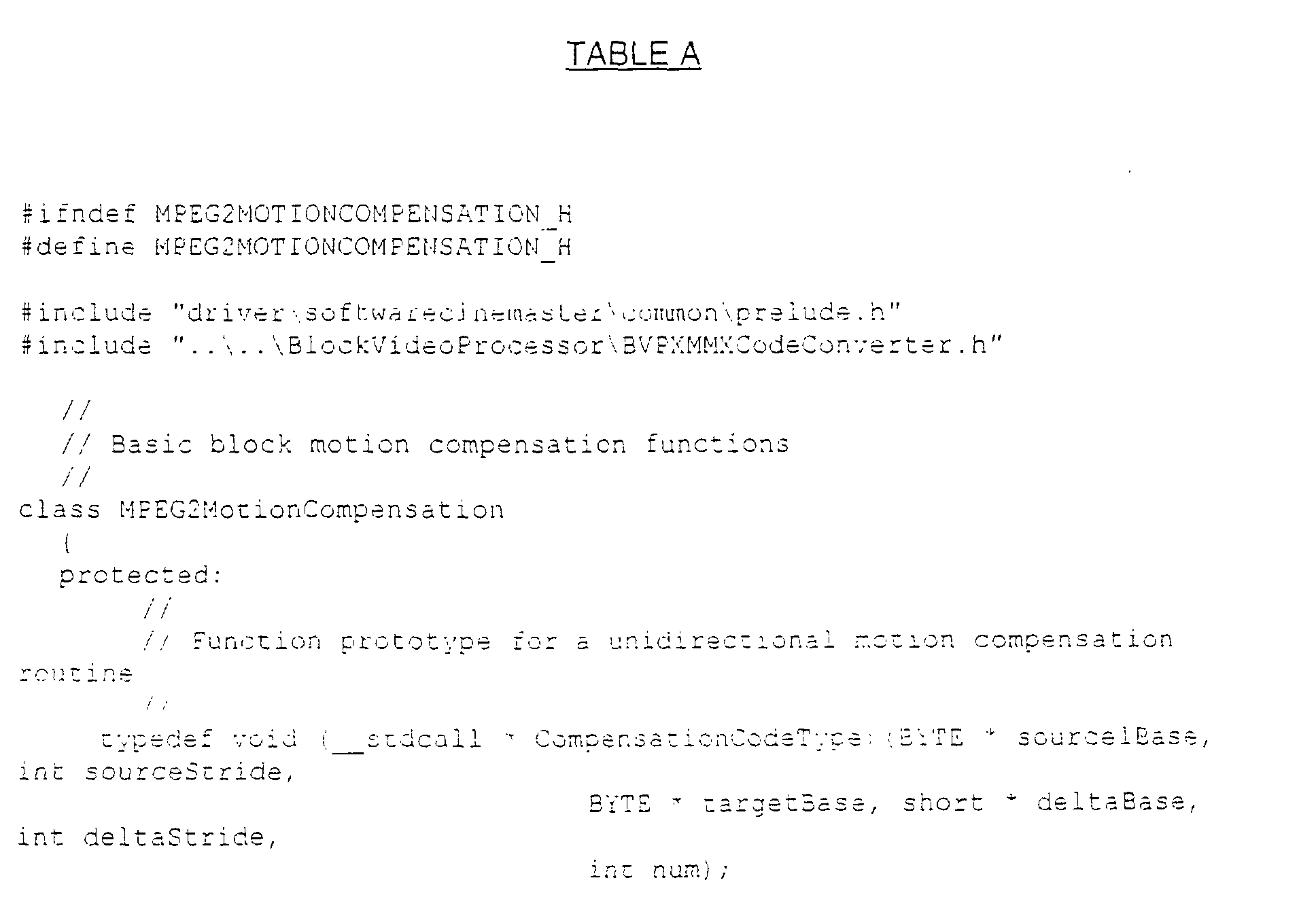
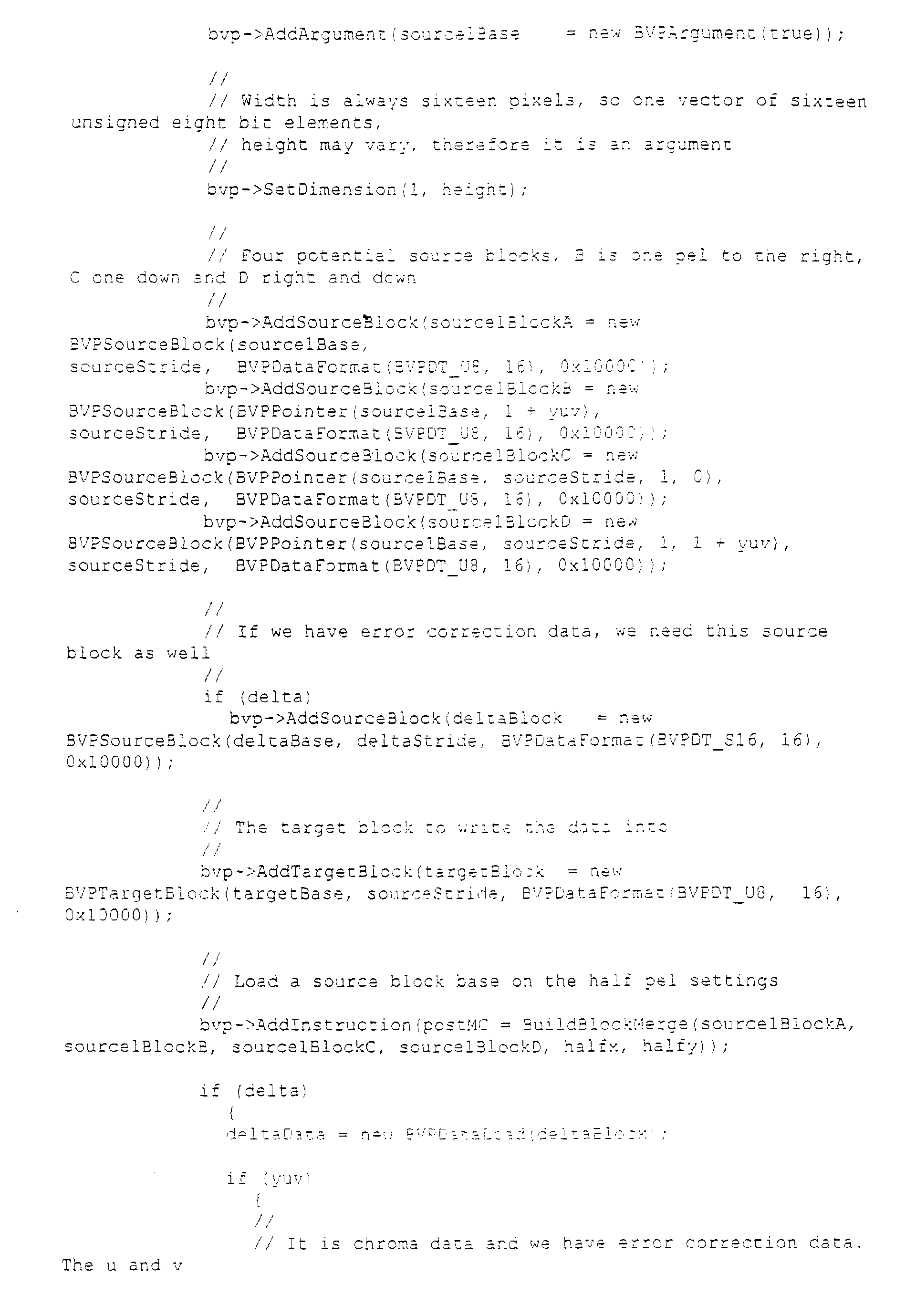
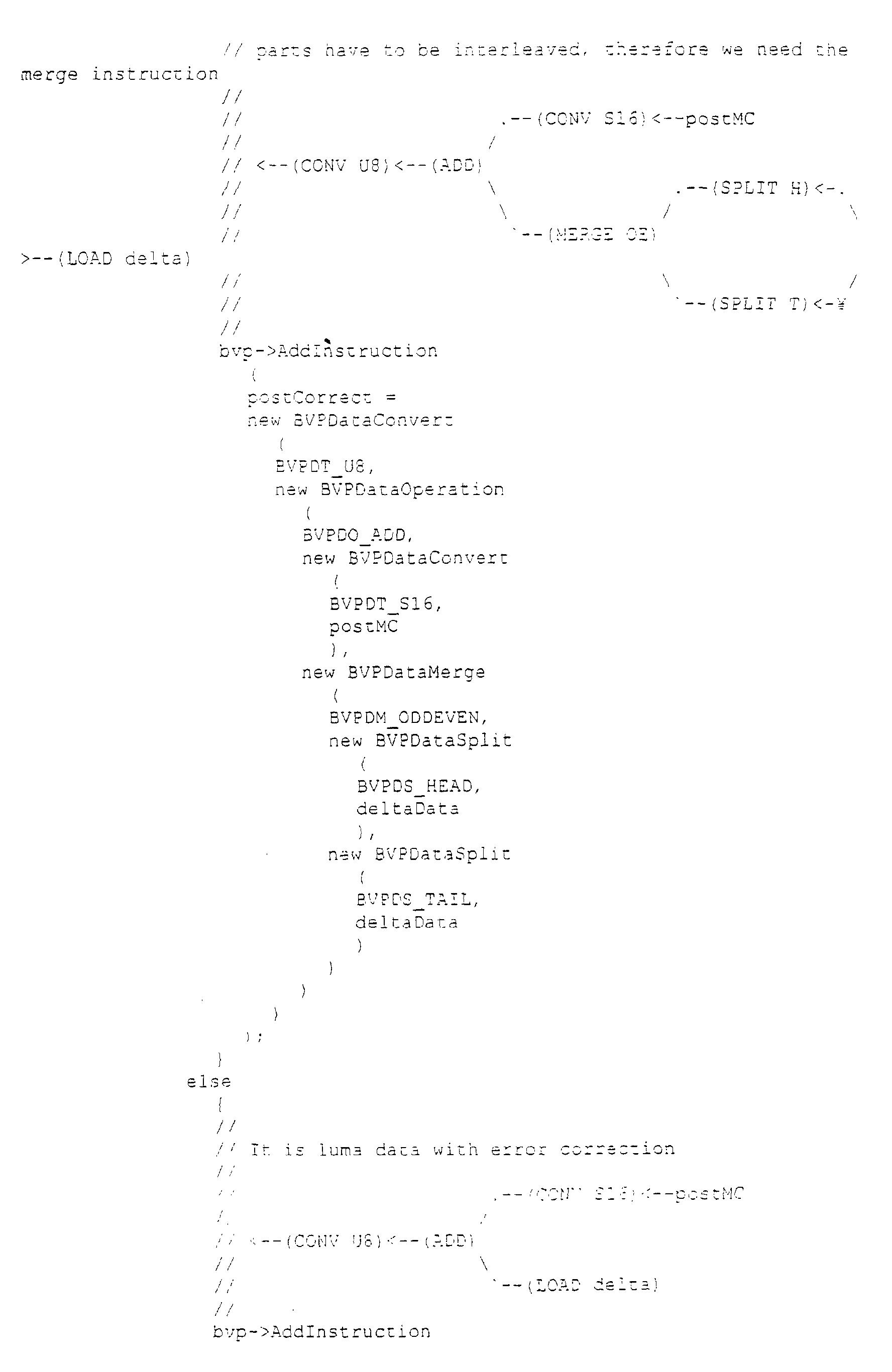
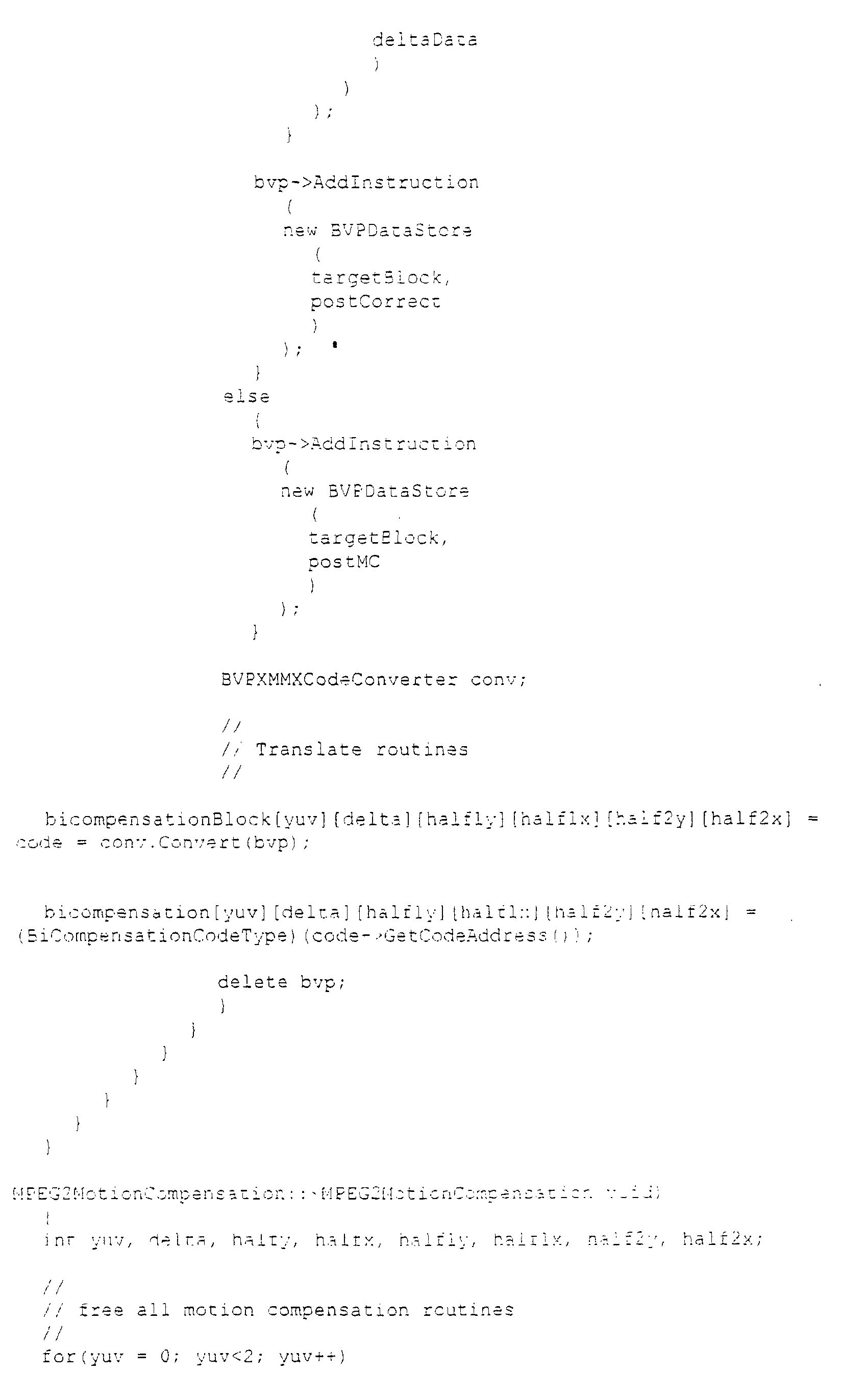
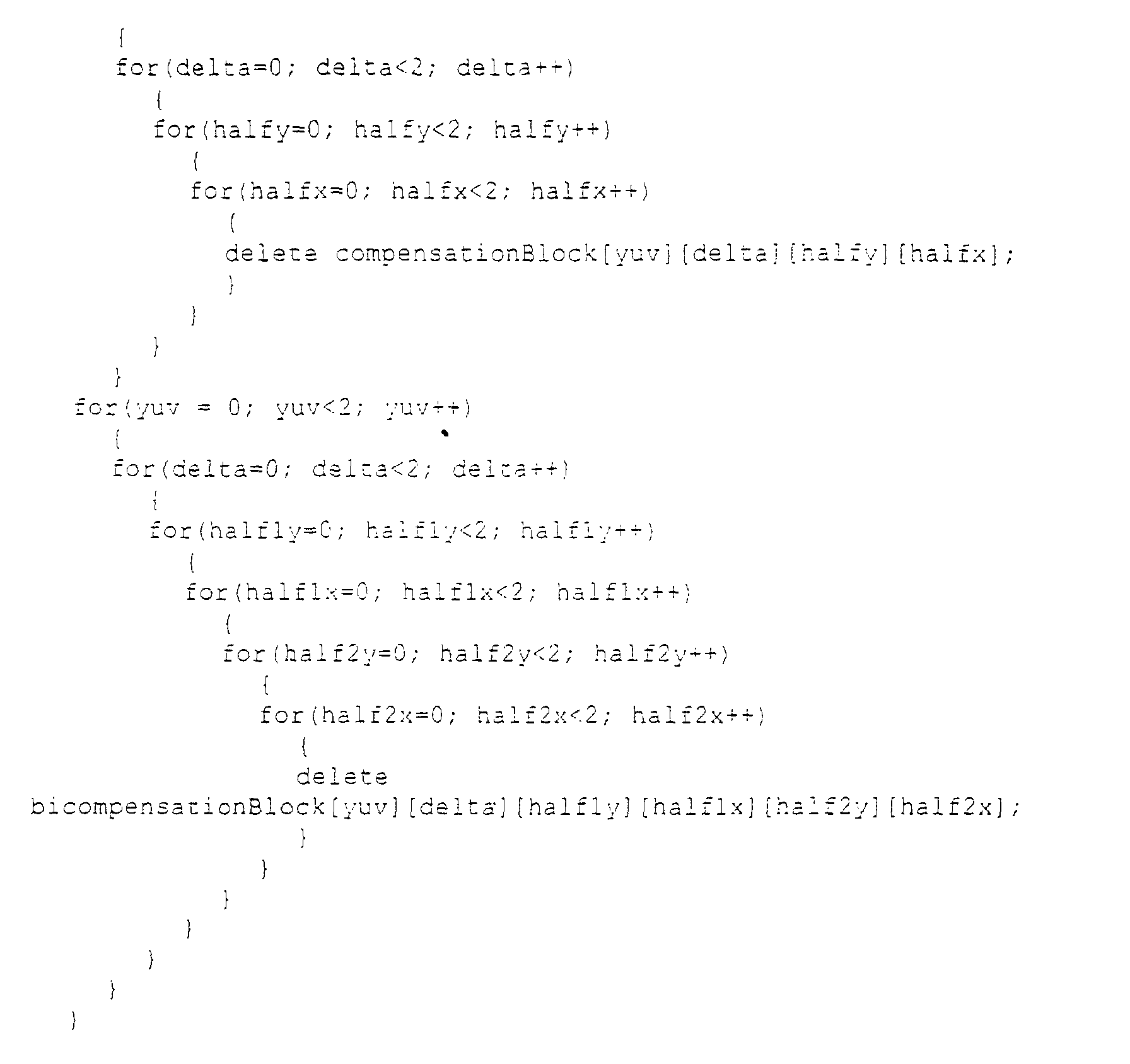
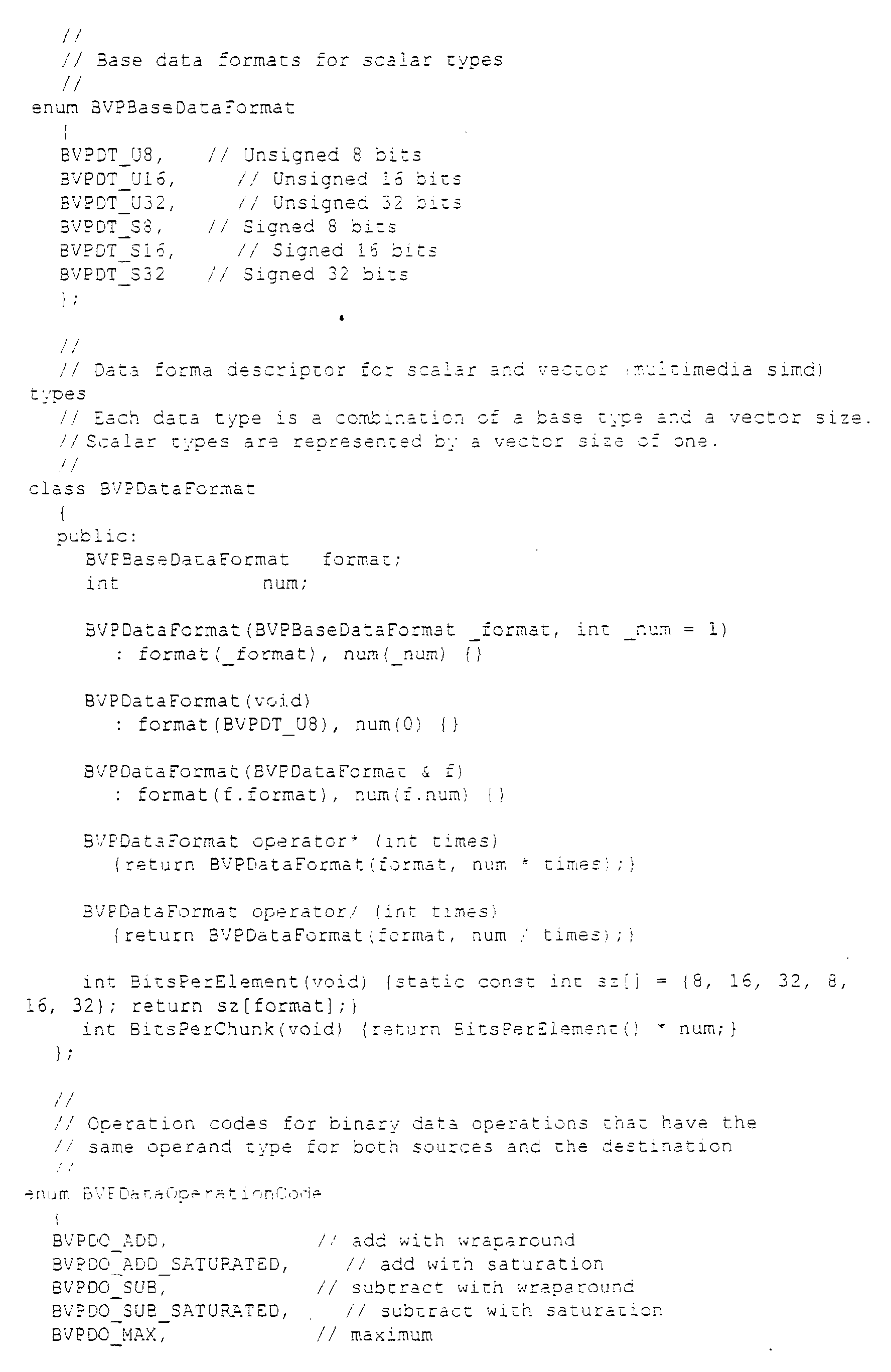
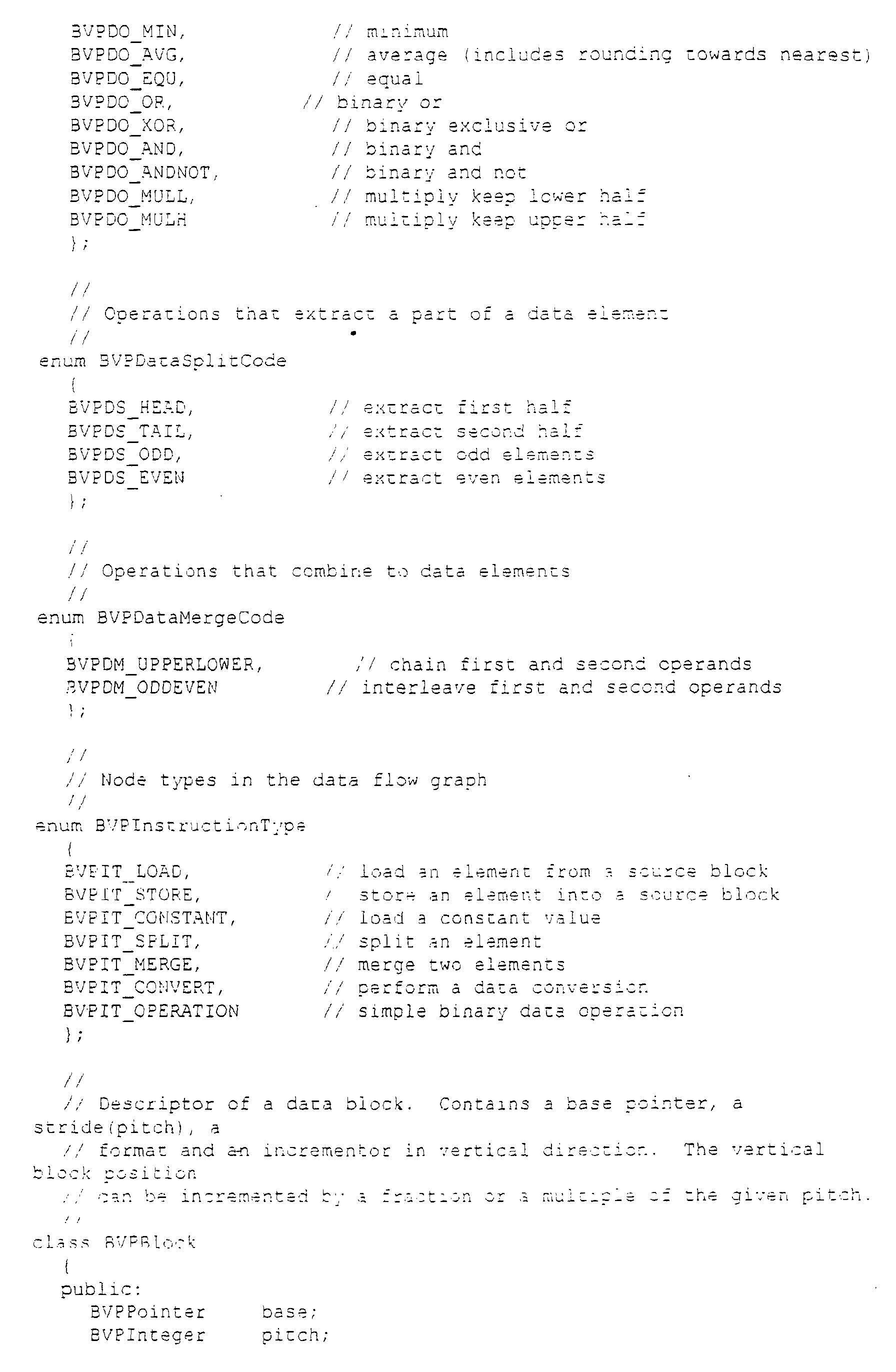
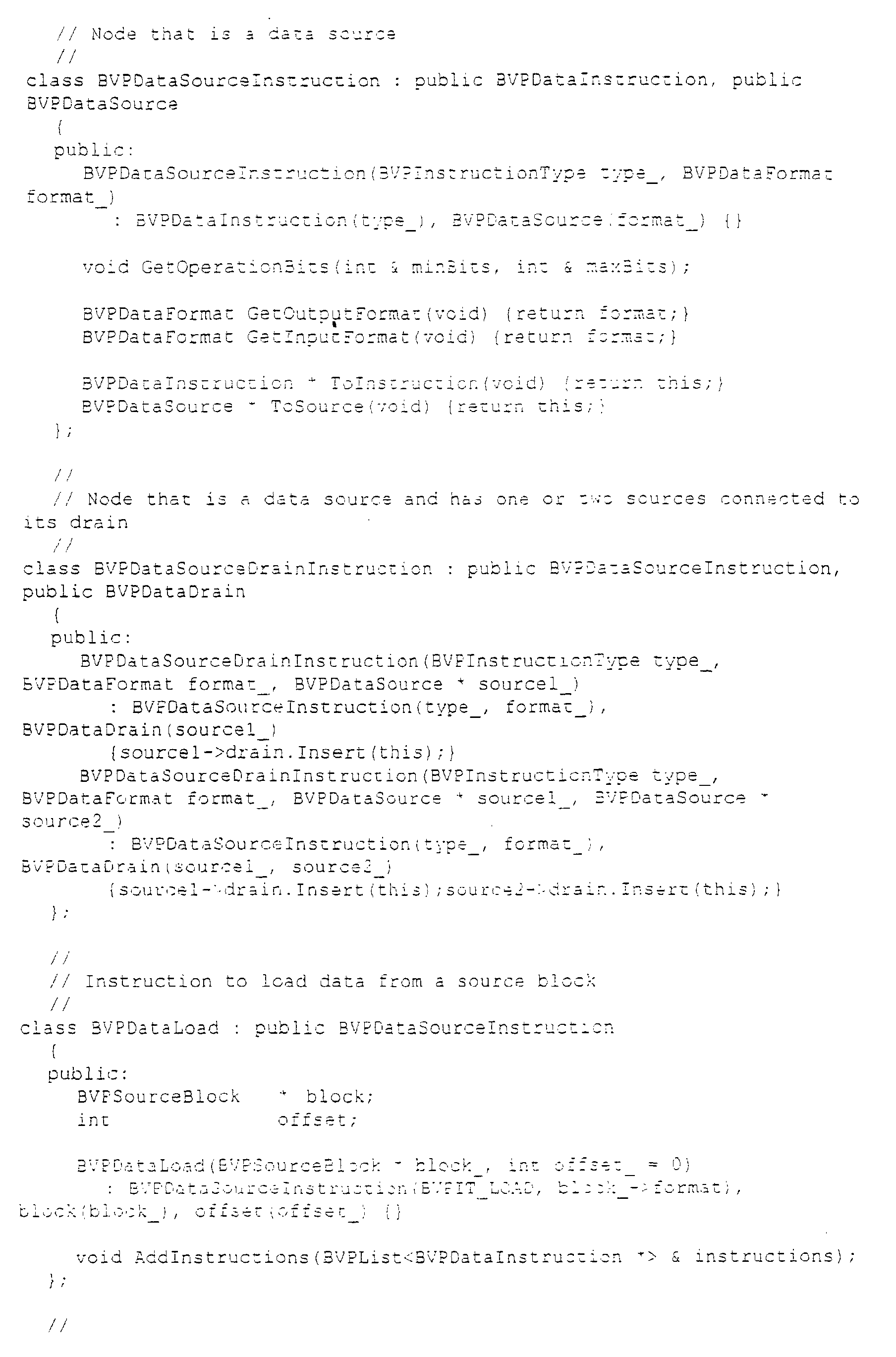
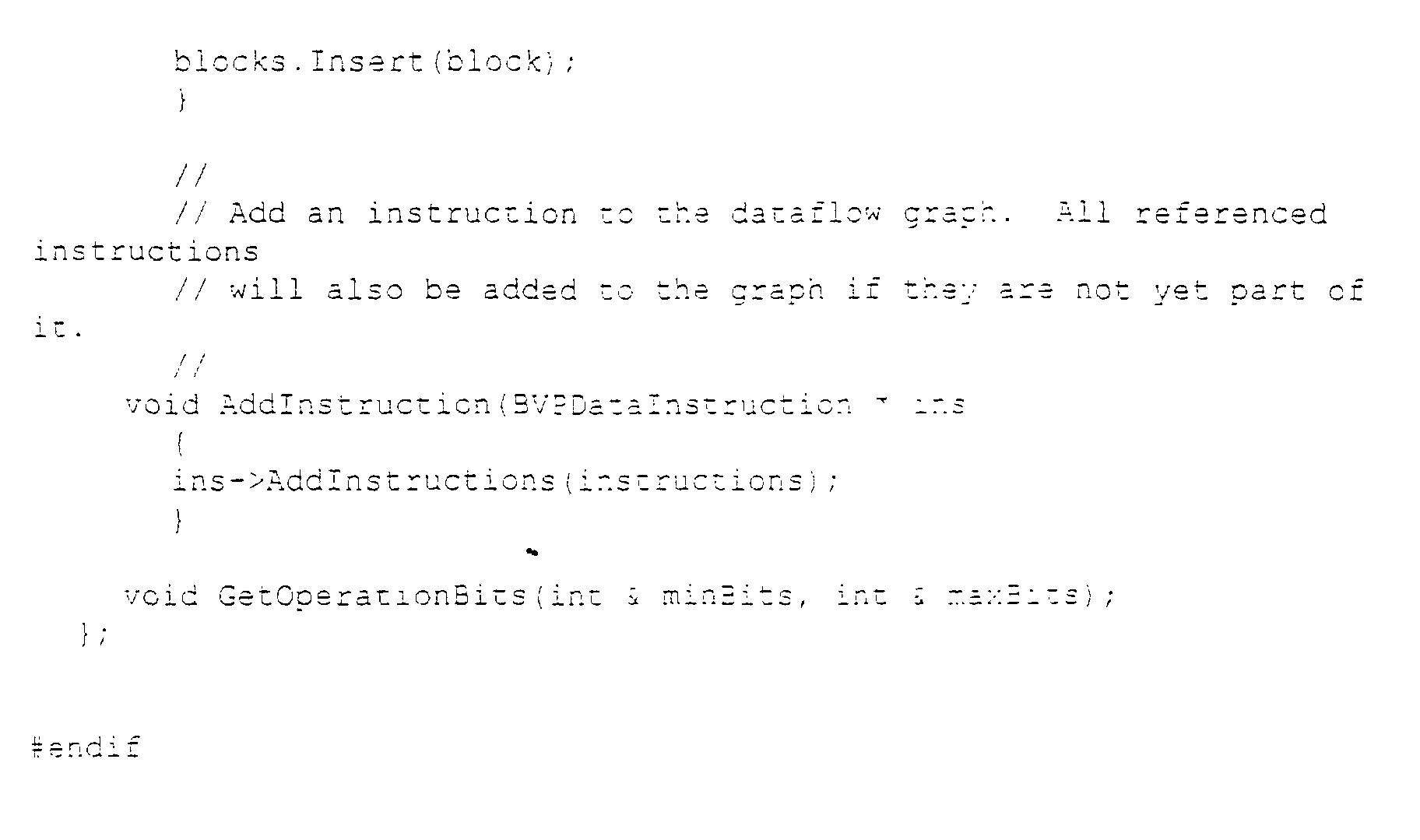
- Tables A-C provide sample code that generates an abstract representation for a motion compensation code that can be translated to an executable code sequence using the invention.
Landscapes
- Engineering & Computer Science (AREA)
- General Engineering & Computer Science (AREA)
- Theoretical Computer Science (AREA)
- Software Systems (AREA)
- Physics & Mathematics (AREA)
- General Physics & Mathematics (AREA)
- Devices For Executing Special Programs (AREA)
- Image Processing (AREA)
- Compression Or Coding Systems Of Tv Signals (AREA)
- Executing Machine-Instructions (AREA)
Abstract
Description










Claims (18)
- An apparatus for generating computer assembly code, comprising:an abstract routine generator for receiving a data stream comprising a multimedia routine and for outputting a generic abstract representation thereof; anda translator for said abstract routine generator for receiving said abstract representation and for outputting processor specific code for processing multimedia input data.
- The apparatus of Claim 1, where in said abstract routine generator builds an abstract routine during runtime.
- The apparatus of Claim 1, wherein said abstract routine generator builds an abstract routine in the form of a graph.
- The apparatus of Claim 1 wherein said multimedia data comprise SIMD input data ; image input data; and/or audio input data.
- The apparatus of Claim 3, wherein said graph is input to said translator.
- The apparatus of Claim 3, wherein the output of said translator is in assembly code.
- The apparatus of Claim 1, wherein said translator's configuration can be changed by use of a dynamic library link.
- The apparatus of Claim 1, wherein said processor-specific code performs any of the operations of add, sub, multiply, average, maximum, minimum, compare, and, or, xor, pack, unpack, and merge on said input data.
- The apparatus of Claim 3, wherein said graph is a function of any of source block, target block, change in the block, color, stride, change in stride, display block, and spatial filtering.
- A method for generating assembly code, comprising:providing an abstract routine generator for generating a generic abstract representation of an input stream, and input comprising multimedia a routine; andproviding a translator for receiving said abstract representation from said abstract routine generator and for outputting processor-specific code for processing multimedia input data.
- The method of Claim 10 wherein said abstract routine generator builds the abstract routine during runtime.
- The method of Claim 11 wherein said abstract routine is a graph.
- The method of Claim 10 wherein said multimedia input data comprise SIMD data; image data and/or audio data.
- The method of claim 12 wherein said graph is input to said translator.
- The method of claim 12 wherein the output of said translator is assembly code.
- The method of Claim 10 wherein said processor-specific code performs any of the operations of add, sub, multiply, average, maximum, minimum, compare, and, or, xor, pack, unpack, and merge on said multimedia input data.
- The method of Claim 12 wherein said graph is a function of any of source block, target block, change in the block, color, stride, change in stride, display block, and spatial filtering.
- The method of Claim 10 wherein said translator can be changed by use of a dynamic library link.
Applications Claiming Priority (2)
| Application Number | Priority Date | Filing Date | Title |
|---|---|---|---|
| US614635 | 1990-11-16 | ||
| US09/614,635 US7168069B1 (en) | 2000-07-12 | 2000-07-12 | Dynamic generation of multimedia code for image processing |
Publications (2)
| Publication Number | Publication Date |
|---|---|
| EP1172727A2 true EP1172727A2 (en) | 2002-01-16 |
| EP1172727A3 EP1172727A3 (en) | 2005-11-09 |
Family
ID=24462105
Family Applications (1)
| Application Number | Title | Priority Date | Filing Date |
|---|---|---|---|
| EP01305958A Ceased EP1172727A3 (en) | 2000-07-12 | 2001-07-10 | On the fly generation of multimedia code for image processing |
Country Status (3)
| Country | Link |
|---|---|
| US (2) | US7168069B1 (en) |
| EP (1) | EP1172727A3 (en) |
| JP (1) | JP2002132513A (en) |
Families Citing this family (17)
| Publication number | Priority date | Publication date | Assignee | Title |
|---|---|---|---|---|
| US8549501B2 (en) * | 2004-06-07 | 2013-10-01 | International Business Machines Corporation | Framework for generating mixed-mode operations in loop-level simdization |
| US7386842B2 (en) * | 2004-06-07 | 2008-06-10 | International Business Machines Corporation | Efficient data reorganization to satisfy data alignment constraints |
| US7475392B2 (en) * | 2004-06-07 | 2009-01-06 | International Business Machines Corporation | SIMD code generation for loops with mixed data lengths |
| US7478377B2 (en) | 2004-06-07 | 2009-01-13 | International Business Machines Corporation | SIMD code generation in the presence of optimized misaligned data reorganization |
| US7367026B2 (en) * | 2004-06-07 | 2008-04-29 | International Business Machines Corporation | Framework for integrated intra- and inter-loop aggregation of contiguous memory accesses for SIMD vectorization |
| US7395531B2 (en) | 2004-06-07 | 2008-07-01 | International Business Machines Corporation | Framework for efficient code generation using loop peeling for SIMD loop code with multiple misaligned statements |
| TWI306215B (en) * | 2005-04-29 | 2009-02-11 | Ind Tech Res Inst | Method and corresponding apparatus for compiling high-level languages into specific processor architectures |
| US7669191B1 (en) * | 2005-06-14 | 2010-02-23 | Xilinx, Inc. | Compile-time dispatch of operations on type-safe heterogeneous containers |
| US8255884B2 (en) * | 2008-06-06 | 2012-08-28 | International Business Machines Corporation | Optimized scalar promotion with load and splat SIMD instructions |
| US8959501B2 (en) * | 2010-12-14 | 2015-02-17 | Microsoft Corporation | Type and length abstraction for data types |
| JP5605228B2 (en) * | 2011-01-07 | 2014-10-15 | 富士ゼロックス株式会社 | Image processing apparatus and program |
| US8756591B2 (en) | 2011-10-03 | 2014-06-17 | International Business Machines Corporation | Generating compiled code that indicates register liveness |
| US8615745B2 (en) | 2011-10-03 | 2013-12-24 | International Business Machines Corporation | Compiling code for an enhanced application binary interface (ABI) with decode time instruction optimization |
| US8612959B2 (en) * | 2011-10-03 | 2013-12-17 | International Business Machines Corporation | Linking code for an enhanced application binary interface (ABI) with decode time instruction optimization |
| WO2015134611A2 (en) * | 2014-03-04 | 2015-09-11 | Michael Manthey | Distributed computing systems and methods |
| JP6977909B2 (en) * | 2019-03-08 | 2021-12-08 | 株式会社Jvcケンウッド | Image coding device, image coding method, and image coding program, image decoding device, image decoding method, and image decoding program. |
| US11593454B2 (en) * | 2020-06-02 | 2023-02-28 | Intel Corporation | Matrix operation optimization mechanism |
Family Cites Families (48)
| Publication number | Priority date | Publication date | Assignee | Title |
|---|---|---|---|---|
| US6493467B1 (en) * | 1959-12-12 | 2002-12-10 | Sony Corporation | Image processor, data processor, and their methods |
| US4667290A (en) * | 1984-09-10 | 1987-05-19 | 501 Philon, Inc. | Compilers using a universal intermediate language |
| US4951194A (en) | 1989-01-23 | 1990-08-21 | Tektronix, Inc. | Method for reducing memory allocations and data copying operations during program calling sequences |
| US5598560A (en) * | 1991-03-07 | 1997-01-28 | Digital Equipment Corporation | Tracking condition codes in translation code for different machine architectures |
| US5307492A (en) * | 1991-03-07 | 1994-04-26 | Digital Equipment Corporation | Mapping assembly language argument list references in translating code for different machine architectures |
| US5488727A (en) * | 1991-09-30 | 1996-01-30 | International Business Machines Corporation | Methods to support multimethod function overloading with compile-time type checking |
| US5875442A (en) | 1992-08-03 | 1999-02-23 | International Business Machines Corporation | Method and apparatus for enhancing access to a remote database employing dynamic buffer management |
| TW224553B (en) | 1993-03-01 | 1994-06-01 | Sony Co Ltd | Method and apparatus for inverse discrete consine transform and coding/decoding of moving picture |
| US5819088A (en) * | 1993-03-25 | 1998-10-06 | Intel Corporation | Method and apparatus for scheduling instructions for execution on a multi-issue architecture computer |
| EP0845908B1 (en) | 1994-06-17 | 2003-02-05 | Snell & Wilcox Limited | Compressing a signal combined from compression encoded video signals after partial decoding thereof |
| US5687316A (en) | 1994-07-29 | 1997-11-11 | International Business Machines Corporation | Communication apparatus and methods having P-MAC, I-MAC engines and buffer bypass for simultaneously transmitting multimedia and packet data |
| US5684538A (en) | 1994-08-18 | 1997-11-04 | Hitachi, Ltd. | System and method for performing video coding/decoding using motion compensation |
| US5708473A (en) | 1994-08-30 | 1998-01-13 | Hughes Aircraft Company | Two stage video film compression method and system |
| KR100404274B1 (en) * | 1994-09-30 | 2004-04-30 | 코닌클리케 필립스 일렉트로닉스 엔.브이. | A multimedia system that receives a representation of a large amount of data, including an application that includes a multiplatform interpreter, a platform subsystem that interacts with the multiplatform interpreter, and a mass memory for that system or subsystem. |
| US5566089A (en) | 1994-10-26 | 1996-10-15 | General Instrument Corporation Of Delaware | Syntax parser for a video decompression processor |
| US5638128A (en) | 1994-11-08 | 1997-06-10 | General Instrument Corporation Of Delaware | Pixel interpolation filters for video decompression processor |
| US5703887A (en) | 1994-12-23 | 1997-12-30 | General Instrument Corporation Of Delaware | Synchronization and error detection in a packetized data stream |
| US5590331A (en) * | 1994-12-23 | 1996-12-31 | Sun Microsystems, Inc. | Method and apparatus for generating platform-standard object files containing machine-independent code |
| KR960036641A (en) | 1995-03-21 | 1996-10-28 | 김광호 | High speed decoding device for decoding low speed video bit stream |
| US5650823A (en) | 1995-03-27 | 1997-07-22 | International Business Machines Corporation | Half pel motion estimation method for B pictures |
| CA2171570C (en) | 1995-03-29 | 1999-09-21 | Swee Boon Lim | Compiler with generic front end and dynamically loadable back ends |
| JPH0981497A (en) | 1995-09-12 | 1997-03-28 | Toshiba Corp | Real-time stream server and method for storing and transferring real-time stream data |
| US5778180A (en) | 1995-11-06 | 1998-07-07 | Sun Microsystems, Inc. | Mechanism for reducing data copying overhead in protected memory operating systems |
| US6091897A (en) * | 1996-01-29 | 2000-07-18 | Digital Equipment Corporation | Fast translation and execution of a computer program on a non-native architecture by use of background translator |
| US5835773A (en) * | 1996-04-17 | 1998-11-10 | Hewlett-Packard, Co. | Method for achieving native performance across a set of incompatible architectures using a single binary file |
| EP0872798A1 (en) | 1997-03-21 | 1998-10-21 | CANAL+ Société Anonyme | Computer memory organization |
| US6081846A (en) | 1997-05-08 | 2000-06-27 | Microsoft Corporation | Method and computer program product for reducing intra-system data copying during network packet processing |
| EP1193977B1 (en) | 1997-06-09 | 2003-08-27 | Hitachi, Ltd. | Image sequence coding method |
| JPH1169345A (en) | 1997-06-11 | 1999-03-09 | Fujitsu Ltd | Inter-frame prediction video coding apparatus and decoding apparatus, and inter-frame prediction video coding method and decoding method |
| US6269484B1 (en) | 1997-06-24 | 2001-07-31 | Ati Technologies | Method and apparatus for de-interlacing interlaced content using motion vectors in compressed video streams |
| US5966534A (en) | 1997-06-27 | 1999-10-12 | Cooke; Laurence H. | Method for compiling high level programming languages into an integrated processor with reconfigurable logic |
| GB9717715D0 (en) | 1997-08-22 | 1997-10-29 | Philips Electronics Nv | Data processor with localised memory reclamation |
| JPH11136225A (en) | 1997-10-30 | 1999-05-21 | Matsushita Electric Ind Co Ltd | Method and apparatus for detecting a start code in a bitstream |
| US6061770A (en) | 1997-11-04 | 2000-05-09 | Adaptec, Inc. | System and method for real-time data backup using snapshot copying with selective compaction of backup data |
| US6081883A (en) | 1997-12-05 | 2000-06-27 | Auspex Systems, Incorporated | Processing system with dynamically allocatable buffer memory |
| US6170075B1 (en) | 1997-12-18 | 2001-01-02 | 3Com Corporation | Data and real-time media communication over a lossy network |
| US5870412A (en) | 1997-12-12 | 1999-02-09 | 3Com Corporation | Forward error correction system for packet based real time media |
| US6058143A (en) | 1998-02-20 | 2000-05-02 | Thomson Licensing S.A. | Motion vector extrapolation for transcoding video sequences |
| US6357039B1 (en) * | 1998-03-03 | 2002-03-12 | Twelve Tone Systems, Inc | Automatic code generation |
| GB9807208D0 (en) | 1998-04-03 | 1998-06-03 | Nds Ltd | Method and apparatus for detecting a sequence in a bitstream |
| US6578197B1 (en) * | 1998-04-08 | 2003-06-10 | Silicon Graphics, Inc. | System and method for high-speed execution of graphics application programs including shading language instructions |
| US6473897B1 (en) * | 1998-04-13 | 2002-10-29 | Intel Corporation | Method and apparatus for generating multiple processor-specific code segments in a single executable |
| US6049668A (en) * | 1998-04-13 | 2000-04-11 | Intel Corporation | Method and apparatus for supporting multiple processor-specific code segments in a single executable |
| US6266769B1 (en) * | 1998-04-30 | 2001-07-24 | Intel Corporation | Conversion between packed floating point data and packed 32-bit integer data in different architectural registers |
| US6096095A (en) * | 1998-06-04 | 2000-08-01 | Microsoft Corporation | Producing persistent representations of complex data structures |
| JP2000112849A (en) | 1998-10-08 | 2000-04-21 | Hitachi Ltd | Header attachment method for communication packets |
| US6490673B1 (en) * | 1998-11-27 | 2002-12-03 | Matsushita Electric Industrial Co., Ltd | Processor, compiling apparatus, and compile program recorded on a recording medium |
| US6247071B1 (en) | 1999-10-04 | 2001-06-12 | B2C2, Inc. | System for receiving an isochronous data stream at a computer using a main memory buffer |
-
2000
- 2000-07-12 US US09/614,635 patent/US7168069B1/en not_active Expired - Lifetime
-
2001
- 2001-07-10 EP EP01305958A patent/EP1172727A3/en not_active Ceased
- 2001-07-12 JP JP2001212263A patent/JP2002132513A/en active Pending
-
2006
- 2006-10-23 US US11/552,124 patent/US8495597B2/en not_active Expired - Fee Related
Also Published As
| Publication number | Publication date |
|---|---|
| JP2002132513A (en) | 2002-05-10 |
| US8495597B2 (en) | 2013-07-23 |
| EP1172727A3 (en) | 2005-11-09 |
| US20070074183A1 (en) | 2007-03-29 |
| US7168069B1 (en) | 2007-01-23 |
Similar Documents
| Publication | Publication Date | Title |
|---|---|---|
| US8495597B2 (en) | On the fly generation of multimedia code for image processing | |
| US10747519B2 (en) | Language, function library, and compiler for graphical and non-graphical computation on a graphical processor unit | |
| CN100524204C (en) | Processor | |
| US7284241B2 (en) | Compiler, compiler apparatus and compilation method | |
| CN1302380C (en) | Processor and compiler | |
| US20110307687A1 (en) | In-lane vector shuffle instructions | |
| US7010177B1 (en) | Portability of digital images | |
| US7509634B2 (en) | SIMD instruction sequence generating program, SIMD instruction sequence generating method and apparatus | |
| US20040006667A1 (en) | Apparatus and method for implementing adjacent, non-unit stride memory access patterns utilizing SIMD instructions | |
| US7299462B2 (en) | Relocation format for linking | |
| US7325230B2 (en) | System for compiling source programs into machine language programs, a computer implemented method for the compiling and a computer program product for the compiling within the computer system | |
| Ren et al. | A preliminary study on the vectorization of multimedia applications for multimedia extensions | |
| CN114253554B (en) | A code processing method, device and storage medium | |
| Nuzman et al. | Autovectorization in GCC–two years later | |
| AU2001263064A1 (en) | Transformation of objects between a computer programming language and a data representation language | |
| US7779391B2 (en) | Method of employing instructions to convert UTF characters with an enhanced extended translation facility | |
| Manilov et al. | Free rider: A tool for retargeting platform-specific intrinsic functions | |
| US20070276646A1 (en) | Retargetable Instruction Set Simulators | |
| Bulić et al. | An extended ANSI C for processors with a multimedia extension | |
| CN101010666A (en) | memory efficient instruction processing circuitry | |
| JP2004252807A (en) | Software development support equipment | |
| Huang | Enable Advanced Vector Extensions for Libraries: Pros, Cons, and Scenarios | |
| Lee et al. | MPEG-2 video decoding on programmable processors: computational and architectural requirements | |
| Yu | Hpsimc: ahpl simulator implemented in c language (parser, software) | |
| Drake | Stream programming for image and video compression |
Legal Events
| Date | Code | Title | Description |
|---|---|---|---|
| PUAI | Public reference made under article 153(3) epc to a published international application that has entered the european phase |
Free format text: ORIGINAL CODE: 0009012 |
|
| AK | Designated contracting states |
Kind code of ref document: A2 Designated state(s): AT BE CH CY DE DK ES FI FR GB GR IE IT LI LU MC NL PT SE TR |
|
| AX | Request for extension of the european patent |
Free format text: AL;LT;LV;MK;RO;SI |
|
| PUAL | Search report despatched |
Free format text: ORIGINAL CODE: 0009013 |
|
| AK | Designated contracting states |
Kind code of ref document: A3 Designated state(s): AT BE CH CY DE DK ES FI FR GB GR IE IT LI LU MC NL PT SE TR |
|
| AX | Request for extension of the european patent |
Extension state: AL LT LV MK RO SI |
|
| 17P | Request for examination filed |
Effective date: 20060426 |
|
| AKX | Designation fees paid |
Designated state(s): DE FR GB IT |
|
| 17Q | First examination report despatched |
Effective date: 20070122 |
|
| STAA | Information on the status of an ep patent application or granted ep patent |
Free format text: STATUS: THE APPLICATION HAS BEEN REFUSED |
|
| 18R | Application refused |
Effective date: 20080903 |