TECHNICAL FIELD
The present invention relates to a formulation
containing a 5-acetoxy or hydroxy-4,6-di-tert-butyl-2,3-dihydrobenzofuran
derivative, especially BO-653, and having
an excellent stability and a capability of being absorbed
by body.
BACKGROUND ART
A family of 5-acetoxy or hydroxy-4,6-di-tert-butyl-2,3-dihydrobenzofuran
derivatives including BO-653, i.e.,
4,6-di-tert-butyl-2,2-di-n-pentyl-5-hydroxy-2,3-dihydrobenzofuran,
are antioxidative compounds, which are
generally oily and high-viscous, and thus promise to be
useful for treating an arteriosclerosis and the like
(WO94/08930). Generally, if such a compound is used as a
drug substance for preparing a formulation, it will be
required to confer a high stability, a capability of being
absorbed by body and the like to the compound.
For example, as a method for preventing the oxidation
of a compound such as vitamin E, which is known as a
natural antioxidant, it has been reported that the compound
is combined with another antioxidant or dissolved in a fat
and oil such as unsaturated higher fatty acid having double
bond(s) and then filled into a soft capsule (JP 7-58082A/95
and JP 8-175967A/96, respectively).
On the other hand, as a method for improving the
capability of being absorbed by body of a drug which is
highly fat-soluble and slightly water-soluble, it has been
reported that the drug is combined with a solubilizer such
as a non-ionic surfactant to enhance its water-solubility
(JP 7-242535A/95) or is dissolved in a fat and oil such as
a medium chain fatty acid triglyceride (JP 8-92088A/96) or
a higher unsaturated fatty acid (JP 7-258082A/95).
However, since it is common that a structural
difference between compounds is responsible for any
differences between them in chemical, physical and/or
biological properties, these methods would not be applied
to the above-mentioned dihydrobenzofuran derivative,
especially BO-653.
Therefore, it would be desirable to provide a
formulation which specifically confers a high stability and
a capability of being absorbed by body to the derivative.
DISCLOSURE OF THE INVENTION
An object of the present invention is to provide a
formulation containing a 5-acetoxy or hydroxy-4,6-di-tert-butyl-2,3-dihydrobenzofuran
derivative, especially BO-653,
or probucol which formulation confers a high stability and
a capability of being absorbed by body to the derivative or
probucol.
As a result of extensive research, we found that,
when the dihydrobenzofuran derivative or probucol is
dissolved in a fat and oil without any additional
antioxidant and then filled into a seamed soft capsule, not
only its stability is maintained but also its capability of
being absorbed by body is improved.
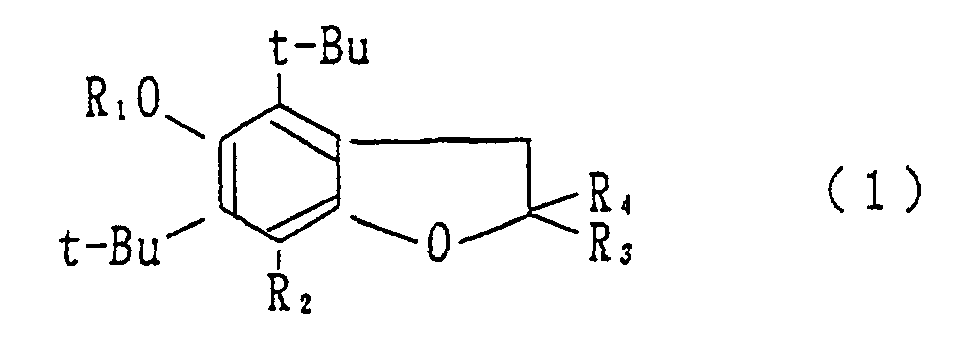
Accordingly, the present invention provides a seamed
soft capsule formulation in which a solution of
dihydrobenzofuran derivative represented by general formula
(1):
wherein R
1 represents a hydrogen atom or an acyl group; R
2
represents a hydrogen atom or a lower alkyl group; and R
3
and R
4, which may be identical or different, represent a
hydrogen atom or a substituted or unsubstituted alkyl,
alkenyl, alkynyl or aryl group, or probucol in a fat and
oil, is filled into a seamed soft capsule.
The present invention also provides a seamed soft
capsule formulation containing BO-653. More specifically,
the present invention provides a seamed soft capsule
formulation in which a solution of BO-653 in fat and oil is
filled into a seamed soft capsule.
BRIEF DESCRIPTION OF THE DRAWINGS
Fig. 1 shows the influence of oxygen on the stability
of BO-653 in various fat and oils.
Fig. 2 shows plasma BO-653 levels after a solution of
BO-653 in various solvents is orally administered.
PREFERRED EMBODIMENTS OF THE INVENTION
The drug substance of the formulation according to
the present invention is a 5-acetoxy or hydroxy-4,6-di-tert-butyl-2,3-dihydrobenzofuran
derivative represented by
the above general formula (1), which is known as described
in WO94/08930, or probucol. BO-653 is preferable. As used
herein, BO-653 refers to 4,6-di-tert-butyl-2,2-di-n-pentyl-5-hydroxy-2,3-dihydrobenzofuran.
In the definition of the compounds of general formula
(1), the examples of the acyl group represented by R1
include acetyl, formyl, propionyl, benzoyl and
benzyloxycarbonyl groups.
The lower alkyl group represented by R2 means a
straight or branched alkyl group having 1 to 6 carbon atoms,
the examples of which include, for example, methyl, ethyl,
n-propyl, i-propyl, n-butyl, s-butyl and t-butyl groups.
The alkyl group represented by R3 and R4 means a
straight or branched alkyl group having 1 to 20 carbon
atoms, the examples of which include, for example, methyl,
ethyl, n-propyl, i-propyl, n-butyl, s-butyl, t-butyl,
pentyl, hexyl, heptyl, octyl, nonyl and decyl groups.
The alkenyl group represented by R3 and R4 means a
straight or branched alkenyl group having 2 to 20 carbon
atoms, the examples of which include, for example, vinyl,
allyl, butenyl, pentenyl, geranyl and farnesyl groups.
The alkynyl group represented by R3 and R4 means a
straight or branched alkynyl group having 2 to 20 carbon
atoms, the examples of which include, for example, ethynyl,
propynyl and butynyl groups.
The aryl group represented by R3 and R4 means a
monovalent aromatic hydrocarbon formed by removing one
hydrogen atom from the aromatic hydrocarbon, the examples
of which include, for example, phenyl, tolyl, xylyl,
biphenyl, naphthyl, anthryl and phenanthryl groups. The
ring carbon atoms of the aryl group may be substituted by
one or more groups selected from halogen, lower alkyl,
hydroxyl, alkoxy, amino, nitro or trifluoromethyl.
The examples of substituents on these alkyl, alkenyl,
alkynyl and aryl groups represented by R3 and R4 include
halogen, hydroxyl, amino, alkoxy and aryloxy.
The examples of the fat and oil according to the
present invention include vegetable oils, medium chain
fatty acid triglycerides (hereinafter referred to as MCTs),
tricaprylin, oleic acid, linoleic acid, linolenic acid and
lecithin. Vegetable oils are preferable.
Preferred vegetable oils are those containing an
unsaturated fatty acid as a main component, the examples of
which include, for example, soybean oil, safflower oil,
sunflower oil, corn oil, cottonseed oil, sesame oil,
rapeseed oil, peanut oil and olive oil, among which soybean
oil is especially preferred. As used herein, the term
"unsaturated fatty acid" means a fatty acid having one or
more double bonds in its molecule, the examples of which
include, for example, oleic acid, linoleic acid and
linolenic acid. To be regarded as the main component, the
unsaturated fatty acid should be present in the vegetable
oil in an amount of 50% or more of the total amount of the
vegetable oil.
The amount of the fat and oil which may be present in
the formulation of this invention is not limited so far as
it enables the derivative or probucol to be formulated with
the fat and oil. However, the fat and oil may be present
in the formulation in an amount of 10-98% by weight based
on the total weight of the filling solution.
As used herein, the term "soft capsule formulation"
means a formulation in which a solution of a drug in a fat
and oil is encapsulated in a capsule shell made of a
gelatin-based material. The term "seamed soft capsule" ,
as used herein, means the soft capsule which is prepared by
a rotary method. The rotary method is for producing a soft
capsule and comprises the steps of stamping capsule shells
out of a gelatin sheet which has been formed by gelling a
solution containing gelatin, plasticizer and purified water,
and then fusing the edges of the capsule shells each other
with injecting filling solution therein to form a soft
capsule. Hence, this method is also called "stamping
method". The formed soft capsule has a seam due to the
fusing step.
The seamed soft capsule shell of the present
invention contains various types of gelatin and plasticizer.
The gelatins include those derived from animals such as
cattle and swine. The examples of type of gelatin include
an alkali-treated gelatin, an acid-treated gelatin, and a
chemically modified gelatin. The gelatin may be used alone
or as a mixture of two or more.
The alkali-treated gelatins are those obtained by
hydrolyzing a raw material of gelatin such as collagen or
ossein with an alkaline material such as a lime solution
and then extracting the hydrolyzate, while the acid-treated
gelatins are those obtained by hydrolyzing a collagen with
an acidic material such as dilute hydrochloric acid or
dilute sulfuric acid. The chemically modified gelatins
include, but not limited to, those prepared by reacting an
amino group of a gelatin with succinic acid, phthalic acid,
acetic acid or the like. The alkali-treated or acid-treated
gelatins may be used as a starting material to
prepare the chemically modified gelatins.
Suitable plasticizers include concentrated glycerin,
sorbitol, maltose, glucose, maltitose, sucrose, xylitol,
mannitol, erythritol, polyethylene glycols having a
molecular weight of 400-6000, etc.
The seamed soft capsule shell of the present
invention preferably contains both gelatin and concentrated
glycerin.
When concentrated glycerin is used as a plasticizer,
it is preferably combined with gelatin at a ratio of 15-50
parts by weight, more preferably 20-45 parts by weight to
100 parts by weight of the gelatin.
The seamed soft capsule shell of the present
invention may contain further plasticizers such as sorbitol,
maltose, glucose, maltitose, sucrose, xylitol, mannitol and
erythritol. In the present invention, these are added to
suppress the deterioration, such as inteneration,
stickiness and disintegration delay, of the shell.
Sorbitol is preferred among all. Preferably, sorbitol is
present in the capsule shell at a ratio of 5-15 parts by
weight, more preferably 7-10 parts by weight to 100 parts
by weight of gelatin.
The seamed soft capsule shell preferably has a
thickness of 28-40 x 10-3 inch (71-100 x 10-2 mm), more
preferably 30-35 x 10-3 inch (76-89 x 10-2 mm) as formed.
The term "thickness as formed" is regarded as the thickness
of a gelatin sheet out of which the shells are stamped.
The term "thickness as formed" is hereinafter referred to
as "thickness".
The examples of the formulation of the present
invention include those in which a solution of BO-653 in a
fat and oil, preferably a vegetable oil, more preferably
soybean oil, containing unsaturated fatty acids as major
constituent is filled into a seamed soft capsule, the shell
of which preferably contains gelatin, concentrated glycerin
and sorbitol.
The drug substance used for preparing the formulation
of the present invention can be produced by known method.
The compounds represented by general formula (1) including
BO-653 can be produced by the method described for example
in WO94/08930. Probucol can also be prepared by known
method.
Fat and oils used for dissolving the drug substance
therein, and the gelatins and plasticizers described above
which are main components of the seamed soft capsule shells
are all commercially available.
The formulations of the present invention can be
prepared by known method. For example, the present
formulations may be prepared via the steps of: preparing a
filling solution, preparing capsule shells, forming a
seamed soft capsule by encapsulating the filling solution
with the shells, and drying the formed capsule.
The step of preparing the filling solution comprises
mixing a drug substance and a fat and oil. The step of
preparing capsule shells comprises mixing a gelatin, a
plasticizer and the like.
The step of forming a seamed soft capsule is carried
out by the rotary process. The rotary process comprises:
(1) passing a continuous gelatin sheet between two rotating
rollers opposed to each other and stamping capsule shells
out of the gelatin sheet by the action of rollers; and (2)
at the same time as the stamping, injecting the filling
solution into a pair of the capsule shells and then fusing
the edges of the shells by heat action to form a seamed
soft capsule.
The drying step comprises drying the seamed soft
capsule at about 25°C in the air controlled at a relative
air humidity of about 5-10%.
The invention will be illustrated in more detail with
reference to the following Examples, but the present
invention is not deemed to be limited thereto. Test
results demonstrating the utility of the present invention
will also be shown.
EXAMPLES
Example 1: Preparation of seamed soft capsule formulation
containing BO-653
Seamed soft capsule formulations 1-4 below were
prepared by the method described above.
Formulation 1
Filling solution: 10% w/w solution of BO-653 in
soybean oil.
Capsule shells: alkali-treated gelatin/concentrated
glycerin = 100/30 w/w.
Formulation 2
Filling solution: 10% w/w solution of BO-653 in MCT.
Capsule shells: alkali-treated gelatin/concentrated
glycerin = 100/30 w/w.
Formulation 3
Filling solution: 50% w/w solution of BO-653 in
soybean oil.
Capsule shells: as shown in Table 1.
| Capsule shells |
| Capsule No. | Thickness | Content of concentrated glycerin
(per 100 parts by weight of gelatin) |
| | x 10-3 inch | x 10-2 mm |
| 1 | 26 | 66 | 30.0 |
| 2 | 30 | 76 | 30.0 |
| 3 | 34 | 86 | 30.0 |
| 4 | 26 | 66 | 44.2 |
| 5 | 30 | 76 | 44.2 |
| 6 | 34 | 86 | 44.2 |
| 7 | 26 | 66 | 56.4 |
| 8 | 30 | 76 | 56.4 |
| 9 | 34 | 86 | 56.4 |
Dosage form: 5 oval
Gelatin: alkali-treated gelatin
Amount of solution filled: 250 mg/capsule. |
Formulation 4
Filling solution: 4, 40 and 80% w/w solutions of BO-653
in soybean oil.
Capsule shells: as shown in Table 2.
| Content of concentrated glycerin | 20 (per 100 parts by weight of gelatin) |
| Content of sorbitol | 7 (per 100 parts by weight of gelatin) |
| Thickness | 30 x 10-3 inch (76 x 10-2mm) |
| Gelatin: alkali-treated gelatin. |
Test example 1: Stability of BO-653 in various fat and oils
The influence of oxygen on the stability of BO-653 in
various fat and oils was tested. BO-653 was dissolved in
soybean oil, olive oil, MCT, tricaprylin, and linoleic acid
separately to give a concentration of 50% by weight. 70 mg
of each of the solutions was placed into individual 5 cc
glass bottles. Separately, 35 mg of BO-653 was directly
placed into a 5 cc glass bottle. The samples were prepared
in duplicate. One set of samples were subjected to an
argon replacement of the headspace of the bottles and then
tightly sealed, while the other set of samples were sealed
without argon replacement. Accelerated test at 80°C was
conducted using all of the samples. The residual ratio of
BO-653 in each bottle after 17 hours was determined by HPLC
under the conditions shown in Table 3.
| HPLC analysis |
| Column | DEVELOSIL ODS-HG-5,250 mm x 4.6 mm I.D. (Nomura Chemical) |
| Mobile phase | Acetonitrile/2-propanol/water (800:120:80) |
| Flow rate | 1 mL/min |
| Column temperature | Room temperature |
| Detection wavelength | 300 nm |
The test results are shown in Fig. 1.
For the samples, including one containing only BO-653,
with the argon replacement (i.e, in the absence of oxygen),
little loss of BO-653 was observed indicating that BO-653
is stable in any fat and oils used. For the samples
without the argon replacement (i.e, in the presence of
oxygen), the stability of BO-653 varied depending on the
fat and oils used. Relatively high stability was observed
in the case where soybean oil was used.
Test example 2: Influence of administration solvents on the
capability of being absorbed by body of RO-653
In order to determine the influence of administration
solvents on the capability of being absorbed by body of BO-653,
the following tests were conducted using the samples
prepared with different solvents shown in Table 4.
| Samples |
| Sample 1 | BO-653 solution in soybean oil having a concentration of 25 mg/mL |
| Sample |
| 2 | BO-653 solution in MCT having a concentration of 25 mg/mL |
| Sample 3 | BO-653 suspension in 3% aqueous solution of gum arabic having a BO-653 concentration of 25 mg/mL |
8-week old SD male rats (270-300 g) were divided into
several groups of four. Each of the samples was orally
administered via a stomach catheter to the animals under
fasting so that a dose of BO-653 of 50 mg/kg was given.
After a certain period, blood was collected from the tail
vein, and plasma was separated and then measured for plasma
BO-653 levels by HPLC under conditions shown in Table 5.
| HPLC analysis |
| Column | TSK-gel ODS-80Ts, 2.0 mm x 150 mm (TOSOH) |
| Mobile phase | Methanol/water (95:5) |
| Flow rate | 200 µL/min |
| Column temperature | Room temperature |
| Detection wavelength | 300 nm |
The test results are shown in Table 6 and Fig. 2.
| Pharmacokinetic parameters (mean ± SD, n = 4) |
| Sample | Cmax in µg/mL | AUC0-48h in µg.h/mL |
| Sample 1 | 6.1 ± 3.5 | 44.6 ± 15.7 |
| Sample 2 | 2.1 ± 0.5 | 10.6 ± 4.3 |
| Sample 3 | 2.2 ± 0.3 | 23.2 ± 7.3 |
In Table 6, Cmax represents the peak plasma level and
AUC0-48h represents the area under the plasma level-time
curves shown in Fig. 2 from 0 to 48 hours after
administration. In Fig. 2, "soybean oil", "MCT" and "3%
gum arabic" are for samples 1, 2 and 3, respectively.
Sample 1 in which soybean oil was used as solvent showed
the highest plasma level shift and the AUC value for Sample
1 was about 4 times and about twice as high as compared
with those for samples 2 and 3, respectively.
Test example 3: Stability of seamed soft capsule
formulation of BO-653 (1)
Formulations 1 and 2 obtained in Example 1 were
tested for their stability under the conditions below:
Condition 1:
Formulation 1 was left at 40°C in a 100% oxygen
atmosphere. The content of BO-653 after 1 month was
determined by HPLC under the conditions shown in Table 3.
Condition 2: Formulation 1 was left at 50°C in a 100% oxygen
atmosphere. The content of BO-653 after 2 weeks was
determined by HPLC under the conditions shown in Table 3.
Condition 3: Formulation 2 was left at 50°C in a 100% oxygen
atmosphere. The content of BO-653 after 3 weeks was
determined by HPLC under the conditions shown in Table 3.
As a control, BO-653 was dissolved in soybean oil to
give a concentration of 10% by weight and the solution was
left at 40°C in a 100% oxygen atmosphere in the form that
the solution was not filled into a soft capsule. The
residual ratio of BO-653 after 1 month was determined by
HPLC under the conditions shown in Table 3. The test
results are shown in Table 7.
| Residual ratio (%) of BO-653 after various accelerated tests |
| Condition 1 | 100.7 |
| Control | < 0.2 |
| Condition 2 | 99.6 |
| Condition 3 | 92.8 |
As apparent from comparison between condition 1 and
control, BO-653 shows very high stability when it is filled
into a soft capsule. Comparison between condition 2 and
condition 3 shows that the stability of BO-653 in a soft
capsule is influenced by the fat and oil used and that the
stability is especially high when BO-653 is dissolved in
soybean oil.
Test example 4: Stability of seamed soft capsule
formulations of BO-653 (2)
Formulation 3 obtained in Example 1 was stored at
50°C in a 100% oxygen atmosphere. The residual ratio of
BO-653 after 1 month was determined by HPLC under the
conditions shown in Table 3. The test results are shown in
Table 8.
| Content (%) of BO-653 after left at 50°C in a 100% oxygen atmosphere for 1 month |
| Glycerin content | Thickness |
| | 26 x 10-3 inch (66 x 10-2 mm) | 30 x 10-3 inch (76 x 10-2 mm) | 34 x 10-3 inch (86 x 10-2 mm) |
| 30.0 | 99.4 | 99.9 | 99.7 |
| 44.2 | 98.8 | 100.0 | 100.8 |
| 56.4 | - | 97.0 | 98.8 |
BO-653 shows especially high stability when
encapsulated in a soft capsule shell having a thickness of
30-34 x 10-3 inch (76-86 x 10-2 mm) and containing 30.0-44.2
parts by weight of concentrated glycerin per 100 parts by
weight of gelatin. Especially preferred thickness is 30-34
x 10-3 inch (76-86 x 10-2 mm) because it allows the shell to
have an excellent oxygen barrier property and a good
disintegrating property. In order to improve the oxygen
barrier property, the shell preferably contains 30 parts by
weight of concentrated glycerin per 100 parts by weight of
gelatin. Seamed soft capsule formulation 3 is considered
to show an excellent stability and a good disintegrating
property.
Test example 5: Stability of seamed soft capsule
formulations of BO-653 (3)
Formulation 4 obtained in Example 1 was stored under
various conditions shown in Table 9. The residual ratio of
BO-653 after the storage was determined by HPLC under the
conditions shown in Table 3. The test results are shown in
Table 9.
| Residual ratio (%) of BO-653 after various accelerated tests |
| Accelerated test conditions | BO-653 content in filling solution |
| | 4% by weight | 40% by weight | 80% by weight |
| 40°C, RH75% - 1M | 99.0 | 100.1 | 99.8 |
| 50°C, 100% oxygen atmosphere-1M | 100.0 | 100.7 | 101.0 |
| Irradiation with 1,200,000 lux.hrs white light | 100.0 | 100.0 | 99.5 |
| Irradiation with 1,200,000 lux.hrs white light followed by 400 W.hrs/m2 UV rays | 98.0 | 99.7 | 99.8 |
These formulations show an excellent stability under
any storage conditions or at any BO-653 contents. The
shells were neither intenerated nor sticky. It can be
concluded from these results that Formulation 4, the shell
of which contains sorbitol as a further component and has a
lower glycerin content than that of Formulation 3, is more
preferred seamed soft capsule formulation than any other
formulations because it not only exhibits an excellent
stability but also suppresses inteneration, stickiness, and
disintegration delay of the shell.
INDUSTRIAL APPLICABILITY
The present invention provides BO-653 formulation
having an excellent stability and a capability of being
enterally absorbed.