EP1170936A2 - Image communicating apparatus - Google Patents
Image communicating apparatus Download PDFInfo
- Publication number
- EP1170936A2 EP1170936A2 EP01305773A EP01305773A EP1170936A2 EP 1170936 A2 EP1170936 A2 EP 1170936A2 EP 01305773 A EP01305773 A EP 01305773A EP 01305773 A EP01305773 A EP 01305773A EP 1170936 A2 EP1170936 A2 EP 1170936A2
- Authority
- EP
- European Patent Office
- Prior art keywords
- data
- image data
- image
- amount
- Prior art date
- Legal status (The legal status is an assumption and is not a legal conclusion. Google has not performed a legal analysis and makes no representation as to the accuracy of the status listed.)
- Granted
Links
- 238000000034 method Methods 0.000 claims description 119
- 230000005540 biological transmission Effects 0.000 claims description 73
- 238000004891 communication Methods 0.000 claims description 23
- 238000007906 compression Methods 0.000 claims description 22
- 230000006835 compression Effects 0.000 claims description 22
- 238000013139 quantization Methods 0.000 claims description 8
- 230000008569 process Effects 0.000 description 96
- 238000012545 processing Methods 0.000 description 39
- 238000007639 printing Methods 0.000 description 23
- 238000006243 chemical reaction Methods 0.000 description 16
- 230000006870 function Effects 0.000 description 13
- 230000004044 response Effects 0.000 description 10
- 238000013144 data compression Methods 0.000 description 5
- 238000003705 background correction Methods 0.000 description 4
- 238000012986 modification Methods 0.000 description 4
- 230000004048 modification Effects 0.000 description 4
- 238000010586 diagram Methods 0.000 description 3
- 230000008859 change Effects 0.000 description 2
- 238000004590 computer program Methods 0.000 description 2
- 230000005236 sound signal Effects 0.000 description 2
- 238000012546 transfer Methods 0.000 description 2
- 230000003044 adaptive effect Effects 0.000 description 1
- 238000003491 array Methods 0.000 description 1
- 238000012937 correction Methods 0.000 description 1
- 230000006837 decompression Effects 0.000 description 1
- 230000009977 dual effect Effects 0.000 description 1
- 238000005516 engineering process Methods 0.000 description 1
- 239000000835 fiber Substances 0.000 description 1
- 230000003068 static effect Effects 0.000 description 1
Images






Classifications
-
- H—ELECTRICITY
- H04—ELECTRIC COMMUNICATION TECHNIQUE
- H04N—PICTORIAL COMMUNICATION, e.g. TELEVISION
- H04N1/00—Scanning, transmission or reproduction of documents or the like, e.g. facsimile transmission; Details thereof
- H04N1/32—Circuits or arrangements for control or supervision between transmitter and receiver or between image input and image output device, e.g. between a still-image camera and its memory or between a still-image camera and a printer device
- H04N1/333—Mode signalling or mode changing; Handshaking therefor
- H04N1/33307—Mode signalling or mode changing; Handshaking therefor prior to start of transmission, input or output of the picture signal only
-
- H—ELECTRICITY
- H04—ELECTRIC COMMUNICATION TECHNIQUE
- H04N—PICTORIAL COMMUNICATION, e.g. TELEVISION
- H04N1/00—Scanning, transmission or reproduction of documents or the like, e.g. facsimile transmission; Details thereof
- H04N1/00127—Connection or combination of a still picture apparatus with another apparatus, e.g. for storage, processing or transmission of still picture signals or of information associated with a still picture
- H04N1/00204—Connection or combination of a still picture apparatus with another apparatus, e.g. for storage, processing or transmission of still picture signals or of information associated with a still picture with a digital computer or a digital computer system, e.g. an internet server
-
- H—ELECTRICITY
- H04—ELECTRIC COMMUNICATION TECHNIQUE
- H04N—PICTORIAL COMMUNICATION, e.g. TELEVISION
- H04N2201/00—Indexing scheme relating to scanning, transmission or reproduction of documents or the like, and to details thereof
- H04N2201/0008—Connection or combination of a still picture apparatus with another apparatus
- H04N2201/0015—Control of image communication with the connected apparatus, e.g. signalling capability
-
- H—ELECTRICITY
- H04—ELECTRIC COMMUNICATION TECHNIQUE
- H04N—PICTORIAL COMMUNICATION, e.g. TELEVISION
- H04N2201/00—Indexing scheme relating to scanning, transmission or reproduction of documents or the like, and to details thereof
- H04N2201/32—Circuits or arrangements for control or supervision between transmitter and receiver or between image input and image output device, e.g. between a still-image camera and its memory or between a still-image camera and a printer device
- H04N2201/333—Mode signalling or mode changing; Handshaking therefor
- H04N2201/33307—Mode signalling or mode changing; Handshaking therefor of a particular mode
- H04N2201/33342—Mode signalling or mode changing; Handshaking therefor of a particular mode of transmission mode
- H04N2201/33357—Compression mode
Definitions
- the present invention relates to a technology for controlling transmission of an image as an attached file in facsimile communication.
- a user places a document to be transmitted on a document holder of a facsimile apparatus and inputs a password for specifying a user name.
- the user selects a transmission destination from among those listed in a destination table, inputs a shortcut number, and presses a start key or a one-touch key.
- the facsimile apparatus reads the document page by page, and an encoder of the facsimile apparatus encodes images on all pages to MMR (modified modified READ) format.
- the encoded data are stored as image data in an image memory in accordance with the Group 3 (G3) format.
- the facsimile apparatus reads information about the destination, which is designated by the shortcut number or one-touch dialing, from the destination table and performs processing required for transmitting the image data as an e-mail message.
- image data in the G3 format is converted to TIFF format, and the converted data is transmitted.
- header information indicating "TIFF ClassF" is appended at the head of the G3 format image data, thereby creating image data in the TIFF format. Since TIFF image data is binary data, the data in the TIFF format is then converted to text data.
- ISP internet service provider
- PAP password authentication protocol
- SMTP simple mail transfer protocol
- the amount of data is much greater than that of monochrome images.
- the amount of data of an A4-sized color document of 200 ⁇ 200 dpi is approximately 11.3 MB. Even when color image data is compressed according to the JPEG format, the amount of data may still exceed 1 MB.
- Japanese Patent Laid-Open No. 10-322501 and Japanese Patent Laid-Open No. 11-068825 propose apparatuses for transmitting image data on a page by dividing the image data into a plurality of e-mail messages. These apparatuses take into consideration only monochrome images. When a JPEG-compressed image is divided and transmitted, a receiver has difficulty in reconstructing the data. In such a case, these apparatuses cannot be used.
- Another object of the present invention is to provide an image communicating apparatus and method for controlling the amount of attached data to be a predetermined amount or smaller when transmitting an image as attached data in an e-mail message.
- It is a further object of the present invention is to provide an image communicating apparatus and a control method therefor for lessening the burden on a server when transmitting an image as attached data in an e-mail message.
- Yet another object of the present invention is to provide an image communicating apparatus and a control method therefor for controlling the image communicating apparatus not to transmit a large image as an attached file in facsimile communication.
- Fig. 1 shows the configuration of a communication system according to a first embodiment of the present invention.
- a facsimile apparatus (hereinafter referred to as a "fax") 101 of the first embodiment is shown.
- the communication system includes a hand scanner 102 connected to the fax 101, a digital camera 103, an integrated services digital network (ISDN) 104, a destination facsimile apparatus (hereinafter referred to as a "destination fax") 105, an internet service provider (hereinafter referred to as an "ISP”) 106, and a destination computer (hereinafter referred to as a "destination PC”) 107.
- ISDN integrated services digital network
- ISP internet service provider
- destination PC destination computer
- the hand scanner 102 and the digital camera 103 exchange image data using a memory card, such as a CompactFlash (TM) card or the like.
- a memory card such as a CompactFlash (TM) card or the like.
- the digital camera 103 can be connected to the fax 101 or to the hand scanner 102 by cable, and hence data can be exchanged. Also, data can be exchanged by wireless communication.
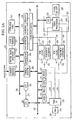
- Figs. 2A shows the structure of the fax 101
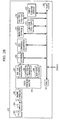
- Fig. 2B shows the structure of the hand scanner 102.
- the fax 101 and the hand scanner 102 are connected to each other.
- the fax 101 includes a first central processing unit (CPU) 201, a data bus/address bus 202, a read only memory (ROM) 203, and a static random access memory (SRAM) 204.
- CPU central processing unit
- ROM read only memory
- SRAM static random access memory
- a second CPU 205 uses middleware to compress and decompress image data according to the JPEG format.
- the fax 101 further includes a data bus 206 for the CPU 205, a ROM 207, and a random access memory (RAM) 208.
- RAM random access memory
- a common register 209 is used to exchange data between the system at the CPU 201 side and the system at the CPU 205 side.
- a common register 210 is used to exchange data between the CPU 205 and the hand scanner 102.
- the fax 101 further includes a printer image processor 211 and a color printer 212 for printing images.
- the printer image processor 211 converts image data to 360 dpi, which is equal to the resolution of the color printer 212, and transmits the converted data as printing data to the color printer 212.
- the fax 101 further includes an operation panel 213, a fax modem 214, a handset 215, and a speaker 216. These devices are controlled by the CPU 205 and are connected to a cross point switch 217. Audio or facsimile analog data is connected to a public communication network via the cross point switch 217.
- the fax 101 further includes an ISDN line (U point) 218.
- a digital service unit (DSU) 219 converts data exchanged with a local switchboard to a transistor-transistor logic (TTL) level signal.
- An ISDN interface 220 controls first to third layers of the ISDN. The ISDN interface 220 inputs data to and outputs data from the B channel of the ISDN.
- a high-level data link control (HDLC) controller 221 assembles and disassembles data in HDLC format with respect to the ISDN.
- a wireless data communication protocol processor 222 that is, a personal handy phone (PHS) internet access forum standard (PIAFS) controller, assembles and disassembles frames in wireless data communication protocol format.
- PHS personal handy phone
- PAFS internet access forum standard
- a PHS processor 223 uses a CPU 224 to process data using a PHS wireless communication protocol.
- a time division multiple access (TDMA) processor 225 assembles and disassembles frames.
- a 1.9-GHz radio frequency (RF) unit 226 transmits and receives 1.9-GHz radio waves. Since the PHS processor 223 is provided in the fax 101, a digital cordless telephone can be used as an extension in the first embodiment.
- PCM code modulation (PCM) codecs 227 and 228 convert analog signals to PCM-coded data and vice versa.
- PCM/adaptive differential pulse code modulation (ADPCM) converters 229 and 230 convert ADPCM-coded data transmitted over a PHS wireless link to PCM-coded data.
- bus switches 231 and 232 select analog signals, such as fax data, or audio signals output from the PHS processor 223, which are sent from the digital cordless telephone, as data to be transmitted over the ISDN.
- a serial communication signal line 233 is for exchanging control signals between the CPU 201 and the CPU 205.
- Serial signal lines 234, 235, and 236 are used for inputting data to and outputting data from the ISDN interface 220.
- the ISDN interface 220 selects two from among the serial signal lines 234, 235, and 236, and connects them to the B1 channel and B2 channel of the ISDN.
- Analog signal lines 237 and 238 are used for inputting data to and outputting data from the fax modem 214 and the handset 215.
- Signal lines 239 and 240 are for ADPCM-coded audio signals which are input to and output from the digital cordless telephone.
- the hand scanner 102 includes therein a CPU 241 and a RAM 242.
- a contact image sensor (CIS) 243 scans images.
- the CIS 243 includes built-in red (R), green (G), and blue (B) light emitting diode (LED) arrays.
- RGB red
- G green
- B blue
- LED light emitting diode
- An analog-to-digital (A/D) converter 244 converts video signals output from the CIS 243 to digital signals.
- the hand scanner 102 further includes a shading corrector 245 and a color-converter selector 246. Under the control of the CPU 241, the color-converter selector 246 selects one from among the following converters in accordance with a user instruction given from the operation panel 213 of the fax 101.
- An RGB ⁇ CIELAB color-space converter 247 is used when performing facsimile communication.
- An RGB ⁇ YCbCr color-space converter 248 is used when attaching a color image to an e-mail message destined to a computer.
- An RGB ⁇ CMYK color-space converter 249 is used when performing color printing by the color printer 212.
- the hand scanner 102 further includes a ⁇ converter 250 for converting luminance to density, a JPEG compressor/decompressor 251, and a resolution converter 252 which is a feature of the first embodiment of the present invention.
- a CIELAB ⁇ CMYK/YCbCr ⁇ CMYK converter 253 converts CIELAB or YCbCr color-space data to CMYK data for printing.
- a CIELAB-YCbCr converter 254 converts CIELAB color-space data to YCbCr color-space data and vice versa.
- a memory card interface 255 is used to obtain image data captured by the digital camera 103 for a memory card such as a CompactFlash card or the like.
- a CompactFlash card interface is used as the memory card interface 255.
- RGB ⁇ CIELAB color-space conversion RGB ⁇ YCbCr color-space conversion, ⁇ conversion, JPEG compression, CMYK conversion, and the like can be performed by middleware of the CPU 241.
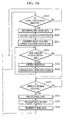
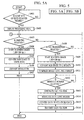
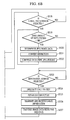
- Fig. 3 which consists of Figs. 3A and 3B, is a flowchart showing a process for transmitting image data scanned by the hand scanner 102 connected to the fax 101 of the first embodiment.
- the hand scanner 102 is removed from the fax 101, and a start key of the hand scanner 102 is pressed (step S301).
- the process starts scanning an image with a resolution of 200 ⁇ 200 dpi (step S302).
- the CIS 243 outputs RGB video signals.
- the output video signals are converted to digital signals and are subjected to shading correction.
- the process determines whether or not a processing mode of the fax 101 is selected (step S303).
- the processing mode of the fax 101 can be selected by a user by using the operation panel 213.
- Selectable processing modes include a printing mode for printing image data, a fax transmission mode for transmitting image data to another fax, and an e-mail transmission mode for transmitting image data as attached data in an e-mail message to be sent to a computer.
- step S303 the process branches to step S304. If it is determined in step S303 that the processing mode is selected, the process branches to step S403 shown in Fig. 5, which will be described hereinafter in a second embodiment of the present invention.
- step S304 the process determines that the CPU 241 selects the fax transmission mode as the default.
- the color-converter selector 246 changes the selection state and inputs the shading-corrected data to the RGB ⁇ CIELAB color-space converter 247.
- the above amount of data is compressed to approximately 1/10 to 1/20 according to the JPEG format. As a result, the amount of compressed data is approximately a few hundreds kilobytes.
- the CPU 205 controls a display unit of the operation panel 213 to display a menu so that the user can select printing, fax transmission, or e-mail transmission.
- step S307 the JPEG image data stored in the RAM 242 of the hand scanner 102 is decompressed by the JPEG compressor/decompressor 251 (step S308).
- the decompressed data is converted to CMYK color-space printing data by the CIELAB ⁇ CMYK/YCbCr ⁇ CMYK converter 253, and the converted data is again stored in the RAM 242 (step S309).
- the data stored in the RAM 242 is transferred to the printer image processor 211 in the fax 101 via the common register 210.
- the printer image processor 211 converts the image data to printing data at 360 dpi, which is equal to the resolution of the color printer 212 (step S310).
- the converted data is transferred to the color printer 212 and is printed (step S311).
- step S312 the process waits for a shortcut number of the destination fax 105 to be selected (step S313), and then the process originates a call via the ISDN to the selected phone number (step S314). If a response is made by the ISDN, the JPEG image data stored in the RAM 242 in the hand scanner 102 is transferred to the fax modem 214 via the common register 210, and the data is subjected to analog modulation (step S315). The analog signal is converted to PCM-coded data by the PCM codec 227 (step S316) and is transmitted to the ISDN (step S317). If the destination fax 105 has a function for decompressing JPEG data, the destination fax 105 decompresses the received file and prints the data.
- step S3128 If "e-mail transmission" is selected (step S318), it is necessary to convert the stored LAB color-space image data to YCbCr color-space data.
- the JPEG image data stored in the RAM 242 is decompressed by the JPEG compressor/decompressor 251 (step S219), and the decompressed data is converted to YCbCr color-space data by the CIELAB-YCbCr converter 254 (step S320). Subsequently, the data is again JPEG-compressed by the JPEG compressor/decompressor 251, and the data is stored in the RAM 242 (step S321).
- step S322 If the amount of data stored in the RAM 242 is below 1 MB (step S322), the process determines that there is no problem in attaching the data to an e-mail message and sending the e-mail message. The process directly proceeds to transmission processing (step S325).
- step S322 if the amount of data stored in the RAM 242 is 1 MB or greater (step S322), it is necessary to convert the resolution in order to reduce the amount of data.
- the uncompressed 200 ⁇ 200 dpi data is converted to 100 ⁇ 100 dpi by decimation (step S323).
- step S324 the data is again compressed according to the JPEG format (step S324).
- the amount of data is reduced to substantially one fourth.
- the amount of JPEG-compressed data is smaller than 1 MB. If the amount of data is still 1 MB or greater (step S322), the process again performs processing in order to reduce the resolution (step S323).
- image data to be transmitted is set.
- the process starts transmission processing.
- the process waits for a shortcut number that corresponds to the recipient e-mail address to be selected (step S325).
- the image data stored in the RAM 242 in the hand scanner 102 is transferred to the SRAM 204 in the fax 101 via the common register 210.
- the process appends information, such as "From:” which indicates the sender, "To:” which indicates the recipient, "Subject:” which indicates the title, "Cc:” which indicates the recipient of a copy of the e-mail message, and "Date:” which indicates the date, to the head of the JPEG-compressed image data to be transmitted.
- the file name "XXXXXX.JPG” is appended to the header information.
- the process When the e-mail format data is created, the process originates a call to the pre-registered ISP 106 (step S327). When a response message from the ISDN is received, the process establishes a connection with a communication path. When a phone line with the ISP 106 is established, the process logs in through the PAP procedures and sends the e-mail message in accordance with SMTP (step S328).
- the e-mail format data in the SRAM 204 is transferred to the HDLC controller 221 and is assembled into an HDLC frame.
- the HDLC frame is transmitted to the ISP 106 via the ISDN interface 220.
- the destination PC 107 which is the recipient of the e-mail message, receives the e-mail message which has been transmitted to the ISP 106 via the Internet.
- the destination PC 107 can open the e-mail message to which the JPEG-compressed image data is attached. If the destination PC 107 has a function for decompressing JPEG data, the destination PC 107 can read the transmitted color image.
- the process determines whether or not the amount of compressed image data is 1 MB or greater when the "e-mail transmission" mode is selected, and the resolution is converted in accordance with the determination result.
- the present invention is not limited to this example.
- the resolution can always be converted regardless of the amount of data. Accordingly, JPEG compression processing is simplified, and hence the processing speed increases.
- the process converts the resolution in step S323 and compresses the data according to the JPEG format in step S324.
- the data compression ratio can be increased by changing a quantization table used to perform JPEG compression, thereby reducing the amount of data.
- the larger the value in the quantization table the greater the data compression ratio becomes.
- a combination of resolution conversion and changing of values in the quantization table can be used in order to reduce the amount of data.
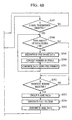
- Fig. 4 which consists of Figs. 4A and 4B, is a flowchart showing a process for transmitting, by the fax 101 of the first embodiment, image data obtained by another image input device (the digital camera 103 in the first embodiment).
- captured RGB image data is converted to YCbCr color-space data. This data is compressed according to the JPEG format and is stored in a CompactFlash card.
- the hand scanner 102 connected to the fax 101 can obtain data stored in the CompactFlash card through the memory card interface 255.
- the CPU 241 detects that the CompactFlash card is inserted into the hand scanner 102 (step S331), the process notifies the CPU 205 in the fax 101 that the CompactFlash card is inserted. Accordingly, the process causes the display unit of the operation panel 213 in the fax 101 to display a menu so that the user can select printing, fax transmission, or e-mail transmission (step S332).
- step S333 the JPEG image data read from the CompactFlash card is decompressed by the JPEG compressor/decompressor 251 (step S334).
- the CIELAB ⁇ CMYK/YCbCr ⁇ CMYK converter 253 creates printing data (step S335), and subsequently the data is stored in the RAM 242.
- the data stored in the RAM 242 is transferred to the printer image processor 211 in the fax 101.
- the printer image processor 211 converts the image data to printing data at 360 dpi, which is equal to the resolution of the color printer 212 (step S336).
- the printing data is transferred to the color printer 212 and is printed (step S337).
- step S338 If "fax transmission” is selected (step S338), the JPEG image data read from the CompactFlash card is decompressed by the JPEG compressor/decompressor 251 (step S339).
- the CIELAB-YCbCr converter 254 converts the data to LAB color-space image data (step S340).
- the data is compressed by the JPEG compressor/decompressor 251 (step S341), and the compressed data is stored in the RAM 242.
- the process waits for a shortcut number of the destination fax 105 to be selected (step S342), and then the process originates a call to the selected phone number via the ISDN (step S343).
- the JPEG image data stored in the RAM 242 in the hand scanner 102 is transferred to the fax modem 214 via the common register 210 and is subjected to analog modulation (step S344).
- the analog signal is converted to PCM-coded data by the PCM codec 227 (step S345), and the data is transmitted to the ISDN (step S346). If the destination fax 105 has a function for decompressing JPEG data, the destination fax 105 can decompress the received file and print the data.
- step S347 If "e-mail transmission” is selected (step S347), the JPEG image data read from the CompactFlash card is maintained in the RAM 242. If the amount of data is below 1 MB (step S348), the process determines that there is no problem in attaching the data to an e-mail message and sending the e-mail message. The process then proceeds to transmission processing (step S352).
- step S348 if the amount of data stored in the RAM 242 is 1 MB or greater (step S348), it is necessary to convert the resolution.
- the process decompresses the JPEG image data (step S349) and performs processing in order to reduce the number of pixels. For example, the process vertically and horizontally decimates the image at a rate of 1:2 pixels. As a result, the number of pixels is reduced to one fourth (step S350). In this manner, the process reduces the number of pixels and compresses the data according to the JPEG format (step S351). The compressed data is again stored in the RAM 242. Even when the amount of data is 1 MB or greater (step S348), the process again performs processing in order to reduce the resolution (step S350). When the process repeats the processing and the amount of JPEG-compressed data is reduced to below 1 MB, the image data to be transmitted is set. As described above, the amount of data can be reduced by increasing the data compression ratio.
- the process starts transmission processing.
- the process waits for a shortcut number that corresponds to the recipient e-mail address (step S352).
- the image data stored in the RAM 242 in the hand scanner 102 is transferred to the SRAM 204 in the fax 101 via the common register 210.
- predetermined header information is appended to the JPEG-compressed image data stored in the SRAM 204.
- data in the Internet e-mail format is created (step S353).
- the process After the e-mail format data is created, the process originates a call to the pre-registered ISP 106 (step S354). If a response message from the ISDN is received, the process establishes a connection with a communication path. When a phone line with the ISP 106 is established, the process logs in through the PAP procedures and sends the e-mail message in accordance with SMTP (step S355).
- the destination PC 107 When the destination PC 107 receives the e-mail message which has been sent to the ISP 106 via the Internet, the destination PC 107 can open the e-mail message sent from the fax 101, to which the JPEG-compressed image data is attached. If the destination PC 107 has a function for decompressing JPEG data, the destination PC can read the transmitted color image.
- an example has been described in which an image captured by the digital camera 103 is read from the CompactFlash card into the hand scanner 102.
- the present invention is not limited to this example.
- similar advantages can be achieved by transferring data from the digital camera 103 in real time using a wired or wireless communication link.
- the color image when color image data is transmitted as an e-mail message, the color image is transmitted with a lower resolution or at a higher data compression ratio compared with a case in which the image data is transmitted using a fax.
- the amount of data transmitted as an e-mail message is reduced, and hence the burden on a server is lessened.
- the selectable processing modes include printing, fax transmission, and e-mail transmission.
- additional processing modes namely, monochrome/color scanning modes for the hand scanner 102.
- the first embodiment can be applied only when the color scanning mode is selected. In other words, when the monochrome scanning mode is selected, it is possible to transmit a high-resolution image, which is similar to that in fax transmission, even when the image is sent as an e-mail message.
- the processing mode such as printing, fax transmission, or e-mail transmission
- the processing mode is selected after a document is scanned by the hand scanner 102.
- the processing mode is selected prior to scanning a document, thus enabling the hand scanner 102 to scan the document with the optimal resolution, resulting in an increase in the scanning speed.
- Fig. 5 which consists of Figs. 5A and 5B, is a flowchart showing a process for transmitting image data scanned by the hand scanner 102 connected to the fax 101 of the second embodiment.
- step S401 the start key is pressed.
- the display unit of the hand scanner 102 displays a menu so that the user can select printing, fax transmission, or e-mail transmission (step S402).
- step S403 When "printing” is selected (step S403), the process starts scanning an image with a resolution of 200 ⁇ 200 dpi (step S404).
- the scanned RGB image data is converted to digital data, is subjected to shading correction, and is converted to CMYK data by the RGB ⁇ CMYK color-space converter 249 (step S405).
- the CMYK data is subjected to ⁇ conversion, the data is stored in the RAM 242 in the hand scanner 102.
- the image data stored in the RAM 242 is transferred to the printer image processor 211 in the fax 101 via the common register 210.
- the printer image processor 211 converts the image data to printing data at 360 dpi, which is equal to the resolution of the color printer 212 (step S406).
- the data is transferred to the color printer 212 and is printed (step S407).
- step S408 When "fax transmission” is selected (step S408), the process starts scanning the image with a resolution of 200 ⁇ 200 dpi (step S409).
- the scanned RGB image data is converted to digital data, is subjected to shading correction, and is converted to LAB data by the RGB ⁇ CIELAB color-space converter 247 (step S410).
- the LAB data is subjected to ⁇ conversion and JPEG compression (step S411), and the data is stored in the RAM 242.
- the process waits for a shortcut number of the destination fax 105 to be selected (step S412) and originates a call to the selected phone number via the ISDN (step S413).
- the JPEG image data stored in the RAM 242 in the hand scanner 102 is transferred to the fax modem 214 via the common register 210 and is subjected to analog modulation (step S414).
- the analog signal is converted to PCM-coded data by the PCM codec 227 (step S415) and is transmitted to the ISDN (step S416). If the destination fax 105 has a function for decompressing JPEG data, the destination fax 105 can decompress the received file and print the data.
- step S417 the process starts scanning the image with a resolution of 100 x 100 dpi (step S418).
- the scanned image data is converted to digital data, is subjected to shading correction, and is converted to YCbCr data by the RGB ⁇ YCbCr color-space converter 248 (step S419).
- the YCbCr data is subjected to ⁇ conversion and JPEG compression (step S420), and the data is stored in the RAM 242.
- the process waits for a shortcut number that corresponds to the recipient e-mail address (step S421).
- the image data stored in the RAM 242 in the hand scanner 102 is transferred to the SRAM 204 in the fax 101 via the common register 210.
- predetermined header information which is similar to that in the first embodiment, to the JPEG-compressed image data in the SRAM 204, data in the Internet e-mail format is created (step S422).
- the process When the e-mail format data is created, the process originates a call to the pre-registered ISP 106 (step S423). When a response message from the ISDN is received, the process establishes a connection with a communication path. When a phone line with the ISP 106 is established, the process logs in through the PAP procedures and sends the e-mail message in accordance with SMTP (step S424).
- the image scanning resolution employed by the hand scanner 102 is changed beforehand in accordance with the selected processing mode.
- the scanning speed, particularly in the case of e-mail transmission, is improved.
- the second embodiment it is possible to employ additional processing modes, namely, monochrome/color scanning modes for the hand scanner 102.
- the second embodiment can be applied only when the color scanning mode is selected.
- the monochrome scanning mode it is possible to transmit a high-resolution image, which is similar to that used in fax transmission, even when the image is sent with an e-mail message.
- the hand scanner 102 when "e-mail transmission" is selected (step S417), the hand scanner 102 starts scanning images with a resolution of 100 ⁇ 100 dpi (step S418).
- the process compresses the scanned image data page by page according to the JPEG format and stores the compressed data in the RAM 242. Specifically, the data is stored page by page in the RAM 242.
- the process creates data to be attached to e-mail messages. At this moment, the process limits the total amount of image data to be attached to each e-mail message to below 1 MB.
- the process scans five pages of a document, each page having 400-KB data.
- the process creates a first piece of e-mail format data to which the first and second pages are attached, a second piece of e-mail format data to which the third and fourth pages are attached, and a third piece of e-mail format data to which the fifth page is attached.
- the process When the e-mail format data are created, the process originates a call to the pre-registered ISP 106 (step S423). When a phone line with the ISP 106 is established, the process logs in through the PAS procedures and transmits the first to third e-mail messages one after another in accordance with SMTP (step S424).
- the data when transmitting color image data of a plurality of pages by attaching the data to e-mail messages, the data is divided into a plurality of portions, each portion being attached to an e-mail message.
- the burden on a server is lessened.
- the present invention is not limited to this example.
- the present invention can be applied to cases in which monochrome images of a plurality of pages are transmitted by attaching them to e-mail messages.
- the monochrome images can be divided into a plurality of portions, each portion being attached to an e-mail message, so that the amount of data attached to each e-mail message does not exceed 1 MB.
- values in the quantization table used to convert data according to the JPEG format can be changed.
- the resolution of image data is converted to reduce the amount of data to smaller than a predetermined amount, thus preventing the occurrence of a problem.
- the fourth embodiment when the amount of data exceeds a predetermined amount, the message "The image size is too large” or the like is displayed, and the transmission is stopped. Thus, the occurrence of a problem can be prevented as in the first to third embodiments.
- e-mail transmission is performed by assembling data in the fax 101 into the e-mail format.
- image data can be sent using an e-mail message without the fax 101 converting the facsimile format image data into the e-mail format data.
- the fax 101 is required to keep the amount of image data to smaller than 1 MB while handling the image data as facsimile format data.
- Fig. 6 which consists of Figs. 6A and 6B, a case is described in which image data scanned by the hand scanner 102 is transmitted.
- the process follows the same procedures (steps S501 to S517) as those in the first embodiment.
- step S528 When "e-mail transmission” is selected (step S518), unlike the first embodiment, color space conversion is performed at the ISP 106 side. Thus, the process can proceed using LAB color-space data.
- the process measures the amount of JPEG image data stored in the RAM 242. If the amount of data does not exceed 1 MB (step S519), the process determines that there is no problem in attaching the data to an e-mail message and sending the e-mail message.
- the process directly proceeds to transmission processing. In the transmission processing, the process selects a destination e-mail address (step S523). When the e-mail address is selected, the process originates a call to a specific phone number which offers an e-mail conversion service (step S524).
- the process When a connection with an e-mail conversion server at the above phone number is established, the process establishes a connection with the server using a dual tone multifrequency (DTMF) signal (step S525).
- the process transmits and receives e-mail information using a V.23 modem (step S526). In this processing step, the process transmits information such as the selected recipient e-mail address information and the subject title to the server.
- DTMF dual tone multifrequency
- the process starts transmitting image data to be attached to an e-mail message.
- the image data is transmitted by a T.30 facsimile sequence (step S527).
- the ISP 106 When the ISP 106 side receives the fax image data, the ISP 106 performs color-space conversion of the data in order to use the data as an e-mail image. The ISP 106 converts the data into the e-mail format and transfers the data to an e-mail server.
- step S519 when the amount of data stored in the RAM 242 is 1 MB or greater (step S519), it is necessary to convert the resolution.
- the process decompresses the JPEG image data (step S520) and converts the 200 ⁇ 200 dpi data to 100 ⁇ 100 dpi data by decimation (step S521). Subsequently, the process again compresses the data according to the JPEG format (step S522). As a result, the amount of data is reduced to approximately one fourth. It is thus possible to conclude that the amount of data is reduced to smaller than 1 MB. If, however, the amount of JPEG-compressed data is still 1 MB or greater (step S519), the process performs processing to further reduce the resolution (step S521). The process then repeats. When the amount of JPEG-compressed data becomes smaller than 1 MB, the image data to be transmitted is set.
- the process establishes a connection with the server through the above-described procedures and transmits the image data (steps S523 to S527).
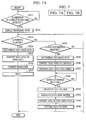
- FIG. 7 which consists of Figs. 7A and 7B, a process for transmitting image data obtained by another image input device (the digital camera 103 in the fifth embodiment) is described.
- step S547 JPEG image data read from the CompactFlash card is decompressed by the JPEG compressor/decompressor 251 (step S548), and the decompressed data is converted to LAB color-space image data by the CIELAB-YCbCr converter 254 (step S549).
- the data is again compressed by the JPEG compressor/decompressor 251 (step S550) and is stored in the RAM 242.
- the process measures the amount of image data. If the amount of data is smaller than 1 MB (step S551), the process determines that there is no problem in attaching the image data to an e-mail message and sending the e-mail message. The process directly proceeds to transmission processing (step S552).
- the transmission processing is similar to the above-described process for transmitting image data scanned by the hand scanner 102.
- step S551 if the amount of data stored in the RAM 242 is 1 MB or greater (step S551), it is necessary to convert the resolution.
- the process decompresses the JPEG image data (step S552) and performs processing in order to reduce the number of pixels. For example, the process vertically and horizontally decimates the image at a rate of 1:2 pixels. As a result, the number of pixels is reduced to one fourth (step S553). In this manner, the process reduces the number of pixels and compresses the data according to the JPEG format (step S554).
- the compressed data is again stored in the RAM 242.
- step S551 the process again performs processing in order to reduce the resolution (step S553). The process then repeats.
- the image data to be transmitted is set.
- the process performs transmission processing similar to the above-described process for transmitting image data in the hand scanner 102 (step S556 to 560).
- the transmitted data is received by the fax/e-mail conversion server.
- the data is subjected to JPEG decompression and LAB ⁇ YCbCr color-space conversion.
- the color-space converted data is compressed according to the JPEG format and is assembled into e-mail format data.
- the e-mail format data is transmitted to the e-mail address designated by the fax 101.
- the fax 101 compresses facsimile format image data using Modified Huffman encoding (MH) and transmits the compressed data to the server.
- MH Modified Huffman encoding
- the process reduces the number of pages and performs transmission.
- the server receives the data, generates a TIFF-F format file based on the received image data, and transmits the file to the e-mail address designated by the fax 101.
- the amount of image data can be reduced by changing values in the quantization table.
- the process determines whether or not to transmit data of a plurality of pages based on the amount of data. If the average amount of data per page is known in advance, it is possible to impose a limitation based on the number of pages. In this way, a user can recognize in advance the number of pages that can be transmitted. This also eliminates the possibility of read data being wasted by not being transmitted.
- the size of JPEG-compressed data of a color facsimile standard document is approximately 300 KB.
- the number of pages that can be attached to an e-mail message is approximately three pages. If the number of pages exceeds three pages at the time the document is read, facsimile transmission can be cancelled, thus achieving similar advantages.
- a case has been described in which e-mail format data is created in a fax (a direct connection with an ISP is established).
- a case has been described in which a connection is established with a server for converting a facsimile-format image to e-mail-format data (fax/e-mail conversion service is used).
- the fax 101 can select one from among the two methods when transmitting an e-mail message.
- step S318 in Fig. 3 the name of the connected recipient is displayed.
- an e-mail message is sent using the method described in the first embodiment.
- facsimile format data is transmitted using the method described in the sixth embodiment.
- the transmission mode can be detected without displaying such processing modes on the menu.
- the transmission mode can be detected by determining whether the destination shortcut number selected by a user corresponds to a facsimile number or an e-mail address.
- a shortcut number registered in a telephone directory in the fax 101 indicates a facsimile number
- "F” is displayed next to a name
- "E” is displayed next to a name.
- the user can distinguish a facsimile number from an e-mail address.
- dedicated keys such as a fax key and an e-mail key can be provided on the operation panel 213.
- a fax key and an e-mail key can be provided on the operation panel 213.
- the fax key is pressed, only facsimile numbers registered in the telephone directory are displayed, thereby achieving similar advantages.
- the ISDN is used as a public communication network.
- data modulated by the fax modem 214 is PCM-encoded.
- data assembled into an HDLC frame is directly transmitted to the ISDN.
- a public communication network is an analog network (public switched telephone network (PSTN))
- PSTN public switched telephone network
- the present invention can achieve similar advantages.
- analog signals modulated by the fax modem 214 are directly transmitted to the PSTN.
- e-mail format data is modulated into analog data by the fax modem 214, and the analog data can be transmitted to the PSTN.
- the present invention is applicable to cases in which e-mail messages are transmitted from the fax 101 using cable television communication lines, asymmetric digital subscriber line (ADSL), fiber optic cables, and the like.
- ADSL asymmetric digital subscriber line
- the hand scanner 102 is removed from the fax 101 and performs scanning.
- the present invention is similarly applicable to a case in which the hand scanner 102 is fixed on the fax 101 or to a case in which the hand scanner 102 is removable from the fax 101.
- the amount of attached data that can be transmitted is not limited to 1 MB.
- the amount of data in conformity with the communication network can be set as a threshold value.
- the present invention can be applied to a system consisting of a plurality of devices such as a host computer, an interface device, a reader, a printer, and the like, and to an apparatus consisting of a single device such as a copy machine, a facsimile apparatus, and the like.
- the objects of the present invention can be achieved by supplying a storage medium or a recording medium which has recorded thereon software program code for implementing the functions of the foregoing embodiments to a system or an apparatus, so that a computer (CPU or MPU) of the system or the apparatus can read and execute the program code stored in the storage medium.
- the program code read from the storage medium implements the functions of the foregoing embodiments
- the storage medium storing the program code forms the present invention.
- the functions of the embodiments can be achieved by an operating system (OS) which runs on the computer by performing part or entirety of the actual processing based on instructions from the program code.
- OS operating system
- the functions of the foregoing embodiments can be achieved by writing the program code read from the storage medium to an add-on card inserted into the computer or to a memory of an add-on unit connected to the computer.
- a CPU of the add-on card or the add-on unit can perform part or entirety of the actual processing based on instructions from the program code.
- control method of the present invention can be implemented by a computer program operating on a processor of the apparatus.
- An aspect of the present invention thus provides a storage medium storing processor implementable instructions for controlling a processor to carry out the method as hereinabove described.
- the computer program can be obtained in electronic form for example by downloading the code over a network such as the internet.
- an electrical signal carrying processor implementable instructions for controlling a processor to carry out the method as hereinbefore described.
Landscapes
- Engineering & Computer Science (AREA)
- Multimedia (AREA)
- Signal Processing (AREA)
- Computing Systems (AREA)
- General Engineering & Computer Science (AREA)
- Information Transfer Between Computers (AREA)
- Compression Of Band Width Or Redundancy In Fax (AREA)
- Facsimiles In General (AREA)
Abstract
Description
Claims (14)
- An image communicating apparatus for transmitting image data to another apparatus through a public communication network, comprising:input means for inputting image data;compression means for compressing the image data input by said input means;transmission means for transmitting the image data compressed by said compression means as attached data in an e-mail message;said image communicating apparatus characterized by comprising:determination means for determining whether or not the amount of image data compressed by said compression means is a predetermined amount or greater; andreduction means for reducing the amount of image data to less than the predetermined amount when said determination means determines that the amount of image data is the predetermined amount or greater.
- An image communicating apparatus according to Claim 1, wherein said reduction means decompresses the compressed image data and causes said compression means to again compress the image data with a lower resolution.
- An image communicating apparatus according to Claim 1, wherein said reduction means decompresses the compressed image data and causes said compression means to again compress the image data at a higher compression ratio.
- An image communicating apparatus according to Claim 3, wherein said compression means performs JPEG compression; and
said reduction means changes values in a quantization table used to perform JPEG compression. - An image communicating apparatus according to Claim 1, wherein said input means includes a scanner for scanning a document image; and
said image communicating apparatus further comprises converting means for converting the color space of an image scanned by the scanner to YCbCr. - An image communicating apparatus according to Claim 1, further comprising display means for displaying that it is determined by said determination means that the amount of image data is the predetermined amount or greater.
- An image communicating apparatus according to Claim 1, further comprising selection means for selecting a facsimile transmission mode, in which the image data input by said input means is transmitted by facsimile, or an e-mail transmission mode, in which the image data input by said input means is transmitted as attached data in an e-mail message;
wherein, when the facsimile transmission mode is selected, said reduction means does not operate. - An image communicating apparatus according to Claim 7, wherein said input means includes a scanner for scanning a document image; and
an image-data scanning resolution employed in the facsimile transmission mode differs from that employed in the e-mail transmission mode. - An image communicating apparatus according to Claim 7, wherein said compression means performs JPEG compression; and
values in a quantization table used to perform JPEG compression in the facsimile transmission mode differ from those in the e-mail transmission mode. - An image communicating apparatus according to Claim 1, wherein, when monochrome image data is input by said input means, said reduction means does not operate.
- An image communicating apparatus according to Claim 1, further comprising dividing means for dividing, when said input means inputs image data of a plurality of pages, the image data of the plurality of pages so that the amount of image data in an e-mail message is less than the predetermined amount.
- A control method for an image communicating apparatus for transmitting image data to another apparatus through a public communication network, comprising:an input step of inputting image data;a compression step of compressing the image data input in said input step; anda selection step of selecting a first transmission mode, in which the image data compressed in said compression step is transmitted by facsimile, or a second transmission mode, in which the image data compressed in said compression step is transmitted as attached data in an e-mail message;said control method characterized by comprising:a determination step of determining, when the second transmission mode is selected in said selection step, whether or not the amount of image data compressed in said compression step is a predetermined amount or greater; anda reduction step of reducing the amount of image data to less than the predetermined amount when it is determined in said determination step that the amount of image data is the predetermined amount or greater.
- A storage medium storing processor implementable instructions for controlling a processor to carry out the method of claim 12.
- An electrical signal carrying processor implementable instructions for controlling a processor to carry out the method claim 12.
Applications Claiming Priority (2)
| Application Number | Priority Date | Filing Date | Title |
|---|---|---|---|
| JP2000205407 | 2000-07-06 | ||
| JP2000205407 | 2000-07-06 |
Publications (3)
| Publication Number | Publication Date |
|---|---|
| EP1170936A2 true EP1170936A2 (en) | 2002-01-09 |
| EP1170936A3 EP1170936A3 (en) | 2003-07-16 |
| EP1170936B1 EP1170936B1 (en) | 2009-09-30 |
Family
ID=18702497
Family Applications (1)
| Application Number | Title | Priority Date | Filing Date |
|---|---|---|---|
| EP01305773A Expired - Lifetime EP1170936B1 (en) | 2000-07-06 | 2001-07-04 | Image communicating apparatus |
Country Status (3)
| Country | Link |
|---|---|
| US (1) | US6972874B2 (en) |
| EP (1) | EP1170936B1 (en) |
| DE (1) | DE60140027D1 (en) |
Cited By (2)
| Publication number | Priority date | Publication date | Assignee | Title |
|---|---|---|---|---|
| BE1015656A5 (en) * | 2003-08-22 | 2005-07-05 | Phan Ngoc Ngan | Digital subscriber line color fax machine for e.g. enterprise, has asymmetrical digital subscriber line modem shared through filter to split telephone line to function as fax-modem for sending color fax by file transfer protocol |
| EP2151120A1 (en) * | 2007-05-25 | 2010-02-10 | Sony Ericsson Mobile Communications AB | Communication device and image transmission method |
Families Citing this family (23)
| Publication number | Priority date | Publication date | Assignee | Title |
|---|---|---|---|---|
| US20020126135A1 (en) * | 1998-10-19 | 2002-09-12 | Keith Ball | Image sharing for instant messaging |
| US7339595B2 (en) | 1998-10-19 | 2008-03-04 | Lightsurf Technologies, Inc. | Method and system for improved internet color |
| JP3605303B2 (en) * | 1998-11-18 | 2004-12-22 | コニカミノルタビジネステクノロジーズ株式会社 | Combined communication device having facsimile transmission function and e-mail transmission function and recording medium recording program for the same |
| US20020080415A1 (en) * | 2000-12-12 | 2002-06-27 | Naoto Akimoto | Communication apparatus for forwarding received data |
| EP1416391B1 (en) | 2001-08-01 | 2011-10-05 | Sony Corporation | Information processing apparatus and method |
| EP1404104B1 (en) * | 2002-09-24 | 2013-01-02 | Ricoh Company, Ltd. | Method of and apparatus for processing image data, and computer product |
| JP3826900B2 (en) * | 2002-10-11 | 2006-09-27 | 村田機械株式会社 | Color image communication device |
| JP4101023B2 (en) * | 2002-11-05 | 2008-06-11 | シャープ株式会社 | Network scanner |
| US7747091B2 (en) * | 2003-09-05 | 2010-06-29 | Sharp Laboratories Of America, Inc. | Systems and methods for section-by-section processing of a digital image file |
| JP2005348170A (en) * | 2004-06-03 | 2005-12-15 | Ricoh Co Ltd | Image reading apparatus, image processing apparatus, image forming apparatus, image processing method, computer program, and recording medium |
| KR100608835B1 (en) * | 2004-12-09 | 2006-08-08 | 엘지전자 주식회사 | Image transmission method of mobile terminal |
| US7706607B2 (en) * | 2005-06-23 | 2010-04-27 | Microsoft Corporation | Optimized color image encoding and decoding using color space parameter data |
| US20070035764A1 (en) * | 2005-08-12 | 2007-02-15 | Yahoo! Inc. | System and method for uploading files |
| US7570396B2 (en) * | 2005-09-14 | 2009-08-04 | Kabushiki Kaisha Toshiba | Image communication apparatus and image communication control method |
| JP4697967B2 (en) * | 2006-03-02 | 2011-06-08 | キヤノン株式会社 | Image coding apparatus and control method thereof |
| JP2008072624A (en) * | 2006-09-15 | 2008-03-27 | Canon Inc | Image coding apparatus and control method thereof |
| US8539029B2 (en) | 2007-10-29 | 2013-09-17 | Microsoft Corporation | Pre-send evaluation of E-mail communications |
| US8280963B2 (en) * | 2008-04-10 | 2012-10-02 | Microsoft Corporation | Caching and exposing pre-send data relating to the sender or recipient of an electronic mail message |
| JP5537287B2 (en) * | 2010-06-29 | 2014-07-02 | 株式会社沖データ | Image forming apparatus |
| US9542501B2 (en) * | 2011-01-28 | 2017-01-10 | Radware Ltd. | System and method for presenting content in a client/server environment |
| JP6541387B2 (en) | 2015-03-23 | 2019-07-10 | キヤノン株式会社 | PROCESSING APPARATUS, CONTROL METHOD THEREOF, AND PROGRAM |
| JP2021164046A (en) | 2020-03-31 | 2021-10-11 | キヤノン株式会社 | Image processing equipment, recording equipment, image processing methods, and programs |
| CN116962542A (en) * | 2023-08-25 | 2023-10-27 | 阿里巴巴达摩院(杭州)科技有限公司 | Data communication method, memory pool switching device, cloud computing system and storage medium |
Family Cites Families (17)
| Publication number | Priority date | Publication date | Assignee | Title |
|---|---|---|---|---|
| JP3080982B2 (en) * | 1990-11-19 | 2000-08-28 | キヤノン株式会社 | Image processing device |
| GB2259824B (en) | 1991-09-19 | 1995-01-18 | Sony Broadcast & Communication | Data compression |
| DE69331126T2 (en) | 1992-07-31 | 2002-06-20 | Canon K.K., Tokio/Tokyo | Image processing device and method for multi-stage compression |
| FR2702580B1 (en) | 1993-03-09 | 1995-06-16 | Blondel Gerard | Method for compressing a digital image to a predetermined size, and corresponding decompression method. |
| DE69535098T2 (en) * | 1994-11-15 | 2007-04-19 | Canon K.K. | Method and apparatus for searching images in a database |
| US5684865A (en) * | 1995-08-28 | 1997-11-04 | Motorola, Inc. | Method for efficient facsimile communication with selective call receivers |
| US5861887A (en) * | 1995-12-05 | 1999-01-19 | Electronic Data Systems Corporation | Graphic image compression and storage system |
| US5805298A (en) * | 1996-02-06 | 1998-09-08 | Ho; Shu-Kuang | Communications device with remote device identifier recognition and transmission in accordance with the recognized identifier |
| JPH09325924A (en) | 1996-06-07 | 1997-12-16 | Murata Mach Ltd | Communication terminal equipment |
| TW406508B (en) | 1996-06-07 | 2000-09-21 | Murata Machinery Ltd | Communication method and customer premise equipment (CPE) |
| JP3452234B2 (en) * | 1996-09-24 | 2003-09-29 | 株式会社リコー | Image input device |
| JP3745070B2 (en) * | 1997-02-19 | 2006-02-15 | キヤノン株式会社 | Data communication apparatus and method |
| JP3593849B2 (en) | 1997-05-20 | 2004-11-24 | 村田機械株式会社 | Facsimile machine with e-mail function |
| JP3702599B2 (en) | 1997-08-18 | 2005-10-05 | 村田機械株式会社 | Communication terminal device with e-mail function |
| JP3304858B2 (en) * | 1997-11-28 | 2002-07-22 | 富士ゼロックス株式会社 | Image transmission apparatus and image transmission method |
| JP3942267B2 (en) | 1998-04-21 | 2007-07-11 | 東芝テック株式会社 | E-mail system |
| JP3170491B2 (en) * | 1999-03-29 | 2001-05-28 | 松下電送システム株式会社 | Image communication device, server device, and capability exchange method |
-
2001
- 2001-06-27 US US09/891,583 patent/US6972874B2/en not_active Expired - Fee Related
- 2001-07-04 EP EP01305773A patent/EP1170936B1/en not_active Expired - Lifetime
- 2001-07-04 DE DE60140027T patent/DE60140027D1/en not_active Expired - Lifetime
Cited By (2)
| Publication number | Priority date | Publication date | Assignee | Title |
|---|---|---|---|---|
| BE1015656A5 (en) * | 2003-08-22 | 2005-07-05 | Phan Ngoc Ngan | Digital subscriber line color fax machine for e.g. enterprise, has asymmetrical digital subscriber line modem shared through filter to split telephone line to function as fax-modem for sending color fax by file transfer protocol |
| EP2151120A1 (en) * | 2007-05-25 | 2010-02-10 | Sony Ericsson Mobile Communications AB | Communication device and image transmission method |
Also Published As
| Publication number | Publication date |
|---|---|
| DE60140027D1 (en) | 2009-11-12 |
| EP1170936B1 (en) | 2009-09-30 |
| US20020051223A1 (en) | 2002-05-02 |
| EP1170936A3 (en) | 2003-07-16 |
| US6972874B2 (en) | 2005-12-06 |
Similar Documents
| Publication | Publication Date | Title |
|---|---|---|
| EP1170936B1 (en) | Image communicating apparatus | |
| US7856481B2 (en) | Data communication apparatus and electronic mail data producing method | |
| EP1119179B1 (en) | Image communication apparatus and method | |
| US20010038469A1 (en) | Image communication apparatus and its control method | |
| US20020089702A1 (en) | Image processing apparatus and method | |
| JP2002140276A (en) | Image communication apparatus, communication system, electronic mail transmission control method, and storage medium | |
| US7277197B2 (en) | Image communication apparatus and image communication method | |
| JP2001061068A (en) | Image reading communication device and image reading communication method | |
| JP2002094738A (en) | Image communication apparatus and control method thereof | |
| US20020015188A1 (en) | Facsimile apparatus, information processing apparatus and method for data communication | |
| JP3768801B2 (en) | Image communication apparatus, image communication method, and storage medium | |
| JP3972871B2 (en) | Color image communication apparatus and color image communication method | |
| JP2003283741A (en) | Information processing apparatus, image processing method, and program | |
| JP3809358B2 (en) | Image communication apparatus, transmission image control method, storage medium, and program | |
| JP2000276415A (en) | Method and equipment for picture communication | |
| JP2000261578A (en) | Facsimile machine | |
| JP2002142063A (en) | Image communication apparatus, communication system, transmission image processing method, and storage medium | |
| JP4115493B2 (en) | Image processing apparatus, image processing method, and program | |
| JP2002158855A (en) | Communicating method for picture data, transmission device and reception device | |
| JP2002135598A (en) | Image processing apparatus and image processing method | |
| JP2002125089A (en) | Facsimile apparatus, control method for facsimile apparatus, and storage medium | |
| JPH07154519A (en) | Method for picture signal conversion and still picture transmitter | |
| JP2004040609A (en) | Data communication equipment | |
| JP2004140461A (en) | Communication control method | |
| JPH09214625A (en) | Communication device |
Legal Events
| Date | Code | Title | Description |
|---|---|---|---|
| PUAI | Public reference made under article 153(3) epc to a published international application that has entered the european phase |
Free format text: ORIGINAL CODE: 0009012 |
|
| AK | Designated contracting states |
Kind code of ref document: A2 Designated state(s): AT BE CH CY DE DK ES FI FR GB GR IE IT LI LU MC NL PT SE TR |
|
| AX | Request for extension of the european patent |
Free format text: AL;LT;LV;MK;RO;SI |
|
| PUAL | Search report despatched |
Free format text: ORIGINAL CODE: 0009013 |
|
| AK | Designated contracting states |
Designated state(s): AT BE CH CY DE DK ES FI FR GB GR IE IT LI LU MC NL PT SE TR |
|
| AX | Request for extension of the european patent |
Extension state: AL LT LV MK RO SI |
|
| RIC1 | Information provided on ipc code assigned before grant |
Ipc: 7G 06T 9/00 B Ipc: 7H 04N 1/333 B Ipc: 7H 04N 1/00 A |
|
| 17P | Request for examination filed |
Effective date: 20031126 |
|
| AKX | Designation fees paid |
Designated state(s): DE ES FR GB IT |
|
| 17Q | First examination report despatched |
Effective date: 20050329 |
|
| GRAP | Despatch of communication of intention to grant a patent |
Free format text: ORIGINAL CODE: EPIDOSNIGR1 |
|
| RIN1 | Information on inventor provided before grant (corrected) |
Inventor name: IZUMI, MICHIHIRO Inventor name: YOSHITANI, AKIHIRO |
|
| GRAS | Grant fee paid |
Free format text: ORIGINAL CODE: EPIDOSNIGR3 |
|
| GRAA | (expected) grant |
Free format text: ORIGINAL CODE: 0009210 |
|
| AK | Designated contracting states |
Kind code of ref document: B1 Designated state(s): DE ES FR GB IT |
|
| REG | Reference to a national code |
Ref country code: GB Ref legal event code: FG4D |
|
| REF | Corresponds to: |
Ref document number: 60140027 Country of ref document: DE Date of ref document: 20091112 Kind code of ref document: P |
|
| PG25 | Lapsed in a contracting state [announced via postgrant information from national office to epo] |
Ref country code: ES Free format text: LAPSE BECAUSE OF FAILURE TO SUBMIT A TRANSLATION OF THE DESCRIPTION OR TO PAY THE FEE WITHIN THE PRESCRIBED TIME-LIMIT Effective date: 20100110 |
|
| PLBE | No opposition filed within time limit |
Free format text: ORIGINAL CODE: 0009261 |
|
| STAA | Information on the status of an ep patent application or granted ep patent |
Free format text: STATUS: NO OPPOSITION FILED WITHIN TIME LIMIT |
|
| 26N | No opposition filed |
Effective date: 20100701 |
|
| PG25 | Lapsed in a contracting state [announced via postgrant information from national office to epo] |
Ref country code: IT Free format text: LAPSE BECAUSE OF FAILURE TO SUBMIT A TRANSLATION OF THE DESCRIPTION OR TO PAY THE FEE WITHIN THE PRESCRIBED TIME-LIMIT Effective date: 20090930 |
|
| REG | Reference to a national code |
Ref country code: FR Ref legal event code: ST Effective date: 20110331 |
|
| PG25 | Lapsed in a contracting state [announced via postgrant information from national office to epo] |
Ref country code: FR Free format text: LAPSE BECAUSE OF NON-PAYMENT OF DUE FEES Effective date: 20100802 |
|
| PGFP | Annual fee paid to national office [announced via postgrant information from national office to epo] |
Ref country code: DE Payment date: 20140731 Year of fee payment: 14 |
|
| PGFP | Annual fee paid to national office [announced via postgrant information from national office to epo] |
Ref country code: GB Payment date: 20140724 Year of fee payment: 14 |
|
| REG | Reference to a national code |
Ref country code: DE Ref legal event code: R119 Ref document number: 60140027 Country of ref document: DE |
|
| GBPC | Gb: european patent ceased through non-payment of renewal fee |
Effective date: 20150704 |
|
| PG25 | Lapsed in a contracting state [announced via postgrant information from national office to epo] |
Ref country code: GB Free format text: LAPSE BECAUSE OF NON-PAYMENT OF DUE FEES Effective date: 20150704 Ref country code: DE Free format text: LAPSE BECAUSE OF NON-PAYMENT OF DUE FEES Effective date: 20160202 |