EP1170276A1 - Process for the preparation of benzyloxyacetaldehyde - Google Patents
Process for the preparation of benzyloxyacetaldehyde Download PDFInfo
- Publication number
- EP1170276A1 EP1170276A1 EP00911402A EP00911402A EP1170276A1 EP 1170276 A1 EP1170276 A1 EP 1170276A1 EP 00911402 A EP00911402 A EP 00911402A EP 00911402 A EP00911402 A EP 00911402A EP 1170276 A1 EP1170276 A1 EP 1170276A1
- Authority
- EP
- European Patent Office
- Prior art keywords
- benzyloxyacetaldehyde
- benzyloxyethanol
- acid
- hypochlorous acid
- hypochlorite
- Prior art date
- Legal status (The legal status is an assumption and is not a legal conclusion. Google has not performed a legal analysis and makes no representation as to the accuracy of the status listed.)
- Withdrawn
Links
Classifications
-
- C—CHEMISTRY; METALLURGY
- C07—ORGANIC CHEMISTRY
- C07C—ACYCLIC OR CARBOCYCLIC COMPOUNDS
- C07C45/00—Preparation of compounds having >C = O groups bound only to carbon or hydrogen atoms; Preparation of chelates of such compounds
- C07C45/27—Preparation of compounds having >C = O groups bound only to carbon or hydrogen atoms; Preparation of chelates of such compounds by oxidation
- C07C45/30—Preparation of compounds having >C = O groups bound only to carbon or hydrogen atoms; Preparation of chelates of such compounds by oxidation with halogen containing compounds, e.g. hypohalogenation
Definitions
- the present invention relates to a process for producing benzyloxyacetaldehyde.
- the benzyloxyacetaldehyde obtained by the present invention is a useful compound as a starting material for synthesizing pharmaceuticals and agricultural chemicals.
- the process (8) uses as a reducing agent DIBAL, which is expensive and tends to ignite on contact with air, thus having a problem of safety.
- an object of the present invention is to provide a process for producing benzyloxyacetaldehyde commercially advantageously from a starting material that is easy to handle and commercially available at a low cost.
- the above object can be achieved by providing a process for producing benzyloxyacetaldehyde, which comprises oxidizing 2-benzyloxyethanol with hypochlorous acid in the presence of a nitroxy radical having the general formula (I) [hereinafter referred to as "nitroxy radical (I)"] Wherein R represents a hydrogen atom, an acyloxy group, an alkoxyl group or an aralkyloxy group.
- examples of the acyloxy group that may be represented by R are acetoxy, propionyloxy and benzoyloxy; examples of the alkoxyl group are methoxy and ethoxy; and examples of the aralkyloxy group are benzyloxy.
- nitroxy radical (I) examples include 2,2,6,6-tetramethylpiperidinyl-1-oxy, 4-acetoxy-2,2,6,6-tetramethylpiperidinyl-1-oxy, 4-methoxy-2,2,6,6-tetramethylpiperidinyl-1-oxy and 4-benzyloxy-2,2,6,6-tetramethylpiperidinyl-1-oxy.
- the nitroxy radical (I) is desirably used in an amount of 0.05 to 10 mole % based on the moles of 2-benzyloxyethanol, more preferably 0.1 to 0.5 mole % on the same basis in view of reactivity and economy.
- Hypochlorous acid available in the form of an aqueous solution, may be used as it is. It is, however, desirable in the present invention-, to use hypochlorous acid as generated in the reaction zone, since the aqueous solution of hypochlorous acid is unstable. Although hypochlorous acid may be generated in the reaction zone by any process with no particular limitation, it is desirable to generate it from a stable and commercially readily available hypochlorite compound, e.g. sodium hypochlorite, potassium hypochlorite and bleaching powder.
- hypochlorite compound e.g. sodium hypochlorite, potassium hypochlorite and bleaching powder.
- sodium hypochlorite is particularly preferred, since it is readily available in large amounts at a low cost in the form of an aqueous solution having a concentration of 12 to 13% and can be handled easily.
- the aqueous sodium hypochlorite may be used as purchased or after dilution to an appropriate concentration. If a solid-form hypochlorite, such as bleaching powder, is used, it may be used as it is or in the form of, after dissolution in water, an aqueous solution having a concentration in the range of 5 to 20%.
- processes of generating hypochlorous acid from a hypochlorite compound include a process which comprises reacting the hypochlorite compound with a compound capable of reacting therewith to generate hypochlorous acid, such as a hydrogen carbonate, e.g. sodium hydrogen carbonate and potassium hydrogen carbonate; a mineral acid, e.g. hydrochloric acid, sulfuric acid, boric acid and phosphoric acid; an organic acid, e.g. acetic acid, propionic acid, benzoic acid and toluenesulfonic acid; a phosphate, e.g. potassium dihydrogen phosphate, dipotassium hydrogen phosphate, sodium dihydrogen phosphate and disodium hydrogen phosphate; and potassium hydrogen phthalate.
- a hydrogen carbonate e.g. sodium hydrogen carbonate and potassium hydrogen carbonate
- a mineral acid e.g. hydrochloric acid, sulfuric acid, boric acid and phosphoric acid
- an organic acid e.g. acetic acid,
- These compounds capable of reacting with a hypochlorite compound to generate hypochlorous acid are used desirably in an amount of 5 to 25 mole % based on the moles of the hypochlorite compound.
- These compounds capable of reacting with a hypochlorite compound to generate hypochlorous acid may either be used as they are or after dissolution in or dilution with water.
- the amount of hypochlorous acid used is, in view of the yield of the reaction and productivity, desirably in a range of 0.5 to 1 molar equivalent relative to the moles of 2-benzyloxyethanol. If hypochlorous acid is used in an amount exceeding 1 molar equivalent, the benzyloxyacetaldehyde that forms will tend to be further oxidized under the same reaction conditions into the corresponding carboxylic acid, thereby decreasing the yield. On the other hand, if the amount of hypochlorous acid used is less than 1 molar equivalent, the conversion of 2-benzyloxyethanol will decrease with decreasing amount of the acid.
- the process of the present invention can be carried out either in the presence or absence of a solvent.
- a solvent examples of usable solvents, which are not particularly limited as long as the reaction is not adversely affected, are aromatic hydrocarbons, e.g. toluene, xylene and mesitylene; halogenated hydrocarbons, e.g. dichloromethane, chloroform, carbon tetrachloride and 1,2-dichloroethane; ethers, e.g. diethyl ether, diisopropyl ether and methyl tertiary butyl ether; ketones, e.g. methyl isobutyl ketone and methyl tertiary butyl ketone; and water.
- aromatic hydrocarbons e.g. toluene, xylene and mesitylene
- halogenated hydrocarbons e.g. dichloromethane, chloroform, carbon tetrachloride and 1,2-d
- solvents may either be used singly or in combination of 2 or more.
- its amount is not particularly limited, but, in general, the amount is preferably in a range of 1 to 10 parts by weight based on one part by weight of 2-benzyloxyethanol.
- the reaction temperature is preferably in the range of -5 to 50°C and, in view of the stability of hypochlorous acid in the reaction zone, more preferably in the range of 0 to 30°C.
- the reaction is carried out by, for example, preparing a solution by mixing prescribed amounts of 2-benzyloxyethanol, nitroxy radical (I), a compound capable of generating hypochlorous acid on reaction with the hypochlorite compound used and, as necessary, a solvent, adjusting the temperature at a prescribed level, and adding to the mixed solution thus prepared the hypochlorite compound in small amounts.
- nitroxy radical (I) a compound capable of generating hypochlorous acid on reaction with the hypochlorite compound used and, as necessary, a solvent, adjusting the temperature at a prescribed level
- the benzyloxyacetaldehyde thus obtained can be isolated and purified by the usual isolation and purification procedure employed in organic synthesis.
- a reducing agent such as sodium thiosulfate is added to the reaction mixture to decompose the remaining hypochlorous acid and the organic layer is separated.
- the organic layer is then washed with water or, preferably, with a saturated aqueous solution of sodium chloride, and the solvent is removed, to obtain a crude product, which is then purified by column chromatography or like means.
- this purification procedure unreacted 2-benzyloxyethanol can be recovered.
- a 300-ml three-necked flask was charged with 15.2 g (0.1 mole) of 2-benzyloxyethanol, 100 ml of dichloromethane and 20 ml of water, and further with 2.6 g (15 mmoles) of dipotassium hydrogen phosphate and 32 mg (0.15 mmole) of 4-acetoxy-2,2,6,6-tetramethyl-piperidinyl-1-oxy, and the mixture was cooled with ice water to 0 to 5 °C with stirring. To the mixed solution, with stirring, 46.6 g (75 mmoles) of a-12% aqueous solution of sodium hypochlorite was added dropwise over 2 hours, while care was being taken not to permit the temperature to exceed 20°C.
- the residue obtained was further subjected to vacuum distillation, to yield 7.5 g of benzyloxyacetaldehyde as a fraction at a boiling point of 118 to 120°C/13 mmHg and 4.6 g of unreacted 2-benzyloxyacetaldehyde as a fraction at a boiling point of 128 to 130°C/13 mmHg (yield of benzyloxyacetaldehyde based on the 2-benzyloxyethanol that had reacted: 71.4%, ratio of recovery of 2-benzyloxyethanol: 30.2%).
- Example 1 was repeated except that 2.5 g (30 mmoles) of sodium hydrogen carbonate was used instead of 2.6 g (15 mmoles) of dipotassium hydrogen phosphate, to obtain 7.1 g of benzyloxyacetaldehyde and 4.5 g of 2-benzyloxyethanol (yield of benzyloxyacetaldehyde based on the 2-benzyloxyethanol that had reacted: 66.8%, ratio of recovery of 2-benzyloxyethanol: 29.6%).
- Example 1 was repeated except that 100 ml of toluene was used instead of 100 ml of dichloromethane, to obtain 7.2 g of benzyloxyacetaldehyde and 4.5 g of 2-benzyloxyethanol (yield of benzyloxyacetaldehyde based on the 2-benzyloxyethanol that had reacted: 68.2%, ratio of recovery of 2-benzyloxyethanol: 29.6%).
- Example 1 was repeated except that 100 ml of methyl isobutyl ketone was used instead of 100 ml of dichloromethane, to obtain 7.6 g of benzyloxyacetaldehyde and 5.5 g of 2-benzyloxyethanol (yield of benzyloxyacetaldehyde based on the 2-benzyloxyethanol that had reacted: 79.5%, ratio of recovery of 2-benzyloxyethanol: 36.3%).
- benzyloxyacetaldehyde can be produced commercially advantageously from a starting material that is easy to handle and commercially available at a low cost.
- the benzyloxyacetaldehyde obtainable by the present invention is a compound useful as a starting material for pharmaceuticals and agricultural chemicals.
Landscapes
- Chemical & Material Sciences (AREA)
- Organic Chemistry (AREA)
- Organic Low-Molecular-Weight Compounds And Preparation Thereof (AREA)
- Low-Molecular Organic Synthesis Reactions Using Catalysts (AREA)
Abstract
A process for producing benzyloxyacetaldehyde which comprises oxidizing 2-benzyloxyethanol with hypochlorous acid in the presence of a nitroxy radical having the general formula (I) <CHEM> wherein R represents a hydrogen atom, an acyloxy group, an alkoxyl group or an aralkyloxy group.
Description
The present invention relates to a process for
producing benzyloxyacetaldehyde. The benzyloxyacetaldehyde
obtained by the present invention is a
useful compound as a starting material for synthesizing
pharmaceuticals and agricultural chemicals.
Known processes for producing benzyloxyacetaldehyde
are as follows.
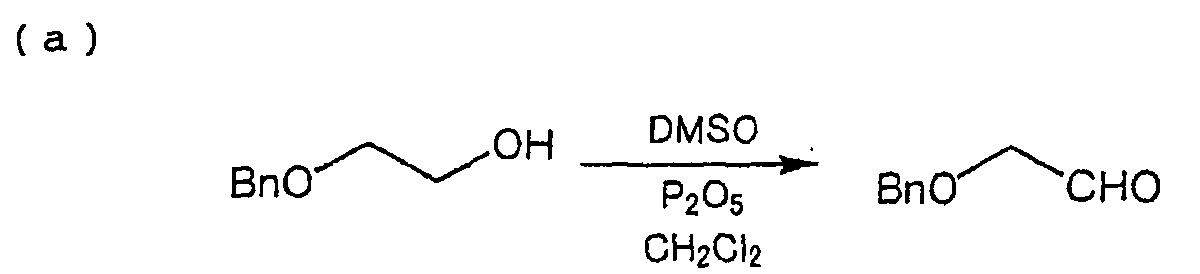




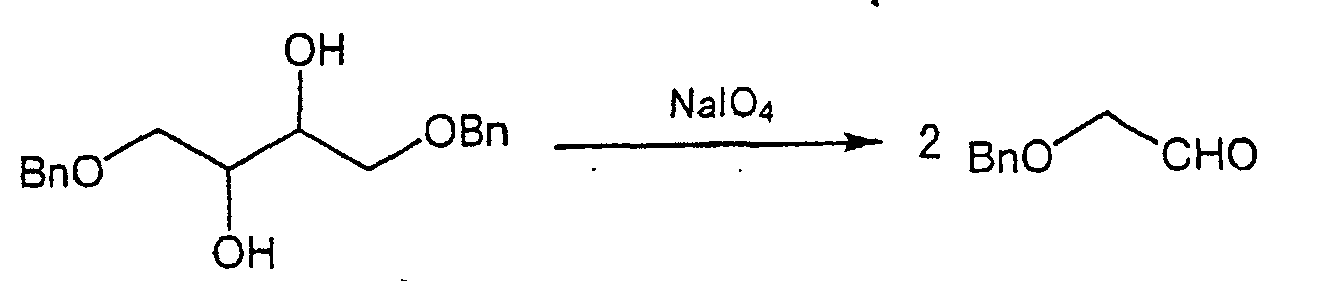



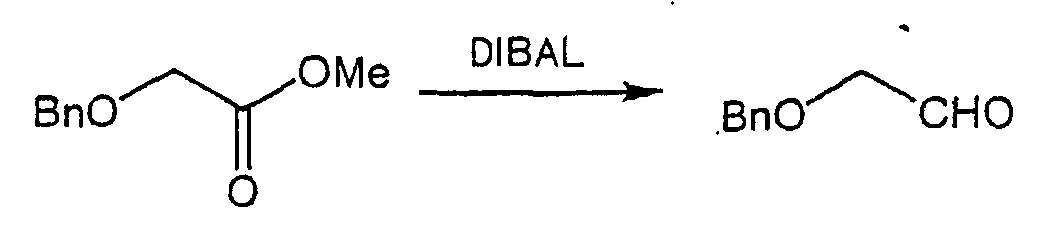

However, these processes have the following drawbacks.
The process (1) of oxidation with DMSO, which
byproduces the same moles of dimethyl sulfide as those
of the starting material, is not -preferable from the
environmental viewpoint.
The processes (2) and (3) of oxidation with ozone,
that is difficult to handle on a commercial scale, yield
intermediate products of unstable ozonides, thereby
causing a problem of safety.
The processes (4) and (5), using periodic acid,
require that the expensive periodic acid be used in an
amount of at least one molar equivalent relative to the
starting material.
The processes (6) and (7) use as starting materials
2-halogenated acetaldehyde diethylacetal and
2-hydroxyacetaldehyde diethylacetal, respectively,
which are both relatively expensive.
The process (8) uses as a reducing agent DIBAL, which
is expensive and tends to ignite on contact with air,
thus having a problem of safety.
The process (9) is difficult to commercialize, since
the synthesis of the starting material phenyl-2-benzyloxyethyl
sulfoxide requires multi-stage reactions.
Accordingly, an object of the present invention is
to provide a process for producing benzyloxyacetaldehyde
commercially advantageously from a starting material
that is easy to handle and commercially available at a
low cost.
According to the present invention, the above object
can be achieved by providing a process for producing
benzyloxyacetaldehyde, which comprises oxidizing 2-benzyloxyethanol
with hypochlorous acid in the presence
of a nitroxy radical having the general formula (I)
[hereinafter referred to as "nitroxy radical (I)"]
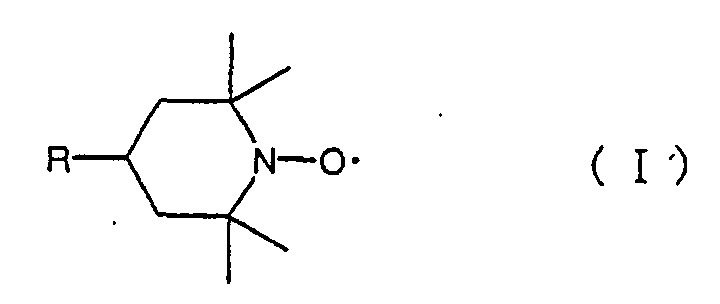 Wherein R represents a hydrogen atom, an acyloxy group,
an alkoxyl group or an aralkyloxy group.
Wherein R represents a hydrogen atom, an acyloxy group,
an alkoxyl group or an aralkyloxy group.
In the above general formula, examples of the acyloxy
group that may be represented by R are acetoxy,
propionyloxy and benzoyloxy; examples of the alkoxyl
group are methoxy and ethoxy; and examples of the
aralkyloxy group are benzyloxy.
Examples of the nitroxy radical (I) are 2,2,6,6-tetramethylpiperidinyl-1-oxy,
4-acetoxy-2,2,6,6-tetramethylpiperidinyl-1-oxy,
4-methoxy-2,2,6,6-tetramethylpiperidinyl-1-oxy
and 4-benzyloxy-2,2,6,6-tetramethylpiperidinyl-1-oxy.
The nitroxy radical (I) is desirably used in an
amount of 0.05 to 10 mole % based on the moles of 2-benzyloxyethanol,
more preferably 0.1 to 0.5 mole % on
the same basis in view of reactivity and economy.
Hypochlorous acid, available in the form of an
aqueous solution, may be used as it is. It is, however,
desirable in the present invention-, to use hypochlorous
acid as generated in the reaction zone, since the aqueous
solution of hypochlorous acid is unstable. Although
hypochlorous acid may be generated in the reaction zone
by any process with no particular limitation, it is
desirable to generate it from a stable and commercially
readily available hypochlorite compound, e.g. sodium
hypochlorite, potassium hypochlorite and bleaching
powder.
Of these hypochlorite compounds, sodium hypochlorite
is particularly preferred, since it is readily
available in large amounts at a low cost in the form of
an aqueous solution having a concentration of 12 to 13%
and can be handled easily. The aqueous sodium hypochlorite
may be used as purchased or after dilution to an
appropriate concentration. If a solid-form hypochlorite,
such as bleaching powder, is used, it may be
used as it is or in the form of, after dissolution in
water, an aqueous solution having a concentration in the range
of 5 to 20%.
Concrete examples of processes of generating
hypochlorous acid from a hypochlorite compound include
a process which comprises reacting the hypochlorite
compound with a compound capable of reacting therewith
to generate hypochlorous acid, such as a hydrogen
carbonate, e.g. sodium hydrogen carbonate and potassium
hydrogen carbonate; a mineral acid, e.g. hydrochloric
acid, sulfuric acid, boric acid and phosphoric acid; an
organic acid, e.g. acetic acid, propionic acid, benzoic
acid and toluenesulfonic acid; a phosphate, e.g.
potassium dihydrogen phosphate, dipotassium hydrogen
phosphate, sodium dihydrogen phosphate and disodium
hydrogen phosphate; and potassium hydrogen phthalate.
These compounds capable of reacting with a hypochlorite
compound to generate hypochlorous acid are used
desirably in an amount of 5 to 25 mole % based on the
moles of the hypochlorite compound. These compounds
capable of reacting with a hypochlorite compound to
generate hypochlorous acid may either be used as they
are or after dissolution in or dilution with water.
The amount of hypochlorous acid used is, in view of
the yield of the reaction and productivity, desirably
in a range of 0.5 to 1 molar equivalent relative to the
moles of 2-benzyloxyethanol. If hypochlorous acid is
used in an amount exceeding 1 molar equivalent, the
benzyloxyacetaldehyde that forms will tend to be further
oxidized under the same reaction conditions into the
corresponding carboxylic acid, thereby decreasing the
yield. On the other hand, if the amount of hypochlorous
acid used is less than 1 molar equivalent, the conversion
of 2-benzyloxyethanol will decrease with decreasing
amount of the acid. Although unreacted 2-benzyloxyethanol
can be recovered by isolation and purification
procedures and be used again, the amount of hypochlorous
acid of less than 0.5 molar equivalent will decrease the
yield of benzyloxyacetaldehyde, which is disadvantageous
from the viewpoint of productivity.
The process of the present invention can be carried
out either in the presence or absence of a solvent.
Examples of usable solvents, which are not particularly
limited as long as the reaction is not adversely
affected, are aromatic hydrocarbons, e.g. toluene, xylene
and mesitylene; halogenated hydrocarbons, e.g.
dichloromethane, chloroform, carbon tetrachloride and
1,2-dichloroethane; ethers, e.g. diethyl ether, diisopropyl
ether and methyl tertiary butyl ether; ketones,
e.g. methyl isobutyl ketone and methyl tertiary butyl
ketone; and water. These solvents may either be used
singly or in combination of 2 or more. On use of a
solvent, its amount is not particularly limited, but,
in general, the amount is preferably in a range of 1 to
10 parts by weight based on one part by weight of 2-benzyloxyethanol.
The reaction temperature is preferably in the range
of -5 to 50°C and, in view of the stability of hypochlorous
acid in the reaction zone, more preferably in the range
of 0 to 30°C.
The reaction is carried out by, for example,
preparing a solution by mixing prescribed amounts of
2-benzyloxyethanol, nitroxy radical (I), a compound
capable of generating hypochlorous acid on reaction with
the hypochlorite compound used and, as necessary, a
solvent, adjusting the temperature at a prescribed
level, and adding to the mixed solution thus prepared
the hypochlorite compound in small amounts.
The benzyloxyacetaldehyde thus obtained can be
isolated and purified by the usual isolation and
purification procedure employed in organic synthesis.
For example, a reducing agent such as sodium thiosulfate
is added to the reaction mixture to decompose the
remaining hypochlorous acid and the organic layer is
separated. The organic layer is then washed with water
or, preferably, with a saturated aqueous solution of sodium
chloride, and the solvent is removed, to obtain a crude
product, which is then purified by column chromatography
or like means. By this purification procedure,
unreacted 2-benzyloxyethanol can be recovered.
Hereinbelow, the present invention is described more
concretely by reference to the Examples, which are by no
means limitative of the invention.
A 300-ml three-necked flask was charged with 15.2
g (0.1 mole) of 2-benzyloxyethanol, 100 ml of dichloromethane
and 20 ml of water, and further with 2.6 g (15
mmoles) of dipotassium hydrogen phosphate and 32 mg (0.15
mmole) of 4-acetoxy-2,2,6,6-tetramethyl-piperidinyl-1-oxy,
and the mixture was cooled with ice water to
0 to 5 °C with stirring. To the mixed solution, with
stirring, 46.6 g (75 mmoles) of a-12% aqueous solution
of sodium hypochlorite was added dropwise over 2 hours,
while care was being taken not to permit the temperature
to exceed 20°C. After completion of the addition, the
mixture was stirred at the same temperature for 30
minutes. To the obtained mixture, 30 ml of a 5% aqueous
solution of sodium thiosulfate was added, and the
resulting mixture was stirred for 5 minutes. The organic
layer was then separated from the mixture. The organic
layer separated was washed with 30 ml of a saturated
aqueous solution of sodium chloride and the solvent was
distilled off. The residue obtained was further
subjected to vacuum distillation, to yield 7.5 g of
benzyloxyacetaldehyde as a fraction at a boiling point
of 118 to 120°C/13 mmHg and 4.6 g of unreacted 2-benzyloxyacetaldehyde
as a fraction at a boiling point
of 128 to 130°C/13 mmHg (yield of benzyloxyacetaldehyde
based on the 2-benzyloxyethanol that had reacted: 71.4%,
ratio of recovery of 2-benzyloxyethanol: 30.2%).
Example 1 was repeated except that 2.5 g (30 mmoles)
of sodium hydrogen carbonate was used instead of 2.6 g
(15 mmoles) of dipotassium hydrogen phosphate, to obtain
7.1 g of benzyloxyacetaldehyde and 4.5 g of 2-benzyloxyethanol
(yield of benzyloxyacetaldehyde based on the
2-benzyloxyethanol that had reacted: 66.8%, ratio of
recovery of 2-benzyloxyethanol: 29.6%).
Example 1 was repeated except that 100 ml of toluene
was used instead of 100 ml of dichloromethane, to obtain
7.2 g of benzyloxyacetaldehyde and 4.5 g of 2-benzyloxyethanol
(yield of benzyloxyacetaldehyde based on the
2-benzyloxyethanol that had reacted: 68.2%, ratio of
recovery of 2-benzyloxyethanol: 29.6%).
Example 1 was repeated except that 100 ml of methyl
isobutyl ketone was used instead of 100 ml of dichloromethane,
to obtain 7.6 g of benzyloxyacetaldehyde and
5.5 g of 2-benzyloxyethanol (yield of benzyloxyacetaldehyde
based on the 2-benzyloxyethanol that had
reacted: 79.5%, ratio of recovery of 2-benzyloxyethanol:
36.3%).
According to the present invention, benzyloxyacetaldehyde
can be produced commercially advantageously
from a starting material that is easy to handle and
commercially available at a low cost. The benzyloxyacetaldehyde
obtainable by the present invention is a
compound useful as a starting material for pharmaceuticals
and agricultural chemicals.
Claims (2)
- A process for producing benzyloxyacetaldehyde, which comprises oxidizing 2-benzyloxyethanol with hypochlorous acid in the presence of a nitroxy radical having the general formula (I)wherein R represents a hydrogen atom, an acyloxy group, an alkoxyl group or an aralkyloxy group.

- The process according to Claim 1, wherein said hypochlorous acid is generated in the reaction zone.
Applications Claiming Priority (3)
| Application Number | Priority Date | Filing Date | Title |
|---|---|---|---|
| JP9573999 | 1999-04-02 | ||
| JP11095739A JP2000290214A (en) | 1999-04-02 | 1999-04-02 | Method for producing benzyloxyacetaldehyde |
| PCT/JP2000/001888 WO2000059857A1 (en) | 1999-04-02 | 2000-03-28 | Process for the preparation of benzyloxyacetaldehyde |
Publications (2)
| Publication Number | Publication Date |
|---|---|
| EP1170276A1 true EP1170276A1 (en) | 2002-01-09 |
| EP1170276A4 EP1170276A4 (en) | 2003-04-23 |
Family
ID=14145868
Family Applications (1)
| Application Number | Title | Priority Date | Filing Date |
|---|---|---|---|
| EP00911402A Withdrawn EP1170276A4 (en) | 1999-04-02 | 2000-03-28 | PROCESS FOR THE PREPARATION OF BENZYLOXYACETALDEHYDE |
Country Status (4)
| Country | Link |
|---|---|
| US (1) | US6624331B1 (en) |
| EP (1) | EP1170276A4 (en) |
| JP (1) | JP2000290214A (en) |
| WO (1) | WO2000059857A1 (en) |
Families Citing this family (2)
| Publication number | Priority date | Publication date | Assignee | Title |
|---|---|---|---|---|
| EP1103537B1 (en) * | 1999-11-19 | 2003-05-14 | Ciba SC Holding AG | Process for the selective oxidation of alcohols using easily separable nitroxyl radicals |
| JP2007246435A (en) * | 2006-03-15 | 2007-09-27 | Sumitomo Chemical Co Ltd | Method for purifying alkoxyacetaldehyde |
Family Cites Families (5)
| Publication number | Priority date | Publication date | Assignee | Title |
|---|---|---|---|---|
| JPH0710806B2 (en) | 1989-07-28 | 1995-02-08 | 株式会社クラレ | Method for producing α-ketocarboxylic acid ester |
| JPH05310632A (en) | 1992-04-28 | 1993-11-22 | Sumitomo Chem Co Ltd | Method for producing m-phenoxybenzaldehyde |
| JPH07330654A (en) | 1994-06-01 | 1995-12-19 | Kuraray Co Ltd | Method for producing ether-substituted aldehydes |
| JP3626520B2 (en) | 1994-12-26 | 2005-03-09 | 株式会社クラレ | Process for producing 3-substituted-3-methylbutanal |
| JP2001011007A (en) | 1999-07-01 | 2001-01-16 | Sumika Fine Chemicals Co Ltd | Production of benzyloxyacetaldehyde compound |
-
1999
- 1999-04-02 JP JP11095739A patent/JP2000290214A/en active Pending
-
2000
- 2000-03-28 US US09/926,229 patent/US6624331B1/en not_active Expired - Fee Related
- 2000-03-28 EP EP00911402A patent/EP1170276A4/en not_active Withdrawn
- 2000-03-28 WO PCT/JP2000/001888 patent/WO2000059857A1/en not_active Ceased
Also Published As
| Publication number | Publication date |
|---|---|
| EP1170276A4 (en) | 2003-04-23 |
| JP2000290214A (en) | 2000-10-17 |
| US6624331B1 (en) | 2003-09-23 |
| WO2000059857A1 (en) | 2000-10-12 |
Similar Documents
| Publication | Publication Date | Title |
|---|---|---|
| US7179928B2 (en) | Synthesis of triphenylphosphonium quinols and quinones | |
| US6624331B1 (en) | Process for the preparation of benzyloxyacetaldehyde | |
| JPH07505405A (en) | Manufacturing method of sclareolide | |
| JP3305447B2 (en) | Method for producing R / S-γ-lipoic acid or R / S-α-lipoic acid, 8-alkoxy-6-formyloxyoctanoic acid and method for producing the same | |
| US6897335B2 (en) | Process for preparation of 2-oxocarboxylic acid esters | |
| Prakash et al. | Oxidation of α-benzoyl-o-hydroxyacetophenones using iodobenzene diacetate in methanolic potassium hydroxide: A new synthesis of 2-benzoylcoumaran-3-ones | |
| JPH05246943A (en) | Method for preparation of 1-fluoro-cyclopropane-1-carboxylic acid | |
| EP0209905B1 (en) | 1,1-(3-ethylphenyl)phenylethylene and method for its preparation | |
| US5786518A (en) | Process for the manufacture of a gamma-halotiglic aldehyde | |
| JP3641808B2 (en) | Method for producing quinoline carbaldehyde | |
| JP2001328984A (en) | Method for producing mevalolactone | |
| Linderman et al. | A direct conversion of (α-hydroxyalkyl) silanes to carboxylic acids | |
| JP3816556B2 (en) | Process for producing 2- or 3- (substituted) phenylpropionic acid | |
| EP0090976B1 (en) | 2,2-dihalo-6-halo-6(1-haloisobutyl)cyclohexanone | |
| JP3626520B2 (en) | Process for producing 3-substituted-3-methylbutanal | |
| JP2584670B2 (en) | Production method of aromatic aldehydes | |
| JP3898258B2 (en) | Method for producing 3-alkylflavanonol derivative | |
| JP2794457B2 (en) | Process for producing 1,1- (3-ethylphenyl) phenylethylene and intermediate therefor | |
| US6278027B1 (en) | 3-Substituted-2-halocycloheptenone compounds and a method for manufacturing same | |
| KR100322237B1 (en) | Process for preparing α-ketocarboxylic acid derivatives | |
| JP4516831B2 (en) | Method for producing cis-jasmon | |
| JP4841032B2 (en) | Process for producing 2-methoxy-4-nitrobenzaldehyde | |
| JP2720934B2 (en) | Process for producing 3- (2-chloro-2- (4-chlorophenyl) -vinyl) -2,2-dimethylcyclopropanecarboxylic acid | |
| JPH11189566A (en) | Method for producing fluoroalkylcarboxylic acid | |
| JP2581186B2 (en) | Method for producing 4-substituted-2-cyclopentenone ester derivative |
Legal Events
| Date | Code | Title | Description |
|---|---|---|---|
| PUAI | Public reference made under article 153(3) epc to a published international application that has entered the european phase |
Free format text: ORIGINAL CODE: 0009012 |
|
| 17P | Request for examination filed |
Effective date: 20011031 |
|
| AK | Designated contracting states |
Kind code of ref document: A1 Designated state(s): AT BE CH CY DE DK ES FI FR GB GR IE IT LI LU MC NL PT SE |
|
| A4 | Supplementary search report drawn up and despatched |
Effective date: 20030311 |
|
| 17Q | First examination report despatched |
Effective date: 20041117 |
|
| STAA | Information on the status of an ep patent application or granted ep patent |
Free format text: STATUS: THE APPLICATION IS DEEMED TO BE WITHDRAWN |
|
| 18D | Application deemed to be withdrawn |
Effective date: 20051026 |