EP1170252A2 - Modified graphite particles and battery using the same - Google Patents
Modified graphite particles and battery using the same Download PDFInfo
- Publication number
- EP1170252A2 EP1170252A2 EP01305754A EP01305754A EP1170252A2 EP 1170252 A2 EP1170252 A2 EP 1170252A2 EP 01305754 A EP01305754 A EP 01305754A EP 01305754 A EP01305754 A EP 01305754A EP 1170252 A2 EP1170252 A2 EP 1170252A2
- Authority
- EP
- European Patent Office
- Prior art keywords
- particles
- graphite particles
- modified graphite
- tabular
- particle size
- Prior art date
- Legal status (The legal status is an assumption and is not a legal conclusion. Google has not performed a legal analysis and makes no representation as to the accuracy of the status listed.)
- Ceased
Links
Images

Classifications
-
- H—ELECTRICITY
- H01—ELECTRIC ELEMENTS
- H01M—PROCESSES OR MEANS, e.g. BATTERIES, FOR THE DIRECT CONVERSION OF CHEMICAL ENERGY INTO ELECTRICAL ENERGY
- H01M4/00—Electrodes
- H01M4/02—Electrodes composed of, or comprising, active material
- H01M4/36—Selection of substances as active materials, active masses, active liquids
- H01M4/58—Selection of substances as active materials, active masses, active liquids of inorganic compounds other than oxides or hydroxides, e.g. sulfides, selenides, tellurides, halogenides or LiCoFy; of polyanionic structures, e.g. phosphates, silicates or borates
- H01M4/583—Carbonaceous material, e.g. graphite-intercalation compounds or CFx
- H01M4/587—Carbonaceous material, e.g. graphite-intercalation compounds or CFx for inserting or intercalating light metals
-
- C—CHEMISTRY; METALLURGY
- C01—INORGANIC CHEMISTRY
- C01B—NON-METALLIC ELEMENTS; COMPOUNDS THEREOF; METALLOIDS OR COMPOUNDS THEREOF NOT COVERED BY SUBCLASS C01C
- C01B32/00—Carbon; Compounds thereof
- C01B32/20—Graphite
- C01B32/21—After-treatment
-
- H—ELECTRICITY
- H01—ELECTRIC ELEMENTS
- H01M—PROCESSES OR MEANS, e.g. BATTERIES, FOR THE DIRECT CONVERSION OF CHEMICAL ENERGY INTO ELECTRICAL ENERGY
- H01M4/00—Electrodes
- H01M4/02—Electrodes composed of, or comprising, active material
- H01M4/13—Electrodes for accumulators with non-aqueous electrolyte, e.g. for lithium-accumulators; Processes of manufacture thereof
- H01M4/133—Electrodes based on carbonaceous material, e.g. graphite-intercalation compounds or CFx
-
- C—CHEMISTRY; METALLURGY
- C01—INORGANIC CHEMISTRY
- C01P—INDEXING SCHEME RELATING TO STRUCTURAL AND PHYSICAL ASPECTS OF SOLID INORGANIC COMPOUNDS
- C01P2004/00—Particle morphology
- C01P2004/20—Particle morphology extending in two dimensions, e.g. plate-like
- C01P2004/22—Particle morphology extending in two dimensions, e.g. plate-like with a polygonal circumferential shape
-
- C—CHEMISTRY; METALLURGY
- C01—INORGANIC CHEMISTRY
- C01P—INDEXING SCHEME RELATING TO STRUCTURAL AND PHYSICAL ASPECTS OF SOLID INORGANIC COMPOUNDS
- C01P2004/00—Particle morphology
- C01P2004/54—Particles characterised by their aspect ratio, i.e. the ratio of sizes in the longest to the shortest dimension
-
- C—CHEMISTRY; METALLURGY
- C01—INORGANIC CHEMISTRY
- C01P—INDEXING SCHEME RELATING TO STRUCTURAL AND PHYSICAL ASPECTS OF SOLID INORGANIC COMPOUNDS
- C01P2004/00—Particle morphology
- C01P2004/60—Particles characterised by their size
- C01P2004/61—Micrometer sized, i.e. from 1-100 micrometer
-
- C—CHEMISTRY; METALLURGY
- C01—INORGANIC CHEMISTRY
- C01P—INDEXING SCHEME RELATING TO STRUCTURAL AND PHYSICAL ASPECTS OF SOLID INORGANIC COMPOUNDS
- C01P2006/00—Physical properties of inorganic compounds
- C01P2006/12—Surface area
-
- H—ELECTRICITY
- H01—ELECTRIC ELEMENTS
- H01M—PROCESSES OR MEANS, e.g. BATTERIES, FOR THE DIRECT CONVERSION OF CHEMICAL ENERGY INTO ELECTRICAL ENERGY
- H01M4/00—Electrodes
- H01M4/02—Electrodes composed of, or comprising, active material
- H01M2004/021—Physical characteristics, e.g. porosity, surface area
-
- Y—GENERAL TAGGING OF NEW TECHNOLOGICAL DEVELOPMENTS; GENERAL TAGGING OF CROSS-SECTIONAL TECHNOLOGIES SPANNING OVER SEVERAL SECTIONS OF THE IPC; TECHNICAL SUBJECTS COVERED BY FORMER USPC CROSS-REFERENCE ART COLLECTIONS [XRACs] AND DIGESTS
- Y02—TECHNOLOGIES OR APPLICATIONS FOR MITIGATION OR ADAPTATION AGAINST CLIMATE CHANGE
- Y02E—REDUCTION OF GREENHOUSE GAS [GHG] EMISSIONS, RELATED TO ENERGY GENERATION, TRANSMISSION OR DISTRIBUTION
- Y02E60/00—Enabling technologies; Technologies with a potential or indirect contribution to GHG emissions mitigation
- Y02E60/10—Energy storage using batteries
Definitions
- This invention relates to modified graphite particles suitable as an active material of batteries, such as nonaqueous secondary batteries, and a battery using the same as an active material.
- Nonaqueous secondary batteries using lithium ions have a high energy density and a high energy efficiency and provides a higher voltage than other types of batteries. Therefore, they have been studied chiefly for application as a small to ultra-small power source to small-sized and cordless electronic equipment, such as mobile phones, personal handyphone systems (PHSs), and notebook personal computers. Recently, they have also been expected as large batteries having a capacity exceeding 10 Ah that would be useful as a power source of electric cars or hybrid cars or as a small scale power storage means in houses , stores or small factories.
- Nonaqueous secondary batteries heretofore used generally comprise metallic lithium as an anode active material.
- Nonaqueous secondary batteries which comprise an anode made of aporous carbon material as an active material in place of metallic lithium, a cathode made of a transition metal oxide containing or not containing lithium, and a nonaqueous organic electrolytic solution comprising a lithium salt electrolyte in a nonaqueous organic solvent.
- Nonaqueous secondary batteries of this type are now under study for practicability particularly as the above-mentioned large batteries.
- the electrode reaction taking place during charging of the nonaqueous secondary batteries of the above type consists of deintercalation of lithium ions from the cathode active material into the electrolytic solution and intercalation of the lithium ions from the electrolytic solution into the porous carbon material of the anode.
- the electrode reaction during discharging consists of liberation of the lithium ions from the anode carbon material into the electrolytic solution and intercalation of the lithium ions from the electrolytic solution into the cathode active material.
- These batteries possess not only the characteristics essential to the nonaqueous secondary batteries using metallic lithium as an anode active material, i.e., high energy density and high energy efficiency, but the merits of not using metallic lithium. That is, they are of high safety and free of such problems as possible reactions between metallic lithium and the electrolytic solution or so-called dendrite formation and are therefore expected to have an extended cycle life.
- the porous carbon materials include coke, sintered resins, carbon fiber, pyrolytic carbon, natural graphite, artificial graphite, and mesophase spheres. Particularly preferred of them is natural or artificial lumpy or flaky graphite which is capable of intercalating a large quantity of lithium ions to provide a large theoretical charge and discharge capacity per unit weight.
- the batteries have a reduced cycle life.
- JP-A-11-45715 discloses modified graphite particles having a disc or a tablet form, which are obtained by spouting a liquid or gaseous dispersion of amorphous lumpy or flaky amorphous graphite particles from nozzles under pressure in a helical jet to make the particles collide against each other thereby to crush and round the particles and then regulating the particle size by classification.
- JP-A as used herein means an "unexamined published Japanese patent application"
- JP-A-11-263612 discloses modified graphite particles having a prescribed degree of circularity, the cross-section of which looks like a cabbage, which are obtained by a batch process comprising making flaky graphite particles to collide against each other by jet streams in a collision zone thereby to crush and round the particles while removing undersize particles by means of a cyclone type classifier provided above the collision zone.
- the modified graphite particles are expected to provide batteries with an improved charge/discharge capacity and an extended cycle life as compared with non-modified ones. Further, considered theoretically, repetition of the proposed modifying treatment or prolongation of the treating time ought to provide modified graphite particles having a higher degree of circularity and a smaller particle size with a reduced size variation, which are supposed to bring further improvements on both charge/discharge capacity and cycle life.
- An object of the present invention is to provide novel modified graphite particles which, when used as an anode active material, provides batteries having not only an excellent cycle life but the charge/discharge capacity further raised toward the theoretical capacity than as attained by those using conventionally proposed modified graphite particles.
- Another object of the invention is to provide a novel battery which exhibits improved charge and discharge characteristics by using the above-described modified graphite particles.
- the inventors have researched the range of an average particle size Ap ( ⁇ m) and the range of a BET specific surface area Sc (m 2 /g) of graphite particles that will secure further extension of the cycle life and further increase of the charge/discharge capacity than heretofore achieved. They have discovered as a result that specifying not only these ranges per se but their ratio, Ss/Ap, is effective for obtaining a further improvement on charge/discharge capacity of a battery while controlling an increase in total surface area of the particles packed up to make an anode. Further study about these ranges and their ratio have led the inventors to complete the present invention.
- the present invention provides modified graphite particles having an almost circular and tabular shape, an average particle size Ap of 12 to 18 ⁇ m, a BET specific surface area Ss of 4 to 6 m 2 /g, and a BET specific surface area to average particle size ratio, Ss/Ap, of 0.35 or less which are obtained by treating tabular particles of natural or artificial lumpy or flaky graphite to break or slightly fold the periphery of the tabular particles to increase the degree of circularity.
- the present invention also provides a battery having the above-mentioned modified graphite particles as an anode active material.
- the battery of the invention has an improved cycle life and an improved charge/discharge capacity and, in particular, excellent discharge characteristics owing to the excellent characteristics of the modified graphite particles.
- the modified graphite particles of the invention are almost circular and tabular particles which are obtained by treating tabular particles of natural or artificial lumpy or flaky graphite to break or slightly fold the periphery of the tabular particles thereby to increase their degree of circularity.
- the modified graphite particles of the invention have an average particle size Ap of 12 to 18 ⁇ m, a BET specific surface area Ss of 4 to 6 m 2 /g, and an Ss/Ap of 0.35 or less.
- modified graphite particles have a specific surface area Ss more than 6 m 2 /g or an Ss/Ap more than 0.35, the loss of lithium ions due to film formation on the particle surface increases to reduce the charge/discharge capacity of a battery.
- the Ap is less than 12 ⁇ m, the packing density in the anode is too high, failing to secure sufficient interstices among particles. If the Ss is less than 4 m 2 /g, the particles have reduced wettability with an organic electrolytic solution. In either case, a highly viscous nonaqueous organic electrolytic solution is not allowed to penetrate deep into the anode, resulting in reduction of charge and discharge density of a battery. Additionally there will be a difference in amount of expansion and contraction on charging and discharging between particles which are in contact with an organic electrolytic solution and those not, which can easily results in cracking of the anode to cause a reduction in cycle life.
- the Ap be about 12 to 16 ⁇ m
- the Ss be about 4 to 5 m 2 /g
- the Ss/Ap be about 0.33 to 0.34.
- the modified graphite particles possessing the above-specified characteristics can be produced by continuously treating raw material particles by use of, for example, an air classifier 1 having a sirocco fan type abrasive classifying rotor 11 as shown in Fig. 1.
- the air classifier 1 comprises a vertical chamber 10 having the sirocco fan type abrasive classifying rotor 11 at the top thereof, a particle feed pipe 12 and an air feed pipe 13 slightly below the middle thereof, and an outlet 10a for collecting modified particles at the bottom thereof.
- Graphite particles to be modified are fed through the particle feed pipe 12 as dispersed in air.
- Air for secondary dispersion is fed through the air feed pipe 13 to uniformly disperse and raise the fed particles in the chamber 10 as shown by the one-dotted broken line.
- the air classifier 1 also has a motor 14 for rotating the abrasive classifying rotor 11, a discharge pipe 15 which is disposed on the same axis of the rotor 11 with one of its openings open to the outside and the other opening 15a open to the inner space 11a of the rotor 11, through which fine particles (hereinafter described) are discharged, a Pitot tube 16 for measuring the speed of the air flow passing through the air feed pipe 13, and a flow control means 17 equipped with a variable-dispersion blade (not shown) which controls the flow rate of the air for secondary dispersion.
- Numeral 17a is a lever for adjusting the variable-dispersion blade.
- the motor 14 In carrying out modifying treatment on natural or artificial graphite particles, the motor 14 is driven to rotate the abrasive classifying rotor 11 at a high speed, and air for secondary dispersion is fed through the air feed pipe 13 into the chamber 10 by operating a fan (not shown) and discharged through the discharge pipe 15.
- Tabular graphite particles to be treated are blown into the chamber 10 through the feed pipe 12, whereupon they are uniformly dispersed by the air supplied from the air feed pipe 13 and rise in the chamber 10 as shown by the one-dotted broken like in Fig. 1.
- the rising particles reach the rotor 11 rotating at a high speed, they collide against the vanes 11b of the rotor 11 and are broken or slightly folded at their periphery into almost circular and tabular particles.
- the particles thus modified and having gained in specific gravity fall by gravity in the chamber 10 as depicted by the two-dotted broken line and are collected through the outlet 10a.
- Fine particles i.e., fragments resulting from breakage of the periphery of raw material particles enter the inner space 11a of the rotor 11 through the gaps between vanes 11b and discharged out of the chamber 10 through the discharge pipe 15.
- the modified graphite particles collected through the outlet 10a can be used in the manufacture of batteries either as they are or after classified if necessary.
- the modifying treatment according to the present invention makes the graphite particles collide against the vanes 11b of the abrasive classifying rotor 11 which is much heavier and larger than the particles and is rotating at a high speed. Therefore the energy applied to the graphite particles upon collision is far higher than achieved in the conventional treatments.
- the modifying treatment can be performed in a continuous manner by use of the above-described apparatus thereby to accomplish improved treating efficiency compared with the conventional batch-wise treatments.
- Conditions of the modifying treatment can be selected appropriately in accordance with such factors as the kind of a raw graphite material (whether it is natural or artificial, where a natural graphite occurs , or in what process an artificial graphite has been produced), the particle size, thickness or purity of the particles, and the like.
- suitable conditions are about 3000 to 8000 rpm in rotating speed of the abrasive classifying rotor 11, about 80 to 150 kg/hr in feed rate of graphite particles, and about 15 to 25 m 3 /min in flow rate of air for secondary dispersion.
- the apparatus can be scaled up by fitting a plurality of the abrasive classifying rotors 11.
- the modified graphite particles according to the present invention are suited for use as an anode active material of a battery. They are especially effective when applied to large nonaqueous secondary batteries having a capacity of 10 Ah or more, particularly of cell stack type. Having uniformity in shape, specific surface area and particle size, the modified graphite particles equalize the cells in expansion and contraction behavior on charging and discharging and charge/discharge characteristics, thereby extending the cycle life of the cell stack. The modified graphite particles reduce the loss in each cell thereby bringing about an improved charge/discharge capacity.
- modified graphite particles of the invention are applicable to not only large batteries as stated above but small or ultra-small batteries for mobile phones, etc. They are also useful as an active material for other batteries than nonaqueous secondary batteries.
- the battery assembly according to the present invention can have the same configuration as conventional ones except for using the modified graphite particles of the invention as an anode active material.
- nonaqueous secondary batteries of stack type are made by alternately superposing a plurality of sheet anodes comprising the modified graphite particles and a plurality of sheet cathodes comprising a cathode active material with a separator, such as a porous film of polyethylene or polypropylene, interposed between every adjacent sheet electrodes to build up an electrode stack, which is sealed into a battery case together with a lithium-containing nonaqueous organic electrolytic solution.
- the anode is formed by applying an active material mixture containing the modified graphite particles on one or both sides of metal foil as an anode current collector.
- the active material mixture further comprises an electrically conducting agent which assists electrical conduction among the modified graphite particles and between the modified graphite particles and a current collector and a binder which binds the modified graphite particles, the conducting agent, etc. to form a layer.
- the conducting agent which can be used includes various powdered conductive materials resisting to an electrolytic solution, such as metal powder, metal compound powder, and carbon powder.
- carbon powder smaller than the modified graphite particles, having an average particle size of about 30 nm to 1 ⁇ m, is advantageous in that it is sufficiently effective in assisting electrical conduction and that it hardly agglomerates in dispersing to form a uniform active material mixture.
- the carbon powder can have a granular shape, a flaky shape or other various shapes. Flaky graphite powder is used suitably for its excellent electrical conductivity.
- the binder which can be used includes various resins having resistance to an electrolytic solution, such as polyvinylidenefluoride (PVdF), polytetrafluoroethylene (PTFE), and fluororubber (FKM).
- PVdF polyvinylidenefluoride
- PTFE polytetrafluoroethylene
- FKM fluororubber
- a suitable active material mixture comprises about 50 to 95%, particularly about 75 to 90%, by weight of the modified graphite particles, about 2.5 to 25%, particularly about 5 to 12.5%, by weight of carbon powder having an average particle size of 30 nm to 1 ⁇ m as a conducting agent, and about 2.5 to 25%, particularly 5 to 12.5%, by weight of the binder, based on the total weight of the active material mixture.
- the active material mixture is mixed with a solvent, such as N-methyl-2-pyrrolidone, into paste, which is applied to one or both sides of metal foil as an anode current collector and dried to form an anode.
- a solvent such as N-methyl-2-pyrrolidone
- a cathode is formed in the same manner, except for using a cathode active material in place of the modified graphite particles.
- the cathode active material includes those capable of intercalating and deintercalating lithium ions, such as chalcogenides (e.g., oxides, sulfides or selenides) of transition metals and complex compounds of such chalcogenides and lithium.
- cathode active materials are at least one compound selected from the group consisting of compounds represented by formula (1), (2) or (3) shown below.
- LiCO b Ni 1-b O 2 wherein 0 ⁇ b ⁇ 1.
- LiAl c Co d Ni 1-c-d O 2 wherein 0 ⁇ c ⁇ 1, 0 ⁇ d ⁇ 1, and 0 ⁇ c+d ⁇ 1.
- LiMn 2-e M e O 4 wherein 0 ⁇ e ⁇ 0.1, and M is at least one metal element selected from the group consisting of Al, Ni, Cr, Co, F, and Mg.
- the metal foil used as a current collector in the cathode and the anode includes foil of various metals having excellent electric conductivity and excellent resistance to an electrolytic solution, such as aluminum, tin, nickel, copper, stainless steel, and titanium.
- Aluminum foil or tin foil, which is light, is preferred in view of the performance and energy density of nonaqueous secondary batteries.
- the dimensions and shapes of the metal oil are selected appropriately according to the shape, structure and dimensions of a nonaqueous secondary battery in which the metal foil is used.
- an electrode stack is formed by alternately superposing the cathode(s) and the anode(s) with a separator, such as a porous film of polyethylene or polypropylene, interposed between every adjacent electrodes.
- the lithium-containing organic electrolytic solution includes solutions or dispersions of a lithium salt, such as LiClO 4 , LiBF 4 , LiPF 6 or LiAsF 6 , or a lithium ion conducting solid electrolyte, preferably LiBF 4 or LiPF 6 in a nonaqueous organic solvent having a high specific dielectric constant, such as ethylene carbonate, propylene carbonate, dimethyl carbonate, diethyl carbonate, ethyl methyl carbonate, 1,2-dimethoxyethane, or tetrahydrofuran.
- a lithium salt such as LiClO 4 , LiBF 4 , LiPF 6 or LiAsF 6
- a lithium ion conducting solid electrolyte preferably LiBF 4 or LiPF 6 in
- the battery case in which the electrode stack and the organic electrolytic solution are sealed includes ametal housing as is conventionally employed.
- the battery case previously proposed by Majima, Yagasaki, et al. (some of the inventors of the present invention) in JP-A-10-334879 is also useful, which has a pressing member, such as a leaf spring, inserted between a battery case and an electrode stack to impose a given pressure in the thickness direction of the stack.
- the pressing member suppresses expansion of the electrode laminate and also functions as a cushion, making it possible to simplify the structure of the battery case.
- a flexible bag container made of materials resistant to an electrolytic solution and impermeable to an organic solvent of the electrolytic solution and to external moisture is also useful. Much lighter than metallic housings, such a bag container brings about a marked improvement on energy density per unit weight (Wh/kg).
- the flexible bag is preferably made of a laminate film comprising a polyolefin resin layer having excellent impermeability to organic solvents and a metal layer having excellent impermeability to water.
- the polyolefin resin layer includes a polyethylene film, a polypropylene film, and a composite film of such a polyolefin resin film and a film having excellent thermal adhesion to metal, such as polyethylene terephthalate.
- the metal of the metal layer includes aluminum, nickel, stainless steel, and titanium which are excellent in water impermeability and resistance to an electrolytic solution. From the standpoint of lightness, aluminum is suitable.
- the olefin resin film making the bag container can contain hydrotalcite, magnesium sulfate, etc. as a water- or Lewis acid-scavenger for improving the battery life.
- Hydrotalcite, magnesium sulfate, etc. may be sealed into a battery case, either a metallic case or a flexible bag container, together with the electrode stack and the electrolytic solution.
- the bag container may have a protective frame made of an electrolytic solution-resistant material, such as PVdF, PTFE or metals, disposed around the electrode stack.
- the nonaqueous secondary battery using the above-described bag container is preferably put into a solid housing, such as a separate hard case similar to a conventional battery case, a hole made under the floor, inside the wall or above the ceiling of a house as a place to put batteries in, and a frame made in a chassis or a body of an electric car.
- a solid housing such as a separate hard case similar to a conventional battery case, a hole made under the floor, inside the wall or above the ceiling of a house as a place to put batteries in, and a frame made in a chassis or a body of an electric car.
- a pressing member comprising a leaf spring and a flat pressing plate, etc. may be put into the above-described solid housing.
- the nonaqueous secondary battery can be disposed in the solid housing not vertically but horizontally with a weight put thereon as a pressing member to apply pressure in the thickness direction of the stack.
- the solid housing can be designed to have slightly larger inner dimensions than the outer dimensions of the battery so that its rigidity may function as a pressing means for suppressing expansion of the electrode stack.
- the nonaqueous secondary battery preferably has a capacity of about 10 to 1000 Ah, particularly about 50 to 1000 Ah. A higher capacity will be obtained by combining two or more batteries.
- Flaky graphite particles NG12 available from Kansai Netukagaku K.K., were continuously treated in the air classifier 1 shown in Fig. 1.
- the rotating speed of the abrasive classifying rotor 11 and the flow rate of air for secondary dispersion fed from the air feed pipe 13 were adjusted according to the throughput of the graphite particles fed from the particle feed pipe 12 per unit time.
- the resulting modified graphite particles had an average particle size Ap of 12 ⁇ m and a BET specific surface area Ss of 4.1 m 2 /g, giving an Ss/Ap of 0.342.
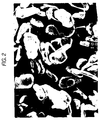
- An electron micrograph of the modified graphite particles is shown in Fig. 2. It is seen that the particles had been broken or slightly folded at their periphery into almost circular and tabular particles.
- Modified graphite particles were obtained in the same manner as in Example 1, except for using flaky graphite particles NG 18, available from Kansai Netukagaku K.K.
- the resulting modified graphite particles had an average particle size Ap of 18 ⁇ m and a BET specific surface area Ss of 5.8 m 2 /g, giving an Ss/Ap of 0.322. Electron microscopic observation revealed that the particles had been broken or slightly folded at their periphery into almost circular and tabular particles similarly to Example 1.
- Flaky graphite particles NG7 available from Kansai Netsukagaku K.K. were modified according to the method taught in JP-A-11-45715.
- the resulting modified graphite particles had an average particle size Ap of 7 ⁇ m and a BET specific surface area Ss of 3.9 m 2 /g, giving an Ss/Ap of 0.557.
- Electron microscopic observation of the modified particles revealed a cabbage-like appearance formed by folding the tabular raw particles twice or more.
- Flaky graphite particles NG20 available from Kansai Netsukagaku K.K. were modified according to the method disclosed in JP-A-11-263612.
- the resulting modified graphite particles had an average particle size Ap of 20 ⁇ m and a BET specific surface area Ss of 7.6 m 2 /g, giving an Ss/Ap of 0.38.
- Electron microscopic observation of the modified particles revealed a cabbage-like appearance formed by folding the tabular raw particles twice or more similarly to Comparative Example 1. Test for confirming irreversible capacity:
- the anode and a metallic lithium foil of the same size (20-cm square) as a cathode were superposed with the anode active material layer facing the cathode with a 25 ⁇ m thick polyethylene porous film as a separator interposed therebetween to prepare an electrode laminate.
- LiPF 6 was dissolved in a 1:1 (by volume) mixture of ethylene carbonate and diethylcarbonate to prepare a nonaqueous organic electrolytic solution having an electrolyte concentration of 1 mol/dm -3 .
- the electrolytic solution was penetrated into the electrode laminate to make up a battery.
- batteries using the modified graphite particles of Examples 1 and 2 have a higher first cycle Coulomb efficiency, i.e., a smaller first cycle irreversible capacity thereby securing a higher battery capacity after the first cycle as compared with the batteries using the conventional modified graphite particles of Comparative Examples 1 and 2.
- Anodes were prepared in the same manner as described above.
- Example 1 3500
- Example 4 Example 2 3000 Compara.
- modified graphite particles according to the present invention provide nonaqueous secondary batteries with an extended cycle life compared with the conventional modified graphite particles.
Landscapes
- Chemical & Material Sciences (AREA)
- Chemical Kinetics & Catalysis (AREA)
- Inorganic Chemistry (AREA)
- Organic Chemistry (AREA)
- Electrochemistry (AREA)
- General Chemical & Material Sciences (AREA)
- Geology (AREA)
- General Life Sciences & Earth Sciences (AREA)
- Life Sciences & Earth Sciences (AREA)
- Engineering & Computer Science (AREA)
- Materials Engineering (AREA)
- Battery Electrode And Active Subsutance (AREA)
- Secondary Cells (AREA)
- Carbon And Carbon Compounds (AREA)
Abstract
Description
| Coulomb Efficiency (%) | |
| Example 1 | 96.8 |
| Example 2 | 96.5 |
| Compara. Example 1 | 92.3 |
| Compara. Example 2 | 82.3 |
| Modified Graphite Particles | Cycle Life | |
| Example 3 | Example 1 | 3500 |
| Example 4 | Example 2 | 3000 |
| Compara. Example 3 | Compara. Example 1 | 2000 |
| Compara. Example 4 | Compara. Example 2 | 1500 |
Claims (5)
- Modified graphite particles having an almost circular and tabular shape, an average particle size Ap of 12 to 18 µm, a BET specific surface area Ss of 4 to 6 m2/g, and a BET specific surface area to average particle size ratio, Ss/Ap, of 0.35 or less which are obtained by treating tabular particles of natural or artificial lumpy or flaky graphite to break or slightly fold the periphery of said tabular particles to increase the degree of circularity.
- The modified graphite particles as claimed in claim 1, wherein the Ap is 12 to 16 µm.
- The modified graphite particles as claimed in claim 1, wherein the Ss is 4 to 5 m2/g.
- The modified graphite particles as claimed in claim 1, wherein the Ss/Ap is 0.33 to 0.34.
- A battery having, as an anode active material, modified graphite particles having an almost circular and tabular shape, an average particle size Ap of 12 to 18 µm, a BET specific surface area Ss of 4 to 6 m2/g, and a BET specific surface area to average particle size ratio, Ss/Ap, of 0.35 or less which are obtained by treating tabular particles of natural or artificial lumpy or flaky graphite to break or slightly fold the periphery of said tabular particles to increase the degree of circularity.
Applications Claiming Priority (2)
| Application Number | Priority Date | Filing Date | Title |
|---|---|---|---|
| JP2000202569 | 2000-07-04 | ||
| JP2000202569A JP2002029720A (en) | 2000-07-04 | 2000-07-04 | Reformed graphite particles and battery using the same |
Publications (2)
| Publication Number | Publication Date |
|---|---|
| EP1170252A2 true EP1170252A2 (en) | 2002-01-09 |
| EP1170252A3 EP1170252A3 (en) | 2002-06-19 |
Family
ID=18700073
Family Applications (1)
| Application Number | Title | Priority Date | Filing Date |
|---|---|---|---|
| EP01305754A Ceased EP1170252A3 (en) | 2000-07-04 | 2001-07-03 | Modified graphite particles and battery using the same |
Country Status (4)
| Country | Link |
|---|---|
| US (1) | US6573007B2 (en) |
| EP (1) | EP1170252A3 (en) |
| JP (1) | JP2002029720A (en) |
| CN (1) | CN1193445C (en) |
Families Citing this family (18)
| Publication number | Priority date | Publication date | Assignee | Title |
|---|---|---|---|---|
| JP4401185B2 (en) * | 2004-02-06 | 2010-01-20 | 関西熱化学株式会社 | Manufacturing method and manufacturing apparatus for electrode material for secondary battery |
| JP4274090B2 (en) * | 2004-09-17 | 2009-06-03 | ソニー株式会社 | Graphite powder and non-aqueous electrolyte secondary battery |
| JP5157051B2 (en) * | 2005-08-18 | 2013-03-06 | 三菱化学株式会社 | Lithium secondary battery |
| JP2008262859A (en) * | 2007-04-13 | 2008-10-30 | Toyota Central R&D Labs Inc | Non-aqueous electrolyte and lithium ion secondary battery |
| CN101417794B (en) * | 2007-10-26 | 2011-06-22 | 顾向宏 | Production manufacturing method of high rate lithium ionic cell cathode F series material |
| CN101409154B (en) * | 2008-09-24 | 2011-05-04 | 上海奥威科技开发有限公司 | Organic mixed super capacitor |
| WO2011084817A1 (en) * | 2009-12-21 | 2011-07-14 | A123 Systems, Inc. | Anode material |
| KR101137375B1 (en) * | 2010-02-09 | 2012-04-20 | 삼성에스디아이 주식회사 | Secondary particle and lithium battery comprising the same |
| US9558894B2 (en) | 2011-07-08 | 2017-01-31 | Fastcap Systems Corporation | Advanced electrolyte systems and their use in energy storage devices |
| US10714271B2 (en) | 2011-07-08 | 2020-07-14 | Fastcap Systems Corporation | High temperature energy storage device |
| JP2012004131A (en) * | 2011-08-08 | 2012-01-05 | Mitsubishi Chemicals Corp | Lithium secondary battery |
| KR20130037091A (en) * | 2011-10-05 | 2013-04-15 | 삼성에스디아이 주식회사 | Negative active material and lithium battery containing the material |
| JP2012049151A (en) * | 2011-12-08 | 2012-03-08 | Mitsubishi Chemicals Corp | Lithium secondary battery |
| JP2014010990A (en) * | 2012-06-28 | 2014-01-20 | Toyota Motor Corp | Nonaqueous electrolyte secondary battery and method of manufacturing the same |
| US11322773B2 (en) | 2016-03-10 | 2022-05-03 | Nec Corporation | Lithium secondary battery |
| US10601047B1 (en) * | 2019-04-02 | 2020-03-24 | Chongqing Jinkang New Energy Automobile Co., Ltd. | Pre-cracked anode particles for high-rate charging applications |
| CN110600696A (en) * | 2019-09-10 | 2019-12-20 | 深圳市比克动力电池有限公司 | Quick-charging type long-circulation cylindrical lithium ion battery with high low-temperature discharge capacity |
| US12148931B2 (en) * | 2021-03-16 | 2024-11-19 | Nissan North America, Inc. | Low resistance cathode for solid-state battery |
Family Cites Families (11)
| Publication number | Priority date | Publication date | Assignee | Title |
|---|---|---|---|---|
| JP3188033B2 (en) * | 1993-04-02 | 2001-07-16 | 三洋電機株式会社 | Non-aqueous secondary battery |
| US5643695A (en) | 1995-09-26 | 1997-07-01 | Valence Technology, Inc. | Carbonaceous electrode and compatible electrolyte |
| JPH10284081A (en) * | 1997-02-04 | 1998-10-23 | Mitsubishi Chem Corp | Lithium ion secondary battery |
| WO1998034291A1 (en) | 1997-02-04 | 1998-08-06 | Mitsubishi Chemical Corporation | Lithium ion secondary battery |
| US6455199B1 (en) | 1997-05-30 | 2002-09-24 | Matsushita Electric Industrial Co., Ltd. | Nonaqueous electrolyte secondary battery and method for manufacturing negative electrode of the same |
| JP4184479B2 (en) * | 1997-05-30 | 2008-11-19 | 松下電器産業株式会社 | Nonaqueous electrolyte secondary battery and method for producing the negative electrode |
| WO1998054779A1 (en) * | 1997-05-30 | 1998-12-03 | Matsushita Electric Industrial Co., Ltd. | Nonaqueous electrolyte secondary battery |
| JP3193342B2 (en) * | 1997-05-30 | 2001-07-30 | 松下電器産業株式会社 | Non-aqueous electrolyte secondary battery |
| JP3787030B2 (en) * | 1998-03-18 | 2006-06-21 | 関西熱化学株式会社 | Scale-like natural graphite modified particles, process for producing the same, and secondary battery |
| JP3841611B2 (en) * | 1999-03-31 | 2006-11-01 | 日立粉末冶金株式会社 | Graphite particles for negative electrode of non-aqueous secondary battery |
| JP2001023696A (en) * | 1999-07-07 | 2001-01-26 | Japan Storage Battery Co Ltd | Non-aqueous electrolyte secondary battery |
-
2000
- 2000-07-04 JP JP2000202569A patent/JP2002029720A/en active Pending
-
2001
- 2001-06-29 CN CNB011175656A patent/CN1193445C/en not_active Expired - Fee Related
- 2001-07-03 US US09/897,118 patent/US6573007B2/en not_active Expired - Fee Related
- 2001-07-03 EP EP01305754A patent/EP1170252A3/en not_active Ceased
Also Published As
| Publication number | Publication date |
|---|---|
| EP1170252A3 (en) | 2002-06-19 |
| CN1330419A (en) | 2002-01-09 |
| US20020018934A1 (en) | 2002-02-14 |
| CN1193445C (en) | 2005-03-16 |
| US6573007B2 (en) | 2003-06-03 |
| JP2002029720A (en) | 2002-01-29 |
Similar Documents
| Publication | Publication Date | Title |
|---|---|---|
| US6573007B2 (en) | Modified graphite particles and battery using the same | |
| Armstrong et al. | TiO2 (B) nanowires as an improved anode material for lithium-ion batteries containing LiFePO4 or LiNi0. 5Mn1. 5O4 cathodes and a polymer electrolyte | |
| JP5555978B2 (en) | Negative electrode active material for non-aqueous electrolyte secondary battery, and non-aqueous electrolyte secondary battery using the same | |
| EP2960971B1 (en) | Composite active material for lithium secondary battery and method for producing same | |
| US7976984B2 (en) | Powdered graphite and nonaqueous electrolyte secondary battery | |
| TWI481100B (en) | Cathode active material and secondary battery comprising the same | |
| CN1127774C (en) | Nonaqueous electrolyte secondary battery | |
| CN103891015B (en) | Composite active material for lithium secondary battery and manufacturing method thereof | |
| US9837658B2 (en) | Silicon-containing particle, negative-electrode material for use in non-aqueous electrolyte secondary battery, and non-aqueous electrolyte secondary battery | |
| EP2712009B1 (en) | Bimodal-type anode active material and lithium secondary battery including same | |
| KR102581795B1 (en) | Method for preparing positive active material for lithium secondary battery using waste positive acive material | |
| CN101510604B (en) | Composite anode active material,method of preparing the same,and anode and lithium battery containing the material | |
| EP4033570A2 (en) | Negative electrode active material, method for producing same, and negative electrode and secondary battery including same | |
| JP2004273443A (en) | Negative electrode material and negative electrode for non-aqueous lithium ion secondary battery, and non-aqueous lithium ion secondary battery | |
| JP4379971B2 (en) | Electrical energy storage element | |
| WO1998054780A1 (en) | Nonaqueous electrolyte secondary battery and method for manufacturing negative electrode of the same | |
| JP4209649B2 (en) | Negative electrode material for lithium ion secondary battery, negative electrode for lithium ion secondary battery containing the negative electrode material, and lithium ion secondary battery using the negative electrode | |
| JP2025506746A (en) | Electrodes and manufacturing method | |
| JP6119796B2 (en) | Negative electrode active material for non-aqueous electrolyte secondary battery, and non-aqueous electrolyte secondary battery using the same | |
| KR102577119B1 (en) | Positive active material and method for preparing the same | |
| KR20260042222A (en) | Phosphorus-carbon composite negative electrode material, negative electrode active material, negative electrode for lithium secondary battery, lithium secondary battery and method for manufacturing phosphorus-carbon composite negative electrode material | |
| JP2026510385A (en) | Positive electrode active material, positive electrode containing the same, and lithium secondary battery | |
| JP2003086181A (en) | Cathode active material and lithium ion secondary battery | |
| JP2000188095A (en) | Lithium ion secondary battery | |
| WO2020175554A1 (en) | Positive electrode active material for lithium ion secondary batteries, method for producing positive electrode active material for lithium ion secondary batteries, and lithium ion secondary battery |
Legal Events
| Date | Code | Title | Description |
|---|---|---|---|
| PUAI | Public reference made under article 153(3) epc to a published international application that has entered the european phase |
Free format text: ORIGINAL CODE: 0009012 |
|
| AK | Designated contracting states |
Kind code of ref document: A2 Designated state(s): AT BE CH CY DE DK ES FI FR GB GR IE IT LI LU MC NL PT SE TR |
|
| AX | Request for extension of the european patent |
Free format text: AL;LT;LV;MK;RO;SI |
|
| PUAL | Search report despatched |
Free format text: ORIGINAL CODE: 0009013 |
|
| AK | Designated contracting states |
Kind code of ref document: A3 Designated state(s): AT BE CH CY DE DK ES FI FR GB GR IE IT LI LU MC NL PT SE TR |
|
| AX | Request for extension of the european patent |
Free format text: AL;LT;LV;MK;RO;SI |
|
| 17P | Request for examination filed |
Effective date: 20021025 |
|
| AKX | Designation fees paid |
Designated state(s): DE FR GB IT |
|
| 17Q | First examination report despatched |
Effective date: 20040304 |
|
| STAA | Information on the status of an ep patent application or granted ep patent |
Free format text: STATUS: THE APPLICATION HAS BEEN REFUSED |
|
| 18R | Application refused |
Effective date: 20081111 |