EP1168649A2 - Two-way radio communication system and two-way radio communication method. - Google Patents
Two-way radio communication system and two-way radio communication method. Download PDFInfo
- Publication number
- EP1168649A2 EP1168649A2 EP01305340A EP01305340A EP1168649A2 EP 1168649 A2 EP1168649 A2 EP 1168649A2 EP 01305340 A EP01305340 A EP 01305340A EP 01305340 A EP01305340 A EP 01305340A EP 1168649 A2 EP1168649 A2 EP 1168649A2
- Authority
- EP
- European Patent Office
- Prior art keywords
- signal
- radio
- modulated
- frequency band
- local oscillation
- Prior art date
- Legal status (The legal status is an assumption and is not a legal conclusion. Google has not performed a legal analysis and makes no representation as to the accuracy of the status listed.)
- Withdrawn
Links
- 238000000034 method Methods 0.000 title claims description 10
- 230000010355 oscillation Effects 0.000 claims abstract description 48
- 238000006243 chemical reaction Methods 0.000 claims abstract description 17
- 230000005540 biological transmission Effects 0.000 claims description 16
- 230000009022 nonlinear effect Effects 0.000 description 2
- 238000001514 detection method Methods 0.000 description 1
- 238000010586 diagram Methods 0.000 description 1
Images
Classifications
-
- H—ELECTRICITY
- H04—ELECTRIC COMMUNICATION TECHNIQUE
- H04B—TRANSMISSION
- H04B1/00—Details of transmission systems, not covered by a single one of groups H04B3/00 - H04B13/00; Details of transmission systems not characterised by the medium used for transmission
- H04B1/38—Transceivers, i.e. devices in which transmitter and receiver form a structural unit and in which at least one part is used for functions of transmitting and receiving
- H04B1/40—Circuits
Definitions
- This invention relates to a two-way radio communication system and a two-way radio communication method. More specifically, in radio communication systems using the SHF and higher frequency bands such as, for example, radio LANs, radio home links, radio video transmission systems, radio road-to-vehicle communication systems, inter-vehicle communication systems and other such systems utilizing millimeter waves, the present invention relates to a two-way radio communication system and a two-way radio communication method for high-quality, high-speed transmission of digital signals and analog signals.
- JP-A 2001-53640 the present inventors proposed a radio communication system that employs self-heterodyne detection.
- part of a local oscillation signal used by the transmitter to frequency-convert a modulated intermediate frequency band signal to a radio frequency band is transmitted by radio simultaneously with the transmission radio frequency, and the receiver then frequency-converts the received radio signal to the modulated intermediate frequency band signal by generating a multiplication product of these two components.
- the above proposal did not provide specific technical details about how to realize the system.
- An object of the present invention is to provide a two-way radio communication system and a two-way radio communication method for enabling high-quality, two-way radio communication without the use of a high-quality local oscillation signal.
- this invention provides a two-way radio communication system for two-way communication between first and second radio stations, the two-way radio communication system comprising a first radio station equipped with a signal modulator for generating a modulated signal in an intermediate frequency band that is lower than a radio frequency, a modulated radio signal generator that uses a local oscillation signal to up-convert the modulated signal to a radio frequency band, a transmitter that from among sideband signals generated during conversion of a modulated intermediate frequency band signal to the radio frequency band by the modulated radio signal generator, selects an upper-side-band signal (USB signal) as a radio signal and transmits the selected radio signal together with the local oscillation signal utilized by the modulated radio signal generator, and a receiver that receives a radio signal from the second radio station and down-converts the received signal to a modulated intermediate frequency band by generating a multiplication component of a modulated radio signal component and local oscillation signal component received from the other radio station, a second radio station equipped with a signal modulator for
- the invention also includes a two-way radio communication method for conducting two-way communication between first and second radio stations, the two-way radio communication method comprising transmission by a first radio station of a radio signal to a second radio station by generating a modulated signal in an intermediate frequency band that is lower than a radio frequency, producing a modulated radio transmission signal, using a local oscillation signal to up-convert the modulated signal to a radio frequency band and transmitting the local oscillation signal used by the modulated radio transmission signal with the modulated radio transmission signal as a radio signal; and when receiving a radio signal from the second radio station, down-converts the received signal to a modulated frequency band by using the local oscillation signal utilized for up-conversion and, of sideband signals generated during conversion of a modulated intermediate frequency band signal to the radio frequency band by the modulated radio signal generator, selects an upper-side-band radio signal and transmits the selected radio signal together with the local oscillation signal, and when a radio signal is received from the other radio station, down-converts the received signal to
- the two-way radio communication system and method described above provide high-quality two-way radio transmission, since signal phase noise and frequency offset in the local oscillation signal can be canceled out. Moreover, since there is no need to use a high-quality local oscillator, two-way radio communication can be achieved at low cost.
- the first radio station C1 transmitter 40a comprises a local oscillator 1 for outputting a local oscillation signal, an intermediate frequency band modulator 2 for modulating a signal and outputting it as a modulated intermediate frequency band signal at an intermediate frequency band that is lower than the radio frequency, a multiplier 3 for multiplying the modulated intermediate frequency band signal and the local oscillation signal and up-converting the modulated signal to a modulated radio frequency band signal.
- the transmitter 50a of the second radio station C2 (child station) comprises a local oscillator 1 for outputting a local oscillation signal, an intermediate frequency band modulator 2 for modulating a signal and outputting it as a modulated intermediate frequency band signal at an intermediate frequency band that is lower than the radio frequency, a multiplier 3 for multiplying the modulated intermediate frequency band signal and the local oscillation signal and up-converting the modulated signal to a modulated radio frequency band signal.
- the first radio station C1 receiver 40b uses a receiving antenna 7b to receive the radio signal from the second radio station C2.
- the signal is amplified by an amplifier 9.
- the radio signal is down-converted to the intermediate frequency band by using a squarer 31 (comprised using an amplifier or other such device having a non-linear effect) or the like to obtain the multiplication component of the radio signal from the second radio station C2 and the local oscillation signal component.
- the modulated intermediate frequency band signal is demodulated by the intermediate frequency band demodulator 11.
- a radio signal transmitted by the first radio station C1 is received by the C2 receiver 50b via receiving antenna 7b.
- the signal is amplified by the amplifier 9.
- the radio signal is down-converted to the intermediate frequency band by using a squarer 31 (comprised using an amplifier or other such device having a non-linear effect) or the like to obtain the multiplication component of the radio signal from the second radio station C2 and the local oscillation signal component.
- the modulated intermediate frequency band signal is demodulated by the intermediate frequency band demodulator 11.
- the signal when one station receives a signal from the other station, the signal is down-converted to the intermediate frequency band by generating the multiplication component of the upper-side-band or lower-side-band signal component andlocal oscillation component of the received signal. Since there is therefore no need to provide the local oscillator used by each radio station with frequency and phase-locking, it is possible to achieve a two-way radio communication system at a lower cost.
- the second radio station C2 uses a local oscillation frequency that is higher than that of the first radio station C1.
- the lower-side-band signal formed following the frequency-conversion is selected as the transmitted radio signal, enabling unused frequency bands between the local oscillation frequency and the radio signal to be utilized as the frequency band of uplink signals, thereby making it possible to make effective use of frequencies.
Landscapes
- Engineering & Computer Science (AREA)
- Computer Networks & Wireless Communication (AREA)
- Signal Processing (AREA)
- Transceivers (AREA)
- Mobile Radio Communication Systems (AREA)
- Small-Scale Networks (AREA)
Abstract
Description
- This invention relates to a two-way radio communication system and a two-way radio communication method. More specifically, in radio communication systems using the SHF and higher frequency bands such as, for example, radio LANs, radio home links, radio video transmission systems, radio road-to-vehicle communication systems, inter-vehicle communication systems and other such systems utilizing millimeter waves, the present invention relates to a two-way radio communication system and a two-way radio communication method for high-quality, high-speed transmission of digital signals and analog signals.
- In JP-A 2001-53640 the present inventors proposed a radio communication system that employs self-heterodyne detection. In this system, part of a local oscillation signal used by the transmitter to frequency-convert a modulated intermediate frequency band signal to a radio frequency band is transmitted by radio simultaneously with the transmission radio frequency, and the receiver then frequency-converts the received radio signal to the modulated intermediate frequency band signal by generating a multiplication product of these two components. However, the above proposal did not provide specific technical details about how to realize the system.
- An object of the present invention is to provide a two-way radio communication system and a two-way radio communication method for enabling high-quality, two-way radio communication without the use of a high-quality local oscillation signal.
- For achieving this object, this invention provides a two-way radio communication system for two-way communication between first and second radio stations, the two-way radio communication system comprising a first radio station equipped with a signal modulator for generating a modulated signal in an intermediate frequency band that is lower than a radio frequency, a modulated radio signal generator that uses a local oscillation signal to up-convert the modulated signal to a radio frequency band, a transmitter that from among sideband signals generated during conversion of a modulated intermediate frequency band signal to the radio frequency band by the modulated radio signal generator, selects an upper-side-band signal (USB signal) as a radio signal and transmits the selected radio signal together with the local oscillation signal utilized by the modulated radio signal generator, and a receiver that receives a radio signal from the second radio station and down-converts the received signal to a modulated intermediate frequency band by generating a multiplication component of a modulated radio signal component and local oscillation signal component received from the other radio station, a second radio station equipped with a signal modulator for generating a modulated signal in an intermediate frequency band that is lower than a radio frequency, a modulated radio signal generator that uses a local oscillation signal to up-convert the modulated signal to a radio frequency band, a transmitter that from among sideband signals generated during conversion of a modulated intermediate frequency band signal to the radio frequency band by the modulated radio signal generator, selects a lower-side-band signal (LSB signal) as a radio signal and transmits the selected radio signal together with the local oscillation signal utilized by the modulated radio signal generator, and a receiver that receives a radio signal from the first radio station and down-converts the received signal to a modulated intermediate frequency band by generating a multiplication component of a modulated radio signal component and local oscillation signal component received from the first radio station.
- The invention also includes a two-way radio communication method for conducting two-way communication between first and second radio stations, the two-way radio communication method comprising transmission by a first radio station of a radio signal to a second radio station by generating a modulated signal in an intermediate frequency band that is lower than a radio frequency, producing a modulated radio transmission signal, using a local oscillation signal to up-convert the modulated signal to a radio frequency band and transmitting the local oscillation signal used by the modulated radio transmission signal with the modulated radio transmission signal as a radio signal; and when receiving a radio signal from the second radio station, down-converts the received signal to a modulated frequency band by using the local oscillation signal utilized for up-conversion and, of sideband signals generated during conversion of a modulated intermediate frequency band signal to the radio frequency band by the modulated radio signal generator, selects an upper-side-band radio signal and transmits the selected radio signal together with the local oscillation signal, and when a radio signal is received from the other radio station, down-converts the received signal to a modulated intermediate frequency band by generating a multiplication component of a received modulated radio signal component and local oscillation signal component; and transmission to the first radio station by a second radio station, generating a modulated signal in an intermediate frequency band that is lower than a radio frequency, producing a modulated radio transmission signal, using a local oscillation signal to up-convert the modulated signal to a radio frequency band and, of sideband signals generated during conversion of a modulated intermediate frequency band signal to the radio frequency band by the modulated radio signal generator, selecting a lower-side-band radio signal and transmitting the selected radio signal together with the local oscillation signal, and when a radio signal is received from the first radio station, down-converting the received signal to a modulated intermediate frequency band by generating a multiplication component of a received modulated radio signal component and local oscillation signal component.
- The two-way radio communication system and method described above provide high-quality two-way radio transmission, since signal phase noise and frequency offset in the local oscillation signal can be canceled out. Moreover, since there is no need to use a high-quality local oscillator, two-way radio communication can be achieved at low cost.
- The above and other objects and features of the invention will become apparent from the following description made with reference to the drawing, in which:-
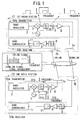
- FIG. 1 is a schematic diagram of a two-way radio communication system that is one embodiment of the present invention,
- FIG. 1 shows a two-way radio communication system that is one embodiment of this invention for two-way radio communication. In this example, two-way communication is effected between a first radio station C1 and a second radio station C2. In this embodiment, the first radio station C1 selects and transmits an upper-side-band radio signal generated by frequency- conversion, and the second radio station C2 uses a local oscillation signal having a different (for example higher) frequency than that of the local oscillation of the first radio station C1 to transmit a lower-side-band radio signal generated by frequency-conversion. This makes it possible to efficiently utilize the frequency bands employed by the uplink and downlink signals. An advantage of the configuration is that the two radio stations engaged in two-way communication each uses its own local oscillation signal only when transmitting, not when receiving, so it is not necessary to equip both stations with frequency- and phase-locked local oscillators.
- The first radio
station C1 transmitter 40a comprises alocal oscillator 1 for outputting a local oscillation signal, an intermediatefrequency band modulator 2 for modulating a signal and outputting it as a modulated intermediate frequency band signal at an intermediate frequency band that is lower than the radio frequency, a multiplier 3 for multiplying the modulated intermediate frequency band signal and the local oscillation signal and up-converting the modulated signal to a modulated radio frequency band signal. - Of the sideband signals generated in the conversion of the modulated intermediate frequency band signal to the radio frequency band by the intermediate
frequency band modulator 2,local oscillator 1 and multiplier 3, only an upper-side-band signal passes through band-pass filter 41, and the local oscillation signal is added to the upper-side-band signal by theadder 5. The resulting signal is then amplified by anamplifier 6 and transmitted from the transmittingantenna 7a. - The
transmitter 50a of the second radio station C2 (child station) comprises alocal oscillator 1 for outputting a local oscillation signal, an intermediatefrequency band modulator 2 for modulating a signal and outputting it as a modulated intermediate frequency band signal at an intermediate frequency band that is lower than the radio frequency, a multiplier 3 for multiplying the modulated intermediate frequency band signal and the local oscillation signal and up-converting the modulated signal to a modulated radio frequency band signal. - Of the sideband signals generated in the conversion of the modulated intermediate frequency band signal to the radio frequency band by the intermediate
frequency band modulator 2,local oscillator 1 and multiplier 3, only a lower-side-band signal passes through band-pass filter 51, and the local oscillation signal is added to the lower-side-band signal by theadder 5. The resulting signal is then amplified by anamplifier 6 and transmitted from the transmittingantenna 7a. - As described, the first radio
station C1 receiver 40b uses a receivingantenna 7b to receive the radio signal from the second radio station C2. After band-pass filter 8 has removed unnecessary components included in the radio signal, the signal is amplified by an amplifier 9. Following this, the radio signal is down-converted to the intermediate frequency band by using a squarer 31 (comprised using an amplifier or other such device having a non-linear effect) or the like to obtain the multiplication component of the radio signal from the second radio station C2 and the local oscillation signal component. The modulated intermediate frequency band signal is demodulated by the intermediatefrequency band demodulator 11. - In the same way, a radio signal transmitted by the first radio station C1 is received by the
C2 receiver 50b via receivingantenna 7b. After band-pass filter 8 has removed unnecessary components included in the radio signal, the signal is amplified by the amplifier 9. Following this, the radio signal is down-converted to the intermediate frequency band by using a squarer 31 (comprised using an amplifier or other such device having a non-linear effect) or the like to obtain the multiplication component of the radio signal from the second radio station C2 and the local oscillation signal component. The modulated intermediate frequency band signal is demodulated by the intermediatefrequency band demodulator 11. - In accordance with the above two-way radio communication method using the first and second radio stations C1 and C2, when one station receives a signal from the other station, the signal is down-converted to the intermediate frequency band by generating the multiplication component of the upper-side-band or lower-side-band signal component andlocal oscillation component of the received signal. Since there is therefore no need to provide the local oscillator used by each radio station with frequency and phase-locking, it is possible to achieve a two-way radio communication system at a lower cost. In particular, the second radio station C2 uses a local oscillation frequency that is higher than that of the first radio station C1. Also, the lower-side-band signal formed following the frequency-conversion is selected as the transmitted radio signal, enabling unused frequency bands between the local oscillation frequency and the radio signal to be utilized as the frequency band of uplink signals, thereby making it possible to make effective use of frequencies.
Claims (2)
- A two-way radio communication system for two-way communication between first and second radio stations, the two-way radio communication system comprising:a first radio station equipped with a signal modulator for generating a modulated signal in an intermediate frequency band that is lower than a radio frequency;a modulated radio signal generator that uses a local oscillation signal to up-convert the modulated signal to a radio frequency band;a transmitter that from among sideband signals generated during conversion of a modulated intermediate frequency band signal to the radio frequency band by the modulated radio signal generator, selects an upper-side-band signal as a radio signal and transmits the selected radio signal together with the local oscillation signal utilized by the modulated radio signal generator; anda receiver that receives a radio signal from the second radio station and down-converts the received signal to a modulated intermediate frequency band by generating a multiplication component of a modulated radio signal component and local oscillation signal component received from the other radio station;a second radio station equipped with a signal modulator for generating a modulated signal in an intermediate frequency band that is lower than a radio frequency;a modulated radio signal generator that uses a local oscillation signal to up-convert the modulated signal to a radio frequency band;a transmitter that from among sideband signals generated during conversion of a modulated intermediate frequency band signal to the radio frequency band by the modulated radio signal generator, selects a lower-side-band signal as a radio signal and transmits the selected radio signal together with the local oscillation signal utilized by the modulated radio signal generator; anda receiver that receives a radio signal from the first radio station and down-converts the received signal to a modulated intermediate frequency band by generating a multiplication component of a modulated radio signal component and local oscillation signal component received from the first radio station.
- A two-way radio communication method for conducting two-way communication between first and second radio stations, the two-way radio communication method comprising transmission by a first radio station of a radio signal to a second radio station by generating a modulated signal in an intermediate frequency band that is lower than a radio frequency, producing a modulated radio transmission signal, using a local oscillation signal to up-convert the modulated signal to a radio frequency band and transmitting the local oscillation signal used by the modulated radio transmission signal with the modulated radio transmission signal as a radio signal; and when receiving a radio signal from the second radio station, down-converts the received signal to a modulated frequency band by using the local oscillation signal utilized for up-conversion and, of sideband signals generated during conversion of a modulated intermediate frequency band signal to the radio frequency band, selects an upper-side-band radio signal and transmits the selected radio signal together with the local oscillation signal, and when a radio signal is received from the other radio station, down-converts the received signal to a modulated intermediate frequency band by generating a multiplication component of a received modulated radio signal component and local oscillation signal component; and transmission to the first radio station by a second radio station, generating a modulated signal in an intermediate frequency band that is lower than a radio frequency, producing a modulated radio transmission signal, using a local oscillation signal to up-convert the modulated signal to a radio frequency band and, of sideband signals generated during conversion of a modulated intermediate frequency band signal to the radio frequency band by the modulated radio signal generator, selecting a lower-side-band radio signal and transmitting the selected radio signal together with the local oscillation signal, and when a radio signal is received from the first radio station, down-converting the received signal to a modulated intermediate frequency band by generating a multiplication component of a received modulated radio signal component and local oscillation signal component.
Applications Claiming Priority (2)
| Application Number | Priority Date | Filing Date | Title |
|---|---|---|---|
| JP2000190216 | 2000-06-23 | ||
| JP2000190216A JP2002009655A (en) | 2000-06-23 | 2000-06-23 | Two-way wireless communication system and two-way wireless communication method |
Publications (2)
| Publication Number | Publication Date |
|---|---|
| EP1168649A2 true EP1168649A2 (en) | 2002-01-02 |
| EP1168649A3 EP1168649A3 (en) | 2003-12-17 |
Family
ID=18689722
Family Applications (1)
| Application Number | Title | Priority Date | Filing Date |
|---|---|---|---|
| EP01305340A Withdrawn EP1168649A3 (en) | 2000-06-23 | 2001-06-20 | Two-way radio communication system and two-way radio communication method. |
Country Status (5)
| Country | Link |
|---|---|
| US (1) | US7043201B2 (en) |
| EP (1) | EP1168649A3 (en) |
| JP (1) | JP2002009655A (en) |
| CN (1) | CN1222111C (en) |
| CA (1) | CA2351271C (en) |
Cited By (1)
| Publication number | Priority date | Publication date | Assignee | Title |
|---|---|---|---|---|
| EP1496624A4 (en) * | 2002-03-29 | 2005-12-14 | Nat Inst Inf & Comm Tech | RADIO COMMUNICATION METHOD AND SYSTEM |
Families Citing this family (9)
| Publication number | Priority date | Publication date | Assignee | Title |
|---|---|---|---|---|
| JP3564480B2 (en) | 2002-02-18 | 2004-09-08 | 独立行政法人情報通信研究機構 | Wireless communication method and system for performing communication between a plurality of wireless communication terminals |
| JP3996902B2 (en) * | 2002-02-28 | 2007-10-24 | シャープ株式会社 | Microwave band radio receiver and microwave band radio communication system |
| JP3598378B2 (en) * | 2002-03-15 | 2004-12-08 | 独立行政法人情報通信研究機構 | Wireless communication method and system |
| US20070171818A1 (en) * | 2004-02-25 | 2007-07-26 | Yozo Shoji | Wireless access method and system |
| JP4391291B2 (en) * | 2004-03-31 | 2009-12-24 | 住友電工デバイス・イノベーション株式会社 | Wireless device |
| CN103634254A (en) * | 2012-08-23 | 2014-03-12 | 华东师范大学 | Indirect modulation and demodulation data transmission device and transmission method thereof |
| JP2015089035A (en) * | 2013-10-31 | 2015-05-07 | 株式会社半導体理工学研究センター | Communication circuit |
| JP6466301B2 (en) * | 2015-09-30 | 2019-02-06 | 株式会社Nttドコモ | Millimeter-wave communication system |
| WO2020255125A1 (en) * | 2019-06-16 | 2020-12-24 | Vayyar Imaging Ltd. | Displacement measurement systems and methods with simultaneous transmission |
Citations (1)
| Publication number | Priority date | Publication date | Assignee | Title |
|---|---|---|---|---|
| WO1999050966A1 (en) * | 1998-03-27 | 1999-10-07 | Telefonaktiebolaget Lm Ericsson | Distortion correction circuit for direct conversion receiver |
Family Cites Families (6)
| Publication number | Priority date | Publication date | Assignee | Title |
|---|---|---|---|---|
| US3733438A (en) * | 1971-03-01 | 1973-05-15 | Bell Telephone Labor Inc | Carrier supply for frequency division multiplexed systems |
| US4483000A (en) * | 1981-01-12 | 1984-11-13 | Nippon Electric Co., Ltd. | Circuit for eliminating spurious components resulting from burst control in a TDMA system |
| US4761821A (en) * | 1986-07-15 | 1988-08-02 | Rca Corporation | Radio frequency signal transmission system with carrier frequencies at opposite edges of the channel |
| KR100255364B1 (en) * | 1997-01-15 | 2000-05-01 | 윤종용 | Radio receiver for suppressing attenuation properties of a low-frequency signal and method thereof |
| US6308048B1 (en) * | 1997-11-19 | 2001-10-23 | Ericsson Inc. | Simplified reference frequency distribution in a mobile phone |
| JP2001053640A (en) | 1999-08-11 | 2001-02-23 | Communication Research Laboratory Mpt | Device and method for radio communication |
-
2000
- 2000-06-23 JP JP2000190216A patent/JP2002009655A/en active Pending
-
2001
- 2001-06-20 EP EP01305340A patent/EP1168649A3/en not_active Withdrawn
- 2001-06-21 US US09/885,113 patent/US7043201B2/en not_active Expired - Fee Related
- 2001-06-22 CN CNB011220163A patent/CN1222111C/en not_active Expired - Fee Related
- 2001-06-22 CA CA002351271A patent/CA2351271C/en not_active Expired - Fee Related
Patent Citations (1)
| Publication number | Priority date | Publication date | Assignee | Title |
|---|---|---|---|---|
| WO1999050966A1 (en) * | 1998-03-27 | 1999-10-07 | Telefonaktiebolaget Lm Ericsson | Distortion correction circuit for direct conversion receiver |
Cited By (2)
| Publication number | Priority date | Publication date | Assignee | Title |
|---|---|---|---|---|
| EP1496624A4 (en) * | 2002-03-29 | 2005-12-14 | Nat Inst Inf & Comm Tech | RADIO COMMUNICATION METHOD AND SYSTEM |
| US7292831B2 (en) | 2002-03-29 | 2007-11-06 | National Institute Of Information And Communications Technology | Radio communicate method and system |
Also Published As
| Publication number | Publication date |
|---|---|
| CA2351271C (en) | 2005-09-20 |
| CA2351271A1 (en) | 2001-12-23 |
| EP1168649A3 (en) | 2003-12-17 |
| US20010055953A1 (en) | 2001-12-27 |
| CN1332523A (en) | 2002-01-23 |
| US7043201B2 (en) | 2006-05-09 |
| JP2002009655A (en) | 2002-01-11 |
| CN1222111C (en) | 2005-10-05 |
Similar Documents
| Publication | Publication Date | Title |
|---|---|---|
| CN100392991C (en) | Radio communication method and system for communication between a plurality of radio communication terminals | |
| JP2001053640A (en) | Device and method for radio communication | |
| CA2543646A1 (en) | Apparatus and method of on-channel repeater | |
| JPH1141132A (en) | Wireless communication device | |
| US7043201B2 (en) | Two-way radio communication system and two-way radio communication method | |
| JPH05252559A (en) | Diversity transmission / reception method | |
| JP2840496B2 (en) | Dual band wireless communication device | |
| JP3937023B2 (en) | Frequency hopping wireless communication method and system | |
| US6813326B1 (en) | Data transmission system, data transmission communication station, and data transmission method | |
| JPH1098409A (en) | Wireless circuit | |
| JPH04355540A (en) | Digital radio communication equipment | |
| JP2914446B1 (en) | Channel allocation method, transmission / reception device, and communication system | |
| KR960701521A (en) | Wireless Transceiver Circuits and Methods | |
| US3427543A (en) | Television fm sound broadcasting with high frequency deviation in st link | |
| KR100947469B1 (en) | Method and system for frequency hopping wireless communication | |
| JP2593020B2 (en) | Wireless communication device | |
| GB245782A (en) | Improved method of and apparatus for multiplex signalling | |
| CA1229888A (en) | Method of transmitting digital data by modulating a high frequency signal | |
| JPS601787B2 (en) | Wireless transmission method | |
| JPS58195325A (en) | Radio equipment | |
| KR100848243B1 (en) | Microwave Repeter System With Sychronazing Modem | |
| JPS60106241A (en) | Transmission system for order signal | |
| JPH09261288A (en) | Data transmission system | |
| JP2000091939A (en) | Frequency converting device and radio communication system using same | |
| JPH07297807A (en) | Two-way broadband LAN system |
Legal Events
| Date | Code | Title | Description |
|---|---|---|---|
| PUAI | Public reference made under article 153(3) epc to a published international application that has entered the european phase |
Free format text: ORIGINAL CODE: 0009012 |
|
| AK | Designated contracting states |
Kind code of ref document: A2 Designated state(s): AT BE CH CY DE DK ES FI FR GB GR IE IT LI LU MC NL PT SE TR |
|
| AX | Request for extension of the european patent |
Free format text: AL;LT;LV;MK;RO;SI |
|
| PUAL | Search report despatched |
Free format text: ORIGINAL CODE: 0009013 |
|
| AK | Designated contracting states |
Kind code of ref document: A3 Designated state(s): AT BE CH CY DE DK ES FI FR GB GR IE IT LI LU MC NL PT SE TR |
|
| AX | Request for extension of the european patent |
Extension state: AL LT LV MK RO SI |
|
| 17P | Request for examination filed |
Effective date: 20040517 |
|
| RAP1 | Party data changed (applicant data changed or rights of an application transferred) |
Owner name: NATIONAL INSTITUTE OF INFORMATION AND COMMUNICATIO |
|
| AKX | Designation fees paid |
Designated state(s): DE ES FR GB IT PT |
|
| RAP1 | Party data changed (applicant data changed or rights of an application transferred) |
Owner name: NATIONAL INSTITUTE OF INFORMATION ANDCOMMUNICATION |
|
| RAP1 | Party data changed (applicant data changed or rights of an application transferred) |
Owner name: NATIONAL INSTITUTE OF INFORMATION AND C |
|
| 17Q | First examination report despatched |
Effective date: 20061103 |
|
| STAA | Information on the status of an ep patent application or granted ep patent |
Free format text: STATUS: THE APPLICATION IS DEEMED TO BE WITHDRAWN |
|
| 18D | Application deemed to be withdrawn |
Effective date: 20150603 |