EP1167723A2 - Injection timing advance arrangement - Google Patents
Injection timing advance arrangement Download PDFInfo
- Publication number
- EP1167723A2 EP1167723A2 EP01304818A EP01304818A EP1167723A2 EP 1167723 A2 EP1167723 A2 EP 1167723A2 EP 01304818 A EP01304818 A EP 01304818A EP 01304818 A EP01304818 A EP 01304818A EP 1167723 A2 EP1167723 A2 EP 1167723A2
- Authority
- EP
- European Patent Office
- Prior art keywords
- piston
- advance
- servo
- arrangement
- light load
- Prior art date
- Legal status (The legal status is an assumption and is not a legal conclusion. Google has not performed a legal analysis and makes no representation as to the accuracy of the status listed.)
- Granted
Links
- 238000002347 injection Methods 0.000 title 1
- 239000007924 injection Substances 0.000 title 1
- 239000000446 fuel Substances 0.000 claims abstract description 59
- 239000012530 fluid Substances 0.000 claims abstract description 8
- 238000004519 manufacturing process Methods 0.000 description 3
- 230000006835 compression Effects 0.000 description 2
- 238000007906 compression Methods 0.000 description 2
- 230000000694 effects Effects 0.000 description 2
- 230000036316 preload Effects 0.000 description 2
- 238000005086 pumping Methods 0.000 description 2
- 238000002485 combustion reaction Methods 0.000 description 1
Images
Classifications
-
- F—MECHANICAL ENGINEERING; LIGHTING; HEATING; WEAPONS; BLASTING
- F02—COMBUSTION ENGINES; HOT-GAS OR COMBUSTION-PRODUCT ENGINE PLANTS
- F02M—SUPPLYING COMBUSTION ENGINES IN GENERAL WITH COMBUSTIBLE MIXTURES OR CONSTITUENTS THEREOF
- F02M41/00—Fuel-injection apparatus with two or more injectors fed from a common pressure-source sequentially by means of a distributor
- F02M41/08—Fuel-injection apparatus with two or more injectors fed from a common pressure-source sequentially by means of a distributor the distributor and pumping elements being combined
- F02M41/14—Fuel-injection apparatus with two or more injectors fed from a common pressure-source sequentially by means of a distributor the distributor and pumping elements being combined rotary distributor supporting pump pistons
- F02M41/1405—Fuel-injection apparatus with two or more injectors fed from a common pressure-source sequentially by means of a distributor the distributor and pumping elements being combined rotary distributor supporting pump pistons pistons being disposed radially with respect to rotation axis
- F02M41/1411—Fuel-injection apparatus with two or more injectors fed from a common pressure-source sequentially by means of a distributor the distributor and pumping elements being combined rotary distributor supporting pump pistons pistons being disposed radially with respect to rotation axis characterised by means for varying fuel delivery or injection timing
- F02M41/1416—Devices specially adapted for angular adjustment of annular cam
-
- F—MECHANICAL ENGINEERING; LIGHTING; HEATING; WEAPONS; BLASTING
- F02—COMBUSTION ENGINES; HOT-GAS OR COMBUSTION-PRODUCT ENGINE PLANTS
- F02D—CONTROLLING COMBUSTION ENGINES
- F02D1/00—Controlling fuel-injection pumps, e.g. of high pressure injection type
- F02D1/16—Adjustment of injection timing
- F02D1/18—Adjustment of injection timing with non-mechanical means for transmitting control impulse; with amplification of control impulse
- F02D1/183—Adjustment of injection timing with non-mechanical means for transmitting control impulse; with amplification of control impulse hydraulic
Definitions
- This invention relates to an advance arrangement for use in controlling the timing of fuel delivery by a high pressure fuel pump intended for use in a compression ignition internal combustion engine.
- the invention relates to a servo-type advance arrangement.
- European Patent Application EP 0 921 300 A describes an advance arrangement for use in controlling the timing of fuel delivery by a high pressure fuel pump.
- the advance arrangement includes an advance piston slidable within a bore, and cooperating, in use, with a cam arrangement of the fuel pump to adjust the timing of fuel delivery by the pump.
- a servo-piston is slidable in a bore provided in the advance piston and a light load piston is moveable relative to the advance piston against the action of a light load control spring.
- a servo-control spring is engaged between the light load piston and the servo-piston and a control valve is operable to control the application of fuel to the light load piston to adjust the timing under light load conditions.
- the pressure of fuel acting on the light load piston varies and the position of the light load piston changes.
- the movement of the light load piston results in movement of the servo piston which, in turn, causes movement of the advance piston.
- the movement of the advance piston causes movement of the cam arrangement to adjust the timing of fuel delivery by the pump.
- the arrangement also includes an independent temperature control valve which is operable to control the application of fuel to the light load piston depending upon the engine temperature, thereby permitting adjustment of the timing of fuel delivery to compensate for cold conditions.
- the advance arrangement therefore permits adjustment of fuel delivery timing both in response to engine load and engine temperature.
- an advance arrangement comprising an advance piston slidable within a first bore, the advance piston cooperating, in use, with a cam arrangement of a fuel pump to adjust the timing of fuel delivery by the pump, a servo-piston slidable within a furkher bore provided in the advance piston, a light load piston moveable relative to the advance piston against the action of a light load control spring, and a servo-control spring engaged between the light load piston and the servo-piston, the advance arrangement further comprising a seal arrangement, including at least one seal member carried by the servo piston, arranged to form a substantially fluid tight seal between the servo-piston and the light load piston.
- the seal arrangement includes a first seal member which forms a close clearance or sliding fit on the servo-piston.
- the first seal member is preferably of elongate, tubular form and, more preferably, takes the form of a rod seal which is carried by the servo piston.
- the seal arrangement may also include a second seal member arranged to sealingly engage the light load piston.
- the second seal member conveniently takes the form of an O-ring seal.
- seal arrangement eases manufacture of the advance arrangement in that any eccentricities between the light load piston and the servo-piston can be compensated for.
- the need for concentric grinding of the servo-piston and the light load piston during manufacture is therefore eliminated.
- an advance arrangement comprising an advance piston slidable within a first bore, the advance piston cooperating, in use, with a cam arrangement of a fuel pump to adjust the timing of fuel delivery by the pump, a servo-piston slidable within a further bore provided in the advance piston, a light load piston moveable relative to the advance piston against the action of a light load control spring, a servo-control spring engaged between the light load piston and the servo-piston, the servo-piston being adaptable to include a removable region, whereby removal of the region permits the advance characteristics of the advance arrangement for light load conditions to be varied.
- Removal of the region of the servo piston permits the length of the servo-piston to be altered and, hence, the maximum extent of movement of the servo-piston within the further bore can be altered.
- the maximum extent of movement of the servo-piston determines the maximum extent of movement of the advance piston and, hence, determines the maximum level of advance.
- the removable region of the servo-piston takes the form of a spigot arranged at one end of the servo-piston.
- the servo-piston defines an abutment surface which is engageable with a surface defined by the light load piston to limit movement of the servo-piston within the further bore in circumstances in which the region is removed.
- the region of the servo-piston defines an abutment surface which is engageable with a further surface defined by the light load piston to limit movement of the servo-piston within the further bore in circumstances in which the region is not removed.
- the servo-piston may be adaptable to be provided with regions of different length to permit the maximum level of advance under light load conditions to be varied.
- the advance arrangement of the present invention is intended for use in controlling the timing of fuel delivery by a high pressure rotary fuel pump including a cam ring which is angularly adjustable with respect to a pump housing, the cam ring including a plurality of cam lobes.
- the cam ring encircles part of a distributor member which includes pumping plungers reciprocable within respective bores of the distributor member, the plungers having associated therewith respective shoe and roller arrangements, the rollers of which are engageable with the cam surface of the cam ring.
- fuel is supplied to the bores of the distributor member by a transfer pump, the fuel serving to push the plungers of the distributor member radially outwards.
- the output pressure of the transfer pump is controlled so as to be related to the speed of operation of the engine with which the pump is being used.
- Rotation of the distributor member relative to the cam ring causes the rollers to move relative to the cam ring, engagement of the rollers with the cam lobes causing the plungers to be forced inwards, pressurizing the fuel within the bores, and causing fuel to be delivered by the fuel pump at high pressure. It will be appreciated that by altering the angular position of the cam ring, the timing at which fuel is delivered by the pump can be adjusted.
- the cam ring in order to permit adjustment of the angular position of the cam ring, the cam ring is provided with a peg which extends into an opening 10 provided in an advance piston 12 which is slidable within a first bore 14 provided in a housing 16.
- the ends of the first bore 14 are closed by end plates 18 which are secured to the housing 16 by means of bolts 20, appropriate O-rings being used to seal the end plates 18 to the housing 16.
- the advance piston 12 includes an axially extending second bore 22 within which a servo-piston member 24 is slidable.
- a light load piston 26 is also received within the bore 14, the light load piston 26 including a central bore into which the servo-piston 24 extends, the light load piston 26 acting to guide movement of the servo-piston 24.
- a light load control spring 28 is engaged between the light load piston 26 and one of the plates 18 to bias the light load piston 26 into engagement with a step defined by part of the bore 14.
- the servo-piston 24 is arranged to carry an elongate, tubular seal member 30 which conveniently takes the form of a rod seal.
- the seal member 30 has an inner surface which forms a close clearance or sliding fit on the servo-piston so as to form a substantially fluid tight seal.
- a second seal member 32 in the form of an O-ring is carried by the seal member 30 so as to form a substantially fluid tight seal with the light load piston 26.
- the servo-piston 24 is therefore a substantially fluid tight, sliding fit within the opening of the light load piston 26.
- the servo-piston 24 also forms a substantially fluid tight, sliding fit within the second bore 22 provided in the advance piston 12.
- a servo control spring 34 is engaged between the light load piston 26 and an annular member 36 which is carried by the servo-piston 24.
- the seal member 30 defines an abutment surface 30 a for a circlip 36 which sets the pre-load of the servo control spring 34 upon assembly of the arrangement.
- the pre-load of the servo control spring 34 determines the point at which the speed advance starts, as will be described in further detail hereinafter.
- the servo-piston 24 is provided with a removable end member 40 which conveniently takes the form of a spigot. In use, movement of the servo-piston 24 to the left in the illustration shown is limited by engagement between the end face of the end member 40 and plate 18.
- the servo control piston 24 also defines an abutment surface 24 a . It will be appreciated that, if the end member 40 of the servo-piston 24 is removed, the abutment surface 24 a is engageable with a surface 38 defined by the light load piston 26 to limit the extent of movement of the servo-piston 24 to the left in the illustration shown.
- the end of the second bore 22 remote from the light load piston 26 is closed by means of a disc-shaped member 42 which is located within an annular groove formed in the advance piston 12. Movement of the servo piston 24 relative to the advance piston 12 is limited by engagement of an end of the servo-piston 24 with the disc-shaped member 42.
- a first control chamber 44 is defined by an end face of the advance piston 12 remote from the light load piston 26, the associated part of the first bore 14, and the associated end plate 18.
- the first control chamber 44 communicates, via a channel (not shown) formed in the outer periphery of the advance piston 12, with a first passage 45 within which a non-return valve 47 is located.
- the first passage 45 and the non-return valve 47 are shown in dashed lines as they are not visible in the sectional view shown in Figure 1.
- the first passage 45 communicates with the second bore 22 and, depending upon the position of the servo piston 24, may communicate with a first recess 53 provided in the outer surface of the advance piston 12 by means of a second passage 49 (also shown in dashed lines).
- the first recess 53 is located so that, for all permitted positions of the advance piston 12 relative to the housing 16, the first recess 53 communicates with a third passage 55 (shown, in part, in dashed lines) in communication with a chamber defined between the housing 16 and an electromagnetically operated control valve 52 mounted upon the housing 16, the chamber communicating constantly with a third bore 62 by means of a further bore 63 (shown in dashed lines) provided in the housing 16.
- the advance piston 12 and light load piston 26 together define a second control chamber 54 within which the servo control spring 34 is located, the second control chamber 54 communicating with a radially extending passage which opens into a second recess 58 provided in the outer surface of the advance piston 12.
- the second recess 58 is located so that for all permitted positions of the advance piston 12, the second recess 58 communicates with a fourth passage 60 (shown, in part, in dashed lines) which communicates with the third bore 62.
- the further bore 63 provided in the housing 16 communicates, constantly, with a passage (not shown) containing fuel at transfer pressure, and the third bore 62 communicates with a metering valve arrangement (not shown).
- the second recess 58 communicates with a control valve passage 68 in communication with the control valve 52.
- the control valve 52 is switched so that fuel at transfer pressure is supplied to the third passage 55, but is not supplied to the control valve passage 68. Further, the metering valve supplies fuel at low pressure to the fourth passage 60. In these conditions, the fuel pressure within the second control chamber 54 is relatively low, thus the light load piston 26 is biased by means of the light load control spring 28 into engagement with a shoulder of the first bore 14, as illustrated in Figure 1. Fuel at transfer pressure is supplied through the third passage 55 and the first recess 53 to a chamber 70 defined by the second bore 22 of the advance piston 12, the end of the servo-piston 24 and the disc-shaped member 42.
- the servo piston 24 occupies a position in which communication between the chamber 70 and the first control chamber 44 is not permitted.
- the fuel pressure within the chamber 70 may increase to a sufficient extent to cause movement of the servo-piston 24 against the action of the servo control spring 34 to a position in which communication between the chamber 70 and the first control chamber 44 is permitted, fuel flowing from the chamber 70, past the non-return valve 46 to the first control chamber 44.
- the flow of fuel to the first control chamber 44 increases the pressure therein, applying a force to the advance piston 12 causing it to move towards the left in the orientation illustrated in Figure 1. Movement of the advance piston 12 in this direction causes movement of the cam ring, due to the cooperation of the peg with the opening 10, to advance the timing of fuel delivery by the pump.
- the advance piston 12 in circumstances in which it is desirable to retard the timing of fuel delivery by the pump, the advance piston 12 must move towards the right in the orientation illustrated. In such circumstances, the transfer pressure falls, thus the servo-piston 24 moves towards the right. Movement of the servo-piston 24 relative to the advance piston 12 beyond a predetermined position results in a drain passage (not shown) being uncovered to permit fuel to escape from the first control chamber 44 to the cam box of the high pressure fuel pump. Thus, fuel pressure within the first control chamber 44 falls, resulting in movement of the advance piston 12 to the right. Movement of the advance piston 12 ceases upon the advance piston having moved to a position in which the drain passage is closed by the servo-piston 24.
- the extent of travel of the advance piston 12 to the left in the illustration shown is limited by the engagement between the end of the servo-piston 24 and the surface 38 of the light load piston 26. It will be appreciated that the engine speed at which advance is started is determined by the force due to the servo control spring 34 urging the servo-piston 24 to the right in the illustration shown, the advance piston 12 being caused to move, and hence the timing of fuel delivery being advanced, when the force due to the servo control spring 34 is overcome by fuel pressure within the chamber 70.
- the maximum permitted advance is determined by the maximum extent of travel of the servo-piston 24, and hence of the advance piston 12, the maximum extent of travel of the servo-piston being determined by the position of the light load piston 26.
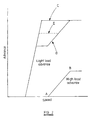
- FIG 2 illustrates the load and speed advance characteristics for the fuel pump with the engine operating at both high and light load conditions. With reference to the speed advance characteristics at high load, it can be seen that the maximum advance is relatively low.
- the metering valve allows the pressure applied to the fourth passage 60 to rise. This causes fuel pressure within the second control chamber 54 to increase. Increased fuel pressure within the second control chamber 54 results in movement of the light load piston 26 to the left in the illustration shown against the action of the light load control spring 28.
- Such movement of the light load piston 26 reduces the compression of the servo control spring 34 acting on the servo piston 24, and the application of fuel to the chamber 70 as described hereinbefore therefore causes movement of the servo-piston 24 to the left in the orientation illustrated.
- the movement of the servo-piston 24 permits fuel to flow to the first control chamber 44 resulting in movement of the advance piston 12 to the left, advancing the timing of fuel delivery by the pump.
- Curve D represents the speed advance characteristic for an advance arrangement in which the end member 40 of the servo piston 24 is removed and curve C represents the speed advance characteristic for an advance arrangement in which the end member 40 of the servo piston 24 is present.
- the maximum level of advance can be altered by removing the end member 40 of the servo piston 24.
- the control valve 52 may be a temperature control valve 52 such that, for both of the operating conditions described hereinbefore, the control valve 52 may be switched in order to adjust timing to compensate for the engine being cold.
- a description of the operation of a temperature control valve in an advance arrangement can be found in European Patent Application EP 0 921 300 A.
- control valve 52 is a solenoid control valve but it will be appreciated that other types of control valve may be employed.
Landscapes
- Engineering & Computer Science (AREA)
- Chemical & Material Sciences (AREA)
- Combustion & Propulsion (AREA)
- Mechanical Engineering (AREA)
- General Engineering & Computer Science (AREA)
- Fuel-Injection Apparatus (AREA)
Abstract
Description
- This invention relates to an advance arrangement for use in controlling the timing of fuel delivery by a high pressure fuel pump intended for use in a compression ignition internal combustion engine. In particular, the invention relates to a servo-type advance arrangement.
- European Patent Application EP 0 921 300 A describes an advance arrangement for use in controlling the timing of fuel delivery by a high pressure fuel pump. The advance arrangement includes an advance piston slidable within a bore, and cooperating, in use, with a cam arrangement of the fuel pump to adjust the timing of fuel delivery by the pump. A servo-piston is slidable in a bore provided in the advance piston and a light load piston is moveable relative to the advance piston against the action of a light load control spring. A servo-control spring is engaged between the light load piston and the servo-piston and a control valve is operable to control the application of fuel to the light load piston to adjust the timing under light load conditions. Depending upon the engine load, the pressure of fuel acting on the light load piston varies and the position of the light load piston changes. The movement of the light load piston results in movement of the servo piston which, in turn, causes movement of the advance piston. The movement of the advance piston causes movement of the cam arrangement to adjust the timing of fuel delivery by the pump.
- The arrangement also includes an independent temperature control valve which is operable to control the application of fuel to the light load piston depending upon the engine temperature, thereby permitting adjustment of the timing of fuel delivery to compensate for cold conditions. The advance arrangement therefore permits adjustment of fuel delivery timing both in response to engine load and engine temperature.
- It is an object of the present invention to provide an improved advance arrangement for use in controlling the timing of fuel delivery by a high pressure fuel pump.
- According to a first aspect of the present invention, there is provided an advance arrangement comprising an advance piston slidable within a first bore, the advance piston cooperating, in use, with a cam arrangement of a fuel pump to adjust the timing of fuel delivery by the pump, a servo-piston slidable within a furkher bore provided in the advance piston, a light load piston moveable relative to the advance piston against the action of a light load control spring, and a servo-control spring engaged between the light load piston and the servo-piston, the advance arrangement further comprising a seal arrangement, including at least one seal member carried by the servo piston, arranged to form a substantially fluid tight seal between the servo-piston and the light load piston.
- Conveniently, the seal arrangement includes a first seal member which forms a close clearance or sliding fit on the servo-piston. The first seal member is preferably of elongate, tubular form and, more preferably, takes the form of a rod seal which is carried by the servo piston. The seal arrangement may also include a second seal member arranged to sealingly engage the light load piston. The second seal member conveniently takes the form of an O-ring seal.
- The provision of the seal arrangement eases manufacture of the advance arrangement in that any eccentricities between the light load piston and the servo-piston can be compensated for. The need for concentric grinding of the servo-piston and the light load piston during manufacture is therefore eliminated.
- According to a second aspect of the invention, there is provided an advance arrangement comprising an advance piston slidable within a first bore, the advance piston cooperating, in use, with a cam arrangement of a fuel pump to adjust the timing of fuel delivery by the pump, a servo-piston slidable within a further bore provided in the advance piston, a light load piston moveable relative to the advance piston against the action of a light load control spring, a servo-control spring engaged between the light load piston and the servo-piston, the servo-piston being adaptable to include a removable region, whereby removal of the region permits the advance characteristics of the advance arrangement for light load conditions to be varied.
- Removal of the region of the servo piston permits the length of the servo-piston to be altered and, hence, the maximum extent of movement of the servo-piston within the further bore can be altered. The maximum extent of movement of the servo-piston determines the maximum extent of movement of the advance piston and, hence, determines the maximum level of advance. This aspect of the invention therefore provides the advantage that removal of the region of the servo-piston enables the advance characteristics of the arrangement for light load conditions to be varied. The advance arrangement can therefore be adapted easily for use under different operating conditions.
- Conveniently, the removable region of the servo-piston takes the form of a spigot arranged at one end of the servo-piston.
- Conveniently, the servo-piston defines an abutment surface which is engageable with a surface defined by the light load piston to limit movement of the servo-piston within the further bore in circumstances in which the region is removed.
- Preferably, the region of the servo-piston defines an abutment surface which is engageable with a further surface defined by the light load piston to limit movement of the servo-piston within the further bore in circumstances in which the region is not removed.
- Preferably, the servo-piston may be adaptable to be provided with regions of different length to permit the maximum level of advance under light load conditions to be varied.
- The invention will now be described, by way of example only, with reference to the following figures in which;
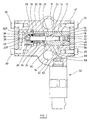
- Figure 1 is a view, part in section, illustrating part of a fuel pump incorporating an advance arrangement in accordance with an embodiment of the invention; and
- Figure 2 is a graph illustrating the advance characteristics of the arrangement in various modes of operation.
-
- The advance arrangement of the present invention is intended for use in controlling the timing of fuel delivery by a high pressure rotary fuel pump including a cam ring which is angularly adjustable with respect to a pump housing, the cam ring including a plurality of cam lobes. The cam ring encircles part of a distributor member which includes pumping plungers reciprocable within respective bores of the distributor member, the plungers having associated therewith respective shoe and roller arrangements, the rollers of which are engageable with the cam surface of the cam ring. In use, fuel is supplied to the bores of the distributor member by a transfer pump, the fuel serving to push the plungers of the distributor member radially outwards. The output pressure of the transfer pump is controlled so as to be related to the speed of operation of the engine with which the pump is being used. Rotation of the distributor member relative to the cam ring causes the rollers to move relative to the cam ring, engagement of the rollers with the cam lobes causing the plungers to be forced inwards, pressurizing the fuel within the bores, and causing fuel to be delivered by the fuel pump at high pressure. It will be appreciated that by altering the angular position of the cam ring, the timing at which fuel is delivered by the pump can be adjusted.
- Referring to Figure 1, in order to permit adjustment of the angular position of the cam ring, the cam ring is provided with a peg which extends into an
opening 10 provided in anadvance piston 12 which is slidable within afirst bore 14 provided in ahousing 16. The ends of thefirst bore 14 are closed byend plates 18 which are secured to thehousing 16 by means ofbolts 20, appropriate O-rings being used to seal theend plates 18 to thehousing 16. - The
advance piston 12 includes an axially extendingsecond bore 22 within which a servo-piston member 24 is slidable. Alight load piston 26 is also received within thebore 14, thelight load piston 26 including a central bore into which the servo-piston 24 extends, thelight load piston 26 acting to guide movement of the servo-piston 24. A lightload control spring 28 is engaged between thelight load piston 26 and one of theplates 18 to bias thelight load piston 26 into engagement with a step defined by part of thebore 14. - The servo-
piston 24 is arranged to carry an elongate,tubular seal member 30 which conveniently takes the form of a rod seal. Theseal member 30 has an inner surface which forms a close clearance or sliding fit on the servo-piston so as to form a substantially fluid tight seal. Asecond seal member 32 in the form of an O-ring is carried by theseal member 30 so as to form a substantially fluid tight seal with thelight load piston 26. The servo-piston 24 is therefore a substantially fluid tight, sliding fit within the opening of thelight load piston 26. The servo-piston 24 also forms a substantially fluid tight, sliding fit within thesecond bore 22 provided in theadvance piston 12. - A
servo control spring 34 is engaged between thelight load piston 26 and anannular member 36 which is carried by the servo-piston 24. Theseal member 30 defines an abutment surface 30a for acirclip 36 which sets the pre-load of theservo control spring 34 upon assembly of the arrangement. The pre-load of theservo control spring 34 determines the point at which the speed advance starts, as will be described in further detail hereinafter. - The servo-
piston 24 is provided with a removable end member 40 which conveniently takes the form of a spigot. In use, movement of the servo-piston 24 to the left in the illustration shown is limited by engagement between the end face of the end member 40 andplate 18. Theservo control piston 24 also defines an abutment surface 24a. It will be appreciated that, if the end member 40 of the servo-piston 24 is removed, the abutment surface 24a is engageable with asurface 38 defined by thelight load piston 26 to limit the extent of movement of the servo-piston 24 to the left in the illustration shown. - In use, movement of the servo-
control piston 24 to the left in the illustration shown causes the timing of fuel delivery to be advanced. Whether the end member 40 is in place or is removed therefore determines the maximum permitted advance for light engine loads, as will be described in further detail hereinafter. - The end of the second bore 22 remote from the
light load piston 26 is closed by means of a disc-shaped member 42 which is located within an annular groove formed in theadvance piston 12. Movement of the servopiston 24 relative to theadvance piston 12 is limited by engagement of an end of the servo-piston 24 with the disc-shapedmember 42. - A first control chamber 44 is defined by an end face of the
advance piston 12 remote from thelight load piston 26, the associated part of thefirst bore 14, and the associatedend plate 18. The first control chamber 44 communicates, via a channel (not shown) formed in the outer periphery of theadvance piston 12, with afirst passage 45 within which anon-return valve 47 is located. Thefirst passage 45 and thenon-return valve 47 are shown in dashed lines as they are not visible in the sectional view shown in Figure 1. - The
first passage 45 communicates with thesecond bore 22 and, depending upon the position of theservo piston 24, may communicate with a first recess 53 provided in the outer surface of theadvance piston 12 by means of a second passage 49 (also shown in dashed lines). The first recess 53 is located so that, for all permitted positions of theadvance piston 12 relative to thehousing 16, the first recess 53 communicates with a third passage 55 (shown, in part, in dashed lines) in communication with a chamber defined between thehousing 16 and an electromagnetically operatedcontrol valve 52 mounted upon thehousing 16, the chamber communicating constantly with athird bore 62 by means of a further bore 63 (shown in dashed lines) provided in thehousing 16. - The
advance piston 12 andlight load piston 26 together define asecond control chamber 54 within which theservo control spring 34 is located, thesecond control chamber 54 communicating with a radially extending passage which opens into asecond recess 58 provided in the outer surface of theadvance piston 12. Thesecond recess 58 is located so that for all permitted positions of theadvance piston 12, thesecond recess 58 communicates with a fourth passage 60 (shown, in part, in dashed lines) which communicates with thethird bore 62. The further bore 63 provided in thehousing 16 communicates, constantly, with a passage (not shown) containing fuel at transfer pressure, and thethird bore 62 communicates with a metering valve arrangement (not shown). - It will be appreciated that, depending upon the axial position of the
advance piston 12, thesecond recess 58 communicates with acontrol valve passage 68 in communication with thecontrol valve 52. - Under normal operating conditions, where the engine load is high and operating at normal operating temperatures, the
control valve 52 is switched so that fuel at transfer pressure is supplied to the third passage 55, but is not supplied to thecontrol valve passage 68. Further, the metering valve supplies fuel at low pressure to thefourth passage 60. In these conditions, the fuel pressure within thesecond control chamber 54 is relatively low, thus thelight load piston 26 is biased by means of the lightload control spring 28 into engagement with a shoulder of thefirst bore 14, as illustrated in Figure 1. Fuel at transfer pressure is supplied through the third passage 55 and the first recess 53 to achamber 70 defined by thesecond bore 22 of theadvance piston 12, the end of the servo-piston 24 and the disc-shapedmember 42. - In the position shown in Figure 1, the
servo piston 24 occupies a position in which communication between thechamber 70 and the first control chamber 44 is not permitted. However, should the speed of rotation of the engine increase, resulting in an increase in the transfer pressure, the fuel pressure within thechamber 70 may increase to a sufficient extent to cause movement of the servo-piston 24 against the action of theservo control spring 34 to a position in which communication between thechamber 70 and the first control chamber 44 is permitted, fuel flowing from thechamber 70, past the non-return valve 46 to the first control chamber 44. The flow of fuel to the first control chamber 44 increases the pressure therein, applying a force to theadvance piston 12 causing it to move towards the left in the orientation illustrated in Figure 1. Movement of theadvance piston 12 in this direction causes movement of the cam ring, due to the cooperation of the peg with theopening 10, to advance the timing of fuel delivery by the pump. - Once the movement of the
advance piston 12 results in communication between thechamber 70 and the first control chamber 44 being closed by the servo-piston 24, the supply of fuel to the first control chamber 44 is terminated and movement of theadvance piston 12 in this direction ceases. - Clearly, in circumstances in which it is desirable to retard the timing of fuel delivery by the pump, the
advance piston 12 must move towards the right in the orientation illustrated. In such circumstances, the transfer pressure falls, thus the servo-piston 24 moves towards the right. Movement of the servo-piston 24 relative to theadvance piston 12 beyond a predetermined position results in a drain passage (not shown) being uncovered to permit fuel to escape from the first control chamber 44 to the cam box of the high pressure fuel pump. Thus, fuel pressure within the first control chamber 44 falls, resulting in movement of theadvance piston 12 to the right. Movement of theadvance piston 12 ceases upon the advance piston having moved to a position in which the drain passage is closed by the servo-piston 24. - It will be appreciated that the extent of travel of the
advance piston 12 to the left in the illustration shown is limited by the engagement between the end of the servo-piston 24 and thesurface 38 of thelight load piston 26. It will be appreciated that the engine speed at which advance is started is determined by the force due to theservo control spring 34 urging the servo-piston 24 to the right in the illustration shown, theadvance piston 12 being caused to move, and hence the timing of fuel delivery being advanced, when the force due to theservo control spring 34 is overcome by fuel pressure within thechamber 70. The maximum permitted advance is determined by the maximum extent of travel of the servo-piston 24, and hence of theadvance piston 12, the maximum extent of travel of the servo-piston being determined by the position of thelight load piston 26. - Figure 2 illustrates the load and speed advance characteristics for the fuel pump with the engine operating at both high and light load conditions. With reference to the speed advance characteristics at high load, it can be seen that the maximum advance is relatively low.
- In conditions where the engine is operating at a light load, the metering valve allows the pressure applied to the
fourth passage 60 to rise. This causes fuel pressure within thesecond control chamber 54 to increase. Increased fuel pressure within thesecond control chamber 54 results in movement of thelight load piston 26 to the left in the illustration shown against the action of the lightload control spring 28. Such movement of thelight load piston 26 reduces the compression of theservo control spring 34 acting on theservo piston 24, and the application of fuel to thechamber 70 as described hereinbefore therefore causes movement of the servo-piston 24 to the left in the orientation illustrated. As described hereinbefore, the movement of the servo-piston 24 permits fuel to flow to the first control chamber 44 resulting in movement of theadvance piston 12 to the left, advancing the timing of fuel delivery by the pump. - If the end member 40 of the
servo piston 24 is present, as shown in Figure 1, movement of theservo piston 24 to the left in the illustration shown is limited by engagement between the end surface of the end member 40 and theend plate 18. If, however, the end region of theservo piston 24 is removed, movement of theservo piston 24 to the left in the illustration shown is limited by engagement between end surface of the end member 40 and thesurface 38 of thelight load piston 26. - Referring to Figure 2, it can be seen that the effect of moving the
light load piston 26 has an effect upon the relationship between engine speed and the maximum permitted level of advance. Curve D represents the speed advance characteristic for an advance arrangement in which the end member 40 of theservo piston 24 is removed and curve C represents the speed advance characteristic for an advance arrangement in which the end member 40 of theservo piston 24 is present. Thus, the maximum level of advance can be altered by removing the end member 40 of theservo piston 24. - It will be appreciated that by providing the
servo piston 24 with an end member 40 having a length less than the length of the end member 40 shown in Figure 1, a further alternative advance characteristic can be achieved, as represented by curve E in Figure 2. Thus, the advance arrangement can easily be adapted to provide the advance characteristics required for any particular application. - An advantage is also obtained in that the provision of the separate seal arrangement, in the form of the
tubular seal member 30 carried by the servo-piston 24 and the O-ring seal carried by the rod seal, to provide a substantially fluid tight seal between the servo-piston 24 and the opening of thelight load piston 26 removes the need for concentric grinding of thepistons - The
control valve 52 may be atemperature control valve 52 such that, for both of the operating conditions described hereinbefore, thecontrol valve 52 may be switched in order to adjust timing to compensate for the engine being cold. A description of the operation of a temperature control valve in an advance arrangement can be found in European Patent Application EP 0 921 300 A. - Conveniently, the
control valve 52 is a solenoid control valve but it will be appreciated that other types of control valve may be employed. - Although the description hereinbefore is of a fuel pump of the type in which pumping plungers move in a radial direction in order to supply fuel at high pressure to an engine, it will be appreciated that the advance arrangement may be applicable to other types of high pressure fuel pump.
Claims (11)
- An advance arrangement comprising an advance piston (12) which is slidable within a first bore (14), the advance piston (12) cooperating, in use, with a cam arrangement of a fuel pump to adjust the timing of fuel delivery by the pump, a servo-piston (24) slidable within a further bore (22) provided in the advance piston (12), a light load piston (26) moveable relative to the advance piston (12) against the action of a light load control spring (28), and a servo-control spring (34) engaged between the light load piston (26) and the servo-piston (24), the advance arrangement further comprising a seal arrangement, comprising at least one seal member (30, 32) carried by the servo piston (24), which is arranged to form a substantially fluid tight seal between the servo-piston (24) and the light load piston (26).
- The advance arrangement as claimed in Claim 1, wherein the seal arrangement includes a first seal member (30) forming a close clearance fit on the servo-piston (24).
- The advance arrangement as claimed in Claim 1 or Claim 2, wherein the first seal member (30) is of elongate, tubular form.
- The advance arrangement as claimed in any of Claims 1 to 3, wherein the seal arrangement includes a second seal member (32) arrange to sealingly engage the light load piston (26).
- The advance arrangement as claimed in Claim 4, wherein the second seal member takes the form of an O-ring seal (32).
- The advance arrangement as claimed in any of Claims 1 to 5, wherein the servo-piston (24) is adaptable to include a removable region (40), whereby removal of the region (40) permits the advance characteristics of the advance arrangement for light load conditions to be varied.
- An advance arrangement comprising an advance piston (12) slidable within a first bore (14), the advance piston (12) cooperating, in use, with a cam arrangement of a fuel pump to adjust the timing of fuel delivery by the pump, a servo-piston (24) slidable in a further bore (22) provided in the advance piston (12), a light load piston (26) moveable relative to the advance piston (12) against the action of a light load control spring (28), a servo-control spring (34) engaged between the light load piston (36) and the servo-piston (24), the servo-piston (24) being adaptable to include a removable region (40), whereby removal of the region permits the advance characteristics of the advance arrangement for light load conditions to be varied.
- The advance arrangement as claimed in Claim 7, wherein the removable region of the servo-piston (24) takes the form of a spigot (40) arranged at one end of the servo-piston (24).
- The advance arrangement as claimed in Claim 7 or Claim 8, wherein the servo-piston (24) defines an abutment surface (24a) which is engageable with a further surface (38) defined by the light load piston (26) to limit movement of the servo-piston (24) within the further bore (22) in circumstances in which the region (40) is removed.
- The advance arrangement as claimed in any of Claims 7 to 9, comprising a plate member (18) arranged to close an open end of the first bore (14), wherein the region (40) of the servo-piston (24) is engageable with the plate member (18) to limit movement of the servo-piston (24) within the further bore (22) in circumstances in which the region (40) is not removed.
- The advance arrangement as claimed in any of Claims 7 to 9, wherein the servo-piston (24) is adaptable to be provided with regions (40) of different length to permit the maximum level of advance to be varied.
Applications Claiming Priority (2)
| Application Number | Priority Date | Filing Date | Title |
|---|---|---|---|
| GB0015191A GB0015191D0 (en) | 2000-06-22 | 2000-06-22 | Advance arrangement |
| GB0015191 | 2000-06-22 |
Publications (3)
| Publication Number | Publication Date |
|---|---|
| EP1167723A2 true EP1167723A2 (en) | 2002-01-02 |
| EP1167723A3 EP1167723A3 (en) | 2002-06-19 |
| EP1167723B1 EP1167723B1 (en) | 2003-11-19 |
Family
ID=9894102
Family Applications (1)
| Application Number | Title | Priority Date | Filing Date |
|---|---|---|---|
| EP20010304818 Expired - Lifetime EP1167723B1 (en) | 2000-06-22 | 2001-05-31 | Injection timing advance arrangement |
Country Status (3)
| Country | Link |
|---|---|
| EP (1) | EP1167723B1 (en) |
| DE (1) | DE60101244T2 (en) |
| GB (1) | GB0015191D0 (en) |
Families Citing this family (1)
| Publication number | Priority date | Publication date | Assignee | Title |
|---|---|---|---|---|
| DE102024137674B3 (en) * | 2024-12-13 | 2026-01-22 | Schaeffler Technologies AG & Co. KG | Adjustment system for an injection pump, internal combustion engine and method for operating an internal combustion engine |
Citations (1)
| Publication number | Priority date | Publication date | Assignee | Title |
|---|---|---|---|---|
| EP0921300A2 (en) | 1997-12-02 | 1999-06-09 | LUCAS INDUSTRIES public limited company | Advance arrangement for a fuel pump |
Family Cites Families (2)
| Publication number | Priority date | Publication date | Assignee | Title |
|---|---|---|---|---|
| DE2752086A1 (en) * | 1977-11-22 | 1979-05-23 | Stanadyne Inc | Timing control for fuel pump - using angularly adjustable cam ring controlled by hydraulically actuated piston with pressure correlated with engine speed |
| US4748958A (en) * | 1986-11-12 | 1988-06-07 | Ash Eugene G | Method and means for repairing injection fuel pump pistons |
-
2000
- 2000-06-22 GB GB0015191A patent/GB0015191D0/en not_active Ceased
-
2001
- 2001-05-31 DE DE2001601244 patent/DE60101244T2/en not_active Expired - Lifetime
- 2001-05-31 EP EP20010304818 patent/EP1167723B1/en not_active Expired - Lifetime
Patent Citations (1)
| Publication number | Priority date | Publication date | Assignee | Title |
|---|---|---|---|---|
| EP0921300A2 (en) | 1997-12-02 | 1999-06-09 | LUCAS INDUSTRIES public limited company | Advance arrangement for a fuel pump |
Also Published As
| Publication number | Publication date |
|---|---|
| GB0015191D0 (en) | 2000-08-09 |
| DE60101244T2 (en) | 2004-09-09 |
| DE60101244D1 (en) | 2003-12-24 |
| EP1167723A3 (en) | 2002-06-19 |
| EP1167723B1 (en) | 2003-11-19 |
Similar Documents
| Publication | Publication Date | Title |
|---|---|---|
| US7069951B2 (en) | Proportional solenoid valve for a camshaft adjusting device of motor vehicles | |
| US4501252A (en) | Fuel injection pump | |
| EP0921300B1 (en) | Advance arrangement for a fuel pump | |
| US6363917B1 (en) | Fuel injector pump advance arrangement | |
| US4214564A (en) | Fuel injection pumping apparatus | |
| JPH0146695B2 (en) | ||
| EP1167723B1 (en) | Injection timing advance arrangement | |
| JPH0320575B2 (en) | ||
| US5377638A (en) | Hydraulic adjusting device | |
| US5639229A (en) | Fuel injection pump having a two piston spill valve arrangement | |
| EP0684379B1 (en) | Distributor-type fuel injection pump | |
| JPH029164B2 (en) | ||
| EP1749996A1 (en) | Injection advance arrangement | |
| EP0604083B1 (en) | Fuel injection pump | |
| US5085195A (en) | Injection timing control device for distributor-type fuel injection pumps | |
| US5203303A (en) | Fuel pumping apparatus | |
| EP1296041B1 (en) | Advance arrangement | |
| US5406923A (en) | Fuel injection pump | |
| US5651348A (en) | Fuel pumping apparatus | |
| JPS5968555A (en) | Adjusting device of injection timing of fuel injection pump | |
| EP0692623B1 (en) | Advance piston mounting | |
| US4401083A (en) | Fuel injection pump for internal combustion engines | |
| US7350508B1 (en) | Advance arrangements | |
| EP1772609B1 (en) | Improvements to advance arrangement | |
| EP1296052B1 (en) | Injection advance arrangement |
Legal Events
| Date | Code | Title | Description |
|---|---|---|---|
| PUAI | Public reference made under article 153(3) epc to a published international application that has entered the european phase |
Free format text: ORIGINAL CODE: 0009012 |
|
| AK | Designated contracting states |
Kind code of ref document: A2 Designated state(s): AT BE CH CY DE DK ES FI FR GB GR IE IT LI LU MC NL PT SE TR |
|
| AX | Request for extension of the european patent |
Free format text: AL;LT;LV;MK;RO;SI |
|
| PUAL | Search report despatched |
Free format text: ORIGINAL CODE: 0009013 |
|
| AK | Designated contracting states |
Kind code of ref document: A3 Designated state(s): AT BE CH CY DE DK ES FI FR GB GR IE IT LI LU MC NL PT SE TR |
|
| AX | Request for extension of the european patent |
Free format text: AL;LT;LV;MK;RO;SI |
|
| RIC1 | Information provided on ipc code assigned before grant |
Free format text: 7F 02D 1/18 A, 7F 02M 41/14 B |
|
| 17P | Request for examination filed |
Effective date: 20020730 |
|
| 17Q | First examination report despatched |
Effective date: 20021018 |
|
| AKX | Designation fees paid |
Designated state(s): DE ES FR GB IT |
|
| GRAH | Despatch of communication of intention to grant a patent |
Free format text: ORIGINAL CODE: EPIDOS IGRA |
|
| GRAS | Grant fee paid |
Free format text: ORIGINAL CODE: EPIDOSNIGR3 |
|
| GRAA | (expected) grant |
Free format text: ORIGINAL CODE: 0009210 |
|
| AK | Designated contracting states |
Kind code of ref document: B1 Designated state(s): DE ES FR GB IT |
|
| PG25 | Lapsed in a contracting state [announced via postgrant information from national office to epo] |
Ref country code: IT Free format text: LAPSE BECAUSE OF FAILURE TO SUBMIT A TRANSLATION OF THE DESCRIPTION OR TO PAY THE FEE WITHIN THE PRESCRIBED TIME-LIMIT;WARNING: LAPSES OF ITALIAN PATENTS WITH EFFECTIVE DATE BEFORE 2007 MAY HAVE OCCURRED AT ANY TIME BEFORE 2007. THE CORRECT EFFECTIVE DATE MAY BE DIFFERENT FROM THE ONE RECORDED. Effective date: 20031119 Ref country code: FR Free format text: LAPSE BECAUSE OF FAILURE TO SUBMIT A TRANSLATION OF THE DESCRIPTION OR TO PAY THE FEE WITHIN THE PRESCRIBED TIME-LIMIT Effective date: 20031119 |
|
| REG | Reference to a national code |
Ref country code: GB Ref legal event code: FG4D |
|
| REF | Corresponds to: |
Ref document number: 60101244 Country of ref document: DE Date of ref document: 20031224 Kind code of ref document: P |
|
| REG | Reference to a national code |
Ref country code: IE Ref legal event code: FG4D |
|
| PG25 | Lapsed in a contracting state [announced via postgrant information from national office to epo] |
Ref country code: ES Free format text: LAPSE BECAUSE OF FAILURE TO SUBMIT A TRANSLATION OF THE DESCRIPTION OR TO PAY THE FEE WITHIN THE PRESCRIBED TIME-LIMIT Effective date: 20040302 |
|
| PLBE | No opposition filed within time limit |
Free format text: ORIGINAL CODE: 0009261 |
|
| STAA | Information on the status of an ep patent application or granted ep patent |
Free format text: STATUS: NO OPPOSITION FILED WITHIN TIME LIMIT |
|
| 26N | No opposition filed |
Effective date: 20040820 |
|
| EN | Fr: translation not filed | ||
| REG | Reference to a national code |
Ref country code: IE Ref legal event code: MM4A |
|
| PG25 | Lapsed in a contracting state [announced via postgrant information from national office to epo] |
Ref country code: GB Free format text: LAPSE BECAUSE OF NON-PAYMENT OF DUE FEES Effective date: 20050531 |
|
| GBPC | Gb: european patent ceased through non-payment of renewal fee |
Effective date: 20050531 |
|
| REG | Reference to a national code |
Ref country code: DE Ref legal event code: R082 Ref document number: 60101244 Country of ref document: DE Representative=s name: MANITZ, FINSTERWALD & PARTNER GBR, DE |
|
| REG | Reference to a national code |
Ref country code: DE Ref legal event code: R081 Ref document number: 60101244 Country of ref document: DE Owner name: DELPHI INTERNATIONAL OPERATIONS LUXEMBOURG S.A, LU Free format text: FORMER OWNER: DELPHI TECHNOLOGIES HOLDING S.A.R.L., BASCHARAGE, LU Effective date: 20140702 Ref country code: DE Ref legal event code: R082 Ref document number: 60101244 Country of ref document: DE Representative=s name: MANITZ, FINSTERWALD & PARTNER GBR, DE Effective date: 20140702 |
|
| PGFP | Annual fee paid to national office [announced via postgrant information from national office to epo] |
Ref country code: DE Payment date: 20140529 Year of fee payment: 14 |
|
| REG | Reference to a national code |
Ref country code: DE Ref legal event code: R119 Ref document number: 60101244 Country of ref document: DE |
|
| PG25 | Lapsed in a contracting state [announced via postgrant information from national office to epo] |
Ref country code: DE Free format text: LAPSE BECAUSE OF NON-PAYMENT OF DUE FEES Effective date: 20151201 |