EP1167490A2 - Separation of olefinic hydrocarbons from sulfur-containing hydrocarbons by use of a solvent - Google Patents
Separation of olefinic hydrocarbons from sulfur-containing hydrocarbons by use of a solvent Download PDFInfo
- Publication number
- EP1167490A2 EP1167490A2 EP01114725A EP01114725A EP1167490A2 EP 1167490 A2 EP1167490 A2 EP 1167490A2 EP 01114725 A EP01114725 A EP 01114725A EP 01114725 A EP01114725 A EP 01114725A EP 1167490 A2 EP1167490 A2 EP 1167490A2
- Authority
- EP
- European Patent Office
- Prior art keywords
- sulfur
- stream
- hydrocarbon
- solvent
- olefin
- Prior art date
- Legal status (The legal status is an assumption and is not a legal conclusion. Google has not performed a legal analysis and makes no representation as to the accuracy of the status listed.)
- Withdrawn
Links
Images
Classifications
-
- C—CHEMISTRY; METALLURGY
- C10—PETROLEUM, GAS OR COKE INDUSTRIES; TECHNICAL GASES CONTAINING CARBON MONOXIDE; FUELS; LUBRICANTS; PEAT
- C10G—CRACKING HYDROCARBON OILS; PRODUCTION OF LIQUID HYDROCARBON MIXTURES, e.g. BY DESTRUCTIVE HYDROGENATION, OLIGOMERISATION, POLYMERISATION; RECOVERY OF HYDROCARBON OILS FROM OIL-SHALE, OIL-SAND, OR GASES; REFINING MIXTURES MAINLY CONSISTING OF HYDROCARBONS; REFORMING OF NAPHTHA; MINERAL WAXES
- C10G21/00—Refining of hydrocarbon oils, in the absence of hydrogen, by extraction with selective solvents
- C10G21/28—Recovery of used solvent
-
- C—CHEMISTRY; METALLURGY
- C10—PETROLEUM, GAS OR COKE INDUSTRIES; TECHNICAL GASES CONTAINING CARBON MONOXIDE; FUELS; LUBRICANTS; PEAT
- C10G—CRACKING HYDROCARBON OILS; PRODUCTION OF LIQUID HYDROCARBON MIXTURES, e.g. BY DESTRUCTIVE HYDROGENATION, OLIGOMERISATION, POLYMERISATION; RECOVERY OF HYDROCARBON OILS FROM OIL-SHALE, OIL-SAND, OR GASES; REFINING MIXTURES MAINLY CONSISTING OF HYDROCARBONS; REFORMING OF NAPHTHA; MINERAL WAXES
- C10G21/00—Refining of hydrocarbon oils, in the absence of hydrogen, by extraction with selective solvents
- C10G21/06—Refining of hydrocarbon oils, in the absence of hydrogen, by extraction with selective solvents characterised by the solvent used
- C10G21/12—Organic compounds only
- C10G21/20—Nitrogen-containing compounds
Definitions
- This invention relates to the separation of olefinic hydrocarbons from close-boiling sulfur-containing hydrocarbons by use of a solvent.
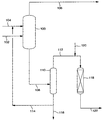
- Fig. 1 is a simplified flow scheme of an embodiment of the present invention.
- the hydrocarbon feedstock suitable for use in the present invention comprises, consists of, or consists essentially of at least one olefin and at least one sulfur-containing hydrocarbon.
- the at least one olefin preferably has in the range of from 2 to 8, more preferably from 6 to 8, and most preferably from 7 to 8 carbon atoms per molecule, and is a mono-olefin, di-olefin, tri-olefin, cycloalkene, or a combination of any two or more thereof.
- Suitable hydrocarbon feedstocks include, but are not limited to, gasoline range hydrocarbons such as catalytically cracked gasolines and fractions thereof (e.g., FCC and hydrocracking) processes, pyrolysis gasolines from thermal hydrocarbon (e.g., ethane, propane, and naphtha) cracking processes, naphthas, gas oils, reformates, straight-run gasoline and the like.
- the preferred feed is a catalytically cracked gasoline comprising hydrocarbons having from 2 to 30 carbon atoms per molecule.
- the hydrocarbon feedstock typically comprises at least about 20 ppmw sulfur. More typically, the concentration of sulfur will be in the range of from about 100 ppmw to about 3000 ppmw, and most typically the sulfur content will be in the range of from 200 ppmw to 1000 ppmw.
- Sulfur ppmw as used herein, means the parts per million by weight of atomic sulfur contained in a hydrocarbon stream. The sulfur is generally present in the hydrocarbon feedstock in the form of sulfur-containing hydrocarbons.
- the at least one sulfur-containing hydrocarbon typically contains in the range of from 4 to 8 carbon atoms per molecule, and is most typically a thiophenic compound, such as, but not limited to, thiophene, 2-methyl thiophene, 3-methyl thiophene, or combinations thereof.
- the olefin concentration of the hydrocarbon feedstock is typically in the range of from about 10 wt. % to about 50 wt. %, more typically from about 15 wt. % to about 35 wt. %, and most typically from 20 wt. % to 30 wt. % of the hydrocarbon feedstock.
- the aromatic hydrocarbon content of the hydrocarbon feedstock is typically in the range of from about 5 wt. % to about 30 wt. %, more typically in the range of from about 10 wt. % to about 25 wt. %, and most typically from 10 wt. % to 20 wt. % of the hydrocarbon feedstock.
- the at least one olefin and at least one suitor-containing hydrocarbons of the hydrocarbon feedstock can be separated from each other by contacting the hydrocarbon feedstock with a solvent stream comprising, consisting of, or consisting essentially of N-hydroxyethyl pyrollidone in a contacting zone.
- a first overhead stream comprising, consisting of, or consisting essentially of at least a portion of the at least one olefin can be removed from the contacting zone and a first bottoms stream comprising, consisting of, or consisting essentially of at least a portion of the N-hydroxyethyl pyrollidone and at least a portion of the at least one sulfur-containing hydrocarbon can be removed from the contacting zone.
- the concentration of sulfur-containing hydrocarbons in the first overhead stream is preferably lower then the concentration of sulfur-containing hydrocarbons in the hydrocarbon feedstock, more preferably, the first overhead stream is substantially free of sulfur-containing hydrocarbons, and most preferably, the concentration of sulfur-containing hydrocarbons in the first overhead stream is less than 100 ppmw. Any remaining sulfur-containing hydrocarbons are likely non-thiophenic and can be removed from the first overhead stream by use of treatment processes such as, but not limited to, caustic washing.
- the contacting zone for contacting the hydrocarbon feedstock with the solvent stream is preferably an extractive distillation column (EDC) wherein the solvent is charged to the EDC at a location above that location where the hydrocarbon feedstock is charged to the EDC.
- the at least one sulfur-containing hydrocarbon leaves the EDC through a first bottoms stream while the at least one olefin passes out of the EDC in a first overhead stream.
- the first bottoms stream can be separated into a second overhead stream comprising at least a portion of the at least one sulfur-containing hydrocarbon, and into a second bottoms stream comprising at least a portion of the N-hydroxyethyl pyrollidone.
- the second bottoms stream can be recycled to the contacting zone for use as at least a portion of the solvent stream.
- the hydrocarbon feedstock and the second overhead stream are further characterized to comprise at least one heavy hydrocarbon having greater than seven carbon atoms per molecule which are also selected from the group consisting of paraffins, aromatics, and combinations thereof.
- the second overhead stream can be hydrodesulfurized, in the presence of hydrogen and under hydrodesulfurization conditions, to thereby produce a desulfurized heavy hydrocarbon product.
- the combined Research Octane Number (RON) of the first overhead stream and the desulfurized heavy hydrocarbon product is at least substantially the same as the RON of the hydrocarbon feedstock.
- the combined RON of the first overhead stream and the desulfurized heavy hydrocarbon product is within 0.5 octane numbers of the RON of the hydrocarbon feedstock, as determined using ASTM test method D2699-97ae1.
- the concentration of sulfur in the combined first overhead stream and desulfurized heavy hydrocarbon product is preferably less than about 50 ppmw, more preferably less than about 40 ppmw, and most preferably less than 30 ppmw.
- a hydrocarbon feedstock enters a contacting vessel 100, which defines a contacting zone, via conduit 102 and a solvent stream enters contacting vessel 100 via conduit 104.
- a first overhead stream is removed from contacting vessel 100 via conduit 106 and a first bottoms stream is removed from contacting vessel 100 via conduit 108.
- the first bottoms stream is charged to a separator 110 via conduit 108.
- a second overhead stream is withdrawn from separator 110 via conduit 112 and a second bottoms stream is removed from separator 110 via conduit 114 and is recycled to contacting vessel 100 via conduits 114 and 104 for use as a part of the solvent stream.
- the second overhead stream is charged to a hydrodesulfurization reactor 118 via conduit 112, and a hydrogen containing stream is charged to hydrodesulfurization reactor 118 via conduits 120 and 112 wherein the second overhead stream is desulfurized producing a desulfurized heavy hydrocarbon product which is removed from hydrodesulfurization reactor 118 via conduit 122.
- the hydrodesulfurization reactor 118 can be operated in upflow or downflow mode.
- Each solvent/hydrocarbon mixture was separately heated under reflux conditions for about 20-30 minutes in a distillation flask equipped with a reflux condenser.
- a small sample (about 0.5 g) was withdrawn by means of a septum from the flask containing the liquid phase of the equilibrium system, and a sample of the condensed vapor was withdrawn by means of a septum located just below the reflux condenser. Both samples were analyzed, and the mole fractions of octene-1 and thiophene in the liquid phase and in the vapor phase were determined by means of a gas chromatograph.
- This example demonstrates the use of N-hydroxyethyl pyrollidone as a solvent to remove sulfur-containing hydrocarbons from a catalytically cracked gasoline.
- the solvent N-hydroxyethyl pyrollidone was added to a 20 gram quantity of a catalytically cracked gasoline obtained from a petroleum refinery in a distillation flask equipped with a reflux condenser at various solvent/gasoline wt. ratios.
- the distillation flask contents were heated under reflux conditions for about 20-30 minutes.
- a small sample (about 0.5 g) was withdrawn by means of a septum from the flask containing the liquid phase of the equilibrium system, and a sample of the condensed vapor was withdrawn by means of a septum located just below the reflux condenser.
- the gasoline feed and both samples (vapor and liquid) were analyzed for total olefins (containing in the range of from 4 to 12 carbon atoms per molecule), thiophene, 2-methyl thiophene, and 3-methyl thiophene by means of a gas chromatograph.
- the mole fractions of the total olefins and the combined thiophenic compounds (thiophene, 2-methyl thiophene and 3-methyl thiophene) in the liquid phase and in the vapor phase were determined by means of a gas chromatograph.
- the concentrations of thiophene, 2-methyl thiophene and 3-methyl thiophene in the overhead stream were 64%, 59% and 60%, respectively, lower than such concentrations in the gasoline feed.
- the lower concentrations of these thiophenic compounds in the overhead, and the corresponding higher concentrations of thiophenic compounds in the bottoms stream, allow the treatment of the majority of the thiophenic compounds by hydrodesulfurization of the bottoms stream.
Landscapes
- Chemical & Material Sciences (AREA)
- Oil, Petroleum & Natural Gas (AREA)
- Engineering & Computer Science (AREA)
- Chemical Kinetics & Catalysis (AREA)
- General Chemical & Material Sciences (AREA)
- Organic Chemistry (AREA)
- Production Of Liquid Hydrocarbon Mixture For Refining Petroleum (AREA)
Abstract
Description
| Solvent/Feed wt. ratio | Relative Volatility |
| 0 | 0.5 |
| 1 | 0.7 |
| 2 | 1.0 |
| 3 | 1.2 |
| 5 | 1.7 |

Claims (10)
- A process for separating at least one olefin from at least one sulfur-containing hydrocarbon comprising the steps of:a) contacting a hydrocarbon feedstock comprising at least one olefin and at least one sulfur-containing hydrocarbon with a solvent stream comprising N-hydroxyethyl pyrollidone in a contacting zone; andb) removing a first overhead stream comprising at least a portion of said at least one olefin from said contacting zone.
- The process of claim 1, wherein said hydrocarbon feedstock is a catalytically cracked gasoline.
- The process of claim 1 or 2, wherein the concentration of sulfur-containing hydrocarbons in said first overhead stream is lower than the concentration of sulfur-containing hydrocarbons in said hydrocarbon feedstock.
- The process of any of claims 1 to 3, wherein said at least one olefin is selected from mono-olefins, di-olefins or tri-olefins containing in the range of from 2 to 8 carbon atoms per molecule, and combinations of any two or more thereof.
- The process of any of the preceding claims, wherein said at least one sulfur-containing hydrocarbon contains in the range of from 4 to 8 carbon atoms per molecule.
- The process of any of the preceding claims, wherein said at least one sulfur-containing hydrocarbon comprises a thiophenic compound.
- The process of any of the preceding claims, further characterized to include the step of:
c) removing a first bottoms stream comprising at least a portion of said N-hydroxyethyl pyrollidone and at least a portion of said at least one sulfur-containing hydrocarbon, in particular wherein said first bottoms stream is separated into a second overhead stream comprising at least a portion of said at least one sulfur-containing hydrocarbon, and into a second bottoms stream comprising at least a portion of said N-hydroxyethyl pyrollidone; and wherein at least a portion of said second bottoms stream is used as at least a portion of said solvent stream. - A process for desulfurizing cracked gasoline comprising the steps of:a) contacting a hydrocarbon feedstock comprising cracked gasoline comprising at least one olefin and at least one sulfur-containing hydrocarbon with a solvent stream comprising N-hydroxyethyl pyrollidone in a contacting zone;b) removing a first overhead stream comprising at least a portion of said at least one olefin from said contacting zone;c) removing a first bottoms stream comprising at least a portion of said N-hydroxyethyl pyrollidone and at least a portion of said at least one sulfur-containing hydrocarbon;d) separating said first bottoms stream into a second overhead stream comprising at least a portion of said at least one sulfur-containing hydrocarbon, and into a second bottoms stream comprising at least a portion of said N-hydroxyethyl pyrollidone; ande) utilizing at least a portion of said second bottoms stream as at least a portion of said solvent stream.
- The process of claim 8, wherein said hydrocarbon feedstock and said second overhead stream are further characterized to comprise at least one heavy hydrocarbon having more than seven carbon atoms per molecule, and wherein said process is further characterized to include hydrodesulfurizing said second overhead stream to produce a desulfurized heavy hydrocarbon product.
- The process of claim 9, wherein the combined octane rating of said first overhead stream and said desulfurized heavy hydrocarbon product is at least substantially the same as the octane rating of said hydrocarbon feedstock.
Applications Claiming Priority (2)
| Application Number | Priority Date | Filing Date | Title |
|---|---|---|---|
| US602439 | 1990-10-22 | ||
| US09/602,439 US6802959B1 (en) | 2000-06-23 | 2000-06-23 | Separation of olefinic hydrocarbons from sulfur-containing hydrocarbons by use of a solvent |
Publications (2)
| Publication Number | Publication Date |
|---|---|
| EP1167490A2 true EP1167490A2 (en) | 2002-01-02 |
| EP1167490A3 EP1167490A3 (en) | 2003-01-29 |
Family
ID=24411361
Family Applications (1)
| Application Number | Title | Priority Date | Filing Date |
|---|---|---|---|
| EP01114725A Withdrawn EP1167490A3 (en) | 2000-06-23 | 2001-06-22 | Separation of olefinic hydrocarbons from sulfur-containing hydrocarbons by use of a solvent |
Country Status (4)
| Country | Link |
|---|---|
| US (1) | US6802959B1 (en) |
| EP (1) | EP1167490A3 (en) |
| JP (1) | JP2002020764A (en) |
| CA (1) | CA2333209C (en) |
Families Citing this family (3)
| Publication number | Priority date | Publication date | Assignee | Title |
|---|---|---|---|---|
| JP4599545B2 (en) * | 2003-02-20 | 2010-12-15 | Jx日鉱日石エネルギー株式会社 | Method for producing unleaded gasoline composition |
| JP4371925B2 (en) * | 2003-06-30 | 2009-11-25 | 株式会社ジャパンエナジー | Unleaded gasoline composition and method for producing the same |
| US8343336B2 (en) * | 2007-10-30 | 2013-01-01 | Saudi Arabian Oil Company | Desulfurization of whole crude oil by solvent extraction and hydrotreating |
Family Cites Families (25)
| Publication number | Priority date | Publication date | Assignee | Title |
|---|---|---|---|---|
| US2069329A (en) * | 1935-03-20 | 1937-02-02 | Shell Dev | Process of refining oils |
| US2162963A (en) * | 1937-08-28 | 1939-06-20 | Shell Dev | Process for desulphurizing mineral oils |
| US2285696A (en) | 1940-08-26 | 1942-06-09 | Shell Dev | Process for desulphurizing mineral oil distillates |
| US2439777A (en) * | 1944-09-18 | 1948-04-13 | Union Oil Co | Separation of thiophenes from hydrocarbons by azeotropic distillation |
| NL277633A (en) * | 1961-04-27 | |||
| DE1163795B (en) | 1961-11-24 | 1964-02-27 | Basf Ag | Process for the removal of small amounts of high molecular weight acetylenes and allenes from conjugated diolefins |
| DE1908126C3 (en) * | 1969-02-19 | 1974-06-27 | Heinrich Koppers Gmbh, 4300 Essen | Process for the separation of saturated hydrocarbons and olefins |
| BE791887A (en) * | 1971-11-26 | 1973-05-24 | Basf Ag | PROCESS FOR OBTAINING PURE CONJUGATED DIOLEFINS CONTAINING 4 AND 5 CARBON ATOMS, FROM MIXTURES |
| US4053369A (en) * | 1974-05-30 | 1977-10-11 | Phillips Petroleum Company | Extractive distillation |
| US4188285A (en) | 1978-12-20 | 1980-02-12 | Chevron Research Company | Selective process for removal of thiophenes from gasoline using a silver-exchanged faujasite-type zeolite |
| US4421640A (en) | 1982-02-16 | 1983-12-20 | Cosden Technology, Inc. | Methods for separating hydrocarbons by liquid extraction |
| US4626415A (en) * | 1984-04-16 | 1986-12-02 | Mobil Oil Corporation | Olefin upgrading system for extracted feed |
| US4948472A (en) * | 1989-07-12 | 1990-08-14 | Phillips Petroleum Company | Extractive distillation of hydrocarbon mixtures employing mixed solvent |
| US4954224A (en) * | 1989-09-08 | 1990-09-04 | Brown Ronald E | Extractive distillation of hydrocarbon feeds employing mixed solvent |
| US5055162A (en) * | 1990-05-21 | 1991-10-08 | Phillips Petroleum Company | Extractive distillation of cycloalkane/alkane feeds |
| JPH05202367A (en) | 1991-10-15 | 1993-08-10 | General Sekiyu Kk | Method for desulfurizing and denitrating light oil by extraction |
| US5135617A (en) | 1991-07-01 | 1992-08-04 | Phillips Petroleum Company | Separation of aromatic from olefinic hydrocarbons by extractive distillation |
| US5454933A (en) | 1991-12-16 | 1995-10-03 | Exxon Research And Engineering Company | Deep desulfurization of distillate fuels |
| CA2159785C (en) * | 1994-11-11 | 2003-04-08 | Tetsuo Aida | Process for recovering organic sulfur compounds from fuel oil and equipment therefor |
| US5582714A (en) * | 1995-03-20 | 1996-12-10 | Uop | Process for the removal of sulfur from petroleum fractions |
| DE19623291A1 (en) * | 1996-06-11 | 1997-12-18 | Basf Ag | Process for the preparation of low-sulfur aliphatic compounds |
| US5863419A (en) | 1997-01-14 | 1999-01-26 | Amoco Corporation | Sulfur removal by catalytic distillation |
| US6228254B1 (en) * | 1999-06-11 | 2001-05-08 | Chevron U.S.A., Inc. | Mild hydrotreating/extraction process for low sulfur gasoline |
| US6184176B1 (en) * | 1999-08-25 | 2001-02-06 | Phillips Petroleum Company | Process for the production of a sulfur sorbent |
| US6358402B1 (en) * | 1999-12-28 | 2002-03-19 | Exxonmobil Research And Engineering Company | Extractive distillation process for the reduction of sulfur species in hydrocarbons streams |
-
2000
- 2000-06-23 US US09/602,439 patent/US6802959B1/en not_active Expired - Fee Related
-
2001
- 2001-01-31 CA CA002333209A patent/CA2333209C/en not_active Expired - Fee Related
- 2001-06-22 EP EP01114725A patent/EP1167490A3/en not_active Withdrawn
- 2001-06-25 JP JP2001190679A patent/JP2002020764A/en active Pending
Also Published As
| Publication number | Publication date |
|---|---|
| JP2002020764A (en) | 2002-01-23 |
| EP1167490A3 (en) | 2003-01-29 |
| CA2333209A1 (en) | 2001-12-23 |
| US6802959B1 (en) | 2004-10-12 |
| CA2333209C (en) | 2006-10-24 |
Similar Documents
| Publication | Publication Date | Title |
|---|---|---|
| US6726835B2 (en) | Fractionation for full boiling range gasoline desulfurization | |
| US4062762A (en) | Process for desulfurizing and blending naphtha | |
| US5582714A (en) | Process for the removal of sulfur from petroleum fractions | |
| US4302323A (en) | Catalytic hydroconversion of residual stocks | |
| JP7071808B2 (en) | 3 Disposal method of gasoline by separation into distillates | |
| US7270737B2 (en) | Process for desulfurization comprising a stage for selective hydrogenation of diolefins and a stage for extraction of sulfur-containing compounds | |
| CN103814115A (en) | Integrated isomerization and hydrotreating process | |
| US6358402B1 (en) | Extractive distillation process for the reduction of sulfur species in hydrocarbons streams | |
| JP4366583B2 (en) | Integrated process for desulfurization of effluents from hydrocarbon cracking or steam cracking processes | |
| CN104726132B (en) | The hydrodesulfurizationprocess process of hydrocarbon-fraction | |
| JP6133859B2 (en) | Hydrotreatment of aromatic extraction hydrocarbon streams. | |
| KR102447296B1 (en) | How to hydrodesulfurize olefin gasoline | |
| US2025255A (en) | Method of treating cracked oil distillates | |
| US3044950A (en) | Process for upgrading catalytically cracked gasoline | |
| US6802959B1 (en) | Separation of olefinic hydrocarbons from sulfur-containing hydrocarbons by use of a solvent | |
| US7122114B2 (en) | Desulfurization of a naphtha gasoline stream derived from a fluid catalytic cracking unit | |
| US4035287A (en) | Desulfurization of residual oil | |
| US20080035530A1 (en) | Method For Reducing The Nitrogen Content Of Petroleum Streams With Reduced Sulfuric Acid Consumption | |
| US20090200205A1 (en) | Sulfur extraction from straight run gasoline | |
| US9393538B2 (en) | Process and apparatus for selectively hydrogenating naphtha | |
| CN116348574A (en) | Method and apparatus for producing purified benzene composition from crude benzene-containing hydrocarbon stream | |
| WO2016057073A1 (en) | Process and apparatus for selectively hydrogenating naphtha | |
| US9611196B2 (en) | Process for obtaining food grade hexane |
Legal Events
| Date | Code | Title | Description |
|---|---|---|---|
| PUAI | Public reference made under article 153(3) epc to a published international application that has entered the european phase |
Free format text: ORIGINAL CODE: 0009012 |
|
| AK | Designated contracting states |
Kind code of ref document: A2 Designated state(s): AT BE CH CY DE DK ES FI FR GB GR IE IT LI LU MC NL PT SE TR |
|
| AX | Request for extension of the european patent |
Free format text: AL;LT;LV;MK;RO;SI |
|
| PUAL | Search report despatched |
Free format text: ORIGINAL CODE: 0009013 |
|
| AK | Designated contracting states |
Designated state(s): AT BE CH CY DE DK ES FI FR GB GR IE IT LI LU MC NL PT SE TR |
|
| AX | Request for extension of the european patent |
Extension state: AL LT LV MK RO SI |
|
| RAP1 | Party data changed (applicant data changed or rights of an application transferred) |
Owner name: CONOCOPHILLIPS COMPANY |
|
| 17P | Request for examination filed |
Effective date: 20030626 |
|
| AKX | Designation fees paid |
Designated state(s): AT BE CH CY DE DK ES FI FR GB GR IE IT LI LU MC NL PT SE TR |
|
| 17Q | First examination report despatched |
Effective date: 20040212 |
|
| GRAP | Despatch of communication of intention to grant a patent |
Free format text: ORIGINAL CODE: EPIDOSNIGR1 |
|
| STAA | Information on the status of an ep patent application or granted ep patent |
Free format text: STATUS: THE APPLICATION IS DEEMED TO BE WITHDRAWN |
|
| 18D | Application deemed to be withdrawn |
Effective date: 20050917 |