EP1167487A1 - Organic material undergoing light-induced phase transition - Google Patents
Organic material undergoing light-induced phase transition Download PDFInfo
- Publication number
- EP1167487A1 EP1167487A1 EP00906713A EP00906713A EP1167487A1 EP 1167487 A1 EP1167487 A1 EP 1167487A1 EP 00906713 A EP00906713 A EP 00906713A EP 00906713 A EP00906713 A EP 00906713A EP 1167487 A1 EP1167487 A1 EP 1167487A1
- Authority
- EP
- European Patent Office
- Prior art keywords
- substituent
- group
- expresses
- ring form
- organic material
- Prior art date
- Legal status (The legal status is an assumption and is not a legal conclusion. Google has not performed a legal analysis and makes no representation as to the accuracy of the status listed.)
- Withdrawn
Links
- 0 Cc1c(C)[s]c(-c2ccc(*)cc2)c1 Chemical compound Cc1c(C)[s]c(-c2ccc(*)cc2)c1 0.000 description 8
- WFOUEDZBEUPAPA-UHFFFAOYSA-N CCc1cc(C)c(C)[s]1 Chemical compound CCc1cc(C)c(C)[s]1 WFOUEDZBEUPAPA-UHFFFAOYSA-N 0.000 description 1
- NCPKEUGVAYKKGH-UHFFFAOYSA-N Cc1c(C)[n](C)c(C#N)c1 Chemical compound Cc1c(C)[n](C)c(C#N)c1 NCPKEUGVAYKKGH-UHFFFAOYSA-N 0.000 description 1
- WBBRXRMBELLUNS-UHFFFAOYSA-N Cc1c(C)[s]c(-c(cc2)ccc2O)c1 Chemical compound Cc1c(C)[s]c(-c(cc2)ccc2O)c1 WBBRXRMBELLUNS-UHFFFAOYSA-N 0.000 description 1
- IVCSKOAAUWMVAB-UHFFFAOYSA-N Cc1c(C)[s]c(-c2ccccc2)c1C Chemical compound Cc1c(C)[s]c(-c2ccccc2)c1C IVCSKOAAUWMVAB-UHFFFAOYSA-N 0.000 description 1
- QKZJQIHBRCFDGQ-UHFFFAOYSA-N Cc1c(C)[s]c(C)c1 Chemical compound Cc1c(C)[s]c(C)c1 QKZJQIHBRCFDGQ-UHFFFAOYSA-N 0.000 description 1
- SHOXGOWAOZUVEB-UHFFFAOYSA-N Cc1cc(I)c(C)[s]1 Chemical compound Cc1cc(I)c(C)[s]1 SHOXGOWAOZUVEB-UHFFFAOYSA-N 0.000 description 1
- GWQOOADXMVQEFT-UHFFFAOYSA-N Cc1ccc(C)[s]1 Chemical compound Cc1ccc(C)[s]1 GWQOOADXMVQEFT-UHFFFAOYSA-N 0.000 description 1
Images

Classifications
-
- G—PHYSICS
- G02—OPTICS
- G02F—OPTICAL DEVICES OR ARRANGEMENTS FOR THE CONTROL OF LIGHT BY MODIFICATION OF THE OPTICAL PROPERTIES OF THE MEDIA OF THE ELEMENTS INVOLVED THEREIN; NON-LINEAR OPTICS; FREQUENCY-CHANGING OF LIGHT; OPTICAL LOGIC ELEMENTS; OPTICAL ANALOGUE/DIGITAL CONVERTERS
- G02F1/00—Devices or arrangements for the control of the intensity, colour, phase, polarisation or direction of light arriving from an independent light source, e.g. switching, gating or modulating; Non-linear optics
- G02F1/01—Devices or arrangements for the control of the intensity, colour, phase, polarisation or direction of light arriving from an independent light source, e.g. switching, gating or modulating; Non-linear optics for the control of the intensity, phase, polarisation or colour
- G02F1/0126—Opto-optical modulation, i.e. control of one light beam by another light beam, not otherwise provided for in this subclass
-
- C—CHEMISTRY; METALLURGY
- C07—ORGANIC CHEMISTRY
- C07D—HETEROCYCLIC COMPOUNDS
- C07D333/00—Heterocyclic compounds containing five-membered rings having one sulfur atom as the only ring hetero atom
- C07D333/02—Heterocyclic compounds containing five-membered rings having one sulfur atom as the only ring hetero atom not condensed with other rings
- C07D333/04—Heterocyclic compounds containing five-membered rings having one sulfur atom as the only ring hetero atom not condensed with other rings not substituted on the ring sulphur atom
- C07D333/06—Heterocyclic compounds containing five-membered rings having one sulfur atom as the only ring hetero atom not condensed with other rings not substituted on the ring sulphur atom with only hydrogen atoms, hydrocarbon or substituted hydrocarbon radicals, directly attached to the ring carbon atoms
- C07D333/14—Radicals substituted by singly bound hetero atoms other than halogen
- C07D333/18—Radicals substituted by singly bound hetero atoms other than halogen by sulfur atoms
-
- C—CHEMISTRY; METALLURGY
- C09—DYES; PAINTS; POLISHES; NATURAL RESINS; ADHESIVES; COMPOSITIONS NOT OTHERWISE PROVIDED FOR; APPLICATIONS OF MATERIALS NOT OTHERWISE PROVIDED FOR
- C09K—MATERIALS FOR MISCELLANEOUS APPLICATIONS, NOT PROVIDED FOR ELSEWHERE
- C09K9/00—Tenebrescent materials, i.e. materials for which the range of wavelengths for energy absorption is changed as a result of excitation by some form of energy
- C09K9/02—Organic tenebrescent materials
-
- G—PHYSICS
- G02—OPTICS
- G02F—OPTICAL DEVICES OR ARRANGEMENTS FOR THE CONTROL OF LIGHT BY MODIFICATION OF THE OPTICAL PROPERTIES OF THE MEDIA OF THE ELEMENTS INVOLVED THEREIN; NON-LINEAR OPTICS; FREQUENCY-CHANGING OF LIGHT; OPTICAL LOGIC ELEMENTS; OPTICAL ANALOGUE/DIGITAL CONVERTERS
- G02F1/00—Devices or arrangements for the control of the intensity, colour, phase, polarisation or direction of light arriving from an independent light source, e.g. switching, gating or modulating; Non-linear optics
- G02F1/0009—Materials therefor
Definitions
- the present invention relates to a photo-induced phase transition organic material, more particularly to a photo-induced phase transition organic material composed of a diheteroarylethene-based compound in which the phase transition occurs in response to light irradiation in a crystalline state, especially even in a single-crystalline state.
- a photochromic material which means the material containing a sort of molecule or molecular assembly from which two isomers having different colors are reversibly formed due to the action of light, has been expected as a photo-functional material since a variety of its physical properties, such as not only the color, but also the dielectric constant, the oxidation/reduction potential, etc., reversibly varies with light irradiation in connection with its photochromic reaction.
- Both photochromic molecules and molecular assemblies conventionally employed are to be transferred with light irradiation from colorless state to one-colored state in a solution or a macromolecular medium, such as red and blue, while method of applying various chemical modifications to the photochromic molecules have been studied in order to obtain the photochromic material which can develop various colors.
- the present invention has arisen from the detailed analysis of the mechanism of the photochromic reaction of diheteroarylethene-based compound which does not need any dispersion medium, and the object of the present invention is to provide a photo-induced phase transition organic material which utilizes the photochromic reaction of diheteroarylethene-based compound.
- the photo-induced phase transition organic material of the present invention is composed of a diheteroarylethene-based compound within which the photochromic reaction occurs in the crystalline state, especially in the single-crystalline state.
- Fig. 1a and 1b are phase diagrams illustrating the relationship between the open-ring form/ring-closure form rate of a compound (II) to be obtained in the following Example of Synthesis 1 and its melting point, where Fig. 1a is a phase diagram in case of light irradiation and Fig. 1b is a phase diagram in case of a mixture.
- diheteroarylethene-based compound of the present invention is the one expressed by the following general formula [1]:
- R 1 expresses an alkyl group, an alkoxyl group, a halogen atom, a trifluoromethyl group, a cyano group, or an aryl group which may have at least one substituent.
- R 2 " and R 3 express a hydrogen atom, an alkyl group, an alkoxyl group, a halogen atom, a trifluoromethyl group, a cyano group, an aryl group which may have at least one substituent, respectively, wherein “R 2 " and “R 3 " are independent of each other.
- R 2 " and “R 3 " may be bonded to each other to form a carbocyclic ring which may have at least one substituent, or a heterocyclic ring which may have at least one substituent.
- Y expresses ⁇ O ⁇ , ⁇ S ⁇ , or ⁇ NR 4 ⁇ in which "R 4 " expresses a hydrogen atom, an alkyl group which may have at least one substituent, an aryl group which may have at least one substituent, or a cycloalkyl group which may have at least one substituent.
- B expresses a substituent (iii) or (iv).
- R 5 expresses an alkyl group, an alkoxyl group, a halogen atom, or a trifluoromethyl group.
- R 6 " and R 7 " express a hydrogen atom, an alkyl group, an alkoxyl group, a halogen atom, a trifluoromethyl group, a cyano group, or an aryl group which may have at least one substituent, respectively, wherein “R 6 " and “R 7 " are independent of each other.
- R 6 " and “R 7 " may be bonded to each other to form a carbocyclic ring which may have at least one substituent, or a heterocyclic ring which may have at least one substituent.
- Z expresses ⁇ O ⁇ , ⁇ S ⁇ ,or ⁇ NR 4 ⁇ in which "R 4 " expresses a hydrogen atom, an alkyl group which may have at least one substituent, an aryl group which may have at least one substituent, or a cycloalkyl group which may have at least one substituent.
- Each of the above a compounds transfers in phase from a open-ring form to a closed-ring form with ultraviolet irradiation, while being in the crystalline state.
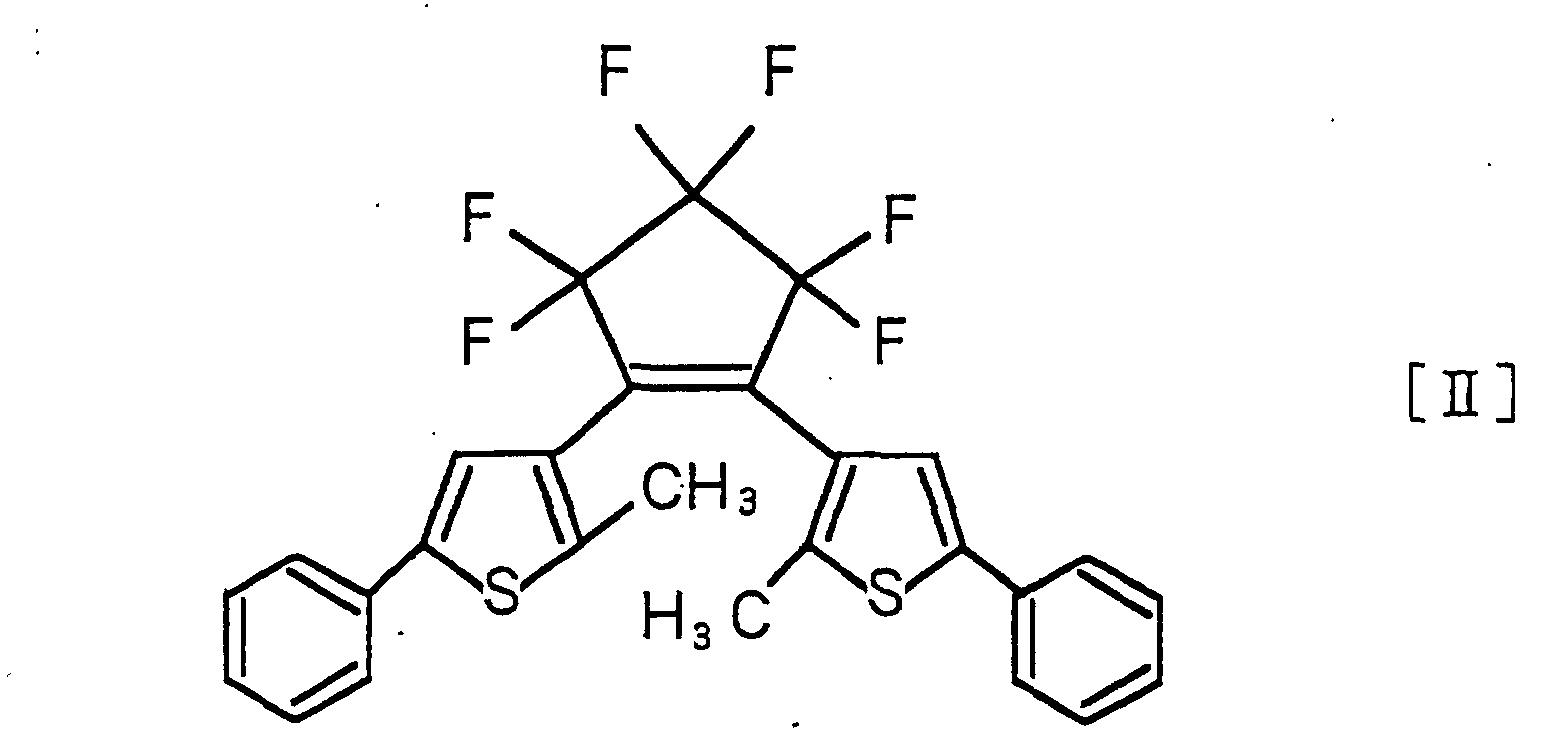
- the diheteroarylethene-based compound is 1,2-bis(5-phenyl-2-methylthiophene-3-yl)perfluorocyclopentene as expressed by the following formula [II]: or 1,2-bis(2,5-dimethylthiophene-3-yl)perfluorocyclopentene as expressed by the following formula [III]:
- the diheteroarylethene-based compound is transferred in phase from the open-ring form to the closed-ring form with irradiation of ultraviolet having a wave length of about 300-400nm, and transferred in phase from the closed-ring form to the open-ring form with visible-light irradiation.
- the open-ring form differs from the closed-ring form in the melting point thereof.
- 2-methylthiophene of 25.4g (0.258mol) and acetic acid of 300ml were poured into a four-necked flask having a capacity of 1000ml, and then kept at a temperature of 0°C with an ice bath.
- bromine of 82.5g (0.516mol) was slowly dropped into them with a dropping funnel, and acetic acid of 20ml was further added into them after the dropping, then the dropping funnel was washed.
- These ingredients were stirred for 30 minutes, while being kept at a temperature of 0°C. After that, the ice bath was removed and the ingredients were further stirred all night, while being warmed to a room temperature.
- the solution thus prepared was neutralized with sodium carbonate, added with a solution of sodium thiosulfate to perform ether extraction, washed with brine, and then dried with magnesium sulfate.
- the magnesium sulfate was removed by filtration after the drying and the ether was distilled off.
- the resultant was distilled under a reduced pressure in order further to separate a component having a boiling point 88 to 90°C.
- the yield of the compound (II) was 1.7g, the rate of the yielding was 31.4%, and the results of analyses about the melting point (m.p.), NMR, IR, molecular weight, etc. were as follows: m. p. : 1 3 9°C 1 H-NMR (200 MHz ) : ⁇ 7.75 , 7.30 (m, 10H, CH of P h), 7. 28 (s, 2H, CH of thiophene) , 1.97 (s, 6H, Me) 13 C-NMR (50MHz) : ⁇ 142.2, 141.1, 133.3, 125. 8, 109.
- the single crystal (II-A) of the compound (II) was obtained from a solution of the compound (II) in hexane by the solvent evaporation method.
- the single crystal (II-A) was transparent and colorless.
- the closed-ring forms of the compound (II-A) were formed by irradiating the above hexane solution with ultraviolet rays having a wavelength of 350 to 400nm, and, among the resulted closed-ring forms, only the blue one was extracted by the column chromatography. The extracted closed-ring form was dissolved into the hexane solution again, and then the closed-ring single crystal (II-B) was obtained from this solution by the solvent evaporation method.
- the melting point of the open-ring form (II-A) was 139°C and that of the closed-ring form (II-B) was 193°C.
- the melting point of the closed-ring form (II-B) went down to 130°C when it was irradiated with visible light having a wavelength of 500nm or less.
- the open-ring form (II-A) was irradiated with ultraviolet light having a wavelength of 350 to 400 nm, its melting point went up to 193°C.
- Fig. 1a This behavior of the melting point was almost the same as that of the mixture of both crystals (II-A) and (II-B) as shown in Fig. 1b.
- the closed-ring forms of the compound (III) were produced from a solution of compound (III) in hexane by irradiating the solution with ultraviolet rays having a wavelength of 313nm.
- the resulted closed-ring forms only the red one (III-B) was extracted by the column chromatography. The extracted closed-ring form was dissolved in hexane again, and then the closed-ring single crystal (III-B) was obtained from this solution by a solvent evaporation method.
- the melting point of the compound varies depending on the mixing ratio of the open-ring form and the closed-ring form.
- the physical properties of the compound such as the refractive index and the like, vary in cases that the compound is completely in liquid phase, completely in solid phase, or in solid-liquid mixed phase, and it is possible to take advantages of this feature of the compound to compose optical memory devices or display devices.
- the composition (mixture) becomes liquefied and changes in physical property, such as the refractive index and the permeability, from the original state. It is possible to take advantages of such changes of the physical properties of the compound to compose optical memory devices and display devices.
- the diheteroarylethene-based compound of the present invention reversibly changes in color with light irradiation and also changes in phase from the open-ring form in the crystalline state to the closed-ring form in the crystalline state, or from the closed-ring form in the crystalline state to the open-ring form in the crystalline state via the liquid state
- the compound can be applicable to optical recording media, display panels, sensors, optical switch devices and the like, by taking advantages of its variations in color and also its changes in physical property, such as the refractive index and the permeability, with its changes in phase.
- the compound in the liquid state or in the solid-liquid mixed state When the compound in the liquid state or in the solid-liquid mixed state is to be used for such applications as above, it may be sealed in a glass cell which is divided in many rooms in a grid-like arrangement or in a stripe-like arrangement, or sealed in glass cells which are independent of each other.
Landscapes
- Chemical & Material Sciences (AREA)
- Organic Chemistry (AREA)
- Physics & Mathematics (AREA)
- Nonlinear Science (AREA)
- General Physics & Mathematics (AREA)
- Optics & Photonics (AREA)
- Engineering & Computer Science (AREA)
- Materials Engineering (AREA)
- Heterocyclic Carbon Compounds Containing A Hetero Ring Having Oxygen Or Sulfur (AREA)
- Liquid Crystal (AREA)
- Non-Silver Salt Photosensitive Materials And Non-Silver Salt Photography (AREA)
Abstract
Description
- The present invention relates to a photo-induced phase transition organic material, more particularly to a photo-induced phase transition organic material composed of a diheteroarylethene-based compound in which the phase transition occurs in response to light irradiation in a crystalline state, especially even in a single-crystalline state.
- A photochromic material, which means the material containing a sort of molecule or molecular assembly from which two isomers having different colors are reversibly formed due to the action of light, has been expected as a photo-functional material since a variety of its physical properties, such as not only the color, but also the dielectric constant, the oxidation/reduction potential, etc., reversibly varies with light irradiation in connection with its photochromic reaction. Both photochromic molecules and molecular assemblies conventionally employed are to be transferred with light irradiation from colorless state to one-colored state in a solution or a macromolecular medium, such as red and blue, while method of applying various chemical modifications to the photochromic molecules have been studied in order to obtain the photochromic material which can develop various colors.
- The present invention has arisen from the detailed analysis of the mechanism of the photochromic reaction of diheteroarylethene-based compound which does not need any dispersion medium, and the object of the present invention is to provide a photo-induced phase transition organic material which utilizes the photochromic reaction of diheteroarylethene-based compound.
- The photo-induced phase transition organic material of the present invention is composed of a diheteroarylethene-based compound within which the photochromic reaction occurs in the crystalline state, especially in the single-crystalline state.
- On the other hand, conventional photochromic compound undergo the photochromic reaction in a state where they are dispersed or dissolved in a macromolecular film or a solvent, and there has been no photochromic compound which stably undergoes the photochromic reaction in a crystalline phase like the photochromic material of the present invention.
- Fig. 1a and 1b are phase diagrams illustrating the relationship between the open-ring form/ring-closure form rate of a compound (II) to be obtained in the following Example of
Synthesis 1 and its melting point, where Fig. 1a is a phase diagram in case of light irradiation and Fig. 1b is a phase diagram in case of a mixture. - Hereinafter, embodiments of the present invention will be described in detail.
- An example of the diheteroarylethene-based compound of the present invention is the one expressed by the following general formula [1]:

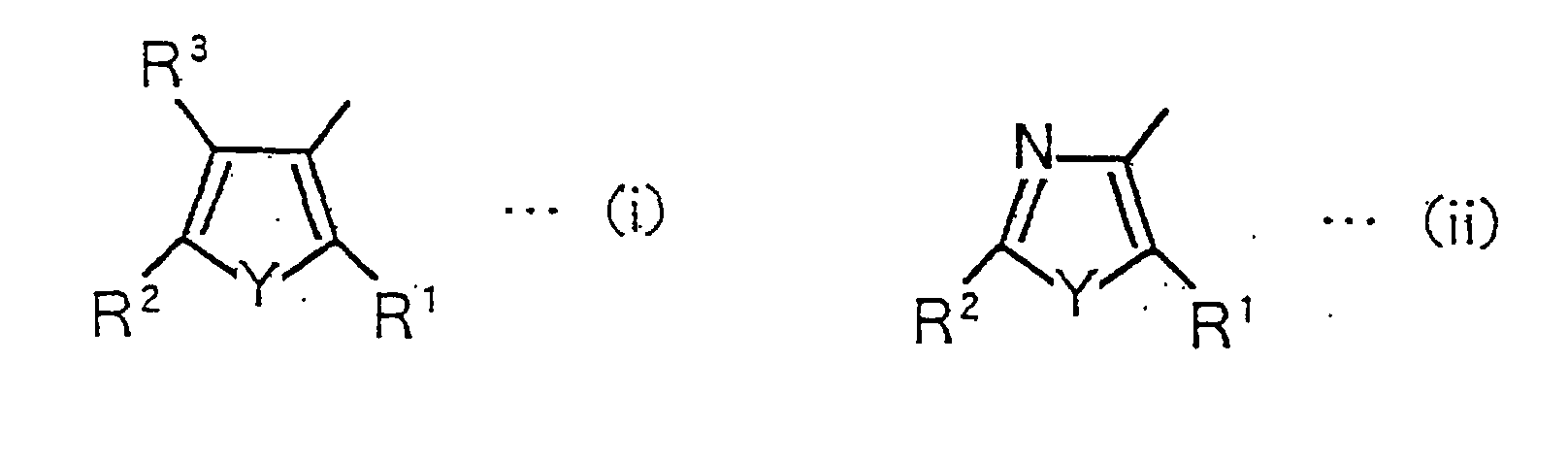
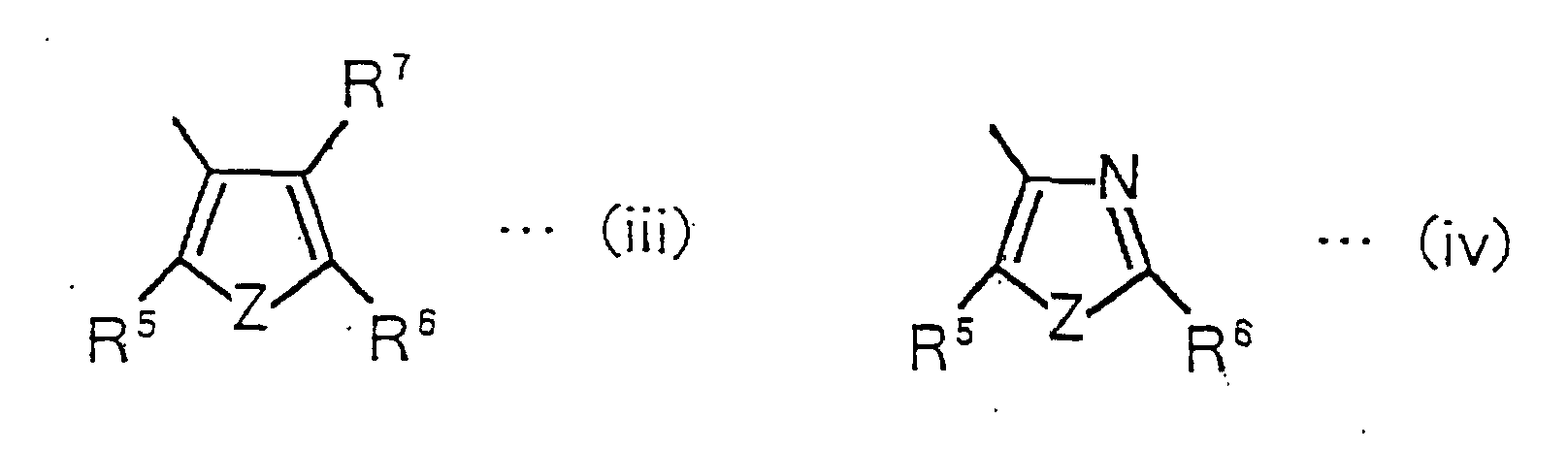
- In the general formula [I], "A" expresses a substituent (i) or (ii). In the substituents (i) and (ii), "R1" expresses an alkyl group, an alkoxyl group, a halogen atom, a trifluoromethyl group, a cyano group, or an aryl group which may have at least one substituent. "R2" and "R3" express a hydrogen atom, an alkyl group, an alkoxyl group, a halogen atom, a trifluoromethyl group, a cyano group, an aryl group which may have at least one substituent, respectively, wherein "R2" and "R3" are independent of each other. Alternatively, "R2" and "R3" may be bonded to each other to form a carbocyclic ring which may have at least one substituent, or a heterocyclic ring which may have at least one substituent. "Y" expresses ―O―, ―S―, or ― NR4― in which "R4" expresses a hydrogen atom, an alkyl group which may have at least one substituent, an aryl group which may have at least one substituent, or a cycloalkyl group which may have at least one substituent. "B" expresses a substituent (iii) or (iv). In the substituents (iii) and (iv), "R5" expresses an alkyl group, an alkoxyl group, a halogen atom, or a trifluoromethyl group. "R6" and "R7" express a hydrogen atom, an alkyl group, an alkoxyl group, a halogen atom, a trifluoromethyl group, a cyano group, or an aryl group which may have at least one substituent, respectively, wherein "R6" and "R7" are independent of each other. Alternatively, "R6" and "R7" may be bonded to each other to form a carbocyclic ring which may have at least one substituent, or a heterocyclic ring which may have at least one substituent. "Z" expresses―O―,―S―,or ―NR4― in which "R4" expresses a hydrogen atom, an alkyl group which may have at least one substituent, an aryl group which may have at least one substituent, or a cycloalkyl group which may have at least one substituent.
- Each of the above a compounds transfers in phase from a open-ring form to a closed-ring form with ultraviolet irradiation, while being in the crystalline state.
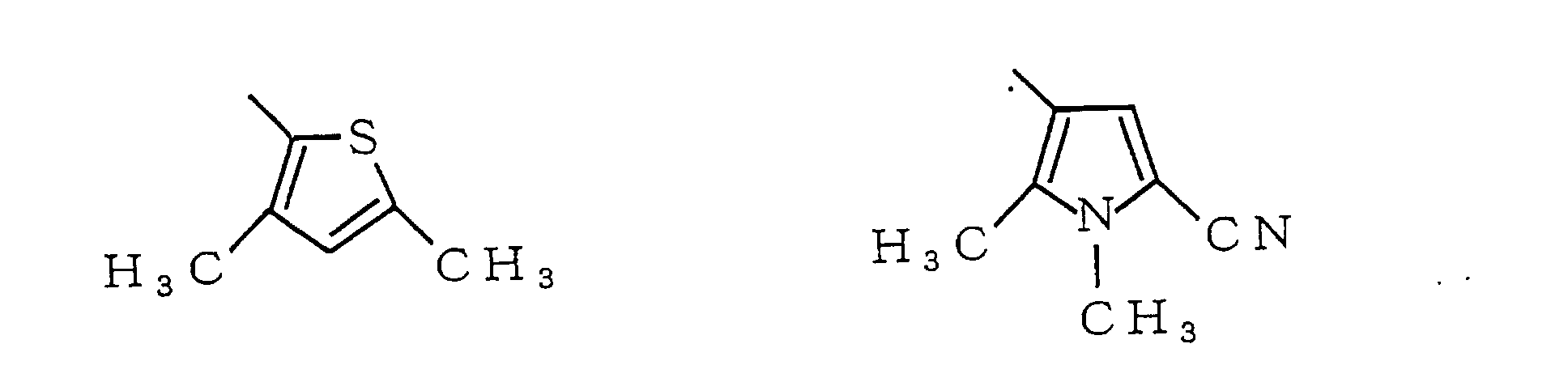
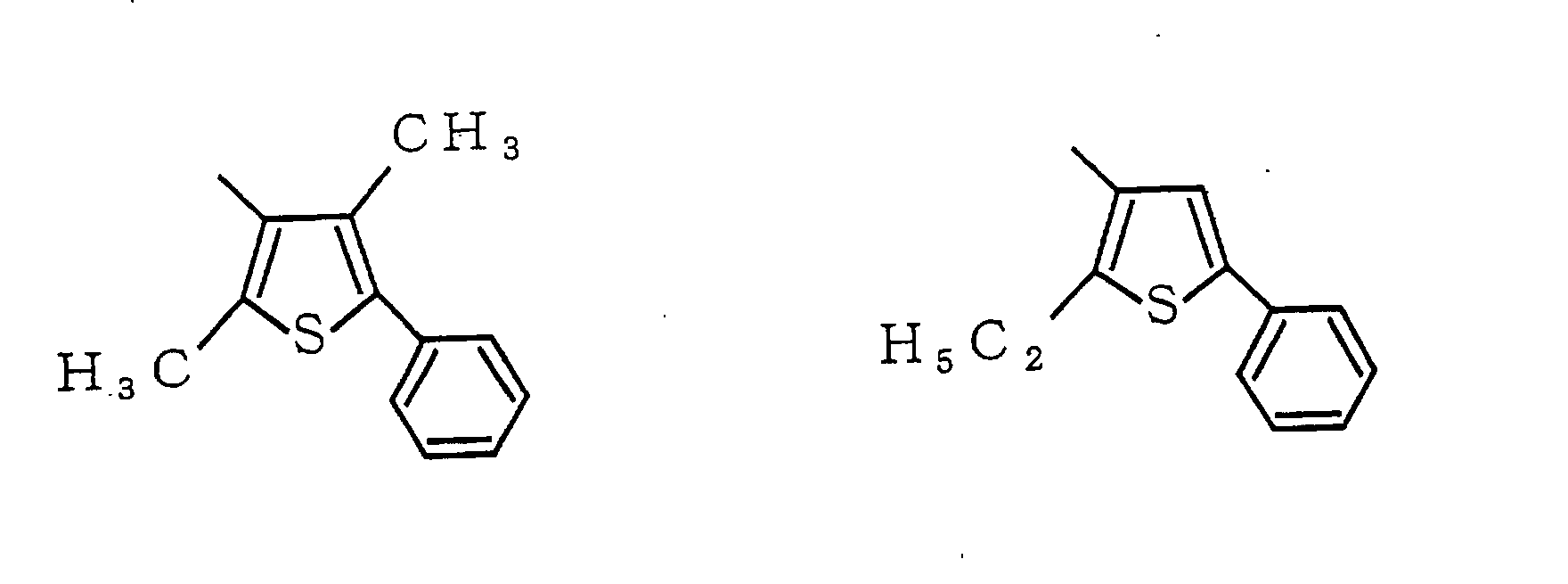
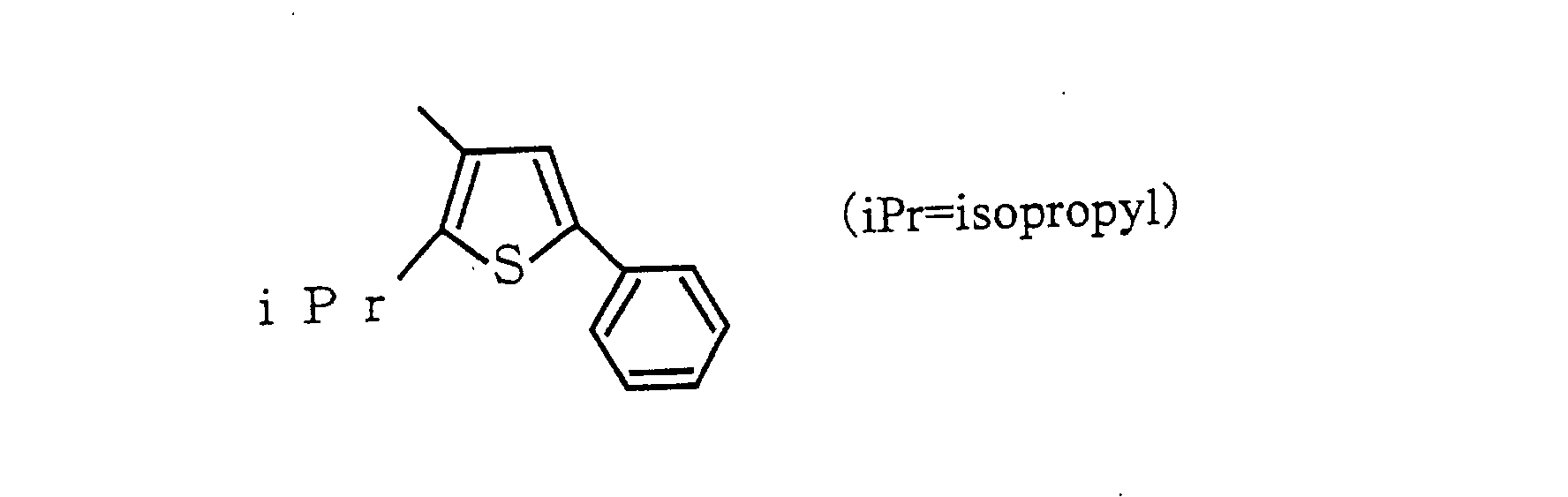
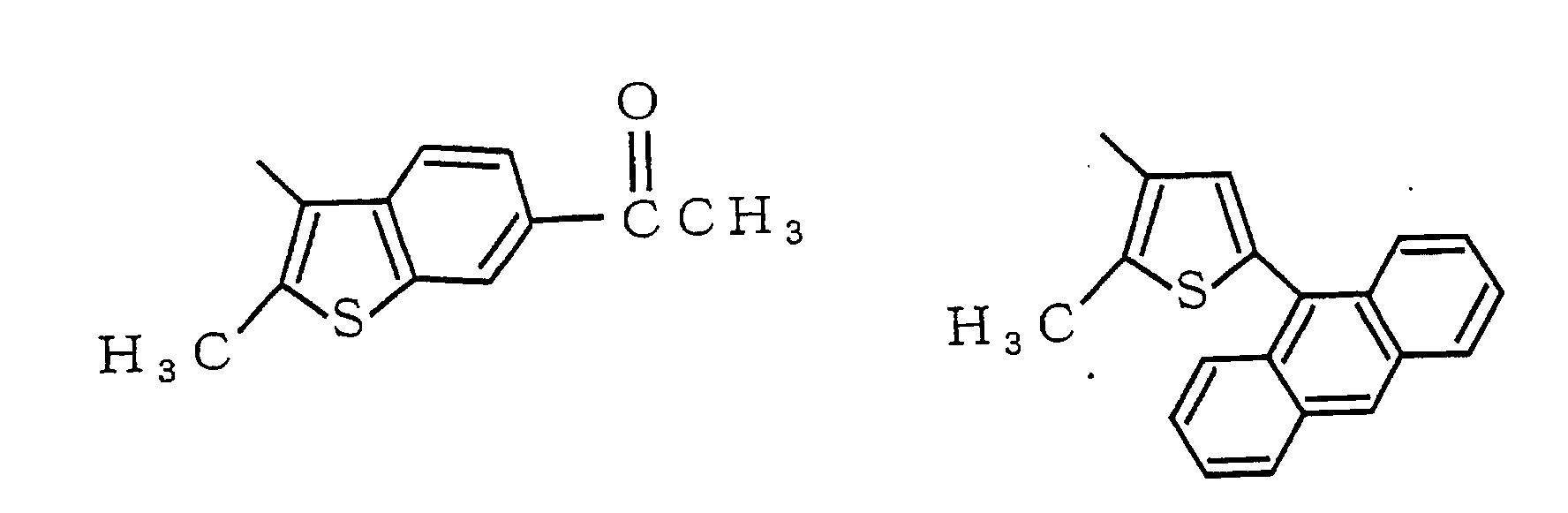
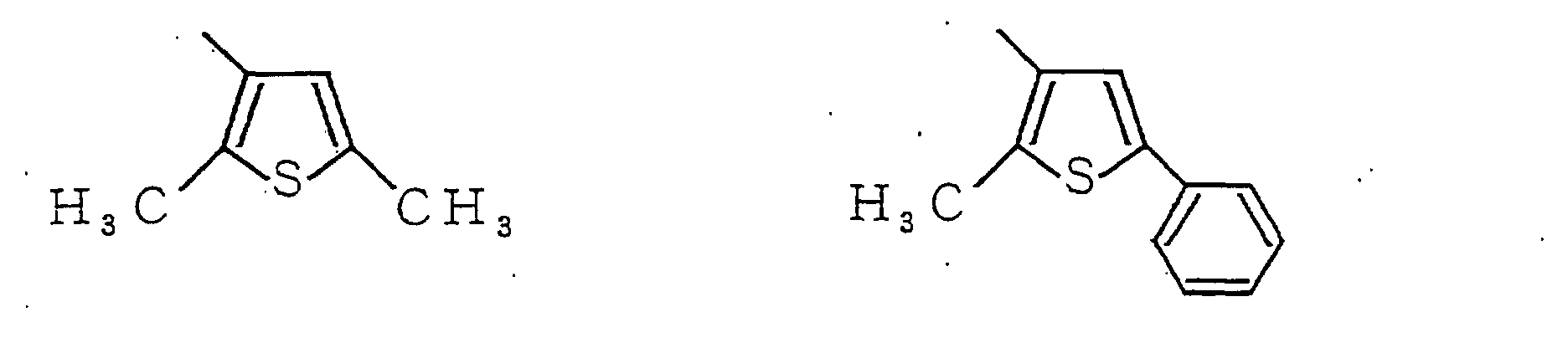
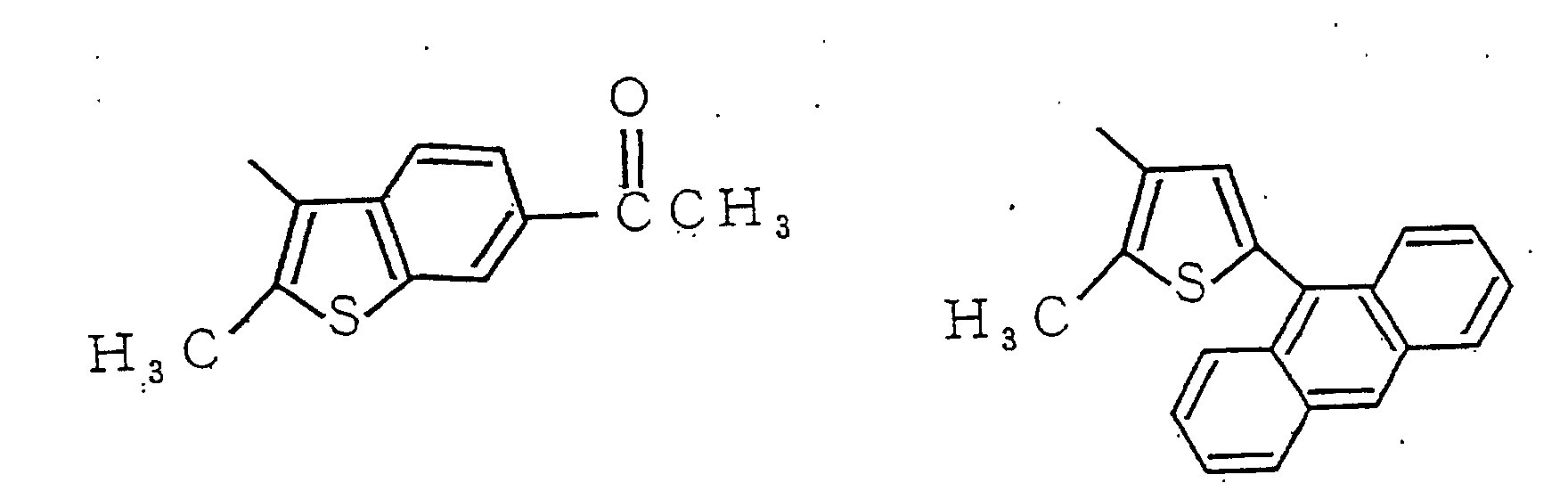
- In the above general formula [I], the following substituents may be employed as substituents A and B, wherein "R" expresses an alkyl group or a phenyl group.
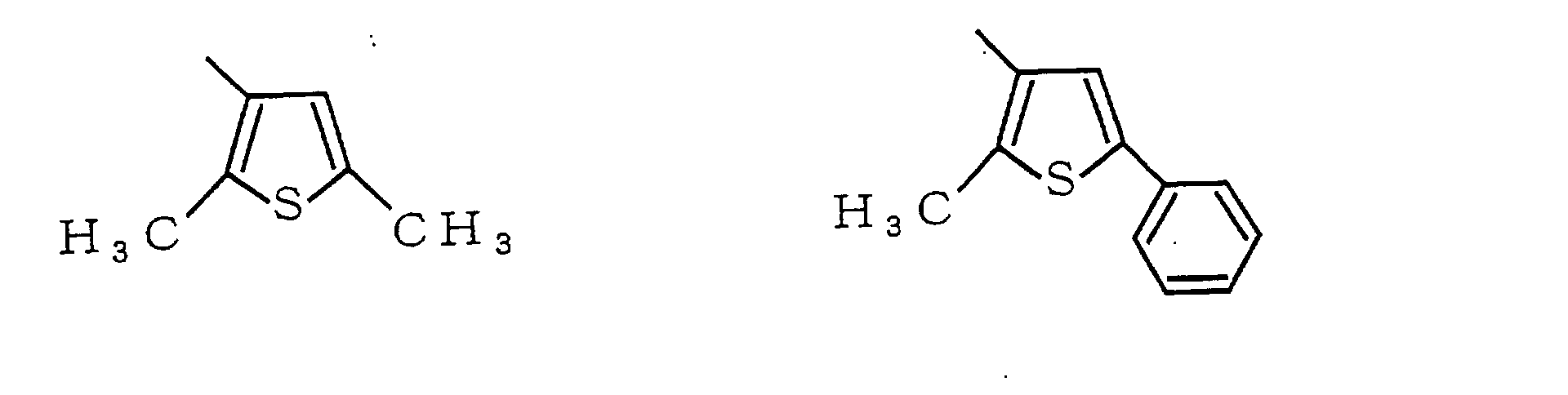


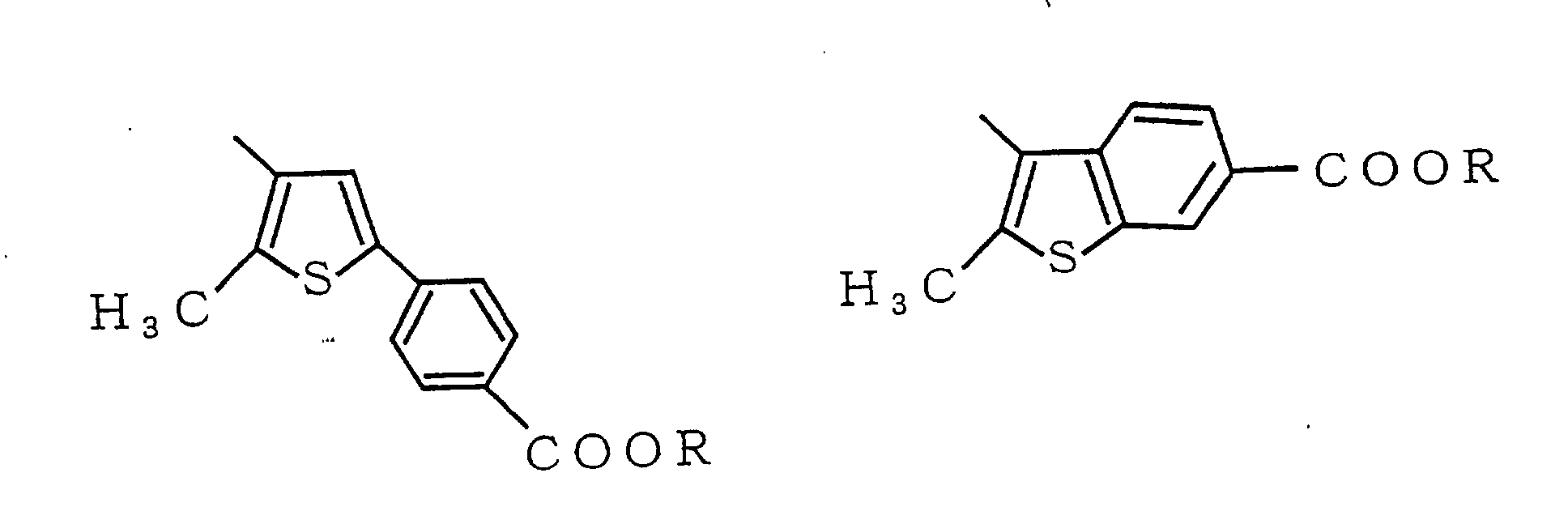

- The diheteroarylethene-based compound is 1,2-bis(5-phenyl-2-methylthiophene-3-yl)perfluorocyclopentene as expressed by the following formula [II]: or 1,2-bis(2,5-dimethylthiophene-3-yl)perfluorocyclopentene as expressed by the following formula [III]:


- The diheteroarylethene-based compound is transferred in phase from the open-ring form to the closed-ring form with irradiation of ultraviolet having a wave length of about 300-400nm, and transferred in phase from the closed-ring form to the open-ring form with visible-light irradiation. The open-ring form differs from the closed-ring form in the melting point thereof.
- Hereinafter, the present invention will be described in detail referring to examples of synthesis and examples of practice.
-
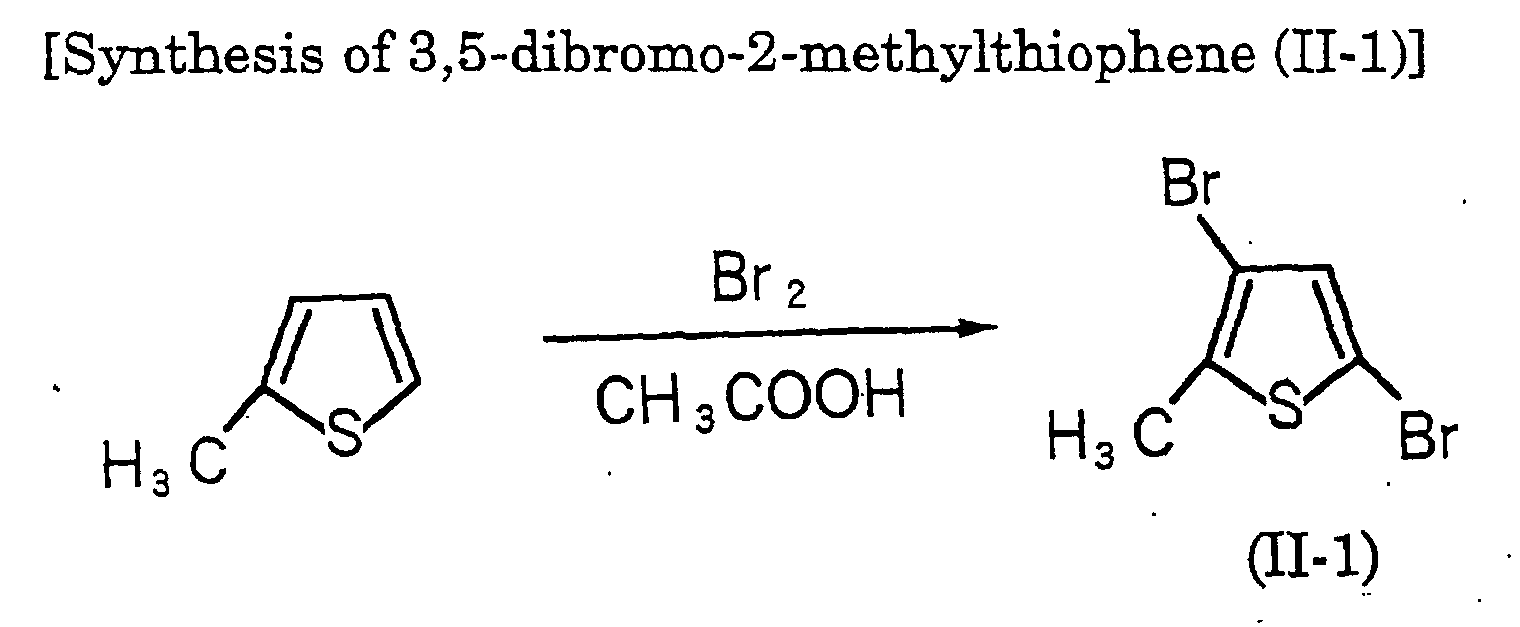
- 2-methylthiophene of 25.4g (0.258mol) and acetic acid of 300ml were poured into a four-necked flask having a capacity of 1000ml, and then kept at a temperature of 0°C with an ice bath. Secondly, bromine of 82.5g (0.516mol) was slowly dropped into them with a dropping funnel, and acetic acid of 20ml was further added into them after the dropping, then the dropping funnel was washed. These ingredients were stirred for 30 minutes, while being kept at a temperature of 0°C. After that, the ice bath was removed and the ingredients were further stirred all night, while being warmed to a room temperature. The solution thus prepared was neutralized with sodium carbonate, added with a solution of sodium thiosulfate to perform ether extraction, washed with brine, and then dried with magnesium sulfate. The magnesium sulfate was removed by filtration after the drying and the ether was distilled off. The remainder was developed with hexane to separate a component of Rf=0.83 by making use of a silica gel chromatographic column. The resultant was distilled under a reduced pressure in order further to separate a component having a boiling point 88 to 90°C. The yield of the compound (II-1) thus obtained was 34.7g, the rate of the yielding was 52.5%, and the results of NMR analysis were as follows:
1H-NMR (200 MHz, CDCl3, TMS)
δ=2. 34 (s, 3H, Me)
6. 86 (s, 1H, aromatic proton)
- The above compound (II-1) of 34.7g (0.136mol) and anhydrous ether of 500ml were poured in a three-necked flask having a capacity of 2000ml, and then cooled to -60°C or less. Secondly, 1.6N n-butylithium of 87.6ml was incorporated into these ingredients and stirred for 30 minutes. After addition of 54.6ml tri-n-butyl borate, the ingredients were kept at a temperature of -60°C or less for 4 hours, then warmed to a room temperature, stirred for 15 more hours, and further added with water to stop reaction. 1.2N hydrochloric acid was, then, added into the solution thus resulted in order to perform ether extraction. The ether phase thus appeared was further extracted with 1.0N sodium hydroxide solution. After that, the ether was removed, and then concentrated hydrochloric acid was added into the liquid phase until pH of the liquid phase corresponded to 1, while the liquid phase was kept 0°C, in order to separate the crystal. The crystal was filtered out by vacuum filtration and dried under reduced pressure, so that a compound (II-2) was obtained. The yield of the compound (II-2) was 21.6g, the rate of the yielding was 72.2%, and the results of NMR analysis were as follows:
1H-NMR (200MHz, CDCl3, TMS)
δ=2. 46 (s, 3H, Me)
7. 3 5 (s, 1H, aromatic proton)
- The above compound (II-2) of 10.0g (45.3mmol), tetrahydrofuran of 70ml, sodium carbonate solution (20% by weight) of 70ml, iodobenzene of 7.6ml (68.0mmol) and tetrakis(triphenylphosphine)palladium (0) of 2.36g were poured in a three-necked flask having a capacity of 500ml, and then heated under reflux at 70°C for 2.5 hours in an atmosphere of argon. The solution thus prepared, then, was cooled down to a room temperature, applied with ether extraction, washed with a solution saturated with sodium hydrogen carbonate and water, and further dried with magnesium sulfate. The magnesium sulfate was removed by filtration after the drying and the ether was distilled off. The remainder was developed and separated by hexane by making use of a silica gel chromatographic column, and then recrystallized, so that a compound (II-3) was obtained. The yield of the compound (II-3) was 6.6g, the rate of the yielding was 57.6%, and the results of NMR analysis were as follows:
1H-NMR (200MHz, CDCl3, TMS)
δ=2. 41 (s, 3H, Me)
7. 10 (s, 1H, aromatic proton)
7. 24-7. 71(m, 5H, aromatic proton)
- The above compound (II-3) of 6.6g (26.1mmol) and tetrahydrofuran of 200ml were poured into a three-necked flask having a capacity of 500ml, and kept at a temperature of -60°C or less. Secondly, 1.6N n-butylithium of 17.5ml (27.4mmol) was dropped into these ingredients slowly, drop by drop. After that, dropping funnel was washed with tetrahydrofuran of 10ml, and the solution thus prepared was stirred for 45 minutes. Perfluorocyclopentene of 0.9ml (11.7mmol), then, was slowly dropped into the solution, while the solution was kept at a temperature of -60°C or less. After being stirred for 2 hours, the solution was added with ethanol and water, while being warmed to a room temperature. The solution thus resulted was applied with ether extraction, washed with 1.2N hydrochloric acid and water, and further dried with magnesium sulfate. The magnesium sulfate was removed by filtration after the drying and the ether was distilled off. The remainder was developed and separated by hexane by making use of a silica gel chromatographic column, and then recrystallized, so that a compound (II) composed of colorless cubic crystal was obtained. The yield of the compound (II) was 1.7g, the rate of the yielding was 31.4%, and the results of analyses about the melting point (m.p.), NMR, IR, molecular weight, etc. were as follows:
m. p. : 1 3 9°C
1H-NMR (200 MHz ) : δ7.75 , 7.30 (m, 10H, CH of P h), 7. 28 (s, 2H, CH of thiophene) , 1.97 (s, 6H, Me) 13C-NMR (50MHz) :δ 142.2, 141.1, 133.3, 125. 8, 109. 8 (8C, Cq), 128.9, 127.8, 125.6 (10C, C H of Ph), 122.4 (2C, CH of thiophene) , 14.5 (2C, Me)
MS (m/z) : 520 (M+, 64), 505 (100), 490, 472, 385, 121, 77
IR (KBr) : 3080, 3020, 2910, 1450, 1340, 1270, 1390, 1340, 1310, 1050, 990, 890, 760,690cm - 1
anal. Calcd for C27H18F6S2: C62. 30; H3. 4 9
Found:C62. 66;H3. 72 -

- Water of 75ml, concentrated sulfuric acid of 18ml, iodine of 11.4g and iodic acid of 3.5g were mixed into a solution of 11.2g 2,5-dimethylthiophene in acetic acid of 100ml, while the solution was stirred at a room temperature. The mixture was under reflux at 70°C for 2 hours, and then the reaction mixture was cooled by ice water. The mixture, further, was applied with ether extraction, and its organic layer was washed with water, a solution of sodium carbonate and a solution of sodium thiosulfate, then dried with magnesium sulfate. After that, the solvent was distilled off, and the remainder was developed by hexane by making use of a silica gel chromatographic column to isolate 2,5-dimethyl-3-iodothiophene (III-1). The yield of the compound (III-1) was 16.6g, the rate of the yielding was 70%, and the results of NMR analysis were as follows:
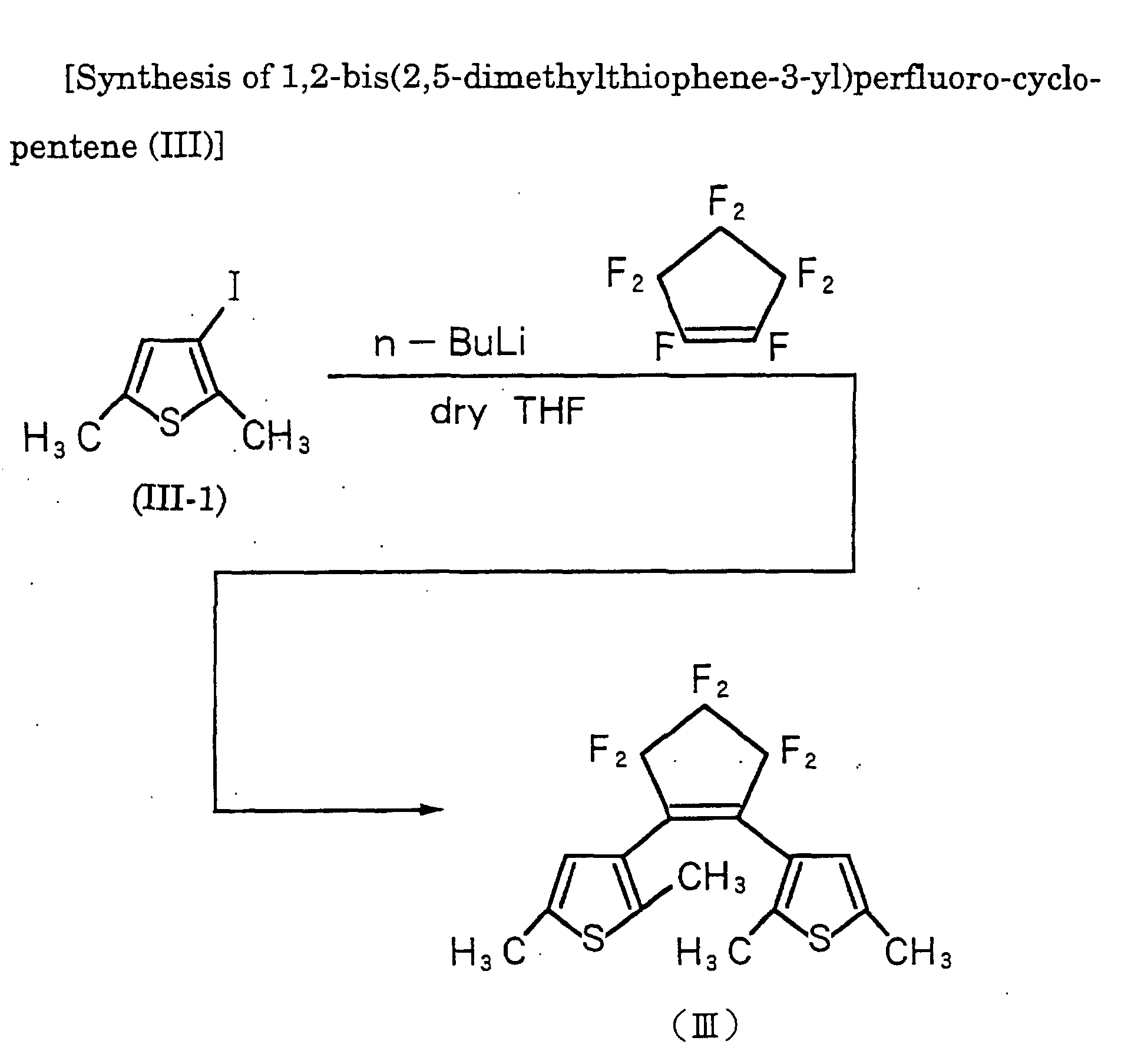
- A solution of 1.6N n-butylithium hexane of 36ml was dropped into a solution of 12.9g 2,5-dimethyl-3-iodothiophene (III-1) in xerotetrahydrofuran of 70ml, while the solution was cooled at -70°C by dry ice-methanol bath in an atmosphere of argon, the solution was stirred for one hour, and then 2.5ml perfluorocyclopentene was dropped into the solution in three steps at intervals of 30 minutes. After being cooled with water, the mixed solution was warmed to a room temperature, and then the solvent was distilled off. The mixture, further, was extracted by ether, washed with brine, and then dried with magnesium sulfate. After that, the solvent was distilled off, and the remainder was developed by hexane by making use of a silica gel chromatographic column and recrystallized to isolate 1,2-bis(2,5-dimethyl-thiophene-3-yl)perfluorocyclopentene (III). The yield of the compound (III) was 6.94g, the rate of the yielding was 65%, and the results of NMR analysis were as follows:
1H NMR (200MHz, CDCl3, TMS)
δ=1.81 (6H, s, Me)
2.41 (6H, s, Me)
6 .72 (2H, s , aromatic H) - The single crystal (II-A) of the compound (II) was obtained from a solution of the compound (II) in hexane by the solvent evaporation method. The single crystal (II-A) was transparent and colorless. On the other hand, the closed-ring forms of the compound (II-A) were formed by irradiating the above hexane solution with ultraviolet rays having a wavelength of 350 to 400nm, and, among the resulted closed-ring forms, only the blue one was extracted by the column chromatography. The extracted closed-ring form was dissolved into the hexane solution again, and then the closed-ring single crystal (II-B) was obtained from this solution by the solvent evaporation method.
- The melting point of the open-ring form (II-A) was 139°C and that of the closed-ring form (II-B) was 193°C. The melting point of the closed-ring form (II-B) went down to 130°C when it was irradiated with visible light having a wavelength of 500nm or less. On the other hand, when the open-ring form (II-A) was irradiated with ultraviolet light having a wavelength of 350 to 400 nm, its melting point went up to 193°C. The behavior of the melting point to irradiation of light is illustrated in Fig. 1a. This behavior of the melting point was almost the same as that of the mixture of both crystals (II-A) and (II-B) as shown in Fig. 1b.
- The closed-ring forms of the compound (III) were produced from a solution of compound (III) in hexane by irradiating the solution with ultraviolet rays having a wavelength of 313nm. Among the resulted closed-ring forms, only the red one (III-B) was extracted by the column chromatography. The extracted closed-ring form was dissolved in hexane again, and then the closed-ring single crystal (III-B) was obtained from this solution by a solvent evaporation method.
- When the closed-ring form (III-B) was irradiated with visible light having a wavelength of 450nm or more at a room temperature for 30 minutes, its crystal melted. Furthermore, when the irradiation was continued on, the closed-ring form was recrystallized. It was thus apparent that the closed-ring form melted and recrystallized by irradiation of light.
- It was apparent also from Figs. 1a and 1b that the melting point of the compound varies depending on the mixing ratio of the open-ring form and the closed-ring form. The physical properties of the compound, such as the refractive index and the like, vary in cases that the compound is completely in liquid phase, completely in solid phase, or in solid-liquid mixed phase, and it is possible to take advantages of this feature of the compound to compose optical memory devices or display devices. For example, when the compound (II) which is composed fully of the open-ring form is irradiated with ultraviolet rays, while being kept at 135°C, so as to transform 15% of its component to the closed-ring form, the composition (mixture) becomes liquefied and changes in physical property, such as the refractive index and the permeability, from the original state. It is possible to take advantages of such changes of the physical properties of the compound to compose optical memory devices and display devices.
- Since the diheteroarylethene-based compound of the present invention reversibly changes in color with light irradiation and also changes in phase from the open-ring form in the crystalline state to the closed-ring form in the crystalline state, or from the closed-ring form in the crystalline state to the open-ring form in the crystalline state via the liquid state, the compound can be applicable to optical recording media, display panels, sensors, optical switch devices and the like, by taking advantages of its variations in color and also its changes in physical property, such as the refractive index and the permeability, with its changes in phase.
- When the compound in the liquid state or in the solid-liquid mixed state is to be used for such applications as above, it may be sealed in a glass cell which is divided in many rooms in a grid-like arrangement or in a stripe-like arrangement, or sealed in glass cells which are independent of each other.
Claims (6)
- A photo-induced phase transition organic material composed of a diheteroarylethene-based compound within which the photochromic reaction occurs in the crystalline state.
- A photo-induced phase transition organic material as claimed in claim 1, wherein said diheteroarylethene-based compound is the one expressed by the following general formula [I]:

 In the general formula [I], "A" expresses a substituent (i) or (ii). In the substituents (i) and (ii), "R1" expresses an alkyl group, an alkoxyl group, a halogen atom, a trifluoromethyl group, a cyano group, or an aryl group which may have at least one substituent. "R2" and "R3" express a hydrogen atom, an alkyl group, an alkoxyl group, a halogen atom, a trifluoromethyl group, a cyano group, or an aryl group which may have at least one substituent, respectively, wherein "R2" and "R3" are independent of each other. Alternatively, "R2" and "R3" are bonded to be a carbocyclic ring which may have at least one substituent, or a heterocyclic ring which may have at least one substituent. "Y" expresses ―O―, ―S―, or ―NR4― in which "R4" expresses a hydrogen atom, an alkyl group which may have at least one substituent, an aryl group which may have at least one substituent, or a cycloalkyl group which may have at least one substituent. "B" expresses a substituent (iii) or (iv). In the substituents (iii) and (iv), "R5" expresses an alkyl group, an alkoxyl group, a halogen atom, or a trifluoromethyl group. "R6" and "R7" express a hydrogen atom, an alkyl group, an alkoxyl group, a halogen atom, a trifluoromethyl group, a cyano group, or an aryl group which may have at least one substituent, respectively, wherein "R6" and "R7" are independent of each other. Alternatively, "R6" and "R7" are bonded to be a carbocyclic ring which may have at least one substituent, or a heterocyclic ring which may have at least one substituent. "Z" expresses ―O―, ―S―, or ―NR4― in which "R4" expresses a hydrogen atom, an alkyl group which may have at least one substituent, an aryl group which may have at least one substituent, or a cycloalkyl group which may have at least one substituent.
- A photo-induced phase transition organic material as claimed in claim 2, wherein each of said substituents A and B is selected from the following substituents in which "R" expresses an alkyl group or a phenyl group:


- A photo-induced phase transition organic material as claimed in claim 3, wherein the diheteroarylethene-based compound is 1,2-bis(5-phenyl-2-methylthiophene-3-yl)perfluorocyclopentene as expressed by the following formula [II]:
- A photo-induced phase transition organic material as claimed in claim 3, wherein the diheteroarylethene-based compound is 1,2-bis(2,5-dimethylthiophene-3-yl)perfluorocyclopentene as expressed by the following formula [III]:

- A photo-induced phase transition organic material as claimed in any one of claims 1 through 5, wherein the diheteroarylethene-based compound is to be transferred in phase from the open-ring form to the closed-ring form with ultraviolet irradiation, and to be transferred in phase from the closed-ring form to the open-ring form with visible-light irradiation.
Applications Claiming Priority (3)
| Application Number | Priority Date | Filing Date | Title |
|---|---|---|---|
| JP6440799 | 1999-03-11 | ||
| JP11064407A JP2000256663A (en) | 1999-03-11 | 1999-03-11 | Light-induced phase change organic materials |
| PCT/JP2000/001330 WO2000053693A1 (en) | 1999-03-11 | 2000-03-06 | Organic material undergoing light-induced phase transition |
Publications (2)
| Publication Number | Publication Date |
|---|---|
| EP1167487A1 true EP1167487A1 (en) | 2002-01-02 |
| EP1167487A4 EP1167487A4 (en) | 2005-10-05 |
Family
ID=13257436
Family Applications (1)
| Application Number | Title | Priority Date | Filing Date |
|---|---|---|---|
| EP00906713A Withdrawn EP1167487A4 (en) | 1999-03-11 | 2000-03-06 | ORGANIC MATERIAL SUBJECTING A LIGHT-INDUCED PHASE TRANSITION |
Country Status (6)
| Country | Link |
|---|---|
| US (2) | US6660868B2 (en) |
| EP (1) | EP1167487A4 (en) |
| JP (1) | JP2000256663A (en) |
| AU (1) | AU2829500A (en) |
| CA (1) | CA2365585C (en) |
| WO (1) | WO2000053693A1 (en) |
Cited By (1)
| Publication number | Priority date | Publication date | Assignee | Title |
|---|---|---|---|---|
| WO2004003107A1 (en) * | 2002-06-28 | 2004-01-08 | Qinetiq Limited | Potochromic liquid crystals |
Families Citing this family (5)
| Publication number | Priority date | Publication date | Assignee | Title |
|---|---|---|---|---|
| JP2000256663A (en) * | 1999-03-11 | 2000-09-19 | Masahiro Irie | Light-induced phase change organic materials |
| DE60238405D1 (en) * | 2001-06-15 | 2011-01-05 | Masahiro Irie | PHOTOCHROMES MATERIALS AND SOLE BASED COLOR DOSIMETERS |
| JP5337927B2 (en) * | 2007-09-26 | 2013-11-06 | 国立大学法人兵庫教育大学 | Photochromic compound and photoreversible coloring composition |
| US20210231836A1 (en) * | 2019-02-28 | 2021-07-29 | BAE Systems Information and Electronic Systerms Integration Inc. | Optically induced phase change materials |
| CN114767549B (en) * | 2022-05-14 | 2023-03-14 | 日照沪鸽生物材料有限公司 | Photochromic dental composite material and preparation method thereof |
Family Cites Families (8)
| Publication number | Priority date | Publication date | Assignee | Title |
|---|---|---|---|---|
| JP3491704B2 (en) * | 1994-10-21 | 2004-01-26 | 入江 正浩 | Dithienylethene compound and photochromic material comprising the compound |
| JPH09241625A (en) * | 1996-03-08 | 1997-09-16 | Masahiro Irie | Photochromic material, optical recording medium using the same, information record and readout using the medium |
| JP3956420B2 (en) * | 1997-03-07 | 2007-08-08 | 入江 正浩 | Visible transparent photochromic material |
| JP3538019B2 (en) * | 1998-03-11 | 2004-06-14 | 独立行政法人 科学技術振興機構 | Photochromic crystal material |
| JPH11311813A (en) * | 1998-04-28 | 1999-11-09 | Kyocera Corp | Optical function element |
| JP2000047270A (en) * | 1998-07-30 | 2000-02-18 | Kyocera Corp | Optical function element |
| JP3696414B2 (en) * | 1998-09-11 | 2005-09-21 | 独立行政法人科学技術振興機構 | Photochromic crystal material |
| JP2000256663A (en) * | 1999-03-11 | 2000-09-19 | Masahiro Irie | Light-induced phase change organic materials |
-
1999
- 1999-03-11 JP JP11064407A patent/JP2000256663A/en active Pending
-
2000
- 2000-03-06 AU AU28295/00A patent/AU2829500A/en not_active Abandoned
- 2000-03-06 EP EP00906713A patent/EP1167487A4/en not_active Withdrawn
- 2000-03-06 CA CA002365585A patent/CA2365585C/en not_active Expired - Fee Related
- 2000-03-06 WO PCT/JP2000/001330 patent/WO2000053693A1/en not_active Ceased
-
2001
- 2001-08-13 US US09/927,931 patent/US6660868B2/en not_active Expired - Fee Related
-
2003
- 2003-12-09 US US10/730,252 patent/US20040133010A1/en not_active Abandoned
Non-Patent Citations (2)
| Title |
|---|
| No further relevant documents disclosed * |
| See also references of WO0053693A1 * |
Cited By (2)
| Publication number | Priority date | Publication date | Assignee | Title |
|---|---|---|---|---|
| WO2004003107A1 (en) * | 2002-06-28 | 2004-01-08 | Qinetiq Limited | Potochromic liquid crystals |
| US7416682B2 (en) | 2002-06-28 | 2008-08-26 | Chi Mei Optoelectronics Corporation | Photochromic liquid crystals |
Also Published As
| Publication number | Publication date |
|---|---|
| AU2829500A (en) | 2000-09-28 |
| US20020007072A1 (en) | 2002-01-17 |
| WO2000053693A1 (en) | 2000-09-14 |
| CA2365585C (en) | 2005-07-05 |
| CA2365585A1 (en) | 2000-09-14 |
| US6660868B2 (en) | 2003-12-09 |
| JP2000256663A (en) | 2000-09-19 |
| US20040133010A1 (en) | 2004-07-08 |
| EP1167487A4 (en) | 2005-10-05 |
Similar Documents
| Publication | Publication Date | Title |
|---|---|---|
| EP1367111B1 (en) | Photochromic material | |
| JPWO2007105699A1 (en) | Dithienylcyclopentene compound, styrene polymer having dithienylcyclopentene, photochromic material, and optical functional device | |
| EP1517977B1 (en) | Photochromic liquid crystals | |
| JP2002241757A (en) | Chiral doping agents for inducing variable helical pitch and use of the agents for reflective color displays | |
| US6660868B2 (en) | Photo-induced phase transition organic material | |
| CN114213296A (en) | Naphthalene series liquid crystal monomer compound containing isothiocyanato, and preparation method and application thereof | |
| Xie et al. | Combination of fluorescent switch and electrochemical switch based on a photochromic diarylethene | |
| Kobatake et al. | The irreversible thermo-bleaching function of a photochromic diarylethene having trimethylsilyl groups | |
| CN105348308B (en) | Bridged bis-boron fluoride complex dipyrromethene derivative containing fluorene at meso-position and preparation method thereof | |
| TWI478911B (en) | 2,5-selenophene derivatives and 2,5-TELLUROPHENE derivatives | |
| CN103333674B (en) | There is diaryl ethylene photochromic compound and the synthetic method of Electric Field Modulated function | |
| JPH0971585A (en) | Diarylethane-based compound having ethynyl group | |
| JPH09241254A (en) | Amorphous photochromic material and optical recording medium using the same | |
| US5563298A (en) | Stilbene-based materials, their preparation and use | |
| Shi et al. | Synthesis and characterizations of novel spindle-like terphenyl-type chromophores for non-linear optical materials | |
| JPH05507724A (en) | naphthyl organic compound | |
| JPH1045732A (en) | Diarylethene derivative and photochromic material using the same | |
| Sporer et al. | Synthesis, X-ray structure, EPR and optical properties of a ferrocene substituted polychlorotriphenylmethyl radical | |
| La et al. | Electrochromic properties based on oligothiophene derivatives | |
| JPH03271286A (en) | Benzothiophene derivative | |
| CN119874575B (en) | A photochromic cyano-containing fluorescent dye and its preparation | |
| JPH0314538A (en) | Production of diarylmaleic acid derivative and diarylethene | |
| JPH0977743A (en) | 2,3-diarylquinone and its production | |
| JPH07330762A (en) | Diarylethene-based compound having quinolyl group | |
| JPH115972A (en) | Photochromic material |
Legal Events
| Date | Code | Title | Description |
|---|---|---|---|
| PUAI | Public reference made under article 153(3) epc to a published international application that has entered the european phase |
Free format text: ORIGINAL CODE: 0009012 |
|
| 17P | Request for examination filed |
Effective date: 20010824 |
|
| AK | Designated contracting states |
Kind code of ref document: A1 Designated state(s): AT BE CH CY DE DK ES FI FR GB GR IE IT LI LU MC NL PT SE |
|
| RBV | Designated contracting states (corrected) |
Designated state(s): DE FR GB |
|
| RAP1 | Party data changed (applicant data changed or rights of an application transferred) |
Owner name: JAPAN SCIENCE AND TECHNOLOGY AGENCY |
|
| A4 | Supplementary search report drawn up and despatched |
Effective date: 20050823 |
|
| RIC1 | Information provided on ipc code assigned before grant |
Ipc: 7G 02F 1/17 B Ipc: 7C 07D 333/12 B Ipc: 7G 02B 5/23 B Ipc: 7C 09K 9/02 A |
|
| 17Q | First examination report despatched |
Effective date: 20070904 |
|
| STAA | Information on the status of an ep patent application or granted ep patent |
Free format text: STATUS: THE APPLICATION IS DEEMED TO BE WITHDRAWN |
|
| 18D | Application deemed to be withdrawn |
Effective date: 20151001 |