EP1167419A2 - Production process of polyphenylene ether - Google Patents
Production process of polyphenylene ether Download PDFInfo
- Publication number
- EP1167419A2 EP1167419A2 EP01202376A EP01202376A EP1167419A2 EP 1167419 A2 EP1167419 A2 EP 1167419A2 EP 01202376 A EP01202376 A EP 01202376A EP 01202376 A EP01202376 A EP 01202376A EP 1167419 A2 EP1167419 A2 EP 1167419A2
- Authority
- EP
- European Patent Office
- Prior art keywords
- oxygen
- containing gas
- mpa
- compound
- reaction vessel
- Prior art date
- Legal status (The legal status is an assumption and is not a legal conclusion. Google has not performed a legal analysis and makes no representation as to the accuracy of the status listed.)
- Granted
Links
Classifications
-
- C—CHEMISTRY; METALLURGY
- C08—ORGANIC MACROMOLECULAR COMPOUNDS; THEIR PREPARATION OR CHEMICAL WORKING-UP; COMPOSITIONS BASED THEREON
- C08G—MACROMOLECULAR COMPOUNDS OBTAINED OTHERWISE THAN BY REACTIONS ONLY INVOLVING UNSATURATED CARBON-TO-CARBON BONDS
- C08G65/00—Macromolecular compounds obtained by reactions forming an ether link in the main chain of the macromolecule
- C08G65/34—Macromolecular compounds obtained by reactions forming an ether link in the main chain of the macromolecule from hydroxy compounds or their metallic derivatives
- C08G65/38—Macromolecular compounds obtained by reactions forming an ether link in the main chain of the macromolecule from hydroxy compounds or their metallic derivatives derived from phenols
- C08G65/44—Macromolecular compounds obtained by reactions forming an ether link in the main chain of the macromolecule from hydroxy compounds or their metallic derivatives derived from phenols by oxidation of phenols
Definitions
- the invention relates to a process for actualizing efficient production of a polyphenylene ether.
- the second proposal is to solubilize the water by using a solvent which has compatibility therewith.
- This process is well known in the art.
- methanol is often employed.
- the polyphenylene ether obtained using a solvent system composed solely of methanol has however too low of a molecular weight to draw attention as an industrial product. Since the solvent, such as methanol, having compatibility with water is often a poor solvent for a polyphenylene ether, precipitation thereof occurs while its molecular weight is still low. Thus, the molecular weight cannot be increased as is expected.
- a polyphenylene ether is therefore often produced in a mixed solvent system containing a solvent having compatibility with the polyphenylene ether. This however requires complex solvent-collecting equipment.
- the third proposal is to impart the catalyst itself with water resistance.
- a process slightly improved in water resistance of the catalyst can be found in U.S. Patent No. 4,028,341, 4,092,294 or 4,788,277, but in such a process, the catalyst has not yet acquired complete water resistance.
- a dehydrating agent such as magnesium sulfate to a polymer mixture, use of molecular sieves, and the like (JP-B-44-27831). By removing water, the activity of the catalyst can be maintained.
- a dehydrating agent such as magnesium sulfate
- An object of the present invention is to provide an effective removing method of water generated upon production of a polyphenylene ether by reacting oxygen with a phenol compound in the presence of a catalyst, thereby providing a highly efficient production process of the polyphenylene ether.
- the phenol compound to be used in the invention is a compound having a structure represented by the following formula (2): (wherein, R 6 represents an alkyl, substituted alkyl, aralkyl, substituted aralkyl, aryl, substituted aryl, alkoxy or substituted alkoxy group, R 7 represents, in addition to those described for R 6 , a halogen atom, and R 8 represent, in addition to those described for R 7 , hydrogen).
- Examples of such a compound include 2,6-dimethylphenol, 2,3,6-trimethylphenol, 2-methyl-6-ethylphenol, 2,6-diethylphenol, 2-ethyl-6-n-propylphenol, 2-methyl-6-chlorophenol, 2-methyl-6-bromophenol, 2-methyl-6-isopropylphenol, 2-methyl-6-n-propylphenol, 2-ethyl-6-bromophenol, 2-methyl-6-n-butylphenol, 2,6-di-n-propylphenol, 2-ethyl-6-chlorophenol, 2-methyl-6-phenylphenol, 2,6-diphenylphenol, 2,6-bis-(4-fluorophenyl)phenol, 2-methyl-6-tolylphenol and 2,6-ditolylphenol.
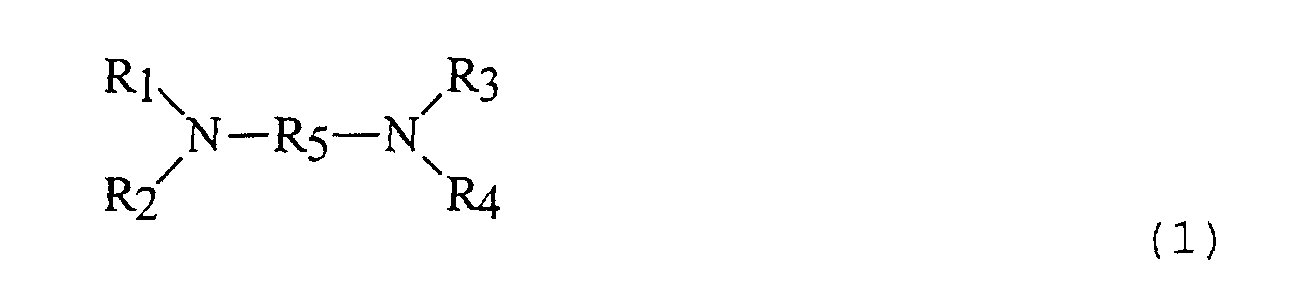
- a catalyst system comprising a copper compound, a bromine compound, a diamine compound represented by the following formula (1): (wherein, R 1 , R 2 , R 3 and R 4 each independently represents hydrogen or a C 1-6 linear or branched alkyl group with the proviso that they do not represent hydrogen simultaneously, and R 5 represents a linear or methyl-branched C 2-5 alkylene group), a tertiary monoamine compound and a secondary monoamine compound must be used. It was found that in the production process using this catalyst, remarkable activity improving effects are brought about within a pressure range and oxygen partial pressure range as specified by the present invention. This phenomenon is so surprising as to exceed usual expectation.
- a cuprous compound and a cupric compound and a mixture thereof can be used as the copper compound.
- cuprous compound examples include cuprous oxide, cuprous chloride, cuprous bromide, cuprous sulfate and cuprous nitrate
- cupric compound examples include cupric chloride, cupric bromide, cupric sulfate and cupric nitrate
- cuprous oxide, cuprous chloride, cupric chloride, cuprous bromide and cupric bromide are preferred.
- copper salts may be obtained upon use by the synthesis of an oxide, carbonate or hydroxide of copper and a corresponding halogen or acid. For example, such a copper salt is available by mixing cuprous oxide and hydrogen bromide (aqueous solution thereof).
- cuprous compounds are particularly preferred. These copper compounds may be used either singly or in combination.
- bromine compound examples include hydrogen bromide, sodium bromide, potassium bromide, tetramethylammonium bromide and tetraethylammonium bromide. These compounds may be used as an aqueous solution or a solution in a suitable solvent. These bromine compounds may be used singly or in combination.
- the most preferred combination of the copper compound and the bromine compound is that of cuprous oxide and an aqueous solution of hydrogen bromide.
- the bromine atom is at least 2 times the molar amount but not greater than 10 times the molar amount of copper atom, the copper atom falling within a range of 0.02 to 0.6 mole based on 100 moles of the phenol compound.
- Examples of the secondary monoamine compound include dimethylamine, diethylamine, di-n-propylamine, di-i-propylamine, di-n-butylamine, di-i-butylamine, di-t-butylamine, dipentylamines, dihexylamines, dioctylamines, didecylamines, dibenzylamines, methylethylamine, methylpropylamine, methylbutylamine and cyclohexylamine.
- N-(substituted or unsubstituted phenyl)alkanolamine examples include N-phenylmethanolamine, N-phenylethanolamine, N-phenylpropanolamine, N-(m-methylphenyl)ethanolamine, N-(p-methylphenyl)ethanolamine, N-(2',6'-dimethylphenyl)ethanolamine and N-(p-chlorophenyl)ethanolamine.
- Examples of the N-(hydrocarbon-substituted)aniline include N-ethylaniline, N-butylaniline, N-methyl-2-methylaniline, N-methyl-2,6-dimethylaniline and diphenylamine.
- These secondary monoamine compounds are however not limited to these examples. They may be used either singly or in combination. Although no particular limitation is imposed on the amount, it is usually added in an amount ranging from 0.05 to 15 moles based on 100 moles of the phenol compound.
- the diamine compound to be used in the invention has a structure represented by the following formula (1): wherein R 1 , R 2 , R 3 and R 4 each independently represents hydrogen or a C 1-6 linear or branched alkyl group, with the proviso that they do not represent a hydrogen atom at the same time, and R 5 represents a C 2-5 linear or methyl-branched alkylene group).
- N,N'-di-t-butylethylenediamine is preferred.
- the amount of the diamine compound it is preferably added in an amount of at least 0.5 time the molar amount of the copper atom to be ordinarily used.
- the upper limit is not critical.
- aliphatic tertiary amines including alicyclic tertiary amines can be used.
- examples include trimethylamine, triethylamine, tripropylamine, tributylamine, triisobutylamine, dimethylethylamine, dimethylpropylamine, allyldiethylamine, dimethyl-n-butylamine, diethylisopropylamine and N-methylcyclohexylamine.
- These tertiary monoamines may be used either singly or in combination. Although no particular limitation is imposed on the amount thereof, an amount ranging from 0.1 to 15 moles relative to 100 moles of the phenol compound is preferred.
- Such a solvent examples include aromatic hydrocarbons such as benzene, toluene, xylene and ethylbenzene, hydrocarbon halides such as chloroform, methylene chloride, 1,2-dichloroethane, trichloroethane, chlorobenzene, dichlorobenzene and trichlorobenzene; and nitro compounds such as nitrobenzene. They may be used as a good solvent for the polymer.
- aromatic hydrocarbons such as benzene, toluene, xylene and ethylbenzene
- hydrocarbon halides such as chloroform, methylene chloride, 1,2-dichloroethane, trichloroethane, chlorobenzene, dichlorobenzene and trichlorobenzene
- nitro compounds such as nitrobenzene. They may be used as a good solvent for the polymer.
- Examples of the poor solvent for the polymer include aliphatic hydrocarbons such as pentane, hexane, heptane, cyclohexane and cycloheptane and ethers such as tetrahydrofuran and diethyl ether.
- a solvent having compatibility with water can be mixed in an amount that does not disturb the advantages of the present invention.
- a solvent include alcohols such as methanol, ethanol and propanol, ketones such as acetone and methyl ethyl ketone, esters such as ethyl acetate and ethyl formate, amides such as dimethylformamide and sulfoxides such as dimethylsulfoxide. These solvents may be used singly or if necessary, as a mixture.
- the solvent to be used in the present invention exhibits particularly desirable activity under the conditions substantially free of compatibility with water.
- Aromatic hydrocarbon solvents such as toluene and xylene are frequently employed as a solvent.
- the polymerization method becomes a solution polymerization at a specific ratio of good solvent to poor solvent for a polyphenylene ether which is a polymer available by oxidative polymerization of a phenol compound.
- the method becomes a precipitation polymerization wherein the polymer is precipitated as particles in the reaction solvent with the progress of the reaction.
- the invention is attained by using the above-described catalyst, controlling the absolute pressure at the gaseous phase portion of the reaction vessel to a range of from 0.098 MPa (mega pascal) to less than 0.392 MPa, and feeding a reaction vessel with an oxygen-containing gas having an oxygen partial pressure, in terms of an absolute pressure, of from 0.0147 MPa to 0.0883 MPa.
- the oxygen concentration range of the oxygen-containing gas to be used in the invention is defined by the absolute pressure at the gaseous phase portion of the reaction vessel and the oxygen absolute partial pressure of the oxygen-containing gas.
- the absolute pressure at the gaseous phase portion of the reaction vessel is controlled to a range of from 0.098 MPa (mega pascal) to less than 0.392 MPa
- the partial pressure of oxygen contained in the oxygen-containing gas fed to the reaction vessel must be from 0.0147 MPa to 0.0883 MPa in terms of an absolute pressure.
- the calculation formula for attaining such a state will next be described. Supposing that the absolute pressure at the gaseous phase portion of the reaction vessel is A(MPa), A falls within a range of 0.098 ⁇ A ⁇ 0.392.
- the lower limit of the oxygen concentration in the oxygen-containing gas is represented by (0.0147/A) x 100 (%), while the upper limit is represented by (0.0883/A) x 100 (%).
- an inert gas must be introduced to the gaseous phase portion of the reaction vessel for safety.
- the higher the oxygen concentration of the oxygen-containing gas the greater the amount of the inert gas to be introduced. It is therefore necessary to determine the upper limit of the oxygen concentration in consideration of an economical aspect.
- An oxygen concentration of 21 vol.% or less is preferred. Oxygen concentrations not greater than this value can improve the cost because the amount of an inert gas to be introduced into the gaseous phase portion of the reaction vessel can be greatly decreased. Oxygen concentrations of 11.6 vol.% or less are more preferred and within this range, safety is essentially ensured. Absolute pressures of 0.392 MPa or greater at the gaseous phase portion of the reaction vessel are not preferred, because they need inappropriately large equipment.
- oxygen-containing gas in the invention gas prepared by mixing oxygen and an inert gas to give an oxygen concentration within the range of the invention, air or a mixture of air and an inert gas are usable.
- the inert gas any inert gas can be used insofar as it does not have a large influence on the polymerization reaction. Nitrogen is a typical example.
- the polymerization, feeding of the oxygen-containing gas and treatment of an unreacted gas can usually be carried out as follows:
- the absolute pressure at the gaseous phase portion in the reaction vessel having therein a catalyst mixture is adjusted to a range of from 0.098 MPa (mega pascal) to less than 0.392 MPa by introducing a gas (ex. inert gas or air-oxygen-containing gas, or mixture thereof).
- Gas-liquid mixing is then conducted by introducing an oxygen-containing gas having an oxygen partial pressure, in terms of an absolute pressure, of from 0.0147 MPa to 0.0883 MPa from a sparger attached at the bottom of the reaction vessel and stirring the mixture in the reaction vessel by an agitating element.
- the gaseous phase portion is purged with nitrogen for safety.
- Polymerization reaction is then initiated by adding the phenol compound (or a solution having the phenol compound dissolved therein) to the reaction vessel through a pump.
- the gas-flow mixture discharged from the reaction vessel is cooled and condensed by a cooler disposed on the upper part of the reaction vessel.
- the condensate is introduced into a decanter, where it is separated into a water phase and an organic phase.
- the organic phase thus separated is returned back to the reaction vessel.
- the pressure of the reaction vessel is controlled by a control valve disposed downstream of the cooler.
- the feeding rate with respect to 1 kg of the reaction mixture at which charging of the whole amount of the phenol compound is completed preferably ranges from 0.5 Nl/min to 15 Nl/min. This amount is not critical, but at an excessively small amount, it takes a long time to attain a desired molecular weight, thereby deteriorating productivity. Excessively large amounts, on the other hand, induce enlargement of the equipment or an increase of the exhaust gas amount so that they are economically disadvantageous.
- the introduction rate can be changed. Favorable results are sometimes available by suppressing the introduction rate in the former stage of polymerization and by increasing it in the latter stage.
- incorporation of a tetraalkylammonium salt compound, polyethylene-glycol-containing alkylamine or polyethylene-glycol-containing alkyl ammonium salt compound in the whole mixture charged in the reaction vessel in an amount not exceeding 0.1 wt.% is preferred for further improving the action of the invention, but it is not always necessary.
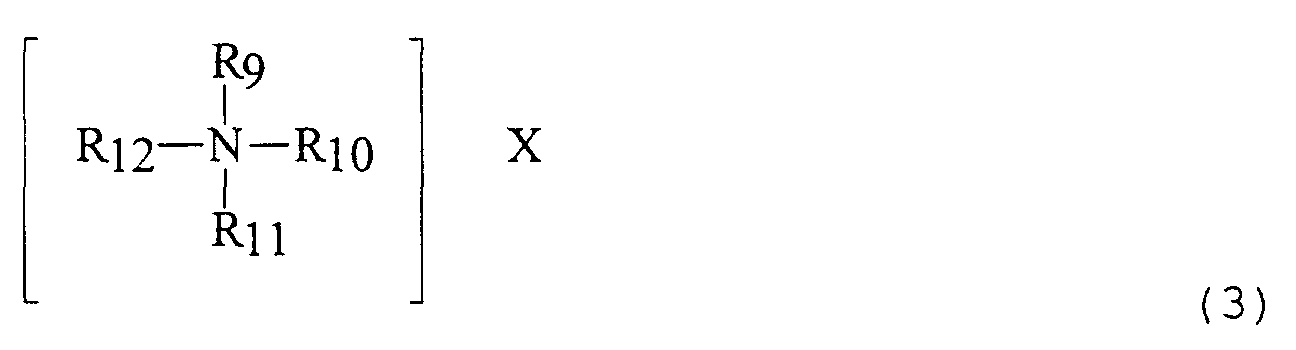
- Such a compound has a structure represented by the following formula (3), (4) or (5): (wherein R 9 , R 10 , R 11 and R 12 each independently represents a C 1-22 linear or branched alkyl group and X represents a counter anion); (wherein R 13 represents a C 1-22 linear or branched alkyl group, R 14 represents, in addition to those described for R 13 , a group represented by -(CH 2 CH 2 O) n -H (n stands for an integer of 1 to 40), and R 15 is a group represented by -(CH 2 CH 2 O) n -H (n stands for an integer of 1 to 40)); (wherein R 16 and R 17 each independently represents a C 1-22 linear or branched alkyl group, R 18 represents, in addition to those described for R 16 , a group represented by -(CH 2 CH 2 O) n -H (n stands for an integer of 1 to 40), R 19 is a group represented by -(CH 2 CH 2 O) n
- trioctylmethylammonium chloride known under the trade name Aliquat 336 (product of Henkel KGaA) or Capriquat (product of Dojindo Laboratories). They are preferred in the present invention.
- Polymerization is preferably effected at a temperature ranging from 0 to 80°C, more preferably 10 to 60°C, because reaction does not proceed smoothly at an excessively low temperature, while the catalyst happens to be deactivated at an excessively high temperature.
- a temperature ranging from 0 to 80°C, more preferably 10 to 60°C because reaction does not proceed smoothly at an excessively low temperature, while the catalyst happens to be deactivated at an excessively high temperature.
- Favorable results tend to be achievable by setting the temperature a little lower in the former stage of polymerization and a little higher in the latter stage of polymerization.
- Reaction is terminated when the molecular weight reaches a desired value, because the molecular weight of the polymer is apparent from the viscosity of the polymer solution measured during polymerization or by the analysis of the sampled polymer.
- a polyphenylene ether can usually be collected simply by adding an acid such as hydrochloric acid or acetic acid, ethylenediaminetetraacetic acid (EDTA) or a salt thereof, or nitrilotriacetic acid or a salt thereof to the reaction mixture to deactivate the catalyst, separating the resulting polymer from the reaction mixture, washing it with a solvent such as methanol which does not dissolve therein the polymer and then drying.
- an acid such as hydrochloric acid or acetic acid, ethylenediaminetetraacetic acid (EDTA) or a salt thereof, or nitrilotriacetic acid or a salt thereof
- the viscosity ( ⁇ sp/c) of a polyphenylene ether was measured at 30°C as a chloroform solution having a concentration of 0.5 g/100 ml by using an Ubbelohde's viscometer. The unit is expressed by dl/g.
- a 10-liter jacketed autoclave reactor having, at its bottom, a sparger for introducing an oxygen-containing gas, an agitating turbine element and a baffle; and having, at a vent gas line at the upper portion of the reactor, a reflux condenser having a condensate-separating decanter attached to the bottom, the catalyst components and a portion of toluene are charged. Vigorous stirring is started, followed by introduction of the oxygen-containing gas from the sparger in accordance with each of the Examples and Comparative examples. When the oxygen-containing gas to be fed to the reactor has a high oxygen concentration, nitrogen is introduced into the gaseous phase portion for safety. The pressure inside of the reactor is adjusted by a control valve disposed downstream of the reflux condenser.
- Addition of a toluene solution having 2,6-dimethylphenol dissolved therein is started at a rate in accordance with each of the Examples and Comparative examples.
- This time point when the addition of the monomer solution is started is designated as the polymerization initiation time except for Examples 14 and 15 and Comparative Examples 10 to 15.
- the point when the addition of the remaining monomer solution is started is designated as the polymerization initiation time.
- the point when the aeration is started is designated as the polymerization initiation time.
- the amount at the time when the addition of the 2,6-dimethylphenol solution is completed is designated as the calculated amount (charged amount) based on the whole charged mixture.
- the charged amount is set at 5 kg in all the examples and comparative examples.
- the feeding rate of the oxygen-containing gas will hereinafter be defined as a value obtained by dividing by 5 the actual feeding rate to the reactor, that is, a feeding rate (unit: Nl/min ⁇ kg) per kg of the calculated amount based on the whole charged mixture.
- a feeding rate unit: Nl/min ⁇ kg
- Added are 1100 g of 2,6-dimethylphenol, 3827.2 g of toluene, 1.4172 g of cuprous oxide, 8.5243 g of a 47% aqueous solution of hydrogen bromide, 3.4139 g of Dt, 41.9196 g of BD, 16.5277 g of DBA and if necessary, 1.00 g of TOM.
- the total amount is 5 kg. In the other comparative examples, the total amount is also 5 kg, but the catalyst employed is different.
- a small amount of the reaction mixture is sampled using a sampling pot. An aqueous solution of the tetrasodium salt of EDTA is added thereto, followed by stirring.
- a polymer is precipitated.
- the polymer thus precipitated is filtered and the filtrate is washed three times with methanol and then dried under vacuum at 145°C for 1 hour.
- the ⁇ sp/c of the dried polymer is measured. From the curve of ⁇ sp/c relative to the polymerization time, the time to attain a desired ⁇ sp/c from the initiation of polymerization is found and it is determined as a necessary time.
- the desired ⁇ sp/c is set at 0.75 dl/g.
- the amount of water generated by polymerization and trapped in the decanter is measured, whereby the water removing efficiency is determined.
- the water removing efficiency is the ratio, expressed by %, of water trapped in the decanter to the stoichiometric water generation amount.
- a first charge liquid was prepared by charging in the reactor 1.4172 g of cuprous oxide, 8.5243 g of a 47% aqueous solution of hydrogen bromide, 16.5277 g of DBA, 41.9196 g of BD, 3.4139 g of Dt and 2770.3 g of toluene. Since the oxygen concentration of the oxygen-containing gas to be fed to the reactor was too high, nitrogen was introduced into the gaseous phase portion of the reaction vessel to control the absolute pressure of the gaseous portion of the reaction vessel to 0.108 MPa.
- a solution obtained by dissolving 1100 g of 2,6-dimethylphenol in 1056.9 g of toluene was added using a plunger pump at such a rate that the charging of the whole amount was completed in 30 minutes.
- the polymerization temperature was kept at 40°C by feeding a heat transfer medium through the jacket. After the polymer solution became a little viscous, sampling of it in a small amount was started.
- the necessary time that is, polymerization time necessary for ⁇ sp/c to reach 0.75 dl/g from the initiation of the polymerization
- the results are shown in Table 1.
- Example 1 In a similar manner to Example 1 except that the pressure at the gaseous phase portion of the reaction vessel was controlled to 0.181 MPa in terms of an absolute pressure by introducing the oxygen-containing gas having an absolute pressure of 0.181 MPa and an oxygen concentration of 40% (accordingly, the absolute partial pressure of oxygen of the oxygen-containing gas was 0.0724 MPa); and the oxygen-containing gas was fed at a rate of 1.21 Nl/min ⁇ kg, polymerization and measurement were conducted. The results are shown in Table 1.
- Example 1 In a similar manner to Example 1 except that air was used as the oxygen-containing gas; the pressure at the gaseous phase portion of the reaction vessel was controlled to 0.103 MPa in terms of an absolute pressure (accordingly, the absolute pressure of the oxygen-containing gas became 0.103 MPa and the absolute partial pressure of oxygen became 0.0216 MPa); and the air was fed at a rate of 2.31 Nl/min ⁇ kg, polymerization and measurement were conducted. The results are shown in Table 1.
- Example 3 In a similar manner to Example 3 except that pure oxygen was used as the oxygen-containing gas and oxygen was fed at a rate of 0.50 Nl/min ⁇ kg, polymerization and measurement were conducted. The results are shown in Table 1.
- Example 1 In a similar manner to Example 1 except that the oxygen-containing gas had an oxygen concentration of 11.6%; the pressure at the gaseous phase portion of the reaction vessel was controlled to 0.147 MPa in terms of an absolute pressure (accordingly, the absolute partial pressure of the oxygen-containing gas became 0.147 MPa and the absolute partial pressure of oxygen became 0.0171 MPa); the oxygen-containing gas was fed at a rate of 4.18 Nl/min ⁇ kg; and introduction of nitrogen to the gaseous phase portion of the reaction vessel conducted for safety was omitted, polymerization and measurement were conducted. The results are shown in Table 1.
- Example 5 In a similar manner to Example 5 except that the oxygen-containing gas had an oxygen concentration of 8.5%; the pressure at the gaseous phase portion of the reaction vessel was controlled to 0.245 MPa in terms of an absolute pressure (accordingly, the absolute partial pressure of the oxygen-containing gas became 0.245 MPa and the absolute partial pressure of oxygen became 0.0208 MPa); and the oxygen-containing gas was fed at a rate of 5.70 Nl/min ⁇ kg, polymerization and measurement were conducted. The results are shown in Table 1.
- Example 8 In a similar manner to Example 8 except that the oxygen-containing gas had an oxygen concentration of 6.0%; the pressure at the gaseous phase portion of the reaction vessel was controlled to 0.348 MPa in terms of an absolute pressure (accordingly, the absolute pressure of the oxygen-containing gas became 0.348 MPa and the absolute partial pressure of oxygen became 0.0208 MPa); and the oxygen-containing gas was fed at a rate of 8.09 Nl/min ⁇ kg, the polymerization and measurement were conducted. The results are shown in Table 1.
- Example 9 In a similar manner to Example 9 except that the oxygen-containing gas had an oxygen concentration of 4.0%; the pressure at the gaseous phase portion of the reaction vessel was controlled to 0.348 MPa in terms of an absolute pressure (accordingly, the absolute pressure of the oxygen-containing gas became 0.348 MPa and the absolute partial pressure of oxygen became 0.0139 MPa); and the oxygen-containing gas was fed at a rate of 18.0 Nl/min ⁇ kg, the polymerization and measurement were conducted. The results are shown in Table 1.
- Example 8 In a similar manner to Example 8 except that the monomer solution was charged at such a rate that the charging was completed in 100 minutes; and the oxygen-containing gas was fed at a rate of 1.70 Nl/min ⁇ kg, the polymerization and measurement were conducted. The results are shown in Table 1.
- Example 10 In a similar manner to Example 10 except that the oxygen-containing gas was fed at a rate of 13.0 Nl/min ⁇ kg, the polymerization and measurement were conducted. The results are shown in Table 1.
- Example 10 In a similar manner to Example 10 except that the oxygen-containing gas was fed at a rate of 0.70 Nl/min ⁇ kg, the polymerization and measurement were conducted. The results are shown in Table 1.
- Example 8 In a similar manner to Example 8 except that the monomer solution was charged at such a rate that the charging was completed in 15 minutes; and the oxygen-containing gas was fed at a rate of 15.0 Nl/min ⁇ kg, the polymerization and measurement were conducted. The results are shown in Table 1.
- Example 7 After preparation of a catalyst-containing first charge solution in accordance with Example 7, a 215.69 g portion of a solution obtained by dissolving 1100 g of 2,6-dimethylphenol in 1056.9 g of toluene was added.
- the oxygen-containing gas had an oxygen concentration of 8.5%; the pressure at the gaseous phase portion of the reaction vessel was controlled to 0.245 MPa in terms of an absolute pressure (accordingly, the absolute pressure of the oxygen-containing gas became 0.245 MPa and the absolute partial pressure of oxygen became 0.0208 MPa); the oxygen-containing gas was fed at a rate of 5.70 Nl/min ⁇ kg, and just after that, the remaining portion of the monomer solution was charged at such a rate that charging of it was completed in 30 minutes, the polymerization and measurement were conducted. The results are shown in Table 1.
- Example 14 In a similar manner to Example 14 except that the oxygen-containing gas had an oxygen concentration of 8.5%; the pressure at the gaseous phase portion of the reaction vessel was controlled to 0.245 MPa in terms of an absolute pressure (accordingly, the absolute pressure of the oxygen-containing gas became 0.245 MPa and the absolute partial pressure of oxygen became 0.0208 MPa); the oxygen-containing gas was fed at a rate of 5.70 Nl/min ⁇ kg; and subsequent addition was not conducted, the polymerization and measurement were conducted. The results are shown in Table 1.
- Example 3 In a similar manner to Example 3 except that the temperature inside of the reaction vessel was controlled to 40°C during 90 minutes after the starting of the reaction; and then, it was maintained at 50°C, the polymerization and measurement were conducted. The results are shown in Table 1.
- Example 8 In a similar manner to Example 8 except that the temperature inside of the reaction vessel was controlled to 40°C during 90 minutes after the starting of the reaction, and then, it was maintained at 50°C, the polymerization and measurement were conducted. The results are shown in Table 1.
- Example 7 In a similar manner to Example 7 except that the feeding rate of the oxygen-containing gas during 90 minutes after the starting of the reaction was controlled to 5.70 Nl/min ⁇ kg and it was then increased to 9.0 Nl/min ⁇ kg, the polymerization and measurement were conducted. The results are shown in Table 1.
Landscapes
- Chemical & Material Sciences (AREA)
- Health & Medical Sciences (AREA)
- Chemical Kinetics & Catalysis (AREA)
- Medicinal Chemistry (AREA)
- Polymers & Plastics (AREA)
- Organic Chemistry (AREA)
- Polyethers (AREA)
- Organic Low-Molecular-Weight Compounds And Preparation Thereof (AREA)
Abstract
Description
wherein the catalyst comprises a copper compound, a bromine compound, a diamine compound represented by the following formula (1):

wherein the process comprises the steps of:




| Test No. | Absolute pressure in reaction vessel | Oxygen concentration | Absolute partial pressure of oxygen | Necessary time | Water removing ratio | Example 19 |
| [MPa] | (%) | [MPa] | (min) | (%) | (min) | |
| Example 1 | 0.108 | 70 | 0.0756 | 140 | 23 | 133 |
| Comp. Ex. 1 | 0.152 | 70 | 0.1064 | 165 | 18 | |
| Example 2 | 0.181 | 40 | 0.0724 | 142 | 27 | |
| Comp. Ex. 2 | 0.250 | 40 | 0.1000 | 163 | 15 | |
| Example 3 | 0.103 | 21 | 0.0216 | 140 | 50 | 132 |
| Example 4 | 0.250 | 21 | 0.525 | 135 | 54 | |
| Comp. Ex. 3 | 0.103 | 100 | 0.1030 | 169 | 12 | |
| Comp. Ex. 4 | 0.103 | 100 | 0.1030 | 162 | 15 | |
| Comp. Ex. 5 | 0.500 | 21 | 0.1050 | 172 | 12 | |
| Example 5 | 0.147 | 11.6 | 0.0171 | 140 | 53 | 130 |
| Example 6 | 0.250 | 11.6 | 0.0290 | 120 | 56 | |
| Comp. Ex. 6 | 0.0981 | 11.6 | 0.0114 | Not reached | 20 | |
| Comp. Ex. 7 | 0.500 | 11.6 | 0.0580 | 188 | 16 | |
| Comp. Ex. 8 | 0.500 | 11.6 | 0.0580 | 140 | 42 | |
| Example 7 | 0.245 | 8.5 | 0.0208 | 133 | 60 | 120 |
| Example 8 | 0.348 | 8.5 | 0.0296 | 121 | 58 | |
| Example 9 | 0.348 | 6.0 | 0.0208 | 143 | 63 | |
| Comp. Ex. 9 | 0.348 | 4.0 | 0.0139 | Not reached | 29 | |
| Example 10 | 0.348 | 8.5 | 0.0296 | 120 | 53 | |
| Example 11 | 0.348 | 8.5 | 0.0296 | 118 | 69 | |
| Example 12 | 0.348 | 8.5 | 0.0296 | 123 | 48 | |
| Example 13 | 0.348 | 8.5 | 0.0296 | 125 | 73 | |
| Example 14 | 0.245 | 8.5 | 0.0208 | 120 | 62 | 116 |
| Example 15 | 0.245 | 8.5 | 0.0208 | 120 | 63 | |
| Example 16 | 0.103 | 21 | 0.0216 | 135 | 59 | |
| Example 17 | 0.348 | 8.5 | 0.0296 | 114 | 65 | 109 |
| Example 18 | 0.245 | 8.5 | 0.0208 | 122 | 68 | 117 |
| Comp. Ex. 10 | 0.103 | 100 | 0.1030 | 80 | 9 | The catalysts of Comp. Ex. 10 to 15 differ in kind from that of the present invention. |
| Comp. Ex. 11 | 0.25 | 21 | 0.0525 | 108 | 22 | |
| Comp. Ex. 12 | 0.103 | 100 | 0.1030 | 90 | 10 | |
| Comp. Ex. 13 | 0.25 | 21 | 0.0525 | 135 | 29 | |
| Comp. Ex. 14 | 0.103 | 100 | 0.1030 | 143 | 14 | |
| Comp. Ex. 15 | 0.25 | 21 | 0.0525 | 192 | 32 |
Claims (6)
- A process for producing a polyphenylene ether by oxidative polymerization of a phenol compound using a catalyst and an oxygen-containing gas,
wherein the catalyst comprises a copper compound, a bromine compound, a diamine compound represented by the following formula (1):(wherein, R1, R2, R3 and R4 each independently represents hydrogen or a C1-6 linear or branched alkyl group with the proviso that all of them do not represent hydrogen simultaneously, and R5 represents a linear or methyl-branched C2-5 alkylene group), a tertiary monoamine compound and a secondary monoamine compound,
wherein the process comprises the steps of:controlling the absolute pressure at a gaseous phase of a reaction vessel to a range of from 0.098 MPa to less than 0.392 MPa; andfeeding the oxygen-containing gas to the reaction vessel, the oxygen-containing gas having an oxygen partial pressure, in terms of an absolute pressure, of from 0.0147 MPa to 0.0883 MPa. - The process according to claim 1, wherein the oxygen-containing gas has an oxygen concentration of not greater than 21 vol.%.
- The process according to claim 1, wherein the oxygen-containing gas has an oxygen concentration of not greater than 11.6 vol.%.
- The process according to any one of claims 1 to 3, wherein the phenol compound is charged, at such a rate that charging of the whole amount thereof is completed within a period of from 10 minutes to less than 110 minutes, into the reaction vessel containing the catalyst components and being fed with the oxygen-containing gas.
- The process according to any one of claims 1 to 3, wherein the oxygen-containing gas is fed at a rate ranging from 0.5 Nl/min to 15 Nl/min with respect to 1 kg of the reaction mixture at which the whole amount of the phenol compound is charged completely.
- The process according to claim 4, wherein the oxygen-containing gas is fed at a rate ranging from 0.5 Nl/min to 15 Nl/min with respect to 1 kg of the reaction mixture at which the whole amount of the phenol compound is charged completely.
Applications Claiming Priority (2)
| Application Number | Priority Date | Filing Date | Title |
|---|---|---|---|
| JP2000183145A JP3504587B2 (en) | 2000-06-19 | 2000-06-19 | Method for producing polyphenylene ether |
| JP2000183145 | 2000-06-19 |
Publications (3)
| Publication Number | Publication Date |
|---|---|
| EP1167419A2 true EP1167419A2 (en) | 2002-01-02 |
| EP1167419A3 EP1167419A3 (en) | 2003-12-10 |
| EP1167419B1 EP1167419B1 (en) | 2008-01-02 |
Family
ID=18683774
Family Applications (1)
| Application Number | Title | Priority Date | Filing Date |
|---|---|---|---|
| EP01202376A Expired - Lifetime EP1167419B1 (en) | 2000-06-19 | 2001-06-19 | Production process of polyphenylene ether |
Country Status (6)
| Country | Link |
|---|---|
| US (1) | US6489439B2 (en) |
| EP (1) | EP1167419B1 (en) |
| JP (1) | JP3504587B2 (en) |
| CN (1) | CN1164648C (en) |
| DE (1) | DE60132133T2 (en) |
| SG (1) | SG133399A1 (en) |
Cited By (9)
| Publication number | Priority date | Publication date | Assignee | Title |
|---|---|---|---|---|
| US6407200B1 (en) | 2001-06-21 | 2002-06-18 | General Electric Company | Method of preparing a poly(arylene ether), and a poly(arylene ether) prepared thereby |
| US6437084B1 (en) | 2001-11-12 | 2002-08-20 | General Electric Company | Method of preparing a poly (arylene ether) and a poly (arylene ether) prepared thereby |
| US6469128B1 (en) * | 2001-08-07 | 2002-10-22 | General Electric Company | Process and apparatus for preparing a poly(arylene ether) |
| SG110017A1 (en) * | 2002-02-01 | 2005-04-28 | Mitsubishi Gas Chemical Co | Production process of polyphenylene ethers |
| US6924350B2 (en) | 2003-08-26 | 2005-08-02 | General Electric Company | Method of separating a polymer from a solvent |
| US7041780B2 (en) | 2003-08-26 | 2006-05-09 | General Electric | Methods of preparing a polymeric material composite |
| US7244813B2 (en) | 2003-08-26 | 2007-07-17 | General Electric Company | Methods of purifying polymeric material |
| US7256225B2 (en) | 2003-08-26 | 2007-08-14 | General Electric Company | Methods of preparing a polymeric material |
| US7354990B2 (en) | 2003-08-26 | 2008-04-08 | General Electric Company | Purified polymeric materials and methods of purifying polymeric materials |
Families Citing this family (11)
| Publication number | Priority date | Publication date | Assignee | Title |
|---|---|---|---|---|
| JP4471073B2 (en) * | 2003-07-02 | 2010-06-02 | 三菱瓦斯化学株式会社 | Method for producing bifunctional phenylene ether oligomer |
| US7487798B2 (en) * | 2004-03-31 | 2009-02-10 | Keihin Corporation | Linear solenoid valve |
| KR100725748B1 (en) * | 2005-06-20 | 2007-06-08 | (주)미래컴퍼니 | Table for Edge Inspection of Glass Substrates |
| JP5196516B2 (en) * | 2006-09-11 | 2013-05-15 | 旭化成ケミカルズ株式会社 | Process for producing polyphenylene ether |
| JPWO2008102876A1 (en) * | 2007-02-22 | 2010-05-27 | 旭化成ケミカルズ株式会社 | Polymer- (organo) clay composite, composition using the same, sheet-like material using the same, and method for producing polymer- (organo) clay composite |
| JP5464907B2 (en) * | 2009-05-22 | 2014-04-09 | 旭化成ケミカルズ株式会社 | New production method of polyphenylene ether |
| JP5349135B2 (en) * | 2009-05-22 | 2013-11-20 | 旭化成ケミカルズ株式会社 | Process for producing polyphenylene ether |
| CN102002159B (en) * | 2010-11-05 | 2013-05-22 | 中国蓝星(集团)股份有限公司 | Method for preparing polyphenyl ether |
| JP6374343B2 (en) * | 2014-04-15 | 2018-08-15 | 旭化成株式会社 | Process for producing polyphenylene ether |
| JP2017110158A (en) * | 2015-12-18 | 2017-06-22 | 旭化成株式会社 | Process for producing polyphenylene ether |
| CN109929103B (en) * | 2019-03-26 | 2024-03-29 | 北京赛福瑞技术服务有限公司 | Method for preparing high-intrinsic-viscosity polyphenyl ether |
Family Cites Families (13)
| Publication number | Priority date | Publication date | Assignee | Title |
|---|---|---|---|---|
| US4028341A (en) * | 1974-02-11 | 1977-06-07 | General Electric Company | Process for the preparation of polyphenylene oxides with hydrolytically stable copper catalysts |
| US3988297A (en) * | 1974-07-03 | 1976-10-26 | General Electric | Process for the preparation of polyphenylene ethers with activated copper-amine catalysts |
| US4042564A (en) * | 1975-11-11 | 1977-08-16 | General Electric Company | Method for preparing polyphenylene ethers |
| US4059568A (en) * | 1976-08-30 | 1977-11-22 | General Electric Company | Method for the control of diamine catalyzed polyphenylene ether polymerization |
| JPS54131698A (en) * | 1978-04-04 | 1979-10-12 | Mitsubishi Gas Chem Co Inc | Preparation of polyphenylene oxide |
| US4385167A (en) * | 1980-08-04 | 1983-05-24 | General Electric Company | Preparation of polyphenylene ether resins |
| DE3206661A1 (en) * | 1982-02-25 | 1983-09-01 | Basf Ag, 6700 Ludwigshafen | METHOD FOR AVOIDING AN EXPLOSIBLE GAS PHASE IN GAS / LIQUID REACTIONS |
| US4477649A (en) * | 1983-03-25 | 1984-10-16 | General Electric Company | Two-stage continuous process for preparation of polyphenylene oxides |
| DE3313864A1 (en) * | 1983-04-16 | 1984-10-18 | Chemische Werke Hüls AG, 4370 Marl | METHOD FOR PRODUCING POLYPHENYLENE OXIDES |
| US4477651A (en) * | 1983-06-06 | 1984-10-16 | General Electric Company | Process for preparing polyphenylene oxides |
| US4588806A (en) * | 1984-11-08 | 1986-05-13 | General Electric Company | Polyphenylene ether resins having bimodal molecular weight distributions and method of their formation |
| US5084551A (en) * | 1990-12-12 | 1992-01-28 | General Electric Co. | Polyphenylene ether process and resin composition |
| US5693742A (en) * | 1994-12-01 | 1997-12-02 | General Electric Company | Solventless method for making polyarylene ethers |
-
2000
- 2000-06-19 JP JP2000183145A patent/JP3504587B2/en not_active Expired - Lifetime
-
2001
- 2001-06-18 CN CNB011188251A patent/CN1164648C/en not_active Expired - Lifetime
- 2001-06-19 DE DE60132133T patent/DE60132133T2/en not_active Expired - Lifetime
- 2001-06-19 EP EP01202376A patent/EP1167419B1/en not_active Expired - Lifetime
- 2001-06-19 US US09/883,388 patent/US6489439B2/en not_active Expired - Lifetime
- 2001-06-19 SG SG200103692-0A patent/SG133399A1/en unknown
Cited By (11)
| Publication number | Priority date | Publication date | Assignee | Title |
|---|---|---|---|---|
| US6407200B1 (en) | 2001-06-21 | 2002-06-18 | General Electric Company | Method of preparing a poly(arylene ether), and a poly(arylene ether) prepared thereby |
| US6469128B1 (en) * | 2001-08-07 | 2002-10-22 | General Electric Company | Process and apparatus for preparing a poly(arylene ether) |
| US6437084B1 (en) | 2001-11-12 | 2002-08-20 | General Electric Company | Method of preparing a poly (arylene ether) and a poly (arylene ether) prepared thereby |
| SG110017A1 (en) * | 2002-02-01 | 2005-04-28 | Mitsubishi Gas Chemical Co | Production process of polyphenylene ethers |
| US6924350B2 (en) | 2003-08-26 | 2005-08-02 | General Electric Company | Method of separating a polymer from a solvent |
| US7041780B2 (en) | 2003-08-26 | 2006-05-09 | General Electric | Methods of preparing a polymeric material composite |
| US7244813B2 (en) | 2003-08-26 | 2007-07-17 | General Electric Company | Methods of purifying polymeric material |
| US7256225B2 (en) | 2003-08-26 | 2007-08-14 | General Electric Company | Methods of preparing a polymeric material |
| US7314907B2 (en) | 2003-08-26 | 2008-01-01 | General Electric Company | Purified polymeric materials and methods of purifying polymeric materials |
| US7354990B2 (en) | 2003-08-26 | 2008-04-08 | General Electric Company | Purified polymeric materials and methods of purifying polymeric materials |
| US7585935B2 (en) | 2003-08-26 | 2009-09-08 | Sabic Innovative Plastics Ip B.V. | Purified polymeric materials and methods of purifying polymeric materials |
Also Published As
| Publication number | Publication date |
|---|---|
| SG133399A1 (en) | 2007-07-30 |
| JP2002003597A (en) | 2002-01-09 |
| CN1164648C (en) | 2004-09-01 |
| DE60132133D1 (en) | 2008-02-14 |
| EP1167419A3 (en) | 2003-12-10 |
| DE60132133T2 (en) | 2008-12-18 |
| CN1330093A (en) | 2002-01-09 |
| US6489439B2 (en) | 2002-12-03 |
| US20020010314A1 (en) | 2002-01-24 |
| JP3504587B2 (en) | 2004-03-08 |
| EP1167419B1 (en) | 2008-01-02 |
Similar Documents
| Publication | Publication Date | Title |
|---|---|---|
| EP1167419B1 (en) | Production process of polyphenylene ether | |
| EP1167420B1 (en) | Production process of polyphenylene ether | |
| US6437084B1 (en) | Method of preparing a poly (arylene ether) and a poly (arylene ether) prepared thereby | |
| JP2017179009A (en) | Process for producing polyphenylene ether | |
| US4140675A (en) | Process of forming quinone-coupled polyphenylene oxides | |
| EP0714927A1 (en) | Solventless method for making polyarylene ethers | |
| JP6374343B2 (en) | Process for producing polyphenylene ether | |
| US4503214A (en) | Continuous process for preparing polyphenylene oxides | |
| US5659006A (en) | Method for making polyarylene ethers from mesitol | |
| JP2010270248A (en) | Process for producing polyphenylene ether | |
| JP5046351B2 (en) | Process for producing polyphenylene ether | |
| JP5464907B2 (en) | New production method of polyphenylene ether | |
| JP4176536B2 (en) | Method for producing low molecular weight polyphenylene ether | |
| JP2013256646A (en) | Method for producing polyphenylene ether powder | |
| JP3910896B2 (en) | Process for producing polyphenylene ether | |
| JP2010270249A (en) | Process for producing polyphenylene ether | |
| JP5311717B2 (en) | Process for producing polyfunctional polyphenylene ether | |
| JP2006249133A (en) | Production of polyphenylene ether | |
| JP2005272631A (en) | Low molecular weight polyphenylene ether resin | |
| JP3909838B2 (en) | Production method of polyphenylene ether | |
| JP2000281774A (en) | Production of polyphenylene ether | |
| JP5960901B1 (en) | Process for producing polyphenylene ether | |
| CN109929103A (en) | A kind of manufacturing method of high inherent viscosity polyphenylene oxide | |
| CN112239536B (en) | Manufacturing method of polyphenylene ether resin | |
| JP5841886B2 (en) | Process for producing polyphenylene ether |
Legal Events
| Date | Code | Title | Description |
|---|---|---|---|
| PUAI | Public reference made under article 153(3) epc to a published international application that has entered the european phase |
Free format text: ORIGINAL CODE: 0009012 |
|
| AK | Designated contracting states |
Kind code of ref document: A2 Designated state(s): AT BE CH CY DE DK ES FI FR GB GR IE IT LI LU MC NL PT SE TR |
|
| AX | Request for extension of the european patent |
Free format text: AL;LT;LV;MK;RO;SI |
|
| PUAL | Search report despatched |
Free format text: ORIGINAL CODE: 0009013 |
|
| AK | Designated contracting states |
Kind code of ref document: A3 Designated state(s): AT BE CH CY DE DK ES FI FR GB GR IE IT LI LU MC NL PT SE TR |
|
| AX | Request for extension of the european patent |
Extension state: AL LT LV MK RO SI |
|
| RAP1 | Party data changed (applicant data changed or rights of an application transferred) |
Owner name: MITSUBISHI GAS CHEMICAL COMPANY, INC. Owner name: ASAHI KASEI CHEMICALS CORPORATION |
|
| RAP1 | Party data changed (applicant data changed or rights of an application transferred) |
Owner name: MITSUBISHI GAS CHEMICAL COMPANY, INC. Owner name: ASAHI KASEI CHEMICALS CORPORATION |
|
| 17P | Request for examination filed |
Effective date: 20040204 |
|
| AKX | Designation fees paid |
Designated state(s): DE NL |
|
| GRAP | Despatch of communication of intention to grant a patent |
Free format text: ORIGINAL CODE: EPIDOSNIGR1 |
|
| GRAS | Grant fee paid |
Free format text: ORIGINAL CODE: EPIDOSNIGR3 |
|
| GRAA | (expected) grant |
Free format text: ORIGINAL CODE: 0009210 |
|
| AK | Designated contracting states |
Kind code of ref document: B1 Designated state(s): DE NL |
|
| REF | Corresponds to: |
Ref document number: 60132133 Country of ref document: DE Date of ref document: 20080214 Kind code of ref document: P |
|
| PLBE | No opposition filed within time limit |
Free format text: ORIGINAL CODE: 0009261 |
|
| STAA | Information on the status of an ep patent application or granted ep patent |
Free format text: STATUS: NO OPPOSITION FILED WITHIN TIME LIMIT |
|
| 26N | No opposition filed |
Effective date: 20081003 |
|
| REG | Reference to a national code |
Ref country code: DE Ref legal event code: R082 Ref document number: 60132133 Country of ref document: DE Representative=s name: STREHL SCHUEBEL-HOPF & PARTNER MBB PATENTANWAE, DE Ref country code: DE Ref legal event code: R082 Ref document number: 60132133 Country of ref document: DE Representative=s name: PATENTANWAELTE STREHL, SCHUEBEL-HOPF & PARTNER, DE Ref country code: DE Ref legal event code: R081 Ref document number: 60132133 Country of ref document: DE Owner name: ASAHI KASEI KABUSHIKI KAISHA, JP Free format text: FORMER OWNERS: ASAHI KASEI CHEMICALS CORPORATION, TOKIO/TOKYO, JP; MITSUBISHI GAS CHEMICAL CO., INC., TOKIO/TOKYO, JP Ref country code: DE Ref legal event code: R081 Ref document number: 60132133 Country of ref document: DE Owner name: MITSUBISHI GAS CHEMICAL CO., INC., JP Free format text: FORMER OWNERS: ASAHI KASEI CHEMICALS CORPORATION, TOKIO/TOKYO, JP; MITSUBISHI GAS CHEMICAL CO., INC., TOKIO/TOKYO, JP |
|
| REG | Reference to a national code |
Ref country code: NL Ref legal event code: PD Owner name: MITSUBISHI GAS CHEMICAL COMPANY, INC.; JP Free format text: DETAILS ASSIGNMENT: VERANDERING VAN EIGENAAR(S), SAMENVOEGEN; FORMER OWNER NAME: MITSUBISHI GAS CHEMICAL COMPANY, INC. Effective date: 20160722 |
|
| PGFP | Annual fee paid to national office [announced via postgrant information from national office to epo] |
Ref country code: DE Payment date: 20200609 Year of fee payment: 20 Ref country code: NL Payment date: 20200513 Year of fee payment: 20 |
|
| REG | Reference to a national code |
Ref country code: DE Ref legal event code: R071 Ref document number: 60132133 Country of ref document: DE |
|
| REG | Reference to a national code |
Ref country code: NL Ref legal event code: MK Effective date: 20210618 |