EP1167361A2 - Process and catalyst for the production of y-butyrolactones - Google Patents
Process and catalyst for the production of y-butyrolactones Download PDFInfo
- Publication number
- EP1167361A2 EP1167361A2 EP01113854A EP01113854A EP1167361A2 EP 1167361 A2 EP1167361 A2 EP 1167361A2 EP 01113854 A EP01113854 A EP 01113854A EP 01113854 A EP01113854 A EP 01113854A EP 1167361 A2 EP1167361 A2 EP 1167361A2
- Authority
- EP
- European Patent Office
- Prior art keywords
- catalyst
- general formula
- product
- butyrolactone
- olefin
- Prior art date
- Legal status (The legal status is an assumption and is not a legal conclusion. Google has not performed a legal analysis and makes no representation as to the accuracy of the status listed.)
- Withdrawn
Links
Classifications
-
- C—CHEMISTRY; METALLURGY
- C07—ORGANIC CHEMISTRY
- C07D—HETEROCYCLIC COMPOUNDS
- C07D307/00—Heterocyclic compounds containing five-membered rings having one oxygen atom as the only ring hetero atom
- C07D307/02—Heterocyclic compounds containing five-membered rings having one oxygen atom as the only ring hetero atom not condensed with other rings
- C07D307/26—Heterocyclic compounds containing five-membered rings having one oxygen atom as the only ring hetero atom not condensed with other rings having one double bond between ring members or between a ring member and a non-ring member
- C07D307/30—Heterocyclic compounds containing five-membered rings having one oxygen atom as the only ring hetero atom not condensed with other rings having one double bond between ring members or between a ring member and a non-ring member with hetero atoms or with carbon atoms having three bonds to hetero atoms with at the most one bond to halogen, e.g. ester or nitrile radicals, directly attached to ring carbon atoms
- C07D307/32—Oxygen atoms
- C07D307/33—Oxygen atoms in position 2, the oxygen atom being in its keto or unsubstituted enol form
-
- C—CHEMISTRY; METALLURGY
- C07—ORGANIC CHEMISTRY
- C07D—HETEROCYCLIC COMPOUNDS
- C07D315/00—Heterocyclic compounds containing rings having one oxygen atom as the only ring hetero atom according to more than one of groups C07D303/00 - C07D313/00
Definitions
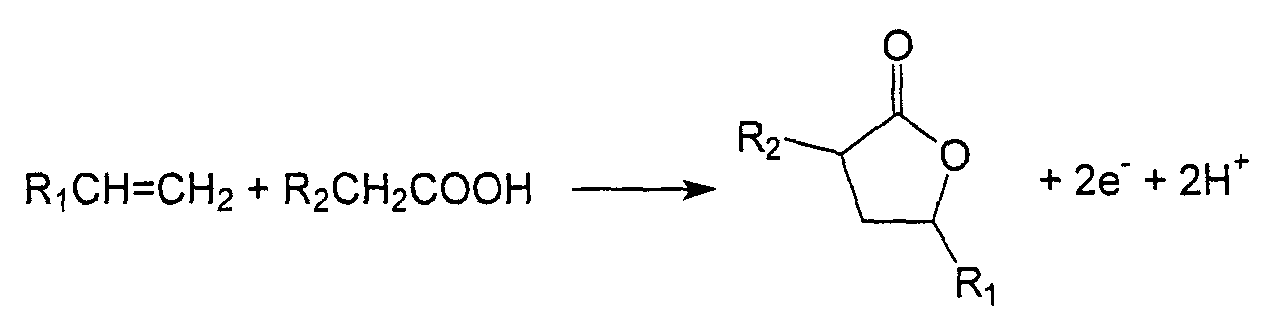
- the present invention deals with the formation of ⁇ -butyrolactone and substituted ⁇ -butyrolactones of the general formula where R 1 and R 2 may be hydrogen, alkyl, cycloalkyl and aryl and may further contain functionalities such as ether and ester groups.
- the invention is characterised by contacting an olefin of the general formula R 1 CHCH 2 , a carboxylic acid of the general formula R 2 CH 2 COOH and oxygen in the vapour phase with a catalyst.
- the reaction which runs according to the following equation is carried out at a temperature of between 120°C and 320°C.
- oxygen as the electron acceptor (stoichiometric oxidant) water is formed as a by-product.
- the process may be carried out in continuous mode with the feed gas consisting of olefin, carboxylic acid, oxygen and optionally a diluent or it may be carried out in a recycling mode, where the catalyst acts as oxygen carrier.
- the process may be carried out in a fixed-bed reactor, a fluid-bed reactor, a Riser reactor and other reactors, which may prove practical.
- the catalyst is characterised by containing manganese and basic metal oxides (alkali, alkaline earth, rare earth and other basic oxides).
- the catalyst may be prepared by impregnation on a suitable support material and by precipitation of manganese salts together with other components.
- a mixture of 1-octene and acetic acid was evaporated in a stream of nitrogen through a fixed bed of catalyst placed in a glass reactor mounted in a tubular oven. Experiments were carried out at 250-350°C and normal pressure.
- the catalyst was an alumina supported, alkali promoted manganese catalyst.
- the effluent gas was passed through a condenser and the condensate was collected and analysed.
- Examples 1-5 concern the preparation of catalysts.
- the Examples 6 and 7 serve to illustrate the application of these catalysts in the process of this invention.
- the support was crushed and sieved before impregnation. In all cases, the fraction 0.60 - 1.00 mm was used.
- a high surface area alumina (5.11 g) was impregnated by the incipient wetness technique with a solution of NaOH (0.15 g) in water (5.0 ml). This product was dried overnight at 100°C. This intermediate product was impregnated with 5.0 ml of a saturated aqueous solution of Mn (II) acetate, and the product was calcined at 300°C.
- a high surface area alumina (5.11 g) was impregnated by the incipient wetness technique with a solution of KOH (0.15 g) in water (5.0 ml). This product was dried overnight at 100°C. This intermediate product was impregnated with 4.0 ml of a saturated aqueous solution of Mn (II) acetate, and the product was calcined at 300°C.
- a high surface area alumina (5.58 g) was impregnated by the incipient wetness technique with a solution of KOH (0.30 g) in water (5.0 ml). This product was dried overnight at 100°C. This intermediate product was impregnated with 4.5 ml of a saturated aqueous solution of Mn (II) acetate, and the product was calcined at 300°C.
- This catalyst was prepared exactly as catalyst 1 except that the support was chromatography grade silica instead of alumina.
- This catalyst was prepared by precipitation as follows. A solution of Mn (NO 3 ) 2 4H 2 O (20.8 g) in 100 ml of water was slowly admixed with a solution of KOH (11.2 g) in 100 ml of water in a well stirred beaker. The slurry was continuously stirred and heated to 80°C for one hour. The product was filtered off, washed with 1 liter of hot water and dried at 110°C overnight. This material was calcined in air at 650°C for 4 hours. The material was analysed by XRD and found to be pure Mn 2 O 3 .
Landscapes
- Chemical & Material Sciences (AREA)
- Organic Chemistry (AREA)
- Catalysts (AREA)
- Organic Low-Molecular-Weight Compounds And Preparation Thereof (AREA)
- Furan Compounds (AREA)
- Low-Molecular Organic Synthesis Reactions Using Catalysts (AREA)
Abstract

Description



| Performances of Catalysts 1-3 | ||||||||
| Catalyst | t1 (min) 1st cycle | n-hex-GBL (arbitr.) | t2 (min) 1st cycle | n-hex-GBL (arbitr.) | t3 (min) 2nd cycle | n-hex-GBL (arbitr.) | t4 (min) 2nd cycle | n-hex-GBL (arbitr.) |
| 1 | 20 | 3905 | 15 | 957 | 20 | 4294 | 10 | 0 |
| 2 | 20 | 2645 | 20 | 883 | 20 | 2791 | 15 | 420 |
| 3 | 20 | 1498 | 15 | 0 | 20 | 2009 | 20 | 652 |
An autoclave was charged with catalyst (2.0 g), pressurised with 5 bar feed gas and closed. The feed gas was either 20% ethylene in nitrogen or pure ethylene as stated in Table 2. The autoclave was heated to 250°C and at this temperature, acetic acid (AcOH) was injected through an injection loop by means of an overpressure of ethylene of 8 bar. After a period of 20 minutes, the autoclave was opened through a gas sample port connected to a 1 m 1/16" steel tube. The condensable parts were collected, diluted with diethyl ether to 2.0 ml and analysed by GC and GC-MS. The amount of product GBL for catalysts 1, 4 and 5 are given in Table 2.
| Performance of catalysts 1, 4 and 5 | |||
| Catalyst | AcOH (g) | % ethylene | GBL (mg/g AcOH) |
| 1 | 1 | 20 | 0.10 |
| 1 | 1 | 100 | 0.16 |
| 4 | 1 | 20 | 0.14 |
| 4 | 1 | 100 | 0.12 |
| 4 | 2 | 100 | 0.19 |
| 5 | 1 | 20 | 0.15 |
| 5 | 1 | 100 | 0.40 |
Claims (5)
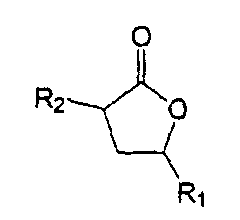
- Process for the catalytic preparation of γ-butyrolactone having the general formulaby reacting an olefin with the general formula R1CHCH2, with a carboxylic acid with the general formula R2CH2COOH, wherein R1 and R2 represent the substituent R1 and R2 in the butyrolactone, which reaction is performed in presence of oxygen in contact with a catalyst comprising manganese.
- The process of claim 1, wherein the olefin and the carboxylic acid and the oxygen are reacted at a temperature of between 120°C and 320°C.
- The process of claim 1, wherein the catalyst further comprises over a catalyst comprised by one or more compounds of alkali metals.
- The process of claim 1, wherein the catalyst is deposited on a support.
- The process as claimed in anyone of the preceding claims, wherein the carboxylic acid is acetic acid and the olefin is ethylene.
Applications Claiming Priority (2)
| Application Number | Priority Date | Filing Date | Title |
|---|---|---|---|
| US21264400P | 2000-06-19 | 2000-06-19 | |
| US212644P | 2000-06-19 |
Publications (2)
| Publication Number | Publication Date |
|---|---|
| EP1167361A2 true EP1167361A2 (en) | 2002-01-02 |
| EP1167361A3 EP1167361A3 (en) | 2002-01-23 |
Family
ID=22791883
Family Applications (1)
| Application Number | Title | Priority Date | Filing Date |
|---|---|---|---|
| EP01113854A Withdrawn EP1167361A3 (en) | 2000-06-19 | 2001-06-07 | Process and catalyst for the production of y-butyrolactones |
Country Status (6)
| Country | Link |
|---|---|
| US (1) | US6515148B2 (en) |
| EP (1) | EP1167361A3 (en) |
| JP (1) | JP2002145873A (en) |
| CN (1) | CN1329000A (en) |
| AU (1) | AU5197101A (en) |
| CA (1) | CA2350865A1 (en) |
Families Citing this family (1)
| Publication number | Priority date | Publication date | Assignee | Title |
|---|---|---|---|---|
| MY122525A (en) * | 1999-10-12 | 2006-04-29 | Kvaerner Process Tech Ltd | Process for the simultaneous production of maleic anyhydride and its hydrogenated derivatives |
Family Cites Families (3)
| Publication number | Priority date | Publication date | Assignee | Title |
|---|---|---|---|---|
| US4175089A (en) * | 1968-03-20 | 1979-11-20 | Mobil Oil Corporation | Preparation of gamma-butyrolactones |
| US4285868A (en) * | 1968-03-20 | 1981-08-25 | Mobil Oil Corporation | Preparation of gamma-butyrolactones |
| GB1293556A (en) * | 1969-04-09 | 1972-10-18 | Ici Ltd | Process for the production of lactones |
-
2001
- 2001-06-07 EP EP01113854A patent/EP1167361A3/en not_active Withdrawn
- 2001-06-13 US US09/880,247 patent/US6515148B2/en not_active Expired - Fee Related
- 2001-06-18 JP JP2001183637A patent/JP2002145873A/en not_active Withdrawn
- 2001-06-18 AU AU51971/01A patent/AU5197101A/en not_active Abandoned
- 2001-06-18 CA CA002350865A patent/CA2350865A1/en not_active Abandoned
- 2001-06-19 CN CN01121670A patent/CN1329000A/en active Pending
Also Published As
| Publication number | Publication date |
|---|---|
| CA2350865A1 (en) | 2001-12-19 |
| US20020013479A1 (en) | 2002-01-31 |
| AU5197101A (en) | 2001-12-20 |
| CN1329000A (en) | 2002-01-02 |
| US6515148B2 (en) | 2003-02-04 |
| EP1167361A3 (en) | 2002-01-23 |
| JP2002145873A (en) | 2002-05-22 |
Similar Documents
| Publication | Publication Date | Title |
|---|---|---|
| US4780552A (en) | Preparation of furan by decarbonylation of furfural | |
| EP1165536B1 (en) | Process for the preparation of alpha-methylene lactones | |
| JP6100972B2 (en) | Method for producing acrylic acid from glycerol | |
| EP2493837B1 (en) | Hydrocarbon selective oxidation with heterogenous gold catalysts | |
| KR100696149B1 (en) | Improved Method for Vinyl Acetate Production | |
| JP2009023995A (en) | Method for preparing fluorine-containing carboxylate | |
| KR20040027935A (en) | Synthesis of Unsaturated Nitriles from Lactones | |
| US5625076A (en) | Catalyst for production of tertiary N-alkenyl carboxylic acid amide, and process for production of tertiary N-alkenyl carboxylic acid amide using said catalyst | |
| US4126752A (en) | Homologation of methanol with a carbon monoxide-water mixture | |
| US6515148B2 (en) | Process and catalyst for the production of γ-butyrolactones | |
| US10301245B2 (en) | Use of molybdenum and vanadium mixed oxides as catalysts for the oxidation of unsaturated alcohols into unsaturated carboxylic acids | |
| ES2361744T3 (en) | PROCESS TO PRODUCE SUMMARY AND PROCESS FOR THE PRODUCTION OF PROPYLENE OXIDE INCLUDING SUCH PRODUCTION PROCESS. | |
| JP2005533120A (en) | Synthesis of alkenoate esters from lactones and alcohols. | |
| JPS63130556A (en) | Production of pyromellitic acid | |
| US4599469A (en) | Hydrogenation process | |
| EP0122026B1 (en) | Method for the manufacture of epoxides from 1,2-glycols | |
| JP4450138B2 (en) | Method for producing fluoroalkylcarboxylic acid | |
| KR102055927B1 (en) | Process for preparing acrolein | |
| EP0122025B1 (en) | Method for the manufacture of epoxides from 1,2-glycols | |
| JP3230243B2 (en) | Phenol production catalyst and phenol production method | |
| US4374268A (en) | Catalytic oxydehydrogenation process | |
| JPS5522610A (en) | Preparation of carboxylic acid ester | |
| US5180700A (en) | Regeneration and extension of lifetime of dehydrogenation catalysts used in the preparation of 2-alkylpyrimidines | |
| RU2035458C1 (en) | Method of gamma-butyrolactone synthesis | |
| JPH0180A (en) | Propylene oxide manufacturing method |
Legal Events
| Date | Code | Title | Description |
|---|---|---|---|
| PUAI | Public reference made under article 153(3) epc to a published international application that has entered the european phase |
Free format text: ORIGINAL CODE: 0009012 |
|
| PUAL | Search report despatched |
Free format text: ORIGINAL CODE: 0009013 |
|
| AK | Designated contracting states |
Kind code of ref document: A2 Designated state(s): AT BE CH CY DE DK ES FI FR GB GR IE IT LI LU MC NL PT SE TR |
|
| AX | Request for extension of the european patent |
Free format text: AL;LT;LV;MK;RO;SI |
|
| RIC1 | Information provided on ipc code assigned before grant |
Free format text: 7C 07D 307/33 A, 7C 07D 307/32 B |
|
| AK | Designated contracting states |
Kind code of ref document: A3 Designated state(s): AT BE CH CY DE DK ES FI FR GB GR IE IT LI LU MC NL PT SE TR |
|
| AX | Request for extension of the european patent |
Free format text: AL;LT;LV;MK;RO;SI |
|
| 17P | Request for examination filed |
Effective date: 20020723 |
|
| AKX | Designation fees paid |
Free format text: AT BE CH CY DE DK ES FI FR GB GR IE IT LI LU MC NL PT SE TR |
|
| 17Q | First examination report despatched |
Effective date: 20030204 |
|
| STAA | Information on the status of an ep patent application or granted ep patent |
Free format text: STATUS: THE APPLICATION IS DEEMED TO BE WITHDRAWN |
|
| 18D | Application deemed to be withdrawn |
Effective date: 20030816 |