EP1166781A1 - Proteasome inhibitors - Google Patents
Proteasome inhibitors Download PDFInfo
- Publication number
- EP1166781A1 EP1166781A1 EP00900834A EP00900834A EP1166781A1 EP 1166781 A1 EP1166781 A1 EP 1166781A1 EP 00900834 A EP00900834 A EP 00900834A EP 00900834 A EP00900834 A EP 00900834A EP 1166781 A1 EP1166781 A1 EP 1166781A1
- Authority
- EP
- European Patent Office
- Prior art keywords
- substituted
- unsubstituted
- compound
- mmol
- carboxylic acid
- Prior art date
- Legal status (The legal status is an assumption and is not a legal conclusion. Google has not performed a legal analysis and makes no representation as to the accuracy of the status listed.)
- Withdrawn
Links
- 0 *C1C(CC(C(O)=O)N)C1 Chemical compound *C1C(CC(C(O)=O)N)C1 0.000 description 5
- ZSYIAUXMQLVKIL-UHFFFAOYSA-N CCC(C)C(C(C(NC1C(CC(C(O)=O)NC(C(C)N)=O)C1)=O)O1)C1=O Chemical compound CCC(C)C(C(C(NC1C(CC(C(O)=O)NC(C(C)N)=O)C1)=O)O1)C1=O ZSYIAUXMQLVKIL-UHFFFAOYSA-N 0.000 description 1
Classifications
-
- C—CHEMISTRY; METALLURGY
- C07—ORGANIC CHEMISTRY
- C07K—PEPTIDES
- C07K5/00—Peptides containing up to four amino acids in a fully defined sequence; Derivatives thereof
- C07K5/04—Peptides containing up to four amino acids in a fully defined sequence; Derivatives thereof containing only normal peptide links
- C07K5/06—Dipeptides
- C07K5/06008—Dipeptides with the first amino acid being neutral
- C07K5/06017—Dipeptides with the first amino acid being neutral and aliphatic
- C07K5/06026—Dipeptides with the first amino acid being neutral and aliphatic the side chain containing 0 or 1 carbon atom, i.e. Gly or Ala
-
- A—HUMAN NECESSITIES
- A61—MEDICAL OR VETERINARY SCIENCE; HYGIENE
- A61P—SPECIFIC THERAPEUTIC ACTIVITY OF CHEMICAL COMPOUNDS OR MEDICINAL PREPARATIONS
- A61P35/00—Antineoplastic agents
-
- A—HUMAN NECESSITIES
- A61—MEDICAL OR VETERINARY SCIENCE; HYGIENE
- A61P—SPECIFIC THERAPEUTIC ACTIVITY OF CHEMICAL COMPOUNDS OR MEDICINAL PREPARATIONS
- A61P43/00—Drugs for specific purposes, not provided for in groups A61P1/00-A61P41/00
-
- C—CHEMISTRY; METALLURGY
- C07—ORGANIC CHEMISTRY
- C07C—ACYCLIC OR CARBOCYCLIC COMPOUNDS
- C07C229/00—Compounds containing amino and carboxyl groups bound to the same carbon skeleton
- C07C229/46—Compounds containing amino and carboxyl groups bound to the same carbon skeleton having amino or carboxyl groups bound to carbon atoms of rings other than six-membered aromatic rings of the same carbon skeleton
-
- C—CHEMISTRY; METALLURGY
- C07—ORGANIC CHEMISTRY
- C07C—ACYCLIC OR CARBOCYCLIC COMPOUNDS
- C07C237/00—Carboxylic acid amides, the carbon skeleton of the acid part being further substituted by amino groups
- C07C237/02—Carboxylic acid amides, the carbon skeleton of the acid part being further substituted by amino groups having the carbon atoms of the carboxamide groups bound to acyclic carbon atoms of the carbon skeleton
- C07C237/22—Carboxylic acid amides, the carbon skeleton of the acid part being further substituted by amino groups having the carbon atoms of the carboxamide groups bound to acyclic carbon atoms of the carbon skeleton having nitrogen atoms of amino groups bound to the carbon skeleton of the acid part, further acylated
-
- C—CHEMISTRY; METALLURGY
- C07—ORGANIC CHEMISTRY
- C07C—ACYCLIC OR CARBOCYCLIC COMPOUNDS
- C07C271/00—Derivatives of carbamic acids, i.e. compounds containing any of the groups, the nitrogen atom not being part of nitro or nitroso groups
- C07C271/06—Esters of carbamic acids
- C07C271/08—Esters of carbamic acids having oxygen atoms of carbamate groups bound to acyclic carbon atoms
- C07C271/10—Esters of carbamic acids having oxygen atoms of carbamate groups bound to acyclic carbon atoms with the nitrogen atoms of the carbamate groups bound to hydrogen atoms or to acyclic carbon atoms
- C07C271/22—Esters of carbamic acids having oxygen atoms of carbamate groups bound to acyclic carbon atoms with the nitrogen atoms of the carbamate groups bound to hydrogen atoms or to acyclic carbon atoms to carbon atoms of hydrocarbon radicals substituted by carboxyl groups
-
- C—CHEMISTRY; METALLURGY
- C07—ORGANIC CHEMISTRY
- C07C—ACYCLIC OR CARBOCYCLIC COMPOUNDS
- C07C327/00—Thiocarboxylic acids
- C07C327/20—Esters of monothiocarboxylic acids
- C07C327/22—Esters of monothiocarboxylic acids having carbon atoms of esterified thiocarboxyl groups bound to hydrogen atoms or to acyclic carbon atoms
-
- C—CHEMISTRY; METALLURGY
- C07—ORGANIC CHEMISTRY
- C07C—ACYCLIC OR CARBOCYCLIC COMPOUNDS
- C07C327/00—Thiocarboxylic acids
- C07C327/20—Esters of monothiocarboxylic acids
- C07C327/28—Esters of monothiocarboxylic acids having sulfur atoms of esterified thiocarboxyl groups bound to carbon atoms of hydrocarbon radicals substituted by singly-bound oxygen atoms
-
- C—CHEMISTRY; METALLURGY
- C07—ORGANIC CHEMISTRY
- C07D—HETEROCYCLIC COMPOUNDS
- C07D305/00—Heterocyclic compounds containing four-membered rings having one oxygen atom as the only ring hetero atoms
- C07D305/02—Heterocyclic compounds containing four-membered rings having one oxygen atom as the only ring hetero atoms not condensed with other rings
- C07D305/10—Heterocyclic compounds containing four-membered rings having one oxygen atom as the only ring hetero atoms not condensed with other rings having one or more double bonds between ring members or between ring members and non-ring members
- C07D305/12—Beta-lactones
-
- C—CHEMISTRY; METALLURGY
- C07—ORGANIC CHEMISTRY
- C07K—PEPTIDES
- C07K5/00—Peptides containing up to four amino acids in a fully defined sequence; Derivatives thereof
- C07K5/04—Peptides containing up to four amino acids in a fully defined sequence; Derivatives thereof containing only normal peptide links
- C07K5/06—Dipeptides
- C07K5/06191—Dipeptides containing heteroatoms different from O, S, or N
-
- A—HUMAN NECESSITIES
- A61—MEDICAL OR VETERINARY SCIENCE; HYGIENE
- A61K—PREPARATIONS FOR MEDICAL, DENTAL OR TOILETRY PURPOSES
- A61K38/00—Medicinal preparations containing peptides
-
- C—CHEMISTRY; METALLURGY
- C07—ORGANIC CHEMISTRY
- C07C—ACYCLIC OR CARBOCYCLIC COMPOUNDS
- C07C2601/00—Systems containing only non-condensed rings
- C07C2601/02—Systems containing only non-condensed rings with a three-membered ring
Definitions
- the present invention relates to a proteasome inhibitor containing a carboxylic acid derivative as an active ingredient, which is useful for the treatment of malignant tumors such as leukemia, lung cancer, colon cancer, breast cancer or the like, for the treatment of diseases associated with autoimmune diseases, inflammation, neurodegeneration or the like such as rheumatoid chronic arthritis, asthma, Alzheimer disease or the like, or further for the reduction of rejection in organ transplantation.
- malignant tumors such as leukemia, lung cancer, colon cancer, breast cancer or the like
- diseases associated with autoimmune diseases, inflammation, neurodegeneration or the like such as rheumatoid chronic arthritis, asthma, Alzheimer disease or the like, or further for the reduction of rejection in organ transplantation.
- Proteasome also called multicatalytic protease is a multicomponent complex. Its structure consists of 20S proteasome, which has cylindrical catalytic subunits and oxbow regulatory subunits. 26S proteasome in which both are associated is a macromolecular complex with a molecular weight of 200k having a dumbbell shaped structure, and plays a role in decomposing intracellularly ubiquitinated proteins depending on ATP [Tanaka K. et al., Molecular Biology Report, 24 , 3-11 (1997); Baumeister W. et al., Cell, 92 , 367-380 (1998)]. It has been previously reported that its expression levels are increased in leukemia cells.
- proteasome-dependent degradation of an endogenous inhibitor of cyclin-dependent kinase, p27 is facilitated in these cancers, particularly in those with poor prognosis [Porter P. L. et al., Nature Medicine, 3 , 222-225 (1997); Catzavelos C. et al., Nature Medicine, 3 , 227-230 (1997); Esposito V. et al., Cancer Res., 57 , 3381-3385 (1997)].
- inhibition of proteasome can accumulate p53 or p27, degradation of which is facilitated in cancer cells, and thereby can induce growth arrest or apoptosis of cancer cells.
- proteasome has been reported to function as a processing enzyme for endogenous antigens in immune initiation system [Rock K. L. et al., Cell, 78 , 761-771 (1994)]. Additionally, it has been demonstrated that proteasome plays an important role in activation of NF- ⁇ B, which is a transcription regulatory factor for inflammatory cytokines such as TNF- ⁇ [Palombella, V. J., Cell, 78 , 773-785 (1994)]. Thus, it is believed that a proteasome inhibitor is also useful for the reduction of rejection in organ transplantation, or for inflammatory diseases or the like.
- UCK14 compounds are the compounds produced by a microorganism belonging to the genus Streptomyces and are disclosed in Japanese Published Unexamined Application No. 169796/97, which exhibit an antitumor action.
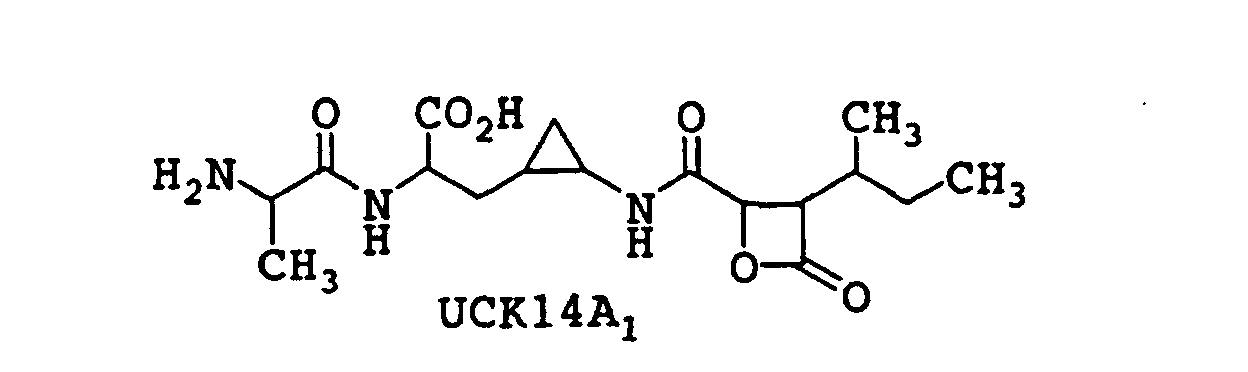
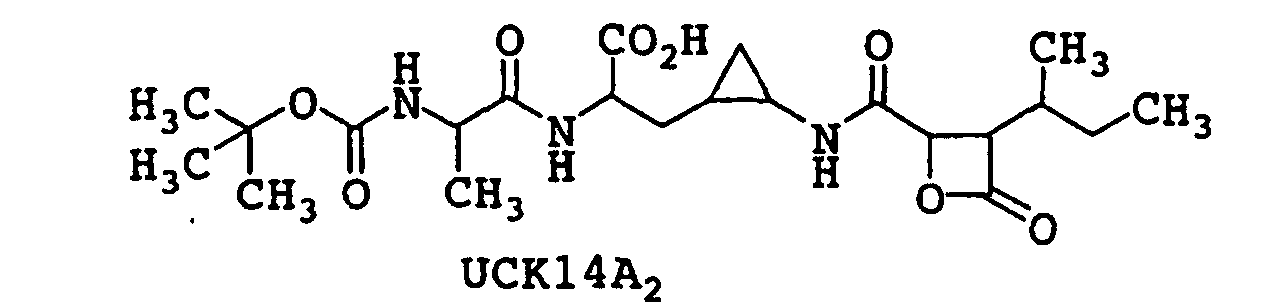
- UCK14A 1 , UCK14A 2 and UCK14C have the following structures, but none of them are known to have an inhibitory activity for proteasome.
- the object of the present invention is to provide a proteasome inhibitor. Also another object of the present invention is to provide a pharmaceutical composition comprising a substance having the above action as an active ingredient. Specifically, providing a pharmaceutical composition useful for the treatment of malignant tumors such as leukemia, lung cancer, colon cancer, breast cancer or the like, for the treatment of diseases associated with autoimmune diseases, inflammation, neurodegeneration or the like such as rheumatoid chronic arthritis, asthma, Alzheimer disease or the like, or further for the reduction of rejection in organ transplantation is the object of the present invention. Still another subject of the present invention is to provide a novel carboxylic acid derivative useful as an active ingredient of various medicines such as an antitumor agent or the like.
- the inventors of the present invention have found an inhibitory activity for proteasome in UCK compounds and derivatives of UCK compounds.
- the present invention relates to a medical agent effective for the treatment of the diseases associated with malignant tumors, autoimmune diseases, inflammation, neurodegeneration or the like by inhibition of proteasome.
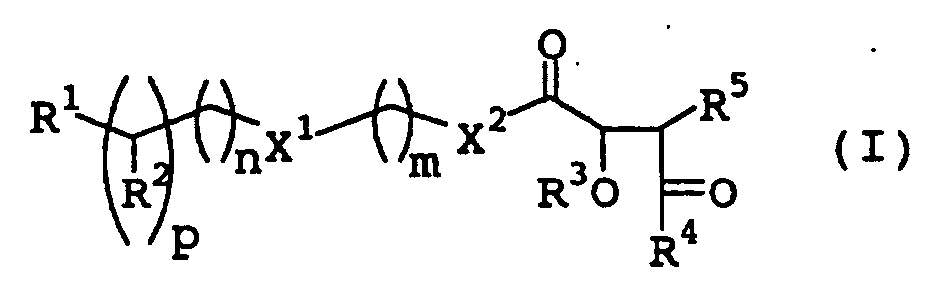
- the present invention relates to proteasome inhibitors comprising, as an active ingredient, a carboxylic acid derivative represented by the formula (I) [hereinafter, the compound represented by the formula (I) is referred to as Compound (I).
- the other formula numbers are treated in a similar manner] or a pharmaceutically acceptable salt thereof: ⁇ wherein m and n are the same or different and represent an integer of 0 to 10; p represents an integer of 0 or 1; R 1 represents a hydrogen atom, substituted or unsubstituted alkyl, substituted or unsubstituted alicyclic alkyl, substituted or unsubstituted aralkyl, substituted or unsubstituted aryl, or NR 6 R 7 ⁇ wherein R 6 represents a hydrogen atom, substituted or unsubstituted alkyl, or substituted or unsubstituted aralkyl; and R 7 represents a hydrogen atom, substituted or unsubstituted alkyl, substitute
- proteasome inhibitors comprising a carboxylic acid derivative, which is Compound (I) wherein R 3 and R 4 together represent a bond, or a pharmaceutically acceptable salt thereof as an active ingredient.
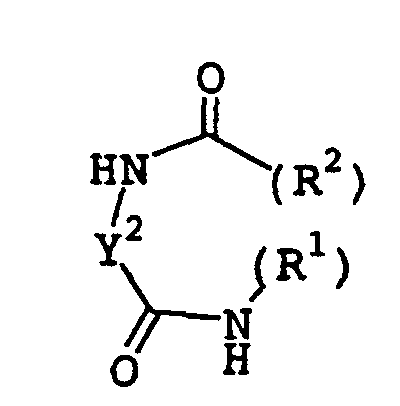
- the present invention relates to carboxylic acid derivatives [hereinafter referred to as Compound (IA)], which are Compound (I) wherein R 4 is hydroxy, or substituted or unsubstituted alkoxy; p is 1; and R 1 is a hydrogen atom or NR 6 R 7 (wherein each of R 6 and R 7 has the same significance as defined above), or R 1 and R 2 together are the formula: (wherein Y 2 has the same significance as defined above); X 1 is substituted or unsubstituted alicyclic alkylene, or substituted or unsubstituted arylene; and X 2 is NR 17 (wherein R 17 has the same significance as defined above), or pharmaceutically acceptable salts thereof, or relates to carboxylic acid derivatives [hereinafter referred to as Compound (IB)], which are Compound (I) wherein R 4 is mercapto, or substituted or unsubstituted alkylthio, or R 3 and R 4 together are a
- carboxylic acid derivatives which are Compound (IA) wherein R 1 is a hydrogen atom or NR 6 R 7 (wherein each of R 6 and R 7 has the same significance as defined above), or pharmaceutically acceptable salts thereof.
- R 1 is NR 6 R 7 (wherein each of R 6 and R 7 has the same significance as defined above);
- X 1 is cyclopropylene or alkylene; and
- X 2 is NH, are preferred.
- carboxylic acid derivatives which are Compound (IB) wherein R 4 is mercapto, or substituted or unsubstituted alkylthio; R 1 is NR 6 R 7 (wherein each of R 6 and R 7 has the same significance as defined above); and X 1 is cyclopropylene or alkylene, or pharmaceutically acceptable salts thereof.
- carboxylic acid derivatives which are a compound wherein R 3 and R 4 together represent a bond in the formula (IB), or pharmaceutically acceptable salts thereof.
- carboxylic acid derivatives or pharmaceutically acceptable salts thereof wherein m is 0; n and p are 1; R 1 is NR 6 R 7 (wherein each of R 6 and R 7 has the same significance as defined above); R 2 is COR 13a (wherein R 13a is alkylamino, aralkyloxy or aralkylamino); R 5 is alkyl; X 1 is cyclopropylene, alkylene, or substituted or unsubstituted phenylene; and X 2 is NH, are preferred.
- novel carboxylic acid derivatives or pharmaceutically acceptable salts thereof are useful, for example, as an active ingredient of pharmaceutical compositions or as an active ingredient for antitumor agents, antiinflammatory agents, proteasome inhibitors or the like.
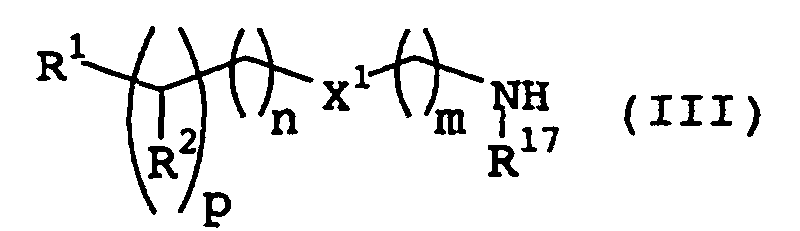
- the present invention relates to a process for producing the above-mentioned carboxylic acid derivatives wherein R 3 and R 4 together represent a bond and X 2 is NR 17 , characterized in that a carboxylic acid represented by the formula (II): (wherein R 5 has the same significance as defined above) is reacted with an amine represented by the formula (III): (wherein each of m, n, p, R 1 , R 2 , R 17 and X 1 has the same significance as defined above).
- Compound (IIa) which are Compound (II) wherein R 5 is substituted or unsubstituted alkyl, substituted or unsubstituted alkenyl, or substituted or unsubstituted aralkyl, or salts thereof.
- the present invention relates to amines [hereinafter referred to as Compound (IIIa)] or salts thereof which are Compound (III) wherein m is 0; n and p are 1; R 1 is NR 6 R 7 (wherein each of R 6 and R 7 has the same significance as defined above); R 2 is COR 13 (wherein R 13 has the same significance as defined above) or CH 2 OR 3a (wherein R 3a has the same significance as defined above), or R 1 and R 2 together are the formula: (wherein Y 2 has the same significance as defined above); and X 1 is cyclopropylene.
- Compound (IIIa) the amines [hereinafter referred to as Compound (IIIb)] or salts thereof, wherein R 1 is amino and R 17 is a hydrogen atom are preferred, and amines [hereinafter referred to as Compound (IIIc)] or salts thereof, wherein R 1 is amino; R 2 is carboxy; and R 17 is a hydrogen atom are more preferred.
- the present invention relates to the compounds or salts thereof, wherein Compound (IIIa) through Compound (IIIc) are protected with protecting groups.
- the present invention relates to medicines comprising Compound (I) or a pharmaceutically acceptable salt thereof as an active ingredient, used for the treatment of the diseases curable by proteasome inhibition.
- diseases may include, for example, malignant tumors such as leukemia, lung cancer, colon cancer, breast cancer or the like, diseases associated with autoimmune diseases, inflammation, neurodegeneration or the like such as rheumatoid chronic arthritis, asthma, Alzheimer disease and the like, and further the diseases such as the reduction of rejection in organ transplantation and the like.
- the above-mentioned inhibitor or the above-mentioned medicine is preferably provided in the form of a pharmaceutical composition comprising Compound (I) or a pharmaceutically acceptable salt thereof and additives for the formulation.
- the present invention relates to the use of Compound (I) or a pharmaceutically acceptable salt thereof for producing the above-mentioned proteasome inhibitor or the above-mentioned medicine, and to a method to inhibit proteasome comprising a process to administer an effective amount of Compound (I) or a pharmaceutically acceptable salt thereof to a mammal including human.
- Compound (II) or salts thereof may be used as a useful intermediate in producing Compound (I) or a pharmaceutically acceptable salt thereof.
- Compound (III) or salts thereof may be used as a useful intermediate in producing Compound (I) or a pharmaceutically acceptable salt thereof.
- Compound (IIIc) or salts thereof may be used as an active ingredient in medicines or agricultural chemicals, a synthetic starting material or synthetic intermediate of medicines or agricultural chemicals, a chemical seasoning, a food additive, a feed additive, an active ingredient of cosmetics, a building block in organic synthesis, an industrial material (for example, a starting material for producing a polymer), or the like, in addition to being used as a useful intermediate in producing Compound (I) or a pharmaceutically acceptable salt thereof.
- the alkyl moieties of the alkyl, alkoxy, alkylamino, alkanoyl, alkoxycarbonylalkyl, alkylthio and alkylsulfonyl include straight-chain or branched alkyl having 1 to 20 carbon atoms, such as methyl, ethyl, propyl, isopropyl, butyl, isobutyl, sec-butyl, tert-butyl, pentyl, isopentyl, hexyl, heptyl, octyl, nonyl, decyl, undecyl, dodecyl, pentadecyl, eicosyl, and preferably they have 1 to 8 carbon atoms.
- the alkylene moieties of the alkylene, alicyclic alkylalkoxy, aroylalkoxy and alkoxycarbonylalkyl are those in which one hydrogen atom is eliminated from the above alkyl moieties.
- the alicyclic alkyl moieties of the alicyclic alkyl and alicyclic alkylalkoxy include alicyclic alkyl having 3 to 8 carbon atoms, such as cyclopropyl, cyclobutyl, cyclopentyl, cyclohexyl, cycloheptyl, and cyclooctyl.
- the alicyclic alkylene is the one in which one hydrogen atom is eliminated from the above alicyclic alkyl.
- the alkenyl moieties of the alkenyl and alkenyloxy include, straight-chain or branched alkenyl having 2 to 6 carbon atoms and 1 to 3 double bonds, such as vinyl, allyl, crotyl, prenyl, butenyl, pentenyl, hexenyl, pentadienyl, and hexadienyl.
- the alkenylene is the one in which one hydrogen atom is eliminated from the above alkenyl.
- the aryl moieties of the aryl, arylamino, arylsulfonyl, aroylalkoxy and aroyl include phenyl, naphthyl, anthryl and phenanthryl.
- the aralkyl moieties of the aralkyl, aralkyloxy and aralkylamino include those having 7 to 15 carbon atoms, such as benzyl, phenethyl, benzhydryl, naphthylmethyl, and anthrylmethyl.
- the arylene is the one in which one hydrogen atom is eliminated from the above aryl.
- the heterocyclic group includes monocyclic or polycyclic 3- to 8-membered heterocyclic groups containing at least one or more heteroatoms such as oxygen, sulfur and nitrogen atoms.
- heteroatoms such as oxygen, sulfur and nitrogen atoms.
- 5- or 6-membered aromatic heterocyclic groups containing nitrogen such as imidazolyl, pyridyl, indolyl, quinolyl, isoquinolyl, quinoxalinyl, quinazolinyl, pyridazinyl, pyrimidinyl and pyrazinyl are included.
- 5- or 6-membered alicyclic heterocyclic groups containing nitrogen such as pyrrolidinyl, oxopyrrolidinyl, piperidinyl, piperidino, piperazinyl, morpholino, thiomorpholino, homopiperidinyl, homopiperazinyl and tetrahydropyridinyl are included.
- 1,3-dioxolan-4-yl, 1,3-dioxan-4-yl and 1,3-dioxan-5-yl are also suitable as the alicyclic heterocyclic group containing oxygen.
- the heterocyclic group formed together with adjacent N can be any of the above heterocyclic groups as long as they contain N.
- the substituents of the substituted heterocyclic group include, in addition to the above substituents of the substituted alkylamino and the like, CW 4 R 8d [wherein R 8d represents a hydrogen atom, substituted or unsubstituted alkyl, substituted or unsubstituted alkylamino, substituted or unsubstituted alkoxy, substituted or unsubstituted aryl, a heterocyclic group, substituted or unsubstituted aralkyl, substituted or unsubstituted aralkylamino, or substituted or unsubstituted aralkyloxy.
- each of the alkyl, alkylamino, alkoxy, aryl, heterocyclic group, aralkyl, aralkylamino and aralkyloxy has the same significance as defined above, respectively; the substituents of the substituted alkyl, substituted alkylamino, substituted alkoxy, substituted aryl, substituted aralkyl, substituted aralkylamino and substituted aralkyloxy have the same significance as defined for the above substituents of the substituted alkylamino and the like; and W 4 has the same significance as the above W 1 ].
- the substituents of the substituted alkyl include substituted alkenyloxycarbonyl, substituted aralkyloxycarbonyl, substituted alicyclic alkylalkoxycarbonyl and substituted alkoxycarbonyl (herein, the alkenyl moiety of the alkenyloxycarbonyl has the same significance as the above alkenyl; the aralkyl moiety of the aralkyloxycarbonyl has the same significance as the above aralkyl; the alkyl moieties of the alicyclic alkylalkoxycarbonyl and alkoxycarbonyl have the same significance as the above alkyl; the alicyclic alkyl moiety of the alicyclic alkylalkoxycarbonyl has the same significance as the above alicyclic alkyl; and the substituents of the substituted alkenyloxycarbonyl, substituted aralkyloxycarbonyl, substituted alicyclic alkylalkoxycarbonyl and substituted alk
- the substituents of the substituted alkoxycarbonylalkyl include substituted aroyl (herein the aroyl has the same significance as defined above, and the substituents of the substituted aroyl have the same significance as the above substituents of the substituted alkylamino and the like) including the above substituents of the substituted alkylamino and the like.
- the halogen represents a fluorine, chlorine, bromine or iodine atom.
- the alkyl moieties of the alkanoyl, alkanoyloxy, alkyl, alkoxy, alkoxycarbonyl, alkoxycarbonylamino, alkoxycarbonyloxy, dialkylcarbamoyloxy, alkoxyaralkyloxycarbonyl and aroylalkoxy have the same significance as the above alkyl.
- the aryl moieties of the aroyl, aroyloxy and aroylalkoxy have the same significance as the above aryl.
- the alkenyl moiety of the alkenyloxycarbonyl has the same significance as the above alkenyl.
- the aralkyl moieties of the aralkyloxy, aralkyloxycarbonyl and alkoxyaralkyloxycarbonyl have the same significance as the aralkyl.
- the protecting groups of Compound (IIIa) through Compound (IIIc) include any of those, which can be used as a protecting group.
- the examples of the protecting group for an amino group include substituted or unsubstituted alkoxycarbonyl, substituted or unsubstituted aryloxycarbonyl, substituted or unsubstituted alkanoyl and substituted or unsubstituted aroyl.
- the examples of the protecting group for a carboxyl group include substituted or unsubstituted alkoxy, substituted or unsubstituted aryloxy and the like [See “Basis and Experiment for Peptide Synthesis" Izumiya et al., Ed., Maruzen (1985)].
- alkyl moieties of the above alkoxycarbonyl, alkanoyl and alkoxy have the same significance as the above alkyl.
- the aryl moieties of the aryloxycarbonyl, aroyl and aryloxy have the same significance as the above aryl.
- the substituents of the substituted alkoxycarbonyl, substituted aryloxycarbonyl, substituted alkanoyl, substituted aroyl, substituted alkoxy and substituted aryloxy have the same significance as the above substituents of the substituted alkylamino and the like.
- Pharmaceutically acceptable salts of Compound (I) include pharmaceutically acceptable acid addition salts, metal salts, ammonium salts, organic amine addition salts, and amino acid addition salts.
- the acid addition salts include inorganic salts such as hydrochloride, hydrobromide, sulfate and phosphate, and organic salts such as formate, acetate, trifluoroacetate, benzoate, maleate, fumarate, succinate, tartrate, citrate, oxalate, methanesulfonate and p-toluene sulfonate.
- the metal salts include alkali metal salts such as lithium salts, sodium salts and potassium salts, alkaline earth metal salts such as magnesium salts and calcium salts, aluminium salts and zinc salts.
- the ammonium salts include ammonium and tetramethyl ammonium.
- the organic amine addition salts include addition salts of morpholine and piperidine, and the amino acid addition salts include addition salts of an amino acid such as glycine, phenylalanine, aspartic acid, glutamic acid and lysine.
- the salts of Compound (II) and Compound (III) include various salts that are available as the salts of Compound (II) and Compound (III) comprising pharmaceutically acceptable salts described above.
- the objective compounds can be obtained using standard methods used in synthetic organic chemistry, for example, protection and deprotection of functional groups [for example, see “Protective Groups in Organic Synthesis” Greene, T. W. Ed., John Wiley & Sons, Inc. (1981)], oxidation, reduction, hydrolysis or the like. Also, the order of the reaction steps such as introduction of the substituents can be altered, if necessary.
- Compound (II) can be obtained by hydrogenating Compound (IV), which can be produced in a manner similar to that described in the references [Corey, E.J. et al., J. Am. Chem. Soc., 120, 2330-2336 (1998); S. Cammas et al., Polymer Bulletin, 33 , 149-158 (1994)] in an inert solvent in the presence of a catalyst.
- the solvents used for the reaction include methanol, ethanol, water and the like.
- the catalysts include, for example, palladium carbon, platinum oxide or the like, and are usually used in an amount of 0.1 equivalent or more, preferably 1 to 200 equivalents based on Compound (IV).
- Compound (II) can be produced in a manner similar to that described in Bajwa, J. S. et al., J. Org. Chem., 48 , 1114-1116 (1983).
- Compound (IIIc) can be obtained by treating UCK14A 1 or UCK14A 2 in an inert solvent in the presence of an acid.
- the solvent used in the reaction may be any of water, dimethylformamide, acetonitrile or the like or the reaction may be conducted without solvents.
- the acid may be any of inorganic acids such as hydrochloric acid, sulfuric acid or the like, but hydrochloric acid is preferably used usually in an amount of 1 equivalent or more, preferably 1 to 200 equivalents based on UCK14A 1 or UCK14A 2 .
- the reaction usually terminates in the range of 0 to 150°C within 1 to 24 hours.
- Compound (Ia), i.e., Compound (I) wherein R 3 and R 4 together represent a bond and X 2 is N-R 17 (wherein R 17 has the same significance as defined above) can be obtained by reacting Compound (II) with Compound (III) obtained by synthesis from an amino acid such as lysine, ornithine, Compound (IIIc), or the like [See “Basis and Experiment for Peptide Synthesis” Izumiya et al., Ed., Maruzen (1985)], in an inert solvent in the presence of a condensing agent.
- the solvent used in the reaction may be any of inert solvents for the reaction such as chloroform, dichloromethane, ether, tetrahydrofuran, acetone, dimethylformamide, acetonitrile, and the like, and these may be used alone or in combination.
- the condensing agent may be any of those conventionally used for condensation between a carboxylic acid and an amine, and for example, dicyclohexylcarbodiimide, 1-ethyl-3-(3-dimethylaminopropyl)carbodiimide hydrochloride or the like may be used.
- 1-Hydroxybenzotriazol, N-hydroxysuccinimide, or the like can be further added thereto in an amount of 1 to 10 equivalents.
- Compound (III) and the condensing agent are usually used in an amount of 1 equivalent or more, preferably 1 to 200 equivalents based on Compound (II). The reaction usually terminates in the range of 0 to 50°C within 5 minutes to 24 hours.
- Compound (I) can be obtained from Compound (V) [See Bajwa, J. S. et al., J. Org. Chem., 48 , 1114-1116 (1983)] and Compound (VI) in a manner similar to that described in Process 3.
- R 4a represents a group defined for the above R 4 except when R 3 and R 4 together represent a bond
- Compound (Id) i.e., Compound (I) wherein R 3 is a hydrogen atom
- Process 4 can also be obtained by reacting Compound (Ic), i.e., Compound (I) wherein R 3 and R 4 are bound together, with Compound (VII) in an inert solvent in the presence of a base.
- the solvent used in the reaction may be any of inert solvents for the reaction described in Process 3, and dimethyl sulfoxide is preferably used.
- Amines such as pyridine, imidazole, triethylamine, diisopropylethylamine, or the like, or carbonates, bicarbonates or phosphates of an alkali metal or an alkaline earth metal such as sodium carbonate, potassium carbonate, calcium carbonate, sodium hydrogencarbonate, or the like may be used as the base.
- Compound (VII) and the base are usually used in an amount of 1 equivalent or more, preferably 1 to 200 equivalents based on Compound (Ic). The reaction usually terminates in the range of -10 to 50°C within 10 minutes to 24 hours.
- Compound (Ie), i.e., Compound (I) wherein R 1 is NHC( O)-C(CH 3 )NR 9 R 10 ; R 2 is COR 13a (wherein R 13a represents a group defined for R 13 except for hydroxy); m is 0; n and p are 1; R 3 and R 4 together represent a bond; R 5 is sec-butyl; X 1 is cyclopropylene or ethylene; and X 2 is NH, can be synthesized by the above-mentioned Process 3, however, can also be produced, for example, by the following synthetic pathway using UCK14A 2 or Compound (VIII) as a starting material: (wherein R 13a has the same significance as defined above; R 9a and R 10a represent groups defined for the above R 9a and R 10a except when R 9 is a hydrogen atom and simultaneously R 10 is a hydrogen atom or CO 2 C(CH 3 ) 3 ; and X 1a represents cyclopropylene or ethylene).
- Compound (Ie) can also be produced, for example, by the steps described below depending on types of R 9 , R 10 , R 13 and X 1a and based on the above-mentioned synthetic pathway.
- R 13b represents substituted or unsubstituted alkyl, substituted or unsubstituted alkenyl, substituted or unsubstituted aralkyl, substituted or unsubstituted alicyclic alkylalkyl, or substituted or unsubstituted aroylalkyl; each of R 13a , R 14 , R 15 and X 1a has the same significance as defined above; and Z represents chlorine, bromine or iodine
- the alkyl moieties of the alicyclic alkylalkyl and aroylalkyl are as defined for the alkyl descrived above; the alicyclic alkyl moiety of the alicyclic alkylalkyl is as defined for the alicyclic alkyl descrived above; the aryl moiety of the aroylalkyl is as defined for the aryl descrived above; the substituents of the substituted alicyclic alkylalkyl and substituted aroylalkyl are as defined for the substituents of the substituted alkyl descrived above; and each of the substituted or unsubstituted alkyl, substituted or unsubstituted alkenyl, and substituted or unsubstituted aralkyl has the same significance as defined above.
- Compound (Ie1) i.e., Compound (Ie) wherein R 9 is a hydrogen atom and R 10 is represented by CO 2 C(CH 3 ) 3
- R 9 is a hydrogen atom
- R 10 is represented by CO 2 C(CH 3 ) 3
- UCK14A 2 or Compound (VIII) with Compound (IX) in an inert solvent in the presence of a base, or with Compound (X) or Compound (XI) in an inert solvent in the presence of a condensing agent.
- the solvent used in the reaction may be any of inert solvents for the reaction described in Process 3, and these solvents may be used alone or in combination.
- Amines such as pyridine, imidazole, triethylamine, diisopropylethylamine, or the like, or carbonates or bicarbonates of an alkal metal or an alkaline earth metal such as sodium carbonate, potassium carbonate, calcium carbonate, sodium hydrogencarbonate, or the like may be used as the base.
- Dimethylaminopyridine or the like may also be used as a catalyst.
- the condensing agent may be any of those conventionally used for condensation between a carboxylic acid and an amine as mentioned above.
- dimethylaminopyridine or the like may be further added thereto in an amount of 0.1 to 10 equivalents
- Compound (XI) 1-hydroxybenzotriazol or the like may be further added thereto in an amount of 1 to 10 equivalents.
- Compound (IX), Compound (X), Compound (XI), the base and the condensing agent are usually used in an amount of 1 equivalent or more, preferably 1 to 200 equivalents based on UCK14A 2 or Compound (VIII). The reaction usually terminates in the range of 0 to 50°C within 5 minutes to 24 hours.
- Compound (Ie2) i.e., Compound (Ie) wherein R 9 and R 10 are simultaneously represented by a hydrogen atom may be obtained by treating Compound (Ie1) in a solvent in the presence of an acid.
- the solvent used in the reaction may be any of chloroform, dichloromethane, ether, tetrahydrofuran, acetone, dimethylformamide, acetonitrile, methanol, ethanol or the like, and preferably, chloroform, dichloromethane or the like is used.
- the acid can be any of organic acids such as p-toluenesulfonic acid, camphorsulfonic acid, pyridinium p-toluenesulfonate, trifluoroacetic acid, trifluoromethanesulfonic acid, and the like, inorganic acids such as hydrochloric acid, sulfuric acid, and the like, and Lewis acids such as titanium tetrachloride, boron trifluoride diethyl etherate, and the like, however, preferably trifluoroacetic acid is used usually in an amount of 1 equivalent or more, preferably 1 to 10 equivalents based on Compound (Ie1). The reaction usually terminates in the range of 0 to 50°C within 5 minutes to 24 hours.
- organic acids such as p-toluenesulfonic acid, camphorsulfonic acid, pyridinium p-toluenesulfonate, trifluoroacetic acid, trifluoromethanesulfonic
- R 9b represents substituted or unsubstituted alkyl, or substituted or unsubstituted aralkyl;
- Z a is as defined for the above Z; and each of R 13a and X 1a has the same significance as defined above
- each of substituted or unsubstituted alkyl and substituted or unsubstituted aralkyl has the same significance as defined above.
- Compound (Ie3a) i.e., Compound (Ie) wherein R 9 and R 10 are identical substituted or unsubstituted alkyl, or substituted or unsubstituted aralkyl can also be obtained by reacting Compound (Ie2) with Compound (XII) in an inert solvent in the presence of a base.
- the solvent used in the reaction may be any of inert solvents for the reaction described in Process 3, and these solvents may be used alone or in combination.
- Amines such as pyridine, imidazole, triethylamine, diisopropylethylamine, or the like, or carbonates or bicarbonates of an alkal metal or an alkaline earth metal such as sodium carbonate, potassium carbonate, calcium carbonate, sodium hydrogencarbonate, or the like may be used as the base, and dimethylaminopyridine or the like may also be used as a catalyst.
- Compound (XII) and the base are usually used in an amount of 1 equivalent or more, preferably 1 to 200 equivalents based on Compound (Ie2). The reaction usually terminates in the range of 0 to 50°C within 5 minutes to 24 hours.
- R 8c represents substituted or unsubstituted alkyl, or substituted or unsubstituted aralkyl; and each of R 8a , R 13a , W 2 and X 1a has the same significance as defined above
- Compound (Ie3b), i.e., Compound (Ie) wherein R 9 is a hydrogen atom and R 10 is CW 2 R 8a (wherein each of R 8a and W 2 has the same significance as defined above) can be obtained by reacting Compound (Ie2) with Compound (XIII) represented by R 8c NCW 2 (wherein each of R 8c and W 2 has the same significance as defined above) in an inert solvent in the presence of a base, or with Compound (XIV) represented by R 8a CO 2 H (wherein R 8a has the same significance as defined above) in an inert solvent in the presence of a condensing agent.
- the solvent used in the reaction may be any of inert solvents for the reaction described in Process 3, and these solvents may be used alone or in combination.
- Amines such as pyridine, imidazole, triethylamine, diisopropylethylamine, or the like may be used as the base, and dimethylaminopyridine or the like can also be used as a catalyst.
- the condensing agent may be any of those conventionally used for condensation between a carboxylic acid and an amine as mentioned above, and 1-hydroxybenzotriazol or the like may be further added thereto in an amount of 1 to 10 equivalents.
- Compound (XIII), Compound (XIV), the base and the condensing agent are usually used in an amount of 1 equivalent or more, preferably 1 to 200 equivalents based on Compound (Ie2).
- the reaction usually terminates in the range of 0 to 50°C within 5 minutes to 24 hours.
- each of substituted or unsubstituted alkyl and substituted or unsubstituted aryl has the same significance as defined above.
- Compound (Ie3c), i.e., Compound (Ie) wherein R 9 is a hydrogen atom and R 10 is SO 2 R 18 (wherein R 18 has the same significance as defined above) can also be obtained by reacting Compound (Ie2) with Compound (XV) in an inert solvent in the presence of a base.
- the solvent used in the reaction may be any of inert solvents for the reaction described in Process 3, and these solvents may be used alone or in combination.
- Amines such as pyridine, imidazole, triethylamine, diisopropylethylamine, or the like may be used as the base, and dimethylaminopyridine or the like can also be used as a catalyst.
- Compound (XV) and the base are usually used in an amount of 1 equivalent or more, preferably 1 to 200 equivalents based on Compound (Ie2). The reaction usually terminates in the range of 0 to 50°C within 5 minutes to 24 hours.
- Compound (Ie3d), i.e., Compound (Ie) wherein R 9 is a hydrogen atom and R 10 is PW 3 R 12 2 (wherein each of R 12 and W 3 has the same significance as defined above) can also be obtained by reacting Compound (Ie2) with Compound (XVI) in an inert solvent in the presence of a base.
- the solvent used in the reaction may be any of inert solvents for the reaction described in Process 3, and these solvents may be used alone or in combination.
- Amines such as pyridine, imidazole, triethylamine, diisopropylethylamine, or the like may be used as the base, and dimethylaminopyridine or the like may also be used as a catalyst.
- Compound (XVI) and the base are usually used in an amount of 1 equivalent or more, preferably 1 to 200 equivalents based on Compound (Ie2). The reaction usually terminates in the range of 0 to 50°C within 5 minutes to 24 hours.
- the objective compounds in the above-mentioned processes can be isolated and purified by standard purification methods used in synthetic organic chemistry such as neutralization, filtration, extraction, washing, drying, concentration, recrystallization, various types of chromatography, or the like.
- Stereoisomers such as diastereomers or the like may exist in some of Compound (I), Compound (II) and Compound (III), and the present invention covers all possible isomers including these and the mixture thereof.
- Compound (I), pharmaceutically acceptable salts thereof, Compound (II), Compound (III) and salts thereof may be in the form of adducts with water or various solvents, and these adducts are also included in the present invention.
- proteasome inhibitory activity, WiDr antiproliferative activity and antitumor activity of representative Compound (I) are described by Test Examples.
- a crude enzyme solution fractionated by molecular weight from an extract solution of HeLa S3 cells in reference to the method known in the art was used as proteasome [Ugai S. et al., J. Biochem., 113 , 754-768 (1993); Orino E. et al., FEBS, 284, 206-210 (1991)].
- 1 x 10 9 of HeLa S3 cells were dispersed in 5 ml of the buffer A [20 mmol/L of Tris (pH 7.5), 2 mmol/L of ATP, 5 mmol/L of MgCl 2 , 1 mmol/L of dithiothreitol (DTT)], and then homogenized at 4°C.
- the supernatant centrifuged at 100,000G was concentrated by a Centricon-500 (supplied by Amicon) and diluted with 2.5 ml of the buffer B [25 mmol/L of Tris/HCl (pH 7.5), 2 mmol/L of ATP, 1 mmol/L of DTT, 20% of glycerol].
- the obtained high molecular fraction (molecular weight >500K) was used as an enzyme solution for the detection of proteasome activity.
- Suc-Leu-Leu-Val-Tyr-AMC (Suc: Succinyl; AMC: Aminomethylcoumarin](supplied by Peptide Institute, Inc.) was used as a substrate for measuring inhibitory activity for proteasome (stored as a 2 mmol/L DMSO solution). The reaction was carried out by the following method using 96-well microtiter plates.
- Test Example 2 Antiproliferative activity in human colon cancer, WiDr cells.
- Human colon cancer WiDr cells suspended in MEM media containing 10% of fetal calf serum were seeded in 96-well microtiter plates at 2 x 10 3 cells/well, and precultured in an incubator with 5% of CO 2 at 37°C for 24 hours. Then, each compound diluted appropriately with the media was added into the well at 50 ⁇ l/well. At this time, a final concentration of each compound is up to 100 ⁇ mol/l or 1 ⁇ mol/l. The cells were cultured in the incubator with 5% of CO 2 at 37°C for additional 72 hours.
- MTT [3-(4,5-dimethylthiazol-2-yl)-2,5-dimethyltetrazolium bromide] dissolved in the medium at a final concentration of 1 mg/mL was added into the well at 50 ⁇ l/well.
- dimethyl sulfoxide was added to the well at 150 ⁇ l/well, and the plate was vigorously stirred using a plate mixer to dissolve crystals of MTT-formazan completely. Then, the difference between absorbance at 550 nM and that at 630 nM was measured by a microplate reader.
- the antiproliferative activity for cellular proliferation was expressed as the concentration at which 50% inhibition of proliferation (IC 50 ) was induced.
- Test Example 3 Antitumor activity for human colon cancer cell line, WiDr transplanted in nude mice
- Compound 4 was dissolved in ethanol and then prepared at the fixed concentrations by adding cremophor EL (supplied by SIGMA) and saline. At this time, final concentrations of ethanol, cremophor EL, and saline are 5%, 7.5% and 87.5%, respectively.
- 2 mm x 2 mm of the tumor piece of human colon cancer cell line, WiDr was subcutaneously transplanted in the ventral site of a BALB/c-nu/nu mouse. At the time when a tumor volume [a major axis (a), a minor axis (b): ab 2 /2] attained to 25-60 mm 3 , the test compound prepared was intraperitoneally administered for 5 consecutive days to five mice as one proup.
- the compound obtained according to the present invention is useful as an antitumor agent, and can be used as such or in various dosing forms.
- Compound (I) or a pharmaceutically acceptable salt thereof when used as an injection, it may be used by dissolving it in a liquid used commonly in the art as a diluent, for example, saline, a glucose solution for injection, a lactose solution for injection, a mannitol solution for injection or the like, or may be used as a freeze dry injection or a powder injection mixed with sodium chloride or the like based on Pharmacopoeia of Japan.
- an adjuvant such as polyethylene glycol, HCO-60 (surfactant; supplied by Nikko Chemical), or the like, or a carrier such as ethanol and/or liposome, cyclodextrin or the like may be added to these injections.
- an adjuvant such as polyethylene glycol, HCO-60 (surfactant; supplied by Nikko Chemical), or the like, or a carrier such as ethanol and/or liposome, cyclodextrin or the like may be added to these injections.
- these injections are usually provided for intravenous administration, however, intra-arterial, intraperitoneal and intrathoracic administrations are also possible.
- Compound (I) or a pharmaceutically acceptable salt thereof can also be used as an oral agent by mixing it with an appropriate excipient, a disintegrator, a binder, a lubricant or the like and molding by a standard method to make tablets, granules, powders, syrups or the like. Also, Compound (I) or a pharmaceutically acceptable salt thereof can also be administered into the rectum by mixing it with a commonly used carrier and molding by a standard method to make a suppository. Further, Compound (I) or a pharmaceutically acceptable salt thereof can also be used as a transdermal agent by mixing it with a commonly used carrier by a standard method to make nasal drops, eye drops, topical cream or the like.
- Compound (I) or a pharmaceutically acceptable salt thereof can be administered orally or parenterally as ointments, injections or the like. Its effective dose and administration schedule vary depending upon the mode of administration, the age, body weight, or conditions of the patients or the like. Generally, administrating 0.01 to 1000 mg/60 kg, preferably mg/60 kg per day once a week or once three weeks is preferred.
- FABMS indicates mass spectra by a “FAB” method
- HRFABMS indicates high resolution mass spectra by a “FAB” method
- calculated means a theoretical value based on a molecular formula
- found means an actual measurement.
- ODS represents octadecylated silica gel.
- UCK14A 2 (50 mg, 0.11 mmol) was dissolved in dichloromethane (5.0 mL) followed by adding n-butyl alcohol (0.015 mL, 0.16 mmol), 1,3-dicyclohexylcarbodiimide (22 mg, 0.11 mmol), 1-hydroxybenzotriazole monohydrate (25 mg, 0.21 mmol) and 4-dimethylaminopyridine (2.6 mg, 0.021 mmol), and then the mixture was stirred at 25°C for 1.5 hours.
- n-butyl alcohol 0.015 mL, 0.16 mmol
- 1,3-dicyclohexylcarbodiimide 22 mg, 0.11 mmol
- 1-hydroxybenzotriazole monohydrate 25 mg, 0.21 mmol
- 4-dimethylaminopyridine 2.6 mg, 0.021 mmol
- UCK14A 2 (52mg, 0.11 mmol) was dissolved in dichloromethane (5.2 mL) followed by adding benzylamine (0.012 mL, 0.11 mmol), 1,3-dicyclohexylcarbodiimide (23 mg, 0.11 mmol) and 1-hydroxybenzotriazole monohydrate(26 mg, 0.22 mmol), and then the mixture was stirred at 25°C for 0.5 hour.
- Example 37 Compound 37 (24 mg, 0.038 mmol) obtained in Example 37 was dissolved in tetrahydrofuran (2.4 mL) followed by adding a 1 mol/L tetrabutylammonium fluororide/tetrahydrofuran solution (0.075 mL, 0.075 mmol) and acetic acid (4.3 mg, 0.075 mmol), and then the mixture was stirred at 25°C for 2 hours.
- Example 71 Compound 71 (23 mg, 0.14 mmol) obtained in Example 71 was dissolved in dichloromethane (2.3 mL) followed by adding benzyl N- ⁇ -(tert-butyloxycarbonyl)-L- ⁇ , ⁇ -diaminopropionate (40 mg, 0.14 mmol), 1,3-dicyclohexylcarbodiimide (28 mg, 0.14 mmol) and 1-hydroxybenzotriazolemonohydrate (32 mg, 0.27 mmol), and then the mixture was stirred at 0°C for 0.5 hour.
- dichloromethane 2.3 mL
- benzyl N- ⁇ -(tert-butyloxycarbonyl)-L- ⁇ , ⁇ -diaminopropionate 40 mg, 0.14 mmol
- 1,3-dicyclohexylcarbodiimide 28 mg, 0.14 mmol
- 1-hydroxybenzotriazolemonohydrate 32 mg, 0.27 mmol
- Example 49 In a manner similar to that in Example 48, Compound 49 (24 mg, yield; 52%) was obtained from Compound 71 (14 mg, 0.080 mmol) obtained in Example 71, dichloromethane (1.4 mL), N-(tert-butyloxycarbonyl)-L-alanyl-L-lysine benzyl ester (33 mg, 0.080 mg), 1,3-dichlorohexylcarbodiimide (42 mg, 0.20 mmol) and 1-hydroxybenzotriazole monohydrate (19 mg, 0.17 mmol).
- Example 71 Compound 71 (36 mg, 0.21 mmol) obtained in Example 71 was dissolved in dichloromethane (3.6 mL) followed by adding N- ⁇ -(tert-butyloxycarbonyl)- ⁇ , ⁇ -diaminopentane (51 mg, 0.25 mmol), 1,3-dicyclohexylcarbodiimide (52 mg, 0.25 mmol) and 1-hydroxybenzotriazole monohydrate (59mg, 0.50 mmol), and then the mixture was stirred at 0°C for 15 minutes.
- dichloromethane 3.6 mL
- N- ⁇ -(tert-butyloxycarbonyl)- ⁇ , ⁇ -diaminopentane 51 mg, 0.25 mmol
- 1,3-dicyclohexylcarbodiimide 52 mg, 0.25 mmol
- 1-hydroxybenzotriazole monohydrate 59mg, 0.50 mmol
- Example 53 In a manner similar to that in Example 48, Compound 53 (26 mg, yield; 46%) was obtained from Compound 71 (20 mg, 0.12 mmol) obtained in Example 71, dichloromethane (2.0 mL), N- ⁇ -[N-(tert-butyloxycarbonyl)-L-alanyl]- ⁇ , ⁇ -diaminopentan e (32 mg, 0.12 mmol), 1,3-dicyclohexylcarbodiimide (24mg, 0.12 mmol) and 1-hydroxybenzotriazole monohydrate (27 mg, 0.23 mmol).
- Example 71 Compound 71 (82 mg, 0.48 mmol) obtained in Example 71 was dissolved in tetrahydrofuran (8.2 mL) followed by adding N-hydroxysuccineimide (0.11 g, 0.95 mmol) and 1,3-dicyclohexylcarbodiimide (0.11 g, 0.52 mmol), and then the mixture was stirred at 25°C for one hour. Further, N- ⁇ -(tert-butyloxycarbonyl)-L-ornithine (0.33 g, 1.43 mmol) was added to the reaction mixture and the mixture was stirred at 25°C for 17 hours.
- Example 80 In a manner similar to that in Example 47, Compound 80 (20 mg, yield; 61%) was obtained from compound 71 (11 mg, 0.063 mmol) obtained in Example 71, dichloromethane (1.1 mL), 4-amino-N-(tert-butyloxycarbonyl)-L-phenylalanine benzyl ester (23 mg, 0.063 mmol), 1,3-dicyclohexylcarbodiimide (26 mg, 0.13 mmol) and 1-hydroxybenzotriazole monohydrate (15 mg, 0.13 mmol).
- Example 89 In a manner similar to that in Example 84, Compound 89 (26mg, yield; 100%) was obtained from Compound 88 (26 mg, 0.047 mmol) obtained in Example 86, methanol (2.6 mL) and a 4 mol/L aqueous solution of sodium hydroxide (0.047 mL, 0.19 mmol).
- Example 71 Compound 71 (4.6 mg, 0.027 mmol) obtained in Example 71 was dissolved in dichloromethane (0.92 mL) followed by adding Compound 86 (10 mg, 0.027 mmol) obtained in Example 84, 1,3-dicyclohexylcarbodiimide (11 mg, 0.054 mmol) and 1-hydroxybenzotriazole monohydrate (13 mg, 0.11 mmol), and then the mixture was stirred at 25°C for 30 minutes.
- Example 91 In a manner similar to that in Example 88, Compound 91 (5.9 mg, yield; 21%) was obtained from Compound 71 (8.2 mg, 0.047 mmol) obtained in Example 71, dichloromethane (1.6 mL), Compound 89 (22 mg, 0.047 mmol) obtained in Example 87, 1,3-dicyclohexylcarbodiimide (29 mg, 0.14 mmol) and 1-hydroxybenzotriazole monohydrate (33 mg, 0.28 mmol).
- Finely ground Compound 4 is dissolved in water for injections. The solution is filtered and the filtrate is sterilized with an autoclave to afford the injections. Inqredient per ampoule Compound 4 10 mg Water for injections an appropriate amount Total volume 1.0 ml
- Finely ground Compound 3 is mixed with powdered potato starch, lactose, magnesium stearate, polyvinyl alcohol and tar dye, and the mixture is compressed to mold the tablets.
- Ingredient per tablet Compound 3 100 mg Lactose 60 mg Potato starch 50 mg Polyvinyl alcohol 2 mg Magnesium stearate 1 mg Tar dye an appropriate amount
- Finely ground Compound 21 is mixed with powdered lactose to afford the powders.
- Ingredient per dose Compound 21 100 mg Lactose 240 mg
- Finely ground Compound 50 is mixed with melted cocoa butter, and the mixture is poured into molds and cooled to afford the suppository.
- Ingredient per one dose of suppository Compound 50 10 mg Cocoa butter (basis) an appropriate amount Total volume 2.0 g
- Finely ground Compound 3 is mixed with powdered lactose and magnesium stearate. Gelatin capsules are filled with the mixture to afford the capsules. Ingredient per capsule Compound 3 100 mg Lactose 540 mg Magnesium stearate 1 mg
- An antiseptic agent is dissolved in warmed purified water and the solution is gradually cooled.
- Sodium chloride and finely ground Compound 24 are added thereto.
- the pH of the mixture is adjusted to 5.5 to 6.5, and the mixture is diluted with purified water into a final volume of 100 ml to afford the nasal drops.
- Ingredient per 100 ml of drops Compound 24 1000 mg Sodium chloride 800 mg Antiseptic agent 500 mg Purified water an appropriate amount Total volume 100 ml
- the eye drops are obtained by a method similar to that
- the eye drops are obtained by a method similar to that in the case of nasal drops.
- Ingredient per 100 ml of drops Compound 24 100 mg Sodium chloride 800 mg Antiseptic agent 500 mg Purified water an appropriate amount Total 100 ml
- An antiseptic agent is dissolved in warmed purified water and the solution is gradually cooled.
- Emulsified wax, mineral oil, and white petrolatum are added thereto followed by mixing thoroughly at 70 to 80°C.
- An aqueous solution containing Compound 50 is added thereto and the mixture is stirred.
- Purified water is added thereto with stirring up to a total weight of 100 g to afford the topical cream.
- Inqredient per 100 g of cream Compound 50 1000 mg Emulsified wax 15 g Mineral oil 5 g White petrolatum 5 g
- Purified water an appropriate amount Total weight 100 g
- Diethyl (R)-(+)-malate (5.0 g, 0.026 mol) was dissolved in tetrahydrofuran (150 mL) followed by adding a 1 mol/L solution of lithium bis(trimethylsilyl)amide/tetrahydrofuran (53 mL, 0.053 mmol) and then the mixture was stirred at -78°C for 15 minutes. Further, 3-bromo-2-methylpropene (27 mL, 0.26 mol) was added thereto and the temperature was elevated up to 0°C over one hour.
- the present invention provides proteasome inhibitors effective for the treatment of malignant tumors, such as leukemia, lung cancer, colon cancer, breast cancer or the like by growth suppression of various cancer cells, for the treatment of diseases associated with autoimmune diseases, inflammation, neurodegeneration or the like, such as rheumatoid chronic arthritis, asthma, Alzheimer disease or the like, or further for the reduction of rejection in organ transplantation.
- malignant tumors such as leukemia, lung cancer, colon cancer, breast cancer or the like by growth suppression of various cancer cells
- diseases associated with autoimmune diseases, inflammation, neurodegeneration or the like such as rheumatoid chronic arthritis, asthma, Alzheimer disease or the like, or further for the reduction of rejection in organ transplantation.
Landscapes
- Chemical & Material Sciences (AREA)
- Organic Chemistry (AREA)
- Health & Medical Sciences (AREA)
- General Health & Medical Sciences (AREA)
- Life Sciences & Earth Sciences (AREA)
- Medicinal Chemistry (AREA)
- Proteomics, Peptides & Aminoacids (AREA)
- Nuclear Medicine, Radiotherapy & Molecular Imaging (AREA)
- Biophysics (AREA)
- Molecular Biology (AREA)
- Biochemistry (AREA)
- Chemical Kinetics & Catalysis (AREA)
- General Chemical & Material Sciences (AREA)
- Genetics & Genomics (AREA)
- Pharmacology & Pharmacy (AREA)
- Animal Behavior & Ethology (AREA)
- Public Health (AREA)
- Veterinary Medicine (AREA)
- Engineering & Computer Science (AREA)
- Bioinformatics & Cheminformatics (AREA)
- Pharmaceuticals Containing Other Organic And Inorganic Compounds (AREA)
- Acyclic And Carbocyclic Compounds In Medicinal Compositions (AREA)
Abstract

Description
- The present invention relates to a proteasome inhibitor containing a carboxylic acid derivative as an active ingredient, which is useful for the treatment of malignant tumors such as leukemia, lung cancer, colon cancer, breast cancer or the like, for the treatment of diseases associated with autoimmune diseases, inflammation, neurodegeneration or the like such as rheumatoid chronic arthritis, asthma, Alzheimer disease or the like, or further for the reduction of rejection in organ transplantation.
- Proteasome also called multicatalytic protease is a multicomponent complex. Its structure consists of 20S proteasome, which has cylindrical catalytic subunits and oxbow regulatory subunits. 26S proteasome in which both are associated is a macromolecular complex with a molecular weight of 200k having a dumbbell shaped structure, and plays a role in decomposing intracellularly ubiquitinated proteins depending on ATP [Tanaka K. et al., Molecular Biology Report, 24, 3-11 (1997); Baumeister W. et al., Cell, 92, 367-380 (1998)]. It has been previously reported that its expression levels are increased in leukemia cells. However in recent years, it has been demonstrated that this degradation mechanism by ubiquitin-proteasome is deeply involved in control of cell cycle and control of immune initiation. In many cancer cells, acceleration of degradation of a tumor suppressor gene product, p53 occurs regardless of its variant or wild type, and p53 does not function normally. Induction of the wild type of p53 causes G1 arrest or apoptosis of cells. The system bearing degradation of this wild type p53 is the ubiquitin-proteasome degradative system [Spataro V. et al., British J. Cancer, 77, 448-455 (1998)]. Recently, from the analysis using clinical specimens of breast cancer, colon cancer and lung cancer, it has been shown that proteasome-dependent degradation of an endogenous inhibitor of cyclin-dependent kinase, p27 is facilitated in these cancers, particularly in those with poor prognosis [Porter P. L. et al., Nature Medicine, 3, 222-225 (1997); Catzavelos C. et al., Nature Medicine, 3, 227-230 (1997); Esposito V. et al., Cancer Res., 57, 3381-3385 (1997)]. Thus, inhibition of proteasome can accumulate p53 or p27, degradation of which is facilitated in cancer cells, and thereby can induce growth arrest or apoptosis of cancer cells. Further, proteasome has been reported to function as a processing enzyme for endogenous antigens in immune initiation system [Rock K. L. et al., Cell, 78, 761-771 (1994)]. Additionally, it has been demonstrated that proteasome plays an important role in activation of NF-κB, which is a transcription regulatory factor for inflammatory cytokines such as TNF-α [Palombella, V. J., Cell, 78, 773-785 (1994)]. Thus, it is believed that a proteasome inhibitor is also useful for the reduction of rejection in organ transplantation, or for inflammatory diseases or the like.
- Lactacystin produced by Actinomycetes [Fenteany G., J. Biol. Chem., 273, 8545-8548 (1998)] and a peptide aldehyde compound, MG132 [Palombella V. J., Cell, 78, 773-785 (1994)] have been reported as existing selective proteasome inhibitors. These inhibitors not only have an action of induction of growth arrest or apoptosis of cancer cells and that of inhibition of NF-KB activation but also are known as the compounds, which induce prong elongation in nerve cells [Omura S. et al., J. Antibiot., 40, 113-116 (1991)]. Thus, it is believed that a proteasome inhibitor is effective for diseases associated with neurodegeneration or the like.
- On the other hand, UCK14 compounds are the compounds produced by a microorganism belonging to the genus Streptomyces and are disclosed in Japanese Published Unexamined Application No. 169796/97, which exhibit an antitumor action. Among them, UCK14A1, UCK14A2 and UCK14C have the following structures, but none of them are known to have an inhibitory activity for proteasome.

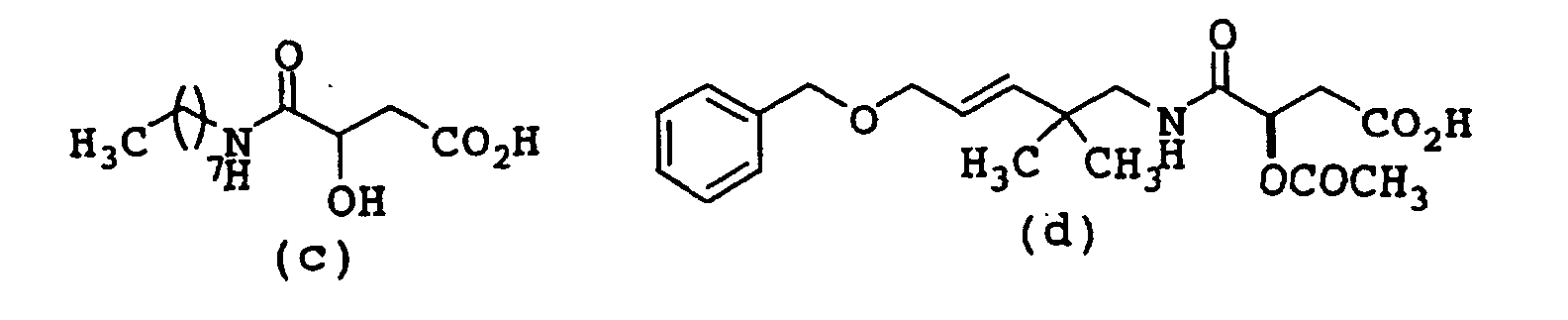
- Besides, the following compounds (a) through (e) [Shih, Hsiencheng et al., Synthesis, 866-867 (1989); Georgy Liesen et al., J. Org. Chem., 52, 455-457 (1987); David J. Hart et al., J. Org. Chem., 50, 235-342 (1985); Japanese Published Unexamined Application No. 21661/92] are known, but none of them are known to have an inhibitory activity for proteasome.


- On the other hand, the following compound having a β-lactone structure has been reported [S. Cammas et al., Polymer Bulletin, 33, 149-158 (1994)], but its pharmacological activity is not known.

- The object of the present invention is to provide a proteasome inhibitor. Also another object of the present invention is to provide a pharmaceutical composition comprising a substance having the above action as an active ingredient. Specifically, providing a pharmaceutical composition useful for the treatment of malignant tumors such as leukemia, lung cancer, colon cancer, breast cancer or the like, for the treatment of diseases associated with autoimmune diseases, inflammation, neurodegeneration or the like such as rheumatoid chronic arthritis, asthma, Alzheimer disease or the like, or further for the reduction of rejection in organ transplantation is the object of the present invention. Still another subject of the present invention is to provide a novel carboxylic acid derivative useful as an active ingredient of various medicines such as an antitumor agent or the like.
- The inventors of the present invention have found an inhibitory activity for proteasome in UCK compounds and derivatives of UCK compounds. The present invention relates to a medical agent effective for the treatment of the diseases associated with malignant tumors, autoimmune diseases, inflammation, neurodegeneration or the like by inhibition of proteasome.
- Thus, the present invention relates to proteasome inhibitors comprising, as an active ingredient, a carboxylic acid derivative represented by the formula (I) [hereinafter, the compound represented by the formula (I) is referred to as Compound (I). The other formula numbers are treated in a similar manner] or a pharmaceutically acceptable salt thereof:<wherein m and n are the same or different and represent an integer of 0 to 10; p represents an integer of 0 or 1; R1 represents a hydrogen atom, substituted or unsubstituted alkyl, substituted or unsubstituted alicyclic alkyl, substituted or unsubstituted aralkyl, substituted or unsubstituted aryl, or NR6R7 {wherein R6 represents a hydrogen atom, substituted or unsubstituted alkyl, or substituted or unsubstituted aralkyl; and R7 represents a hydrogen atom, substituted or unsubstituted alkyl, substituted or unsubstituted aralkyl, CW1R8 (wherein R8 represents a hydrogen atom, substituted or unsubstituted alkyl, substituted or unsubstituted alkylamino, substituted or unsubstituted alkoxy, substituted or unsubstituted aryl, a substituted or unsubstituted heterocyclic group, substituted or unsubstituted aralkyl, substituted or unsubstituted aralkylamino, or substituted or unsubstituted aralkyloxy; and W1 represents an oxygen atom or a sulfur atom); or represents the formula:
 [wherein R9 represents a hydrogen atom, substituted or unsubstituted alkyl, or substituted or unsubstituted aralkyl; R10 represents a hydrogen atom, substituted or unsubstituted alkyl, substituted or unsubstituted aralkyl, CW2R8a (wherein R8a and W2 have the same significances as the above R8 and W1, respectively), substituted or unsubstituted alkylsulfonyl, substituted or unsubstituted arylsulfonyl, or PW3R12 2 (wherein R12's are the same or different and represent substituted or unsubstituted alkyl, or substituted or unsubstituted aryl; and W3 has the same significance as the above W1), or R9 and R10 together represent the formula:
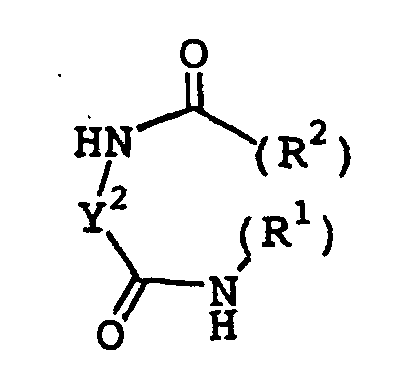
 (wherein Y1 represents substituted or unsubstituted alkylene or substituted or unsubstituted arylene); and R11 represents a hydrogen atom, substituted or unsubstituted alkyl, or substituted or unsubstituted aralkyl]}; R2 represents a hydrogen atom, COR13 [wherein R13 represents hydroxy, substituted or unsubstituted alkoxy, substituted or unsubstituted alkenyloxy, substituted or unsubstituted aralkyloxy, substituted or unsubstituted alicyclic alkylalkoxy, substituted or unsubstituted aroylalkoxy, or NR14R15 (wherein R14 represents a hydrogen atom, substituted or unsubstituted alkyl, or substituted or unsubstituted aryl; and R15 represents substituted or unsubstituted alkyl, substituted or unsubstituted aralkyl, substituted or unsubstituted alkoxycarbonylalkyl, amino, substituted or unsubstituted alkylamino, or substituted or unsubstituted arylamino, or R14 and R15 together with the adjacent N form a substituted or unsubstituted heterocyclic group)], or CH2OR3a [wherein R3a represents a hydrogen atom, substituted or unsubstituted alkyl, substituted or unsubstituted aralkyl, substituted or unsubstituted alkanoyl, substituted or unsubstituted aroyl, or SiR16 3 (wherein R16's are the same or different and represent substituted or unsubstituted alkyl, or substituted or unsubstituted aryl)], or R1 and R2 together represent the formula:
 (wherein Y2 represents substituted or unsubstituted alkylene); X1 represents a bond, substituted or unsubstituted alkylene, substituted or unsubstituted alicyclic alkylene, substituted or unsubstituted alkenylene, or substituted or unsubstituted arylene; X2 represents an oxygen atom, a sulfur atom or NR17 (wherein R17 represents a hydrogen atom, substituted or unsubstituted alkyl, or substituted or unsubstituted aralkyl); R3 has the same significance as the above R3a; R4 represents hydroxy, mercapto, substituted or unsubstituted alkoxy, or substituted or unsubstituted alkylthio, or R3 and R4 together represent a bond; and R5 represents a hydrogen atom, substituted or unsubstituted alkyl, substituted or unsubstituted alkenyl, or substituted or unsubstituted aralkyl>.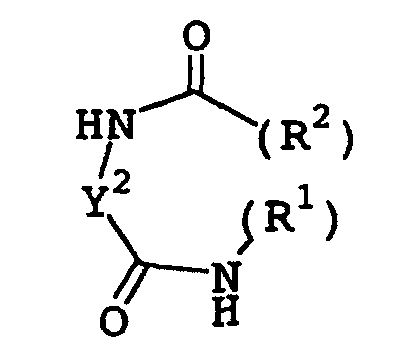
- Another embodiment includes proteasome inhibitors comprising a carboxylic acid derivative, which is Compound (I) wherein R3 and R4 together represent a bond, or a pharmaceutically acceptable salt thereof as an active ingredient.
- In another respect, the present invention relates to carboxylic acid derivatives [hereinafter referred to as Compound (IA)], which are Compound (I) wherein R4 is hydroxy, or substituted or unsubstituted alkoxy; p is 1; and R1 is a hydrogen atom or NR6R7 (wherein each of R6 and R7 has the same significance as defined above), or R1 and R2 together are the formula:(wherein Y2 has the same significance as defined above); X1 is substituted or unsubstituted alicyclic alkylene, or substituted or unsubstituted arylene; and X2 is NR17 (wherein R17 has the same significance as defined above), or pharmaceutically acceptable salts thereof, or relates to carboxylic acid derivatives [hereinafter referred to as Compound (IB)], which are Compound (I) wherein R4 is mercapto, or substituted or unsubstituted alkylthio, or R3 and R4 together are a bond; and X2 is NR17 (wherein R17 has the same significance as defined above)[but, when m is 0; n and p are 1; R2 is carboxy; R3 and R4 together are a bond; R5 is sec-butyl; and X1 is cyclopropylene or ethylene, R1 is neither NHC(=O)-C(CH3)NH2 nor NHC(=O)-C(CH3)NHC(=O)O-C(CH3)3], or pharmaceutically acceptable salts thereof. Also another embodiment includes carboxylic acid derivatives, which are Compound (IA) wherein R1 is a hydrogen atom or NR6R7 (wherein each of R6 and R7 has the same significance as defined above), or pharmaceutically acceptable salts thereof. In the above compounds, carboxylic acid derivatives or pharmaceutically acceptable salts thereof, wherein R1 is NR6R7 (wherein each of R6 and R7 has the same significance as defined above); X1 is cyclopropylene or alkylene; and X2 is NH, are preferred. Also another embodiment includes carboxylic acid derivatives, which are Compound (IB) wherein R4 is mercapto, or substituted or unsubstituted alkylthio; R1 is NR6R7 (wherein each of R6 and R7 has the same significance as defined above); and X1 is cyclopropylene or alkylene, or pharmaceutically acceptable salts thereof. Further, another embodiment includes carboxylic acid derivatives, which are a compound wherein R3 and R4 together represent a bond in the formula (IB), or pharmaceutically acceptable salts thereof. In the above compounds, carboxylic acid derivatives or pharmaceutically acceptable salts thereof, wherein m is 0; n and p are 1; R1 is NR6R7 (wherein each of R6 and R7 has the same significance as defined above); R2 is COR13a (wherein R13a is alkylamino, aralkyloxy or aralkylamino); R5 is alkyl; X1 is cyclopropylene, alkylene, or substituted or unsubstituted phenylene; and X2 is NH, are preferred.
- The above novel carboxylic acid derivatives or pharmaceutically acceptable salts thereof are useful, for example, as an active ingredient of pharmaceutical compositions or as an active ingredient for antitumor agents, antiinflammatory agents, proteasome inhibitors or the like.
- Also, the present invention relates to a process for producing the above-mentioned carboxylic acid derivatives wherein R3 and R4 together represent a bond and X2 is NR17, characterized in that a carboxylic acid represented by the formula (II):(wherein R5 has the same significance as defined above) is reacted with an amine represented by the formula (III):
 (wherein each of m, n, p, R1, R2, R17 and X1 has the same significance as defined above). Further, the present invention relates to carboxylic acids [hereinafter referred to as Compound (IIa)] which are Compound (II) wherein R5 is substituted or unsubstituted alkyl, substituted or unsubstituted alkenyl, or substituted or unsubstituted aralkyl, or salts thereof. Also, the present invention relates to amines [hereinafter referred to as Compound (IIIa)] or salts thereof which are Compound (III) wherein m is 0; n and p are 1; R1 is NR6R7 (wherein each of R6 and R7 has the same significance as defined above); R2 is COR13 (wherein R13 has the same significance as defined above) or CH2OR3a (wherein R3a has the same significance as defined above), or R1 and R2 together are the formula:
 (wherein Y2 has the same significance as defined above); and X1 is cyclopropylene. Among Compound (IIIa), the amines [hereinafter referred to as Compound (IIIb)] or salts thereof, wherein R1 is amino and R17 is a hydrogen atom are preferred, and amines [hereinafter referred to as Compound (IIIc)] or salts thereof, wherein R1 is amino; R2 is carboxy; and R17 is a hydrogen atom are more preferred. In another respect, the present invention relates to the compounds or salts thereof, wherein Compound (IIIa) through Compound (IIIc) are protected with protecting groups.
- In another respect, the present invention relates to medicines comprising Compound (I) or a pharmaceutically acceptable salt thereof as an active ingredient, used for the treatment of the diseases curable by proteasome inhibition. These diseases may include, for example, malignant tumors such as leukemia, lung cancer, colon cancer, breast cancer or the like, diseases associated with autoimmune diseases, inflammation, neurodegeneration or the like such as rheumatoid chronic arthritis, asthma, Alzheimer disease and the like, and further the diseases such as the reduction of rejection in organ transplantation and the like.
- The above-mentioned inhibitor or the above-mentioned medicine is preferably provided in the form of a pharmaceutical composition comprising Compound (I) or a pharmaceutically acceptable salt thereof and additives for the formulation. Also, the present invention relates to the use of Compound (I) or a pharmaceutically acceptable salt thereof for producing the above-mentioned proteasome inhibitor or the above-mentioned medicine, and to a method to inhibit proteasome comprising a process to administer an effective amount of Compound (I) or a pharmaceutically acceptable salt thereof to a mammal including human. Also, Compound (II) or salts thereof may be used as a useful intermediate in producing Compound (I) or a pharmaceutically acceptable salt thereof. Also, Compound (III) or salts thereof may be used as a useful intermediate in producing Compound (I) or a pharmaceutically acceptable salt thereof. Besides, Compound (IIIc) or salts thereof may be used as an active ingredient in medicines or agricultural chemicals, a synthetic starting material or synthetic intermediate of medicines or agricultural chemicals, a chemical seasoning, a food additive, a feed additive, an active ingredient of cosmetics, a building block in organic synthesis, an industrial material (for example, a starting material for producing a polymer), or the like, in addition to being used as a useful intermediate in producing Compound (I) or a pharmaceutically acceptable salt thereof.
- In the definition of each group in the formula (I), formula (II) and formula (III), the alkyl moieties of the alkyl, alkoxy, alkylamino, alkanoyl, alkoxycarbonylalkyl, alkylthio and alkylsulfonyl include straight-chain or branched alkyl having 1 to 20 carbon atoms, such as methyl, ethyl, propyl, isopropyl, butyl, isobutyl, sec-butyl, tert-butyl, pentyl, isopentyl, hexyl, heptyl, octyl, nonyl, decyl, undecyl, dodecyl, pentadecyl, eicosyl, and preferably they have 1 to 8 carbon atoms. The alkylene moieties of the alkylene, alicyclic alkylalkoxy, aroylalkoxy and alkoxycarbonylalkyl are those in which one hydrogen atom is eliminated from the above alkyl moieties. The alicyclic alkyl moieties of the alicyclic alkyl and alicyclic alkylalkoxy include alicyclic alkyl having 3 to 8 carbon atoms, such as cyclopropyl, cyclobutyl, cyclopentyl, cyclohexyl, cycloheptyl, and cyclooctyl. The alicyclic alkylene is the one in which one hydrogen atom is eliminated from the above alicyclic alkyl. The alkenyl moieties of the alkenyl and alkenyloxy include, straight-chain or branched alkenyl having 2 to 6 carbon atoms and 1 to 3 double bonds, such as vinyl, allyl, crotyl, prenyl, butenyl, pentenyl, hexenyl, pentadienyl, and hexadienyl. The alkenylene is the one in which one hydrogen atom is eliminated from the above alkenyl.
- The aryl moieties of the aryl, arylamino, arylsulfonyl, aroylalkoxy and aroyl include phenyl, naphthyl, anthryl and phenanthryl. The aralkyl moieties of the aralkyl, aralkyloxy and aralkylamino include those having 7 to 15 carbon atoms, such as benzyl, phenethyl, benzhydryl, naphthylmethyl, and anthrylmethyl. The arylene is the one in which one hydrogen atom is eliminated from the above aryl.
- The heterocyclic group includes monocyclic or polycyclic 3- to 8-membered heterocyclic groups containing at least one or more heteroatoms such as oxygen, sulfur and nitrogen atoms. Preferably, 5- or 6-membered aromatic heterocyclic groups containing nitrogen such as imidazolyl, pyridyl, indolyl, quinolyl, isoquinolyl, quinoxalinyl, quinazolinyl, pyridazinyl, pyrimidinyl and pyrazinyl are included. And preferably, 5- or 6-membered alicyclic heterocyclic groups containing nitrogen such as pyrrolidinyl, oxopyrrolidinyl, piperidinyl, piperidino, piperazinyl, morpholino, thiomorpholino, homopiperidinyl, homopiperazinyl and tetrahydropyridinyl are included. Further, 1,3-dioxolan-4-yl, 1,3-dioxan-4-yl and 1,3-dioxan-5-yl are also suitable as the alicyclic heterocyclic group containing oxygen. The heterocyclic group formed together with adjacent N can be any of the above heterocyclic groups as long as they contain N.
- The substituents of the substituted alkylamino, substituted alkylsulfonyl, substituted alkanoyl, substituted alkoxy, substituted alkylene, substituted aralkyl, substituted aralkylamino, substituted alicyclic alkyl, substituted alicyclic alkylalkoxy, substituted alicyclic alkylene, substituted aralkyloxy, substituted alkenyl, substituted alkenyloxy, substituted alkenylene, substituted aryl, substituted arylamino, substituted aroyl, substituted aroylalkoxy, substituted alkylthio, substituted arylsulfonyl, substituted heterocyclic group formed together with adjacent N and substituted arylene, are the same or different, and include halogen, nitro, hydroxy, amino, carboxy, alkanoyl, alkanoyloxy, alkyl, alkoxy, aroyl, aralkyl, aroyloxy, aroylalkoxy, alkoxycarbonyl, alkenyloxycarbonyl, alkoxycarbonylamino, alkoxycarbonyloxy, dialkylcarbamoyloxy, aralkyloxy, alkoxyaralkyloxycarbonyl, aralkyloxycarbonyl, alicyclic alkylalkoxycarbonyl, OPO(OH)2, OSO3H, OSiR16a 3 (wherein R16a's are the same or different and represent alkyl or aryl each of which has the same significance as defined above, respectively), and SiR16b 3 (wherein R16b has the same significance as the above R16a). The substituents of the substituted heterocyclic group include, in addition to the above substituents of the substituted alkylamino and the like, CW4R8d [wherein R8d represents a hydrogen atom, substituted or unsubstituted alkyl, substituted or unsubstituted alkylamino, substituted or unsubstituted alkoxy, substituted or unsubstituted aryl, a heterocyclic group, substituted or unsubstituted aralkyl, substituted or unsubstituted aralkylamino, or substituted or unsubstituted aralkyloxy. Herein, each of the alkyl, alkylamino, alkoxy, aryl, heterocyclic group, aralkyl, aralkylamino and aralkyloxy has the same significance as defined above, respectively; the substituents of the substituted alkyl, substituted alkylamino, substituted alkoxy, substituted aryl, substituted aralkyl, substituted aralkylamino and substituted aralkyloxy have the same significance as defined for the above substituents of the substituted alkylamino and the like; and W 4 has the same significance as the above W1]. The substituents of the substituted alkyl include substituted alkenyloxycarbonyl, substituted aralkyloxycarbonyl, substituted alicyclic alkylalkoxycarbonyl and substituted alkoxycarbonyl (herein, the alkenyl moiety of the alkenyloxycarbonyl has the same significance as the above alkenyl; the aralkyl moiety of the aralkyloxycarbonyl has the same significance as the above aralkyl; the alkyl moieties of the alicyclic alkylalkoxycarbonyl and alkoxycarbonyl have the same significance as the above alkyl; the alicyclic alkyl moiety of the alicyclic alkylalkoxycarbonyl has the same significance as the above alicyclic alkyl; and the substituents of the substituted alkenyloxycarbonyl, substituted aralkyloxycarbonyl, substituted alicyclic alkylalkoxycarbonyl and substituted alkoxycarbonyl have the same significance as the above substituents of the substituted alkylamino and the like), including the above substituents of the substituted alkylamino and the like. The substituents of the substituted alkoxycarbonylalkyl include substituted aroyl (herein the aroyl has the same significance as defined above, and the substituents of the substituted aroyl have the same significance as the above substituents of the substituted alkylamino and the like) including the above substituents of the substituted alkylamino and the like.
- In the definitions of the above-mentioned substituents, the halogen represents a fluorine, chlorine, bromine or iodine atom. The alkyl moieties of the alkanoyl, alkanoyloxy, alkyl, alkoxy, alkoxycarbonyl, alkoxycarbonylamino, alkoxycarbonyloxy, dialkylcarbamoyloxy, alkoxyaralkyloxycarbonyl and aroylalkoxy have the same significance as the above alkyl. The aryl moieties of the aroyl, aroyloxy and aroylalkoxy have the same significance as the above aryl. The alkenyl moiety of the alkenyloxycarbonyl has the same significance as the above alkenyl. The aralkyl moieties of the aralkyloxy, aralkyloxycarbonyl and alkoxyaralkyloxycarbonyl have the same significance as the aralkyl.
- The protecting groups of Compound (IIIa) through Compound (IIIc) include any of those, which can be used as a protecting group. The examples of the protecting group for an amino group include substituted or unsubstituted alkoxycarbonyl, substituted or unsubstituted aryloxycarbonyl, substituted or unsubstituted alkanoyl and substituted or unsubstituted aroyl. The examples of the protecting group for a carboxyl group include substituted or unsubstituted alkoxy, substituted or unsubstituted aryloxy and the like [See "Basis and Experiment for Peptide Synthesis" Izumiya et al., Ed., Maruzen (1985)].
- The alkyl moieties of the above alkoxycarbonyl, alkanoyl and alkoxy have the same significance as the above alkyl. The aryl moieties of the aryloxycarbonyl, aroyl and aryloxy have the same significance as the above aryl. The substituents of the substituted alkoxycarbonyl, substituted aryloxycarbonyl, substituted alkanoyl, substituted aroyl, substituted alkoxy and substituted aryloxy have the same significance as the above substituents of the substituted alkylamino and the like.
- Pharmaceutically acceptable salts of Compound (I) include pharmaceutically acceptable acid addition salts, metal salts, ammonium salts, organic amine addition salts, and amino acid addition salts. The acid addition salts include inorganic salts such as hydrochloride, hydrobromide, sulfate and phosphate, and organic salts such as formate, acetate, trifluoroacetate, benzoate, maleate, fumarate, succinate, tartrate, citrate, oxalate, methanesulfonate and p-toluene sulfonate. The metal salts include alkali metal salts such as lithium salts, sodium salts and potassium salts, alkaline earth metal salts such as magnesium salts and calcium salts, aluminium salts and zinc salts. The ammonium salts include ammonium and tetramethyl ammonium. The organic amine addition salts include addition salts of morpholine and piperidine, and the amino acid addition salts include addition salts of an amino acid such as glycine, phenylalanine, aspartic acid, glutamic acid and lysine.
- The salts of Compound (II) and Compound (III) include various salts that are available as the salts of Compound (II) and Compound (III) comprising pharmaceutically acceptable salts described above.
- The processes for the preparation of Compound (I), Compound (II) and Compound (III) are described below.
- In the processes described below, when the compounds used as starting materials or one or two or more functional groups of the products are changed under the conditions of the practical method, or are not appropriate in performing the method, the objective compounds can be obtained using standard methods used in synthetic organic chemistry, for example, protection and deprotection of functional groups [for example, see "Protective Groups in Organic Synthesis" Greene, T. W. Ed., John Wiley & Sons, Inc. (1981)], oxidation, reduction, hydrolysis or the like. Also, the order of the reaction steps such as introduction of the substituents can be altered, if necessary.
- (wherein R5 has the same significance as defined above.)

- Compound (II) can be obtained by hydrogenating Compound (IV), which can be produced in a manner similar to that described in the references [Corey, E.J. et al., J. Am. Chem. Soc., 120, 2330-2336 (1998); S. Cammas et al., Polymer Bulletin, 33, 149-158 (1994)] in an inert solvent in the presence of a catalyst. The solvents used for the reaction include methanol, ethanol, water and the like. The catalysts include, for example, palladium carbon, platinum oxide or the like, and are usually used in an amount of 0.1 equivalent or more, preferably 1 to 200 equivalents based on Compound (IV). The reaction usually terminates in the range of 0 to 50°C within 10 minutes to 24 hours. Also, Compound (II) can be produced in a manner similar to that described in Bajwa, J. S. et al., J. Org. Chem., 48, 1114-1116 (1983).
-
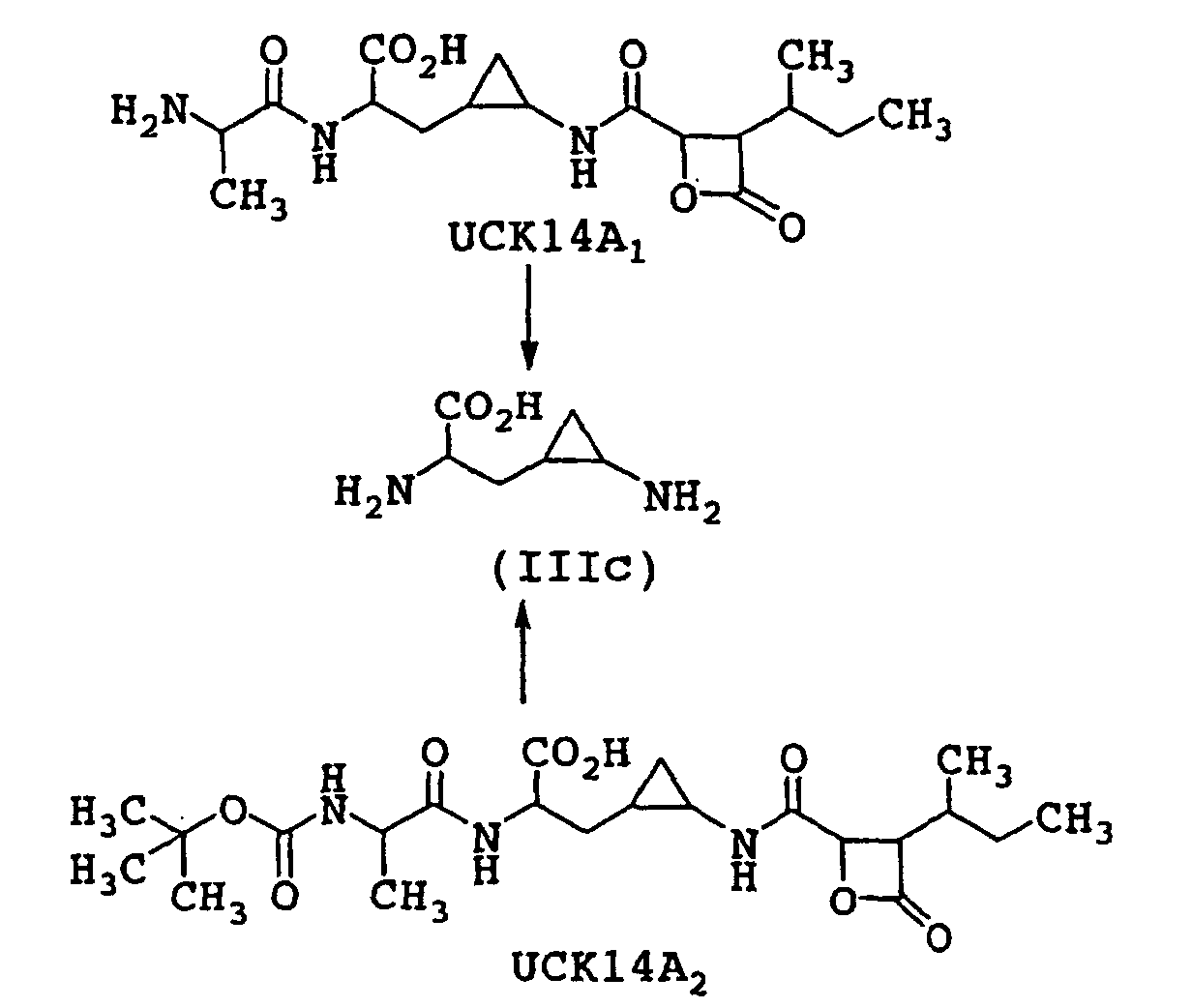
- Compound (IIIc) can be obtained by treating UCK14A1 or UCK14A2 in an inert solvent in the presence of an acid.
- The solvent used in the reaction may be any of water, dimethylformamide, acetonitrile or the like or the reaction may be conducted without solvents. The acid may be any of inorganic acids such as hydrochloric acid, sulfuric acid or the like, but hydrochloric acid is preferably used usually in an amount of 1 equivalent or more, preferably 1 to 200 equivalents based on UCK14A1 or UCK14A2. The reaction usually terminates in the range of 0 to 150°C within 1 to 24 hours.
- (wherein each of m, n, p, R1, R2, R5, R17 and X1 has the same significance as defined above)
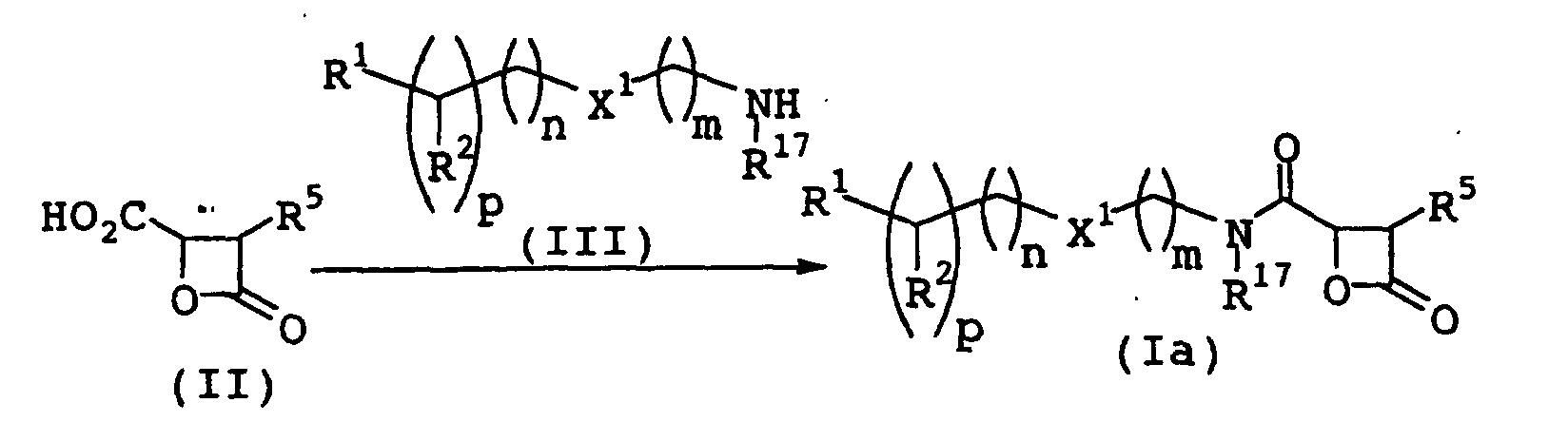
- Compound (Ia), i.e., Compound (I) wherein R3 and R4 together represent a bond and X2 is N-R17 (wherein R17 has the same significance as defined above) can be obtained by reacting Compound (II) with Compound (III) obtained by synthesis from an amino acid such as lysine, ornithine, Compound (IIIc), or the like [See "Basis and Experiment for Peptide Synthesis" Izumiya et al., Ed., Maruzen (1985)], in an inert solvent in the presence of a condensing agent. The solvent used in the reaction may be any of inert solvents for the reaction such as chloroform, dichloromethane, ether, tetrahydrofuran, acetone, dimethylformamide, acetonitrile, and the like, and these may be used alone or in combination. The condensing agent may be any of those conventionally used for condensation between a carboxylic acid and an amine, and for example, dicyclohexylcarbodiimide, 1-ethyl-3-(3-dimethylaminopropyl)carbodiimide hydrochloride or the like may be used. 1-Hydroxybenzotriazol, N-hydroxysuccinimide, or the like can be further added thereto in an amount of 1 to 10 equivalents. Compound (III) and the condensing agent are usually used in an amount of 1 equivalent or more, preferably 1 to 200 equivalents based on Compound (II). The reaction usually terminates in the range of 0 to 50°C within 5 minutes to 24 hours.
- (wherein each of m, n, p, R1, R2, R3, R4, R5, X1 and X2 has the same significance as defined above)

- Compound (I) can be obtained from Compound (V) [See Bajwa, J. S. et al., J. Org. Chem., 48, 1114-1116 (1983)] and Compound (VI) in a manner similar to that described in Process 3.
- (wherein each of m, n, p, R1, R2, R5, X1 and X2 has the same significance as defined above, and R4a represents a group defined for the above R4 except when R3 and R4 together represent a bond)

- Compound (Id), i.e., Compound (I) wherein R3 is a hydrogen atom, can be synthesized by the above-mentioned Process 4, however, can also be obtained by reacting Compound (Ic), i.e., Compound (I) wherein R3 and R4 are bound together, with Compound (VII) in an inert solvent in the presence of a base. The solvent used in the reaction may be any of inert solvents for the reaction described in Process 3, and dimethyl sulfoxide is preferably used. Amines such as pyridine, imidazole, triethylamine, diisopropylethylamine, or the like, or carbonates, bicarbonates or phosphates of an alkali metal or an alkaline earth metal such as sodium carbonate, potassium carbonate, calcium carbonate, sodium hydrogencarbonate, or the like may be used as the base. Compound (VII) and the base are usually used in an amount of 1 equivalent or more, preferably 1 to 200 equivalents based on Compound (Ic). The reaction usually terminates in the range of -10 to 50°C within 10 minutes to 24 hours.
- Compound (Ie), i.e., Compound (I) wherein R1 is NHC(=O)-C(CH3)NR9R10; R2 is COR13a (wherein R13a represents a group defined for R13 except for hydroxy); m is 0; n and p are 1; R3 and R4 together represent a bond; R5 is sec-butyl; X1 is cyclopropylene or ethylene; and X2 is NH, can be synthesized by the above-mentioned Process 3, however, can also be produced, for example, by the following synthetic pathway using UCK14A2 or Compound (VIII) as a starting material:
 (wherein R13a has the same significance as defined above; R9a and R10a represent groups defined for the above R9a and R10a except when R9 is a hydrogen atom and simultaneously R10 is a hydrogen atom or CO2C(CH3)3; and X1a represents cyclopropylene or ethylene).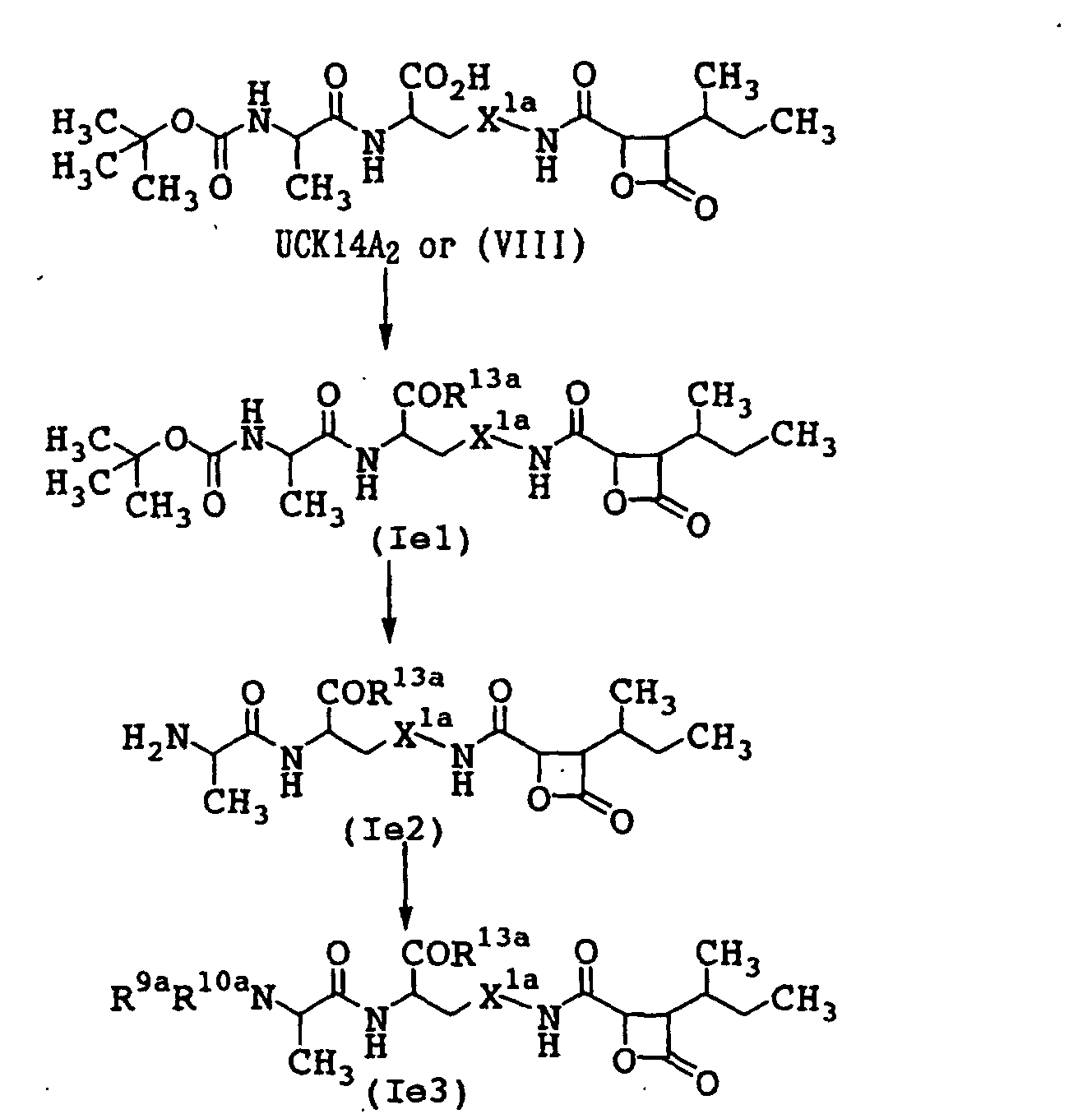
- Compound (Ie) can also be produced, for example, by the steps described below depending on types of R9, R10, R13 and X1a and based on the above-mentioned synthetic pathway.
- (wherein R13b represents substituted or unsubstituted alkyl, substituted or unsubstituted alkenyl, substituted or unsubstituted aralkyl, substituted or unsubstituted alicyclic alkylalkyl, or substituted or unsubstituted aroylalkyl; each of R13a, R14, R15 and X1a has the same significance as defined above; and Z represents chlorine, bromine or iodine)

- In the definition of R13b, the alkyl moieties of the alicyclic alkylalkyl and aroylalkyl are as defined for the alkyl descrived above; the alicyclic alkyl moiety of the alicyclic alkylalkyl is as defined for the alicyclic alkyl descrived above; the aryl moiety of the aroylalkyl is as defined for the aryl descrived above; the substituents of the substituted alicyclic alkylalkyl and substituted aroylalkyl are as defined for the substituents of the substituted alkyl descrived above; and each of the substituted or unsubstituted alkyl, substituted or unsubstituted alkenyl, and substituted or unsubstituted aralkyl has the same significance as defined above.
- Compound (Ie1), i.e., Compound (Ie) wherein R9 is a hydrogen atom and R10 is represented by CO2C(CH3)3 can be obtained by reacting UCK14A2 or Compound (VIII) with Compound (IX) in an inert solvent in the presence of a base, or with Compound (X) or Compound (XI) in an inert solvent in the presence of a condensing agent.
- The solvent used in the reaction may be any of inert solvents for the reaction described in Process 3, and these solvents may be used alone or in combination. Amines such as pyridine, imidazole, triethylamine, diisopropylethylamine, or the like, or carbonates or bicarbonates of an alkal metal or an alkaline earth metal such as sodium carbonate, potassium carbonate, calcium carbonate, sodium hydrogencarbonate, or the like may be used as the base. Dimethylaminopyridine or the like may also be used as a catalyst. The condensing agent may be any of those conventionally used for condensation between a carboxylic acid and an amine as mentioned above. In the case of Compound (X), dimethylaminopyridine or the like may be further added thereto in an amount of 0.1 to 10 equivalents, and in the case of Compound (XI), 1-hydroxybenzotriazol or the like may be further added thereto in an amount of 1 to 10 equivalents. Compound (IX), Compound (X), Compound (XI), the base and the condensing agent are usually used in an amount of 1 equivalent or more, preferably 1 to 200 equivalents based on UCK14A2 or Compound (VIII). The reaction usually terminates in the range of 0 to 50°C within 5 minutes to 24 hours.
- (wherein each of R13a and X1a has the same significance as defined above)

- Compound (Ie2), i.e., Compound (Ie) wherein R9 and R10 are simultaneously represented by a hydrogen atom may be obtained by treating Compound (Ie1) in a solvent in the presence of an acid.
- The solvent used in the reaction may be any of chloroform, dichloromethane, ether, tetrahydrofuran, acetone, dimethylformamide, acetonitrile, methanol, ethanol or the like, and preferably, chloroform, dichloromethane or the like is used. The acid can be any of organic acids such as p-toluenesulfonic acid, camphorsulfonic acid, pyridinium p-toluenesulfonate, trifluoroacetic acid, trifluoromethanesulfonic acid, and the like, inorganic acids such as hydrochloric acid, sulfuric acid, and the like, and Lewis acids such as titanium tetrachloride, boron trifluoride diethyl etherate, and the like, however, preferably trifluoroacetic acid is used usually in an amount of 1 equivalent or more, preferably 1 to 10 equivalents based on Compound (Ie1). The reaction usually terminates in the range of 0 to 50°C within 5 minutes to 24 hours.
- (wherein R9b represents substituted or unsubstituted alkyl, or substituted or unsubstituted aralkyl; Za is as defined for the above Z; and each of R13a and X1a has the same significance as defined above)

- In the definition of R9b, each of substituted or unsubstituted alkyl and substituted or unsubstituted aralkyl has the same significance as defined above.
- Compound (Ie3a), i.e., Compound (Ie) wherein R9 and R10 are identical substituted or unsubstituted alkyl, or substituted or unsubstituted aralkyl can also be obtained by reacting Compound (Ie2) with Compound (XII) in an inert solvent in the presence of a base.
- The solvent used in the reaction may be any of inert solvents for the reaction described in Process 3, and these solvents may be used alone or in combination. Amines such as pyridine, imidazole, triethylamine, diisopropylethylamine, or the like, or carbonates or bicarbonates of an alkal metal or an alkaline earth metal such as sodium carbonate, potassium carbonate, calcium carbonate, sodium hydrogencarbonate, or the like may be used as the base, and dimethylaminopyridine or the like may also be used as a catalyst. Compound (XII) and the base are usually used in an amount of 1 equivalent or more, preferably 1 to 200 equivalents based on Compound (Ie2). The reaction usually terminates in the range of 0 to 50°C within 5 minutes to 24 hours.
- (wherein R8c represents substituted or unsubstituted alkyl, or substituted or unsubstituted aralkyl; and each of R8a, R13a, W2 and X1a has the same significance as defined above)
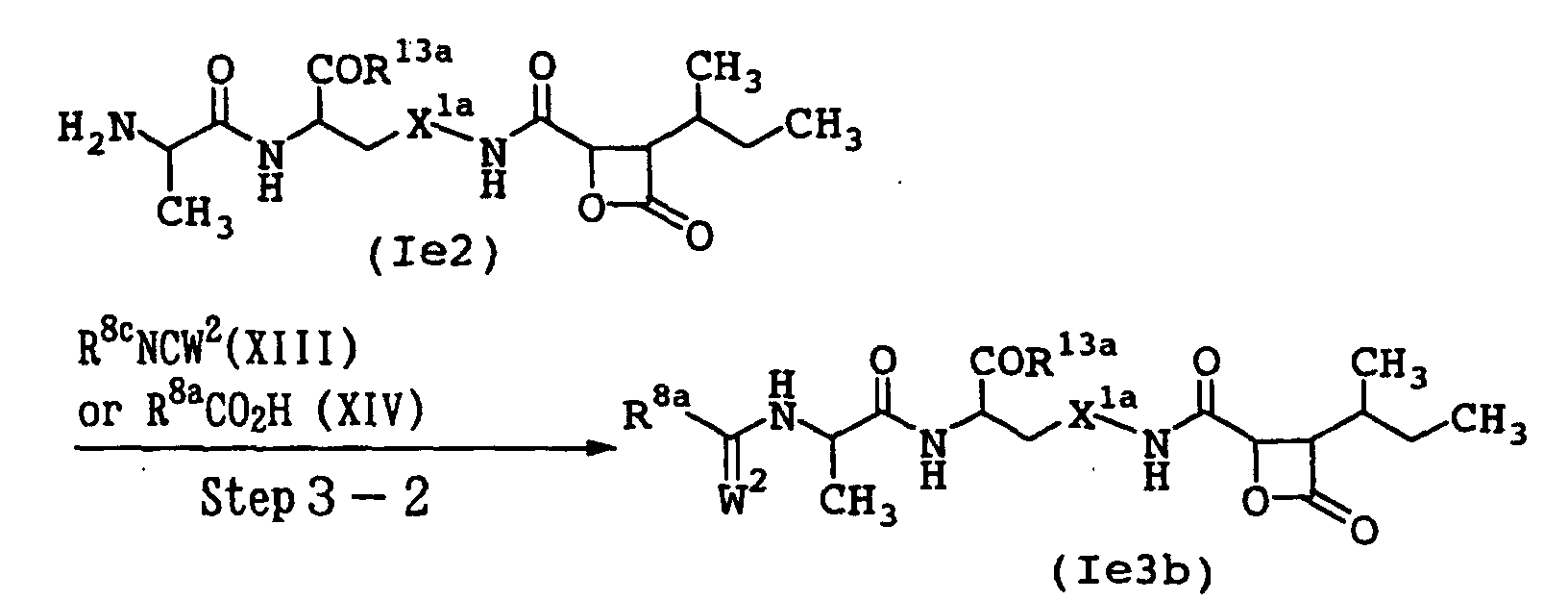
- Compound (Ie3b), i.e., Compound (Ie) wherein R9 is a hydrogen atom and R10 is CW2R8a (wherein each of R8a and W2 has the same significance as defined above) can be obtained by reacting Compound (Ie2) with Compound (XIII) represented by R8cNCW2 (wherein each of R8c and W2 has the same significance as defined above) in an inert solvent in the presence of a base, or with Compound (XIV) represented by R8aCO2H (wherein R8a has the same significance as defined above) in an inert solvent in the presence of a condensing agent.
- The solvent used in the reaction may be any of inert solvents for the reaction described in Process 3, and these solvents may be used alone or in combination. Amines such as pyridine, imidazole, triethylamine, diisopropylethylamine, or the like may be used as the base, and dimethylaminopyridine or the like can also be used as a catalyst. The condensing agent may be any of those conventionally used for condensation between a carboxylic acid and an amine as mentioned above, and 1-hydroxybenzotriazol or the like may be further added thereto in an amount of 1 to 10 equivalents. Compound (XIII), Compound (XIV), the base and the condensing agent are usually used in an amount of 1 equivalent or more, preferably 1 to 200 equivalents based on Compound (Ie2). The reaction usually terminates in the range of 0 to 50°C within 5 minutes to 24 hours.
- (wherein Zb is as defined for the above Z; each of R13a and X1a has the same significance as defined above; and R18 represents substituted or unsubstituted alkyl, or substituted or unsubstituted aryl)

- In the definition of R18, each of substituted or unsubstituted alkyl and substituted or unsubstituted aryl has the same significance as defined above.
- Compound (Ie3c), i.e., Compound (Ie) wherein R9 is a hydrogen atom and R10 is SO2R18 (wherein R18 has the same significance as defined above) can also be obtained by reacting Compound (Ie2) with Compound (XV) in an inert solvent in the presence of a base. The solvent used in the reaction may be any of inert solvents for the reaction described in Process 3, and these solvents may be used alone or in combination. Amines such as pyridine, imidazole, triethylamine, diisopropylethylamine, or the like may be used as the base, and dimethylaminopyridine or the like can also be used as a catalyst. Compound (XV) and the base are usually used in an amount of 1 equivalent or more, preferably 1 to 200 equivalents based on Compound (Ie2). The reaction usually terminates in the range of 0 to 50°C within 5 minutes to 24 hours.
- (wherein Zc is as defined for the above Z; and each of R12, R13a, X1a and W3 has the same significance as defined above)

- Compound (Ie3d), i.e., Compound (Ie) wherein R9 is a hydrogen atom and R10 is PW3R12 2 (wherein each of R12 and W3 has the same significance as defined above) can also be obtained by reacting Compound (Ie2) with Compound (XVI) in an inert solvent in the presence of a base. The solvent used in the reaction may be any of inert solvents for the reaction described in Process 3, and these solvents may be used alone or in combination. Amines such as pyridine, imidazole, triethylamine, diisopropylethylamine, or the like may be used as the base, and dimethylaminopyridine or the like may also be used as a catalyst. Compound (XVI) and the base are usually used in an amount of 1 equivalent or more, preferably 1 to 200 equivalents based on Compound (Ie2). The reaction usually terminates in the range of 0 to 50°C within 5 minutes to 24 hours.
- In the production of Compound (I), Compound (II) and Compound (III), transformations of functional groups can also be conducted by the method known in the art [for example, Comprehensive Organic Transformations, Larock, R. C., Ed. (1989)], in addition to the above-mentioned method in each step.
- The objective compounds in the above-mentioned processes can be isolated and purified by standard purification methods used in synthetic organic chemistry such as neutralization, filtration, extraction, washing, drying, concentration, recrystallization, various types of chromatography, or the like.
- Stereoisomers such as diastereomers or the like may exist in some of Compound (I), Compound (II) and Compound (III), and the present invention covers all possible isomers including these and the mixture thereof.
- Also, some of Compound (I), pharmaceutically acceptable salts thereof, Compound (II), Compound (III) and salts thereof may be in the form of adducts with water or various solvents, and these adducts are also included in the present invention.
- Specific examples of Compound (I) obtained from the above-mentioned processes are shown in Table 1.


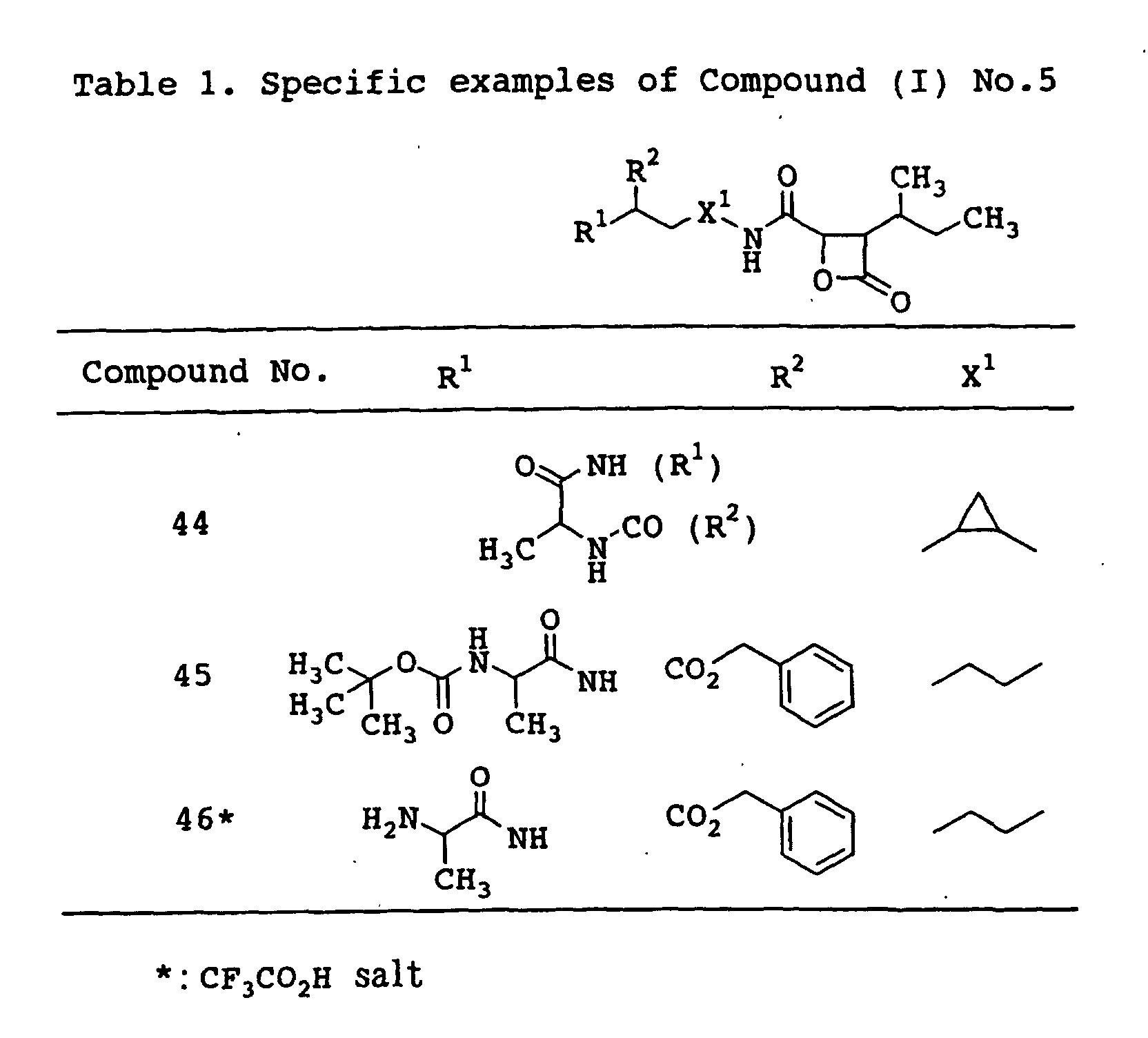


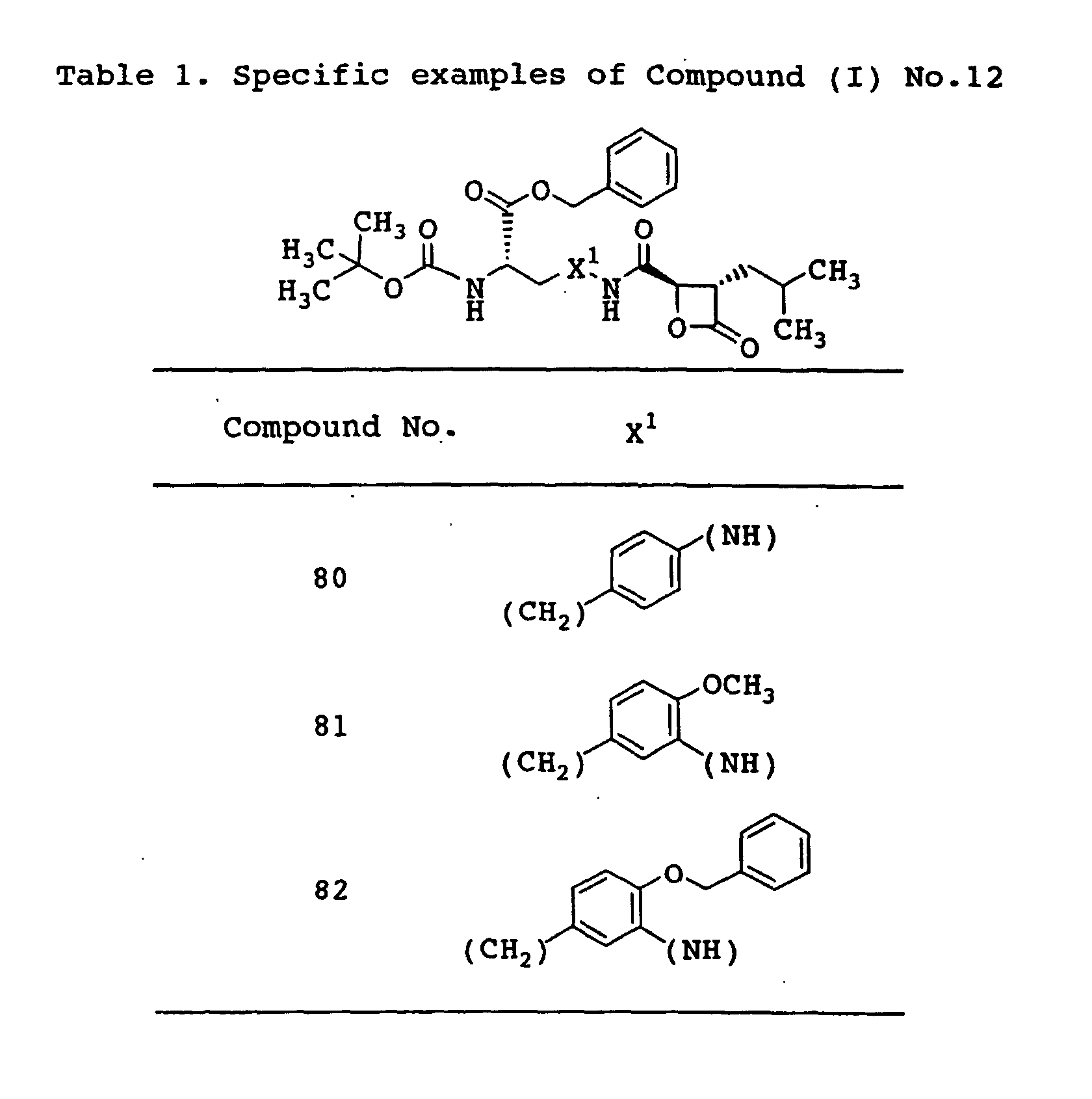

- Then, Specific examples of Compound (II) obtained from the above-mentioned processes are shown in Table 2.

- Then, Specific examples of Compound (III) obtained from the above-mentioned processes are shown in Table 3.

- Then, proteasome inhibitory activity, WiDr antiproliferative activity and antitumor activity of representative Compound (I) are described by Test Examples.
- A crude enzyme solution fractionated by molecular weight from an extract solution of HeLa S3 cells in reference to the method known in the art was used as proteasome [Ugai S. et al., J. Biochem., 113, 754-768 (1993); Orino E. et al., FEBS, 284, 206-210 (1991)]. 1 x 10⁹ of HeLa S3 cells were dispersed in 5 ml of the buffer A [20 mmol/L of Tris (pH 7.5), 2 mmol/L of ATP, 5 mmol/L of MgCl2, 1 mmol/L of dithiothreitol (DTT)], and then homogenized at 4°C. The supernatant centrifuged at 100,000G was concentrated by a Centricon-500 (supplied by Amicon) and diluted with 2.5 ml of the buffer B [25 mmol/L of Tris/HCl (pH 7.5), 2 mmol/L of ATP, 1 mmol/L of DTT, 20% of glycerol]. The obtained high molecular fraction (molecular weight >500K) was used as an enzyme solution for the detection of proteasome activity. Suc-Leu-Leu-Val-Tyr-AMC [Suc: Succinyl; AMC: Aminomethylcoumarin](supplied by Peptide Institute, Inc.) was used as a substrate for measuring inhibitory activity for proteasome (stored as a 2 mmol/L DMSO solution). The reaction was carried out by the following method using 96-well microtiter plates. To 96 µl of a reaction buffer [20 mmol/L of Tris/HCl (pH 8), 0.5 mmol/L of EDTA, 0.04% of sodium dodecylsulfate (SDS)] were added 1 µl of a drug solution (DMSO) and 2 µl of an enzyme solution followed by adding 1 µl of a substrate solution thereto, and then the mixture was incubated at 37°C for one hour. After adding 0.1ml of a quenching buffer [0.1 mol/L of Tris (pH 8.9), 0.5 % of SDS] to the reaction mixture, the fluorescent intensity of the released aminomethylcoumarin was measured at Ex 380 nm and Em 460 nm (1420 ARVO supplied by Wallac). The fluorescent intensity without a compound was made 100, and the amount of the compound at which 50% of proteasome activity was inhibited (IC50) was calculated. The results are shown in Table 4.
Inhibitory activity for proteasome (1) Compound No. IC50(µmol/L) UCK14A1 0.40 1 0.05 2 0.07 3 0.015 4 0.03 5 0.0062 6 0.038 7 0.017 8 0.014 9 0.026 10 0.046 11 0.019 12 0.051 13 0.03 14 0.018 15 0.018 16 0.052 17 0.019 18 0.012 19 0.0062 20 0.011 21 0.004 22 0.012 23 0.017 24 0.015 25 0.024 26 0.013 27 0.003 28 0.005 Inhibitory activity for proteasome (2) Compound No. IC50(µmol/L) 29 0.005 30 0.004 31 0.011 32 0.005 33 0.015 34 0.038 35 0.027 36 0.021 37 0.006 38 0.041 39 0.008 40 0.024 41 0.012 42 0.022 43 0.014 44 0.047 45 0.006 46 0.006 47 0.15 48 0.050 49 0.030 50 0.030 53 0.25 54 0.047 55 0.077 56 0.022 58 0.026 59 0.033 60 0.04 74 0.003 75 0.001 81 0.5 82 0.1 90 0.022 91 0.024 - Human colon cancer, WiDr cells suspended in MEM media containing 10% of fetal calf serum were seeded in 96-well microtiter plates at 2 x 10³cells/well, and precultured in an incubator with 5% of CO2 at 37°C for 24 hours. Then, each compound diluted appropriately with the media was added into the well at 50 µl/well. At this time, a final concentration of each compound is up to 100 µmol/l or 1 µmol/l. The cells were cultured in the incubator with 5% of CO2 at 37°C for additional 72 hours. At 5 hours before the culturing was terminated, MTT [3-(4,5-dimethylthiazol-2-yl)-2,5-dimethyltetrazolium bromide] dissolved in the medium at a final concentration of 1 mg/mL was added into the well at 50 µl/well. After the culturing, dimethyl sulfoxide was added to the well at 150 µl/well, and the plate was vigorously stirred using a plate mixer to dissolve crystals of MTT-formazan completely. Then, the difference between absorbance at 550 nM and that at 630 nM was measured by a microplate reader. The antiproliferative activity for cellular proliferation was expressed as the concentration at which 50% inhibition of proliferation (IC50) was induced. The results are shown in Table 5.
Antiproliferative activity in human colon cancer, WiDr cells (1) Compound No. IC50(72hours, µmol/L) UCK14A1 >30 1 0.79 3 0.037 4 0.05 5 0.03 6 0.04 7 0.7 9 0.01 10 0.068 11 0.01 12 <0.041 13 0.49 14 0.30 15 0.20 16 0.95 17 0.18 18 0.20 19 0.19 20 0.057 21 0.52 22 <0.041 23 0.41 24 0.02 Antiproliferative activity in human colon cancer, WiDr cells (2) Compound No. IC50(72 hours, µmol/L) 25 0.059 26 0.16 28 0.093 30 0.064 31 0.113 32 0.433 33 0.076 34 1.2 35 0.093 36 0.062 37 5.7 39 0.486 40 0.45 41 2.4 43 3.9 45 0.3 46 0.15 50 1.8 56 1.9 68 1.13 90 40 91 22 - Compound 4 was dissolved in ethanol and then prepared at the fixed concentrations by adding cremophor EL (supplied by SIGMA) and saline. At this time, final concentrations of ethanol, cremophor EL, and saline are 5%, 7.5% and 87.5%, respectively. 2 mm x 2 mm of the tumor piece of human colon cancer cell line, WiDr was subcutaneously transplanted in the ventral site of a BALB/c-nu/nu mouse. At the time when a tumor volume [a major axis (a), a minor axis (b): ab2/2] attained to 25-60 mm3, the test compound prepared was intraperitoneally administered for 5 consecutive days to five mice as one proup.
- For evaluating antitumor activity of the compound, the tumor volume was measured everyday, and the ratio of the volume (V) on the day of each measurement to the volume (V0) on the day when the administration of the compound was started was obtained to calculate T/C(%). The results are shown in Table 6.
Antitumor activity for WiDr solid tumor in mice Compound No. Dose (mg/kg/day) T/C (7days,%) 4 5.0 56 4 10.0 49 - The compound obtained according to the present invention is useful as an antitumor agent, and can be used as such or in various dosing forms. For example, when Compound (I) or a pharmaceutically acceptable salt thereof is used as an injection, it may be used by dissolving it in a liquid used commonly in the art as a diluent, for example, saline, a glucose solution for injection, a lactose solution for injection, a mannitol solution for injection or the like, or may be used as a freeze dry injection or a powder injection mixed with sodium chloride or the like based on Pharmacopoeia of Japan. Also, an adjuvant such as polyethylene glycol, HCO-60 (surfactant; supplied by Nikko Chemical), or the like, or a carrier such as ethanol and/or liposome, cyclodextrin or the like may be added to these injections. These injections are usually provided for intravenous administration, however, intra-arterial, intraperitoneal and intrathoracic administrations are also possible.
- Compound (I) or a pharmaceutically acceptable salt thereof can also be used as an oral agent by mixing it with an appropriate excipient, a disintegrator, a binder, a lubricant or the like and molding by a standard method to make tablets, granules, powders, syrups or the like. Also, Compound (I) or a pharmaceutically acceptable salt thereof can also be administered into the rectum by mixing it with a commonly used carrier and molding by a standard method to make a suppository. Further, Compound (I) or a pharmaceutically acceptable salt thereof can also be used as a transdermal agent by mixing it with a commonly used carrier by a standard method to make nasal drops, eye drops, topical cream or the like.
- Compound (I) or a pharmaceutically acceptable salt thereof can be administered orally or parenterally as ointments, injections or the like. Its effective dose and administration schedule vary depending upon the mode of administration, the age, body weight, or conditions of the patients or the like. Generally, administrating 0.01 to 1000 mg/60 kg, preferably mg/60 kg per day once a week or once three weeks is preferred.
- Physicochemical data of each compound shown in the following Examples and Reference Examples were measured using the following instruments.
MS JEOL HX/HX110A 1H NMR Bruker DMX500 (500MHz) JEOL α 400 (400MHz) JEOL Lambda300 (300MHz) IR JASCO Corporation IR-810 - In physical data of the compounds in the following Examples and Reference Examples, "FABMS" indicates mass spectra by a "FAB" method; "HRFABMS" indicates high resolution mass spectra by a "FAB" method; "calculated" means a theoretical value based on a molecular formula; and "found" means an actual measurement. "ODS" represents octadecylated silica gel.
- Also, in the following Examples and Reference Examples, usual post-treatment indicates the following treatment after the reaction.
- After the reaction of each step, water, an acid, a buffer or the like is added to a reaction mixture as needed, and the mixture is extracted with a water-insoluble solvent such as ethyl acetate, ether, chloroform, dichloroethane, or the like. The extract is washed with brine or the like followed by drying over anhydrous sodium sulfate, and the solvent is distilled off under reduced pressure.
- UCK14A2 (10 mg, 0.021 mmol) was dissolved in N,N-dimethylformamide (0.20 mL) followed by adding methyl iodide (0.0050 mL, 0.080 mmol) and potassium carbonate (5.0 mg, 0.036 mmol), and then the mixture was stirred at 25°C for one hour. After usual post-treatment, purifying by a chromatography on silica gel (eluted with chloroform/methanol =100/0 to 100/1) afforded Compound 1 (9.5 mg, yield; 92%).
1H NMR (CDCl3, 300MHz) δ ppm: 8.99(br d, J=7.8Hz, 1H), 6.57(br s, 1H), 5.36(br d, J=7.1Hz, 1H), 4.91(ddd, J=4.4, 4.6, 8.0Hz, 1H), 4.63(d, J=4.7Hz, 1H), 4.38(m, 1H), 3.73(s, 3H), 3.56(dd, J=4.6, 7.3Hz, 1H), 2.51(m, 1H), 2.44(m, 1H), 1.98(m, 1H), 1.66(m, 1H), 1.39-1.48(m, 12H), 1.34(m, 1H), 1.15(m, 1H), 1.08(d, J=6.8Hz, 3H), 0.96(t, J=7.3Hz, 3H), 0.68-0.83(m, 2H), 0.61(m, 1H)
FABMS m/z: 484(M+H)+ calculated for C23H37N3O8=483 - Compound 1 (2.5 mg, 0.051 mmol) was dissolved in dichloromethane (0.20 mL) followed by adding trifluoroacetic acid (0.05 mL, 0.67 mmol), and then the mixture was stirred at 25°C for 2 hours. After concentrating a reaction mixture, purifying by an ODS column chromatography (eluted with water/methanol=0/100 to 100/0) afforded Compound 2 (2.0 mg, yield; 80%).
1H NMR (CDCl3, 300MHz) δ ppm: 9.67(d, J=9.3Hz, 1H), 6.74(br s, 1H), 4.89(m, 1H), 4.67(d, J=4.6Hz, 1H), 4.20(m, 1H), 3.73(s, 3H), 3.55(dd, J=4.7, 7.6Hz, 1H), 2.54(br s, 1H), 2.46(br d, J=14.9Hz, 1H), 1.99(m, 1H), 1.57-1.68(m, 5H), 1.33(m, 1H), 1.07(d, J=6.6Hz, 3H), 0.94 (t, J=7.3Hz, 3H), 0.79(m, 1H), 0.70(m, 1H), 0.63(m, 1H)
FABMS m/z: 384(M+H)+ calculated for C18H29N3O6=383 - UCK14A2 (9.6 mg, 0.021 mmol) was dissolved in N,N-dimethylformamide (0.24 mL) followed by adding benzyl bromide (0.011 mL, 0.092 mmol) and potassium carbonate (6.0 mg, 0.043 mmol), and then the mixture was stirred at 25°C for 1.5 hours. After usual post-treatment, purifying by a thin layer chromatography (developed with n-hexane/ethyl acetate =1/1) afforded Compound 3 (4.6 mg, yield; 40%).
1H NMR (CDCl3, 300MHz)δ ppm: 9.04(br d, J=9.5Hz, 1H), 7.33(m, 5H), 6.52 (br s, 1H), 5.36(br d, J=6.4Hz, 1H), 5.15(s, 2H), 4.96(m, 1H), 4.60(d, J=4.6Hz, 1H), 4.38(m, 1H), 3.74(dd, J=4.6, 7.4Hz, 1H), 2.49(m, 1H), 2.47(m, 1H), 1.97(m, 1H), 1.62(m, 1H), 1.43(s, 9H), 1.38(d, J=7.0Hz, 3H), 1.30(m, 1H), 1.13(m, 1H), 1.06(d, J=6.8Hz, 3H), 0.94(d, J=7.4Hz, 3H), 0.83(m, 1H), 0.73(m, 1H), 0.59(m, 1H)
FABMS m/z: 560(M+H)+ calculated for C29H41N3O8=559 - Compound 3 (5.4 mg, 0.096 mmol) obtained in Example 3 was dissolved in dichloromethane (0.54mL) followed by adding trifluoroacetic acid (0.12 mL, 1.6 mmol), and then the mixture was stirred at 25°C for one hour. After concentrating a reaction mixture, purifying by an ODS column chromatography (eluted with water/acetonitrile=100/0 to 0/100) afforded Compound 4 (5.6 mg, yield; 100%).
1H NMR (CDCl3, 300MHz)δ ppm: 9.59(d, J=9.2Hz, 1H), 7.33(m, 5H), 6.71(br s, 1H), 5.14(s, 2H), 4.92(m, 1H), 4.63(d, J=4.6Hz, 1H), 4.13(m, 1H), 3.43(dd, J=4.6, 7.4Hz, 1H), 2.52(m, 1H), 2.46(br d, J=15.6Hz, 1H), 1.96(m, 1H), 1.61(m, 1H), 1.53(d, J=6.8Hz, 3H), 1.30(m, 1H), 1.11(m, 1H), 1.03(d, J=6.8Hz, 3H), 0.93(d, J=7.5Hz, 3H), 0.91(m, 1H), 0.73(m, 1H), 0.59(m, 1H)
FABMS m/z: 460(M+H)+ calculated for C24H33N3O6=459 - In a manner similar to that in Example 3, Compound 5 (29 mg, yield; 69%) was obtained from UCK14A2 (32 mg, 0.069 mmol), N,N-dimethylformamide (3.2 mL), 2-(bromomethyl)naphthalene (69 mg, 0.031 mmol) and potassium carbonate (20 mg, 12 mmol).
1H NMR (CDCl3, 300MHz) δ ppm: 9.12(d, J=9.0Hz, 1H), 7.77-7.88(m, 4H), 7.50(m, 2H), 7.42(dd, J=1.7, 8.4Hz, 1H), 6.63(br s, 1H), 5.39(brd, J=8.1Hz, 1H), 5.34(d, J=13.0Hz, 1H), 5.29(d, J=13.0Hz, 1H), 4.99(ddd, J=4.2, 4.4, 8.6Hz, 1H), 4.58(d, J=4.6Hz, 1H), 4.39(m, 1H), 3.39(dd, J=4.6, 7.4Hz, 1H), 2.43-2.56(m, 2H), 1.73-1.97(m, 2H), 1.54(m, 1H), 1.43(s, 9H), 1.38(d, J=7.0Hz, 3H), 1.26(m, 1H), 1.00(d, J=6.6Hz, 3H), 0.87(t, J=7.4Hz, 3H), 0.60-0.87(m, 2H), 0.5(m, 1H)
FABMS m/z: 610(M+H)+ calculated for C33H43N3O8=609
HRFABMS calculated for C33H44N3O8 (M+H)+ 610.3128 found 610.3129 - In a manner similar to that in Example 4, Compound 6 (10 mg, yield; 99%) was obtained from Compound 5 (12 mg, 0.020 mmol) obtained in Example 5, dichloromethane (1.2 mL) and trifluoroacetic acid (0.24 mL, 3.1 mmol).
1H NMR (CDCl3, 300MHz) δ ppm: 9.59(brd, J=9.2Hz, 1H), 7.70-7.91(m, 4H), 7.43-7.56(m, 2H), 7.38(dd, J=1.4, 8.4Hz, 1H), 6.77(br s, 1H), 5.31(d, J=12.5Hz, 1H), 5.26(d, J=14.7Hz, 1H), 4.94 (m, 1H), 4.59(d, J=4.2Hz, 1H), 4.15(m, 1H), 3.34(dd, J=4.4, 7.3Hz, 1H), 2.38-2.60(m, 2H), 1.82(m, 1H), 1.40-1.65(m, 2H), 1.27(d, J=9.0Hz, 3H), 1.18(m, 1H), 0.95(d, J=6.6Hz, 3H), 0.88(m, 1H), 0.84(t, J=7.3Hz, 3H), 0.50-0.74(m, 2H)
FABMS m/z: 510(M+H)+ calculated for C28H35N3O6=509
HRFABMS calculated for C28H36N3O6 (M+H)+ 510.2605 found 510.2624 - UCK14A2 (49 mg, 0.10 mmol) was dissolved in acetonitrile (4.9 mL) followed by adding 9-(chloromethyl)anthracene (0.12 g, 0.52 mmol) and potassium carbonate (29 mg, 0.21 mmol), and then the mixture was stirred at 25°C for 7.5 hours. After usual post-treatment, the crude product (24 mg) was obtained by purifying with a thin layer chromatography (developed with n-hexane/ethyl acetate=1/1), and further purified by a preparative high performance liquid chromatography (HPLC) (ODS column, eluted with acetonitrile/water=80/20) to afford Compound 7 (16 mg, yield; 23%).
IR(KBr): 3244, 2970, 2930, 1836, 1708, 1656, 1529, 1492, 1451, 1383, 1366, 1246, 1167, 1098, 958, 913, 886, 734 cm-1
1H NMR (CDCl3, 300MHz)δ ppm: 9.02(br d, J=9.2Hz, 1H), 8.50(s, 1H), 8.28(d, J=8.8Hz, 2H), 8.02(d, J=8.3Hz, 2H), 7.46-7.59(m, 4H), 6.40(br s, 1H), 6.23(d, J=12.4Hz, 1H), 6.13(d, J=12.7Hz, 1H), 5.31(brd, J=7.9Hz, 1H), 4.93(ddd, J=4.1, 4.7, 8.8Hz, 1H), 4.45(d, J=4.6Hz, 1H), 4.39(m, 1H), 2.86(dd, J=5.1, 5.9Hz, 1H), 2.32-2.43(m, 2H), 1.89(m, 1H), 1.67(m, 1H), 1.40(s, 9H), 1.22-1.45(m, 2H), 1.13(d, J=6.8Hz, 3H), 0.93(d, J=6.8Hz, 3H), 0.81(t, J=7.4Hz, 3H), 0.57(m, 1H), 0.41-0.49(m, 2H)
FABMS m/z: 660(M+H)+ calculated for C37H45N3O8=659
HRFABMS calculated for C37H46N3O8 (M+H)+ 660.3285 found 660.3281 - UCK14A2 (49 mg, 0.11 mmol) was dissolved in N,N-dimethyl-formamide (4.9 mL) followed by adding 3-fluorobenzyl bromide (0.065mL, 0.53 mmol) and potassium carbonate (29 mg, 0.21 mmol), and then the mixture was stirred at 25°C for one hour. After usual post-treatment, purifying by a chromatography on silica gel (eluted with n-hexane/ethyl acetate=1/1) afforded Compound 8 (48 mg, yield; 78%).
1H NMR (CDCl3, 300MHz)δ ppm: 9.17(d, J=9.2Hz, 1H), 7.32(m, 1H), 6.98-7.16 (m, 3H), 6.75(br s, 1H), 5.39(br d, J=7.7Hz, 1H), 5.15(s, 2H), 4.98(ddd, J=4.6, 4.6, 9.2Hz, 1H), 4.62(d, J=4.6Hz, 1H), 4.39(m, 1H), 3.50(dd, J=4.6, 7.5Hz, 1H), 2.50(m, 2H), 1.86-2.07(m, 2H), 1.63(m, 1H), 1.43(s, 9H), 1.39(d, J=7.0Hz, 3H), 1.28(m, 1H), 1.05(d, J=6.8Hz, 3H), 0.91(m, 3H), 0.78(m, 1H), 0.68(m, 1H), 0.60(m, 1H)
FABMS m/z: 578(M+H)+ calculated for C29H40N3O8F=577
HRFABMS calculated for C29H41N3O8F (M+H)+ 578.2878 found 578.2886 - UCK14A2 (50 mg, 0.11 mmol) was dissolved in N,N-dimethylformamide (5.0 mL) followed by adding allyl bromide (0.041 mL, 0.47 mmol) and potassium carbonate (31 mg, 0.22 mmol), and then the mixture was stirred at 25°C for 0.5 hour. After usual post-treatment, the crude product (41 mg) was obtained by purifying with a chromatography on silica gel (eluted with n-hexane/ethyl acetate=3/2), and further purified by a preparative HPLC (ODS column, eluted with acetonitrile/water =55/45) to afford Compound 9 (35 mg, yield; 63%).
1H NMR (CDCl3, 300MHz)δ ppm: 9.10(br d, J=8.8Hz, 1H), 6.70(br s, 1H), 5.89(ddd, J=5.7, 10.7, 16.2Hz, 1H), 5.40(br d, J=7.9Hz, 1H), 5.32(dd, J=1.4, 17.2Hz, 1H), 5.23(dd, J=1.3, 10.4Hz, 1H), 4.94(ddd, J=4.2, 4.6, 8.8Hz, 1H), 4.63(m, 3H), 4.40(m, 1H), 3.54(dd, J=4.6, 7.5Hz, 1H), 2.43-2.56(m, 2H), 1.98(m, 1H), 1.65(m, 1H), 1.44(s, 9H), 1.24-1.39(m, 5H), 1.08(d, J=6.1Hz, 3H), 0.95(t, J=7.5Hz, 3H), 0.68-0.85(m, 2H), 0.61(m, 1H)
FABMS m/z: 510(M+H)+ calculated for C25H39N3O8=509
HRFABMS calculated for C25H40N3O8 (M+H)+ 510.2815 found 510.2833 - In a manner similar to that in Example 4, Compound 10(18 mg, yield; 100%) was obtained from Compound 9 (18 mg, 0.035 mmol) obtained in Example 9, dichloromethane (1.8 mL) and trifluoroacetic acid (0.35 mL, 4.6 mmol).
1H NMR (CDCl3, 300MHz)δ ppm: 9.67(br d, J=9.3Hz, 1H), 6.90(br s, 1H), 5.88(ddd, J=5.5, 10.5, 17.1Hz, 1H), 5.32(dd, J=1.3, 17.1Hz, 1H), 5.23(dd, J=1.3, 10.5Hz, 1H), 4.89(m, 1H), 4.68(d, J=4.6Hz, 1H), 4.62(d, J=4.8Hz, 2H), 4.18(m, 1H), 3.52(dd, J=4.6, 7.7Hz, 1H), 2.55(m, 1H), 2.47(m, 1H), 1.99(m, 1H), 1.65(m, 1H), 1.58(d, J=6.9Hz, 3H), 1.23-1.49(m, 2H), 1.07(d, J=6.7Hz, 3H), 0.95(t, J=7.5Hz, 3H), 0.89(m, 1H), 0.80(m, 1H), 0.62(m, 1H) FABMS m/z: 410(M+H)+ calculated for C20H31N3O6=409
HRFABMS calculated for C20H32N3O6 (M+H)+ 410.2291 found 410.2304 - UCK14A2 (50 mg, 0.11 mmol) was dissolved in dichloromethane (5.0 mL) followed by adding n-butyl alcohol (0.015 mL, 0.16 mmol), 1,3-dicyclohexylcarbodiimide (22 mg, 0.11 mmol), 1-hydroxybenzotriazole monohydrate (25 mg, 0.21 mmol) and 4-dimethylaminopyridine (2.6 mg, 0.021 mmol), and then the mixture was stirred at 25°C for 1.5 hours. After usual post-treatment, the crude product (31 mg) was obtained by purifying with a chromatography on silica gel (eluted with n-hexane/ethyl acetate=3/2), and further purified by a preparative HPLC (ODS column, eluted with acetonitrile/water=60/40) to afford Compound 11 (9.3 mg, yield; 9.8%).
1H NMR (CDCl3, 300MHz)δ ppm: 9.02(br d, J=8.2Hz, 1H), 6.61(br s, 1H), 5.40(br d, J=7.5Hz, 1H), 4.63(d, J=4.4Hz, 1H), 4.50(m, 1H), 4.40(m, 1H), 4.12(d, J=6.2Hz, 2H), 3.55 (m, 1H), 2.41-2.54 (m, 3H), 2.00 (m, 1H), 1.55-1.75 (m, 2H), 1.44(s, 9H), 1.42(d, J=7.4Hz, 3H), 1.23-1.40(m, 5H), 1.09(d, J=6.6Hz, 1H), 0.84-1.00(m, 8H), 0.61(m, 1H), 0.57(m, 1H)
FABMS m/z: 526(M+H)+ calculated for C26H43N3O8=525
HRFABMS calculated for C26H44N3O8 (M+H)+ 526.3128 found 526.3118 - In a manner similar to that in Example 4, Compound 12 (27 mg, yield; 100%) was obtained from Compound 11 (25 mg, 0.048 mmol) obtained in Example 11, dichloromethane (2.5 mL) and trifluoroacetic acid (0.51 mL, 6.6 mmol).
1H NMR (CDCl3, 300MHz) δ ppm: 9.60(br d, J=9.5Hz, 1H), 6.86(br s, 1H), 4.86(m, 1H), 4.69(d, J=4.4Hz, 1H), 4.18(m, 1H), 4.12(t, J=6.6Hz, 2H), 3.53(dd, J=4.6, 7.7Hz, 1H), 2.55(m, 1H), 2.41(m, 1H), 1.99(m, 1H), 1.55-1.71(m, 5H), 1.24-1.44(m, 4H), 1.14(m, 1H), 0.95(t, J=7.5Hz, 3H), 0.92(t, J=7.5Hz, 3H), 0.67-0.84(m, 5H), 0.62(m, 1H)
FABMS m/z: 426(M+H)+ calculated for C21H35N3O6=425
HRFABMS calculated for C21H36N3O6 (M+H)+ 426.2605 found 426.2624 - UCK14A2 (30 mg, 0.064 mmol) was dissolved in dichloromethane (0.90 mL) and cyclohexane (1.8 mL) followed by adding tert-butyl 2,2,2-trichloroacetimidate (0.11 mL, 0.064 mmol) and boron trifluoride diethyl etherate (0.0079 mL, 0.064 mmol), and then the mixture was stirred at 25°C for 0.5 hour. After usual post-treatment, the crude product (20 mg) was obtained by purifying with a chromatography on silica gel (eluted with n-hexane/ethyl acetate=3/2), and further purified by a preparative HPLC (ODS column, eluted with acetonitrile/water =60/40) to afford Compound 13 ( 18 mg, yield; 54%).
1H NMR (CDCl3, 300MHz) δ ppm: 8.88(br d, J=8.8Hz, 1H), 6.63(br s, 1H), 5.42(br d, J=7.5Hz, 1H), 4.78(m, 1H), 4.63(d, J=4.6Hz, 1H), 4.35(m, 1H), 3.52(dd, J=4.6, 7.5Hz, 1H), 2,38-2.53(m, 2H), 2.00(m, 1H), 1.61-1.75(m, 2H), 1.45(s, 9H), 1.39-1.44(m, 12H), 1.33(m, 1H), 1.08(d, J=6.8Hz, 3H), 0.96(t, J=7.3Hz, 3H), 0.88(m, 1H), 0.77(m, 1H), 0.60(m, 1H)
FABMS m/z: 526(M+H)+ calculated for C26H43N3O8=525
HRFABMS calculated for C26H44N3O8 (M+H)+ 526.3128 found 526.3098 - In a manner similar to that in Example 11, Compound 14 (15 mg, yield; 26%) was obtained from UCK14A2 (47 mg, 0.099 mmol), dichloromethane (4.7 mL), cyclohexylmethanol (0.024 mL, 0.20 mmol), 1,3-dicyclohexylcarbodiimide (41 mg, 0.20 mmol), 1-hydroxybenzotriazole monohydrate (47 mg, 0.40 mmol) and 4-dimethylaminopyridine (4.8 mg, 0.040 mmol).
1H NMR (CDCl3, 300MHz) δ ppm: 9.02(d, J=9.0Hz, 1H), 6.63(br s, 1H), 5.40(br d, J=7.7Hz, 1H), 4.90(m, 1H), 4.62(d, J=4.6Hz, 1H), 4.38(m, 1H), 3.93(d, J=6.2Hz, 2H), 3.54(dd, J=4.6, 7.7Hz, 1H), 2.41-2.54(m, 2H), 1.98(m, 1H), 1.55-1.77(m, 7H), 1.39-1.45(m, 12H), 1.15-1.38(m, 7H), 1.08(d, J=6.6Hz, 3H), 0.96(t, J=7.3Hz, 3H), 0.88(m, 1H), 0.77(m, 1H), 0.61(m, 1H)
FABMS m/z: 566(M+H)+ calculated for C29H47N3O8=565
HRFABMS calculated for C29H48N3O8 (M+H)+ 566.3442 found 566.3453 - In a manner similar to that in Example 11, Compound 15 (15 mg, yield; 25%) was obtained from UCK14A2 (49mg, 0.11 mmol), dichloromethane (4.9mL), 2-(trimethylsilyl)ethanol (0.015mL, 0.11 mmol), 1,3-dicyclohexylcarbodiimide (22 mg, 0.11 mmol), 1-hydroxybenzotriazole monohydrate (25 mg, 0.21 mmol) and 4-dimethylaminopyridine (2.6 mg, 0.021 mmol).
1H NMR (CDCl3, 300MHz)δ ppm: 8.98(br d, J=9.0Hz, 1H), 6.62(br s, 1H), 5.39(br d, J=8.1Hz, 1H), 4.85(ddd, J=4.3, 4.5, 8.8Hz, 1H), 4.62(d, J=4.6Hz, 1H), 4.38(m, 1H), 4.12-4.37(m, 2H), 3.55(dd, J=4.6, 7.5Hz, 1H), 2.38-2.54(m, 2H), 1.99(m, 1H), 1.58-1.75(m, 2H), 1.38-1.47(m, 12H), 1.33(m, 1H), 1.08(d, J=6.8Hz, 3H), 0.98(t, J=8.7Hz, 2H), 0.95(t, J=7.5Hz, 3H), 0.71-0.86(m, 2H), 0.60(m, 1H), 0.04(s, 9H)
FABMS m/z: 570(M+H)+ calculated for C27H47N3O8Si=569
HRFABMS calculated for C27H48N3O8Si (M+H)+ 570.3211 found 570.3216 - In a manner similar to that in Example 9, Compound 16 (24 mg, yield; 51%) was obtained from UCK14A2 (43 mg, 0.091 mmol), N,N-dimethylformamide (4.3 mL), 2-iodoethanol (0.035 mL, 0.46 mmol) and potassium carbonate (25 mg, 0.18 mmol).
1H NMR (CDCl3, 300MHz) δ ppm: 9.02(br d, J=8.6Hz, 1H), 6.80(br s, 1H), 5.33(br d, J=7.8Hz, 1H), 4.96(ddd, J=4.0, 4.6, 8.6Hz, 1H), 4.63(d, J=4.4Hz, 1H), 4.40(ddd, J=2.9, 6.6, 11.4Hz, 1H), 4.32(m, 1H), 4.12(ddd, J=2.9, 5.5, 11.7Hz, 1H), 3.68-3.86(m, 2H), 3.62 (dd, J=4.4, 7.5Hz, 1H), 2.57(m, 1H), 2.48 (m, 1H), 1.99(m, 1H), 1.69(m, 1H), 1.39-1.48(m, 12H), 1.23-1.37(m, 2H), 1.09(d, J=6.8Hz, 3H), 0.96 (t, J=7.3Hz, 3H), 0.88(m, 1H), 0.71(m, 1H), 0.61(m, 1H)
FABMS m/z: 514(M+H)+ calculated for C24H39N3O9=513
HRFABMS calculated for C24H40N3O9 (M+H)+ 514.2764 found 514.2767 - In a manner similar to that in Example 9, Compound 17 (15 mg, yield; 27%) was obtained from UCK14A2 (51 mg, 0.11 mmol), N,N-dimethylformamide (5.1 mL), bromomethyl methyl ether (0.044 mL, 0.54 mmol and potassium carbonate (30 mg, 0.22 mmol). 1H NMR (CDCl3, 300MHz) δ ppm: 9.12(br d, J=8.8Hz, 1H), 6.65(br s, 1H), 5.38(br d, J=7.5Hz, 1H), 5.30(d, J=5.9Hz, 1H), 5.24(d, J=5.9Hz, 1H), 4.95(ddd, J=4.2, 4.6, 8.8Hz, 1H), 4.63(d, J=4.6Hz, 1H), 4.40(m, 1H), 3.55(dd, J=4.6, 7.5Hz, 1H), 3.37(s, 3H), 2.45-2.58(m, 2H), 1.99(m, 1H), 1.58-1.77(m, 2H), 1.40-1.48(m, 12H), 1.32(m, 1H), 1.07(d, J=6.7Hz, 3H), 0.95(t, J=7.3Hz, 3H), 0.74-0.85(m, 2H), 0.62(m, 1H)
FABMS m/z: 514(M+H)+ calculated for C24H39N3O9=513
HRFABMS calculated for C24H40N3O9 (M+H)+ 514.2765 found 514.2759 - In a manner similar to that in Example 9, Compound 18 (28 mg, yield; 49%) was obtained from UCK14A2 (46 mg, 0.098 mmol), N,N-dimethylformamide (4.6mL), 2-bromoacetophenone (98 mg, 0.49 mmol) and potassium carbonate (27 mg, 0.20 mmol). 1H NMR (CDCl3, 300MHz) δ ppm: 9.46(br d, J=9.3Hz, 1H), 7.87(m, 2H), 7.62(m, 1H), 7.50(m, 2H), 6.67(brs, 1H), 5.43(brd, J=8.4Hz, 1H), 5.38(s, 2H), 5.09(m, 1H), 4.62(d, J=4.5Hz, 1H), 4.47(m, 1H), 3.66(dd, J=4.6, 7.7Hz, 1H), 2.56-2.74(m, 2H), 1.89(m, 1H), 1.70(m, 1H), 1.55(m, 1H), 1.38-1.47(m, 12H), 1.19(m, 1H), 0.99(d, J=6.7Hz, 3H), 0.85-0.96(m, 2H), 0.79(d, J=7.3Hz, 3H), 0.65(m, 1H)
FABMS m/z: 588(M+H)+ calculated for C30H41N3O9=587 - UCK14A2 (52mg, 0.11 mmol) was dissolved in dichloromethane (5.2 mL) followed by adding benzylamine (0.012 mL, 0.11 mmol), 1,3-dicyclohexylcarbodiimide (23 mg, 0.11 mmol) and 1-hydroxybenzotriazole monohydrate(26 mg, 0.22 mmol), and then the mixture was stirred at 25°C for 0.5 hour. After usual post-treatment, the crude product (67 mg) was obtained by purifying with a chromatography on silica gel (eluted with n-hexane/ethyl acetate=1/3), and further purified by a preparative HPLC (ODS column, eluted with acetonitrile/water =50/50) to afford Compound 19 (31 mg, yield; 50%).
1H NMR (CDCl3, 300MHz) δ ppm: 9.14(br d, J=6.5Hz, 1H), 7.18-7.45(m, 5H), 6.90(m, 1H), 6.77(brs, 1H), 5.29(brd, J=6.7Hz, 1H), 4.83 (m, 1H), 4.56(d, J=4.5Hz, 1H), 4.50(dd, J=4.6, 14.9Hz, 1H), 4.36(dd, J=5.5, 15.0Hz, 1H), 4.31(m, 1H), 3.33(dd, J=4.6, 7.5Hz, 1H), 2.61(m, 1H), 2.41(m, 1H), 1.92(m, 1H), 1.80(m, 1H), 1.57(m, 1H), 1.42(s, 9H), 1.34(d, J=7.0Hz, 3H), 1.27(m, 1H), 1.01(d, J=6.8Hz, 3H), 0.90(d, J=7.3Hz, 3H), 0.87(m, 1H), 0.80(m, 1H), 0.60(m, 1H)
FABMS m/z: 559(M+H)+ calculated for C29H42N4O7=558
HRFABMS calculated for C29H43N4O7 (M+H)+ 559.3132 found 559.3149 - In a manner similar to that in Example 4, Compound 20 (16 mg, yield; 85%)was obtained from Compound 19 (18 mg, 0.033 mmol) obtained in Example 19, dichloromethane (1.8 mL) and trifluoroacetic acid (0.36 mL, 4.7 mmol).
1H NMR (CDCl3, 300MHz) δ ppm: 9.51(br d, J=8.8Hz, 1H), 7.25-7.38(m, 6H), 7.02(br s, 1H), 4.74(m, 1H), 4.58(d, J=4.4Hz, 1H), 4.37-4.43(m, 2H), 4.17(m, 1H), 3.40(dd, J=4.6, 7.9Hz, 1H), 2.43(m, 1H), 2.28(m, 1H), 1.90(m, 1H), 1.44-1.63(m, 5H), 1.28(m, 1H), 0.98(d, J=6.8Hz, 3H), 0.90(m, 1H), 0.89(t, J=7.3Hz, 3H), 0.75(m, 1H), 0.56(m, 1H)
FABMS m/z: 459(M+H)+ calculated for C24H34N4O5=458 - In a manner similar to that in Example 19, Compound 21 (38 mg, yield; 60%) was obtained from UCK14A2 (49 mg, 0.11 mmol), dichloromethane (4.9 mL), 1-naphthalenemethylamine (0.015 mL, 0.11 mmol), 1,3-dicyclohexylcarbodiimide (22 mg, 0.11 mmol) and 1-hydroxybenzotriazole monohydrate (25 mg, 0.21 mmol).
IR (KBr): 3272, 3054, 2974, 2936, 1835, 1650, 1513, 1454, 1367, 1249, 1166, 1100, 1021, 914, 887, 778, 668 cm-1
1H NMR (CDCl3, 300MHz) δ ppm: 9.07(br s, 1H), 7.97(m, 1H), 7.86(m, 1H), 7.80(m, 1H), 7.48(m, 2H), 7.40(m, 2H), 6.84(br s, 1H), 6.55(s, 1H), 5.25(br d, J=6.4Hz, 1H), 5.04(dd, J=6.5, 14.7Hz, 1H), 4.82(m, 1H), 4.74(dd, J=4.8, 14.5Hz, 1H), 4.36(d, J=4.6Hz, 1H), 4.26(m, 1H), 2.86(m, 1H), 2.63(m, 1H), 2.27(m, 1H), 1.88(m, 1H), 1.70(m, 1H), 1.40(s, 9H), 1.24-1.37(m, 2H), 1.20(d, J=7.0Hz, 3H), 0.90(d, J=6.6Hz, 3H), 0.78-0.85(m, 4H), 0.73(m, 1H), 0.55(m, 1H)
FABMS m/z: 609 (M+H)+ calculated for C33H44N4O7=608
HRFABMS calculated for C33H45N4O7 (M+H)+ 609.3288 found 609.3306 - In a manner similar to that in Example 4, Compound 22 (25 mg, yield; 86%) was obtained from Compound 21 (28 mg, 0.046 mmol) obtained in Example 21, dichloromethane (2.8 mL) and trifluoroacetic acid (0.57 mL, 7.3 mmol).
1H NMR (CDCl3, 300MHz)δ ppm: 9.45(br d, J=8.8Hz, 1H), 7.76-7.90(m, 2H), 7.71(m, 1H), 7.37-7.47(m, 2H), 7.27-7.35(m, 2H), 7.23(m, 1H), 6.90(br s, 1H), 4.62-4.85(m, 3H), 4.41(d, J=4.2Hz, 1H), 4.13(m, 1H), 3.06(dd, J=4.4, 7.3Hz, 1H), 2.18-2.35(m, 2H), 1.77(m, 1H), 1.23-1.48(m, 5H), 1.11(m, 1H), 0.93(m, 1H), 0.88(d, J=6.8Hz, 3H), 0.80(t, J=7.3Hz, 3H), 0.66(m, 1H), 0.45(m, 1H)
FABMS m/z: 509(M+H)+ calculated for C28H36N4O5=508
HRFABMS calculated for C28H37N4O5 (M+H)+ 509.2764 found 509.2780 - UCK14A2 (30 mg, 0.063 mmol) was dissolved in dichloromethane (3.0 mL) followed by adding phenylhydrazine (0.0062 mL, 0.063 mmol), 1,3-dicyclohexylcarbodiimide (13 mg, 0.063 mmol) and 1-hydroxybenzotriazole monohydrate (15 mg, 0.13 mmol), and then the mixture was stirred at 25°C for 0.5 hour. After usual post-treatment, the crude product (25 mg) was obtained by purifying with a thin layer chromatography (developed with n-hexane/ethyl acetate=1/3), and further purified by a preparative HPLC (ODS column, eluted with acetonitrile/water=50/50) to afford Compound 23 (22 mg, yield; 62%).
1H NMR (CDCl3, 300MHz)δ ppm: 9.19(br d, J=7.5Hz, 1H), 8.52(br s, 1H), 7.14-7.23(m, 2H), 6.74-6.91(m, 4H), 6.16(br d, J=3.6Hz, 1H), 5.32(br d, J=7.1Hz, 1H), 4.90(m, 1H), 4.62(d, J=4.6Hz, 1H), 4.36(m, 1H), 3.55(dd, J=4.6, 7.9Hz, 1H), 2.44-2.58(m, 2H), 1.95(m, 1H), 1.84(m, 1H), 1.62(m, 1H), 1.40-1.46(m, 12H), 1.26(m, 1H), 1.03(d, J=6.6Hz, 3H), 0.90(t, J=7.3Hz, 3H), 0.89(m, 1H), 0.70(m, 1H), 0.59(m, 1H)
FABMS m/z: 560(M+H)+ calculated for C28H41N5O7=559
HRFABMS calculated for C28H42N5O7 (M+H)+ 560.3084 found 560.3094 - In a manner similar to that in Example 19, Compound 24 (21 mg, yield; 89%) was obtained from UCK14A2 (21 mg, 0.044 mmol), dichloromethane (2.1mL), n-butylamine (0.0044 mL, 0.044 mmol), 1,3-dicyclohexylcarbodiimide (9.1 mg, 0.044 mmol) and 1-hydroxybenzotriazole monohydrate (10 mg, 0.088 mmol).
1H NMR (CDCl3, 300MHz)δ ppm: 9.10(br d, J=7.1Hz, 1H), 6.81(br s, 1H), 6.48(m, 1H), 5.32(brd, J=6.2Hz, 1H), 4.75 (m, 1H), 4.62(d, J=4.4Hz, 1H), 4.33(m, 1H), 3.52(dd, J=4.4, 7.7Hz, 1H), 3.22(dd, J=7.0, 12.8Hz, 1H), 3.21(dd, J=6.6, 12.3Hz, 1H), 2.58(m, 1H), 2.42 (m, 1H), 2.00 (m, 1H), 1.39-1.55(m, 2H), 1.44(s, 9H), 1.41(d, J=7.0Hz, 3H), 1.23-1.39(m, 5H), 1.07(d, J=6.6Hz, 3H), 0.84-1.01(m, 7H), 0.80(m, 1H), 0.59(m, 1H)
FABMS m/z: 525(M+H)+ calculated for C26H44N4O7=524
HRFABMS calculated for C26H45N4O7 (M+H)+ 525.3288 found 525.3268 - In a manner similar to that in Example 4, Compound 25 (23 mg, yield; 92%) was obtained from Compound 24 (24 mg, 0.046 mmol) obtained in Example 24, dichloromethane (2.4 mL) and trifluoroacetic acid (0.48 mL, 6.3 mmol).
1H NMR (CD3CN, 300MHz) δ ppm: 9.10(m, 1H), 7.50(s, 1H), 6.70(br s, 1H), 4.70(d, J=4.4Hz, 1H), 4.55(m, 1H), 4.10(m, 1H), 3.65(dd, J=4.4, 8.2Hz, 1H), 3.07-3.20(m, 3H), 2.49(m, 1H), 2.26(m, 1H), 1.85-1.98(m, 6H), 1.52(m, 2H), 1.23-1.46(m, 4H), 1.01(d, J=7.0Hz, 3H), 0.79-0.96(m, 6H), 0.54(m, 1H)
FABMS m/z: 425(M+H)+ calculated for C21H36N4O5=424
HRFABMS calculated for C21H37N4O5 (M+H)+ 425.2782 found 425.2764 - UCK14A2 (40 mg, 0.085 mmol) was dissolved in dichloromethane (4.0 mL) followed by adding morpholine (0.0074 mL, 0.085 mmol), 1,3-dicyclohexylcarbodiimide (18 mg, 0.085 mmol) and 1-hydroxybenzotriazole monohydrate (20 mg, 0.17 mmol), and then the mixture was stirred at 25°C for 2.5 hours. After usual post-treatment, purifying by a chromatography on silica gel (eluted with n-hexane/ethyl acetate=1/5 to 1/10) afforded Compound 26 (12 mg, yield; 26%).
1H NMR (CDCl3, 300MHz)δ ppm: 8.53(br d, J=7.1Hz, 1H), 6.65(br s, 1H), 5.33(br d, J=7.1Hz, 1H), 5.07(ddd, J=4.4, 4.6, 9.0Hz, 1H), 4.61(d, J=4.6Hz, 1H), 4.32 (m, 1H), 3.40-3.77 (m, 9H), 2.50(m, 1H), 1.90-2.09 (m, 2H), 1.61-1.82(m, 2H), 1.43(m, 9H), 1.38(d, J=7.0Hz, 3H), 1.31(m, 1H), 1.09(d, J=6.8Hz, 3H), 0.96(t, J=7.4Hz, 3H), 0.89(m, 1H), 0.80(m, 1H), 0.61(m, 1H)
FABMS m/z: 539(M+H)+ calculated for C26H42N4O8=538
HRFABMS calculated for C26H43N4O8 (M+H)+ 539.3081 found 539.3067 - In a manner similar to that in Example 19, Compound 27 (20 mg, yield; 32%) was obtained from UCK14A2 (46 mg, 0.098 mmol), dichloromethane (4.6 mL), L-alanine benzyl ester (21 mg, 0.12 mmol), 1,3-dicyclohexylcarbodiimide (24 mg, 0.12 mmol)
and 1-hydroxybenzotriazole monohydrate (27 mg, 0.23 mmol). 1H NMR (CDCl3, 300MHz) δ ppm: 9.00(br d, J=7.5Hz, 1H), 7.30-7.41(m, 5H), 7.20 (m, 1H), 6.67(brs, 1H), 5.30(brd, J=7.0Hz, 1H), 5.18(d, J=12.3Hz, 1H), 5.13(d, J=12.3Hz, 1H), 4.87(m, 1H), 4.61(d, J=4.6 Hz, 1H), 4.57(m, 1H), 4.34(m, 1H), 3.48(dd, J=4.6, 7.7Hz, 1H), 2.46-2.59(m, 2H), 1.98(m, 1H), 1.58-1.72(m, 2H), 1.40-1.48(m, 12H), 1.38(d, J=7.2Hz, 3H), 1.28(m, 1H), 1.05(d, J=6.8Hz, 3H), 0.98(m, 1H), 0.92(d, J=7.3Hz, 3H), 0.76(m, 1H), 0.56(m, 1H)
FABMS m/z: 631(M+H)+ calculated for C32H46N4O9=630
HRFABMS calculated for C32H47N4O9 (M+H)+ 631.3344 found 631.3358 - Compound 4 (20 mg, 0.035 mmol) obtained in Example 4 was dissolved in tetrahydrofuran (1.0 mL) and water (1.0 mL) followed by adding benzyl chloroformate (20 mg, 0.14 mmol) and sodium hydrogencarbonate (12 mg, 0.14 mmol), and then the mixture was stirred at 0°C for one hour. After usual post-treatment, purifying by a chromatography on silica gel (eluted with n-hexane/ethyl acetate=1/1) afforded Compound 28 (20 mg, yield; 95%).
1H NMR (CDCl3, 300MHz) δ ppm: 9.13 (br d, J=9.4Hz, 1H), 7.23-7.42(m, 10H), 6.58(br s, 1H), 5.68(br d, J=7.7Hz, 1H), 5.16(s, 2H), 5.09(s, 2H), 4.97(m, 1H), 4.60(d, J=4.4Hz, 1H), 4.47(m, 1H), 3.45(dd, J=4.4, 7.5Hz, 1H), 2.42-2.55(m, 2H), 1.95(m, 1H), 1.54-1.72(m, 2H), 1.41(d, J=7.0Hz, 3H), 1.30(m, 1H), 1.04(d, J=6.8Hz, 3H), 0.94(t, J=7.3Hz, 3H), 0.89(m, 1H), 0.72(m, 1H), 0.57(m, 1H)
FABMS m/z: 594(M+H)+ calculated for C32H39N3O8=593 - Compound 4 (40 mg, 0.070 mmol) obtained in Example 4 was dissolved in tetrahydrofuran (2.0 mL) and water (2.0 mL) followed by adding 4-bromobenzyl chloroformate (120 mg, 0.35 mmol) and sodium hydrogencarbonate (29mg, 0.35 mmol), and then the mixture was stirred at 0°C for one hour. After usual post-treatment, purifying by a chromatography on silica gel (eluted with n-hexane/ethyl acetate=1/1) afforded Compound 29 (39 mg, yield; 83%).
1H NMR (CDCl3, 300MHz) δ ppm: 9.13(br d, J=9.2Hz, 1H), 7.43-7.49 (m, 2H), 7.29-7.37(m, 5H), 7.17=7.24(m, 2H), 6.59(br s, 1H), 5.72(br d, J=7.7Hz, 1H), 5.15(s, 2H), 5.02(s, 2H), 4.96(m, 1H), 4.60(d, J=4.4Hz, 1H), 4.44(m, 1H), 3.45(dd, J=4.5, 7.5Hz, 1H), 2.42-2.55(m, 2H), 1.96(m, 1H), 1.70(m, 1H), 1.62(m, 1H), 1.40(d, J=7.0Hz, 3H), 1.30(m, 1H), 1.04(d, J=6.8Hz, 3H), 0.93(t, J=7.3Hz, 3H), 0.93(m, 1H), 0.53-0.68(m, 2H)
FABMS m/z: 672(M+H)+ calculated for C32H38N3O8 79Br=671 - Compound 4 (20 mg, 0.035 mmol) obtained in Example 4 was dissolved in N,N-dimethylformamide (2.0 mL) followed by adding benzyl isocyanate (0.017 mL, 0.14 mmol) and triethylamine (9.7 mL, 0.070 mmol), and then the mixture was stirred at 0°C for 0.5 hour. After usual post-treatment, purifying by a chromatography on silica gel (eluted with n-hexane/ethyl acetate=1/3) afforded Compound 30 (19 mg, yield; 92%).
1H NMR (CDCl3, 300MHz) δ ppm: 9.12(br d, J=9.0Hz, 1H), 7.14-7.40(m, 10H), 6.65(brs, 1H), 5.98 (m, 1H), 5.55(m, 1H), 5.15(d, J=12.3Hz, 1H), 5.09(d, J=12.3Hz, 1H), 4.74(m, 1H), 4.61(m, 1H), 4.58(d, J=4.6Hz, 1H), 4.32(d, J=5.5Hz, 2H), 3.46(dd, J=4.4, 7.5Hz, 1H), 2.49(m, 1H), 2.29(m, 1H), 1.94(m, 1H), 1.61(m, 1H), 1.38(d, J=7.0Hz, 3H), 1.19-1.35(m, 2H), 1.03(d, J=6.8Hz, 3H), 0.93(t, J=7.4Hz, 3H), 0.90(m, 1H), 0.69(m, 1H), 0.50(m, 1H)
FABMS m/z: 593(M+H)+ calculated for C32H40N4O7=592 - In a manner similar to that in Example 30, Compound 31 (16 mg, yield; 86%) was obtained from Compound 4 (20 mg, 0.035 mmol) obtained in Example 4, N,N-dimethylformamide (2.0 mL), isopropyl isocyanate (0.014 mL, 0.14 mmol) and triethylamine (0.0097 mL, 0.070 mmol).
1H NMR (CDCl3, 300MHz) δ ppm: 9.00(br d, J=7.9Hz, 1H), 7.33(s, 5H), 6.73(br s, 1H), 5.51(m, 1H), 5.15(s, 2H), 4.92(ddd, J=4.2, 4.6, 8.8Hz, 1H), 4.62(d, J=4.6Hz, 1H), 4.57(dq, J=7.2, 7.2Hz, 1H), 4.25(m, 1H), 3.81(dq, J=6.2, 12.8Hz, 1H), 3.51(dd, J=4.6, 7.0Hz, 1H), 2.55(m, 1H), 2.40(m, 1H), 1.98(m, 1H), 1.83(m, 1H), 1.64(m, 1H), 1.36(d, J=7.0Hz, 3H), 1.30(m, 1H), 1.02-1.15(m, 9H), 0.95(t, J=7.5Hz, 3H), 0.89(m, 1H), 0.74(m, 1H), 0.59(m, 1H)
FABMS m/z: 545(M+H)+ calculated for C28H40N4O7=544 - In a manner similar to that in Example 30, Compound 32 (16 mg, yield; 75%) was obtained from Compound 4 (20 mg, 0.035 mmol) obtained in Example 4, N,N-dimethylformamide (2.0 mL), benzyl isothiocyanate (0.019 mL, 0.14 mmol) and triethylamine (0.0097 mL, 0.070 mmol).
1H NMR (CDCl3, 300MHz)δ ppm: 9.57(br d, J=9.2Hz, 1H), 7.63(br s, 1H), 7.29-7.38 (m, 10H), 6.58(br s, 1H), 6.55(br s, 1H), 5.13(s, 2H), 5.07(m, 1H), 4.74(m, 1H), 4.62(d, J=4.6Hz, 1H), 4.51(d, J=14.7Hz, 1H), 4.49(d, J=14.8Hz, 1H), 3.48(dd, J=4.6, 7.5Hz, 1H), 2.53(m, 1H), 2.29(m, 1H), 1.96(m, 1H), 1.55-1.75(m, 2H), 1.43(d, J=7.0Hz, 3H), 1.30(m, 1H), 1.05(d, J=6.8Hz, 3H), 0.94(t, J=7.3Hz, 3H), 0.55-0.78(m, 2H), 0.48(m, 1H)
FABMS m/z: 609(M+H)+ calculated for C32H40N4O6S=608 - In a manner similar to that in Example 30, Compound 33 (20 mg, quantitative) was obtained from Compound 4 (20 mg, 0.034 mmol) obtained in Example 4, N,N-dimethylformamide (2.0 mL), benzoic anhydride (31 mg, 0.14 mmol) and triethylamine (0.0095 mL, 0.068 mmol).
1H NMR (CDCl3, 300MHz)δ ppm: 9.35(br d, J=9.3Hz, 1H), 7.30-7.52(m, 8H), 7.28-7.36(m, 2H), 7.18(br d, J=7.4Hz, 1H), 6.70(br s, 1H), 5.18(s, 1H), 5.00(m, 1H), 4.88(m, 1H), 4.63(d, J=4.4Hz, 1H), 3.48(dd, J=4.5, 7.5Hz, 1H), 2.47-2.58(m, 2H), 1.97(m, 1H), 1.63(m, 1H), 1.52(d, J=6.9Hz, 3H), 1.22-1.38(m, 2H), 1.06(d, J=6.8Hz, 3H), 0.95(t, J=7.5Hz, 3H), 0.89(m, 1H), 0.75(m, 1H), 0.59(m, 1H)
FABMS m/z: 564(M+H)+ calculated for C31H37N3O7=563 - Compound 4 (20 mg, 0.035 mmol) obtained in Example 4 was dissolved in formic acid (2.0 mL) followed by adding acetic anhydride (0.67 mL, 7.1 mmol), and then the mixture was stirred at 40°C for 2 hours. After usual post-treatment, purifying by a chromatography on silica gel (eluted with n-hexane/ethyl acetate=1/5) afforded Compound 34 (15 mg, yield; 88%).
1H NMR (CDCl3, 300MHz) δ ppm: 9.22(br d, J=9.4Hz, 1H), 8.26(s, 1H), 7.34(s, 5H), 6.60-6.69(m, 2H), 5.16(s, 2H), 4.97(ddd, J=4.4, 4.6, 9.0Hz, 1H), 4.74(dq, J=7.0, 7.0Hz, 1H), 4.64(d, J=4.6Hz, 1H), 3.37(dd, J=4.4, 7.5Hz, 1H), 2.45-2.56(m, 2H), 1.98(m, 1H), 1.72(m, 1H), 1.63(m, 1H), 1.44(d, J=6.9Hz, 3H), 1.35(m, 1H), 1.07(d, J=6.8Hz, 3H), 0.96(t, J=7.4Hz, 3H), 0.88(m, 1H), 0.77(m, 1H), 0.60(m, 1H)
FABMS m/z: 488(M+H)+ calculated for C25H33N3O7=487 - In a manner similar to that in Example 30, Compound 35 (18 mg, quantitative) was obtained from Compound 4 (20 mg, 0.035 mmol) obtained in Example 4, N,N-dimethylformamide (2.0 mL), acetic anhydride (0.013 mL, 0.14 mmol) and triethylamine (0.0098 mL, 0.070 mmol).
1H NMR (CDCl3, 300MHz) δ ppm: 9.14(br d, J=9.2Hz, 1H), 7.34(m, 5H), 6.68(br s, 1H), 6.47(br d, J=7.2Hz, 1H), 5.16(s, 2H), 4.97(m, 1H), 4.63(m, 1H), 4.62(d, J=4.4Hz, 1H), 3.48(dd, J=4.4, 7.3Hz, 1H), 2.45-2.54(m, 2H), 1.98(s, 3H), 1.96(m, 1H), 1.63(m, 1H), 1.40(d, J=7.0Hz, 3H), 1.23-1.48(m, 2H), 1.07(d, J=6.8Hz, 3H), 0.95(t, J=7.3Hz, 3H), 0.88(m, 1H), 0.74(m, 1H), 0.59(m, 1H)
FABMS m/z: 502(M+H)+ calculated for C26H35N3O7=501 - Compound 4 (25 mg, 0.044 mmol) obtained in Example 4 was dissolved in N,N-dimethylformamide (2.5 mL) followed by adding 2-pyrazinecarboxylic acid (11 mg, 0.087 mmol), 1-ethyl-3-(3-dimethylaminopropyl)carbodiimide hydrochloride (17 mg, 0.087 mmol) and 1-hydroxybenzotriazole monohydrate (20 mg, 0.17 mmol), and then the mixture was stirred at 0°C for 0.5 hour. After usual post-treatment, purifying by a chromatography on silica gel (eluted with n-hexane/ethyl acetate=1/3) afforded Compound 36 (18 mg, yield; 71%).
1H NMR (CDCl3, 300MHz) δ ppm: 9.38(br d, J=9.5Hz, 1H), 9.35(d, J=1.2Hz, 1H), 8.73(d, J=2.6Hz, 1H), 8.55(dd, J=1.6, 2.5Hz, 1H), 8.51(br d, J=7.7Hz, 1H), 7.35(s, 5H), 6.64(br s, 1H), 5.80(s, 2H), 5.01(m, 1H), 4.88(m, 1H), 4.65(d, J=4.6Hz, 1H), 3.48(dd, J=4.6, 7.6Hz, 1H), 2.48-2.57(m, 2H), 1.99(m, 1H), 1.59-1.73(m, 2H), 1.55(d, J=7.0Hz, 3H), 1.34(m, 1H), 1.08(d, J=6.6Hz, 3H), 0.96(t, J=7.4Hz, 3H), 0.88(m, 1H), 0.76(m, 1H), 0.60(m, 1H)
FABMS m/z: 565(M+H)+ calculated for C29H35N5O7=564 - In a manner similar to that in Example 36, Compound 37 (16 mg, yield; 56%) was obtained from Compound 4 (25 mg, 0.044 mmol) obtained in Example 4, N,N-dimethylformamide (2.5 mL), 3-tert-butyldimethylsilyloxypropionic acid (11 mg, 0.087 mmol), 1-ethyl-3-(3-dimethylaminopropyl)carbodiimide hydrochloride (17 mg, 0.087 mmol) and 1-hydroxybenzotriazole monohydrate (20 mg, 0.17 mmol).
1H NMR (CDCl3, 300MHz) δ ppm: 9.27(br d, J=9.5Hz, 1H), 7.47(br d, J=7.7Hz, 1H), 7.33(m, 5H), 6.61(brs, 1H), 5.15(s, 2H), 5.01(m, 1H), 4.66(m, 1H), 4.64(d, J=4.4Hz, 1H), 4.07(s, 2H), 3.56(dd, J=4.6, 7.5Hz, 1H), 2.45-2.57(m, 2H), 1.97(m, 1H), 1.55-1.75(m, 2H), 1.45(d, J=6.9Hz, 3H), 1.30(m, 1H), 1.07(d, J=6.8Hz, 3H), 0.91-0.98(m, 12H), 0.73(m, 1H), 0.65(m, 1H), 0.58(m, 1H), 0.04(s, 6H)
FABMS m/z: 632(M+H)+ calculated for C32H49N3O8Si=631 - Compound 37 (24 mg, 0.038 mmol) obtained in Example 37 was dissolved in tetrahydrofuran (2.4 mL) followed by adding a 1 mol/L tetrabutylammonium fluororide/tetrahydrofuran solution (0.075 mL, 0.075 mmol) and acetic acid (4.3 mg, 0.075 mmol), and then the mixture was stirred at 25°C for 2 hours. After usual post-treatment, the crude product (15 mg) was obtained by purifying with a chromatography on silica gel (eluted with chloroform/ethanol=15/1), and further purified by a preparative HPLC (ODS column, eluted with acetonitrile/water=40/60) to afford Compound 38 (9.9mg, yield; 49%).
1H NMR (CDCl3, 300MHz) δ ppm: 9.02(brd, J=8.3Hz, 1H), 7.29-7.40(m, 5H), 7.13(br d, J=6.7Hz, 1H), 6.66(br s, 1H), 5.19(d, J=11.9Hz, 1H), 5.13(d, J=12.3Hz, 1H), 4.95(ddd, J=4.2, 4.2, 8.4Hz, 1H), 4.66(m, 1H), 4.62(d, J=4.4Hz, 1H), 4.01-4.14(m, 2H), 3.55(br s, 1H), 3.49(dd, J=4.4, 7.4Hz, 1H), 2.42-2.58(m, 2H), 1.98(m, 1H), 1.53-1.72(m, 2H), 1.44(d, J=7.0Hz, 3H), 1.31 (m, 1H), 1.07(d, J=6.8Hz, 3H), 0.96(t, J=7.3Hz, 3H), 0.75(m, 1H), 0.56-0.70(m, 1H)
FABMS m/z: 518(M+H)+ calculated for C26H35N3O8=517 - In a manner similar to that in Example 30, Compound 39 (17 mg, yield; 83%) was obtained from Compound 4 (20 mg, 0.035 mmol) obtained in Example 4, N,N-dimethylformamide (2.0 mL), benzenesulfonyl chloride (0.018 mL, 0.14 mmol) and triethylamine (0.0096 mL, 0.069 mmol).
1H NMR (CDCl3, 300MHz)δ ppm: 8.96(br d, J=9.1Hz, 1H), 7.82-7.88(m, 2H), 7.38-7.55(m, 3H), 7.24-7.36(m, 5H), 6.59(brs, 1H), 5.80(br d, J=9.0Hz, 1H), 5.50-5.68(m, 2H), 4.70(m, 1H), 4.62(d, J=4.6Hz, 1H), 4.09 (m, 1H), 3.47(dd, J=4.4, 7.6Hz, 1H), 2.39 (m, 1H), 2.22 (m, 1H), 1.99(m, 1H), 1.56-1.72 (m, 2H), 1.34(d, J=6.9Hz, 3H), 1.28(m, 1H), 1.07(d, J=6.8Hz, 3H), 0.95(t, J=7.5Hz, 3H), 0.89(m, 1H), 0.45-0.58(m, 2H)
FABMS m/z: 600(M+H)+ calculated for C30H37N3O8S=599 - In a manner similar to that in Example 30, Compound 40 (13 mg, yield; 95%) was obtained from Compound 4 (15 mg, 0.026 mmol) obtained in Example 4, N,N-dimethylformamide (1.5 mL), methanesulfonyl chloride (0.0081 mL, 0.10 mmol) and triethylamine (0.0073 mL, 0.052 mmol).
1H NMR (CDCl3, 300MHz)δ ppm: 9.18(d, J=9.3Hz, 1H), 7.34(m, 5H), 6.68(br s, 1H), 5.51(br d, J=12.3Hz, 1H), 5.17(m, 2H), 4.97(m, 1H), 4.63(d, J=4.6Hz, 1H), 4.26(m, 1H), 3.48(dd, J=4.6, 7.5Hz, 1H), 2.92(s, 3H), 2.44-2.60(m, 2H), 1.99(m, 1H), 1.57-1.72(m, 2H), 1.45(d, J=7.2Hz, 3H), 1.33(m, 1H), 1.09(d, J=6.8Hz, 3H), 0.96(t, J=7.6Hz, 3H), 0.78(m, 1H), 0.54-0.66(m, 2H)
FABMS m/z: 538(M+H)+ calculated for C25H35N3O8S=537 - In a manner similar to that in Example 30, Compound 41 (7.1 mg, yield; 42%) was obtained from Compound 4 (15 mg, 0.026 mmol) obtained in Example 4, N,N-dimethylformamide (1.5 mL), diphenylphosphinic chloride (0.0985 mL, 0.052 mmol) and triethylamine (0.014 mL, 0.10 mmol).
1H NMR (CDCl3, 300MHz) δ ppm: 8.97(br d, J=8.9Hz, 1H), 7.80-7.96(m, 4H), 7.39-7.55(m, 11H), 6.71(br s, 1H), 5.16(s, 2H), 4.92(ddd, J=4.0, 4.6, 8.6Hz, 1H), 4.33 (d, J=4.4Hz, 1H), 3.86-4.04 (m, 2H), 3.34(dd, J=4.6, 7.3Hz, 1H), 2.37-2.48(m, 2H), 1.86(m, 1H), 1.51(m, 1H), 1.44(d, J=6.4Hz, 3H), 1.17-1.30(m, 2H), 0.94(d, J=6.8Hz, 3H), 0.89(t, J=7.4Hz, 3H), 0.66-0.74(m, 2H), 0.58(m, 1H)
FABMS m/z: 660 (M+H)+ calculated for C36H42N3O7=659 - In a manner similar to that in Example 28, Compound 42 (22 mg, yield; 100%) was obtained from Compound 4 (20 mg, 0.035 mmol) obtained in Example 4, tetrahydrofuran (1.0 mL), water (1.0 mL), N-carbethoxyphthalimide (45 mg, 0.21 mmol) and sodium hydrogencarbonate (17 mg, 0.21 mmol).
IR(KBr): 3254, 2930, 1836, 1773, 1714, 1660, 1535, 1456, 1386, 1194, 1153, 1088, 1019, 913, 883, 722, 698, 669 cm-1
1H NMR (CDCl3, 300MHz)δppm: 8.95(br d, J=9.4Hz, 1H), 7.82-7.89 (m, 2H), 7.70-7.77 (m, 2H), 7.28-7.39 (m, 5H), 6.37(brs, 1H), 5.16(m, 1H), 5.12(d, J=2.2Hz, 2H), 5.07(q, J=2.2Hz, 1H), 3.69(d, J=4.6Hz, 1H), 3.25(dd, J=4.6, 7.6Hz, 1H), 2.50 (m, 1H), 2.32 (m, 1H), 1.82 (m, 1H), 1.72(d, J=7.9Hz, 3H), 1.45(m, 1H), 1.14-1.34(m, 2H), 0.91(d, J=6.8Hz, 3H), 0.89(m, 1H), 0.88(t, J=7.6Hz, 3H), 0.50(m, 2H)
FABMS m/z: 590(M+H)+ calculated for C32H35N3O8=589 - In a manner similar to that in Example 8, Compound 43 (7.2 mg, yield; 51%) was obtained from Compound 4 (13 mg, 0.022 mmol) obtained in Example 4, N,N-dimethylformamide (1.3 mL), benzyl bromide (0.010 mL, 0.088 mmol) and potassium carbonate (6.1 mg, 0.044 mmol).
1H NMR (CDCl3, 300MHz)δppm: 8.44(br d, J=8.1Hz, 1H), 7.20-7.44(m, 15H), 6.45(br s, 1H), 5.22(d, J=12.3Hz, 1H), 5.17(d, J=12.3Hz, 1H), 4.75(m, 2H), 4.42(d, J=4.4Hz, 1H), 3.78(d, J=14.0Hz, 2H), 3.55(d, J=14.1Hz, 2H), 3.45(dd, J=4.2, 7.3Hz, 1H), 2.36(m, 1H), 1.93(m, 1H), 1.74(m, 1H), 1.54-1.68(m, 2H), 1.32(d, J=7.1Hz, 3H), 1.27(m, 1H), 1.02(d, J=6.7Hz, 3H), 0.92(t, J=7.3Hz, 3H), 0.54-0.66(m, 3H)
FABMS m/z: 640(M+H)+ calculated for C38H45N3O6=639 - Compound 4 (31 mg, 0.055 mmol) obtained in Example 4 was dissolved in dimethyl sulfoxide (0.31 mL) followed by adding a 0.04 mol/L phosphate buffer (pH=7.2)(2.8 mL), and then the mixture was stirred at 37°C for one day. After adding water to a reaction mixture, the crude product (15 mg) was obtained by purifying with an ODS column chromatography (eluted with water/acetonitrile =100/0 to 0/100), and further purified by a preparative HPLC [ODS column, eluted with acetonitrile/a 0.04 mol/L phosphate buffer (pH=6.5)=20/80] to afford Compound 44 (2.4 mg, yield; 12%).
1H NMR (CD3CN, 300MHz)δ ppm: 7.58 (m, 1H), 7.22(br s, 1H), 6.49(br s, 1H), 4.63(d, J=4.4Hz, 1H), 4.03(dt, J=4.6, 10.3Hz, 1H), 3.95(ddd, J=2.6, 7.0, 14.1Hz, 1H), 3.65(dd, J=4.4, 7.8Hz, 1H), 2.40(m, 1H), 1.90-2.08(m, 3H), 1.40(d, J=7.1Hz, 3H), 1.01(d, J=6.8Hz, 3H), 0.84-0.96(m, 5H), 0.80(m, 2H), 0.72(m, 1H)
FABMS m/z: 352(M+H)+ calculated for C17H25N3O5=351 - In a manner similar to that in Example 9, Compound 45 (18 mg, yield; 74%) was obtained from Compound G (10 mg, 0.022 mmol) obtained in Reference Example 7, N,N-dimethylformamide (1.0 mL), benzyl bromide (0.012 mL, 0.098 mmol) and potassium carbonate (6.3 mg, 0.046 mmol).
1H NMR (CDCl3, 300MHz) δ ppm: 7.35(m, 5H), 6.71(br d, J=7.7Hz, 1H), 6.54(m, 1H), 5.18(dd, J=12.2, 18.7Hz, 2H), 5.10(m, 1H), 4.61(m, 1H), 4.57(d, J=4.6Hz, 1H), 4.17(m, 1H), 3.59(dd, J=4.6, 7.7Hz, 1H), 3.17-3.40(m, 2H), 1.84-2.06(m, 3H), 1.48-1.77(m, 2H), 1.43(s, 9H), 1.34(d, J=7.0Hz, 3H), 1.27(m, 2H), 1.08(d, J=6.6Hz, 3H), 0.95(d, J=7.5Hz, 3H)
FABMS m/z: 548(M+H)+ calculated for C28H41N3O8=547
HRFABMS calculated for C28H42N3O8 (M+H)+ 548.2972 found 548.2993 - In a manner similar to that in Example 4, Compound 46 (9.0 mg, yield; 100%) was obtained from Compound 45 (9.2 mg, 0.017 mmol) obtained in Example 45, dichloromethane (0.82 mL) and trifluoroacetic acid (0.18 mL, 2.4 mmol).
1H NMR (DMSO-d6, 300MHz) δ ppm: 8.71(br d, J=5.7Hz, 1H), 8.47(m, 1H), 7.93(brs, 2H), 7.37(m, 5H), 5.12(s, 2H), 4.77(d, J=4.2Hz, 1H), 4.48(m, 1H), 3.73(m, 1H), 3.62(dd, J=4.2, 7.7Hz, 1H), 3.08-3.43(m, 2H), 1.91(m, 1H), 1.78(m, 1H), 1.65(m, 1H), 1.52(m, 2H), 1.30(d, J=7.2Hz, 3H), 1.24(m, 2H), 0.93(d, J=6.7Hz, 3H), 0.85(d, J=7.3Hz, 3H)
FABMS m/z: 448(M+H)+ calculated for C23H33N3O6=447
HRFABMS calculated for C23H34N3O6 (M+H)+ 448.2448 found 448.2438 - Compound 71 (23 mg, 0.14 mmol) obtained in Example 71 was dissolved in dichloromethane (2.3 mL) followed by adding benzyl N-α-(tert-butyloxycarbonyl)-L-α,β-diaminopropionate (40 mg, 0.14 mmol), 1,3-dicyclohexylcarbodiimide (28 mg, 0.14 mmol) and 1-hydroxybenzotriazolemonohydrate (32 mg, 0.27 mmol), and then the mixture was stirred at 0°C for 0.5 hour. After usual post-treatment, purifying by a chromatography on silica gel (elutedwithn-hexane/ethyl acetate=3/1) afforded Compound 47(30 mg, yield; 50%).
1H NMR (CDCl3, 300MHz)δ ppm: 7.32-7.41(m, 5H), 6.81(m, 1H), 5.43(br d, J=6.2Hz, 1H), 5.19(s, 2H), 4.52(m, 1H), 4.48(d, J=4.4Hz, 1H), 3.72-3.87(m, 2H), 3.53(m, 1H), 1.92-1.70(m, 3H), 1.42(s, 9H), 0.99(d, J=6.5Hz, 3H), 0.95(d, J=6.0Hz, 3H)
FABMS m/z: 449(M+H)+ calculated for C23H32N2O7=448
HRFABMS calculated for C23H33N2O7 (M+H)+ 449.2288 found 449.2291 - Compound 71 (16 mg, 0.095 mmol) obtained in Example 71 was dissolved in dichloromethane (1.6 mL) followed by adding N-a-(tert-butyloxycarbonyl)-L-lysine benzyl ester (32 mg, 0.095 mmol), 1,3-cyclohexylcarbodiimide (20 mg, 0.095 mmol) and 1-hydroxybenzotriazole monohydrate (22 mg, 0.19 mmol), and then the mixture was stirred at 0°C for 0.5 hour. After usual post-treatment, the crude product (24 mg) was obtained by purifying with a chromatography on silica gel (eluted with n-hexane/ethyl acetate=3/1), and further purified by a preparative HPLC (ODS column, eluted with acetonitrile/water =55/45) to afford Compound 48 (6.1 mg, yield; 34%).
1H NMR (CDCl3, 300MHz) δ ppm: 7.33-7.39(m, 5H), 6.34(m, 1H), 5.21(d, J=12.1Hz, 1H), 5.13(d, J=12.1Hz, 1H), 5.05(br d, J=7.6Hz, 1H), 4.52(d, J=4.4Hz, 1H), 4.33(m, 1H), 3.68(ddd, J=4.4, 7.4, 9.0Hz, 1H), 3.31(m, 1H), 3.23(m, 1H), 1.74-1.93(m, 4H), 1.43(s, 9H), 1.23-1.73(m, 5H), 1.00(d, J=6.3Hz, 3H), 0.97(d, J=6.2Hz, 3H)
FABMS m/z: 491(M+H)+ calculated for C26H38N2O7=490
HRFABMS calculated for C26H39N2O7 (M+H)+ 491.2757 found 491.2745 - In a manner similar to that in Example 48, Compound 49 (24 mg, yield; 52%) was obtained from Compound 71 (14 mg, 0.080 mmol) obtained in Example 71, dichloromethane (1.4 mL), N-(tert-butyloxycarbonyl)-L-alanyl-L-lysine benzyl ester (33 mg, 0.080 mg), 1,3-dichlorohexylcarbodiimide (42 mg, 0.20 mmol) and 1-hydroxybenzotriazole monohydrate (19 mg, 0.17 mmol). 1H NMR (CDCl3, 300MHz)δ ppm: 7.32-7.38 (m, 5H), 6.77(br d, J=6.8Hz, 1H), 6.59(br s, 1H), 5.20(d, J=12.1Hz, 1H), 5.20(d, J=12.3Hz, 1H), 5.13(m, 1H), 4.60(d, J=4.1Hz, 1H), 4.58(m, 1H), 4.27(m, 1H), 3.70(ddd, J=4.3, 7.0, 8.8Hz, 1H), 3.35(m, 1H), 3.18(m, 1H), 1.46-1.94 (m, 9H), 1.43(s, 9H), 1.34 (d, J=6.9Hz, 3H), 0.99 (d, J=6.2Hz, 3H), 0.96(d, J=6.3Hz, 3H)
FABMS m/z: 562 (M+H)+ calculated for C29H43N3O8=561
HRFABMS calculated for C29H44N3O8 (M+H)+ 562.3128 found 562.3133 - In a manner similar to that in Example 4, Compound 50 (8.5mg, yield; 70%) was obtained from Compound 49 (12 mg, 0.021 mmol) obtained in Example 49, dichloromethane (1.2 mL) and trifluoroacetic acid (0.24 mL, 3.1 mmol).
1H NMR(CDCl3, 300MHz)δ ppm: 7.90(br d, J=5.6Hz, 1H), 7.27-7.39(m, 5H), 7.12(m, 1H), 5.18(d, J=12.1Hz, 1H), 5.09(d, J=12.1Hz, 1H), 4.58(d, J=4.3Hz, 1H),4.50(m, 1H), 4.18(m, 1H), 3.70(ddd, J=4.2, 6.8, 8.6Hz, 1H), 3.18-3.39(m, 2H), 1.66-1.94(m, 6H), 1.41-1.59(m, 4H), 1.24-1.39(m, 2H), 0.96(d, J=6.3Hz, 3H), 0.93(d, J=6.1Hz, 3H)
FABMS m/z: 462(M+H)+ calculated for C24H35N3O6=461
HRFABMS calculated for C24H36N3O6 (M+H)+ 462.2604 found 462.2603 - Compound 71 (36 mg, 0.21 mmol) obtained in Example 71 was dissolved in dichloromethane (3.6 mL) followed by adding N-α-(tert-butyloxycarbonyl)-α,ε-diaminopentane (51 mg, 0.25 mmol), 1,3-dicyclohexylcarbodiimide (52 mg, 0.25 mmol) and 1-hydroxybenzotriazole monohydrate (59mg, 0.50 mmol), and then the mixture was stirred at 0°C for 15 minutes. After usual post-treatment, purifying by a chromatography on silica gel (eluted with n-hexane/ethyl acetate=2/1) afforded Compound 51 (25 mg, yield; 34%).
FABMS m/z: 357(M+H)+ calculated for C18H32N2O5=356 - Compound 51 (25 mg, 0.070 mmol) obtained in Example 51 was dissolved in dichloromethane (2.5 mL) followed by adding trifluoroacetic acid (0.50 mL, 6.6 mmol), and then the mixture was stirred at 25°C for one hour. After the solvent was distilled off under reduced pressure, the residue was purified by an ODS column chromatography (eluted with water/acetonitrile=100/0 to water/acetonitrile=0/100) to afford Compound 52 (32 mg, yield; 100%).
1H NMR (CDCl3, 300MHz) δ ppm: 7.99(br, 2H), 7.05(t, J=5.7Hz, 1H), 4.58(d, J=4.2Hz, 1H), 3.71(m, 1H), 3.19-3.39(m, 2H), 2.95(t, J=7.4Hz, 2H), 1.49-1.98(m, 6H), 1.22-1.48(m, 2H), 1.10(m, 1H), 0.97(d, J=6.0Hz, 3H), 0.94(d, J=6.0Hz, 3H) - In a manner similar to that in Example 48, Compound 53 (26 mg, yield; 46%) was obtained from Compound 71 (20 mg, 0.12 mmol) obtained in Example 71, dichloromethane (2.0 mL), N-α-[N-(tert-butyloxycarbonyl)-L-alanyl]-α,ε-diaminopentan e (32 mg, 0.12 mmol), 1,3-dicyclohexylcarbodiimide (24mg, 0.12 mmol) and 1-hydroxybenzotriazole monohydrate (27 mg, 0.23 mmol).
1H NMR (CDCl3, 300MHz)δ ppm: 6.62(m, 1H), 6.41(br s, 1H), 5.12(m, 1H), 4.58(d, J=4.8Hz, 1H), 4.13(m, 1H), 3.71(ddd, J=4.4, 7.0, 8.8Hz, 1H), 3.38(dt, J=7.0, 13.6Hz, 1H), 3.18-3.32(m, 3H), 1.77-1.94(m, 4H), 1.22-1.57(m, 5H), 1.44(s, 9H), 1.34(d, J=7.0Hz, 3H), 0.99(d, J=6.2Hz, 3H), 0.96(d, J=6.3Hz, 3H)
FABMS m/z: 428(M+H)+ calculated for C21H37N3O6=427
HRFABMS calculated for C21H38N3O6 (M+H)+ 428.2761 found 428.2760 - Compound 52 (18 mg, 0.071 mmol) obtained in Example 52 was dissolved in N,N-dimethylformamide (1.8 mL) followed by adding N-(tert-butyloxycarbonyl)-cis-3-benzyloxy-L-proline (23 mg, 0.071 mmol), 1-ethyl-3-(3-dimethylaminopropyl)-carbodiimide hydrochloride (41 mg, 0.22 mmol), 1-hydroxybenzotriazole monohydrate (41 mg, 0.35 mmol), triethylamine (0.0098 mL, 0.071 mmol) and 4-dimethylaminopyridine (26 mg, 0.21 mmol), and then the mixture was stirred at 25°C for one hour. After usual post-treatment, the crude product (20 mg) was obtained by purifying with a chromatography on silica gel (eluted with n-hexane/ethyl acetate=1/3), and further purified by a preparative HPLC (ODS column, eluted with acetonitrile/water=75/25) to afford Compound 54 (22 mg, yield; 57%).
1H NMR (CDCl3, 300MHz) δ ppm: 7.27-7.40(m, 5H), 6.43(br s, 1H), 5.92(m, 1H), 4.50-4.63(m, 2H), 4.57(d, J=4.3Hz, 1H), 4.36(m, 1H), 4.31(d, J=6.1Hz, 1H), 3.69(ddd, J=4.2, 6.6, 7.6Hz, 1H), 3.50-3.64(m, 2H), 3.06-3.89(m, 4H), 2.08(m, 1H), 1.85-2.01(m, 3H), 1.20-1.54(m, 6H), 1.43(s, 9H), 0.99(d, J=6.2Hz, 3H), 0.96(d, J=6.2Hz, 3H), 0.89(m, 1H)
FABMS m/z: 560(M+H)+ calculated for C30H45N3O7=559
HRFABMS calculated for C30H46N3O7 (M+H)+ 560.3335 found 560.3354 - In a manner similar to that in Example 47, Compound 55 (19 mg, yield; 40%) was obtained from Compound 71 (21 mg, 0.12 mmol) obtained in Example 71, dichloromethane (2.1 mL), benzyl 6-aminocaproate (42 mg, 0.12 mmol), 1,3-dicyclohexylcarbodiimide (26 mg, 0.12 mmol) and 1-hydroxybenzotriazole monohydrate (29 mg, 0.25 mmol).
1H NMR (CDCl3, 300MHz) δ ppm: 7.27-7.38(m, 5H), 6.40(m, 1H), 5.11(s, 2H), 4.52(d, J=4.4Hz, 1H), 3.69(ddd, J=4.4, 6.9, 8.4Hz, 1H), 3.20-3.41(m, 2H), 2.37(t, J=7.3Hz, 2H), 1.48-1.94(m, 6H), 1.29-1.42(m, 2H), 0.99(d, J=6.2Hz, 3H), 0.96(d, J=6.2Hz, 3H), 0.93(m, 1H)
FABMS m/z: 376(M+H)+ calculated for C21H29NO5=375
HRFABMS calculated for C21H30NO5 (M+H)+ 376.2124 found 376.2127 - In a manner similar to that in Example 48, Compound 56 (33 mg, yield; 53%) was obtained from Compound 71 (19 mg, 0.11 mmol) obtained in Example 71, dichloromethane (1.9 mL), N-(tert-butyloxycarbonyl)-L-alanyl-L-lysinol benzoate (45 mg, 0.11 mmol), 1,3-dicyclohexylcarbodiimide (23 mg, 0.11 mmol) and 1-hydroxybenzotriazole monohydrate (26 mg, 0.22 mmol).
1H NMR (CDCl3, 300MHz)δ ppm: 8.01-8.08(m, 2H), 7.58(m, 1H), 7.41-7.49(m, 2H), 6.61(m, 1H), 6.53(m, 1H), 5.14(brd, J=6.8Hz, 1H), 4.63(d, J=4.2Hz, 1H), 4.22-4.42(m, 3H), 4.12(m, 1H), 3.71(ddd, J=4.4, 8.6, 8.6Hz, 1H), 3.45(m, 1H), 3.22(m, 1H), 1.76-1.94(m, 4H), 1.48-1.71(m, 4H), 1.41(s, 9H), 1.30(d, J=6.9Hz, 3H), 1.27(m, 1H), 0.99(d, J=6.4Hz, 3H), 0.96(d, J=6.2Hz, 3H)
FABMS m/z: 562(M+H)+ calculated for C29H43N3O8=561
HRFABMS calculated for C29H44N3O8 (M+H)+ 562.3129 found 562.3140 - Compound 71 (82 mg, 0.48 mmol) obtained in Example 71 was dissolved in tetrahydrofuran (8.2 mL) followed by adding N-hydroxysuccineimide (0.11 g, 0.95 mmol) and 1,3-dicyclohexylcarbodiimide (0.11 g, 0.52 mmol), and then the mixture was stirred at 25°C for one hour. Further, N-α-(tert-butyloxycarbonyl)-L-ornithine (0.33 g, 1.43 mmol) was added to the reaction mixture and the mixture was stirred at 25°C for 17 hours. After usual post-treatment, purifying by a chromatography on silica gel (eluted with ethyl acetate) afforded Compound 57 (0.14 g, yield; 77%).
FABMS m/z: 387 (M+H)+ calculated for C18H30N2O7=386 - In a manner similar to that in Example 9, Compound 58 (8.5 mg, yield; 18%) was obtained from Compound 57 (38mg, 0.098 mmol) obtained in Example 57, N,N-dimethylformamide (3.8 mL), benzyl bromide (0.052 mL, 0.44 mmol) and potassium carbonate (28 mg, 0.21 mmol).
1H NMR (CDCl3, 300MHz) δ ppm: 7.33-7.40(m, 5H), 6.44(m, 1H), 5.21(d, J=12.1Hz, 1H), 5.14(d, J=12.1Hz, 1H), 5.10(m, 1H), 4.50(d, J=4.4Hz, 1H), 4.35(m, 1H), 3.68(ddd, J=4.4, 7.1, 8.9Hz, 1H), 3.19-3.41(m, 2H), 1.75-1.92(m, 4H), 1.47-1.73(m, 3H), 1.43(s, 9H), 0.99(d, J=6.0Hz, 3H), 0.96(d, J=6.1Hz, 3H)
FABMS m/z: 477(M+H)+ calculated for C25H36N2O7=476
HRFABMS calculated for C25H37N2O7 (M+H)+ 477.2601 found 477.2601 - Compound 58 (92 mg, 0.19 mmol) obtained in Example 58 was dissolved in dichloromethane (9.2 mL) followed by adding trifluoroacetic acid (1.8 mL, 24 mmol), and then the mixture was stirred at 25°C for one hour. After the solvent was distilled off under reduced pressure, the residue was dissolved in N,N-dimethylformamide (6.7 mL) followed by adding N-(tert-butyloxycarbonyl)-L-alanine (73 mg, 0.39 mmol), 1-ethyl-3-(3-dimethylaminopropyl)carbodiimide hydrochloride (74 mg, 0.39 mmol) and 1-hydroxybenzotriazole monohydrate (45 mg, 0.39 mmol), and then the mixture was stirred at 0°C for 0.5 hour. After usual post-treatment, the crude product (86 mg) was obtained by purifying with a chromatography on silica gel (eluted with n-hexane/ethyl acetate=1/1), and further purified by a preparative HPLC (ODS column, eluted with acetonitrile/water=50/50) to afford Compound 59 (61 mg, yield; 57%).
1H NMR (CDCl3, 300MHz) δ ppm: 7.43(br d, J=6.8Hz, 1H), 7.32(m, 5H), 6.65(m, 1H), 5.20(d, J=12.1Hz, 1H), 5.14(d, J=12.1Hz, 1H), 5.08(brs, 1H), 4.63(ddd, J=5.3, 7.5, 7.7Hz, 1H), 4.52(d, J=4.4Hz, 1H), 4.16(m, 1H), 3.70(ddd, J=4.4, 7.0, 9.0Hz, 1H), 3.34(m, 1H), 3.25(m, 1H), 1.74-1.97(m, 4H), 1.68(m, 1H), 1.47-1.61(m, 2H), 1.43(s, 9H), 1.33(d, J=7.1Hz, 3H), 0.99(d, J=6.3Hz, 3H), 0.95(d, J=6.3Hz, 3H)
FABMS m/z: 548(M+H)+ calculated for C28H41N3O8=547
HRFABMS calculated for C28H42N3O8 (M+H)+ 548.2972 found 548.2989 - In a manner similar to that in Example 4, Compound 60 (22 mg, yield; 95%) was obtained from Compound 59 (23 mg, 0.042 mmol) obtained in Example 59, dichloromethane (2.3 mL) and trifluoroacetic acid (0.46 mL, 5.9 mmol).
1H NMR (CDCl3, 300MHz)δ ppm: 8.02(br s, 1H), 7.27-7.37(m, 5H), 7.24(br s, 1H), 5.17(d, J=12.3Hz, 1H), 5.08(d, J=12.1Hz, 1H), 4.52(d, J=4.0Hz, 1H), 4.51(m, 1H), 4.17(m, 1H), 3.71(m, 1H), 3.25(m, 2H), 1.36-1.98(m, 7H), 1.23-1.30(m, 3H), 0.94(d, J=6.1Hz, 3H), 0.92(d, J=7.0Hz, 3H)
FABMS m/z: 448(M+H)+ calculated for C23H33N3O6=447
HRFABMS calculated for C23H34N3O6 (M+H)+ 448.2447 found 448.2444 - In a manner similar to that in Example 48, Compound 61 (40 mg, yield; 43%) was obtained from Compound 72 (33 mg, 0.19 mmol) obtained in Example 72, dichloromethane (3.3 mL), N-α-(tert-butyloxycarbonyl)-L-lysine benzyl ester (64 mg, 0.19 mmol), 1,3-cyclohexylcarbodiimide (39 mg, 0.19 mmol) and 1-hydroxybenzotriazole monohydrate (45 mg, 0.38 mmol).
1H NMR (CDCl3, 300MHz)δ ppm: 7.32-7.39(m, 5H), 6.34(m, 1H), 5.21(d, J=12.1Hz, 1H), 5.14(d, J=12.2Hz, 1H), 5.05(br d, J=7.7Hz, 1H), 4.52(d, J=4.4Hz, 1H), 4.33 (m, 1H), 3.69(ddd, J=4.4, 7.3, 9.0Hz, 1H), 3.30(m, 1H), 3.21(m, 1H), 1.74-1.92(m, 4H), 1.23-1.72(m, 5H), 1.43(s, 9H), 0.99(d, J=6.5Hz, 3H), 0.96(d, J=6.2Hz, 3H)
FABMS m/z: 491(M+H)+ calculated for C26H38N2O7=490
HRFABMS calculated for C26H39N2O7 (M+H)+ 491.2757 found 491.2747 - In a manner similar to that in Example 4, Compound 62 (35 mg, yield; 84%) was obtained from Compound 61 (40 mg, 0.072 mmol) obtained in Example 61, dichloromethane (4.0 mL) and trifluoroacetic acid (0.80 mL, 10 mmol).
1H NMR (CDCl3, 300MHz)δ ppm: 7.29-7.38(m, 5H), 6.99(m, 1H), 5.22(d, J=12.3Hz, 1H), 5.15(d, J=12.1Hz, 1H), 4.51(d, J=4.2Hz, 1H), 4.02(m, 1H), 3.67(m, 1H), 3.17-3.34(m, 2H), 1.96(m, 1H), 1.65-1.89(m, 2H), 1.23-1.59(m, 6H), 0.95(d, J=4.9Hz, 3H), 0.93(d, J=6.3Hz, 3H)
FABMS m/z: 391 (M+H)+ calculated for C21H30N2O5=390
HRFABMS calculated for C21H31N2O5 (M+H)+ 391.2233 found 391.2245 - In a manner similar to that in Example 48, Compound 63 (24 mg, yield; 44%) was obtained from Compound 72 (34 mg, 0.20 mmol) obtained in Example 72, dichloromethane (3.4 mL), N-(tert-butyloxycarbonyl)-L-alanyl-L-lysine benzyl ester (81 mg, 0.20 mmol), 1,3-dicyclohexylcarbodiimide (41 mg, 0.20 mmol) and 1-hydroxybenzotriazole monohydrate (47 mg, 0.40 mmol).
1H NMR (CDCl3, 300MHz) δ ppm: 7.32-7.38(m, 5H), 6.78(brd, J=7.6Hz, 1H), 6.59(m, 1H), 5.20(d, J=12.1Hz, 1H), 5.14(d, J=12.3Hz, 1H), 5.12(m, 1H), 4.62(ddd, J=5.0, 7.9, 7.9Hz, 1H), 4.54(d, J=4.2Hz, 1H), 4.37(m, 1H), 3.71(ddd, J=4.4, 7.2, 9.0Hz, 1H), 3.14-3.35(m, 2H), 1.63-1.94(m, 5H), 1.47-1.62(m, 2H), 1.44(s, 9H), 1.34(d, J=7.1Hz, 3H), 1.25-1.33(m, 2H), 0.99(d, J=6.4Hz, 3H), 0.97(d J=6.2Hz, 3H)
FABMS m/z: 562(M+H)+ calculated for C29H43N3O8=561
HRFABMS calculated for C29H44N3O8 (M+H)+ 562.3129 found 562.3155 - In a manner similar to that in Example 4, Compound 64 (20 mg, yield; 100%) was obtained from Compound 63 (20 mg, 0.035 mmol) obtained in Example 63, dichloromethane (2.0 mL) and trifluoroacetic acid (0.40 mL, 5.0 mmol).
1H NMR (CDCl3, 300MHz) δ ppm: 7.82(br s, 1H), 7.28-7.37(m, 5H), 7.11(br s, 1H), 5.18(d, J=12.3Hz, 1H), 5.09(d, J=11.9Hz, 1H), 4.57(d, J=4.0Hz, 1H), 4.50(m, 1H), 4.18(m, 1H), 3.71(m, 1H), 3.11-3.32(m, 2H), 1.63-1.89(m, 5H), 1.40-1.56(m, 5H), 1.25-1.40(m, 2H), 0.96(d, J=5.3Hz, 3H), 0.92(d, J=6.4Hz, 3H)
FABMS m/z: 462(M+H)+ calculated for C24H35N3O6=461
HRFABMS calculated for C24H36N3O6 (M+H)+ 462.2604 found 462.2630 - In a manner similar to that in Example 47, Compound 65 (44 mg, yield; 68%) was obtained from Compound 72 (31 mg, 0.18 mmol) obtained in Example 72, dichloromethane (3.1 mL), N-α-(tert-butyloxycarbonyl)-α,ε-diaminopentane (37 mg, 0.18 mmol), 1,3-dichlorohexylcarbodiimide (37 mg, 0.18 mmol) and 1-hydroxybenzotriazole monohydrate (42 mg, 0.36 mmol).
1H NMR (CDCl3, 300MHz) δ ppm: 6.46(br s, 1H), 4.57(m, 1H), 4.54(d, J=4.4Hz, 1H), 3.70(ddd, J=4.4, 7.3, 9.0Hz, 1H), 3.36(m, 1H), 3.28(m, 1H), 3.12(dd, J=6.4, 12.8Hz, 2H), 1.76-1.97(m, 3H), 1.31-1.53(m, 6H), 1.44(s, 9H), 1.00(d, J=6.2Hz, 3H), 0.98(d, J=6.2Hz, 3H)
FABMS m/z: 357(M+H)+ calculated for C18H32N2O5=356
HRFABMS calculated for C18H33N2O5 (M+H)+ 357.2390 found 357.2395 - In a manner similar to that in Example 4, Compound 66 (15 mg, yield; 71%) was obtained from Compound 65 (20 mg, 0.056 mmol) obtained in Example 65, dichloromethane (2.0 mL) and trifluoroacetic acid (0.40 mL, 5.0 mmol).
1H NMR (CDCl3, 300MHz)δ ppm: 8.46(br s, 2H), 7.07(m, 1H), 4.58(d, J=4.2Hz, 1H), 3.71(ddd, J=4.2, 6.6, 9.0H2, 1H), 3.18-3.39(m, 2H), 2.90-3.01(m, 2H), 1.02-1.98(m, 9H), 0.98(d, J=6.1Hz, 3H), 0.94(d, J=6.0Hz, 3H)
FABMS m/z: 257(M+H)+ calculated for C13H24N2O3=256
HRFABMS calculated for C13H25N2O3 (M+H)+ 257.1865 found 257.1880 - UCK14A2 (2.0 mg, 0.0042 mmol) was dissolved in methanol (1.0 mL) followed by adding triethylamine (2.2 mL, 0.0022 mmol), and then the mixture was stirred at 25°C for 2 days. The solvent was distilled off under normal pressure. A 1 mol/L solution of hydrogen chloride in water was added to the residue, which was extracted with chloroform. The solvent was distilled off under reduced pressure to afford Compound 67 (0.8 mg, yield; 38%).
1H NMR (CDCl3, 300MHz)δ ppm: 9.36(br d, J=7.0Hz, 1H), 7.17(br s, 1H), 5.47(br d, J=6.9Hz, 1H), 4.82(m, 1H), 4.43(m, 1H), 4.23(d, J=2.6Hz, 1H), 3.65(s, 3H), 2.98(dd, J=2.2, 9.2Hz, 1H), 2.38-2.53(m, 2H), 1.95(m, 1H), 1.43(s, 9H), 1.41(m, 3H), 1.38(m, 1H), 1.20(m, 1H), 1.07(m, 1H), 1.03(d, J=7.0Hz, 3H), 0.92(t, J=7.7Hz, 3H), 0.75-0.87(m, 2H), 0.58(m, 1H)
FABMS m/z: 502(M+H)+ calculated for C23H39N3O9=501 - Compound 67 (10 mg, 0.020 mmol) obtained in Example 67 was dissolved in N,N-dimethylformamide (3.8 mL) followed by adding benzyl bromide (0.0070 mL, 0.059 mmol) and potassium carbonate (5.0 mg, 0.036 mmol), and then the mixture was stirred at 25°C for 2 hours. After usual post-treatment, the crude product (12 mg) was obtained by purifying with a chromatography on silica gel (eluted with chloroform/methanol=100/0 to 50/1). The obtained crude product was dissolved in dichloromethane (0.40 mL) followed by adding trifluoroacetic acid (0.020 mL, 0.26 mmol), and then the mixture was stirred at 25°C for 4 hours. After concentrating the reaction mixture, the residue was purified by an ODS column chromatography (eluted with water/acetonitrile=100/0 to 0/100) to afford Compound 68 (4.0 mg, yield; 33%)
1H NMR (CDCl3, 300MHz) δ ppm: 10.04(br, 1H), 8.26(br, 2H), 7.33(s, 6H), 5.13(m, 2H), 4.93(br, 1H), 4.33(br, 2H), 3.55(s, 3H), 2.82(br, 1H), 2.68(br, 1H), 2.43(br, 1H), 2.05(br, 2H), 1.95(br, 1H), 1.67(br, 3H), 1.40(m, 1H), 1.15(br, 1H), 1.02(br, 3H), 0.88(br, 3H), 0.45-0.76(m, 3H)
FABMS m/z: 492(M+H)+ calculated for C25H37N3O7=491 - Compound 3 (30 mg, 0.054 mmol) obtained in Example 3 was dissolved in dimethyl sulfoxide (0.90 mL) and a 0.04 mol/L sodium hydrogenphosphate - potassium dihydrogenphosphate buffer (pH=7.2, 2.8 mL) followed by adding mercaptoethanol (0.11 mL, 0.162 mmol), and then the mixture was stirred at 0°C for 0.5 hour. After adding water to the reaction mixture, the crude product (33 mg) was obtained by purifying with an ODS column chromatography (eluted with acetonitrile/water=100/0 to 0/100), and further purified by a preparative HPLC (ODS column, eluted with acetonitrile/a 0.04 mol/L phosphate buffer (pH=6.5)=55/45) to afford Compound 69 (13 mg, yield; 39%).
1H NMR (CDCl3, 500MHz) δ ppm: 9.52(d, J=9.2Hz, 1H), 7.31-7.44(m, 5H), 7.07(s, 1H), 5.49(s, 1H), 5.21(d, J=12.4Hz, 1H), 5.13(d, J=12.5Hz, 1H), 4.99(m, 1H), 4.42(m, 1H), 4.28(dd, J=1.8, 9.2Hz, 1H), 3.76(m, 1H), 3.59(m, 1H), 3.18(ddd, J=4.1, 4.1, 13.7Hz, 1H), 3.13(dd, J=1.7, 9.9Hz, 1H), 3.06(dd, J=5.9, 5.9Hz, 1H), 2.88(ddd, J=3.4, 7.7, 12.4Hz, 1H), 2.48(br s, J=14.6Hz, 1H), 2.39(br s, 1H), 2.00(m, 1H), 1.49(m, 1H), 1.44(s, 9H), 1.16-1.32(m, 5H), 1.06(d, J=6.7Hz, 3H), 0.92(t, J=7.3Hz, 3H), 0.61-0.74(m, 2H), 0.52(m, 1H)
FABMS m/z: 638(M+H)+ calculated for C31H47N3O9S=637 - In a manner similar to that in Example 69, Compound 70(5.4 mg, yield; 32%) was obtained from Compound 4 (18 mg, 0.031 mmol) obtained in Example 4, dimethyl sulfoxide (0.18 mL), a 0.04 mol/L sodium hydrogenphosphate - potassium dihydrogenphosphate buffer (pH=7.2)(0.81 mL) and mercaptoethanol (0.066 mL, 0.939 mmol).
1H NMR (CDCl3, 300MHz)δ ppm: 9.04(br s, 1H), 7.28-7.41(m, 5H), 7.06(br s, 1H), 5.20(d, J=12.5Hz, 1H), 5.14(d, J=12.6Hz, 1H), 4.92(m, 1H), 4.26(m, 1H), 3.59-3.78(m, 3H), 3.04-3.24(m, 2H), 2.89(m, 1H), 2.38(br s, 1H), 2.28(br d, J=14.4Hz, 1H), 2.00(m, 1H), 1.12-1.58(m, 3H), 1.40(d, J=6.8Hz, 3H), 1.02(d, J=6.0H2, 3H), 0.99(d, J=7.4Hz, 3H), 0.63-0.82(m, 2H), 0.52(m, 1H)
FABMS m/z: 538(M+H)+ calculated for C26H39N3O7S=537
HRFABMS calculated for C26H40N3O7S (M+H)+ 538.2587 found 538.2580 - Compound C (11 mg, 0.046 mmol) obtained in Reference Example 3 was dissolved in ethanol (1.1 mL) followed by adding 10% palladium on carbon (1.1 mg), and then the mixture was stirred at 25°C for 19 hours under hydrogen atmosphere. After passing the reaction mixture through Celite R545, the solvent was distilled off under reduced pressure. The residue was purified by a chromatography on silica gel (eluted with chloroform/ethanol=2/1) to afford Compound 71 (7.5 mg, yield; 94%).
1H NMR (CDCl3, 300MHz)δ ppm: 8.25(br s, 1H), 4.64(d, J=3.7Hz, 1H), 3.86 (m, 1H), 1.72-1.91(m, 3H), 0.98(d, J=6.4Hz, 3H), 0.96(d, J=6.8Hz, 3H)
FABMS m/z: 171(M-H)- calculated for C8H12O4=172 - In a manner similar to that in Example 71, Compound 72 (0.084 g, yield; 100%) was obtained from Compound F (0.11 g, 0.42 mmol) obtained in Reference Example 6, ethanol (11 mL) and 10% palladium on carbon (0.011 g).
1H NMR (CDCl3, 300MHz) δ ppm: 9.10(br s, 1H), 4.61(m, 1H), 3.81(m, 1H), 1.67-1.87(m, 3H), 0.97(d, J=6.2Hz, 3H), 0.94(d, J=6.5Hz, 3H)
FABMS m/z: 171(M-H)- calculated for C8H12O4=172 - In a manner similar to that in Example 47, Compound 73 (18 mg, yield; 25%) was obtained from (R)-4-carboxy-β-propiolactone (15 mg, 0.13 mmol), dichloromethane (1.5 mL), N-a-[N-(tert-butyloxycarbonyl)-L-alanyl]-L-lysine (1-napht halenemethyl)amide (59 mg, 0.13 mmol), 1,3-dicyclohexylcarbodiimide (53 mg, 0.26 mmol) and 1-hydroxybenzotriazole monohydrate (60 mg, 0.51 mmol).
1H NMR (CDCl3, 300MHz)δ ppm: 7.96(d, J=7.5Hz, 1H), 7.37-7.56(m, 4H), 7.36(m, 1H), 7.29(m, 1H), 6.72-6.80(m, 2H), 6.63(br s, 1H), 5.00(br d, J=6.6Hz, 1H), 4.28-4.40(m, 3H), 4.38(m, 1H), 4.06(dq, J=6.6, 6.6Hz, 1H), 3.81(dd, J=7.0, 16.9Hz, 1H), 3.52(dd, J=4.6, 16.9Hz, 1H), 3.33 (m, 1H), 3.19(m, 1H), 1.74-1.99(m, 2H), 1.47-1.76(m, 4H), 1.35(s, 9H), 1.23(d, J=7.1Hz, 3H)
FABMS m/z: 555(M+H)+ calculated for C29H38N4O7=554 - Compound C (0.20 g, 0.78 mmol) obtained in Reference Example 3 was dissolved in ethanol (13 mL) followed by adding 10% palladium on carbon (0.020 g) and then the mixture was stirred at 25°C for 1.5 hours under hydrogen atmosphere. After passing the reaction mixture through Celite R545, the solvent was distilled off under reduced pressure. The residue was purified by a chromatography on silica gel (eluted with chloroform/ethanol=2/1) to afford a carboxylic acid (0.14 g). A part (10 mg, 0.060 mmol) of the carboxylic acid was dissolved in dichloromethane (1.0 mL) followed by adding N-α-[N-(tert-butyloxycarbonyl)-L-alanyl]-L-lysine (1-napht halenemethyl)amide (28 mg, 0.060 mmol), 1,3-dicyclohexylcarbodiimide (13 mg, 0.060 mmol) and 1-hydroxybenzotriazole monohydrate (14 mg, 0.12 mmol), and then the mixture was stirred at 0°C for 30 minutes. After usual post-treatment, the crude product was obtained by purifying with a thin layer column chromatography (developed with n-hexane/ethyl acetate=1/2), and further purified by a preparative HPLC (ODS column, eluted with acetonitrile/water=55/45) to afford Compound 74 (6.3mg, yield; 17%) and Compound 75 (13 mg, yield; 36%).
- 1H NMR (CDCl3, 300MHz) δ ppm: 7.97(m, 1H), 7.87(m, 1H), 7.79(dd, J=3.5, 5.9Hz, 1H), 7.38-7.57 (m, 4H), 6.68-6.77(m, 2H), 6.53(m, 1H), 5.32(m, 1H), 4.98(d, J=6.8Hz, 1H), 4.85-4.91(m, 2H), 4.61(d, J=4.4Hz, 1H), 4.48(dd, J=4.6, 8.8Hz, 1H), 4.38(dt, J=5.1, 8.4Hz, 1H), 4.06(dq, J=6.8, 6.8Hz, 1H), 3.37(m, 1H), 3.20(m, 1H), 1.85-2.08(m, 2H), 1.79(s, 3H), 1.48-1.75(m, 4H), 1.72(s, 3H), 1.35(s, 9H), 1.23(d, J=7.0Hz, 3H)
FABMS m/z: 609(M+H)+ calculated for C33H44N4O7=608 - 1H NMR (CDCl3, 300MHz) δ ppm: 7.96(m, 1H), 7.85(m, 1H), 7.78(dd, J=3.8, 5.7Hz, 1H), 7.37-7.55(m, 4H), 6.73-6.83(m, 2H), 6.58(m, 1H), 5.01(d, J=7.0Hz, 1H), 4.79-4.94(m, 2H), 4.58(d, J=4.1Hz, 1H), 4.37(dt, J=5.0, 8.3Hz, 1H), 4.08(dq, J=7.0, 7.0Hz, 1H), 3.68(ddd, J=4.2, 7.0, 8.6Hz, 1H), 3.37(m, 1H), 3.17(m, 1H), 1.62-1.98(m, 6H), 1.46-1.60(m, 3H), 1.35(s, 9H), 1.21(d, J=7.2Hz, 3H), 0.97(d, J=6.2Hz, 3H), 0.94(d, J=6.1Hz, 3H)
FABMS m/z: 611(M+H)+ calculated for C33H46N4O7=610 - Compound J (11 mg, 0.041 mmol) obtained in Reference Example 10 was dissolved in 1,4-dioxane (0.55 mL) and water (0.55 mL) followed by adding, a 12 mol/L solution of hydrogen chloride in water (0.0069 mL, 0.081 mmol) and the mixture was stirred at 60°C for one hour. The solvent was distilled off under reduced pressure. The residue was dissolved in dichloromethane (0.96 mL) followed by adding N-α-[N-(tert-butyloxycarbonyl)-L-alanyl]-L-lysine (1-napht halenemethyl)amide (18 mg, 0.040 mmol), 1,3-dicyclohexylcarbodiimide (16 mg, 0.079 mmol) and 1-hydroxybenzotriazole monohydrate(19 mg, 0.16mmol), and then the mixture was stirred at 25°C for one hour. After usual post-treatment, purifying by a thin layer column chromatography (developed with chloroform/methanol=20/1) afforded Compound 76 (23 mg, yield; 87%).
1H NMR (CDCl3, 300MHz)δ ppm: 7.97(m, 1H), 7.85(m, 1H), 7.38(dd, J=2.9, 6.5Hz, 1H), 7.37-7.56(m, 4H), 6.95(m, 1H), 6.79-7.00(m, 3H), 5.19(br d, J=6.6Hz, 1H), 4.78-4.95(m, 2H), 4.37(m, 1H), 4.02-4.16(m, 2H), 3.32(m, 1H), 3.11(m, 1H), 2.83(dd, J=7.6, 15.1Hz, 1H), 2.82(dd, J=7.5, 14.9Hz, 1H), 1.59-1.98(m, 3H), 1.42-1.57(m, 2H), 1.14-1.40(m, 4H), 1.34(s, 9H), 1.17-1.34(m, 6H), 0.94(d, J=6.3Hz, 3H), 0.91(d, J=6.2Hz, 3H)
FABMS m/z: 673(M+H)+ calculated for C35H52N4O7S=672 - Compound L (57 mg, 0.17 mmol) obtained in Reference Example 12 was dissolved in ethanol (2.8 mL) followed by adding 10% palladium on carbon (5.7 mg) and then the mixture was stirred at 25°C for 2 hours under hydrogen atmosphere. After passing the reaction mixture through Celite R545, the solvent was distilled off under reduced pressure. A part (18 mg, 0.071 mmol) of the residue was dissolved in dichloromethane (1.8 mL) followed by adding N-α-[N-(tert-butyloxycarbonyl)-L-alanyl]-L-lysine (1-napht halenemethyl)amide (32 mg, 0.071 mmol), 1,3-dicyclohexylcarbodiimide (15 mg, 0.071 mmol) and 1-hydroxybenzotriazole monohydrate (17 mg, 0.14 mmol), and then the mixture was stirred at 0°C for 30 minutes. After usual post-treatment, the crude product (32 mg) was obtained by purifying with a thin layer column chromatography (developed with n-hexane/ethyl acetate=1/4), and further purified by a preparative HPLC (ODS column, eluted with acetonitrile/water=55/45) to afford Compound 77 (8.9 mg, yield; 28%) and Compound 78 (12 mg, yield; 36%).
- 1H NMR (CDCl3, 300MHz) δ ppm: 7.98(m, 1H), 7.85(m, 1H), 7.78(dd, J=2.4, 7.2Hz, 1H), 7.38-7.56(m, 4H), 6.90(br s, 1H), 6.78(br d, J=6.9Hz, 1H), 6.55(m, 1H), 5.21(d, J=9.7Hz, 1H), 5.16(d, J=6.1Hz, 1H), 4.95(dd, J=5.7, 14.5Hz, 1H), 4.82(dd, J=5.3, 15.0Hz, 1H), 4.64(dd, J=6.8, 8.2Hz, 2H), 4.36(dt, J=5.2, 8.1Hz, 1H), 4.28(d, J=6.3Hz, 1H), 4.08(dq, J=7.0, 7.0Hz, 1H), 3.78(dd, J=6.2, 9.9Hz, 1H), 3.65(s, 3H), 3.36(s, 3H), 3.10-3.32(m, 2H), 1.95(m, 1H), 1.73(s, 3H), 1.63-1.72(m, 3H), 1.65(s, 3H), 1.40-1.55(m, 2H), 1.32(s, 9H), 1.27(d, J=6.8Hz, 3H)
FABMS m/z: 685(M+H)+ calculated for C36H52N4O9=684 - 1H NMR (CDCl3, 300MHz) δ ppm: 7.98(m, 1H), 7.85(m, 1H), 7.78(dd, J=2.6, 6.8Hz, 1H), 7.38-7.56(m, 4H), 6.89(br s, 1H), 6.81(br d, J=7.4Hz, 1H), 6.62(m, 1H), 5.11(d, J=6.4Hz, 1H), 4.94(dd, J=5.5, 14.1Hz, 1H), 4.82(dd, J=5.0, 14.7Hz, 1H), 4.63(s, 2H), 4.37(dt, J=4.8, 4.8Hz, 1H), 4.20(d, J=5.9Hz, 1H), 4.08(dq, J=6.7, 6.7Hz, 1H), 3.66(s, 3H), 3.36(s, 3H), 3.11-3.34(m, 2H), 2.96(dt, J=4.9, 9.7Hz, 1H), 1.94(m, 1H), 1.66-1.77(m, 4H), 1.45-1.61(m, 2H), 1.21-1.39(m, 5H), 1.34(s, 9H), 0.89(d, J=6.6Hz, 3H), 0.87(d, J=6.4Hz, 3H)
FABMS m/z: 687(M+H)+ calculated for C36H54N4O9=686 - Compound 78 (13 mg, 0.019 mmol) obtained in Example 76 was dissolved in 1,4-dioxane (0.65 mL) and water (0.65 mL) followed by adding a 4 mol/L aqueous solution of potassium hydroxide (0.014mL, 0.056 mmol) and then the mixture was stirred at 25°C for 13 hours. DOWEX50W was added to the reaction mixture for neutralization, and then the solvent was distilled off under reduced pressure. The residue was purified by a thin layer column chromatography (developed with chloroform/methanol=5/1) to afford Compound 79 (13 mg, yield; 100%).
1H NMR (CDCl3, 300MHz)δ ppm: 7.95(d, J=7.8Hz, 1H), 7.85(m, 1H), 7.78(dd, J=3.5, 5.9Hz, 1H), 7.37-7.56(m, 4H), 7.05(br s, 1H), 6.64(m, 2H), 5.30(s, 2H), 4.85(m, 1H), 4.73(d, J=6.9Hz, 1H), 4.66(d, J=7.0Hz, 1H), 4.36(m, 1H), 4.24 (m, 1H), 4.14(dq, J=8.3, 8.3Hz, 1H), 3.39(s, 3H), 2.85-3.03(m, 2H), 1.58-1.84(m, 4H), 1.41-1.53(m, 3H), 1.29-1.39(m, 2H), 1.38(s, 9H), 1.27(m, 3H), 0.94(d, J=5.7Hz, 3H), 0.92(d, J=6.1Hz, 3H)
FABMS m/z: 673(M+H)+ calculated for C35H52N4O9=672 - In a manner similar to that in Example 47, Compound 80 (20 mg, yield; 61%) was obtained from compound 71 (11 mg, 0.063 mmol) obtained in Example 71, dichloromethane (1.1 mL), 4-amino-N-(tert-butyloxycarbonyl)-L-phenylalanine benzyl ester (23 mg, 0.063 mmol), 1,3-dicyclohexylcarbodiimide (26 mg, 0.13 mmol) and 1-hydroxybenzotriazole monohydrate (15 mg, 0.13 mmol).
1H NMR (CDCl3, 300MHz) δ ppm: 7.95(br s, 1H), 7.42(d, J=8.5Hz, 2H), 7.28-7.49(m, 5H), 7.01(d, J=8.3Hz, 2H), 5.19(d, J=12.5Hz, 1H), 5.08(d, J=12.3Hz, 1H), 4.97(br d, J=8.1Hz, 1H), 4.67(d, J=4.4Hz, 1H), 4.60(m, 1H), 3.83(ddd, J=4.4, 7.1, 8.7Hz, 1H), 3.43(m, 1H), 2.98-3.14(m, 2H), 1.80-1.98(m, 2H), 1.41(s, 9H), 1.27(m, 1H), 1.02(d, J=6.0Hz, 3H), 0.99(d, J=6.1Hz, 3H)
FABMS m/z: 525(M+H)+ calculated for C29H36N2O7=524 - In a manner similar to that in Example 47, Compound 81 (13 mg, yield; 43%) was obtained from Compound 71 (9.1mg, 0.053 mmol) obtained in Example 71, dichloromethane (0.9 mL), Compound N (21 mg, 0.053 mmol) obtained in Reference Example 14, 1,3-dicyclohexylcarbodiimide (11 mg, 0.053 mmol) and 1-hydroxybenzotriazole monohydrate (12 mg, 0.11 mmol).
1H NMR (CDCl3, 300MHz) δ ppm: 8.59(br s, 1H), 8.19(s, 1H), 7.30-7.37(m, 5H), 6.82(dd, J=2.0, 8.5Hz, 1H), 6.76(d, J=8.3Hz, 1H), 5.21(d, J=12.5Hz, 1H), 5.15(d, J=12.1Hz, 1H), 5.01(br d, J=7.5Hz, 1H), 4.65(d, J=4.4Hz, 1H), 4.59(m, 1H), 3.87(s, 3H), 3.71(m, 1H), 2.92-3.13(m, 2H), 1.79-1.96(m, 2H), 1.40(s, 9H), 1.28(m, 1H), 1.02(d, J=6.1Hz, 3H), 0.99(d, J=6.1Hz, 3H)
FABMS m/z: 555(M+H)+ calculated for C30H38N2O8=554 - Compound 71 (11 mg, 0.064 mmol) obtained in Example 71 was dissolved in dichloromethane (1.1 mL) followed by adding Compound P (30 mg, 0.064 mmol) obtained in Reference Example 16, 1,3-dicyclohexylcarbodiimide (13 mg, 0.064 mmol) and 1-hydroxybenzotriazole monohydrate (15 mg, 0.13 mmol), and then the mixture was stirred at 25°C for 0.5 hour. After usual post-treatment, purifying by a thin layer column chromatography (developed with n-hexane/ethyl acetate=3/1) afforded Compound 82 (16 mg, yield; 40%).
1H NMR (CDCl3, 300MHz) δ ppm: 8.73(br s, 1H), 8.18(s, 1H), 7.30-7.46(m, 10H), 6.84(d, J=8.4Hz, 1H), 6.79(dd, J=1.8, 8.3Hz, 1H), 5.21(d, J=12.2Hz, 1H), 5.15(d, J=12.2Hz, 1H), 5.12(s, 2H), 5.01(br d, J=8.5Hz, 1H), 4.62(d, J=4.4Hz, 1H), 4.59(m, 1H), 3.79(ddd, J=4.3, 6.5, 9.1Hz, 1H), 2.98-3.12(m, 2H), 1.78-1.94(m, 2H), 1.41(s, 9H), 1.27(m, 1H), 1.01(d, J=6.0Hz, 3H), 0.99(d, J=6.1Hz, 3H)
FABMS m/z: 631(M+H)+ calculated for C36H42N2O8=630 - A 12 mol/L solution of hydrogen chloride in water (5.2 mL) was added to UCK14A2 (0.10 g, 0.22 mmol), and the mixture was stirred at 120°C for 23 hours. The reaction mixture was concentrated, and then the residue was dissolved in water (5.2 mL). Amberlite" IRA-400 was added thereto for neutralization, and then purifying by a column chromatography using Amberlite™ IRC-50 (eluted with water/a 1 mol/L aqueous solution of hydrogen chloride=100/0 to 0/100) afforded Compound 83 (0.030 g, yield; 74%).
1H NMR (D2O, 300MHz)δ ppm: 4.05(brs, 1H), 2.54(brs, 1H), 2.12(br s, 1H), 1.72(br s, 1H), 1.32(br s, 1H), 1.05(br s, 1H), 0.83(br s, 1H)
FABMS m/z: 145(M+H)+ calculated for C6H12N2O2=144 - Compound 83 (30 mg, 0.16 mmol) obtained in Example 81 was dissolved in water (3.0 mL) followed by adjusting the pH to 10 with a 1 mol/L aqueous solution of potassium hydroxide. Then ethyl trifluoroacetate (1.2 mL, 10 mmol) was added thereto and the mixture was stirred at 25°C for 2 hours. After usual post-treatment, the crude product was obtained by purifying with a chromatography on silica gel (eluted with chloroform/methanol/acetic acid=20/10/1). The resulting crude product was dissolved in tetrahydrofuran (1.9 mL) and water (1.9 mL) followed by adding sodium hydrogencarbonate (110 mg, 1.3 mmol) and di-tert-butyl dicarbonate (0.30 mL, 1.3 mmol), and then the mixture was stirred at 25°C for 11 hours. After usual post-treatment, purifying by a chromatography on silica gel (eluted with chloroform/methanol=5/1) afforded Compound 84 (22 mg, yield; 40%).
1H NMR (CDCl3, 300MHz) δ ppm: 6.48-6.98(m, 2H), 6.01(d, J=8.1Hz, 1H), 4.51(m, 1H), 2.50(m, 2H), 2.08(m, 1H), 1.46(s, 9H), 0.98(m, 1H), 0.89(m, 1H), 0.83(m, 1H)
FABMS m/z: 341(M+H)+ calculated for C13H19N2O5F3=340 - In a manner similar to that in Example 19, Compound 85 (24 mg, yield; 77%) was obtained from Compound 84 (22 mg, 0.065 mmol) obtained in Example 82, dichloromethane (1.1 mL), 1-naphthalenemethylamine (0.019 mL, 0.13 mmol), 1,3-dicyclohexylcarbodiimide (27 mg, 0.13 mmol) and 1-hydroxybenzotriazole monohydrate (31 mg, 0.26 mmol).
1H NMR (CDCl3, 300MHz)δ ppm: 7.98(m, 1H), 7.86(m, 1H), 7.79(dd, J=2.9, 6.4Hz, 1H), 7.38-7.55(m, 4H), 6.88(m, 2H), 6.43(d, J=8.8Hz, 1H), 4.93(dd, J=5.7, 14.7Hz, 1H), 4.86(dd, J=5.5, 14.9Hz, 1H), 4.39(m, 1H), 2.19-2.41(m, 2H), 1.69(m, 1H), 1.38(s, 9H), 0.96(m, 1H), 0.80(m, 1H), 0.63(dd, J=6.3, 13.1Hz, 1H)
FABMS m/z: 480(M+H)+ calculated for C24H28N3O4F3=479 - Compound 85 (22 mg, 0.047 mmol) obtained in Example 83 was dissolved in methanol (2.2 mL) followed by adding a 4 mol/L aqueous solution of sodium hydroxide (0.047 mL, 0.19 mmol), and then the mixture was stirred at 60°C for 6 hours. After usual post-treatment, purifying by a thin layer column chromatography (developed with chloroform/methanol=10/1) afforded Compound 86 (16 mg, yield; 40%).
1H NMR (CDCl3, 300MHz) δ ppm: 8.00(m, 1H), 7.87(m, 1H), 7.80(dd, J=2.1, 7.4Hz, 1H), 7.38-7.58(m, 4H), 7.51(m, 1H), 5.13(m, 1H), 4.91(d, J=5.5Hz, 2H), 4.15(m, 1H), 2.05(m, 1H), 1.62(dd, J=7.2, 7.2Hz, 2H), 1.37(s, 9H), 0.68(m, 1H), 0.49(m, 1H), 0.32(m, 1H)
FABMS m/z: 384(M+H)+ calculated for C22H29N3O3=383 - Compound 85 (75 mg, 0.16 mmol) obtained in Example 83 was dissolved in dichloromethane (7.5 mL) followed by adding trifluoroacetic acid (0.75 mL) and then the mixture was stirred at 25°C for one hour. The reaction mixture was concentrated to afford Compound 87 (62 mg, yield; 100%).
1H NMR (CDCl3, 300MHz)δ ppm: 8.00(d, J=8.6Hz, 1H), 7.86(m, 1H), 7.79(dd, J=3.0, 6.6Hz, 1H), 7.38-7.56(m, 4H), 7.00(br s, 1H), 6.97(br s, 1H), 4.88(d, J=5.3Hz, 2H), 3.60(m, 1H), 2.37(m, 1H), 1.85-2.12(m, 2H), 0.89(m, 1H), 0.81(m, 1H), 0.70(m, 1H)
FABMS m/z: 380(M+H)+ calculated for C19H20N3O2F3=379 - Compound 87 (59 mg, 0.16 mmol) obtained in Example 85 was dissolved in N,N-dimethylformamide (5.9 mL) followed by adding N-(tert-butyloxycarbonyl)-L-alanine (59mg, 0.31 mmol), 1-ethyl-3-(3-dimethylaminopropyl)carbodiimidehydrochloride (60 mg, 0.31 mmol) and 1-hydroxybenzotriazole monohydrate (73 mg, 0.62 mmol), and then the mixture was stirred at 25°C for 0.5 hour. After usual post-treatment, purifying by a chromatography on silica gel (eluted with chloroform/methanol=30/1) afforded Compound 88 (81 mg, yield; 94%).
1H NMR (CDCl3, 300MHz) δ ppm: 8.38(br d, J=8.6Hz, 1H), 7.94(dd, J=2.4, 5.5Hz, 1H), 7.82(m, 1H), 7.75(m, 1H), 7.52(br s, 1H), 7.43-7.51(m, 2H), 7.34-7.39(m, 2H), 7.18(m, 1H), 5.17(m, 1H), 4.84(d, J=5.6Hz, 2H), 4.80(m, 1H), 4.11(m, 1H), 2.26-2.52(m, 2H), 1.36(s, 9H), 1.23(d, J=7.2Hz, 3H), 0.93-1.11(m, 2H), 0.79(m, 1H), 0.55(dd, J=6.2, 13.0Hz, 1H)
FABMS m/z: 551(M+H)+ calculated for C27H33N4O5F3=550 - In a manner similar to that in Example 84, Compound 89 (26mg, yield; 100%) was obtained from Compound 88 (26 mg, 0.047 mmol) obtained in Example 86, methanol (2.6 mL) and a 4 mol/L aqueous solution of sodium hydroxide (0.047 mL, 0.19 mmol).
1H NMR (CDCl3, 300MHz)δ ppm: 8.00(m, 1H), 7.85(m, 1H), 7.78(m, 1H), 7.37-7.56(m, 4H), 6.88(brd, J=8.2Hz, 1H), 6.86(br s, 1H), 5.09(d, J=6.6Hz, 1H), 4.89(d, J=5.3Hz, 2H), 4.50(dd, J=6.8, 14.7Hz, 1H), 4.09 (m, 1H), 2.01 (m, 1H), 1.53-1.66 (m, 2H), 1.34 (s, 9H), 1.26(d, J=7.3Hz, 3H), 0.61(m, 1H), 0.44(m, 1H), 0.30(m, 1H)
FABMS m/z: 455(M+H)+ calculated for C25H34N4O4=454 - Compound 71 (4.6 mg, 0.027 mmol) obtained in Example 71 was dissolved in dichloromethane (0.92 mL) followed by adding Compound 86 (10 mg, 0.027 mmol) obtained in Example 84, 1,3-dicyclohexylcarbodiimide (11 mg, 0.054 mmol) and 1-hydroxybenzotriazole monohydrate (13 mg, 0.11 mmol), and then the mixture was stirred at 25°C for 30 minutes. After usual post-treatment, the crude product (11 mg) was obtained by purifying with a thin layer column chromatography (developed with toluene/ethyl acetate=1/1), and further purified by a preparative HPLC (ODS column, eluted with acetonitrile/water=60/40) to afford Compound 90 (4.2mg, yield; 29%).
1H NMR (CDCl3, 300MHz)δ ppm: 8.01(m, 1H), 7.87(m, 1H), 7.80(dd, J=2.8, 7.0Hz, 1H), 7.47-7.53(m, 2H), 7.37-7.44(m, 2H), 6.82(m, 1H), 6.37(m, 2H), 4.96(dd, J=5.7, 14.5Hz, 1H), 4.42(m, 1H), 4.38(dd, J=5.3, 14.5Hz, 1H), 4.21 (m, 1H), 3.18(m, 1H), 2.43(d, J=13.3Hz, 1H), 2.11(m, 1H), 1.52-1.72(m, 3H), 1.40(s, 9H), 1.11(m, 1H), 0.90(d, J=5.8Hz, 3H), 0.87(m, 1H), 0.82(d, J=6.0Hz, 3H), 0.66(m, 1H), 0.52(dd, J=6.4, 13.2Hz, 1H)
FABMS m/z: 538(M+H)+ calculated for C30H39N3O6=537
HRFABMS calculated for C30H40N3O6 (M+H)+ 538.2930 found 538.2903 - In a manner similar to that in Example 88, Compound 91 (5.9 mg, yield; 21%) was obtained from Compound 71 (8.2 mg, 0.047 mmol) obtained in Example 71, dichloromethane (1.6 mL), Compound 89 (22 mg, 0.047 mmol) obtained in Example 87, 1,3-dicyclohexylcarbodiimide (29 mg, 0.14 mmol) and 1-hydroxybenzotriazole monohydrate (33 mg, 0.28 mmol).
1H NMR (CDCl3, 300MHz)δ ppm: 8.98(m, 1H), 7.98(dd, J=3.5, 6.2Hz, 1H), 7.87(dd, J=3.3, 6.1Hz, 1H), 7.80(dd, J=4.6, 4.6Hz, 1H), 7.49(dd, J=3.3, 6.4Hz, 2H), 7.39(d, J=5.5Hz, 2H), 6.85(br s, 1H), 6.51(br s, 1H), 5.22(m, 1H), 5.00(dd, J=6.0, 14.5Hz, 1H), 4.74-4.86(m, 2H), 4.35(d, J=4.2Hz, 1H), 4.25(m, 1H), 3.08(m, 1H), 2.62(m, 1H), 2.28(br s, 1H), 1.63(m, 3H), 1.40(s, 9H), 1.21(d, J=7.0Hz, 3H), 1.00(m, 1H), 0.89(d, J=6.3Hz, 3H), 0.87(m, 1H), 0.77(d, J=6.5Hz, 3H), 0.72(m, 1H), 0.56(m, 1H)
FABMS m/z: 609(M+H)+ calculated for C33H44N4O7=608
HRFABMS calculated for C33H45N4O7 (M+H)+ 609.3280 found 609.3295 - Finely ground Compound 4 is dissolved in water for injections. The solution is filtered and the filtrate is sterilized with an autoclave to afford the injections.
Inqredient per ampoule Compound 4 10 mg Water for injections an appropriate amount Total volume 1.0 ml - Finely ground Compound 3 is mixed with powdered potato starch, lactose, magnesium stearate, polyvinyl alcohol and tar dye, and the mixture is compressed to mold the tablets.
Ingredient per tablet Compound 3 100 mg Lactose 60 mg Potato starch 50 mg Polyvinyl alcohol 2 mg Magnesium stearate 1 mg Tar dye an appropriate amount - Finely ground Compound 21 is mixed with powdered lactose to afford the powders.
Ingredient per dose Compound 21 100 mg Lactose 240 mg - Finely ground Compound 50 is mixed with melted cocoa butter, and the mixture is poured into molds and cooled to afford the suppository.
Ingredient per one dose of suppository Compound 50 10 mg Cocoa butter (basis) an appropriate amount Total volume 2.0 g - Finely ground Compound 3 is mixed with powdered lactose and magnesium stearate. Gelatin capsules are filled with the mixture to afford the capsules.
Ingredient per capsule Compound 3 100 mg Lactose 540 mg Magnesium stearate 1 mg - An antiseptic agent is dissolved in warmed purified water and the solution is gradually cooled. Sodium chloride and finely ground Compound 24 are added thereto. The pH of the mixture is adjusted to 5.5 to 6.5, and the mixture is diluted with purified water into a final volume of 100 ml to afford the nasal drops.
Ingredient per 100 ml of drops Compound 24 1000 mg Sodium chloride 800 mg Antiseptic agent 500 mg Purified water an appropriate amount Total volume 100 ml - The eye drops are obtained by a method similar to that
- The eye drops are obtained by a method similar to that in the case of nasal drops.
Ingredient per 100 ml of drops Compound 24 100 mg Sodium chloride 800 mg Antiseptic agent 500 mg Purified water an appropriate amount Total 100 ml - An antiseptic agent is dissolved in warmed purified water and the solution is gradually cooled. Emulsified wax, mineral oil, and white petrolatum are added thereto followed by mixing thoroughly at 70 to 80°C. An aqueous solution containing Compound 50 is added thereto and the mixture is stirred. Purified water is added thereto with stirring up to a total weight of 100 g to afford the topical cream.
Inqredient per 100 g of cream Compound 50 1000 mg Emulsified wax 15 g Mineral oil 5 g White petrolatum 5 g Antiseptic agent 200 mg Purified water an appropriate amount Total weight 100 g - The Reference Examples of the present invention are shown below. The structures of the compounds in the Reference Examples are shown in Table 7.
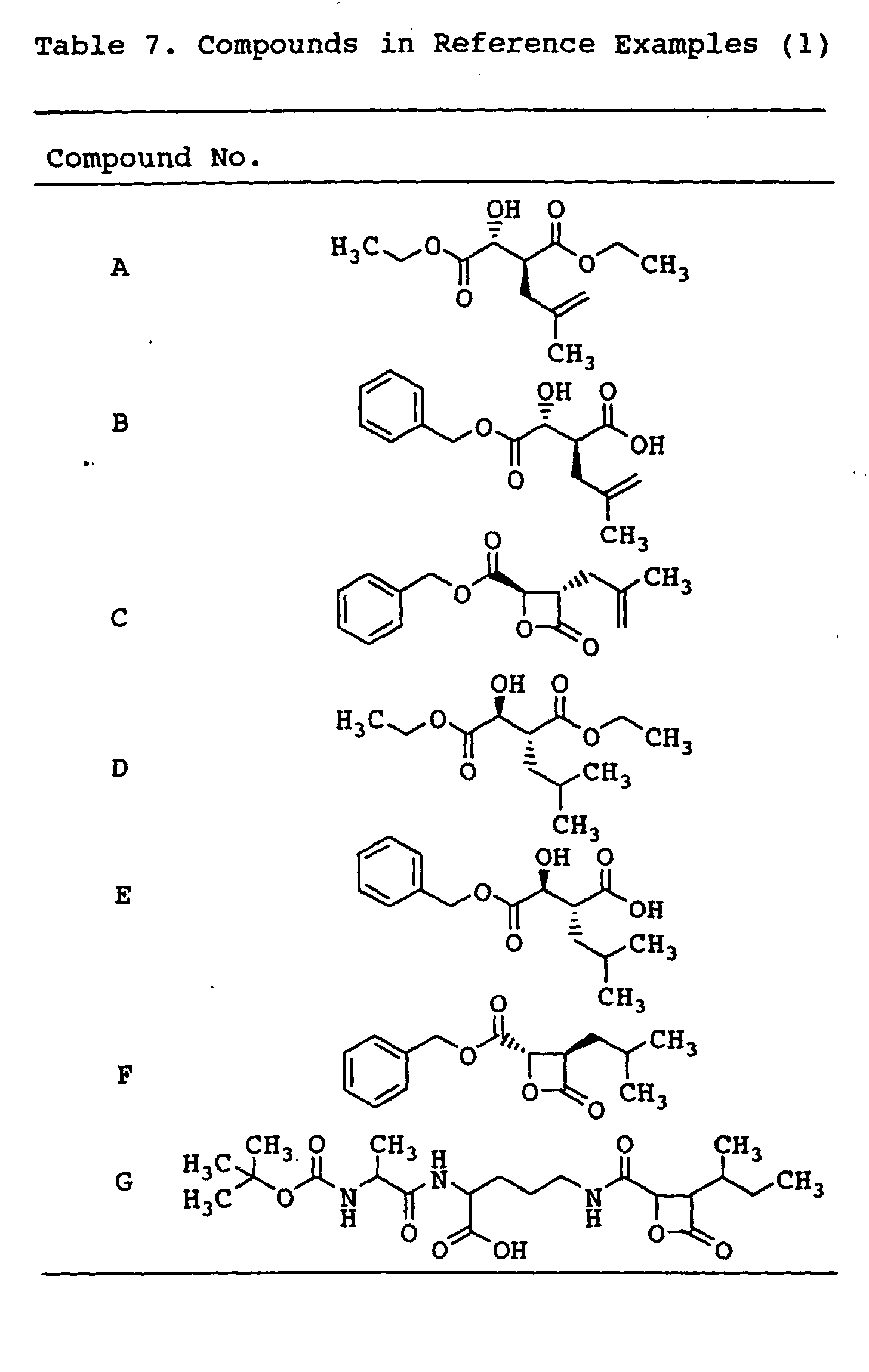


- Diethyl (R)-(+)-malate (5.0 g, 0.026 mol) was dissolved in tetrahydrofuran (150 mL) followed by adding a 1 mol/L solution of lithium bis(trimethylsilyl)amide/tetrahydrofuran (53 mL, 0.053 mmol) and then the mixture was stirred at -78°C for 15 minutes. Further, 3-bromo-2-methylpropene (27 mL, 0.26 mol) was added thereto and the temperature was elevated up to 0°C over one hour. After usual post-treatment, purifying by a chromatography on silica gel (eluted with n-hexane/ethyl acetate=2/1) afforded Compound A (5.2 g, yield; 81%).
1H NMR (CDCl3, 300MHz)δ ppm: 4.84(d, J=11.7Hz, 2H), 4.21-4.33(m, 3H), 4.14 (q, J=7.1Hz, 2H), 3.18(d, J=7.2Hz, 1H), 3.11(ddd, J=3.0, 6.6, 9.2Hz, 1H), 2.58(dd, J=6.6, 14.5Hz, 1H), 2.44(dd, J=9.0, 14.3Hz, 1H), 1.78(s, 3H), 1.32 (t, J=7.1Hz, 3H), 1.24(t, J=7.1Hz, 3H)
FABMS m/z: 245(M+H)+ calculated for C12H20O5=244 - Compound A (0.50 g, 0.0020 mol) obtained in Reference Example 1 was dissolved in 1,4-dioxane (2.5 mL) and water (2.5 mL) followed by adding a 4.5 mol/L aqueous solution of potassium hydroxide (1.4 mL, 0.0061 mmol), and the mixture was stirred at 100°C for 6 hours. After DOWEX50W was added to the reaction mixture for neutralization, the solvent was distilled off under reduced pressure. Trifluoroacetic anhydride (1.9 mL) was added to the residue, followed by stirring at 25°C for 0.5 hour. After the solvent was distilled off under reduced pressure, the residue was dissolved in benzyl alcohol (5.4 mL) followed by adding triethylamine (1.4 mL, 0.010 mol) and 4-dimethylaminopyridine (0.25 g, 0.0020 mol), and then the mixture was stirred at 60°C for 0.5 hour. After usual post-treatment, purifying by a chromatography on silica gel (eluted with chloroform/methanol=20/1) afforded Compound B (0.56 g, yield; 100%).
1H NMR (CDCl3, 300MHz)δ ppm: 7.27-7.39(m, 5H), 5.18(br s, 2H), 4.82(brd, J=6.5Hz, 2H), 4.32(br s, 1H), 3.09(m, 1H), 2.43-2.62 (m, 2H), 1.72(br s, 3H)
FABMS m/z: 277(M-H)- calculated for C15H18O5=278 - Compound B (0.53 g, 2.0 mmol) obtained in Reference Example 2 was dissolved in dichloromethane (110 mL) followed by adding bis(2-oxo-3-oxazolidinyl)phosphinic chloride (1.0 g, 4.0 mmol) and N,N-diisopropylethylamine (1.2 mL, 6.0 mmol), and then the mixture was stirred at 25°C for 2 hours. After usual post-treatment, purifying by a chromatography on silica gel (eluted with toluene/ethyl acetate=20/1) afforded Compound C (0.22 g, yield; 44%).
1H NMR (CDCl3, 300MHz ) δ ppm: 7.30-7.40(m, 5H), 5.18-5.32(m, 2H), 4.85(br s, 1H), 4.76(br s, 1H), 4.62(d, J=4.2Hz, 1H), 3.92(ddd, J=4.2, 5.9, 9.9Hz, 1H), 2.62(dd, J=5.9, 15.3Hz, 1H), 2.52(dd, J=9.7, 14.8Hz, 1H), 1.71(s, 3H) - Diethyl (S)-(-)-malate (10 g, 0.053 mol) was dissolved in tetrahydrofuran (30 mL) followed by adding a 1 mol/L solution of lithium bistrimethylsilylamide/tetrahydrofuran (110 mL, 0.11 mmol) and then the mixture was stirred at -78°C for 2.5 hours. Then 1-iodo-2-methylpropane (9.2 mL, 0.080 mol) was added thereto, and the mixture was stirred at 25°C for one hour. After usual post-treatment, purifying by a chromatography on silica gel (eluted with n-hexane/ethyl acetate=2/1) afforded Compound D (2.7 g, yield; 21%).
1H NMR (CDCl3, 300MHz)δ ppm: 4.31-4.12(m, 3H), 4.13(q, J=7.1Hz, 1H), 3.19 (br d, J=7.5Hz, 1H), 2.93(ddd, J=3.5, 7.6, 7.6Hz, 1H), 1.59-1.82(m, 2H), 1.52(dd, J=7.0, 13.4Hz, 1H), 1.31(t, J=7.1Hz, 3H), 1.25(t, J=6.9Hz, 3H), 0.95(d, J=6.7Hz, 3H), 0.94 (d, J=6.5Hz, 3H)
FABMS m/z: 247(M+H)+ calculated for C12H22O5=246 - In a manner similar to that in Reference Example 2, Compound E (1.2g, yield; 73%) was obtained from Compound D (2.7 g, 0.011 mol) obtained in Reference Example 4, 1,4-dioxane (130 mL), water (130 mL), a 4.5 mol/L aqueous solution of potassium hydroxide (7.3 mL, 0.033 mol), trifluoroacetic acid anhydride (62 mL), benzyl alcohol (88 mL), triethylamine (1.4 mL, 0.010 mol) and 4-dimethylaminopyridine (1.3 g, 0.011 mol).
1H NMR (DMSO-d6, 300MHz) δ ppm: 7.31-7.40(m, 5H), 5.16(d, J=12.2Hz, 1H), 5.11(d, J=12.3Hz, 1H), 4.13(d, J=7.3Hz, 1H), 2.67(m, 1H), 1.40-1.52(m, 2H), 1.03(dd, J=4.6, 9.2Hz, 1H), 0.80(d, J=6.4Hz, 3H), 0.79(d, J=6.4Hz, 3H)
FABMS m/z: 281(M+H)+ calculated for C15H20O5=280 - In amanner similar to that in Reference Example 3, Compound F (4.3 g, yield; 42%) was obtained from Compound E (11 mg, 0.039 mmol) obtained in Reference Example 5, dichloromethane (0.19 mL), bis(2-oxo-3-oxazolidinyl)phosphinic chloride (12 mg, 0.047 mmol) and triethylamine (0.016 mL, 0.12 mmol).
1H NMR (CDCl3, 300MHz)δ ppm: 7.34-7.40(m, 5H), 5.30(d, J=12.2Hz, 1H), 5.24(d, J=12.1Hz, 1H), 4.61(d, J=4.2Hz, 1H), 3.77(ddd, J=4.2, 6.3, 10.3Hz, 1H), 1.68-1.86(m, 3H), 0.93(d, J=6.4Hz, 3H), 0.88(d, J=6.2Hz, 3H) - UCK14C (0.060 g, 0.17 mmol) was dissolved in a 50% aqueous solution of tetrahydrofuran (1.5 mL) followed by adjusting the pH to 7.5 with a saturated aqueous solution of sodium hydrogencarbonate. Then, di-tert-butyl dicarbonate (0.040 g, 0.018 mmol) was added thereto and the mixture was stirred at room temperature for one hour. After usual post-treatment, purifying by a chromatography on silica gel (eluted with chloroform/methanol/acetic acid=200/1/0.1 to 200/4/0.4) afforded Compound G (0.052 g, yield; 68%).
1H NMR (CDCl3, 300MHz)δppm: 7.18(d, J=7.9Hz, 1H), 7.06(t, J=5.9Hz, 1H), 5.34(brs, 1H), 4.63(d, J=4.6Hz, 1H), 4.58(m, 1H), 4.23(br s, 1H), 3.62(dd, J=4.4, 7.7Hz, 1H), 3.21-3.48(m, 2H), 1.88-2.05(m, 2H), 1.54-1.82(m, 4H), 1.43(s, 9H), 1.35(d, J=7.0Hz, 3H), 1.29(m, 1H), 1.07(d, J=6.6Hz, 3H), 0.93(t, J=7.6Hz, 3H)
FABMS m/z: 458(M+H)+ calculated for C21H35N3O8=457 - Compound A (0.50 g, 2.1mmol) obtained in Reference Example 1 was dissolved in ethanol (50 mL) followed by adding platinum oxide (0.050 g), and then the mixture was stirred at 25°C for 4 hours under hydrogen atmosphere. After passing the reaction mixture through Celite R545, the solvent was distilled off under reduced pressure to afford Compound H (0.45 g, yield; 90%).
1H NMR (CDCl3, 300MHz)δ ppm: 4.27 (q, J=7.2Hz, 1H), 4.26(q, J=7.2Hz, 1H), 4.14 (q, J=7.1Hz, 2H), 3.18(d, J=7.7Hz, 1H), 2.93(ddd, J=3.7, 7.0, 8.3Hz, 1H), 1.48-1.81 (m, 3H), 1.31 (t, J=7.1Hz, 3H), 1.24 (t, J=7.1Hz, 3H), 0.95(d, J=6.4Hz, 3H), 0.93(d, J=6.5Hz, 3H) - Compound H (0.45 g, 1.8 mmol) obtained in Reference Example 8 was dissolved in 1,4-dioxane (11 mL) and water (11 mL) followed by adding a 4.5 mol/L aqueous solution of potassium hydroxide (1.2 mL, 5.5 mmol), and then the mixture was stirred at 100°C for one hour. DOWEX50W was added to the reaction mixture for neutralization, and then the solvent was distilled off under reduced pressure. The residue (0.35 g, 1.8 mmol) was dissolved in dichloromethane (11 mL) followed by adding 2,2-dimethoxypropane (0.45 mL, 3.7 mmol) and camphorsulfonic acid (0.086 g, 0.37 mmol), and then the mixture was stirred at 40°C for 1.5 hours. After usual post-treatment, purifying by a chromatography on silica gel (eluted with n-hexane/ethyl acetate=1/1) afforded Compound I (0.33 g, yield; 77%).
1H NMR (CDCl3, 300MHz)δ ppm: 4.47(d, J=4.9H2, 1H), 3.02(m, 1H), 1.59-1.86(m, 3H), 1.61(s, 3H), 1.55(s, 3H), 0.96(d, J=6.2Hz, 3H), 0.95(d, J=6.0Hz, 3H)
FABMS m/z: 231(M+H)+ calculated for C11H18O5=230 - Compound I (45mg, 0.20 mmol) obtained in Reference Example 9 was dissolved in dichloromethane (4.5 mL) followed by adding ethanethiol (0.025 mL, 0.34 mmol), 1-ethyl-3-(3-dimethylaminopropyl)carbodiimide hydrochloride (64 mg, 0.34 mmol) and 4-dimethylaminopyridine (4.8 mg, 0.039 mmol), and then the mixture was stirred at 25°C for 1.5 hours. After usual post-treatment, purifying by a chromatography on silica gel (eluted with n-hexane/ethyl acetate=20/1) afforded Compound J (39 mg, yield; 73%).
1H NMR (CDCl3, 300MHz) δ ppm: 4.45(d, J=6.2Hz, 1H), 3.10(m, 1H), 2.83-3.01(m, 2H), 1.64-1.85(m, 3H), 1.61(s, 3H), 1.52(s, 3H), 1.26(t, J=7.3Hz, 3H), 0.97(d, J=6.8Hz, 3H), 0.63(d, J=6.6Hz, 3H) - Compound B (0.13 g, 0.46 mmol) obtained in Reference Example 2 was dissolved in methanol (6.4 mL) followed by adding a 2 mol/L solution of trimethylsilyldiazomethane/n-hexane (4.1 mL, 4.6 mmol), and then the mixture was stirred at 0°C for 10 minutes. After usual post-treatment, purifying by a chromatography on silica gel (eluted with n-hexane/ethyl acetate=3/1) afforded Compound K (62 mg, yield; 46%).
1H NMR (CDCl3, 300MHz)δ ppm: 7.33-7.39(m, 5H), 5.22(d, J=8.1Hz, 2H), 4.84(s, 1H), 4.80(s, 1H), 4.68(s, 1H), 4.30(d, J=3.1Hz, 1H), 3.54(s, 3H), 3.13(ddd, J=3.1, 6.6, 9.2Hz, 1H), 2.54(dd, J=6.8, 14.5Hz, 1H), 2.42(dd, J=5.5, 14.3Hz, 1H), 1.73(s, 3H) - Compound K (62mg, 0.21 mmol) obtained in Reference Example 11 was dissolved in tetrahydrofuran (3.1 mL) followed by adding sodium hydride (7.1 mg, 0.30 mmol) and bromomethyl methyl ether (0.052 mL, 0.63 mmol), and then the mixture was stirred at 0°C for 10 minutes. After usual post-treatment, purifying by a chromatography on silica gel (eluted with n-hexane/ethyl acetate=5/1) afforded Compound L (57 mg, yield; 80%).
1H NMR(CDCl3, 300MHz) δ ppm: 7.33-7.40(m, 5H), 5.20(s, 2H), 4.78(s, 1H), 4.71(s, 1H), 4.67(dd, J=7.0, 9.0Hz, 2H), 4.30(d, J=6.6Hz, 1H), 3.60(s, 3H), 3.32(s, 3H), 3.17(dt, J=6.5, 8.8Hz, 1H), 2.41(dd, J=8.9, 14.4Hz, 1H), 2.13(dd, J=6.3, 14.4Hz, 1H), 1.68(s, 3H)
FABMS m/z: 337(M+H)+ calculated for C18H24O6=336 - N-(tert-butyloxycarbonyl)-3-nitro-L-tyrosine benzyl ester (10 mg, 0.024 mmol) was dissolved inN,N-dimethylformamide (1.0mL) followed by adding methyl iodide (0.0075 mL, 0.12 mmol) and potassium carbonate (6.7 mg, 0.28 mmol), and then the mixture was stirred at 25°C for one hour. After usual post-treatment, purifying by a thin layer column chromatography (developed with n-hexane/ethyl acetate=2/1) afforded Compound M (11 mg, yield; 100%).
1H NMR (CDCl3, 300MHz) δ ppm: 7.55(d, J=2.2Hz, 1H), 7.30-7.40(m, 5H), 7.19(dd, J=2.3, 8.9Hz, 1H), 6.91(d, J=8.6Hz, 1H), 5.20(d, J=12.1Hz, 1H), 5.11(d, J=11.9Hz, 1H), 5.06(br d J=7.3Hz, 1H), 4.60(m, 1H), 3.91(s, 3H), 3.13(dd, J=6.6, 14.1Hz, 1H), 3.01(dd, J=6.1, 14.2Hz, 1H), 1.42(s, 9H)
FABMS m/z: 431(M+H)+ calculated for C22H26N2O7=430 - Compound L (110 mg, 0.025 mmol) obtained in Reference Example 13 was dissolved in 2-methoxyethanol (1.6 mL) and water (1.6 mL) followed by adding sodium dithionite (13 mg, 0.74 mmol), and then the mixture was stirred at 80°C for 7 hours. After usual post-treatment, purifying by a thin layer column chromatography (developed with chloroform/methanol=20/1) afforded Compound N (21 mg, yield; 21%).
1H NMR (CDCl3, 400MHz) δ ppm: 7.30-7.38(m, 5H), 6.62(d, J=8.1Hz, 1H), 6.39(br d, J=8.1Hz, 1H), 6.32(brs, 1H), 5.20(d, J=12.3Hz, 1H), 5.08(d, J=12.2Hz, 1H), 4.94(br d, J=7.5Hz, 1H), 4.55(m, 1H), 3.80(s, 3H), 3.65(br s, 2H), 2.94(m, 2H), 1.42(s, 9H) - N-(tert-butyloxycarbonyl)-3-nitro-L-tyrosine (0.21 g, 0.63 mmol) was dissolved in N,N-dimethylformamide (1.0 mL) followed by adding benzyl bromide (0.34 mL, 2.8 mmol) and potassium carbonate (0.18 g, 1.3 mmol), and then the mixture was stirred at 25°C for 0.5 hour. After usual post-treatment, purifying by a chromatography on silica gel (eluted with n-hexane/ethyl acetate=3/1) afforded Compound O (0.21 mg, yield; 65%).
1H NMR (CDCl3, 300MHz)δ ppm: 7.56(br d, J=1.7Hz, 1H), 7.27-7.46 (m, 10H), 7.13(br d, J=7.4Hz, 1H), 6.92(d, J=8.7Hz, 1H), 5.05-5.22(m, 5H), 4.59(m, 1H), 3.11(dd, J=6.0, 13.9Hz, 1H), 2.99(dd, J=5.7, 14.0Hz, 1H), 1.41(s, 9H)
FABMS m/z: 507(M+H)+ calculated for C28H30N2O7=506 - In a manner similar to that in Reference Example 14, Compound P (30 mg, yield; 18%) was obtained from Compound O (0.18 g, 0.35 mmol) obtained in Reference Example 15, 2-methoxyethanol (4.4 mL), water (4.4 mL) and sodium dithionite (0.18 g, 1.1 mmol).
1H NMR (CDCl3, 400MHz) δ ppm: 7.28-7.48(m, 10H), 6.69(d, J=8.3Hz, 1H), 6.37(br d, J=8.3Hz, 1H), 6.33(br s, 1H), 4.91-5.25(m, 5H), 4.56(m, 1H), 3.70(br s, 2H), 2.89-2.99(m, 2H), 1.40(s, 9H)
FABMS m/z: 476 M+ calculated for C28H32N2O5=476 - The present invention provides proteasome inhibitors effective for the treatment of malignant tumors, such as leukemia, lung cancer, colon cancer, breast cancer or the like by growth suppression of various cancer cells, for the treatment of diseases associated with autoimmune diseases, inflammation, neurodegeneration or the like, such as rheumatoid chronic arthritis, asthma, Alzheimer disease or the like, or further for the reduction of rejection in organ transplantation.
Claims (24)
- A proteasome inhibitor comprising, as an active ingredient, a carboxylic acid derivative represented by the formula (I) or a pharmaceutically acceptable salt thereof:<wherein m and n are the same or different and represent an integer of 0 to 10; p represents 0 or 1; R1 represents a hydrogen atom, substituted or unsubstituted alkyl, substituted or unsubstituted alicyclic alkyl, substituted or unsubstituted aralkyl, substituted or unsubstituted aryl or NR6R7 {wherein R6 represents a hydrogen atom, substituted or unsubstituted alkyl, or substituted or unsubstituted aralkyl, and R7 represents a hydrogen atom, substituted or unsubstituted alkyl, substituted or unsubstituted aralkyl, CW1R8 (wherein R8 represents a hydrogen atom, substituted or unsubstituted alkyl, substituted or unsubstituted alkylamino, substituted or unsubstituted alkoxy, substituted or unsubstituted aryl, a substituted or unsubstituted heterocyclic group, substituted or unsubstituted aralkyl, substituted or unsubstituted aralkylamino, or substituted or unsubstituted aralkyloxy, and W1 represents an oxygen atom or a sulfur atom), or the formula:
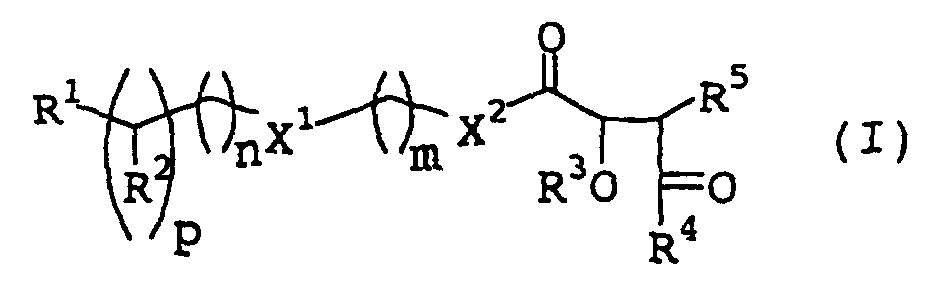 (wherein R9 represents a hydrogen atom, substituted or unsubstituted alkyl, or substituted or unsubstituted aralkyl; R10 represents a hydrogen atom, substituted or unsubstituted alkyl, substituted or unsubstituted aralkyl, CW2R8a (wherein R8a and W2 have the same significances as the above R8 and W1, respectively), substituted or unsubstituted alkylsulfonyl, substituted or unsubstituted arylsulfonyl, or PW3R12 2 (wherein R12's are the same or different and represent substituted or unsubstituted alkyl, or substituted or unsubstituted aryl; and W3 has the same significance as the above W1); or R9 and R10 together represent the formula:
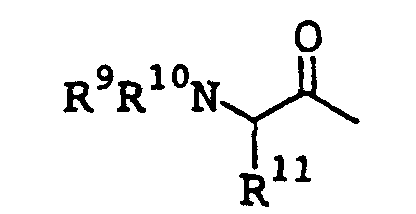 (wherein Y1 represents substituted or unsubstituted alkylene or substituted or unsubstituted arylene); and R11 represents a hydrogen atom, substituted or unsubstituted alkyl, or substituted or unsubstituted aralkyl)}; R2 represents a hydrogen atom, COR13 (wherein R13 represents hydroxy, substituted or unsubstituted alkoxy, substituted or unsubstituted alkenyloxy, substituted or unsubstituted aralkyloxy, substituted or unsubstituted alicyclic alkylalkoxy, substituted or unsubstituted aroylalkoxy, or NR14R15 (wherein R14 represents a hydrogen atom, substituted or unsubstituted alkyl, or substituted or unsubstituted aryl; and R15 represents substituted or unsubstituted alkyl, substituted or unsubstituted aralkyl, substituted or unsubstituted alkoxycarbonylalkyl, amino, substituted or unsubstituted alkylamino, or substituted or unsubstituted arylamino; or R14 and R15 together with the adjacent N form a substituted or unsubstituted heterocyclic group)) or CH2OR3a (wherein R3a represents a hydrogen atom, substituted or unsubstituted alkyl, substituted or unsubstituted aralkyl, substituted or unsubstituted alkanoyl, substituted or unsubstituted aroyl, or SiR16 3 (wherein R16's are the same or different and represent substituted or unsubstituted alkyl, or substituted or unsubstituted aryl)); or R1 and R2 together represent the formula:
 (wherein Y2 represents substituted or unsubstituted alkylene); X1 represents a bond, substituted or unsubstituted alkylene, substituted or unsubstituted alicyclic alkylene, substituted or unsubstituted alkenylene, or substituted or unsubstituted arylene; X2 represents an oxygen atom, a sulfur atom or NR17 (wherein R17 represents a hydrogen atom, substituted or unsubstituted alkyl, or substituted or unsubstituted aralkyl); R3 has the same significance as the above R3a; R4 represents hydroxy, mercapto, substituted or unsubstituted alkoxy, or substituted or unsubstituted alkylthio; or R3 and R4 together represent a bond; and R5 represents a hydrogen atom, substituted or unsubstituted alkyl, substituted or unsubstituted alkenyl, or substituted or unsubstituted aralkyl>.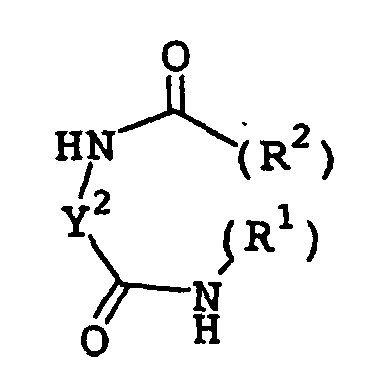
- The proteasome inhibitor according to claim 1, wherein R3 and R4 together represent a bond.
- The carboxylic acid derivative or the pharmaceutically acceptable salt thereof according to claim 1, wherein R4 is hydroxy, or substituted or unsubstituted alkoxy; p is 1; R1 is a hydrogen atom or NR6R7 (wherein each of R6 and R7 has the same significance as defined above), or R1 and R2 together are the formula:(wherein Y2 has the same significance as defined above); X1 is substituted or unsubstituted alicyclic alkylene, or substituted or unsubstituted arylene; and X2 is NR17 (wherein R17 has the same significance as defined above).
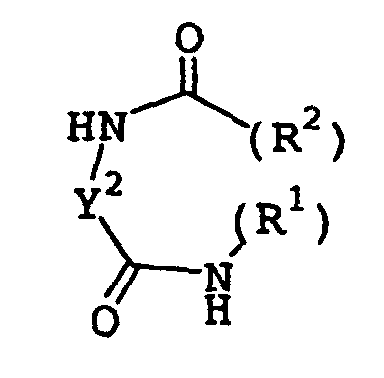
- The carboxylic acid derivative or the pharmaceutically acceptable salt thereof according to claim 1, wherein R4 is mercapto, or substituted or unsubstituted alkylthio, or R3 and R4 together are a bond; X2 is NR17 (wherein R17 has the same significance as defined above)[when m is 0; n and p are 1; R2 is carboxy; R3 and R4 together are a bond; R5 is sec-butyl; and X1 is cyclopropylene or ethylene, R1 is neither NHC(=O)-C(CH3)NH2 nor NHC(=O)-C(CH3)NHC(=O)O-C(CH3)3].
- The carboxylic acid derivative or the pharmaceutically acceptable salt thereof according to claim 3, wherein R1 is a hydrogen atom or NR6R7 (wherein each of R6 and R7 has the same significance as defined above).
- The carboxylic acid derivative or the pharmaceutically acceptable salt thereof according to claim 5, wherein R1 is NR6R7 (wherein each of R6 and R7 has the same significance as defined above); X1 is cyclopropylene or alkylene; and X2 is NH.
- The carboxylic acid derivative or the pharmaceutically acceptable salt thereof according to claim 4, wherein R4 is mercapto, or substituted or unsubstituted alkylthio; R1 is NR6R7 (wherein each of R6 and R7 has the same significance as defined above); and X1 is cyclopropylene or alkylene.
- The carboxylic acid derivative or the pharmaceutically acceptable salt thereof according to claim 4, wherein R3 and R4 together are a bond.
- The carboxylic acid derivative or the pharmaceutically acceptable salt thereof according to claim 8, wherein m is 0; n and p are 1; R1 is NR6R7 (wherein each of R6 and R7 has the same significance as defined above); R2 is COR13a (wherein R13a is alkylamino, aralkyloxy or aralkylamino); R5 is alkyl; X1 is cyclopropylene, alkylene, or substituted or unsubstituted phenylene; and X2 is NH.
- A process for producing the carboxylic acid derivative according to claim 1, wherein R3 and R4 together represent a bond and X2 is NR17, characterized in that a carboxylic acid represented by the formula (II):(wherein R5 has the same significance as defined above) is reacted with an amine represented by the formula (III):
 (wherein each of m, n, p, R1, R2, R17 and X1 has the same significance as defined above).
- The carboxylic acid according to claim 10, wherein R5 is substituted or unsubstituted alkyl, substituted or unsubstituted alkenyl, or substituted or unsubstituted aralkyl, or a salt thereof.
- The amine according to claim 10, wherein m is 0; n and p are 1; R1 is NR6R7 (wherein each of R6 and R7 has the same significance as defined above); R2 is COR13 (wherein R13 has the same significance as defined above) or CH2OR3a (wherein R3a has the same significance as defined above), or R1 and R2 together are the formula:(wherein Y2 has the same significance as defined above); and X1 is cyclopropylene, or a salt thereof.
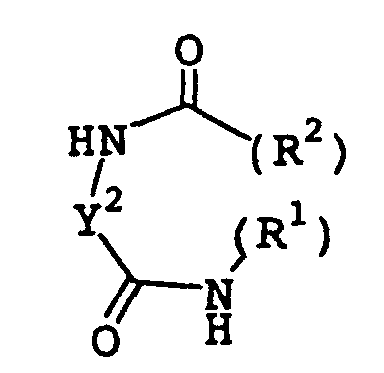
- The amine or the salt thereof according to claim 12, wherein R1 is amino and R17 is a hydrogen atom.
- The amine or the salt thereof according to claim 13, wherein R2 is carboxy.
- A pharmaceutical composition comprising the amine or the salt thereof according to any one of claims 12 to 14 as an active ingredient.
- A compound wherein the amine according to any one of claims 12 to 14 is protected with a protecting group, or a salt thereof.
- A pharmaceutical composition comprising the carboxylic acid derivative or the pharmaceutically acceptable salt thereof according to any one of claims 3 to 9 as an active ingredient.
- A proteasome inhibitor comprising the carboxylic acid derivative or the pharmaceutically acceptable salt thereof according to any one of claims 3 to 9 as an active ingredient.
- An antitumor agent comprising the carboxylic acid derivative or the pharmaceutically acceptable salt thereof according to any one of claims 3 to 9 as an active ingredient.
- A pharmaceutical composition comprising the carboxylic acid derivative or the pharmaceutically acceptable salt thereof according to any one of claims 3 to 9 as an active ingredient, used for the treatment of the diseases curable by proteasome inhibition.
- A use of the carboxylic acid derivative or the pharmaceutically acceptable salt thereof according to any one of claims 3 to 9 for the manufacture of a proteasome inhibitor.
- A use of the carboxylic acid derivative or the pharmaceutically acceptable salt thereof according to any one of claims 3 to 9 for the manufacture of an antitumor agent.
- Amethod to inhibit proteasome comprising a process in which an effective amount of the carboxylic acid derivative or the pharmaceutically acceptable salt thereof according to any one of claims 3 to 9 is administered to a mammal including human.
- A method of treatment or prevention of a tumor comprising a process in which an effective amount of the carboxylic acid derivative or the pharmaceutically acceptable salt thereof according to any one of claims 3 to 9 is administered to a mammal including human.
Applications Claiming Priority (5)
| Application Number | Priority Date | Filing Date | Title |
|---|---|---|---|
| JP1239199 | 1999-01-20 | ||
| JP1239199 | 1999-01-20 | ||
| JP28853999 | 1999-10-08 | ||
| JP28853999 | 1999-10-08 | ||
| PCT/JP2000/000247 WO2000043000A1 (en) | 1999-01-20 | 2000-01-20 | Proteasome inhibitors |
Publications (2)
| Publication Number | Publication Date |
|---|---|
| EP1166781A1 true EP1166781A1 (en) | 2002-01-02 |
| EP1166781A4 EP1166781A4 (en) | 2002-08-21 |
Family
ID=26348003
Family Applications (1)
| Application Number | Title | Priority Date | Filing Date |
|---|---|---|---|
| EP00900834A Withdrawn EP1166781A4 (en) | 1999-01-20 | 2000-01-20 | PROTEASOME INHIBITORS |
Country Status (4)
| Country | Link |
|---|---|
| EP (1) | EP1166781A4 (en) |
| AU (1) | AU3074500A (en) |
| CA (1) | CA2359561A1 (en) |
| WO (1) | WO2000043000A1 (en) |
Cited By (5)
| Publication number | Priority date | Publication date | Assignee | Title |
|---|---|---|---|---|
| US7223745B2 (en) | 2003-08-14 | 2007-05-29 | Cephalon, Inc. | Proteasome inhibitors and methods of using the same |
| WO2008006113A3 (en) * | 2006-07-07 | 2008-02-28 | Texas A & M Univ Sys | Novel belactosin derivatives as therapeutic agents/biological probes and their synthesis |
| WO2008067921A1 (en) * | 2006-12-08 | 2008-06-12 | Bayer Cropscience Ag | Oxooxetane as a fungicidal agent |
| US7576206B2 (en) | 2003-08-14 | 2009-08-18 | Cephalon, Inc. | Proteasome inhibitors and methods of using the same |
| US8088923B2 (en) | 2006-07-07 | 2012-01-03 | The Texas A&M University System | Cyclic-fused beta-lactones and their synthesis |
Families Citing this family (18)
| Publication number | Priority date | Publication date | Assignee | Title |
|---|---|---|---|---|
| JP5048201B2 (en) | 2000-08-04 | 2012-10-17 | ディーエムアイ バイオサイエンシズ インコーポレイテッド | Method for using diketopiperazines and compositions containing diketopiperazines |
| ES2278049T3 (en) | 2001-05-21 | 2007-08-01 | Alcon, Inc. | USE OF PROTEASOME INHIBITORS TO TREAT DRY EYE DISORDERS. |
| DK1393277T3 (en) | 2001-05-21 | 2006-10-30 | Alcon Inc | Use of NF-Kappa-B inhibitors to treat eye disorders |
| US6872382B1 (en) | 2001-05-21 | 2005-03-29 | Alcon, Inc. | Use of selective PDE IV inhibitors to treat dry eye disorders |
| US7112588B2 (en) | 2001-05-21 | 2006-09-26 | Alcon, Inc. | Use of proteasome inhibitors to treat dry eye disorders |
| US6645994B1 (en) | 2001-06-01 | 2003-11-11 | Alcon, Inc. | Method of treating dry eye disorders |
| DE10232902A1 (en) | 2002-07-19 | 2004-01-29 | Bayer Cropscience Ag | Method for identifying inhibitors of the 20S and 26S proteasome |
| CN102210852B (en) | 2003-05-15 | 2016-10-19 | 安皮奥制药股份有限公司 | Treatment of T-cell mediated diseases |
| US7569709B2 (en) | 2006-03-10 | 2009-08-04 | Cornell Research Foundation, Inc. | Low pressure carbonylation of heterocycles |
| JP5856843B2 (en) | 2008-05-27 | 2016-02-10 | アンピオ ファーマシューティカルズ,インコーポレイテッド | Pharmaceutical composition using diketopiperazine |
| EP2613786A4 (en) | 2010-09-07 | 2013-10-23 | Dmi Acquisition Corp | TREATMENT OF DISEASES |
| PH12014500685B1 (en) | 2011-10-10 | 2018-10-03 | Ampio Pharmaceuticals Inc | Treatment of degenerative joint disease |
| JP2014530063A (en) | 2011-10-10 | 2014-11-17 | アンピオ ファーマシューティカルズ,インコーポレイテッド | Implantable medical device with enhanced immune tolerance, manufacturing method and implantation method |
| HK1198812A1 (en) | 2011-10-28 | 2015-06-12 | Ampio Pharmaceuticals, Inc. | Treatment of rhinitis |
| CA2906864A1 (en) | 2013-03-15 | 2014-09-18 | Ampio Pharmaceuticals, Inc. | Compositions for the mobilization, homing, expansion and differentiation of stem cells and methods of using the same |
| EP4066836A1 (en) | 2014-08-18 | 2022-10-05 | Ampio Pharmaceuticals, Inc. | Treatment of joint conditions |
| EP3310375A4 (en) | 2015-06-22 | 2019-02-20 | Ampio Pharmaceuticals, Inc. | USE OF LOW MOLECULAR WEIGHT HUMAN SERUM ALBUMIN FRACTIONS FOR TREATING DISEASES |
| CN122059950B (en) * | 2026-04-21 | 2026-08-11 | 浙大城市学院 | Compounds with proteasome agonist activity, their preparation methods and applications |
Family Cites Families (2)
| Publication number | Priority date | Publication date | Assignee | Title |
|---|---|---|---|---|
| JPH0421661A (en) * | 1990-05-15 | 1992-01-24 | Kanegafuchi Chem Ind Co Ltd | Production of n-benzylmalimide |
| EP0768317B1 (en) * | 1995-10-16 | 1999-01-27 | Kyowa Hakko Kogyo Co., Ltd. | UCK14 compounds |
-
2000
- 2000-01-20 WO PCT/JP2000/000247 patent/WO2000043000A1/en not_active Ceased
- 2000-01-20 CA CA002359561A patent/CA2359561A1/en not_active Abandoned
- 2000-01-20 EP EP00900834A patent/EP1166781A4/en not_active Withdrawn
- 2000-01-20 AU AU30745/00A patent/AU3074500A/en not_active Abandoned
Non-Patent Citations (3)
| Title |
|---|
| ASAI, AKIRA ET AL: "Belactosin A, a novel antitumor antibiotic acting on Cyclin/CDK mediated cell cycle regulation, produced by Streptomyces sp." JOURNAL OF ANTIBIOTICS (2000), 53(1), 81-83 , XP001083660 * |
| DATABASE CA [Online] CHEMICAL ABSTRACTS SERVICE, COLUMBUS, OHIO, US; HASEGAWA, ATSUHIRO ET AL: "Structural elucidation of UCK14A, novel cell cycle inhibitor" retrieved from STN Database accession no. 132:322118 XP002202529 & TENNEN YUKI KAGOBUTSU TORONKAI KOEN YOSHISHU (1999), 41ST, 385-390 , * |
| See also references of WO0043000A1 * |
Cited By (9)
| Publication number | Priority date | Publication date | Assignee | Title |
|---|---|---|---|---|
| US7223745B2 (en) | 2003-08-14 | 2007-05-29 | Cephalon, Inc. | Proteasome inhibitors and methods of using the same |
| US7576206B2 (en) | 2003-08-14 | 2009-08-18 | Cephalon, Inc. | Proteasome inhibitors and methods of using the same |
| US7915236B2 (en) | 2003-08-14 | 2011-03-29 | Cephalon, Inc. | Proteasome inhibitors and methods of using the same |
| US8058262B2 (en) | 2003-08-14 | 2011-11-15 | Cephalon, Inc. | Proteasome inhibitors and methods of using the same |
| US9233115B2 (en) | 2003-08-14 | 2016-01-12 | Millennium Pharmaceuticals Inc. | Proteasome inhibitors and methods of using the same |
| WO2008006113A3 (en) * | 2006-07-07 | 2008-02-28 | Texas A & M Univ Sys | Novel belactosin derivatives as therapeutic agents/biological probes and their synthesis |
| US8088923B2 (en) | 2006-07-07 | 2012-01-03 | The Texas A&M University System | Cyclic-fused beta-lactones and their synthesis |
| US8119653B2 (en) | 2006-07-07 | 2012-02-21 | The Texas A&M University System | Belactosin derivatives as therapeutic agents/biological probes and their synthesis |
| WO2008067921A1 (en) * | 2006-12-08 | 2008-06-12 | Bayer Cropscience Ag | Oxooxetane as a fungicidal agent |
Also Published As
| Publication number | Publication date |
|---|---|
| EP1166781A4 (en) | 2002-08-21 |
| WO2000043000A1 (en) | 2000-07-27 |
| CA2359561A1 (en) | 2000-07-27 |
| AU3074500A (en) | 2000-08-07 |
Similar Documents
| Publication | Publication Date | Title |
|---|---|---|
| CA2359561A1 (en) | Proteasome inhibitors | |
| AU666179B2 (en) | 2-Oxoethyl derivatives as immunosuppressants | |
| CN100369908C (en) | Taxane derivatives | |
| KR0173862B1 (en) | O-carbamoyl- (D) -phenylalaninol compounds and their pharmaceutically useful salts and methods for their preparation | |
| EP0434365A2 (en) | HIV protease inhibitors useful for the treatment of aids | |
| EP1737863B1 (en) | 2-cyanopyrrolidinecarboxamides as dipeptidyl peptidase-iv inhibitors | |
| FR2609716A1 (en) | NOVEL PEPTIDE DERIVATIVES, THEIR PREPARATION AND THEIR USE AS MEDICAMENTS | |
| BG107889A (en) | Tetralone derivatives as antitumor agents | |
| PT820438E (en) | O-CARBAMOYL-PHENYLALANINOL BASED ON A BENZENE RING, ITS PHARMACEUTICALLY USEFUL SALTS AND PROCESS FOR PREPARING THE SAME | |
| CA2240060C (en) | O-carbamoyl-phenylalaninol compounds, their pharmaceutically useful salts and process for preparing the same | |
| WO2019062435A1 (en) | Use of triazolopyrimidine, triazolopyridine compounds and composition thereof for treating prc2-mediated diseases | |
| TW202239756A (en) | 1,3,4-oxadiazole thiocarbonyl compounds as histone deacetylase 6 inhibitor, and pharmaceutical composition comprising the same | |
| KR940003297B1 (en) | 1,3,2-dioxathioene oxide derivative | |
| US5258383A (en) | DC-89 derivatives | |
| US20080070885A1 (en) | Macrocyclic compounds having aspartic protease inhibiting activity and pharmaceutical uses thereof | |
| IL275766B1 (en) | Converted alkylene compounds as anticancer agents | |
| HU206194B (en) | Process for producing cyclomethylene-1,2-dicarboxylic acid derivatives and pharmaceutical compositions comprising same | |
| EP1497273B1 (en) | Hydroxamic acid derivatives | |
| CN101724016B (en) | A class of peptide compounds, its preparation method and use | |
| JPWO2000043000A1 (en) | Proteasome inhibitors | |
| CN1976710B (en) | Compounds and compositions as cathepsin S inhibitors | |
| CN102924567B (en) | Peptide compound and preparation method and use of peptide compound | |
| EP2185525B1 (en) | Pyrazole 3,5 carboxylate derivatives preparation and therapeutic application thereof | |
| JP2002145849A (en) | Alkynyl amino acid derivative and method for producing the same | |
| CN120965805A (en) | A phosphorylated peptide compound and its pharmaceutical uses |
Legal Events
| Date | Code | Title | Description |
|---|---|---|---|
| PUAI | Public reference made under article 153(3) epc to a published international application that has entered the european phase |
Free format text: ORIGINAL CODE: 0009012 |
|
| 17P | Request for examination filed |
Effective date: 20010820 |
|
| AK | Designated contracting states |
Kind code of ref document: A1 Designated state(s): AT BE CH CY DE DK ES FI FR GB GR IE IT LI LU MC NL PT SE |
|
| AX | Request for extension of the european patent |
Free format text: AL PAYMENT 20000820;LT PAYMENT 20000820;LV PAYMENT 20000820;MK PAYMENT 20000820;RO PAYMENT 20000820;SI PAYMENT 20000820 |
|
| RIC1 | Information provided on ipc code assigned before grant |
Free format text: 7A 61K 31/215 A, 7A 61K 31/27 B, 7A 61K 31/337 B, 7A 61K 31/497 B, 7A 61K 31/501 B, 7A 61K 31/506 B, 7C 07C 271/22 B, 7C 07C 237/10 B, 7C 07C 327/22 B, 7C 07C 327/28 B, 7C 07C 237/22 B |
|
| A4 | Supplementary search report drawn up and despatched |
Effective date: 20020710 |
|
| AK | Designated contracting states |
Kind code of ref document: A4 Designated state(s): AT BE CH CY DE DK ES FI FR GB GR IE IT LI LU MC NL PT SE |
|
| 17Q | First examination report despatched |
Effective date: 20021219 |
|
| STAA | Information on the status of an ep patent application or granted ep patent |
Free format text: STATUS: THE APPLICATION IS DEEMED TO BE WITHDRAWN |
|
| 18D | Application deemed to be withdrawn |
Effective date: 20040827 |