EP1166778A2 - The use of growth hormone scretagogues to treat systemic lupus erythematosus and inflammatory bowel disease - Google Patents
The use of growth hormone scretagogues to treat systemic lupus erythematosus and inflammatory bowel disease Download PDFInfo
- Publication number
- EP1166778A2 EP1166778A2 EP01305273A EP01305273A EP1166778A2 EP 1166778 A2 EP1166778 A2 EP 1166778A2 EP 01305273 A EP01305273 A EP 01305273A EP 01305273 A EP01305273 A EP 01305273A EP 1166778 A2 EP1166778 A2 EP 1166778A2
- Authority
- EP
- European Patent Office
- Prior art keywords
- alkyl
- optionally substituted
- optionally
- group
- independently
- Prior art date
- Legal status (The legal status is an assumption and is not a legal conclusion. Google has not performed a legal analysis and makes no representation as to the accuracy of the status listed.)
- Withdrawn
Links
- 0 CC(N(C)CC1)=CCC1(*)C(*)(*)N=C Chemical compound CC(N(C)CC1)=CCC1(*)C(*)(*)N=C 0.000 description 5
Classifications
-
- A—HUMAN NECESSITIES
- A61—MEDICAL OR VETERINARY SCIENCE; HYGIENE
- A61K—PREPARATIONS FOR MEDICAL, DENTAL OR TOILETRY PURPOSES
- A61K31/00—Medicinal preparations containing organic active ingredients
- A61K31/33—Heterocyclic compounds
- A61K31/395—Heterocyclic compounds having nitrogen as a ring hetero atom, e.g. guanethidine or rifamycins
- A61K31/55—Heterocyclic compounds having nitrogen as a ring hetero atom, e.g. guanethidine or rifamycins having seven-membered rings, e.g. azelastine, pentylenetetrazole
-
- A—HUMAN NECESSITIES
- A61—MEDICAL OR VETERINARY SCIENCE; HYGIENE
- A61K—PREPARATIONS FOR MEDICAL, DENTAL OR TOILETRY PURPOSES
- A61K31/00—Medicinal preparations containing organic active ingredients
-
- A—HUMAN NECESSITIES
- A61—MEDICAL OR VETERINARY SCIENCE; HYGIENE
- A61K—PREPARATIONS FOR MEDICAL, DENTAL OR TOILETRY PURPOSES
- A61K31/00—Medicinal preparations containing organic active ingredients
- A61K31/33—Heterocyclic compounds
- A61K31/395—Heterocyclic compounds having nitrogen as a ring hetero atom, e.g. guanethidine or rifamycins
- A61K31/435—Heterocyclic compounds having nitrogen as a ring hetero atom, e.g. guanethidine or rifamycins having six-membered rings with one nitrogen as the only ring hetero atom
- A61K31/4353—Heterocyclic compounds having nitrogen as a ring hetero atom, e.g. guanethidine or rifamycins having six-membered rings with one nitrogen as the only ring hetero atom ortho- or peri-condensed with heterocyclic ring systems
- A61K31/437—Heterocyclic compounds having nitrogen as a ring hetero atom, e.g. guanethidine or rifamycins having six-membered rings with one nitrogen as the only ring hetero atom ortho- or peri-condensed with heterocyclic ring systems the heterocyclic ring system containing a five-membered ring having nitrogen as a ring hetero atom, e.g. indolizine, beta-carboline
-
- A—HUMAN NECESSITIES
- A61—MEDICAL OR VETERINARY SCIENCE; HYGIENE
- A61K—PREPARATIONS FOR MEDICAL, DENTAL OR TOILETRY PURPOSES
- A61K31/00—Medicinal preparations containing organic active ingredients
- A61K31/33—Heterocyclic compounds
- A61K31/395—Heterocyclic compounds having nitrogen as a ring hetero atom, e.g. guanethidine or rifamycins
- A61K31/435—Heterocyclic compounds having nitrogen as a ring hetero atom, e.g. guanethidine or rifamycins having six-membered rings with one nitrogen as the only ring hetero atom
- A61K31/438—The ring being spiro-condensed with carbocyclic or heterocyclic ring systems
-
- A—HUMAN NECESSITIES
- A61—MEDICAL OR VETERINARY SCIENCE; HYGIENE
- A61K—PREPARATIONS FOR MEDICAL, DENTAL OR TOILETRY PURPOSES
- A61K31/00—Medicinal preparations containing organic active ingredients
- A61K31/33—Heterocyclic compounds
- A61K31/395—Heterocyclic compounds having nitrogen as a ring hetero atom, e.g. guanethidine or rifamycins
- A61K31/435—Heterocyclic compounds having nitrogen as a ring hetero atom, e.g. guanethidine or rifamycins having six-membered rings with one nitrogen as the only ring hetero atom
- A61K31/44—Non condensed pyridines; Hydrogenated derivatives thereof
- A61K31/4427—Non condensed pyridines; Hydrogenated derivatives thereof containing further heterocyclic ring systems
- A61K31/444—Non condensed pyridines; Hydrogenated derivatives thereof containing further heterocyclic ring systems containing a six-membered ring with nitrogen as a ring heteroatom, e.g. amrinone
-
- A—HUMAN NECESSITIES
- A61—MEDICAL OR VETERINARY SCIENCE; HYGIENE
- A61K—PREPARATIONS FOR MEDICAL, DENTAL OR TOILETRY PURPOSES
- A61K31/00—Medicinal preparations containing organic active ingredients
- A61K31/33—Heterocyclic compounds
- A61K31/395—Heterocyclic compounds having nitrogen as a ring hetero atom, e.g. guanethidine or rifamycins
- A61K31/495—Heterocyclic compounds having nitrogen as a ring hetero atom, e.g. guanethidine or rifamycins having six-membered rings with two or more nitrogen atoms as the only ring heteroatoms, e.g. piperazine or tetrazines
- A61K31/4985—Pyrazines or piperazines ortho- or peri-condensed with heterocyclic ring systems
-
- A—HUMAN NECESSITIES
- A61—MEDICAL OR VETERINARY SCIENCE; HYGIENE
- A61K—PREPARATIONS FOR MEDICAL, DENTAL OR TOILETRY PURPOSES
- A61K31/00—Medicinal preparations containing organic active ingredients
- A61K31/33—Heterocyclic compounds
- A61K31/395—Heterocyclic compounds having nitrogen as a ring hetero atom, e.g. guanethidine or rifamycins
- A61K31/495—Heterocyclic compounds having nitrogen as a ring hetero atom, e.g. guanethidine or rifamycins having six-membered rings with two or more nitrogen atoms as the only ring heteroatoms, e.g. piperazine or tetrazines
- A61K31/50—Pyridazines; Hydrogenated pyridazines
- A61K31/5025—Pyridazines; Hydrogenated pyridazines ortho- or peri-condensed with heterocyclic ring systems
-
- A—HUMAN NECESSITIES
- A61—MEDICAL OR VETERINARY SCIENCE; HYGIENE
- A61K—PREPARATIONS FOR MEDICAL, DENTAL OR TOILETRY PURPOSES
- A61K31/00—Medicinal preparations containing organic active ingredients
- A61K31/33—Heterocyclic compounds
- A61K31/395—Heterocyclic compounds having nitrogen as a ring hetero atom, e.g. guanethidine or rifamycins
- A61K31/495—Heterocyclic compounds having nitrogen as a ring hetero atom, e.g. guanethidine or rifamycins having six-membered rings with two or more nitrogen atoms as the only ring heteroatoms, e.g. piperazine or tetrazines
- A61K31/505—Pyrimidines; Hydrogenated pyrimidines, e.g. trimethoprim
- A61K31/519—Pyrimidines; Hydrogenated pyrimidines, e.g. trimethoprim ortho- or peri-condensed with heterocyclic rings
-
- A—HUMAN NECESSITIES
- A61—MEDICAL OR VETERINARY SCIENCE; HYGIENE
- A61K—PREPARATIONS FOR MEDICAL, DENTAL OR TOILETRY PURPOSES
- A61K45/00—Medicinal preparations containing active ingredients not provided for in groups A61K31/00 - A61K41/00
- A61K45/06—Mixtures of active ingredients without chemical characterisation, e.g. antiphlogistics and cardiaca
-
- A—HUMAN NECESSITIES
- A61—MEDICAL OR VETERINARY SCIENCE; HYGIENE
- A61P—SPECIFIC THERAPEUTIC ACTIVITY OF CHEMICAL COMPOUNDS OR MEDICINAL PREPARATIONS
- A61P1/00—Drugs for disorders of the alimentary tract or the digestive system
-
- A—HUMAN NECESSITIES
- A61—MEDICAL OR VETERINARY SCIENCE; HYGIENE
- A61P—SPECIFIC THERAPEUTIC ACTIVITY OF CHEMICAL COMPOUNDS OR MEDICINAL PREPARATIONS
- A61P1/00—Drugs for disorders of the alimentary tract or the digestive system
- A61P1/04—Drugs for disorders of the alimentary tract or the digestive system for ulcers, gastritis or reflux esophagitis, e.g. antacids, inhibitors of acid secretion, mucosal protectants
-
- A—HUMAN NECESSITIES
- A61—MEDICAL OR VETERINARY SCIENCE; HYGIENE
- A61P—SPECIFIC THERAPEUTIC ACTIVITY OF CHEMICAL COMPOUNDS OR MEDICINAL PREPARATIONS
- A61P1/00—Drugs for disorders of the alimentary tract or the digestive system
- A61P1/10—Laxatives
-
- A—HUMAN NECESSITIES
- A61—MEDICAL OR VETERINARY SCIENCE; HYGIENE
- A61P—SPECIFIC THERAPEUTIC ACTIVITY OF CHEMICAL COMPOUNDS OR MEDICINAL PREPARATIONS
- A61P37/00—Drugs for immunological or allergic disorders
Definitions
- the present invention provides methods of using growth hormone secretagogues, prodrugs thereof and pharmaceutically acceptable salts of said secretagogues and said prodrugs to treat systemic lupus erythematosus, Crohn's disease, inflammatory bowel disease (IBD) and ulcerative colitis. More specifically, the present invention provides such methods wherein the growth hormone secretagogues are certain compounds of Formula I below.
- This invention also provides combinations comprising a growth hormone secretagogue and a second therapeutic agent selected from methotrexate, dapsone, a glucocorticoid or an antimalarial.
- the invention also provides pharmaceutical compositions and kits comprising such combinations and methods of using such combinations, pharmaceutical compositions and kits in the treatment of systemic lupus erythematosus, Crohn's disease, IBD and ulcerative colitis.
- SLE Systemic Lupus Erythematosus
- lupus erythematosus is a chronic, usually life-long, potentially fatal autoimmune disease characterized by unpredictable exacerbations and remissions with protean clinical manifestations.
- SLE is also characterized by immune dysregulation resulting in the production of antinuclear antibodies (ANA), generation of circulating immune complexes, and activation of the complement system.
- ANA antinuclear antibodies
- SLE there is a predilection for clinical involvement of the joints, skin, kidney, brain, serosa, lung, heart and gastrointestinal tract.
- the pathologic hallmark of the disease is recurrent, widespread, and diverse vascular lesions.
- SLE is a complex disorder affecting a predominately young population and shares similarities with HIV infection as regards the propensity for multiple organ involvement, potentially life-threatening episodes, and need for sophisticated monitoring. (Belmont, ibid.)
- SLE is not a rare disorder. Although reported at both extremes of life (e.g., diagnosed in infants and in the tenth decade of life), chiefly it affects women of child bearing age. Among children, SLE occurs three times more commonly in females than in males. In the 60% of SLE patients who experience onset of their disease between puberty and the fourth decade of life the female to male ratio is 9:1. Thereafter, the female preponderance again falls to that observed in prepubescents. (Belmont, ibid. )
- SLE The origin of autoantibody production in SLE is unclear but a role has been suggested for an antigen driven process, spontaneous B-cell hyper-responsiveness, or impaired immune regulation. Regardless of the etiology of autoantibody production, SLE is associated with the impaired clearance of circulating immune complexes secondary to decreased CR1 expression, defective Fc receptor function, or deficiencies of early complement components such as C4A. (Belmont, ibid. ) It has been suggested that the apoptosis process is atypical in the lupus patient leading to the increased production of autoantibodies including antiphospholipid antibodies. (L. Casciola-Rosen et al., Proc. Natl. Acad. Sci. USA, 93 , 1996, 1624-1629.
- the health status of a patient with SLE is related not only to disease activity, but to the damage that results from recurrent episodes of disease flare (e.g., deforming arthropathy, shrinking lung, end stage renal disease, organic mental syndrome, etc.), as well as the adverse effects of treatment (e.g., avascular necrosis of bone, infections, precocious atherosclerosis, etc.).
- disease flare e.g., deforming arthropathy, shrinking lung, end stage renal disease, organic mental syndrome, etc.
- adverse effects of treatment e.g., avascular necrosis of bone, infections, precocious atherosclerosis, etc.
- Inflammatory Bowel Disease is a term used to collectively describe Crohn's disease and ulcerative colitis, both of which cause similar symptoms, particularly inflammation of the intestines.
- Crohn's disease is a debilitating multisystem disorder which is characterized by inflammation of the bowel.
- the disease usually begins during adolescence or early adulthood and often leads to catabolism.
- patients suffering from Crohn's disease are treated with immunosuppressive and antiflammatory drugs that often have severe side effects which may enhance the catabolic process.
- High protein diets have been partially successful in counteracting the effects of the disease. It has been reported that growth homrone and insulin-like growth factor I 4 counteract the catabolic process of the disease and reduce morbidity. See Slonim et al., New England Journal of Medicine, 2000, 342 , 1633-1637.
- Crohn's disease and ulcerative colitis are currently treated by administering prednisone, sulfasalazine (which is sold in a commercial formulation as Azulfidine® ), mesalamine (which is variously sold in commercial formulations as, inter alia, Asacol® , Pentasa® and Rowasa® ) and olsalazine (which is sold in a commercial formulation as Dipentum® ).
- Ulcerative colitis is a condition characterized by inflammation of the lining of the colon and/or rectum.
- the inflammation may be of long or short duration and varies in intensity. Remission, the period between flare-ups, may last for a few days to many years.
- Patients generally experience bloody diarrhea, rectal bleeding, abdominal pain or cramping and/or and urgent need to go to the bathroom.
- the condition is a life-long problem which has no cure short of removal of the colon.
- the periods of remission may be extended by treatment with prednisone, sulfasalazine (which is sold in a commercial formulation as Azulfidine® ), mesalamine (which is variously sold in commercial formulations as, inter alia, Asacol® , Pentasa® and Rowasa® ) and olsalazine (which is sold in a commercial formulation as Dipentum® ). (http://www.living-better.com/2010.html) .
- Overexpression of bovine growth hormone in transgenic mice accelerates recovery and mucosal healing after experimentally induced colitis. See Williams et al., Gastroenterology 2000, 118 , A556.
- Growth hormone which is secreted from the pituitary, stimulates growth of all tissues of the body that are capable of growing.
- growth hormone is known to have the following basic effects on the metabolic processes of the body: (1) increased rate of protein synthesis in all cells of the body; (2) decreased rate of carbohydrate utilization in cells of the body; and (3) increased mobilization of free fatty acids and use of fatty acids for energy.
- GH receptors are found throughout the stomach, small intestine and colon. GH has a proliferative effect on intestinal crypt cells. Pair-fed transgenic mice overexpressing growth hormone show increases in small bowel weight and length and a 50% - 100% increase in mucosal mass with increased villus height and crypt depth, particularly in the proximal bowel. GH increases absorption or transport of water, sodium chloride, amino acids and calcium in the gut and increases enteroendocrine secretion in animals. See Shulman, Endocrine 2000, 12(2): 147-152. In preliminary clinical trials of short bowel syndrome, GH in combination with glutamine and dietary supplementation improved fractional protein absorption and decreased stool output.
- the problem was generally solved by providing exogenous growth hormone or by administering GRF, IGF-I or a peptidyl compound which stimulated growth hormone production and/or release.
- the peptidyl nature of the compound necessitated that it be administered by injection.
- the source of growth hormone was the extraction of the pituitary glands of cadavers. This resulted in a very expensive product and carried with it the risk that a disease associated with the source of the pituitary gland could be transmitted to the recipient of the growth hormone.
- Recombinant growth hormone has become available which, while no longer carrying any risk of disease transmission, is still a very expensive product which must be given by injection or by a nasal spray.
- administration of exogenous growth hormone may result in side-effects, including edema, and does not correlate with the pulsatile release seen in the endogenous release of growth hormone.
- Certain compounds have been developed which stimulate the release of endogenous growth hormone.
- Peptides which are known to stimulate the release of endogenous growth hormone include growth hormone releasing hormone, the growth hormone releasing peptides, GHRP-6 and GHRP-1 (described in U.S. Patent No. 4,411,890; International Patent Application, Publication No. WO 89/07110; and International Patent Application, Publication No. WO 89/07111), and GHRP-2 (described in International Patent Application, Publication No. WO 93/04081), as well as hexarelin (J. Endocrinol. Invest., 15 (Suppl. 4): 45 (1992)).
- MK-0677 Merck
- NN703 Novo Nordisk
- L-162752 and L-163022 Merck
- hexarelin Pharmacia & Upjohn
- GPA-748 KP102, GHRP-2
- ipamorelin Novo Nordisk
- LY444711 Eli Lilly
- GHRH/GRF receptor The following agents that stimulate GH release via GHRH/GRF receptor (including GHRH/GRF derivatives, analogs and mimetics) are known in the art: Geref (Ares/Serono); GHRH (1-44) (BioNebraska); Somatorelin (GRF 1-44) (Fujisawa/ICN); and ThGRF (Theratechnologies).
- Endocrine Reviews 18(5): 621-645 (1997) provides an overview of peptidomimetic regulation of growth hormone secretion by growth hormone secretagogues. Horm. Res. 1999; 51 (suppl 3):16-20 (1999), examines the clinical and experimental effects of growth hormone secretagogues on various organ systems.
- a growth hormone secretagogue is useful for enhancing the return of patients to independent living status following acute deconditioning such as that which may result from immobilization, surgery, or major injury such as hip fracture.
- J. Bone Miner. Res. 1998, 12: 1158-1166 discloses that treatment with the oral growth hormone secretagogue, MK-0677, increases markers of bone formation and bone resorption in obese young males.
- U.S. Patent Number 6,043,026 discloses that the combination of an estrogen receptor modulator and a growth hormone secretagogue is useful in the treatment or prevention of diseases involving bone resorption, especially osteoporosis.
- This invention is directed to methods of treating systemic lupus erythematosus in a patient which comprises administering to the patient a systemic lupus erythematosus treating effective amount of a growth hormone secretagogue (GHS), a prodrug thereof or a pharmaceutically acceptable salt of said GHS or said prodrug.
- GHS growth hormone secretagogue
- This invention is also directed to methods of treating inflammatory bowel disease such as Crohn's disease and ulcerative colitis in a patient which comprises administering to the patient an inflammatory bowel disease treating effective amount of a growth hormone secretagogue (GHS), a prodrug thereof or a pharmaceutically acceptable salt of said GHS or said prodrug.
- GHS growth hormone secretagogue
- the GHS may be peptidyl or non-peptidyl in nature, however, the use of an orally active GHS is preferred. In addition, it is preferred that the GHS induce or amplify a pulsatile release of endogenous growth hormone.
- This invention is also directed to combinations comprising a GHS, a prodrug thereof or a pharmaceutically acceptable salt of said GHS or said prodrug and a second therapeutic agent wherein said second therapeutic agent is known to be beneficial in the treatment of systemic lupus erythematosus.
- Preferred such agents include, but are not limited to, methotrexate, dapsone, a glucocorticoid or an antimalarial, a prodrug of said methotrexate, dapsone, glucocorticoid or antimalarial or a pharmaceutically acceptable salt thereof or of said prodrug.
- This invention is also directed to pharmaceutical compositions comprising such combinations and a pharmaceutically acceptable carrier, vehicle or diluent.
- This invention is also directed to a kit comprising:
- This invention is also directed to methods of treating systemic lupus erythematosus in a patient which comprises administering to the patient
- This invention is also directed to combinations comprising a GHS, a prodrug thereof or a pharmaceutically acceptable salt of said GHS or said prodrug and a second therapeutic agent wherein said second therapeutic agent is known to be beneficial in the treatment of inflammatory bowel disease such as Crohn's disease or ulcerative colitis.
- Preferred such agents include, but are not limited to, prednisone, sulfasalazine, mesalamine and olsalazine, a prodrug thereof or a pharmaceutically acceptable salt of said agent or said prodrug and a pharmaceutically acceptable carrier, vehicle or diluent.
- This invention is also directed to pharmaceutical compositions comprising such combinations and a pharmaceutically acceptable carrier, vehicle or diluent.
- This invention is also directed to a kit comprising:
- This invention is also directed to methods of treating inflammatory bowel disease such as Crohn's disease or ulcerative colitis in a patient which comprises administering to the patient
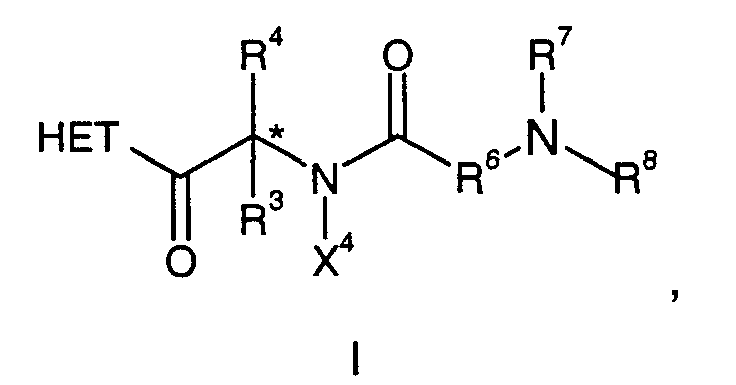
- the GHS is a compound of the Formula I: or a stereoisomeric mixture thereof, diastereomerically enriched, diastereomerically pure, enantiomerically enriched or enantiomerically pure isomer thereof, or a prodrug of such compound, mixture or isomer thereof, or a pharmaceutically acceptable salt of the compound, mixture, isomer or prodrug, wherein:
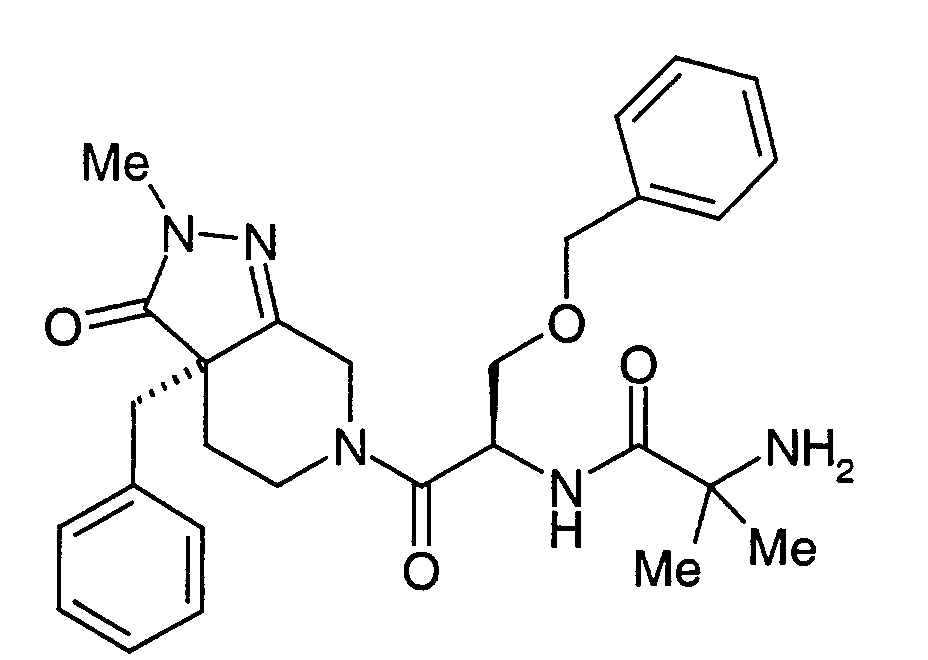
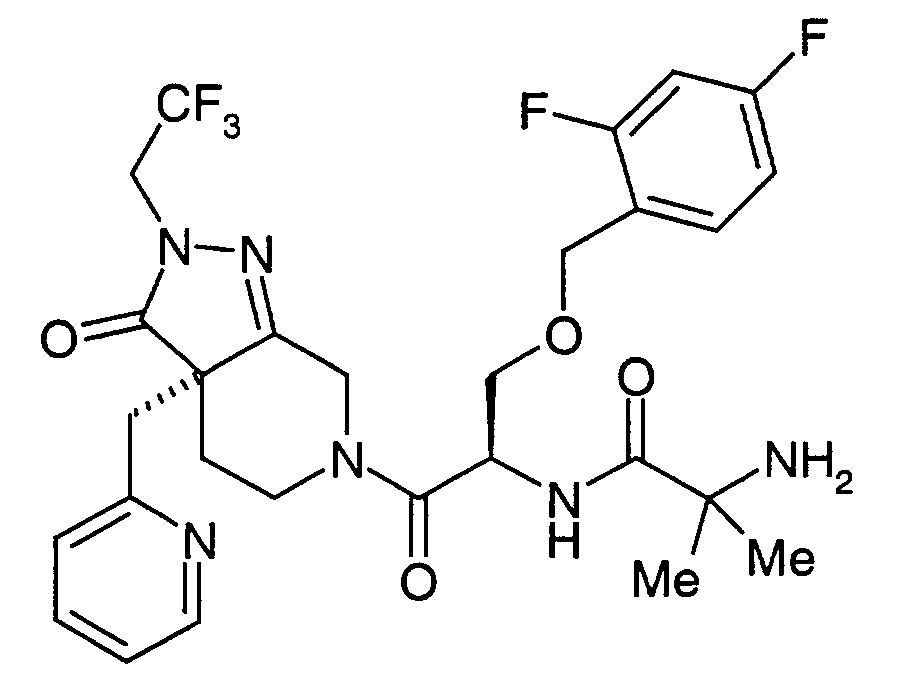
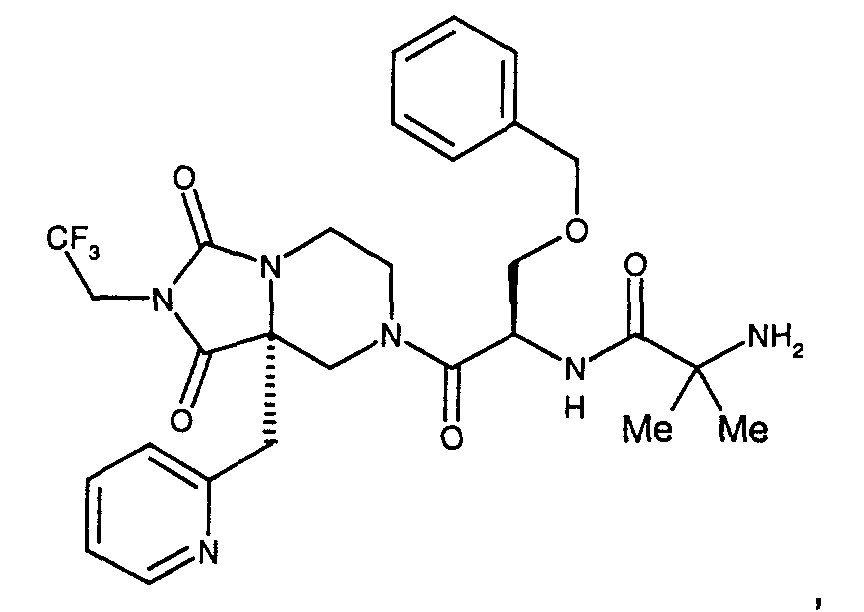
- said GHS is 2-amino-N-(1 (R)-benzyloxymethyl-2-(1,3-dioxo-8a(S)-pyridin-2-ylmethyl-2-(2,2,2-trifluoro-ethyl)-hexahydro-imidazo[1,5-a]pyrazin-7-yl]-2-oxo-ethyl)-2-methyl-propionamide; 2-amino-N-[2-(3a-(R)-benzyl-2-methyl-3-oxo-2,3,3a,4,6,7-hexahydro-pyrazolo-[4,3-c]pyridin-5-yl)-1-(R)-benzyloxymethyl-2-oxo-ethyl]-isobutyramide; or 2-amino-N-(1-(R)-(2,4-difluoro-benzyloxymethyl)-2-ox
- This invention is also directed to methods comprising administering a recombinant growth hormone or an additional GHS selected from the group consisting of GHRP-6, GHRP-1, GHRP-2, growth hormone releasing factor and an analog of growth hormone releasing factor in addition to said GHS.
- a recombinant growth hormone or an additional GHS selected from the group consisting of GHRP-6, GHRP-1, GHRP-2, growth hormone releasing factor and an analog of growth hormone releasing factor in addition to said GHS.
- said glucocorticoid is prednisone, betamethasone dipropionate, clobetasol, diflorasone diacetate, halobetasol propionate, amcinonide, desoximetasone, fluocinonide, halcinonide, betamethasone valerate, triamcinolone acetate, fluocinolone acetonide, flurandrenolide, hydrocortisone valerate, triamcinolone acetonide, hydrocortisone butyrate, alclometasone dipropionate, desonide, mometasone furoate, dexamethasone, hydrocortisone or methylprednisolone acetate.
- said antimalarial is chloroquine, hydroxychloroquine, quinacrine or quinine.
- pharmaceutically acceptable means that a substance or mixture of substances must be compatible with the other ingredients of a formulation and not deleterious to a patient.
- treating includes curative, preventative (e.g., prophylactic) and palliative treatment.
- patient and “subject” are used interchangeably and refer to animals, particularly mammals such as dogs, cats, cattle, horses, sheep and humans. Particularly preferred patients and subjects are humans, including males and females.
- terapéuticaally effective amount means an amount of a GHS that ameliorates, attenuates, or eliminates a particular disease or condition associated with growth hormone secretion and/or production, or prevents or delays the onset of a disease or condition associated with growth hormone secretion and/or production.
- the parenthetical negative or positive sign used herein in the nomenclature denotes the direction plane polarized light is rotated by the particular stereoisomer.
- the subject invention also includes combinations, pharmaceutical compositions, methods and kits comprising isotopically-labeled compounds, which are identical to the compounds described hereinabove, but for the fact that one or more atoms are replaced by an atom having an atomic mass or mass number different from the atomic mass or mass number usually found in nature.
- isotopes that can be incorporated into compounds used in the invention include isotopes of hydrogen, carbon, nitrogen, oxygen, phosphorous, sulfur, fluorine and chlorine, such as 2 H, 3 H, 13 C, 14 C, 15 N, 18 O, 17 O, 31 P, 32 P, 35 S, 18 F and 36 Cl, respectively.
- isotopically labeled compounds used in this invention and prodrugs thereof can generally be prepared by carrying out the procedures disclosed in the Schemes and /or in the Examples and Preparations described in the patents and applications which are incorporated herein by reference, by substituting a readily available isotopically labeled reagent for a non-isotopically labeled reagent.
- the present invention is directed to the use of a compound, which has the ability to stimulate or amplify the release of natural or endogenous growth hormone, for treating systemic lupus erythematosus.
- the present invention provides a method for treating systemic lupus erythematosus comprising the administration of a GHS, a prodrug thereof or a pharmaceutically acceptable salt of said GHS or of said prodrug.
- the present invention also provides a method for treating IBD such as Crohn's disease or ulcerative colitis comprising the administration of a GHS, a prodrug thereof or a pharmaceutically acceptable salt of said GHS or of said prodrug.
- growth hormone secretagogue any exogenously administered compound or agent that directly or indirectly stimulates or increases the endogenous release of growth hormone, growth hormone-releasing hormone or somatostatin in an animal, in particular, a human.
- the GHS may be used alone or in combination with other GHSs or with other agents which are known to be beneficial for the treatment of systemic lupus erythematosus.
- the GHS and the other agent may be coadministered, either in concomitant therapy or in a fixed combination.
- the GHS may be administered in combination with methotrexate, dapsone, a glucocorticoid or an antimalarial.
- the GHS may be used alone or in combination with other GHSs or with other agents which are known to be beneficial for the treatment of IBD such as Crohn's disease or ulcerative colitis.
- the GHS and the other agent may be coadministered, either in concomitant therapy or in a fixed combination.
- the GHS may be administered in combination with prednisone, sulfasalazine, mesalamine or olsalazine.
- GHSs Representative GHSs and a full description of procedures for preparing those GHSs, are disclosed in the following International Patent Applications (listed by Publication Nos.), issued U.S. patents and published European patent applications, each of which is incorporated herein by reference: WO 98/46569, WO 98/51687, WO 96/38471, WO 96/35713, WO 98/58947, WO 98/58949, WO 98/58950, WO 99/08697, WO 99/09991, WO 95/13069, U.S. 5,492,916, U.S. 5,494,919, WO 95/14666, WO 94/19367, WO 94/13696, WO 94/11012, U.S.
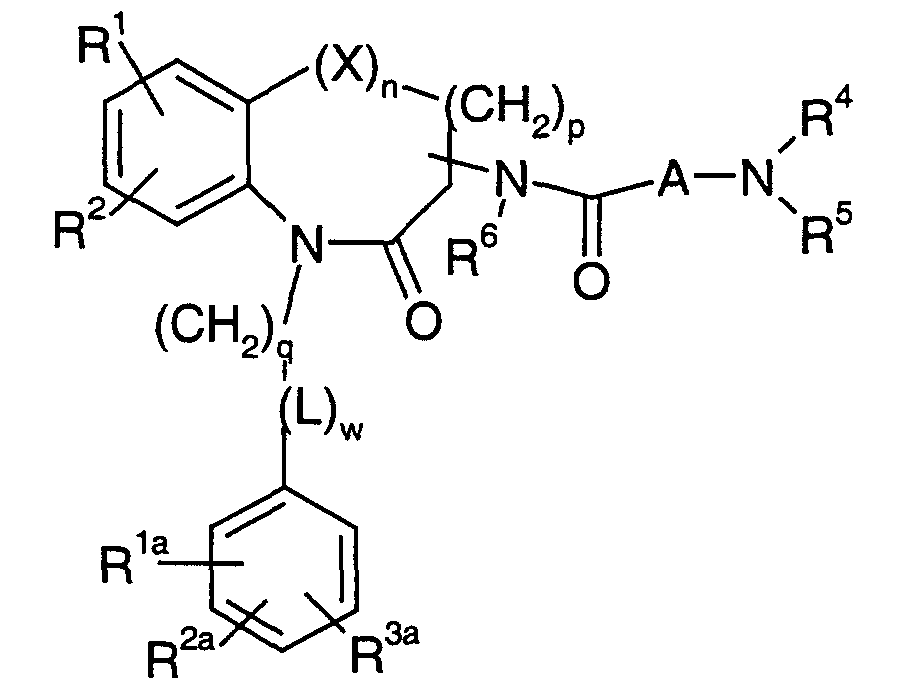
- a representative first group of GHSs is set forth in International Patent Application, Publication No. WO 97/24369, as compounds having the structural formula below, which is designated herein as Formula II: wherein the various substituents are as defined in WO 97/24369. Said compounds are prepared as disclosed therein.
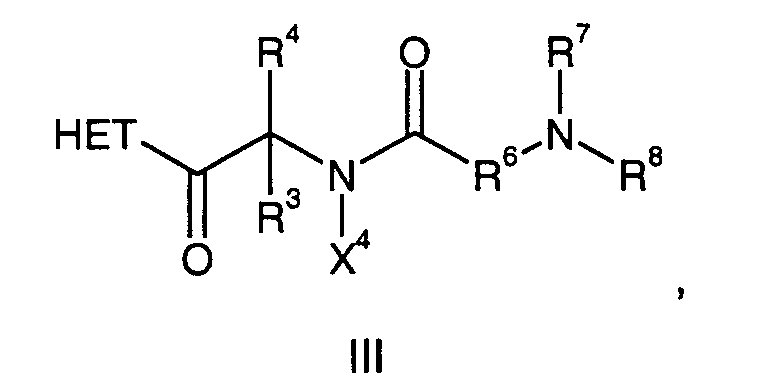
- a representative second group of GHSs is set forth in International Patent Application, Publication No. WO 98/58947, as compounds having the structural formula below, which is designated herein as Formula III: wherein the various substituents are as defined in WO 98/58947. Said compounds are prepared as disclosed therein or as described herein.
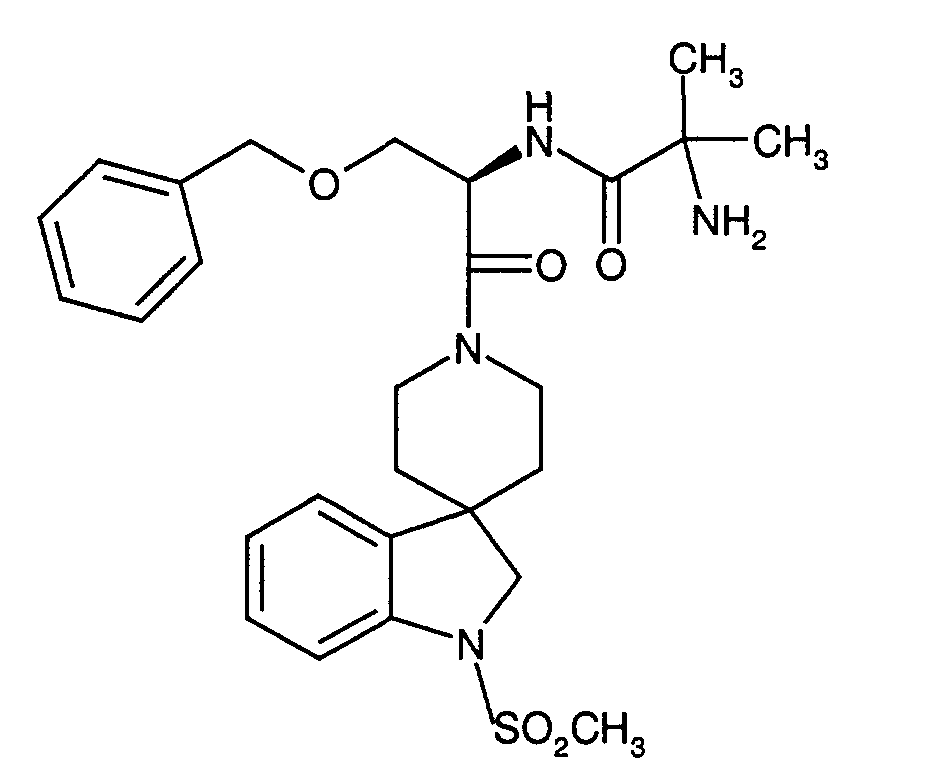
- a preferred compound within this second group which may be employed in the present invention is identified as having the following name and structure: 2-amino-N-(1 (R)-benzyloxymethyl-2-(1,3-dioxo-8a(S)-pyridin-2-ylmethyl-2-(2,2,2-trifluoro-ethyl)-hexahydro-imidazo[1,5-a]pyrazin-7-yl)-2-oxo-ethyl)-2-methyl-propionamide,
- This compound is within the scope of the disclosure of International Patent Application, Publication No. WO 98/58947, and may be prepared as described in Examples Five and Six therein.
- GHSs A representative third group of GHSs is set forth in Published European patent application 0995748, which discloses certain dipeptide GHSs of Formula III, as designated above, and their use for the treatment or prevention of musculoskeletal fraility including osteoporosis.
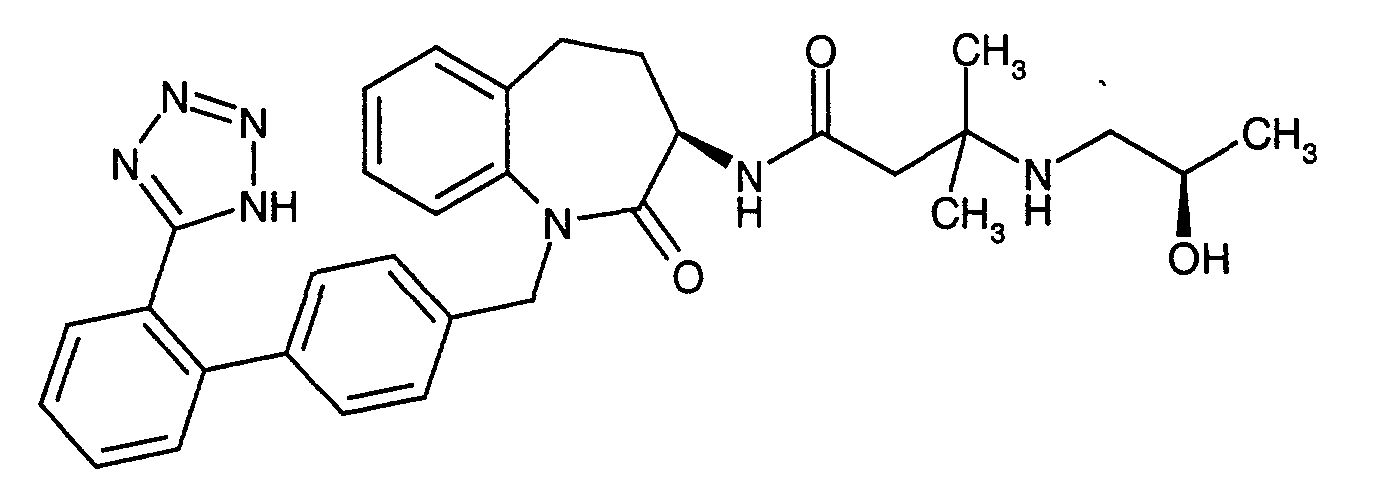
- a representative fourth group of GHSs is set forth in U.S. Patent No. 5,206,235, as having the following structure: wherein the various substituents are as defined in U.S. Patent No. 5,206,235. Said compounds are prepared as disclosed therein.
- Preferred compounds within this fourth group are identified as having the following structures: or
- a representative fifth group of GHSs is set forth in U.S. Patent No. 5,283,241, as having the following structural formula: wherein the various substituents are as defined in U.S. Patent 5,283,241. Said compounds are prepared as disclosed therein.
- GHSs A representative sixth group of GHSs is disclosed in International Patent Application, Publication No. WO 97/41879, as compounds having the following structural formulas: wherein the various substituents are as defined in WO97/41879. Said compounds are prepared as disclosed therein.
- Preferred compounds within this sixth group which may be employed in the present invention are identified as having the following structure: and pharmaceutically acceptable salts thereof, in particular, the methanesulfonate salt.
- a representative seventh group of GHSs is disclosed in U.S. Patent No. 5,492,916, as being compounds of the following structural formula: wherein the various substituents are as defined in U.S. Patent No. 5,492,916. Said compounds are prepared as disclosed therein.
- a second therapeutic agent may be used in conjunction with the GHS in the combinations, pharmaceutical compositions, kits and methods of this invention.
- suitable glucocorticoids are prednisone, betamethasone dipropionate, clobetasol, diflorasone diacetate, halobetasol propionate, amcinonide, desoximetasone, fluocinonide, halcinonide, betamethasone valerate, triamcinolone acetate, fluocinolone acetonide, flurandrenolide, hydrocortisone valerate, triamcinolone acetonide, hydrocortisone butyrate, alclometasone dipropionate, desonide, mometasone furoate, dexamethasone, hydrocortisone or methylprednisolone acetate.
- Other glucocorticoids are also within the following glucocorticoids.
- suitable antimalarials include quinine, chloroquine, quinacrine and hydroxychloroquine.
- Other antimalarial agents are also within the scope of the combinations, pharmaceutical compositions, kits and methods of this invention.
- the second therapeutic agents set forth herein including methotrexate, dapsone, the glucocorticoids disclosed herein and the antimalarials disclosed herein, are all readily available or can be prepared as set forth in references which may be found in the Merck Index, 12 th Edition, Merck & Co., Whitehouse Station, New Jersey, 1996.
- Mesalamine also known as 5-amino-2-hydroxybenzoic acid
- 2-hydroxy-5-nitrobenzoic acid Aldrich Chemical Company, P.O. Box 355, Milwaukee, Wisconsin 52301-9358
- a particularly useful process for effecting said reduction is by reacting said 2-hydroxy-5-nitrobenzoic acid with zinc dust and hydrochloric acid as described by Weil et al., Ber. 55B, 2664 (1922).
- Sulfasalazine may be prepared as described in United States Patent Number 2,396,145.
- Olsalazine may be prepared as described in United States Patent Number 4,528,367.
- Prednisone may be prepared as described in United States Patent Numbers 2,897,216; 2,837,464; or 3,134,718; or as described in Herzog et al., Tetrahedron, 18 , 581 (1962) or Nobile et al., JACS, 77 , 4184 (1955).
- pharmaceutically acceptable salts includes both pharmaceutically acceptable acid addition salts and pharmaceutically acceptable cationic salts, where appropriate.
- pharmaceutically-acceptable cationic salts is intended to define but is not limited to such salts as the alkali metal salts, (e.g., sodium and potassium), alkaline earth metal salts (e.g., calcium and magnesium), aluminum salts, ammonium salts, and salts with organic amines such as benzathine (N,N'-dibenzylethylenediamine), choline, diethanolamine, ethylenediamine, meglumine (N-methylglucamine), benethamine (N-benzylphenethylamine), diethylamine, piperazine, tromethamine (2-amino-2-hydroxymethyl-1,3-propanediol) and procaine.
- alkali metal salts e.g., sodium and potassium
- alkaline earth metal salts e.g., calcium and magnesium
- aluminum salts e.
- salts are intended to define but is not limited to such salts as the hydrochloride, hydrobromide, sulfate, hydrogen sulfate, phosphate, hydrogen phosphate, dihydrogenphosphate, acetate, succinate, d-tartrate, I-tartrate, citrate, methanesulfonate (mesylate) and p-toluenesulfonate (tosylate) salts.
- Pharmaceutically acceptable cationic salts of the compounds used in this invention may be readily prepared, where appropriate, by reacting the free acid form of said compound with an appropriate base, usually one equivalent, in a co-solvent.
- bases are sodium hydroxide, sodium methoxide, sodium ethoxide, sodium hydride, potassium methoxide, magnesium hydroxide, calcium hydroxide, benzathine, choline, diethanolamine, piperazine and tromethamine.
- the salt is isolated by concentration to dryness or by addition of a non-solvent.
- salts are preferably prepared by mixing a solution of the acid with a solution of a different salt of the cation (sodium or potassium ethylhexanoate, magnesium oleate), and employing a solvent (e.g., ethyl acetate) from which the desired cationic salt precipitates, or can be otherwise isolated by concentration and/or addition of a non-solvent.
- a solvent e.g., ethyl acetate
- the acid addition salts of the compounds used in this invention may be readily prepared by reacting the free base form of said compound with the appropriate acid.
- the salt is of a monobasic acid (e.g., the hydrochloride, the hydrobromide, the p-toluenesulfonate, the acetate)
- the hydrogen form of a dibasic acid e.g., the hydrogen sulfate, the succinate
- the dihydrogen form of a tribasic acid e.g., the dihydrogen phosphate, the citrate
- at least one molar equivalent and usually a molar excess of the acid is employed.
- salts as the sulfate, the hemisuccinate, the hydrogen phosphate or the phosphate
- the appropriate and exact chemical equivalents of acid will generally be used.
- the free base and the acid are usually combined in a co-solvent from which the desired salt precipitates, or can be otherwise isolated by concentration and/or addition of a non-solvent.
- GHSs and other compounds which may be used in accordance with this invention, prodrugs thereof and pharmaceutically acceptable salts thereof or of said prodrugs may occur as hydrates or solvates. Said hydrates and solvates are also within the scope of the invention.
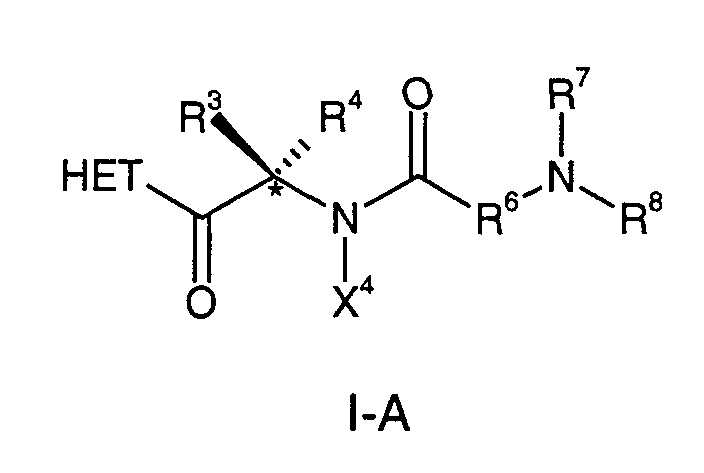
- the compounds used in the methods of the present invention may have at least one asymmetric center as noted, e.g., by the asterisk in the structural Formula I-A below. Additional asymmetric centers may be present in the compounds of Formula I depending upon the nature of the various substituents on the molecule. Each such asymmetric center will produce two optical isomers and it is intended that all such optical isomers, as separated, pure or partially purified optical isomers, racemic mixtures or diastereomeric mixtures thereof, be included within the scope of the methods and combinations of the instant invention.
- compositions, kits and methods of this invention may have the potential to exist in tautomeric forms. All tautomers of a compound of the present invention are within the scope of this invention. Also, for example, all keto-enol or imine-enamine forms of the compounds are included in this invention.
- a GHS is a compound that, when administered to a patient, increases the production and/or secretion of growth hormone when compared with baseline plasma concentrations of growth hormone.
- a GHS to identify a GHS, one need simply measure the baseline plasma concentrations of growth hormone over a time period, typically one day, and compare the plasma concentrations of growth hormone after administration of a GHS with the baseline concentration over the time period.
- Various examples of GHSs are disclosed herein. It is contemplated that any GHS can be used in the present administration methods.
- a compound as a "growth hormone secretagogue" which is able to directly or indirectly stimulate or increase the endogenous release of growth hormone in an animal may be readily determined without undue experimentation by methodology well known in the art, such as the assay described by Smith et al., Science, 260 , 1640-1643 (1993) (see text of Figure 2 therein).
- pituitary glands are aseptically removed from 150-200 g Wistar male rats and cultures of pituitary cells are prepared according to Cheng et al., Endocrinol., 124 , 2791-2798 (1989). The cells are treated with the subject compound and assayed for growth hormone secreting activity, as described by Cheng et al.
- the GHS activity of a compound which may be used in the present invention may be determined by this assay.
- Compounds which display GHS activity in this assay are useful in treating systemic lupus erytheamtosus and intestinal bowel disease as described herein.
- GHS provides unexpected benefits relative to the administration of exogenous growth hormone.
- the GHS enhances the normal pulsatile releases of endogenous growth hormone and thus is more likely to reproduce the natural pattern of endogenous growth hormone release (see J. Clin. Endocrinol. Metab. 81 : 4249-4257, 1996).
- GHSs which are orally active also have the benefit of being able to be administered orally, rather than just intravenously, intraperitoneally or subcutaneously.
- the GHSs used in the present invention may be formulated into various pharmaceutical forms for administration purposes.
- a GHS may be administered, alone or in combination, by oral, parenteral (e.g., intramuscular, intraperitoneal, intravenous or subcutaneous injection, or implant), nasal, vaginal, rectal, sublingual, or topical routes of administration and can be formulated with pharmaceutically acceptable vehicles, diluents or carriers to provide dosage forms appropriate for each route of administration.
- Solid dosage forms for oral administration include capsules, tablets, pills, powders and granules and for companion animals the solid dosage forms include an admixture with food and chewable forms.
- the compounds and combinations of this invention can be admixed with at least one inert pharmaceutically acceptable carrier, vehicle or diluent such as sucrose, lactose, or starch.
- Such dosage forms can also comprise, as is normal practice, additional substances other than such inert carriers, vehicles or diluents, e.g., lubricating agents such as magnesium stearate.
- the dosage forms may also comprise buffering agents. Tablets and pills can additionally be prepared with enteric coatings.
- the dosage form may comprise flavoring agents and perfuming agents.
- Liquid dosage forms for oral administration include pharmaceutically acceptable emulsions, solutions, suspensions, syrups, and elixirs containing inert vehicles, carriers or diluents commonly used in the art, such as water. Besides such inert vehicles, carriers or diluents, such compositions can also include adjuvants, such as wetting agents, emulsifying and suspending agents, and sweetening, flavoring and perfuming agents.
- Preparations according to this invention for parenteral administration include sterile aqueous or non-aqueous solutions, suspensions, or emulsions.
- non-aqueous solvents or vehicles are propylene glycol, polyethylene glycol, vegetable oils, such as olive oil and corn oil, gelatin, and injectable organic esters such as ethyl oleate.
- Such dosage forms may also contain adjuvants such as preserving, wetting, emulsifying, and dispersing agents. They may be sterilized by, for example, filtration through a bacteria-retaining filter, by incorporating sterilizing agents into the compositions, by irradiating the compositions, or by heating the compositions. They can also be manufactured in the form of sterile solid compositions which can be dissolved in sterile water, or some other sterile injectable medium immediately before use.
- compositions for rectal or vaginal administration are preferably suppositories which may contain, in addition to the active substance, which may also be a prodrug or a pharmaceutically acceptable salt of a prodrug, excipients such as coca butter or a suppository wax.
- Compositions for nasal or sublingual administration are also prepared with standard excipients well known in the art.
- the dosage of active ingredients in the compositions, methods and combinations of the present invention invention may be varied; however, it is necessary that the amount of the active ingredients be such that a suitable dosage form is obtained.
- the selected dosage depends upon the desired therapeutic effect, on the route of administration, and on the duration of the treatment. Generally, dosage levels of between 0.001 to 10 mg/kg of body weight daily are administered to humans and other animals, e.g., mammals, to obtain effective release of growth hormone.
- a preferred dosage range in humans is 0.01 to 5.0 mg/kg of body weight daily which can be administered as a single dose or divided into multiple doses.
- a preferred dosage range in animals other than humans is 0.01 to 10.0 mg/kg of body weight daily which can be administered as a single dose or divided into multiple doses.
- a more preferred dosage range in animals other than humans is 0.1 to 5 mg/kg of body weight daily which can be administered as a single dose or divided into multiple doses.
- tartrate salt or other pharmaceutically acceptable salt of the above compounds is used in the present invention
- skilled person will be able to calculate effective dosage amounts by calculating the molecular weight of the salt form and performing simple stoichiometric ratios.
- the present invention includes within its scope the use of a GHS according to the present invention, alone or in combination with another GHS, such as those referenced herein, including the growth hormone releasing peptides GHRP-6 and GHRP-1 (described in U.S. Patent No. 4,411,890 and International Patent Applications, Publication Nos.
- GHRH hexarelin and growth hormone releasing hormone
- GRF hexarelin and growth hormone releasing hormone
- the GHS may be used in combination with growth hormone releasing factor or an analog of growth hormone releasing factor.
- the present invention includes within its scope the use of a pharmaceutical composition according to the present invention comprising, as an active ingredient, at least one GHS in association with a pharmaceutical carrier, vehicle or diluent.
- the individual daily dosages for these combinations may range from about one-fifth of the minimally recommended clinical dosages to the maximum recommended levels for the entities when they are given singly. These dose ranges may be adjusted on a unit basis as necessary to permit divided daily dosage and, as noted above, the dose will vary depending on the nature and severity of the disease, weight of patient, special diets and other factors.
- the kit comprises two separate pharmaceutical compositions: a GHS, a prodrug thereof or a pharmaceutically acceptable salt of said GHS or said prodrug; and a second therapeutic agent as described herein.
- the kit comprises a container for containing the separate compositions such as a divided bottle or a divided foil packet, however, the separate compositions may also be contained within a single, undivided container.
- the kit comprises directions for the administration of the separate components.
- the kit form is particularly advantageous when the separate components are preferably administered in different dosage forms (e.g., oral and parenteral), are administered at different dosage intervals, or when titration of the individual components of the combination is desired by the prescribing physician.
- Blister packs are well known in the packaging industry and are being widely used for the packaging of pharmaceutical unit dosage forms (tablets, capsules, and the like). Blister packs generally consist of a sheet of relatively stiff material covered with a foil of a preferably transparent plastic material. During the packaging process, recesses are formed in the plastic foil. The recesses have the size and shape of the tablets or capsules to be packed. Next, the tablets or capsules are placed in the recesses and the sheet of relatively stiff material is sealed against the plastic foil at the face of the foil which is opposite from the direction in which the recesses were formed. As a result, the tablets or capsules are sealed in the recesses between the plastic foil and the sheet.
- the strength of the sheet is such that the tablets or capsules can be removed from the blister pack by manually applying pressure on the recesses whereby an opening is formed in the sheet at the place of the recess. The tablet or capsule can then be removed via said opening.
- a memory aid on the kit, e.g., in the form of numbers next to the tablets or capsules whereby the numbers correspond with the days of the regimen which the dosage form so specified should be ingested.
- a memory aid is a calendar printed on the card e.g., as follows "First Week, Monday, Tuesday, ...etc.... Second Week, Monday, Tuesday, etc.
- a "daily dose” can be a single tablet or capsule or several tablets or capsules to be taken on a given day.
- a daily dose of a second therapeutic agent as described herein can consist of one tablet or capsule while a daily dose of the GHS, prodrug thereof or pharmaceutically acceptable salt of said GHS or said prodrug can consist of several tablets or capsules and vice versa.
- the memory aid should reflect this.
- a dispenser designed to dispense the daily doses one at a time in the order of their intended use.
- the dispenser is equipped with a memory-aid, so as to further facilitate compliance with the regimen.
- a memory-aid is a mechanical counter which indicates the number of daily doses that has been dispensed.
- a battery-powered micro-chip memory coupled with a liquid crystal readout, or audible reminder signal which, for example, reads out the date that the last daily dose has been taken and/or reminds one when the next dose is to be taken.
Landscapes
- Health & Medical Sciences (AREA)
- Chemical & Material Sciences (AREA)
- Medicinal Chemistry (AREA)
- Pharmacology & Pharmacy (AREA)
- Life Sciences & Earth Sciences (AREA)
- Animal Behavior & Ethology (AREA)
- General Health & Medical Sciences (AREA)
- Public Health (AREA)
- Veterinary Medicine (AREA)
- Epidemiology (AREA)
- Engineering & Computer Science (AREA)
- Bioinformatics & Cheminformatics (AREA)
- Chemical Kinetics & Catalysis (AREA)
- General Chemical & Material Sciences (AREA)
- Nuclear Medicine, Radiotherapy & Molecular Imaging (AREA)
- Organic Chemistry (AREA)
- Immunology (AREA)
- Pharmaceuticals Containing Other Organic And Inorganic Compounds (AREA)
- Medicines That Contain Protein Lipid Enzymes And Other Medicines (AREA)
- Heterocyclic Carbon Compounds Containing A Hetero Ring Having Nitrogen And Oxygen As The Only Ring Hetero Atoms (AREA)
- Pyrrole Compounds (AREA)
- Peptides Or Proteins (AREA)
Abstract
Description
wherein:


-NR2-C(O)-NR2-, -NR2-S(O)2-NR2-, -O-C(O)-NR2-, -NR2-C(O)-O-, -C(O)-NR2-C(O)-, -C(O)-NR2-C(R9R10)-, -C(R9R10)-NR2-C(O)-, -C(R9R10)-C(R9R10)-C(R9R10)-, -S(O)2-C(R9R10)-C(R9R10)-, -C(R9R10)-O-C(O)-, -C(R9R10)-O-C(R9R10)-, -NR2-C(O)-C(R9R10)-, -O-C(O)-C(R9R10)-, -C(R9R10)-C(O)-NR2-, -C(R9R10)-C(O)-O-, -C(O)-NR2-C(R9R10)-C(R9R10)-, -C(O)-O-C(R9R10)-, -C(R9R10)-C(R9R10)-C(R9R10)-C(R9R10)-, -S(O)2-NR2-C(R9R10)-C(R9R10)-, -C(R9R10)-C(R9R10)-NR2-C(O)-, -C(R9R10)-C(R9R10)-O-C(O)-, -NR2-C(O)-C(R9R10)-C(R9R10)-, -NR2-S(O)2-C(R9R10)-C(R9R10)-, -O-C(O)-C(R9R10)-C(R9R10)-, -C(R9R10)-C(R9R10)-C(O)-NR2-, -C(R9R10)-C(R9R10)-C(O)-, -C(R9R10)-NR2-C(O)-O-, -C(R9R10)-O-C(O)-NR2, -C(R9R10)-NR2-C(O)-NR2-, -NR2-C(O)-O-C(R9R10)-, -NR2-C(O)-NR2-C(R9R10)-, -NR2-S(O)2-NR2-C(R9R10)-, -O-C(O)-NR2-C(R9R10)-, -C(O)-N=C(R11)-NR2-, -C(O)-NR2-C(R11)=N-, -C(R9R10)-NR12-C(R9R10)-, -NR12-C(R9R10)-, -NR12-C(R9R10)-C(R9R10)-, -C(O)-O-C(R9R10)-C(R9R10)-, -NR2-C(R11)=N-C(O)-, -C(R9R10)-C(R9R10)-N(R12)-, -C(R9R10)-NR12-, -N=C(R11)-NR2-C(O)-, -C(R9R10)-C(R9R10)-NR2-S(O)2-, -C(R9R10)-C(R9R10)-S(O)2-NR2-, -C(R9R10)-C(R9R10)-C(O)-O-, -C(R9R10)-S(O)2-C(R9R10)-, -C(R9R10)-C(R9R10)-S(O)2-,-O-C(R9R10)-C(R9R10)-, -C(R9R10)-C(R9R10)-O-, -C(R9R10)-C(O)-C(R9R10)-, -C(O)-C(R9R10)-C(R9R10)- and -C(R9R10)-NR2-S(O)2-NR2-;
where the alkyl groups and the cycloalkyl groups in the definition of R2 are optionally substituted with hydroxy, -C(O)OX6, -C(O)N(X6)(X6), -N(X6)(X6), - S(O)m(C1-C6)alkyl, -C(O)A1, -C(O)(X6), CF3, CN or 1, 2 or 3 independently selected halo groups;

the optionally substituted (C1-C6)alkyl in the definition of X5 and X5a is optionally substituted with a substituent selected from the group consisting of A1, OX2, -S(O)m(C1-C6)alkyl, -C(O)OX2, (C3-C7)cycloalkyl, -N(X2)(X2) and -C(O)N(X2)(X2);


-ORc, S(O)mRc, C(O)ORc, (C3-C7)cycloalkyl, -N(Rc)(Rc), -C(O)N(Rc)(Rc), or Ra or Rb may independently be joined to one or both of R7 or E (where E is other than O, S or -CH=CH-) to form an alkylene bridge between the terminal nitrogen and the alkyl portion of the Ra or Rb and the R7 or E group, wherein the bridge contains 1 to 8 carbon atoms; or Ra and Rb may be joined to one another to form a (C3-C7)cycloalkyl;
where the optionally substituted (C1-C6)alkyl in the definition of R7 and R8 is optionally independently substituted with A1, -C(O)O-(C1-C6)alkyl, -S(O)m(C1-C6)alkyl, 1 to 5 halo groups, 1 to 3 hydroxy groups, 1 to 3 -O-C(O)(C1-C10)alkyl groups or 1 to 3 (C1-C6)alkoxy groups; or
where L is C(X2)(X2), S(O)m or N(X2);
A1 for each occurrence is independently optionally substituted, on one or optionally both rings if A1 is a bicyclic ring system, with up to three substituents, each substituent independently selected from the group consisting of F, Cl, Br, I, OCF3, OCF2H, CF3, CH3, OCH3, -OX6, -C(O)N(X6)(X6), -C(O)OX6, oxo, (C1-C6)alkyl, nitro, cyano, benzyl, -S(O)m(C1-C6)alkyl, 1H-tetrazol-5-yl, phenyl, phenoxy, phenylalkyloxy, halophenyl, methylenedioxy, -N(X6)(X6), -N(X6)C(O)(X6), -S(O)2N(X6)(X6), -N(X6)S(O)2-phenyl, -N(X6)S(O)2X6, -CONX11X12, -S(O)2NX11X12, -NX6S(O)2X12, -NX6CONX11X12, -NX6S(O)2NX11X12, -NX6C(O)X12, imidazolyl, thiazolyl and tetrazolyl, provided that if A1 is optionally substituted with methylenedioxy then it can only be substituted with one methylenedioxy;
the optionally substituted (C1-C6)alkyl defined for X11 is optionally independently substituted with phenyl, phenoxy, (C1-C6)alkoxycarbonyl, -S(O)m(C1-C6)alkyl, 1 to 5 halo groups, 1 to 3 hydroxy groups, 1 to 3 (C1-C10)alkanoyloxy groups or 1 to 3 (C1-C6)alkoxy groups;
L1 is C(X2)(X2), O, S(O)m or N(X2);
when there are two X6 groups on one atom and both X6 are independently (C1-C6)alkyl, the two (C1-C6)alkyl groups may be optionally joined and, together with the atom to which the two X6 groups are attached, form a 4- to 9- membered ring optionally having oxygen, sulfur or NX7 as a ring member;
X7 is hydrogen or (C1-C6)alkyl optionally substituted with hydroxy;
with the provisos that:
where the alkyl groups and the cycloalkyl groups in the definition of R2 are optionally substituted with hydroxyl, -C(O)OX6, -C(O)N(X6)(X6), -N(X6)(X6), -S(O)m(C1-C6)alkyl, -C(O)A1, -C(O)(X6), CF3, CN or 1, 2 or 3 halogen;
where the alkyl groups in the definition of R3 are optionally substituted with, -S(O)m(C1-C6)alkyl, -C(O)OX3, 1, 2, 3, 4 or 5 halogens, or 1, 2 or 3 OX3; X1 is O, S(O)m, -N(X2)C(O)-, -C(O)N(X2)-, -OC(O)-, -C(O)O-, -CX2=CX2-, -N(X2)C(O)O-, -OC(O)N(X2)- or -C≡C-;
the optionally substituted (C1-C6)alkyl in the definition of X5 and X5a is optionally substituted with a substituent selected from the group consisting of A1, OX2, -S(O)m(C1-C6)alkyl, -C(O)OX2, (C3-C7)cycloalkyl, -N(X2)(X2) and -C(O)N(X2)(X2);
where the optionally substituted (C1-C6)alkyl in the definition of R7 and R8 is optionally independently substituted with A1, -C(O)O-(C1-C6)alkyl, -S(O)m(C1-C6)alkyl, 1 to 5 halogens, 1 to 3 hydroxy, 1 to 3 -O-C(O)(C1-C10)alkyl or 1 to 3 (C1-C6)alkoxy; or
where L is C(X2)(X2), S(O)m or N(X2);
where X11 is hydrogen or optionally substituted (C1-C6)alkyl;
the optionally substituted (C1-C6)alkyl defined for X11 is optionally independently substituted with phenyl, phenoxy, (C1-C6)alkoxycarbonyl, -S(O)m(C1-C6)alkyl 1 to 5 halogens, 1 to 3 hydroxy, 1 to 3 (C1-C10)alkanoyloxy or 1 to 3 (C1-C6)alkoxy;
where L1 is C(X2)(X2), O, S(O)m or N(X2);
X7 is hydrogen or (C1-C6)alkyl optionally substituted with hydroxyl; and
with the proviso that:




Claims (18)
- The use of an effective amount of a growth hormone secretagogue (GHS), a prodrug thereof or a pharmaceutically acceptable salt of said GHS or of said prodrug for the manufacture of a medicament for the treatment of systemic lupus erythematosus or inflammatory bowel disease.
- A use according to claim 1 wherein said GHS is a compound of the Formula I:or a stereoisomeric mixture thereof, diastereomerically enriched, diastereomerically pure, enantiomerically enriched or enantiomerically pure isomer thereof, or a prodrug of such compound, mixture or isomer thereof, or a pharmaceutically acceptable salt of the compound, mixture, isomer or prodrug,
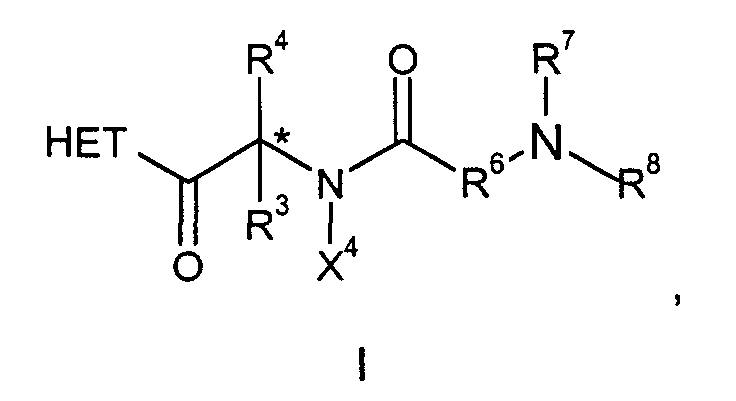
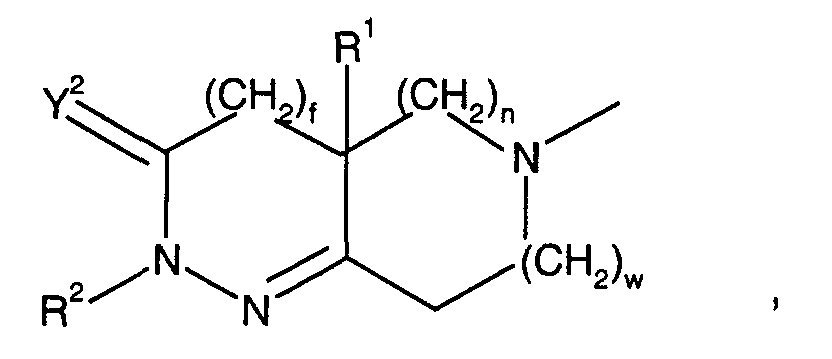
wherein:HET is a heterocyclic moiety selected from the group consisting of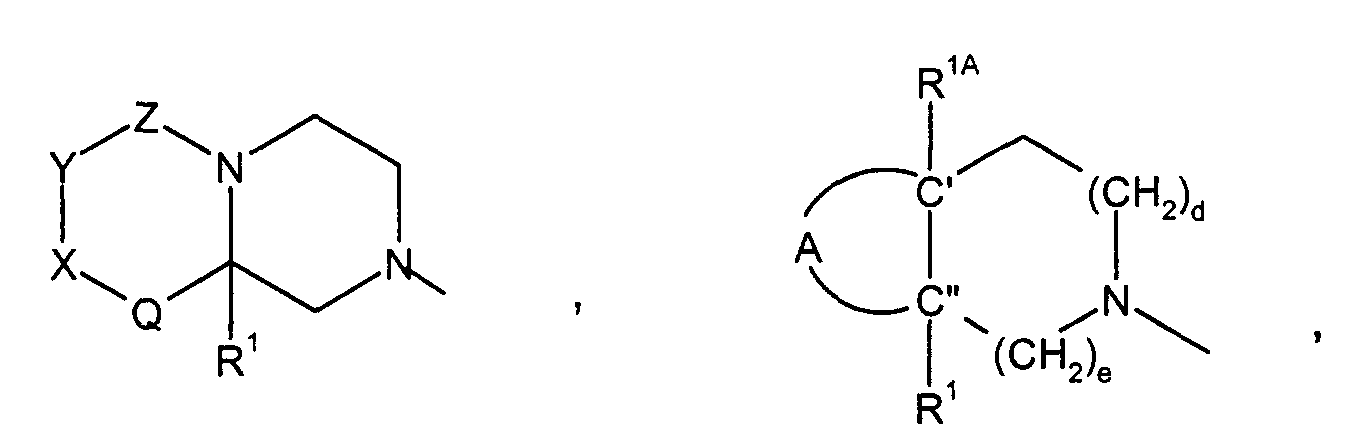
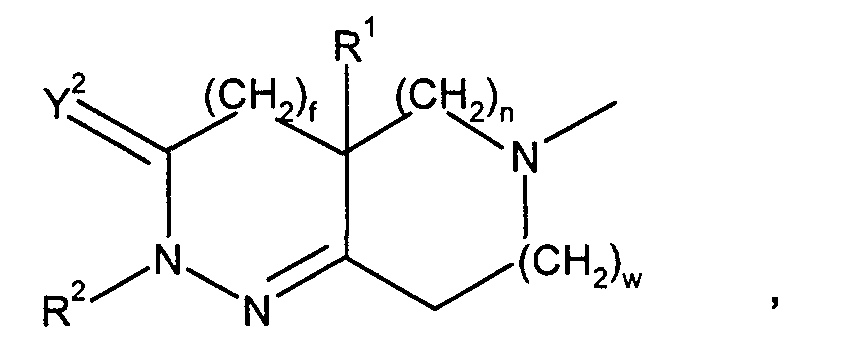
 d is 0, 1 or 2;e is 1 or 2;f is 0 or 1 ;n and w are 0, 1 or 2, provided that n and w cannot both be 0 at the same time;Y2 is oxygen or sulfur;A is a divalent radical, where the left hand side of the radical as shown below is connected to C" and the right hand side of the radical as shown below is connected to C', selected from the group consisting of
-NR2-C(O)-NR2-, -NR2-S(O)2-NR2-, -O-C(O)-NR2-, -NR2-C(O)-O-, -C(O)-NR2-C(O)-, -C(O)-NR2-C(R9R10)-, -C(R9R10)-NR2-C(O)-, -C(R9R10)-C(R9R10)-C(R9R10)-, -S(O)2-C(R9R10)-C(R9R10)-, -C(R9R10)-O-C(O)-, -C(R9R10)-O-C(R9R10)-, -NR2-C(O)-C(R9R10)-, -O-C(O)-C(R9R10)-, -C(R9R10)-C(O)-NR2-, -C(R9R10)-C(O)-O-, -C(O)-NR2-C(R9R10)-C(R9R10)-, -C(O)-O-C(R9R10)-, -C(R9R10)-C(R9R10)-C(R9R10)-C(R9R10)-, -S(O)2-NR2-C(R9R10)-C(R9R10)-, -C(R9R10)-C(R9R10)-NR2-C(O)-, -C(R9R10)-C(R9R10)-O-C(O)-, -NR2-C(O)-C(R9R10)-C(R9R10)-, -NR2-S(O)2-C(R9R10)-C(R9R10)-, -O-C(O)-C(R9R10)-C(R9R10)-, -C(R9R10)-C(R9R10)-C(O)-NR2-, -C(R9R10)-C(R9R10)-C(O)-, -C(R9R10)-NR2-C(O)-O-, -C(R9R10)-O-C(O)-NR2, -C(R9R10)-NR2-C(O)-NR2-, -NR2-C(O)-O-C(R9R10)-, -NR2-C(O)-NR2-C(R9R10)-, -NR2-S(O)2-NR2-C(R9R10)-, -O-C(O)-NR2-C(R9R10)-, -C(O)-N=C(R11)-NR2-, -C(O)-NR2-C(R11)=N-, -C(R9R10)-NR12-C(R9R10)-, -NR12-C(R9R10)-, -NR12-C(R9R10)-C(R9R10)-, -C(O)-O-C(R9R10)-C(R9R10)-, -NR2-C(R11)=N-C(O)-, -C(R9R10)-C(R9R10)-N(R12)-, -C(R9R10)-NR12-, -N=C(R11)-NR2-C(O)-, -C(R9R10)-C(R9R10)-NR2-S(O)2-, -C(R9R10)-C(R9R10)-S(O)2-NR2-, -C(R9R10)-C(R9R10)-C(O)-O-, -C(R9R10)-S(O)2-C(R9R10)-, -C(R9R10)-C(R9R10)-S(O)2-, -O-C(R9R10)-C(R9R10)-, -C(R9R10)-C(R9R10)-O-, -C(R9R10)-C(O)-C(R9R10)-, -C(O)-C(R9R10)-C(R9R10)- and -C(R9R10)-NR2-S(O)2-NR2-;Q is a covalent bond or CH2;W is CH or N;X is CR9R10, C=CH2 or C=O;Y is CR9R10, O or NR2;Z is C=O, C=S or S(O)2;G1 is hydrogen, halo, hydroxy, nitro, amino, cyano, phenyl, carboxyl, -CONH2, -(C1-C4)alkyl optionally independently substituted with one or more phenyl, one or more halogens or one or more hydroxy groups, -(C1-C4)alkoxy optionally independently substituted with one or more phenyl, one or more halogens or one or more hydroxy groups, -(C1-C4)alkylthio, phenoxy, -COO(C1-C4)alkyl, N,N-di-(C1-C4)alkylamino,-(C2-C6)alkenyl optionally independently substituted with one or more phenyl, one or more halogens or one or more hydroxy groups, -(C2-C6)alkynyl optionally independently substituted with one or more phenyl, one or more halogens or one or more hydroxy groups, -(C3-C6)cycloalkyl optionally independently substituted with one or more (C1-C4)alkyl groups, one or more halogens or one or more hydroxy groups, -(C1-C4)alkylamino carbonyl or di-(C1-C4)alkylamino carbonyl;G2 and G3 are each independently selected from the group consisting of hydrogen, halo, hydroxy, -(C1-C4)alkyl optionally independently substituted with one to three halo groups and -(C1-C4)alkoxy optionally independently substituted with one to three halo groups;R1 is hydrogen, -CN, -(CH2)qN(X6)C(O)X6, -(CH2)qN(X6)C(O)(CH2)t-A1,
-(CH2)qN(X6)S(O)2(CH2)t-A1, -(CH2)qN(X6)S(O)2X6, -(CH2)qN(X6)C(O)N(X6)(CH2)rA1, -(CH2)qN(X6)C(O)N(X6)(X6), -(CH2)qC(O)N(X6)(X6), -(CH2)qC(O)N(X6)(CH2)t-A1, -(CH2)qC(O)OX6, -(CH2)qC(O)O(CH2)t-A1, -(CH2)qOX6, -(CH2)qOC(O)X6, -(CH2)qOC(O)(CH2)t-A1, -(CH2)qOC(O)N(X6)(CH2)t-A1, -(CH2)qOC(O)N(X6)(X6), -(CH2)qC(O)X6, -(CH2)qC(O)(CH2)t-A1, -(CH2)qN(X6)C(O)OX6, -(CH2)qN(X6)S(O)2N(X6)(X6), -(CH2)qS(O)mX6, -(CH2)qS(O)m(CH2)t-A1, -(C1-C10)alkyl, -(CH2)t-A1, -(CH2)q-(C3-C7)cycloalkyl, -(CH2)q-Y1-(C1-C6)alkyl, -(CH2)q-Y1-(CH2)t-A1 or -(CH2)q-Y1-(CH2)t-(C3-C7)cycloalkyl;where the alkyl and cycloalkyl groups in the definition of R1 are optionally substituted with (C1-C4)alkyl, hydroxy, (C1-C4)alkoxy, carboxyl, -CONH2, -S(O)m(C1-C6)alkyl, -CO2(C1-C4)alkyl ester, 1H-tetrazol-5-yl or 1, 2 or 3 fluoro groups;Y1 is O, S(O)m, -C(O)NX6-, -CH=CH-, -C≡C-, -N(X6)C(O)-, -C(O)NX6-, -C(O)O-, -OC(O)N(X6)- or -OC(O)-;q is 0, 1, 2, 3 or 4;t is 0, 1, 2 or 3;said (CH2)q group and (CH2)t group in the definition of R1 are optionally independently substituted with hydroxy, (C1-C4)alkoxy, carboxyl, -CONH2, -S(O)m(C1-C6)alkyl, -CO2(C1-C4)alkyl ester, 1H-tetrazol-5-yl, 1, 2 or 3 fluoro groups or 1 or 2 (C1-C4)alkyl groups;R1A is selected from the group consisting of hydrogen, F, Cl, Br, I, (C1-C6)alkyl, phenyl(C1-C3)alkyl, pyridyl(C1-C3)alkyl, thiazolyl(C1-C3)alkyl and thienyl(C1-C3)alkyl, provided that R1A is not F, Cl, Br or I when a heteroatom is vicinal to C";R2 is hydrogen, (C1-C8)alkyl, -(C0-C3)alkyl-(C3-C8)cycloalkyl, -(C1-C4)alkyl-A1 or A1;
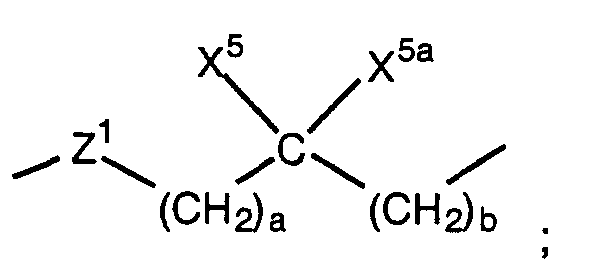
where the alkyl groups and the cycloalkyl groups in the definition of R2 are optionally substituted with hydroxy, -C(O)OX6, -C(O)N(X6)(X6), -N(X6)(X6), - S(O)m(C1-C6)alkyl, -C(O)A1, -C(O)(X6), CF3, CN or 1, 2 or 3 independently selected halo groups;R3 is selected from the group consisting of A1, (C1-C10)alkyl, -(C1-C6)alkyl-A1, -(C1-C6)alkyl-(C3-C7)cycloalkyl, -(C1-C5)alkyl-X1-(C1-C5)alkyl, -(C1-C5)alkyl-X1-(C0-C5)alkyl-A1 and -(C1-C5)alkyl-X1-(C1-C5)alkyl-(C3-C7)cycloalkyl;where the alkyl groups in the definition of R3 are optionally substituted with -S(O)m(C1-C6)alkyl, -C(O)OX3, 1, 2, 3, 4 or 5 independently selected halo groups or 1, 2 or 3 independently selected -OX3 groups;X1 is O, S(O)m, -N(X2)C(O)-, -C(O)N(X2)-, -OC(O)-, -C(O)O-, -CX2=CX2-, -N(X2)C(O)O-, -OC(O)N(X2)- or -C≡C-;R4 is hydrogen, (C1-C6)alkyl or (C3-C7)cycloalkyl, or R4 is taken together with R3 and the carbon atom to which they are attached and form (C5-C7)cycloalkyl, (C5-C7)cycloalkenyl, a partially saturated or fully saturated 4- to 8-membered ring having 1 to 4 heteroatoms independently selected from the group consisting of oxygen, sulfur and nitrogen, or is a bicyclic ring system consisting of a partially saturated or fully saturated 5- or 6-membered ring, fused to a partially saturated, fully unsaturated or fully saturated 5- or 6-membered ring, optionally having 1 to 4 heteroatoms independently selected from the group consisting of nitrogen, sulfur and oxygen;X4 is hydrogen or (C1-C6)alkyl or X4 is taken together with R4 and the nitrogen atom to which X4 is attached and the carbon atom to which R4 is attached and form a five to seven membered ring;R6 is a bond or is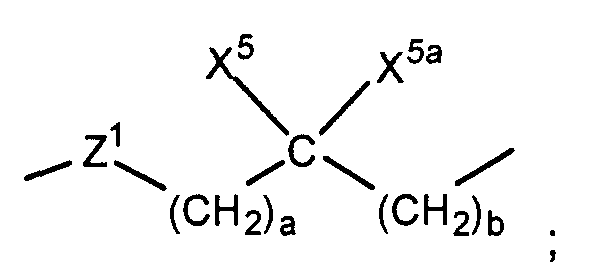 where a and b are each independently 0, 1, 2 or 3;X5 and X5a are each independently selected from the group consisting of hydrogen, CF3, A1 and optionally substituted (C1-C6)alkyl;
the optionally substituted (C1-C6)alkyl in the definition of X5 and X5a is optionally substituted with a substituent selected from the group consisting of A1, OX2, -S(O)m(C1-C6)alkyl, -C(O)OX2, (C3-C7)cycloalkyl, -N(X2)(X2) and -C(O)N(X2)(X2);or the carbon bearing X5 or X5a forms one or two alkylene bridges with the nitrogen atom bearing R7 and R8 wherein each alkylene bridge contains 1 to 5 carbon atoms, provided that when one alkylene bridge is formed then only one of X5 or X5a is on the carbon atom and only one of R7 or R8 is on the nitrogen atom and further provided that when two alkylene bridges are formed then X5 and X5a cannot be on the carbon atom and R7 and R8 cannot be on the nitrogen atom;or X5 is taken together with X5a and the carbon atom to which they are attached and form a partially saturated or fully saturated 3- to 7-membered ring, or a partially saturated or fully saturated 4- to 8-membered ring having 1 to 4 heteroatoms independently selected from the group consisting of oxygen, sulfur and nitrogen;or X5 is taken together with X5a and the carbon atom to which they are attached and form a bicyclic ring system consisting of a partially saturated or fully saturated 5- or 6-membered ring, optionally having 1 or 2 heteroatoms independently selected from the group consisting of nitrogen, sulfur and oxygen, fused to a partially saturated, fully saturated or fully unsaturated 5- or 6-membered ring, optionally having 1 to 4 heteroatoms independently selected from the group consisting of nitrogen, sulfur and oxygen;Z1 is a bond, O or N-X2, provided that when a and b are both 0 then Z1 is not N-X2 or O;or R6 is -(CRaRb)a-E-(CRaRb)b-, where the -(CRaRb)a- group is attached to the carbonyl carbon of the amide group of the compound of formula I and the -(CRaRb)b group is attached to the terminal nitrogen atom of the compound of formula I;E is -O-, -S-, -CH=CH- or an aromatic moiety selected from said aromatic moiety in the definition of E optionally substituted with up to three halo, hydroxy, -N(Rc)(Rc), (C1-C6)alkyl or (C1-C6)alkoxy;
 Ra and Rb are, for each occurrence, independently hydrogen, (C1-C6)alkyl, trifluoromethyl, phenyl or monosubstituted (C1-C6)alkyl where the substituents are imidazolyl, naphthyl, phenyl, indolyl, p-hydroxyphenyl, -ORc, S(O)mRc, C(O)ORc, (C3-C7)cycloalkyl, -N(Rc)(Rc), -C(O)N(Rc)(Rc), or Ra or Rb may independently be joined to one or both of R7 or E (where E is other than O, S or -CH=CH-) to form an alkylene bridge between the terminal nitrogen and the alkyl portion of the Ra or Rb and the R7 or E group, wherein the bridge contains 1 to 8 carbon atoms; or Ra and Rb may be joined to one another to form a (C3-C7)cycloalkyl;Rc, for each occurrence, is independently hydrogen or (C1-C6)alkyl; a and b are independently 0, 1, 2 or 3, with the proviso that if E is -O- or -S-, b is other than 0 or 1 and with the further proviso that if E is -CH=CH-, b is other than 0;R7 and R8 are each independently hydrogen or optionally substituted (C1-C6)alkyl;
where the optionally substituted (C1-C6)alkyl in the definition of R7 and R8 is optionally independently substituted with A1, -C(O)O-(C1-C6)alkyl, -S(O)m(C1-C6)alkyl, 1 to 5 halo groups, 1 to 3 hydroxy groups, 1 to 3 -O-C(O)(C1-C10)alkyl groups or 1 to 3 (C1-C6)alkoxy groups; orR7 and R8 can be taken together to form -(CH2)r-L-(CH2)r-;
where L is C(X2)(X2), S(O)m or N(X2);R9 and R10 are each independently selected from the group consisting of hydrogen, fluoro, hydroxy and (C1-C5)alkyl optionally independently substituted with 1-5 halo groups;R11 is selected from the group consisting of (C1-C5)alkyl and phenyl optionally substituted with 1-3 substituents each independently selected from the group consisting of (C1-C5)alkyl, halo and (C1-C5)alkoxy;R12 is selected from the group consisting of (C1-C5)alkylsulfonyl, (C1-C5)alkanoyl and (C1-C5)alkyl where the alkyl portion is optionally independently substituted by 1-5 halo groups;A1 for each occurrence is independently selected from the group consisting of (C5-C7)cycloalkenyl, phenyl, a partially saturated, fully saturated or fully unsaturated 4- to 8-membered ring optionally having 1 to 4 heteroatoms independently selected from the group consisting of oxygen, sulfur and nitrogen and a bicyclic ring system consisting of a partially saturated, fully unsaturated or fully saturated 5- or 6-membered ring, optionally having 1 to 4 heteroatoms independently selected from the group consisting of nitrogen, sulfur and oxygen, fused to a partially saturated, fully saturated or fully unsaturated 5- or 6-membered ring, optionally having 1 to 4 heteroatoms independently selected from the group consisting of nitrogen, sulfur and oxygen;
A1 for each occurrence is independently optionally substituted, on one or optionally both rings if A1 is a bicyclic ring system, with up to three substituents, each substituent independently selected from the group consisting of F, Cl, Br, I, OCF3, OCF2H, CF3, CH3, OCH3, -OX6, -C(O)N(X6)(X6), -C(O)OX6, oxo, (C1-C6)alkyl, nitro, cyano, benzyl,-S(O)m(C1-C6)alkyl, 1H-tetrazol-5-yl, phenyl, phenoxy, phenylalkyloxy, halophenyl, methylenedioxy, -N(X6)(X6), -N(X6)C(O)(X6), -S(O)2N(X6)(X6), -N(X6)S(O)2-phenyl, -N(X6)S(O)2X6, -CONX11X12, -S(O)2NX11X12, -NX6S(O)2X12, -NX6CONX11X12, -NX6S(O)2NX11X12, -NX6C(O)X12, imidazolyl, thiazolyl and tetrazolyl, provided that if A1 is optionally substituted with methylenedioxy then it can only be substituted with one methylenedioxy;where X11 is hydrogen or optionally substituted (C1-C6)alkyl;
the optionally substituted (C1-C6)alkyl defined for X11 is optionally independently substituted with phenyl, phenoxy, (C1-C6)alkoxycarbonyl, -S(O)m(C1-C6)alkyl, 1 to 5 halo groups, 1 to 3 hydroxy groups, 1 to 3 (C1-C10)alkanoyloxy groups or 1 to 3 (C1-C6)alkoxy groups;X12 is hydrogen, (C1-C6)alkyl, phenyl, thiazolyl, imidazolyl, furyl or thienyl, provided that when X12 is not hydrogen, the X12 group is optionally substituted with one to three substituents independently selected from the group consisting of Cl, F, CH3, OCH3, OCF3 and CF3;or X11 and X12 are taken together to form -(CH2)r-L1-(CH2)r-;
L1 is C(X2)(X2), O, S(O)m or N(X2);r for each occurrence is independently 1, 2 or 3;X2 for each occurrence is independently hydrogen, optionally substituted (C1-C6)alkyl or optionally substituted (C3-C7)cycloalkyl, where the optionally substituted (C1-C6)alkyl and optionally substituted (C3-C7)cycloalkyl in the definition of X2 are optionally independently substituted with -S(O)m(C1-C6)alkyl, -C(O)OX3, 1 to 5 halo groups or 1-3 OX3 groups;X3 for each occurrence is independently hydrogen or (C1-C6)alkyl;X6 for each occurrence is independently hydrogen, optionally substituted (C1-C6)alkyl, (C2-C6)halogenated alkyl, optionally substituted (C3-C7)cycloalkyl, (C3-C7)-halogenated cycloalkyl, where optionally substituted (C1-C6)alkyl and optionally substituted (C3-C7)cycloalkyl in the definition of X6 is optionally independently mono- or di-substituted with (C1-C4)alkyl, hydroxy, (C1-C4)alkoxy, carboxyl, CONH2, -S(O)m(C1-C6)alkyl, carboxylate (C1-C4)alkyl ester or 1H-tetrazol-5-yl; or
when there are two X6 groups on one atom and both X6 are independently (C1-C6)alkyl, the two (C1-C6)alkyl groups may be optionally joined and, together with the atom to which the two X6 groups are attached, form a 4- to 9- membered ring optionally having oxygen, sulfur or NX7 as a ring member;
X7 is hydrogen or (C1-C6)alkyl optionally substituted with hydroxy;m for each occurrence is independently 0, 1 or 2;
with the provisos that:1) X6 and X12 cannot be hydrogen when attached to C(O) or S(O)2 in the form C(O)X6, C(O)X12, S(O)2X6 or S(O)2X12; and2) when R6 is a bond then L is N(X2) and each r in the definition -(CH2)r-L-(CH2)r- is independently 2 or 3. - A use according to claim 2 wherein said GHS is a compound of the formulaa racemic-diastereomeric mixture or optical isomer of said compound or a pharmaceutically-acceptable salt or prodrug thereof,

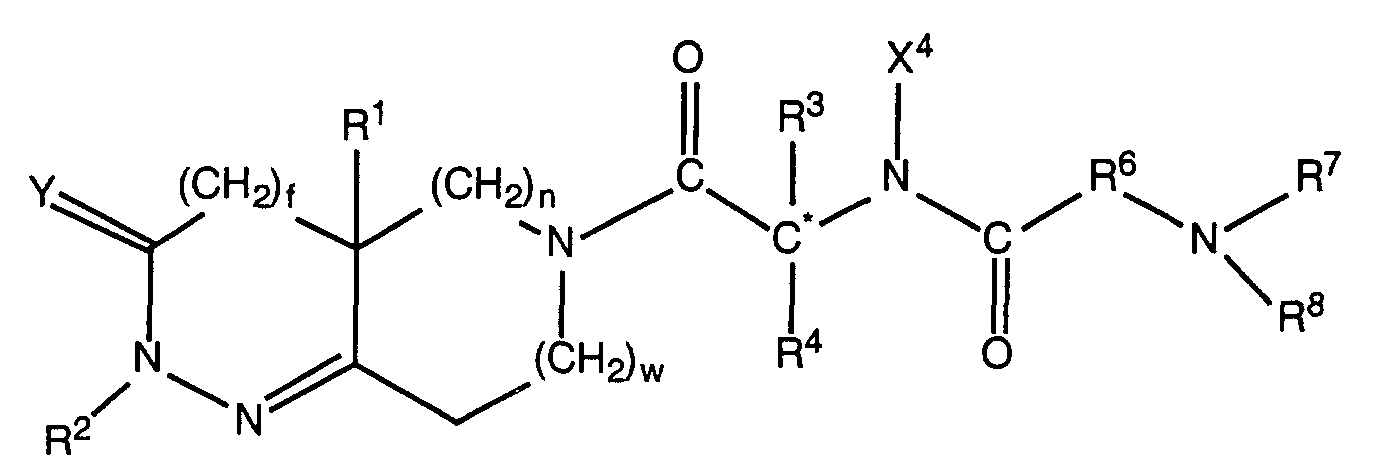
whereinf is 0;n is 0 and w is 2, or n is 1 and w is 1, or n is 2 and w is 0;Y is oxygen or sulfur;R1 is hydrogen, -CN, -(CH2)qN(X6)C(O)X6, -(CH2)qN(X6)C(O)(CH2)t-A1, -(CH2)qN(X6)SO2(CH2)t-A1, -(CH2)qN(X6)SO2X6, -(CH2)qN(X6)C(O)N(X6)(CH2)t-A1, -(CH2)qN(X6)C(O)N(X6)(X6), -(CH2)qC(O)N(X6)(X6), -(CH2)qC(O)N(X6)(CH2)t-A1, -(CH2)qC(O)OX6, -(CH2)qC(O)O(CH2)t-A1, -(CH2)qOX6, -(CH2)qOC(O)X6, -(CH2)qOC(O)(CH2)t-A1, -(CH2)qOC(O)N(X6)(CH2)t-A1, -(CH2)qOC(O)N(X6)(X6), -(CH2)qC(O)X6, -(CH2)qC(O)(CH2)t-A1, -(CH2)qN(X6)C(O)OX6, -(CH2)qN(X6)SO2N(X6)(X6), -(CH2)qS(O)mX6, -(CH2)qS(O)m(CH2)t-A1, -(C1-C10)alkyl, -(CH2)t-A1, -(CH2)q-(C3-C7)cycloalkyl, -(CH2)q-Y1-(C1-C6)alkyl, -(CH2)q-Y1-(CH2)t-A1 or -(CH2)q-Y1-(CH2)t-(C3-C7)cycloalkyl;where the alkyl and cycloalkyl groups in the definition of R1 are optionally substituted with (C1-C4)alkyl, hydroxyl, (C1-C4)alkoxy, carboxyl, -CONH2, -S(O)m(C1-C6)alkyl, -CO2(C1-C4)alkyl ester, 1H-tetrazol-5-yl or 1, 2 or 3 fluoro;Y1 is O, S(O)m, -C(O)NX6-, -CH=CH-, -C≡C-, -N(X6)C(O)-, -C(O)NX6-, -C(O)O-, -OC(O)N(X6)- or -OC(O)-;q is 0, 1, 2, 3 or 4;t is 0, 1, 2 or 3;said (CH2)q group and (CH2)t group may each be optionally substituted with hydroxyl, (C1-C4)alkoxy, carboxyl, -CONH2, -S(O)m(C1-C6)alkyl, -CO2(C1-C4)alkyl ester, 1H-tetrazol-5-yl, 1, 2 or 3 fluoro, or 1 or 2 (C1-C4)alkyl;R2 is hydrogen, (C1-C8)alkyl, -(C0-C3)alkyl-(C3-C8)cycloalkyl, -(C1-C4)alkyl-A1 or A1;
where the alkyl groups and the cycloalkyl groups in the definition of R2 are optionally substituted with hydroxyl, -C(O)OX6, -C(O)N(X6)(X6), -N(X6)(X6), -S(O)m(C1-C6)alkyl, -C(O)A1, -C(O)(X6), CF3, CN or 1, 2 or 3 halogen;R3 is A1, (C1-C10)alkyl, -(C1-C6)alkyl-A1, -(C1-C6)alkyl-(C3-C7)cycloalkyl, -(C1-C5)alkyl-X1-(C1-C5)alkyl,-(C1-C5)alkyl-X1-(C0-C5)alkyl-A1 or -(C1-C5)alkyl-X1-(C1-C5)alkyl-(C3-C7)cycloalkyl;where the alkyl groups in the definition of R3 are optionally substituted with, -S(O)m(C1-C6)alkyl, -C(O)OX3, 1, 2, 3, 4 or 5 halogens, or 1, 2 or 3 OX3;X1 is O, S(O)m, -N(X2)C(O)-, -C(O)N(X2)-, -OC(O)-, -C(O)O-, -CX2=CX2-, -N(X2)C(O)O-, -OC(O)N(X2)- or -C≡C-;R4 is hydrogen, (C1-C6)alkyl or (C3-C7)cycloalkyl;X4 is hydrogen or (C1-C6)alkyl or X4 is taken together with R4 and the nitrogen atom to which X4 is attached and the carbon atom to which R4 is attached and form a five to seven membered ring;R6 is a bond or is where a and b are independently 0, 1, 2 or 3;X5 and X5a are each independently selected from the group consisting of hydrogen, trifluoromethyl, A1 and optionally substituted (C1-C6)alkyl;
the optionally substituted (C1-C6)alkyl in the definition of X5 and X5a is optionally substituted with a substituent selected from the group consisting of A1, OX2, -S(O)m(C1-C6)alkyl, -C(O)OX2, (C3-C7)cycloalkyl, -N(X2)(X2) and -C(O)N(X2)(X2);R7 and R8 are independently hydrogen or optionally substituted (C1-C6)alkyl;
where the optionally substituted (C1-C6)alkyl in the definition of R7 and R8 is optionally independently substituted with A1, -C(O)O-(C1-C6)alkyl, -S(O)m(C1-C6)alkyl, 1 to 5 halogens, 1 to 3 hydroxy, 1 to 3 -O-C(O)(C1-C10)alkyl or 1 to 3 (C1-C6)alkoxy; orR7 and R8 can be taken together to form -(CH2)r-L-(CH2)r-;
where L is C(X2)(X2), S(O)m or N(X2);A1 in the definition of R1 is a partially saturated, fully saturated or fully unsaturated 4- to 8-membered ring optionally having 1 to 4 heteroatoms independently selected from the group consisting of oxygen, sulfur and nitrogen, a bicyclic ring system consisting of a partially saturated, fully unsaturated or fully saturated 5- or 6-membered ring, having 1 to 4 heteroatoms independently selected from the group consisting of nitrogen, sulfur and oxygen, fused to a partially saturated, fully saturated or fully unsaturated 5- or 6-membered ring, optionally having 1 to 4 heteroatoms independently selected from the group consisting of nitrogen, sulfur and oxygen;A1 in the definition of R2, R3, R6, R7 and R8 is independently (C5-C7)cycloalkenyl, phenyl or a partially saturated, fully saturated or fully unsaturated 4- to 8-membered ring optionally having 1 to 4 heteroatoms independently selected from the group consisting of oxygen, sulfur and nitrogen, a bicyclic ring system consisting of a partially saturated, fully unsaturated or fully saturated 5- or 6-membered ring, optionally having 1 to 4 heteroatoms independently selected from the group consisting of nitrogen, sulfur and oxygen, fused to a partially saturated, fully saturated or fully unsaturated 5- or 6- membered ring, optionally having 1 to 4 heteroatoms independently selected from the group consisting of nitrogen, sulfur and oxygen;
A1 for each occurrence is independently optionally substituted, in one or optionally both rings if A1 is a bicyclic ring system, with up to three substituents, each substituent independently selected from the group consisting of F, Cl, Br, I, OCF3, OCF2H, CF3, CH3, OCH3, -OX6, -C(O)N(X6)(X6), -C(O)OX6, oxo, (C1-C6)alkyl, nitro, cyano, benzyl, -S(O)m(C1-C6)alkyl, 1H-tetrazol-5-yl, phenyl, phenoxy, phenylalkyloxy, halophenyl, methylenedioxy, -N(X6)(X6), -N(X6)C(O)(X6), -SO2N(X6)(X6), -N(X6)SO2-phenyl, -N(X6)SO2X6, -CONX11X12, -SO2NX11X12, -NX6SO2X12, -NX6CONX11X12, -NX6SO2NX11X12, -NX6C(O)X12, imidazolyl, thiazolyl or tetrazolyl, provided that if A1 is optionally substituted with methylenedioxy then it can only be substituted with one methylenedioxy;where X11 is hydrogen or optionally substituted (C1-C6)alkyl;
the optionally substituted (C1-C6)alkyl defined for X11 is optionally independently substituted with phenyl, phenoxy, (C1-C6)alkoxycarbonyl, -S(O)m(C1-C6)alkyl 1 to 5 halogens, 1 to 3 hydroxy, 1 to 3 (C1-C10)alkanoyloxy or 1 to 3 (C1-C6)alkoxy;X12 is hydrogen, (C1-C6)alkyl, phenyl, thiazolyl, imidazolyl, furyl or thienyl, provided that when X12 is not hydrogen, X12 is optionally substituted with one to three substituents independently selected from the group consisting of Cl, F, CH3, OCH3, OCF3 and CF3;or X11 and X12 are taken together to form -(CH2)r-L1-(CH2)r-;
where L1 is C(X2)(X2), O, S(O)m or N(X2);r for each occurrence is independently 1, 2 or 3;X2 for each occurrence is independently hydrogen, optionally substituted (C1-C6)alkyl, or optionally substituted (C3-C7)cycloalkyl, where the optionally substituted (C1-C6)alkyl and optionally substituted (C3-C7)cycloalkyl in the definition of X2 are optionally independently substituted with -S(O)m(C1-C6)alkyl, -C(O)OX3, 1 to 5 halogens or 1-3 OX3;X3 for each occurrence is independently hydrogen or (C1-C6)alkyl;X6 is independently hydrogen, optionally substituted (C1-C6)alkyl, (C2-C6)halogenated alkyl, optionally substituted (C3-C7)cycloalkyl, (C3-C7)-halogenatedcycloalkyl, where optionally substituted (C1-C6)alkyl and optionally substituted (C3-C7)cycloalkyl in the definition of X6 is optionally independently substituted by 1 or 2 (C1-C4)alkyl, hydroxyl, (C1-C4)alkoxy, carboxyl, CONH2,-S(O)m(C1-C6)alkyl, carboxylate (C1-C4)alkyl ester, or 1H-tetrazol-5-yl; orwhen there are two X6 groups on one atom and both X6 are independently (C1-C6)alkyl, the two (C1-C6)alkyl groups may be optionally joined and, together with the atom to which the two X6 groups are attached, form a 4- to 9- membered ring optionally having oxygen, sulfur or NX7;
X7 is hydrogen or (C1-C6)alkyl optionally substituted with hydroxyl; andm for each occurrence is independently 0, 1 or 2;
with the proviso that:X6 and X12 cannot be hydrogen when it is attached to C(O) or SO2 in the form C(O)X6, C(O)X12, SO2X6 or SO2X12; andwhen R6 is a bond then L is N(X2) and each r in the definition -(CH2)r-L-(CH2)r- is independently 2 or 3. - A use according to claim 3 wherein the GHS is 2-amino-N-(2-(3a-(R)-benzyl-2-methyl-3-oxo-2,3,3a,4,6,7-hexahydro-pyrazolo-[4,3-c]pyridin-5-yl)-1-(R)-benzyloxymethyl-2-oxo-ethyl)-isobutyramide, a prodrug thereof or a pharmaceutically acceptable salt of said GHS or said prodrug.
- A use according to claim 4 wherein the GHS is 2-amino-N-[2-(3a-(R)-benzyl-2-methyl-3-oxo-2,3,3a,4,6,7-hexahydro-pyrazolo[4,3-c]pyridin-5-yl)-1-(R)-benzyloxymethyl-2-oxo-ethyl]-isobutyramide, L-tartrate.
- A combination comprising a GHS, a prodrug thereof or a pharmaceutically acceptable salt thereof or of said prodrug and a second therapeutic agent comprising a recombinant growth hormone or an additional GHS selected from the group consisting of GHRP-6, GHRP-1, GHRP-2, growth hormone releasing factor and an analog of growth hormone releasing factor.
- A combination comprising a GHS, a prodrug thereof or pharmaceutically acceptable salt thereof or of said prodrug and a second therapeutic agent selected from methotrexate, dapsone, a glucocorticoid or an antimalarial, a prodrug of said agent or a pharmaceutically acceptable salt thereof or of said prodrug.
- A combination according to claim 7 wherein said glucocorticoid is prednisone, betamethasone dipropionate, clobetasol, diflorasone diacetate, halobetasol propionate, amcinonide, desoximetasone, fluocinonide, halcinonide, betamethasone valerate, triamcinolone acetate, fluocinolone acetonide, flurandrenolide, hydrocortisone valerate, triamcinolone acetonide, hydrocortisone butyrate, alclometasone dipropionate, desonide, mometasone furoate, dexamethasone, hydrocortisone or methylprednisolone acetate.
- A combination according to claim 7 or claim 8 wherein said antimalarial is chloroquine, hydroxychloroquine, quinacrine or quinine.
- A combination comprising a GHS, a prodrug thereof or pharmaceutically acceptable salt thereof or of said prodrug and a second therapeutic agent selected from prednisone, sulfasalazine, mesalamine and olsalazine, a prodrug thereof or a pharmaceutically acceptable salt of said agent or said prodrug and a pharmaceutically acceptable carrier, vehicle or diluent.
- A combination according to any one of claims 7 to 10 wherein said GHS is a compound of the Formula I:or a stereoisomeric mixture thereof, diastereomerically enriched, diastereomerically pure, enantiomerically enriched or enantiomerically pure isomer thereof, or a prodrug of such compound, mixture or isomer thereof, or a pharmaceutically acceptable salt of the compound, mixture, isomer or prodrug,

wherein:HET is a heterocyclic moiety selected from the group consisting of

 d is 0, 1 or 2;e is 1 or 2;f is 0 or 1;n and w are 0, 1 or 2, provided that n and w cannot both be 0 at the same time;Y2 is oxygen or sulfur;A is a divalent radical, where the left hand side of the radical as shown below is connected to C" and the right hand side of the radical as shown below is connected to C', selected from the group consisting of
-NR2-C(O)-NR2-, -NR2-S(O)2-NR2-, -O-C(O)-NR2-, -NR2-C(O)-O-, -C(O)-NR2-C(O)-, -C(O)-NR2-C(R9R10)-, -C(R9R10)-NR2-C(O)-, -C(R9R10)-C(R9R10)-C(R9R10)-, -S(O)2-C(R9R10)-C(R9R10)-, -C(R9R10)-O-C(O)-, -C(R9R10)-O-C(R9R10)-, -NR2-C(O)-C(R9R10)-, -O-C(O)-C(R9R10)-, -C(R9R10)-C(O)-NR2-, -C(R9R10)-C(O)-O-, -C(O)-NR2-C(R9R10)-C(R9R10)-, -C(O)-O-C(R9R10)-, -C(R9R10)-C(R9R10)-C(R9R10)-C(R9R10)-, -S(O)2-NR2-C(R9R10)-C(R9R10)-, -C(R9R10)-C(R9R10)-NR2-C(O)-, -C(R9R10)-C(R9R10)-O-C(O)-, -NR2-C(O)-C(R9R10)-C(R9R10)-, -NR2-S(O)2-C(R9R10)-C(R9R10)-, -O-C(O)-C(R9R10)-C(R9R10)-, -C(R9R10)-C(R9R10)-C(O)-NR2-, -C(R9R10)-C(R9R10)-C(O)-, -C(R9R10)-NR2-C(O)-O-, -C(R9R10)-O-C(O)-NR2, -C(R9R10)-NR2-C(O)-NR2-, -NR2-C(O)-O-C(R9R10)-, -NR2-C(O)-NR2-C(R9R10)-, -NR2-S(O)2-NR2-C(R9R10)-, -O-C(O)-NR2-C(R9R10)-, -C(O)-N=C(R11)-NR2-, -C(O)-NR2-C(R11)=N-, -C(R9R10)-NR12-C(R9R10)-, -NR12-C(R9R10)-, -NR12-C(R9R10)-C(R9R10)-, -C(O)-O-C(R9R10)-C(R9R10)-, -NR2-C(R11)=N-C(O)-, -C(R9R10)-C(R9R10)-N(R12)-, -C(R9R10)-NR12-, -N=C(R11)-NR2-C(O)-, -C(R9R10)-C(R9R10)-NR2-S(O)2-, -C(R9R10)-C(R9R10)-S(O)2-NR2-, -C(R9R10)-C(R9R10)-C(O)-O-, -C(R9R10)-S(O)2-C(R9R10)-, -C(R9R10)-C(R9R10)-S(O)2-, -O-C(R9R10)-C(R9R10)-, -C(R9R10)-C(R9R10)-O-, -C(R9R10)-C(O)-C(R9R10)-, -C(O)-C(R9R10)-C(R9R10)- and -C(R9R10)-NR2-S(O)2-NR2-;Q is a covalent bond or CH2;W is CH or N;X is CR9R10, C=CH2 or C=O;Y is CR9R10, O or NR2;Z is C=O, C=S or S(O)2;G1 is hydrogen, halo, hydroxy, nitro, amino, cyano, phenyl, carboxyl, -CONH2, -(C1-C4)alkyl optionally independently substituted with one or more phenyl, one or more halogens or one or more hydroxy groups, -(C1-C4)alkoxy optionally independently substituted with one or more phenyl, one or more halogens or one or more hydroxy groups, -(C1-C4)alkylthio, phenoxy, -COO(C1-C4)alkyl, N,N-di-(C1-C4)alkylamino, -(C2-C6)alkenyl optionally independently substituted with one or more phenyl, one or more halogens or one or more hydroxy groups, -(C2-C6)alkynyl optionally independently substituted with one or more phenyl, one or more halogens or one or more hydroxy groups, -(C3-C6)cycloalkyl optionally independently substituted with one or more (C1-C4)alkyl groups, one or more halogens or one or more hydroxy groups, -(C1-C4)alkylamino carbonyl or di-(C1-C4)alkylamino carbonyl;G2 and G3 are each independently selected from the group consisting of hydrogen, halo, hydroxy, -(C1-C4)alkyl optionally independently substituted with one to three halo groups and -(C1-C4)alkoxy optionally independently substituted with one to three halo groups;R1 is hydrogen, -CN, -(CH2)qN(X6)C(O)X6, -(CH2)qN(X6)C(O)(CH2)t-A1, -(CH2)qN(X6)S(O)2(CH2)t-A1, -(CH2)qN(X6)S(O)2X6, -(CH2)qN(X6)C(O)N(X6)(CH2)t-A1, -(CH2)qN(X6)C(O)N(X6)(X6), -(CH2)qC(O)N(X6)(X6), -(CH2)qC(O)N(X6)(CH2)t-A1, -(CH2)qC(O)OX6, -(CH2)qC(O)O(CH2)t-A1, -(CH2)qOX6, -(CH2)qOC(O)X6, -(CH2)qOC(O)(CH2)t-A1, -(CH2)qOC(O)N(X6)(CH2)t-A1, -(CH2)qOC(O)N(X6)(X6), -(CH2)qC(O)X6, -(CH2)qC(O)(CH2)t-A1, -(CH2)qN(X6)C(O)OX6, -(CH2)qN(X6)S(O)2N(X6)(X6), -(CH2)qS(O)mX6, -(CH2)qS(O)m(OH2)t-A1, -(C1-C10)alkyl, -(CH2)t-A1, -(CH2)q-(C3-C7)cycloalkyl, -(CH2)q-Y1-(C1-C6)alkyl, (CH2)q-Y1-(CH2)t-A1 or -(CH2)q-Y1-(CH2)t-(C3-C7)cycloalkyl;where the alkyl and cycloalkyl groups in the definition of R1 are optionally substituted with (C1-C4)alkyl, hydroxy, (C1-C4)alkoxy, carboxyl, -CONH2, -S(O)m(C1-C6)alkyl, -CO2(C1-C4)alkyl ester, 1H-tetrazol-5-yl or 1, 2 or 3 fluoro groups;Y1 is O, S(O)m, -C(O)NX6-, -CH=CH-, -C≡C-, -N(X6)C(O)-, -C(O)NX6-, -C(O)O-, -OC(O)N(X6)- or -OC(O)-;q is 0, 1, 2, 3 or 4;t is 0, 1, 2 or 3;said (CH2)q group and (CH2)t group in the definition of R1 are optionally independently substituted with hydroxy, (C1-C4)alkoxy, carboxyl, -CONH2, -S(O)m(C1-C6)alkyl, -CO2(C1-C4)alkyl ester, 1H-tetrazol-5-yl, 1, 2 or 3 fluoro groups or 1 or 2 (C1-C4)alkyl groups;R1A is selected from the group consisting of hydrogen, F, Cl, Br, I, (C1-C6)alkyl, phenyl(C1-C3)alkyl, pyridyl(C1-C3)alkyl, thiazolyl(C1-C3)alkyl and thienyl(C1-C3)alkyl, provided that R1A is not F, Cl, Br or I when a heteroatom is vicinal to C";R2 is hydrogen, (C1-C8)alkyl, -(C0-C3)alkyl-(C3-C8)cycloalkyl, -(C1-C4)alkyl-A1 or A1;
where the alkyl groups and the cycloalkyl groups in the definition of R2 are optionally substituted with hydroxy, -C(O)OX6, -C(O)N(X6)(X6), -N(X6)(X6),-S(O)m(C1-C6)alkyl, -C(O)A1, -C(O)(X6), CF3, CN or 1, 2 or 3 independently selected halo groups;R3 is selected from the group consisting of A1, (C1-C10)alkyl, -(C1-C6)alkyl-A1, -(C1-C6)alkyl-(C3-C7)cycloalkyl, -(C1-C5)alkyl-X1-(C1-C5)alkyl, -(C1-C5)alkyl-X1-(C0-C5)alkyl-A1 and -(C1-C5)alkyl-X1-(C1-C5)alkyl-(C3-C7)cycloalkyl;where the alkyl groups in the definition of R3 are optionally substituted with -S(O)m(C1-C6)alkyl, -C(O)OX3, 1, 2, 3, 4 or 5 independently selected halo groups or 1, 2 or 3 independently selected -OX3 groups;X1 is O, S(O)m, -N(X2)C(O)-, -C(O)N(X2)-, -OC(O)-, -C(O)O-, -CX2=CX2-, -N(X2)C(O)O-, -OC(O)N(X2)- or -C≡C-;R4 is hydrogen, (C1-C6)alkyl or (C3-C7)cycloalkyl, or R4 is taken together with R3 and the carbon atom to which they are attached and form (C5-C7)cycloalkyl, (C5-C7)cycloalkenyl, a partially saturated or fully saturated 4- to 8-membered ring having 1 to 4 heteroatoms independently selected from the group consisting of oxygen, sulfur and nitrogen, or is a bicyclic ring system consisting of a partially saturated or fully saturated 5- or 6-membered ring, fused to a partially saturated, fully unsaturated or fully saturated 5- or 6-membered ring, optionally having 1 to 4 heteroatoms independently selected from the group consisting of nitrogen, sulfur and oxygen;X4 is hydrogen or (C1-C6)alkyl or X4 is taken together with R4 and the nitrogen atom to which X4 is attached and the carbon atom to which R4 is attached and form a five to seven membered ring;R6 is a bond or is where a and b are each independently 0, 1, 2 or 3;X5 and X5a are each independently selected from the group consisting of hydrogen, CF3, A1 and optionally substituted (C1-C6)alkyl;
the optionally substituted (C1-C6)alkyl in the definition of X5 and X5a is optionally substituted with a substituent selected from the group consisting of A1, OX2, -S(O)m(C1-C6)alkyl, -C(O)OX2, (C3-C7)cycloalkyl, -N(X2)(X2) and -C(O)N(X2)(X2);or the carbon bearing X5 or X5a forms one or two alkylene bridges with the nitrogen atom bearing R7 and R8 wherein each alkylene bridge contains 1 to 5 carbon atoms, provided that when one alkylene bridge is formed then only one of X5 or X5a is on the carbon atom and only one of R7 or R8 is on the nitrogen atom and further provided that when two alkylene bridges are formed then X5 and X5a cannot be on the carbon atom and R7 and R8 cannot be on the nitrogen atom;or X5 is taken together with X5a and the carbon atom to which they are attached and form a partially saturated or fully saturated 3- to 7-membered ring, or a partially saturated or fully saturated 4- to 8-membered ring having 1 to 4 heteroatoms independently selected from the group consisting of oxygen, sulfur and nitrogen;or X5 is taken together with X5a and the carbon atom to which they are attached and form a bicyclic ring system consisting of a partially saturated or fully saturated 5- or 6-membered ring, optionally having 1 or 2 heteroatoms independently selected from the group consisting of nitrogen, sulfur and oxygen, fused to a partially saturated, fully saturated or fully unsaturated 5- or 6-membered ring, optionally having 1 to 4 heteroatoms independently selected from the group consisting of nitrogen, sulfur and oxygen;Z1 is a bond, O or N-X2, provided that when a and b are both 0 then Z1 is not N-X2 or O;or R6 is -(CRaRb)a-E-(CRaRb)b-, where the -(CRaRb)a- group is attached to the carbonyl carbon of the amide group of the compound of formula I and the -(CRaRb)b group is attached to the terminal nitrogen atom of the compound of formula I;E is -O-, -S-, -CH=CH- or an aromatic moiety selected from said aromatic moiety in the definition of E optionally substituted with up to three halo, hydroxy, -N(Rc)(Rc), (C1-C6)alkyl or (C1-C6)alkoxy;
 Ra and Rb are, for each occurrence, independently hydrogen, (C1-C6)alkyl, trifluoromethyl, phenyl or monosubstituted (C1-C6)alkyl where the substituents are imidazolyl, naphthyl, phenyl, indolyl, p-hydroxyphenyl, -ORc, S(O)mRc, C(O)ORc, (C3-C7)cycloalkyl, -N(Rc)(Rc), -C(O)N(Rc)(Rc), or Ra or Rb may independently be joined to one or both of R7 or E (where E is other than O, S or -CH=CH-) to form an alkylene bridge between the terminal nitrogen and the alkyl portion of the Ra or Rb and the R7 or E group, wherein the bridge contains 1 to 8 carbon atoms; or Ra and Rb may be joined to one another to form a (C3-C7)cycloalkyl;Rc, for each occurrence, is independently hydrogen or (C1-C6)alkyl;a and b are independently 0, 1, 2 or 3, with the proviso that if E is -O- or -S-, b is other than 0 or 1 and with the further proviso that if E is -CH=CH-, b is other than 0;R7 and R8 are each independently hydrogen or optionally substituted (C1-C6)alkyl;
where the optionally substituted (C1-C6)alkyl in the definition of R7 and R8 is optionally independently substituted with A1, -C(O)O-(C1-C6)alkyl, -S(O)m(C1-C6)alkyl, 1 to 5 halo groups, 1 to 3 hydroxy groups, 1 to 3 -O-C(O)(C1-C10)alkyl groups or 1 to 3 (C1-C6)alkoxy groups; orR7 and R8 can be taken together to form -(CH2)r-L-(CH2)r-;
where L is C(X2)(X2), S(O)m or N(X2);R9 and R10 are each independently selected from the group consisting of hydrogen, fluoro, hydroxy and (C1-C5)alkyl optionally independently substituted with 1-5 halo groups;R11 is selected from the group consisting of (C1-C5)alkyl and phenyl optionally substituted with 1-3 substituents each independently selected from the group consisting of (C1-C5)alkyl, halo and (C1-C5)alkoxy;R12 is selected from the group consisting of (C1-C5)alkylsulfonyl, (C1-C5)alkanoyl and (C1-C5)alkyl where the alkyl portion is optionally independently substituted by 1-5 halo groups;A1 for each occurrence is independently selected from the group consisting of (C5-C7)cycloalkenyl, phenyl, a partially saturated, fully saturated or fully unsaturated 4-to 8-membered ring optionally having 1 to 4 heteroatoms independently selected from the group consisting of oxygen, sulfur and nitrogen and a bicyclic ring system consisting of a partially saturated, fully unsaturated or fully saturated 5- or 6-membered ring, optionally having 1 to 4 heteroatoms independently selected from the group consisting of nitrogen, sulfur and oxygen, fused to a partially saturated, fully saturated or fully unsaturated 5- or 6-membered ring, optionally having 1 to 4 heteroatoms independently selected from the group consisting of nitrogen, sulfur and oxygen;
A1 for each occurrence is independently optionally substituted, on one or optionally both rings if A1 is a bicyclic ring system, with up to three substituents, each substituent independently selected from the group consisting of F, Cl, Br, I, OCF3, OCF2H, CF3, CH3, OCH3, -OX6, -C(O)N(X6)(X6), -C(O)OX6, oxo, (C1-C6)alkyl, nitro, cyano, benzyl,-S(O)m(C1-C6)alkyl, 1H-tetrazol-5-yl, phenyl, phenoxy, phenylalkyloxy, halophenyl, methylenedioxy, -N(X6)(X6), -N(X6)C(O)(X6), -S(O)2N(X6)(X6), -N(X6)S(O)2-phenyl, -N(X6)S(O)2X6, -CONX11X12, -S(O)2NX11X12, -NX6S(O)2X12, -NX6CONX11X12, -NX6S(O)2NX11X12, -NX6C(O)X12, imidazolyl, thiazolyl and tetrazolyl, provided that if A1 is optionally substituted with methylenedioxy then it can only be substituted with one methylenedioxy;where X11 is hydrogen or optionally substituted (C1-C6)alkyl;
the optionally substituted (C1-C6)alkyl defined for X11 is optionally independently substituted with phenyl, phenoxy, (C1-C6)alkoxycarbonyl, -S(O)m(C1-C6)alkyl, 1 to 5 halo groups, 1 to 3 hydroxy groups, 1 to 3 (C1-C10)alkanoyloxy groups or 1 to 3 (C1-C6)alkoxy groups;X12 is hydrogen, (C1-C6)alkyl, phenyl, thiazolyl, imidazolyl, furyl or thienyl, provided that when X12 is not hydrogen, the X12 group is optionally substituted with one to three substituents independently selected from the group consisting of Cl, F, CH3, OCH3, OCF3 and CF3;or X11 and X12 are taken together to form -(CH2)r-L1-(CH2)r-;
L1 is C(X2)(X2), O, S(O)m or N(X2);r for each occurrence is independently 1, 2 or 3;X2 for each occurrence is independently hydrogen, optionally substituted (C1-C6)alkyl or optionally substituted (C3-C7)cycloalkyl, where the optionally substituted (C1-C6)alkyl and optionally substituted (C3-C7)cycloalkyl in the definition of X2 are optionally independently substituted with -S(O)m(C1-C6)alkyl, -C(O)OX3, 1 to 5 halo groups or 1-3 OX3 groups;X3 for each occurrence is independently hydrogen or (C1-C6)alkyl;X6 for each occurrence is independently hydrogen, optionally substituted (C1-C6)alkyl, (C2-C6)halogenated alkyl, optionally substituted (C3-C7)cycloalkyl, (C3-C7)-halogenated cycloalkyl, where optionally substituted (C1-C6)alkyl and optionally substituted (C3-C7)cycloalkyl in the definition of X6 is optionally independently mono- or di-substituted with (C1-C4)alkyl, hydroxy, (C1-C4)alkoxy, carboxyl, CONH2, -S(O)m(C1-C6)alkyl, carboxylate (C1-C4)alkyl ester or 1H-tetrazol-5-yl; orwhen there are two X6 groups on one atom and both X6 are independently (C1-C6)alkyl, the two (C1-C6)alkyl groups may be optionally joined and, together with the atom to which the two X6 groups are attached, form a 4- to 9- membered ring optionally having oxygen, sulfur or NX7 as a ring member;
X7 is hydrogen or (C1-C6)alkyl optionally substituted with hydroxy;m for each occurrence is independently 0, 1 or 2;
with the provisos that:1) X6 and X12 cannot be hydrogen when attached to C(O) or S(O)2 in the form C(O)X6, C(O)X12, S(O)2X6 or S(O)2X12; and2) when R6 is a bond then L is N(X2) and each r in the definition -(CH2)r-L-(CH2)r- is independently 2 or 3. - A combination according to claim 11 wherein said GHS is a compound of the formulaa racemic-diastereomeric mixture or optical isomer of said compound or a pharmaceutically-acceptable salt and prodrug thereof,
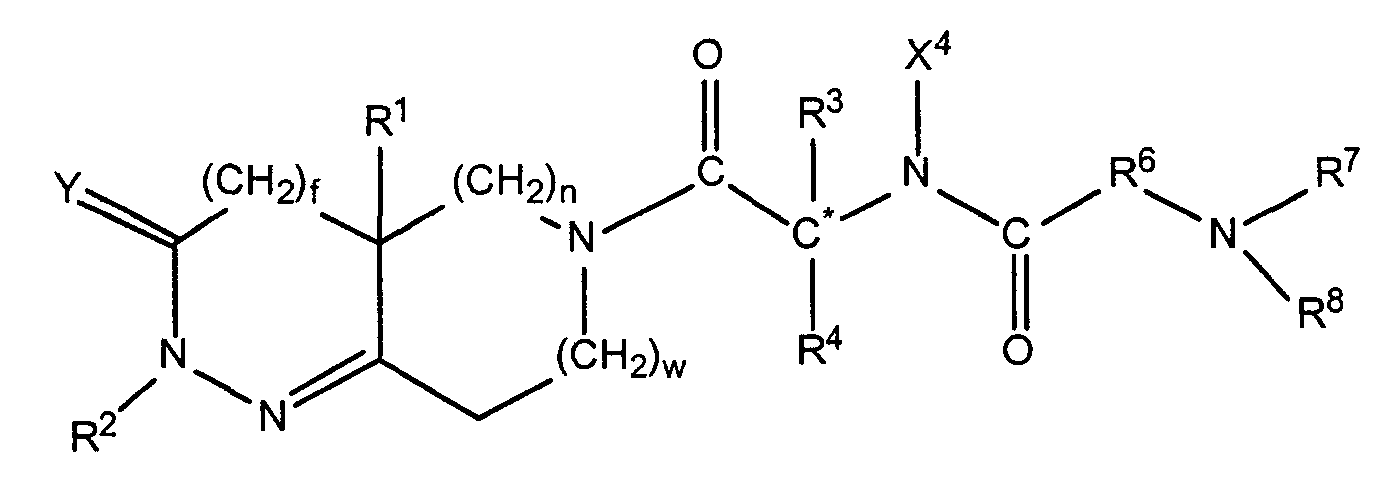
whereinf is 0;n is 0 and w is 2, or n is 1 and w is 1, or n is 2 and w is 0;Y is oxygen or sulfur;R1 is hydrogen, -CN, -(CH2)qN(X6)C(O)X6, -(CH2)qN(X6)C(O)(CH2)t-A1, -(CH2)qN(X6)SO2(CH2)t-A1, -(CH2)qN(X6)SO2X6, -(CH2)qN(X6)C(O)N(X6)(CH2)t-A1, -(CH2)qN(X6)C(O)N(X6)(X6), -(CH2)qC(O)N(X6)(X6), -(CH2)qC(O)N(X6)(CH2)t-A1, -(CH2)qC(O)OX6, -(CH2)qC(O)O(CH2)t-A1, -(CH2)qOX6, -(CH2)qOC(O)X6, -(CH2)qOC(O)(CH2)t-A1, -(CH2)qOC(O)N(X6)(CH2)t-A1, -(CH2)qOC(O)N(X6)(X6), -(CH2)qC(O)X6, -(CH2)qC(O)(CH2)t-A1, -(CH2)qN(X6)C(O)OX6, -(CH2)qN(X6)SO2N(X6)(X6), -(CH2)qS(O)mX6, -(CH2)qS(O)m(CH2)t-A1, -(C1-C10)alkyl, -(CH2)t-A1, -(CH2)q-(C3-C7)cycloalkyl, -(CH2)q-Y1-(C1-C6)alkyl, -(CH2)q-Y1-(CH2)t-A1 or -(CH2)q-Y1-(CH2)t-(C3-C7)cycloalkyl;where the alkyl and cycloalkyl groups in the definition of R1 are optionally substituted with (C1-C4)alkyl, hydroxyl, (C1-C4)alkoxy, carboxyl, -CONH2, -S(O)m(C1-C6)alkyl, -CO2(C1-C4)alkyl ester, 1H-tetrazol-5-yl or 1, 2 or 3 fluoro;Y1 is O, S(O)m, -C(O)NX6-, -CH=CH-, -C≡C-, -N(X6)C(O)-, -C(O)NX6-, -C(O)O-, -OC(O)N(X6)- or -OC(O)-;q is 0, 1, 2, 3 or 4;t is 0, 1, 2 or 3;said (CH2)q group and (CH2)t group may each be optionally substituted with hydroxyl, (C1-C4)alkoxy, carboxyl, -CONH2, -S(O)m(C1-C6)alkyl, -CO2(C1-C4)alkyl ester, 1H-tetrazol-5-yl, 1, 2 or 3 fluoro, or 1 or 2 (C1-C4)alkyl;R2 is hydrogen, (C1-C8)alkyl, -(C0-C3)alkyl-(C3-C8)cycloalkyl, -(C1-C4)alkyl-A1 or A1;
where the alkyl groups and the cycloalkyl groups in the definition of R2 are optionally substituted with hydroxyl, -C(O)OX6, -C(O)N(X6)(X6), -N(X6)(X6), -S(O)m(C1-C6)alkyl, -C(O)A1, -C(O)(X6), CF3, CN or 1, 2 or 3 halogen;R3 is A1, (C1-C10)alkyl, -(C1-C6)alkyl-A1, -(C1-C6)alkyl-(C3-C7)cycloalkyl, -(C1-C5)alkyl-X1-(C1-C5)alkyl,-(C1-C5)alkyl-X1-(C0-C5)alkyl-A1 or -(C1-C5)alkyl-X1-(C1-C5)alkyl-(C3-C7)cycloalkyl;where the alkyl groups in the definition of R3 are optionally substituted with, -S(O)m(C1-C6)alkyl, -C(O)OX3, 1, 2, 3, 4 or 5 halogens, or 1, 2 or 3 OX3;X1 is O, S(O)m, -N(X2)C(O)-, -C(O)N(X2)-, -OC(O)-, -C(O)O-, -CX2=CX2-, -N(X2)C(O)O-, -OC(O)N(X2)- or -C≡C-;R4 is hydrogen, (C1-C6)alkyl or (C3-C7)cycloalkyl;X4 is hydrogen or (C1-C6)alkyl or X4 is taken together with R4 and the nitrogen atom to which X4 is attached and the carbon atom to which R4 is attached and form a five to seven membered ring;R6 is a bond or is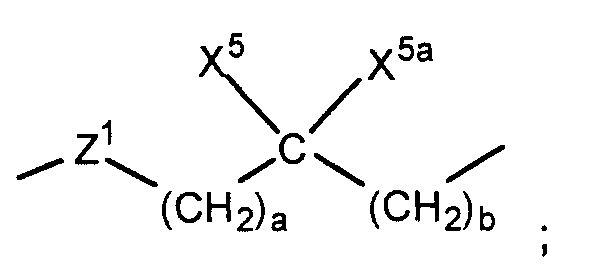 where a and b are independently 0, 1, 2 or 3;X5 and X5a are each independently selected from the group consisting of hydrogen, trifluoromethyl, A1 and optionally substituted (C1-C6)alkyl;
the optionally substituted (C1-C6)alkyl in the definition of X5 and X5a is optionally substituted with a substituent selected from the group consisting of A1, OX2, -S(O)m(C1-C6)alkyl, -C(O)OX2, (C3-C7)cycloalkyl, -N(X2)(X2) and -C(O)N(X2)(X2);R7 and R8 are independently hydrogen or optionally substituted (C1-C6)alkyl;
where the optionally substituted (C1-C6)alkyl in the definition of R7 and R8 is optionally independently substituted with A1, -C(O)O-(C1-C6)alkyl, -S(O)m(C1-C6)alkyl, 1 to 5 halogens, 1 to 3 hydroxy, 1 to 3 -O-C(O)(C1-C10)alkyl or 1 to 3 (C1-C6)alkoxy; orR7 and R8 can be taken together to form -(CH2)r-L-(CH2)r-;
where L is C(X2)(X2), S(O)m or N(X2);A1 in the definition of R1 is a partially saturated, fully saturated or fully unsaturated 4- to 8-membered ring optionally having 1 to 4 heteroatoms independently selected from the group consisting of oxygen, sulfur and nitrogen, a bicyclic ring system consisting of a partially saturated, fully unsaturated or fully saturated 5- or 6-membered ring, having 1 to 4 heteroatoms independently selected from the group consisting of nitrogen, sulfur and oxygen, fused to a partially saturated, fully saturated or fully unsaturated 5- or 6-membered ring, optionally having 1 to 4 heteroatoms independently selected from the group consisting of nitrogen, sulfur and oxygen;A1 in the definition of R2, R3, R6, R7 and R8 is independently (C5-C7)cycloalkenyl, phenyl or a partially saturated, fully saturated or fully unsaturated 4- to 8-membered ring optionally having 1 to 4 heteroatoms independently selected from the group consisting of oxygen, sulfur and nitrogen, a bicyclic ring system consisting of a partially saturated, fully unsaturated or fully saturated 5- or 6-membered ring, optionally having 1 to 4 heteroatoms independently selected from the group consisting of nitrogen, sulfur and oxygen, fused to a partially saturated, fully saturated or fully unsaturated 5- or 6- membered ring, optionally having 1 to 4 heteroatoms independently selected from the group consisting of nitrogen, sulfur and oxygen;
A1 for each occurrence is independently optionally substituted, in one or optionally both rings if A1 is a bicyclic ring system, with up to three substituents, each substituent independently selected from the group consisting of F, Cl, Br, I, OCF3, OCF2H, CF3, CH3, OCH3, -OX6, -C(O)N(X6)(X6), -C(O)OX6, oxo, (C1-C6)alkyl, nitro, cyano, benzyl, -S(O)m(C1-C6)alkyl, 1H-tetrazol-5-yl, phenyl, phenoxy, phenylalkyloxy, halophenyl, methylenedioxy, -N(X6)(X6), -N(X6)C(O)(X6), -SO2N(X6)(X6), -N(X6)SO2-phenyl, -N(X6)SO2X6, -CONX11X12, -SO2NX11X12, -NX6SO2X12, -NX6CONX11X12, -NX6SO2NX11X12, -NX6C(O)X12, imidazolyl, thiazolyl or tetrazolyl, provided that if A1 is optionally substituted with methylenedioxy then it can only be substituted with one methylenedioxy;where X11 is hydrogen or optionally substituted (C1-C6)alkyl;
the optionally substituted (C1-C6)alkyl defined for X11 is optionally independently substituted with phenyl, phenoxy, (C1-C6)alkoxycarbonyl, -S(O)m(C1-C6)alkyl 1 to 5 halogens, 1 to 3 hydroxy, 1 to 3 (C1-C10)alkanoyloxy or 1 to 3 (C1-C6)alkoxy;X12 is hydrogen, (C1-C6)alkyl, phenyl, thiazolyl, imidazolyl, furyl or thienyl, provided that when X12 is not hydrogen, X12 is optionally substituted with one to three substituents independently selected from the group consisting of Cl, F, CH3, OCH3, OCF3 and CF3;or X11 and X12 are taken together to form -(CH2)r-L1-(CH2)r-;
where L1 is C(X2)(X2), O, S(O)m or N(X2);r for each occurrence is independently 1, 2 or 3;X2 for each occurrence is independently hydrogen, optionally substituted (C1-C6)alkyl, or optionally substituted (C3-C7)cycloalkyl, where the optionally substituted (C1-C6)alkyl and optionally substituted (C3-C7)cycloalkyl in the definition of X2 are optionally independently substituted with -S(O)m(C1-C6)alkyl, -C(O)OX3, 1 to 5 halogens or 1-3 OX3;X3 for each occurrence is independently hydrogen or (C1-C6)alkyl;X6 is independently hydrogen, optionally substituted (C1-C6)alkyl, (C2-C6)halogenated alkyl, optionally substituted (C3-C7)cycloalkyl, (C3-C7)halogenatedcycloalkyl, where optionally substituted (C1-C6)alkyl and optionally substituted (C3-C7)cycloalkyl in the definition of X6 is optionally independently substituted by 1 or 2 (C1-C4)alkyl, hydroxyl, (C1-C4)alkoxy, carboxyl, CONH2,-S(O)m(C1-C6)alkyl, carboxylate (C1-C4)alkyl ester, or 1H-tetrazol-5-yl; orwhen there are two X6 groups on one atom and both X6 are independently (C1-C6)alkyl, the two (C1-C6)alkyl groups may be optionally joined and, together with the atom to which the two X6 groups are attached, form a 4- to 9- membered ring optionally having oxygen, sulfur or NX7;
X7 is hydrogen or (C1-C6)alkyl optionally substituted with hydroxyl; and m for each occurrence is independently 0, 1 or 2;
with the proviso that:X6 and X12 cannot be hydrogen when it is attached to C(O) or SO2 in the form C(O)X6, C(O)X12, SO2X6 or SO2X12; andwhen R6 is a bond then L is N(X2) and each r in the definition -(CH2)r-L-(CH2)r- is independently 2 or 3. - A combination according to claim 12 wherein the GHS is 2-amino-N-(2-(3a-(R)-benzyl-2-methyl-3-oxo-2,3,3a,4,6,7-hexahydro-pyrazolo-[4,3-c]pyridin-5-yl)-1-(R)-benzyloxymethyl-2-oxo-ethyl)-isobutyramide, a prodrug thereof or a pharmaceutically acceptable salt of said GHS or said prodrug.
- A combination according to claim 13 wherein the GHS is 2-amino-N-[2-(3a-(R)-benzyl-2-methyl-3-oxo-2,3,3a,4,6,7-hexahydro-pyrazolo[4,3-c]pyridin-5-yl)-1-(R)-benzyloxymethyl-2-oxo-ethyl]-isobutyramide, L-tartrate.
- A pharmaceutical composition comprising a combination according to any of claims 7 to 14 and a pharmaceutically acceptable carrier, vehicle or diluent.
- Use of a combination according to any one of claims 7 to 14 for the manufacture of a medicament for separate, sequential or simultaneous administration of the GHS and the second therapeutic agent, for the treatment of systemic lupus erythematosus
- A product containing:a) a GHS, a prodrug thereof or a pharmaceutically acceptable salt of said GHS or said prodrug; andb) a therapeutic agent selected from methotrexate, dapsone, a glucocorticoid or an antimalarial, a prodrug thereof or a pharmaceutically acceptable salt of said agent or said prodrug;
as a combined preparation for the treatment of systemic lupus erythematosus. - A product containing:as a combined preparation for the treatment of systemic lupus erythematosus.a) a GHS, a prodrug thereof or a pharmaceutically acceptable salt of said GHS or said prodrug; andb) a therapeutic agent selected from prednisone, sulfasalazine, mesalamine and olsalazine, a prodrug thereof or a pharmaceutically acceptable salt of said agent or said prodrug;
Applications Claiming Priority (2)
| Application Number | Priority Date | Filing Date | Title |
|---|---|---|---|
| US21252100P | 2000-06-19 | 2000-06-19 | |
| US212521P | 2000-06-19 |
Publications (2)
| Publication Number | Publication Date |
|---|---|
| EP1166778A2 true EP1166778A2 (en) | 2002-01-02 |
| EP1166778A3 EP1166778A3 (en) | 2003-09-17 |
Family
ID=22791370
Family Applications (1)
| Application Number | Title | Priority Date | Filing Date |
|---|---|---|---|
| EP01305273A Withdrawn EP1166778A3 (en) | 2000-06-19 | 2001-06-18 | The use of growth hormone scretagogues to treat systemic lupus erythematosus and inflammatory bowel disease |
Country Status (9)
| Country | Link |
|---|---|
| US (1) | US20020013320A1 (en) |
| EP (1) | EP1166778A3 (en) |
| JP (1) | JP2002053493A (en) |
| KR (1) | KR20010113537A (en) |
| AU (1) | AU5198301A (en) |
| CA (1) | CA2350857A1 (en) |
| HU (1) | HUP0102500A3 (en) |
| IL (1) | IL143690A0 (en) |
| ZA (1) | ZA200104923B (en) |
Families Citing this family (18)
| Publication number | Priority date | Publication date | Assignee | Title |
|---|---|---|---|---|
| US20050261201A1 (en) * | 2004-03-30 | 2005-11-24 | Rejuvenon Corporation | Method of reducing C-reactive protein using growth hormone secretagogues |
| AU2005271700B2 (en) * | 2004-07-12 | 2010-11-11 | Allergan, Inc. | Opthalmic compositions and methods for treating ophthalmic conditions |
| EP1757290A1 (en) | 2005-08-16 | 2007-02-28 | Zentaris GmbH | Novel triazole derivatives as ghrelin analogue ligands of growth hormone secretagogue receptors |
| PE20080145A1 (en) | 2006-03-21 | 2008-02-11 | Janssen Pharmaceutica Nv | TETRAHYDRO-PYRIMIDOAZEPINE AS MODULATORS OF TRPV1 |
| US8889632B2 (en) | 2007-01-31 | 2014-11-18 | Dana-Farber Cancer Institute, Inc. | Stabilized p53 peptides and uses thereof |
| EP2508531B1 (en) | 2007-03-28 | 2016-10-19 | President and Fellows of Harvard College | Stitched polypeptides |
| JP5562865B2 (en) | 2007-12-17 | 2014-07-30 | ジヤンセン・フアーマシユーチカ・ナームローゼ・フエンノートシヤツプ | TRPV1 imidazolo-, oxazolo-, and thiazolopyrimidine modulators |
| US8579865B2 (en) * | 2009-03-20 | 2013-11-12 | Antares Pharma, Inc. | Hazardous agent injection system |
| SI2603600T1 (en) | 2010-08-13 | 2019-04-30 | Aileron Therapeutics, Inc. | Peptidomimetic macrocycles |
| EP2431035A1 (en) | 2010-09-16 | 2012-03-21 | Æterna Zentaris GmbH | Novel Triazole Derivatives with Improved Receptor Activity and Bioavailability Properties as Ghrelin Antagonists of Growth Hormone Secretagogue Receptors |
| UY34094A (en) | 2011-05-27 | 2013-01-03 | Novartis Ag | DERIVATIVES OF PIPERIDINE 3-ESPIROCYCLIC AS AGRONISTS OF GHRELINE RECEPTORS |
| TW201806968A (en) | 2011-10-18 | 2018-03-01 | 艾利倫治療公司 | Peptidomimetic macrocycles |
| HK1205454A1 (en) | 2012-02-15 | 2015-12-18 | Aileron Therapeutics, Inc. | Triazole-crosslinked and thioether-crosslinked peptidomimetic macrocycles |
| KR102112373B1 (en) | 2012-02-15 | 2020-05-18 | 에일러론 테라퓨틱스 인코포레이티드 | Peptidomimetic macrocycles |
| WO2013164790A1 (en) | 2012-05-03 | 2013-11-07 | Novartis Ag | L-malate salt of 2, 7 - diaza - spiro [4.5 ] dec- 7 - yle derivatives and crystalline forms thereof as ghrelin receptor agonists |
| WO2014071241A1 (en) | 2012-11-01 | 2014-05-08 | Aileron Therapeutics, Inc. | Disubstituted amino acids and methods of preparation and use thereof |
| BR112017005598A2 (en) | 2014-09-24 | 2017-12-12 | Aileron Therapeutics Inc | peptidomimetic macrocycles and their uses |
| WO2016154058A1 (en) | 2015-03-20 | 2016-09-29 | Aileron Therapeutics, Inc. | Peptidomimetic macrocycles and uses thereof |
Family Cites Families (10)
| Publication number | Priority date | Publication date | Assignee | Title |
|---|---|---|---|---|
| US5206235A (en) * | 1991-03-20 | 1993-04-27 | Merck & Co., Inc. | Benzo-fused lactams that promote the release of growth hormone |
| US5283241A (en) * | 1992-08-28 | 1994-02-01 | Merck & Co., Inc. | Benzo-fused lactams promote release of growth hormone |
| US5492916A (en) * | 1993-12-23 | 1996-02-20 | Merck & Co., Inc. | Di- and tri-substituted piperidines, pyrrolidines and hexahydro-1H-azepines promote release of growth hormone |
| WO1995014666A1 (en) * | 1993-11-24 | 1995-06-01 | Merck & Co., Inc. | Indolyl group containing compounds and the use thereof to promote the release of growth hormone(s) |
| TW432073B (en) * | 1995-12-28 | 2001-05-01 | Pfizer | Pyrazolopyridine compounds |
| AU2334097A (en) * | 1996-03-21 | 1997-10-10 | Merck & Co., Inc. | 4-spiroindoline piperidines promote release of growth hormone |
| AU711884B2 (en) * | 1996-05-07 | 1999-10-21 | Merck & Co., Inc. | Enhancement of sleep with a growth hormone secretagogue |
| US6251902B1 (en) * | 1997-06-25 | 2001-06-26 | Pfizer Inc. | Dipeptide derivatives as growth hormone secretagogues |
| UA53716C2 (en) * | 1997-06-25 | 2003-02-17 | Пфайзер Продактс Інк. | A substituted dipeptide tartaric salt as an agent stimulating the growth hormone secretion |
| US6358951B1 (en) * | 1998-08-21 | 2002-03-19 | Pfizer Inc. | Growth hormone secretagogues |
-
2001
- 2001-06-11 IL IL14369001A patent/IL143690A0/en unknown
- 2001-06-14 US US09/881,322 patent/US20020013320A1/en not_active Abandoned
- 2001-06-15 JP JP2001181479A patent/JP2002053493A/en active Pending
- 2001-06-15 ZA ZA200104923A patent/ZA200104923B/en unknown
- 2001-06-15 CA CA002350857A patent/CA2350857A1/en not_active Abandoned
- 2001-06-18 EP EP01305273A patent/EP1166778A3/en not_active Withdrawn
- 2001-06-18 KR KR1020010034325A patent/KR20010113537A/en not_active Ceased
- 2001-06-18 AU AU51983/01A patent/AU5198301A/en not_active Abandoned
- 2001-06-18 HU HU0102500A patent/HUP0102500A3/en unknown
Also Published As
| Publication number | Publication date |
|---|---|
| JP2002053493A (en) | 2002-02-19 |
| EP1166778A3 (en) | 2003-09-17 |
| KR20010113537A (en) | 2001-12-28 |
| US20020013320A1 (en) | 2002-01-31 |
| ZA200104923B (en) | 2002-12-17 |
| IL143690A0 (en) | 2002-04-21 |
| AU5198301A (en) | 2001-12-20 |
| CA2350857A1 (en) | 2001-12-19 |
| HUP0102500A3 (en) | 2003-09-29 |
| HUP0102500A2 (en) | 2002-04-29 |
Similar Documents
| Publication | Publication Date | Title |
|---|---|---|
| EP1159964B1 (en) | Use of growth hormone secretagogues for stimulating gastrointestinal motility | |
| US20020013320A1 (en) | Use of growth hormone secretagogues to treat systemic lupus erythematosus and inflammatory bowel disease | |
| US20080261873A1 (en) | Growth-Hormone Secretagogues | |
| US20020028838A1 (en) | Use of growth hormone secretagogues for treatment of physical performance decline | |
| EP1175900A2 (en) | Use of growth hormone secretagogues for improvement of fucnctional health status | |
| CZ295090B6 (en) | Novel combination of loteprednol and antihistamines | |
| EP1284753A2 (en) | Combination of growth hormone secretagogues and antidepressants | |
| US20020151551A1 (en) | Use of growth hormone secretagogues in conjunction with physical exercise cross reference to related application | |
| WO2004108120A1 (en) | Use of growth hormone secretagogues for treatment of fibromyalgia | |
| US20020086865A1 (en) | Use of growth hormone secretagogues for stimulating or increasing appetite | |
| US20030199514A1 (en) | Methods for improving efficacy of treatment with growth hormone secretagogues | |
| NZ523359A (en) | Growth hormone secretagogues; useful for treating systemic lupus erythematosus and inflammatory bowel disease | |
| JPH01501708A (en) | Nasal administration of amino acids |
Legal Events
| Date | Code | Title | Description |
|---|---|---|---|
| PUAI | Public reference made under article 153(3) epc to a published international application that has entered the european phase |
Free format text: ORIGINAL CODE: 0009012 |
|
| 17P | Request for examination filed |
Effective date: 20010630 |
|
| AK | Designated contracting states |
Kind code of ref document: A2 Designated state(s): AT BE CH CY DE DK ES FI FR GB GR IE IT LI LU MC NL PT SE TR |
|
| AX | Request for extension of the european patent |
Free format text: AL;LT;LV;MK;RO;SI |
|
| PUAL | Search report despatched |
Free format text: ORIGINAL CODE: 0009013 |
|
| AK | Designated contracting states |
Kind code of ref document: A3 Designated state(s): AT BE CH CY DE DK ES FI FR GB GR IE IT LI LU MC NL PT SE TR |
|
| AX | Request for extension of the european patent |
Extension state: AL LT LV MK RO SI |
|
| 17Q | First examination report despatched |
Effective date: 20040312 |
|
| AKX | Designation fees paid |
Designated state(s): AT BE CH CY DE DK ES FI FR GB GR IE IT LI LU MC NL PT SE TR |
|
| STAA | Information on the status of an ep patent application or granted ep patent |
Free format text: STATUS: THE APPLICATION IS DEEMED TO BE WITHDRAWN |
|
| 18D | Application deemed to be withdrawn |
Effective date: 20050418 |