EP1164542A1 - Method and device for describing video contents - Google Patents
Method and device for describing video contents Download PDFInfo
- Publication number
- EP1164542A1 EP1164542A1 EP00900849A EP00900849A EP1164542A1 EP 1164542 A1 EP1164542 A1 EP 1164542A1 EP 00900849 A EP00900849 A EP 00900849A EP 00900849 A EP00900849 A EP 00900849A EP 1164542 A1 EP1164542 A1 EP 1164542A1
- Authority
- EP
- European Patent Office
- Prior art keywords
- description
- actions
- motion picture
- reference plane
- trajectory
- Prior art date
- Legal status (The legal status is an assumption and is not a legal conclusion. Google has not performed a legal analysis and makes no representation as to the accuracy of the status listed.)
- Withdrawn
Links
Images





Classifications
-
- G—PHYSICS
- G06—COMPUTING OR CALCULATING; COUNTING
- G06T—IMAGE DATA PROCESSING OR GENERATION, IN GENERAL
- G06T7/00—Image analysis
- G06T7/20—Analysis of motion
-
- G—PHYSICS
- G06—COMPUTING OR CALCULATING; COUNTING
- G06F—ELECTRIC DIGITAL DATA PROCESSING
- G06F16/00—Information retrieval; Database structures therefor; File system structures therefor
- G06F16/50—Information retrieval; Database structures therefor; File system structures therefor of still image data
- G06F16/58—Retrieval characterised by using metadata, e.g. metadata not derived from the content or metadata generated manually
- G06F16/583—Retrieval characterised by using metadata, e.g. metadata not derived from the content or metadata generated manually using metadata automatically derived from the content
- G06F16/5854—Retrieval characterised by using metadata, e.g. metadata not derived from the content or metadata generated manually using metadata automatically derived from the content using shape and object relationship
-
- G—PHYSICS
- G06—COMPUTING OR CALCULATING; COUNTING
- G06F—ELECTRIC DIGITAL DATA PROCESSING
- G06F16/00—Information retrieval; Database structures therefor; File system structures therefor
- G06F16/70—Information retrieval; Database structures therefor; File system structures therefor of video data
- G06F16/78—Retrieval characterised by using metadata, e.g. metadata not derived from the content or metadata generated manually
- G06F16/783—Retrieval characterised by using metadata, e.g. metadata not derived from the content or metadata generated manually using metadata automatically derived from the content
- G06F16/7837—Retrieval characterised by using metadata, e.g. metadata not derived from the content or metadata generated manually using metadata automatically derived from the content using objects detected or recognised in the video content
-
- G—PHYSICS
- G06—COMPUTING OR CALCULATING; COUNTING
- G06F—ELECTRIC DIGITAL DATA PROCESSING
- G06F16/00—Information retrieval; Database structures therefor; File system structures therefor
- G06F16/70—Information retrieval; Database structures therefor; File system structures therefor of video data
- G06F16/78—Retrieval characterised by using metadata, e.g. metadata not derived from the content or metadata generated manually
- G06F16/783—Retrieval characterised by using metadata, e.g. metadata not derived from the content or metadata generated manually using metadata automatically derived from the content
- G06F16/7847—Retrieval characterised by using metadata, e.g. metadata not derived from the content or metadata generated manually using metadata automatically derived from the content using low-level visual features of the video content
- G06F16/7854—Retrieval characterised by using metadata, e.g. metadata not derived from the content or metadata generated manually using metadata automatically derived from the content using low-level visual features of the video content using shape
-
- G—PHYSICS
- G06—COMPUTING OR CALCULATING; COUNTING
- G06F—ELECTRIC DIGITAL DATA PROCESSING
- G06F16/00—Information retrieval; Database structures therefor; File system structures therefor
- G06F16/70—Information retrieval; Database structures therefor; File system structures therefor of video data
- G06F16/78—Retrieval characterised by using metadata, e.g. metadata not derived from the content or metadata generated manually
- G06F16/783—Retrieval characterised by using metadata, e.g. metadata not derived from the content or metadata generated manually using metadata automatically derived from the content
- G06F16/7847—Retrieval characterised by using metadata, e.g. metadata not derived from the content or metadata generated manually using metadata automatically derived from the content using low-level visual features of the video content
- G06F16/786—Retrieval characterised by using metadata, e.g. metadata not derived from the content or metadata generated manually using metadata automatically derived from the content using low-level visual features of the video content using motion, e.g. object motion or camera motion
-
- G—PHYSICS
- G06—COMPUTING OR CALCULATING; COUNTING
- G06V—IMAGE OR VIDEO RECOGNITION OR UNDERSTANDING
- G06V20/00—Scenes; Scene-specific elements
- G06V20/40—Scenes; Scene-specific elements in video content
-
- G—PHYSICS
- G06—COMPUTING OR CALCULATING; COUNTING
- G06V—IMAGE OR VIDEO RECOGNITION OR UNDERSTANDING
- G06V40/00—Recognition of biometric, human-related or animal-related patterns in image or video data
- G06V40/20—Movements or behaviour, e.g. gesture recognition
- G06V40/23—Recognition of whole body movements, e.g. for sport training
-
- G—PHYSICS
- G06—COMPUTING OR CALCULATING; COUNTING
- G06T—IMAGE DATA PROCESSING OR GENERATION, IN GENERAL
- G06T2207/00—Indexing scheme for image analysis or image enhancement
- G06T2207/30—Subject of image; Context of image processing
- G06T2207/30221—Sports video; Sports image
-
- G—PHYSICS
- G06—COMPUTING OR CALCULATING; COUNTING
- G06T—IMAGE DATA PROCESSING OR GENERATION, IN GENERAL
- G06T2207/00—Indexing scheme for image analysis or image enhancement
- G06T2207/30—Subject of image; Context of image processing
- G06T2207/30241—Trajectory
Definitions
- the present invention relates to a method and an apparatus for describing contents of motion picture for the sake of efficient search based on contents of motion picture of a computer system capable of processing motion picture, in particular, video, DVD and so on.
- MPEG Motion Picture Experts Group
- MPEG-1, MPEG-2 and MPEG-4 have been standardized so far.
- MPEG-7 has no rule for a method of image processing and is beyond the scope of any standards, not only automatic processing but also manual data input is allowed.
- neither conventional example 3 nor 4 has a concept such as a player and his movement.
- the purpose of the system of conventional example 7 is conversion of medium from image to speech, namely a system for automatically generating a narration, so it does not store the created meta data and unlike the present invention, it does not have a data structure suitable for search of contents.
- the present invention is limited, in terms of its descriptive contents, to processing results based on "feature colors,” “texture,” “shape” and “movement.”
- An object defined here consists of a lump region appearing in image, and it is possible to extract its color, texture, shape and movement.
- the present invention is a proposal of a description method effective for interpretation based on video contents.
- the description method of the present invention is effective not only for search of an object or a scene but also for applications such as reuse of an object and summarization of contents.
- An object of the present invention is to provide a description method for efficiently representing contents of motion picture with a little data volume.
- Another object of the present invention is to propose a description method effective for interpretation based on contents of motion picture.
- a further object of the present invention is to provide a description method not only for search of an object or a scene but also capable of applications such as reuse of an object and summarization of contents.
- the present invention proposes a method for description in terms of relationship between a single object and plural objects based on data extractable as an image feature.
- the present invention (1) represents a trajectory of how each object has moved over time by using reference plane representing position information of each object, (2) sets a description unit based on a type of action of each object by using changes in shape of each object, (3) has actions of each object represented as each behavioral section, and (4) comprises a description facility capable of reading and interpreting definition of an object dependent on video contents, definition of classes of actions, and definition of interpretation of a scene by interaction of plural objects.
- position in description of video is mostly mere implicit use of an image plane, and there is no method for using a different ground from the image plane depending on the contents.
- an image is originally a three-dimensional scene projected on a two-dimensional plane, and there are cases where it is more convenient to take an object position not on an image plane but on a plane on which the object exists.
- This description method allows effective description for the contents to which a geometrical relationship among objects is important.
- a representation unit of an object is decomposed on the basis of behavior, and initiating and terminating frames representing its behavioral section and a trajectory between them are described so as to reproduce an object position in an arbitrary frame.
- collinear approximation is used as a method for representing a trajectory.
- Data of a trajectory is collinearly approximated, and the number of nodes, approximated coordinates on reference plane of each node and the time in Action are described. Consequently, if a certain time is specified, coordinate value of an object at the time can be uniquely determined.
- Fig. 1 is a diagram conceptually representing description based on reference plane and a behavioral section of an object and description and data flow based on plural objects in soccer contents.
- a video object based on the region is cut from video sequence, and lifetime of the object is acquired by tracing each object in the direction of time (131).
- actions of the object are classified based on silhouette of the object which represents changes in shape of each object. Description of objects is performed for each of these behavioral sections, which is Action description (132).
- a trajectory in Act is described here limiting it only to that of two points.
- a trajectory of a ball is used as to spatial representation of IAct (described later).
- information of a ball is described with a player's touch on a ball (kicking or receiving a ball) as a unit, regarding a touch between different players as a pass and a consecutive touches by the same player as a dribble.
- Fig. 1 is seen further in detail, a region based on color, texture and movement is cut from video sequence 101 and 102 (131). While this process is basically automated, it is also possible to modify it in each field by a tool for correcting regions extracted erroneously and oversplit regions.
- the split moving regions are handled as video objects. Also, an object ID can be inserted at this time. Tracing of a region between neighboring fields is automatically determined by a size of the region where split regions are overlapping. A ball, as a special object, is not currently cut, and manual input is performed with a tool for inputting a position of a ball on an image. 111 in Fig. 1 shows a conceptual diagram of the above data.
- a camera movement parameter is restored by tracing in each field a corner or a feature region on a still object in the background.
- Position of a video object is represented on an image plane, which requires correction according to movement of a camera. Therefore, a virtual plane is assumed and the video of which a movement parameter is restored is projected on an image plane. Thus, data equivalent to restoring an object position in video which is input from a single camera is acquired. Moreover, since the camera is set to have an angle of depression against the ground, it can be handled not as a distance on an image plane but as a real distance by projecting the object position on the plane of the ground looked down on from the sky as reference plane. This is represented in Space 123 in Fig. 1 as a conceptual diagram which is continuous with time.
- While the cut object is a video changing shape over time, in this example, a silhouette disregarding internal color information is used in order to pay attention to changes in shape. Since changes in silhouette show specific changes according to actions, consecutive silhouettes of plural pre-instructed action patterns are unfolded in unique space so as to acquire changes unique to actions from high order eigenvalue.
- a series of objects can be described by plural actions, and just by entering an action ID and a frame number at a changing point in actions, it can be interpreted that all the objects in between were performing the same movements.
- the data transformation described in Fig. 1 has processing which partly needs manual input support, it is possible to generate data in a process which is expected to be automated in the future.
- Fig. 2 is a diagram showing in detail the same drawing as TIME (124) in Fig. 1, but the subject video data is different.
- Horizontal axis 292 in Fig. 2 represents time, and vertical axis 291 represents an object ID.
- An object is described making the changing points of time of silhouettes 201 and 202 in Fig. 2 boundaries of description with an identified action ID as a minimum unit.
- the time intervals and object positions at the start/end of an action ID are described.
- positions at plural points in a time interval are described. Accordingly, object positions can be approximated in all the frames.
- 200 in Fig. 2 is a conceptual diagram of objects according to the time intervals where Objs. 1-6 (203-208) represent the players, (A) and (B) represent the teams, and Obj. X (209) represents the ball.
- Ball 209 is described as an object without an action ID.
- Obj. 2 (A) is a player of team A and it runs during time interval 214, stays in time interval 224, kicks a ball in time interval 234, runs in time interval 244, kicks a ball in time interval 254, and runs in time interval 264. These actions are recorded with starting time, ending time and an object position (Px).
- Fig. 3 shows movement of major players in the soccer scene for about 20 seconds in a solid line and movement of a ball in a dotted line. While Fig. 3 is a diagram showing in detail the same drawing as Space (123) in Fig. 1, but the subject video data is different.
- the ball object (dotted line) is kicked first from position 312 and reaches position 314 near goal 340 after being kicked several times.
- IAction Interactive Action
- IAction or described as IAct
- IAct is totally dependent on contents, and a different definition for each content or for each video database administrator may be used.
- IAction is defined by logical operation with another IAction and plural Actions.
- IAction is a description of "when, where, who did what.”
- the differences from the above Action are that its subject is plural objects and that the location is specified in a voluntary manner.
- a trajectory of a ball is used as spatial representation of an event.
- description in a soccer game is shown.
- a type of play defined from a single object and a type of actions defined by relationship of plural objects are used as description items.
- description of a ball object is used as a special object.
Landscapes
- Engineering & Computer Science (AREA)
- Theoretical Computer Science (AREA)
- Multimedia (AREA)
- Library & Information Science (AREA)
- General Physics & Mathematics (AREA)
- Physics & Mathematics (AREA)
- Data Mining & Analysis (AREA)
- Databases & Information Systems (AREA)
- General Engineering & Computer Science (AREA)
- Computer Vision & Pattern Recognition (AREA)
- General Health & Medical Sciences (AREA)
- Psychiatry (AREA)
- Social Psychology (AREA)
- Human Computer Interaction (AREA)
- Health & Medical Sciences (AREA)
- Information Retrieval, Db Structures And Fs Structures Therefor (AREA)
- Processing Or Creating Images (AREA)
Abstract
An object of the present invention is to provide a description method for efficiently representing contents of motion picture with a small data volume. The organization of the present invention (1) represents a trajectory of how each object has moved over time by using reference plane representing position information of each object, (2) sets a description unit based on a type of action of each object by using changes in shape of each object, (3) has actions of each object represented as each behavioral section, and (4) comprises a description facility capable of reading and interpreting definition of an object dependent on video contents, definition of classes of actions, and definition of interpretation of a scene by interaction of plural objects. <IMAGE>
Description
The present invention relates to a method and an apparatus
for describing contents of motion picture for the sake of
efficient search based on contents of motion picture of a
computer system capable of processing motion picture, in
particular, video, DVD and so on.
While motion picture such as video data is easy for a
human being to understand, there was a difficulty for a
computer to manage it. Namely, it is difficult to find
the meaning that the contents have from an original video
data itself, and it has not been possible to date to
accurately represent the meaning of video data even with
advanced image processing technology.
While management of motion picture such as video data with
a computer was conventionally based on annotations made by
an administrator in advance, the method of using
annotations lacks consistency in annotations among
administrators, and besides, complicated processing for
video data in large quantities is a big problem from now
on.
As a candidate for the solution, it is considered
promising to describe metacontents from video data with an
intermediate result of image processing and knowledge
registrable in advance that the contents have.
However, though it is possible to use plural image
features for specific contents so as to describe a
description method or a search engine for specific search
or management, general versatility is lost and it does not
contribute to proliferation of video search.
Therefore, a description method with general versatility
taking advantage of image features is desired for
description of video data, and the activities for
standardization were started by ISO (International
Organization for Standardization) as MPEG-7.
MPEG (Moving Picture Experts Group) is an organization
promoting standardization of encoding method for storing
color motion picture, and MPEG-1, MPEG-2 and MPEG-4 have
been standardized so far.
Since MPEG-7 has no rule for a method of image processing
and is beyond the scope of any standards, not only
automatic processing but also manual data input is
allowed.
However, it will only make data input more complicated to
demand meaning of originally unextractable scene from
video data or registration of data difficult to detect
from video data. So far, there have been many examples of
representing frame sequence of video as structured. For
instance, Abe's method ("Method for Searching Moving
Picture with Change of State over Time as Key", Abe,
Sotomura, Shingakuron, pp.512-519, 1992 (conventional
example 1)) describes a dynamic change of state so that
the time intervals to be searched in video search may not
be fixed.
In Abe's method (conventional example 1), however, since
information of state description covers the entire frames,
a drawback is that search time is in proportion to length
of the video used for search. Also, since an object is
represented by the center of gravity in an image, it is
substantially different from the present invention taking
advantage of changes in an object's shape.
While the method described in conventional example 2, ("An
Automatic Video Parser for TV Soccer Games," Y.Gong,
C.H-Chuan, L.T.Sin, ACCV '95, pp.509-513, Nov., 1995) is
trying to use information of positions and movement of the
players, the positions are classified code of positions
where the field is roughly divided into nine, and movement
is of a very short period (several frames) so that event
extraction is performed regarding classified code of
positions and motion vector in a short period as events.
In conventional example 2, however, a drawback is that an
event to be extracted and description are inseparable and
besides, extractable events become a very limited set.
The method described in conventional example 3,
("Integrated Image and Speech Analysis for Content Based
Video Indexing," Y-L.Chang, W.Zeng, I.Kamel, R.Alonso,
ICMCS '96, pp.306-313, 1996) adopts a limited approach of
tracking positions of the ball and goal posts on the
screen and considering only their positional relationship
so as to extract time intervals of close distance as
exciting scenes.
The method described in conventional example 4, ("Analysis
and Presentation of Soccer Highlights from Video," D.Yow,
B.L.Yeo, M.Yeung, B.Liu, ACCV '95, pp.499-502, 1995)
performs shot extraction covering American football, and
identifies events such as touchdown by a key word in each
shot by speech recognition and line pattern extraction in
the screen using image processing.
However, neither conventional example 3 nor 4 has a
concept such as a player and his movement.
On the other hand, while there is also conventional
example 5, ("A Suggestion of a Method for Image Search by
Inquiries Using Words of Movement," Miyamori, Kasuya,
Tominaga, Image media processing symposium '96, I-8, 13,
1996) as a method for representation which cuts an object
from video and is based on lifetime and an object
position, it has neither a concept of reference plane nor
general versatility.
In addition, conventional example 6, ("A Suggestion of a
Method for Image Contents Search Using Description of
Short Time Movement in a Scene," Miyamori, Maeda, Echigo,
Nakano, Iisaku, MIRU-98, I-75, 1998) also describes an
object with description of short time movement as a unit,
but it lacks expandability since it does not
simultaneously adopt description which represents a
spatio-temporal trajectory and is a representation method
dependent on specific contents.
Conventional example 7, ("On the Simultaneous
Interpretation of Real World Image Sequences and Their
Natural Language Description: The System SOCCER," E.Andre,
G.Herzog, T.Rist, Proc. 8th ECAI, pp.449-454, 1988) is a
system with scene description and interaction among
objects as its meta data.
However, the purpose of the system of conventional example
7 is conversion of medium from image to speech, namely a
system for automatically generating a narration, so it
does not store the created meta data and unlike the
present invention, it does not have a data structure
suitable for search of contents.
Conventional example 8, ("Automatic Classification of
Tennis Video for High-level Content-based Retrieval,
G.Sudhir, J.C.M.Lee, A.K.Jain, Proc. CAIVD-98, pp.81-90,
1997) covers tennis matches, so description of interaction
among objects is limited to simple movement and position
information.
The present invention is limited, in terms of its
descriptive contents, to processing results based on
"feature colors," "texture," "shape" and "movement."
In video, a subject of attention is different depending on
its contents. Therefore, it is necessary to predefine a
subject object depending on the contents.
An object defined here consists of a lump region appearing
in image, and it is possible to extract its color,
texture, shape and movement.
It is a property of this object region that can be
extracted from video, and it is difficult to give meaning
to its contents.
Accordingly, a technique of description based on
relationship between a single object and plural objects is
proposed, and knowledge dependent on contents registrable
in advance and description of objects are associated, and
thus, search based on an object of a meaningful scene in
video becomes possible.
Since description of the entire frames of video data will
result in storing of redundant information in large
quantities, description for efficiently representing video
contents with a little data volume is important.
The present invention is a proposal of a description
method effective for interpretation based on video
contents. The description method of the present invention
is effective not only for search of an object or a scene
but also for applications such as reuse of an object and
summarization of contents.
An object of the present invention is to provide a
description method for efficiently representing contents
of motion picture with a little data volume.
Another object of the present invention is to propose a
description method effective for interpretation based on
contents of motion picture.
A further object of the present invention is to provide a
description method not only for search of an object or a
scene but also capable of applications such as reuse of an
object and summarization of contents.
The present invention proposes a method for description in
terms of relationship between a single object and plural
objects based on data extractable as an image feature.
Namely, the present invention (1) represents a trajectory
of how each object has moved over time by using reference
plane representing position information of each object,
(2) sets a description unit based on a type of action of
each object by using changes in shape of each object, (3)
has actions of each object represented as each behavioral
section, and (4) comprises a description facility capable
of reading and interpreting definition of an object
dependent on video contents, definition of classes of
actions, and definition of interpretation of a scene by
interaction of plural objects.
As main features of an object in image, there are
"position" of an object, its "moving speed" and
"trajectory."
However, in spite of conventional use of "position"
information, position in description of video is mostly
mere implicit use of an image plane, and there is no
method for using a different ground from the image plane
depending on the contents.
In addition, an image is originally a three-dimensional
scene projected on a two-dimensional plane, and there are
cases where it is more convenient to take an object
position not on an image plane but on a plane on which the
object exists.
In general, sports images just fall under the cases where
it is more convenient to take an object position not on an
image plane but on a plane on which the object exists.
While a plane equivalent as world coordinates system is
generally used for description of an object of the real
world, it is different from video in the subject of
description, purpose and in that it always takes the
ground for a part of the real world.
On the other hand, since an image lacks information of a
depth direction, it may be better to project consecutive
frames of video on a common image plane.
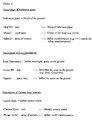
From the above consideration, it is necessary to predefine
for each of the contents to be searched the ground for
determining an object position which is called reference
plane and described as follows by using "zone description"
and a "camera model."
This description method allows effective description for
the contents to which a geometrical relationship among
objects is important.
Descriptions of reference plane, zone description and
camera spec. are shown in attached Table 1. However, the
description of camera spec. is not essential to the
present invention but optional.
Next, representation method for each object is explained.
An object moves on reference plane and performs meaningful
behavior/actions in it.
For the contents in which behavior of an object may be a
major factor in hitting the search, specifically the
following description method is very effective.
A representation unit of an object is decomposed on the
basis of behavior, and initiating and terminating frames
representing its behavioral section and a trajectory
between them are described so as to reproduce an object
position in an arbitrary frame.
While nothing represented changes in shape of each object
in the background art, the present invention allows
meaning of an object of a description unit to be preserved
by giving meaning to changes in shape as behavior of an
object due to such changes in shape.
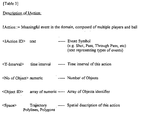
This description is represented as Action (or described as
Act) shown in attached Table 2.
An example of description using this Action is as follows.
Act("Kick", 10(frame), 240(frame), 3, 3, (120, 180, 0)
(150, 195, 180) (180, 223, 230))
By this description of Action, a representation of "An
object (who) did the behavior indicated by action ID
(what) on the space represented by a trajectory (where) in
a time interval (when)" becomes possible.
Here, collinear approximation is used as a method for
representing a trajectory. Data of a trajectory is
collinearly approximated, and the number of nodes,
approximated coordinates on reference plane of each node
and the time in Action are described. Consequently, if a
certain time is specified, coordinate value of an object
at the time can be uniquely determined.
Fig. 1 is a diagram conceptually representing description
based on reference plane and a behavioral section of an
object and description and data flow based on plural
objects in soccer contents.
First, a video object based on the region is cut from
video sequence, and lifetime of the object is acquired by
tracing each object in the direction of time (131). Next,
actions of the object are classified based on silhouette
of the object which represents changes in shape of each
object. Description of objects is performed for each of
these behavioral sections, which is Action description
(132).
At this time, spatial movement of the object is
represented as its trajectory by using reference plane.
Objects present in the entire frames of video have Action
description independently, and IAction (described later)
is defined from plural objects.
For simplicity, a trajectory in Act is described here
limiting it only to that of two points. In addition, a
trajectory of a ball is used as to spatial representation
of IAct (described later). And in this case, information
of a ball is described with a player's touch on a ball
(kicking or receiving a ball) as a unit, regarding a touch
between different players as a pass and a consecutive
touches by the same player as a dribble.
If Fig. 1 is seen further in detail, a region based on
color, texture and movement is cut from video sequence 101
and 102 (131). While this process is basically automated,
it is also possible to modify it in each field by a tool
for correcting regions extracted erroneously and oversplit
regions.
Hereafter, the split moving regions are handled as video
objects. Also, an object ID can be inserted at this time.
Tracing of a region between neighboring fields is
automatically determined by a size of the region where
split regions are overlapping. A ball, as a special
object, is not currently cut, and manual input is
performed with a tool for inputting a position of a ball
on an image. 111 in Fig. 1 shows a conceptual diagram of
the above data.
Next, a camera movement parameter is restored by tracing
in each field a corner or a feature region on a still
object in the background.
Position of a video object is represented on an image
plane, which requires correction according to movement of
a camera. Therefore, a virtual plane is assumed and the
video of which a movement parameter is restored is
projected on an image plane. Thus, data equivalent to
restoring an object position in video which is input from
a single camera is acquired. Moreover, since the camera
is set to have an angle of depression against the ground,
it can be handled not as a distance on an image plane but
as a real distance by projecting the object position on
the plane of the ground looked down on from the sky as
reference plane. This is represented in Space 123 in Fig.
1 as a conceptual diagram which is continuous with time.
While the cut object is a video changing shape over time,
in this example, a silhouette disregarding internal color
information is used in order to pay attention to changes
in shape. Since changes in silhouette show specific
changes according to actions, consecutive silhouettes of
plural pre-instructed action patterns are unfolded in
unique space so as to acquire changes unique to actions
from high order eigenvalue.
Next, when input patterns are unfolded in the same unique
space, the movement patterns are identified by seeking
which instructed patterns they are closest to. This
process requires a changing point in actions in a series
of object actions to be acquired. While it is possible to
acquire the changing point from the unique space, it is
currently entered manually.
A series of objects can be described by plural actions,
and just by entering an action ID and a frame number at a
changing point in actions, it can be interpreted that all
the objects in between were performing the same movements.
As above, while the data transformation described in Fig.
1 has processing which partly needs manual input support,
it is possible to generate data in a process which is
expected to be automated in the future.
Fig. 2 is a diagram showing in detail the same drawing as
TIME (124) in Fig. 1, but the subject video data is
different.
An object is described making the changing points of time
of silhouettes 201 and 202 in Fig. 2 boundaries of
description with an identified action ID as a minimum
unit. The time intervals and object positions at the
start/end of an action ID are described. Also, in order
to trace an object trajectory, positions at plural points
in a time interval are described. Accordingly, object
positions can be approximated in all the frames.
200 in Fig. 2 is a conceptual diagram of objects according
to the time intervals where Objs. 1-6 (203-208) represent
the players, (A) and (B) represent the teams, and Obj. X
(209) represents the ball.
For instance, Obj. 2 (A) is a player of team A and it runs
during time interval 214, stays in time interval 224,
kicks a ball in time interval 234, runs in time interval
244, kicks a ball in time interval 254, and runs in time
interval 264. These actions are recorded with starting
time, ending time and an object position (Px).
Fig. 3 shows movement of major players in the soccer scene
for about 20 seconds in a solid line and movement of a
ball in a dotted line. While Fig. 3 is a diagram showing
in detail the same drawing as Space (123) in Fig. 1, but
the subject video data is different.
These are the cases where the objects were extracted from
the actual soccer scene and then the movement of each
object on the field was reproduced by automatically
extracting movement parameters of the camera. In the case
of Fig. 3, a soccer field is set as reference plane.
The ball object (dotted line) is kicked first from
position 312 and reaches position 314 near goal 340 after
being kicked several times.
It shows that a player (solid line) has moved from
position 322 to position 324 and another player has
started from position 312 and moved to position 314.
In this way, a trajectory of each object in the video data
on reference plane can be traced.
Next, while in general, plural objects simultaneously
exist in an image and have different lifetimes and
meanings respectively, it becomes possible to give meaning
to a scene consisting of behavior of plural objects.
This is described as Interactive Action (IAction).
IAction (or described as IAct) is totally dependent on
contents, and a different definition for each content or
for each video database administrator may be used.
However, in order to facilitate consistency of description
of IAction and its application to a search engine, it is
prescribed in this specification that IAction is defined
by logical operation with another IAction and plural
Actions.
Description of IAction is shown in attached Table 3.
An example of description using this IAction is as
follows.
IAct("Pass", 20(frame), 35(frame), 2, 1, 2, Trajectory, 2,
(120, 180, 0) (160, 230, 15))
The above description of IAction is a description of
"when, where, who did what." The differences from the
above Action are that its subject is plural objects and
that the location is specified in a voluntary manner.
In the example of soccer mentioned later, a trajectory of
a ball is used as spatial representation of an event.
As an example, descriptions of a "Pass" to which meaning
is given by two objects and a "Through Pass" represented
by AND of other objects are explained.
Here, it is assumed that the database described by the
above Act and IAct actually exists. It is defined for
convenience' sake that a through pass is "a pass made
between players A and B, and the ball went through between
players C and D of the defense side who were there at the
time the pass was made."
In the present invention, it is defined as to determine
the following. 1. There was an IAct ("pass") between
certain two players. 2. There were two other players of
the defense side in that time interval (there are two Acts
sharing a time interval with 1, and the object which
performed the two Acts belongs to a different team from
the objects of 1). 3. The trajectory of the pass went
through between the two players (in the shared time
interval, the trajectory of the ball intersects the line
linking the two players of the defense side).
Here, the IAct statement is described in attached Table 4.
An example of definition of an IAct through pass is shown
in attached Table 5.
As an example of application of the present invention,
description in a soccer game is shown. In soccer, a type
of play defined from a single object and a type of actions
defined by relationship of plural objects are used as
description items. Moreover, in soccer, description of a
ball object is used as a special object.
Description of a ball itself can be represented likewise,
namely an action ID is omitted in the Action description
of the above object and the object ID is a ball.
The following description defines IAction in soccer
contents, and description using Action and IAction is also
possible to other contents.
It can be considered a useful description method for the
contents such as the present invention in which
representation of behavior of an object and positional
relationship on reference plane is effective, since there
are a number of examples of application such as sports
other than soccer, measurement of traffic and video
surveillance, etc.
Claims (9)
- A description means for contents of motion picture, said means comprising of:(a) means for setting reference plane;(b) means for describing each object on said motion picture by position on said reference plane and predefined type of actions; and(c) means for describing each scene by using said means for describing each object.
- A search means for contents of motion picture, said means comprising of:(a) means for setting reference plane;(b) means for describing each object on said motion picture by position on said reference plane and predefined type of actions;(c) means for describing each scene by using said means for describing each object; and(d) means for searching motion picture by using said means for describing each object or said means for describing each scene.
- A description method for motion picture, said method comprising the steps of:(a) determining reference plane which represents information of object positions included in said motion picture;(b) representing changes over time of each object on said reference plane as a trajectory;(c) setting a description unit based on predefined type of actions of each object by using changes in shape of each object so as to assign actions of each object as each behavioral section; and(d) defining each scene by plural objects.
- A search method for motion picture, said method comprising the steps of:(a) setting reference plane which represents information of object positions included in said motion picture;(b) representing changes over time of each object on said reference plane as a trajectory;(c) setting a description unit based on predefined type of actions of each object by using changes in shape of each object so as to assign actions of each object as each behavioral section;(d) defining each scene by plural objects; and(e) searching a specific scene by using said actions of each object or said scene.
- A description method for motion picture, said method comprising the steps of:(a) determining reference plane from said motion picture;(b) cutting a region map, an object trajectory ID, an action ID and a camera parameter from said motion picture;(c) creating description of actions by each object from said region map, said object trajectory ID, said action ID and said camera parameter; and(d) creating description of scenes by using said description of actions by each object.
- A description method for motion picture, said method comprising the steps of:(a) determining reference plane from said motion picture;(b) cutting a region map, an object trajectory ID, an action ID and a camera parameter from said motion picture;(c) creating description of actions by each object from said region map, said object trajectory ID, said action ID and said camera parameter; and(d) creating description of scenes by using said description of actions by each object.
- A description method for motion picture, said method comprising the steps of:(a) cutting a region map, an object trajectory ID, an action ID and a camera parameter from said motion picture;(b) creating description of actions by each object from said region map, said object trajectory ID, said action ID and said camera parameter; and(c) creating description of scenes by using said description of actions by each object.
- A computer readable storage medium which has recorded management data for searching motion picture, said management data comprising of:(a) data of description of actions by each object defined by position on reference plane and predefined type of actions; and(b) data of description of scenes defined by said data of description of actions.
- A computer readable storage medium which has recorded a program, said program having a computer execute the steps of:(a) determining reference plane which represents information of object positions included in said motion picture;(b) representing changes over time of each object on said reference plane as a trajectory;(c) setting a description unit based on predefined type of actions of each object by using changes in shape of each object so as to assign actions of each object as each behavioral section; and(d) defining each scene by plural objects.
Applications Claiming Priority (3)
| Application Number | Priority Date | Filing Date | Title |
|---|---|---|---|
| JP1655499 | 1999-01-26 | ||
| JP1655499 | 1999-01-26 | ||
| PCT/JP2000/000269 WO2000045335A1 (en) | 1999-01-26 | 2000-01-20 | Method and device for describing video contents |
Publications (2)
| Publication Number | Publication Date |
|---|---|
| EP1164542A1 true EP1164542A1 (en) | 2001-12-19 |
| EP1164542A4 EP1164542A4 (en) | 2007-05-02 |
Family
ID=11919508
Family Applications (1)
| Application Number | Title | Priority Date | Filing Date |
|---|---|---|---|
| EP00900849A Withdrawn EP1164542A4 (en) | 1999-01-26 | 2000-01-20 | Method and device for describing video contents |
Country Status (8)
| Country | Link |
|---|---|
| US (1) | US7199798B1 (en) |
| EP (1) | EP1164542A4 (en) |
| CN (1) | CN1338089A (en) |
| CZ (1) | CZ20012674A3 (en) |
| IL (1) | IL144197A0 (en) |
| MY (1) | MY130843A (en) |
| TW (1) | TW452748B (en) |
| WO (1) | WO2000045335A1 (en) |
Cited By (5)
| Publication number | Priority date | Publication date | Assignee | Title |
|---|---|---|---|---|
| EP2034441A1 (en) * | 2007-09-05 | 2009-03-11 | Sony Corporation | System and method for communicating a representation of a scene |
| EP2137669A1 (en) * | 2007-04-13 | 2009-12-30 | Atg Advanced U.S. Technology Group, Inc. | Method for recognizing content in an image sequence |
| EP2149883A1 (en) * | 2008-08-01 | 2010-02-03 | Sony Corporation | Method and apparatus for generating an event log |
| WO2019143984A1 (en) * | 2018-01-22 | 2019-07-25 | Dakiana Research Llc | Method and device for generating a synthesized reality reconstruction of flat video content |
| US12620177B2 (en) | 2018-01-22 | 2026-05-05 | Apple Inc. | Method and device for generating a synthesized reality reconstruction of flat video content |
Families Citing this family (92)
| Publication number | Priority date | Publication date | Assignee | Title |
|---|---|---|---|---|
| US6236395B1 (en) * | 1999-02-01 | 2001-05-22 | Sharp Laboratories Of America, Inc. | Audiovisual information management system |
| US7424677B2 (en) | 1999-09-16 | 2008-09-09 | Sharp Laboratories Of America, Inc. | Audiovisual information management system with usage preferences |
| JP3810268B2 (en) * | 2000-04-07 | 2006-08-16 | シャープ株式会社 | Audio visual system |
| US8028314B1 (en) | 2000-05-26 | 2011-09-27 | Sharp Laboratories Of America, Inc. | Audiovisual information management system |
| JP3692500B2 (en) | 2000-09-12 | 2005-09-07 | インターナショナル・ビジネス・マシーンズ・コーポレーション | Image processing method, image processing system, and recording medium |
| US8020183B2 (en) | 2000-09-14 | 2011-09-13 | Sharp Laboratories Of America, Inc. | Audiovisual management system |
| US20030038796A1 (en) * | 2001-02-15 | 2003-02-27 | Van Beek Petrus J.L. | Segmentation metadata for audio-visual content |
| US7904814B2 (en) | 2001-04-19 | 2011-03-08 | Sharp Laboratories Of America, Inc. | System for presenting audio-video content |
| US20030206710A1 (en) * | 2001-09-14 | 2003-11-06 | Ferman Ahmet Mufit | Audiovisual management system |
| US7474698B2 (en) | 2001-10-19 | 2009-01-06 | Sharp Laboratories Of America, Inc. | Identification of replay segments |
| US8214741B2 (en) | 2002-03-19 | 2012-07-03 | Sharp Laboratories Of America, Inc. | Synchronization of video and data |
| FR2842979B1 (en) | 2002-07-24 | 2004-10-08 | Thomson Licensing Sa | METHOD AND DEVICE FOR PROCESSING DIGITAL DATA |
| US7006945B2 (en) * | 2003-01-10 | 2006-02-28 | Sharp Laboratories Of America, Inc. | Processing of video content |
| US20040197088A1 (en) * | 2003-03-31 | 2004-10-07 | Ferman Ahmet Mufit | System for presenting audio-video content |
| US8356317B2 (en) * | 2004-03-04 | 2013-01-15 | Sharp Laboratories Of America, Inc. | Presence based technology |
| US8949899B2 (en) | 2005-03-04 | 2015-02-03 | Sharp Laboratories Of America, Inc. | Collaborative recommendation system |
| JP4088274B2 (en) * | 2004-06-28 | 2008-05-21 | 株式会社東芝 | Metadata structure and editing method |
| US10949773B2 (en) | 2005-10-26 | 2021-03-16 | Cortica, Ltd. | System and methods thereof for recommending tags for multimedia content elements based on context |
| US8818916B2 (en) | 2005-10-26 | 2014-08-26 | Cortica, Ltd. | System and method for linking multimedia data elements to web pages |
| US11032017B2 (en) | 2005-10-26 | 2021-06-08 | Cortica, Ltd. | System and method for identifying the context of multimedia content elements |
| US9191626B2 (en) | 2005-10-26 | 2015-11-17 | Cortica, Ltd. | System and methods thereof for visual analysis of an image on a web-page and matching an advertisement thereto |
| US9384196B2 (en) | 2005-10-26 | 2016-07-05 | Cortica, Ltd. | Signature generation for multimedia deep-content-classification by a large-scale matching system and method thereof |
| US9767143B2 (en) | 2005-10-26 | 2017-09-19 | Cortica, Ltd. | System and method for caching of concept structures |
| US10380623B2 (en) | 2005-10-26 | 2019-08-13 | Cortica, Ltd. | System and method for generating an advertisement effectiveness performance score |
| US9529984B2 (en) | 2005-10-26 | 2016-12-27 | Cortica, Ltd. | System and method for verification of user identification based on multimedia content elements |
| US9477658B2 (en) | 2005-10-26 | 2016-10-25 | Cortica, Ltd. | Systems and method for speech to speech translation using cores of a natural liquid architecture system |
| US8266185B2 (en) | 2005-10-26 | 2012-09-11 | Cortica Ltd. | System and methods thereof for generation of searchable structures respective of multimedia data content |
| US10691642B2 (en) | 2005-10-26 | 2020-06-23 | Cortica Ltd | System and method for enriching a concept database with homogenous concepts |
| US9639532B2 (en) | 2005-10-26 | 2017-05-02 | Cortica, Ltd. | Context-based analysis of multimedia content items using signatures of multimedia elements and matching concepts |
| US11019161B2 (en) | 2005-10-26 | 2021-05-25 | Cortica, Ltd. | System and method for profiling users interest based on multimedia content analysis |
| US10635640B2 (en) | 2005-10-26 | 2020-04-28 | Cortica, Ltd. | System and method for enriching a concept database |
| US9372940B2 (en) | 2005-10-26 | 2016-06-21 | Cortica, Ltd. | Apparatus and method for determining user attention using a deep-content-classification (DCC) system |
| US10621988B2 (en) | 2005-10-26 | 2020-04-14 | Cortica Ltd | System and method for speech to text translation using cores of a natural liquid architecture system |
| US9466068B2 (en) | 2005-10-26 | 2016-10-11 | Cortica, Ltd. | System and method for determining a pupillary response to a multimedia data element |
| US10614626B2 (en) | 2005-10-26 | 2020-04-07 | Cortica Ltd. | System and method for providing augmented reality challenges |
| US9489431B2 (en) | 2005-10-26 | 2016-11-08 | Cortica, Ltd. | System and method for distributed search-by-content |
| US11216498B2 (en) | 2005-10-26 | 2022-01-04 | Cortica, Ltd. | System and method for generating signatures to three-dimensional multimedia data elements |
| US9558449B2 (en) | 2005-10-26 | 2017-01-31 | Cortica, Ltd. | System and method for identifying a target area in a multimedia content element |
| US10191976B2 (en) | 2005-10-26 | 2019-01-29 | Cortica, Ltd. | System and method of detecting common patterns within unstructured data elements retrieved from big data sources |
| US9218606B2 (en) | 2005-10-26 | 2015-12-22 | Cortica, Ltd. | System and method for brand monitoring and trend analysis based on deep-content-classification |
| US10698939B2 (en) | 2005-10-26 | 2020-06-30 | Cortica Ltd | System and method for customizing images |
| US8326775B2 (en) | 2005-10-26 | 2012-12-04 | Cortica Ltd. | Signature generation for multimedia deep-content-classification by a large-scale matching system and method thereof |
| US11403336B2 (en) | 2005-10-26 | 2022-08-02 | Cortica Ltd. | System and method for removing contextually identical multimedia content elements |
| US10742340B2 (en) | 2005-10-26 | 2020-08-11 | Cortica Ltd. | System and method for identifying the context of multimedia content elements displayed in a web-page and providing contextual filters respective thereto |
| US11361014B2 (en) | 2005-10-26 | 2022-06-14 | Cortica Ltd. | System and method for completing a user profile |
| US9646005B2 (en) | 2005-10-26 | 2017-05-09 | Cortica, Ltd. | System and method for creating a database of multimedia content elements assigned to users |
| US10848590B2 (en) | 2005-10-26 | 2020-11-24 | Cortica Ltd | System and method for determining a contextual insight and providing recommendations based thereon |
| US11003706B2 (en) | 2005-10-26 | 2021-05-11 | Cortica Ltd | System and methods for determining access permissions on personalized clusters of multimedia content elements |
| US10193990B2 (en) | 2005-10-26 | 2019-01-29 | Cortica Ltd. | System and method for creating user profiles based on multimedia content |
| US10372746B2 (en) | 2005-10-26 | 2019-08-06 | Cortica, Ltd. | System and method for searching applications using multimedia content elements |
| US10776585B2 (en) | 2005-10-26 | 2020-09-15 | Cortica, Ltd. | System and method for recognizing characters in multimedia content |
| US10535192B2 (en) | 2005-10-26 | 2020-01-14 | Cortica Ltd. | System and method for generating a customized augmented reality environment to a user |
| US11386139B2 (en) | 2005-10-26 | 2022-07-12 | Cortica Ltd. | System and method for generating analytics for entities depicted in multimedia content |
| US10585934B2 (en) | 2005-10-26 | 2020-03-10 | Cortica Ltd. | Method and system for populating a concept database with respect to user identifiers |
| US10380267B2 (en) | 2005-10-26 | 2019-08-13 | Cortica, Ltd. | System and method for tagging multimedia content elements |
| US10360253B2 (en) | 2005-10-26 | 2019-07-23 | Cortica, Ltd. | Systems and methods for generation of searchable structures respective of multimedia data content |
| US10180942B2 (en) | 2005-10-26 | 2019-01-15 | Cortica Ltd. | System and method for generation of concept structures based on sub-concepts |
| US8312031B2 (en) | 2005-10-26 | 2012-11-13 | Cortica Ltd. | System and method for generation of complex signatures for multimedia data content |
| US10607355B2 (en) | 2005-10-26 | 2020-03-31 | Cortica, Ltd. | Method and system for determining the dimensions of an object shown in a multimedia content item |
| US10387914B2 (en) | 2005-10-26 | 2019-08-20 | Cortica, Ltd. | Method for identification of multimedia content elements and adding advertising content respective thereof |
| US11620327B2 (en) | 2005-10-26 | 2023-04-04 | Cortica Ltd | System and method for determining a contextual insight and generating an interface with recommendations based thereon |
| US9747420B2 (en) | 2005-10-26 | 2017-08-29 | Cortica, Ltd. | System and method for diagnosing a patient based on an analysis of multimedia content |
| US9953032B2 (en) * | 2005-10-26 | 2018-04-24 | Cortica, Ltd. | System and method for characterization of multimedia content signals using cores of a natural liquid architecture system |
| US9031999B2 (en) | 2005-10-26 | 2015-05-12 | Cortica, Ltd. | System and methods for generation of a concept based database |
| US10380164B2 (en) | 2005-10-26 | 2019-08-13 | Cortica, Ltd. | System and method for using on-image gestures and multimedia content elements as search queries |
| US11604847B2 (en) | 2005-10-26 | 2023-03-14 | Cortica Ltd. | System and method for overlaying content on a multimedia content element based on user interest |
| US8689253B2 (en) | 2006-03-03 | 2014-04-01 | Sharp Laboratories Of America, Inc. | Method and system for configuring media-playing sets |
| US10733326B2 (en) | 2006-10-26 | 2020-08-04 | Cortica Ltd. | System and method for identification of inappropriate multimedia content |
| CN100444202C (en) * | 2007-01-24 | 2008-12-17 | 杭州电子科技大学 | Control Method of Motion Trajectory of Animation Object Based on Chaos Theory |
| US9047374B2 (en) * | 2007-06-08 | 2015-06-02 | Apple Inc. | Assembling video content |
| CN102708215B (en) * | 2007-12-18 | 2015-01-07 | 孟智平 | Method and system for processing video |
| US20100150447A1 (en) * | 2008-12-12 | 2010-06-17 | Honeywell International Inc. | Description based video searching system and method |
| CN102473291B (en) | 2009-07-20 | 2014-08-20 | 汤姆森特许公司 | Method for detecting and adapting video processing for far-view scenes in sports video |
| US20110021280A1 (en) * | 2009-07-27 | 2011-01-27 | Vladimir Boroda | Hitting technique by identifying ball impact points |
| US20130335635A1 (en) * | 2012-03-22 | 2013-12-19 | Bernard Ghanem | Video Analysis Based on Sparse Registration and Multiple Domain Tracking |
| US9213781B1 (en) | 2012-09-19 | 2015-12-15 | Placemeter LLC | System and method for processing image data |
| US9361714B2 (en) | 2013-08-05 | 2016-06-07 | Globalfoundries Inc. | Enhanced video description |
| US9652534B1 (en) * | 2014-03-26 | 2017-05-16 | Amazon Technologies, Inc. | Video-based search engine |
| US10432896B2 (en) | 2014-05-30 | 2019-10-01 | Placemeter Inc. | System and method for activity monitoring using video data |
| CN104318596B (en) * | 2014-10-08 | 2017-10-20 | 北京搜狗科技发展有限公司 | The generation method and generating means of a kind of dynamic picture |
| US9710716B2 (en) * | 2014-12-16 | 2017-07-18 | Sighthound, Inc. | Computer vision pipeline and methods for detection of specified moving objects |
| US10104345B2 (en) | 2014-12-16 | 2018-10-16 | Sighthound, Inc. | Data-enhanced video viewing system and methods for computer vision processing |
| US10043078B2 (en) | 2015-04-21 | 2018-08-07 | Placemeter LLC | Virtual turnstile system and method |
| US11334751B2 (en) | 2015-04-21 | 2022-05-17 | Placemeter Inc. | Systems and methods for processing video data for activity monitoring |
| WO2016171878A1 (en) * | 2015-04-21 | 2016-10-27 | Placemeter, Inc. | Virtual turnstile counter system and method |
| GB201512283D0 (en) | 2015-07-14 | 2015-08-19 | Apical Ltd | Track behaviour events |
| US10002313B2 (en) | 2015-12-15 | 2018-06-19 | Sighthound, Inc. | Deeply learned convolutional neural networks (CNNS) for object localization and classification |
| US11100335B2 (en) | 2016-03-23 | 2021-08-24 | Placemeter, Inc. | Method for queue time estimation |
| US10679669B2 (en) * | 2017-01-18 | 2020-06-09 | Microsoft Technology Licensing, Llc | Automatic narration of signal segment |
| CN107025275B (en) * | 2017-03-21 | 2019-11-15 | 腾讯科技(深圳)有限公司 | Video search method and device |
| CN110175263A (en) * | 2019-04-08 | 2019-08-27 | 浙江大华技术股份有限公司 | A kind of method of positioning video frame, the method and terminal device for saving video |
| US11504619B1 (en) * | 2021-08-24 | 2022-11-22 | Electronic Arts Inc. | Interactive reenactment within a video game |
Family Cites Families (7)
| Publication number | Priority date | Publication date | Assignee | Title |
|---|---|---|---|---|
| US5969755A (en) * | 1996-02-05 | 1999-10-19 | Texas Instruments Incorporated | Motion based event detection system and method |
| US6280323B1 (en) * | 1996-11-21 | 2001-08-28 | Konami Co., Ltd. | Device, method and storage medium for displaying penalty kick match cursors in a video soccer game |
| CN1188193C (en) * | 1997-02-18 | 2005-02-09 | 世嘉股份有限公司 | Image processing device and image processing method |
| US6741655B1 (en) * | 1997-05-05 | 2004-05-25 | The Trustees Of Columbia University In The City Of New York | Algorithms and system for object-oriented content-based video search |
| EP1008064A4 (en) * | 1997-05-05 | 2002-04-17 | Univ Columbia | Algorithms and system for object-oriented content-based video search |
| US6741725B2 (en) * | 1999-05-26 | 2004-05-25 | Princeton Video Image, Inc. | Motion tracking using image-texture templates |
| US6665423B1 (en) * | 2000-01-27 | 2003-12-16 | Eastman Kodak Company | Method and system for object-oriented motion-based video description |
-
1999
- 1999-11-23 TW TW088120475A patent/TW452748B/en not_active IP Right Cessation
- 1999-12-16 MY MYPI99005509A patent/MY130843A/en unknown
-
2000
- 2000-01-20 EP EP00900849A patent/EP1164542A4/en not_active Withdrawn
- 2000-01-20 IL IL14419700A patent/IL144197A0/en unknown
- 2000-01-20 CN CN00803115A patent/CN1338089A/en active Pending
- 2000-01-20 CZ CZ20012674A patent/CZ20012674A3/en unknown
- 2000-01-20 WO PCT/JP2000/000269 patent/WO2000045335A1/en not_active Ceased
- 2000-01-20 US US09/890,168 patent/US7199798B1/en not_active Expired - Fee Related
Cited By (9)
| Publication number | Priority date | Publication date | Assignee | Title |
|---|---|---|---|---|
| EP2137669A1 (en) * | 2007-04-13 | 2009-12-30 | Atg Advanced U.S. Technology Group, Inc. | Method for recognizing content in an image sequence |
| EP2034441A1 (en) * | 2007-09-05 | 2009-03-11 | Sony Corporation | System and method for communicating a representation of a scene |
| US8355532B2 (en) | 2007-09-05 | 2013-01-15 | Sony Corporation | System for communicating and method |
| EP2149883A1 (en) * | 2008-08-01 | 2010-02-03 | Sony Corporation | Method and apparatus for generating an event log |
| US8547431B2 (en) | 2008-08-01 | 2013-10-01 | Sony Corporation | Method and apparatus for generating an event log |
| WO2019143984A1 (en) * | 2018-01-22 | 2019-07-25 | Dakiana Research Llc | Method and device for generating a synthesized reality reconstruction of flat video content |
| US11386653B2 (en) | 2018-01-22 | 2022-07-12 | Apple Inc. | Method and device for generating a synthesized reality reconstruction of flat video content |
| EP4462796A1 (en) * | 2018-01-22 | 2024-11-13 | Apple Inc. | Method and device for generating a synthesized reality reconstruction of flat video content |
| US12620177B2 (en) | 2018-01-22 | 2026-05-05 | Apple Inc. | Method and device for generating a synthesized reality reconstruction of flat video content |
Also Published As
| Publication number | Publication date |
|---|---|
| WO2000045335A1 (en) | 2000-08-03 |
| MY130843A (en) | 2007-07-31 |
| CN1338089A (en) | 2002-02-27 |
| EP1164542A4 (en) | 2007-05-02 |
| US7199798B1 (en) | 2007-04-03 |
| IL144197A0 (en) | 2002-05-23 |
| TW452748B (en) | 2001-09-01 |
| CZ20012674A3 (en) | 2001-11-14 |
Similar Documents
| Publication | Publication Date | Title |
|---|---|---|
| US7199798B1 (en) | Method and device for describing video contents | |
| Gong et al. | Automatic parsing of TV soccer programs | |
| CN106464958B (en) | System and method for performing spatiotemporal analysis of sporting events | |
| US7203693B2 (en) | Instantly indexed databases for multimedia content analysis and retrieval | |
| US10755102B2 (en) | Methods and systems of spatiotemporal pattern recognition for video content development | |
| Chen et al. | Ball tracking and 3D trajectory approximation with applications to tactics analysis from single-camera volleyball sequences | |
| Pingali et al. | Ball tracking and virtual replays for innovative tennis broadcasts | |
| Pingali et al. | Instantly indexed multimedia databases of real world events | |
| Zhong et al. | Spatio-temporal video search using the object based video representation | |
| Yu et al. | Comprehensive dataset of broadcast soccer videos | |
| JPH05108730A (en) | Search of moving image database | |
| Oskouie et al. | Multimodal feature extraction and fusion for semantic mining of soccer video: a survey | |
| CN101639354A (en) | Method and apparatus for object tracking | |
| Chang et al. | A video information system for sport motion analysis | |
| Lazarescu et al. | Using camera motion to identify different types of american football plays | |
| KR101500831B1 (en) | Method and apparatus for searching and sharing motion data using similarity of articulation | |
| Careelmont | Badminton shot classification in compressed video with baseline angled camera | |
| Kurokawa et al. | Representation and retrieval of video scene by using object actions and their spatio-temporal relationships | |
| Martín et al. | Automatic players detection and tracking in multi-camera tennis videos | |
| Ainasoja et al. | Keyframe-based Video Summarization with Human in the Loop. | |
| Ruiz-del-Solar et al. | An automated refereeing and analysis tool for the Four-Legged League | |
| Şaykol | Web-based user interface for query specification in a video database system | |
| JPWO2000045335A1 (en) | Video content description method and device | |
| Zhuang | Sports video structure analysis and feature extraction in long jump video | |
| Ekin et al. | Automatic extraction of low-level object motion descriptors |
Legal Events
| Date | Code | Title | Description |
|---|---|---|---|
| PUAI | Public reference made under article 153(3) epc to a published international application that has entered the european phase |
Free format text: ORIGINAL CODE: 0009012 |
|
| 17P | Request for examination filed |
Effective date: 20010810 |
|
| AK | Designated contracting states |
Kind code of ref document: A1 Designated state(s): AT BE CH CY DE DK ES FI FR GB GR IE IT LI LU MC NL PT SE |
|
| A4 | Supplementary search report drawn up and despatched |
Effective date: 20070404 |
|
| 17Q | First examination report despatched |
Effective date: 20070717 |
|
| STAA | Information on the status of an ep patent application or granted ep patent |
Free format text: STATUS: THE APPLICATION IS DEEMED TO BE WITHDRAWN |
|
| 18D | Application deemed to be withdrawn |
Effective date: 20071128 |