EP1164510A2 - Virtual join index for relational databases - Google Patents
Virtual join index for relational databases Download PDFInfo
- Publication number
- EP1164510A2 EP1164510A2 EP01304928A EP01304928A EP1164510A2 EP 1164510 A2 EP1164510 A2 EP 1164510A2 EP 01304928 A EP01304928 A EP 01304928A EP 01304928 A EP01304928 A EP 01304928A EP 1164510 A2 EP1164510 A2 EP 1164510A2
- Authority
- EP
- European Patent Office
- Prior art keywords
- unique secondary
- covering non
- secondary indexes
- join index
- virtual
- Prior art date
- Legal status (The legal status is an assumption and is not a legal conclusion. Google has not performed a legal analysis and makes no representation as to the accuracy of the status listed.)
- Withdrawn
Links
Images


Classifications
-
- G—PHYSICS
- G06—COMPUTING OR CALCULATING; COUNTING
- G06F—ELECTRIC DIGITAL DATA PROCESSING
- G06F16/00—Information retrieval; Database structures therefor; File system structures therefor
- G06F16/20—Information retrieval; Database structures therefor; File system structures therefor of structured data, e.g. relational data
- G06F16/24—Querying
- G06F16/245—Query processing
- G06F16/2455—Query execution
- G06F16/24553—Query execution of query operations
- G06F16/24561—Intermediate data storage techniques for performance improvement
-
- G—PHYSICS
- G06—COMPUTING OR CALCULATING; COUNTING
- G06F—ELECTRIC DIGITAL DATA PROCESSING
- G06F16/00—Information retrieval; Database structures therefor; File system structures therefor
- G06F16/20—Information retrieval; Database structures therefor; File system structures therefor of structured data, e.g. relational data
- G06F16/24—Querying
- G06F16/245—Query processing
- G06F16/2455—Query execution
- G06F16/24553—Query execution of query operations
- G06F16/24558—Binary matching operations
- G06F16/2456—Join operations
-
- Y—GENERAL TAGGING OF NEW TECHNOLOGICAL DEVELOPMENTS; GENERAL TAGGING OF CROSS-SECTIONAL TECHNOLOGIES SPANNING OVER SEVERAL SECTIONS OF THE IPC; TECHNICAL SUBJECTS COVERED BY FORMER USPC CROSS-REFERENCE ART COLLECTIONS [XRACs] AND DIGESTS
- Y10—TECHNICAL SUBJECTS COVERED BY FORMER USPC
- Y10S—TECHNICAL SUBJECTS COVERED BY FORMER USPC CROSS-REFERENCE ART COLLECTIONS [XRACs] AND DIGESTS
- Y10S707/00—Data processing: database and file management or data structures
- Y10S707/953—Organization of data
- Y10S707/954—Relational
-
- Y—GENERAL TAGGING OF NEW TECHNOLOGICAL DEVELOPMENTS; GENERAL TAGGING OF CROSS-SECTIONAL TECHNOLOGIES SPANNING OVER SEVERAL SECTIONS OF THE IPC; TECHNICAL SUBJECTS COVERED BY FORMER USPC CROSS-REFERENCE ART COLLECTIONS [XRACs] AND DIGESTS
- Y10—TECHNICAL SUBJECTS COVERED BY FORMER USPC
- Y10S—TECHNICAL SUBJECTS COVERED BY FORMER USPC CROSS-REFERENCE ART COLLECTIONS [XRACs] AND DIGESTS
- Y10S707/00—Data processing: database and file management or data structures
- Y10S707/99931—Database or file accessing
- Y10S707/99932—Access augmentation or optimizing
Definitions
- This invention relates in general to computerized relational databases, and in particular, to a virtual join index and associated covering non-unique secondary indexes.
- RDBMS Relational DataBase Management Systems
- SQL Structured Query Language
- ANSI American National Standards Institute
- ISO International Standards Organization
- a table in a relational database is two dimensional, consisting of rows and columns. Each column has a name, typically describing the type of data held in that column. As new data is added, more rows are inserted into the table.
- a user query selects some rows of the table by specifying clauses that qualify the rows to be retrieved based on the values in one or more of the columns.
- the SQL interface allows users to formulate relational operations on the tables either interactively, in batch files, or embedded in host languages such as C, COBOL, etc. Operators are provided in SQL that allow the user to manipulate the data, wherein each operator performs functions on one or more tables and produces a new table as a result.
- the power of SQL lies on its ability to link information from multiple tables or views together to perform complex sets of procedures with a single statement.
- the SQL interface allows users to formulate relational operations on the tables.
- One of the most common SQL queries executed by the RDBMS is the SELECT statement.
- the SELECT statement generally comprises the format: "SELECT ⁇ clause> FROM ⁇ clause> WHERE ⁇ clause> GROUP BY ⁇ clause> HAVING ⁇ clause> ORDER BY ⁇ clause>.”
- the clauses generally must follow this sequence, but only the SELECT and FROM clauses are required.
- the result of a SELECT statement is a subset of data retrieved by the RDBMS from one or more existing tables stored in the relational database, wherein the FROM clause identifies the name of the table or tables from which data is being selected.
- the subset of data is treated as a new table, termed the result table.
- join operation is usually implied by naming more than one table in the FROM clause of a SELECT statement.
- a join operation makes it possible to combine tables by combining rows from one table with another table.
- the rows, or portions of rows, from the different tables are concatenated horizontally.
- join operations normally include a WHERE clause that identifies the columns through which the rows can be combined.
- the WHERE clause may also include a predicate comprising one or more conditional operators that are used to select the rows to be joined.
- join indexes have been used to improve the performance of join operations in an RDBMS. Moreover, techniques have been developed for maximizing performance using join indexes. However, there remains a need in the art for additional optimization techniques through the use of join indexes.
- the invention resides in a method of optimizing retrieval of data from a database in a computerized database management system, comprising creating a virtual join index for one or more tables in the database by combining one or more columns from the tables; and generating one or more covering non-unique secondary indexes for the virtual join index, wherein each of the covering non-unique secondary indexes combines one or more commonly-used columns of the virtual join index, and data is not stored in the virtual join index after the covering non-unique secondary indexes are generated.
- On receiving a query into a computer it may be processed by accessing one or more of the covering non-unique secondary indexes generated from a virtual join index.
- the invention resides in a computerized database management system, comprising means for creating a virtual join index for one or more tables in a database by combining one or more columns from the tables; and means for generating one or more covering non-unique secondary indexes for the virtual join index, wherein each of the covering non-unique secondary indexes combines one or more commonly-used columns of the virtual join index, and data is not stored in the virtual join index after the covering non-unique secondary indexes are generated.
- the system also comprises means for receiving a query and means for processing the query by accessing one or more of the covering non-unique secondary indexes generated from a virtual join index.
- At least a portion of a query may be resolved solely by accessing one or more of the covering non-unique secondary indexes which may be scanned to provide results for the query.
- the covering non-unique secondary indexes use a compressed format that reduces storage requirements and provides faster access to data stored therein.
- Each row of the non-unique secondary index contains a fixed part and a repeating part.
- the fixed part preferably comprises a fixed set of one or more columns while the repeating part preferably comprises a repeating set of one or more columns.
- the fixed part is preferably stored only once in each row, but the repeating part may be comprised of recursive levels within each row, so that each row may contain as many repeating parts as needed
- Each of the repeating parts may contain a fixed part and a repeating part.
- the virtual join index may be created by performing one or more join operations on the tables and the covering non-unique secondary indexes may be generated by performing one or more join operations on the virtual join index.
- the invention may also be expressed as a data structure stored in a memory for use by a database management system executed by a computer, the data structure comprising instructions for optimizing retrieval of data from the database which when executed cause the computer to perform the method described above.
- the invention also resides in a computer program comprising program instructions for optimizing retrieval of data from a database in a computerized database management system and in an article including one or more machine-readable storage media containing instructions for optimizing retrieval of data from a database in a computerized database management system, the instructions when executed causing the system to perform the method described above.
- a virtual join index is a join index with one or more covering non-unique secondary indexes (NUSIs), for which the data of the virtual join index is discarded and not maintained after the NUSIs are created.
- NUSIs covering non-unique secondary indexes
- the NUSIs may use a compressed format that reduces their storage requirements and provides faster access to the data therein.
- FIG. 1 illustrates an exemplary hardware and software environment that could be used with the preferred embodiment of the present invention.
- a computer system 100 is comprised of one or more processing units (PUs) 102, also known as processors or nodes, which are interconnected by a network 104.
- PUs processing units
- DSUs removable data storage units
- Each of the PUs 102 is coupled to zero or more fixed and/or removable data storage units (DSUs) 106, such as disk drives, that store one or more relational databases.
- DSUs fixed and/or removable data storage units
- DCUs data communications units
- Operators of the computer system 100 typically use a workstation 110, terminal, computer, or other input device to interact with the computer system 100.
- This interaction generally comprises queries that conform to the Structured Query Language (SQL) standard, and invoke functions performed by a Relational DataBase Management System (RDBMS) executed by the system 100.
- SQL Structured Query Language
- RDBMS Relational DataBase Management System
- the RDBMS comprises the Teradata® product offered by NCR Corporation, and includes one or more Parallel Database Extensions (PDEs) 112, Parsing Engines (PEs) 114, and Access Module Processors (AMPs) 116. These components of the RDBMS perform the functions necessary to implement the RDBMS and SQL standards, i.e., definition, compilation, interpretation, optimization, database access control, database retrieval, and database update.
- PDEs Parallel Database Extensions
- PEs Parsing Engines
- AMPs Access Module Processors
- a DSU 106 may store only a subset of rows that comprise a table in the partitioned database 118 and work is managed by the system 100 so that the task of operating on each subset of rows is performed by the AMP 116 managing the DSUs 106 that store the subset of rows.
- the PEs 114 handle communications, session control, optimization and query plan generation and control.
- the PEs 114 fully parallelize all functions among the AMPs 116.
- the system of FIG. 1 applies a multiple instruction stream, multiple data stream (MIMD) concurrent processing architecture to implement a relational database management system 100.
- MIMD multiple instruction stream, multiple data stream
- Both the PEs 114 and AMPs 116 are known as “virtual processors" or “vprocs”.
- the vproc concept is accomplished by executing multiple threads or processes in a PU 102, wherein each thread or process is encapsulated within a vproc.
- the vproc concept adds a level of abstraction between the multi-threading of a work unit and the physical layout of the parallel processing computer system 100.
- the vproc concept provides for intra-node as well as the inter-node parallelism.
- the vproc concept results in better system 100 availability without undue programming overhead.
- the vprocs also provide a degree of location transparency, in that vprocs communicate with each other using addresses that are vproc-specific, rather than node-specific. Further, vprocs facilitate redundancy by providing a level of isolation/abstraction between the physical node 102 and the thread or process. The result is increased system 100 utilization and fault tolerance.
- the system 100 does face the issue of how to divide a query or other unit of work into smaller sub-units, each of which can be assigned to an AMP 116.
- data partitioning and repartitioning may be performed, in order to enhance parallel processing across multiple AMPs 116.
- the data may be hash partitioned, range partitioned, or not partitioned at all (i.e., locally processed).
- Hash partitioning is a partitioning scheme in which a predefined hash function and map is used to assign records to AMPs 116, wherein the hashing function generates a hash "bucket" number and the hash bucket numbers are mapped to AMPs 116.
- Range partitioning is a partitioning scheme in which each AMP 116 manages the records falling within a range of values, wherein the entire data set is divided into as many ranges as there are AMPs 116. No partitioning means that a single AMP 116 manages all of the records.
- the PDEs 112, PEs 114, and AMPs 116 are tangibly embodied in and/or accessible from a device, media, carrier, or signal, such as RAM, ROM, one or more of the DSUs 106, and/or a remote system or device communicating with the computer system 100 via one or more of the DCUs 108.
- the PDEs 112, PEs 114, and AMPs 116 each comprise logic and/or data which, when executed, invoked, and/or interpreted by the PUs 102 of the computer system 100, cause the necessary steps or elements of the present invention to be performed.
- FIG. 1 is not intended to limit the present invention. Indeed, those skilled in the art will recognize that other alternative environments may be used without departing from the scope of the present invention. In addition, it should be understood that the present invention may also apply to components other than those disclosed herein.
- a standard join index is extended to new structures, known as a virtual join index and associated covering non-unique secondary indexes.
- the virtual join index stores the results from one or more join operations on one or more columns of one or more tables.
- the covering non-unique secondary indexes are generated by combining one or more commonly-used columns of the virtual join index. Data stored in the virtual join index is discarded and not maintained after the covering non-unique secondary indexes are generated The data stored in the covering non-unique secondary indexes can then be used to satisfy a subsequent query, rather than having to perform the join operations from columns of the tables referenced in the query.
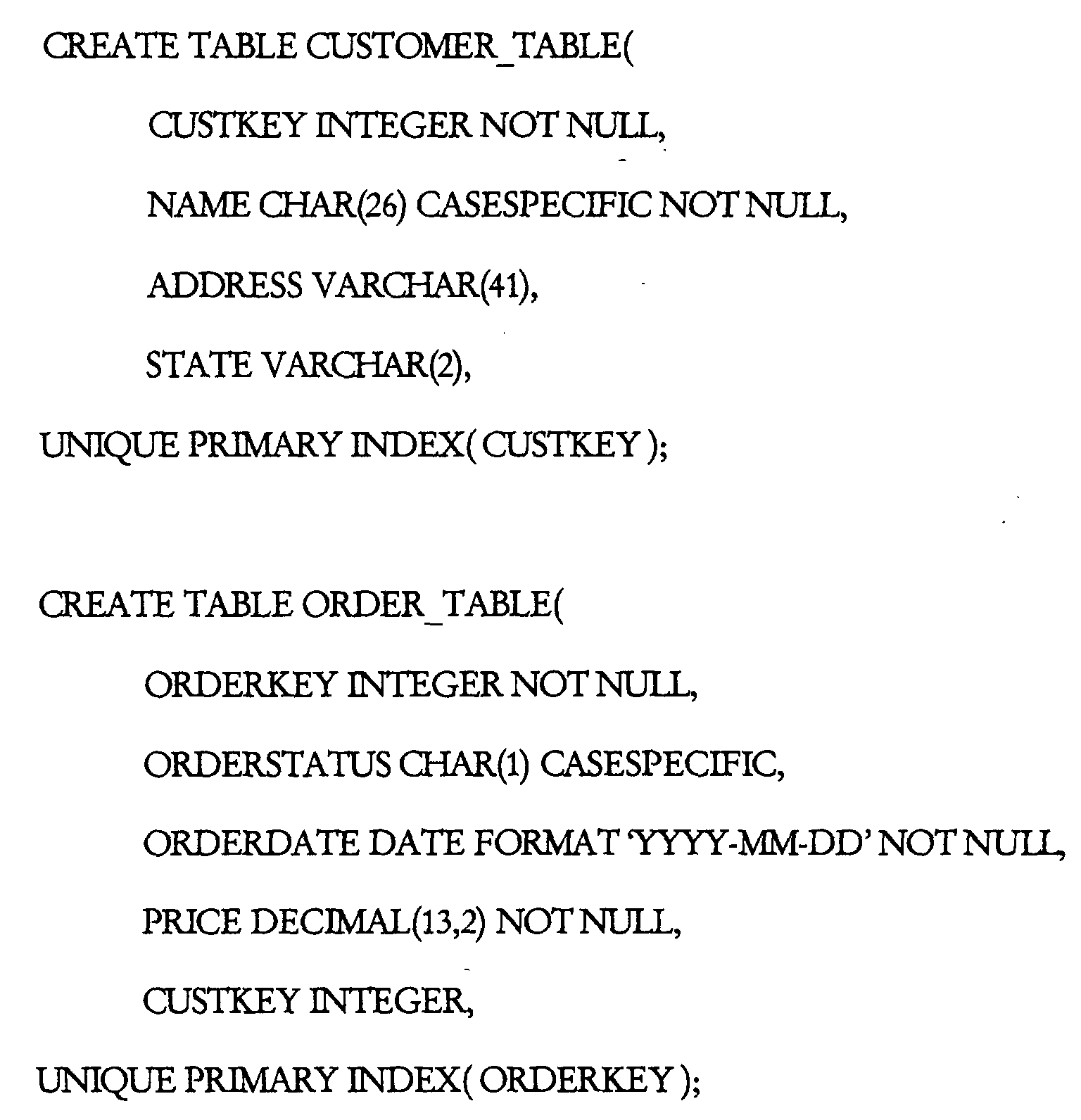
- FIG. 2A illustrates the structures of two base tables (CUSTOMER_TABLE 200 and ORDER_TABLE 202), a virtual join index (VIRTUAL_JOIN_INDEX 204), and two non-unique secondary indexes (NUSI1 206 and NUSI2 208).
- the base tables 200 and 202 are created using the following SQL statements:
- a simple query comprising a SELECT statement can be defined on the base tables 200 and 202, wherein the query performs a join operation:
- a typical execution plan for this query would involve redistributing ORDER_TABLE 202 into a spool file, sorting the spool file on CUSTKEY, and then performing a merge join between the spool file and the CUSTOMER_TABLE 200.
- a virtual join index 204 as well as two NUSIs 206 and 208, can be defined as follows:
- the NUSIs 206 and 208 are maintained as separate subtables. Each entry in the NUSIs 206 and 208 includes the specified column values, as well as row identifiers (or other pointers) to the rows in the tables 200 and 202 with those same column values. Thereafter, queries can scan one or more of the NUSIs 206 and 208 defined on the virtual join index 204, when at least a portion of the query can be satisfied by the NUSIs 206 and 208.
- an execution plan for the above SELECT statement may scans the NUSI 208 defined on the virtual join index 204, in a manner similar to that shown in the following statement:
- the ability to access the NUSIs 206 and 208 rather than the tables 200 and 202 provides performance benefits in much the same manner as regular join indexes. However, the maintenance costs are less. That is, the benefits of the NUSIs 206 and 208 on the virtual join index 204 are obtained without the overhead of maintaining the data of the virtual join index 204.
- the NUSIs 206 and 208 are defined on the virtual join index 204, and are automatically maintained by the system when updates (UPDATE, DELETE, INSERT) are performed on the underlying tables 200 and 202. In the preferred embodiment, additional steps are included in the execution plans for these updates to regenerate the affected portions of the NUSIs 206 and 208.
- the user may specify the option of compressing the rows of the NUSIs 206 and 208 by defining a fixed subset of columns with a repeating set of columns.
- a compressed NUSI 206 or 208 may use less storage, and as such, may take less time to scan, thereby leading to improved performance.
- FIG. 2B illustrates NUSIs 206 and 208 using a novel structure to store the same information as in FIG. 2A.
- This novel structure avoids redundant information, because each row contains two parts: a fixed part and a repeating part.
- the fixed part is stored only once, but the repeating part is comprised of recursive levels, so that it may contain as many values as needed.
- Each of the repeating parts may themselves contain two parts: a fixed and a repeating part.
- FIELD 1 The storage of a compressed row is described below: (F1, ..., FN)((FX, ..., FY, ROWID), (FX ..., FY, ROWID), ...) wherein the fixed part (F1, ..., FN) is referred to as FIELD 1, and the repeating part ((FX, ..., FY, ROWID), (FX, ..., FY, ROWID), ...) is referred to as FIELD 2.
- a row in the NUSI 206 or 208 with no recursive levels is defined as: (F1) ((R11), (R12), (R13), ...) where Fx indicates the fixed portion and Rxx indicates the repeating portions.
- a row in the NUSI 206 or 208 with one recursive level is defined as: (F1) ((F12, (R121, R122, ...)), (F13, (R131, R132, R133, ...)), ...) where Fx and Fxx indicate the fixed portions and Rxxx indicates the repeating portion.
- a virtual join index with one or more NUSIs is created using the following SQL statement:
- FIGS. 3 and 4 Flowcharts which illustrate the logic of the RDBMS creating and using a virtual join index according to the present invention are shown in FIGS. 3 and 4. Those skilled in the art will recognize that this logic is provided for illustrative purposes only and that different logic may be used to accomplish the same results.
- FIG. 3 is a flowchart illustrating the steps performed by the RDBMS to create a virtual join index according to the present invention.
- Block 300 represents the RDBMS identifying the tables from which to create the virtual join index.
- Block 302 represents the RDBMS performing one or more SQL statements to create the virtual join index and generate the associated covering NUSIs, wherein the query comprises, for example, the following:
- Block 304 represents the RDBMS storing the results of the executed SQL statement in the associated covering NUSIs of the virtual join index for later use.
- Block 306 represents the RDBMS discarding the data in the virtual join index.
- the data may not have been materialized in the virtual join index, and this step would not be required.
- FIG. 4 is a flowchart illustrating the steps performed by the RDBMS to use a virtual join index for accessing data according to the present invention.
- Block 400 represents the RDBMS receiving one or more SQL statements comprising, for example, a query against one or more tables in the relational database.
- Block 402 represents the RDBMS interpreting the SQL statements.
- Block 404 is a decision block that represents the RDBMS determining whether a virtual join index can be used to answer the SQL statements. If not, control transfers to Block 412, which represents the RDBMS performing standard processing for the SQL statements; otherwise, control transfers to Block 406.
- Block 406 is a decision block that represents the RDBMS determining whether the SQL statements access only data that can be found in the associated covering NUSIs of the virtual join index. If so, control transfers to Block 408, which represents the RDBMS modifying the SQL statements to access data only from the associated covering NUSIs of the virtual join index, rather than the tables referenced in the query; otherwise, control transfers to Block 410, which represents the RDBMS modifying the SQL statements to retrieve data from the tables using the associated covering NUSIs of the virtual join index.
- Block 412 represents the RDBMS generating an access plan that enables the RDBMS to access the data from the relational database.
- Block 414 represents the RDBMS executing the plan, retrieving the results from the relational database, and then returning the results to the user or client application.
- any type of computer such as a mainframe, minicomputer, or personal computer, could be used to implement the present invention.
- any database management system (DBMS) that performs join operations or uses join indexes could benefit from the present invention.
- DBMS database management system
- the present invention discloses the optimized retrieval of data from a database in a computerized database management system using a virtual join index and associated covering non-unique secondary indexes.
- the virtual join index is created by combining one or more commonly-used columns of one or more tables.
- the covering non-unique secondary indexes are generating by combining one or more commonly-used columns of the virtual join index.
- Data stored in the virtual join index is discarded and not maintained after the covering non-unique secondary indexes are generated. Thereafter, some queries may be resolved solely by accessing one or more of the covering non-unique secondary indexes.
Landscapes
- Engineering & Computer Science (AREA)
- Theoretical Computer Science (AREA)
- Computational Linguistics (AREA)
- Data Mining & Analysis (AREA)
- Databases & Information Systems (AREA)
- Physics & Mathematics (AREA)
- General Engineering & Computer Science (AREA)
- General Physics & Mathematics (AREA)
- Information Retrieval, Db Structures And Fs Structures Therefor (AREA)
Abstract
Description


(F1, ..., FN)((FX, ..., FY, ROWID), (FX ..., FY, ROWID), ...)
wherein the fixed part (F1, ..., FN) is referred to as FIELD 1, and the repeating part ((FX, ..., FY, ROWID), (FX, ..., FY, ROWID), ...) is referred to as
(F1) ((R11), (R12), (R13), ...)
where Fx indicates the fixed portion and Rxx indicates the repeating portions.
(F1) ((F12, (R121, R122, ...)), (F13, (R131, R132, R133, ...)), ...)
where Fx and Fxx indicate the fixed portions and Rxxx indicates the repeating portion.
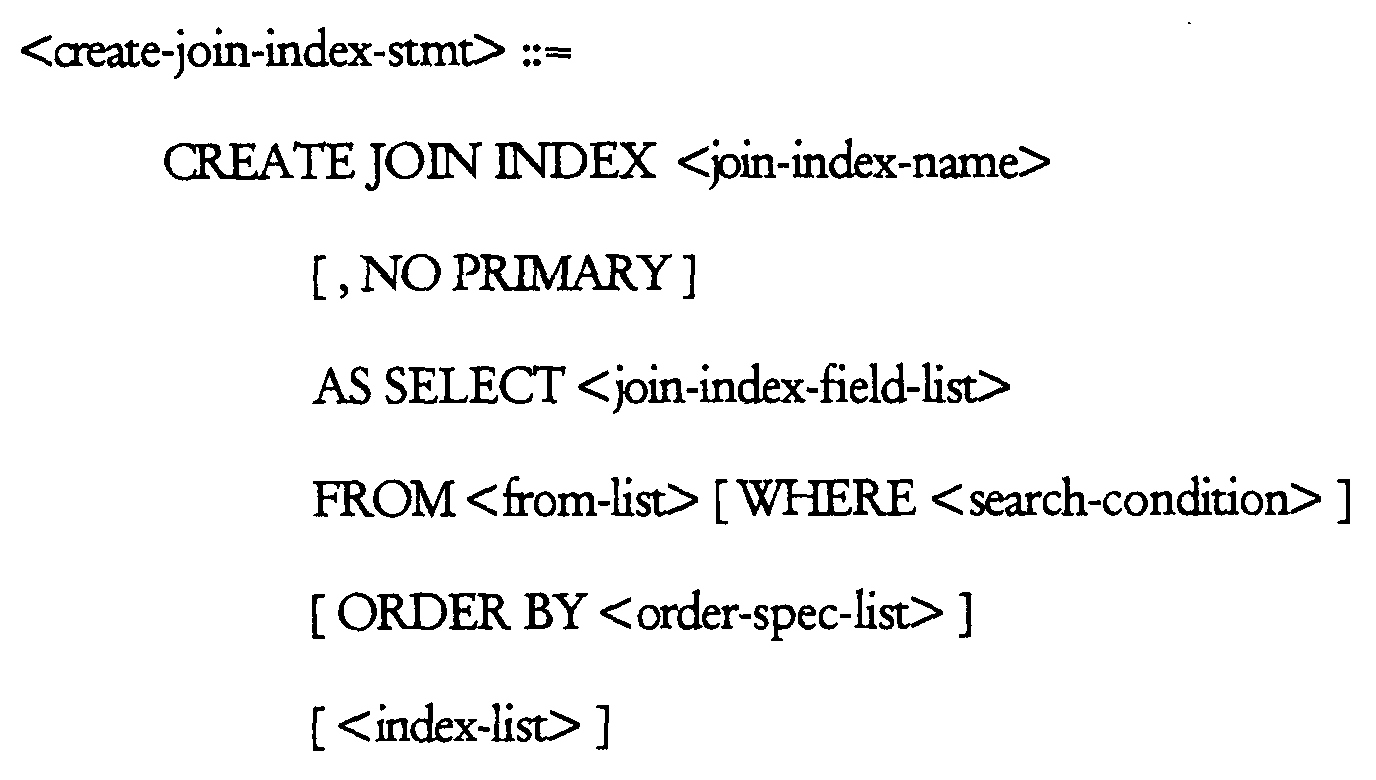
- The option NO PRIMARY indicates that the join index is a virtual join index.
- A virtual join index should have one or more non-unique secondary indexes (NUSIs) and data is retrieved from one of the NUSIs instead of the primary table to satisfy queries that can use the virtual join index (that is, the NUSI must be a covering index for the query).
- The virtual join index must be defined with primary-to-foreign key join conditions.
- A compressed NUSI contains a fixed part (FIELD 1) and a repeating part (FIELD 2). The fixed part (FIELD 1) is defined by <column-name-list1>. The repeating part (FIELD 2) is defined by <column-name-list2>.
- If a column is specified for the ORDER BY clause, it must be a column within <column-name-list1>.
- This compressed format is beneficial when more than one NUSI row has
the same content of the FIELD 1. These rows are stored in one physical
row and the common value of the FIELD 1 is stored only once. The
bigger the size of the FIELD 1 compared to the size of the
FIELD 2 and the more rows with the same value in the FIELD 1, the more benefits derived from this format.

Claims (27)
- A method of optimizing retrieval of data from a database in a computerized database management system, characterized by:(a) creating a virtual join index for one or more tables in the database by combining one or more columns from the tables; and(b) generating one or more covering non-unique secondary indexes for the virtual join index, wherein each of the covering non-unique secondary indexes combines one or more commonly-used columns of the virtual join index, and data is not stored in the virtual join index after the covering non-unique secondary indexes are generated
- The method of claim 1, further comprising(c) receiving a query into a computer; and(d) processing the query by accessing one or more of the covering non-unique secondary indexes generated from a virtual join index.
- The method of claims 1 or 2, wherein at least a portion of a query can be resolved solely by accessing one or more of the covering non-unique secondary indexes.
- The method of claims any of claims 1 to 3 , wherein the covering non-unique secondary indexes are scanned to provide results for the query.
- The method of any of claims 1 to 4, wherein the covering non-unique secondary indexes use a compressed format that reduces storage requirements and provides faster access to data stored therein.
- The method of claim 5, wherein each row of the non-unique secondary index contains a fixed part and a repeating part.
- The method of claim 6, wherein the fixed part comprises a fixed set of one or more columns.
- The method of claim 6, wherein the repeating part comprises a repeating set of one or more columns.
- The method of claim 6, wherein the fixed part is stored only once in each row, but the repeating part is comprised of recursive levels within each row, so that each row may contain as many repeating parts as needed.
- The method of claim 9, wherein each of the repeating parts contains a fixed part and a repeating part.
- The method of any of claims 1 to 10, further comprising creating the virtual join index by performing one or more join operations on the tables.
- The method of any of claims 1 to 11, further comprising generating the covering non-unique secondary indexes by performing one or more join operations on the virtual join index.
- A computerized database management system, characterized by:(a) means for creating a virtual join index for one or more tables in a database by combining one or more columns from the tables; and(b) means for generating one or more covering non-unique secondary indexes for the virtual join index, wherein each of the covering non-unique secondary indexes combines one or more commonly-used columns of the virtual join index, and data is not stored in the virtual join index after the covering non-unique secondary indexes are generated.
- The system of claim 13, further comprising:(a) means for receiving a query; and(b) means for processing the query by accessing one or more of the covering non-unique secondary indexes generated from a virtual join index .
- The system of claims 13 or 14, wherein at least a portion of a query can be resolved solely by accessing one or more of the covering non-unique secondary indexes.
- The system of any of claims 13 to 15, comprising means for scanning the covering non-unique secondary indexes to provide results for the query.
- The system of any of claims 13 to 16, wherein the covering non-unique secondary indexes use a compressed format that reduces storage requirements and provides faster access to data stored therein.
- The system of claim 17, wherein each row of the non-unique secondary index contains a fixed part and a repeating part.
- The system of claim 18, wherein the fixed part comprises a fixed set of one or more columns.
- The system of claim 18, wherein the repeating part comprises a repeating set of one or more columns.
- The system of claim 18, wherein the fixed part is stored only once in each row, but the repeating part is comprised of recursive levels within each row, so that each row may contain as many repeating parts as needed.
- The system of claim 21, wherein each of the repeating parts contains a fixed part and a repeating part.
- The system of any of claims 13 to 22, further comprising means for creating the virtual join index by performing one or more join operations on the tables.
- The system of any of claims 13 to 23, further comprising means for generating the covering non-unique secondary indexes by performing one or more join operations on the virtual join index.
- A data structure stored in a memory for use by a database management system executed by a computer, the data structure comprising instructions for optimizing retrieval of data from the database which when executed cause the computer to perform the method of any of claims 1 to 12.
- A computer program comprising program instructions for optimizing retrieval of data from a database in a computerized database management system, the instructions when executed causing the system to perform the method of any of claims 1 to 12.
- An article including one or more machine-readable storage media containing instructions for optimizing retrieval of data from a database in a computerized database management system, the instructions when executed causing the system to perform the method of any of claims 1 to 12.
Applications Claiming Priority (2)
| Application Number | Priority Date | Filing Date | Title |
|---|---|---|---|
| US594963 | 1996-01-31 | ||
| US09/594,963 US6505188B1 (en) | 2000-06-15 | 2000-06-15 | Virtual join index for relational databases |
Publications (2)
| Publication Number | Publication Date |
|---|---|
| EP1164510A2 true EP1164510A2 (en) | 2001-12-19 |
| EP1164510A3 EP1164510A3 (en) | 2005-11-30 |
Family
ID=24381131
Family Applications (1)
| Application Number | Title | Priority Date | Filing Date |
|---|---|---|---|
| EP01304928A Withdrawn EP1164510A3 (en) | 2000-06-15 | 2001-06-06 | Virtual join index for relational databases |
Country Status (2)
| Country | Link |
|---|---|
| US (1) | US6505188B1 (en) |
| EP (1) | EP1164510A3 (en) |
Cited By (6)
| Publication number | Priority date | Publication date | Assignee | Title |
|---|---|---|---|---|
| EP2320334A1 (en) * | 2005-09-23 | 2011-05-11 | Alan El-Sabbagh | Methods and systems for joining database tables using indexing data structures |
| WO2020112692A1 (en) * | 2018-11-26 | 2020-06-04 | Amazon Technologies, Inc. | Indexes on non-materialized views |
| US10942910B1 (en) | 2018-11-26 | 2021-03-09 | Amazon Technologies, Inc. | Journal queries of a ledger-based database |
| US11119998B1 (en) | 2018-11-26 | 2021-09-14 | Amazon Technologies, Inc. | Index and view updates in a ledger-based database |
| US11196567B2 (en) | 2018-11-26 | 2021-12-07 | Amazon Technologies, Inc. | Cryptographic verification of database transactions |
| US12619595B1 (en) | 2019-03-18 | 2026-05-05 | Amazon Technologies, Inc. | Optimistically concurrent view loading |
Families Citing this family (45)
| Publication number | Priority date | Publication date | Assignee | Title |
|---|---|---|---|---|
| EP1217540A1 (en) * | 2000-11-29 | 2002-06-26 | Lafayette Software Inc. | Methods of organizing data and processing queries in a database system, and database system and software product for implementing such method |
| US6834279B1 (en) * | 2001-05-24 | 2004-12-21 | Ncr Corporation | Method and system for inclusion hash joins and exclusion hash joins in relational databases |
| US6643636B1 (en) * | 2001-06-05 | 2003-11-04 | Ncr Corporation | Optimizing a query using a non-covering join index |
| US7080072B1 (en) * | 2001-11-14 | 2006-07-18 | Ncr Corp. | Row hash match scan in a partitioned database system |
| US7149935B1 (en) * | 2002-12-17 | 2006-12-12 | Ncr Corp. | Method and system for managing detected corruption in stored data |
| US7133867B2 (en) * | 2003-02-13 | 2006-11-07 | Sap Aktiengesellschaft | Text and attribute searches of data stores that include business objects |
| US7523462B1 (en) * | 2003-05-27 | 2009-04-21 | International Business Machines Corporation | Method for providing a real time view of heterogeneous enterprise data |
| US7448048B1 (en) * | 2003-05-27 | 2008-11-04 | International Business Machines Corporation | Method for performing real-time analytics using a business rules engine on real-time heterogeneous materialized data views |
| US7266565B2 (en) | 2003-09-24 | 2007-09-04 | Tablecode Software Corporation | Table-oriented application development environment |
| US7672964B1 (en) | 2003-12-31 | 2010-03-02 | International Business Machines Corporation | Method and system for dynamically initializing a view for a streaming data base system |
| US8886614B2 (en) * | 2004-02-03 | 2014-11-11 | Teradata Us, Inc. | Executing a join plan using data compression |
| US7693856B2 (en) * | 2004-06-25 | 2010-04-06 | Apple Inc. | Methods and systems for managing data |
| US7730012B2 (en) * | 2004-06-25 | 2010-06-01 | Apple Inc. | Methods and systems for managing data |
| US8131674B2 (en) | 2004-06-25 | 2012-03-06 | Apple Inc. | Methods and systems for managing data |
| US20060136380A1 (en) * | 2004-12-17 | 2006-06-22 | Purcell Terence P | System and method for executing a multi-table query |
| US20060149712A1 (en) * | 2004-12-30 | 2006-07-06 | Uwe Kindsvogel | Searching based on object relationships |
| US20060149767A1 (en) * | 2004-12-30 | 2006-07-06 | Uwe Kindsvogel | Searching for data objects |
| US8086615B2 (en) * | 2005-03-28 | 2011-12-27 | Oracle International Corporation | Security data redaction |
| US20060224628A1 (en) * | 2005-03-29 | 2006-10-05 | Bea Systems, Inc. | Modeling for data services |
| US20060218118A1 (en) * | 2005-03-28 | 2006-09-28 | Bea Systems, Inc. | Using query plans for building and performance tuning services |
| US7778998B2 (en) * | 2005-03-28 | 2010-08-17 | Bea Systems, Inc. | Liquid data services |
| US20060218149A1 (en) * | 2005-03-28 | 2006-09-28 | Bea Systems, Inc. | Data redaction policies |
| US20060224556A1 (en) * | 2005-03-29 | 2006-10-05 | Bea Systems, Inc. | SQL interface for services |
| US20060224557A1 (en) * | 2005-03-29 | 2006-10-05 | Bea Systems, Inc. | Smart services |
| US7660814B2 (en) * | 2005-12-21 | 2010-02-09 | Teradata Us, Inc. | Techniques for mapping a physical table to multiple virtual tables |
| US7849114B2 (en) * | 2006-06-19 | 2010-12-07 | International Business Machines Corporation | Method, system, and program product for generating a virtual database |
| US20080114733A1 (en) * | 2006-11-14 | 2008-05-15 | Microsoft Corporation | User-structured data table indexing |
| US20080183663A1 (en) * | 2007-01-31 | 2008-07-31 | Paul Reuben Day | Dynamic Index Selection for Database Queries |
| US7792784B2 (en) * | 2007-05-31 | 2010-09-07 | International Business Machines Corporation | Streaming multidimensional data by bypassing multidimensional query processor |
| CN101639769B (en) * | 2008-07-30 | 2013-03-06 | 国际商业机器公司 | Method and device for splitting and sequencing dataset in multiprocessor system |
| US7991765B2 (en) * | 2008-07-31 | 2011-08-02 | Teradata Us, Inc. | Cost-based query rewrite using materialized views |
| US8032503B2 (en) * | 2008-08-05 | 2011-10-04 | Teradata Us, Inc. | Deferred maintenance of sparse join indexes |
| US20100036799A1 (en) * | 2008-08-05 | 2010-02-11 | Teradata Us, Inc. | Query processing using horizontal partial covering join index |
| US7912833B2 (en) * | 2008-08-05 | 2011-03-22 | Teradata Us, Inc. | Aggregate join index utilization in query processing |
| CN101727465B (en) * | 2008-11-03 | 2011-12-21 | 中国移动通信集团公司 | Methods for establishing and inquiring index of distributed column storage database, device and system thereof |
| US8583653B2 (en) * | 2010-05-13 | 2013-11-12 | Salesforce.Com, Inc. | Methods and systems for determining candidates for a custom index in a multi-tenant database environment |
| US10417611B2 (en) | 2010-05-18 | 2019-09-17 | Salesforce.Com, Inc. | Methods and systems for providing multiple column custom indexes in a multi-tenant database environment |
| US9053151B2 (en) * | 2010-07-30 | 2015-06-09 | Sap Se | Dynamically joined fast search views for business objects |
| US8386533B2 (en) * | 2010-11-30 | 2013-02-26 | Oracle International Corporation | Records management of database tables |
| US10108648B2 (en) | 2011-07-13 | 2018-10-23 | Salesforce.Com, Inc. | Creating a custom index in a multi-tenant database environment |
| US8990186B2 (en) | 2011-12-28 | 2015-03-24 | Teradata Us, Inc. | Techniques for updating join indexes |
| CN105354255B (en) * | 2015-10-21 | 2018-01-02 | 华为技术有限公司 | Data query method and device |
| US11868331B1 (en) | 2018-05-21 | 2024-01-09 | Pattern Computer, Inc. | Systems and methods for aligning big data tables in linear time |
| US11782924B2 (en) * | 2018-10-18 | 2023-10-10 | Sindice Limited | Distributed join index for shared-nothing and log-structured databases |
| US20230350864A1 (en) * | 2022-04-28 | 2023-11-02 | Teradata Us, Inc. | Semi-materialized views |
Family Cites Families (8)
| Publication number | Priority date | Publication date | Assignee | Title |
|---|---|---|---|---|
| US5241648A (en) | 1990-02-13 | 1993-08-31 | International Business Machines Corporation | Hybrid technique for joining tables |
| US5440730A (en) * | 1990-08-09 | 1995-08-08 | Bell Communications Research, Inc. | Time index access structure for temporal databases having concurrent multiple versions |
| US5742806A (en) * | 1994-01-31 | 1998-04-21 | Sun Microsystems, Inc. | Apparatus and method for decomposing database queries for database management system including multiprocessor digital data processing system |
| US5666525A (en) | 1995-09-21 | 1997-09-09 | The Trustees Of Columbia University In The City Of New York | System and method for performing an efficient join operation on large tables with a small main memory |
| US5710915A (en) * | 1995-12-21 | 1998-01-20 | Electronic Data Systems Corporation | Method for accelerating access to a database clustered partitioning |
| US5870747A (en) | 1996-07-09 | 1999-02-09 | Informix Software, Inc. | Generalized key indexes |
| US5987453A (en) | 1997-04-07 | 1999-11-16 | Informix Software, Inc. | Method and apparatus for performing a join query in a database system |
| US5983215A (en) | 1997-05-08 | 1999-11-09 | The Trustees Of Columbia University In The City Of New York | System and method for performing joins and self-joins in a database system |
-
2000
- 2000-06-15 US US09/594,963 patent/US6505188B1/en not_active Expired - Lifetime
-
2001
- 2001-06-06 EP EP01304928A patent/EP1164510A3/en not_active Withdrawn
Cited By (10)
| Publication number | Priority date | Publication date | Assignee | Title |
|---|---|---|---|---|
| EP2320334A1 (en) * | 2005-09-23 | 2011-05-11 | Alan El-Sabbagh | Methods and systems for joining database tables using indexing data structures |
| WO2020112692A1 (en) * | 2018-11-26 | 2020-06-04 | Amazon Technologies, Inc. | Indexes on non-materialized views |
| US10942910B1 (en) | 2018-11-26 | 2021-03-09 | Amazon Technologies, Inc. | Journal queries of a ledger-based database |
| US11036708B2 (en) | 2018-11-26 | 2021-06-15 | Amazon Technologies, Inc. | Indexes on non-materialized views |
| GB2592538A (en) * | 2018-11-26 | 2021-09-01 | Amazon Tech Inc | Indexes on non-materialized views |
| US11119998B1 (en) | 2018-11-26 | 2021-09-14 | Amazon Technologies, Inc. | Index and view updates in a ledger-based database |
| US11196567B2 (en) | 2018-11-26 | 2021-12-07 | Amazon Technologies, Inc. | Cryptographic verification of database transactions |
| US11675770B1 (en) | 2018-11-26 | 2023-06-13 | Amazon Technologies, Inc. | Journal queries of a ledger-based database |
| US12476821B2 (en) | 2018-11-26 | 2025-11-18 | Amazon Technologies, Inc. | Cryptographic verification of database transactions |
| US12619595B1 (en) | 2019-03-18 | 2026-05-05 | Amazon Technologies, Inc. | Optimistically concurrent view loading |
Also Published As
| Publication number | Publication date |
|---|---|
| EP1164510A3 (en) | 2005-11-30 |
| US6505188B1 (en) | 2003-01-07 |
Similar Documents
| Publication | Publication Date | Title |
|---|---|---|
| US6505188B1 (en) | Virtual join index for relational databases | |
| US6505189B1 (en) | Aggregate join index for relational databases | |
| US6618729B1 (en) | Optimization of a star join operation using a bitmap index structure | |
| US5864842A (en) | Optimization of SQL queries using hash star join operations | |
| EP1107135B1 (en) | Parallel optimized triggers in parallel processing database systems | |
| US7092954B1 (en) | Optimizing an equi-join operation using a bitmap index structure | |
| US6625593B1 (en) | Parallel query optimization strategies for replicated and partitioned tables | |
| US6957222B1 (en) | Optimizing an outer join operation using a bitmap index structure | |
| US5778354A (en) | Database management system with improved indexed accessing | |
| JP3297403B2 (en) | Method and apparatus for query optimization | |
| US5615361A (en) | Exploitation of uniqueness properties using a 1-tuple condition for the optimization of SQL queries | |
| US5761657A (en) | Global optimization of correlated subqueries and exists predicates | |
| US6167399A (en) | Join index for relational databases | |
| US6289334B1 (en) | Apparatus and method for decomposing database queries for database management system including multiprocessor digital data processing system | |
| US5687362A (en) | Enumerating projections in SQL queries containing outer and full outer joins in the presence of inner joins | |
| US7281000B2 (en) | Method for efficient query execution using dynamic queries in database environments | |
| US5590324A (en) | Optimization of SQL queries using universal quantifiers, set intersection, and max/min aggregation in the presence of nullable columns | |
| US6219662B1 (en) | Supporting database indexes based on a generalized B-tree index | |
| US6826562B1 (en) | Method of simplifying and optimizing scalar subqueries and derived tables that return exactly or at most one tuple | |
| US6249783B1 (en) | Method and apparatus for efficiently executing built-in functions | |
| US6834279B1 (en) | Method and system for inclusion hash joins and exclusion hash joins in relational databases | |
| US6343286B1 (en) | Efficient technique to defer large object access with intermediate results | |
| US6957210B1 (en) | Optimizing an exclusion join operation using a bitmap index structure | |
| IL147694A (en) | Database system for viewing effects of changes to an index for a query optimization | |
| US6704724B1 (en) | Parallel optimizer hints with a direct manipulation user interface |
Legal Events
| Date | Code | Title | Description |
|---|---|---|---|
| PUAI | Public reference made under article 153(3) epc to a published international application that has entered the european phase |
Free format text: ORIGINAL CODE: 0009012 |
|
| AK | Designated contracting states |
Kind code of ref document: A2 Designated state(s): AT BE CH CY DE DK ES FI FR GB GR IE IT LI LU MC NL PT SE TR |
|
| AX | Request for extension of the european patent |
Free format text: AL;LT;LV;MK;RO;SI |
|
| PUAL | Search report despatched |
Free format text: ORIGINAL CODE: 0009013 |
|
| AK | Designated contracting states |
Kind code of ref document: A3 Designated state(s): AT BE CH CY DE DK ES FI FR GB GR IE IT LI LU MC NL PT SE TR |
|
| AX | Request for extension of the european patent |
Extension state: AL LT LV MK RO SI |
|
| 17P | Request for examination filed |
Effective date: 20060530 |
|
| AKX | Designation fees paid |
Designated state(s): DE FR GB |
|
| 17Q | First examination report despatched |
Effective date: 20060824 |
|
| STAA | Information on the status of an ep patent application or granted ep patent |
Free format text: STATUS: THE APPLICATION HAS BEEN WITHDRAWN |
|
| 18W | Application withdrawn |
Effective date: 20080517 |
|
| RAP1 | Party data changed (applicant data changed or rights of an application transferred) |
Owner name: NCR INTERNATIONAL, INC. |