EP1164258A2 - Valve driving apparatus for engine - Google Patents
Valve driving apparatus for engine Download PDFInfo
- Publication number
- EP1164258A2 EP1164258A2 EP01113216A EP01113216A EP1164258A2 EP 1164258 A2 EP1164258 A2 EP 1164258A2 EP 01113216 A EP01113216 A EP 01113216A EP 01113216 A EP01113216 A EP 01113216A EP 1164258 A2 EP1164258 A2 EP 1164258A2
- Authority
- EP
- European Patent Office
- Prior art keywords
- cam
- valve
- lifter
- valves
- intake
- Prior art date
- Legal status (The legal status is an assumption and is not a legal conclusion. Google has not performed a legal analysis and makes no representation as to the accuracy of the status listed.)
- Withdrawn
Links
- 238000002485 combustion reaction Methods 0.000 claims abstract description 12
- 238000005553 drilling Methods 0.000 claims description 3
- 238000004519 manufacturing process Methods 0.000 abstract description 5
- 238000010276 construction Methods 0.000 description 13
- 238000003754 machining Methods 0.000 description 3
- 238000005457 optimization Methods 0.000 description 3
- 230000002093 peripheral effect Effects 0.000 description 3
- 239000007787 solid Substances 0.000 description 3
- 238000000034 method Methods 0.000 description 2
- 230000003247 decreasing effect Effects 0.000 description 1
- 239000000446 fuel Substances 0.000 description 1
- 238000003466 welding Methods 0.000 description 1
Images





Classifications
-
- F—MECHANICAL ENGINEERING; LIGHTING; HEATING; WEAPONS; BLASTING
- F01—MACHINES OR ENGINES IN GENERAL; ENGINE PLANTS IN GENERAL; STEAM ENGINES
- F01L—CYCLICALLY OPERATING VALVES FOR MACHINES OR ENGINES
- F01L1/00—Valve-gear or valve arrangements, e.g. lift-valve gear
- F01L1/34—Valve-gear or valve arrangements, e.g. lift-valve gear characterised by the provision of means for changing the timing of the valves without changing the duration of opening and without affecting the magnitude of the valve lift
-
- F—MECHANICAL ENGINEERING; LIGHTING; HEATING; WEAPONS; BLASTING
- F01—MACHINES OR ENGINES IN GENERAL; ENGINE PLANTS IN GENERAL; STEAM ENGINES
- F01L—CYCLICALLY OPERATING VALVES FOR MACHINES OR ENGINES
- F01L1/00—Valve-gear or valve arrangements, e.g. lift-valve gear
- F01L1/12—Transmitting gear between valve drive and valve
- F01L1/14—Tappets; Push rods
- F01L1/143—Tappets; Push rods for use with overhead camshafts
-
- F—MECHANICAL ENGINEERING; LIGHTING; HEATING; WEAPONS; BLASTING
- F01—MACHINES OR ENGINES IN GENERAL; ENGINE PLANTS IN GENERAL; STEAM ENGINES
- F01L—CYCLICALLY OPERATING VALVES FOR MACHINES OR ENGINES
- F01L1/00—Valve-gear or valve arrangements, e.g. lift-valve gear
- F01L1/26—Valve-gear or valve arrangements, e.g. lift-valve gear characterised by the provision of two or more valves operated simultaneously by same transmitting-gear; peculiar to machines or engines with more than two lift-valves per cylinder
-
- F—MECHANICAL ENGINEERING; LIGHTING; HEATING; WEAPONS; BLASTING
- F01—MACHINES OR ENGINES IN GENERAL; ENGINE PLANTS IN GENERAL; STEAM ENGINES
- F01L—CYCLICALLY OPERATING VALVES FOR MACHINES OR ENGINES
- F01L1/00—Valve-gear or valve arrangements, e.g. lift-valve gear
- F01L1/26—Valve-gear or valve arrangements, e.g. lift-valve gear characterised by the provision of two or more valves operated simultaneously by same transmitting-gear; peculiar to machines or engines with more than two lift-valves per cylinder
- F01L1/262—Valve-gear or valve arrangements, e.g. lift-valve gear characterised by the provision of two or more valves operated simultaneously by same transmitting-gear; peculiar to machines or engines with more than two lift-valves per cylinder with valve stems disposed radially from a centre which is substantially the centre of curvature of the upper wall surface of a combustion chamber
-
- F—MECHANICAL ENGINEERING; LIGHTING; HEATING; WEAPONS; BLASTING
- F01—MACHINES OR ENGINES IN GENERAL; ENGINE PLANTS IN GENERAL; STEAM ENGINES
- F01L—CYCLICALLY OPERATING VALVES FOR MACHINES OR ENGINES
- F01L13/00—Modifications of valve-gear to facilitate reversing, braking, starting, changing compression ratio, or other specific operations
- F01L13/0015—Modifications of valve-gear to facilitate reversing, braking, starting, changing compression ratio, or other specific operations for optimising engine performances by modifying valve lift according to various working parameters, e.g. rotational speed, load, torque
- F01L13/0036—Modifications of valve-gear to facilitate reversing, braking, starting, changing compression ratio, or other specific operations for optimising engine performances by modifying valve lift according to various working parameters, e.g. rotational speed, load, torque the valves being driven by two or more cams with different shape, size or timing or a single cam profiled in axial and radial direction
- F01L13/0042—Modifications of valve-gear to facilitate reversing, braking, starting, changing compression ratio, or other specific operations for optimising engine performances by modifying valve lift according to various working parameters, e.g. rotational speed, load, torque the valves being driven by two or more cams with different shape, size or timing or a single cam profiled in axial and radial direction with cams being profiled in axial and radial direction
-
- F—MECHANICAL ENGINEERING; LIGHTING; HEATING; WEAPONS; BLASTING
- F02—COMBUSTION ENGINES; HOT-GAS OR COMBUSTION-PRODUCT ENGINE PLANTS
- F02B—INTERNAL-COMBUSTION PISTON ENGINES; COMBUSTION ENGINES IN GENERAL
- F02B2275/00—Other engines, components or details, not provided for in other groups of this subclass
- F02B2275/18—DOHC [Double overhead camshaft]
Definitions
- the present invention relates to a valve driving apparatus for engines. More particularly, the present invention pertains to a valve driving apparatus that varies performance of a set of intake valves and a set of exhaust valves in an engine according to the operating conditions of the engine by changing the positions of valve actuating cams.
- Exiting engines have valve driving apparatuses with low speed cams and high speed cams, which have different profiles, provided on an intake camshaft or an exhaust camshaft.
- the apparatus switches between the low speed cams and the high speed cams in accordance with the operating conditions of the engine thereby changing the valve timing or the valve lift of the intake valves or the exhaust valves.
- the apparatus makes the maximum lift amount of the valves relatively small when the engine speed is low and makes the maximum valve lift amount of the valves relatively large when the engine speed is high. In this manner, the apparatus guarantees optimum engine characteristics such as torque and stability both in the low speed range and in the high speed range of the engine.
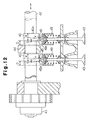
- Fig. 12 shows a valve driving apparatus of another type used in an engine having four valves per cylinder.
- This apparatus is provided on a camshaft 42 (either the intake or exhaust camshaft of the engine), which is supported by a bearing 44.
- Cams 40 are fixed on the camshaft 42.
- a pair of the cams 40 corresponds to a pair of valves 43 (either intake or exhaust valves) located in an engine cylinder.
- Each cam 40 is a solid cam having a surface 40a.
- the cam nose radius of each cam 40 continuously varies in the axial direction of the camshaft 42.
- the cams 40 are integrally moved with the camshaft 42 in the axial direction (to the left or the right in the drawing) by a shaft moving mechanism 41. This changes the effective cam nose radius of the cams 40.
- the range of change of the maximum lift amount (hereinafter, referred to as the lift control amount) is determined according to the difference between the maximum value and the minimum value of the radius of the cam nose.
- the axial position of the cam shaft 42 is controlled such that the maximum lift of the valves 43 is small in the low engine speed range and is large in the high engine speed range. Therefore, the apparatus of Fig. 12 optimizes engine characteristics such as the torque and stability both in the low speed range and in the high speed range of the engine.
- a valve lifter 49 is located between each valve 43 and the corresponding cam 40.
- a cam follower 45 is pivotally located on top of each valve lifter 49.
- the surface 45a of the cam follower 45 slidably contacts the cam surface 40a.
- the cam follower 45 pivots as it slides on the cam surface 40a. That is, the surface 45a of the cam follower 45 functions as a sliding surface that slides on the cam surface 40a.
- the bearing 44 must be located between a pair of cams 40 that correspond to a single combustion chamber for ensuring sufficient rigidity of the camshaft 42.
- the distance between the valves 43 is determined in accordance with the size of each combustion chamber and cannot be widened.
- the axial moving amount D of the cams 40 is therefore limited to avoid interference between the cams 40 and the bearing 44.
- the size of the combustion chamber that is, the distance between the adjacent valves 43 limits the axial moving amount D of the cams 40.
- the limited axial moving amount D of the cams 40 corresponds to an insufficient range of valve performance variation, or an insufficient lift control amount of the valves 43.
- Japanese Unexamined Patent Publication 3-179116 discloses another type of valve driving apparatus.
- This apparatus includes a single valve lifter for actuating a pair of valves.
- Fig. 13 shows a partial cross-sectional view of the apparatus.
- the apparatus includes a single cam 51 and a single valve lifter 59 that correspond to two valves 58.
- the two valves 58 are actuated by the single cam 51 through the single valve lifter 59.
- This construction increases the width W the cam 51 and the axial moving amount D of the cam 51 compared to the apparatus of Fig. 12 without changing the inclination angle ⁇ of the cam nose. Accordingly, the lift control amount is increased.
- the valve lifter 59 is shaped like a rectangle with rounded ends when viewed from above.
- its side surface has an oblong shape
- the bore formed in the cylinder head for accommodating the lifter must also be shaped like a rectangle with rounded ends. Therefore, compared to circular valve lifter, it is difficult to obtain the required dimensional accuracy of the valve lifter 59.
- the valve lifter 59 supports two valves 58 at predetermined positions. This complicates the construction of the valve lifter 59.
- the valve lifter 59 and the corresponding oblong lifter opening are larger than a valve lifter that actuates a single valve and its corresponding lifter opening. Therefore, it is difficult to achieve the required assembly tolerances for the valve lifter 59 and the corresponding lifter opening. Hence, the manufacture of the valve lifter 59 and the engine is significantly complicated.
- Methods to increase the lift control amount without changing the width W of cams and the moving amount D of the cams include increasing the inclination angle ⁇ of the cam surface 40a for increasing the difference between the maximum value and the minimum values of the radius of the cam nose.
- increasing the inclination angle ⁇ of the cam nose increases force required for moving the cam shaft 42 to the right in Fig. 12.
- the valve moving apparatus 41 needs to be enlarged.
- EP 0 570 963 A1 discloses a valve driving apparatus in accordance with the preamble of claim 1.
- valve driving apparatus in accordance with claim 1 or 4 provided.
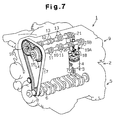
- Fig. 2 shows an engine 1 provided with a valve driving apparatus according to this embodiment.
- This engine 1 is a double overhead cam (DOHC) type, in which four valves (two intake valves and two exhaust valves) are associated with one cylinder.
- DOHC double overhead cam
- the engine 1 includes a cylinder block 2 and a crankcase 5 secured to each other. Cylinders 3 are defined in the cylinder block 2. Each cylinder 3 houses a piston 4. A crankshaft 6 is rotatably supported in the crankcase 5. Each piston 4 is coupled to the crankshaft 6 by a connecting rod 7. One end of the crankshaft 6 is secured to a timing pulley 8.
- a cylinder head 9 is secured to the top of the cylinder block 2.
- An intake camshaft 10 is rotatably supported on the cylinder head 9 by bearings 22 (only one is shown in Fig
- a timing pulley 14 and a shaft moving mechanism 15 are integrally provided on one end of the intake camshaft 10.
- a timing pulley 16 is fixed to one end of the exhaust camshaft 12.
- the timing pulleys 14 and 16 are connected to a timing pulley 8 of the crankshaft 6 by a timing belt 17. Rotation of the crankshaft 6 is transmitted to the intake camshaft 10 and the exhaust camshaft 12 by the belt 17.
- the camshafts 10, 12 are rotated, accordingly.
- Each cylinder 3 is provided with a pair of intake valves 18.
- the intake valves 18 are connected to and driven by the intake cams 11 through valve lifters 19A and 19B.
- the valve lifters 19A, 19B have cylindrical shapes and are connected to each other at their tops by a bracket 23.
- the lifters 19A, 19B and the bracket 23 form an integral lifter structure.
- the valve lifters 19A, 19B are fitted in lifter opening formed in the cylinder head 9.
- the lifters 19A, 19B slide with respect to the walls of the opening.
- Fig. 5 is a plan view of the lifter opening.
- the lifter bore opening is formed by three overlapping bores 26A, 26B, 26C.
- the bores 26A and 26B are circular and can thus be formed by drilling or boring.
- the circular shape facilitates the achievement of the required machining accuracy of the bores 26A, 26B.
- the bore 26C is formed between the bores 26A and 26B.
- the center portion of the bracket 23 occupies the bore 26C.
- the bore 26C has a circular shape like the bores 26A, 26B.
- the bore 26C may have other shapes.
- the machining accuracy of the bore 26C is not necessarily as high as that of the bores 26A, 26B.
- Figs. 4(a) and 4(b) are a cross-sectional view and a plan view of the valve lifter structure, respectively.
- the bracket 23 is directly welded to the top of the valve lifter 19A and is coupled to the second valve lifter 19B with a disk shaped shim 23 in between.
- the shim 27 is selected from shims having different thicknesses for adjusting the height difference between the first and second valve lifters 19A and 19B.
- the bracket 23 also includes a cam follower holder 24 as shown in Figs. 4(a) and 4(b).
- the holder 24 is integrally formed with the bracket 23 and pivotally holds a cam follower 25.
- the cam follower 25 is urged in a direction to engage the cam 11 by springs 26 located in the valve lifters 19A, 19B.
- the surface of the cam follower 25, or a sliding surface 25a slides on the cam surface 11a of the intake cam 11 (see Figs. 1 and 3).
- the cam follower 25 pivots along the cam surface 11a.
- each cylinder 3 is provided with a pair of exhaust valves 20.
- Each exhaust valve 20 is driven by the exhaust cam 13 through a valve lifter 21.
- Each valve lifter 21 is slidably supported in a lifter bore (not shown).
- Figs. 1 and 3 show the shaft moving mechanism 15, the intake cam 11 and the intake valves 18 that correspond to one cylinder.
- the intake valves 18 are actuated by the intake cam 11.
- the bearing 22 is provided in the vicinity of the intake cam 11 for ensuring the rigidity of the camshaft 10.
- the intake camshaft 10 is rotatably supported on the cylinder head 9 by the bearing 22 and other bearings and moves in its axial direction.
- the intake cam 11 has substantially the same construction as the prior art solid cam illustrated in Figs. 12, 13.
- the radius of the cam surface 11a at the cam nose varies continuously in the axial direction.
- An inclination angle ⁇ 1 of the cam surface 11a at the cam nose is the same as the inclination angle ⁇ of the cam nose of the cam 40 in the prior art apparatus shown in Figs. 12, 13.
- the cam width W1 of the intake cam 11 is however wider than that of the prior art cam 40 shown in Fig. 12.
- the axial moving amount D1 of the cam 11 is set wider than the moving amount D of the prior art cam 40. That is, although the cam 11 has the same inclination angle ⁇ 1 as the inclination angle ⁇ of the cam 40, the difference between the maximum value and the minimum value of the cam nose radius is larger than that of the prior art cam 40.
- the shaft moving mechanism 15 is a conventional mechanism driven by a hydraulic circuit (not shown) to move the intake camshaft 10 together with the intake cam 11 in the axial direction.
- the shaft moving mechanism 15 moves the intake camshaft 10 so that the contact position between the cam surface 11a of the intake cam 11 and the surface 25a of the cam follower 25 varies between the highest radius position (see Fig. 1) of the cam nose and the lowest radius position (see Fig. 3) of the cam nose.
- valve lifters 19A, 19B are integrally coupled to the bracket 23. Therefore, unlike the prior art apparatus of Fig. 12 having two cams 40 for actuating two valve lifters, the apparatus of this embodiment needs only one intake cam 11 for actuating the pair of valve lifters 19A, 19B.
- This construction widens the distance within which the intake cam 11 is movable along the axial direction of the camshaft 10. That is, this construction allows the cam 11 to be wider than the prior art cam 40 while maintaining the inclination angle ⁇ 1 of the cam nose of the cam 11 equal to the inclination angle ⁇ of the prior art cam 40.
- the increased cam width W1 increases the moving amount D1 of the intake cam 11 compared to the cam moving amount D1 of the prior art apparatus.
- the difference between the maximum value and the minimum value of the radius of the cam nose is greater. Therefore, the lift control amount (the range of the valve performance) is increased compared to that of the prior art apparatus.
- the increased lift control amount enables greater optimization of the amount of intake air. Since the inclination angle ⁇ 1 of the cam nose is the same as that of the prior art apparatus, the force for moving the camshaft 10 to the right in Figs. 1 and 3 is the same as that of the prior art apparatus. Thus, the shaft moving mechanism 15 does not need to be enlarged.
- the valve lifters 19A and 19B have a circular cross section.
- the lifter bores 26A and 26B are also circular like the lifter bores of the prior art apparatus. This construction improves the machining accuracy of the lifter bores 26A, 26B (Fig. 5).
- the circular shapes of the valve lifters 19A, 19B and the bores 26A, 26B makes it easier to achieve the required assembly accuracy of the valve lifters 19A, 19B and the lifter bores 26A, 26b.
- the shim 27 located between the bracket 23 and the valve lifter 19B adjusts the height difference between the valve lifters 19A and 19B. Also, the shim 27, together with the bracket 23, prevents the valve lifters 19A, 19B from rotating. Therefore, no other construction is needed for restricting rotation of the valve lifters 19A, 19B.
- This embodiment has the following advantages.
- the width W1 and the moving amount D1 of the intake cam 11 are increased. As a result, the lift control amount of the intake valves 18 is increased. Therefore, the amount of intake air and the amount of residual gas of the engine 1 are optimally controlled.
- valve lifter 19A, 19B and the lifter bores 26A, 26B have circular shapes and thus are easy to machine. Therefore, it is easy to obtain the required assembly accuracy of the valve lifter 19A, 19B and the bores 26A, 26B.
- the shim 27 adjusts the height difference between the valve lifters 19A and 19B, and prevents the valve lifter 19A, 19B from rotating.
- the number of the cams is the half of that when each cam corresponds to one valve. This facilitates the manufacture of the camshaft 10.
- Fig. 1 to 5 may be modified as follows:
- the camshaft 10 of Fig. 1 moves axially and the intake cams 11, which are secured to the camshaft 10, move integrally with the camshaft 10.
- the camshaft 10 may be axially fixed and the intake cams 11 may axially move with respect to the camshaft 10. This construction has the same advantages as the embodiment of Figs 1 to 5.
- the valve driving apparatus of Figs. 1 to 5 may be used for the exhaust valves or for both the intake and exhaust valves. Further, the apparatus may be used in engines other than an engine having four valves per cylinder. For example, the apparatus may be used in engines having six and eight valves per cylinder.
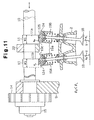
- the camshaft 10 has two intake cams 11 per cylinder 3.
- the intake cams 11 are secured to the camshaft 10.
- each cylinder 3 has a pair of intake valves 18.
- the valves 18 are inclined along the axis of the camshaft 10 (to the right and left as viewed in Fig. 6) such that the space between the valves 18 is wider toward their upper ends.
- the valves 18 are inclined from the vertical line V of Fig. 6 by an inclination angle ⁇ B .
- the valves 18 are operably coupled to the intake cams 11 by the valve lifters 19A, 19B.
- the valve lifters 19A, 19B are fitted and slide with respect to lift bores (not shown).
- the exhaust camshaft 12 also has two exhaust cams 13 per cylinder 3. Each cylinder 3 has a pair of exhaust valves 20.
- the exhaust valves 20 are operably coupled to the exhaust cams 13 through valve lifters 21.
- Each valve lifter 21 is slidably fitted in a lifter bore (not shown).
- the shaft moving mechanism 15 of this embodiment has substantially the same construction as that of the embodiment of Figs. 1 to 5 except that the bearing 22 is located between the adjacent intake cams 11 forming the pair.
- the intake cams 11 are conventional solid cams.
- the radius of the cam surface 11a at the cam nose varies continuously in the axial direction.
- An inclination angle ⁇ 1 of the cam surface 11a at the cam nose is the same as the inclination angle ⁇ of the cam nose of the cam 40 in the prior art shown in Figs. 12.
- the valve lifters 19A, 19B have the same shape. As shown in Fig. 9, the valve lifters 19A, 19B have a cylindrical shape.
- a guide member 123 is provided on the outer peripheral surface 19a thereof.
- the guide member 123 is secured to a recess 19b formed in the outer peripheral surface 19a by press fitting or welding.
- the guide member 123 is engaged with a structure (not shown) such as a groove formed in the inner peripheral surface of the lifter bore. This prevents the valve lifters 19A and 19B from rotating, but allows them to slide in the axial direction of the lifter bores.
- the valve lifters 19A and 19B each have cam follower holders 124 integrally formed in their upper surfaces 19c.
- a cam follower 125 is pivotally supported in the holder 124. As shown in Fig. 9, the holder 124 is located in the center of the upper surface 19c of the valve lifters 19A, 19B.
- Each cam follower 125 is urged in a direction to engage the cam 11 by springs 126 located in the valve lifters 19A, 19B.
- the surface of the cam follower 125, or a sliding surface 125a slides on the surface 11a of the intake cam 11 (see Figs. 6 and 8).
- the cam follower 125 pivots along the cam surface 11a.
- the width S1 of the cam followers 125 is equal to the width S of the prior art cam followers 45 illustrated in Fig. 12.
- a pair of intake valves 18, which are located on both sides of a bearing 22, are inclined with respect to a radius of the camshaft 10 such that the upper ends are set apart by a greater amount than their lower ends.
- This construction allows the width W1 of each intake cam 11 to be greater than the width W of the prior art cam 40
- the increased cam width W1 allows the moving amount D1 of the cams 11 to be greater than the moving amount D of the prior art cam 40. That is, although the cam 11 has the same inclination angle ⁇ 1 of the cam surface 11a at the cam nose as the inclination angle ⁇ of the cam nose of the cam 40, the difference between the maximum value and the minimum value of the radius of the cam nose is larger than that of the prior art cam 40.
- the shaft moving mechanism 15 is a conventional mechanism driven by a hydraulic circuit (not shown) to move the intake camshaft 10.
- the shaft moving mechanism 15 moves the intake camshaft 10 so that the contact position between the cam surface 11a of the intake cam 11 and the surface 125a of the cam follower 125 varies between the lowest radius position (see Fig. 8) of the cam nose and the highest radius position (see Fig. 6) of the cam nose.
- the intake valves 18 are inclined such that the distance between their upper ends along the camshaft 10 is greater. This expands the space between the intake cams 11 without increasing the space between the lower ends of the valves 18, which are located in the combustion chamber of a single cylinder 3. That is, this construction increases the width W1 of the cam 11 as compared to the width W of the prior art cam 40 without changing the inclination angle ⁇ 1 of the cam nose of the cam 11. In accordance with the increased width W1, the moving amount D1 of the cam 11 is greater than the moving amount D of the prior art cam 40. Therefore, the difference between the maximum value and the minimum value of the radius of the cam nose is larger than that of the prior art cam 40. Thus, the lift control amount (range of valve performance) is increased compared to that of the prior art apparatus. The increased lift control amount enables greater optimization of the amount of intake air for the various driving conditions of the engine 1.
- the roof of an engine cylinder having four valves typically is defined by two intersecting planes (like the roof of a house).
- the inclined intake valves 18 makes the shape of the roof of the combustion chambers closer to a hemispheric shape, which is ideal. This improves the combustion efficiency of fuel thereby preventing knocking of the engine. Thus, the performance of the engine is improved.
- the width S1 of the sliding surface 125a is equal to the width S of the sliding surface 45a of the prior art. Therefore, the pressure acting on the surface 125a is not greater than the pressure acting on the surface 45a.
- the cam follower 125 thus does not wear out faster than the prior art cam follower.
- the apparatus of Figs. 6-9 has the following advantages.
- Inclination of the intake valves 18 allows the width W1 and the moving amount D1 of the intake cam 11 to be increased. As a result, the lift control amount of the intake valves 18 is increased. Therefore, the amount of intake air and the amount of residual gas of the engine 1 are controlled with greater optimization.
- the prior art cams and valve lifters may be used in the apparatus of Figs. 6-9. This facilitates the design of the apparatus and lowers the manufacturing cost.
- Figs. 6-9 may be modified as the follows.
- the cam follower holder 124 and the cam follower 125 are located in the center of the upper surface 19c of the valve lifter.
- the cam follower holder 124 and the cam follower 125 may be located other positions.
- each holder 124 may be laterally offset from the center of the upper surface 19c in a direction away from the bearing 22 as illustrated in Fig 10. This construction further increases the cam width W and the cam moving amount D.
- the angles of the cam nose inclination angle ⁇ 1 of the cams 11, which have the bearing 22 in between, are the same.
- the inclination angles ⁇ 1 of the cams 11 may be different.
- the cam nose inclination angle ⁇ L of the left cam 11 may be greater than the cam nose inclination angle ⁇ R of the right cam 11.
- the inclination angles ⁇ B and ⁇ C of the associated intake valves 18 are changed. Changing the cam nose inclination angles of adjacent intake cams 11 changes the valve lift of the intake valves 18 when the valve lift is small. This causes air drawn through the intake valves 18 to be agitated thereby producing turbulence in the combustion chamber. The turbulence improves the combustion efficiency.
- the cam nose inclination angle ⁇ R of the right cam 11 may be greater than the cam nose inclination angle ⁇ L of the left cam 11.
- the camshaft 10 moves axially and the intake cams 11, which are secured to the camshaft 10, move integrally with the camshaft 10.
- the camshaft 10 may be axially fixed and the intake cams 11 may axially move with respect to the camshaft 10. This construction has the same advantages as the embodiment of Figs 1 to 5.
- valve driving apparatuses of Figs. 6 to 11 may be used for the exhaust valves or for both the intake and exhaust valves. Further, the apparatus may be used in engines other than the engine having four valves per cylinder. For example, the apparatus may be used in engines having six and eight valves per cylinder.
Landscapes
- Engineering & Computer Science (AREA)
- Mechanical Engineering (AREA)
- General Engineering & Computer Science (AREA)
- Chemical & Material Sciences (AREA)
- Combustion & Propulsion (AREA)
- Valve Device For Special Equipments (AREA)
- Valve-Gear Or Valve Arrangements (AREA)
Abstract
Description
Claims (5)
- A valve driving apparatus for an engine comprising :a camshaft (10) rotatably supported by the engine;a combustion chamber having a pair of ports;a pair of valves (18) associated with the ports, respectively, for selectively opening and closing the respective ports, wherein the valves each have a longitudinal axis, a head end, and an outer end, which is opposite to the head end;a cam (11) provided on the camshaft (10) for operating the valves (18), wherein the cam (11) lifts the valves along their axes in response to rotation of the camshaft, the cam having a cam nose for lifting the valves, wherein the radius of the cam nose varies in the axial direction so that the valves are driven with a variable amount of valve lift;a cam follower (25) for transmitting movement of the cam (11) to the valves (18), wherein the cam follower (25) contacts the cam at a contact position;a valve lifter structure located between the follower (25) and the valves (18), wherein the valve lifter structure is connected to each valve; andan actuator for moving the cam (11) relative to the valves (18) in the axial direction of the camshaft (10) to vary the amount of valve lift of each valve, wherein the movement of the cam varies the contact position of the cam follower (25) on the cam, characterized in thatthe side surface of the lifter structure is shaped like at least one circle so that the lifter structure fits into a correspondingly shaped opening that is formed entirely by drilling or boring, wherein the lifter structure includes:a pair of valve lifters (19A, 19B) respectively mounted on the pair of valves (18), each lifter having a cylindrical shape; anda bracket (23) for connecting the pair of valve lifters with each other, wherein the cam follower (25) is pivotally supported on the bracket (23), andwherein the valve lifters (19A, 19B) include a first lifter and a second lifter, and the bracket (23) has a first end welded to the first lifter and a second end fixed to the second lifter
- The valve driving apparatus according to Claim 1, wherein a shim (27) is located between the second end of the bracket and the second lifter.
- The valve driving apparatus according to Claim 1 or 2, further comprising a spring (26) for urging each valve, each valve lifter, the bracket and the cam follower toward the cam.
- A valve lifter structure for operating a pair of engine valves in an internal combustion engine, wherein the lifter is circularly shaped to fit into a correspondingly shaped lifter opening that is formed by drilling or boring, the lifter structure comprising:a first cylindrical lifter for engaging a first spring and a first valve of the pair of valves; anda second cylindrical lifter for engaging a second spring and a second valve of the pair of valves; characterized bya bracket (23) joined to the first lifter and the second lifter such that the bracket and the first and second lifters form an integral structure whereina cam follower (25) is pivotally supported on the bracket.
- A lifter structure according to claim 15, wherein a shim (27) is located between the bracket and the second lifter.
Applications Claiming Priority (5)
| Application Number | Priority Date | Filing Date | Title |
|---|---|---|---|
| JP7548797A JPH10266819A (en) | 1997-03-27 | 1997-03-27 | Valve characteristic control device for internal combustion engine |
| JP7548797 | 1997-03-27 | ||
| JP08671197A JP3324438B2 (en) | 1997-04-04 | 1997-04-04 | Valve characteristic control device for internal combustion engine |
| JP8671197 | 1997-04-04 | ||
| EP98105319A EP0867601B1 (en) | 1997-03-27 | 1998-03-24 | Valve driving apparatus for engine |
Related Parent Applications (1)
| Application Number | Title | Priority Date | Filing Date |
|---|---|---|---|
| EP98105319.2 Division | 1998-03-24 |
Publications (2)
| Publication Number | Publication Date |
|---|---|
| EP1164258A2 true EP1164258A2 (en) | 2001-12-19 |
| EP1164258A3 EP1164258A3 (en) | 2003-01-02 |
Family
ID=26416614
Family Applications (2)
| Application Number | Title | Priority Date | Filing Date |
|---|---|---|---|
| EP98105319A Expired - Lifetime EP0867601B1 (en) | 1997-03-27 | 1998-03-24 | Valve driving apparatus for engine |
| EP01113216A Withdrawn EP1164258A3 (en) | 1997-03-27 | 1998-03-24 | Valve driving apparatus for engine |
Family Applications Before (1)
| Application Number | Title | Priority Date | Filing Date |
|---|---|---|---|
| EP98105319A Expired - Lifetime EP0867601B1 (en) | 1997-03-27 | 1998-03-24 | Valve driving apparatus for engine |
Country Status (3)
| Country | Link |
|---|---|
| US (2) | US5988128A (en) |
| EP (2) | EP0867601B1 (en) |
| DE (1) | DE69810830D1 (en) |
Cited By (1)
| Publication number | Priority date | Publication date | Assignee | Title |
|---|---|---|---|---|
| DE10361188B4 (en) * | 2002-12-27 | 2010-06-24 | Suzuki Motor Corp., Hamamatsu-Shi | Valve drive device and having this internal combustion engine |
Families Citing this family (15)
| Publication number | Priority date | Publication date | Assignee | Title |
|---|---|---|---|---|
| JP2000073710A (en) * | 1998-08-31 | 2000-03-07 | Toyota Motor Corp | Swing follower mechanism for 3D cam |
| JP3700409B2 (en) * | 1998-09-04 | 2005-09-28 | トヨタ自動車株式会社 | 3D cam valve lifter and variable valve operating device |
| US6170449B1 (en) * | 1998-09-30 | 2001-01-09 | Yamaha Hatsudoki Kabushiki Kaisha | Valve operating system for engine |
| JP2002529635A (en) * | 1998-10-30 | 2002-09-10 | ポーレット メルモス ウォルターズ,クリストファー | Valve control mechanism |
| WO2001014694A1 (en) * | 1999-08-23 | 2001-03-01 | Toyota Jidosha Kabushiki Kaisha | Engine valve characteristic controller |
| AU2001259388B2 (en) * | 2000-05-03 | 2005-05-05 | Hanon Systems | EGR valve apparatus |
| US6425359B2 (en) * | 2000-06-23 | 2002-07-30 | Honda Giken Kogyo Kabushiki Kaisha | Valve moving apparatus of an internal combustion engine |
| DE10123966A1 (en) * | 2001-05-17 | 2002-11-21 | Ina Schaeffler Kg | Bucket tappet for valve drive has jacket with appreciably lower height than bucket tappet as whole |
| JP4627121B2 (en) * | 2001-06-12 | 2011-02-09 | ヤマハ発動機株式会社 | 3D cam and 3D cam grinding machine |
| JP4201617B2 (en) * | 2003-02-24 | 2008-12-24 | 本田技研工業株式会社 | Internal combustion engine |
| DE102004022832B4 (en) * | 2004-05-08 | 2020-03-26 | Dr. Ing. H.C. F. Porsche Aktiengesellschaft | Valve train for an internal combustion engine |
| DE102006058093A1 (en) * | 2006-12-09 | 2008-06-12 | Schaeffler Kg | valve train |
| DE102007042457A1 (en) * | 2007-09-07 | 2009-03-12 | Schaeffler Kg | Valve actuator for a fully variable valve train |
| US20150020760A1 (en) * | 2011-09-22 | 2015-01-22 | Etg Limited | Four-cycle Internal Combustion Engine |
| US20130074792A1 (en) * | 2011-09-22 | 2013-03-28 | Etg Limited | Engine Lubrication Method |
Family Cites Families (16)
| Publication number | Priority date | Publication date | Assignee | Title |
|---|---|---|---|---|
| US4658780A (en) * | 1981-05-08 | 1987-04-21 | Yamaha Hatsudoki Kabushiki Kaisha | Four cycle internal combustion engine |
| AT382933B (en) * | 1984-03-14 | 1987-04-27 | Weichsler Hermann | VALVE ACTUATION FOR LIFTING PISTON - INTERNAL COMBUSTION ENGINES |
| DE3624108A1 (en) * | 1986-07-17 | 1988-01-28 | Opel Adam Ag | VALVE DRIVE FOR AT LEAST TWO VALVES TO BE OPERATED AT THE SAME TIME |
| IT1195192B (en) * | 1986-10-07 | 1988-10-12 | Fiat Auto Spa | VALVE CONTROL FOR CAMSHAFT ENGINES IN HEAD |
| US4850311A (en) * | 1988-12-09 | 1989-07-25 | General Motors Corporation | Three dimensional cam cardanic follower valve lifter |
| JPH03179116A (en) * | 1989-07-25 | 1991-08-05 | Isuzu Motors Ltd | Valve driving device for engine |
| IT1257540B (en) * | 1992-05-22 | 1996-01-30 | Ferrari Spa | VALVE CONTROL SYSTEM FOR A VARIABLE ENDOTHERMAL ENGINE, IN PARTICULAR AN ENGINE WITH MORE VALVES PER CYLINDER. |
| DE4226760A1 (en) * | 1992-08-13 | 1994-02-17 | Opel Adam Ag | Valve train for at least two simultaneously operated lift valves |
| IT1270443B (en) * | 1993-02-10 | 1997-05-05 | Fiat Auto Spa | VARIABLE GEOMETRY DISTRIBUTION CONTROL FOR AN INTERNAL COMBUSTION ENGINE. |
| US5445117A (en) * | 1994-01-31 | 1995-08-29 | Mendler; Charles | Adjustable valve system for a multi-valve internal combustion engine |
| JPH07279631A (en) * | 1994-04-05 | 1995-10-27 | Nittan Valve Kk | Variable valve device for internal combustion engine |
| JPH084505A (en) * | 1994-06-17 | 1996-01-09 | Yamaha Motor Co Ltd | Engine valve gear |
| US5673661A (en) * | 1995-11-27 | 1997-10-07 | Jesel; Daniel Henry | Valve lifter |
| US5645023A (en) * | 1996-04-08 | 1997-07-08 | Chrysler Corporation | Valve train for an internal combustion engine |
| US5682849A (en) * | 1996-10-04 | 1997-11-04 | Chrysler Corporation | Rocker arm-tappet connector for radial valves and vertically operating crosshead |
| US5921209A (en) * | 1997-08-29 | 1999-07-13 | Chrysler Corporation | Roller arrangement for valve train mechanism |
-
1998
- 1998-03-24 EP EP98105319A patent/EP0867601B1/en not_active Expired - Lifetime
- 1998-03-24 DE DE69810830T patent/DE69810830D1/en not_active Expired - Lifetime
- 1998-03-24 EP EP01113216A patent/EP1164258A3/en not_active Withdrawn
- 1998-03-24 US US09/047,249 patent/US5988128A/en not_active Expired - Fee Related
-
1999
- 1999-03-12 US US09/266,746 patent/US6067947A/en not_active Expired - Fee Related
Cited By (1)
| Publication number | Priority date | Publication date | Assignee | Title |
|---|---|---|---|---|
| DE10361188B4 (en) * | 2002-12-27 | 2010-06-24 | Suzuki Motor Corp., Hamamatsu-Shi | Valve drive device and having this internal combustion engine |
Also Published As
| Publication number | Publication date |
|---|---|
| EP0867601B1 (en) | 2003-01-22 |
| DE69810830D1 (en) | 2003-02-27 |
| US6067947A (en) | 2000-05-30 |
| US5988128A (en) | 1999-11-23 |
| EP0867601A1 (en) | 1998-09-30 |
| EP1164258A3 (en) | 2003-01-02 |
Similar Documents
| Publication | Publication Date | Title |
|---|---|---|
| US6067947A (en) | Valve driving apparatus for engine | |
| US5494009A (en) | Valve control device for internal combustion engine | |
| US6244229B1 (en) | Valve lifter for three-dimensional cam and variable valve operating apparatus using the same | |
| EP0515520B2 (en) | Valve control means | |
| US6041746A (en) | Variable valve actuation apparatus | |
| EP0887519B1 (en) | Valve operating system in internal combustion engine | |
| US5359970A (en) | Valve drive for an internal combustion engine | |
| US7588003B2 (en) | Valve train for internal combustion engine | |
| US7913658B2 (en) | Valve actuating mechanism for an internal combustion engine, and cylinder head incorporating same | |
| US5893345A (en) | Valve control apparatus for an internal combustion engine | |
| US5870984A (en) | Variable engine valve driver | |
| EP1881167B1 (en) | Valve system for internal combustion engine | |
| EP1275823A2 (en) | Internal combustion engine | |
| US7444966B2 (en) | Valve moving device for engine | |
| KR20000071212A (en) | Operating mechanisms for valves | |
| JP2001123811A (en) | Variable valve characteristic device for internal combustion engine | |
| US6098580A (en) | Variable valve actuator apparatus | |
| JP3324438B2 (en) | Valve characteristic control device for internal combustion engine | |
| JPH09177525A (en) | Valve train for internal combustion engine | |
| JP2007205299A (en) | Cylinder head of internal combustion engine | |
| JP3661431B2 (en) | Swing follower mechanism for 3D cam | |
| JP2007239496A (en) | Cylinder head of internal combustion engine | |
| KR0179300B1 (en) | Valve lift mechanism of automobile | |
| JPH1113442A (en) | Valve train for internal combustion engine | |
| JP2002221013A (en) | Variable valve train for internal combustion engines |
Legal Events
| Date | Code | Title | Description |
|---|---|---|---|
| PUAI | Public reference made under article 153(3) epc to a published international application that has entered the european phase |
Free format text: ORIGINAL CODE: 0009012 |
|
| AC | Divisional application: reference to earlier application |
Ref document number: 867601 Country of ref document: EP |
|
| AK | Designated contracting states |
Kind code of ref document: A2 Designated state(s): DE FR GB IT |
|
| PUAL | Search report despatched |
Free format text: ORIGINAL CODE: 0009013 |
|
| AK | Designated contracting states |
Kind code of ref document: A3 Designated state(s): DE FR GB IT |
|
| RIC1 | Information provided on ipc code assigned before grant |
Free format text: 7F 01L 13/00 A, 7F 01L 1/14 B, 7F 01L 1/34 B, 7F 01L 1/20 B |
|
| AKX | Designation fees paid | ||
| REG | Reference to a national code |
Ref country code: DE Ref legal event code: 8566 |
|
| STAA | Information on the status of an ep patent application or granted ep patent |
Free format text: STATUS: THE APPLICATION IS DEEMED TO BE WITHDRAWN |
|
| 18D | Application deemed to be withdrawn |
Effective date: 20030703 |