EP1162497A1 - Filmstrip transport mechanism with compensation for perforation pitch variations for improved film registration - Google Patents
Filmstrip transport mechanism with compensation for perforation pitch variations for improved film registration Download PDFInfo
- Publication number
- EP1162497A1 EP1162497A1 EP01201977A EP01201977A EP1162497A1 EP 1162497 A1 EP1162497 A1 EP 1162497A1 EP 01201977 A EP01201977 A EP 01201977A EP 01201977 A EP01201977 A EP 01201977A EP 1162497 A1 EP1162497 A1 EP 1162497A1
- Authority
- EP
- European Patent Office
- Prior art keywords
- registration
- filmstrip
- tension
- pin
- substrate
- Prior art date
- Legal status (The legal status is an assumption and is not a legal conclusion. Google has not performed a legal analysis and makes no representation as to the accuracy of the status listed.)
- Withdrawn
Links
- 230000007723 transport mechanism Effects 0.000 title description 2
- 239000000758 substrate Substances 0.000 claims abstract description 26
- 230000000712 assembly Effects 0.000 claims abstract description 15
- 238000000429 assembly Methods 0.000 claims abstract description 15
- 230000000284 resting effect Effects 0.000 claims description 4
- 238000000034 method Methods 0.000 abstract description 8
- 238000013459 approach Methods 0.000 abstract description 6
- 230000003993 interaction Effects 0.000 abstract 1
- 230000007246 mechanism Effects 0.000 description 6
- 238000006073 displacement reaction Methods 0.000 description 3
- 238000003780 insertion Methods 0.000 description 2
- 230000037431 insertion Effects 0.000 description 2
- 238000012986 modification Methods 0.000 description 2
- 230000004048 modification Effects 0.000 description 2
- 230000009471 action Effects 0.000 description 1
- 238000004519 manufacturing process Methods 0.000 description 1
- 230000003287 optical effect Effects 0.000 description 1
- 230000000737 periodic effect Effects 0.000 description 1
- 230000008569 process Effects 0.000 description 1
- 238000012545 processing Methods 0.000 description 1
- 230000004044 response Effects 0.000 description 1
Images


Classifications
-
- G—PHYSICS
- G03—PHOTOGRAPHY; CINEMATOGRAPHY; ANALOGOUS TECHNIQUES USING WAVES OTHER THAN OPTICAL WAVES; ELECTROGRAPHY; HOLOGRAPHY
- G03B—APPARATUS OR ARRANGEMENTS FOR TAKING PHOTOGRAPHS OR FOR PROJECTING OR VIEWING THEM; APPARATUS OR ARRANGEMENTS EMPLOYING ANALOGOUS TECHNIQUES USING WAVES OTHER THAN OPTICAL WAVES; ACCESSORIES THEREFOR
- G03B1/00—Film strip handling
- G03B1/42—Guiding, framing, or constraining film in desired position relative to lens system
-
- B—PERFORMING OPERATIONS; TRANSPORTING
- B65—CONVEYING; PACKING; STORING; HANDLING THIN OR FILAMENTARY MATERIAL
- B65H—HANDLING THIN OR FILAMENTARY MATERIAL, e.g. SHEETS, WEBS, CABLES
- B65H23/00—Registering, tensioning, smoothing or guiding webs
- B65H23/02—Registering, tensioning, smoothing or guiding webs transversely
- B65H23/0204—Sensing transverse register of web
- B65H23/0208—Sensing transverse register of web with an element engaging the edge of the web
-
- B—PERFORMING OPERATIONS; TRANSPORTING
- B65—CONVEYING; PACKING; STORING; HANDLING THIN OR FILAMENTARY MATERIAL
- B65H—HANDLING THIN OR FILAMENTARY MATERIAL, e.g. SHEETS, WEBS, CABLES
- B65H23/00—Registering, tensioning, smoothing or guiding webs
- B65H23/04—Registering, tensioning, smoothing or guiding webs longitudinally
- B65H23/18—Registering, tensioning, smoothing or guiding webs longitudinally by controlling or regulating the web-advancing mechanism, e.g. mechanism acting on the running web
- B65H23/188—Registering, tensioning, smoothing or guiding webs longitudinally by controlling or regulating the web-advancing mechanism, e.g. mechanism acting on the running web in connection with running-web
- B65H23/1882—Registering, tensioning, smoothing or guiding webs longitudinally by controlling or regulating the web-advancing mechanism, e.g. mechanism acting on the running web in connection with running-web and controlling longitudinal register of web
-
- G—PHYSICS
- G03—PHOTOGRAPHY; CINEMATOGRAPHY; ANALOGOUS TECHNIQUES USING WAVES OTHER THAN OPTICAL WAVES; ELECTROGRAPHY; HOLOGRAPHY
- G03B—APPARATUS OR ARRANGEMENTS FOR TAKING PHOTOGRAPHS OR FOR PROJECTING OR VIEWING THEM; APPARATUS OR ARRANGEMENTS EMPLOYING ANALOGOUS TECHNIQUES USING WAVES OTHER THAN OPTICAL WAVES; ACCESSORIES THEREFOR
- G03B1/00—Film strip handling
- G03B1/18—Moving film strip by means which act on the film between the ends thereof
- G03B1/20—Acting means
- G03B1/22—Claws or pins engaging holes in the film
-
- G—PHYSICS
- G03—PHOTOGRAPHY; CINEMATOGRAPHY; ANALOGOUS TECHNIQUES USING WAVES OTHER THAN OPTICAL WAVES; ELECTROGRAPHY; HOLOGRAPHY
- G03B—APPARATUS OR ARRANGEMENTS FOR TAKING PHOTOGRAPHS OR FOR PROJECTING OR VIEWING THEM; APPARATUS OR ARRANGEMENTS EMPLOYING ANALOGOUS TECHNIQUES USING WAVES OTHER THAN OPTICAL WAVES; ACCESSORIES THEREFOR
- G03B1/00—Film strip handling
- G03B1/18—Moving film strip by means which act on the film between the ends thereof
- G03B1/20—Acting means
- G03B1/24—Sprockets engaging holes in the film
-
- B—PERFORMING OPERATIONS; TRANSPORTING
- B65—CONVEYING; PACKING; STORING; HANDLING THIN OR FILAMENTARY MATERIAL
- B65H—HANDLING THIN OR FILAMENTARY MATERIAL, e.g. SHEETS, WEBS, CABLES
- B65H2301/00—Handling processes for sheets or webs
- B65H2301/40—Type of handling process
- B65H2301/44—Moving, forwarding, guiding material
- B65H2301/442—Moving, forwarding, guiding material by acting on edge of handled material
- B65H2301/4421—Moving, forwarding, guiding material by acting on edge of handled material by abutting edge
Definitions
- the present invention relates to perforated filmstrip transport mechanisms in general, and to methods and apparatuses for consistently registering perforated filmstrip images in particular.
- High speed perforated filmstrip transportation for such applications as scanning, recording and optical printing not only require reliable movement of filmstrips, but also consistent registration of the filmstrip images. That is, it is important that each image on a filmstrip come to momentary rest at the same location along the direction of travel, within an acceptable tolerance. When images are not properly registered, undesirable image artifacts can be produced, with the severity of the artifacts being more pronounced with film transport speed.
- One basic prior art approach to filmstrip registration is to use sprocket teeth (or pins) that engage the perforations with an interference fit. Because the action of insertion or removal of the pins can lead to image artifacts due to film displacement, such approaches require pauses in the processes which may greatly limit the filmstrip transport speed. Additionally, minute, periodic and random variations induced in the film manufacturing processing can also lead to image artifacts.
- Another basic prior art filmstrip registration approach partially addresses the problems associated with the aforementioned approach, by using precisely machined pins which have a smaller projected area than the perforation areas. Registration is accomplished by using the filmstrip tension to rest edges of the perforations against the corresponding edge of the pins. For example, the pins can be made to consistently rest against the trailing edges of all of the perforations. While this approach allows for a faster filmstrip transport speed, it does not address the problem of inconsistent registration (and the resulting artifacts) due to variability in the distances between the perforation distances.
- the present invention provides a filmstrip transport system adapted for perforated filmstrip transport and filmstrip image registration.
- the system at least includes a substrate adapted to apply a normal force to a filmstrip, and a plurality of registration-tension assemblies carried by the substrate, the registration-tension assemblies each at least including a registration pin member having a registration pin sized for a non-interference fit with filmstrip perforations and a tension pin member having a tension pin sized for a non-interference fit with filmstrip perforations.
- the registration-tension assemblies have a registration mode to engage and register a filmstrip by resting an edge of one perforation of the filmstrip against the side of an inserted registration pin, and placing the filmstrip in tension by pulling the filmstrip via a tension pin inserted in another perforation in the filmstrip, in a direction substantially parallel to the direction of filmstrip transport and away from the registration pin.
- the registration-tension assemblies also have a load mode to load the registration and tension pins into prospective perforations by moving the tension pin in a direction substantially parallel to the direction of filmstrip transport and toward the registration pin until the registration and tension pins achieve a distance therebetween permitting a non-interference fit into two filmstrip perforations.
- the present invention also provides a method of transporting and registering a filmstrip.
- the method at least includes the steps of, via a substrate, providing a normal force to a filmstrip, and providing a plurality of registration-tension assemblies carried by the substrate, the registration-tension assemblies each at least including a registration pin member having a registration pin sized for a non-interference fit with filmstrip perforations and a tension pin member having a tension pin sized for a non-interference fit with filmstrip perforations.
- the method also includes the steps of providing a registration mode to engage and register a filmstrip by resting an edge of one perforation of the filmstrip against the side of an inserted registration pin, and placing the filmstrip in tension by pulling the filmstrip via a tension pin inserted in another perforation in the filmstrip, in a direction substantially parallel to the direction of filmstrip transport and away from the registration pin, and providing a load mode to load the registration and tension pins into prospective perforations by moving the tension pin in a direction substantially parallel to the direction of filmstrip transport and toward the registration pin until the registration and tension pins achieve a distance therebetween permitting a non-interference fit into two filmstrip perforations.
- the present-inventive filmstrip transport and registration system 100 is generally shown in Figure 1.
- the filmstrip transport and registration system 100 is capable of both advancing a filmstrip at a high speed, and properly registering each image frame by lining it with a registration pin, as detailed infra.
- the system 100 is principally embodied in and upon a rotary filmstrip transport drum mechanism 104, which also acts as a substrate.
- the drum mechanism 104 has a number vacuum holes 106 throughout its surface for allowing an internally produced vacuum to interact with a filmstrip touching the drum surface. In operation, the filmstrip touches the drum mechanism 104 so that there is a slight transverse displacement as shown in Figure 1.
- FIG. 2 illustrates a plan view of a perforated filmstrip 102 (the drum mechanism is obscured) in the "registration mode.” That is, an image frame 206 is momentarily fixed (axially aligned) in its axial position along the direction of travel with respect to a registration pin 220 (inserted in a perforation 208) by pulling the filmstrip in a direction opposite the transport direction to place the filmstrip in tension, by a tension pin 230 (inserted into an adjacent perforation 208).
- the filmstrip is transversely aligned and restrained by resting one edge of the filmstrip against filmstrip guide edges 240 and 242 on one side, and by applying spring-loaded filmstrip guide rollers 250-252 on the other side.
- the spring-loaded rollers are connected to a spring-loaded roller support 256, which may be as simple as spring member.
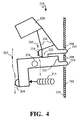
- Figures 3 and 4 show side views of the registration and tension pin pair assemblies 216 located on the periphery of the drum mechanism 104 in line with the filmstrip perforations 208.
- Figure 3 shows a side view of an assembly 216 in the registration position
- Figure 4 shows a side view of an assembly 216 in the load position.
- the registration pin 220 is part of a registration pin body 222.
- the registration pin body 222 is connected to a fixed body 228 on the substrate/drum 104 by two flexible members ("flexures") 226, which allow curvilinear displacement of the registration pin when a cam surface 260 acts upon a registration pin body roller 224.
- the tension pin 230 is part of a spring-loaded tension pin body 232.
- the tension pin body 232 pivots around a pivot point 234, attached to the substrate/drum 104.
- the tension pin body, and hence the tension pin moves curvilinearly, in response to the force of a cam surface 262 acting through a tension pin body roller 236.
- the general operation of the perforated filmstrip transport and registration system is as follows. To place a registration and tension pin pair assembly 216 in the load mode, the cam surface 260 lowers the registration pin body 222, causing the registration pin 220 to move downward and toward the tension pin 230 in a curved path. Meanwhile, the cam surface 262 forces the tension pin body 232 to pivot toward the registration pin 220, so that the distance between the centerlines of the registration and tension pins is approximately equal to the average distance between the centerlines of two adjacent perforations. The rotating drum places the registration and tension pin assembly in the 3 o'clock position, whereupon the pins are inserted into two adjacent perforations.
- the cam surface 260 raises the registration pin body 222 to place the side of the registration pin 220 against the front edge of a perforation, while a tension pin body spring 235 forces the tension pin body 232 to pivot and move the tension pin 230 away from the registration pin to place the filmstrip in tension by impinging the tension pin on the rear edge of a trailing perforation.
- the present invention is not limited to any particular perforated filmstrip type, and is generally adaptable to any perforated filmstrip transport operation.
- Components which may have functional equivalents include, inter alia , the transverse guides (240, 242, 250, 252, and 256), the flexures (226), the spring-loaded pivot (234), and the cam surface/roller combinations (260/224 and 262/236).
- the substrate/drum can include registration and tension pin pair assemblies on both edges, to engage pins on both sides of a perforated filmstrip.
- the present invention need not use a curved substrate, and is adaptable to linear substrate systems.
- cam surfaces 260 and 262 have been included in the preferred embodiment as perhaps the simplest means of pin actuation, other means of pin actuation are also possible, including one or more of, among others, the following methods: electrical; mechanical; electromechanical; and hydraulics.
- a piezoelectric actuator might take the place of the cam, for actuating the registration pin.
- the preferred embodiment spaces registration and tension pins in such a manner that the aforementioned pins act upon adjacent perforations, it is possible to increase the relative spacing so that the pins operate on non-adjacent perforations (e.g., every third perforation).
- the substrate is curved ⁇ as in the preferred embodiment ⁇ there is an increased likelihood that when using other than adjacent perforations, the force of the tension pin could cause the filmstrip to buckle.
Landscapes
- Physics & Mathematics (AREA)
- General Physics & Mathematics (AREA)
- Projection-Type Copiers In General (AREA)
Abstract
Description
- The present invention relates to perforated filmstrip transport mechanisms in general, and to methods and apparatuses for consistently registering perforated filmstrip images in particular.
- High speed perforated filmstrip transportation for such applications as scanning, recording and optical printing not only require reliable movement of filmstrips, but also consistent registration of the filmstrip images. That is, it is important that each image on a filmstrip come to momentary rest at the same location along the direction of travel, within an acceptable tolerance. When images are not properly registered, undesirable image artifacts can be produced, with the severity of the artifacts being more pronounced with film transport speed.
- One basic prior art approach to filmstrip registration is to use sprocket teeth (or pins) that engage the perforations with an interference fit. Because the action of insertion or removal of the pins can lead to image artifacts due to film displacement, such approaches require pauses in the processes which may greatly limit the filmstrip transport speed. Additionally, minute, periodic and random variations induced in the film manufacturing processing can also lead to image artifacts.
- Another basic prior art filmstrip registration approach partially addresses the problems associated with the aforementioned approach, by using precisely machined pins which have a smaller projected area than the perforation areas. Registration is accomplished by using the filmstrip tension to rest edges of the perforations against the corresponding edge of the pins. For example, the pins can be made to consistently rest against the trailing edges of all of the perforations. While this approach allows for a faster filmstrip transport speed, it does not address the problem of inconsistent registration (and the resulting artifacts) due to variability in the distances between the perforation distances.
- What is therefore of great interest―but not provided for in the prior art―are a high speed filmstrip transport device and method which eliminates image artifacts caused by variations in relative perforation distances.
- To address the unmet needs of the prior art identified supra, the present invention provides a filmstrip transport system adapted for perforated filmstrip transport and filmstrip image registration. The system at least includes a substrate adapted to apply a normal force to a filmstrip, and a plurality of registration-tension assemblies carried by the substrate, the registration-tension assemblies each at least including a registration pin member having a registration pin sized for a non-interference fit with filmstrip perforations and a tension pin member having a tension pin sized for a non-interference fit with filmstrip perforations.
- The registration-tension assemblies have a registration mode to engage and register a filmstrip by resting an edge of one perforation of the filmstrip against the side of an inserted registration pin, and placing the filmstrip in tension by pulling the filmstrip via a tension pin inserted in another perforation in the filmstrip, in a direction substantially parallel to the direction of filmstrip transport and away from the registration pin. The registration-tension assemblies also have a load mode to load the registration and tension pins into prospective perforations by moving the tension pin in a direction substantially parallel to the direction of filmstrip transport and toward the registration pin until the registration and tension pins achieve a distance therebetween permitting a non-interference fit into two filmstrip perforations.
- The present invention also provides a method of transporting and registering a filmstrip. The method at least includes the steps of, via a substrate, providing a normal force to a filmstrip, and providing a plurality of registration-tension assemblies carried by the substrate, the registration-tension assemblies each at least including a registration pin member having a registration pin sized for a non-interference fit with filmstrip perforations and a tension pin member having a tension pin sized for a non-interference fit with filmstrip perforations.
- The method also includes the steps of providing a registration mode to engage and register a filmstrip by resting an edge of one perforation of the filmstrip against the side of an inserted registration pin, and placing the filmstrip in tension by pulling the filmstrip via a tension pin inserted in another perforation in the filmstrip, in a direction substantially parallel to the direction of filmstrip transport and away from the registration pin, and providing a load mode to load the registration and tension pins into prospective perforations by moving the tension pin in a direction substantially parallel to the direction of filmstrip transport and toward the registration pin until the registration and tension pins achieve a distance therebetween permitting a non-interference fit into two filmstrip perforations.
- Features and advantages of the present invention will become apparent to those skilled in the art from the description below, with reference to the following drawing figures, in which:
- Figure 1 is a general illustration of the filmstrip transport and image registration system of the present invention;
- Figure 2 is a plan view of a filmstrip engaged with a registration pin/tension pin pair of the rotary filmstrip transport drum mechanism of the present invention;
- Figure 3 is a side view of a registration pin/tension pin pair in the fully engaged ("in" or "registration") position, allowing for image/frame registration, and filmstrip advancement; and
- Figure 4 is a side view of a registration pin/tension pin pair in the disengaged ("load") position, allowing for free insertion into filmstrip perforations.
-
- The present-inventive filmstrip transport and
registration system 100, is generally shown in Figure 1. The filmstrip transport andregistration system 100 is capable of both advancing a filmstrip at a high speed, and properly registering each image frame by lining it with a registration pin, as detailed infra. Thesystem 100 is principally embodied in and upon a rotary filmstriptransport drum mechanism 104, which also acts as a substrate. Thedrum mechanism 104 has anumber vacuum holes 106 throughout its surface for allowing an internally produced vacuum to interact with a filmstrip touching the drum surface. In operation, the filmstrip touches thedrum mechanism 104 so that there is a slight transverse displacement as shown in Figure 1. - Figure 2 illustrates a plan view of a perforated filmstrip 102 (the drum mechanism is obscured) in the "registration mode." That is, an
image frame 206 is momentarily fixed (axially aligned) in its axial position along the direction of travel with respect to a registration pin 220 (inserted in a perforation 208) by pulling the filmstrip in a direction opposite the transport direction to place the filmstrip in tension, by a tension pin 230 (inserted into an adjacent perforation 208). The filmstrip is transversely aligned and restrained by resting one edge of the filmstrip againstfilmstrip guide edges roller support 256, which may be as simple as spring member. - Figures 3 and 4 show side views of the registration and tension
pin pair assemblies 216 located on the periphery of thedrum mechanism 104 in line with thefilmstrip perforations 208. In particular, Figure 3 shows a side view of anassembly 216 in the registration position, while Figure 4 shows a side view of anassembly 216 in the load position. - The
registration pin 220 is part of aregistration pin body 222. Theregistration pin body 222 is connected to a fixedbody 228 on the substrate/drum 104 by two flexible members ("flexures") 226, which allow curvilinear displacement of the registration pin when acam surface 260 acts upon a registrationpin body roller 224. - The
tension pin 230 is part of a spring-loadedtension pin body 232. Thetension pin body 232 pivots around apivot point 234, attached to the substrate/drum 104. The tension pin body, and hence the tension pin moves curvilinearly, in response to the force of acam surface 262 acting through a tensionpin body roller 236. - The general operation of the perforated filmstrip transport and registration system is as follows. To place a registration and tension
pin pair assembly 216 in the load mode, thecam surface 260 lowers theregistration pin body 222, causing theregistration pin 220 to move downward and toward thetension pin 230 in a curved path. Meanwhile, thecam surface 262 forces thetension pin body 232 to pivot toward theregistration pin 220, so that the distance between the centerlines of the registration and tension pins is approximately equal to the average distance between the centerlines of two adjacent perforations. The rotating drum places the registration and tension pin assembly in the 3 o'clock position, whereupon the pins are inserted into two adjacent perforations. - To register a filmstrip image and move the filmstrip one frame length, the
cam surface 260 raises theregistration pin body 222 to place the side of theregistration pin 220 against the front edge of a perforation, while a tensionpin body spring 235 forces thetension pin body 232 to pivot and move thetension pin 230 away from the registration pin to place the filmstrip in tension by impinging the tension pin on the rear edge of a trailing perforation. - At any given moment, only one registration and tension pin assembly is in the registration mode, while the rest of the registration and tension pair assemblies are in the load mode.
- Variations and modifications of the present invention are possible, given the above description. However, all variations and modifications which are obvious to those skilled in the art to which the present invention pertains are considered to be within the scope of the protection granted by this Letters Patent.
- For example, the present invention is not limited to any particular perforated filmstrip type, and is generally adaptable to any perforated filmstrip transport operation. Also, it will be appreciated by those skilled in the art that, given the above description of the essence of the present invention, many components may have substitutes without departing from the scope of the invention. Components which may have functional equivalents include, inter alia, the transverse guides (240, 242, 250, 252, and 256), the flexures (226), the spring-loaded pivot (234), and the cam surface/roller combinations (260/224 and 262/236).
- Additionally, the substrate/drum can include registration and tension pin pair assemblies on both edges, to engage pins on both sides of a perforated filmstrip.
- Also, the present invention need not use a curved substrate, and is adaptable to linear substrate systems.
- Given the above description of the essence of the present invention, it should also be noted that while the
cam surfaces - Although the preferred embodiment spaces registration and tension pins in such a manner that the aforementioned pins act upon adjacent perforations, it is possible to increase the relative spacing so that the pins operate on non-adjacent perforations (e.g., every third perforation). However, where the substrate is curved―as in the preferred embodiment―there is an increased likelihood that when using other than adjacent perforations, the force of the tension pin could cause the filmstrip to buckle.
Claims (10)
- A filmstrip transport system adapted for perforated filmstrip transport and filmstrip image registration, said system comprising:a substrate adapted to apply a normal force to a filmstrip; anda plurality of registration-tension assemblies carried by said substrate, said registration-tension assemblies each comprising a registration pin member having a registration pin sized for a non-interference fit with filmstrip perforations and a tension pin member having a tension pin sized for a non-interference fit with filmstrip perforations;wherein said registration-tension assemblies have a registration mode to engage and register a filmstrip by resting an edge of one perforation of said filmstrip against the side of an inserted registration pin, and placing said filmstrip in tension by pulling said filmstrip via a tension pin inserted in another perforation in said filmstrip, in a direction substantially parallel to the direction of filmstrip transport and away from said registration pin; andwherein said registration-tension assemblies have a load mode to load the registration and tension pins into prospective perforations by moving said tension pin in a direction substantially parallel to the direction of filmstrip transport and toward said registration pin until said registration and tension pins achieve a distance therebetween permitting a non-interference fit into two filmstrip perforations.
- The system in Claim 1, wherein said substrate has a curvilinear shape when viewed from a vantage point with the edge of said filmstrip visible.
- The system in Claim 2, wherein said substrate is drumlike, and said substrate further comprises vacuum holes whereby a filmstrip is held in contact with said substrate via a vacuum created inside of said substrate, and acting through said vacuum holes.
- The system in Claim 1, wherein the relative motion of said registration and tension pins resembles the movement of scissors tips.
- The system in Claim 1, wherein said tension pin member is pivotally mounted to said substrate via a spring member, and the movement of said tension pin forms an arc.
- The system in Claim 1, wherein said registration pin member is mounted to said substrate via at least one flexible member.
- The system in Claim 5, wherein said substrate further comprises at least one cam surface adapted to guide the movement of said tension pin member to position said tension pin for said registration and load modes.
- The system in Claim 6, wherein said substrate further comprises at least one cam surface adapted to guide the movement of said registration pin member to position said registration pin for said registration and load modes.
- The system in Claim 1, wherein said tension pin member is pivotally mounted to said substrate via a spring member, and the movement of said tension pin forms an arc, said registration pin member is mounted to said substrate via at least one flexible member, wherein said substrate further comprises at least one cam surface adapted to guide the movement of said tension pin member to position said tension pin for said registration and load modes, and another cam surface adapted to guide the movement of said registration pin member to position said registration pin for said registration and load modes.
- The system in Claim 1 wherein said registration and tension pins are relatively spaced to fit into adjacent filmstrip perforations.
Applications Claiming Priority (4)
| Application Number | Priority Date | Filing Date | Title |
|---|---|---|---|
| US756620 | 1996-11-26 | ||
| US20976700P | 2000-06-06 | 2000-06-06 | |
| US209767P | 2000-06-06 | ||
| US09/756,620 US6435393B1 (en) | 2000-06-06 | 2001-01-08 | Filmstrip transport mechanism with compensation for perforation pitch variations for improved film registration |
Publications (1)
| Publication Number | Publication Date |
|---|---|
| EP1162497A1 true EP1162497A1 (en) | 2001-12-12 |
Family
ID=26904494
Family Applications (1)
| Application Number | Title | Priority Date | Filing Date |
|---|---|---|---|
| EP01201977A Withdrawn EP1162497A1 (en) | 2000-06-06 | 2001-05-25 | Filmstrip transport mechanism with compensation for perforation pitch variations for improved film registration |
Country Status (2)
| Country | Link |
|---|---|
| US (1) | US6435393B1 (en) |
| EP (1) | EP1162497A1 (en) |
Families Citing this family (2)
| Publication number | Priority date | Publication date | Assignee | Title |
|---|---|---|---|---|
| US7243828B2 (en) * | 2004-11-12 | 2007-07-17 | Samsung Techwin Co., Ltd. | Tape feeder for component mounter and method of automatically setting tape initial position by the same |
| ES2803581T3 (en) | 2014-10-29 | 2021-01-28 | Walter & Eliza Hall Inst Medical Res | Mcl-1 inhibitors for use in the treatment of diseases caused by pathological neovascularization |
Citations (4)
| Publication number | Priority date | Publication date | Assignee | Title |
|---|---|---|---|---|
| GB1575536A (en) * | 1978-05-30 | 1980-09-24 | Samuelson Film Service Ltd | Film transport mechanism |
| US4405070A (en) * | 1980-02-26 | 1983-09-20 | Arnold & Richter Cinetechnik Gmbh, & Co. Betriebs Kg | Film transport mechanism |
| US5341182A (en) * | 1993-01-14 | 1994-08-23 | Pioneer Technology Corporation | Motion picture projection apparatus |
| US5529232A (en) * | 1994-08-19 | 1996-06-25 | Eastman Kodak Company | Precision pin registered film gate |
Family Cites Families (12)
| Publication number | Priority date | Publication date | Assignee | Title |
|---|---|---|---|---|
| US1912535A (en) * | 1930-04-25 | 1933-06-06 | Mitchell Camera Corp | Film movement |
| US1930723A (en) * | 1932-01-11 | 1933-10-17 | Mitchell Camera Corp | Film movement mechanism |
| US2129093A (en) * | 1934-06-08 | 1938-09-06 | Int Projector Corp | Claw and registration pin mechanism |
| US2619006A (en) * | 1950-08-09 | 1952-11-25 | Debrie Andre Victor Le Clement | Balanced mechanism for driving films |
| FR1337382A (en) * | 1962-07-30 | 1963-09-13 | Film drive mechanism of a cinematographic camera | |
| FR1478399A (en) * | 1966-01-21 | 1967-04-28 | Film drive mechanism of a cinematographic device | |
| US3776626A (en) | 1972-02-15 | 1973-12-04 | Columbia Pictures Ind Inc | Film advancing and positioning apparatus |
| US4039256A (en) * | 1976-05-24 | 1977-08-02 | Ampex Corporation | Intermittent film transport registration stabilization device |
| US4522476A (en) * | 1984-06-25 | 1985-06-11 | Walter Renold | Motion picture film gate and registration system |
| US5543869A (en) | 1991-12-12 | 1996-08-06 | Vetter; Richard | Frame registration |
| US5328074A (en) | 1992-06-24 | 1994-07-12 | Eastman Kodak Company | Film registration gate assembly |
| US5328073A (en) * | 1992-06-24 | 1994-07-12 | Eastman Kodak Company | Film registration and ironing gate assembly |
-
2001
- 2001-01-08 US US09/756,620 patent/US6435393B1/en not_active Expired - Fee Related
- 2001-05-25 EP EP01201977A patent/EP1162497A1/en not_active Withdrawn
Patent Citations (4)
| Publication number | Priority date | Publication date | Assignee | Title |
|---|---|---|---|---|
| GB1575536A (en) * | 1978-05-30 | 1980-09-24 | Samuelson Film Service Ltd | Film transport mechanism |
| US4405070A (en) * | 1980-02-26 | 1983-09-20 | Arnold & Richter Cinetechnik Gmbh, & Co. Betriebs Kg | Film transport mechanism |
| US5341182A (en) * | 1993-01-14 | 1994-08-23 | Pioneer Technology Corporation | Motion picture projection apparatus |
| US5529232A (en) * | 1994-08-19 | 1996-06-25 | Eastman Kodak Company | Precision pin registered film gate |
Also Published As
| Publication number | Publication date |
|---|---|
| US6435393B1 (en) | 2002-08-20 |
| US20020125287A1 (en) | 2002-09-12 |
Similar Documents
| Publication | Publication Date | Title |
|---|---|---|
| US6856334B1 (en) | Sheet material fixing device | |
| JP2005328216A (en) | Image reader | |
| US6435393B1 (en) | Filmstrip transport mechanism with compensation for perforation pitch variations for improved film registration | |
| JP2788879B2 (en) | Magnetic stripe reader / writer | |
| WO2008033233A2 (en) | Imaging apparatus with media pickup | |
| EP1176796A2 (en) | Sheet member holding device | |
| JP3700174B2 (en) | Paper reversing mechanism in laser printer and paper reversing mechanism in image forming apparatus | |
| JP2983777B2 (en) | Method of transporting photosensitive material | |
| JP2591580B2 (en) | Positioning device and screen printing device using the same | |
| US5667355A (en) | Device for decollating cards from a stack of cards | |
| JP2003095488A (en) | Sheet material positioning device | |
| EP0287616A1 (en) | Card feeding apparatus | |
| JP2682505B2 (en) | Positioning mechanism for circuit board transfer system | |
| JP2000218597A (en) | Punch assembly with surely working punch pull-in mechanism for internal drum image setter | |
| JP2000288992A (en) | Continuous paper cutting apparatus and method for recording apparatus | |
| JP2003076032A (en) | Device for conveying and guiding printing plate | |
| JP3752904B2 (en) | Card processing device | |
| JP3698985B2 (en) | Paper sheet stacking device | |
| JP2001151379A (en) | Image forming device | |
| JPH05241247A (en) | Film transport mechanism and film exposure apparatus equipped with this film transport mechanism | |
| JP3699594B2 (en) | Image recording device | |
| JP2559503B2 (en) | Plate printing device | |
| JP3760890B2 (en) | Paper reversing mechanism in laser printer and paper reversing mechanism in image forming apparatus | |
| JP4503759B2 (en) | Board stopper mechanism | |
| JP2002046889A (en) | Conveyor for sheet-like members |
Legal Events
| Date | Code | Title | Description |
|---|---|---|---|
| PUAI | Public reference made under article 153(3) epc to a published international application that has entered the european phase |
Free format text: ORIGINAL CODE: 0009012 |
|
| AK | Designated contracting states |
Kind code of ref document: A1 Designated state(s): AT BE CH CY DE DK ES FI FR GB GR IE IT LI LU MC NL PT SE TR Kind code of ref document: A1 Designated state(s): DE FR GB |
|
| AX | Request for extension of the european patent |
Free format text: AL;LT;LV;MK;RO;SI |
|
| 17P | Request for examination filed |
Effective date: 20020510 |
|
| 17Q | First examination report despatched |
Effective date: 20020712 |
|
| AKX | Designation fees paid |
Free format text: DE FR GB |
|
| STAA | Information on the status of an ep patent application or granted ep patent |
Free format text: STATUS: THE APPLICATION IS DEEMED TO BE WITHDRAWN |
|
| 18D | Application deemed to be withdrawn |
Effective date: 20021125 |