EP1162493A1 - Sample indicator lens - Google Patents
Sample indicator lens Download PDFInfo
- Publication number
- EP1162493A1 EP1162493A1 EP01113751A EP01113751A EP1162493A1 EP 1162493 A1 EP1162493 A1 EP 1162493A1 EP 01113751 A EP01113751 A EP 01113751A EP 01113751 A EP01113751 A EP 01113751A EP 1162493 A1 EP1162493 A1 EP 1162493A1
- Authority
- EP
- European Patent Office
- Prior art keywords
- lens
- sample
- indicator
- imprinted
- colored
- Prior art date
- Legal status (The legal status is an assumption and is not a legal conclusion. Google has not performed a legal analysis and makes no representation as to the accuracy of the status listed.)
- Withdrawn
Links
- 238000000034 method Methods 0.000 claims abstract description 30
- 239000003086 colorant Substances 0.000 claims description 22
- 239000000049 pigment Substances 0.000 claims description 11
- 210000001747 pupil Anatomy 0.000 claims description 11
- 239000000975 dye Substances 0.000 claims description 4
- 238000009826 distribution Methods 0.000 claims description 3
- 239000007850 fluorescent dye Substances 0.000 claims description 3
- 239000007787 solid Substances 0.000 claims description 3
- 239000011248 coating agent Substances 0.000 claims 1
- 238000000576 coating method Methods 0.000 claims 1
- 239000000523 sample Substances 0.000 description 70
- 241000284156 Clerodendrum quadriloculare Species 0.000 description 11
- 230000008569 process Effects 0.000 description 10
- 238000013461 design Methods 0.000 description 6
- 230000000694 effects Effects 0.000 description 6
- 230000002093 peripheral effect Effects 0.000 description 5
- 238000004519 manufacturing process Methods 0.000 description 4
- 210000003786 sclera Anatomy 0.000 description 4
- 230000008901 benefit Effects 0.000 description 3
- 239000002537 cosmetic Substances 0.000 description 3
- 238000004040 coloring Methods 0.000 description 2
- 208000016339 iris pattern Diseases 0.000 description 2
- 239000000203 mixture Substances 0.000 description 2
- 238000012986 modification Methods 0.000 description 2
- 230000004048 modification Effects 0.000 description 2
- 230000000007 visual effect Effects 0.000 description 2
- 238000012935 Averaging Methods 0.000 description 1
- 230000005540 biological transmission Effects 0.000 description 1
- 238000007796 conventional method Methods 0.000 description 1
- 239000003814 drug Substances 0.000 description 1
- 229940079593 drug Drugs 0.000 description 1
- 230000002708 enhancing effect Effects 0.000 description 1
- 238000009472 formulation Methods 0.000 description 1
- 230000036541 health Effects 0.000 description 1
- 239000000976 ink Substances 0.000 description 1
- 244000005700 microbiome Species 0.000 description 1
- 230000005180 public health Effects 0.000 description 1
- 238000009877 rendering Methods 0.000 description 1
Images




Classifications
-
- G—PHYSICS
- G02—OPTICS
- G02C—SPECTACLES; SUNGLASSES OR GOGGLES INSOFAR AS THEY HAVE THE SAME FEATURES AS SPECTACLES; CONTACT LENSES
- G02C7/00—Optical parts
- G02C7/02—Lenses; Lens systems ; Methods of designing lenses
- G02C7/04—Contact lenses for the eyes
- G02C7/046—Contact lenses having an iris pattern
-
- G—PHYSICS
- G02—OPTICS
- G02C—SPECTACLES; SUNGLASSES OR GOGGLES INSOFAR AS THEY HAVE THE SAME FEATURES AS SPECTACLES; CONTACT LENSES
- G02C7/00—Optical parts
- G02C7/02—Lenses; Lens systems ; Methods of designing lenses
- G02C7/021—Lenses; Lens systems ; Methods of designing lenses with pattern for identification or with cosmetic or therapeutic effects
Definitions
- This invention relates to contact lens manufacturing and the lenses made thereby, and in particular to contact lenses with marks thereon indicating the lenses are samples, and a method of manufacturing lenses with indicator markings.
- sample items are sometimes sold or diverted, rather than being used as samples for the customer.
- Samples are typically distributed in order to allow customers or potential customers to view the cosmetic effect before they purchase the lenses.
- the customer may nave the opportunity to view several colors or designs before making a choice.
- Sample lenses may be sold to a customer, rather than used as samples.
- the lenses may be diverted to another seller, who may not be an authorized customer of the contact lens manufacturer, and who may violate the manufacturer's selling, support and safety requirements.
- the lenses may be diverted to a seller who sells them for a price lower than the manufacturer's authorized sellers.
- the lenses may be illegally diverted into the hands of someone who dispenses the lens without a prescription.
- the lenses may be illegally smuggled into another country where the lenses are not approved by the appropriate health authorities. These latter concerns are highly important since they affect legal liability and public health.
- the invention is a contact lens on which a sample indicator is imprinted.
- the sample indicator may comprise the word or words "Demo", “Sample”, “Model”, “Not for Sale”, or “Demonstration Only”.
- the advantage of such sample lenses is that the lens itself is fully functional for all purposes of a sample lens, except for ordinary daily wear.
- the sample lens may not be suitable for that purpose, because the sample indicator may well be conspicuous to another person viewing the eyes of the wearer of the sample lens.
- most colored contact lenses are colored in the area of the lens superimposed on the iris of the wearer's eye.
- the sample indicator is therefore most conspicuous when it is imprinted in the lens periphery, that is, the area between the outer edge of the lens and the area superimposed on the iris of the wearer's eye. This is applicable to both colored and non-colored lenses.
- this placement of the sample indicator has very few disadvantages.
- No marking is required in the area of the lens superimposed over the pupil of the eye, assuring no visual interference with the wearer.
- the indicator is visible when the lens is not being worn, and, depending on the color of the indicator, may be more or less conspicuous while being wom. In other words, the color may contrast with that of a lens, or a user's iris, or the color of the indicator may be more compatible with that of the lens.
- the manufacturer can continue to supply sample lenses, confident they will not be diverted, and thus a wearer may sample several lens colors or styles to determine the cosmetic effect of the lens.
- the sample indicator may be imprinted in an existing step in a color-printing process, or the sample indicator may be imprinted in a separate step.
- the color and formulation of the inks used to imprint the sample indicator will likely determine how many steps of printing are required.
- U.S. Pat. No. 4,582,402 assigned to the assignee of the present invention, discloses a method of printing contact lenses on selected areas of the lens, imprinting dots or other small geometric patterns, such as hexagons.
- the patent teaches that the entire surface of the lens need not be covered, only a part of the surface. Further improvements revealed in other patents, listed above, include larger patterns that are useful in enhancing a cosmetic effect for the wearer of the lenses.
- the sample indicator of the present invention is useful in deterring unauthorized use of samples of such lenses.
- contact lenses are consisting of areas as outlined in Fig. 1, having an inner area 12 corresponding to the pupil of the eye. This area is not printed in order not to interfere with the transmission of light to the pupil of the eye.
- Surrounding the pupil is the iris, comprising respectively an inner iris region 14 and an outer iris region 16, and an outer periphery 18.
- the periphery 18 is the area outside the iris and surrounding the iris. This area corresponds to the sclera of the eye.
- the border 28 marks the end of the iris section and the beginning of the peripheral area of the contact lens, while border 30 marks the outer edge of the contact lens.
- R1 is the radius of the pupil area of the contact lens, about 2.2 to about 2.6 mm, and preferably about 2.5 mm.
- the radius of the outer periphery of the average iris on the lens, R2, is about 5.2 to about 6.8 mm, preferably about 6.75 mm.
- R3 the radius of the inner periphery of the iris zone, is a jagged edge, and will vary between 3.3 and 3.7 mm, with an average of about 3.5 mm. While a jagged edge will yield a more natural appearance after printing, the border of the inner periphery of the iris may also be a substantially circular curve, with an average radius of about 3.5 mm.
- R4 is the radius of the outer periphery of the iris zone of a contact lens, about 4.8 to 5.2 mm, and preferably averaging about 5.0 mm, with substantial irregularity, as shown in the figure.
- R4 may also be a substantially circular curve, with a radius of about 5.0 mm.
- the peripheral area of the lens, area 18, lies outside the iris area. It is in this area, between outer iris periphery 28 and the outer border 30 of the contact lens, that the marking or the sample indicator is preferably located.
- Fig. 2 is a top view of a conventional imprinted area on a contact lens in accordance with the above geometries. Patterns of dots and lines may be viewed in the figure, both in embodiments having color elements and those not having color elements.
- the pupil 12 is not imprinted, while the inner iris 14 and the outer iris 16 are imprinted, with variations and even macro-striations visible in the central printed area.
- the outer area 18 is not printed. These variations are effective in imparting depth and texture to the color of a user's iris when viewed by an observer at a normal distance, about 5 feet, from the user.
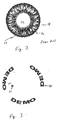
- Fig. 3 is a top view of sample indicator 20, and a manufacturer's symbol 21 according to the present invention, to be imprinted in the peripheral area of the contact lens.
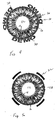
- Fig. 4 is a top view of the sample indicator 20 imprinted on the peripheral area 18 of the lens in conjunction with a coloring pattern imprinted in the iris areas 14,16 of the lens. The imprinting of the sample indicator does not interfere with the pupil area 12 of the lens at the center, nor does it interfere with the coloring pattern discussed above and shown in, Fig. 2.
- sample indicator used in Fig. 4 is the word “DEMO”
- sample indicator could as well be any other word, phrase or symbol that would suggest a demonstration or sample item. These could include the words “Not for Sale”, “Sample”, “Model”, and even “Demonstration Only”. Symbols effective for such use might include a series of symbols such as "XXXXX” imprinted in several areas in the periphery of the lens, or a solid bar in a radial or circumferential pattern, such as one about 0.2 to 2.0 mm thick and about 0.5 to 5.0 mm long, imprinted one or more times in the periphery of a lens.
- a bold color contrasting with that of the iris or the sclera of the eye may be effective here, especially a dark, opaque color, such as black. Examples are shown in Fig. 5a with circumferential bars 22 and Fig. 5b with triangular symbols 24. Any indicator that would suggest a sample or demonstration item is within the scope of the invention.
- Colorants used to color contact lenses may be used for the sample indicator. Such colorants must be safe for use in human eyes, and are subject to approval by the U.S. Food and Drug Administration. Included in acceptable and useful colorants are conventional pigments and dyes. Also useful are new classes of pigments, such as pearlescent pigments and fluorescent pigments, which impart unique tones and colors to the contact lenses. Also useful in marking sample indicators are fluorescent dyes. Such pigments and dyes may be used singly or in combinations to produce desirable colors and shades, in ways well known to those skilled in the art.
- Fig. 6 illustrates another conventional color scheme, in which the central area of the iris 15 is imprinted with much greater color density than the inner iris area 14 or the outer iris area 16.
- This particular color scheme features a variation of color coverage different from that of the previous example, one that may be advantageously applied by a single-step imprinting process.
- Such a simple process may be advantageously used to imprint the sample indicator shown in Fig. 3.
- the combination of the sample indicator of Fig. 3 and the color pattern of Fig. 6 is shown in Fig.
- sample indicator 20 is shown in the peripheral area 18 of the lens, while the color-enhancing portion is shown generally in the areas 14, 15, 16 of the lens to be superimposed on the iris of the user's eye.
- the area 12 of the lens corresponding to the pupil of the eye is not imprinted.
- the invention disclosed here also covers a method of marking the contact lens with the sample indicator.
- the lens may be imprinted simultaneously with the color scheme.
- the sample indicator may be printed separately.
- Some contact lenses use more than one step of imprinting in order to provide more sophisticated visual effects.
- several steps are used to imprint, one for each color and sometimes more than one in order to give the proper aesthetic effect furnished by variations in the density of colors afforded by these processes.
- the sample indicator may be added to an existing step, or may added in a separate printing step.
- Such color schemes tend to reveal the sample status of the lens to an observer of the lens wearer. It may also be desirable to alert the wearer to the sample status of the lens with a less garish color scheme.
- One purpose is to alert the wearer to the sample status of the lens, but not to make the indicator so vivid as to destroy the value of the lens as a sample for its selling purposes. Marking the lens with a color compatible with the lens alerts the wearer but does not make the lens garish. With such a color, the wearer preparing to insert the lens into an eye will be aware that the lens is a sample. However, the lens with such a sample indicator will not appear so garish or unusual as to detract from the wearer's appreciation of the color scheme of the lens.
- contact lenses may be marked as samples with a color compatible with that of the lens for some purposes, and may be marked with highly contrasting colors for other purposes.
- the invention includes both types of markings.
- the invention also includes the marking of non-colored lenses with these sample indicators.
- a contact lens is colored in a multi-step process with overlapping or partially overlapping areas.
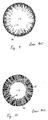
- Fig. 8 depicts an area of a contact lens conventionally printed in one step of such a process, an "inner starburst," an area of the lens to be superimposed on the inner portion 14 of the iris of the wearer, with only a small portion of the outer iris 16 imprinted, and the pupil area 12 not printed at all.
- Fig. 9 depicts a "starburst" to be printed on the outer portion 16 of the iris of a contact lens. A difference in color, or color density, can be discerned in Fig.
- Fig. 10 depicts an iris pattern which may be used in combination with the inner and outer starburst patterns of Fig. 8 and Fig. 9 respectively, to achieve a more natural look for the iris of the wearer, yielding greater depth and texture to the appearance of the iris, due to the several colors and several steps used in printing the colors. Periphery 18 is not imprinted.
- Fig. 11 depicts the application of the invention to an outer starburst, primarily in area 16 and to a lesser extent in area 14, here adding the indicator "Demo" 20 in area 18 on the periphery of the lens, in readable type.
- This figure is meant to demonstrate that the sample indicator may be added in an existing step, especially if the color desired is the color already used to imprint the lens. Alternatively, the sample indicator 20 may be printed in a separate, additional step, if the added cost will yield a process advantage or a better sample indicator.
- Fig. 12 provides another example, in which the sample indicator is imprinted on the periphery 18 of the lens, this time in rather larger typeface, rendering the sample indicator even more visible than in Fig. 11.
- the sample indicator may be made as discreet or as bold as desired, depending on the perceived needs of the manufacturer adding the sample indicator.
- the indicator may be imprinted in a color compatible with that of the lens, or contrasting with that of the lens. If the lens is not colored, the sample indicator may be imprinted in a bold or in a discrete color.
- the indicator may be made larger or smaller, depending on the manufacturer and the deterrent effect desired.
- the sample indicators may be made large and dark and meant for the placement over the sclera of the eye for maximal effect; in another embodiment, the sample indicators may be made light blue and placed partially within the area of the contact lens meant to be superimposed over the iris and partially at the periphery of the lens.
- the invention is meant to include all embodiments of colored lenses incorporating a sample indicator. This includes the colors mentioned above, whether applied in a single step or in more than one step, and wherein the sample indicator is added through an existing step or an additional step. It is meant to include variations on these colors, including applications with solid colors, mixtures of colors, and colors with densities varied according to those with skill in the art, wherein only a part of the surface is imprinted with the desired colors.
- the invention also comprises colors incorporating a design, whether a geometric pattern formed from color, or a design of objects using color, such as the "Wild Eyes" designs belonging to the assignee of the present application. The color white may be used in indicators according to the present invention.
Landscapes
- Health & Medical Sciences (AREA)
- Ophthalmology & Optometry (AREA)
- Physics & Mathematics (AREA)
- General Health & Medical Sciences (AREA)
- General Physics & Mathematics (AREA)
- Optics & Photonics (AREA)
- Eyeglasses (AREA)
Abstract
Description
- This invention relates to contact lens manufacturing and the lenses made thereby, and in particular to contact lenses with marks thereon indicating the lenses are samples, and a method of manufacturing lenses with indicator markings.
- Colored contact lenses have been a commercial success. Acceptance by consumers has been so great that many variations of lenses and processes for making such lenses have been devised and patented. Examples of patents in this field include U.S. Pat No. 4,582,402, U.S. Pat. No. 5,720,188, U.S. Pat. No. 5,414,477, and U.S. Pat. No. 5,936,705. These patents disclose articles of manufacture and methods of making such contact lenses. Success has gone beyond colored lenses and now extends to lenses with several colors and designs beyond mere color.
- The desirability and novelty of these items has led to difficulty in controlling the distribution of samples. In particular, the sample items are sometimes sold or diverted, rather than being used as samples for the customer. Samples are typically distributed in order to allow customers or potential customers to view the cosmetic effect before they purchase the lenses. In addition, the customer may nave the opportunity to view several colors or designs before making a choice. However, there are several ways for the lenses to fall into misuse. Sample lenses may be sold to a customer, rather than used as samples. The lenses may be diverted to another seller, who may not be an authorized customer of the contact lens manufacturer, and who may violate the manufacturer's selling, support and safety requirements.
- The lenses may be diverted to a seller who sells them for a price lower than the manufacturer's authorized sellers. The lenses may be illegally diverted into the hands of someone who dispenses the lens without a prescription. The lenses may be illegally smuggled into another country where the lenses are not approved by the appropriate health authorities. These latter concerns are highly important since they affect legal liability and public health.
- Many solutions have been attempted to solve these problems. Marking the packages with sample indicators has not solved the problem. Warnings that sharing of contact lenses may lead to the spread of microorganisms have not helped. The problem of the unauthorized use of sample lenses will only become greater, as more varieties of lenses, colors and designs become available. In addition, while there is a greater problem with colored lenses, the problem is also applicable to non-colored lenses, that is, lenses that are clear rather than colored. What is needed is a contact lens that will discourage the widespread unauthorized distribution and use of samples, but which samples will still function for their intended purpose, that is, of allowing a customer or potential customer to sample the lenses.
- In one aspect the invention is a contact lens on which a sample indicator is imprinted. The sample indicator may comprise the word or words "Demo", "Sample", "Model", "Not for Sale", or "Demonstration Only". The advantage of such sample lenses is that the lens itself is fully functional for all purposes of a sample lens, except for ordinary daily wear. The sample lens may not be suitable for that purpose, because the sample indicator may well be conspicuous to another person viewing the eyes of the wearer of the sample lens. In particular, most colored contact lenses are colored in the area of the lens superimposed on the iris of the wearer's eye. The sample indicator is therefore most conspicuous when it is imprinted in the lens periphery, that is, the area between the outer edge of the lens and the area superimposed on the iris of the wearer's eye. This is applicable to both colored and non-colored lenses.
- At the same time, this placement of the sample indicator has very few disadvantages. No marking is required in the area of the lens superimposed over the pupil of the eye, assuring no visual interference with the wearer. The indicator is visible when the lens is not being worn, and, depending on the color of the indicator, may be more or less conspicuous while being wom. In other words, the color may contrast with that of a lens, or a user's iris, or the color of the indicator may be more compatible with that of the lens. The manufacturer can continue to supply sample lenses, confident they will not be diverted, and thus a wearer may sample several lens colors or styles to determine the cosmetic effect of the lens. In terms of manufacture, the sample indicator may be imprinted in an existing step in a color-printing process, or the sample indicator may be imprinted in a separate step. The color and formulation of the inks used to imprint the sample indicator will likely determine how many steps of printing are required.
-
- Fig. 1 is a top view of a contact lens depicting areas normally considered in imparting a color scheme to the contact lens.
- Fig. 2 is a top view of a conventional pattern used to color a contact lens by combining an inner starburst pattern (Fig. 8) and an outer starburst pattern (Fig. 9).
- Fig. 3 is a top view of a sample indicator that may be imprinted on a colored or non-colored contact lens according to the present invention.
- Fig. 4 is a top view of a pattern with a sample indicator for a colored contact lens.
- Figs. 5a and 5b are top views of sample indicators and color patterns for contact lenses.
- Fig. 6 is a top view of a conventional pattern used to color a contact lens.
- Fig. 7 is a top view of a pattern with a sample indicator for a contact lens.
- Fig. 8 is a top view of a conventional inner starburst pattern used to color a contact lens.
- Fig. 9 is a top view of a conventional outer starburst pattern used to color a contact lens.
- Fig. 10 is an iris pattern that may be used in combination with the inner and outer starburst patterns of Fig. 8 and Fig. 9 respectively.
- Fig. 11 is a top view of an "outer starburst" pattern incorporating a sample indicator according to the present invention.
- Fig. 12 is a top view of an "outer starburst" pattern and a sample indicator according to the present invention, wherein the sample indicator is of a different relative size.
-
- U.S. Pat. No. 4,582,402, assigned to the assignee of the present invention, discloses a method of printing contact lenses on selected areas of the lens, imprinting dots or other small geometric patterns, such as hexagons. The patent teaches that the entire surface of the lens need not be covered, only a part of the surface. Further improvements revealed in other patents, listed above, include larger patterns that are useful in enhancing a cosmetic effect for the wearer of the lenses. The sample indicator of the present invention is useful in deterring unauthorized use of samples of such lenses.
- It is convenient to think of contact lenses as consisting of areas as outlined in Fig. 1, having an
inner area 12 corresponding to the pupil of the eye. This area is not printed in order not to interfere with the transmission of light to the pupil of the eye. Surrounding the pupil is the iris, comprising respectively aninner iris region 14 and anouter iris region 16, and anouter periphery 18. Theperiphery 18 is the area outside the iris and surrounding the iris. This area corresponds to the sclera of the eye. In Fig. 1, theborder 28 marks the end of the iris section and the beginning of the peripheral area of the contact lens, whileborder 30 marks the outer edge of the contact lens. R1 is the radius of the pupil area of the contact lens, about 2.2 to about 2.6 mm, and preferably about 2.5 mm. - The radius of the outer periphery of the average iris on the lens, R2, is about 5.2 to about 6.8 mm, preferably about 6.75 mm. R3, the radius of the inner periphery of the iris zone, is a jagged edge, and will vary between 3.3 and 3.7 mm, with an average of about 3.5 mm. While a jagged edge will yield a more natural appearance after printing, the border of the inner periphery of the iris may also be a substantially circular curve, with an average radius of about 3.5 mm. R4 is the radius of the outer periphery of the iris zone of a contact lens, about 4.8 to 5.2 mm, and preferably averaging about 5.0 mm, with substantial irregularity, as shown in the figure. While a jagged edge will yield a more natural appearance, R4 may also be a substantially circular curve, with a radius of about 5.0 mm. The peripheral area of the lens,
area 18, lies outside the iris area. It is in this area, betweenouter iris periphery 28 and theouter border 30 of the contact lens, that the marking or the sample indicator is preferably located. - Fig. 2 is a top view of a conventional imprinted area on a contact lens in accordance with the above geometries. Patterns of dots and lines may be viewed in the figure, both in embodiments having color elements and those not having color elements. The
pupil 12 is not imprinted, while theinner iris 14 and theouter iris 16 are imprinted, with variations and even macro-striations visible in the central printed area. Theouter area 18 is not printed. These variations are effective in imparting depth and texture to the color of a user's iris when viewed by an observer at a normal distance, about 5 feet, from the user. Fig. 3 is a top view ofsample indicator 20, and a manufacturer'ssymbol 21 according to the present invention, to be imprinted in the peripheral area of the contact lens. The contact lens may be colored or non-colored. Fig. 4 is a top view of thesample indicator 20 imprinted on theperipheral area 18 of the lens in conjunction with a coloring pattern imprinted in theiris areas pupil area 12 of the lens at the center, nor does it interfere with the coloring pattern discussed above and shown in, Fig. 2. - While the sample indicator used in Fig. 4 is the word "DEMO", the sample indicator could as well be any other word, phrase or symbol that would suggest a demonstration or sample item. These could include the words "Not for Sale", "Sample", "Model", and even "Demonstration Only". Symbols effective for such use might include a series of symbols such as "XXXXX" imprinted in several areas in the periphery of the lens, or a solid bar in a radial or circumferential pattern, such as one about 0.2 to 2.0 mm thick and about 0.5 to 5.0 mm long, imprinted one or more times in the periphery of a lens. A bold color contrasting with that of the iris or the sclera of the eye may be effective here, especially a dark, opaque color, such as black. Examples are shown in Fig. 5a with
circumferential bars 22 and Fig. 5b withtriangular symbols 24. Any indicator that would suggest a sample or demonstration item is within the scope of the invention. - Colorants used to color contact lenses may be used for the sample indicator. Such colorants must be safe for use in human eyes, and are subject to approval by the U.S. Food and Drug Administration. Included in acceptable and useful colorants are conventional pigments and dyes. Also useful are new classes of pigments, such as pearlescent pigments and fluorescent pigments, which impart unique tones and colors to the contact lenses. Also useful in marking sample indicators are fluorescent dyes. Such pigments and dyes may be used singly or in combinations to produce desirable colors and shades, in ways well known to those skilled in the art.
- The lenses covered in this invention are not limited to those with the color scheme of the previous several examples. Fig. 6 illustrates another conventional color scheme, in which the central area of the
iris 15 is imprinted with much greater color density than theinner iris area 14 or theouter iris area 16. This particular color scheme features a variation of color coverage different from that of the previous example, one that may be advantageously applied by a single-step imprinting process. Such a simple process may be advantageously used to imprint the sample indicator shown in Fig. 3. The combination of the sample indicator of Fig. 3 and the color pattern of Fig. 6 is shown in Fig. 7, in which thesample indicator 20 is shown in theperipheral area 18 of the lens, while the color-enhancing portion is shown generally in theareas area 12 of the lens corresponding to the pupil of the eye is not imprinted. - The invention disclosed here also covers a method of marking the contact lens with the sample indicator. In a single step printing process, the lens may be imprinted simultaneously with the color scheme. Alternatively, the sample indicator may be printed separately. Some contact lenses use more than one step of imprinting in order to provide more sophisticated visual effects. In one conventional method, several steps are used to imprint, one for each color and sometimes more than one in order to give the proper aesthetic effect furnished by variations in the density of colors afforded by these processes. In any of these processes, the sample indicator may be added to an existing step, or may added in a separate printing step. There may an advantage to a using separate step for imprinting the sample indicator, especially if it is desired to mark the sample indicator in a color that will stand out in contrast to the sclera of the eye, such as white, or black, or bright red, or other unusual, contrasting color.
- Such color schemes tend to reveal the sample status of the lens to an observer of the lens wearer. It may also be desirable to alert the wearer to the sample status of the lens with a less garish color scheme. One purpose is to alert the wearer to the sample status of the lens, but not to make the indicator so vivid as to destroy the value of the lens as a sample for its selling purposes. Marking the lens with a color compatible with the lens alerts the wearer but does not make the lens garish. With such a color, the wearer preparing to insert the lens into an eye will be aware that the lens is a sample. However, the lens with such a sample indicator will not appear so garish or unusual as to detract from the wearer's appreciation of the color scheme of the lens. Thus, contact lenses may be marked as samples with a color compatible with that of the lens for some purposes, and may be marked with highly contrasting colors for other purposes. The invention includes both types of markings. The invention also includes the marking of non-colored lenses with these sample indicators.
- Other color schemes may be used besides the ones mentioned above. In one embodiment of the invention, a contact lens is colored in a multi-step process with overlapping or partially overlapping areas. Fig. 8 depicts an area of a contact lens conventionally printed in one step of such a process, an "inner starburst," an area of the lens to be superimposed on the
inner portion 14 of the iris of the wearer, with only a small portion of theouter iris 16 imprinted, and thepupil area 12 not printed at all. Fig. 9 depicts a "starburst" to be printed on theouter portion 16 of the iris of a contact lens. A difference in color, or color density, can be discerned in Fig. 9 betweeninner portion 14 andouter portion 16, here depicted with darker color of greater color density toward the outer portion, though that is not essential. Fig. 10 depicts an iris pattern which may be used in combination with the inner and outer starburst patterns of Fig. 8 and Fig. 9 respectively, to achieve a more natural look for the iris of the wearer, yielding greater depth and texture to the appearance of the iris, due to the several colors and several steps used in printing the colors.Periphery 18 is not imprinted. - Fig. 11 depicts the application of the invention to an outer starburst, primarily in
area 16 and to a lesser extent inarea 14, here adding the indicator "Demo" 20 inarea 18 on the periphery of the lens, in readable type. This figure is meant to demonstrate that the sample indicator may be added in an existing step, especially if the color desired is the color already used to imprint the lens. Alternatively, thesample indicator 20 may be printed in a separate, additional step, if the added cost will yield a process advantage or a better sample indicator. Fig. 12 provides another example, in which the sample indicator is imprinted on theperiphery 18 of the lens, this time in rather larger typeface, rendering the sample indicator even more visible than in Fig. 11. - It will be obvious, in light of these examples, that the sample indicator may be made as discreet or as bold as desired, depending on the perceived needs of the manufacturer adding the sample indicator. Thus, the indicator may be imprinted in a color compatible with that of the lens, or contrasting with that of the lens. If the lens is not colored, the sample indicator may be imprinted in a bold or in a discrete color. In addition, the indicator may be made larger or smaller, depending on the manufacturer and the deterrent effect desired. In one embodiment, the sample indicators may be made large and dark and meant for the placement over the sclera of the eye for maximal effect; in another embodiment, the sample indicators may be made light blue and placed partially within the area of the contact lens meant to be superimposed over the iris and partially at the periphery of the lens.
- In addition, other color schemes besides these may be proposed for contact lenses. The invention is meant to include all embodiments of colored lenses incorporating a sample indicator. This includes the colors mentioned above, whether applied in a single step or in more than one step, and wherein the sample indicator is added through an existing step or an additional step. It is meant to include variations on these colors, including applications with solid colors, mixtures of colors, and colors with densities varied according to those with skill in the art, wherein only a part of the surface is imprinted with the desired colors. The invention also comprises colors incorporating a design, whether a geometric pattern formed from color, or a design of objects using color, such as the "Wild Eyes" designs belonging to the assignee of the present application. The color white may be used in indicators according to the present invention.
- While this invention has been shown and described in connection with the preferred embodiments, it is apparent that certain changes and modifications, in addition to those mentioned above, may be made from the basic features of this invention. For example, any letter or symbol may be used repetitively to mark the lens as a sample without departing from the invention. Any indicator that would suggest a sample or demonstration item is meant to be included. Accordingly, it is the intention of the applicants to protect all variations and modifications within the valid scope of the present invention. It is intended that the invention be defined by the following claims, including all equivalents.
Claims (31)
- A method of marking a sample contact lens to prevent unauthorized distribution of the lens, comprising:a) providing a polymeric lens; andb) applying a marking to said lens to indicate that the lens is a sample and not for sale.
- The method of Claim 1, wherein the marking comprises a word or a phrase indicating that the lens is a sample and is not for sale.
- The method of Claim 1, wherein the marking is applied by printing.
- A sample contact lens, comprising a polymeric lens and a sample indicator imprinted thereon.
- The contact lens of Claim 4, wherein the sample indicator is a word or phase.
- The contact lens of Claim 5, wherein the word or phrase imprinted is selected from the group consisting of "Sample", "Not for Sale", "Not for Resale", "Model", "Demo", "Demonstration Only" and combinations thereof.
- The contact lens of Claim 5, wherein the lens is colored, and the indicator is imprinted in a color similar to that of the lens.
- The contact lens of Claim 5, wherein the lens is colored and the indicator is imprinted in a color contrasting with that of the lens.
- The contact lens of Claim 5, wherein the lens is colored by incorporating one or more colorants selected from the group consisting of conventional pigments, conventional dyes, pearlescent pigments, fluorescent pigments and fluorescent dyes.
- The contact lens of Claim 9, wherein the lens is colored by imprinting in an area superimposed on an iris of a wearer, said area having a jagged edge and surrounding a non-opaque area for a pupil of an eye of the wearer, said imprint incorporating one or more colorants selected from the group consisting of conventional pigments, conventional dyes, peariescent pigments, fluorescent pigments and fluorescent dyes.
- The contact lens of Claim 1, wherein the indicator is imprinted in an area between a periphery of the lens and an area superimposed on an iris of a wearer.
- The contact lens of Claim 9, wherein the lens changes the appearance of a wearer by changing the color of an iris of the wearer.
- The contact lens of Claim 4, wherein the lens is colored throughout, and the indicator is imprinted in a color contrasting with that of the lens.
- The contact lens of Claim 13, wherein the indicator is imprinted in an area between a periphery of the lens and an area of the lens superimposed on an iris of a wearer.
- The contact lens of Claim 14, wherein the lens changes the appearance of the wearer by changing the color of the iris of the wearer.
- The contact lens of Claim 4, wherein the lens is colored in a single process step, and the sample indicator is imprinted in the single step or in an additional step.
- The contact lens of Claim 4, wherein the lens is colored in two process steps, and the sample indicator is imprinted in one of the two steps or in an additional step.
- The contact lens of Claim 4, wherein the lens is colored in three process steps, and the sample indicator is imprinted in one of the three steps or in an additional step.
- The contact lens of Claim 4, wherein the lens is colored in more than three process steps, and the sample indicator is imprinted one of the more than three steps or in an additional step.
- A method of marking contact lenses, comprising:a) holding a lens in a fixed position; andb) imprinting a sample indicator thereon.
- The method of Claim 20, wherein the indicator is a word or phrase.
- The method of Claim 21, wherein the word or phrase imprinted is selected from the group consisting of "Sample", "Not for Sale", "Not for Resale", "Model", "Demo", "Demonstration Only" and combinations thereof.
- The method of Claim 20, wherein the lens is colored.
- The method of Claim 23, wherein the lens color and the indicator are imprinted in the same operation.
- The method of Claim 20, wherein the lens is colored and the sample indicator is imprinted in a color similar to that of the lens.
- The method of Claim 20, wherein the sample indicator is imprinted in an area between a periphery of the lens and an area of the lens superimposed on an iris of a wearer.
- The method of Claim 22, further comprising a step of coating the lens.
- The method of Claim 22, further comprising a step of covering the lens with a transparent cover.
- A demonstration contact lens comprising a contact lens and a sample indicator imprinted thereon, wherein the sample indicator is selected from the group consisting of "Sample", "Not For Sale", "Not for Resale", "Model", "Demo", "Demonstration Only", "XXXXX" and a solid bar, said sample indicator being imprinted in an area of the lens outside of an area superimposed on a pupil of an eye, said imprinting in a color contrasting with that of the lens.
- The lens of Claim 29, wherein the imprinting is in a color similar to that of the lens.
- The lens of Claim 29, further comprising a symbol indicative of the manufacturer of the lens.
Applications Claiming Priority (2)
| Application Number | Priority Date | Filing Date | Title |
|---|---|---|---|
| US09/589,478 US6634747B1 (en) | 2000-06-07 | 2000-06-07 | Sample indicator lens |
| US589478 | 2000-06-07 |
Publications (1)
| Publication Number | Publication Date |
|---|---|
| EP1162493A1 true EP1162493A1 (en) | 2001-12-12 |
Family
ID=24358185
Family Applications (1)
| Application Number | Title | Priority Date | Filing Date |
|---|---|---|---|
| EP01113751A Withdrawn EP1162493A1 (en) | 2000-06-07 | 2001-06-05 | Sample indicator lens |
Country Status (3)
| Country | Link |
|---|---|
| US (1) | US6634747B1 (en) |
| EP (1) | EP1162493A1 (en) |
| JP (1) | JP2002006267A (en) |
Cited By (3)
| Publication number | Priority date | Publication date | Assignee | Title |
|---|---|---|---|---|
| WO2003104878A1 (en) * | 2002-06-07 | 2003-12-18 | Johnson & Johnson Vision Care, Inc. | Tinted contact lenses |
| EP1376204A1 (en) * | 2002-06-19 | 2004-01-02 | CL-Tinters Oy | Colored contact lens for use as a trial lens |
| CN107219639A (en) * | 2016-03-22 | 2017-09-29 | 庄臣及庄臣视力保护公司 | Haptic lens with improved a variety of and integrated effects |
Families Citing this family (18)
| Publication number | Priority date | Publication date | Assignee | Title |
|---|---|---|---|---|
| US7278736B2 (en) * | 2004-02-25 | 2007-10-09 | Novartis Ag | Contact lenses imparting a vivacious appearance to the eye |
| US7118213B2 (en) * | 2004-06-01 | 2006-10-10 | Johnson & Johnson Vision Care, Inc. | Promotional aid |
| US20080129960A1 (en) * | 2006-11-30 | 2008-06-05 | Gregory Lee Heacock | Disposable ophthalmic/medical apparatus with timed color change indication |
| US9134285B2 (en) | 2006-11-30 | 2015-09-15 | Sensor International, Llc | Apparatus with timed color change indication |
| DE102008017592A1 (en) * | 2008-04-07 | 2009-10-08 | Carl Zeiss Meditec Ag | Ophthalmological implant, microscopy system and optical detection method for the detection and / or identification of an ophthalmological implant |
| US9252874B2 (en) | 2010-10-13 | 2016-02-02 | Ccs Technology, Inc | Power management for remote antenna units in distributed antenna systems |
| US8663998B2 (en) | 2011-12-09 | 2014-03-04 | Gregory L. Heacock | Color changeable dyes for indicating exposure, methods of making and using such dyes, and apparatuses incorporating such dyes |
| JP5369273B1 (en) | 2012-02-20 | 2013-12-18 | 株式会社メニコンネクト | Colored contact lenses |
| US9746421B2 (en) | 2013-09-26 | 2017-08-29 | Sensor International, Llc | Apparatuses, indicators, methods and kits with timed color change indication |
| US9664927B2 (en) | 2014-03-31 | 2017-05-30 | Johnson & Johnson Vision Care, Inc. | Contact lens with pearlescent sclera |
| US11467422B2 (en) | 2014-05-30 | 2022-10-11 | Sensor International, Llc | Carbon dioxide sensing color changeable dyes for indicating exposure, methods of making and using such dyes, and apparatuses incorporating such dye |
| US12220284B2 (en) | 2016-10-17 | 2025-02-11 | Thermographic Measurements Limited | Color sensor with gas generating layer |
| US12306154B2 (en) | 2017-12-05 | 2025-05-20 | Thermographic Measurements Limited | Meltable color changeable indicators with organic polymer cores and methods of making such meltable indicators and composites thereof |
| US10759976B2 (en) | 2018-03-23 | 2020-09-01 | Sensor International, Llc | Color changeable adhesives and methods of making such adhesives |
| US11346786B2 (en) | 2018-10-09 | 2022-05-31 | Sensor International, Llc | High pressure sensitive color changeable indicators and methods of making such indicators |
| TWD214891S (en) * | 2021-01-29 | 2021-10-21 | 晶碩光學股份有限公司 | Contact lens |
| TWD218109S (en) * | 2021-01-29 | 2022-04-11 | 晶碩光學股份有限公司 | contact lenses |
| TWD214892S (en) * | 2021-01-29 | 2021-10-21 | 晶碩光學股份有限公司 | Contact lens |
Citations (6)
| Publication number | Priority date | Publication date | Assignee | Title |
|---|---|---|---|---|
| WO1984003569A1 (en) * | 1983-03-01 | 1984-09-13 | Robert E Klein | A visual indicator on soft contact lenses |
| US4668240A (en) * | 1985-05-03 | 1987-05-26 | Schering Corporation | Pigment colored contact lenses and method for making same |
| EP0472496A2 (en) * | 1990-08-20 | 1992-02-26 | Ciba-Geigy Ag | Method of producing a contact lens and contact lens produced thereby |
| US5414477A (en) * | 1989-11-01 | 1995-05-09 | Wesley-Jessen Corporation | Colored contact lens having very natural appearance |
| US5936705A (en) * | 1997-03-31 | 1999-08-10 | Wesley Jensen Corporation | Pattern for color modifying contact lens |
| EP0947872A1 (en) * | 1998-03-31 | 1999-10-06 | JOHNSON & JOHNSON VISION PRODUCTS, INC. | Contact lenses bearing marks |
Family Cites Families (22)
| Publication number | Priority date | Publication date | Assignee | Title |
|---|---|---|---|---|
| DE1696714B1 (en) | 1968-03-13 | 1970-12-03 | Zeiss Carl Fa | Process for the production of a mark on transparent materials |
| US4039827A (en) | 1976-08-26 | 1977-08-02 | American Optical Corporation | Method for marking intraocular lenses |
| US4194814A (en) | 1977-11-10 | 1980-03-25 | Bausch & Lomb Incorporated | Transparent opthalmic lens having engraved surface indicia |
| US4268133A (en) * | 1978-07-14 | 1981-05-19 | Bausch & Lomb Incorporated | Preferential orientation of contact lenses |
| US4193671A (en) | 1978-11-20 | 1980-03-18 | Precision Cosmet Corp. | Identifying means for polymeric contact lenses |
| US4559059A (en) * | 1981-08-12 | 1985-12-17 | Ciba-Geigy Corporation | Tinted contact lenses and a method for their preparation |
| US4648932A (en) | 1983-04-11 | 1987-03-10 | Minnesota Mining And Manufacturing Company | High-angularity retroreflective sheeting and method for manufacture |
| US4525044A (en) | 1983-05-05 | 1985-06-25 | Bauman Robert C | Soft contact lens with surface identification and method of using same |
| US4582402A (en) | 1984-04-16 | 1986-04-15 | Schering Corporation | Color-imparting contact lenses |
| US4704017A (en) | 1984-04-16 | 1987-11-03 | Schering Corporation | Process for manufacturing colored contact lenses |
| US4720188A (en) | 1984-04-16 | 1988-01-19 | Schering Corporation | Process for manufacturing colored contact lenses and lenses made by the process |
| US5062701A (en) * | 1988-06-07 | 1991-11-05 | Wesley-Jessen Corporation | Asymmetric contact lens |
| NL8802472A (en) | 1988-10-10 | 1990-05-01 | Homer Hollandse Meet En Regels | DOCUMENT INCLUDING RANDOM INFORMATION, CARRIER OF THIS RANDOM INFORMATION AND METHOD AND DEVICE FOR READING THIS RANDOM INFORMATION. |
| US4968063A (en) | 1989-09-19 | 1990-11-06 | Minnesota Mining And Manufacturing Company | Transparent tamper-indicating document overlay |
| JP2557986B2 (en) | 1989-09-20 | 1996-11-27 | トーメー産業株式会社 | Method for dyeing hydrous contact lenses |
| US5160463A (en) | 1990-10-30 | 1992-11-03 | Pilkington Visioncare, Inc. | Method of manufacturing a contact lens |
| US5467149A (en) | 1993-06-15 | 1995-11-14 | Bausch & Lomb Incorporated | Highly visible markings for contact lenses |
| DE4323883C2 (en) | 1993-07-16 | 2002-11-07 | Meto International Gmbh | Theft security tag |
| CN1032390C (en) | 1994-08-15 | 1996-07-24 | 孟武 | Double-card-track laser holographic anti-counterfeiting mark and inspection device thereof |
| US5641437A (en) | 1995-09-29 | 1997-06-24 | Johnson & Johnson Vision Products, Inc. | Marking of mold inserts to produce marked contact lenses |
| US5936704A (en) | 1997-12-22 | 1999-08-10 | Gabrielian; Grant | Marked contact lens bearing optical marking element |
| US6024448A (en) | 1998-03-31 | 2000-02-15 | Johnson & Johnson Vision Products, Inc. | Contact lenses bearing identifying marks |
-
2000
- 2000-06-07 US US09/589,478 patent/US6634747B1/en not_active Expired - Fee Related
-
2001
- 2001-05-28 JP JP2001158685A patent/JP2002006267A/en active Pending
- 2001-06-05 EP EP01113751A patent/EP1162493A1/en not_active Withdrawn
Patent Citations (6)
| Publication number | Priority date | Publication date | Assignee | Title |
|---|---|---|---|---|
| WO1984003569A1 (en) * | 1983-03-01 | 1984-09-13 | Robert E Klein | A visual indicator on soft contact lenses |
| US4668240A (en) * | 1985-05-03 | 1987-05-26 | Schering Corporation | Pigment colored contact lenses and method for making same |
| US5414477A (en) * | 1989-11-01 | 1995-05-09 | Wesley-Jessen Corporation | Colored contact lens having very natural appearance |
| EP0472496A2 (en) * | 1990-08-20 | 1992-02-26 | Ciba-Geigy Ag | Method of producing a contact lens and contact lens produced thereby |
| US5936705A (en) * | 1997-03-31 | 1999-08-10 | Wesley Jensen Corporation | Pattern for color modifying contact lens |
| EP0947872A1 (en) * | 1998-03-31 | 1999-10-06 | JOHNSON & JOHNSON VISION PRODUCTS, INC. | Contact lenses bearing marks |
Cited By (3)
| Publication number | Priority date | Publication date | Assignee | Title |
|---|---|---|---|---|
| WO2003104878A1 (en) * | 2002-06-07 | 2003-12-18 | Johnson & Johnson Vision Care, Inc. | Tinted contact lenses |
| EP1376204A1 (en) * | 2002-06-19 | 2004-01-02 | CL-Tinters Oy | Colored contact lens for use as a trial lens |
| CN107219639A (en) * | 2016-03-22 | 2017-09-29 | 庄臣及庄臣视力保护公司 | Haptic lens with improved a variety of and integrated effects |
Also Published As
| Publication number | Publication date |
|---|---|
| US6634747B1 (en) | 2003-10-21 |
| JP2002006267A (en) | 2002-01-09 |
Similar Documents
| Publication | Publication Date | Title |
|---|---|---|
| US6634747B1 (en) | Sample indicator lens | |
| CA2576451C (en) | Tinted contact lenses with combined limbal ring and iris patterns | |
| CS532490A3 (en) | Colored contact lens having a very natural appearance | |
| JP4605802B2 (en) | Display device | |
| CA2566389A1 (en) | Tinted contact lenses with combined limbal ring and iris patterns | |
| US20060050230A1 (en) | Tinted contact lenses with hatch patterns | |
| JP2003517622A (en) | A color contact lens that changes the appearance of the iris to olive green | |
| US6733127B2 (en) | Colored contact lens for use as a trial lens | |
| TW200409989A (en) | Tinted contact lenses | |
| US4880256A (en) | Textile label | |
| WO2012144978A1 (en) | Contact lens with brightly colored sclera | |
| KR102211510B1 (en) | Pendant with rotating display plate | |
| KR100586157B1 (en) | Contact lens | |
| JP2556989B2 (en) | Optical material for objective observation | |
| KR100586160B1 (en) | Color contact lens | |
| JP2004117336A (en) | Game seal for toilet bowl | |
| RU25730U1 (en) | BOTTLE | |
| JP4233682B2 (en) | Confidential information concealment card and method of use | |
| US20070058131A1 (en) | Tinted contact lenses with three-dimensional iris patterns | |
| KR20070053279A (en) | Tinted contact lens with cell pattern | |
| HK1140451B (en) | Tinted contact lenses having a depth effect |
Legal Events
| Date | Code | Title | Description |
|---|---|---|---|
| PUAI | Public reference made under article 153(3) epc to a published international application that has entered the european phase |
Free format text: ORIGINAL CODE: 0009012 |
|
| 17P | Request for examination filed |
Effective date: 20010605 |
|
| AK | Designated contracting states |
Kind code of ref document: A1 Designated state(s): AT BE CH CY DE DK ES FI FR GB GR IE IT LI LU MC NL PT SE TR |
|
| AX | Request for extension of the european patent |
Free format text: AL;LT;LV;MK;RO;SI |
|
| AKX | Designation fees paid |
Free format text: AT BE CH CY DE DK ES FI FR GB GR IE IT LI LU MC NL PT SE TR |
|
| RAP1 | Party data changed (applicant data changed or rights of an application transferred) |
Owner name: NOVARTIS AG |
|
| RAP1 | Party data changed (applicant data changed or rights of an application transferred) |
Owner name: NOVARTIS AG Owner name: NOVARTIS PHARMA GMBH |
|
| STAA | Information on the status of an ep patent application or granted ep patent |
Free format text: STATUS: THE APPLICATION HAS BEEN WITHDRAWN |
|
| 18W | Application withdrawn |
Effective date: 20070313 |