EP1162178A2 - Process for removing cyclic acetals from wastewater streams - Google Patents
Process for removing cyclic acetals from wastewater streams Download PDFInfo
- Publication number
- EP1162178A2 EP1162178A2 EP01304919A EP01304919A EP1162178A2 EP 1162178 A2 EP1162178 A2 EP 1162178A2 EP 01304919 A EP01304919 A EP 01304919A EP 01304919 A EP01304919 A EP 01304919A EP 1162178 A2 EP1162178 A2 EP 1162178A2
- Authority
- EP
- European Patent Office
- Prior art keywords
- process according
- wastewater
- cyclic acetals
- general formula
- wastewater streams
- Prior art date
- Legal status (The legal status is an assumption and is not a legal conclusion. Google has not performed a legal analysis and makes no representation as to the accuracy of the status listed.)
- Withdrawn
Links
- 0 CC1OC(*)(*)C(*)(*)C(*)(*)O1 Chemical compound CC1OC(*)(*)C(*)(*)C(*)(*)O1 0.000 description 1
Classifications
-
- C—CHEMISTRY; METALLURGY
- C02—TREATMENT OF WATER, WASTE WATER, SEWAGE, OR SLUDGE
- C02F—TREATMENT OF WATER, WASTE WATER, SEWAGE, OR SLUDGE
- C02F1/00—Treatment of water, waste water, or sewage
- C02F1/70—Treatment of water, waste water, or sewage by reduction
-
- B—PERFORMING OPERATIONS; TRANSPORTING
- B01—PHYSICAL OR CHEMICAL PROCESSES OR APPARATUS IN GENERAL
- B01J—CHEMICAL OR PHYSICAL PROCESSES, e.g. CATALYSIS OR COLLOID CHEMISTRY; THEIR RELEVANT APPARATUS
- B01J31/00—Catalysts comprising hydrides, coordination complexes or organic compounds
- B01J31/02—Catalysts comprising hydrides, coordination complexes or organic compounds containing organic compounds or metal hydrides
- B01J31/06—Catalysts comprising hydrides, coordination complexes or organic compounds containing organic compounds or metal hydrides containing polymers
- B01J31/08—Ion-exchange resins
- B01J31/10—Ion-exchange resins sulfonated
-
- C—CHEMISTRY; METALLURGY
- C02—TREATMENT OF WATER, WASTE WATER, SEWAGE, OR SLUDGE
- C02F—TREATMENT OF WATER, WASTE WATER, SEWAGE, OR SLUDGE
- C02F1/00—Treatment of water, waste water, or sewage
- C02F1/02—Treatment of water, waste water, or sewage by heating
-
- C—CHEMISTRY; METALLURGY
- C02—TREATMENT OF WATER, WASTE WATER, SEWAGE, OR SLUDGE
- C02F—TREATMENT OF WATER, WASTE WATER, SEWAGE, OR SLUDGE
- C02F2101/00—Nature of the contaminant
- C02F2101/30—Organic compounds
- C02F2101/36—Organic compounds containing halogen
-
- C—CHEMISTRY; METALLURGY
- C02—TREATMENT OF WATER, WASTE WATER, SEWAGE, OR SLUDGE
- C02F—TREATMENT OF WATER, WASTE WATER, SEWAGE, OR SLUDGE
- C02F2103/00—Nature of the water, waste water, sewage or sludge to be treated
- C02F2103/34—Nature of the water, waste water, sewage or sludge to be treated from industrial activities not provided for in groups C02F2103/12 - C02F2103/32
- C02F2103/36—Nature of the water, waste water, sewage or sludge to be treated from industrial activities not provided for in groups C02F2103/12 - C02F2103/32 from the manufacture of organic compounds
-
- C—CHEMISTRY; METALLURGY
- C02—TREATMENT OF WATER, WASTE WATER, SEWAGE, OR SLUDGE
- C02F—TREATMENT OF WATER, WASTE WATER, SEWAGE, OR SLUDGE
- C02F3/00—Biological treatment of water, waste water, or sewage
Definitions
- the present invention relates to a process for removing cyclic acetals from wastewater streams over heterogeneous acid catalysts.
- Cyclic acetals such as 1,3-dioxane, 1,3-dioxolane and their derivatives are prepared by reacting diols and aldehydes.
- 1,3-Dioxolane is synthesized, for example, from ethylene glycol and formaldehyde, the reaction being carried out in the presence of acid catalysts.
- Acid catalysts used here are the most varied Br ⁇ nstedt or Lewis acids, but also cation exchangers, such as sulphonated polystyrene resins (Chopade, React. Funct. Polym. 1997, 34, 37-45).
- the wastewaters from such acetal preparation processes still always contain certain amounts of acetals whose separation from the wastewater poses difficulties.
- ⁇ , ⁇ -diols such as 1,2-diols, 1,3-diols or 1,4-diols
- certain amounts of cyclic acetals can also be formed, due to side reactions of these diols with aldehydes formed by oxidation, and can pass into the wastewater.
- the cyclic acetals are most stable. They are stable, especially, to bases and oxidizing or reducing media. Under the conditions in a biological sewage treatment plant (neutral pH and oxidizing media), cyclic acetals are thus not attacked or degraded.
- An object of the present invention is to provide a process by which the content of cyclic acetals in wastewater streams can be reduced.
- the invention relates to a process for removing cyclic acetals from wastewater streams which is characterized in that the cyclic acetal-containing wastewater streams are passed over a heterogeneous acid catalyst.
- the wastewater streams used in the inventive process preferably comprise 5-, 6- or 7-membered cyclic acetals or their substituted derivatives. These wastewater streams are customarily produced in the synthesis of the cyclic acetals. However, they can also arise, as described above, in the synthesis of the respective ⁇ , ⁇ -diols underlying the cyclic acetals, i.e. the 5-membered acetals based on 1,3-dioxolane in ethylene glycol preparation, the 6-membered acetals based on 1,3-dioxane in propylene glycol preparation and the 7-membered acetals in 1,4-butanediol preparation.
- 1,3-dioxolanes of the general formula (I) and the 1,3-dioxanes of the general formula (II) are preferably substituted by one or two radicals R.
- the inventive process has particularly utility for wastewater streams which comprise 1,3-dioxolane, 1,3-dioxane, their respective halogen-substituted derivatives or their respective 2-mono-(C 1 -C 5 )-alkyl, 2,4-di-(C 1 -C 5 )-alkyl derivatives.
- radical R in the general formulae (I) and (II) takes the meanings fluorine, chlorine, bromine, iodine, methyl, ethyl or chloromethyl.
- the concentration of the cyclic acetals in the wastewater stream can be in the range 0.1-100 000 ppm, preferably 20-10 000 ppm, in particular 1-5 000 ppm.
- the wastewater stream can, if appropriate, also comprise other organic substances or solvents, such as aliphatic hydrocarbons or ethers, which are inert to the heterogeneous acid catalyst under the respective reaction conditions in the inventive process.
- the inventive process is customarily carried out in such a manner that the wastewater stream loaded with the cyclic acetal or cyclic acetals is passed over the heterogeneous acid catalyst at a temperature in the range 10-120°C, preferably 20-80°C, a pressure in the range 0.5-20 bar, preferably 0.5-10 bar, in particular 0.8-2 bar, and an LHSV less than 200 h -1 , preferably in the range 0.1-25 h -1 , particularly preferably 0.1-10 h -1 .
- the heterogeneous acid catalysts used in the inventive process are known in principle.
- the heterogeneous acid catalyst is a cation exchanger in the H + form.
- Such acid cation exchangers are macroporous or in the form of a gel and are commercially available. They can be prepared, for example, by copolymerization of vinyl monomers and divinyl crosslinkers, if appropriate in the presence of solvents, or by condensation of phenol and formaldehyde.
- Vinyl monomers which can be used are, for example, styrene or acrylic esters; divinyl crosslinker is, for example, divinylbenzene.
- Acid groups are, for example, carboxyl groups, phosphonic acid groups or sulphonic acid groups.
- macroporous acid cation exchangers are used.
- the mean pore radius of such macroporous cation exchangers can be, for example, in the range 50-1 200 ⁇ , preferably 70-500 ⁇ .
- the acid cation exchangers can be used, for example, as polymer beads having particle sizes of 0.1-2 mm or as powder resin having particle sizes of 10-100 ⁇ m.
- a macroporous or gel-form acid, SO 3 H-group-containing cation exchanger having a degree of crosslinking of 2-65% and a surface area per unit volume of 5-750 m 2 /g of dry cation exchanger is particularly advantageous.
- heterogeneous acid catalysts used do not lose activity in the course of the inventive process, as do the adsorber materials known from the prior art for separating off phenols and chlorobenzenes, but have a considerably longer service life, since the cleavage products of the cyclic acetals are discharged again with the wastewater and do not remain on the heterogeneous catalyst. This makes a critical contribution to the economic attractiveness of the inventive process.
- Deionized water which comprises in each case the 1,3-dioxolane specified in Table 1 in the concentration specified there between 300 and 450 ppm is passed over 10 ml of an acid sulphonated polystyrene resin at various temperatures and space velocities at atmospheric pressure.
- the acid sulphonated polystyrene resin used is either Lewatit® K2621 (Bayer AG, Germany) or Amberlyst® 38WET (Rohm and Haas, USA).
- Example 1 summarizes the initial and final concentrations of the respective dioxolanes in the deionized water under the various conditions.
- Example 1 2 3 4 Deionized water containing 1,3-dioxolane 1,3-dioxolane 2-methyl-1,3-dioxolane 2-chloromethyl-1,3-dioxolane Ion exchanger Lewatit K2621 Amberlyst 38 WET Lewatit K2621 Lewatit K2621 Temperature [°C] 70 70 20 70 LHSV [h
Landscapes
- Life Sciences & Earth Sciences (AREA)
- Hydrology & Water Resources (AREA)
- Engineering & Computer Science (AREA)
- Environmental & Geological Engineering (AREA)
- Water Supply & Treatment (AREA)
- Chemical & Material Sciences (AREA)
- Organic Chemistry (AREA)
- Treatment Of Water By Ion Exchange (AREA)
- Catalysts (AREA)
- Treatment Of Water By Oxidation Or Reduction (AREA)
Abstract
Description
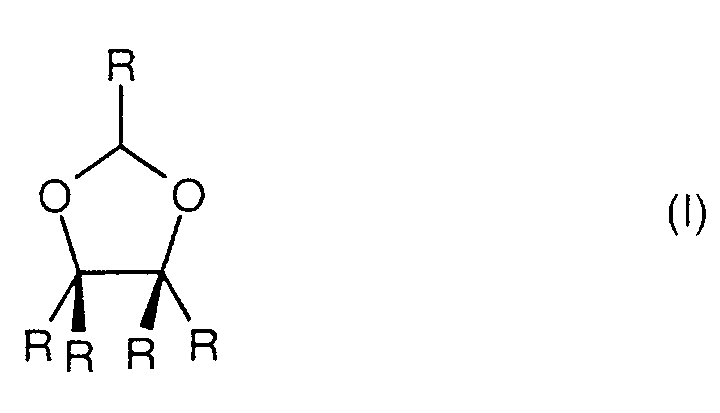
- R
- is identical or different and represents hydrogen, halogen or an unbranched or
branched, saturated or unsaturated C1-C7 hydrocarbon radical which can
optionally be substituted by one or more halogen radicals,
or 1,3-dioxanes of the general formula (II),where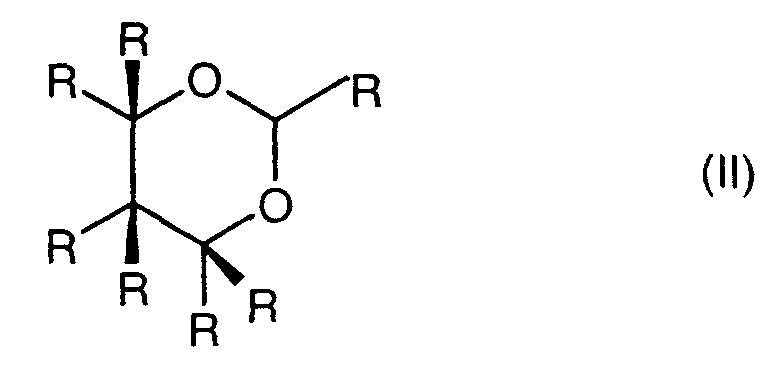
- R
- has the meanings specified for the general formula (I).
| Example | 1 | 2 | 3 | 4 |
| Deionized water containing | 1,3-dioxolane | 1,3-dioxolane | 2-methyl-1,3-dioxolane | 2-chloromethyl-1,3-dioxolane |
| Ion exchanger | Lewatit K2621 | Amberlyst 38 WET | Lewatit K2621 | Lewatit K2621 |
| Temperature [°C] | 70 | 70 | 20 | 70 |
| LHSV [h-1] | 10 | 10 | 10 | 10 |
| Initial dioxolane concentration [ppm] | 350 | 345 | 450 | 300 |
| Final dioxolane concentration [ppm] | 15 | 5 | 5 | 100 |
Claims (13)
- Process for removing cyclic acetals from wastewater streams, characterized in that the cyclic-acetal-containing wastewater streams are passed over a heterogeneous acid catalyst.
- Process according to Claim 1, characterized in that the wastewater streams used comprise 5-, 6- or 7-membered cyclic acetals or their substituted derivatives.
- Process according to Claim 1 or 2, characterized in that the wastewater streams used comprise 1,3-dioxolanes of the general formula (I)where
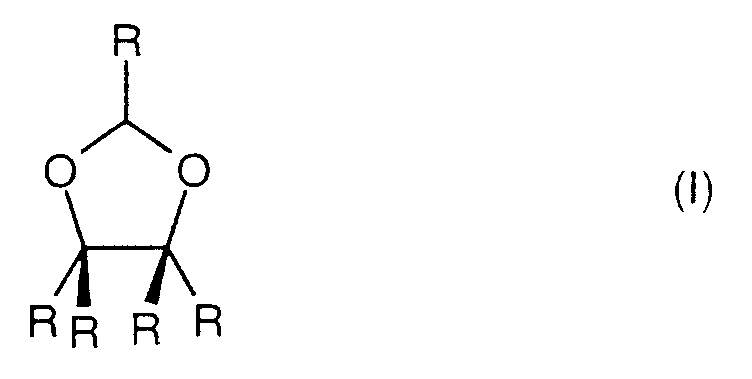
- R
- is identical or different and represents hydrogen, halogen or an unbranched or branched, saturated or unsaturated C1-C7 hydrocarbon radical which can optionally be substituted by one or more halogen radicals,
where
- R
- has the meanings specified for the general formula (I).
- Process according to Claim 3, characterized in that the 1,3-dioxolanes of the general formula (I) or the 1,3-dioxanes of the general formula (II) are substituted by one or two radicals R.
- Process according to one or more of Claims 1-4, characterized in that the wastewater streams used comprise 1,3-dioxolane, 1,3-dioxane, their respective halogen-substituted derivatives or their respective 2-mono-(C1-C5)-alkyl or 2,4-di-(C1-C5)-alkyl derivatives.
- Process according to one or more of Claims 1-5, characterized in that the radical R in the general formulae (I) and (II) represents fluorine, chlorine, bromine, iodine, methyl, ethyl or chloromethyl.
- Process according to one or more of Claims 1-6, characterized in that the concentration of the cyclic acetals in the wastewater stream used is 0.1-100 000 ppm, preferably 20-10 000 ppm.
- Process according to one or more of Claims 1-7, characterized in that the wastewater stream loaded with the cyclic acetal or cyclic acetals is passed over the heterogeneous acid catalyst at a temperature in the range 10-120°C, preferably 20-80°C, a pressure in the range 0.5-20 bar, preferably 0.5-10 bar, in particular 0.8-2 bar, and an LHSV less than 200 h-1, preferably in the range 0.1-25 h-1, particularly preferably 0.1-10 h-1.
- Process according to one or more of Claims 1-8, characterized in that the heterogeneous acid catalyst is a cation exchanger in the H+ form.
- Process according to one or more of Claims 1-9, characterized in that macroporous acid cation exchangers are used whose mean pore radius is in the range 50-1 200 Å, preferably 70-500 Å.
- Process according to Claim 10, characterized in that the acid cation exchanger is used as polymer beads having particle sizes of 0.1-2 mm or as powder resin having particle sizes of 10-100 µm.
- Process according to one or more of Claims 1-11, characterized in that a macroporous or gel-form acid SO3H-group-containing cation exchanger having a degree of crosslinking of 2-65% and a surface area per unit volume of 5-750 m2/g of dry cation exchanger is used.
- Process according to one or more of Claims 1-12, characterized in that the wastewater stream, after it has been passed over the heterogeneous acid catalyst, is subjected to a biological wastewater treatment.
Applications Claiming Priority (2)
| Application Number | Priority Date | Filing Date | Title |
|---|---|---|---|
| DE10027892 | 2000-06-06 | ||
| DE10027892 | 2000-06-06 |
Publications (2)
| Publication Number | Publication Date |
|---|---|
| EP1162178A2 true EP1162178A2 (en) | 2001-12-12 |
| EP1162178A3 EP1162178A3 (en) | 2003-10-15 |
Family
ID=7644804
Family Applications (1)
| Application Number | Title | Priority Date | Filing Date |
|---|---|---|---|
| EP01304919A Withdrawn EP1162178A3 (en) | 2000-06-06 | 2001-06-05 | Process for removing cyclic acetals from wastewater streams |
Country Status (6)
| Country | Link |
|---|---|
| US (1) | US6623649B2 (en) |
| EP (1) | EP1162178A3 (en) |
| CA (1) | CA2349728A1 (en) |
| MX (1) | MXPA01005675A (en) |
| PL (1) | PL347925A1 (en) |
| SK (1) | SK7742001A3 (en) |
Cited By (1)
| Publication number | Priority date | Publication date | Assignee | Title |
|---|---|---|---|---|
| US7153987B2 (en) | 2002-09-30 | 2006-12-26 | Shell Oil Company | Process for making silver based epoxidation catalysts and process for preparing an olefin oxide |
Families Citing this family (4)
| Publication number | Priority date | Publication date | Assignee | Title |
|---|---|---|---|---|
| KR101020380B1 (en) * | 2002-10-28 | 2011-03-08 | 셀 인터나쵸나아레 레사아치 마아츠샤피 비이부이 | Method for producing olefin oxide, method for using such olefin oxide and catalyst composition |
| WO2004039497A2 (en) * | 2002-10-28 | 2004-05-13 | Shell Internationale Research Maatschappij B.V. | Silver-based olefin oxide catalysts |
| JP7300242B2 (en) * | 2017-11-07 | 2023-06-29 | 大成建設株式会社 | Contaminated water treatment method |
| WO2024064241A1 (en) * | 2022-09-20 | 2024-03-28 | Evoqua Water Technologies Llc | System and method to remove 1,4 dioxane from water |
Family Cites Families (4)
| Publication number | Priority date | Publication date | Assignee | Title |
|---|---|---|---|---|
| JPH05105641A (en) * | 1991-10-14 | 1993-04-27 | Nippon Synthetic Chem Ind Co Ltd:The | Removal of glyoxal from aqueous solution of glyoxylic acid |
| US5744064A (en) * | 1995-05-12 | 1998-04-28 | Union Carbide Chemicals & Plastics Technology Corporation | Ketone-based surfactant and method for treating industrial, commerical, and institutional waste-water |
| DE19840277A1 (en) * | 1998-09-04 | 2000-03-09 | Degussa | Process for reducing the content of acetals or ketals in alcoholic reaction mixtures |
| DE19840276C2 (en) * | 1998-09-04 | 2002-10-31 | Perstorp Specialty Chem Ab | Process for reducing cleavage of linear and cyclic acetals, especially formals |
-
2001
- 2001-06-05 US US09/873,448 patent/US6623649B2/en not_active Expired - Fee Related
- 2001-06-05 CA CA002349728A patent/CA2349728A1/en not_active Abandoned
- 2001-06-05 EP EP01304919A patent/EP1162178A3/en not_active Withdrawn
- 2001-06-06 SK SK774-2001A patent/SK7742001A3/en unknown
- 2001-06-06 MX MXPA01005675A patent/MXPA01005675A/en active IP Right Grant
- 2001-06-06 PL PL01347925A patent/PL347925A1/en not_active Application Discontinuation
Cited By (1)
| Publication number | Priority date | Publication date | Assignee | Title |
|---|---|---|---|---|
| US7153987B2 (en) | 2002-09-30 | 2006-12-26 | Shell Oil Company | Process for making silver based epoxidation catalysts and process for preparing an olefin oxide |
Also Published As
| Publication number | Publication date |
|---|---|
| CA2349728A1 (en) | 2001-12-06 |
| MXPA01005675A (en) | 2004-01-29 |
| EP1162178A3 (en) | 2003-10-15 |
| US6623649B2 (en) | 2003-09-23 |
| US20020040877A1 (en) | 2002-04-11 |
| PL347925A1 (en) | 2001-12-17 |
| SK7742001A3 (en) | 2003-02-04 |
Similar Documents
| Publication | Publication Date | Title |
|---|---|---|
| US8080678B2 (en) | Purification of propylene oxide | |
| EP0557116B1 (en) | Lower alkylene oxide purification | |
| Chopade et al. | Acetalization of ethylene glycol with formaldehyde using cation-exchange resins as catalysts: batch versus reactive distillation | |
| US4551567A (en) | Deetherification process | |
| WO2012177417A1 (en) | Production of cyclic acetals or ketals using solid acid catalysts | |
| RU2666424C2 (en) | Method for reducing the total organic carbon in wastewater | |
| RU2259362C2 (en) | Method for preparing oxirane involving isolation of oxirane from reaction mixture | |
| US4629710A (en) | Resin catalysts and method of preparation | |
| US6623649B2 (en) | Process for removing cyclic acetals from wastewater streams | |
| CN1484629A (en) | Method for removing methanol from formaldehyde-containing solution | |
| JP5153335B2 (en) | Method for producing high purity acetonitrile | |
| JPH07196584A (en) | Method of separating and removing methanol from mixture of dimethyl carbonate with methanol | |
| DE602005007012D1 (en) | GREAT TECHNOLOGY FOR THE MANUFACTURE OF ACETALES IN A SIMULATED FLOAT BED REACTOR | |
| EP2229350A1 (en) | Purification of propylene glycol monoalkyl ether | |
| RU2240316C2 (en) | Propylene oxide purification process | |
| US7211702B2 (en) | Process for production of alcohols | |
| US4683347A (en) | Glycerine purification process | |
| EA010614B1 (en) | Treatment of an aqueous mixture containing an alkylene oxide with an ion exchange resin | |
| EP2137176A1 (en) | Process for preparing an 1,2-alkylene carbonate | |
| US6586605B1 (en) | Purification of alkylene carbonate | |
| CN1714062A (en) | Method for preparing tert-butanol by reactive distillation | |
| US20040171890A1 (en) | Process for production of alcohols | |
| CN100351221C (en) | Method and device for absorbing (methyl) acrylic acid | |
| US5264132A (en) | Method of removing alkaline materials from waste water | |
| JP3948845B2 (en) | Treatment method of crude phenol solution |
Legal Events
| Date | Code | Title | Description |
|---|---|---|---|
| PUAI | Public reference made under article 153(3) epc to a published international application that has entered the european phase |
Free format text: ORIGINAL CODE: 0009012 |
|
| AK | Designated contracting states |
Kind code of ref document: A2 Designated state(s): AT BE CH CY DE DK ES FI FR GB GR IE IT LI LU MC NL PT SE TR |
|
| AX | Request for extension of the european patent |
Free format text: AL;LT;LV;MK;RO;SI |
|
| RAP1 | Party data changed (applicant data changed or rights of an application transferred) |
Owner name: BP KOELN GMBH |
|
| PUAL | Search report despatched |
Free format text: ORIGINAL CODE: 0009013 |
|
| AK | Designated contracting states |
Kind code of ref document: A3 Designated state(s): AT BE CH CY DE DK ES FI FR GB GR IE IT LI LU MC NL PT SE TR |
|
| AX | Request for extension of the european patent |
Extension state: AL LT LV MK RO SI |
|
| RIC1 | Information provided on ipc code assigned before grant |
Ipc: 7C 02F 103:36 Z Ipc: 7C 02F 101:30 Z Ipc: 7C 02F 101:36 Z Ipc: 7C 02F 1/42 B Ipc: 7C 02F 1/58 A |
|
| 17P | Request for examination filed |
Effective date: 20040326 |
|
| 17Q | First examination report despatched |
Effective date: 20040426 |
|
| AKX | Designation fees paid |
Designated state(s): AT BE CH CY DE DK ES FI FR GB GR IE IT LI LU MC NL PT SE TR |
|
| RAP1 | Party data changed (applicant data changed or rights of an application transferred) |
Owner name: INNOVENE DEUTSCHLAND GMBH |
|
| RAP1 | Party data changed (applicant data changed or rights of an application transferred) |
Owner name: INNOVENE EUROPE LIMITED |
|
| RAP1 | Party data changed (applicant data changed or rights of an application transferred) |
Owner name: INNOVENE EUROPE LIMITED |
|
| RAP1 | Party data changed (applicant data changed or rights of an application transferred) |
Owner name: INEOS EUROPE LIMITED |
|
| RAP1 | Party data changed (applicant data changed or rights of an application transferred) |
Owner name: INEOS EUROPE LIMITED |
|
| STAA | Information on the status of an ep patent application or granted ep patent |
Free format text: STATUS: THE APPLICATION IS DEEMED TO BE WITHDRAWN |
|
| 18D | Application deemed to be withdrawn |
Effective date: 20090103 |