EP1161982A1 - Flow reactor of nonequilibrium open type - Google Patents
Flow reactor of nonequilibrium open type Download PDFInfo
- Publication number
- EP1161982A1 EP1161982A1 EP00902066A EP00902066A EP1161982A1 EP 1161982 A1 EP1161982 A1 EP 1161982A1 EP 00902066 A EP00902066 A EP 00902066A EP 00902066 A EP00902066 A EP 00902066A EP 1161982 A1 EP1161982 A1 EP 1161982A1
- Authority
- EP
- European Patent Office
- Prior art keywords
- pressure part
- low
- temperature
- temperature high
- circulation line
- Prior art date
- Legal status (The legal status is an assumption and is not a legal conclusion. Google has not performed a legal analysis and makes no representation as to the accuracy of the status listed.)
- Withdrawn
Links
Images


Classifications
-
- B—PERFORMING OPERATIONS; TRANSPORTING
- B01—PHYSICAL OR CHEMICAL PROCESSES OR APPARATUS IN GENERAL
- B01J—CHEMICAL OR PHYSICAL PROCESSES, e.g. CATALYSIS OR COLLOID CHEMISTRY; THEIR RELEVANT APPARATUS
- B01J3/00—Processes of utilising sub-atmospheric or super-atmospheric pressure to effect chemical or physical change of matter; Apparatus therefor
-
- B—PERFORMING OPERATIONS; TRANSPORTING
- B01—PHYSICAL OR CHEMICAL PROCESSES OR APPARATUS IN GENERAL
- B01J—CHEMICAL OR PHYSICAL PROCESSES, e.g. CATALYSIS OR COLLOID CHEMISTRY; THEIR RELEVANT APPARATUS
- B01J14/00—Chemical processes in general for reacting liquids with liquids; Apparatus specially adapted therefor
-
- B—PERFORMING OPERATIONS; TRANSPORTING
- B01—PHYSICAL OR CHEMICAL PROCESSES OR APPARATUS IN GENERAL
- B01J—CHEMICAL OR PHYSICAL PROCESSES, e.g. CATALYSIS OR COLLOID CHEMISTRY; THEIR RELEVANT APPARATUS
- B01J19/00—Chemical, physical or physico-chemical processes in general; Their relevant apparatus
- B01J19/0006—Controlling or regulating processes
- B01J19/0013—Controlling the temperature of the process
-
- B—PERFORMING OPERATIONS; TRANSPORTING
- B01—PHYSICAL OR CHEMICAL PROCESSES OR APPARATUS IN GENERAL
- B01J—CHEMICAL OR PHYSICAL PROCESSES, e.g. CATALYSIS OR COLLOID CHEMISTRY; THEIR RELEVANT APPARATUS
- B01J19/00—Chemical, physical or physico-chemical processes in general; Their relevant apparatus
- B01J19/24—Stationary reactors without moving elements inside
- B01J19/2415—Tubular reactors
-
- B—PERFORMING OPERATIONS; TRANSPORTING
- B01—PHYSICAL OR CHEMICAL PROCESSES OR APPARATUS IN GENERAL
- B01J—CHEMICAL OR PHYSICAL PROCESSES, e.g. CATALYSIS OR COLLOID CHEMISTRY; THEIR RELEVANT APPARATUS
- B01J19/00—Chemical, physical or physico-chemical processes in general; Their relevant apparatus
- B01J19/24—Stationary reactors without moving elements inside
- B01J19/2455—Stationary reactors without moving elements inside provoking a loop type movement of the reactants
- B01J19/2465—Stationary reactors without moving elements inside provoking a loop type movement of the reactants externally, i.e. the mixture leaving the vessel and subsequently re-entering it
-
- B—PERFORMING OPERATIONS; TRANSPORTING
- B01—PHYSICAL OR CHEMICAL PROCESSES OR APPARATUS IN GENERAL
- B01J—CHEMICAL OR PHYSICAL PROCESSES, e.g. CATALYSIS OR COLLOID CHEMISTRY; THEIR RELEVANT APPARATUS
- B01J3/00—Processes of utilising sub-atmospheric or super-atmospheric pressure to effect chemical or physical change of matter; Apparatus therefor
- B01J3/04—Pressure vessels, e.g. autoclaves
- B01J3/042—Pressure vessels, e.g. autoclaves in the form of a tube
-
- B—PERFORMING OPERATIONS; TRANSPORTING
- B01—PHYSICAL OR CHEMICAL PROCESSES OR APPARATUS IN GENERAL
- B01J—CHEMICAL OR PHYSICAL PROCESSES, e.g. CATALYSIS OR COLLOID CHEMISTRY; THEIR RELEVANT APPARATUS
- B01J2219/00—Chemical, physical or physico-chemical processes in general; Their relevant apparatus
- B01J2219/00049—Controlling or regulating processes
- B01J2219/00051—Controlling the temperature
- B01J2219/00074—Controlling the temperature by indirect heating or cooling employing heat exchange fluids
- B01J2219/00087—Controlling the temperature by indirect heating or cooling employing heat exchange fluids with heat exchange elements outside the reactor
- B01J2219/00094—Jackets
-
- B—PERFORMING OPERATIONS; TRANSPORTING
- B01—PHYSICAL OR CHEMICAL PROCESSES OR APPARATUS IN GENERAL
- B01J—CHEMICAL OR PHYSICAL PROCESSES, e.g. CATALYSIS OR COLLOID CHEMISTRY; THEIR RELEVANT APPARATUS
- B01J2219/00—Chemical, physical or physico-chemical processes in general; Their relevant apparatus
- B01J2219/00049—Controlling or regulating processes
- B01J2219/00051—Controlling the temperature
- B01J2219/00074—Controlling the temperature by indirect heating or cooling employing heat exchange fluids
- B01J2219/00087—Controlling the temperature by indirect heating or cooling employing heat exchange fluids with heat exchange elements outside the reactor
- B01J2219/00099—Controlling the temperature by indirect heating or cooling employing heat exchange fluids with heat exchange elements outside the reactor the reactor being immersed in the heat exchange medium
-
- B—PERFORMING OPERATIONS; TRANSPORTING
- B01—PHYSICAL OR CHEMICAL PROCESSES OR APPARATUS IN GENERAL
- B01J—CHEMICAL OR PHYSICAL PROCESSES, e.g. CATALYSIS OR COLLOID CHEMISTRY; THEIR RELEVANT APPARATUS
- B01J2219/00—Chemical, physical or physico-chemical processes in general; Their relevant apparatus
- B01J2219/00049—Controlling or regulating processes
- B01J2219/00051—Controlling the temperature
- B01J2219/00074—Controlling the temperature by indirect heating or cooling employing heat exchange fluids
- B01J2219/00105—Controlling the temperature by indirect heating or cooling employing heat exchange fluids part or all of the reactants being heated or cooled outside the reactor while recycling
- B01J2219/0011—Controlling the temperature by indirect heating or cooling employing heat exchange fluids part or all of the reactants being heated or cooled outside the reactor while recycling involving reactant liquids
-
- B—PERFORMING OPERATIONS; TRANSPORTING
- B01—PHYSICAL OR CHEMICAL PROCESSES OR APPARATUS IN GENERAL
- B01J—CHEMICAL OR PHYSICAL PROCESSES, e.g. CATALYSIS OR COLLOID CHEMISTRY; THEIR RELEVANT APPARATUS
- B01J2219/00—Chemical, physical or physico-chemical processes in general; Their relevant apparatus
- B01J2219/00049—Controlling or regulating processes
- B01J2219/00051—Controlling the temperature
- B01J2219/00132—Controlling the temperature using electric heating or cooling elements
- B01J2219/00135—Electric resistance heaters
-
- B—PERFORMING OPERATIONS; TRANSPORTING
- B01—PHYSICAL OR CHEMICAL PROCESSES OR APPARATUS IN GENERAL
- B01J—CHEMICAL OR PHYSICAL PROCESSES, e.g. CATALYSIS OR COLLOID CHEMISTRY; THEIR RELEVANT APPARATUS
- B01J2219/00—Chemical, physical or physico-chemical processes in general; Their relevant apparatus
- B01J2219/00049—Controlling or regulating processes
- B01J2219/00164—Controlling or regulating processes controlling the flow
- B01J2219/00166—Controlling or regulating processes controlling the flow controlling the residence time inside the reactor vessel
-
- B—PERFORMING OPERATIONS; TRANSPORTING
- B01—PHYSICAL OR CHEMICAL PROCESSES OR APPARATUS IN GENERAL
- B01J—CHEMICAL OR PHYSICAL PROCESSES, e.g. CATALYSIS OR COLLOID CHEMISTRY; THEIR RELEVANT APPARATUS
- B01J2219/00—Chemical, physical or physico-chemical processes in general; Their relevant apparatus
- B01J2219/00049—Controlling or regulating processes
- B01J2219/00184—Controlling or regulating processes controlling the weight of reactants in the reactor vessel
-
- B—PERFORMING OPERATIONS; TRANSPORTING
- B01—PHYSICAL OR CHEMICAL PROCESSES OR APPARATUS IN GENERAL
- B01J—CHEMICAL OR PHYSICAL PROCESSES, e.g. CATALYSIS OR COLLOID CHEMISTRY; THEIR RELEVANT APPARATUS
- B01J2219/00—Chemical, physical or physico-chemical processes in general; Their relevant apparatus
- B01J2219/00049—Controlling or regulating processes
- B01J2219/00245—Avoiding undesirable reactions or side-effects
Definitions
- the present invention relates to a flow reactor of non-equilibrium open type. More specifically, the invention of the present application relates to a flow reactor of non-equilibrium open type as a novel technique for polymerizing low molecular weight organic compounds such as amino acids while easily controlling the degree of polymerization thereof at a desired level.
- the degree of polymerization of the product is controlled by placing organic molecules with polymerizable reactive groups in a reaction field of acceptable strength and pressure conditions under the presence of polymerization catalysts or energy ray irradiation.
- the present invention firstly provides a flow reactor of non-equilibrium open type, comprising a high-temperature highpressure part, a low-temperature high-pressure part and a circulation line connecting the two parts, wherein the liquid reaction mixture containing organic reactant molecules to be polymerized is emitted into the low-temperature high-pressure part from the high-temperature high-pressure part through the circulation line, whereby inhibiting the polymer produced in the high-temperature high-pressure part from decomposing in the low-temperature high-pressure part, after which the polymer produced is once again sent to the high-temperature high-pressure part through the circulation line for further polymerization, and the same cycle is repeated.
- the present invention provides the flow reactor of non-equilibrium open type wherein: secondly, the circulation line comprises a low-temperature low-pressure part installed to the downstream side of the low-temperature high-pressure part; thirdly, the circulation line comprises a low-temperature low-pressure part and a low-temperature high-pressure part installed in sequence to the downstream side of the low-temperature high-pressure part; fourthly, an outlet path for the polymer is installed in the low-temperature low-pressure part; fifthly, a supply path for the organic reactant molecules to be polymerized is installed in the low-temperature low-pressure part; and sixthly, the diameter size of the circulation line connecting the high-temperature high-pressure part with the low-temperature high-pressure part is variable and the cooling rate at the low-temperature high-pressure part is controllable.
- an open reaction field in which the energy injection (at the high temperature side) and the energy release (at the low temperature side) are simultaneously carried out in a field open to the outside, under non-equilibrium conditions wherein a constant temperature gradient is realized is achieved.
- the invention of the present application facilitates the production of polymers and the controlling of the decomposition of the produced polymers, by forming a reaction field of a non-equilibrium open system, whereby providing future prospects of effectively producing a predetermined polymer of organic molecules, such as amino acids.
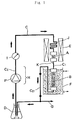
- the flow reactor of the present invention has a high-temperature high-pressure part (A) and a low-temperature high-pressure part (B) as well as a circulation line (C) that connects the two parts.
- a liquid reaction mixture containing organic reactant molecules to be polymerized is emitted into the low-temperature high-pressure part (B) from the high-temperature high-pressure part (A) through the circulation line (C), whereby inhibiting the polymer produced in the high-temperature high pressure part (A) from decomposing in the low-temperature high pressure part (B), after which the polymer is once again sent to the high-temperature high-pressure part (A) through the circulation line (C2) for further polymerization, and the cycle is repeated. That is, the high-temperature high-pressure part (A) and the low-temperature high-pressure part (B) realize a constant temperature gradient, thereby creating a field in a state of non-equilibrium.
- the chamber of the high-temperature high-pressure part (A) is heated by a heating device such as an electric furnace (E), and the chamber of the low-temperature high-pressure top layer (B) is cooled, for example, by cooling water in a cooling tank (F).
- a heating device such as an electric furnace (E)
- the chamber of the low-temperature high-pressure top layer (B) is cooled, for example, by cooling water in a cooling tank (F).
- An open system is realized by the simultaneous injection of thermal energy (the high temperature side) and release of energy (the low temperature side), and by the contact with the electric furnace (E), an external high temperature heat source, and the cooling tank (F), a low temperature heat bath; in other words, the system is open to the outside.
- the low-temperature low-pressure part (D) is connected to the downstream side of the low-temperature high-pressure part (B) through, for example, a pressure-decreasing needle tube (C21), and an outlet path (G) for the polymer is connected to the low-temperature low-pressure part (D).
- a non-pulsating current pump (P) as the low-temperature high-pressure part (H), a pressure gauge (I) having a safety device and the like are installed.
- a low molecular weight compound such as low molecular weight amino acid or a derivative thereof, as the initial organic compound, namely, the raw material, or the reaction intermediate
- the organic molecules are supplied as liquids, dissolved in organic solvents or as dispersion mixtures in solvent.
- the liquid reaction mixture containing the supplied organic molecules is then sent to the low-temperature high-pressure part (H) to pass through the pump (P) for pressurization.
- the pressurized liquid reaction mixture is introduced to the high-temperature high-pressure part (A) by way of, for example, the auxiliary heating part (J).
- the decomposition in the high-temperature part may be controlled in advance within a certain range or degree.
- the liquid reaction mixture containing polymers produced by the reaction is emitted into the low-temperature high-pressure part (B) through the circulation line (C1).
- the thermal decomposition of the emitted polymer product is inhibited, and the polymer for which decomposition was inhibited is held in the low-temperature high-pressure part (B).
- the emission of the liquid reaction mixture into the low-temperature high-pressure part (B) from the high-temperature high-pressure part (A) is performed through the circulation line (C1).
- a structure of the circulation line (C1) a nozzle shape or a nozzle structure with a relatively small diameter may be considered.
- the cooling rate at the low-temperature high-pressure part (B) may be controlled.
- a temperature measuring part (K) may be installed in the vicinity of the outlet of the high-temperature high-pressure part (A).
- a polymer with a large decomposition rate may be obtained by setting the cooling rate at the low-temperature high-pressure part (B) to a value larger than the decomposition rate of the polymer.
- the liquid reaction mixture containing the polymer product is sent to the low-temperature low-pressure part (D) from the low-temperature high-pressure part (B), after depressurizing by way of a pressure-decreasing means such as a pressure-decreasing needle tube (C21) or the like. All or part of the polymer product may be taken outside of the system from the low-temperature low-pressure part (D) by way of the outlet path (G).
- the remaining of the polymer product, together with the liquid reaction mixture, is circulated again to the high-temperature high-pressure part (A) by way of the low-temperature high-pressure part (H) as described above.
- the polymer product as a reactant is further converted into a polymer of another type.
- additional polymerization reactions proceed sequentially as a result of receiving thermal energy.
- the flow reactor of the present invention is characteristic in that it is a flow type reactor for polymerizing low molecular weight organic molecules such as amino acids in a non-equilibrium open system environment, wherein the liquid phase containing the organic molecules is circulated from the high-temperature high-pressure part (A) to the low-temperature high-pressure part (B), and further, to the low-temperature low-pressure part (D).
- A high-temperature high-pressure part
- B low-temperature high-pressure part
- D low-temperature low-pressure part
- a flow reactor for a new type of polymerization reaction by which highly advanced control of decomposition and polymerization is enabled, is provided.
- the high-temperature high-pressure part (A) and the low-temperature high-pressure part (B) and the circulation line (C) were all made from stainless steel (SUS 316).
- the chamber of the high-temperature high-pressure part (A) which had a volume of 15 ml, was connected the chamber of the low-temperature high-pressure part (B) with an inner diameter of 20 mm and length of 250 mm, via the circulation line (C1) tube with an inner diameter of 100 ⁇ m and a length of 50 mm.
- the chamber of the low-temperature high-pressure part (B) was immersed in a 20 L water bath, which had a cooling pipe for circulating a cooling medium of -20 °C.
- the water bath was arranged so that the temperature of water at the circulation-outlet was 0 °C.
- a capillary tube with a length of 1 m and an inner diameter of 100 ⁇ m was connected to the chamber of the low-temperature high-pressure part (B), so that the pressure could be decreased to atmospheric pressure by the tube.
- the flow rate of the liquid reaction mixture was set in the range of 8-12 ml/min, so that the internal pressure of the chamber of the high-temperature high-pressure part (A) remained constant (23.0 MPa).
- the polymerization was carried out, by charging a 100 mM solution of L-glycine in pure water so that the total volume of the circulation liquid was 500 ml.
- the pressure in the chamber of the high-temperature high-pressure part (A) with a volume of 15ml was set at 23.0 MPa, as described above. This pressure slightly exceeds the critical pressure of water (22.1 MPa) and is a pressure value at which water can constantly maintain the liquid phase.
- the temperature of the chamber of the high-temperature high-pressure part (A) was held within the range of 110-350 °C. The temperature was raised, at the initial stage, from room temperature to a temperature within the aforementioned range in approximately 10 minutes.
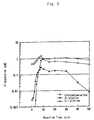
- Figure. 2 shows a profile of the products obtained by high precision liquid chromatography (HPLC) observed one hour after setting the temperature of the chamber of the high-temperature high-pressure part (A) at 250 °C.
- HPLC high precision liquid chromatography
- the abscissa of Figure 2 represents the time during which the temperature was maintained. Details of the HPLC column, the eluent, the elution rate and the detection means are as follows.
- Figure 6 is a diagram which shows the production with time where 5 ⁇ M tri-glycine was added to a 100 mM glycine solution in the high-temperature high-pressure part (A) with a temperature of 250 °C.
- the self-catalytic polymerization as described above is not expected in conventional polymerization reactions for which thermal equilibrium is considered. In that sense, such self-catalytic polymerization well represents the notable characteristics of the flow reactor of non-equilibrium open type of the present invention.
- the invention of the present application provides a novel polymerization technique, which allows the polymerization of low molecular weight organic molecules such as amino acids wherein the degree of polymerization of the polymer product is highly controlled.
Landscapes
- Chemical & Material Sciences (AREA)
- Organic Chemistry (AREA)
- Chemical Kinetics & Catalysis (AREA)
- Polyamides (AREA)
- Other Resins Obtained By Reactions Not Involving Carbon-To-Carbon Unsaturated Bonds (AREA)
Abstract
Description
- HPLC Column:
- Shodex ODP-50 4D (4.6 mm × 150 mm)
- Eluent:
- 50 mM KH2PO4, 7.2 mM CH3(CH2)5SO2Na, pH 2.5
- Elution Rate:
- 0.5 ml/min
- Detection Means:
- UV (195 nm)
Claims (6)
- A flow reactor of non-equilibrium open type for liquid-phase polymerization reaction, comprising a high-temperature high-pressure part, a low-temperature high-pressure part and a circulation line connecting the two parts, wherein the liquid reaction mixture containing organic reactant molecules to be polymerized is emitted into the low-temperature high-pressure part from the high-temperature high-pressure part through the circulation line, whereby inhibiting the decomposition of the polymer produced in the high-temperature high-pressure part in the low-temperature high-pressure part, after which the polymer produced is once again sent to the high-temperature high-pressure part through the circulation line for further polymerization, and the same cycle is repeated.
- The flow reactor of claim 1, wherein the circulation line comprises a low-temperature low-pressure part installed to the downstream side of the low-temperature high-pressure part.
- The flow reactor of claim 1, wherein the circulation line comprises a low-temperature low-pressure part and a low-temperature high-pressure part installed in sequence to the downstream side of the low-temperature high-pressure part.
- The flow reactor of claims 2 or 3, wherein an outlet path for the polymer is installed in the low-temperature low-pressure part.
- The flow reactor of any one of claims 2 to 4, wherein a supply path for the organic reactant molecules to be polymerized is installed in the low-temperature low-pressure part.
- The flow reactor of any one of claims 1 to 5, wherein the diameter size of the circulation line connecting the high-temperature high-pressure part with the low-temperature high-pressure part is variable and the cooling rate at the low-temperature high-pressure part is controllable.
Applications Claiming Priority (3)
| Application Number | Priority Date | Filing Date | Title |
|---|---|---|---|
| JP02796299A JP3655479B2 (en) | 1999-02-04 | 1999-02-04 | Non-equilibrium open flow reactor |
| JP2796299 | 1999-02-04 | ||
| PCT/JP2000/000583 WO2000045947A1 (en) | 1999-02-04 | 2000-02-03 | Flow reactor of nonequilibrium open type |
Publications (2)
| Publication Number | Publication Date |
|---|---|
| EP1161982A1 true EP1161982A1 (en) | 2001-12-12 |
| EP1161982A4 EP1161982A4 (en) | 2004-12-29 |
Family
ID=12235529
Family Applications (1)
| Application Number | Title | Priority Date | Filing Date |
|---|---|---|---|
| EP00902066A Withdrawn EP1161982A4 (en) | 1999-02-04 | 2000-02-03 | UNBALANCED OPEN-CIRCULATION REACTOR |
Country Status (3)
| Country | Link |
|---|---|
| EP (1) | EP1161982A4 (en) |
| JP (1) | JP3655479B2 (en) |
| WO (1) | WO2000045947A1 (en) |
Family Cites Families (5)
| Publication number | Priority date | Publication date | Assignee | Title |
|---|---|---|---|---|
| NL8100643A (en) * | 1981-02-11 | 1982-09-01 | Stamicarbon | METHOD FOR DRAINING HEAT FROM FLUID MIXTURES CONTAINING A POLYMERIZABLE MONOMER AND AN ACTIVE POLYMERIZATION CATALYST, METHOD FOR POLYMERIZING A POLYMERIZABLE MONOMER, AND DEVICE FOR POLYMERIZABLE ROOF |
| JPS5825309A (en) * | 1981-08-07 | 1983-02-15 | Asahi Chem Ind Co Ltd | Production of alpha-olefin polymer and apparatus therefor |
| US5241048A (en) * | 1988-03-11 | 1993-08-31 | Protein Technologies, Inc. | Organic syntheses employing supercritical carbon dioxide as a reaction solvent |
| US5405533A (en) * | 1993-04-07 | 1995-04-11 | General Atomics | Heat transfer via dense gas in a fluid circulation system |
| US6017460A (en) * | 1996-06-07 | 2000-01-25 | Chematur Engineering Ab | Heating and reaction system and method using recycle reactor |
-
1999
- 1999-02-04 JP JP02796299A patent/JP3655479B2/en not_active Expired - Fee Related
-
2000
- 2000-02-03 WO PCT/JP2000/000583 patent/WO2000045947A1/en not_active Ceased
- 2000-02-03 EP EP00902066A patent/EP1161982A4/en not_active Withdrawn
Also Published As
| Publication number | Publication date |
|---|---|
| JP3655479B2 (en) | 2005-06-02 |
| EP1161982A4 (en) | 2004-12-29 |
| WO2000045947A1 (en) | 2000-08-10 |
| JP2000225330A (en) | 2000-08-15 |
Similar Documents
| Publication | Publication Date | Title |
|---|---|---|
| Sasaki et al. | Cellulose hydrolysis in subcritical and supercritical water | |
| US5320875A (en) | Method of providing an abrasion resistant coating | |
| CA2883372C (en) | Formation of [2,2] paracyclophane and related compounds and methods for the formation of polymers from cyclophanes | |
| CN103764660B (en) | Method and device for synthesizing artemisinin | |
| CA2431435A1 (en) | Tubular reactor with coaxial cylinders and process using this reactor | |
| EP1698647A1 (en) | Polymer and process for producing polymer | |
| US6221319B1 (en) | Plasma discharge reactors for the preparation of bioactive compounds | |
| US20040254311A1 (en) | Flow reactor of non-equilibrium open type | |
| US5711859A (en) | Process for plasma-chemical conversion of N2 O into NOx | |
| US4369255A (en) | Method of obtaining improved equilibrium conditions and of simultaneously producing steam under high pressure in the production of methanol | |
| EP0903175A2 (en) | Continuous process for polymerizing a vinyl monomer cooled by superheated water | |
| GEP20063776B (en) | Process for Converting Caprolactam to Nylon 6 | |
| JP3655479B2 (en) | Non-equilibrium open flow reactor | |
| CN111635299A (en) | A method for preparing aromatic hydrocarbon alpha ketone carbonyl compounds by continuous visible light catalyzed molecular oxygen oxidation in a microchannel reactor | |
| KR102538855B1 (en) | Apparatus and method for manufacturing germane gas | |
| US6300523B1 (en) | Noncatalytic organic synthesis using supercritical water | |
| Reynolds et al. | Photochemical generation and preparative capture of 1, 2, 4, 5-tetramethylenebenzene in fluid solution. Nanosecond time-resolved spectroscopic determination of absolute rates of dimerization and oxygen trapping of a disjoint singlet hydrocarbon biradical | |
| Pan et al. | Plasma dissociation reaction kinetics. I. Methyl methacrylate | |
| EP1085002B1 (en) | Method of novel noncatalytic organic synthesis | |
| JP2002159291A (en) | Method for polymerizing nucleic acid molecules in non-equilibrium reaction field | |
| RU2447088C2 (en) | Ethylene polymerisation method | |
| CN117942591A (en) | Reboiler and preparation method and application thereof | |
| Poliakoff et al. | Intermediates in organometallic and organic chemistry: spectroscopy, polymers, hydrogenation and supercritical fluids | |
| CN116854555B (en) | A kind of dimethyl bridged octahydronaphthalene or its derivative and its gradient pressurization preparation method | |
| EP1369413A1 (en) | Process for producing lactam |
Legal Events
| Date | Code | Title | Description |
|---|---|---|---|
| PUAI | Public reference made under article 153(3) epc to a published international application that has entered the european phase |
Free format text: ORIGINAL CODE: 0009012 |
|
| 17P | Request for examination filed |
Effective date: 20010816 |
|
| AK | Designated contracting states |
Kind code of ref document: A1 Designated state(s): AT BE CH CY DE DK ES FI FR GB GR IE IT LI LU MC NL PT SE |
|
| RBV | Designated contracting states (corrected) |
Designated state(s): DE FR GB |
|
| RAP1 | Party data changed (applicant data changed or rights of an application transferred) |
Owner name: JAPAN SCIENCE AND TECHNOLOGY AGENCY |
|
| A4 | Supplementary search report drawn up and despatched |
Effective date: 20041115 |
|
| RIC1 | Information provided on ipc code assigned before grant |
Ipc: 7B 01J 3/00 A Ipc: 7B 01J 3/04 B Ipc: 7C 12M 1/40 B Ipc: 7B 01J 19/24 B |
|
| STAA | Information on the status of an ep patent application or granted ep patent |
Free format text: STATUS: THE APPLICATION HAS BEEN WITHDRAWN |
|
| 18W | Application withdrawn |
Effective date: 20070720 |