The present invention relates to an image data communication system and more
particularly to an image data communication system and a method thereof for
displaying on an image display apparatus an image signal which is generated by
imaging a subject.
The present invention also relates to an image pickup apparatus and an image
data processing method used for the image data communication system.
A portable information device, especially a portable telephone, has a limited
image data processing capability and often places limitations on the amount of data
and the number of colors as regards available digital images. Accordingly, displaying
an image on the portable information device requires advanced knowledge about
digital images such as an image retouching program, for example.
To solve this problem, there are provided a camera dedicated to a portable
device for displaying images and a special conversion program for a personal
computer. An image is created by using these hardware and software products and is
input to the portable device according to a special communication protocol.
According to an available service, an image processing server is provided on the
network. An image is once uploaded to the image processing server. The uploaded
image is automatically converted according to the amount of data and the number of
colors which can be processed on the portable information device. The converted
image is downloaded to the portable information device.
When the dedicated communication protocol is used for entering the created
image to the portable device as mentioned above, special-purpose devices or programs
are needed, increasing costs and causing a compatibility problem.
According to the above-mentioned method, an image processing server is
provided on the network and the created image is uploaded for converting the data
amount and the number of colors. This method solves the compatibility problem but
necessitates additional communication costs. Currently, a mainstream digital still
camera is capable of digital images of more than a million pixels, whereas a portable
information device supports images of just several tens of thousands of pixels at the
most. This results in uploading data several tens of times larger than the number of
finally needed pixels, causing unnecessary communication costs. Since the amount
of data is compressed considerably, there is a high possibility of degrading the quality
of converted images. The conventional method allows confirmation of the image
quality only after completion of all processes. There has been frequently a waste of
tune, communication costs, and charges for the service.
Various aspects and features of the present invention are defined in the
appended claims.
The present invention has been made in consideration of the foregoing.
Embodiments of the present invention can provide an image data communication
system and a method thereof which can decrease communication costs and time.
For addressing the above-mentioned problems, an image data communication
system according to the present invention comprises: an image pickup apparatus
having image pickup means for imaging a subject, wherein the image pickup apparatus
converts an image signal from this image pickup means to image data having a data
size in compliance with an image display capability of a transmission destination and
outputs the image data; and an image display apparatus for displaying an image using
the image data output from the image pickup apparatus.
The data amount does not increase during communication since the image
pickup apparatus creates and outputs image data having a data size corresponding to
an image display capability of the image display apparatus.
For addressing the above-mentioned problems, an image data communication
method according to the present invention is used for sending image data resulting
from imaging a subject by an image pickup apparatus to an image display apparatus
as a transmission destination, comprising: an image data processing step of converting
an image signal captured by image pickup means of the image pickup apparatus to
image data of a data size corresponding to an image display capability of the image
display apparatus as a transmission destination; a communication step of transmitting
the image data resulting from the image data processing step to the image display
apparatus; and an image display step of receiving the image data transmitted by the
communication step and displaying the image data as an image on the image display
apparatus.
The data amount does not increase during communication since the image data
processing step creates image data of a data size corresponding to an image display
capability of the image display apparatus.
For addressing the above-mentioned problems, an image pickup apparatus
according to the present invention comprises: image pickup means for imaging a
subject; image data processing means for generating image data having a data size in
compliance with an image display capability of an image display apparatus from an
image signal captured by the image pickup means; and output means for outputting the
image data generated by the image data processing means.
For solving the above-mentioned problems, an image data processing method
according to the present invention is used for generating image data from an image
signal obtained by imaging a subject and displaying the image data on an image
display apparatus by means of communication, comprising: an image data processing
step of converting the image signal to image data of a data size in compliance with an
image display capability of the image display apparatus.
The present invention can provide an image data communication system and a
method thereof which can decrease communication costs and time.
The invention will now be described by way of example with reference to the
accompanying drawings, throughout which like parts are referred to by like references, and
in which:
Embodiments of the present invention will be described in further detail with
reference to the accompanying drawings. As an embodiment, FIG. 1 shows an image
data communication system 1 which comprises a digital image recording apparatus 2
and a portable telephone 9. The digital image recording apparatus 2 works as an image
pickup apparatus. The portable telephone 9 works as an image display apparatus for
displaying an image by using image data output from the digital image recording
apparatus 2.
In this image data communication system 1, the digital image recording
apparatus 2 is connected to a portable telephone 3. The portable telephone 3 sends and
receives an RF signal to/from a base station 4 connected to a wire network 5 such as
the Internet via a wireless transmission path. The portable telephone 9 sends and
receives an RF signal to/from a base station 8 connected to the wire network 5 via a
wireless transmission path.
The network 5 may connect with an image processing apparatus 6 such as a
personal computer and a portable information terminal 10 such as a PDA. The network
5 may connect with an image distribution server 7.
In the image data communication system 1 as shown in FIG. 1, an image sender
uses the digital image recording apparatus 2 to capture a desired still image or motion
video (hereafter simply referred to as an image). The digital image recording apparatus
2 compresses the image and records it in a recording section so that a data amount is
appropriate for processing on the portable telephone 9 or the portable information
terminal 10. It is assumed that, say, a 5-KB data amount is appropriate for processing
on the portable telephone 9 or the portable information terminal 10. This data amount
is based on a recording medium capacity in the portable telephone 9 or the portable
information terminal 10 and a speed of a data transmission service for mobile
communication. The above data amount may be increased when a next-generation
high-speed mobile communication service is available in the filture. The digital image
recording apparatus 2 images a subject to generate, say, a color still image. This image
is compressed according to the JPEG format and is further compressed as a color GIF
(graphics interchange format) file so that the data amount is appropriate for processing
on the portable telephone 9 or the portable information terminal 10. At this time, it
may be preferable to temporarily compress the captured color still image as a JPEG
file and then as a GIF file.
The image sender connects the digital image recording apparatus 2 to the
portable telephone 3 which establishes a connection to the network 5. The recorded
5-KB image data is transferred to the image distribution server 7. The image
distribution server 7 records the image data transferred from the digital image
recording apparatus 2 on an internal recording apparatus. The image distribution
server 7 then sends an e-mail message to the portable telephone 9 or the portable
information terminal 10 to notify a recipient that image distribution is available. The
recipient can download to receive the image from the image distribution server 7 by
operating the portable telephone 9 or the portable information terminal 10.
In the above description, the image distribution server 7 temporarily stores
image data. The present invention also permits a system configuration without the
image distribution server 7. In this case, the image sender connects the digital image
recording apparatus 2 to the portable telephone 3 and directly transfers image data to
the recipient's portable telephone 9 or portable information terminal 10.
In the description so far, the digital image recording apparatus 2 is connected
to the portable telephone 3. This is an example of means for connecting the digital
image recording apparatus 2 to the network 5. Instead of the portable telephone 3, it
may be preferable to use connection means such as a stationary telephone and a
networked personal computer. It may be also preferable to directly connect the digital
image recording apparatus 2 to the network 5 by eliminating the portable telephone 3.
In this case, the digital image recording apparatus 2 may be not only a camera and a
scanner, but also a CCD-camera equipped PDA or portable telephone.
An image sending source may be the image processing apparatus 6 connected
to the network 5. In this case, the sender converts a prepared image using the image
processing apparatus 6 so that the data amount is appropriate for processing on the
portable telephone 9 or the portable information terminal 10. Thereafter, the image
is distributed via the network 5 as mentioned above.
The following describes detailed configuration and operations of the digital
image recording apparatus 2 with reference to FIGS. 2 and 3. In the digital image
recording apparatus 2 as shown in FIG. 2, a CCD 11 works as image pickup means for
imaging a subject and generates an image signal. An image processing circuit 12
processes the image signal and outputs image data with a data size which complies
with an image display capability of the destination such as the portable telephone 9 or
the portable information terminal 10.
An image captured by the CCD 11 is processed in the image processing circuit
12 and is displayed on the image display apparatus 13. The image display apparatus
13 can be a built-in LCD panel or EVF display, an externally connected TV monitor,
and the like.
When a user presses a shutter button 15, an image captured by the CCD 11 is
temporarily recorded in DRAM 14 via the image processing circuit 12. The image
data recorded in the DRAM 14 is compressed by the image processing circuit 12 and
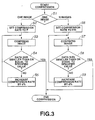
is written back to the DRAM 14. The compression follows an algorithm as shown in
the flowchart of FIG. 3 to be described later. During the compression, data is
compressed to an amount which can be processed by the portable telephone 9 or the
portable information terminal 10. The compressed image data written back to the
DRAM 14 is recorded in a memory card 18 via a memory card controller 17.
For reproducing an image recorded in the memory card 18, the compressed
image data is read from the memory card 18 via the memory card controller 17 and is
recorded in the DRAM 14. The compressed image data is expanded in the image
processing circuit 12 and is written back to the DRAM 14. The image data written
back to the DRAM 14 is processed in the image processing circuit 12 and is displayed
on the image display apparatus 13.
For transferring an image recorded in the memory card 18 to a portable
telephone, the compressed image data is read from the memory card 18 via the
memory card controller 17 and is recorded in the DRAM 14. The compressed image
data recorded in the DRAM 14 is transferred to the portable telephone 9 via the I/F
circuit 19.
A controller microcomputer 16 controls transfer of image data between the
blocks. In the above description, compressed image data is recorded in the memory
card 18. The system configuration may use removable built-in nonvolatile memory
for storing compressed image data.
The following describes an image compression algorithm with reference to FIG.
3 when the digital image recording apparatus 2 compresses an image.
When the image compression starts, it is checked whether to compress one
image or a plurality of images (step S1). Here, a plurality of images refers to a
plurality of still images and a plurality of motion images.
When one image is to be compressed, control advances to step S2 to set a
predefined value P as an initial compression rate. The compression rate P is a
provisional term used for explaining a compression degree. In actual processing, a
compression rate may comprise a plurality of parameters. When the compression rate
P is specified, the image is compressed according to the specified value at step S3.
When the compression is complete, the resulting image data amount is checked at step
S4. When the data amount is smaller than or equal to the predefined value, the
compression terminates. This predefined value corresponds to a size capable of
processing in the portable telephone 9 or the portable information terminal 10. When
the data amount exceeds the specified value, the compression rate P is increased by
amount d% (step S5). The compression is repeated at S3. This processing is repeated
until the compressed image data amount becomes smaller than or equal to the
specified value. According to this algorithm, the compression rate is increased by d%
at step S5. It may be preferable to determine the compression rate by providing a
compression rate table or using a function for finding the compression rate.
When a plurality of images (N images) is to be compressed at step S1, a value
P/N is specified as an initial compression rate (step S6) and the compression is
performed (step S7). Thereafter, the image data amount is checked at step S8. When
the data amount is smaller than or equal to the specified value, the compression
terminates. When the data amount exceeds the specified value, the compression rate
is increased by amount d'% (step S9) and the compression is reexecuted (step S7).
This processing is repeated until the image data amount becomes smaller than or equal
to the specified value. With respect to the compression rate P/N, a value 1/N indicates
that the compressed data amount should be controlled likewise for one image and a
plurality of images. However, the value 1/N does not always take effect depending on
an image characteristic. Like the case for one image, there can be several methods of
setting the amount d'% for increasing the compression rate.
In the above algorithm, the specified data amount value may be stored in the
nonvolatile memory of the digital image recording apparatus or entered by a user.
With reference to FIG. 4, the following describes a sequence of operations in
the image data communication system 1. Namely, 5-KB image data received by the
digital image recording apparatus 2 is temporarily stored in the image distribution
server 7 connected to the network 5 via the portable telephone 3 and is displayed on
the portable telephone 9.
For example, 5-KB image data is captured by the digital image recording
apparatus 2, and is converted to a color GIF file having a data amount which can be
processed in the portable telephone 9. The image data is displayed on a display
section 20 of the portable telephone 3. This display section 20 is the same as the
image display apparatus 13 in FIG. 2. At this time, the 5-KB data (color GIF file) is
provided with additional data such as a mail address, an image file name, a message,
and the like according to key operations on the portable telephone 3. When a transfer
button is operated on the display section 20, the GIF file with additional data is
uploaded to the image distribution server 7 via the wireless transmission path and the
wire network 5 (1). The image distribution server 7 generates a URL and a mail
message in a specified mode and sends this message to the portable telephone 9 (2).
When the portable telephone 9 is used to access the URL sent from the image
distribution server 7 (3), the GIF file is downloaded from the image distribution server
7.
FIG. 5 illustrates a sequence of operations in which a GIF file with additional
data from the digital image recording apparatus 2 is temporarily uploaded to an image
distribution server 7 via a personal computer 60 and then is sent to the portable
telephone 9.
The personal computer 60 activates software for uploading images. A press of
a send button on the personal computer 60 transmits a customer ID and a password
(provisional ID and password) to the image distribution server 7 according to the
HTTPS protocol (1). The image distribution server 7 checks an authentication server
21 based on the ID and password transmitted from the personal computer 60 (2). The
image distribution server 7 then returns a result of checking the ID and password to
the personal computer 60 (3).
When the image distribution server 7 returns a successful check result, the
software active on the personal computer 60 uses the HTTPS protocol to send to the
image distribution server 7 a customer ID and password (provisional ID and
password), a password for viewing GIF files, a sender name, a sender's mail address,
a recipient name, a specified mail address, a 5-KB GIF file, a message attached to an
image, and the like (4).
Based on the transmitted data, the image distribution server 7 generates a mail
message in a specified mode, a URL, and HTML files for a password check screen and
a viewer page (5). The image distribution server 7 returns a processing result to the
personal computer 60.
Then, the image distribution server 7 sends a mail message in a specified mode
to a mail server 22 according to a fixed mail format used for the mail server 22 (7).
The mail server 22 distributes the mail message in the specified mode to the portable
telephone 9 (8). When the above mail message causes an error, the error mail message
is returned to the image distribution server 7 (9).
FIG. 6 shows an example of a mail message in a specified mode distributed to
the portable telephone 9 and displayed on a display section 23 thereof. When a
recipient clicks the URL, he or she is prompted to enter a password for viewing the
GIF file. After the password is entered successfully, the GIF file can be viewed.
The image data communication system I has been described in detail. As
mentioned above, the digital image recording apparatus 2 creates beforehand an image
compressed to the data amount which can be processed in the receiving portable
telephone or portable information terminal. This can minimize the data amount to be
uploaded to the network 5, thus decreasing communication costs and time.
After the data amount is decreased, the image quality can be confirmed before
data transfer. This can prevent a failure of wasting communication costs and time
when the image quality is found to be unsatisfactory after the data transfer.
The network does not always need to have a server for converting images,
making the system configuration easy. It is possible to decrease costs for the system
configuration and operations.
It is unnecessary to use dedicated image recording equipment or communication
protocol, decreasing costs and ensuring versatility.
In so far as the embodiments of the invention described above are implemented, at least
in part, using software-controlled data processing apparatus, it will be appreciated that a
computer program providing such software control and a storage medium by which such a
computer program is stored are envisaged as aspects of the present invention.
Various different aspects and features of the present invention are defined in the
appended claims. Combinations of features from the dependent claims may be combined
with features of the independent claims as appropriate and not merely as explicitly set out in
the claims.