EP1160768A2 - Robust features extraction for speech processing - Google Patents
Robust features extraction for speech processing Download PDFInfo
- Publication number
- EP1160768A2 EP1160768A2 EP01304769A EP01304769A EP1160768A2 EP 1160768 A2 EP1160768 A2 EP 1160768A2 EP 01304769 A EP01304769 A EP 01304769A EP 01304769 A EP01304769 A EP 01304769A EP 1160768 A2 EP1160768 A2 EP 1160768A2
- Authority
- EP
- European Patent Office
- Prior art keywords
- speech
- values
- parameters
- signal
- signal values
- Prior art date
- Legal status (The legal status is an assumption and is not a legal conclusion. Google has not performed a legal analysis and makes no representation as to the accuracy of the status listed.)
- Withdrawn
Links
- 238000012545 processing Methods 0.000 title claims abstract description 110
- 238000000605 extraction Methods 0.000 title 1
- 230000005540 biological transmission Effects 0.000 claims abstract description 22
- 230000006870 function Effects 0.000 claims description 116
- 238000000034 method Methods 0.000 claims description 85
- 238000004088 simulation Methods 0.000 claims description 25
- 230000015654 memory Effects 0.000 claims description 15
- 238000005070 sampling Methods 0.000 claims description 10
- 230000005236 sound signal Effects 0.000 claims description 10
- 238000012795 verification Methods 0.000 claims description 10
- 238000003672 processing method Methods 0.000 claims 2
- 238000004458 analytical method Methods 0.000 abstract description 22
- 238000007619 statistical method Methods 0.000 description 67
- 239000013598 vector Substances 0.000 description 28
- 238000009826 distribution Methods 0.000 description 27
- 238000007405 data analysis Methods 0.000 description 19
- 239000011159 matrix material Substances 0.000 description 16
- 238000005259 measurement Methods 0.000 description 13
- 238000010586 diagram Methods 0.000 description 11
- 238000009499 grossing Methods 0.000 description 9
- 238000001514 detection method Methods 0.000 description 5
- 230000009466 transformation Effects 0.000 description 5
- 238000004519 manufacturing process Methods 0.000 description 4
- 230000000694 effects Effects 0.000 description 3
- 230000001373 regressive effect Effects 0.000 description 3
- 230000002441 reversible effect Effects 0.000 description 3
- 238000007476 Maximum Likelihood Methods 0.000 description 2
- 238000010420 art technique Methods 0.000 description 2
- 230000015572 biosynthetic process Effects 0.000 description 2
- 238000004422 calculation algorithm Methods 0.000 description 2
- 238000004364 calculation method Methods 0.000 description 2
- 238000007781 pre-processing Methods 0.000 description 2
- 230000003595 spectral effect Effects 0.000 description 2
- 238000003786 synthesis reaction Methods 0.000 description 2
- 238000009827 uniform distribution Methods 0.000 description 2
- 230000003936 working memory Effects 0.000 description 2
- 229910001369 Brass Inorganic materials 0.000 description 1
- 238000000342 Monte Carlo simulation Methods 0.000 description 1
- 239000000654 additive Substances 0.000 description 1
- 230000000996 additive effect Effects 0.000 description 1
- 238000013459 approach Methods 0.000 description 1
- 239000010951 brass Substances 0.000 description 1
- 238000006243 chemical reaction Methods 0.000 description 1
- 230000001419 dependent effect Effects 0.000 description 1
- 238000005315 distribution function Methods 0.000 description 1
- 238000002955 isolation Methods 0.000 description 1
- 239000000203 mixture Substances 0.000 description 1
- 238000009527 percussion Methods 0.000 description 1
- 238000003860 storage Methods 0.000 description 1
- 230000001052 transient effect Effects 0.000 description 1
- 238000010977 unit operation Methods 0.000 description 1
Images


Classifications
-
- G—PHYSICS
- G10—MUSICAL INSTRUMENTS; ACOUSTICS
- G10L—SPEECH ANALYSIS TECHNIQUES OR SPEECH SYNTHESIS; SPEECH RECOGNITION; SPEECH OR VOICE PROCESSING TECHNIQUES; SPEECH OR AUDIO CODING OR DECODING
- G10L15/00—Speech recognition
- G10L15/02—Feature extraction for speech recognition; Selection of recognition unit
-
- G—PHYSICS
- G10—MUSICAL INSTRUMENTS; ACOUSTICS
- G10L—SPEECH ANALYSIS TECHNIQUES OR SPEECH SYNTHESIS; SPEECH RECOGNITION; SPEECH OR VOICE PROCESSING TECHNIQUES; SPEECH OR AUDIO CODING OR DECODING
- G10L19/00—Speech or audio signals analysis-synthesis techniques for redundancy reduction, e.g. in vocoders; Coding or decoding of speech or audio signals, using source filter models or psychoacoustic analysis
- G10L19/0018—Speech coding using phonetic or linguistical decoding of the source; Reconstruction using text-to-speech synthesis
-
- G—PHYSICS
- G10—MUSICAL INSTRUMENTS; ACOUSTICS
- G10L—SPEECH ANALYSIS TECHNIQUES OR SPEECH SYNTHESIS; SPEECH RECOGNITION; SPEECH OR VOICE PROCESSING TECHNIQUES; SPEECH OR AUDIO CODING OR DECODING
- G10L21/00—Speech or voice signal processing techniques to produce another audible or non-audible signal, e.g. visual or tactile, in order to modify its quality or its intelligibility
- G10L21/02—Speech enhancement, e.g. noise reduction or echo cancellation
-
- G—PHYSICS
- G10—MUSICAL INSTRUMENTS; ACOUSTICS
- G10L—SPEECH ANALYSIS TECHNIQUES OR SPEECH SYNTHESIS; SPEECH RECOGNITION; SPEECH OR VOICE PROCESSING TECHNIQUES; SPEECH OR AUDIO CODING OR DECODING
- G10L15/00—Speech recognition
- G10L15/20—Speech recognition techniques specially adapted for robustness in adverse environments, e.g. in noise, of stress induced speech
Definitions
- the present invention relates to an apparatus for and method of speech processing.
- the invention particularly relates to a statistical processing of an input speech signal to derive parameters defining the speech production system which generated the speech.
- Most speech processing systems such as speech recognition systems, speech encoding systems, speaker verification systems and the like all include a signal processing front end, which converts the speech waveform into a parametric representation.
- One of the most common types of parameters (or coefficients) which are generated to represent speech are linear prediction (LP) coefficients.
- LP linear prediction
- This LP analysis assumes that the value of a current speech sample can be predicted from a linear weighted combination of the k most recent speech samples. Based on this model, the task of the LP analysis is to identify the value of the weightings (or coefficients) which minimises the mean squared error between the actual value of the current speech sample and the predicted value of the current speech sample.
- One of the problems with this LP analysis is that it performs the analysis of the speech within each frame in isolation from the speech within other frames. It also assumes that the same number of weightings or coefficients will represent the speech within each time frame. As a result, errors can be introduced making subsequent recognition processing or the like more prone to error.
- An aim of the present invention is to provide an alternative technique for pre-possessing speech prior to use in a speech recognition system, a speech encoding system, a speaker verification system or the like.
- Embodiments of the present invention can be implemented on computer hardware, but the embodiment to be described is implemented in software which is run in conjunction with processing hardware such as a personal computer, workstation, photocopier, facsimile machine or the like.
- FIG. 1 shows a personal computer (PC) 1 which may be programmed to operate an embodiment of the present invention.
- a keyboard 3, a pointing device 5, a microphone 7 and a telephone line 9 are connected to the PC 1 via an interface 11.
- the keyboard 3 and pointing device 5 allow the system to be controlled by a user.
- the microphone 7 converts the acoustic speech signal of the user into an equivalent electrical signal and supplies this to the PC 1 for processing.
- An internal modem and speech receiving circuit may be connected to the telephone line 9 so that the PC 1 can communicate with, for example, a remote computer or with a remote user.
- the program instructions which make the PC 1 operate in accordance with the present invention may be supplied for use with an existing PC 1 on, for example, a storage device such as a magnetic disc 13, or by downloading the software from the Internet (not shown) via the internal modem and telephone line 9.
- the AR coefficients output by the statistical analysis unit 21 are then input, via a coefficient converter 23 to a cepstral based speech recognition unit 25.
- the coefficient converter 23 converts the AR coefficients output by the analysis unit 21 into cepstral coefficients. This can be achieved using the conversion technique described in, for example, "Fundamentals of Speech Recognition" by Rabiner and Juang at pages 115 and 116.
- the speech recognition unit 25 then compares the cepstral coefficients for successive frames of speech with a set of stored speech models 27, which may be template based or Hidden Markov Model based, to generate a recognition result.
- the statistical analysis unit 21 analyses the speech within successive frames of the input speech signal.
- the frames are overlapping.
- the frames of speech are non-overlapping and have a duration of 20ms which, with the 16kHz sampling rate of the analogue to digital converter 17, results in a frame size of 320 samples.
- the analysis unit 21 assumes that there is an underlying process which generated each sample within the frame.
- the model of this process used in this embodiment is shown in Figure 3.
- AR auto regressive
- these AR filter coefficients are the same coefficients that the linear prediction (LP) analysis estimates albeit using a different processing technique.
- the raw speech samples s(n) generated by the speech source are input to a channel 33 which models the acoustic environment between the speech source 31 and the output of the analogue to digital converter 17.
- the channel 33 should simply attenuate the speech as it travels from the source 31 to the microphone 7.
- the signal (y(n)) output by the analogue to digital converter 17 will depend not only on the current raw speech sample (s(n)) but it will also depend upon previous raw speech samples.
- h 0 , h 1 , h 2 ....h r are the channel filter coefficients representing the amount of distortion within the channel 33
- r is the channel filter model order
- ⁇ (n) represents a random additive measurement noise component.
- the analysis unit 21 aims to determine, amongst other things, values for the AR filter coefficients ( a ) which best represent the observed signal samples ( y (n)) in the current frame. It does this by determining the AR filter coefficients ( a ) that maximise the joint probability density function of the speech model, channel model, raw speech samples and the noise statistics given the observed signal samples output from the analogue to digital converter 17, i.e. by determining: where ⁇ e 2 and ⁇ ⁇ 2 represent the process and measurement noise statistics respectively.
- this function defines the probability that a particular speech model, channel model, raw speech samples and noise statistics generated the observed frame of speech samples ( y (n)) from the analogue to digital converter.
- the statistical analysis unit 21 must determine what this function looks like. This problem can be simplified by rearranging this probability density function using Bayes law to give: p ( y ( n )
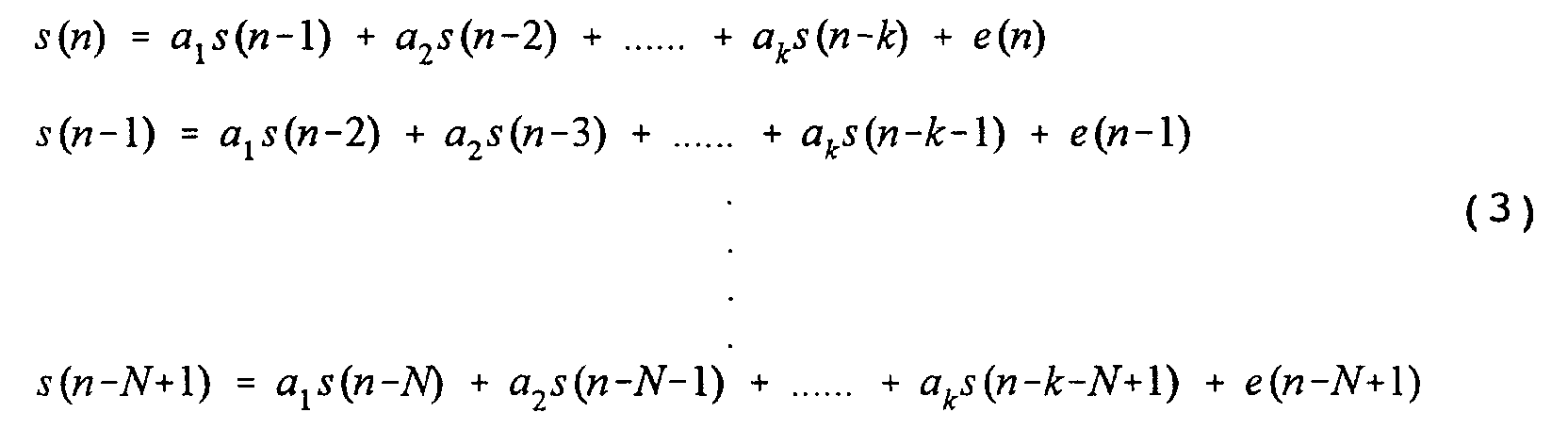
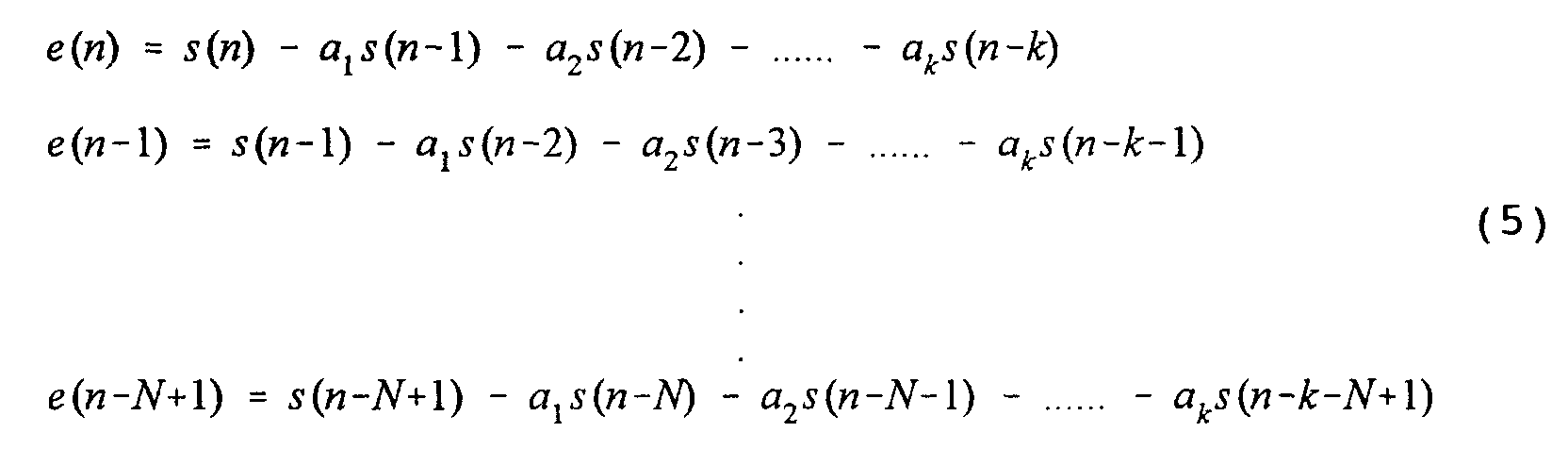
- This term represents the joint probability density function for generating the vector of raw speech samples ( s (n)) during a frame, given the AR filter coefficients ( a ), the AR filter model order (k) and the process noise statistics ( ⁇ e 2 ). From equation (6) above, this joint probability density function for the raw speech samples can be determined from the joint probability density function for the process noise.
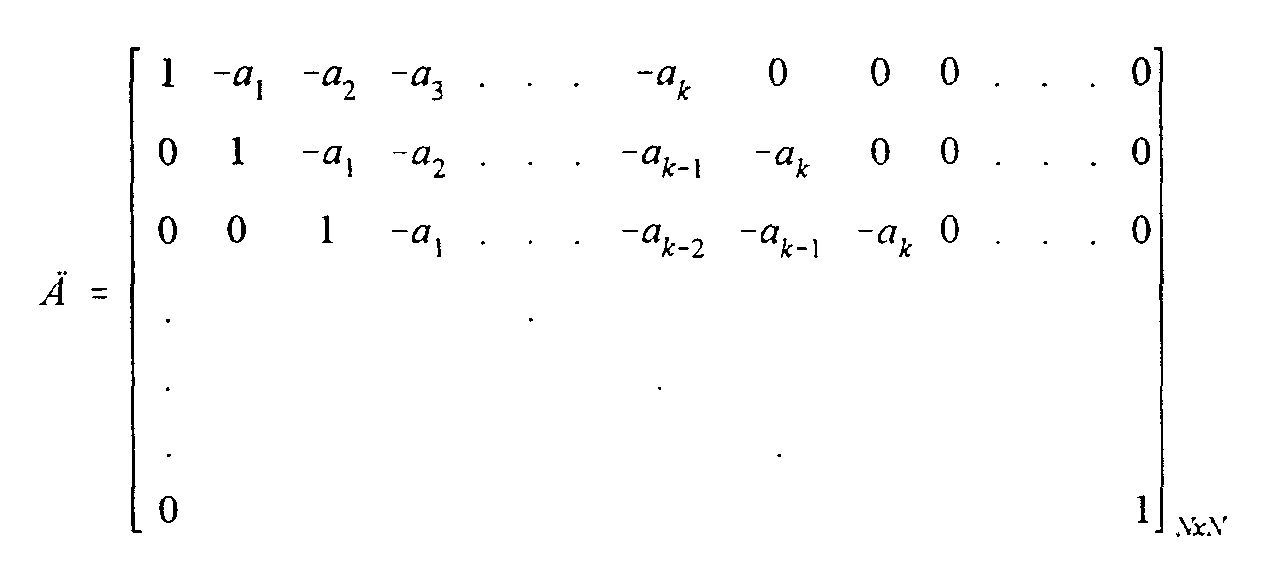
- a , k, ⁇ e 2 ) is given by: where p( e (n)) is the joint probability density function for the process noise during a frame of the input speech and the second term on the right-hand side is known as the Jacobean of the transformation. In this case, the Jacobean is unity because of the triangular form of the matrix ⁇ (see equations (6) above).
- the statistical analysis unit 21 assumes that the process noise associated with the speech source 31 is Gaussian having zero mean and some unknown variance ⁇ e 2 .
- the statistical analysis unit 21 also assumes that the process noise at one time point is independent of the process noise at another time point. Therefore, the joint probability density function for the process noise during a frame of the input speech (which defines the probability of any given vector of process noise e (n) occurring) is given by:
- the joint probability density function for a vector of raw speech samples given the AR filter coefficients (a), the AR filter model order (k) and the process noise variance ( ⁇ e 2 ) is given by: p( y (n)
- This term represents the joint probability density function for generating the vector of speech samples ( y (n)) output from the analogue to digital converter 17, given the vector of raw speech samples ( s (n)), the channel filter coefficients ( h ), the channel filter model order (r) and the measurement noise statistics ( ⁇ ⁇ 2 ). From equation (8), this joint probability density function can be determined from the joint probability density function for the process noise.
- s (n), h , r, ⁇ ⁇ 2 ) is given by: where p( ⁇ (n)) is the joint probability density function for the measurement noise during a frame of the input speech and the second term on the right hand side is the Jacobean of the transformation which again has a value of one.
- the statistical analysis unit 21 assumes that the measurement noise is Gaussian having zero mean and some unknown variance ⁇ ⁇ 2 . It also assumes that the measurement noise at one time point is independent of the measurement noise at another time point. Therefore, the joint probability density function for the measurement noise in a frame of the input speech will have the same form as the process noise defined in equation (12). Therefore, the joint probability density function for a vector of speech samples ( y (n)) output from the analogue to digital converter 17, given the channel filter coefficients ( h ), the channel filter model order (r), the measurement noise statistics ( ⁇ ⁇ 2 ) and the raw speech samples ( s (n)) will have the following form:
- This term defines the prior probability density function for the AR filter coefficients (a) and it allows the statistical analysis unit 21 to introduce knowledge about what values it expects these coefficients will take.
- the statistical analysis unit 21 models this prior probability density function by a Gaussian having an unknown variance ( ⁇ a 2 ) and mean vector ( ⁇ a ), i.e.:
- the prior density functions (p( ⁇ a 2 ) and p( ⁇ a )) for these variables must be added to the numerator of equation (10) above.
- the mean vector ( ⁇ a ) can be set to zero and for the second and subsequent frames of speech being processed, it can be set to the mean vector obtained during the processing of the previous frame.
- p( ⁇ a ) is just a Dirac delta function located at the current value of ⁇ a and can therefore be ignored.
- the statistical analysis unit 21 could set this equal to some constant to imply that all variances are equally probable. However, this term can be used to introduce knowledge about what the variance of the AR filter coefficients is expected to be. In this embodiment, since variances are always positive, the statistical analysis unit 21 models this variance prior probability density function by an Inverse Gamma function having parameters ⁇ a and ⁇ a , i.e.:
- the statistical analysis unit 21 At the beginning of the speech being processed, the statistical analysis unit 21 will not have much knowledge about the variance of the AR filter coefficients. Therefore, initially, the statistical analysis unit 21 sets the variance ⁇ a 2 and the ⁇ and ⁇ parameters of the Inverse Gamma function to ensure that this probability density function is fairly flat and therefore non-informative. However, after the first frame of speech has been processed, these parameters can be set more accurately during the processing of the next frame of speech by using the parameter values calculated during the processing of the previous frame of speech. p( h
- This term represents the prior probability density function for the channel model coefficients ( h ) and it allows the statistical analysis unit 21 to introduce knowledge about what values it expects these coefficients to take.
- this probability density function is modelled by a Gaussian having an unknown variance ( ⁇ h 2 ) and mean vector ( ⁇ h ), i.e.:
- the prior density functions (p( ⁇ h ) and p( ⁇ h )) must be added to the numerator of equation (10).
- the mean vector can initially be set to zero and after the first frame of speech has been processed and for all subsequent frames of speech being processed, the mean vector can be set to equal the mean vector obtained during the processing of the previous frame. Therefore, p( ⁇ h ) is also just a Dirac delta function located at the current value of ⁇ h and can be ignored.
- this is modelled by an Inverse Gamma function having parameters ⁇ h and ⁇ h .
- the variance ( ⁇ h 2 ) and the ⁇ and ⁇ parameters of the Inverse Gamma function can be chosen initially so that these densities are non-informative so that they will have little effect on the subsequent processing of the initial frame.
- the statistical analysis unit 21 models these by an Inverse Gamma function having parameters ⁇ e , ⁇ e and ⁇ ⁇ , ⁇ ⁇ respectively. Again, these variances and these Gamma function parameters can be set initially so that they are non-informative and will not appreciably affect the subsequent calculations for the initial frame. p(k) and p(r)
- the prior probability density functions for the AR filter model order (k) and the channel model order (r) respectively are modelled by a uniform distribution up to some maximum order. In this way, there is no prior bias on the number of coefficients in the models except that they can not exceed these predefined maximums.
- the maximum AR filter model order (k) is thirty and the maximum channel model order (r) is one hundred and fifty.
- the statistical analysis unit 21 "draws samples" from it.
- the joint probability density function to be sampled is a complex multivariate function
- a Gibbs sampler is used which breaks down the problem into one of drawing samples from probability density functions of smaller dimensionality.
- the Gibbs sampler proceeds by drawing random variates from conditional densities as follows:
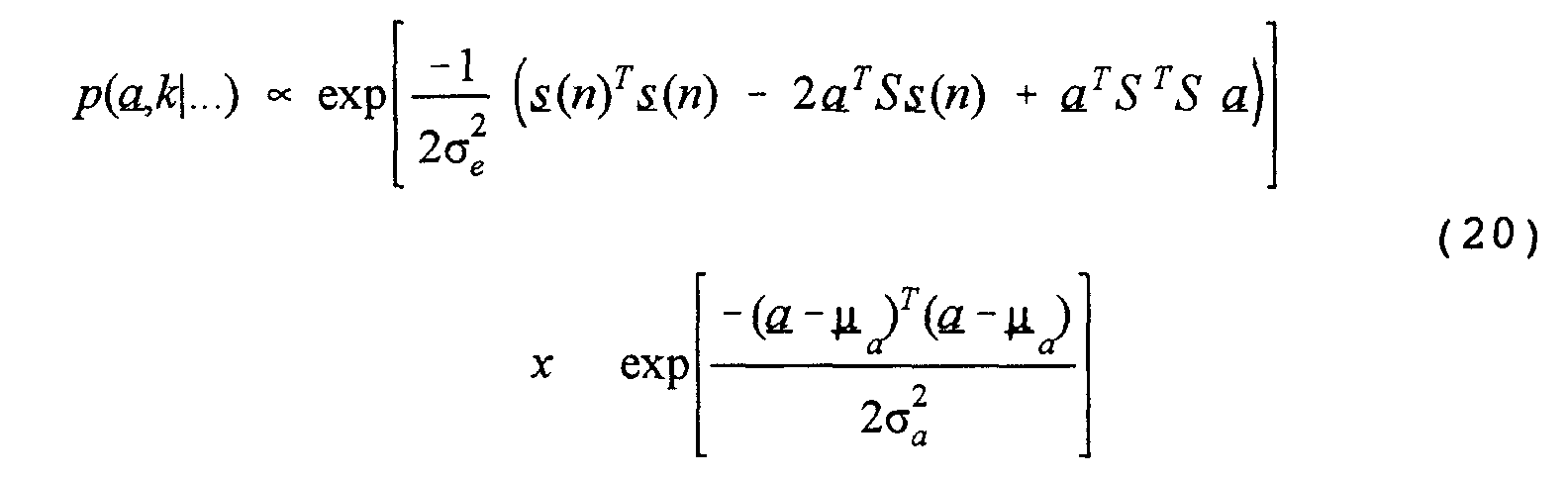
- conditional densities are obtained by inserting the current values for the given (or known) variables into the terms of the density function of equation (19).
- (7) this results in: which can be simplified to give: which is in the form of a standard Gaussian distribution having the following covariance matrix:
- the mean value of this Gaussian distribution can be determined by differentiating the exponent of equation (21) with respect to a and determining the value of a which makes the differential of the exponent equal to zero. This yields a mean value of:
- a sample can then be drawn from this standard Gaussian distribution to give a g (where g is the g th iteration of the Gibbs sampler) with the model order (k g ) being determined by a model order selection routine which will be described later.
- the drawing of a sample from this Gaussian distribution may be done by using a random number generator which generates a vector of random values which are uniformly distributed and then using a transformation of random variables using the covariance matrix and the mean value given in equations (22) and (23) to generate the sample.
- a random number generator is used which generates random numbers from a Gaussian distribution having zero mean and a variance of one.
- 7) reveals that it also is a standard Gaussian distribution but having a covariance matrix and mean value given by: from which a sample for h g can be drawn in the manner described above, with the channel model order (r g ) being determined using the model order selection routine which will be described later.
- a sample is then drawn from this Inverse Gamma distribution by firstly generating a random number from a uniform distribution and then performing a transformation of random variables using the alpha and beta parameters given in equation (27), to give ( ⁇ e 2 ) g .
- the Gibbs sampler requires an initial transient period to converge to equilibrium (known as burn-in).
- burn-in the sample ( a L , k L , h L , r L , ( ⁇ e 2 ) L , ( ⁇ 2 ) L , ( ⁇ a 2 ) L , ( ⁇ h 2 ) L , s(n) L ) is considered to be a sample from the joint probability density function defined in equation (19).
- the Gibbs sampler performs approximately one hundred and fifty (150) iterations on each frame of input speech and discards the samples from the first fifty iterations and uses the rest to give a picture (a set of histograms) of what the joint probability density function defined in equation (19) looks like. From these histograms, the set of AR coefficients ( a ) which best represents the observed speech samples ( y (n)) from the analogue to digital converter 17 are determined. The histograms are also used to determine appropriate values for the variances and channel model coefficients ( h ) which can be used as the initial values for the Gibbs sampler when it processes the next frame of speech.
- model order (k) of the AR filter and the model order (r) of the channel filter are updated using a model order selection routine.
- this is performed using a technique derived from "Reversible jump Markov chain Monte Carlo computation", which is described in the paper entitled “Reversible jump Markov chain Monte Carlo Computation and Bayesian model determination” by Peter Green, Biometrika, vol 82, pp 711 to 732, 1995.
- FIG 4 is a flow chart which illustrates the processing steps performed during this model order selection routine for the AR filter model order (k).
- a new model order (k 2 ) is proposed.
- a sample is drawn from a discretised Laplacian density function centred on the current model order (k 1 ) and with the variance of this Laplacian density function being chosen a priori in accordance with the degree of sampling of the model order space that is required.
- a model order variable (MO) is set equal to: where the ratio term is the ratio of the conditional probability given in equation (21) evaluated for the current AR filter coefficients (a) drawn by the Gibbs sampler for the current model order (k 1 ) and for the proposed new model order (k 2 ). If k 2 > k 1 , then the matrix S must first be resized and then a new sample must be drawn from the Gaussian distribution having the mean vector and covariance matrix defined by equations (22) and (23) (determined for the resized matrix S), to provide the AR filter coefficients ( a ⁇ 1:k2> ) for the new model order (k 2 ).
- step s7 the model order is set to the proposed model order (k 2 ) and a count associated with the value of k 2 is incremented. If, on the other hand, the model order variable (MO) is smaller than the random number, then the processing proceeds to step s9 where the current model order is maintained and a count associated with the value of the current model order (k 1 ) is incremented. The processing then ends.
- This model order selection routine is carried out for both the model order of the AR filter model and for the model order of the channel filter model. This routine may be carried out at each Gibbs iteration. However, this is not essential. Therefore, in this embodiment, this model order updating routine is only carried out every third Gibbs iteration.
- the Simulation Smoother is run before the Gibbs Sampler. It is also run again during the Gibbs iterations in order to update the estimates of the raw speech samples. In this embodiment, the Simulation Smoother is run every fourth Gibbs iteration.
- the dimensionality of the raw speech vectors ( s and (n)) and the process noise vectors ( ê (n)) do not need to be Nx1 but only have to be as large as the greater of the model orders - k and r.
- the channel model order (r) will be larger than the AR filter model order (k).
- the vector of raw speech samples ( s and (n)) and the vector of process noise ( ê (n)) only need to be rx1 and hence the dimensionality of the matrix only needs to be rxr.
- the Simulation Smoother involves two stages - a first stage in which a Kalman filter is run on the speech samples in the current frame and then a second stage in which a "smoothing" filter is run on the speech samples in the current frame using data obtained from the Kalman filter stage.
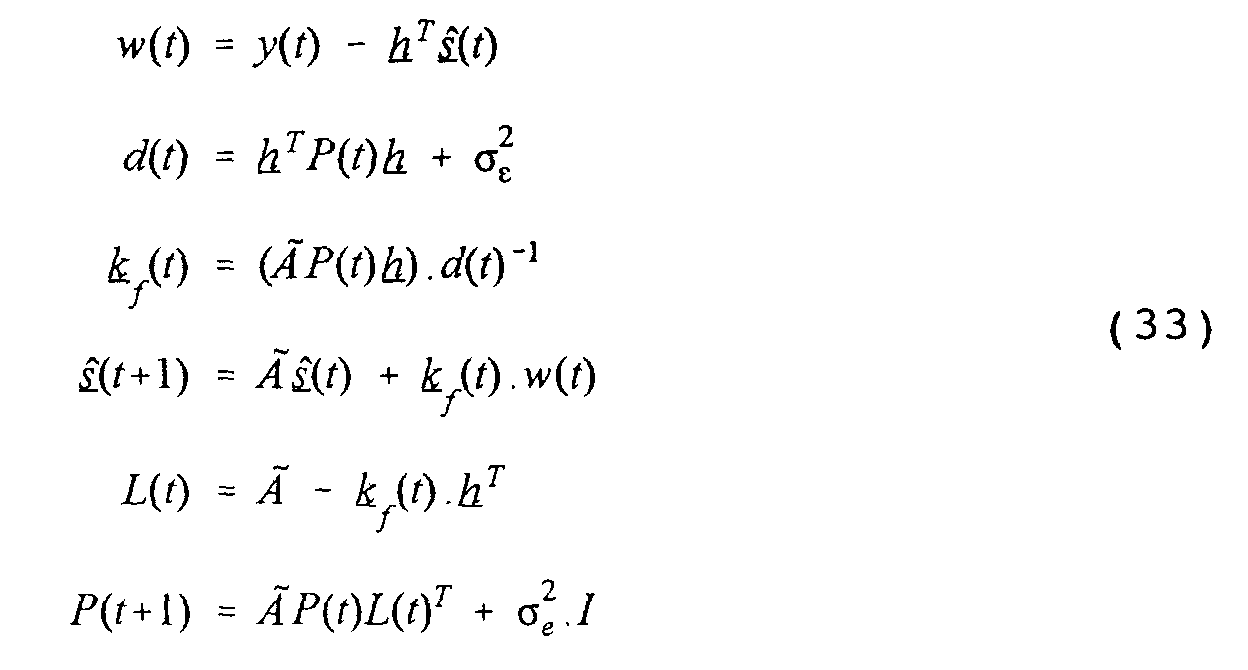
- step s21 the processing then proceeds to step s23, where the following Kalman filter equations are computed for the current speech sample (y(t)) being processed: where the initial vector of raw speech samples ( s and (1)) includes raw speech samples obtained from the processing of the previous frame (or if there are no previous frames then s(i) is set equal to zero for i ⁇ 1); P(1) is the variance of s and (1) (which can be obtained from the previous frame or initially can be set to ⁇ e 2 ); h is the current set of channel model coefficients which can be obtained from the processing of the previous frame (or if there are no previous frames then the elements of h can be set to their expected values - zero); y(t) is the current speech sample of the current frame being processed and I is the identity matrix.
- the initial vector of raw speech samples ( s and (1)) includes raw speech samples obtained from the processing of the previous frame (or if there are no previous frames then s(i) is set equal to zero for i ⁇ 1);
- P(1) is
- step s25 the scalar values w(t) and d(t) are stored together with the rxr matrix L(t) (or alternatively the Kalman filter gain vector k f (t) could be stored from which L(t) can be generated).
- step s27 the system determines whether or not all the speech samples in the current frame have been processed. If they have not, then the processing proceeds to step s29 where the time variable t is incremented by one so that the next sample in the current frame will be processed in the same way. Once all N samples in the current frame have been processed in this way and the corresponding values stored, the first stage of the Simulation Smoother is complete.
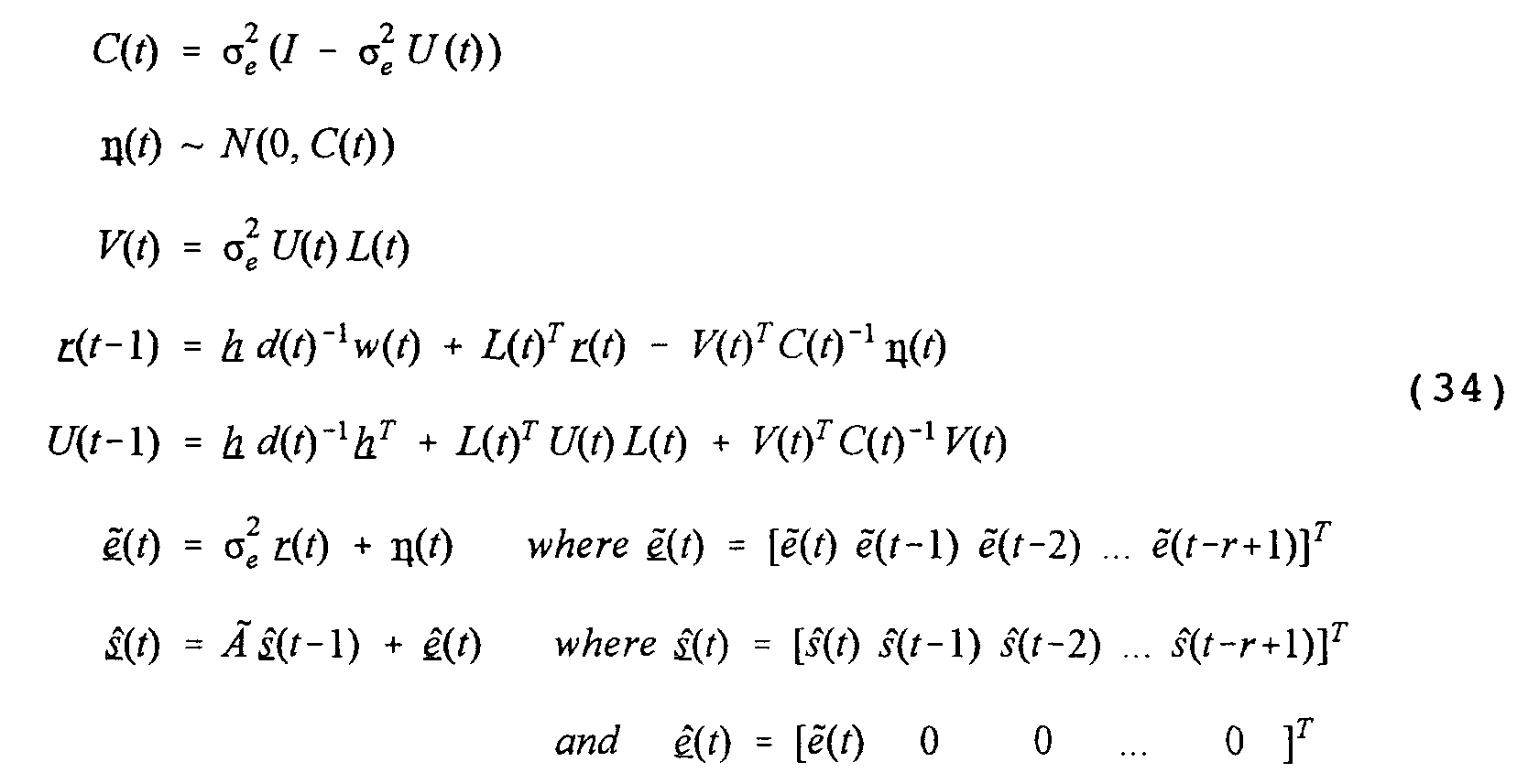
- step s31 the second stage of the Simulation Smoother is started in which the smoothing filter processes the speech samples in the current frame in reverse sequential order.
- step s33 the estimate of the process noise ( (t)) for the current speech sample being processed and the estimate of the raw speech sample (s and(t)) for the current speech sample being processed are stored.
- step s35 the system determines whether or not all the speech samples in the current frame have been processed. If they have not, then the processing proceeds to step s37 where the time variable t is decremented by one so that the previous sample in the current frame will be processed in the same way. Once all N samples in the current frame have been processed in this way and the corresponding process noise and raw speech samples have been stored, the second stage of the Simulation Smoother is complete and an estimate of s (n) will have been generated.
- the matrix S and the matrix Y require raw speech samples s(n-N-1) to s(n-N-k+1) and s(n-N-1) to s(n-N-r+1) respectively in addition to those in s (n).
- These additional raw speech samples can be obtained either from the processing of the previous frame of speech or if there are no previous frames, they can be set to zero.
- the Gibbs sampler can be run to draw samples from the above described probability density functions.
- Figure 6 is a block diagram illustrating the principal components of the statistical analysis unit 21 of this embodiment. As shown, it comprises the above described Gibbs sampler 41, Simulation Smoother 43 (including the Kalman filter 43-1 and smoothing filter 43-2) and model order selector 45. It also comprises a memory 47 which receives the speech samples of the current frame to be processed, a data analysis unit 49 which processes the data generated by the Gibbs sampler 41 and the model order selector 45 and a controller 50 which controls the operation of the statistical analysis unit 21.
- the memory 47 includes a non volatile memory area 47-1 and a working memory area 47-2.
- the non volatile memory 47-1 is used to store the joint probability density function given in equation (19) above and the equations for the variances and mean values and the equations for the Inverse Gamma parameters given above in equations (22) to (24) and (27) to (30) for the above mentioned conditional probability density functions for use by the Gibbs sampler 41.
- the non volatile memory 47-1 also stores the Kalman filter equations given above in equation (33) and the smoothing filter equations given above in equation 34 for use by the Simulation Smoother 43.
- Figure 7 is a schematic diagram illustrating the parameter values that are stored in the working memory area (RAM) 47-2.
- the RAM includes a store 51 for storing the speech samples y f (1) to y f (N) output by the analogue to digital converter 17 for the current frame (f) being processed. As mentioned above, these speech samples are used in both the Gibbs sampler 41 and the Simulation Smoother 43.
- the RAM 47-2 also includes a store 57 for storing the estimates of the raw speech samples (s and f (t)) and the estimates of the process noise ( (t)) generated by the smoothing filter 43-2, as discussed above.
- the RAM 47-2 also includes a store 59 for storing the model order counts which are generated by the model order selector 45 when the model orders for the AR filter model and the channel model are updated.
- FIG 8 is a flow diagram illustrating the control program used by the controller 50, in this embodiment, to control the processing operations of the statistical analysis unit 21.
- the controller 50 retrieves the next frame of speech samples to be processed from the buffer 19 and stores them in the memory store 51.
- the processing then proceeds to step s43 where initial estimates for the channel model, raw speech samples and the process noise and measurement noise statistics are set and stored in the store 53. These initial estimates are either set to be the values obtained during the processing of the previous frame of speech or, where there are no previous frames of speech, are set to their expected values (which may be zero).
- the processing then proceeds to step s45 where the Simulation Smoother 43 is activated so as to provide an estimate of the raw speech samples in the manner described above.
- step s47 one iteration of the Gibbs sampler 41 is run in order to update the channel model, speech model and the process and measurement noise statistics using the raw speech samples obtained in step s45. These updated parameter values are then stored in the memory store 53.
- step s49 the controller 50 determines whether or not to update the model orders of the AR filter model and the channel model. As mentioned above, in this embodiment, these model orders are updated every third Gibbs iteration. If the model orders are to be updated, then the processing proceeds to step s51 where the model order selector 45 is used to update the model orders of the AR filter model and the channel model in the manner described above. If at step s49 the controller 50 determines that the model orders are not to be updated, then the processing skips step s51 and the processing proceeds to step s53. At step s53, the controller 50 determines whether or not to perform another Gibbs iteration.
- step s55 the controller 50 decides whether or not to update the estimates of the raw speech samples (s(t)). If the raw speech samples are not to be updated, then the processing returns to step s47 where the next Gibbs iteration is run.
- the Simulation Smoother 43 is run every fourth Gibbs iteration in order to update the raw speech samples. Therefore, if the controller 50 determines, in step s55 that there has been four Gibbs iterations since the last time the speech samples were updated, then the processing returns to step s45 where the Simulation Smoother is run again to provide new estimates of the raw speech samples (s(t)). Once the controller 50 has determined that the required 150 Gibbs iterations have been performed, the controller 50 causes the processing to proceed to step s57 where the data analysis unit 49 analyses the model order counts generated by the model order selector 45 to determine the model orders for the AR filter model and the channel model which best represents the current frame of speech being processed.
- step s59 the data analysis unit 49 analyses the samples drawn from the conditional densities by the Gibbs sampler 41 to determine the AR filter coefficients ( a ), the channel model coefficients ( h ), the variances of these coefficients and the process and measurement noise variances which best represent the current frame of speech being processed.
- step s61 the controller 50 determines whether or not there is any further speech to be processed. If there is more speech to be processed, then processing returns to step S41 and the above process is repeated for the next frame of speech. Once all the speech has been processed in this way, the processing ends.
- the data analysis unit 49 initially determines, in step s57, the model orders for both the AR filter model and the channel model which best represents the current frame of speech being processed. It does this using the counts that have been generated by the model order selector 45 when it was run in step s51. These counts are stored in the store 59 of the RAM 47-2. In this embodiment, in determining the best model orders, the data analysis unit 49 identifies the model order having the highest count.
- Figure 9a is an exemplary histogram which illustrates the distribution of counts that is generated for the model order (k) of the AR filter model. Therefore, in this example, the data analysis unit 49 would set the best model order of the AR filter model as five.
- the data analysis unit 49 performs a similar analysis of the counts generated for the model order (r) of the channel model to determine the best model order for the channel model.
- the data analysis unit 49 analyses the samples generated by the Gibbs sampler 41 which are stored in the store 53 of the RAM 47-2, in order to determine parameter values that are most representative of those samples. It does this by determining a histogram for each of the parameters from which it determines the most representative parameter value. To generate the histogram, the data analysis unit 49 determines the maximum and minimum sample value which was drawn by the Gibbs sampler and then divides the range of parameter values between this minimum and maximum value into a predetermined number of sub-ranges or bins. The data analysis unit 49 then assigns each of the sample values into the appropriate bins and counts how many samples are allocated to each bin.
- Figure 9b illustrates an example histogram which is generated for the variance ( ⁇ e 2 ) of the process noise, from which the data analysis unit 49 determines that the variance representative of the sample is 0.3149.
- the data analysis unit 49 determines and analyses a histogram of the samples for each coefficient independently.
- Figure 9c shows an exemplary histogram obtained for the third AR filter coefficient (a 3 ), from which the data analysis unit 49 determines that the coefficient representative of the samples is -0.4977.
- the data analysis unit 49 only outputs the AR filter coefficients which are passed to the coefficient convertor 23 shown in Figure 2.
- the remaining parameter values determined by the data analysis unit 49 are stored in the RAM 47-2 for use during the processing of the next frame of speech.
- the AR filter coefficients output by the statistical analysis unit 21 are input to the coefficient convertor 23 which converts these coefficients into cepstral coefficients which are then compared with stored speech models 27 by the speech recognition unit 25 in order to generate a recognition result.
- a speech processing technique has been described above which uses statistical analysis techniques to determine sets of AR filter coefficients representative of an input speech signal.
- the technique is more robust and accurate than prior art techniques which employ maximum likelihood estimators to determine the AR filter coefficients. This is because the statistical analysis of each frame uses knowledge obtained from the processing of the previous frame.
- the model order for the AR filter model is not assumed to be constant and can vary from frame to frame. In this way, the optimum number of AR filter coefficients can be used to represent the speech within each frame. As a result, the AR filter coefficients output by the statistical analysis unit 21 will more accurately represent the corresponding input speech.
- the AR filter coefficients that are determined will be more representative of the actual speech and will be less likely to include distortive effects of the channel. Further still, since variance information is available for each of the parameters, this provides an indication of the confidence of each of the parameter estimates. This is in contrast to maximum likelihood and least squares approaches, such as linear prediction analysis, where point estimates of the parameter values are determined.
- the statistical analysis unit was used as a pre-processor for a speech recognition system in order to generate AR coefficients representative of the input speech. It also generated a number of other parameter values (such as the process noise variances and the channel model coefficients), but these were not output by the statistical analysis unit. As those skilled in the art will appreciate, the AR coefficients and some of the other parameters which are calculated by the statistical analysis unit can be used for other purposes.
- Figure 10 illustrates a speech recognition system which is similar to the speech recognition system shown in Figure 2 except that there is no coefficient converter since the speech recognition unit 25 and speech models 27 are AR coefficient based.
- the speech recognition system shown in Figure 10 also has an additional speech detection unit 61 which receives the AR filter coefficients ( a ) together with the AR filter model order (k) generated by the statistical analysis unit 21 and which is operable to determine from them when speech is present within the signal received from the microphone 7. It can do this, since the AR filter model order and the AR filter coefficient values will be larger during speech than when there is no speech present. Therefore, by comparing the AR filter model order (k) and/or the AR filter coefficient values with appropriate threshold values, the speech detection unit 61 can determine whether or not speech is present within the input signal. When the speech detection unit 61 detects the presence of speech, it outputs an appropriate control signal to the speech recognition unit 25 which causes it to start processing the AR coefficients it receives from the statistical analysis unit 21. Similarly, when the speech detection unit 61 detects the end of speech, it outputs an appropriate control signal to the speech recognition unit 25 which causes it to stop processing the AR coefficients it receives from the statistical analysis unit 21.
- a speech recognition system having a particular speech pre-processing front end which performed a statistical analysis of the input speech.
- this pre-processing can be used in speech processing systems other than speech recognition systems.
- the statistical analysis unit 21 may form a front end to a speaker verification system 65.
- the speaker verification system 65 compares the sequences of AR filter coefficients output by the statistical analysis unit 21 with pre-stored speaker models 67 to determine whether or not the received speech corresponds to a known user.
- Figure 12 illustrates another application for the statistical analysis unit 21.
- Figure 12 shows an acoustic classification system.
- the statistical analysis unit 21 is used to generate the AR filter coefficients for an input audio signal (which may or may not be speech) in the manner described above. These coefficients are then passed to an acoustic classification system 66 which compares the AR coefficients from the statistical analysis unit with pre-stored acoustic models 68 to generate the classification result.
- This classification system may be used, for example, to identify and categorise various input sounds, for example, percussion sounds, woodwind sounds, brass sounds as well as speech.
- Figure 13 illustrates another application for the statistical analysis unit 21.
- Figure 13 shows a speech encoding and transmission system.
- the statistical analysis unit 21 is used to generate the AR filter coefficients in the manner described above, which are then passed to a channel encoder which encodes the sequences of AR filter coefficients so that they are in a more suitable form for transmission through a communications channel.
- the encoded AR filter coefficients are then passed to a transmitter 73 where the encoded data is used to modulate a carrier signal which is then transmitted to a remote receiver 75.
- the receiver 75 demodulates the received signal to recover the encoded data which is then decoded by a decoder 76.
- sequences of AR filter coefficients output by the decoder are then either passed to a speech recognition unit 77 which compares the sequences of AR filter coefficients with stored reference models (not shown) to generate a recognition result or to a speech synthesis unit 79 which re-generates the speech and outputs it via a loudspeaker 81.
- a speech recognition unit 77 compares the sequences of AR filter coefficients with stored reference models (not shown) to generate a recognition result
- a speech synthesis unit 79 which re-generates the speech and outputs it via a loudspeaker 81.
- the sequences of AR filter coefficients may also pass through an optional processing unit 83 (shown in phantom) which can be used to manipulate the characteristics of the speech that is synthesised.
- an optional processing unit 83 shown in phantom
- the optimum number of AR filter coefficients will be used to represent the speech within each frame.
- the number of AR filter coefficients is assumed to be constant and hence the prior art techniques tend to over parameterise the speech in order to ensure that information is not lost.
- the statistical analysis described above the amount of data which has to be transmitted from the transmitter to the receiver will be less than with the prior art systems which assume a fixed size of AR filter model.
- Figure 14 shows another system which uses the statistical analysis unit 21 described above.
- the system shown in Figure 14 allows a user to add a voice annotation to a data file 91 for use in subsequent voice retrieval operations.
- the user selects a data file to be annotated (which may be a photograph or the like).
- the user then speaks the voice annotation and the input speech received via the microphone 7 is processed by the statistical analysis unit 21 in the same way as described above, except the data analysis unit only outputs the variance ( ⁇ a 2 ) of the AR filter coefficients for each frame of speech which is passed to a speech quality assessor 93.
- the speech quality assessor 93 uses this variance information as an indication of the quality of the input speech (although it will also depend on other factors).
- the speech quality assessor 93 then outputs to a data file annotation unit 95 a signal identifying whether or not the input voice annotation is of a high quality.
- the input speech is also passed through a traditional speech pre-processor 95 and then to a traditional speech recognition unit 97 which generates words and/or phonemes representative of the input speech which are then passed to the data file annotation unit 99.
- the data file annotation unit 99 then annotates the selected data file 91 with the data output by the speech recognition unit 97 and the data output by the speech quality assessor 93 and stores the annotated data file in a database 101.
- this speech quality indication which is stored with the data file is useful for subsequent retrieval operations.
- the user wishes to retrieve a data file 91 from the database 101 (using a voice query)
- it is useful to know the quality of the speech that was used to annotate the data file and/or the quality of the voice retrieval query used to retrieve the data file, since this will affect the retrieval performance.
- the voice annotation is of a high quality and the user's retrieval query is also of a high quality
- a stringent search of the database 101 can be performed, in order to reduce the amount of false identifications.
- the original voice annotation is of a low quality or if the user's retrieval query is of a low quality
- a less stringent search of the database 101 can be performed to give a higher chance of retrieving the correct data file 91.
- the variance ( ⁇ e 2 ) of the process noise is also a good measure of the quality of the input speech, since this variance is also measure of the energy in the process noise. Therefore, the variance of the process noise can be used in addition to or instead of the variance of the AR filter coefficients to provide the measure of quality of the input speech.
- a separate preprocessor 95 was provided as the front end to the speech recognition unit 97.
- the statistical analysis unit 21 may act as the preprocessor for the speech recognition unit 97.
- the statistical analysis unit 21 may be used solely for providing information to the speech detection unit 61 and a separate speech preprocessor may be used to parameterise the input speech for use by the speech recognition unit 25.
- such separate parameterisation of the input speech is not preferred because of the additional processing overhead involved.
- the AR filter coefficients output by the statistical analysis unit 21 were converted into cepstral coefficients since the speech recognition unit used in the first embodiment was a cepstral based system.
- the coefficient converter 23 may be arranged to convert the AR filter coefficients into the appropriate spectral parameters.
- the coefficient converter 23 is unnecessary.
- Gaussian and Inverse Gamma distributions were used to model the various prior probability density functions of equation (19).
- the reason these distributions were chosen is that they are conjugate to one another.
- each of the conditional probability density functions which are used in the Gibbs sampler will also either be Gaussian or Inverse Gamma. This therefore simplifies the task of drawing samples from the conditional probability densities.
- the noise probability density functions could be modelled by Laplacian or student-t distributions rather than Gaussian distributions.
- the probability density functions for the variances may be modelled by a distribution other than the Inverse Gamma distribution. For example, they can be modelled by a Rayleigh distribution or some other distribution which is always positive.
- the use of probability density functions that are not conjugate will result in increased complexity in drawing samples from the conditional densities by the Gibbs sampler.
- a Simulation Smoother was used to generate estimates for the raw speech samples.
- This Simulation Smoother included a Kalman filter stage and a smoothing filter stage in order to generate the estimates of the raw speech samples.
- the smoothing filter stage may be omitted, since the Kalman filter stage generates estimates of the raw speech (see equation (33)).
- these raw speech samples were ignored, since the speech samples generated by the smoothing filter are considered to be more accurate and robust. This is because the Kalman filter essentially generates a point estimate of the speech samples from the joint probability density function p( s (n)
- a Simulation Smoother was used in order to generate estimates of the raw speech samples. It is possible to avoid having to estimate the raw speech samples by treating them as " nuisance parameters" and integrating them out of equation (19). However, this is not preferred, since the resulting integral will have a much more complex form than the Gaussian and Inverse Gamma mixture defined in equation (19). This in turn will result in more complex conditional probabilities corresponding to equations (20) to (30). In a similar way, the other nuisance parameters (such as the coefficient variances or any of the Inverse Gamma, alpha and beta parameters) may be integrated out as well. However, again this is not preferred, since it increases the complexity of the density function to be sampled using the Gibbs sampler. The technique of integrating out nuisance parameters is well known in the field of statistical analysis and will not be described further here.
- the data analysis unit analysed the samples drawn by the Gibbs sampler by determining a histogram for each of the model parameters and then determining the value of the model parameter using a weighted average of the samples drawn by the Gibbs sampler with the weighting being dependent upon the number of samples in the corresponding bin.
- the value of the model parameter may be determined from the histogram as being the value of the model parameter having the highest count.
- a predetermined curve such as a bell curve
- the statistical analysis unit modelled the underlying speech production process with a separate speech source model (AR filter) and a channel model. Whilst this is the preferred model structure, the underlying speech production process may be modelled without the channel model. In this case, there is no need to estimate the values of the raw speech samples using a Kalman filter or the like, although this can still be done. However, such a model of the underlying speech production process is not preferred, since the speech model will inevitably represent aspects of the channel as well as the speech. Further, although the statistical analysis unit described above ran a model order selection routine in order to allow the model orders of the AR filter model and the channel model to vary, this is not essential. In particular, the model order of the AR filter model and the channel model may be fixed in advance, although this is not preferred since it will inevitably introduce errors into the representation.
- the speech that was processed was received from a user via a microphone.
- the speech may be received from a telephone line or may have been stored on a recording medium.
- the channel model will compensate for this so that the AR filter coefficients representative of the actual speech that has been spoken should not be significantly affected.
- the speech generation process was modelled as an auto-regressive (AR process and the channel was modelled as a moving average (MA) process.
- AR process auto-regressive
- MA moving average
- other signal models may be used. However, these models are preferred because it has been found that they suitably represent the speech source and the channel they are intended to model.
- a new model order was proposed by drawing a random variable from a predetermined Laplacian distribution function.
- the new model order may be proposed in a deterministic way (ie under predetermined rules), provided that the model order space is sufficiently sampled.
Landscapes
- Engineering & Computer Science (AREA)
- Physics & Mathematics (AREA)
- Computational Linguistics (AREA)
- Health & Medical Sciences (AREA)
- Audiology, Speech & Language Pathology (AREA)
- Human Computer Interaction (AREA)
- Acoustics & Sound (AREA)
- Multimedia (AREA)
- Signal Processing (AREA)
- Computer Vision & Pattern Recognition (AREA)
- Quality & Reliability (AREA)
- Telephonic Communication Services (AREA)
- Complex Calculations (AREA)
- Time-Division Multiplex Systems (AREA)
Abstract
Description




p(s(n)| a , k, σ e 2)




p(a |k)


p(h |r)

p(σe 2) and p(σe 2)
p(k) and p(r)












Claims (57)
- A speech processing apparatus comprising:means for receiving a set of signal values representative of a speech signal generated by a speech source as distorted by a transmission channel between the speech source and the receiving means;a memory for storing data defining a predetermined function derived from a predetermined signal model which includes a first part having first parameters which models said source and a second part having second parameters which models said channel and said function being in terms of said first and second parameters and in terms of a set of signal values;means for applying said set of received signal values to said stored function; andmeans for processing said function with those values applied to obtain values of said first parameters that are representative of said speech generated by said speech source before it was distorted by said transmission channel.
- An apparatus according to claim 1, wherein said function generates, for a given set of received signal values, a probability density function which defines, for a given set of first and second parameters, the probability that the predetermined signal model has those parameter values, given that the signal model is assumed to have generated the received set of signal values and wherein said processing means comprises means for drawing samples from said probability density function and means for determining said values of said first parameters that are representative of the speech from the drawn samples.
- An apparatus according to claim 2, further comprising means for evaluating said probability density function for the set of received signal values using one or more of said drawn samples or parameter values for different numbers of parameter values, to determine respective probabilities that the predetermined signal model has those parameter values and wherein said processing means is operable to process at least some of said drawn samples of parameter values and said evaluated probabilities to determine said values of said first parameters that are representative of the speech generated by said source before it was distorted by said transmission channel.
- An apparatus according to claim 2 or 3, wherein said processing means is operable to determine a histogram of said drawn samples and wherein said values of said first parameters are determined from said histogram.
- An apparatus according to claim 4, wherein said processing means is operable to determine said values of said first parameters using a weighted sum of said drawn samples, and wherein the weighting is determined from said histogram.
- An apparatus according to any of claims 2 to 5, wherein said sampling means is operable to draw samples iteratively from said probability density function.
- An apparatus according to any of claims 2 to 6, wherein said sampling means is operable to draw samples of both said first and second parameters.
- An apparatus according to any of claims 2 to 7, wherein said sampling means comprises a Gibbs sampler.
- An apparatus according to any of claims 2 to 8, wherein said processing means comprises means for analysing at least some of said drawn samples of parameter values to determine a measure of the variance of said samples and the apparatus further comprises means for outputting a signal indicative of the quality of the received set of signal values in dependence upon said determined variance measure.
- An apparatus according to claim 9, wherein said probability density function is in terms of said variance measure and wherein said analysing means is operable to draw samples of said variance measure from said probability density function.
- An apparatus according to any preceding claim, wherein said function is in terms of a set of raw speech signal values representative of speech generated by said source before being distorted by said transmission channel, wherein the apparatus further comprises second processing means for processing the received set of signal values with initial estimates of said first and second parameters, to generate an estimate of the raw speech signal values corresponding to the received set of signal values and wherein said applying means is operable to apply said estimated set of raw speech signal values to said function in addition to said set of received signal values.
- An apparatus according to claim 11, wherein said second processing means comprises a simulation smoother.
- An apparatus according to claim 11 or 12, wherein said second processing means comprises a Kalman filter.
- An apparatus according to any preceding claim, wherein said receiving means is operable to receive a sequence of sets of signal values representative of a speech signal generated by a speech source as distorted by said transmission channel and wherein said processing means is operable to obtain values of said first parameters for the speech within each set of signal values in said sequence.
- An apparatus according to claim 14, wherein said processing means is operable to use the values of said first parameters obtained during the processing of a preceding set of signal values as initial estimates for the values of said first parameters for a current set of signal values being processed.
- An apparatus according to claim 14 or 15, wherein said sets of signal values in said sequence are non-overlapping.
- An apparatus according to any of claims 14 to 16, wherein said processing means comprises means for varying the number of parameter values used to represent the speech signal within each set of signal values.
- An apparatus according to any preceding claim, wherein said first part is an auto-regressive model and said first parameters comprise auto-regressive model coefficients.
- An apparatus according to any preceding claim, wherein said second part is a moving average model and said second parameters comprise moving average model coefficients.
- An apparatus according to any preceding claim, further comprising means for comparing said determined parameter values with pre-stored parameter values to generate a comparison result.
- An apparatus according to any of claims 1 to 19, further comprising recognition means for comparing said determined parameter values with pre-stored reference models to generate a recognition result.
- An apparatus according to any of claims 1 to 19, further comprising speaker verification means for comparing said determined parameter values with pre-stored speaker models to generate a verification result.
- A speech processing method comprising the steps of:receiving a set of signal values representative of a speech signal generated by a speech source as modified by a transmission channel between the speech source and the receiver;storing data defining a predetermined function derived from a predetermined signal model which includes a first part having first parameters which models said source and a second part having second parameters which models said channel, said function being in terms of said first and second parameters and generating, for a given set of signal values, a probability density function which defines, for a given set of first parameters and second parameters, the probability that the predetermined signal model has those parameter values, given that the signal model is assumed to have generated the received set of signal values;applying said set of received signal values to said function;processing said function with those values applied to derive samples of at least said first parameters from said probability density function; andmeans for analysing at least some of said derived samples to determine values of said first parameters that are representative of said speech signal generated by said source before it was modified by said transmission channel.
- A method according to claim 23, wherein said function generates, for a given set of received signal values, a probability density function which defines, for a given set of first and second parameters, the probability that the predetermined signal model has those parameter values, given that the signal model is assumed to have generated the received set of signal values and wherein said processing step comprises the steps of drawing samples from said probability density function and determining said values of said first parameters that are representative of the speech from the drawn samples.
- A method according to claim 24, further comprising the step of evaluating said probability density function for the set of received signal values using one or more of said drawn samples or parameter values for different numbers of parameter values, to determine respective probabilities that the predetermined signal model has those parameter values and wherein said processing step processes at least some of said drawn samples of parameter values and said evaluated probabilities to determine said values of said first parameters that are representative of the speech generated by said source before it was distorted by said transmission channel.
- A method according to claim 24 or 25, wherein said processing step determines a histogram of said drawn samples and wherein said values of said first parameters are determined from said histogram.
- A method according to claim 26, wherein said processing step determines said values of said first parameters using a weighted sum of said drawn samples, and wherein the weighting is determined from said histogram.
- A method according to any of claims 29 to 27, wherein said sampling step draws samples iteratively from said probability density function.
- A method according to any of claims 24 to 28, wherein said sampling step draws samples of both said first and second parameters.
- A method according to any of claims 24 to 29, wherein said sampling step uses a Gibbs sampling technique.
- A method according to any of claims 24 to 30, wherein said processing step comprises the step of analysing at least some of said drawn samples of parameter values to determine a measure of the variance of said samples and wherein the method further comprises the step of outputting a signal indicative of the quality of the received set of signal values in dependence upon said determined variance measure.
- A method according to claim 31, wherein said probability density function is in terms of said variance measure and wherein said analysing step draws samples of said variance measure from said probability density function.
- A method according to any of claims 23 to 32, wherein said function is in terms of a set of raw speech signal values representative of speech generated by said source before being distorted by said transmission channel, wherein the method further comprises a second processing step of processing the received set of signal values with initial estimates of said first and second parameters, to generate an estimate of the raw speech signal values corresponding to the received set of signal values and wherein said applying step applies said estimated set of raw speech signal values to said function in addition to said set of received signal values.
- A method according to claim 33, wherein said second processing step uses a simulation smoother.
- A method according to claim 23 or 34, wherein said second processing step uses a Kalman filter.
- A method according to any of claims 23 to 35, wherein said receiving step receives a sequence of sets of signal values representative of a speech signal generated by a speech source as distorted by said transmission channel and wherein said processing step obtains values of said first parameters for the speech within each set of signal values in said sequence.
- A method according to claim 36, wherein said processing step uses the values of said first parameters obtained during the processing of a preceding set of signal values as initial estimates for the values of said first parameters for a current set of signal values being processed.
- A method according to claim 36 or 37, wherein said sets of signal values in said sequence are non-overlapping.
- A method according to any of claims 36 to 38, wherein said processing step comprises the step of varying the number of parameter values used to represent the speech signal within each set of signal values.
- A method according to any of claims 23 to 39, wherein said first part is an auto aggressive model and said first parameters comprise auto aggressive model coefficients.
- A method according to any of claims 23 to 40, wherein said second part is a moving average model and said second parameters comprise moving average model coefficients.
- A method according to any of claims 23 to 41, further comprising the step of comparing said determined parameter values with pre-stored parameter values to generate a comparison result.
- A method according to any of claims 23 to 41, further comprising the step of comparing said determined parameter values with pre-stored reference models to generate a recognition result.
- A method according to any of claims 23 to 41, further comprising speaker verification means for comparing said determined parameter values with pre-stored speaker models to generate a verification result.
- A speech processing apparatus comprising:means for receiving a set of signal values representative of a speech signal generated by a speech source as modified by a transmission channel between the speech source and the receiving means;a memory for storing data defining a predetermined function derived from a predetermined signal model which includes a first part having first parameters which models said source and a second part having second parameters which models said channel, said function being in terms of said first and second parameters and generating, for a given set of signal values, a probability density function which defines, for a given set of first parameters and second parameters, the probability that the predetermined signal model has those parameter values, given that the signal model is assumed to have generated the received set of signal values;means for applying said set of received signal values to said function;processing said function with those values applied to derive samples of at least said first parameters from said probability density function; andmeans for analysing at least some of said derived samples to determine values of said first parameters that are representative of said speech signal generated by said source before it was modified by said transmission channel.
- A speech processing apparatus comprising:means for receiving a set of signal values representative of a speech signal generated by a speech source as distorted by a transmission channel between the speech source and the receiving means;a memory for storing data defining a predetermined function derived from a predetermined signal model which includes a first part having first parameters which models said source and a second part having second parameters which models said channel, said function being in terms of said first and second parameters and being in terms of a set of raw speech signal values representative of speech generated by said source before being distorted by said transmission channel;means for processing said received set of signal values with initial estimates of said first and second parameters, to generate an estimate of the raw speech signal values corresponding to the received set of signal values;means for applying said set of received signal values and the estimated set of raw speech signal values to said function;means for processing said function with those values applied to obtain values of said first parameters that are representative of said speech signal generated by said speech source before it was distorted by said transmission channel.
- A speech processing apparatus comprising:means for receiving a set of signal values representative of a speech signal generated by a speech source as modified by a transmission channel between the signal source and the receiving means;a memory for storing data defining a predetermined function derived from a predetermined signal model which includes a first part having first parameters which models said source and a second part having second parameters which models said channel, said function being in terms of said first and second parameters and being in terms of a set of raw speech signal values representative of a speech signal generated by said source before being modified by said transmission channel, said function generating, for a given set of signal values, a probability density function which defines, for a given set of first parameters, second parameters and raw speech signal values, the probability that the predetermined signal model has those parameter values and generates said raw speech signal values, given that the signal model is assumed to have generated the received set of signal values;means for processing said received set of signal values with initial estimates of said first and second parameters, to generate an estimate of said set of raw speech signal values corresponding to the received set of signal values;means for applying said set of received signal values and the estimated set of raw speech signal values to said function;means for processing said function with those values applied to derive samples of at least said first parameters from said probability density function; andmeans for analysing at least some of said derived samples to determine values of said first parameters that are representative of said speech signal generated by said speech source before it was modified by said transmission channel.
- An apparatus for determining sets of parameter values representative of an input speech signal, the apparatus comprising:wherein said determining means comprises means for varying the number of parameter values used to represent the speech signal values in each group.means for receiving a plurality of speech signal values representative of an input speech signal;means for dividing the plurality of speech signal values into a succession of groups of speech signal values; andmeans for determining a set of parameter values representative of the speech signal values in each group;
- An apparatus for determining sets of parameter values representative of an input speech signal, the apparatus comprising:means for receiving a plurality of speech signal values representative of an input speech signal;means for dividing the plurality of speech signal values into a succession of groups of speech signal values; andmeans for processing the speech signal values in each group to determine a set of parameter values representative of the speech signal values in the group;wherein said processing means comprises:a memory for storing data defining a predetermined function which gives, for a set of speech signal values of a group, a probability density for parameters of a predetermined signal model which is assumed to have generated the speech signal values in the group, the probability density defining, for a given set of parameter values, the probability that the predetermined signal model has those parameter values, given that the model is assumed to have generated the speech signal values in the group;means for applying the set of speech signal values of a current group to said stored function to give the probability density for said model parameters for the current group;means for processing said function to derive samples of parameter values from said probability density for the current group;means for evaluating said probability density for the current group using one or more of said derived samples of parameter values for different numbers of parameter values to determine respective probabilities that the predetermined signal model has those parameter values; andmeans for processing at least some of said derived samples of parameter values and said evaluated probabilities to determine model parameters that are representative of the set of signal values in the current group.
- An audio comparison apparatus comprising:a memory for storing a predetermined function which gives, for a given set of audio signal values, a probability density for parameters of a predetermined audio model which is assumed to have generated the set of audio signal values, the probability density defining, for a given set of model parameter values, the probability that the predetermined audio model has those parameter values, given that the model is assumed to have generated the set of audio signal values;means for receiving a set of audio signal values representative of an input audio signal;means for applying the set of received audio signal values to said stored function to give the probability density for said model parameters for the set of received audio signal values;means for processing said function, with said set of received audio signal values applied, to derive samples of parameter values from said probability density;means for analysing at least some of said derived samples of parameter values to determine parameter values that are representative of the set of received audio signal values; andmeans for comparing said determined parameter values with pre-stored parameter values to generate a comparison result.
- A speech recognition system comprising an audio comparison apparatus according to claim 50.
- A speaker verification system comprising an audio comparison apparatus according to claim 50.
- An acoustic classification system comprising an audio comparison apparatus according to claim 50.
- An audio processing system substantially as hereinbefore described with reference to or as shown in the accompanying drawings.
- An audio processing method substantially as herein above described with reference to or as shown in the accompanying drawings.
- A computer readable medium storing computer executable process steps to cause a programmable computer apparatus to perform the method of any of claims 23 to 44.
- Processor implementable process steps for causing a programmable computing device to perform the method according to any of claims 23 to 44.
Applications Claiming Priority (4)
| Application Number | Priority Date | Filing Date | Title |
|---|---|---|---|
| GB0013541A GB0013541D0 (en) | 2000-06-02 | 2000-06-02 | Speech processing system |
| GB0013541 | 2000-06-02 | ||
| GB0018965 | 2000-08-02 | ||
| GB0018965A GB0018965D0 (en) | 2000-08-02 | 2000-08-02 | Speech processing system |
Publications (2)
| Publication Number | Publication Date |
|---|---|
| EP1160768A2 true EP1160768A2 (en) | 2001-12-05 |
| EP1160768A3 EP1160768A3 (en) | 2004-02-04 |
Family
ID=26244420
Family Applications (1)
| Application Number | Title | Priority Date | Filing Date |
|---|---|---|---|
| EP01304769A Withdrawn EP1160768A3 (en) | 2000-06-02 | 2001-05-31 | Robust features extraction for speech processing |
Country Status (3)
| Country | Link |
|---|---|
| US (1) | US7035790B2 (en) |
| EP (1) | EP1160768A3 (en) |
| JP (1) | JP2002140087A (en) |
Cited By (8)
| Publication number | Priority date | Publication date | Assignee | Title |
|---|---|---|---|---|
| GB2367990A (en) * | 2000-06-02 | 2002-04-17 | Canon Kk | Speech processing system |
| WO2003100372A1 (en) * | 2002-05-29 | 2003-12-04 | Nokia Corporation | Method in a digital network system for controlling the transmission of terminal equipment |
| WO2004049308A1 (en) * | 2002-11-22 | 2004-06-10 | Koninklijke Philips Electronics N.V. | Speech recognition device and method |
| US6954745B2 (en) | 2000-06-02 | 2005-10-11 | Canon Kabushiki Kaisha | Signal processing system |
| US7010483B2 (en) | 2000-06-02 | 2006-03-07 | Canon Kabushiki Kaisha | Speech processing system |
| US7035790B2 (en) | 2000-06-02 | 2006-04-25 | Canon Kabushiki Kaisha | Speech processing system |
| US7072833B2 (en) | 2000-06-02 | 2006-07-04 | Canon Kabushiki Kaisha | Speech processing system |
| WO2016202409A1 (en) * | 2015-06-19 | 2016-12-22 | Widex A/S | Method of operating a hearing aid system and a hearing aid system |
Families Citing this family (16)
| Publication number | Priority date | Publication date | Assignee | Title |
|---|---|---|---|---|
| AU777693B2 (en) | 1999-03-05 | 2004-10-28 | Canon Kabushiki Kaisha | Database annotation and retrieval |
| US6990447B2 (en) * | 2001-11-15 | 2006-01-24 | Microsoft Corportion | Method and apparatus for denoising and deverberation using variational inference and strong speech models |
| US20030171900A1 (en) * | 2002-03-11 | 2003-09-11 | The Charles Stark Draper Laboratory, Inc. | Non-Gaussian detection |
| US7412383B1 (en) * | 2003-04-04 | 2008-08-12 | At&T Corp | Reducing time for annotating speech data to develop a dialog application |
| US7539617B2 (en) * | 2003-07-01 | 2009-05-26 | France Telecom | Method and system for analysis of vocal signals for a compressed representation of speakers using a probability density representing resemblances between a vocal representation of the speaker in a predetermined model and a predetermined set of vocal representations reference speakers |
| JP4529492B2 (en) * | 2004-03-11 | 2010-08-25 | 株式会社デンソー | Speech extraction method, speech extraction device, speech recognition device, and program |
| US7904295B2 (en) * | 2004-09-02 | 2011-03-08 | Coelho Rosangela Fernandes | Method for automatic speaker recognition with hurst parameter based features and method for speaker classification based on fractional brownian motion classifiers |
| US8467538B2 (en) * | 2008-03-03 | 2013-06-18 | Nippon Telegraph And Telephone Corporation | Dereverberation apparatus, dereverberation method, dereverberation program, and recording medium |
| BRPI0707343B1 (en) * | 2006-01-31 | 2020-09-08 | Telefonaktiebolaget Lm Ericsson (Publ) | METHOD AND APPARATUS FOR ASSESSING QUALITY OF NON-INTRUSIVE SIGN |
| JP2007249873A (en) * | 2006-03-17 | 2007-09-27 | Toshiba Corp | Analysis model creation method, analysis model creation program, and analysis model creation device |
| CN101743689B (en) * | 2007-07-13 | 2013-04-10 | 杜比实验室特许公司 | Time-varying audio-signal level using a time-varying estimated probability density of the level |
| US8527266B2 (en) * | 2008-03-21 | 2013-09-03 | Tokyo University Of Science Educational Foundation Administrative Organization | Noise suppression device and noise suppression method |
| WO2010019831A1 (en) * | 2008-08-14 | 2010-02-18 | 21Ct, Inc. | Hidden markov model for speech processing with training method |
| US20110235816A1 (en) * | 2010-03-25 | 2011-09-29 | Abdelhafid Bouhraoua | Selective filtering earplugs |
| US8923523B2 (en) | 2010-03-25 | 2014-12-30 | King Fahd University Of Petroleum And Minerals | Selective filtering earplugs |
| CN106328153B (en) * | 2016-08-24 | 2020-05-08 | 青岛歌尔声学科技有限公司 | Electronic communication equipment voice signal processing system and method and electronic communication equipment |
Family Cites Families (57)
| Publication number | Priority date | Publication date | Assignee | Title |
|---|---|---|---|---|
| US4386237A (en) | 1980-12-22 | 1983-05-31 | Intelsat | NIC Processor using variable precision block quantization |
| GB2137052B (en) | 1983-02-14 | 1986-07-23 | Stowbell | Improvements in or relating to the control of mobile radio communication systems |
| US4811399A (en) | 1984-12-31 | 1989-03-07 | Itt Defense Communications, A Division Of Itt Corporation | Apparatus and method for automatic speech recognition |
| GB8608289D0 (en) | 1986-04-04 | 1986-05-08 | Pa Consulting Services | Noise compensation in speech recognition |
| US4860360A (en) * | 1987-04-06 | 1989-08-22 | Gte Laboratories Incorporated | Method of evaluating speech |
| JPH0783315B2 (en) | 1988-09-26 | 1995-09-06 | 富士通株式会社 | Variable rate audio signal coding system |
| US5012518A (en) | 1989-07-26 | 1991-04-30 | Itt Corporation | Low-bit-rate speech coder using LPC data reduction processing |
| WO1991009482A1 (en) | 1989-12-07 | 1991-06-27 | The Commonwealth Of Australia | Error rate monitor |
| CA2483324C (en) | 1991-06-11 | 2008-05-06 | Qualcomm Incorporated | Estimation of background noise in a variable rate vocoder |
| JPH05346915A (en) | 1992-01-30 | 1993-12-27 | Ricoh Co Ltd | Learning machine, neural network, data analysis device, and data analysis method |
| FI90477C (en) | 1992-03-23 | 1994-02-10 | Nokia Mobile Phones Ltd | A method for improving the quality of a coding system that uses linear forecasting |
| US5315538A (en) | 1992-03-23 | 1994-05-24 | Hughes Aircraft Company | Signal processing incorporating signal, tracking, estimation, and removal processes using a maximum a posteriori algorithm, and sequential signal detection |
| US5507037A (en) | 1992-05-22 | 1996-04-09 | Advanced Micro Devices, Inc. | Apparatus and method for discriminating signal noise from saturated signals and from high amplitude signals |
| US5432859A (en) | 1993-02-23 | 1995-07-11 | Novatel Communications Ltd. | Noise-reduction system |
| JPH06332492A (en) * | 1993-05-19 | 1994-12-02 | Matsushita Electric Ind Co Ltd | VOICE DETECTION METHOD AND DETECTION DEVICE |
| US5590242A (en) | 1994-03-24 | 1996-12-31 | Lucent Technologies Inc. | Signal bias removal for robust telephone speech recognition |
| CA2171922C (en) | 1995-03-31 | 2001-12-11 | Joseph Michael Nowack | Decoder and method therefor |
| US5884269A (en) | 1995-04-17 | 1999-03-16 | Merging Technologies | Lossless compression/decompression of digital audio data |
| US6018317A (en) | 1995-06-02 | 2000-01-25 | Trw Inc. | Cochannel signal processing system |
| US5799276A (en) * | 1995-11-07 | 1998-08-25 | Accent Incorporated | Knowledge-based speech recognition system and methods having frame length computed based upon estimated pitch period of vocalic intervals |
| FI100840B (en) | 1995-12-12 | 1998-02-27 | Nokia Mobile Phones Ltd | Noise cancellation and background noise canceling method in a noise and a mobile telephone |
| SE506034C2 (en) * | 1996-02-01 | 1997-11-03 | Ericsson Telefon Ab L M | Method and apparatus for improving parameters representing noise speech |
| US6377919B1 (en) * | 1996-02-06 | 2002-04-23 | The Regents Of The University Of California | System and method for characterizing voiced excitations of speech and acoustic signals, removing acoustic noise from speech, and synthesizing speech |
| US5742694A (en) * | 1996-07-12 | 1998-04-21 | Eatwell; Graham P. | Noise reduction filter |
| US5884255A (en) * | 1996-07-16 | 1999-03-16 | Coherent Communications Systems Corp. | Speech detection system employing multiple determinants |
| US6708146B1 (en) * | 1997-01-03 | 2004-03-16 | Telecommunications Research Laboratories | Voiceband signal classifier |
| US5784297A (en) | 1997-01-13 | 1998-07-21 | The United States Of America As Represented By The Secretary Of The Navy | Model identification and characterization of error structures in signal processing |
| US6104993A (en) | 1997-02-26 | 2000-08-15 | Motorola, Inc. | Apparatus and method for rate determination in a communication system |
| US6134518A (en) | 1997-03-04 | 2000-10-17 | International Business Machines Corporation | Digital audio signal coding using a CELP coder and a transform coder |
| GB2332053B (en) | 1997-12-04 | 2002-01-09 | Olivetti Res Ltd | Detection system for determinning positional and other information about objects |
| GB2332052B (en) | 1997-12-04 | 2002-01-16 | Olivetti Res Ltd | Detection system for determining orientation information about objects |
| FR2765715B1 (en) * | 1997-07-04 | 1999-09-17 | Sextant Avionique | METHOD FOR SEARCHING FOR A NOISE MODEL IN NOISE SOUND SIGNALS |
| FR2766604B1 (en) | 1997-07-22 | 1999-10-01 | France Telecom | METHOD AND DEVICE FOR BLIND EQUALIZATION OF THE EFFECTS OF A TRANSMISSION CHANNEL ON A DIGITAL SPOKEN SIGNAL |
| GB2332054B (en) | 1997-12-04 | 2000-02-02 | Olivetti Res Ltd | Detection system for determining positional information about objects |
| GB2332055B (en) | 1997-12-04 | 2000-02-02 | Olivetti Res Ltd | Detection system for determining positional information about objects |
| GB2336711B (en) | 1998-04-20 | 2002-01-09 | Olivetti Telemedia Spa | Cables |
| AUPP340798A0 (en) * | 1998-05-07 | 1998-05-28 | Canon Kabushiki Kaisha | Automated video interpretation system |
| GB9812635D0 (en) | 1998-06-11 | 1998-08-12 | Olivetti Telemedia Spa | Location system |
| US6044336A (en) | 1998-07-13 | 2000-03-28 | Multispec Corporation | Method and apparatus for situationally adaptive processing in echo-location systems operating in non-Gaussian environments |
| US6240386B1 (en) | 1998-08-24 | 2001-05-29 | Conexant Systems, Inc. | Speech codec employing noise classification for noise compensation |
| JP3061039B2 (en) | 1998-10-20 | 2000-07-10 | 日本電気株式会社 | Silence compression code decoding method and apparatus |
| US6226613B1 (en) | 1998-10-30 | 2001-05-01 | At&T Corporation | Decoding input symbols to input/output hidden markoff models |
| US6691084B2 (en) | 1998-12-21 | 2004-02-10 | Qualcomm Incorporated | Multiple mode variable rate speech coding |
| US6266633B1 (en) * | 1998-12-22 | 2001-07-24 | Itt Manufacturing Enterprises | Noise suppression and channel equalization preprocessor for speech and speaker recognizers: method and apparatus |
| GB9901300D0 (en) | 1999-01-22 | 1999-03-10 | Olivetti Research Ltd | A method of increasing the capacity and addressing rate of an Ultrasonic location system |
| GB2361339B (en) | 1999-01-27 | 2003-08-06 | Kent Ridge Digital Labs | Method and apparatus for voice annotation and retrieval of multimedia data |
| AU3229900A (en) | 1999-02-12 | 2000-08-29 | Prange, Michael | Uncertainty constrained subsurface modeling |
| AU777693B2 (en) | 1999-03-05 | 2004-10-28 | Canon Kabushiki Kaisha | Database annotation and retrieval |
| GB2349717A (en) | 1999-05-04 | 2000-11-08 | At & T Lab Cambridge Ltd | Low latency network |
| DE59908889D1 (en) | 1999-06-18 | 2004-04-22 | Alcatel Sa | Common source and channel coding |
| US6374221B1 (en) * | 1999-06-22 | 2002-04-16 | Lucent Technologies Inc. | Automatic retraining of a speech recognizer while using reliable transcripts |
| AU5698800A (en) | 1999-07-06 | 2001-01-22 | At & T Laboratories Cambridge Limited | A thin multimedia communication device and method |
| KR100609128B1 (en) | 1999-07-12 | 2006-08-04 | 에스케이 텔레콤주식회사 | Apparatus and method for measuring call quality in mobile communication systems |
| GB2360670B (en) | 2000-03-22 | 2004-02-04 | At & T Lab Cambridge Ltd | Power management system |
| US6760699B1 (en) | 2000-04-24 | 2004-07-06 | Lucent Technologies Inc. | Soft feature decoding in a distributed automatic speech recognition system for use over wireless channels |
| US7035790B2 (en) | 2000-06-02 | 2006-04-25 | Canon Kabushiki Kaisha | Speech processing system |
| GB2363557A (en) | 2000-06-16 | 2001-12-19 | At & T Lab Cambridge Ltd | Method of extracting a signal from a contaminated signal |
-
2001
- 2001-05-30 US US09/866,596 patent/US7035790B2/en not_active Expired - Fee Related
- 2001-05-31 EP EP01304769A patent/EP1160768A3/en not_active Withdrawn
- 2001-06-04 JP JP2001168803A patent/JP2002140087A/en not_active Withdrawn
Cited By (10)
| Publication number | Priority date | Publication date | Assignee | Title |
|---|---|---|---|---|
| GB2367990A (en) * | 2000-06-02 | 2002-04-17 | Canon Kk | Speech processing system |
| US6954745B2 (en) | 2000-06-02 | 2005-10-11 | Canon Kabushiki Kaisha | Signal processing system |
| US7010483B2 (en) | 2000-06-02 | 2006-03-07 | Canon Kabushiki Kaisha | Speech processing system |
| US7035790B2 (en) | 2000-06-02 | 2006-04-25 | Canon Kabushiki Kaisha | Speech processing system |
| US7072833B2 (en) | 2000-06-02 | 2006-07-04 | Canon Kabushiki Kaisha | Speech processing system |
| WO2003100372A1 (en) * | 2002-05-29 | 2003-12-04 | Nokia Corporation | Method in a digital network system for controlling the transmission of terminal equipment |
| CN100361117C (en) * | 2002-05-29 | 2008-01-09 | 诺基亚有限公司 | Method for controlling transmission of terminal equipment in digital network system |
| WO2004049308A1 (en) * | 2002-11-22 | 2004-06-10 | Koninklijke Philips Electronics N.V. | Speech recognition device and method |
| WO2016202409A1 (en) * | 2015-06-19 | 2016-12-22 | Widex A/S | Method of operating a hearing aid system and a hearing aid system |
| US10582313B2 (en) | 2015-06-19 | 2020-03-03 | Widex A/S | Method of operating a hearing aid system and a hearing aid system |
Also Published As
| Publication number | Publication date |
|---|---|
| JP2002140087A (en) | 2002-05-17 |
| US7035790B2 (en) | 2006-04-25 |
| EP1160768A3 (en) | 2004-02-04 |
| US20020059065A1 (en) | 2002-05-16 |
Similar Documents
| Publication | Publication Date | Title |
|---|---|---|
| US6954745B2 (en) | Signal processing system | |
| EP1160768A2 (en) | Robust features extraction for speech processing | |
| US7072833B2 (en) | Speech processing system | |
| US7010483B2 (en) | Speech processing system | |
| CN102473412B (en) | Speech signal interval estimation device and method | |
| Wan et al. | Dual extended Kalman filter methods | |
| EP0886263B1 (en) | Environmentally compensated speech processing | |
| JP6243858B2 (en) | Speech model learning method, noise suppression method, speech model learning device, noise suppression device, speech model learning program, and noise suppression program | |
| JP3154487B2 (en) | A method of spectral estimation to improve noise robustness in speech recognition | |
| JP4531166B2 (en) | Speech recognition method using reliability measure evaluation | |
| JPH0850499A (en) | Signal identification method | |
| JP2009535674A (en) | Method and apparatus for speech dereverberation based on stochastic model of sound source and room acoustics | |
| EP1995723B1 (en) | Neuroevolution training system | |
| JP4586577B2 (en) | Disturbance component suppression device, computer program, and speech recognition system | |
| US20020026253A1 (en) | Speech processing apparatus | |
| JP3987927B2 (en) | Waveform recognition method and apparatus, and program | |
| JP5070591B2 (en) | Noise suppression device, computer program, and speech recognition system | |
| JP4512848B2 (en) | Noise suppressor and speech recognition system | |
| JP2008298844A (en) | Noise suppression device, computer program, and speech recognition system | |
| JP4673828B2 (en) | Speech signal section estimation apparatus, method thereof, program thereof and recording medium | |
| JP4755555B2 (en) | Speech signal section estimation method, apparatus thereof, program thereof, and storage medium thereof | |
| GB2367729A (en) | Speech processing system | |
| JP4989379B2 (en) | Noise suppression device, noise suppression method, noise suppression program, and recording medium | |
| JP5885686B2 (en) | Acoustic model adaptation apparatus, acoustic model adaptation method, and program | |
| JPH05273994A (en) | Method for learning hidden markovian model |
Legal Events
| Date | Code | Title | Description |
|---|---|---|---|
| PUAI | Public reference made under article 153(3) epc to a published international application that has entered the european phase |
Free format text: ORIGINAL CODE: 0009012 |
|
| AK | Designated contracting states |
Kind code of ref document: A2 Designated state(s): AT BE CH CY DE DK ES FI FR GB GR IE IT LI LU MC NL PT SE TR |
|
| AX | Request for extension of the european patent |
Free format text: AL;LT;LV;MK;RO;SI |
|
| PUAL | Search report despatched |
Free format text: ORIGINAL CODE: 0009013 |
|
| AK | Designated contracting states |
Kind code of ref document: A3 Designated state(s): AT BE CH CY DE DK ES FI FR GB GR IE IT LI LU MC NL PT SE TR |
|
| AX | Request for extension of the european patent |
Extension state: AL LT LV MK RO SI |
|
| RIC1 | Information provided on ipc code assigned before grant |
Ipc: 7G 10L 15/20 B Ipc: 7G 10L 21/02 A |
|
| 17P | Request for examination filed |
Effective date: 20040629 |
|
| AKX | Designation fees paid |
Designated state(s): DE FR GB |
|
| STAA | Information on the status of an ep patent application or granted ep patent |
Free format text: STATUS: THE APPLICATION HAS BEEN WITHDRAWN |
|
| 18W | Application withdrawn |
Effective date: 20060504 |