EP1160766A1 - Coding the expressivity in voice synthesis - Google Patents
Coding the expressivity in voice synthesis Download PDFInfo
- Publication number
- EP1160766A1 EP1160766A1 EP01401391A EP01401391A EP1160766A1 EP 1160766 A1 EP1160766 A1 EP 1160766A1 EP 01401391 A EP01401391 A EP 01401391A EP 01401391 A EP01401391 A EP 01401391A EP 1160766 A1 EP1160766 A1 EP 1160766A1
- Authority
- EP
- European Patent Office
- Prior art keywords
- source
- voice synthesis
- resynthesis
- source signal
- coefficients
- Prior art date
- Legal status (The legal status is an assumption and is not a legal conclusion. Google has not performed a legal analysis and makes no representation as to the accuracy of the status listed.)
- Granted
Links
- 238000003786 synthesis reaction Methods 0.000 title claims abstract description 36
- 230000015572 biosynthetic process Effects 0.000 title claims abstract description 33
- 238000000034 method Methods 0.000 claims abstract description 37
- 230000001755 vocal effect Effects 0.000 claims abstract description 30
- 238000001914 filtration Methods 0.000 claims abstract description 13
- 230000000877 morphologic effect Effects 0.000 claims abstract description 13
- 238000004458 analytical method Methods 0.000 claims abstract description 12
- 230000000694 effects Effects 0.000 claims abstract description 4
- 230000003595 spectral effect Effects 0.000 claims description 21
- 230000009466 transformation Effects 0.000 claims description 15
- 238000001308 synthesis method Methods 0.000 claims description 10
- 238000000844 transformation Methods 0.000 claims description 8
- 230000004044 response Effects 0.000 claims description 4
- 238000012935 Averaging Methods 0.000 claims description 3
- 230000001131 transforming effect Effects 0.000 claims 4
- 238000013459 approach Methods 0.000 description 14
- 238000001228 spectrum Methods 0.000 description 14
- 230000008569 process Effects 0.000 description 9
- 230000005236 sound signal Effects 0.000 description 9
- 238000004519 manufacturing process Methods 0.000 description 5
- 230000008859 change Effects 0.000 description 4
- 238000010586 diagram Methods 0.000 description 4
- 230000007246 mechanism Effects 0.000 description 4
- 230000036961 partial effect Effects 0.000 description 4
- 238000005070 sampling Methods 0.000 description 4
- 239000000654 additive Substances 0.000 description 3
- 230000000996 additive effect Effects 0.000 description 3
- 230000008451 emotion Effects 0.000 description 3
- 230000006870 function Effects 0.000 description 3
- 210000004704 glottis Anatomy 0.000 description 3
- 230000006872 improvement Effects 0.000 description 3
- 238000011160 research Methods 0.000 description 3
- 230000008901 benefit Effects 0.000 description 2
- 239000000203 mixture Substances 0.000 description 2
- 238000012986 modification Methods 0.000 description 2
- 230000004048 modification Effects 0.000 description 2
- 238000012545 processing Methods 0.000 description 2
- 238000004088 simulation Methods 0.000 description 2
- 230000007704 transition Effects 0.000 description 2
- MQJKPEGWNLWLTK-UHFFFAOYSA-N Dapsone Chemical compound C1=CC(N)=CC=C1S(=O)(=O)C1=CC=C(N)C=C1 MQJKPEGWNLWLTK-UHFFFAOYSA-N 0.000 description 1
- 241000282412 Homo Species 0.000 description 1
- 208000005392 Spasm Diseases 0.000 description 1
- 238000004891 communication Methods 0.000 description 1
- 238000007796 conventional method Methods 0.000 description 1
- 230000007423 decrease Effects 0.000 description 1
- 238000011161 development Methods 0.000 description 1
- 238000005516 engineering process Methods 0.000 description 1
- 230000003278 mimic effect Effects 0.000 description 1
- 230000008447 perception Effects 0.000 description 1
- 230000000737 periodic effect Effects 0.000 description 1
- 239000002994 raw material Substances 0.000 description 1
- 230000003068 static effect Effects 0.000 description 1
- 238000012546 transfer Methods 0.000 description 1
- 230000000007 visual effect Effects 0.000 description 1
- 210000001260 vocal cord Anatomy 0.000 description 1
Images


Classifications
-
- G—PHYSICS
- G10—MUSICAL INSTRUMENTS; ACOUSTICS
- G10L—SPEECH ANALYSIS TECHNIQUES OR SPEECH SYNTHESIS; SPEECH RECOGNITION; SPEECH OR VOICE PROCESSING TECHNIQUES; SPEECH OR AUDIO CODING OR DECODING
- G10L13/00—Speech synthesis; Text to speech systems
- G10L13/02—Methods for producing synthetic speech; Speech synthesisers
- G10L13/04—Details of speech synthesis systems, e.g. synthesiser structure or memory management
-
- G—PHYSICS
- G10—MUSICAL INSTRUMENTS; ACOUSTICS
- G10L—SPEECH ANALYSIS TECHNIQUES OR SPEECH SYNTHESIS; SPEECH RECOGNITION; SPEECH OR VOICE PROCESSING TECHNIQUES; SPEECH OR AUDIO CODING OR DECODING
- G10L13/00—Speech synthesis; Text to speech systems
- G10L13/06—Elementary speech units used in speech synthesisers; Concatenation rules
- G10L13/07—Concatenation rules
Definitions
- the present invention relates to the field of voice synthesis and, more particularly to improving the expressivity of voiced sounds generated by a voice synthesiser.
- the sampling approach makes use of an indexed database of digitally recorded short spoken segments, such as syllables, for example.
- a playback engine then assembles the required words by sequentially combining the appropriate recorded short segments.
- some form of analysis is performed on the recorded sounds in order to enable them to be represented more effectively in the database.
- the short spoken segments are recorded in encoded form: for example, in US patents 3982070 and 3995116 the stored signals are the coefficients required by a phase vocoder in order to regenerate the sounds in question.
- the sampling approach to voice synthesis is the approach that is generally preferred for building TTS systems and, indeed, it is the core technology used by most computer-speech systems currently on the market.
- the source-filter approach produces sounds from scratch by mimicking the functioning of the human vocal tract - see Figure 1.
- the source-filter model is based upon the insight that the production of vocal sounds can be simulated by generating a raw source signal that is subsequently moulded by a complex filter arrangement.
- a complex filter arrangement see, for example, "Software for a Cascade/Parallel Formant Synthesiser" by D. Klatt from the Journal of the Acoustical Society of America, 63(2), pp.971-995, 1980.
- the raw sound source corresponds to the outcome from the vibrations created by the glottis (opening between the vocal chords) and the complex filter corresponds to the vocal tract "tube".
- the complex filter can be implemented in various ways.
- the vocal tract is considered as a tube (with a side-branch for the nose) sub-divided into a number of cross-sections whose individual resonances are simulated by the filters.
- the system is normally furnished with an interface that converts articulatory information (e.g. the positions of the tongue, jaw and lips during utterance of particular sounds) into filter parameters; hence the reason the source-filter model is sometimes referred to as the articulatory model (see "Articulatory Model for the Study of Speech Production” by P. Mermelstein from the Journal of the Acoustical Society of America, 53(4), pp.1070-1082,1973).
- Utterances are then produced by telling the program how to move from one set of articulatory positions to the next, similar to a key-frame visual animation.
- a control unit controls the generation of a synthesised utterance by setting the parameters of the sound source(s) and the filters for each of a succession of time periods, in a manner which indicates how the system moves from one set of "articulatory positions", and source sounds, to the next in successive time periods.
- Synthesisers based on the sampling approach do not suit any of the three basic needs indicated above.
- the source-filter approach is compatible with requirements i) and ii) above, but the systems that have been proposed so far need to be improved in order to best fulfil requirement iii).
- the present inventor has found that the articulatory simulation used in conventional voice synthesisers based on the source-filter approach works satisfactorily for the filter part of the synthesiser but the importance of the source signal has been largely overlooked. Substantial improvements in the quality and flexibility of source-filter synthesis can be made by addressing the importance of the glottis more carefully.
- the different glottal source signals are formed by varying the beginning and ending points of the closing edge, with fixed opening slope and time. Rather than storing representations of these different glottal source signals, the Cook system stores parameters of a Fourier series representation of the different source signals.
- the Cook system involves a synthesis of different types of glottal source signal, based on parameters stored in a library, with a view to subsequent filtering by an arrangement modelling the vocal tract, the different types of source signal are generated based on a single cycle of a respective basic pulse waveform derived from a raised cosine function. More importantly, there is no optimisation of the different types of source signal with a view to improving expressivity of the final sound signal output from the global source-filter type synthesizer.
- the preferred embodiments of the present invention provide a method and apparatus for voice synthesis adapted to fulfil all of the above requirements i)-iii) and to avoid the above limitations a) to d).
- the preferred embodiments of the invention improve expressivity of the synthesised voice (requirement iii) above), by making use of a parametrical library of source sound categories each corresponding to a respective morphological category.
- the preferred embodiments of the present invention further provide a method and apparatus for voice synthesis in which the source signals are based on waveforms of variable length, notably waveforms corresponding to a short segment of a sound that may include more than one cycle of a repeating waveform of substantially any shape.
- the preferred embodiments of the present invention yet further provide a method and apparatus for voice synthesis in which the source signal categories are derived based on analysis of real speech.
- the source component of a synthesiser based on the source-filter approach is improved by replacing the conventional pulse generator by a library of morphologically-based source sound categories that can be retrieved to produce utterances.
- the library stores parameters relating to different categories of sources tailored for respective specific classes of utterances, according to the general morphology of these utterances. Examples of typical classes are "plosive consonant to open vowel", "front vowel to back vowel", a particular emotive timbre, etc.
- the general structure of this type of voice synthesiser according to the invention is indicated in Figure 3.
- Voice synthesis methods and apparatus enable an improvement to be obtained in the smoothness of the synthesised utterances, because signals representing consonants and vowels both emanate from the same type of source (rather than from noise and/or pulse sources).
- the library should be "parametrical", in other words the stored parameters are not the sounds themselves but parameters for sound synthesis.
- the resynthesised sound signals are then used as the raw sound signals which are input to the complex filter arrangement modelling the vocal tract.
- the stored parameters are derived from analysis of speech and these parameters can be manipulated in various ways, before resynthesis, in order to achieve better performance and more expressive variations.
- the stored parameters may be phase vocoder module coefficients (for example coefficients for a digital tracking phase vocoder (TPV) or "oscillator bank” vocoder), derived from the analysis of real speech data.
- Phase vocoder module coefficients for example coefficients for a digital tracking phase vocoder (TPV) or "oscillator bank” vocoder
- Resynthesis of the raw sound signals by the phase vocoder is a type of additive re-synthesis that produces sound signals by converting STFT data into amplitude and frequency trajectories (or envelopes) [see the book by E.R.Miranda quoted supra].
- the output from the phase vocoder is supplied to the filter arrangement that simulates the vocal tract.
- Implementation of the library as a parametrical library enables greater flexibility in the voice synthesis. More particularly, the source synthesis coefficients can be manipulated in order to simulate different glottal qualities. Moreover, phase vocoder-based spectral transformations can be made on the stored coefficients before resynthesis of the source sound, thereby making it possible to achieve richer prosody.
- the expressivity of the final speech signal can be enhanced by modifying the way in which the pitch of the source signal varies over time (and, thus, modifying the "intonation" of the final speech signal).
- the preferred technique for achieving this pitch transformation is the Pitch-Synchronous Overlap and Add (PSOLA) technique.
- the conventional sound source of a source-filter type synthesiser is replaced by a parametrical library of morphologically-based source sound categories.
- any convenient filter arrangement such as waveguide or band-pass filtering, modelling the vocal tract can be used to process the output from the source module according to the present invention.
- the filter arrangement can model not just the response of the vocal tract but can also take into account the way in which sound radiates away from the head.
- the corresponding conventional techniques can be used to control the parameters of the filters in the filter arrangement. See, for example, Klatt quoted supra.
- preferred embodiments of the invention use the waveguide ladder technique (see, for example, "Waveguide Filter Tutorial” by J.O. Smith, from the Proceedings of the international Computer Music Conference, pp.9-16, Urbana (IL):ICMA,1987) due to its ability to incorporate non-linear vocal tract losses in the model (e.g. the viscosity and elasticity of the tract walls).
- This is a well known technique that has been successfully employed for simulating the body of various wind musical instruments, including the vocal tract (see “Towards the Perfect Audio Morph? Singing Voice Synthesis and Processing" by P. R. Cook, from DAFX98 Proceedings, pp. 223-230, 1998).
- Figure 4 illustrates the steps involved in the building up of the parametrical library of source sound categories according to preferred embodiments of the present invention.
- items enclosed in rectangles are processes whereas items enclosed in ellipses are signals input/output from respective processes.
- the stored signals are derived as follows: a real vocal sound (1) is detected and inverse-filtered (2) in order to subtract the articulatory effects that the vocal tract would have imposed on the source signal [see "SPASM: A Real-time Vocal Tract Physical Model Editor/Controller and Singer” by P.R. Cook, in Computer Music Journal, 17(1), pp.30-42, 1993].
- Deconvolution can be achieved by means of any convenient technique, for example, autoregression methods such as cepstrum and linear predictive coding (LPC): , where i is the i th filter coefficient, p is the number of filters, and n t is a noise signal.
- autoregression methods such as cepstrum and linear predictive coding (LPC): , where i is the i th filter coefficient, p is the number of filters, and n t is a noise signal.
- Figure 5 illustrates how the inverse-filtering process serves to generate an estimated glottal signal (item 3 in Fig.4).
- the estimated glottal signal is assigned (4) to a morphological category which encapsulates generic utterance forms: e.g., "plosive consonant to back vowel", "front to back vowel”, a certain emotive timbre, etc.
- a signal representing this form is computed by averaging the estimated glottal vowel signals resulting from inverse filtering various utterances of the respective form (5).
- the estimated glottal signal will be a short sound segment of variable length, the length being that necessary for characterising the glottal morphological category in question.
- the averaged signal representing a given form is here designated a "glottal signal category" (6).
- the system builds a categorical representation from these examples.
- the generated categorical representation could be labelled "plosive to open vowel”.
- a source signal is generated by accessing the "plosive to open vowel" categorical representation stored in the library.
- the parameters of the filters in the filter arrangement are set in a conventional manner so as to apply to this source signal a transfer function which will result in the desired specific sound /pa/.
- the glottal signal categories could be stored in the library without further processing. However, it is advantageous to store, not the categories (source sound signals) themselves but encoded versions thereof. More particularly, according to preferred embodiments of the invention each glottal signal category is analysed using a Short Time Fourier transform (STFT) algorithm (7 in Fig.4) in order to produce coefficients (8) that can be used for resynthesis of the original source sound signal, preferably using a phase vocoder. These resynthesis coefficients are then stored in a glottal source library (9) for subsequent retrieval during the synthesis process in order to produce the respective source signal.
- STFT Short Time Fourier transform
- the STFT analysis breaks down the glottal signal category into overlapping segments and shapes each segment with an envelope: , where ⁇ m is the input signal, h n-m is the time-shifted window, n is a discrete time interval, k is the index for the frequency bin, N is the number of points in the spectrum (or the length of the analysis window), and X (m,k) is the Fourier transform of the windowed input at discrete time interval n for frequency bin k (see "Computer Music tutorial” cited supra).
- the analysis yields a representation of the spectrum in terms of amplitudes and frequency trajectories (in other words, the way in which the frequencies of the partials (frequency components) of the sound change over time), which constitute the resynthesis coefficients that will be stored in the library.
- FIG. 6 illustrates the main steps of the process for generating a source-stream, according to the preferred embodiments of the invention.
- the codes (21) associated with sounds of the respective classes constitute the coefficients of a resynthesis device (e.g. a phase vocoder) and could, in theory, be fed directly to that device in order to regenerate the source sound signal in question (27).
- the resynthesis device used in preferred embodiments of the invention is a phase vocoder using an additive sinusoidal technique to synthesise the source stream.
- the amplitudes and frequency trajectories retrieved from the glottal source library drive a bank of oscillators each outputting a respective sinusoidal wave, these waves being summed in order to produce the final output source signal (see Figure 7).
- interpolation When synthesising an utterance composed of a succession of sounds, interpolation is applied to smooth the transition from one sound to the next.
- the interpolation is applied to the synthesis coefficients (24,25) prior to synthesis (27). (It is to be recalled that, as in standard filter arrangements of source-filter type synthesisers, the filter arrangement too will perform interpolation but, in this case, it is interpolation between the articulatory positions specified by the control means).
- a major advantage of storing the glottal source categories in the form of resynthesis coefficients is that one can perform a number of operations on the spectral information of this signal, with the aim, for example, of fine-tuning or morphing (consonant-vowel, vowel-consonant).
- the appropriate transformation coefficients (22) are used to apply spectral transformations (25) to the resynthesis coefficients (24) retrieved from the glottal source library. Then the transformed coefficients (26) are supplied to the resynthesis device for generation of the source-stream. It is possible, for example, to make gradual transitions from one spectrum to another, change the spectral envelope and spectral contents of the source, and mix two or more spectra.
- spectral transformations that may be applied to the glottal source categories retrieved from the glottal source library are illustrated in Figure 8. These transformations include time-stretching (see Figure 8a)), spectral shift (see figure 8b)) and spectral stretching (see figure 8c)).
- time-stretching see Figure 8a
- spectral shift see figure 8b
- spectral stretching see figure 8c
- Fig.8a the trajectory of the amplitudes of the partials changes over time.
- Figs.8b and 8c it is the frequency trajectory that changes over time.
- Spectral time stretching works by increasing the distance (time interval) between the analysis frames of the original sound (top trace of Fig.8a) in order to produce a transformed signal which is the spectrum of the sound stretched in time (bottom trace).
- Spectral shift works by changing the distances (frequency intervals) between the partials of the spectrum: whereas the interval between the frequency components may be ⁇ f in the original spectrum (top trace) it becomes ⁇ f' in the transformed spectrum (bottom trace of Fig.8b), where ⁇ f' ⁇ f.
- Spectral stretching is similar to spectral shift except that in the case of spectral stretching the respective distances (frequency intervals) between the frequency components are no longer constant - the distances between the partials of the spectrum are altered so as to increase exponentially.
- the preferred method of implementing such time-based transformations is the above-mentioned PSOLA technique.
- This technique is described in, for example, "Voice transformation using PSOLA technique” by H. Valbret, E. Moulines & J.P. Tulbach, in Speech Communication, 11, no.2/3, June 1992, pp.175-187.
- the PSOLA technique is applied to make appropriate modifications of the source signal (after resynthesis thereof) before the transformed source signal is fed to the filter arrangement modelling the vocal tract.
- a source signal is generated based on the categorical representation stored in the library for sounds of this class or morphological category, and the filter arrangement is arranged to modify the source signal in known manner so as to generate the desired specific sound in this class.
- the results of the synthesis are improved because the raw material on which the filter arrangement is working has more appropriate components than those in source signals generated by conventional means.
- the voice synthesis technique according to the present invention improves limitation a) (detailed above) of the standard glottal model, in the sense that the morphing between vowels and consonants is more realistic as both signals emanate from the same type of source (rather than from noise and/or pulse sources).
- the synthesised utterances have improved smoothness.
- limitations b) and c) have also improved significantly because we can now manipulate the synthesis coefficients in order to change the spectrum of the source signal.
- the system has greater flexibility.
- Different glottal qualities e.g. expressive synthesis, addition of emotion, simulation of the idiosyncrasies of a particular voice
- This automatically implies an improvement of limitation d) as we now can specify time-varying functions that change the source during phonation. Richer prosody can therefore be obtained.
- the present invention is based on the notion that the source component of the source-filter model is as important as the filter component and provides a technique to improve the quality and flexibility of the former.
- the potential of this technique could be exploited even more advantageously by finding a methodology to define particular spectral operations.
- the real glottis manages very subtle changes in the spectrum of the source sounds but the specification of the phase vocoder coefficients to simulate these delicate operations is not a trivial task.
- references herein to the vocal tract do not limit the invention to systems that mimic human voices.
- the invention covers systems which produce a synthesised voice (e.g. voice for a robot) which the human vocal tract typically will not produce.
Landscapes
- Engineering & Computer Science (AREA)
- Computational Linguistics (AREA)
- Health & Medical Sciences (AREA)
- Audiology, Speech & Language Pathology (AREA)
- Human Computer Interaction (AREA)
- Physics & Mathematics (AREA)
- Acoustics & Sound (AREA)
- Multimedia (AREA)
- Compression, Expansion, Code Conversion, And Decoders (AREA)
Abstract
Description
- The present invention relates to the field of voice synthesis and, more particularly to improving the expressivity of voiced sounds generated by a voice synthesiser.
- In the last few years there has been tremendous progress in the development of voice synthesisers, especially in the context of text-to-speech (TTS) synthesisers. There are two main fundamental approaches to voice synthesis, the sampling approach (sometimes referred to as the concatenative or diphone-based approach) and the source-filter (or "articulatory" approach). In this respect see "Computer Sound Synthesis for the Electronic Musician" by E.R. Miranda, Focal Press, Oxford, UK, 1998.
- The sampling approach makes use of an indexed database of digitally recorded short spoken segments, such as syllables, for example. When it is desired to produce an utterance, a playback engine then assembles the required words by sequentially combining the appropriate recorded short segments. In certain systems, some form of analysis is performed on the recorded sounds in order to enable them to be represented more effectively in the database. In others, the short spoken segments are recorded in encoded form: for example, in US patents 3982070 and 3995116 the stored signals are the coefficients required by a phase vocoder in order to regenerate the sounds in question.
- The sampling approach to voice synthesis is the approach that is generally preferred for building TTS systems and, indeed, it is the core technology used by most computer-speech systems currently on the market.
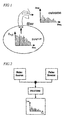
- The source-filter approach produces sounds from scratch by mimicking the functioning of the human vocal tract - see Figure 1. The source-filter model is based upon the insight that the production of vocal sounds can be simulated by generating a raw source signal that is subsequently moulded by a complex filter arrangement. In this context see, for example, "Software for a Cascade/Parallel Formant Synthesiser" by D. Klatt from the Journal of the Acoustical Society of America, 63(2), pp.971-995, 1980.
- In humans, the raw sound source corresponds to the outcome from the vibrations created by the glottis (opening between the vocal chords) and the complex filter corresponds to the vocal tract "tube". The complex filter can be implemented in various ways. In general terms, the vocal tract is considered as a tube (with a side-branch for the nose) sub-divided into a number of cross-sections whose individual resonances are simulated by the filters.
- In order to facilitate the specification of the parameters for these filters, the system is normally furnished with an interface that converts articulatory information (e.g. the positions of the tongue, jaw and lips during utterance of particular sounds) into filter parameters; hence the reason the source-filter model is sometimes referred to as the articulatory model (see "Articulatory Model for the Study of Speech Production" by P. Mermelstein from the Journal of the Acoustical Society of America, 53(4), pp.1070-1082,1973). Utterances are then produced by telling the program how to move from one set of articulatory positions to the next, similar to a key-frame visual animation. In other words, a control unit controls the generation of a synthesised utterance by setting the parameters of the sound source(s) and the filters for each of a succession of time periods, in a manner which indicates how the system moves from one set of "articulatory positions", and source sounds, to the next in successive time periods.
- There is a need for an improved voice synthesiser for use in research into the fundamental mechanisms of language evolution. Such research is being performed, for example, in order to improve the linguistic abilities of computer and robotic systems. One of these fundamental mechanisms involves the emergence of phonetic and prosodic repertoires. The study of these mechanisms requires a voice synthesiser that is able to: i) support evolutionary research paradigms, such as self-organisation and modularity, ii) support a unified form of knowledge representation for both vocal production and perception (so as to be able to support the assumption that the abilities to speak and to listen share the same sensory-motor mechanisms), and iii) speak and sing expressively (including emotion and paralinguistic features).
- Synthesisers based on the sampling approach do not suit any of the three basic needs indicated above. Conversely, the source-filter approach is compatible with requirements i) and ii) above, but the systems that have been proposed so far need to be improved in order to best fulfil requirement iii).
- The present inventor has found that the articulatory simulation used in conventional voice synthesisers based on the source-filter approach works satisfactorily for the filter part of the synthesiser but the importance of the source signal has been largely overlooked. Substantial improvements in the quality and flexibility of source-filter synthesis can be made by addressing the importance of the glottis more carefully.
- The standard practice is to implement the source component using two generators: one generator of white noise (to simulate the production of consonants) and one generator of a periodic harmonic pulse (to simulate the production of vowels). The general structure of a voice synthesiser of this conventional type is illustrated in Figure 2. By carefully controlling the amount of signal that each generator sends to the filters, one can roughly simulate whether the vocal folds are tensioned (for vowels) or not (for consonants). The main limitations with this method are:
- a) The mixing of the noise signal with the pulse signal does not sound realistic: the noise and pulse signals do not blend well together because they are of a completely different nature. Moreover, the rapid switches from noise to pulse, and vice-versa (needed to make words with consonants and vowels) often produces a "buzzy" voice.
- b) The spectrum of the pulse signal is composed of harmonics of its fundamental frequency (i.e. FO, 2*FO, 2*(2*FO), 2*(2*(2*FO)) etc.). This implies a source signal whose components cannot vary before entering the filters, thus holding back the timbre quality of the voice.
- c) The spectrum of the pulse signal has a fixed envelope where the energy of each of its harmonics decreases exponentially by -6dB as they double in frequency. A source signal that always has the same spectral shape undermines the flexibility to produce timbral nuances in the voice. Also, high frequency formants are prejudiced in the case where they need to be of higher energy value than the lower ones.
- d) In addition to b) and c) above, the spectrum of the source signal lacks a dynamical trajectory: both frequency distances between the spectral components and their amplitudes are static from the outset to the end of a given time period. This lack of time-varying attributes impoverishes the prosody of the synthesised voice.
-
- A particular speech synthesizer based on the source-filter approach has been proposed in US patent 5,528,726 (Cook), in which different glottal source signals are synthesized. In this speech synthesizer, the filter arrangement uses a digital waveguide network and a parameter library is employed that stores sets of waveguide junction control parameters and associated glottal source signal parameters for generating sets of predefined speech signals. In this system, the basic glottal pulse making up the different glottal source signals is approximated by a waveform which begins as a raised cosine waveshape but then continues in a straight-line portion (closing edge) leading down to zero and remaining at zero for the rest of the period. The different glottal source signals are formed by varying the beginning and ending points of the closing edge, with fixed opening slope and time. Rather than storing representations of these different glottal source signals, the Cook system stores parameters of a Fourier series representation of the different source signals.
- Although the Cook system involves a synthesis of different types of glottal source signal, based on parameters stored in a library, with a view to subsequent filtering by an arrangement modelling the vocal tract, the different types of source signal are generated based on a single cycle of a respective basic pulse waveform derived from a raised cosine function. More importantly, there is no optimisation of the different types of source signal with a view to improving expressivity of the final sound signal output from the global source-filter type synthesizer.
- The preferred embodiments of the present invention provide a method and apparatus for voice synthesis adapted to fulfil all of the above requirements i)-iii) and to avoid the above limitations a) to d). In particular, the preferred embodiments of the invention improve expressivity of the synthesised voice (requirement iii) above), by making use of a parametrical library of source sound categories each corresponding to a respective morphological category.
- The preferred embodiments of the present invention further provide a method and apparatus for voice synthesis in which the source signals are based on waveforms of variable length, notably waveforms corresponding to a short segment of a sound that may include more than one cycle of a repeating waveform of substantially any shape.
- The preferred embodiments of the present invention yet further provide a method and apparatus for voice synthesis in which the source signal categories are derived based on analysis of real speech.
- In the preferred embodiments of the present invention, the source component of a synthesiser based on the source-filter approach is improved by replacing the conventional pulse generator by a library of morphologically-based source sound categories that can be retrieved to produce utterances. The library stores parameters relating to different categories of sources tailored for respective specific classes of utterances, according to the general morphology of these utterances. Examples of typical classes are "plosive consonant to open vowel", "front vowel to back vowel", a particular emotive timbre, etc. The general structure of this type of voice synthesiser according to the invention is indicated in Figure 3.
- Voice synthesis methods and apparatus according to the present invention enable an improvement to be obtained in the smoothness of the synthesised utterances, because signals representing consonants and vowels both emanate from the same type of source (rather than from noise and/or pulse sources).
- According to the present invention it is preferred that the library should be "parametrical", in other words the stored parameters are not the sounds themselves but parameters for sound synthesis. The resynthesised sound signals are then used as the raw sound signals which are input to the complex filter arrangement modelling the vocal tract. The stored parameters are derived from analysis of speech and these parameters can be manipulated in various ways, before resynthesis, in order to achieve better performance and more expressive variations.
- The stored parameters may be phase vocoder module coefficients (for example coefficients for a digital tracking phase vocoder (TPV) or "oscillator bank" vocoder), derived from the analysis of real speech data. Resynthesis of the raw sound signals by the phase vocoder is a type of additive re-synthesis that produces sound signals by converting STFT data into amplitude and frequency trajectories (or envelopes) [see the book by E.R.Miranda quoted supra]. The output from the phase vocoder is supplied to the filter arrangement that simulates the vocal tract.
- Implementation of the library as a parametrical library enables greater flexibility in the voice synthesis. More particularly, the source synthesis coefficients can be manipulated in order to simulate different glottal qualities. Moreover, phase vocoder-based spectral transformations can be made on the stored coefficients before resynthesis of the source sound, thereby making it possible to achieve richer prosody.
- It is also advantageous to implement time-based transformations on the resynthesized source signal before it is fed to the filter arrangement. More particularly, the expressivity of the final speech signal can be enhanced by modifying the way in which the pitch of the source signal varies over time (and, thus, modifying the "intonation" of the final speech signal). The preferred technique for achieving this pitch transformation is the Pitch-Synchronous Overlap and Add (PSOLA) technique.
- Further features and advantages of the present invention will become clear from the following description of a preferred embodiment thereof, given by way of example, illustrated by the accompanying drawings, in which:
- Figure 1 illustrates the principle behind source-filter type voice synthesis;
- Figure 2 is a block diagram illustrating the general structure of a conventional voice synthesiser following the source-filter approach;
- Figure 3 is a block diagram illustrating the general structure of a voice synthesiser according to the preferred embodiments of the present invention;
- Figure 4 is a flow diagram illustrating the main steps in the process of building the source sound category library according to preferred embodiments of the invention;
- Figure 5 schematically illustrates how a source sound signal (estimated glottal signal) is produced by inverse filtering;
- Figure 6 is a flow diagram illustrating the main steps in the process for generating source sounds according to preferred embodiments of the invention.
- Figure 7 schematically illustrates an additive sinusoidal technique implemented by an oscillator bank used in preferred embodiments of the invention, and
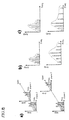
- Figure 8 illustrates some of the different types of transformations that can be
applied to the glottal source categories defined according to the preferred embodiment
of the present invention, in which:
- Fig.8a) illustrates spectral time-stretching,
- Fig.8b) illustrates spectral shift, and
- Fig.8c) illustrates spectral stretching.
-
- As mentioned above, in the voice synthesis method and apparatus according to preferred embodiments of the invention, the conventional sound source of a source-filter type synthesiser is replaced by a parametrical library of morphologically-based source sound categories.
- Any convenient filter arrangement, such as waveguide or band-pass filtering, modelling the vocal tract can be used to process the output from the source module according to the present invention. Optionally, the filter arrangement can model not just the response of the vocal tract but can also take into account the way in which sound radiates away from the head. The corresponding conventional techniques can be used to control the parameters of the filters in the filter arrangement. See, for example, Klatt quoted supra.
- However, preferred embodiments of the invention use the waveguide ladder technique (see, for example, "Waveguide Filter Tutorial" by J.O. Smith, from the Proceedings of the international Computer Music Conference, pp.9-16, Urbana (IL):ICMA,1987) due to its ability to incorporate non-linear vocal tract losses in the model (e.g. the viscosity and elasticity of the tract walls). This is a well known technique that has been successfully employed for simulating the body of various wind musical instruments, including the vocal tract (see "Towards the Perfect Audio Morph? Singing Voice Synthesis and Processing" by P. R. Cook, from DAFX98 Proceedings, pp. 223-230, 1998).
- Descriptions of suitable filter arrangements and the control thereof are readily available in the literature in this field and so no further details thereof are given here.
- The building up of the parametrical library of source sound categories, and the use thereof in the generation of source sounds, in the preferred embodiments of the invention will be described below with reference to Figures 4 to 8.
- Figure 4 illustrates the steps involved in the building up of the parametrical library of source sound categories according to preferred embodiments of the present invention. In this figure, items enclosed in rectangles are processes whereas items enclosed in ellipses are signals input/output from respective processes.
- As Figure 4 shows, in the preferred embodiments, the stored signals are derived as follows: a real vocal sound (1) is detected and inverse-filtered (2) in order to subtract the articulatory effects that the vocal tract would have imposed on the source signal [see "SPASM: A Real-time Vocal Tract Physical Model Editor/Controller and Singer" by P.R. Cook, in Computer Music Journal, 17(1), pp.30-42, 1993]. The reasoning behind the inverse filtering is that if an utterance ωh is the result of a source-stream Sh convoluted by a filter with response h (see Figure 1), then it is possible to estimate an approximation of the source-stream by deconvoluting the utterance:
- Deconvolution can be achieved by means of any convenient technique, for example, autoregression methods such as cepstrum and linear predictive coding (LPC):, where i is the i th filter coefficient, p is the number of filters, and nt is a noise signal. See "The Computer Music Tutorial" by Curtis Roads, MIT Press, Cambridge, Massachusetts, USA, 1996.

- Figure 5 illustrates how the inverse-filtering process serves to generate an estimated glottal signal (
item 3 in Fig.4). - The estimated glottal signal is assigned (4) to a morphological category which encapsulates generic utterance forms: e.g., "plosive consonant to back vowel", "front to back vowel", a certain emotive timbre, etc. For a given form (for example, a certain whispered vowel), a signal representing this form is computed by averaging the estimated glottal vowel signals resulting from inverse filtering various utterances of the respective form (5). The estimated glottal signal will be a short sound segment of variable length, the length being that necessary for characterising the glottal morphological category in question. The averaged signal representing a given form is here designated a "glottal signal category" (6).
- For example, various instances of, say, the syllable /pa/ as in "park" and the syllable /pe/ as in "pedestrian" etc. are input to the system and the system builds a categorical representation from these examples. In this specific example, the generated categorical representation could be labelled "plosive to open vowel". When a specific example of a "plosive to open vowel" sound is to be synthesised, for example, the sound /pa/, a source signal is generated by accessing the "plosive to open vowel" categorical representation stored in the library. The parameters of the filters in the filter arrangement are set in a conventional manner so as to apply to this source signal a transfer function which will result in the desired specific sound /pa/.
- The glottal signal categories could be stored in the library without further processing. However, it is advantageous to store, not the categories (source sound signals) themselves but encoded versions thereof. More particularly, according to preferred embodiments of the invention each glottal signal category is analysed using a Short Time Fourier transform (STFT) algorithm (7 in Fig.4) in order to produce coefficients (8) that can be used for resynthesis of the original source sound signal, preferably using a phase vocoder. These resynthesis coefficients are then stored in a glottal source library (9) for subsequent retrieval during the synthesis process in order to produce the respective source signal.
- The STFT analysis breaks down the glottal signal category into overlapping segments and shapes each segment with an envelope:, where χ m is the input signal, hn-m is the time-shifted window, n is a discrete time interval, k is the index for the frequency bin, N is the number of points in the spectrum (or the length of the analysis window), and X(m,k) is the Fourier transform of the windowed input at discrete time interval n for frequency bin k (see "Computer Music Tutorial" cited supra).

- The analysis yields a representation of the spectrum in terms of amplitudes and frequency trajectories (in other words, the way in which the frequencies of the partials (frequency components) of the sound change over time), which constitute the resynthesis coefficients that will be stored in the library.
- As in conventional synthesisers of source-filter types, when an utterance is to be synthesised in the methods and apparatus according to the present invention, that utterance is broken down into a succession of component sounds which must be output successively in order to produce the final utterance in its totality. In order to generate the required succession of sounds at the output of the filter arrangement modelling the vocal tract, it is necessary to input an appropriate source-stream to that filter arrangement. Figure 6 illustrates the main steps of the process for generating a source-stream, according to the preferred embodiments of the invention.
- As shown in Figure 6, it is first necessary to identify the sounds involved in the utterance and to retrieve from the library of source sound categories the codes (21) associated with sounds of the respective classes. These codes constitute the coefficients of a resynthesis device (e.g. a phase vocoder) and could, in theory, be fed directly to that device in order to regenerate the source sound signal in question (27). The resynthesis device used in preferred embodiments of the invention is a phase vocoder using an additive sinusoidal technique to synthesise the source stream. In other words, the amplitudes and frequency trajectories retrieved from the glottal source library drive a bank of oscillators each outputting a respective sinusoidal wave, these waves being summed in order to produce the final output source signal (see Figure 7).
- When synthesising an utterance composed of a succession of sounds, interpolation is applied to smooth the transition from one sound to the next. The interpolation is applied to the synthesis coefficients (24,25) prior to synthesis (27). (It is to be recalled that, as in standard filter arrangements of source-filter type synthesisers, the filter arrangement too will perform interpolation but, in this case, it is interpolation between the articulatory positions specified by the control means).
- A major advantage of storing the glottal source categories in the form of resynthesis coefficients (for example, coefficients representing magnitudes and frequency trajectories) is that one can perform a number of operations on the spectral information of this signal, with the aim, for example, of fine-tuning or morphing (consonant-vowel, vowel-consonant). As illustrated in Figure 6, if desired, the appropriate transformation coefficients (22) are used to apply spectral transformations (25) to the resynthesis coefficients (24) retrieved from the glottal source library. Then the transformed coefficients (26) are supplied to the resynthesis device for generation of the source-stream. It is possible, for example, to make gradual transitions from one spectrum to another, change the spectral envelope and spectral contents of the source, and mix two or more spectra.
- Some examples of spectral transformations that may be applied to the glottal source categories retrieved from the glottal source library are illustrated in Figure 8. These transformations include time-stretching (see Figure 8a)), spectral shift (see figure 8b)) and spectral stretching (see figure 8c)). In the case illustrated in Fig.8a, the trajectory of the amplitudes of the partials changes over time. In the cases illustrated in Figs.8b and 8c, it is the frequency trajectory that changes over time.
- Spectral time stretching (Fig.8a) works by increasing the distance (time interval) between the analysis frames of the original sound (top trace of Fig.8a) in order to produce a transformed signal which is the spectrum of the sound stretched in time (bottom trace). Spectral shift (Fig.8b) works by changing the distances (frequency intervals) between the partials of the spectrum: whereas the interval between the frequency components may be Δf in the original spectrum (top trace) it becomes Δf' in the transformed spectrum (bottom trace of Fig.8b), where Δf'≠Δf. Spectral stretching (Fig.8c) is similar to spectral shift except that in the case of spectral stretching the respective distances (frequency intervals) between the frequency components are no longer constant - the distances between the partials of the spectrum are altered so as to increase exponentially.
- It is also possible to enhance the expressivity (or the so-called "emotion") of the final speech signal by altering the way in which the pitch of the resynthesized source signal varies over time. Such a time-based transformation makes it possible, for example, to take a relatively flat speech signal and make it more melodic, or transform an affirmative sentence to a question (by raising the pitch at the end), and so on.
- In the context of the present invention, the preferred method of implementing such time-based transformations is the above-mentioned PSOLA technique. This technique is described in, for example, "Voice transformation using PSOLA technique" by H. Valbret, E. Moulines & J.P. Tulbach, in Speech Communication, 11, no.2/3, June 1992, pp.175-187.
- The PSOLA technique is applied to make appropriate modifications of the source signal (after resynthesis thereof) before the transformed source signal is fed to the filter arrangement modelling the vocal tract. Thus, it is advantageous to add a module implementing the PSOLA technique and operating on the output from the
source synthesis unit 27 of Fig.6. - As mentioned above, when it is desired to synthesise a specific sound, a source signal is generated based on the categorical representation stored in the library for sounds of this class or morphological category, and the filter arrangement is arranged to modify the source signal in known manner so as to generate the desired specific sound in this class. The results of the synthesis are improved because the raw material on which the filter arrangement is working has more appropriate components than those in source signals generated by conventional means.
- The voice synthesis technique according to the present invention improves limitation a) (detailed above) of the standard glottal model, in the sense that the morphing between vowels and consonants is more realistic as both signals emanate from the same type of source (rather than from noise and/or pulse sources). Thus, the synthesised utterances have improved smoothness.
- In the preferred embodiments of the invention, limitations b) and c) have also improved significantly because we can now manipulate the synthesis coefficients in order to change the spectrum of the source signal. Thus, the system has greater flexibility. Different glottal qualities (e.g. expressive synthesis, addition of emotion, simulation of the idiosyncrasies of a particular voice) can be simulated by changing the values of the phase vocoder coefficients before applying the re-synthesis process. This automatically implies an improvement of limitation d) as we now can specify time-varying functions that change the source during phonation. Richer prosody can therefore be obtained.
- The present invention is based on the notion that the source component of the source-filter model is as important as the filter component and provides a technique to improve the quality and flexibility of the former. The potential of this technique could be exploited even more advantageously by finding a methodology to define particular spectral operations. The real glottis manages very subtle changes in the spectrum of the source sounds but the specification of the phase vocoder coefficients to simulate these delicate operations is not a trivial task.
- It is to be understood that the present invention is not limited by the features of the specific embodiments described above. More particularly, various modifications may be made to the preferred embodiments within the scope of the appended claims.
- Also, it is to be understood that references herein to the vocal tract do not limit the invention to systems that mimic human voices. The invention covers systems which produce a synthesised voice (e.g. voice for a robot) which the human vocal tract typically will not produce.
Claims (18)
- Voice synthesiser apparatus comprising:characterised in that the source module comprises a library of stored representations of source sound categories each corresponding to a respective morphological category, and the source signal output by the source module corresponds to a stored representation of a selected source sound category.a source module adapted to output, during use, a source signal;a filter module arranged to receive said source signal as an input and to apply thereto a filter characteristic modelling the response of the vocal tract;
- Voice synthesiser apparatus according to claim 1, wherein the source module comprises a resynthesis device adapted to output said source signal and the stored representations in said library are in the form of resynthesis coefficients enabling said source sound categories to be regenerated by the resynthesis device.
- Voice synthesis apparatus according to claim 2, wherein the stored representations in said library are derived by inverse filtering real vocal sounds so as to subtract the articulatory effects imposed by the vocal tract.
- Voice synthesis apparatus according to claim 3, wherein the stored representations in said library are derived by deconvoluting respective portions of an utterance.
- Voice synthesis apparatus according to claim 3 or 4, wherein the stored representation corresponding to a particular morphological category is derived by averaging signals produced by inverse filtering a plurality of examples of vocal sounds embodying the morphological category.
- Voice synthesis apparatus according to claim 2, 3, 4 or 5, wherein the resynthesis device comprises a phase vocoder adapted to output glottal signals for submission to said filter module, and the resynthesis coefficients constituting the stored representation of a source sound category correspond to a representation derived by STFT analysis of signals resulting from the inverse filtering.
- Voice synthesis apparatus according to claim 6, and comprising means for performing spectral transformations on said resynthesis coefficients, wherein the phase vocoder is driven by the transformed resynthesis coefficients.
- Voice synthesis apparatus according to any previous claim, wherein the pitch of the source signal varies as a function of time, and there is provided means for transforming the source signal by modifying the pitch variation function, the filter module being adapted to operate on the source signal after transformation thereof by said transforming means.
- Voice synthesis apparatus according to any previous claim, wherein the filter module is implemented using the waveguide ladder technique.
- A method of voice synthesis comprising the steps of:characterised in that the step of providing a source module comprises providing a source module comprising a library of stored representations of source sound categories each corresponding to a respective morphological category, and the source signal output by the source module corresponds to a stored representation of a selected source sound category.providing a source module,causing said source module to generate a source signal corresponding to a particular morphological category of sound,providing a filter module having a filter characteristic modelling the response of the vocal tract;inputting the source signal to the filter module
- A voice synthesis method according to claim 10, wherein the source module outputs a source signal by retrieval from the library of a stored representation in the form of resynthesis coefficients representing the corresponding morphological category, input of the retrieved resynthesis coefficients to a resynthesis device, and output of the signal generated by the resynthesis device as the source signal.
- A voice synthesis method according to claim 11, wherein the stored representations in said library are derived by inverse filtering real vocal sounds so as to subtract the articulatory effects imposed by the vocal tract.
- A voice synthesis method according to claim 12, wherein the stored representations in said library are derived by deconvoluting respective portions of an utterance.
- A voice synthesis method according to claim 12 or 13, wherein the stored representation corresponding to a particular morphological category is derived by averaging signals produced by inverse filtering a plurality of examples of vocal sounds embodying the morphological category.
- A voice synthesis method according to claim 11, 12, 13 or 14, wherein the resynthesis device comprises a phase vocoder adapted to output glottal signals to said filter module, and the resynthesis coefficients constituting the stored representation of a source sound category correspond to a representation derived by STFT analysis of signals resulting from the inverse filtering.
- A voice synthesis method according to claim 15, wherein a spectral transformation is applied to the retrieved resynthesis coefficients, and the transformed coefficients are used to drive the phase vocoder.
- A voice synthesis method according to any one of claims 10 to 16, wherein the pitch of the source signal varies as a function of time, and comprising the step of transforming the source signal by modifying the pitch variation function, the filter module being adapted to operate on the source signal after transformation thereof in said transforming step.
- A voice synthesis method according to any one of claims 10 to 17, wherein the filter module is implemented using the waveguide ladder technique.
Priority Applications (1)
| Application Number | Priority Date | Filing Date | Title |
|---|---|---|---|
| EP20010401391 EP1160766B1 (en) | 2000-06-02 | 2001-05-29 | Coding the expressivity in voice synthesis |
Applications Claiming Priority (3)
| Application Number | Priority Date | Filing Date | Title |
|---|---|---|---|
| EP00401560 | 2000-06-02 | ||
| EP00401560A EP1160764A1 (en) | 2000-06-02 | 2000-06-02 | Morphological categories for voice synthesis |
| EP20010401391 EP1160766B1 (en) | 2000-06-02 | 2001-05-29 | Coding the expressivity in voice synthesis |
Publications (2)
| Publication Number | Publication Date |
|---|---|
| EP1160766A1 true EP1160766A1 (en) | 2001-12-05 |
| EP1160766B1 EP1160766B1 (en) | 2005-08-10 |
Family
ID=26073505
Family Applications (1)
| Application Number | Title | Priority Date | Filing Date |
|---|---|---|---|
| EP20010401391 Expired - Lifetime EP1160766B1 (en) | 2000-06-02 | 2001-05-29 | Coding the expressivity in voice synthesis |
Country Status (1)
| Country | Link |
|---|---|
| EP (1) | EP1160766B1 (en) |
Citations (2)
| Publication number | Priority date | Publication date | Assignee | Title |
|---|---|---|---|---|
| US5528726A (en) * | 1992-01-27 | 1996-06-18 | The Board Of Trustees Of The Leland Stanford Junior University | Digital waveguide speech synthesis system and method |
| EP1005021A2 (en) * | 1998-11-25 | 2000-05-31 | Matsushita Electric Industrial Co., Ltd. | Method and apparatus to extract formant-based source-filter data for coding and synthesis employing cost function and inverse filtering |
-
2001
- 2001-05-29 EP EP20010401391 patent/EP1160766B1/en not_active Expired - Lifetime
Patent Citations (2)
| Publication number | Priority date | Publication date | Assignee | Title |
|---|---|---|---|---|
| US5528726A (en) * | 1992-01-27 | 1996-06-18 | The Board Of Trustees Of The Leland Stanford Junior University | Digital waveguide speech synthesis system and method |
| EP1005021A2 (en) * | 1998-11-25 | 2000-05-31 | Matsushita Electric Industrial Co., Ltd. | Method and apparatus to extract formant-based source-filter data for coding and synthesis employing cost function and inverse filtering |
Non-Patent Citations (5)
| Title |
|---|
| COOK P.: "Toward the Perfect Audio Morph? Singing Voice Synthesis and Processing", WORKSHOP ON DIGITAL AUDIO EFFECTS 98, PROCEEDINGS OF DAFX98, 19 November 1998 (1998-11-19) - 21 November 1998 (1998-11-21), Barcelona, Spain, pages 223 - 230, XP002151707 * |
| DATABASE INSPEC [online] INSTITUTE OF ELECTRICAL ENGINEERS, STEVENAGE, GB; YAHAGI T ET AL: "Estimation of glottal waves based on nonminimum-phase models", XP002151708, Database accession no. 6051709 * |
| ELECTRONICS AND COMMUNICATIONS IN JAPAN, PART 3 (FUNDAMENTAL ELECTRONIC SCIENCE), NOV. 1998, SCRIPTA TECHNICA, USA, vol. 81, no. 11, pages 56 - 66, ISSN: 1042-0967 * |
| MIRANDA E.R.: "a phase vocoder model of the glottis for expressive voice synthesis", 9TH SONY RESEARCH FORUM, SRF TECHNICAL DIGEST, 1999, Tokyo, pages 150 - 152, XP002172507 * |
| VELDHUIS R ET AL: "Time-scale and pitch modifications of speech signals and resynthesis from the discrete short-time Fourier transform", SPEECH COMMUNICATION,NL,ELSEVIER SCIENCE PUBLISHERS, AMSTERDAM, vol. 18, no. 3, 1 May 1996 (1996-05-01), pages 257 - 279, XP004018610, ISSN: 0167-6393 * |
Also Published As
| Publication number | Publication date |
|---|---|
| EP1160766B1 (en) | 2005-08-10 |
Similar Documents
| Publication | Publication Date | Title |
|---|---|---|
| US6804649B2 (en) | Expressivity of voice synthesis by emphasizing source signal features | |
| Tabet et al. | Speech synthesis techniques. A survey | |
| US8744854B1 (en) | System and method for voice transformation | |
| Macon et al. | A singing voice synthesis system based on sinusoidal modeling | |
| EP1688911B1 (en) | Singing voice synthesizing apparatus and method | |
| Dutoit | Corpus-based speech synthesis | |
| EP0561752B1 (en) | A method and an arrangement for speech synthesis | |
| JP2761552B2 (en) | Voice synthesis method | |
| Carlson | Models of speech synthesis. | |
| Delalez et al. | Vokinesis: syllabic control points for performative singing synthesis | |
| d’Alessandro et al. | The speech conductor: gestural control of speech synthesis | |
| EP1160766B1 (en) | Coding the expressivity in voice synthesis | |
| Bonada et al. | Sample-based singing voice synthesizer using spectral models and source-filter decomposition. | |
| JPH1165597A (en) | Speech synthesis device, speech synthesis and CG synthesis output device, and interactive device | |
| EP1589524B1 (en) | Method and device for speech synthesis | |
| EP1640968A1 (en) | Method and device for speech synthesis | |
| Miranda | Artificial phonology: Disembodied humanoid voice for composing music with surreal languages | |
| Rodet | Sound analysis, processing and synthesis tools for music research and production | |
| Lai | F0 control model for mandarin singing voice synthesis | |
| Miranda | A phase vocoder model of the glottis for expressive voice synthesis | |
| Vasilopoulos et al. | Implementation and evaluation of a Greek Text to Speech System based on an Harmonic plus Noise Model | |
| JPH0836397A (en) | Speech synthesizer | |
| JPH10301599A (en) | Voice synthesizer | |
| Datta | Introduction to ESOLA | |
| May et al. | Speech synthesis using allophones |
Legal Events
| Date | Code | Title | Description |
|---|---|---|---|
| PUAI | Public reference made under article 153(3) epc to a published international application that has entered the european phase |
Free format text: ORIGINAL CODE: 0009012 |
|
| AK | Designated contracting states |
Kind code of ref document: A1 Designated state(s): DE FR GB Kind code of ref document: A1 Designated state(s): AT BE CH CY DE DK ES FI FR GB GR IE IT LI LU MC NL PT SE TR |
|
| AX | Request for extension of the european patent |
Free format text: AL;LT;LV;MK;RO;SI |
|
| RAP1 | Party data changed (applicant data changed or rights of an application transferred) |
Owner name: SONY FRANCE S.A. |
|
| 17P | Request for examination filed |
Effective date: 20020529 |
|
| AKX | Designation fees paid |
Free format text: DE FR GB |
|
| 17Q | First examination report despatched |
Effective date: 20040514 |
|
| GRAP | Despatch of communication of intention to grant a patent |
Free format text: ORIGINAL CODE: EPIDOSNIGR1 |
|
| GRAS | Grant fee paid |
Free format text: ORIGINAL CODE: EPIDOSNIGR3 |
|
| GRAA | (expected) grant |
Free format text: ORIGINAL CODE: 0009210 |
|
| AK | Designated contracting states |
Kind code of ref document: B1 Designated state(s): DE FR GB |
|
| REG | Reference to a national code |
Ref country code: GB Ref legal event code: FG4D |
|
| REF | Corresponds to: |
Ref document number: 60112512 Country of ref document: DE Date of ref document: 20050915 Kind code of ref document: P |
|
| ET | Fr: translation filed | ||
| PLBE | No opposition filed within time limit |
Free format text: ORIGINAL CODE: 0009261 |
|
| STAA | Information on the status of an ep patent application or granted ep patent |
Free format text: STATUS: NO OPPOSITION FILED WITHIN TIME LIMIT |
|
| 26N | No opposition filed |
Effective date: 20060511 |
|
| PGFP | Annual fee paid to national office [announced via postgrant information from national office to epo] |
Ref country code: DE Payment date: 20090527 Year of fee payment: 9 Ref country code: FR Payment date: 20090515 Year of fee payment: 9 |
|
| PGFP | Annual fee paid to national office [announced via postgrant information from national office to epo] |
Ref country code: GB Payment date: 20090527 Year of fee payment: 9 |
|
| GBPC | Gb: european patent ceased through non-payment of renewal fee |
Effective date: 20100529 |
|
| REG | Reference to a national code |
Ref country code: FR Ref legal event code: ST Effective date: 20110131 |
|
| PG25 | Lapsed in a contracting state [announced via postgrant information from national office to epo] |
Ref country code: DE Free format text: LAPSE BECAUSE OF NON-PAYMENT OF DUE FEES Effective date: 20101201 |
|
| PG25 | Lapsed in a contracting state [announced via postgrant information from national office to epo] |
Ref country code: FR Free format text: LAPSE BECAUSE OF NON-PAYMENT OF DUE FEES Effective date: 20100531 |
|
| PG25 | Lapsed in a contracting state [announced via postgrant information from national office to epo] |
Ref country code: GB Free format text: LAPSE BECAUSE OF NON-PAYMENT OF DUE FEES Effective date: 20100529 |