EP1160763A2 - Voice detecting method and apparatus - Google Patents
Voice detecting method and apparatus Download PDFInfo
- Publication number
- EP1160763A2 EP1160763A2 EP01113066A EP01113066A EP1160763A2 EP 1160763 A2 EP1160763 A2 EP 1160763A2 EP 01113066 A EP01113066 A EP 01113066A EP 01113066 A EP01113066 A EP 01113066A EP 1160763 A2 EP1160763 A2 EP 1160763A2
- Authority
- EP
- European Patent Office
- Prior art keywords
- calculating
- voice
- band energy
- change quantities
- filter
- Prior art date
- Legal status (The legal status is an assumption and is not a legal conclusion. Google has not performed a legal analysis and makes no representation as to the accuracy of the status listed.)
- Granted
Links
- 238000000034 method Methods 0.000 title claims description 159
- 230000008859 change Effects 0.000 claims abstract description 441
- 230000003595 spectral effect Effects 0.000 claims abstract description 51
- 230000008569 process Effects 0.000 claims description 132
- 230000001172 regenerating effect Effects 0.000 claims description 32
- 230000010365 information processing Effects 0.000 claims description 24
- 238000009499 grossing Methods 0.000 description 29
- 238000004364 calculation method Methods 0.000 description 14
- 238000001514 detection method Methods 0.000 description 10
- 238000004458 analytical method Methods 0.000 description 9
- 238000010586 diagram Methods 0.000 description 7
- 238000004891 communication Methods 0.000 description 4
- 230000006835 compression Effects 0.000 description 3
- 238000007906 compression Methods 0.000 description 3
- 238000005311 autocorrelation function Methods 0.000 description 2
- 230000006870 function Effects 0.000 description 2
- 239000011159 matrix material Substances 0.000 description 2
- 238000003672 processing method Methods 0.000 description 2
- 230000004044 response Effects 0.000 description 2
- 238000005070 sampling Methods 0.000 description 2
- 230000007704 transition Effects 0.000 description 2
- 230000005540 biological transmission Effects 0.000 description 1
- 230000006866 deterioration Effects 0.000 description 1
- 230000000694 effects Effects 0.000 description 1
- 230000006872 improvement Effects 0.000 description 1
- 238000001228 spectrum Methods 0.000 description 1
Images


Classifications
-
- G—PHYSICS
- G10—MUSICAL INSTRUMENTS; ACOUSTICS
- G10L—SPEECH ANALYSIS TECHNIQUES OR SPEECH SYNTHESIS; SPEECH RECOGNITION; SPEECH OR VOICE PROCESSING TECHNIQUES; SPEECH OR AUDIO CODING OR DECODING
- G10L25/00—Speech or voice analysis techniques not restricted to a single one of groups G10L15/00 - G10L21/00
- G10L25/78—Detection of presence or absence of voice signals
Definitions
- the present invention relates to a voice detecting method and apparatus which are used in switching a coding method to a decoding method between a voice section and a non-voice section in a coding device and a decoding device for transmitting a voice signal at a low bit rate.
- a noise exists in a background of conversation voice, and however, it is considered that a bit rate necessary for transmission of a background noise in a non-voice section is lower compared with voice. Accordingly, from a use efficiency improvement standpoint for a circuit, there are many cases in which a voice section is detected, and a coding method specific to a background noise, which has a low bit rate, is used in the non-voice section. For example, in an ITU-T standard G.729 voice coding method, less information on a background noise is intermittently transmitted in the non-voice section. At this time, a correct operation is required for voice detection so that deterioration of voice quality is avoided and a bit rate is effectively reduced.
- Fig. 6 is a block diagram showing an arrangement example of a conventional voice detecting apparatus. It is assumed that an input of voice to this voice detecting apparatus is conducted at a block unit (frame) of a T fr msec (for example, 10 msec) period. A frame length is assumed to be L fr samples (for example, 80 samples). The number of samples for one frame is determined by a sampling frequency (for example, 8 kHz) of input voice.
- a sampling frequency for example, 8 kHz
- Voice is input from an input terminal 10, and a linear predictive coefficient is input from an input terminal 11.
- the linear predictive coefficient is obtained by applying linear predictive analysis to the above-described input voice vector in a voice coding device in which the voice detecting apparatus is used.
- linear predictive analysis a well-known method, for example, Chapter 8 "Linear Predictive Coding of Speech” in “Digital Processing of Speech Signals” (Prentice-Hall, 1978) (Referred to as "Literature 4") by L. R. Rabiner, et al. can be referred to.
- the voice detecting apparatus in accordance with the present invention is realized independent of the voice coding device, the above-described linear predictive analysis is performed in this voice detecting apparatus.
- An LSF calculating circuit 1011 receives the linear predictive coefficient via the input terminal 11, and calculates a line spectral frequency (LSF) from the above-described linear predictive coefficient, and outputs the above-described LSF to a first change quantity calculating circuit 1031 and a first moving average calculating circuit 1021.
- LSF line spectral frequency
- a whole band energy calculating circuit 1012 receives voice (input voice) via the input terminal 10, and calculates a whole band energy of the input voice, and outputs the above-described whole band energy to a second change quantity calculating circuit 1032 and a second moving average calculating circuit 1022.
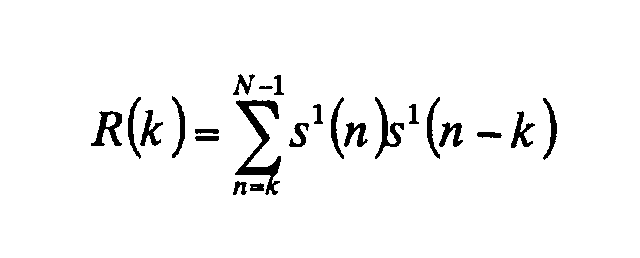
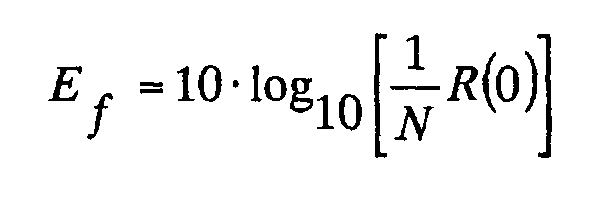
- the whole band energy E f is a logarithm of a normalized zero-degree autocorrelation function R(0), and is represented by the following equation:
- an autocorrelation coefficient is represented by the following equation:
- N is a length (analysis window length, for example, 240 samples) of a window of the linear predictive analysis for the input voice
- S 1 (n) is the input voice multiplied by the above-described window.
- a low band energy calculating circuit 1013 receives voice (input voice) via the input terminal 10, and calculates a low band energy of the input voice, and outputs the above-described low band energy to a third change quantity calculating circuit 1033 and a third moving average calculating circuit 1023.
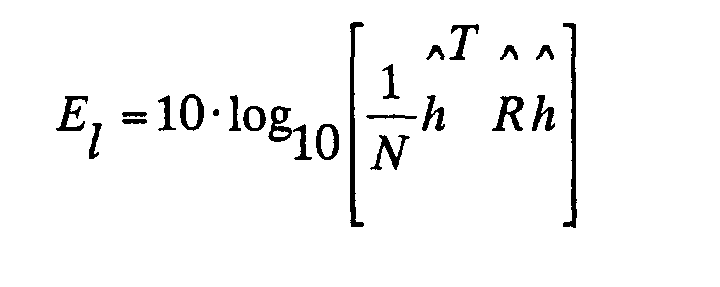
- the low band energy E i from 0 to F i Hz is represented by the following equation:
- h and is an impulse response of an FIR filter, a cutoff frequency of which is F 1 Hz
- R and is a Teplitz autocorrelation matrix, diagonal components of which are autocorrelation coefficients R(k).
- a zero cross number calculating circuit 1014 receives voice (input voice) via the input terminal 10, and calculates a zero cross number of an input voice vector, and outputs the above-described zero cross number to a fourth change quantity calculating circuit 1034 and a fourth moving average calculating circuit 1024.
- the zero cross number Z c is represented by the following equation:
- S(n) is the input voice
- sgn[x] is a function which is 1 when x is a positive number and which is 0 when it is a negative number.
- the first moving average calculating circuit 1021 receives the LSF from the LSF calculating circuit 1011, and calculates an average LSF in the current frame (present frame) from the above-described LSF and an average LSF calculated in the past frames, and outputs it to the first change quantity calculating circuit 1031.
- P is represented by the following equation:
- P is a linear predictive order (for example, 10)
- ⁇ LSF is a certain constant number (for example, 0.7).
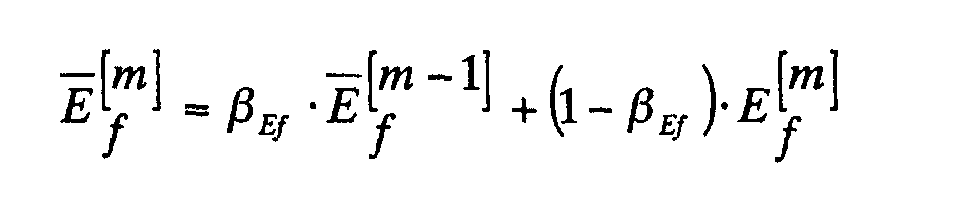
- the second moving average calculating circuit 1022 receives the whole band energy from the whole band energy calculating circuit 1012, and calculates an average whole band energy in the current frame from the above-described whole band energy and an average whole band energy calculated in the past frames, and outputs it to the second change quantity calculating circuit 1032.
- a whole band energy in the m-th frame is E f [m]
- an average whole band energy in the m-th frame E [ m ] / f is represented by the following equation:
- ⁇ Ef is a certain constant number (for example, 0.7).
- the third moving average calculating circuit 1023 receives the low band energy from the low band energy calculating circuit 1013, and calculates an average low band energy in the current frame from the above-described low band energy and an average low band energy calculated in the past frames, and outputs it to the third change quantity calculating circuit 1033.
- a low band energy in the m-th frame is E l [m]
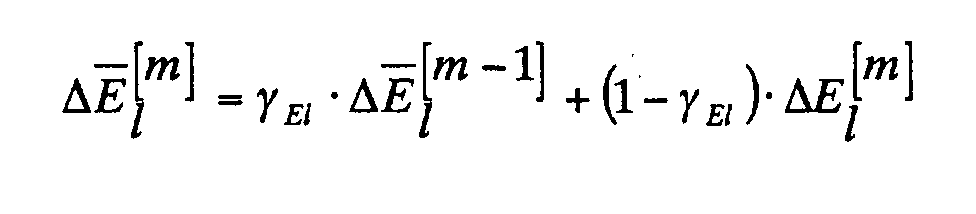
- an average low band energy in the m-th frame E [ m ] / l is represented by the following equation:
- ⁇ El is a certain constant number (for example, 0.7).
- the fourth moving average calculating circuit 1024 receives the zero cross number from the zero cross number calculating circuit 1014, and calculates an average zero cross number in the current frame from the above-described zero cross number and an average zero cross number calculated in the past frames, and outputs it to the fourth change quantity calculating circuit 1034.
- a zero cross number in the m-th frame is Z [ m ] / c
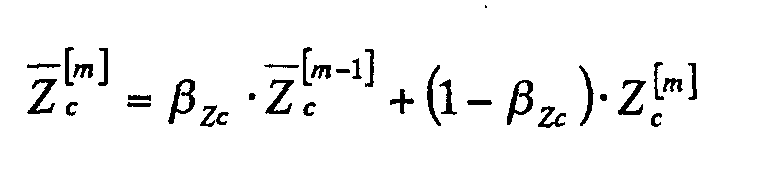
- an zero cross number in the m-th frame Z [ m ] / c is represented by the following equation:
- ⁇ Zc is a certain constant number (for example, 0.7).
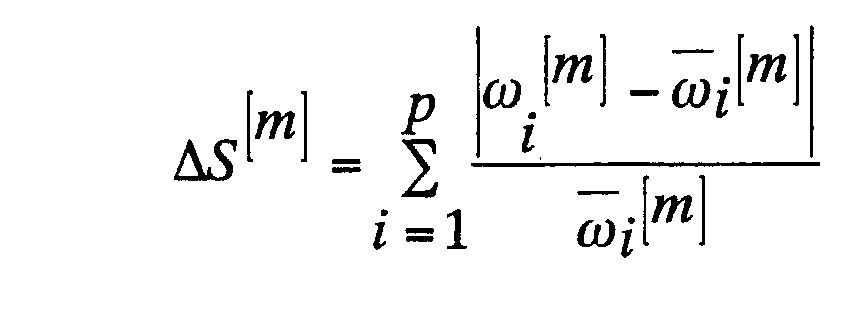
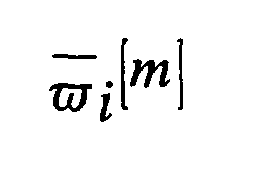
- the first change quantity calculating circuit 1031 receives LSF ⁇ i [m] from the LSF calculating circuit 1011, and receives the average LSF ⁇ i [ m ] from the first moving average calculating circuit 1021, and calculates spectral change quantities (first change quantities) from the above-described LSF and the above-described average LSF, and outputs the above-described first change quantities to a voice/non-voice determining circuit 1040.
- the first change quantities ⁇ S [m] in the m-th frame are represented by the following equation:
- the second change quantity calculating circuit 1032 receives the whole band energy E f [m] from the whole band energy calculating circuit 1012, and receives the average whole band energy E [ m ] / f from the second moving average calculating circuit 1022, and calculates whole band energy change quantities (second change quantities) from the above-described whole band energy and the above-described average whole band energy, and outputs the above-described second change quantities to the voice/non-voice determining circuit 1040.
- the third change quantity calculating circuit 1033 receives the low band energy E l [m] from the low band energy calculating circuit 1013, and receives the average low band energy E [ m ] / l from the third moving average calculating circuit 1023, and calculates low band energy change quantities (third change quantities) from the above-described low band energy and the above-described average low band energy, and outputs the above-described third change quantities to the voice/non-voice determining circuit 1040.
- the fourth change quantity calculating circuit 1034 receives the zero cross number Z c [m] from the zero cross number calculating circuit 1014, and receives the zero cross number Z [ m ] / c from the fourth moving average calculating circuit 1024, and calculates zero cross number change quantities (fourth change quantities) from the above-described zero cross number and the above-described average zero cross number, and outputs the above-described fourth change quantities to the voice/non-voice determining circuit 1040.
- the voice/non-voice determining circuit 1040 receives the first change quantities from the first change quantity calculating circuit 1031, receives the second change quantities from the second change quantity calculating circuit 1032, receives the third change quantities from the third change quantity calculating circuit 1033, and receives the fourth change quantities from the fourth change quantity calculating circuit 1034, and the voice/non-voice determining circuit determines that it is a voice section when a four-dimensional vector consisting of the above-described first change quantities, the above-described second change quantities, the above-described third change quantities and the above-described fourth change quantities exists within a voice region in a four-dimensional space, and otherwise, the voice/non-voice determining circuit determines that it is a non-voice section, and sets a determination flag to 1 in case of the above-described voice section, and sets the determination flag to 0 in case of the above-described non-voice section, and outputs the above-described determination flag to a determination value smoothing circuit 1050.
- the determination value correcting circuit 1050 receives the determination flag from the voice/non-voice determining circuit 1040, and receives the whole band energy from the whole band energy calculating circuit 1012, and corrects the above-described determination flag in accordance with a predetermined condition equation, and outputs the corrected determination flag via the output terminal.
- the correction of the above-described determination flag is conducted as follows: If a previous frame is a voice section (in other words, the determination flag is 1), and if the energy of the current frame exceeds a certain threshold value, the determination flag is set to 1.
- the determination flag is set to 1.
- the determination flag is set to 0.
- a condition equation described in Paragraph B.3.6 of the Literatures 1 and 2 can be used.
- the above-mentioned conventional voice detecting method has a task that there is a case in which a detection error in the voice section (to erroneously detect a non-voice section for a voice section) and a detection error in the non-voice section (to erroneously detect a voice section for a non-voice section) occur.
- the voice/non-voice determination is conducted by directly using the change quantities of spectrum, the change quantities of energy and the change quantities of the zero cross number.
- actual input voice is the voice section
- a value of each of the above-described change quantities has a large change
- the actual input voice does not always exist in a value range predetermined in accordance with the voice section. Accordingly, the above-described detection error in the voice section occurs. This is the same as in the non-voice section.
- the present invention is made to solve the above-mentioned problems.
- the first invention of the present application is a voice detecting method of discriminating a voice section from a non-voice section for every fixed time length for a voice signal, using feature quantity calculated from the above-described voice signal input for every fixed time length, and it is characterized in that a long-time average of change quantities obtained by inputting change quantities of the feature quantity to filters is used.
- the second invention of the present application is characterized in that, in the first invention, the change quantities of the above-described feature quantity are calculated by using the above-described feature quantity and a long-time average thereof.
- the third invention of the present application is characterized in that, in the first or second invention, the above-described filters are switched to each other when the long-time average of the above-described change quantities is calculated, using a result of the above-described discrimination output in the past in accordance with the above-described voice detecting method.
- the fourth invention of the present application is characterized in that, in the first, second or third invention, the feature quantity calculated from the above-described voice signal input in the past is used.
- the fifth invention of the present application is characterized in that, in the first, second, third or fourth invention, at least one of a line spectral frequency, a whole band energy, a low band energy and a zero cross number is used for the above-described feature quantity.
- the sixth invention of the present invention is characterized in that, in the fifth invention, at least one of a line spectral frequency that is calculated from a linear predictive coefficient decoded by means of a voice decoding method, a whole band energy, a low band energy and a zero cross number that are calculated from a regenerative voice signal output in the past by means of the above-described voice decoding method is used.
- the seventh invention of the present application is a voice detecting apparatus for discriminating a voice section from a non-voice section for every fixed time length for a voice signal, using feature quantity calculated from the above-described voice signal input for every fixed time length, and it is characterized in that the apparatus includes: an LSF calculating circuit for calculating a line spectral frequency (LSF) from the above-described voice signal; a whole band energy calculating circuit for calculating a whole band energy from the above-described voice signal; a low band energy calculating circuit for calculating a low band energy from the above-described voice signal; a zero cross number calculating circuit for calculating a zero cross number from the above-described voice signal; a line spectral frequency change quantity calculating section for calculating change quantities (first change quantities) of the above-described line spectral frequency; a whole band energy change quantity calculating section for calculating change quantities (second change quantities) of the above-described whole band energy; a low band energy change quantity calculating section for calculating change quantities (third
- the eighth invention of the present application is a voice detecting apparatus for discriminating a voice section from a non-voice section for every fixed time length for a voice signal, using feature quantity calculated from the above-described voice signal input for every fixed time length, and it is characterized in that the apparatus includes: a LSF calculating circuit for calculating a line spectral frequency (LSF) from the above-described voice signal; a whole band energy calculating circuit for calculating a whole band energy from the above-described voice signal; a low band energy calculating circuit for calculating a low band energy from the above-described voice signal; a zero cross number calculating circuit for calculating a zero cross number from the above-described voice signal; a first change quantity calculating section for calculating first change quantities based on a difference between the above-described line spectral frequency and a long-time average thereof; a second change quantity calculating section for calculating second change quantities based on a difference between the above-described whole band energy and a long-time average thereof; a
- the ninth invention of the present application is characterized in that, in the seventh or eighth invention, the apparatus includes: a first storage circuit for holding a result of the above-described discrimination, which was output in the past from the above-described voice detecting apparatus; a first switch for switching a fifth filter to a sixth filter using the result of the above-described discrimination, which is input from the above-described first storage circuit, when the long-time average of the above-described first change quantities is calculated; a second switch for switching a seventh filter to an eighth filter using the result of the above-described discrimination, which is input from the above-described first storage circuit, when the long-time average of the above-described second change quantities is calculated; a third switch for switching a ninth filter to a tenth filter using the result of the above-described discrimination, which is input from the above-described first storage circuit, when the long-time average of the above-described third change quantities is calculated; and a fourth switch for switching an eleventh filter to a twelfth
- the tenth invention of the present application is characterized in that, in the seventh, eighth or ninth invention, the above-described line spectral frequency, the above-described whole band energy, the above-described low band energy and the above-described zero cross number are calculated from the above-described voice signal input in the past.
- the eleventh invention of the present application is characterized in that, in any of the seventh to tenth inventions, at least one of the line spectral frequency, the whole band energy, the low band energy and the zero cross number is used for the feature quantity.
- the twelfth invention of the present application is characterized in that, in any of the seventh to tenth inventions, the apparatus includes a second storage circuit for storing and holding a regenerative voice signal output from a voice decoding device in the past, and uses at least one of a whole band energy, a low band energy and a zero cross number that are calculated from the above-described regenerative voice signal output from the above-described second storage circuit, and a line spectral frequency that is calculated from a linear predictive coefficient decoded in the above-described voice decoding device.
- the thirteenth invention of the present application provides a recording medium in which a program for executing a voice detecting method of discriminating a voice section from a non-voice section for every fixed time length for a voice signal, using feature quantity calculated from the above-described voice signal input for every fixed time length, is recorded for making a computer execute processes (a) to (1) : (a) a process of calculating a line spectral frequency (LSF) from the above-described voice signal; (b) a process of calculating a whole band energy from the above-described voice signal; (c) a process of calculating a low band energy from the above-described voice signal; (d) a process of calculating a zero cross number from the above-described voice signal; (e) a process of calculating change quantities (first change quantities) of the above-described line spectral frequency; (f) a process of calculating change quantities (second change quantities) of the above-described whole band energy; (g) a process of calculating change quantities (third change quantities
- the fourteenth invention of the present application provides a recording medium in which a program for executing a voice detecting method of discriminating a voice section from a non-voice section for every fixed time length for a voice signal, using feature quantity calculated from the above-described voice signal input for every fixed time length, is recorded for making a computer execute processes (a) to (1): (a) a process of calculating a line spectral frequency (LSF) from the above-described voice signal; (b) a process of calculating a whole band energy from the above-described voice signal; (c) a process of calculating a low band energy from the above-described voice signal; (d) a process of calculating a zero cross number from the above-described voice signal; (e) a process of calculating first change quantities based on a difference between the above-described line spectral frequency and a long-time average thereof; (f) a process of calculating second change quantities based on a difference between the above-described whole band energy and a long-
- the fifth invention of the present application provides a recording medium in which a program is recorded for making the above-described computer execute processes (a) to (e): (a) a process of holding a result of the above-described discrimination, which was output in the past; (b) a process of switching a fifth filter to a sixth filter using the result of the above-described discrimination, which is input from the above-described first storage circuit, when the long-time average of the above-described first change quantities is calculated; (c) a process of switching a seventh filter to an eighth filter using the result of the above-described discrimination, which is input from the above-described first storage circuit, when the long-time average of the above-described second change quantities is calculated; (d) a process of switching a ninth filter to a tenth filter using the result of the above-described discrimination, which is input from the above-described first storage circuit, when the long-time average of the above-described third change quantities is calculated; and
- the sixteenth invention of the present application provides a recording medium in which a program is recorded for making the above-described computer execute a process of calculating the above-described line spectral frequency, the above-described whole band energy, the above-described low band energy and the above-described zero cross number from the above-described voice signal input in the past.
- the seventeenth invention of the present application provides a recording medium, which is readable by the above-described information processing device, in which a program is recorded for making the above-described information processing device execute at least one of processes (a) to (d): (a) a process of calculating a line spectral frequency (LSF) from the above-described voice signal; (b) a process of calculating a whole band energy from the above-described voice signal; (c) a process of calculating a low band energy from the above-described voice signal; and (d) a process of calculating a zero cross number from the above-described voice signal.
- LSF line spectral frequency
- the eighteenth invention of the present application provides a recording medium, which is readable by the above-described information processing device, in which a program is recorded for making the above-described information processing device execute (a) a process of storing and holding a regenerative voice signal output from a voice decoding device in the past, and at least one of processes (b) to (e): (b) a process of calculating a line spectral frequency (LSF) from the above-described regenerative voice signal; (c) a process of calculating a whole band energy from the above-described regenerative voice signal; (d) a process of calculating a low band energy from the above-described regenerative voice signal; and (e) a process of calculating a zero cross number from the above-described regenerative voice signal.
- LSF line spectral frequency
- the voice/non-voice determination is conducted by using the long-time averages of the spectral change quantities, the energy change quantities and the zero cross number change quantities. Since, with regard to the long-time average of each of the above-described change quantities, a change of a value within each section of voice and non-voice is smaller compared with each of the above-described change quantities themselves, values of the above-described long-time averages exist with a high rate within a value range predetermined in accordance with the voice section and the non-voice section. Therefore, a detection error in the voice section and a detection error in the non-voice section can be reduced.
- Fig. 1 is a view showing an arrangement of a first embodiment of a voice detecting apparatus of the present invention.
- the same reference numerals are attached to elements same as or similar to those in Fig. 6.
- an LSF calculating circuit 1011 since input terminals 10 and 11, an output terminal 12, an LSF calculating circuit 1011, a whole band energy calculating circuit 1012, a low band energy calculating circuit 1013, a zero cross number calculating circuit 1014, a first moving average calculating circuit 1021, a second moving average calculating circuit 1022, a third moving average calculating circuit 1023, a fourth moving average calculating circuit 1024, a first change quantity calculating circuit 1031, a second change quantity calculating circuit 1032, a third change quantity calculating circuit 1033, a fourth change quantity calculating circuit 1034, and a voice/non-voice determining circuit 1040 are the same as the elements shown in Fig. 5, explanation of these elements will be omitted, and points different from the arrangement shown in Fig. 5 will be mainly
- a first filter 2061, a second filter 2062, a third filter 2063 and a fourth filter 2064 are added to the arrangement shown in Fig. 5.
- an input of voice is conducted at a block unit (frame) of a T fr msec (for example, 10 msec) period.
- a frame length is assumed to be L fr samples (for example, 80 samples).
- the number of samples for one frame is determined by a sampling frequency (for example, 8 kHz) of input voice.
- the first filter 2061 receives the first change quantities from the first change quantity calculating circuit 1031, and calculates a first average change quantity that is a value in which average performance of the above-described first change quantities is reflected, such as an average value, a median value and a most frequent value of the above-described first change quantities, and outputs the above-described first average change quantity to the voice/non-voice determining circuit 1040.
- a first average change quantity that is a value in which average performance of the above-described first change quantities is reflected, such as an average value, a median value and a most frequent value of the above-described first change quantities, and outputs the above-described first average change quantity to the voice/non-voice determining circuit 1040.
- a linear filter and a non-linear filter can be used for the calculation of the above-described average value.
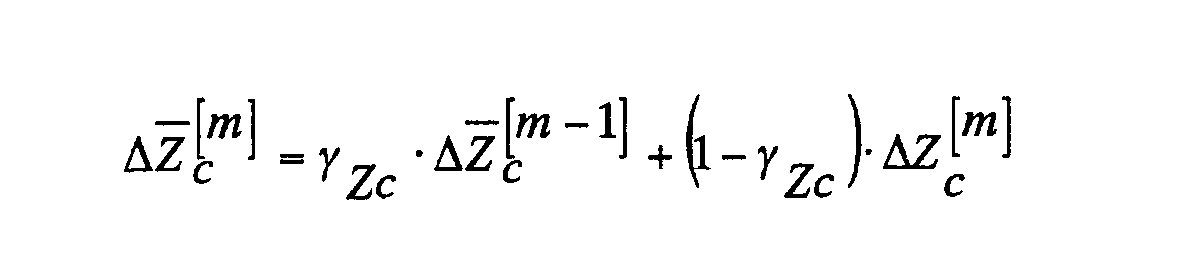
- the first average change quantity ⁇ S [ m ] in the m-th frame is calculated.
- the second filter 2062 receives the second change quantities from the second change quantity calculating circuit 1032, and calculates a second average change quantity that is a value in which average performance of the above-described second change quantities is reflected, such as an average value, a median value and a most frequent value of the above-described second change quantities, and outputs the above-described second average change quantity to the voice/non-voice determining circuit 1040.
- a second average change quantity that is a value in which average performance of the above-described second change quantities is reflected, such as an average value, a median value and a most frequent value of the above-described second change quantities, and outputs the above-described second average change quantity to the voice/non-voice determining circuit 1040.
- a linear filter and a non-linear filter can be used for the calculation of the above-described average value.
- the second average change quantity ⁇ E [ m ] / f in the m-th frame is calculated.
- the third filter 2063 receives the third change quantities from the third change quantity calculating circuit 1033, and calculates a third average change quantity that is a value in which average performance of the above-described third change quantities is reflected, such as an average value, a median value and a most frequent value of the above-described third change quantities, and outputs the above-described third average change quantity to the voice/non-voice determining circuit 1040.
- a third average change quantity that is a value in which average performance of the above-described third change quantities is reflected, such as an average value, a median value and a most frequent value of the above-described third change quantities, and outputs the above-described third average change quantity to the voice/non-voice determining circuit 1040.
- a linear filter and a non-linear filter can be used for the calculation of the above-described average value.
- the third average change quantity ⁇ E [ m ] / l in the m-th frame is calculated.
- the fourth filter 2064 receives the fourth change quantities from the fourth change quantity calculating circuit 1034, and calculates a fourth average change quantity that is a value in which average performance of the above-described fourth change quantities is reflected, such as an average value, a median value and a most frequent value of the above-described fourth change quantities, and outputs the above-described fourth average change quantity to the voice/non-voice determining circuit 1040.
- a fourth average change quantity that is a value in which average performance of the above-described fourth change quantities is reflected, such as an average value, a median value and a most frequent value of the above-described fourth change quantities, and outputs the above-described fourth average change quantity to the voice/non-voice determining circuit 1040.
- a linear filter and a non-linear filter can be used for the calculation of the above-described average value.
- the fourth average change quantity ⁇ Z [ m ] / c in the m-th frame is calculated.
- FIG. 2 is a view showing an arrangement of the second embodiment of a voice detecting apparatus of the present invention.
- the same reference numerals are attached to elements same as or similar to those in Fig. 1 and Fig. 6.
- filters for calculating average values of the first change quantities, the second change quantities, the third change quantities and the fourth change quantities, respectively, are switched in accordance with outputs from the voice/non-voice determining circuit 1040.
- the filters for calculating the average values are assumed to be the smoothing filters same as the above-described first embodiment, parameters for controlling strength of smooth (smoothing strength parameters), ⁇ S , ⁇ Ef , ⁇ El and ⁇ Zc are made large in a voice section (in other words, in case that a determination flag output from the voice/non-voice determining circuit 1040 is 1).
- the above-described first change quantities and an average value of each difference become to reflect a whole characteristic of the voice section more, and it is possible to further reduce a detection error in the voice section.
- a non-voice section in case that the above-described determination flag is 0
- by making the above smoothing strength parameters small in transition from the non-voice section to the voice section, it is possible to avoid a delay of transition of the determination flag, namely, a detection error, which occurs by smoothing the above-described change quantities and each difference.
- an LSF calculating circuit 1011 a whole band energy calculating circuit 1012, a low band energy calculating circuit 1013, a zero cross number calculating circuit 1014, a first moving average calculating circuit 1021, a second moving average calculating circuit 1022, a third moving average calculating circuit 1023, a fourth moving average calculating circuit 1024, a first change quantity calculating circuit 1031, a second change quantity calculating circuit 1032, a third change quantity calculating circuit 1033, a fourth change quantity calculating circuit 1034, and a voice/non-voice determining circuit 1040 are the same as the elements shown in Fig. 5, explanation of these elements will be omitted.
- a fifth filter 3061, a sixth filter 3062, a seventh filter 3063, an eighth filter 3064, a ninth filter 3065, a tenth filter 3066, an eleventh filter 3067, a twelfth filter 3068, a first switch 3071, a second switch 3072, a third switch 3073, a fourth switch 3074 and a first storage circuit 3081 are added. These will be explained below.
- the first storage circuit 3081 receives a determination flag from the voice/non-voice determining circuit 1040, and stores and holds this, and outputs the above-described stored and held determination flag in the past frames to the first switch 3071, the second switch 3072, the third switch 3073 and the fourth switch 3074.
- the first switch 3071 receives the first change quantities from the first change quantity calculating circuit 1031, and receives the determination flag in the past frames from the first storage circuit 3081, and when the above-described determination flag is 1 (a voice section), the first switch outputs the above-described first change quantities to the fifth filter 3061, and when the above-described determination flag is 0 (a non-voice section), the first switch outputs the above-described first change quantities to the sixth filter 3062.
- the fifth filter 3061 receives the first change quantities from the first switch 3071, and calculates a first average change quantity that is a value in which average performance of the above-described first change quantities is reflected, such as an average value, a median value and a most frequent value of the above-described first change quantities, and outputs the above-described first average change quantity to the voice/non-voice determining circuit 1040.
- a first average change quantity that is a value in which average performance of the above-described first change quantities is reflected, such as an average value, a median value and a most frequent value of the above-described first change quantities, and outputs the above-described first average change quantity to the voice/non-voice determining circuit 1040.
- a linear filter and a non-linear filter can be used for the calculation of the above-described average value.
- the first average change quantity ⁇ S [ m ] in the m-th frame is calculated.
- the sixth filter 3062 receives the first change quantities from the first switch 3071, and calculates a first average change quantity that is a value in which average performance of the above-described first change quantities is reflected, such as an average value, a median value and a most frequent value of the above-described first change quantities, and outputs the above-described first average change quantity to the voice/non-voice determining circuit 1040.
- a first average change quantity that is a value in which average performance of the above-described first change quantities is reflected, such as an average value, a median value and a most frequent value of the above-described first change quantities, and outputs the above-described first average change quantity to the voice/non-voice determining circuit 1040.
- a linear filter and a non-linear filter can be used for the calculation of the above-described average value.
- the first average change quantity ⁇ S [ m ] in the m-th frame is calculated.
- ⁇ S2 is a constant number.
- ⁇ S 2 ⁇ ⁇ S 1 and for example, ⁇ S2 0.64.
- the second switch 3072 receives the second change quantities from the second change quantity calculating circuit 1032, and receives the determination flag in the past frames from the first storage circuit 3081, and when the above-described determination flag is 1 (a voice section), the second switch outputs the above-described second change quantities to the seventh filter 3063, and when the above-described determination flag is 0 (a non-voice section), the second switch outputs the above-described second change quantities to the eighth filter 3064.
- the seventh filter 3063 receives the second change quantities from the second switch 3072, and calculates a second average change quantity that is a value in which average performance of the above-described second change quantities is reflected, such as an average value, a median value and a most frequent value of the above-described second change quantities, and outputs the above-described second average change quantity to the voice/non-voice determining circuit 1040.
- a second average change quantity that is a value in which average performance of the above-described second change quantities is reflected, such as an average value, a median value and a most frequent value of the above-described second change quantities, and outputs the above-described second average change quantity to the voice/non-voice determining circuit 1040.
- a linear filter and a non-linear filter can be used for the calculation of the above-described average value.
- the second average change quantity ⁇ E [ m ] / f in the m-th frame is calculated.
- the eighth filter 3064 receives the second change quantities from the second switch 3072, and calculates a second average change quantity that is a value in which average performance of the above-described second change quantities is reflected, such as an average value, a median value and a most frequent value of the above-described second change quantities, and outputs the above-described second average change quantity to the voice/non-voice determining circuit 1040.
- a second average change quantity that is a value in which average performance of the above-described second change quantities is reflected, such as an average value, a median value and a most frequent value of the above-described second change quantities, and outputs the above-described second average change quantity to the voice/non-voice determining circuit 1040.
- a linear filter and a non-linear filter can be used for the calculation of the above-described average value.
- the second average change quantity ⁇ E [ m ] / f in the m-th frame is calculated.
- ⁇ Ef2 is a constant number.
- ⁇ Ef 2 ⁇ ⁇ Ef 1 and for example, ⁇ Ef2 0.54.
- the third switch 3073 receives the third change quantities from the third change quantity calculating circuit 1033, and receives the determination flag in the past frames from the first storage circuit 3081, and when the above-described determination flag is 1 (a voice section), the third switch outputs the above-described third change quantities to the ninth filter 3065, and when the above-described determination flag is 0 (a non-voice section), the third switch outputs the above-described third change quantities to the tenth filter 3066.
- the ninth filter 3065 receives the third change quantities from the third switch 3073, and calculates a third average change quantity that is a value in which average performance of the above-described third change quantities is reflected, such as an average value, a median value and a most frequent value of the above-described third change quantities, and outputs the above-described third average change quantity to the voice/non-voice determining circuit 1040.
- a third average change quantity that is a value in which average performance of the above-described third change quantities is reflected, such as an average value, a median value and a most frequent value of the above-described third change quantities, and outputs the above-described third average change quantity to the voice/non-voice determining circuit 1040.
- a linear filter and a non-linear filter can be used for the calculation of the above-described average value.
- the third average change quantity ⁇ E [ m ] / l in the m-th frame is calculated.
- the tenth filter 3066 receives the third change quantities from the third switch 3073, and calculates a third average change quantity that is a value in which average performance of the above-described third change quantities is reflected, such as an average value, a median value and a most frequent value of the above-described third change quantities, and outputs the above-described third average change quantity to the voice/non-voice determining circuit 1040.
- a third average change quantity that is a value in which average performance of the above-described third change quantities is reflected, such as an average value, a median value and a most frequent value of the above-described third change quantities, and outputs the above-described third average change quantity to the voice/non-voice determining circuit 1040.
- a linear filter and a non-linear filter can be used for the calculation of the above-described average value.
- the third average change quantity ⁇ E [ m ] / l in the m-th frame is calculated.
- ⁇ El2 is a constant number.
- ⁇ El 2 ⁇ ⁇ El 1 and for example, ⁇ El2 0.54.
- the fourth switch 3074 receives the fourth change quantities from the fourth change quantity calculating circuit 1034, and receives the determination flag in the past frames from the first storage circuit 3081, and when the above-described determination flag is 1 (a voice section), the fourth switch outputs the above-described fourth change quantities to the eleventh filter 3067, and when the above-described determination flag is 0 (a non-voice section), the fourth switch outputs the above-described fourth change quantities to the twelfth filter 3068.
- the eleventh filter 3067 receives the fourth change quantities from the fourth switch 3074, and calculates a fourth average change quantity that is a value in which average performance of the above-described fourth change quantities is reflected, such as an average value, a median value and a most frequent value of the above-described fourth change quantities, and outputs the above-described fourth average change quantity to the voice/non-voice determining circuit 1040.
- a fourth average change quantity that is a value in which average performance of the above-described fourth change quantities is reflected, such as an average value, a median value and a most frequent value of the above-described fourth change quantities, and outputs the above-described fourth average change quantity to the voice/non-voice determining circuit 1040.
- a linear filter and a non-linear filter can be used for the calculation of the above-described average value.
- the fourth average change quantity ⁇ Z [ m ] / c in the m-th frame is calculated.
- the twelfth filter 3068 receives the fourth change quantities from the fourth switch 3074, and calculates a fourth average change quantity that is a value in which average performance of the above-described fourth change quantities is reflected, such as an average value, a median value and a most frequent value of the above-described fourth change quantities, and outputs the above-described fourth average change quantity to the voice/non-voice determining circuit 1040.
- a fourth average change quantity that is a value in which average performance of the above-described fourth change quantities is reflected, such as an average value, a median value and a most frequent value of the above-described fourth change quantities, and outputs the above-described fourth average change quantity to the voice/non-voice determining circuit 1040.
- a linear filter and a non-linear filter can be used for the calculation of the above-described average value.
- the fourth average change quantity ⁇ Z [ m ] / c in the m-th frame is calculated.
- ⁇ Zc2 is a constant number.
- ⁇ Zc 2 ⁇ ⁇ Zc 1 and for example, ⁇ Zc2 0.64.
- Fig. 3 is a view showing an arrangement of the third embodiment of a voice detecting apparatus of the present invention.
- the same reference numerals are attached to elements same as or similar to those in Fig. 1.
- This embodiment is shown as an example of an arrangement in which the voice detecting apparatus in accordance with the first embodiment of the present application is utilized, for example, for a purpose for switching decode processing methods in accordance with voice and non-voice in a voice decoding device. Accordingly, in this embodiment, regenerative voice which was output from the above-described voice decoding device in the past is input via an input terminal 10, and a linear predictive coefficient decoded in the voice decoding device is input via an input terminal 11.
- an LSF calculating circuit 1011 a whole band energy calculating circuit 1012, a low band energy calculating circuit 1013, a zero cross number calculating circuit 1014, a first moving average calculating circuit 1021, a second moving average calculating circuit 1022, a third moving average calculating circuit 1023, a fourth moving average calculating circuit 1024, a first change quantity calculating circuit 1031, a second change quantity calculating circuit 1032, a third change quantity calculating circuit 1033, a fourth change quantity calculating circuit 1034, a first filter 2061, a second filter 2062, a third filter 2063, a fourth filter 2064 and a voice/non-voice determining circuit 1040 are the same as the elements shown in Fig. 1, explanation thereof will be omitted.
- a second storage circuit 7071 is provided in addition to the arrangement in the first embodiment shown in Fig. 1, a second storage circuit 7071 is provided.
- the above-described second storage circuit 7071 will be explained below.
- the second storage circuit 7071 receives regenerative voice output from the voice decoding device via the input terminal 10, and stores and holds this, and outputs stored and held regenerative signals in the past frames to the whole band energy calculating circuit 1012, the low band energy calculating circuit 1013 and the zero cross number calculating circuit 1014.
- Fig. 4 is a view showing an arrangement of the fourth embodiment of a voice detecting apparatus of the present invention.
- the same reference numerals are attached to elements same as or similar to those in Fig. 2.
- This embodiment is shown as an example of an arrangement in which the voice detecting apparatus in accordance with the second embodiment of the present application is utilized, for example, for a purpose for switching decode processing methods in accordance with voice and non-voice in a voice decoding device. Accordingly, in this embodiment, regenerative voice which was output from the above-described voice decoding device is input via an input terminal 10, and a linear predictive coefficient decoded in the voice decoding device is input via an input terminal 11.
- an LSF calculating circuit 1011 a whole band energy calculating circuit 1012, a low band energy calculating circuit 1013, a zero cross number calculating circuit 1014, a first moving average calculating circuit ) 1021, a second moving average calculating circuit 1022, a third moving average calculating circuit 1023, a fourth moving average calculating circuit 1024, a first change quantity calculating circuit 1031, a second change quantity calculating circuit 1032, a third change quantity calculating circuit 1033, a fourth change quantity calculating circuit 1034, a first switch 3071, a second switch 3072, a third switch 3073, a fourth switch 3074, a fifth filter 3061, a sixth filter 3062, a seventh filter 3063, an eighth filter 3064, a ninth filter 3065, a tenth filter 3066, an eleventh filter 3067, a twelfth filter 3068, a first storage circuit 3081 and a voice/non-voice determining circuit 1040 are the same as the
- a second storage circuit 7071 is provided in addition to the arrangement in the second embodiment shown in Fig. 2, in addition to the arrangement in the second embodiment shown in Fig. 2, a second storage circuit 7071 is provided.
- the above-described second storage circuit 7071 is the same as an element shown in Fig. 3, explanation thereof will be omitted.
- Fig. 5 is a view schematically showing an apparatus arrangement as a fifth embodiment of the present invention, in a case where the above-described voice detecting apparatus of each embodiment is realized by a computer.
- this program is read out in a memory 3 via a recording medium reading device 5 and a recording medium reading device interface 4, and is executed.
- the above-described program can be stored in a mask ROM and so forth, and a non-volatile memory such as a flush memory, and the recording medium includes a nonvolatile memory, and in addition, includes a medium such as a CD-ROM, an FD, a DVD (Digital Versatile Disk), an MT (Magnetic Tape) and a portable type HDD, and also, includes a communication medium by which a program is communicated by wire and wireless like a case where the program is transmitted by means of a communication medium from a server device to a computer.
- the computer 1 for executing a program read out from the recording medium 6 for executing voice detecting processing of discriminating a voice section from a non-voice section for every fixed time length for a voice signal, using feature quantity calculated from the above-described voice signal input for every fixed time length, a program for executing processes (a) to (e) in the above-described computer 1 is recorded in the recording medium 6:
- Fig. 7 is a flowchart for explaining the operation corresponding to the first embodiment.
- a linear predictive coefficient is input (Step 11), and a line spectral frequency (LSF) is calculated from the above-described linear predictive coefficient (Step A1).
- LSF line spectral frequency
- a moving average LSF in the current frame is calculated from the calculated LSF and an average LSF calculated in the past frames (Step A2).
- a first average change quantity is calculated, which is a value in which average performance of the above-described first change quantities is reflected, such as an average value, a median value and a most frequent value of the above-described first change quantities (Step A3).
- the first average change quantity ⁇ S [ m ] in the m-th frame is calculated.
- voice input voice
- a whole band energy of the input voice is calculated (Step B1).
- the whole band energy E f is a logarithm of a normalized zero-degree autocorrelation function R(0), and is represented by the following equation: Also, an autocorrelation coefficient is represented by the following equation:
- N is a length (analysis window length, for example, 240 samples) of a window of the linear predictive analysis for the input voice
- S 1 (n) is the input voice multiplied by the above-described window.
- N>L fr by holding the voice which was input in the past frame, it shall be voice for the above-described analysis window length.
- a moving average of the whole band energy in the current frame is calculated from the whole band energy E f and an average whole band energy calculated in the past frames (Step B2).
- Step B3 From the whole band energy E f [m] and the moving average of the whole band energy E [ m ] / f whole band energy change quantities (second change quantities) are calculated (Step B3).
- a second average change quantity is calculated, which is a value in which average performance of the above-described second change quantities is reflected, such as an average value, a median value and a most frequent value of the above-described second change quantities (Step B4).
- the second average change quantity E [ m ] / f in the m-th frame is calculated.
- a low band energy of the input voice is calculated (Step C1).
- the low band energy E i from 0 to F i Hz is represented by the following equation:
- h and is an impulse response of an FIR filter, a cutoff frequency of which is F 1 Hz, and R and is a Teplitz autocorrelation matrix, diagonal components of which are autocorrelation coefficients R(k).
- a moving average of the low band energy in the current frame is calculated from the low band energy and an average low band energy calculated in the past frames (Step C2).
- a low band energy in the m-th frame is E l [m]
- the average low band energy in the m-th frame E [m] / l is represented by the following equation:
- ⁇ El is a certain constant number (for example, 0.7).
- a third average change quantity is calculated, which is a value in which average performance of the above-described third change quantities is reflected, such as an average value, a median value and a most frequent value of the above-described third change quantities (Step C4).
- the third average change quantity E [ m ] / l in the m-th frame is calculated.
- a zero cross number of an input voice vector is calculated (Step D1).
- a zero cross number Z c is represented by the following equation:
- S(n) is the input voice
- sgn[x] is a function which is 1 when x is a positive number and which is 0 when it is a negative number.
- Step D2 a moving average of the zero cross number in the current frame is calculated from the calculated zero cross number and an average zero cross number calculated in the past frames.
- a zero cross number in the m-th frame is Z [ m ] / c
- an average zero cross number in the m-th frame Z [ m ] / c is represented by the following equation:
- ⁇ Zc is a certain constant number (for example, 0.7).
- a fourth average change quantity is calculated, which is a value in which average performance of the above-described fourth change quantities is reflected, such as an average value, a median value and a most frequent value of the above-described fourth change quantities (Step D4).
- the fourth average change quantity ⁇ Z [ m ] / c in the m-th frame is calculated.
- Step E3 a determination flag is set to 1
- Step E2 the determination flag is set to 0
- Step E4 a determination result is output
- FIG. 8 Fig. 9 and Fig. 10 are flowcharts for explaining the operation corresponding to the second embodiment.
- explanation thereof will be omitted, and only different points will be explained.
- a point different from the above-mentioned processing is that, after the first change quantities, the second change quantities, the third change quantities and the fourth change quantities are calculated, when average values of these are calculated, the filters for calculating the average values are switched in accordance with the kind of a determination flag.
- Step A11 After the first change quantities are calculated at Step A3, it is confirmed whether or not the past determination flag is 1 (Step A11).
- Step A12 filter processing like the fifth filter in the second embodiment is conducted, and the first average change quantity is calculated (Step A12). For example, by using a smoothing filter of the following equation, from the first change quantities ⁇ S [m] in the m-th frame and the first average change quantity ⁇ S [ m -1] in the (m-1)-th frame, the first average change quantity ⁇ S [ m ] in the m-th frame is calculated.
- Step A13 filter processing like the sixth filter in the second embodiment is conducted, and the first average change quantity is calculated (Step A13).
- the first average change quantity ⁇ S [ m ] in the m-th frame is calculated.
- ⁇ S2 is a constant number.
- ⁇ S 2 ⁇ ⁇ S 1 and for example, ⁇ S2 0.64.
- Step B11 After the second change quantities are calculated at Step B3, it is confirmed whether or not the past determination flag is 1 (Step B11).
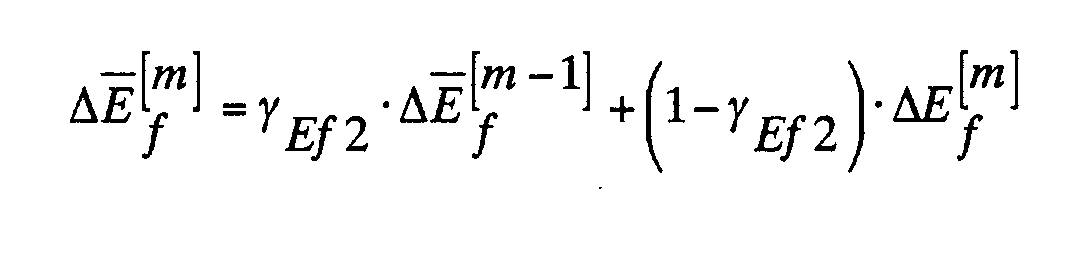
- Step B12 filter processing like the seventh filter in the second embodiment is conducted, and the second average change quantity is calculated (Step B12). For example, by using a smoothing filter of the following equation, from the second change quantities ⁇ E f [m] in the m-th frame and the second average change quantity ⁇ E [ m -1] / f in the (m-1)-th frame, the second average change quantity ⁇ E [ m ] / f in the m-th frame is calculated.
- Step B13 filter processing like the eighth filter in the second embodiment is conducted, and the second average change quantity is calculated (Step B13).
- the second average change quantity ⁇ E [ m ] / f in the m-th frame is calculated.
- ⁇ Ef2 is a constant number.
- ⁇ Ef 2 ⁇ ⁇ Ef 1 and for example, ⁇ Ef2 0.54.
- Step C11 After the third change quantities are calculated at Step C3, it is confirmed whether or not the past determination flag is 1 (Step C11).
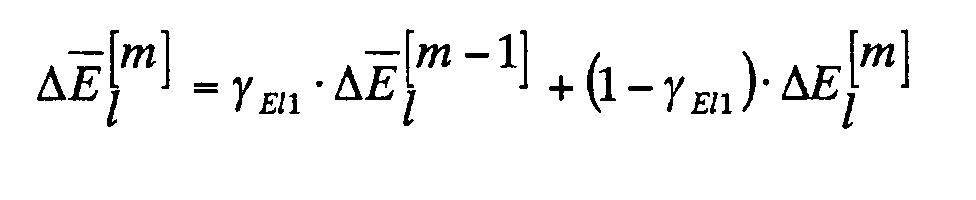
- Step C12 filter processing like the ninth filter in the second embodiment is conducted, and the third average change quantity is calculated (Step C12).
- the third average change quantity ⁇ E [ m ] / l in the (m-1)-th frame is calculated.
- Step C13 filter processing like the tenth filter in the second embodiment is conducted, and the third average change quantity is calculated (Step C13).
- the third average change quantity ⁇ E [ m ] / l in the (m-1)-th frame is calculated.
- ⁇ Ef2 is a constant number.
- ⁇ El 2 ⁇ ⁇ El 1 and for example, ⁇ El2 0.54.
- Step D11 After the fourth change quantities are calculated at Step D3, it is confirmed whether or not the past determination flag is 1 (Step D11).
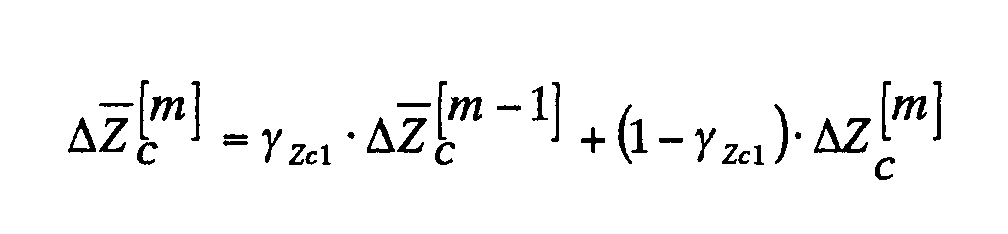
- Step D12 filter processing like the eleventh filter in the second embodiment is conducted, and the fourth average change quantity is calculated (Step D12).
- the fourth average change quantity ⁇ Z [ m ] / c in the (m-1)-th frame is calculated.
- Step D13 filter processing like the twelfth filter in the second embodiment is conducted, and the fourth average change quantity is calculated (Step D13).
- the fourth average change quantity ⁇ Z [ m ] / c in the (m-1)-th frame is calculated.
- ⁇ Zc2 is a constant number.
- ⁇ Zc 2 ⁇ ⁇ Zc 1 and for example, ⁇ Zc2 0.64.
- Fig. 11 is a flowchart for explaining the operation corresponding to the third embodiment.
- Step I11 and Step I12 Points in this operation, which are different from the above-mentioned processing, are Step I11 and Step I12, and are that a linear predictive coefficient decoded in a voice decoding device is input at Step I11, and that a regenerative voice vector output from the voice decoding device in the past is input at Step I12.
- This operation is characterized in that the operation corresponding to the above-mentioned second embodiment and the operation corresponding to the above-mentioned third embodiment are combined with each other. Accordingly, since the operation corresponding to the second embodiment and the operation corresponding to the third embodiment were already explained, explanation thereof will be omitted.
- the effect of the present invention is that it is possible to reduce a detection error in the voice section and a detection error in the non-voice section.
- the voice/non-voice determination is conducted by using the long-time averages of the spectral change quantities, the energy change quantities and the zero cross number change quantities.
- the long-time average of each of the above-described change quantities since, with regard to the long-time average of each of the above-described change quantities, a change of a value within each section of voice and non-voice is smaller compared with each of the above-described change quantities themselves, values of the above-described long-time averages exist with a high rate within a value range predetermined in accordance with the voice section and the non-voice section.
Landscapes
- Engineering & Computer Science (AREA)
- Physics & Mathematics (AREA)
- Signal Processing (AREA)
- Health & Medical Sciences (AREA)
- Audiology, Speech & Language Pathology (AREA)
- Human Computer Interaction (AREA)
- Computational Linguistics (AREA)
- Acoustics & Sound (AREA)
- Multimedia (AREA)
- Compression, Expansion, Code Conversion, And Decoders (AREA)
- Measurement Of Mechanical Vibrations Or Ultrasonic Waves (AREA)
- Measuring Frequencies, Analyzing Spectra (AREA)
- Interface Circuits In Exchanges (AREA)
Abstract
Description


h and
is an impulse response of an FIR filter, a cutoff frequency of which is F1 Hz, and
R and
is a Teplitz autocorrelation matrix, diagonal components of which are autocorrelation coefficients R(k).


is represented by the following equation:

is represented by the following equation:

is represented by the following equation:
from the first moving average calculating circuit 1021, and calculates spectral change quantities (first change quantities) from the above-described LSF and the above-described average LSF, and outputs the above-described first change quantities to a voice/non-voice determining circuit 1040. Here, the first change quantities ΔS[m] in the m-th frame are represented by the following equation:

from the second moving average calculating circuit 1022, and calculates whole band energy change quantities (second change quantities) from the above-described whole band energy and the above-described average whole band energy, and outputs the above-described second change quantities to the voice/non-voice determining circuit 1040. Here, the second change quantities ΔEf [m] in the m-th frame are represented by the following equation:
from the third moving average calculating circuit 1023, and calculates low band energy change quantities (third change quantities) from the above-described low band energy and the above-described average low band energy, and outputs the above-described third change quantities to the voice/non-voice determining circuit 1040. Here, the third change quantities ΔEl [m] in the m-th frame are represented by the following equation:
from the fourth moving average calculating circuit 1024, and calculates zero cross number change quantities (fourth change quantities) from the above-described zero cross number and the above-described average zero cross number, and outputs the above-described fourth change quantities to the voice/non-voice determining circuit 1040. Here, the fourth change quantities ΔZc [m] in the m-th frame are represented by the following equation:
Δ
in the (m-1)-th frame, the first average change quantity
Δ
in the m-th frame is calculated.

Δ
Δ
in the m-th frame is calculated.

Δ
in the (m-1)-th frame, the third average change quantity
Δ
in the m-th frame is calculated.

Δ
in the (m-1)-th frame, the fourth average change quantity
Δ
in the m-th frame is calculated.


Δ
in the (m-1)-th frame, the first average change quantity
Δ
in the m-th frame is calculated.

γ S 2 ≤ γ S 1 and for example, γS2 = 0.64.
Δ
in the (m-1)-th frame, the second average change quantity
Δ
in the m-th frame is calculated.

Δ
in the (m-1)-th frame, the second average change quantity
Δ
in the m-th frame is calculated.

γ Ef 2 ≤ γ Ef 1
and for example, γEf2 = 0.54.
Δ
in the (m-1)-th frame, the third average change quantity
Δ
in the m-th frame is calculated.

Δ
in the (m-1)-th frame, the third average change quantity
Δ
in the m-th frame is calculated.

γEl 2 ≤ γ El 1
and for example, γEl2 = 0.54.
Δ
in the (m-1)-th frame, the fourth average change quantity
Δ
in the m-th frame is calculated.

Δ
in the (m-1)-th frame, the fourth average change quantity
Δ
in the m-th frame is calculated.

γ Zc 2 ≤ γZc 1
and for example, γZc2 = 0.64.
(a) to (e) in the above-described computer 1 is recorded in the recording medium 6:
ω i [m),i = 1,···,P
an average LSF in the m-th frame
is represented by the following equation:


Δ
in the (m-1)-th frame, the first average change quantity
Δ


whole band energy change quantities (second change quantities) are calculated (Step B3).
in the (m-1)-th frame, the second average change quantity
in the m-th frame is calculated.

h and
is an impulse response of an FIR filter, a cutoff frequency of which is F1 Hz, and
R and
is a Teplitz autocorrelation matrix, diagonal components of which are autocorrelation coefficients R(k).

low band energy change quantities (third change quantities) are calculated (Step C3). Here, the third change quantities ▵E1 [m] in the m-th frame are represented by the following equation:
in the (m-1)-th frame, the third average change quantity
in the m-th frame is calculated.

Z [m] / c an average zero cross number in the m-th frame

zero cross number change quantities (fourth change quantities) are calculated (Step D3). Here, the fourth change quantities ▵Zc [m] in the m-th frame are represented by the following equation:
Δ
in the (m-1)-th frame, the fourth average change quantity
Δ
in the m-th frame is calculated.

Δ
the above-described second average change quantity
Δ
the above-described third average change quantity
Δ
Δ
exists within a voice region in a four-dimensional space, it is determined that it is the voice section, and otherwise, it is determined that it is the non-voice section (Step E1).
Δ
in the (m-1)-th frame, the first average change quantity
Δ
in the m-th frame is calculated.

Δ
in the (m-1)-th frame, the first average change quantity
Δ
in the m-th frame is calculated.

γ S 2 ≤ γ S 1
and for example, γS2 = 0.64.
Δ
in the (m-1)-th frame, the second average change quantity
Δ
in the m-th frame is calculated.

Δ
in the (m-1)-th frame, the second average change quantity
Δ
in the m-th frame is calculated.
Δ
in the (m-1)-th frame, the third average change quantity
Δ
in the m-th frame is calculated.
Δ
in the (m-1)-th frame, the third average change quantity
Δ
in the m-th frame is calculated.

Δ
in the (m-1)-th frame, the fourth average change quantity
Δ
Δ
Δ

Δ
the above-described second average change quantity
Δ
the above-described third average change quantity
Δ
Δ
Claims (26)
- A voice detecting method of discriminating a voice section from a non-voice section for every fixed time length for a voice signal, using feature quantity calculated from said voice signal input for every fixed time length, characterized in that the voice section is discriminated from the non-voice section for every fixed time length in the voice signal, using a long-time average of change quantities obtained by inputting change quantities of the feature quantity to filters.
- A voice detecting method recited in claim 1, wherein the change quantities of said feature quantity are calculated by using said feature quantity and a long-time average thereof.
- A voice detecting method recited in claim 1, wherein said filters are switched to each other when the long-time average of said change quantities is calculated, using a result of discrimination output in the past.
- A voice detecting method recited in claim 1, wherein the feature quantity calculated from the voice signal input in the past is used.
- A voice detecting method recited in claim 1, wherein at least one of a line spectral frequency, a whole band energy, a low band energy and a zero cross number is used for said feature quantity.
- A voice detecting method recited in claim 5, wherein at least one of a line spectral frequency that is calculated from a linear predictive coefficient decoded by means of a voice decoding method, a whole band energy, a low band energy and a zero cross number that are calculated from a regenerative voice signal output in the past by means of said voice decoding method are used.
- A voice detecting apparatus for discriminating a voice section from a non-voice section for every fixed time length for a voice signal, using feature quantity calculated from said voice signal input for every fixed time length, said apparatus comprises:an LSF calculating circuit for calculating a line spectral frequency (LSF) from the voice signal;a whole band energy calculating circuit for calculating a whole band energy from said voice signal;a low band energy calculating circuit for calculating a low band energy from said voice signal;a zero cross number calculating circuit for calculating a zero cross number from said voice signal;a line spectral frequency change quantity calculating section for calculating change quantities (first change quantities) of said line spectral frequency; a whole band energy change quantity calculating section for calculating change quantities (second change quantities) of said whole band energy; a low band energy change quantity calculating section for calculating change quantities (third change quantities) of said low band energy;a zero cross number change quantity calculating section for calculating change quantities (fourth change quantities) of said zero cross number;a first filter for calculating a long-time average of said first change quantities;a second filter for calculating a long-time average of said second change quantities;a third filter for calculating a long-time average of said third change quantities; anda fourth filter for calculating a long-time average of said fourth change quantities.
- A voice detecting apparatus recited in claim 7, wherein said apparatus further comprises:a first storage circuit for holding a result of said discrimination, which was output in the past from the voice detecting apparatus;a first switch for switching a fifth filter to a sixth filter using the result of said discrimination, which is input from said first storage circuit, when the long-time average of said first change quantities is calculated;a second switch for switching a seventh filter to an eighth filter using the result of said discrimination, which is input from said first storage circuit, when the long-time average of said second change quantities is calculated;a third switch for switching a ninth filter to a tenth filter using the result of said discrimination, which is input from said first storage circuit, when the long-time average of said third change quantities is calculated; anda fourth switch for switching an eleventh filter to a twelfth filter using the result of said discrimination, which is input from said first storage circuit, when the long-time average of said fourth change quantities is calculated.
- A voice detecting apparatus recited in claim 7, wherein said line spectral frequency, said whole band energy, said low band energy and said zero cross number are calculated from said voice signal input in the past.
- A voice detecting apparatus recited in claim 7, wherein at least one of the line spectral frequency, the whole band energy, the low band energy and the zero cross number is used for said feature quantity.
- A voice detecting apparatus recited in claim 7, wherein said apparatus further comprises a second storage circuit for storing and holding a regenerative voice signal output from a voice decoding device in the past, and
uses at least one of a whole band energy, a low band energy and a zero cross number that are calculated from said regenerative voice signal output from said second storage circuit, and a line spectral frequency that is calculated from a linear predictive coefficient decoded in said voice decoding device. - A voice detecting apparatus for discriminating a voice section from a non-voice section for every fixed time length for a voice signal, using feature quantity calculated from said voice signal input for every fixed time length, said apparatus comprises:an LSF calculating circuit for calculating a line spectral frequency (LSF) from the voice signal;a whole band energy calculating circuit for calculating a whole band energy from said voice signal;a low band energy calculating circuit for calculating a low band energy from said voice signal;a zero cross number calculating circuit for calculating a zero cross number from said voice signal;a first change quantity calculating section for calculating first change quantities based on a difference between said line spectral frequency and a long-time average thereof;a second change quantity calculating section for calculating second change quantities based on a difference between said whole band energy and a long-time average thereof ;a third change quantity calculating section for calculating third change quantities based on a difference between said low band energy and a long-time average thereof;a fourth change quantity calculating section for calculating fourth change quantities based on a difference between said zero cross number and a long-time average thereof;a first filter for calculating a long-time average of said first change quantities;a second filter for calculating a long-time average of said second change quantities;a third filter for calculating a long-time average of said third change quantities; anda fourth filter for calculating a long-time average of said fourth change quantities.
- A voice detecting apparatus recited in claim 12, wherein said apparatus further comprises:a first storage circuit for holding a result of said discrimination, which was output in the past from the voice detecting apparatus;a first switch for switching a fifth filter to a sixth filter using the result of said discrimination, which is input from said first storage circuit, when the long-time average of said first change quantities is calculated;a second switch for switching a seventh filter to an eighth filter using the result of said discrimination, which is input from said first storage circuit, when the long-time average of said second change quantities is calculated;a third switch for switching a ninth filter to a tenth filter using the result of said discrimination, which is input from said first storage circuit, when the long-time average of said third change quantities is calculated; anda fourth switch for switching an eleventh filter to a twelfth filter using the result of said discrimination, which is input from said first storage circuit, when the long-time average of said fourth change quantities is calculated.
- A voice detecting apparatus recited in claim 12, wherein said line spectral frequency, said whole band energy, said low band energy and said zero cross number are calculated from said voice signal input in the past.
- A voice detecting apparatus recited in claim 12, wherein at least one of the line spectral frequency, the whole band energy, the low band energy and the zero cross number is used for said feature quantity.
- A voice detecting apparatus recited in claim 12, wherein said apparatus further comprises a second storage circuit for storing and holding a regenerative voice signal output from a voice decoding device in the past, and
uses at least one of a whole band energy, a low band energy and a zero cross number that are calculated from said regenerative voice signal output from said second storage circuit, and a line spectral frequency that is calculated from a linear predictive coefficient decoded in said voice decoding device. - A recording medium readable by an information processing device constituting a voice detecting apparatus for discriminating a voice section from a non-voice section for every fixed time length for a voice signal, using feature quantity calculated from said voice signal input for every fixed time length, in which a program is recorded for making said information processing device execute processes (a) to (1):(a) a process of calculating a line spectral frequency (LSF) from said voice signal;(b) a process of calculating a whole band energy from said voice signal;(c) a process of calculating a low band energy from said voice signal;(d) a process of calculating a zero cross number from said voice signal;(e) a process of calculating change quantities (first change quantities) of said line spectral frequency;(f) a process of calculating change quantities (second change quantities) of said whole band energy;(g) a process of calculating change quantities (third change quantities) of said low band energy;(h) a process of calculating change quantities (fourth change quantities) of said zero cross number;(I) a process of calculating a long-time average of said first change quantities;(j) a process of calculating a long-time average of said second change quantities;(k) a process of calculating a long-time average of said third change quantities; and(l) a process of calculating a long-time average of said fourth change quantities.
- A recording medium recited in claim 17, which is readable by said information processing device, in which a program is recorded for making said information processing device execute processes (a) to (e):(a) a process of holding a result of said discrimination, which was output in the past;(b) a process of switching a fifth filter to a sixth filter using the result of said discrimination, which is input from said first storage circuit, when the long-time average of said first change quantities is calculated;(c) a process of switching a seventh filter to an eighth filter using the result of said discrimination, which is input from said first storage circuit, when the long-time average of said second change quantities is calculated;(d) a process of switching a ninth filter to a tenth filter using the result of said discrimination, which is input from said first storage circuit, when the long-time average of said third change quantities is calculated; and(e) a process of switching an eleventh filter to a twelfth filter using the result of said discrimination, which is input from said first storage circuit, when the long-time average of said fourth change quantities is calculated.
- A recording medium recited in claim 17, which is readable by said information processing device, in which a program is recorded for making said information processing device execute a process of calculating said line spectral frequency, said whole band energy, said low band energy and said zero cross number as said feature quantity from said voice signal input in the past.
- A recording medium recited in 17, which is readable by said information processing device, in which a program is recorded for making said information processing device execute at least one of processes (a) to (d):(a) a process of calculating a line spectral frequency (LSF) from said voice signal;(b) a process of calculating a whole band energy from said voice signal;(c) a process of calculating a low band energy from said voice signal; and(d) a process of calculating a zero cross number from said voice signal.
- A recording medium recited in claim 17, which is readable by said information processing device, in which a program is recorded for making said information processing device execute:(a) a process of storing and holding a regenerative voice signal output from a voice decoding device in the past, and at least one of processes (b) to (e):(b) a process of calculating a line spectral frequency (LSF) from said regenerative voice signal;(c) a process of calculating a whole band energy from said regenerative voice signal;(d) a process of calculating a low band energy from said regenerative voice signal; and(e) a process of calculating a zero cross number from said regenerative voice signal.
- A recording medium readable by an information processing device constituting a voice detecting apparatus for discriminating a voice section from a non-voice section for every fixed time length for a voice signal, using feature quantity calculated from said voice signal input for every fixed time length, in which a program is recorded for making said information processing device execute processes (a) to (1) :(a) a process of calculating a line spectral frequency (LSF) from said voice signal;(b) a process of calculating a whole band energy from said voice signal;(c) a process of calculating a low band energy from said voice signal;(d) a process of calculating a zero cross number from said voice signal;(e) a process of calculating first change quantities based on a difference between said line spectral frequency and a long-time average thereof;(f) a process of calculating second change quantities based on a difference between said whole band energy and a long-time average thereof;(g) a process of calculating third change quantities based on a difference between said low band energy and a long-time average thereof;(h) a process of calculating fourth change quantities based on a difference between said zero cross number and a long-time average thereof;(I) a process of calculating a long-time average of said first change quantities;(j) a process of calculating a long-time average of said second change quantities;(k) a process of calculating a long-time average of said third change quantities; and(l) a process of calculating a long-time average of said fourth change quantities.
- A recording medium recited in claim 22, which is readable by said information processing device, in which a program is recorded for making said information processing device execute processes (a) to (e):(a) a process of holding a result of said discrimination, which was output in the past;(b) a process of switching a fifth filter to a sixth filter using the result of said discrimination, which is input from said first storage circuit, when the long-time average of said first change quantities is calculated;(c) a process of switching a seventh filter to an eighth filter using the result of said discrimination, which is input from said first storage circuit, when the long-time average of said second change quantities is calculated;(d) a process of switching a ninth filter to a tenth filter using the result of said discrimination, which is input from said first storage circuit, when the long-time average of said third change quantities is calculated; and(e) a process of switching an eleventh filter to a twelfth filter using the result of said discrimination, which is input from said first storage circuit, when the long-time average of said fourth change quantities is calculated.
- A recording medium recited in any of claim 22, which is readable by said information processing device, in which a program is recorded for making said information processing device execute a process of calculating said line spectral frequency, said whole band energy, said low band energy and said zero cross number as said feature quantity from said voice signal input in the past.
- A recording medium recited in any of claim 22, which is readable by said information processing device, in which a program is recorded for making said information processing device execute at least one of processes (a) to (d) :(a) a process of calculating a line spectral frequency (LSF) from said voice signal;(b) a process of calculating a whole band energy from said voice signal;(c) a process of calculating a low band energy from said voice signal; and(d) a process of calculating a zero cross number from said voice signal.
- A recording medium recited in claim 22, which is readable by said information processing device, in which a program is recorded for making said information processing device execute (a) a process of storing and holding a regenerative voice signal output from a voice decoding device in the past, and at least one of processes (b) to (e):(b) a process of calculating a line spectral frequency (LSF) from said regenerative voice signal;(c) a process of calculating a whole band energy from said regenerative voice signal;(d) a process of calculating a low band energy from said regenerative voice signal; and(e) a process of calculating a zero cross number from said regenerative voice signal.
Applications Claiming Priority (2)
| Application Number | Priority Date | Filing Date | Title |
|---|---|---|---|
| JP2000166746A JP4221537B2 (en) | 2000-06-02 | 2000-06-02 | Voice detection method and apparatus and recording medium therefor |
| JP2000166746 | 2000-06-02 |
Publications (3)
| Publication Number | Publication Date |
|---|---|
| EP1160763A2 true EP1160763A2 (en) | 2001-12-05 |
| EP1160763A3 EP1160763A3 (en) | 2004-01-21 |
| EP1160763B1 EP1160763B1 (en) | 2006-04-19 |
Family
ID=18670022
Family Applications (1)
| Application Number | Title | Priority Date | Filing Date |
|---|---|---|---|
| EP01113066A Expired - Lifetime EP1160763B1 (en) | 2000-06-02 | 2001-05-29 | Voice detecting method and apparatus |
Country Status (6)
| Country | Link |
|---|---|
| US (2) | US7117150B2 (en) |
| EP (1) | EP1160763B1 (en) |
| JP (1) | JP4221537B2 (en) |
| AT (1) | ATE323931T1 (en) |
| CA (1) | CA2349102C (en) |
| DE (1) | DE60118831T2 (en) |
Cited By (2)
| Publication number | Priority date | Publication date | Assignee | Title |
|---|---|---|---|---|
| CN101023469B (en) * | 2004-07-28 | 2011-08-31 | 日本福年株式会社 | Digital filtering method, digital filtering equipment |
| US8326612B2 (en) | 2007-12-18 | 2012-12-04 | Fujitsu Limited | Non-speech section detecting method and non-speech section detecting device |
Families Citing this family (20)
| Publication number | Priority date | Publication date | Assignee | Title |
|---|---|---|---|---|
| US6581032B1 (en) * | 1999-09-22 | 2003-06-17 | Conexant Systems, Inc. | Bitstream protocol for transmission of encoded voice signals |
| GB2384670B (en) * | 2002-01-24 | 2004-02-18 | Motorola Inc | Voice activity detector and validator for noisy environments |
| US7143028B2 (en) | 2002-07-24 | 2006-11-28 | Applied Minds, Inc. | Method and system for masking speech |
| GB0408856D0 (en) * | 2004-04-21 | 2004-05-26 | Nokia Corp | Signal encoding |
| JP4798601B2 (en) * | 2004-12-28 | 2011-10-19 | 株式会社国際電気通信基礎技術研究所 | Voice segment detection device and voice segment detection program |
| US8102872B2 (en) * | 2005-02-01 | 2012-01-24 | Qualcomm Incorporated | Method for discontinuous transmission and accurate reproduction of background noise information |
| KR100770895B1 (en) * | 2006-03-18 | 2007-10-26 | 삼성전자주식회사 | Voice signal separation system and method |
| JP4353202B2 (en) | 2006-05-25 | 2009-10-28 | ソニー株式会社 | Prosody identification apparatus and method, and speech recognition apparatus and method |
| KR100883652B1 (en) | 2006-08-03 | 2009-02-18 | 삼성전자주식회사 | Speech section detection method and apparatus, and speech recognition system using same |
| JP4758879B2 (en) * | 2006-12-14 | 2011-08-31 | 日本電信電話株式会社 | Temporary speech segment determination device, method, program and recording medium thereof, speech segment determination device, method |
| GB2450886B (en) * | 2007-07-10 | 2009-12-16 | Motorola Inc | Voice activity detector and a method of operation |
| JP5088050B2 (en) * | 2007-08-29 | 2012-12-05 | ヤマハ株式会社 | Voice processing apparatus and program |
| WO2009063662A1 (en) * | 2007-11-16 | 2009-05-22 | Mitsubishi Electric Corporation | Voice signal processing device and method |
| WO2010146711A1 (en) * | 2009-06-19 | 2010-12-23 | 富士通株式会社 | Audio signal processing device and audio signal processing method |
| CN104485118A (en) * | 2009-10-19 | 2015-04-01 | 瑞典爱立信有限公司 | Detector and method for voice activity detection |
| JP6531412B2 (en) * | 2015-02-09 | 2019-06-19 | 沖電気工業株式会社 | Target sound section detection apparatus and program, noise estimation apparatus and program, SNR estimation apparatus and program |
| CN105118520B (en) * | 2015-07-13 | 2017-11-10 | 腾讯科技(深圳)有限公司 | A kind of removing method and device of audio beginning sonic boom |
| KR101760753B1 (en) * | 2016-07-04 | 2017-07-24 | 주식회사 이엠텍 | Hearing assistant device for informing state of wearer |
| JP7170287B2 (en) * | 2018-05-18 | 2022-11-14 | パナソニックIpマネジメント株式会社 | Speech recognition device, speech recognition method, and program |
| CN112511698B (en) * | 2020-12-03 | 2022-04-01 | 普强时代(珠海横琴)信息技术有限公司 | Real-time call analysis method based on universal boundary detection |
Family Cites Families (7)
| Publication number | Priority date | Publication date | Assignee | Title |
|---|---|---|---|---|
| JPS6127598A (en) | 1984-07-19 | 1986-02-07 | 日本電気株式会社 | Voice/voiceless decision for voice signal |
| US5007093A (en) * | 1987-04-03 | 1991-04-09 | At&T Bell Laboratories | Adaptive threshold voiced detector |
| US5487087A (en) * | 1994-05-17 | 1996-01-23 | Texas Instruments Incorporated | Signal quantizer with reduced output fluctuation |
| TW271524B (en) * | 1994-08-05 | 1996-03-01 | Qualcomm Inc | |
| US5806038A (en) * | 1996-02-13 | 1998-09-08 | Motorola, Inc. | MBE synthesizer utilizing a nonlinear voicing processor for very low bit rate voice messaging |
| JP3297346B2 (en) * | 1997-04-30 | 2002-07-02 | 沖電気工業株式会社 | Voice detection device |
| US6438518B1 (en) * | 1999-10-28 | 2002-08-20 | Qualcomm Incorporated | Method and apparatus for using coding scheme selection patterns in a predictive speech coder to reduce sensitivity to frame error conditions |
-
2000
- 2000-06-02 JP JP2000166746A patent/JP4221537B2/en not_active Expired - Fee Related
-
2001
- 2001-05-29 AT AT01113066T patent/ATE323931T1/en not_active IP Right Cessation
- 2001-05-29 EP EP01113066A patent/EP1160763B1/en not_active Expired - Lifetime
- 2001-05-29 CA CA002349102A patent/CA2349102C/en not_active Expired - Fee Related
- 2001-05-29 DE DE60118831T patent/DE60118831T2/en not_active Expired - Lifetime
- 2001-05-31 US US09/871,368 patent/US7117150B2/en not_active Expired - Fee Related
-
2006
- 2006-08-10 US US11/501,958 patent/US7698135B2/en not_active Expired - Fee Related
Cited By (3)
| Publication number | Priority date | Publication date | Assignee | Title |
|---|---|---|---|---|
| CN101023469B (en) * | 2004-07-28 | 2011-08-31 | 日本福年株式会社 | Digital filtering method, digital filtering equipment |
| US8326612B2 (en) | 2007-12-18 | 2012-12-04 | Fujitsu Limited | Non-speech section detecting method and non-speech section detecting device |
| US8798991B2 (en) | 2007-12-18 | 2014-08-05 | Fujitsu Limited | Non-speech section detecting method and non-speech section detecting device |
Also Published As
| Publication number | Publication date |
|---|---|
| CA2349102A1 (en) | 2001-12-02 |
| DE60118831T2 (en) | 2006-11-30 |
| CA2349102C (en) | 2007-05-01 |
| JP2001350488A (en) | 2001-12-21 |
| EP1160763B1 (en) | 2006-04-19 |
| JP4221537B2 (en) | 2009-02-12 |
| US7117150B2 (en) | 2006-10-03 |
| US20020007270A1 (en) | 2002-01-17 |
| ATE323931T1 (en) | 2006-05-15 |
| US20060271363A1 (en) | 2006-11-30 |
| EP1160763A3 (en) | 2004-01-21 |
| DE60118831D1 (en) | 2006-05-24 |
| US7698135B2 (en) | 2010-04-13 |
Similar Documents
| Publication | Publication Date | Title |
|---|---|---|
| EP1160763A2 (en) | Voice detecting method and apparatus | |
| EP1243090B1 (en) | Method and arrangement in a communication system | |
| US5305332A (en) | Speech decoder for high quality reproduced speech through interpolation | |
| EP0877355B1 (en) | Speech coding | |
| KR100395458B1 (en) | Method for decoding an audio signal with transmission error correction | |
| US6704702B2 (en) | Speech encoding method, apparatus and program | |
| RU2640743C1 (en) | Audio encoding device, audio encoding method, audio encoding programme, audio decoding device, audio decoding method and audio decoding programme | |
| US6721327B1 (en) | Delayed packet concealment method and apparatus | |
| EP1267325B1 (en) | Process for voice activity detection in a signal, and speech signal coder comprising a device for carrying out the process | |
| EP0736858A2 (en) | Mobile communication equipment | |
| EP0501421A2 (en) | Speech coding system | |
| US6327562B1 (en) | Method and device for coding an audio signal by “forward” and “backward” LPC analysis | |
| US6871175B2 (en) | Voice encoding apparatus and method therefor | |
| JPH1022937A (en) | Error compensation device and recording medium | |
| US20090299737A1 (en) | Method for adapting for an interoperability between short-term correlation models of digital signals | |
| JPH0844395A (en) | Voice pitch detector | |
| US5459784A (en) | Dual-tone multifrequency (DTMF) signalling transparency for low-data-rate vocoders | |
| Korhonen et al. | Schemes for error resilient streaming of perceptually coded audio | |
| JP3150277B2 (en) | Linear prediction coefficient calculator | |
| JPH08195722A (en) | Audio signal transmission system using spectral parameter and audio parameter encoder and decoder used for same | |
| KR100283087B1 (en) | Speech and Tone Coding Methods | |
| JP2005316499A (en) | Voice-coder | |
| Welch | Joseph P. Campbell, Jr. | |
| JPH0286231A (en) | Speech predictive coding device | |
| JP2009225466A (en) | Signal encoding apparatus, decoding apparatus, method, program, and recording medium |
Legal Events
| Date | Code | Title | Description |
|---|---|---|---|
| PUAI | Public reference made under article 153(3) epc to a published international application that has entered the european phase |
Free format text: ORIGINAL CODE: 0009012 |
|
| AK | Designated contracting states |
Kind code of ref document: A2 Designated state(s): AT BE CH CY DE DK ES FI FR GB GR IE IT LI LU MC NL PT SE TR |
|
| AX | Request for extension of the european patent |
Free format text: AL;LT;LV;MK;RO;SI |
|
| PUAL | Search report despatched |
Free format text: ORIGINAL CODE: 0009013 |
|
| RIC1 | Information provided on ipc code assigned before grant |
Ipc: 7G 10L 11/02 A |
|
| AK | Designated contracting states |
Kind code of ref document: A3 Designated state(s): AT BE CH CY DE DK ES FI FR GB GR IE IT LI LU MC NL PT SE TR |
|
| AX | Request for extension of the european patent |
Extension state: AL LT LV MK RO SI |
|
| 17P | Request for examination filed |
Effective date: 20031211 |
|
| 17Q | First examination report despatched |
Effective date: 20040301 |
|
| AKX | Designation fees paid |
Designated state(s): AT BE CH CY DE DK ES FI FR GB GR IE IT LI LU MC NL PT SE TR |
|
| GRAP | Despatch of communication of intention to grant a patent |
Free format text: ORIGINAL CODE: EPIDOSNIGR1 |
|
| GRAS | Grant fee paid |
Free format text: ORIGINAL CODE: EPIDOSNIGR3 |
|
| GRAA | (expected) grant |
Free format text: ORIGINAL CODE: 0009210 |
|
| AK | Designated contracting states |
Kind code of ref document: B1 Designated state(s): AT BE CH CY DE DK ES FI FR GB GR IE IT LI LU MC NL PT SE TR |
|
| PG25 | Lapsed in a contracting state [announced via postgrant information from national office to epo] |
Ref country code: IT Free format text: LAPSE BECAUSE OF FAILURE TO SUBMIT A TRANSLATION OF THE DESCRIPTION OR TO PAY THE FEE WITHIN THE PRESCRIBED TIME-LIMIT;WARNING: LAPSES OF ITALIAN PATENTS WITH EFFECTIVE DATE BEFORE 2007 MAY HAVE OCCURRED AT ANY TIME BEFORE 2007. THE CORRECT EFFECTIVE DATE MAY BE DIFFERENT FROM THE ONE RECORDED. Effective date: 20060419 Ref country code: FI Free format text: LAPSE BECAUSE OF FAILURE TO SUBMIT A TRANSLATION OF THE DESCRIPTION OR TO PAY THE FEE WITHIN THE PRESCRIBED TIME-LIMIT Effective date: 20060419 Ref country code: CH Free format text: LAPSE BECAUSE OF FAILURE TO SUBMIT A TRANSLATION OF THE DESCRIPTION OR TO PAY THE FEE WITHIN THE PRESCRIBED TIME-LIMIT Effective date: 20060419 Ref country code: BE Free format text: LAPSE BECAUSE OF FAILURE TO SUBMIT A TRANSLATION OF THE DESCRIPTION OR TO PAY THE FEE WITHIN THE PRESCRIBED TIME-LIMIT Effective date: 20060419 Ref country code: AT Free format text: LAPSE BECAUSE OF FAILURE TO SUBMIT A TRANSLATION OF THE DESCRIPTION OR TO PAY THE FEE WITHIN THE PRESCRIBED TIME-LIMIT Effective date: 20060419 Ref country code: LI Free format text: LAPSE BECAUSE OF FAILURE TO SUBMIT A TRANSLATION OF THE DESCRIPTION OR TO PAY THE FEE WITHIN THE PRESCRIBED TIME-LIMIT Effective date: 20060419 Ref country code: NL Free format text: LAPSE BECAUSE OF FAILURE TO SUBMIT A TRANSLATION OF THE DESCRIPTION OR TO PAY THE FEE WITHIN THE PRESCRIBED TIME-LIMIT Effective date: 20060419 |
|
| REG | Reference to a national code |
Ref country code: GB Ref legal event code: FG4D |
|
| REF | Corresponds to: |
Ref document number: 60118831 Country of ref document: DE Date of ref document: 20060524 Kind code of ref document: P |
|
| PG25 | Lapsed in a contracting state [announced via postgrant information from national office to epo] |
Ref country code: IE Free format text: LAPSE BECAUSE OF NON-PAYMENT OF DUE FEES Effective date: 20060529 |
|
| PG25 | Lapsed in a contracting state [announced via postgrant information from national office to epo] |
Ref country code: MC Free format text: LAPSE BECAUSE OF NON-PAYMENT OF DUE FEES Effective date: 20060531 |
|
| REG | Reference to a national code |
Ref country code: IE Ref legal event code: FG4D |
|
| PG25 | Lapsed in a contracting state [announced via postgrant information from national office to epo] |
Ref country code: DK Free format text: LAPSE BECAUSE OF FAILURE TO SUBMIT A TRANSLATION OF THE DESCRIPTION OR TO PAY THE FEE WITHIN THE PRESCRIBED TIME-LIMIT Effective date: 20060719 Ref country code: SE Free format text: LAPSE BECAUSE OF FAILURE TO SUBMIT A TRANSLATION OF THE DESCRIPTION OR TO PAY THE FEE WITHIN THE PRESCRIBED TIME-LIMIT Effective date: 20060719 |
|
| PG25 | Lapsed in a contracting state [announced via postgrant information from national office to epo] |
Ref country code: ES Free format text: LAPSE BECAUSE OF FAILURE TO SUBMIT A TRANSLATION OF THE DESCRIPTION OR TO PAY THE FEE WITHIN THE PRESCRIBED TIME-LIMIT Effective date: 20060730 |
|
| PG25 | Lapsed in a contracting state [announced via postgrant information from national office to epo] |
Ref country code: PT Free format text: LAPSE BECAUSE OF FAILURE TO SUBMIT A TRANSLATION OF THE DESCRIPTION OR TO PAY THE FEE WITHIN THE PRESCRIBED TIME-LIMIT Effective date: 20060919 |
|
| NLV1 | Nl: lapsed or annulled due to failure to fulfill the requirements of art. 29p and 29m of the patents act | ||
| REG | Reference to a national code |
Ref country code: CH Ref legal event code: PL |
|
| ET | Fr: translation filed | ||
| PLBE | No opposition filed within time limit |
Free format text: ORIGINAL CODE: 0009261 |
|
| STAA | Information on the status of an ep patent application or granted ep patent |
Free format text: STATUS: NO OPPOSITION FILED WITHIN TIME LIMIT |
|
| 26N | No opposition filed |
Effective date: 20070122 |
|
| PG25 | Lapsed in a contracting state [announced via postgrant information from national office to epo] |
Ref country code: GR Free format text: LAPSE BECAUSE OF FAILURE TO SUBMIT A TRANSLATION OF THE DESCRIPTION OR TO PAY THE FEE WITHIN THE PRESCRIBED TIME-LIMIT Effective date: 20060720 |
|
| PG25 | Lapsed in a contracting state [announced via postgrant information from national office to epo] |
Ref country code: LU Free format text: LAPSE BECAUSE OF NON-PAYMENT OF DUE FEES Effective date: 20060529 Ref country code: TR Free format text: LAPSE BECAUSE OF FAILURE TO SUBMIT A TRANSLATION OF THE DESCRIPTION OR TO PAY THE FEE WITHIN THE PRESCRIBED TIME-LIMIT Effective date: 20060419 |
|
| PG25 | Lapsed in a contracting state [announced via postgrant information from national office to epo] |
Ref country code: CY Free format text: LAPSE BECAUSE OF FAILURE TO SUBMIT A TRANSLATION OF THE DESCRIPTION OR TO PAY THE FEE WITHIN THE PRESCRIBED TIME-LIMIT Effective date: 20060419 |
|
| PGFP | Annual fee paid to national office [announced via postgrant information from national office to epo] |
Ref country code: DE Payment date: 20130522 Year of fee payment: 13 Ref country code: GB Payment date: 20130529 Year of fee payment: 13 |
|
| PGFP | Annual fee paid to national office [announced via postgrant information from national office to epo] |
Ref country code: FR Payment date: 20130531 Year of fee payment: 13 |
|
| REG | Reference to a national code |
Ref country code: DE Ref legal event code: R119 Ref document number: 60118831 Country of ref document: DE |
|
| GBPC | Gb: european patent ceased through non-payment of renewal fee |
Effective date: 20140529 |
|
| REG | Reference to a national code |
Ref country code: FR Ref legal event code: ST Effective date: 20150130 |
|
| PG25 | Lapsed in a contracting state [announced via postgrant information from national office to epo] |
Ref country code: DE Free format text: LAPSE BECAUSE OF NON-PAYMENT OF DUE FEES Effective date: 20141202 |
|
| PG25 | Lapsed in a contracting state [announced via postgrant information from national office to epo] |
Ref country code: FR Free format text: LAPSE BECAUSE OF NON-PAYMENT OF DUE FEES Effective date: 20140602 Ref country code: GB Free format text: LAPSE BECAUSE OF NON-PAYMENT OF DUE FEES Effective date: 20140529 |
|
| REG | Reference to a national code |
Ref country code: DE Ref legal event code: R079 Ref document number: 60118831 Country of ref document: DE Free format text: PREVIOUS MAIN CLASS: G10L0011020000 Ipc: G10L0025840000 |