EP1160680A2 - System for calculating sum of products - Google Patents
System for calculating sum of products Download PDFInfo
- Publication number
- EP1160680A2 EP1160680A2 EP01111283A EP01111283A EP1160680A2 EP 1160680 A2 EP1160680 A2 EP 1160680A2 EP 01111283 A EP01111283 A EP 01111283A EP 01111283 A EP01111283 A EP 01111283A EP 1160680 A2 EP1160680 A2 EP 1160680A2
- Authority
- EP
- European Patent Office
- Prior art keywords
- values
- feedback
- products
- sum
- processing engine
- Prior art date
- Legal status (The legal status is an assumption and is not a legal conclusion. Google has not performed a legal analysis and makes no representation as to the accuracy of the status listed.)
- Withdrawn
Links
Images


Classifications
-
- G—PHYSICS
- G06—COMPUTING OR CALCULATING; COUNTING
- G06F—ELECTRIC DIGITAL DATA PROCESSING
- G06F7/00—Methods or arrangements for processing data by operating upon the order or content of the data handled
- G06F7/38—Methods or arrangements for performing computations using exclusively denominational number representation, e.g. using binary, ternary, decimal representation
- G06F7/48—Methods or arrangements for performing computations using exclusively denominational number representation, e.g. using binary, ternary, decimal representation using non-contact-making devices, e.g. tube, solid state device; using unspecified devices
- G06F7/544—Methods or arrangements for performing computations using exclusively denominational number representation, e.g. using binary, ternary, decimal representation using non-contact-making devices, e.g. tube, solid state device; using unspecified devices for evaluating functions by calculation
- G06F7/5443—Sum of products
-
- G—PHYSICS
- G06—COMPUTING OR CALCULATING; COUNTING
- G06F—ELECTRIC DIGITAL DATA PROCESSING
- G06F17/00—Digital computing or data processing equipment or methods, specially adapted for specific functions
- G06F17/10—Complex mathematical operations
Definitions
- This invention relates generally to generating sum of products values and, more particularly, to a sum of products processing engine that employs random access memory for feedback purposes.
- DFT Discrete Fourier Transform
- window presumming The necessary data preparation techniques are done by a process commonly known as "window presumming.”
- Typical window presum algorithms involve the multiplication of the incoming data by known coefficient values and summing the product. The result is an SOP and is extremely common in the digital signal processing industry.
- RAM random access memory
- the SOP processor will include a ping-pong RAM at the input stage of the processor.
- Ping-pong RAMs employ an additional RAM as a buffer and the data is essentially "bounced" between the RAM's to create intended delays. The delayed data is then switched between a number of processing arms placed in parallel with one another. While this approach partially addresses processing speed issues, the aforementioned shortcomings remain. Thus, it is desirable to perform SOP calculations with minimal delay and memory use.
- a processing engine for generating SOP values for incoming data includes a calculation module for generating intermediate and SOP values based on the incoming data and coefficient values, where the intermediate values are defined by product values and partial presum values.
- a feedback module stores the intermediate values until the calculation module generates SOP values.
- the processing engine further includes a reordering module for reordering the SOP values.
- the feedback module includes a switching mechanism for retrieving intermediate values from the calculation module until the calculation module generates SOP values.
- a feedback RAM can store the intermediate values without the need for buffering RAM at the input stage.
- the feedback module further includes a holding register for retrieving the intermediate values from the feedback RAM, where the holding register routes the intermediate values to the calculation module.
- a computerized method for generating SOP values includes the step of storing product values in a feedback RAM as intermediate values until a predetermined number of product values is stored. Partial presum values are then stored in the feedback RAM as intermediate values until the calculation module generates SOP values, where the partial presum values are generated from the product values. The method further provides for reordering of the SOP values.
- the processing engine 10 has a calculation module 30, a feedback module 50, and a reordering module 70.
- the calculation module 30 includes a plurality of calculation sub-modules 31 ( Figure 2), wherein each calculation sub-module 31 operates on data corresponding to a processing arm of the processing engine.
- the feedback module 50 includes a plurality of feedback sub-modules 51 ( Figure 2), wherein each feedback sub-module 51 operates on data corresponding to a processing arm of the processing engine 10.
- each processing arm (W 0 -W n ) computes a set of L SOPs each consisting of D summations.
- the calculation module 30 generates intermediate and SOP values based on the incoming data and coefficient values, where the intermediate values are defined by product values and partial presum values.
- the feedback module 50 stores the intermediate values and provides the intermediate values to the calculation module 30 until the calculation module 30 generates SOP values.
- the reordering module 70 reorders the SOP values.
- the calculation module 30 has a multiplier 32 for multiplying the incoming data by the desired coefficient values, and an adder 33 for adding the product values to the intermediate values stored by the feedback module 50.
- a calculation register 34 routes the product values from the multiplier 32 to the adder 33.
- an input register 35 can be provided at the input for retrieving the incoming data and routing the data among the plurality of calculation submodules 31.
- a coefficient read only memory (ROM) 36 contains the coefficient values used in the multiplication function.
- the feedback module 50 includes a switching mechanism shown as demultiplexer 52, a feedback RAM 53, and a holding register 54.
- the demultiplexer 52 retrieves the intermediate values from the calculation module 30 for storage until the calculation module 30 generates SOP values. It can be seen that the demultiplexer 52 routes the SOP values to the reordering module 70 when the SOP values are present.
- the feedback RAM 53 stores the intermediate values for later use by the adder 33 of the calculation module 30.
- the holding register 54 retrieves the intermediate values from the feedback RAM 53, and routes the intermediate values to the calculation module 30.
- the feedback RAM 53 is a dual port RAM which can be written to and read from simultaneously. This ability further reduces latency in the processing operations.
- the first L products of h(k)d(k) are stored in the feedback RAM 53 as intermediate values. These values are then retrieved for summation by the adder 33. The results of the summations are stored back to the feedback RAM 53 as partial presum values until D summations have been performed. At such time, the SOP's are passed to the reordering module 70.
- the reordering module 70 includes a reordering RAM configuration 71 for reordering the SOP values.
- a reordering RAM configuration 71 for reordering the SOP values.
- the reordering RAM configuration 71 can be reduced using a ping-pong architecture.
- the preferred reordering RAM configuration 71 shown in Figure 2 includes a plurality of dual port RAMS, it will be appreciated that a ping-pong RAM can also be used.
- the reordering module 70 further includes an input switching mechanism shown as input multiplexer 72 for retrieving the SOP values from the feedback module 50.
- a storage switching mechanism shown as storage demultiplexer 73 reorders the SOP values in the random access memory configuration 71 while a reordering register 74 routes the SOP values from the input multiplexer to the storage demultiplexer.
- a retrieval switching mechanism shown as retrieval multiplexer 75 retrieves the reordered SOP values from the reordering RAM configuration 71.
- Step 110 product values are stored in the feedback RAM as intermediate values.
- Step 120 demonstrates that this process is continued until a predetermined number of product values is stored. In the preferred embodiment, the predetermined number of product values equals L.
- Partial presum values are then stored in the feedback RAM as intermediate values at step 130 until the calculation module generates SOP values. This moment is reached when D summations have been made for the first set of partial presum values.
- SOP values are obtained at step 140, the SOP values are reordered at step 150.
- Figure 4 demonstrates the subroutine of storing product values in greater detail. It can be seen that at step 111, the incoming data is multiplied by predetermined coefficient values. Products of the incoming data and the predetermined coefficient values are then stored in the feedback RAM at step 112.
- the subroutine of storing partial presum values is shown in greater detail. It will be appreciated that the incoming data is multiplied by the predetermined coefficient values at step 131. At step 132 the intermediate values contained in the feedback RAM are retrieved. The products of the incoming data and the coefficient values are added to the intermediate values to generate partial presum values at step 133. At step 134 the partial presum values are then stored in the feedback RAM.
- Figure 6 demonstrates the subroutine of reordering the SOP values in greater detail. Specifically, the SOP values are stored to the reordering RAM at step 151, and retrieved from the reordering RAM at step 152.
Landscapes
- Engineering & Computer Science (AREA)
- Physics & Mathematics (AREA)
- General Physics & Mathematics (AREA)
- Theoretical Computer Science (AREA)
- General Engineering & Computer Science (AREA)
- Mathematical Analysis (AREA)
- Mathematical Optimization (AREA)
- Pure & Applied Mathematics (AREA)
- Computational Mathematics (AREA)
- Data Mining & Analysis (AREA)
- Mathematical Physics (AREA)
- Computing Systems (AREA)
- Algebra (AREA)
- Databases & Information Systems (AREA)
- Software Systems (AREA)
- Complex Calculations (AREA)
Abstract
A processing engine (10) that generates sum of products (SOP) values for
incoming data. The processing engine (10) includes a calculation module (30) for
generating intermediate and SOP values based on the incoming data and coefficient
values, wherein the intermediate values are defined by product values and partial
presum values. A feedback module (50) stores the intermediate values until the
calculation module (30) generates SOP values. The processing engine (10) further
includes a reordering module (70) for reordering the SOP values. The feedback
module (50) includes a switching mechanism (52) for retrieving intermediate values
from the calculation module (30) until the calculation module (30) generates SOP
values. Thus, a feedback RAM (53) can store the intermediate values without the
need for buffering RAM at the input stage. The feedback module (50) further
includes a holding register (54) for retrieving the intermediate values from the
feedback RAM (53), wherein the holding register (54) routes the intermediate values
to the calculation module (30).
Description
- This invention relates generally to generating sum of products values and, more particularly, to a sum of products processing engine that employs random access memory for feedback purposes.
- In many digital signal processing applications, it is necessary to perform sum of products (SOP) computations. For example, in satellite communications systems it is common to use Discrete Fourier Transform (DFT) calculations to convert frequency modulated sampled waveforms into a format suitable for processing on a digital computer. Before a DFT can be performed on such incoming data, however, the data must be filtered in various different ways. Filter tap length (DFT size) refers to the number of clock cycles required to process one DFT, whereas the decimation factor refers to the number of clock cycles available to process one DFT. SOP circuits are particularly useful where the filter tap length is greater than the decimation factor resulting in a requirement for overlapping windows. The necessary data preparation techniques are done by a process commonly known as "window presumming." Typical window presum algorithms involve the multiplication of the incoming data by known coefficient values and summing the product. The result is an SOP and is extremely common in the digital signal processing industry.
- Many DSP techniques have evolved in an attempt to efficiently perform SOP calculations. A common problem with most architectures, however, is dealing with the difference in incoming data rates and available processing speeds. For example, most sampled waveforms are received at a rate much faster than a serial SOP processing engine can handle. Thus, a typical SOP processor will employ random access memory (RAM) intensive architectures to buffer the data for processing and multiple processing arms to create a parallel processing scheme. Such use of RAM, however, substantially increases overall memory size, increases processing latency, and reduces design scalability.
- In one specific example, the SOP processor will include a ping-pong RAM at the input stage of the processor. Ping-pong RAMs employ an additional RAM as a buffer and the data is essentially "bounced" between the RAM's to create intended delays. The delayed data is then switched between a number of processing arms placed in parallel with one another. While this approach partially addresses processing speed issues, the aforementioned shortcomings remain. Thus, it is desirable to perform SOP calculations with minimal delay and memory use.
- In accordance with the teachings of the present invention, a processing engine for generating SOP values for incoming data is disclosed. In one embodiment, the processing engine includes a calculation module for generating intermediate and SOP values based on the incoming data and coefficient values, where the intermediate values are defined by product values and partial presum values. A feedback module stores the intermediate values until the calculation module generates SOP values. The processing engine further includes a reordering module for reordering the SOP values.
- The feedback module includes a switching mechanism for retrieving intermediate values from the calculation module until the calculation module generates SOP values. Thus, a feedback RAM can store the intermediate values without the need for buffering RAM at the input stage. The feedback module further includes a holding register for retrieving the intermediate values from the feedback RAM, where the holding register routes the intermediate values to the calculation module.
- A computerized method for generating SOP values is also provided. The method includes the step of storing product values in a feedback RAM as intermediate values until a predetermined number of product values is stored. Partial presum values are then stored in the feedback RAM as intermediate values until the calculation module generates SOP values, where the partial presum values are generated from the product values. The method further provides for reordering of the SOP values.
- Additional objects, features and advantages of the invention will become apparent from the following description and the appended claims when taken in connection with the accompanying drawings.
-
- Figure 1 is a block diagram of a processing engine for generating SOP values according to the present invention;
- Figure 2 is circuit schematic implementing the processing engine of Figure 1 for multiple processing arms;
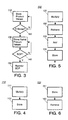
- Figure 3 is a flowchart of a computerized method for generating SOP values according to the present invention;
- Figure 4 is a flowchart of a subroutine for storing product values in a feedback RAM according to the present invention;
- Figure 5 is a flowchart of a subroutine for storing partial presum values in a feedback RAM according to the present invention;
- Figure 6 is a flowchart of a subroutine for reordering SOP values according to the present invention; and
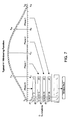
- Figure 7 is a diagram of typical windowing function computing SOPS according to the present invention.
-
- The following discussion of the preferred embodiments directed to using a RAM based feedback module for calculating SOP values is merely exemplary in nature, and is in no way intended to limit the invention or its applications or uses.
- Turning now to Figure 1, a processing engine for generating SOP values for incoming data is shown generally at 10. The
processing engine 10 has acalculation module 30, afeedback module 50, and areordering module 70. It will be appreciated that preferably thecalculation module 30 includes a plurality of calculation sub-modules 31 (Figure 2), wherein eachcalculation sub-module 31 operates on data corresponding to a processing arm of the processing engine. Similarly, thefeedback module 50 includes a plurality of feedback sub-modules 51 (Figure 2), wherein eachfeedback sub-module 51 operates on data corresponding to a processing arm of theprocessing engine 10. In a typical window presuming application, each processing arm (W0-Wn) computes a set of L SOPs each consisting of D summations. Each SOP is of the form:where k=(I+nL) and / denotes the presum number from 0 to L.
- As generally shown in Figure 1, the
calculation module 30 generates intermediate and SOP values based on the incoming data and coefficient values, where the intermediate values are defined by product values and partial presum values. Thefeedback module 50 stores the intermediate values and provides the intermediate values to thecalculation module 30 until thecalculation module 30 generates SOP values. When thecalculation module 30 begins to generate the SOP values, thereordering module 70 reorders the SOP values. Thus, it can be appreciated that storing the product values and partial presum values as intermediate values until thecalculation module 30 begins to generate SOP values allows the elimination of excess memory at the input stages of the design. In other words, thecalculation module 30 need not perform any RAM intensive delaying of the incoming data because thefeedback module 50 is able to accumulate product values and partial presum values without imposing processing delays. - Turning to Figure 2, the benefits of the present invention can be better understood. It can be seen that the
calculation module 30 has amultiplier 32 for multiplying the incoming data by the desired coefficient values, and anadder 33 for adding the product values to the intermediate values stored by thefeedback module 50. A calculation register 34 routes the product values from themultiplier 32 to theadder 33. It will be appreciated that instead of a complex ping-pong RAM, aninput register 35 can be provided at the input for retrieving the incoming data and routing the data among the plurality ofcalculation submodules 31. Preferably, a coefficient read only memory (ROM) 36 contains the coefficient values used in the multiplication function. - The
feedback module 50 includes a switching mechanism shown asdemultiplexer 52, afeedback RAM 53, and aholding register 54. Thedemultiplexer 52 retrieves the intermediate values from thecalculation module 30 for storage until thecalculation module 30 generates SOP values. It can be seen that thedemultiplexer 52 routes the SOP values to thereordering module 70 when the SOP values are present. Thefeedback RAM 53 stores the intermediate values for later use by theadder 33 of thecalculation module 30. The holdingregister 54 retrieves the intermediate values from thefeedback RAM 53, and routes the intermediate values to thecalculation module 30. Preferably, thefeedback RAM 53 is a dual port RAM which can be written to and read from simultaneously. This ability further reduces latency in the processing operations. Thus, for the above SOP equation, the first L products of h(k)d(k) are stored in thefeedback RAM 53 as intermediate values. These values are then retrieved for summation by theadder 33. The results of the summations are stored back to thefeedback RAM 53 as partial presum values until D summations have been performed. At such time, the SOP's are passed to thereordering module 70. - The
reordering module 70 includes areordering RAM configuration 71 for reordering the SOP values. When a DFT operation is to be performed following the SOP processing and the decimation factor is larger than the DFT size, thereordering RAM configuration 71 can be reduced using a ping-pong architecture. Thus, while the preferredreordering RAM configuration 71 shown in Figure 2 includes a plurality of dual port RAMS, it will be appreciated that a ping-pong RAM can also be used. Noting that a DFT can be processed in a number of clock cycles equal to the DFT size (given by L in the above equation), and that the number of clock cycles available to process one DFT is equal to the decimation factor d, when dχL the presummed values for a particular processing arm can be stored in one of two ping-pong RAMS of size LXn bits. It can be seen that thereordering module 70 further includes an input switching mechanism shown asinput multiplexer 72 for retrieving the SOP values from thefeedback module 50. A storage switching mechanism shown asstorage demultiplexer 73 reorders the SOP values in the randomaccess memory configuration 71 while areordering register 74 routes the SOP values from the input multiplexer to the storage demultiplexer. A retrieval switching mechanism shown asretrieval multiplexer 75 retrieves the reordered SOP values from thereordering RAM configuration 71. - Turning now to Figure 3, a computerized method for generating SOP values is shown for programming purposes. At
step 110, product values are stored in the feedback RAM as intermediate values. Step 120 demonstrates that this process is continued until a predetermined number of product values is stored. In the preferred embodiment, the predetermined number of product values equals L. Partial presum values are then stored in the feedback RAM as intermediate values atstep 130 until the calculation module generates SOP values. This moment is reached when D summations have been made for the first set of partial presum values. Once SOP values are obtained atstep 140, the SOP values are reordered atstep 150. - Figure 4 demonstrates the subroutine of storing product values in greater detail. It can be seen that at
step 111, the incoming data is multiplied by predetermined coefficient values. Products of the incoming data and the predetermined coefficient values are then stored in the feedback RAM atstep 112. - Turning now to Figure 5, the subroutine of storing partial presum values is shown in greater detail. It will be appreciated that the incoming data is multiplied by the predetermined coefficient values at
step 131. Atstep 132 the intermediate values contained in the feedback RAM are retrieved. The products of the incoming data and the coefficient values are added to the intermediate values to generate partial presum values atstep 133. Atstep 134 the partial presum values are then stored in the feedback RAM. - Figure 6 demonstrates the subroutine of reordering the SOP values in greater detail. Specifically, the SOP values are stored to the reordering RAM at
step 151, and retrieved from the reordering RAM atstep 152. - Turning now to Figure 7, a typical windowing function can be seen. In this example, the number of summations, D, is equal to four and the predetermined number of product values, L, is equal to twelve. Thus,
product row 81 is initially stored in the feedback RAM andpartial presum rows 82 are subsequently stored in the feedback RAM.SOP row 83 is then passed to the reordering module for reordering - The foregoing discussion discloses and describes merely exemplary embodiments of the present invention. One skilled in the art will readily recognize from such discussion, and from the accompanying drawings and claims, that various changes, modifications and variations can be made therein without departing from the spirit and scope of the invention as defined in the following claims.
Claims (13)
- A processing engine for generating sum of products values for incoming data, the processing engine comprising:a calculation module for generating intermediate values and sum of products values based on the incoming data and coefficient values, the intermediate values defined by product values and partial presum values;a feedback module for storing the intermediate values until the calculation module generates sum of products values; anda reordering module for reordering the sum of product values.
- The processing engine of claim 1 wherein the feedback module includes:a switching mechanism for retrieving the intermediate values from the calculation module until the calculation module generates sum of products values, the switching mechanism routing the sum of products values to the reordering module;a feedback random access memory for storing the intermediate values; anda holding register for retrieving the intermediate values from the feedback random access memory, the holding register routing the intermediate values to the calculation module.
- The processing engine of claim 1 wherein the calculation module includes:a multiplier for multiplying the incoming data by the coefficient values to obtain product values;an adder for adding the product values to the intermediate values; anda calculation register for routing the product values from the multiplier to the adder.
- The processing engine of claim 3 wherein the calculation module further includes an input register for retrieving the incoming data.
- The processing engine of claim 3 wherein the calculation module further includes a coefficient read only memory containing the coefficient values.
- The processing engine of claim 1 wherein the reordering module includes a reordering random access memory configuration for reordering the sum of products values.
- The processing engine of claim 6 wherein the reordering module further includes:an input switching mechanism for retrieving the sum of products values from the feedback module;a storage switching mechanism for reordering the sum of products values in the random access memory configuration;a reordering register for routing the sum of products values from the input switching mechanism to the storage switching mechanism; anda retrieval switching mechanism for retrieving the reordered sum of products values.
- The processing engine of claim 1 wherein the feedback module includes a plurality of feedback submodules, each feedback submodule operating on data corresponding to a processing arm of the processing engine.
- The processing engine of claim 1 wherein the calculation module includes a plurality of calculation submodules, each calculation submodule operating on data corresponding to a processing arm of the processing engine.
- A feedback module for a sum of products processing engine, the feedback module comprising:a switching mechanism for retrieving intermediate values from a calculation module until the calculation module generates sum of products values;a feedback random access memory for storing the intermediate values; anda holding register for retrieving the intermediate values from the feedback random access memory, the holding register routing the intermediate values to the calculation module.
- A computerized method for generating sum of products values for incoming data, the method comprising the steps of:storing product values in a feedback random access memory as intermediate values until a predetermined number of product values is stored;storing partial presum values in the feedback random access memory as intermediate values until a calculation module generates sum of products values, the partial presum values generated from the product values; andreordering the sum of products values.
- The method of claim 11 further including:multiplying the incoming data by predetermined coefficient values; andstoring products of the incoming data and the coefficient values in the feedback random access memory as intermediate values.
- The method of claim 11 further including:multiplying the incoming data by predetermined coefficient values;retrieving the intermediate values from the feedback random access memory;adding products of the incoming data and the coefficient values to the intermediate values to generate partial presum values; andstoring the partial presum values in the feedback random access memory.
Applications Claiming Priority (2)
| Application Number | Priority Date | Filing Date | Title |
|---|---|---|---|
| US09/584,073 US6598062B1 (en) | 2000-05-31 | 2000-05-31 | Ram based processing engine for simultaneous sum of products computation |
| US584073 | 2000-05-31 |
Publications (1)
| Publication Number | Publication Date |
|---|---|
| EP1160680A2 true EP1160680A2 (en) | 2001-12-05 |
Family
ID=24335826
Family Applications (1)
| Application Number | Title | Priority Date | Filing Date |
|---|---|---|---|
| EP01111283A Withdrawn EP1160680A2 (en) | 2000-05-31 | 2001-05-16 | System for calculating sum of products |
Country Status (4)
| Country | Link |
|---|---|
| US (1) | US6598062B1 (en) |
| EP (1) | EP1160680A2 (en) |
| JP (1) | JP2002007376A (en) |
| CA (1) | CA2342754A1 (en) |
Families Citing this family (1)
| Publication number | Priority date | Publication date | Assignee | Title |
|---|---|---|---|---|
| US7867845B2 (en) * | 2005-09-01 | 2011-01-11 | Micron Technology, Inc. | Transistor gate forming methods and transistor structures |
Family Cites Families (4)
| Publication number | Priority date | Publication date | Assignee | Title |
|---|---|---|---|---|
| GB2108736B (en) * | 1981-10-27 | 1984-12-12 | Standard Telephones Cables Ltd | Sum of products multiplier |
| EP0557204A3 (en) * | 1992-02-21 | 1995-10-18 | Sony Corp | Discrete cosine transform apparatus and inverse discrete cosine transform apparatus |
| JPH07253965A (en) * | 1994-03-16 | 1995-10-03 | Fujitsu Ltd | Multiply-accumulator |
| US5732251A (en) * | 1996-05-06 | 1998-03-24 | Advanced Micro Devices | DSP with register file and multi-function instruction sequencer for vector processing by MACU |
-
2000
- 2000-05-31 US US09/584,073 patent/US6598062B1/en not_active Expired - Lifetime
-
2001
- 2001-04-04 CA CA002342754A patent/CA2342754A1/en not_active Abandoned
- 2001-04-19 JP JP2001120622A patent/JP2002007376A/en not_active Withdrawn
- 2001-05-16 EP EP01111283A patent/EP1160680A2/en not_active Withdrawn
Also Published As
| Publication number | Publication date |
|---|---|
| CA2342754A1 (en) | 2001-11-30 |
| JP2002007376A (en) | 2002-01-11 |
| US6598062B1 (en) | 2003-07-22 |
Similar Documents
| Publication | Publication Date | Title |
|---|---|---|
| US5500811A (en) | Finite impulse response filter | |
| US5287299A (en) | Method and apparatus for implementing a digital filter employing coefficients expressed as sums of 2 to an integer power | |
| JP3000325B2 (en) | Finite impulse response digital filter | |
| US5255216A (en) | Reduced hardware look up table multiplier | |
| US4766561A (en) | Method and apparatus for implementing multiple filters with shared components | |
| JPH039471A (en) | Moving average processor | |
| US4817025A (en) | Digital filter | |
| US5594675A (en) | Reduced signal processing requirement sample and hold linear phase interpolative fir filter | |
| US7046723B2 (en) | Digital filter and method for performing a multiplication based on a look-up table | |
| NL8601183A (en) | DISCRETE COSINUS TRANSFORMATION DEVICE. | |
| US7480689B2 (en) | Systolic de-multiplexed finite impulse response filter array architecture for linear and non-linear implementations | |
| US6202074B1 (en) | Multiplierless digital filtering | |
| US4750144A (en) | Real time pipelined system for forming the sum of products in the processing of video data | |
| US6598062B1 (en) | Ram based processing engine for simultaneous sum of products computation | |
| US8090013B2 (en) | Method and system of providing a high speed Tomlinson-Harashima Precoder | |
| JPH0744530A (en) | Arithmetic unit | |
| Ramirez et al. | High performance, reduced complexity programmable RNS-FPL merged FIR filters | |
| US7461113B2 (en) | Reduced complexity adaptive filter | |
| EP0782260A2 (en) | Equalizer filter configuration for processing real-valued and complex-valued signal samples | |
| US20070005830A1 (en) | Systems and methods for weighted overlap and add processing | |
| EP0037130B1 (en) | Arrangement for calculating the discrete fourier transform by means of two circular convolutions | |
| JP2001522576A (en) | Shared resources for digital filters | |
| Mohanty et al. | Efficient multiplierless designs for 1-D DWT using 9/7 filters based on distributed arithmetic | |
| EP0426296B1 (en) | Apparatus having modular interpolation architecture | |
| Amira et al. | An FPGA implementation of Walsh-Hadamard transforms for signal processing |
Legal Events
| Date | Code | Title | Description |
|---|---|---|---|
| PUAI | Public reference made under article 153(3) epc to a published international application that has entered the european phase |
Free format text: ORIGINAL CODE: 0009012 |
|
| AK | Designated contracting states |
Kind code of ref document: A2 Designated state(s): AT BE CH CY DE DK ES FI FR GB GR IE IT LI LU MC NL PT SE TR |
|
| AX | Request for extension of the european patent |
Free format text: AL;LT;LV;MK;RO;SI |
|
| RAP1 | Party data changed (applicant data changed or rights of an application transferred) |
Owner name: NORTHROP GRUMMAN CORPORATION |
|
| RAP1 | Party data changed (applicant data changed or rights of an application transferred) |
Owner name: NORTHROP GRUMMAN CORPORATION |
|
| STAA | Information on the status of an ep patent application or granted ep patent |
Free format text: STATUS: THE APPLICATION HAS BEEN WITHDRAWN |
|
| 18W | Application withdrawn |
Effective date: 20040326 |