EP1160321A1 - Kidney Injury Novel Gene-1: Isolation and therapeutic applications - Google Patents
Kidney Injury Novel Gene-1: Isolation and therapeutic applications Download PDFInfo
- Publication number
- EP1160321A1 EP1160321A1 EP00401531A EP00401531A EP1160321A1 EP 1160321 A1 EP1160321 A1 EP 1160321A1 EP 00401531 A EP00401531 A EP 00401531A EP 00401531 A EP00401531 A EP 00401531A EP 1160321 A1 EP1160321 A1 EP 1160321A1
- Authority
- EP
- European Patent Office
- Prior art keywords
- seq
- polypeptide
- king
- nucleotide sequence
- amino acid
- Prior art date
- Legal status (The legal status is an assumption and is not a legal conclusion. Google has not performed a legal analysis and makes no representation as to the accuracy of the status listed.)
- Ceased
Links
- 206010061481 Renal injury Diseases 0.000 title claims abstract description 23
- 208000037806 kidney injury Diseases 0.000 title claims abstract description 22
- 230000001225 therapeutic effect Effects 0.000 title description 6
- 238000002955 isolation Methods 0.000 title description 2
- 108090000765 processed proteins & peptides Proteins 0.000 claims abstract description 232
- 102000004196 processed proteins & peptides Human genes 0.000 claims abstract description 219
- 229920001184 polypeptide Polymers 0.000 claims abstract description 212
- 108091033319 polynucleotide Proteins 0.000 claims abstract description 81
- 102000040430 polynucleotide Human genes 0.000 claims abstract description 81
- 239000002157 polynucleotide Substances 0.000 claims abstract description 80
- 238000000034 method Methods 0.000 claims abstract description 68
- 238000003556 assay Methods 0.000 claims abstract description 9
- 238000011282 treatment Methods 0.000 claims abstract description 7
- 125000003729 nucleotide group Chemical group 0.000 claims description 81
- 239000002773 nucleotide Substances 0.000 claims description 80
- 210000004027 cell Anatomy 0.000 claims description 55
- 125000003275 alpha amino acid group Chemical group 0.000 claims description 47
- 239000002299 complementary DNA Substances 0.000 claims description 45
- 239000012634 fragment Substances 0.000 claims description 39
- 201000010099 disease Diseases 0.000 claims description 38
- 208000037265 diseases, disorders, signs and symptoms Diseases 0.000 claims description 38
- 230000014509 gene expression Effects 0.000 claims description 36
- 108020004414 DNA Proteins 0.000 claims description 34
- 150000001413 amino acids Chemical class 0.000 claims description 31
- 230000000694 effects Effects 0.000 claims description 31
- 108091032973 (ribonucleotides)n+m Proteins 0.000 claims description 25
- 239000013598 vector Substances 0.000 claims description 25
- 150000001875 compounds Chemical class 0.000 claims description 22
- 239000000203 mixture Substances 0.000 claims description 21
- FWMNVWWHGCHHJJ-SKKKGAJSSA-N 4-amino-1-[(2r)-6-amino-2-[[(2r)-2-[[(2r)-2-[[(2r)-2-amino-3-phenylpropanoyl]amino]-3-phenylpropanoyl]amino]-4-methylpentanoyl]amino]hexanoyl]piperidine-4-carboxylic acid Chemical compound C([C@H](C(=O)N[C@H](CC(C)C)C(=O)N[C@H](CCCCN)C(=O)N1CCC(N)(CC1)C(O)=O)NC(=O)[C@H](N)CC=1C=CC=CC=1)C1=CC=CC=C1 FWMNVWWHGCHHJJ-SKKKGAJSSA-N 0.000 claims description 18
- 230000000302 ischemic effect Effects 0.000 claims description 16
- 108091028043 Nucleic acid sequence Proteins 0.000 claims description 15
- 239000000556 agonist Substances 0.000 claims description 14
- 239000008194 pharmaceutical composition Substances 0.000 claims description 14
- 239000005557 antagonist Substances 0.000 claims description 11
- 102000039446 nucleic acids Human genes 0.000 claims description 11
- 108020004707 nucleic acids Proteins 0.000 claims description 11
- 150000007523 nucleic acids Chemical class 0.000 claims description 11
- 230000002062 proliferating effect Effects 0.000 claims description 11
- 206010007559 Cardiac failure congestive Diseases 0.000 claims description 10
- 208000007342 Diabetic Nephropathies Diseases 0.000 claims description 10
- 206010018364 Glomerulonephritis Diseases 0.000 claims description 10
- 206010019280 Heart failures Diseases 0.000 claims description 10
- 206010020772 Hypertension Diseases 0.000 claims description 10
- 208000001647 Renal Insufficiency Diseases 0.000 claims description 10
- 208000020832 chronic kidney disease Diseases 0.000 claims description 10
- 208000022831 chronic renal failure syndrome Diseases 0.000 claims description 10
- 208000033679 diabetic kidney disease Diseases 0.000 claims description 10
- 238000001727 in vivo Methods 0.000 claims description 10
- 230000002757 inflammatory effect Effects 0.000 claims description 10
- 201000006370 kidney failure Diseases 0.000 claims description 10
- 238000004519 manufacturing process Methods 0.000 claims description 10
- 230000035772 mutation Effects 0.000 claims description 10
- 208000010125 myocardial infarction Diseases 0.000 claims description 10
- 208000031225 myocardial ischemia Diseases 0.000 claims description 10
- 239000003446 ligand Substances 0.000 claims description 9
- 230000008569 process Effects 0.000 claims description 9
- 238000012216 screening Methods 0.000 claims description 8
- 239000000758 substrate Substances 0.000 claims description 7
- 102000004190 Enzymes Human genes 0.000 claims description 5
- 108090000790 Enzymes Proteins 0.000 claims description 5
- 230000004913 activation Effects 0.000 claims description 5
- 230000003292 diminished effect Effects 0.000 claims description 5
- 239000003937 drug carrier Substances 0.000 claims description 5
- 238000003786 synthesis reaction Methods 0.000 claims description 5
- 230000000295 complement effect Effects 0.000 claims description 4
- 210000000170 cell membrane Anatomy 0.000 claims description 3
- 230000002265 prevention Effects 0.000 claims description 3
- 238000012258 culturing Methods 0.000 claims description 2
- 230000002018 overexpression Effects 0.000 claims description 2
- 230000009452 underexpressoin Effects 0.000 claims description 2
- 230000002508 compound effect Effects 0.000 claims 1
- 230000001131 transforming effect Effects 0.000 claims 1
- 230000007170 pathology Effects 0.000 abstract description 2
- 238000010188 recombinant method Methods 0.000 abstract description 2
- 108090000623 proteins and genes Proteins 0.000 description 81
- 102000004169 proteins and genes Human genes 0.000 description 56
- 235000018102 proteins Nutrition 0.000 description 55
- 235000001014 amino acid Nutrition 0.000 description 29
- 229940024606 amino acid Drugs 0.000 description 25
- 241000282414 Homo sapiens Species 0.000 description 20
- 238000009396 hybridization Methods 0.000 description 14
- 108020004999 messenger RNA Proteins 0.000 description 14
- 108020003175 receptors Proteins 0.000 description 14
- 102000005962 receptors Human genes 0.000 description 14
- 239000000523 sample Substances 0.000 description 13
- 241000124008 Mammalia Species 0.000 description 12
- 125000000539 amino acid group Chemical group 0.000 description 12
- 241000700159 Rattus Species 0.000 description 11
- 230000027455 binding Effects 0.000 description 11
- 238000009472 formulation Methods 0.000 description 11
- 239000000463 material Substances 0.000 description 11
- 210000003734 kidney Anatomy 0.000 description 10
- 238000004458 analytical method Methods 0.000 description 9
- 230000000890 antigenic effect Effects 0.000 description 9
- 238000013459 approach Methods 0.000 description 9
- 108020001507 fusion proteins Proteins 0.000 description 9
- 102000037865 fusion proteins Human genes 0.000 description 9
- 238000000746 purification Methods 0.000 description 9
- 208000009304 Acute Kidney Injury Diseases 0.000 description 8
- 208000033626 Renal failure acute Diseases 0.000 description 8
- 201000011040 acute kidney failure Diseases 0.000 description 8
- 208000012998 acute renal failure Diseases 0.000 description 8
- 239000012472 biological sample Substances 0.000 description 8
- 230000002068 genetic effect Effects 0.000 description 8
- 230000010410 reperfusion Effects 0.000 description 8
- 239000013612 plasmid Substances 0.000 description 7
- 239000000243 solution Substances 0.000 description 7
- 238000006467 substitution reaction Methods 0.000 description 7
- 210000001519 tissue Anatomy 0.000 description 7
- PEDCQBHIVMGVHV-UHFFFAOYSA-N Glycerine Chemical compound OCC(O)CO PEDCQBHIVMGVHV-UHFFFAOYSA-N 0.000 description 6
- 241001465754 Metazoa Species 0.000 description 6
- HEMHJVSKTPXQMS-UHFFFAOYSA-M Sodium hydroxide Chemical compound [OH-].[Na+] HEMHJVSKTPXQMS-UHFFFAOYSA-M 0.000 description 6
- 239000004480 active ingredient Substances 0.000 description 6
- 230000015572 biosynthetic process Effects 0.000 description 6
- 238000012217 deletion Methods 0.000 description 6
- 230000037430 deletion Effects 0.000 description 6
- 230000002163 immunogen Effects 0.000 description 6
- 239000012528 membrane Substances 0.000 description 6
- 230000004048 modification Effects 0.000 description 6
- 238000012986 modification Methods 0.000 description 6
- 238000003752 polymerase chain reaction Methods 0.000 description 6
- 108091026890 Coding region Proteins 0.000 description 5
- 238000000636 Northern blotting Methods 0.000 description 5
- 241000700605 Viruses Species 0.000 description 5
- 238000007792 addition Methods 0.000 description 5
- 125000003178 carboxy group Chemical group [H]OC(*)=O 0.000 description 5
- 238000003776 cleavage reaction Methods 0.000 description 5
- 230000006870 function Effects 0.000 description 5
- 230000028993 immune response Effects 0.000 description 5
- 230000001965 increasing effect Effects 0.000 description 5
- 125000002924 primary amino group Chemical group [H]N([H])* 0.000 description 5
- 125000006239 protecting group Chemical group 0.000 description 5
- 230000001177 retroviral effect Effects 0.000 description 5
- 230000007017 scission Effects 0.000 description 5
- 230000003248 secreting effect Effects 0.000 description 5
- 239000000126 substance Substances 0.000 description 5
- 230000014616 translation Effects 0.000 description 5
- 238000013519 translation Methods 0.000 description 5
- 102000040650 (ribonucleotides)n+m Human genes 0.000 description 4
- 108020004635 Complementary DNA Proteins 0.000 description 4
- 102000053602 DNA Human genes 0.000 description 4
- 241000588724 Escherichia coli Species 0.000 description 4
- 108060003951 Immunoglobulin Proteins 0.000 description 4
- 108091034117 Oligonucleotide Proteins 0.000 description 4
- 108700026244 Open Reading Frames Proteins 0.000 description 4
- JLCPHMBAVCMARE-UHFFFAOYSA-N [3-[[3-[[3-[[3-[[3-[[3-[[3-[[3-[[3-[[3-[[3-[[5-(2-amino-6-oxo-1H-purin-9-yl)-3-[[3-[[3-[[3-[[3-[[3-[[5-(2-amino-6-oxo-1H-purin-9-yl)-3-[[5-(2-amino-6-oxo-1H-purin-9-yl)-3-hydroxyoxolan-2-yl]methoxy-hydroxyphosphoryl]oxyoxolan-2-yl]methoxy-hydroxyphosphoryl]oxy-5-(5-methyl-2,4-dioxopyrimidin-1-yl)oxolan-2-yl]methoxy-hydroxyphosphoryl]oxy-5-(6-aminopurin-9-yl)oxolan-2-yl]methoxy-hydroxyphosphoryl]oxy-5-(6-aminopurin-9-yl)oxolan-2-yl]methoxy-hydroxyphosphoryl]oxy-5-(6-aminopurin-9-yl)oxolan-2-yl]methoxy-hydroxyphosphoryl]oxy-5-(6-aminopurin-9-yl)oxolan-2-yl]methoxy-hydroxyphosphoryl]oxyoxolan-2-yl]methoxy-hydroxyphosphoryl]oxy-5-(5-methyl-2,4-dioxopyrimidin-1-yl)oxolan-2-yl]methoxy-hydroxyphosphoryl]oxy-5-(4-amino-2-oxopyrimidin-1-yl)oxolan-2-yl]methoxy-hydroxyphosphoryl]oxy-5-(5-methyl-2,4-dioxopyrimidin-1-yl)oxolan-2-yl]methoxy-hydroxyphosphoryl]oxy-5-(5-methyl-2,4-dioxopyrimidin-1-yl)oxolan-2-yl]methoxy-hydroxyphosphoryl]oxy-5-(6-aminopurin-9-yl)oxolan-2-yl]methoxy-hydroxyphosphoryl]oxy-5-(6-aminopurin-9-yl)oxolan-2-yl]methoxy-hydroxyphosphoryl]oxy-5-(4-amino-2-oxopyrimidin-1-yl)oxolan-2-yl]methoxy-hydroxyphosphoryl]oxy-5-(4-amino-2-oxopyrimidin-1-yl)oxolan-2-yl]methoxy-hydroxyphosphoryl]oxy-5-(4-amino-2-oxopyrimidin-1-yl)oxolan-2-yl]methoxy-hydroxyphosphoryl]oxy-5-(6-aminopurin-9-yl)oxolan-2-yl]methoxy-hydroxyphosphoryl]oxy-5-(4-amino-2-oxopyrimidin-1-yl)oxolan-2-yl]methyl [5-(6-aminopurin-9-yl)-2-(hydroxymethyl)oxolan-3-yl] hydrogen phosphate Polymers Cc1cn(C2CC(OP(O)(=O)OCC3OC(CC3OP(O)(=O)OCC3OC(CC3O)n3cnc4c3nc(N)[nH]c4=O)n3cnc4c3nc(N)[nH]c4=O)C(COP(O)(=O)OC3CC(OC3COP(O)(=O)OC3CC(OC3COP(O)(=O)OC3CC(OC3COP(O)(=O)OC3CC(OC3COP(O)(=O)OC3CC(OC3COP(O)(=O)OC3CC(OC3COP(O)(=O)OC3CC(OC3COP(O)(=O)OC3CC(OC3COP(O)(=O)OC3CC(OC3COP(O)(=O)OC3CC(OC3COP(O)(=O)OC3CC(OC3COP(O)(=O)OC3CC(OC3COP(O)(=O)OC3CC(OC3COP(O)(=O)OC3CC(OC3COP(O)(=O)OC3CC(OC3COP(O)(=O)OC3CC(OC3COP(O)(=O)OC3CC(OC3CO)n3cnc4c(N)ncnc34)n3ccc(N)nc3=O)n3cnc4c(N)ncnc34)n3ccc(N)nc3=O)n3ccc(N)nc3=O)n3ccc(N)nc3=O)n3cnc4c(N)ncnc34)n3cnc4c(N)ncnc34)n3cc(C)c(=O)[nH]c3=O)n3cc(C)c(=O)[nH]c3=O)n3ccc(N)nc3=O)n3cc(C)c(=O)[nH]c3=O)n3cnc4c3nc(N)[nH]c4=O)n3cnc4c(N)ncnc34)n3cnc4c(N)ncnc34)n3cnc4c(N)ncnc34)n3cnc4c(N)ncnc34)O2)c(=O)[nH]c1=O JLCPHMBAVCMARE-UHFFFAOYSA-N 0.000 description 4
- 210000004369 blood Anatomy 0.000 description 4
- 239000008280 blood Substances 0.000 description 4
- 230000002759 chromosomal effect Effects 0.000 description 4
- 210000000349 chromosome Anatomy 0.000 description 4
- 238000001514 detection method Methods 0.000 description 4
- 229940088598 enzyme Drugs 0.000 description 4
- 238000005755 formation reaction Methods 0.000 description 4
- 238000001415 gene therapy Methods 0.000 description 4
- 102000018358 immunoglobulin Human genes 0.000 description 4
- 239000003112 inhibitor Substances 0.000 description 4
- 238000002347 injection Methods 0.000 description 4
- 239000007924 injection Substances 0.000 description 4
- 210000004962 mammalian cell Anatomy 0.000 description 4
- 239000003550 marker Substances 0.000 description 4
- 238000002360 preparation method Methods 0.000 description 4
- 230000028327 secretion Effects 0.000 description 4
- 229960005486 vaccine Drugs 0.000 description 4
- LFQSCWFLJHTTHZ-UHFFFAOYSA-N Ethanol Chemical compound CCO LFQSCWFLJHTTHZ-UHFFFAOYSA-N 0.000 description 3
- WSFSSNUMVMOOMR-UHFFFAOYSA-N Formaldehyde Chemical compound O=C WSFSSNUMVMOOMR-UHFFFAOYSA-N 0.000 description 3
- 206010063897 Renal ischaemia Diseases 0.000 description 3
- 240000004808 Saccharomyces cerevisiae Species 0.000 description 3
- FAPWRFPIFSIZLT-UHFFFAOYSA-M Sodium chloride Chemical compound [Na+].[Cl-] FAPWRFPIFSIZLT-UHFFFAOYSA-M 0.000 description 3
- 230000002159 abnormal effect Effects 0.000 description 3
- 230000004075 alteration Effects 0.000 description 3
- 230000000692 anti-sense effect Effects 0.000 description 3
- 230000001580 bacterial effect Effects 0.000 description 3
- 230000004071 biological effect Effects 0.000 description 3
- 210000001124 body fluid Anatomy 0.000 description 3
- 239000010839 body fluid Substances 0.000 description 3
- 238000004587 chromatography analysis Methods 0.000 description 3
- 230000001276 controlling effect Effects 0.000 description 3
- 125000004122 cyclic group Chemical group 0.000 description 3
- 238000003745 diagnosis Methods 0.000 description 3
- 238000005516 engineering process Methods 0.000 description 3
- 230000004927 fusion Effects 0.000 description 3
- 238000003780 insertion Methods 0.000 description 3
- 230000037431 insertion Effects 0.000 description 3
- 230000003907 kidney function Effects 0.000 description 3
- 238000011694 lewis rat Methods 0.000 description 3
- 230000001404 mediated effect Effects 0.000 description 3
- 238000000329 molecular dynamics simulation Methods 0.000 description 3
- 238000011160 research Methods 0.000 description 3
- 238000010839 reverse transcription Methods 0.000 description 3
- 238000007423 screening assay Methods 0.000 description 3
- 150000003384 small molecules Chemical class 0.000 description 3
- 241000894007 species Species 0.000 description 3
- 238000012360 testing method Methods 0.000 description 3
- 238000001890 transfection Methods 0.000 description 3
- 238000005406 washing Methods 0.000 description 3
- YBJHBAHKTGYVGT-ZKWXMUAHSA-N (+)-Biotin Chemical compound N1C(=O)N[C@@H]2[C@H](CCCCC(=O)O)SC[C@@H]21 YBJHBAHKTGYVGT-ZKWXMUAHSA-N 0.000 description 2
- IJGRMHOSHXDMSA-UHFFFAOYSA-N Atomic nitrogen Chemical compound N#N IJGRMHOSHXDMSA-UHFFFAOYSA-N 0.000 description 2
- 241000972773 Aulopiformes Species 0.000 description 2
- 241000894006 Bacteria Species 0.000 description 2
- 241000255581 Drosophila <fruit fly, genus> Species 0.000 description 2
- 238000002965 ELISA Methods 0.000 description 2
- 108091060211 Expressed sequence tag Proteins 0.000 description 2
- ZHNUHDYFZUAESO-UHFFFAOYSA-N Formamide Chemical compound NC=O ZHNUHDYFZUAESO-UHFFFAOYSA-N 0.000 description 2
- 241000238631 Hexapoda Species 0.000 description 2
- 241000829100 Macaca mulatta polyomavirus 1 Species 0.000 description 2
- 101710163270 Nuclease Proteins 0.000 description 2
- 239000004677 Nylon Substances 0.000 description 2
- 108020004511 Recombinant DNA Proteins 0.000 description 2
- 102000006382 Ribonucleases Human genes 0.000 description 2
- 108010083644 Ribonucleases Proteins 0.000 description 2
- 241000714474 Rous sarcoma virus Species 0.000 description 2
- 238000012300 Sequence Analysis Methods 0.000 description 2
- 208000027418 Wounds and injury Diseases 0.000 description 2
- 239000002253 acid Substances 0.000 description 2
- 238000001042 affinity chromatography Methods 0.000 description 2
- 230000003321 amplification Effects 0.000 description 2
- 238000010171 animal model Methods 0.000 description 2
- 230000000903 blocking effect Effects 0.000 description 2
- -1 cationic lipid Chemical class 0.000 description 2
- 238000004113 cell culture Methods 0.000 description 2
- 238000012512 characterization method Methods 0.000 description 2
- 238000010367 cloning Methods 0.000 description 2
- 238000004590 computer program Methods 0.000 description 2
- DDRJAANPRJIHGJ-UHFFFAOYSA-N creatinine Chemical compound CN1CC(=O)NC1=N DDRJAANPRJIHGJ-UHFFFAOYSA-N 0.000 description 2
- 230000006378 damage Effects 0.000 description 2
- 230000003247 decreasing effect Effects 0.000 description 2
- 238000011161 development Methods 0.000 description 2
- 230000018109 developmental process Effects 0.000 description 2
- 239000003814 drug Substances 0.000 description 2
- 239000013604 expression vector Substances 0.000 description 2
- 239000000499 gel Substances 0.000 description 2
- 210000004408 hybridoma Anatomy 0.000 description 2
- 230000002209 hydrophobic effect Effects 0.000 description 2
- 230000001976 improved effect Effects 0.000 description 2
- 238000000338 in vitro Methods 0.000 description 2
- 238000011534 incubation Methods 0.000 description 2
- 230000001939 inductive effect Effects 0.000 description 2
- 208000015181 infectious disease Diseases 0.000 description 2
- 230000002401 inhibitory effect Effects 0.000 description 2
- 208000014674 injury Diseases 0.000 description 2
- 238000007918 intramuscular administration Methods 0.000 description 2
- 238000010253 intravenous injection Methods 0.000 description 2
- 208000037906 ischaemic injury Diseases 0.000 description 2
- 208000028867 ischemia Diseases 0.000 description 2
- 150000002632 lipids Chemical class 0.000 description 2
- 239000007788 liquid Substances 0.000 description 2
- 238000013507 mapping Methods 0.000 description 2
- 238000010369 molecular cloning Methods 0.000 description 2
- 229910052757 nitrogen Inorganic materials 0.000 description 2
- 238000003199 nucleic acid amplification method Methods 0.000 description 2
- 229920001778 nylon Polymers 0.000 description 2
- 238000004806 packaging method and process Methods 0.000 description 2
- 210000002381 plasma Anatomy 0.000 description 2
- 239000013600 plasmid vector Substances 0.000 description 2
- 230000004481 post-translational protein modification Effects 0.000 description 2
- 230000001323 posttranslational effect Effects 0.000 description 2
- 238000012545 processing Methods 0.000 description 2
- 230000000069 prophylactic effect Effects 0.000 description 2
- 230000009145 protein modification Effects 0.000 description 2
- 238000003127 radioimmunoassay Methods 0.000 description 2
- 230000004044 response Effects 0.000 description 2
- 210000003296 saliva Anatomy 0.000 description 2
- 235000019515 salmon Nutrition 0.000 description 2
- 239000011780 sodium chloride Substances 0.000 description 2
- 229910000162 sodium phosphate Inorganic materials 0.000 description 2
- 239000007790 solid phase Substances 0.000 description 2
- 238000010561 standard procedure Methods 0.000 description 2
- 238000007920 subcutaneous administration Methods 0.000 description 2
- 238000007910 systemic administration Methods 0.000 description 2
- 210000001550 testis Anatomy 0.000 description 2
- 238000002560 therapeutic procedure Methods 0.000 description 2
- 230000034512 ubiquitination Effects 0.000 description 2
- 238000010798 ubiquitination Methods 0.000 description 2
- 241001515965 unidentified phage Species 0.000 description 2
- 210000002700 urine Anatomy 0.000 description 2
- XLYOFNOQVPJJNP-UHFFFAOYSA-N water Substances O XLYOFNOQVPJJNP-UHFFFAOYSA-N 0.000 description 2
- KUHSEZKIEJYEHN-BXRBKJIMSA-N (2s)-2-amino-3-hydroxypropanoic acid;(2s)-2-aminopropanoic acid Chemical compound C[C@H](N)C(O)=O.OC[C@H](N)C(O)=O KUHSEZKIEJYEHN-BXRBKJIMSA-N 0.000 description 1
- PSLCKQYQNVNTQI-BHFSHLQUSA-N (2s)-2-aminobutanedioic acid;(2s)-2-aminopentanedioic acid Chemical compound OC(=O)[C@@H](N)CC(O)=O.OC(=O)[C@@H](N)CCC(O)=O PSLCKQYQNVNTQI-BHFSHLQUSA-N 0.000 description 1
- 125000003088 (fluoren-9-ylmethoxy)carbonyl group Chemical group 0.000 description 1
- ODHCTXKNWHHXJC-VKHMYHEASA-N 5-oxo-L-proline Chemical compound OC(=O)[C@@H]1CCC(=O)N1 ODHCTXKNWHHXJC-VKHMYHEASA-N 0.000 description 1
- ZCYVEMRRCGMTRW-UHFFFAOYSA-N 7553-56-2 Chemical compound [I] ZCYVEMRRCGMTRW-UHFFFAOYSA-N 0.000 description 1
- 230000005730 ADP ribosylation Effects 0.000 description 1
- 108010085238 Actins Proteins 0.000 description 1
- 102000007469 Actins Human genes 0.000 description 1
- DCXYFEDJOCDNAF-UHFFFAOYSA-N Asparagine Natural products OC(=O)C(N)CC(N)=O DCXYFEDJOCDNAF-UHFFFAOYSA-N 0.000 description 1
- 241000228212 Aspergillus Species 0.000 description 1
- 244000063299 Bacillus subtilis Species 0.000 description 1
- 235000014469 Bacillus subtilis Nutrition 0.000 description 1
- 241000283690 Bos taurus Species 0.000 description 1
- 125000001433 C-terminal amino-acid group Chemical group 0.000 description 1
- 241000282472 Canis lupus familiaris Species 0.000 description 1
- OKTJSMMVPCPJKN-UHFFFAOYSA-N Carbon Chemical compound [C] OKTJSMMVPCPJKN-UHFFFAOYSA-N 0.000 description 1
- 241000282693 Cercopithecidae Species 0.000 description 1
- 150000008574 D-amino acids Chemical class 0.000 description 1
- LEVWYRKDKASIDU-QWWZWVQMSA-N D-cystine Chemical compound OC(=O)[C@H](N)CSSC[C@@H](N)C(O)=O LEVWYRKDKASIDU-QWWZWVQMSA-N 0.000 description 1
- 238000001712 DNA sequencing Methods 0.000 description 1
- 229920002307 Dextran Polymers 0.000 description 1
- BWGNESOTFCXPMA-UHFFFAOYSA-N Dihydrogen disulfide Chemical compound SS BWGNESOTFCXPMA-UHFFFAOYSA-N 0.000 description 1
- KCXVZYZYPLLWCC-UHFFFAOYSA-N EDTA Chemical compound OC(=O)CN(CC(O)=O)CCN(CC(O)=O)CC(O)=O KCXVZYZYPLLWCC-UHFFFAOYSA-N 0.000 description 1
- 241000196324 Embryophyta Species 0.000 description 1
- 241000283086 Equidae Species 0.000 description 1
- 241000701959 Escherichia virus Lambda Species 0.000 description 1
- 108700039887 Essential Genes Proteins 0.000 description 1
- 241000282326 Felis catus Species 0.000 description 1
- 241000700662 Fowlpox virus Species 0.000 description 1
- WQZGKKKJIJFFOK-GASJEMHNSA-N Glucose Natural products OC[C@H]1OC(O)[C@H](O)[C@@H](O)[C@@H]1O WQZGKKKJIJFFOK-GASJEMHNSA-N 0.000 description 1
- 108010015776 Glucose oxidase Proteins 0.000 description 1
- 239000004366 Glucose oxidase Substances 0.000 description 1
- 102100031181 Glyceraldehyde-3-phosphate dehydrogenase Human genes 0.000 description 1
- HVLSXIKZNLPZJJ-TXZCQADKSA-N HA peptide Chemical group C([C@@H](C(=O)N[C@@H](CC(O)=O)C(=O)N[C@@H](C(C)C)C(=O)N1[C@@H](CCC1)C(=O)N[C@@H](CC(O)=O)C(=O)N[C@@H](CC=1C=CC(O)=CC=1)C(=O)N[C@@H](C)C(O)=O)NC(=O)[C@H]1N(CCC1)C(=O)[C@@H](N)CC=1C=CC(O)=CC=1)C1=CC=C(O)C=C1 HVLSXIKZNLPZJJ-TXZCQADKSA-N 0.000 description 1
- 108010093488 His-His-His-His-His-His Proteins 0.000 description 1
- 241001272567 Hominoidea Species 0.000 description 1
- 241000282412 Homo Species 0.000 description 1
- 102000003839 Human Proteins Human genes 0.000 description 1
- 108090000144 Human Proteins Proteins 0.000 description 1
- 102000001706 Immunoglobulin Fab Fragments Human genes 0.000 description 1
- 108010054477 Immunoglobulin Fab Fragments Proteins 0.000 description 1
- 229930010555 Inosine Natural products 0.000 description 1
- UGQMRVRMYYASKQ-KQYNXXCUSA-N Inosine Chemical compound O[C@@H]1[C@H](O)[C@@H](CO)O[C@H]1N1C2=NC=NC(O)=C2N=C1 UGQMRVRMYYASKQ-KQYNXXCUSA-N 0.000 description 1
- 102100034343 Integrase Human genes 0.000 description 1
- QNAYBMKLOCPYGJ-REOHCLBHSA-N L-alanine Chemical compound C[C@H](N)C(O)=O QNAYBMKLOCPYGJ-REOHCLBHSA-N 0.000 description 1
- DCXYFEDJOCDNAF-REOHCLBHSA-N L-asparagine Chemical compound OC(=O)[C@@H](N)CC(N)=O DCXYFEDJOCDNAF-REOHCLBHSA-N 0.000 description 1
- AGPKZVBTJJNPAG-WHFBIAKZSA-N L-isoleucine Chemical compound CC[C@H](C)[C@H](N)C(O)=O AGPKZVBTJJNPAG-WHFBIAKZSA-N 0.000 description 1
- ROHFNLRQFUQHCH-YFKPBYRVSA-N L-leucine Chemical compound CC(C)C[C@H](N)C(O)=O ROHFNLRQFUQHCH-YFKPBYRVSA-N 0.000 description 1
- FFEARJCKVFRZRR-BYPYZUCNSA-N L-methionine Chemical compound CSCC[C@H](N)C(O)=O FFEARJCKVFRZRR-BYPYZUCNSA-N 0.000 description 1
- COLNVLDHVKWLRT-QMMMGPOBSA-N L-phenylalanine Chemical compound OC(=O)[C@@H](N)CC1=CC=CC=C1 COLNVLDHVKWLRT-QMMMGPOBSA-N 0.000 description 1
- QIVBCDIJIAJPQS-VIFPVBQESA-N L-tryptophane Chemical compound C1=CC=C2C(C[C@H](N)C(O)=O)=CNC2=C1 QIVBCDIJIAJPQS-VIFPVBQESA-N 0.000 description 1
- OUYCCCASQSFEME-QMMMGPOBSA-N L-tyrosine Chemical compound OC(=O)[C@@H](N)CC1=CC=C(O)C=C1 OUYCCCASQSFEME-QMMMGPOBSA-N 0.000 description 1
- KZSNJWFQEVHDMF-BYPYZUCNSA-N L-valine Chemical compound CC(C)[C@H](N)C(O)=O KZSNJWFQEVHDMF-BYPYZUCNSA-N 0.000 description 1
- 108090001090 Lectins Proteins 0.000 description 1
- 102000004856 Lectins Human genes 0.000 description 1
- ROHFNLRQFUQHCH-UHFFFAOYSA-N Leucine Natural products CC(C)CC(N)C(O)=O ROHFNLRQFUQHCH-UHFFFAOYSA-N 0.000 description 1
- 241000699666 Mus <mouse, genus> Species 0.000 description 1
- 241000699660 Mus musculus Species 0.000 description 1
- 238000005481 NMR spectroscopy Methods 0.000 description 1
- 206010028851 Necrosis Diseases 0.000 description 1
- 229930193140 Neomycin Natural products 0.000 description 1
- 101100384865 Neurospora crassa (strain ATCC 24698 / 74-OR23-1A / CBS 708.71 / DSM 1257 / FGSC 987) cot-1 gene Proteins 0.000 description 1
- 102000015636 Oligopeptides Human genes 0.000 description 1
- 108010038807 Oligopeptides Proteins 0.000 description 1
- 241000283973 Oryctolagus cuniculus Species 0.000 description 1
- OAICVXFJPJFONN-UHFFFAOYSA-N Phosphorus Chemical compound [P] OAICVXFJPJFONN-UHFFFAOYSA-N 0.000 description 1
- 239000002202 Polyethylene glycol Substances 0.000 description 1
- 238000002123 RNA extraction Methods 0.000 description 1
- 108010092799 RNA-directed DNA polymerase Proteins 0.000 description 1
- AUNGANRZJHBGPY-SCRDCRAPSA-N Riboflavin Chemical compound OC[C@@H](O)[C@@H](O)[C@@H](O)CN1C=2C=C(C)C(C)=CC=2N=C2C1=NC(=O)NC2=O AUNGANRZJHBGPY-SCRDCRAPSA-N 0.000 description 1
- BFDMCHRDSYTOLE-UHFFFAOYSA-N SC#N.NC(N)=N.ClC(Cl)Cl.OC1=CC=CC=C1 Chemical compound SC#N.NC(N)=N.ClC(Cl)Cl.OC1=CC=CC=C1 BFDMCHRDSYTOLE-UHFFFAOYSA-N 0.000 description 1
- 241000293869 Salmonella enterica subsp. enterica serovar Typhimurium Species 0.000 description 1
- 108020004682 Single-Stranded DNA Proteins 0.000 description 1
- 241000256248 Spodoptera Species 0.000 description 1
- 241000295644 Staphylococcaceae Species 0.000 description 1
- 241000187747 Streptomyces Species 0.000 description 1
- 241000701093 Suid alphaherpesvirus 1 Species 0.000 description 1
- 241000282887 Suidae Species 0.000 description 1
- NINIDFKCEFEMDL-UHFFFAOYSA-N Sulfur Chemical compound [S] NINIDFKCEFEMDL-UHFFFAOYSA-N 0.000 description 1
- 210000001744 T-lymphocyte Anatomy 0.000 description 1
- GKLVYJBZJHMRIY-OUBTZVSYSA-N Technetium-99 Chemical compound [99Tc] GKLVYJBZJHMRIY-OUBTZVSYSA-N 0.000 description 1
- 108020005038 Terminator Codon Proteins 0.000 description 1
- 239000004098 Tetracycline Substances 0.000 description 1
- AYFVYJQAPQTCCC-UHFFFAOYSA-N Threonine Natural products CC(O)C(N)C(O)=O AYFVYJQAPQTCCC-UHFFFAOYSA-N 0.000 description 1
- 239000004473 Threonine Substances 0.000 description 1
- 108010022394 Threonine synthase Proteins 0.000 description 1
- 108020004566 Transfer RNA Proteins 0.000 description 1
- YZCKVEUIGOORGS-NJFSPNSNSA-N Tritium Chemical compound [3H] YZCKVEUIGOORGS-NJFSPNSNSA-N 0.000 description 1
- QIVBCDIJIAJPQS-UHFFFAOYSA-N Tryptophan Natural products C1=CC=C2C(CC(N)C(O)=O)=CNC2=C1 QIVBCDIJIAJPQS-UHFFFAOYSA-N 0.000 description 1
- 108090000848 Ubiquitin Proteins 0.000 description 1
- 102000044159 Ubiquitin Human genes 0.000 description 1
- 241000700618 Vaccinia virus Species 0.000 description 1
- KZSNJWFQEVHDMF-UHFFFAOYSA-N Valine Natural products CC(C)C(N)C(O)=O KZSNJWFQEVHDMF-UHFFFAOYSA-N 0.000 description 1
- PNNCWTXUWKENPE-UHFFFAOYSA-N [N].NC(N)=O Chemical compound [N].NC(N)=O PNNCWTXUWKENPE-UHFFFAOYSA-N 0.000 description 1
- 230000021736 acetylation Effects 0.000 description 1
- 238000006640 acetylation reaction Methods 0.000 description 1
- 230000002378 acidificating effect Effects 0.000 description 1
- 150000007513 acids Chemical class 0.000 description 1
- 230000009471 action Effects 0.000 description 1
- 230000003213 activating effect Effects 0.000 description 1
- 230000001154 acute effect Effects 0.000 description 1
- 230000010933 acylation Effects 0.000 description 1
- 238000005917 acylation reaction Methods 0.000 description 1
- 239000002671 adjuvant Substances 0.000 description 1
- 239000011543 agarose gel Substances 0.000 description 1
- 230000002776 aggregation Effects 0.000 description 1
- 238000004220 aggregation Methods 0.000 description 1
- 230000032683 aging Effects 0.000 description 1
- 235000004279 alanine Nutrition 0.000 description 1
- 238000012867 alanine scanning Methods 0.000 description 1
- 230000009435 amidation Effects 0.000 description 1
- 238000007112 amidation reaction Methods 0.000 description 1
- BFNBIHQBYMNNAN-UHFFFAOYSA-N ammonium sulfate Chemical compound N.N.OS(O)(=O)=O BFNBIHQBYMNNAN-UHFFFAOYSA-N 0.000 description 1
- 229910052921 ammonium sulfate Inorganic materials 0.000 description 1
- 238000012870 ammonium sulfate precipitation Methods 0.000 description 1
- 235000011130 ammonium sulphate Nutrition 0.000 description 1
- 229960000723 ampicillin Drugs 0.000 description 1
- AVKUERGKIZMTKX-NJBDSQKTSA-N ampicillin Chemical compound C1([C@@H](N)C(=O)N[C@H]2[C@H]3SC([C@@H](N3C2=O)C(O)=O)(C)C)=CC=CC=C1 AVKUERGKIZMTKX-NJBDSQKTSA-N 0.000 description 1
- 210000004102 animal cell Anatomy 0.000 description 1
- 238000005571 anion exchange chromatography Methods 0.000 description 1
- 150000001450 anions Chemical class 0.000 description 1
- 230000005875 antibody response Effects 0.000 description 1
- 239000000427 antigen Substances 0.000 description 1
- 108091007433 antigens Proteins 0.000 description 1
- 102000036639 antigens Human genes 0.000 description 1
- 239000003963 antioxidant agent Substances 0.000 description 1
- 235000006708 antioxidants Nutrition 0.000 description 1
- 230000010516 arginylation Effects 0.000 description 1
- 108010062796 arginyllysine Proteins 0.000 description 1
- 125000003118 aryl group Chemical group 0.000 description 1
- 235000009582 asparagine Nutrition 0.000 description 1
- 229960001230 asparagine Drugs 0.000 description 1
- 238000011888 autopsy Methods 0.000 description 1
- 210000003719 b-lymphocyte Anatomy 0.000 description 1
- WQZGKKKJIJFFOK-VFUOTHLCSA-N beta-D-glucose Chemical compound OC[C@H]1O[C@@H](O)[C@H](O)[C@@H](O)[C@@H]1O WQZGKKKJIJFFOK-VFUOTHLCSA-N 0.000 description 1
- 239000003833 bile salt Substances 0.000 description 1
- 229940093761 bile salts Drugs 0.000 description 1
- 230000008827 biological function Effects 0.000 description 1
- 238000001574 biopsy Methods 0.000 description 1
- 229960002685 biotin Drugs 0.000 description 1
- 235000020958 biotin Nutrition 0.000 description 1
- 239000011616 biotin Substances 0.000 description 1
- 238000006664 bond formation reaction Methods 0.000 description 1
- 210000001185 bone marrow Anatomy 0.000 description 1
- 239000000872 buffer Substances 0.000 description 1
- 239000007975 buffered saline Substances 0.000 description 1
- 239000001506 calcium phosphate Substances 0.000 description 1
- 229910000389 calcium phosphate Inorganic materials 0.000 description 1
- 235000011010 calcium phosphates Nutrition 0.000 description 1
- 229910052799 carbon Inorganic materials 0.000 description 1
- 239000000969 carrier Substances 0.000 description 1
- 238000005277 cation exchange chromatography Methods 0.000 description 1
- 230000030833 cell death Effects 0.000 description 1
- 108091092328 cellular RNA Proteins 0.000 description 1
- 230000033077 cellular process Effects 0.000 description 1
- 239000001913 cellulose Substances 0.000 description 1
- 229920002678 cellulose Polymers 0.000 description 1
- 230000008859 change Effects 0.000 description 1
- 238000007385 chemical modification Methods 0.000 description 1
- 239000003153 chemical reaction reagent Substances 0.000 description 1
- 239000003795 chemical substances by application Substances 0.000 description 1
- 230000002596 correlated effect Effects 0.000 description 1
- 230000000875 corresponding effect Effects 0.000 description 1
- 230000008878 coupling Effects 0.000 description 1
- 238000010168 coupling process Methods 0.000 description 1
- 238000005859 coupling reaction Methods 0.000 description 1
- 229940109239 creatinine Drugs 0.000 description 1
- 238000004132 cross linking Methods 0.000 description 1
- 238000002425 crystallisation Methods 0.000 description 1
- 230000008025 crystallization Effects 0.000 description 1
- 229960003067 cystine Drugs 0.000 description 1
- 230000032459 dedifferentiation Effects 0.000 description 1
- 230000002950 deficient Effects 0.000 description 1
- 230000017858 demethylation Effects 0.000 description 1
- 238000010520 demethylation reaction Methods 0.000 description 1
- 239000003599 detergent Substances 0.000 description 1
- 229960002086 dextran Drugs 0.000 description 1
- 229960000633 dextran sulfate Drugs 0.000 description 1
- 239000008121 dextrose Substances 0.000 description 1
- 238000002405 diagnostic procedure Methods 0.000 description 1
- 238000000502 dialysis Methods 0.000 description 1
- 230000004069 differentiation Effects 0.000 description 1
- 230000029087 digestion Effects 0.000 description 1
- 102000004419 dihydrofolate reductase Human genes 0.000 description 1
- 230000003467 diminishing effect Effects 0.000 description 1
- 231100000676 disease causative agent Toxicity 0.000 description 1
- 229940079593 drug Drugs 0.000 description 1
- 238000004520 electroporation Methods 0.000 description 1
- 210000002472 endoplasmic reticulum Anatomy 0.000 description 1
- 230000002708 enhancing effect Effects 0.000 description 1
- 210000000981 epithelium Anatomy 0.000 description 1
- 238000012869 ethanol precipitation Methods 0.000 description 1
- 210000003527 eukaryotic cell Anatomy 0.000 description 1
- 230000029142 excretion Effects 0.000 description 1
- 238000000605 extraction Methods 0.000 description 1
- 238000001914 filtration Methods 0.000 description 1
- 239000012530 fluid Substances 0.000 description 1
- GNBHRKFJIUUOQI-UHFFFAOYSA-N fluorescein Chemical compound O1C(=O)C2=CC=CC=C2C21C1=CC=C(O)C=C1OC1=CC(O)=CC=C21 GNBHRKFJIUUOQI-UHFFFAOYSA-N 0.000 description 1
- 230000022244 formylation Effects 0.000 description 1
- 238000006170 formylation reaction Methods 0.000 description 1
- 230000002538 fungal effect Effects 0.000 description 1
- 230000006251 gamma-carboxylation Effects 0.000 description 1
- 229940116332 glucose oxidase Drugs 0.000 description 1
- 235000019420 glucose oxidase Nutrition 0.000 description 1
- ZDXPYRJPNDTMRX-UHFFFAOYSA-N glutamine Natural products OC(=O)C(N)CCC(N)=O ZDXPYRJPNDTMRX-UHFFFAOYSA-N 0.000 description 1
- 108020004445 glyceraldehyde-3-phosphate dehydrogenase Proteins 0.000 description 1
- 230000013595 glycosylation Effects 0.000 description 1
- 238000006206 glycosylation reaction Methods 0.000 description 1
- 150000003278 haem Chemical group 0.000 description 1
- 210000002216 heart Anatomy 0.000 description 1
- 238000004128 high performance liquid chromatography Methods 0.000 description 1
- HNDVDQJCIGZPNO-UHFFFAOYSA-N histidine Natural products OC(=O)C(N)CC1=CN=CN1 HNDVDQJCIGZPNO-UHFFFAOYSA-N 0.000 description 1
- 125000000487 histidyl group Chemical group [H]N([H])C(C(=O)O*)C([H])([H])C1=C([H])N([H])C([H])=N1 0.000 description 1
- 210000003917 human chromosome Anatomy 0.000 description 1
- 238000004191 hydrophobic interaction chromatography Methods 0.000 description 1
- 238000012872 hydroxylapatite chromatography Methods 0.000 description 1
- 230000033444 hydroxylation Effects 0.000 description 1
- 238000005805 hydroxylation reaction Methods 0.000 description 1
- 230000001900 immune effect Effects 0.000 description 1
- 230000003053 immunization Effects 0.000 description 1
- 238000002649 immunization Methods 0.000 description 1
- 238000003018 immunoassay Methods 0.000 description 1
- 230000005847 immunogenicity Effects 0.000 description 1
- 229940072221 immunoglobulins Drugs 0.000 description 1
- 229910052738 indium Inorganic materials 0.000 description 1
- APFVFJFRJDLVQX-UHFFFAOYSA-N indium atom Chemical compound [In] APFVFJFRJDLVQX-UHFFFAOYSA-N 0.000 description 1
- 230000002458 infectious effect Effects 0.000 description 1
- 239000004615 ingredient Substances 0.000 description 1
- 230000005764 inhibitory process Effects 0.000 description 1
- 230000000977 initiatory effect Effects 0.000 description 1
- 229960003786 inosine Drugs 0.000 description 1
- 238000001361 intraarterial administration Methods 0.000 description 1
- 238000007912 intraperitoneal administration Methods 0.000 description 1
- 238000001990 intravenous administration Methods 0.000 description 1
- 230000026045 iodination Effects 0.000 description 1
- 238000006192 iodination reaction Methods 0.000 description 1
- 229910052740 iodine Inorganic materials 0.000 description 1
- 239000011630 iodine Substances 0.000 description 1
- 229960000310 isoleucine Drugs 0.000 description 1
- AGPKZVBTJJNPAG-UHFFFAOYSA-N isoleucine Natural products CCC(C)C(N)C(O)=O AGPKZVBTJJNPAG-UHFFFAOYSA-N 0.000 description 1
- 238000002372 labelling Methods 0.000 description 1
- 239000002523 lectin Substances 0.000 description 1
- 238000007834 ligase chain reaction Methods 0.000 description 1
- 210000004185 liver Anatomy 0.000 description 1
- 238000011068 loading method Methods 0.000 description 1
- 210000004072 lung Anatomy 0.000 description 1
- 210000004880 lymph fluid Anatomy 0.000 description 1
- 201000001441 melanoma Diseases 0.000 description 1
- 238000002844 melting Methods 0.000 description 1
- 230000008018 melting Effects 0.000 description 1
- 230000002503 metabolic effect Effects 0.000 description 1
- MYWUZJCMWCOHBA-VIFPVBQESA-N methamphetamine Chemical compound CN[C@@H](C)CC1=CC=CC=C1 MYWUZJCMWCOHBA-VIFPVBQESA-N 0.000 description 1
- 229930182817 methionine Natural products 0.000 description 1
- 230000011987 methylation Effects 0.000 description 1
- 238000007069 methylation reaction Methods 0.000 description 1
- 244000005700 microbiome Species 0.000 description 1
- 238000000520 microinjection Methods 0.000 description 1
- 230000003278 mimic effect Effects 0.000 description 1
- 238000002703 mutagenesis Methods 0.000 description 1
- 231100000350 mutagenesis Toxicity 0.000 description 1
- 230000007498 myristoylation Effects 0.000 description 1
- 229930014626 natural product Natural products 0.000 description 1
- 239000006225 natural substrate Substances 0.000 description 1
- 230000017074 necrotic cell death Effects 0.000 description 1
- 229960004927 neomycin Drugs 0.000 description 1
- 230000007935 neutral effect Effects 0.000 description 1
- 238000006386 neutralization reaction Methods 0.000 description 1
- 230000003472 neutralizing effect Effects 0.000 description 1
- 239000002674 ointment Substances 0.000 description 1
- 229940046166 oligodeoxynucleotide Drugs 0.000 description 1
- 238000011275 oncology therapy Methods 0.000 description 1
- 238000005457 optimization Methods 0.000 description 1
- 230000003647 oxidation Effects 0.000 description 1
- 238000007254 oxidation reaction Methods 0.000 description 1
- 238000007911 parenteral administration Methods 0.000 description 1
- 239000002245 particle Substances 0.000 description 1
- 239000006072 paste Substances 0.000 description 1
- 230000007310 pathophysiology Effects 0.000 description 1
- 210000001322 periplasm Anatomy 0.000 description 1
- 230000002688 persistence Effects 0.000 description 1
- 239000000546 pharmaceutical excipient Substances 0.000 description 1
- 239000012071 phase Substances 0.000 description 1
- 238000002205 phenol-chloroform extraction Methods 0.000 description 1
- COLNVLDHVKWLRT-UHFFFAOYSA-N phenylalanine Natural products OC(=O)C(N)CC1=CC=CC=C1 COLNVLDHVKWLRT-UHFFFAOYSA-N 0.000 description 1
- 229940080469 phosphocellulose Drugs 0.000 description 1
- 230000026731 phosphorylation Effects 0.000 description 1
- 238000006366 phosphorylation reaction Methods 0.000 description 1
- 238000005222 photoaffinity labeling Methods 0.000 description 1
- 230000008488 polyadenylation Effects 0.000 description 1
- 229920001223 polyethylene glycol Polymers 0.000 description 1
- 230000013823 prenylation Effects 0.000 description 1
- 230000035755 proliferation Effects 0.000 description 1
- 238000001243 protein synthesis Methods 0.000 description 1
- 230000002797 proteolythic effect Effects 0.000 description 1
- 229940043131 pyroglutamate Drugs 0.000 description 1
- 238000011002 quantification Methods 0.000 description 1
- 230000006340 racemization Effects 0.000 description 1
- 230000002829 reductive effect Effects 0.000 description 1
- 230000008929 regeneration Effects 0.000 description 1
- 238000011069 regeneration method Methods 0.000 description 1
- 230000001105 regulatory effect Effects 0.000 description 1
- 210000002254 renal artery Anatomy 0.000 description 1
- 230000010076 replication Effects 0.000 description 1
- 238000003757 reverse transcription PCR Methods 0.000 description 1
- PYWVYCXTNDRMGF-UHFFFAOYSA-N rhodamine B Chemical compound [Cl-].C=12C=CC(=[N+](CC)CC)C=C2OC2=CC(N(CC)CC)=CC=C2C=1C1=CC=CC=C1C(O)=O PYWVYCXTNDRMGF-UHFFFAOYSA-N 0.000 description 1
- 238000007363 ring formation reaction Methods 0.000 description 1
- 210000003935 rough endoplasmic reticulum Anatomy 0.000 description 1
- 238000012163 sequencing technique Methods 0.000 description 1
- 238000002741 site-directed mutagenesis Methods 0.000 description 1
- 210000002027 skeletal muscle Anatomy 0.000 description 1
- 239000001509 sodium citrate Substances 0.000 description 1
- AJPJDKMHJJGVTQ-UHFFFAOYSA-M sodium dihydrogen phosphate Chemical compound [Na+].OP(O)([O-])=O AJPJDKMHJJGVTQ-UHFFFAOYSA-M 0.000 description 1
- 239000001488 sodium phosphate Substances 0.000 description 1
- 239000007787 solid Substances 0.000 description 1
- 238000010532 solid phase synthesis reaction Methods 0.000 description 1
- 239000002904 solvent Substances 0.000 description 1
- 230000000638 stimulation Effects 0.000 description 1
- 210000002784 stomach Anatomy 0.000 description 1
- 238000003860 storage Methods 0.000 description 1
- 238000012916 structural analysis Methods 0.000 description 1
- 125000001424 substituent group Chemical group 0.000 description 1
- 230000019635 sulfation Effects 0.000 description 1
- 238000005670 sulfation reaction Methods 0.000 description 1
- 229910052717 sulfur Inorganic materials 0.000 description 1
- 239000011593 sulfur Substances 0.000 description 1
- 230000003319 supportive effect Effects 0.000 description 1
- 230000001629 suppression Effects 0.000 description 1
- 230000004083 survival effect Effects 0.000 description 1
- 239000000375 suspending agent Substances 0.000 description 1
- 239000000725 suspension Substances 0.000 description 1
- 208000011580 syndromic disease Diseases 0.000 description 1
- 210000001179 synovial fluid Anatomy 0.000 description 1
- 238000010189 synthetic method Methods 0.000 description 1
- 230000002123 temporal effect Effects 0.000 description 1
- 229960002180 tetracycline Drugs 0.000 description 1
- 229930101283 tetracycline Natural products 0.000 description 1
- 235000019364 tetracycline Nutrition 0.000 description 1
- 150000003522 tetracyclines Chemical class 0.000 description 1
- 239000002562 thickening agent Substances 0.000 description 1
- 230000000699 topical effect Effects 0.000 description 1
- 230000005026 transcription initiation Effects 0.000 description 1
- 230000005030 transcription termination Effects 0.000 description 1
- 238000010361 transduction Methods 0.000 description 1
- 230000026683 transduction Effects 0.000 description 1
- 238000011830 transgenic mouse model Methods 0.000 description 1
- 238000011277 treatment modality Methods 0.000 description 1
- QORWJWZARLRLPR-UHFFFAOYSA-H tricalcium bis(phosphate) Chemical compound [Ca+2].[Ca+2].[Ca+2].[O-]P([O-])([O-])=O.[O-]P([O-])([O-])=O QORWJWZARLRLPR-UHFFFAOYSA-H 0.000 description 1
- HRXKRNGNAMMEHJ-UHFFFAOYSA-K trisodium citrate Chemical compound [Na+].[Na+].[Na+].[O-]C(=O)CC(O)(CC([O-])=O)C([O-])=O HRXKRNGNAMMEHJ-UHFFFAOYSA-K 0.000 description 1
- 229940038773 trisodium citrate Drugs 0.000 description 1
- RYFMWSXOAZQYPI-UHFFFAOYSA-K trisodium phosphate Chemical compound [Na+].[Na+].[Na+].[O-]P([O-])([O-])=O RYFMWSXOAZQYPI-UHFFFAOYSA-K 0.000 description 1
- 229910052722 tritium Inorganic materials 0.000 description 1
- 210000004926 tubular epithelial cell Anatomy 0.000 description 1
- 208000037995 tubular obstruction Diseases 0.000 description 1
- OUYCCCASQSFEME-UHFFFAOYSA-N tyrosine Natural products OC(=O)C(N)CC1=CC=C(O)C=C1 OUYCCCASQSFEME-UHFFFAOYSA-N 0.000 description 1
- 241000701161 unidentified adenovirus Species 0.000 description 1
- 241000701447 unidentified baculovirus Species 0.000 description 1
- 241001430294 unidentified retrovirus Species 0.000 description 1
- 230000003827 upregulation Effects 0.000 description 1
- 239000004474 valine Substances 0.000 description 1
- 230000003612 virological effect Effects 0.000 description 1
- 210000005253 yeast cell Anatomy 0.000 description 1
Images

Classifications
-
- C—CHEMISTRY; METALLURGY
- C07—ORGANIC CHEMISTRY
- C07K—PEPTIDES
- C07K14/00—Peptides having more than 20 amino acids; Gastrins; Somatostatins; Melanotropins; Derivatives thereof
- C07K14/435—Peptides having more than 20 amino acids; Gastrins; Somatostatins; Melanotropins; Derivatives thereof from animals; from humans
- C07K14/46—Peptides having more than 20 amino acids; Gastrins; Somatostatins; Melanotropins; Derivatives thereof from animals; from humans from vertebrates
- C07K14/47—Peptides having more than 20 amino acids; Gastrins; Somatostatins; Melanotropins; Derivatives thereof from animals; from humans from vertebrates from mammals
-
- A—HUMAN NECESSITIES
- A61—MEDICAL OR VETERINARY SCIENCE; HYGIENE
- A61K—PREPARATIONS FOR MEDICAL, DENTAL OR TOILETRY PURPOSES
- A61K38/00—Medicinal preparations containing peptides
-
- A—HUMAN NECESSITIES
- A61—MEDICAL OR VETERINARY SCIENCE; HYGIENE
- A61K—PREPARATIONS FOR MEDICAL, DENTAL OR TOILETRY PURPOSES
- A61K48/00—Medicinal preparations containing genetic material which is inserted into cells of the living body to treat genetic diseases; Gene therapy
-
- C—CHEMISTRY; METALLURGY
- C07—ORGANIC CHEMISTRY
- C07K—PEPTIDES
- C07K2319/00—Fusion polypeptide
Definitions
- the invention relates to newly identified polynucleotides, to polypeptides encoded by them and to the use of such polynucleotides and polypeptides.
- the invention also relates to their production. More particularly, the polynucleotides and polypeptides of the invention relate to a newly identified gene, hereinafter referred to as Kidney Injury Novel Gene-1 (KING-1). Two variants of human KING-1, as well as rat KING-1, are hereinafter disclosed.
- the invention also relates to inhibiting or activating the action of such polynucleotides and polypeptides and to their therapeutic applications.
- Acute renal failure is a devastating multifactorial syndrome with high incidence and mortality.
- the pathophysiology of acute renal failure is complex.
- Acute ischemic injury to renal tubular epithelial cells leads to massive cell death due to necrosis and sloughing, resulting in tubular obstruction and dramatic lost of renal function.
- This injury process is followed by dedifferentiation, proliferation, then differentiation of survival cells, allowing reparative cellular processes and regeneration of damaged tubular epithelium, culminating in the restoration of renal function (Sutton T.A. and Molitoris B.A. (1998) Semin. Nephrol. 8:490-497; Thadhani R. et al. (1996) N. Engl. J. Med. 334:1448-1460; Toback F.G. (1992) Kidney Int. 41:226-246; Bonventre J.V. (1993) Kidney Int. 43:1160-1178). Dialysis continues to be the major supportive intervention in severe acute renal failure.
- genes whose expression is induced following ischemia and reperfusion would allow a better understanding of the physiopathology that occurs in ischemic acute renal failure. Such genes might be involved in either the process of ischemic injury of renal tubular cells (deletorious effect) or the phase of restoration of renal function (benefic effect). Their characterization may be helpful for the development of new therapeutics.
- the invention relates to KING-1 polypeptides and polynucleotides, and to recombinant materials and methods for their production. Another aspect of the invention relates to methods for using such KING-1 polypeptides and polynucleotides.
- Such uses include the treatment of ischemic renal failure, glomerulonephritis, chronic renal failure, diabetic nephropathy, cardiac ischemia, myocardial infarction, hypertension, congestive heart failure, inflammatory and proliferative diseases, among others.
- Figure 1 illustrates the alignment of human and rat KING-1 protein sequences using the Clustal algorithm of MEGALIGN (version 3.18) from LASERGENE.
- KING-1 refers to a polypeptide comprising the amino acid sequence set forth in SEQ ID NO: 4, SEQ ID NO: 5 or SEQ ID NO: 6, or an allelic variant thereof, as well as other variants as described further.
- KING-1 activity or “biological activity of KING-1” refers to the metabolic or physiologic function of said KING-1 including similar activities or improved activities or these activities with decreased undesirable side-effects. Also included are antigenic and immunogenic activities of said KING-1.
- KING-1 gene or "KING-1 polynucleotide” refers to a polynucleotide comprising the nucleotide sequences set forth in SEQ ID NO: 1, SEQ ID NO: 2, SEQ ID NO: 3, or allelic variants thereof and/or their complements, as described in the following specification.
- Antibodies as used herein include polyclonal and monoclonal antibodies, chimeric, single chain, and humanized antibodies (an antibody ⁇ mouse or any other - with some specific parts changed to human homologous regions), as well as Fab fragments, including the products of an Fab or other immunoglobulin expression library.
- Isolated means altered “by the hand of man” from the natural state. If an "isolated" composition or substance occurs in nature, it has been changed or removed from its original environment, or both.
- a polynucleotide or a polypeptide naturally present in a living animal is not “isolated,” but the same polynucleotide or polypeptide separated from the coexisting materials of its natural state is “isolated”, as the term is employed herein.
- recombinant DNA molecules contained in a vector are considered isolated for the purposes of the invention.
- Further examples of isolated nucleic acid molecules include recombinant DNA molecules maintained in heterologous host cells or purified DNA molecules in solution.
- Isolated RNA molecules include in vivo or in vitro RNA transcripts of the DNA molecules of the invention. Isolated nucleic acid molecules according to the invention further include such molecules produced synthetically.
- Polynucleotide generally refers to any polyribonucleotide or polydeoxribonucleotide, which may be unmodified RNA or DNA or modified RNA or DNA.
- Polynucleotides include, without limitation, single- and double-stranded DNA, DNA that is a mixture of single- and double-stranded regions, single- and double-stranded RNA, and RNA that is a mixture of single- and double-stranded regions, hybrid molecules comprising DNA and RNA that may be single-stranded or, more typically, double-stranded or a mixture of single- and double-stranded regions.
- polynucleotide refers to triple-stranded regions comprising RNA or DNA or both RNA and DNA.
- the term polynucleotide also includes DNA or RNA containing one or more modified bases and DNA or RNA with backbones modified for stability or for other reasons as explained in the present application.
- Modified bases include, for example, tritylated bases and unusual bases such as inosine. A variety of modifications has been made to DNA and RNA; thus, “polynucleotide” embraces chemically, enzymatically or metabolically modified forms of polynucleotides as typically found in nature, as well as the chemical forms of DNA and RNA characteristic of viruses and cells.
- polynucleotide also encompasses variants of the nucleic acid molecules of the invention which encode portions, analogs or derivatives of the KING-1 genes. Variants may occur naturally, such as natural allelic variants. By an “allelic variant” is intended one of several alternate forms of a gene occupying a given locus on a chromosome of an organism. "Polynucleotide” also embraces relatively short polynucleotides, often referred to as oligonucleotides.
- Polypeptide refers to any peptide or protein comprising two or more amino acids joined to each other by peptide bonds or modified peptide bonds, i.e., peptide isosteres.
- Polypeptide refers to both short chains, commonly referred to as peptides, oligopeptides or oligomers, and to longer chains, generally referred to as proteins. Polypeptides may contain amino acids other than the 20 gene-encoded amino acids.
- Polypeptides include amino acid sequences modified either by natural processes, such as post-translational processing, or by chemical modification techniques which are well known in the art. Such modifications are well described in basic texts and in more detailed monographs, as well as in a voluminous research literature.
- Modifications can occur anywhere in a polypeptide, including the peptide backbone, the amino acid side-chains and the amino or carboxyl termini. It will be appreciated that the same type of modification may be present in the same or varying degrees at several sites in a given polypeptide. Also, a given polypeptide may contain many types of modifications. Polypeptides may be branched as a result of ubiquitination, and they may be cyclic, with or without branching. Cyclic, branched and branched cyclic polypeptides may result from post-translation natural processes or may be made by synthetic methods.
- Modifications include acetylation, acylation, ADP-ribosylation, amidation, covalent attachment of flavin, covalent attachment of a heme moiety, covalent attachment of a nucleotide or nucleotide derivative, covalent attachment of a lipid or lipid derivative, covalent attachment of phosphotidylinositol, cross-linking, cyclization, disulfide bond formation, demethylation, formation of covalent cross-links, formation of cystine, formation of pyroglutamate, formylation, gamma-carboxylation, glycosylation, GPI anchor formation, hydroxylation, iodination, methylation, myristoylation, oxidation, proteolytic processing, phosphorylation, prenylation, racemization, selenoylation, sulfation, transfer-RNA mediated addition of amino acids to proteins such as arginylation, and ubiquitination.
- Variant is a polynucleotide or polypeptide that differs from a reference polynucleotide or polypeptide respectively, but retains its essential properties.
- a typical variant of a polynucleotide differs in nucleotide sequence from another reference polynucleotide. Changes in the nucleotide sequence of the variant may or may not alter the amino acid sequence of a polypeptide encoded by the reference polynucleotide. Nucleotide changes may result in amino acid substitutions, additions, deletions, fusions and truncations in the polypeptide encoded by the reference sequence, as discussed below.
- a variant and reference polypeptide may differ in amino acid sequence by one or more substitutions, additions, deletions in any combination.
- a substituted or inserted amino acid residue may or may not be one encoded by the genetic code.
- a variant of a polynucleotide or polypeptide may be naturally occurring, such as an allelic variant, or it may be a variant that is not known to occur naturally. Non-naturally occurring variants of polynucleotides and polypeptides may be made by mutagenesis techniques or by direct synthesis.
- Identity is a measure of the identity of nucleotide sequences or amino acid sequences. In general, the sequences are aligned so that the highest order match is obtained. "Identity” per se has an art-recognized meaning and can be calculated using published techniques. See, e.g. : Computational Molecular Biology, Lesk, A.M., ed., Oxford University Press, New York, 1988; Biocomputing Informatics and Genome Projects, Smith, D. W., ed., Academic Press, New York, 1993; Computer Analysis of Sequence Data, Part I, Griffin, A. M., and Griffin, H.
- identity is well known to skilled artisans (Carillo, H., and Lipton, D., SIAM J . Applied Math. (1988) 48:1073). Methods commonly employed to determine identity or similarity between two sequences include, but are not limited to, those disclosed in Guide to Huge Computers, Martin J.
- a polynucleotide having a nucleotide sequence having at least, for example, 95% "identity" to a reference nucleotide sequence is intended a polynucleotide in which the nucleotide sequence is identical to the reference sequence except that the polynucleotide sequence may include up to five point mutations per each 100 nucleotides of the reference nucleotide sequence.
- a polynucleotide having a nucleotide sequence at least 95% identical to a reference nucleotide sequence up to 5% of the nucleotides in the reference sequence may be deleted or substituted with another nucleotide, or a number of nucleotides up to 5% of the total nucleotides in the reference sequence may be inserted into the reference sequence.
- These mutations of the reference sequence may occur at the 5' or 3' terminal positions of the reference nucleotide sequence or anywhere between those terminal positions, interspersed either individually among nucleotides in the reference sequence or in one or more contiguous groups within the reference sequence.
- a polypeptide having an amino acid sequence having at least, for example, 95% "identity" to a reference amino acid sequence is intended a polypeptide having an amino acid sequence identical to the reference sequence except that the polypeptide sequence may include up to five amino acid alterations per each 100 amino acids of the reference amino acid.
- up to 5% of the amino acid residues in the reference sequence may be deleted or substituted with another amino acid, or a number of amino acids up to 5% of the total amino acid residues in the reference sequence may be inserted into the reference sequence.
- These alterations of the reference sequence may occur at the amino or carboxy terminal positions of the reference amino acid sequence or anywhere between those terminal positions, interspersed either individually among residues in the reference sequence or in one or more contiguous groups within the reference sequence.
- the invention relates to isolated KING-1 polypeptides.
- the KING-1 polypeptides include the polypeptide of SEQ ID NO: 4, SEQ ID NO: 5 or SEQ ID NO: 6; as well as polypeptides comprising the amino acid sequence of SEQ ID NO: 4, SEQ ID NO: 5 or SEQ ID NO: 6; and polypeptides comprising an amino acid sequence which has at least 80% identity to that of SEQ ID NO: 4, SEQ ID NO: 5 or SEQ ID NO: 6 over its entire length, and still more preferably at least 90% identity, and even still more preferably at least 95% identity to SEQ ID NO: 4, SEQ ID NO: 5 or SEQ ID NO: 6. Furthermore, those with at least 97-99% identity are highly preferred.
- polypeptides having the amino acid sequence which have at least 80% identity to the polypeptide having the amino acid sequence of SEQ ID NO: 4, SEQ ID NO: 5 or SEQ ID NO: 6 over its entire length, and still more preferably at least 90% identity, and even still more preferably at least 95% identity to SEQ ID NO: 4, SEQ ID NO: 5 or SEQ ID NO: 6. Furthermore, those with at least 97-99% identity are highly preferred.
- the invention further provides variants of the KING-1 polypeptides which show substantial KING-1 polypeptide activity or which include regions of KING-1 protein such as the protein portions discussed below.
- Such mutants include KING-1 polypeptides in which deletions, insertions, type substitutions, inversions and/or repeats have occurred.
- fragment, derivative or analog of the polypeptide of SEQ ID NO: 4, SEQ ID NO: 5 or SEQ ID NO: 6, or that encoded by the deposited cDNA may be :
- changes are preferably of a minor nature, such as conservative amino acid substitutions that do not significantly affect the activity of the protein, such as those indicated hereafter.
- Amino acids in the KING-1 polypeptide of the invention that are essential for function can be identified by methods known in the art, such as site-directed mutagenesis or alanine-scanning mutagenesis (Cunnigham and Wells, Science 244 : 1081-1085 (1989)). The latter procedure introduces single alanine mutations at every residue in the molecule. The resulting mutant molecules are then tested for biological activity such as receptor binding or in vitro proliferative activity. Sites that are critical for ligand-receptor binding can also be determined by structural analysis, e.g. crystallization, nuclear magnetic resonance or photoaffinity labeling (Smith et al., J. Mol . Biol. 224 : 899-904 (1992); de Vos et al., Science 255 : 306-312 (1992)).
- Antigenic epitope-bearing peptides and polypeptides of the invention are therefore useful to raise antibodies, including monoclonal antibodies, that bind specifically to a polypeptide of the invention.
- Antigenic epitope-bearing peptides and polypeptides of the invention preferably contain a sequence of at least seven, more preferably at least nine and most preferably between about 15 to about 30 amino acids contained within the amino acid sequence of a polypeptide according to the invention.
- epitope-bearing peptides and polypeptides of the invention can be prepared by any conventional means, for instance by the method described in document US Patent n° 4,631,211.
- KING-1 polypeptides of the invention and the epitope-bearing fragments thereof can be combined with parts of the constant domain of immunoglobulins (IgG), resulting in chimeric polypeptides.
- IgG immunoglobulins
- These fusion proteins facilitate the purification and generally show an increased half life in vivo . See for instance Traunecker et al., Nature 331 : 84-86 (1988). Fusion proteins that have a disulfide-linked dimeric structure due to the IgG part can also be more efficient in binding and neutralizing other molecules than the monomeric KING-1 protein or protein fragment thereof (Fountoulakis et al., J. Biochem . 270 : 3958-3964 (1995)).
- the KING-1 polypeptides may be in the form of the "mature" protein or may be a part of a larger protein such as a fusion protein. It is often advantageous to include an additional amino acid sequence which contains secretory or leader sequences, pro-sequences, sequences which aid in purification such as multiple histidine residues, or an additional sequence for stability during recombinant production.
- a fragment is a polypeptide having an amino acid sequence that entirely is the same as part, but not all, of the amino acid sequence of the aforementioned KING-1 polypeptides.
- fragments may be "free-standing,” or comprised within a larger polypeptide of which they form a part or region, most preferably as a single continuous region.
- Preferred fragments include, for example, truncation polypeptides having the amino acid sequence of KING-1 polypeptides, except for deletion of a continuous series of residues that includes the amino terminus, or a continuous series of residues that includes the carboxyl terminus or deletion of two continuous series of residues, one including the amino terminus and one including the carboxyl terminus.
- fragments characterized by structural or functional attributes such as fragments that comprise alpha-helix and alpha-helix forming regions, beta-sheet and beta-sheet-forming regions, turn and turn-forming regions, coil and coil-forming regions, hydrophilic regions, hydrophobic regions, alpha amphipathic regions, beta amphipathic regions, flexible regions, surface-forming regions, substrate binding region, and high antigenic index regions.
- Other preferred fragments are biologically active fragments.
- Biologically active fragments are those that mediate KING-1 activity, including those with a similar activity or an improved activity, or with a decreased undesirable activity. Also included are those that are antigenic or immunogenic in an animal, especially in a human.
- all of these polypeptide fragments retain the biological activity of KING-1, including antigenic activity.
- the KING-1 polypeptides of the invention can be prepared in any suitable manner.
- Such polypeptides include isolated naturally occurring polypeptides, recombinantly produced polypeptides, or polypeptides produced by a combination of these methods.
- the KING-1 polypeptides of the invention can be prepared by chemical synthesis, for example by using non natural and/or modified amino acids.
- non natural amino acids for example D-amino acids
- amino acids for example sulfurized forms of amino acids.
- polypeptides of the invention can be carried out by using a solid phase process.
- the C-terminal amino acid is fixed onto an inert solid support and comprises protective groups (e.g. BOC or FMOC) of the alpha-amino moiety.
- the protective group is removed and a second amino acid, optionally protected in a similar manner, is fixed.
- the N-terminal protective groups are removed after each amino acid is fixed, protective groups possibly present on the lateral chains being conserved.
- the peptide chain is synthesized, the peptide is cleaved from the support and the remaining protective groups are removed.
- Coupling can be carried out by using N,N'-diisopropyl-carbodiimine (DIC), among others, in a solvent of DMF or DCM.
- DIC N,N'-diisopropyl-carbodiimine
- polypeptides according to the invention comprise the amino acid sequence of the KING-1 polypeptide which possesses the complete amino acid sequence encoded by the cDNA clone contained in ATCC deposit number PTA-1770, PTA-1771 or PTA-1772 as discussed below, as well as polypeptides which comprise the amino acid sequence of the mature KING-1 polypeptide which possesses the complete amino acid sequence encoded by the cDNA clone contained in ATCC deposit number PTA-1770, PTA-1771 or PTA-1772.
- the invention provides a peptide or polypeptide comprising an epitope-bearing portion of a polypeptide of the invention.
- the epitope of this polypeptide portion is an immunogenic or antigenic epitope of a polypeptide described in the invention.
- An immunogenic epitope is defined as a part of a protein that elicits an antibody response when the whole protein is the immunogen.
- a region of a protein molecule to which an antibody can bind is defined as an antigenic epitope.
- Another aspect of the invention relates to KING-1 polynucleotides.
- nucleotide sequences determined by sequencing a DNA molecule herein have been determined by using an automated DNA sequencer, and all amino acid sequences of polypeptides encoded by DNA sequences determined herein have been predicted by translation of a DNA sequence determined as above. Therefore, as is known in the art for any DNA sequence determined by this approach, any nucleotide sequence may contain some errors. Nucleotide sequences determined by automation are typically at least about 90 % identical, more typically at least about 95 % to about 99.9 % identical to the actual nucleotide sequence of the sequenced DNA molecule.
- KING-1 polynucleotides include isolated polynucleotides which encode the KING-1 polypeptides and fragments, and polynucleotides closely related thereto, e.g. variants, derivatives, mutated forms. More specifically, KING-1 polynucleotides of the invention include a polynucleotide comprising the nucleotide sequence set forth in SEQ ID NO: 1, SEQ ID NO: 2 or SEQ ID NO: 3 encoding a KING-1 polypeptide of SEQ ID NO: 4, SEQ ID NO: 5 or SEQ ID NO: 6 respectively, and a polynucleotide having the particular sequence of SEQ ID NO: 1, SEQ ID NO: 2 or SEQ ID NO: 3.
- KING-1 polynucleotides further include a polynucleotide comprising a nucleotide sequence that has at least 80% identity to a nucleotide sequence encoding the KING-1 polypeptides of SEQ ID NO: 4, SEQ ID NO: 5 or SEQ ID NO: 6 over its entire length, and a polynucleotide that is at least 80% identical to that having SEQ ID NO: 4, SEQ ID NO: 5 or SEQ ID NO: 6 over its entire length.
- polynucleotides at least 90% identical are particularly preferred, and those with at least 95% identity are especially preferred.
- KING-1 polynucleotides are nucleotide sequences which have sufficient identity to the nucleotide sequence contained in SEQ ID NO: 1, SEQ ID NO: 2 or SEQ ID NO: 3 or contained in the cDNA insert of the plasmid deposited with the ATCC Deposit number PTA-1770, PTA-1771 or PTA-1772 discussed below to hybridize under conditions useable for amplification or for use as a probe or marker.
- KING-1 polynucleotides include a nucleotide sequence having at least 80% identity to a nucleotide sequence encoding the KING-1 polypeptide, either in a mature form or not, expressed by the cDNA insert deposited at the ATCC with Deposit Number PTA-1770, PTA-1771 or PTA-1772, and a nucleotide sequence comprising at least 15 contiguous nucleotides of such cDNA insert.
- polynucleotides at least 90% identical are particularly preferred, and those with at least 95% identity are especially preferred.
- those with at least 97% identity are highly preferred and those with at least 98-99% identity are most highly preferred, those with at least 99% identity being the most preferred.
- the invention also provides polynucleotides which are complementary to all the KING-1 polynucleotides according to the invention.
- a deposit containing a human KING-1 cDNA has been deposited with the American Type Culture Collection (ATCC), 10801 University Bld, Manassas, VA 20110-2209, USA, on April 27, 2000, and assigned ATCC Deposit Number PTA-1770.
- the deposited material (clone) is plasmid pcDNA4A which can be obtained from Invitrogen, Inc. that further contains the full length human cDNA of KING-1, referred to as "hKING-1" upon deposit.
- the cDNA insert is within EcoRI/Xhol sites in the vector.
- the nucleotide sequence of the polynucleotide contained in the deposited material, as well as the amino acid sequence of the polypeptide encoded thereby, are controlling in the event of any conflict with any description of sequences herein.
- a deposit containing a human variant KING-1 cDNA has been deposited with the American Type Culture Collection (ATCC), 10801 University Bld, Manassas, VA 20110-2209, USA, on April 27, 2000, and assigned ATCC Deposit Number PTA-1772.
- the deposited material (clone) is plasmid pcDNA4A which can be obtained from Invitrogen, Inc. that further contains the full length human cDNA of KING-1, referred to as "hvKING-1" upon deposit.
- the cDNA insert is within EcoRI/Xhol sites in the vector.
- the nucleotide sequence of the polynucleotide contained in the deposited material, as well as the amino acid sequence of the polypeptide encoded thereby, are controlling in the event of any conflict with any description of sequences herein.
- a deposit containing a rat KING-1 cDNA has been deposited with the American Type Culture Collection (ATCC), 10801 University Bld, Manassas, VA 20110-2209, USA, on April 27, 2000, and assigned ATCC Deposit Number PTA-1771.
- the deposited material (clone) is plasmid pcDNA4B which can be obtained from Invitrogen, Inc. that further contains the full length rat cDNA of KING-1, referred to as "rKING-1" upon deposit.
- the cDNA insert is within Notl sites in the vector.
- the nucleotide sequence of the polynucleotide contained in the deposited material, as well as the amino acid sequence of the polypeptide encoded thereby, are controlling in the event of any conflict with any description of sequences herein.
- the cDNA sequence of SEQ ID NO: 1 contains an open reading frame (nucleotide numbers 6 to 860) encoding a polypeptide of 284 amino acid residues of SEQ ID NO: 4 with a putative molecular weight of 32.0 Kd.
- the cDNA sequence of SEQ ID NO: 2 contains an open reading frame (nucleotide numbers 6 to 761) encoding a polypeptide of 251 amino acid residues of SEQ ID NO: 5 with a putative molecular weight of 28.3 Kd.
- the cDNA sequence of SEQ ID NO: 3 contains an open reading frame (nucleotide numbers 12 to 857) encoding a polypeptide of 281 amino acid residues of SEQ ID NO: 6 with a putative molecular weight of 31.1 Kd.
- the polynucleotides of the invention encoding KING-1 may be obtained using standard cloning and screening, from a cDNA library derived from mRNA in cells of human kidney and testis using the expressed sequence tag (EST) analysis (Adams, M.D., et al . Science (1991) 252:1651-1656; Adams, M. D. et al ., Nature, (1992) 355:632-634; Adams, M. D., et al ., Nature (1995) 377 Supp:3-174). Polynucleotides of the invention can also be obtained from natural sources such as genomic DNA libraries or can be synthesized using well known and commercially available techniques.
- EST expressed sequence tag
- the nucleotide sequence encoding KING-1 polypeptides of SEQ ID NO: 4, SEQ ID NO: 5 or SEQ ID NO: 6 may be identical to the polypeptide encoding sequence contained in SEQ ID NO: 1, SEQ ID NO: 2 or SEQ ID NO: 3 respectively, or it may be a different sequence which, as a result of the redundancy (degeneracy) of the genetic code, also encodes the polypeptides of SEQ ID NO: 4, SEQ ID NO: 5 or SEQ ID NO: 6.
- the invention also provides the mature form of the KING-1 polypeptide of the invention.
- proteins secreted by mammalian cells have a signal or secretory leader sequence which is cleaved from the mature protein once export of the growing protein chain across the rough endoplasmic reticulum has been initiated.
- Most mammalian cells and even insect cells cleave secreted proteins with the same specificity.
- cleavage of a secreted protein is not entirely uniform, which results in two or more mature species of the protein.
- the cleavage specificity of a secreted protein is ultimately determined by the primary structure of the complete protein, i.e. its amino acid sequence.
- the invention provides a nucleotide sequence encoding the mature KING-1 polypeptide having the amino acid sequence encoded by the cDNA clone contained in the host identified as ATCC Deposit PTA-1770, PTA-1771 or PTA-1772.
- the mature KING-1 polypeptide having the amino acid sequence encoded by the cDNA clone contained in the host identified as ATCC Deposit PTA-1770, PTA-1771 or PTA-1772 is meant the mature form of the KING-1 polypeptide produced by expression in a mammalian cell of the complete open reading frame encoded by the human DNA sequence of the clone contained in the vector in the deposited host.
- the mature KING-1 polypeptide having the amino acid sequence encoded by the cDNA clone contained in ATCC Deposit PTA-1770, PTA-1771 or PTA-1772 may or may not differ from the predicted "mature" KING-1 protein represented in SEQ ID NO: 4, SEQ ID NO: 5 or SEQ ID NO: 6, depending on the accuracy of the predicted cleavage site based on computer analysis.
- the polynucleotide may include the coding sequence for the mature polypeptide or a fragment thereof, by itself; the coding sequence for the mature polypeptide or fragment in reading frame with other coding sequences, such as those encoding a leader or secretory sequence, a pre-, or pro- or prepro- protein sequence, or other fusion peptide portions.
- a marker sequence which facilitates purification of the fused polypeptide can be encoded.
- the marker sequence is a hexa-histidine peptide, as provided in the pQE vector (Qiagen, Inc.) and described in Gentz et al ., Proc. Natl . Acad . Sci. USA (1989) 86:821-824, or is an HA tag.
- the polynucleotide may also contain non-coding 5' and 3' sequences, such as transcribed, non-translated sequences, splicing and polyadenylation signals, ribosome binding sites and sequences that stabilize mRNA.
- KING-1 variants comprising the amino acid sequence of KING-1 polypeptides of SEQ ID NO: 4, SEQ ID NO: 5 or SEQ ID NO: 6 in which several, for example 5-10, 1-5, 1-3, 1-2 or 1 amino acid residues are substituted, deleted or added, in any combination.
- the invention is further directed to fragments of the isolated nucleic acid molecules described herein.
- a fragment of an isolated nucleic acid molecule having the nucleotide sequence of the deposited cDNA or the nucleotide molecule having the nucleotide sequence shown in SEQ ID NO: 1, SEQ ID NO: 2 or SEQ ID NO: 3 is intended fragments of at least about 15 nucleotides, and preferably of at least about 20 nucleotides, more preferably of at least about 30 nucleotides, even more preferably of at least about 40 nucleotides, which are useful as diagnostic probes and primers.
- fragments which include 20 or more contiguous bases from the nucleotide sequence of the deposited cDNA or from the sequence shown in SEQ ID NO: 1, SEQ ID NO: 2 or SEQ ID NO: 3, deleted from a continuous series of residues including the 5' end or 3' end or both.
- the invention further relates to polynucleotides that hybridize to the herein above-described sequences.
- the invention especially relates to polynucleotides which hybridize under stringent conditions to the herein above-described polynucleotides.
- stringent conditions means hybridization will occur only if there is at least 95% and preferably at least 97% identity between the sequences.
- Polynucleotides of the invention which are identical or sufficiently identical to a nucleotide sequence contained in SEQ ID NO: 1, SEQ ID NO: 2 or SEQ ID NO: 3 or a fragment thereof, or to the cDNA insert in the plasmid deposited at the ATCC with Deposit Number PTA-1770, PTA-1771 or PTA-1772 or a fragment thereof, may be used as hybridization probes for cDNA and genomic DNA, to isolate full-length cDNAs and genomic clones encoding KING-1 and to isolate cDNA and genomic clones of other genes that have a high sequence similarity to the KING-1 gene. Such hybridization techniques are known to those of skill in the art.
- these nucleotide sequences are 80% identical, preferably 90% identical, more preferably 95% identical to that of the referent.
- the probes generally will comprise at least 15 nucleotides. Preferably, such probes will have at least 30 nucleotides and may have at least 50 nucleotides. Particularly preferred probes will range between 30 and 50 nucleotides.
- obtaining a polynucleotide encoding KING-1 polypeptide comprises the steps of screening an appropriate library under stringent hybridization conditions with a labeled probe having the SEQ ID NO: 1, SEQ ID NO: 2 or SEQ ID NO: 3 or a fragment thereof; and isolating full-length cDNA and genomic clones containing said polynucleotide sequence.
- a labeled probe having the SEQ ID NO: 1, SEQ ID NO: 2 or SEQ ID NO: 3 or a fragment thereof.
- Stringent hybridization conditions are as defined above or alternatively conditions under overnight incubation at 42°C in a solution comprising: 50% formamide, 5xSSC (150 mM NaCI, 15 mM trisodium citrate), 50 mM sodium phosphate (pH 7.6), 5x Denhardt's solution, 10 % dextran sulfate, and 20 microgram/ml denatured, sheared salmon sperm DNA, followed by washing the filters in 0.1x SSC at about 65°C.
- 5xSSC 150 mM NaCI, 15 mM trisodium citrate
- 50 mM sodium phosphate pH 7.6
- 5x Denhardt's solution 10 % dextran sulfate
- 20 microgram/ml denatured, sheared salmon sperm DNA followed by washing the filters in 0.1x SSC at about 65°C.
- polynucleotides and polypeptides of the invention may be employed as research reagents and materials for discovery of treatments and diagnostics for animal and human diseases.
- the invention also relates to recombinant vectors which comprise a polynucleotide or polynucleotides according to the invention and expression system capable of producing the KING-1 polypeptide when said expression system is present in a compatible host cell, host cells which are genetically engineered with vectors of the invention.
- the invention also relates to the production of polypeptides of the invention by recombinant techniques. Cell-free translation systems can also be employed to produce such proteins using RNAs derived from the DNA constructs of the invention.
- host cells can be genetically engineered to incorporate expression systems or portions thereof for polynucleotides of the invention.
- Introduction of polynucleotides into host cells can be effected by methods described in many standard laboratory manuals, such as Davis et al., Basic Methods in Molecular Biology (1986) and Sambrook et al., Molecular Cloning : a Laboratory Manual, 2nd Ed., Cold Spring Harbor Laboratory Press, Cold Spring Harbor, N.Y. (1989) such as calcium phosphate transfection, DEAE-dextran mediated transfection, transvection, microinjection, cationic lipid-mediated transfection, electroporation, transduction, scrape loading, ballistic introduction or infection.
- the expression vectors will preferably include at least one selectable marker.
- selectable markers include dihydrofolate reductase or neomycin resistance for eukaryotic cell culture and tetracycline or ampicillin resistance genes for culturing E. coli and other bacteria.
- the DNA insert should preferably be linked to an appropriate promoter, such as the bacterial phage lambda PL and RP, T3 and T7, E . coli lac , trp and tac promoters, the eukaryotic SV40 early and late promoters, CMV immediate early promoters, eukaryotic promoters from retroviral LTRs, such as those of the Rous Sarcoma Virus (RSV) to name a few.
- an appropriate promoter such as the bacterial phage lambda PL and RP, T3 and T7, E . coli lac , trp and tac promoters, the eukaryotic SV40 early and late promoters, CMV immediate early promoters, eukaryotic promoters from retroviral LTRs, such as those of the Rous Sarcoma Virus (RSV) to name a few.
- RSV Rous Sarcoma Virus
- the expression constructs will further contain sites for transcription initiation, termination and, in the transcribed region, a ribosome binding site for translation.
- the coding region of the mature transcripts expressed by the constructs will preferably include a translation initiating at the beginning and a termination codon (UAA, AGA or UAG) appropriately positioned at the end of the polypeptide to be translated.
- Representative examples of appropriate hosts comprise bacterial cells, such as streptococci, staphylococci, E. coli , Streptomyces, Salmonella typhimurium and Bacillus subtilis cells; fungal cells, such as yeast cells and Aspergillus cells; insect cells such as Drosophila S2 and Spodoptera Sf9 cells; animal cells such as CHO, COS, HeLa, C127, 3T3, BHK, HEK 293 and Bowes melanoma cells; and plant cells.
- bacterial cells such as streptococci, staphylococci, E. coli , Streptomyces, Salmonella typhimurium and Bacillus subtilis cells
- fungal cells such as yeast cells and Aspergillus cells
- insect cells such as Drosophila S2 and Spodoptera Sf9 cells
- animal cells such as CHO, COS, HeLa, C127, 3T3, BHK, HEK 293 and Bowes melanoma cells
- plant cells
- chromosomal, episomal and virus-derived systems e.g., vectors derived from bacterial plasmids, from bacteriophage, from transposons, from yeast episomes, from insertion elements, from yeast chromosomal elements, from viruses such as baculoviruses, papova viruses, such as SV40, vaccinia viruses, adenoviruses, fowl pox viruses, pseudorabies viruses and retroviruses, and vectors derived from combinations thereof, such as those derived from plasmid and bacteriophage genetic elements, such as cosmids and phagemids.
- any system or vector suitable to maintain, propagate or express polynucleotides, for producing a polypeptide in a host may be used.
- vectors preferred for use in bacteria are pGE70, pGE60 and pG-9, available form Qiagen; Phagescript vectors, pBS vectors, Bluescript vectors, pNH8A, pNH16a, pNH18A, pNH46A, available from Stratagene, ptrc99a, pKK223-3, pDR540, pRIT5 available from Pharmacia.
- eukaryotic vectors are pWLNEO, pSV2CAT, pOG44, pXT1 and pSG available from Stratagene; pSVK3, pBPV, pMSG and pSVL available from Pharmacia, pCDNA3, pCDNA3.1 and pTracerTM available from Invitrogene.
- Other suitable vectors will be readily apparent to the skilled in the art.
- nucleotide sequence may be inserted into an expression system by any of a variety of well-known and routine techniques, such as, for example, those set forth in Sambrook et al ., Molecular Cloning, a Laboratory Manual ( supra ).
- secretion signals may be incorporated into the desired polypeptide. These signals may be endogenous to the polypeptide or they may be heterologous signals.
- the polypeptide be produced at the surface of the cell.
- the cells may be harvested prior to use in the screening assay. If KING-1 polypeptide is secreted into the medium, the medium can be recovered in order to recover and purify the polypeptide; if produced intracellularly, the cells must first be lysed before the polypeptide is recovered.
- KING-1 polypeptides can be recovered and purified from recombinant cell cultures by well-known methods including ammonium sulfate or ethanol precipitation, acid extraction, anion or cation exchange chromatography, phosphocellulose chromatography, hydrophobic interaction chromatography, affinity chromatography, hydroxylapatite chromatography and lectin chromatography. Most preferably, high performance liquid chromatography is employed for purification. Well known techniques for refolding proteins may be employed to regenerate active conformation when the polypeptide is denatured during isolation and or purification.
- the polypeptide may be expressed in a modified form, such as a fusion protein, and may include not only secretion signals, but also additional heterologous functional regions. For instance, a region of additional amino acids, particularly charged amino acids, may be added to the N-terminus of the polypeptide to improve stability and persistence in the host cell, during purification or during subsequent handling and storage. Also, peptide moieties may be added to the polypeptide to facilitate purification. Such regions may be removed prior to final preparation of the polypeptide. The addition of peptide moieties to polypeptides to engender secretion or excretion, to improve stability and to facilitate purification, among others, are familiar and routine techniques in the art.
- a preferred fusion protein comprises a heterologous region from immunoglobulin that is useful to solubilize proteins.
- EP-A-0 464 533 discloses fusion proteins comprising various portions of constant region of immunoglobulin molecules together with another human protein or part thereof.
- the Fc part in a fusion protein is advantageous for use in therapy and diagnosis.
- mammals with certain diseases or susceptibility to certain diseases express significantly altered, enhanced or diminished levels of the KING-1 protein and mRNA encoding the KING-1 protein, when compared to a corresponding "standard" mammal, i.e. a mammal of the same species not having or not presenting a susceptibility to the disease.
- significantly altered, enhanced or diminished levels of the KING-1 protein can be detected in certain body fluids (e.g. bone marrow, lymph fluid, blood, sera, plasma, saliva, urine, synovial fluid and spinal fluid) from mammals with the disease or presenting a susceptibility to the disease when compared to sera from mammals of the same species not having or not presenting a susceptibility to the disease.
- the invention provides a diagnostic method which involves assaying the expression level of the gene encoding a KING-1 polypeptide of the invention in mammalian cells or body fluid and comparing the gene expression level with a standard KING-1 polypeptide expression level, whereby an altered, enhanced or diminished expression level of the gene with respect to the standard is indicative of the disease or of a susceptibility to the disease.
- Preferred mammals include monkeys, apes, cats, dogs, cows, pigs, horses, rabbits and humans.
- Kidney Injury Novel Gene-1 of the invention diseases which can be diagnosed include but are not limited to ischemic renal failure, glomerulonephritis, chronic renal failure, diabetic nephropathy, cardiac ischemia, myocardial infarction, hypertension, congestive heart failure, inflammatory and proliferative diseases, among others, e.g. through detection of mutation in the Kidney Injury Novel Gene-1 of the invention.
- saying the expression level of the gene encoding a KING-1 protein is intended qualitatively or quantitatively measuring or estimating the level of a KING-1 protein or the level of the mRNA encoding a KING-1 protein in a first biological sample either directly (e.g. by determining or estimating absolute protein level or mRNA level) or relatively (e.g. by comparing with the KING-1 protein level or mRNA level in a second biological sample).
- the KING-1 protein level or mRNA level in the first biological sample is measured or estimated and compared with a standard KING-1 protein level or mRNA level, the standard being taken from a second biological sample obtained from an individual not having (nor presenting a susceptibility to) the disease.
- a standard KING-1 protein level or mRNA level is known, it can be used repeatedly as a standard for comparison.
- biological sample any biological sample, either tissue sample or body fluid, obtained from an individual, cell line, tissue culture, or other source which contains KING-1 protein or mRNA.
- Total cellular RNA can be isolated from a biological sample using the single-step guanidinium-thiocyanate-phenol-chloroform method described in Chomczynski and Sacchi, Anal . Biochem . 162 : 156-159 (1987). Levels of mRNA encoding the KING-1 polypeptide are then assayed using any appropriate method.
- Assaying KING-1 protein levels in a biological sample can occur using antibody-based techniques. For example, KING-1 protein expression in tissues can be studied with classical immunohistological methods (Jalkanen, M., et al., J. Cell. Biol . 101 : 976-985 (1985); Jalkanen, M., et al., J. Cell. Biol . 105 : 3087-3096 (1987)) .
- Other antibody-based methods useful for detecting KING-1 gene expression include immunoassays, such as the enzyme linked immunosorbent assay (ELISA) and the radioimmunoassay (RIA).
- ELISA enzyme linked immunosorbent assay
- RIA radioimmunoassay
- Suitable labels are known in the art and include enzyme labels, such as glucose oxidase, and radioisotopes, such as iodine ( 125 I, 121 I), carbon ( 14 C), sulfur ( 35 S), tritium ( 3 H), indium ( 112 In), and technetium ( 99m Tc), and fluorescent labels, such as fluorescein and rhodamine and biotin.
- enzyme labels such as glucose oxidase
- radioisotopes such as iodine ( 125 I, 121 I), carbon ( 14 C), sulfur ( 35 S), tritium ( 3 H), indium ( 112 In), and technetium ( 99m Tc)
- fluorescent labels such as fluorescein and rhodamine and biotin.
- the invention provides a diagnostic assays for diagnosing or determining a susceptibility to ischemic renal failure, glomerulonephritis, chronic renal failure, diabetic nephropathy, cardiac ischemia, myocardial infarction, hypertension, congestive heart failure, inflammatory and proliferative diseases, among others through detection of mutation in the KING-1 gene by the methods described below.
- the diagnostic assays of the invention comprises:
- Nucleic acids for diagnosis may be obtained from a subject's cells, such as from blood, urine, saliva, tissue biopsy or autopsy material.
- the genomic DNA may be used directly for detection or may be amplified enzymatically by using PCR or other amplification techniques prior to analysis.
- RNA or cDNA may also be used in similar fashion. Deletions and insertions can be detected by a change in size of the amplified product in comparison to the normal genotype. Point mutations can be identified by hybridizing amplified DNA to labeled KING-1 nucleotide sequences. Perfectly matched sequences can be distinguished from mismatched duplexes by RNase digestion or by differences in melting temperatures.
- DNA sequence differences may also be detected by alterations in electrophoretic mobility of DNA fragments in gels, with or without denaturing agents, or by direct DNA sequencing. See, e.g., Myers et al ., Science (1985) 230:1242. Sequence changes at specific locations may also be revealed by nuclease protection assays, such as RNase and S1 protection or the chemical cleavage method. See Cotton et al ., Proc . Natl. Acad . Sci. USA (1985) 85: 4397-4401.
- an array of oligonucleotides probes comprising KING-1 nucleotide sequence or fragments thereof can be constructed to conduct efficient screening of e.g., genetic mutations.
- Array technology methods are well known and have general applicability. They can be used to address a variety of questions in molecular genetics including gene expression, genetic linkage, and genetic variability. (See for example: M.Chee et al., Science, Vol 274, pp 610-613 (1996)).
- the nucleotide sequences of the invention are also valuable for chromosome identification.
- the sequence is specifically targeted to and can hybridize with a particular location on an individual human chromosome.
- the mapping of relevant sequences to chromosomes according to the invention is an important first step in correlating those sequences with gene associated disease. Once a sequence has been mapped to a precise chromosomal location, the physical position of the sequence on the chromosome can be correlated with genetic map data. Such data are found, for example, in V. McKusick, Mendelian Inheritance in Man (available on line through Johns Hopkins University Welch Medical Library). The relationship between genes and diseases that have been mapped to the same chromosomal region are then identified through linkage analysis (coinheritance of physically adjacent genes).
- the differences in the cDNA or genomic sequence between affected and unaffected individuals can also be determined. If a mutation is observed in some or all of the affected individuals but not in any normal individuals, then the mutation is likely to be the causative agent of the disease.
- polypeptides of the invention or their fragments or analogs thereof, or cells expressing them can also be used as immunogens to produce antibodies or fragments of antibodies immunospecific for the KING-1 polypeptides.
- immunospecific means that the antibodies have substantial greater affinity for the polypeptides of the invention than their affinity for other related polypeptides.
- Antibodies generated against the KING-1 polypeptides can be obtained by administering the polypeptides or epitope-bearing fragments, analogs or cells to an animal, preferably a non human, using routine protocols.
- any technique which provides antibodies produced by continuous cell line cultures can be used. Examples include the hybridoma technique (Kohler, G. and Milstein, C., Nature (1975) 256:495-497), the trioma technique, the human B-cell hybridoma technique (Kozbor et al ., Immunology Today (1983) 4:72) and the EBV-hybridoma technique (Cole et al ., Monoclonal Antibodies and Cancer Therapy, pp. 77-96, Alan R. Liss, Inc., 1985).
- the above-described antibodies may be employed to isolate or to identify clones expressing the polypeptide or to purify the polypeptides by affinity chromatography.
- Antibodies against KING-1 polypeptides may also be employed to treat ischemic renal failure, glomerulonephritis, chronic renal failure, diabetic nephropathy, cardiac ischemia, myocardial infarction, hypertension, congestive heart failure, inflammatory and proliferative diseases, among others.
- Another aspect of the invention relates to a method for inducing an immunological response in a mammal which comprises inoculating the mammal with KING-1 polypeptide, or a fragment thereof, adequate to produce antibody and/or T cell immune response to protect said animal from ischemic renal failure, glomerulonephritis, chronic renal failure, diabetic nephropathy, cardiac ischemia, myocardial infarction, hypertension, congestive heart failure, inflammatory and proliferative diseases, among others.
- Yet another aspect of the invention relates to a method of inducing an immunological response in a mammal which comprises, delivering KING-1 polypeptide via a vector directing expression of KING-1 polynucleotide in vivo in order to induce such an immunological response and to produce antibody to protect said animal from diseases.
- a further aspect of the invention relates to an immunological/vaccine formulation (composition) which, when introduced into a mammalian host, induces an immunological response in that mammal to a KING-1 polypeptide wherein the composition comprises a KING-1 polypeptide or KING-1 gene.
- the vaccine formulation may further comprise a suitable carrier. Since KING-1 polypeptide may be broken down in the stomach, it is preferably administered parenterally (including subcutaneous, intramuscular, intravenous, intradermal etc. injection).
- Formulations suitable for parenteral administration include aqueous and non-aqueous sterile injection solutions which may contain anti-oxidants, buffers, bacteriostats and solutes which render the formulation isotonic with the blood of the recipient; and aqueous and non-aqueous sterile suspensions which may include suspending agents or thickening agents.
- the formulations may be presented in unit-dose or multi-dose containers, for example, sealed ampoules and vials and may be stored in a freeze-dried condition requiring only the addition of the sterile liquid carrier immediately prior to use.
- the vaccine formulation may also include adjuvant systems for enhancing the immunogenicity of the formulation, such as oil-in-water systems and other systems known in the art. The dosage will depend on the specific activity of the vaccine and can be readily determined by routine experimentation.
- the KING-1 polypeptide of the invention may be employed in a screening process for candidate compounds which, directly or indirectly, activate (agonists) or inhibit activation (antagonists, otherwise called inhibitors) of the KING-1 polypeptide of the invention.
- polypeptides of the invention may also be used to assess the binding of small molecule substrates and ligands in, for example, cells, cell-free preparations, chemical libraries, and natural product mixtures. These substrates and ligands may be natural substrates and ligands or may be structural or functional mimetics. See Coligan et al ., Current Protocols in Immunology 1(2): Chapter 5 (1991).
- KING-1 polypeptides are deemed to be responsible for many biological functions, including many pathologies. Accordingly, it is desirous to find compounds and drugs which stimulate KING-1 on the one hand or which can inhibit the function of KING-1 on the other hand.
- agonists are employed for therapeutic and prophylactic purposes for such conditions as ischemic renal failure, glomerulonephritis, chronic renal failure, diabetic nephropathy, cardiac ischemia, myocardial infarction, hypertension, congestive heart failure, inflammatory and proliferative diseases.
- Antagonists may be employed for a variety of therapeutic and prophylactic purposes for such conditions as ischemic renal failure, glomerulonephritis, chronic renal failure, diabetic nephropathy, cardiac ischemia, myocardial infarction, hypertension, congestive heart failure, inflammatory and proliferative diseases.
- Such screening procedures involve producing appropriate cells which express the receptor polypeptide of the invention on the surface thereof.
- Such cells include cells from mammals, yeast, Drosophila or E. coli .
- Cells expressing the receptor (or cell membrane containing the expressed receptor) are then contacted with a test compound to observe binding, stimulation or inhibition of a functional response.
- the assays may simply test the binding of a candidate compound, wherein adherence to the cells bearing the receptor is detected by means of a label directly or indirectly associated with the candidate compound or in an assay involving competition with a labeled competitor. Further, these assays may test whether the candidate compound results in a signal generated by activation of the receptor, using detection systems appropriate to the cells bearing the receptor at their surfaces. Inhibitors of activation are generally assayed in the presence of a known agonist and the effect on activation by the agonist in the presence of the candidate compound is observed. Standard methods for conducting such screening assays are well understood in the art.
- Examples of potential KING-1 antagonists include antibodies or, in some cases, oligonucleotides or proteins which are closely related to the ligand of the KING-1, e.g., a fragment of the ligand, or small molecules which bind to the receptor but do not elicit a response, so that the activity of the receptor is prevented.
- the invention relates to a screening kit for identifying agonists, antagonists, ligands, receptors, substrates, enzymes, etc. for Kidney Injury Novel Gene-1 polypeptides; or compounds which decrease or enhance the production of Kidney Injury Novel Gene-1 polypeptides, which comprises:
- the invention provides methods of treating abnormal conditions related to both an over-activity or an insufficient activity of KING-1.
- the invention provides a method of treating an individual in need of an altered, diminished or inhibited level of KING-1 activity or expression, comprising administering to such an individual a pharmaceutical composition comprising an effective amount of one or several active ingredients capable of altering or diminishing the KING-1 activity.
- One approach comprises administering as active ingredient an inhibitor compound (antagonist) identifiable by the method as above described, with a pharmaceutically acceptable carrier, in an amount effective to inhibit the function of King Injury Novel Gene-1, e.g. by blocking the binding of ligands, substrates, enzymes, receptors, etc, or by inhibiting a second signal, and thereby alleviating the abnormal condition.
- an inhibitor compound identifiable by the method as above described
- a pharmaceutically acceptable carrier in an amount effective to inhibit the function of King Injury Novel Gene-1, e.g. by blocking the binding of ligands, substrates, enzymes, receptors, etc, or by inhibiting a second signal, and thereby alleviating the abnormal condition.
- soluble forms of KING-1 polypeptides still capable of binding the ligand, substrate, enzyme, receptor, etc in competition with endogenous KING-1 may be administered as active ingredient.
- Typical embodiments of such competitors comprise fragments of the KING-1 polypeptide.
- expression of the gene encoding endogenous KING-1 can be inhibited using expression blocking techniques.
- expression blocking techniques involve the use of antisense sequences, either internally generated or separately administered. See, for example, O'Connor, J Neurochem (1991) 56:560 in Oligodeoxynucleotides as Antisense Inhibitors of Gene Expression, CRC Press, Boca Raton, FL (1988).
- oligonucleotides which form triple helices with the gene can be supplied. See, for example, Lee et al ., Nucleic Acids Res. (1979) 3:173; Cooney et al ., Science (1988) 241:456; Dervan et al ., Science (1991) 251:1360. These oligomers can be administered per se or the relevant oligomers can be expressed in vivo .
- the invention provides a method of treating an individual in need of an increased level of KING-1 activity or expression, comprising administering to such an individual a pharmaceutical composition comprising an effective amount of one or several active ingredients capable of increasing the KING-1 activity.
- One approach comprises administering as active ingredient a therapeutically effective amount of a compound which activates KING-1, i.e., an agonist identifiable by the method as described above, in combination with a pharmaceutically acceptable carrier, to thereby alleviate the abnormal condition.
- gene therapy may be employed to effect the endogenous production of KING-1 by the relevant cells in the subject.
- a polynucleotide of the invention may be engineered for expression in a replication defective retroviral vector, as discussed above.
- the polynucleotide constitutes in that case the active ingredient.
- the retroviral expression construct may then be isolated and introduced into a packaging cell transduced with a retroviral plasmid vector containing RNA encoding a polypeptide of the invention such that the packaging cell now produces infectious viral particles containing the gene of interest.
- These producer cells may be administered to a subject for engineering cells in vivo and expression of the polypeptide in vivo .
- gene therapy see Chapter 20, Gene Therapy and other Molecular Genetic-based Therapeutic Approaches, (and references cited therein) in Human Molecular Genetics, T. Strachan and A. P. Read, BIOS Scientific Publishers Ltd. (1996).
- the invention provides pharmaceutical compositions for preventing and/or treating in a subject a disease or susceptibility to a disease related to activity of KING-1.
- compositions of the invention are intended, but not limited to, the treatment and/or prevention of ischemic renal failure, glomerulonephritis, chronic renal failure, diabetic nephropathy, cardiac ischemia, myocardial infarction, hypertension, congestive heart failure, inflammatory and proliferative diseases, among others.
- compositions of the invention for preventing and/or treating in a subject a disease or susceptibility to a disease related to over-activity or over-expression of KING-1 may comprise a therapeutically effective amount of at least an antagonist of KING-1 or a derivative or homologue thereof as defined above, and/or at least a nucleic acid molecule that inhibits the expression of the nucleotide sequence encoding said receptor (antisense sequence) and/or at least a peptide which competes with said receptor, as discussed above.
- compositions of the invention for preventing and/or treating in a subject a disease or susceptibility to a disease related to under-activity or under-expression of KING-1 may comprise a therapeutically effective amount of at least an agonist of KING-1 or a derivative or homologue thereof as defined above, and/or at least a polynucleotide according to the invention and/or at least a nucleotide sequence according to the invention able to express in vivo a KING-1 polypeptide of the invention.
- compositions in which at least a polypeptide according to the invention is used may comprise the recombinant vectors of the invention, able to express in vivo a polypeptide according to the invention.
- Polypeptides according to the invention may be also used "naked", i.e. without being inserted into a vector. It has been shown that some DNA or RNA sequences can be expressed in some tissues without the aid of an expression vector.
- compositions according to the invention may be formulated in combination with a suitable pharmaceutical carrier.
- suitable pharmaceutical carrier include but are not limited to saline, buffered saline, dextrose, water, glycerol, ethanol, and combinations thereof. Formulation should suit the mode of administration, and is well within the skill of the art.
- the invention further relates to pharmaceutical packs and kits comprising one or more containers filled with one or more of the ingredients of the aforementioned compositions of the invention.
- Polypeptides and other compounds of the invention may be employed alone or in conjunction with other compounds, such as therapeutic compounds.
- systemic administration of the pharmaceutical compositions include injection, typically by intravenous injection.
- Other injection routes such as subcutaneous, intramuscular, intrasternal, intraarterial or intraperitoneal, can be used.
- Alternative means for systemic administration include transmucosal and transdermal administration using penetrants such as bile salts or fusidic acids or other detergents.
- penetrants such as bile salts or fusidic acids or other detergents.
- oral, rectal, intravaginal administration may also be possible.
- Administration of these compounds may also be topical and/or localized, in the form of salves, pastes, gels and the like.
- the dosage range required depends on the choice of peptide, the route of administration, the nature of the formulation, the nature of the subject's condition, and the judgment of the attending practitioner. Suitable dosages, however, are in the range of 1 ⁇ g/kg/day to 10 mg/kg/day of subject. More preferably, this dose is at least between 0.01 mg/kg/day and 1 mg/kg/day. Variations in the needed dosage are to be expected in view of the nature of the compounds used and the differing efficiencies of various routes of administration. For example, oral administration would be expected to require higher dosages than administration by intravenous injection. Variations in these dosage levels can be adjusted using standard empirical routines for optimization, as is well understood in the art.
- Polypeptides used in treatment can also be generated endogenously in the subject, in treatment modalities often referred to as "gene therapy" as described above.
- cells from a subject may be engineered with a polynucleotide of the invention, such as a DNA or RNA, to encode a polypeptide ex vivo , and for example, by the use of a retroviral plasmid vector. The cells are then introduced into the subject.
- Subtracted cDNAs were then cloned into pTAdv. vector (Clontech Inc.). Individual colonies were randomly picked and organized into 96-well microtiter plates. Glycerol stocks were kept at -80°C.
- the cDNA clone inserts from the subtracted library were amplified by PCR using AmpliTaq polymerase (Perkin-Elmer) and vector-specific primers. PCR products were spotted onto Nylon filters (Hybond N + , Amersham, UK) using a Biomek 2000 robot (Beckman, France), at a density of 384 spots (4 x 96 microtiter plates) per 8x12 cm filter.
- DNA was denatured by incubation of the filters in NaOH 0.5 M, NaCl 1.5 M, followed by a neutralization step in 5xSSC, and fixed to the membrane by baking at 80°C for 2 h.
- Control cDNAs specific for various house-keeping genes ( ⁇ -actin, GAPDH, ubiquitin), as well as rat genomic DNA were spotted at specific positions on the filters. Membranes were prepared in batches and stored at 4°C until use.
- the macroarrays were then exposed to phosphor screens (Molecular Dynamics, CA) for 5 days and scanned onto a Phosphorlmager STORM 820 (Molecular Dynamics) at a resolution of 100 ⁇ m. Quantification of hybridization signal intensities was carried out using the Image Quant software (version 3.1) (Molecular Dynamics).
- KING-1 a particular gene, called KING-1, was significantly over-expressed after renal ischemia whereas its transcript expression on a multiple rat normal tissue Northern blot appeared in heart, testis, liver, skeletal muscle, lung, kidney.
- ClonCapture and 5' RACE technologies (Clontech, Inc.) was used in order to isolate a full-length cDNA containing the entire coding sequence of rat KING-1 gene.
- a human KING-1 cDNA was cloned by hybridization of Human Universal cDNA Library membranes (HUCL) from Stratagene. It corresponded to a splice variant lacking 99 bp inside the coding region when aligned to the rat cDNA sequence.
- a full-length human KING-1 cDNA was reconstituted using the HUCL clone and Reverse-transcription PCR approach.
- KING-1 mRNA up-regulation following renal ischemia and reperfusion was confirmed by Northern blot hybridization.
- Fischer 344 and Lewis rats from ischemic and sham-operated groups were sacrified at different times following reperfusion, e.g 2 h, 4 h, 6 h, 24 h, 48 h, 72 h and 120 h.
- Both kidneys were rapidly excised, cleaned of surrounding tissues, snap frozen in liquid nitrogen and stored at -80°C until RNA extraction.
- Total RNAs were extracted from pools of frozen kidneys using RNeasy (QIAGEN). Poly-A + RNAs were purified by chromatography on oligo-dT cellulose columns (Pharmacia).
- Equal amounts of polyA + RNA (4 ⁇ g) were electrophoresed through formaldehyde - 1% agarose gels, transferred to Nylon membranes (BiodyneA, PALL), and fixed to the membrane by baking at 80°C for 2 h.
- cDNA probe for rat KING-1 was labeled with [ 32 P]-dCTP by random-priming (MegaPrime kit, Amersham, UK).
- Membranes were hybridized for 2 h at 68°C using ExpressHyb Hybridization Solution (Clontech). After hybridization, final washing conditions were 50°C with 0.1xSSC / 0.1% SDS.
Landscapes
- Chemical & Material Sciences (AREA)
- Health & Medical Sciences (AREA)
- Life Sciences & Earth Sciences (AREA)
- Organic Chemistry (AREA)
- Biochemistry (AREA)
- Gastroenterology & Hepatology (AREA)
- Zoology (AREA)
- Biophysics (AREA)
- General Health & Medical Sciences (AREA)
- Genetics & Genomics (AREA)
- Medicinal Chemistry (AREA)
- Molecular Biology (AREA)
- Proteomics, Peptides & Aminoacids (AREA)
- Toxicology (AREA)
- Peptides Or Proteins (AREA)
Abstract
Description
- one in which one or more of the amino acid residues are substituted with a conserved or non-conserved amino acid residue, preferably a conserved amino acid residue, and such substituted amino acid residue may or may not be one encoded by the genetic code, or
- one in which one or more of the amino acid residues includes a substituent group, or
- one in which the mature polypeptide is fused with another compound, such as a compound for increasing the half-life of the polypeptide (for example, polyethylene glycol), or
- one in which additional amino acids are fused to the mature polypeptide, such as the IgG Fc fusion region peptide or leader or secretory sequence which is employed for purification of the mature polypeptide or a pro-protein sequence. Such fragments, derivatives and analogs are deemed to be within the scope of the invention.
| Aromatic | Phenylalanine |
| Tryptophan | |
| Tyrosine | |
| Hydrophobic | Leucine |
| Isoleucine | |
| Valine | |
| Polar | Glutamine |
| Asparagine | |
| Basic | Arginine |
| Lysine | |
| Histidine | |
| Acidic | Aspartic acid |
| Glutamic acid | |
| Small | Alanine |
| Serine | |
| Threonine | |
| Methionine | |
| Glysine |
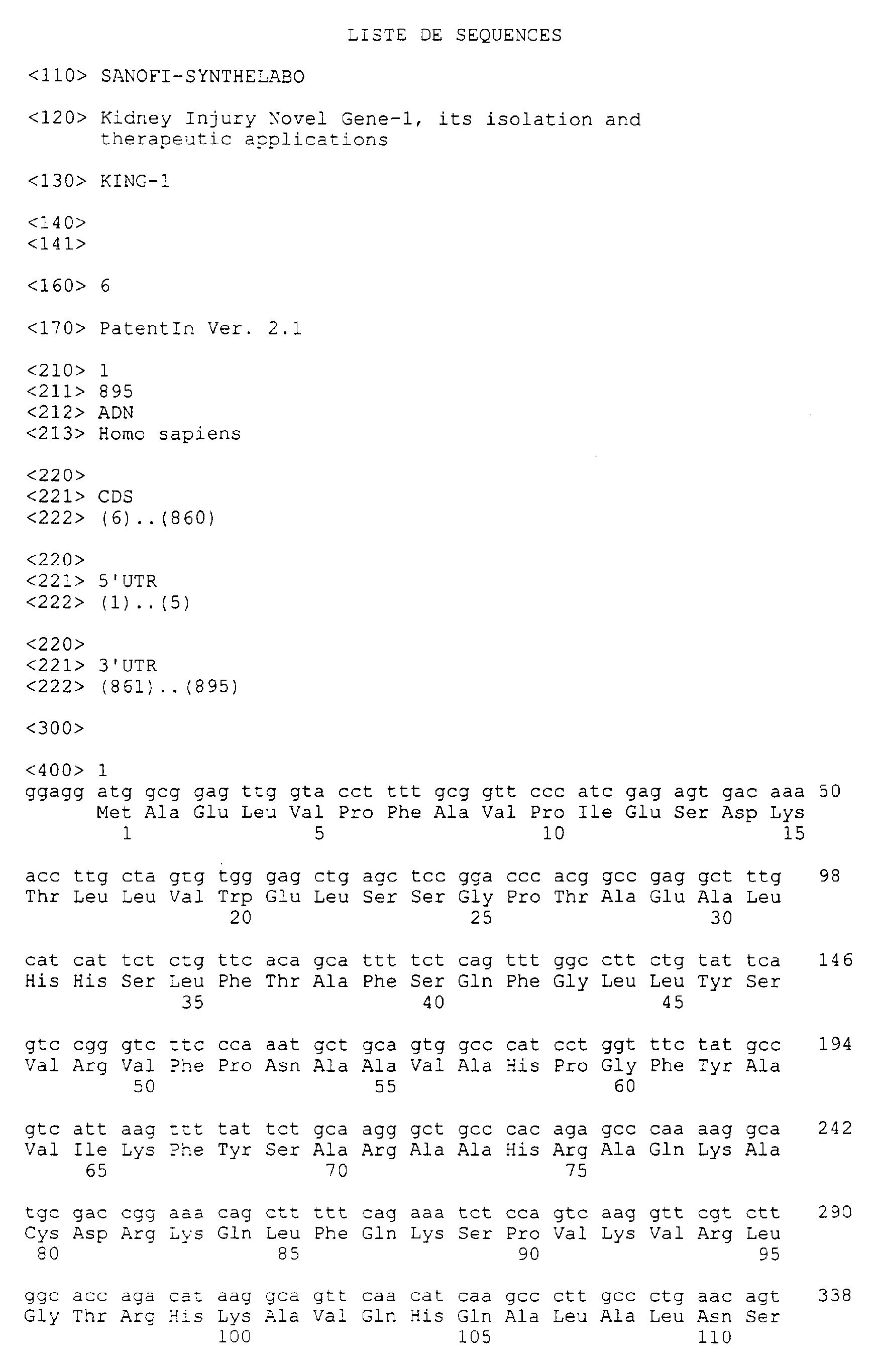


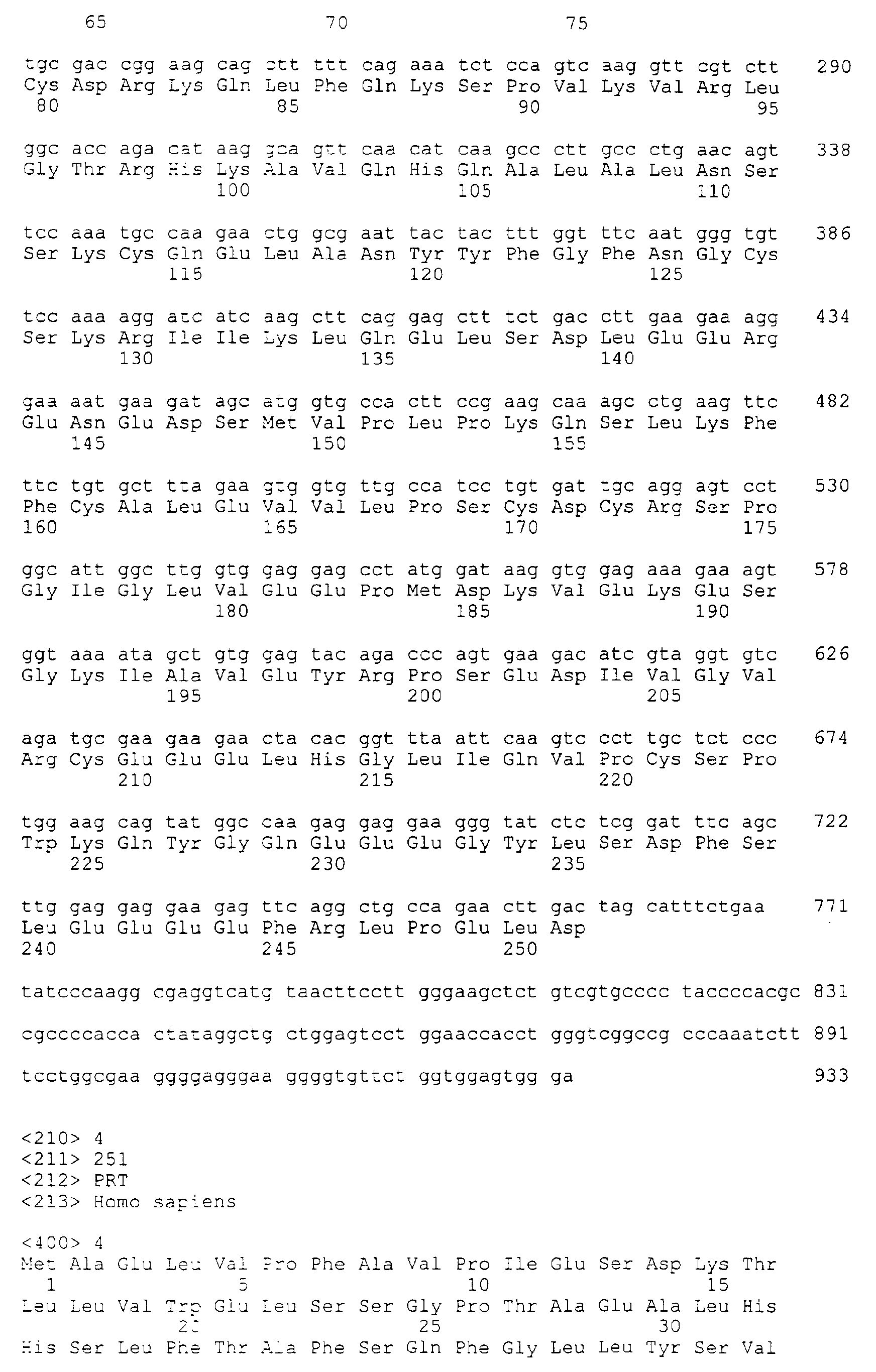
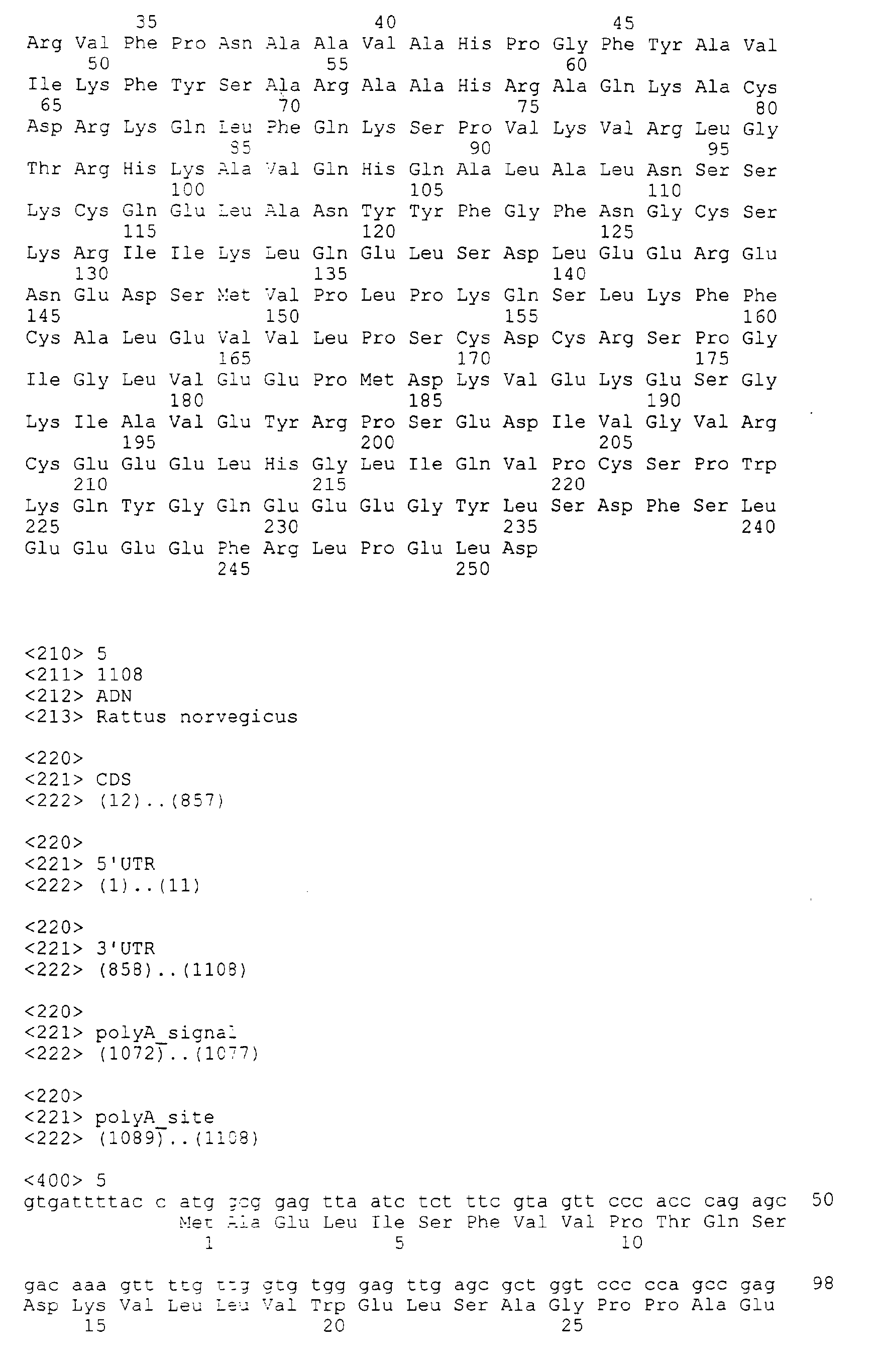
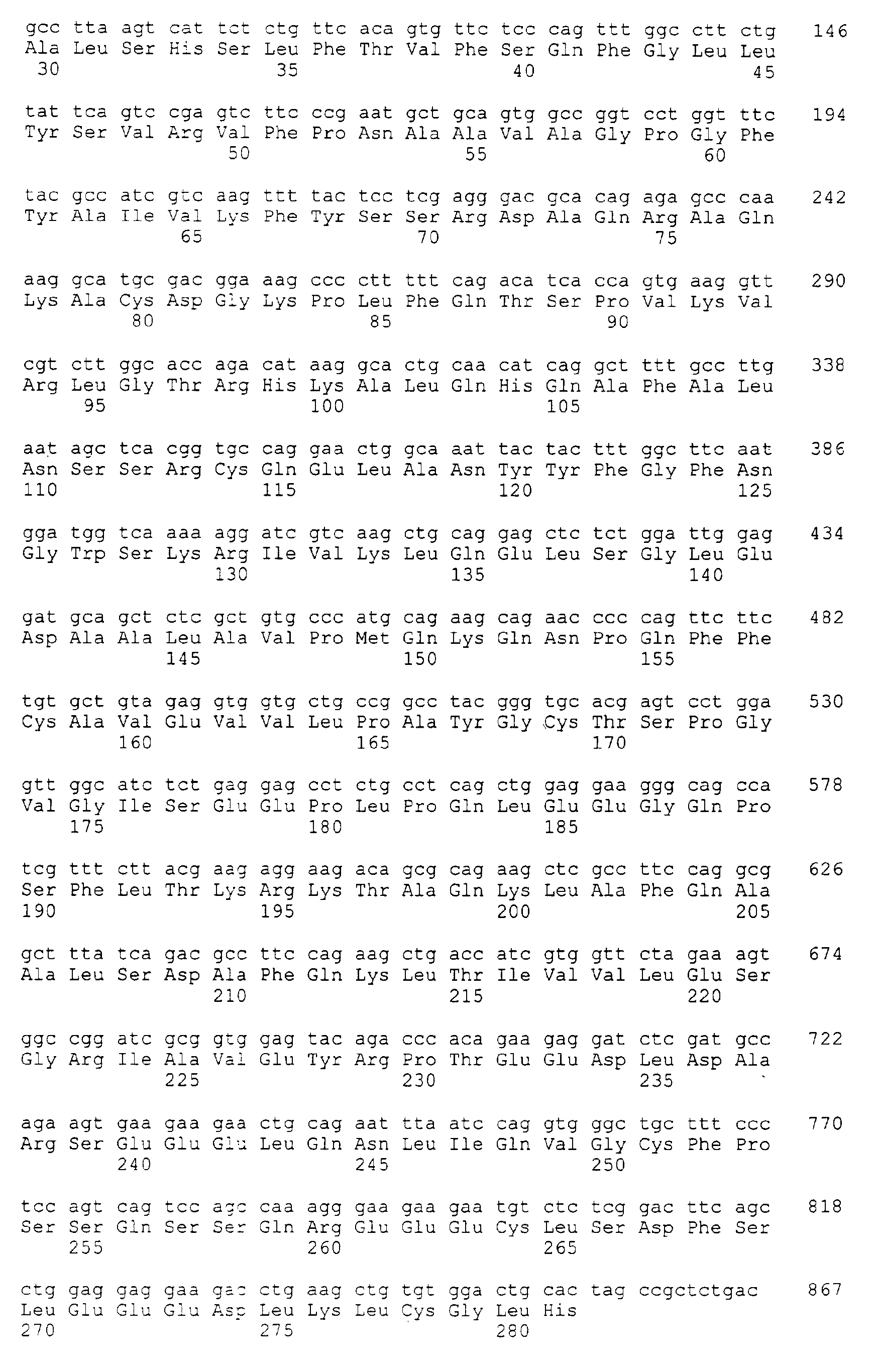

Claims (17)
- An isolated polynucleotide comprising a nucleotide sequence at least 80% identical to a nucleotide sequence selected from the group consisting of:(a) the nucleotide sequence set forth in SEQ ID NO: 1, SEQ ID NO: 2 or SEQ ID NO: 3;(b) a nucleotide sequence which comprises the KING-1 polypeptide encoding sequence contained in SEQ ID NO: 1, SEQ ID NO: 2 or SEQ ID NO: 3;(c) a nucleotide sequence comprising the sequence located between nucleotide numbers 6 to 860 set forth in SEQ ID NO: 1, the nucleotide sequence comprising the sequence located between nucleotide numbers 6 to 761 set forth in SEQ ID NO: 2 or the nucleotide sequence comprising the nucleotide sequence located between nucleotide numbers 12 to 857 set forth in SEQ ID NO: 3;(d) a nucleotide sequence encoding a polypeptide comprising amino acids from 1 to 284 set forth in SEQ ID NO: 4, the nucleotide sequence encoding a polypeptide comprising amino acids from 1 to 251 set forth in SEQ ID NO: 5 or the nucleotide sequence encoding a polypeptide comprising amino acids from 1 to 281 set forth in SEQ ID NO: 6;(e) the nucleotide sequence encoding the KING-1 polypeptide expressed by the cDNA clone contained in ATCC deposit number PTA-1770, PTA-1771 or PTA-1772;(f) the nucleotide sequence encoding the mature KING-1 polypeptide expressed by the cDNA clone contained in ATCC deposit number PTA-1770, PTA-1771 or PTA-1772;(g) a nucleotide sequence able to hybridize with the nucleotide sequence set forth in SEQ ID NO: 1, SEQ ID NO: 2 or SEQ ID NO: 3 or with the cDNA clone contained in ATCC deposit number PTA-1770, PTA-1771 or PTA-1772;(h) a nucleotide sequence complementary to any of the nucleotide sequences defined in (a), (b), (c), (d), (e), (f) or (g) above, as well as fragments, variants, derivatives, mutated forms of these nucleotide sequences.
- Polynucleotide according to claim 1 which is DNA or RNA.
- A DNA or RNA molecule constituting a recombinant vector, comprising an expression system which is capable of producing a KING-1 polypeptide when said expression system is present in a compatible host cell, wherein said DNA or RNA molecule comprises a polynucleotide according to claim 1 or 2.
- A host cell comprising the expression system of claim 3.
- A process for producing a KING-1 polypeptide, comprising the steps of transforming or transfecting a host cell with an expression system according to claim 3, culturing said host cell under appropriate culture conditions so that said host cell produces the KING-1 polypeptide, and recovering the polypeptide from the culture.
- An isolated KING-1 polypeptide comprising an amino acid sequence which is at least 80% identical to a sequence selected from the group consisting of:(a) the amino acid sequence set forth in SEQ ID NO: 4, SEQ ID NO: 5 or SEQ ID NO: 6;(b) the amino acid sequence comprised between amino acids 1 to 284 of the sequence set forth in SEQ ID NO: 4, the amino acid sequence comprised between amino acids 1 to 251 of SEQ ID NO: 5 or the amino acid sequence comprised between 1 to 281 of the sequence set forth in SEQ ID NO: 6;(c) the amino acid sequence of the KING-1 polypeptide having the complete amino acid sequence encoded by the cDNA clone contained in ATCC deposit number PTA-1770, PTA-1771 or PTA-1772;(d) the amino acid sequence of the mature KING-1 polypeptide having the complete amino acid sequence encoded by the cDNA clone contained in ATCC deposit number PTA-1770, PTA-1771 or PTA-1772; as well as fragments, derivatives, variants or mutated forms of these amino acid sequences.
- Polypeptide according to claim 6, wherein it is obtained by the process of claim 5 or by chemical synthesis.
- A method for identifying agonists of KING-1 polypeptide, which comprises the steps of:(a) contacting a host cell according to claim 4 with a candidate compound; and(b) determining whether the candidate compound effects a signal generated by activation of the KING-1 polypeptide.
- A method for identifying antagonists of KING-1 polypeptide, which comprises the steps of:(a) contacting a host cell according to claim 4 with an agonist of KING-1 polypeptide; and(b) determining whether the signal generated by said agonist is diminished in the presence of a candidate compound.
- A process for diagnosing a disease or a susceptibility to a disease in a subject related to expression or activity of KING-1 polypeptide comprising the steps of:(a) determining the presence or absence of a mutation in the nucleotide sequence encoding said KING-1 polypeptide in the genome of said subject; and/or(b) analyzing for the presence or amount of said KING-1 polypeptide expression in a sample derived from said subject.
- Pharmaceutical composition, for preventing and/or treating in a subject a disease or susceptibility to a disease related to an under-expression or under-activity of KING-1, said composition comprising a therapeutically effective amount of at least an agonist of KING-1 polypeptide or derivative or homologue thereof identified by the method of claim 8, and/or at least a polypeptide according to claim 6, and/or at least a nucleotide sequence able to express in vivo a KING-1 polypeptide according to claim 6.
- Pharmaceutical composition for preventing and/or treating in a subject a disease or susceptibility to a disease related to over-activity or over-expression of KING-1, said composition comprising a therapeutically effective amount of at least an antagonist of KING-1 or a derivative or homologue thereof identified by the method of claim 9, and/or at least a nucleic acid molecule that inhibits the expression of the nucleotide sequence encoding KING-1 and/or at least a peptide which competes with KING-1.
- Pharmaceutical composition according to claim 11 or 12, wherein it comprises a recombinant vector according to claim 3, able to express in vivo a polypeptide according to claim 6.
- Pharmaceutical composition according to any of claims 11 to 13, wherein it further comprises at least a pharmaceutically acceptable carrier.
- Pharmaceutical composition according to any of claims 11 to 14, for prevention and/or treatment of ischemic renal failure, glomerulonephritis, chronic renal failure, diabetic nephropathy, cardiac ischemia, myocardial infarction, hypertension, congestive heart failure, inflammatory and proliferative diseases.
- A diagnostic assays for diagnosing or determining a susceptibility to ischemic renal failure, glomerulonephritis, chronic renal failure, diabetic nephropathy, cardiac ischemia, myocardial infarction, hypertension, congestive heart failure, inflammatory and proliferative diseases which comprises:(a) a Kidney Injury Novel Gene-1 polynucleotide, preferably the nucleotide sequence of SEQ ID NO: 1, SEQ ID NO: 2 or SEQ ID NO: 3 or a fragment thereof;(b) a nucleotide sequence complementary to that of SEQ ID NO: 1, SEQ ID NO: 2 or SEQ ID NO: 3;(c) a Kidney Injury Novel Gene-1 polypeptide, preferably the polypeptide of SEQ ID NO: 4, SEQ ID NO: 5 or SEQ ID NO: 6 or a fragment thereof; or(d) an antibody against a Kidney Injury Novel Gene-1 polypeptide, preferably to the polypeptide of SEQ ID NO: 4, SEQ ID NO: 5 or SEQ ID NO: 6.
- Screening kit for identifying e.g. agonists, antagonists, ligands, receptors, substrates, enzymes for Kidney Injury Novel Gene-1 polypeptides; or compounds which decrease or enhance the production of Kidney Injury Novel Gene-1 polypeptides, which comprises:(a) a Kidney Injury Novel Gene-1 polypeptide, preferably that of SEQ ID NO: 4, SEQ ID NO: 5 or SEQ ID NO: 6;(b) a recombinant cell expressing a Kidney Injury Novel Gene-1 polypeptide, preferably that of SEQ ID NO: 4, SEQ ID NO: 5 or SEQ ID NO: 6;(c) a cell membrane expressing a Kidney Injury Novel Gene-1 polypeptide; preferably that of SEQ ID NO: 4, SEQ ID NO: 5 or SEQ ID NO: 6; or(d) an antibody against a Kidney Injury Novel Gene-1 polypeptide, preferably that of SEQ ID NO: 4, SEQ ID NO: 5 or SEQ ID NO: 6.
Priority Applications (1)
| Application Number | Priority Date | Filing Date | Title |
|---|---|---|---|
| EP00401531A EP1160321A1 (en) | 2000-05-31 | 2000-05-31 | Kidney Injury Novel Gene-1: Isolation and therapeutic applications |
Applications Claiming Priority (1)
| Application Number | Priority Date | Filing Date | Title |
|---|---|---|---|
| EP00401531A EP1160321A1 (en) | 2000-05-31 | 2000-05-31 | Kidney Injury Novel Gene-1: Isolation and therapeutic applications |
Publications (1)
| Publication Number | Publication Date |
|---|---|
| EP1160321A1 true EP1160321A1 (en) | 2001-12-05 |
Family
ID=8173709
Family Applications (1)
| Application Number | Title | Priority Date | Filing Date |
|---|---|---|---|
| EP00401531A Ceased EP1160321A1 (en) | 2000-05-31 | 2000-05-31 | Kidney Injury Novel Gene-1: Isolation and therapeutic applications |
Country Status (1)
| Country | Link |
|---|---|
| EP (1) | EP1160321A1 (en) |
Cited By (2)
| Publication number | Priority date | Publication date | Assignee | Title |
|---|---|---|---|---|
| EP1767544A3 (en) * | 2003-04-09 | 2007-10-10 | Amgen Inc. | Methods of treatment of inflammatory diseases using specific binding agents of human angiopoietin - 2 |
| US9200040B2 (en) | 2001-10-11 | 2015-12-01 | Amgen Inc. | Specific binding agents of human angiopoietin-2 |
Citations (1)
| Publication number | Priority date | Publication date | Assignee | Title |
|---|---|---|---|---|
| WO1997044460A1 (en) * | 1996-05-24 | 1997-11-27 | Biogen, Inc. | Modulators of tissue regeneration |
-
2000
- 2000-05-31 EP EP00401531A patent/EP1160321A1/en not_active Ceased
Patent Citations (1)
| Publication number | Priority date | Publication date | Assignee | Title |
|---|---|---|---|---|
| WO1997044460A1 (en) * | 1996-05-24 | 1997-11-27 | Biogen, Inc. | Modulators of tissue regeneration |
Non-Patent Citations (5)
| Title |
|---|
| DATABASE EMBL EBI; 18 February 1998 (1998-02-18), XP002151171 * |
| FAURE, C. ET AL.: "Differentially expressed genes in ischemic acute renal failure", MOL. BIOL. CELL, vol. 9, 1998, pages 473A, XP000953127 * |
| PADANILAM, B.J. ET AL.: "Molecular mechanisms of cell death and regeneration in acute ischemic renal injury", CURRENT OPINION IN NEPHROLOGY AND HYPERTENSION, vol. 8, no. 1, 1 January 1999 (1999-01-01), pages 15 - 19, XP000953223 * |
| ROSENBERG, M.E. ET AL.: "Differential gene expression in the recovery from ischemic renal injury", KIDNEY INT., vol. 39, no. 6, 1991, pages 1156 - 1161, XP000953186 * |
| SGARD, F. ET AL.: "Regulation of ATP-Sensitive Potassium Channel mRNA Expression in Rat Kidney Following Ischemic Injury", BIOCHEM BIOPHYS. RES. COMMUN., vol. 269, 16 March 2000 (2000-03-16), pages 618 - 622, XP002151170 * |
Cited By (3)
| Publication number | Priority date | Publication date | Assignee | Title |
|---|---|---|---|---|
| US7666831B2 (en) * | 2001-10-11 | 2010-02-23 | Amgen Inc. | Methods of treatment using specific binding agents of human angiopoietin-2 |
| US9200040B2 (en) | 2001-10-11 | 2015-12-01 | Amgen Inc. | Specific binding agents of human angiopoietin-2 |
| EP1767544A3 (en) * | 2003-04-09 | 2007-10-10 | Amgen Inc. | Methods of treatment of inflammatory diseases using specific binding agents of human angiopoietin - 2 |
Similar Documents
| Publication | Publication Date | Title |
|---|---|---|
| US6274717B1 (en) | Splicing variant of human membrane-type matrix metalloproteinease-5 (MT-MMP5-L) | |
| EP0861898A1 (en) | Rat Cathepsin K polynucleotide & polypeptide sequence | |
| US6348585B1 (en) | Human urotensin II | |
| EP0943684A2 (en) | Frizzled-like polypeptides and polynucleotides | |
| EP0879888A2 (en) | Patched-2 polypeptides and polynucleotides and methods for their production | |
| EP0894855A2 (en) | Human I kappa B-beta transcription factor | |
| US20020019029A1 (en) | Wnt10a polynucleotides, Wint10a polypeptides and uses thereof | |
| EP1222265B1 (en) | Novel nicotinic acetylcholine receptor subunit, its isolation and use | |
| EP0884386A1 (en) | Sodium channel receptor | |
| EP1122307B1 (en) | Human carnosinase 2 | |
| US6197544B1 (en) | Compounds | |
| WO1998036062A1 (en) | Neural cell adhesion molecule splicing variants | |
| WO1999036529A2 (en) | Twik-1 related two p domains potassium channel | |
| EP1097997A1 (en) | Human carnosinase, its isolation and uses | |
| EP1069188A1 (en) | Three neprilysin-like membrane metallopeptidases | |
| US6200776B1 (en) | Polynucleotides encoding human sodium bicarbonate cotransporters | |
| US6426405B2 (en) | Neurotransmitter transporter SC6 | |
| CA2248963A1 (en) | Novel compounds | |
| CA2230996A1 (en) | Novel compounds | |
| EP0897982A2 (en) | Sodium bicarbonate co-transporter | |
| US6165752A (en) | Polynucleotides and expression systems for HSSCRG1 | |
| EP0879886A2 (en) | Signal transduction protein HLDAT86, the human Wnt-4 homolog | |
| US6316219B1 (en) | Compounds | |
| US20020019520A1 (en) | CBFBGA09: a human SL15 homolog | |
| WO1999021885A1 (en) | A human abc transporter-7 (habc7) gene |
Legal Events
| Date | Code | Title | Description |
|---|---|---|---|
| PUAI | Public reference made under article 153(3) epc to a published international application that has entered the european phase |
Free format text: ORIGINAL CODE: 0009012 |
|
| AK | Designated contracting states |
Kind code of ref document: A1 Designated state(s): AT BE CH CY DE DK ES FI FR GB GR IE IT LI LU MC NL PT SE |
|
| AX | Request for extension of the european patent |
Free format text: AL;LT;LV;MK;RO;SI |
|
| AKX | Designation fees paid | ||
| 17P | Request for examination filed |
Effective date: 20020531 |
|
| RBV | Designated contracting states (corrected) |
Designated state(s): AT BE CH CY DE DK ES FI FR GB GR IE IT LI LU MC NL PT SE |
|
| REG | Reference to a national code |
Ref country code: DE Ref legal event code: 8566 |
|
| RAP1 | Party data changed (applicant data changed or rights of an application transferred) |
Owner name: SANOFI-AVENTIS |
|
| 17Q | First examination report despatched |
Effective date: 20060809 |
|
| 18R | Application refused |
Effective date: 20080508 |
|
| STAA | Information on the status of an ep patent application or granted ep patent |
Free format text: STATUS: THE APPLICATION HAS BEEN REFUSED |
|
| R18R | Application refused (corrected) |
Effective date: 20080517 |