EP1160252A1 - Avermectin derivatives - Google Patents
Avermectin derivatives Download PDFInfo
- Publication number
- EP1160252A1 EP1160252A1 EP00902857A EP00902857A EP1160252A1 EP 1160252 A1 EP1160252 A1 EP 1160252A1 EP 00902857 A EP00902857 A EP 00902857A EP 00902857 A EP00902857 A EP 00902857A EP 1160252 A1 EP1160252 A1 EP 1160252A1
- Authority
- EP
- European Patent Office
- Prior art keywords
- group
- compound
- mixture
- ppm
- added
- Prior art date
- Legal status (The legal status is an assumption and is not a legal conclusion. Google has not performed a legal analysis and makes no representation as to the accuracy of the status listed.)
- Granted
Links
Classifications
-
- C—CHEMISTRY; METALLURGY
- C07—ORGANIC CHEMISTRY
- C07H—SUGARS; DERIVATIVES THEREOF; NUCLEOSIDES; NUCLEOTIDES; NUCLEIC ACIDS
- C07H17/00—Compounds containing heterocyclic radicals directly attached to hetero atoms of saccharide radicals
- C07H17/04—Heterocyclic radicals containing only oxygen as ring hetero atoms
- C07H17/08—Hetero rings containing eight or more ring members, e.g. erythromycins
-
- A—HUMAN NECESSITIES
- A61—MEDICAL OR VETERINARY SCIENCE; HYGIENE
- A61K—PREPARATIONS FOR MEDICAL, DENTAL OR TOILETRY PURPOSES
- A61K31/00—Medicinal preparations containing organic active ingredients
- A61K31/70—Carbohydrates; Sugars; Derivatives thereof
- A61K31/7042—Compounds having saccharide radicals and heterocyclic rings
- A61K31/7048—Compounds having saccharide radicals and heterocyclic rings having oxygen as a ring hetero atom, e.g. leucoglucosan, hesperidin, erythromycin, nystatin, digitoxin or digoxin
-
- A—HUMAN NECESSITIES
- A61—MEDICAL OR VETERINARY SCIENCE; HYGIENE
- A61P—SPECIFIC THERAPEUTIC ACTIVITY OF CHEMICAL COMPOUNDS OR MEDICINAL PREPARATIONS
- A61P33/00—Antiparasitic agents
Definitions
- the present invention relates to avermectin derivatives having antiparasitic activity.
- Avermectins are antiparasitic antibiotics produced by Streptomyces avermitilis.
- Four main ingredients (A1a, A2a, B1a and B2a) have been known, and among them, avermectin B1a is known to have potent activity (Japanese Patent Unexamined Publication (KOKAI) No. (Hei) 3-254678/1991).
- An object of the present invention is to provide avermectin derivatives having antiparasitic activity.
- the present invention thus provides compounds represented by the general formula (I) or salts thereof:
- medicaments which comprise as an active ingredient the compound represented by the aforementioned general formula (I) or the physiologically acceptable salt thereof.
- the medicaments can be administered as antiparasitics to a mammal including a human.
- a use of the compound represented by the aforementioned general formula (I) or the physiologically acceptable salt thereof for the manufacture of the aforementioned medicament and a method for therapeutic treatment of parasitosis which comprises the step of administering a therapeutically effective amount of the compound represented by the aforementioned general formula (I) or the physiologically acceptable salt thereof to a mammal including a human.
- the compounds wherein -X ---- Y- represents -CH 2 -CH 2 -, the line ---- between R 2 and a carbon atom at the 5-position represents a single bond, and R 2 represents a hydroxyl group or a tri(lower alkyl)silyloxy group are sometimes referred to particularly as "ivermectin derivatives.”
- ivermectin derivatives referred to in the specification include the aforementioned ivermectin derivatives.
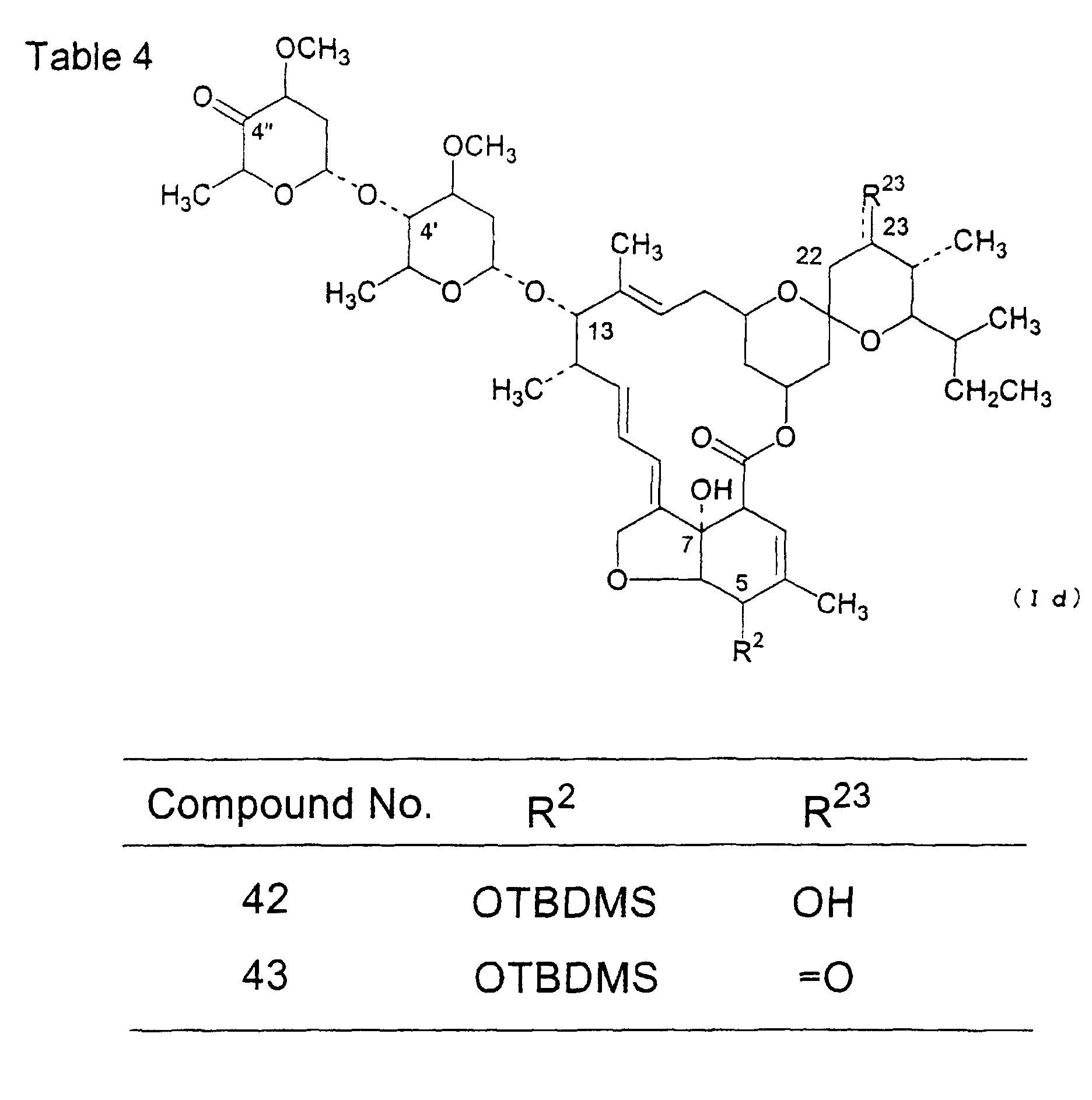
- the compounds wherein -X ---- Y- represents -CH 2 -CH(R 13 )- wherein R 13 represents a hydroxyl group or a lower alkylcarbonyloxy group, the line ---- between R 2 and a carbon atom at the 5-position represents a single bond, and R 2 represents a hydroxyl group or a tri(lower alkyl)silyloxy group are sometimes referred to as the compounds (Id).
- the lower alkyl group may be any of C 1 -C 8 linear, branched, and cyclic alkyl groups or a combination thereof, preferably a C 1 -C 8 linear or branched alkyl group.
- the lower alkyl group includes, for example, a methyl group, ethyl group, propyl group, isopropyl group, cyclopropyl group, butyl group, isobutyl group, sec-butyl group, tert-butyl group, cyclopropylmethyl group, cyclobutyl group, pentyl group, hexyl group, heptyl group, octyl group, and the like.
- a lower alkyl moiety in functional groups having the lower alkyl moiety such as the lower alkoxycarbonyl group, lower alkoxyl group, lower alkylcarbonyloxy group and tri(lower alkyl)silyloxy group has the same meaning as that defined in the aforementioned lower alkyl group unless otherwise specifically mentioned.
- the lower alkyl moieties in the tri(lower alkyl)silyloxy group may be the same or different.
- Examples of a lower alkenyl moiety in the lower alkenyloxycarbonyl group include C 2 -C 6 straight and branched alkenyl groups, for example, a vinyl group, allyl group, methacryl group, butenyl group, pentenyl group, hexenyl group, and the like.
- the number of double bonds present in the alkenyl group is not particularly limited, and preferably one.
- the heterocyclic group may be either an aromatic or aliphatic heterocyclic group.
- the aromatic heterocyclic group include, for example, a 5- or 6-membered monocyclic aromatic heterocyclic group which contains at least one heteroatom selected from the group consisting of nitrogen, oxygen, and sulfur atoms. More specifically, examples include a pyridyl group, pyrrolyl group, furyl group, thienyl group, thiazolyl group, pyrazinyl group, imidazolyl group, pyrazolyl group, triazolyl group, tetrazolyl group, and oxazolyl group.
- aliphatic heterocyclic group examples include, for example, a 5- or 6-membered monocyclic aliphatic heterocyclic group which contains at least one heteroatom selected from the group consisting of nitrogen, oxygen, and sulfur atoms. More specifically, examples include a pyrrolidinyl group, tetrahydrofuryl group, and tetrahydropyranyl group.
- the nitrogen containing heterocyclic group formed together with the adjacent nitrogen atom includes a morpholino group, thiomorpholino group, piperidino group, 1-piperazinyl group, and 1-pyrrolidinyl group.
- the type and number of the substituent of the substituted alkyl group are not particularly limited.
- a lower alkyl moiety of the mono(lower alkyl)amino group, mono(lower alkoxy)amino group, alkanoylamino group, lower alkanoyloxy group and lower alkoxycarbonyl group has the same meaning as that defined in the aforementioned lower alkyl group.
- Examples of the salt of the compounds (I) include acid-addition salts, metal salts, ammonium salts, and organic amine-addition salts.
- Examples of the acid-addition salts include inorganic acid salts such as hydrochlorides, sulfates, nitrates and phosphates, and organic acid salts such as acetates, maleates, fumarates and citrates.
- Examples of the metal salts include alkali metal salts such as sodium salts and potassium salts, alkaline-earth metal salts such as magnesium salts and calcium salts, aluminium salts, and zinc salts.
- ammonium salts examples include ammonium salts and tetramethylammonium salts
- organic amine-addition salts include salts with morpholine and piperidine.
- Avermectins B1a and B2a which are used as starting materials for the avermectin derivatives disclosed in the present invention, are isolated from the culture of Streptomyces avermitilis, and they are known compounds (Japanese Patent Unexamined Publication (KOKAI) Nos. (Hei) 3-74397/1991 and 3-254678/1991, and USP 5,206,155 and the like).
- 5-O-tri(lower alkyl)silyl-4"-oxoavermectin B1a (the compounds (IIa)), which are starting materials for the preparation of the compounds (Ia)
- avermectin B1a as a starting material according to the method disclosed in Japanese Patent Examined Publication (KOKOKU) No. (Hei) 6-33273/1994 or a similar method thereto.
- the compounds (IIa) used as the starting material can be obtained by subjecting the hydroxyl group at the 5-position of avermectin B1a to tri(lower alkyl)silylation, and then oxidizing the hydroxyl group at the 4"-position.
- oxidations other than the method disclosed in Japanese Patent Examined Publication (KOKOKU) No. (Hei) 6-33273/1994 include oxidation with phenyl dichlorophosphate (PhOPOCl 2 )/triethylamine (TEA)/dimethylsulfoxide (DMSO) in isopropyl acetate,' oxidation with tetrapropylammonium perruthenate (Pr 4 NRuO 4 )/4-methylmorpholine N-oxide (NMO) in the presence of Molecular Sieves 4A (MS4A) in methylene chloride, and oxidation with sulfur trioxide/pyridine complex in dimethylsulfoxide (DMSO).
- PrOPOCl 2 phenyl dichlorophosphate
- TEA triethylamine
- DMSO dimethylsulfoxide
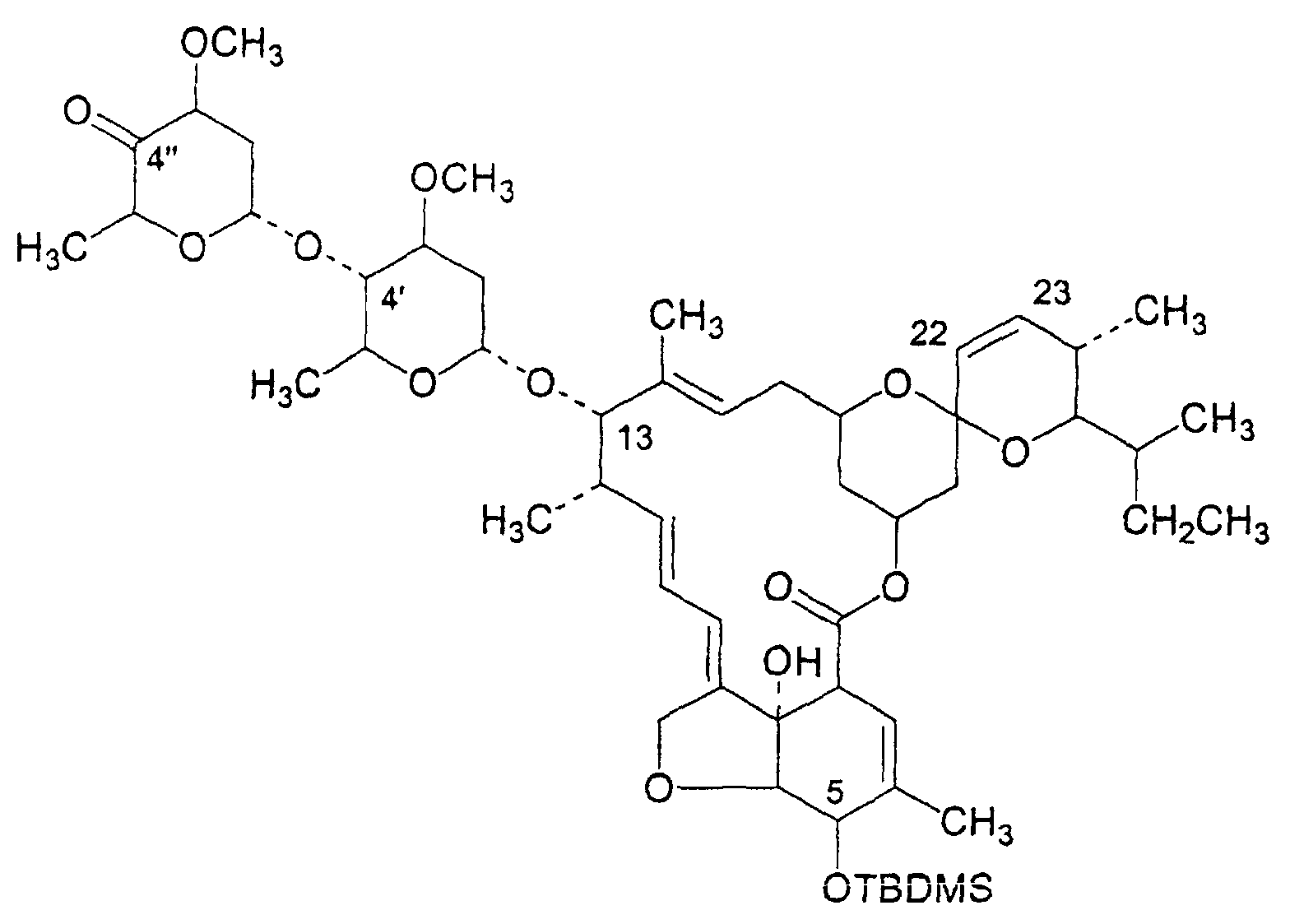
- 5-O-Tri(lower alkyl)silyl-4",23-dioxoavermectin B2a (the compounds (IIb)), which are starting materials for the preparation of the compounds (Ib), can be obtained by using avermectin B2a as a starting material according to the method disclosed in Japanese Patent Unexamined Publication (KOKAI) No. (Hei) 3-74397/1991 or a similar method thereto, which method comprises the step of producing 5-O-tri(lower alkyl)silylavermectin B2a and the following oxidation at the 23- and 4"-positions.
- the compounds (IIIa) and (IIIb) can be prepared by the process set out below:
- R 11a represents a lower alkoxycarbonyl group optionally substituted with a heterocyclic group, a lower alkenyloxycarbonyl group, or a cyano group among the definition of R 11 ;
- R 2a represents a tri(lower alkyl)silyloxy group among the definition of R 2 ;
- the compound (IIIa) or (IIIb) can be obtained by reacting the compound (IIa) or (IIb) with 1 to 10 equivalents of a compound (IV) represented by the formula: (RO) 2 P(O)CH 2 R 11a wherein R represents a lower alkyl group having the same meaning as that defined above and R 11a has the same meaning as that defined above, in the presence of 1 to 10 equivalents of a base in an inert solvent at a temperature ranging from -78°C to a boiling point of a solvent used for 1 minute to 24 hours.
- a compound (IV) represented by the formula: (RO) 2 P(O)CH 2 R 11a wherein R represents a lower alkyl group having the same meaning as that defined above and R 11a has the same meaning as that defined above
- inert solvent tetrahydrofuran, ether, benzene, toluene, and the like can be used alone or as a mixture thereof.
- base examples include potassium tert-butoxide, sodium hydride, potassium hydride, lithium hexamethyldisilazane, and lithium diisopropylamide.
- the reaction can be carried out by reacting the compound (VIIa) with a corresponding lower alcohol optionally substituted with a heterocyclic group or an ester of a corresponding lower alcohol optionally substituted with a heterocyclic group in the presence or absence of a base in an inert solvent at a temperature ranging from 0°C to a boiling point of a solvent used for one minute to 3 days to prepare the desired compounds.
- the inert solvent lower alcohols such as methanol, ethanol, propanol and tert-butanol, tetrahydrofuran, ether, chloroform, methylene chloride, 1,2-dichloroethane, and the like may be used.
- the corresponding lower alcohol optionally substituted with a heterocyclic group or the ester of the corresponding lower alcohol optionally substituted with a heterocyclic group, per se, may be used as the inert solvent.
- N-ethyl diisopropylamine triethylamine
- pyridine 4-dimethylaminopyridine, and the like may be used.
- the inert solvent methanol, ethanol, water, tetrahydrofuran, ether, benzene, toluene, pyridine, hexane, methylene chloride, chloroform, 1,2-dichloroethane, and the like may be used alone or as a mixture thereof.
- the reducing agent include sodium borohydride, lithium aluminium hydride, and diisobutylaluminium hydride.
- the compounds wherein R 11 is a halomethyl group can be prepared by treating the compound obtained above wherein R 11 is a hydroxymethyl group with a halogenating agent in the presence or absence of a base in an inert solvent at a temperature ranging from -78°C to a boiling point of a solvent used for 1 minute to 24 hours.
- inert solvent methylene chloride, chloroform, 1,2-dichloroethane, benzene, ether, tetrahydrofuran, and the like may be used alone or as a mixture thereof.
- halogenating agent p-toluenesulfonyl chloride, thionyl chloride, thionyl bromide, and the like may be used.
- base N-ethyl diisopropylamine, triethylamine, pyridine, 4-dimethylaminopyridine, and the like may be used.
- the compounds wherein R 11 is an aminomethyl group can also be prepared by reacting the compound wherein R 11 is a halomethyl group with an azide-formation agent in an inert solvent at a temperature ranging from -78°C to a boiling point of a solvent used for 1 minute to 24 hours and carrying out reduction in a conventional manner.
- Sodium azide, potassium azide, and the like may be used as the azide-formation agent.
- ether tetrahydrofuran, and the like may be used alone or as a mixture thereof.
- the compound (VIa) can be obtained by treating the compound (Va) obtained in Preparation 2 with an equivalent to an excess amount of an oxidizing agent in an inert solvent at a temperature ranging from -78°C to a boiling point of a solvent used for 1 minute to 24 hours.
- the inert solvent water, tetrahydrofuran, ether, benzene, hexane, methylene chloride, chloroform, 1,2-dichloroethane, tert-butanol, and the like may be used alone or as a mixture thereof.
- the oxidizing agent include pyridinium chlorochromate, pyridinium dichromate, manganese dioxide, and potassium permanganate.
- the compound (VIa) wherein the lower alkoxycarbonyl group optionally substituted with a heterocyclic group or the lower alkenyloxycarbonyl group is converted into a formyl group can also be obtained by controlling reaction conditions for reduction of the lower alkoxycarbonyl group optionally substituted with a heterocyclic group or the lower alkenyloxycarbonyl group of the compound (IIIa1) which is used as a starting material in Preparation 2.
- Examples of the reaction solvent, the reducing agent, equivalents of the reducing agent, the reaction time and the reaction temperature for the reduction of the compound (IIIa1) to obtain the compound (VIa) include those exemplified in Preparation 2.
- R 11 is a formyl group
- the compound (VIIa) can be obtained by treating the compound (Va) obtained in Preparation 2 with an equivalent to an excess amount of an oxidizing agent in an inert solvent at a temperature ranging from -78°C to a boiling point of a solvent used for 1 minute to 24 hours.
- an oxidizing agent inert solvent
- water, tetrahydrofuran, ether, benzene, hexane, chloroform, methylene chloride, 1,2-dichloroethane, tert-butanol, and the like may be used alone or as a mixture thereof.
- the oxidizing agent include pyridinium dichromate, pyridinium chlorochromate, Jones reagent, chromium trioxide, and potassium permanganate.
- the compound (VIIa) can also be obtained by oxidizing the formyl group of the compound (VIa) obtained in Preparation 3 according to the method for preparing the compound (VIIa) from the compound (Va).
- the compound (VIIa) can also be obtained by hydrolyzing the compound (IIIa) obtained in Preparation 1 in the presence of an equivalent to an excess amount of an acid or a base in an inert solvent.
- the inert solvent include methanol, ethanol, water, tetrahydrofuran, ether, and acetonitrile.
- the acid include hydrochloric acid, sulfuric acid, and nitric acid
- the base include sodium hydroxide, potassium hydroxide, and lithium hydroxide.
- the compound (VIIa) can also be obtained by treating the compound wherein R 11a is a lower alkenyloxycarbonyl group among the compound (IIIa) obtained in Preparation 1 with an equivalent to an excess amount of a reducing agent in the presence of a palladium catalyst in an inert solvent at a temperature ranging from -78°C to a boiling point of a solvent used for 1 minute to 24 hours.
- a palladium catalyst include tetrakis(triphenylphosphono)palladium.
- R 11 is -CO-S-CH 2 -CH 2 -NH-CO-R x (R x has the same meaning as that defined above) can be prepared by further reacting the compound obtained above wherein R 11 is a carboxyl group with HS-CH 2 -CH 2 -NH-CO-R x (R x has the same meaning as that defined above).
- reaction is generally carried out in the presence of a condensing agent and a base.
- Examples of the solvent and the base used in the preparation of the compound wherein R 11 is -CO-S-CH 2 -CH 2 -NH-CO-R x (R x has the same meaning as that defined above) from the compound wherein R 11 is a carboxyl group include the inert solvents and the bases used in the reaction of the compounds (VIIa) and (XV) in Preparation 9 explained below.
- benzotriazol-1-yloxytripyrrolidinophosphonium hexafluorophosphate and the like as well as the condensing agents used in the reaction of the compounds (VIIa) and (XV) in Preparation 9 explained below, may be used.
- R 7 represents a lower alkyl group or a heterocyclic group which may be substituted with a halogen atom or a lower alkoxycarbonyl group;
- R 2a and -X 1a ---- Y 1a - have the same meanings as those defined above.
- the lower alkyl group, heterocyclic group, halogen atom and lower alkoxycarbonyl group in the definition of R 7 have the same meanings as those defined above, respectively.
- the compound (IXa) can be obtained by reacting the compound (Va) obtained in Preparation 2 with an equivalent to an excess amount of the compound (VIIIa) represented by the formula: R 7 COCl wherein R 7 has the same meaning as that defined above, in the presence or absence of an equivalent to an excess amount of a base in an inert solvent at a temperature ranging from -78°C to a boiling point of a solvent used for 1 minute to 24 hours.
- the inert solvent include chloroform, methylene chloride, 1,2-dichloroethane and pyridine
- examples of the base include triethylamine, diisopropylethylamine, pyridine, and dimethylaminopyridine.
- the desired compound (IXa) can also be obtained by reacting the compound (Va) with an equivalent to an excess amount of the compound (VIIIb) represented by the formula: (R 7 CO) 2 O wherein R 7 has the same meaning as that defined above, in the presence or absence of an equivalent to an excess amount of a base in an inert solvent at a temperature ranging from -78°C to a boiling point of a solvent used for 1 minute to 24 hours.
- the inert solvent and the base used include those used in the reaction of the compounds (Va) and (VIIIa).
- the desired compound (IXa) can alternatively be obtained by reacting the compound (Va) with an equivalent to an excess amount of the compound (VIIIc) represented by the formula: R 7 COOH wherein R 7 has the same meaning as that defined above, for 1 minute to 24 hours in the presence or absence of an equivalent to an excess amount of a base and in the presence of an equivalent to an excess amount of a condensing agent in an inert solvent at a temperature ranging from -78°C to a boiling point of a solvent used.
- the inert solvent and the base used include those used in the reaction of the compounds (Va) and (VIIIa).
- the condensing agent include 1-ethyl-3-(3-dimethylaminopropyl)carbodiimide (WSCI) hydrochloride and 1,3-dicyclocarbodiimide.
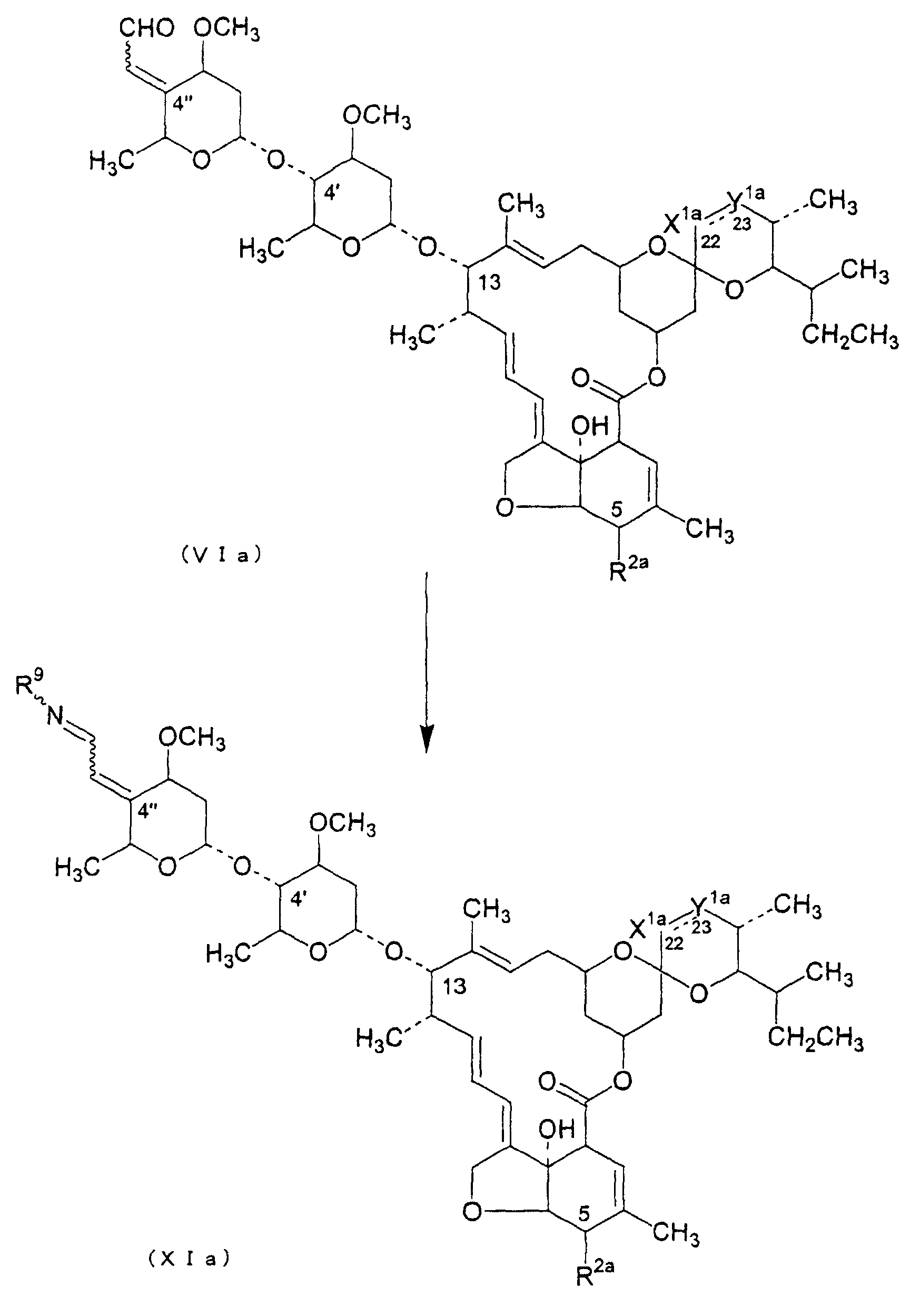
- R 9 represents OR 3 wherein R 3 has the same meaning as that defined above, or NH-CONH 2 , and R 2a and -X 1a ---- Y 1a - have the same meanings as those defined above.
- the compound (XIa) can be obtained by reacting the compound (VIa) with an equivalent to an excess amount of the compound (X) represented by the formula: H 2 N-OR 3 wherein R 3 has the same meaning as that defined above or a salt thereof (examples thereof include acid addition salts having the same meaning as that defined above), or an equivalent to an excess amount of a semicarbazide or a salt thereof (examples thereof include acid addition salts having the same meaning as that defined above) for 1 minute to 24 hours in the presence or absence of an equivalent to an excess amount of a base in an inert solvent at a temperature ranging from -78°C to a boiling point of a solvent used.
- the inert solvent include methanol and ethanol.
- the base include pyridine, triethylamine, and dimethylaminopyridine.
- the reduction can be carried out, for example, using a reducing reagent such as diisobutylaluminium hydride in an inert solvent such as dichloromethane, chloroform and tetrahydrofuran.
- the compound (XIIa) can be obtained by reacting the compound (Va) obtained in Preparation 2 with an equivalent to an excess amount of dihydropyran in the presence of an acid catalyst in an inert solvent.
- an acid catalyst include hydrochloric acid, p-toluenesulfonic acid, and pyridinium p-toluenesulfonate.
- the inert solvent include chloroform and methylene chloride.
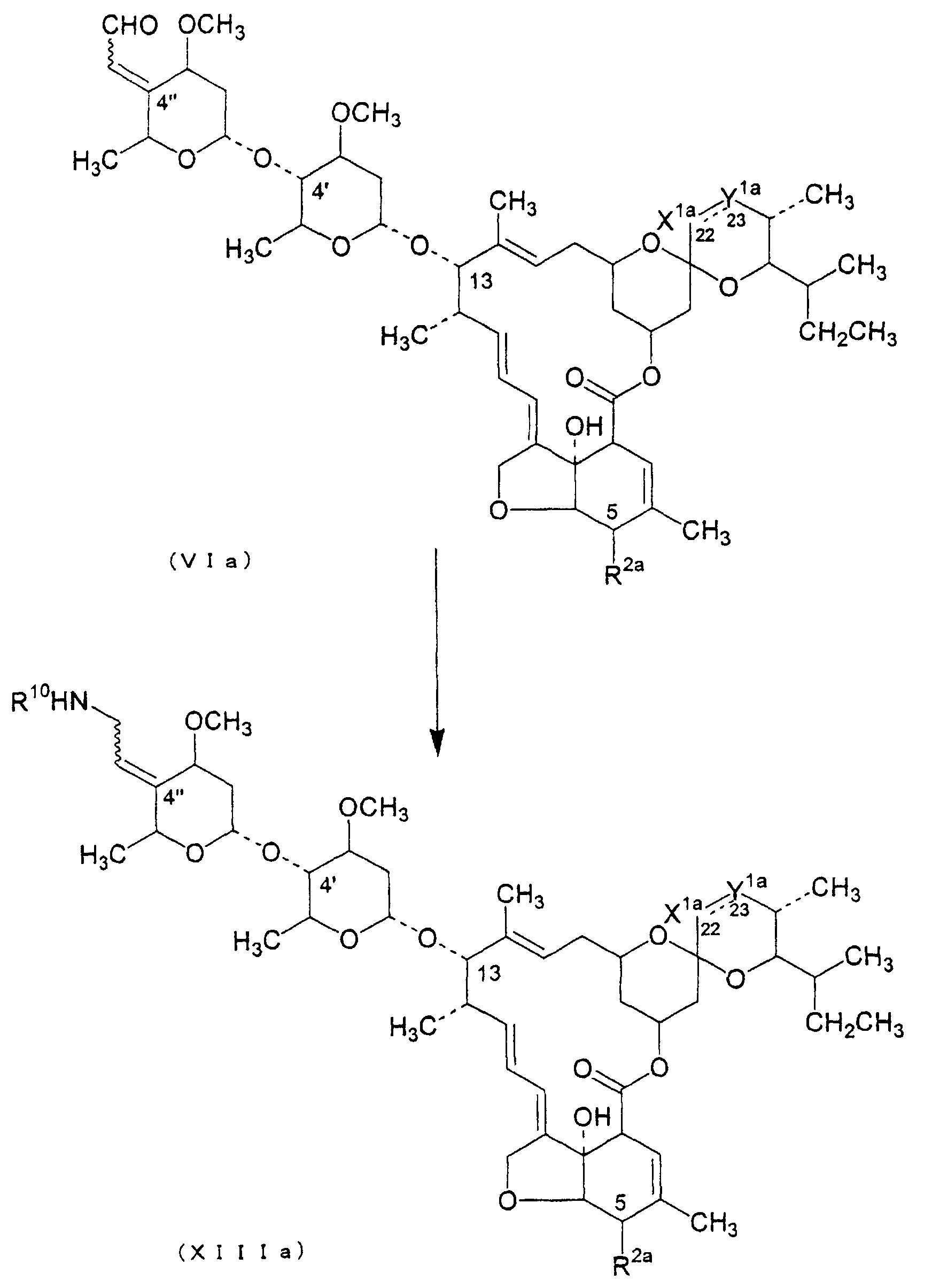
- R 10 represents a hydrogen atom or a methyl group, and R 2a and -X 1a ---- Y 1a - have the same meanings as those defined above.
- the compound (XIIIa) wherein R 10 is a hydrogen atom can be obtained by reacting the compound (VIa) with an equivalent to an excess amount of hexamethyldisilazane in the presence of a catalytic amount to an excess amount of a metal salt in an inert solvent at a temperature ranging from -78°C to a boiling point of a solvent used for 1 minute to 24 hours, and then adding an equivalent to an excess amount of a reducing agent.
- Examples of the inert solvent include methyl acetate, ethyl acetate, propyl acetate, isopropyl acetate, methanol and ethanol.
- Examples of the metal salt include zinc chloride, and examples of the reducing agent include sodium borohydride, formic acid, hydrogen gas, and lithium aluminium hydride.
- R 31 represents NR 5 R 6 wherein R 5 and R 6 have the same meanings as those defined above, respectively, and R 2a and -X 1a ---- Y 1a - have the same meanings as those defined above.
- the compound (XIVa) can be obtained by reacting the compound (VIIa) with an equivalent to an excess amount of the compound (XV) represented by the formula: R 31 H wherein R 11 has the same meaning as that defined above, for 1 minute to 24 hours in the presence of a base and a condensing agent in an inert solvent at a temperature ranging from -78°C to a boiling point of a solvent used.
- Examples of the inert solvent include chloroform, methylene chloride, methyl acetate, ethyl acetate, propyl acetate, isopropyl acetate, methanol, and ethanol.
- Examples of the condensing agent include 1-ethyl-3-(3-dimethylaminopropyl)carbodiimide (WSCI) hydrochloride, and 1,3-dicyclocarbodiimide.
- Examples of the base include triethylamine, diisopropylethylamine, dimethylaminopyridine, and pyridine.
- the compound (XIVa) can also be obtained by treating the compound (VIIa) with a chlorinating agent in an inert solvent or in the absence of a solvent at a temperature ranging from an ice-cooling temperature to a boiling point of a solvent used (at a boiling temperature of the chlorinating agent when no solvent is used) to convert the compound into a corresponding acid chloride, and reacting the resulting acid chloride with the compound (XV) represented by the formula: R 31 H wherein R 31 has the same meaning as that defined above in an inert solvent in the presence of a base at a temperature ranging from an ice-cooling temperature to a boiling point of a solvent used.
- Examples of the chlorinating agent include phosphorus oxychloride, phosphorus pentachloride, phosphorus trichloride, thionyl chloride, and thionyl bromide.
- Examples of the inert solvent for the chlorination include chloroform, methylene chloride, 1,2-dichloroethane, toluene, and benzene.
- Examples of the inert solvent for the condensation reaction include chloroform, methylene chloride, methyl acetate, ethyl acetate, propyl acetate, isopropyl acetate, tetrahydrofuran, methanol, and ethanol.
- Examples of the base include triethylamine, diisopropylethylamine, dimethylaminopyridine, and pyridine.
- R 1 , R 2a and -X 1 ---- Y 1 - have the same meanings as those defined above.
- the compound (XVIa) or (XVIb) can be obtained by treating the compound obtained in Preparations 1 to 9 for 1 minute to 24 hours with a catalytic amount to an amount serving as a solvent of a desilylating agent in an inert solvent at a temperature ranging from -78°C to a boiling point of a solvent used.
- inert solvent tetrahydrofuran, ether, benzene, toluene, pyridine, isopropyl acetate, and the like may be used alone or as a mixture thereof.
- desilylating agent include hydrogen fluoride, hydrochloric acid, hydrogen bromide, sulfuric acid, and hydrogen fluoride/pyridine complex.
- the tri(lower alkyl)silyloxy group at the 5-position is sometimes converted into a hydroxyl group depending on reaction conditions for conversion of a functional group at the other position.
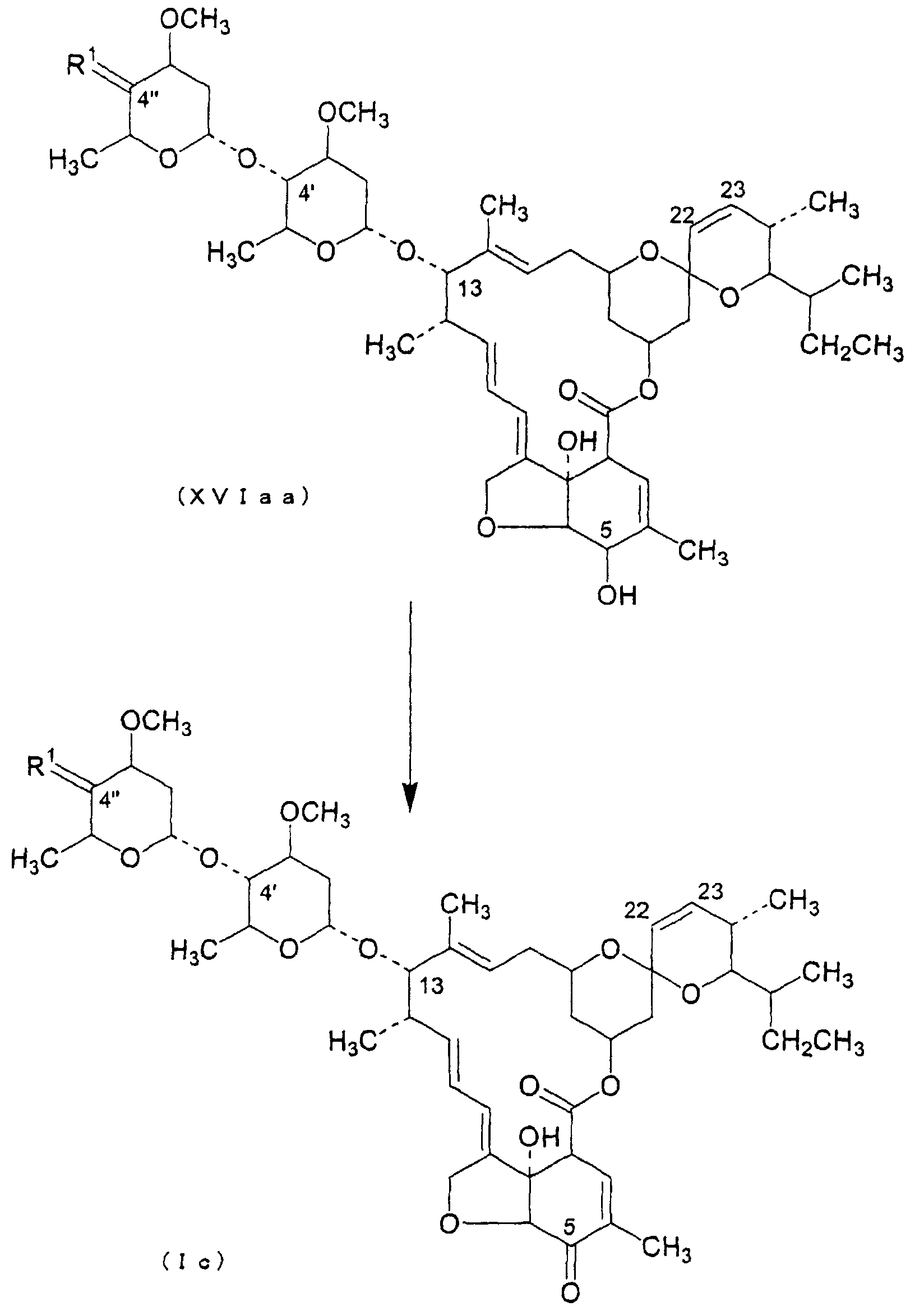
- R 1 has the same meaning as that defined above.
- the compound (Ic) can be prepared by treating the compound (XVIaa) with an equivalent to an excess amount of an oxidizing agent in an inert solvent at a temperature ranging from -78°C to a boiling point of a solvent used. The reaction is generally finished in 1 minute to 2 days.
- Examples of the inert solvent include chloroform, methylene chloride, and 1,2-dichloroethane.
- Examples of the oxidizing agent include manganese dioxide, pyridinium chlorochromate, chromium trioxide, and pyridinium dichromate.
- the compound wherein R 2 forms a hydroxime group together with the carbon atom at the 5-position can be obtained by further reacting the resulting compound (Ic) with hydroxylamine or a salt thereof (examples of the salt include acid addition salts having the same meaning as that defined above).
- the reaction of the compound (Ic) with hydroxylamine or a salt thereof can be carried out in the presence or absence of a base in an inert solvent at a temperature ranging from -78°C to a boiling point of a solvent used.
- the hydroxylamine or a salt thereof and the base can be used in an equivalent to an excess amount.
- the reaction is generally finished in 1 minute to 2 days.
- inert solvent examples include lower alcohols such as methanol, ethanol and propanol, ethers such as ether and tetrahydrofuran, and halogenated hydrocarbons such as chloroform, methylene chloride and 1,2-dichloroethane.
- Examples of the base include pyridine, 2,6-dimethylpyridine, dimethylaminopyridine, triethylamine, and diisopropylamine.
- the compound, wherein the double bond between the 22- and 23-positions are reduced (ivermectin derivatives, the compounds (B1)), can be prepared by the method set out below.
- the corresponding carbonyl compound can be obtained through oxidation at the 4"-position according to a conventional method.
- the compound (B1) can be obtained by using the resulting compound for a reaction with the compound represented by the formula: (RO) 2 P(O)CH 2 R 11b1 wherein R has the same meaning as that defined above, and R 11b1 represents a cyano group or a lower alkenyloxycarbonyl group in a manner similar to that described in Preparation 1.
- the compound wherein R 1 is a cyanomethyl group or a carboxymethyl group and -X ---- Y- is -CH 2 -CH 2 - can be prepared by catalytically reducing the compound obtained in Preparation 1 wherein R 11 is a cyano group or the compound obtained in Preparation 4 wherein R 11 is a carboxyl group for 1 minute to 100 hours in the presence of a catalyst such as triphenylphosphinerhodium chloride and a hydrogen source such as hydrogen and ammonium formate in a solvent such as benzene at a temperature ranging from 0°C to a boiling point of a solvent used.
- a catalyst such as triphenylphosphinerhodium chloride
- a hydrogen source such as hydrogen and ammonium formate in a solvent such as benzene at a temperature ranging from 0°C to a boiling point of a solvent used.
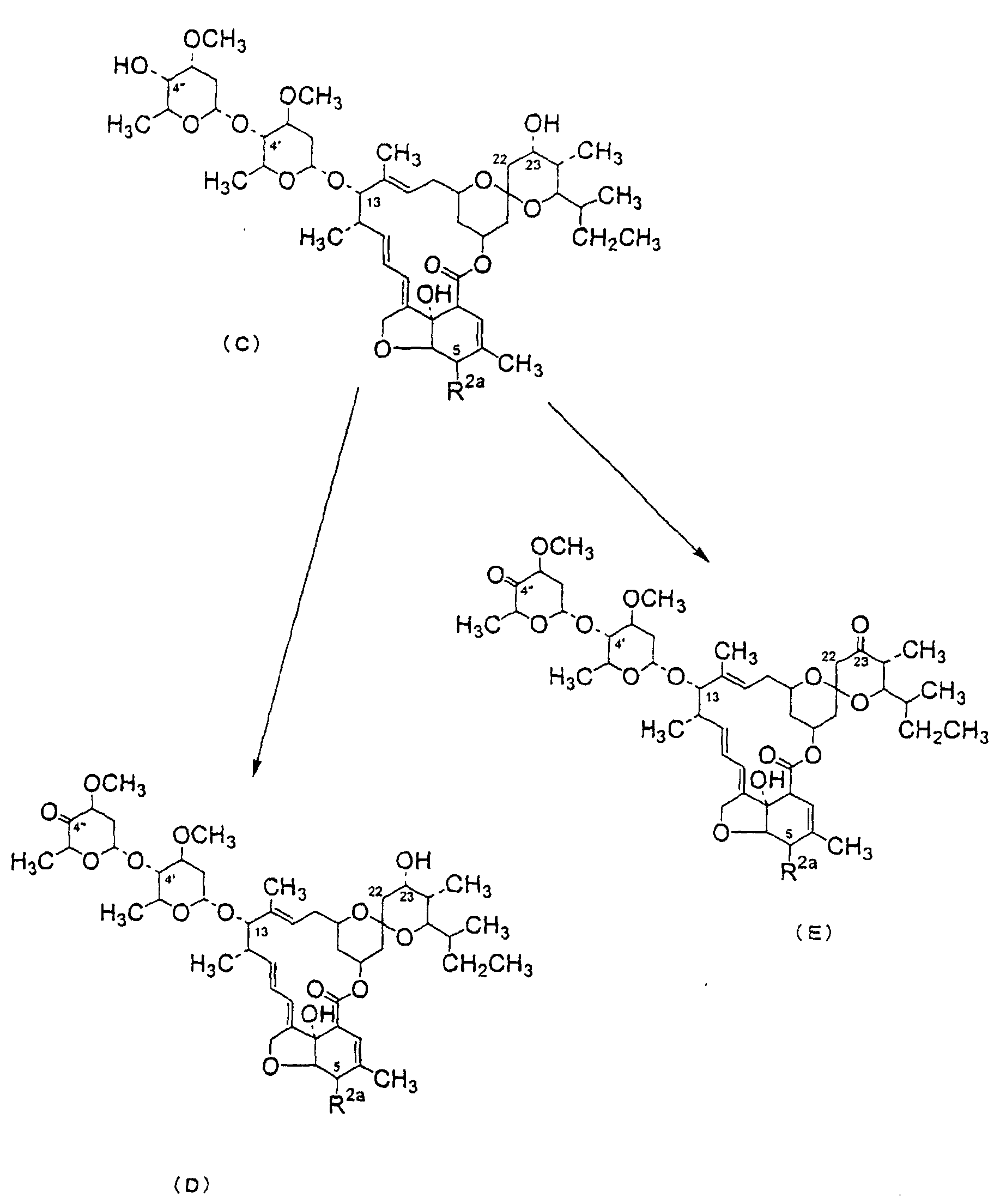
- the compound wherein only the hydroxyl group at the 4"-position of the avermectin B2a derivative (the compound (C)) is oxidized into the corresponding carbonyl group (the compound (D)) or that wherein the hydroxyl groups at the 4"- and 23-positions of the compounds (C) are oxidized into the corresponding carbonyl groups, respectively (the compound (E)), can be prepared by treating the compound (C) with an appropriate oxidizing reagent.
- R 2a has the same meaning as that defined above.
- the compound wherein R 11 is a cyano group or a carboxyl group can be prepared by treating the compound (D) wherein only the hydroxyl group at the 4"-position is oxidized into the corresponding carbonyl group in a manner similar to that in Preparation 1 or 4.
- the aforementioned methods are typical examples of the preparations of the compounds (I), and the preparations of the compounds (I) are not limited to those explained above. It can be easily understood by a person skilled in the art that the compounds of the present invention can be prepared by other methods and the compounds (I) can also be obtained by carrying out the above methods in an appropriate combination or with an appropriate modification or alteration, if necessary.
- the compounds (I) can also be obtained by an appropriate combination of the methods for converting a functional group which are usually used in the field of synthetic organic chemistry.
- the compound wherein R 2 is a methoxy group can be prepared by a conventional methylation of the hydroxyl group of the corresponding compound wherein R 2 is a hydroxyl group.
- the compound wherein R 2 is a lower alkoxyl group can be prepared by alkylation.
- desired conversions of functional groups can efficiently be made by protecting appropriate functional groups by methods for protection and deprotection conventionally used in the field of synthetic organic chemistry [e.g., see Protective Groups in Organic Synthesis, T. W. Greene, John Wiley & Sons Inc. (1981)], if necessary.
- Purification of the desired compounds in the aforementioned preparations can be made by an appropriate combination of methods ordinarily used in the filed of synthetic organic chemistry, for example, filtration, extraction, washing, drying, concentration, crystallization, and various chromatography and the like. Synthetic intermediates may be subjected to a next reaction without purification.
- Isomers such as regio isomers, geometrical isomers, tautomers and optical isomers may exist as the compounds (I). Any possible isomers and mixtures thereof in any proportion fall within the scope of the present invention.
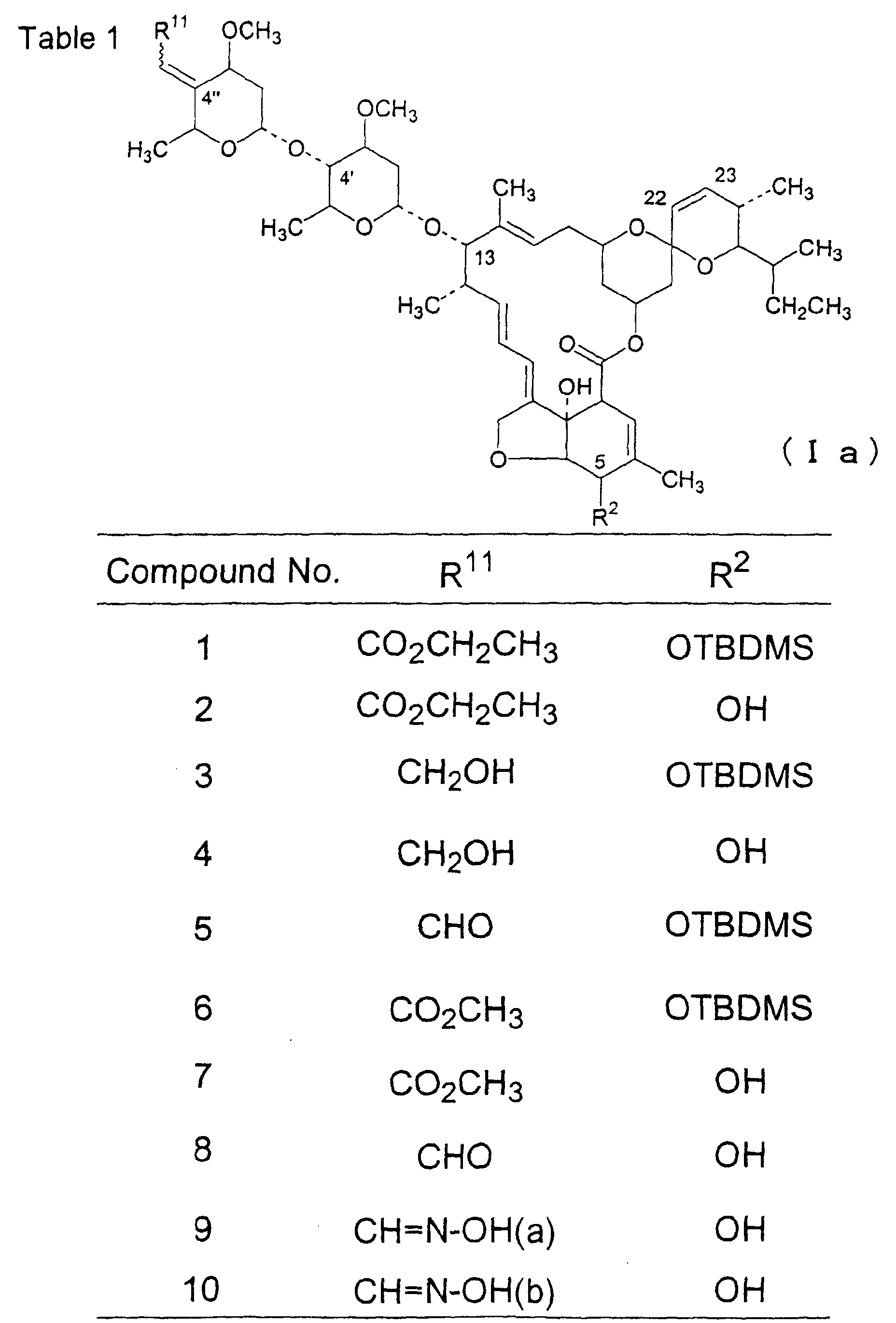
- a bond of a functional group that substitutes on a carbon atom forming a double bond is represented by a waved line in the specification, it means that the compound is an E-or Z-compound, or a mixture thereof.
- a resulting salt, per se may be purified when the compound (I) is obtained in the form of a salt.
- a salt When a product is obtained in a free form, a salt may be isolated and purified after dissolving or suspending the product in a suitable solvent, and adding an acid or a base thereto to form a salt.
- the compounds (I) and salts thereof may exist in the forms of adducts with water or various solvents (i.e., hydrates or solvates), and these adducts also fall into the scope of the present invention. Moreover, any forms of crystal also fall into the scope of the present invention.
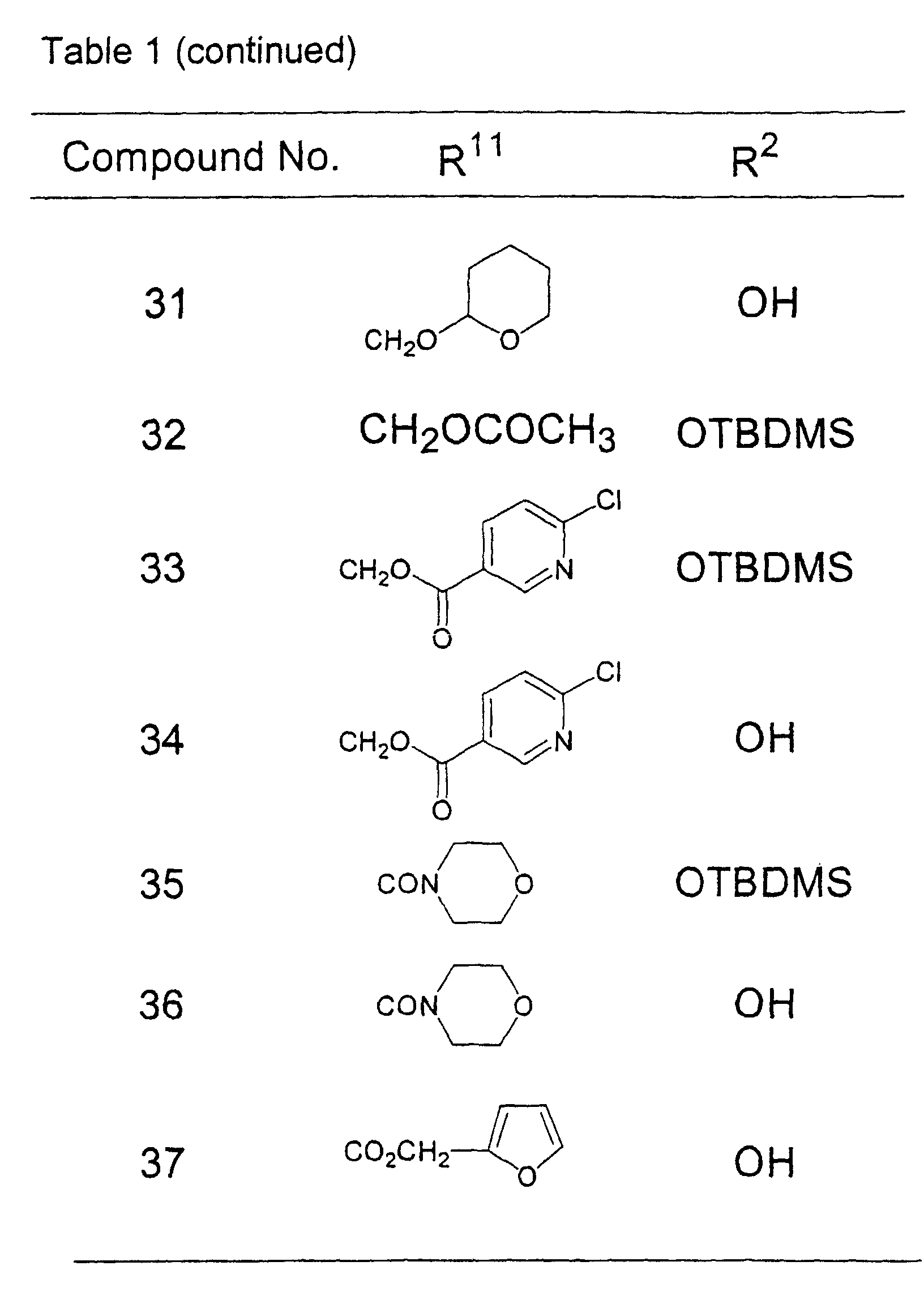
- OTBDMS represents tert-butyldimethylsilyloxy (OSi(CH 3 ) 2 C(CH 3 ) 3 ), and (a) and (b) represent two isomers based on the hydroxyl group of the oxime moiety (Compounds 9 and 10, and Compounds 12 and 13) or two isomers based on the exomethylene at the 4"-position (Compounds 18 and 19).
- the isomers appended by (a) represent those having a larger Rf value (lower polarity) and the isomers appended by (b) represent those having a smaller Rf value (higher polarity) in thin-layer chromatography.
- the active ingredient of the medicament of the present invention one or more substances selected from the group consisting of the compounds in the free form and physiologically acceptable salts thereof, and hydrates thereof and solvates thereof can be used. Any mixture of isomers or an isomer in a pure form may be used.
- the medicament of the present invention is generally provided in the form of a pharmaceutical composition which comprises one or more pharmaceutical additives and the aforementioned substance as an active ingredient.
- the route of administration is not particularly limited, and the medicament can be orally administered using preparations such as tablets, granules, capsules, syrups and powders, or parenterally administered by means of injection, intrarectal administration, transdermal administration or the like.
- Pharmaceutical formulations suitable for oral or parenteral administration are well-known to persons skilled in the art, and they can appropriately choose pharmaceutical additives suitable for the manufacture of the pharmaceutical formulations.
- the medicament of the present invention may be applied to various parasitic diseases, and the kinds of the parasitic disease are not particularly limited.
- the medicament of the present invention may be applied to a human or a mammal other than a human.
- the medicament may be administered as a pharmaceutical composition, or alternatively, a pharmaceutical composition or the aforementioned active ingredient per se may be added to a feed.
- the compound of the present invention may be applied as pesticides such as an agent for controlling injurious insects such as blowflies, cockroaches, fleas and the like.
- Solution A used in the following examples is a solution which is obtained by mixing 10 ml of hydrogen fluoride/pyridine complex, 6 ml of pyridine and 12 ml of tetrahydrofuran and stored in a polypropylene container below -10°C.
- 5-tert-butyldimethylsilyloxyavermectin B2a (5-O-tert-butyldimethylsilylavermectin B2a) is described in Tetrahedron Letters, Vol. 31, pp. 3625-2528 (1990) and J. Med. Chem., Vol. 25, pp. 658-663 (1982), and 5-tert-butyldimethylsilyloxy-7-trimethyl-silyloxyavermectin B1a is described in U.S. Patent No. 4,895,837.
- Example 3 In 1 ml of tetrahydrofuran, 87 mg of Compound 3 obtained in Example 3 was dissolved, 1 ml of the solution A was added thereto, and the mixture was stirred at room temperature for a night. Then, the reaction mixture was treated and purified in the manners similar to those in Example 2 to give 49 mg of Compound 4 in a 64% yield.
- Example 6 In 2 ml of tetrahydrofuran, 67 mg of Compound 6 obtained in Example 6 was dissolved, 0.3 ml of the solution A was added thereto, and the mixture was stirred at room temperature for a night. Then, the reaction mixture was treated and purified in the manners similar to those in Example 2 to give 41 mg of Compound 7 in a 67% yield.
- the resulting crude product was dissolved in 1 ml of tetrahydrofuran, 0.5 ml of the solution A was added thereto, and the mixture was stirred at room temperature for a night.
- To the reaction solution was added pyridine and an aqueous sodium hydrogencarbonate solution and the mixture was extracted with ethyl acetate.
- the ethyl acetate layer was dried over anhydrous magnesium sulfate, and the solvent was evaporated to give a crude product.
- Compounds 9 and 10 are isomers based on the hydroxyl group of the oxime.
- Example 5 In 0.3 ml of ethanol, 87 mg of Compound 5 obtained in Example 5 was dissolved, 22 mg of methyloxyamine hydrochloride and 0.5 ml of pyridine were added thereto, and the mixture was stirred at room temperature for 1 hour. To the reaction solution was added an aqueous sodium hydrogencarbonate solution and the mixture was extracted with ethyl acetate. The ethyl acetate layer was dried over anhydrous magnesium sulfate, and the solvent was evaporated under reduced pressure to give a crude product.
- the resulting crude product was dissolved in 1 ml of tetrahydrofuran, 0.5 ml of the solution A was added thereto, and the mixture was stirred at room temperature for a night.
- To the reaction solution was added pyridine and an aqueous sodium hydrogencarbonate solution and the mixture was extracted with ethyl acetate.
- the ethyl acetate layer was dried over anhydrous magnesium sulfate, and the solvent was evaporated under reduced pressure to give a crude product.
- Compounds 12 and 13 are isomers based on the hydroxy group of the oxime.
- Compounds 15 and 29 are isomers based on the 4"-exomethylene moiety.
- Example 3 In 0.5 ml of methylene chloride, 102 mg of Compound 3 obtained in Example 3 was dissolved, 0.2 ml of pyridine, 52 mg of isonicotinoyl chloride hydrochloride and 12 mg of 4-dimethylaminopyridine were added thereto, and the mixture was stirred for 5 days. The reaction mixture was subjected to post-treatment and purified in the manners similar to those in Example 14 to give 51 mg of Compound 17 in a 46% yield.
- Compounds 18 and 19 are isomers based on the 4"-exomethylene moiety.
- Example 3 In 0.25 ml of methylene chloride, 21 mg of Compound 3 obtained in Example 3 was dissolved, 5 mg of pyrrole-2-carboxylic acid, 6 mg of 4-dimethylaminopyridine and 10 mg of 1-ethyl-3-(3-dimethylaminopropyl)carbodiimide hydrochloride (WSCI hydrochloride) were added thereto, and then the mixture was stirred at room temperature for a night. The reaction mixture was subjected to post-treatment and purified in the manners similar to those in Example 14. The resulting crude product was dissolved in 0.5 ml of tetrahydrofuran, 0.2 ml of the solution A was added thereto, and the mixture was stirred at room temperature for 5 hours.
- WSCI hydrochloride 1-ethyl-3-(3-dimethylaminopropyl)carbodiimide hydrochloride
- Example 3 In 0.4 ml of methylene chloride, 36 mg of Compound 3 obtained in Example 3 was dissolved, 15 mg of N-(tert-butoxycarbonyl)proline, 8 mg of 4-dimethylaminopyridine and 17 mg of 1-ethyl-3-(3-dimethylaminopropyl)carbodiimide hydrochloride (WSCI hydrochloride) were added thereto, and then the mixture was stirred at room temperature for a night. The reaction mixture was subjected to post-treatment and purified in the manners similar to those in Example 14 to give 42 mg of Compound 28 in a 98% yield.
- WSCI hydrochloride 1-ethyl-3-(3-dimethylaminopropyl)carbodiimide hydrochloride
- Example 14 In 0.6 ml of methylene chloride, 61 mg of Compound 3 obtained in Example 3 was dissolved, 10 ⁇ l of dihydropyran and 5 mg of pyridinium p-toluenesulfonate were added thereto, and the mixture was stirred at room temperature for 45 minutes. The reaction mixture was then subjected to post-treatment and purified in the manners similar to those in Example 14.
- Example 21 In 0.2 ml of methylene chloride, 30 mg of Compound 24 obtained in Example 21 was dissolved, 2 drops of furfuryl alcohol, 10 mg of 4-dimethylaminopyridine and 11 mg of WSCI hydrochloride were added thereto, and then the mixture was stirred at room temperature for a night. The reaction mixture was subjected to post-treatment and purified in the manners similar to those in Example 14 to give 5-O-tert-butyldimethylsilyl-4"-furfuryloxycarbonylmethylideneavermectin B1a.
- the 5-O-tert-butyldimethylsilyl-4"-furfuryloxycarbonylmethylideneavermectin B1a obtained was dissolved in 1.0 ml of tetrahydrofuran, 0.2 ml of the solution A was added thereto, and the mixture was stirred at room temperature for a night. Then, the mixture was treated and purified in the manners similar to those in Example 2 to give 8 mg of Compound 37 in a 62% yield.
- the crude product was dissolved in 2.1 ml of tetrahydrofuran, 0.7 ml of the solution A was added thereto, and the mixture was stirred at room temperature for a night.
- the ethyl acetate layer was dried over anhydrous sodium sulfate, and then the solvent was evaporated under reduced pressure to give a crude product.
- the crude product was dissolved in 1.5 ml of tetrahydrofuran, 0.5 ml of the solution A was added thereto, and the mixture was stirred at room temperature for a night.
- insects for simple determination of antiparasitic and insecticidal activities, those insects are desired which can be easily obtained and bred in laboratories, and have no pathogenicity to a human.
- Caenorhabditis elegans an unparasitic eelworm widely used in experiments of genetics, was used as a typical steam worm, and artemia salina used as feed for tropical fish and named Brine shrimp, was used instead of insects.
- Escherichia. coli for the feed of caenorhabditis elegans (mutant having uracil requirement) was inoculated in a seed medium for E. coli to which a small amount of uracil was added, and cultured with shaking at 27°C for 1 day.
- a petri dish of 6 cm diameter was filled with 10 ml of an agar medium for eelworm proliferation, and the medium was solidified. Then 0.5 ml of the culture of E. coli was spread over the medium in the dish, and the dish was incubated at 37°C to proliferate E. coli.
- a piece of the agar was collected with a platinum loop from a petri dish in which caenorhabditis elegans successfully proliferated, and inoculated in petri dishes in which E. coli was proliferated.
- the petri dishes were incubated at 20°C to proliferate caenorhabditis elegans . Since the life of eelworm is about 2 weeks, subculture was carried out every once a week. The eelworms grown with spread on the surface of the petri dish after 3 to 5 days from subculture were used for the experiments.
- Solution A was obtained by dissolving 0.3% of sodium chloride, 1.7% of bact-agar (DIFCO Co.), 0.5% of bact-peptone (DIFCO Co.) and 1.0% of yeast extract (DIFCO Co.) in distilled water.
- Solution B was obtained by dissolving 0.5% of cholesterol in ethanol.
- Solution C was obtained by dissolving 13.9% of calcium chloride in distilled water.
- Solution D was obtained by dissolving 30.8% of magnesium sulfate heptahydrate in distilled water.
- Solution E was obtained by dissolving 13.54% of KH 2 PO 4 and 4.45% of K 2 HPO 4 in distilled water.
- the agar medium for eelworm proliferation was prepared by mixing the solutions in the following proportion: Solution A: 100 ml, Solution B: 0.1 ml, Solution C: 0.05 ml, Solution D: 0.1 ml and Solution E: 2.5 ml (without pH adjustment), and dispensing each 10 ml portion into petri dishes of 60 ⁇ 15 mm.
- each well of a 96 well microplate was filled with the solution of the test compound (methanol as a solvent), and the solvent was removed using a vacuum pump, then 250 ⁇ l of the assay medium was added to each wells (the assay medium was prepared by dissolving 7.5 mM sodium hydrogencarbonate, 7.5 mM potassium chloride, 7.5 mM calcium chloride dihydrate and 7.5 mM magnesium sulfate heptahydrate in distilled water and adding 0.01% of lecithin thereto), and then the microplate was shaken using a microplate mixer for 15 minutes.
- Indications 3 and 2 were judged as effective, and Indications 1 and 0 as ineffective.
- the results are shown in Table 9.
- the values for each compound are minimum inhibitory concentrations (MIC) which were required to give Indication 2 (or 3) for caenorhabditis elegans or artemia salina.
- MIC minimum inhibitory concentrations
- caenorhabditis elegans and artemia salina are abbreviated as C.E. and A.S., respectively.
- mice For the experiments male mice (strain Bor CFW, 25-30 g of body weight on receipt) were housed in Macrolon cages (3 mice per cage) and provided with water and SNIFF rat feed (10-mm pellets) ad libitum. Mice were infected with H. spumosa by oral application of 90 embryonated eggs. The eggs were obtained from female Heterakis. isolated from mouse colon 40 days after infection followed by additional three weeks incubation at 37°C. The mice were treated orally 4 times with the compounds at the dosages of 1, 0.5, 0.25, 0.1, 0.05 and 0.025 mg/kg between days 46 and 49 after infection. Compounds were suspended in Cremophor EL. Infected control mice served as untreated controls which only received Cremophor EL.
- mice were killed eight days after treatment (i.e. on day 57 after infection) with carbon dioxide and cecum and colon were dissected. The number of worms which have resided in the cecum and colon were counted macroscopically. The ratios of the number of expelled worms in percent of the total number of worms was defined as level of the anthelmintic activity. Activity was evaluated on a scale 0-3 where 3 represents cure (no parasites detectable), 2 effective ( ⁇ 20% of parasites remaining), 1 trace effect ( ⁇ of parasites remaining) and 0 ineffective (> 50% of parasites remaining).
- mice Male mice (species and conditions are the same as those in Test Example 2) were orally infected with 60 numbers of dubius larvae. 14 days after infection the mice were orally treated 4 times with the compounds using the same dosages (dose: 1, 0.5, 0.25, 0.1 mg/kg), and killed eight days after treatment. Calculation of the level of anthelmintic activity was performed in the same way as for Test Example 2.
- Test animals Lucilia cuprina larvae
- Solvent Dimethylsulfoxide
- active compound solution 20 mg are dissolved in one ml of dimethylsulfoxide.
- active compound solution is diluted with water to the concentration required in each case.
- Approx. 20 Lucilia cuprina larvae are introduced into a test tube containing approx. 1 cm 3 of horse-meat and 0.5 ml of the active compound preparation to be tested. After 48 hours the activity of the active compound preparation is determined.
- the test tubes are transferred to beakers with a sand-covered base. After a further 2 days the test tubes are removed and the pupae counted.
- the activity of the active compound preparation is assessed according to the number of flies which have hatched after 1.5 times the development period of an untreated control. 100% means that no flies have hatched: 0% means that all of the flies have hatched normally.
- Test animals Adult Ctenocephalides felis Solvent: Dimethylsulfoxide (DMSO)
- a solution of active compound is prepared from 20 mg of active compound and 1 ml of DMSO. 20 ⁇ l of this formulation are added to 4 ml of citrated cow's blood and stirred.
- Test animals Adult Musca domestica of WHO(N) species
- Solvent DMSO
- a solution of active compound is prepared froom 20 mg of active compound and 1 ml of DMSO.
- the active compound solution is diluted with water to the concentration required in each case.
- the activity of the active compound preparation is determined. 100% means that all of the flies have been destroyed; 0% means that none of the flies have been destroyed.
- Test animals Fourth larval stage of Periplaneta americana Solvent: Dimethylsulfoxide
- active compound solution 20 mg are dissolved in one ml of dimethylsulfoxide.
- active compound solution is diluted with water to the concentration required in each case.
- Test animals Third larval stages of Periplaneta americana Solvent: Dimethylsulfoxide
- the activity of the active compound formulation is determined. 100% means that all of the cockroach larvae have been destroyed; 0% means that none of the cockroach larvae have been destroyed.
- avermectin derivatives having antiparasitic activity and salts thereof are provided.
- the aforementioned derivatives and salts thereof are useful as active ingredients of antiparasitic agents.
Landscapes
- Health & Medical Sciences (AREA)
- Chemical & Material Sciences (AREA)
- Life Sciences & Earth Sciences (AREA)
- General Health & Medical Sciences (AREA)
- Organic Chemistry (AREA)
- Molecular Biology (AREA)
- Veterinary Medicine (AREA)
- Animal Behavior & Ethology (AREA)
- Medicinal Chemistry (AREA)
- Public Health (AREA)
- Pharmacology & Pharmacy (AREA)
- Biotechnology (AREA)
- Biochemistry (AREA)
- Engineering & Computer Science (AREA)
- Genetics & Genomics (AREA)
- Epidemiology (AREA)
- Tropical Medicine & Parasitology (AREA)
- Chemical Kinetics & Catalysis (AREA)
- General Chemical & Material Sciences (AREA)
- Nuclear Medicine, Radiotherapy & Molecular Imaging (AREA)
- Pharmaceuticals Containing Other Organic And Inorganic Compounds (AREA)
- Saccharide Compounds (AREA)
Abstract

Description

- 1) when -X----Y- represents -CH=CH-,
the line ---- between R1 and a carbon atom at the 4"-position represents a double bond;
R1 represents (R11)(R12)C [wherein R11 represents a substituted or unsubstituted lower alkyl group; a formyl group; a lower alkoxylcarbonyl group, the alkyl moiety of the said lower alkoxylcarbonyl group may be substituted with a heterocyclic group; -CH=N-OR3 wherein R3 represents a hydrogen atom or a lower alkyl group; a lower alkenyloxycarbonyl group; -CH=N-NH-CONH2; a cyano group; -COR4 wherein R4 represents a hydroxyl group or N(R5)(R6) wherein R5 and R6 form a nitrogen containing heterocyclic group together with the adjacent nitrogen atom; a vinyl group substituted with a lower alkenyloxycarbonyl group; -CO-S-CH2-CH2-NH-CO-Rx
wherein Rx represents a lower alkyl group; or -CH=CH-COOH; and R12 represents a hydrogen atom, or when R11 represents a cyano group, R12 represents a hydrogen atom or a lower alkyl group]; when the line ---- between R2 and a carbon atom at the 5-position represents a single bond, R2 represents a hydroxyl group, a lower alkoxyl group, or a tri(lower alkyl)silyloxy group; or when the line ---- between R2 and a carbon atom at the 5-position represents a double bond, R2 forms a carbonyl group or a hydroxime group {-C(=NOH)}, together with the carbon atom at the 5-position; - 2) when -X----Y- represents -CH2-C(=O)-,
the line ---- between R1 and a carbon atom at the 4"-position represents a double bond;
R1 represents (R11a)(R12a)C [wherein R11a represents a lower alkoxycarbonyl group, the alkyl moiety of the said lower alkoxycarbonyl group may be substituted with a heterocyclic group, or -COOCH2CH=CH2; and R12a represents a hydrogen atom]; the line ---- between R2 and a carbon atom at the 5-position represents a single bond; and R2 represents a hydroxyl group, a lower alkoxyl group, or a tri(lower alkyl)silyloxy group; - 3) when -X----Y- represents -CH2-CH2-,
R1 represents (R11b)(R12b)C [wherein R11b represents a cyano group, a carboxyl group, or a lower alkenyloxycarbonyl group; and R12b represents a hydrogen atom]; or when the line ---- between R1 and a carbon atom at the 4"-position represents a single bond, R1 may represent a carboxymethyl group or a cyanomethyl group; the line ---- between R2 and a carbon atom at the 5-position represents a single bond; and R2 represents a hydroxyl group, a lower alkoxyl group, or a tri(lower alkyl)silyloxy group; - 4) when -X----Y- represents -CH2-CH(R13)-,
the line ---- between R1 and a carbon atom at the 4"-position represents a double bond;
R1 represents (R11c)(R12c)C [wherein R11c represents a cyano group, a carboxyl group, a lower alkoxycarbonyl group or a lower alkenyloxycarbonyl group; and R12c represents a hydrogen atom]; R13 represents a hydroxyl group or a lower alkylcabonyloxy group; the line ---- between R2 and a carbon atom at the 5-position represents a single bond; and R2 represents a hydroxyl group, a lower alkoxyl group or a tri(lower alkyl)silyloxy group.




Examples of the condensing agent include
1-ethyl-3-(3-dimethylaminopropyl)carbodiimide (WSCI) hydrochloride, and
1,3-dicyclocarbodiimide. Examples of the base include triethylamine, diisopropylethylamine, dimethylaminopyridine, and pyridine.


Toluene/acetone = 4/1
Toluene/ethyl acetate = 6/1






HR-FAB-MS: Calculated; C54H84O15Si [M+Na]+ 1023.5477, Found; 1023.5507 IR(KBr) λ maxcm-1: 3469, 2962, 2933, 1739, 1724, 1452, 1124, 1054, 1006, 989 1H NMR (270MHz, CDCl3, partial data) δ (ppm): 5.76 (1H, m), 5.70 (2H, m), 5.48 (1H, s), 5.30 (1H, s), 5.26 (1H, m), 4.90 (1H, t, J = 7.3Hz), 4.73 (1H, d, J = 3.3Hz), 4.64 (1H, d, J = 15.8Hz), 4.53 (1H, d, J = 16.1Hz), 4.38 (2H, m), 4.15 (1H, m), 3.98 (1H, s), 3.89 (1H, br.s), 3.77 (1H, d, J = 5.6Hz), 3.46 (3H, s), 3.39 (3H, s), 3.28 (1H, t, J = 8.9Hz), 1.76 (3H, s), 1.11 (3H, d, J = 6.9Hz), 0.09 (6H, s)
13C-NMR (67.8MHz, CDCl3) δ (ppm): 206.9, 205.8, 173.7, 140.1, 137.5, 137.3, 135.4, 124.8, 119.2, 117.6, 117.1, 100.5, 97.9, 94.7, 81.7, 81.0, 80.2, 80.0, 79.0, 77.9, 76.4, 70.6, 69.3, 68.1, 67.7, 67.6, 66.8, 60.3, 58.2, 56.3, 51.3, 46.3, 45.6, 40.3, 39.4, 39.3, 35.9, 35.8, 34.4, 33.7, 27.2, 25.7, 25.7, 25.7, 20.2, 19.9, 18.3, 15.0, 13.8, 12.3, 11.5, 8.6, -4.7, -5.0
HR-FAB-MS: Calculated; C52H76O15[M+Na]+ 963.5081, Found; 963.5082 IR(KBr) λ maxcm-1: 3482, 2969, 2933, 1720, 1654, 1457, 1382, 1159, 1120, 991 1H NMR (270MHz, CDCl3, partial data) δ (ppm): 5.82 (1H, s), 5.73 (3H, m), 5.53 (1H, dd, J = 2.3, 9.9Hz), 5.40 (3H, m), 5.13 (1H, s), 4.98 (1H, m), 4.75 (1H, d, J = 2.9Hz), 4.46 (2H, m), 4.17 (2H, q, J = 7.2Hz), 4.01 (1H, s), 3.44 (3H, s), 3.35 (3H, s), 1.85 (3H, s)
13C-NMR (67.8MHz, CDCl3) δ (ppm): 173.7, 165.8, 156.4, 139.5, 138.1, 137.9, 136.3, 135.1, 127.7, 124.6, 120.4, 118.2, 118.0, 117.1, 96.2, 95.7, 95.0, 81.9, 80.3, 80.2, 79.0, 78.9, 74.8, 70.1, 68.4, 68.3, 68.3, 68.1, 67.7, 67.4, 60.3, 57.1, 56.4, 45.6, 40.4, 39.7, 36.6, 35.1, 34.7, 34.2, 33.4, 30.5, 27.5, 20.1, 19.9, 19.3, 17.9, 16.3, 15.0, 14.2, 12.9, 12.0
HR-FAB-MS: Calculated; C56H88O14Si[M+Na]+ 1035.5840, Found; 1035.5841 IR(KBr) λ maxcm-1: 3477, 2962, 2931, 1735, 1718, 1459, 1380, 1160, 1124, 989 1H NMR (270MHz, CDCl3, partial data) δ (ppm): 5.70 (5H, m), 5.51 (1H, dd, J = 2.3, 9.9Hz), 5.36 (3H, m), 4.97 (1H, m), 4.73 (1H, d, J = 3.3Hz), 4.58 (2H, q, J = 4.8Hz), 4.39 (2H, m), 4.27 (3H, m), 3.93 (1H, s), 3.45 (3H, s), 3.38 (3H, s), 1.78 (3H, s), 1.31 (3H, d, J = 6.3Hz), 1.22 (3H, d, J = 6.3Hz), 1.12 (3H, d, J = 7.0Hz), 0.89 (9H, s), 0.10 (6H, s)
HR-FAB-MS: Calculated; C50H74O14[M+Na]+ 921.4976, Found; 921.4922 IR(KBr) λ maxcm-1: 3465, 2967, 2933, 1735, 1718, 1457, 1378, 1180, 1118, 989 1H NMR (270MHz, CDCl3, partial data) δ (ppm): 5.88 (1H, m), 5.73 (4H, m), 5.54 (1H, dd, J = 2.6, 9.9Hz), 5.37 (3H, m), 4.98 (1H, m), 4.76 (1H, d, J = 3.0Hz), 4.67 (2H, s), 3.45 (3H, s), 3.36 (3H, s), 1.86 (3H, s), 1.33 (3H, d, J = 6.6Hz), 1.25 (3H, d, J = 5.9Hz), 1.14 (3H, d, J = 6.9Hz)
13C-NMR (67.8MHz, CDCl3) δ (ppm): 173.7, 141.6, 139.5, 138.1, 137.9, 136.3, 135.1, 127.7, 125.9, 124.7, 120.4, 118.3, 118.0, 96.7, 95.7, 95.0, 81.9, 80.4, 79.9, 79.0, 74.9, 73.2, 68.4, 68.3, 68.3, 67.7, 67.5, 67.1, 58.4, 56.9, 55.8, 45.7, 40.4, 39.8, 36.6, 35.1, 34.7, 34.2, 33.2, 30.6, 27.5, 20.2, 19.9, 18.2, 18.0, 16.4, 15.1, 12.9, 12.0 (one peak was not observed because of overlapping with another peak.)
HR-FAB-MS: Calculated; C56H86O14Si[M+Na]+ 1033.5684, Found; 1033.5740 IR(KBr) λ maxcm-1: 3444, 2962, 2933, 1727, 1660, 1461, 1384, 1160, 1124, 1008, 989 1H NMR (270MHz, CDCl3, partial data) δ (ppm): 10.3 (1H, d, J = 7.3Hz), 5.90 (1H, d, J = 7.3Hz), 5.74 (4H, m), 5.54 (1H, dd, J = 2.3, 9.9Hz), 5.48 (1H, m), 5.33 (2H, m), 4.99 (1H, m), 4.78 (1H, s), 4.43 (1H, br.s), 4.13 (1H, s), 3.45 (3H, s), 3.44 (3H, s), 3.31 (1H, t, J = 9.2Hz), 2.03 (1H, m), 1.79 (3H, s), 1.35 (3H, d, J = 6.3Hz), 1.15 (3H, d, J = 6.9Hz), 0.13 (6H, s)
13C-NMR (67.8MHz, CDCl3) δ (ppm): 193.7, 174.1, 158.7, 140.2, 137.5, 137.4, 136.2, 135.1, 127.7, 125.1, 124.8, 119.2, 118.3, 117.1, 97.3, 95.7, 95.0, 82.0, 80.5, 80.2, 80.0, 79.1, 75.2, 74.8, 69.4, 68.4, 68.3, 67.9, 67.2, 67.0, 56.7, 56.4, 45.7, 40.4, 39.6, 36.5, 36.4, 35.1, 34.6, 34.2, 30.5, 27.5, 25.8, 25.8, 25.8, 20.3, 20.0, 18.4, 18.1, 17.6, 16.3, 15.1, 12.9, 12.0, -4.6, -4.9
HR-FAB-MS: Calculated; C57H88O15Si[M+Na]+ 1063.5790, Found; 1063.5840 IR(KBr) λ maxcm-1: 3444, 2962, 2933, 1727, 1660, 1461, 1384, 1160, 1124, 1008, 989 1H NMR (270MHz, CDCl3, partial data) δ (ppm): 5.84 (1H, s), 5.72 (3H, m), 5.54 (1H, dd, J = 2.3, 9.9Hz), 5.44 (1H, t, J = 7.2Hz), 5.35 (1H, m), 5.32 (1H, s), 5.13 (1H, s), 4.98 (1H, m), 4.76 (1H, s), 4.52 (2H, q, J = 4.9Hz), 4.45 (2H, m), 3.72 (3H, s), 3.45 (3H, s), 3.37 (3H, s), 1.78 (3H, s), 1.49 (3H, s), 1.41 (3H, d, J = 6.6Hz), 1.24 (3H, d, J = 6.3Hz), 1.13 (3H, d, J = 6.9Hz), 0.92 (9H, s), 0.13 (6H, s)
HR-FAB-MS: Calculated; C51H74O15[M+Na]+ 949.4925, Found; 949.4955 IR(KBr) λ maxcm-1: 3446, 2967, 2933, 1724, 1456, 1382, 1159, 1120, 987 1H NMR (270MHz, CDCl3, partial data) δ (ppm): 5.77 (5H, m), 5.53 (1H, dd, J = 2.6, 9.9Hz), 5.40 (3H, m), 5.12 (1H, s), 4.98 (1H, m), 4.75 (1H, d, J = 3.9Hz), 4.66 (2H, s), 4.48 (1H, m), 4.28 (1H, br.s), 3.71 (3H, s), 3.45 (3H, s), 3.36 (3H, s), 1.85 (3H, s), 1.47 (3H, s), 1.40 (3H, d, J = 7.6Hz), 1.23 (3H, d, J = 5.9Hz), 1.12 (3H, d, J = 6.9Hz) 13C-NMR (67.8MHz, CDCl3) δ (ppm): 173.7, 166.2, 156.8, 139.5, 138.0, 137.9, 136.2, 135.1, 127.7, 124.6, 120.4, 118.2, 118.0, 116.6, 96.1, 95.7, 95.0, 81.9, 80.3, 80.2, 79.0, 78.9, 74.8, 70.2, 68.4, 68.3, 68.3, 68.1, 67.7, 67.4, 57.1, 56.5, 51.3, 45.6, 40.4, 39.7, 36.6, 35.1, 34.7, 34.2, 33.4, 30.5, 27.4, 20.1, 19.9, 19.3, 17.9, 16.3, 15.0, 13.0, 12.0
HR-FAB-MS: Calculated; C50H72O14[M+Na]+ 919.4819, Found; 919.4821 IR(KBr) λ maxcm-1: 3453, 2967, 2933, 1723, 1673, 1456, 1378, 1160, 1118, 991 1H NMR (270MHz, CDCl3, partial data) δ (ppm): 10.36 (1H, d, J = 7.6Hz), 5.90 (1H, d, J = 7.6Hz), 5.86 (1H, m), 5.74 (3H, m), 5.53 (1H, dd, J = 2.3, 9.9Hz), 5.48 (1H, m), 5.41 (2H, m), 4.98 (1H, m), 4.78 (1H, br.s), 4.68 (1H, s), 4.53 (2H, m), 4.29 (1H, br.s), 3.45 (3H, s), 3.43 (3H, s), 2.02 (1H, m), 1.87 (3H, s), 1.36 (3H, d, J = 6.6Hz), 1.25 (3H, d, J = 6.9Hz), 1.16 (3H, d, J = 6.3Hz)
13C-NMR (67.8MHz, CDCl3) δ (ppm): 193.6, 173.7, 158.7, 139.6, 138.0, 138.0, 136.2, 135.1, 127.7, 125.1, 124.7, 120.4, 118.3, 118.0, 97.3, 95.7, 95.0, 82.0, 80.5, 80.4, 79.1, 75.2, 74.9, 68.4, 68.3, 68.3, 67.7, 67.3, 67.2, 67.1, 56.7, 56.4, 45.7, 40.4, 39.7, 36.6, 36.4, 35.1, 34.6, 34.2, 30.5, 27.5, 20.2, 19.9, 18.1, 17.7, 16.3, 15.1, 12.9, 12.0
13C-NMR (67.8MHz, CDCl3) δ (ppm): 173.7, 148.0, 144.9, 139.5, 138.1, 137.9, 136.3, 135.8, 135.1, 127.7, 124.7, 120.4, 118.3, 118.1, 112.0, 97.0, 95.8, 95.1, 81.9, 80.4, 79.2, 79.2, 79.1, 74.9, 74.0, 68.4, 68.4, 67.9, 67.7, 67.4, 56.9, 56.3, 45.7, 40.5, 39.8, 36.6, 35.5, 35.2, 34.7, 34.2, 30.6, 27.5, 20.2, 19.9, 18.3, 18.1, 16.4, 15.1, 13.0, 12.0
HR-FAB-MS: Calculated; C51H77NO13[M+Na]+ 912.5475, Found; 912.5460 IR(KBr) λ maxcm-1: 3477, 2931, 1737, 1716, 1454, 1118, 989
1H NMR (270MHz, CDCl3, partial data) δ (ppm): 5.79 (4H, m), 5.61 (1H, m), 5.55 (1H, dd, J = 2.3, 9.9Hz), 5.38 (3H, m), 4.99 (1H, m), 4.76 (1H, d, J = 3.0Hz), 4.68 (2H, s), 4.40 (1H, m), 4.27 (2H, m), 3.46 (3H, s), 3.35 (3H, s), 2.49 (3H, s), 1.87 (3H, s), 1.34 (3H, d, J = 6.3Hz), 1.15 (3H, d, J = 6.9Hz)
HR-FAB-MS: Calculated; C56H89NO13Si[M+Na]+ 1034.5983, Found; 1034.5956 IR(KBr) λ maxcm-1: 3482, 2962, 2931, 1735, 1716, 1457, 1380, 1160, 1124, 1083, 991 1H NMR (270MHz, CDCl3, partial data) δ (ppm): 5.73 (5H, m), 5.54 (1H, dd, J = 2.3, 9.9Hz), 5.32 (3H, m), 4.98 (1H, m), 4.77 (1H, br.s), 4.68 (1H, d, J = 15.8Hz), 4.57 (1H, d, J = 14.2Hz), 4.39 (2H, m), 4.27 (1H, br.s), 3.44 (3H, s), 3.38 (3H, s), 1.78 (3H, s), 1.33 (3H, d, J = 6.3Hz), 1.14 (3H, d, J = 6.9Hz), 0.13 (6H, s)
1H NMR (270MHz, CDCl3, partial data) δ (ppm): 5.73 (4H, m), 5.54 (1H, dd, J = 2.6, 9.9Hz), 5.45 (1H, t, J = 4.3Hz), 5.35 (3H, m), 4.98 (1H, m), 4.77 (1H, d, J = 3.3Hz), 4.68 (1H, d, J = 14.9Hz), 4.57 (1H, d, J = 14.5Hz), 4.45 (2H, m), 4.30 (1H, m), 3.48 (3H, s), 3.44 (3H, s), 1.78 (3H, s), 1.35 (3H, d, J = 6.3Hz), 1.14 (3H, d, J = 6.9Hz), 0.13 (6H, s)
HR-FAB-MS: Calculated; C62H91NO15Si[M+Na]+ 1140.6055, Found; 1140.6058 IR(KBr) λ maxcm-1: 3438, 2962, 2929, 1727, 1280, 1124, 987
1H NMR (270MHz, CDCl3, partial data) δ (ppm): 9.21 (1H, d, J = 1.6Hz), 8.76 (1H, dd, J = 1.6, 4.6Hz), 8.28 (1H, dt, J = 2.0, 8.2Hz), 7.37 (1H, m), 5.72 (5H, m), 5.52 (1H, dd, J = 2.5, 9.9Hz), 5.39 (3H, m), 5.15 (1H, dd, J = 7.6, 13.2Hz), 5.01 (2H, m), 4.75 (1H, d, J = 3.0Hz), 4.66 (1H, d, J = 16.2Hz), 4.55 (1H, d, J = 16.8Hz), 4.32 (1H, br.s), 3.44 (3H, s), 3.36 (3H, s), 1.76 (3H, s), 1.35 (3H, d, J = 6.6Hz), 1.12 (3H, d, J = 6.6Hz), 0.11 (6H, s)
HR-FAB-MS: Calculated; C62H91NO15Si[M+Na]+ 1140.6055, Found; 1140.6049 IR(KBr) λ maxcm-1: 3450, 2962, 2933, 1731, 1461, 1378, 1276, 1160, 1124, 993 1H NMR (270MHz, CDCl3, partial data) δ (ppm): 8.78 (2H, dd, J = 1.7, 4.4Hz), 7.85 (2H, dd, J = 1.7, 4.4Hz), 5.73 (5H, m), 5.55 (1H, dd, J = 2.3, 9.9Hz), 5.41 (2H, s), 5.14 (1H, dd, J = 7.6, 13.2Hz), 5.02 (2H, m), 4.77 (1H, d, J = 3.0Hz), 4.67 (1H, d, J = 16.2Hz), 4.57 (1H, d, J = 16.2Hz), 4.33 (1H, br.s), 4.12 (1H, s), 3.46 (3H, s), 3.38 (3H, s), 1.78 (3H, s), 1.37 (3H, d, J = 6.6Hz), 1.26 (3H, d, J = 6.6Hz), 1.14 (3H, d, J = 6.9Hz), 0.92 (9H, s), 0.13 (6H, s)
13C-NMR (67.8MHz, CDCl3) δ (ppm): 173.9, 164.9, 150.5, 150.5, 142.9, 140.1, 137.4, 137.3, 136.2, 135.1, 127.7, 124.7, 122.8, 122.8, 120.1, 119.3, 118.3, 117.3, 96.8, 95.7, 95.0, 82.0, 80.2, 80.1, 80.0, 79.0, 74.8, 73.4, 69.4, 68.4, 68.3, 67.9, 67.4, 67.3, 62.0, 56.9, 56.0, 45.7, 40.4, 39.6, 36.5, 35.1, 34.7, 34.2, 30.5, 27.4, 25.8, 25.8, 25.8, 20.2, 20.0, 18.4, 18.3, 18.0, 16.3, 15.1, 12.9, 12.0, -4.6, -4.9 (two peaks were not observed because of overlappings with other peaks.)
HR-FAB-MS: Calculated; C53H76O15[M+Na]+ 975.5081, Found; 975.5082
IR(KBr) λ maxcm-1: 3475, 2967, 2933, 1722, 1652, 1456, 1382, 1159, 1120, 1010, 989 1H NMR (270MHz, CDCl3, partial data) δ (ppm): 5.95 (1H, m), 5.86 (2H, m), 5.73 (3H, m), 5.54 (1H, dd, J = 2.3, 9.9Hz), 5.41 (3H, m), 5.29 (2H, m), 5.13 (1H, s), 4.97 (1H, m), 4.76 (1H, d, J = 3.0Hz), 4.67 (1H, s), 4.62 (1H, d, J = 6.0Hz), 4.50 (1H, q, J = 6.6Hz), 4.28 (1H, d, J = 5.0Hz), 3.45 (3H, s), 3.36 (3H, s), 1.86 (3H, s), 1.41 (3H, d, J = 6.6Hz), 1.24 (3H, d, J = 6.0Hz), 1.13 (3H, d, J = 6.9Hz)
13C-NMR (67.8MHz, CDCl3) δ (ppm): 173.5, 165.2, 157.0, 139.5, 137.9, 137.8, 136.1, 135.0, 132.0, 127.7, 124.6, 120.3, 118.3, 118.2, 117.9, 116.6, 96.1, 95.7, 94.9, 81.8, 80.3, 80.2, 79.1, 78.8, 74.8, 70.0, 68.2, 68.1, 67.6, 67.3, 64.9, 60.3, 57.0, 56.4, 45.5, 39.7, 36.5, 35.0, 34.1, 33.3, 30.5, 27.4, 25.2, 20.9, 20.0, 19.8, 19.3, 17.8, 16.3, 15.0, 14.1, 12.9, 11.9
HR-FAB-MS: Calculated; C56H77O15[M+Na]+ 1026.5190, Found; 1026.5197 IR(KBr) λ maxcm-1: 3475, 2967, 2933, 1727, 1591, 1456, 1280, 1118, 989 1H NMR (270MHz, CDCl3, partial data) δ (ppm): 9.23 (1H, d, J = 1.6Hz), 8.78 (1H, dd, J = 1.6, 4.9Hz), 8.30 (1H, dt, J = 2.0, 7.9Hz), 7.40 (1H, dd, J = 4.9, 7.9Hz), 5.74 (5H, m), 5.55 (1H, dd, J = 2.3, 9.9Hz), 5.41 (3H, m), 5.15 (1H, dd, J = 7.6, 12.5Hz), 5.02 (2H, m), 4.77 (1H, d, J = 3.3Hz), 4.68 (2H, s), 3.46 (3H, s), 3.38 (3H, s), 1.87 (3H, s), 1.37 (3H, d, J = 6.6Hz), 1.26 (3H, d, J = 5.9Hz), 1.20 (3H, d, J = 6.9Hz), 1.15 (3H, d, J = 6.9Hz)
13C-NMR (67.8MHz, CDCl3) δ (ppm): 173.6, 165.1, 156.4, 150.8, 142.7, 139.6, 138.0, 137.9, 137.1, 136.2, 135.1, 127.7, 126.0, 124.7, 123.3, 120.4, 120.3, 118.2, 118.0, 96.7, 95.7, 95.0, 81.9, 80.3, 80.1, 79.1, 79.0, 74.8, 73.3, 68.3, 68.3, 67.7, 67.4, 67.3, 61.6, 56.9, 56.0, 53.4, 45.6, 40.4, 39.7, 36.6, 35.1, 34.7, 34.2, 34.1, 30.5, 27.4, 20.1, 19.9, 18.3, 18.0, 16.3, 15.0, 12.9, 12.0
HR-FAB-MS: Calculated; C51H75N3O14[M+Na]+ 976.5146, Found; 976.5147 IR(KBr) λ maxcm-1: 3488, 2967, 2933, 1695, 1577, 1457, 1160, 1118, 989 1H NMR (270MHz, CDCl3, partial data) δ (ppm): 8.64 (1H, br.s), 8.02 (1H, d, J = 9.3Hz), 6.08 (1H, d, J = 9.3Hz), 5.85 (1H, m), 5.74 (3H, m), 5.55 (1H, dd, J = 2.3, 9.9Hz), 5.40 (3H, m), 4.99 (1H, m), 4.77 (1H, d, J = 3.0Hz), 4.67 (1H, s), 3.45 (3H, s), 3.38 (3H, s), 1.86 (3H, s), 1.37 (3H, d, J = 6.2Hz), 1.25 (3H, d, J = 6.3Hz), 1.15 (3H, d, J = 6.9Hz)
HR-FAB-MS: Calculated; C50H71N3O13[M+Na]+ 916.4882, Found; 916.4813 IR(KBr) λ maxcm-1: 3463, 2933, 2931, 2221, 1735, 1716, 1657, 1378, 1118, 1052, 1010 1H NMR (270MHz, CDCl3, partial data) δ (ppm): 5.81 (1H, m), 5.71 (3H, m), 5.51 (1H, d, J = 9.9Hz), 5.34 (4H, m), 4.95 (1H, m), 4.74 (1H, d, J = 3.3Hz), 4.63 (2H, s), 4.43 (1H, m), 4.25 (2H, m), 4.08 (1H, br.s), 3.44 (3H, s), 3.40 (3H, s), 1.82 (3H, s), 1.32 (3H, d, J = 6.3Hz)
13C-NMR (67.8MHz, CDCl3) δ (ppm): 173.5, 163.3, 139.5, 137.7, 136.2, 135.0, 127.6, 124.7, 120.2, 118.2, 117.9, 115.9, 97.0, 95.7, 94.9, 93.9, 81.9, 80.6, 80.3, 79.1, 78.9, 75.3, 74.8, 68.2, 68.2, 67.6, 67.0, 66.6, 64.1, 57.7, 56.6, 45.6, 40.4, 39.6, 36.8, 36.4, 35.0, 34.5, 34.1, 30.4, 27.4, 20.1, 19.8, 18.0, 17.5, 16.2, 15.0, 12.8, 11.9
HR-FAB-MS: Calculated; C56H86O15Si[M+Na]+ 1049.5633, Found; 1049.5634 IR(KBr) λ maxcm-1: 3482, 2962, 2933, 1716, 1654, 1459, 1380, 1159, 1124, 1085, 1006 1H NMR (270MHz, CDCl3, partial data) δ (ppm): 5.86 (1H, s), 5.70 (4H, m), 5.53 (1H, dd, J = 2.3, 9.9Hz), 5.45 (1H, m), 5.31 (3H, m), 5.06 (1H, m), 4.98 (1H, m), 4.75 (1H, s), 4.67 (1H, d, J = 15.0Hz), 4.55 (1H, d, J = 15.0Hz), 4.48 (1H, m), 4.43 (1H, br.s), 3.44 (3H, s), 3.37 (3H, s), 1.77 (3H, s), 1.40 (3H, d, J = 6.6Hz), 1.11 (3H, d, J = 6.9Hz), 0.13 (6H, s)
HR-FAB-MS: Calculated; C50H72O15[M+Na2 - H]+ 957.4588, Found; 957.4670 IR(KBr) λ maxcm-1: 3469, 2967, 2933, 1716, 1654, 1456, 1378, 1160, 1120, 1008, 991 1H NMR (270MHz, CDCl3, partial data) δ (ppm): 5.95 (1H, m), 5.85 (3H, m), 5.62 (1H, dd, J = 2.3, 9.9Hz), 5.57 (1H, m), 5.40 (2H, m), 5.07 (1H, m), 4.86 (1H, s), 4.77 (2H, s), 4.38 (1H, d, J = 6.0Hz), 3.55 (3H, s), 3.33 (3H, s), 1.95 (3H, s), 1.34 (3H, d, J = 6.3Hz), 1.22 (3H, d, J = 6.6Hz)
HR-FAB-MS: Calculated; C56H77O15[M+Na2-H]+ 1026.5190, Found; 1026.5225 IR(KBr) λ maxcm-1: 3477, 2967, 2933, 1731, 1457, 1278, 1120, 989
1H NMR (270MHz, CDCl3, partial data) δ (ppm): 8.77 (2H, dd, J = 1.6, 4.2Hz), 7.85 (2H, dd, J = 1.6, 4.2Hz), 5.83 (1H, m), 5.73 (4H, m), 5.54 (1H, dd, J = 2.3, 9.9Hz), 5.41 (3H, m), 5.13 (1H, dd, J = 7.2, 13.2Hz), 5.03 (2H, m), 4.76 (1H, d, J = 3.0Hz), 4.66 (2H, s), 3.45 (3H, s), 3.37 (3H, s), 1.85 (3H, s), 1.35 (3H, d, J = 6.6Hz), 1.25 (3H, d, J = 5.9Hz), 1.14 (3H, d, J = 6.9Hz)
13C-NMR (67.8MHz, CDCl3) δ (ppm): 173.4, 164.8, 150.3, 150.3, 142.8, 139.5, 137.8, 137.6, 137.3, 136.1, 135.0, 137.6, 124.6, 122.8, 122.8, 120.2, 120.1, 118,1, 117.9, 96.7, 95.6, 95.0, 81.8, 80.2, 80.1, 79.1, 78.9, 74.7, 73.3, 68.2, 68.2, 67.6, 67.2, 64.0, 62.0, 56.8, 55.9, 45.5, 40.3, 39.6, 36.4, 35.0, 34.6, 34.1, 34.0, 30.4, 27.3, 20.1, 19.8, 18.2, 17.9, 16.2, 15.0, 12.8, 12.0 (one peak was not observed because of overlapping with another one.)
HR-FAB-MS: Calculated; C55H77O15[M+Na2 - H]+ 1014.5190, Found; 1014.5156 IR(KBr) λ maxcm-1: 3469, 2967, 29:33, 1706, 1556, 1452, 1413, 1378, 1309, 1160, 1120 1H NMR (270MHz, CDCl3, partial data) δ (ppm): 9.45 (1H, br.s), 6.93 (2H, m), 6.25 (1H, m), 5.72 (5H, m), 5.53 (1H, dd, J = 2.6, 9.3Hz), 5.40 (3H, m), 4.75 (1H, d, J = 3.3Hz), 4.66 (2H, s), 3.94 (1H, d, J = 6.3Hz), 3.45 (3H, s), 3.34 (3H, s), 1.85 (3H, s), 1.35 (3H, d, J = 6.6Hz), 1.24 (3H, d, J = 6.2Hz), 1.13 (3H, d, J = 6.5Hz)
13C-NMR (67.8MHz, CDCl3) δ (ppm): 173.6, 161.0, 142.0, 139.5, 138.1, 137.8, 136.2, 135.1, 127.7, 124.6, 123.1, 122.5, 121.4, 120.4, 118.2, 118.0, 115.5, 110.4, 96.6, 95.7, 95.0, 81.9, 80.3, 80.0, 79.1, 79.0, 74.8, 73.0, 68.3, 68.2, 67.7, 67.5, 60.4, 57.0, 55.9, 50.7, 45.7, 40.4, 39.7, 36.5, 35.1, 34.7, 34.2, 33.9, 30.5, 27.4, 20.1, 19.9, 18.5, 18.0, 16.3, 15.0, 12.9, 12.0
HR-FAB-MS: Calculated; C66H103NO17Si[M+Na]+ 1232.6892, Found; 1232.6901 IR(KBr) λ maxcm-1: 3453, 1962, 1745, 1706, 1457, 1396, 1160, 1124, 1085, 989 1H NMR (270MHz, CDCl3, partial data) δ (ppm): 5.72 (4H, m), 5.54 (1H, dd, J = 2.3, 9.9Hz), 5.52 (1H, m), 5.34 (3H, m), 4.76 (1H, br.s), 4.67 (1H, dd, J = 2.0, 14.5Hz), 4.57 (1H, dd, J = 2.0, 14.5Hz), 4.10 (1H, s), 3.92 (1H, br.s), 3.45 (3H, s), 3.32 (3H, d, J = 4.3Hz), 1.78 (3H, s), 1.42 (3H, s), 1.40 (6H, s), 1.33 (3H, d, J = 6.6Hz), 1.24 (3H, d, J = 6.3Hz), 1.13 (3H, d, J = 6.9Hz), 0.12 (6H, s)
HR-FAB-MS: Calculated; C60H89NO17[M+Na]+ 1118.6027, Found; 1118.6050 IR(KBr) λ maxcm-1: 3475, 2971, 1743, 1706, 1454, 1396, 1160, 1120, 989 1H NMR (270MHz, CDCl3, partial data) δ (ppm): 5.72 (4H, m), 5.54 (1H, dd, J = 2.3, 9.9Hz), 5.52 (1H, m), 5.40 (3H, m), 5.06 (1H, m), 4.75 (1H, br.s), 4.66 (2H, s), 4.37 (1H, m), 3.94 (1H, d, J = 6.3Hz), 3.92 (1H, s), 3.43 (3H, s), 3.31 (3H, d, J = 4.3Hz), 1.85 (3H, s), 1.47 (3H, s), 1.43 (3H, s), 1.39 (3H, s), 1.32 (3H, d, J = 6.3Hz), 1.23 (3H, d, J = 6.3Hz), 1.13 (3H, d, J = 6.9Hz)
HR-FAB-MS: Calculated; C57H88O16Si[M+Na]+ 1079.5738, Found; 1079.5693 IR(KBr) λ maxcm-1: 3473, 2962, 2935, 1724, 1458, 1384, 1245, 1124, 1012, 987 1H NMR (270MHz, CDCl3, partial data) δ (ppm): 5.81 (1H, s), 5.76 (1H, m), 5.69 (2H, m), 5.41 (1H, m), 5.30 (1H, s), 5.26 (1H, m), 5.10 (1H, br.s), 4.90 (1H, br.t, J = 7.1Hz), 4.71 (1H, d, J = 3.0Hz), 4.64 (1H, d, J = 16.2Hz), 4.53 (1H, d, J = 16.2Hz), 4.39 (1H, m), 3.95 (1H, s), 3.89 (1H, br.s), 3.78 (1H, d, J = 6.6Hz), 3.69 (3H, s), 3.41 (3H, s), 3.33 (3H, s), 1.66 (3H, s), 1.38 (3H, d, J=6.3Hz), 1.09 (3H, d, J = 6.9Hz), 0.10 (6H, s) 13C-NMR (67.8MHz, CDCl3) δ (ppm): 206.9, 173.7, 166.1, 156.7, 140.0, 137.5, 137.5, 135.5, 124.7, 119.3, 117.6, 117.1, 116.6, 100.5, 96.0, 94.8, 81.6, 80.2, 80.2, 80.1, 80.0, 78.8, 76.4, 70.1,69. 3, 68.1, 68.1, 67.8, 67.7, 67.3, 60.3, 57.0, 56.4, 51.3, 46.4, 45.6, 40.4, 39.5, 35.9, 35.8, 34.7, 33.7, 33.4, 27.1, 25.8, 25.8, 25.8, 20.0, 19.3, 18.3, 17.8, 15.0, 12.3, 11.5, 8.7, -4.7, -5.0
HR-FAB-MS: Calculated; C51H74O16[M+Na]+ 965.4874, Found; 965.4835 IR(KBr) λ maxcm-1: 3477, 2971, 2935, 1724, 1459, 1387, 1340, 1240, 1197, 1164, 1122, 1060, 1012, 987 1H NMR (270MHz, CDCl3, partial data) δ (ppm): 5.83 (2H, s), 5.71 (2H, m), 5.43 (2H, s), 5.33 (1H, m), 5.13 (1H, m), 4.93 (1H, m), 4.74 (1H, d, J = 3.0Hz), 4.66 (2H, s), 4.49(1H, q, J = 6.6Hz), 4.28 (1H, m), 3.71 (3H, s), 3.43 (3H, s), 3.35 (3H, s), 1.86 (3H, s), 1.40 (3H, d, J = 6.6Hz), 1.23 (3H, d, J =5.9Hz),1.13 (3H, d, J = 6.9Hz)
13C-NMR (67.8MHz, CDCl3) δ (ppm): 207.0, 173.5, 166.2, 156.7, 139.5, 138.1, 135.5, 125.2, 124.6, 120.4, 117.9, 117.6, 116.6, 100.5, 96.1, 94.8,8 1.6, 80.4, 80.4, 80.2, 79.1, 78.9, 70.1,68.3, 68.2, 68.2, 67.6, 67.6, 67.4, 57.0, 56.5, 51.3, 46.5, 45.6, 40.4, 39.7, 36.0, 35.9, 34.8, 33.7, 33.4, 27.2, 20.1, 19.9, 19.4, 17.9, 15.1, 12.3, 11.6, 8.7
HR-FAB-MS: Calculated; C55H82O15 [M+Na]+ 1005.5550, Found; 1005.5517 IR(KBr) λ maxcm-1: 3473, 2966, 2933, 1737, 1716, 1456, 1380, 1159, 1118, 991 1H NMR (270MHz, CDCl3, partial data) δ (ppm): 5.85 (1H, m), 5.73 (3H, m), 5.54 (1H, dd, J = 2.6, 9.9Hz), 5.37 (3H, m), 4.98 (1H, m), 4.75 (1H, d, J = 3.0Hz), 4.67 (1H, s), 4.61 (1H, m), 4.42 (1H, m), 4.02 (1H, s), 3.95 (1H, d, J = 7.3Hz), 3.45 (3H, s), 3.30 (3H, d, J = 4.3Hz), 1.96 (3H, s), 1.36 (3H, d, J = 6.3Hz), 1.25 (3H, d, J = 5.9Hz), 1.13 (3H, d, J = 6.9Hz)
IR(KBr) λ maxcm-1: 3467, 2962, 2933, 1741, 1718, 1459, 1376, 1234, 1124, 1085, 995 1H NMR (270MHz, CDCl3, partial data) δ (ppm): 5.73 (4H, m), 5.55 (2H, m), 5.34 (3H, m), 4.99 (1H, m), 4.83 (1H, dd, J = 7.3, 13.5Hz), 4.66 (1H, d, J = 14.8Hz), 4.58 (1H, d, J = 14.5Hz), 4.42 (2H, m), 4.25 (1H, br.s), 4.02 (1H, br.s), 3.45 (3H, s), 3.33 (3H, s), 2.06 (3H, s), 1.78 (3H, s), 1.35 (3H, d, J = 6.6Hz), 1.14 (3H, d, J = 6.9Hz), 0.12 (6H, s) 13C-NMR (67.8MHz, CDCl3) δ (ppm): 174.1, 170.9, 142.1, 140.2, 137.6, 137.5, 136.2, 135.2, 127.8, 124.8, 121.2, 119.3, 118.3, 117.2, 96.7, 95.8, 95.1, 80.2, 80.1, 80.0, 79.0, 74.8, 73.0, 69.5, 68.4, 68.3, 67.9, 67.5, 60.7, 57.0, 56.0, 45.8, 40.5, 39.7, 36.6, 35.2, 34.3, 34.0, 30.6, 27.5, 25.9, 25.3, 21.0, 20.2, 20.0, 18.5, 18.4, 18.0, 16.4, 15.1, 13.0, 12.0, -4.6, -4.9
HR-FAB-MS: Calculated; C61H90ClNO15Si[M+Na]+ 1174.5665, Found; 1174.5669 1H NMR (270MHz, CDCl3, partial data) δ (ppm): 8.98 (1H, d, J = 2.3Hz), 8.22 (1H, dd, J = 2.3, 8.2Hz), 7.39 (1H, d, J = 8.2Hz), 5.75 (4H, m), 5.62 (1H, t, J = 6.6Hz), 5.52 (1H, dd, J= 2.3, 9.9Hz), 5.35 (3H, m), 5.12 (1H, dd, J = 7.3, 13.7Hz), 4.98 (2H, m), 4.74 (1H, d, J = 3.0Hz), 4.65 (1H, d, J = 16.1Hz), 4.55 (1H, d, J = 16.1Hz), 4.40 (1H, br.d, J = 5.6Hz), 4.30 (1H, br.s), 3.90 (1H, s), 3.79 (1H, d, J = 5.6Hz), 3.43 (3H, s), 3.35 (3H, s), 1.75 (3H, s), 1.34 (3H, d, J = 6.6Hz), 1.12 (3H, d, J = 6.9Hz), 0.10 (6H, s)
HR-FAB-MS: Calculated; C56H76ClNO15[M+Na]+ 1060.4800, Found; 1060.4824 1H NMR (270MHz, CDCl3, partial data) δ (ppm): 8.97 (1H, d, J = 2.3Hz), 8.22 (1H, dd, J = 2.3, 8.2Hz), 7.39 (1H, d, J = 8.2Hz), 5.76 (4H, m), 5.63 (1H, t, J = 6.3Hz), 5.53 (1H, dd, J = 2.3, 9.9Hz), 5.39 (3H, m), 5.12 (1H, dd, J = 7.3, 13.2Hz), 4.99 (2H, m), 4.75 (1H, d, J = 3.0Hz), 4.66 (2H, s), 4.41 (1H, q, J = 6.3Hz), 4.20 (2H, m), 4.02 (1H, s), 3.94 (1H, d, J = 6.3Hz), 3.44 (3H, s), 3.36 (3H, s), 1.85 (3H, s), 1.34 (3H, d, J = 6.6Hz), 1.13 (3H, d, J = 6.9Hz)
13C-NMR (67.8MHz, CDCl3) δ (ppm): 173.6, 164.2, 155.6, 151.1, 142.9, 139.6, 139.5, 138.0, 137.9, 136.2, 135.1, 127.7, 125.0, 124.6, 124.1, 120.3, 120.1, 118.2, 118.0, 96.8, 95.7, 95.0, 81.9, 80.3, 80.0, 79.1, 79.0, 74.8, 73.4, 68.4, 68.3, 68.3, 67.6, 67.4, 67.3, 61.9, 56.9, 56.0, 45.6, 40.4, 39.7, 36.5, 35.1, 34.7, 34.2, 30.5, 27.4, 20.1, 19.9, 18.3, 18.0, 16.3, 15.0, 12.9, 12.0 (one peak was not observed because of overlapping with another peak.)
IR(KBr) λ maxcm-1: 3446, 2960, 2929, 1735, 1637, 1461, 1120, 995 1H NMR (270MHz, CDCl3, partial data) δ (ppm): 5.73 (4H, m), 5.54 (1H, dd, J = 2.3, 9.9Hz), 5.45 (1H, m), 5.33 (2H, m), 4.99 (1H, m), 4.76 (1H, br.s), 4.68 (1H, d, J = 14.2Hz), 4.58 (1H, d, J = 15.5Hz), 4.43 (2H, m), 4.29 (1H, m), 3.44 (3H, s), 3.36 (3H, s), 1.79 (3H, s), 1.35 (3H, d, J = 6.6Hz), 1.15 (3H, d, J = 6.9Hz), 0.13 (6H, s)
HR-FAB-MS: Calculated; C54H79NO15Na [M+Na]+ 1004.5349, Found; 1004.5352 1H NMR (270MHz, CDCl3, partial data) δ (ppm): 5.85 (5H, m), 5.54 (1H, dd, J = 2.6, 9.9Hz), 5.41 (3H, m), 4.98 (1H, m), 4.76 (1H, br.s), 4.67 (2H, s), 3.44 (3H, s), 3.35 (3H, s), 1.86 (3H, s), 1.35 (3H, d, J = 6.3Hz), 1.23 (3H, d, J = 6.3Hz), 1.18 (3H, d, J = 6.9Hz) 13C-NMR (67.8MHz, CDCl3) δ (ppm): 173.7, 168.1, 145.6, 139.6, 138.0, 137.9, 136.3, 135.1, 127.7, 124.7, 120.4, 118.3, 118.0, 116.8, 97.5, 95.7, 95.0, 81.9, 80.4, 80.3, 79.2, 79.1, 74.9, 74.4, 68.4, 68.3, 67.7, 67.2, 66.6, 66.3, 57.3, 56.7, 47.0, 45.7, 41.5, 40.4, 39.7, 36.6, 35.8, 35.1, 34.6, 34.2, 30.6, 27.5, 20.2, 19.9, 18.2, 17.5, 16.3, 15.1, 12.9, 12.0 (two peaks were not observed because of overlappings with the other ones.)
HR-FAB-MS: Calculated; C55H76O16Na [M+Na]+ 1015.5032, Found; 1015.5031 1H NMR (270MHz, CDCl3, partial data) δ (ppm): 7.42 (1H, d, J = 1.0Hz), 6.41 (1H, d, J = 3.3Hz), 6.36 (1H, m), 5.85 (2H, m), 5.73 (3H, m), 5.54 (1H, dd, J = 2.6, 9.9Hz), 5.41 (3H, m), 4.99 (1H, m), 4.75 (1H, d, J = 3.9Hz), 4.67 (2H, s), 4.48 (1H, dq, J = 1.7, 6.6Hz), 4.29 (1H, m), 3.45 (3H, s), 3.33 (3H, s), 1.86 (3H, s), 1.39 (3H, d, J = 6.6Hz), 1.13 (3H, d, J = 6.9Hz)
13C-NMR (67.8MHz, CDCl3) δ (ppm): 173.7, 165.3, 157.5, 149.3, 143.3, 139.6, 138.1, 138.0, 136.3, 135.1, 127.7, 124.7, 120.4, 118.3, 118.0, 116.5, 110.8, 110.6, 96.2, 95.8, 95.0, 81.9, 80.4, 80.3, 79.1, 78.9, 74.9, 70.2, 68.4, 68.3, 68.0, 67.7, 67.4, 57.9, 57.1, 56.5, 45.7, 40.5, 39.8, 36.6, 35.2, 34.8, 34.2, 33.3, 30.6, 27.5, 25.3, 20.1, 20.0, 19.3, 18.0, 16.4, 15.1, 13.0, 12.0
HR-FAB-MS : Calculated; C54H86O15Si [M+Na]+ 1025.5634, Found; 1025.5641 IR(KBr) λ maxcm-1 : 3527, 2962, 2933, 1739, 1456, 1382, 1191, 1170, 1124, 1006, 987 1H NMR (270MHz, CDCl3, partial data) δ (ppm) : 5.74 (3H, m), 5.50 (1H, s), 5.28 (1H, s), 5.24 (1H, m), 4.95 (1H, m), 4.75 (1H, s), 4.65 (1H, d, J=14.5Hz), 4.54 (1H, d, J=14.5Hz), 4.17 (1H, dd, J=6.3, 11.6Hz), 3.79 (1H, d, J=5.6Hz), 3.48 (3H, s), 3.41 (3H, s), 1.76 (3H, s), 1.25 (3H, d, J=6.3Hz), 0.90 (9H, s), 0.10 (6H, s) 13C NMR (67.8MHz, CDCl3) δ (ppm): 205.9, 173.9, 140.3, 137.6, 137.3, 135.6, 124.9, 119.3, 117.6, 117.1, 99.6, 98.0, 94.8, 81.8, 81.1, 80.2, 80.1, 79.1, 78.0, 77.7, 70.7, 69.9, 69.4, 68.2, 67.9, 67.6, 60.4, 58.3, 56.4, 45.7, 41.1, 40.7, 39.6, 39.4, 36.4, 35.7, 35.1, 34.5, 34.2, 27.2, 25.8(*3), 20.3, 20.0, 18.4, 18.3, 15.2, 14.2, 13.9, 12.4, 11.8, -4.6, -4.9
HR-FAB-MS : Calculated; C54H84O15Si [M+Na]+ 1023.5477 Found; 1023.5507 IR(KBr) λ maxcm-1 : 3469, 2962, 2933, 1739, 1724, 1452, 1124, 1054, 1006, 989 1H NMR (270MHz, CDCl3, partial data) δ (ppm): 5.76 (1H, m), 5.70 (2H, m), 5.48 (1H, s), 5.30 (1H, s), 5.26 (1H, m), 4.90 (1H, t, J=7.3Hz), 4.73 (1H, d, J=3.3Hz), 4.64 (1H, d, J=15.8Hz), 4.53 (1H, d, J=16.1Hz), 4.38 (2H, m), 4.15 (1H, m), 3.98 (1H, s), 3.89 (1H, br.s), 3.77 (1H, d, J=5.6Hz), 3.46 (3H, s), 3.39 (3H, s), 3.28 (1H, t, J=8.9Hz), 1.76 (3H, s), 1.11 (3H, d, J=6.9Hz), 0.09 (6H, s)
13C NMR (67.8MHz, CDCl3) δ (ppm): 206.9, 205.8, 173.7, 140.1, 137.5, 137.3, 135.4, 124.8, 119.2, 117.6, 117.1, 100.5, 97.9, 94.7, 81.7, 81.0, 80.2, 80.0, 79.0, 77.9, 76.4, 70.6, 69.3, 68.1, 67.7, 67.6, 66.8, 60.3, 58.2, 56.3, 51.3, 46.3, 45.6, 40.3, 39.4, 39.3, 35.9. 35.8, 34.4, 33.7, 27.2, 25.7(*3), 20.2, 19.9, 18.3, 15.0, 13.8, 12.3, 11.5, 8.6, -4.7, -5.0
HR-FAB-MS : Calculated; C57H88O16Si [M+Na]+ 1079.5738 Found; 1079.5693 IR(KBr) λmaxcm-1 : 3473, 2962, 2935, 1724, 1458, 1384, 1245, 1124, 1012, 987 1H NMR (270MHz, CDCl3, partial data) δ (ppm) : 5.81 (1H, s), 5.76 (1H, m), 5.69 (2H, m), 5.41 (1H, m), 5.30 (1H, s), 5.26 (1H, m), 5.10 (1H, br.s), 4.90 (1H, br.t, J=7.1Hz), 4.71 (1H, d, J=3.0Hz), 4.64 (1H, d, J=16.2Hz), 4.53 (1H, d, J=16.2Hz), 4.39 (1H, m), 3.95 (1H, s), 3.89 (1H, br.s), 3.78 (1H, d, J=6.6Hz), 3.69 (3H, s), 3.41 (3H, s), 3.33 (3H, s), 1.66 (3H, s), 1.38 (3H, d, J=6.3Hz), 1.09 (3H, d, J=6.9Hz), 0.10 (6H,s)
13C NMR (67.8MHz, CDCl3) δ (ppm) : 206.9, 173.7, 166.1, 156.7, 140.0, 137.5(*2), 135.5, 124.7, 119.3, 117.6, 117.1, 116.6, 100.5, 96.0, 94.8, 81.6, 80.2(*2), 80.1, 80.0, 78.8, 76.4, 70.1, 69.3, 68.1(*2), 67.8, 67.7, 67.3, 60.3, 57.0, 56.4, 51.3, 46.4, 45.6, 40.4, 39.5, 35.9, 35.8, 34.7, 33.7, 33.4, 27.1, 25.8(*3), 20.0, 19.3, 18.3, 17.8, 15.0, 12.3, 11.5, 8.7, -4.7, -5.0
HR-FAB-MS : Calculated; C51H74O16 [M+Na]+ 965.4874 Found; 965.4835 IR(KBr) λ maxcm-1 : 3477, 2971, 2935, 1724, 1459, 1387, 1340, 1240, 1197, 1164, 1122, 1060, 1012, 987
1H NMR (270MHz, CDCl3, partial data) δ (ppm) : 5.83 (2H, s), 5.71 (2H, m), 5.43 (2H, s), 5.33 (1H, m), 5.13 (1H, m), 4.93 (1H, m), 4.74 (1H, d, J=3.0Hz), 4.66 (2H, s), 4.49 (1H, q, J=6.6Hz), 4.28 (1H, m), 3.71 (3H, s), 3.43 (3H, s), 3.35 (3H, s), 1.86 (3H, s), 1.40 (3H, d, J=6.6Hz), 1.23 (3H, d, J=5.9Hz), 1.13 (3H, d, J=6.9Hz),
13C NMR (67.8MHz, CDCl3) δ (ppm): 207.0, 173.5, 166.2, 156.7, 139.5, 138.1, 135.5, 125.2, 124.6, 120.4, 117.9, 117.6, 116.6, 100.5, 96.1, 94.8, 81.6, 80.4(*2), 80.2, 79.1, 78.9, 70.1, 68.3, 68.2(*2), 67.6(*2), 67.4, 57.0, 56.5, 51.3, 46.5, 45.6, 40.4, 39.7, 36.0, 35.9, 34.8, 33.7, 33.4, 27.2, 20.1, 19.9, 19.4, 17.9, 15.1, 12.3, 11.6, 8.7
HR-FAB-MS : Calculated; C59H90O16Si [M+Na]+ 1105.5898 Found; 1105.5885 IR(KBr) λ maxcm-1 : 3457, 2962, 2933, 1724, 1456, 1386, 1195, 1124, 1087, 1010, 987 1H NMR (270MHz, CDCl3, partial data) δ (ppm): 5.92 (1H, m), 5.86 (1H, s), 5.70 (2H, m), 5.42 (1H, m), 5.30 (5H, m), 5.12 (1H, br.s), 4.92 (1H, m), 4.73 (1H, d, J=3.3Hz), 3.96 (1H, s), 3.90 (1H, br.s), 3.43 (3H, s), 3.34 (3H, s), 1.78 (3H, s), 1.40 (3H, d, J=6.6Hz), 1.22 (3H, d, J=6.9Hz), 1.11 (3H, d, J=6.9Hz), 0.91 (9H, s), 0.12 (6H, s) 13C NMR (67.8MHz, CDCl3) δ (ppm): 207.0, 173.8, 165.3, 157.1, 140.1, 137.6, 135.5, 132.0, 124.7, 119.3, 118.45, 117.6, 117.1, 116.7, 100.5, 96.1, 94.8, 81.6, 80.23, 80.18, 80.0, 78.8, 76.3, 70.1, 69.4, 68.14, 68.05, 67.8, 67.7, 67.4, 65.0, 57.0, 56.5, 51.4, 46.5, 45.7, 40.4, 39.6, 36.0, 35.9, 34.8, 33.7, 33.4, 27.2, 25.8(*3), 25.7, 20.2, 20.0, 19.3, 18.4, 17.9, 15.1, 12.3, 11.6, 8.7, -4.7, -4.9
IR(KBr) λ maxcm-1 : 3457, 2966, 2933, 1718, 1656, 1454, 1382, 1122, 1008, 989 1H NMR (270MHz, CDCl3, partial data) δ (ppm) : 5.86 (1H, s), 5.44 (3H, m), 5.30 (1H, m), 5.06 (1H, s), 4.96 (1H, m), 4.75 (1H, d, J = 2.3Hz), 4.66 (2H, s), 4.49 (1H, q, J = 6.0Hz), 4.29 (1H, d, J = 5.5Hz), 3.44 (3H, s), 3.37 (3H, s), 1.85 (3H, s), 1.41 (3H, d, J = 6.3Hz), 1.24 (3H, d, J = 5.9Hz), 1.14 (3H, d, J = 6.6Hz)
13C NMR (67.8MHz, CDCl3) δ (ppm) : 173.6, 168.9, 157.6, 139.5, 138.0, 137.9, 135.9, 124.7, 120.4, 117.9, 117.4, 116.8, 99.6, 96.2, 94.9, 81.6, 80.3, 80.1, 79.1, 78.9, 77.7, 70.8, 70.7, 69.9, 68.4, 68.2, 68.1, 67.6, 67.4, 57.0, 56.5, 45.7, 41.1, 40.7, 39.7, 36.4, 35.6, 35.1, 34.7, 34.1, 33.5, 27.2, 20.1, 19.9, 19.1, 17.9, 15.1, 13.7, 12.4, 11.8
HR-FAB-MS : Calculated; C50H73NO14 [M+Na]+ 934.4929 Found; 934.4921 IR(KBr) λ maxcm-1 : 3515, 2967, 2933, 2221, 1733, 1456, 1382, 1191, 1120, 1054 1H NMR (270MHz, CDCl3, partial data) δ (ppm): 5.92 (1H, m), 5.80 (2H, m), 5.50 (2H, m), 5.41 (1H, s), 5.37 (1H, m), 5.03 (1H, m), 4.82 (1H, d, J=3.0Hz), 4.73 (2H, s), 4.68 (1H, m), 4.53 (2H, m), 3.53 (3H, s), 3.49 (3H, s), 1.93 (3H, s), 1.42 (3H, d, J=6.6Hz), 1.30 (3H, d, J=6.3Hz), 1.21 (3H, d, J=6.9Hz)
HR-FAB-MS : Calculated; C52H75NO15 [M+Na]+ 976.5034 Found; 976.5025 1H NMR (270MHz, CDCl3, partial data) δ (ppm): 5.85 (1H, m), 5.72 (2H, m), 5.41 (3H, m), 5.32 (1H, m), 4.99 (1H, br.d, J=7.0Hz), 4.86 (1H, d, J=2.6Hz), 4.76 (1H, d, J=3.0Hz), 4.67 (2H, s), 3.95 (1H, d, J=6.3Hz), 3.47 (3H, s), 3.44 (3H, s), 2.02 (3H, s), 1.86 (3H, s), 1.35 (3H, d, J=6.6Hz), 1.24 (3H, d, J=6.2Hz), 1.15 (3H, d, J=6.6Hz) 13C NMR (67.8MHz, CDCl3) δ (ppm): 173.8, 163.4, 139.7, 138.0, 137.8, 135.1, 124.8, 120.3, 118.2, 118.0, 116.1, 97.4, 97.1, 94.9, 94.1, 81.9, 80.7, 80.4, 79.0, 75.4, 71.7, 70.5, 68.4, 68.2, 67.7, 67.4, 66.7, 57.8, 56.8, 45.7, 41.0, 39.7, 38.5, 36.9, 36.5, 35.2, 34.6, 34.1, 27.3, 21.3, 20.2, 19.9, 18.2, 17.7, 15.1, 13.2, 12.4, 11.6
1H NMR (270 MHz, CDCl3, partial data) δ (ppm) : 5.94 (1H, m), 5.85 (1H, s), 5.49-5.10 (5H, m), 5.12 (1H, br.s), 4.95 (1H, m), 3.91(1H, s), 3.80(1H, d, J = 5.3 Hz), 3.42 (3H, s), 3.34 (3H, s), 1.76 (1H, s), 1.48 (1H, s), 1.40 (3H, d, J = 6.3 Hz), 1.11 (3H, d, J = 6.9 Hz), 0.90 (9H, s), 0.11(6H, s)
13C NMR (67.8MHz, CDCl3) δ (ppm) : 173.8, 165.3, 157.0, 140.1, 137.5(*2), 135.6, 132.0, 124.7, 119.3, 118.4, 117.4, 117.1, 116.6, 99.6, 96.1, 94.9, 81.6, 80.2(*2), 80.0, 78.8, 70.7, 70.0, 69.8, 69.4, 68.2, 68.1, 67.8, 67.6, 67.4, 64.9, 60.3, 57.0, 56.4, 45.6, 41.1, 40.6, 39.6, 36.3, 35.6, 35.0, 34.7, 34.1, 33.3, 27.2, 25.8(*3), 20.2, 19.3, 18.3, 17.9, 15.1, 13.7, 12.4, 11.7, -4.7, -4.9
1H NMR (270MHz, CDCl3, partial data) δ (ppm) : 5.87 (1H, s), 5.78 (1H, m), 5.71 (2H, m), 5.44 (1H, m), 5.31 (1H, s), 5.26 (1H, m), 5.05 (1H, br.s), 4.96 (1H, m), 4.74 (1H, br.s), 4.67 (1H, d, J=15.5Hz), 4.57 (1H, d, J=15.5Hz), 4.49 (1H, d, J=5.6Hz), 4.42 (1H, br.s), 3.93 (1H, s), 3.81 (1H, d, J=5.6Hz), 3.43 (3H, s), 3.38 (3H, s), 1.78 (3H, s), 1.41 (3H, d, J=6.3Hz), 1.12 (3H, d, J=6.6Hz), 0.91 (9H, s), 0.12 (6H, s)
HR-FAB-MS : Calculated; C52H76O17 [M-H+2Na]+ 1017.4800 Found; 1017.4872
IR(KBr) λ maxcm-1 : 3450, 2967, 2933, 1731, 1718, 1378, 1251, 1187, 1122, 1008, 991 1H NMR (270MHz, CDCl3, partial data) δ (ppm): 5.85 (1H, m), 5.71 (2H, m), 5.56 (1H, d, J=6.6Hz), 5.47 (1H, m), 5.41 (1H, s), 5.31 (1H, m), 4.98 (1H, br.d, J=3.3Hz), 4.86 (1H, d, J=2.3Hz), 4.76 (1H, d, J=3.3Hz), 4.67 (1H, s), 4.29 (1H, d, J=5.9Hz), 3.96 (1H, d, J=7.3Hz), 3.46 (3H, s), 3.24 (3H, s), 2.03 (3H, s), 1.86(3H, s), 1.13 (3H, d, J=6.9Hz), 0.97 (3H, t, J=6.9Hz)
13C NMR (67.8MHz, CDCl3) δ (ppm): 173.7, 171.3, 168.9, 156.8, 139.5, 138.0, 137.9, 135.2, 124.7,120.4, 118.1, 118.0, 117.8, 97.4, 94.9, 94.1, 81.8, 80.8, 80.5, 80.4, 79.1, 78.9, 71.7, 70.5, 68.5, 68.3, 67.7, 67.5, 57.1, 56.1, 45.7, 41.0, 39.8, 38.5, 38.2, 36.4, 35.2, 34.8, 34.1, 27.3, 21.3, 20.1, 19.9, 19.6, 18.0, 15.0, 13.2, 12.4, 11.6 (three peaks were overlapped with other peaks.)
HR-FAB-MS : Calculated; C56H75O15N [M+Na]+ 1024.5044 Found; 1024.5026 IR(KBr) λmaxcm-1 : 3450, 2969, 2879, 1734, 1682, 1456, 1378,1279,1120,1045, 987 1H NMR (270 MHz, CDCl3, partial data) δ (ppm) : 8.78 (2H, br.s), 7.86 (2H, br.s), 6.58 (1H, s), 5.94 (1H, m), 5.71 (4H, m), 5.55 (1H, dd, J = 2.6, 9.9 Hz), 5.44 (2H, m), 5.14 (1H, dd, J = 7.2, 13.2 Hz), 4.98 (3H, m), 4.75 (3H, m), 4.43 (1H, d, J = 6.3 Hz), 3.46 (3H, s), 3.38 (3H, s), 1.88 (3H, s), 1.49 (3H, s), 1.37 (3H, d, J = 6.3 Hz), 1.26 (3H, d, J = 6.3 Hz), 1.15 (3H, d, J = 6.9 Hz)
13C NMR (67.8 MHz, CDCl3) δ (ppm) : 192.1, 172.1, 165.0, 150.5 (*2), 143.0, 139.1, 138.1, 137.9, 137.4, 136.7, 136.4, 135.3, 127.7, 124.7, 122.9 (*2), 121.9, 120.2, 118.3, 96.8, 95.8, 95.0, 82.0, 81.8, 81.3, 80.3, 79.0, 74.9, 73.4, 69.8, 69.1, 68.4, 67.5, 67.4, 62.1, 56.9, 55.9, 46.6 ,40.5, 39.9, 36.5, 35.2, 34.8, 34.2 (*2), 30.6, 27.5, 20.1, 18.4, 18.1, 16.4, 15.5, 15.1,13.0, 12.1
HR-FAB-MS : Calculated; C50H69O13N [M+Na]+ 914.4667 Found; 914.4677 IR(KBr) λmaxcm-1 : 3452, 2966, 2931,2222, 1738, 1682, 1456, 1381, 1187, 1118, 1045, 993
1H NMR (270 MHz, CDCl3, partial data) δ (ppm) : 6.57 (1H, s), 5.93 (1H, m), 5.75 (3H, m), 5.57 (1H, dd, J = 2.1, 10.1 Hz), 5.43 (3H, m), 4.98 (1H, m), 4.76 (3H, m), 4.47 (1H, d, J = 6.2 Hz), 4.31 (1H, m), 3.48 (3H, s), 3.45 (3H, s), 1.89 (3H, s), 1.49 (3H, s), 1.36 (3H, d, J = 6.6 Hz), 1.23 (3H, d, J = 6.3 Hz), 1.15 (3H, d, J = 6.9 Hz)
13C NMR (67.8 MHz, CDCl3) δ (ppm) : 192.1, 172.2, 163.3, 138.9, 137.9, 137.8, 136.8, 136.4, 135.1, 127.6, 124.7, 121.7, 118.2, 116.0, 97.1, 95.7, 94.9, 94.0, 81.9, 81.8, 80.7 (*2), 79.0, 75.4, 74.9, 69.8, 69.0, 68.3, 67.1, 66.7, 57.8, 56.7, 46.5, 40.4, 39.8, 36.9, 36.5, 35.1, 34.5, 34.1, 30.5, 27.5, 20.0, 18.1, 17.6, 16.3, 15.4, 15.1,12.9, 12.1
HR-FAB-MS : Calculated; C56H75O15N [M+Na]+ 1039.5143 Found; 1039.5203 IR(KBr) λ maxcm-1 : 3375, 2968, 2933, 1732, 1456, 1379, 1329, 1279, 1120, 1041, 989 1H NMR (270 MHz, CDCl3, partial data) δ (ppm) : 8.77 (2H, br.s), 7.87 (2H, br.s), 5.91 (1H, m), 5.69 (4H, m), 5.55 (1H, dd, J = 2.5, 9.7 Hz), 5.40 (2H, m), 5.14 (1H, dd, J = 7.6, 13.2 Hz), 5.02(1H, dd, J = 5.6, 13.2 Hz), 4.93 (1H, dd, J = 6.3, 13.2 Hz), 4.75 (1H, d, J = 4.3 Hz), 4.64 (2H, m), 4.43 (1H, d, J = 6.3 Hz), 3.46(3H, s), 3.38 (3H, s), 1.98 (3H, s), 1.48 (3H, s), 1.36 (3H, d, J = 6.6 Hz), 1.26 (3H, d, J = 6.3 Hz), 1.15 (3H, d, J = 6.9 Hz)
13C NMR (67.8 MHz, CDCl3) δ (ppm) : 173.1, 164.7, 151.2, 150.4 (*2), 143.0, 138.4, 138.2, 137.5, 136.5, 135.1, 132.2, 127.7, 124.8, 122.9 (*2), 121.3, 120.1, 118.2, 118.0, 96.9, 95.7, 95.0, 82.0, 80.3, 80.1, 79.0, 78.6, 74.8, 73.3, 68.7, 68.4, 68.2, 67.3, 64.4, 62.1, 57.0, 56.0, 46.4 ,40.4, 39.9, 36.5, 35.1, 34.7, 34.4, 34.1, 30.6, 27.4, 20.1, 18.3, 18.0, 17.5, 16.3, 15.1,12.9, 12.0
HR-FAB-MS : Calculated; C50H70O13N2Na [M+Na]+ 929.4776 Found; 929.4778 IR(KBr) λ maxcm-1 : 3462, 2968, 2933, 2224, 1714, 1456, 1381, 1340, 1160, 1119, 1043, 989
1H NMR (270 MHz, CDCl3, partial data) δ (ppm) : 8.77 (2H, br.s), 7.87 (2H, br.s), 5.91 (1H, m), 5.69 (4H, m), 5.55 (1H, dd, J = 2.5, 9.7 Hz), 5.40 (2H, m), 5.14 (1H, dd, J = 7.6, 13.2 Hz), 5.02 (1H, dd, J = 5.6, 13.2 Hz), 4.93 (1H, dd, J = 6.3, 13.2 Hz), 4.75 (1H, d, J = 4.3 Hz), 4.64 (2H, m), 4.43 (1H, d, J = 6.3 Hz), 3.46 (3H, s), 3.38 (3H, s), 1.98 (3H, s), 1.48 (3H, s), 1.36 (3H, d, J = 6.6 Hz), 1.26 (3H, d, J = 6.3 Hz), 1.15 (3H, d, J = 6.9 Hz)
13C NMR (67.8 MHz, CDCl3) δ (ppm) : 173.6, 164.8, 151.6, 138.6 (*2), 136.7, 135.5, 132.5, 128.1, 125.6, 125.3, 121.8, 118.7, 116.4, 97.6, 96.1, 95.4, 94.4, 82.4, 81.2, 79.4, 79.1, 78.3, 75.9, 75.3, 73.4, 69.2, 68.9, 67.5, 67.1, 58.2, 57.0, 46.8 ,40.9, 40.3, 37.3, 36.9, 35.5, 35.0, 34.6, 31.0, 27.9, 20.6, 18.5, 18.0, 16.7, 15.7, 15.5, 13.4, 12.4
HR-FAB-MS : Calculated; C50H70O15 [M+2Na-H]+ 955.4432 Found; 955.4415 IR(KBr) λ maxcm-1 : 3425, 2964, 2931, 1722, 1657, 1458, 1380, 1259, 1161, 1117, 1065, 1041, 1005
1H NMR (270 MHz, CDCl3, partial data) δ (ppm) : 6.57 (1H, s), 5.83 (5H, m), 5.55 (1H, dd, J = 2.0, 9.9 Hz), 5.44 (2H, m), 5.06 (1H, br.s), 4.99 (1H, m), 4.76 (1H, m), 4.73 (2H, s), 4.50 (1H, d, J = 6.3 Hz), 3.45 (3H, s), 3.38 (3H, s), 1.87 (3H, s), 1.48 (3H, s), 1.41 (3H, d, J = 6.6 Hz), 1.13 (3H, d, J = 6.9 Hz)
13C NMR (67.8 MHz, CDCl3) δ (ppm) : 192.1, 172.2, 169.5, 158.0, 139.1, 138.0, 137.7, 136.8, 136.4, 135.2, 127.6, 124.6, 121.8, 118.2, 116.8, 96.2, 95.7, 95.0, 81.9, 81.7, 80.8, 80.2, 78.9, 74.9, 70.7, 69.8, 69.1, 68.3, 68.0, 67.4, 57.0, 56.5, 46.6, 40.5, 39.8, 36.5, 35.1, 34.7, 34.1, 33.5, 30.6, 27.5, 20.0, 19.1, 18.0, 16.3, 15.5, 15.1,13.0, 12.0
HR-FAB-MS : Calculated; C50H71O15N [M+2Na-H]+ 970.4541 Found; 970.4550 IR(KBr) λ maxcm-1 : 3425, 2991, 2964, 1726, 1657, 1458, 1381, 1259, 1161, 1117, 1064, 1041, 1005
1H NMR (270 MHz, CDCl3, partial data) δ (ppm) : 5.79 (5H, m), 5.52 (1H, dd, J = 2.1, 9.9 Hz), 5.43 (2H, m), 5.06 (1H, br.s), 4.96 (1H, m), 4.75 (1H, br.s), 4.70 (2H, m), 4.51 (1H, d, J = 6.3 Hz), 3.45 (3H, s), 3.38 (3H, s), 1.92 (3H, s), 1.48 (3H, s), 1.41 (3H, d, J = 6.6 Hz), 1.14 (3H, d, J = 6.6 Hz)
13C NMR (67.8 MHz, CDCl3) δ (ppm) : 173.1, 169.4, 158.0, 151.2, 138.4, 137.9, 136.3, 135.1, 131.7, 127.7, 126.0, 124.8, 121.5, 118.2, 116.7, 96.3, 95.7, 95.0, 81.9, 80.3, 78.9 (*2), 78.7, 74.9, 73.1, 70.7, 68.6, 68.4, 68.0, 67.4, 57.0, 56.6, 46.4, 40.5, 39.9, 36.5, 35.1, 34.7, 33.5, 30.6, 29.7, 27.5, 20.1, 19.2, 18.0, 17.5, 16.4, 15.1,13.0, 12.0
1H NMR (270 MHz, CDCl3, partial data) δ (ppm) : 5.73 (4H, m), 5.54 (1H, dd, J = 2.3, 9.9 Hz), 5.44 (1H, dd, J = 4.0, 6.9 Hz), 5.34 (2H, m), 4.98 (1H, m), 4.83 (1H, dd, J = 6.9, 13.9 Hz), 4.77 (1H, d, J = 3.0 Hz), 4.68 (1H, d, J = 16.8 Hz), 4.57 (1H, d, J = 16.8 Hz), 4.50 (1H, t, J = 3.3 Hz), 4.42 (1H, m), 3.46 (3H, s), 3.33 (3H, s), 1.95 (3H, s), 1.79 (3H, s), 1.49 (3H, s), 1.43 (3H, d, J = 6.9 Hz), 1.23 (3H, d, J = 6.6 Hz), 1.13 (3H, d, J = 6.9 Hz), 0.93 (9H, s), 0.13 (6H, s)
13C NMR (67.8 MHz, CDCl3) δ (ppm) : 174.0, 152.5, 140.1, 137.5 (*2), 136.2, 135.1, 127.7, 124.7, 119.3, 118.2 (*2), 117.1, 107.2, 95.7, 94.9, 94.2, 82.0, 81.0, 80.2, 80.0, 78.8, 76.5, 74.8, 69.4, 68.4, 68.3, 68.0, 67.9, 67.2, 57.0, 56.3, 45.7 ,40.4, 39.6, 37.3, 36.5, 35.1, 34.7, 34.2, 30.5, 27.5, 25.8 (*3), 20.2, 20.0, 19.2, 18.4, 18.0, 16.3, 16.0, 15.1,12.9, 12.0, -4.6, -4.9
1H NMR (270 MHz, CDCl3, partial data) δ (ppm) : 5.74 (4H, m), 5.55 (1H, dd, J = 2.5, 9.9 Hz), 5.47 (1H, dd, J = 3.5, 6.7 Hz), 5.35 (2H, m), 5.02 (2H, m), 4.76 (1H, d, J = 3.0 Hz), 4.68 (1H, d, J = 15.8 Hz), 4.57 (1H, d, J = 15.8 Hz), 4.42 (1H, t, J = 3.3 Hz), 4.42 (1H, m), 3.46 (3H, s), 3.28 (3H, s), 2.02 (3H, s), 1.79 (3H, s), 1.62 (3H, s), 1.52 (3H, d, J = 6.9 Hz), 1.24 (3H, d, J = 5.9 Hz), 1.13 (3H, d, J = 6.6 Hz), 0.93 (9H, s), 0.13 (6H, s)
13C NMR (67.8 MHz, CDCl3) δ (ppm) : 174.0, 152.8, 140.1, 137.6 (*2), 136.2, 135.2, 127.8, 124.8, 119.3, 118.3 (*2), 117.2, 106.9, 95.8, 95.0, 94.3, 82.0, 80.8, 80.2, 80.1, 78.9, 74.9, 71.6, 71.5, 69.5, 68.4, 68.3, 67.9, 67.3, 56.9, 56.1, 45.8 ,40.4, 39.6, 36.6, 36.3, 35.2, 34.7, 34.3, 30.6, 27.5, 25.9 (*3), 20.4, 20.2, 20.0, 18.4, 18.0, 16.5, 16.0, 15.1,12.9, 12.0, -4.6, -4.9
HR-FAB-MS : Calculated; C60H94O15Si [M+Na]+ 1105.6260 Found; 1105.6260 IR(KBr) λ maxcm-1 : 3449, 2968, 2931, 2372, 1714, 1658, 1450, 1383, 1254, 1160, 1124, 1082, 1006
1H NMR (270 MHz, CDCl3, partial data) δ (ppm) : 5.74 (5H, m), 5.54 (1H, dd, J = 2.3, 9.9 Hz), 5.38 (2H, m), 5.14 (1H, m), 4.99 (1H, m), 4.76 (1H, d, J = 3.3 Hz), 4.68 (1H, d, J = 16.2 Hz), 4.57 (1H, d, J = 16.2 Hz), 4.47 (2H, m), 3.45 (3H, s), 3.36 (3H, s), 1.79 (3H, s), 1.61 (3H, s), 1.41 (3H, d, J = 6.6 Hz), 1.24 (3H, d, J = 6.3 Hz), 1.13 (3H, d, J = 6.9 Hz), 0.93 (9H, s), 0.91 (9H, s), 0.13 (6H, s)
13C NMR (67.8 MHz, CDCl3) δ (ppm) : 174.0, 165.2, 154.3, 140.1, 137.5, 136.2, 135.1, 128.3, 127.7, 124.7, 119.3, 118.9, 118.2, 117.2, 96.1, 95.7, 95.0, 81.9, 80.6, 80.2(*2), 80.0, 78.9, 74.8, 69.8, 69.4, 68.4, 68.3, 68.2, 67.9, 57.1, 56.3, 45.7, 40.4, 39.6, 36.5, 35.1, 34.8, 34.2, 33.6, 30.5, 28.1 (*3), 27.5, 25.8 (*3), 20.2, 20.0, 19.4, 18.4, 17.9, 16.3, 16.0, 15.1, 12.9, 12.0, -4.6, -4.9
HR-FAB-MS : Calculated; C51H73O13NSi [M+Na]+ 930.4980 Found; 930.5007 IR(KBr) λ maxcm-1 : 3439, 2966, 2931, 2372, 1714, 1635, 1456, 1381, 1161, 1120, 1072, 991
1H NMR (270 MHz, CDCl3, partial data) δ (ppm) : 5.85 (1H, m), 5.73 (3H, m), 5.53 (1H, dd, J = 2.6, 9.9 Hz), 5.47 (1H, dd, J = 4.0, 6.9 Hz), 5.35 (2H, m), 4.97 (1H, m), 4.82 (1H, dd, J = 6.8, 14.0 Hz), 4.75 (1H, d, J = 3.0 Hz), 4.66 (2H, s), 4.61 (1H, m), 3.45 (3H, s), 3.31 (3H, s), 1.94 (3H, s), 1.86 (3H, s), 1.47 (3H, s), 1.41 (3H, d, J = 6.9 Hz), 1.22 (3H, d, J = 5.9 Hz), 1.12 (3H, d, J = 6.9 Hz)
13C NMR (67.8 MHz, CDCl3) δ (ppm) : 173.7, 152.5, 139.5, 138.0, 137.9, 136.2, 135.0, 127.7, 124.7, 120.3, 118.2 (*2), 118.0, 107.2, 95.7, 94.9, 94.2, 81.9, 80.9, 80.3, 79.0, 78.8, 76.5, 74.8, 68.4 (*2), 68.3, 68.0, 67.6, 67.2, 57.0, 56.3, 45.6 ,40.4, 39.7, 37.3, 36.5, 35.1, 34.7, 34.2, 30.5, 27.5, 20.1, 19.9, 19.1, 18.0, 16.3, 16.0, 15.0,12.9, 12.0,
HR-FAB-MS : Calculated; C60H94O15Si [M+Na]+ 1105.6260 Found; 1105.6260 IR(KBr) λ maxcm-1 : 3435, 2970, 2931, 1714, 1647, 1454, 1385, 1248, 1155, 1118, 1063, 1003
1H NMR (270 MHz, CDCl3, partial data) δ (ppm) : 5.84 (1H, m), 5.74 (4H, m), 5.54 (1H, dd, J = 2.5, 9.9 Hz), 5.36 (2H, m), 5.13 (1H, m), 4.99 (1H, m), 4.76 (1H, d, J = 3.0 Hz), 4.67 (2H, s), 4.47 (1H, d, J = 5.3 Hz), 3.45 (3H, s), 3.35 (3H, s), 1.86 (3H, s), 1.48 (12H, s), 1.40 (3H, d, J = 6.6 Hz), 1.24 (3H, d, J = 6.3 Hz), 1.14 (3H, d, J = 6.9 Hz)
13C NMR (67.8 MHz, CDCl3) δ (ppm) : 173.7, 165.2, 154.3, 139.5, 138.1, 137.9, 136.2, 135.1, 127.7, 124.6, 120.4, 118.9, 118.2, 118.0, 96.1, 95.7, 95.0, 81.9, 80.6, 80.3, 80.2, 79.0, 78.9, 74.8, 69.8, 69.4, 68.4, 68.3 (*2), 68.2, 67.7, 67.4, 57.1, 56.3, 53.4, 45.6 ,40.4, 39.7, 36.6, 35.1, 34.8, 34.2, 33.6, 30.5, 28.1 (*3), 27.4, 20.1, 19.9, 19.4, 17.9, 16.3, 15.0, 12.9, 12.0, -4.6, -4.9
HR-FAB-MS : Calculated; C51H73O13NSi [M+Na]+ 930.4980 Found; 930.4973 IR(KBr) λ maxcm-1 : 3448, 2968, 2931, 1733, 1638, 1456,1383,1161,1120,1068, 991
1H NMR (270 MHz, CDCl3, partial data) δ (ppm) : 5.85 (1H, m), 5.74 (3H, m), 5.54 (1H, dd, J = 2.6, 9.9 Hz), 5.46 (1H, dd, J = 3.7, 6.9 Hz), 5.25 (2H, m), 5.00 (2H, m), 4.76 (1H, d, J = 3.3 Hz), 4.67 (2H, s), 4.36 (1H, m), 3.46 (3H, s), 3.28 (3H, s), 2.01 (3H, s), 1.87 (3H, s), 1.52 (3H, d, J = 6.9 Hz), 1.48 (3H, s), 1.24 (3H, d, J = 6.3 Hz), 1.13 (3H, d, J = 6.9 Hz)
13C NMR (67.8 MHz, CDCl3) δ (ppm) : 173.7, 152.8, 139.5, 138.1, 137.9, 136.2, 135.1, 127.7, 124.7, 120.4, 118.2, 118.0, 117.6, 106.9, 95.7, 94.9, 94.3, 81.9, 80.8, 80.4, 79.0 (*2), 74.9, 71.6, 71.4, 68.4, 68.3 (*2), 67.7, 67.3, 57.0, 56.1, 45.7 ,40.4, 39.7, 36.6, 36.2, 35.1, 34.7, 34.2, 30.6, 27.5, 20.4, 20.1, 19.9, 18.0, 16.4, 16.0, 15.1,12.9, 12.0,
HR-FAB-MS : Calculated; C54H88O14Si [M+Na]+ 1011.5841 Found; 1011.5873 IR(KBr) λ maxcm-1 : 3450, 2963, 2931, 1714, 1635, 1456, 1381, 1254, 1120, 987 1H NMR (270 MHz, CDCl3, partial data) δ (ppm) : 5.80 (1H, m), 5.71 (2H, m), 5.39 (1H, d, J = 3.3 Hz), 5.31 (2H, m), 4.98 (1H, m), 4.77 (1H, d, J = 3.0 Hz), 4.68 (1H, d, J = 16.2 Hz), 4.52 (1H, d, J = 16.2 Hz), 4.22 (1H, m), 3.42 (6H, s), 1.78 (3H, s), 1.50 (3H, s), 1.27 (3H, d, J = 6.3 Hz), 1.25 (3H, d, J = 6.0 Hz), 1.15 (3H, d, J = 6.9 Hz), 0.92 (9H, s), 0.13 (6H, s)
13C NMR (67.8 MHz, CDCl3) δ (ppm) : 174.1, 141.2, 137.2 (*2), 135.0, 124.8, 119.3, 118.3, 117.2, 98.5, 97.5, 94.8, 81.8, 80.4, 80.2, 80.0, 79.3, 78.2, 77.5-76.5 (*1), 76.0, 69.5, 68.7, 68.1, 67.9, 67.2 (*2), 56.5, 56.4, 45.7 ,41.1, 39.6, 36.8, 35.7, 35.4, 34.5, 34.1 (*2), 31.2, 28.1, 27.3, 25.8 (*3), 20.3, 20.0, 18.4, 17.6, 17.4, 15.2 (*2), 12.4, 12.1, -4.6, -4.9
HR-FAB-MS : Calculated; C54H86O14Si [M+Na]+ 1009.5685 Found; 1009.5673 IR(KBr) λ maxcm-1 : 3455, 2960, 2860, 1740, 1635, 1456, 1379, 1253, 1174, 1122, 988
1H NMR (270 MHz, CDCl3, partial data) δ (ppm) : 5.80 (1H, m), 5.67 (2H, m), 5.52 (1H, br.s), 5.29 (2H, m), 4.98 (1H, m), 4.79 (1H, d, J = 3.3 Hz), 4.67 (1H, d, J = 14.5 Hz), 4.56 (1H, d, J = 14.5 Hz), 4.40 (2H, m), 3.50 (3H, s), 3.44 (3H, s), 1.78 (3H, s), 1.51 (3H, s), 1.27 (3H, d, J = 6.3 Hz), 1.27 (3H, d, J = 5.9 Hz), 1.15 (3H, d, J = 6.6 Hz), 0.92 (9H, s), 0.12 (6H, s)
13C NMR (67.8 MHz, CDCl3) δ (ppm) : 206.0, 174.1, 140.4, 137.5, 137.3, 135.0, 124.9, 119.2, 118.4, 117.2, 98.9, 97.5, 94.8, 82.0, 81.2, 80.2, 80.0, 79.1, 78.0, 77.5-76.5 (*1), 70.8, 69.5, 68.7, 67.9, 67.2, 67.0, 58.3, 56.5, 45.8 ,41.2, 39.6, 39.4, 36.9, 35.7, 35.5, 34.5, 34.1, 31.1, 28.1, 27.3, 25.9 (*3), 20.3, 20.0, 18.4, 18.3, 17.4, 15.2, 12.9, 12.4, 12.1, -4.6, -4.9
HR-FAB-MS : Calculated; C61H92O15Si [M+Na]+ 1115.6103 Found; 1115.6024 IR(KBr) λ maxcm-1 : 3425, 2964, 2929, 1718, 1649, 1456, 1377, 1161, 1120, 1076, 997 1H NMR (270 MHz, CDCl3, partial data) δ (ppm) : 7.77 (1H, dd, J = 11.6, 15.2 Hz), 6.18 (1H, d, J = 11.6 Hz), 5.96 (1H, d, J = 15.2 Hz), 5.94 (1H, m), 5.74 (4H, m), 5.54 (1H, dd, J = 2.3, 9.9 Hz), 5.34 (5H, m), 4.99 (1H, m), 4.77 (1H, d, J = 3.3 Hz), 4.68 (3H, m), 4.57 (1H, d, J = 14.8 Hz), 4.48 (2H, m), 3.47 (3H, s), 3.34 (3H, s), 1.79 (3H, s), 1.49 (3H, s), 1.40 (3H, d, J = 6.3 Hz), 1.24 (3H, d, J = 6.9 Hz), 1.14 (3H, d, J = 6.9 Hz), 0.93 (9H, s), 0.13 (6H, s)
13C NMR (67.8 MHz, CDCl3) δ (ppm): 173.9, 166.4, 147.9, 144.1, 139.4, 137.4, 136.1, 135.1, 132.1, 127.7, 124.5, 123.7, 122.7, 119.2, 118.2, 118.0 (*2), 117.2, 96.3, 95.7, 95.0, 81.2, 80.2 (*2), 80.1, 80.0, 78.9, 74.7, 72.6, 69.4, 68.4, 68.3, 67.8, 67.3, 65.0, 56.9, 56.1, 45.7 ,40.4, 39.6, 36.4, 35.1, 34.7, 34.2, 30.5, 27.4, 26.0, 25.8 (*3), 20.2, 19.9, 18.9, 18.3, 17.9, 16.3, 15.0, 12.9, 12.0, -4.7 (*2)
1H NMR (270 MHz, CDCl3, partial data) δ (ppm) : 5.98 (1H, m), 5.79 (1H, m), 5.70 (2H, m), 5.52 (2H, m), 5.30 (4H, m), 4.98 (1H, m), 4.70 (1H, d, J = 3.0 Hz), 4.67 (1H, d, J = 16.8 Hz), 4.61 (2H, d, J = 5.9 Hz), 4.60 (1H, d, J = 16.8 Hz), 4.42 (1H, m), 3.45 (3H, s), 3.24 (3H, s), 1.78 (3H, s), 1.50 (3H, s), 1.48 (3H, d, J = 6.6 Hz), 1.24 (3H, d, J = 6.3 Hz), 1.11 (3H, d, J = 6.9 Hz), 0.92 (9H, s), 0.85 (3H, d, J = 6.6 Hz), 0.12 (6H, s)
13C NMR (67.8 MHz, CDCl3) δ (ppm) : 174.1, 164.6, 155.5, 140.1, 137.6, 137.5, 135.1, 132.0, 124.7, 119.4, 118.6, 118.3, 117.8, 117.3, 97.5, 94.8, 94.2, 81.8, 80.7, 80.4, 80.2, 80.0, 78.9, 77.5-76.5 (*1), 69.5, 68.7, 68.4, 67.9, 67.4, 67.2, 65.1, 57.1, 56.1, 45.8 ,41.1, 39.7, 38.2, 36.8, 35.7, 35.5, 34.8, 34.1, 31.2, 28.1, 27.3, 25.9 (*3), 20.2, 20.0, 19.7, 18.4, 18.0, 17.4, 15.2,12.4, 12.1, -4.6, -4.9
1H NMR (270 MHz, CDCl3, partial data) δ (ppm) : 5.95 (1H, m), 5.87 (1H, s), 5.80 (1H, m), 5.74 (2H, m), 5.45 (1H, m), 5.30 (4H, m), 5.14 (1H, m), 4.99 (1H, m), 4.77 (1H, d, J = 2.6 Hz), 4.68 (1H, d, J = 16.2 Hz), 4.63 (2H, d, J = 5.9 Hz), 4.54 (1H, d, J = 16.2 Hz), 4.50 (1H, d, J = 6.6 Hz), 3.45 (3H, s), 3.37 (3H, s), 1.60 (3H, s), 1.50 (3H, s), 1.41 (3H, d, J = 6.6 Hz), 1.25 (3H, d, J = 6.3 Hz), 1.13 (3H, d, J = 6.9 Hz), 0.93 (9H, s), 0.85 (3H, d, J = 6.6 Hz),0.13(6H, s)
13C NMR (67.8 MHz, CDCl3) δ (ppm) : 174.1, 165.4, 157.1, 140.2, 137.6, 137.5, 135.0, 132.0, 124.7, 119.3, 118.5, 118.3, 117.2, 116.7, 97.5, 96.2, 94.9, 81.8, 80.3, 80.0, 80.2, 78.9, 77.5-76.5 (*1), 70.1, 69.5, 68.7, 68.1, 67.9, 67.4, 67.2, 65.0, 57.1, 56.5, 45.7, 41.2, 39.6, 36.8, 35.7, 35.4, 34.8, 34.1, 33.4, 31.2, 28.1, 27.3, 25.9 (*3), 20.2, 20.0, 19.4, 18.4, 18.0, 17.4, 15.2,12.4, 12.1, -4.6, -4.9
1H NMR (270 MHz, CDCl3, partial data) δ (ppm) : 5.79 (1H, m), 5.72 (2H, m), 5.51 (1H, s), 5.45 (1H, m), 5.31 (2H, m), 4.98 (1H, m), 4.77 (1H, d, J = 3.0 Hz), 4.68 (1H, d, J = 3.0 Hz), 4.67 (1H, d, J = 16.2 Hz), 4.56 (1H, d, J = 16.2 Hz), 4.42 (1H, m), 3.43 (3H, s), 3.36 (3H, s), 1.79 (3H, s), 1.64 (3H, d, J = 6.9 Hz), 1.50 (3H, s), 1.25 (3H, d, J = 6.3 Hz), 1.14 (3H, d, J = 6.9 Hz), 0.92 (9H, s), 0.85 (3H, d, J = 6.6 Hz), 0.13 (6H, s)
13C NMR (67.8 MHz, CDCl3) δ (ppm) : 174.1, 161.8, 140.3, 137.5, 137.4, 135.0, 124.8, 119.3, 118.3, 117.2, 116.0, 97.5, 96.9, 94.8, 92.8, 81.9, 81.0, 80.2 (*2), 80.0, 79.1, 77.5-76.5 (*1), 69.5, 68.7, 67.9, 67.4, 67.2, 67.1, 56.9, 56.6, 45.7 ,41.1, 39.6, 38.6, 36.8, 35.7, 35.4, 34.6, 34.1, 31.2, 28.1, 27.3, 25.8 (*3), 20.3, 20.0, 18.4 (*2), 18.2, 17.4, 15.2, 12.4, 12.1, -4.6, -4.9
1H NMR (270 MHz, CDCl3, partial data) δ (ppm) : 5.80 (1H, m), 5.70 (2H, m), 5.45 (1H, t, J = 4.3 Hz), 5.36 (1H, s), 5.29 (2H, m), 4.99 (1H, m), 4.78 (1H, d, J = 3.0 Hz), 4.68 (1H, d, J = 14.4 Hz), 4.57 (1H, d, J = 14.4 Hz), 4.35 (2H, m), 3.48 (3H, s), 3.44 (3H, s), 1.79 (3H, s), 1.51 (3H, s), 1.36 (3H, d, J = 6.3 Hz), 1.24 (3H, d, J = 6.6 Hz), 1.15 (3H, d, J = 6.9 Hz), 0.93 (9H, s), 0.85 (3H, d, J = 6.6 Hz), 0.13 (6H, s)
13C NMR (67.8 MHz, CDCl3) δ (ppm) : 174.1, 163.4, 140.3, 137.5, 137.4, 135.0, 124.8, 119.3, 118.3, 117.2, 116.0, 97.5, 97.0, 94.8, 94.0, 81.9, 80.7, 80.2 (*2), 80.0, 79.0, 77.5-76.5 (*1), 75.4, 69.4, 67.9, 67.2, 67.1, 67.0, 66.7, 57.8, 56.7, 45.7 ,41.1, 39.6, 36.9, 36.8, 35.7, 35.4, 34.6,31.2, 28.1, 27.3, 25.9 (*3), 20.3, 20.0, 18.4, 18.2, 17.6, 17.4, 15.2, 12.1, 12.1, -4.6, -4.9
HR-FAB-MS : Calculated; C52H74O15 [M+2Na-H]+ 983.4745 Found; 983.4743 IR(KBr) λ maxcm-1 : 3464, 2972, 2935, 1716, 1639, 1456, 1379, 1161, 1119, 993
1H NMR (270 MHz, CDCl3, partial data) δ (ppm) : 7.82 (1H, dd, J = 11.6, 15.2 Hz), 6.19 (1H, d, J = 11.6 Hz), 5.92 (1H, d, J = 15.2 Hz), 5.84 (1H, m), 5.74 (3H, m), 5.54 (1H, dd, J = 2.5, 9.9 Hz), 5.42 (3H, m), 4.99 (1H, m), 4.77 (1H, d, J = 3.0 Hz), 4.67 (2H, s), 4.48 (1H, m), 4.29 (1H, d, J = 5.9 Hz), 3.46 (3H, s), 3.35 (3H, s), 1.86 (3H, s), 1.48 (3H, s), 1.40 (3H, d, J = 6.6 Hz), 1.25 (3H, d, J = 5.9 Hz), 1.14 (3H, d, J = 6.9 Hz)
13C NMR (67.8 MHz, CDCl3) δ (ppm) : 173.7, 171.2, 148.9, 141.2, 139.4, 138.1, 137.9, 136.3, 135.1, 127.7, 124.7, 123.5, 122.3, 120.4, 118.2, 118.0, 96.4, 95.7, 95.0, 81.9, 80.3 (*3), 79.1, 79.0, 74.9, 72.7, 68.4 (*3), 67.7, 67.4, 57.0, 56.2, 45.7 ,40.3, 39.7, 36.6, 35.1, 34.7, 34.2, 30.9, 29.2, 27.3, 20.2, 19.9, 18.8, 18.0, 16.4, 15.1, 12.9, 12.0
HR-FAB-MS : Calculated; C50H74O15 [M+2Na-H]+ 959.4745 Found; 959.4793 IR(KBr) λmaxcm-1: 3463, 2966, 2933, 1718, 1456, 1385, 1245, 1119, 989
1H NMR (270 MHz, CDCl3, partial data) δ (ppm) : 5.87 (1H, s), 5.84 (1H, m), 5.73 (2H, m), 5.39 (2H, m), 5.05 (1H, m), 4.97 (1H, m), 4.77 (1H, d, J = 2.6 Hz), 4.67 (2H, s), 4.50 (1H, d, J = 5.3 Hz), 4.29 (1H, d, J = 5.9 Hz), 3.44 (3H, s), 3.38 (3H, s), 1.86 (3H, s), 1.48 (3H, s), 1.41 (3H, d, J = 6.6 Hz), 1.24 (3H, d, J = 6.3 Hz), 1.13 (3H, d, J = 6.6 Hz), 0.92 (3H, t, J = 7.3 Hz), 0.84 (3H, d, J = 6.6 Hz)
13C NMR (67.8 MHz, CDCl3) δ (ppm) : 173.8, 169.2, 157.9, 139.4, 138.1, 137.8, 135.6, 124.7, 120.5, 118.3, 118.1, 116.8, 97.5, 96.2, 94.9, 81.7, 80.3 (*2), 79.1, 78.9, 77.5-76.5 (*1), 70.8, 68.7, 68.4, 68.0, 67.7, 67.3, 67.1, 57.0, 56.5, 45.7, 41.1, 39.7, 36.9, 35.7, 35.4, 34.7, 34.1, 33.5, 31.2, 28.0, 27.3, 20.2, 19.9, 19.1, 18.0, 17.4, 15.1,12.4, 12.0
HR-FAB-MS : Calculated; C50H74O15 [M+2Na-H]+ 918.4980 Found; 918.4984 IR(KBr) λ maxcm-1 : 3438, 2966, 2935, 2362, 1718, 1450, 1381, 1178, 1119, 1059, 1012, 991
1H NMR (270 MHz, CDCl3, partial data) δ (ppm) : 5.85 (1H, m), 5.71 (2H, m), 5.37 (3H, m), 5.35 (1H, s), 4.84 (1H, d, J = 3.3 Hz), 4.66 (2H, s), 4.55 (1H, d, J = 5.9 Hz), 4.43 (2H, m), 3.47 (3H, s), 3.43 (3H, s), 1.86 (3H, s). 1.49 (3H, s), 1.35 (3H, d, J = 6.6 Hz), 1.23 (3H, d, J = 6.3 Hz), 1.14 (3H, d, J = 6.9 Hz), 0.92 (3H, t, J = 7.3 Hz), 0.84 (3H, d, J = 6.6 Hz)
13C NMR (67.8 MHz, CDCl3) δ (ppm) : 174.2, 163.8, 140.1, 138.4 (*2), 135.4, 125.2, 120.8, 118.7, 118.5, 116.5, 97.9, 97.6, 95.3, 94.4, 82.2, 81.2, 80.8, 79.5 (*2), 77.1, 75.9, 69.0, 68.9, 68.1, 67.6, 67.5, 67.1, 58.3, 57.2, 46.1 ,41.6, 40.1, 37.4, 36.2, 36.0, 35.9, 35.0, 34.5, 31.6, 28.5, 27.7, 20.6, 20.4, 18.6, 18.1, 17.9, 15.6,12.9, 12.5
HR-FAB-MS : Calculated; C60H93O15NSSi [M+Na]+ 1150.5933 Found; 1150.5890 IR(KBr) λ maxcm-1 : 3378, 2964, 2933, 1732, 1673, 1543, 1456, 1380, 1161, 1120, 1081, 981
1H NMR (270 MHz, CDCl3, partial data) δ (ppm) : 6.08 (1H, s), 5.76 (4H, m), 5.54 (1H, dd, J = 2.3, 9.9 Hz), 5.45 (1H, m), 5.34 (1H, m), 4.96 (2H, m), 4.76 (1H, d, J = 3.0 Hz), 4.65 (2H, s), 4.45 (1H, d, J = 5.6 Hz), 3.45 (3H, s), 3.35 (3H, s), 1.96 (3H, s), 1.79 (3H, s), 1.49 (3H, s), 1.42 (3H, d, J = 6.6 Hz), 1.24 (3H, d, J = 6.3 Hz), 1.13 (3H, d, J = 6.9 Hz), 0.92 (9H, s), 0.13 (6H, s)
13C NMR (67.8 MHz, CDCl3) δ (ppm) : 189.5, 174.0, 170.3, 154.3, 140.1, 137.5 (*2), 136.2, 135.1, 127.8, 124.8, 122.8, 119.3, 118.3, 117.2, 96.1, 95.7, 95.0, 82.0, 80.3, 80.2, 80.0, 78.9, 74.8, 71.0, 69.4, 68.4, 68.3, 67.9, 67.8, 67.3, 57.0, 56.6, 45.7, 40.4, 39.6, 39.5, 36.6, 35.1, 34.7, 34.3, 33.3, 30.5, 28.9, 27.5, 25.8 (*3), 23.2, 20.2, 20.0, 19.2, 18.4, 17.9, 16.3, 15.1, 13.0, 12.0, -4.6, -4.9
HR-FAB-MS : Calculated; C54H79O15NS [M+Na]+ 1036.5068 Found; 1036.5059 IR(KBr) λ maxcm-1: 3400, 2968, 2933, 1732, 1670, 1547, 1454, 1380, 1161, 1117, 1061, 995
1H NMR (270 MHz, CDCl3, partial data) δ (ppm) : 6.06 (1H, s), 5.97 (1H, m), 5.82 (1H, m), 5.72 (2H, m), 5.41 (2H, m), 5.23 (1H, dd, J = 2.6, 9.9 Hz), 4.94 (2H, m), 4.74 (1H, d, J = 3.3 Hz), 4.68 (1H, d, J = 14.5 Hz), 4.57 (1H, d, J = 14.5 Hz), 4.46 (2H, m), 3.45 (3H, s), 3.33 (3H, s), 1.94 (3H, s), 1.84 (3H, s), 1.47 (3H, s), 1.39 (3H, d, J = 6.6 Hz), 1.22 (3H, d, J = 6.3 Hz), 1.12 (3H, d, J = 6.9 Hz)
13C NMR (67.8 MHz, CDCl3) δ (ppm) : 189.5, 173.6, 170.3, 154.2, 139.6, 138.0, 137.8, 136.2, 135.1, 127.7, 124.6, 122.7, 120.3, 118.2, 118.0, 96.1, 95.7, 95.0, 81.9, 80.3, 80.2, 79.1, 78.9, 74.8, 70.9, 68.4, 68.3, 67.7, 67.6, 67.3 (*2), 57.0, 56.6, 45.6, 40.4, 39.7, 39.4, 36.6, 35.1, 34.7, 34.2, 33.3, 30.5, 28.4, 27.4, 23.1, 19.9, 19.2, 18.4, 17.9, 16.3, 15.0, 12.9, 12.3
HR-FAB-MS : Calculated; C51H77O14NNa [M+Na]+ 950.5242 Found; 950.5246 IR(KBr) λ maxcm-1 : 3450, 2966, 2931, 1732,1458, 1383, 1188, 1119, 1049, 993
1H NMR (270 MHz, CDCl3, partial data) δ (ppm) : 5.84 (1H, m), 5.73 (3H, m), 5.61 (1H, t, J = 6.9 Hz), 5.53 (1H, dd, J = 2.3, 9.9 Hz), 5.37 (3H, m), 4.97 (1H, m), 4.75 (1H, d, J = 3.3 Hz), 4.66 (2H, s), 4.40 (1H, d, J = 6.6 Hz), 3.52 (3H, s), 3.45 (3H, s), 3.32 (3H, s), 1.85 (3H, s), 1.47 (3H, s),1.34 (3H, d, J = 6.3 Hz), 1.24 (3H, d, J = 6.3 Hz), 1.13 (3H, d, J = 6.9 Hz)
13C NMR (67.8 MHz, CDCl3) δ (ppm) : 173.7, 141.5, 139.5, 138.1, 137.9, 136.2, 135.1, 127.7, 124.6, 123.1, 120.4, 118.2, 118.0, 96.4, 95.7, 95.0, 81.9, 80.3, 80.0, 79.1, 78.9, 74.8, 72.5, 68.4, 68.3 (*2), 67.7 (*2), 67.5, 61.7, 57.0, 55.7, 48.7, 45.6, 40.4, 39.7, 36.6, 35.1, 34.8, 34.2, 33.3, 30.5, 27.4, 20.1, 19.9, 18.7, 17.9, 16.3, 15.0, 12.9, 12.0
IR(KBr) λ maxcm-1 : 3478, 2964, 2933, 1714, 1458, 1383, 1328, 1255, 1188, 1161, 1120, 1084, 993
1H NMR (270 MHz, CDCl3, partial data) δ (ppm) : 5.71 (5H, m), 5.54 (1H, dd, J = 2.6, 9.9 Hz), 5.36 (3H, m), 4.97 (1H, m), 4.76 (1H, d, J = 3.3 Hz), 4.67 (1H, d, J = 14.5 Hz), 4.46 (1H, d, J = 14.5 Hz), 4.42 (2H, m), 3.45 (3H, s), 3.35 (3H, s), 1.78 (3H, s), 1.49 (3H, s), 1.35 (3H, d, J = 6.3 Hz), 1.25 (3H, d, J = 6.3 Hz), 1.14 (3H, d, J = 6.9 Hz), 0.92 (9H, s), 0.13 (6H, s)
13C NMR (67.8 MHz, CDCl3) δ (ppm) : 174.0, 142.2, 140.2, 137.5 (*2), 136.1, 135.1, 127.8, 124.7, 122.7, 119.3, 118.3, 117.2, 96.6, 95.7, 95.0, 82.0, 80.2, 80.1 (*2), 79.6, 74.8, 72.8, 69.5, 68.4, 68.3, 67.9, 67.6, 67.4, 56.9, 56.1, 45.8, 40.4, 39.7 (*2), 36.5, 35.2, 34.7, 34.2 (*2), 30.5, 27.5, 25.8 (*3), 20.2, 20.0, 18.5, 18.4, 18.0, 16.3, 15.1, 12.9, 12.0, -4.6, -4.9
HR-FAB-MS : Calculated; C50H73O13ClNa [M+Na]+ 939.4637 Found; 939.4626 IR(KBr) λ maxcm-1 : 3475, 2966, 2931, 1716, 1454, 1379, 1338, 1309, 1186, 1161, 1117, 1052, 993
1H NMR (270 MHz, CDCl3, partial data) δ (ppm) : 5.86 (1H, m), 5.70 (4H, m), 5.54 (1H, dd, J = 2.6, 9.9 Hz), 5.39 (3H, m), 4.97 (1H, m), 4.76 (1H, d, J = 3.0 Hz), 4.67 (2H, s), 4.41 (1H, d, J = 6.3 Hz), 3.45 (3H, s), 3.35 (3H, s), 1.86 (3H, s), 1.48 (3H, s), 1.35 (3H, d, J = 6.3 Hz), 1.25 (3H, d, J = 5.9 Hz), 1.14 (3H, d, J = 6.9 Hz)
13C NMR (67.8 MHz, CDCl3) δ (ppm) : 173.1, 142.2, 139.5, 138.1, 137.9, 136.3, 135.1, 127.7, 124.7, 122.8, 120.4, 118.3, 118.0, 96.6, 95.7, 95.0, 81.9, 80.4, 80.1, 79.1, 79.0, 74.9, 72.8, 68.4, 68.3 (*2), 67.7, 67.6, 67.4, 57.0, 56.1, 45.7, 40.4, 39.8 (*2), 36.6, 35.1, 34.7, 34.2, 34.1, 30.6, 27.5, 20.1, 19.9, 18.5, 18.0, 16.3, 15.1, 12.9, 12.0
HR-FAB-MS : Calculated; C50H76O15Na [M+Na]+ 939.5082 Found; 939.5087 IR(KBr) λ maxcm-1 : 3443, 2966, 2931, 1716, 1456, 1379, 1342, 1301, 1196, 1173, 1117, 1053, 987
1H NMR (270 MHz, CDCl3, partial data) δ (ppm) : 5.86 (1H, m), 5.75 (2H, m), 5.40 (3H, m), 4.98 (1H, m), 4.76 (1H, d, J = 3.0 Hz), 4.67 (2H, s), 4.11 (1H, d, J = 6.3 Hz), 3.96 (1H, d, J = 6.3 Hz), 3.42 (3H, s), 3.34 (3H, s), 1.86 (3H, s), 1.49 (3H, s), 1.23 (3H, d, J = 6.6 Hz), 1.20 (3H, d, J = 5.9 Hz), 1.16 (3H, d, J = 6.9 Hz), 0.92 (3H, t, J = 7.3 Hz), 0.84 (3H, d, J = 6.3 Hz), 0.78 (3H, d, J = 4.3 Hz)
13C NMR (67.8 MHz, CDCl3) δ (ppm) : 177.3, 173.8, 139.5, 138.0, 137.8, 135.0, 124.7, 120.4, 118.3, 118.0, 98.5, 97.5, 94.8, 81.8, 80.3, 80.0, 79.3, 79.1, 77.5-76.5 (*1), 76.1, 68.6, 68.4, 68.0, 67.7, 67.2 (*2), 56.5, 56.1, 45.7, 45.4, 41.2, 39.7, 36.9, 35.7, 35.4, 35.0, 34.5, 34.1, 33.5, 31.2, 28.0, 27.2, 20.2, 19.9, 18.9, 18.3, 17.4, 15.1,12.4, 12.1
HR-FAB-MS : Calculated; C50H75O13NNa [M+Na]+ 920.5136 Found; 920.5136 IR(KBr) λ maxcm-1 : 3458, 2966, 2931, 2328, 1713, 1456, 1377, 1340, 1304, 1171, 1115, 1045, 991
1H NMR (270 MHz, CDCl3, partial data) δ (ppm) : 5.86 (1H ,m), 5.72 (2H, m), 5.38 (3H, m), 4.97 (1H, m), 4.76 (1H, d, J = 3.0 Hz), 3.41 (3H, s), 3.37 (3H, s), 1.87 (3H, s), 1.51 (3H, s), 1.31 (3H, d, J = 6.6 Hz), 1.23 (3H, d, J = 6.3 Hz), 1.15 (3H, d, J = 6.9 Hz), 0.93 (3H, t, J = 7.3 Hz), 0.85 (3H, d, J = 6.6 Hz), 0.78 (3H, d, J = 4.3 Hz)
13C NMR (67.8 MHz, CDCl3) δ (ppm) : 173.8, 139.7, 137.9 (*2), 134.9, 124.7, 120.8, 120.4, 118.3, 118.0, 98.5, 97.5, 94.8, 81.8, 80.8, 80.3, 79.2, 79.0, 76.6, 73.8, 68.6, 68.4, 67.7, 67.2, 67.0, 65.1, 56.6, 55.5, 45.7, 41.1, 39.7, 39.6, 36.9, 35.7, 35.4, 34.5, 34.1, 31.2, 31.1, 28.0, 27.3, 20.2, 19.9, 18.3, 18.2, 17.4, 15.1, 12.4, 12.1, 8.4
HR-FAB-MS : Calculated; C56H89O13NSiNa [M+Na]+ 1034.6001 Found; 1034.5950 IR(KBr) λ maxcm-1 : 3468, 2964, 2931, 1730, 1460, 1383, 1342, 1259, 1190, 1161, 1122, 1074, 995
1H NMR (270 MHz, CDCl3, partial data) δ (ppm) : 5.80 (1H, m), 5.71 (3H, m), 5.59 (1H, t, J = 6.9 Hz), 5.52 (1H, dd, J = 2.3, 9.9 Hz), 5.34 (3H, m), 4.97 (1H, m), 4.74 (1H, d, J = 3.3 Hz),4.66 (1H, d, J = 14.2 Hz), 4.56 (1H, d, J = 14.2 Hz), 4.38 (2H, m), 3.44 (3H, s), 3.32 (3H, s), 1.77 (3H, s), 1.47 (3H, s), 1.33 (3H, d, J = 6.3 Hz), 1.24 (3H, d, J = 5.9 Hz), 1.12 (3H, d, J = 6.9 Hz), 0.91 (9H, s), 0.11 (6H, s)
13C NMR (67.8 MHz, CDCl3) δ (ppm) : 173.9, 140.3, 140.1, 137.5, 137.4, 136.1, 135.1, 127.7, 126.1, 124.7, 119.3, 118.2, 117.3, 96.5, 95.7, 95.0, 81.9, 80.2, 80.0 (*2), 78.9, 74.8, 72.7, 69.4, 68.4, 68.3, 67.8, 67.5, 67.4, 56.9, 55.7, 45.7, 40.4, 39.6, 38.3, 36.4, 35.1, 34.7, 34.2, 33.3, 30.5, 27.4, 25.8 (*3), 20.2, 20.0, 18.5, 18.3, 17.9, 16.3, 15.0, 12.9, 12.0, -4.8, -4.9
HR-FAB-MS : Calculated; C50H75O13NNa [M+Na]+ 920.5136 Found; 920.5140 IR(KBr) λmaxcm-1 : 3495, 2968, 2931, 1734, 1456, 1381, 1340, 1309, 1190, 1161, 1119, 1066, 991
1H NMR (270 MHz, CDCl3, partial data) δ (ppm) : 5.85 (1H, m), 5.73 (3H, m), 5.58 (1H, t, J = 6.6 Hz), 5.53 (1H, dd, J = 2.3, 9.9 Hz), 5.37 (3H, m), 4.98 (1H, m), 4.75 (1H, d, J = 3.0 Hz), 4.65 (2H, s), 4.38 (1H, d, J = 6.8 Hz), 3.44 (3H, s), 3.32 (3H, s), 1.85 (3H, s), 1.47 (3H, s), 1.33 (3H, d, J = 6.3 Hz), 1.24 (3H, d, J = 5.9 Hz), 1.13 (3H, d, J = 6.9 Hz)
13C NMR (67.8 MHz, CDCl3) δ (ppm) : 173.6, 139.8, 139.5, 138.0, 137.8, 136.2, 135.1, 127.7, 127.0, 124.6, 120.3, 118.2, 118.0, 96.4, 95.7, 95.0, 81.9, 80.3, 80.0, 79.1, 79.0, 74.8, 72.5, 68.3 (*3), 67.6 (*2), 67.5, 57.0, 55.7, 45.7, 40.4, 39.7, 38.5, 36.5, 35.1, 34.8, 34.2, 33.2, 30.5, 27.4, 20.1, 19.9, 18.6, 17.9, 16.3, 15.0, 12.9, 12.0
HR-FAB-MS : Calculated; C54H82O13N2Na [M+Na]+ 989.5715 Found; 989.5710 IR(KBr) λ maxcm-1 : 3448, 2966, 2931, 1734, 1643, 1454, 1381, 1340, 1311, 1161, 1119, 1065, 993
1H NMR (270 MHz, CDCl3, partial data) δ (ppm) : 5.81 (1H, m), 5.71 (4H, m), 5.54 (1H, dd, J = 2.3, 9.9 Hz), 5.38 (3H, m), 4.97 (1H, m), 4.75 (1H, d, J = 3.0 Hz), 4.67 (2H, s), 4.40 (1H, d, J = 6.6 Hz), 3.45 (3H, s), 3.31 (3H, s), 1.86 (3H, s), 1.47 (3H, s), 1.35 (3H, d, J = 6.3 Hz), 1.25 (3H, d, J = 5.9 Hz), 1.13 (3H, d, J = 6.6 Hz)
13C NMR (67.8 MHz, CDCl3) δ (ppm) : 173.7, 140.6, 139.6, 138.1, 138.0, 136.3, 135.2, 127.8, 124.9, 124.7, 120.4, 118.3, 118.1, 96.3, 95.8, 95.1, 81.9, 80.4, 80.2, 79.1, 78.4, 74.9, 72.2, 68.4 (*4), 67.7, 67.6, 57.1, 55.9, 55.8, 54.6 (*2), 46.0 (*2), 45.7, 40.5, 39.8, 36.6, 35.2, 34.8, 34.2, 33.4, 30.6, 27.5, 20.1, 19.9, 19.2, 18.0, 16.4, 15.1, 13.0, 12.0
HR-FAB-MS : Calculated; C54H82O14NNa [M+Na]+ 990.5555 Found; 990.5545
IR(KBr) λ maxcm-1 : 3463, 2968, 2931, 1736, 1718, 1456, 1381, 1340, 1271, 1190, 1161, 1119, 1068, 993
1H NMR (270 MHz, CDCl3, partial data) δ (ppm) : 5.84 (1H, m), 5.72 (3H, m), 5.56 (1H, t, J = 6.6 Hz), 5.53 (1H, dd, J = 2.3, 9.9 Hz), 5.37 (3H, m), 4.96 (1H, m), 4.74 (1H, d, J = 3.3 Hz), 4.65 (2H, s), 4.40 (1H, d, J = 6.3 Hz), 3.70 (4H, m), 3.44 (3H, s), 3.30 (3H, s), 2.45 (4H, br), 1.85 (3H, s), 1.46 (3H, s), 1.34 (3H, d, J = 6.3 Hz), 1.24 (3H, d, J = 5.9 Hz), 1.12 (3H, d, J = 6.6 Hz)
13C NMR (67.8 MHz, CDCl3) δ (ppm) : 173.7, 141.0, 139.5, 138.1, 137.9, 136.2, 135.1, 127.7, 124.6, 124.3, 120.3, 118.2, 118.0, 96.3, 95.7, 95.0, 81.9, 80.3, 80.1, 79.1, 78.9, 74.8, 72.2, 68.3 (*3), 68.1, 67.6, 67.5, 66.8 (*2), 57.0, 55.7, 55.6, 53.7 (*2), 45.6, 40.4, 39.7, 36.6, 35.1, 34.8, 34.2, 33.3, 30.5, 27.4, 20.1, 19.9, 19.0, 17.9, 16.3, 15.0,12.9, 12.0
HR-FAB-MS : Calculated; C55H84O13NNa [M+Na]+ 988.5762 Found; 988.5768
IR(KBr) λ maxcm-1: 3435, 2966, 2931, 1734, 1641, 1456, 1388, 1338, 1306, 1271, 1159, 1119, 1063, 995
1H NMR (270 MHz, CDCl3, partial data) δ (ppm) : 5.85 (1H, m), 5.72 (3H, m), 5.56 (1H, t, J = 6.6 Hz), 5.53 (1H, dd, J = 2.3, 9.9 Hz), 5.37 (3H, m), 4.96 (1H, m), 4.74 (1H, d, J = 3,3 Hz), 4.65 (2H, s), 4.40 (1H, d, J = 6.3 Hz), 3.70 (4H, m), 3.44 (3H, s), 3.30 (3H, s), 2.45 (4H, br), 1.85 (3H, s), 1.46 (3H, s), 1.34 (3H, d, J = 6.3 Hz), 1.24 (3H, d, J = 5.9 Hz), 1.12 (3H, d, J = 6.6 Hz)
13C NMR (67.8 MHz, CDCl3) δ (ppm) : 173.7, 141.0, 139.5, 138.1, 137.9, 136.2, 135.1, 127.7, 124.6, 124.3, 120.3, 118.2, 118.0, 96.3, 95.7, 95.0, 81.9, 80.3, 80.1, 79.1, 78.9, 74.8, 72.2, 68.3 (*3), 68.1, 67.6, 67.5, 66.8 (*2), 57.0, 55.7, 55.6, 53.7 (*2), 45.6, 40.4, 39.7, 36.6, 35.1, 34.8, 34.2, 33.3, 30.5, 27.4, 20.1, 19.9, 19.0, 17.9, 16.3, 15.0,12.9, 12.0
HR-FAB-MS : Calculated; C52H77O14NNa [M+Na]+ 962.5242 Found; 962.5237 IR(KBr) λ maxcm-1 : 3400, 2970, 2931, 1734, 1659, 1547, 1454, 1381, 1340, 1309, 1292, 1161, 1117, 1059, 991
1H NMR (270 MHz, CDCl3, partial data) δ (ppm) : 5.78 (4H, m), 5.53 (1H, dd, J = 2.0, 9.9 Hz), 5.51 (1H, t, J = 3.0 Hz), 5.37 (3H, m), 4.98 (1H, m), 4.75 (1H, d, J = 3.0 Hz), 4.66 (2H, s), 4.36 (1H, d, J = 6.6 Hz), 3.45 (3H, s), 3.35 (3H, s), 1.95 (3H, s), 1.85 (3H, s), 1.47 (3H, s), 1.31 (3H, d, J = 6.3 Hz), 1.24 (3H, d, J = 5.9 Hz), 1.13 (3H, d, J = 6.6 Hz)
13C NMR (67.8 MHz, CDCl3) δ (ppm) : 173.7, 169.9, 142.1, 139.5, 138.1, 137.9, 136.2, 135.1, 127.7, 124.7, 123.3, 120.3, 118.2, 118.0, 96.5, 95.7, 95.0, 81.9, 80.3, 79.9, 79.1, 79.0, 74.8, 72.5, 68.4, 68.3 (*2), 67.6, 67.5, 67.0, 57.0, 56.7, 45.6, 40.4, 39.7, 36.5 (*2), 35.1, 34.7, 34.2, 32.4, 30.5, 27.4, 23.2, 20.1, 19.9, 18.3, 17.9, 16.3, 15.0,12.9, 12.0
IR(KBr) λ maxcm-1 : 3492, 2966, 2933, 1724, 1456, 1382, 1193, 1122, 1060, 1008, 985
1H NMR (270MHz, CDCl3, partial data) δ (ppm): 5.82 (1H, s), 5.45-5.26 (4H, m), 5.13 (1H, s), 4.96(1H, m), 4.74 (1H, d, J = 2.6Hz), 4.66 (2H, s), 4.48(1H, q, J = 5.6Hz), 4.28 (1H, d, J = 5.9Hz), 3.71 (3H, s), 3.44 (3H, s), 3.26 (3H, s), 1.86 (3H, s), 1.13 (3H, d, J = 6.6Hz)
13C NMR (67.8MHz, CDCl3) δ (ppm) : 173.5, 166.2, 156.7, 139.5, 138.0, 137.9, 135.6, 124.6, 120.3, 117.9, 117.4, 116.6, 99.6, 96.1, 94.9, 81.6, 80.3(*2), 80.2, 79.1, 78.8, 70.7, 70.1, 69.8, 68.3, 68.2, 68.1, 67.6, 67.4, 57.0, 56.4, 51.3, 45.6, 41.1, 40.7, 39.7, 36.4, 35.6, 35.0, 34.7, 34.1, 33.4, 27.2, 20.1, 19.9, 19.3, 17.9, 15.1, 13.7, 12.4, 11.7
- 3:
- No movement
- 2:
- Between 1 and 3
- 1:
- A little week movements
- 0:
- Active movements
| Compound No. | C.E. (µg/ml) | A.S.(µg/ml) |
| 1 | 100 | 100 |
| 2 | 0.01 | 0.01 |
| 3 | 100 | 20 |
| 4 | 0.01 | 0.01 |
| 5 | 100 | 100 |
| 6 | >100 | ≧ 100 |
| 7 | 0.01 | 0.002 |
| 8 | 0.01 | 0.01 |
| 9 | 0.01 | 0.002 |
| 10 | 0.01 | 0.002 |
| 11 | 0.05 | 0.01 |
| 12 | 0.01 | 0.01 |
| 13 | 0.01 | 0.002 |
| 14 | 100 | 5 |
| 17 | 100 | 100 |
| 20 | 0.01 | 0.002 |
| 21 | 0.01 | 0.002 |
| 22 | 0.01 | 0.0005 |
| 23 | 0.0005 | 0.0005 |
| 25 | 0.05 | 0.01 |
| 26 | 0.05 | 0.01 |
| 27 | 0.01 | 0.0005 |
| 30 | 0.05 | 0.01 |
| 31 | 0.05 | 0.01 |
| 34 | 0.002 | 0.002 |
| 36 | 0.01 | 0.002 |
| 37 | 0.05 | 0.01 |
| 41 | 0.01 | 0.01 |
| Compound 2 | 1, 0.5, 0.25, 0.1 mg/kg (Score 3) 0.05 mg/kg (Score 2) |
| Compound 23 | 0.1 mg/kg (Score 3), 0.05 mg/kg (Score 2) |
| Compound 31 | 1, 0.5 mg/kg (Score 3), 0.25, 0.1 mg/kg (Score 2) |
| Compound 64 | 1 mg/kg (Score 3) 0.5, 0.25, 0.1 0.05 mg/kg (Score 2) |
| Compound 85 | 1, 0.5, 0.25, 0.1 mg/kg (Score 3) 0.05 mg/kg (Score 2) |
Compound 58: 1, 0.5 mg/kg (Score 3)
Solvent: Dimethylsulfoxide
| Compound 7 | 100, 10, 1 ppm (100%) |
| Compound 21 | 100, 10, 1 ppm (100%) |
| Compound 64 | 100, 10, 1 ppm (100%) |
| Compound 87 | 100, 10, 1, 0.1 ppm (100%) |
| Compound 88 | 100, 10, 1 ppm (100%) |
Solvent: Dimethylsulfoxide (DMSO)
| Compound 2 | 100 ppm (100%), 10 ppm (50%) |
| Compound 4 | 100 ppm (100%), 10 ppm (42%) |
| Compound 7 | 100 ppm (99%), 10 ppm (61%) |
| Compound 23 | 100 ppm (100%), 10 ppm (100%), 1 ppm (31%) |
| Compound 25 | 100 ppm (100%), 10 ppm (69%) |
| Compound 58 | 100 ppm (100%), 10 ppm (73%) |
| Compound 88 | 100 ppm (100%), 10 ppm (61%) |
Solvent: DMSO
| Compound 26 | 100 ppm (100%), 10 ppm (75%) |
| Compound 69 | 100 ppm (100%), 10 ppm (50%) |
| Compound 85 | 100 ppm (95%), 10 ppm (75%) |
| Compound 87 | 100 ppm (100%), 10 ppm (100%), 1 ppm (80%) |
Solvent: Dimethylsulfoxide
Compound 62: 100 ppm (75%)
Solvent: Dimethylsulfoxide
| Compound 62 | 100 ppm (100%), 10 ppm (100%), 1 ppm (75%) |
| Compound 64 | 100 ppm (100%), 10 ppm (100%) |
| Compound 66 | 100 ppm (100%), 10 ppm (100%), 1 ppm (75%) |
| Compound 75 | 100 ppm (100%), 10 ppm (100%), 1 ppm (50%) |
| Compound 78 | 100 ppm (100%), 10 ppm (50%), 1 ppm (50%) |
| Compound 85 | 100 ppm (100%), 10 ppm (100%), 1 ppm (25%) |
| Compound 87 | 100 ppm (100%), 10 ppm (100%), 1 ppm (75%) |
Claims (10)
- A compound represented by the general formula (I) or a salt thereof:
 wherein -X----Y- represents -CH=CH-, -CH2-C(=O)-, -CH2-CH2-, or -CH2-CH(R13)-;a line ---- between R1 and a carbon atom at the 4"-position represents a single or double bond;a line ---- between R2 and a carbon atom at the 5-position represents a single or double bond;1) when -X----Y- represents -CH=CH-, the line ---- between R1 and a carbon atom at the 4"-position represents a double bond;R1 represents (R11)(R12)C [wherein R11 represents a substituted or unsubstituted lower alkyl group; a formyl group; a lower alkoxylcarbonyl group, the alkyl moiety of the said lower alkoxycarbonyl group may be substituted with a heterocyclic group;-CH=N-OR3 wherein R3 represents a hydrogen atom or a lower alkyl group; a lower alkenyloxycarbonyl group; -CH=N-NH-CONH2; a cyano group; -COR4 wherein R4 represents a hydroxyl group or N(R5)(R6) wherein which R5 and R6 form a nitrogen containing heterocyclic group together with the adjacent nitrogen atom; a vinyl group substituted with a lower alkenyloxycarbonyl group; -CO-S-CH2-CH2-NH-CO-Rx wherein Rx represents a lower alkyl group; or -CH=CH-COOH; and R12 represents a hydrogen atom, or when R11 represents a cyano group, R12 represents a hydrogen atom or a lower alkyl group]; when the line ---- between R2 and a carbon atom at the 5-position represents a single bond, R2 represents a hydroxyl group, a lower alkoxyl group, or a tri(lower alkyl)silyloxy group; or when the line ---- between R2 and a carbon atom at the 5-position represents a double bond, R2 forms a carbonyl group or a hydroxime group (-C(=NOH)) together with the carbon atom at the 5-position;2) when -X----Y- represents -CH2-C(=O)-, the line ---- between R1 and a carbon atom at the 4"-position represents a double bond;R1 represents (R11a)(R12a)C [wherein R11a represents a lower alkoxycarbonyl group, the alkyl moiety of the said lower alkoxycarbonyl group may be substituted with a heterocyclic group, or -COOCH2CH=CH2; and R12a represents a hydrogen atom]; the line ---- between R2 and a carbon atom at the 5-position represents a single bond; andR2 represents a hydroxyl group, a lower alkoxyl group, or a tri(lower alkyl)silyloxy group;3) when -X----Y- represents -CH2-CH2-,R1 represents (R11b)(R12b)C [wherein R11b represents a cyano group, a carboxyl group, or a lower alkenyloxycarbonyl group; and R12b represents a hydrogen atom]; or when the line ---- between R1 and a carbon atom at the 4"-position represents a single bond, R1 may represent a carboxymethyl group or a cyanomethyl group; the line ---- between R2 and a carbon atom at the 5-position represents a single bond; and R2 represents a hydroxyl group, a lower alkoxyl group, or a tri(lower alkyl)silyloxy group;4) when -X----Y- represents -CH2-CH(R13)-, the line ---- between R1 and a carbon atom at the 4"-position represents a double bond;R1 represents (R11c)(R12c)C [wherein R11c represents a cyano group, a carboxyl group, a lower alkoxycarbonyl group or a lower alkenyloxycarbonyl group; and R12c represents a hydrogen atom]; R13 represents a hydroxyl group or a lower alkylcabonyloxy group; the line ---- between R2 and a carbon atom at the 5-position represents a single bond; and R2 represents a hydroxyl group, a lower alkoxyl group or a tri(lower alkyl)silyloxy group.
 - The compound or the salt thereof according to claim 1 wherein -X----Y- is -CH=CH-.
- The compound or the salt thereof according to claim 2 wherein R11 represents a substituted or unsubstituted lower alkyl group, a cyano group, or -COR4 wherein R4 has the same meaning as that defined above.
- The compound or the salt thereof according to any one of claims 1 to 3 wherein R2 is hydroxyl group or a tri(lower alkyl)silyloxy group.
- The compound or the salt thereof according to claim 1 wherein -X----Y- is -CH2-CH2-.
- The compound or the salt thereof according to claim 5 wherein R11b is a cyano group or a carboxyl group.
- A medicament which comprises as an active ingredient the compound or the physiologically acceptable salt thereof according to any one of claims 1 to 6.
- A method for therapeutic treatment of parasitosis which comprises the step of administering to a mammal including a human a therapeutically effective amount of the compound or the physiologically acceptable salt thereof according to any one of claims 1 to 6.
- An agent for therapeutic treatment of parasitosis which comprises as an active ingredient the compound or the physiologically acceptable salt thereof according to any one of claims 1 to 6.
- A use of the compound or the physiologically acceptable salt thereof according to any one of claims 1 to 6 for the manufacture of an antiparasitic agent.
Priority Applications (1)
| Application Number | Priority Date | Filing Date | Title |
|---|---|---|---|
| EP10010449A EP2332949A1 (en) | 1999-02-09 | 2000-02-09 | Avermectin derivatives |
Applications Claiming Priority (5)
| Application Number | Priority Date | Filing Date | Title |
|---|---|---|---|
| JP3105899 | 1999-02-09 | ||
| JP3105899 | 1999-02-09 | ||
| JP24863399 | 1999-09-02 | ||
| JP24863399 | 1999-09-02 | ||
| PCT/JP2000/000691 WO2000047597A1 (en) | 1999-02-09 | 2000-02-09 | Avermectin derivatives |
Related Child Applications (1)
| Application Number | Title | Priority Date | Filing Date |
|---|---|---|---|
| EP10010449.6 Division-Into | 2010-09-24 |
Publications (3)
| Publication Number | Publication Date |
|---|---|
| EP1160252A1 true EP1160252A1 (en) | 2001-12-05 |
| EP1160252A4 EP1160252A4 (en) | 2002-07-17 |
| EP1160252B1 EP1160252B1 (en) | 2012-05-02 |
Family
ID=26369507
Family Applications (2)
| Application Number | Title | Priority Date | Filing Date |
|---|---|---|---|
| EP00902857A Expired - Lifetime EP1160252B1 (en) | 1999-02-09 | 2000-02-09 | Avermectin derivatives |
| EP10010449A Withdrawn EP2332949A1 (en) | 1999-02-09 | 2000-02-09 | Avermectin derivatives |
Family Applications After (1)
| Application Number | Title | Priority Date | Filing Date |
|---|---|---|---|
| EP10010449A Withdrawn EP2332949A1 (en) | 1999-02-09 | 2000-02-09 | Avermectin derivatives |
Country Status (14)
| Country | Link |
|---|---|
| US (1) | US6605595B1 (en) |
| EP (2) | EP1160252B1 (en) |
| JP (1) | JP4832645B2 (en) |
| KR (1) | KR20010101819A (en) |
| CN (2) | CN1202116C (en) |
| AT (1) | ATE556083T1 (en) |
| AU (1) | AU769612B2 (en) |
| BR (1) | BR0009861A (en) |
| CA (1) | CA2362253C (en) |
| ES (1) | ES2387384T3 (en) |
| HK (1) | HK1040083A1 (en) |
| MX (1) | MXPA01007963A (en) |
| NZ (1) | NZ514026A (en) |
| WO (1) | WO2000047597A1 (en) |
Cited By (8)
| Publication number | Priority date | Publication date | Assignee | Title |
|---|---|---|---|---|
| WO2004069853A1 (en) | 2003-02-04 | 2004-08-19 | Syngenta Participations Ag | Avermectins and avermectin monosaccharides substituted in the 4’- and 4’’-position having pesticidal properties |
| US7605134B2 (en) | 2001-08-28 | 2009-10-20 | Merial Limited | 4″-Deoxy-4″-(s)-amino avermectin derivatives |
| US7608595B2 (en) | 2002-05-07 | 2009-10-27 | Merial Limited | 4″-deoxy-4″-(S)-amido avermectin derivatives |
| US7632820B2 (en) | 2003-01-31 | 2009-12-15 | Merial Limited | Avermectin and avemectin monosaccharide derivatives substituted in the 4″- or 4′-position having pesticidal properties |
| US7678773B2 (en) | 2001-02-27 | 2010-03-16 | Merial Limited | Salts of avermectins substituted in the 4″-position and having pesticidal properties |
| US7678740B2 (en) | 2003-01-31 | 2010-03-16 | Merial Limited | Avermectin and avermectin monosaccharide derivatives substituted in the 4″-or 4′-position having pesticidal properties |
| US7704961B2 (en) | 2003-08-28 | 2010-04-27 | Merial Limited | Avermectins and avermectin monosacharides substituted in the 4′-and 4″ position having pesticidal properties |
| US7732416B2 (en) | 2001-02-27 | 2010-06-08 | Merial Limited | Avermectins substituted in the 4″-position having pesticidal properties |
Families Citing this family (10)
| Publication number | Priority date | Publication date | Assignee | Title |
|---|---|---|---|---|
| CA2418968C (en) * | 2000-08-09 | 2009-11-24 | The Kitasato Institute | Avermectin derivatives |
| JPWO2002012248A1 (en) * | 2000-08-09 | 2004-01-15 | 社団法人北里研究所 | Evermectin derivative |
| IL161560A0 (en) * | 2001-10-25 | 2004-09-27 | Sankyo Lifetech Company Ltd | Anthelmintic compositions containing milbemycin derivatives |
| GB0302309D0 (en) * | 2003-01-31 | 2003-03-05 | Syngenta Participations Ag | Avermectin monosaccharide derivatives substituted in the 4 -position having pesticidal properties |
| US7396819B2 (en) * | 2003-08-08 | 2008-07-08 | Virbac Corporation | Anthelmintic formulations |
| WO2005094210A2 (en) * | 2004-03-12 | 2005-10-13 | The Hartz Mountain Corporation | Multi-action anthelmintic formulations |
| CN103360444B (en) | 2012-04-03 | 2016-05-11 | 浙江海正药业股份有限公司 | The new technique for synthesizing of antiparasitic agent selamectin |
| CN104231022B (en) * | 2013-06-14 | 2018-10-09 | 南开大学 | A kind of preparation and application of macrolides compound |
| CN103421065B (en) * | 2013-07-03 | 2016-05-18 | 大庆志飞生物化工有限公司 | One class Novel Abamectin derivative and preparation method thereof |
| KR20250127754A (en) | 2022-12-23 | 2025-08-26 | 메이지 세이카 파루마 가부시키가이샤 | evermectin derivatives |
Family Cites Families (9)
| Publication number | Priority date | Publication date | Assignee | Title |
|---|---|---|---|---|
| US4427663A (en) | 1982-03-16 | 1984-01-24 | Merck & Co., Inc. | 4"-Keto-and 4"-amino-4"-deoxy avermectin compounds and substituted amino derivatives thereof |
| US4833168A (en) * | 1986-10-03 | 1989-05-23 | Merck & Co., Inc. | Avermectin reformatsky adducts |
| US4895837A (en) * | 1988-01-29 | 1990-01-23 | Merck & Co., Inc. | Avermectin derivatives |
| US4906619A (en) * | 1988-07-22 | 1990-03-06 | Merck & Co., Inc. | Alkyl avermectin derivatives |
| US5030622A (en) | 1989-06-02 | 1991-07-09 | Merck & Co., Inc. | Avermectin derivatives |
| JPH0325467A (en) | 1989-06-22 | 1991-02-04 | Konica Corp | Color image forming device |
| JP2888586B2 (en) | 1990-03-05 | 1999-05-10 | 社団法人北里研究所 | Microorganism for selective production of specific components of avermectin and its selective production method |
| JPH0633273A (en) | 1992-07-16 | 1994-02-08 | Asahi Chem Ind Co Ltd | Rust preventive for metal part embedded in alc |
| GB9312154D0 (en) * | 1993-06-12 | 1993-07-28 | Pfizer Ltd | Antiparasitic agents |
-
2000
- 2000-02-09 CA CA002362253A patent/CA2362253C/en not_active Expired - Fee Related
- 2000-02-09 MX MXPA01007963A patent/MXPA01007963A/en active IP Right Grant
- 2000-02-09 NZ NZ514026A patent/NZ514026A/en not_active IP Right Cessation
- 2000-02-09 EP EP00902857A patent/EP1160252B1/en not_active Expired - Lifetime
- 2000-02-09 AT AT00902857T patent/ATE556083T1/en active
- 2000-02-09 AU AU24590/00A patent/AU769612B2/en not_active Ceased
- 2000-02-09 CN CNB008060657A patent/CN1202116C/en not_active Expired - Fee Related
- 2000-02-09 CN CNA2004100855716A patent/CN1637011A/en active Pending
- 2000-02-09 HK HK02100099.8A patent/HK1040083A1/en unknown
- 2000-02-09 ES ES00902857T patent/ES2387384T3/en not_active Expired - Lifetime
- 2000-02-09 KR KR1020017009984A patent/KR20010101819A/en not_active Ceased
- 2000-02-09 WO PCT/JP2000/000691 patent/WO2000047597A1/en not_active Ceased
- 2000-02-09 EP EP10010449A patent/EP2332949A1/en not_active Withdrawn
- 2000-02-09 JP JP2000598515A patent/JP4832645B2/en not_active Expired - Lifetime
- 2000-02-09 US US09/890,824 patent/US6605595B1/en not_active Expired - Lifetime
- 2000-02-09 BR BR0009861-2A patent/BR0009861A/en not_active Application Discontinuation
Cited By (8)
| Publication number | Priority date | Publication date | Assignee | Title |
|---|---|---|---|---|
| US7678773B2 (en) | 2001-02-27 | 2010-03-16 | Merial Limited | Salts of avermectins substituted in the 4″-position and having pesticidal properties |
| US7732416B2 (en) | 2001-02-27 | 2010-06-08 | Merial Limited | Avermectins substituted in the 4″-position having pesticidal properties |
| US7605134B2 (en) | 2001-08-28 | 2009-10-20 | Merial Limited | 4″-Deoxy-4″-(s)-amino avermectin derivatives |
| US7608595B2 (en) | 2002-05-07 | 2009-10-27 | Merial Limited | 4″-deoxy-4″-(S)-amido avermectin derivatives |
| US7632820B2 (en) | 2003-01-31 | 2009-12-15 | Merial Limited | Avermectin and avemectin monosaccharide derivatives substituted in the 4″- or 4′-position having pesticidal properties |
| US7678740B2 (en) | 2003-01-31 | 2010-03-16 | Merial Limited | Avermectin and avermectin monosaccharide derivatives substituted in the 4″-or 4′-position having pesticidal properties |
| WO2004069853A1 (en) | 2003-02-04 | 2004-08-19 | Syngenta Participations Ag | Avermectins and avermectin monosaccharides substituted in the 4’- and 4’’-position having pesticidal properties |
| US7704961B2 (en) | 2003-08-28 | 2010-04-27 | Merial Limited | Avermectins and avermectin monosacharides substituted in the 4′-and 4″ position having pesticidal properties |
Also Published As
| Publication number | Publication date |
|---|---|
| CA2362253A1 (en) | 2000-08-17 |
| AU769612B2 (en) | 2004-01-29 |
| US6605595B1 (en) | 2003-08-12 |
| AU2459000A (en) | 2000-08-29 |
| HK1040083A1 (en) | 2002-05-24 |
| EP2332949A1 (en) | 2011-06-15 |
| CN1637011A (en) | 2005-07-13 |
| BR0009861A (en) | 2002-01-15 |
| CA2362253C (en) | 2008-09-23 |
| KR20010101819A (en) | 2001-11-14 |
| EP1160252B1 (en) | 2012-05-02 |
| CN1202116C (en) | 2005-05-18 |
| EP1160252A4 (en) | 2002-07-17 |
| NZ514026A (en) | 2001-09-28 |
| CN1346362A (en) | 2002-04-24 |
| MXPA01007963A (en) | 2004-01-29 |
| WO2000047597A1 (en) | 2000-08-17 |
| JP4832645B2 (en) | 2011-12-07 |
| ES2387384T3 (en) | 2012-09-21 |
| ATE556083T1 (en) | 2012-05-15 |
Similar Documents
| Publication | Publication Date | Title |
|---|---|---|
| EP1160252B1 (en) | Avermectin derivatives | |
| EP0598359B1 (en) | Hypoglycemic dihydrochalcone derivatives | |
| US7250402B2 (en) | Avermectin derivatives | |
| JPH089623B2 (en) | 4a-substituted avermectin derivative | |
| KR101837488B1 (en) | Optically pure benzyl-4-chlorophenyl-c-glucoside derivative | |
| JP2509560B2 (en) | Substituted or unsubstituted 13- (alkoxy) methoxy derivatives of novel avermectin aglycone | |
| JPWO2000047597A1 (en) | Avermectin derivatives | |
| JPH11506117A (en) | Synthetic modification of spinosyn compounds | |
| JPH0278683A (en) | Alkylavelmectin derivative | |
| CA2130664C (en) | Antiparasitic agents | |
| JPH03218382A (en) | 24- and 25-substituted avermectin and milbemycin derivative | |
| US9145436B2 (en) | Anti-inflammatory macrolides | |
| JP2837957B2 (en) | Anthelmintic | |
| NZ233680A (en) | Avermectins and milbemycins and compositions thereof | |
| US7144866B2 (en) | Avermectin derivatives | |
| US20040224904A1 (en) | Preparation and use of carbohydrate-based bicyclic ring structures with antimicrobial and cytostatic activity | |
| CN108640958B (en) | Isobenzofuran derivatives, pharmaceutical compositions and formulations thereof, and uses thereof | |
| JPH0686476B2 (en) | Alkoxymethylidene epipodophyllotoxin glucoside | |
| JPH09151188A (en) | Milbemycin 5-oxide derivative substituted at 13-position |
Legal Events
| Date | Code | Title | Description |
|---|---|---|---|
| PUAI | Public reference made under article 153(3) epc to a published international application that has entered the european phase |
Free format text: ORIGINAL CODE: 0009012 |
|
| 17P | Request for examination filed |
Effective date: 20010908 |
|
| AK | Designated contracting states |
Kind code of ref document: A1 Designated state(s): AT BE CH CY DE DK ES FI FR GB GR IE IT LI LU MC NL PT SE |
|
| AX | Request for extension of the european patent |
Free format text: AL;LT;LV;MK;RO;SI |
|
| A4 | Supplementary search report drawn up and despatched |
Effective date: 20020603 |
|
| AK | Designated contracting states |
Kind code of ref document: A4 Designated state(s): AT BE CH CY DE DK ES FI FR GB GR IE IT LI LU MC NL PT SE |
|
| 17Q | First examination report despatched |
Effective date: 20080402 |
|
| REG | Reference to a national code |
Ref country code: HK Ref legal event code: WD Ref document number: 1040083 Country of ref document: HK |
|
| GRAP | Despatch of communication of intention to grant a patent |
Free format text: ORIGINAL CODE: EPIDOSNIGR1 |
|
| GRAS | Grant fee paid |
Free format text: ORIGINAL CODE: EPIDOSNIGR3 |
|
| GRAA | (expected) grant |
Free format text: ORIGINAL CODE: 0009210 |
|
| AK | Designated contracting states |
Kind code of ref document: B1 Designated state(s): AT BE CH CY DE DK ES FI FR GB GR IE IT LI LU MC NL PT SE |
|
| REG | Reference to a national code |
Ref country code: GB Ref legal event code: FG4D |
|
| REG | Reference to a national code |
Ref country code: CH Ref legal event code: EP Ref country code: AT Ref legal event code: REF Ref document number: 556083 Country of ref document: AT Kind code of ref document: T Effective date: 20120515 |
|
| REG | Reference to a national code |
Ref country code: IE Ref legal event code: FG4D |
|
| REG | Reference to a national code |
Ref country code: DE Ref legal event code: R096 Ref document number: 60047143 Country of ref document: DE Effective date: 20120705 |
|
| REG | Reference to a national code |
Ref country code: NL Ref legal event code: VDEP Effective date: 20120502 |
|
| REG | Reference to a national code |
Ref country code: ES Ref legal event code: FG2A Ref document number: 2387384 Country of ref document: ES Kind code of ref document: T3 Effective date: 20120921 |
|
| PG25 | Lapsed in a contracting state [announced via postgrant information from national office to epo] |
Ref country code: CY Free format text: LAPSE BECAUSE OF FAILURE TO SUBMIT A TRANSLATION OF THE DESCRIPTION OR TO PAY THE FEE WITHIN THE PRESCRIBED TIME-LIMIT Effective date: 20120502 Ref country code: SE Free format text: LAPSE BECAUSE OF FAILURE TO SUBMIT A TRANSLATION OF THE DESCRIPTION OR TO PAY THE FEE WITHIN THE PRESCRIBED TIME-LIMIT Effective date: 20120502 Ref country code: FI Free format text: LAPSE BECAUSE OF FAILURE TO SUBMIT A TRANSLATION OF THE DESCRIPTION OR TO PAY THE FEE WITHIN THE PRESCRIBED TIME-LIMIT Effective date: 20120502 |
|
| REG | Reference to a national code |
Ref country code: AT Ref legal event code: MK05 Ref document number: 556083 Country of ref document: AT Kind code of ref document: T Effective date: 20120502 |
|
| PG25 | Lapsed in a contracting state [announced via postgrant information from national office to epo] |
Ref country code: GR Free format text: LAPSE BECAUSE OF FAILURE TO SUBMIT A TRANSLATION OF THE DESCRIPTION OR TO PAY THE FEE WITHIN THE PRESCRIBED TIME-LIMIT Effective date: 20120803 Ref country code: PT Free format text: LAPSE BECAUSE OF FAILURE TO SUBMIT A TRANSLATION OF THE DESCRIPTION OR TO PAY THE FEE WITHIN THE PRESCRIBED TIME-LIMIT Effective date: 20120903 |
|
| PG25 | Lapsed in a contracting state [announced via postgrant information from national office to epo] |
Ref country code: BE Free format text: LAPSE BECAUSE OF FAILURE TO SUBMIT A TRANSLATION OF THE DESCRIPTION OR TO PAY THE FEE WITHIN THE PRESCRIBED TIME-LIMIT Effective date: 20120502 |
|
| PG25 | Lapsed in a contracting state [announced via postgrant information from national office to epo] |
Ref country code: AT Free format text: LAPSE BECAUSE OF FAILURE TO SUBMIT A TRANSLATION OF THE DESCRIPTION OR TO PAY THE FEE WITHIN THE PRESCRIBED TIME-LIMIT Effective date: 20120502 Ref country code: NL Free format text: LAPSE BECAUSE OF FAILURE TO SUBMIT A TRANSLATION OF THE DESCRIPTION OR TO PAY THE FEE WITHIN THE PRESCRIBED TIME-LIMIT Effective date: 20120502 Ref country code: DK Free format text: LAPSE BECAUSE OF FAILURE TO SUBMIT A TRANSLATION OF THE DESCRIPTION OR TO PAY THE FEE WITHIN THE PRESCRIBED TIME-LIMIT Effective date: 20120502 |
|
| PLBE | No opposition filed within time limit |
Free format text: ORIGINAL CODE: 0009261 |
|
| STAA | Information on the status of an ep patent application or granted ep patent |
Free format text: STATUS: NO OPPOSITION FILED WITHIN TIME LIMIT |
|
| 26N | No opposition filed |
Effective date: 20130205 |
|
| REG | Reference to a national code |
Ref country code: DE Ref legal event code: R097 Ref document number: 60047143 Country of ref document: DE Effective date: 20130205 |
|
| PG25 | Lapsed in a contracting state [announced via postgrant information from national office to epo] |
Ref country code: MC Free format text: LAPSE BECAUSE OF NON-PAYMENT OF DUE FEES Effective date: 20130228 |
|
| REG | Reference to a national code |
Ref country code: CH Ref legal event code: PL |
|
| PG25 | Lapsed in a contracting state [announced via postgrant information from national office to epo] |
Ref country code: CH Free format text: LAPSE BECAUSE OF NON-PAYMENT OF DUE FEES Effective date: 20130228 Ref country code: LI Free format text: LAPSE BECAUSE OF NON-PAYMENT OF DUE FEES Effective date: 20130228 |
|
| REG | Reference to a national code |
Ref country code: IE Ref legal event code: MM4A |
|
| PG25 | Lapsed in a contracting state [announced via postgrant information from national office to epo] |
Ref country code: IE Free format text: LAPSE BECAUSE OF NON-PAYMENT OF DUE FEES Effective date: 20130209 |
|
| REG | Reference to a national code |
Ref country code: DE Ref legal event code: R082 Ref document number: 60047143 Country of ref document: DE Representative=s name: GODEMEYER BLUM LENZE PARTNERSCHAFT, PATENTANWA, DE Ref country code: DE Ref legal event code: R082 Ref document number: 60047143 Country of ref document: DE Representative=s name: GODEMEYER BLUM LENZE PATENTANWAELTE, PARTNERSC, DE Ref country code: DE Ref legal event code: R082 Ref document number: 60047143 Country of ref document: DE Representative=s name: GODEMEYER BLUM LENZE - WERKPATENT, DE |
|
| PG25 | Lapsed in a contracting state [announced via postgrant information from national office to epo] |
Ref country code: LU Free format text: LAPSE BECAUSE OF NON-PAYMENT OF DUE FEES Effective date: 20130209 |
|
| REG | Reference to a national code |
Ref country code: FR Ref legal event code: PLFP Year of fee payment: 17 |
|
| REG | Reference to a national code |
Ref country code: FR Ref legal event code: PLFP Year of fee payment: 18 |
|
| REG | Reference to a national code |
Ref country code: FR Ref legal event code: PLFP Year of fee payment: 19 |
|
| PGFP | Annual fee paid to national office [announced via postgrant information from national office to epo] |
Ref country code: FR Payment date: 20171227 Year of fee payment: 19 |
|
| PGFP | Annual fee paid to national office [announced via postgrant information from national office to epo] |
Ref country code: ES Payment date: 20180306 Year of fee payment: 19 Ref country code: GB Payment date: 20180207 Year of fee payment: 19 Ref country code: DE Payment date: 20180207 Year of fee payment: 19 |
|
| PGFP | Annual fee paid to national office [announced via postgrant information from national office to epo] |
Ref country code: IT Payment date: 20180209 Year of fee payment: 19 |
|
| REG | Reference to a national code |
Ref country code: DE Ref legal event code: R119 Ref document number: 60047143 Country of ref document: DE |
|
| GBPC | Gb: european patent ceased through non-payment of renewal fee |
Effective date: 20190209 |
|
| PG25 | Lapsed in a contracting state [announced via postgrant information from national office to epo] |
Ref country code: DE Free format text: LAPSE BECAUSE OF NON-PAYMENT OF DUE FEES Effective date: 20190903 Ref country code: GB Free format text: LAPSE BECAUSE OF NON-PAYMENT OF DUE FEES Effective date: 20190209 |
|
| PG25 | Lapsed in a contracting state [announced via postgrant information from national office to epo] |
Ref country code: FR Free format text: LAPSE BECAUSE OF NON-PAYMENT OF DUE FEES Effective date: 20190228 Ref country code: IT Free format text: LAPSE BECAUSE OF NON-PAYMENT OF DUE FEES Effective date: 20190209 |
|
| REG | Reference to a national code |
Ref country code: ES Ref legal event code: FD2A Effective date: 20200327 |
|
| PG25 | Lapsed in a contracting state [announced via postgrant information from national office to epo] |
Ref country code: ES Free format text: LAPSE BECAUSE OF NON-PAYMENT OF DUE FEES Effective date: 20190210 |