EP1159360B1 - Particulate carbamate functional compounds and powder coatings comprising the same - Google Patents
Particulate carbamate functional compounds and powder coatings comprising the same Download PDFInfo
- Publication number
- EP1159360B1 EP1159360B1 EP99959046A EP99959046A EP1159360B1 EP 1159360 B1 EP1159360 B1 EP 1159360B1 EP 99959046 A EP99959046 A EP 99959046A EP 99959046 A EP99959046 A EP 99959046A EP 1159360 B1 EP1159360 B1 EP 1159360B1
- Authority
- EP
- European Patent Office
- Prior art keywords
- group
- groups
- compound
- carbamate
- symmetry
- Prior art date
- Legal status (The legal status is an assumption and is not a legal conclusion. Google has not performed a legal analysis and makes no representation as to the accuracy of the status listed.)
- Expired - Lifetime
Links
- 150000001875 compounds Chemical class 0.000 title claims description 56
- 239000000843 powder Substances 0.000 title claims description 52
- KXDHJXZQYSOELW-UHFFFAOYSA-M Carbamate Chemical compound NC([O-])=O KXDHJXZQYSOELW-UHFFFAOYSA-M 0.000 title claims description 23
- 238000000576 coating method Methods 0.000 title description 34
- 239000008199 coating composition Substances 0.000 claims description 29
- KXDHJXZQYSOELW-UHFFFAOYSA-N Carbamic acid Chemical group NC(O)=O KXDHJXZQYSOELW-UHFFFAOYSA-N 0.000 claims description 28
- 229920005989 resin Polymers 0.000 claims description 25
- 239000011347 resin Substances 0.000 claims description 25
- VLKZOEOYAKHREP-UHFFFAOYSA-N n-Hexane Chemical compound CCCCCC VLKZOEOYAKHREP-UHFFFAOYSA-N 0.000 claims description 21
- 239000000203 mixture Substances 0.000 claims description 15
- 125000000524 functional group Chemical group 0.000 claims description 11
- 125000000217 alkyl group Chemical group 0.000 claims description 10
- 239000004971 Cross linker Substances 0.000 claims description 8
- 239000003795 chemical substances by application Substances 0.000 claims description 8
- 125000000753 cycloalkyl group Chemical group 0.000 claims description 8
- 229920003180 amino resin Polymers 0.000 claims description 7
- 125000003118 aryl group Chemical group 0.000 claims description 5
- XDTMQSROBMDMFD-UHFFFAOYSA-N Cyclohexane Chemical compound C1CCCCC1 XDTMQSROBMDMFD-UHFFFAOYSA-N 0.000 claims description 4
- 239000001273 butane Substances 0.000 claims description 4
- 125000005587 carbonate group Chemical group 0.000 claims description 4
- IJDNQMDRQITEOD-UHFFFAOYSA-N n-butane Chemical compound CCCC IJDNQMDRQITEOD-UHFFFAOYSA-N 0.000 claims description 4
- OFBQJSOFQDEBGM-UHFFFAOYSA-N n-pentane Natural products CCCCC OFBQJSOFQDEBGM-UHFFFAOYSA-N 0.000 claims description 4
- 125000000391 vinyl group Chemical group [H]C([*])=C([H])[H] 0.000 claims description 4
- XSQUKJJJFZCRTK-UHFFFAOYSA-N urea group Chemical group NC(=O)N XSQUKJJJFZCRTK-UHFFFAOYSA-N 0.000 claims description 3
- NGFUWANGZFFYHK-UHFFFAOYSA-N 1,3,3a,4,6,6a-hexahydroimidazo[4,5-d]imidazole-2,5-dione;formaldehyde Chemical compound O=C.N1C(=O)NC2NC(=O)NC21 NGFUWANGZFFYHK-UHFFFAOYSA-N 0.000 claims description 2
- 125000004185 ester group Chemical group 0.000 claims 2
- 125000001033 ether group Chemical group 0.000 claims 2
- 239000011248 coating agent Substances 0.000 description 20
- 238000006243 chemical reaction Methods 0.000 description 14
- 239000002245 particle Substances 0.000 description 13
- 239000007787 solid Substances 0.000 description 11
- OKKJLVBELUTLKV-UHFFFAOYSA-N Methanol Chemical class OC OKKJLVBELUTLKV-UHFFFAOYSA-N 0.000 description 10
- 238000000034 method Methods 0.000 description 9
- QGZKDVFQNNGYKY-UHFFFAOYSA-N Ammonia Chemical class N QGZKDVFQNNGYKY-UHFFFAOYSA-N 0.000 description 8
- 239000007788 liquid Substances 0.000 description 8
- 238000004519 manufacturing process Methods 0.000 description 8
- -1 Chemical class 0.000 description 7
- CURLTUGMZLYLDI-UHFFFAOYSA-N Carbon dioxide Chemical class O=C=O CURLTUGMZLYLDI-UHFFFAOYSA-N 0.000 description 6
- 239000004593 Epoxy Substances 0.000 description 6
- YXFVVABEGXRONW-UHFFFAOYSA-N Toluene Chemical compound CC1=CC=CC=C1 YXFVVABEGXRONW-UHFFFAOYSA-N 0.000 description 6
- 239000000758 substrate Substances 0.000 description 6
- 150000005676 cyclic carbonates Chemical group 0.000 description 5
- 125000002887 hydroxy group Chemical group [H]O* 0.000 description 5
- 239000012948 isocyanate Substances 0.000 description 5
- 150000002513 isocyanates Chemical class 0.000 description 5
- 229920000877 Melamine resin Polymers 0.000 description 4
- 229910021529 ammonia Inorganic materials 0.000 description 4
- 235000013877 carbamide Nutrition 0.000 description 4
- 238000001816 cooling Methods 0.000 description 4
- IQPQWNKOIGAROB-UHFFFAOYSA-N isocyanate group Chemical group [N-]=C=O IQPQWNKOIGAROB-UHFFFAOYSA-N 0.000 description 4
- 239000002184 metal Chemical class 0.000 description 4
- 229910052751 metal Inorganic materials 0.000 description 4
- GTCAXTIRRLKXRU-UHFFFAOYSA-N methyl carbamate Chemical compound COC(N)=O GTCAXTIRRLKXRU-UHFFFAOYSA-N 0.000 description 4
- 238000002156 mixing Methods 0.000 description 4
- 238000002360 preparation method Methods 0.000 description 4
- 125000000467 secondary amino group Chemical class [H]N([*:1])[*:2] 0.000 description 4
- 239000002904 solvent Substances 0.000 description 4
- XLYOFNOQVPJJNP-UHFFFAOYSA-N water Substances O XLYOFNOQVPJJNP-UHFFFAOYSA-N 0.000 description 4
- WFDIJRYMOXRFFG-UHFFFAOYSA-N Acetic anhydride Chemical compound CC(=O)OC(C)=O WFDIJRYMOXRFFG-UHFFFAOYSA-N 0.000 description 3
- 229920001807 Urea-formaldehyde Polymers 0.000 description 3
- 239000002253 acid Substances 0.000 description 3
- VSKFADHADUWCCL-UHFFFAOYSA-N carbamoperoxoic acid Chemical class NC(=O)OO VSKFADHADUWCCL-UHFFFAOYSA-N 0.000 description 3
- 239000001569 carbon dioxide Chemical class 0.000 description 3
- 229910002092 carbon dioxide Inorganic materials 0.000 description 3
- 125000002843 carboxylic acid group Chemical group 0.000 description 3
- 239000007795 chemical reaction product Substances 0.000 description 3
- 239000003431 cross linking reagent Substances 0.000 description 3
- 230000001419 dependent effect Effects 0.000 description 3
- 125000003700 epoxy group Chemical group 0.000 description 3
- 238000000227 grinding Methods 0.000 description 3
- 150000004820 halides Chemical class 0.000 description 3
- 238000003860 storage Methods 0.000 description 3
- 239000000126 substance Substances 0.000 description 3
- 229920001187 thermosetting polymer Polymers 0.000 description 3
- 125000004178 (C1-C4) alkyl group Chemical group 0.000 description 2
- QRMPKOFEUHIBNM-UHFFFAOYSA-N 1,4-dimethylcyclohexane Chemical group CC1CCC(C)CC1 QRMPKOFEUHIBNM-UHFFFAOYSA-N 0.000 description 2
- HRPVXLWXLXDGHG-UHFFFAOYSA-N Acrylamide Chemical group NC(=O)C=C HRPVXLWXLXDGHG-UHFFFAOYSA-N 0.000 description 2
- 239000004640 Melamine resin Substances 0.000 description 2
- YGYAWVDWMABLBF-UHFFFAOYSA-N Phosgene Chemical class ClC(Cl)=O YGYAWVDWMABLBF-UHFFFAOYSA-N 0.000 description 2
- 150000008065 acid anhydrides Chemical class 0.000 description 2
- GZCGUPFRVQAUEE-SLPGGIOYSA-N aldehydo-D-glucose Chemical compound OC[C@@H](O)[C@@H](O)[C@H](O)[C@@H](O)C=O GZCGUPFRVQAUEE-SLPGGIOYSA-N 0.000 description 2
- 150000008064 anhydrides Chemical group 0.000 description 2
- 150000004649 carbonic acid derivatives Chemical class 0.000 description 2
- ONCCWDRMOZMNSM-FBCQKBJTSA-N compound Z Chemical compound N1=C2C(=O)NC(N)=NC2=NC=C1C(=O)[C@H]1OP(O)(=O)OC[C@H]1O ONCCWDRMOZMNSM-FBCQKBJTSA-N 0.000 description 2
- 238000004132 cross linking Methods 0.000 description 2
- 238000009826 distribution Methods 0.000 description 2
- 230000000694 effects Effects 0.000 description 2
- 150000002148 esters Chemical class 0.000 description 2
- 150000002170 ethers Chemical class 0.000 description 2
- 238000010438 heat treatment Methods 0.000 description 2
- XXMIOPMDWAUFGU-UHFFFAOYSA-N hexane-1,6-diol Chemical compound OCCCCCCO XXMIOPMDWAUFGU-UHFFFAOYSA-N 0.000 description 2
- 125000004356 hydroxy functional group Chemical group O* 0.000 description 2
- 230000001788 irregular Effects 0.000 description 2
- 125000005647 linker group Chemical group 0.000 description 2
- 238000010951 particle size reduction Methods 0.000 description 2
- 150000002978 peroxides Chemical class 0.000 description 2
- 239000004033 plastic Substances 0.000 description 2
- 229920000642 polymer Polymers 0.000 description 2
- 150000003141 primary amines Chemical class 0.000 description 2
- 125000002924 primary amino group Chemical group [H]N([H])* 0.000 description 2
- 239000000047 product Substances 0.000 description 2
- 238000010992 reflux Methods 0.000 description 2
- 150000003839 salts Chemical class 0.000 description 2
- 239000007921 spray Substances 0.000 description 2
- VXUYXOFXAQZZMF-UHFFFAOYSA-N titanium(IV) isopropoxide Chemical compound CC(C)O[Ti](OC(C)C)(OC(C)C)OC(C)C VXUYXOFXAQZZMF-UHFFFAOYSA-N 0.000 description 2
- 150000003672 ureas Chemical class 0.000 description 2
- 238000005292 vacuum distillation Methods 0.000 description 2
- 229920002554 vinyl polymer Polymers 0.000 description 2
- 239000012855 volatile organic compound Substances 0.000 description 2
- GPUKMTQLSWHBLZ-UHFFFAOYSA-N 1-phenyltridecane-1-sulfonic acid Chemical compound CCCCCCCCCCCCC(S(O)(=O)=O)C1=CC=CC=C1 GPUKMTQLSWHBLZ-UHFFFAOYSA-N 0.000 description 1
- ZYFTZMADDQMCNB-UHFFFAOYSA-N 2-aminoethyl carbamate Chemical compound NCCOC(N)=O ZYFTZMADDQMCNB-UHFFFAOYSA-N 0.000 description 1
- BTDQXGUEVVTAMD-UHFFFAOYSA-N 2-hydroxyethyl carbamate Chemical compound NC(=O)OCCO BTDQXGUEVVTAMD-UHFFFAOYSA-N 0.000 description 1
- ZAMOUSCENKQFHK-UHFFFAOYSA-N Chlorine atom Chemical compound [Cl] ZAMOUSCENKQFHK-UHFFFAOYSA-N 0.000 description 1
- 239000004606 Fillers/Extenders Substances 0.000 description 1
- DRAJWRKLRBNJRQ-UHFFFAOYSA-N Hydroxycarbamic acid Chemical class ONC(O)=O DRAJWRKLRBNJRQ-UHFFFAOYSA-N 0.000 description 1
- DGAQECJNVWCQMB-PUAWFVPOSA-M Ilexoside XXIX Chemical compound C[C@@H]1CC[C@@]2(CC[C@@]3(C(=CC[C@H]4[C@]3(CC[C@@H]5[C@@]4(CC[C@@H](C5(C)C)OS(=O)(=O)[O-])C)C)[C@@H]2[C@]1(C)O)C)C(=O)O[C@H]6[C@@H]([C@H]([C@@H]([C@H](O6)CO)O)O)O.[Na+] DGAQECJNVWCQMB-PUAWFVPOSA-M 0.000 description 1
- WHXSMMKQMYFTQS-UHFFFAOYSA-N Lithium Chemical compound [Li] WHXSMMKQMYFTQS-UHFFFAOYSA-N 0.000 description 1
- VGGLHLAESQEWCR-UHFFFAOYSA-N N-(hydroxymethyl)urea Chemical compound NC(=O)NCO VGGLHLAESQEWCR-UHFFFAOYSA-N 0.000 description 1
- 229920002732 Polyanhydride Polymers 0.000 description 1
- 229920003265 Resimene® Polymers 0.000 description 1
- 229910000831 Steel Inorganic materials 0.000 description 1
- 239000000654 additive Substances 0.000 description 1
- 238000005054 agglomeration Methods 0.000 description 1
- 230000002776 aggregation Effects 0.000 description 1
- 150000001299 aldehydes Chemical class 0.000 description 1
- 125000002009 alkene group Chemical group 0.000 description 1
- 125000004849 alkoxymethyl group Chemical group 0.000 description 1
- IVHKZGYFKJRXBD-UHFFFAOYSA-N amino carbamate Chemical compound NOC(N)=O IVHKZGYFKJRXBD-UHFFFAOYSA-N 0.000 description 1
- 125000004429 atom Chemical group 0.000 description 1
- 239000004202 carbamide Substances 0.000 description 1
- 229910052799 carbon Inorganic materials 0.000 description 1
- 239000011203 carbon fibre reinforced carbon Substances 0.000 description 1
- 239000003054 catalyst Substances 0.000 description 1
- 239000000919 ceramic Substances 0.000 description 1
- 239000000460 chlorine Substances 0.000 description 1
- 229910052801 chlorine Inorganic materials 0.000 description 1
- 239000002131 composite material Substances 0.000 description 1
- 238000005336 cracking Methods 0.000 description 1
- 238000007872 degassing Methods 0.000 description 1
- 239000008367 deionised water Substances 0.000 description 1
- 229910021641 deionized water Inorganic materials 0.000 description 1
- 238000007598 dipping method Methods 0.000 description 1
- KPUWHANPEXNPJT-UHFFFAOYSA-N disiloxane Chemical class [SiH3]O[SiH3] KPUWHANPEXNPJT-UHFFFAOYSA-N 0.000 description 1
- 238000005516 engineering process Methods 0.000 description 1
- 230000007613 environmental effect Effects 0.000 description 1
- 239000003822 epoxy resin Substances 0.000 description 1
- 238000001125 extrusion Methods 0.000 description 1
- 238000010285 flame spraying Methods 0.000 description 1
- 229910052739 hydrogen Inorganic materials 0.000 description 1
- 238000010902 jet-milling Methods 0.000 description 1
- 229910052744 lithium Inorganic materials 0.000 description 1
- 150000007974 melamines Chemical class 0.000 description 1
- 125000002496 methyl group Chemical group [H]C([H])([H])* 0.000 description 1
- 239000003607 modifier Substances 0.000 description 1
- 125000004108 n-butyl group Chemical group [H]C([H])([H])C([H])([H])C([H])([H])C([H])([H])* 0.000 description 1
- 229910052757 nitrogen Inorganic materials 0.000 description 1
- 239000003960 organic solvent Substances 0.000 description 1
- 229910052760 oxygen Inorganic materials 0.000 description 1
- 150000002989 phenols Chemical class 0.000 description 1
- 239000000049 pigment Substances 0.000 description 1
- 229920003023 plastic Polymers 0.000 description 1
- 229920000647 polyepoxide Polymers 0.000 description 1
- 229920001296 polysiloxane Polymers 0.000 description 1
- 239000002243 precursor Substances 0.000 description 1
- 238000002203 pretreatment Methods 0.000 description 1
- 238000004064 recycling Methods 0.000 description 1
- 125000005373 siloxane group Chemical group [SiH2](O*)* 0.000 description 1
- 229910052708 sodium Inorganic materials 0.000 description 1
- 239000011734 sodium Substances 0.000 description 1
- 239000010959 steel Substances 0.000 description 1
- 229910052717 sulfur Inorganic materials 0.000 description 1
- 238000010998 test method Methods 0.000 description 1
- KJAMZCVTJDTESW-UHFFFAOYSA-N tiracizine Chemical compound C1CC2=CC=CC=C2N(C(=O)CN(C)C)C2=CC(NC(=O)OCC)=CC=C21 KJAMZCVTJDTESW-UHFFFAOYSA-N 0.000 description 1
- 230000009466 transformation Effects 0.000 description 1
Classifications
-
- C—CHEMISTRY; METALLURGY
- C09—DYES; PAINTS; POLISHES; NATURAL RESINS; ADHESIVES; COMPOSITIONS NOT OTHERWISE PROVIDED FOR; APPLICATIONS OF MATERIALS NOT OTHERWISE PROVIDED FOR
- C09D—COATING COMPOSITIONS, e.g. PAINTS, VARNISHES OR LACQUERS; FILLING PASTES; CHEMICAL PAINT OR INK REMOVERS; INKS; CORRECTING FLUIDS; WOODSTAINS; PASTES OR SOLIDS FOR COLOURING OR PRINTING; USE OF MATERIALS THEREFOR
- C09D201/00—Coating compositions based on unspecified macromolecular compounds
- C09D201/02—Coating compositions based on unspecified macromolecular compounds characterised by the presence of specified groups, e.g. terminal or pendant functional groups
- C09D201/025—Coating compositions based on unspecified macromolecular compounds characterised by the presence of specified groups, e.g. terminal or pendant functional groups containing nitrogen atoms
-
- C—CHEMISTRY; METALLURGY
- C08—ORGANIC MACROMOLECULAR COMPOUNDS; THEIR PREPARATION OR CHEMICAL WORKING-UP; COMPOSITIONS BASED THEREON
- C08G—MACROMOLECULAR COMPOUNDS OBTAINED OTHERWISE THAN BY REACTIONS ONLY INVOLVING UNSATURATED CARBON-TO-CARBON BONDS
- C08G2150/00—Compositions for coatings
- C08G2150/20—Compositions for powder coatings
Definitions
- the present invention relates to solid carbamate functional compounds, and powder coating compositions using the same.
- Powder coating compositions especially thermosetting powder coatings, have been used to provide a variety of advantages in the coating of articles. Applied as dry, finely divided particles, powder coating compositions have several advantages as compared to conventional liquid solvent-based coatings.
- Powder coating compositions provide many of the performance properties of traditional solvent based coating compositions without the complications of liquid organic solvents.
- the application and cure of powder coatings results in significantly reduced emissions of volatile organic compounds (VOC's) .
- Powder coatings are also more amenable to recycling than traditional liquid coatings. As a result, powder coating compositions have the potential for environmental and financial advantages.
- powder coating compositions can present manufacturing, performance and/or application challenges.
- Powder coating composition processing typically requires the application of initial temperatures above the T g of the powder resin(s), followed by application of temperatures sufficient to affect crosslinking if the coating is thermosetting. Thus, high cure schedules are often required. Application concerns and energy costs encourage the use of powder compositions having lower T g resins. The use of lower T g resins facilitates more rapid flow, improved appearance and lower cure temperatures.
- Inferior film adhesion and/or cracking of the applied powder coating film during curing may occur, for example, when the powder coating is applied over a previously applied coating. These negative performance characteristics can be magnified by higher film builds and poor storage stability of the powder coating composition.
- finished films obtained from powder coating compositions can exhibit variable gloss and/or inferior performance characteristics, particularly when balancing scratch and mar resistance against water resistance, chip resistance and etch resistance. It is often difficult to achieve an acceptable balance of properties among these characteristics, especially with traditional acid epoxy powder/powder coating resin systems employed as clearcoats or pigmented topcoats.
- the invention further provides a powder coating composition
- the compound (a) of the invention will preferably have a molecular weight of from 350 to 1900 and most preferably from 460 to 900.
- the equivalent weight per carbamate functional group can range from 175 to 450 and preferably from 175 to 350.
- Compound (a) is normally a solid at 25°C, the term "solid” referring to a substance of definite shape and relatively great density, low internal enthalpy, and greaf cohesion of its molecules. Grant &hackh's Chemical Dictionary , Fifth Edition McGraw-Hill, Inc. pg.541.
- R is a divalent or polyvalent symmetrical linking group
- X is a carbamate functional group
- y is 2 or higher.
- compound (a) is a carbamate functional compound having at least two carbamate groups.
- compound (a) will have from 2 to 6 carbamate groups, i.e., y is a number from 2 to 6, and most preferably compound (a) will have 2 to 3 carbamate groups, i.e., y is 2 or 3.
- a molecule with symmetry means that certain parts of the molecule can be interchanged, via a symmetry operation, with others without altering either the identity or the orientation of the molecule.
- [a] molecule possesses a symemetry element if the application of the operation generated by the element leaves the molecule in an indistinguishable state.'' Molecular Symmetry and Group Theory. Alan Vincent, Wiley & Sons, NY, 1977, reprinted 1981, page 21.
- Symmetry operations are geometrically defined ways of exchanging equivalent parts of a molecule. However, such operations are symmetry operations if, and only if, the appearance of the molecule is exactly the same relative to the pre- and post- symmetry operation view. Thus, the term "symmetrical" as used herein refers to a molecular having an appearance that appears identical relative to the pre- and post- symmetry operation views.
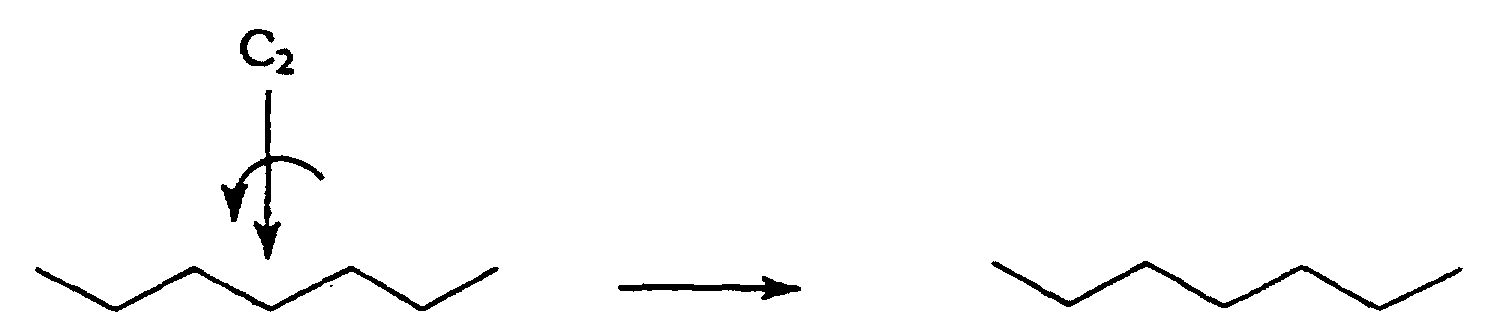
- Proper rotation also referred to as " C n ", refers to simple rotation about an axis passing through the molecule by an angle 2 ⁇ / n or an angle 360°/ n .
- a molecule is said to have a C n symmetry element if after undergoing a proper rotation C n operation, it's appearance is indistinguishable from it's appearance prior to undergoing the proper rotation C n operation irrespective of conformational isomers.
- a molecule possesses a symmetry element, in this case C n , when one or more of its conformational isomers possesses that symmetry element.
- the highest symmetry element that belongs to any conformational isomer of the molecule is assigned to the molecule.
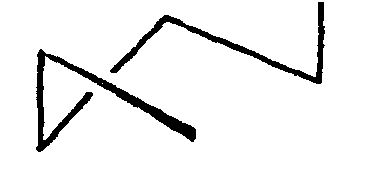
- R is selected from the group consisting of an alkyl, a cycloalkyl or an aromatic group-containing structure having the required C n symmetry.
- R may further comprise additional functional groups so long as the symmetry of R is maintained.
- R may comprise functional groups comprising single, double, and/or triple bonds with atoms such as C, H, S, O, N and mixtures thereof.
- additional functional groups include ureas, ethers, esters, carbonates.
- examples of illustrative R groups include C 4 H 8 and C 6 H 12 .
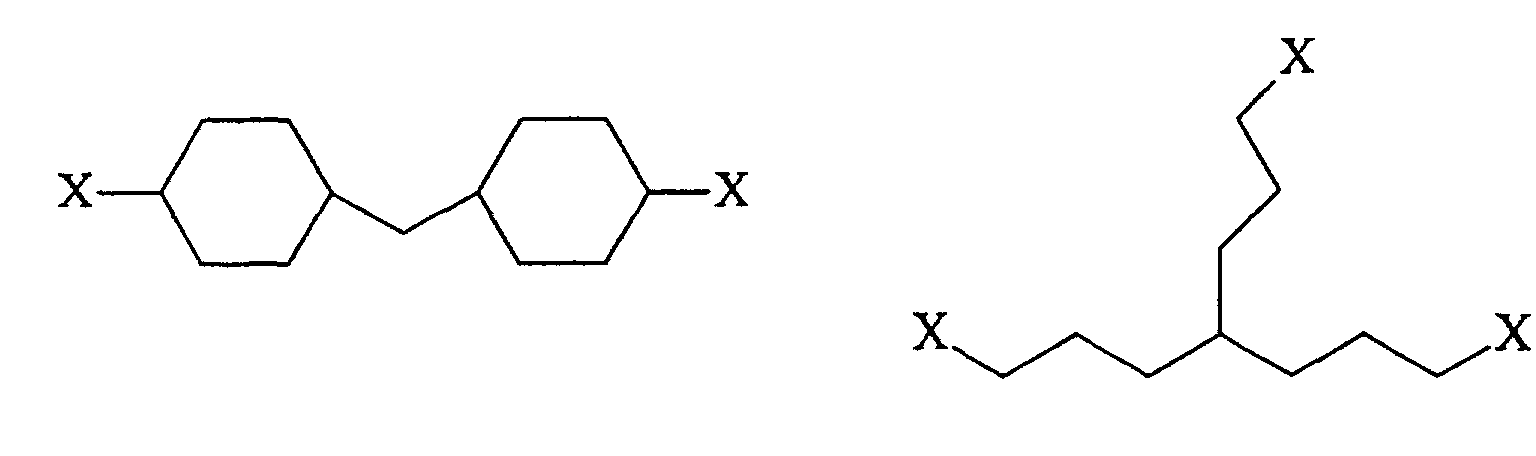
- Other illustrative examples of suitable R groups . are where "X" marks the location of a carbamate group.
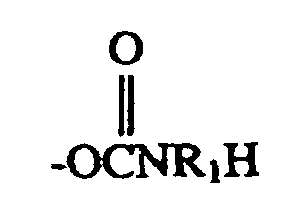
- R groups comprising additional functional groups include ureas such as , ethers such as -R 1 -O-R 2 -, and linear carbonates such as , wherein R 1 and R 2 are identical and are selected from the group consisting of alkyl or cycloalkyl groups having at least four carbons, and R' and R" are identical and are H or a C 1 -C 4 alkyl. It will be appreciated that in each case, R 1 and R 2 are linked to carbamate groups X.
- R 1 and R 2 may have, but are not required to have, C n symmetry, so long as R(X) y has the required C n symmetry wherein n is 2 or higher.
- R 1 and R 2 will be an alkyl group having from four to 12 carbons and most preferably, will be an alkyl group having from four to eight carbons, Examples of illustrative R 1 and R 2 groups include C 4 H 8 and C 6 H 12 . A particularly preferred group is C 6 H 12 .
- R 4 may be selected from the group consisting of alkyl, cycloalkyl, and aromatic-group containing structures.
- R will comprise a C 2 -C 12 alkyl, group or cycloalkyl group.
- R groups are hexane, butane, and 1,4 dimethylcyclohexane.
- R will be butane or hexane.
- Carbamate group X may be a primary or secondary carbamate, wherein. all X's are identical.
- R 1 may be a C 1-4 alkyl group, with methyl and n-butyl alkyl groups being preferred.
- X will be a primary carbamate group.
- Compound (a) may be obtained via several methods.
- a preferred method of obtaining a compound (a) having the formula R(X)y involves the reaction of a compound R(Y) n with a compound Z, wherein R is as described above, Y is a functional group that can be converted into a carbamate group in one or more steps, n is two or more, and Z is a compound reactive with Y.
- This method may be viewed as the transformation of the Y functionality into carbamate functionality in one or more reaction steps.
- the reaction product of R(Y) n + Z may subsequently be reacted with Z' to obtain R(X) y .
- the reaction product of [[R(Y) n + Z] + Z' ] will be be reacted with Z".
- Multiple step reactions utilizing Z"' are within the scope of the invention:
- Functional groups suitable for use as Y include hydroxyl groups, alkene groups, cyclic carbonate functionality, epoxy groups, isocyanate functionality, aminoplast functionality and halides.
- Y will be selected from the group consisting of hydroxyl groups, cylic carbonate functionality, epoxy groups, isocyanate functionality, and halides.
- Preferred Y groups are hydroxyl, isocyanate, and cylic carbonate functionality. Hydroxyl groups are most preferred for use as Y.
- Z may be a compound which can react with compound Y to produce a carbamate group or a group convertible to a carbamate via subsequent reaction steps.
- compound Z may be a compound having the formula Z L -Q, wherein Z L is a linking group which is reactive with compound Y, and Q is a carbamate group or a group convertible to a carbamate group.
- group convertible to a carbamate group refers to those groups such as are discussed below as the precursors to a carbamate group and/or are as discussed in the review article from P. Adams and F. Baron, "Esters of Carbamic Acid", Chemical Review, v 65, 1965.
- Z and/or Z', Z" are primary amines, secondary amines, ammonia, phosgene, isocyanates, peroxides, metal salts of hydroxy carbamates, carbon dioxide, hydroxycarbamates, and mixtures thereof.
- a compound R(Y) n wherein Y is a cyclic carbonate group e.g. the reaction product of an epoxy with carbon dioxide
- Y is a cyclic carbonate group
- Z a primary or secondary amine or ammonia
- this reaction scheme further illustrates how Y can be an epoxy group where Z is carbon dioxide and Z' is the primary or secondary amine or ammonia.
- a compound R(Y) n wherein Y is a carbon-carbon double bond can be converted into an epoxy following known techniques (e.g. reaction with peroxides), then transformed into a carbamate as shown above.
- a compound R(Y) n wherein Y is OH can be converted into a carbamate by way of reaction with phosgene followed by reaction with a primary or secondary amine or ammonia.
- R(Y) n can be reacted with a mono-functional isocyanate (Z).
- Y is an isocyanate group
- an isocyanate reactable carbamate e.g., hydroxy ethyl carbamate, hydroxy propyl carbamate, aminoethyl carbamate.
- the isocyanate reactable carbamate is of the formula Z L -Q.
- R(Y) n can be reacted with a Z which is a metal salt (e.g. sodium, lithium, etc.) of a hydroxy carbamate.
- a metal salt e.g. sodium, lithium, etc.
- An R with carboxylic acid groups can be converted into an acid anhydride (e.g. reaction with acetic anhydride) to generate an acid anhydride that can then be reacted with a hydroxy carbamate or an amino carbamate
- Y is an aminoplast group (e.g. a carbamate group that has been reacted with an aldehyde or urea)
- Y can be reacted with a carbamate functional: vinyl, epoxy, cyclic carbonate, hydroxy, or carboxylic acid group, (i.e., Z L -Q, wherein Z L is the carbamate group and Q is the vinyl, epoxy, cyclic carbonate, hydroxy, or carboxylic acid group) and then be converted into a carbamate as described above.
- a carbamate functional vinyl, epoxy, cyclic carbonate, hydroxy, or carboxylic acid group
- the resin of the invention will typically be processed by accepted powder resin manufacturing technology, for example via sheet, roll or drop techniques. After solidifying, the resin is broken into particles having a desired size and shape. The average size and shape of the resin particles is dependent upon handling, processing, and equipment considerations.
- the resin will be in the shape of flat chips or discs having regular or irregular dimensions.
- Particles having an average particle size of from 2,54 to 7,62 cm (1 to 3 inches) are preferred, with average particle sizes of from 1 ⁇ m to up to 2,54 cm (1 inch) most preferred.
- Particle size as used herein refers to the average diameter of an object having irregular boundaries that can be determined with known test methods.
- the compound (a) of the invention is curable upon combination with a curing agent (b) or a crosslinking agent (b).
- the powder coating of the invention results when compound (a) is combined with crosslinker (b), which is at least one particulate crosslinker which is reactive with the particulate compound (a).
- crosslinker (b) which is at least one particulate crosslinker which is reactive with the particulate compound (a).
- one or more pigments, extenders, flow aids, catalysts, modifiers, regulators, additives, and/or degassing solvents may be incorporated to make the powder coating composition of the invention.
- Curing agent (b) may be a compound having a plurality of functional groups that are reactive with compound (a) of the invention.
- Suitable reactive groups include active methylol or methylalkoxy groups on aminoplast crosslinking agents or on other compounds such as phenol/formaldehyde adducts, acrylamide groups, isocyanate groups, siloxane groups, cyclic carbonate groups, and anhydride groups.
- curing agent (b) examples include melamine formaldehyde resin (including monomeric or polymeric melamine resin and partially or fully alkylated melamine resin), urea resins (e.g., methylol ureas such as urea formaldehyde resin, alkoxy ureas such as butylated urea formaldehyde resin), polymers having alkoxylated acrylamide groups, polymers having methylol or alkoxymethyl groups, polyanhydrides (e.g., polysuccinic anhydride), and polysiloxanes (e.g., trimethoxy siloxane).
- Monomeric and/or low oligomeric aminoplast resins such as melamine formaldehyde resins or urea formaldehyde resins are especially preferred.
- crosslinker (b) will have at least one particulate crosslinker that is reactive with the particulate compound (a).
- a suitable particulate crosslinker is PowderLink® resin, a crosslinking resin commercially available from Cytec of West Paterson, NJ and believed to be a glycol uril formaldehyde resin.
- the ratio of equivalents of compound (a) to equivalents of curing agent (b) or crosslinking agent (b) is about from 0.5:1.0 (a:b) to 1.5:1.0, preferably from about 0.8:1.0 to 1.2:1.0.
- the powder coating composition may be made according to known powder coating manufacturing techniques, i.e., premixing followed by dry blending or melt mixing. Melt mixing or extrusion is most preferred. After cooling, the resulting particles are subjected to grinding to a desired particle size distribution. Suitable particle size reduction or grinding methods include mechanical grinding or jet milling. After particle size reduction processing, the powder coating will typically have an average particle size of from 0.1 to 100 ⁇ m, more preferably from 1 to 40 ⁇ m and most preferably, an average particle size of from 10 to 30 ⁇ m.
- the desired particle size distribution of the powder coating is dependent upon the end use application, processing and/or application considerations.
- the powder coating composition of the invention after curing, will typically have a T g of from 40°C to 205°C, more preferably a T g of from 40°C to 120°C and most preferably a T g of from 40°C to 80°C.
- Particulate compound (a) of the invention will typically have a Tg within the foregoing ranges for the powder coating of the invention. However, it is possible for the T g of particulate compound (a) to be higher than the above ranges. A mixture with other components of the powder coating may lower the T g of the particulate compound (a) so that the powder coating of the invention has a T g within 40°C to 205°C, more preferably a T g of from 40°C to 120°C and most preferably a T g of from 40°C to 80°C.
- the powder coating of the invention may be applied according to accepted application techniques to a variety of substrates for use in various end use applications such as automotive, furniture, industrial, lawn and garden, appliances, electrical equipment.
- Suitable substrates include metal, plastic, wood, ceramics, composites and mixtures thereof Metal and/or plastic substrates are preferred. Substrates will preferably be clean prior to application of the powder coating. Substrates may be optionally pretreated with phosphating, chromatizing and similar pretreatment methods to improve adhesion and/or appearance. It will be appreciated that pretreatment selection is dependent upon the desired substrate and end use application.
- the powder coating of the invention may be applied by electrostatic spray, dipping the part in an electrostatic or non-electrostatic fluidized bed, or by flamespraying methods. Application by electrostatic spray is most preferred.
- cure schedule refers to the time/temperature relationship required to effect complete curing of a thermosetting powder coating.
- Typical cure schedules for the powder coatings of the invention involve part temperatures of from 121 to 204°C (250 to 400°F) and time at part temperature of from 10 to 30 minutes.
- Preferred cure schedules are from 121 to 149°C (250 to 300°F) and time at part temperature of from 10 to 20 minutes.
- Example 1 124 parts of the resin from Example 1 is melted to liquid form by heating to a temperature of 110°C.
- the liquid is cooled to 60°C at which time 40 parts Resimene 747, (n aminoplast resin commercially available from Cytec) and 1 part dodecylbenzyl sulfonic acid is added.
- the components are mixed until homogenous at which time the liquid is drawn down into a thin layer.
- the liquid layer Upon cooling to ambient temperature (approximately 20-25°C), the liquid layer crystallizes to form a solid layer which upon heating (approximately 30 minutes at 120°C) provides a clear, hard and solvent resistant cured coating.
- Powderlink 1174 an aminoplast crosslinker, commercially available from Cytec
- This mixture is then melt mixed by means of an extruder.
- the extrudate is fed onto a chill roller and then onto a cooling belt where it is rolled and then broken into chips.
- the chips are ground in a ACM mill commercially available form Hosokawa Mikron to an average particle size of 25 - 50 ⁇ m.
- the powder is applied electrostaticly over coated steel panels and baked 30 minutes at 163°C (325°F) to provide a cured glossy clear topcoat finish.
Landscapes
- Chemical & Material Sciences (AREA)
- Life Sciences & Earth Sciences (AREA)
- Engineering & Computer Science (AREA)
- Materials Engineering (AREA)
- Wood Science & Technology (AREA)
- Organic Chemistry (AREA)
- Paints Or Removers (AREA)
- Compositions Of Macromolecular Compounds (AREA)
- Other Resins Obtained By Reactions Not Involving Carbon-To-Carbon Unsaturated Bonds (AREA)
Description


R is selected from the group consisting of an alkyl, a cycloalkyl or an aromatic group-containing structure having the required Cn symmetry. R may further comprise additional functional groups so long as the symmetry of R is maintained. For example, R may comprise functional groups comprising single, double, and/or triple bonds with atoms such as C, H, S, O, N and mixtures thereof. Illustrative examples of additional functional groups include ureas, ethers, esters, carbonates.




After particle size reduction processing, the powder coating will typically have an average particle size of from 0.1 to 100 µm, more preferably from 1 to 40 µm and most preferably, an average particle size of from 10 to 30 µm.
Claims (13)
- A curable composition comprising a carbamate functional compound (a) of the formula R(X)2 having Cn symmetry wherein n = 2 or higher and a Tg ≥ 30 °C, wherein R has a molecular weight between 50 and 165 and X is a carbamate functional group and wherein R is selected from the group consisting of alkyl, cycloalkyl or aromatic containing groups having Cn symmetry wherein n = 2 or higher.
- The composition of claim 1 wherein n = 2.
- The composition of claim 1 wherein R further comprises functional groups selected from the group consisting of vinyl groups, urea groups, ether groups, ester groups, and carbonate groups.
- The composition of claim 1 wherein compound (a) is selected from the group consisting of 1,6 dicarbamate hexane, 1,4 dicarbamate butane, and 1,4 dicarbamate cyclohexane.
- The composition of claim 1 wherein X is a primary carbamate group.
- A curable coating composition comprisingwherein R is selected from the group consisting of alkyl, cycloalkyl or aromatic containing groups having Cn symmetry wherein n = 2 or higher.(a) a carbamate functional compound (a) of the formula R(X)2 having Cn symmetry wherein n = 2 or higher and a Tg ≥ 30 °C, wherein R has a molecular weight between 50 and 165 and X is a carbamate functional group and(b) a curing agent,
- The curable coating composition of claim 6 wherein n = 2.
- The curable coating composition of claim 6 wherein R further comprises functional groups selected from the group consisting of vinyl groups, urea groups, ether groups, ester groups, and carbonate groups.
- The curable coating composition of claim 6 wherein compound (a) is selected from the group consisting of 1,6 dicarbamate hexane, 1,4 dicarbamate butane, and 1,4 dicarbamate cyclohexane.
- The composition of claim 6 wherein X is a primary carbamate group.
- The curable coating composition of claim 6 wherein curing agent (b) comprises at least one particulate crosslinker (i) reactive with the particulate compound (a).
- The curable coating composition of claim 11 wherein the at least one particulate crosslinker (i) reactive with the particulate compound (a) is an aminoplast resin or a glycol uril formaldehyde resin.
- The curable coating composition according to anyone of the claims 6 to 12, which coating composition is a powder coating composition.
Applications Claiming Priority (3)
| Application Number | Priority Date | Filing Date | Title |
|---|---|---|---|
| US21157898A | 1998-12-14 | 1998-12-14 | |
| US211578 | 1998-12-14 | ||
| PCT/US1999/027521 WO2000036035A1 (en) | 1998-12-14 | 1999-11-19 | Particulate carbamate functional compounds and powder coatings comprising the same |
Publications (2)
| Publication Number | Publication Date |
|---|---|
| EP1159360A1 EP1159360A1 (en) | 2001-12-05 |
| EP1159360B1 true EP1159360B1 (en) | 2004-08-18 |
Family
ID=22787504
Family Applications (1)
| Application Number | Title | Priority Date | Filing Date |
|---|---|---|---|
| EP99959046A Expired - Lifetime EP1159360B1 (en) | 1998-12-14 | 1999-11-19 | Particulate carbamate functional compounds and powder coatings comprising the same |
Country Status (8)
| Country | Link |
|---|---|
| EP (1) | EP1159360B1 (en) |
| JP (1) | JP2002532607A (en) |
| AU (1) | AU1630000A (en) |
| BR (1) | BR9915441A (en) |
| CA (1) | CA2355240A1 (en) |
| DE (1) | DE69919592T2 (en) |
| ES (1) | ES2228136T3 (en) |
| WO (1) | WO2000036035A1 (en) |
Families Citing this family (2)
| Publication number | Priority date | Publication date | Assignee | Title |
|---|---|---|---|---|
| US7060357B2 (en) | 2002-10-04 | 2006-06-13 | Basf Corporation | Powder coatings containing symmetrical additives |
| US9334234B2 (en) * | 2014-05-08 | 2016-05-10 | Basf Coatings Gmbh | Method using titanium catalyst for producing carbamate-functional materials |
Family Cites Families (3)
| Publication number | Priority date | Publication date | Assignee | Title |
|---|---|---|---|---|
| US5574103A (en) * | 1992-12-29 | 1996-11-12 | Cytec Technology Corp. | Aminoresin based coatings containing 1,3,5-triazine tris-carbamate co-crosslinkers |
| US5336566A (en) * | 1993-04-30 | 1994-08-09 | Basf Corporation | Tri-carbamate-functional crosslinking agents |
| DE69417532T2 (en) * | 1994-01-03 | 1999-11-11 | Basf Corp., Southfield | Chain extended isocyanurates for use as curing agents in coating compositions |
-
1999
- 1999-11-19 CA CA002355240A patent/CA2355240A1/en not_active Abandoned
- 1999-11-19 JP JP2000588288A patent/JP2002532607A/en active Pending
- 1999-11-19 AU AU16300/00A patent/AU1630000A/en not_active Abandoned
- 1999-11-19 BR BR9915441-2A patent/BR9915441A/en not_active IP Right Cessation
- 1999-11-19 ES ES99959046T patent/ES2228136T3/en not_active Expired - Lifetime
- 1999-11-19 DE DE69919592T patent/DE69919592T2/en not_active Expired - Lifetime
- 1999-11-19 WO PCT/US1999/027521 patent/WO2000036035A1/en not_active Ceased
- 1999-11-19 EP EP99959046A patent/EP1159360B1/en not_active Expired - Lifetime
Also Published As
| Publication number | Publication date |
|---|---|
| EP1159360A1 (en) | 2001-12-05 |
| DE69919592T2 (en) | 2005-09-01 |
| BR9915441A (en) | 2001-08-07 |
| AU1630000A (en) | 2000-07-03 |
| JP2002532607A (en) | 2002-10-02 |
| DE69919592D1 (en) | 2004-09-23 |
| CA2355240A1 (en) | 2000-06-22 |
| ES2228136T3 (en) | 2005-04-01 |
| WO2000036035A1 (en) | 2000-06-22 |
Similar Documents
| Publication | Publication Date | Title |
|---|---|---|
| JPH07508794A (en) | Method for preparing color-clear composite coatings with acid etching resistance | |
| US6849337B2 (en) | Powder coatings containing oxirane groups beta to urethane or urea groups | |
| US20050182189A1 (en) | Use of carbamate-modified aminoplast resins to improve the appearance and performance of powder coatings | |
| US7060357B2 (en) | Powder coatings containing symmetrical additives | |
| EP1326934B1 (en) | Hot melt paint composition | |
| US4133843A (en) | Powder coating resin process | |
| EP3239226B1 (en) | Particulate coating | |
| US4190714A (en) | Powder coating resin process containing an aromatic carbonamide condensate | |
| WO2000036035A1 (en) | Particulate carbamate functional compounds and powder coatings comprising the same | |
| US3980733A (en) | Powder coating resin process | |
| US6812316B2 (en) | Powder coating compositions and powder slurry coating compositions containing monomeric difunctional compounds | |
| WO2000036028A1 (en) | Particulate carbamate functional compounds and powder coatings comprising the same | |
| EP0668334B1 (en) | Powder coating composition and method of coating a substrate therewith | |
| EP1159361B1 (en) | Powder slurry coating composition containing particulate carbamate functional compounds and a liquid component | |
| MXPA01004095A (en) | Particulate carbamate functional compounds and powder coatings comprising the same | |
| EP1157054B1 (en) | Powder slurry composition containing particulate carbamate functional compounds | |
| MXPA01002333A (en) | Powder slurry composition containing particulate carbamate functional compounds | |
| WO2002024798A2 (en) | Aminoplast-based crosslinkers and powder coating compositions containing such crosslinkers | |
| MXPA01002139A (en) | Powder slurry composition containing particulate carbamate functional compounds | |
| JPH1180607A (en) | Preparation of thermosetting powder coating |
Legal Events
| Date | Code | Title | Description |
|---|---|---|---|
| PUAI | Public reference made under article 153(3) epc to a published international application that has entered the european phase |
Free format text: ORIGINAL CODE: 0009012 |
|
| 17P | Request for examination filed |
Effective date: 20010601 |
|
| AK | Designated contracting states |
Kind code of ref document: A1 Designated state(s): AT BE CH CY DE DK ES FI FR GB GR IE IT LI LU MC NL PT SE |
|
| AX | Request for extension of the european patent |
Free format text: AL;LT;LV;MK;RO;SI |
|
| 17Q | First examination report despatched |
Effective date: 20011128 |
|
| GRAP | Despatch of communication of intention to grant a patent |
Free format text: ORIGINAL CODE: EPIDOSNIGR1 |
|
| GRAA | (expected) grant |
Free format text: ORIGINAL CODE: 0009210 |
|
| GRAS | Grant fee paid |
Free format text: ORIGINAL CODE: EPIDOSNIGR3 |
|
| AK | Designated contracting states |
Kind code of ref document: B1 Designated state(s): DE ES FR IT |
|
| PG25 | Lapsed in a contracting state [announced via postgrant information from national office to epo] |
Ref country code: IT Free format text: LAPSE BECAUSE OF FAILURE TO SUBMIT A TRANSLATION OF THE DESCRIPTION OR TO PAY THE FEE WITHIN THE PRESCRIBED TIME-LIMIT;WARNING: LAPSES OF ITALIAN PATENTS WITH EFFECTIVE DATE BEFORE 2007 MAY HAVE OCCURRED AT ANY TIME BEFORE 2007. THE CORRECT EFFECTIVE DATE MAY BE DIFFERENT FROM THE ONE RECORDED. Effective date: 20040818 |
|
| REG | Reference to a national code |
Ref country code: IE Ref legal event code: FG4D |
|
| REF | Corresponds to: |
Ref document number: 69919592 Country of ref document: DE Date of ref document: 20040923 Kind code of ref document: P |
|
| LTIE | Lt: invalidation of european patent or patent extension |
Effective date: 20040818 |
|
| REG | Reference to a national code |
Ref country code: ES Ref legal event code: FG2A Ref document number: 2228136 Country of ref document: ES Kind code of ref document: T3 |
|
| ET | Fr: translation filed | ||
| PLBE | No opposition filed within time limit |
Free format text: ORIGINAL CODE: 0009261 |
|
| STAA | Information on the status of an ep patent application or granted ep patent |
Free format text: STATUS: NO OPPOSITION FILED WITHIN TIME LIMIT |
|
| 26N | No opposition filed |
Effective date: 20050519 |
|
| PGFP | Annual fee paid to national office [announced via postgrant information from national office to epo] |
Ref country code: ES Payment date: 20091201 Year of fee payment: 11 Ref country code: DE Payment date: 20091112 Year of fee payment: 11 |
|
| PGFP | Annual fee paid to national office [announced via postgrant information from national office to epo] |
Ref country code: FR Payment date: 20091123 Year of fee payment: 11 |
|
| REG | Reference to a national code |
Ref country code: DE Ref legal event code: R119 Ref document number: 69919592 Country of ref document: DE Effective date: 20110601 Ref country code: DE Ref legal event code: R119 Ref document number: 69919592 Country of ref document: DE Effective date: 20110531 |
|
| REG | Reference to a national code |
Ref country code: FR Ref legal event code: ST Effective date: 20110801 |
|
| PG25 | Lapsed in a contracting state [announced via postgrant information from national office to epo] |
Ref country code: DE Free format text: LAPSE BECAUSE OF NON-PAYMENT OF DUE FEES Effective date: 20110531 |
|
| PG25 | Lapsed in a contracting state [announced via postgrant information from national office to epo] |
Ref country code: FR Free format text: LAPSE BECAUSE OF NON-PAYMENT OF DUE FEES Effective date: 20101130 |
|
| REG | Reference to a national code |
Ref country code: ES Ref legal event code: FD2A Effective date: 20120305 |
|
| PG25 | Lapsed in a contracting state [announced via postgrant information from national office to epo] |
Ref country code: ES Free format text: LAPSE BECAUSE OF NON-PAYMENT OF DUE FEES Effective date: 20101120 |