EP1159335B1 - Capping of polyphenylene ether resin - Google Patents
Capping of polyphenylene ether resin Download PDFInfo
- Publication number
- EP1159335B1 EP1159335B1 EP99966047A EP99966047A EP1159335B1 EP 1159335 B1 EP1159335 B1 EP 1159335B1 EP 99966047 A EP99966047 A EP 99966047A EP 99966047 A EP99966047 A EP 99966047A EP 1159335 B1 EP1159335 B1 EP 1159335B1
- Authority
- EP
- European Patent Office
- Prior art keywords
- capping
- ppe
- resin
- capping agent
- capped
- Prior art date
- Legal status (The legal status is an assumption and is not a legal conclusion. Google has not performed a legal analysis and makes no representation as to the accuracy of the status listed.)
- Expired - Lifetime
Links
- 229920001955 polyphenylene ether Polymers 0.000 title claims description 69
- 229920005989 resin Polymers 0.000 title claims description 41
- 239000011347 resin Substances 0.000 title claims description 41
- 238000000034 method Methods 0.000 claims description 35
- -1 poly(phenylene ether) Polymers 0.000 claims description 34
- 239000003795 chemical substances by application Substances 0.000 claims description 24
- 125000002887 hydroxy group Chemical group [H]O* 0.000 claims description 19
- 239000002904 solvent Substances 0.000 claims description 15
- YGSDEFSMJLZEOE-UHFFFAOYSA-N salicylic acid Chemical compound OC(=O)C1=CC=CC=C1O YGSDEFSMJLZEOE-UHFFFAOYSA-N 0.000 claims description 14
- YXFVVABEGXRONW-UHFFFAOYSA-N Toluene Chemical compound CC1=CC=CC=C1 YXFVVABEGXRONW-UHFFFAOYSA-N 0.000 claims description 9
- HEDRZPFGACZZDS-UHFFFAOYSA-N Chloroform Chemical compound ClC(Cl)Cl HEDRZPFGACZZDS-UHFFFAOYSA-N 0.000 claims description 8
- 150000002148 esters Chemical class 0.000 claims description 8
- RWZYAGGXGHYGMB-UHFFFAOYSA-N anthranilic acid Chemical compound NC1=CC=CC=C1C(O)=O RWZYAGGXGHYGMB-UHFFFAOYSA-N 0.000 claims description 7
- FJKROLUGYXJWQN-UHFFFAOYSA-N papa-hydroxy-benzoic acid Natural products OC(=O)C1=CC=C(O)C=C1 FJKROLUGYXJWQN-UHFFFAOYSA-N 0.000 claims description 7
- 229960004889 salicylic acid Drugs 0.000 claims description 7
- UHOVQNZJYSORNB-UHFFFAOYSA-N Benzene Chemical compound C1=CC=CC=C1 UHOVQNZJYSORNB-UHFFFAOYSA-N 0.000 claims description 6
- YMWUJEATGCHHMB-UHFFFAOYSA-N Dichloromethane Chemical compound ClCCl YMWUJEATGCHHMB-UHFFFAOYSA-N 0.000 claims description 6
- 229960001701 chloroform Drugs 0.000 claims description 5
- RFFLAFLAYFXFSW-UHFFFAOYSA-N 1,2-dichlorobenzene Chemical compound ClC1=CC=CC=C1Cl RFFLAFLAYFXFSW-UHFFFAOYSA-N 0.000 claims description 4
- 238000001556 precipitation Methods 0.000 claims description 4
- WSLDOOZREJYCGB-UHFFFAOYSA-N 1,2-Dichloroethane Chemical compound ClCCCl WSLDOOZREJYCGB-UHFFFAOYSA-N 0.000 claims description 2
- CTQNGGLPUBDAKN-UHFFFAOYSA-N O-Xylene Chemical compound CC1=CC=CC=C1C CTQNGGLPUBDAKN-UHFFFAOYSA-N 0.000 claims description 2
- XSTXAVWGXDQKEL-UHFFFAOYSA-N Trichloroethylene Chemical group ClC=C(Cl)Cl XSTXAVWGXDQKEL-UHFFFAOYSA-N 0.000 claims description 2
- 229950005499 carbon tetrachloride Drugs 0.000 claims description 2
- 125000004122 cyclic group Chemical group 0.000 claims description 2
- 238000001694 spray drying Methods 0.000 claims description 2
- VZGDMQKNWNREIO-UHFFFAOYSA-N tetrachloromethane Chemical compound ClC(Cl)(Cl)Cl VZGDMQKNWNREIO-UHFFFAOYSA-N 0.000 claims description 2
- UBOXGVDOUJQMTN-UHFFFAOYSA-N trichloroethylene Natural products ClCC(Cl)Cl UBOXGVDOUJQMTN-UHFFFAOYSA-N 0.000 claims description 2
- 239000008096 xylene Substances 0.000 claims description 2
- 229920013636 polyphenyl ether polymer Polymers 0.000 description 57
- 238000006243 chemical reaction Methods 0.000 description 15
- 239000000203 mixture Substances 0.000 description 13
- PPBRXRYQALVLMV-UHFFFAOYSA-N Styrene Chemical group C=CC1=CC=CC=C1 PPBRXRYQALVLMV-UHFFFAOYSA-N 0.000 description 9
- 125000000217 alkyl group Chemical group 0.000 description 8
- 150000001875 compounds Chemical class 0.000 description 8
- 229910052739 hydrogen Inorganic materials 0.000 description 8
- 239000001257 hydrogen Substances 0.000 description 8
- 229920000642 polymer Polymers 0.000 description 8
- BVKZGUZCCUSVTD-UHFFFAOYSA-L Carbonate Chemical compound [O-]C([O-])=O BVKZGUZCCUSVTD-UHFFFAOYSA-L 0.000 description 7
- BSYNRYMUTXBXSQ-UHFFFAOYSA-N Aspirin Chemical compound CC(=O)OC1=CC=CC=C1C(O)=O BSYNRYMUTXBXSQ-UHFFFAOYSA-N 0.000 description 6
- 239000004793 Polystyrene Substances 0.000 description 6
- ZMANZCXQSJIPKH-UHFFFAOYSA-N Triethylamine Chemical compound CCN(CC)CC ZMANZCXQSJIPKH-UHFFFAOYSA-N 0.000 description 6
- 229960001138 acetylsalicylic acid Drugs 0.000 description 6
- 239000003054 catalyst Substances 0.000 description 6
- 238000005453 pelletization Methods 0.000 description 6
- ZQBAKBUEJOMQEX-UHFFFAOYSA-N phenyl salicylate Chemical compound OC1=CC=CC=C1C(=O)OC1=CC=CC=C1 ZQBAKBUEJOMQEX-UHFFFAOYSA-N 0.000 description 6
- 229920002223 polystyrene Polymers 0.000 description 6
- 229910052736 halogen Inorganic materials 0.000 description 5
- 150000002367 halogens Chemical group 0.000 description 5
- 125000004435 hydrogen atom Chemical group [H]* 0.000 description 5
- PWHULOQIROXLJO-UHFFFAOYSA-N Manganese Chemical compound [Mn] PWHULOQIROXLJO-UHFFFAOYSA-N 0.000 description 4
- 229920001577 copolymer Polymers 0.000 description 4
- 229910052748 manganese Inorganic materials 0.000 description 4
- 239000011572 manganese Substances 0.000 description 4
- 239000000178 monomer Substances 0.000 description 4
- QTBSBXVTEAMEQO-UHFFFAOYSA-N Acetic acid Chemical compound CC(O)=O QTBSBXVTEAMEQO-UHFFFAOYSA-N 0.000 description 3
- WFDIJRYMOXRFFG-UHFFFAOYSA-N Acetic anhydride Chemical compound CC(=O)OC(C)=O WFDIJRYMOXRFFG-UHFFFAOYSA-N 0.000 description 3
- 125000004103 aminoalkyl group Chemical group 0.000 description 3
- MLSVGAXOQBMEGH-UHFFFAOYSA-N benzo[c][1,5]benzodioxocine-6,12-dione Chemical compound O=C1OC2=CC=CC=C2C(=O)OC2=CC=CC=C12 MLSVGAXOQBMEGH-UHFFFAOYSA-N 0.000 description 3
- 229920001519 homopolymer Polymers 0.000 description 3
- 238000011068 loading method Methods 0.000 description 3
- 239000000463 material Substances 0.000 description 3
- 239000000155 melt Substances 0.000 description 3
- 125000002496 methyl group Chemical group [H]C([H])([H])* 0.000 description 3
- 125000001997 phenyl group Chemical group [H]C1=C([H])C([H])=C(*)C([H])=C1[H] 0.000 description 3
- 229960000969 phenyl salicylate Drugs 0.000 description 3
- 238000006116 polymerization reaction Methods 0.000 description 3
- 229920005990 polystyrene resin Polymers 0.000 description 3
- 238000002360 preparation method Methods 0.000 description 3
- MYRTYDVEIRVNKP-UHFFFAOYSA-N 1,2-Divinylbenzene Chemical compound C=CC1=CC=CC=C1C=C MYRTYDVEIRVNKP-UHFFFAOYSA-N 0.000 description 2
- QQOMQLYQAXGHSU-UHFFFAOYSA-N 2,3,6-Trimethylphenol Chemical compound CC1=CC=C(C)C(O)=C1C QQOMQLYQAXGHSU-UHFFFAOYSA-N 0.000 description 2
- NXXYKOUNUYWIHA-UHFFFAOYSA-N 2,6-Dimethylphenol Chemical compound CC1=CC=CC(C)=C1O NXXYKOUNUYWIHA-UHFFFAOYSA-N 0.000 description 2
- KAKZBPTYRLMSJV-UHFFFAOYSA-N Butadiene Chemical compound C=CC=C KAKZBPTYRLMSJV-UHFFFAOYSA-N 0.000 description 2
- YGYAWVDWMABLBF-UHFFFAOYSA-N Phosgene Chemical compound ClC(Cl)=O YGYAWVDWMABLBF-UHFFFAOYSA-N 0.000 description 2
- 125000000746 allylic group Chemical group 0.000 description 2
- QVGXLLKOCUKJST-UHFFFAOYSA-N atomic oxygen Chemical compound [O] QVGXLLKOCUKJST-UHFFFAOYSA-N 0.000 description 2
- 239000006227 byproduct Substances 0.000 description 2
- 125000004432 carbon atom Chemical group C* 0.000 description 2
- 229910017052 cobalt Inorganic materials 0.000 description 2
- 239000010941 cobalt Substances 0.000 description 2
- GUTLYIVDDKVIGB-UHFFFAOYSA-N cobalt atom Chemical compound [Co] GUTLYIVDDKVIGB-UHFFFAOYSA-N 0.000 description 2
- 150000001993 dienes Chemical class 0.000 description 2
- 230000009477 glass transition Effects 0.000 description 2
- 150000004820 halides Chemical class 0.000 description 2
- 125000001188 haloalkyl group Chemical group 0.000 description 2
- 238000010438 heat treatment Methods 0.000 description 2
- 150000002431 hydrogen Chemical class 0.000 description 2
- 150000002500 ions Chemical class 0.000 description 2
- 238000005691 oxidative coupling reaction Methods 0.000 description 2
- 229910052760 oxygen Inorganic materials 0.000 description 2
- 239000001301 oxygen Substances 0.000 description 2
- 229920003192 poly(bis maleimide) Polymers 0.000 description 2
- 238000000197 pyrolysis Methods 0.000 description 2
- 229920005604 random copolymer Polymers 0.000 description 2
- 150000003902 salicylic acid esters Chemical group 0.000 description 2
- 239000007787 solid Substances 0.000 description 2
- 239000000126 substance Substances 0.000 description 2
- FYSNRJHAOHDILO-UHFFFAOYSA-N thionyl chloride Chemical compound ClS(Cl)=O FYSNRJHAOHDILO-UHFFFAOYSA-N 0.000 description 2
- KYLIMUJRJDIPPF-UHFFFAOYSA-N trisalicylate Chemical compound O=C1OC2=CC=CC=C2C(=O)OC2=CC=CC=C2C(=O)OC2=CC=CC=C12 KYLIMUJRJDIPPF-UHFFFAOYSA-N 0.000 description 2
- 125000000391 vinyl group Chemical group [H]C([*])=C([H])[H] 0.000 description 2
- 229920002554 vinyl polymer Polymers 0.000 description 2
- XLYOFNOQVPJJNP-UHFFFAOYSA-N water Substances O XLYOFNOQVPJJNP-UHFFFAOYSA-N 0.000 description 2
- 125000004178 (C1-C4) alkyl group Chemical group 0.000 description 1
- JWPFIOGLRMADPB-UHFFFAOYSA-N 1,3-benzodioxine-2,4-dione Chemical compound C1=CC=CC2=C1OC(=O)OC2=O JWPFIOGLRMADPB-UHFFFAOYSA-N 0.000 description 1
- XQUPVDVFXZDTLT-UHFFFAOYSA-N 1-[4-[[4-(2,5-dioxopyrrol-1-yl)phenyl]methyl]phenyl]pyrrole-2,5-dione Chemical compound O=C1C=CC(=O)N1C(C=C1)=CC=C1CC1=CC=C(N2C(C=CC2=O)=O)C=C1 XQUPVDVFXZDTLT-UHFFFAOYSA-N 0.000 description 1
- KPTMGJRRIXXKKW-UHFFFAOYSA-N 2,3,5-trimethyl-7-oxabicyclo[2.2.1]hepta-1,3,5-triene Chemical group O1C2=C(C)C(C)=C1C=C2C KPTMGJRRIXXKKW-UHFFFAOYSA-N 0.000 description 1
- SBYMUDUGTIKLCR-UHFFFAOYSA-N 2-chloroethenylbenzene Chemical compound ClC=CC1=CC=CC=C1 SBYMUDUGTIKLCR-UHFFFAOYSA-N 0.000 description 1
- GVLZQVREHWQBJN-UHFFFAOYSA-N 3,5-dimethyl-7-oxabicyclo[2.2.1]hepta-1,3,5-triene Chemical group CC1=C(O2)C(C)=CC2=C1 GVLZQVREHWQBJN-UHFFFAOYSA-N 0.000 description 1
- DDTHMESPCBONDT-UHFFFAOYSA-N 4-(4-oxocyclohexa-2,5-dien-1-ylidene)cyclohexa-2,5-dien-1-one Chemical compound C1=CC(=O)C=CC1=C1C=CC(=O)C=C1 DDTHMESPCBONDT-UHFFFAOYSA-N 0.000 description 1
- NLHHRLWOUZZQLW-UHFFFAOYSA-N Acrylonitrile Chemical compound C=CC#N NLHHRLWOUZZQLW-UHFFFAOYSA-N 0.000 description 1
- CPELXLSAUQHCOX-UHFFFAOYSA-M Bromide Chemical compound [Br-] CPELXLSAUQHCOX-UHFFFAOYSA-M 0.000 description 1
- 239000004215 Carbon black (E152) Substances 0.000 description 1
- OKTJSMMVPCPJKN-OUBTZVSYSA-N Carbon-13 Chemical compound [13C] OKTJSMMVPCPJKN-OUBTZVSYSA-N 0.000 description 1
- 0 Cc(c(OC)c(c(N)*1C)OC)c1N Chemical compound Cc(c(OC)c(c(N)*1C)OC)c1N 0.000 description 1
- VEXZGXHMUGYJMC-UHFFFAOYSA-M Chloride anion Chemical compound [Cl-] VEXZGXHMUGYJMC-UHFFFAOYSA-M 0.000 description 1
- RYGMFSIKBFXOCR-UHFFFAOYSA-N Copper Chemical compound [Cu] RYGMFSIKBFXOCR-UHFFFAOYSA-N 0.000 description 1
- 239000005749 Copper compound Substances 0.000 description 1
- UFHFLCQGNIYNRP-UHFFFAOYSA-N Hydrogen Chemical compound [H][H] UFHFLCQGNIYNRP-UHFFFAOYSA-N 0.000 description 1
- 238000005481 NMR spectroscopy Methods 0.000 description 1
- ISWSIDIOOBJBQZ-UHFFFAOYSA-N Phenol Chemical compound OC1=CC=CC=C1 ISWSIDIOOBJBQZ-UHFFFAOYSA-N 0.000 description 1
- 239000005062 Polybutadiene Substances 0.000 description 1
- 230000002292 Radical scavenging effect Effects 0.000 description 1
- 230000002378 acidificating effect Effects 0.000 description 1
- 125000002252 acyl group Chemical group 0.000 description 1
- 230000032683 aging Effects 0.000 description 1
- 150000001299 aldehydes Chemical class 0.000 description 1
- 125000002723 alicyclic group Chemical group 0.000 description 1
- 125000001931 aliphatic group Chemical group 0.000 description 1
- 150000004703 alkoxides Chemical class 0.000 description 1
- 125000003545 alkoxy group Chemical group 0.000 description 1
- 125000005263 alkylenediamine group Chemical group 0.000 description 1
- XYLMUPLGERFSHI-UHFFFAOYSA-N alpha-Methylstyrene Chemical compound CC(=C)C1=CC=CC=C1 XYLMUPLGERFSHI-UHFFFAOYSA-N 0.000 description 1
- 150000001412 amines Chemical class 0.000 description 1
- 238000004458 analytical method Methods 0.000 description 1
- 239000000538 analytical sample Substances 0.000 description 1
- 238000010539 anionic addition polymerization reaction Methods 0.000 description 1
- 150000001450 anions Chemical class 0.000 description 1
- 239000003849 aromatic solvent Substances 0.000 description 1
- 125000003118 aryl group Chemical group 0.000 description 1
- YXVFYQXJAXKLAK-UHFFFAOYSA-N biphenyl-4-ol Chemical group C1=CC(O)=CC=C1C1=CC=CC=C1 YXVFYQXJAXKLAK-UHFFFAOYSA-N 0.000 description 1
- 238000012662 bulk polymerization Methods 0.000 description 1
- 244000309464 bull Species 0.000 description 1
- MPMBRWOOISTHJV-UHFFFAOYSA-N but-1-enylbenzene Chemical compound CCC=CC1=CC=CC=C1 MPMBRWOOISTHJV-UHFFFAOYSA-N 0.000 description 1
- 125000003178 carboxy group Chemical group [H]OC(*)=O 0.000 description 1
- 230000003197 catalytic effect Effects 0.000 description 1
- 239000002738 chelating agent Substances 0.000 description 1
- 150000001869 cobalt compounds Chemical class 0.000 description 1
- 230000000536 complexating effect Effects 0.000 description 1
- 239000008139 complexing agent Substances 0.000 description 1
- 239000012141 concentrate Substances 0.000 description 1
- 238000007796 conventional method Methods 0.000 description 1
- 238000001816 cooling Methods 0.000 description 1
- 229910052802 copper Inorganic materials 0.000 description 1
- 239000010949 copper Substances 0.000 description 1
- 150000001880 copper compounds Chemical class 0.000 description 1
- 239000007822 coupling agent Substances 0.000 description 1
- 150000001923 cyclic compounds Chemical class 0.000 description 1
- 238000000354 decomposition reaction Methods 0.000 description 1
- 230000003247 decreasing effect Effects 0.000 description 1
- 230000001419 dependent effect Effects 0.000 description 1
- 125000005265 dialkylamine group Chemical group 0.000 description 1
- 230000000694 effects Effects 0.000 description 1
- 229920001971 elastomer Polymers 0.000 description 1
- 238000007720 emulsion polymerization reaction Methods 0.000 description 1
- 238000011067 equilibration Methods 0.000 description 1
- 125000004185 ester group Chemical group 0.000 description 1
- CCGKOQOJPYTBIH-UHFFFAOYSA-N ethenone Chemical compound C=C=O CCGKOQOJPYTBIH-UHFFFAOYSA-N 0.000 description 1
- 238000001125 extrusion Methods 0.000 description 1
- 229910001385 heavy metal Inorganic materials 0.000 description 1
- 125000000623 heterocyclic group Chemical group 0.000 description 1
- 229920005669 high impact polystyrene Polymers 0.000 description 1
- 239000004797 high-impact polystyrene Substances 0.000 description 1
- 229930195733 hydrocarbon Natural products 0.000 description 1
- XMBWDFGMSWQBCA-UHFFFAOYSA-N hydrogen iodide Chemical compound I XMBWDFGMSWQBCA-UHFFFAOYSA-N 0.000 description 1
- 230000000977 initiatory effect Effects 0.000 description 1
- VYFOAVADNIHPTR-UHFFFAOYSA-N isatoic anhydride Chemical compound NC1=CC=CC=C1CO VYFOAVADNIHPTR-UHFFFAOYSA-N 0.000 description 1
- 238000002955 isolation Methods 0.000 description 1
- FPYJFEHAWHCUMM-UHFFFAOYSA-N maleic anhydride Chemical compound O=C1OC(=O)C=C1 FPYJFEHAWHCUMM-UHFFFAOYSA-N 0.000 description 1
- 150000002697 manganese compounds Chemical class 0.000 description 1
- 150000002736 metal compounds Chemical class 0.000 description 1
- 238000002156 mixing Methods 0.000 description 1
- 125000000449 nitro group Chemical group [O-][N+](*)=O 0.000 description 1
- 125000001181 organosilyl group Chemical group [SiH3]* 0.000 description 1
- 230000003647 oxidation Effects 0.000 description 1
- 238000007254 oxidation reaction Methods 0.000 description 1
- 238000010525 oxidative degradation reaction Methods 0.000 description 1
- 125000004430 oxygen atom Chemical group O* 0.000 description 1
- 239000002245 particle Substances 0.000 description 1
- 239000008188 pellet Substances 0.000 description 1
- ISWSIDIOOBJBQZ-UHFFFAOYSA-M phenolate Chemical compound [O-]C1=CC=CC=C1 ISWSIDIOOBJBQZ-UHFFFAOYSA-M 0.000 description 1
- 150000002989 phenols Chemical group 0.000 description 1
- 230000000704 physical effect Effects 0.000 description 1
- 229920002857 polybutadiene Polymers 0.000 description 1
- 229920000515 polycarbonate Polymers 0.000 description 1
- 239000004417 polycarbonate Substances 0.000 description 1
- 229920005749 polyurethane resin Polymers 0.000 description 1
- 239000000047 product Substances 0.000 description 1
- HJWLCRVIBGQPNF-UHFFFAOYSA-N prop-2-enylbenzene Chemical compound C=CCC1=CC=CC=C1 HJWLCRVIBGQPNF-UHFFFAOYSA-N 0.000 description 1
- 150000004053 quinones Chemical class 0.000 description 1
- 238000007348 radical reaction Methods 0.000 description 1
- 239000002516 radical scavenger Substances 0.000 description 1
- 239000011541 reaction mixture Substances 0.000 description 1
- 230000035484 reaction time Effects 0.000 description 1
- 239000005060 rubber Substances 0.000 description 1
- 229960001860 salicylate Drugs 0.000 description 1
- 239000007921 spray Substances 0.000 description 1
- 238000005507 spraying Methods 0.000 description 1
- 125000001424 substituent group Chemical group 0.000 description 1
- 239000000725 suspension Substances 0.000 description 1
- 238000010557 suspension polymerization reaction Methods 0.000 description 1
- 150000003512 tertiary amines Chemical class 0.000 description 1
- 229920001169 thermoplastic Polymers 0.000 description 1
- 229920001187 thermosetting polymer Polymers 0.000 description 1
- 239000004634 thermosetting polymer Substances 0.000 description 1
- 229920006305 unsaturated polyester Polymers 0.000 description 1
Classifications
-
- C—CHEMISTRY; METALLURGY
- C08—ORGANIC MACROMOLECULAR COMPOUNDS; THEIR PREPARATION OR CHEMICAL WORKING-UP; COMPOSITIONS BASED THEREON
- C08G—MACROMOLECULAR COMPOUNDS OBTAINED OTHERWISE THAN BY REACTIONS ONLY INVOLVING UNSATURATED CARBON-TO-CARBON BONDS
- C08G65/00—Macromolecular compounds obtained by reactions forming an ether link in the main chain of the macromolecule
- C08G65/34—Macromolecular compounds obtained by reactions forming an ether link in the main chain of the macromolecule from hydroxy compounds or their metallic derivatives
- C08G65/48—Polymers modified by chemical after-treatment
-
- C—CHEMISTRY; METALLURGY
- C08—ORGANIC MACROMOLECULAR COMPOUNDS; THEIR PREPARATION OR CHEMICAL WORKING-UP; COMPOSITIONS BASED THEREON
- C08G—MACROMOLECULAR COMPOUNDS OBTAINED OTHERWISE THAN BY REACTIONS ONLY INVOLVING UNSATURATED CARBON-TO-CARBON BONDS
- C08G65/00—Macromolecular compounds obtained by reactions forming an ether link in the main chain of the macromolecule
- C08G65/34—Macromolecular compounds obtained by reactions forming an ether link in the main chain of the macromolecule from hydroxy compounds or their metallic derivatives
- C08G65/48—Polymers modified by chemical after-treatment
- C08G65/485—Polyphenylene oxides
Definitions
- the invention relates to methods of capping poly(phenylene ether) resin, and more particularly relates to methods of capping poly(phenylene ether) resin having an intrinsic viscosity between 0.07 and 0.25 dl/g, preferably between 0.09 and 0.15 dl/g.
- Poly(phenylene ether) resins are commercially attractive materials because of their unique combination of physical, chemical, and electrical properties.
- PPE Poly(phenylene ether) resins
- PPE Poly(phenylene ether) resins
- PPE are sold as blends with predominantly high impact polystyrene resins.
- PPE are miscible with polystyrene resins in all proportions and because of the very high glass transition temperatures of PPE, the blends of PPE with polystyrene resins possess higher heat resistance than that of the polystyrene resins alone. Examples of such blends can be found in U.S. Patent Nos. 3,383,435; 4,097,550; 4,113,800; 4,101,503, 4,101,504; 4,101,505; 4,128,602; 4,139,574; and 4,154,712 among others.
- poly(phenylene ether) resins posses endgroups having an aromatic hydroxyl moiety, generally an alkyl substituted phenol residue. These residues are believed to act as radical scavengers and consequently limit the utility of poly(phenylene ether) resins in applications involving desirable radical reactions.
- One example of a desirable application is the polymerization of styrene monomer, either alone or with comonomers, in the presence of poly(phenylene ether) resin.
- poly(phenylene ether) resins become dark and embrittled in the presence of oxygen and high temperatures, presumably due to oxidation of these same hydroxyl groups. Capping the hydroxyl moieties present in PPE affords a solution to many of these problems.
- capped PPE would also have utility in many PPE blends such as, for example, blends with other thermoplastic polymers as well as thermoset resins including unsaturated polyurethane resins, allylics, bismaleimides, and the like.
- EP-A-0 301 233 discloses PPE having terminal anthranilate ester groups.
- EP-A-0 592 144 discloses blends of diene based copolymers and pelletized salicylic ester capped PPE have improved resistance to loss of impact strength after being thermally recyted.
- U.S. Patent No. 4,760,118 describes a method to cap poly(phenylene ether) resins in a melt (i.e. solventless) process.
- the method described in the aforementioned patent was exemplified using a poly(phenylene ether) resin having an intrinsic viscosity of about 0.48 dl/g and afforded solutions to issues for capping relatively high molecular weight poly(phenylene ether) resin.
- Capping poly(phenylene ether) resin relatively low molecular weight poly(phenylene ether) resin e.g., having an intrinsic viscosity between 0.05 and 0.35 dl/g, presents issues that were not previously recognized.
- relatively low molecular weight poly(phenylene ether) resin has a significantly higher proportion of hydroxyl moieties for capping.
- relatively low molecular weight poly(phenylene ether) resin can not be efficiently isolated after polymerization using conventional solvent precipitation techniques due to the extremely small particle size generated with conventional techniques.
- the low melt strength of relatively low molecular weight poly(phenylene ether) resin also presents special issues, especially with stranding and chopping the extrudate.
- the invention relates to methods of capping poly(phenylene ether) resin having an intrinsic viscosity between 0.07 and 0.25 dl/g, preferably between about 0.09 and 0.15 dl/g. More particularly, the methods comprise capping a poly(phenylene ether) resin having an intrinsic viscosity between 0.09 and 0.15 dl/g, in a solvent to produce a capped poly(phenylene ether) resin having an intrinsic viscosity between 0.07 and 0.25 dl/g, , preferably between 0.09 and 0.15 dl/g, and isolating the capped poly(phenylene ether) resin by removal of the solvent, preferably in a process other than precipitation.
- the invention also relates to the capped poly(phenylene ether) resin having an intrinsic viscosity between 0.07 and 0.25 dl/g, preferably between 0.09 and 0.15 dl/g.
- Poly(phenylene ether) resins hereinafter referred to as "PPE" are known polymers comprising a plurality of structural units of the formula: wherein for each structural unit, each Q 1 is independently halogen, primary or secondary lower alkyl (e.g., alkyl containing up to 7 carbon atoms), phenyl, haloalkyl, aminoalkyl, hydrocarbonoxy, or halohydrocarbonoxy wherein at least two carbon atoms separate the halogen and oxygen atoms; and each Q 2 is independently hydrogen, halogen, primary or secondary lower alkyl, phenyl, haloalkyl, hydrocarbonoxy or halohydrocarbonoxy as defined for Q 1 .
- each Q 1 is alkyl or phenyl, especially C 1-4 alkyl, and each Q 2 is hydrogen.
- Both homopolymer and copolymer PPE are known and included in the present invention.
- the preferred homopolymers are those containing 2,6-dimethyl-1,4-phenylene ether units.
- Suitable copolymers include random copolymers containing, for example, such units in combination with 2,3,6-trimethyl-1,4-phenylene ether units.
- PPE containing moieties prepared by grafting vinyl monomers or polymers such as polystyrenes, as well as coupled PPE in which coupling agents such as low molecular weight polycarbonates, quinones, heterocycles and formals undergo reaction in known manner with the hydroxy groups of two PPE chains albeit to produce a higher molecular weight polymer.
- the PPE have an intrinsic viscosity in the range of 0.07-0.25 dl./g., and preferably in the range of 0.09-0.15 dl./g., all as measured in chloroform at 25°C. It is also possible to utilize a higher intrinsic viscosity PPE outside these ranges in combination with a lower intrinsic viscosity PPE within these ranges. Determining an exact intrinsic viscosity to be used will depend somewhat on the ultimate physical properties that are desired.
- PPE are typically prepared by the oxidative coupling of at least one corresponding monohydroxyaromatic compound.
- Particularly useful and readily available monohydroxyaromatic compounds are 2,6-xylenol (wherein each Q 1 is methyl and each Q 2 is hydrogen), whereupon the polymer may be characterized as a poly(2,6-dimethyl-1,4-phenylene ether), and 2,3,6-trimethylphenol (wherein each Q 1 and one Q 2 is methyl and the other Q 2 is hydrogen).
- a variety of catalyst systems are known for the preparation of PPE by oxidative coupling. For the most part, they contain at least one heavy metal compound such as a copper, manganese or cobalt compound, usually in combination with various other materials.
- a first class of operative catalyst systems consists of those containing a copper compound.
- Such catalysts are disclosed, for example, in U.S. Pat. Nos. 3,306,874, 3,306,875, 3,914,266 and 4,028,341. They are usually combinations of cuprous or cupric ions, halide (i.e. chloride, bromide, or iodide) ions and at least one amine.
- Catalyst systems containing manganese compounds are also known. They are generally alkaline systems in which divalent manganese is combined with such anions as halide, alkoxide or phenoxide. Most often, the manganese is present as a complex with one or more complexing and/or chelating agents such as dialkylamines, alkanolamines, alkylenediamines, o-hydroxyaromatic aldehydes, o-hydroxyazo compounds, omega -hydroxyoximes (monomeric and polymeric), o-hydroxyaryl oximes and beta -diketones. Also useful are cobalt-containing catalyst systems. Suitable manganese and cobalt-containing catalyst systems for polyphenylene ether preparation are known in the art by reason of disclosure in numerous patents and publications.
- the invention is a method for capping PPE having an intrinsic viscosity in the range of 0.07-0.25 dl./g., and preferably in the range of 0.09-0.15 dl./g., all as measured in chloroform at 25°C, which comprises reacting said PPE in solution with at least one ester of salicylic acid or anthranilic acid or a substituted derivative thereof.
- Another aspect is compositions prepared by said method.
- the invention includes compositions which contain a proportion of uncapped PPE, that is, PPE containing terminal hydroxy groups.
- the PPE is reacted in with at least one ester of salicylic acid (preferably) or anthranilic acid or a substituted derivative thereof in a solvent.
- ester of salicylic acid includes compounds in which the carboxy group, the hydroxy group or both have been esterified.
- the precise molecular structure of the ester is not critical.
- substituents may be present on the salicylate ring, including, for example, alkyl, aryl, alkoxy, acyl, nitro, carbalkoxy andnitro, although unsubstituted compounds are preferred.
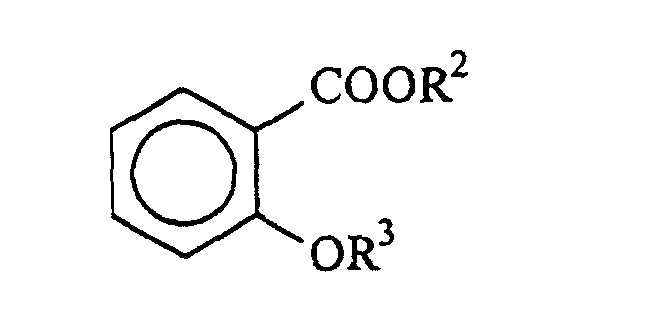
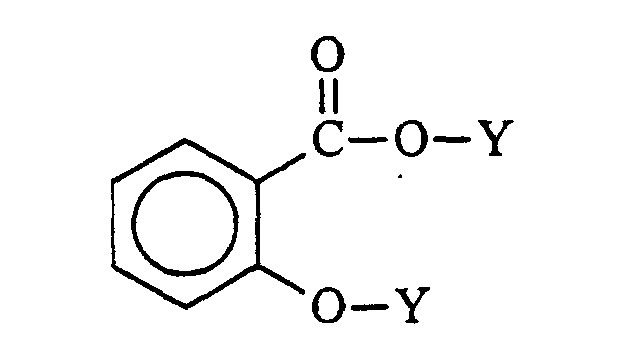
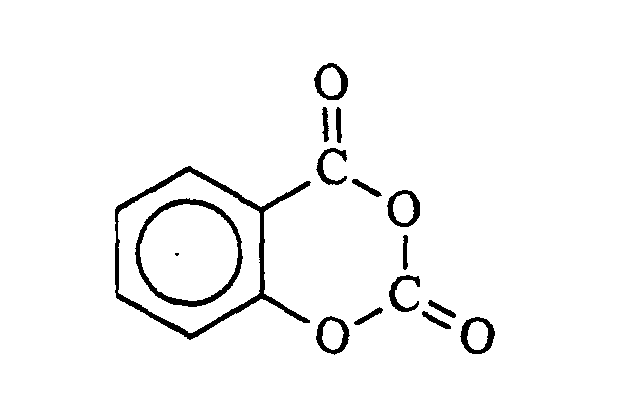
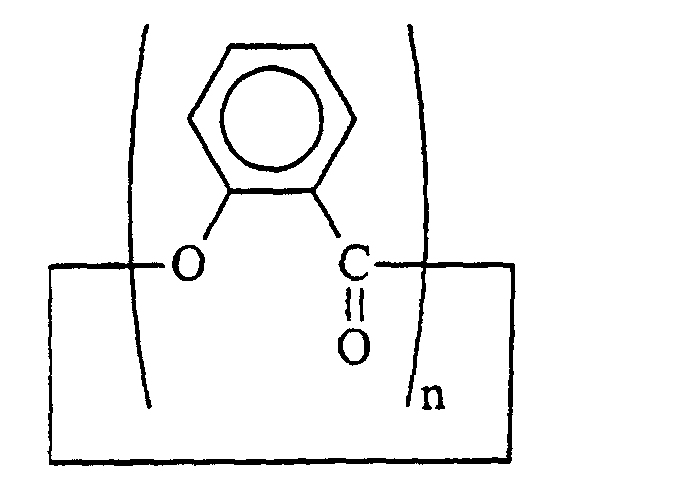
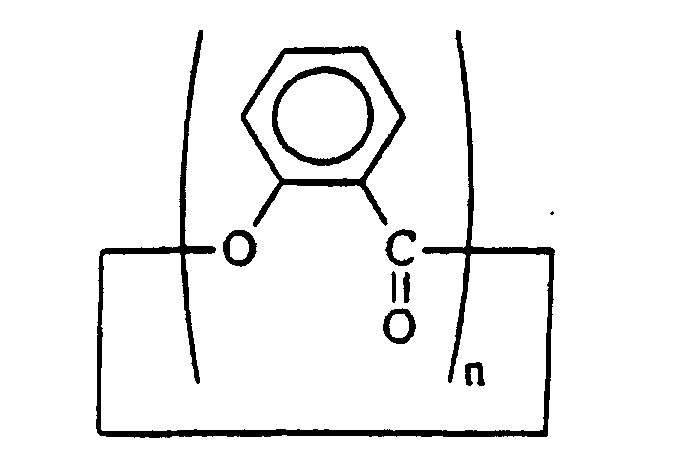
- salicylic acid esters including simple esters of the formula wherein each R 3 is independently hydrogen or an aliphatic, alicyclic or aromatic radical, preferably a hydrocarbon radical, at least one R 3 being other than hydrogen; silyl esters of the formula wherein each Y is hydrogen or Si(R 4 ) 3 , at least one Y being Si(R 4 ) 3 , and each R 4 is independently a C 1-4 alkyl radical, all R 4 values preferably being methyl; salicylic carbonate(benzo-1,3-dioxin-2,4-dione), having the formula cyclic oligomeric esters (salicylides) of the formula wherein n is a small integer and especially 2 or 3; and linear polysalicylates of the formula wherein n is at least 2.
- each R 3 is independently hydrogen or an aliphatic, alicyclic or aromatic radical, preferably a hydrocarbon radical, at least one R 3 being other than hydrogen
- the capping agents which are generally found to give the best yields of the capped polyphenylene ethers of this invention are aryl salicylates such as phenyl salicylate, aspirin (i.e., acetylsalicylic acid), salicylic carbonate and polysalicylates, including both linear polysalicylates and cyclic compounds such as disalicylide and trisalicylide.
- aryl salicylates such as phenyl salicylate, aspirin (i.e., acetylsalicylic acid), salicylic carbonate and polysalicylates, including both linear polysalicylates and cyclic compounds such as disalicylide and trisalicylide.
- phenyl salicylate and aspirin react to form acidic by-products (phenol and acetic acid), which may be undesirable. Therefore, the most preferred capping agents are salicylic carbonate and the polysalicylates, especially linear polysalicylate
- phenyl salicylate such compounds as phenyl salicylate, aspirin and isatoic anhydride are commercially available.
- Salicylic carbonate is a known compound which may be prepared, for example, by the reaction of salicylic acid with phosgene.
- Disalicylide and trisalicylide are also known, as is their preparation by pyrolysis of aspirin; Baker et al., J. Chem. Soc., 1951, 201.
- Linear polysalicylates may be prepared by anionic polymerization of salicylic carbonate; Saegusa et al., Polym. Bull., 1, 341 (1979). They have also been found to be the product (rather than the reported disalicylide) of the treatment of salicylic carbonate with a catalytic amount of triethylamine; Dean et al., J. Chem. Soc., Perkin 1, 1972, 2007.
- Linear polysalicylates are additionally obtainable by reacting salicylic acid with acetic anhydride or thionyl chloride, or by pyrolysis of aspirin at somewhat lower temperatures than those employed by Baker et al.; Finally, the reaction of salicylic acid with phosgene in the presence of a tertiary amine such as triethylamine affords linear polysalicylates in high yield.
- the PPE is heated in solution with the capping agent.
- Typical reaction temperatures are in the range of about 160°-300°C.
- Aromatic solvents such as benzene, toluene, xylene and o-dichlorobenzene are especially preferred, although tetrachloromethane, trichloromethane, dichloromethane, 1,2-dichloroethane and trichloroethylene may also be used.
- the capping reaction can be conveniently conducted in a vessel capable of intimately mixing the PPE solution, preferably under pressure to avoid loss of the solvent.
- One useful vessel and process involves feeding the capping agent into a devolatilization piece of equipment like an devolatilizing extruder.
- the capping agent can be mixed without a solvent in a melt, like e.g., in a conventional extruder.
- the proportion of capping agent used should generally be sufficient to react with substantially all hydroxy end groups, including any aminoalkyl end groups and 4-hydroxybiphenyl end groups that may be present in addition to any conventional 2,6-dialkylphenol end groups as known in the art to be present on PPE.
- the latter include any groups formed during the capping reaction by decomposition of capped and uncapped aminoalkyl end groups.
- the molar proportion of capping agent will to some extent depend on the molecular weight and level of hydroxyl end groups in the PPE, as well as other hydroxy-substituted "tail" end groups resulting from equilibration with diphenoquinone. About 1-10 molar equivalents, most often about 2 - 4 molar equivalents, and preferably about 2.5 - 3.5 molar equivalents of capping agent, based on PPE hydroxyl number, is usually adequate. It is unexpected that molar amounts as low as about 2.5 - 3.5 based upon the PPE hydroxyl number would be sufficient to achieve capping levels in excess of 90% based upon the teachings of the prior art wherein molar amount of 4.5 or more were necessary to achieve similar high capping levels. Minimizing the amount of excess capping agent is extremely desirable from both cost standpoint and overall final purity viewpoints.
- polystyrene in the composition.
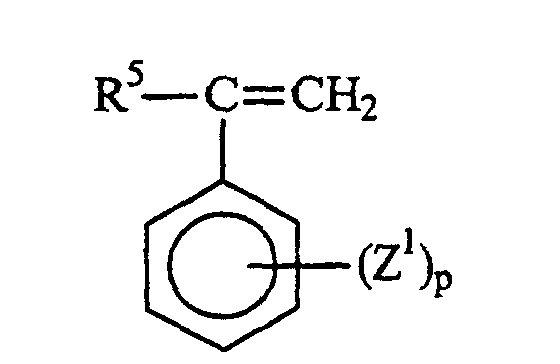
- polystyrene includes polymers prepared by methods known in the art including bulk, suspension and emulsion polymerization, which contain at least 25% by weight of structural units derived from a monomer of the formula wherein R 5 is hydrogen, lower alkyl or halogen; Z 1 is vinyl, halogen or lower alkyl; and p is from 0 to 5.
- These resins include homopolymers of styrene, chlorostyrene and vinyltoluene, random copolymers of styrene with one or more monomers illustrated by acrylonitrile, butadiene, alpha -methylstyrene, ethylvinylbenzene, divinylbenzene and maleic anhydride, and rubber-modified polystyrenes comprising blends and grafts, wherein the rubber is a polybutadiene or a rubbery copolymer of about 98-70% styrene and about 2-30% diene monomer.
- compositions of this invention have been shown by infrared and carbon-13 nuclear magnetic resonance spectroscopy to contain end groups with salicylate ester moieties.
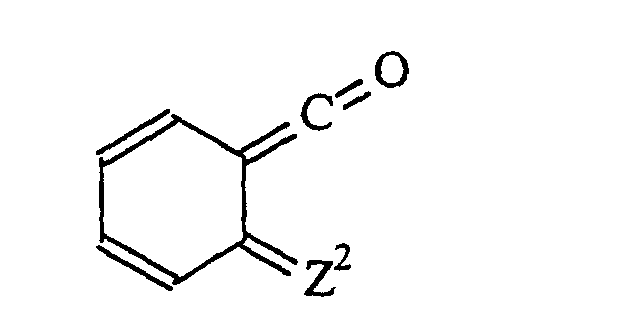
- another aspect of the invention is compositions comprising capped PPE which comprise polymer molecules having end groups of at least one of the formulas and wherein A is an unsubstituted or substituted o-phenylene radical, Z 2 is O or NH and Q 1 and Q 2 are as previously defined. While the invention is not dependent on theory, it is believed that the capping agent is converted, under the conditions employed, to a ketene of the formula which then reacts with the hydroxy group to form an end group of one of the aforementioned formulas.
- the capped PPE may be isolated in a variety of manners, e.g., by non-solvent precipitation followed by collection of the capped PPE, through direct devolatilization of the solvent, by chipping, or spray drying.
- the capped PPE is isolated by passing the reaction mixture through a devolatilization extruder capable of reducing the solvent level to less than about 2000 ppm, preferably less than about 1000 ppm.
- a devolatilization extruder it is often preferred to concentrate the PPE solution somewhat, typically to greater than about 50% solids, preferably greater than about 60% solids, before feeding the PPE solution to the extruder.
- the capped PPE of this invention are in many respects superior to uncapped PPE. For example, they are much less susceptible to oxidative degradation at high temperatures. This is demonstrated by a dramatic increase in time to embrittlement upon heat aging in air, and also by a decrease in oxygen uptake under high-temperature conditions. For the most part, tensile properties are not materially affected by capping. Additionally, the capped PPE reduces to a large part the radical scavenging the capability of the PPE. Thus, the capped PPE are useful in process that involve radical initiation and/or reactions, e.g., styrene polymerization processes as well as unsaturated polyester, allylic, and bismaleimide thermosetting resins.
- radical initiation and/or reactions e.g., styrene polymerization processes as well as unsaturated polyester, allylic, and bismaleimide thermosetting resins.
- the glass transition and heat distortion temperatures of the capped polymers may be lower than those of the corresponding uncapped PPE.
- linear polysalicylates are found to cause a greater decrease in said temperatures than salicylic carbonate. This phenomenon is apparently the result of various by-products which plasticize the polyphenylene ether. The plasticization effect may be decreased or eliminated by dissolving and reprecipitating the polymer after capping, thus removing the plasticizing materials.
- polysalicylate (PSAL) was added in varying amounts to a PPE having an intrinsic viscosity of 0.12 dl/g and an hydroxyl number of 367 ⁇ mol/g dissolved in toluene and heated at 240°C. After 30 minutes an analytical sample was removed. After an additional heat treatment, simulating an extrusion step, a second analysis was performed. The conversion data is provided below.
- PSAL weight % based on PPE
- Capped PPE having an intrinsic viscosity between 0.05 and 0.35 dl/g can also be achieved in a melt process, e.g., in an extruder with high conversion rates even at reduced loadings of capping agent as would be expected from the prior art.
- Table 2 provides a comparision between a PPE having an intrinsic viscosity of 0.40 dl/g and an hydroxyl endgroup number of 82 ⁇ mol/g to a PPE having an intrinsic viscosity of 0.12 dl/g and an hydroxyl endgroup number of 367 ⁇ mol/g. (not according to the invention) PPE I.V. PSAL (weight % based on PPE) Conversion % 0.40 (82 4.0 >93 ⁇ mol/g OH) 0.12 (367 ⁇ mol/g OH) 4.0 47 0.12 8.0 91 0.12 12.0 100
- PPE having an intrinsic viscosity of between about 0.05-0.35 dl./g., preferably in the range of about 0.07-0.25 dl./g., and most preferably in the range of about 0.10-0.15 dl./g. can achieve complete capping with significantly lower amounts of capping agent.
Landscapes
- Chemical & Material Sciences (AREA)
- General Chemical & Material Sciences (AREA)
- Health & Medical Sciences (AREA)
- Chemical Kinetics & Catalysis (AREA)
- Medicinal Chemistry (AREA)
- Polymers & Plastics (AREA)
- Organic Chemistry (AREA)
- Polyethers (AREA)
- Compositions Of Macromolecular Compounds (AREA)
- Paints Or Removers (AREA)
Description


in one embodiment, the compositions of this invention have been shown by infrared and carbon-13 nuclear magnetic resonance spectroscopy to contain end groups with salicylate ester moieties. Accordingly, another aspect of the invention is compositions comprising capped PPE which comprise polymer molecules having end groups of at least one of the formulas


| PSAL (weight % based on PPE ) | Conversion % (30 min.) | Conversion % after additional heat treatment |
| 24.5 | 100 | 100 |
| 15.4 | 100 | 100 |
| 12.5 | 95 | 100 |
| 8.4 | 72 | 86 |
| 6.3 | 50 | -- |
| (not according to the invention) | ||
| PPE I.V. | PSAL (weight % based on PPE) | Conversion % |
| 0.40 (82 | 4.0 | >93 |
| µmol/g OH) | ||
| 0.12 (367 µmol/g OH) | 4.0 | 47 |
| 0.12 | 8.0 | 91 |
| 0.12 | 12.0 | 100 |
Claims (16)
- A method to prepare a capped polyphenylene ether resin comprising capping a poly(phenylene ether) resin having an intrinsic viscosity between 0.07 and less than 0.25 dl/g as measured in chloroform at 25°C with a capping agent in a solvent, wherein the capping agent is selected from at least one ester of salicylic acid or anthranilic acid or a substituted derivative of at least one of the foregoing, to produce a capped poly(phenylene ether) resin having an intrinsic viscosity between 0.07 and 0.25 dl/g and isolating the capped poly(phenylene ether) resin.
- The method of claim 1 wherein the capped poly(phenylene ether) resin has an intrinsic viscosity between 0.10 and 0.15 dl/g.
- The method of claim 1 wherein the capping agent comprises a cyclic polysalicylate of the formula.wherein n is at least 2.
- The method of claim 1 wherein the capping agent is used in molar ratio of capping agent to polyphenylene ether resin hydroxyl of between 1:1 and 10:1.
- The method of claim 1 wherein the capping agent is used in molar ratio of capping agent to polyphenylene ether resin hydroxyl of between 2:1 and 4:1.
- The method of claim 1 wherein the capping agent is used in molar ratio of capping agent to polyphenylene ether resin hydroxyl of between 2.5:1 and 3.5:1.
- The method of claim 1 wherein the solvent is selected from the group consisting of benzene, toluene, xylene, o-dichlorobenzene, tetrachloromethane, trichloromethane, dichloromethane, 1,2-dichloroethane, and trichloroethylene.
- The method of claim 1 wherein the capped polyphenylene ether resin is isolated by devolatilization of the solvent.
- The method of claim 1 wherein the capped polyphenylene ether resin is isolated by devolatilization of the solvent wherein the devolantilization is done at least partly in an extruder.
- The method of claim 1 wherein the capped polyphenylene ether resin is isolated by spray drying.
- The method of claim 1 wherein the capped polyphenylene ether resin is isolated by precipitation followed by collection.
- The method of claim 1 wherein the capping is done at a temperature between 160° and 300°C.
- The method of claim 1 wherein the capping is at least partly done during a devolatilization step to remove the solvent.
- The method of claim 13 wherein the devolatilization step is at least partly accomplished with a devolatilizing extruder.
- The method of claim 1 wherein at least a portion of the capping agent is added during a devolatilization step to remove the solvent.
- The method of claim 15 wherein the devolatilization step is at least partly accomplished with a devolatilizing extruder.
Applications Claiming Priority (3)
| Application Number | Priority Date | Filing Date | Title |
|---|---|---|---|
| US245255 | 1999-02-05 | ||
| US09/245,255 US6306978B1 (en) | 1999-02-05 | 1999-02-05 | Capping of polyphenylene ether resin |
| PCT/US1999/029068 WO2000046275A1 (en) | 1999-02-05 | 1999-12-07 | Capping of polyphenylene ether resin |
Publications (2)
| Publication Number | Publication Date |
|---|---|
| EP1159335A1 EP1159335A1 (en) | 2001-12-05 |
| EP1159335B1 true EP1159335B1 (en) | 2004-12-08 |
Family
ID=22925939
Family Applications (1)
| Application Number | Title | Priority Date | Filing Date |
|---|---|---|---|
| EP99966047A Expired - Lifetime EP1159335B1 (en) | 1999-02-05 | 1999-12-07 | Capping of polyphenylene ether resin |
Country Status (10)
| Country | Link |
|---|---|
| US (1) | US6306978B1 (en) |
| EP (1) | EP1159335B1 (en) |
| JP (1) | JP2002539278A (en) |
| KR (1) | KR100728435B1 (en) |
| CN (1) | CN1125107C (en) |
| AR (1) | AR035477A1 (en) |
| AT (1) | ATE284428T1 (en) |
| AU (1) | AU2168900A (en) |
| DE (1) | DE69922544T2 (en) |
| WO (1) | WO2000046275A1 (en) |
Families Citing this family (44)
| Publication number | Priority date | Publication date | Assignee | Title |
|---|---|---|---|---|
| US7235192B2 (en) * | 1999-12-01 | 2007-06-26 | General Electric Company | Capped poly(arylene ether) composition and method |
| EP2241328A1 (en) * | 2000-05-12 | 2010-10-20 | Immunex Corporation | Interleukin-1 inhibitors in the treatment of diseases |
| CN1237084C (en) | 2002-07-25 | 2006-01-18 | 三菱瓦斯化学株式会社 | Vinyl compounds and their cured products |
| US7167148B2 (en) * | 2003-08-25 | 2007-01-23 | Texas Instruments Incorporated | Data processing methods and apparatus in digital display systems |
| US7041780B2 (en) * | 2003-08-26 | 2006-05-09 | General Electric | Methods of preparing a polymeric material composite |
| US7244813B2 (en) * | 2003-08-26 | 2007-07-17 | General Electric Company | Methods of purifying polymeric material |
| US20050046056A1 (en) * | 2003-08-26 | 2005-03-03 | Jiawen Dong | Method of molding articles |
| US7354990B2 (en) * | 2003-08-26 | 2008-04-08 | General Electric Company | Purified polymeric materials and methods of purifying polymeric materials |
| US7256225B2 (en) * | 2003-08-26 | 2007-08-14 | General Electric Company | Methods of preparing a polymeric material |
| US20050048252A1 (en) * | 2003-08-26 | 2005-03-03 | Irene Dris | Substrate and storage media for data prepared therefrom |
| US7148296B2 (en) * | 2003-10-03 | 2006-12-12 | General Electric Company | Capped poly(arylene ether) composition and process |
| US20050080185A1 (en) * | 2003-10-10 | 2005-04-14 | Mhetar Vijay R. | Poly(arylene ether) composition and method of making |
| US7417083B2 (en) * | 2004-04-01 | 2008-08-26 | Sabic Innovative Plastics Ip B.V. | Flame retardant composition |
| US7582692B2 (en) * | 2004-04-01 | 2009-09-01 | Sabic Innovative Plastics Ip B.V. | Flame retardant thermoplastic composition and articles comprising the same |
| US7799854B2 (en) * | 2004-04-01 | 2010-09-21 | Sabic Innovative Plastics Ip B.V. | Flame retardant thermoplastic composition and articles comprising the same |
| US20060089458A1 (en) * | 2004-10-22 | 2006-04-27 | Davis John E | Articles suitable for autoclave sterilization |
| US7220917B2 (en) | 2004-12-17 | 2007-05-22 | General Electric Company | Electrical wire and method of making an electrical wire |
| US7776441B2 (en) * | 2004-12-17 | 2010-08-17 | Sabic Innovative Plastics Ip B.V. | Flexible poly(arylene ether) composition and articles thereof |
| US7741564B2 (en) * | 2004-12-17 | 2010-06-22 | Sabic Innovative Plastics Ip B.V. | Electrical wire and method of making an electrical wire |
| US7217885B2 (en) * | 2004-12-17 | 2007-05-15 | General Electric Company | Covering for conductors |
| US20060131053A1 (en) * | 2004-12-17 | 2006-06-22 | Hiroshi Kubo | Flame retardant electrical wire |
| US7332677B2 (en) * | 2004-12-17 | 2008-02-19 | General Electric Company | Multiconductor cable assemblies and methods of making multiconductor cable assemblies |
| US20060134416A1 (en) * | 2004-12-17 | 2006-06-22 | Hiroshi Kubo | Flame retardant electrical wire |
| US7772322B2 (en) * | 2005-02-17 | 2010-08-10 | Sabic Innovative Plastics Ip B.V. | Poly(arylene ether) composition and articles |
| US8062747B2 (en) | 2005-12-30 | 2011-11-22 | Sabic Innovative Plastics Ip B.V. | Flame retardant flexible thermoplastic composition, method of making, and articles thereof |
| US20070238190A1 (en) * | 2006-03-30 | 2007-10-11 | Steven Klei | Method of authenticating a poly(arylene ether) composition |
| US20070238831A1 (en) * | 2006-03-30 | 2007-10-11 | Steven Klei | Poly(arylene ether) composition and method of making the same |
| KR100693729B1 (en) * | 2006-05-26 | 2007-03-12 | 린나이코리아 주식회사 | Boiler front cover fixing structure |
| US7491769B2 (en) * | 2006-05-30 | 2009-02-17 | Sabic Innovative Plastics Ip B.V. | Rubber composition and article |
| US7524902B2 (en) * | 2006-05-30 | 2009-04-28 | Sabic Innovative Plastics Ip B.V. | Core-shell particle composition, method, and article |
| US7727418B2 (en) * | 2006-06-19 | 2010-06-01 | Sabic Innovative Plastics Ip B.V. | Infrared transmissive thermoplastic composition, and articles formed therefrom |
| US20080193755A1 (en) * | 2007-02-09 | 2008-08-14 | Olivier Guise | Extrusion die, methods of coating a wire core, and a coated wire by the extrusion die and methods |
| US20080248278A1 (en) * | 2007-04-02 | 2008-10-09 | General Electric Company | Fiber reinforced thermoplastic sheets with surface coverings and methods of making |
| US8075812B2 (en) * | 2007-04-04 | 2011-12-13 | Sabic Innovative Plastics Ip B.V. | Method of separating a poly(arylene ether) composition from a solvent, and poly(arylene ether) composition prepared thereby |
| US8557937B1 (en) | 2012-05-09 | 2013-10-15 | Sabic Innovative Plastics Ip B.V. | Rubber composition, method for its formation, and automotive tire containing the composition |
| US7595367B2 (en) | 2007-08-28 | 2009-09-29 | Sabic Innovative Plastics Ip B.V. | Poly(arylene ether) preparation method |
| US20100012373A1 (en) | 2008-07-16 | 2010-01-21 | Sabic Innovative Plastics, Ip B.V. | Poly(arylene ether) composition and a covered conductor with thin wall and small size conductor |
| US8871866B2 (en) * | 2008-11-19 | 2014-10-28 | Sabic Global Technologies B.V. | Poly(arylene ether) composition and a covered conductor with flexible covering wall and large size conductor |
| US8110632B2 (en) * | 2009-01-15 | 2012-02-07 | Sabic Innovative Plastics Ip B.V. | Poly(arylene ether) articles and compositions |
| KR101303593B1 (en) * | 2010-04-05 | 2013-09-11 | 제일모직주식회사 | End-capper for polyphenylene ethers, polyphenylene ethers end-capped therewith and method for preparing the same |
| CN101921394B (en) * | 2010-08-25 | 2013-05-01 | 中国蓝星(集团)股份有限公司 | Method for simultaneously drying and blocking polyphenyl ether |
| US8466253B1 (en) | 2012-06-29 | 2013-06-18 | Sabic Innovative Plastics Ip B.V. | Poly(phenylene ether) process |
| US20160185984A1 (en) * | 2014-12-26 | 2016-06-30 | Dow Global Technologies Llc | Pore-fill compositions |
| JP7102202B2 (en) * | 2018-04-19 | 2022-07-19 | 旭化成株式会社 | Polyphenylene ether and its manufacturing method |
Family Cites Families (26)
| Publication number | Priority date | Publication date | Assignee | Title |
|---|---|---|---|---|
| BE635350A (en) | 1962-07-24 | |||
| NL295748A (en) | 1962-07-24 | |||
| NL141540B (en) | 1965-01-06 | 1974-03-15 | Gen Electric | PROCESS FOR PREPARING A POLYSTYRENE CONTAINING POLYMER MIXTURE WHICH CAN BE PROCESSED INTO PRODUCTS WITH HIGH BENDING AND TENSILE STRENGTHS, AS WELL AS SUCH PRODUCTS. |
| US3652710A (en) * | 1969-07-01 | 1972-03-28 | Gen Electric | Curable polyaryleneoxide compositions |
| US4128602A (en) | 1970-04-24 | 1978-12-05 | General Electric Company | Polyphenylene ether compositions containing rubber modified polystyrene |
| US3914266A (en) | 1974-02-11 | 1975-10-21 | Gen Electric | Copper complex |
| US4028341A (en) | 1974-02-11 | 1977-06-07 | General Electric Company | Process for the preparation of polyphenylene oxides with hydrolytically stable copper catalysts |
| US4113800A (en) | 1974-11-25 | 1978-09-12 | General Electric | High impact polyphenylene ether resin compositions that include A-B-A block copolymers |
| US4097550A (en) | 1976-06-08 | 1978-06-27 | General Electric Company | Composition of a radial teleblock copolymer and a copolymer of a vinyl aromatic compound and an α,β unsaturated cyclic anhydride |
| US4101505A (en) | 1977-04-13 | 1978-07-18 | General Electric Company | Compositions of a polyphenylene ether resin and EPDM rubber-modified alkenyl aromatic resins having specified gel content |
| US4101503A (en) | 1977-04-13 | 1978-07-18 | General Electric Company | Compositions of a polyphenylene ether resin and high molecular weight alkenyl aromatic resins modified with EPDM rubber |
| US4101504A (en) | 1977-04-13 | 1978-07-18 | General Electric Company | High impact compositions of a polyphenylene ether resin and alkenyl aromatic resins modified with EPDM rubber |
| US4154712A (en) | 1977-09-30 | 1979-05-15 | General Electric Company | Low molecular weight polyphenylene ether compositions |
| US4139574A (en) | 1977-11-28 | 1979-02-13 | General Electric Company | Impact resistant polyphenylene ether resin compositions containing EPDM rubber-modified alkenyl aromatic resins and hydrogenated radial teleblock copolymers |
| US4391950A (en) * | 1981-09-02 | 1983-07-05 | General Electric Company | Polyphenylene ether composition and process for production |
| EP0272439B1 (en) * | 1986-11-14 | 1992-01-15 | Mitsubishi Petrochemical Co., Ltd. | Polyphenylene ether polyester copolymer-containing resin compositions |
| US4760118A (en) * | 1987-03-23 | 1988-07-26 | General Electric Company | Polyphenylene ether capped with salicylic acid ester |
| US4808672A (en) * | 1987-07-27 | 1989-02-28 | General Electric Company | Thermally stable polyphenylene ether having terminal anthranilate ester groups |
| US5213886A (en) * | 1989-02-17 | 1993-05-25 | General Electric Company | Curable dielectric polyphenylene ether-polyepoxide compositions |
| US5043421A (en) * | 1989-08-04 | 1991-08-27 | General Electric Company | Extruder isolation of polymers from solution |
| US5115043A (en) | 1991-02-25 | 1992-05-19 | General Electric Company | Process for functionalizing polyphenylene ether with substituted chlorotriazine |
| EP0522767B1 (en) | 1991-07-05 | 1996-12-18 | General Electric Company | Method for preparing reactive triazine-capped aromatic polymers |
| IT1260592B (en) | 1991-09-24 | 1996-04-16 | Ecp Enichem Polimeri | ETHER POLYPHENYLENE CONTAINING REACTIVE TERMINAL GROUPS, PROCESS FOR ITS PREPARATION AND RELATED THERMOPLASTIC COMPOSITIONS |
| EP0592144A1 (en) | 1992-10-07 | 1994-04-13 | General Electric Company | Polyphenylene ether compositions |
| IT1270952B (en) | 1993-07-21 | 1997-05-26 | Enichem Spa | POLYPHENYLENETERE WITH REACTIVE TERMINAL GROUPS AND RELATED THERMOPLASTIC COMPOSITIONS |
| US5834565A (en) * | 1996-11-12 | 1998-11-10 | General Electric Company | Curable polyphenylene ether-thermosetting resin composition and process |
-
1999
- 1999-02-05 US US09/245,255 patent/US6306978B1/en not_active Expired - Fee Related
- 1999-12-07 CN CN99816040A patent/CN1125107C/en not_active Expired - Fee Related
- 1999-12-07 DE DE69922544T patent/DE69922544T2/en not_active Expired - Fee Related
- 1999-12-07 JP JP2000597345A patent/JP2002539278A/en active Pending
- 1999-12-07 KR KR1020017009844A patent/KR100728435B1/en not_active Expired - Fee Related
- 1999-12-07 EP EP99966047A patent/EP1159335B1/en not_active Expired - Lifetime
- 1999-12-07 WO PCT/US1999/029068 patent/WO2000046275A1/en not_active Ceased
- 1999-12-07 AU AU21689/00A patent/AU2168900A/en not_active Abandoned
- 1999-12-07 AT AT99966047T patent/ATE284428T1/en not_active IP Right Cessation
-
2000
- 2000-01-24 AR ARP000100293A patent/AR035477A1/en not_active Application Discontinuation
Also Published As
| Publication number | Publication date |
|---|---|
| AU2168900A (en) | 2000-08-25 |
| JP2002539278A (en) | 2002-11-19 |
| WO2000046275A1 (en) | 2000-08-10 |
| CN1125107C (en) | 2003-10-22 |
| CN1346377A (en) | 2002-04-24 |
| DE69922544D1 (en) | 2005-01-13 |
| KR100728435B1 (en) | 2007-06-13 |
| AR035477A1 (en) | 2004-06-02 |
| EP1159335A1 (en) | 2001-12-05 |
| KR20020010570A (en) | 2002-02-04 |
| US6306978B1 (en) | 2001-10-23 |
| ATE284428T1 (en) | 2004-12-15 |
| DE69922544T2 (en) | 2005-12-15 |
Similar Documents
| Publication | Publication Date | Title |
|---|---|---|
| US6306978B1 (en) | Capping of polyphenylene ether resin | |
| CA1278145C (en) | Melt-capped polyphenylene ethers and method of preparation | |
| US4806602A (en) | Anhydride capping polyphenylene ether with carboxylic acid | |
| JP3109735B2 (en) | Process for preparing stabilized polyphenylene ether resin and its composition | |
| US4831115A (en) | Method for removing volatile impurities from polyphenylene ethers | |
| US4927894A (en) | Method for preparation of aryloxytriazine-capped polyphenylene ethers | |
| US4808671A (en) | Catalytic method of preparing carboxy derivatives of polyphenylene ethers | |
| JPH04233941A (en) | Polyphenylene ether capped with ortho ester, and copolymer made therefrom | |
| US5122575A (en) | Preparation of functionalized polyphenylene ether using copolymers of dicarboxylic acids and salicylic acids | |
| EP0279196B1 (en) | Polyphenylene ether-polycarbonate copolymers and method of preparation | |
| US6417274B1 (en) | Process for the manufacture of functionalized polyphenylene ether resins | |
| EP0264623B1 (en) | Curable linear polyphenylene ether interpenetrating polymer network compositions and process | |
| US4808674A (en) | Aryl ester-grafted polyphenylene ethers and phenylene ether-amide graft copolymers prepared therefrom | |
| US4973628A (en) | Method for preparing block polyphenylene ether-polycarbonates | |
| JPH023443A (en) | Polyphenylene ether-polyester molding composition | |
| USRE34799E (en) | Reactive graft polymers | |
| JPH0639526B2 (en) | Block polyphenylene ether-polycarbonate manufacturing method | |
| CA2057147A1 (en) | Thermally stable blends of polyphenylene ether and diene based rubber | |
| JPH08253674A (en) | Heat resistant composition containing homopolymer having high glass transition temperature |
Legal Events
| Date | Code | Title | Description |
|---|---|---|---|
| PUAI | Public reference made under article 153(3) epc to a published international application that has entered the european phase |
Free format text: ORIGINAL CODE: 0009012 |
|
| 17P | Request for examination filed |
Effective date: 20010905 |
|
| AK | Designated contracting states |
Kind code of ref document: A1 Designated state(s): AT BE CH CY DE DK ES FI FR GB GR IE IT LI LU MC NL PT SE |
|
| 17Q | First examination report despatched |
Effective date: 20030502 |
|
| GRAP | Despatch of communication of intention to grant a patent |
Free format text: ORIGINAL CODE: EPIDOSNIGR1 |
|
| GRAS | Grant fee paid |
Free format text: ORIGINAL CODE: EPIDOSNIGR3 |
|
| GRAA | (expected) grant |
Free format text: ORIGINAL CODE: 0009210 |
|
| AK | Designated contracting states |
Kind code of ref document: B1 Designated state(s): AT BE CH CY DE DK ES FI FR GB GR IE IT LI LU MC NL PT SE |
|
| PG25 | Lapsed in a contracting state [announced via postgrant information from national office to epo] |
Ref country code: NL Free format text: LAPSE BECAUSE OF FAILURE TO SUBMIT A TRANSLATION OF THE DESCRIPTION OR TO PAY THE FEE WITHIN THE PRESCRIBED TIME-LIMIT Effective date: 20041208 Ref country code: LI Free format text: LAPSE BECAUSE OF FAILURE TO SUBMIT A TRANSLATION OF THE DESCRIPTION OR TO PAY THE FEE WITHIN THE PRESCRIBED TIME-LIMIT Effective date: 20041208 Ref country code: FI Free format text: LAPSE BECAUSE OF FAILURE TO SUBMIT A TRANSLATION OF THE DESCRIPTION OR TO PAY THE FEE WITHIN THE PRESCRIBED TIME-LIMIT Effective date: 20041208 Ref country code: CH Free format text: LAPSE BECAUSE OF FAILURE TO SUBMIT A TRANSLATION OF THE DESCRIPTION OR TO PAY THE FEE WITHIN THE PRESCRIBED TIME-LIMIT Effective date: 20041208 Ref country code: BE Free format text: LAPSE BECAUSE OF FAILURE TO SUBMIT A TRANSLATION OF THE DESCRIPTION OR TO PAY THE FEE WITHIN THE PRESCRIBED TIME-LIMIT Effective date: 20041208 Ref country code: AT Free format text: LAPSE BECAUSE OF FAILURE TO SUBMIT A TRANSLATION OF THE DESCRIPTION OR TO PAY THE FEE WITHIN THE PRESCRIBED TIME-LIMIT Effective date: 20041208 |
|
| REG | Reference to a national code |
Ref country code: GB Ref legal event code: FG4D |
|
| REG | Reference to a national code |
Ref country code: CH Ref legal event code: EP |
|
| REG | Reference to a national code |
Ref country code: IE Ref legal event code: FG4D |
|
| REF | Corresponds to: |
Ref document number: 69922544 Country of ref document: DE Date of ref document: 20050113 Kind code of ref document: P |
|
| PG25 | Lapsed in a contracting state [announced via postgrant information from national office to epo] |
Ref country code: SE Free format text: LAPSE BECAUSE OF FAILURE TO SUBMIT A TRANSLATION OF THE DESCRIPTION OR TO PAY THE FEE WITHIN THE PRESCRIBED TIME-LIMIT Effective date: 20050308 Ref country code: GR Free format text: LAPSE BECAUSE OF FAILURE TO SUBMIT A TRANSLATION OF THE DESCRIPTION OR TO PAY THE FEE WITHIN THE PRESCRIBED TIME-LIMIT Effective date: 20050308 Ref country code: DK Free format text: LAPSE BECAUSE OF FAILURE TO SUBMIT A TRANSLATION OF THE DESCRIPTION OR TO PAY THE FEE WITHIN THE PRESCRIBED TIME-LIMIT Effective date: 20050308 |
|
| PG25 | Lapsed in a contracting state [announced via postgrant information from national office to epo] |
Ref country code: ES Free format text: LAPSE BECAUSE OF FAILURE TO SUBMIT A TRANSLATION OF THE DESCRIPTION OR TO PAY THE FEE WITHIN THE PRESCRIBED TIME-LIMIT Effective date: 20050319 |
|
| NLV1 | Nl: lapsed or annulled due to failure to fulfill the requirements of art. 29p and 29m of the patents act | ||
| REG | Reference to a national code |
Ref country code: CH Ref legal event code: PL |
|
| PLBE | No opposition filed within time limit |
Free format text: ORIGINAL CODE: 0009261 |
|
| STAA | Information on the status of an ep patent application or granted ep patent |
Free format text: STATUS: NO OPPOSITION FILED WITHIN TIME LIMIT |
|
| ET | Fr: translation filed | ||
| PGFP | Annual fee paid to national office [announced via postgrant information from national office to epo] |
Ref country code: MC Payment date: 20051121 Year of fee payment: 7 |
|
| 26N | No opposition filed |
Effective date: 20050909 |
|
| PG25 | Lapsed in a contracting state [announced via postgrant information from national office to epo] |
Ref country code: IE Free format text: LAPSE BECAUSE OF NON-PAYMENT OF DUE FEES Effective date: 20051207 Ref country code: CY Free format text: LAPSE BECAUSE OF FAILURE TO SUBMIT A TRANSLATION OF THE DESCRIPTION OR TO PAY THE FEE WITHIN THE PRESCRIBED TIME-LIMIT Effective date: 20051207 |
|
| PG25 | Lapsed in a contracting state [announced via postgrant information from national office to epo] |
Ref country code: LU Free format text: LAPSE BECAUSE OF NON-PAYMENT OF DUE FEES Effective date: 20051231 |
|
| REG | Reference to a national code |
Ref country code: IE Ref legal event code: MM4A |
|
| PG25 | Lapsed in a contracting state [announced via postgrant information from national office to epo] |
Ref country code: MC Free format text: LAPSE BECAUSE OF NON-PAYMENT OF DUE FEES Effective date: 20061231 |
|
| PG25 | Lapsed in a contracting state [announced via postgrant information from national office to epo] |
Ref country code: PT Free format text: LAPSE BECAUSE OF NON-PAYMENT OF DUE FEES Effective date: 20050508 |
|
| PGFP | Annual fee paid to national office [announced via postgrant information from national office to epo] |
Ref country code: IT Payment date: 20071222 Year of fee payment: 9 |
|
| PGFP | Annual fee paid to national office [announced via postgrant information from national office to epo] |
Ref country code: GB Payment date: 20071227 Year of fee payment: 9 |
|
| REG | Reference to a national code |
Ref country code: GB Ref legal event code: 732E |
|
| PGFP | Annual fee paid to national office [announced via postgrant information from national office to epo] |
Ref country code: FR Payment date: 20071217 Year of fee payment: 9 |
|
| REG | Reference to a national code |
Ref country code: FR Ref legal event code: TP |
|
| PGFP | Annual fee paid to national office [announced via postgrant information from national office to epo] |
Ref country code: DE Payment date: 20081205 Year of fee payment: 10 |
|
| GBPC | Gb: european patent ceased through non-payment of renewal fee |
Effective date: 20081207 |
|
| REG | Reference to a national code |
Ref country code: FR Ref legal event code: ST Effective date: 20090831 |
|
| PG25 | Lapsed in a contracting state [announced via postgrant information from national office to epo] |
Ref country code: GB Free format text: LAPSE BECAUSE OF NON-PAYMENT OF DUE FEES Effective date: 20081207 |
|
| PG25 | Lapsed in a contracting state [announced via postgrant information from national office to epo] |
Ref country code: FR Free format text: LAPSE BECAUSE OF NON-PAYMENT OF DUE FEES Effective date: 20081231 |
|
| PG25 | Lapsed in a contracting state [announced via postgrant information from national office to epo] |
Ref country code: DE Free format text: LAPSE BECAUSE OF NON-PAYMENT OF DUE FEES Effective date: 20100701 |
|
| PG25 | Lapsed in a contracting state [announced via postgrant information from national office to epo] |
Ref country code: IT Free format text: LAPSE BECAUSE OF NON-PAYMENT OF DUE FEES Effective date: 20081207 |