EP1158026A1 - Curable composition - Google Patents
Curable composition Download PDFInfo
- Publication number
- EP1158026A1 EP1158026A1 EP01111290A EP01111290A EP1158026A1 EP 1158026 A1 EP1158026 A1 EP 1158026A1 EP 01111290 A EP01111290 A EP 01111290A EP 01111290 A EP01111290 A EP 01111290A EP 1158026 A1 EP1158026 A1 EP 1158026A1
- Authority
- EP
- European Patent Office
- Prior art keywords
- curable composition
- weight
- parts
- compound
- group
- Prior art date
- Legal status (The legal status is an assumption and is not a legal conclusion. Google has not performed a legal analysis and makes no representation as to the accuracy of the status listed.)
- Granted
Links
Classifications
-
- C—CHEMISTRY; METALLURGY
- C08—ORGANIC MACROMOLECULAR COMPOUNDS; THEIR PREPARATION OR CHEMICAL WORKING-UP; COMPOSITIONS BASED THEREON
- C08L—COMPOSITIONS OF MACROMOLECULAR COMPOUNDS
- C08L23/00—Compositions of homopolymers or copolymers of unsaturated aliphatic hydrocarbons having only one carbon-to-carbon double bond; Compositions of derivatives of such polymers
- C08L23/02—Compositions of homopolymers or copolymers of unsaturated aliphatic hydrocarbons having only one carbon-to-carbon double bond; Compositions of derivatives of such polymers not modified by chemical after-treatment
- C08L23/18—Homopolymers or copolymers of hydrocarbons having four or more carbon atoms
- C08L23/20—Homopolymers or copolymers of hydrocarbons having four or more carbon atoms having four to nine carbon atoms
- C08L23/22—Copolymers of isobutene; Butyl rubber; Homopolymers or copolymers of other iso-olefins
-
- C—CHEMISTRY; METALLURGY
- C08—ORGANIC MACROMOLECULAR COMPOUNDS; THEIR PREPARATION OR CHEMICAL WORKING-UP; COMPOSITIONS BASED THEREON
- C08L—COMPOSITIONS OF MACROMOLECULAR COMPOUNDS
- C08L71/00—Compositions of polyethers obtained by reactions forming an ether link in the main chain; Compositions of derivatives of such polymers
- C08L71/02—Polyalkylene oxides
Definitions
- the present invention relates to a curable composition which is good for a sealing material and a sealant for the use of buildings, automobiles, ships, and so on. More particularly, the present invention relates to a curable composition which has excellent durability, heat-resistance, and storage stability.
- a curable composition of the present invention comprises 100 parts by weight of a saturated hydrocarbon polymer having at least one silicon-containing group which has at least one hydroxyl or hydrolyzable group bonded to a silicon atom and is crosslinkable through formation of a siloxane bond, 1-100 parts by weight of a compound having at least one epoxy group at its end, and 1-100 parts by weight of mica.
- a curable composition of the present invention includes the aforementioned saturated hydrocarbon polymer, the compound having at least one epoxy group at its end, and the mica.
- the saturated hydrocarbon polymer has at least one silicon-containing group which has at least one hydroxyl or hydrolyzable group bonded to a silicon atom and is crosslinkable through the formation of a siloxane bond.
- this saturated hydrocarbon polymer is prepared from an isobutylene polymer having functional groups at all their ends and including an alkoxysilyl group as shown in the following chemical formula.
- each of R and R' is lower alkyl containing 1-5 carbon atoms
- R may be the same with R', or may be different from R'
- "a" is an integer from 1to 3.
- the molecular weight of this isobutylene polymer having functional groups at all its ends is 1,000-40,000.
- This polymer is wax-like or very sticky liquid at room temperature, and is prepared by a cationic polymerization method called Inifers method.
- saturated hydrocarbon polymer which is suitably used in the present invention, having at least one silicon-containing group which has at least one hydroxyl or hydrolyzable group bonded to a silicon atom and is crosslinkable through the formation of a siloxane bond
- polymers in "Epion" series manufactured by Kanegafuchi Chemical Industries Co., Ltd. are given and they have a chemical structure shown in the following chemical formula.
- n is an integer from 5 to 400 and m is an integer from 5 to 400.
- the main chain of the compound is an alkyl group and the compound has good compatibility with the aforementioned saturated hydrocarbon polymer.
- An example of that compound is expressed by the following chemical formula, which is transparent liquid at room temperature.
- n is an integer from 1 to 1,000, preferably from 5 to 1,000.
- n is greater than 1,000, viscosity of the curable composition becomes too high and a number of epoxy groups becomes relatively low.
- the amount of the compound having at least one epoxy group at its end is 1-100 parts by weight, preferably 5-40 parts by weight for 100 parts by weight of the aforementioned saturated hydrocarbon polymer.
- the amount of the compound is less than 1 part by weight, heat resistance of the cured material becomes poor.
- the amount of the compound is more than 100 parts by weight, the curing may have some problems.
- the amount of mica is 1-100 parts by weight, preferably 1-30 parts by weight for 100 parts by weight of the aforementioned saturated hydrocarbon polymer. There is no restriction on the kind of mica. Both natural and synthetic mica can be used.
- the average particle size of mica is preferably not greater than 150 ⁇ m, most preferably in a range from 20 ⁇ m to 50 ⁇ m.
- the plasticizer is not limitative and any usual plasticizer can be used. However, it is recommended to use a plasticizer having good compatibility with ingredients of the curable composition.
- the plasticizer used for the curable composition is preferably at least one compound selected from a group consisting of hydrocarbon compounds, paraffin chlorides, phthalates, non-aromatic dibasic acid esters, esters of polyalkylene glycols, phosphate esters, and the like.
- hydrocarbon compound examples include polybutene, hydrogenated polybutene, ethylene- ⁇ -olefin oligomer, ⁇ -methylstyrene oligomer, biphenyl, terphenyl, triaryl dimethane, alkylene triphenyl, liquid polybutadiene, hydrogenated liquid polybutadiene, alkyl diphenyl, partially hydrogenated terphenyl, paraffinic oils, naphthenic oils, atactic polypropylene, and the like.
- phthalates are dibutyl phthalate, diheptyl phthalate, di(2-ethylhexyl) phthalate, butylbenzyl phthalate, butylphthalylbutyl glycolate, and the like.
- non-aromatic dibasic acid esters examples include dioctyl adipate, dioctyl sebacate, and the like.
- esters of polyalkylene glycols are diethylene glycol benzoate, triethylene glycol dibenzoate, and the like.
- phosphate esters are tricresyl phosphate, tributyl phosphate, and the like.
- plasticizers most preferable plasticizers are hydrocarbon compounds not having unsaturated groups, for example, hydrogenated polybutene, hydrogenated liquid polybutadiene, paraffinic oils, naphthenic oils, atactic polypropylene, etc., which have good compatibility with the ingredients of the curable composition and make improvements in weather resistance of the curable composition.
- hydrocarbon compounds not having unsaturated groups for example, hydrogenated polybutene, hydrogenated liquid polybutadiene, paraffinic oils, naphthenic oils, atactic polypropylene, etc.
- the amount of the plasticizer is preferably in a range from 10 to 200 parts by weight for 100 parts by weight of the aforementioned saturated hydrocarbon polymer.
- the curable composition of the present invention may contain proper amounts of other additives which are usually added into a sealing material and a sealant, for example, fillers (heavy calcium carbonate, calcium carbonate treated with a fatty acid, humed silica, precipitated silica, carbon black, talc, titanium oxide, and the like), adhesion improvers (epoxy compounds, silane coupling agent, and the like), anti-aging agents (hindered phenols, mercaptanes, thiophosphates, thioaldehydes, and the like), moisture suppliers (water, hydrates of inorganic salts, and the like), ultraviolet light absorbers (hindered amines, benzotriazoles, and the like), antiozonants, light stabilizers, toners, and so on.
- fillers heavy calcium carbonate, calcium carbonate treated with a fatty acid, humed silica, precipitated silica, carbon black, talc, titanium oxide, and the like
- a curing agent including curing catalysts is mixed with the curable composition prior to the use of the curable composition.
- the curing agent preferably includes curing catalysts (tin catalysts such as tin dioctylate, dibutyltin dilaurate, dibutyltin bis-acetyl acetate, and the like), cocatalysts (tertiary amine compounds, and the like), plasticizers, fillers.
- the amount of the curing agent is preferably in a range from 5 to 20 parts by weight (0.3 to 5.0 parts by weight of the curing catalyst) for 100 parts by weight of the aforementioned saturated hydrocarbon polymer.
- Epion EP505S manufactured by Kanegafuchi Chemical Industries Co., Ltd.
- a base material was prepared by mixing 100 parts by weight of the saturated hydrocarbon polymer with 67 parts by weight of colloidal calcium carbonate and 27 parts by weight of ground whiting as fillers, 37 parts by weight of paraffin hydrocarbon (PAO 5004) as the plasticizer, 2 parts by weight of an anti-aging agent, 3.3 parts by weight of titanium oxide, 3.3 parts by weight of water as the co-curing agent, and 5 parts by weight of mica.
- the curable composition was cured by adding the curing agent consisting of 1.7 parts by weight of tin octylate and 0.5 parts by weight of lauryl amine. Properties of the cured material were measured according to JIS (The Japanese Industrial Standard) A5758 and the results are shown in Table 1. The viscosity and workability were measured right after adding the curing agent. Further, the loss of volume after heating, durability, and stringiness of the cured material were measured. Those results are also shown in Table 1.
- Curable compositions were prepared in the same manner as Example 1 except that amounts of ingredients are shown in Table 1. These curable compositions were cured by curing agents shown in Table 1. Properties of cured materials were measured, the results of which are shown in Table 1.
- the curable composition contained 10 parts by weight of low molecular weight hydrocarbon (IP1620 manufactured by Idemitsu Petrochemical Co., Ltd.).
- Comparative Examples 4 and 5 were the same in their composition as Examples 1 and 2, respectively, except that mica was not added.
- Component Examples Comparative Examples 1 2 1 2 3 4 5 Saturated hydrocarbon polymer 100 100 100 100 100 100 100 100 100 Filler 100 100 100 100 100 100 100 100 100 100 100 100 Plasticizer 37 37 43 43 - 37 37 Anti-aging agent 2 2 2 2 2 2 2 Water 3.3 3.3 3.3 3.3 3.3 3.3 Titanium oxide 4.7 4.7 4.7 4.7 4.7 4.7 4.7 4.7 4.7 Epoxy compound 6.7 6.7 - - - 6.7 6.7 Low molecular weight hydrocarbon - - - 10 - - Mica 5 5 5 5 5 5 5 - - Curing Tin octylate 1.7 3.3 1.7 3.3 3.3 1.7 3.3 agent Lauryl amine 0.5 0.5 0.5 0.5 0.5 0.5 0.5 0.5 Viscosity(23°C) Strain 100%[P] 210 200 320 300 170 210 200 Workability Good Good Poor Poor Fair Good to Fair
- the present invention provides a curable composition comprising liquid saturated hydrocarbon polymer having a reactive silicon-containing group, wherein the curable composition provides a cured material having only a small increase of modulus of elasticity at high temperature and excellent durability.
Landscapes
- Chemical & Material Sciences (AREA)
- Health & Medical Sciences (AREA)
- Chemical Kinetics & Catalysis (AREA)
- Medicinal Chemistry (AREA)
- Polymers & Plastics (AREA)
- Organic Chemistry (AREA)
- Compositions Of Macromolecular Compounds (AREA)
- Sealing Material Composition (AREA)
- Addition Polymer Or Copolymer, Post-Treatments, Or Chemical Modifications (AREA)
Abstract
Description
- The present invention relates to a curable composition which is good for a sealing material and a sealant for the use of buildings, automobiles, ships, and so on. More particularly, the present invention relates to a curable composition which has excellent durability, heat-resistance, and storage stability.
- It is required for a sealing material and a sealant to have adhesive properties and elasticity to keep close adhesion with a member under movements and vibrations of the member. Various curable compositions have been developed to meet these requirements.
- Conventional sealing materials tend to be deteriorated by movements or vibrations of members, changes of ambient temperature, or the like. Moreover, modulus of elasticity of a conventional sealing material becomes high in a condition of high temperature so that the sealing material could be destructed or ripped off a member with movements and vibrations of the member.
- It is an object of the present invention to provide a curable composition which is excellent in such properties as adhesive properties and strength. It is another object of the present invention to provide a curable composition having excellent long-term durability. Further, it is an object of the present invention to provide a curable composition which has few stringiness and improved workability.
- A curable composition of the present invention comprises 100 parts by weight of a saturated hydrocarbon polymer having at least one silicon-containing group which has at least one hydroxyl or hydrolyzable group bonded to a silicon atom and is crosslinkable through formation of a siloxane bond, 1-100 parts by weight of a compound having at least one epoxy group at its end, and 1-100 parts by weight of mica.
- A curable composition of the present invention includes the aforementioned saturated hydrocarbon polymer, the compound having at least one epoxy group at its end, and the mica. The saturated hydrocarbon polymer has at least one silicon-containing group which has at least one hydroxyl or hydrolyzable group bonded to a silicon atom and is crosslinkable through the formation of a siloxane bond. By a method disclosed in Japanese Patent Publication H8-231758A, this saturated hydrocarbon polymer is prepared from an isobutylene polymer having functional groups at all their ends and including an alkoxysilyl group as shown in the following chemical formula.

- In the above chemical formula, each of R and R' is lower alkyl containing 1-5 carbon atoms, R may be the same with R', or may be different from R', and "a" is an integer from 1to 3. The molecular weight of this isobutylene polymer having functional groups at all its ends is 1,000-40,000. This polymer is wax-like or very sticky liquid at room temperature, and is prepared by a cationic polymerization method called Inifers method.
- As examples of the saturated hydrocarbon polymer, which is suitably used in the present invention, having at least one silicon-containing group which has at least one hydroxyl or hydrolyzable group bonded to a silicon atom and is crosslinkable through the formation of a siloxane bond, polymers in "Epion" series manufactured by Kanegafuchi Chemical Industries Co., Ltd. are given and they have a chemical structure shown in the following chemical formula.
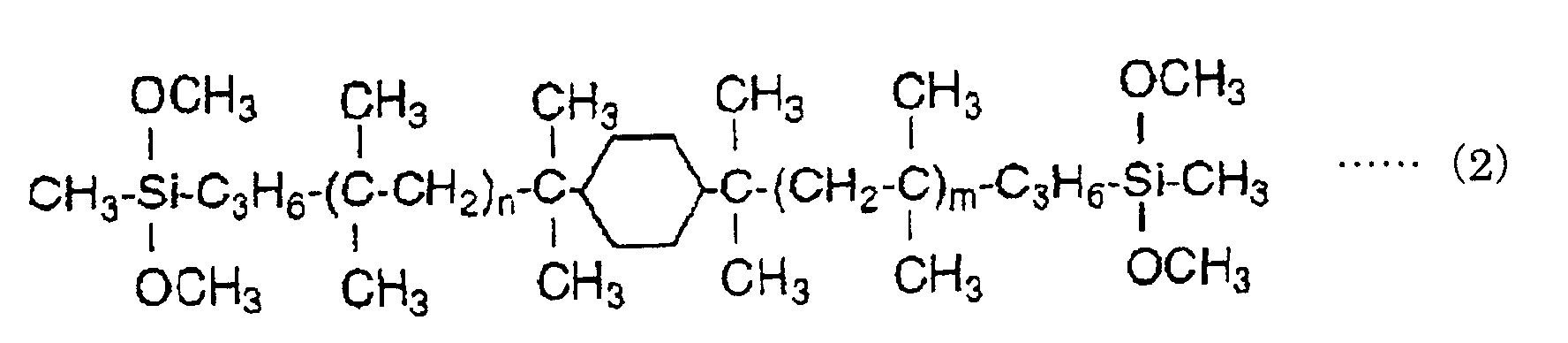
- wherein n is an integer from 5 to 400 and m is an integer from 5 to 400.
- As for the compound having at least one epoxy group at its end, it is desirable that the main chain of the compound is an alkyl group and the compound has good compatibility with the aforementioned saturated hydrocarbon polymer. An example of that compound is expressed by the following chemical formula, which is transparent liquid at room temperature.

- wherein n is an integer from 1 to 1,000, preferably from 5 to 1,000. When n is greater than 1,000, viscosity of the curable composition becomes too high and a number of epoxy groups becomes relatively low.
- The amount of the compound having at least one epoxy group at its end is 1-100 parts by weight, preferably 5-40 parts by weight for 100 parts by weight of the aforementioned saturated hydrocarbon polymer. When the amount of the compound is less than 1 part by weight, heat resistance of the cured material becomes poor. When the amount of the compound is more than 100 parts by weight, the curing may have some problems.
- The amount of mica is 1-100 parts by weight, preferably 1-30 parts by weight for 100 parts by weight of the aforementioned saturated hydrocarbon polymer. There is no restriction on the kind of mica. Both natural and synthetic mica can be used. The average particle size of mica is preferably not greater than 150µm, most preferably in a range from 20µm to 50µm.
- In addition, it is preferable to mix a plasticizer into the curable composition of the present invention.
- The plasticizer is not limitative and any usual plasticizer can be used. However, it is recommended to use a plasticizer having good compatibility with ingredients of the curable composition.
- The plasticizer used for the curable composition is preferably at least one compound selected from a group consisting of hydrocarbon compounds, paraffin chlorides, phthalates, non-aromatic dibasic acid esters, esters of polyalkylene glycols, phosphate esters, and the like.
- Examples of the hydrocarbon compound are polybutene, hydrogenated polybutene, ethylene-α-olefin oligomer, α-methylstyrene oligomer, biphenyl, terphenyl, triaryl dimethane, alkylene triphenyl, liquid polybutadiene, hydrogenated liquid polybutadiene, alkyl diphenyl, partially hydrogenated terphenyl, paraffinic oils, naphthenic oils, atactic polypropylene, and the like.
- Examples of phthalates are dibutyl phthalate, diheptyl phthalate, di(2-ethylhexyl) phthalate, butylbenzyl phthalate, butylphthalylbutyl glycolate, and the like.
- Examples of non-aromatic dibasic acid esters are dioctyl adipate, dioctyl sebacate, and the like.
- Examples of esters of polyalkylene glycols are diethylene glycol benzoate, triethylene glycol dibenzoate, and the like.
- Examples of phosphate esters are tricresyl phosphate, tributyl phosphate, and the like.
- Among these plasticizers, most preferable plasticizers are hydrocarbon compounds not having unsaturated groups, for example, hydrogenated polybutene, hydrogenated liquid polybutadiene, paraffinic oils, naphthenic oils, atactic polypropylene, etc., which have good compatibility with the ingredients of the curable composition and make improvements in weather resistance of the curable composition.
- The amount of the plasticizer is preferably in a range from 10 to 200 parts by weight for 100 parts by weight of the aforementioned saturated hydrocarbon polymer.
- The curable composition of the present invention may contain proper amounts of other additives which are usually added into a sealing material and a sealant, for example, fillers (heavy calcium carbonate, calcium carbonate treated with a fatty acid, humed silica, precipitated silica, carbon black, talc, titanium oxide, and the like), adhesion improvers (epoxy compounds, silane coupling agent, and the like), anti-aging agents (hindered phenols, mercaptanes, thiophosphates, thioaldehydes, and the like), moisture suppliers (water, hydrates of inorganic salts, and the like), ultraviolet light absorbers (hindered amines, benzotriazoles, and the like), antiozonants, light stabilizers, toners, and so on.
- A curing agent including curing catalysts is mixed with the curable composition prior to the use of the curable composition. The curing agent preferably includes curing catalysts (tin catalysts such as tin dioctylate, dibutyltin dilaurate, dibutyltin bis-acetyl acetate, and the like), cocatalysts (tertiary amine compounds, and the like), plasticizers, fillers. The amount of the curing agent is preferably in a range from 5 to 20 parts by weight (0.3 to 5.0 parts by weight of the curing catalyst) for 100 parts by weight of the aforementioned saturated hydrocarbon polymer.
- As the saturated hydrocarbon polymer having at least one silicon-containing group which has at least one hydroxyl or hydrolyzable group bonded to a silicon atom and is crosslinkable through the formation of a siloxane bond, "Epion EP505S" (manufactured by Kanegafuchi Chemical Industries Co., Ltd.) was used. A base material was prepared by mixing 100 parts by weight of the saturated hydrocarbon polymer with 67 parts by weight of colloidal calcium carbonate and 27 parts by weight of ground whiting as fillers, 37 parts by weight of paraffin hydrocarbon (PAO 5004) as the plasticizer, 2 parts by weight of an anti-aging agent, 3.3 parts by weight of titanium oxide, 3.3 parts by weight of water as the co-curing agent, and 5 parts by weight of mica.
- To the base material, 6.7 parts by weight of the epoxy compound (Rikaresin EX-24 manufactured by Shin-Nihon Rika Co., Ltd. : this compound is expressed by the aforementioned chemical formula 3, wherein n is 12-14.) was added to prepare the curable composition.
- The curable composition was cured by adding the curing agent consisting of 1.7 parts by weight of tin octylate and 0.5 parts by weight of lauryl amine. Properties of the cured material were measured according to JIS (The Japanese Industrial Standard) A5758 and the results are shown in Table 1. The viscosity and workability were measured right after adding the curing agent. Further, the loss of volume after heating, durability, and stringiness of the cured material were measured. Those results are also shown in Table 1.
- Curable compositions were prepared in the same manner as Example 1 except that amounts of ingredients are shown in Table 1. These curable compositions were cured by curing agents shown in Table 1. Properties of cured materials were measured, the results of which are shown in Table 1.
- In only the case of Comparative Example 3, the curable composition contained 10 parts by weight of low molecular weight hydrocarbon (IP1620 manufactured by Idemitsu Petrochemical Co., Ltd.).
- Comparative Examples 4 and 5 were the same in their composition as Examples 1 and 2, respectively, except that mica was not added.
Component Examples Comparative Examples 1 2 1 2 3 4 5 Saturated hydrocarbon polymer 100 100 100 100 100 100 100 Filler 100 100 100 100 100 100 100 Plasticizer 37 37 43 43 - 37 37 Anti-aging agent 2 2 2 2 2 2 2 Water 3.3 3.3 3.3 3.3 3.3 3.3 3.3 Titanium oxide 4.7 4.7 4.7 4.7 4.7 4.7 4.7 Epoxy compound 6.7 6.7 - - - 6.7 6.7 Low molecular weight hydrocarbon - - - - 10 - - Mica 5 5 5 5 5 - - Curing Tin octylate 1.7 3.3 1.7 3.3 3.3 1.7 3.3 agent Lauryl amine 0.5 0.5 0.5 0.5 0.5 0.5 0.5 Viscosity(23°C) Strain 100%[P] 210 200 320 300 170 210 200 Workability Good Good Poor Poor Fair Good to Fair Good to Fair Ordinary state 50%modulus[N/cm2] 11 11 11 12 11 11 11 Heat resistance (90°C, 2 weeks) 50%modulus[N/cm2] 14 15 17.5 19 20 14 15 Loss of volume after heat resistance test 10% or less 10% or less 10% or less 10% or less 10% or more 10% or less 10% or less Durability 10030 Good Good Fair to Poor Fair to Poor Fair Good Good Stringiness Good Good Good Good Good Fair to poor Fair to poor - From the comparisons of Examples 1 and 2 with Comparative Examples 4 and 5, respectively, it has been found that the addition of mica decreases stringiness resulting in improvements of workability.
- It has been found that low molecular weight hydrocarbon added in Comparative Example 3 is effective to decrease viscosity of the curable composition. However, once the cured material is exposed to surroundings of high temperature, the hydrocarbon evaporates, which leads to decreasing of modulus of elasticity and greater loss of volume. It has also been found that Rikaresin EX24 is very effective to decrease viscosity of the curable composition and that, after heating, the cured material containing Rikaresin EX24 has a small loss of volume, a small increase of modulus of elasticity and improved durability.
- As resulted from Examples and Comparative Examples, the present invention provides a curable composition comprising liquid saturated hydrocarbon polymer having a reactive silicon-containing group, wherein the curable composition provides a cured material having only a small increase of modulus of elasticity at high temperature and excellent durability.
Claims (12)
- A curable composition comprising:100 parts by weight of saturated hydrocarbon polymer having at least one silicon-containing group which has at least one hydroxyl or hydrolyzable group bonded to a silicon atom and is crosslinkable through formation of a siloxane bond,1-100 parts by weight of a compound which has at least one epoxy group at its end, and1-100 parts by weight of mica.
- A curable composition as claimed in claim 1, wherein the main chain of said compound having at least one epoxy group at its end is a saturated hydrocarbon containing 1-1,000 carbon atoms.
- A curable composition as claimed in claim 2, wherein the main chain of said compound having at least one epoxy group contains 1-100 carbon atoms.
- A curable composition as claimed in any one of claims 1 through 3, wherein the amount of said compound having at least one epoxy group is 5-40 parts by weight.
- A curable composition as claimed in any one of claims 1 through 4, wherein the amount of said mica is 1-30 parts by weight.
- A curable composition as claimed in any one of claims 1 through 5, further comprising 0.5-5 parts by weight of an anti-aging agent.
- A curable composition as claimed in any one of claims 1 through 6, further comprising 10-500 parts by weight of fillers.
- A curable composition as claimed in any one of claims 1 through 7, further comprising at least one selected from a group consisting of an adhesion improver, a moisture supplier, an ultraviolet light absorber, an antiozonant, a light stabilizer, and a toner.
- Use of the curable composition claimed in any one of claims 1 through 8, wherein a curing agent is mixed into the curable composition prior to the use of the curable composition.
- Use of a curable composition as claimed in claim 9, wherein said curing agent includes a curing catalyst.
- Use of a curable composition as claimed in claim 10, wherein said curing catalyst includes a tin compound.
- Use of a curable composition as claimed in claim 11, wherein said curing catalyst is at least one selected from a group consisting of tin dioctylate, dibutyltin dilaurate, and dibutyltin bis-acetyl acetate.
Applications Claiming Priority (2)
| Application Number | Priority Date | Filing Date | Title |
|---|---|---|---|
| JP2000150161A JP2001329126A (en) | 2000-05-22 | 2000-05-22 | Curable composition |
| JP2000150161 | 2000-05-22 |
Publications (2)
| Publication Number | Publication Date |
|---|---|
| EP1158026A1 true EP1158026A1 (en) | 2001-11-28 |
| EP1158026B1 EP1158026B1 (en) | 2003-08-27 |
Family
ID=18655917
Family Applications (1)
| Application Number | Title | Priority Date | Filing Date |
|---|---|---|---|
| EP01111290A Expired - Lifetime EP1158026B1 (en) | 2000-05-22 | 2001-05-16 | Curable composition |
Country Status (4)
| Country | Link |
|---|---|
| US (1) | US20020002263A1 (en) |
| EP (1) | EP1158026B1 (en) |
| JP (1) | JP2001329126A (en) |
| DE (1) | DE60100640T2 (en) |
Families Citing this family (9)
| Publication number | Priority date | Publication date | Assignee | Title |
|---|---|---|---|---|
| US6593133B1 (en) | 1998-07-06 | 2003-07-15 | Nsgene A/S | Neurotrophic factors |
| CN101043899B (en) | 2004-08-19 | 2011-03-30 | 比奥根艾迪克Ma公司 | Refolding transforming growth factor beta family proteins |
| US20100056440A1 (en) * | 2006-03-01 | 2010-03-04 | Biogen Idec Ma Inc. | Compositions and methods for administering gdnf ligand family proteins |
| DE102006059473A1 (en) | 2006-12-14 | 2008-06-19 | Henkel Kgaa | Silyl-containing mixture of prepolymers and their use |
| JP2008156572A (en) * | 2006-12-26 | 2008-07-10 | Idemitsu Kosan Co Ltd | Plasticizer for resin and resin composition containing the same |
| TWI445544B (en) | 2007-05-01 | 2014-07-21 | Biogen Idec Inc | Compositions and methods for increasing vascularization |
| JP5394039B2 (en) * | 2008-10-28 | 2014-01-22 | サンスター技研株式会社 | Sealant composition |
| KR101432393B1 (en) * | 2012-12-28 | 2014-08-20 | 삼성전기주식회사 | Epoxy Resin Composition for Sealing Geomagnetic Sensor Module, and Geomagnetic Sensor Module Sealed with the Composition |
| JP6079359B2 (en) * | 2013-03-26 | 2017-02-15 | 横浜ゴム株式会社 | Curable resin composition |
Citations (3)
| Publication number | Priority date | Publication date | Assignee | Title |
|---|---|---|---|---|
| EP0370463A2 (en) * | 1988-11-21 | 1990-05-30 | Kanegafuchi Chemical Industry Co., Ltd. | Two pack type curable composition comprising epoxy resin and silicon-containing elastomeric polymer |
| JPH08231758A (en) * | 1995-02-23 | 1996-09-10 | Kanegafuchi Chem Ind Co Ltd | Curable composition with improved storage stability |
| JPH10324793A (en) * | 1997-05-27 | 1998-12-08 | Asahi Glass Co Ltd | Room temperature curable composition |
-
2000
- 2000-05-22 JP JP2000150161A patent/JP2001329126A/en active Pending
-
2001
- 2001-05-14 US US09/853,612 patent/US20020002263A1/en not_active Abandoned
- 2001-05-16 EP EP01111290A patent/EP1158026B1/en not_active Expired - Lifetime
- 2001-05-16 DE DE60100640T patent/DE60100640T2/en not_active Expired - Fee Related
Patent Citations (3)
| Publication number | Priority date | Publication date | Assignee | Title |
|---|---|---|---|---|
| EP0370463A2 (en) * | 1988-11-21 | 1990-05-30 | Kanegafuchi Chemical Industry Co., Ltd. | Two pack type curable composition comprising epoxy resin and silicon-containing elastomeric polymer |
| JPH08231758A (en) * | 1995-02-23 | 1996-09-10 | Kanegafuchi Chem Ind Co Ltd | Curable composition with improved storage stability |
| JPH10324793A (en) * | 1997-05-27 | 1998-12-08 | Asahi Glass Co Ltd | Room temperature curable composition |
Non-Patent Citations (2)
| Title |
|---|
| PATENT ABSTRACTS OF JAPAN vol. 1997, no. 01 31 January 1997 (1997-01-31) * |
| PATENT ABSTRACTS OF JAPAN vol. 1999, no. 03 31 March 1999 (1999-03-31) * |
Also Published As
| Publication number | Publication date |
|---|---|
| DE60100640D1 (en) | 2003-10-02 |
| DE60100640T2 (en) | 2004-06-17 |
| EP1158026B1 (en) | 2003-08-27 |
| JP2001329126A (en) | 2001-11-27 |
| US20020002263A1 (en) | 2002-01-03 |
Similar Documents
| Publication | Publication Date | Title |
|---|---|---|
| AU596548B2 (en) | Curable composition | |
| JP2003155389A (en) | Hydrolysable silyl group-containing curable composition | |
| EP0322857B1 (en) | A curable composition of oxyalkylene polymer | |
| EP1158026B1 (en) | Curable composition | |
| JPH02117956A (en) | Curable composition | |
| WO2013067062A1 (en) | Plasticizers for adhesive, coating and sealant compositions applied to asphalt | |
| EP2888332A1 (en) | Catalysis of silane-crosslinkable polymer compositions | |
| JP2011178955A (en) | Curable composition | |
| JP2009040827A (en) | Curable composition | |
| EP1840166A1 (en) | Curable composition | |
| CN101568579B (en) | Plasticizer for resin and resin composition containing the same | |
| US4983700A (en) | Curable polymer composition | |
| EP0326862B1 (en) | Curable polymer composition | |
| EP1057861A2 (en) | Thermoplastic crosslinked product and heat-sensitive elastic adhesive | |
| JP3477120B2 (en) | Two-component curable composition | |
| JP5115035B2 (en) | Curable composition | |
| JPH02185565A (en) | Curable resin composition | |
| EP0420031A2 (en) | Polymer alloys | |
| JP2640129B2 (en) | Curable resin composition | |
| JP3387798B2 (en) | Architectural sealant | |
| JPH04159371A (en) | Curing composition and its use | |
| JP2855025B2 (en) | Curable composition | |
| JPH0873745A (en) | Liquid silicone composition for gasket | |
| JP3325849B2 (en) | Two-component curable composition | |
| JP3546523B2 (en) | Curable composition |
Legal Events
| Date | Code | Title | Description |
|---|---|---|---|
| PUAI | Public reference made under article 153(3) epc to a published international application that has entered the european phase |
Free format text: ORIGINAL CODE: 0009012 |
|
| AK | Designated contracting states |
Kind code of ref document: A1 Designated state(s): AT BE CH CY DE DK ES FI FR GB GR IE IT LI LU MC NL PT SE TR Kind code of ref document: A1 Designated state(s): DE FR GB |
|
| AX | Request for extension of the european patent |
Free format text: AL;LT;LV;MK;RO;SI |
|
| 17P | Request for examination filed |
Effective date: 20011106 |
|
| AKX | Designation fees paid |
Free format text: DE FR GB |
|
| GRAH | Despatch of communication of intention to grant a patent |
Free format text: ORIGINAL CODE: EPIDOS IGRA |
|
| GRAS | Grant fee paid |
Free format text: ORIGINAL CODE: EPIDOSNIGR3 |
|
| GRAA | (expected) grant |
Free format text: ORIGINAL CODE: 0009210 |
|
| AK | Designated contracting states |
Designated state(s): DE FR GB |
|
| REG | Reference to a national code |
Ref country code: GB Ref legal event code: FG4D |
|
| REF | Corresponds to: |
Ref document number: 60100640 Country of ref document: DE Date of ref document: 20031002 Kind code of ref document: P |
|
| ET | Fr: translation filed | ||
| PLBE | No opposition filed within time limit |
Free format text: ORIGINAL CODE: 0009261 |
|
| STAA | Information on the status of an ep patent application or granted ep patent |
Free format text: STATUS: NO OPPOSITION FILED WITHIN TIME LIMIT |
|
| 26N | No opposition filed |
Effective date: 20040528 |
|
| PGFP | Annual fee paid to national office [announced via postgrant information from national office to epo] |
Ref country code: GB Payment date: 20050511 Year of fee payment: 5 Ref country code: FR Payment date: 20050511 Year of fee payment: 5 |
|
| PGFP | Annual fee paid to national office [announced via postgrant information from national office to epo] |
Ref country code: DE Payment date: 20050512 Year of fee payment: 5 |
|
| PG25 | Lapsed in a contracting state [announced via postgrant information from national office to epo] |
Ref country code: GB Free format text: LAPSE BECAUSE OF NON-PAYMENT OF DUE FEES Effective date: 20060516 |
|
| PG25 | Lapsed in a contracting state [announced via postgrant information from national office to epo] |
Ref country code: DE Free format text: LAPSE BECAUSE OF NON-PAYMENT OF DUE FEES Effective date: 20061201 |
|
| GBPC | Gb: european patent ceased through non-payment of renewal fee |
Effective date: 20060516 |
|
| REG | Reference to a national code |
Ref country code: FR Ref legal event code: ST Effective date: 20070131 |
|
| PG25 | Lapsed in a contracting state [announced via postgrant information from national office to epo] |
Ref country code: FR Free format text: LAPSE BECAUSE OF NON-PAYMENT OF DUE FEES Effective date: 20060531 |