EP1157974A1 - Man-made vitreous fibres - Google Patents
Man-made vitreous fibres Download PDFInfo
- Publication number
- EP1157974A1 EP1157974A1 EP01119722A EP01119722A EP1157974A1 EP 1157974 A1 EP1157974 A1 EP 1157974A1 EP 01119722 A EP01119722 A EP 01119722A EP 01119722 A EP01119722 A EP 01119722A EP 1157974 A1 EP1157974 A1 EP 1157974A1
- Authority
- EP
- European Patent Office
- Prior art keywords
- fibres
- composition
- use according
- amount
- sio
- Prior art date
- Legal status (The legal status is an assumption and is not a legal conclusion. Google has not performed a legal analysis and makes no representation as to the accuracy of the status listed.)
- Ceased
Links
Classifications
-
- C—CHEMISTRY; METALLURGY
- C03—GLASS; MINERAL OR SLAG WOOL
- C03C—CHEMICAL COMPOSITION OF GLASSES, GLAZES OR VITREOUS ENAMELS; SURFACE TREATMENT OF GLASS; SURFACE TREATMENT OF FIBRES OR FILAMENTS MADE FROM GLASS, MINERALS OR SLAGS; JOINING GLASS TO GLASS OR OTHER MATERIALS
- C03C13/00—Fibre or filament compositions
- C03C13/06—Mineral fibres, e.g. slag wool, mineral wool, rock wool
-
- C—CHEMISTRY; METALLURGY
- C03—GLASS; MINERAL OR SLAG WOOL
- C03C—CHEMICAL COMPOSITION OF GLASSES, GLAZES OR VITREOUS ENAMELS; SURFACE TREATMENT OF GLASS; SURFACE TREATMENT OF FIBRES OR FILAMENTS MADE FROM GLASS, MINERALS OR SLAGS; JOINING GLASS TO GLASS OR OTHER MATERIALS
- C03C13/00—Fibre or filament compositions
-
- C—CHEMISTRY; METALLURGY
- C03—GLASS; MINERAL OR SLAG WOOL
- C03C—CHEMICAL COMPOSITION OF GLASSES, GLAZES OR VITREOUS ENAMELS; SURFACE TREATMENT OF GLASS; SURFACE TREATMENT OF FIBRES OR FILAMENTS MADE FROM GLASS, MINERALS OR SLAGS; JOINING GLASS TO GLASS OR OTHER MATERIALS
- C03C2213/00—Glass fibres or filaments
- C03C2213/02—Biodegradable glass fibres
Definitions
- This invention relates to man-made vitreous fibres (MMVF) which are durable in use but which can be shown to be biologically advantageous.
- MMVF man-made vitreous fibres
- MMV fibres are made from vitreous melt, such as of rock, slag, glass or other mineral melts.
- the melt is formed by melting in a furnace a mineral composition having the desired analysis.
- This composition is generally formed by blending rocks or minerals to give the desired analysis.
- the mineral composition often has an analysis, as oxides, which includes at least 32% SiO 2 , below 30% Al 2 O 3 and at least 10% CaO.
- the elemental analyses in the specification are by weight and calculated as oxides.
- the iron oxide may be a mixture of FeO and Fe 2 O 3 but is quoted herein as FeO.
- MMV fibres that retain the required physical properties of MMV fibres (e.g., durability at elevated temperatures and under humid conditions) but which can also be alleged to be of improved biological safety.
- the Al 2 O 3 amount must be below 10%.
- the aluminium content of rock wool and slag wool is generally in the range 5 to 15% (measured as Al 2 O 3 by weight) and many of these allegedly biologically suitablo fibres have an aluminium content of below 4%, and often below 2%. It is known to include phosphorous in these low-Al 2 O 3 compositions in order to increase the dissolution rate in this pH 7.5 dissolution rate test.
- melt properties are not entirely satisfactory for manufacture in conventional or easily adapted melting and fibre-forming apparatus.
- melt viscosity at convenient fibre-forming temperatures may be rather low.
- a high dissolution rate at pH 7.5 may tend to result in reduced durability under humid conditions which may be experienced after installation.
- Existing MMV fibres formed from rock, slag and other relatively high alkaline earth mixtures can have a higher dissolution rate at pH 4.5 than pH 7.5 but tend to have a low melt viscosity.
- Existing fibres which are promoted as being biologically acceptable do not have a satisfactory combination of dissolution rate at pH 4.5 with melt properties.
- Fibres which are currently alleged to be preferred on the basis of in vitro tests tend to have low melt viscosity when they have the required low aluminium content. The low melt viscosity inevitably reduces production efficiency compared to normal production.
- MMV fibres which can be shown to be biodegradable in the lung, have melt properties which allow for normal, high, production efficiency and which can be made from inexpensive raw materials. Preferably they have good weathering resistance when exposed to ambient humid conditions in use.
- fibres having satisfactory biological solubility fibres which have a dissolution rate measured at pH 4 to 5 of at least 20nm per day and which are formed of a composition having a melt viscosity at 1,400°C of 10-70 poise.
- the dissolution rate at pH 4.5 can be at least 30 or even at least 50 nm per day or more.
- the combination of the melt viscosity and the solubility at pH 4.5 means that we can use a melt which is convenient to fiberise by conventional techniques and can produce fibres which are biologically soluble at pH 4.5. It is new to formulate or select fibres according to this combination, and many such fibres have a novel composition.
- we determine the melt viscosity and the fibre dissolution rate at a pH in the range 4-5 of one or more compositions we select a composition which has a melt viscosity at 1400°C of 10 to 70 poise and provides fibres which have a dissolution rate at pH 4.5 of at least 20nm per day and which has an analysis, measured as weight of oxides, which includes SiO 2 32 to 48% Al 2 O 3 10 to 30% CaO 10 to 30% MgO 2 to 20% FeO 2 to 15% Na 2 O + K 2 O 0 to 12% TiO 2 0 to 6% Other Elements 0 to 15% and we make fibres from this composition.
- fibres which have a good dissolution rate at pH 4.5 thereby facilitating clearance from the lungs by macrophages (thus promoting genuine biodegradability), even though the fibres can have low or moderate dissolution rate at pH 7.5. This allows maintenance of good stability under humid conditions (without loss of biodegradability).
- the fibres can have reasonably conventional melt characteristics such as liquidus temperature, crystallisation rate and melt viscosity.
- the fibres can be formed using inexpensive raw materials.
- Another advantage of the fibres is that when they are exposed to humidity and condensed water, the resultant solution that is formed containing dissolution products has increased pH but the fibres may have reduced solubility at increased pH and so they may dissolve less and have increased durability.
- the invention broadly includes all MMVF products made from a composition having the melt viscosity at 1,400°C of 10-70 poise and wherein the manufacture, promotion or sale or use involves measurement of, or reference to measurement of, solubility at about pH 4.5 (e.g., 4 to 5) and/or in the environment of macrophages in the lung irrespective of whether the dissolution rate is measured during the actual production of such products.
- the fibres preferably have an analysis as stated above.
- the invention includes the use of the stated composition to promote the removal of MMVF fibres from human lungs.
- the invention also includes the use of the stated fibres to impart the ability to be rejected from human lungs.
- the invention includes MMVF products, including MMV fibres, made from a composition which has been selected in order to provide the stated solubility. For instance it includes the measurement of pH 4-5 solubility and the melt viscosity of one or more compositions and selecting a composition partly or wholly on the basis of observing melt viscosity and solubility value at pH 4-5, and utilising compositions having the same or substantially the same analysis for making MMVF products. Any deviations in the analysis must be sufficiently small that they do not significantly alter the pH 4-5 solubility.
- the solubility can be determined at any pH (usually in the range 4-5) which correlates to the pH at 4.5.
- the melt viscosity can be determined either by deduction from data or by measurement and/or calculation, for any temperature (usually in the range 1,370-1,450°C) which gives a value which correlates with the value at 1,400°C.
- the selection of the composition does not have to be conducted at the same location or at about the same time as carrying out the commercial production using the selected composition.
- a manufacturer may conduct tests, or sponsor others to conducts tests, to determine solubility and use the information from these tests as part of the basis for selecting the composition which is used for making the fibres commercially.
- the invention includes products having the quoted analysis and are formed from a composition having the quoted melt viscosity and which are labelled or sold as having the defined dissolution rate at pH 4-5.
- the invention includes packages which contain MMV fibres and which carry a label or insert, or which are sold with advertising, which refers to solubility at pH in the range 4-5 or in the environment of macrophages or which refers to a test method which measures such solubility.
- the invention includes novel MVVF products. These include horticultural MMVF growth media and fibre reinforcement wherein the fibres are as defined in the invention.
- One class of fibres which are novel are fibres having the solubility, melt viscosity and composition analysis given above except that the amount of Al 2 O 3 is at least 18%.
- Other useful fibres have Al 2 O 3 above 16%. Often it is above 19 or 20%, for instance up to 26 or 28%.
- the combined amount of alkali Na 2 O +K 2 O
- the amount of alkali is usually below 5% and preferably below 3% when the amount of Al 2 O 3 is above 16%.
- These fibres can have good fire resistance and other mechanical properties. When these properties are of less importance, fibres having useful pH 4.5 solubility can be obtained with amounts of Al 2 O 3 below 16% and amounts of Na 2 O+K 2 O above 6 or 7%, for instance 8 to 12%, usually 8-10%.
- fibres which are novel are fibres which preferably have the solubility and melt viscosity given above and which have the general analysis given above except that the alkali (Na 2 O+K 2 O) is above 6% and the amount of Al 2 O 3 is usually 12-18%, and is often not more than 16% preferably 13-16%. Often the composition contains 0.5-4% TiO 2 , usually 1-2% TiO 2 .
- the alkali is usually provided by at least 5% and often at least 7%, Na 2 O.
- the total amount of alkali (Na 2 O+K 2 O) is preferably 8-12%, often 8-10%.
- the viscosity at 1400°C of any particular melt is too high, it may be possible to reduce it by reducing the total amount of SiO 2 + Al 2 O 3 .
- the melt viscosity is too low, it may be possible to increase it by raising the total amount of SiO 2 + Al 2 O 3 , generally within the range of 55 to 75%, often 60 to 75%, or by increasing the amount of alkali oxide.
- the rate of dissolution at pH 4.5 is too low it may be possible to increase it by decreasing the amount of SiO 2 , but it may then be necessary to increase the amount of Al 2 O 3 (and/or to add a component such as P 2 O 5 ) in order to maintain melt properties.
- the amount of SiO 2 is normally at least 32%, often at least 34% and preferably at least 35%. It is normally below 47% and preferably below 45% and is often 38-42%. However amounts of 42 to 47% are preferred when the amount of Al 2 O 3 is not more than 16%.
- the amount of Al 2 O 3 is normally at least 12% and preferably at least 13%.
- the amount of alkali is relatively low, good solubility at pH 4.5 can be obtained with Al 2 O 3 amounts above 16 or 17%, especially at least 18%, but preferably at least 20% and often at least 24%. It is normally below 28% and preferably below 26%. Amounts of 20-23% are often preferred.
- the amount of alkali is relatively high (for instance at least 7% Na 2 O+K 2 O) good solubility at pH 4.5 can be obtained with Al 2 O 3 amounts below 16%, eg 13-15%.
- the combined amount of SiO 2 + Al 2 O 3 is normally 55 to 75%, usually at least 56% and preferably at least 57%. In preferred products it is often above 60%, most preferably at least 61 or 62%. It is normally below 70% or 68% and preferably below 65%. When the amount of Al 2 O 3 is not more than 16%, the amount of SiO 2 +Al 2 O 3 is often 56-60%.
- the amount of CaO is normally at least 14% and preferably at least 18%. It is normally below 28% and preferably below 25%. Amounts of 14-20% are often preferred.
- the amount of MgO is normally at least 5%, preferably at least 6% and most preferably at least 8%. It is normally below 15%, preferably below 11%. When the amount of Al 2 O 3 is not more than 16%, the amount is preferably 5-11%.
- the amount of FeO is normally at least 3% and preferably at least 5%. It is normally below 12%, preferably below 10% and most preferably below 8%. Amounts of 5-7% are often preferred.
- CaO + MgO + FeO is 25 to 40%.
- the composition often includes TiO 2 in an amount of up to 3% or 4%, usually up to 2%.
- the amount of TiO 2 is usually at least 0.2%, often at least 0.5 or 1%.
- a variety of other elements can be present in the composition in any amount that does not detract from the desired properties
- examples of other elements that can be included are P 2 O 5 , B 2 O 3 , BaO, ZrO 2 , MnO, ZnO and V 2 O 5 .
- P 2 O 5 and/or B 2 O 3 for instance to adjust melt properties or to adjust solubility.
- the total amount of P 2 O 5 and B 2 O 3 is generally not more than 10%.
- the amount of P 2 O 5 is usually more than the amount of B 2 O 3 and is usually at least 1% or 2%.
- B 2 O 3 is absent.
- the total amount of these various other elements is usually below 15% and often below 10% or 8%.
- Each of the other elements which is present is normally present in an amount of not more than 2%, except than P 2 O 3 and/or B 2 O 3 may be present in larger amounts as mentioned above.
- the melt can have normal crystallisation characteristics, but when it is desired to minimise crystallisation this can be achieved by including magnesium in a rather low amount for instance 2 to 6% MgO.
- FeO FeO
- the amount of FeO which preferably is then at least 6%, for instance up to 8% or higher, for instance 10%, and the MgO should then be at least 8%.
- the analysis of the composition is preferably such that the fibres have a dissolution rate at pH 4.5 of at least 25, and preferably at least 40, nm per day. It is desirable for the dissolution rate to be as high as possible (consistent with retention of adequate humidity and heat resistance properties) but it is generally unnecessary for it to be above 150 or 100nm per day and it is usually below 80nm per day.
- the fibres have a dissolution rate in Gambles solution at pH 7.5 of below 25, and most preferably below 15, nm per day.
- the viscosity of the composition at 1400°C is usually at least 12 or 15 poise and is preferably at least 18 poise. Although it can be as high as, for instance, 60 poise it is generally below 40 poise and preferably it is not more than 30 poise.
- the analysis is preferably such that the sintering temperature is at least 800°C and preferably at least 1,000°C.
- the liquidus temperature is usually at least 1200°C but often at least 1240°C. It can be as high as, for instance, 1400°C but preferably it is not more than 1340°C.
- An advantage of the use of the moderate aluminium melts defined for use in the invention is that it permits the inclusion in the composition of readily available materials having a moderate aluminium content such as rock, sand and waste. This therefore minimises the need to use expensive, high alumina materials such as bauxite or kaolin, and minimises at the same time the need to use expensive very low alumina materials such as silica sand or olivine sand, iron ore, etc. These more expensive materials may however be useful if desired.
- Typical, readily available, medium alumina materials that may be used as part or all of the composition include anorthosite and phonolite and gabbros.
- the composition is typically formed by blending appropriate amounts of naturally occurring rock and sand materials such as anorthosite, gabbros, limestone, dolomite, diabase, apatite, boron-containing materials, and waste materials such as mineral wool waste, alumina silicates, slag, in particular high alumina (20-30%) slags such as ladle slag, foundry sand, filter dust, fly ash, bottom ash and high alumina waste from the production of refractory materials.
- rock and sand materials such as anorthosite, gabbros, limestone, dolomite, diabase, apatite, boron-containing materials, and waste materials such as mineral wool waste, alumina silicates, slag, in particular high alumina (20-30%) slags such as ladle slag, foundry sand, filter dust, fly ash, bottom ash and high alumina waste from the production of refractory materials.
- the composition can be converted to a melt in conventional manner, for instance in a gas heated furnace or in an electric furnace or in a cupola furnace.
- An advantage of the invention is that the composition can easily have a reasonably low liquidus temperature (while maintaining adequate viscosity at 1400°C) and this minimises the amount of energy that is required for forming the melt.
- the melt can be converted to fibres in conventional manner, for instance by a spinning cup process or by a cascade rotor process, for instance as described in WO92/06047.
- the fibres of the invention can have any convenient fibre diameter and length.
- dissolution rate is determined using the following test protocol.
- 300mg of fibres are placed in polyethylene bottles containing 500ml of a modified Gamble's solution (i.e., with complexing agents), adjusted to pH 7.5 or 4.5, respectively. Once a day the pH is checked and if necessary adjusted by means of HCl.
- a modified Gamble's solution i.e., with complexing agents
- the tests are carried out during a one week period.
- the bottles are kept in water bath at 37°C and shaken vigorously twice a day. Aliquots of the solution are taken out after one and four days and analysed for Si on a Perkin-Elmer Atomic Absorption Spectrophotometer.
- the modified Gamble's solution has the following composition: g/l MgCl 2 .6H 2 O 0.212 NaCl 7.120 CaCl 2 .2H 2 O 0.029 Na 2 SO 4 0.079 Na 2 HPO 4 0.148 NaHCO 3 1.950 (Na 2 -tartrate) .2H 2 .O 0.180 (Na 3 -citrate) .2H 2 O 0.152 90% lactic acid 0.156 Glycine 0.118 Na-pyruvate 0.172 Formalin 1 ml
- the fibre diameter distribution is determined for each sample by measuring the diameter of at least 200 individual fibres by means of the intercept method and a scanning electron microscope or optical microscope (1000 x magnification). The readings are used for calculating the specific surface of the fibre samples, taking into account the density of the fibres.
- the sintering temperature is determined by the following test protocol.
- a sample (5 x 5 x 7.5 cm) of mineral wool made of the fibre composition to be tested is placed in a furnace preheated to 700°C. After 1.5 hours exposure the shrinkage and the sintering of the sample were evaluated. The method is repeated each time with a fresh sample and a furnace temperature 50°C above the previous furnace temperature until the maximum furnace temperature, at which no sintering or no excessive shrinkage of the sample is observed, was determined.
- compositions were formed by blending appropriate proportions of raw materials as shown in the table and each was melted in a crucible furnace and was fiberised by the cascade spinner technique. The melt viscosity and solubility of each was determined. The analyses of the compositions and their properties are quoted in the following tables. In the invention, any of compositions A to X are judged to be suitable and are selected for the subsequent manufacture of MMVF products which are labelled as having good biological solubility. Those having viscosity above 20 and pH 4.5 solubility above 30 are preferred.
- Product 1 is similar to, commercial slag wool and gives a poor viscosity.
- Product 2 is a high aluminium product but the proportions of all the components are such that the melt viscosity is too high for convenient spinning.
- Product 3 is similar to a conventional rock wool product with normal good product properties but has a very low dissolution rate at pH 4.5. Accordingly products 1, 2 and 3 are not selected for use in the manufacture of biologically soluble MMV fibre products.
- the selected fibres may be provided in any of the forms conventional for MMV fibres. Thus they may be provided as a product consisting of loose, unbonded fibres. More usually they are provided with a bonding agent, for instance as a result of forming the fibres and connecting them in conventional manner. Generally the product is consolidated as a slab, sheet or other shaped article.
- Products according to the invention may be formulated for any of the conventional purposes of MMV fibres, for instance as slabs, sheets, tubes or other shaped products that are to serve as thermal insulation, fire insulation and protection or noise reduction and regulation, or in appropriate shapes for use as horticultural growing media, or as free fibres for reinforcement of cement, plastics or other products or as a filler.
Landscapes
- Chemical & Material Sciences (AREA)
- Life Sciences & Earth Sciences (AREA)
- Engineering & Computer Science (AREA)
- Chemical Kinetics & Catalysis (AREA)
- General Chemical & Material Sciences (AREA)
- Geochemistry & Mineralogy (AREA)
- Materials Engineering (AREA)
- Organic Chemistry (AREA)
- General Life Sciences & Earth Sciences (AREA)
- Glass Compositions (AREA)
- Inorganic Fibers (AREA)
- Artificial Filaments (AREA)
- Materials For Medical Uses (AREA)
- Woven Fabrics (AREA)
- Surface Treatment Of Glass Fibres Or Filaments (AREA)
- Chemical Or Physical Treatment Of Fibers (AREA)
- Pens And Brushes (AREA)
- Stringed Musical Instruments (AREA)
- Yarns And Mechanical Finishing Of Yarns Or Ropes (AREA)
- Fittings On The Vehicle Exterior For Carrying Loads, And Devices For Holding Or Mounting Articles (AREA)
- Surface Treatment Of Glass (AREA)
- Seal Device For Vehicle (AREA)
- Prostheses (AREA)
Abstract
Description
- This invention relates to man-made vitreous fibres (MMVF) which are durable in use but which can be shown to be biologically advantageous.
- MMV fibres are made from vitreous melt, such as of rock, slag, glass or other mineral melts. The melt is formed by melting in a furnace a mineral composition having the desired analysis. This composition is generally formed by blending rocks or minerals to give the desired analysis. The mineral composition often has an analysis, as oxides, which includes at least 32% SiO2, below 30% Al2O3 and at least 10% CaO. The elemental analyses in the specification are by weight and calculated as oxides. The iron oxide may be a mixture of FeO and Fe2O3 but is quoted herein as FeO.
- Efficient and cost-effective formation of the melt in the furnace and of the fibres from the melt requires that the composition should have a suitable liquidus temperature and should have a suitable viscosity during the fibre-forming process. These requirements impose constraints on the selection of the composition that is to be melted.
- Although there is no scientific evidence establishing that there is a health risk associated with the manufacture and use of MMV fibres, commercial interests have led manufacturers to provide MMV fibres that retain the required physical properties of MMV fibres (e.g., durability at elevated temperatures and under humid conditions) but which can also be alleged to be of improved biological safety.
- This allegation of improved safety is usually made on the basis of an in vitro test that examines the dissolution rate or degradability of the fibres in a liquid which is intended to simulate lung liquid, such as Gamble's solution with pH 7.4 to 7.8. A consequence of enhanced dissolution rate at pH 7.5 is that the fibres will normally have reduced resistance to humidity.
- Numerous patent applications have been published describing fibres that give enhanced dissolution rate in such an in vitro test, such as WO87/05007, WO89/12032, EP 412878, EP459897, WO92/09536, WO93/22251 and WO94/14717.
- A characteristic of many of these patent applications, and of fibres which are alleged to have enhanced dissolution rate in such in vitro tests, is that the fibre should have reduced aluminium content. For instance it is stated in WO87/05007 that the Al2O3 amount must be below 10%. The aluminium content of rock wool and slag wool is generally in the range 5 to 15% (measured as Al2O3 by weight) and many of these allegedly biologically suitablo fibres have an aluminium content of below 4%, and often below 2%. It is known to include phosphorous in these low-Al2O3 compositions in order to increase the dissolution rate in this pH 7.5 dissolution rate test.
- A problem with many of these low-Al2O3 fibres (in addition to uncertainty as to whether they do have enhanced biological suitability) is that the melt properties are not entirely satisfactory for manufacture in conventional or easily adapted melting and fibre-forming apparatus. For instance the melt viscosity at convenient fibre-forming temperatures may be rather low. Another problem is that a high dissolution rate at pH 7.5 may tend to result in reduced durability under humid conditions which may be experienced after installation.
- In addition to the in vitro tests, in vivo research testing has been conducted. For instance Oberdörster in VDI Berichte 853, 1991, pages 17 to 37 showed that two basic mechanisms are involved in the clearance of fibres from the lungs, namely dissolution in the near-neutral lung fluid and dissolution in the acidic environment (maintained at pH 4.5 to 5) created around fibres surrounded by macrophages in the lung. It is believed macrophages promote removal of the fibres from the lung by promoting local dissolution of the surrounded fibre area leading to weakening and breaking of the fibres so as to reduce the average fibre length, thereby enabling macrophages to engulf and transport the shorter fibres out of the lung. This mechanism is illustrated in the article by Morimoto et al in Occup. Environ. Med 1994, 51, 62-67 and especially Figures 3 and 7 and articles by Luoto et al in Environmental Research 66 (1994) 198-207 and Staub-Reinhaltung der Luft 52 (1992) 419-423.
- Traditional glass fibres and many of the MMV fibres claimed to have increased solubility in lung fluid (at pH 7.5) have a worse solubility at pH 4.5 than at pH 7.5 and so presumably attack by macrophages would not contribute significantly to the shortening and final removal of the fibres from the lung.
- Existing MMV fibres formed from rock, slag and other relatively high alkaline earth mixtures can have a higher dissolution rate at pH 4.5 than pH 7.5 but tend to have a low melt viscosity. Existing fibres which are promoted as being biologically acceptable do not have a satisfactory combination of dissolution rate at pH 4.5 with melt properties. Fibres which are currently alleged to be preferred on the basis of in vitro tests tend to have low melt viscosity when they have the required low aluminium content. The low melt viscosity inevitably reduces production efficiency compared to normal production.
- It would be desirable to provide MMV fibres which can be shown to be biodegradable in the lung, have melt properties which allow for normal, high, production efficiency and which can be made from inexpensive raw materials. Preferably they have good weathering resistance when exposed to ambient humid conditions in use.
- In the invention we use, as fibres having satisfactory biological solubility, fibres which have a dissolution rate measured at pH 4 to 5 of at least 20nm per day and which are formed of a composition having a melt viscosity at 1,400°C of 10-70 poise. For instance the dissolution rate at pH 4.5 can be at least 30 or even at least 50 nm per day or more.
- The combination of the melt viscosity and the solubility at pH 4.5 means that we can use a melt which is convenient to fiberise by conventional techniques and can produce fibres which are biologically soluble at pH 4.5. It is new to formulate or select fibres according to this combination, and many such fibres have a novel composition.
- In a preferred aspect of the invention we determine the melt viscosity and the fibre dissolution rate at a pH in the range 4-5 of one or more compositions, we select a composition which has a melt viscosity at 1400°C of 10 to 70 poise and provides fibres which have a dissolution rate at pH 4.5 of at least 20nm per day and which has an analysis, measured as weight of oxides, which includes
SiO2 32 to 48% Al2O3 10 to 30% CaO 10 to 30% MgO 2 to 20% FeO 2 to 15% Na2O + K2O 0 to 12% TiO2 0 to 6% Other Elements 0 to 15% - It is surprisingly possible, in accordance with the invention, to provide fibres which have a good dissolution rate at pH 4.5 thereby facilitating clearance from the lungs by macrophages (thus promoting genuine biodegradability), even though the fibres can have low or moderate dissolution rate at pH 7.5. This allows maintenance of good stability under humid conditions (without loss of biodegradability). The fibres can have reasonably conventional melt characteristics such as liquidus temperature, crystallisation rate and melt viscosity. The fibres can be formed using inexpensive raw materials.
- Another advantage of the fibres is that when they are exposed to humidity and condensed water, the resultant solution that is formed containing dissolution products has increased pH but the fibres may have reduced solubility at increased pH and so they may dissolve less and have increased durability.
- The invention broadly includes all MMVF products made from a composition having the melt viscosity at 1,400°C of 10-70 poise and wherein the manufacture, promotion or sale or use involves measurement of, or reference to measurement of, solubility at about pH 4.5 (e.g., 4 to 5) and/or in the environment of macrophages in the lung irrespective of whether the dissolution rate is measured during the actual production of such products. The fibres preferably have an analysis as stated above.
- The invention includes the use of the stated composition to promote the removal of MMVF fibres from human lungs. The invention also includes the use of the stated fibres to impart the ability to be rejected from human lungs.
- The invention includes MMVF products, including MMV fibres, made from a composition which has been selected in order to provide the stated solubility. For instance it includes the measurement of pH 4-5 solubility and the melt viscosity of one or more compositions and selecting a composition partly or wholly on the basis of observing melt viscosity and solubility value at pH 4-5, and utilising compositions having the same or substantially the same analysis for making MMVF products. Any deviations in the analysis must be sufficiently small that they do not significantly alter the pH 4-5 solubility. When conducting the measurements to allow a selection of fibres to be made, the solubility can be determined at any pH (usually in the range 4-5) which correlates to the pH at 4.5. The melt viscosity can be determined either by deduction from data or by measurement and/or calculation, for any temperature (usually in the range 1,370-1,450°C) which gives a value which correlates with the value at 1,400°C.
- The selection of the composition does not have to be conducted at the same location or at about the same time as carrying out the commercial production using the selected composition. Thus a manufacturer may conduct tests, or sponsor others to conducts tests, to determine solubility and use the information from these tests as part of the basis for selecting the composition which is used for making the fibres commercially.
- The invention includes products having the quoted analysis and are formed from a composition having the quoted melt viscosity and which are labelled or sold as having the defined dissolution rate at pH 4-5. The invention includes packages which contain MMV fibres and which carry a label or insert, or which are sold with advertising, which refers to solubility at pH in the range 4-5 or in the environment of macrophages or which refers to a test method which measures such solubility.
- The invention includes novel MVVF products. These include horticultural MMVF growth media and fibre reinforcement wherein the fibres are as defined in the invention.
- One class of fibres which are novel are fibres having the solubility, melt viscosity and composition analysis given above except that the amount of Al2O3 is at least 18%. Other useful fibres have Al2O3 above 16%. Often it is above 19 or 20%, for instance up to 26 or 28%. In fibres having Al2O3 above 16% the combined amount of alkali (Na2O +K2O) is usually at least 1% and preferably at least 2%, up to 7% or 10% or more. The amount of alkali is usually below 5% and preferably below 3% when the amount of Al2O3 is above 16%. These fibres can have good fire resistance and other mechanical properties. When these properties are of less importance, fibres having useful pH 4.5 solubility can be obtained with amounts of Al2O3 below 16% and amounts of Na2O+K2O above 6 or 7%, for instance 8 to 12%, usually 8-10%.
- Another class of fibres which are novel are fibres which preferably have the solubility and melt viscosity given above and which have the general analysis given above except that the alkali (Na2O+K2O) is above 6% and the amount of Al2O3 is usually 12-18%, and is often not more than 16% preferably 13-16%. Often the composition contains 0.5-4% TiO2, usually 1-2% TiO2. The alkali is usually provided by at least 5% and often at least 7%, Na2O. The total amount of alkali (Na2O+K2O) is preferably 8-12%, often 8-10%.
- It is possible to select elemental analyses within the general ranges given above so as to obtain the defined combination of melt viscosity and dissolution rate at pH 4.5. Also, it is easily possible to select the composition such that the composition and the fibres comply with other desirable properties, such as liquidus temperature and sintering temperature.
- For instance, if it is found that the viscosity at 1400°C of any particular melt is too high, it may be possible to reduce it by reducing the total amount of SiO2 + Al2O3. Similarly, if the melt viscosity is too low, it may be possible to increase it by raising the total amount of SiO2 + Al2O3, generally within the range of 55 to 75%, often 60 to 75%, or by increasing the amount of alkali oxide. Similarly, it may be possible to decrease the viscosity by increasing the total amount of alkaline earth metal oxide components and FeO.
- If the rate of dissolution at pH 4.5 is too low it may be possible to increase it by decreasing the amount of SiO2, but it may then be necessary to increase the amount of Al2O3 (and/or to add a component such as P2O5) in order to maintain melt properties.
- The amount of SiO2 is normally at least 32%, often at least 34% and preferably at least 35%. It is normally below 47% and preferably below 45% and is often 38-42%. However amounts of 42 to 47% are preferred when the amount of Al2O3 is not more than 16%.
- The amount of Al2O3 is normally at least 12% and preferably at least 13%. When the amount of alkali is relatively low, good solubility at pH 4.5 can be obtained with Al2O3 amounts above 16 or 17%, especially at least 18%, but preferably at least 20% and often at least 24%. It is normally below 28% and preferably below 26%. Amounts of 20-23% are often preferred. However when the amount of alkali is relatively high (for instance at least 7% Na2O+K2O) good solubility at pH 4.5 can be obtained with Al2O3 amounts below 16%, eg 13-15%.
- The combined amount of SiO2 + Al2O3 is normally 55 to 75%, usually at least 56% and preferably at least 57%. In preferred products it is often above 60%, most preferably at least 61 or 62%. It is normally below 70% or 68% and preferably below 65%. When the amount of Al2O3 is not more than 16%, the amount of SiO2+Al2O3 is often 56-60%.
- The amount of CaO is normally at least 14% and preferably at least 18%. It is normally below 28% and preferably below 25%. Amounts of 14-20% are often preferred.
- The amount of MgO is normally at least 5%, preferably at least 6% and most preferably at least 8%. It is normally below 15%, preferably below 11%. When the amount of Al2O3 is not more than 16%, the amount is preferably 5-11%.
- The amount of FeO is normally at least 3% and preferably at least 5%. It is normally below 12%, preferably below 10% and most preferably below 8%. Amounts of 5-7% are often preferred. Preferably CaO + MgO + FeO is 25 to 40%.
- The composition often includes TiO2 in an amount of up to 3% or 4%, usually up to 2%. The amount of TiO2 is usually at least 0.2%, often at least 0.5 or 1%.
- A variety of other elements can be present in the composition in any amount that does not detract from the desired properties Examples of other elements that can be included are P2O5, B2O3, BaO, ZrO2, MnO, ZnO and V2O5.
- It is often desirable to include P2O5 and/or B2O3 for instance to adjust melt properties or to adjust solubility. The total amount of P2O5 and B2O3 is generally not more than 10%. The amount of P2O5 is usually more than the amount of B2O3 and is usually at least 1% or 2%. Often B2O3 is absent. Preferably there is 1 to 8%, usually 1 to 5%, P2O5 and 0 to 5% B2O3 (often 1 to 4% B2O3).
- The total amount of these various other elements is usually below 15% and often below 10% or 8%. Each of the other elements which is present is normally present in an amount of not more than 2%, except than P2O3 and/or B2O3 may be present in larger amounts as mentioned above.
- The melt can have normal crystallisation characteristics, but when it is desired to minimise crystallisation this can be achieved by including magnesium in a rather low amount for instance 2 to 6% MgO.
- When it is desired to provide fibres having improved fire resistance, it is generally desired to increase the amount of FeO, which preferably is then at least 6%, for instance up to 8% or higher, for instance 10%, and the MgO should then be at least 8%.
- The analysis of the composition is preferably such that the fibres have a dissolution rate at pH 4.5 of at least 25, and preferably at least 40, nm per day. It is desirable for the dissolution rate to be as high as possible (consistent with retention of adequate humidity and heat resistance properties) but it is generally unnecessary for it to be above 150 or 100nm per day and it is usually below 80nm per day.
- Although a high dissolution rate at pH 7.5 has been proposed as a desirable property (as an indication of alleged biodegradability), in fact it is often an undesirable property since it is an indication of poor weathering resistance when exposed to humidity. Dissolution in the lungs at pH 7.5 is not exclusively necessary for the fibres to be biodegradable. Preferably the fibres have a dissolution rate in Gambles solution at pH 7.5 of below 25, and most preferably below 15, nm per day.
- The viscosity of the composition at 1400°C is usually at least 12 or 15 poise and is preferably at least 18 poise. Although it can be as high as, for instance, 60 poise it is generally below 40 poise and preferably it is not more than 30 poise.
- When it is desired that the fibres should have good fire resistance, the analysis is preferably such that the sintering temperature is at least 800°C and preferably at least 1,000°C.
- The liquidus temperature is usually at least 1200°C but often at least 1240°C. It can be as high as, for instance, 1400°C but preferably it is not more than 1340°C.
- An advantage of the use of the moderate aluminium melts defined for use in the invention is that it permits the inclusion in the composition of readily available materials having a moderate aluminium content such as rock, sand and waste. This therefore minimises the need to use expensive, high alumina materials such as bauxite or kaolin, and minimises at the same time the need to use expensive very low alumina materials such as silica sand or olivine sand, iron ore, etc. These more expensive materials may however be useful if desired. Typical, readily available, medium alumina materials that may be used as part or all of the composition include anorthosite and phonolite and gabbros.
- The composition is typically formed by blending appropriate amounts of naturally occurring rock and sand materials such as anorthosite, gabbros, limestone, dolomite, diabase, apatite, boron-containing materials, and waste materials such as mineral wool waste, alumina silicates, slag, in particular high alumina (20-30%) slags such as ladle slag, foundry sand, filter dust, fly ash, bottom ash and high alumina waste from the production of refractory materials.
- The composition can be converted to a melt in conventional manner, for instance in a gas heated furnace or in an electric furnace or in a cupola furnace. An advantage of the invention is that the composition can easily have a reasonably low liquidus temperature (while maintaining adequate viscosity at 1400°C) and this minimises the amount of energy that is required for forming the melt.
- The melt can be converted to fibres in conventional manner, for instance by a spinning cup process or by a cascade rotor process, for instance as described in WO92/06047.
- The fibres of the invention can have any convenient fibre diameter and length.
- In this invention, dissolution rate is determined using the following test protocol.
- 300mg of fibres are placed in polyethylene bottles containing 500ml of a modified Gamble's solution (i.e., with complexing agents), adjusted to pH 7.5 or 4.5, respectively. Once a day the pH is checked and if necessary adjusted by means of HCl.
- The tests are carried out during a one week period. The bottles are kept in water bath at 37°C and shaken vigorously twice a day. Aliquots of the solution are taken out after one and four days and analysed for Si on a Perkin-Elmer Atomic Absorption Spectrophotometer.
- The modified Gamble's solution has the following composition:
g/l MgCl2.6H2O 0.212 NaCl 7.120 CaCl2.2H2O 0.029 Na2SO4 0.079 Na2HPO4 0.148 NaHCO3 1.950 (Na2-tartrate) .2H2.O 0.180 (Na3-citrate) .2H2O 0.152 90% lactic acid 0.156 Glycine 0.118 Na-pyruvate 0.172 Formalin 1 ml - The fibre diameter distribution is determined for each sample by measuring the diameter of at least 200 individual fibres by means of the intercept method and a scanning electron microscope or optical microscope (1000 x magnification). The readings are used for calculating the specific surface of the fibre samples, taking into account the density of the fibres.
- Based on the dissolution of SiO2 (network dissolution), the specific thickness dissolved was calculated and the rate of dissolution established (nm/day). The calculations are based on the SiO2 content in the fibres, the specific surface and the dissolved amount of Si.
- In this specification, the sintering temperature is determined by the following test protocol.
- A sample (5 x 5 x 7.5 cm) of mineral wool made of the fibre composition to be tested is placed in a furnace preheated to 700°C. After 1.5 hours exposure the shrinkage and the sintering of the sample were evaluated. The method is repeated each time with a fresh sample and a furnace temperature 50°C above the previous furnace temperature until the maximum furnace temperature, at which no sintering or no excessive shrinkage of the sample is observed, was determined.
- In this specification, the viscosity in poise at 1400°C is calculated according to Bottinga and Weill, American Journal of Science Volume 272, May 1972, page 455-475.
- The following are examples of the invention.
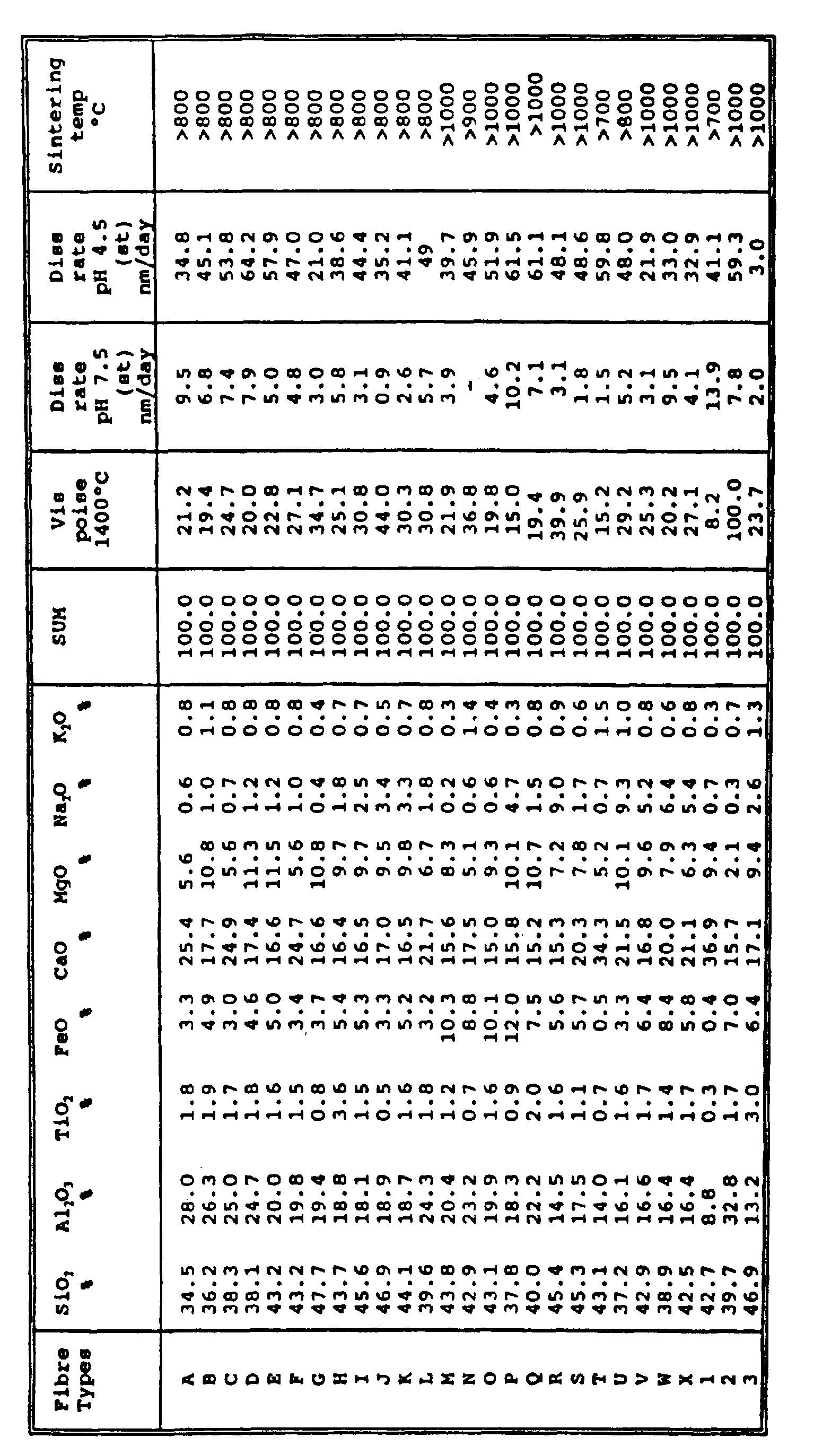
- Compositions were formed by blending appropriate proportions of raw materials as shown in the table and each was melted in a crucible furnace and was fiberised by the cascade spinner technique. The melt viscosity and solubility of each was determined. The analyses of the compositions and their properties are quoted in the following tables. In the invention, any of compositions A to X are judged to be suitable and are selected for the subsequent manufacture of MMVF products which are labelled as having good biological solubility. Those having viscosity above 20 and pH 4.5 solubility above 30 are preferred.
- Product 1 is similar to, commercial slag wool and gives a poor viscosity. Product 2 is a high aluminium product but the proportions of all the components are such that the melt viscosity is too high for convenient spinning. Product 3 is similar to a conventional rock wool product with normal good product properties but has a very low dissolution rate at pH 4.5. Accordingly products 1, 2 and 3 are not selected for use in the manufacture of biologically soluble MMV fibre products.
- The selected fibres may be provided in any of the forms conventional for MMV fibres. Thus they may be provided as a product consisting of loose, unbonded fibres. More usually they are provided with a bonding agent, for instance as a result of forming the fibres and connecting them in conventional manner. Generally the product is consolidated as a slab, sheet or other shaped article.
- Products according to the invention may be formulated for any of the conventional purposes of MMV fibres, for instance as slabs, sheets, tubes or other shaped products that are to serve as thermal insulation, fire insulation and protection or noise reduction and regulation, or in appropriate shapes for use as horticultural growing media, or as free fibres for reinforcement of cement, plastics or other products or as a filler.
Claims (21)
- Use as biodegradable man-made vitreous fibres of fibres formed of a composition which includes, by weight of oxides,
SiO2 32 to 48% Al2O3 16 to 30% CaO 10 to 30% MgO 2 to 20% FeO 2 to 15% Na2O + K2O 0 to 12% TiO2 0 to 6% Other Elements 0 to 15% - Use in mineral fibre products as biodegradable fibres of fibres formed of a composition which includes, by weight of oxides,
SiO2 32 to 48% Al2O3 16 to 30% CaO 10 to 30% MgO 2 to 20% FeO 2 to 15% Na2O + K2O 0 to 12% TiO2 0 to 6% Other Elements 0 to 15% - Use in mineral fibre products of man-made vitreous fibres which are shown to be biodegradable in the lung, wherein the fibres are formed of a composition which includes, by weight of oxides,
SiO2 32 to 48% Al2O3 16 to 30% CaO 10 to 30% MgO 2 to 20% FeO 2 to 15% Na2O + K2O 0 to 12% TiO2 0 to 6% Other Elements 0 to 15% - Use of fibres as biodegradable products, wherein the fibres are man-made vitreous fibres formed of a composition which includes, by weight of oxides,
SiO2 32 to 48% Al2O3 16 to 30% CaO 10 to 30% MgO 2 to 20% FeO 2 to 15% Na2O + K2O 0 to 12% TiO2 0 to 6% Other Elements 0 to 15% - A use according to any of claims 2 to 4 in which the product is a bonded product.
- A use according to claim 5 in which the bonded product is used as thermal insulation, fire insulation or protection, noise regulation or protection, or as a horticultural growth medium.
- Use according to any preceding claim in wich the fibres are shown to be biodegradable in the lung by determination of solubility in the environment of macrophages in the lung.
- Use according to any preceding claim in which the fibres have a dissolution rate as defined herein of at least 20nm per day calculated from the amount of Si in solution in modified Gambles solution at pH 4.5 after one day's immersion and after four day's immersion.
- Use according to any preceding claim wherein the sintering temperature of the fibres in mineral wool formed from the fibres is at least 800°C.
- Use according to any preceding claim in which the fibres have an analysis, measured as weight of oxides, which includes
SiO2 32 to below 45% Al2O3 above 16 to 28% CaO 10 to 30% MgO 2 to 20% FeO 2 to 15% Na2O + K2O 0 to 12% TiO2 0 to 4% Other Elements 0 to 8% - Use according to any preceding claim in which the amount of magnesium expressed as MgO is at least 5% up to 20%.
- Use according to any preceding claim in which the amount of iron, expressed as FeO, is below 10%.
- Use according to any preceding claim in which the amount of iron, expressed as FeO, is above 5%.
- Use according to any preceding calim in which the amount of aluminium, expressed as Al2O3 is at least 18%.
- A use according to claim 14 in which the amount of Al2O3 is at least 20%.
- A use according to claim 14 in which the amount of Al2O3 is 20 to 26%.
- A use according to any preceding claim in which the amount of SiO2 is below 42%
- A use according to any preceding claim in which the amount of titanium, expressed as TiO2, is at least 0.5%.
- A use according to any preceding claim in which the fibres have a dissolution rate at pH 7.5 below 15nm per day.
- A use according to any preceding claim in which the composition provides a liquidus temperature of 1240 to 1340°C,
- A product comprising man-made vitreous fibres formed of a composition having an analysis, as oxides, which includes
SiO2 32 to 48% Al2O3 10 to 18% CaO 10 to 30% MgO 2 to 20% FeO 2 to 15% Na2O + K2O 6 to 12% TiO2 0 to 6% Other Elements 0 to 15% and the composition has a viscosity at 1400°C of 10 to 70 poise,and the fibres have a dissolution rate at pH 4.5 of at least 20nm per day.
Applications Claiming Priority (10)
| Application Number | Priority Date | Filing Date | Title |
|---|---|---|---|
| GB9422468 | 1994-11-08 | ||
| GB9422468A GB9422468D0 (en) | 1994-11-08 | 1994-11-08 | Mad-made vitreous fibres |
| GB9424126 | 1994-11-23 | ||
| GB9424126A GB9424126D0 (en) | 1994-11-23 | 1994-11-23 | Man-made vitreous fibres |
| GB9424127 | 1994-11-23 | ||
| GB9424127A GB9424127D0 (en) | 1994-11-23 | 1994-11-23 | Man-made vitreous fibres |
| GBGB9500667.2A GB9500667D0 (en) | 1995-01-13 | 1995-01-13 | Man-made vitreous fibres |
| GB9500667 | 1995-01-13 | ||
| EP97107510A EP0792844B1 (en) | 1994-11-08 | 1995-11-08 | Man-made vitreous fibres |
| EP95937881A EP0790962B1 (en) | 1994-11-08 | 1995-11-08 | Man-made vitreous fibres |
Related Parent Applications (1)
| Application Number | Title | Priority Date | Filing Date |
|---|---|---|---|
| EP97107510A Division EP0792844B1 (en) | 1994-11-08 | 1995-11-08 | Man-made vitreous fibres |
Publications (1)
| Publication Number | Publication Date |
|---|---|
| EP1157974A1 true EP1157974A1 (en) | 2001-11-28 |
Family
ID=27451226
Family Applications (7)
| Application Number | Title | Priority Date | Filing Date |
|---|---|---|---|
| EP98114194A Revoked EP0877004B1 (en) | 1994-11-08 | 1995-11-08 | Method of making man-made vitreous fibre products |
| EP97107511A Revoked EP0792845B1 (en) | 1994-11-08 | 1995-11-08 | Man-made vitreous fibres |
| EP95937881A Revoked EP0790962B1 (en) | 1994-11-08 | 1995-11-08 | Man-made vitreous fibres |
| EP97107509A Withdrawn EP0792843A3 (en) | 1994-11-08 | 1995-11-08 | Man-made vitreous fibres |
| EP97107510A Revoked EP0792844B1 (en) | 1994-11-08 | 1995-11-08 | Man-made vitreous fibres |
| EP01119722A Ceased EP1157974A1 (en) | 1994-11-08 | 1995-11-08 | Man-made vitreous fibres |
| EP95937882A Revoked EP0791087B1 (en) | 1994-11-08 | 1995-11-08 | Man-made vitreous fibres |
Family Applications Before (5)
| Application Number | Title | Priority Date | Filing Date |
|---|---|---|---|
| EP98114194A Revoked EP0877004B1 (en) | 1994-11-08 | 1995-11-08 | Method of making man-made vitreous fibre products |
| EP97107511A Revoked EP0792845B1 (en) | 1994-11-08 | 1995-11-08 | Man-made vitreous fibres |
| EP95937881A Revoked EP0790962B1 (en) | 1994-11-08 | 1995-11-08 | Man-made vitreous fibres |
| EP97107509A Withdrawn EP0792843A3 (en) | 1994-11-08 | 1995-11-08 | Man-made vitreous fibres |
| EP97107510A Revoked EP0792844B1 (en) | 1994-11-08 | 1995-11-08 | Man-made vitreous fibres |
Family Applications After (1)
| Application Number | Title | Priority Date | Filing Date |
|---|---|---|---|
| EP95937882A Revoked EP0791087B1 (en) | 1994-11-08 | 1995-11-08 | Man-made vitreous fibres |
Country Status (24)
| Country | Link |
|---|---|
| US (2) | US5935886A (en) |
| EP (7) | EP0877004B1 (en) |
| JP (2) | JP3786424B2 (en) |
| CN (2) | CN1073053C (en) |
| AT (5) | ATE213721T1 (en) |
| AU (1) | AU706317B2 (en) |
| BE (1) | BE1009073A7 (en) |
| BG (2) | BG62250B1 (en) |
| CA (2) | CA2204772C (en) |
| CZ (2) | CZ290224B6 (en) |
| DE (12) | DE790962T1 (en) |
| DK (5) | DK0792844T3 (en) |
| ES (6) | ES2162377T3 (en) |
| FI (2) | FI972515L (en) |
| FR (1) | FR2726548B1 (en) |
| GR (3) | GR980300010T1 (en) |
| HU (2) | HU222253B1 (en) |
| NL (1) | NL1001607C2 (en) |
| PL (2) | PL182565B1 (en) |
| RO (2) | RO118949B1 (en) |
| SI (4) | SI0791087T1 (en) |
| SK (2) | SK55097A3 (en) |
| UA (1) | UA46749C2 (en) |
| WO (2) | WO1996014454A2 (en) |
Cited By (8)
| Publication number | Priority date | Publication date | Assignee | Title |
|---|---|---|---|---|
| EP1522642A1 (en) * | 2003-10-06 | 2005-04-13 | Saint-Gobain Isover G+H Ag | Insulating mat of mineral fibre wound in a roll for press fitting between beams |
| WO2005035896A1 (en) * | 2003-10-06 | 2005-04-21 | Saint-Gobain Isover | Insulating material consisting of a web of mineral fibres for wedging between beams and the like |
| US7585794B2 (en) | 2003-10-22 | 2009-09-08 | Saint-Gobain Isover | Vapor retarder with shielding against electromagnetic fields |
| US7740931B2 (en) | 2003-10-06 | 2010-06-22 | Horst Keller | Fire protection gate and correlated fire protection inset |
| DE102008062810B3 (en) * | 2008-12-23 | 2010-07-01 | Saint-Gobain Isover G+H Ag | Manufacture of high-alumina mineral fibers, employs clay or clay minerals of given composition, to reduce melting point under oxidizing conditions |
| US7803729B2 (en) | 2003-10-06 | 2010-09-28 | Saint-Gobain Isover | Insulating element from mineral fibers for shipbuilding |
| WO2011006875A2 (en) | 2009-07-13 | 2011-01-20 | Rockwool International A/S | Mineral fibres and their use |
| US9546107B2 (en) | 2012-10-18 | 2017-01-17 | Ocv Intellectual Capital, Llc | Glass composition for the manufacture of fibers and process |
Families Citing this family (104)
| Publication number | Priority date | Publication date | Assignee | Title |
|---|---|---|---|---|
| GB2287934A (en) | 1992-01-17 | 1995-10-04 | Morgan Crucible Co | Saline soluble vitreous inorganic fibres |
| JP3786424B2 (en) * | 1994-11-08 | 2006-06-14 | ロックウール インターナショナル アー/エス | Artificial glass fiber |
| US6346494B1 (en) * | 1995-11-08 | 2002-02-12 | Rockwool International A/S | Man-made vitreous fibres |
| GB9525475D0 (en) * | 1995-12-13 | 1996-02-14 | Rockwool Int | Man-made vitreous fibres and their production |
| GB9525641D0 (en) † | 1995-12-15 | 1996-02-14 | Rockwool Int | Production of mineral fibres |
| DE19604238A1 (en) * | 1996-02-06 | 1997-08-07 | Gruenzweig & Hartmann | Mineral fiber composition |
| US6043170A (en) * | 1996-02-06 | 2000-03-28 | Isover Saint-Gobain | Mineral fiber composition |
| GB9604264D0 (en) * | 1996-02-29 | 1996-05-01 | Rockwool Int | Man-made vitreous fibres |
| US6067821A (en) * | 1996-10-07 | 2000-05-30 | Owens Corning Fiberglas Technology, Inc. | Process for making mineral wool fibers from lumps of uncalcined raw bauxite |
| BE1010725A3 (en) * | 1996-10-30 | 1998-12-01 | Calumite Company Europ Naamloz | Method for valorising and may do so editing pots paints. |
| AU5227298A (en) * | 1996-11-28 | 1998-06-22 | Isover Saint-Gobain | Textile additive for cement material, materials and product containing same |
| CA2262700C (en) * | 1997-06-05 | 2002-09-17 | Hoya Corporation | Substrate for information recording media |
| FI109293B (en) * | 1997-08-15 | 2002-06-28 | Paroc Group Oy Ab | Mineral fiber and method for increasing elasticity and reducing the brittleness of a mineral fiber |
| GB9717486D0 (en) * | 1997-08-18 | 1997-10-22 | Rockwool Int | Roof and wall cladding |
| GB9717484D0 (en) | 1997-08-18 | 1997-10-22 | Rockwool Int | Roof and wall cladding |
| GB9717482D0 (en) | 1997-08-18 | 1997-10-22 | Rockwool Int | Roof and wall cladding |
| FR2768144B1 (en) * | 1997-09-10 | 1999-10-01 | Vetrotex France Sa | GLASS YARNS SUITABLE FOR REINFORCING ORGANIC AND / OR INORGANIC MATERIALS |
| HUP0004516A3 (en) * | 1997-12-02 | 2011-03-28 | Rockwool Int | Briquettes for mineral fibre production and their use |
| EP1036044B2 (en) * | 1997-12-02 | 2010-10-20 | Rockwool International A/S | Production of man-made vitreous fibres |
| NL1008041C2 (en) | 1998-01-16 | 1999-07-19 | Tidis B V I O | Application of a water-soluble binder system for the production of glass or rock wool. |
| WO1999051535A1 (en) | 1998-04-06 | 1999-10-14 | Rockwool International A/S | Man-made vitreous fibre batts and their production |
| FR2778401A1 (en) * | 1998-05-06 | 1999-11-12 | Saint Gobain Isover | COMPOSITION OF MINERAL WOOL |
| DE19840497C1 (en) * | 1998-09-05 | 2000-02-10 | Oesterr Heraklith Gmbh | Mineral fibers used in fleeces, mats, or plates in the building industry |
| CA2276729A1 (en) * | 1998-07-10 | 2000-01-10 | Albert Henry Kent | Fiberized mineral wool and method for making same |
| GB2341607B (en) | 1998-09-15 | 2000-07-19 | Morgan Crucible Co | Bonded fibrous materials |
| FR2783516B1 (en) † | 1998-09-17 | 2000-11-10 | Saint Gobain Isover | COMPOSITION OF MINERAL WOOL |
| AU764663C (en) * | 1999-02-22 | 2005-02-03 | Bayer Innovation Gmbh | Biodegradable ceramic fibres from silica sols |
| US6265335B1 (en) * | 1999-03-22 | 2001-07-24 | Armstrong World Industries, Inc. | Mineral wool composition with enhanced biosolubility and thermostabilty |
| AU4758900A (en) * | 1999-05-28 | 2000-12-18 | Rockwool International A/S | Man-made vitreous fibres and products containing them |
| FR2797867B1 (en) * | 1999-07-29 | 2001-12-07 | Saint Gobain Isover | COMPOSITION OF MINERAL WOOL LIKELY TO DISSOLVE IN A PHYSIOLOGICAL MEDIUM |
| MXPA02002380A (en) | 1999-09-10 | 2002-08-20 | Morgan Crucible Company P L C | High temperature resistant saline soluble fibres. |
| AU2001237407A1 (en) | 2000-02-15 | 2001-08-27 | Rockwool International A/S | Man-made vitreous fibres and products containing them |
| DE10010664B4 (en) * | 2000-03-04 | 2007-05-24 | Asglawo Technofibre Gmbh | Reinforcing fibers for cement-bonded concrete elements |
| FR2806402B1 (en) * | 2000-03-17 | 2002-10-25 | Saint Gobain Isover | COMPOSITION OF MINERAL WOOL |
| FI117383B (en) * | 2000-12-22 | 2006-09-29 | Paroc Group Oy Ab | Raw material for the production of mineral fiber |
| FI20002827A0 (en) * | 2000-12-22 | 2000-12-22 | Paroc Group Oy Ab | Raw material for the manufacture of mineral fibers |
| DE10114985C5 (en) | 2001-03-26 | 2017-08-24 | Hans-Peter Noack | Process for the production of mineral wool |
| FR2823501B1 (en) * | 2001-04-11 | 2003-06-06 | Saint Gobain Isover | COMPOSITION OF MINERAL WOOL |
| JP2003082569A (en) * | 2001-04-13 | 2003-03-19 | Toshiba Monofrax Co Ltd | Inorganic fiber products |
| JP4472218B2 (en) * | 2001-08-30 | 2010-06-02 | ニチアス株式会社 | Inorganic fiber and method for producing the same |
| JP3880038B2 (en) | 2001-09-28 | 2007-02-14 | ニチアス株式会社 | Biosoluble honeycomb structure |
| WO2003050054A1 (en) | 2001-12-12 | 2003-06-19 | Rockwool International A/S | Fibres and their production |
| GB2383793B (en) | 2002-01-04 | 2003-11-19 | Morgan Crucible Co | Saline soluble inorganic fibres |
| FR2856055B1 (en) * | 2003-06-11 | 2007-06-08 | Saint Gobain Vetrotex | GLASS YARNS FOR REINFORCING ORGANIC AND / OR INORGANIC MATERIALS, COMPOSITES COMPRISING SAME AND COMPOSITION USED THEREFOR |
| DE102004014344B4 (en) * | 2004-03-22 | 2008-06-19 | Saint-Gobain Isover G+H Ag | Biodegradable glass composition and mineral wool product therefrom |
| FR2879591B1 (en) * | 2004-12-16 | 2007-02-09 | Saint Gobain Vetrotex | GLASS YARNS FOR REINFORCING ORGANIC AND / OR INORGANIC MATERIALS |
| KR101544954B1 (en) | 2005-05-12 | 2015-08-18 | 헴펠 에이/에스 | Method for the establishment of a crack resistant epoxy paint coat and paint compositions suitable for said method |
| US7823417B2 (en) * | 2005-11-04 | 2010-11-02 | Ocv Intellectual Capital, Llc | Method of manufacturing high performance glass fibers in a refractory lined melter and fiber formed thereby |
| US7799713B2 (en) * | 2005-11-04 | 2010-09-21 | Ocv Intellectual Capital, Llc | Composition for high performance glass, high performance glass fibers and articles therefrom |
| US8586491B2 (en) | 2005-11-04 | 2013-11-19 | Ocv Intellectual Capital, Llc | Composition for high performance glass, high performance glass fibers and articles therefrom |
| US9187361B2 (en) | 2005-11-04 | 2015-11-17 | Ocv Intellectual Capital, Llc | Method of manufacturing S-glass fibers in a direct melt operation and products formed there from |
| US9656903B2 (en) * | 2005-11-04 | 2017-05-23 | Ocv Intellectual Capital, Llc | Method of manufacturing high strength glass fibers in a direct melt operation and products formed there from |
| US8338319B2 (en) * | 2008-12-22 | 2012-12-25 | Ocv Intellectual Capital, Llc | Composition for high performance glass fibers and fibers formed therewith |
| US8198505B2 (en) * | 2006-07-12 | 2012-06-12 | The Procter & Gamble Company | Disposable absorbent articles comprising non-biopersistent inorganic vitreous microfibers |
| US7807594B2 (en) * | 2007-08-15 | 2010-10-05 | Johns Manville | Fire resistant glass fiber |
| WO2009074570A1 (en) * | 2007-12-10 | 2009-06-18 | Hempel A/S | Alkyl silicate paint compositions with improved cracking resistance |
| WO2010027771A1 (en) | 2008-08-27 | 2010-03-11 | Edwards Lifesciences Corporation | Analyte sensor |
| USD628718S1 (en) | 2008-10-31 | 2010-12-07 | Owens Corning Intellectual Capital, Llc | Shingle ridge vent |
| USD615218S1 (en) | 2009-02-10 | 2010-05-04 | Owens Corning Intellectual Capital, Llc | Shingle ridge vent |
| US8252707B2 (en) * | 2008-12-24 | 2012-08-28 | Ocv Intellectual Capital, Llc | Composition for high performance glass fibers and fibers formed therewith |
| EP2354105A1 (en) * | 2010-02-05 | 2011-08-10 | 3B | Glass fibre composition and composite material reinforced therewith |
| WO2011113303A1 (en) * | 2010-03-18 | 2011-09-22 | Yang Dening | Glass fiber with properties of high strength, energy saving, environment protecting and low viscosity, production method thereof and composite material containing the same |
| JP5889870B2 (en) * | 2010-04-12 | 2016-03-22 | ユーエスジー・インテリアズ・エルエルシー | Mineral wool from reusable materials |
| CN102050583A (en) * | 2010-10-27 | 2011-05-11 | 泰山玻璃纤维有限公司 | Chemical corrosion resistant fiberglass |
| EP2640878B1 (en) | 2010-11-16 | 2018-11-07 | Unifrax I LLC | Inorganic fiber |
| CN102173594B (en) * | 2011-02-14 | 2012-05-23 | 重庆国际复合材料有限公司 | Boron-free fluorine-free glass fiber composition |
| US9650282B2 (en) | 2011-02-23 | 2017-05-16 | Dening Yang | Glass fiber with properties of high strength, energy saving, environment protecting and low viscosity, production method thereof and composite material containing the same |
| KR101477733B1 (en) * | 2011-04-12 | 2014-12-30 | 주식회사 케이씨씨 | Mineral Wool Fiber Composition having improved Bio-Solubility, And Mineral Wool |
| EP2599839B1 (en) | 2011-12-01 | 2015-07-08 | Rockwool International A/S | Mineral wool substrate |
| KR101516981B1 (en) * | 2011-12-14 | 2015-05-06 | 주식회사 케이씨씨 | Mineral wool fiber composition having improved saline solubility and construction material containing the mineral wool fiber obtained therefrom |
| CA2857606C (en) | 2011-12-16 | 2017-05-02 | Rockwool International A/S | Melt composition for the production of man-made vitreous fibres |
| FR2985725B1 (en) | 2012-01-17 | 2015-06-26 | Saint Gobain Isover | SIZING COMPOSITION FOR FIBERS, ESPECIALLY MINERAL, BASED ON HUMIC AND / OR FULVIC ACID, AND RESULTING INSULATING PRODUCTS. |
| KR101348274B1 (en) * | 2012-04-05 | 2014-01-09 | 주식회사 케이씨씨 | Composition for preparing mineral wool fiber having high solubility in body fluid and mineral wool fiber prepared therefrom |
| CN103539361B (en) * | 2012-07-09 | 2015-10-14 | 浙江轩鸣新材料有限公司 | Take flyash as inorganic fibre and the manufacture method thereof of main raw material |
| CN103539347A (en) * | 2012-07-09 | 2014-01-29 | 上海华明高技术(集团)有限公司 | Inorganic fiber with solid waste as raw material and production method thereof |
| EP2882693A1 (en) | 2012-08-13 | 2015-06-17 | Rockwool International A/S | Graphite coated fibres |
| US10370855B2 (en) | 2012-10-10 | 2019-08-06 | Owens Corning Intellectual Capital, Llc | Roof deck intake vent |
| USD710985S1 (en) | 2012-10-10 | 2014-08-12 | Owens Corning Intellectual Capital, Llc | Roof vent |
| PL2969989T3 (en) | 2013-03-15 | 2019-10-31 | Unifrax I Llc | Inorganic fiber |
| JP6433981B2 (en) * | 2013-04-15 | 2018-12-05 | ケーシーシー コーポレーション | Composition for producing mineral wool fiber excellent in solubility in body fluid and mineral wool fiber produced thereby |
| US9611082B2 (en) * | 2013-05-13 | 2017-04-04 | Owens-Brockway Glass Container Inc. | Seal ring for foil-sealing a container |
| HRP20180256T1 (en) * | 2013-10-16 | 2018-03-23 | Rockwool International A/S | ARTIFICIAL GLASS FIBERS |
| JP6554269B2 (en) * | 2014-07-08 | 2019-07-31 | ニチアス株式会社 | Method for producing biosoluble inorganic fiber |
| CN104261685A (en) * | 2014-07-15 | 2015-01-07 | 宣汉正原微玻纤有限公司 | Rapid biodegradable glass fiber cotton and preparation method thereof |
| US10023491B2 (en) | 2014-07-16 | 2018-07-17 | Unifrax I Llc | Inorganic fiber |
| PL3169833T3 (en) | 2014-07-16 | 2020-01-31 | Unifrax I Llc | Inorganic fiber with improved shrinkage and strength |
| CN106715348A (en) | 2014-07-17 | 2017-05-24 | 尤尼弗瑞克斯 I 有限责任公司 | Inorganic fibers with improved shrinkage and strength |
| CN105645774A (en) * | 2014-12-01 | 2016-06-08 | 杨德宁 | A low crystallization temperature, low crystallization speed, high temperature resistance, application of ultra-high aluminum glass fiber and its preparation method, composite material |
| FR3043399B1 (en) * | 2015-11-09 | 2018-01-05 | Eco'ring | PROCESS FOR PRODUCING ROCK WOOL AND VALORIZABLE CAST IRON |
| US9919957B2 (en) | 2016-01-19 | 2018-03-20 | Unifrax I Llc | Inorganic fiber |
| US10094614B2 (en) * | 2016-12-14 | 2018-10-09 | Usg Interiors, Llc | Method for dewatering acoustical panels |
| US10882779B2 (en) | 2018-05-25 | 2021-01-05 | Unifrax I Llc | Inorganic fiber |
| CN108950791A (en) * | 2018-07-27 | 2018-12-07 | 合肥岑遥新材料科技有限公司 | A kind of glass fiber compound material and preparation method thereof |
| KR102042930B1 (en) * | 2018-08-23 | 2019-12-02 | 한국세라믹기술원 | Ceramic long fiber using fly ash and rock, and method of fabricating of the same |
| KR101964114B1 (en) * | 2018-08-23 | 2019-08-20 | 한국세라믹기술원 | Ceramic fiber using slag and rock method of fabricating of the same |
| CN109748494A (en) * | 2019-03-05 | 2019-05-14 | 沈阳化工大学 | A kind of preparation method of aluminum silicate wool using waste refractory material waste resin sand and boron mud |
| ES3002158T3 (en) * | 2019-12-23 | 2025-03-06 | Rockwool As | A storm water management system |
| CN116648434B (en) * | 2020-11-19 | 2026-06-12 | 洛科威有限公司 | Method for preparing melts for producing synthetic mineral fibers |
| CN113402175B (en) * | 2021-07-06 | 2022-08-19 | 山东鲁阳节能材料股份有限公司 | Soluble glass fiber blanket and preparation method thereof |
| CN113582536B (en) * | 2021-08-20 | 2023-08-01 | 山东鲁阳节能材料股份有限公司 | Preparation method and preparation system of soluble mineral fiber blanket |
| WO2023079108A1 (en) | 2021-11-05 | 2023-05-11 | Rockwool A/S | Method of preparing a melt for the production of man-made mineral fibres |
| CN113880442B (en) * | 2021-11-18 | 2022-06-07 | 浙江大学 | Preparation method of nano-scale glass fiber and product thereof |
| EP4580998B1 (en) | 2022-09-02 | 2026-07-08 | Rockwool A/S | Process for recycling waste mineral material |
| WO2025181094A1 (en) | 2024-02-27 | 2025-09-04 | Rockwool A/S | Process for recycling waste mineral material |
Citations (5)
| Publication number | Priority date | Publication date | Assignee | Title |
|---|---|---|---|---|
| GB2152026A (en) * | 1983-12-30 | 1985-07-31 | Inst Mineral Rohstoff Lager | Method of producing temperature-resistant rock fibres |
| EP0231691A1 (en) * | 1985-12-17 | 1987-08-12 | Isover Saint-Gobain | Nutritious glasses for agriculture |
| EP0459897A1 (en) * | 1990-06-01 | 1991-12-04 | Isover Saint-Gobain | Mineral fibres degradable in physiological medium |
| FR2662687A1 (en) * | 1990-06-01 | 1991-12-06 | Saint Gobain Isover | Inorganic fibres capable of decomposing in a physiological medium |
| EP0583791A1 (en) * | 1992-08-20 | 1994-02-23 | Isover Saint-Gobain | Method for producing mineral wool, and mineral wool produced thereby |
Family Cites Families (28)
| Publication number | Priority date | Publication date | Assignee | Title |
|---|---|---|---|---|
| US2020403A (en) * | 1933-06-19 | 1935-11-12 | Isaiah B Engle | Process for producing mineral fiber |
| US2300930A (en) * | 1938-08-08 | 1942-11-03 | Anthracite Ind Inc | Mineral wool |
| US2576312A (en) * | 1948-08-16 | 1951-11-27 | Baldwin Hill Company | Method of making mineral wool |
| US3736162A (en) * | 1972-02-10 | 1973-05-29 | Ceskoslovenska Akademie Ved | Cements containing mineral fibers of high corrosion resistance |
| US4002482A (en) * | 1975-02-14 | 1977-01-11 | Jenaer Glaswerk Schott & Gen. | Glass compositions suitable for incorporation into concrete |
| US4002492A (en) * | 1975-07-01 | 1977-01-11 | Exxon Research And Engineering Company | Rechargeable lithium-aluminum anode |
| US4037470A (en) * | 1976-08-19 | 1977-07-26 | The United States Of America As Represented By The Secretary Of The Navy | Method and apparatus for measuring high energy laser beam power |
| DK143938C (en) * | 1978-01-02 | 1982-04-19 | Rockwool Int | ALKALIR RESISTANT, SYNTHETIC MINERAL FIBERS AND FIBER REINFORCED PRODUCTS BASED ON CEMENT OR CALCIUM SILICATE AS A BINDING AGENT |
| JPS605539B2 (en) * | 1980-03-17 | 1985-02-12 | 日東紡績株式会社 | Alkali-resistant, heat-resistant inorganic fiber |
| JPS57188427A (en) * | 1981-01-23 | 1982-11-19 | Bethlehem Steel Corp | Mineral wool and manufacture |
| CS236485B2 (en) * | 1981-07-20 | 1985-05-15 | Saint Gobain Isover | Glass fibre |
| FR2509716A1 (en) * | 1981-07-20 | 1983-01-21 | Saint Gobain Isover | Glass fibres, esp. discontinuous glass fibres - with specific chemical compsn., used to make thermally insulating prods. which can be employed at high temps. |
| US4560606A (en) * | 1981-11-16 | 1985-12-24 | Owens-Corning Fiberglas Corporation | Basalt compositions and their fibers |
| US5037470A (en) * | 1985-12-17 | 1991-08-06 | Isover Saint-Gobain | Nutritive glasses for agriculture |
| CA1271785A (en) * | 1986-02-20 | 1990-07-17 | Leonard Elmo Olds | Inorganic fiber composition |
| AU3765789A (en) * | 1988-06-01 | 1990-01-05 | Manville Sales Corporation | Process for decomposing an inorganic fiber |
| AU630484B2 (en) * | 1989-08-11 | 1992-10-29 | Isover Saint-Gobain | Glass fibres capable of decomposing in a physiological medium |
| US5250488A (en) * | 1989-08-11 | 1993-10-05 | Sylvie Thelohan | Mineral fibers decomposable in a physiological medium |
| DK163494C (en) * | 1990-02-01 | 1992-08-10 | Rockwool Int | MINERAL FIBER |
| SU1724613A1 (en) * | 1990-03-11 | 1992-04-07 | Украинский Научно-Исследовательский, Проектный И Конструкторско-Технологический Институт "Укрстромниипроект" | Glass for preparation of mineral fibre |
| FI93346C (en) * | 1990-11-23 | 1998-03-07 | Partek Ab | Mineral Fiber Composition |
| FR2690438A1 (en) * | 1992-04-23 | 1993-10-29 | Saint Gobain Isover | Mineral fibers capable of dissolving in a physiological medium. |
| JPH05301741A (en) * | 1992-04-28 | 1993-11-16 | Nippon Sheet Glass Co Ltd | Glass composition for fiber suitable for acid elution |
| DE4219165A1 (en) * | 1992-06-11 | 1993-12-16 | Rohde & Schwarz | antenna |
| US5401693A (en) * | 1992-09-18 | 1995-03-28 | Schuller International, Inc. | Glass fiber composition with improved biosolubility |
| DK156692D0 (en) * | 1992-12-29 | 1992-12-29 | Rockwool Int | MINERAL FIBER PRODUCT |
| JP3786424B2 (en) * | 1994-11-08 | 2006-06-14 | ロックウール インターナショナル アー/エス | Artificial glass fiber |
| US5576252A (en) * | 1995-05-04 | 1996-11-19 | Owens-Corning Fiberglas Technology, Inc. | Irregularly-shaped glass fibers and insulation therefrom |
-
1995
- 1995-11-08 JP JP51506796A patent/JP3786424B2/en not_active Expired - Lifetime
- 1995-11-08 DE DE0790962T patent/DE790962T1/en active Pending
- 1995-11-08 DE DE0792843T patent/DE792843T1/en active Pending
- 1995-11-08 PL PL95320363A patent/PL182565B1/en unknown
- 1995-11-08 SI SI9530123T patent/SI0791087T1/en not_active IP Right Cessation
- 1995-11-08 DK DK97107510T patent/DK0792844T3/en active
- 1995-11-08 US US08/836,537 patent/US5935886A/en not_active Expired - Lifetime
- 1995-11-08 SI SI9530468T patent/SI0792845T1/en unknown
- 1995-11-08 ES ES98114194T patent/ES2162377T3/en not_active Expired - Lifetime
- 1995-11-08 BE BE9500932A patent/BE1009073A7/en not_active IP Right Cessation
- 1995-11-08 SI SI9530584T patent/SI0792844T1/en unknown
- 1995-11-08 EP EP98114194A patent/EP0877004B1/en not_active Revoked
- 1995-11-08 DK DK97107511T patent/DK0792845T3/en active
- 1995-11-08 EP EP97107511A patent/EP0792845B1/en not_active Revoked
- 1995-11-08 ES ES97107510T patent/ES2111507T3/en not_active Expired - Lifetime
- 1995-11-08 DE DE69522969T patent/DE69522969T2/en not_active Revoked
- 1995-11-08 ES ES97107511T patent/ES2111508T3/en not_active Expired - Lifetime
- 1995-11-08 JP JP51506696A patent/JP3955091B2/en not_active Expired - Lifetime
- 1995-11-08 HU HU9702122A patent/HU222253B1/en not_active IP Right Cessation
- 1995-11-08 DE DE0791087T patent/DE791087T1/en active Pending
- 1995-11-08 CA CA002204772A patent/CA2204772C/en not_active Expired - Lifetime
- 1995-11-08 DE DE19581831T patent/DE19581831T1/en not_active Withdrawn
- 1995-11-08 CA CA002204773A patent/CA2204773C/en not_active Expired - Lifetime
- 1995-11-08 SK SK550-97A patent/SK55097A3/en not_active Application Discontinuation
- 1995-11-08 AT AT97107510T patent/ATE213721T1/en active
- 1995-11-08 RO RO97-00857A patent/RO118949B1/en unknown
- 1995-11-08 ES ES95937881T patent/ES2111504T3/en not_active Expired - Lifetime
- 1995-11-08 AU AU38715/95A patent/AU706317B2/en not_active Withdrawn - After Issue
- 1995-11-08 RO RO97-00856A patent/RO120335B1/en unknown
- 1995-11-08 DE DE0792845T patent/DE792845T1/en active Pending
- 1995-11-08 WO PCT/EP1995/004395 patent/WO1996014454A2/en not_active Ceased
- 1995-11-08 US US08/836,516 patent/US5932500A/en not_active Expired - Lifetime
- 1995-11-08 DE DE69506277T patent/DE69506277T2/en not_active Revoked
- 1995-11-08 DK DK95937881T patent/DK0790962T3/en active
- 1995-11-08 WO PCT/EP1995/004394 patent/WO1996014274A2/en not_active Ceased
- 1995-11-08 HU HU9702124A patent/HU219310B/en not_active IP Right Cessation
- 1995-11-08 EP EP95937881A patent/EP0790962B1/en not_active Revoked
- 1995-11-08 DE DE69525645T patent/DE69525645T2/en not_active Revoked
- 1995-11-08 DE DE19581829T patent/DE19581829T1/en not_active Ceased
- 1995-11-08 DK DK98114194T patent/DK0877004T3/en active
- 1995-11-08 DE DE69503919T patent/DE69503919T2/en not_active Revoked
- 1995-11-08 SK SK551-97A patent/SK55197A3/en not_active Application Discontinuation
- 1995-11-08 DE DE69519589T patent/DE69519589T2/en not_active Revoked
- 1995-11-08 UA UA97062629A patent/UA46749C2/en unknown
- 1995-11-08 CN CN95196117A patent/CN1073053C/en not_active Expired - Lifetime
- 1995-11-08 NL NL1001607A patent/NL1001607C2/en not_active IP Right Cessation
- 1995-11-08 AT AT95937881T patent/ATE173721T1/en active
- 1995-11-08 CZ CZ19971404A patent/CZ290224B6/en not_active IP Right Cessation
- 1995-11-08 AT AT95937882T patent/ATE169352T1/en not_active IP Right Cessation
- 1995-11-08 ES ES97107509T patent/ES2111506T1/en active Pending
- 1995-11-08 FR FR9513230A patent/FR2726548B1/en not_active Expired - Lifetime
- 1995-11-08 CN CN95196118A patent/CN1044923C/en not_active Expired - Lifetime
- 1995-11-08 SI SI9530536T patent/SI0877004T1/en unknown
- 1995-11-08 EP EP97107509A patent/EP0792843A3/en not_active Withdrawn
- 1995-11-08 EP EP97107510A patent/EP0792844B1/en not_active Revoked
- 1995-11-08 ES ES95937882T patent/ES2111505T3/en not_active Expired - Lifetime
- 1995-11-08 FI FI972515A patent/FI972515L/en not_active Application Discontinuation
- 1995-11-08 CZ CZ0136697A patent/CZ297816B6/en not_active IP Right Cessation
- 1995-11-08 AT AT98114194T patent/ATE206101T1/en active
- 1995-11-08 EP EP01119722A patent/EP1157974A1/en not_active Ceased
- 1995-11-08 EP EP95937882A patent/EP0791087B1/en not_active Revoked
- 1995-11-08 DK DK95937882T patent/DK0791087T3/en active
- 1995-11-08 PL PL95320344A patent/PL181150B1/en unknown
- 1995-11-08 AT AT97107511T patent/ATE197948T1/en active
- 1995-11-08 DE DE0792844T patent/DE792844T1/en active Pending
-
1997
- 1997-05-02 BG BG101449A patent/BG62250B1/en unknown
- 1997-05-02 BG BG101450A patent/BG62286B1/en unknown
- 1997-06-13 FI FI972516A patent/FI122070B/en not_active IP Right Cessation
-
1998
- 1998-03-31 GR GR980300010T patent/GR980300010T1/en unknown
- 1998-03-31 GR GR980300011T patent/GR980300011T1/en unknown
- 1998-08-06 GR GR980401713T patent/GR3027597T3/en unknown
Patent Citations (5)
| Publication number | Priority date | Publication date | Assignee | Title |
|---|---|---|---|---|
| GB2152026A (en) * | 1983-12-30 | 1985-07-31 | Inst Mineral Rohstoff Lager | Method of producing temperature-resistant rock fibres |
| EP0231691A1 (en) * | 1985-12-17 | 1987-08-12 | Isover Saint-Gobain | Nutritious glasses for agriculture |
| EP0459897A1 (en) * | 1990-06-01 | 1991-12-04 | Isover Saint-Gobain | Mineral fibres degradable in physiological medium |
| FR2662687A1 (en) * | 1990-06-01 | 1991-12-06 | Saint Gobain Isover | Inorganic fibres capable of decomposing in a physiological medium |
| EP0583791A1 (en) * | 1992-08-20 | 1994-02-23 | Isover Saint-Gobain | Method for producing mineral wool, and mineral wool produced thereby |
Cited By (12)
| Publication number | Priority date | Publication date | Assignee | Title |
|---|---|---|---|---|
| EP1522642A1 (en) * | 2003-10-06 | 2005-04-13 | Saint-Gobain Isover G+H Ag | Insulating mat of mineral fibre wound in a roll for press fitting between beams |
| WO2005035896A1 (en) * | 2003-10-06 | 2005-04-21 | Saint-Gobain Isover | Insulating material consisting of a web of mineral fibres for wedging between beams and the like |
| US7740931B2 (en) | 2003-10-06 | 2010-06-22 | Horst Keller | Fire protection gate and correlated fire protection inset |
| US7803729B2 (en) | 2003-10-06 | 2010-09-28 | Saint-Gobain Isover | Insulating element from mineral fibers for shipbuilding |
| US8026190B2 (en) | 2003-10-06 | 2011-09-27 | Saint-Gobain Isover | Insulating element from mineral fibers for shipbuilding |
| US7585794B2 (en) | 2003-10-22 | 2009-09-08 | Saint-Gobain Isover | Vapor retarder with shielding against electromagnetic fields |
| DE102008062810B3 (en) * | 2008-12-23 | 2010-07-01 | Saint-Gobain Isover G+H Ag | Manufacture of high-alumina mineral fibers, employs clay or clay minerals of given composition, to reduce melting point under oxidizing conditions |
| WO2011006875A2 (en) | 2009-07-13 | 2011-01-20 | Rockwool International A/S | Mineral fibres and their use |
| WO2011006875A3 (en) * | 2009-07-13 | 2011-06-30 | Rockwool International A/S | Mineral fibres and their use |
| US8822359B2 (en) | 2009-07-13 | 2014-09-02 | Rockwool International A/S | Mineral fibres and their use |
| EA021658B1 (en) * | 2009-07-13 | 2015-08-31 | Роквул Интернэшнл А/С | Mineral fibres and their use |
| US9546107B2 (en) | 2012-10-18 | 2017-01-17 | Ocv Intellectual Capital, Llc | Glass composition for the manufacture of fibers and process |
Also Published As
Similar Documents
| Publication | Publication Date | Title |
|---|---|---|
| EP0792844B1 (en) | Man-made vitreous fibres | |
| EP0883581B1 (en) | Man-made vitreous fibres | |
| US6346494B1 (en) | Man-made vitreous fibres | |
| AU770902B2 (en) | Man-made vitreous fibres | |
| AU704242C (en) | Man-made vitreous fibres | |
| RU2220118C2 (en) | Artificially obtained glass fibers | |
| CA2247345A1 (en) | Man-made vitreous fibres |
Legal Events
| Date | Code | Title | Description |
|---|---|---|---|
| PUAI | Public reference made under article 153(3) epc to a published international application that has entered the european phase |
Free format text: ORIGINAL CODE: 0009012 |
|
| 17P | Request for examination filed |
Effective date: 20010903 |
|
| AC | Divisional application: reference to earlier application |
Ref document number: 792844 Country of ref document: EP Ref document number: 790962 Country of ref document: EP |
|
| AK | Designated contracting states |
Kind code of ref document: A1 Designated state(s): AT BE CH DE DK ES FR GB GR IT LI NL SE |
|
| AX | Request for extension of the european patent |
Free format text: LT PAYMENT 20010903;LV PAYMENT 20010903;SI PAYMENT 20010903 |
|
| AKX | Designation fees paid |
Free format text: AT BE CH DE DK ES FR GB GR IT LI NL SE |
|
| AXX | Extension fees paid |
Free format text: LT PAYMENT 20010903;LV PAYMENT 20010903;SI PAYMENT 20010903 |
|
| 17Q | First examination report despatched |
Effective date: 20031007 |
|
| APBN | Date of receipt of notice of appeal recorded |
Free format text: ORIGINAL CODE: EPIDOSNNOA2E |
|
| APBR | Date of receipt of statement of grounds of appeal recorded |
Free format text: ORIGINAL CODE: EPIDOSNNOA3E |
|
| APBK | Appeal reference recorded |
Free format text: ORIGINAL CODE: EPIDOSNREFNE |
|
| APAZ | Date of receipt of statement of grounds of appeal deleted |
Free format text: ORIGINAL CODE: EPIDOSDNOA3E |
|
| APBR | Date of receipt of statement of grounds of appeal recorded |
Free format text: ORIGINAL CODE: EPIDOSNNOA3E |
|
| APAF | Appeal reference modified |
Free format text: ORIGINAL CODE: EPIDOSCREFNE |
|
| APBT | Appeal procedure closed |
Free format text: ORIGINAL CODE: EPIDOSNNOA9E |
|
| STAA | Information on the status of an ep patent application or granted ep patent |
Free format text: STATUS: THE APPLICATION HAS BEEN REFUSED |
|
| 18R | Application refused |
Effective date: 20090316 |