EP1156540A2 - Battery vent plug - Google Patents
Battery vent plug Download PDFInfo
- Publication number
- EP1156540A2 EP1156540A2 EP01304201A EP01304201A EP1156540A2 EP 1156540 A2 EP1156540 A2 EP 1156540A2 EP 01304201 A EP01304201 A EP 01304201A EP 01304201 A EP01304201 A EP 01304201A EP 1156540 A2 EP1156540 A2 EP 1156540A2
- Authority
- EP
- European Patent Office
- Prior art keywords
- elements
- region
- vent plug
- battery
- cylindrical component
- Prior art date
- Legal status (The legal status is an assumption and is not a legal conclusion. Google has not performed a legal analysis and makes no representation as to the accuracy of the status listed.)
- Granted
Links
Images



Classifications
-
- H—ELECTRICITY
- H01—ELECTRIC ELEMENTS
- H01M—PROCESSES OR MEANS, e.g. BATTERIES, FOR THE DIRECT CONVERSION OF CHEMICAL ENERGY INTO ELECTRICAL ENERGY
- H01M50/00—Constructional details or processes of manufacture of the non-active parts of electrochemical cells other than fuel cells, e.g. hybrid cells
- H01M50/30—Arrangements for facilitating escape of gases
- H01M50/308—Detachable arrangements, e.g. detachable vent plugs or plug systems
-
- H—ELECTRICITY
- H01—ELECTRIC ELEMENTS
- H01M—PROCESSES OR MEANS, e.g. BATTERIES, FOR THE DIRECT CONVERSION OF CHEMICAL ENERGY INTO ELECTRICAL ENERGY
- H01M50/00—Constructional details or processes of manufacture of the non-active parts of electrochemical cells other than fuel cells, e.g. hybrid cells
- H01M50/30—Arrangements for facilitating escape of gases
- H01M50/383—Flame arresting or ignition-preventing means
-
- H—ELECTRICITY
- H01—ELECTRIC ELEMENTS
- H01M—PROCESSES OR MEANS, e.g. BATTERIES, FOR THE DIRECT CONVERSION OF CHEMICAL ENERGY INTO ELECTRICAL ENERGY
- H01M50/00—Constructional details or processes of manufacture of the non-active parts of electrochemical cells other than fuel cells, e.g. hybrid cells
- H01M50/30—Arrangements for facilitating escape of gases
- H01M50/394—Gas-pervious parts or elements
-
- Y—GENERAL TAGGING OF NEW TECHNOLOGICAL DEVELOPMENTS; GENERAL TAGGING OF CROSS-SECTIONAL TECHNOLOGIES SPANNING OVER SEVERAL SECTIONS OF THE IPC; TECHNICAL SUBJECTS COVERED BY FORMER USPC CROSS-REFERENCE ART COLLECTIONS [XRACs] AND DIGESTS
- Y02—TECHNOLOGIES OR APPLICATIONS FOR MITIGATION OR ADAPTATION AGAINST CLIMATE CHANGE
- Y02E—REDUCTION OF GREENHOUSE GAS [GHG] EMISSIONS, RELATED TO ENERGY GENERATION, TRANSMISSION OR DISTRIBUTION
- Y02E60/00—Enabling technologies; Technologies with a potential or indirect contribution to GHG emissions mitigation
- Y02E60/10—Energy storage using batteries
Definitions
- the present invention relates to a vent plug for use in an electric storage battery.
- vent plug is intended for use in a lead-acid battery for use in a vehicle, such batteries often being referred to as SLI batteries (starting, lighting and ignition batteries), and while the invention is not specifically limited to such lead acid batteries it will be described herein for convenience in relation to such batteries.
- SLI batteries starting, lighting and ignition batteries
- the lid of a battery case closes each cell of the battery and the lid has an aperture for filling each battery cell with electrolyte.
- the apertures in the lid are closed by individual plugs and it has previously been proposed to use these plugs as a vent route for gases, and to incorporate a baffle arrangement within the gas flow path through the vent plug so that electrolyte droplets are intercepted by the baffle arrangement and returned to their respective cell.
- vent plug It is known to produce a vent plug by separately moulding a hollow body and a baffle assembly, the baffle assembly being inserted into the hollow body and being retained in place by a snap-fit connection with the body.
- a vent plug arrangement is disadvantageous in that it requires moulding of two separate components and subsequent handling and assembly of those components to complete the vent plug before it can be used in a battery. It is an object of the present invention to provide a vent plug for a battery in a simple and convenient form wherein the aforementioned disadvantage is minimised.
- a battery vent plug comprising a generally cylindrical component for introduction through the lid of a battery in use, the cylindrical component being open at its opposite axial ends so as to provide a path for gas to flow therethrough from the interior of the battery to atmosphere, and, a baffle arrangement within said cylindrical component, said cylindrical component including a region moulded as two semi-cylindrical elements united along one axially extending edge by an integral flexible hinge, said elements including mating latch components for holding the elements in a closed position relative to one another defining said region of said cylindrical component and, said baffle arrangement being moulded integrally with said region of said cylindrical component so as to define a labyrinthine gas flow path through said region when said elements are latched together to define said region.
- said baffle arrangement is defined by a plurality of inclined baffle plates moulded integrally with one of said elements and engaging the inner surface of the other element when the two elements are closed together.
- said cylindrical component includes a region into which a flame retarder disc can be introduced prior to closing said elements to define said cylindrical region, said disc lying in said gas flow path downstream of said baffle arrangement in use.
- the mating longitudinal edges of said elements remote from said hinge are shaped to overlap in the closed position of said elements to provide a low-pressure gas tight seal.
- said elements include latch component at their hinge edges and at their edges remote from the hinge so that both abutting edges of the two elements are latched in position when the two elements are closed against one another.
- the end region of said component which is the downstream end region of the component in use is moulded in one piece, and has an integral, external screw thread for affixing the vent plug to the lid of the battery casing in use.
- said mating latch components include an enlarged aperture providing a gas entry to said baffle arrangement in use.
- one or both of said elements includes aperture means above the lowermost edge of the lowermost baffle plate to permit coalesced electrolyte to drain back into the associated battery cell in use.
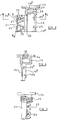
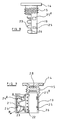
- vent plug 11 is arranged to be a screw fit in an aperture in the lid 12 of a battery casing so that an outer surface 13 of the plug is substantially flush with the outer surface of the lid 12, and the remainder of the plug 11 projects through the lid 12 and into the gas space above the electrolyte level in the cell of the battery with which the plug is associated.
- An outer peripheral flange 14 of the plug 11 traps an annular sealing ring 14 a against the surface of the lid 12 to seal the interface of the plug and the lid so that the only gas flow path from the cell of the battery to atmosphere is through the interior of the plug 11.
- the plug 11 is moulded as a single component in a synthetic resin material, conveniently polypropylene.
- the plug is an elongate hollow cylindrical component comprising a first region 16 formed externally with the integral screw threads 15 and a second, axially divided region 17.
- the region 16 is of one part construction, and is hollow and closed at its outer end by an end wall 16 a which is extended radially outward to define the flange 14.
- the end wall 16 is perforated by two or more small diameter apertures 18.
- the region 17 is formed as two semi-cylindrical elements 19, 21 which are united along one axially extending edge by an integral flexible web 22 defining an integral hinge between the elements 19, 21.
- the element 19 is a continuation of the region 16 of the plug and has a smooth internal cylindrical surface 19 a .
- the lower end of the region 17 lies just below the normal electrolyte level of its respective cell in use.
- a plurality of inclined baffle plates 23 are moulded integrally with the element 21 and protrude from the inner cylindrical surface of the element 21 to protrude laterally from the open face of the element.
- the arrangement of the baffle plates 23 is such that when the element 21 is hinged from the position shown in Figures 2, and 3, by flexure of the web 22, so that the axially extending edges of the element 21 abut with the corresponding edges of the element 19 the baffle plates 23 extend into the semi-cylindrical shape of the element 19 and engage the inner cylindrical surface 19 a of the element 19.
- First and second barbed, resilient legs 24, 24 a are formed integrally with the free edge region of the element 21 and snap-engage within corresponding apertures 25, 25 a provided in the wall of the element 19 when the element 21 is hinged from the open position shown in Figures 2 and 3 to a closed position relative to the element 19.
- the latch arrangement 24, 25; 24 a , 25 a holds the element 21 in a closed position relative to the element 19, and the baffle plates 23 define with the elements 21 and 19, a labyrinthine path through the region 17 of the plug.
- the upper aperture 25 a is wider than its respective leg 24 a so that a window 24 b in the wall of the element 21 exists when the elements 19, 21 are latched together.
- the window 25 b provides an inlet into the plug above the normal electrolyte level of the cell, through which gasses evolved in the cell can enter the baffle arrangement of the plug.
- baffle plates 23 are all inclined downwardly in use so that any electrolyte droplets entrained with the gas flow entering the baffle arrangement and coalescing on the baffle plates will form drops which will migrate under gravity along the baffle plates, dropping from one baffle plate to another (see arrow B in Figures 3 and 9), to be returned ultimately back into the cell from which the electrolyte is transported with the evolved gases.
- Alternate plates terminate short of opposite sides respectively of the cylindrical passage within which the plates are housed in order to define the labyrinthine path through the plug.
- the elements 19, 21 are cut away at 26 to provide an outlet for electrolyte collected by the baffle arrangement to flow exit back into the cell.
- the cutouts 26 provide access to the space between the lowest, and the next adjacent baffle plate 23, although if desired the lowest baffle plate 23 could terminate, at its lowest end, short of the wall of the region 17.
- the upper baffle plate has a downwardly extending projection or flange 27 to obstruct the gas flow immediately downstream of the window 25 b and on which the droplets carried with the gas flow will coalesce. Additionally the flange 27 will promote drip formation for electrolyte droplets coalescing on that baffle plate. Gas freed of electrolyte droplets will flow around the flange 27 and its baffle plate (see arrow A in Figures 3 and 9) to exit the plug ultimately by way of the apertures 18 to atmosphere.
- the lower baffle plates prevent electrolyte being splashed or swirled up into the region 17 of the plug, particularly in conditions of extreme vibration or agitation, or when gas bubbles are evolved immediately below the plug.
- gas with entrained droplets may enter the region 17 of the plug by way of the cutouts 26 so that the gas will follow the labyrinthine path around all of the baffle plates depositing the droplets on the plates in the process. Irrespective of the route by which gas enters the plug it will exit the plug to atmosphere by way of the apertures 18
- the interior of the region 16 of the plug defines a hollow cylindrical pocket closed at its upper end by the wall 16 a with the exception of the perforations 18.
- a separately formed porous flame retarder disc 28 which may be formed from synthetic resin material or ceramic material, can be introduced as a push fit within the cylindrical pocket so as to obstruct the downstream end of the gas flow path through the vent plug.
- the porous nature of the disc 28 permits gas to percolate through the disc and to exit the vent plug by way of the perforations 18, but will prevent flame being transferred back through the disc 28 and into the cell of the battery should the gases issuing from the perforations 18 to atmosphere be ignited.
- a small chamber 29 is defined between the downstream face of the disc 28 and the underside of the wall 16 a .
- the two longitudinal edges and the upper circumferential edge of the element 21 shall be a close fit against the corresponding edges of the element 19 and the region 16 when the element 21 is in its closed position, so that gas with entrained electrolyte will enter the plug through the window 25 b . It will be recognised that one edge of each of the elements 19, 21 is inherently sealed by virtue of the integral web 22 which forms the hinge between the elements 19, 21.
- the free edge of the element 19 can be formed with an upstanding rib 31 which is received in a corresponding recess 32 along the free edge of the element 21 so as to form a lap-joint when the element 21 is moved to its closed position relative to the element 19.
- the element 21 can have, adjacent the hinge web 22 a further latch connection comprising one or more integral, resilient, barbed legs 33 which engage as a snap fit in one or more corresponding apertures 34 formed in the element 19.
- Figures 9 and 10 illustrate such an arrangement utilizing a spaced pair of additional legs 32 and apertures 33.
- Figure 11 shows the interrelationship of the free edges of the elements 19 and 21 including the rib 31 and recess 32. It must be recognised however that the screw thread 15, the legs 24, 33, the corresponding apertures 25, 34, and the baffle plates 32 are omitted from Figure 11 for clarity.
Landscapes
- Chemical & Material Sciences (AREA)
- Chemical Kinetics & Catalysis (AREA)
- Electrochemistry (AREA)
- General Chemical & Material Sciences (AREA)
- Gas Exhaust Devices For Batteries (AREA)
- Filling, Topping-Up Batteries (AREA)
Abstract
Description
In use gas evolved within the cell of the battery must flow between
Claims (9)
- A vent plug, for use in an electric storage battery, comprising a generally cylindrical component (16) for introduction through the lid of a battery in use, the cylindrical component being open at its opposite axial ends so as to provide a path for gas to flow therethrough from the interior of the battery to atmosphere, and, a baffle arrangement (23) within said cylindrical component (16), the vent plug being characterised in that said cylindrical component (16) includes a region (17) moulded as two semi-cylindrical elements (19, 21) united along one axially extending edge by an integral flexible hinge (22), said elements (19, 21) including mating latch components (24, 25; 24a, 25a) for holding the elements in a closed position relative to one another defining said region (17) of said cylindrical component and, said baffle arrangement (23) being moulded integrally with said region (17) of said cylindrical component so as to define a labyrinthine gas flow path through said region when said elements (19, 21) are latched together to define said region.
- A vent plug as claimed in claim 1 characterised in that said baffle arrangement (23) is defined by a plurality of inclined baffle plates moulded integrally with one (21) of said elements and engaging the inner surface of the other element (19) when the two elements are closed together.
- A vent plug as claimed in claim 1 or claim 2 characterised in that said cylindrical component includes a region (16) into which a flame retarder disc (28) can be introduced prior to closing said elements (19, 21) to define said cylindrical region, said disc (28) lying in said gas flow path downstream of said baffle arrangement (23) in use.
- A vent plug as claimed in any one of the preceding claims characterised in that the mating longitudinal edges of said elements (19, 21) remote from said hinge (22) are shaped (31, 32) to overlap in the closed position of said elements to provide a low-pressure gas tight seal.
- A vent plug as claimed in any one of the preceding claims characterised in that said elements include latch components (24, 25; 24a, 25a; 33, 34) at their hinge edges and at their edges remote from the hinge so that both abutting edges of the two elements are latched in position when the two elements are closed against one another.
- A vent plug as claimed in any one of the preceding claims characterised in that the end region (16) of said component which is the downstream end region of the component in use is moulded in one piece, and has an integral, external screw thread (15) for affixing the vent plug to the lid of the battery casing in use.
- A vent plug as claimed in any one of the preceding claims characterised in that said mating latch components include an enlarged aperture (25a) providing a gas entry to said baffle arrangement in use.
- A vent plug as claimed in any one of the preceding claims characterised in that one or both of said elements includes aperture means (26) above the lowermost edge of the lowermost baffle plate to permit coalesced electrolyte to drain back into the associated battery cell in use.
- An electric storage battery wherein the or each cell of the battery is vented by way of a vent plug (11) as claimed in any one of the preceding claims.
Applications Claiming Priority (2)
| Application Number | Priority Date | Filing Date | Title |
|---|---|---|---|
| GBGB0012031.1A GB0012031D0 (en) | 2000-05-19 | 2000-05-19 | Battery vent plug |
| GB0012031 | 2000-05-19 |
Publications (3)
| Publication Number | Publication Date |
|---|---|
| EP1156540A2 true EP1156540A2 (en) | 2001-11-21 |
| EP1156540A3 EP1156540A3 (en) | 2003-05-28 |
| EP1156540B1 EP1156540B1 (en) | 2004-12-01 |
Family
ID=9891865
Family Applications (1)
| Application Number | Title | Priority Date | Filing Date |
|---|---|---|---|
| EP01304201A Expired - Lifetime EP1156540B1 (en) | 2000-05-19 | 2001-05-10 | Battery vent plug |
Country Status (4)
| Country | Link |
|---|---|
| EP (1) | EP1156540B1 (en) |
| JP (1) | JP2001357830A (en) |
| DE (1) | DE60107483D1 (en) |
| GB (1) | GB0012031D0 (en) |
Cited By (6)
| Publication number | Priority date | Publication date | Assignee | Title |
|---|---|---|---|---|
| US20120107653A1 (en) * | 2010-11-02 | 2012-05-03 | Minhyung Guen | Secondary battery |
| WO2017138793A1 (en) * | 2016-02-12 | 2017-08-17 | 주식회사 엘지화학 | Cell module assembly receiving structure having improved safety |
| CN107112452A (en) * | 2014-09-30 | 2017-08-29 | 江森自控科技公司 | Battery module gas extraction system and method |
| US10135048B2 (en) | 2015-02-27 | 2018-11-20 | GS Yuasa Internationl Ltd. | Lead-acid battery |
| CN113906625A (en) * | 2021-03-22 | 2022-01-07 | 宁德新能源科技有限公司 | Battery cell and power utilization device |
| CN116250142A (en) * | 2021-06-17 | 2023-06-09 | 株式会社Lg新能源 | Battery module, and battery pack and vehicle including the battery module |
Families Citing this family (2)
| Publication number | Priority date | Publication date | Assignee | Title |
|---|---|---|---|---|
| KR101284669B1 (en) * | 2012-08-22 | 2013-07-16 | (주)마루엠씨에스 | Adapter plug for battery |
| US9034497B2 (en) * | 2012-09-25 | 2015-05-19 | Lg Chem, Ltd. | Vehicle battery pack container |
Family Cites Families (4)
| Publication number | Priority date | Publication date | Assignee | Title |
|---|---|---|---|---|
| JPH0626125B2 (en) * | 1986-04-01 | 1994-04-06 | 田中貴金属工業株式会社 | Method for manufacturing gas diffusion electrode |
| JPS62232853A (en) * | 1986-04-02 | 1987-10-13 | Matsushita Electric Ind Co Ltd | Liquid spout plug for lead acid battery |
| JPH049738Y2 (en) * | 1987-01-20 | 1992-03-11 | ||
| JPS63127073U (en) * | 1987-02-12 | 1988-08-19 |
-
2000
- 2000-05-19 GB GBGB0012031.1A patent/GB0012031D0/en not_active Ceased
-
2001
- 2001-05-10 DE DE60107483T patent/DE60107483D1/en not_active Expired - Lifetime
- 2001-05-10 EP EP01304201A patent/EP1156540B1/en not_active Expired - Lifetime
- 2001-05-18 JP JP2001149524A patent/JP2001357830A/en active Pending
Cited By (8)
| Publication number | Priority date | Publication date | Assignee | Title |
|---|---|---|---|---|
| US20120107653A1 (en) * | 2010-11-02 | 2012-05-03 | Minhyung Guen | Secondary battery |
| US8765279B2 (en) * | 2010-11-02 | 2014-07-01 | Samsung Sdi Co., Ltd. | Secondary battery with injection inlet including a blocking member |
| CN107112452A (en) * | 2014-09-30 | 2017-08-29 | 江森自控科技公司 | Battery module gas extraction system and method |
| US10135048B2 (en) | 2015-02-27 | 2018-11-20 | GS Yuasa Internationl Ltd. | Lead-acid battery |
| WO2017138793A1 (en) * | 2016-02-12 | 2017-08-17 | 주식회사 엘지화학 | Cell module assembly receiving structure having improved safety |
| US10847765B2 (en) | 2016-02-12 | 2020-11-24 | Lg Chem, Ltd. | Cell module assembly receiving structure having improved safety |
| CN113906625A (en) * | 2021-03-22 | 2022-01-07 | 宁德新能源科技有限公司 | Battery cell and power utilization device |
| CN116250142A (en) * | 2021-06-17 | 2023-06-09 | 株式会社Lg新能源 | Battery module, and battery pack and vehicle including the battery module |
Also Published As
| Publication number | Publication date |
|---|---|
| GB0012031D0 (en) | 2000-07-05 |
| JP2001357830A (en) | 2001-12-26 |
| DE60107483D1 (en) | 2005-01-05 |
| EP1156540B1 (en) | 2004-12-01 |
| EP1156540A3 (en) | 2003-05-28 |
Similar Documents
| Publication | Publication Date | Title |
|---|---|---|
| US4207387A (en) | Container for a remotely-vented battery | |
| KR100844601B1 (en) | Battery case cover | |
| US5284720A (en) | Vent cap with electrolyte drain and explosion attenuation capabilities | |
| EP1156540B1 (en) | Battery vent plug | |
| US4317868A (en) | Battery vent plug with flame arrestor | |
| US6686720B2 (en) | Vented-type leak resistant motor cycle battery | |
| EP0496539B1 (en) | Electric storage battery lid assembly with venting system | |
| EP1280214B1 (en) | A leak resistant automotive battery | |
| WO2000057502A1 (en) | A venting system for a battery | |
| US6677075B2 (en) | Plug arrangement for a cell vent of a storage battery | |
| JPS6025148A (en) | Storage battery | |
| US6746795B2 (en) | Lead-acid safety battery cap | |
| US3597280A (en) | Multiple vent plug assembly | |
| US4072799A (en) | Vent plug system for batteries | |
| US4098963A (en) | Vented battery cap | |
| CA1236878A (en) | Vent for a storage battery | |
| US4091180A (en) | Vent system with flame arresting capability | |
| US3083254A (en) | Battery vent plug | |
| EP0501709A1 (en) | Battery cover with venting system | |
| US3284244A (en) | Multiple vent plug assembly | |
| EP0630062A1 (en) | Battery gang vent system | |
| US4315058A (en) | Vent plugs for electric storage batteries | |
| US5217823A (en) | Explosion resistant vent cap | |
| US6660426B2 (en) | Multi-cell storage battery with gas vent in a cover assembly | |
| US4107398A (en) | Gas removal means for storage batteries |
Legal Events
| Date | Code | Title | Description |
|---|---|---|---|
| PUAI | Public reference made under article 153(3) epc to a published international application that has entered the european phase |
Free format text: ORIGINAL CODE: 0009012 |
|
| AK | Designated contracting states |
Kind code of ref document: A2 Designated state(s): AT BE CH CY DE DK ES FI FR GB GR IE IT LI LU MC NL PT SE TR |
|
| AX | Request for extension of the european patent |
Free format text: AL;LT;LV;MK;RO;SI |
|
| PUAL | Search report despatched |
Free format text: ORIGINAL CODE: 0009013 |
|
| AK | Designated contracting states |
Designated state(s): AT BE CH CY DE DK ES FI FR GB GR IE IT LI LU MC NL PT SE TR |
|
| AX | Request for extension of the european patent |
Extension state: AL LT LV MK RO SI |
|
| 17P | Request for examination filed |
Effective date: 20030721 |
|
| AKX | Designation fees paid |
Designated state(s): DE ES FR GB PT |
|
| GRAP | Despatch of communication of intention to grant a patent |
Free format text: ORIGINAL CODE: EPIDOSNIGR1 |
|
| GRAS | Grant fee paid |
Free format text: ORIGINAL CODE: EPIDOSNIGR3 |
|
| GRAA | (expected) grant |
Free format text: ORIGINAL CODE: 0009210 |
|
| AK | Designated contracting states |
Kind code of ref document: B1 Designated state(s): DE ES FR GB PT |
|
| PG25 | Lapsed in a contracting state [announced via postgrant information from national office to epo] |
Ref country code: FR Free format text: LAPSE BECAUSE OF NON-PAYMENT OF DUE FEES Effective date: 20041201 |
|
| REG | Reference to a national code |
Ref country code: GB Ref legal event code: FG4D |
|
| REG | Reference to a national code |
Ref country code: IE Ref legal event code: FG4D |
|
| REF | Corresponds to: |
Ref document number: 60107483 Country of ref document: DE Date of ref document: 20050105 Kind code of ref document: P |
|
| PG25 | Lapsed in a contracting state [announced via postgrant information from national office to epo] |
Ref country code: DE Free format text: LAPSE BECAUSE OF FAILURE TO SUBMIT A TRANSLATION OF THE DESCRIPTION OR TO PAY THE FEE WITHIN THE PRESCRIBED TIME-LIMIT Effective date: 20050302 |
|
| PG25 | Lapsed in a contracting state [announced via postgrant information from national office to epo] |
Ref country code: ES Free format text: LAPSE BECAUSE OF FAILURE TO SUBMIT A TRANSLATION OF THE DESCRIPTION OR TO PAY THE FEE WITHIN THE PRESCRIBED TIME-LIMIT Effective date: 20050312 |
|
| PLBE | No opposition filed within time limit |
Free format text: ORIGINAL CODE: 0009261 |
|
| STAA | Information on the status of an ep patent application or granted ep patent |
Free format text: STATUS: NO OPPOSITION FILED WITHIN TIME LIMIT |
|
| 26N | No opposition filed |
Effective date: 20050902 |
|
| EN | Fr: translation not filed | ||
| PGFP | Annual fee paid to national office [announced via postgrant information from national office to epo] |
Ref country code: GB Payment date: 20060510 Year of fee payment: 6 |
|
| PG25 | Lapsed in a contracting state [announced via postgrant information from national office to epo] |
Ref country code: PT Free format text: LAPSE BECAUSE OF NON-PAYMENT OF DUE FEES Effective date: 20050501 |
|
| GBPC | Gb: european patent ceased through non-payment of renewal fee |
Effective date: 20070510 |
|
| PG25 | Lapsed in a contracting state [announced via postgrant information from national office to epo] |
Ref country code: GB Free format text: LAPSE BECAUSE OF NON-PAYMENT OF DUE FEES Effective date: 20070510 |