EP1156044A1 - 6-substituted heteroquinolinecarboxylic acid derivatives and addition salts thereof and processes for the preparation of both - Google Patents
6-substituted heteroquinolinecarboxylic acid derivatives and addition salts thereof and processes for the preparation of both Download PDFInfo
- Publication number
- EP1156044A1 EP1156044A1 EP00905327A EP00905327A EP1156044A1 EP 1156044 A1 EP1156044 A1 EP 1156044A1 EP 00905327 A EP00905327 A EP 00905327A EP 00905327 A EP00905327 A EP 00905327A EP 1156044 A1 EP1156044 A1 EP 1156044A1
- Authority
- EP
- European Patent Office
- Prior art keywords
- group
- denotes
- general formula
- substituted
- halogen atom
- Prior art date
- Legal status (The legal status is an assumption and is not a legal conclusion. Google has not performed a legal analysis and makes no representation as to the accuracy of the status listed.)
- Granted
Links
- 0 CCc1ccc(C(*)C(*)C(N2Cc3cc*(C4C(C(N)=N)=CC=CC4)cc3)=O)c2c1 Chemical compound CCc1ccc(C(*)C(*)C(N2Cc3cc*(C4C(C(N)=N)=CC=CC4)cc3)=O)c2c1 0.000 description 4
- ZVGYILWWKKTQPW-UHFFFAOYSA-N CCOC(c(cc(cc(c(Cl)c1)-[n]2cnc(C=O)c2)c1n1)c1OCC)=O Chemical compound CCOC(c(cc(cc(c(Cl)c1)-[n]2cnc(C=O)c2)c1n1)c1OCC)=O ZVGYILWWKKTQPW-UHFFFAOYSA-N 0.000 description 1
- RKJFOIDGNGIZSW-UHFFFAOYSA-N OC(C(C=CC1)=CC1NC(OCc(nc1)c[n]1-c(c(Cl)c1)cc(C=C2C(O)=O)c1NC2=O)=O)=O Chemical compound OC(C(C=CC1)=CC1NC(OCc(nc1)c[n]1-c(c(Cl)c1)cc(C=C2C(O)=O)c1NC2=O)=O)=O RKJFOIDGNGIZSW-UHFFFAOYSA-N 0.000 description 1
Classifications
-
- C—CHEMISTRY; METALLURGY
- C07—ORGANIC CHEMISTRY
- C07D—HETEROCYCLIC COMPOUNDS
- C07D401/00—Heterocyclic compounds containing two or more hetero rings, having nitrogen atoms as the only ring hetero atoms, at least one ring being a six-membered ring with only one nitrogen atom
- C07D401/02—Heterocyclic compounds containing two or more hetero rings, having nitrogen atoms as the only ring hetero atoms, at least one ring being a six-membered ring with only one nitrogen atom containing two hetero rings
- C07D401/04—Heterocyclic compounds containing two or more hetero rings, having nitrogen atoms as the only ring hetero atoms, at least one ring being a six-membered ring with only one nitrogen atom containing two hetero rings directly linked by a ring-member-to-ring-member bond
-
- A—HUMAN NECESSITIES
- A61—MEDICAL OR VETERINARY SCIENCE; HYGIENE
- A61P—SPECIFIC THERAPEUTIC ACTIVITY OF CHEMICAL COMPOUNDS OR MEDICINAL PREPARATIONS
- A61P25/00—Drugs for disorders of the nervous system
-
- A—HUMAN NECESSITIES
- A61—MEDICAL OR VETERINARY SCIENCE; HYGIENE
- A61P—SPECIFIC THERAPEUTIC ACTIVITY OF CHEMICAL COMPOUNDS OR MEDICINAL PREPARATIONS
- A61P25/00—Drugs for disorders of the nervous system
- A61P25/28—Drugs for disorders of the nervous system for treating neurodegenerative disorders of the central nervous system, e.g. nootropic agents, cognition enhancers, drugs for treating Alzheimer's disease or other forms of dementia
-
- A—HUMAN NECESSITIES
- A61—MEDICAL OR VETERINARY SCIENCE; HYGIENE
- A61P—SPECIFIC THERAPEUTIC ACTIVITY OF CHEMICAL COMPOUNDS OR MEDICINAL PREPARATIONS
- A61P43/00—Drugs for specific purposes, not provided for in groups A61P1/00-A61P41/00
Definitions
- the present invention relates to 6-substituted heteroquinolinecarboxylic acid derivatives and their addition salts effective for the therapy of disorder of cerebral nerve cells as antagonists against excitatory amino acid receptors, in particular, as selective antagonists against AMPA receptor in non-NMDA receptor, processes for the preparation of both, and a medicinal composition containing these compounds.
- the glutamic acid being excitatory amino acid is a main excitatory transmitter substance in the central nervous system of vertebrates, and is known as an amino acid contained most rich in brain. It is known, however, that, when releasing from nervous axon terminals exceeding the physiological threshold, it excessively excites the glutamic acid receptor of post-synapse to cause the death of nerve cells. This is called excitotoxicity.
- the glutamic acid receptor is divided into ion channel type receptor and G protein-binding type receptor, and this ion channel type receptor is further divided into NMDA (N-methyl-D-aspartic acid) receptor and non-NMDA receptor. Moreover, the latter non-NMDA receptor is classified into AMPA ( ⁇ -amino-3-hydroxy-5-methyl-4-isooxazol-propionic acid) receptor and KA (kainic acid) receptor.
- AMPA ⁇ -amino-3-hydroxy-5-methyl-4-isooxazol-propionic acid
- KA kainic acid
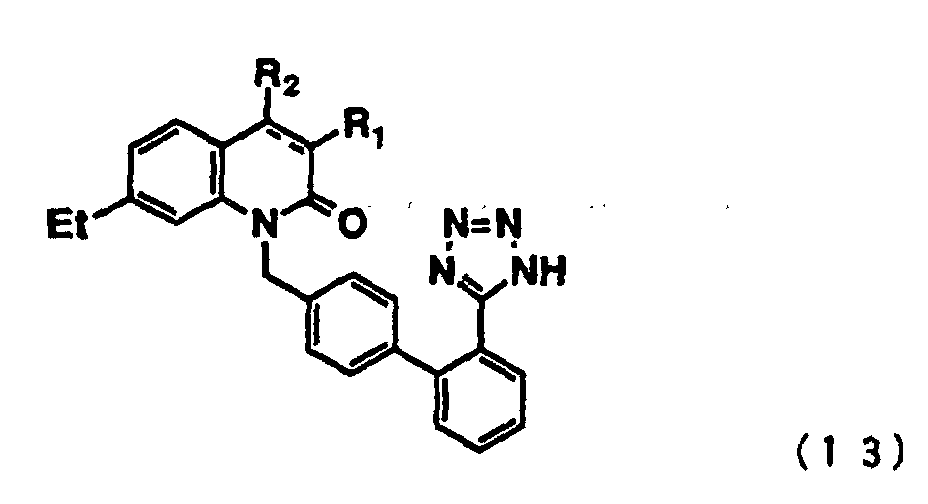
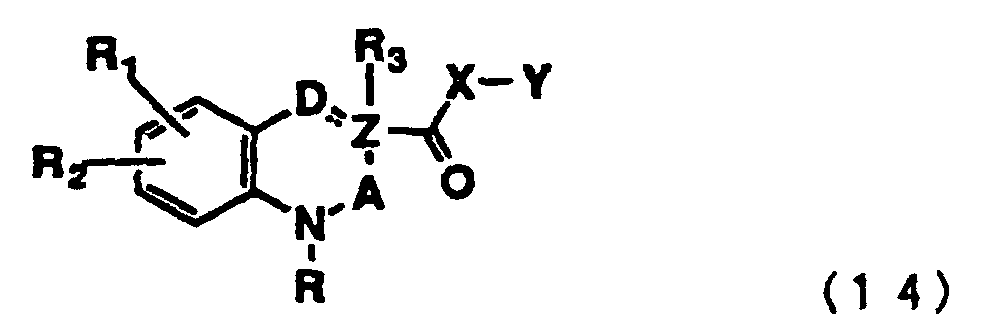
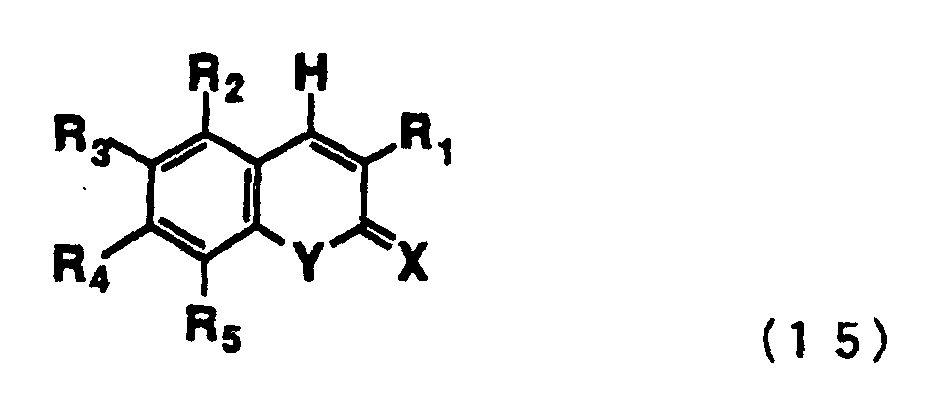
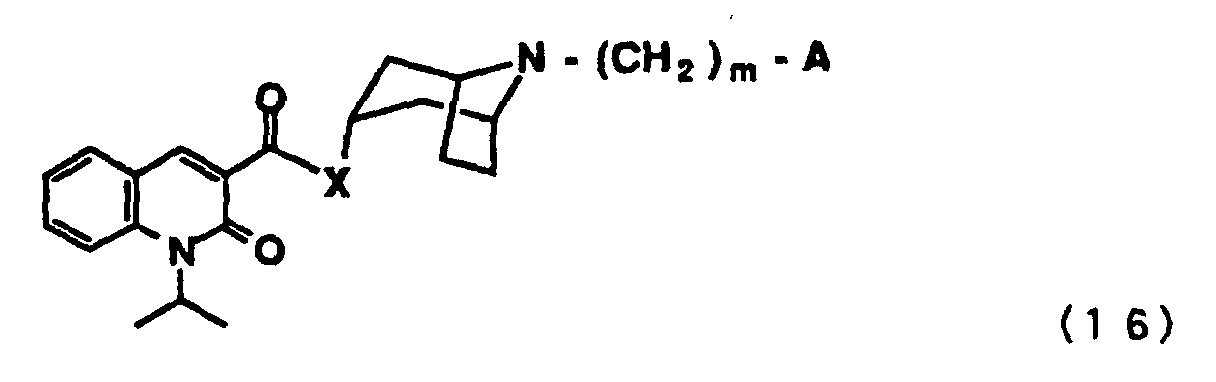
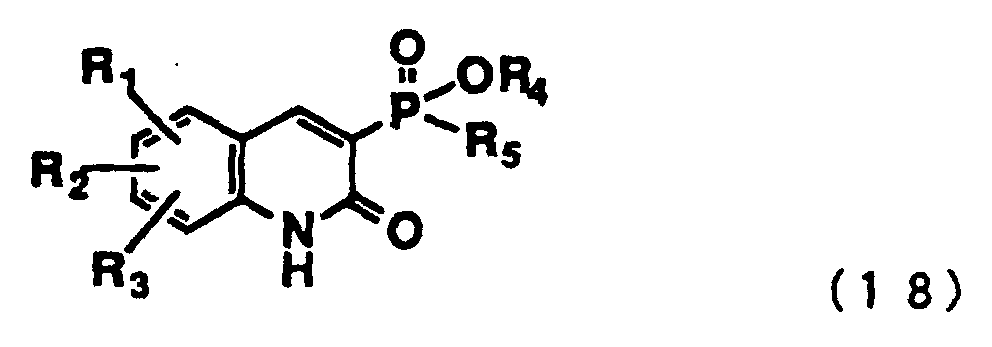
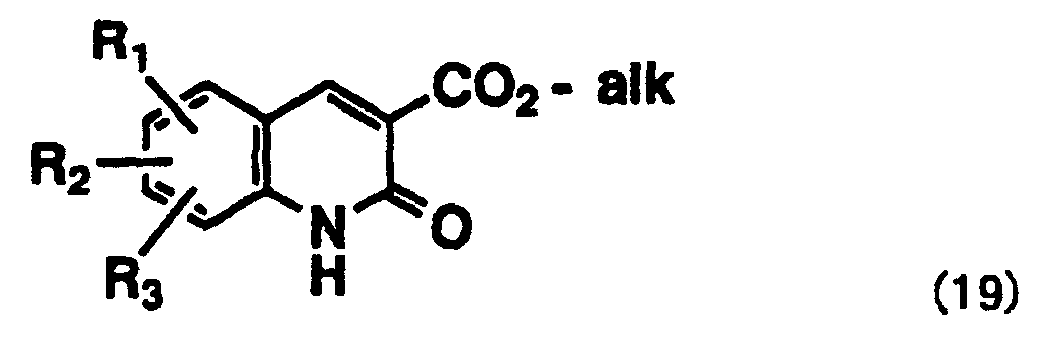
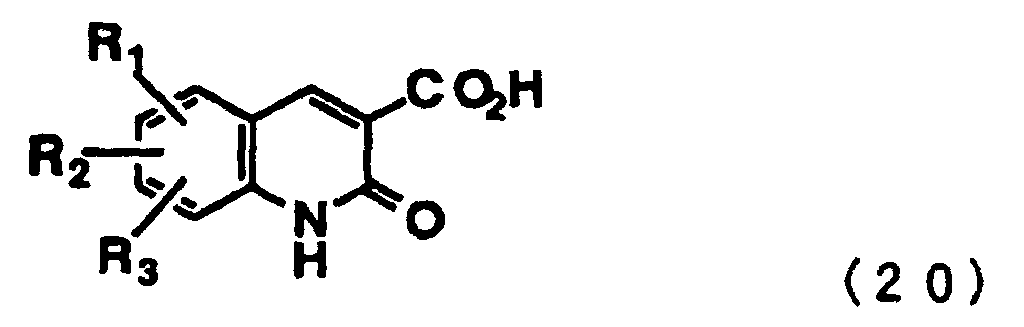
- compounds represented by a general formula (18) are opened to public in EP 640612 by Adeal etitch as compounds with inhibitory action on the pathologic symptoms relevant to hyperactivity through the route of excitatory amino acid, and, as synthetic intermediates of this general formula (18), compounds represented by a general formula (19) (wherein R 1 , R 2 and R 3 are as described above), and compounds represented by a general formula (20) (wherein R 1 , R 2 and R 3 are as described above), are transcribed.
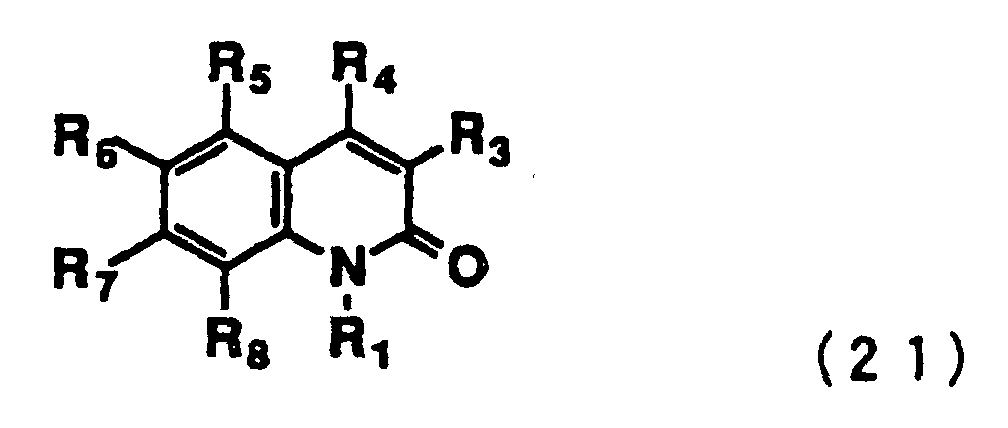
- quinolone derivatives are described in WO 93/10783 by Merck Sharp and Dohme Co. as compounds with antagonism against NMDA and AMPA receptors.
- the disclosure of compounds cannot be said to be sufficient, and, in addition, the structure is different from that of the inventive compounds with characteristic substituents at 6-position of quinoline ring.
- the disclosed pharmacological data are also only for NMDA receptor and no concrete data are disclosed against AMPA receptor, as the inventive compounds.
- the invention is to provide compounds with antagonism against receptor of glutamic acid that is considered to be an etiology bringing about the memory disorder or dementia due to said diseases and selective death of cells, in particular, with high affinity and selectivity against AMPA receptor in non-NMDA receptor and protective effect on cerebral nerve cells.
- lower alkyl groups straight chain or branched ones with carbon atoms of 1 to 6 such as methyl, ethyl, n-propyl and iso-propyl are mentioned, for "cycloalkyl groups”, ones with carbon atoms of 3 to 7 such as cyclopropyl, cyclopentyl and cyclohexyl are mentioned, for "halogen atoms”, fluorine, chlorine, bromine and iodine are mentioned, for “lower alkoxy groups”, straight chain or branched ones with carbon atoms of 1 to 4 such as methoxy, ethoxy and propoxy are mentioned, for “lower alkylthio groups”, straight chain or branched ones with carbon atoms of 1 to 6 such as methylthio, ethylthio and propylthio are mentioned, for "lower alkoxycarbonyl groups”, straight chain or branched ones with carbon atoms of 1 to 4 such as methoxycarbonyl and e
- heterocycles in the phrase of "aralkyl group, phenyl group, naphthyl group, 5- or 6-membered heterocycle and its condensed ring (these may have one or more substituents on aromatic ring or heterocycle)" are saturated or unsaturated monocyclic or polycyclic heterocycle groups which may have one or more substituents and which can contain one or more nitrogen, oxygen or sulfur atoms, and, for example, pyrrolidyl, piperidyl, piperazyl, morpholyl, thiomorpholyl, furanyl, thienyl, pyrazolyl, imidazolyl, oxazolyl, thiazolyl, pyridyl, pyrimidyl, pyridazyl, pyrazyl, etc.
- “Its condensed ring” represents benzenecondensed rings of said "heterocycles” and, for example, indolyl, tetrahydroquinolyl, benzoxazolidinyl, benzothiazolidinyl, benzofuranyl, benzothienyl, benzimidazolyl, quinolyl, isoquinolyl, quinazolyl, quinoxalyl, cinnolyl, etc. are mentioned.
- the compounds of the invention are prepared, for example, through preparative processes shown below.
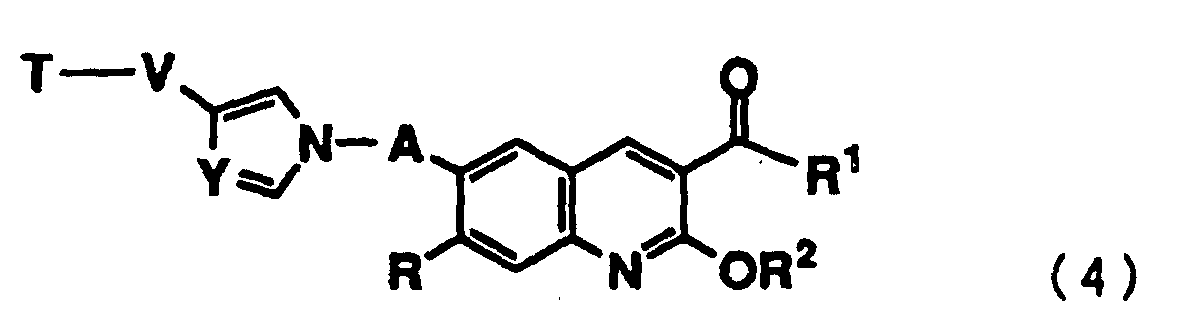
- Compounds represented by the general formula (1) can be synthesized by reacting compounds represented by a general formula (4) (wherein A, Y, V, T, R and R 1 are as described above, and R 2 denotes a lower alkyl group which may be substituted with halogen atom or aralkyl group which may have one or more substituents), for 0.5 to 72 hours at 20 to 120°C without solvent or in a suitable solvent, for example, water, acetic acid, methanol or the like, using a suitable acid, for example, hydrochloric acid, sulfuric acid, hydrobromic acid, trifluoroacetic acid, mixed acid thereof or the like.
- a suitable solvent for example, water, acetic acid, methanol or the like
- a suitable acid for example, hydrochloric acid, sulfuric acid, hydrobromic acid, trifluoroacetic acid, mixed acid thereof or the like.
- compounds represented by the general formula (1) can also be synthesized, in the case of R 1 being lower alkoxy group among compounds represented by the general formula (4) (wherein A, Y, V, T, R, R 1 and R 2 are as described above), by reacting those compounds for 0.5 to 72 hours at 20 to 100°C in a suitable solvent, for example, water, methanol, ethanol or the like, using a suitable alkali, for example, potassium hydroxide, sodium hydroxide, lithium hydroxide or the like to convert to carboxylic acid, and then reacting for 0.5 to 72 hours at 20 to 120°C without solvent or in a suitable solvent, for example, water, acetic acid, methanol or the like, using a suitable acid, for example, hydrochloric acid, sulfuric acid, hydrobromic acid, trifluoroacetic acid, mixed acid thereof or the like.
- a suitable solvent for example, water, methanol, ethanol or the like
- a suitable alkali for example, potassium hydroxide, sodium hydroxide
- compounds represented by the general formula (1) can also be synthesized, in the case of R 1 being lower alkoxy group among compounds represented by the general formula (4) (wherein A, Y, V, T, R, R 1 and R 2 are as described above), by reacting those compounds for 3 to 72 hours at 20 to 120°C without solvent or in a suitable solvent, for example, water, acetic acid, methanol or the like, using a suitable acid, for example, hydrochloric acid, sulfuric acid, hydrobromic acid, trifluoroacetic acid, mixed acid thereof or the like to deprotect R 2 , and then reacting for 0.5 to 72 hours at 20 to 100°C in a solvent of water, methanol, ethanol or the like, using a suitable alkali, for example, potassium hydroxide, sodium hydroxide, lithium hydroxide or the like.
- a suitable solvent for example, water, acetic acid, methanol or the like
- a suitable acid for example, hydrochloric acid, sulfuric acid, hydrobromic acid,
- compounds, R 1 being lower alkoxy group among compounds represented by the general formula (1) those compounds are reacted for 0.5 to 10 hours at 20 to 100°C in a suitable solvent of water, methanol, ethanol or the like, using a suitable alkali, for example, potassium hydroxide, sodium hydroxide, lithium hydroxide or the like to synthesize compounds, R 1 being hydroxyl group.
- a suitable alkali for example, potassium hydroxide, sodium hydroxide, lithium hydroxide or the like to synthesize compounds, R 1 being hydroxyl group.
- a suitable solvent for example, tetrahydrofuran, benzene, toluene, acetic acid, ethanol, methanol or the like (suit
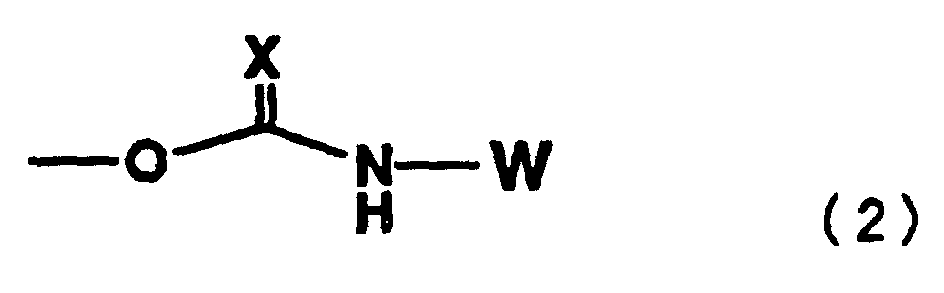
- compounds, T being represented by the general formula (2) or general formula (3) among compounds represented by the general formula (1) can also be synthesized by reacting compounds represented by a general formula (7) (wherein A, Y, V, R and R 1 are as described above, and T 1 denotes a hydroxyl group or amino group), with compounds represented by a general formula (8)
- D being amino group
- they can be converted to carbamic chlorides or isocyanic (isothiocyanic) esters by reacting with phosgene (thiophosgene), phosgene dimer (2,2,2-trichloromethyl chloroformate) or its homologue (4-nitrophenyl chloroformate etc.) for 1 to 5 hours at -10 to 50°C in a suitable solvent, for example, tetrahydrofuran, dioxane, benzene, toluene or the like, without base or using a suitable organic base, for example, triethylamine or the like.
- a suitable solvent for example, tetrahydrofuran, dioxane, benzene, toluene or the like
- a suitable organic base for example, triethylamine or the like.
- isocyanic (isothiocyanic) esters can be converted to isocyanic (isothiocyanic) esters by using Crutius rearrangement reaction or Schmidt rearrangement reaction after converted carboxyl group to acid azide in the case of D being carboxyl group, and by using Hofmann rearrangement reaction in the case of D being amide group.
- isocyanic (isothiocyanic) esters in one pot using DPPA (diphenylphosphoryl azide).
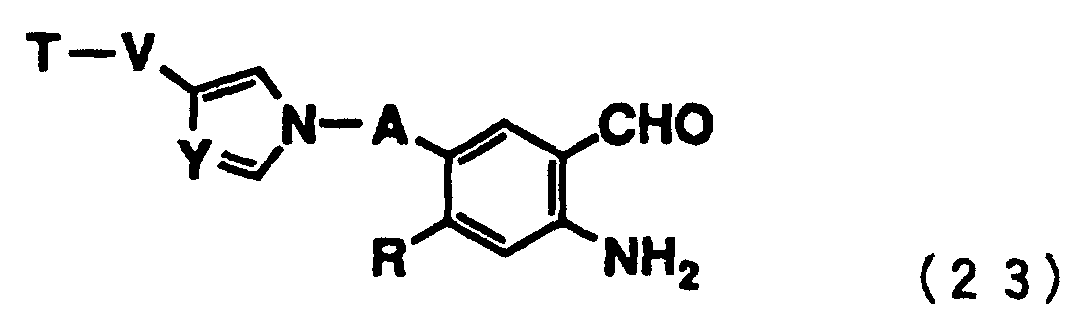
- compounds represented by the general formula (1) can also be synthesized by reacting compounds represented by a general formula (23) (wherein A, Y, V, T and R are as described above), with malonic diesters represented by a general formula (24).
- R 4 denotes a lower alkyl group
- R 4 denotes a lower alkyl group
- a suitable solvent for example, ethanol, methanol, tetrahydrofuran or the like
- a suitable base for example, sodium ethoxide, sodium methoxide, potassium ter-butoxide, potassium hydroxide or the like.
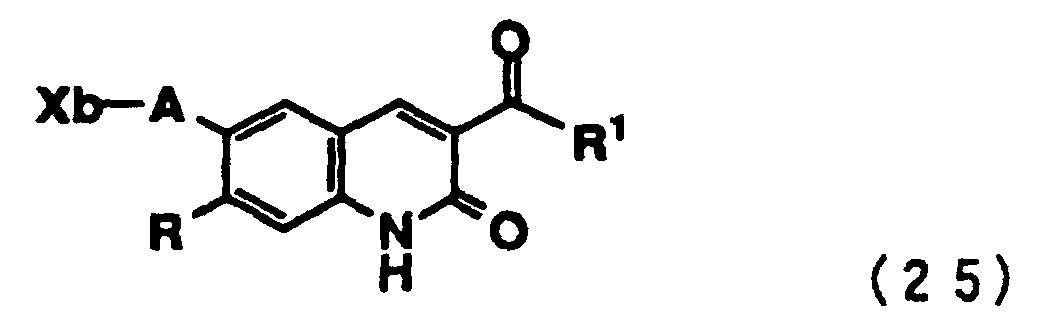
- compounds represented by the general formula (1) can be synthesized by reacting compounds represented by a general formula (25) (wherein A, R and R 1 are as described above, and Xb denotes a halogen atom), with compounds represented by a general formula (12) (wherein Y, V and T are as described above), for 0.5 to 24 hours at 20 to 160°C without solvent or in a suitable solvent, for example, tetrahydrofuran, dioxane, N,N-dimethylformamide, N,N-dimethylacetamide, N-methylpyrrolidone, acetonitrile, benzene, toluene or the like, without base or using a suitable inorganic or organic base, for example, sodium hydride, sodium carbonate, potassium carbonate, triethylamine or the like.
- a suitable solvent for example, tetrahydrofuran, dioxane, N,N-dimethylformamide, N,N-dimethylacetamide, N-
- a suitable solvent for example, tetrahydrofuran, dioxane, N,N-dimethylformamide, N,N-dimethylace
- D being amino group
- they can be converted to carbamic chlorides or isocyanic (isothiocyanic) esters by reacting with phosgene (thiophosgene), phosgene dimer (2,2,2-trichloromethyl chloroformate) or its homologue (4-nitrophenyl chloroformate etc.) for 1 to 5 hours at -10 to 50°C in a suitable solvent, for example, tetrahydrofuran, dioxane, benzene, toluene or the like, without base or using a suitable organic base, for example, triethylamine or the like.
- a suitable solvent for example, tetrahydrofuran, dioxane, benzene, toluene or the like
- a suitable organic base for example, triethylamine or the like.
- isocyanic (isothiocyanic) esters can be converted to isocyanic (isothiocyanic) esters by using Crutius rearrangement reaction or Schmidt rearrangement reaction after converted carboxyl group to acid azide in the case of D being carboxyl group, and by using Hofmann rearrangement reaction in the case of D being amide group.
- isocyanic (isothiocyanic) esters in one pot using DPPA (diphenylphosphoryl azide).
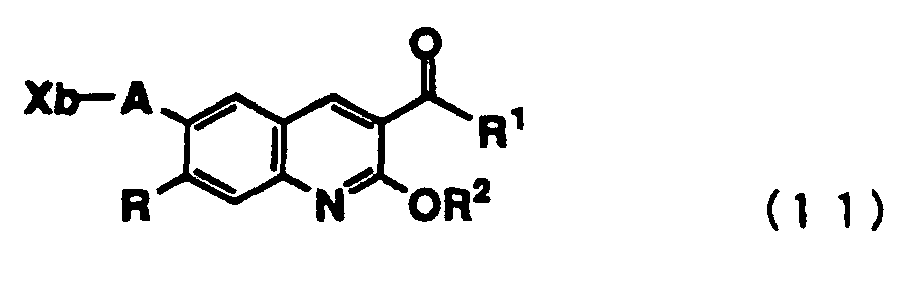
- compounds represented by the general formula (4) can be synthesized by reacting compounds represented by a general formula (11) (wherein A, Xb, R, R 1 and R 2 are as described above), with compounds represented by a general formula (12) (wherein Y, T and V are as described above), for 0.5 to 24 hours at 20 to 160°C without solvent or in a suitable solvent, for example, tetrahydrofuran, dioxane, N,N-dimethylformamide, N,N-dimethylacetamide, N-methylpyrrolidone, acetonitrile, benzene, toluene or the like, without base or using a suitable inorganic or organic base, for example, sodium hydride, sodium carbonate, potassium carbonate, triethylamine or the like.
- a suitable solvent for example, tetrahydrofuran, dioxane, N,N-dimethylformamide, N,N-dimethylacetamide, N-methylpyrrolidone,
- compounds, A being single bond among compounds represented by the general formula (11), can be synthesized by reacting compounds represented by a general formula (25) (wherein A, Xb, R and R 1 are as described above), with alkyl halide, for example, methyl iodide or the like, or aralkyl halide, for example, 4-methoxybenzyl chloride or the like, for 2 to 10 hours at 20 to 120°C in a suitable solvent, for example, benzene, toluene, chloroform, methylene chloride, tetrahydrofuran or the like, using a suitable silver catalyst, for example, silver oxide, silver carbonate or the like.
- alkyl halide for example, methyl iodide or the like
- aralkyl halide for example, 4-methoxybenzyl chloride or the like
- a suitable solvent for example, benzene, toluene, chloroform, methylene chloride, tetrahydro
- compounds, A being methylene (CH 2 ) among compounds represented by the general formula (11) can be synthesized by reacting compounds represented by a general formula (26) (wherein R, R 1 and R 2 are as described above), for 1 to 12 hours at 20 to 100°C in a suitable solvent, for example, carbon tetrachloride, chloroform, acetic acid or the like, using a halogenating agent, for example, N-bromosuccinimide (NBS), N-chlorosuccinimide (NCS), bromine or the like.
- a suitable solvent for example, carbon tetrachloride, chloroform, acetic acid or the like
- a halogenating agent for example, N-bromosuccinimide (NBS), N-chlorosuccinimide (NCS), bromine or the like.
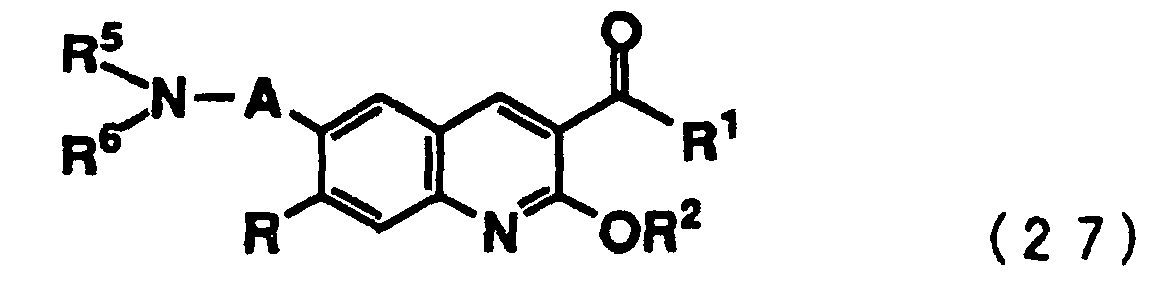
- compounds represented by the general formula (5) can be synthesized by reacting compounds represented by a general formula (27) (wherein A, R, R 1 and R 2 are as described above, and R 5 and R 6 identically or differently denote hydrogen atoms or protective groups of amino group), for 3 to 72 hours at 20 to 120°C in a suitable solvent, for example, water, acetic acid, methanol, ethanol or the like, using a suitable acid, for example, hydrochloric acid, sulfuric acid, hydrobromic acid, trifluoroacetic acid, mixed acid thereof or the like.
- a suitable solvent for example, water, acetic acid, methanol, ethanol or the like
- a suitable acid for example, hydrochloric acid, sulfuric acid, hydrobromic acid, trifluoroacetic acid, mixed acid thereof or the like.
- compounds represented by the general formula (27) can be synthesized by reacting compounds represented by the general formula (11) (wherein A, R, R 1 , R 2 and Xb are as described above), with general formula (28) R 5 R 6 -NH (wherein R 5 and R 6 are as described above), for 0.5 to 48 hours at 20 to 160°C in a suitable solvent, for example, tetrahydrofuran, dioxane, N,N-dimethylformamide, N,N-dimethylacetamide, N-methylpyrrolidone, acetonitrile, benzene, toluene or the like, without base or using a suitable inorganic or organic base, for example, sodium hydride, sodium carbonate, potassium carbonate, triethylamine or the like.
- a suitable solvent for example, tetrahydrofuran, dioxane, N,N-dimethylformamide, N,N-dimethylacetamide, N-methylpyrrolidone, ace
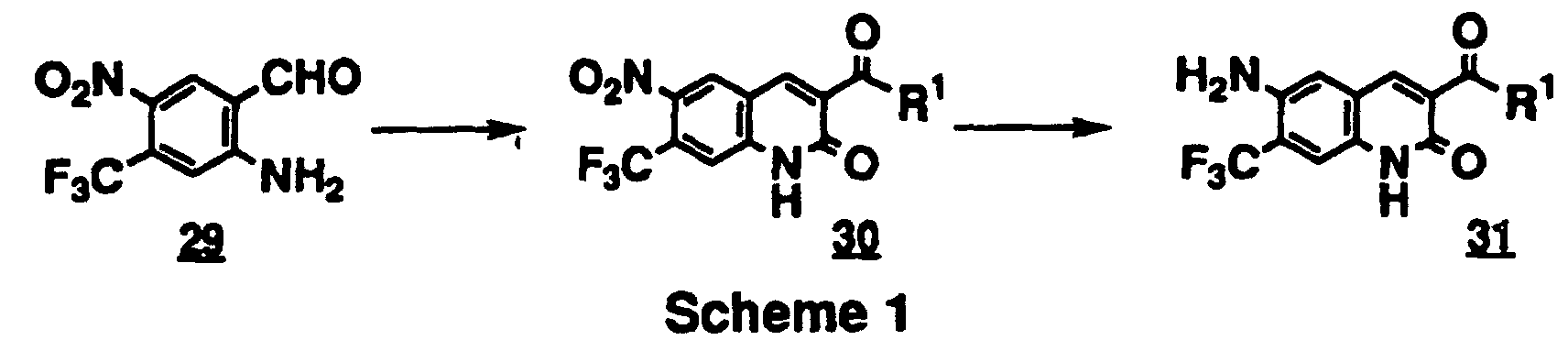
- compounds (29) are reacted with malonic esters, for example, diethyl malonate or the like, for 2 to 24 hours at 25 to 100°C in a suitable solvent, for example, alcohol such as ethanol or methanol, tetrahydrofuran, N,N-dimethylformamide or the like, in the presence of a suitable base, for example, sodium ethoxide, potassium ter-butoxide, potassium hydroxide or the like, to convert to compounds (30), and then these are subject to reduction through catalytic hydrogenation, that is, hydrogenated for 2 to 24 hours at 25 to 80°C and at ambient pressure to 5 atm (507 KPa) in a suitable solvent, for example, ethanol, methanol, acetic acid or the like in the presence of a suitable catalyst, for example, palladium on carbon, platinum oxide, rhodium on alumina or the like, thus allowing to synthesize compounds (31).
- a suitable solvent for example, alcohol such as ethanol or methanol, tetra
- Suitable solvent for example, ethanol, dilute hydrochloric acid, acetic acid or mixed solvent thereof in the presence of tin chloride, zinc, iron, sodium hydrosulfite or the like.
- available or synthesizable compound (32) is reacted for 0.5 to 2 hours at -10 to 80°C in a suitable solvent, for example, nitromethane, acetic acid, sulfuric acid or the like, using a suitable nitrating agent, for example, concentrated nitric acid, fuming nitric acid, potassium nitrate, acetyl nitrate or the like to convert to compound (33), and this is subject to reduction through catalytic hydrogenation, that is, hydrogenated for 2 to 24 hours at 25 to 80°C and at atmospheric pressure to 5 atm (507 KPa) in a suitable solvent, for example, ethanol, methanol, acetic acid or the like in the presence of a suitable catalyst, for example, palladium on carbon, platinum oxide, rhodium-alumina or the like, followed further by aceylation, to convert to compound (34).
- a suitable solvent for example, nitromethane, acetic acid, sulfuric acid or the like
- a suitable solvent for example, nitromethane, acetic acid, sulfuric acid or the like
- a suitable nitrating agent for example, concentrated nitric acid, fuming nitric acid, potassium nitrate, acetyl nitrate or the like to convert to compound (35)
- a suitable oxidizing agent for example, potassium permanganate, sodium periodate or the like to convert to compound (36)
- a suitable base for example, sodium hydroxide, potassium hydroxide or the like, or it is hydrolyzed for 1 to 10 hours at 20 to 100°C in a suitable solvent
- compound (37) is reacted for 1 to 10 hours at 20 to 150°C in a suitable solvent, for example, ether, tetrahydrofuran, dioxane or the like, using a suitable reducing agent, for example, borane complex such as borane-tetrahydrofuran complex, borane-dimethyl sulfide complex, borane-pyridine complex or the like to convert to compound (38), and further this is reacted for 1 to 24 hours at 20 to 100°C in a suitable solvent, for example, chloroform, methylene chloride, tetrahydrofuran or the like, using a suitable oxidizing agent, for example, manganese dioxide or the like, thus allowing to convert to compound (29).
- a suitable solvent for example, ether, tetrahydrofuran, dioxane or the like
- a suitable reducing agent for example, borane complex such as borane-tetrahydrofuran complex, borane-dimethyl
- a suitable solvent for example, water, acetic acid, mixed solvent thereof or the like
- a suitable reducing agent for example, titanium trichloride or the like
- a suitable alkali for example, potassium hydroxide, sodium hydroxide, lithium hydroxide or the like
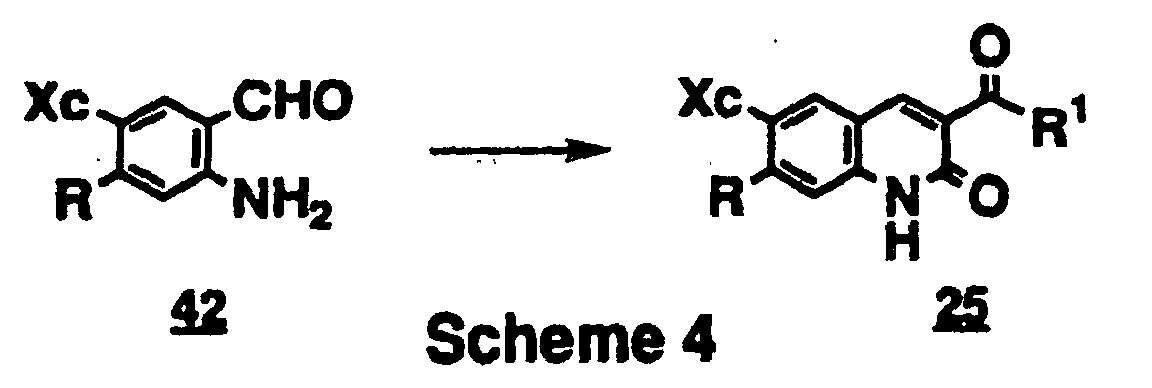
- ком ⁇ онент (42) can be synthesized by reacting general formula (42) with malonic esters, for example, diethyl malonate or the like, for 2 to 24 hours at 25 to 100°C in a suitable solvent, for example, alcohol such as ethanol or methanol, tetrahydrofuran, N,N-dimethylformamide or the like in the presence of a suitable base, for example, sodium ethoxide, potassium ter-butoxide, potassium hydroxide or the like.
- a suitable solvent for example, alcohol such as ethanol or methanol, tetrahydrofuran, N,N-dimethylformamide or the like
- a suitable base for example, sodium ethoxide, potassium ter-butoxide, potassium hydroxide or the like.
- a suitable solvent for example, water, ethanol, methanol, mixed solution thereof or the like
- a suitable base for example, sodium hydroxide, potassium hydroxide or the like
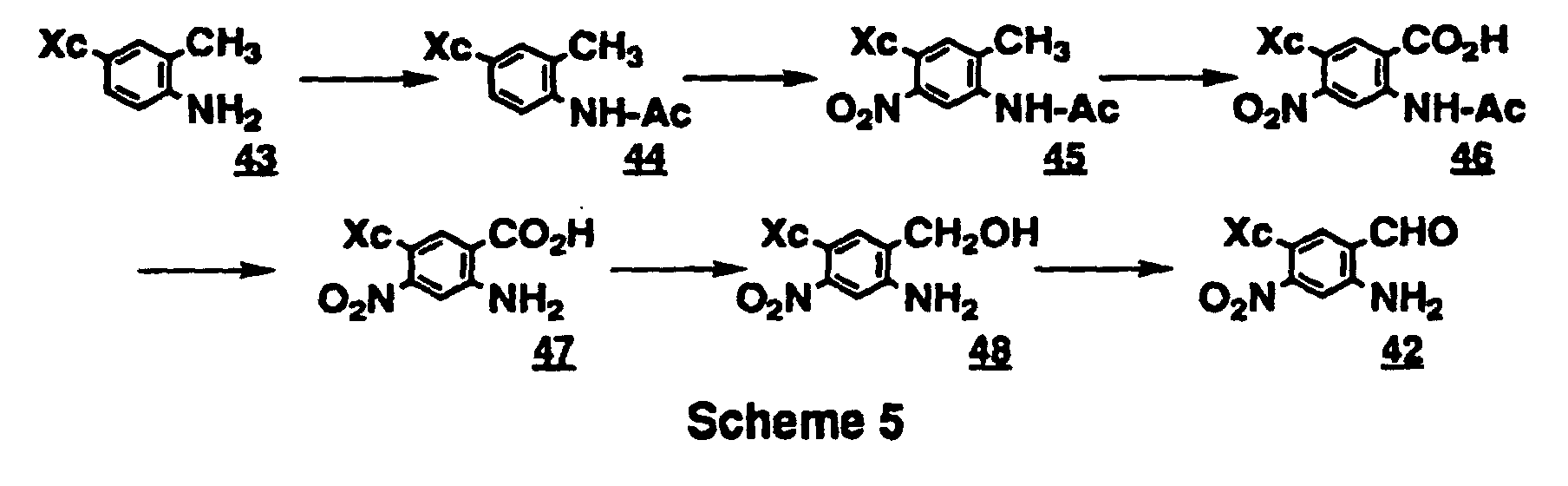
- general formula (47) are reacted for 1 to 10 hours at 20 to 150°C in a suitable solvent, for example, ether, tetrahydrofuran, dioxane or the like, using a suitable reducing agent, for example, borane complex such as borane-tetrahydrofuran complex, borane-dimethyl sulfide complex, borane-pyridine complex or the like to convert to general formula (48), and successively these are reacted for 1 to 24 hours at 20 to 100°C in a suitable solvent, for example, chloroform, methylene chloride, tetrahydrofuran or the like, using a suitable oxidizing agent, for example, manganese dioxide or the like, thus allowing to convert to general formula (42).
- a suitable solvent for example, ether, tetrahydrofuran, dioxane or the like
- a suitable reducing agent for example, borane complex such as borane-tetrahydrofuran complex, borane-
- available general formula (49) is acetylated with acetic anhydride at room temperature to convert to general formula (50), this is reacted for 0.5 to 2 hours at -10 to 80°C in a suitable solvent, for example, nitromethane, acetic acid, sulfuric acid or the like, using a suitable nitrating agent, for example, concentrated nitric acid, fuming nitric acid, potassium nitrate, acetyl nitrate or the like to convert to general formula (51), and this is hydrolyzed for 1 to 10 hours at 20 to 100°C in a suitable solvent, for example, water, ethanol, methanol, mixed solution thereof or the like, using a suitable base, for example, sodium hydroxide, potassium hydroxide or the like, or it is hydrolyzed for 1 to 10 hours at 20 to 100°C in a suitable solvent, for example, water, ethanol, methanol or the like or mixed solution thereof, using a suitable acid, for example, hydrochloric acid
- the general formula (52) is reacted for 1 to 10 hours at 20 to 100°C in a suitable solvent, for example, chloroform, methylene chloride, tetrahydrofuran, benzene, water or the like, using a suitable oxidizing agent, for example, manganese dioxide or the like to convert to general formula (53).
- a suitable solvent for example, chloroform, methylene chloride, tetrahydrofuran, benzene, water or the like
- a suitable oxidizing agent for example, manganese dioxide or the like
- This general formula (53) is reacted with malonic esters, for example, diethyl malonate or the like, for 2 to 24 hours at 25 to 100°C in a suitable solvent, for example/alcohol such as ethanol or methanol, tetrahydrofuran, N,N-dimethylformamide or the like in the presence of a suitable base, for example, sodium ethoxide, potassium ter-butoxide, potassium hydroxide or the like to convert to general formula (54), and then these are reacted with alkyl halide, for example, methyl iodide or the like, or aralkyl halide, for example, 4-methoxybenzyl chloride or the like, for 2 to 10 hours at 20 to 120°C in a suitable solvent, for example, benzene, toluene, chloroform, methylene chloride, tetrahydrofuran or the like, using a suitable silver catalyst, for example, silver oxide, silver carbonate or the like, thus
- compounds represented by the general formula (54) can also be reacted for 2 to 6 hours at 0 to 120°C in a suitable solvent, for example, benzene, toluene, chloroform, methylene chloride, tetrahydrofuran or the like, using borate, for example, tetramethyloxonium borate or the like to convert to the general formula (26).
- a suitable solvent for example, benzene, toluene, chloroform, methylene chloride, tetrahydrofuran or the like
- borate for example, tetramethyloxonium borate or the like
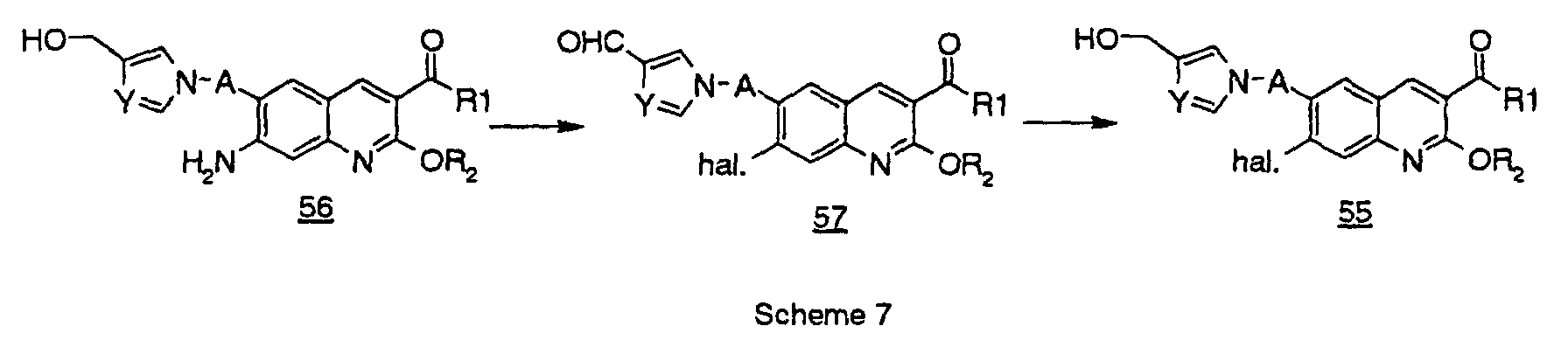
- compounds represented by general formula (56) are reacted with a suitable nitrite, for example, sodium nitrite, nitrous ester, for example, t-butyl nitrite or the like, and halide, for example, potassium chloride or potassium bromide or copper (I or II) halide, for example, copper chloride, copper bromide or copper iodide, for 1 to 8 hours at 20 to 50°C in a suitable solvent, for example, dimethyl sulfoxide, acetonitrile, acetic acid, water, mixed solvent thereof or the like to convert to compounds represented by general formula (57), and these are reduced at 0 to 100°C in a suitable solvent, for example, ethanol, methanol, isopropanol, water, mixed solution thereof or the like, using a suitable reducing agent, for example, sodium borohydride or the like, thus allowing to synthesize.
- a suitable solvent for example, sodium nitrite, nitrous ester, for example, t
- compounds represented by the general formula (55) can also be obtained directly by reacting compounds represented by the general formula (56) with a suitable nitrite, for example, sodium nitrite, nitrous ester, for example, t-butyl nitrite or the like, and halide, for example, potassium chloride or potassium bromide or copper (I or II) halide, for example, copper chloride, copper bromide or copper iodide, for 0.5 to 2 hours at 0 to 50°C in a suitable solvent, for example, dimethyl sulfoxide, acetonitrile, acetic acid, water, mixed solvent thereof or the like.
- a suitable nitrite for example, sodium nitrite, nitrous ester, for example, t-butyl nitrite or the like
- halide for example, potassium chloride or potassium bromide or copper (I or II) halide, for example, copper chloride, copper bromide or copper iodide, for 0.5 to 2 hours
- compounds represented by the general formula (56) can be obtained by hydrogenating compounds represented by general formula (58), R being nitro group, V being methylene and T 1 being hydroxyl group among compounds represented by the general formula (10), for 2 to 24 hours at 25 to 80°C and at atmospheric pressure to 5 atm (507 KPa) in a suitable solvent, for example, ethanol, methanol, acetic acid, mixed solution thereof or the like in the presence of a suitable catalyst, for example, palladium on carbon, platinum oxide or the like (Scheme 8).
- a suitable solvent for example, ethanol, methanol, acetic acid, mixed solution thereof or the like
- a suitable catalyst for example, palladium on carbon, platinum oxide or the like
- compounds represented by the general formula (56) can also be obtained by reacting compounds represented by general formula (58) with a suitable reducing agent, for example, reducing iron, tin, tin chloride (II), titanium trichloride or the like for 2 to 24 hours at 25 to 100°C in a suitable solvent, for example, ethanol, methanol, acetic acid, hydrochloric acid, water, mixed solution thereof or the like.
- a suitable reducing agent for example, reducing iron, tin, tin chloride (II), titanium trichloride or the like for 2 to 24 hours at 25 to 100°C in a suitable solvent, for example, ethanol, methanol, acetic acid, hydrochloric acid, water, mixed solution thereof or the like.
- Example 12 To a suspension of the compound of Example 12 (8.00mg, 15.3 ⁇ mol) in water (1ml) was added 1 mol/L aqueous solution (1ml) of lithium hydroxide, and the mixture was stirred for 30 minutes at 80°C. After cooling with ice, the reaction mixture was brought to pH4 with 3 mol/L hydrochloric acid. The precipitated crystals were collected by filtration, washed with water and then air-dried, thereby obtaining 5,00mg of title compound as yellow powder. Yield 66%.
- Example 13 Using the compound of Example 13 (17.0mg, 32.6 ⁇ mol) and through the process similar to Example 15, 12,0mg of title compound were obtained as yellow powder. Yield 75%.
- the crystals obtained were suspended into water and the pH value was brought to 4 with 3 mol/L hydrochloric acid under cooling with ice.
- the precipitated crystals were collected by filtration, washed with water, and then air-dried, thereby obtaining 768mg of title compound as colorless powder. Yield 39%.
- Example 17 Using the compound of Example 17 (200mg, 525 ⁇ mol) and phenyl isocyanate (93.9mg, 0.788mmol), and through the process similar to Example 18, 234mg of title compound were obtained as colorless powder. Yield 89%.
- Example 23 Using the compound of Example 23 (100mg, 200 ⁇ mol) and through the process similar to Example 19, 87.0mg of title compound were obtained as white powder. Yield 92%.
- Example 2 To a solution of the compound of Example 1 (2.06g, 5.3mmol) in ethanol (30ml) were added acetic acid (30ml) and successively 10% palladium-carbon (206mg) to submit to hydrogenating reaction at ambient temperature under ambient pressure. After completion of the reaction, catalyst was filtered off using celite and then solvent was distilled off. The powder obtained was suspended into acetonitrile (30ml) and added to a solution of cupric chloride (1.23g, 9.18 mmol) and t-butyl nitrite (947mg, 9.18 mmol) in acetonitrile (70ml). The mixture was stirred for 8 hours at room temperature and then refluxed for 8 hours.
- cupric chloride (1.23g, 9.18 mmol
- t-butyl nitrite 947mg, 9.18 mmol
- Example 37 Using the compound of Example 37 (44.0mg, 94.2 ⁇ mol) and through the process similar to Example 19, 36.0mg of title compound were obtained as white powder. Yield 82%.
- Example 38 Using the compound of Example 38 (49.0mg, 91.6 ⁇ mol) and through the process similar to Example 19, 21.0mg of title compound were obtained as white powder. Yield 45%.
- Example 39 Using the compound of Example 39 (81.0mg, 150 ⁇ mol) and through the process similar to Example 19, 23.0mg of title compound were obtained as white powder. Yield 30%.
- Example 40 Using the compound of Example 40 (50.0mg, 92.8 ⁇ mol) and through the process similar to Example 19, 33.6mg of title compound were obtained as white powder. Yield 69%.
- the 6-substituted heteroquinolinecarboxylic acid derivatives of the invention are novel compounds with excellent antagonism against excitatory amino acid receptors, in particular, AMPA receptor in non-NMDA receptor.
- inventive compounds inhibit the binding of excitatory amino acid receptor that causes the death of nerve cells to AMPA receptor, they are effective for the therapies of disorder of cerebral nerve cells due to excitatory amino acid aforementioned, etc., and can be said to be useful compounds expressing no adverse effects that the drugs with antagonism against NMDA receptor have.
Landscapes
- Organic Chemistry (AREA)
- Health & Medical Sciences (AREA)
- Chemical & Material Sciences (AREA)
- Bioinformatics & Cheminformatics (AREA)
- Engineering & Computer Science (AREA)
- Life Sciences & Earth Sciences (AREA)
- Veterinary Medicine (AREA)
- Nuclear Medicine, Radiotherapy & Molecular Imaging (AREA)
- General Chemical & Material Sciences (AREA)
- Pharmacology & Pharmacy (AREA)
- Chemical Kinetics & Catalysis (AREA)
- Animal Behavior & Ethology (AREA)
- General Health & Medical Sciences (AREA)
- Public Health (AREA)
- Medicinal Chemistry (AREA)
- Biomedical Technology (AREA)
- Neurology (AREA)
- Neurosurgery (AREA)
- Hospice & Palliative Care (AREA)
- Psychiatry (AREA)
- Pharmaceuticals Containing Other Organic And Inorganic Compounds (AREA)
- Plural Heterocyclic Compounds (AREA)
Abstract

Description




- R denotes a nitro group, trifluoromethyl group or halogen atom, and
- R1 denotes a hydroxyl group or lower alkoxy group), and addition salts thereof have excellent antagonism against AMPA receptor, leading to the completion of the invention.












C, 46.17; H, 2.95; N, 12.82.
C, 50.06; H, 3.00; N, 13.90.
C, 51.97; H, 3.32; N, 14.43.
C, 51.97; H, 2.70; N, 14.43.
C, 52.36; H, 3.95; N, 13.88.
C, 52.86; H, 3.63; N, 14.01.
C, 44.12; H, 3.19; N, 11.69. Found: C, 44.19: H, 2.91; N, 11.58.


1H-NMR(DMSO-d6, δ) : 1.30(3H,t,J=7.3Hz), 4.30(2H,q,J= 7.3Hz), 4.42 (2H,d,J=7.3Hz), 5.02(1H,t,J=7.3Hz), 7.20(1H,s), 7.74(1H,s), 7.79 (1H,s), 8.09(1H,s), 8.56(1H,s), 12.49(1H,brs).

1H-NMR(DMSO-d6, δ): 1.30(3H,t,J=7.3Hz), 4.28(2H,q,J=7.3Hz), 4.30 (2H,q,J=7.3Hz), 5.11(2H,s), 7.53(1H,s), 7.61(2H,d,J= 8.8Hz), 7.79 (1H,s), 7.87(1H,s), 7.89(2H,d,J=8.8Hz), 8.10(1H,s), 8.56(1H,s), 10.21(1H,s), 12.49(1H,brs).

C,50.84; H, 3.33; N, 10.31.

1H-NMR(CDCl3, δ): 1.46(3H,t,J=7.3Hz), 4.48(2H,q,J=7.3Hz), 6.82 (1H,q,J=1.5Hz), 6.86(1H,s), 7.45(1H,s), 7.78(1H,s), 7.88(1H,s), 8.55(1H,s), 9.87(1H,s), 12.33(1H,brs).

1H-NMR(DMSO-d6, δ): 1.30(6H,t,J=6.8Hz), 4.19 (2H,d,J=4.9Hz), 4.26 (2H,q,J=6.9Hz), 4.30(2H,q,J=6.9Hz), 6.23(1H,t,J=2.0Hz), 6.50(1H, brs), 6.88(2H,s), 7.52(2H,d,J=8.8Hz), 7.75(1H,s), 7.83(2H,d,J=8.8 Hz), 8.00(1H,s), 8.55(1H,s), 8.91(1H,s).

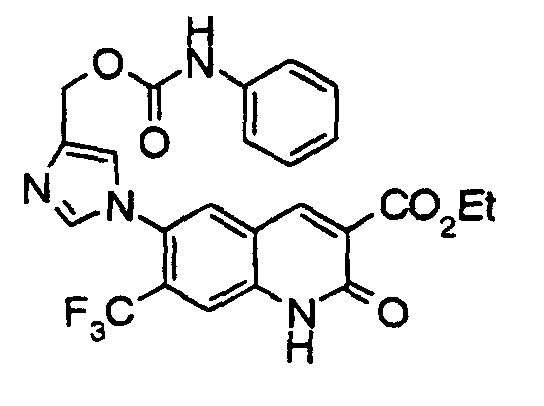
1H-NMR(DMSO-d6, δ): 1.30(3H,t,J=7.3Hz), 4.30(2H,q,J=7.3Hz), 5.07 (2H,s), 6.98(1H,t,J=7.3Hz), 7.27(2H,t,J=7.3Hz), 7.47(2H,d,J=7.3 Hz), 7.51(1H,s), 7.79 (1H,s), 7.86(1H,s), 8.10(1H,s), 8.56(1H,s), 9.76(1H,s), 12.48(1H,brs).


C, 46.41; H, 2.83; N, 9.84.

C, 46.12; H, 2.89; N, 9.78.
C, 49.15; H, 2.94; N, 9.97.
C, 53.81; H, 3.93; N, 10.91.
C, 53.81; H, 3.93; N, 10.91.

1H-NMR(DMSO-d6, δ): 1.34(3H,t,J=6.8Hz), 1.41(3H,t,J=6.8Hz), 4.36 (2H,q,J=6.8Hz), 4.55(2H,q,J=6.8Hz), 8.14(1H,s), 8.23(1H,s), 8.47 (1H,s), 8.81(1H,s), 9.86(1H,s).
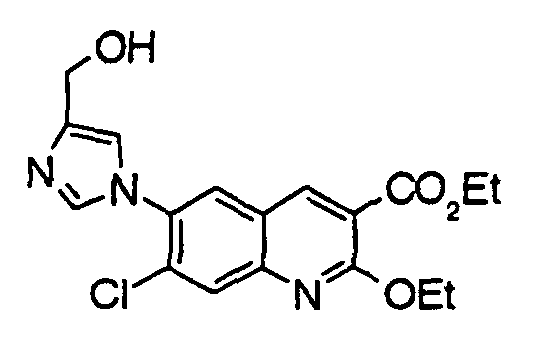
1H-NMR(DMSO-d6, δ): 1.34(3H,t,J=6.8Hz), 1.40(3H,t,J=6.8Hz), 4.35 (2H,q,J=6.8Hz), 4.44(2H,d,J=5.4Hz), 4.54(2H,q,J=6.8Hz), 5.03(1H, t,J=5.4Hz), 7.33(1H,s), 7.88(1H,s), 8.08(1H,s), 8.26(1H,s), 8.80 (1H, s).
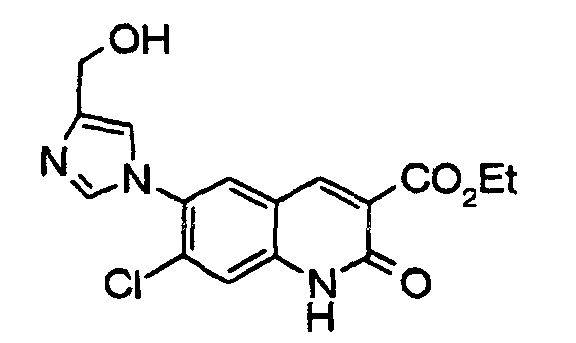
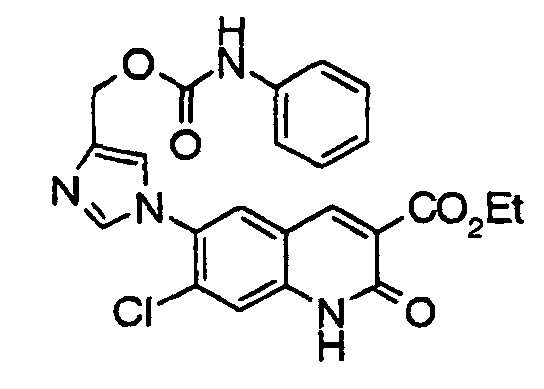
1H-NMR(DMSO-d6, δ): 1.30(3H,t,J=7.3Hz), 4.28(2H,q,J=7.3Hz), 5.08 (2H,s), 6.98(1H,t,J=7.3Hz), 7.27(2H,t,J=7.3Hz), 7.47(2H,d,J=7.3 Hz), 7.53(1H,s), 7.55(1H,5), 7.92(1H,s), 8.09(1H,s), 8.53(1H,s), 9.76(1H,s), 12.31(1H,brs).

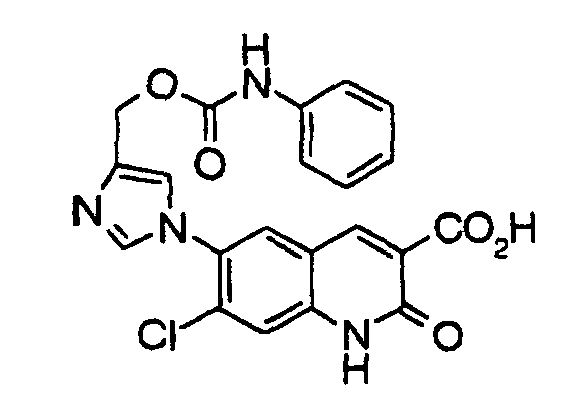
C, 54.14; H, 3.89; N, 12.03.


C, 51.28; H, 3.64; N, 10.87.

C, 50.58; H, 3.74; N, 10.72.

C, 47.08; H, 3.01; N, 10.46.
C, 52.72; H, 3.45; N, 11.71.
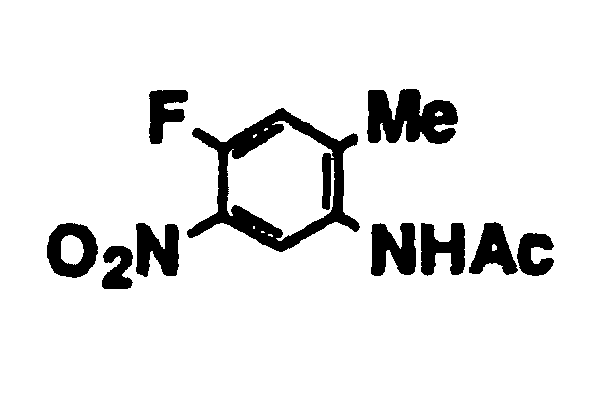
1H-NMR(DMSO-d6, δ): 2.11(3H,s), 2.32(3H,s), 7.50(1H,d,J= 12.7Hz), 8.34(1H,d,J=7.3Hz), 9.56(1H,brs).
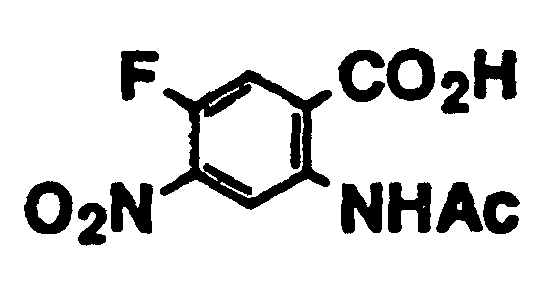
1H-NMR(DMSO-d6, δ): 2.15(3H,s), 7.99(1H,d,J=11.2Hz), 9.09(1H,d, J=6.8Hz), 10.99(1H,brs).

1H-NMR(DMSO-d6, δ): 7.50(1H,d,J=6.3Hz), 7.70(1H,d,J=12.2Hz).

1H-NMR(DMSO-d6, δ): 7.33(2H,brs), 7.49(1H,d,J=5.9Hz), 7.84(1H,d, J=11.2Hz), 9.91(1H,s).
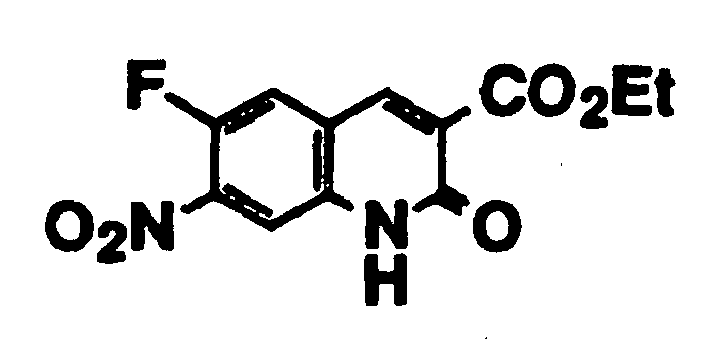
1H-NMR(DMSO-d6, δ): 1.27(3H,t,J=6.8Hz), 4.20(2H,q,J=6.8Hz), 7.57 (1H,d,J=11.7Hz), 7.66(1H,d,J=7.8Hz), 7.84(1H,s).
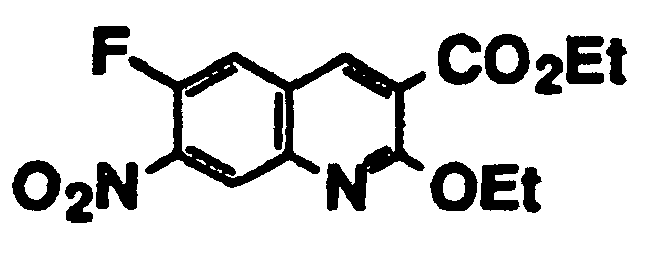
1H-NMR(DMSO-d6, δ): 1.35(3H,t,J=7.3Hz), 1.40(3H,t,J=6.8Hz), 4.37 (2H,q,J=7.3Hz), 4.54(2H,q,J=6.8Hz), 8.24(1H,d,J= 11.7Hz), 8.48(1H, d,J=6.8Hz), 8.79(1H,s).

1H-NMR(DMSO-d6, δ): 7.73(1H,s), 8.37(1H,d,J=10.7Hz), 8.50(1H,d,J=6.3Hz).

1H-NMR(DMSO-d6, δ): 4.44(2H,d,J=4.4Hz), 5.09(1H,t,J=4.4Hz), 7.39 (1H,s), 7.78(1H,s), 7.92(1H,s), 8.19(1H,s), 8.59(1H,s).

1H-NMR(DMSO-d6, δ): 4.39(2H,d,J=5.9Hz), 4.97(1H,t,J=5.9Hz), 7.10 (1H,s), 7.30(1H,s), 7.64(1H,s), 7.67(2H,s), 7.79(1H,s), 9.91(1H,s).

1H-NMR(CDCl3, δ): 2.69(3H,s), 7.52(1H,d,J=8.3Hz), 7.76(1H,d,J =8.3 Hz), 8.25 (1H,s).
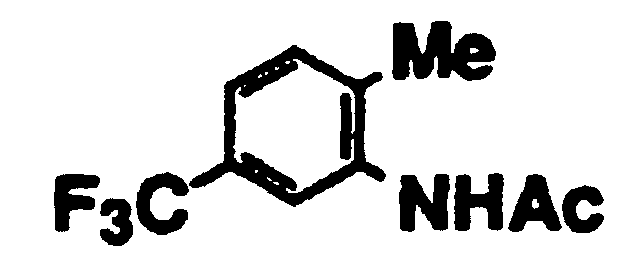
1H-NMR(DMSO-d6, δ): 2.10(3H,s), 2.30(3H,s), 7.39(1H,d,J= 8.3Hz), 7.44(1H,d,J=8.3Hz), 7.89(1H,s), 9.46(1H,s).

1H-NMR(DMSO-d6, δ): 2.18(3H,s), 2.40(3H,s), 8.11(1H,s), 8.39(1H,d, s), 9.74(1H,s).
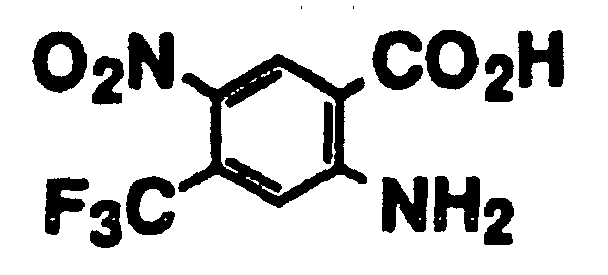
1H-NMR(DMSO-d6, δ): 7.36(1H,s), 8.06(2H,brs), 8.58(1H,s).
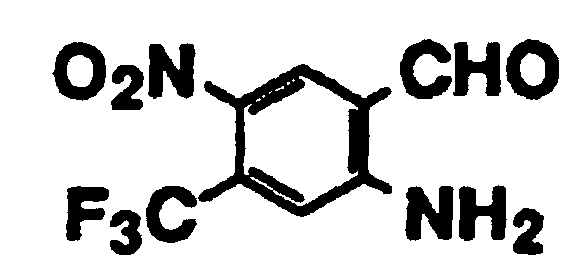
1H-NMR(CDCl3, δ): 7.09(1H,s), 8.45(1H,s), 9.97(1H,s).
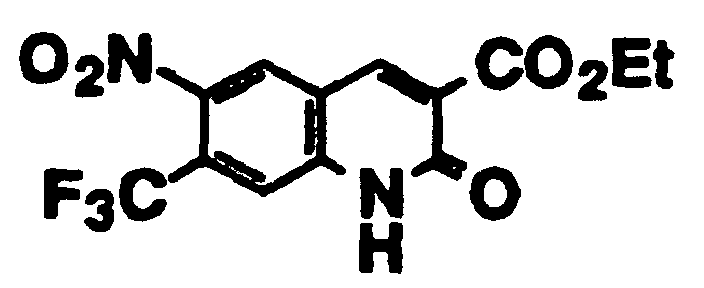
1H-NMR(DMSO-d6, δ): 1.31(3H,t,J=6.8Hz), 4.31(2H,q,J=6.9Hz), 7.80 (1H,s), 8.67(1H,s), 8.84(1H,s), 12.50-13.00(1H,br).

1H-NMR(DMSO-d6, δ) : 1.30 (3H,t,J=7.3Hz), 4.27(2H,q,J=7.3Hz), 5.45(2H,s), 7.15(1H,S), 7.40(1H,S), 8.25(1H,s), 11.82(1H,s).

Claims (10)
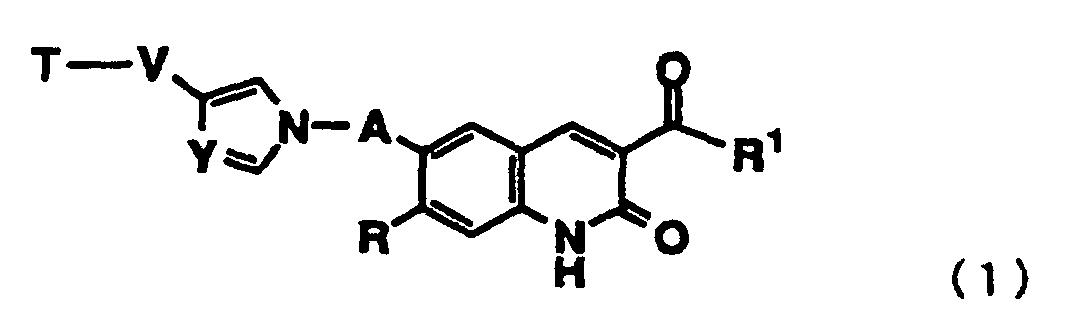
- 6-Substituted heteroquinolinecarboxylic acid derivatives represented by a general formula (1)(wherein A denotes a single bond or methylene (CH2),
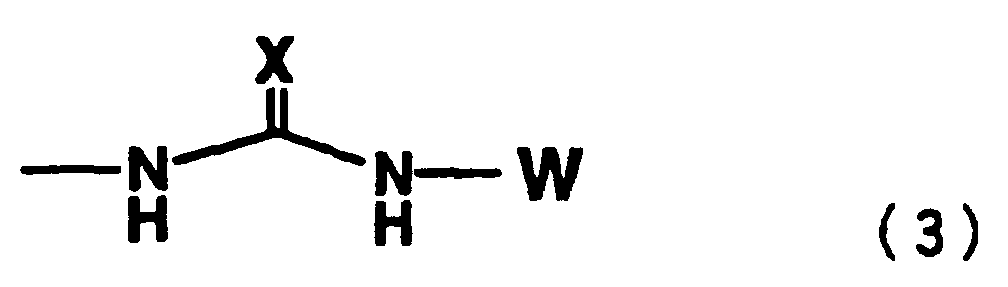
 (wherein X denotes an oxygen atom or sulfur atom, W denotes an aralkyl group, phenyl group, naphthyl group, 5- or 6-membered heterocycle and its condensed ring (these may have one or more substituents on aromatic ring or heterocycle), lower alkyl group which may be substituted with halogen atom, or cycloalkyl group), or general formula (3)Y denotes a nitrogen atom or =CH―,V denotes a single bond or methylene (CH2),T denotes a hydroxyl group, amino group, lower alkoxycarbonyl group, carboxyl group, aldehyde group, general formula (2)
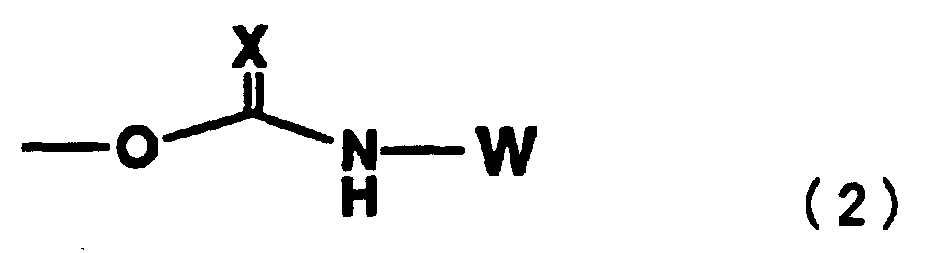 (wherein X denotes an oxygen atom or sulfur atom, W denotes an aralkyl group, phenyl group, naphthyl group, 5- or 6-membered heterocycle and its condensed ring (these may have one or more substituents on aromatic ring or heterocycle), lower alkyl group which may be substituted with halogen atom, or cycloalkyl group),
 R denotes a nitro group, trifluoromethyl group or halogen atom, andR1 denotes a hydroxyl group or lower alkoxy group), and addition salts thereof.
 - 6-Substituted heteroquinolinecarboxylic acid derivatives of Claim 1, represented by a general formula (1)(wherein A denotes a single bond,
 (wherein X denotes an oxygen atom or sulfur atom, W denotes an aralkyl group, phenyl group, naphthyl group, 5- or 6-membered heterocycle and its condensed ring (these may have one or more substituents on aromatic ring or heterocycle), lower alkyl group which may be substituted with halogen atom, or cycloalkyl group), or general formula (3)Y denotes a nitrogen atom or =CH―,V denotes a methylene (CH2),T denotes a general formula (2)
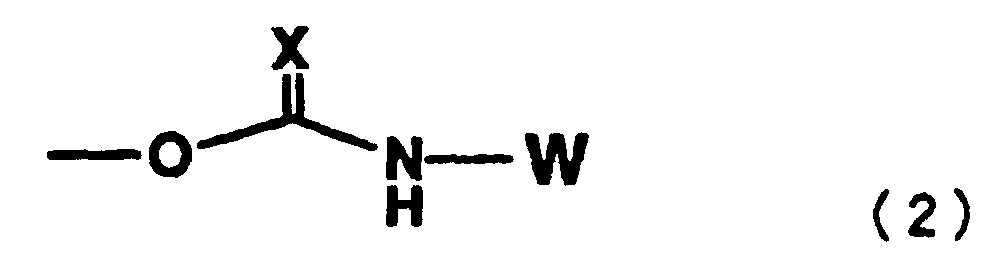 (wherein X denotes an oxygen atom or sulfur atom, W denotes an aralkyl group, phenyl group, naphthyl group, 5- or 6-membered heterocycle and its condensed ring (these may have one or more substituents on aromatic ring or heterocycle), lower alkyl group which may be substituted with halogen atom, or cycloalkyl group),
 R denotes a nitro group, trifluoromethyl-group or halogen atom, andR1 denotes a hydroxyl group or lower alkoxy group), and addition salts thereof.
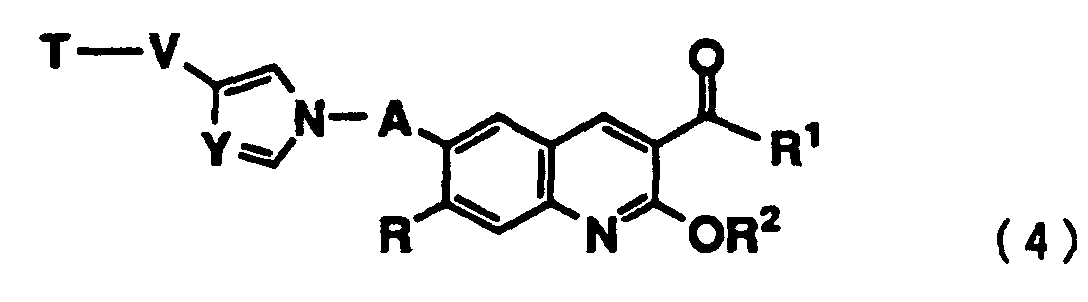
 - A process for preparing 6-substituted heteroquinolinecarboxylic acid derivatives and their addition salts of Claim 1, characterized by hydrolyzing compounds represented by a general formula (4)(wherein A denotes a single bond or methylene (CH2),
 (wherein X denotes an oxygen atom or sulfur atom, w denotes an aralkyl group, phenyl group, naphtyl group, 5- or 6-membered heterocycle and its condensed ring (these may have one or more substituents on aromatic ring or heterocycle), lower alkyl group which may be substitued with halogen atom, or cycloalkyl group), or general formula (3)Y denotes a nitrogen atom or =CH―,V denotes a single bond or methylene (CH2),T denotes a hydroxyl group, amino group, lower alkoxycarbonyl group, carboxyl group, aldehyde group, general formula (2)
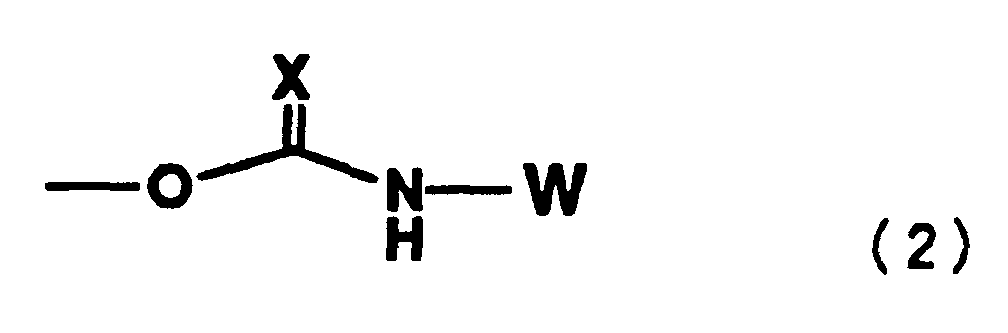 (wherein X denotes an oxygen atom or sulfur atom, W denotes an aralkyl group, phenyl group, naphthyl group, 5- or 6-membered heterocycle and its condensed ring (these may have one or more substituents on aromatic ring or heterocycle), lower alkyl group which may be substituted with halogen atom, or cycloalkyl group),
 R denotes a nitro group, trifluoromethyl group or halogen atom,R1 denotes a hydroxyl group or lower alkoxy group, andR2 denotes a lower alkyl group which may be substituted with halogen atom, or aralkyl group which may have one or more substituents).
 - A process for preparing 6-substituted heteroquinolinecarboxylic acid derivatives and their addition salts, Y in Claim 1 being represented by =CH―, characterized by reacting compounds represented by a general formula (5)(wherein A denotes a single bond or methylene (CH2),
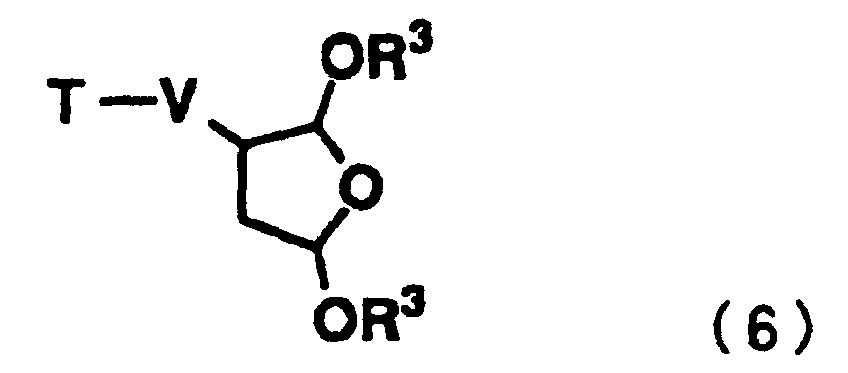
 (wherein V denotes a single bond or methylene (CH2),R denotes a nitro group, trifluoromethyl group or halogen atom, andR1 denotes a hydroxyl group or lower alkoxy group), with compounds represented by a general formula (6)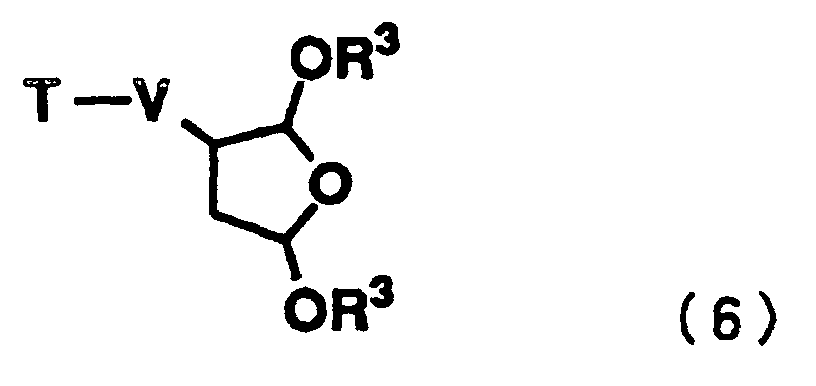
T denotes a hydroxyl group, amino group, lower alkoxycarbonyl group, carboxyl group, aldehyde group, general formula (2)(wherein X denotes an oxygen atom or sulfur atom, W denotes an aralkyl group, phenyl group, naphthyl group, 5- or 6-membered heterocycle and its condensed ring (these may have one or more substituents on aromatic ring or heterocycle), lower alkyl group which may be substituted with halogen atom, or cycloalkyl group), or general formula (3)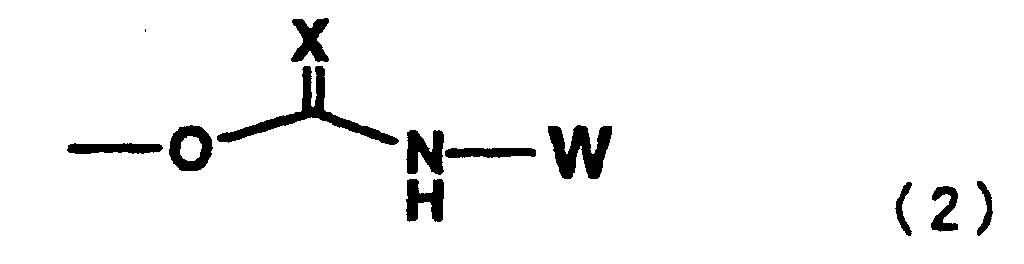 (wherein X denotes an oxygen atom or sulfur atom, W denotes an aralkyl group, phenyl group, naphthyl group, 5- or 6-membered heterocycle and its condensed ring (these may have one or more substituents on aromatic ring or heterocycle), lower alkyl group which may be substituted with halogen atom, or cycloalkyl group), and
R3 denotes a lower alkyl group which may be substituted with halogen atom, or aralkyl group which may have one or more substituents). - A process for preparing 6-substituted heteroquinolinecarboxylic acid derivatives and their addition salts, T being represented by the general formula (2) or general formula (3) in Claim 1, characterized by reacting compounds represented by a general formula (7)(wherein A denotes a single bond or methylene (CH2),
 (wherein Z denotes an aralkyl group, phenyl group, naphthyl group, 5- or 6-membered heterocycle and its condensed ring (these may have one or more substituents on aromatic ring or heterocycle), lower alkyl group which may be substituted with halogen atom, or cycloalkyl group, and Xa denotes an oxygen atom or sulfur atom), or with isocyanic (isothiocyanic) esters synthesized from precursors of isocyanic (isothiocyanic) esters represented by a general formula (9)Y denotes a nitrogen atom or =CH―,V denotes a single bond or methylene (CH2),T1 denotes a hydroxyl group or amino group,R denotes a nitro group, trifluoromethyl group or halogen atom, andR1 denotes a hydroxyl group or lower alkoxy group), with isocyanic (isothiocyanic) esters represented by a general formula (8)
 - Synthetic intermediates for preparing the compounds of Claim 1, represented by a general formula (4)(wherein A denotes a single bond or methylene (CH2),
 (wherein X denotes an oxygen atom or sulfur atom, W denotes an aralkyl group, phenyl group, naphthyl group, 5- or 6-membered heterocycle and its condensed ring (these may have one or more substituents on aromatic ring or heterocycle), lower alkyl group which may be substituted with halogen atom, or cycloalkyl group), or general formula (3)Y denotes a nitrogen atom or =CH―,V denotes a single bond or methylene (CH2),T denotes a hydroxyl group, amino group, lower alkoxycarbonyl group, carboxyl group, aldehyde group, general formula (2)
 (wherein X denotes an oxygen atom or sulfur atom, W denotes an aralkyl group, phenyl group, naphthyl group, 5- or 6-membered heterocycle and its condensed ring (these may have one or more substituents on aromatic ring or heterocycle), lower alkyl group which may be substituted with halogen atom, or cycloalkyl group),
 R denotes a nitro group, trifluoromethyl group or halogen atom,R1 denotes a hydroxyl group or lower alkoxy group, andR2 denotes a lower alkyl group which may be substituted with halogen atom, or aralkyl group which may have one or more substituents).
 - A process for preparing the compounds, T being the general formula (2) or general formula (3) in Claim 6, characterized by reacting compounds represented by a general formula (10)(wherein A denotes a single bond or methylene (CH2),
 (wherein Z denotes an aralkyl group, phenyl group, naphthyl group, 5- or 6-membered heterocycle and its condensed ring (these may have one or more substituents on aromatic ring or heterocycle), lower alkyl group which may be substituted with halogen atom, or cycloalkyl group, and Xa denotes an oxygen atom or sulfur atom), or with isocyanic (isothiocyanic) esters synthesized from precursors of isocyanic (isothiocyanic) esters represented by a general formula (9)Y denotes a nitrogen atom or =CH―,V denotes a single bond or methylene (CH2),T1 denotes a hydroxyl group or amino group,R denotes a nitro group, trifluoromethyl group or halogen atom,R1 denotes a hydroxyl group or lower alkoxy group, andR2 denotes a lower alkyl group which may be substituted with halogen atom, or aralkyl group which may have one or more substituents), with isocyanic (isothiocyanic) esters represented by a general formula (8)
 - A process for preparing the compounds of Claim 6, characterized by reacting compounds represented by a general formula (11)(wherein A denotes a single bond or methylene (CH2), Xb denotes a halogen atom,
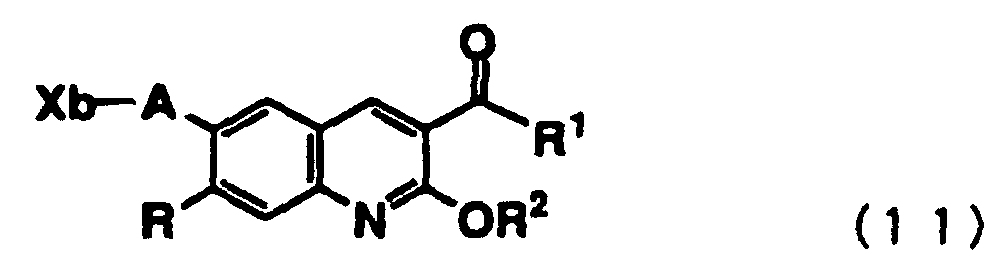 (wherein Y denotes a nitrogen atom or =CH―,R denotes a nitro group, trifluoromethyl group or halogen atom,R1 denotes a hydroxyl group or lower alkoxy group, andR2 denotes a lower alkyl group which may be substituted with halogen atom, or aralkyl group which may have one or more substituents), with compounds represented by a general formula (12)
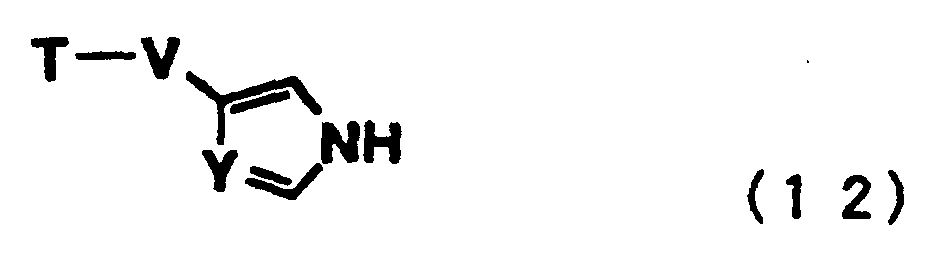 V denotes a single bond or methylene (CH2),T denotes a hydroxyl group, amino group, lower alkoxycarbonyl group, carboxyl group, aldehyde group, general formula (2)(wherein X denotes an oxygen atom or sulfur atom, W denotes an aralkyl group, phenyl group, naphthyl group, 5- or 6-membered heterocycle and its condensed ring (these may have one or more substituents on aromatic ring or heterocycle), lower alkyl group which may be substituted with halogen atom, or cycloalkyl group), or general formula (3)
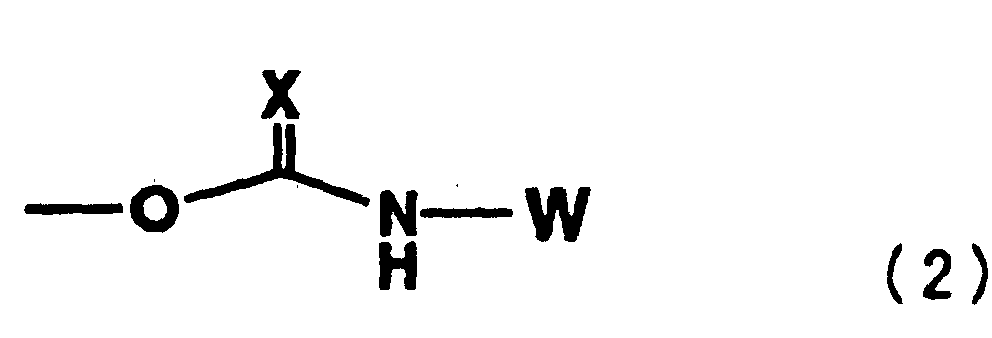 (wherein X denotes an oxygen atom or sulfur atom, W denotes an aralkyl group, phenyl group, naphthyl group, 5- or 6-membered heterocycle and its condensed ring (these may have one or more substituents on aromatic ring or heterocycle), lower alkyl group which may be substituted with halogen atom, or cycloalkyl group).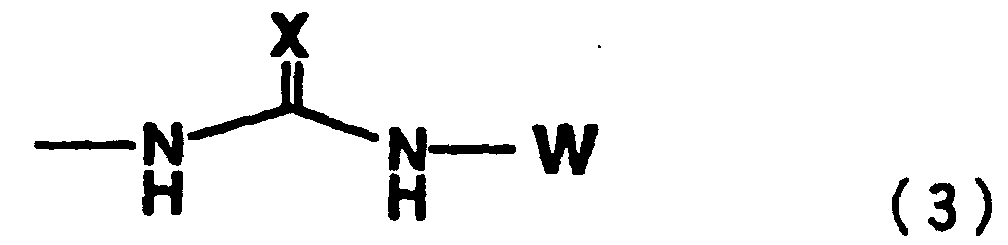
- An antagonist against excitatory amino acid receptors with antagonism against AMPA receptor, characterized by containing one or more kinds of 6-substituted heteroquinolinecarboxylic acid derivatives and their addition salts represented by a general formula (1)(wherein A denotes a single bond or methylene (CH2),
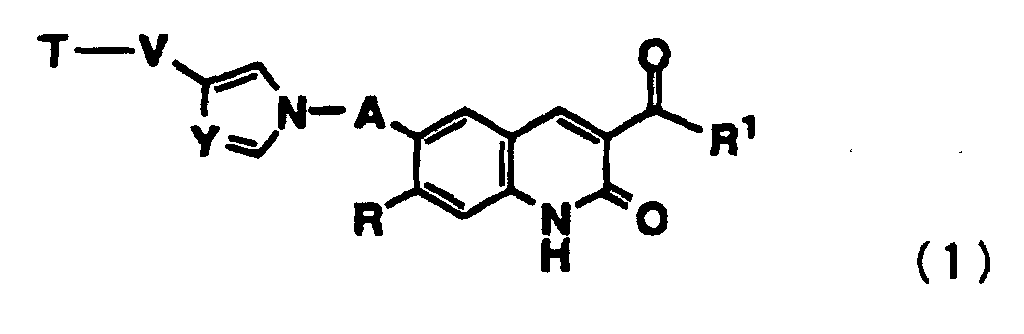 (wherein X denotes an oxygen atom or sulfur atom, W denotes an aralkyl group, phenyl group, naphthyl group, 5- or 6-membered heterocycle and its condensed ring (these may have one or more substituents on aromatic ring or heterocycle), lower alkyl group which may be substituted with halogen atom, or cycloalkyl group), or general formula (3)Y denotes a nitrogen atom or =CH―,V denotes a single bond or methylene (CH2),T denotes a hydroxyl group, amino group, lower alkoxycarbonyl group, carboxyl group, aldehyde group, general formula (2)
 (wherein X denotes an oxygen atom or sulfur atom, W denotes an aralkyl group, phenyl group, naphthyl group, 5- or 6-membered heterocycle and its condensed ring (these may have one or more substituents on aromatic ring or heterocycle), lower alkyl group which may be substituted with halogen atom, or cycloalkyl group),
 R denotes a nitro group, trifluoromethyl group or halogen atom, andR1 denotes a hydroxyl group or lower alkoxy group), as effective ingredients.
 - An antagonist against excitatory amino acid receptors with antagonism against AMPA receptor of Claim 9, characterized by containing one or more kinds of 6-substituted heteroquinolinecarboxylic acid derivatives and their addition salts represented by a general formula (1)(wherein A denotes a single bond,
 (wherein X denotes an oxygen atom or sulfur atom, W denotes an aralkyl group, phenyl group, naphthyl group, 5- or 6-membered heterocycle and its condensed ring (these may have one or more substituents on aromatic ring or heterocycle), lower alkyl group which may be substituted with halogen atom, or cycloalkyl group), or general formula (3)Y denotes a nitrogen atom or =CH―,V denotes a methylene (CH2),T denotes a general formula (2)
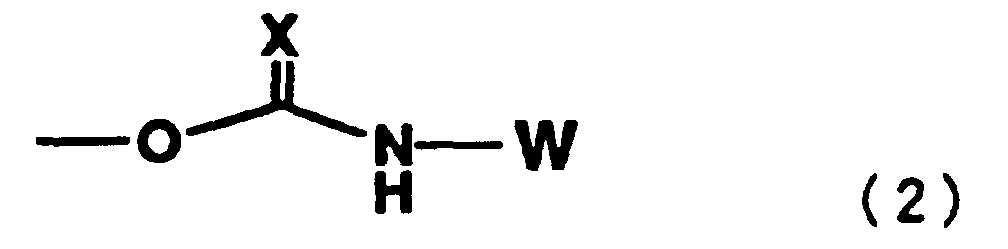 (wherein X denotes an oxygen atom or sulfur atom, W denotes an aralkyl group, phenyl group, naphthyl group, 5- or 6-membered heterocycle and its condensed ring (these may have one or more substituents on aromatic ring or heterocycle), lower alkyl group which may be substituted with halogen atom, or cycloalkyl group),
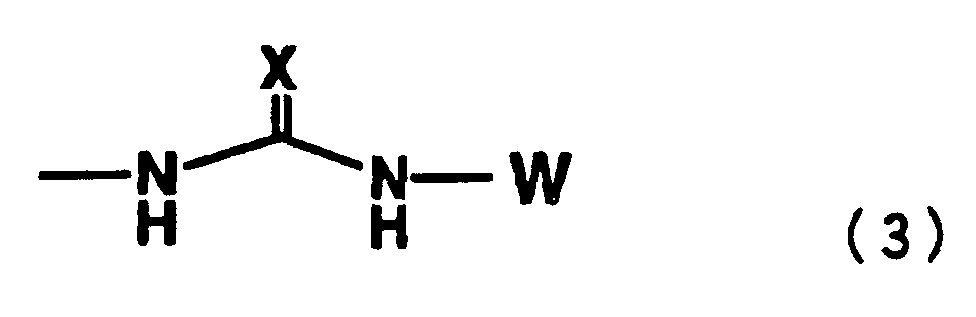 R denotes a nitro group, trifluoromethyl group or halogen atom, andR1 denotes a hydroxyl group or lower alkoxy group), as effective ingredients.
Applications Claiming Priority (5)
| Application Number | Priority Date | Filing Date | Title |
|---|---|---|---|
| JP5023999 | 1999-02-26 | ||
| JP5023999 | 1999-02-26 | ||
| JP2000041814 | 2000-02-18 | ||
| JP2000041814A JP2000309585A (en) | 1999-02-26 | 2000-02-18 | 6-Substituted heteroquinoline carboxylic acid derivatives, addition salts thereof and methods for producing them |
| PCT/JP2000/001077 WO2000050416A1 (en) | 1999-02-26 | 2000-02-25 | 6-substituted heteroquinolinecarboxylic acid derivatives and addition salts thereof and processes for the preparation of both |
Publications (3)
| Publication Number | Publication Date |
|---|---|
| EP1156044A1 true EP1156044A1 (en) | 2001-11-21 |
| EP1156044A4 EP1156044A4 (en) | 2002-06-19 |
| EP1156044B1 EP1156044B1 (en) | 2004-08-25 |
Family
ID=26390687
Family Applications (1)
| Application Number | Title | Priority Date | Filing Date |
|---|---|---|---|
| EP00905327A Expired - Lifetime EP1156044B1 (en) | 1999-02-26 | 2000-02-25 | 6-substituted heteroquinolinecarboxylic acid derivatives and addition salts thereof and processes for the preparation of both |
Country Status (8)
| Country | Link |
|---|---|
| US (1) | US6562839B1 (en) |
| EP (1) | EP1156044B1 (en) |
| JP (1) | JP2000309585A (en) |
| AT (1) | ATE274509T1 (en) |
| AU (1) | AU2692000A (en) |
| CA (1) | CA2364754A1 (en) |
| DE (1) | DE60013257T2 (en) |
| WO (1) | WO2000050416A1 (en) |
Cited By (1)
| Publication number | Priority date | Publication date | Assignee | Title |
|---|---|---|---|---|
| EP1372654A4 (en) * | 2001-04-06 | 2007-10-03 | Smithkline Beecham Corp | Quinoline inhibitors of hyak1 and hyak3 kinases |
Families Citing this family (4)
| Publication number | Priority date | Publication date | Assignee | Title |
|---|---|---|---|---|
| GB0416730D0 (en) | 2004-07-27 | 2004-09-01 | Novartis Ag | Organic compounds |
| GB0507298D0 (en) * | 2005-04-11 | 2005-05-18 | Novartis Ag | Organic compounds |
| WO2012164085A1 (en) | 2011-06-03 | 2012-12-06 | Merz Pharma Gmbh & Co. Kgaa | Glycine b antagonists |
| JP6786900B2 (en) * | 2016-06-16 | 2020-11-18 | 日本製鉄株式会社 | Bidirectional electromagnetic steel sheet and its manufacturing method |
Family Cites Families (10)
| Publication number | Priority date | Publication date | Assignee | Title |
|---|---|---|---|---|
| FR640612A (en) | 1926-08-02 | 1928-07-18 | Method and apparatus for producing images, inscriptions, designs, etc., on screens covered with a luminous coating | |
| FR818449A (en) | 1937-02-27 | 1937-09-25 | Socket forming a switch and breaking in a vacuum | |
| GB9026389D0 (en) | 1990-12-05 | 1991-01-23 | Merck Sharp & Dohme | Therapeutic agents |
| GB9125485D0 (en) | 1991-11-29 | 1992-01-29 | Merck Sharp & Dohme | Therapeutic agents |
| FR2709489B1 (en) * | 1993-08-31 | 1995-10-20 | Adir | New derivatives of 2- (1H) -quinolineone, their preparation process and the pharmaceutical compositions containing them. |
| DE4340045A1 (en) * | 1993-11-24 | 1995-06-01 | Basf Ag | New (heterocyclyl)pyrrolyl-substd. quinoxaline-di:one derivs. |
| US5607928A (en) * | 1994-08-05 | 1997-03-04 | Zeneca Limited | Carbapenem derivatives containing a bicyclic ketone substituent and their use as anti-infectives |
| DE19624808A1 (en) * | 1996-06-21 | 1998-01-02 | Basf Ag | Pyrrolylquinoxalinediones, their preparation and use |
| FR2750988B1 (en) * | 1996-07-11 | 1998-09-18 | Adir | NOVEL 2- (1H) -QUINOLEINONE DERIVATIVES, THEIR PREPARATION PROCESS AND THE PHARMACEUTICAL COMPOSITIONS CONTAINING THEM |
| HUP0002853A3 (en) * | 1997-09-01 | 2001-12-28 | Kyorin Seiyaku Kk | 6,7-asymmetrically disubstituted quinoxalinecarboxylic acid derivatives, and pharmaceutical compositions containing them |
-
2000
- 2000-02-18 JP JP2000041814A patent/JP2000309585A/en active Pending
- 2000-02-25 US US09/926,054 patent/US6562839B1/en not_active Expired - Fee Related
- 2000-02-25 AT AT00905327T patent/ATE274509T1/en not_active IP Right Cessation
- 2000-02-25 DE DE60013257T patent/DE60013257T2/en not_active Expired - Fee Related
- 2000-02-25 WO PCT/JP2000/001077 patent/WO2000050416A1/en not_active Ceased
- 2000-02-25 CA CA002364754A patent/CA2364754A1/en not_active Abandoned
- 2000-02-25 AU AU26920/00A patent/AU2692000A/en not_active Abandoned
- 2000-02-25 EP EP00905327A patent/EP1156044B1/en not_active Expired - Lifetime
Cited By (1)
| Publication number | Priority date | Publication date | Assignee | Title |
|---|---|---|---|---|
| EP1372654A4 (en) * | 2001-04-06 | 2007-10-03 | Smithkline Beecham Corp | Quinoline inhibitors of hyak1 and hyak3 kinases |
Also Published As
| Publication number | Publication date |
|---|---|
| DE60013257D1 (en) | 2004-09-30 |
| EP1156044B1 (en) | 2004-08-25 |
| WO2000050416A1 (en) | 2000-08-31 |
| ATE274509T1 (en) | 2004-09-15 |
| EP1156044A4 (en) | 2002-06-19 |
| DE60013257T2 (en) | 2005-08-11 |
| JP2000309585A (en) | 2000-11-07 |
| CA2364754A1 (en) | 2000-08-31 |
| AU2692000A (en) | 2000-09-14 |
| US6562839B1 (en) | 2003-05-13 |
Similar Documents
| Publication | Publication Date | Title |
|---|---|---|
| KR101465413B1 (en) | Trisubstituted 1,2,4-triazoles | |
| EP2699550B1 (en) | Tetrahydroquinoline derivatives useful as bromodomain inhibitors | |
| EP2280945B1 (en) | Trisubstituted pyrazoles as acetylcholine receptor modulators | |
| EP3168213B1 (en) | Tetrahydroquinoline derivatives useful as bromodomain inhibitors | |
| EP2496557B1 (en) | Tetrahydroquinoline derivatives and their pharmaceutical use | |
| JP2013510125A (en) | Tetrahydroquinoline derivatives as bromodomain inhibitors | |
| EP1020453B1 (en) | 6,7-asymmetrically disubstituted quinoxalinecarboxylic acid derivatives, addition salts thereof, and processes for the preparation of both | |
| TWI472525B (en) | Quinolone compound and pharmaceutical composition | |
| CA2989992A1 (en) | Benzimidazole compound and medical use thereof | |
| US6969716B2 (en) | 5-phenyl[1,2,4]triazines as ligands for GABA-A α2/α3 receptors for treating anxiety or depression | |
| EP1156044B1 (en) | 6-substituted heteroquinolinecarboxylic acid derivatives and addition salts thereof and processes for the preparation of both | |
| CN104395290A (en) | Novel adamantyl derivatives as cannabinoid receptor 2 agonists | |
| US5852016A (en) | Quinoxaline derivatives useful in therapy | |
| CN101827836B (en) | Trisubstituted 1,2,4-triazole compounds | |
| JP2000169451A (en) | 6,7-Disubstituted quinoline carboxylic acid derivatives, their addition salts and their production | |
| EP1156047B1 (en) | 6-substituted-7- heteroquinoxaline carboxylic acid derivatives and addition salts thereof and processes for the preparation of both | |
| JP2002193941A (en) | New method for producing pyrazoles | |
| JPH0753715B2 (en) | Benzoheterocyclic compound | |
| JP2000169450A (en) | 6-arylquinoline carboxylic acid derivatives, their addition salts and their production | |
| CN101001844A (en) | Mercaptoimidazoles as CCR2 receptor antagonists | |
| EP1814857B1 (en) | Isotopically marked quinoline derivatives as adenosin a3 receptor ligands |
Legal Events
| Date | Code | Title | Description |
|---|---|---|---|
| PUAI | Public reference made under article 153(3) epc to a published international application that has entered the european phase |
Free format text: ORIGINAL CODE: 0009012 |
|
| 17P | Request for examination filed |
Effective date: 20010823 |
|
| AK | Designated contracting states |
Kind code of ref document: A1 Designated state(s): AT BE CH CY DE DK ES FI FR GB GR IE IT LI LU MC NL PT SE |
|
| AX | Request for extension of the european patent |
Free format text: AL PAYMENT 20010823;LT PAYMENT 20010823;LV PAYMENT 20010823;MK PAYMENT 20010823;RO PAYMENT 20010823;SI PAYMENT 20010823 |
|
| A4 | Supplementary search report drawn up and despatched |
Effective date: 20020507 |
|
| AK | Designated contracting states |
Kind code of ref document: A4 Designated state(s): AT BE CH CY DE DK ES FI FR GB GR IE IT LI LU MC NL PT SE |
|
| 17Q | First examination report despatched |
Effective date: 20020905 |
|
| GRAP | Despatch of communication of intention to grant a patent |
Free format text: ORIGINAL CODE: EPIDOSNIGR1 |
|
| GRAS | Grant fee paid |
Free format text: ORIGINAL CODE: EPIDOSNIGR3 |
|
| GRAA | (expected) grant |
Free format text: ORIGINAL CODE: 0009210 |
|
| AK | Designated contracting states |
Kind code of ref document: B1 Designated state(s): AT BE CH CY DE DK ES FI FR GB GR IE IT LI LU MC NL PT SE |
|
| AX | Request for extension of the european patent |
Extension state: AL LT LV MK RO SI |
|
| PG25 | Lapsed in a contracting state [announced via postgrant information from national office to epo] |
Ref country code: NL Free format text: LAPSE BECAUSE OF FAILURE TO SUBMIT A TRANSLATION OF THE DESCRIPTION OR TO PAY THE FEE WITHIN THE PRESCRIBED TIME-LIMIT Effective date: 20040825 Ref country code: LI Free format text: LAPSE BECAUSE OF FAILURE TO SUBMIT A TRANSLATION OF THE DESCRIPTION OR TO PAY THE FEE WITHIN THE PRESCRIBED TIME-LIMIT Effective date: 20040825 Ref country code: FI Free format text: LAPSE BECAUSE OF FAILURE TO SUBMIT A TRANSLATION OF THE DESCRIPTION OR TO PAY THE FEE WITHIN THE PRESCRIBED TIME-LIMIT Effective date: 20040825 Ref country code: CH Free format text: LAPSE BECAUSE OF FAILURE TO SUBMIT A TRANSLATION OF THE DESCRIPTION OR TO PAY THE FEE WITHIN THE PRESCRIBED TIME-LIMIT Effective date: 20040825 Ref country code: BE Free format text: LAPSE BECAUSE OF FAILURE TO SUBMIT A TRANSLATION OF THE DESCRIPTION OR TO PAY THE FEE WITHIN THE PRESCRIBED TIME-LIMIT Effective date: 20040825 Ref country code: AT Free format text: LAPSE BECAUSE OF FAILURE TO SUBMIT A TRANSLATION OF THE DESCRIPTION OR TO PAY THE FEE WITHIN THE PRESCRIBED TIME-LIMIT Effective date: 20040825 |
|
| REG | Reference to a national code |
Ref country code: GB Ref legal event code: FG4D |
|
| REG | Reference to a national code |
Ref country code: CH Ref legal event code: EP |
|
| REG | Reference to a national code |
Ref country code: IE Ref legal event code: FG4D |
|
| REF | Corresponds to: |
Ref document number: 60013257 Country of ref document: DE Date of ref document: 20040930 Kind code of ref document: P |
|
| PG25 | Lapsed in a contracting state [announced via postgrant information from national office to epo] |
Ref country code: DK Free format text: LAPSE BECAUSE OF FAILURE TO SUBMIT A TRANSLATION OF THE DESCRIPTION OR TO PAY THE FEE WITHIN THE PRESCRIBED TIME-LIMIT Effective date: 20041125 Ref country code: SE Free format text: LAPSE BECAUSE OF FAILURE TO SUBMIT A TRANSLATION OF THE DESCRIPTION OR TO PAY THE FEE WITHIN THE PRESCRIBED TIME-LIMIT Effective date: 20041125 Ref country code: GR Free format text: LAPSE BECAUSE OF FAILURE TO SUBMIT A TRANSLATION OF THE DESCRIPTION OR TO PAY THE FEE WITHIN THE PRESCRIBED TIME-LIMIT Effective date: 20041125 |
|
| PG25 | Lapsed in a contracting state [announced via postgrant information from national office to epo] |
Ref country code: ES Free format text: LAPSE BECAUSE OF FAILURE TO SUBMIT A TRANSLATION OF THE DESCRIPTION OR TO PAY THE FEE WITHIN THE PRESCRIBED TIME-LIMIT Effective date: 20041206 |
|
| LTIE | Lt: invalidation of european patent or patent extension |
Effective date: 20040825 |
|
| PG25 | Lapsed in a contracting state [announced via postgrant information from national office to epo] |
Ref country code: CY Free format text: LAPSE BECAUSE OF FAILURE TO SUBMIT A TRANSLATION OF THE DESCRIPTION OR TO PAY THE FEE WITHIN THE PRESCRIBED TIME-LIMIT Effective date: 20050225 Ref country code: IE Free format text: LAPSE BECAUSE OF NON-PAYMENT OF DUE FEES Effective date: 20050225 Ref country code: LU Free format text: LAPSE BECAUSE OF NON-PAYMENT OF DUE FEES Effective date: 20050225 |
|
| PG25 | Lapsed in a contracting state [announced via postgrant information from national office to epo] |
Ref country code: MC Free format text: LAPSE BECAUSE OF NON-PAYMENT OF DUE FEES Effective date: 20050228 |
|
| REG | Reference to a national code |
Ref country code: CH Ref legal event code: PL |
|
| NLV1 | Nl: lapsed or annulled due to failure to fulfill the requirements of art. 29p and 29m of the patents act | ||
| ET | Fr: translation filed | ||
| PLBE | No opposition filed within time limit |
Free format text: ORIGINAL CODE: 0009261 |
|
| STAA | Information on the status of an ep patent application or granted ep patent |
Free format text: STATUS: NO OPPOSITION FILED WITHIN TIME LIMIT |
|
| 26N | No opposition filed |
Effective date: 20050526 |
|
| REG | Reference to a national code |
Ref country code: IE Ref legal event code: MM4A |
|
| PGFP | Annual fee paid to national office [announced via postgrant information from national office to epo] |
Ref country code: GB Payment date: 20070221 Year of fee payment: 8 |
|
| PGFP | Annual fee paid to national office [announced via postgrant information from national office to epo] |
Ref country code: DE Payment date: 20070227 Year of fee payment: 8 |
|
| PG25 | Lapsed in a contracting state [announced via postgrant information from national office to epo] |
Ref country code: PT Free format text: LAPSE BECAUSE OF NON-PAYMENT OF DUE FEES Effective date: 20050125 |
|
| PGFP | Annual fee paid to national office [announced via postgrant information from national office to epo] |
Ref country code: IT Payment date: 20070523 Year of fee payment: 8 |
|
| PGFP | Annual fee paid to national office [announced via postgrant information from national office to epo] |
Ref country code: FR Payment date: 20070126 Year of fee payment: 8 |
|
| GBPC | Gb: european patent ceased through non-payment of renewal fee |
Effective date: 20080225 |
|
| REG | Reference to a national code |
Ref country code: FR Ref legal event code: ST Effective date: 20081031 |
|
| PG25 | Lapsed in a contracting state [announced via postgrant information from national office to epo] |
Ref country code: DE Free format text: LAPSE BECAUSE OF NON-PAYMENT OF DUE FEES Effective date: 20080902 |
|
| PG25 | Lapsed in a contracting state [announced via postgrant information from national office to epo] |
Ref country code: FR Free format text: LAPSE BECAUSE OF NON-PAYMENT OF DUE FEES Effective date: 20080229 |
|
| PG25 | Lapsed in a contracting state [announced via postgrant information from national office to epo] |
Ref country code: GB Free format text: LAPSE BECAUSE OF NON-PAYMENT OF DUE FEES Effective date: 20080225 |
|
| PG25 | Lapsed in a contracting state [announced via postgrant information from national office to epo] |
Ref country code: IT Free format text: LAPSE BECAUSE OF NON-PAYMENT OF DUE FEES Effective date: 20080225 |