EP1156039A1 - Pyridazin-3-one derivatives and medicines containing the same - Google Patents

Pyridazin-3-one derivatives and medicines containing the same Download PDF

Info

Publication number
EP1156039A1
EP1156039A1 EP00905344A EP00905344A EP1156039A1 EP 1156039 A1 EP1156039 A1 EP 1156039A1 EP 00905344 A EP00905344 A EP 00905344A EP 00905344 A EP00905344 A EP 00905344A EP 1156039 A1 EP1156039 A1 EP 1156039A1
Authority
EP
European Patent Office
Prior art keywords
pyridazin
group
substituted
methoxyphenyl
bis
Prior art date
Legal status (The legal status is an assumption and is not a legal conclusion. Google has not performed a legal analysis and makes no representation as to the accuracy of the status listed.)
Granted
Application number
EP00905344A
Other languages
German (de)
French (fr)
Other versions
EP1156039A4 (en
EP1156039B1 (en
Inventor
Masao Ohkuchi
Yoshinori Kyotani
Hiromichi Shigyo
Hideo Yoshizaki
Tomoyuki Koshi
Takahiro Kitamura
Takayuki Matsuda
Kyoko Yasuoka
Tomoko Furuyama
Current Assignee (The listed assignees may be inaccurate. Google has not performed a legal analysis and makes no representation or warranty as to the accuracy of the list.)
Kowa Co Ltd
Original Assignee
Kowa Co Ltd
Priority date (The priority date is an assumption and is not a legal conclusion. Google has not performed a legal analysis and makes no representation as to the accuracy of the date listed.)
Filing date
Publication date
Application filed by Kowa Co Ltd filed Critical Kowa Co Ltd
Publication of EP1156039A1 publication Critical patent/EP1156039A1/en
Publication of EP1156039A4 publication Critical patent/EP1156039A4/en
Application granted granted Critical
Publication of EP1156039B1 publication Critical patent/EP1156039B1/en
Anticipated expiration legal-status Critical
Expired - Lifetime legal-status Critical Current

Links

Classifications

    • CCHEMISTRY; METALLURGY
    • C07ORGANIC CHEMISTRY
    • C07DHETEROCYCLIC COMPOUNDS
    • C07D237/00Heterocyclic compounds containing 1,2-diazine or hydrogenated 1,2-diazine rings
    • C07D237/02Heterocyclic compounds containing 1,2-diazine or hydrogenated 1,2-diazine rings not condensed with other rings
    • C07D237/06Heterocyclic compounds containing 1,2-diazine or hydrogenated 1,2-diazine rings not condensed with other rings having three double bonds between ring members or between ring members and non-ring members
    • C07D237/10Heterocyclic compounds containing 1,2-diazine or hydrogenated 1,2-diazine rings not condensed with other rings having three double bonds between ring members or between ring members and non-ring members with hetero atoms or with carbon atoms having three bonds to hetero atoms with at the most one bond to halogen, e.g. ester or nitrile radicals, directly attached to ring carbon atoms
    • C07D237/24Carbon atoms having three bonds to hetero atoms with at the most one bond to halogen
    • CCHEMISTRY; METALLURGY
    • C07ORGANIC CHEMISTRY
    • C07DHETEROCYCLIC COMPOUNDS
    • C07D237/00Heterocyclic compounds containing 1,2-diazine or hydrogenated 1,2-diazine rings
    • C07D237/02Heterocyclic compounds containing 1,2-diazine or hydrogenated 1,2-diazine rings not condensed with other rings
    • C07D237/06Heterocyclic compounds containing 1,2-diazine or hydrogenated 1,2-diazine rings not condensed with other rings having three double bonds between ring members or between ring members and non-ring members
    • C07D237/10Heterocyclic compounds containing 1,2-diazine or hydrogenated 1,2-diazine rings not condensed with other rings having three double bonds between ring members or between ring members and non-ring members with hetero atoms or with carbon atoms having three bonds to hetero atoms with at the most one bond to halogen, e.g. ester or nitrile radicals, directly attached to ring carbon atoms
    • C07D237/14Oxygen atoms
    • AHUMAN NECESSITIES
    • A61MEDICAL OR VETERINARY SCIENCE; HYGIENE
    • A61KPREPARATIONS FOR MEDICAL, DENTAL OR TOILETRY PURPOSES
    • A61K31/00Medicinal preparations containing organic active ingredients
    • A61K31/33Heterocyclic compounds
    • A61K31/395Heterocyclic compounds having nitrogen as a ring hetero atom, e.g. guanethidine or rifamycins
    • A61K31/495Heterocyclic compounds having nitrogen as a ring hetero atom, e.g. guanethidine or rifamycins having six-membered rings with two or more nitrogen atoms as the only ring heteroatoms, e.g. piperazine or tetrazines
    • A61K31/50Pyridazines; Hydrogenated pyridazines
    • AHUMAN NECESSITIES
    • A61MEDICAL OR VETERINARY SCIENCE; HYGIENE
    • A61PSPECIFIC THERAPEUTIC ACTIVITY OF CHEMICAL COMPOUNDS OR MEDICINAL PREPARATIONS
    • A61P1/00Drugs for disorders of the alimentary tract or the digestive system
    • AHUMAN NECESSITIES
    • A61MEDICAL OR VETERINARY SCIENCE; HYGIENE
    • A61PSPECIFIC THERAPEUTIC ACTIVITY OF CHEMICAL COMPOUNDS OR MEDICINAL PREPARATIONS
    • A61P1/00Drugs for disorders of the alimentary tract or the digestive system
    • A61P1/04Drugs for disorders of the alimentary tract or the digestive system for ulcers, gastritis or reflux esophagitis, e.g. antacids, inhibitors of acid secretion, mucosal protectants
    • AHUMAN NECESSITIES
    • A61MEDICAL OR VETERINARY SCIENCE; HYGIENE
    • A61PSPECIFIC THERAPEUTIC ACTIVITY OF CHEMICAL COMPOUNDS OR MEDICINAL PREPARATIONS
    • A61P19/00Drugs for skeletal disorders
    • AHUMAN NECESSITIES
    • A61MEDICAL OR VETERINARY SCIENCE; HYGIENE
    • A61PSPECIFIC THERAPEUTIC ACTIVITY OF CHEMICAL COMPOUNDS OR MEDICINAL PREPARATIONS
    • A61P19/00Drugs for skeletal disorders
    • A61P19/02Drugs for skeletal disorders for joint disorders, e.g. arthritis, arthrosis
    • AHUMAN NECESSITIES
    • A61MEDICAL OR VETERINARY SCIENCE; HYGIENE
    • A61PSPECIFIC THERAPEUTIC ACTIVITY OF CHEMICAL COMPOUNDS OR MEDICINAL PREPARATIONS
    • A61P19/00Drugs for skeletal disorders
    • A61P19/08Drugs for skeletal disorders for bone diseases, e.g. rachitism, Paget's disease
    • A61P19/10Drugs for skeletal disorders for bone diseases, e.g. rachitism, Paget's disease for osteoporosis
    • AHUMAN NECESSITIES
    • A61MEDICAL OR VETERINARY SCIENCE; HYGIENE
    • A61PSPECIFIC THERAPEUTIC ACTIVITY OF CHEMICAL COMPOUNDS OR MEDICINAL PREPARATIONS
    • A61P29/00Non-central analgesic, antipyretic or antiinflammatory agents, e.g. antirheumatic agents; Non-steroidal antiinflammatory drugs [NSAID]
    • AHUMAN NECESSITIES
    • A61MEDICAL OR VETERINARY SCIENCE; HYGIENE
    • A61PSPECIFIC THERAPEUTIC ACTIVITY OF CHEMICAL COMPOUNDS OR MEDICINAL PREPARATIONS
    • A61P37/00Drugs for immunological or allergic disorders
    • AHUMAN NECESSITIES
    • A61MEDICAL OR VETERINARY SCIENCE; HYGIENE
    • A61PSPECIFIC THERAPEUTIC ACTIVITY OF CHEMICAL COMPOUNDS OR MEDICINAL PREPARATIONS
    • A61P37/00Drugs for immunological or allergic disorders
    • A61P37/02Immunomodulators
    • A61P37/06Immunosuppressants, e.g. drugs for graft rejection
    • AHUMAN NECESSITIES
    • A61MEDICAL OR VETERINARY SCIENCE; HYGIENE
    • A61PSPECIFIC THERAPEUTIC ACTIVITY OF CHEMICAL COMPOUNDS OR MEDICINAL PREPARATIONS
    • A61P9/00Drugs for disorders of the cardiovascular system
    • AHUMAN NECESSITIES
    • A61MEDICAL OR VETERINARY SCIENCE; HYGIENE
    • A61PSPECIFIC THERAPEUTIC ACTIVITY OF CHEMICAL COMPOUNDS OR MEDICINAL PREPARATIONS
    • A61P9/00Drugs for disorders of the cardiovascular system
    • A61P9/10Drugs for disorders of the cardiovascular system for treating ischaemic or atherosclerotic diseases, e.g. antianginal drugs, coronary vasodilators, drugs for myocardial infarction, retinopathy, cerebrovascula insufficiency, renal arteriosclerosis

Definitions

  • This invention relates to novel pyridazin-3-one derivatives, which have excellent inhibitory activity against interleukin-1 ⁇ production and are useful for the prevention and treatment of immune system diseases, inflammatory diseases, ischemic diseases and the like, and also to medicines containing them as effective ingredients.
  • interleukin-1 ⁇ serves to induce synthesis of an enzyme which is considered to take part in inflammation like collagenase and PLA2 and, when intra-articularly injected to animals, causes multiarticular destruction highly resembling rheumatoid arthritis.
  • interleukin-1 ⁇ is controlled in activity by interleukin-1 receptor, soluble interleukin-1 receptor and interleukin-1 receptor antagonist.
  • interleukin-1 ⁇ has been found to play an important role in the body, leading to an increasing potential of substances having interleukin-1 ⁇ inhibitory activity as therapeutics for such diseases.
  • COX-2 selective inhibitors for example, nimesulide as a phenoxysulfonanilide derivative (DE 2333643), T-614 as a phenoxybenzopyran derivative (US 4954518), and tenidap (hydroxyindole derivative) as a dual inhibitor (COX-1/5-LO).
  • interleukin-1 ⁇ production inhibitory activity is not their primary action so that their inhibitory activity against interleukin-1 ⁇ production is lower than their primary action.
  • Production inhibitors can be classified into a group of compounds which inhibit the transfer process of an inflammatory signal to a cell nucleus and another group of compounds which inhibit an enzyme ICE that functions in the processing of a precursor of interleukin-1 ⁇ .
  • Known examples of compounds presumed to have the former action include SB203580 [Japanese Language Laid-Open (Kokai) Publication (PCT) No. HEI 7-503017], FR167653 (Eur. J.
  • an object of the present invention is to provide a compound having excellent inhibitory activity against interleukin-1 ⁇ production and also a medicine containing it as an effective ingredient.
  • pyridazin-3-one derivatives represented by the below-described formula (1) have excellent inhibitory activity against interleukin-1 ⁇ production and are useful as medicines for the prevention and treatment of immune system diseases, inflammatory diseases and ischemic diseases, leading to the completion of the present invention.
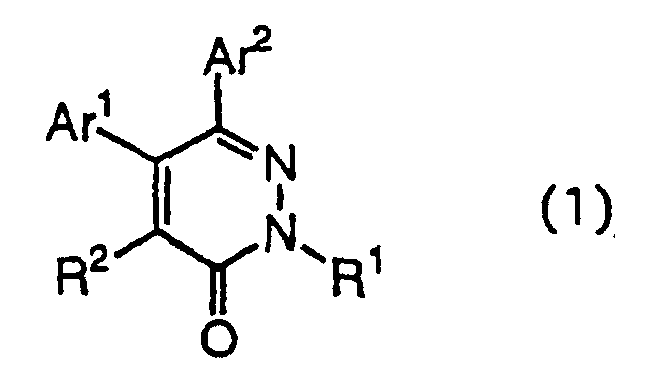
  • the present invention provides a pyridazin-3-one derivative represented by the following formula (1): wherein Ar 1 represents a substituted or unsubstituted aromatic group, Ar 2 represents a phenyl group having a substituent at least at the 4-position thereof, R 1 represents a linear or branched alkyl group, an alkyl group having a cyclic structure, a substituted or unsubstituted phenyl group or a substituted or unsubstituted phenyl (lower alkyl) group, and R 2 represents a cyano group, a carboxyl group, a (lower alkoxy) carbonyl group, a substituted or unsubstituted lower alkyl group or a substituted or unsubstituted carbamoyl group; or a salt thereof.
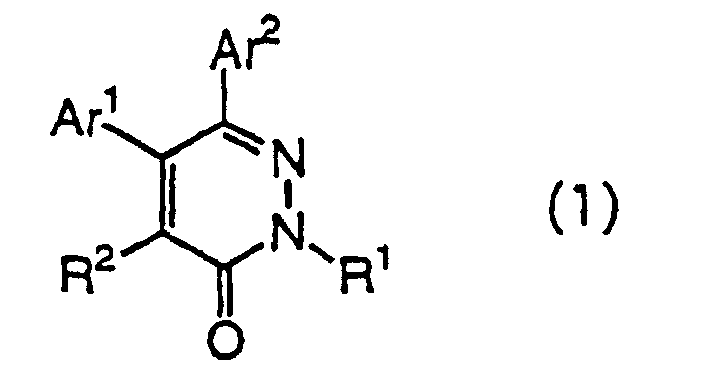
  • Ar 1 represents a substituted or unsubstituted aromatic group
  • Ar 2 represents a phenyl group having a substituent at least at the 4-position thereof
  • R 1 represents
  • the present invention also provides a medicine comprising the pyridazin-3-one derivative (1) or the salt thereof as an effective ingredient.
  • the present invention also provides an inhibitor of interleukin-1 ⁇ production comprising the pyridazin-3-one derivative (1) or the salt thereof as an effective ingredient.
  • the present invention also provides a pharmaceutical composition
  • a pharmaceutical composition comprising the pyridazin-3-one derivative (1) or the salt thereof and a pharmaceutically acceptable carrier.
  • the present invention also provides use of the pyridazin-3-one derivative (1) or the salt thereof as a medicine.
  • the present invention also provides a method for treating a disease caused by stimulation of interleukin-1 ⁇ production, which comprises administering the pyridazin-3-one derivative (1) or the salt thereof.
  • the pyridazin-3-one derivative according to the present invention is represented by the formula (1).
  • examples of the aromatic group represented by Ar 1 can include all aromatic hydrocarbon groups and heterocyclic aromatic groups, such as phenyl, naphthyl, pyridyl and quinolyl groups, with a phenyl group being particularly preferred.
  • Illustrative of one or more substituents which the aromatic group may have are halogen atoms, lower alkoxy group,s lower alkylthio groups, lower alkylsulfinyl groups, and lower alkylsulfonyl groups.
  • examples of the halogen atoms can include fluorine, chlorine, bromine and iodine atoms.
  • lower alkyl moieties in the lower alkoxy, lower alkylthio, lower alkylsulfinyl and lower alkylsulfonyl groups can include linear, branched or cyclic alkyl groups having 1 to 6 carbon atoms, for example, methyl, ethyl, n-propyl, isopropyl, n-butyl, isobutyl and t-butyl groups.
  • lower alkoxy groups are preferred with a methoxy group being particularly preferred.
  • Illustrative of the substituent which the substituted phenyl group represented by Ar 2 has at the 4-position thereof are lower alkoxy, lower alkylthio, lower alkylsulfinyl and lower alkylsulfonyl groups. More specifically, groups similar to those exemplified above in connection with Ar 1 can be mentioned, with lower alkoxy groups, especially a methoxy group being preferred. Further, the substituted phenyl group may be substituted at other position or positions by halogen atoms, lower alkoxy groups or the like. Examples of these halogen atoms and lower alkoxy groups can be similar to those exemplified above in connection with Ar 1 can be mentioned.
  • Illustrative of the linear or branched alkyl group represented by R 1 are those having 2 to 11 carbon atoms, for examples, ethyl, n-propyl, isopropyl, n-butyl, isobutyl, t-butyl, pentyl, hexyl and heptyl groups.
  • Illustrative of the alkyl groups having cyclic structures are cycloalkyl groups having 3 to 7 carbon atoms, such as cyclopropyl, cyclobutyl, cyclopentyl and cyclohexyl groups; and lower alkyl groups, such as methyl and ethyl groups, with such cycloalkyl groups substituted thereon.
  • substituent groups on the substituted phenyl or phenyl(lower alkyl) group represented by R 1 can include halogen atoms, lower alkyl groups, and lower alkoxy groups. Examples of these halogen atoms, lower alkyl groups and lower alkoxy groups can be similar to those exemplified above in connection with Ar 1 .
  • substituents on the substituted lower alkyl group represented by R 2 can include halogen atoms, hydroxy groups, and substituted or unsubstituted phthalimido groups.
  • substituents on the phthalimide groups are halogen atoms, nitro groups, lower alkoxy groups, and amino groups which may contain, as substituents, lower alkyl groups, lower alkylsulfonyl groups or lower alkylcarbonyl groups.
  • substituent or substituents on the substituted carbamoyl group represented by R 2 are lower alkyl groups, aromatic groups, and lower alkyl groups substituted by aromatic groups.
  • Illustrative of the lower alkyl moiety or moieties of the substituted lower alkyl or lower alkoxycarbonyl group represented by R 2 , the halogen atom or atoms as substituent or substituents of the substituted lower alkyl or lower alkoxy carbonyl group, the lower alkyl moieties of the lower alkyl, lower alkoxy, lower alkylsulfonyl, lower alkylcarbonyl and aromatic-group-substituted lower alkyl group, and the aromatic moieties of the aromatic group and aromatic-group-substituted lower alkyl group can be similar to those exemplified above in connection with Ar 1 .
  • the aromatic group a phenyl or pyridyl group is particularly preferred.
  • Preferred specific examples of the pyridazin-3-one derivative (1) according to the present invention can include 5,6-bis(4-methoxyphenyl)-4-carbamoyl-2-cyclopropylmethyl-2H-pyridazin-3-one, 5,6-bis(4-methoxyphenyl)-4-cyano-2-ethyl-2H-pyridazin-3-one, 5,6-bis(4-methoxyphenyl)-4-cyano-2-cyclopropylmethyl-2H-pyridazin-3-one, 5,6-bis(4-methoxyphenyl)-4-cyano-2-cyclopentylmethyl-2H-pyridazin-3-one, 2-benzyl-5,6-bis(4-methoxyphenyl)-4-ethoxycarbonyl-2H-pyridazin-3-one, 5,6-bis(4-methoxyphenyl)-4-ethoxycarbonyl-2-isopropyl-2H-pyridazin
  • Illustrative of the salts of the pyridazin-3-one derivative (1) are the hydrochloride, nitrate, hydrobromide, acetate, sulfate, p-toluenesulfonate, methanesulfonate, fumarate, succinate, lactate, sodium salt, potassium salt, magnesium salt, calcium salt, ammonium salt, methylammonium salt, dimethylammonium salt, and trimethylammonium.
  • the pyridazin-3-one derivative (1) or the salt thereof according to the present invention may exist in the form of a keto-enol tautomer and solvates. Such tautomer and solvates should also be encompassed by the present invention.
  • pyridazin-3-one (1) or the salt thereof according to the present invention No particular limitation is imposed on a process for the preparation of the pyridazin-3-one (1) or the salt thereof according to the present invention, and a variety of processes, which have conventionally been used for the synthesis of pyridazine derivatives, and their modifications can be used.
  • the pyridazin-3-one derivative (1) according to the present invention can be prepared, for example, by the following reaction scheme.
  • R 3 and R 4 may be the same or different and each independently represent a hydrogen atom, a lower alkyl group, an aromatic group or an aromatic-group-substituted lower alkyl group
  • X represents a halogen atom
  • R 5 and R 6 may be the same or different and each independently represent a hydrogen atom, a halogen atom, a nitro group, a lower alkoxy group, or an amino group which may have, as substituent or substituents, one or two of lower alkyl groups, lower alkylcarbonyl groups and lower alkylsulfonyl groups
  • R 7 represents a lower alkyl group.
  • the starting materials i.e., the compounds represented by the formula (2) and (3), respectively, can be prepared by known processes (J. Med. Chem., 23 , 1398-1405, 1980; Eur. J. Med. Chem., 14 , 53-60, 1979).
  • a 2 N aqueous solution of sodium hydroxide (4 ml) was added to a solution of 5,6-bis(4-methoxyphenyl)-4-cyano-2-cyclopropylmethyl-2H-pyridazin-2-one (171 mg, 0.44 mmol) in methanol (2 ml), followed by stirring at a bath temperature of 70°C for 8 hours.
  • a mixture of 2 N aqueous solution of sodium hydroxide (1 ml) and methanol (2 ml) was added further, followed by stirring at a bath temperature of 70°C for 12 hours. After the methanol was distilled off, the residue was extracted with ethyl acetate.
  • the extract was washed with water and brine, successively, and was then dried over anhydrous sodium sulfate.
  • the solvent was distilled off.
  • the residue (197 mg) was separated and purified by silica gel preparative chromatography [developer: chloroform/methanol (10/1)] and then crystallized from chloroform-diethyl ether-hexane, whereby the title compound (158 mg, 88.2%) was obtained as pale yellow prisms.
  • Example 2 Using 5,6-bis(4-methoxyphenyl)-4-cyano-2H-pyridazin-3-one and ethyl iodide as starting materials, the procedures of Example 1 were repeated likewise, whereby the title compound was obtained in a yield of 76.8%. Yellow prisms (ethyl acetate)
  • Example 2 Using 5,6-bis(4-methoxyphenyl)-4-cyano-2H-pyridazin-3-one and 1-bromopropane as starting materials, the procedures of Example 1 were repeated likewise, whereby the title compound was obtained in a yield of 72.6%. Pale yellow scales (ethyl acetate-diethyl ether)
  • Example 2 Using 5,6-bis(4-methoxyphenyl)-4-cyano-2H-pyridazin-3-one and isopropyl chloride as starting materials, the procedures of Example 1 were repeated likewise, whereby the title compound was obtained in a yield of 72.6%. Pale yellow crystals (ethyl acetate-diethyl ether)
  • Example 2 Using 5,6-bis(4-methoxyphenyl)-4-cyano-2-isopropyl-2H-pyridazin-3-one as a starting material, the procedures of Example 2 were repeated likewise, whereby the title compound was obtained in a yield of 72.0%. Slightly yellow needles (chloroform-ethyl acetate-diethyl ether)
  • Example 1 Using 5,6-bis(4-methoxyphenyl)-4-cyano-2H-pyridazin-3-one and isobutyl chloride as starting materials, the procedures of Example 1 were repeated likewise, whereby the title compound was obtained in a yield of 71.8%. Pale yellow scales (ethyl acetate-hexane)
  • Example 2 Using 5,6-bis(4-methoxyphenyl)-4-cyano-2H-pyridazin-3-one and cyclopentylmethyl chloride as starting materials, the procedures of Example 1 were repeated likewise, whereby the title compound was obtained in a yield of 42.4%. Yellow needles (ethyl acetate-diethyl ether)
  • Example 2 Using 5,6-bis(4-methoxyphenyl)-4-cyano-2H-pyridazin-3-one and cyclohexylmethyl chloride as starting materials, the procedures of Example 1 were repeated likewise, whereby the title compound was obtained in a yield of 45.0%. Yellow needles (chloroform-ethyl acetate)
  • Example 1 Using 5,6-bis(4-methoxyphenyl)-4-cyano-2H-pyridazin-3-one and benzyl chloride as starting materials, the procedures of Example 1 were repeated likewise, whereby the title compound was obtained in a yield of 65.4%. Orange needles (chloroform-diethyl ether)
  • the extract was dried over anhydrous sodium carbonate, the solvent was distilled off under reduced pressure, and the residue was then crystallized from ethyl acetate-hexane, whereby the title compound (1.54 g, 89.4%) was obtained as colorless prisms.
  • p-Toluenesulfonyl chloride (84 mg) was added to a solution of 5,6-bis(4-methoxyphenyl)-4-carboxy-2-isobutyl-2H-pyridazin-3-one (150 mg, 0.37 mmol) in pyridine (5 ml), followed by stirring at room temperature for 30 minutes. Methylamine hydrochloride (124 mg) was then added, and the mixture was stirred overnight. Water was added to the reaction mixture, followed by extraction with chloroform. The extract was dried over anhydrous sodium sulfate, the solvent was distilled off under reduced pressure, and the residue was then separated and purified by chromatography on a silica gel column. Crystallization was conducted from chloroform-hexane, whereby the title compound (76.4 mg, 49.4%) was obtained as slightly yellow needles.
  • Example 22 Using 5,6-bis(4-methoxyphenyl)-4-carboxy-2-isobutyl-2H-pyridazin-3-one and aniline as starting materials, the procedures of Example 22 were repeated likewise, whereby the title compound was obtained in a yield of 89.0%. Pale yellow needles (chloroform-hexane)
  • Example 19 Using 5,6-bis(4-methoxyphenyl)-4-ethoxycarbonyl-2H-pyridazin-3-one and (chloromethyl)cyclopropane as starting materials, the procedures of Example 19 were repeated likewise, whereby the title compound was obtained in a yield of 89.1%. Colorless needles (ethyl acetate-hexane)
  • Example 22 Using 5,6-bis(4-methoxyphenyl)-4-carboxy-2-cyclopropylmethyl-2H-pyridazin-3-one and methylamine hydrochloride as starting materials, the procedures of Example 22 were repeated likewise, whereby the title compound was obtained in a yield of 88.2%. Pale yellow prisms (chloroform-hexane)
  • Example 20 Using 2-benzyl-5,6-bis(4-methoxyphenyl)-4-ethoxycarbonyl-2H-pyridazin-3-one as a starting material, the procedures of Example 20 were repeated likewise, whereby the title compound was obtained in a yield of 89.4%. Yellow prisms (chloroform-methanol-hexane)
  • Triethylamine (278.7 mg) and ethyl chlorocarbonate (298.9 mg) were added under ice cooling to a solution of 5,6-bis(4-methoxyphenyl)-4-carboxy-2-isobutyl-2H-pyridazin-3-one. (750 mg, 1.84 mmol) in tetrahydrofuran (8 ml), followed by stirring for 1 hour.
  • the reaction mixture was filtered. Under ice cooling, sodium borohydride (277.8 mg) was added to the filtrate, followed by stirring for 1 hour. The mixture was stirred further at room temperature for 2 hours.
  • the reaction mixture was concentrated, to which a saturated aqueous solution of ammonium chloride was added.
  • HL-60 cells were cultured for 4 days until confluence on RPMI 1640 medium with 10% fetal bovine serum (FBS) added thereto. The medium was centrifuged. The supernatant was discarded, and the cells were then suspended at 1 x 10 6 cells/ml on RPMI 1640 medium with 3% FBS, and lipopolysaccharide was added to give a final concentration of 10 ⁇ g/ml.
  • the culture was inoculated at 1 ml/well to a 24-well plate. A test compound was added at 1 ⁇ l/well, followed by culturing for 3 days. Three days later, the amount of interleukin-1 ⁇ in each culture was determined by ELISA.
  • the compounds according to the present invention have been found to have extremely good inhibitory activity against interleukin-1 ⁇ production compared with the comparative compounds, which are the compounds disclosed in Eur. J. Med. Chem., 14 , 53-60, 1979.
  • the pyridazin-3-one derivatives (1) and their salts, which pertain to the present invention, have excellent inhibitory activity against interleukin-1 ⁇ production, and are useful as medicines such as preventives and therapeutics for immune system diseases, inflammatory diseases and ischemic diseases.

Landscapes

  • Health & Medical Sciences (AREA)
  • Chemical & Material Sciences (AREA)
  • Organic Chemistry (AREA)
  • Life Sciences & Earth Sciences (AREA)
  • Engineering & Computer Science (AREA)
  • Bioinformatics & Cheminformatics (AREA)
  • Veterinary Medicine (AREA)
  • Public Health (AREA)
  • General Health & Medical Sciences (AREA)
  • Medicinal Chemistry (AREA)
  • Animal Behavior & Ethology (AREA)
  • Pharmacology & Pharmacy (AREA)
  • General Chemical & Material Sciences (AREA)
  • Nuclear Medicine, Radiotherapy & Molecular Imaging (AREA)
  • Chemical Kinetics & Catalysis (AREA)
  • Physical Education & Sports Medicine (AREA)
  • Immunology (AREA)
  • Rheumatology (AREA)
  • Orthopedic Medicine & Surgery (AREA)
  • Cardiology (AREA)
  • Heart & Thoracic Surgery (AREA)
  • Pain & Pain Management (AREA)
  • Vascular Medicine (AREA)
  • Urology & Nephrology (AREA)
  • Transplantation (AREA)
  • Epidemiology (AREA)
  • Pharmaceuticals Containing Other Organic And Inorganic Compounds (AREA)
  • Plural Heterocyclic Compounds (AREA)
  • Saccharide Compounds (AREA)
  • Fats And Perfumes (AREA)
  • Organic Low-Molecular-Weight Compounds And Preparation Thereof (AREA)

Abstract

Objects of the invention are to provide compounds having excellent activity against interleukin-1β production and also medicines comprising them as effective ingredients.
Pyridazin-3-one derivatives represented by the following formula (1):
Figure 80000001
wherein Ar1 represents a substituted or unsubstituted aromatic group, Ar2 represents a phenyl group having a substituent at least at the 4-position thereof, R1 represents a linear or branched alkyl group, an alkyl group having a cyclic structure, a substituted or unsubstituted phenyl group or a substituted or unsubstituted phenyl(lower alkyl) group, and R2 represents a cyano group, a carboxyl group, a (lower alkoxy)carbonyl group, a substituted or unsubstituted lower alkyl group or a substituted or unsubstituted carbamoyl group, or salts thereof; and medicines comprising them as effective ingredients.

Description

Technical Field
This invention relates to novel pyridazin-3-one derivatives, which have excellent inhibitory activity against interleukin-1β production and are useful for the prevention and treatment of immune system diseases, inflammatory diseases, ischemic diseases and the like, and also to medicines containing them as effective ingredients.
Background Art
In many diseases, for example, rheumatism, arthritis, osteoporosis, inflammatory colitis, immune deficiency syndrome, ichorrhemia, hepatitis, nephritis, ischemic diseases, insulin-dependent diabetes mellitus, arterial sclerosis, Parkinson's disease, Alzheimer's disease, leukemia and the like, stimulation of interleukin-1β production, an inflammatory cytokine, is observed. This interleukin-1β serves to induce synthesis of an enzyme which is considered to take part in inflammation like collagenase and PLA2 and, when intra-articularly injected to animals, causes multiarticular destruction highly resembling rheumatoid arthritis. In the normal living body, on the other hand, interleukin-1β is controlled in activity by interleukin-1 receptor, soluble interleukin-1 receptor and interleukin-1 receptor antagonist.
From research conducted making use of recombinants of these bioactivity-inhibiting substances, anti-interleukin-1β antibodies and anti-receptor antibodies against various disease models, interleukin-1β has been found to play an important role in the body, leading to an increasing potential of substances having interleukin-1β inhibitory activity as therapeutics for such diseases.
For example, immunosuppressors and steroids which are used for the treatment of rheumatism out of such many diseases have been reported to inhibit the production of interleukin-1β. Even among medicaments currently under development, KE298, a benzoylpropionic acid derivative [The Japanese Society of Inflammation (11th), 1990], for example, has been reported to have inhibitory activity against interleukin-1β production although it is an immunoregulator. Inhibitory activity against interleukin-1β production is also observed on a group of compounds which are called "COX-2 selective inhibitors", for example, nimesulide as a phenoxysulfonanilide derivative (DE 2333643), T-614 as a phenoxybenzopyran derivative (US 4954518), and tenidap (hydroxyindole derivative) as a dual inhibitor (COX-1/5-LO).
For all of these compounds, however, interleukin-1β production inhibitory activity is not their primary action so that their inhibitory activity against interleukin-1β production is lower than their primary action.
In recent years, increasingly active synthesis research is under way with a focus placed on inhibitory activity against interleukin-1β production. Production inhibitors can be classified into a group of compounds which inhibit the transfer process of an inflammatory signal to a cell nucleus and another group of compounds which inhibit an enzyme ICE that functions in the processing of a precursor of interleukin-1β. Known examples of compounds presumed to have the former action include SB203580 [Japanese Language Laid-Open (Kokai) Publication (PCT) No. HEI 7-503017], FR167653 (Eur. J. Pharm., 327, 169-175, 1997), E-5090 (EP 376288), CGP47969A (Gastroenterology, 109, 812-828, 1995), hydroxyindole derivatives (Eur. J. Med. Chem. 31, 187-198, 1996), and triarylpyrrole derivatives (WO 97/05878), while known examples of compounds presumed to have the latter action include VE-13,045 which is a peptide compound (Cytokine, 8(5), 377-386, 1996).
None of these compounds can however exhibit sufficient inhibitory activity against interleukin-1β production.
On the other hand, it is known that a variety of 5,6-diphenylpyridazine derivatives have analgesic and anti-inflammatory action (Eur. J. Med. Chem., 14, 53-60, 1979). Absolutely nothing has however been known with respect to inhibitory activity of these 5,6-diphenylpyridazine derivatives against interleukin-1β production.
Accordingly, an object of the present invention is to provide a compound having excellent inhibitory activity against interleukin-1β production and also a medicine containing it as an effective ingredient.
Disclosure of the Invention
Under such circumstances, the present inventors have proceeded with an extensive investigation. As a result, it has been found that pyridazin-3-one derivatives represented by the below-described formula (1) have excellent inhibitory activity against interleukin-1β production and are useful as medicines for the prevention and treatment of immune system diseases, inflammatory diseases and ischemic diseases, leading to the completion of the present invention.
Namely, the present invention provides a pyridazin-3-one derivative represented by the following formula (1):
Figure 00050001
wherein Ar1 represents a substituted or unsubstituted aromatic group, Ar2 represents a phenyl group having a substituent at least at the 4-position thereof, R1 represents a linear or branched alkyl group, an alkyl group having a cyclic structure, a substituted or unsubstituted phenyl group or a substituted or unsubstituted phenyl (lower alkyl) group, and R2 represents a cyano group, a carboxyl group, a (lower alkoxy) carbonyl group, a substituted or unsubstituted lower alkyl group or a substituted or unsubstituted carbamoyl group; or a salt thereof.
The present invention also provides a medicine comprising the pyridazin-3-one derivative (1) or the salt thereof as an effective ingredient.
Further, the present invention also provides an inhibitor of interleukin-1β production comprising the pyridazin-3-one derivative (1) or the salt thereof as an effective ingredient.
Furthermore, the present invention also provides a pharmaceutical composition comprising the pyridazin-3-one derivative (1) or the salt thereof and a pharmaceutically acceptable carrier.
Moreover, the present invention also provides use of the pyridazin-3-one derivative (1) or the salt thereof as a medicine.
In addition, the present invention also provides a method for treating a disease caused by stimulation of interleukin-1β production, which comprises administering the pyridazin-3-one derivative (1) or the salt thereof.
Best Mode for Carrying out the Invention
The pyridazin-3-one derivative according to the present invention is represented by the formula (1).
In the formula (1), examples of the aromatic group represented by Ar1 can include all aromatic hydrocarbon groups and heterocyclic aromatic groups, such as phenyl, naphthyl, pyridyl and quinolyl groups, with a phenyl group being particularly preferred. Illustrative of one or more substituents which the aromatic group may have are halogen atoms, lower alkoxy group,s lower alkylthio groups, lower alkylsulfinyl groups, and lower alkylsulfonyl groups. Examples of the halogen atoms can include fluorine, chlorine, bromine and iodine atoms. Examples of the lower alkyl moieties in the lower alkoxy, lower alkylthio, lower alkylsulfinyl and lower alkylsulfonyl groups can include linear, branched or cyclic alkyl groups having 1 to 6 carbon atoms, for example, methyl, ethyl, n-propyl, isopropyl, n-butyl, isobutyl and t-butyl groups. Among these substituents, lower alkoxy groups are preferred with a methoxy group being particularly preferred.
Illustrative of the substituent which the substituted phenyl group represented by Ar2 has at the 4-position thereof are lower alkoxy, lower alkylthio, lower alkylsulfinyl and lower alkylsulfonyl groups. More specifically, groups similar to those exemplified above in connection with Ar1 can be mentioned, with lower alkoxy groups, especially a methoxy group being preferred. Further, the substituted phenyl group may be substituted at other position or positions by halogen atoms, lower alkoxy groups or the like. Examples of these halogen atoms and lower alkoxy groups can be similar to those exemplified above in connection with Ar1 can be mentioned.
Illustrative of the linear or branched alkyl group represented by R1 are those having 2 to 11 carbon atoms, for examples, ethyl, n-propyl, isopropyl, n-butyl, isobutyl, t-butyl, pentyl, hexyl and heptyl groups. Illustrative of the alkyl groups having cyclic structures are cycloalkyl groups having 3 to 7 carbon atoms, such as cyclopropyl, cyclobutyl, cyclopentyl and cyclohexyl groups; and lower alkyl groups, such as methyl and ethyl groups, with such cycloalkyl groups substituted thereon. Examples of substituent groups on the substituted phenyl or phenyl(lower alkyl) group represented by R1 can include halogen atoms, lower alkyl groups, and lower alkoxy groups. Examples of these halogen atoms, lower alkyl groups and lower alkoxy groups can be similar to those exemplified above in connection with Ar1.
Examples of substituents on the substituted lower alkyl group represented by R2 can include halogen atoms, hydroxy groups, and substituted or unsubstituted phthalimido groups. Illustrative of substituents on the phthalimide groups are halogen atoms, nitro groups, lower alkoxy groups, and amino groups which may contain, as substituents, lower alkyl groups, lower alkylsulfonyl groups or lower alkylcarbonyl groups. Illustrative of the substituent or substituents on the substituted carbamoyl group represented by R2 are lower alkyl groups, aromatic groups, and lower alkyl groups substituted by aromatic groups. Illustrative of the lower alkyl moiety or moieties of the substituted lower alkyl or lower alkoxycarbonyl group represented by R2, the halogen atom or atoms as substituent or substituents of the substituted lower alkyl or lower alkoxy carbonyl group, the lower alkyl moieties of the lower alkyl, lower alkoxy, lower alkylsulfonyl, lower alkylcarbonyl and aromatic-group-substituted lower alkyl group, and the aromatic moieties of the aromatic group and aromatic-group-substituted lower alkyl group can be similar to those exemplified above in connection with Ar1. As the aromatic group, a phenyl or pyridyl group is particularly preferred.
Preferred specific examples of the pyridazin-3-one derivative (1) according to the present invention can include 5,6-bis(4-methoxyphenyl)-4-carbamoyl-2-cyclopropylmethyl-2H-pyridazin-3-one, 5,6-bis(4-methoxyphenyl)-4-cyano-2-ethyl-2H-pyridazin-3-one, 5,6-bis(4-methoxyphenyl)-4-cyano-2-cyclopropylmethyl-2H-pyridazin-3-one, 5,6-bis(4-methoxyphenyl)-4-cyano-2-cyclopentylmethyl-2H-pyridazin-3-one, 2-benzyl-5,6-bis(4-methoxyphenyl)-4-ethoxycarbonyl-2H-pyridazin-3-one, 5,6-bis(4-methoxyphenyl)-4-ethoxycarbonyl-2-isopropyl-2H-pyridazin-3-one, and 5,6-bis(4-methoxyphenyl)-2-isobutyl-4-phthalimidomethyl-2H-pyridazin-3-one.
Illustrative of the salts of the pyridazin-3-one derivative (1), said salt also pertaining to the present invention, are the hydrochloride, nitrate, hydrobromide, acetate, sulfate, p-toluenesulfonate, methanesulfonate, fumarate, succinate, lactate, sodium salt, potassium salt, magnesium salt, calcium salt, ammonium salt, methylammonium salt, dimethylammonium salt, and trimethylammonium. Further, the pyridazin-3-one derivative (1) or the salt thereof according to the present invention may exist in the form of a keto-enol tautomer and solvates. Such tautomer and solvates should also be encompassed by the present invention.
No particular limitation is imposed on a process for the preparation of the pyridazin-3-one (1) or the salt thereof according to the present invention, and a variety of processes, which have conventionally been used for the synthesis of pyridazine derivatives, and their modifications can be used. The pyridazin-3-one derivative (1) according to the present invention can be prepared, for example, by the following reaction scheme.
Figure 00110001
wherein Ar1, Ar2, R1 and R2 have the same meanings, R3 and R4 may be the same or different and each independently represent a hydrogen atom, a lower alkyl group, an aromatic group or an aromatic-group-substituted lower alkyl group, X represents a halogen atom, R5 and R6 may be the same or different and each independently represent a hydrogen atom, a halogen atom, a nitro group, a lower alkoxy group, or an amino group which may have, as substituent or substituents, one or two of lower alkyl groups, lower alkylcarbonyl groups and lower alkylsulfonyl groups, and R7 represents a lower alkyl group.
The starting materials, i.e., the compounds represented by the formula (2) and (3), respectively, can be prepared by known processes (J. Med. Chem., 23, 1398-1405, 1980; Eur. J. Med. Chem., 14, 53-60, 1979).
  • (A) Preparation of a compound (1a) in which R2 is a cyano group: This cyano-substituted pyridazin-3-one derivative can be prepared by reacting a compound, which is represented by R1-Y in which R1 has the same meaning as defined above and Y represents a halogen atom or a reactive esterified hydroxyl group, with a compound represented by the formula (2) in the presence of a base in a solvent.Examples of the base usable in the reaction can include inorganic bases such as potassium carbonate and sodium carbonate and organic bases such as metal alkoxides. Usable examples of the solvent can include N,N-dimethylformamide, dimethylsulfoxide, acetone and methyl ethyl ketone. The reaction may be conducted preferably at 20 to 150°C for 1 to 20 hours, notably at 50 to 130°C for 2 to 10 hours.
  • (B) Preparation of a compound (1b) in which R2 is a carbamoyl group: This carbamoyl-substituted pyridazin-3-one derivative (1b) can be prepared by reacting a base, such as caustic soda or caustic potash, with the compound (1a) in a solvent.
  • (C) Preparation of a compound (1c) in which R2 is an ethoxycarbonyl group: This ethoxycarbonyl-substituted pyridazin-3-one derivative (1c) can be prepared by reacting R1-Y, which was also used in (A), with the compound represented by the formula (3) in the presence of a base in a solvent.Examples of the base usable in the reaction can include inorganic bases such as potassium carbonate and sodium carbonate and organic bases such as metal alkoxides. Usable examples of the solvent can include N,N-dimethylformamide, dimethylsulfoxide, acetone and methyl ethyl ketone. The reaction may be conducted preferably at 20 to 150°C for 1 to 20 hours, notably at 50 to 130°C for 2 to 10 hours.
  • (D) Preparation of a compound (1d) in which R2 is a carboxyl group: This carboxyl-substituted pyridazin-3-one derivative (1d) can be prepared by hydrolyzing the compound (1c) in the presence of a base, such as caustic soda or caustic potash, in a solvent in a manner known per se in the art.
  • (E) Preparation of a compound (1e) in which R2 is a substituted carbamoyl group: This substituted-carbamoyl-substituted pyridazin3-one derivative (1e) can be prepared by converting the compound (1d) at the carboxyl group thereof into a reactive derivative and then reacting it with a corresponding amine R3R4NH in which R3 and R4 have the same meanings as defined above.Examples of the reactive derivative at the carboxyl group can include acid halides and mixed acid anhydrides. Conversion into such an acid halide can be effected with oxalyl chloride, thionyl chloride, thionyl bromide or the like. Conversion into such a mixed acid anhydride, on the other hand, can be effected with acetic anhydride, pivalic anhydride, methanesulfonic anhydride, p-toluenesulfonyl chloride or the like. The synthesis reaction of the reactive derivative may be conducted preferably in the presence or absence of a base at -10 to 150°C for 1 to 20 hours, especially at 0 to 130°C for 1 to 10 hours in a solvent, for example, tetrahydrofuran, N,N-dimethylformamide, dimethylsulfoxide, pyridine, chloroform, methylene chloride, toluene or benzene.
  • (F) Preparation of a compound (1f) in which R2 is a hydroxymethyl group: This hydroxymethyl-substituted pyridazin-3-one derivative (1f) can be prepared by reacting an alkyl halocarbonate compound, such as ethyl chlorocarbonate, with the compound (1d) in the presence of a base such as triethylamine in a solvent to form a mixed acid anhydride and then reacting sodium borohydride with the mixed acid anhydride.Usable examples of the solvent can include tetrahydrofuran, dioxane, diethyl ether, and ethyl acetate. The reaction may be conducted preferably at -20 to 50°C for 0.5 to 10 hours, notably at 0 to 30°C for 0.5 to 3 hours.
  • (G) Preparation of a compound (1g) in which R2 is a halogenated methyl group: This halogenated-methyl-substituted pyridazin-3-one derivative (1g) in which X is a chlorine atom or bromine atom can be prepared by reacting a halogenating agent, such as thionyl chloride, thionyl bromide, phosphorus trichloride, phosphorus pentachloride or phosphorus tribromide, with the compound (1f) in a solvent. Further, the halogenated-methyl-substituted pyridazin-3-one derivative (1g) in which X is an iodine atom can be prepared by reacting sodium iodide, potassium iodide or the like with the above compound in a solvent.Usable examples of the solvent for the halogenation (chlorination, bromination) can include benzene, toluene, tetrahydrofuran, dioxane, diethyl ether, ethyl acetate, and chloroform. The reaction may be conducted preferably at 20 to 130°C for 0.5 to 5 hours, especially at 30 to 100°C for 1 to 3 hours. In the preparation of the compound (1g) in which X is an iodine atom, acetone, methyl ethyl ketone, N,N-dimethylformamide, dimethyl sulfoxide, ethyl acetate, chloroform or the like can be used as the solvent. The reaction may be conducted preferably at 40 to 150°C for 0.5 to 10 hours, notably at 50 to 120°C for 1 to 5 hours.
  • (H) Preparation of a compound (1h) in which R2 is a (substituted) phthalimidomethyl group: This compound (1h) which has a (substituted) phthalimidomethyl group at the 4-position can be prepared by reacting potassium phthalimide or substituted potassium phthalimide with the compound (1g) in a solvent.Usable examples of the solvent can include N,N-dimethylformamide, dimethyl sulfoxide, tetrahydrofuran, dioxane, benzene, and toluene. The reaction may be conducted preferably at 50 to 150°C for 0.5 to 5 hours, notably at 70 to 120°C for 1 to 3 hours.
  • (I) Preparation of a compound (1i) in which R2 is a (lower alkoxy)carbonyl group: This (lower alkoxy)carbonyl-substituted pyridazin-3-one derivative (1i) can be prepared by reacting a lower alcohol R7-OH, in which R7 has the same meaning as defined above, with the reactive derivative of the compound (1d) at the carboxyl thereof, which was used in the preparation of the compound (1e), in the presence or absence of a base in a solvent such as tetrahydrofuran, N,N-dimethylformamide, dimethyl sulfoxide, ethyl acetate, pyridine, chloroform, methylene chloride, toluene or benzene. As an alternative process, it can also be prepared by a usual ester preparation process, namely, by reacting the lower alcohol R7-OH with the compound (1d) in the presence of an acid catalyst in a solvent.The intermediates and target compounds obtained in the above-described individual reactions can be separated and purified by purification methods commonly employed in organic synthesis chemistry, for example, by subjecting them to filtration, extraction, washing, drying, concentration, recrystallization, various chromatographic treatment, and the like. The intermediates may be provided for the next reactions without purifying them specifically. Further, they may also be obtained as solvates of solvents such as reaction solvents or recrystallization solvents, especially as hydrates.The pyridazin-3-one derivatives (1) and their salts according to the present invention, which are available as described above, have excellent inhibitory activity against interleukin-1β production, and are useful as preventives or therapeutics for immune system diseases, inflammatory diseases, ischemic diseases, osteoporosis, ichorrhemia, rheumatism, arthritis and inflammatory colitis.Medicines according to the present invention contain the pyridazin-3-one derivatives (1) or their salts as effective ingredients. Using them alone or together with pharmacologically-acceptable carriers such as solubilizers, excipients, binders or extenders, they can be formed into pharmaceutical preparation forms such as tablets, capsules, granules, powders, injections and suppositories. These pharmaceutical preparations can be produced by known methods. For example oral preparations can be produced by suitably formulating the pyridazin-3-one derivatives (1) or their salts in combination with solubilizers such as tragacanth gum, gum arabic, sucrose esters, lecithin, olive oil, soybean oil and PEG400; excipients such as starch, mannitol and lactose; binders such as carboxymethylcellulose sodium and hydroxypropylcellulose; disintegrators such as crystalline cellulose and carboxymethylcellulose calcium; lubricants such as talc and magnesium stearate; anticaking agents such as light anhydrous silicic acid.The dosage of each medicine according to the present invention varies depending on the body weight, age, sex, conditions and the like. In general, however, it is preferred to orally or parenterally administer to an adult the medicine in an amount of about 0.01 to 1,000 mg, preferably 0.1 to 100 mg in terms of the compound represented by the formula (1) per day at once or in several portions.
  • Examples
    The present invention will next be described in further detail by the following Examples. It should however be borne in mind that the present invention is not limited to these Examples.
    Example 1 Preparation of 5,6-bis(4-methoxyphenyl)-4-cyano-2-cyclopropylmethyl-2H-pyridazin-3-one
    (Chloromethyl)cyclopropane (0.6 mℓ, 6.36 mmol) was added to a solution of 5,6-bis(4-methoxyphenyl)-4-cyano-2H-pyridazin-3-one (1.71 g, 5.10 mmol) and potassium carbonate (2.02 g, 14.62 mmol) in N,N-dimethyl-formamide (5 mℓ), followed by stirring at a bath temperature of 80°C for 6 hours. Water was then added to the reaction mixture, followed by extraction with ethyl acetate (300 mℓ). The organic layer was washed with water and a saturated aqueous solution of sodium chloride (brine), successively, and was then dried over anhydrous sodium sulfate. The solvent was distilled off, whereby the title compound (1.413 g, 71.5%) was obtained as yellow crystals.
    Pale yellow prisms (chloroform-diethyl ether).
  • Melting point: 175.6-176.1°C
  • 1H-NMR (CDCℓ3) δ: 0.47-0.54(2H,m), 0.54-0.67(2H,m), 1.36-1.52(1H,m), 3.79(3H,s), 3.83(3H,s), 4.15(2H,d,J=7.33Hz), 6.77(2H,d,J=9.04Hz), 6.88(2H,d,J=9.04Hz), 7.04(2H,d,J=9.04Hz), 7.16(2H,d,J=9.03Hz).
  • IR (KBr) cm1: 2235,1667,1608,1512,1255,1179,1024,837.
  • Example 2 Preparation of 5,6-bis(4-methoxyphenyl)-4-carbamoyl-2-cyclopropylmethyl-2H-pyridazin-3-one
    A 2 N aqueous solution of sodium hydroxide (4 mℓ) was added to a solution of 5,6-bis(4-methoxyphenyl)-4-cyano-2-cyclopropylmethyl-2H-pyridazin-2-one (171 mg, 0.44 mmol) in methanol (2 mℓ), followed by stirring at a bath temperature of 70°C for 8 hours. A mixture of 2 N aqueous solution of sodium hydroxide (1 mℓ) and methanol (2 mℓ) was added further, followed by stirring at a bath temperature of 70°C for 12 hours. After the methanol was distilled off, the residue was extracted with ethyl acetate. The extract was washed with water and brine, successively, and was then dried over anhydrous sodium sulfate. The solvent was distilled off. The residue (197 mg) was separated and purified by silica gel preparative chromatography [developer: chloroform/methanol (10/1)] and then crystallized from chloroform-diethyl ether-hexane, whereby the title compound (158 mg, 88.2%) was obtained as pale yellow prisms.
  • Melting point: 174.2-175.2°C
  • 1H-NMR (CDCℓ3) δ: 0.43-0.53(2H,m), 0.53-0.66(2H,m), 1.38-1.53(1H,m), 3.77(3H,s), 3.79(3H,s), 4.13(2H,d,J=7.33Hz), 5.74(1H,brs), 6.73(2H,d,J=8.79Hz), 6.79(2H,d,J=8.79Hz), 7.00(2H,J=8.30Hz), 7.05(2H,J=8.31Hz).
  • IR (KBr) cm1: 3371,3331,3173,1682,1635,1610,1583,1252, 1177,1027,828.
  • Mass(m/z): 405 (M+).
  • Example 3 Preparation of 5,6-bis(4-methoxyphenyl)-4-cyano-2-ethyl-2H-pyridazin-3-one
    Using 5,6-bis(4-methoxyphenyl)-4-cyano-2H-pyridazin-3-one and ethyl iodide as starting materials, the procedures of Example 1 were repeated likewise, whereby the title compound was obtained in a yield of 76.8%.
    Yellow prisms (ethyl acetate)
  • Melting point: 170.5-171.5°C
  • 1H-NMR (CDCℓ3) δ: 1.48(3H,t,J=7.33Hz), 3.79(3H,s), 3.83(3H,s), 4.35(2H,q,J=7.33Hz), 6.76(2H,d,J=8.79Hz), 6.88(2H,d,J=9.03Hz), 7.04(2H,d,J=9.03Hz), 7.15(2H,d,J=9.03Hz).
  • IR (KBr) cm-1: 2232,1660,1602,1516,1255,1174,1024,840.
  • Mass (m/z) : 361 (M+).
  • Example 4 Preparation of 5,6-bis(4-methoxyphenyl)-4-carbamoyl-2-ethyl-2H-pyridazin-3-one
    Using 5,6-bis(4-methoxyphenyl)-4-cyano-2-ethyl-2H-pyridazin-3-one as a starting material, the procedures of Example 2 were repeated likewise, whereby the title compound was obtained in a yield of 69.8%.
    Pale yellow prisms (chloroform-hexane)
  • Melting point: 226.2-227.5°C
  • 1H-NMR (CDCℓ3) δ: 1.47(3H,t,J=7.32Hz), 3.77(3H,s), 3.79(3H,s), 4.34(2H,q,J=7.32Hz), 5.69(1H,brs), 6.73(2H,d,J=8.79Hz), 6.79(2H,d,J=9.03Hz), 6.9-7.05(1H,br), 7.01(2H,d,J=9.03Hz), 7.02(2H,d,J=9.0Hz)
  • IR (KBr) cm-1: 3428,3316,1660,1647,1610,1520,1512,1249, 1183,1026,839.
  • Example 5 Preparation of 5,6-bis(4-methoxyphenyl)-4-cyano-2-n-propyl-2H-pyridazin-3-one
    Using 5,6-bis(4-methoxyphenyl)-4-cyano-2H-pyridazin-3-one and 1-bromopropane as starting materials, the procedures of Example 1 were repeated likewise, whereby the title compound was obtained in a yield of 72.6%.
    Pale yellow scales (ethyl acetate-diethyl ether)
  • Melting point: 151.4-151.9°C
  • 1H-NMR (CDCℓ3) δ: 1.03(3H,t,J=7.6Hz), 1.94(2H,sext,J=7.6Hz), 3.79(3H,s), 3.80(3H,s), 4.25(2H,t,J=7.6Hz), 6.77(2H,d,J=9.0Hz), 6.88(2H,d,J=9.0Hz), 7.03(2H,d,J=9.0Hz), 7.14(2H,d,J=8.8Hz).
  • IR (KBr) cm-1: 1665,1608,1609,1512,1252,1178,834.
  • Mass (m/z): 375 (M+).
  • Example 6 Preparation of 5,6-bis(4-methoxyphenyl)-4-carbamoyl-2-n-propyl-2H-pyridazin-3-one
    Using 5,6-bis(4-methoxyphenyl)-4-cyano-2-n-propyl-2H-pyridazin-3-one as a starting material, the procedures of Example 2 were repeated likewise, whereby the title compound was obtained in a yield of 67.6%. Colorless needles (ethyl acetate-hexane)
  • Melting point: 167.3-180.4°C
  • 1H-NMR (CDCℓ3) δ: 1.03(3H,t,J=7.6Hz), 1.93(2H,sext,J=7.6Hz), 3.77(3H,s), 3.79(3H,s), 4.24(2H,t,J=7.6Hz), 5.69(1H,br), 6.73(2H,d,J=9.0Hz), 6.79(2H,d,J=8.8Hz), 6.99(2H,d,J=8.3Hz), 7.02(2H,d,J=8.5Hz), 7.08(1H,br).
  • IR (KBr) cm-1: 3428,1675,1637,1611,1585,1516,1252,1179.
  • Mass (m/z): 393 (M+).
  • Example 7 Preparation of 5,6-bis(4-methoxyphenyl)-4-cyano-2-isopropyl-2H-pyridazin-3-one
    Using 5,6-bis(4-methoxyphenyl)-4-cyano-2H-pyridazin-3-one and isopropyl chloride as starting materials, the procedures of Example 1 were repeated likewise, whereby the title compound was obtained in a yield of 72.6%.
    Pale yellow crystals (ethyl acetate-diethyl ether)
  • Melting point: 196.7-197.6°C
  • 1H-NMR (CDCℓ3) δ: 1.46(6H,d,J=6.6Hz), 3.79(3H,s), 3.84(3H,s), 5.41(1H,sept,J=6.6Hz), 6.77(2H,d,J=8.5Hz), 6.89(2H,d,J=8.5Hz), 7.05(2H,d,J=8.5Hz), 7.17(2H,d,J=8.5Hz).
  • IR (KBr) cm-1: 2118,1667,1609,1516,1383,1364,1254,1180, 843.
  • Mass (m/z): 375 (M+).
  • Example 8 Preparation of 5,6-bis(4-methoxyphenyl)-4-carbamoyl-2-isopropyl-2H-pyridazin-3-one
    Using 5,6-bis(4-methoxyphenyl)-4-cyano-2-isopropyl-2H-pyridazin-3-one as a starting material, the procedures of Example 2 were repeated likewise, whereby the title compound was obtained in a yield of 72.0%.
    Slightly yellow needles (chloroform-ethyl acetate-diethyl ether)
  • Melting point: 165.2-166.4°C
  • 1H-NMR (CDCℓ3) δ: 1.45(6H,d,J=6.6Hz), 3.78(3H,s), 3.79(3H,s), 5.41(1H,sept,J=6.6Hz), 5.66(1H,br), 6.73(2H,d,J=9.0Hz), 6.80(2H,d,J=8.8Hz), 6.93(1H,br), 7.01(2H,d,J=8.8Hz), 7.04(2H,d,J=8.8Hz).
  • IR (KBr) cm-1: 3348,1681,1636,1610,1514,1384,1365,1251, 1180,834.
  • Mass (m/z): 393 (M+).
  • Example 9 Preparation of 5,6-bis(4-methoxyphenyl)-2-n-butyl-4-cyano-2H-pyridazin-3-one
    Using 5,6-bis(4-methoxyphenyl)-4-cyano-2H-pyridazin-3-one and n-butyl chloride as starting materials, the procedures of Example 1 were repeated likewise, whereby the title compound was obtained in a yield of 72.6%.
    Pale yellow scales (ethyl acetate-diethyl ether)
  • Melting point: 134.4-135.5°C
  • 1H-NMR(CDCℓ3) δ: 0.99(3H,t,J=7.6Hz), 1.44(2H,sext,J=7.6Hz), 1.89(2H,quint,J=7.6Hz), 3.79(3H,s), 3.83(3H,s), 4.29(2H,t,J=7.6Hz), 6.77(2H,d,J=8.8Hz), 6.88(2H,d,J=9.0Hz), 7.03(2H,d,J=8.8Hz), 7.15(1H,d,J=8.8Hz).
  • IR (KBr) cm-1: 2962,2934,2838,2223,1663,1607,1512,1252, 1178,836.
  • Mass (m/z): 389 (M+).
  • Example 10 Preparation of 5,6-bis(4-methoxyphenyl)-2-n-butyl-4-carbamoyl-2H-pyridazin-3-one
    Using 5,6-bis(4-methoxyphenyl)-2-n-butyl-4-cyano-2H-pyridazin-3-one as a starting material, the procedures of Example 2 were repeated likewise, whereby the title compound was obtained in a yield of 75.3%.
    Colorless needles (chloroform-diethyl ether)
  • Melting point: 201.0-201.8°C
  • 1H-NMR (CDCℓ3) δ: 0.99(3H,t,J=7.6Hz), 1.45(2H,sext,J=7.6Hz), 1.88(2H,quint,J=7.6Hz), 3.77(3H,s), 3.79(3H,s), 4.28(2H,t,J=7.6Hz), 5.70(1H,br), 6.73(2H,d,J=8.8Hz), 6.79(2H,d,J=8.8Hz), 7.00(2H,d,J=8.3Hz), 7.01(2H,d,J=8.8Hz), 7.08(1H,br).
  • IR (KBr) cm-1: 3427,1688,1631,1610,1515,1253,1179,833.
  • Mass (m/z) : 407 (M+).
  • Example 11 Preparation of 5,6-bis(4-methoxyphenyl)-4-cyano-2-isobutyl-2H-pyridazin-3-one
    Using 5,6-bis(4-methoxyphenyl)-4-cyano-2H-pyridazin-3-one and isobutyl chloride as starting materials, the procedures of Example 1 were repeated likewise, whereby the title compound was obtained in a yield of 71.8%.
    Pale yellow scales (ethyl acetate-hexane)
  • 1H-NMR (CDCℓ3) δ: 1.02(6H,d,J=6.6Hz), 2.37(1H,sept,J=6.8Hz), 3.79(3H,s), 3.83(3H,s), 4.12(2H,d,J=7.3Hz), 6.77(2H,d,J=9.0Hz), 6.88(2H,d,J=8.8Hz), 7.03(2H,d,J=8.8Hz), 7.16(2H,d,J=8.8Hz).
  • IR (KBr) cm-1: 2227, 1664, 1607, 1383, 1363, 1256, 1180, 834.
  • Mass (m/z): 389 (M+).
  • Example 12 Preparation of 5,6-bis(4-methoxyphenyl)-4-carbamoyl-2-isobutyl-2H-pyridazin-3-one
    Using 5,6-bis(4-methoxyphenyl)-4-cyano-2-isobutyl-2H-pyridazin-3-one as a starting material, the procedures of Example 2 were repeated likewise, whereby the title compound was obtained in a yield of 61.9%.
    Colorless needles (ethyl acetate-diethyl ether)
  • Melting point: 156.5-157.2°C
  • 1H-NMR (CDCℓ3) δ: 1.02(6H,d,J=6.8Hz), 2.38(1H,sept,J=6.8Hz), 3.77(3H,s,), 3.79(3H,s), 4.11(2H,d,J=7.3Hz), 5.71(1H,br), 6.73(2H,d,J=9.0Hz), 6.79(2H,d,J=8.8Hz), 6.99(2H,d,J=9.0Hz), 7.04(2H,d,J=9.0Hz), 7.12(1H,br).
  • IR (KBr) cm-1: 3410,1685,1641,1611,1512,1255,1178,830.
  • Mass (m/z): 407 (M+).
  • Example 13 Preparation of 5,6-bis(4-methoxyphenyl)-4-cyano-2-cyclopentylmethyl-2H-pyridazin-3-one
    Using 5,6-bis(4-methoxyphenyl)-4-cyano-2H-pyridazin-3-one and cyclopentylmethyl chloride as starting materials, the procedures of Example 1 were repeated likewise, whereby the title compound was obtained in a yield of 42.4%.
    Yellow needles (ethyl acetate-diethyl ether)
  • Melting point: 180.2-180.7°C
  • 1H-NMR (CDCℓ3) δ: 1.36-1.44(2H,m), 1.56-1.81(6H,m), 2.56(1H,sept,J=7.6Hz), 3.79(3H,s), 3.83(3H,s), 4.24(2H,d,J=7.6Hz), 6.77(2H,d,J=8.8Hz), 6.88(2H,d,J=8.8Hz), 7.03(2H,d,J=8.8Hz), 7.16(2H,d,J=8.8Hz).
  • IR (KBr) cm-1: 2221,1655,1607,1512,1254,1175,835.
  • Mass (m/z): 415 (M+).
  • Example 14 Preparation of 5,6-bis(4-methoxyphenyl)-4-carbamoyl-2-cyclopentylmethyl-2H-pyridazin-3-one
    Using 5,6-bis(4-methoxyphenyl)-4-cyano-2-cyclopentylmethyl-2H-pyridazin-3-one as a starting material, the procedures of Example 2 were repeated likewise, whereby the title compound was obtained in a yield of 81.1%.
    Slightly yellow needles (chloroform-diethyl ether)
  • Melting point: 183.8-184.6°C
  • 1H-NMR (CDCℓ3) δ: 1.19-1.82(8H,m), 2.59(1H,sept,J=7.6Hz), 3.77(3H,s), 3.79(3H,s), 4.23(2H,d,J=7.6Hz), 5.68(1H,br), 6.73(2H,d,J=8.8Hz), 6.79(2H,d,J=8.8Hz), 6.99(2H,d,J=8.5Hz), 7.02(2H,d,J=8.5Hz), 7.12(1H,br).
  • IR (KBr) cm-1: 3432,1688,1631,1610,1515,1254,1178,830.
  • Mass (m/z) : 433 (M+).
  • Example 15 Preparation of 5,6-bis(4-methoxyphenyl)-4-cyano-2-cyclohexylmethyl-2H-pyridazin-3-one
    Using 5,6-bis(4-methoxyphenyl)-4-cyano-2H-pyridazin-3-one and cyclohexylmethyl chloride as starting materials, the procedures of Example 1 were repeated likewise, whereby the title compound was obtained in a yield of 45.0%.
    Yellow needles (chloroform-ethyl acetate)
  • Melting point: 185.0-186.8°C
  • 1H-NMR (CDCℓ3) δ: 1.05-1.33(5H,m), 1.65-1.80(5H,m), 2.00-2.12(1H,m), 3.79(3H,s), 3.83(3H,s), 4.14(2H,d,J=7.3Hz), 6.77(2H,d,J=9.0Hz), 6.88(2H,d,J=9.0Hz), 7.03(2H,d,J=8.8Hz), 7.16(2H,d,J=9.0Hz).
  • IR (KBr) cm-1: 2223,1658,1607,1512,1254,1175,835.
  • Mass (m/z) : 429 (M+).
  • Example 16 Preparation of 5,6-bis(4-methoxyphenyl)-4-carbamoyl-2-cyclhexylmethyl-2H-pyridazin-3-one
    Using 5,6-bis(4-methoxyphenyl)-4-cyano-2-cyclohexylmethyl-2H-pyridazin-3-one as a starting material, the procedures of Example 2 were repeated likewise, whereby the title compound was obtained in a yield of 80.3%.
    Colorless needles (ethyl acetate-hexane)
  • Melting point: 183.9-184.5°C
  • 1H-NMR (CDCℓ3) δ: 1.06-1.32(5H,m), 1.55-1.76(5H,m), 2.03-2.08(1H,m), 3.77(3H,s), 3.79(3H,s), 4.12(2H,d,J=7.3Hz), 5.69(1H,br), 6.73(2H,d,J=8.8Hz), 6.79(2H,d,J=8.5Hz), 6.99(2H,d,J=8.5Hz), 7.02(2H,d,J=8.5Hz), 7.12(1H,br).
  • IR (KBr) cm-1: 3432,1690,1629,1609,1515,1253,1177,830.
  • Mass (m/z): 447 (M+).
  • Example 17 Preparation of 2-benzyl-5,6-bis(4-methoxyphenyl)-4-cyano-2H-pyridazin-3-one
    Using 5,6-bis(4-methoxyphenyl)-4-cyano-2H-pyridazin-3-one and benzyl chloride as starting materials, the procedures of Example 1 were repeated likewise, whereby the title compound was obtained in a yield of 65.4%.
    Orange needles (chloroform-diethyl ether)
  • Melting point: 178.8-179.2°C
  • 1H-NMR (CDCℓ3) δ: 3.79(3H,s), 3.82(3H,s), 5.43(2H,s), 6.76(2H,d,J=9.OHz), 6.86(2H,d,J=9.0Hz), 7.01(2H,d,J=8.8Hz), 7.12(2H,d,J=9.0Hz), 7.32-7.40(3H,m), 7.55-7.58(2H,m).
  • IR (KBr) cm-1: 2228,1662,1609,1513,1253,1179,836.
  • Mass (m/z): 423 (M+).
  • Example 18 Preparation of 2-benzyl-5,6-bis(4-methoxyphenyl)-4-carbamoyl-2H-pyridazin-3-one
    Using 2-benzyl-5,6-bis(4-methoxyphenyl)-4-cyano-2H-pyridazin-3-one as a starting material, the procedures of Example 2 were repeated likewise, whereby the title compound was obtained in a yield of 67.7%.
    Colorless powder (chloroform-ethyl acetate)
  • Melting point: 192.9-193.7°C
  • 1H-NMR (CDCℓ3) δ: 3.77(3H,s), 3.78(3H,s), 5.43(2H,s), 5.62(1H,br), 6.73(2H,d,J=9.0Hz), 6.78(2H,d,J=8.8Hz), 6.93(1H,br), 6.99(4H,d,J=8.8Hz), 7.30-7.40(3H,m), 7.54-7.56(2H,m).
  • IR (KBr) cm-1: 3402,1676,1640,1611,1513,1255,1179,834.
  • Mass (m/z): 441 (M+).
  • Example 19 Preparation of 5,6-bis(4-methoxyphenyl)-4-ethoxycarbonyl-2H-pyridazin-3-one
    Potassium carbonate (2.72 g) and isobutyl bromide (1.08 g) were added to a solution of 5,6-bis(4-methoxyphenyl)-4-ethoxycarbonyl-2H-pyridazin-3-one (1.50 g, 3.94 mmol) in N,N-dimethylformamide (15 mℓ), followed by stirring at 80°C for 4 hours. After the reaction mixture was concentrated, water was added, followed by extraction with ethyl acetate. The extract was dried over anhydrous sodium carbonate, the solvent was distilled off under reduced pressure, and the residue was then crystallized from ethyl acetate-hexane, whereby the title compound (1.54 g, 89.4%) was obtained as colorless prisms.
  • Melting point: 134.3-134.7°C
  • 1H-NMR (CDCℓ3) δ: 1.02(6H,d,J=6.6Hz), 1.09(3H,t,J=7.1Hz), 2.39(1H,nonet,J=6.8Hz), 3.77(3H,s), 3.79(3H,s), 4.09(2H,d,J=7.3Hz), 4.17(2H,q,J=7.1Hz), 6.74(2H,d,J=8.8Hz), 6.79(2H,d,J=8.8Hz), 7.03(2H,d,J=8.8Hz), 7.04(2H,d,J=8.8Hz).
  • IR (KBr) cm1: 1732,1651,1610,1516,1293,1253,1183,1027, 841.
  • Mass (m/z): 436 (M+).
  • Example 20 Preparation of 5,6-bis(4-methoxyphenyl)-4-carboxy-2-isobutyl-2H-pyridazin-3-one
    A 2 N aqueous solution of sodium hydroxide (50 mℓ) was added to a solution of 5,6-bis(4-methoxyphenyl)-4-ethoxycarbonyl-2-isobutyl-2H-pyridazin-3-one (1.4 g, 3.21 mmol) in ethanol (50 mℓ), followed by heating under reflux for 3 hours. Ethanol was distilled off under reduced pressure, and hydrochloric acid was added to the residue to neutralize the same. Precipitated crystals were collected by filtration and then recrystallized from ethanol-hexane, whereby the title compound (1.07 g, 81.3%) was obtained as yellow prisms.
  • Melting point: 186.5-187.0°C
  • 1H-NMR (CDCℓ3) δ: 1.06(6H,d,J=7.1Hz), 2.41(1H,nonet,J=7.1Hz), 3.77(3H,s), 3.80(3H,s), 4.20(2H,d,J=7.1Hz), 6.73(2H,d,J=8.8Hz), 6.81(2H,d,J=8.8Hz), 6.92-6.98(4H,m).
  • IR (KBr) cm1: 1745,1610,1578,1561,1514,1464,1292,1252, 1180,1027,834.
  • Mass (m/z) : 408 (M+).
  • Example 21 Preparation of 5,6-bis(4-methoxyphenyl)-2-isobutyl-4-methylcarbamoyl-2H-pyridazin-3-one
    p-Toluenesulfonyl chloride (84 mg) was added to a solution of 5,6-bis(4-methoxyphenyl)-4-carboxy-2-isobutyl-2H-pyridazin-3-one (150 mg, 0.37 mmol) in pyridine (5 mℓ), followed by stirring at room temperature for 30 minutes. Methylamine hydrochloride (124 mg) was then added, and the mixture was stirred overnight. Water was added to the reaction mixture, followed by extraction with chloroform. The extract was dried over anhydrous sodium sulfate, the solvent was distilled off under reduced pressure, and the residue was then separated and purified by chromatography on a silica gel column. Crystallization was conducted from chloroform-hexane, whereby the title compound (76.4 mg, 49.4%) was obtained as slightly yellow needles.
  • Melting point: 88.9-89.7°C
  • 1H-NMR (CDCℓ3) δ: 1.01(6H,d,J=6.6Hz), 2.36(1H,sept,J=6.8Hz), 2.82(3H,d,J=4.9Hz), 3.77(3H,s), 3.78(3H,s), 4.09(2H,d,J=7.3Hz), 6.72(2H,d,J=8.5Hz), 6.78(2H,d,J=8.5Hz), 6.98(2H,d,J=8.5Hz), 6.99(2H,d,J=8.5Hz), 7.32(1H,brq,J=4.9Hz).
  • IR (KBr) cm1: 1629,1611,1515,1292,1251,1179,1030.
  • Mass (m/z): 421 (M+).
  • Example 22 Preparation of 5,6-bis(4-methoxyphenyl)-4-dimethyl-carbamoyl-2-isobutyl-2H-pyridazin-3-one
    Thionyl chloride (43.7 mg) was added to a solution of 5,6-bis(4-methoxyphenyl)-4-carboxy-2-isobutyl-2H-pyridazin-3-one (100 mg, 0.24 mmol) in benzene (5 mℓ), followed by stirring at 75°C for 2 hours. The reaction mixture was distilled under reduced pressure. Benzene (5 mℓ) and dimethylamine hydrochloride (100 mg) were added to the residue, and the mixture was then heated overnight under reflux. Water was added to the reaction mixture, followed by extraction with ethyl acetate. The extract was washed with water and then dried over anhydrous sodium sulfate. The solvent was distilled off under reduced pressure. The residue was separated and purified by silica gel preparative chromatography [developer: ethyl acetate] and was then crystallized from chloroform-hexane, whereby the title compound was quantitatively obtained as colorless needles.
  • Melting point: 188.6-189.2°C
  • 1H-NMR (CDCℓ3) δ: 1.00(3H,d,J=6.6Hz), 1.03(3H,d,J=6.6Hz), 2.31-2.46(1H,m), 2.72(3H,s), 2.88(3H,s), 3.77(3H,s), 3.79(3H,s), 4.08(1H,dd,J=12.4,7.1Hz), 4.10(1H,dd,J=12.4,7.6Hz), 6.74(2H,d,J=9.0Hz), 6.78(2H,d,J=9.0Hz), 7.00-7.14(4H,m).
  • IR (KBr) cm1: 1645,1609,1513,1466,1309,1302,1291,1251, 1183,1027.
  • Mass (m/z): 435 (M+).
  • Example 23 Preparation of 5,6-bis(4-methoxyphenyl)-2-isobutyl-4-phenylcarbamoyl-2H-pyridazin-3-one
    Using 5,6-bis(4-methoxyphenyl)-4-carboxy-2-isobutyl-2H-pyridazin-3-one and aniline as starting materials, the procedures of Example 22 were repeated likewise, whereby the title compound was obtained in a yield of 89.0%.
    Pale yellow needles (chloroform-hexane)
  • Melting point: 105.5-106.2°C
  • 1H-NMR (CDCℓ3) δ: 1.02(6H,d,J=6.8Hz), 2.39(1H,sept,J=6.8Hz), 3.77(3H,s), 3.78(3H,s), 4.10(2H,d,J=7.1Hz), 6.74(2H,d,J=8.8Hz), 6.78(2H,d,J=8.8Hz), 6.98(2H,d,J=8.8Hz), 7.03(2H,d,J=8.8Hz), 7.19-7.27(3H,m), 7.50(2H,d,J=7.6Hz), 10.00(1H,brs).
  • IR (KBr) cm-1: 1624,1610,1582,1552,1516,1500,1444,1292, 1253,1179,1030.
  • Mass (m/z): 483 (M+).
  • Example 24 Preparation of 5,6-bis(4-methoxyphenyl)-2-isobutyl-4-(4-pyridylcarbamoyl)-2H-pyridazin-3-one
    Using 5,6-bis(4-methoxyphenyl)-4-carboxy-2-isobutyl-2H-pyridazin-3-one and 4-aminopyridine as starting materials, the procedures of Example 22 were repeated likewise, whereby the title compound was obtained quantitatively.
    Colorless prisms (chloroform-hexane)
  • Melting point: 200.7-201.1°C
  • 1H-NMR (CDCℓ3) δ: 1.01(6H,d,J=6.6Hz), 2.28-2.43(1H,m), 3.778(3H,s), 3.784(3H,s), 4.04(2H,d,J=7.3Hz), 6.74(2H,d,J=8.8Hz), 6.80(2H,d,J=8.8Hz), 6.98(2H,d,J=8.8Hz), 7.01(2H,d,J=8.8Hz), 7.42(2H,d,J=6.3Hz), 8.36(2H,d,J=6.3Hz), 10.81(1H, brs).
  • IR (KBr) cm-1: 1701,1610,1594,1516,1337,1292,1252,1179, 1032,832.
  • Mass (m/z): 484 (M+).
  • Example 25 Preparation of 5,6-bis(4-methoxyphenyl)-4-ethoxycarbonyl-2-isopropyl-2H-pyridazin-3-one
    Using 5,6-bis(4-methoxyphenyl)-4-ethoxycarbonyl-2H-pyridazin-3-one and isopropyl bromide as starting materials, the procedures of Example 19 were repeated likewise, whereby the title compound was obtained in a yield of 92.3%.
    Colorless prisms (chloroform-hexane)
  • Melting point: 163.0-163.2°C
  • 1H-NMR (CDCℓ3) δ: 1.08(3H,t,J=7.1Hz), 1.44(6H,d,J=6.6Hz), 3.78(3H,s), 3.80(3H,s), 4.17(2H,q,J=7.1Hz), 5.35-5.46(1H,m), 6.74(2H,d,J=8.8Hz), 6.80(2H,d,J=8.8Hz), 7.05(2H,d,J=8.8Hz), 7.06(2H,J=8.8Hz).
  • IR (KBr) cm-1: 2974,2938,1732,1645,1611,1516,1254,1029, 840.
  • Mass (m/z): 422 (M+).
  • Example 26 Preparation of 5,6-bis(4-methoxyphenyl)-4-carboxy-2-isopropyl-2H-pyridazin-3-one
    Using 5,6-bis(4-methoxyphenyl)-4-ethoxycarbonyl-2-isopropyl-2H-pyridazin-3-one as a starting material, the procedures of Example 20 were repeated likewise, whereby the title compound was obtained in a yield of 97.9%.
    Slightly yellow prisms (chloroform-hexane)
  • Melting point: 213.7-214.9°C (dec.)
  • 1H-NMR (CDCℓ3) δ: 1.50(6H,d,J=6.8Hz), 3.78(3H,s), 3.80(3H,s), 5.40-5.51(1H,m), 6.73(2H,d,J=8.8Hz), 6.82(2H,d,J=8.8Hz), 6.95(2H,d,J=8.8Hz), 6.97(2H,d,J=8.8Hz), 14.50(1H,br).
  • IR (KBr) cm-1: 1740,1610,1560,1514,1251,1178.
  • Mass (m/z): 394 (M+).
  • Example 27 Preparation of 5,6-bis(4-methoxyphenyl)-2-isopropyl-4-methylcarbamoyl-2H-pyridazin-3-one
    Using 5,6-bis(4-methoxyphenyl)-4-carboxy-2-isopropyl-2H-pyridazin-3-one and methylamine hydrochloride as starting materials, the procedures of Example 22 were repeated likewise, whereby the title compound was obtained in a yield of 92.3%.
    Colorless prisms (chloroform-hexane)
  • Melting point: 244.6-245.7°C
  • 1H-NMR (CDCℓ3) δ: 1.44(6H,d,J=6.6Hz), 2.81(3H,d,J=4.9Hz), 3.77(3H,s), 3.79(3H,s), 5.34-5.45(1H,m), 6.73(2H,d,J=8.8Hz), 6.78(2H,d,J=8.8Hz), 6.96-7.04(5H,m) [7.009(2H,d,J=8.8Hz), 7.014(2H,d,J=8.8Hz), and 1H,br].
  • IR (KBr) cm-1: 3302,1660,1625,1610,1585,1512,1251,1177.
  • Example 28 Preparation of 5,6-bis(4-methoxyphenyl)-2-cyclopropylmethyl-4-ethoxycarbonyl-2H-pyridazin-3-one
    Using 5,6-bis(4-methoxyphenyl)-4-ethoxycarbonyl-2H-pyridazin-3-one and (chloromethyl)cyclopropane as starting materials, the procedures of Example 19 were repeated likewise, whereby the title compound was obtained in a yield of 89.1%.
    Colorless needles (ethyl acetate-hexane)
  • Melting point: 149.9-150.7°C
  • 1H-NMR (CDCℓ3) δ: 0.46-0.53(2H,m), 0.55-0.62(2H,m), 1.08(3H,t,J=7.1Hz), 1.47(1H,ttt,J=7.8,7.6,4.9Hz), 3.77(3H,s), 3.79(3H,s), 4.12(2H,d,J=7.6Hz), 4.17(2H,q,J=7.1Hz), 6.74(2H,d,J=9.0Hz), 6.80(2H,d,J=9.0Hz), 7.03-7.07(4H,m).
  • IR (KBr) cm-1: 1734,1648,1516,1293,1254,1183,1026,843.
  • Mass (m/z) : 434 (M+).
  • Example 29 Preparation of 5,6-bis(4-methoxyphenyl)-4-carboxy-2-cyclopropylmethyl-2H-pyridazin-3-one
    Using 5,6-bis(4-methoxyphenyl)-2-cyclopropylmethyl-4-ethoxycarbonyl-2H-pyridazin-3-one as a starting material, the procedures of Example 20 were repeated likewise, whereby the title compound was obtained quantitatively.
    Pale yellow prisms (chloroform-hexane)
  • Melting point: 196.5-197.8°C
  • 1H-NMR (CDCℓ3) δ: 0.46-0.56(2H,m), 0.58-0.68(2H,m), 1.49(1H,ttt,J=7.8,7.6,4.6Hz), 3.76(3H,s), 3.79(3H,s), 4.22(2H,d,J=7.6Hz), 6.73(2H,d,J=8.8Hz), 6.81(2H,d,J=8.8Hz), 6.97(4H,d,J=8.8Hz).
  • IR (KBr) cm-1: 1738,1646,1610,1582,1563,1515,1465,1291, 1252,1180.
  • Mass (m/z): 406 (M+).
  • Example 30 Preparation of 5,6-bis(4-methoxyphenyl)-2-cyclopropylmethyl-4-methylcarbamoyl-2H-pyridazin-3-one
    Using 5,6-bis(4-methoxyphenyl)-4-carboxy-2-cyclopropylmethyl-2H-pyridazin-3-one and methylamine hydrochloride as starting materials, the procedures of Example 22 were repeated likewise, whereby the title compound was obtained in a yield of 88.2%.
    Pale yellow prisms (chloroform-hexane)
  • Melting point: 195.8-196.3°C
  • 1H-NMR (CDCℓ3) δ: 0.42-0.50(2H,m), 0.53-0.61(2H,m), 1.44(1H,ttt,J=8.1,7.3,4.9Hz), 2.81(3H,d,J=4.9Hz), 3.77(3H,s), 3.78(3H,s), 4.10(2H,d,J=7.3Hz), 6.73(2H,d,J=9.0Hz), 6.78(2H,d,J=9.0Hz), 6.99(2H,d,J=9.0Hz), 7.01(2H,d,J=9.0Hz), 7.22(1H,br).
  • IR (KBr) cm-1: 1664,1629,1610,1583,1513,1292,1252,1179, 1030,835.
  • Mass (m/z): 419 (M+).
  • Example 31 Preparation of 4-benzylcarbamoyl-5,6-bis(4-methoxyphenyl)-2-cyclopropylmethyl-2H-pyridazin-3-one
    Using 5,6-bis(4-methoxyphenyl)-4-carboxy-2-cyclopropylmethyl-2H-pyridazin-3-one and benzylamine as starting materials, the procedures of Example 22 were repeated likewise, whereby the title compound was obtained quantitatively.
    Slightly yellow needles (chloroform-hexane)
  • Melting point: 166.9-167.5°C
  • 1H-NMR (CDCℓ3) δ: 0.46-0.52(2H,m), 0.53-0.61(2H,m), 1.46(1H,ttt,J=7.8,7.6,4.9Hz), 3.76(3H,s), 3.80(3H,s), 4.12(2H,d,J=7.6Hz), 4.47(2H,d,J=5.9Hz), 6.73(2H,d,J=8.8Hz), 6.77(2H,d,J=8.8Hz), 6.98-7.05(7H,m), 7.20-7.25(3H,m).
  • IR (KBr) cm-1: 1645,1610,1586,1515,1455,1292,1252,1179, 1029,834.
  • Mass (m/z): 495 (M+).
  • Example 32 Preparation of 5,6-bis(4-methoxyphenyl)-2-cyclopropylmethyl-4-(2-pyridylmethylcarbamoyl)-2H-pyridazin-3-one
    Using 5,6-bis(4-methoxyphenyl)-4-carboxy-2-cyclopropylmethyl-2H-pyridazin-3-one and 2-(aminomethyl)pyridine as starting materials, the procedures of Example 22 were repeated likewise, whereby the title compound was obtained quantitatively.
    Slightly yellow needles (chloroform-hexane)
  • Melting point: 205.2-205.7°C
  • 1H-NMR (CDCℓ3) δ: 0.45-0.52(2H,m), 0.53-0.62(2H,m), 1.48(1H,ttt,J=7.8,7.6,4.9Hz), 3.74(3H,s), 3.77(3H,s), 4.14(2H,d,J=7.6Hz), 4.58(2H,d,J=5.4Hz), 6.70(2H,d,J=8.8Hz), 6.73(2H,d,J=8.8Hz), 7.01(2H,d,J=8.8Hz), 7.03(2H,d,J=8.8Hz), 7.09-7.15(2H,m), 7.57(1H,ddd,J=7.8,7.6,1.7Hz), 7.62(1H,brt,J=5.4Hz), 8.45(1H,ddd,J=4.9,1.7,1.0Hz).
  • IR (KBr) cm-1: 1661,1639,1611,1572,1517,1253,1180.
  • Mass (m/z): 496 (M+).
  • Example 33 Preparation of 2-benzyl-5,6-bis(4-methoxyphenyl)-4-ethoxycarbonyl-2H-pyridazin-3-one
    Using 5,6-bis(4-methoxyphenyl)-4-ethoxycarbonyl-2H-pyridazin-3-one and benzyl chloride as starting materials, the procedures of Example 19 were repeated likewise, whereby the title compound was obtained in a yield of 99.1%.
    Colorless prisms (chloroform-hexane)
  • Melting point: 159.4-159.9°C
  • 1H-NMR (CDCℓ3) δ: 1.06(3H,t,J=7.1Hz), 3.77(3H,s), 3.78(3H,s), 4.15(2H,q,J=7.1Hz), 5.41(2H,s), 6.74(2H,d,J=8.8Hz), 6.78(2H,d,J=8.8Hz), 7.01(2H,d,J=8.8Hz), 7.02(2H,d,J=8.8Hz), 7.29-7.40(3H,m), 7.54-7.60(2H,m).
  • IR (KBr) cm-1: 1739,1652,1609,1514,1318,1287,1251,1227, 1184,1143,1029,837.
  • Mass (m/z): 470 (M+).
  • Example 34 Preparation of 2-benzyl-5,6-bis(4-methoxyphenyl)-4-carboxy-2H-pyridazin-3-one
    Using 2-benzyl-5,6-bis(4-methoxyphenyl)-4-ethoxycarbonyl-2H-pyridazin-3-one as a starting material, the procedures of Example 20 were repeated likewise, whereby the title compound was obtained in a yield of 89.4%.
    Yellow prisms (chloroform-methanol-hexane)
  • Melting point: 192.0-192.9°C
  • 1H-NMR (CDCℓ3) δ: 3.47(1H,s), 3.77(3H,s), 3.78(3H,s), 5.50(2H,s), 6.73(2H,d,J=8.8Hz), 6.79(2H,d,J=8.8Hz), 6.92(2H,d,J=8.8Hz), 6.94(2H,d,J=8.8Hz), 7.33-7.42(3H,m), 7.55(2H,dd,J=7.8,1.7Hz).
  • IR (KBr) cm-1: 1744,1611,1559,1514,1292,1253,1183,1028.
  • Mass (m/z): 442 (M+).
  • Example 35 Preparation of 2-benzyl-5,6-bis(4-methoxyphenyl)-4-methylcarbamoyl-2H-pyridazin-3-one
    Using 2-benzyl-5,6-bis(4-methoxyphenyl)-4-carboxy-2H-pyridazin-3-one and methylamine hydrochloride as starting materials, the procedures of Example 22 were repeated likewise, whereby the title compound was obtained in a yield of 90.9%.
    Slightly yellow prisms (chloroform-hexane)
  • Melting point: 183.5-184.3°C
  • 1H-NMR (CDCℓ3) δ: 2.78(3H,d,J=4.9Hz), 3.76(3H,s), 3.77(3H,s), 5.40(2H,s), 6.72(2H,d,J=8.8Hz), 6.76(2H,d,J=8.8Hz), 6.97(2H,d,J=8.8Hz), 6.98(2H,d,J=8.8Hz), 7.07(1H,brd,J=4.9Hz), 7.28-7.38(3H,m), 7.53(2H,dd,J=8.1,1.5Hz).
  • IR (KBr) cm-1: 1654,1636,1610,1515,1293,1250,1179,834.
  • Mass (m/z): 455 (M+).
  • Example 36 Preparation of 2-benzyl-5,6-bis(4-methoxyphenyl)-4-ethylcarbamoyl-2H-pyridazin-3-one
    Using 2-benzyl-5,6-bis(4-methoxyphenyl)-4-carboxy-2H-pyridazin-3-one and ethylamine hydrochloride as starting materials, the procedures of Example 22 were repeated likewise, whereby the title compound was obtained in a yield of 59.0%.
    Colorless needles (chloroform-hexane)
  • Melting point: 187.2-187.8°C
  • 1H-NMR (CDCℓ3) δ: 0.99.(3H,t,J=7.3Hz), 3.24(2H,dq,J=7.3,5.9Hz), 3.76(3H,s), 3.77(3H,s), 5.40(2H,s), 6.68-6.80(5H,m), 6.988(2H,d,J=8.8Hz), 6.990(2H,d,J=8.8Hz), 7.28-7.38(3H,m), 7.53(2H,dd,J=8.1,1.5Hz).
  • IR (KBr) cm-1: 1682,1659,1643,1633,1610,1563,1514,1289, 1254,1182,1029,842,701.
  • Mass (m/z) : 469 (M+).
  • Example 37 Preparation of 2-benzyl-5,6-bis(4-methoxyphenyl)-4-dimethylcarbamoyl-2H-pyridazin-3-one
    Using 2-benzyl-5,6-bis(4-methoxyphenyl)-4-carboxy-2H-pyridazin-3-one and dimethylamine hydrochloride as starting materials, the procedures of Example 22 were repeated likewise, whereby the title compound was obtained in a yield of 42.1%.
    Pale yellow prisms (chloroform-hexane)
  • Melting point: 176.9-177.2°C
  • 1H-NMR (CDCℓ3) δ: 2.67(3H,s), 2.87(3H,s), 3.77(3H,s), 3.78(3H,s), 5.38(1H,d,J=13.4Hz), 5.43(1H,d,J=13.4Hz), 6.74(2H,d,J=9.0Hz), 6.76(2H,d,J=9.0Hz), 7.04(4H,d,J=9.0Hz), 7.28-7.38(3H,m), 7.56(2H,dt,J=8.3,2.0Hz).
  • IR (KBr) cm-1: 1645,1609,1512,1302,1293,1253,1181,1026, 838.
  • Mass (m/z): 469 (M+).
  • Example 38 Preparation of 5,6-bis(4-methoxyphenyl)-4-hydroxymethyl-2-isobutyl-2H-pyridazin-3-one
    Triethylamine (278.7 mg) and ethyl chlorocarbonate (298.9 mg) were added under ice cooling to a solution of 5,6-bis(4-methoxyphenyl)-4-carboxy-2-isobutyl-2H-pyridazin-3-one. (750 mg, 1.84 mmol) in tetrahydrofuran (8 mℓ), followed by stirring for 1 hour. The reaction mixture was filtered. Under ice cooling, sodium borohydride (277.8 mg) was added to the filtrate, followed by stirring for 1 hour. The mixture was stirred further at room temperature for 2 hours. The reaction mixture was concentrated, to which a saturated aqueous solution of ammonium chloride was added. After the mixture was extracted with ethyl acetate, the extract was washed with a saturated aqueous solution of sodium hydrogencarbonate and water, successively, and was the dried over anhydrous sodium sulfate. The solvent was distilled off under reduced pressure. The residue was separated and purified by chromatography on a silica gel column and then crystallized from ethyl acetate-hexane, whereby the title compound (383.0 mg, yield: 52.9%) was obtained as colorless needles.
  • Melting point: 121.4-122.1°C
  • 1H-NMR (CDCℓ3) δ: 1.03(6H,d,J=6.8Hz), 2.32-2.47(1H,m), 3.76(3H,s), 3.80(3H,s), 4.11(2H,d,J=7.3Hz), 4.39(1H,dt,J=6.6,1.2Hz), 4.51(2H;d,J=6.6Hz), 6.72(2H,d,J=9.0Hz), 6.83(2H,d,J=9.OHz), 6.94(2H,d,J=9.0Hz), 7.00(2H,d,J=9.OHz).
  • IR (KBr) cm-1: 3346,2960,1634,1611,1585,1571,1515,1466, 1292,1252,1180,1035.
  • Mass (m/z): 394 (M+).
  • Example 39 Preparation of 5,6-bis(4-methoxyphenyl)-4-chloromethyl-2-isobutyl-2H-pyridazin-3-one
    Thionyl chloride (306.1 mg) was added to a solution of 5,6-bis(4-methoxyphenyl)-4-hydroxymethyl-2-isobutyl-2H-pyridazin-3-one (203 mg, 0.51 mmol) in benzene (10 mℓ), followed by stirring at 75°C for 2 hours. Water was added to the reaction mixture, followed by extraction with chloroform. After the extract was dried over anhydrous sodium sulfate, the solvent was distilled off under reduced pressure. The residue was separated and purified by silica gel preparative chromatography [developer: hexane/ethyl acetate (2/1)], whereby the title compound (180.8 mg, 85.1%) was obtained as a yellow gum.
  • 1H-NMR (CDCℓ3) δ: 1.03(6H,dd,J=6.8,1.0Hz), 2.32-2.49(1H,m), 3.73(3H,d,J=1.5Hz), 3.80(3H,d,J=1.5Hz), 4.12(2H,d,J=7.3Hz), 4.40(2H,s), 6.71(2H,dd,J=8.8,1.0Hz), 6.86(2H,dd,J=8.8,0.7Hz), 7.02(2H,dd,J=8.8,0.7Hz), 7.10(2H,dd,J=8.8,1.0Hz).
  • IR (KBr) cm-1: 1636,1615,1515,1466,1292,1252,1186,1035, 1029.
  • Mass (m/z): 412 (M+).
  • Example 40 Preparation of 5,6-bis(4-methoxyphenyl)-2-cyclopropylmethyl-4-hydroxymethyl-2H-pyridazin-3-one
    Using 5,6-bis(4-methoxyphenyl)-4-carboxy-2-cyclopropylmethyl-2H-pyridazin-3-one as a starting material, the procedures of Example 38 were repeated likewise, whereby the title compound was obtained in a yield of 47.7%.
    Colorless prisms (ethyl acetate-hexane)
  • Melting point: 124.5-124.9°C
  • 1H-NMR (CDCℓ3) δ: 0.46-0.53(2H,m), 0.55-0.63(2H,m), 1.47(1H,ttt,J=8.1,7.3,4.9Hz), 3.76(3H,s), 3.81(3H,s), 4.14(2H,d,J=7.3Hz), 4.40(1H,t,J=6.6Hz), 4.52(2H,d,J=6.6Hz), 6.71(2H,d,J=8.9Hz), 6.83(2H,d,J=8.9Hz), 6.94(2H,d,J=8.9Hz), 7.01(2H,d,J=8.9Hz).
  • IR (KBr) cm-1: 1621,1582,1563,1513,1292,1251,1182,1036, 835.
  • Mass (m/z): 392 (M+).
  • Example 41 Preparation of 5,6-bis(4-methoxyphenyl)-4-chloromethyl-2-cyclopropylmethyl-2H-pyridazin-3-one
    Using 5,6-bis(4-methoxyphenyl)-2-cyclopropylmethyl-4-hydroxymethyl-2H-pyridazin-3-one as a starting material, the procedures of Example 39 were repeated likewise, whereby the title compound was obtained quantitatively.
    Colorless needles (chloroform-hexane)
  • Melting point: 117.8-118.6°C
  • 1H-NMR (CDCℓ3) δ: 0.48-0.54(2H,m), 0.56-0.62(2H,m), 1.49(1H,ttt,J=7.8,7.6,4.9Hz), 3.76(3H,s), 3.83(3H,s), 4.15(2H,d,J=7.6Hz), 4.41(2H,s), 6.72(2H,d,J=9.0Hz), 6.87(2H,d,J=9.0Hz), 7.02(2H,d,J=9.0Hz), 7.10(2H,d,J=9.0Hz).
  • IR (KBr) cm-1: 1649,1610,1514,1294,1255,1218,1179,1027, 834.
  • Mass (m/z): 410 (M+).
  • Example 42 Preparation of 5,6-bis(4-methoxyphenyl)-2-isobutyl-4-phthalimidomethyl-2H-pyridazin-3-one
    Potassium phthalimide (324.4 mg) was added to a solution of 5,6-bis(4-methoxyphenyl)-4-chloromethyl-2-isobutyl-2H-pyridazin-3-one (180.8 mg, 0.44 mmol) in N,N-dimethylformamide (6 mℓ), followed by stirring at 80°C for 2 hours. After the reaction mixture was concentrated, water was added, followed by extraction with ethyl acetate. The extract was dried over anhydrous sodium sulfate. The solvent was distilled off under reduced pressure. The residue was separated and purified by chromatography on a silica gel column and was then crystallized from ethyl acetate-hexane, whereby the title compound (215.8 mg, 94.1%) was obtained as colorless needles.
  • Melting point: 74.3-76.6°C
  • 1H-NMR (CDCℓ3) δ: 0.95(6H,d,J=6.6Hz), 2.28-2.40(1H,m), 3.70(3H,s), 3.74(3H,s), 4.03(2H,d,J=7.6Hz), 4.80(2H,s), 6.69(2H,d,J=8.5Hz), 6.71(2H,d,J=8.5Hz), 6.99(2H,d,J=8.5Hz), 7.04(2H,d,J=8.5Hz), 7.64(2H,dd,J=5.4,3.2Hz), 7.72(2H,dd,J=5.4,3.2Hz).
  • IR (KBr) cm-1: 1717,1642,1611,1515,1467,1396,1290,1250, 1179,1031,835,722,714.
  • Mass (m/z): 523 (M+).
  • Test 1 Inhibitory Activity against Interleukin-1β Production
    The following test was conducted, which showed inhibitory activity of the compounds of the present invention represented by the formula (1) against interleukin-1β production.
    HL-60 cells were cultured for 4 days until confluence on RPMI 1640 medium with 10% fetal bovine serum (FBS) added thereto. The medium was centrifuged. The supernatant was discarded, and the cells were then suspended at 1 x 10⁶ cells/mℓ on RPMI 1640 medium with 3% FBS, and lipopolysaccharide was added to give a final concentration of 10 µ g/mℓ. The culture was inoculated at 1 mℓ/well to a 24-well plate. A test compound was added at 1 µℓ/well, followed by culturing for 3 days. Three days later, the amount of interleukin-1β in each culture was determined by ELISA. Each IC50 value was determined by a comparison in yield with a control to which no test sample was added. Results on some representative compounds are shown in Table 1.
    Inhibitory Activity against Interleukin-1β Production
    Compound Inhibitory activity against IL-β production (IC50 µM)
    Example 1 2.44
    Example 2 0.58
    Example 3 0.40
    Example 13 1.46
    Example 25 2.86
    Example 33 0.48
    Example 42 0.64
    Comp. Comp'd 1 29
    Comp. Comp'd 2 46
    Comp. Comp'd 3 >100
    Comp. Comp'd 4 31.6
    Figure 00540001
    Figure 00540002
    As is apparent from Table 1, the compounds according to the present invention have been found to have extremely good inhibitory activity against interleukin-1β production compared with the comparative compounds, which are the compounds disclosed in Eur. J. Med. Chem., 14, 53-60, 1979.
    Capability of Exploitation in Industry
    The pyridazin-3-one derivatives (1) and their salts, which pertain to the present invention, have excellent inhibitory activity against interleukin-1β production, and are useful as medicines such as preventives and therapeutics for immune system diseases, inflammatory diseases and ischemic diseases.

    Claims (14)

    1. A pyridazin-3-one derivative represented by the following formula (1):
      Figure 00560001
      wherein Ar1 represents a substituted or unsubstituted aromatic group, Ar2 represents a phenyl group having a substituent at least at the 4-position thereof, R1 represents a linear or branched alkyl group, an alkyl group having a cyclic structure, a substituted or unsubstituted phenyl group or a substituted or unsubstituted phenyl(lower alkyl) group, and R2 represents a cyano group, a carboxyl group, a (lower alkoxy)carbonyl group, a substituted or unsubstituted lower alkyl group or a substituted or unsubstituted carbamoyl group; or a salt thereof.
    2. A pyridazin-3-one derivative or a salt thereof according to claim 1, wherein Ar1 is a phenyl group, which may be substituted by one or more of halogen atoms, lower alkoxy groups, lower alkylthio groups, lower alkylsulfinyl groups and lower alkylsulfonyl groups; and Ar2 is a phenyl group, which may be substituted at the 4-position thereof by a lower alkoxy group, lower alkylthio group, lower alkylsulfinyl group or lower alkylsulfonyl group and may be substituted further at one or more positions thereof other than the 4-position thereof by one or more of halogen atoms and lower alkoxy groups.
    3. A pyridazin-3-one derivative or a salt thereof according to claim 1 or 2, wherein R1 is a linear or branched alkyl group having 2 to 11 carbon atoms, a cycloalkyl group having 3 to 7 carbon atoms, a lower alkyl group substituted by one or more cycloalkyl groups having 3 to 7 carbon atoms, or a phenyl or phenyl(lower alkyl) group which may be substituted by one or more of halogen atoms, lower alkyl groups and lower alkoxy groups.
    4. A pyridazin-3-one derivative or a salt thereof according to any one of claims 1-3, wherein R2 is a cyano group; a carboxyl group; a lower alkoxycarbonyl; a lower alkyl group substituted by one or more of halogen atoms, hydroxy groups, and substituted or unsubstituted phthalimido groups; or a carbamoyl group substituted by one or two of lower alkyl groups, aromatic groups and aromatic-group-substituted lower alkyl groups.
    5. A pyridazin-3-one derivative according to any one of claims 1-4, which is 5,6-bis(4-methoxyphenyl)-4-carbamoyl-2-cyclopropylmethyl-2H-pyridazin-3-one, 5,6-bis(4-methoxyphenyl)-4-cyano-2-ethyl-2H-pyridazin-3-one, 5,6-bis(4-methoxyphenyl)-4-cyano-2-cyclopropylmethyl-2H-pyridazin-3-one, 5,6-bis(4-methoxyphenyl)-4-cyano-2-cyclopentylmethyl-2H-pyridazin-3-one, 2-benzyl-5,6-bis(4-methoxyphenyl)-4-ethbxycarbonyl-2H-pyridazin-3-one, 5, 6-bis(4-methoxyphenyl)-4-ethoxycarbonyl-2-isopropyl-2H-pyridazin-3-one, or 5,6-bis(4-methoxyphenyl)-2-isobutyl-4-phthalimidomethyl-2H-pyridazin-3-one.
    6. A medicine comprising, as an effective ingredient, a pyridazin-3-one derivative or a salt thereof according to any one of claims 1-5.
    7. A medicine according to claim 6, which is an inhibitor of interleukin-1β production.
    8. A medicine according to claim 6, which is a preventive or therapeutic for a disease caused by stimulation of interleukin-1β production.
    9. A medicine according to claim 6, which is a preventive or therapeutic for an immune system disease, an inflammatory disease, an ischemic disease, osteoporosis or ichorrhemia.
    10. A medicine according to claim 6, which is a preventive or therapeutic for rheumatism, arthritis or inflammatory colitis.
    11. An inhibitor of interleukin-1β production comprising, as an effective ingredient, a pyridazin-3-one derivative or a salt thereof according to any one of claims 1-5.
    12. A pharmaceutical composition comprising a pyridazin-3-one derivative or a salt thereof according to any one of claims 1-5 and a pharmaceutically acceptable carrier.
    13. Use of a pyridazin-3-one derivative or a salt thereof according to any one of claims 1-5 as a medicine.
    14. A method for the treatment of a disease caused by stimulation of interleukin-1β production, which comprises administering a pyridazin-3-one derivative or a salt thereof according to any one of claims 1-5.
    EP00905344A 1999-02-26 2000-02-25 Pyridazin-3-one derivatives and medicines containing the same Expired - Lifetime EP1156039B1 (en)

    Applications Claiming Priority (3)

    Application Number Priority Date Filing Date Title
    JP11049758A JP2000247959A (en) 1999-02-26 1999-02-26 Pyridazin-3-one derivatives and pharmaceuticals containing the same
    JP4975899 1999-02-26
    PCT/JP2000/001098 WO2000050408A1 (en) 1999-02-26 2000-02-25 Pyridazin-3-one derivatives and medicines containing the same

    Publications (3)

    Publication Number Publication Date
    EP1156039A1 true EP1156039A1 (en) 2001-11-21
    EP1156039A4 EP1156039A4 (en) 2002-04-17
    EP1156039B1 EP1156039B1 (en) 2005-10-05

    Family

    ID=12840099

    Family Applications (1)

    Application Number Title Priority Date Filing Date
    EP00905344A Expired - Lifetime EP1156039B1 (en) 1999-02-26 2000-02-25 Pyridazin-3-one derivatives and medicines containing the same

    Country Status (18)

    Country Link
    US (1) US6680316B1 (en)
    EP (1) EP1156039B1 (en)
    JP (2) JP2000247959A (en)
    KR (1) KR100647726B1 (en)
    CN (1) CN1148355C (en)
    AT (1) ATE305926T1 (en)
    AU (1) AU764393B2 (en)
    CA (1) CA2364801C (en)
    DE (1) DE60022986T2 (en)
    DK (1) DK1156039T3 (en)
    ES (1) ES2250100T3 (en)
    HK (1) HK1044534B (en)
    HU (1) HUP0200088A3 (en)
    NO (1) NO319832B1 (en)
    NZ (1) NZ513578A (en)
    RU (1) RU2232755C2 (en)
    TW (1) TWI249533B (en)
    WO (1) WO2000050408A1 (en)

    Cited By (4)

    * Cited by examiner, † Cited by third party
    Publication number Priority date Publication date Assignee Title
    WO2004094379A3 (en) * 2003-04-16 2005-03-31 Amgen Inc 3-phenyl-4- (pyrimidin-2-yl) -6- (piperidin-4-yl) derivatives and related compounds as tnf-alpha and il-1 inhibitors for the treatment of inflammations
    WO2021105641A1 (en) * 2019-11-28 2021-06-03 Universite De Reims Champagne-Ardenne N2-arylmethyl-4-haloalkyl-pyridazin-3-one cftr modulators for the treatment of cystic fibrosis
    WO2021163519A1 (en) * 2020-02-14 2021-08-19 Fmc Corporation Substituted 5,6-diphenyl-3(2h)-pyridazinones for use as fungicides
    TWI918630B (en) 2020-02-14 2026-03-21 美商富曼西公司 Fungicidal pyridazinones

    Families Citing this family (11)

    * Cited by examiner, † Cited by third party
    Publication number Priority date Publication date Assignee Title
    US6348468B1 (en) * 1997-11-19 2002-02-19 Kowa Co., Ltd. Pyridazine compounds and compositions containing the same
    KR100770327B1 (en) * 2000-09-18 2007-10-25 에자이 알앤드디 매니지먼트 가부시키가이샤 Pyridazinone and triazinone compounds and their medical uses
    AU761191B2 (en) * 2001-05-24 2003-05-29 Pfizer Products Inc. Therapies for tissue damage resulting from ischemia
    US6869954B2 (en) * 2001-09-26 2005-03-22 Kowa Co., Ltd. Water-soluble phenylpyridazine compounds and compositions containing the same
    BRPI0407519A (en) * 2003-03-07 2006-02-14 Kowa Co benzofuran derivatives
    RU2005132167A (en) 2003-03-18 2006-05-10 Кова Ко., Лтд. (Jp) WATER-SOLUBLE DERIVATIVES OF PHENYL-PYRIDAZINE AND MEDICINES CONTAINING THEM
    ES2251866B1 (en) * 2004-06-18 2007-06-16 Laboratorios Almirall S.A. NEW DERIVATIVES OF PIRIDAZIN-3 (2H) -ONA.
    WO2007044796A2 (en) * 2005-10-11 2007-04-19 Nps Pharmaceuticals, Inc. Pyridazinone compounds as calcilytics
    US20090131443A1 (en) * 2005-10-28 2009-05-21 Kowa Co., Ltd. Method for prevention and/or treatment of rheumatoid arthritis
    HUE032863T2 (en) * 2013-02-07 2017-11-28 Merck Patent Gmbh Pyridazinone-amides derivatives
    US9624246B2 (en) * 2015-02-06 2017-04-18 Merck Patent Gmbh Pyridazinone macrocycles as IRAK inhibitors and uses thereof

    Family Cites Families (17)

    * Cited by examiner, † Cited by third party
    Publication number Priority date Publication date Assignee Title
    US2839532A (en) * 1958-06-17 Pyridazone compounds and process of
    GB788393A (en) * 1953-04-30 1958-01-02 Ciba Ltd Process for the manufacture of pyridazone compounds
    US3840597A (en) 1971-02-24 1974-10-08 Riker Laboratories Inc Substituted 2-phenoxy alkane-sulfonanilides
    AR206496A1 (en) 1972-07-03 1976-07-30 Riker Laboratories Inc PROCEDURE FOR THE PREPARATION OF 2-PHENOXY-4-NITRO-ALKYL OR HALOALKYLSULPHONANILIDES
    US4238490A (en) 1979-02-12 1980-12-09 Diamond Shamrock Corporation Antihypertensive pyridazin(2H)-3-ones
    JPS57501328A (en) * 1980-08-07 1982-07-29
    US4545810A (en) 1980-08-07 1985-10-08 Sds Biotech Corporation Herbicidal and plant growth regulant diphenylpyridazinones
    JPH0753725B2 (en) 1987-10-08 1995-06-07 富山化学工業株式会社 4H-1-benzopyran-4-one derivative and its salt, their production method and anti-inflammatory agent containing them
    FI91062C (en) 1988-12-28 1994-05-10 Eisai Co Ltd Process for the preparation of naphthalene derivatives useful as a medicament
    MX9300141A (en) 1992-01-13 1994-07-29 Smithkline Beecham Corp NOVEL IMIDAZOLE COMPOUNDS, PROCEDURE FOR THE PREPARATION AND PHARMACEUTICAL COMPOSITIONS CONTAINING IT.
    ES2114654T3 (en) 1993-06-08 1998-06-01 Vertex Pharma PIRIDAZINES AS INHIBITORS OF THE INTERLEUKIN-1BETA CONVERSION ENZYME.
    WO1997005878A1 (en) 1995-08-10 1997-02-20 Merck & Co., Inc. 2,5-substituted aryl pyrroles, compositions containing such compounds and methods of use
    DK1005460T3 (en) 1997-08-22 2006-07-10 Abbott Lab Inhibitors of the biosynthesis of prostaglandin endoperoxide H synthase
    CA2299300C (en) 1997-08-22 2007-04-17 Abbott Laboratories Arylpyridazinones as prostaglandin endoperoxide h synthase bisoynthesis inhibitors
    US6348468B1 (en) 1997-11-19 2002-02-19 Kowa Co., Ltd. Pyridazine compounds and compositions containing the same
    TWI241295B (en) 1998-03-02 2005-10-11 Kowa Co Pyridazine derivative and medicine containing the same as effect component
    TR200101765T2 (en) 1998-10-27 2002-02-21 Abbott Laboratories Prostaglandin endoperoxide H synthase biosynthesis inhibitors

    Cited By (6)

    * Cited by examiner, † Cited by third party
    Publication number Priority date Publication date Assignee Title
    WO2004094379A3 (en) * 2003-04-16 2005-03-31 Amgen Inc 3-phenyl-4- (pyrimidin-2-yl) -6- (piperidin-4-yl) derivatives and related compounds as tnf-alpha and il-1 inhibitors for the treatment of inflammations
    WO2021105641A1 (en) * 2019-11-28 2021-06-03 Universite De Reims Champagne-Ardenne N2-arylmethyl-4-haloalkyl-pyridazin-3-one cftr modulators for the treatment of cystic fibrosis
    FR3103701A1 (en) * 2019-11-28 2021-06-04 Universite De Reims Champagne-Ardenne TYPEN2-ARYLMETHYL-4-HALOALKYL-PYRIDAZIN-3-ONE COMPOUNDS AND THEIR USE
    WO2021163519A1 (en) * 2020-02-14 2021-08-19 Fmc Corporation Substituted 5,6-diphenyl-3(2h)-pyridazinones for use as fungicides
    CN115087639A (en) * 2020-02-14 2022-09-20 Fmc公司 Substituted 5, 6-diphenyl-3 (2H) -pyridazinones for use as fungicides
    TWI918630B (en) 2020-02-14 2026-03-21 美商富曼西公司 Fungicidal pyridazinones

    Also Published As

    Publication number Publication date
    WO2000050408A1 (en) 2000-08-31
    NZ513578A (en) 2005-04-29
    CA2364801A1 (en) 2000-08-31
    EP1156039A4 (en) 2002-04-17
    TWI249533B (en) 2006-02-21
    ATE305926T1 (en) 2005-10-15
    AU764393B2 (en) 2003-08-14
    DE60022986T2 (en) 2006-05-11
    EP1156039B1 (en) 2005-10-05
    JP2000247959A (en) 2000-09-12
    HUP0200088A2 (en) 2002-11-28
    CN1148355C (en) 2004-05-05
    CA2364801C (en) 2009-05-19
    DE60022986D1 (en) 2006-02-16
    KR100647726B1 (en) 2006-11-23
    ES2250100T3 (en) 2006-04-16
    NO20014099D0 (en) 2001-08-23
    JP4456765B2 (en) 2010-04-28
    US6680316B1 (en) 2004-01-20
    HUP0200088A3 (en) 2002-12-28
    NO20014099L (en) 2001-10-23
    RU2232755C2 (en) 2004-07-20
    NO319832B1 (en) 2005-09-19
    CN1341103A (en) 2002-03-20
    KR20010101979A (en) 2001-11-15
    DK1156039T3 (en) 2006-01-30
    AU2692800A (en) 2000-09-14
    HK1044534A1 (en) 2002-10-25
    HK1044534B (en) 2004-12-10

    Similar Documents

    Publication Publication Date Title
    US6403586B1 (en) Pyridazine derivatives and drugs containing the same as the active ingredient
    EP1156039B1 (en) Pyridazin-3-one derivatives and medicines containing the same
    CA2267103C (en) Pyrazolopyridylpyridazinone derivatives and process for the preparation thereof
    KR100626605B1 (en) Novel pyridazine derivatives and medicines using the same
    JPWO1999044995A1 (en) Novel pyridazine derivatives and medicines containing them as active ingredients
    US4978665A (en) 3(2H)pyridazinone, and antagonistic agent against SRS-A containing it
    CA2335104C (en) Arylalkanoylpyridazines
    AU2004314287A1 (en) Derivatives of 1-piperazine- and 1-homopiperazine-carboxylates, preparation method thereof and use of same as inhibitors of the FAAH enzyme
    EA010634B1 (en) Novel heterocyclic compounds useful for thr treatment of inflammatory and allergic disorders:process for their preparation and pharmaceutical compositions containing them
    JPWO2000050408A1 (en) Pyridazin-3-one derivatives and medicines containing the same
    US7087606B2 (en) Water-soluble phenylpyridazine compounds and compositions containing the same
    CA2518227A1 (en) Water-soluble phenylpyridazine derivative and medicine containing the same
    CN116693449A (en) Compounds useful as TYK2 inhibitors, preparation method and application thereof in medicine
    WO1999030711A1 (en) Drugs augmenting nkt cells
    MXPA00008549A (en) Novel pyridazine derivatives and drugs containing the same as the active ingredient
    JPH0676390B2 (en) Pyridazinone derivative

    Legal Events

    Date Code Title Description
    PUAI Public reference made under article 153(3) epc to a published international application that has entered the european phase

    Free format text: ORIGINAL CODE: 0009012

    17P Request for examination filed

    Effective date: 20010802

    AK Designated contracting states

    Kind code of ref document: A1

    Designated state(s): AT BE CH CY DE DK ES FI FR GB GR IE IT LI LU MC NL PT SE

    AX Request for extension of the european patent

    Free format text: AL;LT;LV;MK;RO;SI

    A4 Supplementary search report drawn up and despatched

    Effective date: 20020301

    AK Designated contracting states

    Kind code of ref document: A4

    Designated state(s): AT BE CH CY DE DK ES FI FR GB GR IE IT LI LU MC NL PT SE

    17Q First examination report despatched

    Effective date: 20030207

    GRAP Despatch of communication of intention to grant a patent

    Free format text: ORIGINAL CODE: EPIDOSNIGR1

    GRAS Grant fee paid

    Free format text: ORIGINAL CODE: EPIDOSNIGR3

    GRAA (expected) grant

    Free format text: ORIGINAL CODE: 0009210

    AK Designated contracting states

    Kind code of ref document: B1

    Designated state(s): AT BE CH CY DE DK ES FI FR GB GR IE IT LI LU MC NL PT SE

    REG Reference to a national code

    Ref country code: GB

    Ref legal event code: FG4D

    REG Reference to a national code

    Ref country code: CH

    Ref legal event code: NV

    Representative=s name: BOVARD AG PATENTANWAELTE

    Ref country code: CH

    Ref legal event code: EP

    REG Reference to a national code

    Ref country code: IE

    Ref legal event code: FG4D

    REG Reference to a national code

    Ref country code: SE

    Ref legal event code: TRGR

    REG Reference to a national code

    Ref country code: DK

    Ref legal event code: T3

    REG Reference to a national code

    Ref country code: GR

    Ref legal event code: EP

    Ref document number: 20050403651

    Country of ref document: GR

    REF Corresponds to:

    Ref document number: 60022986

    Country of ref document: DE

    Date of ref document: 20060216

    Kind code of ref document: P

    REG Reference to a national code

    Ref country code: ES

    Ref legal event code: FG2A

    Ref document number: 2250100

    Country of ref document: ES

    Kind code of ref document: T3

    ET Fr: translation filed
    PLBE No opposition filed within time limit

    Free format text: ORIGINAL CODE: 0009261

    STAA Information on the status of an ep patent application or granted ep patent

    Free format text: STATUS: NO OPPOSITION FILED WITHIN TIME LIMIT

    26N No opposition filed

    Effective date: 20060706

    PGFP Annual fee paid to national office [announced via postgrant information from national office to epo]

    Ref country code: ES

    Payment date: 20090225

    Year of fee payment: 10

    Ref country code: AT

    Payment date: 20090219

    Year of fee payment: 10

    Ref country code: DK

    Payment date: 20090220

    Year of fee payment: 10

    Ref country code: IE

    Payment date: 20090218

    Year of fee payment: 10

    Ref country code: LU

    Payment date: 20090224

    Year of fee payment: 10

    PGFP Annual fee paid to national office [announced via postgrant information from national office to epo]

    Ref country code: NL

    Payment date: 20090223

    Year of fee payment: 10

    Ref country code: PT

    Payment date: 20090220

    Year of fee payment: 10

    Ref country code: FI

    Payment date: 20090223

    Year of fee payment: 10

    PGFP Annual fee paid to national office [announced via postgrant information from national office to epo]

    Ref country code: GR

    Payment date: 20090226

    Year of fee payment: 10

    PGFP Annual fee paid to national office [announced via postgrant information from national office to epo]

    Ref country code: BE

    Payment date: 20090224

    Year of fee payment: 10

    PGFP Annual fee paid to national office [announced via postgrant information from national office to epo]

    Ref country code: SE

    Payment date: 20090223

    Year of fee payment: 10

    PGFP Annual fee paid to national office [announced via postgrant information from national office to epo]

    Ref country code: MC

    Payment date: 20090218

    Year of fee payment: 10

    PGFP Annual fee paid to national office [announced via postgrant information from national office to epo]

    Ref country code: CY

    Payment date: 20090213

    Year of fee payment: 10

    BERE Be: lapsed

    Owner name: *KOWA CO. LTD

    Effective date: 20100228

    REG Reference to a national code

    Ref country code: PT

    Ref legal event code: MM4A

    Free format text: LAPSE DUE TO NON-PAYMENT OF FEES

    Effective date: 20100825

    REG Reference to a national code

    Ref country code: NL

    Ref legal event code: V1

    Effective date: 20100901

    REG Reference to a national code

    Ref country code: DK

    Ref legal event code: EBP

    EUG Se: european patent has lapsed
    PG25 Lapsed in a contracting state [announced via postgrant information from national office to epo]

    Ref country code: MC

    Free format text: LAPSE BECAUSE OF NON-PAYMENT OF DUE FEES

    Effective date: 20100301

    REG Reference to a national code

    Ref country code: IE

    Ref legal event code: MM4A

    PG25 Lapsed in a contracting state [announced via postgrant information from national office to epo]

    Ref country code: FI

    Free format text: LAPSE BECAUSE OF NON-PAYMENT OF DUE FEES

    Effective date: 20100225

    Ref country code: AT

    Free format text: LAPSE BECAUSE OF NON-PAYMENT OF DUE FEES

    Effective date: 20100225

    PG25 Lapsed in a contracting state [announced via postgrant information from national office to epo]

    Ref country code: CY

    Free format text: LAPSE BECAUSE OF NON-PAYMENT OF DUE FEES

    Effective date: 20100125

    PG25 Lapsed in a contracting state [announced via postgrant information from national office to epo]

    Ref country code: DK

    Free format text: LAPSE BECAUSE OF NON-PAYMENT OF DUE FEES

    Effective date: 20100228

    Ref country code: IE

    Free format text: LAPSE BECAUSE OF NON-PAYMENT OF DUE FEES

    Effective date: 20100225

    Ref country code: PT

    Free format text: LAPSE BECAUSE OF NON-PAYMENT OF DUE FEES

    Effective date: 20100825

    Ref country code: NL

    Free format text: LAPSE BECAUSE OF NON-PAYMENT OF DUE FEES

    Effective date: 20100901

    PG25 Lapsed in a contracting state [announced via postgrant information from national office to epo]

    Ref country code: BE

    Free format text: LAPSE BECAUSE OF NON-PAYMENT OF DUE FEES

    Effective date: 20100228

    REG Reference to a national code

    Ref country code: ES

    Ref legal event code: FD2A

    Effective date: 20110309

    REG Reference to a national code

    Ref country code: CH

    Ref legal event code: PFA

    Owner name: KOWA CO., LTD.

    Free format text: KOWA CO., LTD.#6-29, NISHIKI 3-CHOME NAKA-KU, NAGOYA-SHI,#AICHI 460-0003 (JP) -TRANSFER TO- KOWA CO., LTD.#6-29, NISHIKI 3-CHOME NAKA-KU, NAGOYA-SHI,#AICHI 460-0003 (JP)

    PGFP Annual fee paid to national office [announced via postgrant information from national office to epo]

    Ref country code: CH

    Payment date: 20110222

    Year of fee payment: 12

    Ref country code: FR

    Payment date: 20110301

    Year of fee payment: 12

    Ref country code: DE

    Payment date: 20110223

    Year of fee payment: 12

    Ref country code: IT

    Payment date: 20110226

    Year of fee payment: 12

    PG25 Lapsed in a contracting state [announced via postgrant information from national office to epo]

    Ref country code: ES

    Free format text: LAPSE BECAUSE OF NON-PAYMENT OF DUE FEES

    Effective date: 20110308

    PGFP Annual fee paid to national office [announced via postgrant information from national office to epo]

    Ref country code: GB

    Payment date: 20110221

    Year of fee payment: 12

    PG25 Lapsed in a contracting state [announced via postgrant information from national office to epo]

    Ref country code: ES

    Free format text: LAPSE BECAUSE OF NON-PAYMENT OF DUE FEES

    Effective date: 20100226

    PG25 Lapsed in a contracting state [announced via postgrant information from national office to epo]

    Ref country code: LU

    Free format text: LAPSE BECAUSE OF NON-PAYMENT OF DUE FEES

    Effective date: 20100225

    Ref country code: SE

    Free format text: LAPSE BECAUSE OF NON-PAYMENT OF DUE FEES

    Effective date: 20100226

    REG Reference to a national code

    Ref country code: CH

    Ref legal event code: PL

    GBPC Gb: european patent ceased through non-payment of renewal fee

    Effective date: 20120225

    PG25 Lapsed in a contracting state [announced via postgrant information from national office to epo]

    Ref country code: LI

    Free format text: LAPSE BECAUSE OF NON-PAYMENT OF DUE FEES

    Effective date: 20120229

    Ref country code: CH

    Free format text: LAPSE BECAUSE OF NON-PAYMENT OF DUE FEES

    Effective date: 20120229

    REG Reference to a national code

    Ref country code: FR

    Ref legal event code: ST

    Effective date: 20121031

    PG25 Lapsed in a contracting state [announced via postgrant information from national office to epo]

    Ref country code: IT

    Free format text: LAPSE BECAUSE OF NON-PAYMENT OF DUE FEES

    Effective date: 20120225

    REG Reference to a national code

    Ref country code: DE

    Ref legal event code: R119

    Ref document number: 60022986

    Country of ref document: DE

    Effective date: 20120901

    PG25 Lapsed in a contracting state [announced via postgrant information from national office to epo]

    Ref country code: FR

    Free format text: LAPSE BECAUSE OF NON-PAYMENT OF DUE FEES

    Effective date: 20120229

    Ref country code: GB

    Free format text: LAPSE BECAUSE OF NON-PAYMENT OF DUE FEES

    Effective date: 20120225

    PG25 Lapsed in a contracting state [announced via postgrant information from national office to epo]

    Ref country code: DE

    Free format text: LAPSE BECAUSE OF NON-PAYMENT OF DUE FEES

    Effective date: 20120901