EP1156036A2 - Compounds with electron donor and electron acceptor functionality - Google Patents
Compounds with electron donor and electron acceptor functionality Download PDFInfo
- Publication number
- EP1156036A2 EP1156036A2 EP01111275A EP01111275A EP1156036A2 EP 1156036 A2 EP1156036 A2 EP 1156036A2 EP 01111275 A EP01111275 A EP 01111275A EP 01111275 A EP01111275 A EP 01111275A EP 1156036 A2 EP1156036 A2 EP 1156036A2
- Authority
- EP
- European Patent Office
- Prior art keywords
- molar equivalent
- carbon atoms
- alkyl group
- group
- compounds
- Prior art date
- Legal status (The legal status is an assumption and is not a legal conclusion. Google has not performed a legal analysis and makes no representation as to the accuracy of the status listed.)
- Withdrawn
Links
- 0 CC(C)N(*)*(OC)=S Chemical compound CC(C)N(*)*(OC)=S 0.000 description 3
- CREFUPAXFUZBFG-UHFFFAOYSA-N C=Cc1ccc(CNC(c(cc2)ccc2N(C(C=C2)=O)C2=O)=O)cc1 Chemical compound C=Cc1ccc(CNC(c(cc2)ccc2N(C(C=C2)=O)C2=O)=O)cc1 CREFUPAXFUZBFG-UHFFFAOYSA-N 0.000 description 1
- GPCKFIWBUTWTDH-UHFFFAOYSA-N CCC(CC)(N)N Chemical compound CCC(CC)(N)N GPCKFIWBUTWTDH-UHFFFAOYSA-N 0.000 description 1
- UGCIMOQSIXVRCO-QXXKMKNGSA-N C[C@H](CCCCCC(Oc1ccc(/C=C/C)cc1OC)=O)C(CC(C=C1)=O)C1=O Chemical compound C[C@H](CCCCCC(Oc1ccc(/C=C/C)cc1OC)=O)C(CC(C=C1)=O)C1=O UGCIMOQSIXVRCO-QXXKMKNGSA-N 0.000 description 1
- YKOHXGLFDCPCHP-JXMROGBWSA-N O=C(CCCCCN(C(C=C1)=O)C1=O)NC/C=C/c1ccccc1 Chemical compound O=C(CCCCCN(C(C=C1)=O)C1=O)NC/C=C/c1ccccc1 YKOHXGLFDCPCHP-JXMROGBWSA-N 0.000 description 1
- BCHKIOWPKLJEKK-UHFFFAOYSA-N O=C(c(cc1)ccc1N(C(C=C1)=O)C1=O)Cl Chemical compound O=C(c(cc1)ccc1N(C(C=C1)=O)C1=O)Cl BCHKIOWPKLJEKK-UHFFFAOYSA-N 0.000 description 1
Classifications
-
- C—CHEMISTRY; METALLURGY
- C07—ORGANIC CHEMISTRY
- C07D—HETEROCYCLIC COMPOUNDS
- C07D207/00—Heterocyclic compounds containing five-membered rings not condensed with other rings, with one nitrogen atom as the only ring hetero atom
- C07D207/02—Heterocyclic compounds containing five-membered rings not condensed with other rings, with one nitrogen atom as the only ring hetero atom with only hydrogen or carbon atoms directly attached to the ring nitrogen atom
- C07D207/44—Heterocyclic compounds containing five-membered rings not condensed with other rings, with one nitrogen atom as the only ring hetero atom with only hydrogen or carbon atoms directly attached to the ring nitrogen atom having three double bonds between ring members or between ring members and non-ring members
- C07D207/444—Heterocyclic compounds containing five-membered rings not condensed with other rings, with one nitrogen atom as the only ring hetero atom with only hydrogen or carbon atoms directly attached to the ring nitrogen atom having three double bonds between ring members or between ring members and non-ring members having two doubly-bound oxygen atoms directly attached in positions 2 and 5
- C07D207/448—Heterocyclic compounds containing five-membered rings not condensed with other rings, with one nitrogen atom as the only ring hetero atom with only hydrogen or carbon atoms directly attached to the ring nitrogen atom having three double bonds between ring members or between ring members and non-ring members having two doubly-bound oxygen atoms directly attached in positions 2 and 5 with only hydrogen atoms or radicals containing only hydrogen and carbon atoms directly attached to other ring carbon atoms, e.g. maleimide
- C07D207/452—Heterocyclic compounds containing five-membered rings not condensed with other rings, with one nitrogen atom as the only ring hetero atom with only hydrogen or carbon atoms directly attached to the ring nitrogen atom having three double bonds between ring members or between ring members and non-ring members having two doubly-bound oxygen atoms directly attached in positions 2 and 5 with only hydrogen atoms or radicals containing only hydrogen and carbon atoms directly attached to other ring carbon atoms, e.g. maleimide with hydrocarbon radicals, substituted by hetero atoms, directly attached to the ring nitrogen atom
-
- C—CHEMISTRY; METALLURGY
- C07—ORGANIC CHEMISTRY
- C07C—ACYCLIC OR CARBOCYCLIC COMPOUNDS
- C07C233/00—Carboxylic acid amides
- C07C233/01—Carboxylic acid amides having carbon atoms of carboxamide groups bound to hydrogen atoms or to acyclic carbon atoms
- C07C233/16—Carboxylic acid amides having carbon atoms of carboxamide groups bound to hydrogen atoms or to acyclic carbon atoms having the nitrogen atom of at least one of the carboxamide groups bound to a carbon atom of a hydrocarbon radical substituted by singly-bound oxygen atoms
- C07C233/17—Carboxylic acid amides having carbon atoms of carboxamide groups bound to hydrogen atoms or to acyclic carbon atoms having the nitrogen atom of at least one of the carboxamide groups bound to a carbon atom of a hydrocarbon radical substituted by singly-bound oxygen atoms with the substituted hydrocarbon radical bound to the nitrogen atom of the carboxamide group by an acyclic carbon atom
- C07C233/20—Carboxylic acid amides having carbon atoms of carboxamide groups bound to hydrogen atoms or to acyclic carbon atoms having the nitrogen atom of at least one of the carboxamide groups bound to a carbon atom of a hydrocarbon radical substituted by singly-bound oxygen atoms with the substituted hydrocarbon radical bound to the nitrogen atom of the carboxamide group by an acyclic carbon atom having the carbon atom of the carboxamide group bound to a carbon atom of an acyclic unsaturated carbon skeleton
-
- C—CHEMISTRY; METALLURGY
- C07—ORGANIC CHEMISTRY
- C07C—ACYCLIC OR CARBOCYCLIC COMPOUNDS
- C07C233/00—Carboxylic acid amides
- C07C233/01—Carboxylic acid amides having carbon atoms of carboxamide groups bound to hydrogen atoms or to acyclic carbon atoms
- C07C233/02—Carboxylic acid amides having carbon atoms of carboxamide groups bound to hydrogen atoms or to acyclic carbon atoms having nitrogen atoms of carboxamide groups bound to hydrogen atoms or to carbon atoms of unsubstituted hydrocarbon radicals
- C07C233/09—Carboxylic acid amides having carbon atoms of carboxamide groups bound to hydrogen atoms or to acyclic carbon atoms having nitrogen atoms of carboxamide groups bound to hydrogen atoms or to carbon atoms of unsubstituted hydrocarbon radicals with carbon atoms of carboxamide groups bound to carbon atoms of an acyclic unsaturated carbon skeleton
-
- C—CHEMISTRY; METALLURGY
- C07—ORGANIC CHEMISTRY
- C07C—ACYCLIC OR CARBOCYCLIC COMPOUNDS
- C07C271/00—Derivatives of carbamic acids, i.e. compounds containing any of the groups, the nitrogen atom not being part of nitro or nitroso groups
- C07C271/06—Esters of carbamic acids
- C07C271/08—Esters of carbamic acids having oxygen atoms of carbamate groups bound to acyclic carbon atoms
- C07C271/10—Esters of carbamic acids having oxygen atoms of carbamate groups bound to acyclic carbon atoms with the nitrogen atoms of the carbamate groups bound to hydrogen atoms or to acyclic carbon atoms
- C07C271/12—Esters of carbamic acids having oxygen atoms of carbamate groups bound to acyclic carbon atoms with the nitrogen atoms of the carbamate groups bound to hydrogen atoms or to acyclic carbon atoms to hydrogen atoms or to carbon atoms of unsubstituted hydrocarbon radicals
-
- C—CHEMISTRY; METALLURGY
- C07—ORGANIC CHEMISTRY
- C07C—ACYCLIC OR CARBOCYCLIC COMPOUNDS
- C07C69/00—Esters of carboxylic acids; Esters of carbonic or haloformic acids
- C07C69/52—Esters of acyclic unsaturated carboxylic acids having the esterified carboxyl group bound to an acyclic carbon atom
- C07C69/533—Monocarboxylic acid esters having only one carbon-to-carbon double bond
- C07C69/54—Acrylic acid esters; Methacrylic acid esters
-
- C—CHEMISTRY; METALLURGY
- C07—ORGANIC CHEMISTRY
- C07C—ACYCLIC OR CARBOCYCLIC COMPOUNDS
- C07C69/00—Esters of carboxylic acids; Esters of carbonic or haloformic acids
- C07C69/52—Esters of acyclic unsaturated carboxylic acids having the esterified carboxyl group bound to an acyclic carbon atom
- C07C69/593—Dicarboxylic acid esters having only one carbon-to-carbon double bond
- C07C69/60—Maleic acid esters; Fumaric acid esters
-
- C—CHEMISTRY; METALLURGY
- C09—DYES; PAINTS; POLISHES; NATURAL RESINS; ADHESIVES; COMPOSITIONS NOT OTHERWISE PROVIDED FOR; APPLICATIONS OF MATERIALS NOT OTHERWISE PROVIDED FOR
- C09J—ADHESIVES; NON-MECHANICAL ASPECTS OF ADHESIVE PROCESSES IN GENERAL; ADHESIVE PROCESSES NOT PROVIDED FOR ELSEWHERE; USE OF MATERIALS AS ADHESIVES
- C09J4/00—Adhesives based on organic non-macromolecular compounds having at least one polymerisable carbon-to-carbon unsaturated bond ; adhesives, based on monomers of macromolecular compounds of groups C09J183/00 - C09J183/16
-
- C—CHEMISTRY; METALLURGY
- C08—ORGANIC MACROMOLECULAR COMPOUNDS; THEIR PREPARATION OR CHEMICAL WORKING-UP; COMPOSITIONS BASED THEREON
- C08F—MACROMOLECULAR COMPOUNDS OBTAINED BY REACTIONS ONLY INVOLVING CARBON-TO-CARBON UNSATURATED BONDS
- C08F212/00—Copolymers of compounds having one or more unsaturated aliphatic radicals, each having only one carbon-to-carbon double bond, and at least one being terminated by an aromatic carbocyclic ring
- C08F212/02—Monomers containing only one unsaturated aliphatic radical
- C08F212/04—Monomers containing only one unsaturated aliphatic radical containing one ring
- C08F212/14—Monomers containing only one unsaturated aliphatic radical containing one ring substituted by heteroatoms or groups containing heteroatoms
- C08F212/22—Oxygen
-
- C—CHEMISTRY; METALLURGY
- C08—ORGANIC MACROMOLECULAR COMPOUNDS; THEIR PREPARATION OR CHEMICAL WORKING-UP; COMPOSITIONS BASED THEREON
- C08F—MACROMOLECULAR COMPOUNDS OBTAINED BY REACTIONS ONLY INVOLVING CARBON-TO-CARBON UNSATURATED BONDS
- C08F222/00—Copolymers of compounds having one or more unsaturated aliphatic radicals, each having only one carbon-to-carbon double bond, and at least one being terminated by a carboxyl radical and containing at least one other carboxyl radical in the molecule; Salts, anhydrides, esters, amides, imides, or nitriles thereof
- C08F222/36—Amides or imides
- C08F222/40—Imides, e.g. cyclic imides
- C08F222/408—Imides, e.g. cyclic imides substituted imides comprising other heteroatoms
Definitions
- This invention relates to electron donor/acceptor compounds and to curable adhesive compositions comprising those electron donor/acceptor compounds.
- Adhesive compositions are used for a variety of purposes in the fabrication and assembly of semiconductor packages and microelectronic devices. The more prominent uses are the bonding of integrated circuit chips to lead frames or other substrates, and the bonding of circuit packages or assemblies to printed wire boards.
- This invention relates to compounds containing both an electron donor group and an electron acceptor group (electron donor/acceptor compound).
- the electron donor group is a carbon to carbon double bond attached to an aromatic ring and conjugated with the unsaturation in the ring.
- the electron acceptor group is a maleate, fumurate, maleimide, or acrylate.
- This invention is also an adhesive composition comprising one or more of the inventive electron donor/acceptor compounds, a curing agent, and optionally, one or more fillers.
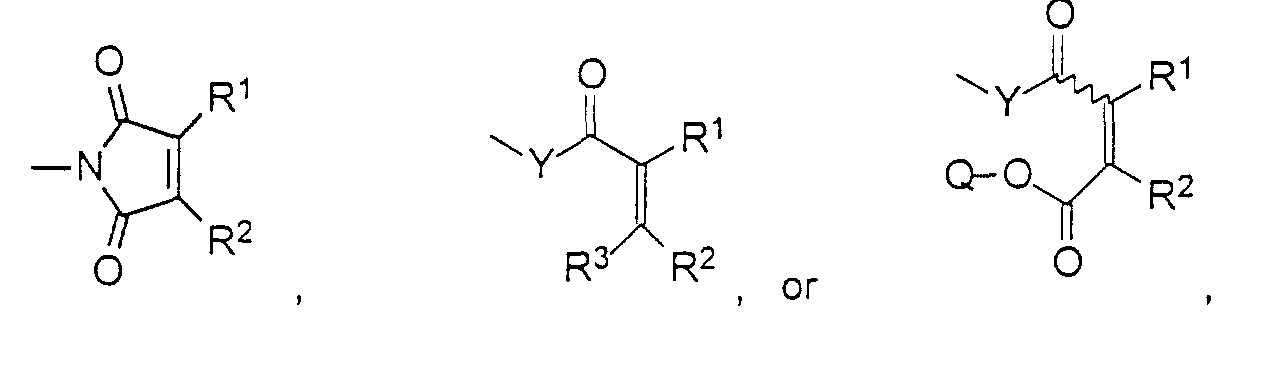
- the electron donor/acceptor compounds of this invention will have one of the structures depicted here:
- the electron donor group is a carbon-carbon double bond that is attached directly to an aromatic ring and conjugated with the unsaturation in the aromatic ring.
- the aromatic ring can be any molecular moiety that meets the classical definition of an aromatic compound, that is it contains cyclic clouds of delocalized ⁇ electrons above and below the plane of the molecule and the ⁇ clouds have a total of (4n + 2) electrons.
- the aromatic ring may also contain electron donating substituents, which will increase the electron density on the carbon to carbon double bond, leading to higher reactivity.
- the reactivity of the electron donor group will also be affected by steric interaction.
- An increase in the number of alkyl substituents on the carbon to carbon double bond will decrease the reactivity.
- all substituents on the carbon to carbon double bond will be hydrogen, or will be hydrogen with a methyl group as the only other substituent.
- Starting materials for Z group moieties are commercially available from a number of sources; for example, aromatic and polyaromatic materials may be obtained from BASF or Bayer; siloxanes and polysiloxanes from Gelest; polyethers from BASF; polyesters from Uniqema or Bayer; poly(butadiene)s from Elf-Atochem; polyurethanes from Bayer or BASF; and the branched or linear alkanes from Uniqema.
- the Z groups may contain cyclic moieties or heteroatoms, and may contain pendant hydroxyl or thiol groups depending on the synthetic route for making the electron donor compound; for example, if one of the starting compounds contains a hydroxyl or thiol functionality that is reacted with an epoxy functionality, the Z group will contain a pendant hydroxyl or thiol group.
- composition or molecular weight of Z is not critical to the invention and can range widely depending on the requirements of the end use for the electron donor compound.
- Z can be a methylene group or a high molecular weight polymeric entity.
- the composition of Z can be chosen to give specific material properties in a final formulation, such as, rheological properties, hydrophilic or hydrophobic properties, toughness, strength, or flexibility. For example, a low level of crosslinking and free rotation about polymeric bonds will impart flexibility to a compound, and the presence of siloxane moieties will impart hydrophobicity and flexibility.
- the molecular weight and chain length will affect viscosity, the higher the molecular weight and the longer the chain length, the higher the viscosity.
- the electron acceptor starting compounds can be fumarates and maleates, acrylates and maleimides.
- Suitable acrylates are numerous and are commercially available, for example, from Sartomer.
- Suitable maleimides are easily prepared, for example, according to procedures described in US patents 6,034,194 and 6,034,195 to Dershem.
- the carboxyl group in the acrylate, maleate and fumarate compounds will be the reactive functionality for linking the electron acceptor to a co-reactive functionality on the Z group.
- the maleimides will contain a separate functionality, as shown in the examples, for reacting with a co-reactive functionality on the Z group.
- Suitable reaction routes can be designed by determining on a specific addition or condensation reaction, then choosing functionalities for the starting electron-donor compound and the starting electron-acceptor compound to participate in that reaction. Although one skilled in the art can devise suitable variations in reactions by choice and location of functionality (whether on the starting electron-donor or starting electron-acceptor compound), it will be understood that the choices may be limited in practice by the commercial availability of starting materials or ease of synthesis routes.
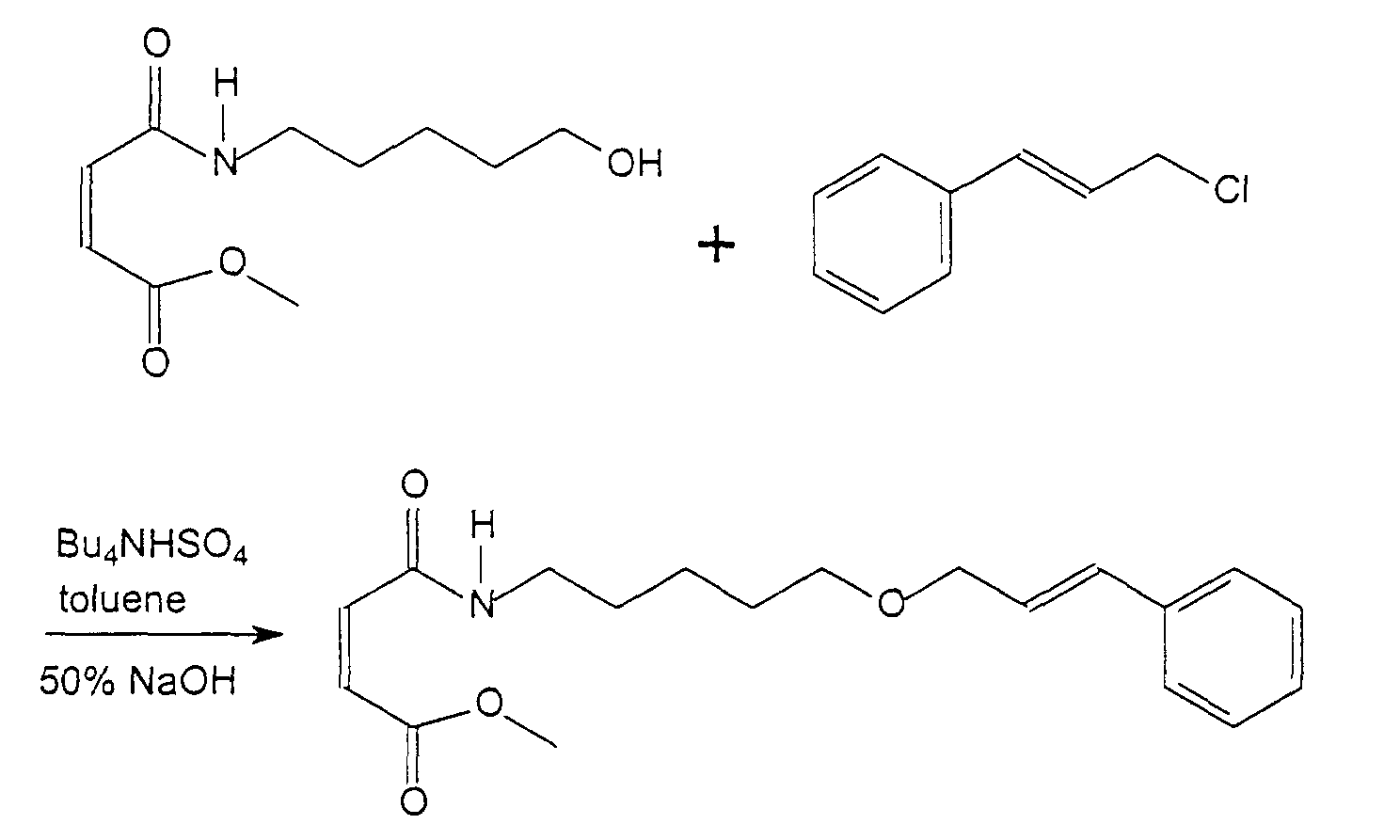
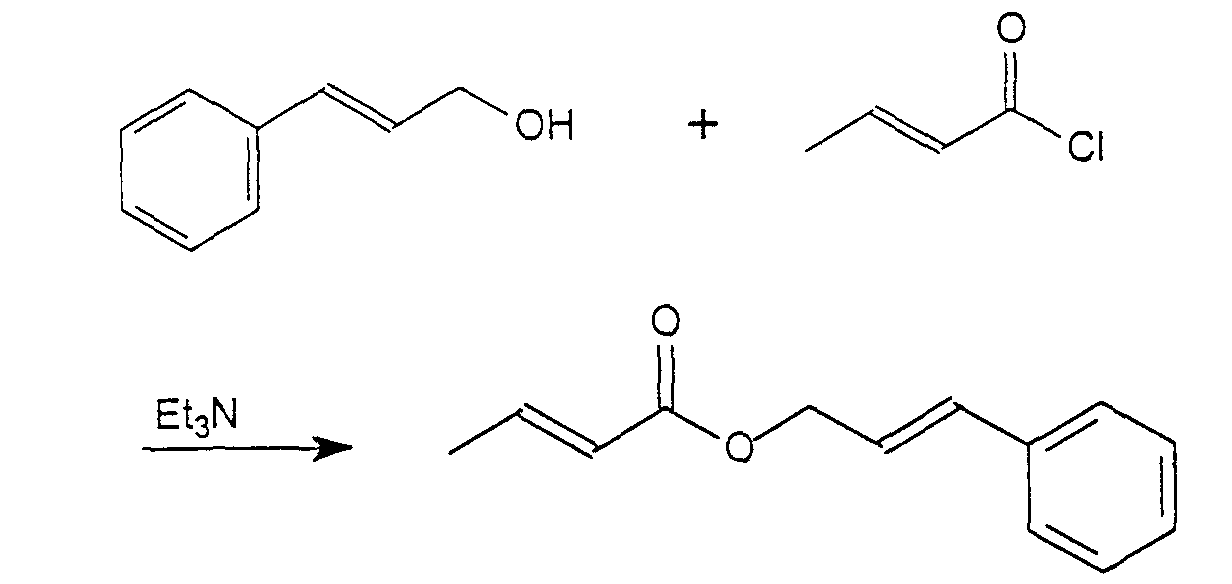
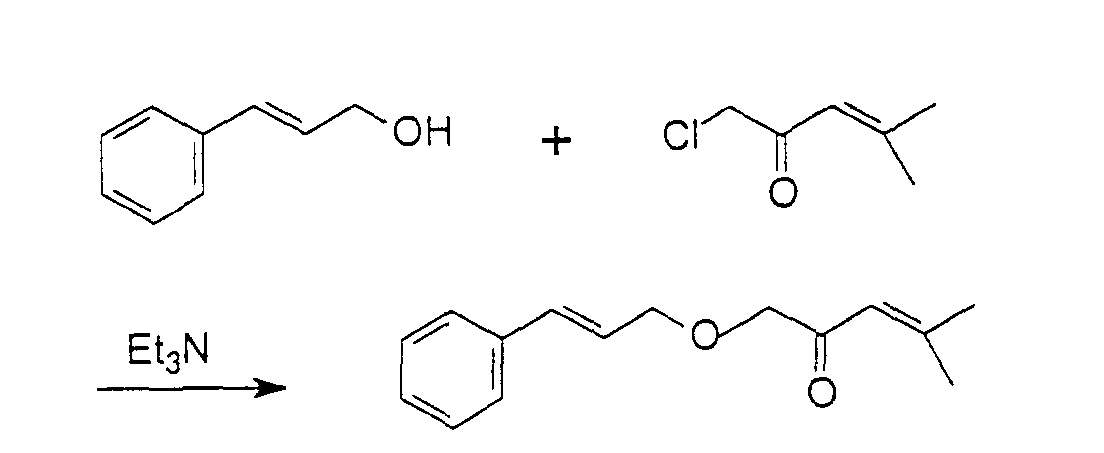
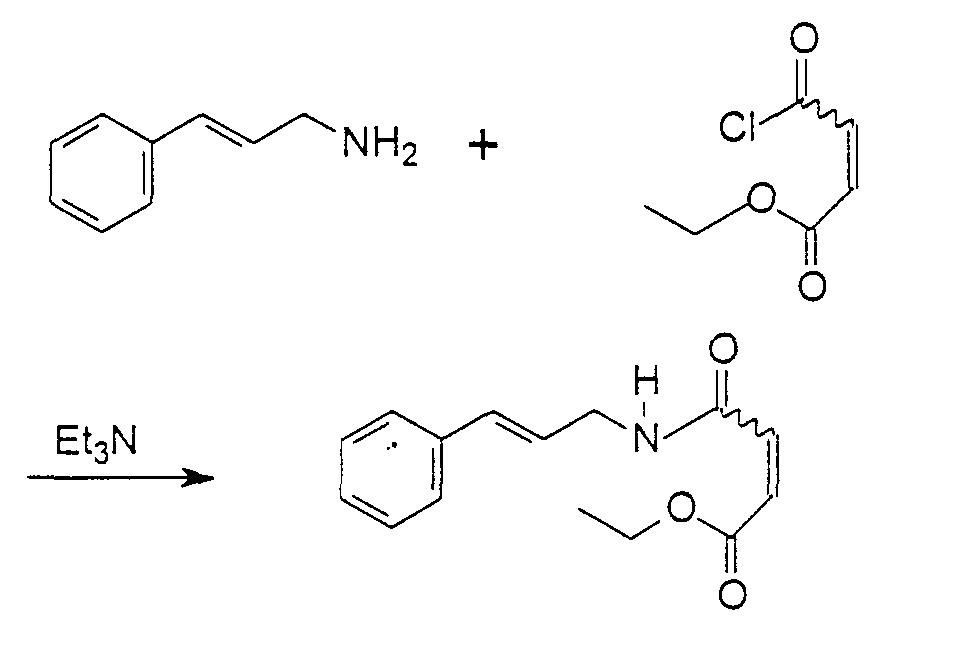
- Representative synthetic routes include:
- the electron donor/acceptor compounds can be formulated into an adhesive, coating, potting or encapsulant composition.
- the formulations will contain one or more curing agents and may contain a conductive or nonconductive filler.
- Exemplary curing agents are thermal initiators and photoinitiators and will be present in an amount of 0.1% to 10%, preferably 0.1% to 3.0%, by weight of the electron donor compound.
- Preferred thermal initiators include peroxides, such as butyl peroctoates and dicumyl peroxide, and azo compounds, such as 2,2'-azobis(2-methyl-propanenitrile) and 2,2'-azobis(2-methyl-butanenitrile).
- a preferred series of photoinitiators is one sold under the trademark Irgacure by Ciba Specialty Chemicals.
- both thermal initiation and photoinitiation may be desirable; for example, the curing process can be started by irradiation, and in a later processing step curing can be completed by the application of heat to accomplish the thermal cure.
- compositions will cure within a temperature range of 70°C to 250°C, and curing will be effected within a range of ten seconds to three hours.
- the time and temperature curing profile of each formulation will vary with the specific electron donor compound and the other components of the formulation, but the parameters of a curing profile can be determined by one skilled in the art knowing the teachings of this specification.
- Suitable conductive fillers are carbon black, graphite, gold, silver, copper, platinum, palladium, nickel, aluminum, silicon carbide, boron nitride, diamond, and alumina.
- Suitable nonconductive fillers are particles of vermiculite, mica, wollastonite, calcium carbonate, titania, sand, glass, fused silica, fumed silica, barium sulfate, and halogenated ethylene polymers, such as tetrafluoroethylene, trifluoroethylene, vinylidene fluoride, vinyl fluoride, vinylidene chloride, and vinyl chloride. When present, fillers will be in amounts of 20% to 90% by weight of the formulation.
- Suitable adhesion promoters or coupling agents are silanes, silicate esters, metal acrylates or methacrylates, titanates, and compounds containing a chelating ligand, such as phosphine, mercaptan, and acetoacetate.
- coupling agents will be in amounts up to 10% by weight, and preferably in amounts of 0.1% to 3.0% percent by weight of the electron donor compounds.
- the formulations may contain compounds that lend additional flexibility and toughness to the resultant cured material.
- Such compounds may be any thermoset or thermoplastic material having a Tg of 150°C or less, and typically will be a polymeric material, such as, a polyacrylate, poly(butadiene), polyTHF (polymerized tetrahydrofuran), carboxy-terminated butyronitrile rubber and polypropylene glycol. When present, these compounds may be in an amount up to about 15% by weight of the electron donor compound.
- the following examples show representative electron donor/acceptor compounds and reactions for their preparation.
- the electron donor/acceptor reaction products were characterized by 1 H-NMR and FT-IR spectroscopies.
- the examples are illustrative of the invention and are not intended as a limitation.
- a solution of one molar equivalent maleic anhydride in acetonitrile is added to one molar equivalent of 6-aminocaprioc acid in acetic acid.
- the mixture is allowed to react for three hours at room temperature until white crystals of the amic acid adduct precipitate from the solution.
- the white crystals are filtered off, washed with cold acetonitrile, and dried.
- the amic acid is mixed with two molar equivalents of triethylamine in toluene.
- the mixture is heated to 130°C for two hours and until water is distilled off.
- the organic solvent is evaporated and 2M HCI is added to reach pH 2.
- the mixture is extracted with ethyl acetate and dried over MgSO 4 .
- the solvent is evaporated to give the 6-maleimidocaproic acid.
- 6-maleimidocaproic acid is reacted with excess thionyl chloride at 50°C for three hours, and then the excess thionyl chloride is distilled off to leave 6-maleimidocaproic chloride.
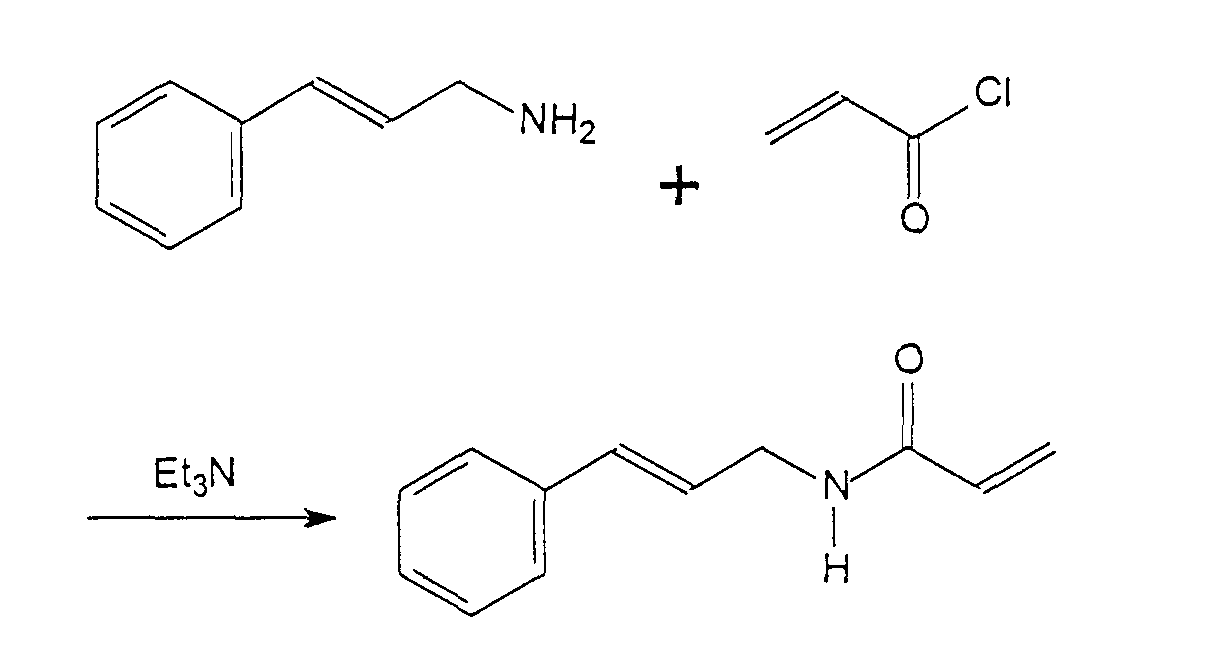
- One molar equivalent of cinnamyl amine and one molar equivalent of triethylamine are mixed in dry methylene chloride at 0°C to which is added one molar equivalent of 6-maleimidocaproic chloride dissolved in dry methylene chloride. The mixture is allowed to react for four hours. The solvent is evaporated and the crude product is purified by column chromatography using a gradient of hexane / ethyl acetate.
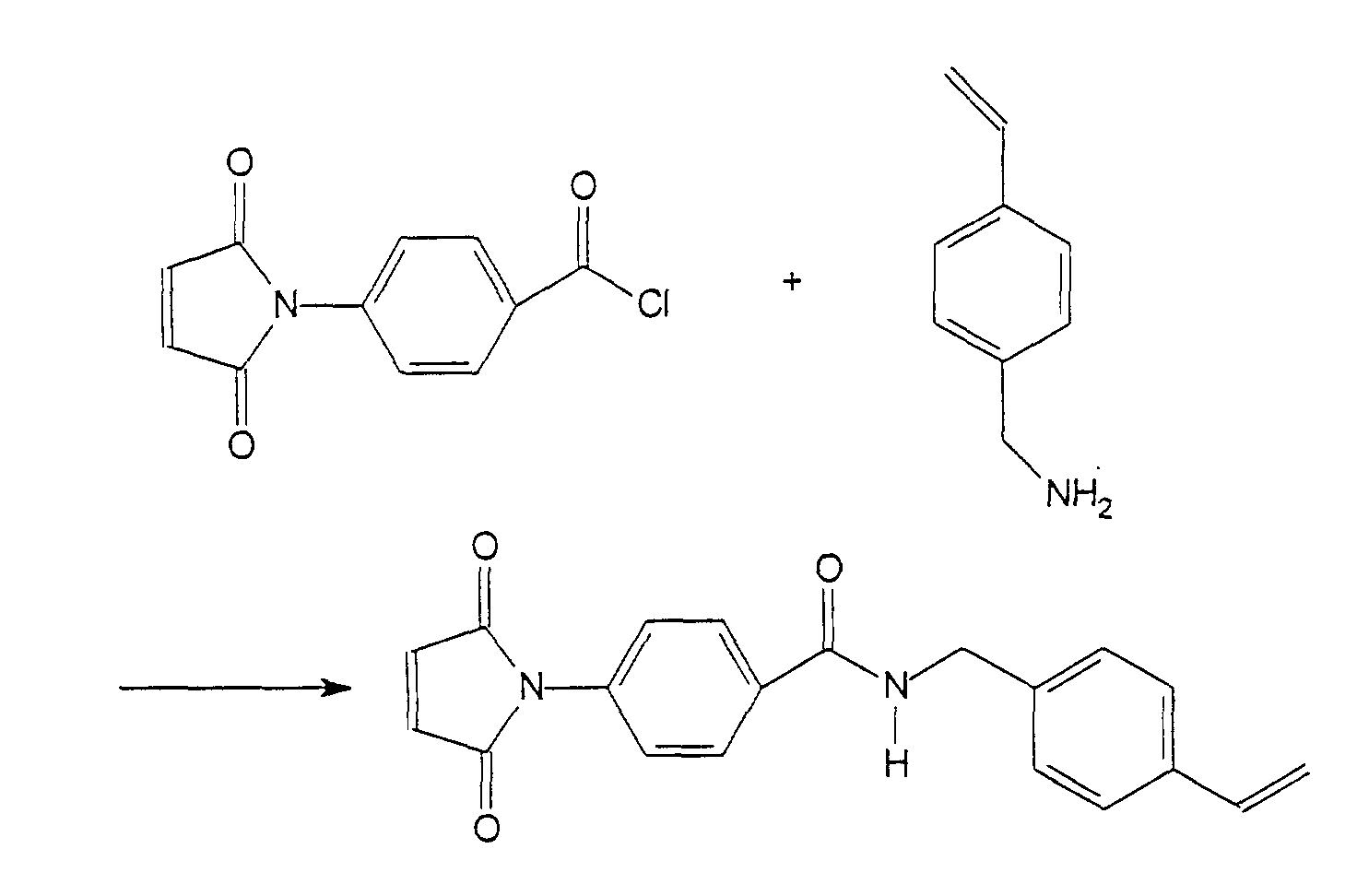
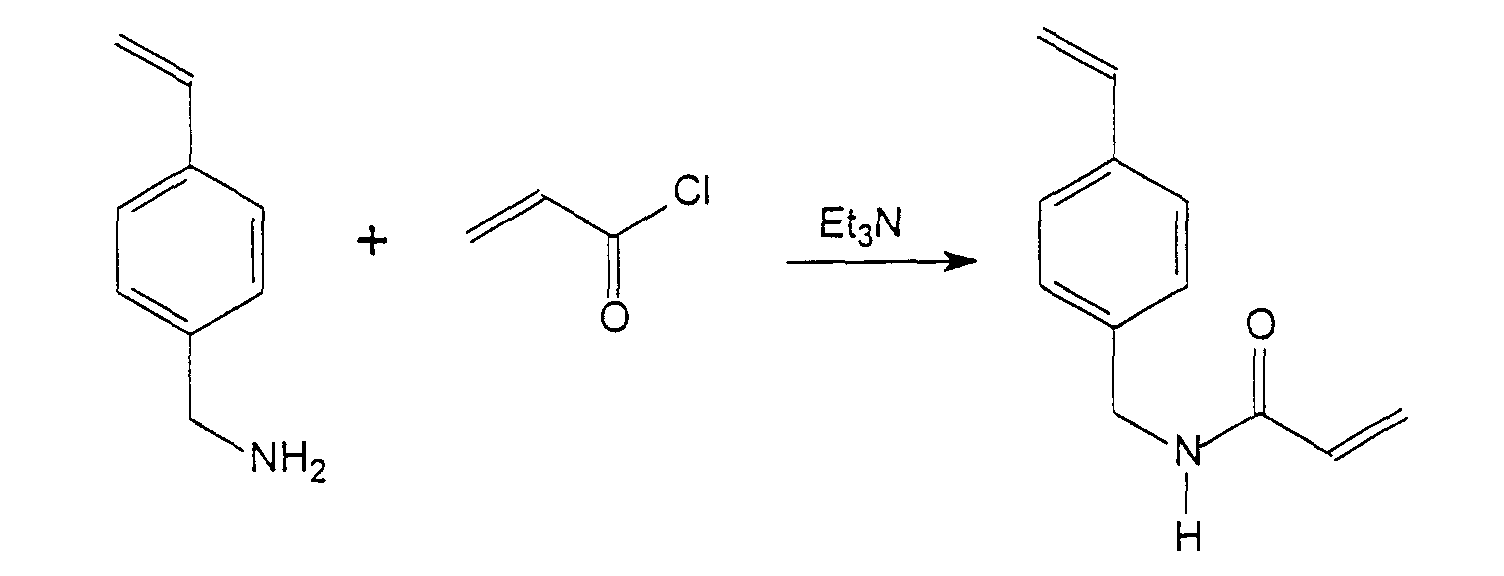
- One molar equivalent of 4-vinyl benzyl amine and one molar equivalent of triethylamine are mixed in dry methylene chloride at 0°C, to which is added one molar equivalent of 6-maleimidocaproic chloride dissolved in dry methylene chloride. The mixture is allowed to react for four hours. The solvent is evaporated and the crude product is purified by column chromatography using a gradient of hexane / ethyl acetate.
- m-TMI 3-isopropenyl- ⁇ , ⁇ -dimethylbenzyl isocyanate
- m-TMI 3-isopropenyl- ⁇ , ⁇ -dimethylbenzyl isocyanate
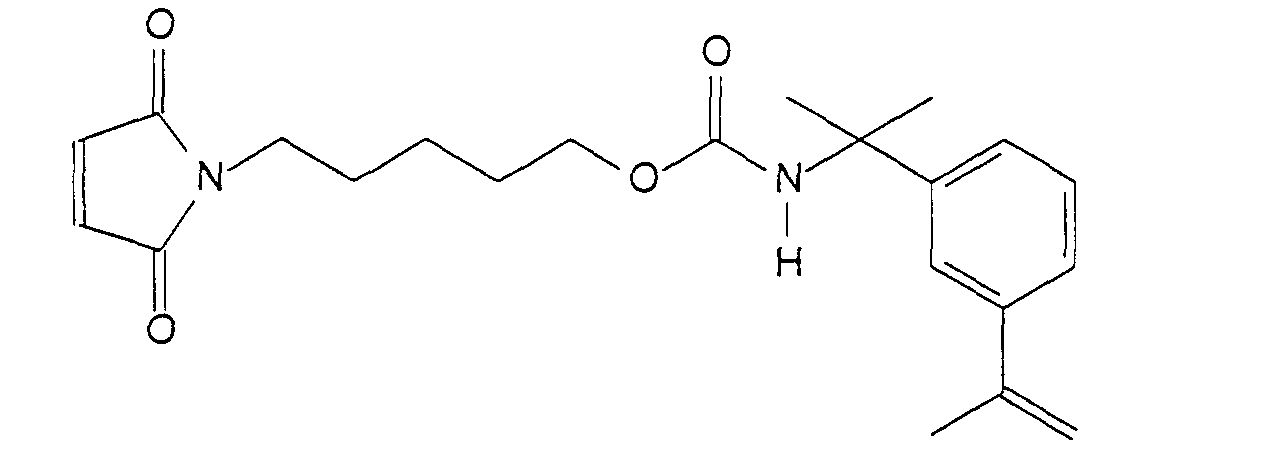
- the reaction is placed under nitrogen, and 0.01 molar molar equivalent dibutyltin dilaurate (catalyst) is added with stirring as the solution is heated to 90°C.
- the addition funnel is charged with one molar equivalent of N-(5-hydroxypentyl) maleimide dissolved in toluene. This solution is added to the isocyanate solution over ten minutes, and the resulting mixture heated for an additional three hours at 90°C.
- the reaction is allowed to cool to room temperature, and then the mixture is washed with distilled water three times.
- the organic layer is isolated and dried over MgSO 4 , filtered, and the solvent removed in vacuo to give the product.
- N,N-dimethylformamide DMF
- maleic anhydride and p-amino benzoic acid are dissolved in N,N-dimethylformamide (DMF), and the mixture stirred at room temperature for five hours under nitrogen atmosphere.
- the resulting solution is poured into a sufficient water to precipitate crude N-(4-carboxyphenyl)maleamic acid. This is filtered, dried, and recrystallized three times from water to obtain pure N-(4-carboxyphenyl) maleamic acid.
- N-(4-carboxyphenyl)maleamic acid A mixture of one molar equivalent N-(4-carboxyphenyl)maleamic acid, acetic anhydride, and sodium acetate is stirred at 60°C for two hours.
- the reaction mixture is poured into a sufficient amount of water to precipitate crude N-(4-carboxyphenyl)maleimide. This is filtered, dried, and recrystallized three times from water to obtain pure N-(4-carboxyphenyl) maleimide.
- One molar equivalent cinnamyl alcohol and one molar equivalent triethylamine are mixed in dry methylene chloride at 0°C to which is added N-(4-(chlorocarbonyl)phenyl)maleimide dissolved in dry methylene chloride. The mixture is allowed to react for four hours. The solvent is evaporated and the crude product is purified by column chromatography using a gradient of hexane / ethyl acetate.
- One molar equivalent of maleimide with isocyanate functionality is solvated in toluene in a three-necked flask equipped with a mechanical stirrer, addition funnel and nitrogen inlet/outlet.
- the reaction is placed under nitrogen, and 0.01 molar molar equivalent dibutyltin dilaurate (catalyst) is added with stirring as the solution is heated to 70°C.
- the addition funnel is charged with one molar equivalent of cinnamyl alcohol dissolved in toluene. This solution is then added to the isocyanate solution over ten minutes, and the resulting mixture heated for an additional three hours at 70°C. After the reaction is allowed to cool to room temperature, the mixture is washed with distilled water three times. The isolated organic layer is then dried over MgSO 4 , filtered and the solvent removed in vacuo to give the product.
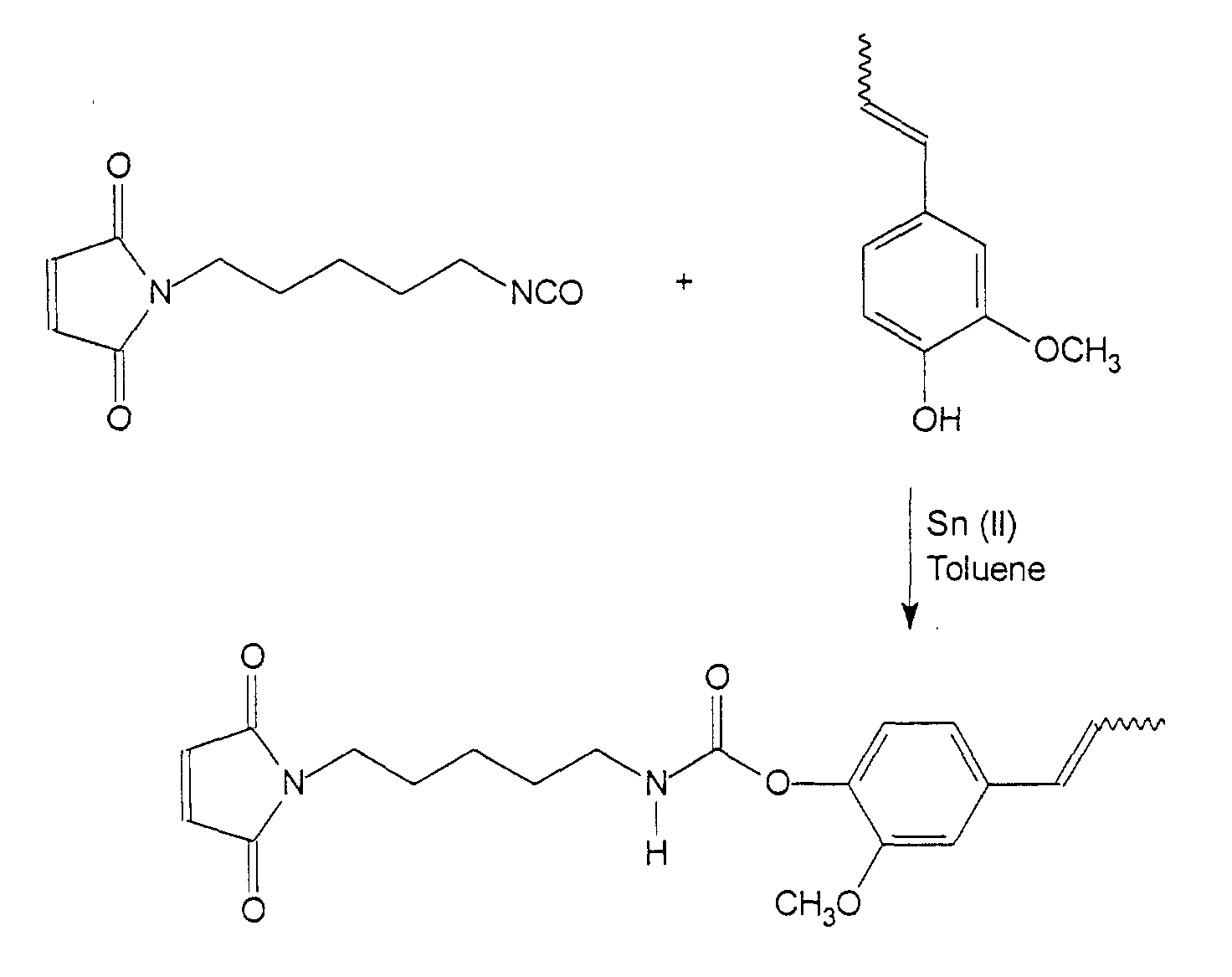
- One molar equivalent of maleimide with isocyanate functionality is solvated in toluene in a three-necked flask equipped with a mechanical stirrer, addition funnel and nitrogen inlet/outlet.
- the reaction is placed under nitrogen, and 0.01 molar molar equivalent dibutyltin dilaurate (catalyst) is added with stirring as the solution is heated to 70°C.
- the addition funnel is charged with one molar equivalent of isoeugenol dissolved in toluene. This solution is then added to the isocyanate solution over ten minutes, and the resulting mixture heated for three hours at 70°C. After the reaction is allowed to cool to room temperature, the mixture is washed with distilled water three times. The isolated organic layer is then dried over MgSO 4 , filtered, and the solvent removed in vacuo to give the product.
- m-TMI 3-isopropenyl- ⁇ , ⁇ -dimethylbenzyl isocyanate
- m-TMI 3-isopropenyl- ⁇ , ⁇ -dimethylbenzyl isocyanate
- the reaction is placed under nitrogen, and 0.01 molar molar equivalent of dibutyltin dilaurate (catalyst) is added with stirring as the solution is heated to 70°C.
- the addition funnel is charged with one molar equivalent of butanediol monoacrylate dissolved in toluene. This solution is added to the isocyanate solution over ten minutes, and the resulting mixture heated for an additional three hours at 70°C. After the reaction is allowed to cool to room temperature, the mixture is washed with distilled water three times. The isolated organic layer is then dried over MgSO 4 , filtered, and the solvent removed in vacuo to give product.
- m-TMI 3-isopropenyl- ⁇ , ⁇ -dimethylbenzyl isocyanate
- m-TMI 3-isopropenyl- ⁇ , ⁇ -dimethylbenzyl isocyanate
- the reaction is placed under nitrogen, and 0.01 molar equivalent of dibutyltin dilaurate (catalyst) is added with stirring as the solution is heated to 70°C.
- Catalyst 0.01 molar equivalent of dibutyltin dilaurate
- a solution of one molar equivalent of hydroxyl amic ester dissolved in toluene is added to the isocyanate solution over ten minutes, and the resulting mixture heated for an additional three hours at 70°C.
- the reaction is allowed to cool to room temperature, the mixture is washed with distilled water three times.
- the isolated organic layer is then dried over MgSO 4 , filtered and the solvent removed in vacuo to give the product.
- TYZOR TOT is a titanium catalyst available from Aldrich.
Landscapes
- Chemical & Material Sciences (AREA)
- Organic Chemistry (AREA)
- Organic Low-Molecular-Weight Compounds And Preparation Thereof (AREA)
- Macromonomer-Based Addition Polymer (AREA)
- Adhesives Or Adhesive Processes (AREA)
- Addition Polymer Or Copolymer, Post-Treatments, Or Chemical Modifications (AREA)
- Nitrogen Condensed Heterocyclic Rings (AREA)
- Pyrrole Compounds (AREA)
Abstract
Description


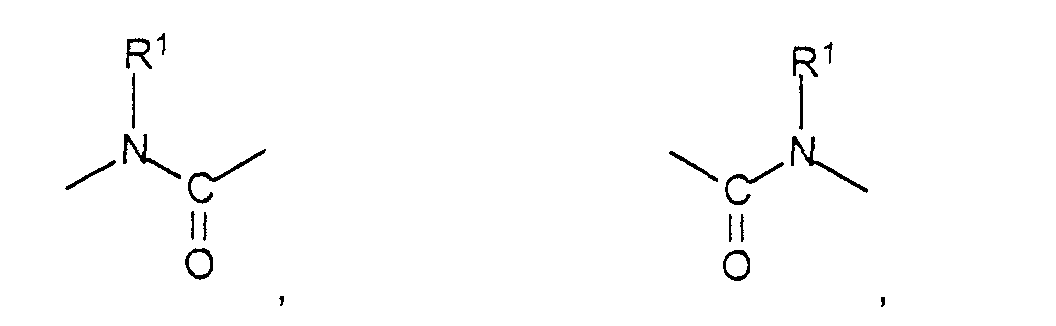
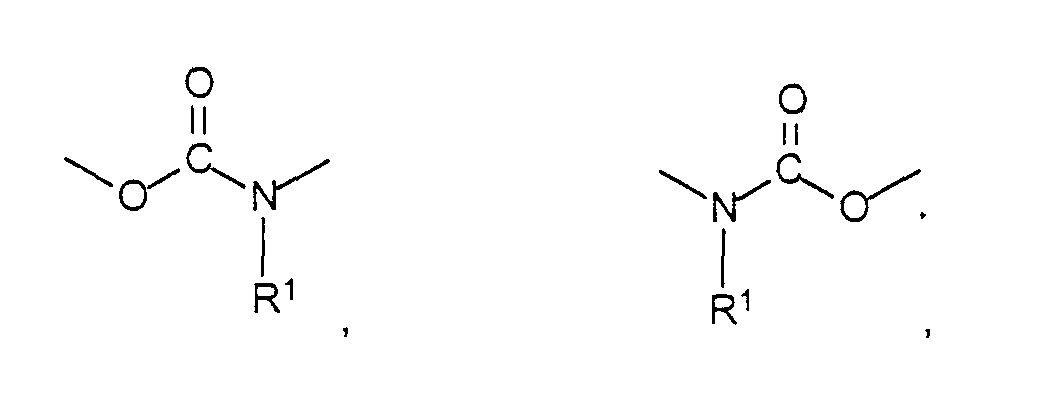

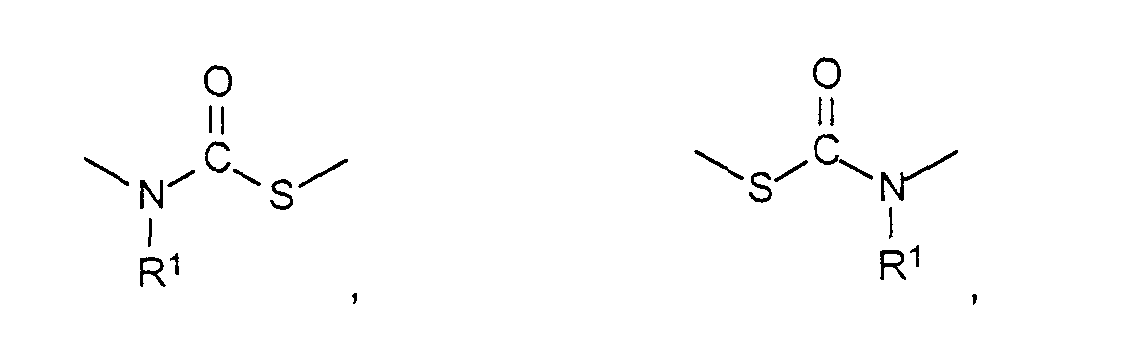


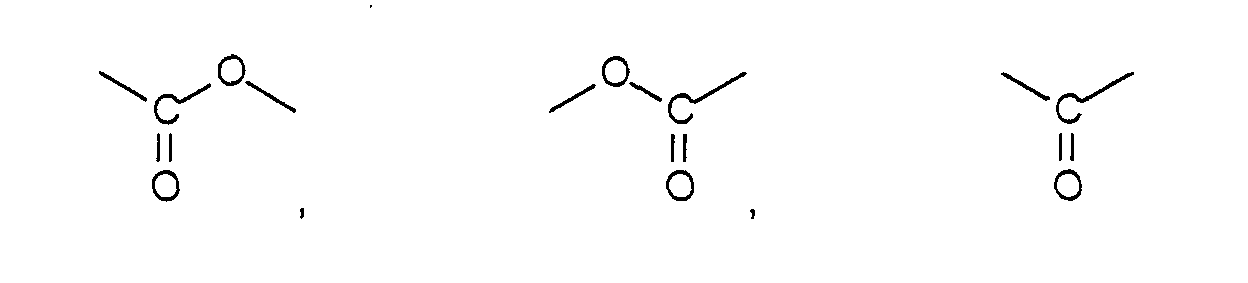











Claims (9)
- A compound having the structurein which
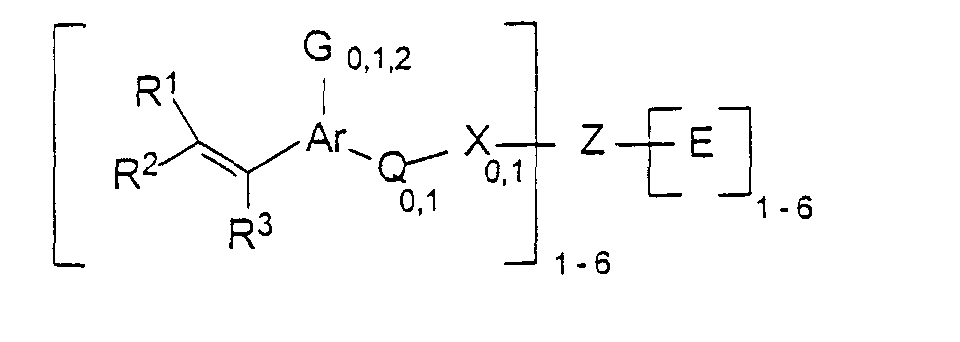 in which Y is O or N(R1) and R1, R2, and R3 and Q are as described above.Ar is an aromatic or heteroaromatic ring or fused ring having 3 to 10 carbon atoms within the ring structure, in which the heteroatoms may be N, O or S;R1, R2 and R3 are independently hydrogen, a branched, cyclic or linear alkyl group having 1 to 12 carbon atoms, or Ar as described above;G is -OR4, -SR4, -N(R1)(R2), Ar as described above, or an alkyl group having 1 to 12 carbon atoms, in which R1 and R2 are as described above, and R4 is Ar as described above or an alkyl group having 1 to 12 carbon atoms;Q is an alkyl group having 1 to 12 carbon atoms;X is :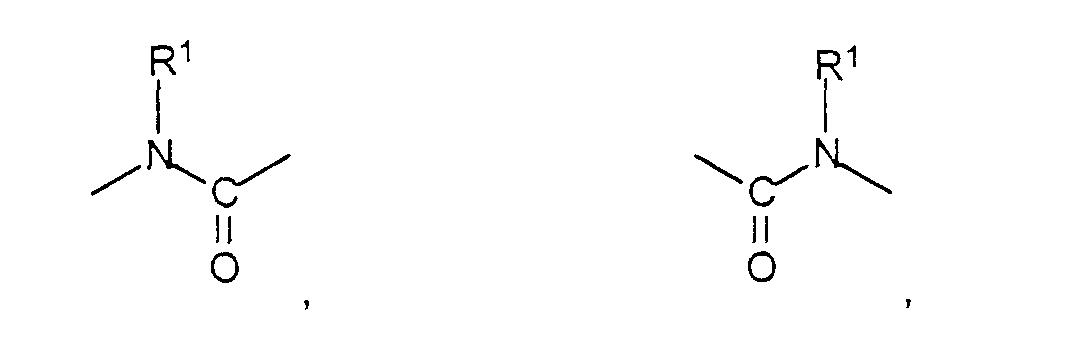


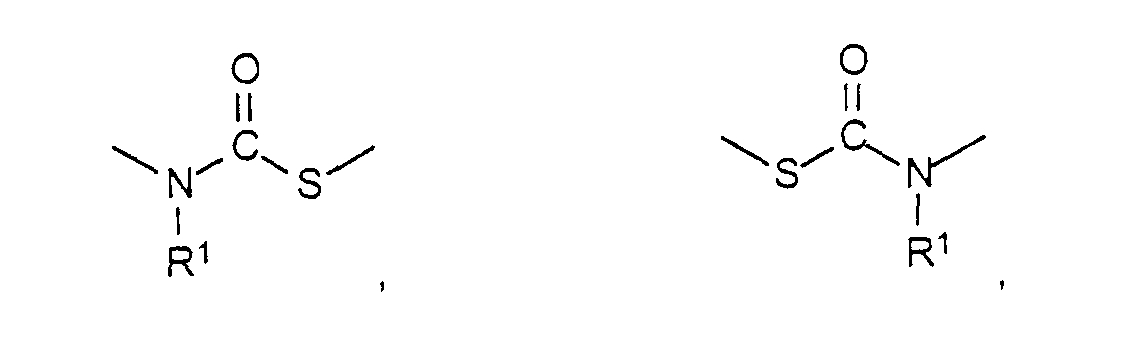

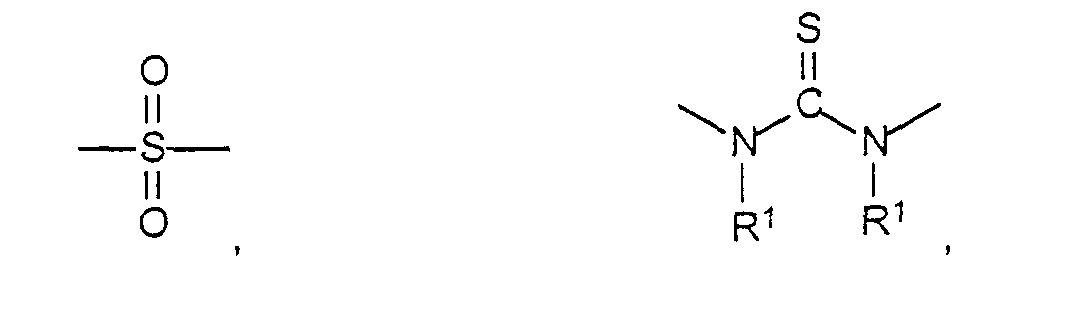

 Z is an alkyl group, a siloxane, a polysiloxane, a C1 to C4 alkoxy-terminated siloxane or polysiloxane, a polyether, a polyester, a polyurethane, a poly(butadiene) or an aromatic, polyaromatic, or heteroaromatic group; andE is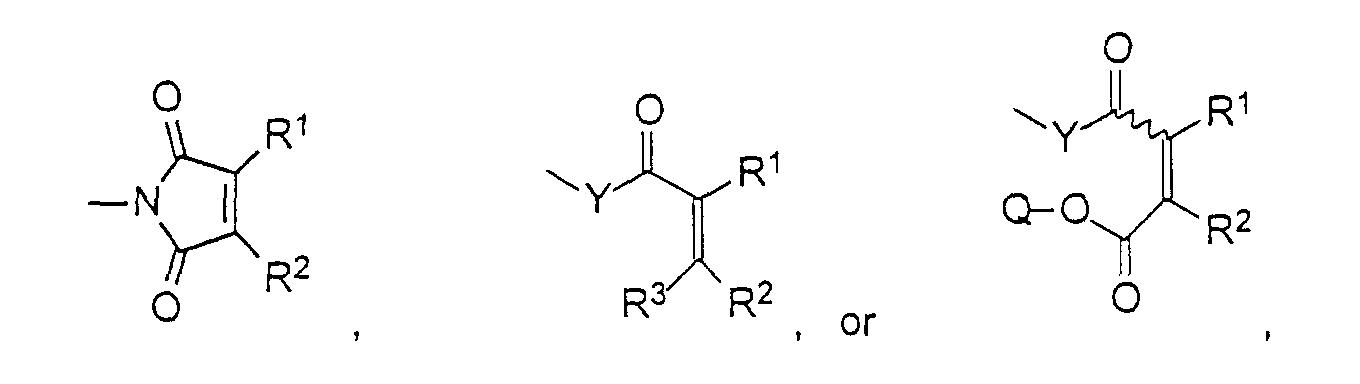
- A compound according to claim 1 selected from the group of compounds:



- A compound having the structurein which
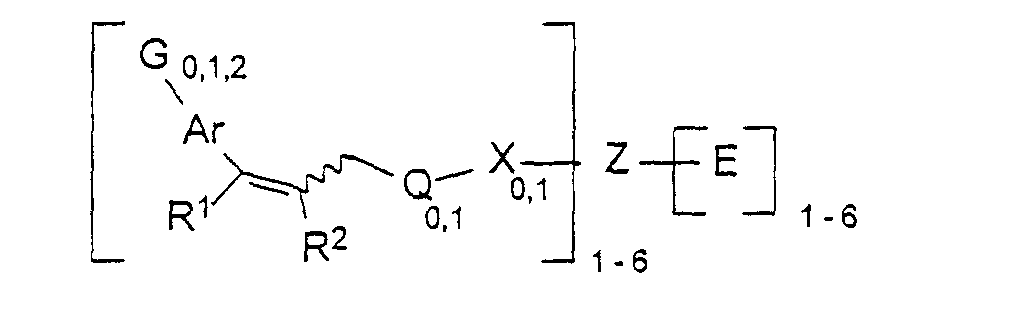 in which Y is O or N(R1) and R1, R2, and R3 and Q are as described above.Ar is an aromatic or heteroaromatic ring or fused ring having 3 to 10 carbon atoms within the ring structure, in which the heteroatoms may be N, O or S;R1, R2 and R3 are independently hydrogen, a branched, cyclic or linear alkyl group having 1 to 12 carbon atoms, or Ar as described above;G is -OR4, -SR4, -N(R1)(R2), Ar as described above, or an alkyl group having 1 to 12 carbon atoms, in which R1 and R2 are as described above, and R4 is Ar as described above or an alkyl group having 1 to 12 carbon atoms;Q is an alkyl group having 1 to 12 carbon atoms;X is :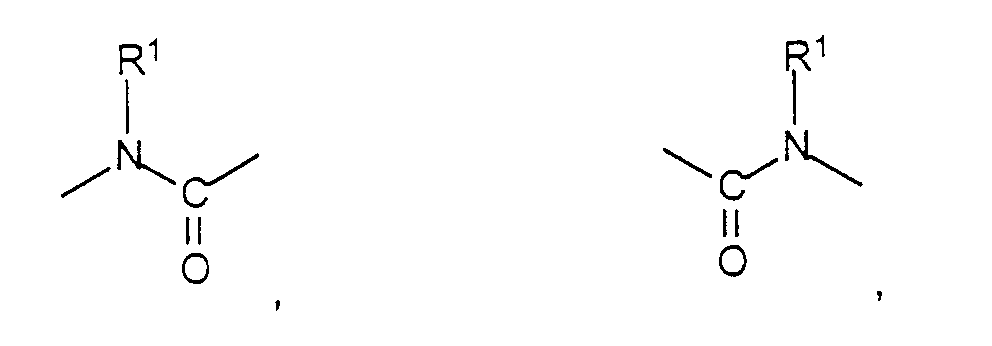
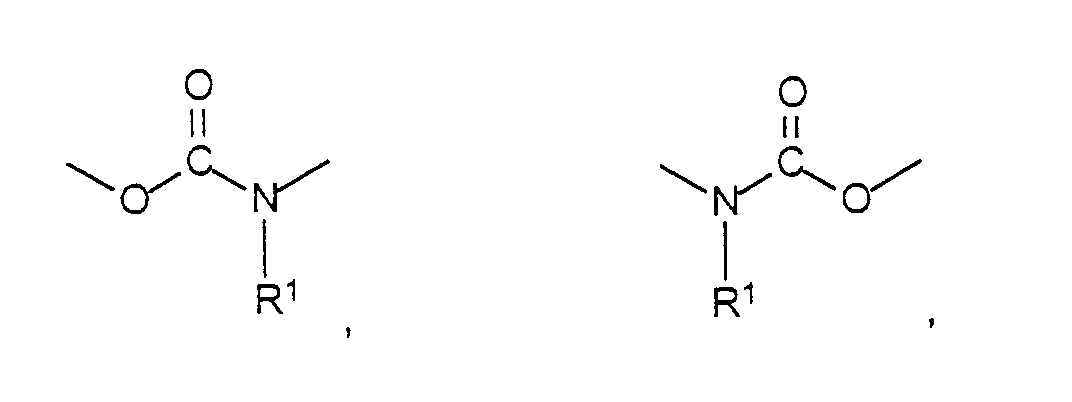
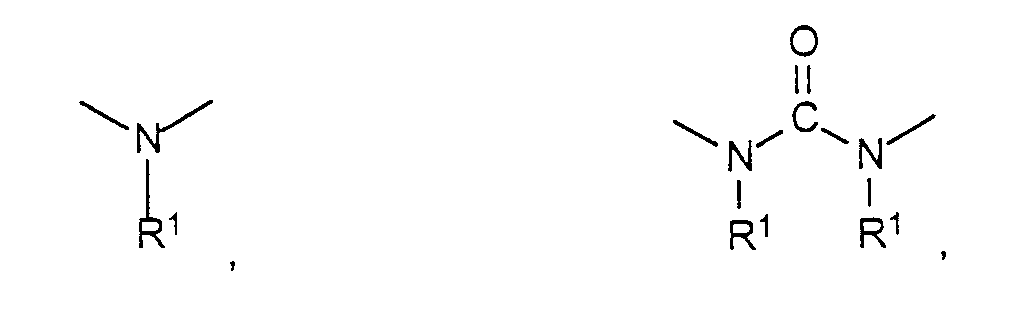
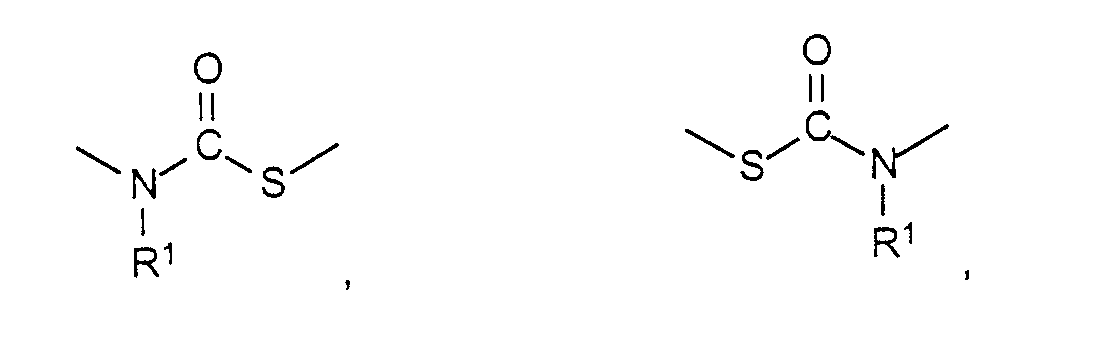


 Z is an alkyl group, a siloxane, a polysiloxane, a C1 to C4 alkoxy-terminated siloxane or polysiloxane, a polyether, a polyester, a polyurethane, a poly(butadiene) or an aromatic, polyaromatic, or heteroaromatic group; andE is
- A compound according to claim 3 selected from the group of compounds:
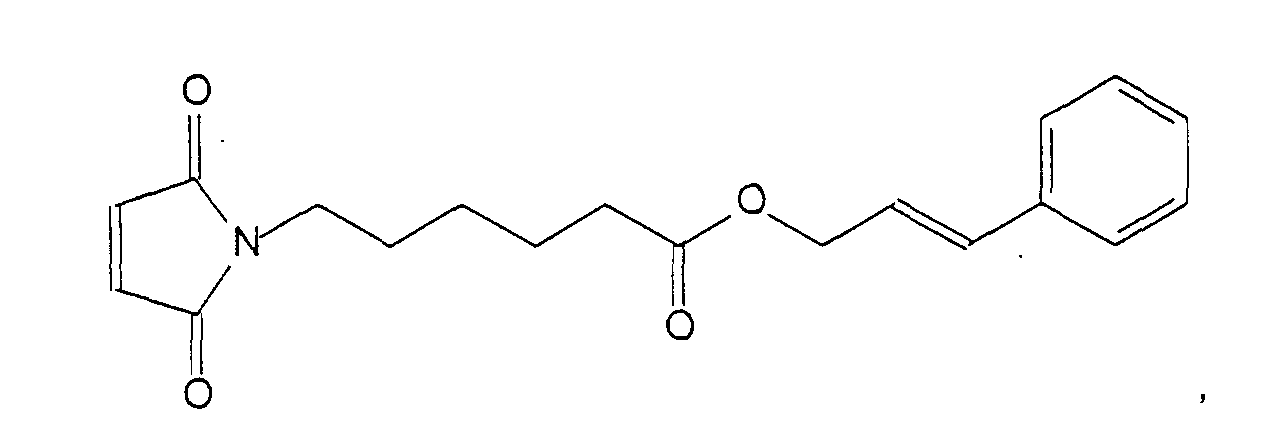

 and
and

- A curable adhesive composition comprising a compound according to any one of claims 1 to 4.
- A curable adhesive composition comprising a compound according to any one of claims 1 to 4 and a thermally conductive filler.
- A curable adhesive composition comprising a compound according to any one of claims 1 to 4 and an electrically conductive filler.
- A curable adhesive composition comprising a compound according to any one of claims 1 to 4 and a nonconductive filler.
- A semiconductor package in which a silicon chip is adhered to a substrate with an adhesive comprising a compound according to any one of claims 1 to 4.
Applications Claiming Priority (2)
| Application Number | Priority Date | Filing Date | Title |
|---|---|---|---|
| US09/573,838 US6300456B1 (en) | 2000-05-18 | 2000-05-18 | Compounds with electron donor and electron acceptor functionality |
| US573838 | 2000-05-18 |
Publications (2)
| Publication Number | Publication Date |
|---|---|
| EP1156036A2 true EP1156036A2 (en) | 2001-11-21 |
| EP1156036A3 EP1156036A3 (en) | 2003-09-10 |
Family
ID=24293593
Family Applications (1)
| Application Number | Title | Priority Date | Filing Date |
|---|---|---|---|
| EP01111275A Withdrawn EP1156036A3 (en) | 2000-05-18 | 2001-05-16 | Compounds with electron donor and electron acceptor functionality |
Country Status (10)
| Country | Link |
|---|---|
| US (1) | US6300456B1 (en) |
| EP (1) | EP1156036A3 (en) |
| JP (1) | JP2002030041A (en) |
| KR (1) | KR100794635B1 (en) |
| CN (1) | CN1190419C (en) |
| CA (1) | CA2347898A1 (en) |
| HK (1) | HK1042492B (en) |
| MY (1) | MY119976A (en) |
| SG (1) | SG104936A1 (en) |
| TW (1) | TW581799B (en) |
Cited By (10)
| Publication number | Priority date | Publication date | Assignee | Title |
|---|---|---|---|---|
| WO2004101550A1 (en) * | 2003-05-06 | 2004-11-25 | National Starch And Chemical Investment Holding Corporation | Oxetane compounds containing maleimide functionality |
| US7928153B2 (en) | 2007-08-14 | 2011-04-19 | Designer Molecules, Inc. | Thermosetting polyether oligomers, compositions and methods for use thereof |
| US8013104B2 (en) | 2008-08-13 | 2011-09-06 | Designer Molecules, Inc. | Thermosetting hyperbranched compositions and methods for use thereof |
| US8039663B2 (en) | 2007-04-09 | 2011-10-18 | Designer Molecules, Inc. | Monomers derived from pentacyclopentadecane dimethanol |
| US8063161B2 (en) | 2007-04-16 | 2011-11-22 | Designer Molecules, Inc. | Low temperature curing acrylate and maleimide based formulations and methods for use thereof |
| US8287686B2 (en) | 2006-07-24 | 2012-10-16 | Designer Molecules, Inc. | Derivatives of poly(styrene-co-allyl alcohol) and methods for use thereof |
| US8344076B2 (en) | 2006-12-19 | 2013-01-01 | Designer Molecules, Inc. | Hydrolytically resistant thermoset monomers |
| US8378017B2 (en) | 2005-12-29 | 2013-02-19 | Designer Molecules, Inc. | Thermosetting adhesive compositions |
| US8530573B2 (en) | 2006-05-10 | 2013-09-10 | Designer Molecules, Inc. | Modified calcium carbonate-filled adhesive compositions and methods for use thereof |
| US9278909B2 (en) | 2003-05-05 | 2016-03-08 | Designer Molecules, Inc. | Amide-extended crosslinking compounds and methods for use thereof |
Families Citing this family (25)
| Publication number | Priority date | Publication date | Assignee | Title |
|---|---|---|---|---|
| EP1278781A4 (en) * | 1999-10-01 | 2005-01-26 | Ballina Pty Ltd | Radiation polymerisable compositions |
| ITMI20012707A1 (en) * | 2001-12-20 | 2003-06-20 | Enichem Spa | PROCESS FOR THE ALKYLATION OF AROMATIC COMPOUNDS |
| US6803406B2 (en) | 2002-03-29 | 2004-10-12 | National Starch And Chemical Investmnet Holding Corporation | Electron donors, electron acceptors and adhesion promoters containing disulfide |
| US6706835B2 (en) * | 2002-07-19 | 2004-03-16 | National Starch And Chemical Investment Holding Corporation | Curable compositions containing thiazole functionality |
| US8513375B2 (en) | 2003-05-05 | 2013-08-20 | Designer Molecules, Inc. | Imide-linked maleimide and polymaleimide compounds |
| JP2007536403A (en) * | 2004-05-02 | 2007-12-13 | アシュランド・ライセンシング・アンド・インテレクチュアル・プロパティー・エルエルシー | Radiation curable coatings for metal substrates from polyfunctional acrylate oligomers |
| US20060258875A1 (en) * | 2005-05-10 | 2006-11-16 | Clementine Reyes | Methods for manufacturing supported nanocatalysts and methods for using supported nanocatalysts |
| US8043534B2 (en) | 2005-10-21 | 2011-10-25 | Designer Molecules, Inc. | Maleimide compositions and methods for use thereof |
| GB0526279D0 (en) * | 2005-12-23 | 2006-02-01 | Givaudan Sa | Improvements in or related to organic compounds |
| US8097229B2 (en) * | 2006-01-17 | 2012-01-17 | Headwaters Technology Innovation, Llc | Methods for manufacturing functionalized inorganic oxides and polymers incorporating same |
| US7632774B2 (en) | 2006-03-30 | 2009-12-15 | Headwaters Technology Innovation, Llc | Method for manufacturing supported nanocatalysts having an acid-functionalized support |
| CA2667714C (en) | 2006-10-27 | 2014-09-09 | Metkinen Chemistry Oy | Carbamoylation of amines, thiophenols, mercaptanes and phenols employing organic azides |
| US8586650B2 (en) * | 2007-09-14 | 2013-11-19 | Henkel US IP LLC | Thermally conductive composition |
| US8324319B2 (en) * | 2007-11-20 | 2012-12-04 | Sridhar Laxmisha M | Redox-induced cationically polymerizable compositions with low cure temperature |
| US8308892B2 (en) | 2008-04-09 | 2012-11-13 | Designer Molecules, Inc. | Di-cinnamyl compounds and methods for use thereof |
| US8158748B2 (en) | 2008-08-13 | 2012-04-17 | Designer Molecules, Inc. | Hetero-functional compounds and methods for use thereof |
| US8217120B2 (en) * | 2008-08-13 | 2012-07-10 | Designer Molecules, Inc. | Functionalized styrene oligomers and polymers |
| US8008419B2 (en) | 2008-08-13 | 2011-08-30 | Designer Molecules, Inc. | Siloxane monomers and methods for use thereof |
| KR20150046995A (en) * | 2013-10-23 | 2015-05-04 | 동우 화인켐 주식회사 | Adhesive composition and complexed polarization plate using the same |
| CN103788076B (en) * | 2014-01-22 | 2015-06-03 | 山西大学 | Reagent and method for detecting cysteine |
| CN110876925B (en) * | 2018-09-05 | 2022-04-12 | 武汉大学 | Mixed-mode chromatographic stationary phase and preparation method and application thereof |
| JP7093150B2 (en) * | 2018-12-06 | 2022-06-29 | 日本化薬株式会社 | Curable resin composition and its cured product |
| EP3992231B1 (en) * | 2019-06-28 | 2025-05-28 | Mitsubishi Gas Chemical Company, Inc. | Use of a film in a pre-applied underfill material |
| KR102407792B1 (en) | 2019-09-05 | 2022-06-10 | 주식회사 엘지화학 | Diol compound, polycarbonate and method for preparing the same |
| AU2020417293A1 (en) | 2020-01-03 | 2022-09-01 | Berg Llc | Polycyclic amides as UBE2K modulators for treating cancer |
Family Cites Families (27)
| Publication number | Priority date | Publication date | Assignee | Title |
|---|---|---|---|---|
| US34A (en) * | 1836-09-29 | Improvement in vertical cylindrical steam-boilers | ||
| US401A (en) * | 1837-09-21 | John bouis | ||
| US883A (en) * | 1838-08-15 | Laura rice adminis | ||
| US4401777A (en) * | 1981-10-20 | 1983-08-30 | Mitsui Toatsu Chemicals, Inc. | Curable resin composition comprising N-(alkenylphenyl)maleimide and epoxy composition |
| US4486582A (en) | 1983-01-27 | 1984-12-04 | The Dow Chemical Company | Reactive monomers and thermosettable compositions containing same |
| US4732956A (en) | 1984-06-18 | 1988-03-22 | Loctite (Ireland) Ltd. | Styryloxy resins and compositions thereof |
| US4543397A (en) | 1984-06-18 | 1985-09-24 | Loctite (Ireland) Ltd. | Styryloxy resins and compositions thereof |
| JPS6064958A (en) * | 1984-06-22 | 1985-04-13 | Mitsui Toatsu Chem Inc | Isopropenylphenylmaleimide derivative |
| US4640849A (en) | 1986-01-31 | 1987-02-03 | Loctite (Ireland) Limited | Meta-bridged styryloxy resins |
| US4751273A (en) | 1986-08-19 | 1988-06-14 | Allied-Signal, Inc. | Vinyl ether terminated urethane resins |
| FR2608600A1 (en) * | 1986-12-17 | 1988-06-24 | Rhone Poulenc Chimie | NOVEL COMPOUNDS BASED ON MALEIMIDES AND NEW THERMOSETTING COMPOSITIONS CONTAINING SAME |
| US4749807A (en) | 1987-02-17 | 1988-06-07 | Allied-Signal Inc. | Vinyl ether terminated ester oligomers |
| US4775732A (en) | 1988-01-11 | 1988-10-04 | Allied-Signal Inc. | Vinyl ether terminated ester and urethane resins from bis(hydroxyalkyl)cycloalkanes |
| US5021487A (en) * | 1988-05-27 | 1991-06-04 | Loctite Corporation | Thermally stabilized acrylic adhesive compositions and novel methacrylated malemide compounds useful therein |
| US5334456A (en) | 1988-08-12 | 1994-08-02 | Stamicarbon B.V. | Free-radical curable compositions |
| AU4432789A (en) | 1988-11-10 | 1990-05-17 | Loctite (Ireland) Limited | Polymerisable styryloxy resins and compositions thereof |
| US5183946A (en) | 1989-02-08 | 1993-02-02 | Isp Investments Inc. | Vinyloxy hydroxyalkylcycloalkane and preparation therefor |
| US5084490A (en) | 1990-12-10 | 1992-01-28 | Loctite (Ireland) Limited | Styryloxy compounds and polymers thereof |
| JPH06273930A (en) * | 1993-03-18 | 1994-09-30 | Hitachi Ltd | Curable resin composition and multilayer printed circuit board using the same and its manufacture |
| WO1994025508A1 (en) | 1993-05-03 | 1994-11-10 | Loctite Corporation | Polymer dispersed liquid crystals in electron-rich alkene-thiol polymers |
| US6034194A (en) | 1994-09-02 | 2000-03-07 | Quantum Materials/Dexter Corporation | Bismaleimide-divinyl adhesive compositions and uses therefor |
| US5539014A (en) | 1994-07-13 | 1996-07-23 | Alliedsignal Inc. | Adhesion promoters for vinyl ether-based coating systems |
| US5514727A (en) | 1994-07-13 | 1996-05-07 | Alliedsignal Inc. | Stabilizers for vinyl ether-based coating systems |
| US5491178A (en) | 1994-07-13 | 1996-02-13 | Alliedsignal Inc. | Hydrogen stabilizers for vinyl ether-based coating systems |
| US5789757A (en) | 1996-09-10 | 1998-08-04 | The Dexter Corporation | Malemide containing formulations and uses therefor |
| US5708129A (en) | 1995-04-28 | 1998-01-13 | Johnson Matthey, Inc. | Die attach adhesive with reduced resin bleed |
| US5633411A (en) | 1995-06-07 | 1997-05-27 | Loctite Corporation | Method for production of allyloxystyrene compounds |
-
2000
- 2000-05-18 US US09/573,838 patent/US6300456B1/en not_active Expired - Lifetime
-
2001
- 2001-05-16 SG SG200102945A patent/SG104936A1/en unknown
- 2001-05-16 CA CA002347898A patent/CA2347898A1/en not_active Abandoned
- 2001-05-16 KR KR1020010026798A patent/KR100794635B1/en not_active Expired - Fee Related
- 2001-05-16 MY MYPI20012302A patent/MY119976A/en unknown
- 2001-05-16 JP JP2001146637A patent/JP2002030041A/en active Pending
- 2001-05-16 EP EP01111275A patent/EP1156036A3/en not_active Withdrawn
- 2001-05-17 CN CNB011195258A patent/CN1190419C/en not_active Expired - Fee Related
- 2001-05-17 TW TW090112026A patent/TW581799B/en not_active IP Right Cessation
-
2002
- 2002-06-05 HK HK02104280.9A patent/HK1042492B/en not_active IP Right Cessation
Cited By (12)
| Publication number | Priority date | Publication date | Assignee | Title |
|---|---|---|---|---|
| US9278909B2 (en) | 2003-05-05 | 2016-03-08 | Designer Molecules, Inc. | Amide-extended crosslinking compounds and methods for use thereof |
| WO2004101550A1 (en) * | 2003-05-06 | 2004-11-25 | National Starch And Chemical Investment Holding Corporation | Oxetane compounds containing maleimide functionality |
| US6982338B2 (en) | 2003-05-06 | 2006-01-03 | National Starch And Chemical Investment Holding Corporation | Oxetane compounds containing maleimide functionality |
| EP1736473A3 (en) * | 2003-05-06 | 2007-01-31 | National Starch and Chemical Investment Holding Corporation | Oxetane compounds containing maleimide functionality |
| US8378017B2 (en) | 2005-12-29 | 2013-02-19 | Designer Molecules, Inc. | Thermosetting adhesive compositions |
| US8530573B2 (en) | 2006-05-10 | 2013-09-10 | Designer Molecules, Inc. | Modified calcium carbonate-filled adhesive compositions and methods for use thereof |
| US8287686B2 (en) | 2006-07-24 | 2012-10-16 | Designer Molecules, Inc. | Derivatives of poly(styrene-co-allyl alcohol) and methods for use thereof |
| US8344076B2 (en) | 2006-12-19 | 2013-01-01 | Designer Molecules, Inc. | Hydrolytically resistant thermoset monomers |
| US8039663B2 (en) | 2007-04-09 | 2011-10-18 | Designer Molecules, Inc. | Monomers derived from pentacyclopentadecane dimethanol |
| US8063161B2 (en) | 2007-04-16 | 2011-11-22 | Designer Molecules, Inc. | Low temperature curing acrylate and maleimide based formulations and methods for use thereof |
| US7928153B2 (en) | 2007-08-14 | 2011-04-19 | Designer Molecules, Inc. | Thermosetting polyether oligomers, compositions and methods for use thereof |
| US8013104B2 (en) | 2008-08-13 | 2011-09-06 | Designer Molecules, Inc. | Thermosetting hyperbranched compositions and methods for use thereof |
Also Published As
| Publication number | Publication date |
|---|---|
| HK1042492A1 (en) | 2002-08-16 |
| CN1190419C (en) | 2005-02-23 |
| JP2002030041A (en) | 2002-01-29 |
| HK1042492B (en) | 2005-10-07 |
| SG104936A1 (en) | 2004-07-30 |
| MY119976A (en) | 2005-08-30 |
| EP1156036A3 (en) | 2003-09-10 |
| TW581799B (en) | 2004-04-01 |
| KR100794635B1 (en) | 2008-01-14 |
| KR20010105229A (en) | 2001-11-28 |
| CA2347898A1 (en) | 2001-11-18 |
| CN1325847A (en) | 2001-12-12 |
| US6300456B1 (en) | 2001-10-09 |
Similar Documents
| Publication | Publication Date | Title |
|---|---|---|
| US6300456B1 (en) | Compounds with electron donor and electron acceptor functionality | |
| JP4870738B2 (en) | Curable electron donor compound | |
| US6441213B1 (en) | Adhesion promoters containing silane, carbamate or urea, and donor or acceptor functionality | |
| US6265530B1 (en) | Die attach adhesives for use in microelectronic devices | |
| US6803406B2 (en) | Electron donors, electron acceptors and adhesion promoters containing disulfide | |
| JP2002020721A (en) | Die adhesive for use in microelectronic devices | |
| US6307001B1 (en) | Curable hybrid electron donor compounds containing vinyl ether | |
| JP2004131698A (en) | Curable composition having thiazole functionality | |
| US7456280B2 (en) | Maleimide resin with cyanurate core | |
| KR20040069402A (en) | Compounds containing vinyl silane and electron donor or acceptor functionality |
Legal Events
| Date | Code | Title | Description |
|---|---|---|---|
| PUAI | Public reference made under article 153(3) epc to a published international application that has entered the european phase |
Free format text: ORIGINAL CODE: 0009012 |
|
| AK | Designated contracting states |
Kind code of ref document: A2 Designated state(s): AT BE CH CY DE DK ES FI FR GB GR IE IT LI LU MC NL PT SE TR |
|
| AX | Request for extension of the european patent |
Free format text: AL;LT;LV;MK;RO;SI |
|
| PUAL | Search report despatched |
Free format text: ORIGINAL CODE: 0009013 |
|
| AK | Designated contracting states |
Kind code of ref document: A3 Designated state(s): AT BE CH CY DE DK ES FI FR GB GR IE IT LI LU MC NL PT SE TR |
|
| AX | Request for extension of the european patent |
Extension state: AL LT LV MK RO SI |
|
| 17P | Request for examination filed |
Effective date: 20031212 |
|
| AKX | Designation fees paid |
Designated state(s): DE FI FR GB IT NL |
|
| 17Q | First examination report despatched |
Effective date: 20060809 |
|
| STAA | Information on the status of an ep patent application or granted ep patent |
Free format text: STATUS: THE APPLICATION IS DEEMED TO BE WITHDRAWN |
|
| 18D | Application deemed to be withdrawn |
Effective date: 20100820 |